All posts in “Lamborghini”

Here are all the ways the Lamborghini Countach is incredibly flawed (and why we love it anyway)

Share

  • Pinterest

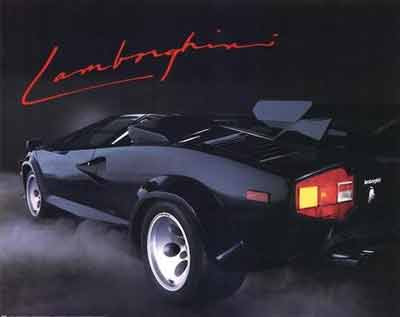
You probably had a picture of a Lamborghini Countach on your wall, your garage or your computer’s desktop wallpaper. The later versions of Lambo’s ultimate poster car got quintessentially ‘80s with a massive wing and enough aero add-ons to look like a salad shooter. What we don’t often see is what makes this Lambo incredibly weird, like a hidden fuel filler in one of the air ducts on the passenger side. 

Doug DeMuro hops behind the wheel of the 25th anniversary edition Countach to show off the 455 hp V12’s grunt, but also to show off the strange features that you won’t see on a poster. The Countach has everything from an interior designed by a right angle square fanatic and the ultimate ‘80s accessory: a portable vanity mirror. The Countach also has massive rear 335 cross-section rubber wrapping tiny 15-inch wheels. 

Finally Lamborghini gets a Concours

Finally, Lamborghini gets a concours!

In a year that sees many, many celebrations of Ferrari’s 70th anniversary, Lamborghini held a celebration of its own. The other great Italian supercar maker may only be 54 years old, but …

If you thought backing up the Lamborghini Countach was impossible — you’d be right. According to DeMuro, the suggested method is to throw it in reverse, pop the door open and look over the car’s roof while slipping the clutch.

Want to see more of the Lambo’s quirks? Watch the video above. 

Finally, Lamborghini gets a concours!

Share

  • Pinterest

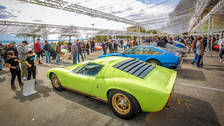
In a year that sees many, many celebrations of Ferrari’s 70th anniversary, Lamborghini held a celebration of its own. The other great Italian supercar maker may only be 54 years old, but that doesn’t mean it doesn’t have a heritage, with a long line of classics to park on a lawn somewhere and enjoy. The event was called “Lamborghini & Design Concours d’Elegance,” and it was held in the froufrou Swiss berg of Neuchatel, where they speak French, not Italian. But no matter: The language of the supercar is universal.

Fifty cars, from the original 350GTV to modern missiles, lined the square at the Place du Port on Neuchatel’s waterfront, a lovely location for a splendid concours. Attendees could see Lambors-ghini that are rare sights outside of, well, just about anywhere: the 400GT, Islero, Espada, Urraco and Jalpa, all cars that kept the nameplate in business until the Miura and all-conquering Countach set the stage for what became the modern Lamborghini.


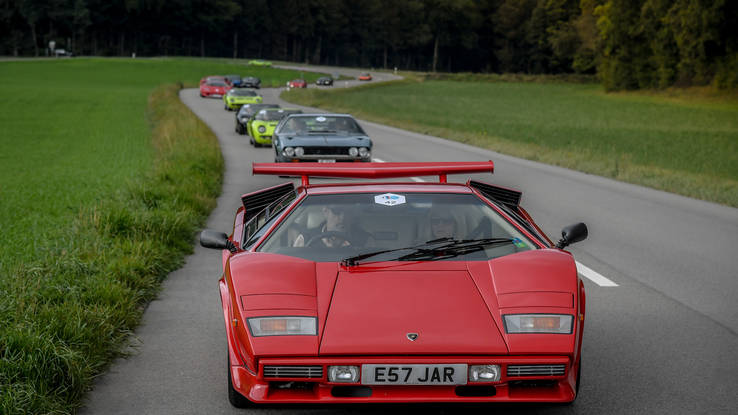
Officially, the show was dedicated to Swiss architect Charles-Eduard Jeanneret-Gris, aka Le Corbusier. Part of the honoring was to route the Tour du Charme et Design, the rally that took place the day before, to La Maison Blanche, the house Jeanneret-Gris built for his parents in nearby La Chaux-de-Fonds. In addition to his work on things non-mobile, Jeanneret-Gris is a lifelong car enthusiast who even designed his own car: Voiture Minimum, a concept that was displayed at Neuchatel during the concours.

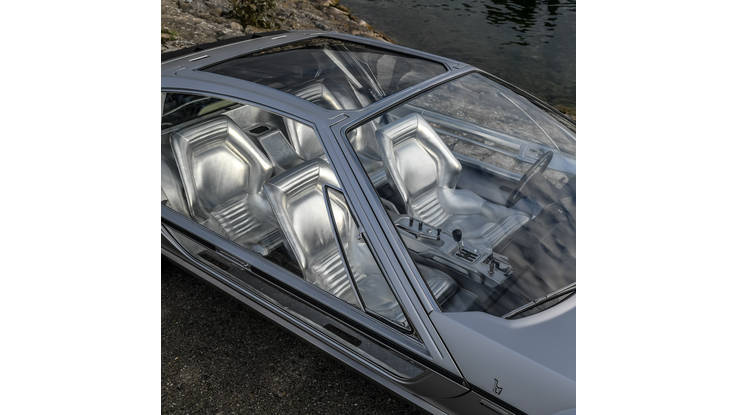
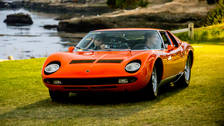
Seeing Miuras, Countaches, and LM 002s parading through the cobblestoned Swiss streets would have been enough. But this being a concours, there was judging and there were winners. Best in Show went to the Miura SV of Japanese collector Ezio Tomita, a fitting honor for a beautiful car. But just as Spinal Tap’s amp went to 11, there was an award one higher than Best of Show: Best of the Best, and that went to the wild 1967 Lamborghini concept car the Marzal. The spacious, openish but glass-enclosed Marzal was penned by the then-younger Marcello Gandini in 1967 and shown at Geneva that year. It was also introduced to car-guy Prince Ranier and Princess Grace at the Grand Prix of Monaco. Not a bad way to launch a concept. Even the CEO agrees:

“This concours is a combination of passion and culture, reflecting a Lamborghini that looks ahead to the future, yet combining the desire to be innovative with an appreciation of its legendary past,” said Stefano Domenicali, chairman and CEO of Automobili Lamborghini, who went on to plug the current model lineup. “The results of this approach are plain to see in our most recent successes with the Aventador and Huracán models. In 2018, the Super SUV Urus will be added to the range, turning the great intuition of the LM 002 into reality, the car that ‘invented’ the concept of today’s high-performance SUVs.”

Marzal concept car

The rarely seen Marzal concept car was penned in The Space Age by Marcello Gandini

The whole show was organized by Lamborghini Polo Storico, the division of the carmaker that does restoration and certification of classic Lamborghinis. Polo Storico handles cars that are out of production for at least 10 years (from the Lamborghini 350 GT to the Diablo), in addition to preserving archives and records and handling the supply of original spare parts for classic cars. To them, we say, “grazie mille!”

Born to be mild: Grandpa’s Lamborghini Aventador?

Share

  • Pinterest

When you think of the Lamborghini Aventador, you probably think of an orange or highlighter-green supercar that sticks out of boring traffic like a sore thumb. You know — a car that works at drawing every eye as it rolls around the boulevard. However, that apparently isn’t always the case. 

Keen-eyed Reddit user therealkameroonie spotted this grampa-spec baby-blue Aventador while he was running around. Going against the supercar norms, this Aventador is parked in one parking space, among other cars and appears to sport the simple Azzuro Thetys metallic paint — no bright orange, green or insane wrap.

It might not be how we’d order a Lambo for the office, but a modest Aventador might be the rarest supercar of them all. 

Lamborghini prototype’s exhaust suggests Aventador Performante is in the works

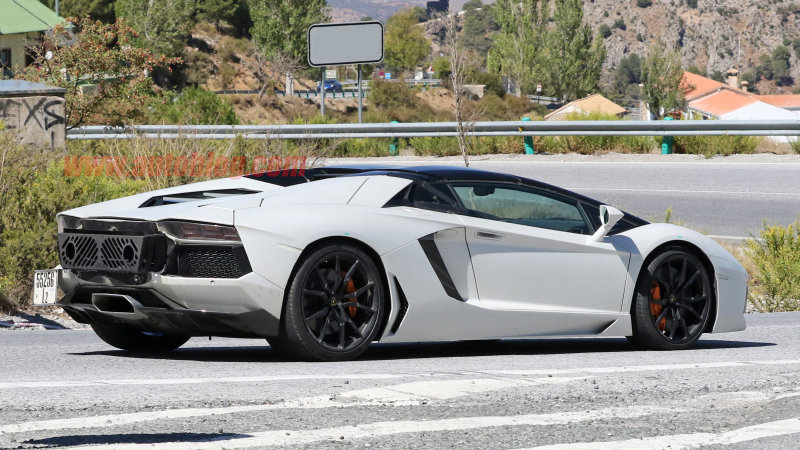
Lamborghini made waves with the introduction of its Huracán Performante, and more specifically, its stunning Nürburgring lap time that challenged million-dollar hypercars. Now, based on these new spy shots, it seems Lamborghini will build upon the success of the Huracán with a Performante version of the bigger, more powerful Aventador. Although the early roadster and later coupe look stock, they feature an exhaust that gives away what’s under the skin.

At the back, we can see the standard center-exit exhaust used on every normal Aventador, and even the previous top-tier Aventador, the SV. But above that is a strange metal box with slats and a pair of circles cut out. This box appears to hide the car’s real exhaust. And if that’s the case, they’re positioned in the very same location as on the smaller Huracán Performante.

Using the Huracán Performante as a model, we expect the Aventador version will make more horsepower than the regular Aventador S. The Huracán Performante made 28 more horsepower than the standard all-wheel-drive version, so we wouldn’t be surprised to see just as much of an increase for the Aventador, which would put it at about 770 horsepower. The Aventador Performante will also likely use the Huracán’s fancy active aerodynamics that can adjust downforce on the left and right sides independently in corners, and naturally there will be a giant wing at the back.

Another interesting thing to note about these prototypes is the use of both a coupe and a roadster. We’ve seen a nearly production-ready Huracán Performante Spyder out testing, so it wouldn’t be out of the question for Lamborghini to do the same for the Aventador. But it’s surprising to see Lamborghini testing one this early when we only ever saw Huracán prototypes in coupe guise ahead of the coupe’s full reveal.

Related Video:

Check out the Battle Car versions of your favorite supercars

Share

  • Pinterest

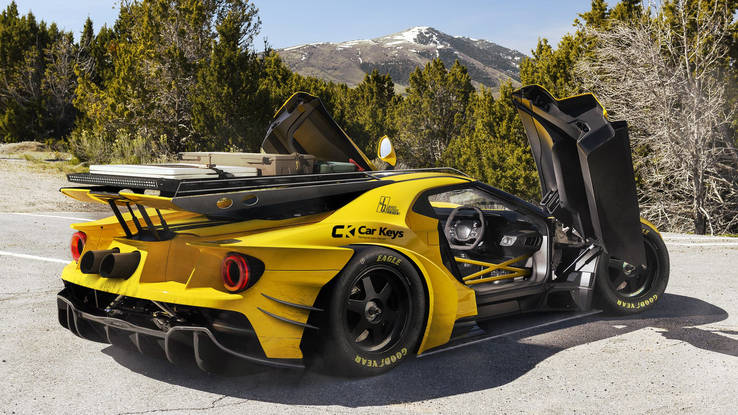
Did you need some inspiration for your freshly purchased Bugatti Chiron? Maybe you want something more out of your Ford GT. Whatever your wild ideas might be, they’re probably tame compared to what Car Keys has done with this set of Battle Cars.

If you’re not familiar with Battle Cars, they’re cars that have been converted for off-road and battle use. Reddit has an extensive page dedicated to them, but these ones are dreamed-up supercar versions created with Photoshop. Here are four wild-looking creations: the Bugatti Chiron, Ford GT, Lamborghini Veneno and Pagani Huayra.

Ford GT image

This Ford GT gets gullwing doors and a heavily modified body to make it a Battle Car. Photo by Car Keys

All of these look stunning and mean enough to scare most of their opponents away before even going to battle. The massive off-road tires on the Chiron and Huayra could throw the balance off in cornering, but hey, who cares if your supercar can shred up a rally stage better than a WRC car? It’s hard to make the Veneno look any more menacing than it already does, but a few modifications later and it’s bullish as can be.

Check the fantasy machines and their creators out here. We know we’d love to see somebody do this for real. Off-roading a Bugatti is something one can only dream about.

Zac Palmer

Zac Palmer – Editorial Intern Zac Palmer has probably spent more time in a car than any other 21-year old in the country. He likes anything that can go around a corner, and is surely talking about a car wherever he might be.
See more by this author»

Watch Lamborghini legend Valentino Balboni reunite with the Countach

Share

  • Pinterest

The name Valentino Balboni might not ring any bells unless you’re a die-hard Lamborghini fan. Balboni was the chief test driver for Lamborghini for years, after getting his start as a mechanic’s apprentice, and the video above has Balboni explaining that he got a chance to become a test driver after getting caught driving cars around the Lamborghini workshop instead of pushing them into their spots. 
After a year of training, Balboni got hired on as a test driver at the tail end of the Lamborghini Miura program. That means when the Lamborghini Countach rolled out of the factory doors, Balboni was one of the first to test the car. 

If you were into cars in the 1980s, it’s likely that you had one of these in your garage — or, like most of us, on your bedroom wall.

Want to watch two Lamborghini legends get back together? Check out the video above.

Rambo Lambo: Lamborghini’s first SUV, the LM002, still blows minds

Share

  • Pinterest

In 1986, long before the Lamborghini Urus SUV was even a thought, the Italian supercar maker created an ostentatious, V12-powered, off-roading display of ’80s excess and called it LM002. True to its appearance, the LM started life as a mid-engined military prototype called  “Cheetah.”

After various contracts fell through, Lamborghini decided to retool its military-spec ground warrior into what was arguably the first luxury high-performance SUV. The designers moved the engine from the back to the front, then ousted the Cheetah’s Chrysler V8 in favor of the 5.2L V12 used in the Countach. This gave the LM002 444 hp and a top speed of just over 130 mph — amazing for the time and impressive even now, considering the bricklike aerodynamics.

Lamborghini Miura

The LM002 was also available with a 7.2-liter V12 Lamborghini marine engine for customers who loved horsepower and had an ample supply of cheap gasoline — just the thing for oil barons and sheiks to thrash around the desert.

From 1986 to 1992, Lamborghini made just over 300 LM002s for customers ranging from the Hollywood elite to political figures like the Sultan of Brunei and Uday Hussein. Today’s luxury super SUVs like the Bentley Bentayga and Mercedes-Benz G65 AMG are significantly faster and perform better than the LM002 of decades’ past. But for presence? Nothing tops a Rambo Lambo. 

By Alex Hevesy

Fire takes out a Lamborghini Countach — but it could have been worse

Share

  • Pinterest

Add another mark to the Italian supercar fire tally: a Lamborghini Countach succumbed to burn wounds near San Francisco this past week, KRON4 reports.

From the limited videography of the actual burning, it’s difficult to tell whether this is a real Countach or kit car. The cause of the fire is unconfirmed as well, but those on the scene report the car’s engine was running while the driver was refueling it. 

As the flames melted what we’ll assume was a valuable Countach at the Chevron station, firefighters arrived and thankfully prevented any surrounding buildings or objects (such as gas pumps) from catching on fire. No injuries were reported from the blaze either, but we’re sure the owner is still feeling the pain of losing a piece of Lamborghini history.

Countach values have risen as of late, so seeing a real example die a red, fiery death is hard to watch. It’s not as though we don’t see other Italian exotics practice immolation, but we hope this guy has got a good insurance plan.

Zac Palmer

Zac Palmer – Editorial Intern Zac Palmer has probably spent more time in a car than any other 21-year old in the country. He likes anything that can go around a corner, and is surely talking about a car wherever he might be.
See more by this author»

Lamborghini Huracan Performante: Five things to know

Share

  • Pinterest

We drove Lamborghini’s new track weapon, the Huracan Performante, a few weeks ago and came away impressed with the car’s poise and focus. There’s a lot more to it than just horsepower and radical styling, however: Lamborghini walked us through some of the car’s unique features and styling influences, plus some engineering details that aren’t immediately apparent. Look for these cues if you’re ever fortunate enough to see a Huracan Performante on the street or at your local Cars ‘n Coffee meetup:

Lamborghini Huracan Performante carbon fiber details

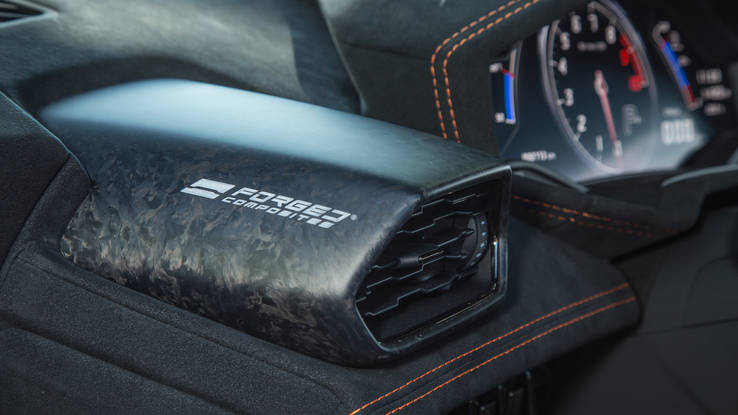
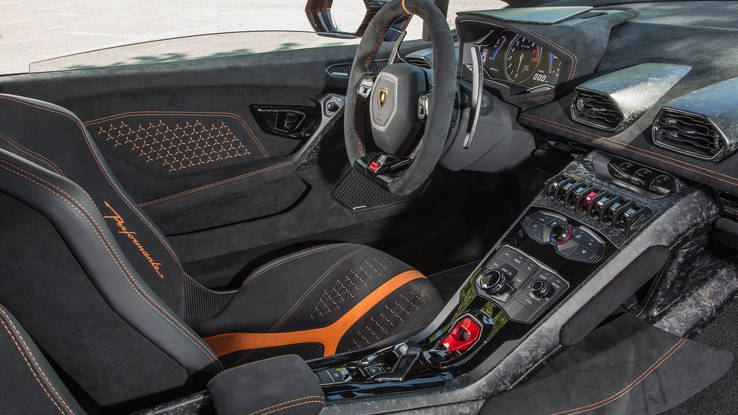
Lamborghini’s “Forged Composite” has a unique flecked look, shown here on one of the dash air vents.

What’s that weird-looking carbon fiber?

Lamborghini calls it “Forged Composite,” and it’s essentially chopped up carbon fiber mixed with plastic resins. It doesn’t have the same structural strength as layered carbon fiber, but it’s lightweight and plenty strong enough for parts like the hood, spoilers and rear bumper cover — plus, it looks cool.

Huracan Performante engine intake color

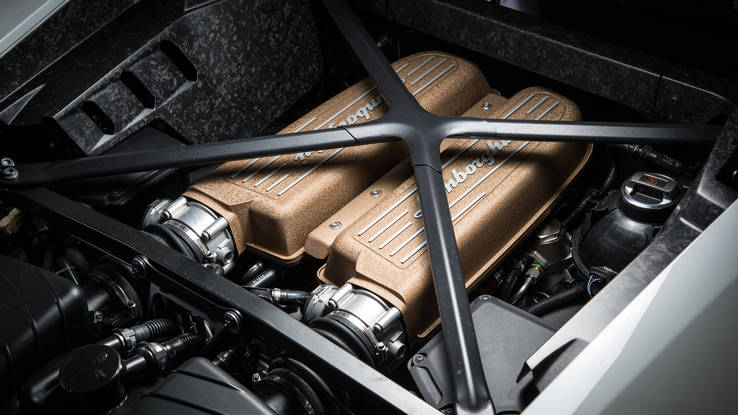
The Huracan Performante’s bronze intake color is reserved for special edition Lamborghini engines.

Why’s the engine that bronze color?

One dead giveaway that you’re looking at a Huracan Performante is the bronze-colored intake manifold castings on the V10 engine; the color is a throwback to earlier special-edition Lambos, including the 30th anniversary Diablo. What isn’t a throwback is the output: With 640 hp at 8,000 rpm, the Performante engine is the most powerful V10 ever produced by Lamborghini, thanks in part to a ridiculous 12.7:1 compression ratio. 

Huracan Performante exhaust

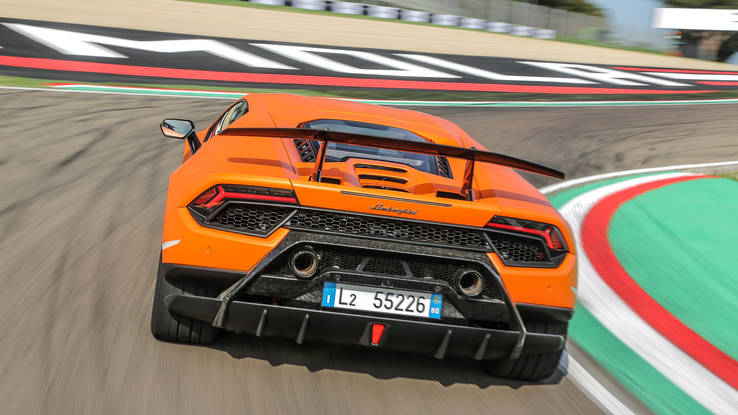
Those high-mounted exhausts are different than the standard Huracan, and meant to evoke racing motorcycles.

What’s different about the exhaust?

The most significant exterior change denoting Performante Huracans occurs out back: Enormous dual exhausts exit from high on the rear panel rather than below the fascia. Lamborghini claims it’s a touch to evoke superbike styling, but there are also practical refinements in the exhaust system to reduce backpressure. Most importantly, it develops a rich, resonant wail at full tilt that’s vastly more enjoyable than the shriek of certain V8 supercars from elsewhere in Italy.

Huracan Performante Y shapes

The “Y” pattern is most obvious on the optional interior, but there are also subtle “Y” cues all over the car, from the wheels to the panel gaps.

Why are there so many ‘Y’ shapes?

Modern Lamborghinis aren’t shy about angles, and they often meet in “Y” shapes; there’s an optional Y graphic available for the Huracan Performante’s interior stitching, too. It’s not accidental: Hexagons played a large part in historical Lambo styling — just look at the lower rear fascia of the Miura or any surface on the Marzal show car — and the current Y motif is taken from where the hexagonal shapes meet on those classic Lambos.  

Huracan Performante price

This view is going to cost you about $275,000…plus options.

What’s it going to cost me?

You have to ask, eh? Starting price is right at $275,000, but note that some of the things most buyers will want are options: Adaptive steering, magnetorheological dampers and, of course, a lime green Alcantara headliner. 

Andrew Stoy

Andrew Stoy – Digital editor Andrew Stoy has spent the past 20 years wrenching on and writing about cars. He’s worked everywhere from dealer service bays to the headquarters of the world’s largest automakers.
See more by this author»

Lamborghini Huracan Performante first drive: Off the wall

Share

  • Pinterest

Mine was a white Countach Quattrovalvole.

Depending on the era in which you came of automotive age, yours could have been a Miura, an LP400 Countach, a Diablo or even a Murcielago, but if you possess the soul of an auto enthusiast, at some point around age 13, you had a poster of a Lamborghini pinned to your bedroom wall.

It’s been that way for decades, and it’ll probably be that way for decades to come.

That appeal — Lamborghini’s appeal — to enthusiast youth has been in full force since the Countach stormed car magazines worldwide starting in the 1970s. The pure extremes, the shock value, of that Bertone design (and of every Lamborghini since) seems to burn its way through adolescent boys as predictably as puberty.

But then one of three things typically happens: 1) Adult responsibilities and financial realities gradually wear away the appeal of exotic cars; 2) performance specs give way to actual driving impressions, revealing there are more satisfying sports cars for the same price or less; or 3) your trust fund matures and you buy one in every color.

Our subject here, the Huracan Performante, exists to challenge assumption number 2, the notion among those of means that a Lamborghini is merely a plaything for the ostentatiously wealthy, a noisemaker for late-night boulevard runs after the clubs close rather than a track-focused supercar for the serious driver. This car is here to prove a point: That while still outrageous-looking and demanding, Lamborghini can build an honest-to-God sports car to challenge the world’s best. 

Yes, there’s more power —always more power — but Lamborghini achieves its goal primarily through weight savings and aerodynamic enhancements. Performante models shed 88 pounds over the standard Huracán, while Aerodinamica Lamborghini Attiva (ALA), the company’s name for its active aero system, helps keep things pointed in the right direction.

ALA is pretty trick stuff, so let’s take a closer look at what it does. Electrically actuated flaps in the front and rear spoilers can adjust airflow on the fly, based on the car’s needs at that moment. Need high downforce for high-speed cornering and maximum braking? The car closes the flaps in the front spoiler. For top speed runs and maximum acceleration, the flaps open, sending air along special channels under the car to reduce drag.
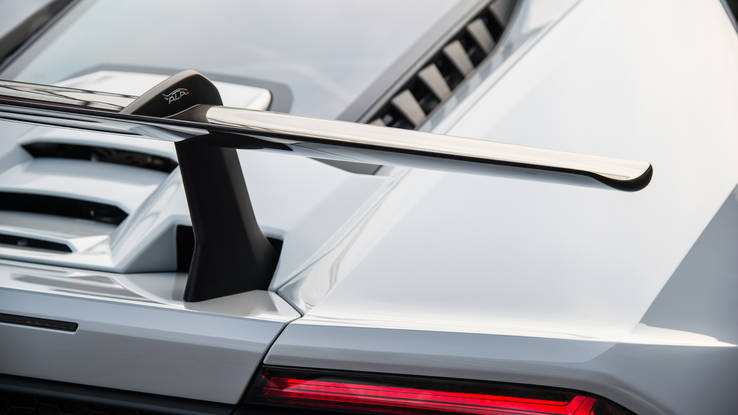
ALA huracan

Lamborghini’s active aero (called ALA) doesn’t physically move the wing; instead, air is either blocked or channeled through slots in the lower half of the spoiler.

Things in back are a bit more complicated: To cool the 640-hp V10 and its accessories, two central ducts are always open. Two other flap-operated ducts connect to the rear wing; when they’re closed, the wing works in conventional fashion, but the design boosts downforce by 750 percent over the standard Huracán.

When it detects the car is running wide open, ALA opens the flaps and admits air through ridges underneath the wing, reducing drag; the flaps can also open independently to boost downforce and, subsequently, traction on a particular rear wheel for a sort of aero torque vectoring.
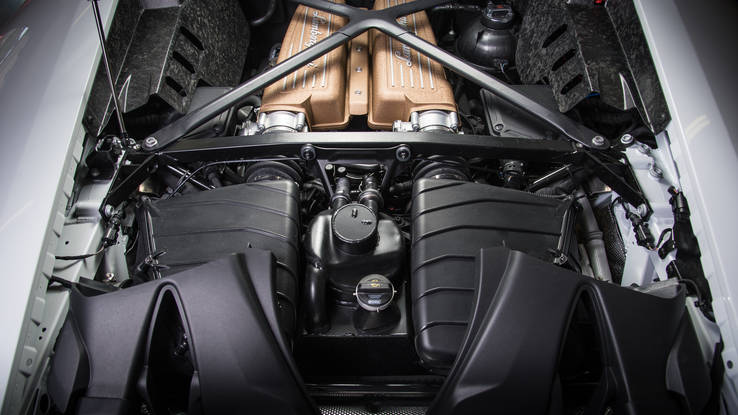
Lamborghini Huracan Performante engine

The bronze intake manifold is an homage to special-edition Lamborghini models past.

To make its 640 hp and 443 lb-ft of torque, Lamborghini’s V10 engine gets titanium valves and refined intake and exhaust systems; you’ll be able to distinguish a Performante from the bronze manifold visible through the engine cover. The power is sent through a seven-speed dual-clutch transmission, then out to the wheels via a Haldex-based AWD system.

In the event you skipped all the tech stuff above, here are the Cliffs Notes: Lambo got a camo-clad test car to run a stunning 6:52 Nurbürgring time, beating the Porsche 918 Spyder to become (briefly) the fastest production car ever to circle the Green Hell.

The Execution

We’re testing at Imola — more accurately, Autodromo Enzo e Dino Ferrari. It’s an intimidating racetrack, not only for its remarkable (and tragic) history, but also because of its layout: multiple long straights plus a 640-hp car means the potential for serious speed, and the Lamborghini folks have wisely put prominent BRAKE signs indicating when it’s time to stand on the binders.

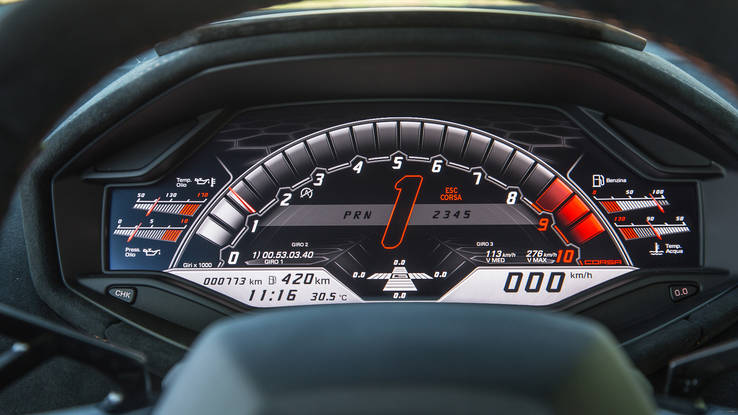
Setting the drive mode to Corsa — maximum performance and minimum intervention from the electronic controls — preps the ALA system, opens the exhaust and recalibrates the steering and magnetic suspension settings, when equipped. The Huracan Performante is also offered with a conventional steel spring suspension and nonadaptive electric steering system, but you don’t want that, do you? Best to just get the works.

Moving out onto Imola’s front straight and accelerating slight right toward Tamburello, two things are immediately apparent: First, in Corsa, the Performante’s steering response is insanely quick and direct, but not disconcerting –- after a moment of recalibration it feels perfectly natural and makes short work of Imola’s multiple sharp corners. 
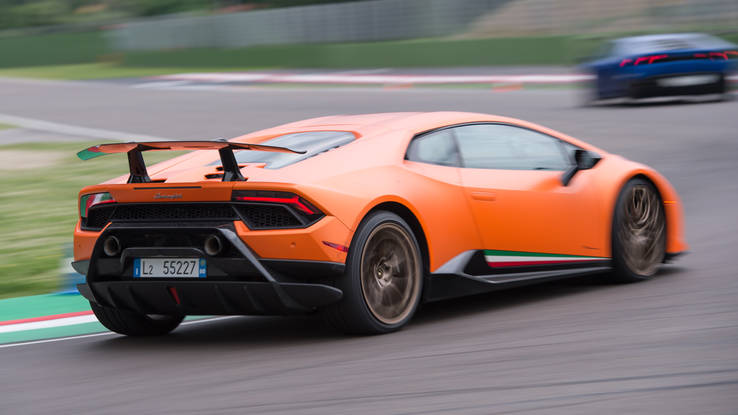
Imola in a Lamborghini Huracan performante

The Huracan Performante is a legitimate track-focused sports car, not just a sledgehammer supercar

Second, we’re all going to miss naturally aspirated engines once they’re gone: The V10 is magic, with gobs of power across the rev range. As one of my colleagues remarked, “I took a turn in fourth gear on one lap and it felt great; I tried it in third the next lap, and that felt great, too. No idea which one was ‘right’ since the car just powered out onto the straight no matter what.” Then there’s the sound: The new exhaust looks menacing, snarls on startup and shrieks like an F1 car at full tilt on the straights. No matter the performance, a turbocharged engine simply can’t sound as good as the Huracán’s naturally aspirated V10. It’s a thing of beauty visually, aurally and in terms of throttle response.

Switching between the more benign Sport mode, which also deactivates ALA, and aggressive Corsa settings shows the effect Lamborghini’s dynamic aero has in hard driving: Corsa lets the driver brake even later than those massive carbon discs already allow, and brings the car around more precisely while still letting the tail slide around a little. There’s just an immense sense of control — the car feels like it’s on your side and allows for minor correct/pause/recover mistakes without major punishment.

On the Italian country roads around Imola, drive mode system set to the softest Strada setting, the Huracán Performante does a remarkable impression of a daily driver. The exhaust is unobtrusive, ride is more than acceptable for a sports car and the seating position remains comfortable even after an hour or two. Oh, you’ll get stares, especially in central Italy where EVERYONE seems to enjoy rooting for the home team (either of them), but there’s no reason you couldn’t use a Huracán Performante to run to Ace for a bag of bolts. On your way to the track, of course. 

The Verdict

Reviews be damned, Lamborghinis will continue to haunt the subconscious of tween boys around the globe. But the Huracán Performante is so much more than just dramatic angles and flashy colors. It’s a car that deserves attention from the surprisingly broad range of buyers who might be eyeballing a McLaren 720S, Ferrari 488 or Porsche 911 GT3.  

The mere fact there’s another legitimate sports car challenger within those ranks is good news for everyone who loves cars, track days and the art of driving. Start saving your lawnmowing money now.

Andrew Stoy

Andrew Stoy – Digital editor Andrew Stoy has spent the past 20 years wrenching on and writing about cars. He’s worked everywhere from dealer service bays to the headquarters of the world’s largest automakers.
See more by this author»

On Sale: Summer 2017

Base Price: $274,390

Drivetrain: 5.2-liter V10, 7-speed dual-cluch automatic, AWD

Output: 640 hp @ 8,000 rpm, 442 lb-ft torque @ 6,500 rpm

Curb Weight: 3,500 lbs (est)

0-60 MPH: 2.9 sec

Pros: Brilliant reflexes, instant throttle response, Lamborghini looks

Cons: Very expensive track day choice; Lamborghini looks

Here’s what it’s like to drive a Murcielago with 258,000 miles on the clock

Share

  • Pinterest

No matter the income of supercar owners, the supercars themselves usually seem incapable of racking up many miles. If they’re not garage queens outright, bought with some shaky plan of being flipped a couple of decades later (with deteriorated hoses and bad oil in the engine and transmission), they tend to sit for months on end at various vacation homes, seeing a couple hundred miles each year in short bursts. That’s why you rarely encounter a 13-year-old Lamborghini with miles commensurate with a 13-year-old Volvo, even if both are used for grocery runs.

There are exceptions, though.
 

1991 Ferrari Testarossa with delivery miles heads to auction

Ferrari Testarossa with 184 miles heads to auction

The days of Ferrari Testarossas selling for the price of a modestly optioned new Chevrolet Tahoe are over — that much is clear. But just how high are the values of low-mileage examples of this model, …

Autocar spent some time behind the wheel of a Lamborghini Murcielago that’s racked up an impressive 258,000 miles while in the employ of a supercar experience company its owner created. This particular 2004 Murcielago was used for as many as 90 events per year for those who paid for a day of driving various exotic wheels. Autocar says that lead to about 600 miles per week for about five years.

So how does a 258,000-mile Lamborghini Murcielago actually feel after all those miles and inexperienced drivers? We won’t spoil the details, but a 40-mph crash headlong into a tree and a subsequent repair failed to send this bull to the farm.

Read the full story here at Autocar.
 

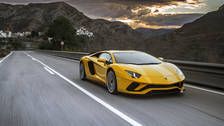
2017 Lamborghini Aventador S review with price, horsepower and photo gallery

2017 Lamborghini Aventador S first drive: Next-level Lambo

Share

  • Pinterest

We’ve never complained that the Lamborghini Aventador is too slow. It produces 690 hp and hits 62 mph in 2.9 seconds. Not bad. The new Aventador S, at 730 hp, is more powerful and, Lamborghini says, no heavier, but there are also no stated improvements to acceleration times — even the 217-mph top end is static. But that’s not what you take away from driving the Aventador S. Instead, it’s the newfound agility that puts a gulf between the two: A new rear-wheel-steering system is key here.

Rear-wheel steering has been around for decades — 1980s Honda Preludes and R32 Skyline GT-Rs ran it — but it’s back in vogue, notably with the Porsche 911 and the Ferrari F12tdf. Similar in concept to those cars, the Aventador S’ version turns the rear wheels opposite the fronts up to 3 degrees below 81 mph, virtually shortening the wheelbase and adding agility. Above 81 mph, the wheels turn up to 1.5 degrees in the same direction to effectively elongate the wheelbase, increasing stability. Lambo claims lower-speed steering inputs are reduced 30 percent with a variable-rate steering system.

To underline the point, Lamborghini let us drive an Aventador back to back with the new S on a slalom at the Circuit Ricardo Tormo in Spain. The original Aventador never did fulfill its dynamic potential—it feels dim-witted and cumbersome, veering from left to right through the cones. In comparison, the S jinks and shimmies, feeling lighter and more energetic, and you sense the tires on tiptoes, hungry to change direction. You’re also more aware of the weight of that mid-mounted V12 shifting around behind you.

Here's the difference between your base Aventador and SV

Of course, the Aventador fundamentals remain. You can see the carbon-fiber monocoque when you swing up the extravagant doors; there’s still a riotous, naturally aspirated 6.5-liter V12 behind your head; and there’s carbon-ceramic brakes and exotic push-rod suspension at each corner. The bat-costume body and fighter-jet cockpit looks unchanged at a glance, though exterior modifications evoke poisonous fangs, add 130 percent more front downforce and increase cooling in line with the extra power. A new TFT display morphs to match the driving mode but always looks like you’re playing a retro arcade game. In a good way.

Crucially, though, adding rear-wheel steering necessitated completely redesigning the chassis. There’s new hardware to account for the turning rear wheels, the springs are 20 percent stiffer and the magnetorheological dampers have been recalibrated. The Pirelli P Zeros are new, and the AWD system has been reprogrammed to shift more torque rearward. A new brain — Lamborghini Dinamica Veicolo Attiva — makes sense of it all. It’s why those monster 355/25ZR-21 rears get up to 90 percent of the torque in sport mode. There are also strada (street) and corsa (race) modes, while the new ego mode allows you to mix and match the other settings.

I choose sport to chase Lamborghini test driver Mario Fasanetto onto the track. The acceleration is mind-bendingly rapid. The V12 is now just 10 hp down on the 740-hp SV halo model Fasanetto is driving, thanks to a variable-valve system updated for extra overlap and a new airbox design. The two engines’ targets differ slightly, however, with more torque the goal for the S. So while both models produce 507 lb-ft at 5,500 rpm, the effective size of the S’ new airbox is manipulated by four driveby-wire throttles — more throttles for maximum air and performance, fewer for extra low-down torque.

We’re not using torque right now. The V12 yelps, yowls and crackles. It doesn’t yield full power until 100 rpm off the 8,500-rpm rev limit. An automated manual transmission, now said to offer smoother low-speed shifts, still selects the gears, but it remains light years behind the Ferrari F12’s more refined dual-clutch. At high rpm, though, the shifts engage like clicked fingers, a physical urgency stopping just short of brutishness.

Trying to keep pace with Fasanetto, we notice the same lightning turn-in from the slalom, but also how the AWD claws unbelievable traction from the surface and only understeers when we’re too early on the throttle. This car doesn’t tolerate fools, be warned, as there’s still a lot of movement to manage—go in too deep on the excellent brakes and the heavyweight V12 starts to swing the back end round like a mallet tossed handle first; the sharper steering and turning rears probably exacerbate the trait. Even off-throttle in sport mode through a tighter turn, you might need to add steering correction.

That just adds to a really unique supercar’s intensity —  the Lambo has no comparable rivals. When we pull into the pits to a thumbs-up from Fasanetto, it’s hard to imagine a similar experience with anything else.

The SV is still more white-hot crazy, but the Aventador is now the car we always thought it should be—old school and as deeply physical as ever, now with added finesse thanks to that S.

This article first appeared in the March 30 issue of Autoweek magazine. Get your subscription here.

By Ben Barry

On Sale: Now

Base Price: $421,350

Drivetrain: 6.5-liter V12, AWD, 7-speed automated manual

Output: 730 hp, 507 lb-ft torque

Curb Weight: 3,472 lb

0-60 MPH: 2.9 sec

Pros: No longer just a brute, it’s a balanced handler now too

Cons: Getting pretty close to half a million bucks

Get your new liver delivered by a Lamborghini Huracan

Share

  • Pinterest

Some countries just know how to do police cars in a way that allows them to catch bad guys without trying too hard — and look good doing so. The Polizia Stradale, or highway patrol, in Rome recently took delivery of their second Lamborghini Huracan LP 610-4. The homegrown exotic will be used for traffic patrol duties and medical transport.

What goes into turning the Huracan into a police car? Lamborghini added a computer with a tablet for the passenger, a gun holster fitted to the interior, a video camera, police radio and a holster for a hand-held directional sign called a paletta that police in Italy use to signal cars out the window. Lambo also added a low-profile LED light bar, strobes behind the grille and a siren system.

And that’s just for the police patrol part of its duties; the Huracan will also be used to transport blood and organs between hospitals. To this end, the luggage compartment is equipped with a special refrigeration system in addition to a defibrillator.

2017 Lamborghini Huracan Polizia front

The 610-hp, all-wheel-drive Huracan will be used for blood and organ transport between hospitals.

“The Highway Patrol is constantly engaged in meeting the need for medical assistance. In 2016, there were 176 requests for assistance from all over Italy, requiring involvement from 462 police patrols,” Lamborghini says. “120 patrols provided assistance to persons afflicted with special medical conditions, 111 and 74 transported organs and plasma/blood, respectively, 117 carried serums/vaccines and medications, and 40 teams were employed for other associated purposes.”

About the only item it won’t be able to carry are perps, but the Polizia have dedicated vans for transporting suspects. And when it comes to chasing down suspects, the Huracan will be one of the fastest and most capable cars on the road (assuming it can clear Rome traffic in front of itself) with 610 hp and 412 lb-ft of torque on tap, as well as crucial all-wheel drive to keep it all together in the corners.

The delivery of the Huracan follows up on something that’s turning into a tradition for Lamborghini: You might recall the automaker gave a couple of Gallardos to the Polizia in previous years, in addition to another Huracan that has been on the force since 2015. Lamborghini CEO Stefano Domenicali handed over the keys to Interior Minister Marco Minniti in a ceremony for the delivery of the latest Huracan that, we’re happy to announce, is also available in civilian spec.

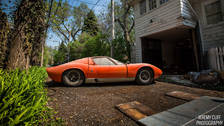
A 1967 Lamborghini Miura P400 is found in a barn

Lamborghini Huracan Performante clinches the Nurburgring record

Share

  • Pinterest

It looks like the Porsche 918 Spyder’s reign as the fastest production car has finally come to an end. Sitting in the top spot for production cars is now a Lamborghini Huracan Performante — the performance version of the Lamborghini Huracan, as the name suggests. The record was broken in October 2016, well ahead of the car’s Geneva motor show debut in March 2017. That means the record was broken while the Lambo was still sporting full camo.

Behind the wheel of the camouflaged Lambo was company test driver Marco Mapelli, the same man who ran the ‘Ring in the Aventador SV

While Lamborghini remains tight-lipped about the Performante, we do know the car will offer “superior track performance” thanks to changes to the engine, all-wheel-drive system, aero package and a set of Pirelli Trofeo R tires. We’ll find out the particulars after the car officially debuts.

The new Lamborghini ran the Nurburgring in only 6 minutes, 52 seconds, which is about five seconds faster than the Porsche 918. Want to see what a record-setting lap looks like? Check out the video above, and stay tuned to our Geneva motor show page for the official details when they drop.

Here’s the difference between a base Lamborghini Aventador and the SV

Share

  • Pinterest

The Lamborghini Aventador remains one of the most wildly styled and unmistakable supercars on the road today. Well, unmistakable from anything but other Aventadors in one of the many trims. For example, you might see an Aventador running around your city and think it looks incredible, but not quite as radical as what what you remembered from the internet. That could be because you were staring at gigabytes of Lamborghini Aventador SV pictures but actually saw a plebe-spec LP700 in the wild.

To help clear things up, Instagrammer YASHMEHTAPHOTO caught a regular Aventador butted up to the upscale SV-trimmed Lambo. The most obvious differences between the two supercars are the massive wing, diffuser and plethora of carbon fiber slapped onto the rear end of the Aventador SV. The air vents on the Aventador SV seem bigger, which makes sense considering the increased demands of the performance version. It also looks like the parking sensor on the LP700 didn’t find its way onto the Aventador SV’s bumper cover.

We won’t call the base Aventador subtle, but compared to the Aventador SV? Decide for yourself.

A Lamborghini Aventador is the perfect winter beater in Canada

Another day, another Aventador winter beater

Share

  • Pinterest

Is this the hull of Sir Ernest Shackleton’s HMS Endurance trapped in the ice? No, this, ladies and gentlemen, is yet another Lamborghini Aventador winter beater, and it is demonstrating improper seasonal storage of a supercar. Actually, the Reddit user who posted this photo of a friend’s Aventador says it is the college student owner’s daily driver. So at least it hasn’t been forgotten — which sometimes happens with European soccer stars who maintain several apartments.

A Lamborghini Aventador is the perfect winter beater in Canada

We suspect that, sitting still, the Aventador is incurring less weather wear than if it were driving around on salty roads, so in that sense it is pretty well preserved. But carefully cleaning it and starting it up looks like a job that will take at least an hour, if done properly. We’ve all been there, and we all know that lunch trays from the college cafeteria make great snow shovels for tasks like these.

Actually, Lamborghinis are not afraid of the white stuff, and recently we had a chance to drift a few of them on a frozen lake in Sweden. With permanent all-wheel drive, these cars are meant to be ski chalet-friendly — the whole point of owning a Lambo in Europe is to drive it from your bachelor pad in a metropolitan area to a ski lodge in Switzerland or the French Alps, preferably while wearing Pirelli Winter Sottozero 3 tires. The Aventador in the photo, if we had to guess, is not wearing winter tires, but it does have the benefit of all-wheel drive.

Who said Italian supercars couldn’t be winter beaters?
 

A Lamborghini Aventador is the perfect winter beater in Canada

Share

  • Pinterest

Slush, snow and ice mixed with road salt, plus drivers a bit too eager to panic at the first sign of precipitation may seem like the worst possible situation in which to drive your Lamborghini Aventador. It’s just asking for someone to slip and slide their 1992 Honda Civic into it. But for one brave Canadian driver, the winter slog is just what the Aventador craves.

Yes, the Lambo does come with all-wheel drive — but that doesn’t necessarily mean the Lamborghini is up for your typical winter commute. AWD without ground clearance and the right rubber isn’t going to help in heavy snow. And feathering that V12 seems like a waste of all the horsepower.

Then again, given the right wintery conditions, we imagine an Aventador would be the perfect vehicle to hoon in the snow, at least until it gets beached on just a few inches of the white stuff. If a McLaren 540C can do it, why can’t the Aventador?

Is this what Lamborghini heaven looks like?

Share

  • Pinterest

When the Lamborghini Miura was first produced in 1967, it took the world by storm with its stunningly good looks and revolutionary mid-engine layout that set the stage for every supercar thereafter. Obviously, the Huracan beside it would destroy it in every quantitative performance test today, but the Miura costs the same as five new Huracans for a reason. One glance over it and if those curves don’t win you over, it’s hard to imagine what will.

There are so few Miuras out there that seeing the old standard-bearer and new exotic right next to each other in the same color is a sight to behold. Given the choice between the two, we’d have to drive home the V12 Miura. Driving The Italian Job route through the Alps just wouldn’t feel the same in a modern Lamborghini

Which one would you put in your garage? 

Zac Palmer

Zac Palmer – Editorial Intern Zac Palmer has probably spent more time in a car than any other 21-year old in the country. He likes anything that can go around a corner, and is surely talking about a car wherever he might be.
See more by this author»