All posts in “Stuff”

The Hyundai Kona Electric packs 292 miles of range into a perfectly sensible subcompact package

Share

  • Pinterest

If there’s an electric vehicle revolution happening, it’s happening in waves. First came the science experiments and cobbled-together compliance cars, expensive and only marginally practical; then, high-dollar, high-performance products for the few (this is the domain of Tesla, and companies like Porsche want in). Now we’re looking at a tide of EVs with true mass-market potential: practical, mainstream and relatively affordable offerings with comfortable ranges offered by major automakers.

And you can’t get more mainstream than a subcompact crossover. hence, the Hyundai Kona Electric. The EV will make its real-world debut at the 2018 Geneva motor show, but it’s been revealed online ahead of that.

Hyundai says the Kona Electric is the world’s first fully electric subcompact SUV — good timing on the automaker’s part, given how popular these things are becoming. And if you consider a slightly lifted, moderately ruggedized hatchback to be an SUV, then yeah, they’re right. Its looks and stance will help separate it from the Nissan Leaf, Chevrolet Bolt and even the Tesla Model 3, which are all vaguely similar in size.

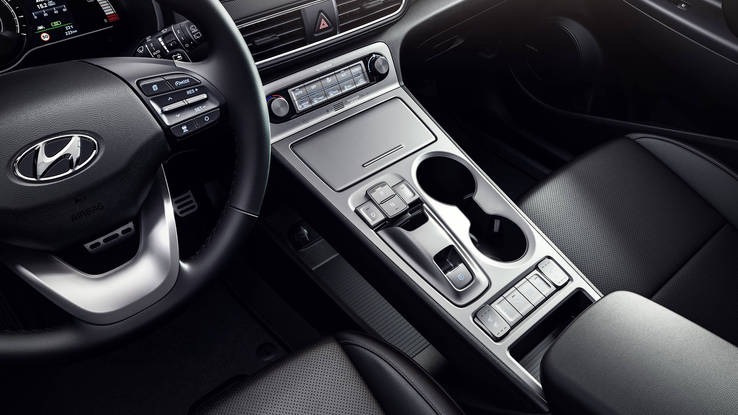
Hyundai Kona Electric Ev interior center console gear selector buttons

Inside the Kona Electric. Note the gear selector buttons on the center console.

Everything you need to know about the Chevy Bolt EV

In case you haven’t noticed, Hyundai seems to be rolling out vehicles with every sort of powertrain imaginable: gasoline, diesel, hybrid, plug-in hybrid, fuel cell (which we just test-drove in the form of the Hyundai Nexo) and electric. It might seem scattershot, but we can see the underlying logic; globally, different markets are facing different regulatory regimes. What works in one country might be banned in another in the coming decades, and besides, no one is really sure what future tech will stand the test of time.

Electric vehicles seem to be a safe bet. Though they’re just a tiny fraction of the global automotive market and seem destined to remain that way for quite some time, they dwarf the number of hydrogen-powered cars on the road. And adding charging stations to home garages or apartment parking lots is a lot easier than building a complete hydrogen infrastructure.
 

I drove a Hyundai Nexo Fuel Cell to the Winter Olympics Hyundai Nexo

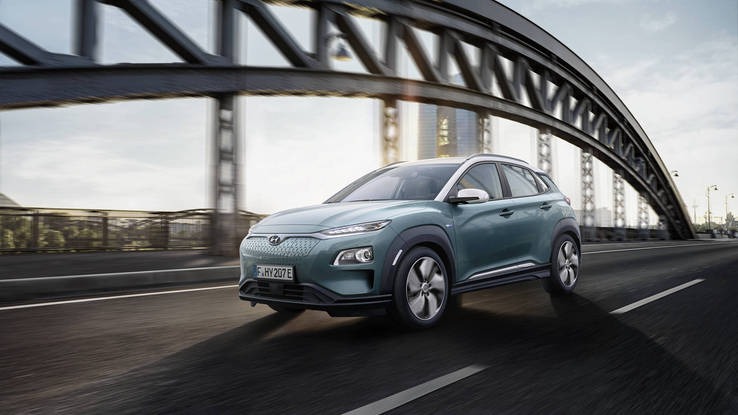
Hyundai Kona Electric EV front 3-4 on road

The Kona Electric cruising down some Highway of Tomorrow

As for the Kona Electric production specs: It will be offered with two powertrains. The big one gets a 64 kWh battery and a 150 kw motor (that’s about 201 hp), and it’s good for 292 miles of range. Plus, if you’re less concerned with maxing out that range, it’ll do 0-62 mph in 7.6 seconds — not exactly Ludicrous Mode, but not bad for this sort of vehicle. The base version gets a 39.2 kWh battery, a 99 kw battery and a 186-mile range. On a DC quick charger, you’ll be able recharge either version to 80 percent capacity in about 54 minutes.

Hyundai seems to be using this vehicle as a tech showcase, so it comes loaded with the company’s SmartSense safety and driving assistance features. Smart cruise control, lane keeping and lane following aren’t exclusive to the Kona Electric by any means, but it’s unusual for them to come standard on a vehicle in this size class.

Hyundai hasn’t commented on potential North American availability for the Kona Electric, nor do we have a sense of what such a vehicle would cost if it went on sale here. But from its body style to its very usuable range, it seems logic enough. While we’re waiting for US market news, we’ll let you know what it’s like in person in Geneva.
 

Graham Kozak

Graham Kozak – Graham Kozak drove a 1951 Packard 200 sedan in high school because he wanted something that would be easy to find in a parking lot. He thinks all the things they’re doing with fuel injection and seatbelts these days are pretty nifty too.
See more by this author»

The Alpina XD3 will whoosh into the Geneva motor show with four turbos

Share

  • Pinterest

Tri-turbos are so last season. In case you had any doubt about Alpina’s ability to cook up wonderfully delicious diesel BMWs, the tuning house’s Geneva motor show wares should serve as a timely reminder: Alpina will use the event to show off the 2019 BMW X3-based XD3, which packs a quad-turbocharged 3.0-liter diesel inline-six good for 388 hp and 567 lb-ft of torque.

Yes, those are four turbochargers whooshing away at the common-rail high-pressure direct-injected diesel, and with the help of an eight-speed automatic they propel this locomotive from 0 to 62 mph in just 4.6 seconds, and up to a top speed of 165 mph.

If four turbos is two turbos too many, Alpina will also offer a twin-turbo version of this 3.0-liter diesel inline-six in the X3, good for a still-respectable 333 hp and 516 lb-ft of torque. Acceleration time drops to 4.9 seconds in this version, but there’s still plenty of torque to pull out tree stumps in the Black Forest.

These stats should give prospective buyers of the gasoline-engined X3 something to think about. If they’re based in Europe, that is. Alpina’s wares rarely make it to the states, even though BMW has offered a few models like the Z8 and the B7 from time to time.

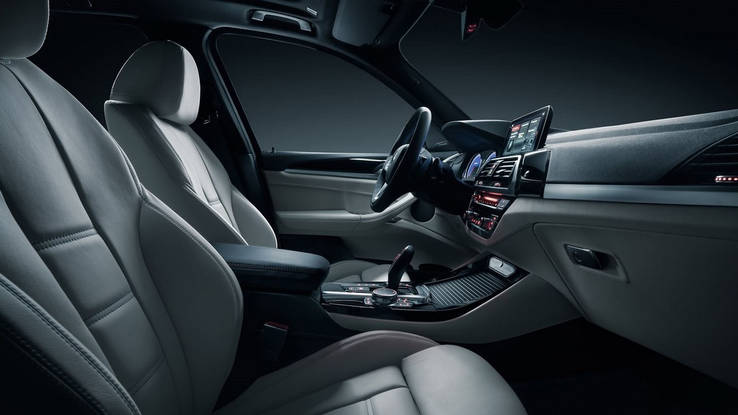
2019 Alpina XD3 interior

The XD3 also features a slightly reworked interior in addition to 22-inch wheels, a retuned suspension with electronically adjustable dampers and a bodykit.

BMW Alpina B6 xDrive Gran Coupe BMW CCA Edition

There’s more to the XD3 than the turbo count and the insane levels of torque: Electronically adjustable dampers, an active limited-slip rear differential, 22-inch wheels and a relatively restrained body kit help round out the package. And, as always, it helps to order one of these in the Alpina-friendly colors like dark blue or dark green.

Depending on who you listen to diesel may be on its way out in Europe, but on paper the XD3 is one of the best arguments we’ve seen to keep diesel around a little while longer, or mandate Alpina-tuned quad-turbo setups for any diesel BMW offered stateside.

We’ll have to wait until the Geneva motor show to find out just how much all this goodness costs, and until that time we’ll put Alpina to the top of the list of the reasons why the U.S. needs more diesel vehicles. And more turbos.

Geneva Motor Show: Here’s everything we expect to see

Share

  • Pinterest

Several long-awaited Tesla-fighting models from European automakers will be the center of attention at this year’s Geneva auto show.

After years of dismissing talk of a Tesla threat, alarm bells went off when the Model S outsold the Mercedes-Benz S class and BMW 7 series in Europe for the first time last year.

If Tesla overcomes its Model 3 production glitches, traditional automakers will have a bigger cause for concern, Evercore ISI analyst Arndt Ellinghorst said in an investor note last week.

Jaguar’s I-Pace electric crossover is seen by industry watchers as the first credible all-electric Tesla rival. Audi, Volkswagen and Mercedes-Benz also will showcase electric vehicles aimed at Tesla.

Geneva also highlights the industry’s shift toward electrification in the top-end and lower price brackets. Bentley will debut its first plug-in hybrid, while Hyundai premieres a battery-powered version of its new Kona small crossover.

BMW’s Z4 and Toyota’s Supra successor are likely to be among the showstoppers. The automakers developed the sports cars together.

General Motors’ former Opel brand, owned by France’s PSA Group, is skipping the show with nothing new to offer. Fiat Chrysler Automobiles’ Alfa Romeo, Jeep and Fiat brands will be there but without all-new products. Ford is limiting itself to showing the European version of its freshened Edge crossover, saving its big European launch of the year, the Focus, for a standalone event in April.

The show is open to the public March 8-18.

Here’s a look at debuts planned.

Audi

The e-tron battery-powered crossover that will rival the Tesla Model X and Jaguar I-Pace is not expected to be on Audi’s show stand because it will be officially unveiled in August at an event in Brussels, where it is being built. However, some e-trons are expected to be displayed on the show grounds for test drives. The e-tron is already available to order in some European markets and is expected to go on sale in the U.S. next year. Audi is expected to debut its latest A6 sedan. The Mercedes E-class and BMW 5-series rival will get technology and styling cues from the recently re-engineered A8 and A7 models. It moves to a new platform and will be lighter and more agile than the current car.

Bentley

The Bentayga plug-in hybrid will be Bentley’s first electrified vehicle. The hybrid drivetrain likely will be similar to that of the Porsche Panamera E-Hybrid, which mates a 2.9-liter V-6 with a 136-hp electric motor for a combined power output of 462 hp. The Panamera plug-in can travel 30 miles on electric power.

BMW

BMW’s new Z4 roadster is expected to debut, as is its Toyota sibling, the Supra successor. The automakers began cooperating on sports cars in 2012 as part of a technology sharing agreement. BMW previewed its version with the Concept Z4 last summer at Pebble Beach. The Z4 gets a fabric roof while Toyota’s version is a coupe.

BMW ramps up its focus on profit-boosting, high-margin sports cars with the 8-series coupe. The luxury grand tourer will go on sale this year as a rival to the Mercedes S-class coupe. Its production form closely follows the Concept 8 series shown at the 2017 Villa d’Este concours d’elegance in Italy. BMW is also expected to show a near-production concept for a high-performance, 600-hp M8 version.

The second-generation X4 gets a show debut. The coupe-styled crossover moves to BMW’s CLAR platform and becomes lighter, more efficient and roomier with sportier riding dynamics.

Ferrari

The 710-hp 488 Pista is Ferrari’s most powerful V-8 car to date. The Pista goes from 0 to 62 mph in 2.85 seconds. Top speed is 211 mph. Ferrari said the midengine supercar’s sporty dynamics and technological carryover from racing are a significant step up from its previous special series models.

Ford

Ford will show a face-lifted European version of the Edge. The European version of the Focus compact will be Ford’s most important launch in the region this year but its unveiling is being saved for a standalone event in April. Ford will also show its Ka+ budget subcompact hatchback with a face-lift.

Giugiaro

Designer Giorgetto Giugiaro’s GFG Style will unveil an electric sedan concept developed with Chinese energy management company Envision. The concept has autonomous driving capability.

Hyundai

Hyundai will debut its redesigned Santa Fe crossover and expand its green car offerings with the Nexo fuel cell crossover and a battery-powered version of its Kona subcompact crossover.

The Santa Fe is longer and wider than the current model, giving it a bigger cabin. It also gets a more premium interior and new safety features such as a rear cross-traffic collision-avoidance system to automatically brake the car if it detects vehicles about to cross its path when reversing.

The Nexo is built on a new dedicated fuel cell platform unlike its predecessor, which was a retrofitted Tucson. The new platform allowed Hyundai to boost electric motor output to 120 kilowatts from 100 and extend its driving range by 30 percent to around 350 miles. Hyundai said the Nexo’s blind-spot detection system, which shows drivers rear and side views while changing lanes, is an industry first.

U.S. sales start in the fourth quarter.

Hyundai will add a full-electric version of its Kona subcompact crossover, which replaces the Accent hatchback. Hyundai said the Kona EV will have a range of up to 300 miles on a single charge. U.S. sales have not been confirmed.

Italdesign

The Zerouno targa is the second product from the Italian design house’s new Automobili Speciali division created last year to build limited-production cars. Italdesign, which is part of Volkswagen Group, will build five units of the $2.4 million, V-10- powered two-seat targa, which shares its platform with the Audi R8 and Lamborghini Huracan. Italdesign will also show an evolution of its Pop.Up flying car developed with aircraft manufacturer Airbus.

Jaguar

The production version of the I-Pace, Jaguar’s battery-powered five-seat crossover, will debut. The I-Pace concept was unveiled at the 2016 Los Angeles Auto Show. The I-Pace is built on a unique, aluminum-intensive platform and has a range of 220 miles from its 400-hp twin electric motors.

Land Rover

Land Rover’s Range Rover subbrand will add the limited-edition three-door Coupe SV as its new flagship model. The SUV will be Land Rover’s most expensive model when it goes on sale this year.

Lexus

The UX small crossover is the production version of the UX Concept shown at the 2016 Paris auto show. It will get a more toned-down design than the aggressive-looking Concept, which had heavy creasing, bold blister fenders, angular wheel wells and a massive mesh version of the brand’s trademark spindle grille.

The UX is expected to be based off the Toyota C-HR subcompact crossover, which is built on Toyota’s TNGA modular platform that underpins the Prius. Powertrain details for the UX are under wraps, but a hybrid is certain to be among the options. All-wheel drive is also a possibility.

McLaren

McLaren says the 789-hp Senna is its most powerful road-legal track car to date. The midengine coupe is powered by a twin-turbocharged V-8 engine. It’s named after former Formula One champion Ayrton Senna. The supercar accelerates from 0 to 62 mph in 2.8 seconds. Top speed is 211 mph. McLaren is building 500 units of the car and they are already sold, priced at £750,000 ($1 million) in the automaker’s UK home market.

Mercedes-Benz

Mercedes says it will show its first series-production model with battery-electric drive but offered no further details except to say it will provide a look to the future portfolio of its EQ subbrand. The model could preview a Tesla Model X rival based on the Generation EQ concept that Mercedes unveiled at the 2016 Paris show.

Mercedes will show the production AMG GT Coupe after the concept’s unveiling last year. Despite the word coupe in its name, it has four doors and is expected to get AMG’s 4.0-liter turbocharged V-8 engine with 604 hp. A hybrid variant with 805 hp is also planned, reports said.

Mercedes will also show another high-performance model, the AMG variant of its latest G class. The Mercedes-AMG G63 is powered by a 577-hp, 4.0-liter twin-turbocharged V-8 engine, mated to a nine-speed automatic transmission. The high-performance SUV will reach the U.S. by the end of the year.

A big debut for Mercedes is the latest A-class compact hatchback. Mercedes touts the car as a “smartphone on wheels” because it will offer what the automaker says is the most advanced human-machine interface it has developed to date.

The A-class hatchback will go on sale in Europe in May. A sedan version will arrive in the U.S. late this year as the brand’s new entry-level model below the CLA.

Toyota

Toyota is expected to debut a concept for a successor to its Supra performance coupe. The company released a teaser picture for a “modern racing concept” this month. The Supra, which is being developed in partnership with BMW, is expected to get a BMW engine and underbody, with a Toyota-styled top. Toyota’s version is expected to put more emphasis on performance.

Volkswagen

Volkswagen brand’s I.D. Vizzion fastback concept will be used to test customer acceptance for a long electric vehicle in key sedan markets such as the U.S. and China, a VW spokeswoman said. The concept previews a possible flagship sedan that would be a battery-powered successor to the slow-selling Phaeton and would compete directly with the Tesla Model S. It has a system output of 225 kilowatts (equivalent to 302 hp) and its 111-kWh lithium ion batteries enable a driving range of up to 413 miles when braking regeneration is factored in. Top speed is 112 mph.

The Vizzion has no steering wheel or visible dashboard instruments and hints at what a fully autonomous VW car could look like.

Volvo

The redesigned V60 station wagon continues the electrification of Volvo’s lineup. The V60 will be offered in the U.S. with Volvo’s T8 Twin Engine plug-in hybrid that delivers 386 hp. Volvo has loaded the second-generation V60 with safety technology. One of its systems includes steering help when automatic braking would not stop a collision with another vehicle, pedestrian or large animal. The wagon also has a system that helps drivers avoid collisions with vehicles in the oncoming lane. The new V60 is longer than the current model but not as tall or wide. U.S. sales start this year.

BMW, Toyota could steal the Geneva show” originally appeared in Automotive News on 2/26/2018

By Paul McVeigh, Automotive News

5 details that make the Ferrari Portofino so special

Share

  • Pinterest

Faster, more comfortable, smoother and more efficient—Ferrari’s new Portofino hasn’t changed much in concept, but it’s better than the California T in just about every way. This is Ferrari’s most important car for key reasons, starting with the revenue stream, and it’s an obvious indicator how the little company in Maranello (and maybe its audience) has changed the last 25 years.

The important things are still here, of course: impressive power-to-weight ratio, crazy-high specific output, studied aerodynamics, Italian design and flair. There are new pieces of technology, too, though they aren’t always visible to the naked eye.

Herewith, five of the more interesting tech bits in the newest Ferrari. It isn’t clear if any will close an extra Portofino sale, but all of them caught our attention.

Portech I1

Passenger Video Display

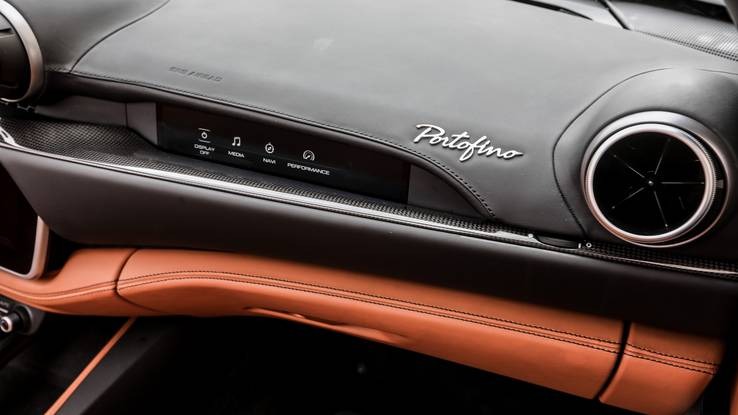
Display screens of varying technologies are everywhere in cars these days, and more often than not they’re of the haptic-touch variety. The guiding principle for automotive designers seems to be that bigger screens are better. The Portofino also gets one, much bigger than that in the car it replaces, and it can be split to show two different views or data sets. As hard as it might be for old-school Ferrari geeks to wrap their minds around split touch-screens and 3D maps, the Portofino’s primary screen isn’t likely to get more than a passing mention in the typical drive review.

What pops more forcefully is a second touch screen, and something we haven’t seen elsewhere–an elongated, 8.8 inch LCD directly in front of the front passenger, hidden above the Portofino’s glove box in the space where you might expect a trim strip. This screen allows the passenger to display a separate data set, from performance meters like road speed and RPM to nav prompts to entertainment choices, independent of what’s in front of the driver or on the bigger screen in the center stack.

So now your passenger can manipulate the audio while you keep the full map on the main screen, or read you directions or make fun of your short shifts. What you cannot do is fib about how fast you’re going, assuming your partner won’t know better without craning over your shoulder.

Portech I2

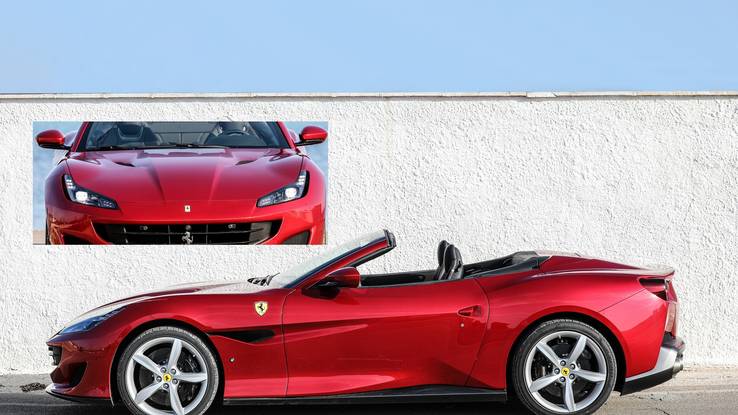
Those narrow slits next to the Portofino’s headlights (inset) force air into the wheel wells, then out of the vents on the front fenders

Front Fender Vents

Slits, lips or lumps in Ferrari sheetmetal aren’t usually simple adornment, but the vents or channels pressed into the Portofino’s front fenders form part of a particularly clever, aesthetically interesting aero solution. Working in conjunction with a thin port outboard of each headlight assembly, the vents deliver a couple of significant benefits.

First, they dramatically improve front brake cooling, and they do it without adding drag. High-velocity air channeled through the headlight slits flows through the wheel well, over the brake discs and out the vent in the fender.

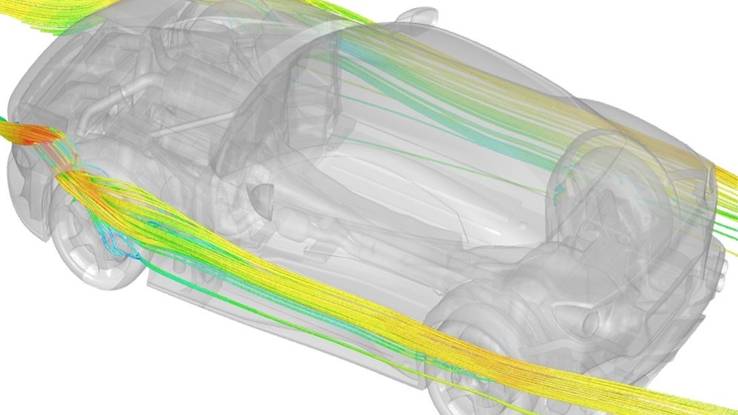
Indeed, the slit/vent combo actually reduces drag considerably, because it flushes out the extra-turbulent air that tends to collect around the wheel wells in a more predictable fashion. That air flows out as a denser “air curtain” from the wheel-well vents rearward, close to the Portofino’s flanks, according to Ferrari engineers. It’s one of the bigger contributors to a 6 percent reduction in drag, compared to the California T.

Portech I3

Cast-in Turbo Cases

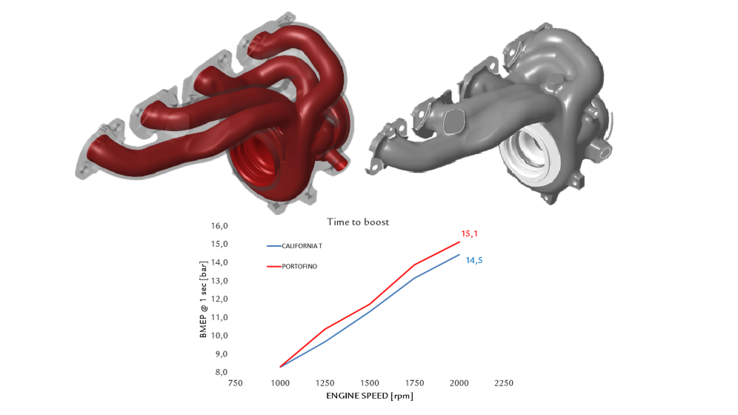
The Portofino’s exhaust headers are now sand-cast as a single part with the turbo housing, rather than welded up from separate pieces. What’s the big deal with that? Where to start?

Yes, we are starting to see exhaust manifolds that are cast into, rather than bolted to, the cylinder head, on cars more pedestrian than the Portofino, and we’ve seen a more rudimentary example of what Ferrari has done with its turbocharged V8s. That came from Hyundai when it launched its 2.0-liter direct-injection turbo four in the Sonata in 2010. But it came only after Hyundai (one of the world’s largest, best endowed manufacturers) spent years developing a patented process to manufacture the single-piece manifold/ turbine case, and then had to look long and hard for a supplier who could actually manufacture it. And Hyundai’s single casting is a more conventional, pitchfork-style manifold.

This is more complicated. For starters, Ferrari wants exhaust headers that are precisely equal in length, feeding two separate scrolls on the turbo turbine with staggered cylinders to keep exhaust pulses precisely even. That minimizes turbo lag and promotes Ferrari-suitable engine sounds, but it also leaves a manifold that looks like snakes swarming around the turbine case.

Portech I4

If you cast this complicated form, you’ll need multiple mold pieces, inside and out, and all of these individual, resin-impregnated sand molds must be structurally bound to each other and stable enough to withstand the pressure of casting force. The interior mold pieces have to deliver the precise path and flow dynamics you require for turbo performance, but you also have to get them out when the part is finished. Then you have to flow your alloy to ensure uniform, bubble-free thickness.

Sound complicated? Remember: A company Ferrari’s size is doing this with a relative handful of engineers, miniscule compare to the number at Hyundai’s disposal, and then casting the manifold/cases at the same Maranello foundry that casts F1 engine blocks.

So the one-piece header/turbine case is pretty cool. The payoff for Ferrari might be twofold. First, the single casting might ultimately represent a cost reduction, once the development and capital costs are amortized over a lot of parts. At Ferrari volume, that could take a while. More to the point, they’re left with a turbo that more effectively harvests exhaust gas flow to more quickly compress intake air for the engine. See the chart above for a representation of the Portofino cast header/case’s improvement on the welded California T version.

Portech I5

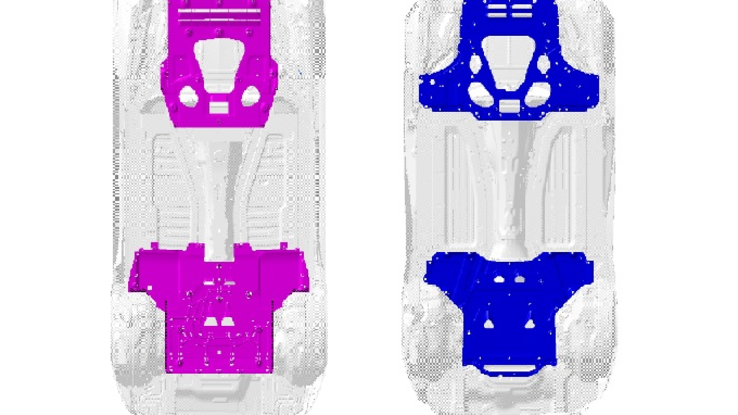
Pink is the California T (plastic) and blue is the Portofino (aluminum). Blue is better

Aluminum Undertrays

Undertrays on the bottom of production cars are nothing new, and they’ve trickled down in some fashion to some of the least expensive cars you can buy. Yet even in expensive cars with expansive undertrays, these drag-limiting devices tend to be molded from plastic or a light composite. The undertrays in the Portofino are stamped from aluminum and attached with bolts rather than Dzus-type fasteners or something else.

They’re not intended as giant skid plates, though they probably do add some protection in that context. The Portofino’s aluminum undertrays actually provide structural framing that plastic could not. That allowed Ferrari engineers to remove mass elsewhere in the Portofino’s frame with lighter extrusions or castings. In short, the heavier aluminum undertrays were crucial to lightening the Portofino’s frame 70 pounds compared to the California T, while still delivering a 35 percent increase in static torsional rigidity.

Portech I6

The really woke thing here isn’t visible to the naked eye

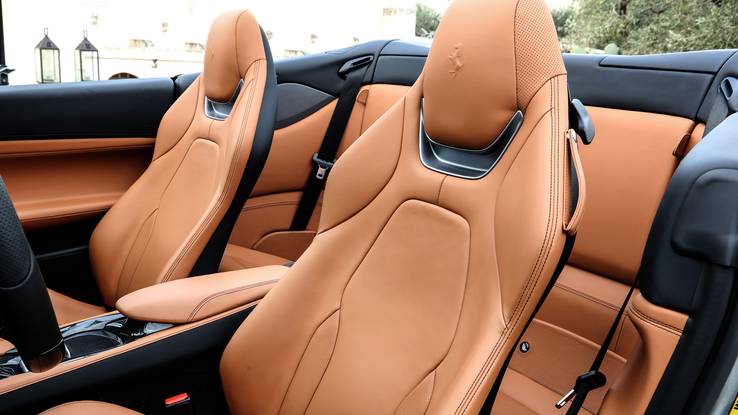
Magnesium Seat Frames

We’ve seen magnesium in post-war automotive applications since at least the 1950s, from racing wheels to transaxle cases in the low and mighty Volkswagen Beetle. Magnesium alloys have made a bit of a comeback through the 2000s, thanks partly to fabrication advances and usually in higher-end cars via a brace here or a case there. Yet with rare exceptions (like the Beetle), there’s usually a cheaper way to do it.

With a 35 percent weight advantage on aluminum, the appeal of magnesium remains, but the cost still gets in the way. Raw materials run about 80 percent higher than aluminum, and it gets worse when you start fabricating—a bit worse if you’re casting, compared to aluminum, and a lot worse if you’re extruding. Metallurgists say that every pound you save with magnesium is going to cost an extra $4 minimum, and maybe twice that depending on where you’re doing the saving.

So where did Ferrari introduce magnesium alloy into the Portofino? In those sexy, attention-grabbing seat frames, of course. Engineers say they’ve trimmed 53 pounds from the Portofino’s interior components, compared to the Ferrari California T, and we can be fairly certain that the biggest chunk of those 53 pounds came out of the seats. The magnesium frames also allow much thinner seat backs, and helped increase knee room in back of the Portofino two inches compared to the California T.

The cost of a magnesium upgrade might be easier to absorb in a $220,000 car, yes, but we appreciate Ferrari’s dedication to mass reduction nonetheless.

Is the Aspark Owl the quickest car on the planet?

Share

  • Pinterest

The Aspark Owl EV debuted at the Frankfurt motor show last year. As with many of these super-hyper EV one-offs, our first thought was “vaporware.” But this week, the company put out a video of the slick, carbon-fiber lightning bolt ripping off a claimed sprint to 62 mph (100 kph) in just 1.9 seconds. That’s as fast as Tesla claims its new Roadster will be, in case you’re wondering.

According to the website, the Owl prototype uses two 40-kW motors, but “according to calculations, 320 kW of power is required to go from 0 to 100 kph in two seconds. We developed a completely new current-control technology to draw 160-kW of power from those 40-kW motors.” Aspark continues, “So we came up with a completely new idea. We used capacitors powered by the regenerative energy from braking. The super g forces need to be experienced to be believed.”

The video is from a site called Gigazine, entirely in Japanese, but it does have some pictures of the crazy, rear-mounted battery/motor setup of the Owl, which looks like a legit supercar — though we do wonder how many have actually been built.

[embedded content]

The two-seater Owl comes in at about 190 inches long, 76 inches wide and just 39 inches high. It will get 93 miles of range on a single charge.

What we’re most surprised about is the runoff: The rear parking area of this warehouse looks to be too short to get to 62 mph, let alone slow back down to zero. And as you can see, the driver barely has enough room to get it stopped at the corner.

Mark the Aspark Owl down as something we’re cautiously optimistic about. The Owl makes about 1,000 hp, and with that carbon body weighs in at 1,874 pounds. And that’s frickin’ fast. It’s all-wheel drive; that’s basically the only way to can get those numbers outside of top fuel dragster. Speaking of that, in the video, the car looks like it was shot out of a cannon, and we’re wondering what that does to the driver’s neck, retinas and internal organs. For the record, the wheelman looks fine as he scans through the times.

Check out the brochure straight from Aspark below.

Aspark Owl brochure

(3.82 MB)

These galleries from Retromobile are the next best thing to being there

Share

  • Pinterest

Every year the Retromobile classic show, held at the Parc des expositions de la Porte de Versailles in Paris, hosts an eclectic collection of the continent’s rarest and most important automobiles, with a special focus on European marques. Set inside the high-ceilinged pavilions, Retromobile is one of the most visited classic expositions in Europe, one that combines the sights of a traditional concours with a trade show, as a number of restoration shops show off their skills.

Think of it as a traditional indoor auto show, but for classic cars. And with 500 cars on display from 550 exhibitors, it takes even longer to see it all than the Detroit or New York auto shows.

Retromobile hosts not only automakers and prominent restoration experts, but car clubs, auction houses, art galleries, parts and automobilia vendors and specialty fabrication shops. In short, there really isn’t a U.S. equivalent of Retromobile that features this mix of classic cars and automobilia indoors. Arizona in January is certainly bigger, but it’s very different — Retromobile combines many elements all under three roofs in three exhibit halls in an urban setting, just off Paris’ ring road.

Jaguar Classic D-Type

It takes a few days to see it all, which is why Retromobile runs for a full five days. Of course, you don’t have that much time, so we’ve put together these three galleries, above and below, that should give you a 10-minute appetizer-size taste of the show.

Among the milestones celebrated at Retromobile, this year was Renault’s 120th anniversary, which the automaker marked with a display of several notable models from its long history. The French marque’s collection at Retromobile included an original 1898 Type A model — the first Renault — as well as far more recent models like the 1974 Renault 5, which made it to the U.S. as the Le Car (let’s just say that the Renault 5 enjoyed a vastly different reception and legacy on its home continent than in the States).

Autoweek asks What classic car deserves to be reborn as an EV

“Renault’s collection includes more than 750 vehicles testifying to the inventiveness and know-how of the firm founded in 1898 in Boulogne-Billancourt,” the automaker says. “A living collection, it is preserved, maintained and operated by Renault Classic, which regularly showcases it at exhibitions, fairs, historic races, press and television reports and sporting events around the world.”

Renault also brought a 1947 4CV to Retromobile, a model that was the first Renault to exceed 1 million cars in sales, as well as the 1950 Colorale, which the automaker calls its first SUV. The most recent car on display that might be familiar to U.S. audiences was the Renault 9 from 1981, which was in production in Kenosha, Wisconsin, for a few years (with some changes) as the Renault Alliance. The very latest models on display included the 1984 Espace, one of the first mass-market minivans as we know them today, as well as the 1992 Twingo subcompact hatchback.

If you missed out on Retromobile this year, make plans for 2019. (But we’ll still have galleries for you next year if you miss it again).

Lexus will debut UX crossover with…taillamp fins?

Share

  • Pinterest

Lexus plans to take its long-anticipated plunge in the premium small crossover segment with the debut of the UX at the Geneva auto show on March 6.

Lexus confirmed the Geneva debut in a statement on Tuesday outlining its show plans

While Lexus gave no further details, a spokesman for its parent Toyota Motor said the vehicle is the production version of the UX Concept shown at the 2016 Paris auto show.

It will get a more toned-down design than the aggressive-looking UX Concept, which had heavy creasing, bold blister fenders, angular wheel wells and a massive mesh version of the brand’s trademark spindle grille.

The UX is expected to be based off the Toyota C-HR subcompact crossover, which is built on Toyota’s TNGA modular platform that also underpins the Prius.

Powertrain details for the UX concept are still under wraps, but the production version could use at least one of the three available globally in the C-HR: a 2.0-liter naturally-aspirated four-cylinder in the U.S. and a hybrid powertrain or a 1.2-liter turbo four cylinder available outside the U.S.

All-wheel-drive is also a possibility.

The UX nameplate helps round out the Lexus lineup with a crossover-styled vehicle at the small end of the spectrum as customers flock to crossovers of all stripes.

The Lexus NX was the top-selling compact premium crossover in the U.S. last year, and the RX topped the premium midsize ranking. There is little competition in the luxury small segment outside the Infiniti QX30. But mass market subcompact crossover sales in the U.S. surged 14 percent last year, despite the overall market’s slump.

Lexus executives have long wanted to tap that demand.

In Europe, Lexus hopes the UX will help the brand to counter German automakers’ domination of the premium small crossover segment with models such as the BMW X1, Audi Q3 and Mercedes-Benz GLA.

Lexus sold 45,098 cars in Europe last year, up 1.5 percent, of which almost 20,000 were the NX, according to figures from JATO Dynamics.

By Hans Greimel, Automotive News
Hi there, 2020 Volvo V60: Swedish wagon leaks ahead of its Geneva debut

Share

  • Pinterest

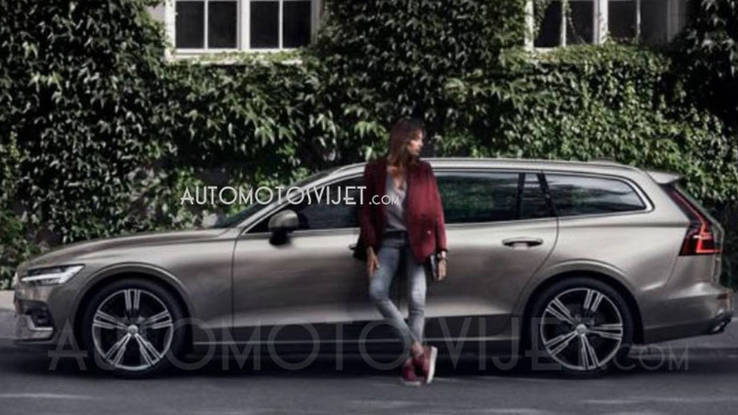
The digital covers came off a little early for the next-generation Volvo V60 wagon, set to debut at the Geneva motor show in a matter of weeks. Images of the upcoming smaller sibling of the Volvo V90 were leaked by AutoMotoSvijet in Europe, revealing the design of the midsize station wagon due in the U.S. next year. The unplanned reveal coincided with a planned official publication of a teaser video previewing the next-generation V60, which will replace a model that has been on sale globally since 2010 and will also be joined by an all-new S60 sedan.

What can we glean from these images? For starters, the design appears to be a scaled-down version of the larger V90 wagon, which went on sale in the U.S. just last year. The rear side windows appear to be a little more generous this time around compared to the outgoing model, which was knocked for not offering much cargo space in the back.

When it comes to engines, the V60 is likely to share the powerplants of its SPA platform siblings like the new XC60, which debuted recently. This means we’re likely to see a 2.0-liter turbocharged inline-four badged T5, good for 250 hp, and a turbocharged and supercharged 2.0-liter inline-four badged T6, which churns out 316 hp in other models. It remains to be seen whether the V60 will get the pricey 400-hp T8 version of this engine, which has been the range-topping powerplant in a number of recent Volvo models.

2020 Volvo V60 side

Volvo is likely to offer the T5 and T6 four-cylinder powetrains in the new V60. Photo by Volvo

2018 Volvo XC60 T8 Inscription review

2018 Volvo XC60 T8 review: Swedish overachiever

The new Volvo XC60 SUV landed on the scene a full two years after its bigger brother XC90 received a complete redesign; both SUVs’ predecessors were on the shelf past their expiration dates. As a …

We expect to see an interior dash design similar to other recent Volvo models, including the XC60. This means a center stack dominated by a large touchscreen and bookended by two vertical A/C vents, wood trim accents along the beltline of the dash and the doors, and a starter switch on the center console. The latest Volvo interiors have been examples of minimalism, and we don’t expect the automaker to depart from this look for some time.

The V60 will be revealed online on February 21, ahead of its appearance at the Geneva motor show.

Confirmed: Toyota Supra (or a racing version) will debut at the Geneva auto show

Share

  • Pinterest

Toyota Supra news is coming fast and furious these days, but today we got the first official image from the Japanese automaker, with a confirmation that “the legend returns” at the 2018 Geneva motor show on March 6 at 3:45 p.m., EST. The darkened pic features a fastback-style coupe with a giant wing perched on two risers.

So, what do we know? We know that the new Supra, though we’re not sure that’s the name, was developed in conjunction with BMW and the new Z4, and that the two will share engines of BMW’s design. Hopefully that means a 250-ish-hp turbocharged four and a 335-ish-hp turbocharged I6. We’re also guessing it’ll have a dual-clutch transmission — there has been no word of a manual option yet. The last BMW Z4 didn’t not offer a stick shift; however, the Toyota 86 does, so who knows?

Toyota does say that what’s appearing at Geneva will be a “modern racing concept” that signals Toyota’s commitment to “bring back to the market its most iconic sports car.” We’re guessing that means a GT-type race version, which will hopefully give us more clues on the forthcoming street car.

Sidenote, wouldn’t “Fast 9” be the perfect on-screen debut for Toyota’s next serious sports car? The original was famously featured in the first film. “More than you can afford pal, Ferrari.” That guy and his girlfriend are then promptly smoked by a souped-up Supra built by Paul Walker and Vin Diesel’s characters.

Regarding that name: We’d like to see Supra plastered on the trunk, but we’re more likely to see something like GT-One. The GT86 in concept form was called FT-86; this concept was called FT-1. The GT-One was also Toyota’s name for its GT1-turned-Le-Mans-prototype car built in the late ‘90s, so there’s some precedent.

We’re also guessing Toyota’s Gazoo Racing department will get its hands on the new car. Gazoo developed the hot Yaris compact that we’re not getting here in the U.S., and we see no reason it shouldn’t breathe on this new coupe too.

The Geneva motor show is less than a month away, and as someone who grew up pining for the last Supra — and as someone who might actually have a chance to drive the new one — March 6 can’t come soon enough.

[embedded content]

Here’s why the 2018 VW Touareg will pass us by

Share

  • Pinterest

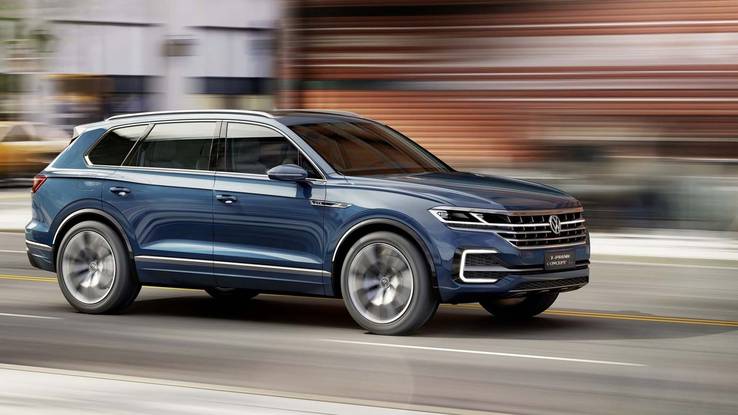
Volkswagen is giving the world a preview of the third-generation Touareg ahead of the model’s debut at the Beijing auto show at the end of March, hinting at close resemblance to the T-Prime GTE concept that the automaker presented in Beijing in 2016.

At the time, the T-Prime GTE was seen as a close preview of 2018 Touareg design themes and technology, and the sketch VW revealed over the weekend confirms this. The next-gen Touareg has already been seen completely uncamouflaged in several spy photos, so perhaps the sole departure from this official sketch will be the height of the roofline, which is a little taller on the actual vehicle.

Based on the MLB Evo platform shared with the likes of the Audi Q7 and Porsche Cayenne, the third-gen Touareg promises to take a substantial technological (and dimensional) leap over the outgoing model, growing in wheelbase by several inches and offering four-wheel steering in addition to an adjustable air suspension and a giant 15-inch infotainment screen. V6 and V8 engines will power the new Touareg, which is also expected be offered in a hybrid flavor with an electric-only range of about 30 miles.

2016 VW T-Prime GTE concept

The T-Prime GTE concept of 2016 was a close preview of the production version the third-generation Touareg.

2018 Volkswagen Atlas SE w/Technology and 4Motion quick take with photos, specs and price

“The new Touareg makes the brand’s standards clear. The highly expressive design by Klaus Bischoff, head of Volkswagen design, and his team give it an unmistakable appearance that is strong in character,” Volkswagen said. “A phalanx of innovative assistance systems gives it a maximum degree of safety and comfort. One of the largest digital cockpits in its class, the Innovision Cockpit, opens up a new type of infotainment environment. Its connectivity makes it a driving internet node. The drivetrain, air suspension, rear-wheel steering and roll stabilization all ensure a safe and dynamic driving experience.”

If it sounds interesting, get it out of your head: The Touareg won’t be offered in the U.S.

The new VW Atlas SUV, which went on sale in the U.S. last year, took a lot of the pressure to be affordable off the Touareg. The 2018 model will be as advanced (and expensive) as it wants to be, which means it’ll be closer to its pricier Audi and Porsche siblings in terms of tech and equipment. The first two generations of the Touareg were criticized as too pricey for the VW badge, especially given the fact that the Q7 was there for much of its existence, and with a new Tiguan and Atlas in the lineup, Volkswagen can afford to keep the Touareg at the top of the range while taking aim at pricier offerings from BMW and Mercedes-Benz.

The world will see the all-new Touareg in the metal on March 23 in Beijing.

2019 Mercedes-AMG G63 revealed: Because the new G-Class needed 577 hp and side pipes

Share

  • Pinterest

We’re not asking you to agree that the 2019 Mercedes-AMG G63 is, strictly speaking, a necessary addition to the automotive market. Or that the already ridiculous performance G-Class needed to get quicker or more powerful. We’re simply telling you that Affalterbach’s fresh take on the totally redesigned is coming, as we all knew it would be, and that Mercedes has released the details ahead of its Geneva motor show debut.

Besides, if we only had cars that were, strictly speaking, necessary, the world would be a boring place.

The G63’s basics aren’t surprising if you’ve already scoped out the 2019 G550, which debuted at the Detroit auto show earlier this year. The boxy SUV is superficially similar to its long-lived predecessor, which began rolling off assembly lines shortly after the Patent-Motorwagen’s first drive, but it’s all-new. It’s gained some much-needed interior room (something this rolling monument to excess was surprisingly short on) but lost its live front axle in favor of an independent setup. The automaker assures us this change-up has not handicapped the darn near unstoppable box off-road. Time and testing will tell.
 

2019 Mercedes-Benz G-Class goes live at Detroit auto show

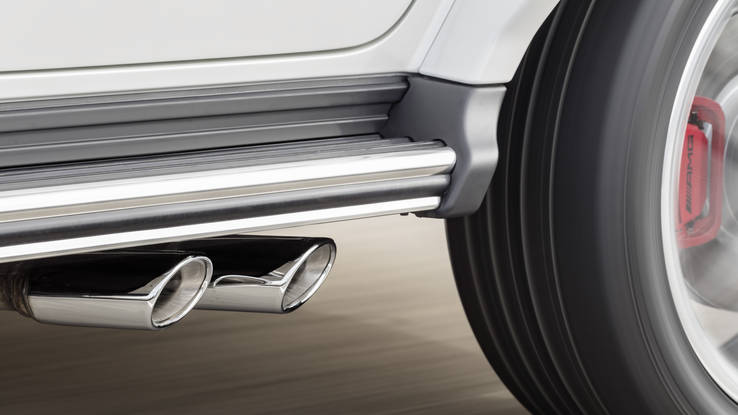
Look past the flared wheel arches and G63-specific front facia and grille and optional 22-inch wheels and the AMG version feels a lot like G550, at least on paper: Both have a 4.0-liter turbocharged V8 mated to a nine-speed automatic transmission pumping power to all four wheels through three electronically locking differentials. But there’s more power and torque (577 hp at 6,000 rpm and 627 lb-ft from 2,500 rpm to 3,500 rpm) and the AMG Performance 4matic all-wheel-drive system has a 40:60 rear-biased torque distribution. Plus, the truck’s dual-flow exhaust keeps the side pipes seen on previous G63s.

The extra output is all in the interest of a 4.4-second estimated 0-60 mph time. This obviously the most important you’re gonna want to look at when you’re shopping for a brick-like SUV, and it’s down from 5.3 seconds on the outgoing model. The side pipes are in the interest of making the thing sound fantastic when you mat it.

Top speed is 137 mph or 149 mph if you get the driver’s package — again, absolutely crucial for this sort of vehicle.

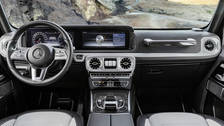
New Mercedes G-Class interior

2019 Mercedes G-Class interior: 5 things to know

Behold, the interior of Mercedes’ new G-Class SUV. We got a sneak peek at what the next G-Wagen will offer occupants, and it’s a marked upgrade from the narrow, decade-old trappings of the …

The interior of the 2019 G-class is, like the rest of the truck, all-new, and the G63’s cabin is (as expected) much like the G550’s. Despite the vehicle’s utilitarian roots, U.S. buyers like their Gelandewagens plush. So, to differentiate itself from the already comfy G550, the G63 adds a flat-bottomed AMG Performance steering wheel. You’ll be able to get as far out there as you want with Benz’s Designo customization program, so get creative!

If this thing is anything like the G63 it replaces, we know that it will be improbably fun to drive and more capable than you’d be inclined to give it credit for. We want to know if its new suspension setup makes it feel less like a rocket-powered shopping car going around corners, though — and if it does, whether that will make the overall experience more or less fun.

The G63 will roll out later this year. Mercedes hasn’t revealed pricing, but the outgoing model started at $142,325. Don’t expect the 2019 model to be any less expensive.

2019 Mercedes AMG G63 G-class side pipes

The side pipes are right there where they belong, on the sides, on the 2019 G63.

Graham Kozak

Graham Kozak – Graham Kozak drove a 1951 Packard 200 sedan in high school because he wanted something that would be easy to find in a parking lot. He thinks all the things they’re doing with fuel injection and seatbelts these days are pretty nifty too.
See more by this author»

2019 Mercedes-Maybach S-Class puts on a pinstripe, two-tone suit for Geneva

Share

  • Pinterest

The 2019 Mercedes-Maybach sedan will debut at the Geneva motor show next month. Engine choices remain the same, but the freshened luxury behemoth, debuting in late summer 2018, gets a new grille, new two-tone paint options and new wheels.

Starting in front, the new vertical bar grille “is inspired by a pinstripe suit” and was cribbed from the Vision Maybach 6 coupe that premiered at Pebble Beach in August 2016. The exterior styling isn’t quite as wild as that concept, but Mercedes is bringing the two-tone paint scheme back, something that made the Maybach Maybach, as opposed to the Mercedes-Maybach, stand out, even in a six-figure crowd.

The new Maybach is available in nine color combinations, as well as with a double clearcoat for dark-color options. The second clearcoat, according to Mercedes, is “applied by hand in the Maybach Manufaktur by specially trained varnishers.” Sweet gig if you can get it.

Well-heeled buyers get three choices of wheel, including the spoked job that came on the first Maybach S-Class Cabriolet.

The updated Maybach gets 10 extra inches of length over the standard S-Class, with more room for rear (coddled/shuttled) passengers, who also get (capital E) Executive seats with footrests, heat, ventilation and all of the good stuff.

As for the engines, not much has changed. The S560 comes with a 4.0-liter turbocharged V8 making 463 hp and 516 lb-ft, while the S650 gets the V12 making 621 hp and 738 lb-ft. Those are good for 0-60 sprints of 4.8 and 4.6 seconds, respectively.

Our sales numbers don’t break out Maybachs versus S-Classes, but Mercedes says since the relaunch of the Maybach in 2015, the company has delivered more than 25,000 Maybachs and in 2017 one out of every 10 S-Classes sold was branded with the big M.

We’ll get a better look in March in Geneva.

The AMG GT four-door coupe is on the road and testing before its debut in Geneva

Share

  • Pinterest

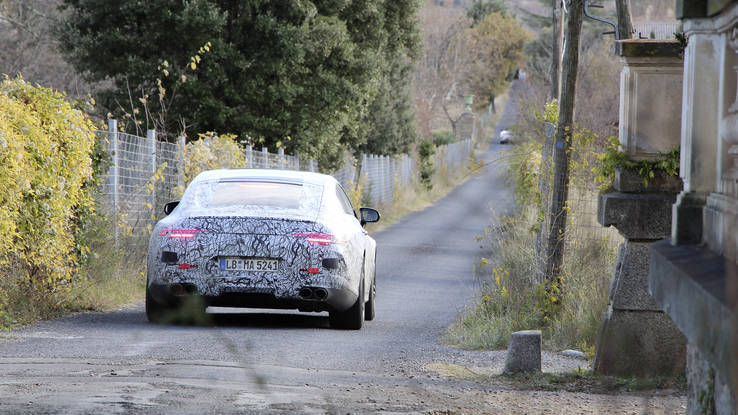
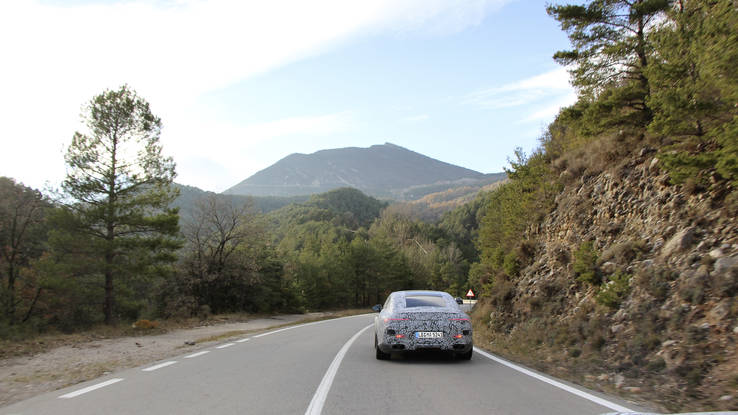
The four-door performance fastback concept Mercedes-AMG brought to the Geneva motor show last year is making its way toward production. We’ll see the real thing at this year’s Geneva motor show in early March, but photos of the car testing in camouflage give us a hint of what we can expect. At the time, it was called the AMG GT Concept. We hope the company’s brand wizards have conjured up a better name since then, but it’s looking good otherwise.

These aren’t exactly standard-issue spy photos, in that Mercedes-AMG took and distributed them. Consider ’em spy-photo-themed teaser shots.

You’ll recall that the concept was presented in Geneva wearing a delightful liquid metallic red coat of show-car paint and weird polished center-lock wheels. We have no idea what color is hiding under the dazzle camo in these photos, but the wheels appear to be more conventional split five-spokes. More important, the lines haven’t changed much from what we saw on the show stand. The front end appears to have lost its gaping vent holes, but the profile, and even the shape of the windows, appear identical.

Mercedes-AMG GT four-door coupe testing rear

Note the quad tailpipes. While the concept was a hybrid, it looks like the production version will, at least initially, get the ubiquitous AMG 4.0-liter turbo V8.

Notice the quad tailpipes out back. AMG hasn’t spelled out this vehicle’s powertrain options yet, but these testers are almost certainly running the 4.0-liter turbo V8. That’s a bit of a departure from the concept, which was said to have a hybrid setup consisting of the V8 plus a rear-wheel booster motor, adding up to a total of 805-plus system horsepower. We could see AMG offering a top-level hybrid version at some point, which would compete directly with the Porsche Panamera Turbo S E-Hybrid.

This car, whatever it will ultimately be called, is meant to evoke the two-door AMG GT — an aim reinforced by features such as the toothy “Panamericana” grille up front. But it isn’t actually a stretched version of the smaller car; it has more in common with the E-Class underneath its skin.

We’ll be on the lookout for more information on the car ahead of its debut next month.

Mercedes-AMG GT four-door coupe testing rear pair

There are at least a couple of these things testing on roads, and they look nearly production-ready.

Graham Kozak

Graham Kozak – Graham Kozak drove a 1951 Packard 200 sedan in high school because he wanted something that would be easy to find in a parking lot. He thinks all the things they’re doing with fuel injection and seatbelts these days are pretty nifty too.
See more by this author»

2019 Ram 1500 loads up on Mopar muscle in Chicago

Share

  • Pinterest

Mopar showed off its accessories for the new Ram 1500 pickup at the Chicago Auto Show before the new truck even hits dealer lots. The brawny Mopar 1500 is designed to give you an idea of what your Ram can look like with a healthy dose of factory accessories. Off-road-ready beadlock wheels compliment the 2-inch lift kit and off-road fender flares, and while the 2-inch lift might not sound like a lot, the extra height adds even more presence to an already big pickup.

Based on a 2019 Ram 1500 Big Horn Sport, the accessorized Ram shows off production versions of the Ram Rack, Mopar cast aluminum running boards and 18-inch off-road wheels with color-matched beadlock trim rings. If you’re wondering if you’ve seen that Ram Rack before — you have. It made its first appearance in 2016 on the Ram Macho Power Wagon concept that debuted at the SEMA show

Toyota rolls out new trail ready TRD Pro trucks

The Mopar Ram also sports a cat-back exhaust with massive 5-inch dual exhaust tips and a Mopar cold-air intake system. The folks at Mopar didn’t make any claims about a horsepower bump from the exhaust and intake, so it’s safe to say the Ram still churns out 395 hp and 410 lb-ft of torque. That said, we’re sure it helps the truck’s aural performance. Finishing off the Mopar concept is a set of Katzkin leather seats embroidered with Ram logos.

While you can’t order a new Ram pickup, you can picture what Mopar parts you want to buy before you even step foot into a showroom. Granted, we don’t yet know how much these parts will set you back, but we’re sure a Ram dealer would be happy to install all the Mopar parts you want before you take delivery.

Subaru celebrates 50 years in America with these special editions

Share

  • Pinterest

It was 50 years ago that Malcolm Bricklin first introduced Subaru to the U.S., bringing the bubble-shaped 360 stateside and giving the marque a foothold in the single largest automotive consumer market in the world. Back then, Subaru was one of more than a dozen small marques trying to make it in a country absolutely dominated by Detroit automakers. Most foreign cars aimed for the compact side of the size spectrum, each angling for a slice of the import pie. It was a time when many marques could be sold under one roof in import dealerships, and not all of them ended up winning over U.S. buyers. But Subaru did, even though it didn’t happen overnight.

Subaru’s slice of the import pie is a lot larger today, and to celebrate half a century of success in the U.S. Subaru is rolling out special 50th Anniversary versions of each model it has.

Each will wear an exclusive Heritage blue exterior color, feature unique wheel designs, satin chrome exterior trim and wear Subaru of America 50th Anniversary emblems. Inside, each model will feature black leather with contrasting silver stitching, as well as silver seatbelts and 50th Anniversary logos on the front seats and floor mats.

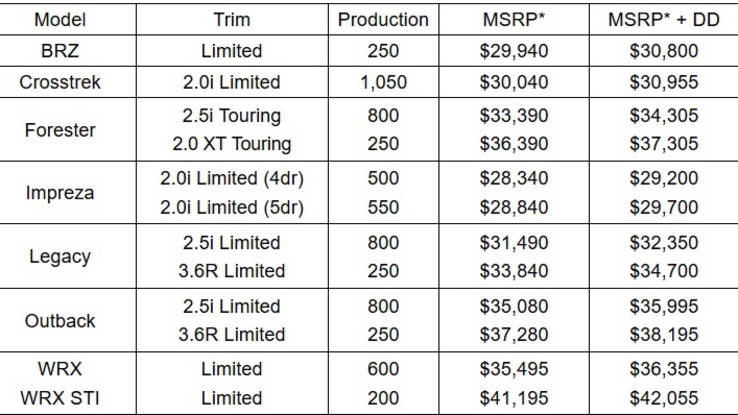
Subaru limited edition model lineup

The sportier side of the lineup will be a little more difficult to find. Add a $915 destination charge to the prices of the Crosstrek, Forester and Outback, and $860 for Impreza , Legacy, WRX and WRX STI.

2018 Subaru WRX STI Type RA first drive

When it comes to the total number of cars that will be offered, things get a little complex: Crosstrek, Impreza, Forester, Legacy and Outback special editions will be produced in a quantity of 1,050 each, while the WRX, STI and BRZ together will add up to 1,050 vehicles as a group. The split of models will get a little more complex based on trim levels; as you can see in the table above, models like the WRX STI will be limited to just 200 vehicles, while the BRZ will be limited to 250 vehicles. The Crosstrek will be the most plentiful model when it comes to 50th Anniversary special editions, with all 1,050 examples produced in a single trim level.

Each model will be based on high-trim level versions of Subaru’s entire lineup, so these cars will all be toward the high end of their respective price ranges. The 50th Anniversary models are on sale now.

Hyundai Sonata Hybrid plugs into the Chicago Auto Show

Share

  • Pinterest

Hyundai is showing off two hybrid variants of its latest Sonata sedan at this year’s Chicago Auto Show. The new Sonatas, a plug-in hybrid and a normal hybrid, both feature new exterior and interior styling, a host of extra features and new powertrains. The hybridized Sonatas borrow much of their new styling from the updated nonhybrid Sonata, so the fresh looks might not be too surprising. The main exterior differences are the hybrid’s wheels and the different fog lights.

With plug-in hybrids, the car’s electric-only range is one of the most important numbers, and the new Sonata Plug-in Hybrid doesn’t gain any more range — it’s the same as the currently available 2017 model at 27 miles from its 9.8 kWh lithium-ion battery. The engine, too, is the same as the outgoing model: a 2.0-liter I4 making 154 hp and 140 lb-ft on its own and 202 hp with the electric motor. 

The Sonata Hybrid effectively uses the same powertrain as the plug-in model, only with a smaller 1.76 kWh battery and a less powerful electric motor. Combined output for the regular hybrid is 193 hp, with the gas engine giving the same stats as the plug-in. Both are only available with a six-speed automatic. Neither will be the fastest car in your neighborhood, but the Sonata Hybrid should get 650 miles to a tank of gas while making 39 mpg and 45 mpg on the highway.

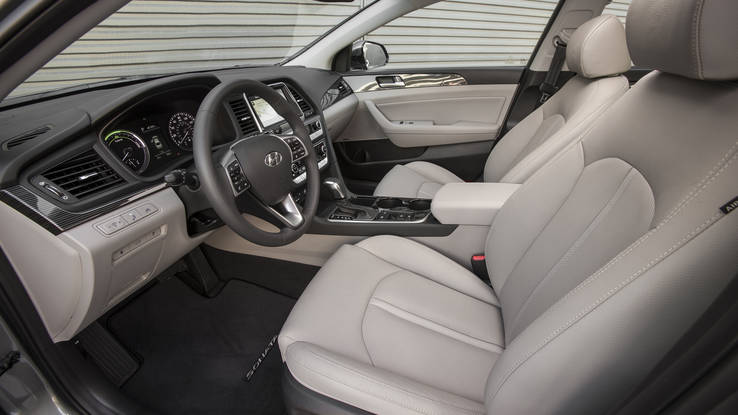
2018 Hyundai Sonata hybrid interior

The Hyundai Sonata Hybrid and Plug-in Hybrid both get a restyled interior.

The new Hyundai Sonata hybrids do have some nice safety nannies as standard equipment, including blind-spot detection with rear cross traffic alert. There are more available safety goodies like autonomous emergency braking, lane keep assist and automatic high beams. 

The new Sonata hybrids will be easier to own if you have a smartphone, too. They’re equipped with Hyundai’s Blue Link connected car system that lets you lock, unlock and start your Sonata Hybrid with your phone. The app will also let you control your charging times if you happen to use your own electricity to charge the plug-in Sonata. This could save owners money because it can maneuver the charge times around peak electricity demand in your town.

The new Hyundai hybrids should be on sale shortly, as they’re still listed as 2018 models. We don’t know much about pricing now, but imagine the prices to stick around the current starting prices of 26,885 for the hybrid and 35,485 for the plug-in.

2019 Volkswagen Arteon picks up where the CC left off

Share

  • Pinterest

The 2019 Volkswagen Arteon, the marque’s new fastback flagship in the U.S. designed to offer the space and amenities of a midsize luxury sedan, made its North American debut at the Chicago Auto Show this week. Positioned above the Passat in the VW lineup, the Arteon will replace the CC sedan.

Based on the MQB architecture shared with models like the new Atlas, the Arteon is longer and wider than the CC sedan — the wheelbase alone tops the CC by more than 5 inches — but features shorter overhangs front and back. Volkswagen aimed for a sleeker and sharper look when it came to exterior design, while also giving the Arteon more interior space. The new sedan’s exterior visually communicates luxury through details such as chrome window surrounds, 18-inch aluminum-alloy wheels, LED headlights and a wide chrome grille while also featuring sportier, coupe-like elements such as frameless side windows and dual trapezoidal exhaust tips. In short, the Arteon aims to take the style of the outgoing CC a step further while also offering improved accommodations for its passengers, creating a standalone model quite different in packaging from the long-serving Passat.

When it comes to performance, the 2019 Arteon will debut with a turbocharged and direct-injected 2.0-liter TSI engine, good for 268 hp and 258 lb-ft of torque, paired with an eight-speed automatic transmission sending power to the front wheels or four wheels when coupled with Volkswagen’s 4Motion all-wheel drive. Standard on all trim levels will be the DCC adaptive damping system that manages the suspension’s compression and rebound rates to improve dynamics.

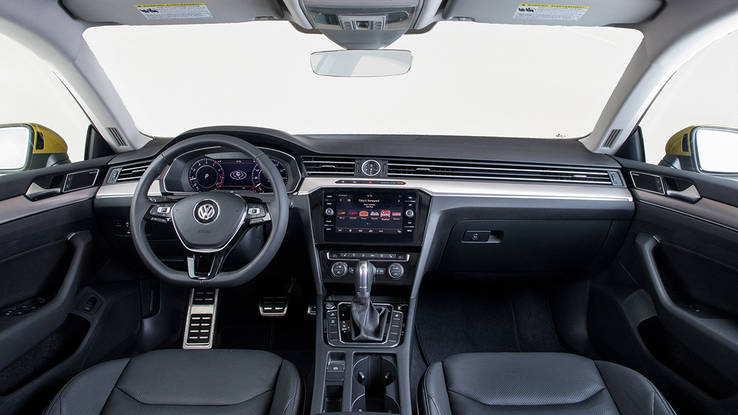
2019 Volkswagen Arteon interior

The Arteon will offer an 8-inch infotainment screen as a standard feature, while the Volkswagen Digital Cockpit will be an option.

2019 Volkswagen Arteon first drive

Inside, the Arteon will feature an 8-inch infotainment screen as standard, while offering the Volkswagen Digital Cockpit as an option. When it comes to interior options the Arteon will also offer a panoramic sunroof, Dynaudio premium sound system and a powered trunk lid which can be opened by the driver with a motion of the foot under the rear bumper. In terms of safety tech the Arteon will feature a blind spot monitor, forward collision warning and autonomous emergency braking as standard items, in addition to optional safety features like active land lane departure warning, adaptive cruise control with stop and go (for traffic jams), an overhead view camera, parking steering assistance and automatic post-collision braking, in addition to other available items.

“The Arteon is Volkswagen’s brand shaper,” said Hinrich J. Woebcken, CEO of Volkswagen’s North American Region. “This car is the spiritual successor to the CC, but it is bolder and faster. Arteon has the style and performance of a luxury Gran Turismo for about the price of a fully loaded midsize sedan.”

Expect to see the Arteon on sale starting in late fall of 2018. Pricing for the three trim levels — SE, SEL and SEL Premium — will be announced closer to the start of sales.

2018 Volkswagen Passat GT introduced for North American International Auto Show

Toyota Tacoma, Tundra TRD Pro trucks get extra off-road goodies in Chicago

Share

  • Pinterest

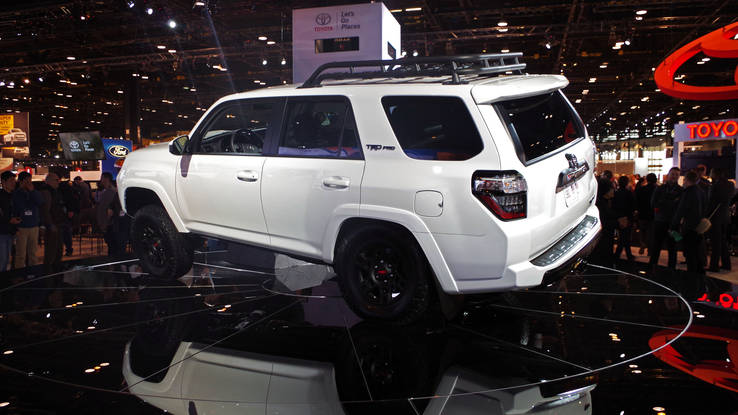
Toyota rolled out updated TRD Pro trims for the midsize Tacoma pickup, the full-size Tundra and the 4Runner SUV, adding a snorkel-like intake on the Tacoma and internal-bypass shocks across the lineup.

The new exclusive color option is Voodoo Blue and joins the Super White and Midnight Black paint options that carry over.

The 2019 TRD Pro series will be available in the fall, Toyota said in a statement Thursday.

Most of the changes to the trail-ready trucks are cosmetic, including a new roof rack on the 4Runner and rigid fog lights and special wheels on the Tundra, but there are some functional changes to the lineup.

Inline TRD Pro image

Toyota shows off its 2019 4Runner TRD Pro’s suspension articulation at the Chicago Auto Show.

The 2.5-inch Fox shocks once exclusive to the Tacoma are now used across the lineup and add an inch of additional wheel travel. The available desert intake on the Tacoma prevents sucking up dust from the wheel well, Toyota said.

The 4Runner receives Toyota’s updated Entune infotainment system with JBL premium audio and integrated navigation.

The first Toyota Racing Development package was offered in 2014.

By Laurence Iliff, Automotive News

The 2019 Ford Transit Connect gets new looks and diesel power in Chicago

Share

  • Pinterest

Ford is showing off the 2019 Ford Transit Connect at this year’s Chicago Auto Show. The latest Transit Connect sports updated styling joined by new safety and entertainment tech and a diesel engine. While the diesel engine is an interesting move, considering the recent scrutiny coal-rollers are facing from the government, the extra safety tech is a welcome addition.

If you decide you don’t want the available 1.5-liter EcoBlue diesel, don’t worry — the 2.0-liter gasoline-burning I4 is standard issue. Both engines are mated to a new eight-speed transmission. Sticking with the trend of downsized diesel engines, the 1.5-liter EcoBlue won’t be as powerful as the 2.0-liter gas engine but should be good for at least 30 mpg on the highway. Ford hasn’t released official numbers yet, but those should be coming closer to the van’s launch. When equipped with a towing package, the Transit Connect can tow 2,000 pounds or have a payload of 1,600 pounds, both in keeping with the van’s typical commercial uses.

Detroits hits and misses

2018 Detroit auto show: Hits and misses

Richard Truett, Automotive News’ powertrain savant, design connoisseur and all-around engineering go-to guy, jumped up on just about every stand, thought and pondered and scratched his head, …

Alongside the new styling and new engines, the Transit Connect now comes standard with autonomous emergency braking. The standard emergency braking comes with pedestrian detection to make urban driving even easier. There’s also available adaptive cruise control, but that will set you back some extra cash. Same goes for a lane keep assist system. Ford also made a 6.5-inch floating touchscreen available but that too is extra. The 6.5-inch media screen runs Ford’s latest Sync 3 infotainment system.

Targeting the active baby boomer and empty nesters looking to get a jump on a second career or hobby, the Transit Connect could appeal to more folks than what Ford is expecting. The hyper utility and flexibility of the new Transit Connect could make it useful for anyone that needs something, well, flexible. If you’re looking to replace your aging Windstar or your older Transit Connect, this 2019 goes on sale in the fall.

2018 Chicago Auto Show preview: Here’s what’s coming to the Windy City

Share

  • Pinterest

With the 2018 Chicago Auto Show right around the corner, we’re already starting to hear about what is rumored and expected to show up in the Windy City during press days. Here’s a preview of some of the new cars, trucks and SUVs we’re anticipating; we’ll update the story as more reveals are previewed or leaked.

The Chicago Auto Show opens to the public on Feb. 10 and runs through Feb. 19, so make plans to attend!

Ford

Ford will show off a refreshed Transit Connect van. We’re expecting creature comfort updates, new tech and new powertrains to be the highlight of Ford’s small commercial van. We also expect Ford to parade around the new Bullitt Mustang that debuted earlier this year at the Detroit auto show.

Although, like we saw with Ford’s GT500 Mustang teaser, we expect Ford to show something less commercial and more enthusiast-oriented at the show.

Hyundai

Hyundai will show off hybrid versions of its refreshed Sonata sedan. The updated Sonata hybrid will likely carry over the styling of the refreshed Sonata and many of its new standard features. We doubt that Hyundai will completely overhaul the hybrid platform during a refresh, so expect the stats to stay similar to the one you can find on dealer lots.

Lexus

Lexus will show off a pair of limited-edition performance versions of its RC coupe and GS sedan to celebrate 10 years of “F” performance cars. The special-edition RC-F and GS-F cars will have matte nebula gray paint and blue accents throughout the cars’ exterior and interior. The 467-hp coupe and sedan will be limited to 240 and 100 examples, respectively.

Nissan

Nissan will display the crazy 370Z roadster dubbed 370Zki, alongside a special-edition of its Armada SUV. The Armada Snow Patrol is a winter-ready three-row SUV that would look perfectly at home with the 370Zki on a trailer behind it.

Subaru

Celebrating 50 years in America, Subaru will show off special 50th anniversary editions of its 2018 models. These models will also come with a shared available color and a special badge saying “Subaru in America since 1968.” These special editions will be based on the higher trim levels of each model. 

Toyota Chicago teaser image

Toyota will show off refreshed versions of its popular off-road-ready pickups and SUVs from the TRD Pro line.

Toyota

Toyota is set to show off the latest off-road-centric TRD Pro versions of its pickups and SUVs. We expect the refreshed TacomaTundra and 4Runner to carry on the TRD Pro tradition of gobs of ground clearance, heavy-duty suspensions and enough rubber to get you into and out of trouble. We doubt there will be any drastic changes to these off-road rigs and expect the Tacoma to stick with 3.5-liter V6 power and the Tundra to keep its 5.7-liter V8.

Volkswagen

Volkswagen will have the U.S. debut of its CC replacement — the Arteon. We saw the official global debut of the Arteon at last year’s Geneva Motor Show and drove it shortly afterward, but it hasn’t made its way to the States yet. The stylish new VW shows that VW hasn’t given up on sedans, but they’re making them swoopier than ever.

By Autoweek Staff