All posts in “Porsche”

More Than Just Skin Deep: Porsche Unveils Updated 911 GT3 RS

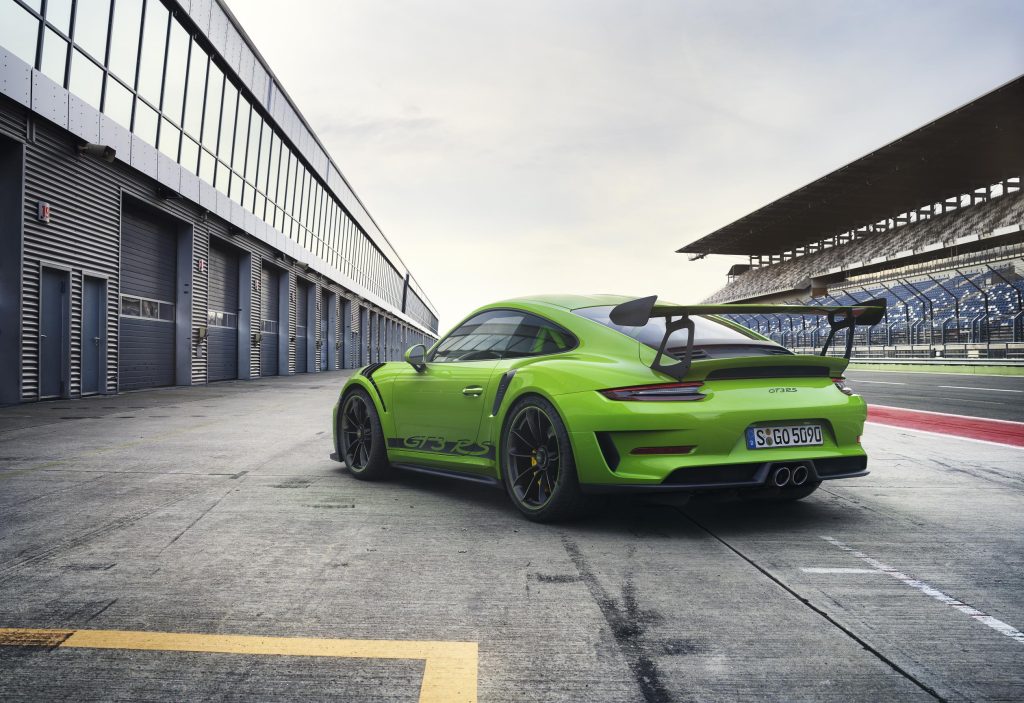
Porsche has unveiled the 2019 911 GT3 RS ahead of the 88th Geneva International Motor Show, which is taking place from 8th-18th March 2018.

Striking visual updates separate this GT3 RS from the model before it. The 2019 model sports a carbon fibre front hood, with NACA ducts like on the 2018 911 GT2 RS to help with brake cooling without adversely affecting the aerodynamic performance of the body.

The front spoiler lip is larger, helping to increase downforce when paired with the side skirts, which are also enlarged. That massive rear wing works in conjunction with an underbody diffuser, with the whole lot coming together to produce more than two times the downforce of the non-RS 911 GT3 according to Porsche.

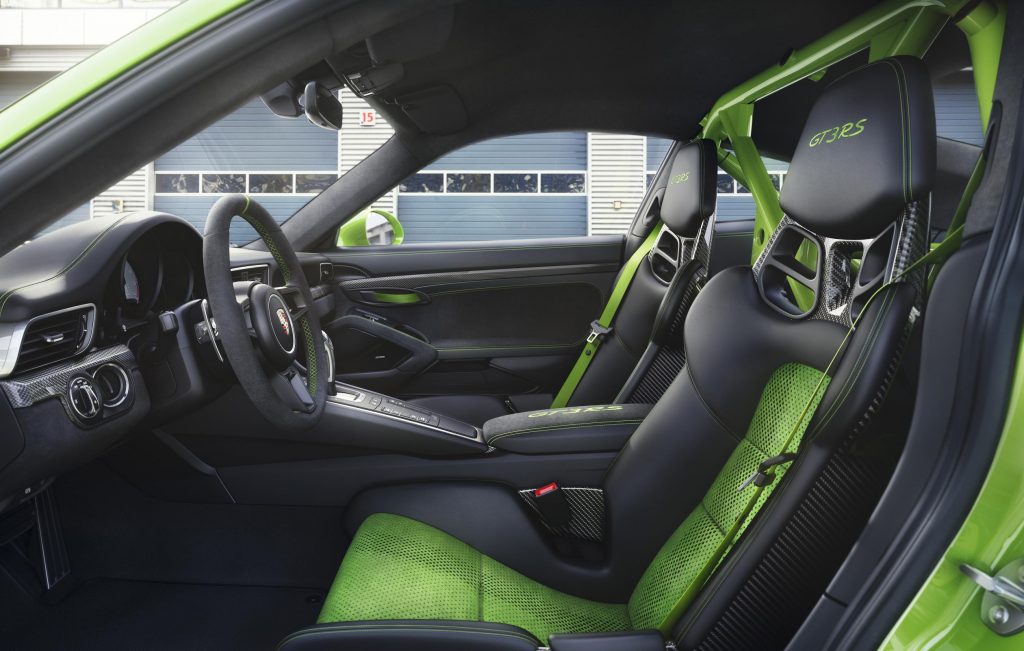
Inside is as you’d expect, with full bucket seats featuring carbon fibre-reinforced backrests to hold the driver in place while the car does its best to throw them out using lateral G-Forces and oodles of grip. Further nods to the motorsport potential of the 2019 GT3 RS include lightened door panels, with loops in place of door handles and an Alcantara steering wheel with a motorsport-inspired yellow 12 o’clock marker.

2019 Porsche 911 GT3 RS interior

2019 Porsche 911 GT3 RS interior

Rear seats? There are none – done away with in the pursuit of keeping the GT3 RS’ weight as low as possible. Even with this, Porsche offer further weight savings, which it says are for ‘particularly spirited drivers.’ With extra carbon fibre for the steering wheel and shift paddles as well as on the sway bars, coupling rods and vehicle roof, and the optional forged magnesium wheels, the $18,000 Weissach package helps the 911 GT3 RS tip the scales at just 1431kg.

At no additional cost, Porsche will also fit the Clubsport package, which adds a roll bar, six-point seat harnesses and a fire extinguisher, for the especially track-focused enthusiast.

Power to match its racing pretensions

Beneath the rear bonnet and that huge spoiler sits Porsche’s 4-litre, naturally aspirated flat-six engine putting out 520 horsepower and 346 lb ft of torque – good for a 0-60 time of 3 seconds flat, 0.2 seconds faster than the GT3 with PDK and one tenth of a second quicker than the previous-gen GT3 RS. This GT3 RS tops out at 193mph, with Porsche’s main focus being to get it round a track as quickly as possible, not on straight-line top speed.

2019 Porsche 911 GT3 RS

2019 Porsche 911 GT3 RS

That power is delivered to the track (or road – don’t forget this thing is road legal) via 325/30 Ultra High Performance tyres, wider than those fitted to the 911 GT3, to help those horses do their stuff in the most effective way possible.

Keeping that power in check and helping the driver harness the car’s potential is the motorsport-derived chassis of the GT3 RS, which features Porsche Active Suspension Management (PASM), active engine mounts, rear-axle steering and an electronic locking rear diff with torque vectoring as standard.

The suspension is adjustable to suit the preference of the driver, with ride height, toe, camber, caster and sway bar settings all able to be altered.

Porsche is accepting orders now for the 2019 911 GT3 RS, with prices starting from $187,500 plus a delivery, processing and handling fee. Options include the aforementioned Weissach Package ($18,000) and magnesium wheels ($13,000).

Is the 2019 Porsche 911 GT3 RS hardcore enough? Let us know on Twitter.

This Porsche 928 and Mercedes-Benz 500E Satisfies a V8 Fetish

“I was a bit skeptical about the color in the beginning, but I kind of like it now. It stands out, definitely,” says Torfi Sigurjonsson of his Speed Yellow 928. With a small list of cars to collect, the brightly-colored Porsche was actually #2. “On the top of the list was the E500, which I bought 2006, and this is a US model. I bought it in New Jersey.” Torfi’s day job? Airline pilot.

“I was hooked on aeroplanes since I was a small kid. Nothing else was an option, other than being a pilot. I’m quite lucky really, to have a job,” he says. “It’s a hard competition to get a job with the national carrier like Icelandair, but I made it there, I’ve been there for now 26 years.”

Torfi agrees that there’s a connection between fast aeroplanes and fast cars—least of which their aversion to the winter months. But he doesn’t own his vehicles for speeding, saying, “It’s a nice feeling just to drive around, not too fast. You know of all the power in there, and knowing that you have it is a good feeling. You don’t have to be going 200-plus [kph].”

With a busy working lifestyle and a dedicated hobby, no matter what, Torfi will always make room for the machines he loves. “I try to keep my life not too complicated, but I have this car fetish. V8 fetish. You only have one life, so I try to make the most out of it.”

Porsche: History, Racing Achievements, & Iconic Sports Cars


Contents (Part one)

Part one / two / three / four / five

Introduction

For nearly seventy years, the name Porsche has been synonymous with some of the finest, best engineered automobiles the world has ever known.

The cars, which boast superior German engineering, are recognized as the most reliable, best handling, performance-driven sports cars both on the racetrack and the open road. Owners and enthusiasts alike will agree that – when it comes to both drivability and collectability – a Porsche is almost always a sure thing; a winner on race day and an investment that will only appreciate in value over time.

However, to appreciate the technology and refinement of today’s most advanced Porsche supercars like the 918 or the 911 GT2 RS, it is important to understand the history of the company, and the people, that gave life to these amazing machines.

Like most of today’s successful automobile manufacturers, Porsche’s “climb to the top” is lined with a rich history that unfolded during some of the most pivotal events of the early 20th century. It’s evolution into the company it is today began with the vision of one man – and a family name that would transcend the borders of Germany and become synonymous with performance driven perfection the world over.

This is the story of Porsche.

In the Beginning

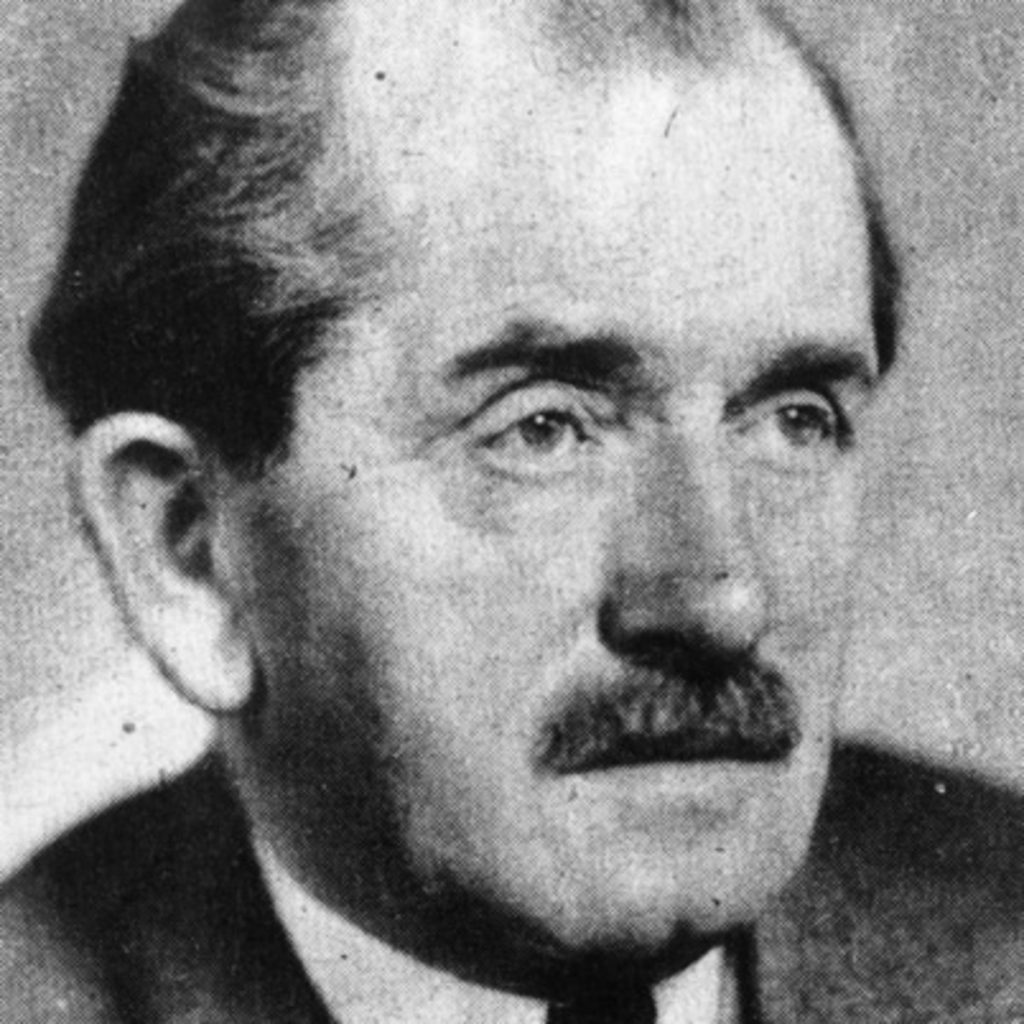
The man behind the Doktor Ingenieur honoris causa Ferdinand Porsche Aktiengesellschaft (or Dr. Ing. h.c. F. Porsche AG) company was founder Ferdinand Anton Ernst Porsche Sr.

Ferdinand Porsche was born on September 3, 1875 in Vratislavice nad Nisou near Liberec in the Czech Republic. Even as a child, a young Ferdinand had demonstrated an aptitude for engineering as he worked in his father’s mechanical shop.

By his eighteenth birthday, Ferdinand had obtained a position in Vienna at the Bela Egger Electrical Company.

Because of his strong desire to learn, Ferdinand would sneak into the Vienna Technical University at night to obtain an education that would further enable him to advance his skills as an engineer and designer. Through these studies at the university, and through his constant pursuit for knowledge at his workplace, Ferdinand successfully built an electric hub motor of his own design.

Jakob Lohner & Company

Because of his electric motor design, Ferdinand was able to gain a position at Jakob Lohner & Co., a Viennese luxury coachbuilding firm.

Lohner, who had become well known for his work building carriages and coaches, entered the realm of building “horseless carriages” (early automobiles) in 1896. He wanted the young Ferdinand Porsche to accompany him on this new venture, and he summarily hired Ferdinand to work with him.

The Lohner-Porsche
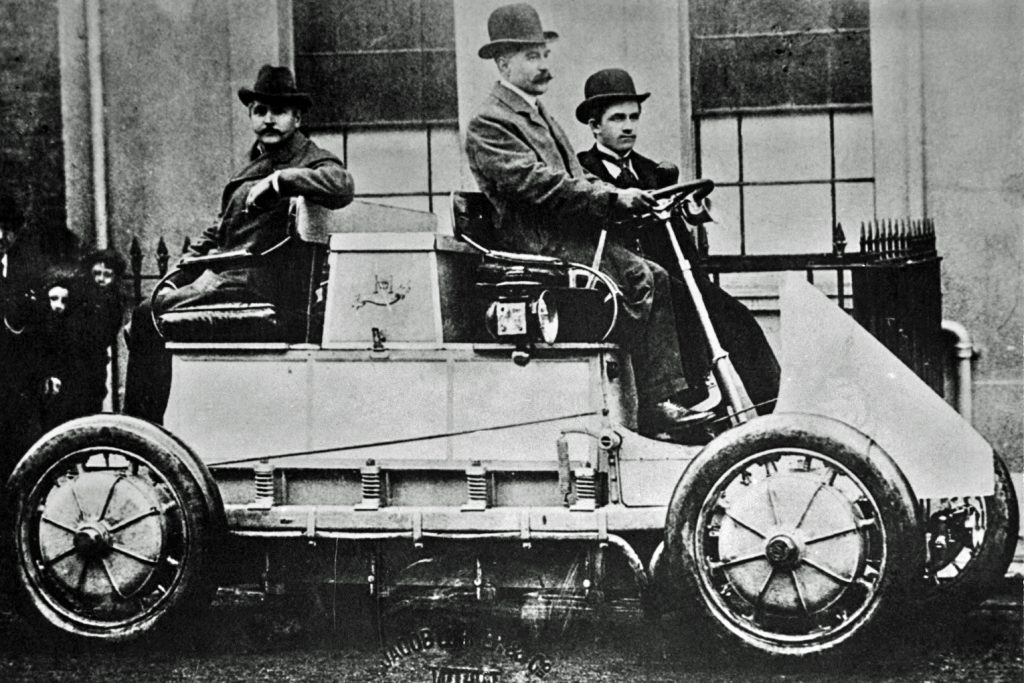
Together they unveiled the “Lohner-Porsche” automobile at the 1900 Toujours-Contente (Paris World Expedition). The automobile was “carriage-like” with hub mounted electric motors that were directly powered by 1800kg of lead acid batteries.

Most automotive historians recognize the 1900 Lohner-Porsche as the first, full-electric automobile.

While its success at the 1900 Paris World Expedition proved the carriage’s potential commercial viability, the Lohner-Porsche was originally designed to be used as a racer. Even given its size and weight, the Lohner-Porsche and surprisingly fast off the line. Still, due in large part to the weight of its batteries, the car struggled to climb hills of any reasonable grade. Further, the battery life was very short.

The Lohner-Porsche Mixte Hybrid
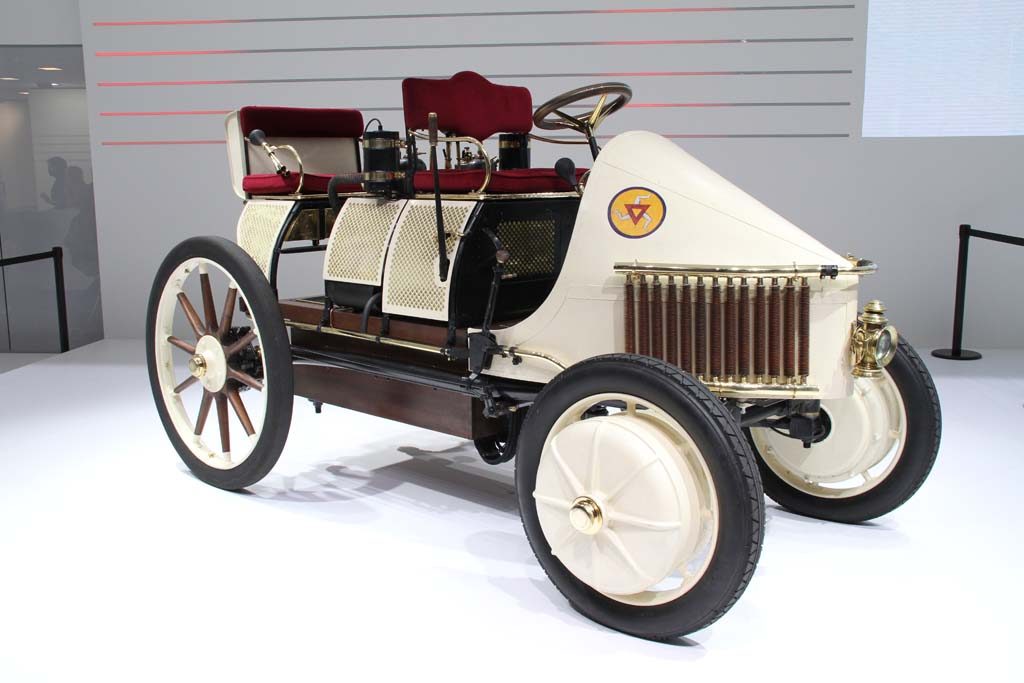
Still, over the course of its development, the Lohner-Porsche evolved through several variations and ultimately emerged as the distant ancestor of a type of vehicle we recognize today as a “hybrid”. This new vehicle was named “Lohner-Porsche Mixte Hybrid”.

Unlike the earlier Lohner-Porsche (which utilized a Volkswagen engine), the Mixte Hybrid featured a Daimler internal combustion engine. In turn, the engine that was fitted to a generator to drive the electric hub mounted motors.

The Lohner-Porsche Mixte Hybrid was celebrated as the first petroleum electric hybrid vehicle (or HEV), and demonstrated unequivocally that the engineering brilliance of Ferdinand Porsche was certain. In addition to being very efficient (for its time), the Mixte Hybrid also proved to be a performance vehicle – it set a land speed record of 35 mph and won the Exelberg Rally in 1901.

By 1905, Ferdinand Porsche had become recognized as one of Austria’s most outstanding automotive engineers.

Between 1901 and 1905, he and Lohner sold more than 300 of their vehicle to consumers throughout Austria and parts of Germany. Despite their success, Ferdinand felt that he could better advance his career by parting company with Lohner and continuing his career as the chief designer for Austro-Daimler. He joined the Daimler corporation in 1906.

Austro-Daimler and the Future Arrives
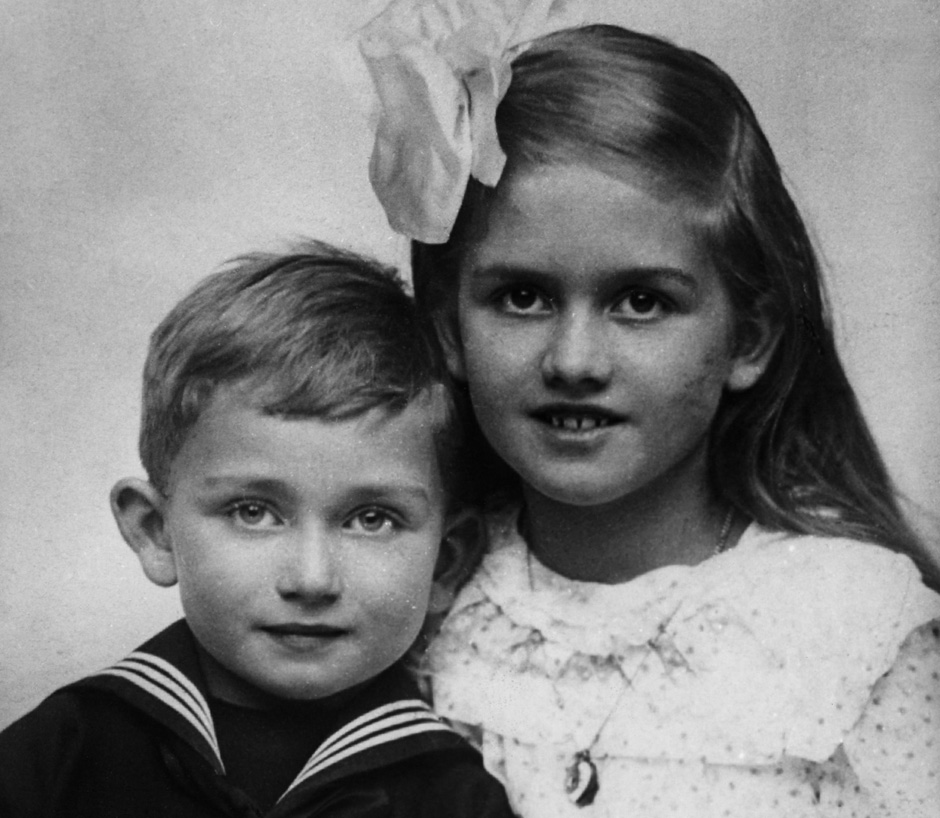
On September 19, 1909, Ferdinand and wife Aloisia Johanna Kaes, welcomed their one and only son into the world. Baptized Ferdinand Anton Ernst Porsche, the newest member of the Porsche family would quickly become known as “Ferry” to his family, a term of endearment that was used to differentiate between father and son.

It was also a name that would follow the younger Porsche into his own professional career and become synonymous with the car he’d help to create.

The 22/80 PS

Because of his work with Lohner, Ferdinand Porsche was commissioned by Daimler to design a car that could be used to compete in the Prinz-Heinrich-Fahrt (the Prince Henry Trial.)

This race, which was held annually from 1908 to 1911, was the precursor to the German Grand Prix, and was run throughout Germany, Poland, Hungary, and Austria, before finishing in Munich. While several designs were presented, Ferdinand’s model – the 22/80 PS – was selected to represent Austro-Daimler in the race.
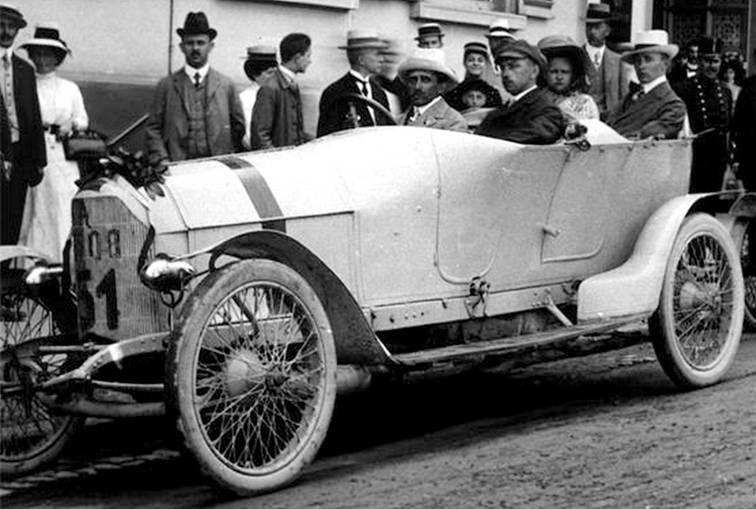
The 22/80 PS featured a 95 brake horsepower, four-cylinder, overhead camshaft engine which included five inclined valves per cylinder (one inlet valve and four exhaust valves.) When the 22/80 PS finished in the top three spots of the Prinz-Heinrich endurance race event, the car was christened as the “Prince Henry,” which is how the car continues to be most commonly referred to today.

Ferdinand Porsche continued to achieve a great measure of success during his tenure with Daimler. By 1916, he had advanced to the position of Managing Director.

Two Honorary Doctorates and a Change In Direction

The following year, Porsche received an honorary doctorate from the Vienna University of Technology (the same university that he had illegally gleaned an education from some twenty years earlier.)

In 1917, he was bestowed with the title “Doktor Ingenieur Honoris Causa” (Doctor of Engineering, Honorary). The more common abbreviation of the degree, “Dr. Ing. h.c.” became an integral part of how Ferdinand was to be addressed and/or identified from that point forward.

For the next several years, Ferdinand continued improving upon the designs of his racing cars and, in 1922, constructed racers that won 43 of the 53 races they competed in that year.

In 1923 Ferdinand resigned from Austro-Daimler and in a few short months accepted a position as Technical Director for Daimler Motor Company in Stuttgart. With Ferdinand’s reputation and popularity, he was given another honorary degree – this time from Stuttgart Technical University.

Daimler-Benz

In 1926, Daimler merged with Benz and became Daimler-Benz, operating under the name Mercedes-Benz. Ferdinand worked his way up into the Chief Engineer position and had many of his more successful designs reach the racing circuit.

From 1925 to 1927, the Porsche designed 2-liter, 8-cylinder Mercedes Type S won 21 of 27 races in the “Regenmeister.” The car, which was driven by Rudolf Caracciola, was said to be almost unbeatable.
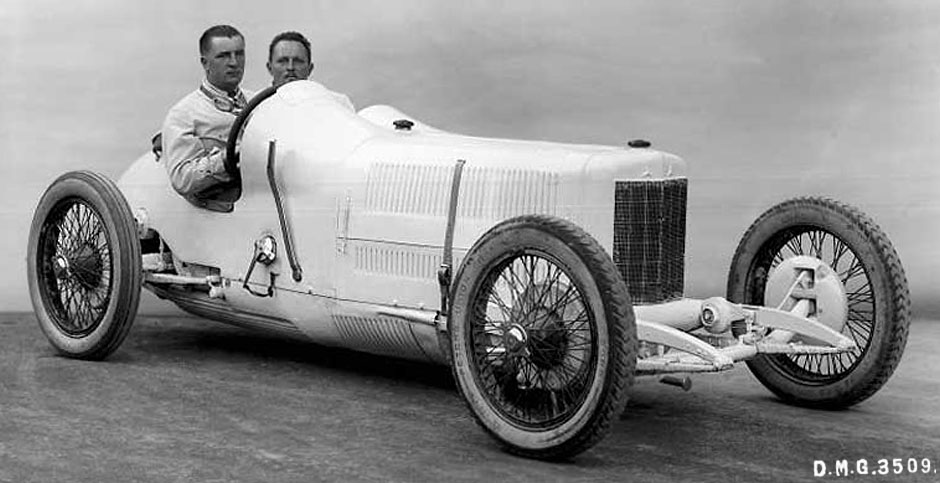
Even though Ferdinand was very successful in the racing circuits with his innovative designs, he was otherwise focused on another project that he worked on in the background of his obligations to Mercedes Benz – namely, a compact automobile that would appeal to the masses. Once he reached a point with his design that he felt it was ready to be unveiled, he proposed it to the directors of Daimler-Benz in 1928. Daimler-Benz showed no interest in his work and Ferdinand’s ego and pride helped reinforce the decision to walk out the door once more and resign.

In several interviews with his son, Ferry Porsche often stated, “My father found that when he signed a contract with an (automotive) firm, they could live another ten years on his designs, but he couldn’t.”

This sentiment – even though it was historical by the time Ferry expressed it – was a driving force at the core of the older Porsche’s professional objectives. Many that knew him believed that, even before his resignation from Daimler-Benz, that Porsche would ultimately seek employment with a company that would openly embrace his vision.

My father found that when he signed a contract with an (automotive) firm, they could live another ten years on his designs, but he couldn’tFerry Porsche

Given the reputation that Ferdinand had developed, accompanied by his successes on the race track, Ferdinand felt that finding gainful employment elsewhere – and moreover, being able to solicit his new automobile design – would be easy.

However, one of his specific employment requirements with any prospective employer he approached was that he’d immediately be placed on their board of directors.

This demand was simply unrealistic and made finding employment very difficult.

The Great Depression & The First Porsche Company

Finding employment became even more challenging for the talented (but obstinate) Ferdinand when the Wall Street stock market crash of 1929 resonated around the world, causing economies everywhere to collapse. As an economic depression took hold of the global economy, finding employment became nearly impossible.

Despite the seemingly insurmountable odds, and with only his family’s financial backing to support him, Ferdinand realized that it was time to take all that he had learned, all the experiences that had helped refine his abilities, and all his successes in automotive design – both on and off the racetrack – and parlay all of it into a new automotive firm.
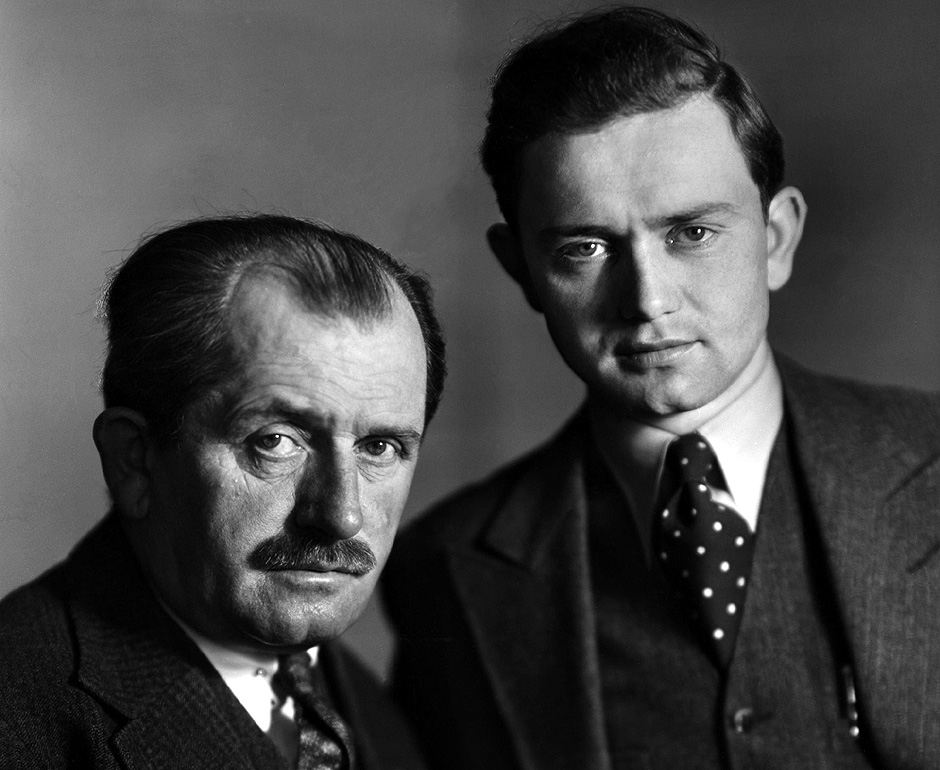
On March 6, 1931, “Porsche Konstruktionsbüro für Motoren-Fahrzeug-Luftfahrzeug and Wasserfahrzeug” (Porsche Construction Office for Engine, Vehicle, Aircraft and Watercraft Construction) was officially established in Stuttgart, Germany.

Throughout his time with Daimler Benz, and even in the years between his resignation there and the founding of his company, Ferdinand had made a conscious effort to provide his son with an education in engineering.

Much like his father, young Ferry took to the areas of design and engineering naturally. He showed great promise and learned his profession quickly, working whenever (and wherever) he could to prove his abilities to his talented father. When Ferdinand Porsche established the Porsche Construction Office in 1931, he almost immediately employed Ferry as the company’s first engineer.

Porsche’s History Continues in Part Two >

2017 Porsche Panamera 4S essentials: Race-team ready

Share

  • Pinterest

What is it: The 2017 Porsche Panamera 4S is an all-wheel drive grand tourer with four luxurious places to sit.

Key Competitors: BMW B6, Mercedes-Benz AMG S65, Audi S8

Base Price: $100,950 As-Tested Price: $133,185

Highlights: A completely new engine and chassis make the Panamera a perfect mix between sports car and grand turismo.
 

Our Opinion: The Panamera 4S is the perfect car for a 24 Hours of Lemons race weekend. Not only are the massaging heated seats perfect for relaxing after a 12-hour day lying in the mud fixing a timing belt on a 1990 Lexus ES250, but it’ll also fit three full-size mustachieod mechanics for the pitch-black ride home.

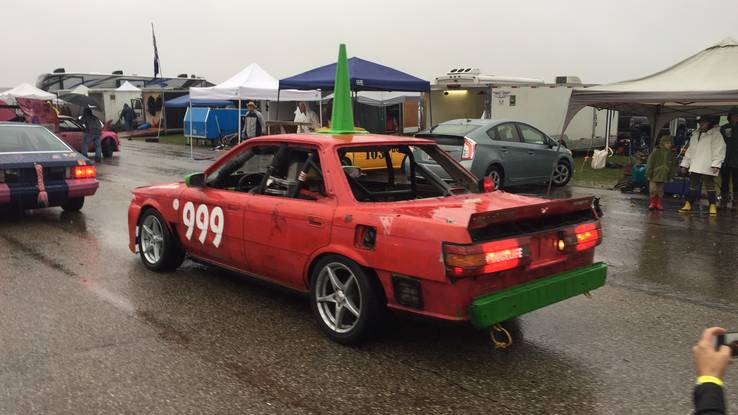
I joined a Lemons team this year, driving the Hoy Fong Foods No. 999 Sciracha Racing Lexus ES250, and made the 2.5-hour trip to the west side of Michigan in this grand tourer at mostly illegal speeds. This is one of those cars that makes me think, “why shouldn’t I be able to cruise at 90 mph on a desolate stretch of two-lane highway at 8 a.m.?” The Panamera feels as stable as a bench vice as it eats highway miles. The drive is actually about three hours, and I did it in 2.5, with a stop. The eight-speed auto only kicks hard in sport plus mode, which is probably good. Most drivers don’t want their back cracked with every shift, ‘cept me.

[embedded content]

Now that I’m looking at the specs, I don’t know if I would have guessed that it has 440 hp, but it is quick at any point in the rev range, and I love the push-to-pass button that turns everything to sport plus mode for 20 seconds. The brakes are great too, hauling this, wow, only 4,100-pounder with ease.

The adaptive suspension is very compliant in normal mode, even when going over the big potholes. Everything firms up in sport and sport plus, but I didn’t use those modes a lot, considering the condition of the surrounding roads. It’s a Porsche, so steering feel is already better than most cars on the market today.

And then there’s the tech. The Panamera has stop/start, mostly non-intrusive; night vision that actually caught a deer before I saw it; lane keeping and adaptive cruise control, which I used a ton; park assist, which helped get me out of the grass between parked cars, and about 20 other acronyms for safety and security. The night vision/wildlife detector was the most impressive though. I did not see the three deer running alongside the road until the car beeped at me, kicked the night vision on and put the animals in red, digital boxes like an acquired target in fighter plane. However, the same thing happed a bit later in the night, and it didn’t detect them, so it’s not 100 percent there.

Hoy Fong Foods No. 999 Sciracha racing Lexus ES250

Hoy Fong Foods No. 999 Sciracha Racing Lexus ES250

One piece of tech that is all the way there is the launch control function, which really isn’t even a function. You just pin the brake, pin the throttle, let go of the brake and hold on. I tested it out on a dirt road. The revs jump up to about 4,000 while the tailpipes pop likes it’s at the rev limiter. Let go and all four tires bite into the road like a dirt-grading machine leaving four, foot-wide tire imprints of freshly ground rocks. After a couple more times the entire road was fresh again. People pay money for this. It never slowed, never overheated and never gave me any sort of warning that the practice might be detrimental to the drivetrain. 

This particular Panamera has about $33,000 in options, which is, in Porsche terms, about mid-pack. The most expensive is the Sport Package that includes rear steering, the Sport Chrono pack, adaptive air suspension and the sport exhaust. Almost everything on the option list is $1,000 or more. Massaging seats, LED headlights, adaptive cruise control, four-zone climate control all break the four-figure barrier. But if you’re spending $105,000 with tax, what’s another $30K in options between friends?

There is a little less space in the trunk than I expected. I had to slide my cooler back up against the seats, Tetris in my tool boxes and bags and then throw a couple things in the back seat. I’m not sure if you could vacation with four people in this thing. The trunk was acting a little wonky as well. It must have some sort of sensor so as not to crush what’s back there, but it might be a little too sensitive. I got up Sunday morning to the trunk only 2/3s of the way closed — luckily with the direction of the rain, nothing got too wet.

Competitors include the BMW 6-Series Gran Turismo, maybe the mid-AMG Mercedes E-Class and the Audi S6. As for driving feel, I’d take this over all of those. The BMW 6 probably has more space, the E is more cushy, I’d guess, but in the $100K four-seat, four-door space, this Panamera 4S is at the top of my list.

–Jake Lingeman, road test editor

OPTIONS: Sport Package with rear-axle steering, sport chrono package, adaptive air suspension, sport exhaust ($5,930), Premium package with lane change assist, Bose surround sound system, power seats w/memory package, comfort access ($3,860), adaptive cruse control ($2,880), night vision assist ($2,540), LED-matrix headlights ($2,220), power seats w/ 8-way ($2,010), 20-inch Panamera Turbo wheels ($1,790), four-zone climate control ($1,410), lane keep assist w/ speed limit indicator ($1,210), massaging seat function ($1,190), park assist ($1,190), power sunblind for rear compartment ($880), night blue metallic ($830), soft close doors ($770), seat heating ($550), USB interface ($410), window tint ($390), standard interior in black/luxor beige ($380), ionizer ($340), steering wheel heating ($270), wheel center caps w/ colored Porsche crest ($185)
 

On Sale: Now

Base Price: $100,950

As Tested Price: $133,185

Powertrain: 2.9-liter DOHC turbocharged V6, AWD eight-speed automatic

Output: 440 hp @ 5,650-6,600 rpm; 405 lb-ft @ 1,750-5,500 rpm

Curb Weight: 4,123 lb

Fuel Economy: 12/28/23 mpg(EPA City/Hwy/Combined)

Pros: Eats highway miles with the best of ’em

Cons: Tech needs its own entry-level course

1974: The Porsche 914 holds much luggage, gets 23 mpg

Share

  • Pinterest

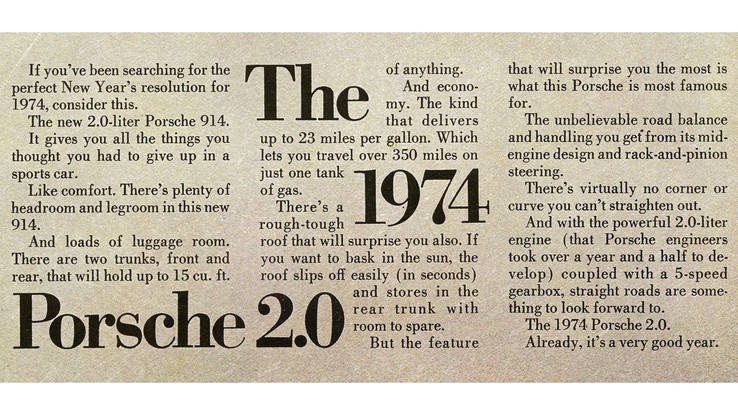
The Porsche 914 outsold the 911 by 17,012 to 11,624 cars in 1974, which is understandable given that the 914 cost about half of all but the lowest-end 911 models that year. American buyers could choose between a 1.8-liter version with 72.5 hp and a 2.0-liter version with 91 horses, and this February 1974 magazine ad takes care to point out (just four months after the start of the 1973 Oil Crisis) that the 914 with the bigger engine still managed to get up to 23 mpg.

1974 Porsche 914 magazine advertisement

This text sure makes the 914 seem practical for post-oil-embargo America. Photo by Porsche

914 production ended in 1976, with the 2.0-powered 912E smoothing the low-cost Porsche transition between the 914 and the more modern, water-cooled/front-engine 924.

74 Porsche 914 Magazine Ad – All.pdf

(31.63 MB)

Can your Porsche 911 do THIS?

Share

  • Pinterest

While they are more well-known for their road racing victories, from Le Mans to Laguna Seca, Porsche 911s have a long and distinguished history as rally cars, too. Vic Elford gave Porsche its first overall World Rally Championship win in 1968 at the Rally Monte Carlo in a Porsche 911T. American John Buffum –- running on a shoestring budget and lots of talent -– powered his own personal 911T to a 12th-place finish in the Rally Monte Carlo while on active duty with the U.S. Army in 1969. A four-wheel-drive 911 won Paris-Dakar in 1984, and the mighty 959 won there in 1986. More recently, everybody’s pal, American Jeff Zwart, has taken various 911s to five class wins at the Pikes Peak Hill Climb in Colorado, some taking place before the pavement was there.

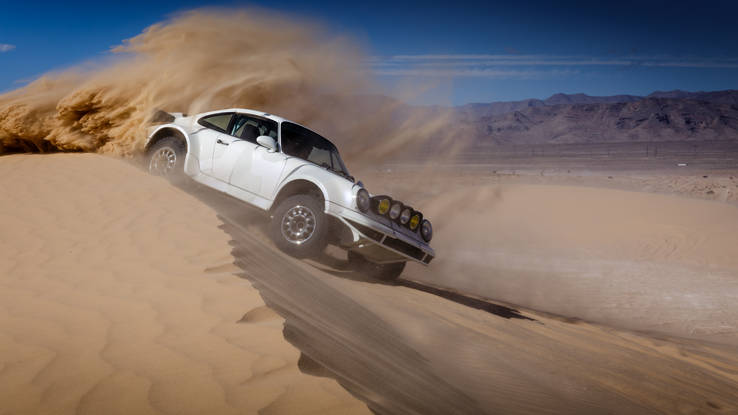
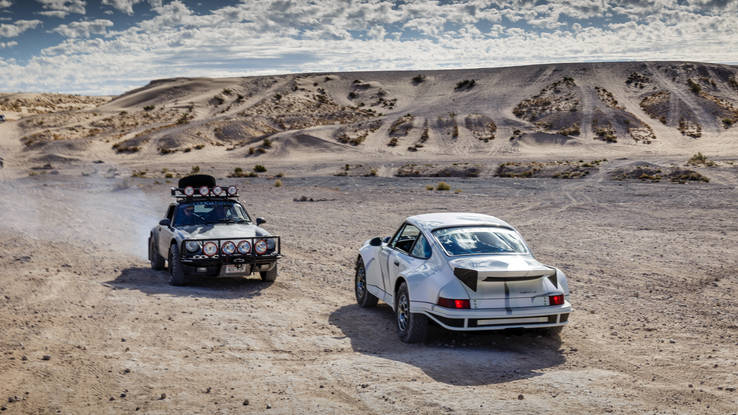
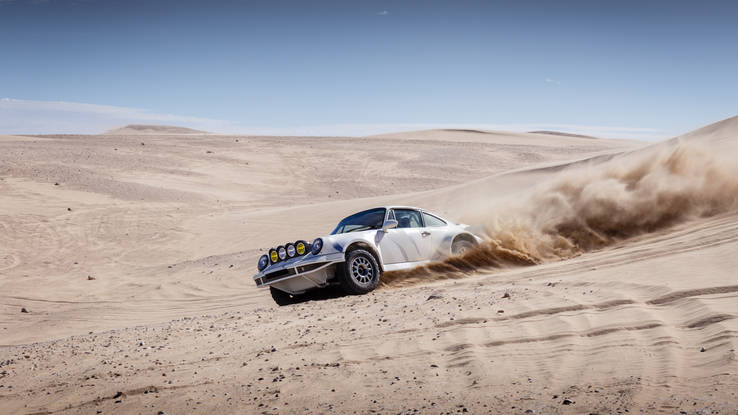
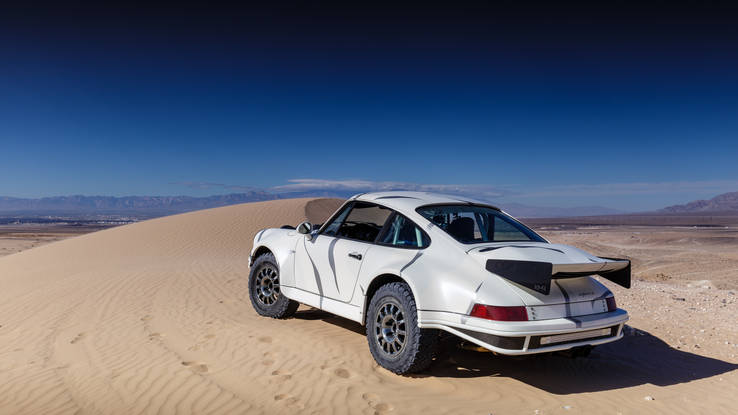
So what you see in these photos — 911s tearing it up in the desert dunes north of Las Vegas — is really not all that sacrilegious. It’s not even blasphemous or unprecedented. But it is fun.

Kelly Moss Porsche 911 from another angle

Kelly Moss Porsche 911 from another angle Photo by Erik Langerak/VICCI Auctions

“So, the first car, the guy walked in off the street, never met him before in my life, and he said, ‘I hear you guys build really cool cars. Can you build me a 911 I can drive on gravel roads and if I get an elk I can throw it up on the roof,” said Jeff Stone, president of Kelly-Moss Road and Race, which built this car and several others like it. “That’s no dumber than anything else anyone’s ever asked us to do, so why not?”

Indeed, why not? Kelly-Moss has been building road racing Porsches for decades, having once run factory racing efforts on behalf of the sports-car maker. So this would be easy. All you have to do is jack it up, beef it up and then go out and tear it up. Turns out it all comes down to the dampers.

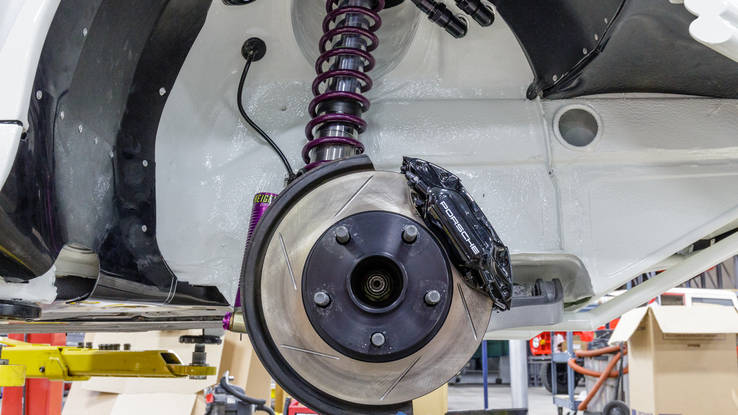
“Really good dampers,” Stone clarified. “The VICCI car (the white one) has these Reiger state-of-the-art rally dampers that are just really awesome. It’s a very, very long-travel shock and a long-travel spring package. They are three-, four-, sometimes five-way adjustable, and they’re remote-reservoir that’s piggybacked onto the bottom of the damper.”

Kelly-Moss also relocated the suspension points, modified the control arms, re-engineered the approach and departure angles, and added enough skid plates to survive a lunar rock garden.

“It’s amazing how well they can work,” Stone said. “You know, a Porsche that normally doesn’t even like to see a gravel road, to come out here and run through sand dunes all day and not get stuck and not break and they just keep going, that’s amazing.”

It was. 

Kelly-Moss 911 dampers

The dampers do the difference

Kelly-Moss showed the white car you see here at SEMA. When SEMA was over, they brought it out to a wild area north of the Las Vegas Motor Speedway used by rental side-by-side outfits, 4×4 clubs and various dirt-driving desperados, all of whom were present on the Saturday I showed up.

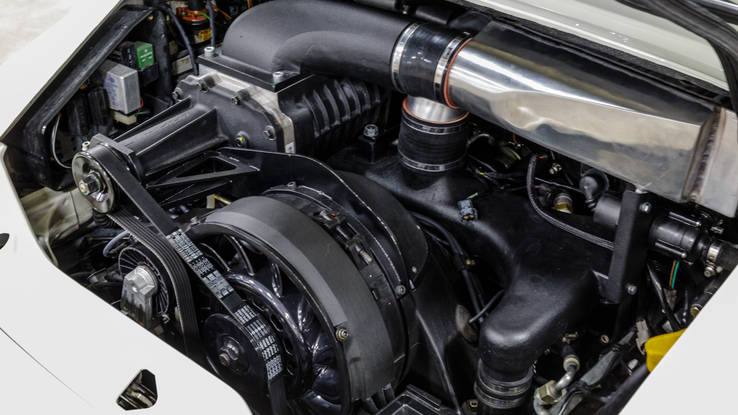
The white car is the AWD version of the two you see here. It has mucho modifications to just about everything on it. The engine is a 3.8-liter flat-six with MAHLE forged pistons, CP Carillo rods, an Eaton supercharger and more modifications than you can shake a camshaft at. Horsepower is listed by Kelly-Moss at 430 at the wheels, with 400 wheel lb-ft of torque, which has quite an effect on something with a curb weight of just 2,600 pounds. The suspension boasts those triple-adjustable long-travel coilovers with Reiger shocks and a continuing litany of parts too long to mention here. It rolls on Braid Rally wheels wrapped in BFGoodrich KO2 off-road tires stuffed inside custom-flared fenders. The list of modifications goes on for about two blocks.

Kelly-Moss 911 engine

The 3.8-liter flat six makes 430 hp

The gray car has rear-drive.

“This car started as an old, beat up, raced-out and used-up 911 that needed everything except a chassis,” said Andy Kilcoyne, general manager of KMRR.

So they fixed everything on it. Now it’s powered by a 3.6-liter Varioram 993 engine with headers, exhaust and, again, more performance parts than can be listed here. It’s tuned to 330 hp and 300 lb-ft of torque, with a five-speed manual 915 transmission with a close ratio and limited-slip differential. Curb weight is listed at 2,500 pounds, including that elk-toting roof rack and the zombie apocalypse bumpers.

And I’d be driving them both.

911s in the vast wasteland

911s in the vast wasteland Photo by Erik Langerak/VICCI Auctions

Stone met me at the dirt turnout to Nevada State Highway 604, somewhere between Las Vegas Motor Speedway and that cool store halfway to Mesquite where you can buy real fireworks and really cheap cigarettes. It was out there, man. I jumped into the passenger seat and off we took, Stone at the wheel, into a desert wasteland not unlike that described by T.S. Eliot in his poem of the same name:

Here is no water but only rock

Rock and no water and the sandy road

If only T.S. Eliot had owned one of these Kelly-Moss 911s, how much happier English majors across America would have been. The ground was a Saharan-mishmash of sand dunes, spiky rocks and angry dirt, like those pictures you see of Mars except that every now and then you pop over a dune and there, off on the distant horizon, is the architectural fantasyland of Las Vegas, or, closer, Nellis AFB, with a real B2 bomber parked on the tarmac and as many F-16s as you’d need to invade Bermuda. It’s all pretty science-fictiony.

But the 911 didn’t care. Stone powered the gray car over the landscape with a mixture of confidence in the equipment and disdain for the rocks. Every time I thought we were about to take a real spine-adjusting whack from a dip or a berm, the 911 just ate it up and spat us out the other side. The car’s ability to absorb bumps, dips and whoop-dee-doos was amazing. Yes, those dampers are things of wonder.

Kelly-Moss 911 in action

Kelly-Moss 911 in action Photo by Erik Langerak/VICCI Auctions

We pulled up to a conclave of Kelly-Moss engineers and technicians and, after a cursory introduction –- here’s the brake, here’s the clutch, that’s the drift bar(!) –- I was off, driving the gray car as if I owned it. And, just as had been the case minutes earlier, the gray car was completely unhindered by terrain undulations. The sand was pretty deep, something that might have been a problem for many other 4×4 rigs, but the RWD 911 never flinched, burrowing through the deepest quicksand without a hiccup. On the rocks it was likewise unperturbed. I had to figure out where the power and torque bands lay in the engine’s output, found them a little on the higher side of the graph and then applied them as appropriate for the conditions. The shifter took a little time to sort out, including one embarrassing grind, but then it was easy enough.

While it was capable in this mix of ground, it would have been far better to take this contraption on a graded dirt road somewhere and fling it about like a rally car. With all that curb weight out over the rear axle, I imagined it would be a joy to pilot in more even conditions. I imagined sliding the tail around like Buffum in the ice and snow of the Alpes-Maritimes. 

Kelly-Moss 911 rear

Carbon Fiber add-ons are also made by Kelly-Moss Photo by Erik Langerak/VICCI Auctions

The white car, with more power and all-wheel drive, was even more confident in these adverse and abusive hills. It could go even farther into the sandy quagmire and come out better, though the gray car, with its rear-wheel drive, was more satisfyingly tail-happy. If I had to choose, I’d get something more like the gray car. But you can get whatever car you want.

If you have the dough, that is. I asked about price.

“It really depends,” said Stone. “We can build everything from a car that is more about visual perspective and less about the real off-road performance if an owner doesn’t ever intend to use that. And, of course, you have to have a donor car, so if someone brings us a donor car that’s fine, we keep donor cars in stock — we always have four or five or six Porsche 911s that are excellent cars to start with.”

That’s vague, Stone. Can’t you come up with a more precise price figure?

“On average, I would say you can start a build for about $150,000 and you can go up to $600,000. It just depends on what you want to do. So I think this car, the (white) VICCI car, is in the mid-threes. And this car (the gray) is about $250K.”

So there you have it. Is this something you want to do? I would say yes, this is something you want to do. Especially if you live out in the Wild West where there are dirt roads winding all over the desert just waiting to be explored. 

On Sale: Now

Base Price: $150,000 to start, more or less — probably more, way more

As Tested Price: $300,000

Powertrain: 3.8-liter H6, 5-speed manual, AWD

Output: 430 hp, 400 lb-ft

Curb Weight: 2600 pounds (mfg.)

Options: Kitchen sink

Pros: Go anywhere and drive like John Buffum

Cons: It’s better if you own your own state

2018 Porsche 911 GT2 RS first drive: Purposeful perfection

Share

  • Pinterest

The 911 GT2 RS is too loud. At highway speeds, wind noise is quickly overwhelmed by burdensome tire whine, which itself is only outdone by the droning exhaust note. This is a cacophonous car, and if you have a long enough commute, your ears might ring. But then again, maybe you deserve ringing ears because you decided to commute in one of the most capable, exhilarating cars on our beloved earth. Shame on you for sullying this epic Porsche’s good name with such plebeian work!

New for 2018, the 991-chassis based GT2 skirted the schedule set by the previous 997 generation and jumped straight to the most extreme RS model embued with the most extreme specs. 3800cc’s of engine displacement generate 700 horsepower at 7000 rpm (for reference, the Dodge Challenger Hellcat, which we love, makes 707 hp, but does so with the help of an additional 2.4 liters). Equally mighty, there’s 553 lb-ft of torque available between 2500-4500 rpm.

Digging into the details, you’ll find the usual array of tech like variable valve timing and lift. But basically, Porsche powertrain engineers made this much power by cramming 22.5 psi of compressed air into all six cylinders all while maintaining a relatively high 9.0:1 compression ratio. I believe we have to thank modern computing power for precisely controlling combustion and mitigating detonation without the safety net of a lower compression ratio or reduced boost.

Only one transmission is available in the GT2 RS and it’s not a manual. The seven-speed PDK (dual-clutch transmission) is the gearbox du jour for the first time in any GT2. Power then channels through a trick, electronically controlled limited-slip differential and spins funny-car wide 325/30ZR21 rear tires on 12.5-inch wheels. 265/35ZR20 tires wrap around 9.5-inch wheels in front.

More than motor, Porsche rid most of the suspension of simple rubber bushings, replacing them with steel ball joints, that, along with lightweight suspension links yanked from the GT3 RS, bridge the gap of response between road and race car. Dynamic engine mounts stiffen up under high lateral loads to keep the engine from becoming a pendulum. And rear-wheel steering helps stabilize the GT2 at the high speeds common in a car with a weight-to-power ratio of 4.6:1.

Among the other highlights, the ceramic brakes are barely worth mentioning, but they come standard and are massive: 16.1-inch rotors in front, 15.4-inches in back. Yet they weigh about half as much as the iron system mounted on the 911 Turbo S. Seeking similar benefits, exhaust flows through a titanium system, saving 15 pounds. Even the inside door handle is a simple, and light, strap. Oh, and switching from all- to rear-wheel-drive helped too. Added together, the full-of-fuel curb weight is 3241 lbs., 286 lbs less than the 911 Turbo S.

Still too heavy? Well maybe you have $31,000 weighing down your wallet. In that case, opt for the Weissach package. Doing so changes the roof, front and rear anti-roll bars, shift paddles, and tie-rod ends to carbon fiber. Furthermore, aluminum alloy wheels are traded for magnesium. The package sheds about 40 extra pounds. Boasting of said shedding comes courtesy of a stripe on the front trunk lid and roof, as well as “Weissach RS” embroided on the seat’s headrest.

Weissach or no, the inside is full of purpose. The seats come with deep bolsters both low and high, so once you’re in, you’re snug. The down side, of course, is unavoidably awkward egress. The steering wheel is very comfortable in your hand. It tilts and telescopes its way to the perfect position. One nice touch, the red “tape stripe” that runs around the steering rim at the top, just like a race car.

Also like a race car, Porsche will sell you the GT2 without air conditioning or a radio, which, again, saves weight and gives you a little extra track rat credibility. The radio would not be missed — this particular boxer six went through rigorous voice training and belts out a baritone beat with bravado. Air conditioning?  Well, depends on your local climate.

Porsche sent us to the Algarve International Circuit in Portimao Portugal to test track credibility and the GT2 RS delivered in spades. It provides neutral balance and confident braking and intense straight-line acceleration. Just be careful not to turn in too quickly, as the car responds to your inputs aggressively and will snap the rear loose, which in turn sends stability control ablaze.

Slow your hands down, however, and the rear-end remains stable, holding the road with duct-tape-like adhesion. Turn-in is what requires patience, in the relative sense at least, because the car behaves brilliantly at track-out. Feeding power in keeps the rear stable and the car can exit every corner with mega speed. You almost think it’s still has all-wheel-drive.

Braking, too, is highly competent and forceful. This is a good time to thank the engineers for all of the weight savings employed, since even if you brake deep, the pedal feel remains constant and linear. I felt zero fade. That’s despite reaching insane-for-a-road-car speeds down the Algarve front straight.

The pull seems endless; approaching turn one, a quick glance at the speedometer showed 274 kph (kilometers per hour) and my foot was still matted another few moments before stabbing the brakes with “I don’t want to die!” urgency. It was easily better than 280 kph, which is 173 mph, which is not slow for a jetliner taking off, let alone a car on the road.

Porsche 911 GT2 RS

Now I have something to say that may offend some: I didn’t miss the manual transmission.

Before the mob forms, hear me out. There’s so much power, shifts come quickly and changing gear would keep any driver quite busy on the track. The computer for the PDK, on the other hand, has the time and is like minded to my choice of gear and happy to take care of it. Secondly, the automatic gave me the chance to left-foot brake full-time, which I vastly prefer. Sometimes you want throttle, other times brakes, and you never know when you might change your mind in a hurry.

With a production car Nordschleife lap record under its belt, I’m sure the GT2 RS’ track prowess surprises no one. But it’s even better on the road; a splendid machine to experience. Even with all the intimidating stats, it’s easy to quickly feel comfortable and connected to the car. The whole ‘man and machine as one’ shtick totally applies here.

If forced to point out a fault, there is a small dead spot on-center in the steering at higher speeds, which is otherwise connected, solid, and fantastic. But in reality, it’s hard to find anything wrong with a Porsche possessing supercar capability (0-60 mph in 2.7 seconds, 0-124 in just 8.3, 211 mph top speed) and yet is no harder to drive than any other 911.

2018 Porsche 911 GT2 RS

This is the 2018 Porsche 911 GT2 RS

Porsche used Goodwood’s 2017 Festival of Speed for the 2018 911GT2 RS global reveal.The 3.8-liter flat-six is based on the Turbo S. Porsche’s GT department added larger turbos and goosed …

Epic cars like this do not come cheap, of course. $294,250 is the price of entry and the Weissach Package, too enticing to ignore, adds $31,000, so we have a realistic starting price of $325,250 — well into LamborghiniFerrari, and McLaren territory. Hell, we’re not that far away from the latest Ford GT. But what makes the GT2 RS stand out is how approachable the performance is.

To call the 2018 Porsche 911 GT2 RS good is like calling the Grand Canyon a neat hole in the ground. Truth is, despite its price tag, the experience it provides converges on priceless. If you ask Saturday Night Live’s Stefon, he’d agree, this 911 GT2 RS has everything: center-lock alloy wheels, an intercooler with its own water cooling system, up to 1000 lbs. of downforce at top speed, NACA duct brake coolers…maybe even MTV’s Dan Cortese.

Robin Warner

Robin Warner – Robin Warner is Editorial Manager at Autoweek. He once tried and failed to become a professional race car driver, but succeeded in learning about debt management and having a story to tell. A former engineer, Warner loves cars for their technology and capability.
See more by this author»

Base Price: $294,250

As Tested Price: $325,250

Powertrain: twin-turbocharged 3.8-liter flat-6, 7-speed PDK, RWD

Output: 700 hp @ 7000 rpm, 553 lb-ft between 2500 – 4500

Curb Weight: 3241 pounds

0-60 MPH: 2.7 seconds

Options: Weissach Package, $31,000

Pros: Amazing car to experience, beautiful to drive

Cons: More than triple the price of a base 911

Throttle-Back Thursday: Porsche CEO Peter Schutz’s unlikely road to the top

Share

  • Pinterest

In the wake of former Porsche CEO Peter Schutz’s recent death, enthusiasts were quick to honor him as the savior of the 911. But there was so much more to the Schutz story than that: He was born in 1930 in Germany to a Jewish family, fleeing in 1938 amid the rise of the Third Reich — first to Cuba, then to Chicago. He cultivated a love of cars from an early age, attained a flying license and set off on a career as an engineer, which eventually led him to a vice presidency at Cummins.

Still, becoming the first American CEO of Porsche in 1981 was another deal entirely — and exactly what the German automaker needed at the time. Schutz brought what he called a “pioneering spirit” to the conservative company, something it desperately needed; notably, he convinced Porsche to keep building the 911 — from today’s perspective, it’s hard to imagine the model facing the chopping block — but just as critically, he steered the company toward aggressive growth at a time when the automaker thought its best bet was to “shrink itself healthy.”

Schutz retired from Porsche in 1987, but the impact of his years at the company can still be felt today. Whether Porsche would even exist in its current form at all today (let alone exist as a highly successful producer of a range of more or less traditional sports cars and hot-selling SUVs) without Schutz’s time at the helm is doubtful. To learn more about the man and his critical role setting the stage for Porsche’s ongoing success, check out our extensive profile below.

Autoweek July 29, 1985 — Profile of Porsche CEO Peter Schultz

(2.87 MB)

Graham Kozak

Graham Kozak – Graham Kozak drove a 1951 Packard 200 sedan in high school because he wanted something that would be easy to find in a parking lot. He thinks all the things they’re doing with fuel injection and seatbelts these days are pretty nifty too.
See more by this author»

Meadow Walker settles wrongful death suit against Porsche, report says

Share

  • Pinterest

Paul Walker’s daughter, Meadow Walker, has settled a wrongful death lawsuit filed against Porsche, The Blast reports. The suit was filed in 2015, about a year after Paul Walker’s November 2013 death. He and Roger Rodas were killed when a Porsche Carrera GT driven by Rodas collided with a tree and light pole after losing control.

The wrongful death suit filed against Porsche alleged, among other things, that the automaker had designed the car’s seat belt in such a way that it could not be released by the victim following the violent impact. The suit also alleged a number of other engineering and safety deficiencies with the Carrera GT, including the lack of side door reinforcements, a stability control system and adequate fuel hose fittings that could have prevented a fire. The lawsuit effectively painted the Carrera GT as a race car licensed for the road (per Porsche’s marketing), but one which lacked proper safety systems, and alleged that due to the design deficiencies Walker was unable to escape the vehicle before a fire broke out despite surviving the initial crash. Specifically, the suit alleged that while the shoulder belt anchor was pulled backward along with the rear engine compartment, the seat belt anchor remained in place, causing internal injuries to Walker and trapping him in the vehicle.

“This snapped Walker’s torso back with thousands of pounds of force, thereby breaking his ribs and pelvis, flattening his seat and trapping him in a supine position, where he remained alive until the vehicle erupted into flames one minute and 20 seconds later,” the suit alleged.

The details of the settlement have not been disclosed, aside from the request by both parties to the court that the wrongful death case be dismissed, according to The Blast. The documents obtained by The Blast note that Walker’s father has also settled a separate suit against Porsche.
 

In the months following the crash, the Los Angeles County Sheriff’s Department and the California Highway Patrol released an investigation report that blamed unsafe driving, rather than a fault with the car, as the cause of the crash. The two men were killed when the Carrera GT, driven by Rodas, skidded off the road in a business park seconds after the two departed a charity event, with the car colliding with a tree and a light pole. The investigation determined that the two were killed almost instantly, and moments later the car itself had caught fire as a result of a fuel leak. The agencies investigating the crash used closed-circuit footage to determine that the car was traveling at 93 mph inside the business park when it left the roadway.

The investigation also noted that the tires worn by the car at the time were nine years old — a fact which contributed to the crash — but the investigation did not state to what degree the age of the tires contributed to the car’s loss of control.
 

Paul Walker crash: 93-mph speed to blame

Paul Walker crash: 93-mph speed to blame

The investigation into the Porsche Carrera GT crash that led to the deaths of actor Paul Walker and Roger Rodas has been completed. Unsafe driving, rather than a fault with the car or the road …

Porsche issued a statement following the release of the investigators’ report, voicing support for the probe’s findings and denying any design or engineering faults with the car.

“It is a sad day for us whenever anyone is injured in one of our cars, and this was a particularly tragic event,” the automaker stated in March 2014. “At the same time, the results of the investigation show that, according to all the available evidence, this crash was caused by dangerous driving at speeds much too high for the road in question. There is also evidence that this particular vehicle had been altered from its original design state and had not been maintained properly. However, there is no evidence of any mechanical malfunction. We stand by our Carrera GT and by the investigation and conclusions of the responsible authorities.”

The settlement of this suit concludes the litigation by surviving family members of both men against each other and the automaker; a federal court in April 2016 had ruled against Rodas’ widow in her suit for negligence and wrongful death against Porsche, a suit that alleged a “defect and failure of a suspension component in the right rear wheel area.” Meadow Walker had already settled a civil suit with the estate of Roger Rodas for $10.1 million in 2014.
 

New 2018 Porsche 718 Boxster and Cayman GTS: all the right boxes checked, straight from the factory

Share

  • Pinterest

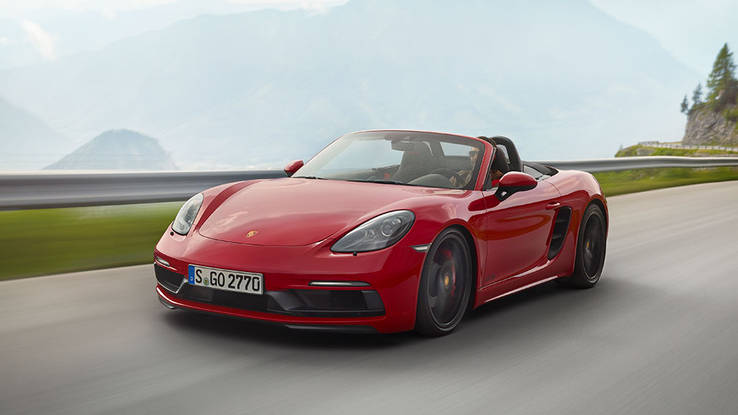
Where there are Porsche models, there too must be Porsche model variants. And out of all of those, the ones that resonate with us most readily are the GTS versions. The idea is that these gran turismo sport models give us more power and a bunch of performance-oriented add-ons, but they aren’t so hardcore that you can’t enjoy them on an afternoon drive.

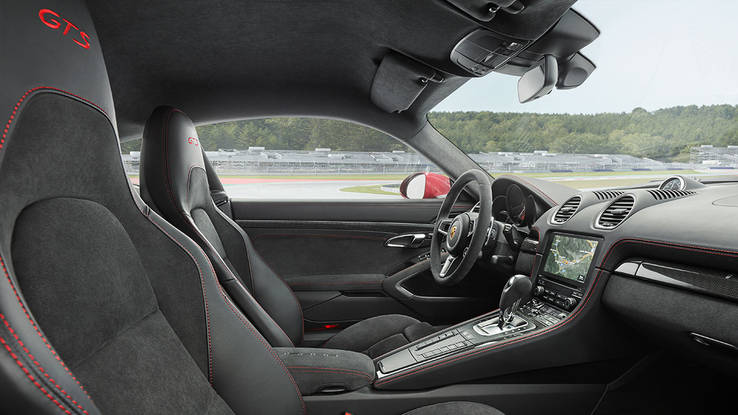
The just-announced 2018 718 Boxster GTS and Cayman GTS follow the established formula we saw in play most recently on the 2017 911 GTS: You get more power, plus the Sport Chrono package, Porsche Active Suspension Management (which drops ride height by 0.39 inch) and Porsche Torque Vectoring are all standard. The interior is done over in Alcantara, and if you order a navigation system, you get Porsche’s Track Precision App, which lets you record and analyze on-circuit performance on your smartphone.

2018 Porsche 718 Boxster GTS front 3-4 on road

The 718 Boxster GTS. The trim makes options like the Sport Chrono package standard-issue.

2017 Porsche 911 GTS quick take: What you need to know

Par for the GTS course, a manual transmission is standard (a six-speed in this case; the 911 GTS gets seven gears), but a PDK is available.

Output from the turbocharged 2.5-liter flat-four is, as we mentioned, increased, which drops 0-60 times to 3.9 seconds and yields a 180-mph top speed. Power is up 35 horses, to 365 hp, and torque is boosted to 309 lb-ft for manual cars and 317 lb-ft for PDK-equipped ones. Porsche attributes the extra power to a redesigned engine intake plenum and an “optimized” turbocharger. Are all other 718 turbos non-optimized, then? We can’t help but wonder.

2018 Porsche 718 Cayman GTS interior.

Lots of alcantara inside these things.

Ther mystery of the Biebster Thres more to that Boxster based Porsche 356 restomod than meets the eye

The GTS goodies don’t come cheap: Base price for the Cayman GTS is $80,850, and $82,950 for the Boxster. Yes, that is a lot of money to spend on one of Porsche’s supposed entry-level sports cars — no getting around that. On the other hand, while Caymans and Boxsters start at $56,350 and $58,450, you can just about double those prices once you start adding options, while the GTS cars seem good to go in standard trim.

If you order one now, you should be able to pick it up from the dealership in March 2018. Get configurating!

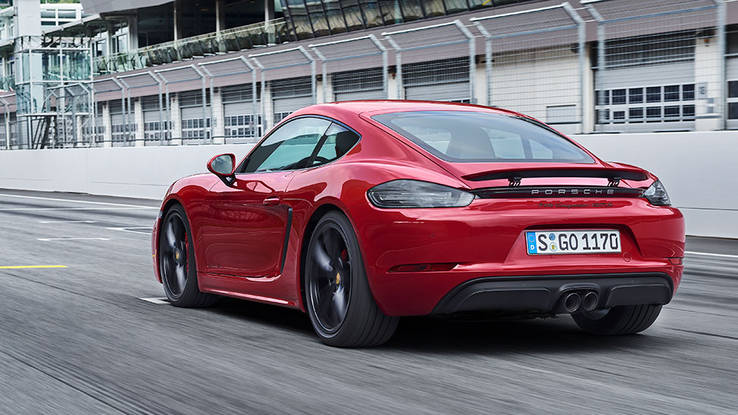
2018 Porsche Cayman GTS rear 3-4 driving

The 718 Cayman GTS is like a Boxster GTS but with a roof. Or is a Boxster just a Cayman without a roof? Think about it.

Graham Kozak

Graham Kozak – Graham Kozak drove a 1951 Packard 200 sedan in high school because he wanted something that would be easy to find in a parking lot. He thinks all the things they’re doing with fuel injection and seatbelts these days are pretty nifty too.
See more by this author»

The strange case of the ‘Biebster’: There’s more to that Boxster-based Porsche 356 restomod than meets the eye

Share

  • Pinterest

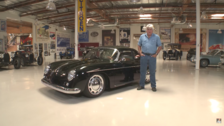
By now you’ve likely seen the recent Jay Leno’s Garage episode in which Jay goes over a strange 356-meets-987 creation built by West Coast Customs. While watching that video, I found myself with more questions than answers and needed to figure out exactly how this car came to be — and whether or not the story presented in the video held up.

To get to the bottom of it all, we’ll have to rewind to a little over a year ago when I first caught wind of this project. I was then a longtime employee of Stoddard NLA LLC, one of the main suppliers of restoration components for Porsche 356 and early 911 projects. We’d been roped into crazy projects before, supplying components to an ill-advised 356 project on Chip Foose’s Overhaulin’. When the owner of the company told me that we’d be working with West Coast Customs on an upcoming project for a celebrity, my initial thoughts ran the gamut from “Oh no, this could be horrible” to “Cool, some extra commission income.” Then he began to show me some photographs and the horror set in.

Not only was this a massive project, it involved my most feared form of project car: the Hat Car. In this case, it was a relatively modern Porsche Boxster wearing a 356 body like a hat. WCC had plans to throw the Boxster and 356 shell in a blender and come out on the other side with a workable project. I was immediately a skeptic, but it wasn’t my job to be skeptical.

What you need to know about the 2017 Porsche 718 Boxster

Clarification: What year is the chassis actually from?

As you may have noticed, this, *ahem,* abomination is available for bidding at the Las Vegas Barrett-Jackson auction, where it is listed as a “1965 Porsche 356 Custom Convertible.” The listing goes on to state that it’s a 2008 Porsche Cayman chassis with a 2.7L and a five-speed automatic. The problem is, there was no 2008 2.7L automatic Cayman, and I distinctly recall WCC labeling the donor car a Boxster. The Boxster/Cayman distinction is mostly inconsequential because they’re effectively the same chassis, but this just shows they have no idea what they’re talking about. In fact, in this Instagram post, they change the year again to say it’s a 2010 Boxter (sic), and in this one, they say again that the car has a Boxster Chassis.

For those not initiated in Porsche, 2008 was the year that Porsche introduced the brand new MA1-architecture engine with direct fuel injection and no pesky intermediate shafts to go wrong. Furthermore, 2008 was the first year of Porsche’s glorious dual-clutch transmission, the PDK. It’s a drastic step forward from the M97 engine that was a development of the engine they put into service in 1997 and the traditional torque converter-style “Tiptronic” transmission.

The shifter in the center console of this car is clearly a Tiptronic unit, and the shot of the engine shows an M97 intake runner design rather than the slightly different MA1 style. Combined with this shot of the car in progress, we can definitively say that this car was a Boxster (you can still see the windshield frame in this photo), and combined with the drivetrain information, it’s likely a 2007.

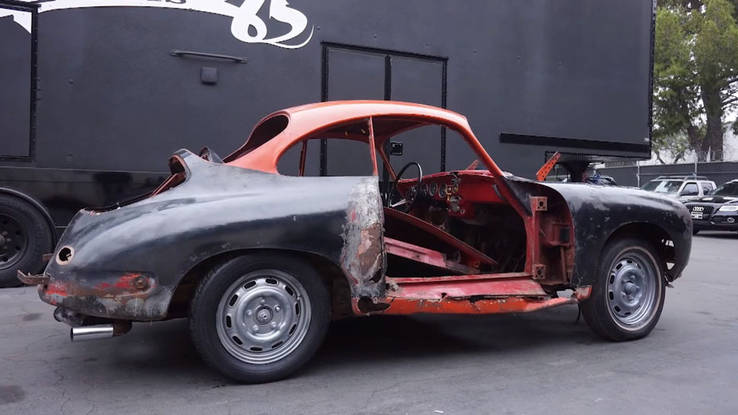
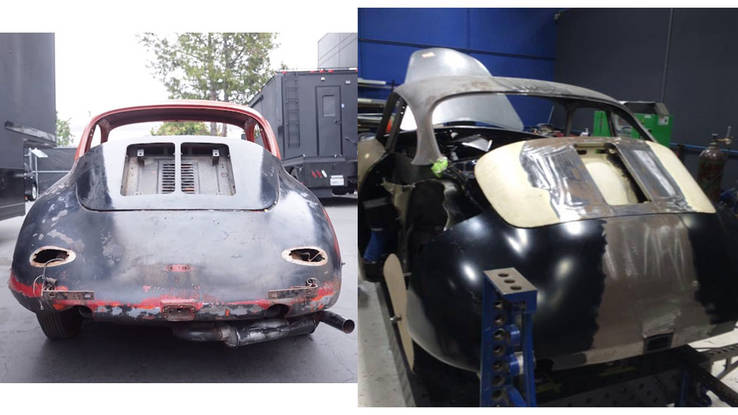
West Coast Customs Porsche 356 restomod speedster base car

The basis of West Coast Customs’ restomod, apparently a 1964 or 1965 356C — a desirable model in very rough shape.

Clarification: What kind of 356 was used for this project?

I’d seen these photos before through internal work emails, but none were ever made public until the Jay Leno video was released. Based on the more squared-off front trunk opening and the disc brake wheels, this is either a 1964 or 1965 Porsche 356C, of which about 13,500 were built. It is a desirable model, thanks to its disc brakes and more tractable engine, but this one was essentially a basket case and they aren’t particularly rare. While a chassis lost forever is still lost, this project, at least, didn’t use up a nice one.

For some reason, one that most likely involves a lot of ignorance, the project manager chose this version of the 356 for this project, even though the car they were trying to emulate was a much earlier 356A Speedster. Because of this, Stoddard was tasked with supplying WCC with an A-style set of exterior body panels, including a hood, fenders, quarter panels, and front nose, as well as earlier style bumpers, which they filled in and chromed for some reason.

With all of those panels in hand, they then had to set about cutting, stretching, and reassembling the panels to fit the Boxster’s much wider shoulders. This car, as completed, is a full 8 inches wider than a standard 356C. Admittedly, this work was very well executed, using all steel construction and likely a serious amount of prep to not look awful once it was painted.

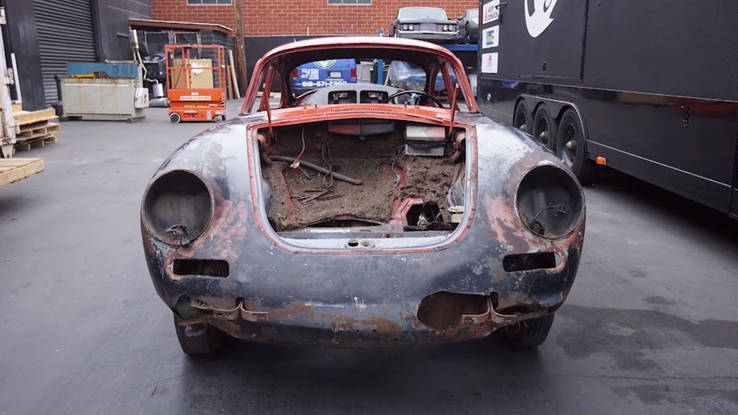
West Coast Customs Porsche 356 restomod front

Another look at the basis of WCC’s restomod project. Again, the 356 was in pretty rough shape.

Jay Leno shows off a restomod Porsche 356 with Cayman guts in his latest Garage video

Clarification: Who was it built for?

From the very beginning of my involvement, however limited it may have been, I was told that this wildly convoluted project was built for and bankrolled by popular Canadian music artist Justin Bieber. The story we were told was that Bieber had initially fallen in love with the Porsche 356 Speedster look when he had one featured in one of his music videos. Since that day, he’d allegedly wanted a 356 Speedster but didn’t know how to drive a stick shift and didn’t want to deal with the many issues a classic car presents, like oil leaks and carburetor tuning. Henceforth we internally referred to the car as the “Biebster” for obvious reasons. I had no reason to believe I was being lied to then, and I still believe this car was built for Bieber.

You can see a gorgeous white Speedster in Bieber’s 2011 holiday-themed video “Mistletoe” that helps back up the story.

We’re not exactly sure why West Coast would feel the need to hide Bieber’s involvement in the project or why they would go to the trouble of making up a “married with kids” owner to further the fabrication. In any case, it seems he didn’t particularly care for the work done and never took delivery of the car. Maybe because he’s used to supercars, this decade-old Porsche with 241 hp and a seven-second 0-60 time wasn’t shouty enough for him?

When Jay asks Ryan, the owner of West Coast Customs, whether this car was a single-grille or a double-grille car, he answers that it was a single grille. It’s simple to tell from this photograph that isn’t the case. There is just so much about this build that is obscured by smoke and mirrors.

West Coast Customs Porsche 356 restomod analysis

Build photos show that, despite claims that this restomod was built out of a ‘single grille’ 356, the project started with a double-grille car — one of the many mysteries and inconsistencies of the build.

Clarification: Why was the pedal box extended?

Another lie, or perhaps a half-truth, from Ryan about this car is the fact that the pedal box had to be extended into the front trunk to fit a taller man. This seems to be another count against Bieber being the owner, but it just doesn’t make sense. I am personally 6-foot-2 and fit in a Boxster just fine. In fact, I own a 1997 model and drive it regularly without problem.

So, with Bieber being a scant 5-foot-9, why would he need a pedal-box extension to fit into the car? Well, thanks to a passage from the Mecum auction description, we know the car required “a 9-inch section removal from the chassis to accommodate the shorter-wheelbase 356 Coupe body”. If you cut 9 inches out of the passenger compartment, not even the shortest of people would fit in the driver’s seat.

Clarification: What do we think of it?

Just in case you were thinking about having a 356 body put on a Boxster chassis, maybe just don’t do that instead. Allegedly over 3,000 labor hours went into the construction of this car, and that’s 3,000 hours of time humanity will never recover. That’s not to say that this is a particularly poorly crafted car; it actually looks like some decent work went into making this car nice inside.  

It was listed at the Mecum auction in Monterey earlier this year, but it obviously did not sell. With a pre-auction estimate of $275,000 to $350,000, we’re guessing that WCC has a ridiculously high reserve on this car. Considering that neither a real 356 nor a normal Boxster would go for anything close to this exorbitant price, we’re not surprised they’re not getting the bids they want. A 2.7-liter Boxster with a Tiptronic is worth between $10,000 and $20,000, and surely we’d rather have one of those than this thing.

By Bradley Brownell

You want to see ‘Wheelman,’ available Friday on Netflix

Share

  • Pinterest

A part-time Porsche racer who puts his skills to work driving getaway cars for a living finds it increasingly harder to actually get away in Wheelman, a surprisingly thrilling thriller.

Yes, we’ve seen this plot line before, in everything from the 2011 release Drive with the too-stoic Ryan Gosling and the recent “Baby Driver,” which was good or bad depending on whether you thought it was good or bad to the droningly painful 2013 flop “Getaway.” Put a good guy in the driver’s seat and force him to do way more than just run the few stop lights he thought he’d have to run. As in other such getaway plans, circumstances force the Wheelman of this title to make ever-more-difficult moral choices as his situation gets further and further out of what he wanted to be his tight-fisted control.

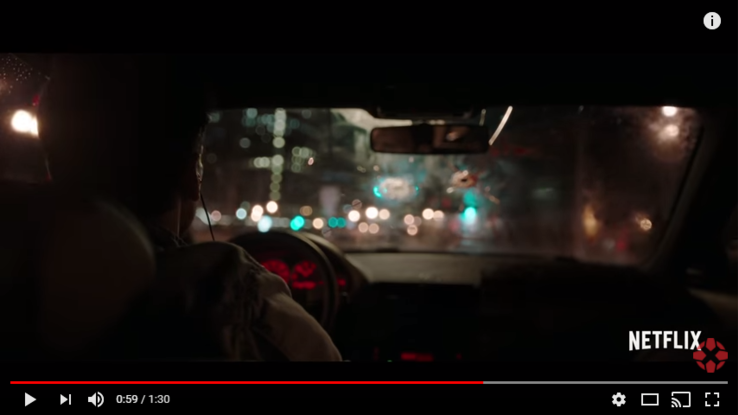
Actor Frank Grillo stars as the title character, a Porsche club racer with a 1973 911 RS back home in the garage. But we don’t see the RS till almost the end of the movie. The film is 82 minutes long, and the first 60 minutes all take place inside a BMW M3. Granted, it’s a four-door M3, so there’s a little more room, but this isn’t a place to relax in rich Corinthian leather. The M3 is the car the crime syndicate has provided for Grillo’s character to drive, and it becomes our tiny, wheeled window into this story.

Sometimes a premise like this works, sometimes it doesn’t. This one works.

Despite the four-door confines, you never feel claustrophobic and you will never, in any of the 82 minutes, look at your watch. I figured I’d look at 20 or 30 minutes of the movie at a time — who has 82 minutes in a row to spend watching TV anymore? — but I was sucked in: What’s going to happen next? Who are those dudes? Wait, what was that????

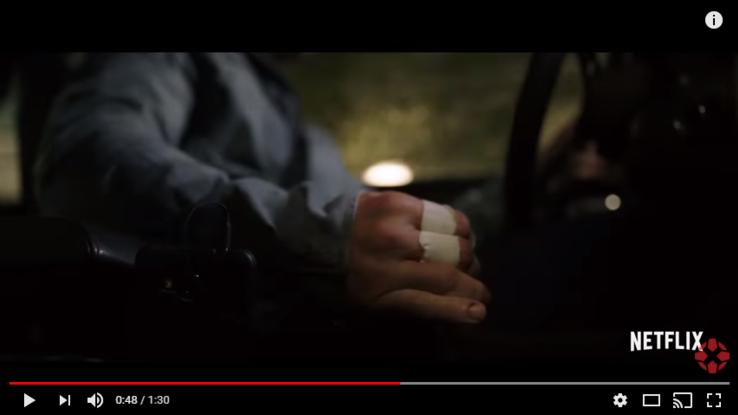
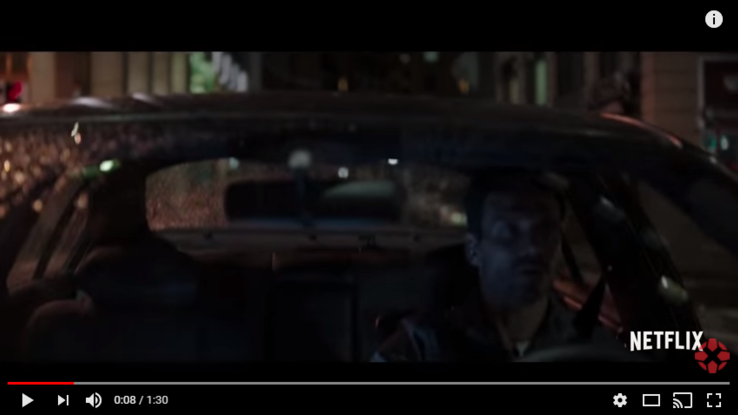
Wheelman still 1

“Wheelman” stars Frank Grillo driving an M3.

Grillo’s character gets the Wheelman moniker from one of the two bank robbers he’s in the act of chauffeuring around. He doesn’t want to tell them his name or where he’s from and won’t even reveal what’s in the brown paper bag he keeps in the front seat — “It’s my lunch,” he says.

His anonymity is one more way he tries to morally justify his accomplice role in the crimes he’s about to commit. If he can justify the driving as a sort of job skill, then it’s just a job instead of a crime, he seems to be telling himself. It’s how he can maintain his moral sanity. He owes the Boston mob a favor, see? The quintessential “one more favor” before he can go straight. There’s not an overload of backstory offered here, and there doesn’t need to be.

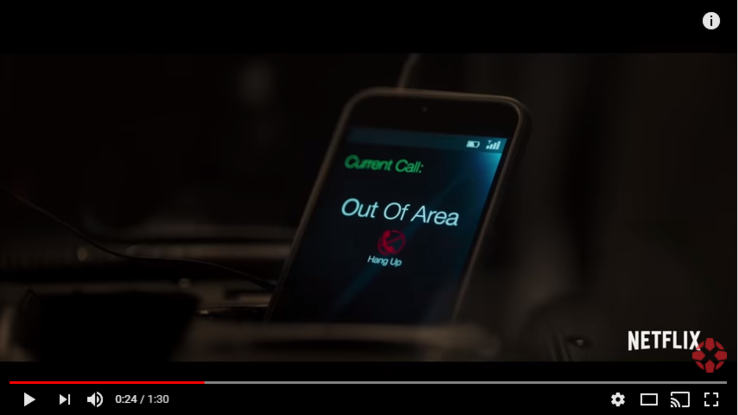
But what he hopes will be a simple getaway drive from a simple bank robbery goes hopelessly haywire very early on, with the Wheelman coming under the increasingly threatening control of an anonymous voice going into his ear bud from his BMW center-console-mounted cellphone. When he refuses to cooperate with the voice, he finds his wife kidnapped and his 14-year-old daughter threatened — all by cellphone and all while he sits in the driver’s seat of the M3.

The first shot made outside the car doesn’t come until the 61st minute or so, and it feels like a relief. It’s not, of course, though you do get to breathe for a second. And at least we finally get to see the 911.

Like the movie, we’ll keep this stark and minimalist. You can see it for yourself when it comes out this Friday, Oct. 20 on Netflix –- yes Netflix, much better distribution, promotion and marketing power, according to Grillo. In fact, let’s let Frank Grillo himself tell you his perspective on “Wheelman.” He called us up a few days ago and answered all our questions. But you really should watch it. Even if you’re not in the PCA or the BMWCCA. 

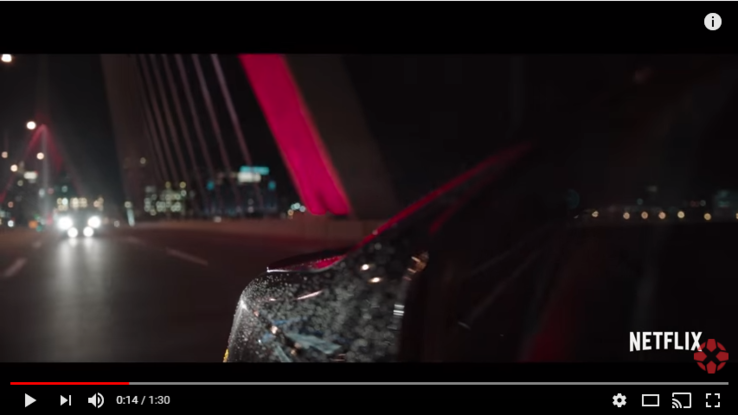
Wheelman crosses a bridge

A simple bank heist. What could go wrong?

Autoweek: How much of your character is Frank Grillo and how much is a guy you made up or maybe somebody you know?

Frank Grillo: I grew up with guys like that. I grew up in the Bronx, and there were those guys who were always looking for shortcuts in life. In the beginning, maybe some of them got some success taking shortcuts, but as we get older, the nobility of being a hustler fades, you have to face reality and then you’re stuck. So I know those guys and I know how they think. I know how myopic they can be, and that’s how they approach life and that’s how I approached this guy.

AW: There’s mention of the crime he did before we see him. Do you have in your mind what that crime was and why he did it?

FG: (My character) was a guy who was involved in driving getaway cars, that’s what he did. He was a part-time race enthusiast, but (driving getaway cars was) what he did. But no harm, no foul — he didn’t carry a gun, he wasn’t looking to hurt anybody. He just drives the car, right? Somehow you can justify not being a criminal. And again, I know guys like that. Then one night there was an arson, he gets caught, he went away. And he didn’t say anything. He borrowed money from the guys who he was protecting and when he got out, you gotta pay ’em back. And part of payin’ ’em back is you gotta do more jobs. Which is exactly what he doesn’t want to do. At this point he’s a middle-aged guy, he just wants to connect with his teenage daughter. That’s his goal. So this is the obstacle. 

Wheelman's cell phone

Uh oh, who can this be?

AW: Is the Porsche in the film from a private collection?

FG: They had a couple of them. That particular one, John Rush the director, he has it. He bought it from the film. He loves that car. It was a special car, it really was. I love old Porsche 911s. It was a fun car to drive. Not easy to drive, but fun.

AW: Did you get to drive in the movie?

FG: Oh, it was a practical movie. 80 percent, 85 percent of those times I was driving. I had a reader in my ear (in the ear bud through which he talks to other unseen characters). So I wasn’t acting with an actor. Somebody’s reading to me rote. So I’m driving the car through the streets and then kind of getting sucked into somebody who wasn’t really performing on the other end. They were just reading the words. So it was a challenge. It was a juggling act.

AW: What BMW was that?

FG: It was a four-door M3. We had, like, six of them. Those are great little cars, by the way.

AW: Did you get one? Did you walk away from the movie with a car?

FG: No, by the end of movies, cars are not in the best shape. And to ship it from Boston to LA … They offered, but I’ve got a lotta motorcycles taking up space in my garage, and my wife’s gonna yell at me. I’ve got a buncha dirt bikes already in there, and enough is enough. 

Wheelman shifter

The M3 is a manual!

AW: Where was the movie shot?

FG: Boston, all over Boston: South Boston and in the North End. All at night, obviously.

AW: Being at night, it’s easier to close down a street.

FG: Yeah, and they were great crews in Boston, they’re just as good as a New York crew. And Boston really went out of their way to shut the streets down. It wasn’t like they were just doing two passes. They gave us full blocks. And in some cases, square blocks to keep doing it because they knew we were under a time constraint.

AW: How many days did you shoot?

FG: We had it scheduled for 23. Joe Carnahan and I produced the movie. It was the first movie for our company WarParty. So we got it down to 19 days. The last two days we were in the car, I did 35 pages of dialogue. We got into such a great rhythm that we were like, ‘We can crush this, we can save some money.’ That’s how you start thinking when you’re producing something. And we did it, we pulled it off.

AW: Did you shoot it in the order in which we saw it?

FG: We shot it like a play. We had the ability to shoot it in sequence because I wasn’t working with actors. It was all me all the time in the car. So we just ran through the script. I think that helped me a lot; the continuity helped me know where I needed to be emotionally and physically and psychologically.  

action shot from Wheelman

The action is relentless.

AW: Is that a natural accent we hear?

FG: I’m from New York. I was born in the Bronx, educated in the public school system. So when I’m drinking a little wine or I go out with my friends, I can go into any number of levels of New York accent.

AW: Is it stated in the movie where this action takes place?

FG: It’s not, and by design. You don’t really know where it is. We’re in the car a lot. By design we’re not hitting the audience over the head with what I did in my past. We left all that out. It’s all very ambiguous because we always felt like it’s stated and any more would be unnecessary. It’s all very ‘70s film style. Veritas. We purposely left all that stuff out. We felt like we just didn’t need it. I like that kind of masculine filmmaking.

AW: It’s not like a date movie.

FG: Although, it’s funny because we got the screeners all over the country and women love it because of the father/daughter thing (The Wheelman is trying to improve the relationship with his 14-year-old daughter, who is drawn into the plot).

AW: Why Netflix? Why not a general theatrical release?

FG: Yeah, that’s the thing that you have to decide early on. This is a little movie. I’m not Brad Pitt. We knew we could get about $5 million from investors, financiers, with me and Joe making the movie. Netflix came in during the Cannes Film Festival while our agents were selling it, and they gave us an ample amount of money, more than we were asking. And here’s the deal: A movie like this would go to film festivals, it may be good for a release on a thousand screens, it has a little bit of a life, that’s usually the trajectory. Netflix loves this movie so much. This movie will be released in 186 countries. They have a marketing plan that in a million years we would never get if we had it in theaters. We shot the movie on anamorphic lenses, it was sound-designed by Kevin O’Connell, who had just won the Oscar for “Hacksaw Ridge.” It’s made to be on a big screen, it plays beautifully on a big screen. But we gave away that so we could get some people to see the film all over the world. Scorsese, he did the same thing with “The Irishman,” they bought it for over a hundred million bucks. He’s got De Niro, Pacino and all those guys, and it’s gonna be on Netflix. And I kind of think they’ve disrupted the business. In a good way. In allowing filmmakers to get their movies out there. So for a guy like (“Wheelman” director) Jeremy Rush, who was a PA (production assistant) before we got this movie for him, he’s guaranteed his first film, there’s gonna be eyes on it. It poses an interesting question all the time.

Porsche’s new subscription service isn’t the cheap alternative

Share

  • Pinterest

Porsche is launching a subscription vehicle service for drivers in metro Atlanta.

Porsche Passport will give members flexible access to Porsche’s sports cars and other vehicles via a mobile app. Vehicle deliveries under the program will begin in November as part of a pilot in Atlanta where Porsche Cars North America Inc. is headquartered.

The month-to-month subscription will give members the option of frequent vehicle exchanges, unrestricted mileage and on-demand access for up to 22 Porsche models. Membership cost will range from $2,000 to $3,000 a month. Porsche is partnering on the offering with Clutch Technologies of Atlanta, which already markets a subscription vehicle service in parts of the country.

“Our Strategy 2025 vision is to be the most aspirational brand in a new era of mobility and consumer expectations. Catering to customers’ desire to experience our sports cars in new ways is a part of our core strategy,” Porsche Cars North America CEO Klaus Zellmer said in a statement. “With Porsche Passport, we now offer our customers a simple and flexible driving solution at their fingertips.”

What you need to know about the 2017 Porsche 718 Boxster

Porsche Passport will have two membership plans:

• The Launch plan includes access to eight model variants such as the 718 Boxster and Cayman S sports cars, plus the Macan S and Cayenne crossovers, for a monthly fee of $2,000.

• The Accelerate plan includes access to 22 model variants for a monthly fee of $3,000. In addition to the vehicles in the Launch plan, it includes cars such as the Porsche 911 Carrera S sports car, the Panamera 4S sport sedan, the Macan GTS and the Cayenne S E-Hybrid.

Alexander Sims

The membership plans include vehicle tax and registration, insurance and maintenance, plus detailing, for the fixed monthly fee. Both plans require a one-time activation fee of $500, and membership approval is subject to a background and credit check.

Metro Atlanta residents can download the Porsche Passport app available on Apple and Android devices to apply. Once approved, vehicles will be delivered to the member’s location beginning in November. Members can schedule same-day or future vehicle exchanges via the app. Customer interaction and end-to-end service delivery will be managed by the Clutch technology platform.

Porsche executives will consider the possibility of expanding the Porsche Passport market area after the pilot period is complete.

Porsche launches subscription pilot in Atlanta” originally appeared in Automotive News on 10/10/2017

By Amy Wilson, Automotive News

Jay Leno shows off a restomod Porsche 356 with Cayman guts in his latest ‘Garage’ video

Share

  • Pinterest

In the latest episode of “Jay Leno’s Garage,” Jay gets behind the wheel of West Coast Customs’ Porsche 356. Like most of West Coast Customs’ creations, this Porsche is clearly far from a concours restoration. The company took a ratty basket-case 356, repaired the rust and then made it fit over a 2008 Porsche Cayman chassis. The wider 356 looks super-aggressive compared to its stock counterpart, without just adding massive flares onto the Porsche fenders.

The custom 356 also sports a removable hardtop, but it looks better with the top in place.

Depending on your age, you might remember West Coast Customs as the shop behind MTV’s infamous “Pimp My Ride” show staring Alvin “Xzibit” Joiner. If you’re wondering if Xzibit shows up at Jay Leno’s Garage … well, watch and find out.

Porsche wants $234 million in diesel compensation from Audi, report says

Share

  • Pinterest

Porsche seeks to recover 200 million euros (approximately $234 million) from sibling automaker Audi for the costs of the diesel scandal, the German daily Bild reports. Managers at Porsche reportedly delivered the claim in written form to top management at Audi, the paper noted. The automaker seeks compensation for the cost of the retrofits to its diesel models that share engines with Audi and Volkswagen models, as well as for related customer compensation and legal services.

Porsche emerged relatively unscathed from the 2-year-old diesel crisis that gripped parent company Volkswagen and its brands — that’s despite the toll taken by a stop-sale order in the U.S. for its 2014-16 model year Cayenne Diesel after the Environmental Protection Agency issued a Notice of Violation for the 3.0-liter TDI engine shared with Audi and Volkswagen models. The stop-sale order was eventually lifted, allowing Porsche dealers to sell the Cayenne Diesel following a software update, but the delay and the procedure did not come without cost to Porsche dealers. 

Back in Europe, the situation is a little different: In July of this year, the German transport ministry ordered a recall of the Cayenne Diesel, alleging additional software that used a “defense strategy” that is not used by the vehicle in real-world conditions, as transport minister Alexander Dobrindt explained it. Porsche admitted that it had discovered additional emissions software in the Cayenne Diesel during its internal probe and agreed to the recall.

KBA demands Audi recall diesel A7 and A8 models

News of Porsche’s demand for compensation from its sister company comes amid still-mounting costs for the diesel scandal itself; Volkswagen announced at the end of September that it will have to allocate an additional $3 billion to deal with the diesel recall and retrofit efforts in the U.S., bringing the total bill for the diesel crisis to approximately $30 billion.

“The reason is an increase in provisions relating to the buyback/retrofit program for 2.0-liter TDI vehicles, which is part of the settlements in North America that is proving to be far more technically complex and time consuming,” the company said in a statement.

Porsche’s demand for compensation, modest though it may seem in the scale of the diesel crisis, also comes on the heels of the alleged arrest of former Porsche R&D chief Wolfgang Hatz by prosecutors in Munich, Automotive News Europe reported. Hatz’s alleged arrest late last month, details of which have not been made public by prosecutors, makes him the highest-ranking VW executive to be taken into custody in connection with the diesel investigations in Germany and the U.S.

The Porsche 597 Jagdwagen was a hunter’s dream; now it’s a collector’s dream

Share

  • Pinterest

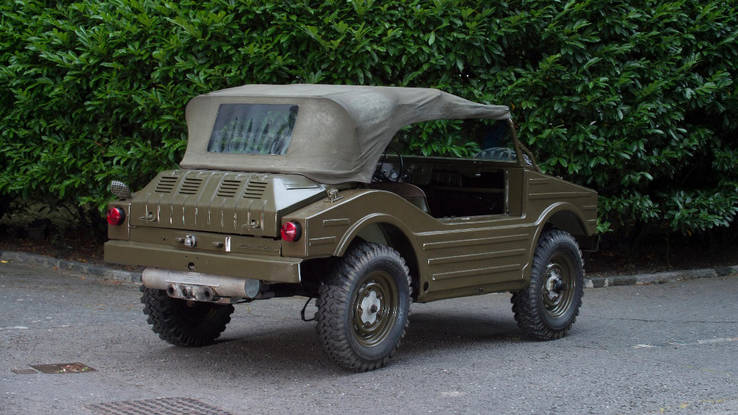
Many Porsche enthusiasts can say they’ve seen all the major models of the 356 family, from the Gmund to the C, but most would be leaving one out: the Porsche 597 Jagdwagen.

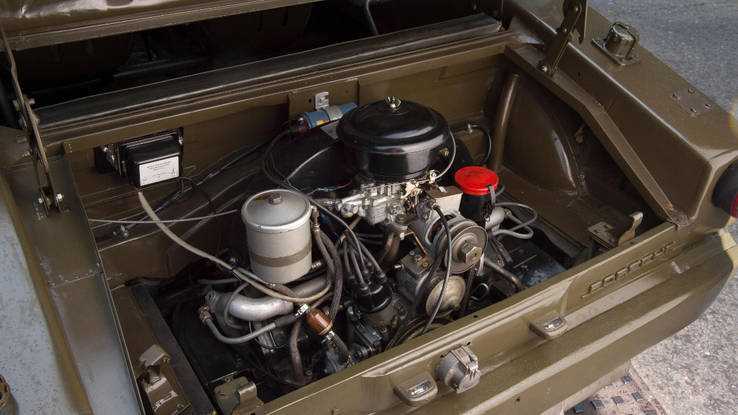
The Jagdwagen, which roughly translates to “hunting car,” came out of a NATO competition to create a light army-transport vehicle similar to the American Jeep. Porsche’s entry was a small, canvas-topped 4×4 that used stamped-steel body panels and a simplified 356 engine for power. Just like in the 356 itself, the engine was in the back, with Porsche using 1.5- and 1.6-liter versions of the air-cooled flat-four engine. The “top” 1.6-liter unit, fitted in later versions of the Jagdwagen, produced 50 hp, giving the vehicle a top speed of around 62 mph. With a weight of 2,182 pounds, the Jagdwagen was relatively nimble and put its horses to good use with the help of a five-speed gearbox — a lot of gears for something like this — and was also able to switch between two-wheel drive and four-wheel drive on the fly. With generous approach and departure angles, the Jagdwagen offered plenty of off-road ability and could even climb gradients of 65 percent. The Jagdwagen was also a little amphibious, being able to float without taking on water when needed, but it would not have been anyone’s first choice for a whitewater rafting trip.

What happened to the whole project? The similar-looking DKW Munga beat entries from Borgward and Porsche in the competition, owing to even simpler engineering and build process.

1957 Porsche Jagdwagen engine

A simplified air-cooled flat-four engine was paired with a five-speed manual gearbox. Photo by Bonhams

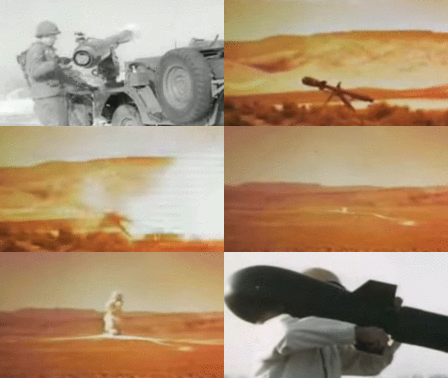
Davy Crockett nuclear launcher on a Jeep

Normally this would have meant the end of the project, with a few prototypes stashed away in museum, but having invested 1.8 million Deutschmarks (a lot in those days) in developing the Jagdwagen, Porsche attempted to find other uses for its 4×4. And that’s where the Jagdwagen name comes from: Porsche decided to “rebrand” it for use by hunters, game wardens and forestry workers.

The automaker built about 71 examples of the Jagdwagen between 1955 and 1957 — not exactly a 24/7 production line — with 49 built to civilian spec and sold to owners. Sadly, precious few survive to this day, and recent auction sales have noted that only about 15 are now known to exist.

As much as we’d like to see the Jagdwagen make appearances in official Porsche videos introducing the 2019 Cayenne — cue grainy footage with a German-accented voiceover announcing: “Inzpired by zee original Jagdwagen” — the experiment had little lasting effect on Porsche’s lineup, perhaps aside from convincing the company it was financially advantageous to sell sports cars one at a time to private owners versus dealing with high-discount government contracts.

1957 Porsche Jagdwagen rear

Porsche tried to market the 597 to hunters and farmers, but very few found homes. Photo by Bonhams

Here's the former Ukrainian president's car collection

The “winner” of the NATO contract itself  — the DKW Munga — enjoyed a 12-year production run with a little over 46,000 units made, but DKW also had to work hard to sell the Munga to private owners in many global markets to make the effort profitable.

Fancy one of these scouts for your farm or as a hunting car? Despite its simplicity, the values of the 597 aren’t too far off from the best examples of the 356 — the 1957 model in the gallery above sold for $235,331 at Bonhams’ Goodwood auction a year ago this month. A 1958 example that belonged to Jerry Seinfeld sold for $330,000 (with a $350,000 to $425,000 estimate) earlier last year at Amelia Island. Sales are sporadic, but it appears that a quarter of a million is the minimum budget for one of these. The owner of the one in the gallery above parted with his, deeming it just “too precious” to use on his country estate. While that’s a depressing reason to part with one, this is one of those situations where continuing to use a classic off-road isn’t worth the stress.

We get inside Porsche’s secret museum

Share

  • Pinterest

“We ask that you not take any photographs of the outside of the building, or of the street, or that you say where this is…” said Porsche Museum leiter Alexander Klein.

This place was a secret and a pretty well-kept secret at that. You may know the public Porsche Museum in Stuttgart. This is not that. If you want to see cool old Porsches, you can see many, many cool race cars and production cars (and even a tractor) at the public Porsche Museum at Porscheplatzz 1, 70435 Stuttgart, Germany. We saw that place, too, on a recent visit, and it is well worth your time to stop by. The public Porsche Museum has everything from the 356/1, the very first 356 (and it is truly a thing of beauty), to race cars like the 550 Spyders, 917s and 962s, as well as modern production cars you may have lusted after. You may still lust after them.

But in all, Porsche owns 575 historic race cars, prototypes and early development mules that went on to become production cars, and it can’t keep all those at the public museum in Stuttgart. So it has about 300 or so cars at this secret warehouse in… well, we won’t say where. And we might not even be able to find it now; we went there on a shuttle bus and we were a little delirious from jet lag and dehydration.

But once we got inside, hoo baby!

908

We love the 908 and would love to drive one. Jerry?

The first thing you see are the race cars, which are parked near the front of the huge 9000-square-meter building (almost 100,000 square feet to you and me). There are 160 race cars here. Right there in front is a Jo Siffert/Derek Bell Gulf-liveried 917. Next to that is a Derek Bell/Hans Stuck/Al Holbert Rothman’s-liveried 962. Across from those is Jo Siffert’s 917-10 Can-Am in RC Cola colors. And a Gulf 908/3 from the 1970 Targa Florio. It goes on: A 906, a 917 with the prototype flat 16 engine that never saw competition, the 911 GT3R hybrid race car driven by American Patrick Long, Dan Gurney’s 1962 F1 car, Porsche Indycars stacked in wooden crates with plexiglass panels on the end so you could look in, and others too numerous to name.

But it isn’t all race cars.

“There are race cars, R&D cars, prototypes, all kind of steps from the first idea of a car and all the steps in between,” said Klein.

For instance, how do you make a four-seater Porsche? There was an early stretched 911 with back seats that look like they’d fit live adult humans, for one. There were some ideas that might have looked better than the current Panamera.

There was a 984 design study for a mid-engine roadster done 10 years before the Boxster came out. There was a 989 that ran around the Nardo oval with a 200-liter gas tank trying to set speed records.

There were rows and rows of 356s, 911s and 924/944/968 cars, some in prototype form, some in production trim. One section had 911s stacked in racks three high to the ceiling. There was a Cayenne convertible that could give the Nissan Murano CrossCabriolet a run for its ugliness.

It’s all fascinating. And all very secret. Which it will stay.

The 2018 Porsche Panamera Turbo S E-Hybrid Sport Turismo is here

Share

  • Pinterest

Porsche is going all in on wagons in the U.S., revealing the Panamera Turbo S E-Hybrid Sport Turismo. That’s the company’s fastest hybrid powertrain, 680 hp and 626 lb-ft, with 45.7 cubic feet of cargo space to haul stuff around.

This is the same powertrain in the non-Sport Turismo, which is easier than saying its full name, the 2018 Porsche Panamera Turbo S E-Hybrid. It consists of a 4.0-liter, twin-turbo V8 connected to a 136-hp, 295-lb-ft electric motor (juiced by a 14.1 kWh liquid-cooled lithium-ion battery) and an eight-speed PDK. Sixty mph should arrive in 3.2 seconds, Porsche says. Top speed — you read that right — 192 mph, with a few schnauzers in the back.

All the good stuff is standard, like all-wheel drive, ceramic brakes, Porsche Dynamic Chassis Control Sport including torque vectoring and the Sport Chrono Package.

2018 Porsche Panamera Turbo S E Hybrid Review All the Power All the Money

It also gets adaptive aero elements (generating an additional 110 pounds of force on the rear axle when necessary) and Porsche’s three-way air suspension.

It comes as a five-seater, but optionally can be specified with two seats in back instead of three. That kinda misses the point of having the wagon, though, right? The rears normally fold 40:20:40. Elsewhere inside, expect Porsche’s best — soft-touch materials, soft-closing doors and the Porsche Advanced Cockpit, its latest in infotainment.

The car hits Porsche showrooms next spring wearing a $188,400 base sticker (excluding delivery, processing and handling fee).

We got our own clip for the movie ‘Overdrive’

Share

  • Pinterest

We already introduced you to “Overdrive,” the car-theft/car-chase/Scott Eastwood (yes, son of Clint) movie coming out Oct. 6. Well, the way things work in Hollywood publicity departments is, if they like you, or if they think they can use you for free publicity, then the studios give you your very own clip. If this were “Star Wars,” that might be a big deal. But even though it’s a lowly car-heist movie, it’s still a fun, lowly car-heist movie. Plus, it stars young Eastwood, who is a promising action hero in his own right.

So they sent us this clip. An exclusive clip. And we liked it, generally, but we “had some thoughts,” as they say in Hollywood. So we, not knowing any better, or any worse, basically not knowing at all, sent it back to Paramount and asked for a new ending! This was probably like Oliver asking for more gruel in the Dickens novel of the same name. But guess what, they gave us a new ending! To our own trailer!

So here it is. Kind of fun. We are hoping the movie, set in the South of France and starring some of the world’s greatest cars all crashing and banging around those skinny roads in the Alpes-Maritimes, is equally fun. We’ll let you know closer to Oct. 6. For now, click on the screener. And let us know if you think that Bugatti is a real Type 57.

Is a Porsche Cayenne Coupe in the works?

Share

  • Pinterest

An old automotive industry maxim holds that if one German automaker fields something, it won’t be long before all others follow suit. And that brings us to the following (regrettable) piece of news.

Britain’s Autocar reports Porsche is mulling a more rakish, coupelike Cayenne to challenge the BMW X6, the Mercedes-Benz GLE Coupe and the upcoming Audi Q8, citing comments by Porsche boss Oliver Blume, who indicated the company is considering such a vehicle and has not made up its mind yet about whether to proceed.

Porsche has already taken steps in this direction; Autocar learned the company has already built such a Cayenne as an internal design project, one that hasn’t been shown to the public.

“We analyze different segments, and this can be an option in the future,” Blume told Autocar. “Today, no decision has been taken. We have to make a calculation and talk to our customers.”

In automotive executive parlance, Blume’s comments may be interpreted as: We’ll see if our dealers can sell it and whether they want to sell it. This means there is still time for Porsche to come to its senses and slap itself out of this lemming-like path, and not only because there is already a smaller Cayenne on the market with a more rakish roof called the Macan.
 

Blume indicated to Autocar that Porsche is under no pressure to boost production and sales numbers at this stage — a remarkably refreshing comment from a CEO these days — and that the needs of customers are more important than the number of cars the automaker is producing.

Still, it wouldn’t be too difficult for Porsche to offer such a model — a Cayenne Sport, we’ll graciously call it — as the automaker has a long history of producing derivative models.

“As a design department, we’re always asked to come up with proposals,” Porsche design boss Michael Mauer told Autocar. “This is the most attractive part of the job: when the brand asks me to provide design ideas to visualize the product portfolio with no limitations of budgets. For each and every model, we have a lot of ideas. But there has to be a business plan. Yes, we’ve developed a lot of ideas.”

One encouraging sign is that Porsche has made the decision to let sedans be sedans and wagons be wagons, splitting the Panamera into two more distinct models after the first-generation effort tried to be too many things at once. Still, with the debut of the all-new 2019 Cayenne, the automaker is in the perfect position to try some new things with the Cayenne lineup.

The 2019 Porsche Cayenne Turbo is your 550 hp grocery getter