All posts in “Porsche”

Auction Time For One-Off ’56 Porsche 356A Carrera GS

Recently Bonham, the exclusive auction house, has listed a truly special one-of-a-kind automobile. The rather awesome Dean Jeffries Porsche 356 was a one-off and a remarkable one at that. This is something special, that even if you can’t afford, or don’t imagine you could afford it, you will want to see, just to marvel at the creative prowess of one of the best of America’s customization experts.

Dean Jeffries will be a name that many car nuts will know, as he was a big player in the Californian customization scene during the 50’s and 60’s.

Among the many eccentric and noteworthy entries into his portfolio of customized creations was the 1956 Porsche 356A Carrera GS that he made for his own personal use, to his particular liking and preference. He transformed a classic Porsche into the muscular and bulging car that is up for grabs.

It features a beefy 600cc DOHC 4-cylinder engine made by Fiat and is capable of providing 125-hp at 7,200-rpm. This is a true representation of the best of the best from what has been regarded as the Golden Age of customized cars.

Now it can be one lucky collector’s newest investment – maybe that someone will be you!

Find out more

[embedded content]

Millions of dollars of smuggled exotica crushed in the Philippines

Here at Supercars.net – in case you haven’t noticed – we love supercars.

That’s why this footage of millions of dollars worth of supercars, classic cars and other precious metal is so painful to watch.

More than 60 luxury and high performance cars and motorbikes were destroyed by Philippine president Rodrigo Duterte as part of an anti-corruption campaign.

The expensive metal had been smuggled into the country illegally in attempts to evade the country’s tax regime that makes buying and importing high value cars prohibitively expensive.

Any car costing more than 2.1 million Philippine Piso (around $39,550) is classified as a luxury vehicle, and hit with a PhP 512,000 tax, plus a further levy of 60% on any amount above PhP 2.1 million.

For something like a base model Porsche 911 Carrera, on sale in the US from $91,100, that would push its cost from the PhP 4.8 million price tag up to PhP 8.25 million – or $155,400 at today’s exchange rate.

The Philippines tax on luxury cars means vehicles like the Porsche 911 Carrera are significantly more expensive to buyThe Philippines tax on luxury cars means vehicles like the Porsche 911 Carrera are significantly more expensive to buy
The Philippines tax on luxury cars means vehicles like the Porsche 911 Carrera are significantly more expensive to buy

If you can’t bear to watch the footage then turn away – in the clip cars sentenced to a crumpled end by bulldozer include a Lamborghini Gallardo, a Porsche 911 Carrera S, a Mercedes-Benz S-Class, Nissan 350Z and a Ford Mustang from what we can see.

[embedded content]

And this isn’t the first time Duterte has put on such a public display of automotive destruction in the name of combatting corruption. As the clip below attests, he has form for this kind of thing.

Beware – clip includes graphic footage of a C3 Corvette meeting its end.

[embedded content]

2019 Porsche 911 GT3 RS

Introduction

When automotive enthusiasts are asked to describe the pinnacle of the Porsche 911, the GT3 RS overwhelmingly dominates the conversation.

In terms of outright performance metrics, it slots in below the new GT2 RS in the pecking order. While it may not be Stuttgart’s king of lap times (most notably at Nürburgring Nordschleife), the GT3 RS is still the people’s champion.

The beloved GT3 RS is certainly no slouch at the ‘Ring either, clocking a 6:56.4 minute lap time – just 9 seconds behind the GT2 RS, and 1 second faster than the million dollar Porsche 918 Spyder.

View the official onboard-footage of the lap here

Like its stablemate, the GT3 RS is a rear-engine, rear-wheel drive iteration of the 911; but it is the soul of the GT3 RS – its 4.0L naturally aspirated engine – that is so enthralling and able to cajole even the most cut-and-dried enthusiasts.

The Porsche 911 GT3 RS – through all the admiration it garners – has essentially become Porsche’s brand ambassador and poster child.

Engine & Performance

The GT3 RS is the beneficiary of an upgraded 911 GT3 engine – a 4.0L, naturally aspirated flat-six power plant which revs all the way to 9,000 rpm. This also means that the GT3 RS and GT3 are the last of the non-turbocharged 911s.

The first 911 GT3 RS of the current 991 generation was released in 2015. For MY2019, the GT3 RS (and almost identical GT3) engine receives upgraded pistons and rings, a solid valve train with shims, a stiffer crankshaft, thicker connecting-rod bearings, and plasma-coated cylinder liners.

With updated electronics and a redesigned exhaust system, the GT3 RS produces 520-horsepower @ 8,250 rpm and 346 lb-ft of torque @ 6,000 rpm. As one would expect from a naturally aspirated unit, the engine has instant throttle response and revs as smoothly as it does protractedly.

The GT3 RS continues to employ the 7-speed PDK transmission. Porsche does not offer a manual transmission option for the GT3 RS – although, it is available for the GT3 – given that the intended application of the car is one that is both results-oriented and performance-epitomized.

Porsche claims that the GT3 RS is able to sprint from 0-60 mph in 3.0 seconds, 0-100 mph in 6.7 seconds, and can complete the ¼ mile in 11.0 seconds with a top speed of 193 mph – remarkable for a car that is not assisted by forced induction or electric motors, as is becoming today’s mainstream.

Chassis & Handling

The increase in power is meant to compliment the overall balance of the car, so naturally, there have been improvements made to the chassis as well.

The front struts and rear multi-link suspension utilize metal ball joints, while stiffer spring rates mitigate body roll. With the setup being much closer to a GT3 Cup car than other production 911s, Porsche states that this ensures “accurate, sharp and direct road holding. And for total emotional contact”.

In addition, steering response and feeling have been improved in conjunction with a redesigned rear-wheel steering system, allowing the car to respond instantly and expertly to driver input and direction.

Aluminum six-pot and four-pot brake calipers come standard on all for corners, while Porsche Ceramic Carbon Brakes (PCCB) are optional for those looking to tread at the highest echelon of performance. With either option, pedal feedback remains consistent even after repeated moments of substantial braking Gs, though the PCCB allows for slightly shorter braking distances and more effective trail braking, should the driver be capable and willing.

Specially designed Michelin Pilot Sport Cup 2 tires (265/35/20 at the front, 325/30/21 at the rear) raise the performance of the 911 GT3 RS to the next level – as road legal tires, they allow the driver to enjoy the car on both the street and track.

For the first time, optional tires developed specifically for race track are available for the GT3 RS. While they are also road legal, they are even more performance oriented and should really only be used at the circuit.

An optional hydraulic lift system on the front axle lifts the front bumper by 30mm, allowing the driver to negotiate curbs, ramps, and entrances seen in the real world.

Design, Styling & Interior

Like the turbocharged GT2 RS, the GT3 RS is also based on the extra-wide body of the 911 Turbo S. Minimum drag, maximum downforce, optimum cooling – all in great abundance and meticulous in detail.

The GT3 RS utilizes the same NACA ducts on the bonnet as seen on the GT2RS, which are used to help cool the braking system without reducing the drag coefficient by efficiently channeling air throughout the body. Large front fender vents assist in ventilating pressure from the rotating wheels.

The aerodynamic front bumper ensures optimum cooling and airflow into the radiator while providing massive downforce over the front axle. In conjunction with the huge carbon fiber rear wing and redesigned underbody panels and diffuser, the GT3 RS is able to generate 100% more downforce at 124 mph compared to the ‘standard’ GT3.

Thanks to the implementation of weight reduction measures wherever possible, the GT3 RS weighs in at 3,150 lbs – a noticeable 377 lbs lighter than the Turbo S that it is built upon, and 91 lbs lighter than its RS counterpart.

For those opting for a more hardcore diet, the Weissach package is available for an additional $18,000 USD. The package – which amongst a host of things, replaces the standard magnesium roof and anti-roll bars with a carbon fiber – also unlocks the option to purchase magnesium wheels for $13,000 USD on top of it.

Pricing

The GT3 RS is priced in a somewhat interesting fashion. While its pedigree is undoubtedly the same class as the turbocharged GT2 RS, it is surprisingly (to me, anyway) priced nowhere near it, and is only about $40,000 USD more than a GT3.

The base price of the GT3 RS is $188,550 USD, with the optional Weissach package and magnesium wheels bringing the total to $219,550 USD when included.

This means that the base price is over $100K USD less than the base price of the GT2 RS ($294,250 USD).

Many wondering if this makes the GT3 RS a direct competitor to the GT2 RS; it does, in a way, but not really. Afterall, the GT2 RS was made to be the rarer of the two iterations and will have no issues selling out. I try to refrain bringing up the GT2 RS so much (honestly!), but this is difficult to avoid in the context of commentating about the GT3 RS – and you can see why.

Its significantly lower price point makes it all the more alluring if it wasn’t already so even with the pricing not part of the debate. This at the very the least, means that the GT3 RS could very well be considered a bargain compared to its competition, even for those obsessed with lap times and technical specifications.

Performance & Specifications Summary

Model & Price Info

Make Porsche
Model 911
Generation 991 (2012-Present)
Sub-Model GT3 RS
Car type Coupe
Category Series Production Car
Built At Stuttgart, Germany
Released At Geneva International Motor Show
Introduced 2015
Base Price (US) $188,550
Base Price (UK) £131,296
Units built TBD

Body, Suspension & Powertrain

Curb Weight 1,430 kg (3,153 lbs)
Layout Rear-engine, rear-wheel drive
Body / Frame Aluminum-steel composite monocoque, carbon fiber elements
Suspension (F) MacPherson strut suspension with lightweight springs (including helper springs), anti-roll bar, fully ball-jointed mountings
Suspension (R) Multi-link axle with lightweight springs (including helper springs), anti-roll bar, fully ball-jointed mountings
Engine Flat-6
Position Boxer, 90°
Aspiration Naturally Aspirated
Block Material Aluminum block and heads
Valvetrain DOHC, 24-Valve (4 Valves per Cylinder) with VVT & VarioCam Plus
Fuel Feed Direct Fuel Injection
Displacement (Litres) 4.0L
Displacement (in³) 244 in³, 4000 cc
Transmission 7-speed DCT with automatic and manual shifting mode (PDK)

Engine & Output

Power (hp) 520 hp @ 8,250 rpm
Power (hp) / litre 130 hp / litre
Power (hp) / weight 0.36 hp / kg
Torque 346 lb-ft @ 6,000 rpm
Average Fuel Consumption 17 mpg

Performance & Acceleration Stats

Top speed 311 km/h
0 – 60 mph 2.9 s
0 – 100 km/h 3.1 s
0 – 160 km/h 6.9 s
0 – 200 km/h 10.9 s
0 – 240 km/h 16.9 s
1/4 mile 10.7 s @ 127.3 mph
1000 m 20.2 s @ 160.0 mph
100 – 0 km/h 31 m (102 ft)
200 – 0 km/h 117 m (384 ft)
18 m slalom 76.5 km/h
36 m slalom 148.0 km/h
Nürburgring Lap Time 6:56.4 (Driver: Kevin Estre)

Image Gallery

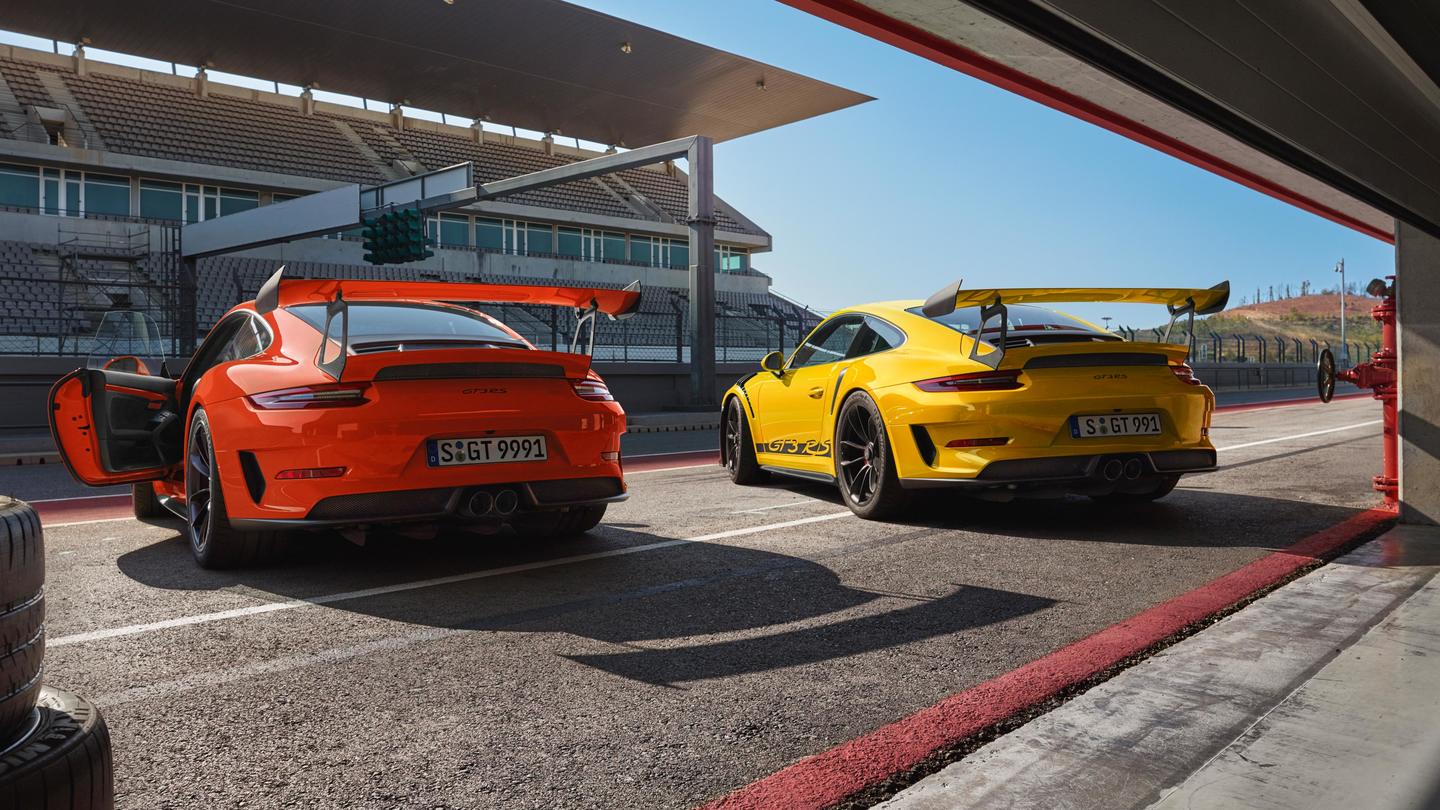
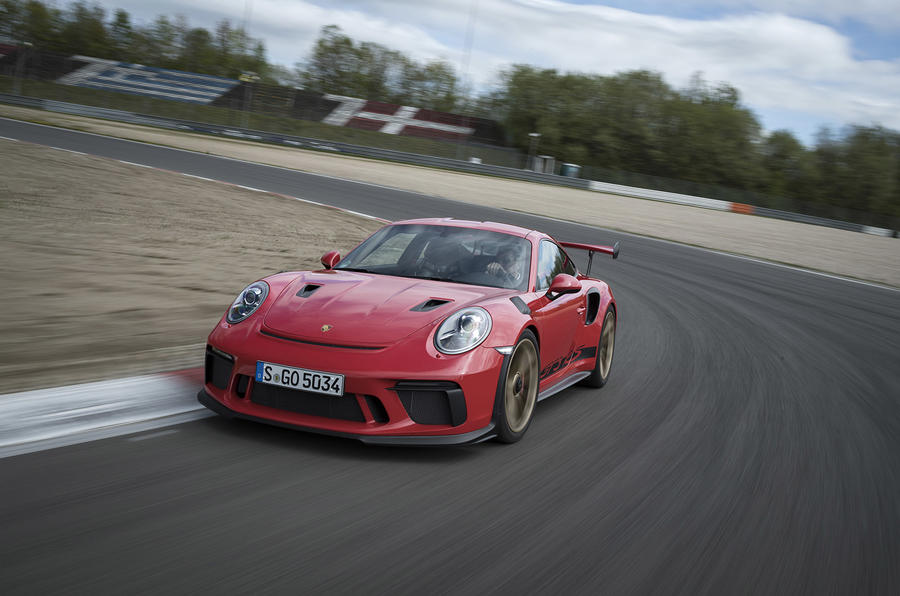
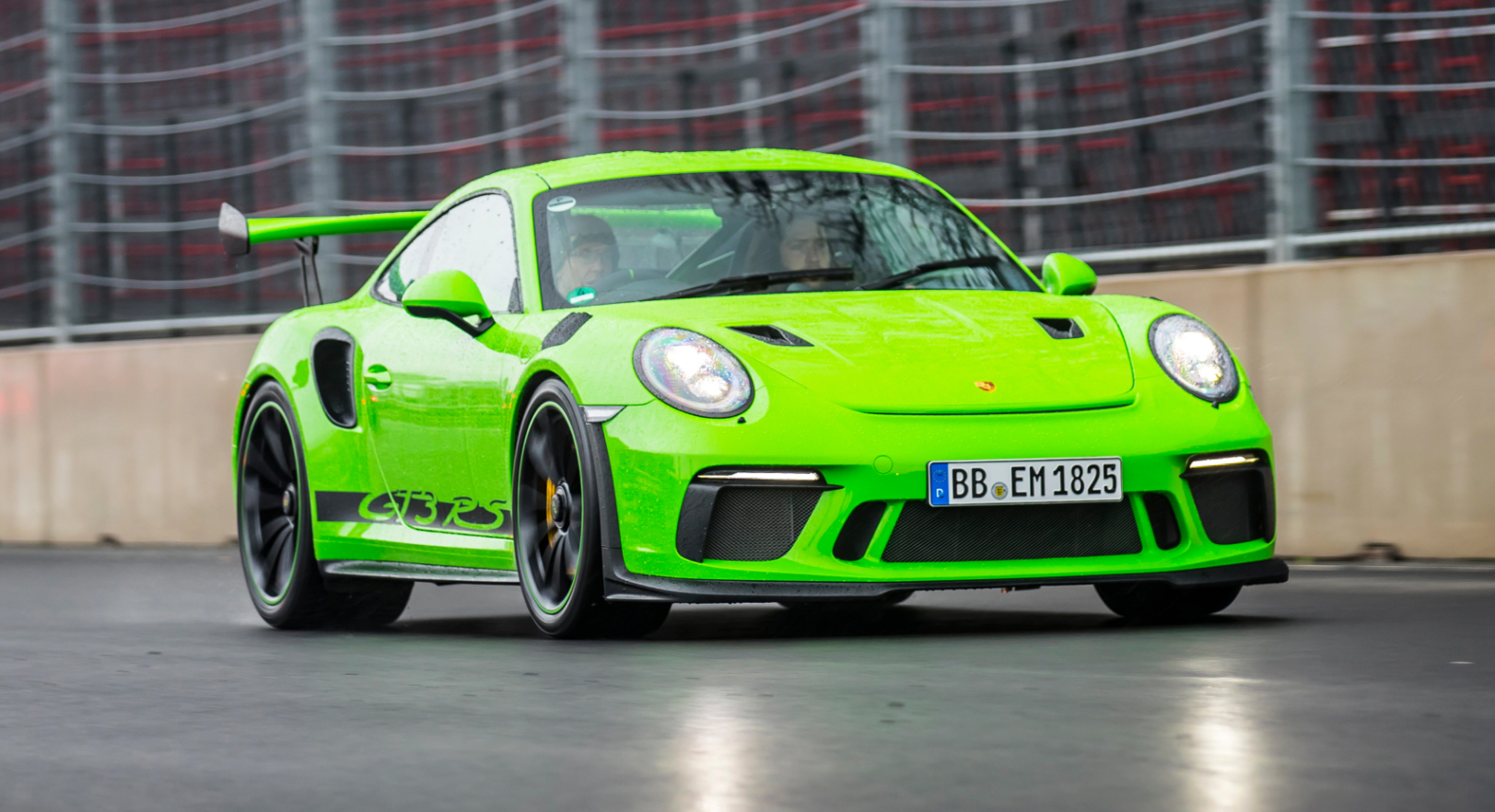
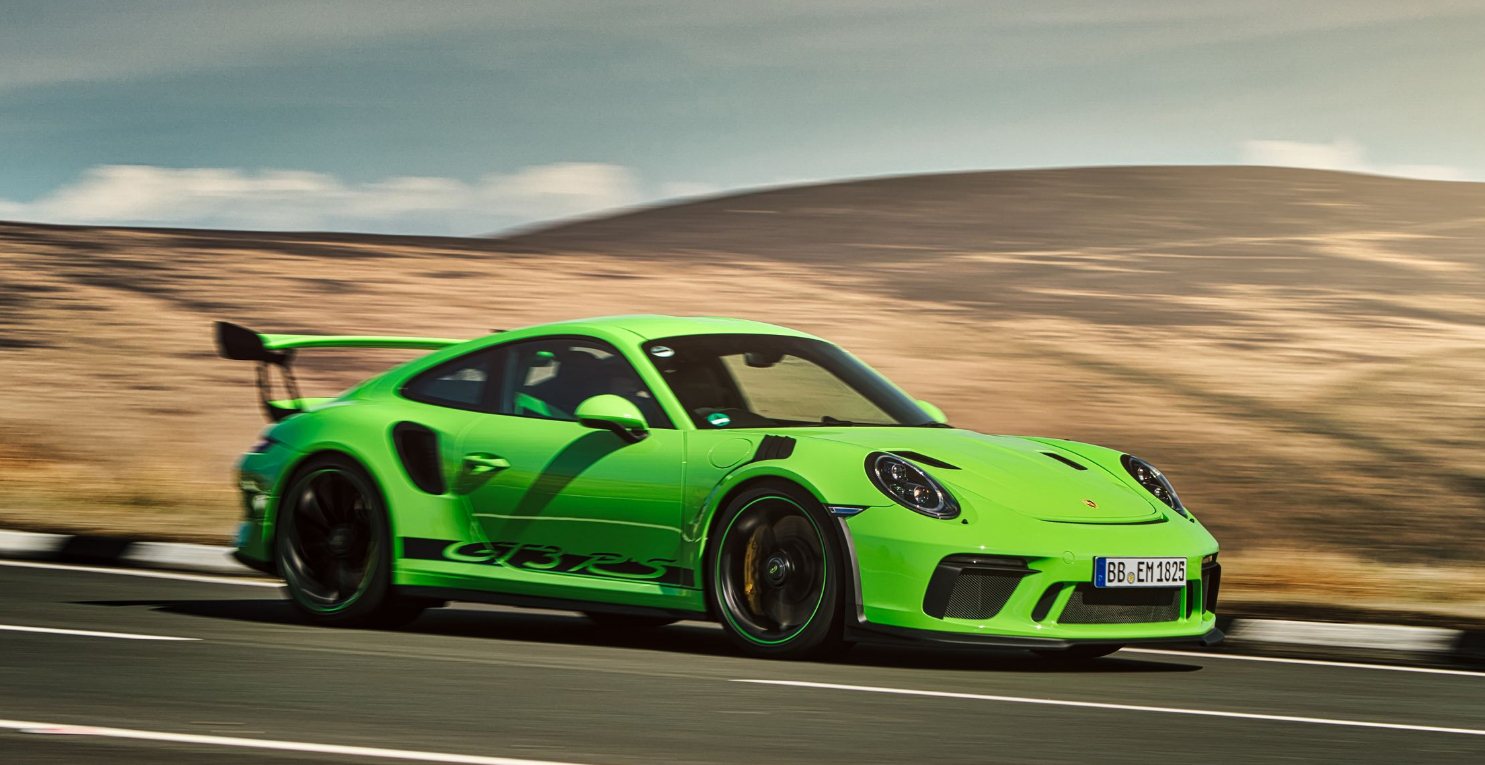
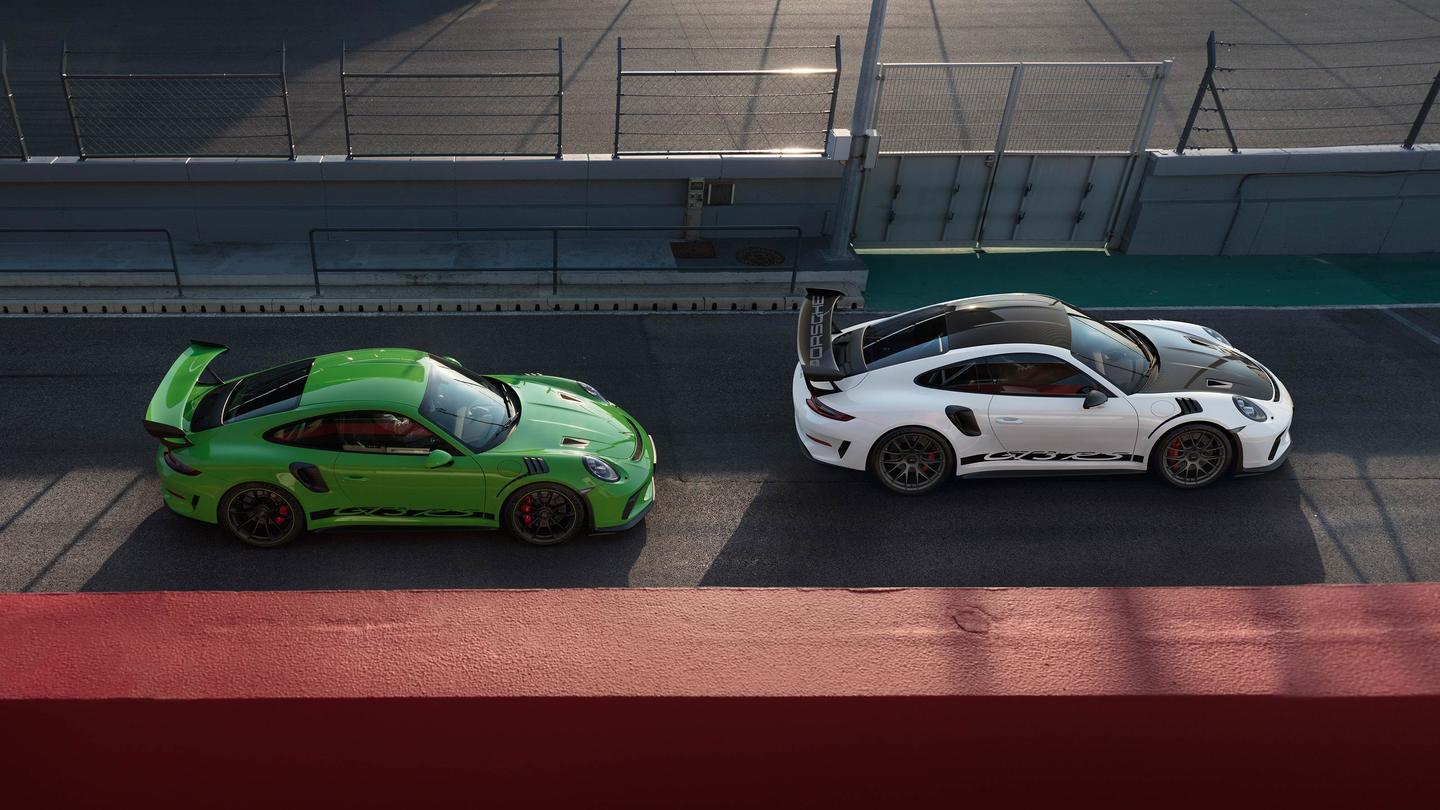
Aggressive, but ceaseless in its functionality. The GT3 RS silhouette is an outstanding display of aerodynamics, cooling efficiency and lightweight design. Whether it be the large rear spoiler, front fender vents, or antagonistic front bumper, the GT3 RS is all about the showmanship, but with the attributes to back it up.

In my opinion, the GT3 RS looks the part and looks even better playing it – form and function, at the highest level.

Video Review Gallery

Here are some YouTube video reviews from some of my favorite car reviewers and auto personalities. All of them provide feedback from an “everyday guy” perspective – but aren’t afraid to thrash the car around a racetrack when given the opportunity – providing commentary that is both technical and easy to absorb.

First up is Matt Prior from Autocar, taking the GT3 RS through the paces in its natural habitat – the race track. He immediately notes that the GT3 RS is more than just a naturally aspirated GT2 RS – its 9,000 rpm redline, brilliantly balanced chassis and cohesive entirety giving the car its own unique merits.

[embedded content]

Next, is a popular YouTuber and Autotrader reviewer, Doug DeMuro providing commentary on what he describes as “the craziest 911 of all time”.

[embedded content]

It’s always important to see what an accomplished professional racer can do with a car like the GT3 RS on a race track. This Car TV video provides onboard footage of two-time World Rally champion Walter Rohrl as he completes a hot lap with meticulous precision, technique, and coolness.

[embedded content]

Last but not least, is Porsche’s official onboard footage of driver Kevin Estre’s blistering 6:56.4 lap time achieved at the benchmark test of all road-approved sports cars – the Nürburgring Nordschleife.

[embedded content]

Original Press Release

Born from Racing: The New 2019 Porsche 911 GT3 RS

World premiere of the most powerful naturally aspirated series-production 911 ever

Atlanta

The Porsche motorsport department is presenting Weissach’s latest treat at the Geneva Motor Show: the 2019 911 GT3 RS with a race-bred chassis and a high-revving four-liter, naturally aspirated engine producing 520 horsepower and 346 lb.-ft. of torque.

Based on the 911 GT3, the RS has been refined even further, combining the most powerful naturally aspirated engine ever fitted to a road-legal 911 with a suspension that features recalibrated rear axle steering tuned for maximum dynamics and precision.

The new 911 GT3 RS accelerates from 0 to 60 mph in 3.0 seconds, which is 0.2 seconds quicker than the current 911 GT3 with PDK and 0.1 seconds quicker than the previous 911 GT3 RS. Top track speed of the 2019 911 GT3 RS is 193 mph. Following the launch of the 2018 911 GT3 and the 2018 911 GT2 RS, the new 911 GT3 RS represents the third road-legal GT model to be unveiled within a year.

Race-inspired aerodynamics and lightweight construction

Aerodynamics and lightweight construction have determined the design of the wide, weight-optimized body with its classic fixed rear wing. Like on the 2018 911 GT3, the front and rear fascia are made of lightweight polyurethane. Additionally, the front trunk lid and fenders on the 911 GT3 RS are made of carbon fiber and the roof consists of magnesium.

Like on the 2018 911 GT2 RS, NACA ducts in the front trunk lid optimize brake cooling without increasing drag. The front fascia features a spoiler lip that is larger than on the previous model, increasing downforce in conjunction with the larger side skirts. At the rear, the large wing mounted on the carbon fiber deck lid works in combination with a rear underbody diffuser. The result: The 2019 911 GT3 RS produces more than twice as much downforce as the regular 911 GT3 at 124 mph.

The race-inspired appearance continues in the interior: Full Bucket Seats with carbon fiber reinforced backrests provide a high degree of lateral support to suit the vehicle’s exceptional level of lateral grip. Lightweight glass for the rear window and rear side windows, lightweight door panels with door opening loops, reduced sound insulation, and the omission of rear seats emphasize the consistency of the material choices and the dedication to saving weight. The Alcantara steering wheel measuring 360 mm in diameter features a yellow 12 o’clock center marker.

The most powerful naturally aspirated engine in a road-legal 911 ever

The four-liter, naturally aspirated flat-six engine from Porsche in the new 911 GT3 RS pushes the sports car to new limits: It delivers 20 horsepower more than the engine in the 2016 911 GT3 RS and the current 911 GT3. Plasma coated cylinder liners, a central oil supply through the crankshaft with larger bearing diameters, larger connecting rod bearings and the rigid valve train with shims to provide valve clearance compensation all carry over from the 2018 911 GT3.

Capable of up to 9,000 rpm like the regular 911 GT3, the thoroughbred engine takes in ram air through openings in the rear quarter panels, and it is closely related to the unit used in current Porsche 911 race cars. The unmistakable flat-six sound escapes the exhaust tips, which are made of titanium like the muffler itself. The engine is mated to a specifically tuned seven-speed PDK, which features performance-oriented gearing with the top track speed being reached in seventh gear like all GT tuned PDK transmissions.

Race-bred chassis

Technology derived from motorsport ensures that the chassis offers exceptional driving dynamics. Porsche Active Suspension Management (PASM), active engine mounts, rear axle steering, and the fully variable electronic locking rear differential with Porsche Torque Vectoring Plus (PTV+) are standard. Ball joints on all suspension links provide even greater precision than conventional bearings with rubber bushings. Furthermore, the new 911 GT3 RS features new helper springs at the front axle, in addition to the rear.

As is customary for a Porsche GT model, the ride height, toe, camber, caster and sway bar settings of the suspension can be adjusted to suit individual driver preferences. Forged lightweight wheels measuring 9.5 x 20 inches in diameter with newly developed 265/35 ultra-high performance (UHP) tires enhance agility and steering precision, while 12.5 x 21-inch wheels with 325/30 UHP tires mounted at the rear deliver excellent traction.

Overall, the wider tires offer a significantly larger contact patch than those of the regular 911 GT3. Large cross-drilled grey cast iron rotors measuring 380 mm front and rear are standard, while the Porsche Ceramic Composite Brake system with 410 mm rotors at the front and 390 mm rotors at the rear can be ordered as an option. The ceramic rotors weigh around 50 percent less than the cast-iron variants.

Optional Weissach package and magnesium wheels for extra weight savings

For particularly spirited drivers, the Porsche motorsport department has created an optional Weissach package to reduce the weight of the car even further. With this package, the front and rear sway bars and coupling rods, vehicle roof, steering wheel trim, and shift paddles on the steering wheel are all made of carbon fiber, reducing the weight by roughly 13 pounds.

Optional forged magnesium wheels, weighing around 25 pounds less than the standard wheels, are available as well in conjunction with the Weissach package. When equipped with these options, the weight of the 911 GT3 RS drops to 3,153 pounds.

Pricing and availability

The new 2019 911 GT3 RS is available to order now and is expected to reach U.S. dealers in fall 2018. The MSRP is $187,500, not including available options or the $1,050 delivery, processing, and handling fee. The Weissach Package is available for $18,000. The magnesium wheels can be ordered for an additional $13,000 in conjunction with the Weissach Package and will be available at a later date.

Final Verdict

As my fellow Supercars.net colleague, Nick Dellis once remarked, “The world is full of armchair commentators when it comes to cars. At Supercars.net we have a number of journalists and automotive publications we rely on when we want to get unbiased opinions from people we admire.”

Below are snippets from some of our favorite car reviewers and automotive personalities regarding the GT3 RS. As always, we ask that you support the amazing publications they release, so that the automotive community continues to benefit from the hard work and enthusiasm they put into providing us with content that we love.

Autocar – “Yes, power is wonderful. But lightness is better.” – 5/5

Matt Prior from Autocar believes that there is no coupe from any other manufacturer that can “…deliver more interaction, more mechanical feel and greater responsiveness than a GT3 RS…”

Naturally, a comparison to the GT2 RS is made, where Matt notes that “While I don’t think the 3 communicates any better than a 2, the messages it does transmit are superior: you can feel that it’s lighter, more willing to turn, easier and more satisfying to ease onto the throttle and keep it pinned. It’s why this car is only a few seconds slower than a 2RS around the Nürburgring Nordschleife despite being almost 200bhp down.”

He goes on to summarize that “And in the form of the GT3 RS it goes into creating – little by little, detail by detail – what might just be the best driver’s car currently on sale.”

The Good

  • Phenomenal feedback, easy to control at limit
  • Lightweight feel, ease of “turn-in”
  • Purposeful aerodynamic design elements
  • 9,000 rpm redline

The Bad

More: Read full review

Top Gear – “It is deeply, deeply fast and massively, massively exciting to use.” – 10/10

Ollie Marriage from Top Gear is a big fan of the GT3 RS’ engine. “Magnificent.”, he proclaims. But of course, it doesn’t stop there.

When asked how the engine blends with the chassis, Ollie replies, “In an almost celestial way. Everything feels sharper, and yet so immaculately precise to use. This makes the process of squeezing more power on while unwinding the steering, for instance, so symbiotic that some extra-sensory spark sends tingles around your body.”

Ultimately he is also in the school of thought that the GT3 is the more quintessential Porsche 911 – “For me, the toughest rival comes from within – the GT3 RS. Given a straight choice, I think I’d still go for the nat asp GT3, although that would mean foregoing the mad turbo headbang…”

The Good

  • Magnificent engine
  • Front end grip levels
  • Connection with chassis, accurate and precise steering

The Bad

  • Could possibly be lighter
  • Suspension changes would make daily driving difficult

More: Read full review

Car And Driver – “As always, massively capable and massively noticeable” – 5/5

“This is a track-day destroyer. Its cornering grip is, well, massive,” exclaims Daniel Pund from Car and Driver.

In his praise of the GT3 RS chassis, he goes on to state that “The car feels like it could handle a lot more than 520 horsepower. That’s because it can. It’s essentially the same vehicle as the turbocharged 700-hp GT2 RS. We suppose there are probably circumstances in which you’d really appreciate the extra 180 horsepower, but believe us when we tell you that 520 is plenty in this car on public roads. Plenty.

The Good

  • Braking and perfect pedal feel
  • Fantastic high-revving engine
  • Brilliant chassis
  • More than $100,000 less than a GT2 RS

The Bad

  • Manual transmission offering would be nice
  • Extroverted looks might not be for everyone

More: Read full review


My Final Verdict – 10/10

The new Porsche 911 GT3 RS is not the fastest 911 by any standard of measure that matters. However, by those same standards, it is also no slouch of a car, with a Nurburgring lap time just seconds off the pace of the production car record set by Porsche’s own GT2 RS.

But perhaps what truly matters is that the GT3 RS represents everything that is great about Porsche’s historic flagship car. It offers a cornucopia of pure unadulterated driving sensations; in no small part due to its unique naturally aspirated engine that screams to 9,000 rpm, which is as much art as it is technological marvel.

You feel a connection with the car as if it is an extension of your own thoughts. The grip, the steering feedback, the pedal feel, the responsiveness; engineering ingenuity in every detail. The GT3 RS is proof that a little bit of nostalgia and a whole lot of innovation can mix well together, at least when concocted by Porsche.

The overall appeal of the GT3 RS also stems from the notion that it is more relatable and relatively attainable – its much lower price point and higher production numbers than the GT2 RS, particularly setting it apart from its linemate.

The GT3 RS is Porsche’s most talismanic figure in its vast and comprehensive 911 roster. It is the first name on the team sheet, and the one everyone looks to for inspiration

Rivals

Lamborghini Huracan Performante
Ferrari 488 Pista
Ford GT
McLaren 720S
Porsche 911 GT3 RS

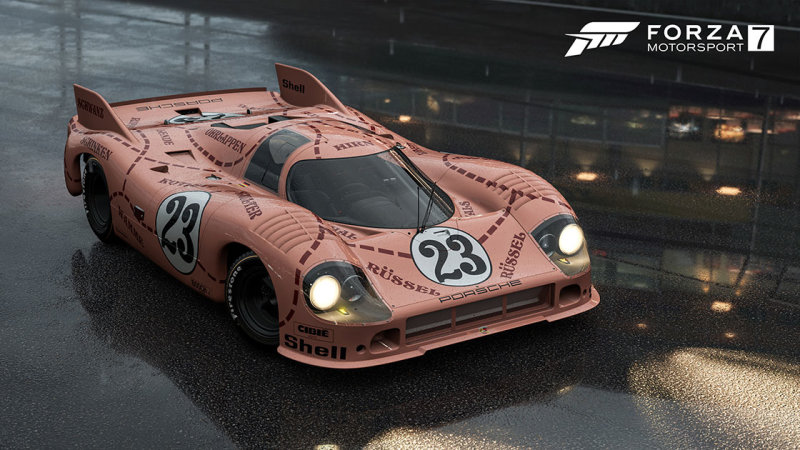
Pink Pig joins Forza Motorsport 7 along with Top Gear car pack

Forza Motorsport 7 is getting an update tomorrow. This July update means new playable cars and events for the game, and it starts with Porsches.

Hot on the heels of Porsche’s “Pink Pig” livery making a memorable re-appearance at the 24 Hours of Le Mans, the original car that wore it is introduced for the game. The tongue-in-cheek, unique-looking livery was created for the 1971 917/20 wearing number 20, and while the actual car is held at Porsche’s Zuffenhausen museum, Forza gamers can now experience it in virtual form. To balance out the vintageness, the other Porsche added in the update is the 2019 911 GT3 RS. It’s a mad, manic car with more than 500 horsepower developed from its naturally aspirated engine.

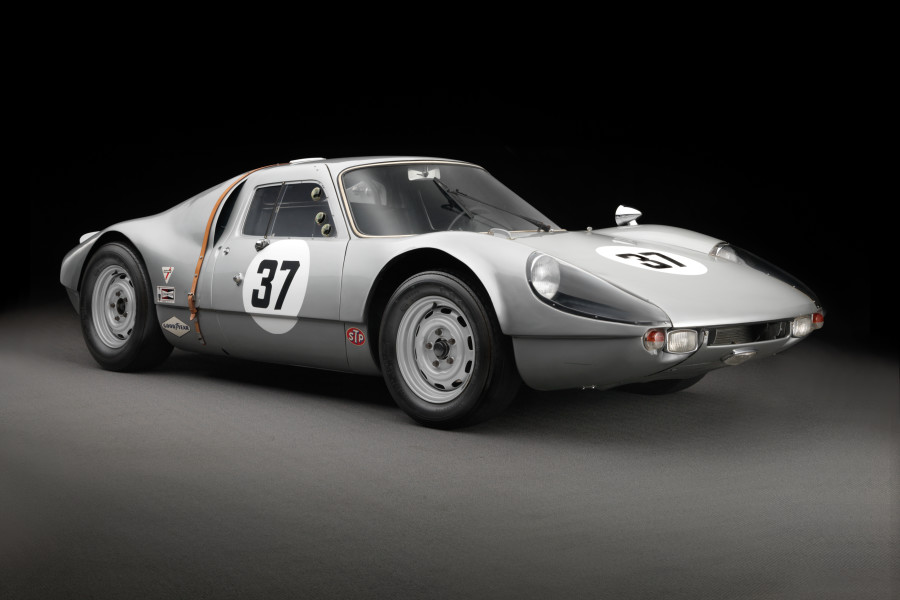
The July update also includes a Top Gear-themed car pack, available free for Forza Motorsport 7 Car Pass owners. It includes seven cars: the 2017 Ferrari 812 Superfast, the 2018 McLaren 720 S, trackday specials Vuhl 05RR, Exomotive Exocet Sport V8 XP-5, and KTM X-Bow F GT4, along with two classic cars: the 1964 Porsche 904 Carrera GTS and 1958 Alfa Romeo Giulietta. Especially the 1.3-liter, 90-hp Alfa Romeo is a sweet, stand-out addition amongst the more powerful cars.

There are also changes made to getting cars: all “exclusive” cars will be unlocked and made purchaseable with in-game credits, after the player has reached Car Collector tier. This means more than 100 previously exclusive cars are now accessible.

Related Video:

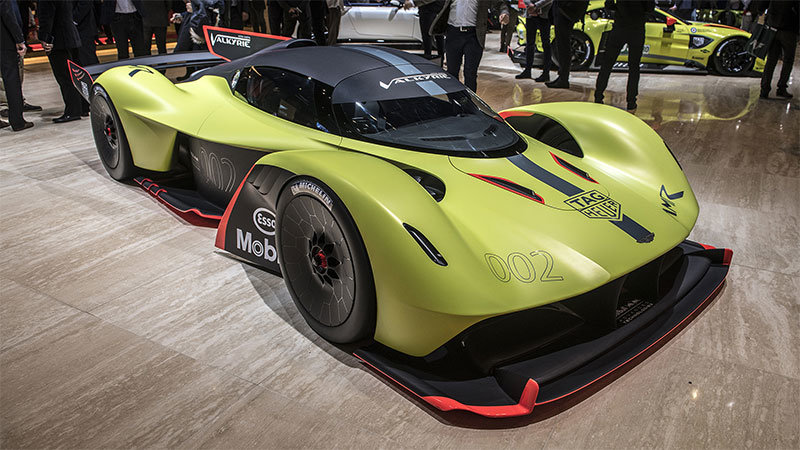
Aston Martin Valkyrie could beat that new Nurburgring record, Red Bull F1 boss says

During last weekend’s Austrian Formula 1Grand Prix, Race Fans asked Red Bull F1 team principal Christian Horner about the Aston Martin Valkyrie. The question was whether the coming hypercar, a collaboration between Red Bull and title sponsor Aston Martin, could beat the stunning lap record around the Nürburgring just set by the Porsche 919 Hybrid Evo. Horner’s answer: “I’m not sure a Formula 1 car could actually do it, but I think that the Valkyrie — certainly the track version of the Valkyrie — could be a contender.” That’s a qualified endorsement, but it still counts as support merely putting the Valkyrie AMR Pro in the conversation.

Let’s compare, shall we? The 919 Hybrid Evo is based on the 2017 World Endurance Championship-winning 919 Hybrid. Freed from motorsport regulations, Porsche Motorsport upgraded numerous performance bits. The 2.0-liter, turbocharged V-four-cylinder went from 500 hp to 720 hp. The two KERS units went from 400 hp to 440 hp. We don’t have a figure for downforce, but items like active aero, a larger front diffuser, optimized turning vanes, and larger rear wing increased downforce by 53 percent over the WEC car, at the same time being 66 percent more aero efficient. It weighs 849 kg dry, or 1,868 pounds because Porsche threw out everything that didn’t contribute to speed.

The Valkyrie specs we know of so far state a weight of 1,000 kilograms, or 2,200 pounds. Powering that is a custom, naturally aspirated, 6.5-liter AMR Cosworth V12 with more than 900 horsepower, augmented by a kinetic energy recovery system contributing around 230 hp. According to Autocar’s sources, the Valkyrie could generate up to 4,000 pounds of downforce at an aerodynamically-limited 225 miles per hour. That boggling number comes courtesy of Adrian Newey’s prowess at making changes such as openings between the front wheel arches and the cockpit that work the front wing harder. The two-seater coupe’s unrestricted top speed is 254 mph.

Note, though, that the Valkyrie AMR Pro will be more powerful, lighter, and could have even more downforce. And since Aston Martin and Newey continue to work on the hypercar, specs could get even better before deliveries begin. Right now, Horner’s suggestion doesn’t seem all that outrageous.

We’ll also wait to see if the Mercedes-AMG Project One pokes its nose in the ring, too. Not long ago, AMG chief Tobias Moers said it’s “reasonable to speculate” the F1-inspired hypercar could claim an absolute lap record around the ‘Ring. But that was before Porsche went ahead and did it. Even if Aston Martin and Mercedes-AMG don’t put up an official challenge, we’ll probably get an idea of what’s possible when the FIA’s new “Hypercar” class begins racing in 2021.

20 Most Expensive Porsches Ever

When it comes to breaking records for expensive cars nobody comes close to Ferrari. It takes more than $4.5 million to even break into the top 100 most expensive Ferraris ever. Ferrari still dominates the classic market but Porsche has been rising in the ranks for a few years now and things aren’t letting up. Porsche is a brand with a rich history that has lots of racing pedigree and nostalgia too.

That has helped Porsches grow from five- to six and seven digits in the last five years, with even models as late as early 2000s’ Carrera GT’s hitting near the million-dollar mark on a model that used to be worth $300,000. Hagerty data that combines public auction sales and private sales shows that the 1974-1977 Porsche 911 has increased the most in average sale price of any classic car this year, with a jump of 154 percent in value over 2014.

Porsches—especially the 911s made between 1970 and 1980 and the 356 Speedsters made in the 1960s—have growing appeal because of several factors. For one thing, they are reliable. Secondly, Porsches from this era have a wide entry point for prospective buyers. If you’re savvy, you can find an old 911 in the five-figure range. Or you can find one for more than $1 million, if that’s more in your price range. The same goes for those little 356s. The thing is that these model still don’t make our top 20 list. That list is made of the rarest and most expensive Porsches sold and that means we’re talking more than $2 million. That’s right, you needed millions (plural) to get your hands on one of the highly sought after models of Porsches.

Here it is then, the most expensive Porshes ever.


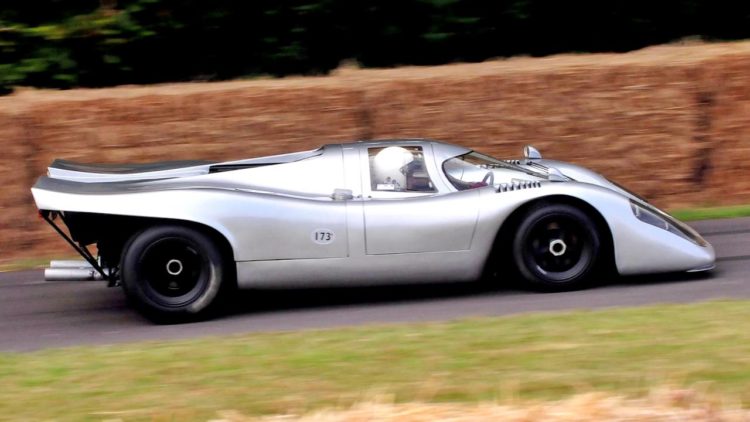
1. 1970 Porsche 917K

Sold for $14,080,000

1970 Porsche 917K

1970 Porsche 917K

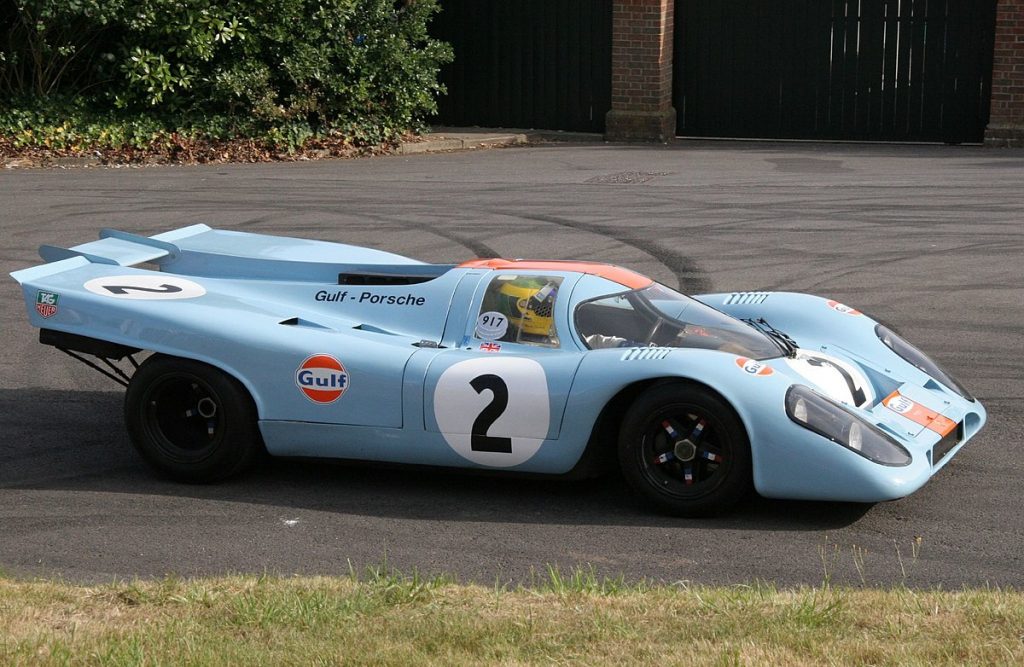
Anybody who has read our greatest Porsche race cars and best Porsches ever list knows we are massive fans of the 917. Formerly the Property of Jo Siffert it was also used in our favorite movie ever, Le Mans. While being in a movie is cool you should also know that this is chassis 024 which makes it the first 917 to ever enter competition in 1968 which is clearly even more cool. Gooding & Company sold the 917 for $14,080,000 at Pebble Beach in 2017.

The Porsche was driven in competition at the 1000 Kilometers of Spa in early 1969. Jo Siffert immediately ripped the car to shreds saying it was “not only unstable, but it is frankly dangerous” and chose to drive the 908 Longtail instead. While 917-024 never took a checkered flag in its racing career and never raced at Le Mans, the car did take the checkered flag in McQueen’s ‘Le Mans’ movie.

Sold by Gooding & Company at Pebble Beach 2017


2. 1982 Porsche 956

$10,120,000

1982 Porsche 956

1982 Porsche 956

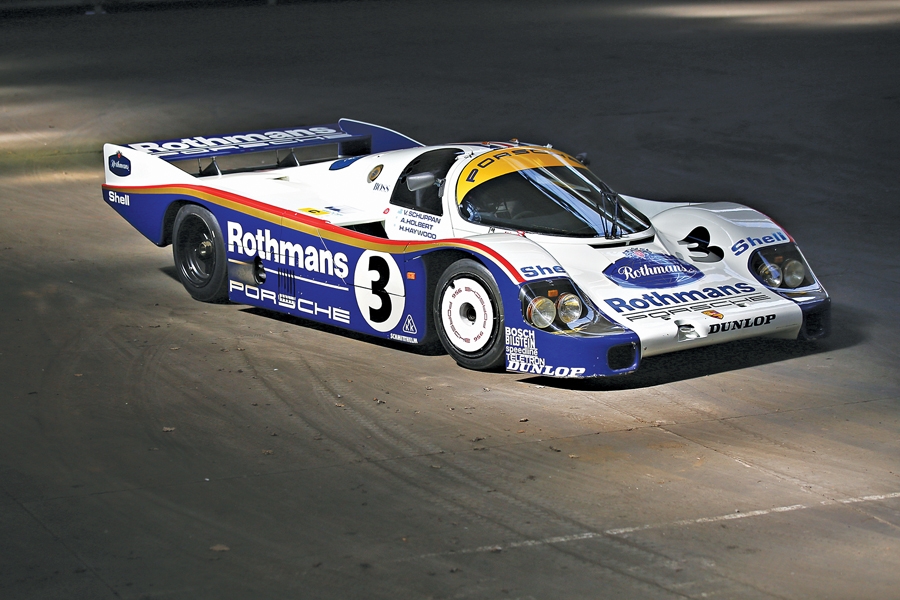
Another Supercars.net favorite is the Porsche 956. It is also the second most expensive Porsche ever auctioned. This is a special 956 too because it is a Le Mans winner.

It is the third of only 10 Works Porsche 956s built. Most memorably is that 1983 Le Mans 24 Hours outright win with Al Holbert, Hurley Haywood and Vern Schuppen as drivers. The previous year, when it was a Porsche 956 1-2-3 finish, the same car was second overall while driven by Jochen Mass and Vern Schuppen. It also scored victories at Spa, Fuji, Brands Hatch and Kyalami. Further famous drivers racing the car included Jacky Ickx, Derek Bell and John Watson.

Sold by Gooding & Company at Pebble Beach 2015


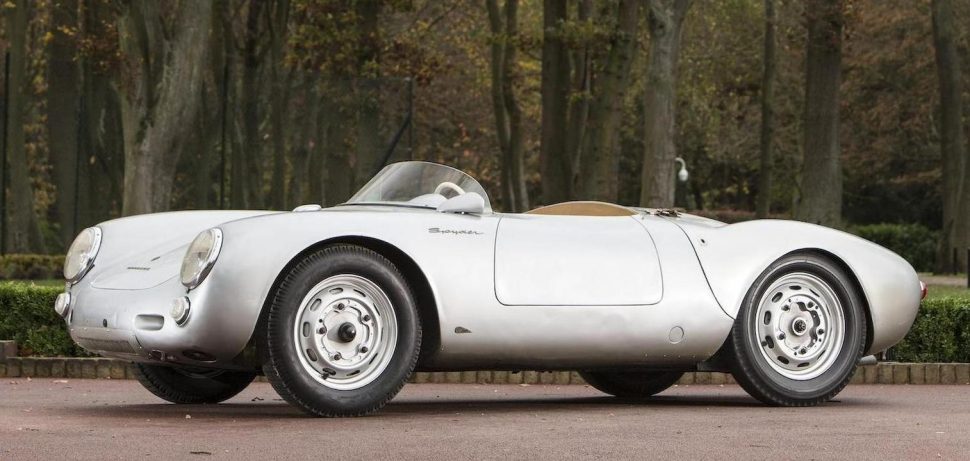
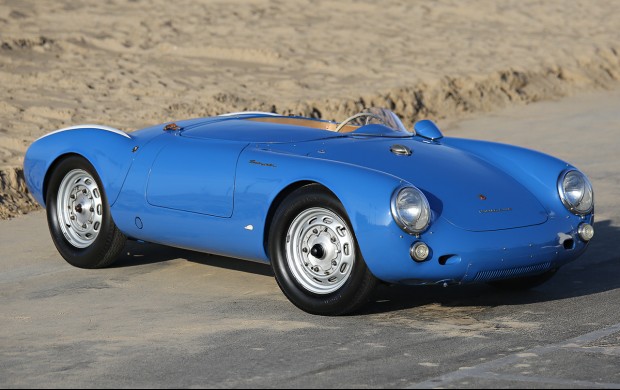
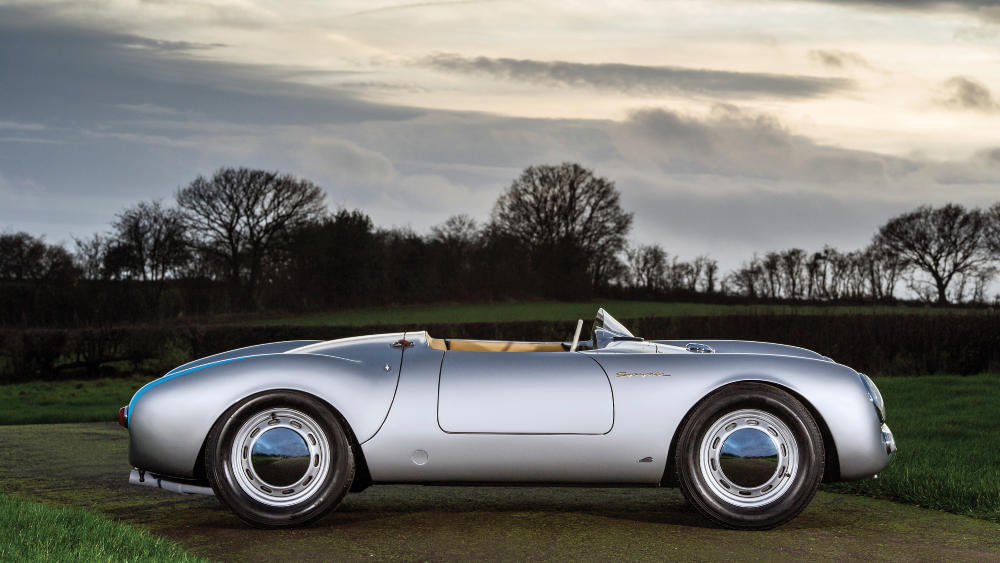
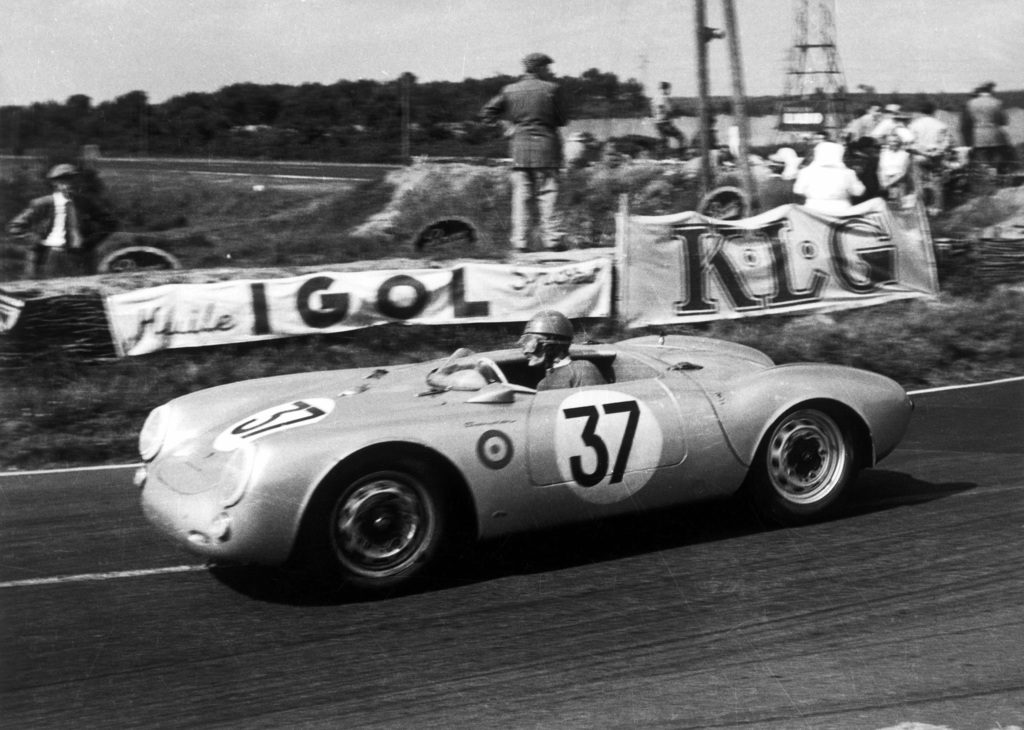
3. Porsche 550 Spyder

Sold for $6.1 million

A large part of its appeal is the fact that this is arguably the world’s best-preserved, never-restored example of this seminal Porsche. The original giant killer it remains then.

Sold by Bonhams 2016


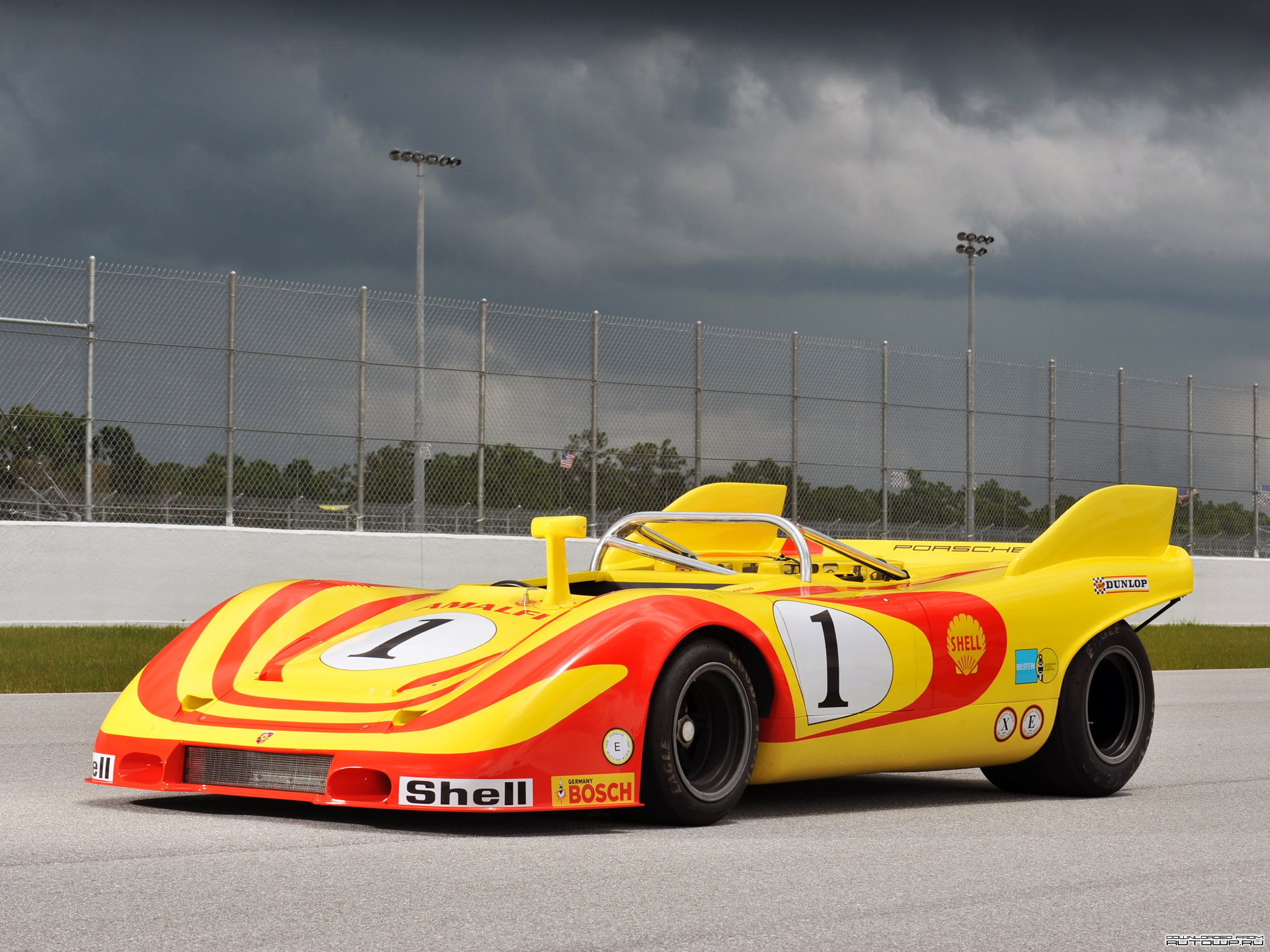
4. 1972 Porsche 917/10

$5,830,000

1972 Porsche 917/10

1972 Porsche 917/10

The Porsche’s 917 race cars were the fastest and most successful racers ever built. They won a lot of endurance championships and were crazy fast. With changes in competition classes about to make the enclosed 917 uncompetitive, in 1972 Porsche turned its attention to North American Canadian-American Challenge (Can-Am) series. No parallel series exists today, but the Can-Am series showcased the best drivers of the era in cars that were insanely fast, even by contemporary standards.

This 917 is a piece of Can Am history. In competition trim, the car boasted some 850 horsepower from its turbocharged flat-12 engine. It easily took the championship. The Team Penske Racing 917 dominated the season, taking first place in 5 out of 9 races. This Porsche is driven by racing legends Mark Donohue and George Folmer.

Sold for $5,830,000 by Mecum in 2012.


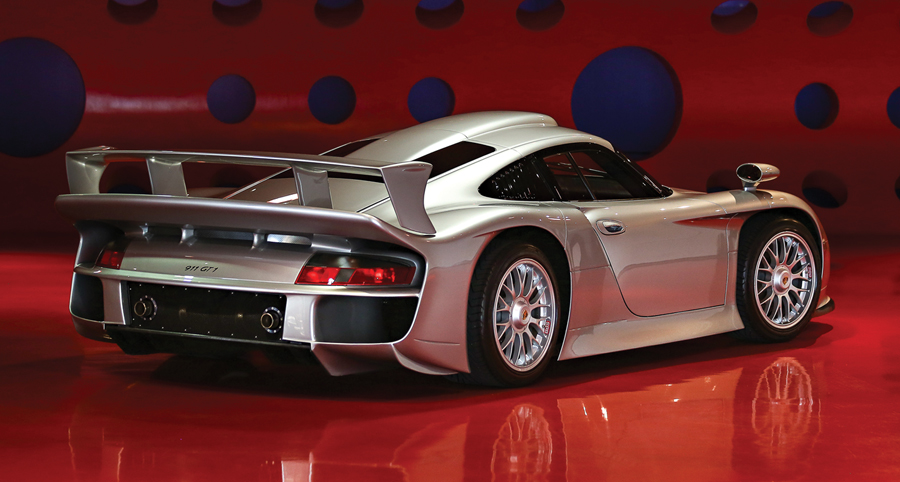
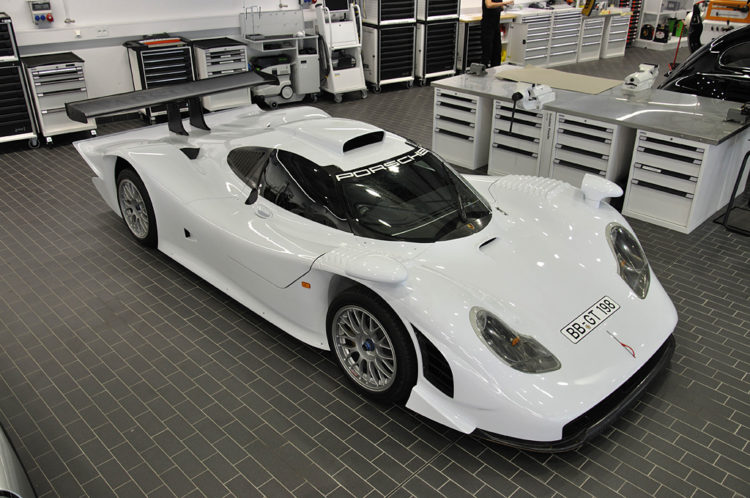
5. 1998 Porsche 911 GT1 Strassenversion

Sold for $5,665,000

1998 Porsche 911 GT1 Strassenversion

1998 Porsche 911 GT1 Strassenversion

Gooding & Company sold a very rare 1998 Porsche 911 GT1 Strassenversion for $5.665 million. The first relatively modern Porsche of this list is the street version of the legendary Le Mans-winning Porsche 911 GT1. It is the race version of the normal Porsche 911 ‘type 996’ with a wide body, front lip and big spoiler work. Of the street version, only 20 were built, so it is a very rare Porsche. This Porsche switched owners for almost €4.75 million.

The GT1 featured a twin-turbocharged 3.2-liter water-cooled flat-six engine capable of developing 600 hp. It got the rear end of the Porsche 962 together with the front end of a Porsche 993 and a carbon fibre body shell. It is capable of 194 mph and 3.6-second 0–60 mph sprints and retailed for $912,000

Sold by Gooding & Company at Amelia Island 2017


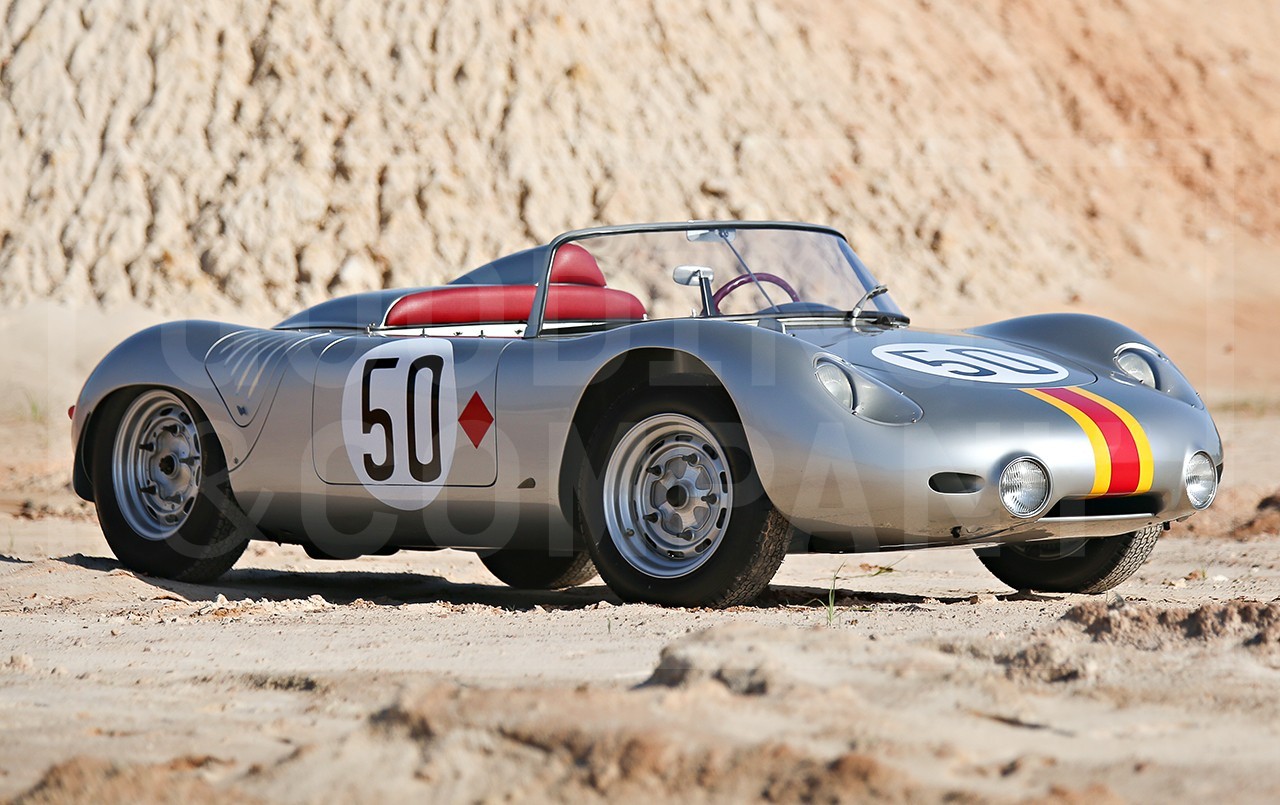
6. 1960 Porsche RS60

Sold for $5,400,000

This is the last of only four Porsche RS60s ever built. It has been driven by Porsches factory team in the important FIA World championship races.Boasting of a driver listing that reads like a who’s who of motor racing elite, chassis 718-044 would have to be considered one of the most remarkable of Porsche’s incredible RS60. Names like Moss, Hill, Holbert, Bonnier, Barth and Herrmann all blend together to make for one iconic Porsche sportscar.

This particular chassis would be among the elite before it even turned a wheel. One of just four works RS60 chassis built, 718-044 would begin life taking part in the biggest race of them all. Driven by Maurice Trintignant and Hans Herrmann in the 1960 24 Hours of Le Mans, the car would do well until a piston failure ended its first race outing. However, defeat was not to be this car’s lease on life.


7. 1955 Porsche 550

Sold for $5,335,000

Jerry Seinfeld’s unrestored and exceptionally original 1955 Porsche 550 Spyder. Sold for $5,335,000 at the Gooding Amelia Island 2016


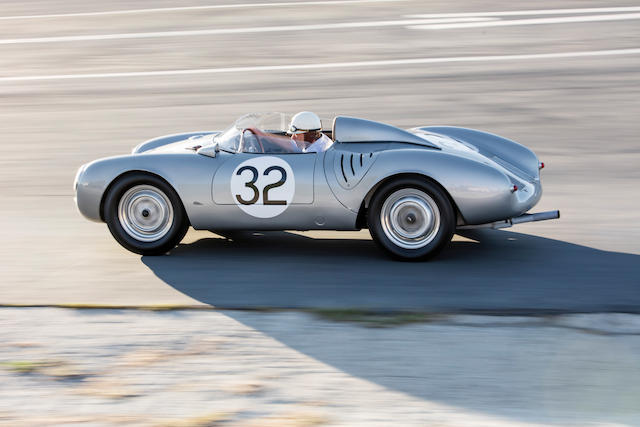
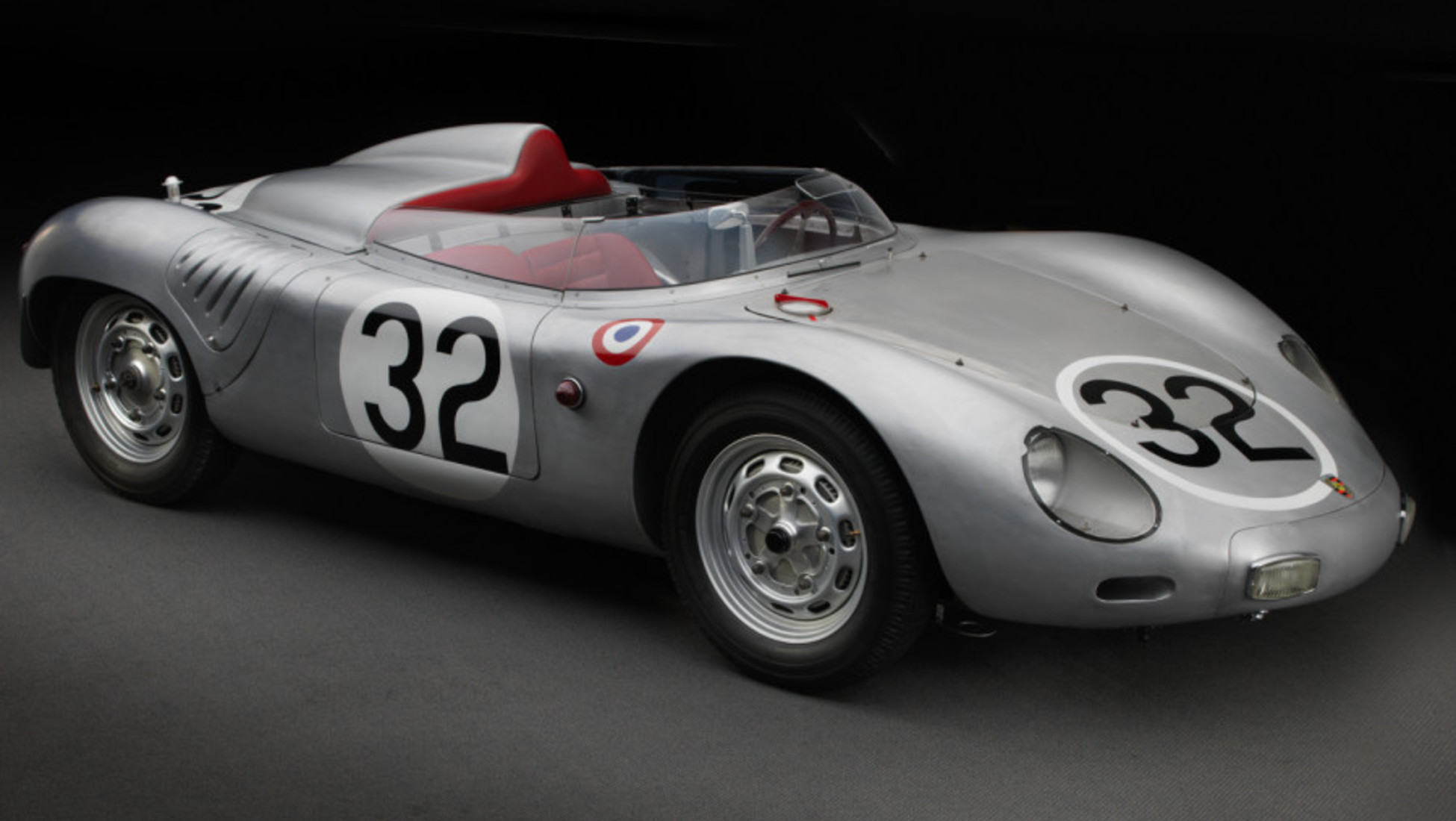
8. 1958 Porsche 550A Spyder 5

Sold for $5,170,000

One of the most iconic and important Porsches ever produced.

This ex-works 1958 Porsche 550A Spyder that once finished second in class at the 24 Hours of Le Mans hit the Bonhams auction block and despite having a little trouble getting the car started for its moment in the Arizona sun, it still commanded a healthy $5.17 million. That result is right in the middle of the car’s estimated selling price of $4.5 million to $5.5 million.

The 550a that came about in 1956 was not just a mere evolution of the preceding model, but more a revolution. Early Spyders employed a ladder frame for its proven design and rugged simplicity, but with Porsche opening its new dedicated competition shop, limited resources were no longer a concern.

This is 550A-0145, the 2nd to last Spyder constructed of the only 40 total examples. As a result of its later 1958 production, the Porsche benefits from all of the upgrades received by the final cars. The motor being in the 547/3 specification means higher compression, centralized distributor, and weber carburetors, resulting in 135 horsepower.

Sold by Bonhams at Scottsdale 2018


9. 1979 Porsche 935

Sold for $4,840,000

1979 Porsche 935

1979 Porsche 935

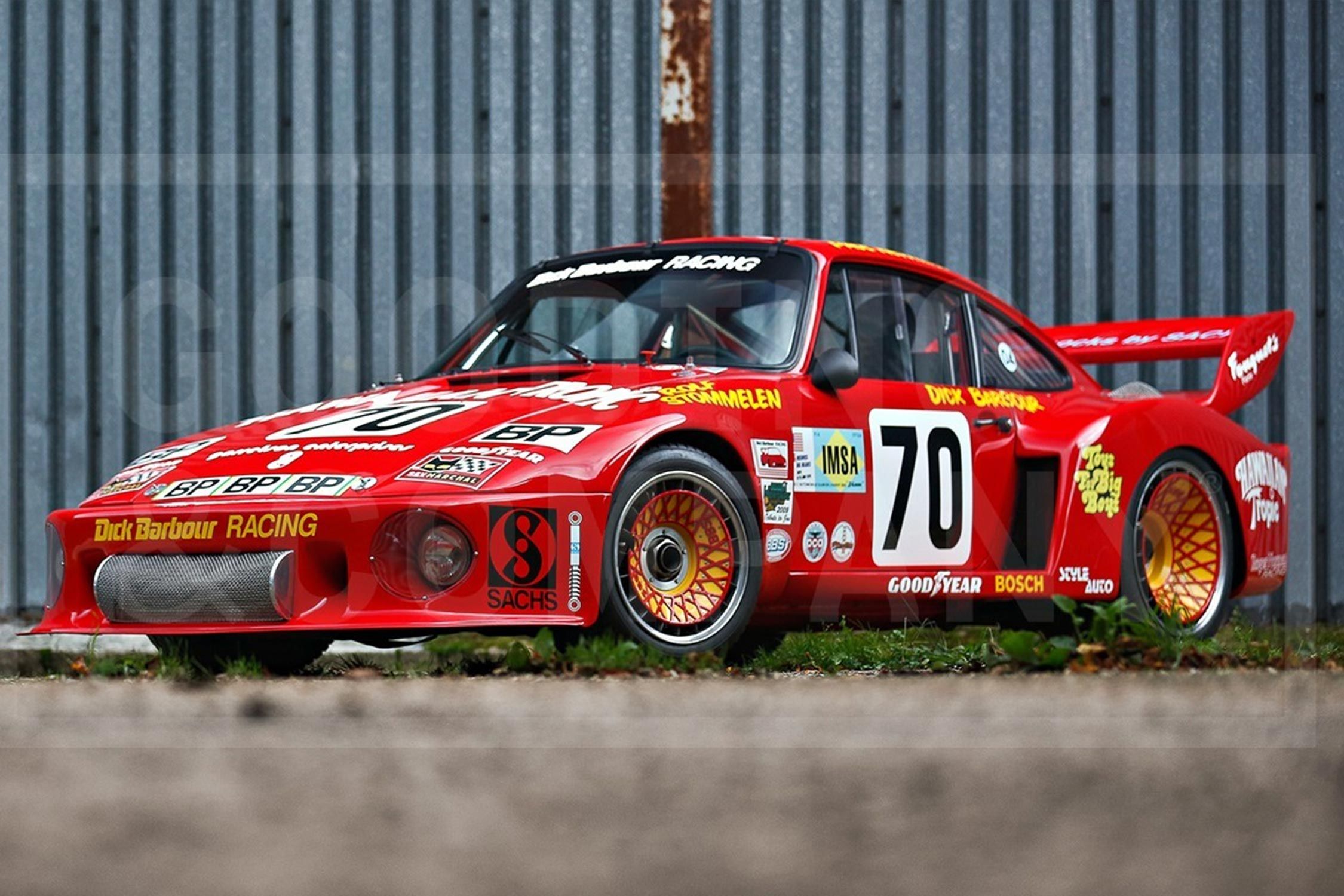
This is the Porsche 935 that Paul Newman raced at Le Mans in 1979. The Porsche 935 is a truly exceptional car. During its nine-year long career, the car triumphed at the 24 Hours of Daytona, the 12 Hours of Sebring and finished second overall at the 24 Hours of Le Mans. After taking Le Mans victory with the 917, a genuine prototype, it was back to basics for Porsche in 1976 with the 935 derived from a road-going 911. This chassis 009 0030 sold by Gooding at Monterey was purchased by Dirk Barbour Racing (Barbour had tried the car out himself a few days earlier) in 1979 to replace a 935 that had been damaged after crashing off the track. It came with a twin-turbo engine and all the latest developments, such as large brake discs and the “upside-down” gearbox. It wowed the crowds at the 24 Hours of Le Mans that year, where it was driven by Paul Newman, the Hollywood legend whose passion for motor racing began while filming the 1969 movie “Winning”.

The next Porsche of this list is probably one of the most successful endurance racing cars of its era. At the Le Mans of 1979 it finished 1st in class and 2nd overall which is a stunning result for a debuting racing car. The 24 hours of Daytona in 1981 and the 12 hours of Sebring in 1983 were no problem for the drivers and the car because they were overall winners of these races too! Very impressive performance out of the 3.2 liter flat-6-cylinder engine! This car was auctioned last year for €4 million.


10. 1973 Porsche 917/30

Sold for $4,400,000

The 1973 Porsche 917/30 Can-Am Spyder is considered by many racing historians to be the most powerful race car to have every turned a wheel in anger.

The twin-turbo 12 cylinder powerplant was tuned to pump out over 1,580hp in qualifying mode during the 1973 season of the Can-Am Challenge, the teams usually decreased turbo boost and raced it at around 1,100hp which still gave the car a 0-60 time of 1.9 seconds, a 0-100 time of 3.9 seconds and a 0-200mph time of 10.9 seconds. In race trim the Porsche could top 260 mph (420 kph), making it quicker than any modern Formula 1 car.

The Porsche 917/30 entered by Penske Racing won the 1972 CanAm series with George Follmer driving (after primary driver Mark Donohue suffered injuries as the result of a crash that year). 1973 saw a Porsche 917/30 piloted by the now recovered driver Mark Donahue win every race except one and claim the series win by a huge margin. This is one of the only six examples ever built. The car participated in a few historic races and was sold at auction for €3.7 million in 2012 ($4,400,000).


11. 1970 Porsche 917K Interserie Spyder Née

Sold for $3,967,000

This racing Porsche was the first out of 6 types of the 917. With its short tail, this Porsche is better known as ‘917K’ where the ‘K’ stands for Kurz (short). With its flat-12 cylinder engine the car has very impressive performances for a car made almost 50 years ago! It goes from 0 to 100 kph in 2.3 seconds and has a top speed of an incredible 390 kph! The car began his life with chassis number ‘026’ but after a big crash in the 24-hour Le Mans in 1970, the car has been rebuilt and received a new chassis with number ‘031’. The new owner bought the car in 2010 for €3.3 million.

Sold for $3,967,000 at the Bonhams & Butterfields Quail Lodge auction on August 12, 2010.


12. 1959 Porsche 718 RSK Spyder

Sold for $3,135,000

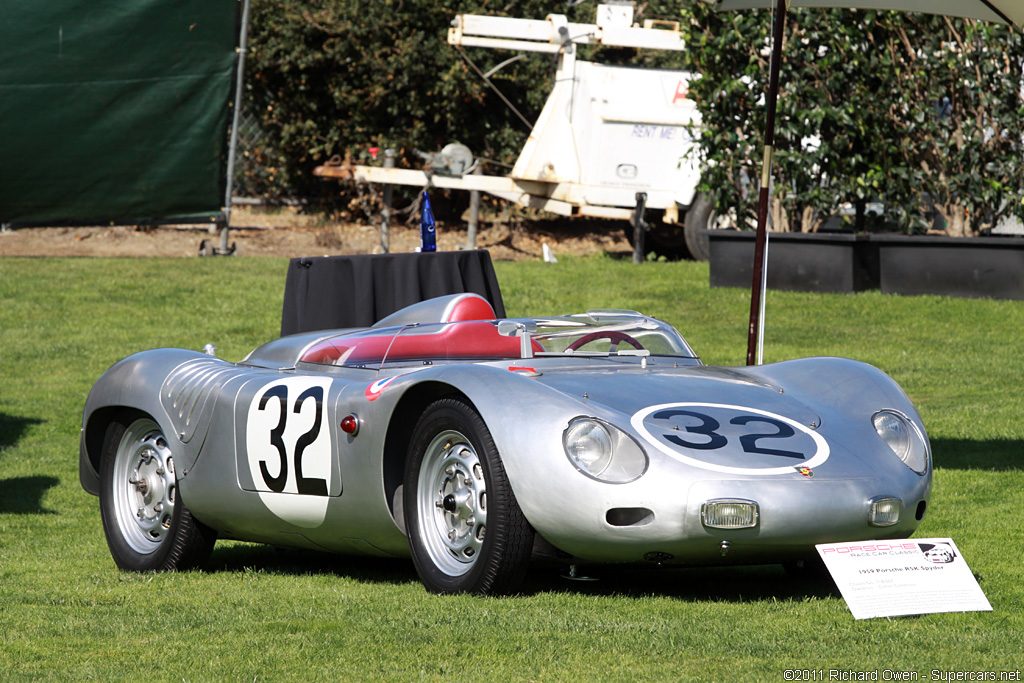
Porsche’s 718 Spyder made its debut at the 1957 24 Hours of Le Mans. Undergoing further development, the car racked up many wins after that. The car pictured above was built in 1959 and was owned by Roy Schechter of Miami, who had already been racing successfully in a gullwinged Mercedes sports car. He paid about $8,000 for the Porsche. Its first race was the 4 hours of Alamar, which took place near Havana, Cuba, that year. This restored Porsche is one of the 34 type 718 Spyders ever built and has a decade-long North American race history. The car belonged to collection of the famous comedian Jerry Seinfield and was auctioned for €2.4 million.


13. 1955 Porsche 550 Spyder by Wendler

Sold for $3,018,400

This Porsche 550 Spyder was shown at the 1955 Frankfurt automobile show before being exported to the USA, where it raced to victory in its debut race at Waterbro. In addition to class and overall victories in regional races in North America, this Porsche also finished 14th overall and third in class at the 1956 Sebring 12 Hours. RM Sotheby’s achieved €2,744,000 ($3,018,400) for this 1955 Porsche 550 Spyder by Wendler. The Porsche was one of only 75 Porsche 550s produced for privateer racers who could drive the car both on the racing track and public roads.


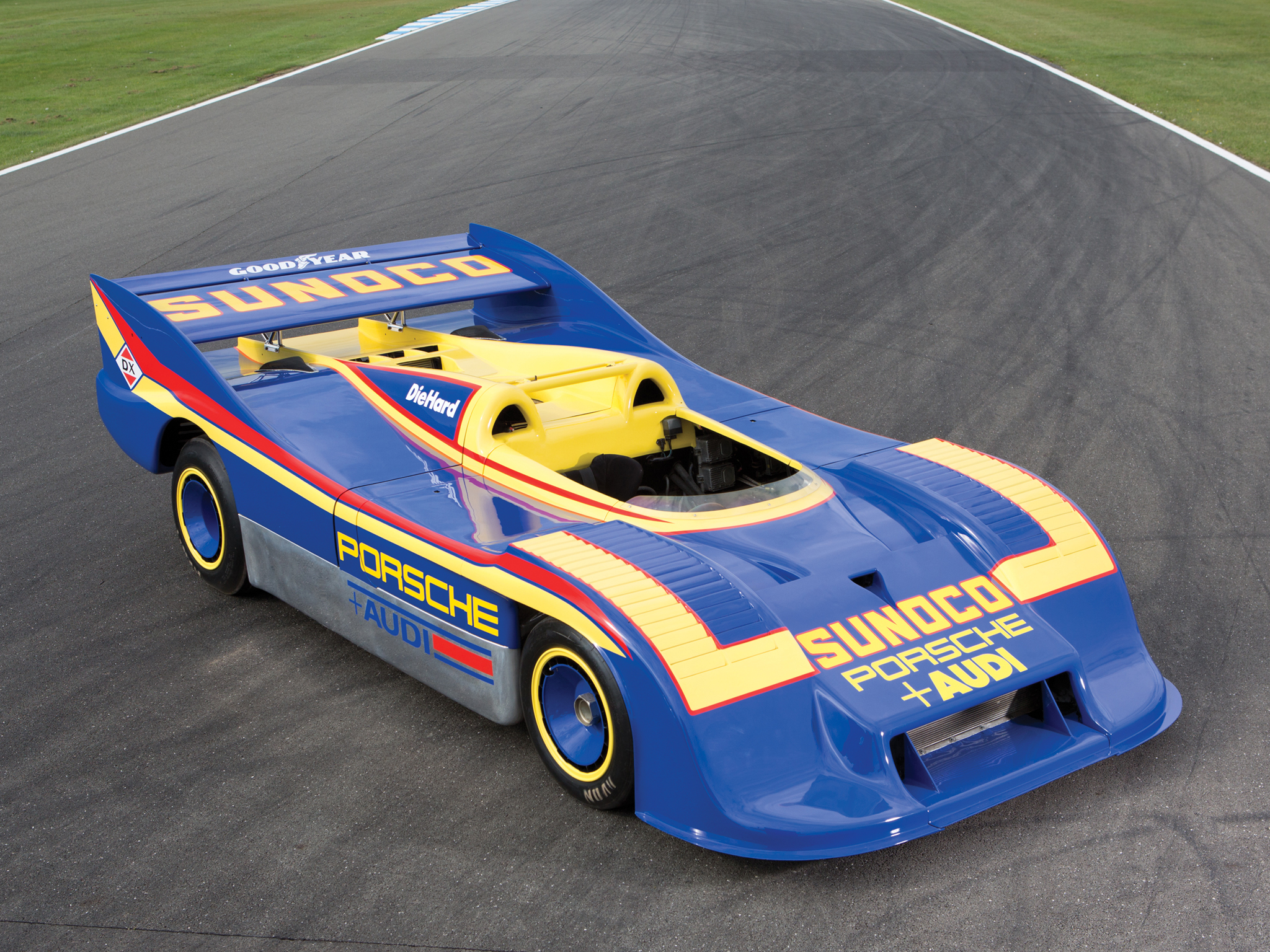
14. 1973 Porsche 917/30 Can Am Spider

Sold for $3,000,000

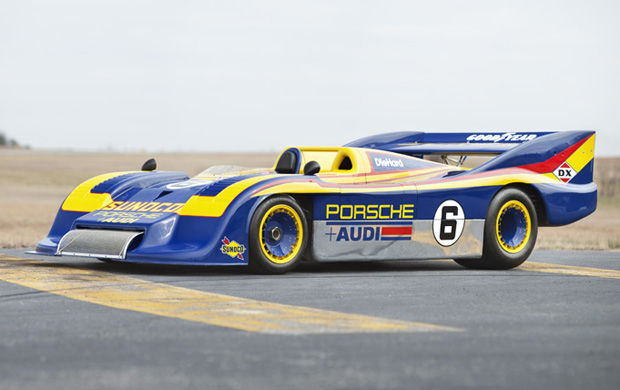
We have written about the Porsche 917/30 Can Am Spider and this example from the Jerry Seinfeld collection went for a cool $3 million. At the time of the sale people were disappointed with the price as it was expected to go for closer to $5 million. Although in excellent condition, the value certainly was not helped by a lack of competition history despite being painted in the Sunoco livery used by similar Penske cars.

Sold by Gooding & Company at Amelia Island 2016


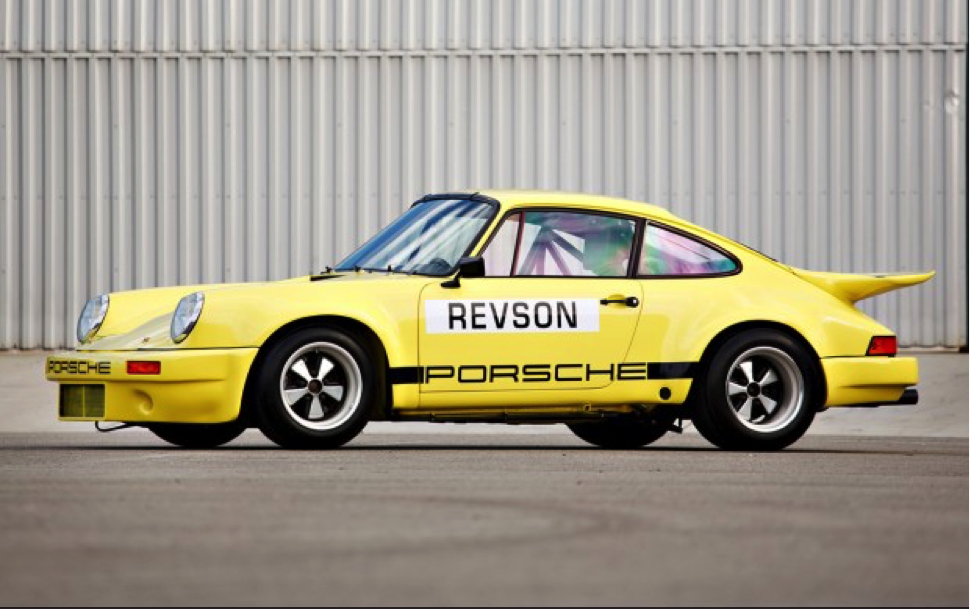
15. 1974 Porsche 911 Carrera 3.0 IROC RSR

Sold for $2,310,000

The 1974 Porsche 911 Carrera 3.0 IROC RSR sold for an impressive $2,310,000 – the pre-auction estimate was a more modest $1.2 to 1.5 million. Although this was one of only 15 RSRs specially built for Roger Penscke’s IROC series, expect more owners of lesser 911s to test the market at coming auctions.

Porsche had to come up with a new design for its winning Porsche, the 917, after racing regulations declared it unsuitable. Due to the changes, Porsche developed the Porsche 911 Carrera RSR 3.0 IROC in 1974. The differences in the two models were that this newer model featured a wider front spoiler, wider wheel arches, along with the signature rear wing, which happens to be the beginning of the rear-wing-craze, (if you ever wondered). The car was designed with a 3.0-liter 2-cylinder SOHC engine that gives you 330 hp. The car sold for $2.3 million, the seventh most expensive Porsches ever sold.


16. Porsche 911 GT1 Road Car

Sold for $2,200,000

Designed to compete in the GT1 race class, the 911 GT1 was not a success at first. Porsche tried multiple times to get it right and in 1998, they finally did. It proved to be a champ on the racetrack. After the fact, Porsche made the necessary adjustments to make the car road worthy, giving it a 3.2-liter 4-cylinder DOHC twin-turbo engine and the automobile manufacturer only made a limited number of the vehicles. This Porsche sold for $2.2 million, making it one of the most expensive models ever sold.


17. Porsche 917K Road Car

Sold for $2,000,000

The “K” stands for Kurzheck, which means, “short tail” in German, and although the racing version has a more up-sweep to the tail, the road version was altered a bit to make it a more suitable car for the road. Although many changes were made for the road travel version, one thing was kept the same between the race and road version, the engine was kept the same; a 5.0-liter V12 engine. This Porsche was sold for $2 million, one of the most expensive Porsches ever.

A Look Back at the New Gear We Discovered This Week: June 25-29, 2018

Good morning, and welcome to the latest edition of This Week in Gear — your single-shot serving of an entire week’s worth of the best new gear pulled from our weekday editions of Today in Gear. Bookmark it to peruse over a cup of coffee or before you soak up the last of your weekend freedom, then start your Monday completely up to speed. Here’s to another fantastic week.

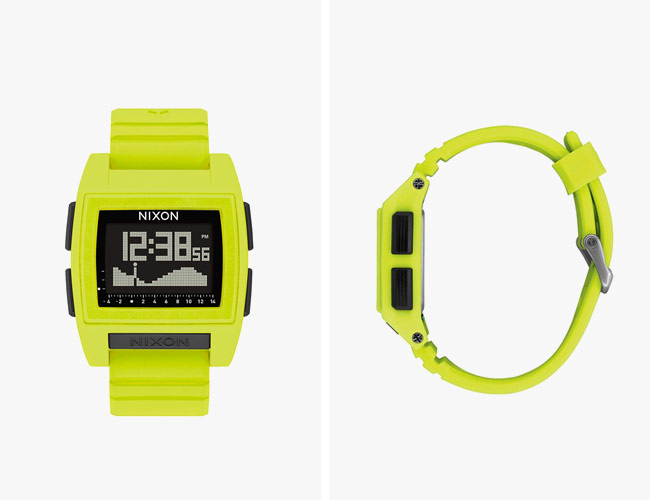
Nixon’s Durable New Watch Is the Go-To of Pro Surfers

Nixon’s Durable New Watch Is the Go-To of Pro Surfers

With tide information from over 500 beaches around the world, it’s time to hang ten.

This Is the Only Utility Knife You’ll Ever Need

This Is the Only Utility Knife You’ll Ever Need

If anyone is going to update a classic utility tool, it better be the lauded creator himself.

This Might Be the Most Badass Dog Leash Ever Made

This Might Be the Most Badass Dog Leash Ever Made

The Lifetime Leash from Atlas Pet Company ensures you and your dog go on longer, better and safer walks – whether those walks take place in the neighborhood or climbing a mountain.

Breathe New Life Into Your Watch With These High-End Leather Straps

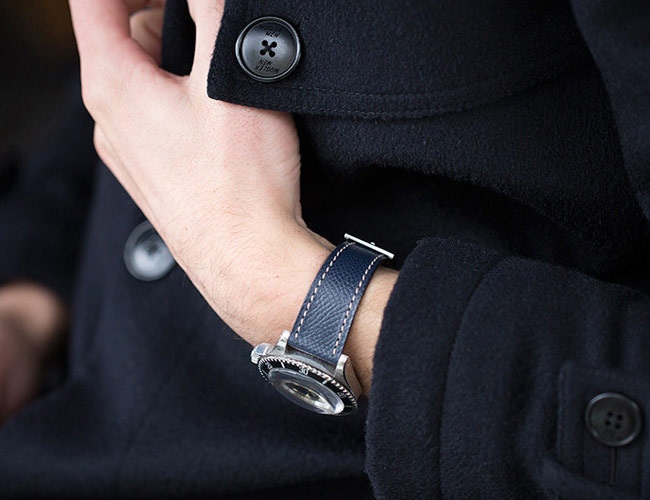
Breathe New Life Into Your Watch With These High-End Leather Straps

Made from calfskin sourced from the best French and Italian tanneries.

The All-New Ford Ranger Raptor Looks Insanely Good Off-Road

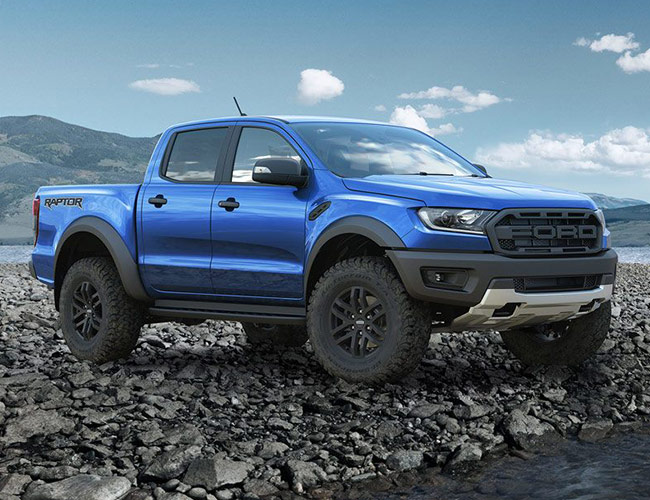
The All-New Ford Ranger Raptor Looks Insanely Good Off-Road

As of now, a US-bound Ranger Raptor is still undecided. But if the excitement over this promo video is anything to go by, Ford would be insane to hold back from the American market.

Designing the Perfect Engagement Ring Online Is Easy (and Cheaper Than Going to a Store)

Designing the Perfect Engagement Ring Online Is Easy (and Cheaper Than Going to a Store)

Buying online is actually 50-percent cheaper than going to a traditional store.

Why Hibiki’s New Blend Is a Bad Omen for Japanese Whisky

Why Hibiki’s New Blend Is a Bad Omen for Japanese Whisky

Japanese whisky may have gotten too hot.

The Most Versatile Home Security Camera You Can Buy?

The Most Versatile Home Security Camera You Can Buy?

It comes integrated with Alexa so you can ask it questions and stream music the same way you would with an Amazon Echo.

The Most Iconic Triumph of All Time Is Coming Out of Hiding

The Most Iconic Triumph of All Time Is Coming Out of Hiding

You have the rare chance to see one of the actual 1962 Triumph 650cc TR6Rs from The Great Escape.

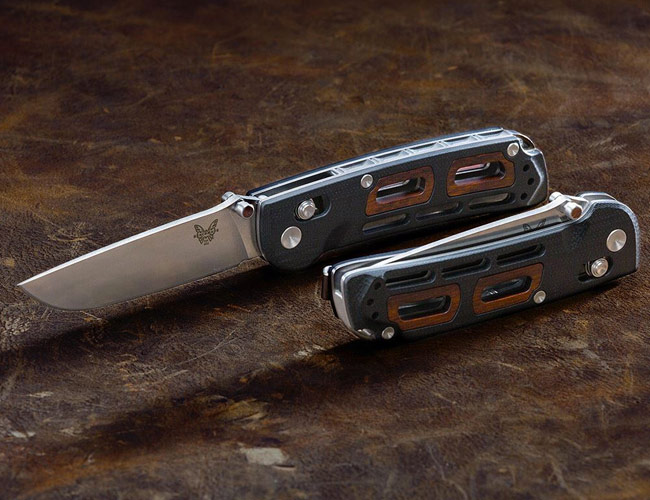
This Beautiful Pocket Knife Is Invisibly Innovative

This Beautiful Pocket Knife Is Invisibly Innovative

Grovemade’s new Titanium Minimalist Knife is inspired by traditional Japanese blades. At its core is a unique and innovative feature that will go unseen by the untrained eye, and that’s by design.

This Super Pretty Headphone Amp Is Perfect for Audiophiles

This Super Pretty Headphone Amp Is Perfect for Audiophiles

The 3ES is compatible with high-end electrostatic headphones, by the likes of HiFiMan, Stax and MrSpeakers.

Toyota’s Alternative to Rolls-Royce Has the Best Seats In the Industry. Here’s Why

Toyota’s Alternative to Rolls-Royce Has the Best Seats In the Industry. Here’s Why

Unfortunately, you can’t get in the US, but we’ve got a solution.

This Titanium Chronograph Celebrates 70 Years of an Iconic Carmaker

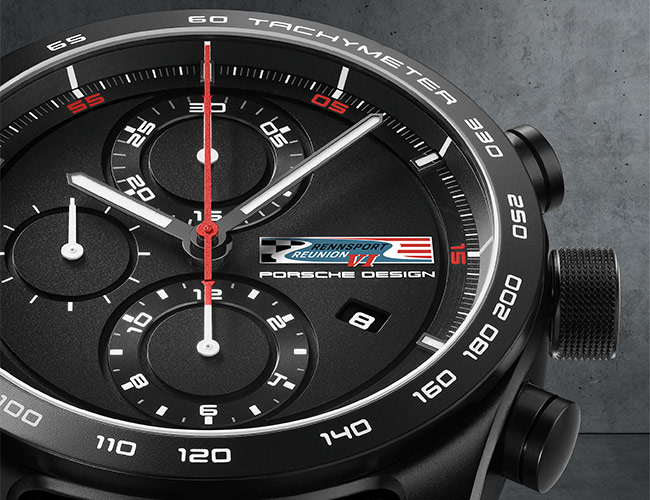
This Titanium Chronograph Celebrates 70 Years of an Iconic Carmaker

It’ll be super limited, though, with just 70 pieces coming to the US.

The Aston Martin DBS Superleggera Is Hyper-Aggressive, Will Scare Supercars and Take Their Lunch Money

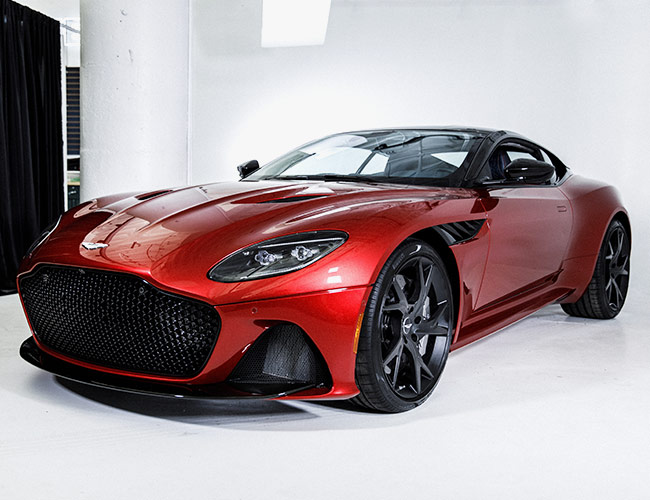
The Aston Martin DBS Superleggera Is Hyper-Aggressive, Will Scare Supercars and Take Their Lunch Money

The 5.5-liter unit conjures 715 horsepower and 664 lb-ft of torque, which is capable of sending the DBS Superleggera maxes out at a somewhat nutty 211 mph. It’ll hit 62 mph/100 kmh in 3.4 seconds.

Oris Completely Over-Engineered Its Biggest, Baddest Dive Watch

Oris Completely Over-Engineered Its Biggest, Baddest Dive Watch

This titanium beast can tell time in two different time zones all the way down to 1,000 meters.

One of the Year’s Best New Pocket Knives Is Finally Available

One of the Year’s Best New Pocket Knives Is Finally Available

If you’re looking for a new high-end EDC folding knife, this is the one to get.

Interested in Fly Fishing? This Is the Rod to Get You Started

Interested in Fly Fishing? This Is the Rod to Get You Started

Getting into a new hobby can be daunting – especially one like fly fishing, which requires an exhaustive list of specific gear. A new company, Reyr Gear, is simplifying the process with its super-packable and…

Todd Snyder Teams Up With New Balance to Make a Cocktail-Inspired Summer Sneaker

Todd Snyder Teams Up With New Balance to Make a Cocktail-Inspired Summer Sneaker

Made in the United States from high-end materials like Horween leather.

This Japanese Pocket Knife is Tiny, Tough and Beautiful

This Japanese Pocket Knife is Tiny, Tough and Beautiful

Seiichi Nakamura does away with Japanese minimalism with his newest, lightest pocket folder.

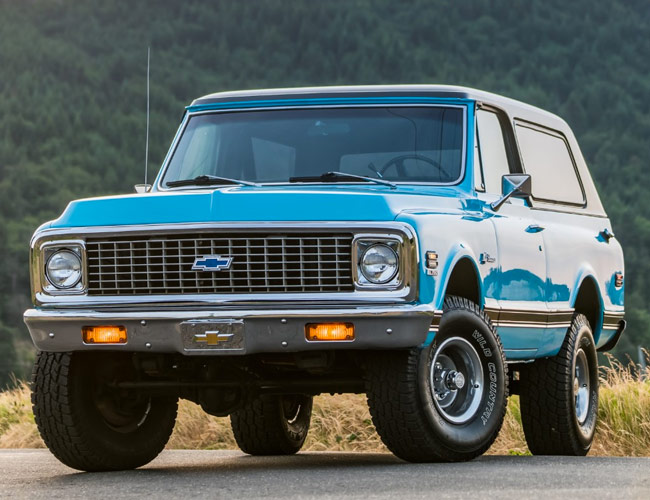
The New Chevy Blazer Is an Embarrassment Compared to This Stunning 1972 Example

The New Chevy Blazer Is an Embarrassment Compared to This Stunning 1972 Example

To put Chevy’s recent announcement into perspective, imagine if GM decided to slap the Camaro name on a high-riding, jelly bean-shaped misguided hatchback.

This App Is Basically the Ultimate Productivity Tool

This App Is Basically the Ultimate Productivity Tool

Gear Patrol readers get an exclusive discount to try it out.

These American-Made Whiskey Glasses Are Molded from Actual Oak

These American-Made Whiskey Glasses Are Molded from Actual Oak

They call back to how whiskey is made.

This $35 Accessory Lets You Turn Your Tablet Into a $160 Smart Speaker

This $35 Accessory Lets You Turn Your Tablet Into a $160 Smart Speaker

The Amazon Echo Show used to cost $230, and now this charging dock can make your tablet function just like it.

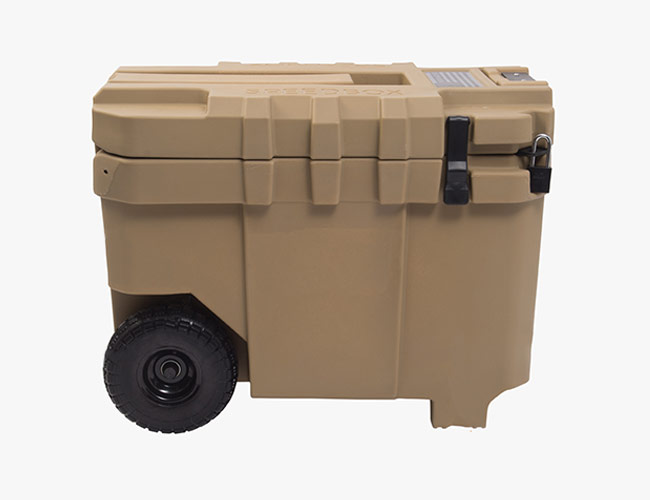
Designed with the Military in Mind, This Cooler Can Take on Pretty Much Anything

Designed with the Military in Mind, This Cooler Can Take on Pretty Much Anything

A rotomolded cooler that actually has a feature to accommodate a parachute landing.

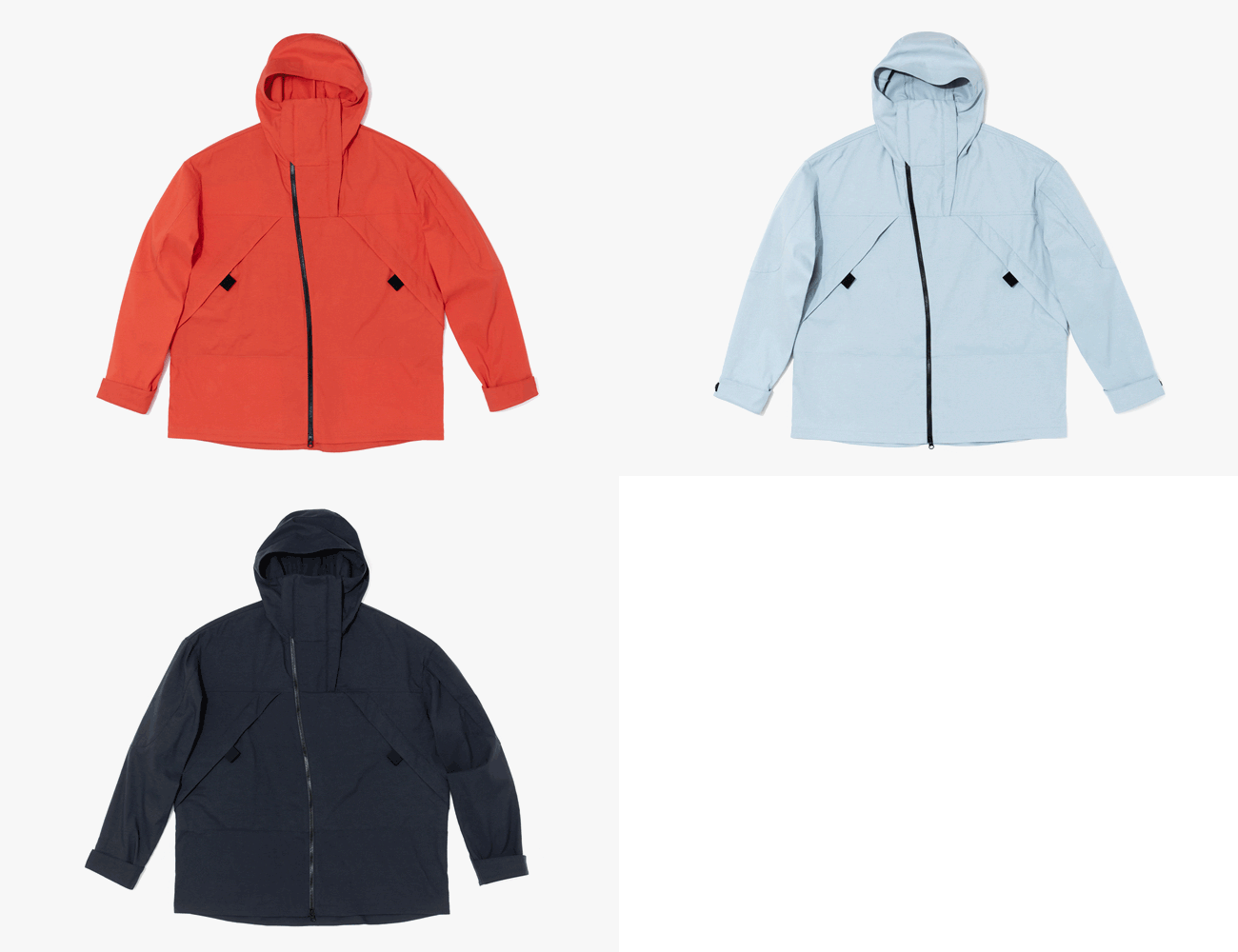
Why This New Parka Makes Good Summer Outerwear

Why This New Parka Makes Good Summer Outerwear

Parkas are a cold weather apparel staple, but do they make sense to wear during the summer too? Outlier just released a new one that has us questioning the matter.

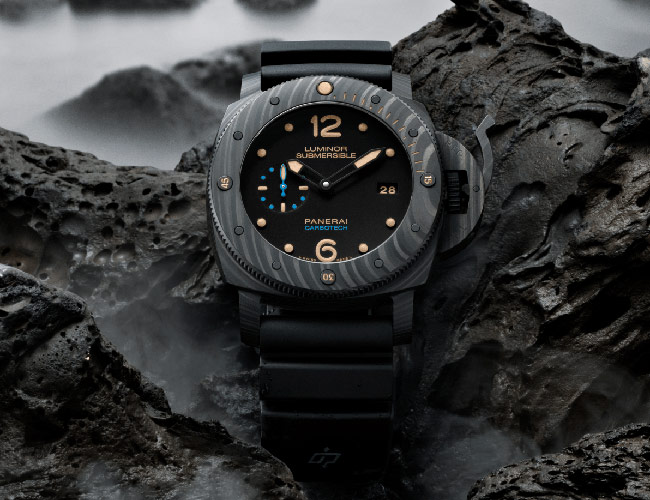
Panerai’s Iconic Dive Watch Uses a Cutting-Edge Case Material

Panerai’s Iconic Dive Watch Uses a Cutting-Edge Case Material

Called Carbotech, it’s extremely strong — yet lighter than ceramic or titanium.

This App Helps Photographers Take the Perfect Landscape Photo

This App Helps Photographers Take the Perfect Landscape Photo

The app factors in things like weather, time, elevation, the moon and sun cycle, and then helps the photographer plan for the perfect photo.

MasterCraft’s New Boat Will Let You Surf Anywhere

MasterCraft’s New Boat Will Let You Surf Anywhere

The newest boat from MasterCraft is the perfect way to hone in on your surfing skills, even if the lake is flat.

Adventure E-Bikes Are Here, and This One Looks Awesome

Adventure E-Bikes Are Here, and This One Looks Awesome

E-bikes are gaining in popularity, and Swiss bike maker BMC is capitalizing on the trend and combining it with one other movement: adventure riding. Meet the Alpenchallenge AMP Cross.

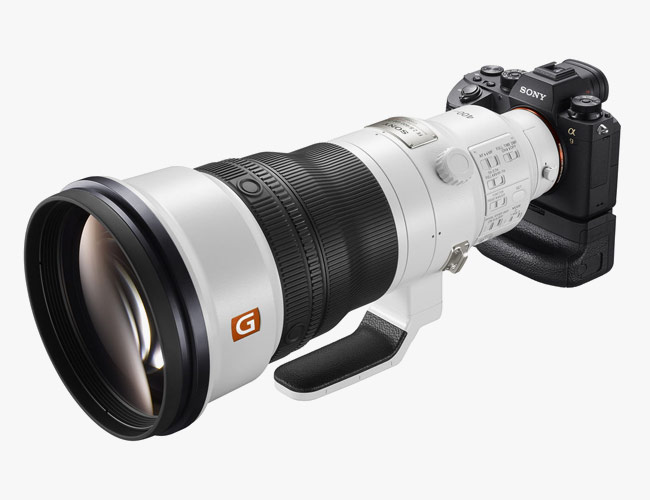
Sony’s Super-Telephoto Lens Is the Ultimate Weapon for Wildlife Photographers

Sony’s Super-Telephoto Lens Is the Ultimate Weapon for Wildlife Photographers

It’s also the world’s lightest 400mm f/2.8 prime lens.

4 Grill Upgrades You Need for the Fourth of July, All Under $50

4 Grill Upgrades You Need for the Fourth of July, All Under $50

Upgrading your grilling setup just in very easy and very cheap.

The 12 Best Cigars to Smoke in 2018

The 12 Best Cigars to Smoke in 2018

To novices, smoking a cigar can be more intimidating than fun. We’re here to help.

The 9 Backyard Games You’ll Find Us Playing This Summer

The 9 Backyard Games You’ll Find Us Playing This Summer

Here at Gear Patrol, we take summer seriously — from barbeques to yard games. Here are our top ways to get competitive with anyone who’s down to play.

The 16 Best Running Shorts of 2018 for Every Type of Runner

The 16 Best Running Shorts of 2018 for Every Type of Runner

Whether you’re looking for split shorts, 5″ or longer than 7″, we have you covered.

4 Grill Upgrades You Need for the Fourth of July, All Under $50

4 Grill Upgrades You Need for the Fourth of July, All Under $50

Upgrading your grilling setup just in very easy and very cheap.

The Best Outdoor Furniture for Your Patio, Balcony or Backyard

The Best Outdoor Furniture for Your Patio, Balcony or Backyard

From Ikea to Herman Miller, this is your survey of the best outdoor and patio furniture at every price point.

The Cars We Love — Even Though Everyone Else Hates Them

The Cars We Love — Even Though Everyone Else Hates Them

When the whole world is hurling hate at the terrible car you love, stand your ground.

These Are the Best Board Shorts Money Can Buy

These Are the Best Board Shorts Money Can Buy

Designed by 11-time surfing world champion Kelly Slater.

The Best Waterproof Bluetooth Speakers for Any Budget

The Best Waterproof Bluetooth Speakers for Any Budget

Looking for a portable speaker to take to the beach, park or backyard barbecue?

The 5 Best Sandals for Men, According to Style Experts

The 5 Best Sandals for Men, According to Style Experts

We asked five of menswear’s best to name their favorite pairs of sandals.

15 of the Worst Used Cars to Buy From 2007-2017

15 of the Worst Used Cars to Buy From 2007-2017

If you’re currently shopping for a used car, this is a good place to find the cars you don’t want.

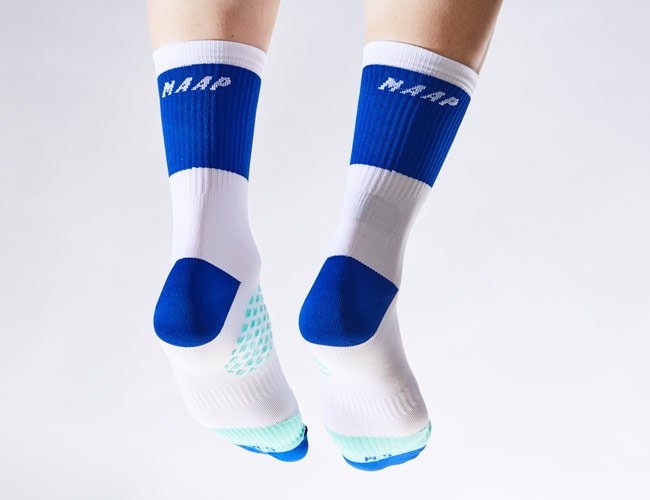
The 6 Most Stylish Cycling Socks of 2018

The 6 Most Stylish Cycling Socks of 2018

Whether you’re a weekend warrior or a die hard road cyclist, these six socks are sure to make you stand out from the crowd.

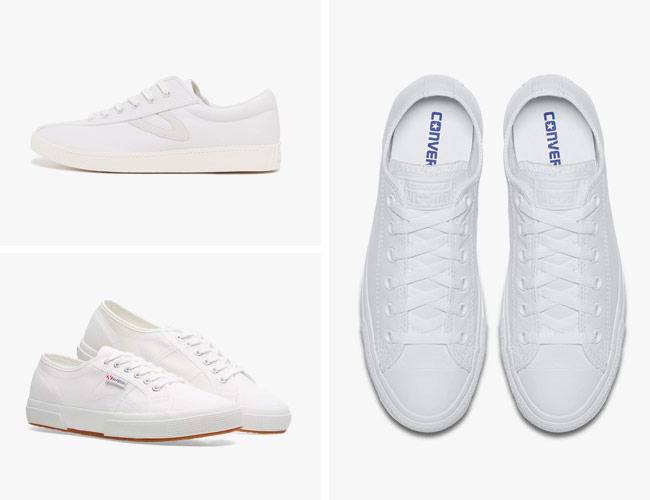
8 White Sneakers to Wear All Summer Long

8 White Sneakers to Wear All Summer Long

Temperatures are rising, leisure levels are increasing. If there was ever a time for some great summer sneakers, it’s now.

Review: You’ve Never Listened to Headphones Like These Before

Review: You’ve Never Listened to Headphones Like These Before

The Audeara A-01 headphones give you a hearing test and then custom-tune the audio so that it sounds perfect for you.

The 2019 Alfa Romeo Giulia and Stelvio Quadrifoglio Offer Ferrari Performance for Audi Money

The 2019 Alfa Romeo Giulia and Stelvio Quadrifoglio Offer Ferrari Performance for Audi Money

In some small ways new for 2019, the high-performance versions of Alfa Romeo’s Giulia and Stelvio are wicked fun. If you haven’t considered buying one — or even driving one — you should.

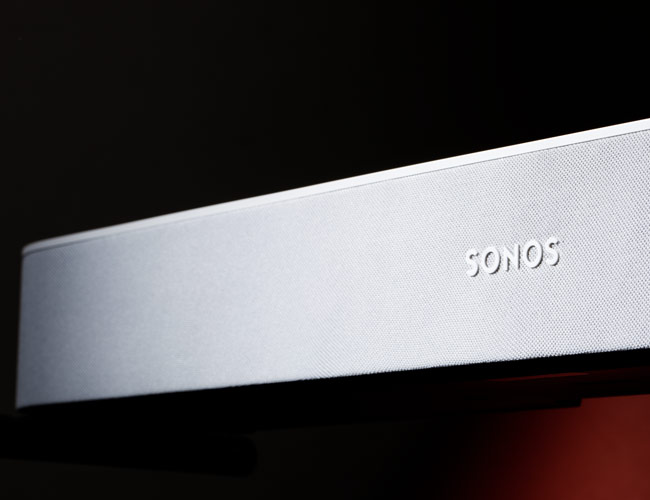
Sonos Beam Review: The Perfect Entry-Level Soundbar, for Most People

Sonos Beam Review: The Perfect Entry-Level Soundbar, for Most People

It combines a smart speaker with TV control, plus the terrific multiroom sound that Sonos is revered for.

Dyson Pure Cool Review: Can Dyson’s Newest Fan Solve Your Allergy Problems?

Dyson Pure Cool Review: Can Dyson’s Newest Fan Solve Your Allergy Problems?

Dyson’s Pure Cool fan and filter is like many Dyson products — expensive, badass and possibly superlative.

VIDEO: Porsche Just Absolutely Smashed the Nürburgring Lap Record

Porsche 919 Sets Nurburgring Record – All-Time Fastest Nordschleife Lap Time

You guys all know by now that we’re obsessed with the fastest Nurburgring times and have been publishing the top 100 production cars around Nurburgring for years now. While we won’t be adding this monumental time to our list (since this is clearly not a production car) we can’t not share the news.

WOW, just WOW.

This morning (Friday June 29 2018) Timo Bernhard (D) lapped the 20.832 kilometre (12.94 miles) Nürburgring Nordschleife race circuit in 5 minutes and 19.55 seconds. This results in an average speed of 233.8 km/h (145.3 mph) on what is revered by race drivers, engineers and enthusiasts alike as the world’s most difficult track. Driving the Porsche 919 Hybrid Evo, Bernhard beat the previous lap record, set by Stefan Bellof, by 51.58 seconds.

For 35 years and 31 days Bellof’s 6:11.13 minutes record remained uncontested. The German driver from Gießen, who tragically died at Spa-Francorchamps in 1985, counted as the biggest racing talent of his time. He drove his record on May 28 in 1983 at the wheel of a powerful 620 bhp Rothmans Porsche 956 C during practice for the 1000-kilometre WEC sports car race. Also his average speed was over 200 km/h.

[embedded content]

2020 Porsche Mission E: All-Electric Porsche Called “Taycan”

The Mission E’s newly adopted name – “Taycan” (pronounced: tie-con) – translated from German roughly means “lively young horse”, and is a tribute to Porsche’s historic crest.

The new all-electric stable mate will be in production next year and is expected to go on sale in late 2019. The aforementioned was all announced at the ‘70 Years of Porsche Sports Cars’ ceremony, which took place on June 8, 2018.

The Taycan has certainly evolved since Porsche first unveiled the Mission E concept back in 2015 – most notably in its design cues. Morphing from a sleek sedan silhouette to what is now more of a sporty crossover fastback design, the Taycan still remains what it was set out to be from the beginning.

“Our new electric sports car is strong and dependable; it’s a vehicle that can consistently cover long distances and that epitomizes freedom,” stated Oliver Blume, Porsche AG chief when describing the goal of the vehicle.

With that said, the Taycan will be the amalgamation of Mr. Blume’s message. While limited specification information is available for the car, here’s what we do know.

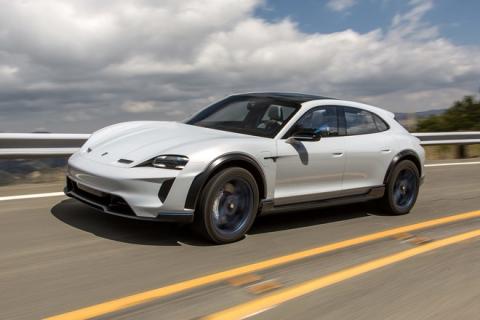
Porsche Mission E Cross Turismo Concept, which the Taycan is based on

Engine and Performance

The Taycan will have 2 electric motors powering the car with a combined output of over 600-horsepower. The rear motor will output the majority of the power, making the Taycan drive more like a rear-biased car. Porsche has indicated that the Taycan should be capable of 0-60 mph in 3.5 seconds or less and have a top speed of approximately 155 mph.

Braking will also be assisted with permanent magnet synchronous electric motors. Two performance modes – or in this case, what is essentially a two-speed gearbox – are available to maximize driving efficiency in either city or highway driving scenarios.

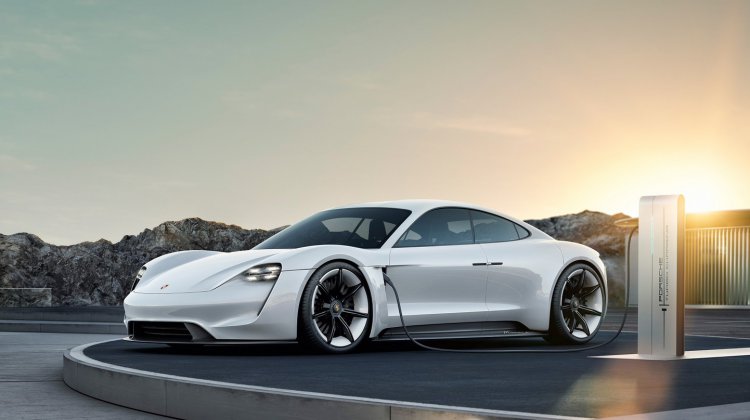
Porsche Mission E as of circa 2015

Range and Charging

Porsche claims that the vehicle’s maximum range on a single full charge will be around 500 km or 310 miles. Real-world mileage will ultimately vary based on driving conditions, but Porsche has a history of understating performance figures in lieu of the risk of underachieving.

The Taycan can be charged up to 80% ( or the equivalent of a 400 km boost) in 15 minutes with an 800-volt charger.

Design

As mentioned earlier, the Taycan has now taken the form of a crossover vehicle, so we can expect it to be a 5-door-wagon with a raised ride height.

Porsche AG chief designer Michael Mauer said of the Mission E Cross Turismo, which the Taycan is based on, “The key for the Panamera Sport Turismo was versatility. In the case of the Mission E Cross Turismo, the focus was more on this combination of different vehicle characteristics. Take this car in the morning to the meeting in the city, and in the evening, you go to your chalet in the Swiss mountains.”

Supercars.net will be providing news updates on the Porsche Taycan as they become available.  

Photo &  Gallery

Video

[embedded content] [embedded content]

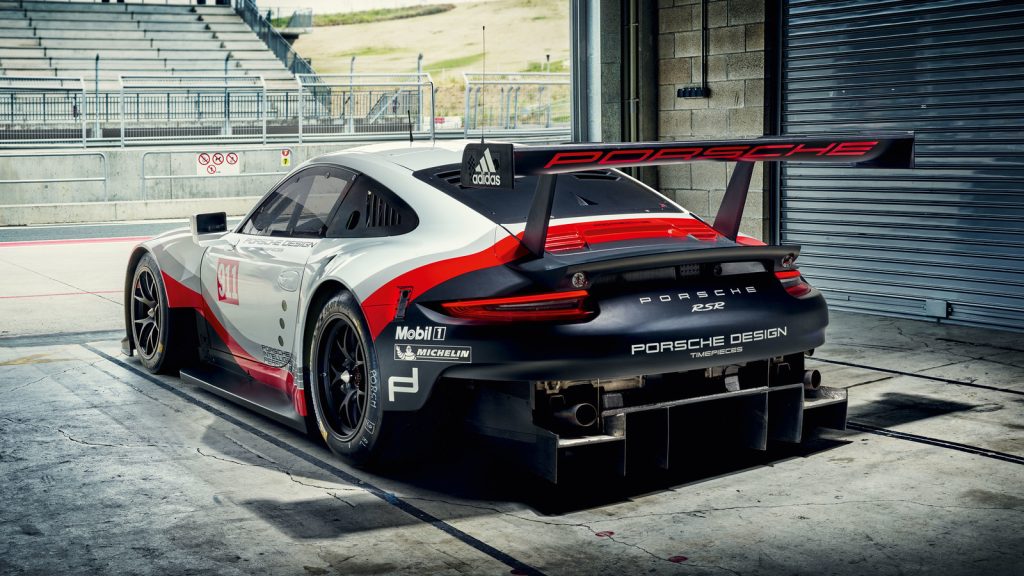
2018 Porsche 911 RSR – Porsche’s Mid-engined 911 Race Car

However, the allocation for MY2018 units was already spoken for before this calendar year – all 6 of them, each costing $1.18 million USD. Even Porsche’s head of Motorsport, Dr. Frank Walliser, has been surprised by the level of public consumer demand for the car – so much so that in mid-2017, Porsche decided to make the car available for purchase through its Customer Motorsport Program. Prior to this, the allotment was restricted to factory racing teams.

The Porsche 911 RSR is a special looking car, but despite its extreme enhancements, its visual profile remains undeniably 911. To understand what truly differentiates this 911 from any other, you would have to look at the engine bay – not so much what’s in it, but where it is.

The RSR is the only 911 to have its engine sitting in front of the rear axle, effectively making this a mid-engined car. Dr. Walliser goes on to remark, “While retaining the typical 911 design, this is the biggest evolution by now in the history of our top GT model”.

Repositioning the flat-six engine is considered an essential design element in ensuring the car remains competitive in its GTLM racing class. Apart from its more centralized weight distribution – effectively reducing tire wear at the rear wheels – the new engine placement also allows for the use of a massive rear diffuser and top-mounted rear wing, which significantly improves aerodynamic efficiency over rear-engined iterations.

As Porsche customers and enthusiasts, perhaps what we should be most looking forward to is a street-legal version of a mid-engined 911 in the future. It could be the makings of something as controversial as it is exciting, and Porsche has a strong track record of sharing its race-proven technologies with its production models.

Engine

While some purists may be tentative about the idea of a mid-engined 911, they will feel more at ease about the fact that it remains in every other sense, more familiar. The 4.0L naturally aspirated boxer engine produces 510-horsepower (depending on size of restrictor) and revs all the way up to its 9,500 rpm redline – imagine a 911 GT3 engine on steroids.

It also features a water cooling system, direct fuel injection, a dry sump lubrication system and four valves per cylinder.

Chassis & Design

Mated to the engine is a six-speed electronic sequential gearbox which is cased in magnesium, and is operated using steering wheel mounted paddle shifters.

The car is also fitted with a myriad of devices and equipment to meet or exceed safety regulations. A radar-supported collision warning system dubbed ‘Collision Avoid System’, proactively alerts drivers to potentially dangerous situations involving other vehicles – particularly useful when dealing with traffic that includes faster prototype cars. The safety cage has been redesigned, along with a rigidly-mounted racing seat fixed to the chassis.

The 911 RSR weighs just 1,234 kg with its full arsenal of wider haunches, 13-inch-wide rear wheels and a massive rear diffuser and rear wing. Entire sections of its carbon fiber panels can quickly and easily be replaced thanks to the clever use of quick-release mechanisms. Changes to the suspension setup can also be performed on short notice.

All technical specs can be found on Porsche’s official website.

Photo Gallery

Videos

[embedded content] [embedded content] [embedded content]

Porsche’s New “Spirited Young Horse” & Their First Electric Car

German automobile brand, Porsche recently celebrated its 70th anniversary in the industry, and the ‘70 years of sports car’ ceremony took place mid-June. 

[embedded content]

For the occasion, Porsche also announced a new concept car called the 911 Speedster Concept.  Fans of the automotive giant were revved up at the news, and before they could catch their breath again, Porsche announced the name of its forthcoming all-electric sports car.

The ‘Taycan’

Porsche always names its models meaningfully, and Taycan means “a spirited young horse” or “a lively young horse” which is a reminiscent of the high-end brand’s logo with a stallion on it.

Mission E, with ‘e’ standing for ‘electric’, was first introduced in 2015 as a multi-year plan to develop an electric sports car. And now, Porsche CEO, Oliver Blume, has announced that the Mission E has an official name- Taycan. The series production of this first-ever purely electric Porsche is all set to begin next year, and its market launch is anticipated to be in 2020.

[embedded content]

The speed range of the Taycan is set to blow minds, and it would be highly recommended to get a car insurance. With speed, comes a price and a Porsche does not lag in either.  

The automobile is set to have two permanently excited magnate synchronous motors (PSM) positioned on both the axles which will generate 600PS of power, yielding a system output of 400 kilowatts. The PSM technology being used here by Porsche is also used by Nissan and the likes.

The electric sports car can accelerate to 100km/h in under 3.5 seconds and to 200km/h in under 12 seconds. The range of the vehicle will be close to 500 kms, measured in accordance with the New European Driving Cycle (NEDC). The engine of the beat goes up all the way to 600bhp.

Two-speed gearboxes will be used to keep acceleration strong all the way to the top speed. It is probable that this two-speed gearbox will be at the back and the front will have a decoupling clutch. The rear motor of the car is to be more powerful than the front.

Porsche has also confirmed the use of ‘computer-blended brakes’. The mechanism of this breaking system works is that the pedal is not a mechanical link to the discs but rather a request for retardation which is then used by a computer to figure out whether to get that retardation from the motors or the discs.

Also offered in the spacious 4-seater are multiple jump-starts, without any compromise on the performance.

Blume called Taycan ‘strong’ and ‘dependable’, and ‘a vehicle that can consistently cover long distances and that epitomizes freedom.’

The Competition

Since the announcement of Mission E, fanatics have been waiting to see how it competes with the Tesla model 3 released in July 2017. Porsche plans on outdoing Tesla when it comes to charging, as Tesla’s superchargers offer 480 volts and Porsche is working on 800V infrastructure to charge the Taycan as well as the automobiles which will succeed it.

Porsche’s head of Electrics/Electronics Development, Uew Michael said that Taycan would be able to charge twice as fast as Model S. The Taycan is also set to boast a range of 310 miles in a single charge with Taycan’s high-voltage superchargers.

The big car shows of 2019 are to be looked forward to for the reveal of the Taycan. It was also suggested by CEO Blume that by the year 2030, all Porsche vehicles may turn out to be fully electric.

While we wait eagerly for the first look of the Taycan, we also have the 911 Speedster Concept to look forward to. While both of these have been debuted at arguably the same time, we are keen to see which one is released first.

The 70 Greatest Porsches Ever

To Celebrate Porsche’s 70 Year Anniversary We Give You the 70 Best Porsche Cars Ever Made

Greatest Porsche List

Clearly we have been a bit of a “best of Porsche” run lately. With Porsche celebrating 70 years in 2018 we felt it was a good time to dive deep into Porsche history and pick our favorite cars from this storied carmaker. First we finished our full Porsche model list page, then we moved onto the best non-911 Porsches before outlining our picks for the best Porsche race cars and finally there was the ultimate list of the greatest 911s.

Here we are, our final Porsche list just after 70 year celebration. In this list we list the greatest Porsche models ever. That’s right, we attempted to give you the ultimate Porsche list. We are ready for the backlash, abuse and “are they crazy” comments we are about to receive from Porsche fans all over the world.

How We Chose – Our Process

We broke down the list of all Porsche models by type (race car, production model, 911 models, special editions, supercars and so on). We went through each category to pick our favorite cars. We looked at factors like historical significance, technology, performance, mystique and outright desirability both historically and today. That helped whittle the list down to about 130 cars that we deemed good enough to be considered an awesome Porsche. Next we started to narrow down the list to seventy Porsche’s that were worthy of their place in the best of Porsche list.

Once we had our seventy cars the next phase was a heated discussion for the next month of so trying to rank them all from 70 to 1. Again, we looked at the key factors and let each person on our five person panel decide where the cars sat on the list. Lots of back and forth, arguing, fighting and hours of research later and we were able to round out number 70 to 50. Getting from 50 to our top 10 took another two weeks of back and forth. The Top 10 Porsche’s ever was another two weeks of work and the least satisfying part of this process because the reality is that any car on the Top 10 Porsche list is good enough for first place. It really depends on which factor you find most important and so much of that is personal opinion.

If you look at Porsche cars through the lens of motor racing then your list of the top ten Porsche’s will different than mine since I’m less of a motorsports fan and more into cars I can use on the road. We tried to balance race cars with production cars, special models an supercars to have as fair a list as possible when you consider it all together as Porsche’s body of work across categories.

Porsche Cars Are Special

Lots of automakers like to brag about how their “racing heritage” informs their production vehicles, but nobody does it like Porsche. Their history in motorsports is unequaled and the Porsche has had success in Formula 1, Le Mans, Daytona, Nurburgring, GT Racing, Rally and much more.

It started with lightweight versions the 356 but things really took off with the “giant killer” 550 Spyder. Dedicated race cars like the 550, 718, RS, and RSK models were the focus of Porsche’s race program through the mid-1960s. Then came 8 cylinder cars like the 907, then the 908 and onto the flat 12 engine in the 917 that is considered one of the most iconic racing cars of all time and gave Porsche their first 24 Hours of Le Mans win. Recent success in LMP1 with its Le Mans winning 919 Hybrid shows that Porsche can still mix it at the top (when it wants to).

Porsche has had success with 911 racing variants with the Porsche 911 Carrera RS and Porsche 935 coming to mind as cars that helped the 911 build its aura as a sports car icon amongst aficionados. The 911 has campaigned both by Porsche and by privateers in thousands of motorsports series with great success and even today, Porsche churns out specific racing models that enthusiastic buyers can snap up and drive in global races in addition to its formal race programs it competes in. In fact it was only this weekend that Porsche won Le Mans in the GT category.

Porsche has always made awesome cars but any “best of” Porsche list always has a bunch of 911s on it and this list is no different. It is the Porsche everybody knows. Yet picking the best 911 is harder than it seems. We found it hard to compare current 911s with older ones so this is probably the most subjective part of our list. For example, does a 991.2 911 GT3 RS deserve to be ahead of a 991.2 GT3 RS? Clearly the newer car is way faster, more focused and technically more advanced given the speed of technology innovation. But is is better? We had to make some tough calls that are bound to be controversial.

What about those awesome “not a 911” cars made by Porsche. Porsche has built some cracking non-911 cars over the years and while they are often forgotten these are some tasty machines that we would take any day. These fringe models helped grow the Porsche brand and fan base and fast forward to today, these fringe cars make up the bulk of Porsche sales. The Macan Turbo and Panamera Turbo S easily outsell the 911 and both are awesome cars with true Porsche DNA. These non 911 models deserve a spot on this list. We also went back in time to a few of our favorite supercars and some forgotten regular models that are still relevant and fun driving cars for collectors and newbies to the Porsche brand.

The takeaway is that there is a real breadth of accomplishment in the cars made by Porsche. Some are race machines that obliterated the competition. Some are hypercars that blew away the world with advanced technology that was a decade or more ahead of its time. Others are just cars that are/were awesome to drive.

We hope you enjoy our list of the greatest Porsche’s ever.

70. 911 Speedster Concept

Because we desperately want Porsche to actually make it.
Built: 2018 | Engine: Flat 6 | Power: 493hp | Top Speed:

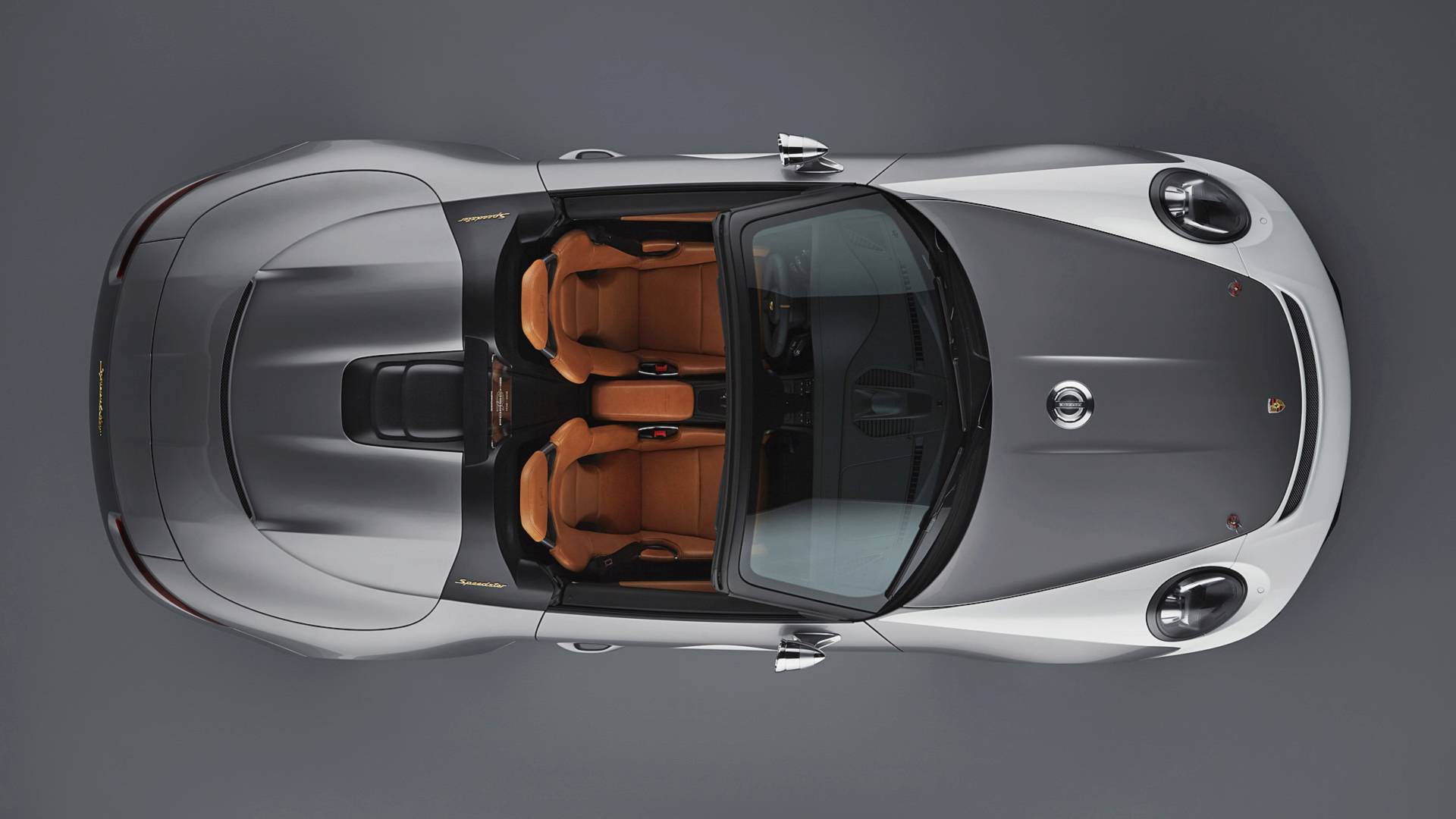
Porsche has rolled out the very cool 911 Speedster concept car. This car is meant to celebrate 70 years of Porsche sports cars. The design of the Speedster Concept is meant to pay homage to the very first Porsche 356 “No.1” Roadster.

Porsche gave the special car a two-tone paint job with silver and white trim and the concept was developed at the Porsche Motorsport Centre. That same place is where the 911 GT2 RS and GT3 RS were born. Porsche says that the concept gives a “glimpse” at the potential series-production version of the car.

The earliest you can hope for the new model to show up is 2019 and Porsche says that a final decision on a production version will be made in the coming months. We totally need to beg Porsche to make this thing and let us buy it for real. Pretty please.


69. Cayman GTS (981)

The essence of the brand
Built: 2015| Engine: 3.4L flat six | Power: 340hp | Top Speed: 177mph

Car & Driver called the Cayman GTS “the essence of the brand” and we totally agree. It includes all the right options bundled into a package that is not unreasonably priced and is just awesome to drive. While we specifically list the Porsche Cayman GTS, the Boxster GTS is equally awesome and deserves a spot on our list. We picked the 981 Cayman our our favorite. While the new 718 Cayman GTS is a great car, the soulless engine just isn’t special enough for us compared to the flat six in the last generation.

Why opt for a Cayman GTS versus the already awesome Cayman S. The Cayman GTS gets you a number of things standard above the Cayman S including Porsche Active Suspension Management (PASM), Sport Seats Plus, the Sport Chrono package (adds Sport Plus drivetrain setting, launch control on PDK models), the Sport exhaust system, leather and Alcantara all over the interior, the SportDesign steering wheel, dynamic bi-xenon lights, tinted taillights, and 20-inch wheels. The Cayman also gets a 15hp boost to 340hp that is noticeable on the road.

The unobtainable GT4 notwithstanding, the Cayman GTS is the perfect sports car. You get awesome mid-engine balance, a powerful and epic-sounding naturally flat-six that revs to the moon as well as suspension that is great on your daily commute and epic on weekend country backroads. Steering is light and direct in a way the competition can’t match.

It just works so well that it is impossible to fault. One of our favorite cars and worth diving into the classifieds to find versus buying a new 718 Cayman GTS.

More: Full 981 Boxster & Cayman Range


68. 911 Sport Classic (997)

Retro cool done right
Production Years: 2010  Generation: 997.2 Units built:  250
Engine: 3.8L flat-6  | Power: 408 hp | 0 – 60 mph: 4.6 s | Top Speed: 187 mph

Launched alongside the 997 Speedster (didn’t make our list but worth looking at) the Porsche 997 Sport Classic was built to celebrate 25 years of Porsche Exclusive. Complete with a double-bubble roof, genuine Fuchs alloys and a ducktail, the Sport Classic was the ultimate embodiment of Zuffenhausen’s special build skills. Some may argue that this is just a 911 Carrera S with a ducktail but to us this is more special, a nod to the good old days. The package is based on the Carrera S but uses 4S rear bodywork for that wider and lower look plus the wider rear track.

The most obvious aesthetic change is the double-dome roof and the SportDesign fascia and unique lip spoiler in front. At the rear the famous ducktail spoiler brings back Carrera RS 2.7 memories. Speaking of memories, check out the black-painted 19-inch retro-styled Fuchs wheels. Other small touches, such as black headlight-trim rings and black side-mirror brackets. It is the prettiest 911 of that generation. Mechanical bits include the Carrera S’s 3.8-liter flat-six paired only to a six-speed manual gearbox (no auto available). While it is also shared with the Carrera S (where it makes 385 horsepower), the Sport Classic is fitted with the optional engine “Powerkit” as standard equipment, the result is 408 horsepower (at 7,300 rpm) and 310 pound-feet of torque (at 4,200 rpm) with the redline set at 7,500 rpm. A sport suspension, a locking rear diff, and carbon-ceramic brakes are all standard.

More: 2010 Porsche 911 Sport Classic


67. Lohner-Porsche

Tesla S who?
Built: 1900-1905 | Engine: 4 Electric Hub Motors | Power: 10-14hp | Top Speed: 37mph

Porsche built an electric car more than 100 years before the Tesla S… and he was still only 28 years old.

The Tesla S was introduced on June 22, 2012. 112 years earlier Porsche unveiled the “Lohner-Porsche” automobile at the 1900 Toujours-Contente (Paris World Expedition). The automobile had hub mounted electric motors that were directly powered by 1800kg of lead acid batteries. Most automotive historians recognize this 1900 Lohner-Porsche as the first, full-electric automobile.

More: Lohner-Porsche Phaeton


66. Porsche 911 GT3 R Hybrid 2.0

This hybrid race car is no Prius. Porsche decided to work with the Williams F1 Team to develop hybrid tech that it could use to go racing. They essentially took the F1 kinetic energy recovery system (KERS) (but used kinetic energy stored in a flywheel rather than batteries) to create the epic GT3-R with its two electric motors assist.

The electric motors added 218 hp to the front wheels to supplement the 470 hp four-liter flat-six engine at the rear. The 911 GT3 R Hybrid was a game changer and that was clear when racing bodies at the time didn’t know how to classify the car.

Compared to its predecessor the second-generation hybrid is our pick. It was 20 percent lighter and more efficient. The GT3 R Hybrid 2.0 features a monocoque body of hot-galvanized steel with a welded roll cage. Body panels are carbon fiber and there are lightweight polycarbonate windows on all sides, including the front windshield. At each corner is a height-adjustable suspension with dual coil springs and Sachs gas-pressure fixed-position dampers. The steering rack is power-assisted, with an electro-hydraulic pressure feed.

With a curb weight of just 2,866 pounds and a total system power of 672 horsepower, the all-wheel-drive Porsche GT3 R Hybrid 2.0 will accelerate to 60 mph in about 2.5 seconds. Its top speed is gearing limited to about 175 mph but that doesn’t seem to be an issue when racing. In September 2011 it impressed everybody when it competed in an exhibition class during an American Le Mans Series (ALMS) race at Laguna Seca. Starting last it outran the entire GT class.


Porsche 928 GTS

Porsche 928 GTS

65. 1995 Porsche 928 GTS

Chalk this one up to nostalgia
Built: 1995 | Engine: 5.4L V8 | Power: 345bhp | Top Speed: 171 mph

The 928 GT and GTS were really expensive 928s that were known for being almost impossibly expensive to maintain and laden with lots of issues to keep you busy maintaining them. Maybe we will chalk adding them to our list as nostalgia since this was the Porsche era I grew up in and I loved it.

The 928 GTS went on sale in late 1991 as a 1992 model in Europe and in spring of 1992 as an early 1993 model in North America. Changed bodywork, larger front brakes and a new, more powerful 5.4 L, 350 PS (257 kW/345 hp) engine were the big advertised changes. While they were great cars, the near $100k price meant they sold poorly and were quickly discontinued (only 77 of them shipped to the to the US).

While the Porsche 928 never sold in the numbers originally envisioned, the 928 did develop a following over time. The 928 GT was sportier than the 928 S4. The last evolutionary stage of the 928 was the GTS and it featured flared rear wings, a red light panel at the rear, a rear wing painted in exterior color, exterior mirrors in the Cup design plus 17″ Cup rims as standard. The 5.4-liter engine of the GTS generated 350 hp.

More: Full Porsche 928 Model List


porsche 356

porsche 356

64. Porsche 356

Fun diminutive sports car that built the Porsche brand
Build: 1948 | Engine: 1.1L flat four | Top Speed: 84mph

This is the first real Porsche product car. Created by Ferry Porsche, the 356 featured a four-cylinder, air-cooled, rear engine, rear-wheel drive car with unitized pan and body construction. The Porsche 356 was a hybrid of new-and-old elements, incorporating an entirely new body design that was developed by Porsche employee Erwin Komenda while utilizing engine and suspension components that were initially sourced/developed for the Volkswagen.

By the early 1950’s, the 356 had gained some recognition amongst automotive enthusiasts both in Europe and in the United states for its aerodynamics, handling and excellent build quality. In 1951, a Porsche 356 was entered in the 24 Hours of Le Mans. The car, still equipped with the modified Volkswagen 1.1L engine, won its class, completing 210 laps during the 24-hour race. This impressive accomplishment bolstered sales, and it became common for owners of the 356 to race their cars as well as drive them on the streets.

More: Porsche 356 History & Timeline | Porsche 356 Model List


1963_Porsche_901

1963_Porsche_901

63. 1963 Porsche 901

The one that started a legend
Year: 1963  Generation: 901  Units built: 82
Engine: Flat-6  Power: 130 bhp  0 – 60 mph: 8.3s  Top Speed: 130mph

In 1963 Porsche introduced their seminal 901 at the 911 at the Frankfurt Motor Show. Peugeot objected to the model designation because they had patented a three-digit type designation with a zero in the middle. The 901 was renamed 911 for the 1964 model year. We still count it as the first 911 which is why it makes our list over the 1964. Series production of the 901 began in September 1964.

At the 1963 Frankfurt show the public saw Porsches new direction. Compared to the 356 it had a longer wheelbase, a more compact suspension setup and much more power from the flat-6 engine. This is the car that started the legend. 82 units of the 901 were produced before the name change.

More: 1963 Porsche 901


Porsche 911 Carrera 4 Leichtbau

Porsche 911 Carrera 4 Leichtbau

62. Porsche 964 C4 Lightweight

964 minus 770 lbs
Year: 1990  Generation: 964  Units built: 22
Engine: 3.6L Air-cooled Flat-6  | Power: 300 bhp | 0 – 60 mph: 4.9 s | Top Speed: 161.59 mph

A handful of specially prepared lightweight 911s were fabricated by the Porsche factory and called the Carrera 4 RS Lightweight. Built by Porsche’s customer motorsport division, the Porsche 964 Carrera 4 Lightweight programme was Jürgen Barth’s way of keeping his department employed in the wake of Group C’s collapse. 130kg lighter than a 964 RS, the Carrera 4 Lightweight used the four-wheel drive drivetrain from the Dakar-winning 953 rally car and was originally envisaged for off-road use. The cars employed the same six-cylinder 3600cc boxer engine as the 260hp “regular” RS, but produced some 40 more horsepower due to the exclusion of catalytic converters and mufflers.

The RS Lightweight earned its name thanks to the combined use of an aluminum front lid, aluminum doors, Plexiglas side windows and a fiberglass rear engine lid. Its overall weight was pared down to 1100kg (2200 lbs) thus making for an exceptional power to weight ratio. For those keeping count that is 350kg (770 lbs) lighter than standard 964 C4. They also added a short ratio 5-speed transmission with lightweight flywheel.

The list of weight reduction features included an aluminum safety cage, two Recaro race seats with five-point safety belts, sport steering wheel coupled to a power assisted steering rack and a type 953 Paris-Dakar transmission. The doors and front hood replaced with aluminum versions and side window glass replaced with plexiglass. Carpeting and sound deadening was removed and left as bare metal.

More: 964 Model List, 1990 Porsche 964 C4 Lightweight


61. 944 S2

What the 924 should have been
Built: 1989-1992 |Engine: 3L four cylinder | Power: 208hp | Top speed: 150mph

Extra poke and more torque plus cool 944 Turbo nose made this our pick of the 944 range.

When the 944 launched for the 1983 model year, Porsche hoped it would mark a change in tides for its entry-level-priced car. The 924 that preceded it was mired in cries of “not a real Porsche” on account of its front-engine, water-cooled configuration, and tepid performance from its Audi-derived 2.0-liter inline-four. And that’s to say nothing of the 924’s meek, egg-shaped styling.

Porsche considered using a six-cylinder engine for the 944 but ruled it out quickly, believing the necessary cost and development time wouldn’t result in any significant advantage over a well-designed four-cylinder — if anything, a six-cylinder would be heavier. In the end, Porsche essentially chopped off half of the SOHC V-8 from the flagship 928 model, creating an eight-valve, 2.5-liter inline-four making 143 horsepower. Without the opposing bank of cylinders to balance out vibration, Porsche licensed belt-driven balance-shaft technology from Mitsubishi, which results in near-six-cylinder smoothness. A five-speed transaxle is hung out back, giving the car even weight distribution for excellent handling.

Porsche also toughened up the styling, adding dramatic box flares at the front and rear wheel arches, inspired by the 924 GTR race cars that ran at Le Mans. The flares were more than just eye-pleasing, as they allowed Porsche to run wider wheels and tires on later, more powerful 944 variants.

Indeed, the 944 evolved over time, dropping its dated 924-style interior halfway through 1985 for a sleeker dashboard and center console. A 944 Turbo with bigger Brembo brakes and a better-integrated front bumper came in 1986 with 217 hp. By 1987, Porsche introduced the 944 S with the same 2.5-liter, naturally aspirated engine as the standard 944, but a new 16-valve, DOHC cylinder head bumped output to 190 hp. Yet the ultimate naturally aspirated 944 is the 944 S2, which arrived for the 1989 model year. With a redesigned engine block, the S2’s engine capacity rose to 3.0 liters, making it the largest four-cylinder engine in production at the time. It retained the 16-valve cylinder head, and the car also got the Turbo’s Brembos, integrated nose, larger anti-roll bars, 16-inch wheels, and stronger five-speed gearbox. Output increased to 208 hp and 207 lb-ft of torque — almost the equivalent of early Turbo models but without the low-end lag inherent to those cars.

The 944’s charms are once again apparent. From the excellent weight distribution, which earned it handling accolades when new, to the nostalgic traits of German build quality—evident even in the soft click when you close a door—that simply aren’t found in newer Porsches, the 944 is a reminder of a special period in Porsche’s history. Add to that 2+2 practicality and a spacious rear hatch, and the 944 is a classic you can use daily.


60. Panamera Turbo S E-Hybrid

Porsche has fixed the Panamera’s styling. Not much to complain about aside from the price.
Built: 2017-present | Engine: Hybrid 4L V8 | Power: 680hp |  Top speed: 188mph

I know we are going to get some hate mail for including a Porsche sedan on our best of Porsche list. Here’s the thing. A Porsche sedan used to seem like a weird concept. The first Panamera certainly drove like a Porsche but was ugly. The new Panamera looks good and drives even better than the first one. So here we have a four-door passenger car that looks great, drives great and is perfect for the family.

Our favorite in 2018 is the Turbo S E-Hybrid. The “base” Turbo comes with a twin-turbo V-8 making 550 hp and 567 lb-ft, the Panamera Turbo. An eight-speed automatic and all-wheel drive put power to the ground and it rips to 60 mph in 3.0 seconds flat. Spend a little more for the Turbo S E-Hybrid and you get electric assist which boots power to 680-hp. The E stands for executive and add almost six inches of wheelbase for extra back-seat room. This is the car to take across continents. New for 2018, the plug-in hybrid is the replacement for the last-generation Panamera Turbo S range topper.


59. Macan Turbo (with Performance Package)

Our favorite small SUV (by far)
Built: 2017-present | Engine: Turbo 3L V6 | Power: 440hp Top Speed: 158mph

The Macan S is a brilliant Porsche drivers car that can be used every day and is practical with loads of space. What isn’t there to love. This is a compact SUV that is all about performance. Five doors, five seats, decent space for the family and a 440-hp twin-turbo V-6 mated to a seven-speed transmission with all-wheel drive. The $10k performance package gets you an additional 40 horsepower and 36 lb-ft of torque over the Turbo Macan and we say it is totally worth it. It is crazy fast and we guarantee that any purist will fall in love with this diminutive Porsche daily driver.


58. Porsche 968 Clubsport (CS)

Lightweight special edition was more fun
Build: 1992-1995 | Engine: 3L four cylinder | Power: 237hp |Top Speed: 157mph

For 1993 thru 1995, Porsche offered a light-weight “Club Sport” variant of the Porsche 968 which was specifically developed for owners looking to run their cars at the racetrack. Much of the base model 968’s “luxury-oriented” equipment was stripped out of the car, or simply not offered to consumers purchasing the Clubsport edition. Less sound deadening material was installed. Electrical options (like power windows and seats) were replaced by manually operated components, although Recaro racing seats were included – due to both their lightweight design and improved side-bolsters for improved driver restraint during track driving conditions.

Mechanically, the car was specially set up for use at the race track. It featured wider wheels (17 inch instead of 16) and wider (225’s in both front and rear) tires than those found on the standard coupe. The suspension system was lowered by 20 millimeters and was revised for more optimal performance in hard corners.

The car was named “Performance Car of the Year” in 1993 by United Kingdom-based “Performance Car” magazine. A Porsche 968 Club Sport was driven in the 1993 “Sandown 6 Hours,” an Australian endurance race event. The car, driven by Peter Fitzgerald and Brett Peters, went on to win that event. The victory was especially sweet for Porsche as the event marked the Australian competition debut of the car.

See Also: Porsche 968 History & Timeline


57. Porsche 911 GT3 RS (996)

Production Years: 2003-2004  Generation: 996 Units built:  682
Engine: 3.6L Water Cooled Flat-6  | Power: 376 hp | 0 – 60 mph: 4.2 s | Top Speed: 190 mph

In 2003 Porsche launched the GT3 RS in order to homologate the GT3 RSR for racing. While you could drive the 996.1 and 996.2 GT3 on the road, the GT3 RS was a more uncompromising track-ready 911 that was tough as a road car.

GT3 RS horsepower remained the same as the GT3 but there was a real difference in performance from other changes. Wider tires were fitted with a revised suspension for track use, and a large rear spoiler was fitted to help increase downforce. Weight was reduced by removing interior sound deadening, air conditioning, rear seats, and adding a Perspex rear window. The diet meant the GT3 RS tipped the scales at just under 3,000 pounds (110 pounds lighter than the GT3). All GT3 RS cars were also fitted with a full roll cage. Reduced mass was advantageous to the car’s performance, since power and torque remained identical to the 996.2 GT3.

The emphasis for Porsche was on achieving the best possible power-to-weight ratio and with a figure of 4.86 kg/kW has resulted it was 4% better than GT3. The GT3 RS power is transmitted via a close-ratio six-speed gearbox. Between the engine and the gearbox the “RS” has a single-mass flywheel with a lower rotating mass than the double-mass version. Performance improved with 0–60 mph time of 4.2 seconds and top speed of 190 mph. The biggest differences came on track however, with the GT3 RS being a purer race car and perfect circuit car.

As for the 996 GT3 RS, its place in history is already secured. Rarity, status and ability have already led to soaring prices. It’s not unusual to find examples on sale for far more than a brand-new 991 GT3 RS.

More: 2004 Porsche 911 GT3 RS


56. Porsche 908

In the late sixties, Ferdinand Piëch wanted Porsche at the top of motor sports and the 908 was his answer. In facing the best that both Ferrari and Ford could produce, it sparked a new generation of Porche prototypes that led to their most successful era. For the first time, Porsche completed in all the championship races with hopes of overall victory. This new era began when the 908 Coupés supported the much smaller 907 mid way through the 1968 championship season.

The 908 was the first car built for the CSI’s prototype Group 6 class that limited engine capacity to 3 liters. In 1968 the only competition came from the JW Engineering Ford GT40s which won Le Mans and the championship. The 908 prototype was named after its eight-cylinder, flat-6 engine. Driven by some of the best drivers, the 908 had a successful career in 1968/69 that included wins at the SPA-Franchorchamps 1000km two years in a row. Under continual development, the design was modified and raced as the 908/2 and 908/3 Spyder for tighter tracks.

Porsche achieved its first overall victory at the 24 Hours of Daytona with the Type 908 LH. The grand successes of the previous year at the 1,000-kilometre race on the Nürburgring and the Targa Florio are repeated. The 911T wins the Monte Carlo Rally.

At the end of 1967, when the displacement limit for prototypes in the Constructor’s World Championship was reduced to 3 litres of displacement (homologated Sports Cars were allowed 5 litres), the 908, with its new 350-hp eight-cylinder engine, could be raced in the long or short-tail version depending on track and competition.

More: Porsche 908


55. 550 Spyder

The original giant killer
Built: 1953-1956 | Engine: 1.5L flat four | Power: 110hp | Top Speed: 140mph

The ‘type 550’ Porsche rewrote motoring history and soon became known simply as the ‘Giant Killer’. It was Porsche’s first purpose-built racer and is known most famously as the car that James Dean was driving when he was killed. The iconic car was based on the 356, but was designed with racing in mind. It used a highly-tuned, four-cam version of its venerable air-cooled flat-four. The 550 had a revolutionary (at the time) rear mid-engine setup that radically improved agility and balance. The 550’s flat-four sat in front of the rear axle and transmission instead of behind them. This improved balance and agility tremendously but killed the back seat, much to the chagrin of exactly zero people. Very few 550 Spyders were produced with a large number of the cars being used for racing. Today, original 550 Spyders change hands for well over 5 to 10 million dollars even in the most ‘original’ condition before restoration.

More on the 550 Spyder


54. Porsche 959 Rally

As part of an extensive road testing programe, the 959 was taken to the desert. The motorsport department at Weissach built a version specifically designed for the Paris-Dakar rally in 1985. Porsche entered three 959s in the race. Power was transmitted to all four wheels via a 6-speed transmission and a pioneering, electro-hydraulically controlled centre differential. The 959 featured a 330-litre fuel tank. Like the 911 which won Paris-Dakar in 1984, a synthetic body made the vehicle considerably lighter; the 959 weighs 1,260 kg. First place in Dakar went to René Metge followed by Jacky Ickx – A double victory for Porsche. Kussmaul brought his 959 to the finish in West Africa in sixth position. On the journey through the Sahara, the Porsche vehicles reached speeds of up to 242 km/h.


53. 1989 Porsche 911 Speedster

The iconic softtop still cool today
Year: 1989  Units built: 2,104 (171 narrow body, 1933 Turbo-look)
Engine: Air-cooled Flat-6  | Power: 231.1 bhp | 0 – 60 mph: 6.0 s | Top Speed: 152.2 mph

The 911 Speedster was introduced alongside the new 964 Porsche Carrera 4 at the 1988 Frankfurt Show.

It was immediately popular amongst Porsche buyers. Unlike the 964 prototype this Porsche 911 Speedster catered to comfort. It was basically a low-roof version of the Cabriolet and was produced in limited numbers (2,104) as both a narrow body car and a Turbo-look. The Speedster started as a design under Helmuth Bott in 1983 but was not manufactured until six years later.

This was the last vehicle with the old 911 body and that’s why it makes our list of greatest 911s. The Speedster stole some body bits from the 930 Turbo as well as the Turbo’s beefier chassis and heavy-duty four-piston cross-drilled disc brakes. The Speedster is best known for its double-hump cover design .

Undeniably, the Speedster had “collectible” written all over it, and all 2,100 were quickly snapped up by would-be profiteers.

More: 1989 Porsche 911 Speedster, 964 Model List, Speedster Porsches


52. Porsche 911 Turbo Flachbau (930)

Absurdly expensive but oh so ’80s cool
Year: 1981-1987  Generation: 930  Units built: 948
Engine: Single turbo flat-six  | Power: 260 to 330 hp | 0 – 60 mph: 4.7 s | Top Speed: 171 mph

Demand for the 930 Turbo soared at the turn of the 1980s, which is why Porsche decided to introduce option M505 which was known as the Flachbau or “flat nose” or “slant nose”. The model was offered as part of the special order program beginning in 1981 and Flachbau unit was handcrafted by remodeling the front fenders (option code M505). In 1986 (1987 model year) Porsche finally offered the slantnose straight from the factory. The official designation in the UK was Turbo SE.

The regular 930 Turbo was costly enough, but the stylistically different Flachbau commanded a big premium over it because the ‘80s were all about having the most expensive whatever. Besides the flat front, the car also came with a different engine than the older Porsche models, namely a 3.3-liter which produced 330 horsepower. With a rear-wheel drive and a top speed of 171 mph, the Porsche 911 Turbo “Flachbau” was the fastest mass production car at the time of its launch.

More: 1987 Porsche 911 Turbo ‘Flachbau’


51. 1966 Porsche 911 Targa

Created when everybody thought convertibles would be outlawed. Thank goodness. 
Built: 1966 | Engine: 2.2L flat six | Power: 140hp | Top Speed: 134mph

We have the US government to thank for the creation of the sexiest Porsche around.

The Targa had a stainless steel-clad roll bar, as automakers believed that proposed rollover safety requirements by the US National Highway Traffic Safety Administration (NHTSA) would make it difficult for fully open convertibles to meet regulations for sale in the US, an important market for the 911.

The road going Targa was equipped with a removable roof panel and a removable plastic rear window (although a fixed glass version was offered from 1968). It has been through a number of iterations since then and the latest GTS version also made our list, but it is hard to ignore the original.


50. 911 Turbo (997)

Supercar performance everyday. Great value today
Built: 2008-2011 | Engine: 3.6L Turbo flat six | Power: 470hp | Top Speed: 193mph

Stinking fast performance from a car you could comfortably enjoy every day. Easy to drive, easy to break the law. Still looks great all these years later (unlke the 996 Turbo which looks shit).

The Porsche 997 Turbo a 3.6-liter, twin turbocharged flat six-cylinder that produced 470 horsepower and 460 lb-ft of torque (that is more than the current turbo motors the Carrera S puts out). This catapulted the car from still to 60mph in 3.7 seconds and up to a top speed of 193 miles per hour. A six speed manual transmission was available but the automatic was the pick for this GT. The car featured active body control, stability management, and had an optional Sport Chrono pack, which included a Sport mode and an overboost function, which gave you 20 percent more maximum turbo pressure from the specially designed twin Borg Warner VTG variable vane turbos.

The 997 Turbo still looks great today and most people won’t know that it is a 10 year old car. Prices are reasonable too (in case you’re looking for a super fast, modern 911 that won’t break the bank).
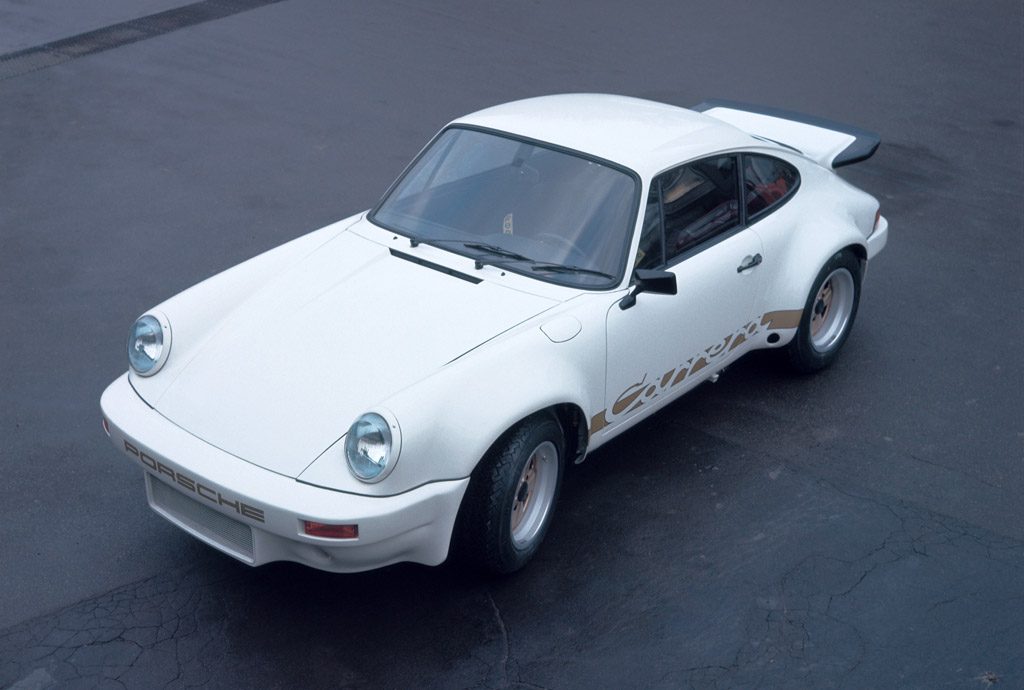

1974 Porsche 911 Carrera RS 3.0

1974 Porsche 911 Carrera RS 3.0

49. 1974 Porsche 911 Carrera RS 3.0

Year: 1974  Generation: Carrera RS  Units built: 109 RS 3.0s, 54 RS trim
Engine: Flat-6  | Power: 230 bhp | 0 – 60 mph: 5.2s | Top Speed: 155 mph

During a successful 1973, Porsche took the opportunity to develop an evolution of the RS 2.7 (having now met stricter requirements of building 1000 road cars per year in line with Group 3 rules). A quirk in the Group 3 rules allowed previously homologated cars (like the RS 2.7), to be homologated with just 100 examples built. So in 1974, Porsche launched the Carrera RS 3.0. It was almost twice as expensive as the 2.7 RS but was much more of a track machine. The chassis was similar to the ’73 Carrera RSR and the brake system was from the Porsche 917. It was a continuation of the race cars for the road trend that all of us Porsche fans love so much.

The 3.0 made 230hp with what was basically as detuned 3.0-liter RSR engine with an aluminum (rather than magnesium) crankcase and street exhaust fitted in place of the open racing unit. Cylinder heads were single-plug rather than the racing twin-plug type, and the compression ratio was given a significant bump over the outgoing 2.7’s 8.5:1 ratio, though it still runs on the equivalent of 93 octane U.S. pump gas.

With its systematic lightweight construction the RS 3.0 only weighed in at 900 kg. This low weight was achieved by using thin-gauge sheet parts and by basically removing parts and equipment from all over the place. Brakes were upgraded to larger four-piston units and the suspension was revised with RSR rear pick-up points allowing for more camber adjustment. There was a five-speed gearbox and limited-slip differential, and the fenders were widened even further to accommodate 8.0-inch wheels up front and 9.0-inches in the rear. The RS 3.0 also had the taller, larger bumpers introduced in all 1974 911s and the new rear “tray”-style spoiler.

Before you ask we love both the RS 2.7 and RS 3.0 the same. The 2.7 is the ultimate dual-purpose 911 from the era. Somebody once nailed it when they said: “The RS 2.7 is 80 percent 911 S. The RS 3.0 is 80 percent RSR.”

More: 1974 Porsche 911 Carrera RS 3.0


48. Cayenne Turbo

The reason we have GT3s
Built: 2002-2010 | Engine: 4.5L V8 | Power: 444hp | Top speed: 165mph

We have the original cash-cow Cayenne to thank for all the cool “sports” cars Porsche makes today. It was also fun to drive (kind of).

Introduced at the same time as the Cayenne and Cayenne S models, the first-generation Cayenne Turbo featured a turbocharged version of the V8 engine introduced with the Cayenne S. So equipped, the Cayenne Turbo produced approximately 445 horsepower (331 kW) and accelerated from 0-60 miles per hour in just 5.3 seconds! A Turbo S version of the Cayenne was built in 2006 to compete with the Mercedes-Benz ML 63AMG. The Cayenne Turbo S featured a twin-turbocharged 4.5-L V8 engine that produced 513 horsepower and 530 lb-ft of torque. Acceleration in the Cayenne Turbo S was truly impressive – even by the standards of many sports cars – with a 0-60 mph time of just 5.0 seconds and a top speed of 171 mph!

In 2008, an updated Turbo model was introduced which featured a larger 4.8L engine. The vehicle was first introduced at the Beijing Auto Show. The larger, more powerful engine helped shave another tenth of a second off the Turbo models already impressive 0-60 times. In addition to the updated Turbo model, a new Turbo S was also introduced. The second-generation Turbo S engine now produced 550 horsepower and was capable of a 0-60 time of just 4.7 seconds.

On February 4, 2008, the 200,000th Porsche Cayenne rolled off the assembly line in Leipzig, Germany. The model was a Cayenne GTS, which had been unveiled that same month at the Chicago Auto Show and had been scheduled for a spring launch.


47. 911 Carrera S (991.2)

Turns our forced induction isn’t that bad
Built: 2016-present | Engine: Turbo 3L flat six | Power: 416hp | Top speed: 191mph

Sure it doesn’t sound like the old naturally aspirated flat six, but downsizing hasn’t been all bad. More power, more torque and more performance makes the latest car a better all rounder.

Porsche’s most popular 911 gets more power and stock gear than regular Carrera, including 20-inch rims and an LSD (or e-LSD on PDK cars). The Carrera S is the sweet spot in the 911 range. More than enough performance for almost any real-world use case, a great chassis and superb steering feel, all in a package still civilized enough for the daily commute.

The Carrera S has two-millimeter-larger turbo impeller and tweaks to the engine-management software versus the base Carrera and that adds up to 50 more horsepower and sub three-second0-60 time (Porsche always sandbags 0-60 times). Power delivery is very similar to the Carrera but the performance in the Carrera S feels stronger than the numbers suggest. Revs rise quicker and with more urgency in the Carrera S and it will pin you in your seat on hard runs (that’s not the case with the base model). Options we would tick are the awesome sport exhaust which lets you be a little obnoxious and looks cool with center exhaust, Sport Chromo package and rear-wheel steering. Not only does the rear steer enable the Carrera S to turn in more quickly, but you’re also physically moving the steering wheel less – in practice it means that left and right transitions are much faster. Overall this is a sweeter ride and has more performance than the base Carrera and is worth the premium.

More: Best 911 to buy


Porsche Boxster Spyder

Porsche Boxster Spyder

46. Porsche Boxster Spyder (987)

Our favorite Boxster
Built: 2011 | Engine: 3.4L flat six | Power: 320-hp Top speed: —

The second-generation Boxster was already a fantastic driver’s car in both base and S forms. There is just something about the stripped-out Boxster Spyder we love more than the standard models. We also feel the 987 model Spyder is better than the 2015 981 model. Porsche took a practical everyday sports cars and turned it into a simple indulgence. Steering is as good as it gets, with every seam of the road and every link to lateral cornering g delivered faithfully to your fingertips. The engine shoves you into the seat with gobs of torque and spins with a gorgeous howl. The six-speed manual is perfect. The Spyder also gets the classic Spyder deck lid and the windshield rake is slightly more severe, and the front lip spoiler grows in size a bit.

The Spyder also benefits from the same direct-injection, 3.4-liter flat-six found in the Cayman S of that year. Doesn’t seem fast compared to today’s sports cars, but behind the wheel it still feels plenty rapid. On a special road this is a special car and that’s why it made the list. It is a mid-engined roadster that represents the true, purest form of the Porsche ethos: Sports cars that are light, powerful, precise, efficient and fun to drive. This open air, low-slung, light soft top sports car is still one of our favorites.

More: 2010 Boxster Spyder Specs


2011 Porsche 911 GTS

2011 Porsche 911 GTS

45. Porsche 911 Carrera GTS (Type 997.2)

Run out special ahead of 997 made quite the impression on us
Production Years: 2011 -2012 Generation: 997.2  Units built:  unknown
Engine: 3.8L flat-6  | Power: 408 hp | 0 – 60 mph: 4.2 s | Top Speed: 190 mph

2011 is the year Porsche did the best thing ever for us 911 lovers. As the 997 911 was coming to the end of its life people were skeptical that the announcement of the Carrera GTS was a mere marketing ploy to squeeze some sales out of the end of lifer. Instead we found that Porsche created the “perfect” 911, the right balance of daily driving, sporting ability and track day capability in a familiar package.

The GTS is a rear-drive 911 Carrera S (comes as a cabrio and AWD too) with the wider rear track from the Carrera 4, cool design touches like center-lock RS Spyder wheels, black logos and trim, Alcantara interior, bodykit changes and some extra helping of horsepower.

The 2011 Carrera GTS also has a back seat big enough to seat two people, a rarity in a segment where rear seats are often so small they’re mostly just for show.

GTS version of the naturally aspirated 3.8-liter flat-six propelling the Carrera S isn’t vast: 408 horsepower versus 385, plus a 200-rpm drop in peak torque availability, imparting a slightly more agreeable curve to the torque band. On the surface it doesn’t look like much has changed, but we found the GTS was transformed and that extra punch and dynamic ability made it more fun the regular Carrera S.


44. Porsche 911 GT3 (996.2)

It’s a GT3. What else needs saying
Year: 2003-2005  Generation: 996 Units built:  2,313
Engine: 3.6L Water Cooled Flat-6  | Power: 376 hp | 0 – 60 mph: 4.7 s | Top Speed: 187.7 mph

In 2004, when Porsche updated the car to 996.2 specs, the GT3 inherited the 996 facelift’s new headlamps, but also received a more pronounced front splitter, a slightly reshaped front bumper, and an even bigger rear wing. The new headlamps were introduced following complaints from Porsche fans who were unhappy that the original units were identical to the Boxster’s. The restyled cars not only looked fresher, but they finally had their own appearance worthy of a genuine 911. This is our pick of the 996 series Porsche 911s.

Initially, the 996 GT3 came with 355 horsepower on tap. The 2004 update increased output to 376 horses and 284 pound-feet of torque, 80-percent of which was available from 2,000 rpm. This new figure made it 60 horses more powerful than the base 911 and 100 horses less powerful than the range-topping GT2.

On the inside, Porsche focused on weight reduction and getting the GT3 as close as possible to its race-spec sibling. But even though the cabin was stripped off many of the 911’s usual creature comforts, Stuttgart made sure the GT3 would still provide comfort on long distances. The most significant changes included a pair of new bucket seats for the driver and passenger, both wrapped in soft leather. The new seats alone shaved about 44 pounds off the car’s curb weight. Additionally, the rear seats were removed entirely, reducing the weight of the car by another 18 pounds. Further changes were noticeable in the center console and center stack areas, with some of the standard car’s equipment missing.

More: 2003 Porsche 911 GT3


944 turbo s

944 turbo s

43. Porsche 944 Turbo S

The Turbo S combined the 968 block and the 944 Turbo to creates one of our favorite cars of the era.
Built: 1993 | Engine: Turbo 3L four cylinder | Power: 305hp | Top Speed: 175mph

Looks like a regular 944 you say. Not sure it is all that special you say. Well we say this is one sleeper Porsche and one of our favorites ever. Outside this may look like a normal 944, but dive into the details and this thing is awesome. In 1988 when the Turbo S was introduced it looked virtually identical to the standard 944 Turbo, but had a bunch of enhancements to make it worthy of the “S” designation. The 944 Turbo S had a more powerful engine (designation number M44/52) with 250 hp (186 kW) and 258 lb⋅ft (350 N⋅m) torque (standard 944 Turbo 220 hp (164 kW) and 243 lb⋅ft (329 N⋅m)). This higher output was achieved by using a larger K26-8 turbine housing and revised engine mapping which allowed maintaining maximum boost until 5800 rpm.

The 944 Turbo S’s suspension had the “M030” option consisting of Koni adjustable shocks front and rear, with ride height adjusting threaded collars on the front struts, progressive rate springs, larger hollow rear anti-roll/torsion bars, harder durometer suspension bushings, larger 26.8 mm (1.055 in) hollow anti-roll/torsion bars at the front, and chassis stiffening brackets in the front frame rails. The air conditioning dryer lines are routed so as to clear the front frame brace on the driver’s side. The 944 Turbo S was the fastest production four cylinder car of its time.

More: 1988 Porsche 944 Turbo S
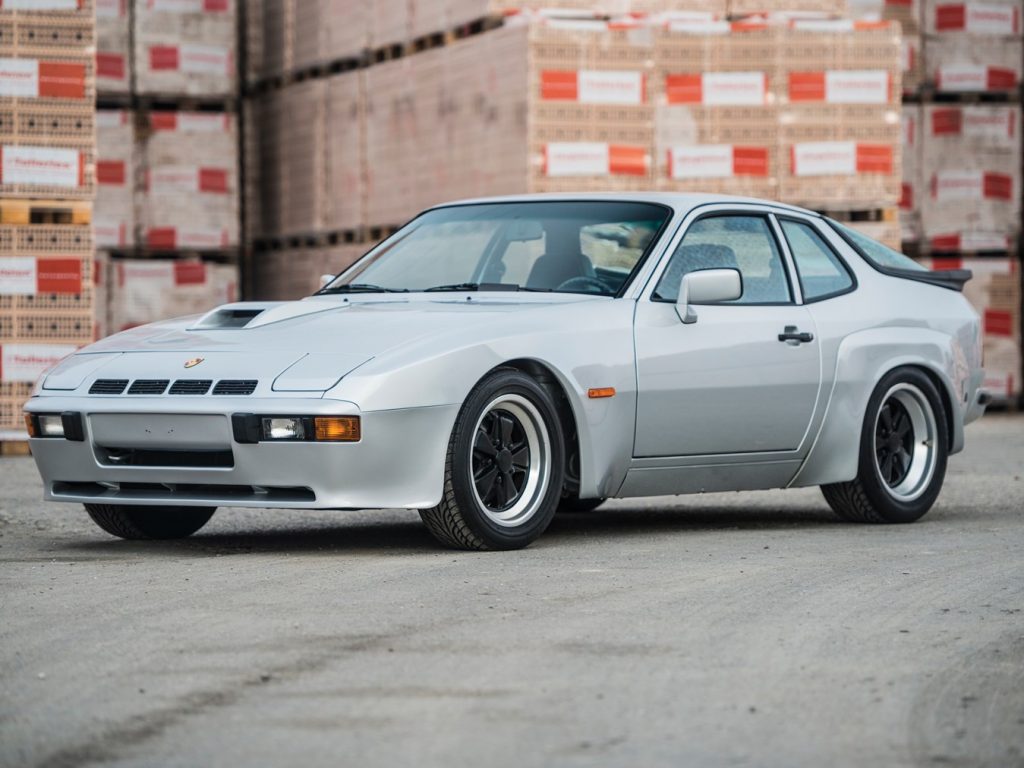

porsche 924 carrera gt

porsche 924 carrera gt

42. Porsche 924 Carrera GT

Add wider wheel arches, turn up the boost and you get the Carrera GT.
Built: 1979-1981 | Engine: Turbo 2L four cylinder | Power: 207hp | Top Speed: 150mph

The 924 Carrera GT was developed specifically for track use, featured an intercooler, had a higher engine-compression ratio of 8.5:1, a much larger rear spoiler and a flush mounted windscreen, along with a number of other minor improvements. The Carrera GT was really an evolution of the 924 Turbo model, but it was the 924 that Porsche had envisioned – namely one that was capable of competing on the world racing stage.

In order to comply with sanctioned homologation regulations, the 924 Carrera GT (and later, the Carrera GTS) were offered as production vehicles, and were equipped as road cars as well. The GT version, when introduced, produced 210 horsepower and the GTS was rated at 245 hp. Both variants of the car included factory-installed roll cages and race seats. The 924 Carrera GT variations were known by model numbers 937 (left hand drive) and 938 (right hand drive.)

More: Porsche 924 Carrera GT Specs | Full Porsche 924 Model List


2015 Porsche Mission E

2015 Porsche Mission E

41. Porsche Mission E

Porsche’s electric future looks bright
Build: expected 2019 | Engine: twin e-motors | Power: 660hp (exp) | Top speed: 155mph (exp)

This isn’t just Porsche taking the fight to Tesla, it is about Porsche’s take on the future of electric cars. We eagerly wait to see how things turn out. Porsche introduced their first all-electrically powered four-seat sports car. The concept car combines the unmistakable emotional design of a Porsche with excellent performance and the forward-thinking practicality of the first 800-volt drive system.

Key specification data of this fascinating sports car: four doors and four single seats, over 600 hp (440 kW) system power and over 500 km driving range. All-wheel drive and all-wheel steering, zero to 100 km/h acceleration in under 3.5 seconds and a charging time of around 15 minutes to reach an 80 per cent charge of electrical energy. Instruments are intuitively operated by eye-tracking and gesture control, some even via holograms – highly oriented toward the driver by automatically adjusting the displays to the driver’s position.

Will this usher in a new age in sports car awesomeness? Can’t wait to find out.


911 Carrera 3.2 Clubsport

911 Carrera 3.2 Clubsport

40. 1989 Porsche 911 3.2 Carrera CS

Engine had hollow valves and higher rev limit. Had 70kgs in weight savings. Cool graphics. Instant fame.
Year: 1987-1989  Generation: 3.2 Carrera (1984–1989)  Units built: 340
Engine: 3.2 L flat-six  | Power: 228 hp | 0 – 60 mph: 5.9 s | Top Speed: 154 mph

In 1983 the SC 911 went away and was replaced by the 911 3.2 Carrera. This was the final “classic” 911 before the Type Porsche 964 was introduced in late 1989. A comeback of the Carrera nameplate was combined with a new, bigger and more advanced engine. A 3.2-liter horizontally opposed flat 6 with between 207 bhp (in the U.S) and 231 bhp (other markets). Three basic models were available – coupé, targa and cabriolet. There were a few special edition cars made too, including the “commemorative edition”, “anniversary edition” and “911 Speedster”. The 1987-1989 Carrera Club Sport, of which 340 were produced, is a collectible 911 that had a blueprinted engine with a higher rev limit, and had 50 kg (110 lb) in weight removed.

We love all 3.2s to be honest but we had to pick a favorite. There are a lot 3.2s on the market so it’s a great classic car to buy for those looking to get into Porsche 911 without breaking the bank. Cars built between 1984 and 1989 feature an improved 3.2-liter flat-six engine and modern electronic fuel injection, while 1987-89 editions come with upgraded G50 gearboxes as well. The late Eighties never got their own official 911 RS so the rate 3.2 Carrera Clubsport was some comfort for Porsche fans with its 2.7 RS-inspired aesthetics and lighter weight.

The 911 CS was more extreme yet affordable at the time. Porsche put the 3.2 Carrera on a weight watchers program with things like air-conditioning, rear seats, electric windows and central locking all removed. All up they were able to remove about 50 kg (110 pounds) of weight, getting the car’s kerb weight to 1260 kg. Revised engine management gave a higher rev limit of 6,840rpm, but Porsche never claimed there was any increase in power. Suspension was uprated and a limited-slip differential was standard.

In a shock to anybody who has tried to by a special edition Porsche, the 911 CS was actually a few grand cheaper than the regular car.

More: 3.2 Carrera (1984 – 1989) Models


39. Porsche 935/77

Ultimate expression of the 911 race car
Built: 1977-1979 | Engine: Turbo 2.9L Flat Six | Power: 560 bhp | Top Speed: 183 mph

From 1977 into the 1980s, Porsche 935s were the popular choice in Group 5, GTP, and GTX racing both in Europe and North America. Later versions were made by Kremer, Joest, Gaaco and Fabcar left little room for any challenge to Porsche dominance. The culmination of these efforts resulted in a first overall at the 1979 24 Hours of Le Mans. Due to the more relaxed Group 5 regulations, engineer Norbert Singer could drastically alter the outer-bodywork of the standard 930 unitary steel monocoque. This allowed for much larger fender flares and a huge rear wing.

Using the 1.4 equivalency factor given to turbocharged engines, Porsche could assemble a 2.9-liter engine that fit well within the 4-liter restriction. To offset the smaller displacement, a huge KKK turbocharger was fitted which helped the 2808cc flat-6 produce close to 600 bhp. The engine used dual-ignition, a 908-style fuel pump, plunger-type fuel injection and spraybar lubrication. Consumption was rated at 4.38 mpg. Some private teams opted for the larger 2994cc engine which raised power to 630 bhp but they were forced to carry 122 extra lbs of ballast.

Porsche offered the car again in 1978 (see below) with the twin-turbocharged specification and running boards as on the factory team cars.

More: Porsche 935


Porsche 911 Carrera GTS (991.2)

Porsche 911 Carrera GTS (991.2)

38. Porsche 911 Carrera GTS (991.2)

Our pick if you want a modern everyday 911
Production Years: 2017-  Generation: 991.2  Units built:
Engine: 3L turbo flat 6  | Power: 450 bhp | 0 – 60 mph: 3.5 s | Top Speed: 193 mph

You guys already know we love the GTS from our best 911s you can buy today post. This is the best-value, all-around street-oriented 911 and in our review probably the best all-around 911 you can buy new today. Balanced, bracing, and the best driving experience under $150,000. The manual GTS is a perfect synthesis of power and grip: to drive and live with every day.

The Carrera GTS sits nicely between the Carrera S and the GT3. The GTS gets a larger turbocharger and a little more boost than the Carrera S, giving it 30 more horsepower and an extra 37 lb-ft of torque. That means 450 hp at 6,500 rpm and 405 lb-ft of torque between 2,150 rpm and 5,000 rpm. You can really feel and hear the differences behind the wheel, the twin-turbo flat-six is so quick to respond and there is so much power across the rev range. 0 to 60 mph takes 3.9 seconds with the manual gearbox and just 3.5 seconds with the PDK. We say that’s conservative and expect the GTS is actually four tenths faster.

The GTS models take the best options you can buy on a Carrera S and are include them as standard. That means the Carrera GTS gets Sport Chrono and the cool different drive settings that come with it. If you opt for dual clutch you also get a cool “push-to-pass” power button on the steering wheel. GTS Coupes get PASM Sport Suspension, which drops the ride height 0.4 inch, though the standard PASM setup is available for those who want the option to dial up a more comfortable ride. You also get cool center-lock wheels and black trim kit that looks epic. Not to mention a lower sport suspension setup and the mean-looking wide-body shell from the Carrera 4. The GTS is pretty perfect. Our pick is the manual gearbox but the PDK is awesome too.

In terms of personality, the GTS is more Carrera S than GT3. It is a great daily driver, with good visibility, a relatively upright seating position, supportive buckets good for long-distance travel, and an easy-to-use cockpit with its controls arranged logically. This is one of the best cars we have ever driven and is nearly perfect.


37. Porsche 935/78 ‘Moby Dick’

845 bhp plus take a look at it. Wow.
Built: 1978 | Engine: Turbo Flat Six | Power: 845 bhp | Top Speed: 227 mph

Due to its wide long-tail body, the Porsche 935/78 was also known as Moby Dick. It was the most powerful 911 ever. The 935/78 was the ultimate expression of the 911 factory race car. Raced under the Group 5 silhouette series, great liberties were taken with the design. The 935/78 was built under Porsche’s Chief Racing by Norbert Singer for high speeds at Le Mans.

The engine had to use production car internals, but the cylinder-heads were open for modification. For the first time in the history of the 911 the engine came with water-cooled cylinder heads featuring four valves per cylinder. Maximum output of the turbocharged 3.2-litre six-cylinder with four overhead camshafts was 845 bhp at 1.7 bar of boost. At the standard 1.5 bar, 750 bhp was possible.

At Le Mans, only a single car was entered for the 24-hour race. It set the fastest lap among several specially-built prototypes. Rolf Stommelen and Manfred Schurti did the best they could despite engine troubles and brought the car home to eight overall. Porsche used the car only twice more before retiring it as a permanent fixture in their Museum. In later years Reinhold Joest and Kremer each made their own versions of the Moby using the factory blueprints.

More: Porsche 935/78 ‘Moby Dick’


36. Porsche 911 GT2 (996)

Unrestrained awesomeness
Built: 2001-2004 | Engine: Turbo 3.6L flat six | Power: 476hp | Top speed: 198mph

Take away the Turbos front drive shafts, add bigger turbos, remove drivers aids. Yep, it is bloody scary fun. The term ‘Widowmaker’ is not the most auspicious of monikers – or one that conjures up especially pleasant images – when it’s applied to a range-topper that cost north of £110,000 on its launch in 2001.

A number of factors contributed to the reputation of the GT2, not least of which was a mighty power output, lack of electronic driver aids and a peaky power delivery. It divided opinion too, some commentators reckoning it was one of Porsche’s finest driver’s cars, while others felt it was a model that should have remained on the drawing board, but we’re not here to judge.

Instead, let’s look at the facts behind the myth, and that starts with the twin-turbocharged flat-six engine.

The 3.6-litre motor was lifted from the 996 Turbo – itself no slouch – but with some key changes, chief among them larger turbochargers, with the KKK17 items swapped for bigger KKK24 blowers and boost pressure increased to 13.5psi.

On a 9.4:1 compression, that meant a power output of 462bhp and a top speed close to 200mph. Fuelling and ignition was controlled by a Bosch Motronic 7.8 system incorporating cylinder knock control, and there were twin catalytic converters.

2004 saw a round of revisions that included tweaks to the turbos and Motronic mapping among other changes, boosting power to a heady 483bhp and the price to a wallet-wilting £126,000.
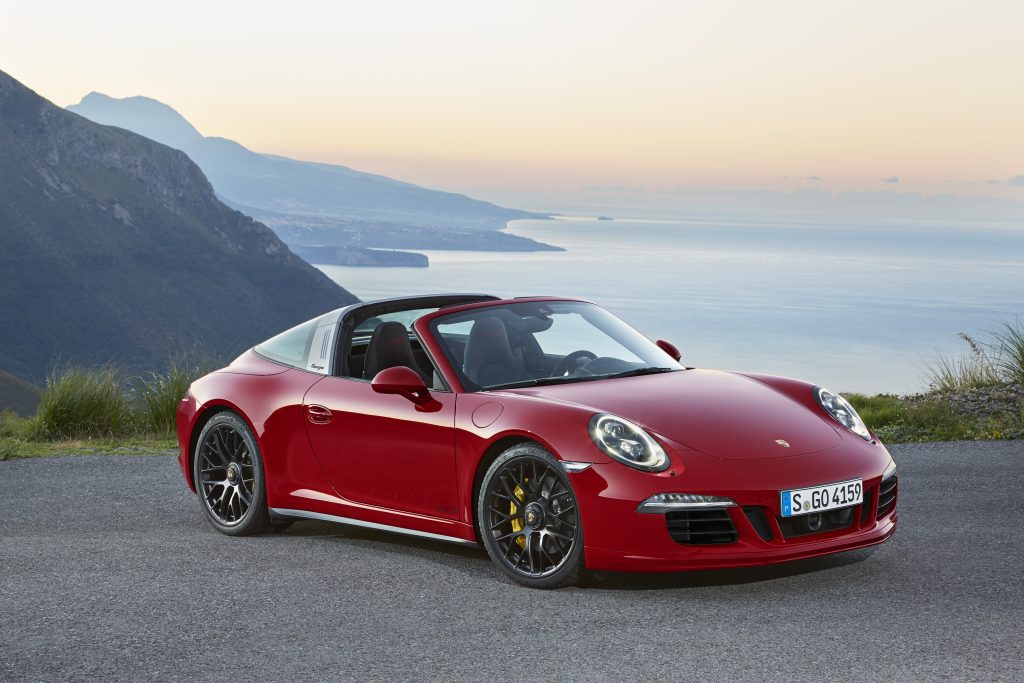

911 Targa 4 GTS

911 Targa 4 GTS

35. Targa GTS (991.2)

The ultimate poser and serious sports car combined
Built: 2017 – present | Engine: Twin-turbo flat six | Power: 420hp | Top Speed: 188mph

If I had the money Targa GTS is on my shortlist. I know the Targa GTS is heavier and less focused than the rear drive GTS but man this thing looks awesome and the performance is more than I would ever need. We have already talked about the GTS models offering all the right goodies as standard. 450 horsepower and 405 pound-feet of torque is appreciated in the heavier Targa and it feels significantly faster and pulls harder than the Targa 4S.

There’s something really iconic about the look of the 911 Targa models, with the wraparound rear glass, off-color pillar, and soft top that stows just behind the passenger compartment. As far as topless 911s go, the Targa not only looks better than the Cabriolet, but that big area behind the rear seats means it’s super functional – combined with the small front trunk, you get 10.1 cubic feet of cargo space. There isn’t any serious wind turbulence with the roof removed when driving at higher speeds, and the weight penalty (about 300 pounds versus a Carrera 4 GTS Coupe) is barely noticeable. It will get to 62mph in 4.1 seconds on its way to a 191mph top speed. Acceleration-wise, that’s three tenths faster than a Targa 4S.

The main issue with the Targa GTS is that it is pretty expensive even in Porsche world. A 911 GTS Coupe is nearly $20,000 cheaper and that drives better and can be tracked. That’s hard to justify unless you absolutely must have the best looking 911. Options wise you don’t even get the PASM Sport suspension (can’t be fitted to the Targa.

It’s a 450-hp Targa! The ultimate poser and serious sports car as a daily driver and our choice if you aren’t doing track days and don’t mind spend $20k more than a Carrera GTS to look good.
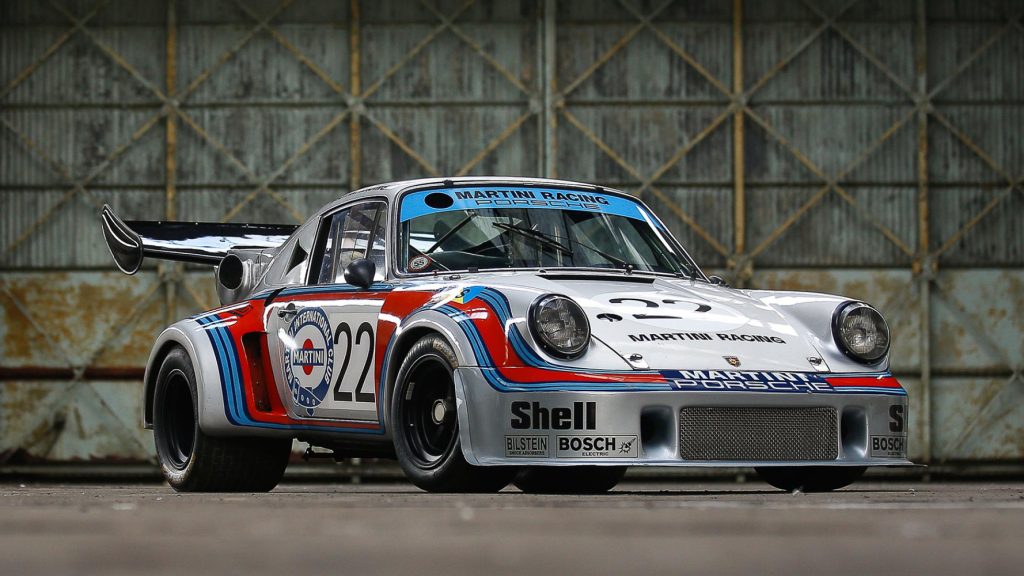

34. Porsche 911 RSR 2.14 Turbo

Little engine. Big heart. First Turbo Racing 911.
Built: 1974 |  Engine: Turbo 2.1L flat six | Power: 500hp | Top speed: 190mph

Huge vents, crazy aggressive body kit, 500hp Turbo engine, fiberglass panels and only 1,600lbs in weight meant this beast was a force to be reckoned with. The RSR was a milestone moment for Porsche. It was the first turbocharged racing 911, one that took part in the FIA’s Group 5 category for the 1974 World Championship for Makes and came 2nd overall at the 24 Hours of Le Mans.

While Porsche had success early on with small and powerful engines, is was really the RSR that showed just how successful a small-capacity turbocharged engine could be in a standard race car. Porsche wanted to prove the abilities of a turbocharged 911 in competition so they created the Porsche 911 Carrera RSR Turbo 2.1. Thanks to the FIAs requirements for a smaller than 3 liter engine for Group 5 cars, Porsche decided on a 2.14 liter flat-six and then added to monster KKK turbochargers to it. The result was 500 hp at 7,600 rpm and 405 lb-ft of torque at 5,400 rpm (in 1974).

Porsche extensively tested the car at the Le Mans trails and found it was 11 seconds faster than a 3.0 RSR. Four cars were made for the 1974 season and they debuted at the Monza 1000km. Only four RSR Turbos were ever built (“R5,” “R9,” “R12,” and “R13″) and they all wore the now famous Martini livery. Despite the tough company, the Martini & Rossi-livered cars managed second place finishes at the Watkins Glen 6 Hours and the 24 Hours of Le Mans.

More: Porsche RSR Models, 1974 Porsche 911 Carrera Turbo 2.14
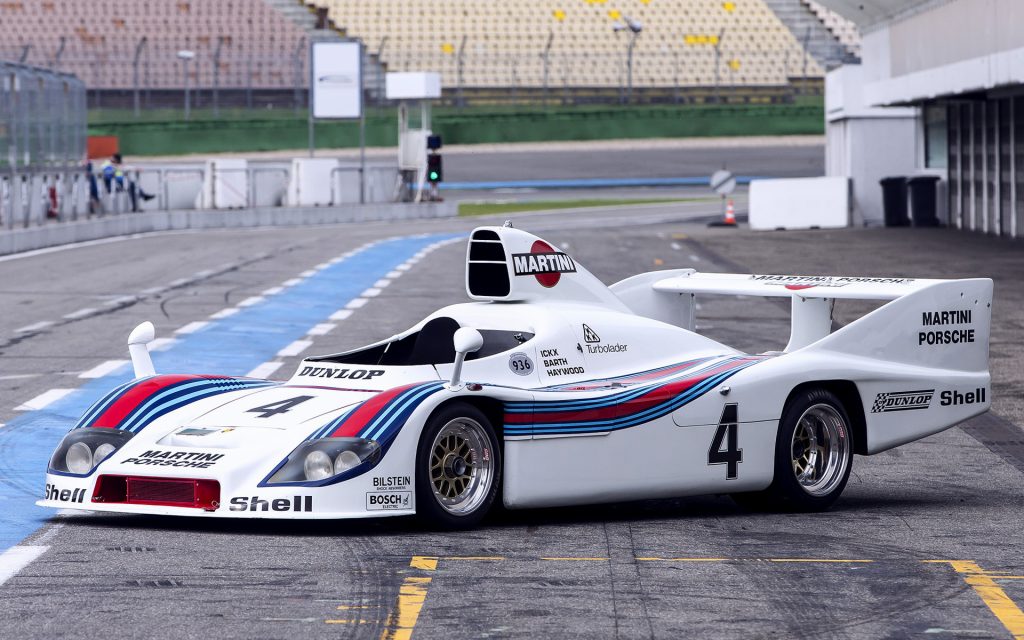

Porsche 936 Spyder

Porsche 936 Spyder

33. Porsche 936 Spyder

Won Le Mans in 1977, 1978 and 1981
Built: 1976-1982 | Engine: Turbo 2.1L flat six | Power: 540hp | Top speed: 220mph

The 936 was developed to help Porsche compete in Group 6 racing and this 908/917 successor didn’t disappoint with outright wins in ’77, ’78 and ’81. The 936 was built for the World Sportscar Championship (Group 6) and was to start alongside the 935 production race car.

Technically, the development of the open Spyder car took its orientation from the proven 908/03 and 917/10 designs. The result was an aluminum tubular frame covered by an aerodynamic plastic body. The car was powered by the 2.1-liter flat-six bi-turbo engine from the 911 Turbo RSR with an output of 540 hp. A typical feature was the large air intake above the cockpit and the high tail fins.

The first race-worthy Porsche 936, called the ‘black widow’ had clinched after 4 of the 7 races in total and the Sports Car World Championship had been won. Participation in the Le Mans 24 Hours was rewarded in June 1976 with a convincing overall victory to Jacky Ickx and Gijs van Lennep. In 1977, Porsche returned to Le Mans with the 936/77. Its body was smaller, lower, shorter and further refined aerodynamically. The engine now featured two turbochargers and delivered 20 more horsepower. At one of the most dramatic races in history, Jacky Ickx, Jürgen Barth and Hurley Haywood slayed the armada of four Renault works cars and two factory-supported “Mirage” with Renault motors. In the year 1981, the 936 celebrated a sensational comeback with another overall Le Mans victory.

More: Porsche 936
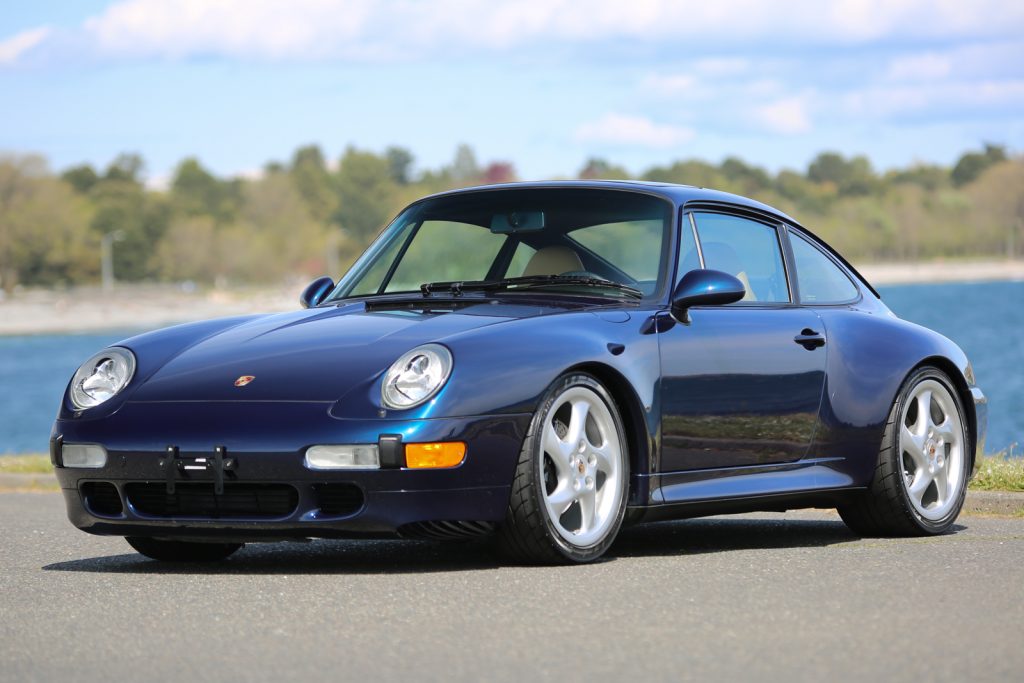

993 Porsche 911

993 Porsche 911

32. 1996-1998 Porsche 911 (993)

Our favorite 911 series and last aircooled 911
Year: 1994-1998  Generation: 993 Units built: 68,029 (all 993s)
Engine: 3.6/3.8L Flat-6  | Power: 268-444hp | 0–60mph: 3.7-5.2s | Top Speed: 165-187mph

Beautiful design, air cooled flat six, modern systems and near perfect driving fun. This is our favorite 911 series. The Porsche 911/Type 993 was sold between January 1994 and early 1998 (with US based models going on sale from 1995-1998. The Type 993 was developed byPorsche as the replacement to the Porsche 964 model (which had been introduced in 1990 as a successor to the earlier 911 platform). We’re being picky here by specifying our love for the 1996-1998 models specifically.

Considered by many Porsche enthusiasts as the “ultimate 911”, the type 993 represented a unique blend of power and simple elegance. The car had a more streamlined look and was “lower slung” than earlier versions of the 911. The styling was perfect and it is still the best looking 911 series.

More importantly the 993 saw big improvements in chassis engineering and performance that was a big step up. Rear suspension geometry was a massive improvement over previous technology, specifically developed to produce improved handling characteristics during inclement weather while retaining the stability and this transformed the 911 driving experience.

This was the last of the “air-cooled” Porsche 911s (insert sad face here). The air-cooled engine was mated to a standard six-speed manual transmission – making the 993 the first-generation of 911 to feature a six-speed transmission (all earlier variants had either 4- or 5-speed gearboxes).

More: 993 Model Range
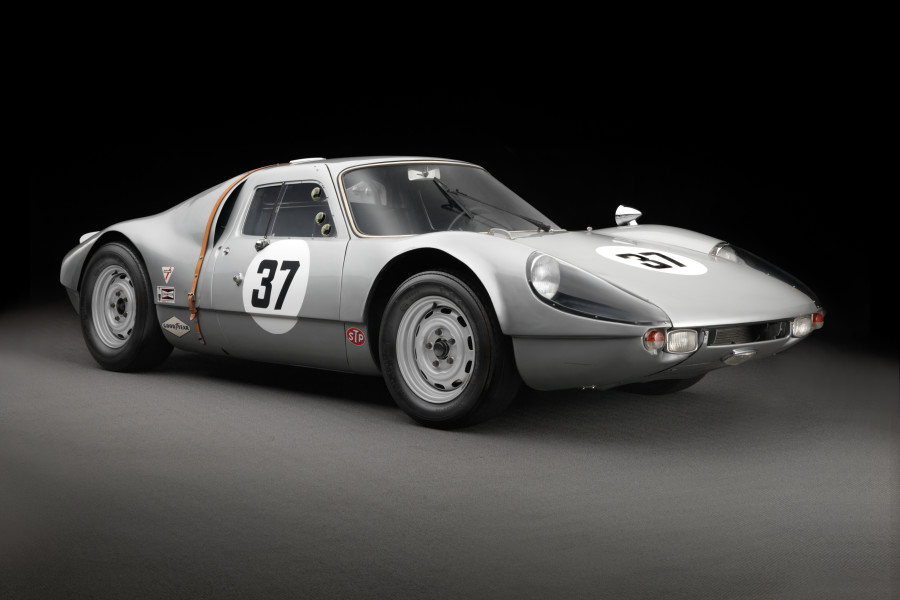

31. Porsche 904

A jack of all trades racer
Built: 1964-1965 | Engine: flat 4, 6, 8 versions | Power: from 155hp | Top speed: From 157mph

The 904 was a racing car built to satisfy the FIA’s definition of a GT car and started a trend which would motivate Porsche to manufacture sports prototype cars. Originally, the chassis of the 904 was designed to accept a number of engines and specifically the flat-6 from the upcoming 901 or 911 as we know it. It was the familiar mid-engine layout with the type 587/2 engine. They increased horsepower from 155 to 180 at 7200 rpm. Optionally, Porsche offered the type 771 eight-cylinder engine with the 904.

Since as many as one hundred and twenty 904s were sold to varying customers, the car competed in numerous hillclimbs, endurance races, sprints and rallies. As highlight to start of the 904’s race career it took outright victory at 1963 Targa Florio. During the 1964 season, Porsche was unchallenged in their class, winning the two liter manufacturer’s championship. For the 1965 season Porsche modified the 904  and again Porsche took the class wins at the majority of the 1965 events.

More: Porsche 904
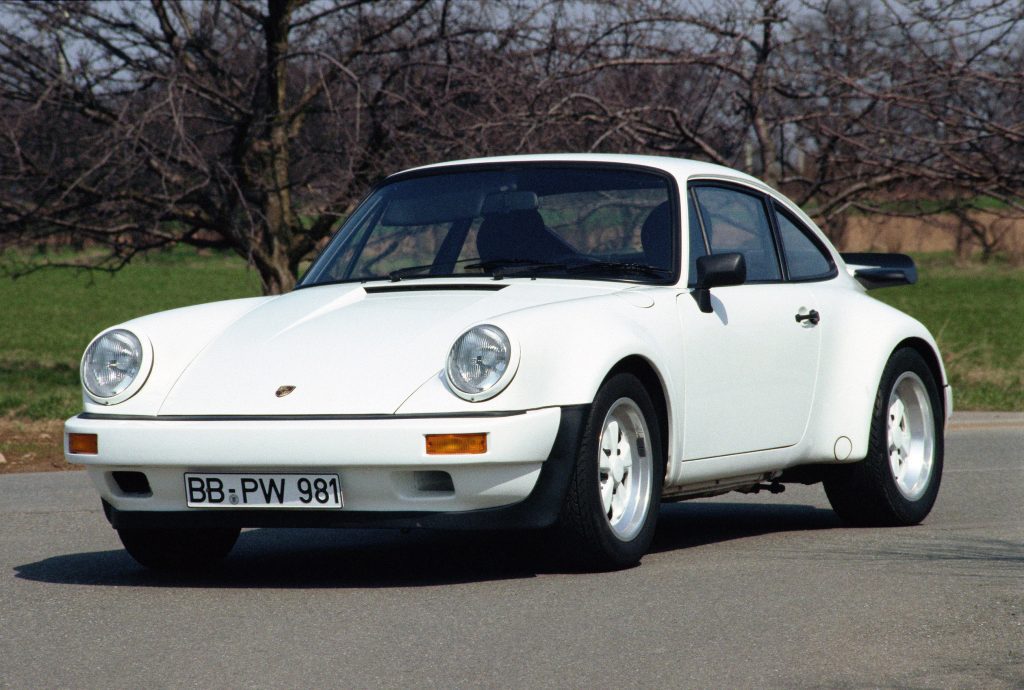

30. 1984 Porsche 911 SC RS

Only 20 examples were built of the SC/RS (for group b purposes).
Built: 1983-1984 | Engine: 3L flat six | Power: 290hp | Top speed: 155mph

In Autumn 1983, Porsche presents the 911 SC/RS for motor racing. The engine of the small series originates from the 911 SC. Improved performance is achieved by the mechanical ball fuel injection, increased compression, the cylinder heads from the 935 and forged pistons. The 911 Turbo supplies the body, chassis and suspension, wheels and braking system. Racing seats are fitted in place of the standard seats.

The Porsche Motorsports built 20 examples of the SC/RS to satisfy the FIA’s Group B competition homologation rules. The SC/RS borrowed freely from the 911 RS/RSR lightweight construction methods from a decade earlier. Typical deletion of standard street parts and the addition of factory lightweight items helped produce an 911 with a curb weight of 2160 Ibs. That is approximately 1,000 pounds lighter than the 911SC street car at a price of $72,000 in 1984. Due to the extreme lightweight nature of the SC/RS, the 290 hp engine propelled the 911 to a record 0-60 time of 4.0 seconds, as tested in 1984 by Automotor magazine in Germany.

More: 911 SC RS
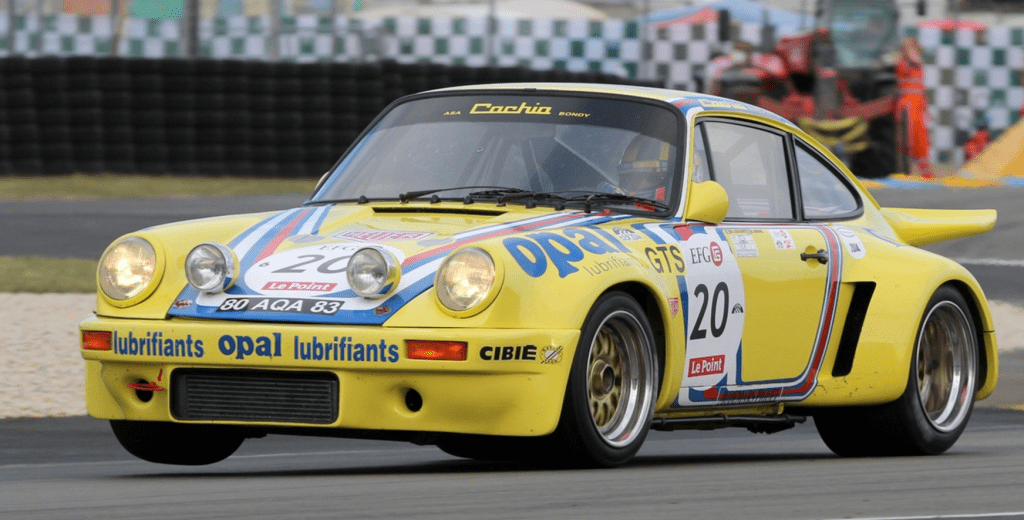

1974 Porsche 911 RSR

1974 Porsche 911 RSR

29. Porsche 911 3.0 RSR

Built from the ground up for serious racing use
Year: 1974  Generation: Carrera RS
Engine: Flat-6  | Power: 280 bhp | 0 – 60 mph: 5.6s | Top Speed: 178 mph

Introduced in 1973, the RSR was a factory-built racing car based on the 911 chassis. Built from the ground up for serious racing use the factory made significant changes to the car including a new 3.0 liter engine, wider wheels with center lock hubs and improved aerodynamics. The result was a car that would dominate the GT category and challenge for overall wins around the world.

With a kerb weight of 900 kilograms (1,984lbs) the Carrera RSR was lightning fast, with its predictable handling and almost bullet-proof reliability it’s undeniable that it forced other GT racing marques to up their game significantly in order to stay competitive.

The RSR dominated international GT racing in 1974 and 1975, it blew the competition out of the water in the Trans Am, IMSA, and the FIA World Championship racing series – cementing its place in Porsche history as one of the most important factory race cars ever built by the Stuttgart-based marque.

More: 1974 Porsche 911 RSR
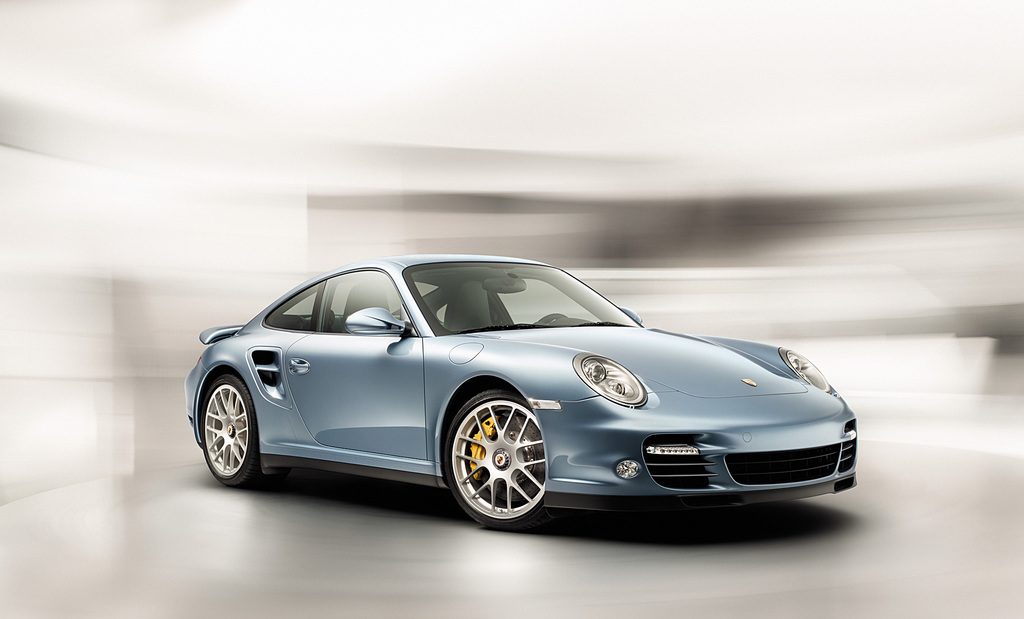

2010_Porsche_911TurboSCoup-0-1024

2010_Porsche_911TurboSCoup-0-1024

28. 911 Turbo S (997)

Huge power and daily drivability. The 997 Turbo was perfect weapon for execs.
Production Years: 2010-2013  Generation997.2 Units built: unknown
Engine: 3.8L twin turbo flat-6  | Power: 530 hp | 0 – 60 mph: 2.9 s | Top Speed: 195 mph

The 997 Turbo S is on our list because even today it is a super fast, comfortable and luxurious car that still looks modern and can still destroy most new cars in the performance stakes. It had aged the best out of all the 911s from that same era and can be bought a relatively bargain price these days in the used car market. While more recent Turbo and Turbo S models are clearly faster, this is our favorite Turbo model in recent history. By 2010 it was clear the GT model cars were designed for track supremacy and Porsche invested more money in making the Turbo and Turbo S models more luxurious and perfect for daily driving.

The Turbo S has all the goodies people recommend you choose on the regular Turbo. Things like dynamic engine mounts, brake-based torque-vectoring, ceramic brakes, and the Sport Chrono package and launch control are all standard. The dual clutch PDK gearbox is the only gearbox choice.

Performance is staggering (even by today’s standards). 0 to 60 mph is an astonishing 2.9 seconds, and top speed is 195 mph. The Sport Chrono package works perfectly and in sport mode with the chassis is stiffened by way of the active suspension, the Turbo S is perfect for a back road blast.

Want a daily driver that can destroy your friends Tesla S and still be a legitimate sports car on weekends? This is the Porsche for you.

More: 2010 Porsche 911 Turbo S Coupé
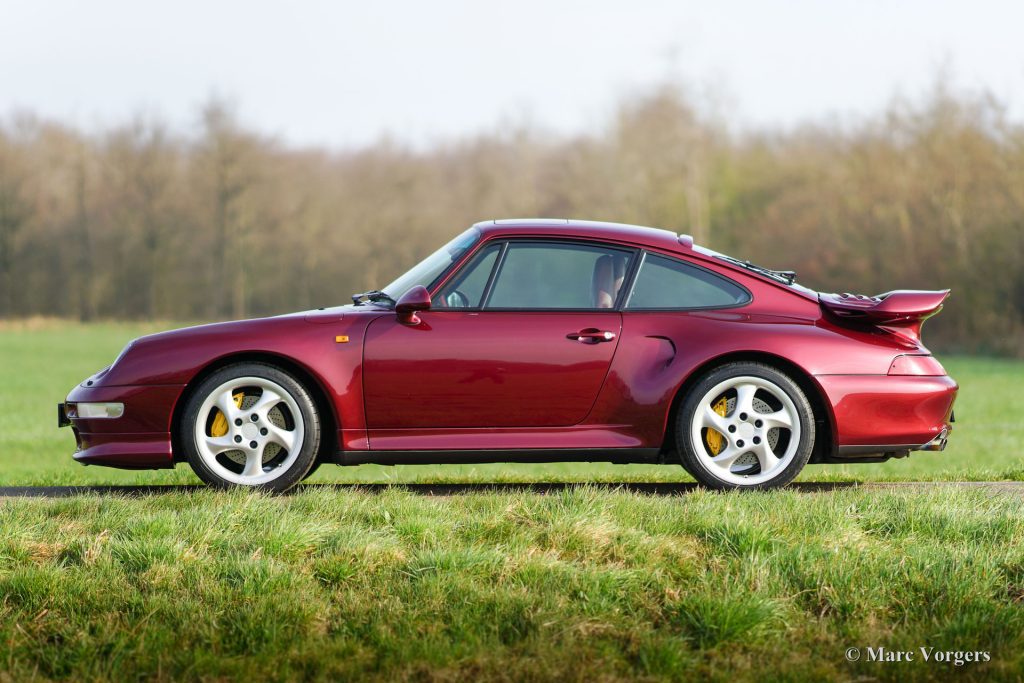

27. 911 Turbo (993)

Four wheel drive makes Turbo safer and fun
Built: 1995-1998 | Engine: Turbo 3.6L flat six | Power: 402hp | Top speed: 184mph

All wheel drive made the Turbo less of a widow maker and more of able to handle the ludicrous power. The 993 era Turbo also marked Porsche moving upmarket, with the Turbo designed for the luxury market, an easy to drive rocket any executive could handle.

Basically all-new for 1995, this version of the Turbo had all-wheel-drive and a largely leather interior. Cribbing a lot of technology from Porsche’s 1980s sensation, the 959 supercar, this Turbo was punching well above its weight. Any car that managed to run a 12.4 second quarter mile time was surely a force to be reckoned with in 1996, and it’s still quite respectable today. Twenty years ago, the 993 Turbo was the class of the field and set Porsche up for a new standard in 911 Turbo. Ever since this car was introduced, each subsequent Turbo has followed a similar formula, but with more power, more luxury, and more tech. The car in this video would jump from zero to sixty in just 4.5 seconds, and now we have the 991-generation capable of the same sprint in less than 3 seconds.
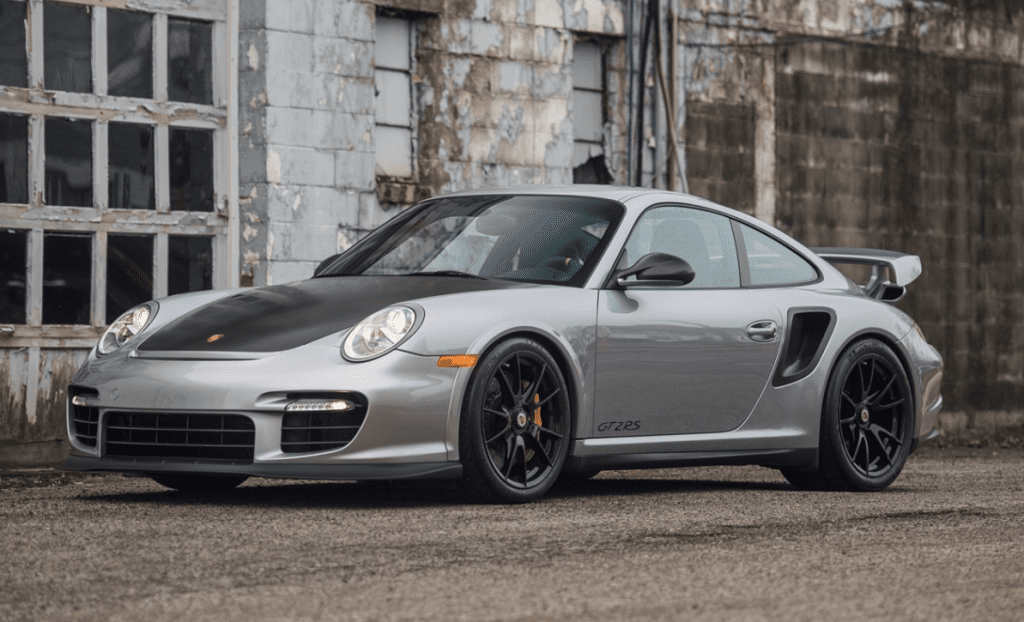

Porsche 911 GT2 RS (Type 997.2)

Porsche 911 GT2 RS (Type 997.2)

26. 2011 Porsche 911 GT2 RS (Type 997.2)

Production Years: 2011  Generation: 997.2 Units built: 600
Engine: 3.6L twin turbo flat-6  | Power: 620 hp | 0 – 60 mph: 3.3 s | Top Speed: 209 mph

We struggled a little when adding the 2011 GT2 RS to the list of ultimate 911s because we also have the GT3 RS 4.0 from the same year on the list. To be clear, the GT3 RS is our favorite of the two. So, how can a car that wasn’t as good as the GT3 RS 4.0 still make our list then? Our logic is that the GT2 RS is a better track car than the 4.0 and is a little less exclusive than the GT2. Ultimately Car and Driver put it best when they said that driving the GT2 RS was an “extraordinary event on par with that of nearly any blue-chip exotic. We won’t call it the best 911 ever, but it’s definitely Porsche at its most extreme”. So this is an awesome 911 that was made in the same year as our favorite 911 and is still better than any other exotics made that year.

The GT2 RS was definitely extreme too. While the “standard” GT2 has the same output as a Turbo S at 530 hp, the GT2 RS has 620 hp sent to the rear wheels only and was the fastest 911 ever produced. It weighs 150 pounds less than a “regular” GT2 and adds 90 hp and no PDK gearbox with manual the only option. Thanks to different turbos, intercoolers, pistons, and ECU, the GT2 RS also gets 516 lb-ft of torque. The GT2 RS also differs on the visual front from the regular Porsche 997 GT2 with more aggressive splitter and rear diffuser plus a bigger wing.

While top speed was 205 mph the real performance kudos came on track. The 911 GT2 RS smashed the Nurburgring lap time, doing a time of 7 minutes 18 seconds making it one of the fastest Nurburgring times even today. Please note that the premium is worth it, more so if you remember that the 997 GT3 RS is the first Porsche to one-up the Carrera GT on the Ring (7 minutes 18 seconds versus 7 minutes 28 seconds).

More: 2010 Porsche 911 GT2 RS
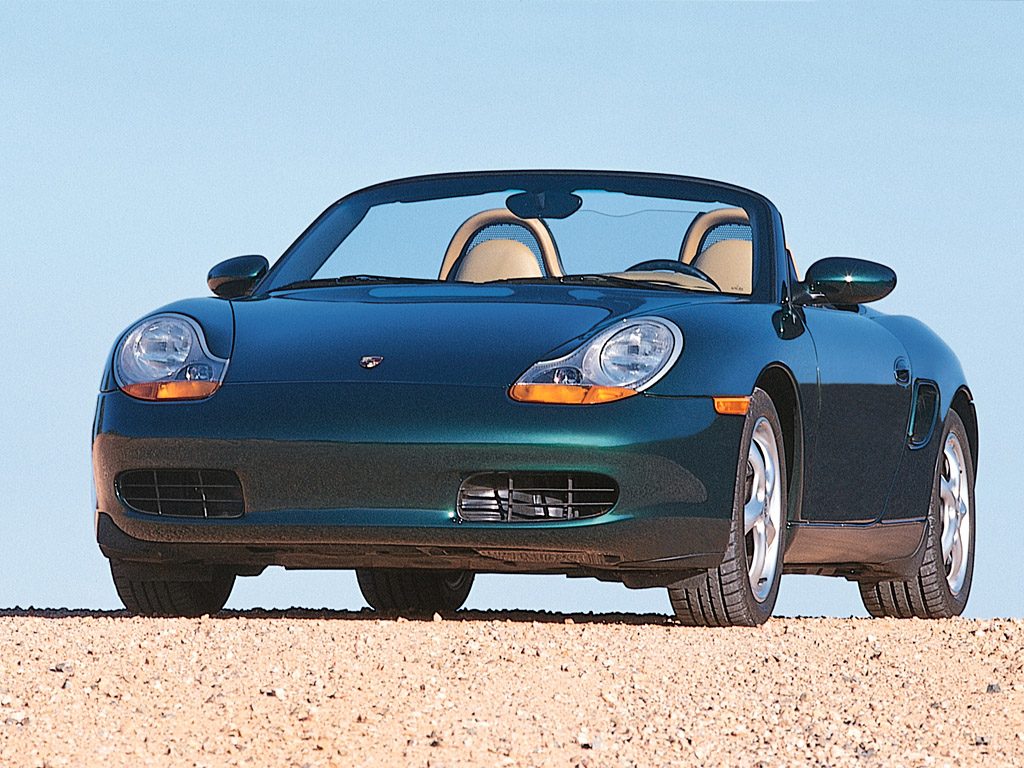

25. Porsche Boxster (986)

Welcome back Porsche
Built: 1996-2004 | Engine: 2.5L flat six | Power: 201hp | Top speed: 149mph

Porsche introduced the Boxster at a time when we needed something more than a Miata. Fun to drive, lightweight, flat six fun.

We could have put every Boxster we have ever driven on this best of Porsche list because they are all spectacular sports cars. There is a case to be made that the original 986 Boxster is the most special of all. Porsche might not be around if it weren’t for the 986 Boxster’s success in the late 1990s. It combined a convertible body with a flat six engine in the mid rear and perfect steering to turn the sports car market on its head. Sales success was immediate and the rest as they say is history.

The Porsche Boxster (type 986) was introduced in late 1996 as part of Porsche’s 1997 model year lineup. The car featured the Porsche type m96 engine – a water-cooled, 2.5-liter, flat six-cylinder engine rated at 201 horsepower. The flat, mid-engine layout provided the Boxster with a low center of gravity, near-perfect weight distribution, and neutral handling. The Boxster was released ahead of its big-brother, the new Porsche 911 (type 996), and the initial response the car received was an affirmation to the engineers behind the new 911 that they’d designed a car that would be incredibly well received. The 986 Boxster shared many of the same body components as the new 911 including the same bonnet, front wings, headlights, interior and engine architecture.

More: Porsche Boxster
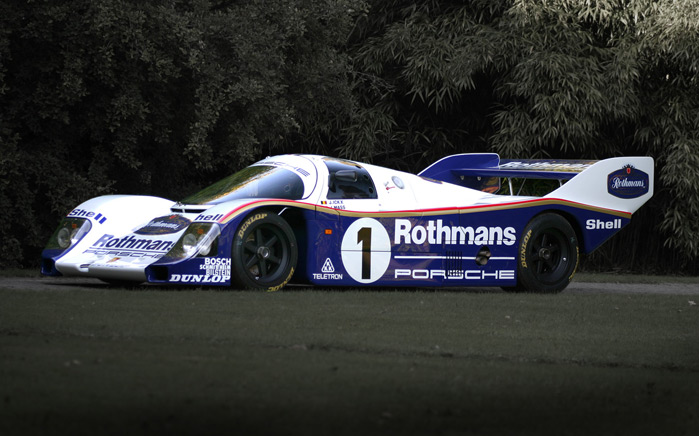

24. Porsche 962, 962 C

So good they basically banned it
Built: 1984-1991 | Engine: 3.0 liter twin-turbo Flat-6 | Power: –hp | Top speed: 218+ mph

The Porsche 962 (also known as the 962C in its Group C form) was a sports-prototype racing car built by Porsche as a replacement for the 956 and designed mainly to comply with IMSA’s GTP regulations, although it would later compete in the European Group C formula as the 956 had. The 962 was introduced at the end of 1984, from which it quickly became successful through private owners while having a remarkably long-lived career, with some examples still proving competitive into the mid-1990s. The vehicle was later replaced by the Porsche WSC-95.

In total, Porsche would produce 91 962s between 1984 and 1991. 16 were officially used by the factory team, while 75 were sold to customers. Some 956s were rebuilt as 962s, with two being previously written off and four others simply rebuilt. Three 962s that were badly damaged were also rebuilt and had been given a new chassis number due to the extensive reconstruction. Due to the high demand for 962 parts, some aluminium chassis were built by Fabcar in the United States before being shipped to Germany for completion. Derek Bell, a 5-time Le Mans winner, drove the 962 to 21 victories between 1985 and 1987, remarked that it was “a fabulous car, but considering how thorough (Norbert) Singer (the designer of the 962 and head of Porsche’s motorsport division at the time) and the team were, it was really quite easy to drive.”

During the early years of its career, the 962, like the 917K, 935 and 956 before it, became one of the most dominant cars in motorsport, and its efficiency and reliability led it to be a car much in demand among private teams. The championships won by teams campaigning the 962 included the World Sportscar Championship title in 1985 and 1986, the IMSA GT Championship every year from 1985 to 1988, the Interserie championship from 1987 until 1992, all four years of the Supercup series (1986 to 1989), and the All Japan Sports Prototype Championship from 1985 until 1989, and it was also very dominant in the American IMSA series well into the 90’s. The 962 also won the 24 Hours of Le Mans in 1986 and 1987, with Derek Bell, Al Holbert and Hans-Joachim Stuck at the wheel on both occasions, as well as later winning under the Dauer 962 badge in 1994.

More Porsche 962
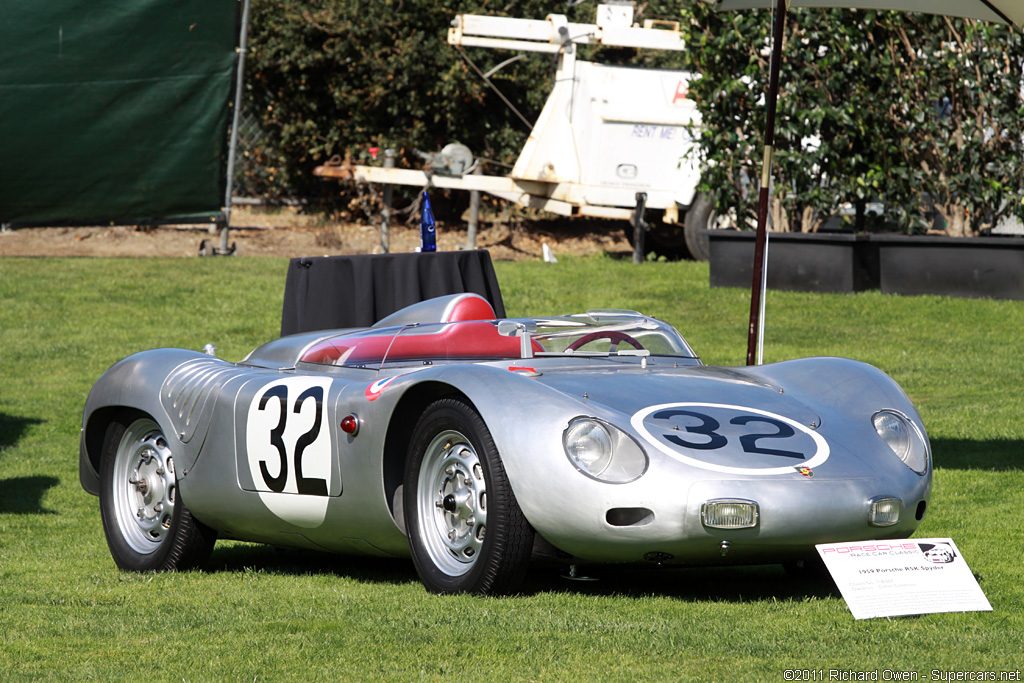

Porsche 718Porsche 718

23. Porsche 718

550 successor continued to beat the big guys with great racing success.
Built: 1957- 2004 | Engine: 2.5L flat four | Power: 148hp | Top speed: 143mph

Successor to the 550 Spyder the 718 was one of Porsche’s most successful race cars in the early years. With its flat-four motor the small and light 718 continued the “giant killer” reputation of the 550 Spyder. Unlike the heavy and powerful v12 Ferrari’s that the 718 raced, the Porsche was light, nimble and very rigid, easily allowing it to win its share.

The car was commonly referred to the RSK and came in a number of set ups in order to compete in different motorsports series. There was the RS60 with 160hp and updated suspension that ended winning the 12 Hours of Sebring and the Targa Florio. The RS61 was basically just an updated RS60. The W-RS upped engine size to 2 liters and went from the initial 4-cylinder to bigger flat-8 with power jumping to 240 hp. While the W-RS could only manage 8th at Le Mans it did win the European Hill Climb Championship. There were even three 718 cars entered into Formula 1 in 1961 (before Porsche switched to the 904 for F1 duties).

More: Porsche 718
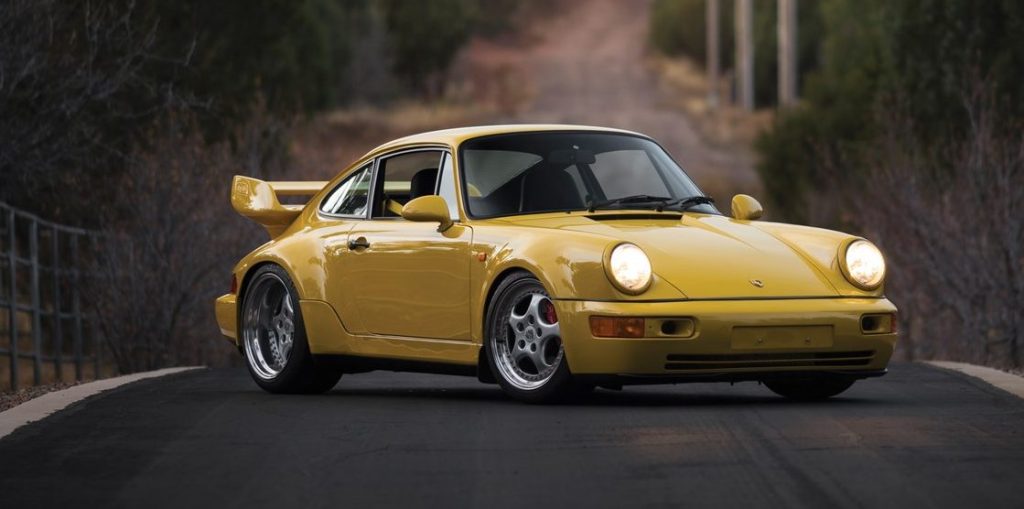

1993 Porsche 911 (964) Carrera RS 3.8

1993 Porsche 911 (964) Carrera RS 3.8

22. 1993 Porsche 964 Carrera RS 3.8

Is it cheating that we have two 964 Carrera RS models on our list? We don’t think so.
Year: 1993-1996  Generation: 964  Units built: 55
Engine: 3.8L Air-cooled Flat-6 | Power: 300 bhp | 0 – 60 mph: 4.9 s | Top Speed: 170 mph

In 1992 Porsche produced the super-lightweight, rear-wheel-drive only version of the 964 dubbed Carrera RS for the European market (it the car above you just read about). The Carrera 3.8 RS is even more ultra-limited. Specifically conceived as a homologation special, the car was based on the Carrera Cup competition car; producing the car for the masses allowed the RSR 3.8 to qualify for BPR GT3 and GT4 racing. Adding to its exclusivity was the fact that it was offered only to the European market.

The car featured the wide-body look of the Type 964 Turbo, had a massive rear spoiler, and three-piece Speedline wheels. It was powered by a 300 bhp 3.8 liter version of the M64 motor. This engine was bored out by 2 mm for a total of 3,746 cc, and was also available in a more powerful competition version called the 3.8 RSR. The car was fitted with Porsche’s innovative Variocam variable-length intake system and also featured newly designed forged pistons of a reduced height and a relocated wrist-pin, helping to keep piston weight below that of the base engine. The six-speed manual transmission had gearing optimized for acceleration and the track.

The competition RSR version, which was distinct from the “standard” model with an interior and exterior stripped down and modified for circuit use, would rack up stunning race results, winning overall at the Spa 24 Hours, Suzuka 1000 KM, and 24 Hours of Interlagos, while clinching class victory.

More: 964 Model List, 1993 Porsche 911 Carrera RS 3.8
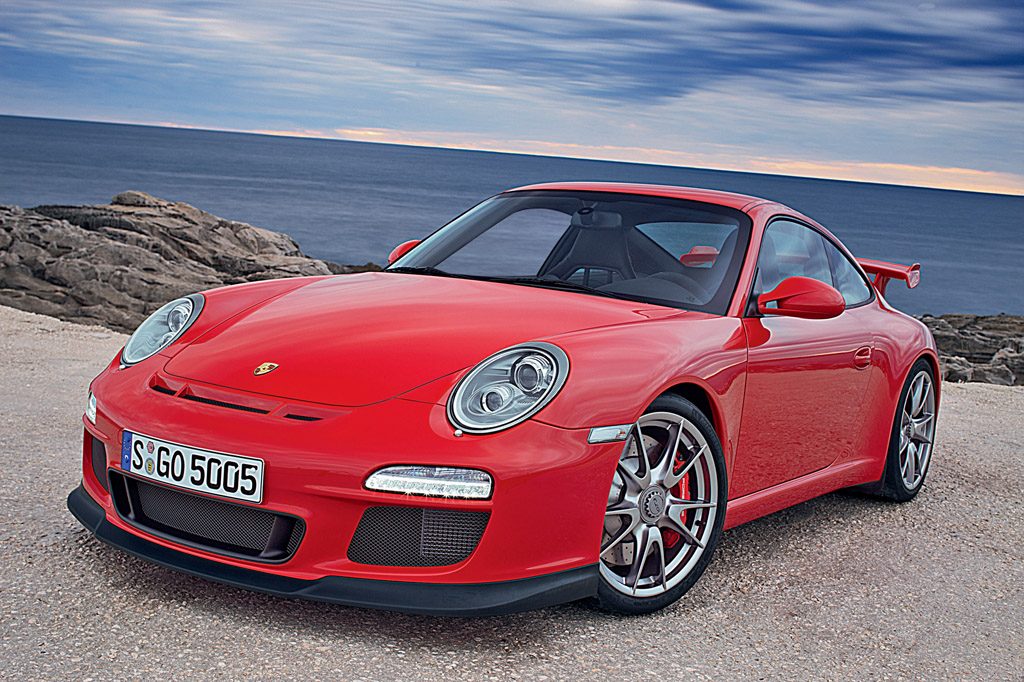

21. Porsche 911 GT3 (997.2)

Monumental performance. Manual gearbox. Direct hydraulic steering. Amazing.
Production Years: 2009-2011  Generation: 997.2 Units built: 2,256
Engine: 3.8L Water Cooled Flat-6  | Power: 429 hp | 0 – 60 mph: 4.0 s | Top Speed: 194 mph

By now you are probably annoyed by the number of GT3s on this list. Get used to it because there are even more further down. They are all awesome and they all deserve to be here.

In 2009, Porsche launched the 2nd Generation 997 GT3. The 997.2 GT3 got a larger 3.8 litre engine producing 429 hp and also had a number of new options including dynamic engine mounts and different rear spoiler as well as other styling changes.

The engine 3.8 liter titanium con-rodded engine revved to over 8,500rpm and produced 429bhp at 7600rpm (up 20bhp) and 317lb ft of torque at 6250rpm (up 19lb ft). The biggest difference between the gen 2 997 GT3 and the first generation GT3 was the difference in mid-range torque. Combined with a weight of 1395kg (the same as the 997.1 GT3 the 0-62mph time dropped to 4.0 seconds and the GT3 had a much broader performance envelope.

Performance was monumental as expected and this was still from the days of manual gearboxes and direct hydraulic steering so it felt amazing too. The most incredible thing about the GT3 is its stability and precision and the fact that you can feel everything going on underneath you. As EVO said when they tested the car back at the launch, “the reaction when you turn into a corner is absolutely instant, faithful and solid, allowing you to pick up a clipping point with  complete confidence. It reminds me of the Audi R8 but more hardcore”.

More: 2009 Porsche 911 GT3
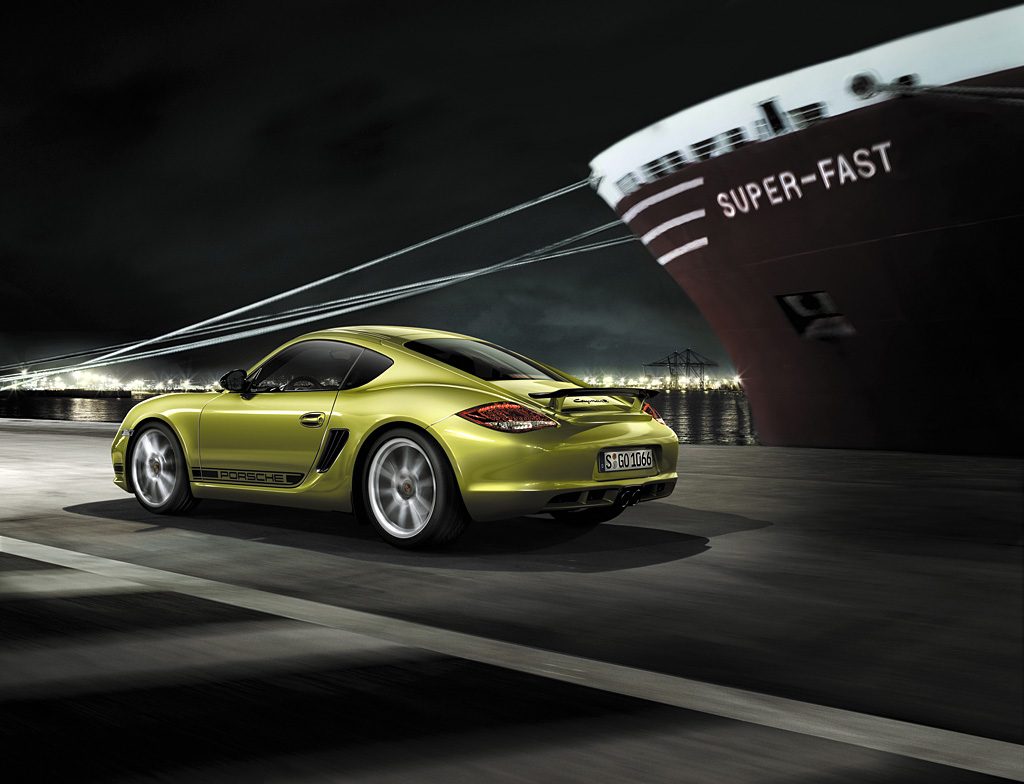

20. 2010 Porsche Cayman R

Diet saved 110 lbs, engine fettling added 10hp, tweaked suspension and LSD transformed awesome Cayman to near perfection. 
Built: 2010 | Engine: 3.4 flat six | Power: 330 bhp | Top speed: 175 mph

The Porsche alphabet reserves the letter R for very special sports cars: R for responsive and refined – but most especially for racy. The new Cayman R combines all these attributes without compromise. 55 kilograms (121 lb) lighter and with ten horsepower more than the Cayman S, the new mid-engine coupé from Dr. Ing. h.c. F. Porsche AG, Stuttgart, is designed for spectacular road behavior. With its specially adapted sports chassis, it provides an even more precise driving experience than the Cayman S. The Cayman R makes its world debut today at the Los Angeles Auto Show.

Mid-engine coupé is powered by a tuned-up 3.4-litre six-cylinder engine developing 330 hp (243 kW). In the standard configuration it transmits its power to the rear wheels via a six-speed manual gearbox that propels the car from 0 to 100 km/h (62 mph) in 5.0 seconds. Or there is the option of the seven-speed Porsche Doppelkupplungsgetriebe (PDK) that reduces its acceleration time to 4.9 seconds.

More: 2010 Cayman R
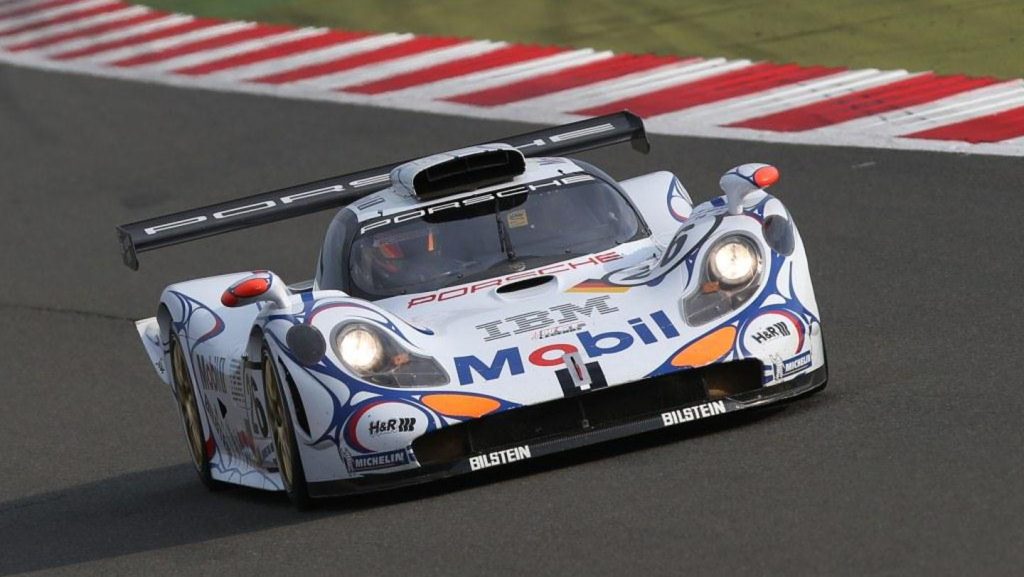

porsche 911 gt1 98

porsche 911 gt1 98

19. Porsche 911 GT1 98

Another Le Mans winner for Porsche
Built: 1996-1998 | Engine: 3.1L flat six | Power: 550hp | Top speed: 205mph

If we are talking about Le Mans legends we need to include the Porsche 911 GT1 on our list of awesome Porsche cars. With its carbon monocoque chassis, extreme aerodynamics and mid-engined layout, the Porsche 911 GT1-98 won Le Mans (Porsches 16th overall victory) and cemented its place in history.

Porsche exploited the rule book and rather than develop a race version of one of their road going models, what they created was effectively a purpose built sports-prototype (the street version was known as the ‘Strassenversion’ and is considered the most fierce and rarest 911 ever). The GT1 made its debut at the 1996 Le Mans and was a technical masterpiece. Both new Porsche 911 GT1s showed reliability and speed, achieving second and third place. For the 1998 season Porsche developed an all-new car, the 911 GT1-98 with a more traditional sports-prototype look. It was only 950 kg and had a 3.2-liter engine with dual KKK turbochargers that produced 550 hp at 7,200 rpm.

At Le Mans in 1998 troubles with the other top runners from Toyota, BMW and Mercedes meant that while slower, the 911 GT1-98 did enough to take both first and second place overall. This gave Porsche its record-breaking 16th overall win at Le Mans, more than any other manufacturer in history.

More: Porsche 911 GT1 (race cars), Porsche 911 GT1 (production)
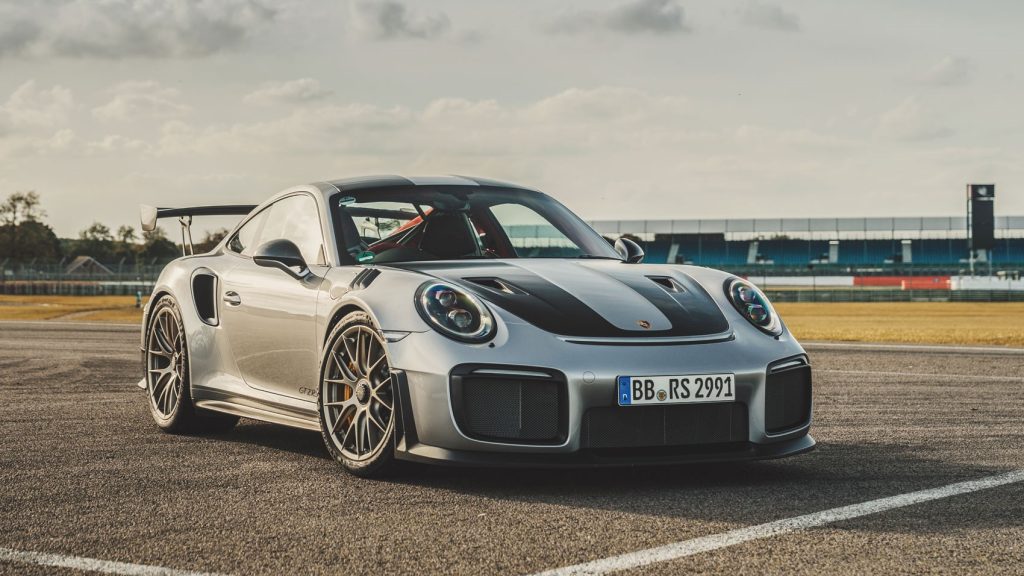

18. 911 GT2 RS (991.2)

Most powerful road going 911 ever built is a 211mph monster that’s easy to drive, until you floor it and scare yourself silly. 
Built: 2017-2018 | Engine: 3.8L Turbo flat six | Power: 690hp | Top speed: 211mph

The rear-engine, rear-wheel drive GT2 RS celebrated its official world premiere at the Goodwood Festival of Speed in the UK which took place from June 30th to July 2nd, 2017. It was here that the world was first introduced to Porsche’s fastest and most powerful street-legal 911 ever made. A few months later, the same car would go on to smash the lap record at the what has become the de facto manufacturers’ testing grounds – a place where those who reigned supreme earned bragging rights in the industry. With a Nurburgring time of 6 minutes 47.3 seconds, it completed the ‘ring 5 seconds faster than the Lamborghini Huracán Performante and 10 seconds faster than Porsche’s own million dollar 918 Spyder.

Suffice to say, the 911 GT2 RS now sits on the throne – equipped with its 3.8L flat-six twin-turbocharged 700 horsepower engine – with an unquestionable legitimacy to its claim. It didn’t get to the top with brute force alone – the GT2 RS is built to be as dexterous as it is powerful. Extensive work was done on the chassis to ensure that the agility and precision of the car were not overwhelmed by its own muscle, but rather, complemented by it.

The Porsche 911 GT2 RS represents everything that is the best about the 911 – a righteous Ruler, indeed.

More: 911 GT2 RS (991.2)
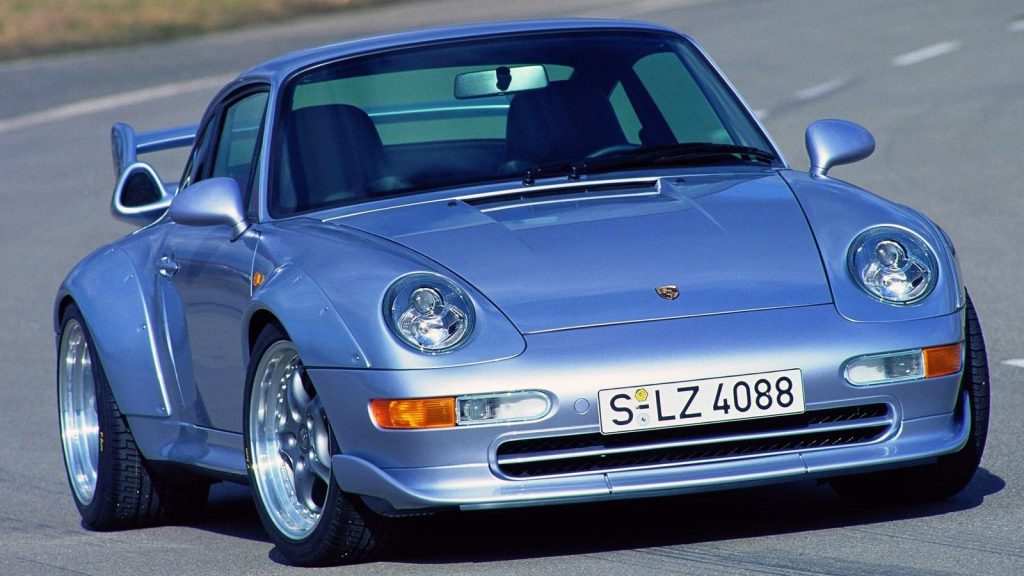

1998 porsche 911 gt2

1998 porsche 911 gt2

17. Porsche 911 GT2 (993)

Wide arches, rear wheel drive, Turbo engine. GT2 craziness begins here.
Year: 1995-1998  Generation: 993 Units built: 57 road cars
Engine: 3.6L twin-turbo H6  | Power: 429-444 hp | 0 – 60 mph: 3.9 s | Top Speed: 187 mph

The 993 GT2 is special. Based on the 993 Turbo, the 993 GT2 was built for homologation purposes. Porsche took the twin-turbo flat-six engine from the 911 Turbo and combined it with the wide-body rear-drive chassis to create one of our favorite Porsches ever. Only 57 were built and they go for over a million dollars today so don’t expect to find a bargain (remember, this is the last of the air-cooled turbocharged, extreme 911s).

The 993 GT2 featured widened plastic fenders, more aggressive front bumper with side canards and a massive rear wing with air scoops in the struts. It wore new, wider wheels and the ride height was dropped. The 993 GT2’s original 3.6 L (220 cu in) engine developed 429 hp and in 1998 it was upgraded to 444 hp. Top speed of 187 mph and a 0-60 sprint of 3.9 seconds was devastatingly fast back in 1995.

Development work behind the Turbo S LM-GT was a big contributor to the GT2. To take all this hard-earned knowledge and tech to the track, Stuttgart had to meet the FIA’s stringent requirements and build a road-legal homologation run. Thus the 993-generation 911 GT2 was born. The 993 GT2 was introduced in 1995, two years after the 993 911 had been launched.

More: 1998 Porsche 911 GT2
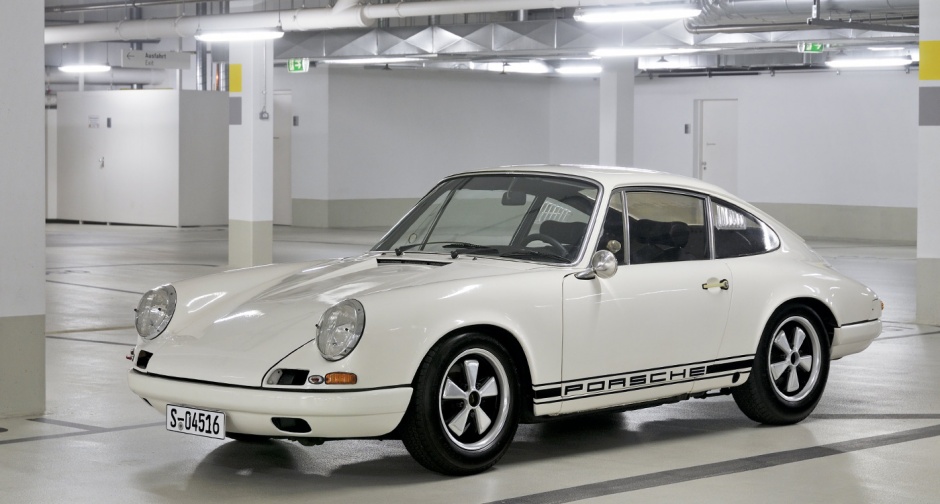

1967-1968 Porsche 911 R

1967-1968 Porsche 911 R

16. 1967-1968 Porsche 911 R

Lightweight perfection
Year: 1967-1968  Generation: Early Years  Units built: 23 (19 vehicles plus 4 test cars)
Engine: Flat-6  | Power: 230 bhp | 0 – 60 mph: 5.9s | Top Speed: 152mph

In 1967, you could walk into a Porsche dealer and buy a 911 S which was essentially the pumped up 911. No so the 911 R. To take the newly released 911 to its limit, Porsche developed a small series of racing versions that focused primarily on weight reduction. These racers were the first among a series of 911s that would dominate GT racing for over 40 years. Only 23 were built.

Every possible component was replaced by a lightweight counterpart. With the standard interior deleted, lightweight windows, fiberglass doors, hood, engine cover and bumpers, the 911R was only 1786 lbs, some 500 lbs less than the standard 911! Wow. Included was the Type 901/22 engine from the Carrera 906 with a standard alloy crankcase. Most cars used Weber 46 IDA3C carburetors, while some featured the mechanical Bosch fuel injection system. Optionally the four-cam Type 901/21 engine which produced 230 bhp (171 Kw) was available. With this engine, the 911 R accelerated from zero to 100 km/h in 5.9 seconds.

Outwardly, the 911 was distinguished by flared wheel arches, smaller bumpers and distinctive circular rear lights. In detail, the extent of the 911R program becomes apparent with details such as a bank of louvers in the rear quarter windows, plastic door hinges and wider Fuchs alloy wheels.

While initially conceived to race in the sports car class, the R never met homologation requirements and was forced to race with the potent prototype classes.

More: 1967 911 R
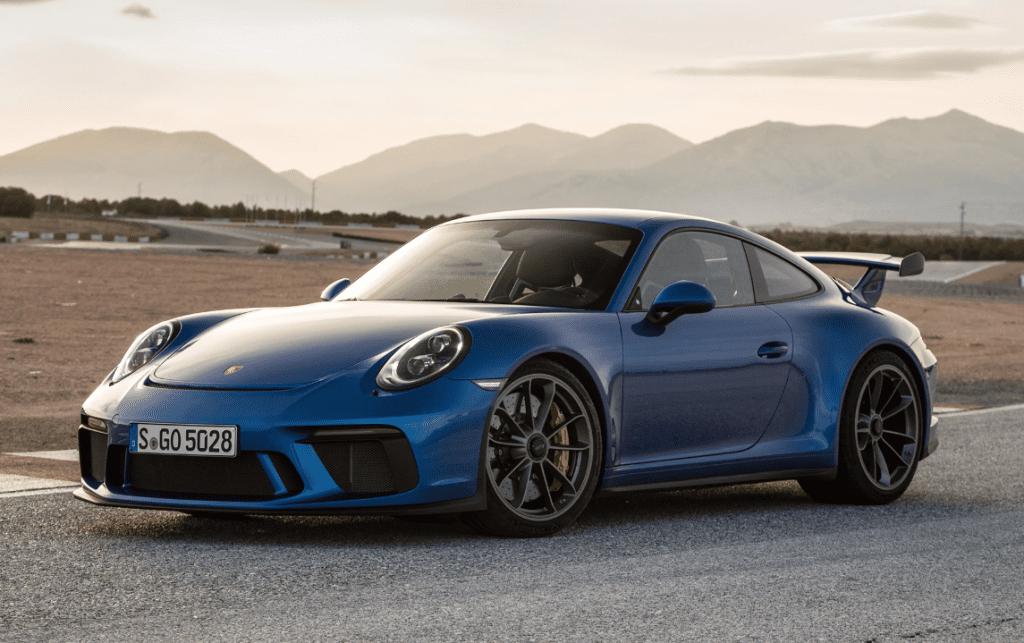

2018 Porsche 911 GT3

2018 Porsche 911 GT3

15. 2018- Porsche 911 GT3 (991.2)

Our pick is the manual Touring. Best all-rounder money can buy. 
Production Years: 2017-  Generation: 991.2  Units built: –
Engine: 4L naturally aspirated flat 6  | Power: 493 bhp | 0 – 60 mph: 3.4 s | Top Speed: 193 mph

With the 991.2 GT3 Porsche got everything right, it took the most involving 911 ever and bulletproofed the engine, added a manual and made it even better across the board. That’s why it gets the nod over the 991.1. The GT3 has a screaming engine, is available with a manual gearbox and is the most involving sports car money can buy. It is a little rough around town so opt for a different 911 of you are looking for a daily driver. If you want to look a little more subtle, you can now opt for the Touring package which removes the rear wing (we love it).

The powerplant is a masterpiece. It’s a dry-sump, 4.0-litre flat six engine that can scream up to its 9,000-rpm redline, making 500 horsepower and 339 pound-feet of torque. While the rest of the 911 range has torque-rich turbocharged engines, this is one you still have to work with and one you want to wind up to 9,000 rpm. The GT3 can be equipped with a six-speed manual transmission or a seven-speed dual-clutch PDK gearbox. The PDK is faster but as manual men we know we’d opt for the stick shift every time.

With the PDK and the launch control system activated, the 2018 Porsche 911 GT3 gets to 62mph in 3.4 seconds. With the manual gearbox, a similar sprint takes 3.9 seconds. That makes the GT3 barely faster than the 911 GTS which is a better daily driver and a 580-hp 911 Turbo S is an entire second faster to 60 so why would you choose the GT3 over these models. It’s easy. It is how it drives and how it makes you feel.

The GT3 has the best handling I’ve ever experienced. It is fast, precise and you can feel everything going on beneath you. The car is surgically precise, the suspension is firm with almost no body roll, and the various scoops and vents on the body not only help cool down the mechanical components, but also increase downforce so the car sticks to the pavement. A GT3 feels like a totally different experience to other cars. It’s loud, stiff, rough and pointy. It is full sensory overload at slow speeds around town and an almost religious experience at speed on track. There is nothing better.
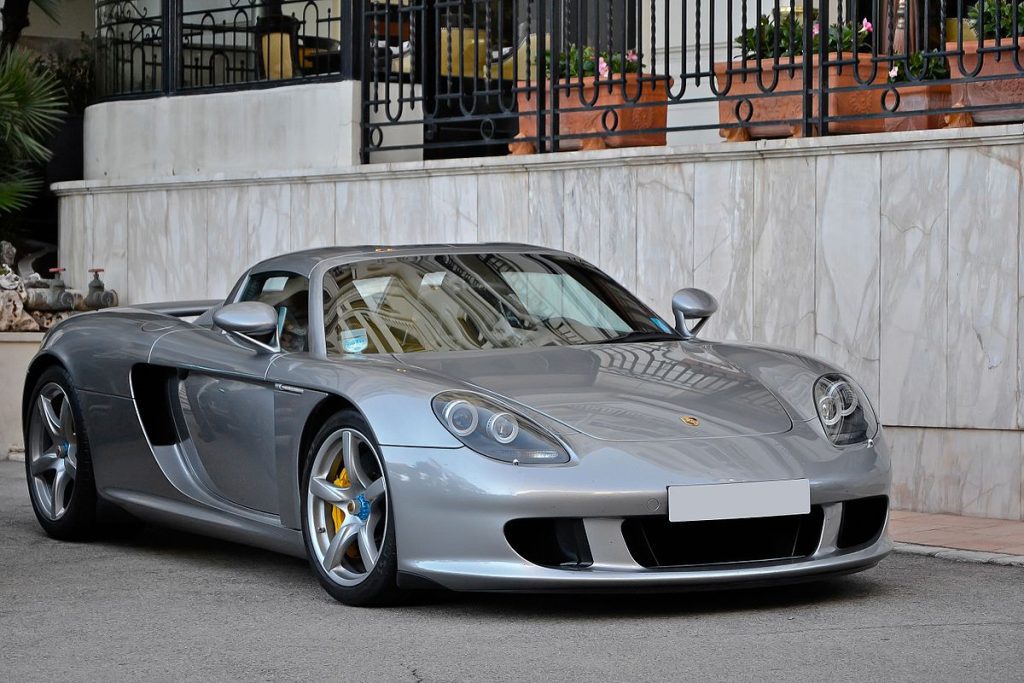

14. Carrera GT

Supercar. Race developed, naturally aspirated V10. Over 600hp. No driver aids. Holy crap.
Built: 2004-2007 | Engine: 5.7L V10 | Power: 603hp | Top speed: 205mph

In the mid-2000’s Porsche introduced the world to the Porsche Carrera GT. The Carrera GT is powered by a 5.7 liter V10 engine producing 603 hp that accelerates from 0 to 60 mph in 3.5 seconds with a maximum speed of 205 mph.  The only available transmission was a six-speed manual. The car was famously devoid of driver aids which made it a real handful, brining back memories of the famous Porsche widow maker moniker.

The development of the Porsche Carrera GT began with the 911 GT1 and some of the technologies being developed by Porsche’s racing division in the late nineties. While the racing program was discontinued, much of the technology developed by that program remained. It was decided that at least some of that technology should become integrated into a new, as-yet-unnamed, production car program. A total of 1,270 Porsche Carrera GT’s were built between 2004 and 2007. While this is less than the originally planned production run of 1500 units, the official reason for the car’s premature discontinuation centered around changing airbag regulations in the United States.

More about the Porsche Carrera GT | Carrera GT History & Timeline
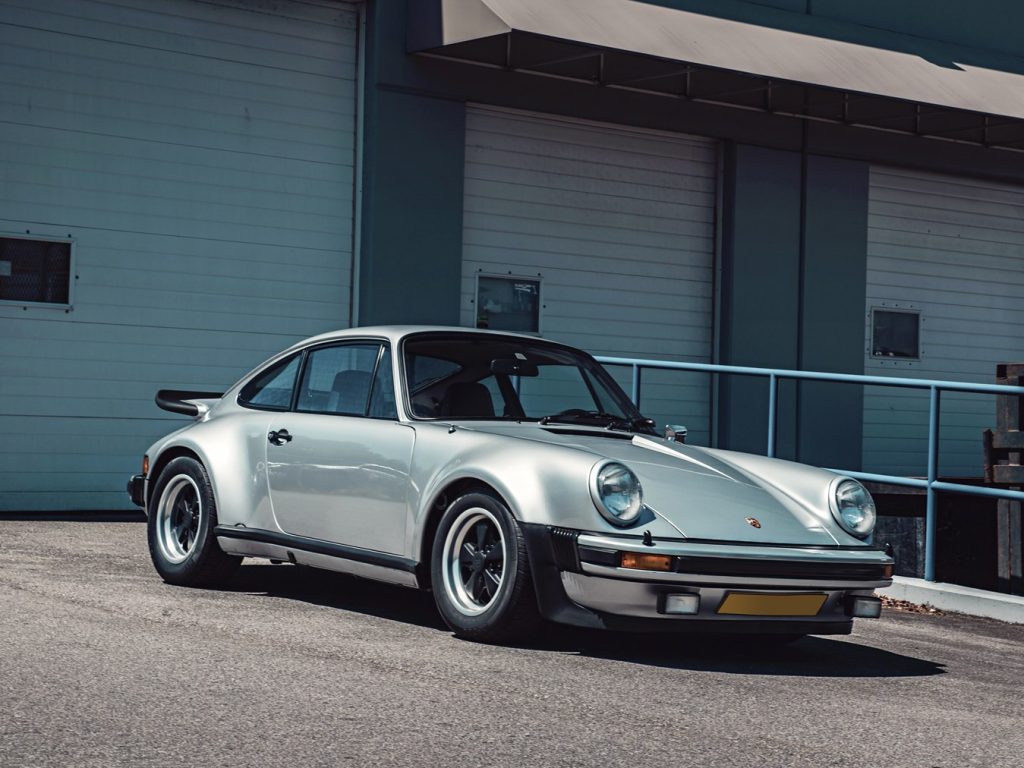

1975-1989 Porsche 930 Turbo

1975-1989 Porsche 930 Turbo

13. 1975-1989 Porsche 930 Turbo

Year: 1975-1989  Generation: 930  Units built: ‘75–’77 (3.L) 2,819, ‘78–’89 (3.3L) 18,770
Engine: Single turbo flat-six  | Power: 260 to 330 hp | 0 – 60 mph: 4.9-5.2s | Top Speed: 155-173mph

In 1974 Porsche introduced the first production turbocharged 911. In Europe it was called the Porsche 911 Turbo and in the United States it was called the Porsche 930. It looked different than the normal 911s, with wider wheel-arches, bigger wheels and tires and a large rear “whale tail” spoiler. Starting out with a 3.0L engine with 260 hp, it rose to 3.3L and 300 hp for 1978. Only in 1989, its last year of production, was the 930 equipped with a five-speed gearbox. The 930 was replaced in 1990 with a 964 version featuring the same 3.3L engine. There have been turbocharged variants of each subsequent generation of 911.

The 930 Turbo was Porsche’s top-of-the-range 911 model for its entire production duration. It was the fastest production car available and very quickly became known as the supercar beater and widowmaker. With 260 horsepower out of its 3.0-liter flat-six and a propensity to oversteer it was a real handful for even experienced drivers. This makes our list because it spawned an entire generation of Porsche cars we now love and it was the first time Porsche really gave it to the folks at Ferraris and Lamborghini, showing it could beat the big guns.

A single turbocharger gave a huge boost in engine output. Unlike the smooth, predictable performance of modern Porsche turbos, the 930 had an on-off switch. All was well until the primitive turbo spooled up and then all hell broke loose. That unpredictability and rear engine layout was scary and people loved it (in a snap oversteer is scary and mind kill you kind of way of course).

Other than the notorious handling characteristics and turbo lag, the 930 is an epic display of automotive pornography. The whale tail, the wide wheel arches, the noise it makes, nearly everything else about the 930 Turbo makes this Porsche 911 breed great.

More: 930 Turbo Models
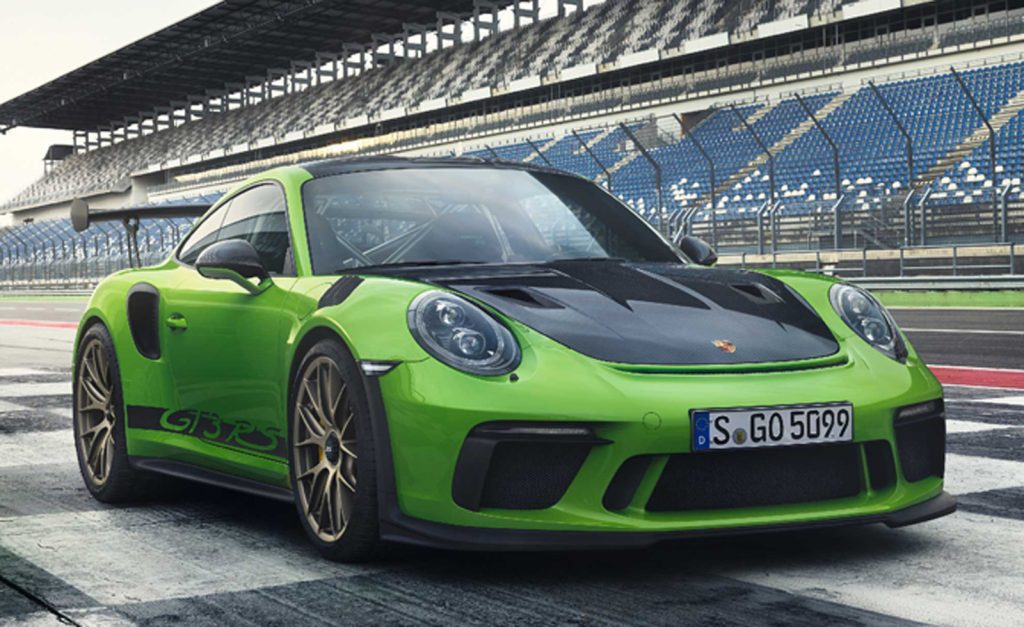

12. Porsche 911 GT3 RS (991.2)

We have no idea how do they keep getting better, but they do.
Production Years: 2018-  Generation: 991.2  Units built:
Engine: 4L naturally aspirated flat 6  | Power: 520 hp | 0 – 60 mph: 3.2 s | Top Speed: 193 mph

Porsche revealed a facelifted GT3 RS and the early reviews suggest that while it is clearly an evolution of the previous GT3 RS that Porsche has done enough that the current model gets nod over the previous generation on our list of the best 911s. Does that mean the old 991.1 GT3 RS doesn’t deserve a spot? Of course not, it is still a cracking track car and likely one of the best cars on the planet. We are simply being super picky.

The GT3 RS gets 520 horsepower and 346 lb-ft of torque from the same flat-six engine in the GT3 (the redline set at 9000 rpm, making it the highest-revving GT3 RS ever). The whole car is heavily based on the GT3 with lots of shared stuff. But it’s the engine that sets the RS apart thanks to an extra 20 horsepower, as well as the fact that you can’t get it with a manual transmission. The chassis setup is also different, so the RS is quicker on the race track. The GT3 RS is 0.1 second quicker than the old GT3 RS to 60 mph, which now happens in just three seconds. The car also gets front brake cooling and new ball joints inspired by the GT2 RS, and a tweaked rear-steering system. If you think of the GT3 RS as a GT3 with more downforce, more power and more grip then you are pretty close to the money.

The GT3 RS is a race car and doesn’t make much sense on the road. On 18 April, 2018 the 991.2 GT3 RS set a lap time of 6:56.4 around the infamous Nürburgring Nordscheleife race track. It is the third Porsche production car to break the 7 minute barrier around the track, the first being the 918 Spyder.
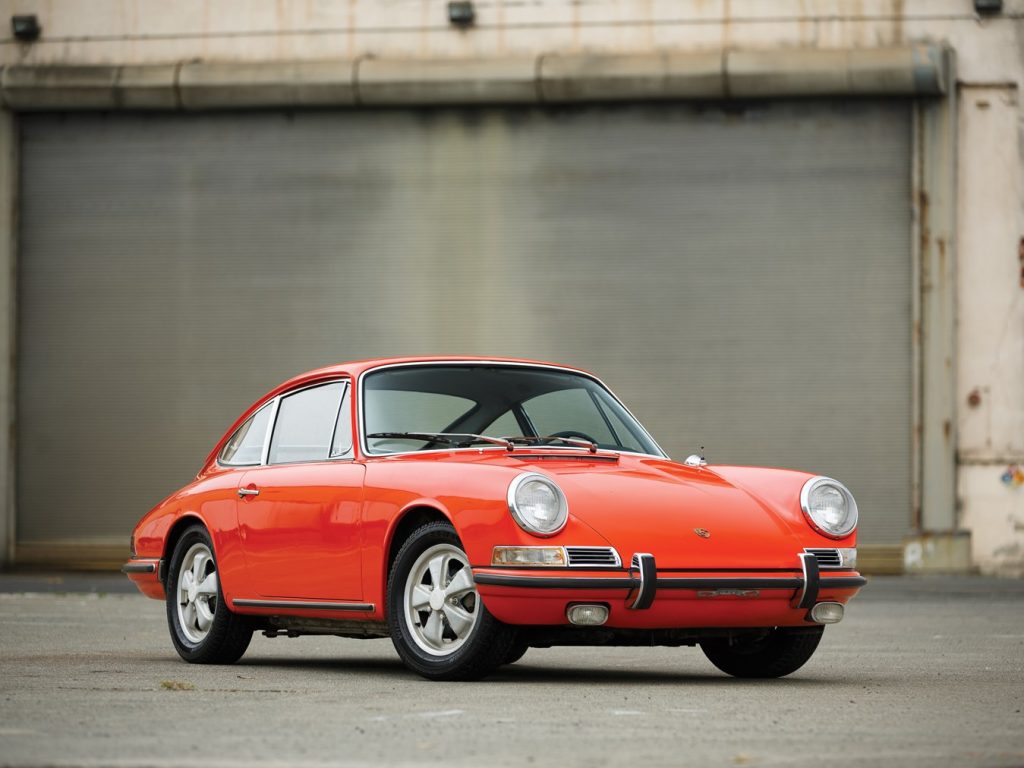

1967 911 S

1967 911 S

11. 1967 911 S Coupe

Year: 1967  Generation: Early Years  Units built: 1,823
Engine: Flat-6  | Power: 160 bhp | 0 – 60 mph: 6.5s | Top Speed: 140mph

We considered adding the Targa from 1967, but ultimately we felt the 911 S was a more important model. The 911 S was introduced to increase the performance potential of the very successful 911. It had a more powerful engine along with a number of chassis enhancements that made it very desirable. Becoming the flag­ship of the fleet, the $6990, 180-hp, 6-cylinder 911S was loaded with per­formance and luxury features.

Distinctive 5-leaf wheels from Fuchs that were made from forged magnesium-alloy, a leather-covered steering wheel rim, extra instrumentation, an auxiliary gaso­line heater, fog lights, pile carpets, and waffled padding on the dash (all pretty luxurious back in 1967 folks).

The tradition of race-inspired 911s really started here. A 2.0-liter flat-six producing 180-hp with a 7,200 rpm redline in 1967 was pretty special. This was clearly a more powerful and sportier car and much better than other cars of the same era.
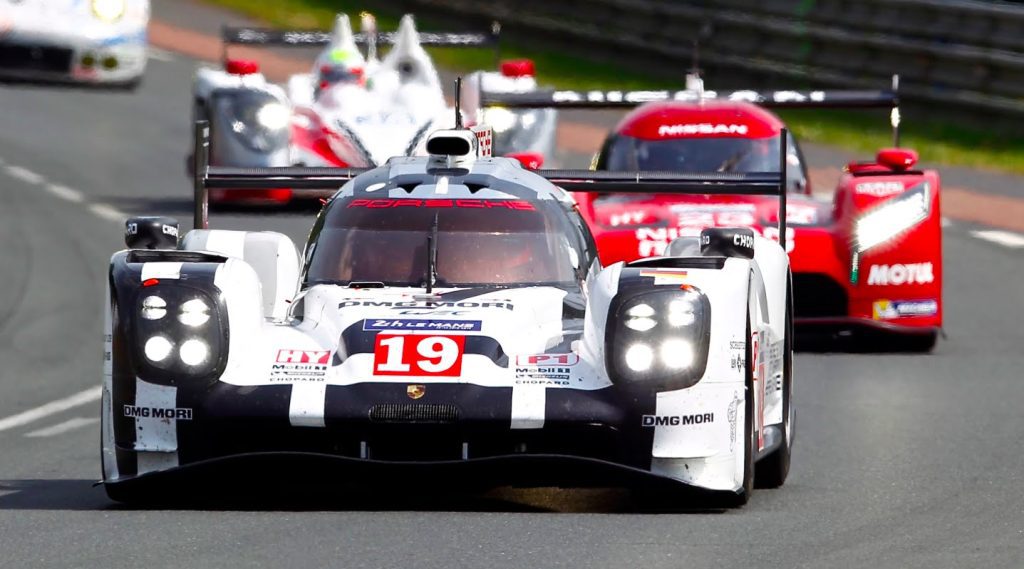

Porsche 919 Hybrid wins lemans

Porsche 919 Hybrid wins lemans

10. Porsche 919 Hybrid

Showed Porsche is still the motorsports top dog
Built: 2014-2017 | Engine: 2L V4 hybrid | Power: 900hp | Top speed: 211mph

Porsche had not tasted overall victory at Le Mans since the Porsche 911 GT1 in 1998 (it stayed on the sidelines and watched Audi dominate). In 2014 Porsche returned to the top-tier LMP1 class with the 919, a 2-liter turbocharged four cylinder with direct injection and two energy recuperation systems and a battery-based hybrid system.

The car made its competitive debut at the 2014 6 Hours of Silverstone, finishing third behind Toyota. At Le Mans that same year a series of unfortunate issues meant Porsche had to go back to the drawing board. Enter the 2015 season and the car was 90% different according to Porsche. The 919 achieved pole positions in Spa and Silverstone before finally picking up a pole at Le Mans and won at the 24 Hours of Le Mans. After Le Mans it won the five remaining races of the season.

Porsche won the 24 Hours of Le Mans that year (2015) and continued to dominated the LMP1 category until retiring the car in 2017. The Porsche LMP1 program won the 2015 FIA World Endurance Championship, won the 2016 Le Mans race and capped off the streak with overall victory in 2017 too.

More: Porsche 919 Hybrid
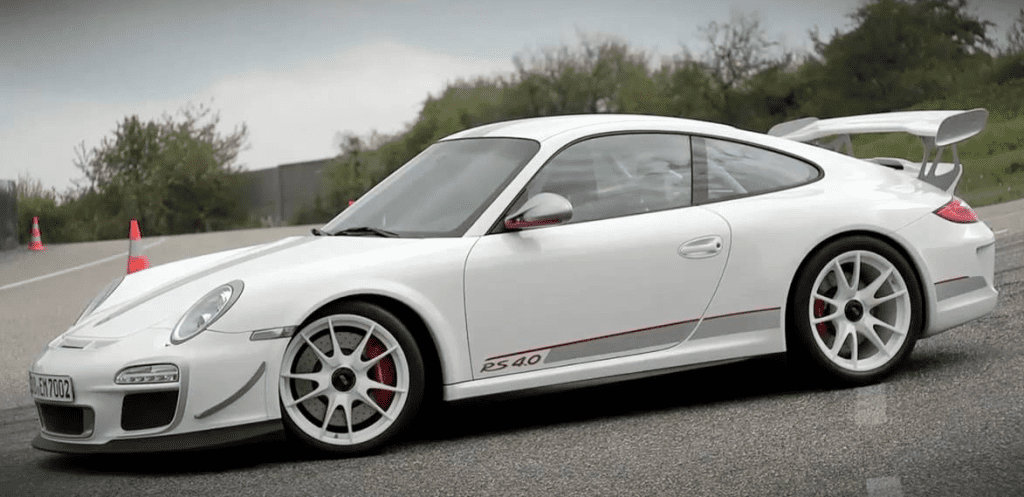

Porsche 911 GT3 RS 4.0

Porsche 911 GT3 RS 4.0

9. Porsche 911 GT3 RS 4.0 (997)

A fitting end to the epic Mezger flat six. A masterpiece car.
Production Years: 2011  Generation: 997.2 Units built: 600
Engine: 4.0L flat-6  | Power: 493 hp | 0 – 60 mph: 3.5 s | Top Speed: 193 mph

The last 997 Porsche and the best by far. Built to homologate the 2011 GT3 RSR racecar, the RS 4.0 is fitted with 4 liter flat six engine which raised power output from roughly 444 to 500 bhp. The GT3 RS is a collectible car already and for good reason. When it was released in 2011 the 997.2 GT3 RS 4.0 was the most powerful and largest displacement naturally aspirated 911 ever made. The flat-six had 493bhp and the same crank as the GT3 R and RSR race cars. The 4.0-liter boxer is good for 125 PS per liter or 500 PS (493 horsepower) in total at 8,250 rpm.

So what is it like to drive? We let the guys at EVO magazine summarize it for us:

Stunning. Perhaps this comes as no surprise considering the starting point, but every aspect of the GT3 RS has been built on. The engine is nothing short of incredible; on the road it impresses with is flexibility and overall smoothness as much as it does with the power at the top end. If you expected a little lumpiness at lower revs, think again; it’s more tractable than the 3.8 and there’s a delicious kick as you head to 8500rpm. In terms of handling it is noticeably sharper in its responses (and it was hardly sluggish before), but the ride remains utterly composed. Track-bred machines are not supposed to be this compliant on a B-road. Oh, and as you might expect it’s devastatingly fast across the ground too.

With a manual transmission and the last car to use the Mezger engine it is probably our top pick on this list of top picks on a personal level and is arguably the best modern 911 ever.

More: Porsche 911 GT3 RS 4.0 (997)
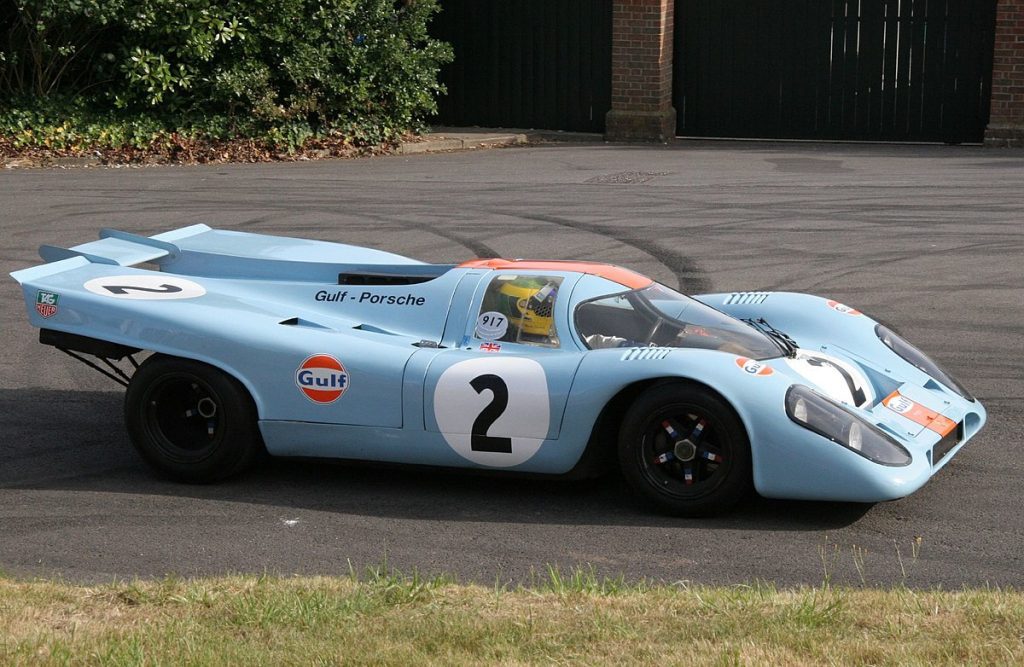

porsche 917

porsche 917

8. Porsche 917

Can Am and Le Mans legend
Built: 1969-1971 | Engine: 4.9L flat 12 | Power: 630hp | Top speed: 246mph

The Porsche 917 is considered one of the most iconic racing cars of all time and gave Porsche their first 24 Hours of Le Mans win. The 917 went on to destroy the competition in the cutthroat Can-Am racing series. It was dangerously quick and also reliable enough to win Porsche’s first overall victory at Le Mans in 1970. The feat was repeated in 1971.

Porsche started their long 917 race program in 1969 with a series of 25 identical cars that were upgraded throughout their career. The first major modification was a stability upgrade that came in 1970 with the 917 Kurzheck or short tail. Simultaneously a long tail ‘Langheck’ model was made for top speed down the Mulsanne Striaght.

After Porsche had won Le Mans twice with the iconic 917 Kurzheck, the engineers at Weissach started experimenting with Can-Am versions. The L&M Porsche+Audi 917/10 of George Follmer and Penske won the 1972 Can-Am Championship ahead of the typically dominant McLaren team. Later, the 917/30 went on to dominate in the 1973 CanAm with the top four places in the final points. This is definitely the most important race car in Porsche’s history.

More: Porsche 9171969 Porsche 917 story


1992 Porsche 911 Carrera RS

1992 Porsche 911 Carrera RS

7. Porsche 964 Carrera RS

The street racer
Year: 1992  Generation: 964  Units built: 22
Engine: 3.6L Air-cooled Flat-6 | Power: 260 bhp | 0 – 60 mph: 4.9 s | Top Speed: 161.6 mph

Introduced in 1989, the 964 was the first major revision to the 911 since it debuted in 1963. In 1992, Porsche brought back the iconic RS moniker for a stripped-out 911 aimed squarely at hardcore enthusiasts. At first, it didn’t come to the U.S., but American 911 fans complained and we ended up with the brilliant RS America.

In hommage to the 1973 911 Carrera RS, Porsche used the same formula to produce a lightweight version of the Carrera 2 from the race-ready Cup car known simply as the Carrera RS. Using the lightweight bits from the Cup car Porsche stripped 175 kg (386 lbs) off the car by use of aluminum doors, hood and trunk as well as a stripped out interior that removed power steering, power windows, rear seats, electronically adjustable front seats and front armrests.

The 3.6 engine got a slight boost in power and came equipped with a lightweight single-mass flywheel that weighed 12 pounds. The revised 260-bhp version of the air-cooled M64 3.6-liter engine also had a limited-slip differential and track-optimized suspension with a 40-mm drop in ride height and a non-power-assisted steering set-up.

The Carrera RS was not sold in the United States because Porsche Cars North America felt the car’s aggressive tuning was not suited to the American market. In 1992, 45 US-legal cars that were very similar to the Carrera RS were imported to the US for a proposed “Porsche Carrera Cup” racing series.

More: 964 Model List, 1992 Porsche 911 Carrera RS
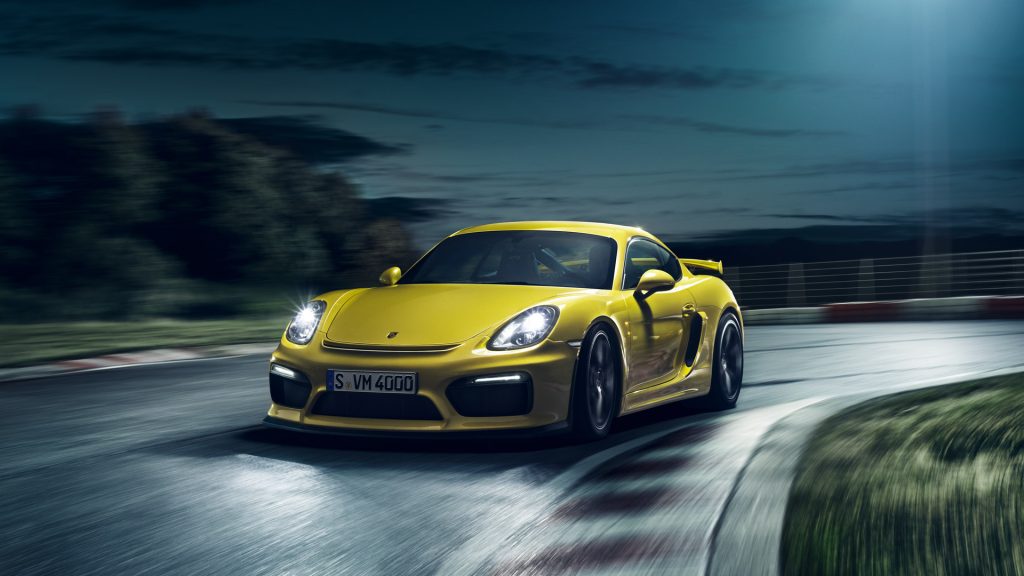

6. Cayman GT4

Perfect car. Period. A future classic.
Built: 2015-2016 | Engine: 3.8L flat six | Power: 380hp | Top speed: 183mph

We should probably just call this the Cayman GT3. With components sourced from the 911 GT3, an engine carried over from a Carrera S and a tweaked and tuned chassis, brakes and aerodynamics, Porsche’s engineers did their best to produce the perfect mid-engine sports car for road and track use. They nailed it. The GT4’s 3.8-litre flat-six engine produces 385 hp (283 kW) and is mated to a six-speed manual gearbox with dynamic gearbox mounts. Compared with the standard Cayman, the GT4’s chassis was lowered by 30mm and bigger brakes were added, with many aspects of its suspension carried over from the 911 GT3. Make no mistake; this is some serious motorsport kit.

The Porsche Cayman GT4 isn’t just a great car, is one of the best cars I have ever driven. I want one. It isn’t the fastest in a straight line and it isn’t the fastest around a track but it feels special and perfect and is more than fast enough. With the right balance of speed, feel and intimacy it has oozes that specialness you expect of a limited edition Porsche Motorsports car like this but at the same time it is approachable and not at all intimidating. You fall for the GT4 the minute you get in and drive a few miles and as the time passes it gets better and better. This is a future icon and my personal favorite Porsche ever.

Our Detailed Review of the Cayman GT4
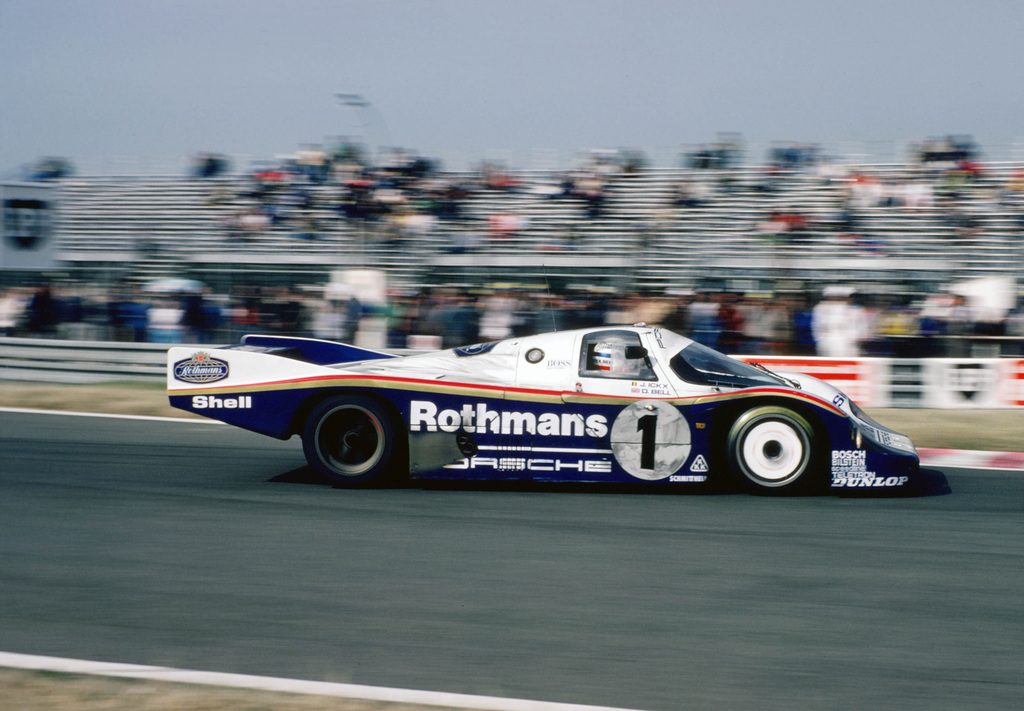

5. Porsche 956

Scary and unbeatable
Built: 1982-1985 | Engine: Turbo 2.6L flat six | Power: 620hp | Top speed: 217mph

The 956 (and 962 that followed) were arguably the most dominant Porsche endurance racing cars ever. Introduced to comply with the FIA World Sportscar Championship’s new Group C regulations in 1982, the 956 was brutally fast and horrifyingly dangerous. The 956 was the first Porsche racing car with a monocoque chassis and the so-called ground effect.

The 1982 at Le Mans the Type 956 took the top three places. Porsche turned the 956 into a customer prototype that would rule motorsport for a decade. Victories in every race of the World Endurance Championship as well as the win in the Manufacturers’ World Championship in 1983, 1984, and 1985 underscore the dominance of the 956. Add the 962 to the mix and between 1982 and 1987, the Porsche 956 and 962 won Le Mans six times.

The secret to the race car’s success lay in this perfect interaction of the aluminum monocoque, the efficient turbo engine, and revolutionary aerodynamics, which put the 956 in a class of its own. On a related note: the 956 saw the first appearance of the Porsche Doppelkupplung (PDK).

More: Porsche 962, Porsche 956
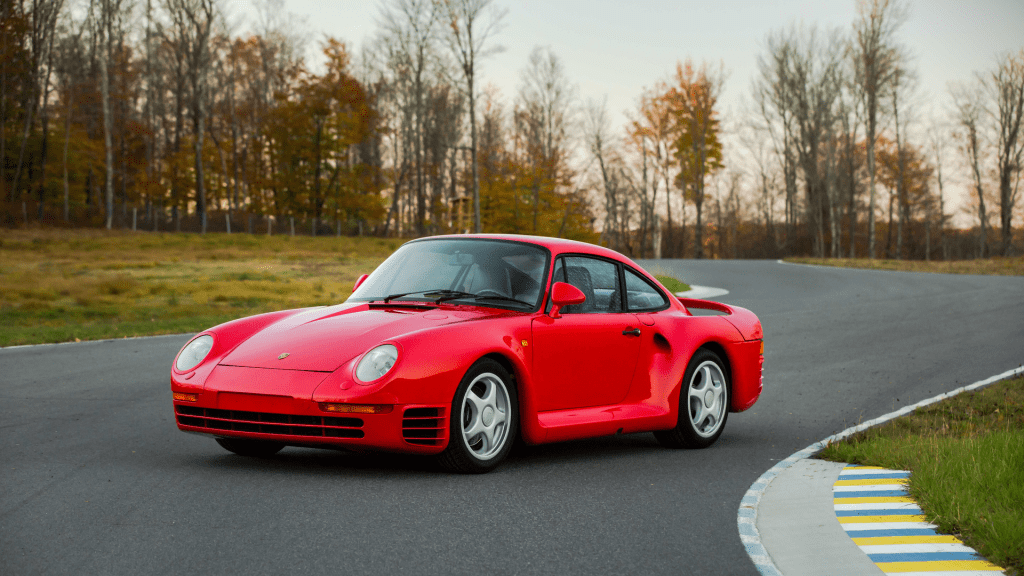
4. Porsche 959

So far ahead of its time that we still see modern cars with less tech today
Built: 1986–1988, 1992–1993 | Engine: 2.8L Turbo flat six | Power: 444hp | Top speed: 195mph

This was officially Porsche’s first supercar and was developed and manufactured by Porsche from 1986. The car was initially developed to function solely as a B rally car. Later, to meet FIA homologation regulations, Porsche developed a commercial production variant of the car. When it was introduced in 1986, the Porsche 959 was immediately the world’s fastest production car. It was a tech masterpiece. Equipped with all-wheel drive, ABS, TPMS, and a six-speed transmission, it was way ahead of its time, and remains one of the most desirable Porsches ever made. It had magnesium wheels with run-flat tires, and its 444-hp flat-six engine had sequential turbocharging. The 3,500 lb 959 got from 0 to 60 in ‎3.6 sec (faster than most of today’s Porsche 911s) and onto a top speed of 195 mph (in 1986). In total, 337 cars were built, including 37 prototypes and pre-production models.

More about the Porsche 959.
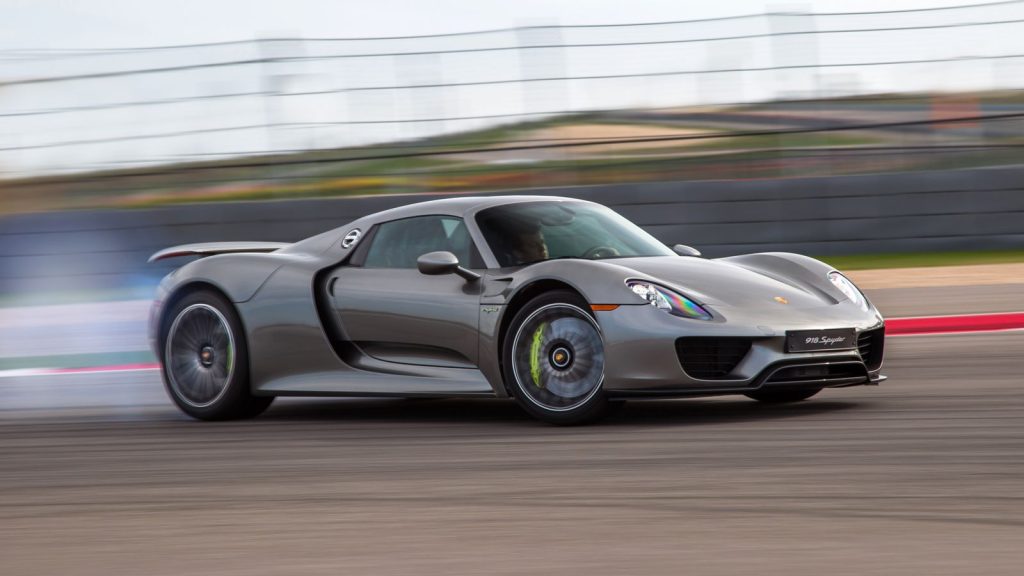

3. Porsche 918 Spyder

A technology masterpiece that points to a bright future for sports car fans
Built: 2013-2015 | Engine: 4.6L V8 hybrid | Power: 875hp | Top speed: 211mph

Simply stated, the Porsche 918 Spyder was a mid-engined, plug-in hybrid supercar. The Spyder was powered by a naturally-aspirated 4.6-liter V8 engine that was capable of producing 608 horsepower (453 kW). Paired with this engine are two electric motors that deliver an additional 279 horsepower each, for a cumulative combined total of 887 horsepower (661 kW.)

Production on the Porsche 918 began on September 18, 2013, with the brand’s first deliveries scheduled to begin in December 2013. Each car had a starting price of $845,000 (U.S.), yet the Spyder sold out quickly in December, 2014. Production of the brand ended entirely in June, 2015. In an independent series of speed tests performed by Car and Driver Magazine, the Porsche 918, achieved a 0-62 mph (0-100 km/h) of just 2.6 seconds, a 0-100 mph (0-161 km/h) time of 4.9 seconds and a 0-180 mph (0-290 km/h) time of just 17.5 seconds. It is one of the fastest accelerating cars on the planet and its top speed is up there too with the fastest cars in the world.

More: Porsche 918 Information | Porsche 918 History & Timeline. More: Full Porsche 918 Gallery
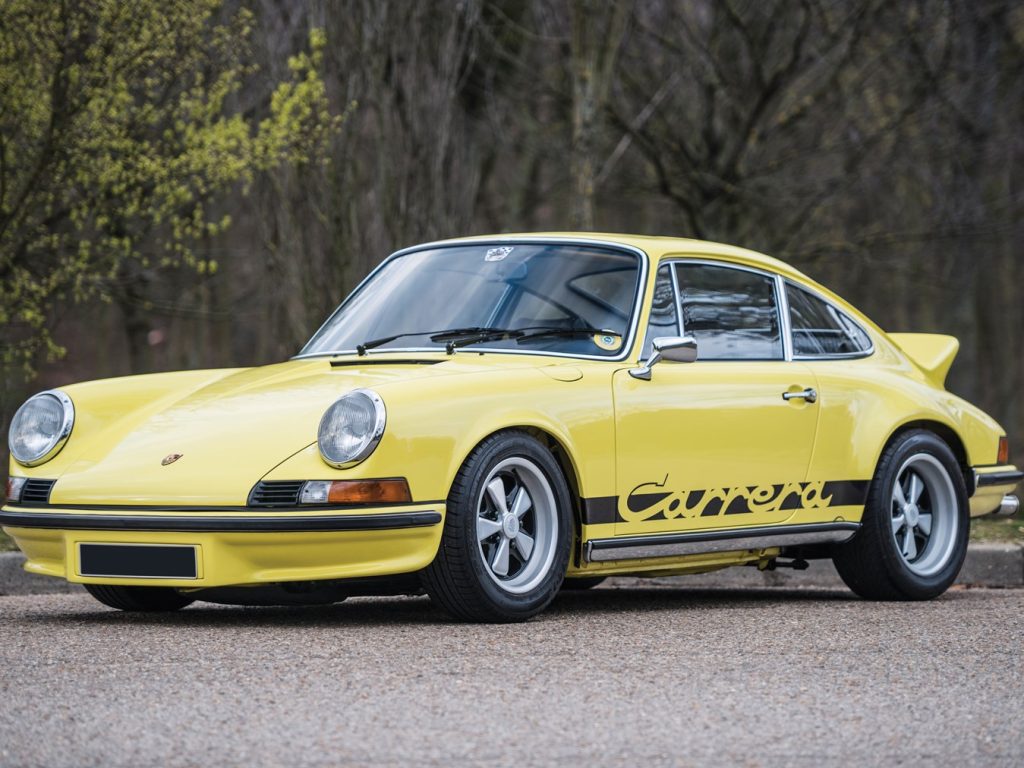

1973 911 Carrera RS 2.7

1973 911 Carrera RS 2.7

2. 911 Carrera RS 2.7

One of Porsche’s Greatest Hits
Year: 1973  Generation: Carrera RS  Units built: 1580 (200 Lightweight, 1300 Touring, 80 Race)
Engine: Flat-6  | Power: 210 bhp | 0 – 60 mph: 5.8s | Top Speed: 150 mph

This is one of the most desirable 911s ever and auction prices will scare the bejesus out of you. The Carrera RS 2.7 was lighter, more powerful, and rarer than other 911s of the era. The Carrera 2.7 RS was a special model used to homologate the 911 in Group 4 racing. Developed from the 911S, the 2.7 was more potent in almost every area. Compared to the standard Carrera, the 2.7 RS featured a larger engine, wider flares to accommodate the Fuchs alloy wheels, stiffened suspension, larger brakes and a ducktail rear spoiler.

With the use of a Nikasil coating on the cylinder walls, the 2.4 unit could be bored out to a capacity of 2687 cc, but the standard valve train was retained. At the time, this became the largest engine available on a Porsche and was good for 210bhp at 6300 rpm. And with a taller 4th and 5th gear, the top speed was increased to 152 mph.

Initial production for the 2.7 was only 500 cars and it sold out almost immediately. Three versions were available, including a lightweight Sports trim, Race Trim or more opulent Touring trim for the road. The lightweight version was substantially lighter with thin-gauge body panels, lighter windows and a stripped out interior.

More: 1973 911 Carrera RS 2.7 Touring, 1973 911 Carrera RS 2.7 Lightweight
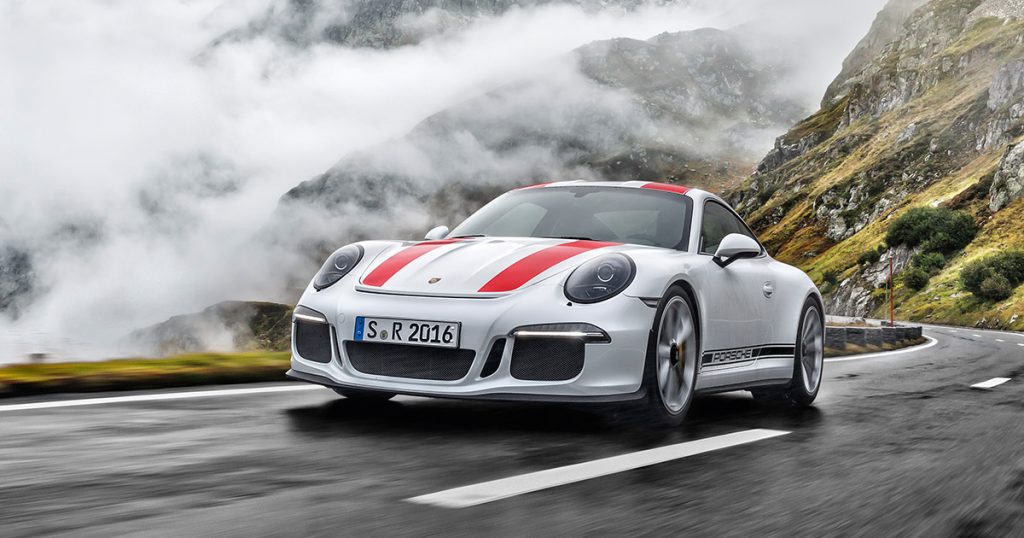

Porsche 911 R

Porsche 911 R

1. Porsche 911 R (991.1)

911 Perfection
Production Years: 2016  Generation: 991.1  Units built: 991
Engine: 4.0-liter flat-six  | Power: 500 bhp | 0 – 60 mph: 3.7 s | Top Speed: 200 mph

Our perfect 911 (if we could afford the $400k+ used prices they fetch for these days).  Think of this as a manual GT3 RS and you’re pretty close. The limited edition (991 units were made) is the perfect Porsche on paper with its 500 hp 4.0-liter naturally aspirated flat-six engine, 6-speed GT sport manual transmission, exotic lightweight materials and lots of cool Porsche motorsports tech thrown in.

This isn’t the fastest 911. It is designed to be a sports car, something you can enjoy driving even if you’re not wringing it’s neck out or trying to break lap records. It is refreshing. As much as the current GT3 and GT3 RS are epic cars, they’re not much fun or approachable on real roads. The Porsche 911 R is much more than that. It is the kind of car you take when you want to hit some mountain passes or some back roads to let off some steam. It is perfect.

More: Porsche 911 R (991

Happy 70th, Porsche. Here’s a New Concept Car!

Over the weekend, Porsche all around the world celebrated their 70th anniversary, when Ferdinand Porsche produced the 1948 Porsche 356. To honor this milestone, Porsche debuted a new concept car called the 911 Speedster Concept. 

Essentially an open-top 911 GT3, it has a very spartan interior with carbon fiber seats, no creature comfort, and many miles of the sky on top of you. Powering this beast is the same 4 liter flat six engine with 493hp, a manual slushbox and everything you expect from a GT3. Classic details include the Fuchs-style wheels, tape-designed headlamps which rally racers did back then to prevent breakage, bullet mirrors, hood-mounted fuel filter, and the tan interior.

No announcement on release just yet, but cross fingers it’s very soon.

Cylinders
Displacement
Power (hp)
Max RPM
Max torque
6
4.0L
500
8,250rpm
460 Nm

Porsche 919 Evo to Set Sub 6 Minute Nurburgring Time?

The Porsche 919 Evo has been spotted lapping the Nurburgring recently. Given its domination of Spa earlier this year, rumours are suggesting that the Nurburgring lap time could tumble too!

The overall, fastest time recorded on the famous Nordschleife is a stunning 6:25.91, set in 1983 in the iconic Porsche 956. That record has stood for 35 years, mainly due to the fact that high level racing events no longer take place on the infamous circuit. Those that do, use a different setup, incorporating the GP track.

Rumours are suggesting that Porsche have smashed the lap record on their test run! The rumours suggest that they dipped below the 6 minute mark for the first time in history. Some are even suggesting that the lap time set by the German company was as low as 5 minutes 30 seconds.

As the 919 no longer races in WEC, Porsche were free to redevelop parts without having to conform to any regulation. The 919 Evo is a lap record setting machine!

Earlier this year, Porsche set its first lap record with the 919 Evo at Spa Francorchamps. It stopped the watch at 1:41.770, eclipsing the 1:42.553 lap record set by Lewis Hamilton during the 2017 Spa Grand Prix in the Mercedes-AMG F1 W07.

It remains to be seen what the official time will be. Hopefully Porsche will announce something soon. For now, marvel in these insane video clips caught by spectators track-side!

Comprehensive Guide To The 2018 Porsche 911 GT2 RS

2018 911 GT2 RS

Introduction

An introduction to a car that really needs no introduction. Cliché perhaps, but what needs to be said about the fastest production car to lap the Nürburgring Nordschleife?

Quite a lot, actually.

The rear-engine, rear-wheel drive GT2 RS celebrated its official world premiere at the Goodwood Festival of Speed in the UK which took place from June 30th to July 2nd, 2017. It was here that the world was first introduced to Porsche’s fastest and most powerful street-legal 911 ever made.

A few months later, the same car would go on to smash the lap record at the what has become the de facto manufacturers’ testing grounds – a place where those who reigned supreme earned bragging rights in the industry.

With a Nurburgring time of 6 minutes 47.3 seconds, it completed the ‘ring 5 seconds faster than the Lamborghini Huracán Performante and 10 seconds faster than Porsche’s own million dollar 918 Spyder.

View the official onboard-footage of the lap here

Suffice to say, the 911 GT2 RS now sits on the throne – equipped with its 3.8L flat-six twin-turbocharged 700 horsepower engine – with an unquestionable legitimacy to its claim.

It didn’t get to the top with brute force alone – the GT2 RS is built to be as dexterous as it is powerful. Extensive work was done on the chassis to ensure that the agility and precision of the car were not overwhelmed by its own muscle, but rather, complemented by it.

The Porsche 911 GT2 RS represents everything that is the best about the 911 – a righteous Ruler, indeed.

Engine & Performance

The GT2 RS in its entirety is more closely based on a Turbo S than it is to its closest GT relative, the 911 GT3 RS. Afterall, at the heart of the GT2 is a revamped version of the Turbo S engine, while the GT3 has its own unique naturally aspirated 4.0L power plant.

The 3.8L flat-six was fitted with larger variable-geometry turbos and was given an increase in peak boost to 22.5 psi, which is 24% higher than the Turbo S. Larger intercoolers, a water-spray system, larger exhaust manifold primaries and redesigned pistons work in synergy with the aforementioned to provide the GT2 RS with 700 horsepower @ 7,000 rpm and 553 lb-ft of torque. Porsche has long buried the traditional notion of “turbo-lag” in its cars with VarioCam Plus and the GT2 RS is no different, making peak torque from 2,250 rpm to 4,000 rpm.

To accommodate what is a 120 horsepower increase over the Turbo S, the 7-speed PDK transmission was also beefed up. Porsche does not offer a manual transmission option for the GT2 RS, which is sensible given that the dual clutch transmission is the best (and therefore, only) choice for delivering power to the rear wheels for this application.

The resulting figures are impressive, to put it mildly; Porsche states that the GT2 RS is able to sprint from 0-60 mph in 2.8 seconds, 0-100 mph in 5.8 seconds, 0-124 mph in 8.3 seconds and has a top speed of 211 mph. Independent tests have shown that Porsche has understated these figures.

Chassis & Handling

Improvements to the chassis are certainly no less impressive than those made to the engine. Virtually no part of the GT2 RS has been overlooked with regards to delivering the driver to the limits of dynamic driving performance.

The front axle utilizes a MacPherson strut suspension with helper springs and wheels independently suspended on the trailing arms and wishbones. A multi-link axle with helper springs and subframe setup is used for the rear.

Ride height, camber, wheel track and stabilizers can be adjusted individually by the driver – very useful features for specifically setting the car up for track use. For the first time in a street legal Porsche vehicle, all chassis joints have been replaced by ball joints which improve rigidity and feedback from the chassis. Porsche states that this ensures “accurate, sharp and direct road holding. And for total emotional contact”.

Porsche engineers weren’t void of all sense of practicality on the street either. An optional lift system on the front axle lifts the front bumper by 1.2” and is functional while moving until approximately 37 mph – allowing you to avoid scraping the front bumper over the pesky curbs, ramps or entrances that inundate daily driving.

The standard Porsche Carbon Ceramic Brakes and rotors provide the stopping power and precision worthy of car’s overall performance. Unfaltering in their duty, they slow the car down with great aplomb and without any hint of brake fade – pedal feedback remains consistent even after repeated moments of substantial braking Gs. Dunlop Sport Maxx Race tires (265/35/20 at the front, 325/30/21 at the rear) translate it all onto the tarmac.

Design, Styling & Interior

Based on the extra-wide body of the 911 Turbo S, the GT2 RS design is one which is race-optimized. Minimum drag, maximum downforce, optimum cooling – all in great abundance and meticulous in detail.

The aerodynamic front bumper ensures optimum cooling and airflow into the radiator while providing massive downforce on the front axle with the attached wide spoiler lip. Large vents placed over the front fender wheel arches assist in ventilating pressure from the rotating wheels. Two ducts on the bonnet, referred to as NACA air intakes, are used to help cool the braking system without reducing the drag coefficient.

At the rear of the car are the very distinguishable side air intakes; located near the rear wheel arches, they provide intercooling and feed extra air into the twin-turbocharged engine. The most notable feature of the car in plain sight would be the fixed carbon rear wing, which enhances much needed aerodynamic downforce over the rear wheels while highlighting the ultra-high performance orientation of this machine.

Weight is also shaved over the Turbo S through a multitude of upgrades. The absence of the front axle on its own removes over 110 lbs. Naturally, carbon fiber adorns both the exterior and interior – the bonnet, rear bumper, intakes, intercooler, bucket seats, and even paddle shifters, being amongst the many parts not overlooked for the carbon diet.

The standard GT2 RS is 3,241 lbs – a noticeable 286 lbs lighter than the Turbo S. Optional deletion of the air-conditioning and infotainment system will save another 41.9 lbs while the optional Weissach package – which includes magnesium wheels, a titanium roll bar (Europe only) and carbon fibre anti-roll bars – will shed another 60 lbs on top of that.

Pricing

The GT2 RS is the pinnacle of the 911 in performance, and also in price.

Base price of the GT2 RS is $294,250 USD with the optional Weissach package bringing the total to $325,250 when included.

This means that pricing is comparable to the Lamborghini Huracan Performante – which it trumped for first place at the ‘ring – and less than one-third the price of the discontinued Porsche 918 Spyder which it outdid by 10 seconds at the same venue.

At the least, this makes the GT2 RS very appropriately priced – if not a bargain – considering everything the car has to offer and when compared to its competition.

Performance & Specifications Summary

Model & Price Info

Make Porsche
Model 911
Generation 991 (2012-Present)
Sub-Model GT2 RS
Car type Coupe
Category Series Production Car
Built At Stuttgart, Germany
Released At Goodwood Festival of Speed, UK
Introduced 2017
Base Price (US) $294,250
Base Price (UK) £207,506
Units built TBD

Body, Suspension & Powertrain

Curb Weight 1,470 kg (3,241 lbs)
Layout Rear-engine, rear-wheel drive
Body / Frame Aluminum-steel composite monocoque, carbon fiber elements
Suspension (F) MacPherson strut suspension with helper springs
Suspension (R) Multi-link axle with helper springs and subframe
Engine Flat-6
Position Boxer, 90°
Aspiration Twin-turbocharged, intercooled
Block Material Aluminum block and heads
Valvetrain DOHC, 24-Valve (4 Valves per Cylinder) with VVT & VarioCam Plus
Fuel Feed Direct Fuel Injection
Displacement (Litres) 3.8L
Displacement (in³) 232 in³, 3800 cc
Transmission 7-speed DCT with automatic and manual shifting mode (PDK)

Engine & Output

Power (hp) 700 hp @ 7,000 rpm
Power (hp) / litre 184.2 hp / litre
Power (hp) / weight 0.48 hp / kg
Torque 553 lb-ft @ 2,250-4000 rpm
Efficiency 59 hp per l/100 km
Average Fuel Consumption 11.8 l/100 km (combined)

Performance & Acceleration Stats

Top speed 340 km/h
0 – 40 km/h 1.1 s
0 – 50 km/h 1.2 s
0 – 100 km/h 2.8 s
0 – 150 km/h 5.2 s
0 – 160 km/h 5.5 s
0 – 200 km/h 8.1 s
0 – 250 km/h 13.0 s
0 – 300 km/h 22.1 s
0 – 60 mph 2.7 s
0 – 100 mph 5.8 s
1/8 mile (est.) 6.9 s @ 111.2 mph
1/4 mile 10.3 s @ 139.2 mph
1/2 mile (est.) 16.4 s @ 164.0 mph
1000 m 18.7 s @ 281.2 km/h
100 – 200 km/h 5.5 s
200 – 300 km/h 13.8 s
100 – 0 km/h 29 m (96 ft)
200 – 0 km/h 115 m (376 ft)
300 – 0 km/h 243 m (796 ft)
18 m slalom 76.5 km/h
Nürburgring Lap Time 6:47.30 (Driver: Lars Kern)

Image Gallery

Aggressive queues are found throughout every part of the body, always taking aerodynamics and cooling into consideration. Whether it be the large rear spoiler, front fender vents, or antagonistic front bumper, the GT RS looks outstanding, but not awkward.

In my opinion, the GT2 RS is as beautiful as it is functional – a perfect blend of form and professionalism, it performs its duties in the utmost style. A car that goes this fast, needs to look the part.

Video Review Gallery

Here are some YouTube video reviews from some of my favorite car reviewers and auto personalities. All of them provide feedback from an “everyday guy” perspective – but aren’t afraid to thrash the car around a racetrack when given the opportunity – providing commentary that is both technical and easy to absorb.

First up is Matt Prior from Autocar, doing his commentating-while-driving-sketch in a Weissach package equipped GT2 RS. He goes into detail about how “absolutely bang-on” the car is while referring to the RS series’ evolution from a “widow maker” to a refined road carving machine.

[embedded content]

Next, is CAR Magazine UK’s Chris Chilton providing his point of view on what he describes as one of “the best driver’s cars in the world”.

[embedded content]

What two-time World Rally champion Walter Rohrl has to say, carries a lot of weight. Watch as CarBuzz and Mr. Rohrl show us what the GT2 RS can do on the track at Algarve International Circuit in Portugal.

[embedded content]

Last but not least, is Porsche’s official onboard footage of that record-setting lap by Lars Kern at the Nürburgring Nordschleife. It even provides some telemetry. Very neat. Very fast. Very g-force.

[embedded content]

Original Press Release

Porsche Unveils The Most Powerful 911 Of All Time, June 30th 2017

The fastest and most powerful road-approved 911 is ready for launch: The new Porsche 911 GT2 RS will celebrate its world premiere at the Goodwood Festival of Speed in the UK (June 30 to July 2).

At the heart of this high-performance sports car is a 515-kW (700-hp; combined fuel consumption: 11.8 l/100 km; urban: 18.1 l/100 km; extra-urban: 8.2 l/100 km; CO2 emissions: 269 g/km) biturbo flat engine. Weighing in at 1,470 kg with a full fuel tank, the lightweight two-seater accelerates from zero to 100 km/h in 2.8 seconds.

The rear-wheel drive Coupé has a top speed of 340 km/h, and with its near-motorsport drive technology, the new 911 GT2 RS trumps its 3.6-litre predecessor by 59 kW (80 hp) and achieves a torque of 750 Newton meters (an increase of 50 Nm).

The engine builds on that in the 911 Turbo S at 427 kW (580 hp; combined fuel consumption: 9.1 l/100 km; urban: 11.8 l/100 km; extra-urban: 7.5 l/100 km; CO2 emissions: 212 g/km). In order to increase performance, large turbochargers push an increased volume of process air into the combustion chambers.

A new additional cooling system delivers optimum cooling at peak loads and, at very high temperatures, sprays the charge-air cooler with water. This causes the gas temperature to fall in the overpressure range and ensures optimum power output, even under extreme conditions.

The customized GT seven-speed double-clutch transmission (PDK) in the new GT2 RS enables power to be transferred with uninterrupted traction. What’s more, the specially developed exhaust system is made from extra-lightweight titanium, weighs around seven kilograms less than the system used in the 911 Turbo and delivers an emotional sound without precedent.

The 911 GT2 RS

For the first time ever, Porsche Design is celebrating the debut of the high-performance sports car by releasing a special-issue watch. Offering a nod to the world of motorsport, the 911 GT2 RS watch is exclusively available to owners of the new vehicle and can only be ordered in conjunction with the new GT model at a Porsche Centre from June 30, 2017.

Racing Chassis For Outstanding Dynamic Cornering

Discipline in sport means mastering every detail. And in the world of super sports cars, cornering speeds are on another level. The 911 GT2 RS reaches these speeds thanks to its flawless racing chassis with rear-axle steering and Ultra High Performance (UHP) tires.

Like all GT sports cars, the new top model features a specially calibrated PSM with a Sport mode that is tailored to provide optimal driving dynamics. Powerful air intakes and outlets and the imposing rear wing emphasize that the vehicle’s aerodynamics have mastered both form and design. The large, wide wheels (265/35 ZR 20 at the front and 325/30 ZR 21 at the rear) ensure outstanding braking and cornering forces. The 911 GT2 RS features Porsche Ceramic Composite Brakes (PCCB) as standard.

The front wings, wheel housing vents, outer shells on the Sport Design exterior mirrors, air intakes on the rear side sections and parts of the rear end are made from carbon-fiber reinforced plastic (CFR), as are many of the interior components. The bonnet is also made from carbon to make the vehicle as lightweight as possible, while the standard trim roof is made from magnesium. Both body parts have a wide lateral swage line.

Optional Weissach Package With 30-kg Weight Saving

Performance can always be cranked up a notch – even on the 911 GT2 RS. That’s why the Porsche engineers have developed the optional Weissach package, which provides a weight saving of around 30 kilograms. The package includes additional elements made from carbon-fiber reinforced plastic and titanium.

For instance, the roof and the anti-roll bars are made of carbon, and so are the coupling rods on both axles. Magnesium wheels reduce both the gross weight and the unsprung weight, providing a greater wealth of impressive chassis properties. The luggage compartment lid and the carbon- weave finish roof are emblazoned with a central strip in the same color as the car for a visually distinctive look.

A Truly Sporty Interior

The passenger compartment of the 911 GT2 RS is dominated by red Alcantara, black leather and interior parts with a carbon-weave finish as standard. The GT2 RS sports steering wheel with gearshift paddles enables quick and sporty gear changes. Drivers and passengers experience the driving dynamics of the high-performance sports car in full bucket seats with a carbon-weave finish.

As in every 911, the Porsche Communication Management (PCM) is the central control unit for audio, navigation, and communication. The Connect Plus module and Porsche Track Precision app are also included as standard, enabling detailed recording, display, and analysis of driving data on a smartphone.

Interior Of The 911 GT2 RS

The optional Chrono Package expands the PCM functions to include performance display, which can be used to display, save and evaluate track times. The package also includes a stopwatch on the switch panel with both analog and digital display.

What’s more, the Chrono Package on the 911 GT2 RS comes with a lap trigger. Using the Porsche Track Precision app in conjunction with external markers on a start/finish straight, this lap trigger enables drivers to record lap times with a high level of precision.

Exclusive Watch To Accompany The Car: Porsche Design 911 GT2 RS Chronograph

Porsche Design has teamed up with Porsche Motorsport to develop the 911 GT2 RS Chronograph for customers of the new super sports car. It is reserved exclusively for 911 GT2 RS drivers. At its heart is the first clock movement developed by Porsche Design, the product of three years’ work.

The caliber 01.200 includes a flyback function, a load-path-optimized movement bridge and an official COSC certificate of authenticity. The timepiece housing is made of lightweight titanium. The flyback function is inspired by motorsport and represents a special feature of the Porsche watch.

On a traditional chronograph, the buttons must be pressed three times in order to measure consecutive time intervals: The first press stops the chronograph, the second resets it and the third restarts the measuring process. On chronographs with a flyback function, these processes happen automatically and in rapid succession. The stop function and the ongoing time display are clearly separated using yellow markings.

Many of the details on the timepiece are based on the high-performance sports car. The tungsten winding rotor is modeled on the rims of the 911 GT2 RS. The clock face is made of carbon, while the design of the time display matches the instrument cluster and the tachometer. The 911 GT2 RS and its watch counterpart are exclusively available at Porsche Centres worldwide. The vehicle and watch are produced individually in line with customer wishes and delivered together.

Fuel Consumption

911 GT2 RS

  • combined fuel consumption: 11.8 l/100 km
  • urban: 18.1 l/100 km
  • extra-urban: 8.2 l/100 km
  • CO2 emissions: 269 g/km

911 Turbo S

  • combined fuel consumption: 9.1 l/100 km
  • urban: 11.8 l/100 km
  • extra-urban: 7.5 l/100 km
  • CO2 emissions: 212 g/km

911 Turbo

  • Fuel consumption combined 9.1 l/100 km
  • CO2 emissions 212 g/km

Final Verdict

As my fellow Supercars.net colleague, Nick Dellis once remarked, “The world is full of armchair commentators when it comes to cars. At Supercars.net we have a number of journalists and automotive publications we rely on when we want to get unbiased opinions from people we admire.”

Below are snippets from some of our favorite car reviewers and automotive personalities regarding the GT2 RS. As always, we ask that you support the amazing publications they release, so that the automotive community continues to benefit from the hard work and enthusiasm they put into providing us with content that we love.

Autocar – “Is it ‘the one’? I’m not sure.” – 4.5/5

Matt Prior from Autocar had nothing but praise for the GT2 RS’s capabilities, so the above quote deserves a bit of context; that was his response when considering whether the GT2 RS is worthy of the “ultimate 911” accolade.

Matt feels that you get “more responsiveness again out of the lighter, revvier GT3 on track. And you’d get a suppleness and sufficient involvement from a GT3, or even a GTS, on the road that makes the GT2 RS a car for certain conditions”.

He goes on to summarize that “It is not, to my mind, the 911 defined as the perfect sports car. It’s a car for ridiculous circumstances. And, in those, there’s still nothing else quite like it.”

The Good

  • Perfectly weighted steering and feedback
  • Balanced handling
  • Phenomenal engine response and linearity

The Bad

  • Loud cabin noise, unrefined interior
  • Less ‘supple’ than some competition
  • Other 911s can provide a more involved driver-feel

More: Read full review

Top Gear – “A Gt2 Rs You Don’t Have To Be Scared Of” – 9/10

Ollie Marriage from Top Gear notes that the GT2 RS is a remarkably quick car that has honed (but not tamed) the GT2’s “historic wildness”.

Ollie says, “The result is a sensationally fast car, one that’s also far sharper, more drivable and controllable than it has any right to be. It doesn’t feel electronically managed either, not for a second, but wonderfully mechanical.”

Ultimately he is also in the school of thought that the GT3 is the more quintessential Porsche 911 – “For me, the toughest rival comes from within – the GT3 RS. Given a straight choice, I think I’d still go for the nat asp GT3, although that would mean foregoing the mad turbo headbang…”

The Good

  • Dextrous chassis
  • Brakes’ stopping-power
  • Engine’s precise power delivery

The Bad

  • GT3 is its main rival
  • Not ‘exotic-feeling’ enough for its price
  • Weissach package is ‘distracting’

More: Read full review

Car And Driver – “At Home On A Track” – 5/5

Mike Duff from Car and Driver states that while the GT2 RS is “quite effective” on the road, it truly excels on a race track. In his opinion, the lack of refinement can make the car overbearing for daily driving, making it a niche car.

“While most modern 911s have become quiet and relaxed, the GT2 RS shortcuts straight back to the origin of the species. The engine fills the cabin with a heavy exhaust note at idle, the rear-mounted flat-six throwing up bass-heavy harmonics under even gentle progress as the ball-jointed suspension can be heard and felt working. There are rattles and vibrations that would never be allowed in a lesser 911.”

Like his contemporaries, he concedes that the GT3 is the more well-rounded and appealing-to-the-masses car. However, he feels the GT2 RS has more than delivered on its mantra, remarking that “If you want the fastest and the most viscerally thrilling version then this is undoubtedly it, the ultimate incarnation of a roadgoing 911 to date.”

The Good

  • Fastest factory-built 911 ever
  • Visceral character
  • Driver friendly

The Bad

  • Rawness precludes daily use
  • Sparse equipment

More: Read full review

My Final Verdict – 10/10

There is no doubt that the new GT2 RS is the pinnacle of the 911 in terms of performance. It is simply the fastest 911 in history, and that’s a fact.

So then, why do opinions matter for something that is so objective? It is not that we are disputing science; however, when it comes to the pure enjoyment of driving and enthusiasm for automobiles, we can only rely on the numbers so much.

I am very blessed to have driven and owned a variety of cars that have helped me mold what I hope, has become a well-versed and pragmatic love for cars. So, I understand that what it all boils down to, is perspective.

I completely get the notion that naturally aspirated variants of high-performance cars often feel more “involving” or have more “character”, but the GT2 RS should be considered in a league of its own – because it is.

It is the quickest production car to lap the Nürburgring Nordschleife. It is the most powerful 911 ever made. It has ridiculous aerodynamics. It is the apex of Porsche performance. There’s nothing else like it.

In my opinion, you should purchase or appreciate the 911 GT2 RS for what it objectively is – not what it subjectively is not. From that perspective, the GT2 RS can’t be anything but the best.

Rivals

Porsche 718 Cayman GT4 to Use 4.0 Flat 6 from GT3 – Latest Spy Shots

Spy shots have been released showing Porsche engineers testing the hotly anticipated Porsche 718 Cayman GT4. The hotly anticipated ‘hardcore’ Cayman model follows on the heels of the previous generation Cayman GT4 which is still a highly sought-after model, even at three years of age!

The photos show the car testing on the Nurburgring. What makes us think this is the GT4? For starters, the aerodynamic profile screams GT4. The mule carries an adjustable rear spoiler, a heavily camouflaged rear diffuser and a new set of larger exhausts.

With the success of the 911 R, 911 T and facelifted RS models, it’s safe to say that Porsche are on a winning streak at the moment. The formula for the GT4, if rumours are to be believed, suggests the Cayman GT4 will extend that success.

Sources are suggesting that the Porsche 718 Cayman GT4 will use the 4.0 litre Flat 6 engine from the latest GT3 in place of the controversial 2.5 litre 4 cylinder model customers can currently order. Don’t expect a GT3 wedged into a Cayman body though, the GT4 will be detuned, yet it remains to be seen if Porsche will give customers the choice of a manual and automatic gearbox. History suggests that the GT4 will remain manual only.

The Porsche 718 Cayman GT4 is set to debut towards the end of the year with first deliveries taking place next year. As with most Porsche performance models, it is likely to be oversubscribed. It might just be worthwhile contacting your Porsche dealer now if you are interested!

2019 Porsche Cayenne E-Hybrid Review

Anything that has a ‘permanently excited motor’ and inspired by the 918 Spyder must be good, or is it?!

The brief for the Special Vehicle Division at Porsche was to make the new Cayenne E-Hybrid performance focused with an increased electric range and they have certainly been working hard with new tech and more options.

Improvements in this new model include an extra 5 kW, (7 hp) from the 3.0 litre turbocharged V6 petrol engine taking it to 250 kW (340 hp). The 918 Spyder inspired electric motor now produces 8 km of extra range with 100 kW (136 hp) in electric only mode. It gets interesting when we see the effects of combining these forces together with a total of 700nm torque and a power output of 340 kW (462 hp) which is 34 kW (46 hp) more than the previous model. Accelerate hard and the effects of the hybrid drivetrain are immediate, this new luxury SUV feels every bit a Porsche. Engage Sport Plus to lower suspension, recharge boost faster, (more about that later), activate the sports exhaust, hold the gears for longer and it all tightens up to deliver a 0-100 km/h time in 5.0 secs or 0-60mph in 4.7secs with a maximum speed of 253km/h,157mph. Add rear-wheel steering and you have a Cayenne that can corner faster than most 2 seater sports cars and inspire great confidence.

The 918 Spyder has influenced a number of performance enhancements with the biggest being the Electric motor. 30% extra battery capacity goes from 10.8 kilowatt hours to 14.1 kilowatt hours and increases range and boost reserves to enhance the overall performance. Driving on all electric mode the new Cayenne E-Hybrid will cover up to 44km (27 miles) and reach a maximum speed of 135km/h.

Porsche’s sport chrono comes as standard to enforce the performance characteristics although the stand-out feature is something that is normally reserved for supercars and now comes as standard in this luxury SUV. Manufacturers like Ferrari and Lamborghini call it a ‘Manettino’ or ‘Anima’ but Porsche call it… the ‘Control System Toggle Switch’. Although it doesn’t have a unique in this case, it does what it says on the tin as it’s located on the steering wheel and enables the driver to toggle between Electric, E-Hybrid, Sport and Sport Plus drive modes. I found myself using this switch a lot to enjoy the full breadth of everything this car could offer. If playing with a toggle switch doesn’t appeal then use the standard Porsche Innodrive system – simply input your destination in the Sat Nav and it will calculate the optimum drive mode for every part of your journey and preserve electric power for the traffic jams enroute and urban driving to help reduce carbon emissions.

The Porsche Advanced Cockpit comes as standard with many dial options including, boost re-charge display other hybrid readouts, laser night vision and Porsche’s very first heads up display. The 2 screens either side of the main speedometer can be changed independently by two small trackballs conveniently located under both thumbs on the steering wheel.

The last time I saw night vision in a performance car was Jackie Chans’ car in the original 1980s Cannonball Run movie when Chan and his co-pilot turn off their lights and use night vision goggles to avoid unwanted attention. Unlike Chans’ Cannonball car there is no rocket in the back of this new Cayenne although you maybe mistaken for thinking otherwise. Push the 918 Spyder inspired Boost button in Sport Plus mode (Porsche call it Sport Response), and all the power available is unleashed for 20 seconds. It soon becomes hard to know whether to focus on the horizon or the boost recharge dial or the night vision screen although either way you certainly get a good idea of what Jackie Chan would have felt when he pushed that launch button. 40 years later the rocket boost fiction is now a reality in a production car. With 700nM torque being the combined power of this upgraded power plant mated to the electric motor, it is very impressive as there is no lag under acceleration. With ‘Boost recharging’ in any drive mode you find yourself watching the dial and willing it to give you the all clear to hit it again. The only problem is choosing the right moment to use the rocket button again. It certainly looks like we are starting to see the gamification of performance driving for the first time!

The new Tiptronic S eight speed auto transmission is lightening fast and adds to the overall driving pleasure, more than the new central instrument display which has gone iPhone like with black laminated glass covering touch buttons. Like many modern cars today carrying out basic functions isn’t immediately obvious although the large 12.3 inch touch display is a joy and provides an ergonomic and aesthetic dashboard. The window button was unusually stiff which will no doubt result in a few broken manicured nails and unfortunately the climate control in the press car didn’t work. This was unfortunate as didn’t get the chance to try the independent climate control which comes as standard to cool or heat the car before getting in.

Whether you are driving around the Nordschleife or stuck in a traffic jam you can enjoy a heightened state of mind and body whilst you enjoy one of the six massage functions Including Shiatsu mode. Other options include the ‘Manoeuvring Assist Curb Warner’ just brilliant as it’s a camera and alarm that warns you of incoming curbs and definitely a must with the 22 inch alloy wheel option.

James Bond fans will remember the film ‘Tomorrow Never Dies’ when Pierce Brosnan drives his BMW 750iL with his phone around a multi-storey carpark which was actually Brent Cross Shopping centre near London. Porsche have made this fiction now a reality with the Porsche Connected Application and the Garage Pilot Function. A great party trick and useful if the parking space is tight, just hope the owners of the cars beside you don’t come back before you can drive it out with your phone as they probably won’t have it.

If you are looking for a performance luxury SUV then this should be high up the list, after all it will cater for any mood as one of the most versatile cars on sale today. With the turn of a toggle, be more relaxed or more excited, the choice is yours.

Words by Paul Tarantino

Greatest Porsche Race Cars Ever

Definitive List of the Best Racing Cars Porsche Has Ever Raced

Clearly this is Porsche month for us. First we wrote about all the wonderful 911s you can buy today, then we took on the best non-911 Porsche’s before tackling the hardest one, the greatest 911s in history. Now it is time for Porsche race cars and boy was this one tough. Lots of automakers like to brag about how their “racing heritage” informs their production vehicles, but nobody does it like Porsche. Their history in motorsports is unequaled and the machines they have made have won thousands of races over the years. Porsche has had success in Formula 1, Le Mans, Daytona, Nurburgring, GT Racing, Rally and much more.

Porsche started racing with lightweight versions the 356 but things really took off with the “giant killer” 550 Spyder. Dedicated race cars like the 550, 718, RS, and RSK models were the focus of Porsche’s race program through the mid-1960s.

Porsche first expanded its 8 cylinder flat engine to 2.2 liters in the 907, then developed the 908 with full three liters in 1968. Based on this 8 cylinder flat engine the 4.5 liter flat 12 917 was introduced in 1969. The Porsche 917 is considered one of the most iconic racing cars of all time and gave Porsche their first 24 Hours of Le Mans win. The 917 went on to destroy the competition in the cutthroat Can-Am racing series.

Porsche has had success with 911 racing variants since the beginning of that models history, winning the Monte Carlo rally. In the 1970s Porsche won the Targa Florio, Daytona and Sebring with the Porsche 911 Carrera RSR. The 911 also went on to win Le Mans in 1979 in the Porsche 935. Since then the 911 has campaigned both by Porsche and by privateers in thousands of motorsports series with great success. Even today, Porsche churns out specific racing models that enthusiastic buyers can snap up and drive in global races in addition to its formal race programs it competes in. Recent success in LMP1 with its Le Mans winning 919 Hybrid shows that Porsche can still mix it at the top.

In celebration of that history we pick the best racing cars Porsche has ever produced and tell you all about them. But first a primer on Porsche and racing.

A Primer – Porsche’s Start in Motorsports

Porsche has a long history and its illustrious racing and motorsport heritage is a big part of that story. You name the motorsports venue and series and there is a good chance Porsche has competed and and had success. 24 Hours of Le Mans, Rally racing, Formula 1, Indy, Carrera Cup (clearly) and much more.

It all started pretty early for Porsche. Because of his work with Lohner, Ferdinand Porsche was commissioned by Daimler to design a car that could be used to compete in the Prinz-Heinrich-Fahrt (the Prince Henry Trial.) While several designs were presented, Ferdinand’s model – the 22/80 PS – was selected to represent Austro-Daimler in the race. When the 22/80 PS finished in the top three spots of the Prinz-Heinrich endurance race event, the car was christened as the “Prince Henry”.

Then from 1925 to 1927 Porsche designed the 2-liter, 8-cylinder Mercedes Type S that won 21 of 27 races in the “Regenmeister.” The car was said to be almost unbeatable. This success led to Porsche being contracted to design a series of race cars (and the engines that powered them) that were to be driven in the Gran Prix of Germany. Known as “The Great Auto Union Project,” the development of the race car would keep the young Porsche engineering firm busy through most of the 1930’s.

In 1933, the governing body of the Grand Prix Circuit announced a new racing formula. Both Ferdinand and Ferry set to work on designs that would meet the new 750kg formula regulation. The early result of this effort was an experimental vehicle known as the P-Wagen project.

In 1946, Piero Dusio, an Italian soccer player, businessman and racing driver, approached the firm to design a new Grand Prix race car. Ferry recognized that this might be the opportunity he’d been seeking to free his father from prison. Dusio gave the Porsche firm just 16 months to complete the car. Dubbed the Porsche Type 360 Cisitalia, the Grand Prix racer featured a supercharged, mid-mounted, 1.5 liter flat-12 cylinder engine that produced 385bhp at 10,500rpm. It was paired to a complex four-wheel drive transmission assembly. It never advanced beyond the testing phase, due mostly to the limited timeframe in which the car was to be completed so that it could compete in the Grand Prix circuit. Despite this, the car was also the first ever to bear the “Porsche” name.

The rest as they say is history. Now, onto the cars.


Best Porsche Racing Cars

porsche 917

porsche 917

Porsche 917

Porsche first expanded its 8 cylinder flat engine to 2.2 liters in the 907, then developed the 908 with full three liters in 1968. Based on this 8 cylinder flat engine the 4.5 liter flat 12 917 was introduced in 1969. The Porsche 917 is considered one of the most iconic racing cars of all time and gave Porsche their first 24 Hours of Le Mans win. The 917 went on to destroy the competition in the cutthroat Can-Am racing series.

Few race cars have attained the same notoriety as the 917. It was dangerously quick and also reliable enough to win Porsche’s first overall victory at Le Mans in 1970. The feat was repeated in 1971 and the 917 has now become an icon of Porsche performance.

It’s true that Porsche took their most daring step forward with the 917, but it followed a long and progressive development of sports racing prototypes. Leading up to the 917, Porsche and Ferdinand Piëch had made very successful sports race cars limited to the smaller classes. These included the 904 Carrera GT, 906, 908, but they were often slower than the GT40 and Ferrari Prototypes which would take overall victory.

In April 1968, the CSI reduced the minimum required production for sports car homologation from 50 to 25 cars. This caught the attention of Piëch who considered a new sports prototype that could win Le Mans. The 908 fit well within the new 3.0 liter prototype class, but it was the 5-liter sports car class known as Group 4 which caught their attention. In it were the V8-powered Lola T70 and Ford GT40 MKI which were very capable of outright victories. Porsche decided the only way to win the World Sports Car Championship was to build 25 copies of a 5-liter prototype that would meet the minimum homologation requirements to qualify as a sports car.

Porsche started their long 917 race program in 1969 with a series of 25 identical cars that were upgraded throughout their career. The first major modification was a stability upgrade that came in 1970 with the 917 Kurzheck or short tail. Simultaneously a long tail ‘Langheck’ model was made for top speed down the Mulsanne Striaght.

After Porsche had won Le Mans twice with the iconic 917 Kurzheck, the engineers at Weissach started experimenting with Can-Am versions and this 917 16-Cylinder Prototype was one of their first test mules converted, turning it into a Group 7 contender that had over 1000 bhp by 1973. As a result the L&M Porsche+Audi 917/10 of George Follmer and Penske won the 1972 Can-Am Championship ahead of the typically dominant McLaren team.

For 1973, Valentin Schäffer had completed the 5.4-liter engine which produced considerably more power at 1100 bhp at 7800 rpm. Later, the 917/30 went on to dominate in the 1973 CanAm with the top four places in the final points being taken back to Stuttgart and Porsche factory driver, Mark Donohue, setting a closed circuit record of 222 mph (355.85km/h) around the Talladega Oval, Alabama. A time that still ranks as one of the fastest race laps ever.

This is definitely the most important race car in Porsche’s history.

More: Porsche 9171969 Porsche 917 story

[embedded content]

Porsche 550 Spyder

From 1953 onwards, Porsche began to use a car specifically designed for motor racing, which was to have a long history of spectacular successes: the 550 Spyder. In technical terms, the mid-engine Roadster was distinguished by its lightweight yet rigid flat frame made from steel tubing and a streamlined and stylish monocoque body. The 550 Spyder won its very first race at the Nürburgring in 1953. Particularly in the “land of opportunity”, the lightweight Spyder was a great asset both on the road and on the track in the 50s. In 1954, it won its class at the Carrera Panamericana in Mexico.

The mid-engine sports car was later equipped with a space frame and received the A designation for even greater power and driving pleasure and became an out and out racing car. The new 550 A Spyder made its racing debut at the 1000-kilometre race at the Nürburgring. But the biggest success of all came in Italy where, at the Sicilian Targa Florio in 1956, Umberto Maglioli beat the Ferraris and Maseratis to the finish line. That was the first of 11 Porsche victories in what was probably the most demanding race of its time.

[embedded content]

Porsche 718Porsche 718

Porsche 718

Porsche started racing with lightweight versions the 356 but things really took off with the “giant killer” 550 Spyder.  Dedicated race cars like the 550, 718, RS, and RSK models were the focus of Porsche’s race program through the mid-1960s .

We chose the 718 over the 550 Spyder due to its amazing results. Successor to the 550 Spyder the 718 was one of Porsche’s most successful race cars in the early years. With its flat-four motor the small and light 718 continued the “giant killer” reputation of the 550 Spyder. Unlike the heavy and powerful v12 Ferrari’s that the 718 raced, the Porsche was light, nimble and very rigid, easily allowing it to win its share.

The car was commonly referred to the RSK and came in a number of set ups in order to compete in different motorsports series. There was the RS60 with 160hp and updated suspension that ended winning the 12 Hours of Sebring and the Targa Florio. The RS61 was basically just an updated RS60. The W-RS upped engine size to 2 liters and went from the initial 4-cylinder to bigger flat-8 with power jumping to 240 hp. While the W-RS could only manage 8th at Le Mans it did win the European Hill Climb Championship. There were even three 718 cars entered into Formula 1 in 1961 (before Porsche switched to the 904 for F1 duties).

More: Porsche 718

[embedded content]

Porsche 904

The 904 was a racing car built to satisfy the FIA’s definition of a GT car and started a trend which would motivate Porsche to manufacture sports prototype cars.

Expertise gained while racing and developing the 550 and RSK (718) Porsches laid the foundation for the 904. After two fledging years of Porsche Grand Prix racing they decided to abandon Grand Prix Racing in 1962 and focus on sports car racing and thus the 904. As the FIA demanded one hundred examples had to be produced to meet homologation, the 904 was designed as a customer car with a full interior including a heater.

Originally, the chassis of the 904 was designed to accept a number of engines and specifically the flat-6 from the upcoming 901 or 911 as we know it. It was the familiar mid-engine layout with the type 587/2 engine found in the Abarth Carrera being used. This was Porsche’s most famous engine at the time, featuring all-alloy construction, two spark plugs per cylinder and over-head cam shafts. They increased horsepower from 155 to 180 at 7200 rpm. Optionally, Porsche offered the type 771 eight-cylinder engine with the 904. It was again a two-liter engine, but offered 210 horsepower.

Since as many as one hundred and twenty 904s were sold to varying customers, the car competed in numerous hillclimbs, endurance races, sprints and rallies. The car would compete in the two-liter class against competition such as the Abarth Simca 2000 and Alfa Romeo Guila Tubolare Zagato.

As highlight to start of the 904’s race career it took outright victory at 1963 Targa Florio. During the 1964 season, Porsche was unchallenged in their class, winning the two liter manufacturer’s championship. For the 1965 season Porsche modified the 904 to include more horsepower, wider racing tires, larger brakes and lighter fiber glass. It is also worth mentioning that during the 1965 season a variety of engines were used in the car including the flat-eights and the flat-sixes. Again, Porsche took the class wins at the majority of the 1965 events.

More: Porsche 904

[embedded content]

Porsche 935/77

From 1977 into the 1980s, Porsche 935s were the popular choice in Group 5, GTP, and GTX racing both in Europe and North America. Later versions were made by Kremer, Joest, Gaaco and Fabcar left little room for any challenge to Porsche dominance. The culmination of these efforts resulted in a first overall at the 1979 24 Hours of Le Mans. The 935 was initially offered as version of their 935 for private racing teams that raced alongside the technically superior Martini-sponsored factory cars. These were based of the 1976 the Porsche Carrera RSR 2.1 Turbo which contested the 24 Hours of Le Mans in 1974 provided a basis for the 935.

Due to the more relaxed Group 5 regulations, engineer Norbert Singer could drastically alter the outer-bodywork of the standard 930 unitary steel monocoque. This allowed for much larger fender flares and a huge rear wing. Half way through the 1976 season, Porsche relocated the front headlights to the Flachbau or flatnose design.

The design retained the 930 Turbo bodyshell which was stiffened by an aluminum roll cage. The attached front and rear sections were made from fiber-glass and 5-inch wheel arches were fitted covering 15-inch tires in the rear. Plexiglass windows and other lightweight construction meant that the car was produced 90 kg underweight which was offset by ballast.

Using the 1.4 equivalency factor given to turbocharged engines, Porsche could assemble a 2.9-liter engine that fit well within the 4-litre restriction. To offset the smaller displacement, a huge KKK turbocharger was fitted which helped the 2808cc flat-6 produce close to 600 bhp. This number varied depending on the boost which ranged from 1.35 and 1.55 bar.

The engine used dual-ignition, a 908-style fuel pump, plunger-type fuel injection and spraybar lubrication. Consumption was rated at 4.38 mpg.1 A knob on the dashboard controlled the boost which could vary the power from a reliable 550 bhp to 650 bhp in sprint mode. Some private teams opted for the larger 2994cc engine which raised power to 630 bhp but they were forced to carry 122 extra lbs of ballast.

The suspension and wheels were also drastically upgraded including coil springs, adjustable anti-roll bars, and larger ventilated discs. Naturally, the car was completely stripped and Porsche managed to reduce weight to 900 kg. With ballast the car could then meet the required 970 kg formula.

Porsche offered the car again in 1978 (see below) with the twin-turbocharged specification and running boards as on the factory team cars. That year IMSA champion was Peter Gregg driving the Brumos Racing 935. The World Championship of Makes was secured by the 935 after winning 7 rounds. The German Nation Championship was also contested by 12 separate 935s of which the Gelo-entered cars were fastest.

More: Porsche 935

[embedded content]

Porsche 935/78 ‘Moby Dick’

Due to its wide long-tail body, the Porsche 935/78 was also known as Moby Dick. It was the most powerful 911 ever. The culmination of the 935 development story was the 935/78 of 1978.  The 935/78 was the ultimate expression of the 911 factory race car before Porsche officially withdrew from motor sport. Raced under the Group 5 silhouette series, great liberties were taken with the design.

The 935/78 was built under Porsche’s Chief Racing by Norbert Singer for high speeds at Le Mans. Due to the advanced shape of the car 227 mph or 366 km/h was possible. To achieve this, both the front and rear end were redesigned with detachable panels that could reveal what little was left of the production unitary steel monocoque with new aluminum sub-frames. The design even went as far as replacing floor and lowering the car 75 mm.

The engine had to use production car internals, but the cylinder-heads were open for modification. For the first time in the history of the 911 the engine came with water-cooled cylinder heads featuring four valves per cylinder. Maximum output of the turbocharged 3.2-litre six-cylinder with four overhead camshafts was 845 bhp at 1.7 bar of boost. At the standard 1.5 bar, 750 bhp was possible.

The rear end of the car was completely new. Radiators that cooled the cylinder heads were mounted just ahead of the rear wheels and a massive adjustable rear wing was fitted above the engine. With a firm eye on Le Mans, Porsche sat out most rounds of the Championship except the Silverstone 6 Hours. There, Jochen Mass and Jackie Ickx won outright with a large margin over the nearest competition.

At Le Mans, only a single car was entered for the 24-hour race. It set the fastest lap among several specially-built prototypes. Rolf Stommelen and Manfred Schurti did the best they could despite engine troubles and brought the car home to eight overall. Porsche used the car only twice more before retiring it as a permanent fixture in their Museum. In later years Reinhold Joest and Kremer each made their own versions of the Moby using the factory blueprints.

More: Porsche 935/78 ‘Moby Dick’

[embedded content]

Porsche 911 RSR 2.14 Turbo

The RSR was a milestone moment for Porsche. It was the first turbocharged racing 911, one that took part in the FIA’s Group 5 category for the 1974 World Championship for Makes and came 2nd overall at the 24 Hours of Le Mans. Just look at this thing and it is clear that Porsche was nuts (which we totally love).

While Porsche had success early on with small and powerful engines, is was really the RSR that showed just how successful a small-capacity turbocharged engine could be in a standard race car. The 917/30’s success drove Porsche to turbocharge more stuff and Porsche had decided to launch the new 911 Turbo in 1975/ Porsche wanted to prove the abilities of a turbocharged 911 in competition. To do so, they created the Porsche 911 Carrera RSR Turbo 2.1. Thanks to the FIAs requirements for a smaller than 3 liter engine for Group 5 cars, Porsche decided on a 2.14 liter flat-six and then added to monster KKK turbochargers to it.

Thats not all either, because this motor had magnesium crankcase, polished-titanium connecting rods, large-capacity oil pumps, a twin-plug ignition, Bosch mechanical fuel injection, and sodium-cooled intake valves (space aged stuff at the time). The result was 500 hp at 7,600 rpm and 405 lb-ft of torque at 5,400 rpm (in 1974). The RSR would wear fiberglass fenders, doors, front and rear valances, and front and rear decklids — all engineered for weight-savings — and tubular framing supported the engine and suspension.

Porsche extensively tested the car at the Le Mans trails and found it was 11 seconds faster than a 3.0 RSR. Four cars were made for the 1974 season and they debuted at the Monza 1000km.

Only four RSR Turbos were ever built (“R5,” “R9,” “R12,” and “R13″) and they all wore the now famous Martini livery. Unfortunately, the 2.14s had to race in the prototype class along with the Matra-Simca MS670C, Gulf Mirage GR7 and Alfa Romeo 33TT12. Despite the tough company, the Martini & Rossi-livered cars managed second place finishes at the Watkins Glen 6 Hours and the 24 Hours of Le Mans.

More: Porsche RSR Models, 1974 Porsche 911 Carrera Turbo 2.14

[embedded content]

Porsche 911 GT3 R Hybrid 2.0

This hybrid race car is no Prius. Porsche decided to work with the Williams F1 Team to develop hybrid tech that it could use to go racing. They essentially took the F1 kinetic energy recovery system (KERS) (but used kinetic energy stored in a flywheel rather than batteries) to create the epic GT3-R with its two electric motors assist.

The electric motors added 218 hp to the front wheels to supplement the 470 hp four-liter flat-six engine at the rear. The 911 GT3 R Hybrid was a game changer and that was clear when racing bodies at the time didn’t know how to classify the car.

Compared to its predecessor the second-generation hybrid is our pick. It was 20 percent lighter and more efficient. The GT3 R Hybrid 2.0 features a monocoque body of hot-galvanized steel with a welded roll cage. Body panels are carbon fiber and there are lightweight polycarbonate windows on all sides, including the front windshield. At each corner is a height-adjustable suspension with dual coil springs and Sachs gas-pressure fixed-position dampers. The steering rack is power-assisted, with an electro-hydraulic pressure feed.

With a curb weight of just 2,866 pounds and a total system power of 672 horsepower, the all-wheel-drive Porsche GT3 R Hybrid 2.0 will accelerate to 60 mph in about 2.5 seconds. Its top speed is gearing limited to about 175 mph but that doesn’t seem to be an issue when racing. In September 2011 it impressed everybody when it competed in an exhibition class during an American Le Mans Series (ALMS) race at Laguna Seca. Starting last it outran the entire GT class.

[embedded content]

Porsche 919 Hybrid wins lemans

Porsche 919 Hybrid wins lemans

Porsche 919 Hybrid

Porsche had not tasted overall victory at Le Mans since the Porsche 911 GT1 in 1998. This is probably due to the fact that Porsche was spending its time toiling away with GT cars and specifically the GT3 and the LMP2 RS Spyder. Porsche tasted victory and won major races overall during the period. In 2014 that all changed when Porsche returned to the top-tier LMP1 class. It wanted outright Le Mans victory. .

This was an advanced and unique race car. The 919 has a 2-liter turbocharged four cylinder gasoline engine with direct injection and two energy recuperation systems and a battery-based hybrid system.

The car made its competitive debut at the 2014 6 Hours of Silverstone, finishing third behind Toyota. At Le Mans that same year a series of unfortunate issues meant Porsche had to go back to the drawing board.

Enter the 2015 season and the car was 90% different according to Porsche. The 919 achieved pole positions in Spa and Silverstone before finally picking up a pole at Le Mans. and win at the 24 Hours of Le Mans. After Le Mans it won the five remaining races of the season.

Porsche won the 24 Hours of Le Mans that year (2015) and continued to dominated the LMP1 category until retiring the car in 2017. The Porsche LMP1 program won the 2015 FIA World Endurance Championship, won the 2016 Le Mans race and capped off the streak with overall victory in 2017 too.

More: Porsche 919 Hybrid

[embedded content]

porsche 911 gt1 98

porsche 911 gt1 98

Porsche 911 GT1 98

If we are talking about Le Mans legends surely we need to include the Porsche 911 GT1 on our list of awesome Porsche race cars. With its carbon monocoque chassis, extreme aerodynamics and mid-engined layout, the Porsche 911 GT1-98 won Le Mans (Porsches 16th overall victory) and cemented its place in history.

When the 911 GT1 was unveiled in 1996, Porsche exploited the rule book and rather than develop a race version of one of their road going models, what they created was effectively a purpose built sports-prototype. The production version of the GT1 was then created to homologate Porsche’s 911 GT1 contender. The street version was known as the ‘Strassenversion’ and is considered the most fierce and rarest 911 ever.

The high-tech GT1 made its debut at the 1996 Le Mans and was a technical masterpiece. Both new Porsche 911 GT1s showed reliability and speed, achieving second and third place. For the 1998 season Porsche developed an all-new car, the 911 GT1-98. Its aim was to match the new Toyota GT-One and Mercedes-Benz CLK-GTR. Unlike the previous two models, the 98 version had a more traditional sports-prototype look about it.  The GT1 from 1998, weighing only 950 kg, was the first Porsche racing car to feature a carbon-fibre monocoque chassis. The 3.2-litre engine with dual KKK turbochargers produced 550 hp at 7,200 rpm. The power is transmitted to the rear wheels via a sequential 6-speed transmission.

At Le Mans in 1998 troubles with the other top runners from Toyota, BMW and Mercedes meant that while slower, the 911 GT1-98 did enough to take both first and second place overall. This gave Porsche its record-breaking 16th overall win at Le Mans, more than any other manufacturer in history.

More: Porsche 911 GT1 (race cars), Porsche 911 GT1 (production)

[embedded content]

Porsche 936 Spyder

Porsche 936 Spyder

Porsche 936 Spyder

In 1976 Porsche decided to participate in the World Sportscar Championship (Group 6) and developed the 936 Spyder as a result. In record time the race engineers developed a new race car in the Type 936 which was to start alongside the 935 production race car.

Technically, the development of the open Spyder car took its orientation from the proven 908/03 and 917/10 designs. The result was an aluminum tubular frame covered by an aerodynamic plastic body. The car was powered by the 2.1-liter flat-six bi-turbo engine from the 911 Turbo RSR with an output of 540 hp (397 kW). A typical feature of the two-seater turbo racing car was the large air intake above the cockpit and the high tail fins.

The Porsche 936 Spyder was a success. The first race-worthy Porsche 936, called the ‘black widow’ within Porsche because of its matte black body, conducted tests in the second half of February on the southern French race course in Le Castellet. After 4 of the 7 races in total, the Sports Car World Championship had already been decided in favor of Porsche. The 936 Spyder won all its races against the works Renault Alpine.

Participation in the Le Mans 24 Hours was rewarded in June 1976 with a convincing overall victory to Jacky Ickx and Gijs van Lennep. In 1977, Porsche returned to Le Mans with the 936/77. Its body was smaller, lower, shorter and further refined aerodynamically. The engine now featured two turbochargers and delivered 20 more horsepower. At one of the most dramatic races in history, Jacky Ickx, Jürgen Barth and Hurley Haywood slayed the armada of four Renault works cars and two factory-supported “Mirage” with Renault motors. In the year 1981, the 936 celebrated a sensational comeback with another overall Le Mans victory.

More: Porsche 936

[embedded content]

Porsche 956 C

The 956 (and 962 that followed) were arguably the most dominant Porsche endurance racing cars ever. Introduced to comply with the FIA World Sportscar Championship’s new Group C regulations in 1982, the 956 was brutally fast and horrifyingly dangerous. Group C was a technical battleground involving the lowest possible road resistance, the most fuel-efficient engines and extreme power transmission. The 956 was the first Porsche racing car with a monocoque chassis and the so-called ground effect. The effect means that when racing, the cars practically stick to the asphalt. The engineers channel the air flows to generate a vacuum to create a downforce beneath the car.

The 1982 at Le Mans the Type 956 took the top three places. The lack of any real competition in 1982 practically handed them the championship, but due to their tremendous team, and the newly developed Weissach facility, Porsche turned the 956 into a customer prototype that would rule motorsport for a decade. Victories in every race of the World Endurance Championship as well as the win in the Manufacturers’ World Championship in 1983, 1984, and 1985 underscore the dominance of the 956. Add the 962 to the mix and between 1982 and 1987, the Porsche 956 and 962 won Le Mans six times.

The 956 was meant to replace the all dominant Porsche 935 and 936. When designing the prototype, Porsche decided to use the flat-6 which had proven itself, powering the 936 to victory at Le Mans. Around this engine Porsche focused on building a car that was above all, aerodynamically efficient, and to do that ground effects were employed. The secret to the race car’s success lay in this perfect interaction of the aluminum monocoque, the efficient turbo engine, and revolutionary aerodynamics, which put the 956 in a class of its own for several years running. It was the first Porsche race car with an aluminum monocoque chassis and ground effects. On a related note: the 956 saw the first appearance of the Porsche Doppelkupplung (PDK).

To tackle the FIA’s fuel restrictions, Porsche decided to rely on turbocharging which offered superior power output that could be adjusted to control fuel consumption by means of a waste-gate. This meant that at any given time, the fuel consumption could be adjusted, with corresponding power outputs from 580 bhp @ 17psi boost to 620 bhp at 14psi boost. Typically, drivers would lower the waste-gate level after they had run on maximum boost to gain top positions in the race

In addition to factory team cars, Porsche built additional 962C cars for privateers to campaign. The wins continued to pile up: victories in all races at the World Endurance Championship and at Le Mans, the Constructor’s World Championship for Porsche in 1983, 1984 and 1985, victories and championship titles in German and Japanese championships underscored the class and dominance of this racing vehicle. In design terms, the 956 represented a milestone for Porsche racing development and set new records in sporting competition.

Anticipating the FISA (Fédération Internationale du Sport Automobile) regulations due to come into effect in 1987, Porsche began developing the 956 into the 962 starting in 1984.

More: Porsche 962, Porsche 956

[embedded content]

Porsche 908

In the late sixties, Ferdinand Piëch wanted Porsche at the top of motor sports and the 908 was his answer. In facing the best that both Ferrari and Ford could produce, it sparked a new generation of Porche prototypes that led to their most successful era. For the first time, Porsche completed in all the championship races with hopes of overall victory. This new era began when the 908 Coupés supported the much smaller 907 mid way through the 1968 championship season.

The 908 was the first car built for the CSI’s prototype Group 6 class that limited engine capacity to 3 liters. In 1968 the only competition came from the JW Engineering Ford GT40s which won Le Mans and the championship. The 908 prototype was named after its eight-cylinder, flat-6 engine. Driven by some of the best drivers, the 908 had a successful career in 1968/69 that included wins at the SPA-Franchorchamps 1000km two years in a row. Under continual development, the design was modified and raced as the 908/2 and 908/3 Spyder for tighter tracks.

Porsche achieved its first overall victory at the 24 Hours of Daytona with the Type 908 LH. The grand successes of the previous year at the 1,000-kilometre race on the Nürburgring and the Targa Florio are repeated. The 911T wins the Monte Carlo Rally.

At the end of 1967, when the displacement limit for prototypes in the Constructor’s World Championship was reduced to 3 litres of displacement (homologated Sports Cars were allowed 5 litres), the 908, with its new 350-hp eight-cylinder engine, could be raced in the long or short-tail version depending on track and competition.

More: Porsche 908

[embedded content]

Porsche 959 Rally

The technologically pioneering Porsche 959 was presented at the IAA in 1985. Only a limited production run of 292 units of this high-performance sports car, based on the 911, were built. With a biturbo flat engine with water-cooled 4-valve cylinder heads, an electronically controlled chassis and all-wheel drive system, as well as an aerodynamically optimised body, Porsche showed what was possible in the field of automotive design.

As part of an extensive road testing programme, the 959 was taken to the desert. The motorsport department at Weissach built a version specifically designed for the Paris-Dakar rally in 1985. Porsche entered three 959s in the race. Power was transmitted to all four wheels via a 6-speed transmission and a pioneering, electro-hydraulically controlled centre differential. The 959 featured a 330-litre fuel tank. Like the 911 which won Paris-Dakar in 1984, a synthetic body made the vehicle considerably lighter; the 959 weighs 1,260 kg. First place in Dakar went to René Metge followed by Jacky Ickx – A double victory for Porsche. Kussmaul brought his 959 to the finish in West Africa in sixth position. On the journey through the Sahara, the Porsche vehicles reached speeds of up to 242 km/h.

[embedded content]

The Definitive List of the Greatest Porsche 911s Ever Made

Porsche has made a lot of cracking 911s over 50+ years. We Pick the Best Production, Limited Edition & Race 911s of All Time.

While we were researching our 911 buyers guide for new Porsche buyers and our best (Non 911) Porsches lists it became clear pretty quickly that an epic post about the best 911s ever made was going to have to happen. Porsche has been making 911s since 1963 and there have been some cracking cars since then. How many? Well, our current list includes more than thirty 911s we consider to be awesome and we are only in April of 2018 so we are sure we will add even more over time.

First things first. This is a living list. We expect Porsche fans and historians to contact us and argue for the inclusion of cars we missed. Send us your thoughts. We will note that while your favorite 911 may not have made our list, but that doesn’t mean we don’t love it. We really did struggle to pick the right balance of pedigree, history and specialness and you can see we ended up with over thirty cars and the list could have been double the size.

Anybody who knows the history of Porsche knows that 1963 was “our year”. In 1963 Porsche introduced their seminal 901 at the 911 at the Frankfurt Motor Show. Thanks to our friends at Peugeot the 901 became the 911 and the world was never the same again for sports car fans. The 911 was a small, powerful and fun sports car with a boxer six engine out back in the wrong place. As the successor to the Porsche 356, the 911 won the hearts of sports car enthusiasts from the outset and sales of the diminutive rear engined flat six sports car started strong.

Ten years after its launch, Porsche gave the 911 a big update with the G Series which ended up being produced from 1973 to 1989. Next up was the 964 in 1989 and this was a totally new platform with an air-cooled 3.6 liter flat six engine with over 250 hp and a modern design that is still coveted by collectors everywhere. Perhaps the most popular and most-loved 911 is the 993 that was launched in 1993. Peopled loved the design and it was the last air-cooled 911 – sigh.

The 996, which rolled off the assembly line from 1997 to 2005, represented a major turning point in the history of the 911. It retained all the character of its classic heritage, but was an entirely new car. This comprehensively redesigned generation was the first to be driven by a water-cooled flat engine. Models like the 996 GT3 are still some of our favorites here at Supercars.net. 2004 was another update with the all new 997. With no more ugly lights and a cleaner and crisper design, it upped power, drivability and technology. The now 3.6 liter flat six was 325 hp in base model while the Carrera S got a new 3.8 liter engine with 355 hp.

Next was the launch of the 991. A completely new chassis with modified wheelbase, greater track width and beefier tires, plus an ergonomically optimized interior produced an even sportier and more comfortable driving sensation. With its low, stretched silhouette, its bristling surfaces and precisely shaped details, the Porsche 911 Car. Once again, engines were more powerful, more efficient and significantly more advanced. Driver aids and advanced chassis tech were also launched. We also saw a big increase in the number of variants made, with the Targa and GTS models launched. In 2015 Porsche moved away from natural aspiration with the 911 now powered by a new 3.0-liter twin-turbocharged six-cylinder flat engine developed 370 hp in base trim.

With more than five decades of evolution and seven model generations, the 911 was always modern but never fashionable. Ask any Porsche fan out there what the best 911 of them all is and chances are every one of them will give you a different answer. There have been countless 911 models that were awesome and picking our favorites was so hard we decided to simply include all the best 911s in one long list. So here it is, our list of the best 911’s of all time.

1963_Porsche_901

1963_Porsche_901

1963 Porsche 901

Year: 1963  Generation: 901  Units built: 82
Engine: Flat-6  Power: 130 bhp  0 – 60 mph: 8.3s  Top Speed: 130mph

In 1963 Porsche introduced their seminal 901 at the 911 at the Frankfurt Motor Show. When Porsche presented the vehicle at the Paris Motor Show in October of that year, the French car manufacturer Peugeot objected to the model designation. The reason: Peugeot had patented a three-digit type designation with a zero in the middle.

The 901 was renamed 911 for the 1964 model year. We still count it as the first 911 which is why it makes our list over the 1964. Series production of the 901 began in September 1964. The new car was sold alongside the 356C as an alternative with more power and room for a rear seat.

The massive undertaking of replacing the 356 began as early as 1959 with Ferdinand Alexander “Butzi” Porsche largely responsible for the project. By 1961 the first clay models were being made and in July of 1964 the first prototypes were being made.

At the 1963 Frankfurt show the public saw Porsches new direction. Compared to the 356 it had a longer wheelbase, a more compact suspension setup and much more power from the flat-6 engine. This is the car that started the legend. 82 units of the 901 were produced before the name change.

More: 1963 Porsche 901


1967 911 S

1967 911 S

1967 911 S Coupe

Year: 1967  Generation: Early Years  Units built: 1,823
Engine: Flat-6  | Power: 160 bhp | 0 – 60 mph: 6.5s | Top Speed: 140mph

We considered adding the Targa from 1967, but ultimately we felt the 911 S was a more important model. The 911 S was introduced to increase the performance potential of the very successful 911. It had a more powerful engine along with a number of chassis enhancements that made it very desirable. Becoming the flag­ship of the fleet, the $6990, 180-hp, 6-cylinder 911S was loaded with per­formance and luxury features.

Distinctive 5-leaf wheels from Fuchs that were made from forged magnesium-alloy, a leather-covered steering wheel rim, extra instrumentation, an auxiliary gaso­line heater, fog lights, pile carpets, and waffled padding on the dash (all pretty luxurious back in 1967 folks).

The tradition of race-inspired 911s really started here. A 2.0-liter flat-six producing 180-hp with a 7,200 rpm redline in 1967 was pretty special. This was clearly a more powerful and sportier car and much better than other cars of the same era.


1967-1968 Porsche 911 R

1967-1968 Porsche 911 R

1967-1968 Porsche 911 R

Year: 1967-1968  Generation: Early Years  Units built: 23 (19 vehicles plus 4 test cars)
Engine: Flat-6  | Power: 230 bhp | 0 – 60 mph: 5.9s | Top Speed: 152mph

In 1967, you could walk into a Porsche dealer and buy a 911 S which was essentially the pumped up 911. No so the 911 R. To take the newly released 911 to its limit, Porsche developed a small series of racing versions that focused primarily on weight reduction. These racers were the first among a series of 911s that would dominate GT racing for over 40 years. Only 23 were built.

Four prototypes initially surfaced from Porsche’s experimental department in Spring of 1967. Every possible component was replaced by a lightweight counterpart. With the standard interior deleted, lightweight windows, fiberglass doors, hood, engine cover and bumpers, the 911R was only 1786 lbs (810 kg), some 500 lbs (230 kg) less than the standard 911! Wow.

Included was the Type 901/22 engine from the Carrera 906 with a standard alloy crankcase. Most cars used Weber 46 IDA3C carburetors, while some featured the mechanical Bosch fuel injection system. Optionally the four-cam Type 901/21 engine which produced 230 bhp (171 Kw) was available. With this engine, the 911 R accelerated from zero to 100 km/h in 5.9 seconds and could cover a distance of one kilometre from a standstill in just 24.2 seconds – one second faster than a Porsche 904 Carrera GTS and a full 5 seconds faster than an Alfa Romeo GTA.

Outwardly, the 911 was distinguished by flared wheel arches, smaller bumpers and distinctive circular rear lights. In detail, the extent of the 911R program becomes apparent with details such as a bank of louvers in the rear quarter windows, plastic door hinges and wider Fuchs alloy wheels.

While initially conceived to race in the sports car class, the R never met homologation requirements and was forced to race with the potent prototype classes. With an estimated sales price of 45,000 DM, a 911 R was nearly twice as expensive as a regular 911 S and did not sell enough units (500 were needed for homologation). The 911 R would have contributed much more to the 911’s legacy had Porsche filled its 500 car requirement for homologation.

More: 1967 911 R


1973 911 Carrera RS 2.7

1973 911 Carrera RS 2.7

1973 911 Carrera RS 2.7

Year: 1973  Generation: Carrera RS  Units built: 1580 (200 Lightweight, 1300 Touring, 80 Race)
Engine: Flat-6  | Power: 210 bhp | 0 – 60 mph: 5.8s | Top Speed: 150 mph

This is one of the most desirable 911s ever and auction prices will scare the bejesus out of you. The Carrera RS 2.7 was lighter, more powerful, and rarer than other 911s of the era.

Revealed at the 1972 Paris Auto Show, the Carrera 2.7 RS was a special model used to homologate the 911 in Group 4 racing. Developed from the 911S, the 2.7 was more potent in almost every area. Compared to the standard Carrera, the 2.7 RS featured a larger engine, wider flares to accommodate the Fuchs alloy wheels, stiffened suspension, larger brakes and a ducktail rear spoiler.

With the use of a Nikasil coating on the cylinder walls, the 2.4 unit could be bored out to a capacity of 2687 cc, but the standard valve train was retained. At the time, this became the largest engine available on a Porsche and was good for 210bhp at 6300 rpm. And with a taller 4th and 5th gear, the top speed was increased to 152 mph.

Initial production for the 2.7 was only 500 cars and it sold out almost immediately. Three versions were available, including a lightweight Sports trim, Race Trim or more opulent Touring trim for the road. The lightweight version was substantially lighter with thin-gauge body panels, lighter windows and a stripped out interior.

More: 1973 911 Carrera RS 2.7 Touring, 1973 911 Carrera RS 2.7 Lightweight


1974 Porsche 911 Carrera RS 3.0

1974 Porsche 911 Carrera RS 3.0

1974 Porsche 911 Carrera RS 3.0

Year: 1974  Generation: Carrera RS  Units built: 109 RS 3.0s, 54 RS trim
Engine: Flat-6  | Power: 230 bhp | 0 – 60 mph: 5.2s | Top Speed: 155 mph

During a successful 1973, Porsche took the opportunity to develop an evolution of the RS 2.7 (having now met stricter requirements of building 1000 road cars per year in line with Group 3 rules). A quirk in the Group 3 rules allowed previously homologated cars (like the RS 2.7), to be homologated with just 100 examples built. So in 1974, Porsche launched the Carrera RS 3.0. It was almost twice as expensive as the 2.7 RS but was much more of a track machine. The chassis was similar to the ’73 Carrera RSR and the brake system was from the Porsche 917. It was a continuation of the race cars for the road trend that all of us Porsche fans love so much.

The 3.0 made 230hp with what was basically as detuned 3.0-liter RSR engine with an aluminum (rather than magnesium) crankcase and street exhaust fitted in place of the open racing unit. Cylinder heads were single-plug rather than the racing twin-plug type, and the compression ratio was given a significant bump over the outgoing 2.7’s 8.5:1 ratio, though it still runs on the equivalent of 93 octane U.S. pump gas.

With its systematic lightweight construction the RS 3.0 only weighed in at 900 kg. This low weight was achieved by using thin-gauge sheet parts and by basically removing parts and equipment from all over the place. Brakes were upgraded to larger four-piston units and the suspension was revised with RSR rear pick-up points allowing for more camber adjustment. There was a five-speed gearbox and limited-slip differential, and the fenders were widened even further to accommodate 8.0-inch wheels up front and 9.0-inches in the rear. The RS 3.0 also had the taller, larger bumpers introduced in all 1974 911s and the new rear “tray”-style spoiler.

Before you ask we love both the RS 2.7 and RS 3.0 the same. The 2.7 is the ultimate dual-purpose 911 from the era. Somebody once nailed it when they said: “The RS 2.7 is 80 percent 911 S. The RS 3.0 is 80 percent RSR.”

More: 1974 Porsche 911 Carrera RS 3.0


1974 Porsche 911 RSR

1974 Porsche 911 RSR

1974 Porsche 911 3.0 RSR

Year: 1974  Generation: Carrera RS
Engine: Flat-6  | Power: 280 bhp | 0 – 60 mph: 5.6s | Top Speed: 178 mph

Introduced in 1973, the RSR was a factory-built racing car based on the 911 chassis. These were not converted street cars, but rather purpose built competition models designed and built from the ground up for serious racing use. In 1974 the factory made significant changes to the car including a new 3.0 liter engine, wider wheels with center lock hubs and improved aerodynamics. The result was a car that would dominate the GT category and challenge for overall wins around the world.

The RSR dominated international GT racing in 1974 and 1975, it blew the competition out of the water in the Trans Am, IMSA, and the FIA World Championship racing series – cementing its place in Porsche history as one of the most important factory race cars ever built by the Stuttgart-based marque.

Porsche built the Carrera RSR on the frame of the road-spec 911 for homologation purposes, much of the body was replaced with fibreglass to save weight and the cockpit held a single seat on the left hand side. The widened wheel arches held racing slicks with a 10 inch wide tire fitted in front and a hefty 14 inch tire at the rear, the engine utilised a twin-plug ignition system and a capacity of 2,992cc.

The engine block was cast from aluminium to keep weight down and a large dry sump oil tank fed fluid to a front bumper mounted oil cooler, allowing the Carrera RSR to remain competitive during endurance racing events. For 1974 the compression ratio was increased from 9.8:1 to 10.3:1 which resulted in 330hp reaching the rear wheels at 8,000rpm.

With a kerb weight of 900 kilograms (1,984lbs) the Carrera RSR was lightning fast, with its predictable handling and almost bullet-proof reliability it’s undeniable that it forced other GT racing marques to up their game significantly in order to stay competitive.

More: 1974 Porsche 911 RSR


1975-1989 Porsche 930 Turbo

1975-1989 Porsche 930 Turbo

1975-1989 Porsche 930 Turbo

Year: 1975-1989  Generation: 930  Units built: ‘75–’77 (3.L) 2,819, ‘78–’89 (3.3L) 18,770
Engine: Single turbo flat-six  | Power: 260 to 330 hp | 0 – 60 mph: 4.9-5.2s | Top Speed: 155-173mph

In 1974 Porsche introduced the first production turbocharged 911. In Europe it was called the Porsche 911 Turbo and in the United States it was called the Porsche 930. It looked different than the normal 911s, with wider wheel-arches, bigger wheels and tires and a large rear “whale tail” spoiler. Starting out with a 3.0L engine with 260 hp, it rose to 3.3L and 300 hp for 1978. Only in 1989, its last year of production, was the 930 equipped with a five-speed gearbox. The 930 was replaced in 1990 with a 964 version featuring the same 3.3L engine. There have been turbocharged variants of each subsequent generation of 911.

The 930 Turbo was Porsche’s top-of-the-range 911 model for its entire production duration. It was the fastest production car available and very quickly became known as the supercar beater and widowmaker. With 260 horsepower out of its 3.0-liter flat-six and a propensity to oversteer it was a real handful for even experienced drivers. This makes our list because it spawned an entire generation of Porsche cars we now love and it was the first time Porsche really gave it to the folks at Ferraris and Lamborghini, showing it could beat the big guns.

A single turbocharger gave a huge boost in engine output. Unlike the smooth, predictable performance of modern Porsche turbos, the 930 had an on-off switch. All was well until the primitive turbo spooled up and then all hell broke loose. That unpredictability and rear engine layout was scary and people loved it (in a snap oversteer is scary and mind kill you kind of way of course).

Other than the notorious handling characteristics and turbo lag, the 930 is an epic display of automotive pornography. The whale tail, the wide wheel arches, the noise it makes, nearly everything else about the 930 Turbo makes this Porsche 911 breed great.

More: 930 Turbo Models


Porsche 935

Year: 1977 – 1979  Engine: 3.0–3.2 L twin-turbo H6  | Power: 560 bhp

From 1977 into the 1980s, Porsche 935s were the popular choice in Group 5, GTP, and GTX racing both in Europe and North America. Later versions were made by Kremer, Joest, Gaaco and Fabcar left little room for any challenge to Porsche dominance. The culmination of these efforts resulted in a first overall at the 1979 24 Hours of Le Mans.

The 935 was initially offered as version of their 935 for private racing teams that raced alongside the technically superior Martini-sponsored factory cars. These were based of the 1976 the Porsche Carrera RSR 2.1 Turbo which contested the 24 Hours of Le Mans in 1974 provided a basis for the 935.

Due to the more relaxed Group 5 regulations, engineer Norbert Singer could drastically alter the outer-bodywork of the standard 930 unitary steel monocoque. This allowed for much larger fender flares and a huge rear wing. Half way through the 1976 season, Porsche relocated the front headlights to the Flachbau or flatnose design.

The design retained the 930 Turbo bodyshell which was stiffened by an aluminum roll cage. The attached front and rear sections were made from fiber-glass and 5-inch wheel arches were fitted covering 15-inch tires in the rear. Plexiglass windows and other lightweight construction meant that the car was produced 90 kg underweight which was offset by ballast.

Using the 1.4 equivalency factor given to turbocharged engines, Porsche could assemble a 2.9-liter engine that fit well within the 4-litre restriction. To offset the smaller displacement, a huge KKK turbocharger was fitted which helped the 2808cc flat-6 produce close to 600 bhp. This number varied depending on the boost which ranged from 1.35 and 1.55 bar.

The engine used dual-ignition, a 908-style fuel pump, plunger-type fuel injection and spraybar lubrication. Consumption was rated at 4.38 mpg.1 A knob on the dashboard controlled the boost which could vary the power from a reliable 550 bhp to 650 bhp in sprint mode. Some private teams opted for the larger 2994cc engine which raised power to 630 bhp but they were forced to carry 122 extra lbs of ballast.

The suspension and wheels were also drastically upgraded including coil springs, adjustable anti-roll bars, and larger ventilated discs. Naturally, the car was completely stripped and Porsche managed to reduce weight to 900 kg. With ballast the car could then meet the required 970 kg formula.

Porsche offered the car again in 1978 with the twin-turbocharged specification and running boards as on the factory team cars. That year IMSA champion was Peter Gregg driving the Brumos Racing 935. The World Championship of Makes was secured by the 935 after winning 7 rounds. The German Nation Championship was also contested by 12 separate 935s of which the Gelo-entered cars were fastest.

More: Porsche 935


Porsche 911 Turbo Flachbau (930)

Year: 1981-1987  Generation: 930  Units built: 948
Engine: Single turbo flat-six  | Power: 260 to 330 hp | 0 – 60 mph: 4.7 s | Top Speed: 171 mph

Demand for the 930 Turbo soared at the turn of the 1980s, which is why Porsche decided to introduce option M505 which was known as the Flachbau or “flat nose” or “slant nose”. The Porsche 911 Turbo “Flachbau” was a special edition of the car which came with a different look.

The model was offered as part of the special order program beginning in 1981, an otherwise normal 930 with a 935-style slantnose instead of the normal 911 front end. Each Flachbau unit was handcrafted by remodeling the front fenders (option code M505). In 1986 (1987 model year) Porsche finally offered the slantnose straight from the factory. The official designation in the UK was Turbo SE.

The regular 930 Turbo was costly enough, but the stylistically different Flachbau commanded a big premium over it because the ‘80s were all about having the most expensive whatever. That sharply drooped snout may not be to some people’s liking, yet Porsche had no problem at all with selling the Flachbau for almost double the cost of the regular Turbo.

Besides the flat front, the car also came with a different engine than the older Porsche models, namely a 3.3-liter which produced 330 horsepower. With a rear-wheel drive and a top speed of 171 mph, the Porsche 911 Turbo “Flachbau” was the fastest mass production car at the time of its launch. To put that firepower into perspective, think of the 930 Turbo Flachbau as the next best thing after the naturally aspirated Ferrari BB 512i, a supercar which was never sold in the U. S..

Despite the panels being slightly heavier, they were modeled after the 935 race car for top speed. The conversion required extended rocker panels, wider rear flares with scooped vents and flip-up headlights up front with functional louvres.

More: 1987 Porsche 911 Turbo ‘Flachbau’


911 Carrera 3.2 Clubsport

911 Carrera 3.2 Clubsport

1989 Porsche 911 3.2 Carrera CS

Year: 1987-1989  Generation: 3.2 Carrera (1984–1989)  Units built: 340
Engine: 3.2 L flat-six  | Power: 228 hp | 0 – 60 mph: 5.9 s | Top Speed: 154 mph

In 1983 the SC 911 went away and was replaced by the 911 3.2 Carrera. This was the final “classic” 911 before the Type Porsche 964 was introduced in late 1989. A comeback of the Carrera nameplate was combined with a new, bigger and more advanced engine. A 3.2-liter horizontally opposed flat 6 with between 207 bhp (in the U.S) and 231 bhp (other markets). Three basic models were available – coupé, targa and cabriolet. There were a few special edition cars made too, including the “commemorative edition”, “anniversary edition” and “911 Speedster”. The 1987-1989 Carrera Club Sport, of which 340 were produced, is a collectible 911 that had a blueprinted engine with a higher rev limit, and had 50 kg (110 lb) in weight removed.

We love all 3.2s to be honest but we had to pick a favorite. There are a lot 3.2s on the market so it’s a great classic car to buy for those looking to get into Porsche 911 without breaking the bank. Cars built between 1984 and 1989 feature an improved 3.2-liter flat-six engine and modern electronic fuel injection, while 1987-89 editions come with upgraded G50 gearboxes as well. The late Eighties never got their own official 911 RS so the rate 3.2 Carrera Clubsport was some comfort for Porsche fans with its 2.7 RS-inspired aesthetics and lighter weight.

The 911 CS was more extreme yet affordable at the time. Porsche put the 3.2 Carrera on a weight watchers program with things like air-conditioning, rear seats, electric windows and central locking all removed. All up they were able to remove about 50 kg (110 pounds) of weight, getting the car’s kerb weight to 1260 kg. Revised engine management gave a higher rev limit of 6,840rpm, but Porsche never claimed there was any increase in power. Suspension was uprated and a limited-slip differential was standard.

In a shock to anybody who has tried to by a special edition Porsche, the 911 CS was actually a few grand cheaper than the regular car.

More: 3.2 Carrera (1984 – 1989) Models


1989 Porsche 930 LE

1989 Porsche 930 LE

1989 Porsche 930 LE

Year: 1989  Generation: 930 Units built: 50
Engine: 3.3L turbo flat-six  | Power: 330 hp | 0 – 60 mph: 4.6 s | Top Speed: 173 mph

Mechanically, the Porsche 930 LE was essentially identically to the slantnose SE. However, the LE – shorthand for ‘Limited Edition’ – stuck with the Porsche 911’s idiosyncratic raised front wings but gained a deep, 934-esque chin spoiler. Just one example was delivered to each contemporary Porsche Centre for a total of 50 rare units.

The reason this 930 makes our list was because almost everybody thought it would be the last ever 911 Turbo. The 964 Porsche was on its way and many thought that meant the end of the Turbo range. Porsche went ahead and made this limited edition. The original list price for the 930 LE was a staggering £84,492 (its close to £300,000 in today’s money). With the 930 LE, Porsche went out of its way to create the ultimate Turbo and that is special to us.

Each car started life as a standard 3.3-litre Turbo before being passed over to the ‘Exclusive’ team at Zuffenhausen. Each car was rebuilt by hand to include a host of no-cost options but the coolest thing of all was a final gold plaque on the centre console highlighted the LE’s place at the end of the Turbo’s 15-year tenure as Porsche’s true everyday supercar.

More: 930 Turbo Models


1989 Porsche 911 Speedster

Year: 1989  Units built: 2,104 (171 narrow body, 1933 Turbo-look)
Engine: Air-cooled Flat-6  | Power: 231.1 bhp | 0 – 60 mph: 6.0 s | Top Speed: 152.2 mph

The 911 Speedster was introduced alongside the new 964 Porsche Carrera 4 at the 1988 Frankfurt Show.

It was immediately popular amongst Porsche buyers. Unlike the 964 prototype this Porsche 911 Speedster catered to comfort. It was basically a low-roof version of the Cabriolet and was produced in limited numbers (2,104) as both a narrow body car and a Turbo-look. The Speedster started as a design under Helmuth Bott in 1983 but was not manufactured until six years later.

This was the last vehicle with the old 911 body and that’s why it makes our list of greatest 911s. The Speedster stole some body bits from the 930 Turbo as well as the Turbo’s beefier chassis and heavy-duty four-piston cross-drilled disc brakes. The Speedster is best known for its double-hump cover design .

Undeniably, the Speedster had “collectible” written all over it, and all 2,100 were quickly snapped up by would-be profiteers.

More: 1989 Porsche 911 Speedster, 964 Model List, Speedster Porsches


Porsche 911 Carrera 4 Leichtbau

Porsche 911 Carrera 4 Leichtbau

1990 Porsche 964 C4 Lightweight

Year: 1990  Generation: 964  Units built: 22
Engine: 3.6L Air-cooled Flat-6  | Power: 300 bhp | 0 – 60 mph: 4.9 s | Top Speed: 161.59 mph

A handful of specially prepared lightweight 911s were fabricated by the Porsche factory and called the Carrera 4 RS Lightweight. Built by Porsche’s customer motorsport division, the Porsche 964 Carrera 4 Lightweight programme was Jürgen Barth’s way of keeping his department employed in the wake of Group C’s collapse.

130kg lighter than a 964 RS, the Carrera 4 Lightweight used the four-wheel drive drivetrain from the Dakar-winning 953 rally car and was originally envisaged for off-road use. The cars employed the same six-cylinder 3600cc boxer engine as the 260hp “regular” RS, but produced some 40 more horsepower due to the exclusion of catalytic converters and mufflers.

The RS Lightweight earned its name thanks to the combined use of an aluminum front lid, aluminum doors, Plexiglas side windows and a fiberglass rear engine lid. Its overall weight was pared down to 1100kg (2200 lbs) thus making for an exceptional power to weight ratio. For those keeping count that is 350kg (770 lbs) lighter than standard 964 C4. They also added a short ratio 5-speed transmission with lightweight flywheel.

The list of weight reduction features included an aluminum safety cage, two Recaro race seats with five-point safety belts, sport steering wheel coupled to a power assisted steering rack and a type 953 Paris-Dakar transmission. The doors and front hood replaced with aluminum versions and side window glass replaced with plexiglass. Carpeting and sound deadening was removed and left as bare metal.

More: 964 Model List, 1990 Porsche 964 C4 Lightweight


1992 Porsche 911 Carrera RS

1992 Porsche 911 Carrera RS

1992 Porsche 964 Carrera RS

Year: 1992  Generation: 964  Units built: 22
Engine: 3.6L Air-cooled Flat-6 | Power: 260 bhp | 0 – 60 mph: 4.9 s | Top Speed: 161.6 mph

Introduced in 1989, the 964 was the first major revision to the 911 since it debuted in 1963. In 1992, Porsche brought back the iconic RS moniker for a stripped-out 911 aimed squarely at hardcore enthusiasts. At first, it didn’t come to the U.S., but American 911 fans complained and we ended up with the brilliant RS America.

In hommage to the 1973 911 Carrera RS, Porsche used the same formula to produce a lightweight version of the Carrera 2 from the race-ready Cup car known simply as the Carrera RS. Using the lightweight bits from the Cup car Porsche stripped 175 kg (386 lbs) off the car by use of aluminum doors, hood and trunk as well as a stripped out interior that removed power steering, power windows, rear seats, electronically adjustable front seats and front armrests.

The 3.6 engine got a slight boost in power and came equipped with a lightweight single-mass flywheel that weighed 12 pounds. The revised 260-bhp version of the air-cooled M64 3.6-liter engine also had a limited-slip differential and track-optimized suspension with a 40-mm drop in ride height and a non-power-assisted steering set-up.

The Carrera RS was not sold in the United States because Porsche Cars North America felt the car’s aggressive tuning was not suited to the American market. In 1992, 45 US-legal cars that were very similar to the Carrera RS were imported to the US for a proposed “Porsche Carrera Cup” racing series.

More: 964 Model List, 1992 Porsche 911 Carrera RS


1993 Porsche 911 (964) Carrera RS 3.8

1993 Porsche 911 (964) Carrera RS 3.8

1993 Porsche 964 Carrera RS 3.8

Year: 1993-1996  Generation: 964  Units built: 55
Engine: 3.8L Air-cooled Flat-6 | Power: 300 bhp | 0 – 60 mph: 4.9 s | Top Speed: 170 mph

Is it cheating that we have two 964 Carrera RS models on our list? We don’t think so.

In 1992 Porsche produced the super-lightweight, rear-wheel-drive only version of the 964 dubbed Carrera RS for the European market (it the car above you just read about). The Carrera 3.8 RS is even more ultra-limited. Specifically conceived as a homologation special, the car was based on the Carrera Cup competition car; producing the car for the masses allowed the RSR 3.8 to qualify for BPR GT3 and GT4 racing. Adding to its exclusivity was the fact that it was offered only to the European market.

The car featured the wide-body look of the Type 964 Turbo, had a massive rear spoiler, and three-piece Speedline wheels. It was powered by a 300 bhp 3.8 liter version of the M64 motor. This engine was bored out by 2 mm for a total of 3,746 cc, and was also available in a more powerful competition version called the 3.8 RSR. The car was fitted with Porsche’s innovative Variocam variable-length intake system and also featured newly designed forged pistons of a reduced height and a relocated wrist-pin, helping to keep piston weight below that of the base engine. The six-speed manual transmission had gearing optimized for acceleration and the track.

The competition RSR version, which was distinct from the “standard” model with an interior and exterior stripped down and modified for circuit use, would rack up stunning race results, winning overall at the Spa 24 Hours, Suzuka 1000 KM, and 24 Hours of Interlagos, while clinching class victory.

More: 964 Model List, 1993 Porsche 911 Carrera RS 3.8


993 Porsche 911

993 Porsche 911

1996-1998 Porsche 911 (993)

Year: 1994-1998  Generation: 993 Units built: 68,029 (all 993s)
Engine: 3.6/3.8L Air-cooled Flat-6  | Power: 268-444hp | 0–60mph: 3.7-5.2s | Top Speed: 165-187mph

The Porsche 911/Type 993 was sold between January 1994 and early 1998 (with US based models going on sale from 1995-1998. The Type 993 was developed byPorsche as the replacement to the Porsche 964 model (which had been introduced in 1990 as a successor to the earlier 911 platform). We’re being picky here by specifying our love for the 1996-1998 models specifically.

Considered by many Porsche enthusiasts as the “ultimate 911”, the type 993 represented a unique blend of power and simple elegance. The car had a more streamlined look and was “lower slung” than earlier versions of the 911. The styling was perfect and it is still the best looking 911 series.

More importantly the 993 saw big improvements in chassis engineering and performance that was a big step up. Rear suspension geometry was a massive improvement over previous technology, specifically developed to produce improved handling characteristics during inclement weather while retaining the stability and this transformed the 911 driving experience.

This was the last of the “air-cooled” Porsche 911s (insert sad face here). The air-cooled engine was mated to a standard six-speed manual transmission – making the 993 the first-generation of 911 to feature a six-speed transmission (all earlier variants had either 4- or 5-speed gearboxes). A turbo-version of the Type 993 Porsche 911 was also introduced in 1995 and featured a bi-turbo engine that was at the top of the performance pack for the time. The discontinuation of the Porsche 993 in 1998 officially marked the end of the air-cooled Porsches.

993s got the standard M64/05(06) engine with 3.6 liter displacement. It basically carried over from the 964, making 268 hp and was used through model year 1995. In 1995 Porsche switched to the VarioRam -equipped M64/21(22) engine and power output increased to 282 hp. The RS got a more powerful version with 3.8 liter and 300 hp. For Turbo 993s the 3.6 liter got twin KKK K16 turbos and made 402 hp although you could customize your order (on Turbo S and GT2 models) to up that to 444 hp.

Powerful, comfortable, nicely balanced, air-cooled flat six and gorgeous looks. What’s not to like about the 993.

More: 993 Model Range


1998 porsche 911 gt2

1998 porsche 911 gt2

1995 – 1998 Porsche 911 GT2 (993)

Year: 1995-1998  Generation: 993 Units built: 57 road cars
Engine: 3.6L twin-turbo H6  | Power: 429-444 hp | 0 – 60 mph: 3.9 s | Top Speed: 187 mph

The 993 GT2 is special. Based on the 993 Turbo, the 993 GT2 was built for homologation purposes. Porsche took the twin-turbo flat-six engine from the 911 Turbo and combined it with the wide-body rear-drive chassis to create one of our favorite Porsches ever. Only 57 were built and they go for over a million dollars today so don’t expect to find a bargain (remember, this is the last of the air-cooled turbocharged, extreme 911s).

The 993 GT2 featured widened plastic fenders, more aggressive front bumper with side canards and a massive rear wing with air scoops in the struts. It wore new, wider wheels and the ride height was dropped. The 993 GT2’s original 3.6 L (220 cu in) engine developed 429 hp and in 1998 it was upgraded to 444 hp. Top speed of 187 mph and a 0-60 sprint of 3.9 seconds was devastatingly fast back in 1995.

Development work behind the Turbo S LM-GT was a big contributor to the GT2. To take all this hard-earned knowledge and tech to the track, Stuttgart had to meet the FIA’s stringent requirements and build a road-legal homologation run. Thus the 993-generation 911 GT2 was born. The 993 GT2 was introduced in 1995, two years after the 993 911 had been launched.

More: 1998 Porsche 911 GT2


Porsche 911 GT1 Straßenversion

Year: 1997-1998  Generation: 993 Units built: ~20
Engine: 3.2L twin-turbo flat 6  | Power: 537 hp | 0 – 60 mph: 3.65 s | Top Speed: 191 mph

We freely admit that calling the GT1 a 911 is *slightly* cheating. In spite of its 911 nameplate the car actually had very little in common with the 993 911 of the time. Sure the front of the car was from the 993 911 but the rear was the Porsche 962 as was the water-cooled, twin-turbocharged flat-six engine. The engine was also mid-mounted compared to the rear-engined layout of a conventional 911. In production car mode the engine made 537hp and only two units were ever made. It’s our article so we’re counting it.

The production version of the GT1 was created to homologate Porsche’s 911 GT1 contender. The street version was known as the ‘Strassenversion’ and is considered the most fierce and rarest 911 ever. Apart from the sparse interior, little differentiates the GT1 from the full-on, race-ready counterpart. The homologation regulations demanded that the car complied to both the rules of the road and track. This included comprehensive European regulations which created a golden age of GT1 racing.

Apparent from the front and rear lights, the GT1 shares many components with its series production counterparts, but puts them together in a more competitive way. Gone is the rear engine layout which isn’t suitable for prototype GT racing, the GT1’s turbocharged flat-six engine sits in front of the rear axle and is supported by chassis tubes instead of the typical 911 rear sub frame. Sitting behind the engine is a longitudinal six-speed transmission which the rear suspension attaches directly onto.

The GT1 was based on the 993 body shell, but with modified exterior panels and a substantial roll-cage that also supported the engine, gearbox and suspension. This helped Porsche avoid necessary crash testing and reinforced ties to the production cars.

But in almost every way, the GT1 was purpose-built race car. It had a carbon fiber body, full width wing, a tiny cockpit and a maximum power of 600bhp was developed at 7,200rpm.

Compared to the GT1s which raced Le Mans, the road-going version had only slight modifications. These changes include a higher ride height, softer suspension, road-going gear ratios and steel brakes which replace the race car’s carbon discs. The engine was only slightly detuned from the race version’s and a complete interior included sport seats and a full dashboard from the 993 line.

While the first version of the GT1 debuted at the 1996 season, Porsche only produced a single homologation car. The following year, the ‘Evo’ version was released with new kidney-shaped headlights and improved aerodynamics. This was good enough for Porsche to build twenty examples for select customers. These lucky few owned one of the most radical and unforgiving road-going supercars of their time.
More: 1998 Porsche 911 GT1 ’98 Straßenversion, 1997 Porsche 911 GT1 Straßenversion


1999-2001 Porsche 911 GT3 (996.1)

Production: 1999-2001 Generation: 996 Units built: 1,868
Engine: 3.6L Water Cooled Flat-6  | Power: 355 hp | 0 – 60 mph: 4.7 s | Top Speed: 187.7 mph

The GT3 we love today all started in 1999 with the 996 model GT3 and it all started because Porsche wanted to enter the GT3 class of the FIA. Porsche began investing in developing both the race car and the road-going version which was required by GT class homologation rules and the GT3 was the result. The GT3 became the 996’s range-topping model until until a new GT2 was launched.

Based on the 996 Carrera, the 996 GT3 was a really a track focused sports car that was lighter, sharper and more potent than its everyday sports model siblings. To help in the performance stakes, the GT3 the water-cooled flat six was loosely based on the GT1 and got a dry-sump crankcase with an external oil tank making it more powerful and higher revving. Gone were the rear seats, sunroof, air conditioning, radio and a boatload of sound deadening.

Major design changes included a more aggressive front end with larger headlamps shared with the Boxster, a sleeker body, and a more raked windshield. Design and aerodynamic features exclusive to the GT3 included slimmer air vents for the front bumper, a front splitter, new side skirts, a revised rear bumper, new wheels, and massive rear wing.

The GT3 quickly became the choice for drivers because of its remarkably sharp throttle response, better steering, steady balance, and amazing engine. While a Turbo had it beat for outright speed, this was the ultimate drivers Porsche. Its lighter body and race tuned suspension tuning also made it a perfect machine for attacking weekend drivers who wanted a track car.

If you are in the U.S you may at this point wonder why you can’t find any GT3s from the era for sale. Porsche did not bring the GT3 to the United States until 2004 (see the 996.2 model just below).

More: 2000 Porsche 911 GT3 details


2003-2005 Porsche 911 GT3 (996.2)

Year: 2003-2005  Generation: 996 Units built:  2,313
Engine: 3.6L Water Cooled Flat-6  | Power: 376 hp | 0 – 60 mph: 4.7 s | Top Speed: 187.7 mph

In 2004, when Porsche updated the car to 996.2 specs, the GT3 inherited the 996 facelift’s new headlamps, but also received a more pronounced front splitter, a slightly reshaped front bumper, and an even bigger rear wing. The new headlamps were introduced following complaints from Porsche fans who were unhappy that the original units were identical to the Boxster’s. The restyled cars not only looked fresher, but they finally had their own appearance worthy of a genuine 911. This is our pick of the 996 series Porsche 911s.

Initially, the 996 GT3 came with 355 horsepower on tap. The 2004 update increased output to 376 horses and 284 pound-feet of torque, 80-percent of which was available from 2,000 rpm. This new figure made it 60 horses more powerful than the base 911 and 100 horses less powerful than the range-topping GT2.

On the inside, Porsche focused on weight reduction and getting the GT3 as close as possible to its race-spec sibling. But even though the cabin was stripped off many of the 911’s usual creature comforts, Stuttgart made sure the GT3 would still provide comfort on long distances. The most significant changes included a pair of new bucket seats for the driver and passenger, both wrapped in soft leather. The new seats alone shaved about 44 pounds off the car’s curb weight. Additionally, the rear seats were removed entirely, reducing the weight of the car by another 18 pounds. Further changes were noticeable in the center console and center stack areas, with some of the standard car’s equipment missing.

More: 2003 Porsche 911 GT3


2003-2004 Porsche 911GT3 RS (996)

Production Years: 2003-2004  Generation: 996 Units built:  682
Engine: 3.6L Water Cooled Flat-6  | Power: 376 hp | 0 – 60 mph: 4.2 s | Top Speed: 190 mph

In 2003 Porsche launched the GT3 RS in order to homologate the GT3 RSR for racing. While you could drive the 996.1 and 996.2 GT3 on the road, the GT3 RS was a more uncompromising track-ready 911 that was tough as a road car.

GT3 RS horsepower remained the same as the GT3 but there was a real difference in performance from other changes. Wider tires were fitted with a revised suspension for track use, and a large rear spoiler was fitted to help increase downforce. Weight was reduced by removing interior sound deadening, air conditioning, rear seats, and adding a Perspex rear window. The diet meant the GT3 RS tipped the scales at just under 3,000 pounds (110 pounds lighter than the GT3). All GT3 RS cars were also fitted with a full roll cage. Reduced mass was advantageous to the car’s performance, since power and torque remained identical to the 996.2 GT3.

The emphasis for Porsche was on achieving the best possible power-to-weight ratio and with a figure of 4.86 kg/kW has resulted it was 4% better than GT3. The GT3 RS power is transmitted via a close-ratio six-speed gearbox. Between the engine and the gearbox the “RS” has a single-mass flywheel with a lower rotating mass than the double-mass version. Performance improved with 0–60 mph time of 4.2 seconds and top speed of 190 mph. The biggest differences came on track however, with the GT3 RS being a purer race car and perfect circuit car.

As for the 996 GT3 RS, its place in history is already secured. Rarity, status and ability have already led to soaring prices. It’s not unusual to find examples on sale for far more than a brand-new 991 GT3 RS.

More: 2004 Porsche 911 GT3 RS


Porsche 911 GT3 R Hybrid 2.0

Engine: 4L Water Cooled Flat-6 + 2 electric motors | Power: 470 hp + 218 hp

This hybrid race car is no Prius. Porsche decided to work with the Williams F1 Team to develop hybrid tech that it could use to go racing. They essentially took the F1 kinetic energy recovery system (KERS) (but used kinetic energy stored in a flywheel rather than batteries) to create the epic GT3-R with its two electric motors assist.

The electric motors added 218 hp to the front wheels to supplement the 470 hp four-liter flat-six engine at the rear. The 911 GT3 R Hybrid was a game changer and that was clear when racing bodies at the time didn’t know how to classify the car.

Compared to its predecessor the second-generation hybrid is our pick. It was 20 percent lighter and more efficient. The GT3 R Hybrid 2.0 features a monocoque body of hot-galvanized steel with a welded roll cage. Body panels are carbon fiber and there are lightweight polycarbonate windows on all sides, including the front windshield. At each corner is a height-adjustable suspension with dual coil springs and Sachs gas-pressure fixed-position dampers. The steering rack is power-assisted, with an electro-hydraulic pressure feed.

With a curb weight of just 2,866 pounds and a total system power of 672 horsepower, the all-wheel-drive Porsche GT3 R Hybrid 2.0 will accelerate to 60 mph in about 2.5 seconds. Its top speed is gearing limited to about 175 mph but that doesn’t seem to be an issue when racing. In September 2011 it impressed everybody when it competed in an exhibition class during an American Le Mans Series (ALMS) race at Laguna Seca. Starting last it outran the entire GT class.

More: 2010 Porsche 911 GT3 R Hybrid


2009-2011 Porsche 911 GT3 (997.2)

Production Years: 2009-2011  Generation: 997.2 Units built: 2,256
Engine: 3.8L Water Cooled Flat-6  | Power: 429 hp | 0 – 60 mph: 4.0 s | Top Speed: 194 mph

By now you are probably annoyed by the number of GT3s on this list. Get used to it because there are even more further down. They are all awesome and they all deserve to be here.

In 2009, Porsche launched the 2nd Generation 997 GT3. The 997.2 GT3 got a larger 3.8 litre engine producing 429 hp and also had a number of new options including dynamic engine mounts and different rear spoiler as well as other styling changes.

The engine 3.8 liter titanium con-rodded engine revved to over 8,500rpm and produced 429bhp at 7600rpm (up 20bhp) and 317lb ft of torque at 6250rpm (up 19lb ft). The biggest difference between the gen 2 997 GT3 and the first generation GT3 was the difference in mid-range torque. Combined with a weight of 1395kg (the same as the 997.1 GT3 the 0-62mph time dropped to 4.0 seconds and the GT3 had a much broader performance envelope.

Performance was monumental as expected and this was still from the days of manual gearboxes and direct hydraulic steering so it felt amazing too. The most incredible thing about the GT3 is its stability and precision and the fact that you can feel everything going on underneath you. As EVO said when they tested the car back at the launch, “the reaction when you turn into a corner is absolutely instant, faithful and solid, allowing you to pick up a clipping point with  complete confidence. It reminds me of the Audi R8 but more hardcore”.

More: 2009 Porsche 911 GT3


2010_Porsche_911TurboSCoup-0-1024

2010_Porsche_911TurboSCoup-0-1024

2010-2013 911 Turbo S (997)

Production Years: 2010-2013  Generation997.2 Units built: unknown
Engine: 3.8L twin turbo flat-6  | Power: 530 hp | 0 – 60 mph: 2.9 s | Top Speed: 195 mph

The 997 Turbo S is on our list because even today it is a super fast, comfortable and luxurious car that still looks modern and can still destroy most new cars in the performance stakes. It had aged the best out of all the 911s from that same era and can be bought a relatively bargain price these days in the used car market. While more recent Turbo and Turbo S models are clearly faster, this is our favorite Turbo model in recent history.

By 2010 it was clear the GT model cars were designed for track supremacy and Porsche invested more money in making the Turbo and Turbo S models more luxurious and perfect for daily driving.

The Turbo S has all the goodies people recommend you choose on the regular Turbo. Things like dynamic engine mounts, brake-based torque-vectoring, ceramic brakes, and the Sport Chrono package and launch control are all standard. The dual clutch PDK gearbox is the only gearbox choice.

Performance is staggering (even by today’s standards). 0 to 60 mph is an astonishing 2.9 seconds, and top speed is 195 mph. The Sport Chrono package works perfectly and in sport mode with the chassis is stiffened by way of the active suspension, the Turbo S is perfect for a back road blast.

Want a daily driver that can destroy your friends Tesla S and still be a legitimate sports car on weekends? This is the Porsche for you.

More: 2010 Porsche 911 Turbo S Coupé


2010 Porsche 911 997 Sport Classic

Production Years: 2010  Generation: 997.2 Units built:  250
Engine: 3.8L flat-6  | Power: 408 hp | 0 – 60 mph: 4.6 s | Top Speed: 187 mph

Launched alongside the 997 Speedster (didn’t make our list but worth looking at) the Porsche 997 Sport Classic was built to celebrate 25 years of Porsche Exclusive. Complete with a double-bubble roof, genuine Fuchs alloys and a ducktail, the Sport Classic was the ultimate embodiment of Zuffenhausen’s special build skills. Some may argue that this is just a 911 Carrera S with a ducktail but to us this is more special, a nod to the good old days.

First of all the Sport Classic is fettled by the folks on the Porsche Exclusive team (the guys will customize a new Porsche with just about any options you could ever dream of). The package is based on the Carrera S but uses 4S rear bodywork for that wider and lower look plus the wider rear track. The most obvious aesthetic change is the double-dome roof and the SportDesign fascia and unique lip spoiler in front. At the rear the famous ducktail spoiler brings back Carrera RS 2.7 memories. Speaking of memories, check out the black-painted 19-inch retro-styled Fuchs wheels. Other small touches, such as black headlight-trim rings and black side-mirror brackets. It is the prettiest 911 of that generation.

Mechanical bits include the Carrera S’s 3.8-liter flat-six paired only to a six-speed manual gearbox (no auto available). While it is also shared with the Carrera S (where it makes 385 horsepower), the Sport Classic is fitted with the optional engine “Powerkit” as standard equipment. In addition to updated engine management software, the expensive option delivers a carbon fiber air filter casing, variable double-resonance intake manifold, modified cylinder heads and a sport exhaust system with the aforementioned special tailpipes. The result is 408 horsepower (at 7,300 rpm) and 310 pound-feet of torque (at 4,200 rpm) with the redline set at 7,500 rpm. A sport suspension, a locking rear diff, and carbon-ceramic brakes are all standard.

The interior also gets the full bespoke treatment. Espresso-Nature colored leather is everywhere. The upholstery in the middle of the seat cushions, seat backs and door panels is made of a beautiful woven leather that looks old school. Grey piping matches the Alcantara headliner as well as the double center stripes on the exterior.

The Porsche’s 911 Sport Classic was rare, unique and very, very expensive and with only 250 copies they go for a lot today on the used car market.

More: 2010 Porsche 911 Sport Classic


2011 Porsche 911 GTS

2011 Porsche 911 GTS

2011 Porsche 911 Carrera GTS (Type 997.2)

Production Years: 2011 -2012 Generation: 997.2  Units built:  unknown
Engine: 3.8L flat-6  | Power: 408 hp | 0 – 60 mph: 4.2 s | Top Speed: 190 mph

2011 is the year Porsche did the best thing ever for us 911 lovers. As the 997 911 was coming to the end of its life people were skeptical that the announcement of the Carrera GTS was a mere marketing ploy to squeeze some sales out of the end of lifer. Instead we found that Porsche created the “perfect” 911, the right balance of daily driving, sporting ability and track day capability in a familiar package.

The GTS is a rear-drive 911 Carrera S (comes as a cabrio and AWD too) with the wider rear track from the Carrera 4, cool design touches like center-lock RS Spyder wheels, black logos and trim, Alcantara interior, bodykit changes and some extra helping of horsepower.

The 2011 Carrera GTS also has a back seat big enough to seat two people, a rarity in a segment where rear seats are often so small they’re mostly just for show.

GTS version of the naturally aspirated 3.8-liter flat-six propelling the Carrera S isn’t vast: 408 horsepower versus 385, plus a 200-rpm drop in peak torque availability, imparting a slightly more agreeable curve to the torque band. On the surface it doesn’t look like much has changed, but we found the GTS was transformed and that extra punch and dynamic ability made it more fun the regular Carrera S.


Porsche 911 GT2 RS (Type 997.2)

Porsche 911 GT2 RS (Type 997.2)

2011 Porsche 911 GT2 RS (Type 997.2)

Production Years: 2011  Generation: 997.2 Units built: 600
Engine: 3.6L twin turbo flat-6  | Power: 620 hp | 0 – 60 mph: 3.3 s | Top Speed: 209 mph

We struggled a little when adding the 2011 GT2 RS to the list of ultimate 911s because we also have the GT3 RS 4.0 from the same year on the list. To be clear, the GT3 RS is our favorite of the two. So, how can a car that wasn’t as good as the GT3 RS 4.0 still make our list then? Our logic is that the GT2 RS is a better track car than the 4.0 and is a little less exclusive than the GT2. Ultimately Car and Driver put it best when they said that driving the GT2 RS was an “extraordinary event on par with that of nearly any blue-chip exotic. We won’t call it the best 911 ever, but it’s definitely Porsche at its most extreme”. So this is an awesome 911 that was made in the same year as our favorite 911 and is still better than any other exotics made that year.

The GT2 RS was definitely extreme too. While the “standard” GT2 has the same output as a Turbo S at 530 hp, the GT2 RS has 620 hp sent to the rear wheels only and was the fastest 911 ever produced. It weighs 150 pounds less than a “regular” GT2 and adds 90 hp and no PDK gearbox with manual the only option. Thanks to different turbos, intercoolers, pistons, and ECU, the GT2 RS also gets 516 lb-ft of torque. The GT2 RS also differs on the visual front from the regular Porsche 997 GT2 with more aggressive splitter and rear diffuser plus a bigger wing.

While top speed was 205 mph the real performance kudos came on track. The 911 GT2 RS smashed the Nurburgring lap time, doing a time of 7 minutes 18 seconds making it one of the fastest Nurburgring times even today. Please note that the premium is worth it, more so if you remember that the 997 GT3 RS is the first Porsche to one-up the Carrera GT on the Ring (7 minutes 18 seconds versus 7 minutes 28 seconds).

More: 2010 Porsche 911 GT2 RS


Porsche 911 GT3 RS 4.0

Porsche 911 GT3 RS 4.0

Porsche 911 GT3 RS 4.0 (997)

Production Years: 2011  Generation: 997.2 Units built: 600
Engine: 4.0L flat-6  | Power: 493 hp | 0 – 60 mph: 3.5 s | Top Speed: 193 mph

The last 997 Porsche and the best by far. Built to homologate the 2011 GT3 RSR racecar, the RS 4.0 is fitted with 4 liter flat six engine which raised power output from roughly 444 to 500 bhp. The GT3 RS is a collectible car already and for good reason.

When it was released in 2011 the 997.2 GT3 RS 4.0 was the most powerful and largest displacement naturally aspirated 911 ever made. The flat-six had 493bhp and the same crank as the GT3 R and RSR race cars. The 4.0-liter boxer is good for 125 PS per liter or 500 PS (493 horsepower) in total at 8,250 rpm. Yup, this is a howling lump enhanced by titanium connecting rods and a crankshaft borrowed straight from the 911 GT3 RSR racecar.

So what is it like to drive? We let the guys at EVO magazine summarize it for us:

Stunning. Perhaps this comes as no surprise considering the starting point, but every aspect of the GT3 RS has been built on. The engine is nothing short of incredible; on the road it impresses with is flexibility and overall smoothness as much as it does with the power at the top end. If you expected a little lumpiness at lower revs, think again; it’s more tractable than the 3.8 and there’s a delicious kick as you head to 8500rpm. In terms of handling it is noticeably sharper in its responses (and it was hardly sluggish before), but the ride remains utterly composed. Track-bred machines are not supposed to be this compliant on a B-road. Oh, and as you might expect it’s devastatingly fast across the ground too.

Air flow was been improved and numerous strengthening upgrades too. Chassis development has been influenced by the GT2 RS and uses parts from other RS 911s. Front dive planes give additional downforce up front. The unique spring, damper, toe and camber settings along with rose joints, and liberal use of carbon make this a lightweight 911 at just 1360kg. With a manual transmission and the last car to use the Mezger engine it is probably our top pick on this list of top picks and is arguably the best modern 911 ever.

More: Porsche 911 GT3 RS 4.0 (997)


Porsche 911 Carrera S 50th Anniversary Edition (991.1)

Production Years: 2014  Generation: 991.1  Units built: 1,963
Engine: 3.8L flat-6  | Power: 394.3 bhp | 0 – 60 mph: 3.7 s | Top Speed: 188.78 mph

If you’re buying a 911 Carrera S 50th Anniversary Edition we hope you like Graphite Grey or Geyser Grey metallic because they are the only color options. Built to celebrate the 50th birthday of the Porsche 911 in 2013, the Porsche 991 Anniversary Edition was essentially a 991 Carrera S with a widebody conversion and a number of retro touches, including green-numbered dials, chrome decklid grill and ‘Pepita’ houndstooth seat centres.

In addition to the pair of color choices, the special edition 911 Carrera S also has a distinctive ‘911 50’ badge that has been finished in two-tone 3D-style on the rear lid. High-gloss window frames are also part of the package, as are SportDesign exterior mirrors, and a new set of “Fuchs” style 20-inch alloy wheels.

More: Porsche 911 50th Anniversary Edition


Porsche 911 R

Porsche 911 R

Porsche 911 R (991.1)

Production Years: 2016  Generation: 991.1  Units built: 991
Engine: 4.0-liter flat-six  | Power: 500 bhp | 0 – 60 mph: 3.7 s | Top Speed: 200 mph

Porsche went dual-clutch only with the 991.1 generation 911 GT3 and GT3 RS which upset a lot of Porsche buyers. In true Porsche fashion they made every koscher again by building the amazing 911 R with the GT3 RS’s engine and a perfect six-speed manual. Our perfect 911 (if we could afford the $400k+ used prices they fetch for these days) .

The original Porsche 911 R was built specifically for motor racing in 1967. Making the car lightweight was an obsession with bumpers, fenders, windows and more all made from light plastic. This 911 R was powerful, extremely fast and way ahead of its rivals at the time.

In 2017, the Porsche 911 R came back and we’re very happy campers. Think of it as a manual GT3 RS and you’re pretty close. The limited edition (991 units were made) is the perfect Porsche on paper with its 500 hp 4.0-liter naturally aspirated flat-six engine, 6-speed GT sport manual transmission, exotic lightweight materials and lots of cool Porsche motorsports tech thrown in.

This isn’t the fastest 911. It is designed to be a sports car, something you can enjoy driving even if you’re not wringing it’s neck out or trying to break lap records. It is refreshing. As much as the current GT3 and GT3 RS are epic cars, they’re not much fun or approachable on real roads. The Porsche 911 R is much more than that. It is the kind of car you take when you want to hit some mountain passes or some back roads to let off some steam.
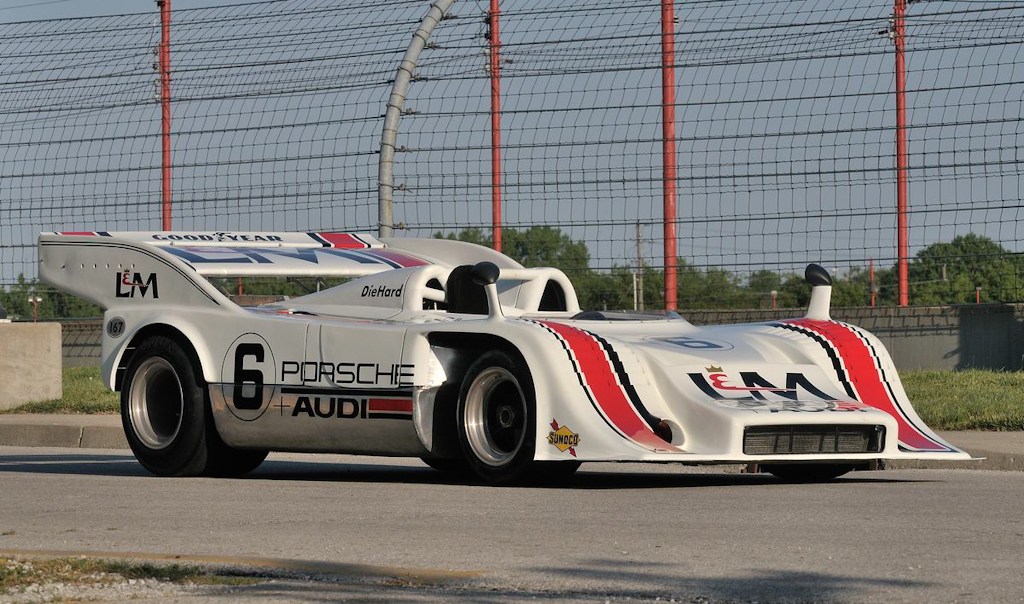
Flat-six naturally aspirated engine. Screw turbocharging, this is what engines should be like. Naturally aspiration and large-volume flat-six engines will always have a place in our hearts. This masterpiece takes it to an even higher level. From its 4-liter displacement it delivers 500 hp (specific output of 125 hp per liter). Maximum torque is 346 lb.-ft and it revs to a stratospheric  8,800 rpm.

6-speed GT sport manual transmission. A high performance Porsche with a 6-speed manual gearbox. As if that wasn’t enough, the precise manual transmission also includes a cool rev-matching function. The focus of the box is not on shaving tenths of a second off lap times on the Nordschleife, but on pure driving pleasure and unfiltered emotion. This is Porsche driving the way it used to be.

The chassis of the new 911 R is based on the 911 GT3 and provides extremely sporty day-to-day driving. The tuning is extremely direct and the vehicle lies as low as the 911 GT3. All chassis control systems have been adapted to the manual transmission. The 911 R includes rear-axle steering, dynamic engine mounts, PASM, PSM and Porsche Torque Vectoring.

More: Porsche 911 R (991)


Porsche 911 Carrera GTS (991.2)

Porsche 911 Carrera GTS (991.2)

2018 Porsche 911 Carrera GTS (991.2)

Production Years: 2017-  Generation: 991.2  Units built:
Engine: 3L turbo flat 6  | Power: 450 bhp | 0 – 60 mph: 3.5 s | Top Speed: 193 mph

You guys already know we love the GTS from our best 911s you can buy today post from a few weeks ago. This is the best-value, all-around street-oriented 911 and in our review probably the best all-around 911 you can buy new today. Balanced, bracing, and the best driving experience under $150,000. The manual GTS is a perfect synthesis of power and grip: to drive and live with every day.

The Carrera GTS sits nicely between the Carrera S and the GT3. The GTS gets a larger turbocharger and a little more boost than the Carrera S, giving it 30 more horsepower and an extra 37 lb-ft of torque. That means 450 hp at 6,500 rpm and 405 lb-ft of torque between 2,150 rpm and 5,000 rpm. You can really feel and hear the differences behind the wheel, the twin-turbo flat-six is so quick to respond and there is so much power across the rev range. 0 to 60 mph takes 3.9 seconds with the manual gearbox and just 3.5 seconds with the PDK. We say that’s conservative and expect the GTS is actually four tenths faster.

The GTS models take the best options you can buy on a Carrera S and are include them as standard. That means the Carrera GTS gets Sport Chrono and the cool different drive settings that come with it. If you opt for dual clutch you also get a cool “push-to-pass” power button on the steering wheel. GTS Coupes get PASM Sport Suspension, which drops the ride height 0.4 inch, though the standard PASM setup is available for those who want the option to dial up a more comfortable ride. You also get cool center-lock wheels and black trim kit that looks epic. Not to mention a lower sport suspension setup and the mean-looking wide-body shell from the Carrera 4. The GTS is pretty perfect. Our pick is the manual gearbox but the PDK is awesome too.

In terms of personality, the GTS is more Carrera S than GT3. It is a great daily driver, with good visibility, a relatively upright seating position, supportive buckets good for long-distance travel, and an easy-to-use cockpit with its controls arranged logically. This is one of the best cars we have ever driven and is nearly perfect.


2018 Porsche 911 GT3

2018 Porsche 911 GT3

2018- Porsche 911 GT3 (991.2)

Production Years: 2017-  Generation: 991.2  Units built: –
Engine: 4L naturally aspirated flat 6  | Power: 493 bhp | 0 – 60 mph: 3.4 s | Top Speed: 193 mph

You will notice that the 991.1 GT3 did not make our list. The reality is that it was an awesome car but had too main issues. First, it was plagued by engine issues and needed a recall and second it had no manual. With the 991.2 GT3 Porsche got everything right, it took the most involving 911 ever and bulletproofed the engine, added a manual and made it even better across the board. That’s why it gets the nod over the 991.1.

The GT3 has a screaming engine, is available with a manual gearbox and is the most involving sports car money can buy. It is a little rough around town so opt for a different 911 of you are looking for a daily driver. If you want to look a little more subtle, you can now opt for the Touring package which removes the rear wing (we love it).

The powerplant is a masterpiece. It’s a dry-sump, 4.0-litre flat six engine that can scream up to its 9,000-rpm redline, making 500 horsepower and 339 pound-feet of torque. While the rest of the 911 range has torque-rich turbocharged engines, this is one you still have to work with and one you want to wind up to 9,000 rpm. The GT3 can be equipped with a six-speed manual transmission or a seven-speed dual-clutch PDK gearbox. The PDK is faster but as manual men we know we’d opt for the stick shift every time.

With the PDK and the launch control system activated, the 2018 Porsche 911 GT3 gets to 62mph in 3.4 seconds. With the manual gearbox, a similar sprint takes 3.9 seconds. That makes the GT3 barely faster than the 911 GTS which is a better daily driver and a 580-hp 911 Turbo S is an entire second faster to 60 so why would you choose the GT3 over these models. It’s easy. It is how it drives and how it makes you feel.

The GT3 has the best handling I’ve ever experienced. It is fast, precise and you can feel everything going on beneath you. The car is surgically precise, the suspension is firm with almost no body roll, and the various scoops and vents on the body not only help cool down the mechanical components, but also increase downforce so the car sticks to the pavement. A GT3 feels like a totally different experience to other cars. It’s loud, stiff, rough and pointy. It is full sensory overload at slow speeds around town and an almost religious experience at speed on track. There is nothing better.


2018 Porsche 911 GT3 RS (991.2)

Production Years: 2018-  Generation: 991.2  Units built:
Engine: 4L naturally aspirated flat 6  | Power: 520 hp | 0 – 60 mph: 3.2 s | Top Speed: 193 mph

In February 2018, Porsche revealed a facelifted GT3 RS and the early reviews suggest that while it is clearly an evolution of the previous GT3 RS that Porsche has done enough that the current model gets nod over the previous generation on our list of the best 911s. Does that mean the old 991.1 GT3 RS doesn’t deserve a spot? Of course not, it is still a cracking track car and likely one of the best cars on the planet. We are simply being super picky.

The GT3 RS gets 520 horsepower and 346 lb-ft of torque from the same flat-six engine in the GT3 (the redline set at 9000 rpm, making it the highest-revving GT3 RS ever). The whole car is heavily based on the GT3 with lots of shared stuff. But it’s the engine that sets the RS apart thanks to an extra 20 horsepower, as well as the fact that you can’t get it with a manual transmission. The chassis setup is also different, so the RS is quicker on the race track. The GT3 RS is 0.1 second quicker than the old GT3 RS to 60 mph, which now happens in just three seconds. The car also gets front brake cooling and new ball joints inspired by the GT2 RS, and a tweaked rear-steering system. If you think of the GT3 RS as a GT3 with more downforce, more power and more grip then you are pretty close to the money.

The more aggressive aerodynamic features stand out on the GT3 RS with NACA ducts guiding air to cool the brakes and smoother channeling air to a new diffuser. The side sills come straight off the GT2 RS, as does the manually adjustable carbon-fiber wing. The GT3 RS makes a lot more downforce than the GT3—more than double at 124 mph, in fact. It also effectively makes more than the GT2 RS, because while both make the same maximum downforce at top speed—750 lbs with wings in their stock settings, 992 lbs at maximum attack—the top speed of the latter is much higher, 211 mph verses 193 mph. This means the GT3 RS is making more downforce at lower speeds.

You guessed it, the GT3 RS is a race car and doesn’t make much sense on the road. On 18 April, 2018 the 991.2 GT3 RS set a lap time of 6:56.4 around the infamous Nürburgring Nordscheleife race track. It is the third Porsche production car to break the 7 minute barrier around the track, the first being the 918 Spyder.


Conclusion

The Porsche 911 is an iconic sports car with lots of history and improvements over fifty plus years. From the current crop of awesome Porsche 911s to classic 911s and limited edition models there are so many special 911s that add to the legend of this model. Here’s to keeping this list alive and continuing to add epic 911s for many years to come.