All posts in “Lamborghini”

Lamborghini drops the top on the Huracan Performante Spyder

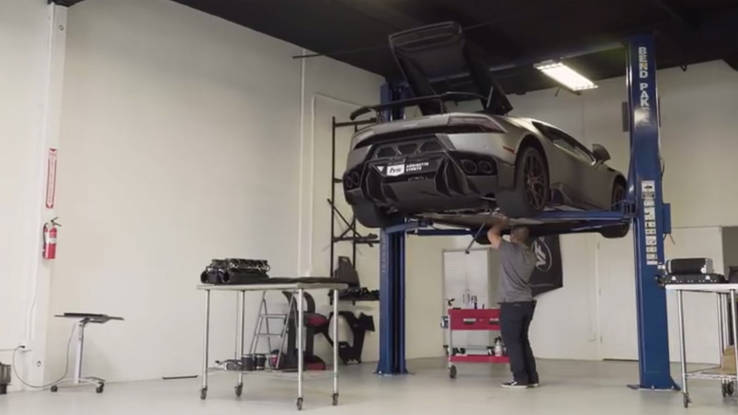
How could Lamborghini make its Huracán Performante even more special? Simply by introducing a topless Spyder variant. The manufacturer suggests the engine note can be heard better with the top open. The Performante is the hot Huracán, its 5.2-liter V10 producing a handsome 640 horsepower, and our 2017 review described the Performante as the character-adding boost the Huracán model line so required. Part of that is due to its ALA active aerodynamics system, or Aerodinamica Lamborghini Attiva. Lamborghini says the downforce-aiding system, which features active flaps on the splitter and the rear wing, is retained in the Spyder version.

As seen in the regular Huracán Spyder, the fabric roof is electro-hydraulic, and according to the manufacturer it only takes 17 seconds to deploy, which can be done at driving speeds of up to 30 mph. Much like the BMW i8 Roadster’s setup, it also has an independently movable rear glass, which functions as a wind deflector when the roof is opened. But there’s more to wind control than just the glass: there are two movable, speedster style fins that rise up from behind the seat backs, continuing the roofline from where it left off. The fins also include an integrated duct that works to reduce cabin turbulence, and two wind guards dampen “aerodynamic pulsations.” Lamborghini says this is to enable conversation even at high speeds, even as one imagines there would be precious little idle chatter when the Performante really performs.

The removal of the fixed roof has added 275 pounds to the dry weight of the Performante, but compared to the regular-issue Spyder, the car is 77 pounds lighter thanks to extensive, Performante-specific use of carbon fiber. Lamborghini says the top speed of 202 mph is unchanged; 0-62 mph takes 0.2 seconds more and is now reached in 3.1 seconds. The 200-kph or 124-mph benchmark takes 9.3 seconds. The first cars will be available in the summer, with a suggested retail price of $308,859.

Related Video:

Porsche is developing an EV supercar platform to share with Audi, Lamborghini

Share

  • Pinterest

Porsche will develop a platform for electric sports cars and supercars that may also be used by Audi and Lamborghini.

Called SPE, the architecture will be parent Volkswagen AG’s third purpose-built architecture for full-electric cars.

Besides Porsche EVs, SPE could underpin a more affordable replacement for the Audi R8 e-tron supercar. It could also help Italian sibling Lamborghini make the jump towards electrification. Lamborghini unveiled the Terzo Millennio (third millennium) electric car concept in November.

The first indication of the SPE platform plan was in a footnote in a capital markets presentation in November.

A senior VW executive familiar with the plan confirmed that Porsche received the assignment to develop an EV platform “for two-door sports cars and supercars.”

Key questions however remain unresolved as the first vehicles are not slated to emerge until after 2025.

VW executives declined to answer whether SPE vehicles would be equipped with an electric motor on each axle or even a third to offer faster acceleration. Nor could they comment on whether it might be designed specifically to employ space saving solid-state battery cells. This next-generation technology boasts higher energy density over conventional cells that use liquid electrolytes to transport lithium ions.

Executives would not comment on whether other brands had already begun to make plans for vehicles based SPE.

A VW Group spokesman said it was much too early to provide further details. “We do not want to comment on future projects in detail at the moment,” he said.

Despite its small size, Porsche may be the furthest among its VW siblings when it comes to electrifying its fleet. Roughly 60 percent of all new Panamera sedans in Europe are sold currently as a plug-in, and by 2025 more than half of its volumes should have some form of electric propulsion.

MEB, PPE platforms

VW Group’s other dedicated electric platforms are the MEB and PPE platforms. The MEB (Modular Electrification Toolkit) will underpin the VW brand’s upcoming I.D. family, along with EVs for Skoda, Seat and Audi. The PPE (Premium Platform Electric) platform is being developed jointly by Audi and Porsche. It will be used for three EV model families, Audi development chief Peter Mertens told Automotive News Europe in October.

A Porsche spokeswoman said the brand is concentrating first on ramping up the J1 platform for its first full-electric car, the Mission E sedan due next year. The PPE platform will come after that. SPE is “too far away” to comment on, the spokeswoman said.

VW said in September that it plans to roll out more than 80 new electrified models by 2025 including about 50 purely battery-powered vehicles and 30 plug-in hybrids as part of its Roadmap E. The automaker also aims to equip each of its 300 group models with a full-electric or plug-in hybrid drivetrain by 2030.

Porsche to develop EV supercar platform” originally appeared in Automotive News on 1/11/18

By Christiaan Hetzner at Automotive News

Supercharged Lamborghini vs 900-hp unlimited dirt truck makes a seriously weird drag race

Share

  • Pinterest

Last time we saw stunt driver/drifter/European Sam Hubinette, he was sliding a Lamborghini Huracan (on sponsored Nitto tires) around a car dealership with his expert-driver wife, Stina. Even if you don’t know the name, you’ve definitely seen his stunt work in “Fast and Furious,” “Teenage Mutant Ninja Turtles,” and the not-as-bad-as-you’d-expect Tom Cruise action flick “Knight and Day.” Now he’s at the drag strip with one of the strangest matchups we’ve ever seen.

Hubinette tapped VF Engineering to add 193.03 rear-wheel horsepower (dyno’d) to a rear-drive Lamborghini Huracan by bolting on a VF 8000 Magnuson TVS 2300 Roots supercharger, intercooler and components. The “base” 580-2 Huracan delivers 580 PS or 571 hp; in total, this now-boosted Huracan puts 685 hp to the pavement through its two rear wheels. Should be perfect for drifting, but we’re here to race.

Hubinette’s opponent, Nitto driver Jason Blanton, brought his 900-hp Unlimited Class Ultra4 all-wheel-drive race truck to the fight and with all four wheels pulling, it should take the Huracan off the line. Can Hubinette catch up? Watch and find out. And check out the video below, which details VF’s process on installing and testing the blower.


Here’s your daily dosage of ’80s European supercars tearing up the Italian countryside

Share

  • Pinterest

This short film is pure, automotive awesomeness for anyone infatuated with 1980s European supercars and sports cars.

Set in beautiful Italy, this famous bunch of drivers pilot cars we all had hanging on our walls as kids. Valentino Balboni, the former Lamborghini test driver, drives the Countach. Stefan Roser, famous Ruf tester, drives the same Yellowbird he famously circled the Nurburgring in 8:05 in the video from 1987. Racing driver Mirko Venturi drives the Ferrari Testarossa before overheating and stealing Balboni’s Lamborghini at gunpoint. Finally, Sam Hancock, a sports car racer, drives the Aston Martin V8 Vantage.

Arguably, Hancock in the Aston wins the “Wolf of the Autostrada” award when he manages to win over the Italian grape farmer post-spin. Turn up the volume and decide for yourself, though; we wouldn’t mind a full-length feature if these few minutes are any hint of things to come.

Zac Palmer

Zac Palmer – Editorial Intern Zac Palmer has probably spent more time in a car than any other 21-year old in the country. He likes anything that can go around a corner, and is surely talking about a car wherever he might be.
See more by this author»

The ARES ‘Project Panther’ is a Pantera-clad Lamborghini Huracan with pop-up headlights

Share

  • Pinterest

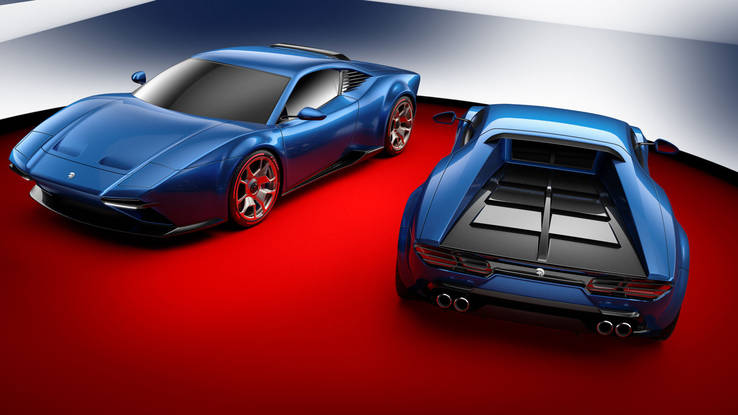
Italian supercars are typically stop-and-stare-worthy, but ARES Design, a coachbuilder out of Modena, Italy, just dropped something we might be staring at a bit longer than usual. It’s called “Project Panther.”

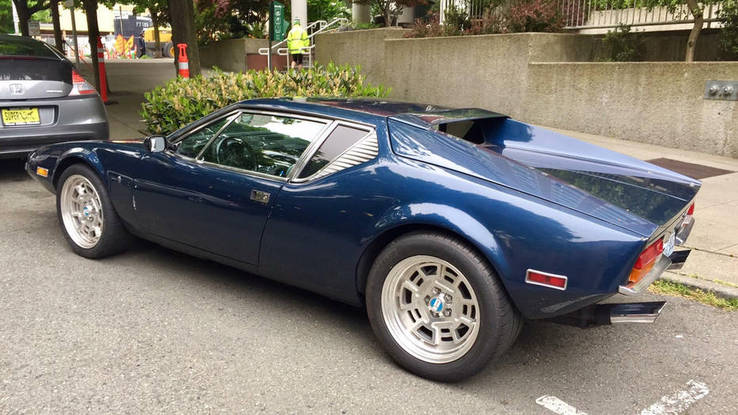
In a nutshell, the Panther is a Lamborghini Huracan underneath, with an original body on top inspired by the De Tomaso Pantera. The wedge-shaped nose, rear buttresses and flat engine cover certainly remind us of the Pantera from the 1970s, but the pop-up headlights really make it a beautiful hybrid of classic and modern design. It’s been a long time since we saw pop-up headlights on a new car, so we applaud the decision to incorporate those despite the difficulties that abound.

Pantera image

Here’s a 1972 De Tomaso Pantera for comparison. Photo by LOVELANDOHIO VIA REDDIT

Of course, being built on a Huracan chassis and sharing its drivetrain means the Panther should deliver performance similar to its Italian brethren. The 5.2-liter V10 engine, seven-speed dual-clutch transmission and all-wheel drive should launch the Panther to 60 in about three seconds, and we’d imagine a top speed near 200 mph isn’t out of the question. ARES isn’t talking specs right now, but there’s always the chance it squeezes more power out of the Huracan’s engine by the time it’s done.

These are the only photos that ARES has made available for now, but more information should be coming soon because Project Panther is set to go on sale during the second half of 2018. This being a coachbuilt supercar, production numbers will be extremely low, and the company says it has already received a few deposits on cars.

Panther image

The Panther will be built at ARES’ production facility in Modena, Italy.

It’s interesting to note that this is ARES’ first supercar, but with ex-Lotus CEO Dany Bahar at the helm, it’s safe to say the car should be a hoot to drive. Project Panther will be the halo car for now, but ARES also mentions it has “much more to come in 2018.” We hope that means more cars with design and performance as alluring as this one.

Zac Palmer

Zac Palmer – Editorial Intern Zac Palmer has probably spent more time in a car than any other 21-year old in the country. He likes anything that can go around a corner, and is surely talking about a car wherever he might be.
See more by this author»

Throttle-Back Thursday: We drive the Super-Countach — Lamborghini’s wickedly cool Diablo test mule

Share

  • Pinterest

“These are busy times at Lamborghini” is how we opened this Dec. 14, 1987 Autoweek feature, but we could just as easily say the same thing today. Lamborghini just unveiled its 641-hp Urus grocery getter super-SUV, and it’s expected to double the Italian automaker’s annual sales volume.

Thirty years ago, Lamborghini had its hands full for different reasons. The company, then owned by Chrysler, was working on a successor to the Countach. But how do you follow up the Countach? It’s hard to be more ridiculous than the king of ridiculous, V12-powered exotics.

This Super-Countach, as it was dubbed, was a pretty good start. This was not the earlier LP500 Quattrovalvole, sometimes called the “super Countach.” Instead, it was a development test bed for Lamborghini’s new V12-powered wedge — a supercar ready to take on the ’90s with “a brand-new, ultra-exotic design.” It was the precursor to the Diablo, and we put it through its paces three years before the real thing went into production.

Styling aside, much of what we saw here carried over to the production car. The 5.7-liter V12, for example (punched up to 6.0 liters later in the production run). Or the option of an all-wheel-drive system, which head to production on 1993’s Diablo VT. Other things, like the lack of speedometer — totally rad — did not.

We always try to give you more here at Autoweek, which is why we tacked on an extra feature about a Lamborghini LM002 (yeah, the Rambo Lambo) that a Saudi prince decided wasn’t quite over-the-top enough. So he had it custom-bodied by Italian coachbuilder Diomante to include all of the features of a private jet. Which sort of made sense, because the prince was the director of an airport.

Read it all below.
 

Autoweek December 14, 1987 — We test the Super-Countach, Lamborghini’s Diablo test mule

(787.99 KB)

Graham Kozak

Graham Kozak – Graham Kozak drove a 1951 Packard 200 sedan in high school because he wanted something that would be easy to find in a parking lot. He thinks all the things they’re doing with fuel injection and seatbelts these days are pretty nifty too.
See more by this author»

The Lamborghini Countach is the coolest Formula 1 safety car ever

Share

  • Pinterest

Since its inception, the Formula 1 safety car has always been something interesting for its time — a Porsche 911 GT2, a Tatra 623 and a Ford Escort RS Cosworth have all served, for example. Sticking with the tradition, the current F1 safety car is the Mercedes-AMG GT, one of the most interesting cars on the road today. However, the ultimate safety car is probably this Lamborghini Countach.

Reddit user t12totalxyzb00 posted a picture of this Countach with the F1 light bar on top of its wedged body. Apparently, this Countach was used for the Monaco GP in the 1980s — making it the most appropriate safety car ever to see time on an F1 track. Between the excess of the 1980s, Formula 1 and the insanely styled V12-powered supercar, there has never been a better representation of an era.

With 641 turbocharged horsepower, the 2019 Lamborghini Urus is the fastest production SUV

Share

  • Pinterest

You knew it was coming, and it’s finally here: The 2019 Lamborghini Urus. It’s not Lamborghini’s first SUV, but it’s the first one that’s going to go into mass production. For that reason alone, it’s worth paying attention to — you’re going to be seeing a lot of these, at least compared to the number of Huracans and Aventadors you happen upon. It will be available next spring — yours for just $200,000 to start.

The Urus is powered by a 4.0-liter twin-turbocharged 90-degree V8, connected to the all-wheel-drive system through an eight-speed automatic transmission. The motor delivers 641 hp (that’s 650 pferdestarke) and 627 lb-ft of torque at 6,000 rpm and 2,250 rpm, respectively. Redline is 6,800 rpm. This engine sounds suspiciously like the turbocharged 4.0-liter available in the 2019 Porsche Cayenne Turbo, but it’s substantially up on output; 0-62 mph takes just 3.6 seconds, and the all-important 0-124-mph run takes 12.8.

All in all, Lamborghini says the Urus is the world’s fastest production SUV with a top speed of 190 mph — notably, 3 mph faster than the Bentley Bentayga and 10 faster than the Jeep Grand Cherokee Trackhawk, for those who keep track of these things.

Curb weight is said to be under 4,850 pounds, for those who keep track of those things. For the thousands of Urus buyers who will flock to Moab and the Rubicon Trail, the ground clearance is probably more important than curb weight; it is adjustable via air suspension from 6.2 inches to just under 9.8 inches. So maybe steer clear of the rock park.

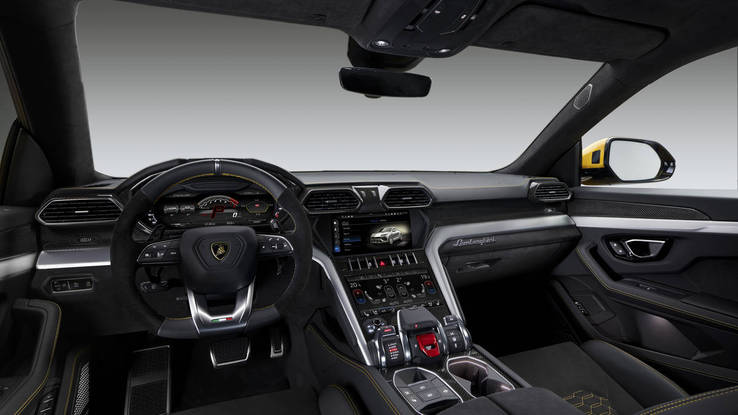
2019 Lamborghini Urus interior

Somewhere in there, on the center console, is the “Tamburo” that you will use to control the Urus’ drive mode.

2018 Jeep Wrangler JL 5 of our favorite design details

The Urus’ all-wheel drive system can deliver up to 70 percent of torque to the front wheels or up to 87 percent of torque to the rear, depending on the situation. You’ll be able to chose between six dive modes (plus the excellently named “EGO” customizable mode) to match terrain, weather conditions and your preferred driving style. Other Lamborghinis have selectable drive modes, but only the Urus’ are accessed through the “Tamburo,” or “drum,” which is what the company is calling the center console-mounted controller.

We know, we know: The stats are impressive, this thing’s existence was all but inevitable and if platform-mates like the Porsche Cayenne and Bentley Bentayga are anything to go by, it will be something of a driver (at least compared to your standard-issue crossover). But it’s taking Lamborghini frighteningly close to “practical” territory, and we’re not sure how we feel about that.

From its turbo motor — the first in a Lambo — to an eventual plug-in-variant to its projected sales volume, the Urus is going to change the company that builds it. It’s available beginning spring 2018, but it’s going to take us a bit longer than that to adjust.

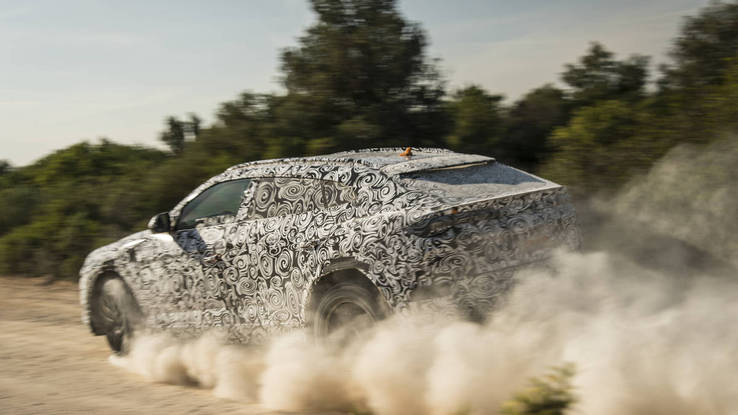
2019 Lamborghini Urus rear 3-4 prototype in dirt

Here’s a Urus prototype off the pavement.

Graham Kozak

Graham Kozak – Graham Kozak drove a 1951 Packard 200 sedan in high school because he wanted something that would be easy to find in a parking lot. He thinks all the things they’re doing with fuel injection and seatbelts these days are pretty nifty too.
See more by this author»

The Lamborghini Urus super-SUV will change the quirky Italian automaker as we know it

Share

  • Pinterest

Lamborghini is preparing to shake up its business with the launch of its first SUV. The Urus is expected to double the supercar maker’s sales to 7,000 units by 2019. Now the company is deciding whether to add a 2+2 GT sports car that could, by the end of the next decade, push the Audi-owned brand’s sales above 10,000 for the first time in its 54-year history. Lamborghini CEO Stefano Domenicali, 52, discussed these topics and more with Automotive News Europe Editor Luca Ciferri.

Q: The auto industry is undergoing major changes. What will Lamborghini look like a decade from now?

A: We are adding our first SUV, the Urus, which will make Lamborghini relevant to customers who never considered us before. We are also currently investigating a 2+2-seat GT that would add space and comfort to the super sport performance we offer in that sector. At the same time, we are shifting toward electrification, first with plug-in hybrids and, when battery technology will permit Lamborghini-style performance, also pure EVs.

As the industry shifts toward SUVs, do you fear that your customers may trade in their Huracan or Aventador to buy an Urus?

Since a Lamborghini customer owns an average of four to six cars, including at least one SUV, we envisage him replacing his current SUV with a Urus and keeping his Huracan or Aventador. We do not see cannibalization between these Lamborghini products, because the Urus is a daily driver while the two-seaters are rarely used on an everyday basis.

Lamborghini has built just one 2+2 model, the Espada, which was launched in 1968. Since then, the company had been struggling to create a successor. Why?

Combining high performance with interior space and driving comfort in a package that, design-wise, should be striking as well as highly efficient in terms of aerodynamics isn’t easy. Therefore, I’m pushing the company to shorten our time to market from the current 48 months to about 34. I want to freeze the design as late as possible to be as current as possible on the latest trends and avoid any mistakes.

Lamborghini Urus video

If the 2+2 GT is approved, when would it arrive on the market?

Between 2025 and 2027.

Volume-wise, it could take Lamborghini to about 10,000 units, right?

Correct.

Lamborghini has shown two 2+2 GT concepts in the last decade: the 2008 Estoque and the 2014 Asterion. Do they provide any hints?

What we have in mind is completely different, but the Asterion is the closest thing we have publicly shown so far.

What powertrain would work best?

The Aventador’s V-12 is ruled out for package reasons, thus we are currently debating between the Huracan’s V-10 and the Urus’ V-8.

A normally aspirated V-12 is part of your DNA. Will it survive the move to downsized turbocharged engines?

The next Aventador will have a normally aspirated V-12 coupled with a plug-in hybrid. Given that the new car is some years away and that we have an average product cycle of eight years, we will continue to offer a V-12 for a while.

Lamborghini Urus factory

Which model will be your first with an electrified powertrain?

The Urus will have a plug-in hybrid variant that will appear in early 2020. The successors to the Aventador and Huracan will come only as plug-in hybrids. This is the only way to maintain performance and keep Lamborghini’s engine sound while also reducing emissions.

And a pure EV?

We do not see the right balance of size and weight to deliver enough performance and range for a Lamborghini based on current and future battery technology. That is why we are exploring a new type of super capacitor with the Massachusetts Institute of Technology that could permit Lamborghini-style performance.

When could such a car become a reality?

Hard to say, but probably not sooner than 2030. I think a company must invest both in expanding its current range as well as looking into the distant future to avoid being left behind.

Isn’t this a bit of a stretch for a company that, despite setting a new record, sold just 3,457 supercars last year?

We are part of an extraordinary group that sells 10 million vehicles a year and that is heavily investing in Lamborghini because it believes in our plans. Therefore, I am far from worried. When I tested the Urus on the Nardo high-speed track, I was genuinely pleased because we were able to deliver on what we have promised. Now it is up to the market to judge our work, but I am very optimistic.

SUV is expected to double Lamborghini sales” originally appeared in Automotive News on 12/4/2017

By Luca Ciferri at Automotive News

The Lamborghini Huracan is the coolest Popemobile

Share

  • Pinterest

Not-at-all-modest Lamborghini has given Pope Francis a special-edition Huracan supercar. Anyone with a passing familiarity with the current Pope would be surprised to hear his plan to throw modesty to the wind and roll around in a supercar — we’d approve, but the masses might not. Rather, Lamborghini donated the custom Huracan to the Pope to auction off through RM Sotheby’s, with proceeds doled out to various charities.

This holy Huracan’s custom finish shares its colors with the Vatican’s flag and looks surprisingly good. While a bold color generally looks best on a Lambo, the subtle white finish with gold accents works well here. 

The rear-wheel-drive Lambo Huracan Pope-edition heads to auction on May 12, 2018. Considering the rear-drive LP580-2 starts around $200K, this special edition will likely top that by a significant margin. 

Pope Francis gets a papal-themed Lamborghini Huracan

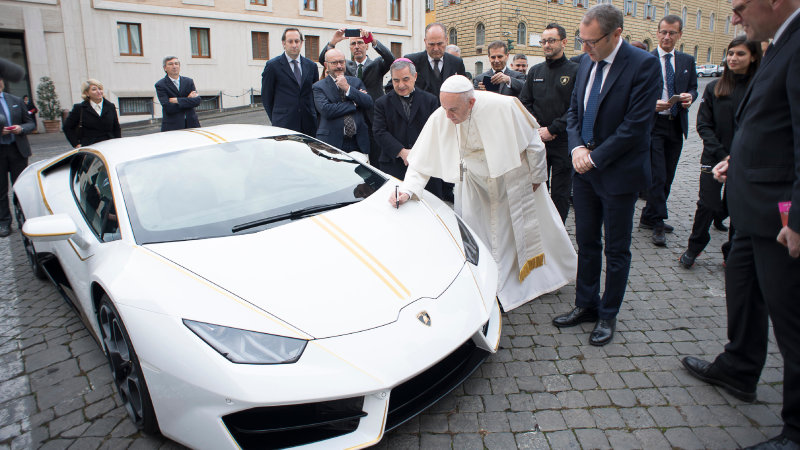
Lamborghini picked a special recipient for the newest and rarest version of its Huracán RWD, giving an ultra limited-edition version of the supercar to Pope Francis in a ceremony Wednesday at the Vatican attended by company executives.

The new Popemobile, it’s not. Fittingly, according to Catholic News Agency, it’s the seventh version of the Huracán, the Italian company’s entry-level model. It’s set to be auctioned at RM Sotheby’s on May 12, 2018, with orders from the Holy See to split the proceeds between three charitable causes: restoring villages on the Nineveh Plain in Iraq, helping victims of human trafficking and supporting missionary work in Africa.

The papal Huracán RWD is done in Monocerus white with Tiberio yellow stripes running along the hood, roof and body, reflecting the colors of the flag of Vatican City. It was blessed and autographed by the pontiff in the presence of Lamborghini Chairman and CEO Stefano Domenicali, board members and two employees who helped build the car.

The Huracán is the successor to the Gallardo, Lamborghini’s best-selling model of all time, with a design inspired by the hexagonal form of the carbon atom. It’s powered by a naturally aspirated, 5.2-liter V10 that makes 602 horsepower and 413 pound-feet of torque. Normally, the sports car starts $199,800. But a version blessed and autographed by the pope? Priceless…

Related Video:

Our 30 favorite cars from the Best of France and Italy car show

Share

  • Pinterest

On the very same day the dilettantes were oohing and aahing at the bazillion-dollar restorations on the other side of the country at the Hilton Head Island Concours, where judges were tisk-tisking the blades of grass in the tread patterns of the otherwise-perfect wheeled juggernauts, and gentlemen in straw hats were sipping tea with pinkies extended just so, on this same day on the opposite coast was held the Best of France and Italy car show, right there in the dust and dirt of the very public Woodley Park in California’s fabulous San Fernando Valley, where strip malls go to die.

And yet we love this little show.

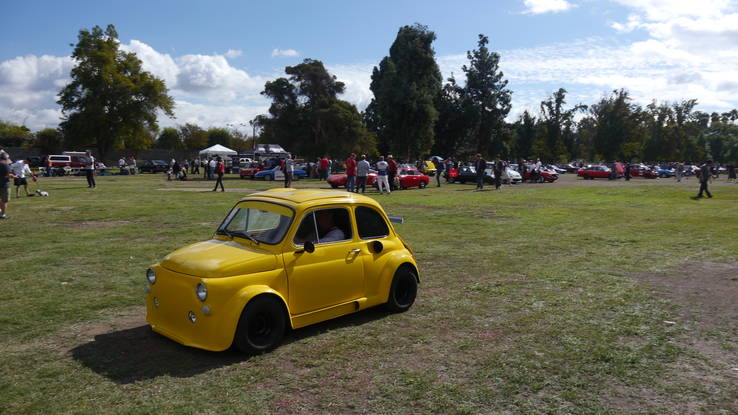
Yellow Fiat Abarth

There were more Fiat Abarths than anything else on the field.

See, there are thousands of really cool little French and Italian cars hiding in stucco garages all over Southern California, ferreted away by owners hoping to one day fix them up and get them running in their former, imagined glory. There are Renaults, Panhards, Citroens, Alfas, Lancias and thousands and thousands of Fiats. The Best of F&I gives these car connoisseurs something to shoot for, a deadline by which they either have to get them all running or face eviction, divorce or both. So in that sense, the show is a public service.

And it’s free to the public. Owners have only to pay 20 bucks online or $25 at the gate to drive onto their own little patch of Pebble-in-The-Valley. 

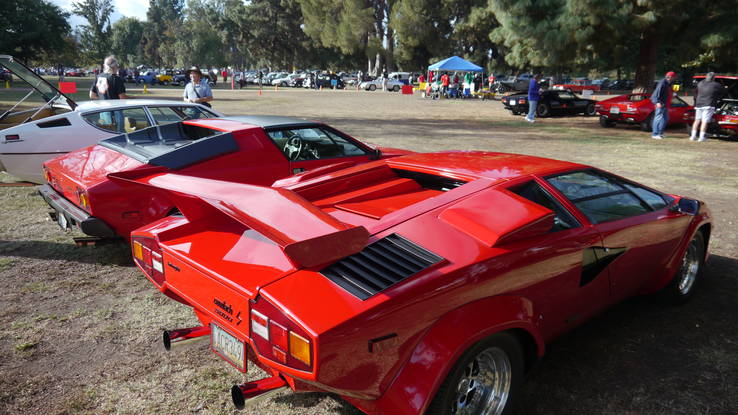
Lamborghini Countach

Lamborghini Countach

It’s not all sub-subcompact econo slugs from the Continent, either. There are Ferraris, Lamborghinis, Panteras and Maseratis, too, the owners of which all want to show them off.

Above are our 30 favorites. The show is always held the first Sunday in November. So start looking around now for parts and get that Lancia Appia running.

Editor’s Note: The same guys put on The Queen’s English in the spring, featuring the best of British cars. Tallyho!

Lamborghini Urus SUV spotted testing at the Nurburgring

Share

  • Pinterest

It’s not too early to (once again) get used to the concept of a Lamborghini SUV, and the upcoming Urus is easing everyone back into the world of supercar SUVs by making regular appearances at the Nurburgring. Due on sale in 2018, the Urus is expected to serve up 650 hp courtesy of a twin-turbocharged V8, as Lamborghini CEO Stefano Domenicali revealed earlier this year. When it comes to raw power, these specs, if they hold, will place the Urus just above the Huracan Performante with its 640 hp, but it’s no secret which one of these models will offer more space for groceries.

The Urus will share its platform with some expected Volkswagen Automotive Group siblings, including the Bentley Bentayga and the Audi Q7, but as this video shows, the Urus will go a little smaller on the inside owing to a rakish roof and a sleeker greenhouse. When it comes to price, the Urus is expected to land just south of $200,000 when it goes on sale during the third quarter of 2018, according to Domenicali.
 

Lamborghini Urus factory

As the video shows, there’s not much to hide on the prototype Urus at the moment — Lamborghini has let the cat out of the bag at a number of auto shows — but we can’t help but gawk at the tall and blunt nose of this SUV and the sizable eggcrate vents just below the hood. Viewed in profile, the Urus displays very high-sided front and rear fascias along with a relatively high shoulder line. This doesn’t paint a picture of a high seating position inside, though; the driver appears to be sitting quite low inside the vehicle. And it’s easy to get a sense of scale for the Urus as it slowly drives past other recognizable cars.

The upcoming Urus is expected to double Sant’Agata Bolognese’s production output to 7,000 vehicles annually, and the boutique Italian automaker is currently putting the finishing touches on a dedicated factory for the brand’s second SUV. The new factory in Sant’Agata won’t start cranking these out at full speed until 2019; the factory plans to build around a thousand examples in 2018 but will aim for half of the brand’s entire output of 3,500 vehicles annually the following year.

2018 Lamborghini Huracán Performante Second Drive | The Lambo of the moment

Down the front straight, past the pits, over the start/finish line, sixth gear at 140 mph. Suddenly, the shrieking wail of the 2018 Lamborghini Huracán Performante’s mid-mounted V-10 and hits me right between the eyes. It’s an easy shot, since I’m wearing an open-face helmet.

Speed is not a problem for the Performante. This new lighter and more powerful version of the Huracán is the best-performing Lambo of all time. It just set the new production-car record around the Nürburgring Nordschleife of 6 minutes, 52.1 seconds. That’s 35 seconds quicker than the standard Huracán. And Lambo says it can accelerate from 0 to 62 mph in 2.9 seconds, which is as quick as the Aventador S. Its 202-mph top speed still lags the top end of the V-12-powered Aventador by 15 mph, but does it really matter?

Completely flat, smooth as glass and just 1.8 miles around, Thermal’s South Palm Circuit isn’t exactly the Nordschleife, but the bathrooms are much fancier. Built in 2014, the luxurious Thermal Motorsports Club outside of Palm Springs, Calif., is an ideal facility for us to taste the 2018 Huracán Performante. If owners of the $274,390 supercar want a safe and controlled environment to wring out their new toy, chances are it will be at private amusement parks such as this.

2018 Lamborghini Huracan Performante

In the age of twin-turbos, the Huracán’s naturally aspirated V10 is a (glorious) anachronism. In the Performante, it has been cranked up to 640 hp at 8,000 rpm and 442 lb-ft of torque at 6,500 rpm, a 30-hp and 40-lb-ft increase over the standard all-wheel-drive model, and it’s all above 6,000 rpm.
Displacement remains 5.2 liters, but Lambo’s engineers added lighter titanium intake valves, more aggressive camshafts, a less-restrictive air intake and a lighter freer-flowing exhaust system. The engine’s compression ratio remains a stratospheric 12.7:1, and it runs into a very aggressive rev limiter at 8,500 rpm.

The Performante is 88 pounds lighter than the standard Huracán Coupe thanks to liberal use of the company’s patented Forged Composite, which it calls the lightest, strongest and most innovative material ever used by Lamborghini. Chopped fibers embedded in a matrix of resins, it’s sort of like carbon fiber 2.0, although its finish looks like high-tech camo with golden flecks. It’s all over the Performante, including its massive rear spoiler, rear bumper and diffuser, front spoiler and its engine cover, which weights 21 percent less than the piece it replaced. Inside you see more Forged Composite on the dash, doors and console.

Lambo also stiffened up the Performante’s suspension by 10 percent, the sway bars are 15 percent more aggressive and the A-arm bushings are 50 percent stiffer. But the coolest piece of the Performante, and what’s really going to wow the crowd at local Cars and Coffee, is the new active aerodynamics system.
Officially called Aerodynamica Lamborghini Attive (ALA), the patented system opens and closes a flap in the front spoiler depending on conditions. When closed, the spoiler creates downforce for high-speed cornering and full brake conditions. When the small electric motor opens the flaps, which takes 0.2 second, it redirects the airflow through an internal channel and the underside of the car. This reduces drag, increasing acceleration and top speed.

2018 Lamborghini Huracan Performante

The fully automatic system also controls two internal ducts connected to inner channels of the rear wing. When the flaps are closed, the fixed rear wing works in a traditional manner, creating downforce and aiding cornering and braking. Lambo says it generates 750 percent more vertical downforce than the wingless standard Huracán Coupe.

In high-throttle conditions, ALA opens the flaps, which routes the air through the rear wing’s inner channels and through ridges underneath the wing, reducing drag. But here’s the cool part: The air channel is split left and right and the flaps work independently, allowing aero vectoring for high-speed cornering. The ALA system can increase downforce and traction on the inside wheel, counteracting the natural cornering forces.

After 10 laps, it’s hard not to be madly in love with this ridiculously antisocial supercar. Lambo says it weighs 3,047 pounds dry, and out on the track it feels small and light. Not exactly Miata miniature, but it’s tossable and it likes to turn on the brakes. It also understeers a bit on power out just to keep you alive, but it will drift if you chuck it in and get back on the power quickly. Do it, it’s also easy to catch with a small amount of counter steer.

Our codriver agrees. Sinya Sean Michemi races a Huracán in Lamborghini’s Blancpain Super Trofeo North America. “Compared to the original Huracán, it feels quite a bit less understeery,” he yells over the Performante’s screaming V-10, which is mounted just inches behind our heads.

2018 Lamborghini Huracan Performante2018 Lamborghini Huracan Performante2018 Lamborghini Huracan Performante2018 Lamborghini Huracan Performante

Most of the corners on this circuit are handled in second gear, although there are two good, long straights where we touch sixth gear and get to enjoy the upper-rpm pull and full song of the big V-10. The straights also reveal the silky and rapid gear changes from the Lambo’s dual-clutch 7-speed, which Lambo geared perfectly to keep that goddess of an engine above 6,000 rpm.

There’s also a three-apex right-hander with a fast third-gear entry at the end of the backstraight. It’s the most challenging section of the track, and the Performante’s stability is impressive as we enter hard on the brakes and drop it down to second to finish the corner hard on the power. It’s massive 20-inch Pirelli P Zero Corsa’s are incredibly forgiving, and the compliance of the suspension over the track’s tall curbing is a nice surprise.

It’s almost stupid how easy it is to drive this car fast. The Huracán’s gargantuan cross-drilled carbon-ceramic brakes are foolproof, with telepathic pedal feel and awesome heat resistance even after constant lapping on a 100-degree day. There was a time not too many years ago that Lamborghini brakes would have caught fire and failed under such conditions.

2018 Lamborghini Huracan Performante

Lamborghini’s ANIMA system offers three modes: Strada, Sport and Corsa. In Strada, Lambo says traction and stability are prioritized, and it’s easy to find the point at which its electronic watchdogs step in on the track. In Sport, the all-wheel-drive system offers a more rear-wheel-drive bias, and the stability control system loosens up enough for some light rotation. Also, the transmission will upshift for you, even in manual mode. In Corsa, the transmission is completely manual, and the stability control allows for plenty of oversteer.

Lamborghini says demand for the Performante is high. However, buyers should know that there’s a Spyder version coming and it’s sure to steal thunder from this hardtop, especially in the States.

But the Performante’s real issue is Lamborghini’s new SUV, which will begin to overshadow the supercar the instant it is unveiled on Dec. 4. The much-anticipated Urus is the Italian automaker’s most important new product since the Countach in 1974, and according to Alessandro Farmeschi, the COO of Lamborghini North America, it’ll double the company’s production when it goes on sale next year.

When that bomb drops, the Huracán Performante will no longer be the Lambo of the moment. Its 15 minutes will be up. Hell, that game clock is already ticking. But until then, let’s enjoy the Performante for what it is: Lamborghini’s best sports car ever. It’s a masterpiece—a masterpiece with unfortunate timing.

Related Video:

Art Center Car Classic 2017 is the designer’s choice

Share

  • Pinterest

Car shows always have themes just like your junior prom. Most of the time they’re so vague no one has any idea what they are. However, instead of “Under the Sea” or “Dancing Among the Stars,” the Art Center College of Design’s annual Car Classic picked “Red, White and Blue,” and it was impossible to ignore.

The red meant Italian cars, which meant, for the most part, Ferraris. There were 17 Ferraris by our count, maybe more, mixed in with Lamborghinis, Lancias, Alfas and Maseratis. And they were all red. A sea of red. The reds were all lined up against the south part of the lawn.  

American racing colors are white with a blue stripe, so America got the white section, the middle of the grass on the Art Center’s Sculpture Garden, perched high above the Rose Bowl in Pasadena, California. There were Corvettes and Cadillacs, mostly all white, though Jay Leno’s white Yenko Corvair did have blue trim.

Then there was the French section. Try as they might, Southern California couldn’t come up with more than about 10 blue French cars. But they were good blue French cars: a Bugatti Type 55 from the Mullin Automotive Museum, a 2018 Bugatti Chiron, Rich Plavetich’s 1959 Deutsch Bonnet HBR-5 Coach, the windshield of which he hand-carried on a flight from France, and a flock of Citroen 2CV in various guises that flew in from all over.

It was an impressive sight, spread out all over the lawn in those colors, a big American flag, or a French flag depending on whether you were looking at it from the west or the east. It might have been best-viewed from a hot air balloon, but we didn’t have a hot air balloon. We didn’t even have a drone. 

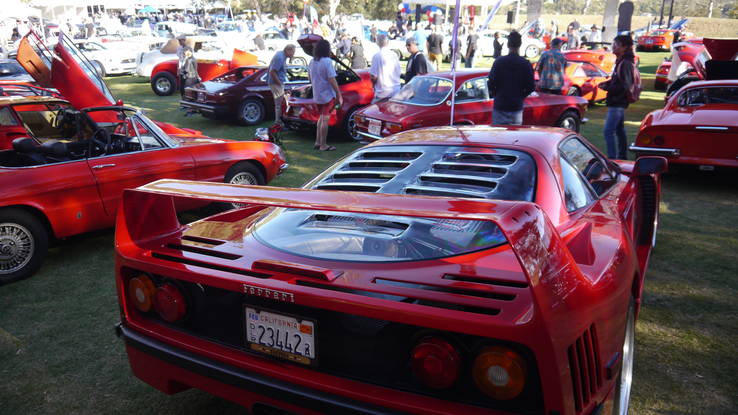
Ferrari F40

Owner Rick Principe, God bless him, drives his F40 as often as he can. Be more like Rick Principe.

Around the periphery were concept cars from major manufacturers: a 1954 Chrysler Ghia GS-1 Coupe, 2009 Corvette Stingray concept, 1953 Cadillac Series 62 Coupe by Ghia, 2005 Shelby GR1 concept, that Infiniti single seater from Pebble, and a couple of Faraday Futures – the FF91 and the Zero 1.  All of those manufacturer concepts served as reminders that more than half of the cars you see today, and more still of the cool cars you see today, came from Art Center graduates. 

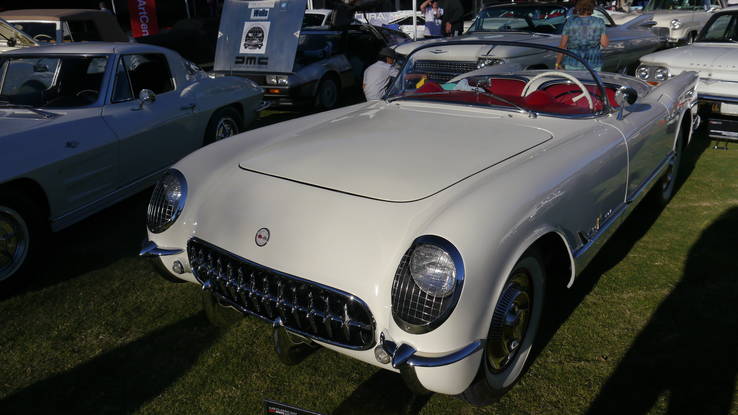
C1 Corvette

This C1 Corvette helped carry American racing colros (albeit minus the blue stripe)

And, since the field is already packed with experts in design, it’s a judged show. Here below are the winners:

Motorcycle: Paul Greenstein’s 1929 Henderson Model KJ (runnerup Philippe De Lespinay’s 1976 Morbidelli-Benelli ARMI 125 VR Grand Prix Racer)

Other Colors (cars that are not from the red, white or blue countries): David Spiegel’s 1936 MG SA Saloon

Special Interest: Gary Wales’ 1938 Bentley 4.25 L Special Roadster

American Classics: The Petersen’s ’53 Ghia Cadillac

American Performance: Paul and Sherrill Colony’s ’55 Corvette

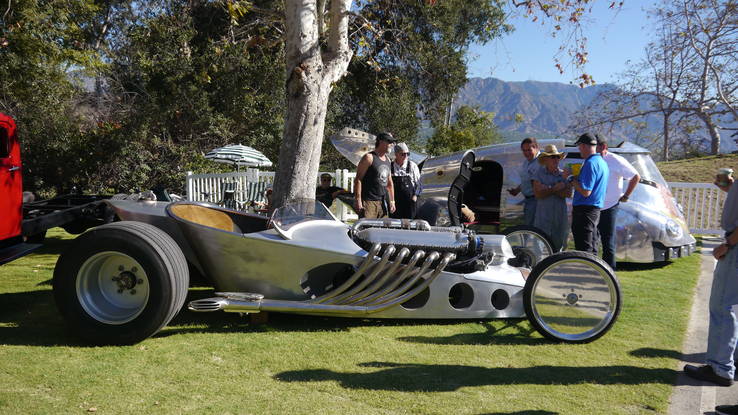
American Special Interest: Michael Leeds’ wild Blastolene “Blown Ranger” Fairchild XFR0001 Roadster

French: James Selevan’s 1976 Renault Alpine A110B

Ferraris: Donnie Crevier’s 1963 400 Superamerica

Italian Exotic: Chuck Gayton’s 1976 Lamborghini LP400

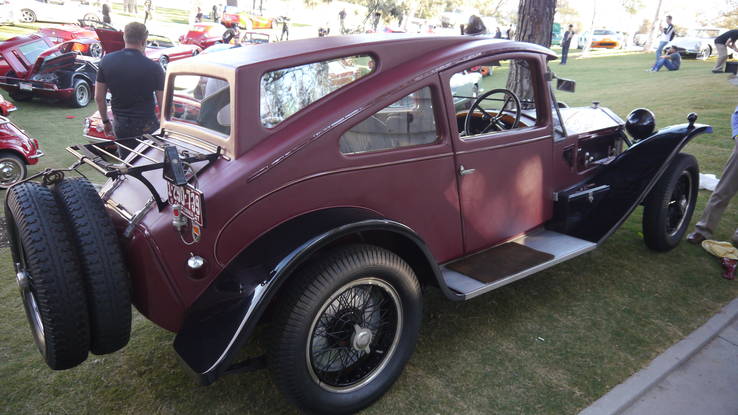
Italain Special Interest: The Byrd Family’s 1927 Lancia Lambda 7th Series Airway

Blastolene Roadster

The Blastolene Roadster

Designer’s Choices were:

Bruce Meyer’s 1960 Chevrolet Cunningham Corvette Le Mans Roadster; The Mullin Museum’s 1932 Bugatti Type 55; Po Shun Leong’s 1972 Citroen DS 21 Pallas; David SK Lee’s 1967 Ferrari 275 GTB/4; Thomas Shaughnessy’s 1962 Fiat/Abarth 1000 Coupe; and Bruce Heavin’s 1957 BMW Isetta.

There is no Best of Show here but if there was, we’d have given it to the Byrd Family’s 1927 Lancia Lambda Airway. The car was designed by Albany Motor Works of England and meant to reflect the general enthusiasm for airplanes at the time. As such the body was meant to simulate an airfoil or an airplane wing, with fabric wrapped over a wood frame structure. It was used as a daily driver for many years, then “fell into disrepair.” The Byrd Family acquired it in the ‘90s and had it restored in Australia, where it had spent most of its life. The restoration included new wood, Australian ash. It was quite a stunner. But then, the field was carpeted with stunners.

Even so, next year might be better. That’s when the Art Center’s Transportation Design department celebrates its 70th year. A big reunion is planned that will last the whole weekend. New car designs could be born. You never know. Start planning now.

The Byrd Family's Lancia

The Byrd Family’s award-winning Lancia

Enormous Urus factory will double Lamborghini’s output

Share

  • Pinterest

The upcoming Lamborghini Urus SUV is expected to double the Italian supercar maker’s sales to roughly 7,000 vehicles per year — something that cannot be accomplished with the company’s existing production facilities. Double the sales requires double the assembly line space.

That’s why Lamborghini just put the finishing touches on a new state-of-the-art factory in Sant’Agata Bolognese, the same Italian village in which every Lamborghini has been produced since the 350 GT. The facility will be used to produce the Urus and also for finish work on the two other Lamborghini model lines currently in production: the Huracan and the Aventador. This carbon-neutral factory was built in just 18 months, and in addition to the assembly space, it includes a new test track with 13 different surfaces specific to SUVs.

“With our third model, we wanted to introduce the most innovative production technologies and smart factory concepts, supporting and complementing the activities of our workforce,” said Ranieri Niccoli, chief manufacturing officer. Urus ushers in a new model of factory, which we call Manifattura Lamborghini, a new point of reference in the luxury automobile industry. The substantial resultant benefits include greater production flexibility, better information accessibility and the interconnection of systems: strengthening the professionalism of craftsmanship that has always distinguished us and supporting the doubling of our production volumes.”

Lamborghini Urus factory detail

The new factory is expected to bring Lambo’s annual production to 7,000 vehicles per year.

Lamborghini mulls four-door sedan after Urus

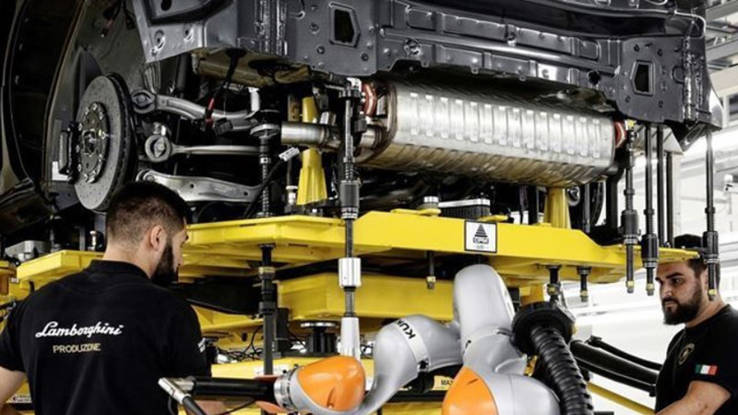
Taking production space from 80,000 to 160,000 square meters was not simply an expansion of floor space; Lamborghini aimed to give the factory a flexible layout to future-proof the facility and to create a space where robots and human workers work together.

The Urus is due on sale in 2018, but that’s just the start of Lamborghini’s expansion: By 2021, the company plans to launch a fourth model line. Recent comments by Lamborghini executives suggest that the fourth model line could be a front-engined four-door sedan in the spirit of the shelved Estoque concept or another supercar to fill out the supercoupe lineup.

By the way, in the video above you can catch fleeting glimpses of the exterior of the Urus itself. Lambo tried to blur out a few shots that reveal the production design, but that’s the real thing being built on the new line.

Ferrari SUV reportedly will ‘probably happen’ according to CEO

Will Lamborghini make a four-door “sedan” after all?

Share

  • Pinterest

If you’ve come to terms with the concept of a Porsche station wagon as well as Rolls-Royce and Bentley SUVs, we have a fresh challenge for you: Lamborghini four-door. Autocar reports that a fourth model line is indeed currently in the concept stage and is slated to debut around 2021, part of the brand’s long term plans under Lamborghini boss Stefano Domenicali. Of course, we’ve known for some time that Sant’Agata Bolognese was after another SUV to follow up on the legendary LM002 — the Urus is due later this year — so a four-door wouldn’t be that big of a shocker, all things considered. Lest we forget, Lambo already previewed a sedan in the form of the 2008 Estoque concept, which was shelved in favor of the Urus; we’ll ignore the ’80s Portofino for now.

What kind of layout might such a model have? Autocar indicates that a front-engined, four-door, four-seat model is still the front-runner for a fourth model line after the Huracan, Aventador and Urus, and Lamborghini has already doubled the size of its production capacity to accommodate the Urus. As the Urus is expected to double the brand’s sales the automaker hopes that it will provide enough breathing room in terms of investment to field a fourth line, which we should note has not been confirmed to be a sedan. But it’s not lost on Lamborghini that the luxury sedan market in China is far more important than the luxury coupe or convertible market.

“We must be humble. The Urus is only at the pre-production phase and, while the goal is to double sales volumes over a few years, we have yet to earn that accolade,” Lamborghini commercial director Federico Foschini told Autocar when pressed on the possibility of a fourth model.

“But of course we should always be looking to grow. If we can take this first step with Urus – a huge step – then there are possibilities,” Foschini added.

Lamborghini Urus concept previews Italy's most athletic SUV

According to Autocar, Lambo bosses are currently debating the possibilities, which may see a third supercar positioned above the Aventador or perched in the space between the Huracan and Aventador. This third supercar model could still turn out to be a stylistic and spiritual successor to the beloved Miura, which is a direction that Lamborghini has explored in the recent past as well, in addition to the Estoque four-door.

But an Estoque-style sedan is viewed as a strong candidate at the moment — it would not offer internal competition to any existing or future models in Lamborghini’s lineup, with the Urus paving the way for a more domesticated, practical side of the marque. It helps that there is already a platform deep within the wide world of Volkswagen brands: the MSB platform that currently underpins the new Porsche Panamera is an obvious choice, and there is no shortage of engines within the current Lamborghini lineup or the greater VW empire.  

We’ll have to wait and see which course Lamborghini decides to take but for now our money is on the sheer power of the luxury sedan market in China, which is showing no signs of slowing.

2018 Porsche Panamera Turbo S E-Hybrid Sport Turismo

Lamborghini Aventador S track review: 730 hp and an aptly named ego mode

Share

  • Pinterest

“We’re putting you two in your own run group,” said Dean DiGiacomo, Lamborghini’s Super Trofeo series factory driver and chief instructor for this event, as I anxiously awaited my stint on the Auto Club Speedway Sports Car Circuit. This would normally be joyous news to me, as smaller run groups in lead/follow lapping typically reduce the chances of the pace being held back by a colleague with less on-track experience. But the other journalist he pointed to was Justin Bell, a former FIA GT champion and 24-Hours of Le Mans class-winner, and it suddenly became clear that I would be the anchor in this equation.

But I’m getting a little ahead of myself here. That’s easy to do with 730 hp at the command of your right foot, and a naturally aspirated, 6.5-liter V12 singing behind your head.

The Aventador S replaces the new-in-2012 standard Aventador and, even at first glance, it’s clearly more track focused. For example, Lamborghini redesigned the front end to improve airflow to the engine’s radiators and enhance aerodynamics, which also ratchets up the visual aggression. 

2017 Lamborghini Aventador S review with price, horsepower and photo gallery

Paired with a revised rear splitter, Lamborghini says the S is now 50 percent more aero efficient while providing 130 percent more downforce than the outgoing model. Some of the additional downforce comes from a new active rear wing, which varies between three different positions based on speed and selected drive mode. Speaking of drive modes, the S gains a much-needed (though perhaps questionably named) “ego” mode, which adds a fourth option alongside strada, sport and corsa that allows the driver to create a preset which brings together their preferred traction, steering and suspension settings.

“You’re going to feel a big difference between this car and the standard Aventador out on the track,” DiGiacomo assured us during the technical briefing. Among the various updates, its handling revisions are, perhaps, the most crucial, including revised suspension geometry, a real-time variable damping system, and a new four-wheel steering system.

Originally debuted last year in the $2 million, ultra-exclusive Centenario, this setup functions similarly to most other four-wheel steering systems currently available. At low speeds the rear wheels turn in the opposite direction of the front wheels, while at higher speeds — above roughly 82 mph — all four wheels move in the same direction. Lamborghini’s implementation is particularly aggressive, offering up to 1.5 degrees of counter steering, which effectively reduces the wheelbase by 700mm and extends it by 500mm when all four wheels turn in unison.

The system is most evident at lower speeds, where the car’s eagerness to turn in can actually take a moment to acclimate to. That four-wheel steering system is teamed with a particularly quick rack that makes the Aventador S more willing to change direction than its size might suggest. It also improves the car’s turning radius, which is nice around town.

If anyone ever considered the Aventador a one-trick pony, those days are over. In corsa mode with minimal intrusion from the electronics and a 20/80 torque split biased toward the rear wheels, a midcorner throttle application can kick the back end out and set the car into a modest four-wheel drift. The chassis feels surprisingly lively, yet it’s easy to manage at speed. It takes ham-fisted inputs to make the Aventador S understeer.

Justin Bell certainly wouldn’t be ham-fisted. Would I be able to keep up? At first, I assumed my ego would be saved by the lead car keeping us corralled during the session for the equipment’s sake. Though it lacks elevation change, this 2.8-mile circuit makes use of about half the superspeedway. Cars like the Aventador S flirt with 170 mph by the end of the main straight before scrubbing off speed for turn one. Surely Lamborghini would guard their coveted, $421,000 flagship model from any abuse. Wouldn’t they?

They would not. The first hint came to me from DiGiacomo’s suggestion to switch the drive mode to corsa (race), before we headed out of the pits. Confirmation came shortly thereafter, when Lamborghini Blancpain Super Trofeo series champion Shinya Michimi set our speed at “let’s see what you’ve got.”

With Bell sent out behind me, I was essentially sandwiched between a pair of motorsport champions. Auto Club’s sports car course is fast and certainly favors high horsepower cars like the S, but the infield also offers a few surprises, like the late apex at turn 9 and the kink that essentially comprises turns 11 and 12, the latter a section which can be taken flat out in this car but will keep you on your toes as the new suspension setup allows the back end to step out for half a breath. I’ve long said that what I lack in talent I do my best to make up for in courage, and the generous back straight allowed me to mash the throttle to put a little bit of distance between myself and Bell, who was likely falling asleep behind me. But we’re hard on those big carbon ceramics again for 13, and the start of another technical section gathered our trio back together.

Once we’d reached the oval portion of the track, Lamborghini’s latest party piece could really be uncorked. As the infield course funneled traffic out on to the wide banking, I dipped back into the seemingly endless wealth of grunt on tap from the V12. The single-clutch seven-speed automated-manual that so often felt out of sorts at low speeds seemed to find its calling here at wide open throttle, delivering upshifts with recoil akin to a 12-gauge shotgun as the digital speedometer rapidly climbed past 160 mph. With the baritone wail of the V12 behind me and my body reflexively bracing for each shunt of the gearbox, the experience was genuinely visceral.

2016 Lamborghini Aventador SV

Midway through our session, Bell and I switched positions and I was left to trail this particularly quick pair. I looked at this as a free coaching session and did my best to replicate Bell’s line and braking points, but inevitably the gap widened, particularly through the technical sections. I managed to reign them back in on the fast stretches to some degree — perhaps my confidence in the capability of the Aventador S allowed me to momentarily forget that the car I was pounding on retails for nearly half a million dollars.

It’s clearly a capable track car, but a heavy one. The new exhaust system is lighter, but that’s offset by the four-wheel steering system. Overall, the Aventador S lugs around roughly two-tons of weight in U.S. specification. That mass is particularly evident when stomping on those near-infallible brakes from high speeds, as the substantial amount of hardware situated behind you starts to wiggle around a bit. And while the new steering and suspension bits do indeed bolster the car’s cornering prowess, ultimately there’s only so much that engineering can do to fight the realities of physics. 

While imperfect, there’s no shortage of things to lust over when considering the Lamborghini Aventador S. We live in an era that increasingly favors small-displacement turbocharging and the prioritization of civility over emotion. The fact that this car can leave just about anyone, even jaded auto journalists, breathless and giggling like children after driving it is irrefutable proof that Lamborghini’s approach to supercar building remains a worthwhile endeavor.

By Bradley Iger

These 10 (Well, 9) cars have the fastest laps around the Nurburgring

Share

  • Pinterest

Nurburgring record lap times are not without their controversy. Some say it ruins the tuning of the cars, making them too stiff on normal roads. Some manufacturers have been caught using non-street-legal tires or special suspension setups. Also, the definition of “production car” can be debated; however, the 12.9-mile, 154-turn Nurburgring is technically a toll road, meaning the regulations of Germany and the European Union apply.

Personally, if you want a street car that’s built for a track day, we think it is a good measuring stick and development tool. If you don’t want that out of your daily driver, you may think differently.

For this list, the cars have to be street legal, use OEM tires and have uncut onboard video proof.

[embedded content]

10. Mercedes-AMG GT R

The Mercedes-AMG GT-R wore Michelin Pilot Sport Cup 2 tires for its 10th-place run back in December 2016. The RWD German rocket has a 4.0-liter twin-turbo V8 making 577 hp in the most extreme version of the AMG GT. It uses supplemental electric rear steering to increase maneuverability.

[embedded content]

9. Nissan GT-R Nismo N-Attack

The Nismo version of Nissan’s GT-R is the quick one — Nismo of course stands for Nissan Motorsports, but this is the one with the extra tuning. It ran on Dunlop SP Sport Maxx GT tires, with Michael Krumm at the helm. Its time of 7 minutes, 8.679 seconds had it in eighth place, until that pesky GT2 knocked it back one.

[embedded content]

8 & 7. Dodge Viper ACR

The next two spots are both held by the Dodge Viper — the first American car on this list, by the way. It ran a 7:01.3 with Lance David Arnold at the wheel and a 7:03.45 with Dominik Farnbacher, of Farnbacher-Loles fame. The Viper, as you know, has a V10 and makes 640 hp. The ACR version, which both of these were, gets extra aero, including a rear wing big enough to block out the sun.

6. Lamborghini Aventator 750-4 Superveloce

The all-wheel drive Superveloce now comes in sixth on the list. It’s 744-hp (750 PS) V12 is good for a time of 6 minutes, 59.73 seconds on Pirelli P-Zero Corsa tires. Marco Mapelli, a Lamborghini factory driver, was behind the wheel.

2016 Lamborghini Aventador SV

[embedded content]

5. Porsche 918 Spyder

The 918 Spyder was and is a marvel of modern technology. Its ‘Ring run happened in 2013 when it clicked off a time of 6 minutes, 57 seconds. The Spyder’s 4.6-liter V8 and two electric motors deliver an astounding 875 hp and 944 lb-ft to the rear wheels.

4. Radical SR8

This is the more “pedestrian” version of the Radical SR8 LM. It has a few less ponies, but it weighs about the same. It set a time of 6 minutes, 55 seconds way back in 2005. Driver Michael Vergers was at the wheel for both Radical runs.

[embedded content]

3. Lamborghini Huracan Performante

The all-wheel-drive Huracan Performante gets active aero and carbon bits at the corners, along with a 640-hp V10. It comes in at cool $274,390, and it held second place with a time of 6 minutes, 52.01 seconds on the ‘Ring list for about a year, until Porsche bumped it down.

2. Radical SR8 LM

This is a purpose-built track car that’s barely legal on the street. It uses a teeny, screaming 2.8-liter V8 making 455 hp. It weighs about 1,600 pounds, hence its insane lap time of 6 minutes, 48.28 seconds.

[embedded content]

1. Porsche 911 GT2 RS

We just saw this lap. Porsche driver Lars Kern laid down a time of 6 minutes, 47.25 seconds after a handful of tries. It was using Michelin Pilot Cup 2 tires, along with a 700-hp 3.8-liter twin-turbocharged flat-six motor. It’s good to have an undebatable production car at the top of the leaderboard.

We’ll be updating this list as new challengers come to the table. Speaking of, there’s a new crop of F1-inspired hyper GT cars on their way from McLarenMercedes and Aston Martin; maybe one of them can knock Porsche off the top spot. Regardless, it’ll be fun to watch.

You can own Deadmau5’s ‘Nyanborghini Purracan’

Share

  • Pinterest

Canadian electronic dance music artist Deadmau5 has his infamous Lamborghini Huracan up for sale. Why infamous? Deadmau5, whose real name is Joel Zimmerman, was issued a cease-and-desist letter by Ferrari after vinyl-wrapping his Ferrari 458 Italia with an image of the popular meme Nyan Cat. This “Nyanborghini Purracan” sports a similar wrap with appropriately altered badges and paint accents to match the meme. The folks actually selling Zimmerman’s Lambo, Motion Endeavours, note that the wrap can be removed and the calipers repainted to stock, but what fun would that be?

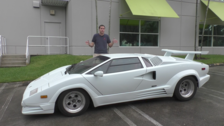
Watch: Here's the weird quirks Lamborghini Countach owners face

It also might not be the best move if you’re trying to preserve the Lambo as a piece of cultural history; then again, you might just be looking to own a low-mileage Lambo — with fewer than 2,000 miles, this Lambo is priced reasonably at $235K, despite its celebrity association.

With the Lambo on its way out, we wonder what Zimmerman slid into its spot in the garage. The music producer’s tastes might seem crass when it comes to wraps, but his supercar taste is top-notch. To name a few of the cars that Zimmerman has, or currently still, owns: Ferrari 458 Italia, a McLaren P1 and a BAC Mono.

H/t Jalopnik