All posts in “Lamborghini”

Insane Lamborghini Aventador S belts out 740 hp, adds four-wheel steering

Share

  • Pinterest

Revised styling, a little more oomph (to the tune of 40 hp) and a new four-wheel steering system mark just a few of the changes Lamborghini is bestowing upon its flagship. Called the Aventador S, the V12 supercar has been refreshed by Lamborghini inside and out.

“This is the next-generation Aventador as well as the expression of new technological and performance milestones in super sports-car development,” says Lamborghini chairman and CEO Stefano Domenicali. “The Aventador S is visionary design, cutting-edge technology and driving dynamics in pure harmony, and it elevates the concept of super-sports cars to a new level.”

Lamborghini has updated the exterior styling with changes designed to achieve maximum efficiency, according to the automaker. Front downforce has been improved by more than 130 percent over the previous Aventador coupe. Lines reminiscent of the Countach are apparently baked into the new S, but we’re having trouble seeing them ourselves.

New to the Aventador S is four-wheel steering. The system is combined with the Lamborghini Dynamic Steering system on the front axle and integrated into the active Lamborghini rear-wheel steering system on the rear axle. The new system responds in just five milliseconds to a driver’s steering inputs and works in conjunction with a revised suspension.

Lamborghini Murcielago destroyed

Lamborghini Murcielago gets eaten in Taiwan

If you were planning on illegally importing your absurdly expensive supercar into Taiwan, this video should persuade you otherwise. We’re sure the owner of this particular Lamborghini Murcielago …

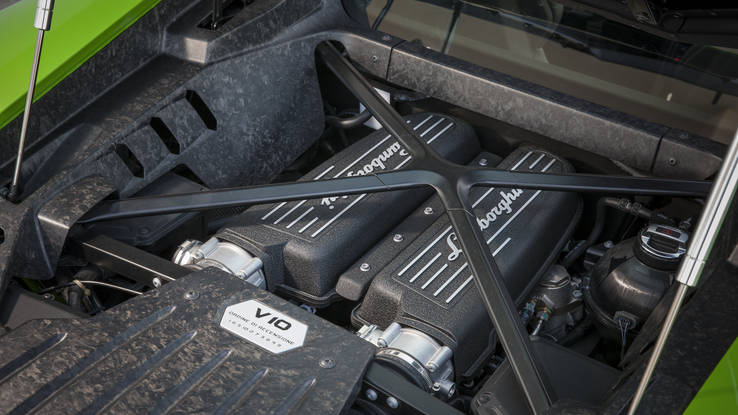
Power still comes from a 6.5-liter V12 engine, but horsepower is up 40 to 740. Torque is 508 lb-ft. A sprint to 62 mph takes 2.9 seconds as power is sent to all four wheels through a seven-speed automatic transmission. Top speed is a license-losing 217 mph.

An additional driving mode — Ego — is now available along with Strada, Sport and Corsa. The new mode provides several profiles, which are customizable by the driver.

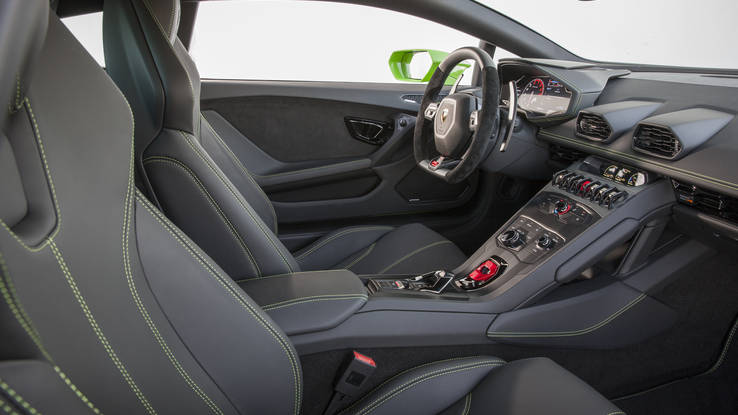
Inside, drivers are met with a new TFT digital dashboard that can be customized to individual preferences with each of the four driving modes. Apple CarPlay is now standard, too. Optional is the Lamborghini telemetry system, which can record lap times and track performance as well as trip data. The interior can be personalized through Lamborghini’s Ad Personam program.

Fortunate customers can get their hands on the Lamborghini Aventador S this spring, with a suggested starting price of $421,350.

Lamborghini Murcielago gets eaten in Taiwan

Share

  • Pinterest

If you were planning on illegally importing your absurdly expensive supercar into Taiwan, this video should persuade you otherwise. We’re sure the owner of this particular Lamborghini Murcielago LP640 is regretting his decision right about now.

If you watch up to the seven-minute mark, you’ll see the finishing touches being put on the remnants of the poor Italian supercar (it’s not worth watching past that point since nothing else happens). It appears as though Taiwan decided to send a message to any other would-be importers — there sure were a lot of cameras set up and ready to go around the car and crusher.

Regardless of how painful this is to watch, it is quite mesmerizing to watch the metal jaws eat the 200-mph Lamborghini. Maybe Taiwan’s New Year’s resolution next year could be to destroy one less supercar. That’s something we could all get behind.

By Zac Palmer

Lamborghini Huracan RWD Spyder is perfect for an LA winter

Share

  • Pinterest

Busy filling out niches, Lamborghini rolled out the Huracan Rear-Wheel Drive Spyder at the LA Auto Show this week by giving the familiar LP 580-2 coupe the folding roof from the LP 610-4 Spyder. That’s a lot of numbers to remember, so Lamborghini just calls it the Rear-Wheel Drive Spyder to avoid sounding too German.

Taking 17 seconds to lower, the folding top won’t just be a piece of canvas that will take up space behind the seats; two fins rise out of the folding roof compartment when the top is lowered (at speeds up to 31 mph) to preserve the looks of the car, while a special duct helps calm the air turbulence at speed. Slicing the roof and adding the folding-top hardware will add just under 260 pounds to the dry curb weight of the Spyder, now weighing in at 3,320 pounds, but it will still weigh less than the all-wheel-drive Spyder. Just about everything else will be carried over from the LP 580-2 coupe that debuted in 2015, taking up a spot below the all-wheel-drive version.

A 5.2-liter V10 still powers this version of the Huracan, generating 572 hp and 398 lb-ft of torque with a seven-speed dual-clutch (it sounds better in Italian: Doppia Frizione) transmission doing the shifting, enabling sprints from 0-60 mph in just 3.6 seconds. A top speed of 198 mph will be a nice number to contemplate, but most jurisdictions tend to set their speed limits just a bit below that.

Lamborghini Huracan RWD Spyder interior

The top will fold in 17 seconds and at speeds up to 31 mph.

“The rear-wheel-drive Spyder enlarges the Huracan family’s core product range,” said Automobili Lamborghini chairman and CEO Stefano Domenicali. “It offers the lifestyle appeal of open-air motoring with the pure thrill of rear-wheel-drive engineering.”

When will buyers be able to drop the top at the push of a button and enjoy the sun? In January 2017, when the sun will be a tiny dot surrounded by a halo of freezing air in the upper part of the U.S. (except those states that a lot of Lamborghinis already call home). Lamborghini hasn’t published pricing just yet but says buyers should expect the starting price to be between the rear-wheel-drive and four-wheel-drive coupes.

How to advertise tires? Make a Lamborghini Huracan drift video!

Share

  • Pinterest

Stunt-driving couple Sam and Stina Hubinette are in the latest Nitto Tire drift video featuring the immensely popular, as far as supercars go, Lamborghini Huracan. The duo takes the Huracan in for service at a Newport Beach dealership and leaves the parking lot with a calligraphy signature of burnt rubber in and out of the repair garage.

This Lambo, in particular, according to Nitto, has a Vorsteiner Novara Edizone Aero Package, custom hydraulic handbrake and, obviously, Nitto ultra-high performance tires, which are promptly destroyed. We can’t tell if it’s the rear-wheel-drive 580-2 version of the Huracan or not, but the Hubinettes do have an easy time sending the tail out. Either way, it’s an enjoyable little feature.

Lamborghini courts the ladies

Share

  • Pinterest

Lamborghini is trying to broaden its appeal to women with its new Urus SUV, coming out in 2018. At least that’s new-ish CEO Stefano Domenicali’s plan, according to Bloomberg, and it’s not that far out of the realm of possibility.

“A bull is always aggressive, but I would like to give us a new philosophy toward the future: A bull can be gentle,” Domenicali said. But don’t worry, Lambo’s giant V12s aren’t going anywhere, even though the Urus is expected to have a 600-hp turbocharged V8.

Domenicali says the new SUV should double the company’s yearly sales; for reference, in 2015 it moved 3,245 units.

We know the Urus will be immediately identifiable as a Lamborghini, but the company wants it to be customizable from the factory and to target a 30- to 45-year-old audience. We think that might be a little difficult, considering the SUV is expected to come in at about $200,000, and there are only so many young, successful entrepreneurs to go around.

Domenicali is hoping a big percentage of those new buyers will be women, as the company’s current buyers are 95 percent male. Bloomberg notes there’s a big swath available to Lamborghini, considering 48 percent of all small premium SUV buyers are women, according to J.D. Power and Associates.

2012 Lamborghini Urus concept

“Lamborghini is going in the right direction here,” said Milton Pedraza, a Manhattan-based consultant. “Anybody can be convinced, as long as there is substance to the argument. If Lamborghini puts out a product that is female-friendly, women will definitely flock to it and will change their minds. It’s not a question of money for women in that segment. The money is not going to be the issue. It’s going to be: ‘Show me you know me.’”

Pedraza goes on, “When women get to the showroom, the people who are ambassadors to the brand and the experience have to be impeccable,” he said. “It all has to be seamless and honest and relevant — and by the way, human. If it can do that, I believe Lamborghini has a great shot.”

Bloomberg notes that it might be productive to actually hire some women as head executives to lead the charge. Currently the only woman on the top team is a new American public relations rep.

“We have a small company, but we know we can do a good job,” Domenicali said. “And we are humble — it’s a different customer, a different car, a different network. We are (at the) top with regard to the super-sports car, but this will be a different business.”

Lamborghini plans to double sales thanks to $200K SUV, report says

Share

  • Pinterest

We may not think of Lamborghini as a company with much interest in sales volume — that wasn’t its main goal for as long as anyone can remember — but the artisanal supercar batchmaker will aim to double its sales by 2019, Reuters reports. Lamborghini expects to produce 7,000 units a year by this year, owing largely to a long-awaited SUV model, chief executive officer Stefano Domenicali told Reuters this week.

The upcoming SUV, which may or may not be called Urus, will be priced around $200,000 to allow it to compete with other entries in the not-too-wildly-expensive-SUV segment.

The brand’s second SUV (after the LM002) was previewed by the Urus concept at the Beijing motor show in 2012, and at the time it was expected to be powered by a VW Group 4.0-liter twin-turbo V8 engine. Powerplants for the upcoming SUV have not been confirmed just yet, but they are expected to be sourced from the Audi and Bentley parts shelves. The SUV is expected to debut in production form in 2018, prior to a likely preview in late 2017 (the Frankfurt motor show is a good candidate for the launch).

2017 Bentley Bentayga first drive

2017 Bentley Bentayga first drive

What is it? It’s a winner, guaranteed.With no hint of reticence, Bentley calls the 2017 Bentayga the “fastest, most powerful, most luxurious and most exclusive SUV in the …

One of the more interesting parts of this plan to boost sales is that supercars will still amount to half, or 3,500 vehicles, of Lamborghini’s annual production, suggesting that the SUV will be the brand’s volume model. Growth will largely be confined to the SUV model; the VW-owned automaker plans to keep all other models capped at just over 3,000 units a year.

The U.S. is expected to be one of the main markets for the Lamborghini SUV; there’s no shortage of demand for premium SUVs in North America at the moment. China is expected to be a major market as well, the current slowdown in that luxury market notwithstanding.

The Lambo SUV won’t be the most expensive SUV on the market when it debuts; by 2019 the Rolls-Royce Cullinan will already be available, expected to be priced well north of Sant’Agata’s sportier offering.

2016 Concorso Italiano is molto bene (very good)

Share

  • Pinterest

“It was spectacular,” said Cappo de Concorso Tom McDowell. “It was really good.”

McDowell lists this as the 31stConcorso Italiano, the eighth since he took it over, and we can’t believe this thing has been going on for that long. What started as a gathering of Maserati enthusiasts in the parking lot of the hotel they all stayed at before Pebble is now huge. HUGE! Hundreds of Italian cars line two long fairways at the Bayonet Blackhorse Golf Course in sometimes-sunny Seaside, California.

Concorso is now slowly growing in prestige as well as size, a real force to be reckoned with, as evidenced by two spectacular concept cars: the Disco Volante by Touring and a concept by Ken Okuyama, both of which crossed the stage to oohs and aahs.

Another significant car was this year’s Best of Show, a car that would easily have been at home on the 18th green at Pebble – a 1958 Ferrari 250 GT Tour de France. Not only did it look impeccable, it drives well, too, according to Brendan Gallaher, who owns the car with Michel Stern.

“It’s great,” said Gallaher. “It’s really balanced, the steering is light, it brakes well, it sounds nice.”

Indeed, the crowd at the award ceremony got to hear it revving on the ramp for several minutes.

“Oh, it doesn’t overheat,” said restoration specialist and the TdF’s driver Rex Nguyen, who noted the car was painted only two days before.

1911 National Speedway Roadster

There was more: There are always anniversaries on which to hang significance to any car event and this year there were six 50th anniversaries, including, most significantly, the Golden Jubilee of the Lamborghini Miura.

“Arguably the first supercar, the Lamborghini Miura was a game-changer,” wrote McDowell in his welcome letter to Concorso faithful. “It was the first mid-engine car designed and produced for street driving. It shocked the automotive world when it was introduced, quickly establishing Automobili Lamborghini as a force in Italy and beyond.”

And, unlike us, it still looks just as sexy now as it did in 1966. There was an entire row of Miuras on the upper fairway. It seemed like about half of them were that electric green that could probably be seen from across the bay in Santa Cruz. So cool.

This was also the 50th anniversary of the Fiat 850 and 124 Spiders (ask Cory Farley about those cars, he owned one, possibly two). The DeTomaso Mangusta came along in 1966, as did the Alfa Romeo Spider/Duetto and Ferrari even contributed the 330 GTC and GTS.

If you want to complain, you could say that all those fun and funky little Etceterinis we always loved seem to be all but gone at Concorso, pushed out by the usual tidal wave of 348s, 355s and Gallardos. How hard would it be to reach out to those owners and get them to push, tow or trailer some more of those magnificent little post-war engineering triumphs? Maybe cut them a deal on registration fees or something? (There we go spending McDowell’s money again). There were also far fewer of those little low-budget home-made picnics sprouting up amidst all the parked cars on all that grass. We counted exactly one. There used to be a lot more. Quaintness, that’s what we want!

But you can’t please everyone.

McDowell promises even greater things for next year — not more cars, he said, but better cars, building on the two concepts and the higher quality of the best entries this year. He has also sworn off that Palm Springs Concours from last winter (remember that debacle?).

“No more Palm Springs,” he said. “It’s strictly Concorso.”

And that’s a good thing.

Watch the 770-hp Lamborghini Centenario test at the Nardo Technical Center

Share

  • Pinterest

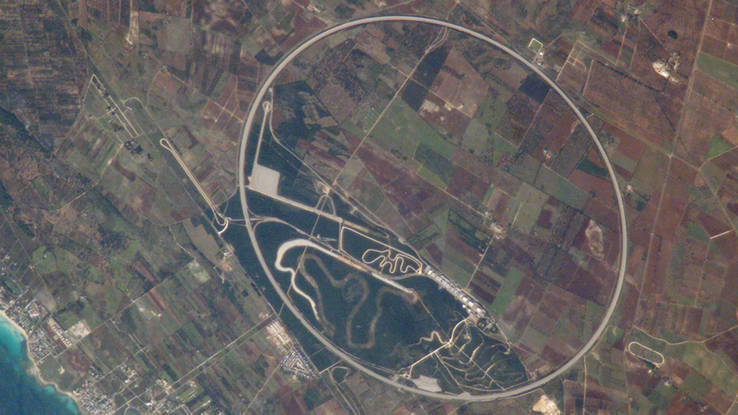
The special edition 770-hp Lamborghini Centenario is sold out. That much we know. What we don’t know is how it compares to the rest of the Lamborghini family, or to the supercar crowd as a whole. A few lucky folks got to drive the new V12 at the Nardo Technical Center in Italy; the track, owned by Porsche, is also known as the Nardo Ring because of its 7.8-mile high-speed course.

Nardo Ring in Italy

The Nardo Ring is now owned by Porsche and features a 7.8-mile high-speed course in addition to an infield road course. Photo by By NASA – http://earthobservatory.nasa.gov/Newsroom/NewImages/images.php3?img_id=17765 [1], Public Domain, https://commons.wikimedia.org/w/index.php?curid=4514992

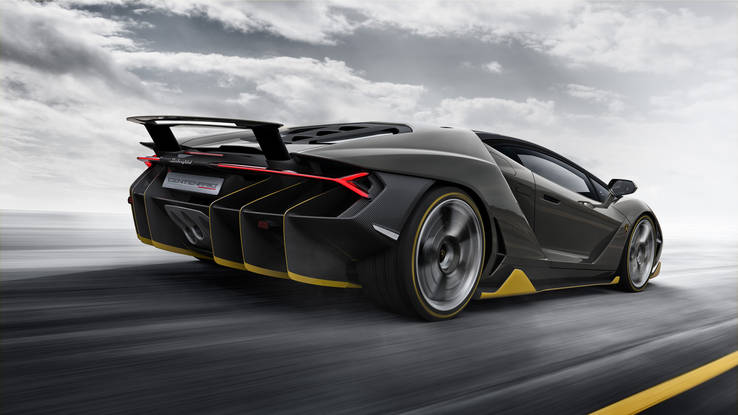
The lastest and fastest wedge from Lamborghini celebrates what would be the 100th birthday of its founder, Ferruccio, if he were alive today, and it probably telegraphs what the next halo car will look like. Only 40 will be built — 20 coupes and 20 roadster — and all have already sold for $1.9 million each. Top speed is 217 and the sprint to 60 mph takes 2.8 seconds. The carbon fiber lightning bolt weighs just 3,351 pounds.

We do expect to drive this car at some point, at least for professional curiosity. Our only questions for Lamborghini are: when and where? Our driving gloves are ready.

Two Lambos, one day in Los Angeles

Share

  • Pinterest

An e-mail popped up the other day from a guy we’ll just call, “Lambo Guy.” He is the official representative of all things Lamborghini in America and holds the keys, both figuratively and literally, to a fleet of those cars stashed in various cinderblock buildings across the United States. E-mails from Lambo Guy do not go into the delete file. They are opened immediately and savored, as one would savor bacon-wrapped cheeseburgers after a two-week backpack spent eating dehydrated turkey tetrazzini, or donuts made from diamonds.

 You never know what Lambo Guy is going to say in these e-mails but you always read attentively to find out. Sometimes it’s just something about some driver in the Blancpain Lambo series race somewhere in Abu Dhabi that you can’t really write about as often as that fine and exotic series maybe deserves. Sometimes it’s an announcement about a Lamborghini store opening in Smackville, Peru, which you also can’t really write anything about. But you open them all anyway because, once every vague now and then, these e-mails contain something that makes all the 342 other e-mails worth opening.

“Hey, you wanna drive a Lamborghini?”

That is a paraphrase, but that was essentially his point. Indeed, he had two points, both of which make all the drives and write-ups of all the thousands upon thousands of crossover SUVs that other carmakers are “really excited about” worthwhile. This was the rare and wonderful Lambo-double-whammy — it was the offer of not just one, which would be reason enough to go to the rooftop parking structure and yodel, but two Lamborsghini for the same day, both Huracans: an LP 580-2 and an LP 610-4.

Mama mia.

Lambo LP 580-2

The Lambo LP 580-2 has more room and may be the better driver of the two Huracans we compared. Photo by Mark Vaughn

Talented pilote though your author may be, even he couldn’t drive two cars at once. So after telling Lambo Guy that yes, perhaps that would be a good idea to drive two Lambos in one day and yes, it looks like there is room on the calender prettymuchanywhereyouwanttheretoberoom, we placed a call on the Supercar Emergency Hot Line telephone kept in a desk drawer in the Autoweek lair high above the LA metropolis to the only guy both talented enough and trustworthy enough to handle an entire day of swapping seats in what would amount to over 1000 metric hp: Autoweek correspondent and all-around good guy Ben Stewart. Stewart himself is not only cool enough behind the wheel to not do anything dumb to these multi-gazllion-dollar exoto-rides, but he himself once owned a Countach  (another story for another time perhaps), so he knows from Lambos.

Yes, said Stewart (we are paraphrasing again), perhaps I, too, have time for such an endeavor.

Stewart, writing ex-post facto: The best supercar experience is a short, intense one on a great road. That way there’s less time to fuss about the little stuff. Who cares if it’s hard to park or returns abysmal the fuel economy? It’s a Lambo! Its only true purpose on this planet is to thrill everyone inside and outside of the car — all the time.

Thus it was that we met in the super-secret Lambo Repository in a nondescript cinderblock building somewhere in LA and took delivery. The Repository is a story in itself, again for another time, but it also had Astons Martin hanging from lifts and one or two other cool cars.

Our contact, “Mike,” showed us around the inner workings of the Huracans — where reverse was, how the windshield wipers worked, where the insurance papers were — and we were off, Ben in the LP 610-4 Spyder and I in the LP 580-2 hardtop coupe.

Stewart: We had a chance recently to spend time with two new Huracans, a double dose of V10 power concentrated into a few brief hours of one delirious day.

LP 610-4 and LP 580-2

LP 610-4 and LP 580-2 Rosenkrantz and Gildenstern, Abbott and Costello, Simon and Garfunkel Photo by Mark Vaughn

I immediately liked my car, maybe because I am not a convertible guy. I like a solid roof above me protecting my pasty white Euro-mutt skin. Yes, you need the vitamin D the sun provides, but you can get that through other sources like prune juice and beets. Plus, I like anonymity … as if you’re going to get any of that in a Lamborghini. Ha!

As you may recall, to make the AWD Huracan into a RWD Huracan, Lamborghini simply removed the front driveshaft, half shafts and differential, which lightened up the front end, allowing engineers to install slightly lighter springs and create what the company calls “… the purest expression of Lamborghini to date.”

The 580-2 had room to stretch out, sort of, and it drove about 200 times better than the old Gallardo. I said as much on earlier drives of earlier Huracans. This is a giant step up for Lamborghini, a company that has lived in the (albeit very fast) shadow of Ferrari its whole corporate life. And while Ferrari used to hold its sales to 5,000 a year no matter what in order to create “desire” for its products, Lamborghini last year hit 3,245 sales and was darned happy to have done so. So buy all you want, they’ll make more.

LP 610-4 interior

LP 610-4 interior was a little cramped if you’re over 5’10” or so Photo by Mark Vaughn

Stewart: The drop-top Spyder is the superstar of this duo. This is the one that snapped necks at the stoplights. It only takes 17 seconds to put the top down and go from obscurity to celebrity. That fabric roof completely disappears behind your head, making the big engine scoops on the car’s upper flanks more prominent.  And the noises! Without a roof you can hear every beautiful, angry shriek of that 610 hp V10. When it all becomes too much, you can drive it around town with the top up and enjoy the car with a little more anonymity. It’s a bit cave-like in there with the roof in place. And you’ll notice a big nasty blind spot making it tough to see cars in the right lane. The Spyder’s top mechanism requires considerable real estate in the back forty of the car. So as pretty as those quilted leather seats are, the legroom is tight and there’s less seatback rake than hardtop model. 

First we cruised Sunset Boulevard and Beverly Hills in general, not because we were shallow poseur douche weasels fulfilling a stereotype, but because it was on the way to our favorite twisting two-lane mountain road. Plus, it gave us a chance to review the car from the point of view of the shallow poseur douche weasel. Not that anyone who buys a Lamborghini could be classified as that, but some exoto-rental car drivers may be. We’d heard.

Alas, it was too early in the day to gain any of the coveted social status supercar owners sometimes seek. All the starlets were still sleeping it off in their Beverly Hills bungalows. Only a few jet-lagged German tourists roamed the streets. A few took pictures of the Lambos, perhaps thinking Stewart was a Charlton Heston clone. No one looked at me.

Stewart: We wound our way through great roads high above the Hollywood hills and after a short freeway blast picked up the sweet, sinewy curves of Angeles Crest Highway in the San Gabriel Mountains. It was a rough assignment but we tried to make the best of it.

Again, the 580-2 felt so much better than any Lambo before it. The influence of the Audi engineers was palatable and much appreciated. It turned, it braked, it was a real car. Granted, it didn’t turn and brake like a Porsche, McLaren or Ferrari, but its progress was worth a Most Improved trophy if anyone was handing those out.

Ben felt similarly happy with the 610-4. Lamborghini calls it “Performance and lifestyle under the open sky.” This version of the 5.2-liter V10 makes 602 SAE hp, good for a top speed listed at 201 mph.

Stewart: In the canyons, sun blasting our faces, the LP-610-4 Spyder is ridiculously fun — and potent. Lamborghini says the roadster hits 60 mph in just 3.4 seconds. And it feels no less thrilling and no slower than the last LP-610-4 coupe we drove six months ago, despite weighing over 250 pounds more. This thing is a beast. And few sounds are as wild as this Lambo’s V10 in Corsa mode bouncing off those rock walls. The Lambo has loads of grip. But what you do feel when you push it on Angeles Crest is tiny movements in the steering column. When you push the car hard, it feels a little unsettled and does understeer. You’d only notice this if you had a Coupe along to drive over the exact same road — which we did. The steering in those corners feels slightly less precise in this droptop. 

LP 580-2 engine

While the engine in the LP 580-2 was down 30 hp on the LP 610-4, it made no real difference. Unless you’re at Bonneville… Photo by Mark Vaughn

When we reached the top of Angeles Crest just over 7,000 feet up in the San Gabriel Mountains at Cloudburst Summit, we swapped cars. “Yikes,” I thought, going from the relatively roomy 580 to the scrunched-up 610. My scrawny chicken legs were too long to fit comfortably in here (I’m only 6 feet-nothin’) and there wasn’t enough room to slide the seat back as much as would have been nice. I drove with my elbows askance not quite like a clown in a clown car but close to it. The car was too small for me and, with the top down, I began to fry like an egg on that sunny day. Stewart, meanwhile, was having fun.

Stewart: Slide into the LP 580-2 and we’re immediately more comfortable. The difference in legroom is so dramatic it had us wondering as first if the actual wheelbases of the two cars are different. They aren’t. But anyone over 6 feet tall will have a more enjoyable drive in a Huracan coupe. On the outside, Lamborghini has installed redesigned lower fascia with larger scoops that make the LP 580-2 look even more aggressive than the LP 610-4, if that’s even possible. When Lamborghini removed the all-wheel drive system on this model, the Huracan lost 72.6 pounds. But it also lost 30 horsepower, down to 580. You will not notice or miss any of those horses. Lamborghini quotes the 0-60 mph time identical to our Spyder. Lay into the throttle and it’s just as angry and ferocious-sounding. And that’s just how a Lamborghini should be.

We took off down the hill. Even though the 610-4 had those 30 more hp, like Ben said, I didn’t notice them. I was just trying to fit into the thing. And the handling felt more skittish. The 580 had been fairly smooth — when it went into a corner it stayed there all the way through the radius. You didn’t have to make any corrections. In the 610 you were always making tiny, minor adjustments. Maybe more seat time would have had me sorting it out better, maybe I’m a talentless dope, but I felt far less dopey in the 580. Granted, a skidpad and a slalom would reveal more, but up here the Spyder felt jumpier than the coupe.

LP 580-2 rear 3 4

Our favorite? The LP 580-2. Easier to drive, easier to sit in and it has a roof.

Stewart: Out on the twisty road, the 580-2 feels more direct, purposeful and connected to the road. It weighs 344 pounds less than the Spyder and feels like a little bit of slack has been taken out of every suspension and steering component. Lamborghini says there’s a good reason we notice this, because the suspension is stiffer and steering is recalibrated over the 610-4. Even the brakes and Pirelli P Zeros are specific to this model. It’s a big improvement. This car feels locked down and more serious about its job than the Spyder. It’s more playful too, and ridiculously fun to hit the corners carrying a lot of speed. Lamborghini says it’s tuned to provide “oversteering characteristics.” We restrained ourselves from drifting the big Bull, but that probably explains why it feels so lively on Angeles Crest.

So the winner? For cruising Sunset and wowing starlets, you’ll want the Spyder. For driving fun in a less-expensive package, pick the 580-2. Stewart agrees.

Stewart: The Spyder is gorgeous. But it’s the rear-drive 580-2 we’d park in our own garage. The driving experience is so much more involving. The 580-2 is the Huracan for the driver who’s going hit the good roads every weekend. It certainly left us wanting more time behind the wheel.

And with that we returned both cars to the secret Lambo lair and drove off in completely unremarkable crossover SUVs, not feeling “really excited” at all about coming back down to Earth. 

On Sale: Now

Base Price: $204,995

Drivetrain: 5.2-liter naturally aspirated V10, rwd/awd (580-2/610-4); seven-speed dual-clutch automatic

Output: 571 hp at 8,000 rpm, 398 lb-ft at 6,500 rpm (LP-580-2); 602 SAE hp and 413 lb-ft of torque (LP 610-4)

0-60 MPH: 3.4 seconds

Pros: Aye Chihuahua!

Cons: Spyder is a little cramped but not enough to cramp your style

Lamborghini Miura’s fathers retrace ‘The Italian Job’ route though the Alps

Share

  • Pinterest

The 50th anniversary of the Lamborghini Miura is upon us, and as part of the celebration the automaker recently sent two Miuras from its museum on a trek through the Italian Alps, retracing the route from the opening sequence of the classic film “The Italian Job.” You may recall the first few minutes of the 1969 film show the Miura being driven on the spectacular roads around the Alps — that’s state road 27 slicing through Great St. Bernard Mountain. And it’s not too far from Lamborghini’s home in Sant’ Agata Bolognese.

What made this outing special is that the “fathers” of the Miura took part in the drive. Design legend Marcello Gandini along with engineers Gian Paolo Dallara and Paolo Stanzani were behind the wheels of these cars. Gandini was at Carrozzeria Bertone at the time he penned the Miura, while Dallara and Stanzani engineered the car. Dallara, of course, went on to start his own race car company, creating many Formula One and IndyCar bodies, while Stanzani went on to engineer another Lamborghini legend: the Countach.

Lamborghini Miura in the Alps

The opening sequence of “The Italian Job” featured the Miura, which was just three years old at the time. Photo by Lamborghini

Throttle Back Thursday 50 years ago the Lamborghini Miura stunned us in Geneva

Test driver Bob Wallace is perhaps the only one of the “fathers” of the Miura who was absent — he passed away three years ago. Wallace was in charge of road-testing the prototypes and the production examples all through the development process and beyond, continuing on with other Lamborghini models including the Urraco, Espada, Jarama and Countach.

The fastest (and arguably most beautiful) production car at the time of its debut in 1966, the Miura has aged gracefully over the past 50 years and achieved a cult status enjoyed by very few other cars. The Lamborghini factory has a few more events planned throughout the year that will celebrate the Miura’s 50th anniversary.

When a new tire is an event: Pirelli P Zero updated for its 30th birthday

Share

  • Pinterest

Formula One and street-tire maker Pirelli introduced a new P Zero performance tire last week; almost exactly 30 years after the first P Zero appeared in 1986 on a Lancia Delta S4 in the World Rally Championship. The new tire gets an F1-style racing bead, more endurance and less rolling resistance for better gas mileage.

Pirellis are almost standard fare for many modern sports- and supercars. The telling point is this: when Porsche, Ferrari and McLaren agree on something, it’s hard to argue. And the company’s “Perfect Fit” strategy means each one of its 60 homologations have been customized for a particular car. If the 911 Turbo needs more squared shoulders for better cornering, Pirelli will do that. If the next Lamborghini needs extra clearance, it can round the shoulders. All 305/35R20s are not created equal.

As for “features,” though we’re not really sure how a tire can have features, the new P Zero has an F1 bead, which uses a super stiff compound for the part that contacts the rim, which Pirelli says allows a more precise steering response and generally smoothes out lateral grip.

The footprint is now flatter, which leads to a longer life, says Pirelli, while more tread pattern grooves and wider and deeper channels help wet grip. Pirelli also changed the way the transverse grooves line up, meaning less road noise. Rolling resistance was cut as well, through the use of new modeling techniques and more silica content in the rubber. That should be good for an mpg or two.

Pirelli P Zero with PNCS

The Pirelli Noise Cancelling System uses a polyurethane sponge to reduce noise.

The latest tech from Pirelli, though, is its new noise cancelling system. The guts of the tire are filled with a layer of polyurethane sponge that dampens both the noise and vibration transmitted to the cabin. Pirelli says the new P Zeros are 2-3 decibels quieter, which is equivalent to cutting noise in half.

The company also does a run-flat version that can be driven when flat at speeds up to 50 mph, and a “seal inside” version, which comes with a rubber sealant that “forms a protective sheath around the piercing object.”

We tested the new Pirellis in Portugal at the famed Estoril Circuit last week, swapping between the Audi R8, Mercedes-AMG GTS and Porsche 911 big “T” Turbo. We found them very progressive when slipping — almost too drama-free, in fact — but extremely grabby when hard on the brakes in a straight line. We also did some road driving with the less-aggressive compounds and found them quiet and compliant during slow-speed cruising.

The company will also begin producing classic fitment tires later this year for older 911s, Lamborghinis and others. Stay tuned — we’ll bring you more info on those as they get closer to market.

Pirelli performed a dance number at the event in Portugal, wearing rubber-looking suits that may or may not have been made by Pirelli. [embedded content]

After the press conference, Pirelli dropped the curtain to reveal a Lamborghini, McLaren and Pagani on the tarmac. [embedded content]

Watch this 1,800-hp Lamborghini Huracan do a quarter mile in 7.8 seconds

Share

  • Pinterest

Last week, this Underground Racing Lamborghini Huracan ran a ridiculously quick, 8.55-second quarter-mile pass at Rockingham Dragway. We were predictably impressed, but someone at UR must have thought it just wasn’t quick enough. The Charlotte-based company upgraded the clutch to a 10-plate Dodson unit, allowing the driver to put more power to the 19-inch drag radials from the twin-turbocharged V10. Currently, this Huracan makes 1,800 hp, or just enough to run consecutive sub-eight-second passes.

Shaving nearly a second off an elapsed time is tough for anyone — or any company — but it gets exponentially more difficult as those numbers get lower and lower. For the team at Underground Racing to turn around in a week and knock out some 7.8-second runs is almost impossible to imagine.

Take a few seconds and watch one of the world’s quickest Lamborghinis making its latest record-setting lap down the quarter mile. And check out last week’s 8.55-second pass below.

[embedded content]

Throttle-Back Thursday: 50 years ago, the Lamborghini Miura stunned us in Geneva

Share

  • Pinterest

Need proof that the Geneva motor show was always about the high end of the market? Look no further than our coverage of the 1966 event. No, there was no Bugatti Chiron, but in its place was something arguably more important: the world’s first supercar.

We’re talking about the Lamborghini Miura P400, a car so stunning it forced us to use “coruscating” in the article headline. This wasn’t the first time we’d seen the car, technically — the chassis was revealed to much acclaim the year prior at the Turin auto salon. Bertone’s gorgeous coachwork was a fitting match for the underpinnings, however, creating a V12-powered work of art that has only grown better with time.

There was more, of course. Pininfarina’s Ferrari California Spider, which — while probably several times more valuable than a Miura — looked positively old-fashioned compared to the Raging Bull’s offering. The new Alfa Romeo 1600 Spider promised to put Italian style within the reach of those not in the Ferrari set, as did the clean Ghia-bodied Isuzu 117 Sport.

Read our full coverage of the show in the April 2, 1966 issue of Competition Press & Autoweek below.

TBT 2016 03 03 Geveva 66.pdf

(1.27 MB)

Graham Kozak

Graham Kozak – Graham Kozak drove a 1951 Packard 200 sedan in high school because he wanted something that would be easy to find in a parking lot. He thinks all the things they’re doing with fuel injection and seatbelts these days are pretty nifty too.
See more by this author»

The Lamborghini Centenario is a tech-packed, 770-hp birthday party for Ferruccio

Share

  • Pinterest

The Lamborghini Centenario, which just debuted at the 2016 Geneva motor show, isn’t just another super-fast wedge-shaped collector’s item (although it is all of those things). It is, as its name suggests, a tribute to company founder Ferruccio Lamborghini; he would have turned 100 this April. It’s an exclusive birthday present, too: Just 20 coupes and 20 roadsters will be built at a cost of roughly $1.9 million per. All are, according to Lamborghini, accounted for.

We know, we know — another hyper-limited hypercar that was already sold out before you even heard about it. Why should you care?

Well, for one, it’s statistically unlikely that you were ever going to buy one anyway. So enjoy the pictures! For another, we wouldn’t be surprised if the Centenario gives us a good idea of what to expect in Lamborghini’s next V12 range-topper. If that’s the case, things are going to get lighter, faster and nimbler — but they’ll remain naturally aspirated. For now.

Lamborghini Centenario limited-edition supercar geneva motor show

The Centenario’s rear wing retracts at low speeds. Note the giant rear diffuser. Photo by Lamborghini

At 4.924 meters long, the Centenario is slightly longer than the Aventador (with which we suspect it shares a good chunk of its carbon fiber monocoque). Yet it’s a bit lighter at 3,351 pounds, a feat accomplished by building the entire car out of carbon fiber ducts and diffusers. To keep the car’s profile simple, the big rear wing on the back retracts when not in use.

To increase agility, the Centenario is equipped with a rear-wheel steering system — a Lamborghini first — and permanent all-wheel drive. The center-lock wheels are unique to the car; 20 inches up front and 21 inches in the rear, they’re wrapped in Pirelli PZero tires.

In this era of turbo-hybridization, we love that the car remains defiantly naturally aspirated. Its (presumably) 6.5-liter V12 produces 770 hp; redline is kicked up from the Aventador’s 8,350 rpm to 8,600 rpm. 0-60 takes 2.8 seconds (slightly slower than the Aventador SV). Top speed is 217 mph, we’re not quite talking about Bugatti Chiron velocities, but it’ll do nicely for your commute.

Since this is a V12-powered Lamborghini, it gets the scissor doors. And since this is 2016, it also gets Apple CarPlay. Whichever one of these two things gets you more excited probably says something about your personality. Choose carefully.

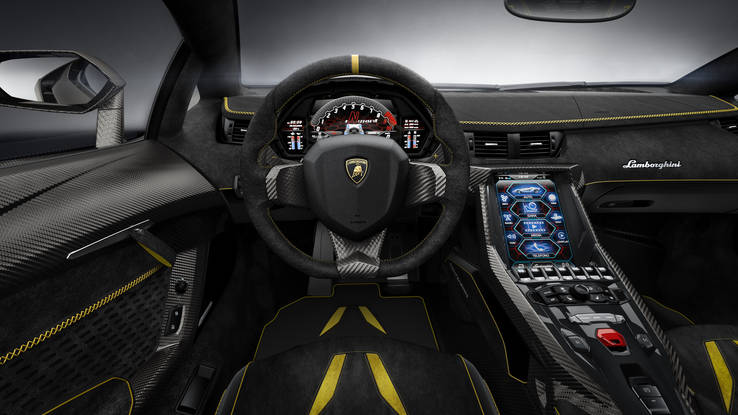
Lamborghini Centenario limited edition supercar cockpit

An interior worthy of Ferruccio. Photo by Lamborghini

Graham Kozak

Graham Kozak – Graham Kozak drove a 1951 Packard 200 sedan in high school because he wanted something that would be easy to find in a parking lot. He thinks all the things they’re doing with fuel injection and seatbelts these days are pretty nifty too.
See more by this author»

Italian coup: ex-Ferrari F1 honcho Domenicali replaces Winkelmann at Lamborghini

Share

  • Pinterest

Lamborghini CEO and president Stephan Winkelmann, who has seen the automaker through the most productive (and very likely the best-managed) period in its 53-year history, will step down effective March 15. His replacement is not a total surprise: Stefano Domenicali, an Imola, Italy, native with over two decades of involvement with the Ferrari Formula One team.

The always-affable Winkelmann joined Lamborghini in 2005. Over the course of his tenure, sales more than doubled to a record-breaking 3,245 cars sold in 2015 — a record all but guaranteed to be demolished once again when the upcoming Urus SUV, developed under Winkelmann’s watch, hits the market in 2018.

Despite his departure from Lamborghini, Winkelmann isn’t straying too far: He will become CEO of Audi high-performance division quattro GmbH. So, instead of a Huracan company car, he’ll be stuck in an R8. We can’t say we feel too badly for him.
 

Supercar drive

Domenicali has been vice president of New Business Initiatives at Audi since November 2014. But it’s what he did before stepping into that rather vague-sounding Audi position that grabbed our interest. Domenicali began working at Ferrari in 1991, moving to Scuderia Ferrari in 1993; he served as team principal in 2008 and represented the team before the FIA from 2009 to 2014.

His involvement with the FIA, and open-wheel racing, continues to this day: Domenicali is president of the body’s single-seater commission.

We suspect his motorsport experience will find a receptive home at Lamborghini. Traditionally, and unlike Ferrari, the company hasn’t relied on podium placement to sell its cars. That’s changing, if only gradually.

Lamborghini is more than capable of building competent road-racing cars, as the impressive (though uneven and controversial) debut performance by Huracan GT3s at the Rolex 24 at Daytona demonstrated. Yet company brass has maintained that its involvement in motorsport will be limited to serving client racing teams … at least for the foreseeable future.

Will that change with Domenicali at the helm? We don’t expect anything too dramatic right away, but we’ll be watching this one closely.
 

Graham Kozak

Graham Kozak – Graham Kozak drove a 1951 Packard 200 sedan in high school because he wanted something that would be easy to find in a parking lot. He thinks all the things they’re doing with fuel injection and seatbelts these days are pretty nifty too.
See more by this author»

We drive supercars at Fittipaldi Exotic Driving and you can too!

Share

  • Pinterest

Just how bad is it for the American middle class? Let’s look at a metric that nobody but nobody’s been keeping track of: how long it’d take the average earner to get into an entry-level exotic. The numbers are devastating. In 1986, the median household income in this country was $22,742; the base price of a Ferrari 328 GTB, just under $60,000. Thirty years later, the first number has tracked with inflation to its current $53,657 — effectively stagnating — while the sticker on an equivalent Ferrari, today’s 488 GTB, has quadrupled to a little less than $250,000. In other words, the amount of time a typical worker and his or her dependents has to spend living on the street and eating out of garbage cans for the privilege of owning a mid-engined Maranello-built thoroughbred has grown from about three years to about five. Things are tough out there!

One might argue that this is an unfair measure compared to other cost-of-living indices, that while a gallon of milk or a three-bedroom house haven’t changed in three decades, today’s supercars are notably improved, able to run rings around purpose-built race cars just a few years their senior on the track while actually being reasonably usable in day-to-day driving. Still, for you and me and Joe Lunchpail living in service-economy/student-debt/revolving-credit land, the chances of us ever getting a sniff of that performance and tractability have gone from slim to, well, none. So much for the American dream.

The market abhors a vacuum, though, and recent years have seen the growth of “driving experience” ventures offering quick hits in megabucks cars at prices ordinary folk can afford (assuming they’re that part of the 99 percent in a position to piss away a few hundred bucks on a Lambo ride). Rather than sending a jaded automotive journalist to find out whether or not such a thing could possibly be worth it, Autoweek sent me, a jaded touring musician whose only whiff of track time has come behind the wheel of a go-kart, and whose lifetime experience driving Ferraris is limited to one built 45 years ago. 

Photo: Fittipaldi Exotic Driving Photo 4

Fittipaldi Exotic Driving Photo by Peter Hughes

“Most of our customers are what I call experience junkies,” says Bill Scott, who with Christian Fittipaldi has just launched the Texas-based Fittipaldi Exotic Driving. For such people, piloting a supercar on a track is a bucket-list item alongside jumping out of a plane or maybe climbing into one of those “Shark Week” cages. A quick glance at the fleet of cars on offer at Texas Motor Speedway on a recent morning, though, suggests that Scott, who spent 20 years working with Richard Petty, is a car guy first and experience-peddler second. Rather than a portfolio of the newest and flashiest, FED’s stable leans heavily toward hardcore track specials.

“Of course, for something like this, you need a Ferrari, you need a Lamborghini, you need a Porsche,” Scott says. But instead of a 488 or 458 Italia (“We had one,” Scott tells me, shaking his head. “It spent more time in the shop than it did on the track.”), here are a pair of 430 Scuderias, the track-weapon variant of the late F430 that’s only become more prized since being succeeded by the 458 in 2010. Likewise, house Lamborghinis are Superleggera and Balboni editions of the familiar Gallardo, cars set up from the factory for track duty. A Porsche 911 Carrera S and Nissan GT-R Black Edition round out the range of options.

A quick classroom briefing is followed by a couple crew-cab pickup laps around the 1.4-mile infield course, an instructor helpfully pointing out the cones denoting braking points and apexes along the way. “Most places just show you a video of the track,” Scott points out. I was kind of hoping we might get to walk it, Jackie Stewart-style — you know, to really assess the fine grain of the track conditions — but yeah, warm-up laps are good, too. 

Photo: Fittipaldi Exotic Driving Photo 7

Fittipaldi Exotic Driving Photo by Peter Hughes

With startling little ceremony, my turn is up. Plopping down behind the wheel of the midnight-blue Scuderia, I exchange pleasantries with Andy, my all-business right-seat guide. As a guy whose job is talking fools through their first encounters with 500-hp supercars, his gruff demeanor makes sense. I quickly resolve to shut off my brain and do as I’m told.

Pulling a paddle to engage first — my first dual-clutch experience will be in automatic mode, alas, but given how much else is going on here, that’s going to be just fine — I dip a toe in the water and, at Andy’s urging, accelerate smartly down the front straight. No doubt the Ferrari’s flat-plane crankshaft V8 is making an unholy howl at this point, but I couldn’t actually tell you as all I have time to focus on is a rapidly approaching series of cones and the voice in my helmet telling me to brake for the first corner. Rolling of the throttle, adding in steering, aim for the cone — thanks, Andy. I’m starting to get the hang of this now, of listening, anyway. Timidly track through the back esses. A decreasing-radius right deposits us on a short straight before a quick sweeper past the start-finish line. “Go, go, go!” Andy shouts, and I gratefully comply.

You’ll notice there hasn’t been much said about the car to this point. The car that — were I a paying customer — would presumably be the whole point of the exercise. That’s because 100 percent of my attention is focused on following instructions and getting the line right. Are those experience junkies as concerned with not screwing up as I am? No way of knowing. About halfway through my second lap, though, I find myself leaning into the car as I learn to trust Andy more fully, and putting together a series of turns that feels moderately fluid. We blow past a slower car heading onto the front straight, and this time I’m briefly able to enjoy the rush of a Ferrari at full tilt on a racetrack. Are those LEDs lighting up on the steering wheel? They are! I’ll be damned.

Photo: Fittipaldi Exotic Driving Photo 6

Fittipaldi Exotic Driving Photo by Peter Hughes

Coming out of turn one, I feel the suspension load up and savor the sensation of the Pirelli Corsas using some fraction of their considerable grip. Of course, the reason I’m feeling this is that I’ve held the steering angle constant and completely failed to follow the line out of the turn, which leaves me set up all wrong for the coming esses, a fact Andy notes evenly. There’s a sort of uncertainty principle at work here, it seems: I can focus on the car or I can focus on the track, but I’m a long way from being able to pay attention to both. I finish my laps without incident and cruise back into the staging line, wishing I could stay out for about four more hours.

Verdict: cool, worthwhile, but slightly anti-climatic and not exactly perception-altering. It’s what comes next that succeeds in resetting my reality, as I climb into FED’s other car, a gutted and fully caged Porsche Cayman bored out to 3.9 liters and running on slicks. Behind the wheel is Christian Fittipaldi, defending United SportsCar Championship champ for two years running, two-time winner of the 24 Hours of Daytona, a guy who’s competed in everything from Formula One to NASCAR and was once named Indianapolis 500 Rookie of the Year. “So, they told you about how you’re supposed to slow down when you get to the cones, right?” I ask him. He shoots me a quizzical look.

Seconds later, Fittipaldi isn’t so much sailing past those cones as full-throttle accelerating through them before standing the car on its nose and diving towards the apex. The amount of speed he carries through the corners that follow is just unreal, and unlike anything I’ve ever experienced. I cackle like a madman the entire time. Pulling back in after a couple laps I attempt to collect myself. “Horsepower?” Fittipaldi shrugs. “About 400,” he says, adding, “This is basically an entry-level race car.” OK, fine. It is clearly not being driven by an entry-level driver.

Photo: Fittipaldi Exotic Driving Photo 5

Fittipaldi Exotic Driving Photo by Peter Hughes

It’s worth noting that Fittipaldi hasn’t just lent his name to the business; he’s both co-owner with Scott and an active participant, even if he won’t always be on hand to provide IMSA-caliber thrill-rides. “It’s so easy to stay in your cocoon,” he tells me later, and one gets the sense the cocoon in question is a metaphorical one, and not that of a Daytona prototype. “For me, this is a way to make new connections, create new opportunities, to really do something cool,” he says, with a guilelessness that’s genuinely disarming. A professional race car driver who wants to get out and meet people? What’s next?

Unlike similar outfits that travel the country hitting a given location maybe twice a year, FED is restricting its territory to Texas for the time being, enabling them to make monthly stops at TMS in Dallas, Driveway Austin, and their home base at MSR Houston.

Is it worth it? Sure. Tell your thrill-seeking friends looking to impress their Instagram feeds to head to Texas Motor Speedway: they won’t find a more professionally run program or a better experience. If you’re an enthusiast curious to drink from the forbidden chalice of modern automotive exotica, though, skip TMS for Austin or Houston (what they lack in Temple of Motorsport grandeur they make up for with longer and more challenging tracks), and maybe look into getting some track instruction in lesser (and less expensive) machinery beforehand, so that when you do get out there in your dream ride, you might be able to more fully appreciate it.

Finally, if offered a ride with Christian Fittipaldi? Say yes. 

By Peter Hughes

2016 Lamborghini Huracan Spyder first drive: The $267,545 exotic ragtop comes of age

Share

  • Pinterest

Since its introduction two years ago, the Lamborghini Huracan has surprised and impressed us with its balance of attitude and capability (and sales). The super-sports car is another extroverted, candy-colored wedge from Sant’Agata — we wouldn’t expect anything less from Lamborghini — but it backs up its trademark assertiveness with razor-sharp agility. It has proved as eager to devour canyons and square off against frozen lakes as it is to attract police attention, and it seems to have a promising racing career ahead of it to boot.

In short, it’s a bull that rages, but only when you want it to.

And the 2016 Huracan Spyder? It’s all that, minus the roof.

We’re in familiar territory here, powertrain-wise: You’ll recognize the coupe’s all-wheel drive, seven-speed dual-clutch transmission and 602-hp 5.2-liter V10, which Lamborghini says it will keep naturally aspirated as long as the regulators permit it. The sprint to 62 mph takes 3.4 seconds, or 0.2 second longer than the coupe, but who’s counting?

Even the aluminum-and-carbon “hybrid chassis,” which is related to the Audi R8’s, carries over more or less unaltered from the Huracan coupe — except, of course, for the ragtop. The Huracan was designed with the inevitable convertible variant in mind, and torsional stiffness is said to be up 40 percent compared to the Gallardo Spyder even without extensive (and heavy) structural bracing. So you’re not sacrificing rigidity or road feel to enjoy the wind in your chest hair.

Nor are you sacrificing style. The long, flat rear deck characteristic of so many drop tops — including the Gallardo Spyder — is absent here; Lamborghini  worked to ensure the coupe’s wedgy profile and the hexagonal side window openings (Lambo’s into hexagons now, for some reason) were maintained with the top up or down. All the convertible hardware means that the superb naturally aspirated V10 is more or less permanently hidden from view, even if you pop the engine cover. But you can hear it bellow far better with the top down than you ever could in the coupe; we’ll consider it a fair tradeoff.

The Spyder is saddled with a substantial weight penalty, however: 3,399 pounds here versus 3,135 pounds for the coupe. Much (220 pounds) of that comes from the electro-hydraulically actuated three-layer soft top and its associated hardware, which includes pop-up safety bars that fill the role of bulky roll bars should you flip the thing over. We gave the convertible top a heck of a workout but never got around to testing that latter feature.

2016 Lamborghini Huracan Spyder convertible drive review top operation

The power top deploys and retracts in 17 seconds at speeds of up to 31 mph. We managed to shave a few seconds off of that while dodging rain in traffic. Photo by Lamborghini

What’s it like to drive?

As we mentioned, the Huracan Spyder nails the 0-62 mph sprint in 3.4 seconds. It tops out at 201 mph.

Also, its convertible top can deploy or retract in a stated 17 seconds at speeds of up to 31 mph.

You can probably guess which set of figures we got acquainted with during the launch, which was conducted in a rain-drenched, high-traffic greater Miami metropolitan area (actually, we timed the top-dropping at 15 seconds, which is handy when you’re dodging foul weather).

Since Lamborghini considers the Spyder the “lifestyle” addition to the Huracan lineup, the choice of local was logical, if perhaps a little obvious. It was refreshing to be able to drive our “Kill Bill”-inspired, Guy Fieri-approved yellow-on-yellow-and-black Huracan Spyder without stopping traffic, the kind of thing only possible in someplace as car-jaded Miami. But the sequence of city streets, expressways and long, straight two-lanes out in the everglades, while perhaps an accurate representation of how the average supercar is used, is a poor match for the Huracan’s capabilities.

This thing was not meant to spend its life cruising South Beach, soggy or otherwise. Tolerant though it may be of low-speed crawling, it wants you to rev its free-breathing V10 to the sky and experience the perception-warping thrill of Vmax.

Maybe that’s the curse of owning a daily-drivable supercar, or super-sports car, or whatever something low and wide with 600-plus hp and all-wheel drive is considered these days: Unless you’re behind the wheel purely to bask in the adoration of exotic car-hungry plebs, you’re reduced to living for the occasional track day, or a few miles on your favorite quiet backroad, or a blessed break in the traffic on an unpatrolled stretch of I-95.

When you do get to wind it up and stretch it out a little, you’ll find the Huracan Spyder’s transition from mild-mannered tourer to track-ready aggressor nothing but fluid. There’s not a hint of turbo lag, because there are no turbos. The cowl doesn’t shake and shudder with the top down, and the car doesn’t flop down the road or around corners, because (believe it or not) convertible technology has advanced since the 1970s.

If anything, it’s so composed that you have to push it further than you ought to to revel in the sensation of speed. All of this is yet more evidence that the members of the Huracan family are, at long last, the Thoroughly Modern Lambos we’ve all been waiting for.

And yet, not too modern. So many high-performance cars assault drivers with adjustability and configurability; with throttle, steering and suspension modes to play with, you feel like you have to program the damned things before you drive them. You can trick your Huracan out with magnetorheological suspension (advisable) and the ratio-adjusting Lamborghini Dynamic Steering system (we’d pass on this option), but all told, there are few parameters to dial in here; you just slither in and go at whatever pace you wish.

It’s not that Lamborghini has turned its back on the sort of electronics that make 600 hp perfectly manageable in the wet. It’s that the company has made the implementation of all of this space-age wizardry feel fairly organic. Rather than the suite of buttons and toggles you’ll find on, say, a BMW M-car, the Huracan gets one big red steering wheel-mounted switch with three selectable drive modes — strada for street, sport for…sporty driving, corsa for the track.

And surprise! You can wring incredible performance out of the car, no matter the mode, with appropriate application of the throttle.

2016 Lamborghini Huracan Spyder convertible drive review overhead rear 3-4

Our yellow tester had a yellow and black leather interior. Great for Guy Fieri, but we’d probably go another route. Photo by Lamborghini

Do I want it?

You don’t buy one of these if you’re looking to fly under the radar; that’s something that has been more true of Lamborghinis, historically, than some other cars in this corner of the market.

In case you haven’t noticed, things have changed since the age of the Countach. If you’ve written off Lamborghinis as style-over-substance blank canvasses for questionable aftermarket rims and offensive vinyl wraps, you’ve been missing out.

The company still makes a hairy, scissor-doored, V12-powered beast — that’s the Aventador — but the Huracan Spyder is the sort of exotic you could, if you were so inclined, live with every day. It’s comfortable enough to drive cross-country, too, so long as you steer clear of the optional carbon fiber bucket seats and hire a chase vehicle to tote your luggage.

But why are we trying to sell you on the practicality of a $267,545 convertible? Buy the Huracan Spyder because it has character, and because it makes a statement no matter which color your order it in. Buy it because it rocks one of a shrinking number of naturally aspirated powerplants, stuffed into a rock-solid chassis and mated to an all-wheel-drive system modern enough to tame it. Buy it because, unless you take yourself far too seriously, it’s fun to be in — even if you’re not going particularly fast.

If you’re about to drop north of a quarter of a million bucks on a car, it goes without saying that you have options. This is one you owe it to yourself to try — even if you don’t consider yourself a Lamborghini person — before you make any rash decisions. Just make sure you line up some clear skies and empty roads, preferably with a curve or two, before you grab the keys.

2016 Lamborghini Huracan Spyder convertible drive review profile on road

We love the sky blue paint — even if we barely saw the sun during our drive. Photo by Lamborghini

Graham Kozak

Graham Kozak – Graham Kozak drove a 1951 Packard 200 sedan in high school because he wanted something that would be easy to find in a parking lot. He thinks all the things they’re doing with fuel injection and seatbelts these days are pretty nifty too.
See more by this author»

On Sale: Spring 2016

Base Price: $267,545

Drivetrain: 5.2-liter V10; AWD; seven-speed dual-clutch transmission

Output: 602 hp @ 8,250 rpm; 413 lb-ft @ 6,500 rpm

Curb Weight: 3,399 lbs

0-60 MPH: 3.4 sec (0-62 mph)

Fuel Economy: 13/26/19 mpg (city/highway/combined, European test cycle)(EPA City/Hwy/Combined)

Pros: Lamborghini’s signature flamboyance is finally backed up by credible performance

Cons: Hefty price tag; not for introverts

Watch: Behind the scenes of ‘Battledrift’: Mustang carnage

Share

  • Pinterest

Last month we showed off the latest Monster Energy, hyper-artistic viral video, featuring darlings of the drift scene: Vaughn Gittin Jr. and Daigo Saito. While that video is beautifully shot and features a drift-ready Lamborghini, we feel like this behind-the-scenes look offers a more interesting watch.

The folks at Monster thought lifting the curtain on drift videos like this was a good idea, and we agree. The beauty in this behind-the-scenes look is that it shows Gittin Jr. royally curbing his RTR Mustang — which shows that even professionals aren’t perfect. It also shows Saito in a rush to wrap up shooting in order to catch a Formula Drift event.

While looking at what it takes to shoot one of these is always entertaining, much like the looks into the gymkhana videos that star Ken Block, there is an added twist on this media rollercoaster. Below, you’ll find Saito’s Lambo build — arguably the first competition drift Lamborghini ever. You don’t often see what it takes to turn a production car into a drift missile, and even less often will that drift missile be a Lambo.

[embedded content]

Aston Martin DB9 vs. Lamborghini Huracan vs. McLaren 650S: We drive all three

Share

  • Pinterest

That Powerball Lottery thing happened last week and yes, it was you with the winning ticket. After you renew your Autoweek subscription to Super Lifetime status, you will need to start arranging a few other things. Sure, there are matters of improving your lot in real estate, significant other and entourage, but we can’t help you with those; we can help you with your choice of conveyance, which really is the most important consideration here.

To that end, we found ourselves in possession of the following: an Aston Martin DB9 GT, Lamborghini Huracan 610-4 AWD and McLaren 650S. There was more firepower in this Euro-performance group than in your average European Space Agency rocket launch — 1,753 hp total and 1369 lb-ft of torque. For comparison’s sake, it would take 14 Toyota Prii to beat that, 25 Smart cars or a battalion of 877 screaming mopeds.

The idea here was not so much a head-to-head comparison, because these cars are too different from one another for that. The idea was to suggest options available to the suddenly well-heeled gentleman or lady. Such a person of means would need to consider the proper car for their newfound status: sporting gran turismo, stylish Italian supercar or roadholding engineering triumph.

We selected these three because they each strongly represented their respective niches. You’d be happy with any one of them. So would we. In this case “we” consists of your author, plus David Undercoffler from our sister publication Automotive News, and contributor Ben Stewart who spent a couple decades as auto writer for Popular Mechanics. We’ve all driven thousands of great cars on wonderful roads all over the world and were ready for three more.

So here we present three separate thoughts on three cars from three drivers: Preconceived Notions, Actual Driving Experiences and What It All Meant afterwards. Read on, McDuff.

photo DB9 1

The Aston Martin DB9 GT is a civilized way to travel. At any speed. Photo by Tim Sutton

Our Preconceived Notions of the Aston Martin DB9 GT

Undercoffler: Power, beauty, age. That’s what Aston’s entire lineup stands for right now. This basic design language and the DB9’s architecture has been around for more than a decade, and in supercar years that’s an eternity. This means handling abilities will have a tough time keeping up with the other two in this showdown. And the DB9 is a front-engine GT! But pull up to the valet in a DB9 of even the oldest vintage and no one would know — or care — how old the car is. Elle MacPherson hasn’t aged this well. 

Stewart: The Aston is a very pretty but also a very old design. And so are those underpinnings. But there’s that V12, so it should sound amazing right? Generally, I thought that this would be a fine grand touring machine but not one that would be particularly fun to drive hard. In fact, I thought it would feel downright sloppy compared to the other two on a good road. Wrong again.

Vaughn: I’ve driven a lot of Astons Martin and have pretty much loved them all. The most appealing thing about them is the looks. Such style, such elegance, such a total outrage that Ford gave the Fusion an Aston Martin grille! On our mountain road of choice would it handle like a sports car, or remain in the category of gran touring elite? I suspected the latter.

Huracan still

The Huracan represents 50 years of Lamborghini evolution. Photo by Tim Sutton

Preconceived Notions of the Lamboghini Huracan

Undercoffler: Lambo is Italy, Italy is Lambo. Loud, boorish, flamboyant, ready for a good time at a moment’s notice, a pain in the culo to deal with for a long period of time. This is what the Gallardo was and the Aventador is. So what does that mean for the Huracan? Can uber-German VW group finally beat some civility into the car?

Stewart: To me, the Lamborghini is a stunner. The design has no odd angles or awkward creases. It’s just tough. Look at those exhaust pipes … does any passenger vehicle besides a dually diesel pickup truck have bigger ones? It’s over the top without being cartoonish. But I thought driving the Lamborghini was going to be a somewhat shallow experience — fun and loud for about 10 minutes and then frustratingly compromised for longer drives.

Vaughn: I always loved the looks of Lamborghinis, and in my youth just assumed anything with that cool-looking an exterior on the poster would also be engineered to go as fast as its exterior promised. I still recall the Countach’s top speed claim of 202 mph with weak knees, whether it was ever true or not. Subsequent actual Lamborghini drives, from a Countach to a Diablo and on up to the Aventador and Gallardo confirmed that these cars did, in fact, look terrific.

650S door

The McLaren 650S makes you wonder how wonderful a world it would have been if McLaren had been building road cars all along? Photo by Tim Sutton

Preconceived Notions of the McLaren 650S Spider

Undercoffler: McLaren is a royal family in the supercar and motorsport worlds. This car comes with a list of ingredients that includes a carbon fiber tub, doors that open “like this” (go watch “Silicon Valley”), a semi-active suspension system and a 3.8-liter, twin-turbo V8. Anyone could put those ingredients together and make a supercar. My only pessimism stems from the 650S’ predecessor, the 12C, which was an amazing car in its own right but neutered of raw emotion.

Stewart: I thought that a supercar manufactured by a small (yet legendary) company in England would have compromises. Lots of compromises. I thought the build quality and ride comfort would be terrible. And the small turbocharged V8, although ridiculously powerful, would probably suffer from lag and simultaneously lack of character. In short, I didn’t think I’d really enjoy this car. I was very, very wrong.

Vaughn: There would have to be flaws, right? Some kind of flaws?

So off we drove, with preconceived notions intact, up one of our favorite local twisting mountain roads, perfectly empty in the middle of the week. The road was dry, the sky was blue and we had three full tanks of gas. There weren’t even any police! What could possibly go wrong? 

Cars tunnel

It was like Supercar Sunday except that it was Wednesday. Photo by Tim Sutton

What Were They Like To Drive? Aston Martin DB9 GT

Undercoffler: This is a car that begs for sweeping mountain passes or lazy high-speed getaways. There’s power everywhere from the Aston Martin’s massive 6.0-liter V12. The pickup is hearty, though there are a few holes in the torque band. For all the engine’s alacrity, it’s surprisingly quiet. Think of Adele singing into a box of tissues. An aftermarket exhaust system would do wonders for this car’s virility. The steering is direct and on-point, the brakes are superb. The automatic transmission is slow and a near antique in a time when basic Fiats offer dual-clutch gearboxes. And there’s an unfortunate amount of body roll when you push this car to keep up with the others.

Stewart: The coolest part about the DB9 to me isn’t that it’s a little more plush and easy to live with daily than these other two. Or even that it cost about $100,000 less than the others. What makes this car interesting to me is that it drives like a big British muscle car. And one that handles well. This Aston wasn’t nearly as sharp or as quick as the other two. The suspension is relatively soft. But it was really fun to drive hard because there’s something about it that lets you really bond (hah, pun!) with it on a good road. I got into a sweet rhythm driving this car hard and didn’t care that the other two supercars were miles ahead. Of course, one big letdown is that the interior doesn’t feel as finely crafted as most cars costing this much. But more importantly, the major problem for me was that this engine just didn’t have the big V12 wail I was hoping for. It was way too quiet and reserved. That’s probably what Aston buyers want.

Vaughn: This is, indeed, a proper gentleman’s gran touring automobile that proved itself more than adept at cornering and equally impressive at launching itself quickly and with alacrity from a standstill right into somewhere in the middle of next week. It’s not a sports car, when pushed hard on tight corners it doesn’t feel as quick to respond as smaller, lighter cars. But when you want to have fun and still be able to drive to Vegas and back in luxury and at speed, even if you take a route that has some curves, this is the car. The 6.0-liter V12 is immensely powerful and sounds like Beelzebub gargling bowling balls in the basement when the hammer is sent down, which it often is in this conveyance. Cynics — jealous, bitter cynics — would say the design is old, the vertical-horizontal architecture is aging and … they’d probably come up with a third point to make that we can’t fathom. But cynics, you haven’t driven this car! 

McLaren steering wheel

Even the steering wheel of the McLaren is perfect. Photo by Tim Sutton

What Were They Like To Drive? Lamborghini Huracan AWD

Undercoffler: Oh my, this is a lot of fun. It’s still a loud, raucous machine, one that’s never afraid to blare the glory of a naturally aspirated V-10 engine out of four engorged tailpipes. But there’s an added dash of refinement, of maturity, to this car that the more basic Gallardo never had: this is a Lambo with fewer buttons undone on its shirt. The real transformation in this car versus its predecessor is the new gearbox, a seven-speed dual-clutch unit that always delivers quick, crisp shifts in either manual or automatic modes. The Huracan’s handling has a heft and a subtle, neutral feel that makes turning easy at speed but at the expense of the natural feeling a RWD car provides. Blame the all-wheel-drive system for this, though it’s more intelligent than before. With the engine where the universe wants it (mid-mounted), the weight transfer is predictable and linear. 

Stewart: The Huracan is all about theater. The interior has crazy video game graphics on a gauge package that looks like it belongs in a flight simulator. The row of toggle switches is also very cool and seems purposeful. And yes, there’s the big red starter button under the flap. To me, it’s all fun and designed to make you feel like this this a special experience. It is. The engine is a nasty brute that revs like a maniac and sounds furious. I love it. There’s a reason you see (and hear) people downshifting these cars all over Los Angeles — the shriek from the engine at redline is so good, it makes you want to hear it all the time. The view out the front is somewhat compromised by the car’s design. It’s not exactly a “gun slit,” but you can see more of the world around you from the driver’s seat of the other two cars here. Of the three modes, “corsa” was too stiff on just about every road. So I left it in “sport” for our mountain drive. The steering is very, very precise but a little lifeless compared to the McLaren. In fact, just about everything in the Lamborghini feels a bit artificial and “managed.” Like there’s a digital overlord controlling every aspect of the drive. Still, that overlord knows what he’s doing because this is one astonishingly quick car on any road. Put the system back into “strada” and the Lambo’s hard edges are softened and I reckon this could be a car you could drive daily. Maybe.

Vaughn: The Huracan cancels out everything you’ve heard about how Lamborghinis drive. Suddenly they can turn and stop as well as launch into oblivion in a straight line. Finally, the engineering matches the exterior. Victory for the Italians!

650S

The 650S, oh baby, or whatever they say in the UK. Photo by Tim Sutton

What’s It Like to Drive? McLaren 650S

Undercoffler: Surprise! It’s amazing. What makes this McLaren (and all others I’ve driven) is that bedrock of any good relationship, communication. The driver has an innate sense of everything this car is doing at every moment. There are no surprises. Combine this with extraordinary capabilities and the result is a machine that takes you right up to your limits as a pilot. There is nothing more pure than a mid-engine, rear-wheel-drive sports car of any size or power. The engine is alive in a way it wasn’t in the 12C, the sport exhaust is sporty, the steering is so good the U.K. should designate a national holiday in its honor. The 650S artfully toes the line between civility and slavish hedonism. The gearbox is good but if we’re nitpicking they were crisper in the Lambo. And the feel of the McLaren’s brakes take a little getting used to. 

Stewart: I can’t imagine a car that offers a more pure driving experience in this class. I’ve not driven a 488 GTB but I’d imagine these two would be very close in terms of capability and overall feel. The elegant and talented McLaren made the Lamborghini seem a little loud and obnoxious. I’d get one in the most understated color and drive it every day. Los Angeles is a place where Lamborghini and Ferrari sightings are not rare. Since McLaren is such a small volume company, you likely won’t see many others. So the McLaren has the exclusivity to match the driving experience.  

Vaughn: Short of the mighty and all-powerful (and now discontinued) million-dollar P1, this may be the best pure road-feel car ever built. Grab the steering wheel — even the wheel is perfectly formed for human hands — and give it a twist on even a slight curve and you immediately feel a connection to the pavement formerly reserved only for street sweeper bristles and patches of sticky bubble gum. The balance is perfect, perfect! And while you might get better looks from a Ferrari 488, you’d have a heck of a time buying one. To paraphrase Jay Leno’s potato chip ad: Buy all the McLarens you want, they’ll make more.

supercar group shot

Those tire marks were there when we got there… Photo by Tim Sutton

Our Final Analysis Aston Martin DB9 GT

Undercoffler: Make no mistake about it: this is an old-school GT machine. With a V12 the size of the La-Z-Boy I’m sitting in mounted up front, comparing it to the others is almost unfair. It’s not built to lap tracks like the McLaren or lap the Nobu parking lot like the Lamborghini. It’s built to cruise at constable-meeting speeds. And while it devours the miles comfortably, it looks better than anything else it’s sharing the road with. You forgive (and forget) this car’s age the moment you see it. Which is why Aston’s been able to keep the DB9 around for so long: no one can say no to this car, even if pure performance is better left to other brands. Its beauty has kept it competitive.

Stewart: The Aston is out of its league in terms of a supercar that’s really racetrack capable. The DB9 is a tasteful, understated and gorgeous long-distance touring machine. This would be the one to take up HWY 1 from LA to Pebble Beach. In that regard, it might compete more with a Mercedes-Benz S65 AMG S-Class Coupe. Still, in world where supercars costing multiple six figures are fitted with all-new chassis and powertrains regularly, this Aston seems outdated. Even the aforementioned Mercedes-Benz is a brand new machine.

Vaughn: As close as it comes to a usable daily driver, you can’t make the DB9 be the really practical Swiss-army-knife problem-solver that some kind of only-car would be. Actual children we interviewed, who should theoretically have fit into the rear seats, made it clear they hated them, especially when an arch-rival sibling got the front seat. This opinion held true even for short trips. In fact, going to the grocery store I preferred a small subcompact to this. I actually had that choice and made it. But if you want a performance coupe that is far more livable than a sports- or supercar, then this is it.

Supercar group shot

Buyers in the $200,000 to $300,000 range are well-taken-care-of. Photo by Tim Sutton

Our Final Analysis Lamborghini Huracan AWD

Undercoffler: Lambo made a lot of improvements on this car and in the process created perhaps the first daily driver in its history. This car’s selling point is its naturally aspirated engine. With Ferrari’s 488 and everything in McLaren’s lineup using turbos, the lack of forced induction is becoming a bigger asset. There are holes in its delivery of torque, but they’re minor; just put the Huracan’s excellent new transmission to use. The styling is clean and masculine but still hangs on to that Italian flair that gets you noticed. This is for the buyer who wants more noise than the McLaren, literally and figuratively. 

Stewart: The Lambo is built to attract attention and thrill its passengers like almost nothing else in the class. Few cars are louder in terms of engine or personality. This is not the understated choice in the $300,000 price class. But it’s also a lot of fun. The McLaren is a better driver’s car, with more delicate and nuanced controls — how I imagine a Ferrari 488 would be. So I think on a racetrack, the Lamborghini might be a step behind those cars.

Vaughn: It is so much better than any Lamborghini ever made. All Lambos past were basically beautiful mounting points for very large engines. Turn a corner in a previous Raging Bull and you could feel the massive V12 (or V10) lean over and drag along next to the car like a designated driver’s woozy passenger. They were terrific in straight lines, so much horsepower and so much torque, and they were always beautiful to look at, but they couldn’t turn worth a 10-lira banknote. Now, Lamborghini has made a car that can turn corners and even brake at stops. It’s a proper sports car that is no doubt giving those poseurs in Maranello nightmares. If there was an award for most improved, Huracan would get it. It turns, it steers, it stops. 

McLaren 650S

McLaren 650S drives as well as it looks, better even. Photo by Tim Sutton

Our Final Analysis McLaren 650S

Undercoffler: Driving the 650S begs the question: why didn’t McLaren start making more road cars sooner, 1990’s F1 notwithstanding? With an enviable motorsports pedigree, daily-drivability and more exoticism (it’s a word) than a Ferrari of its stature, the mere existence of the 650S should make any car nerd smile. Plus, anyone can walk into a McLaren dealership with a pillowcase full of cash and drive out in one of these cars, rather than deal with the multi-car/multi-year screening process Ferrari puts up. This is the one-and-done supercar: if you have to choose one once, not the billionaire’s quiver of machinery, there are no regrets associated with parking a 650S in your driveway. Ever. 

Stewart: The Lambo is built to attract attention and thrill its passengers like almost nothing else in the class. Few cars are louder in terms of engine or personality. This is not the understated choice in the $300,000 price class. But it’s also a lot of fun. The McLaren is a better driver’s car, with more delicate and nuanced controls — how I imagine a Ferrari 488 would be. So I think on a racetrack, the Lamborghini might be a step behind those cars.

Vaughn: Oh man, oh man, oh man. It may not have the styling of the Ferrari, but it also lacks the Italian’s pretense. And the precision with which it slices and dices curves is just about unmatched in my experience. If you are looking for a sports car not to impress others but to impress (and entertain) yourself, this is easily the one. Oh baby.

supercar group shot

Photo by Tim Sutton

Our Final Answer

For style and grace, buy the Aston Martin. For straight line speed, marvelous street presence and now even some turning, get the Lamborghini. For superb sports-car handling perfection — oh man — get the McLaren.

On Sale: A couple years now

Base Price: DB9: $202,775; Huracan: $243,695; 650S: $288,600

As Tested Price: DB9: $213,100; Huracan: $299,075; 650S: $317,720

Drivetrain: DB9: front-mid 6.0-liter V12, 6-spd transaxle, rwd; Huracan: rear-mid 5.2 V10, 7-spd dual-clutch paddle-sifted auto, AWD; 650S: twin-turbo 3.8 V8, dual-clutch 7-spd auto, rwd

Output: DB9: 510 hp @ 6500, 457 lb ft @ 5500; Huracan: 602 hp @ 8250, 412 lb ft @ 6500; 650S: 641 hp @ 7250, 500 lb ft @ 6000

Curb Weight: DB9: 3935; Huracan: 3135 dry; 650S: 3236 DIN

0-60 MPH: DB9: 4.6 (0-62); Huracan: 3.2 (0-62); 650S: 3.0 (0-62), 2.9 (0-60),

Pros: Yes

Cons: Sticker shock, some daily practical considerations, none that couldn’t be overcome

No bull: Lamborghini Huracan RWD first drive

Share

  • Pinterest

What is it? The rear-wheel-drive Lamborghini Huracan LP 580-2 is simply the best-handling Lamborghini ever made.

Granted, we said that about the all-wheel-drive Huracan when it came out just a year and a half ago, and while Lamborghinis have always been good at blasting down the Autostrada in a more or less straight line, they have not traditionally been renowned for flying through corners with anything that could be labeled precision. But the new rear-drive Huracan takes this “entry level” supercar further into the corner than anything that has ever come out of Sant’Agata Bolognese.

To make the AWD Huracan into a RWD Huracan, engineers simply remove the front driveshaft, differential and half shafts. The front springs and antiroll bar are 10 percent softer, there is just a bit more camber in the front wheels and Pirelli whipped up a new batch of P Zeros front and rear with a different compound, design and structure, as well as a recommended few pounds more air in them.

The new car is 73 pounds lighter and has more weight on its rear axle, for a weight distribution of 40/60 front/rear versus 43/57 on the AWD Huracan. With a new engine calibration, you give up 30 hp in the LP 580-2, but the loss of those 73 pounds means it has almost the same power-to-weight ratio as the all-wheel-drive Huracan.

Gallery Lamborghini LP 580 2 Photo 64

Lamborghini goes back to rear-wheel drive with the new Huracan LP 580-2, coming in March starting at just over 200 grand. Photo by Lamborghini

What’s it like to drive? 

It is, again, the best road-going Lamborghini ever made, especially if that road has curves in it. Turn-in is lighter, faster and far more effortless in this new car, aided by electric power steering that is accurate and unambiguous (we did not have the optional dynamic steering). The calibration of the stability control allows a little bit of what Lamborghini execs called “drifting” through corners.

As in the AWD coupe and Spyder Huracans, there are three modes for the LPI (Lamborghini Piattaforma Inerziale) stability program. We chose Corsa for our first track excursion. Corsa keeps you lined up straight and true, and slots you through the corner the quickest of the three modes. It is fast and stable, but you don’t get much feedback out of it. For feedback, fun and a little oversteer, you want sport mode, which we used for the rest of our day at the track. In sport, we could make the rear end come out maybe 10 or 15 degrees when powering out of corners, and we could push the front end to understeer a little, too. Exiting fast corners and hammering down long straights, we could feel the rears squiggle a little bit. As the day wore on and we gained more confidence in sport mode, we occasionally found ourselves just tossing the car into corners and then trying to sort things out as we went, so good was the LPI at keeping us out of trouble.

Sport mode was by far the most engaging of the three driving modes, which is what we wanted at the track. In Corsa mode, you tend to learn less and you don’t improve your driving as much because the LPI is doing everything for you and not telling you about it. The third mode, Strada, is for daily commuting, which 40 percent of Huracan owners do with their cars, Lamborghini said.

In a straight line, the new car gets to 62.5 mph in 3.4 seconds then back to zero in 105 feet, according to Lamborghini. Top speed is listed at 199 mph. Excellent numbers all.

Gallery Lamborghini LP 580 2 Photo 45

Lamborghini goes back to rear-wheel drive with the new Huracan LP 580-2, coming in March starting at just over 200 grand. Photo by Lamborghini

Do I want it?

Product cycles are getting more efficient over at Lamborghini as the supercar maker pushes to sell more and more cars. It took eight years for the Gallardo to get a rear-drive variant; the Huracan took just 18 months. This year will be the first time the Italian marque tops 3,000 sales, with projections pointing at 3,200 total by year’s end. There are many more models coming from Sant’Agata in the next few years, including the massive and promising Urus SUV in 2018. So the addition of this fun and sporty entry-level model is just one more reason to celebrate for the shopper in the $200,000 market segment. 

For pure handling supremacy, the McLaren 650S and 675LT as well as the Ferrari 488 GTB are still tops, but the LP 580-2 gets closer than ever before to those competitors and is reason to celebrate for the Lambo faithful.

On Sale: March 2016

Base Price: $204,995 (assuming gas guzzler tax stays at $1,700, as estimated)

As Tested Price: $220,295

Drivetrain: 5.2-liter rear-mid longitudinal V10, seven-speed dual-clutch automatic, RWD

Output: 571 hp at 8,000 rpm, 398 lb-ft at 6,500 rpm

Curb Weight: 3,062 lbs (Euro spec dry weight)

0-60 MPH: 3.4 sec 0-62.5 mph (mfr)

Fuel Economy: 17 mpg combined (mfr)(EPA City/Hwy/Combined)

Options: Carbon ceramic disc brakes $15,300

Pros: Rear-drive configuration and a few tweaks here and there make it the sportiest Lambo ever!

Cons: Rear vision atrocious; priced out of our league