All posts in “Home”

How to Sharpen Kitchen Knives the Right Way

Vincent Lau’s job is to restore and maintain the blades of hundreds of clients a week, many of who belong to New York City’s culinary elite. When we met at Korin, a Japanese knife and kitchenware emporium in Tribeca where he does his work, he was just finishing up a set of 104 steak knives from Eleven Madison Park (considered by many critics to be one of the world’s best restaurants). But he wasn’t using some automatic, industrial sharpener. Lau favors the time-tested techniques of traditional whetstone sharpening — even if it’s slower.

“Using a whetstone to sharpen knives isn’t really comparable to using a machine or knife sharpening tool,” Lau says. “Machines can’t accommodate any type of knife with any level of defect or dullness. I can.” We asked Lau, who “easily sharpens more than 100 knives a day,” the steps he takes to revive a knife, and what you need to do it at home.

What You Need

Primary Sharpening Stone

Whetstones are differentiated by grit numbers. The lower the grit number, the coarser the stone. “Lower numbers are coarser and should be used on the first sharpen. Higher numbers are typically only used to finish an already sharp knife,” Lau says. A grit number below 600 is typically reserved for repairs or extremely dull knives, so Lau recommends starting with 1,000 for the initial sharpening.

Finishing Stone
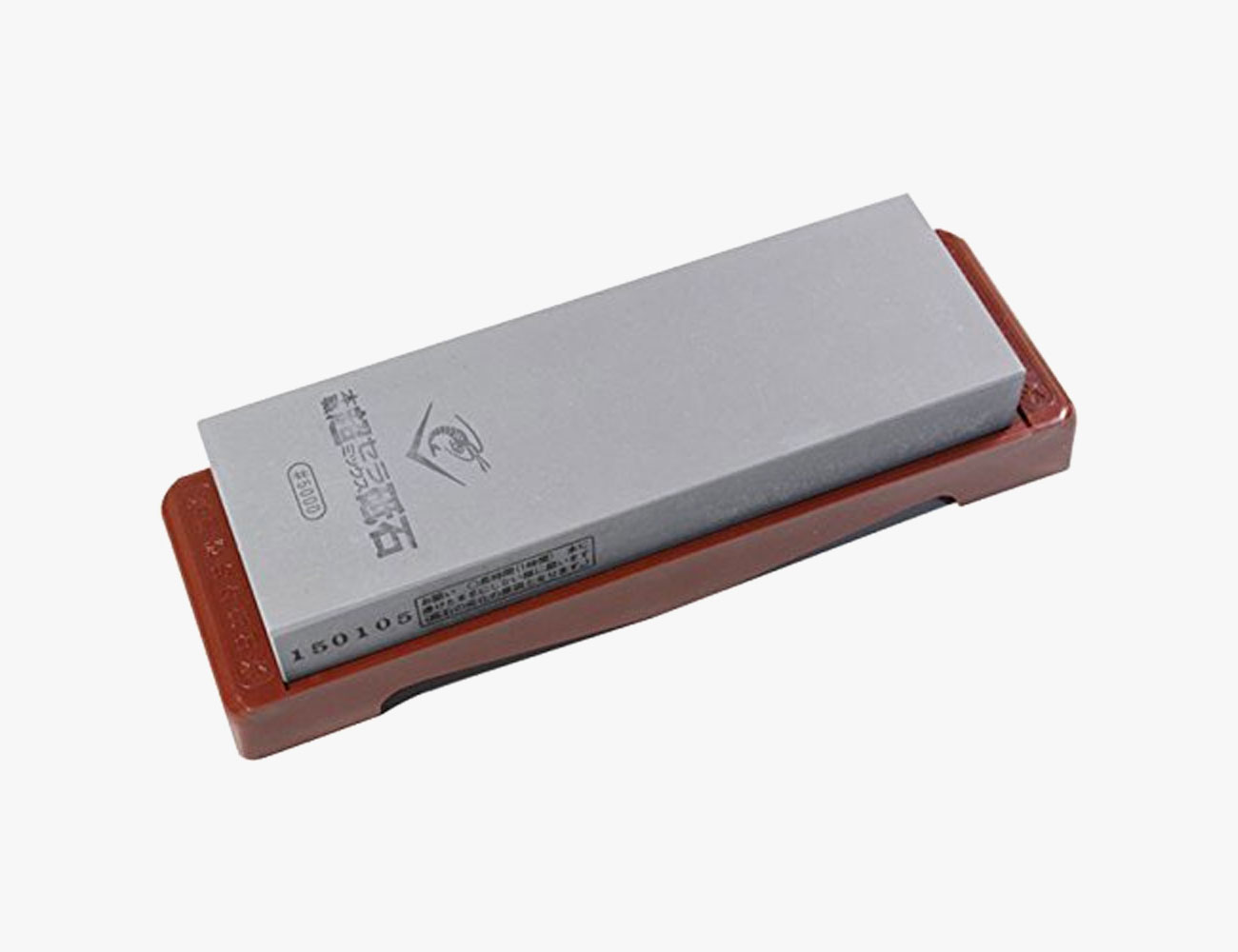
Finishing a knife is the process of eliminating the burr you create by removing metal from the previously dull knife (it also makes the knife more reflective and good-looking). Swap your lower-grit-number stone out for something higher. Lau recommends anything in the 4,000 to 8,000 range. If you don’t feel like spending almost $200 on two whetstones, King makes a two-pack (1,000 grit and 6,000 grit) for $45.

How to Sharpen a Chef’s Knife

Step 1: Study your knife.
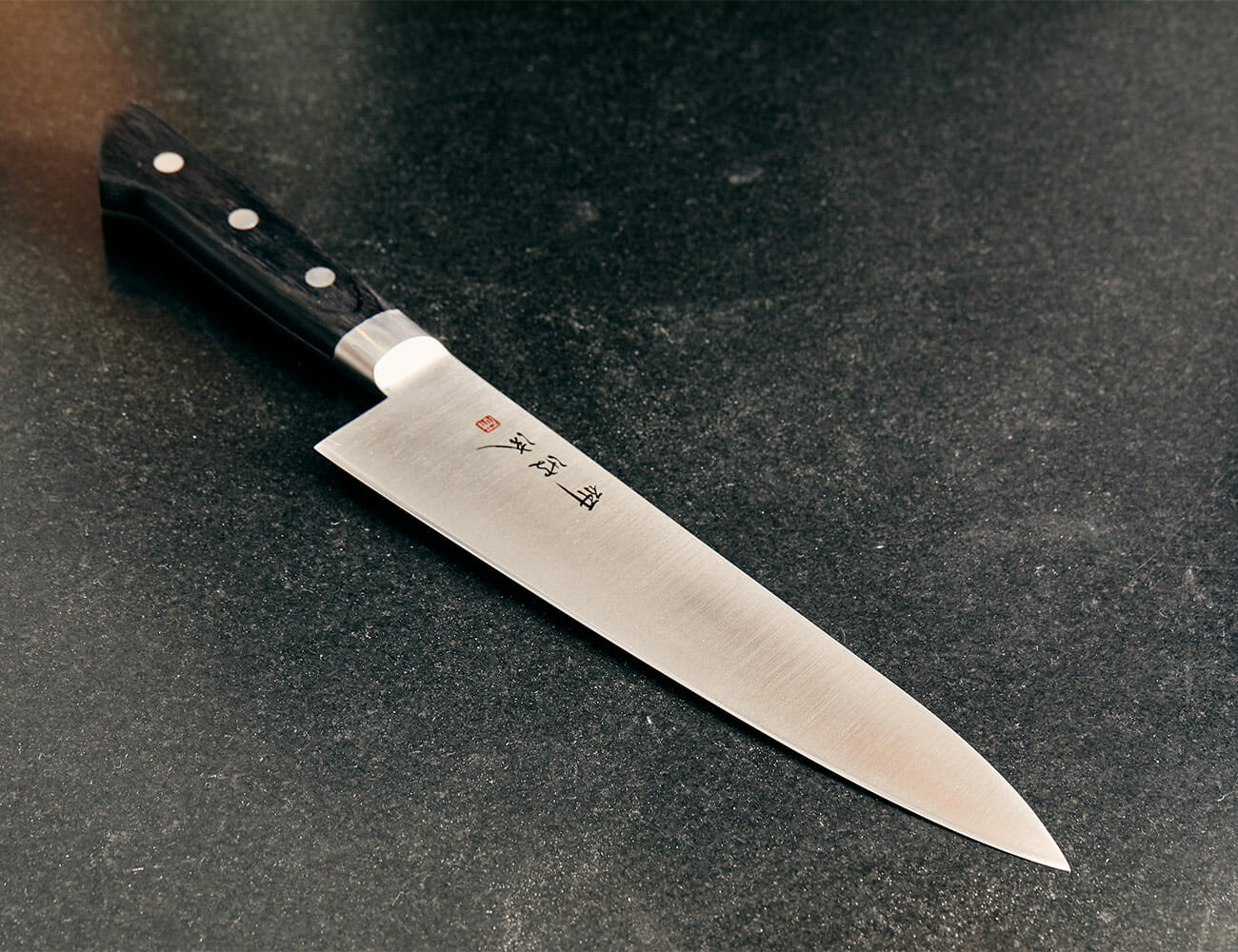
The first thing any would-be knife sharpener does before putting blade to stone is study the blade itself. Ask yourself, Where is the knife dull? Is it single or double-beveled? Carbon steel or stainless steel? “Don’t just pick up a knife and go,” Lau says. “Pay attention to what you’re doing. You’ll learn to adjust to variables with practice.”

Step 2: Soak your sharpening stones.
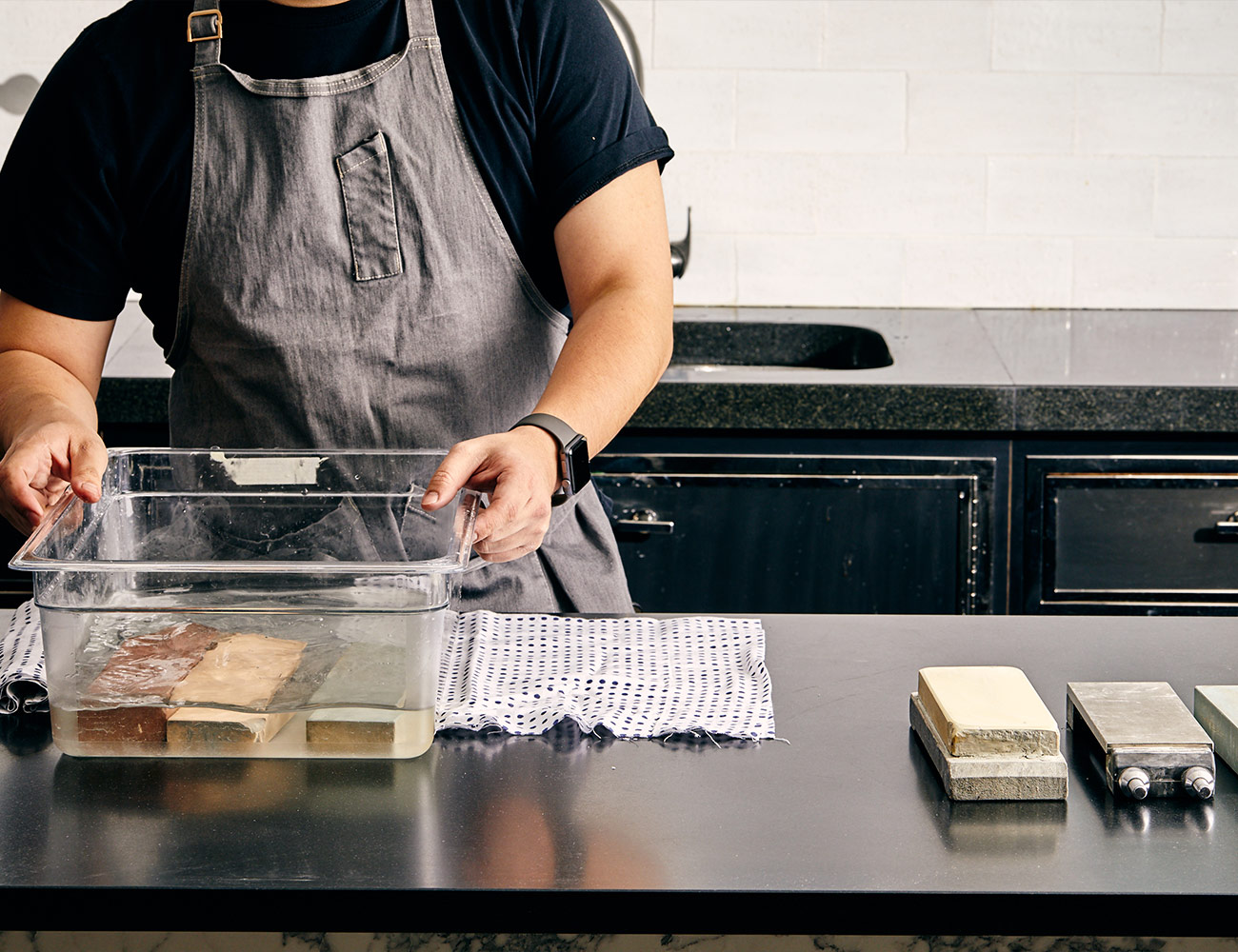
Soaking the stone before sharpening ensures the surface of the stone won’t scratch or chip the blade further. According to Lau, it is a non-negotiable step in the knife sharpening process. “I’d soak them for at least 15 minutes or so before getting to work,” he says. “Half an hour would be ideal.”

Step 3: Find your grip.
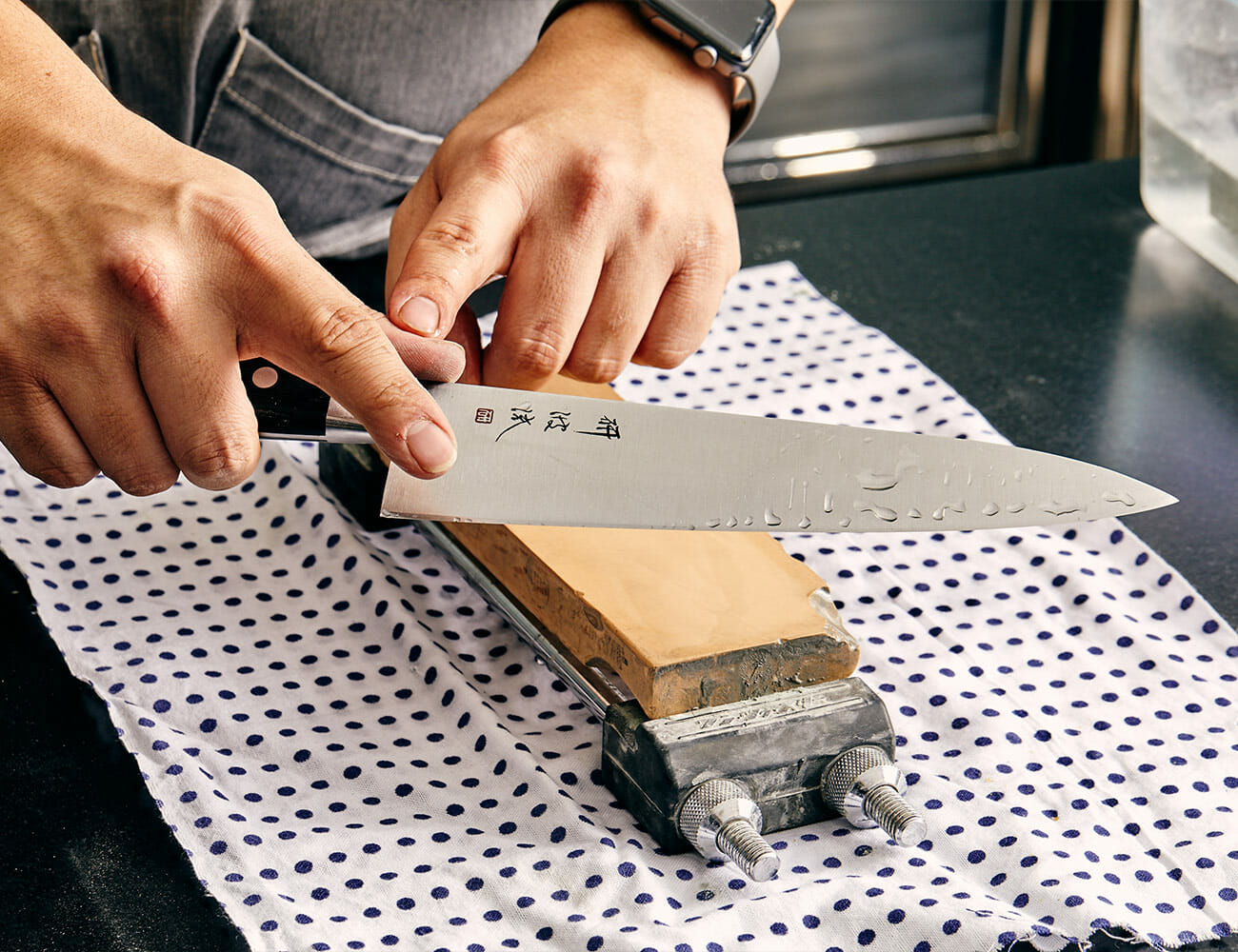
“Keeping a consistent grip is the first step to not injuring yourself,” Lau said. In your knife hand, Lau recommends putting your thumb on the spine of the blade, your index finger on the heel and keep three fingers wrapped around the handle. Your off-hand will be used as the sharpening force.

Step 4: Get the angle right.
How-To-Sharpen-A-Chefs-Knife-Gear-PAtrol-angle-slide-1
How-To-Sharpen-A-Chefs-Knife-Gear-PAtrol-angle-slide-2

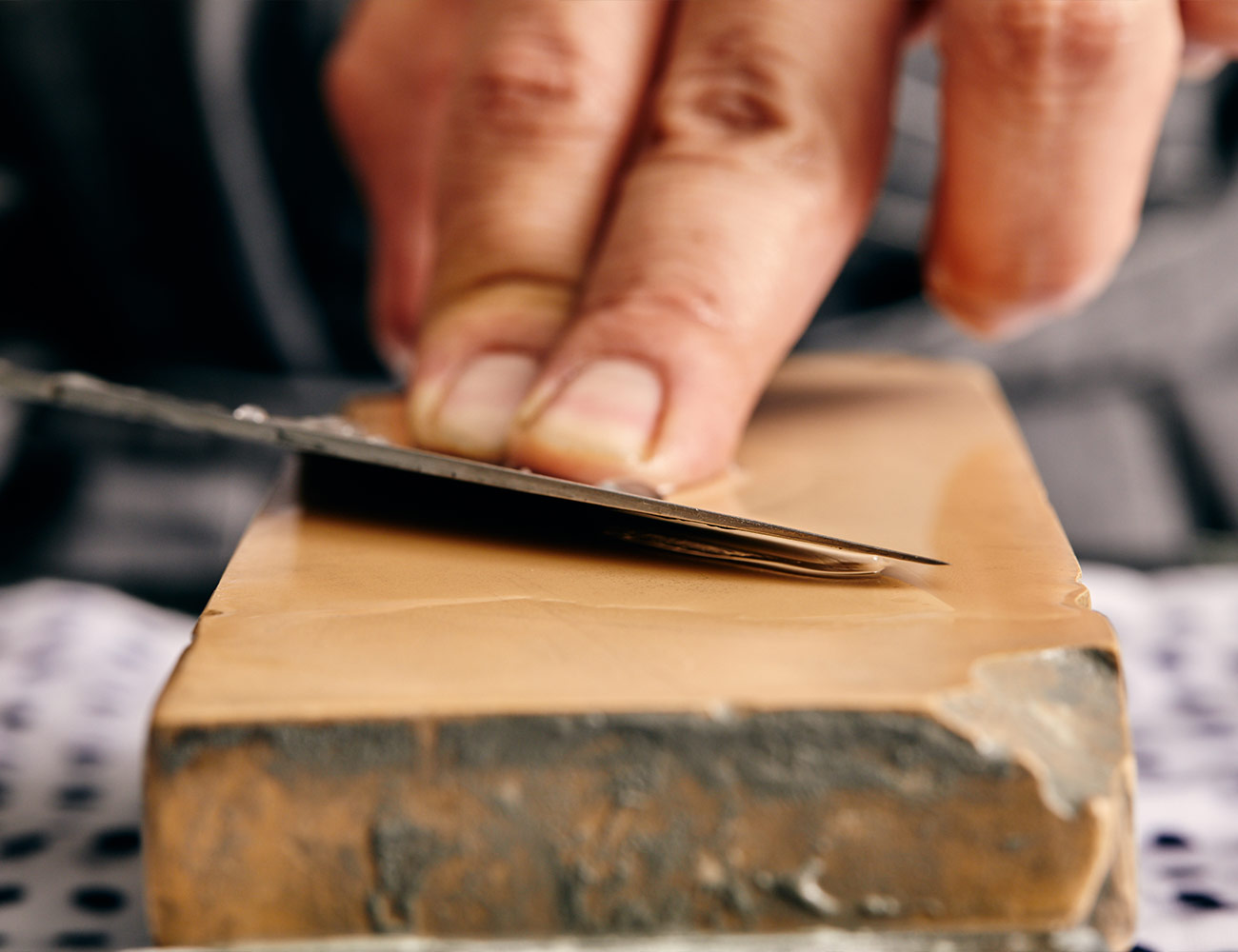
This is the most difficult step for beginners. “Every knife has a slightly different angle that the edge slopes down to, so you’ll have to learn how to feel for that,” Lau says. To find the angle, lay the knife completely face down on the stone and put two fingers on its edge. With your fingers keeping the blade’s edge on the stone, use your other hand to lift the knife until you’ve found the shallowest angle that allows the edge to be flush with the stone. “You’re trying to match the bevel’s angle with the stone,” Lau says. “This will take practice.”

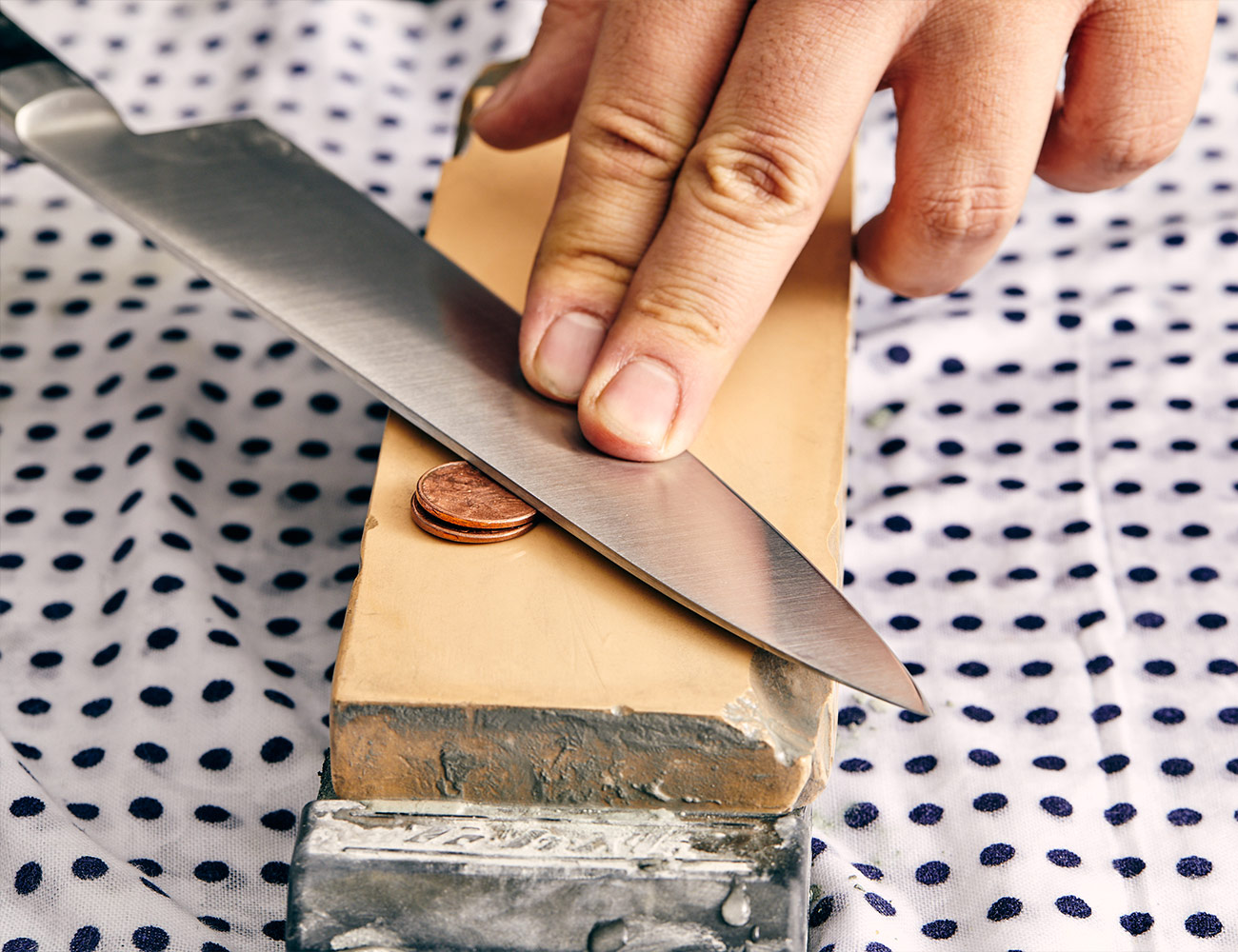
Beginners can use a stack of two to three pennies as a visual guide. Place the pennies on the sharpening stone and lay the spine of the knife on top of them. “In my lessons, that really helps people visualize what they need to do themselves,” Lau says.

Step 5: Start sharpening.
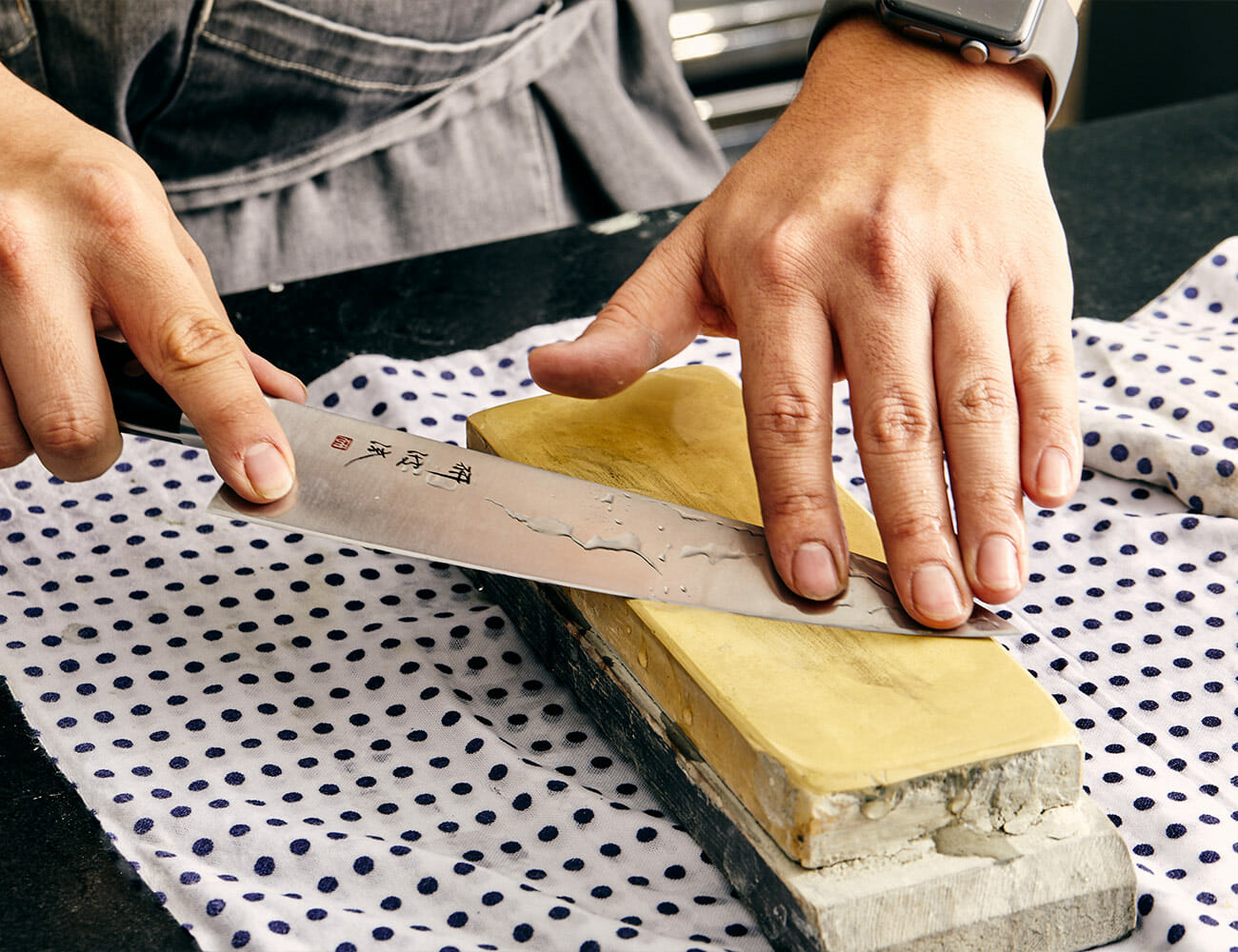
Once you’ve got the angle down, it’s time to create a new edge. Lau recommends getting comfortable with the motion and pattern of sharpening before working on your first knife. In theory, the process is quite simple: keep the knife against the stone with two fingers and pull the blade towards you, then push it away.

Two things to think about in this up-and-down movement: The sharpening action is on the downstroke (pulling the blade toward you), so relieve pressure on the knife on the upstroke. And you need to sharpen the entire blade, so slide your fingers slightly down the blade with every downstroke; if you’re not applying pressure to a point on the blade, it’s not sharpening.

Lau says to make sure the tip of the knife doesn’t miss sharpening, too, as the optimal sharpening angle for the rest of the blade can create a gap between stone and tip. To counteract this, simply lift the elbow of your grip hand while sharpening the tip area — this will lower it onto the stone.

Step 6: Keep the stones wet.
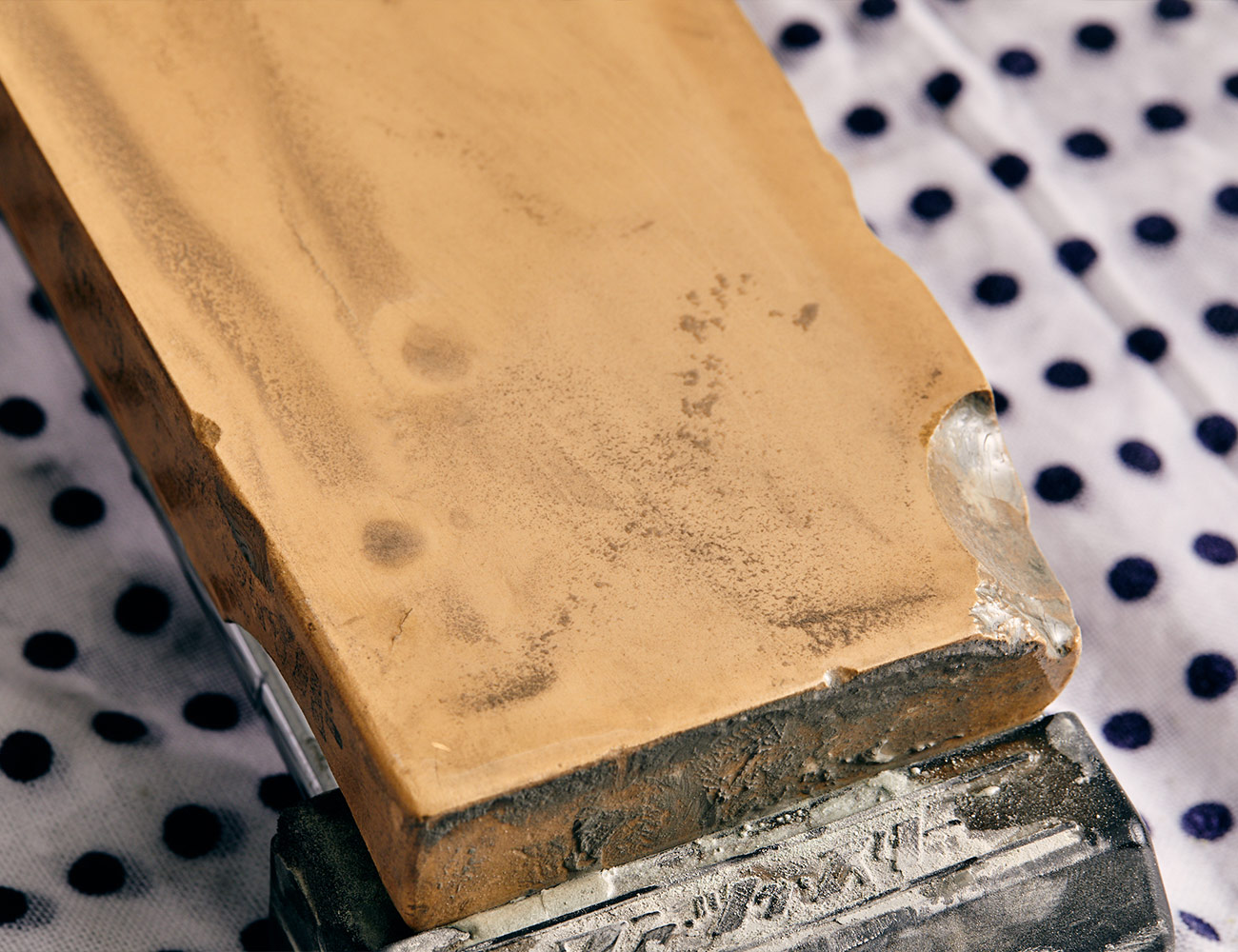
To prevent damaging a knife, Lau splashes his sharpening stone with water constantly before and after a round of sharpening. A sign you’re in good shape: grey sediment building up in the water on top of the stone after a few swipes of the blade. “That stuff is abrasive and helps you sharpen more efficiently,” Lau says. “Don’t wash it off.”

Step 7: Finish the blade.
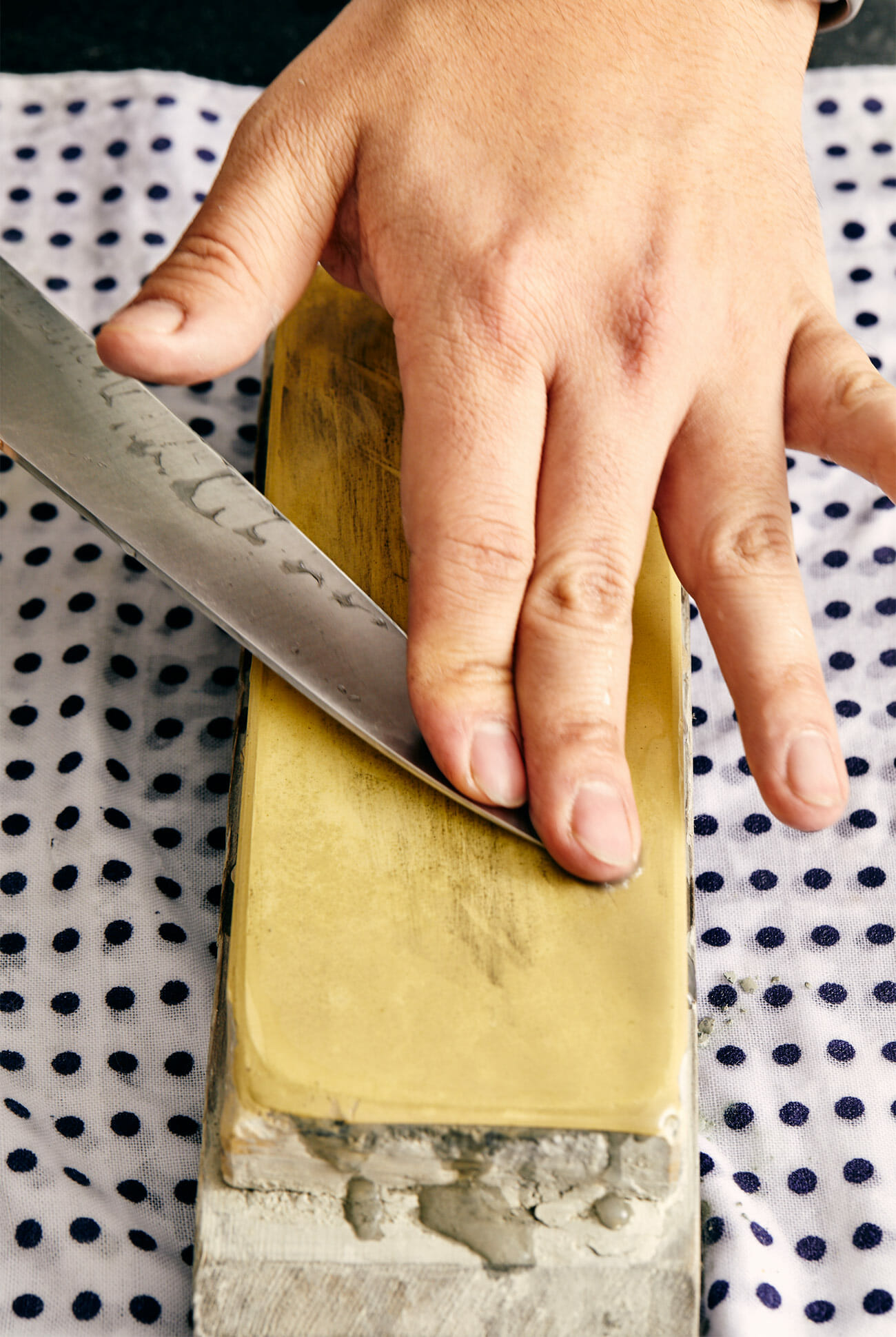
Finish a knife happens just like the initial sharpening, the only difference being the stone used and the pressure you apply to the blade. Lau says instead of pushing down on the blade across the stone, apply only the pressure of the weight of your hand. “Any more than [the weight of your hand] and you’ll run the risk of damaging your newly sharp knife,” Lau says.

Step 8: Paper cut.
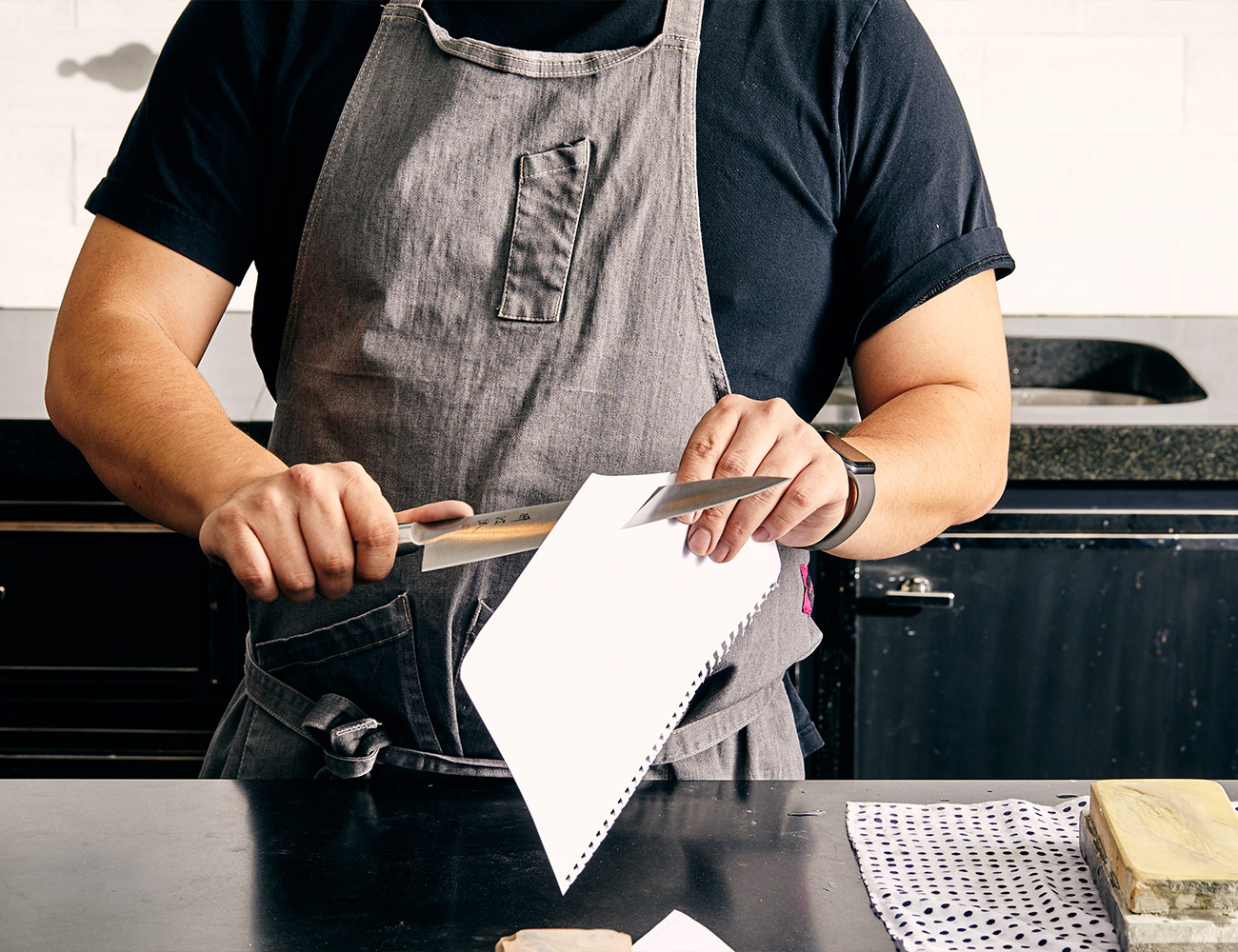
It may be cliché, but slicing through a sheet of paper is still the easiest way to check your work after sharpening. “If you carve through the paper without issues, it’s sharp,” Lau says. “Make sure you run the whole length of the knife, too, because if you left any chips or dull spots you’ll feel the drag while cutting.”

This New Line of Mixers Lets You Stock Your Home Bar Like World’s Best Bartenders

Just a few of the awards in Alex Kratena, Monica Berg and Simone Caporale’s trophy case: World’s Best Bartender, Best Bar in the World, Best International Bartender, World’s 50 Best Bars. The trio is also the founding team behind Muyu, a new liqueur line from Dutch spirit company De Kuyper.

The group was inspired after a trip to the Amazon, but instead of sourcing ingredients directly from the rainforest, they went in a different direction. “We first visited the Amazon in 2016 to explore the potential of Amazonian produce in cocktails, and we were so inspired by what we saw, but also realized we would contribute to the rainforest’s destruction if we sourced directly from there,” Berg said in a press release.

Instead, each of the three bottles released at launch — Chinotto Nero, Jasmine Verte and Vetiver Gris — were developed in the same manner perfume or cologne is. The individual expressions start with the single eponymous flavor note (nero, jasmine and vetiver), with secondary flavors “wrapped around each note to create a completely developed and complex liquid,” the press release noted. After the flavor compounds are identified and blended, the mixture is cooked together with C02 extraction, steam distillation and a host of other techniques before finally being blended with alcohol, sugars and water.

“This process allows us to create a liqueur brand that enables bartenders to work with some of the most extraordinary ingredients available in the world, without taking anything away from the rainforest,” Berg said in the release.

Muyu officially launches in London near the end of the month.

You’re Cleaning Your Coffee Maker the Wrong Way

Several years ago, the National Sanitation Foundation conducted a study to challenge perceptions of cleanliness. The research found that kitchens — not bathrooms — are the most germ-ridden areas. One of the chief realms of germs and junk? Your coffee maker.

But having a coffee maker of germs isn’t just a matter of hygiene. According to Erika Vonie, Director of Coffee at Trade, it translates to better tasting brew. “You want each coffee to have a chance to shine every time you brew it, so having a clean starting point every day is a great way to do that,” she says. Here are three areas on your coffee maker that need the most love.

Carafe

The carafe of a coffee maker harbors stains and any mineral content left by the coffee you make. According to Vonie, Urnex is the gold standard of coffee cleaning supplies. The brand’s $4 bottle of carafe cleaner wipes out any lingering matter from the carafe with a few squirts and some hot water.

Filter Basket

The filter basket is the thing that holds the coffee while the machine runs water through it. And seeing as this is the area that will see the most frequent water traffic (apart from the tubing inside the machine), it’s basically covered in foreign materials (coffee oils, microscopic grinds, limescale and, if you’re not careful, mold).

It is the only part of a coffee maker you should be diligent about cleaning after every use — even if it’s just a hand wash under the sink. Vonnie says coffee brewers are flushed and cleaned after every batch in the café world. Plus, the filter basket often catches small pools of brewed coffee — pools that, according to Vonie, can be harmful to more than your taste buds. “Aside from mold and scale that can build in your coffee maker, coffee is also corrosive and acidic and could potentially damage your machine the longer it lingers on your equipment,” she says.

Water Resevoir

Beyond germs, coffee makers develop limescale (the mineral residue from the water used in brewing) far more quickly than other appliances, and build-up can cause both performance and taste issues. The solution: a descaling tablets ($9 for four) that do all the work for you. “I’ve used [Urnex’s] food-safe cleaners in every shop I’ve ever worked in,” Vonie says. “They don’t leave a residue or impart flavor when used correctly and leave your equipment factory-clean when all is said and done.”

If you’re strapped for cash or just naturally thrifty, you can make do without. “Honestly a one-to-one white vinegar to water solution also does the trick,” Vonie adds. “Just make sure you rinse very thoroughly to remove all traces of vinegar from your coffee maker and the carafe you brew into.”

12 Foolproof Food Ideas to Win Super Bowl Sunday

For as much as the Super Bowl hangs on anticipation and uncertainty, there isn’t a lot about the de-facto national holiday left up in the air — least of all the food.

Generally speaking, you can bet on a few staples: chips, guac, beer and lots of carby finger food. But there are still plenty of angles you can take with kickoff classics — a different take on guacamole or something more involved, such as roasted potatoes with duck fat and parmesan. Here are a few ideas of what to eat and drink, with some gear recommendations for good measure.

One-Pot Sticky Wings to Carry You through Football Season (and Beyond)

From Andrew Zimmern, the indomitable palate behind Bizarre Foods, we bring you our go-to sticky wings recipe for Super Bowl Sunday. (Stack of napkins not included.)

The Best Everyday Hot Sauces, According to Pro Chefs

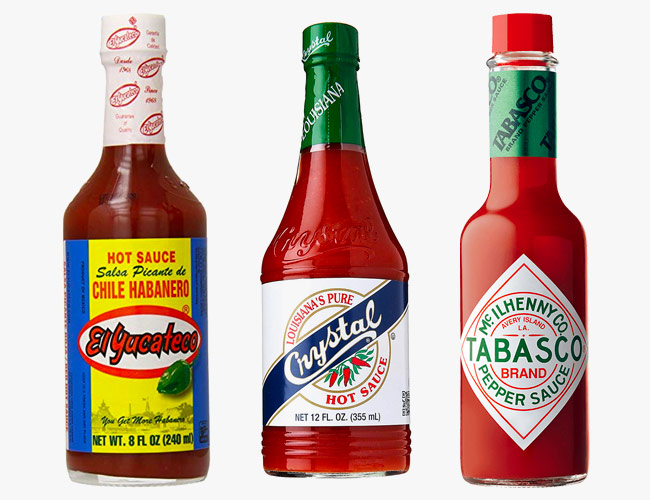
As dumb as it sounds, hot sauce loyalty is a thing. We asked professional chefs what their favorite market variety hot sauces are, and things got heated. Find out which of the following is best to douse your wings while watching the Patriots go head to head with the Rams.

You Should Be Making Your Own Queso Dip For the Super Bowl

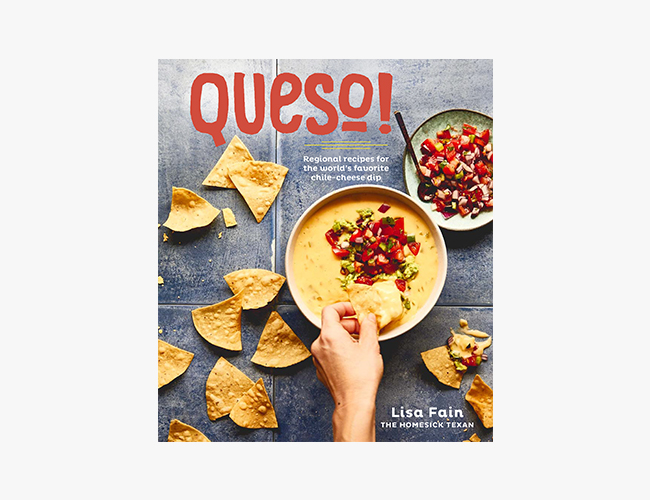
Thinking about buying pre-made cheese dip? Don’t. Instead, check out this recipe for Austin-style, crowd-pleasing queso from Lisa Fain’s QUESO! cookbook, topped with guacamole and served with sturdy chips. It may be easier to just buy some, but this is a Super Bowl food idea that’s surprisingly easy and, most importantly, totally winning when it comes to flavor.

How to Make Truly Great Guacamole

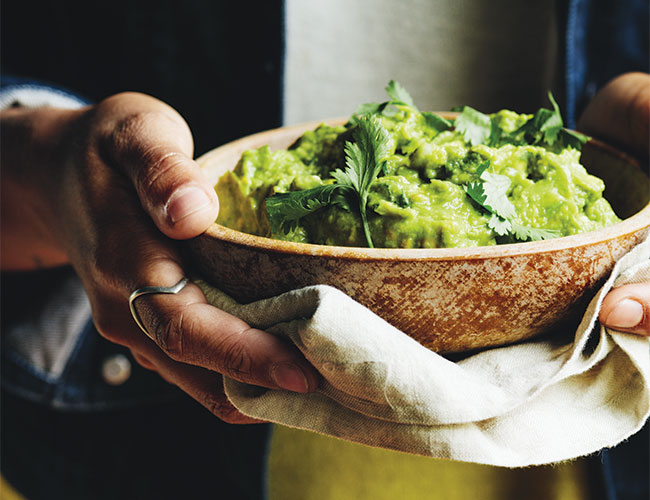
Avocados are just a piece of the puzzle. Great guac is the harmonious blend of different flavors and textures. Discover the perfect blend in time for Sunday by checking out this recipe from Gonzalo Guzmán, the chef and owner of San Francisco’s much-loved restaurant Nopalito.

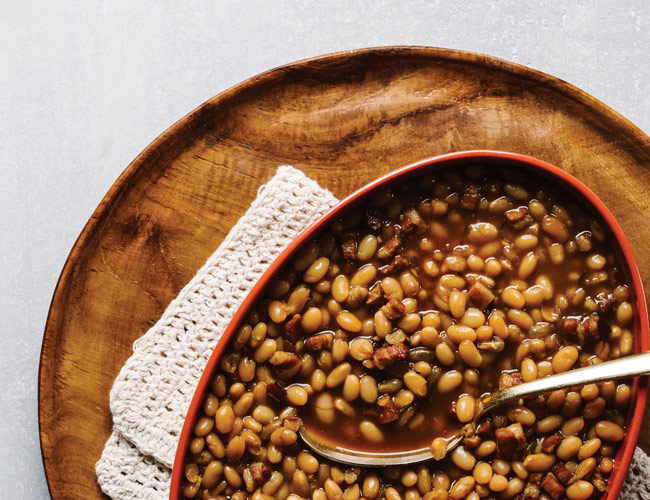
Make These Baked Beans from Scratch and You’ll Never Look Back

Rooting for the Patriots? This recipe from chef Hugh Acheson’s cookbook The Chef and the Slow Cooker is perfect for those looking for a hands-off recipe for Boston-style baked beans. A Rams fan? You’re still going to want to make this. Maybe just don’t tell your friends they’re Boston-style.

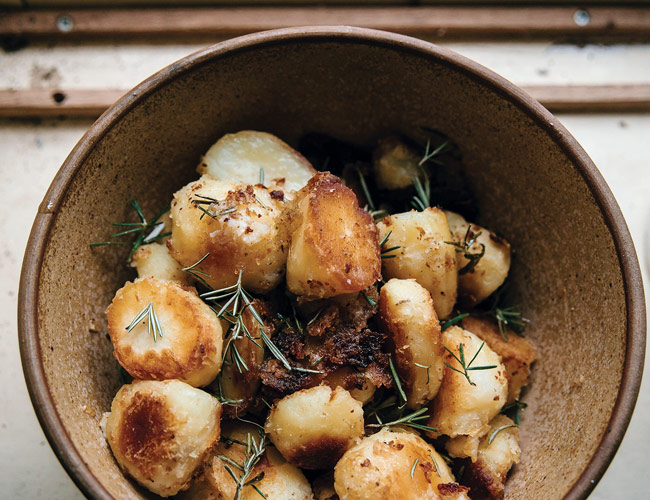
A Superior Way to Make Roasted Potatoes

When it comes to serving up good finger food to guests, it’s never a bad call to order some fries. A better call, though, is roasting some of your own potatoes with this recipe from Marte Marie Forseberg’s The Cottage Kitchen. No matter how the game goes, you can at least be proud of these duck fat and parmesan topped morsels.

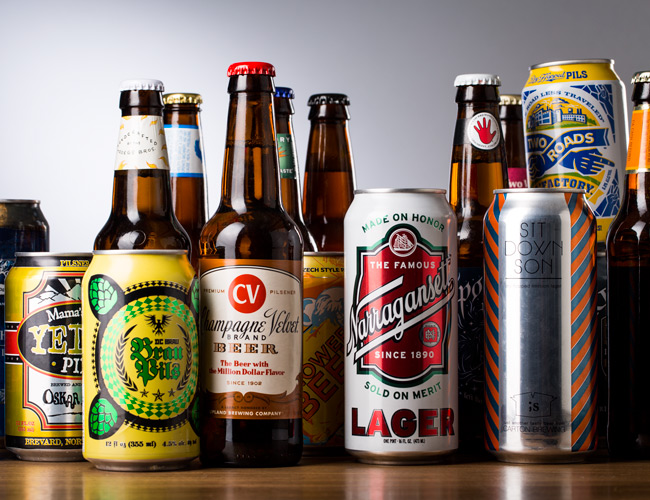
20 Great American Lagers Not Named Budweiser

Not as big on IPAs? There are more easy-drinking lagers out there than just those from mega-brewers. For sessionable drinking on game day, our go-to list ranges from pilsners to amber lagers and everything in between.

9 Delicious IPAs You Can Buy at Your Local Grocery Store

Whether you are trying to balance out your spicy wings, celebrate a touchdown or take the edge off a ridiculous call – having a good IPA on hand is always a good idea. These nine are tasty, reliable and easy to find (and they won’t cost an arm and a leg to stock your fridge with).

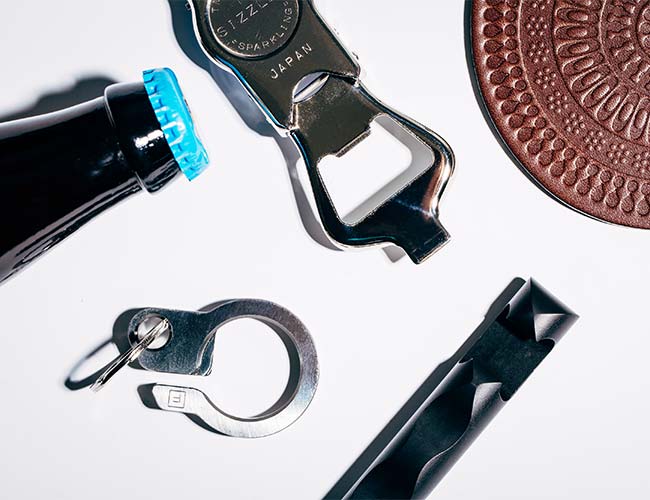
8 Bottle Openers That Won’t Let You Down

Bottlescrew, cap opener, church key or just ‘bottle opener’, no matter what you call it the best way to open a beer is with by grabbing the closest tool at hand. Unless, of course, it doesn’t actually work. Here are some options that won’t let you down.

The 10 Best Mail-Order Meat Companies in America

Mail-order meat companies used to be all talk. Nowadays, some of the best butchers and meat producers in the country are in on the game. Take a look through some of the best and you may just find something you can get in time for the big game.

The 6 Best Grills to Buy if You Live in a Small Apartment or House

Even if you’re a city-bound football fand like many of us here at Gear Patrol, you don’t have to give up on grilling on Super Bowl Sunday. In this guide to small space grilling, we cover what you need to know before buying, and the six best compact grills to buy.

PKTX Folding Grill Review: This Is the Best Low-Maintenance Charcoal Grill You Can Buy Today

For those who are more fortunate in the square-footage department, you may want to consider this amazing charcoal grill. PK’s grills were designed almost 70 years ago and continue to outcook the competition. The brand’s newest grill promises all the virtues of the original and then some.

Note: Purchasing products through our links may earn us a portion of the sale, which supports our editorial team’s mission. Learn more here.

This Cast-Iron Skillet Caters to Cooks Who Want the Heat without the Maintenance

Detractors of the cast-iron skillet cite numerous minor issues with the time-tested pan: it heats slowly, its prone to hot spots, it’s heavy and so on. But cast-iron cookware’s greatest weakness isn’t any of those things — it’s pan maintenance. Simply put, seasoning a pan after every few uses isn’t the most practical thing to take on when cooking on a regular basis.

For those not willing to deal with the trouble of seasoning, there’s an in-between option designed just for you — the enameled cast-iron skillet. Enameling is a glassy shell that coats a metal (iron, in this case) and it’s extremely common in the world of Dutch ovens. Basically, enameled iron boasts similar high-heat potential and exceptional insulation to a bare cast-iron skillet, but it can be washed with plenty of soap without worry and doesn’t require seasoning.

Last year, Milo released a high performance, nice-looking and affordable enameled Dutch oven that became one of our favorite product releases of 2018. Now it’s got an enameled cast-iron skillet to go with it. The 6-pound, 10-inch pan is coated in the familiar white coating of the Dutch oven but comes with a different stick-resistant enamel on the cooking surface. The new skillet launched with a slightly smaller Dutch oven, too, and all are now available as a set.

Milo’s offerings aren’t innovations, necessarily — there’s plenty of great enameled skillets and Dutch ovens out there. But the company’s track record thus far is fairly spotless — its wares are priced fairly and work well. If you want to get into cooking with cast iron but don’t want to bother with oil and ovens, this might be worth a look.

Up Your Shelving Game With The Tylko Type02

Shelves. One of the most essential pieces of furniture any person must have in their arsenal, and yet one of the hardest indoor fixtures to pull off.

There are so many kinds of shelves, from regal to urban to downright eccentric. Stripped down to its core, though, a shelf is all about making room for stuff in the most efficient way possible.

If you’ve simply run out of shelving ideas, consider looking at the Tylko Type02 shelves. These aren’t just your typical shelves, for one. Tylko actually lets customers adjust and personalize Type02 shelves down to their centimeter, the style, the finish, and all sorts of other tweaks. You can literally spruce it up with fine-grained details to get the perfect shelf in your mind.

You can even use Tylko’s augmented reality app to check whether a style will work in your living spaces.

Tylko did a lot of research for its latest shelf collection. The company sought to improve not just the look, but also the functionality of these storage savers. Tylko created new combinations to choose from, and refined the doors and handles to be more ergonomic. Adjustable legs were developed to ensure there would be no uneven shelves, even on spaces with weird floors. There’s also a much wider gamut of color options available.

Assembling them is also much easier now. Customers don’t even need to bring out special tools to fix up these shelves. They’re even easier to build than your typical flat-packed furniture with color-coding, factory-installed connectors.

Type02 shelves are excellent, well-crafted, stylish, and idiot-proof. What more could you want from shelves, really?

START CUSTOMIZING HERE

Photos courtesy of Tylko

This Is the Coffee Subscription to Get If You Want to Get Into Coffee

Like craft beer before it, Third Wave coffee is riddled with stereotypes. The caricature of the beer snob is a close relative of the coffee snob — snooty, dismissive and weirdly righteous. You’ll remember, too, that the craft beer community of yesteryear held fast to its belief that certain beers were beneath them — those beers being lagers — until some of the best brewers in America decided they weren’t. Craft coffee’s version of the lager saga is dark roasted coffee, and now it looks like it might get off that high horse, too.

Launched this week, “The Classics” is Trade Coffee’s new monthly coffee subscription. One of our favorite things to come out of last year, Trade is the world’s largest specialty coffee buying platform. Its new subscription entails receiving two bags of darker roasted, specialty-grade coffee beans per month ($25 total), and was built for the person who wants to get into coffee.

“I think the thing about darker roasts is that they’re inherently a bit nostalgic, right — for the most part, that’s how coffee was roasted in America for a very long time. That kind of super over-done roast and stale beans, it wasn’t the most pleasant drinking experience,” Erika Vonnie, director of coffee at Trade, said. “In the past specialty roasters have leaned on lighter roasts, but they tend to be so far removed from what people know about coffee that it makes the transition from Folgers to specialty especially difficult.”

This idea mirrors the prediction of specialty coffee consultant and entrepreneur, James Hoffmann. In a video predicting coffee trends in the new year, Hoffmann spoke to the specialty coffee industry’s traditional stance against dark roasts. Hoffmann said “We’ve pushed back pretty hard against [dark roasts] as an industry. We’ve said dark roasting is morally wrong, it destroys the hard work of great producers, and I understand and see that argument. I think we’re going to start to say ‘if people like dark roasts, why can’t they have good green coffee?’”

What Hoffmann means by “green” coffee is coffee beans prior to roasting (historically, darker roasts were filled using beans of a lower grade). It doesn’t hurt that that buzzy coffee roasters like LA’s Go Get ‘Em Tiger and Arkansas’s Onyx Coffee Lab are releasing higher-end dark roasts, too.

“You can’t hand someone curious about specialty coffee your super funky, light roast Gesha and send them off into the sunset, you know? This is about getting coffee in the hands of people who want something that’s great, but still reminds them of coffee they’ve had before,” Vonnie said.

The Classics subscription is available through Trade’s site now.

Dark-Roasted Coffee Could Be the Comeback Story of 2019

Like craft beer before it, Third Wave coffee is riddled with stereotypes. The caricature of the beer snob is a close relative of the coffee snob — snooty, dismissive and weirdly righteous. You’ll remember, too, that the craft beer community of yesteryear held fast to its belief that certain beers were beneath them — such as lagers — until some of America’s best brewers decided they weren’t. Craft coffee’s version of the lager saga is darkly roasted coffee, and now it looks like it might get off that high horse, too.

Meet “The Classics,” Trade Coffee’s new monthly coffee subscription. Built for the person who wants to get into coffee, new subscription nets you two bags of dark-roasted, specialty-grade coffee beans per month ($25 total).

“I think the thing about darker roasts is that they’re inherently a bit nostalgic,” said Erika Vonnie, director of coffee at Trade. “For the most part, that’s how coffee was roasted in America for a very long time. In the past, specialty roasters have leaned on lighter roasts, but they tend to be so far removed from what people know about coffee that it makes the transition from Folgers to specialty especially difficult.”

This idea mirrors the prediction of specialty coffee consultant and entrepreneur, James Hoffmann. In a video predicting coffee trends in the new year, Hoffmann spoke to the specialty coffee industry’s traditional stance against dark roasts: “We’ve pushed back pretty hard against [dark roasts] as an industry. We’ve said dark roasting is morally wrong, it destroys the hard work of great producers, and I understand and see that argument. I think we’re going to start to say, ‘If people like dark roasts, why can’t they have good green coffee?’”

By “green” coffee, Hoffman is referring to coffee beans prior to roasting (historically, darker roasts were filled using beans of a lower grade). It doesn’t hurt that that buzzy coffee roasters like LA’s Go Get ‘Em Tiger and Arkansas’s Onyx Coffee Lab are releasing higher-end dark roasts, too.

“You can’t hand someone curious about specialty coffee your super funky, light-roast Gesha and send them off into the sunset,” Vonnie said. “This is about getting coffee in the hands of people who want something that’s great, but still reminds them of coffee they’ve had before.”

The Classics subscription is available through Trade’s site now.

You Might Actually Be Able to Find This Japanese Whisky in Stores

Brand: Suntory
Upshot: Blend of whiskies from Canada, Scotland, Ireland, the US and Japan
Price: ~$50
Release Date: April 2019 (Japan), international markets shortly thereafter
Proof: 86

Announced today, Japanese whisky behemoth Suntory will make a new blended whisky. But unlike much of its lineup, it may not be impossible to find or impossibly expensive when it comes out later this year.

Dubbed “Ao,” the 86 proof bottle is a blend of whiskies from the world’s major producing countries — Canada, Scotland, Ireland, the US and Japan. It’s also the first whisky Suntory will release that blends whiskies from different regions (or at least the first that’s upfront about it).

Suntory’s worldwide whisky holdings are vast, so the move makes a lot of sense. Its portfolio is stuffed with names like Canadian Club, Tyrconnell, Laphroaig, Kessler, Yamazaki, Hakushu and Hibiki. Considering everybody is pretty certain the day of Japanese whiskies carrying age statements is behind us (for now), Ao is a good move.

Plus, because Suntory has already said it plans to crank out something like 30,000 cases of the stuff, there should a fair amount to go around. Suntory Ao is set to launch in Japan in mid-April for 5000 Yen, or roughly $50. It will roll out to international markets — including the US — shortly thereafter.

Brava Oven Review: A Smart Home Triumph That Takes the Fun Out of Cooking

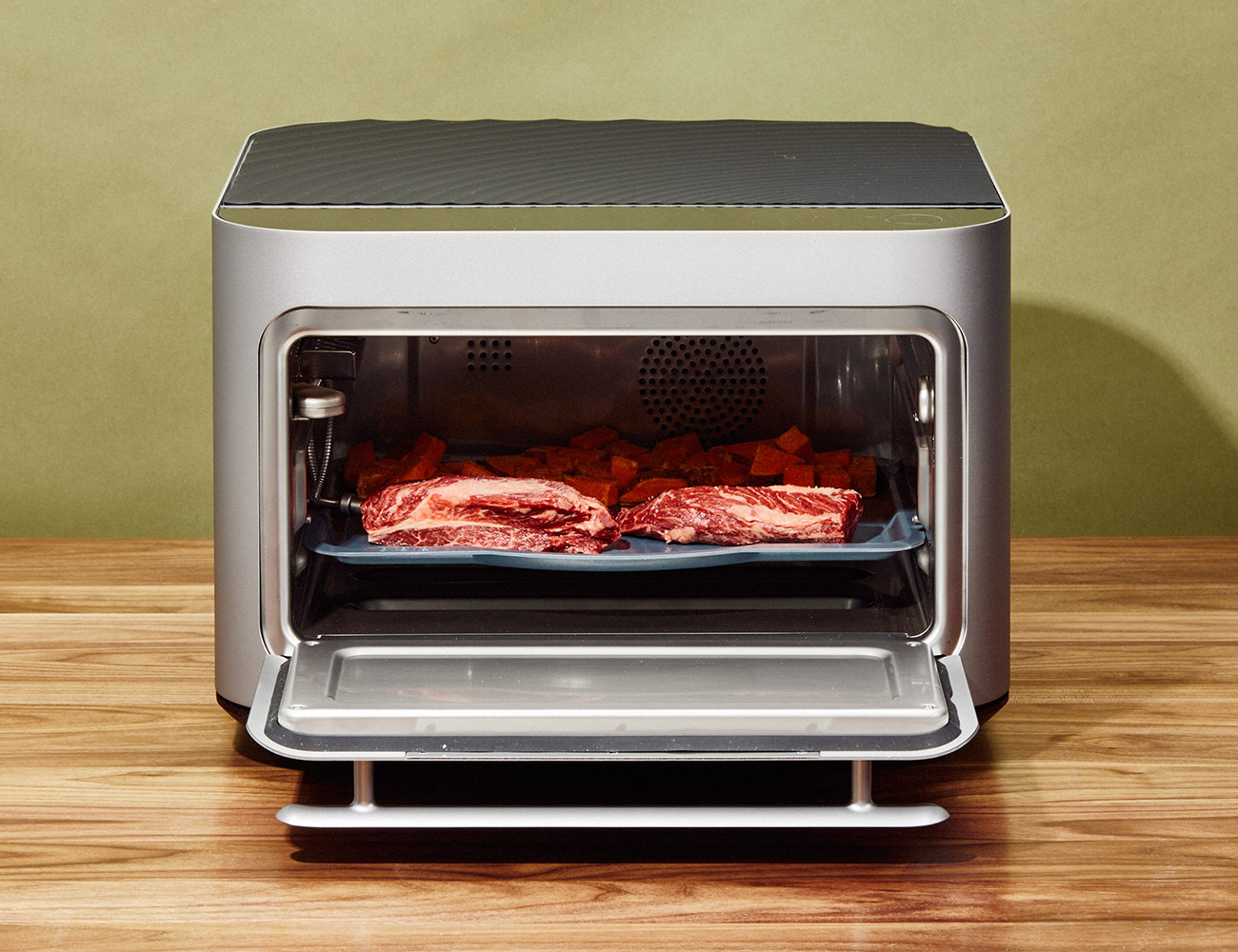
The Brava smart oven’s value proposition is fairly simple: cook dinner as quickly and efficiently as possible. The countertop oven itself, however, is not so simple. By way of wi-fi connectivity, a custom-built programming language, meat thermometer and something called Pure Light Technology, the Brava Oven claims to cook three different things at once, all at different temperatures. And the results, though made on a similar path of least resistance, taste nothing like the product of a microwave.

Brava isn’t alone in the mission to make the domestic do-it-all oven. A slew of similarly well-funded competitors have their own super-ovens. So how does the Brava Oven compare? We used one to cook a week’s worth of lunches — some using Brava’s own pre-packaged meal kits — to find out.

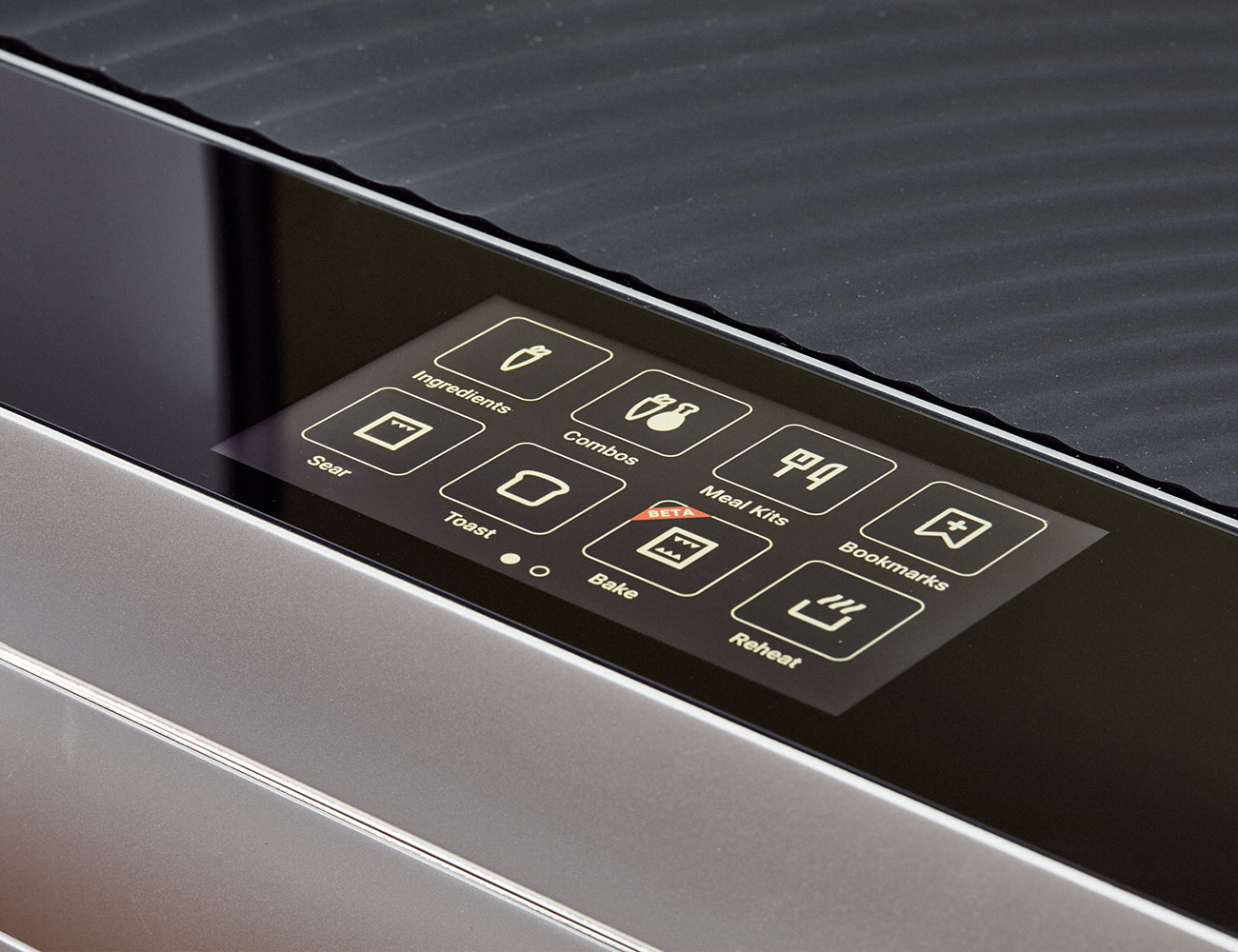
The Good: From temperature to sear, Brava executed all of the meal kits as advertised. The meals I made controlling the oven manually were similarly well-executed. And though I worried it would take some time to learn the ins and outs of the machine’s touchscreen interface, it didn’t — the interface is straightforward and guides you through subsequent steps without issue. The ability to cook different foods at different temperatures, simultaneously, is undeniably impressive.

Who It’s For: This is the question that’s defined Brava since its launch last year. The person who will get the most from the Brava Oven should relate to at least two of three things: a desire for more control over what they’re eating, a lack of interest in learning how to cook themselves and a dearth of time (or patience). It’s not for someone who enjoys the act of cooking and it’s definitely not going to show you how to cook. But the Brava Oven effectively turns out solid meals in a simple, timely manner.

Watch Out For: The Brava Oven will make you dinner but it’s not going to teach you how to cook. If you opt to skip the meal kits — which cost about $14 per serving — you’ll still need a basic understanding of what comprises a meal and how to make it passable to the palate. Finally, its $995 price tag is high, and a 1-year warranty is uncomfortably short for a product this tech-reliant (though it seems to be a standard warranty among its competition).

Alternatives: You may be surprised to learn the smart oven market is quickly growing. June ($600) is a carbon fiber-heated countertop oven that’s smaller and a bit better at recognizing food; it also sports a simpler interface than Brava. Currently available in Europe, Miele sells a full-size smart oven that makes similarly plethoric claims regarding multifunctionality, gourmet food prep and so on. Tovala ($249) is a smart steam oven that promises to perform the usual oven functions without drying out food (there’s a slightly cheaper food subscription add-on as well).

Every smart oven has its own niche benefits but none are really alike. Brava can cook three different foods at three different temperatures simultaneously, but it doesn’t brown food as effectively as Miele’s smart oven. June can automatically recognize and cook a tray of veggies to doneness, but it costs hundreds of dollars more than Tovala. Here’s the gist: the Brava Oven is the most multifunctional, hands-off of the bunch.

Review: First discussions about Brava are often punctuated with a lot of question marks. To understand exactly how it works would require pre-knowledge of light ray science, frequencies, surface temperatures and a lot of math (Brava developers literally invented a coding language just to design recipes for it). Thankfully, none of that is necessary to cook steak and potatoes.

Setting up the Brava Oven is quick and straightforward — you download the Brava app, connect your machine to your phone and give the two included cooking trays (aluminum and glass) a good wipe down. Its MacBook-looking grey anodized aluminum body also looks pretty good on the counter, though it’s bigger (11.3 x 14.1 x 16.7 inches) and heavier (34 pounds) than most countertop ovens.

Operating the oven is similarly easy — punch what you’re making into the machine’s touchscreen interface and it’ll tell you what “zone” to put each food item in (each tray has three zones marked by number imprinted on the tray). Once the cooking process has begun, you’re given an estimate of when the food will be ready — it’s important to note that it’s just an estimate, as the one-and-a-quarter-inch steak I cooked changed its done timer between 11 and 19 minutes before eventually landing on 15 minutes. If the variance is annoying, it’s tempered by the oven’s auto-shutoff, which ensures no food is severely overcooked.

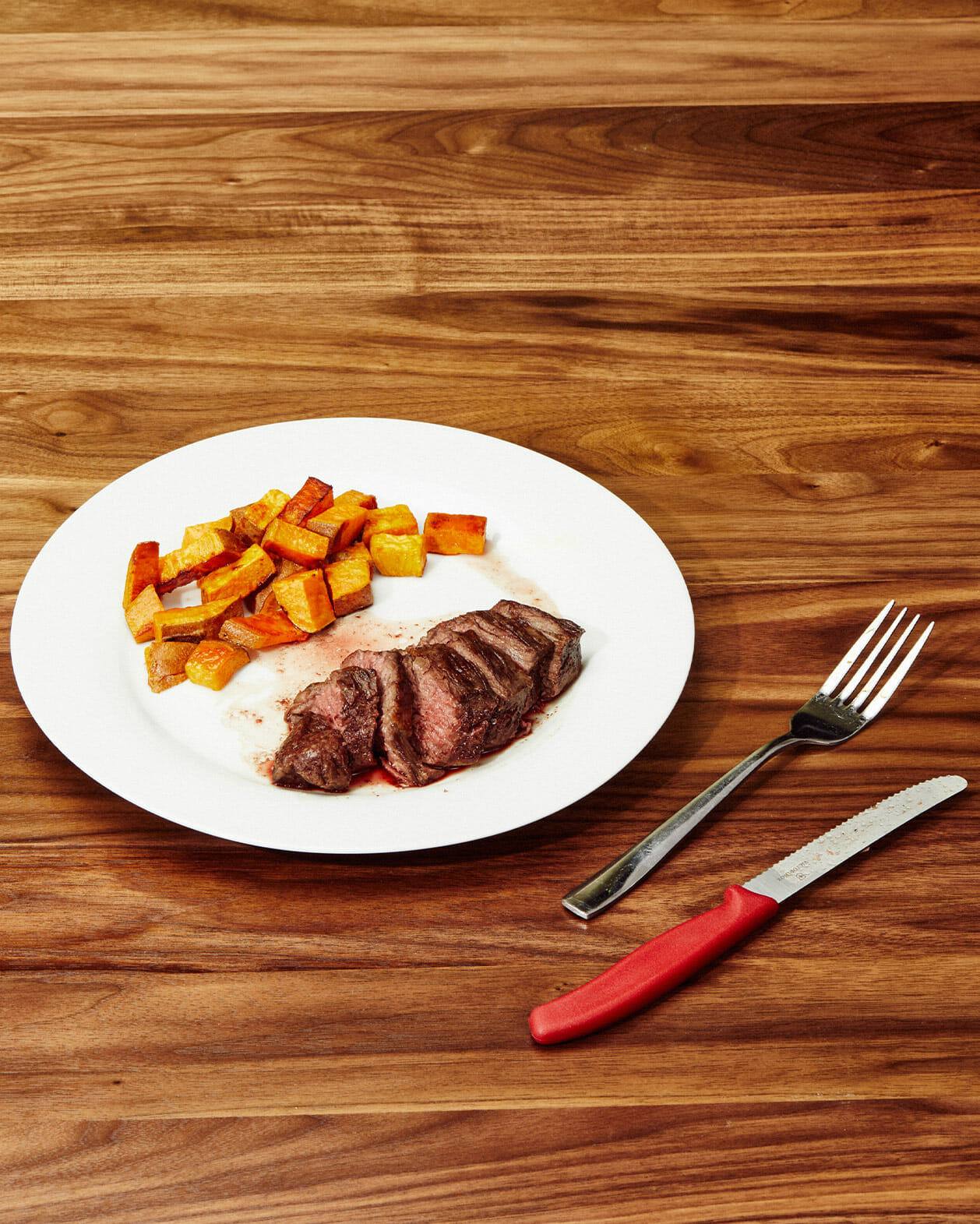
All of the food I made in the Brava oven was cooked to the exact temperature — or doneness — inputted, even food that would usually call for browning. The ribeye and hanger steak I made were reasonably browned and within three degrees of proper temperature upon finishing their cook cycles. Similar results came from roasting a whole chicken, which took about 50 minutes once in the oven.

Meats’ brown bits weren’t nearly as satisfying as the crispy crust you get from a cast-iron skillet, but it took next to no effort to produce. As a person who enjoys cooking and spends an inordinate amount of time thinking about ways to better roast a chicken, this isn’t a selling point. But for the cook who sees cooking as a means to an end rather than something to enjoy, I see the appeal.

At the end of the day, the app worked as intended, the touchscreen interface easy to control and the food pretty tasty. But is that all worth $1,000? Only if you view food and cooking as a chore, rather than a hobby.

Verdict: Unlike June, Tovalo or other ovens — smart or not — Brava can prepare meals with multiple parts and cook times simultaneously. Brava marketing materials describe the machine as “the art of cooking, streamlined.” This is accurate. Using one feels the Jetsons might have used — log what you want to cook into the machine and out it comes. It feels, and is, mathematic. If you can stomach the cost and are happy pretty good food that’s ready really fast, it’s worth considering. If you enjoy the act of cooking, you can likely skip smart ovens altogether without much pause.

What Others Are Saying:

• “That’s the odd conundrum with the Brava. It’s such a novel way to cook that traditional cooking rules don’t apply. Yes, the Brava can cook foods faster as long as you know what you’re doing or if you’re following along on a prepared recipe. That might be interesting to cooking novices or those who are simply passionate about trying cutting-edge kitchen tech. For me, I found it to be a limiting and unsatisfying way to cook. If I were in the market for a smart oven, I’d likely opt for the recently updated June instead.” — Nicole Lee, Engadget

• “Was the Brava oven competent? Absolutely. Meal kits were tasty, the oven includes plenty of customization options for cooking and it saves time with the ability to skip preheat. Still, Brava doesn’t match the food-recognizing smarts of the June Oven or the simple meal kits of Tovala, and it’s more expensive than both of those. For that reason, I can’t recommend it over its competitors.” — Molly Price, CNET

• “Ultimately I’m still not sure who this is for — other than rich people who live in a tiny apartment with no oven or stove. But even Sharp’s Superheated Steam Countertop Oven also eliminates the need for preheating for a much more reasonable price at $500, and the second generation of the June, which we quite liked apart from its exorbitant price tag, is now just $600. The Brava simply doesn’t make sense or perform well enough for its cost. So skip it, get one of the cheaper options recommended above or just learn to cook on your damn stove or order delivery.” — Victoria Song, Gizmodo

Brava provided this product for review.

Read More Gear Patrol Reviews

Hot takes and in-depth reviews on noteworthy, relevant and interesting products. Read the Story
Note: Purchasing products through our links may earn us a portion of the sale, which supports our editorial team’s mission. Learn more here.

9 Great Wool Blankets to Keep You Warm This Winter

Let’s not mince words — wool is the king of cold-weather textiles. It’s very basic, the product of shearing an animal, cleaning the coat, carding it into slivers and spinning it into yarn. But wool is high-tech, too: the cuticle of wool fiber is hydrophobic, meaning it dispels water quickly, and because those same fibers aren’t straight, you end up with air pockets that trap heat. Wool even wicks moisture and prevents the kind of bacteria build-up that usually leads to odors.

These attributes make wool the perfect material for blankets and throws. Get one to drape over the arm of your favorite chair, or simply keep it in the trunk of your car to safeguard against emergencies. Nine winter-ready options below.

Avoca Donegal Wool Cobble Throw

These days, Avoca sells ceramics, cookbooks and clothes but it’s bread and butter will always be blankets, which it’s sold since the 1700s. This Donegal new wool throw is woven with three different colors of yarn and comes in two sizes. It’s also affordable, as far as 100 percent wool blankets go.

Perf Herringbone Wool Blanket

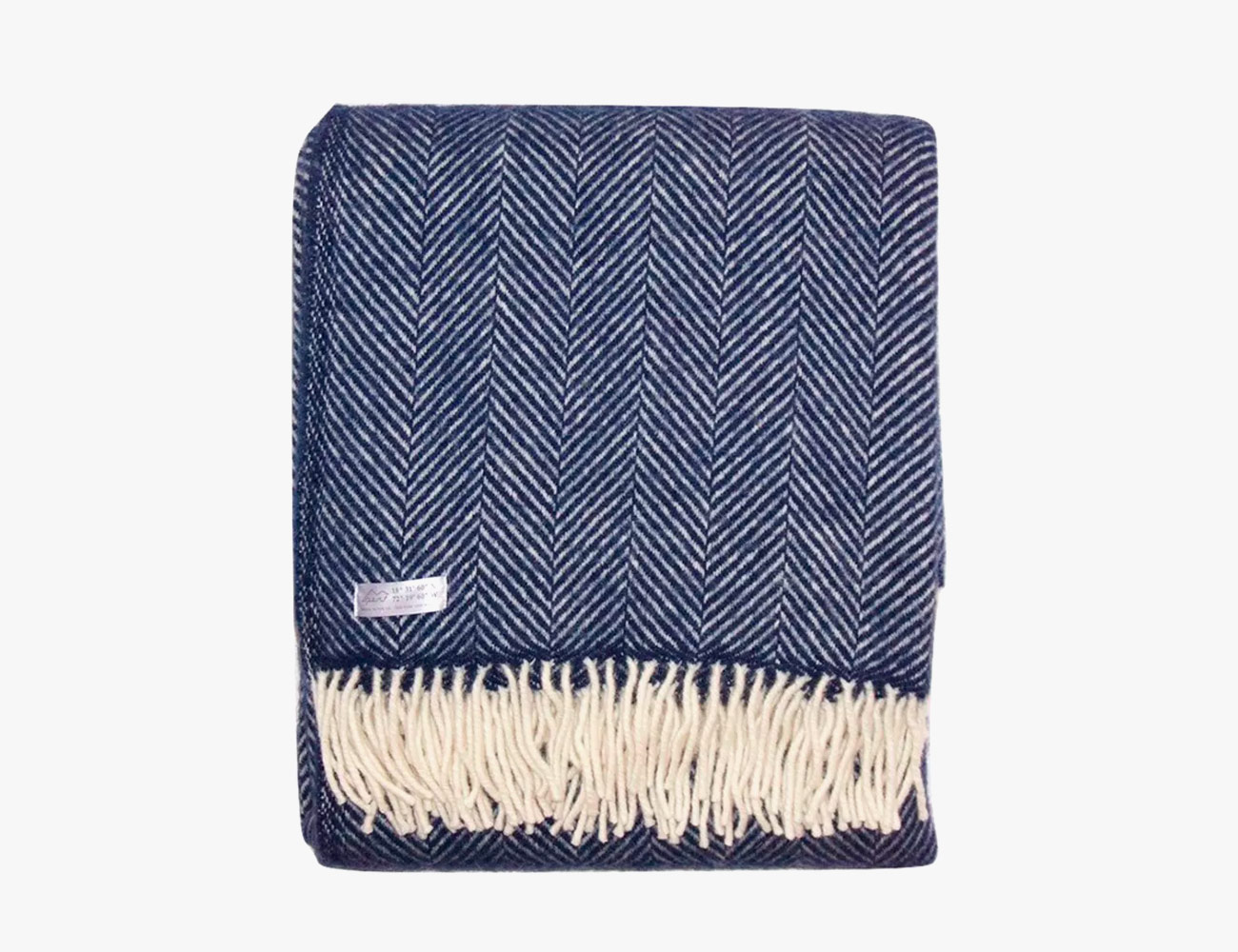
This Herringbone weave new wool blanket is woven by hand in the homes of Mexican artisans who receive fair wages for their work. In the incredibly competitive and expensive world of textile manufacturing, that alone makes these blankets special. But Perf also guarantees a percentage of sales from every one of its blue ink blankets goes to Habitat for Humanity. It doesn’t hurt that they look great, too.

Woolrich Logan Ridge Sherpa Blanket

Woolrich may have closed its last US plant in 2018 but it remains one of America’s most storied makers. The Logan Ridge sherpa blanket is sherpa (polyester) on one side and wool on the other, while this ombre stripe pattern is an homage to the Woolrich archive. Toss it over your shoulders around a campfire.

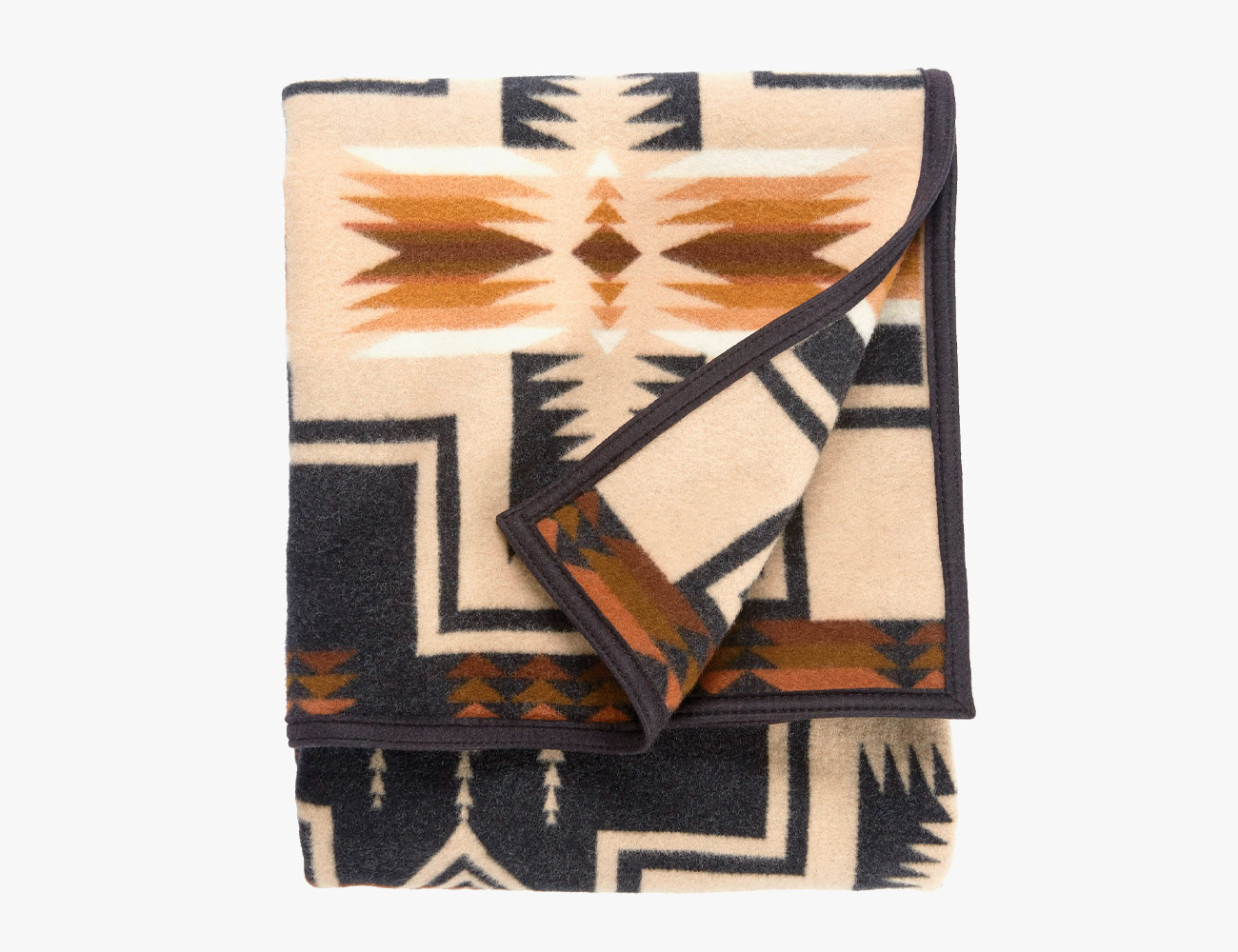
Pendleton Harding Jacquard Blanket

Thomas Kay founded Pendleton, but it was his grandsons who infused the legendary company with Native American influence. Its Jacquard loomed new wool blankets are among its most popular designs ever, and it’s pretty easy to see why: they’re gorgeous.

Best Made Co. Lumberlander Blanket

Best Made’s Lumberlander blanket is designed in its NYC-based offices, but it’s made at the legendary Pendleton Woolen Mills. Instead of riffing on Pendleton’s iconic Native American-inspired prints, however, Best Made took a more minimal approach. The wool-cotton blend blanket comes in two striped colorways, both finished with a whipstitched top and bottom layer and selvage sides.

Coyuchi Striped Blanket

This striped wool blanket is one of Coyuchi’s most popular products ever. Made in a 140-year-old Canadian mill from the dense wool of Canadian sheep, it follows the same rigorous standards the company holds for its popular cotton bedding, meaning it’s GOTS-, Fair Trade- and Fibershed-certified.

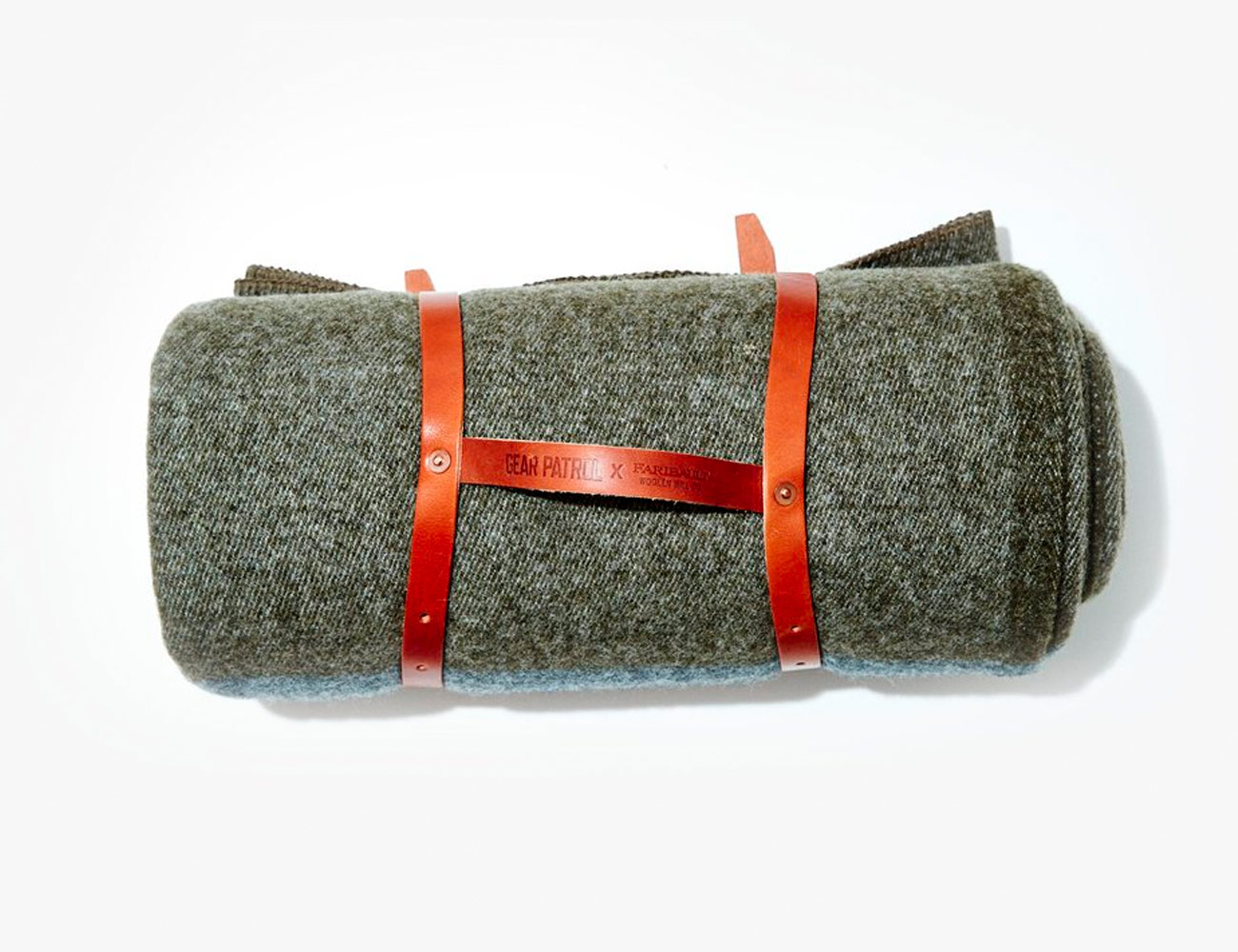
Faribault Woolen Co. Scout Blanket

In operation since 1865, Faribault is one of the biggest names in American wool. The Scout blanket is a 100 percent wool reproduction of a Civil War-era blanket, and this one comes with a bit of added Gear Patrol flair. Dry clean only, please.

Schoolhouse Shaniko Throw

Brian Faherty’s Schoolhouse used to sell old light fixtures through a mail-order catalog. Now it’s a robust outlet, specializing in vintage-inspired homewares. The yellow and white Shaniko throw blanket is made in collaboration with Imperial Stock Ranch, a century-and-a-half-old ranch rolling out some of the best textiles the country has to offer. (Name sound familiar? Imperial Stock Ranch worked with Ralph Lauren on the uniforms for the 2014 US Olympic Team in Sochi, Russia).

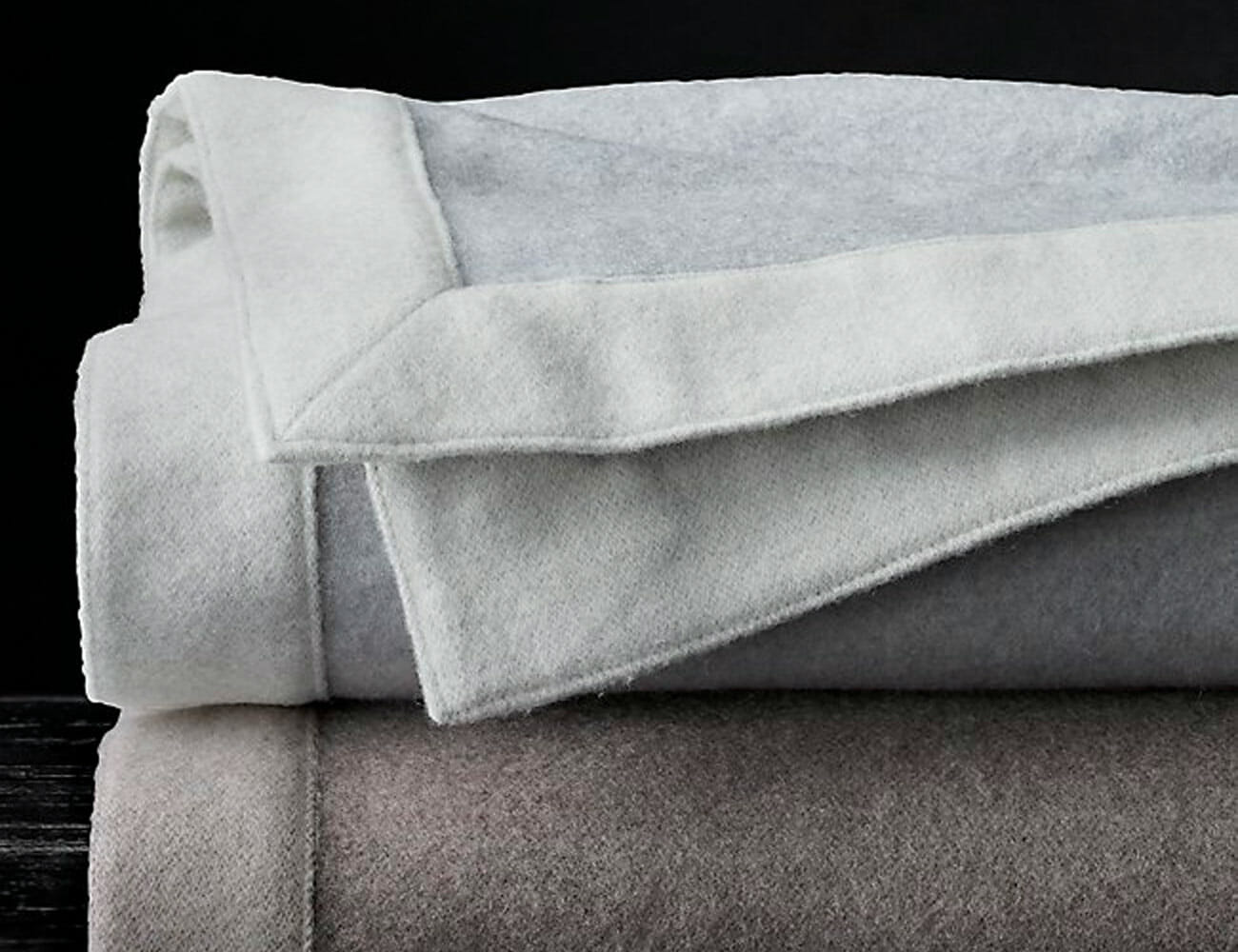
Restoration Hardware Fine Merino Blanket

Restoration Hardware’s blanket disproves wool’s scratchy reputation — two layers of extra-soft virgin merino wool make for the softest option on this list. It’s reversible and comes in two muted colors for easy matching.

Note: Purchasing products through our links may earn us a portion of the sale, which supports our editorial team’s mission. Learn more here.

Don’t Sleep on West Elm’s New Bathroom Gear

Cheap and Good-Looking

Don’t Sleep on West Elm’s New Bathroom Gear


Bathroom gear is not a subject we spend much time discussing. Not only is it inherently less exciting than cast-iron skillets or kitchen knives, it’s typically stuff that most people need, rather than stuff they actually want. But when West Elm releases a small collection of affordable and nice-looking bathroom gear, perspectives are subject to change.

Water Street, comprised of cheap bath towels, mats, countertop accessories and glossy hardware, is the company’s first bathroom collection since 2015. With items like GOTS-Certified organic cotton bath towels for under $30 and hardware starting under $20, it’s also strangely affordable — a characteristic heightened by the fact Water Street pieces are 20 percent off today. Find some of our favorite items below.

Organic Luxe Fibrosoft Bath Towel by West Elm $29 $21

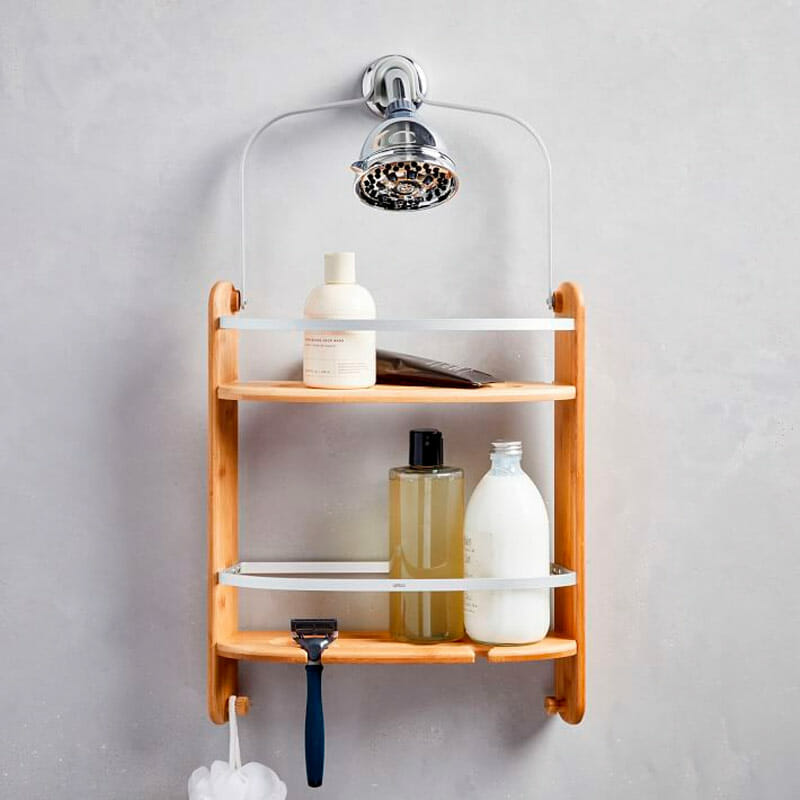
Ease Shleved Shower Caddy by West Elm $40 $32

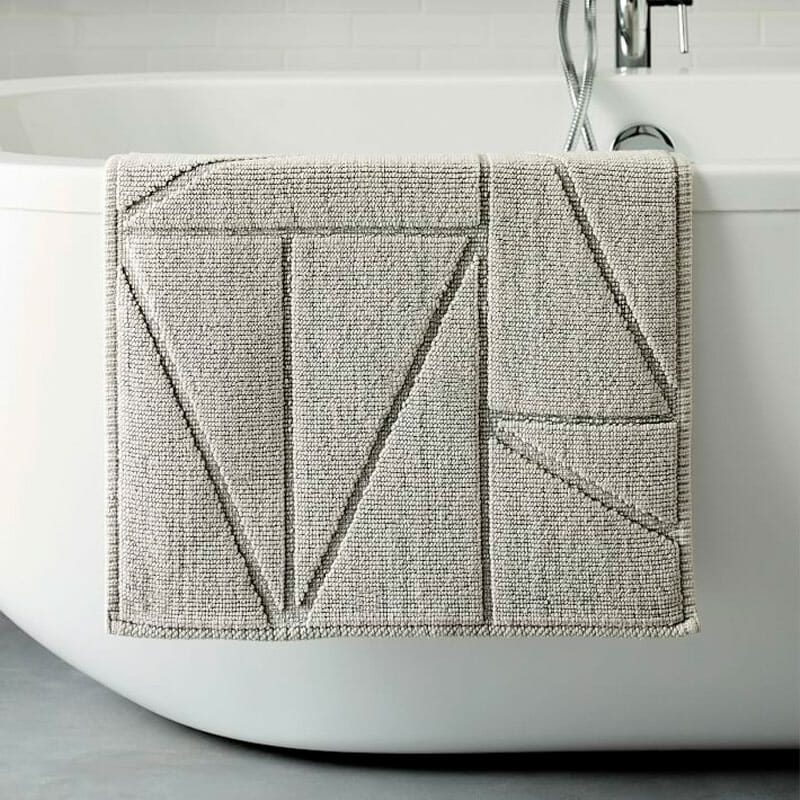
Organic Triangle Sculpted Bath Mat by West Elm $29 $21

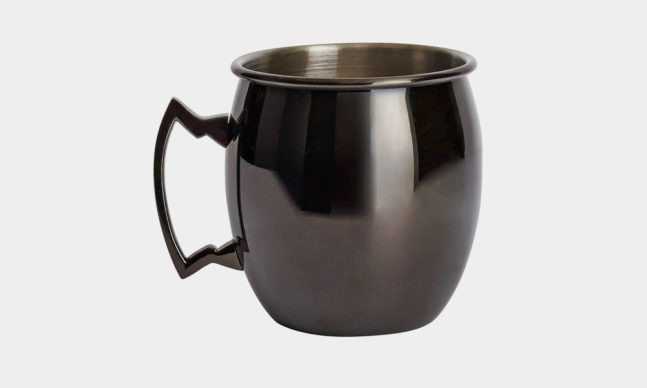
This Gunmetal Moscow Mule Mug Is on Sale for Less Than $2

The Moscow Mule is the perfect example of a great spring cocktail. But just because it’s associated with the warmer weather doesn’t mean you can’t have one whenever the hell you feel like it. There’s…

7 High-Proof Bourbon Whiskeys to Drink This Year

A bourbon myth for you, briefly: any 120 proof bourbon is somehow inherently better than your run-of-the-mill 80- or 90-proof stuff.

“There is a falsity that’s in the consumer base that cask strength is better,” says Fred Minnick, a spirits writer and the Editor-in-Chief of Bourbon+ magazine. “What’s really happening is, a lot of people can’t taste flaws at that strength. If they were to cut it with water and get it down to 90 or 80 proof, they would detect notes they wouldn’t necessarily care for.”

Don’t go pouring the strong stuff in your liquor cabinet down the drain, though. High-proof bourbon (it’s called “cask strength” when it’s unwatered, and therefore the same strength it was when it exited the bourbon cask) remains a beautiful spirit.

Weller first bottled a bourbon at “barrel proof” in the 1940s, but it was only 107 proof. The first bottles to breach the 115 mark came from Booker Noe, at Jim Beam, and a less-remembered bourbon from Willet called Noah’s Mill. Those bourbons weren’t just about firepower. They gave drinkers a chance to taste the bourbons like their blenders had, straight out of the barrel; they added a new tool to the bartender’s cocktail kit; and they introduced a new route — albeit a difficult one for distillers and blenders to traverse — to flavors intensified by the higher alcohol content.

Science backs this up. Ethanol, the alcohol in spirits, is an immense flavor enhancer, but its effects on the taste of a drink are not always straightforward. For instance, scientific studies have found that an increase in ethanol content in a spirit tends to decrease the release of aromatic compounds — higher alcohol, less smells. To a point, a well-balanced high-proof bourbon can amplify certain flavors, like caramel, Minnick says. When distillers control the beast, “you get those special bourbons, where the concentration of the flavor notes are much more powerful.”

It’s a fine line to walk for distillers, let alone buyers. The final lesson? Don’t buy high-proof bourbon for high proof’s sake, but prospect carefully and you’ll unlock liquid pleasures beyond the vale. Here are some high-proof bourbons that walk the line beautifully.

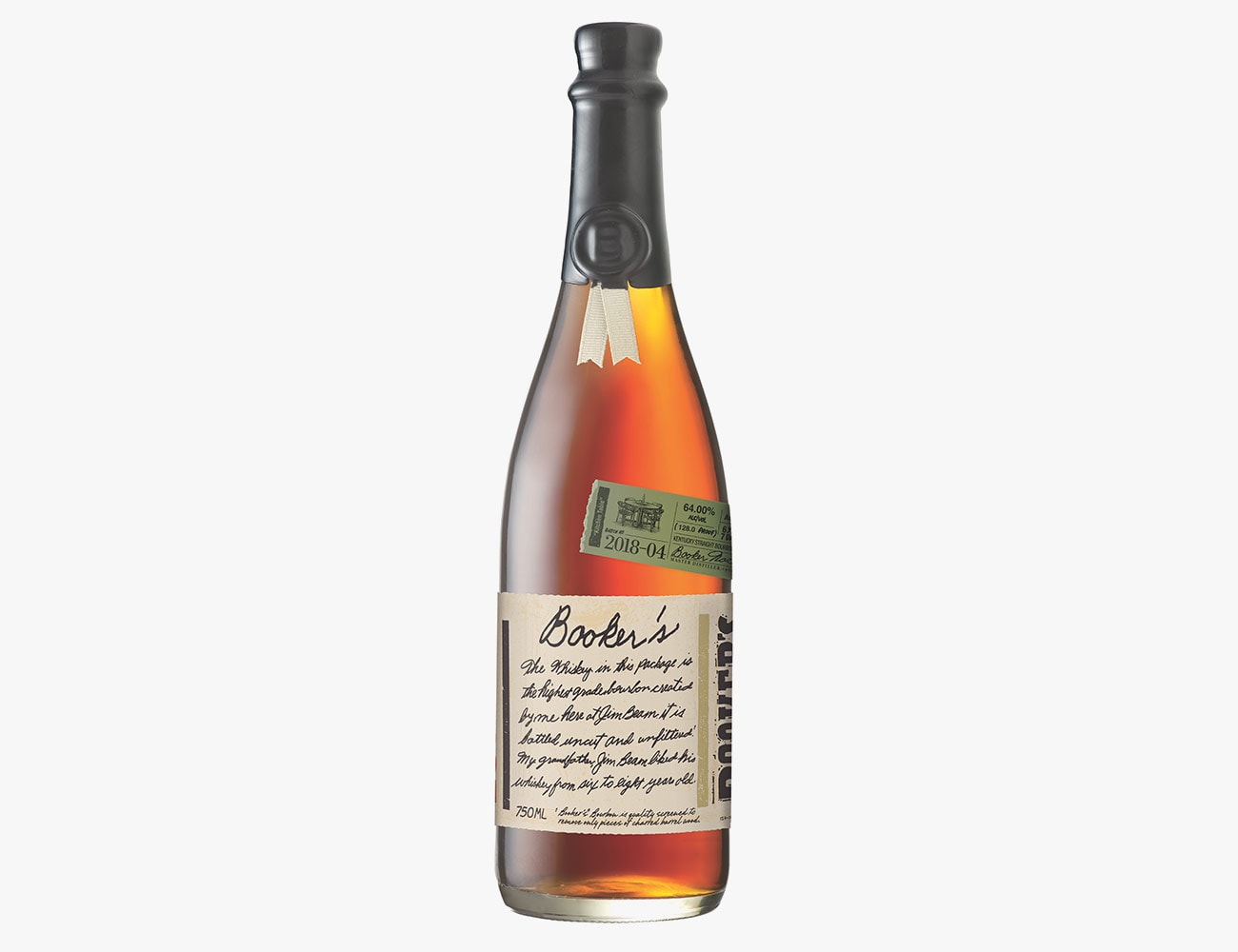
Booker’s 2018 04 “Kitchen Table”

The OG: Booker Noe was a visionary in the high-proof world, one of the first to bottle bourbon at cask strength, unwatered. (Booker’s also claims that he coined the term “small batch” when, really, he popularized it.) That bourbon was called “Booker’s True Barrel Bourbon.” Today, every bottle of Booker’s is bottled at barrel proof, and they pack a serious punch — usually, upward of 125 proof.
Proof: 128 (barrel proof)
Age: 6 years, 8 months, 7 days
Tasting Notes: honey, rye, molasses, spice

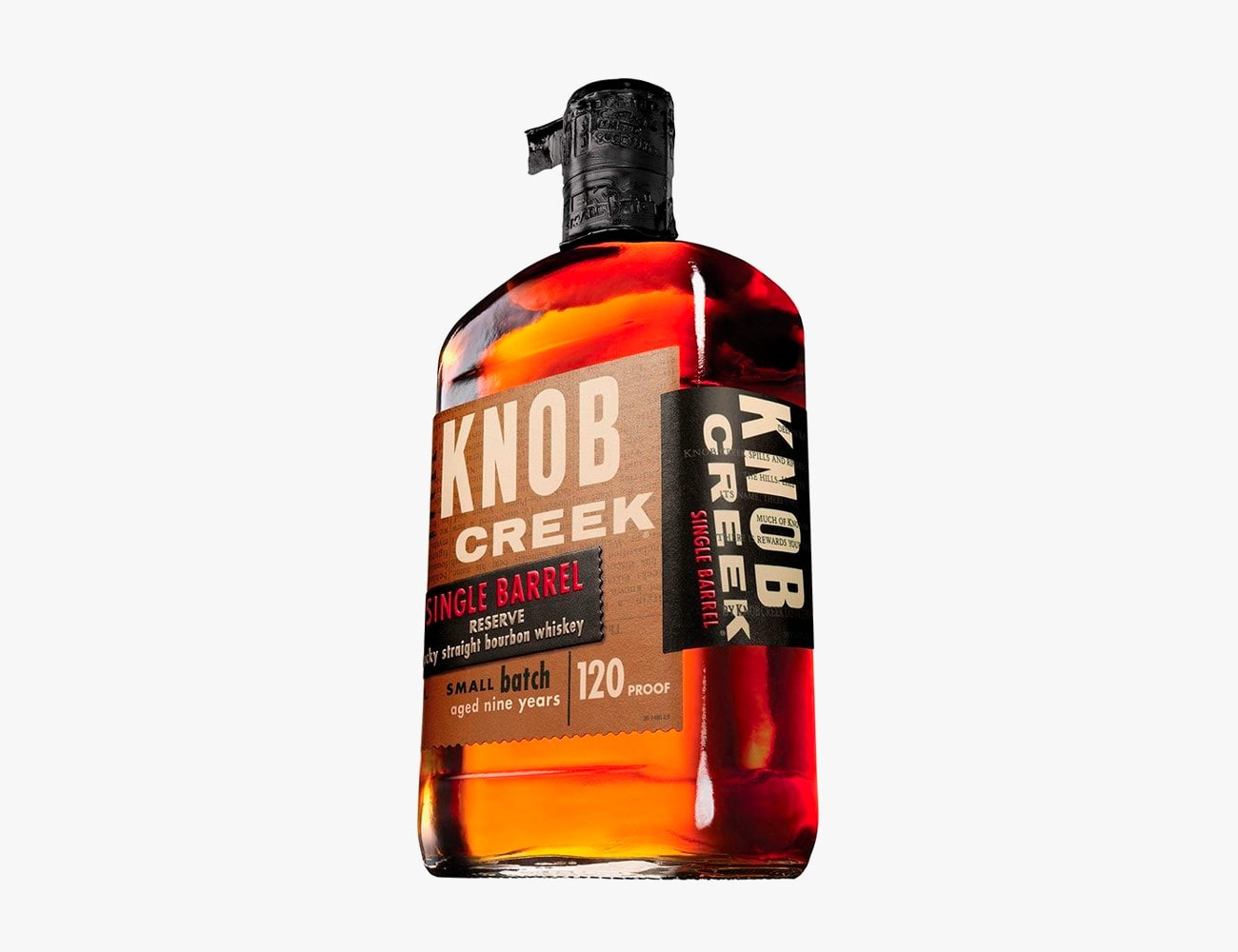
Knob Creek Single Barrel Reserve

Juicy Bomb: Also the doing of Booker Noe, Knob Creek comes from the Beam Suntory distillery. It’s aged nine years, just like every other Knob Creek bourbon, which drinkers will find reflected in its classic vanilla and caramel notes. The extra ethanol seems to amplify the sultry caramel flavor without overwhelming the juicy, light citrus that comes from the rye.
Proof: 120
Age: 9 years
Tasting Notes: vanilla and caramel, with a touch of citrus

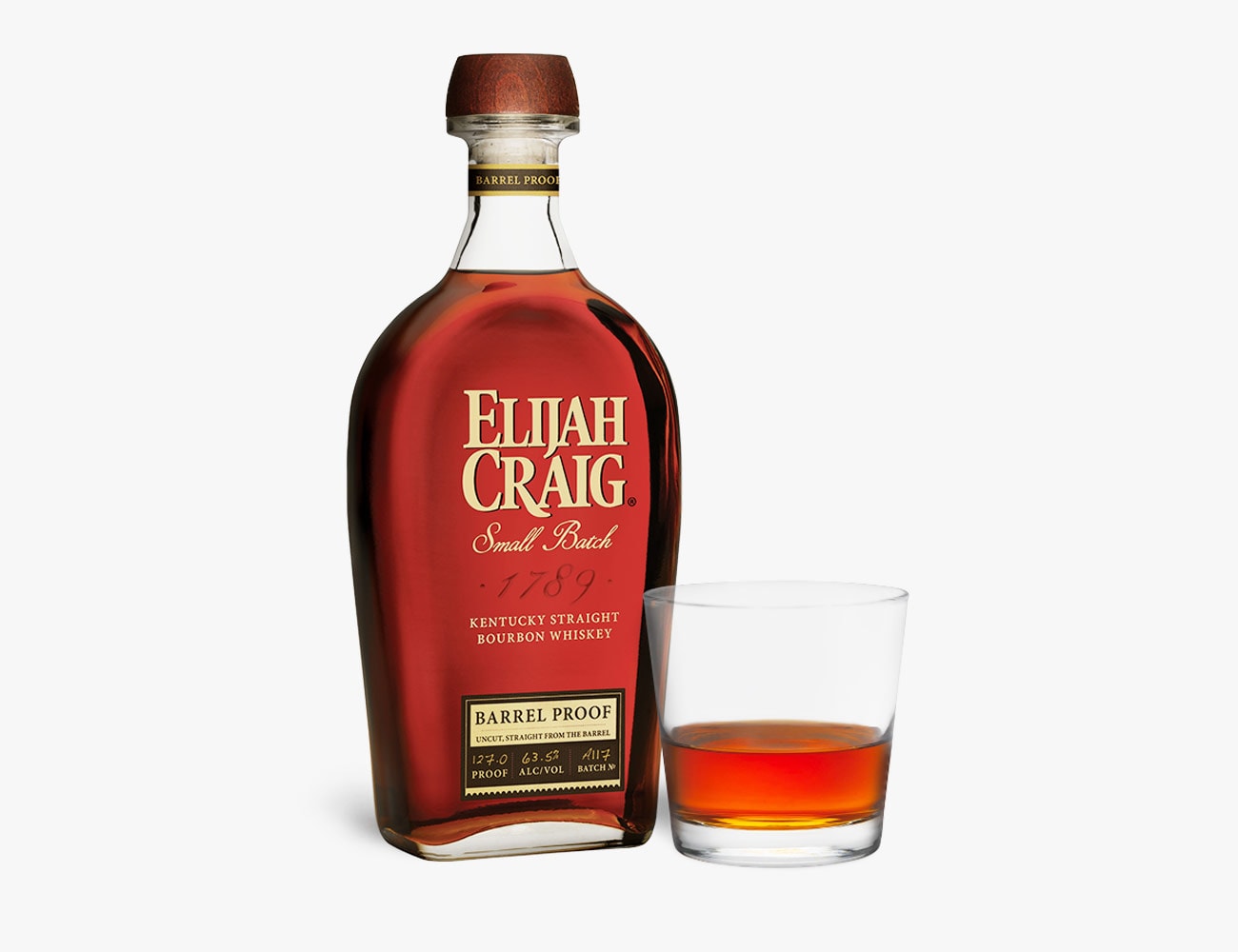
Elijah Craig Barrel Proof

Award Winner: Heaven Hill’s ubiquitously distributed gem has won serious awards. Elijah Craig small batch variety has been lauded by Whiskey Advocate, Whiskey Magazine and The Whiskey Bible, while the Barrel Proof version was Whiskey Advocate’s 2017 Whisky of the Year. It’s an incredibly dark bourbon, representative of a serious interaction between bourbon and barrel.
Proof: 131 (barrel proof)
Age: 12 years
Tasting Notes: caramel, butterscotch, spice

Wild Turkey Rare Breed

The People’s Champion: Even the widely accessible bourbons on this list cost upward of $80. Wild Turkey’s version goes for around 50 bucks. It’s been around since 1991, a blend of 6-, 8-, and 12-year-old bourbons. Its spiciness follows with Wild Turkey 101s.
Proof: 118 (barrel proof)
Age: 6 – 12 years
Tasting Notes: spice, rye, pepper, oak

George T Stagg

Dream Bottle: Much like Colonel E. H. Taylor, Jr. — more on him in a moment — George T. Stagg was not known as a great distiller or blender, but rather a salesman. He’d be happy to see a bourbon with his name on it that goes for upward of $800, if it can be found. But inflated as its price may be, this is truly a dream bottle for collectors, fawned over by experts worldwide: winner of Jim Murray’s Whiskey Bible World Whiskey of the year from 2004 to 2006, and second in 2012, it was awarded three golds and three double gold medals by the San Francisco World Spirits Competition from 2006 to 2012.
Proof: 124.9 (barrel proof)
Age: 15 years
Tasting Notes: rye, coffee, fudge, dates, dark berries

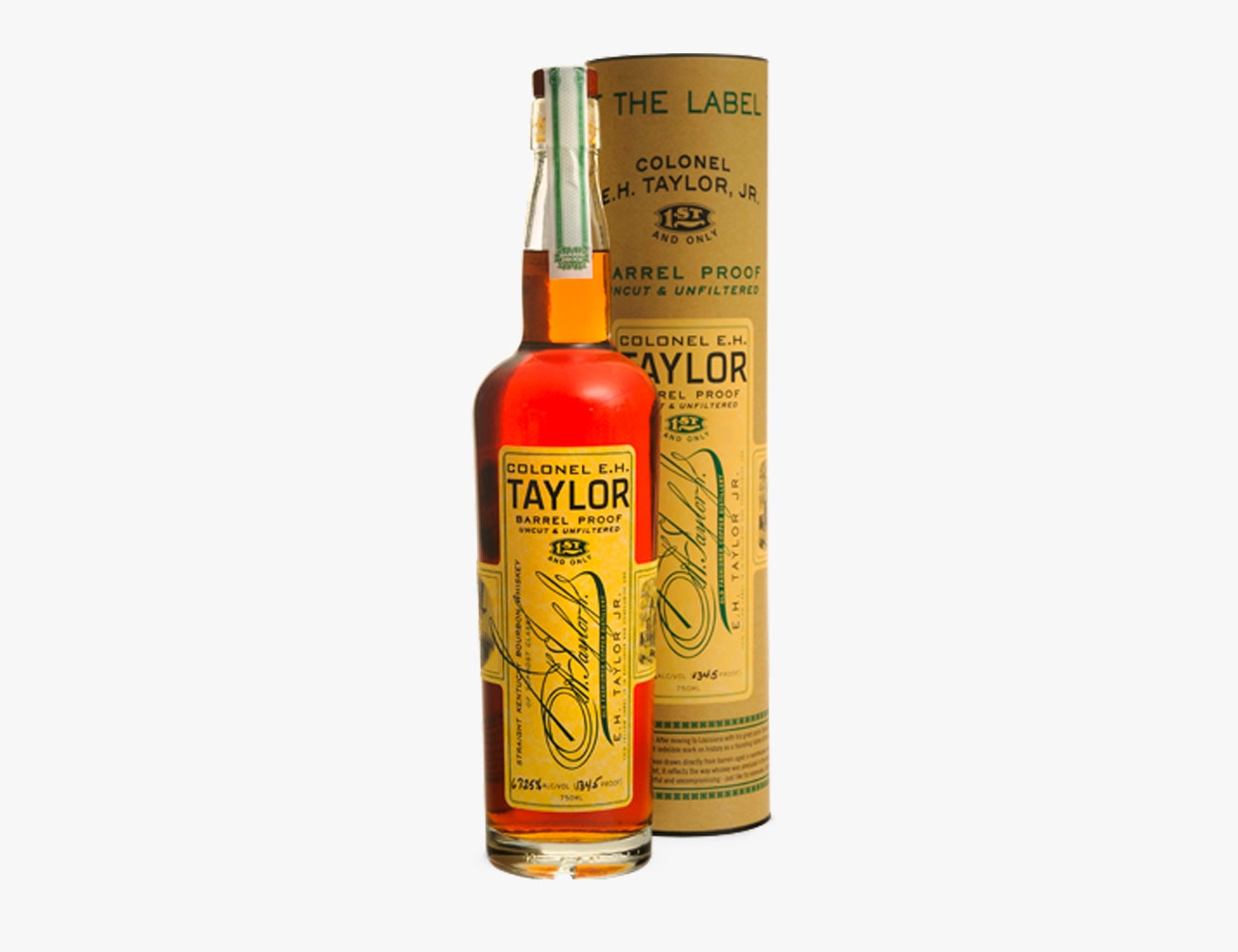
Colonel E. H. Taylor, Jr. Barrel Proof

Gentle Giant: Colonel Taylor was a benefactor of sorts for the bourbon industry in the 19th century — first as a banker and then as a modernizer of distilling equipment at what today is Buffalo Trace. The standard E. H. Taylor, Jr. bottle and the small-batch version are both bottled-in-bond without an age statement, which means they are at least four years old; the Barrel Proof version also has no age statement. All three use the distillery’s ubiquitous “mash bill no. 1,” shared with a number of other bottles, including Buffalo Trace and Stagg Jr.; get your hands on all three and you can compare how different barrels and proofs make for drastically different bourbons.
Proof: 125 (barrel proof)
Age: NAS
Tasting Notes: vanilla, citrus, plum

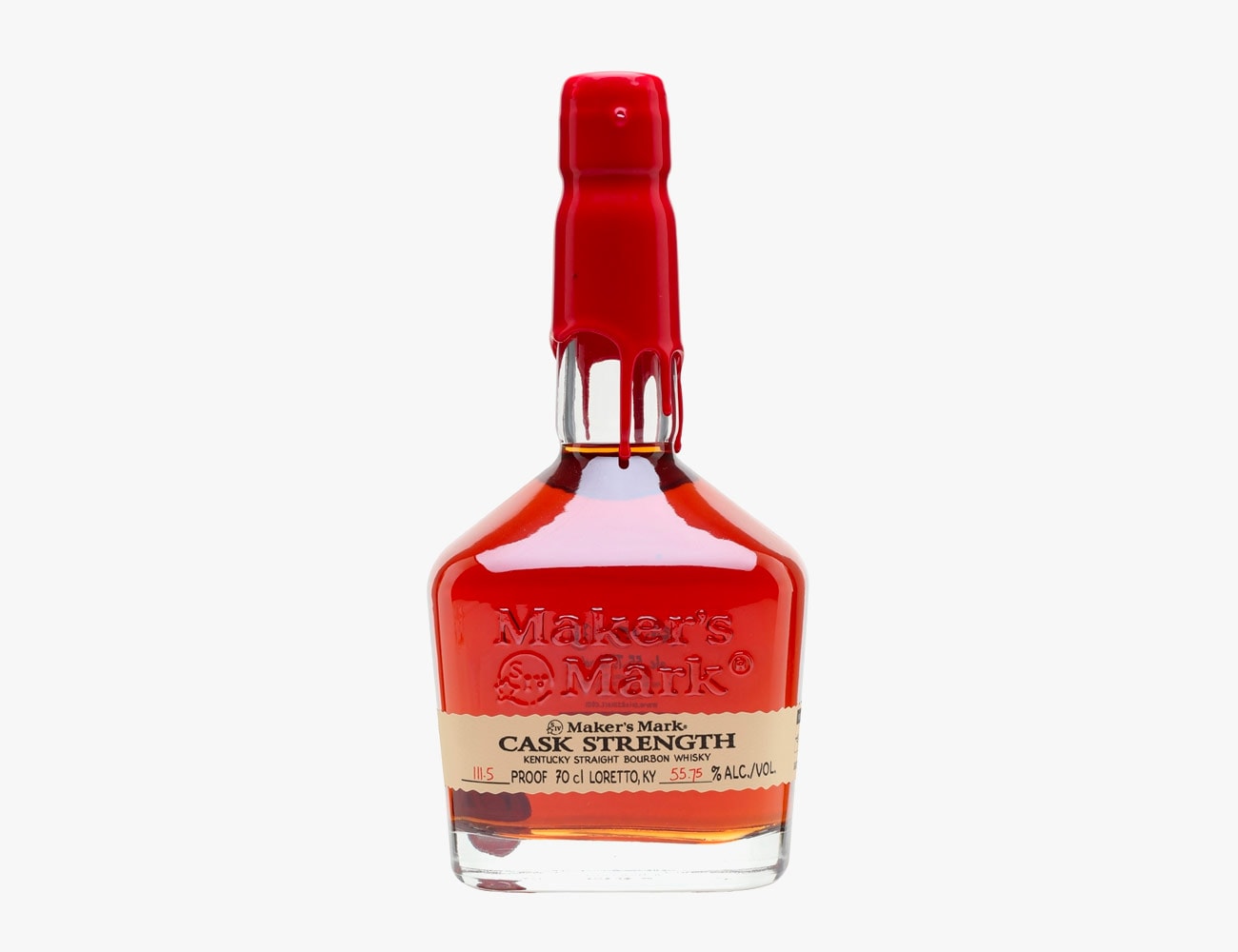
Maker’s Mark Cask Strength

Wheated Winner: There are few barrel-proof bourbons on the market that use wheat rather than rye. When Maker’s Mark Cask Strength was introduced in 2014, it gave wheated bourbon fans their first crack at a reasonably priced, widely available option. The home-run version for high-proof wheated bourbons is William Larue Weller, which is closer to 130 proof, wins loads of awards but it also costs an arm and a leg. Maker’s Mark is bottled at a much lower proof, which helps balance its sweetness, spice and alcohol heat.
Proof: 111.3 (varies)
Age: NAS
Tasting Notes: cherries, cinnamon, vanilla, dark fruit, molasses

The Best Bourbon Whiskeys You Can Buy

Everything you ever wanted to know about America’s favorite brown spirit, including, of course, the best bottles you can actually buy. Read the Story

These Norwegian Door Mats Blend Commercial-Grade Durability with Designer Looks

The Magazine

Let us take you on a journey of the world. Each issue of the Gear Patrol Magazine comes packed with adventures, guides and stories exclusive to the magazine. Stunningly designed, printed on high quality stock and ready for your coffee table. Biannual. $39.

The Newsletter

Get GEAR PATROL in your inbox with the DISPATCH, including Today in Gear and all our new stories. Daily, 5pm. Free.

The Last Time This Chef’s Knife Was Available It Sold Out in 24 Hours

Based in Austin, Texas, Made In Cookware already produces some of the best pots and pans for the money on the market. Now it makes more than just pots and pans and, again, takes aim at pulling materials made with real, quality materials down a few price pegs.

The Made In chef’s knife was listed for pre-order in October, and when the $89 knife was finally made available, it sold out. Fast.

Made In’s knife features material, construction and design DNA with chef’s knives from major players in the kitchen knife space, but at a price point that’s a fraction of similar blades.

“We wanted to adhere primarily to the characteristics of Western-style knives, since we’re made in Thiers, France,” said Made In co-founder Jack Kalick, “Thiers is known as the knife-making capital of the world, and has been doing so for over 700 years, so the inspiration was a no-brainer.”

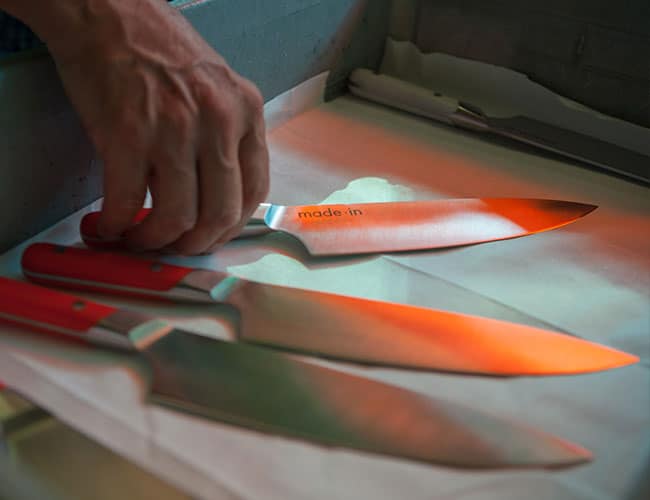
Pictured: Made In’s chef’s knife, which is forged in France of German X50CrMoV15 steel, the same steel found in Wustof and Victorinox’s signature knives.

The blade is forged and utilizes X50CrMoV15 steel, which is a very confusing way of saying its a mixture of carbon, chromium, molybdenium, vanadium, manganese and silicon. Further, it is best described as a relatively low-carbon carbon steel, or, by some, as a high carbon stainless steel — this basically means it carries some traits from both carbon and stainless steel knives.

Kalick said as much when we asked him about it, “We specifically chose X50CrMoV15 stainless steel because it’s a cornerstone for premium western knives. It combines good carbon content with stainless steel properties to ensure a durable and resistant blade.”

The handle of Kalick’s knife is the only departure from classic Western chef’s knives. It was designed with a slightly rounded profile, and added a gradual flare to help with grip. “This is the one aspect of the knife that may lean a little Eastern in style, but we like its comfort for hands of all sizes,” Kalick said.

What kind of performance differences do you get with a knife that rides the line between carbon and stainless steel? Because of a higher percentage of chromium, it is far, far more corrosion resistant and stain resistant than a carbon steel knife (which will rust very quickly if left in the sink or with moisture on its surface). But it is also a rather soft steel, meaning it loses its edge a bit more quickly than a carbon steel might (invest in a home sharpening system, they’re pretty cheap). Finally, and this is a good thing, it’s far less brittle than carbon steel knives, which are far more prone to chipping at awkward angles on your cutting board or an accidental drop.

According to Made In, what separates its knife is an additional step it takes to increase hardness and further protect it from chipping — a nitrogen finish. Much better explained by Knife Steel Nerds, the gist is the finish allows the knife to be much harder (and, somewhat confusingly easier to sharpen) than most stainless steel while also keeping its high chromium content (which allows it to be stain and rust resistant).

As Kalick noted, X50CrMoV15 steel also happens to be a staple of high-end Western knives — it’s the steel type Wüsthof, Victorinox and others use in their signature blades (both are somewhat more expensive than Made In’s knife).

The Made In chef’s knife is back in stock now for $89.

Life Hack: For a Calm and Cozy Bedroom, Switch Your Light Bulb

From Issue Five of Gear Patrol Magazine.
Discounted domestic shipping + 15% off in the GP store for new subscribers.

Before electricity, interiors were illuminated by flame, with candles and gas lamps that cast a natural glow. These days, however, high-impact, low-energy bulbs that use blue wavelengths to brighten light — such as LEDs and compact fluorescents — are standard in homes across the globe.

While blue light may assist in matters of alertness and productivity, overexposure can strain retinas and knock the body’s circadian rhythm out of sync. Bulbs that stray from the conventional soft white 60-watt LED, then, have the power to improve overall well-being, joining energy efficiency with the warm glow of a candle.

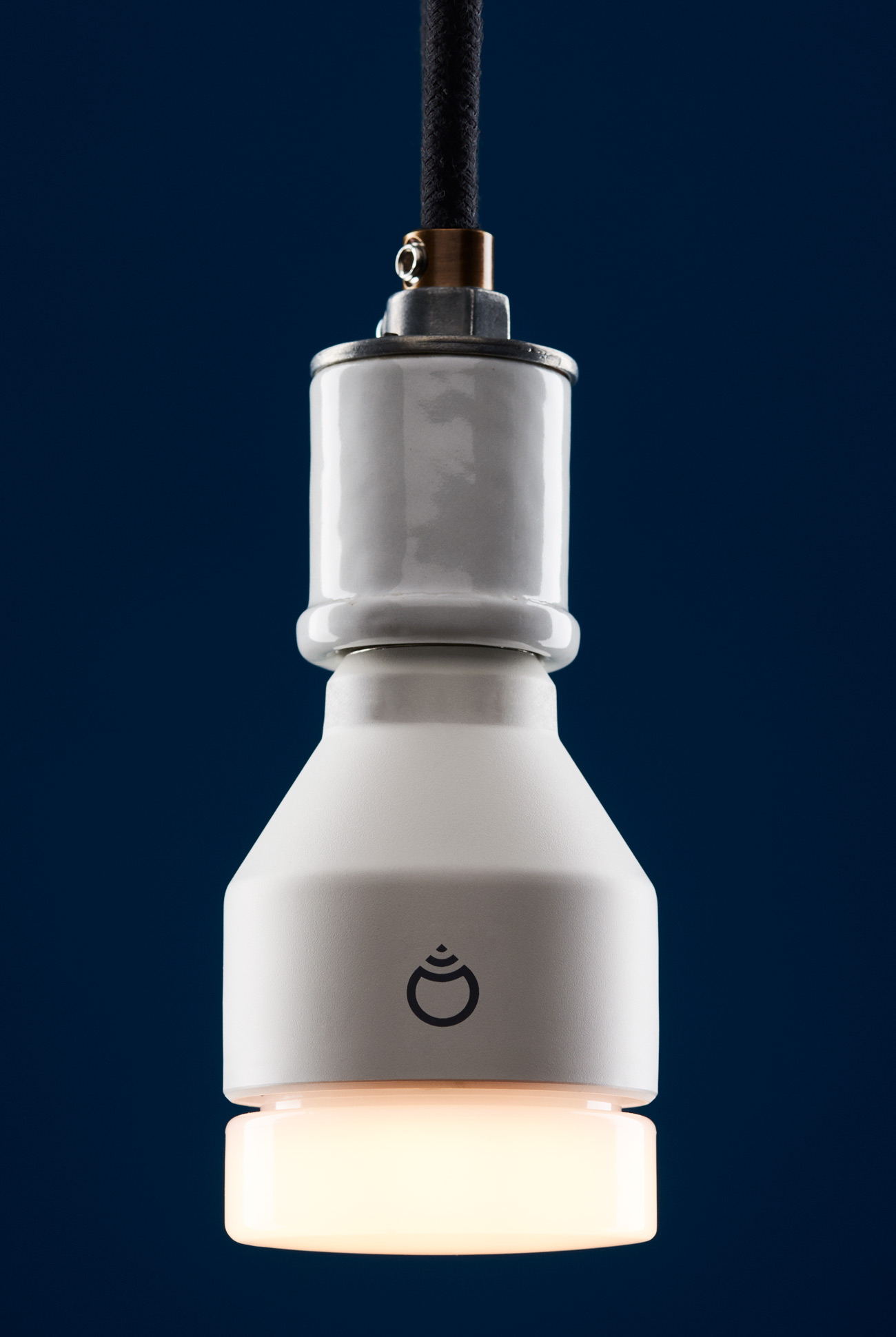
LIFX A19 LED Light

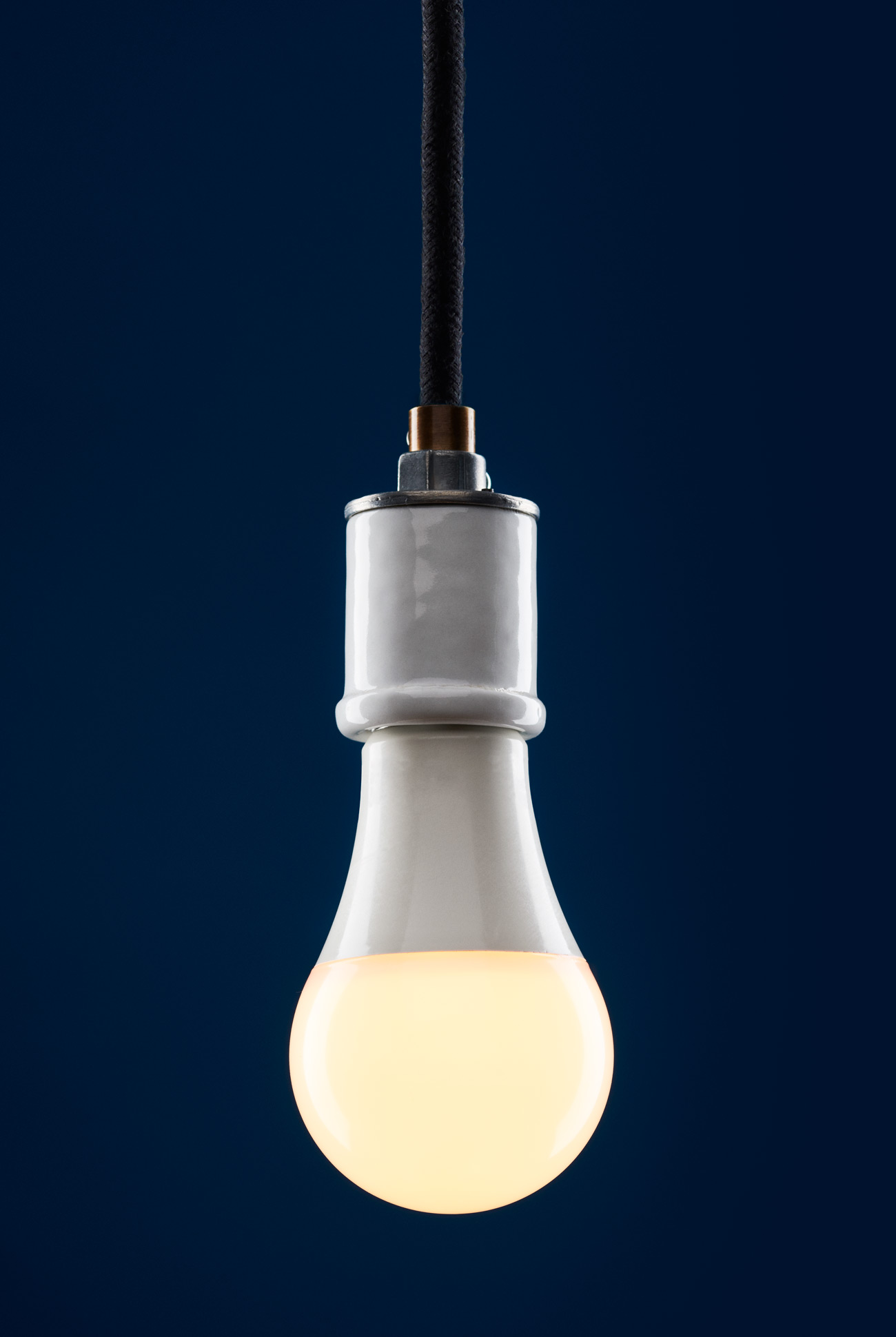
Best Smart Bulb: The LIFX smart bulb boasts fully customizable full-spectrum color — 16 million hues in total — with a color temperature that spans a soft, yellowed hue at 2,500 kelvins to a vibrant, bluish white at 9,000 kelvins. Going one step beyond customized “sleep” and “wake” times, an app-enabled Solar Schedule setting uses location-based data to sync the light with the rising and setting sun, gradually glowing brighter to facilitate smoother mornings, and later dimming to conduce a better night’s sleep.

Lighting Science HealthE Good Night LED Sleep-Enhancing Light

Best Blue Light-Blocking Bulb: The Lighting Science HealthE Good Night bulb was developed in collaboration with NASA to support the circadian rhythms of astronauts aboard the International Space Station. With patented light spectrum technology that filters out 95 percent of blue light, the bulb relies on a warm, pink-yellow glow to foster the natural production of melatonin.

Luminance ST19 Filament LED Bulb

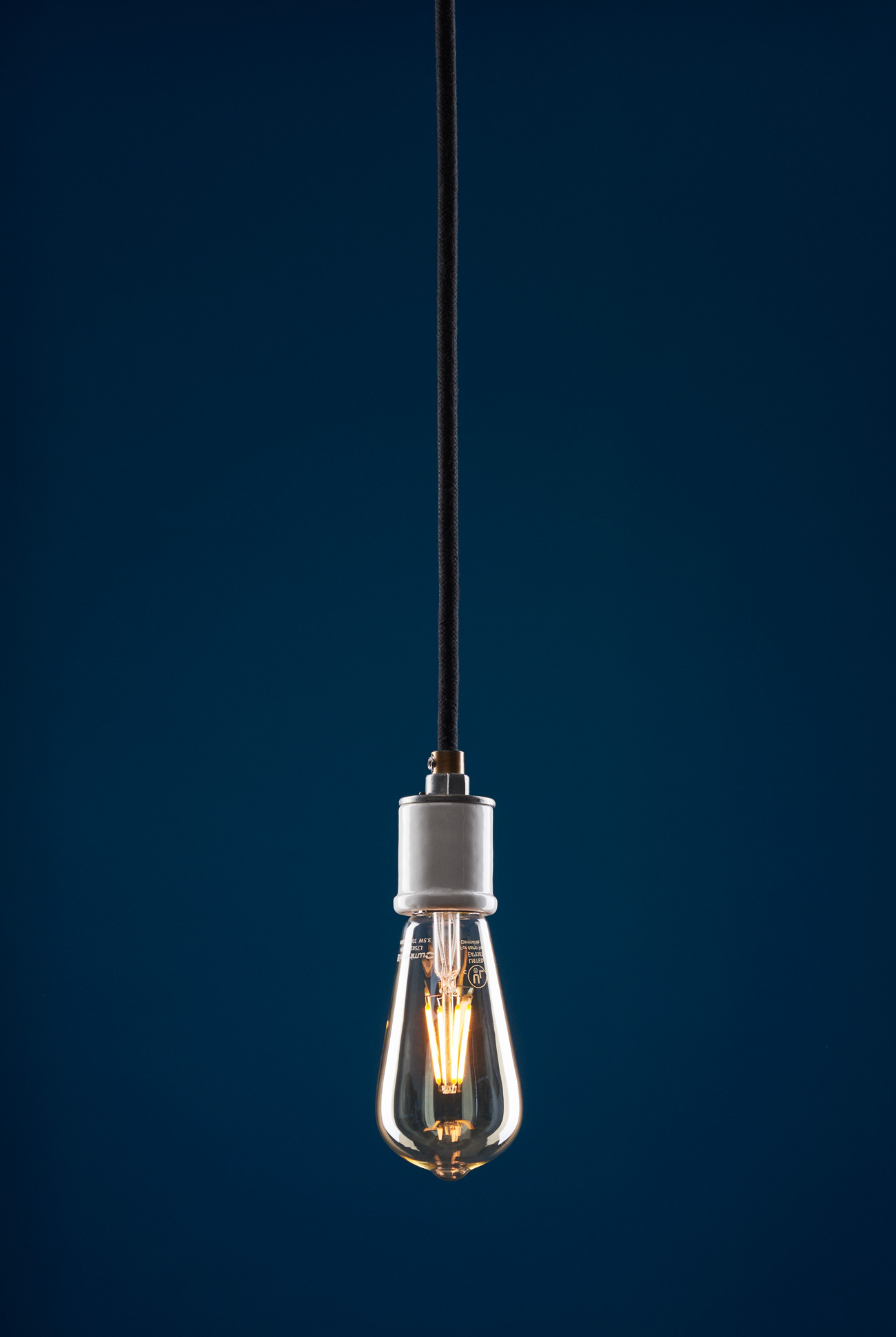
Best Filament Bulb: Guided by aesthetics rather than science, a filament bulb encourages relaxation in much the same way that a purpose-built bulb can. Illuminating with 250 lumens, compared to the 800 of a standard 60-watt LED, the Luminance ST19 Filament LED is distinguished by a warm, amber-tinged glow. It clocks in at 2,200 kelvins, and is perhaps best placed in an exposed light fixture, whether that’s a pendant, flush mount or simple shade-free lamp.

15 Tools Every Home Bar Should Have on Hand

After you’ve blown your bar-stocking budget on high-end bourbons, the last thing you’ll want to read is a shopping list of all the items you need to turn that booze into a cocktail. Thankfully, those tools tend to be very affordable. From the obvious pickups to the sleeper hits, these are the 15 things every home bar should have on hand.

Peeler

Peelers are for that guest who demands a twist in every drink. Kuhn Rikon’s Y-shaped peeler sports an ultra-sharp carbon steel blade, and it’s a favorite among chefs.

Jigger

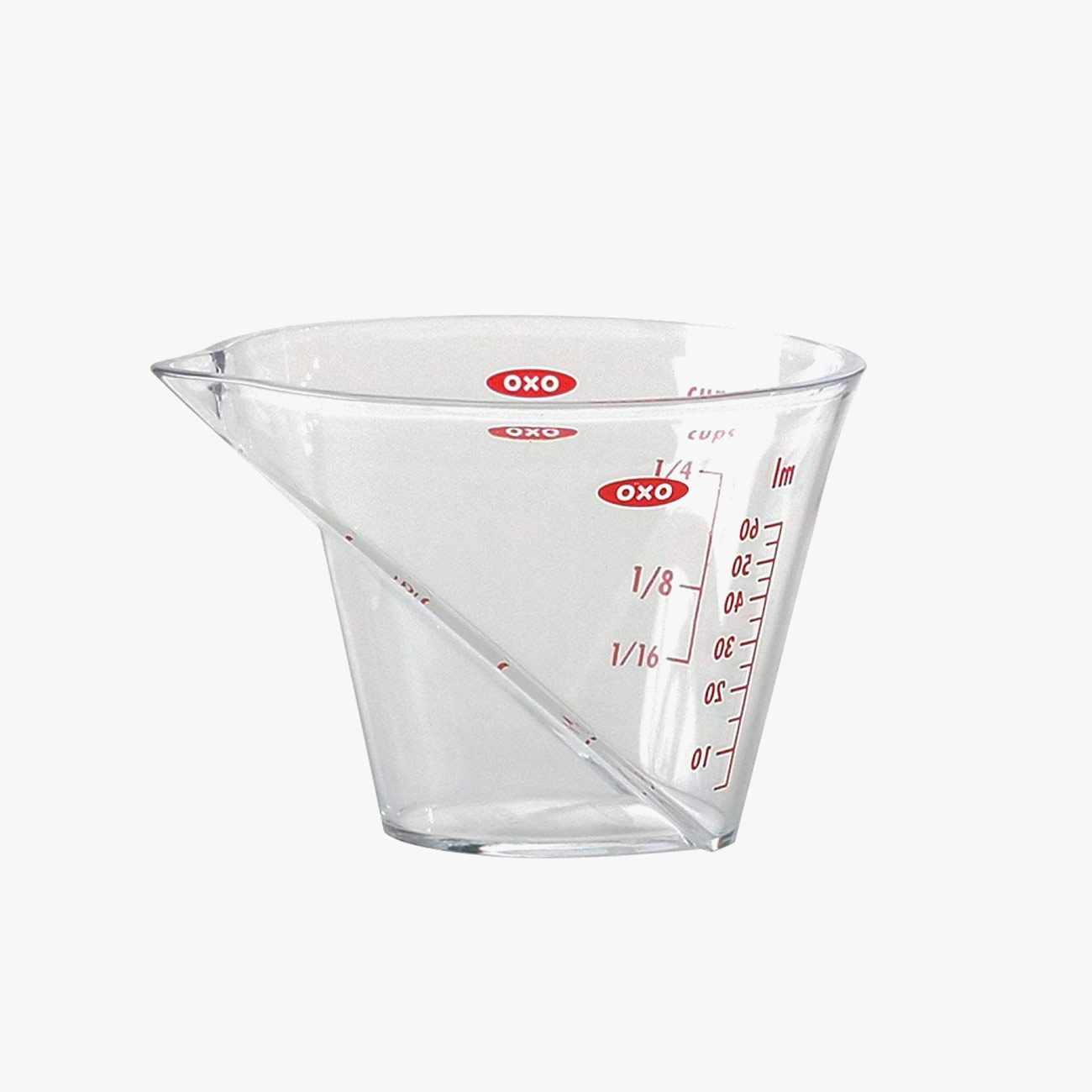
The basis of any good cocktail is measurement. And though nostalgia has you reaching for those shot glasses from college, Oxo’s easy-to-read jigger is just a better tool for the job.

Strainer

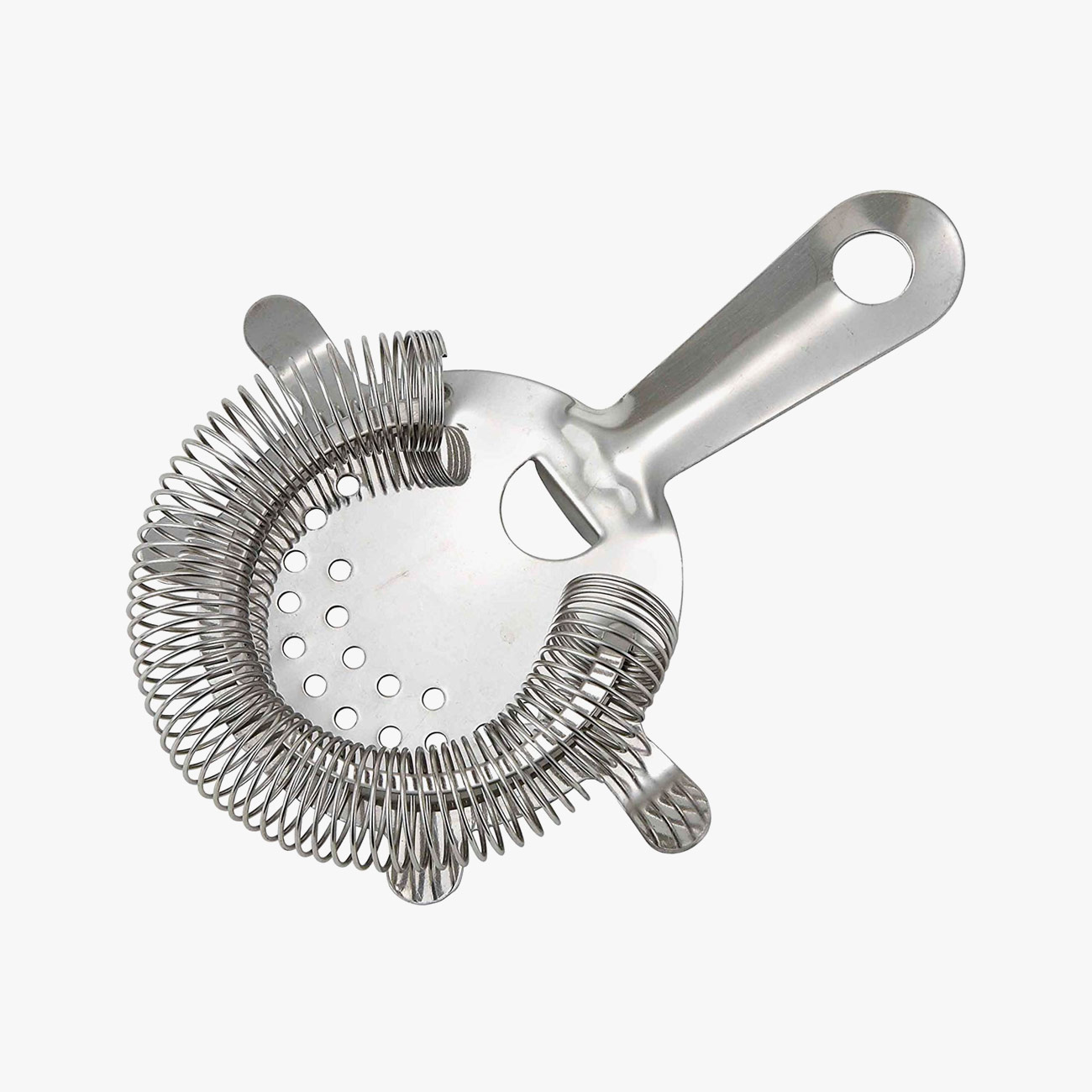
Strainers hold chunks of fruit, seeds and other solids you don’t want in the glass. This is one simple and cheap, as it should be.

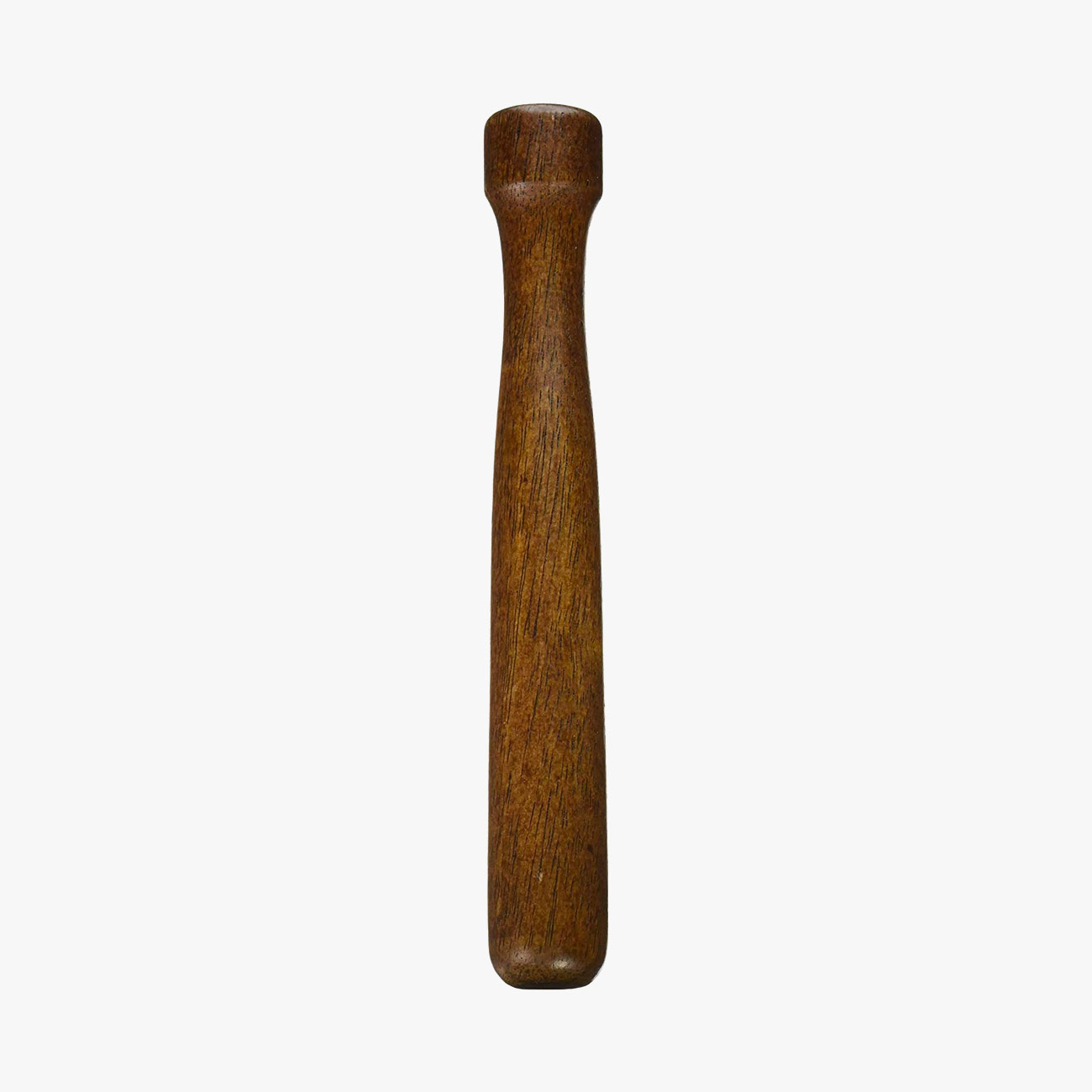
Wood Muddler

Wood muddlers don’t transfer the harsh cold of ice like metal ones do. Thus, they better protect bartenders’ hands from numbing. This one is from a big name in commercial restaurant supply. That means it’s dependable.

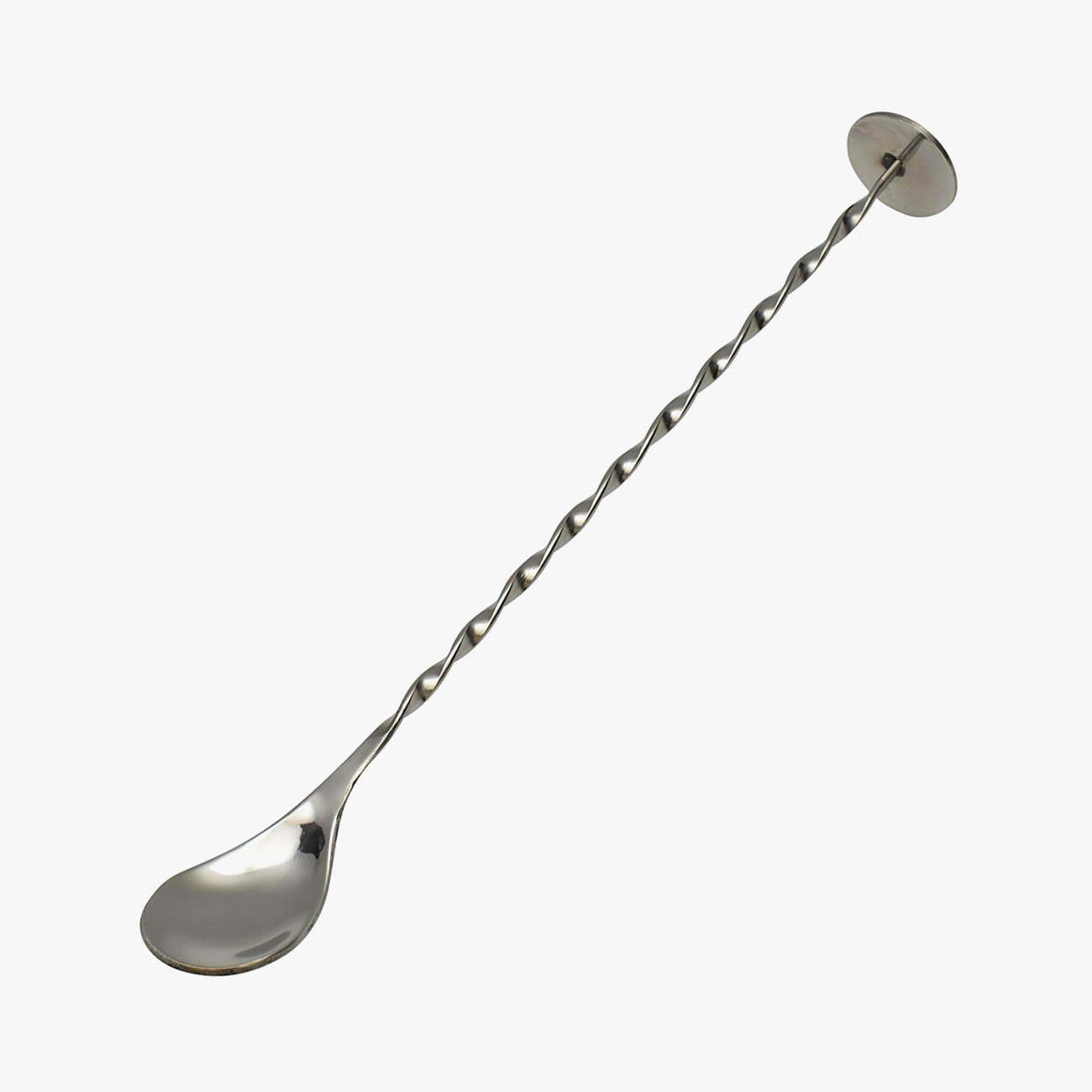
Disc Bar Spoon

A bar spoon must be two things: long and twisted. The length allows the drink maker to stir without getting the drink all over their hand, while the twisted handle keeps the spoon in the hand in the first place. This one has a masher, which can serve as a quick replacement for a muddler if time (or budget ) is of the essence.

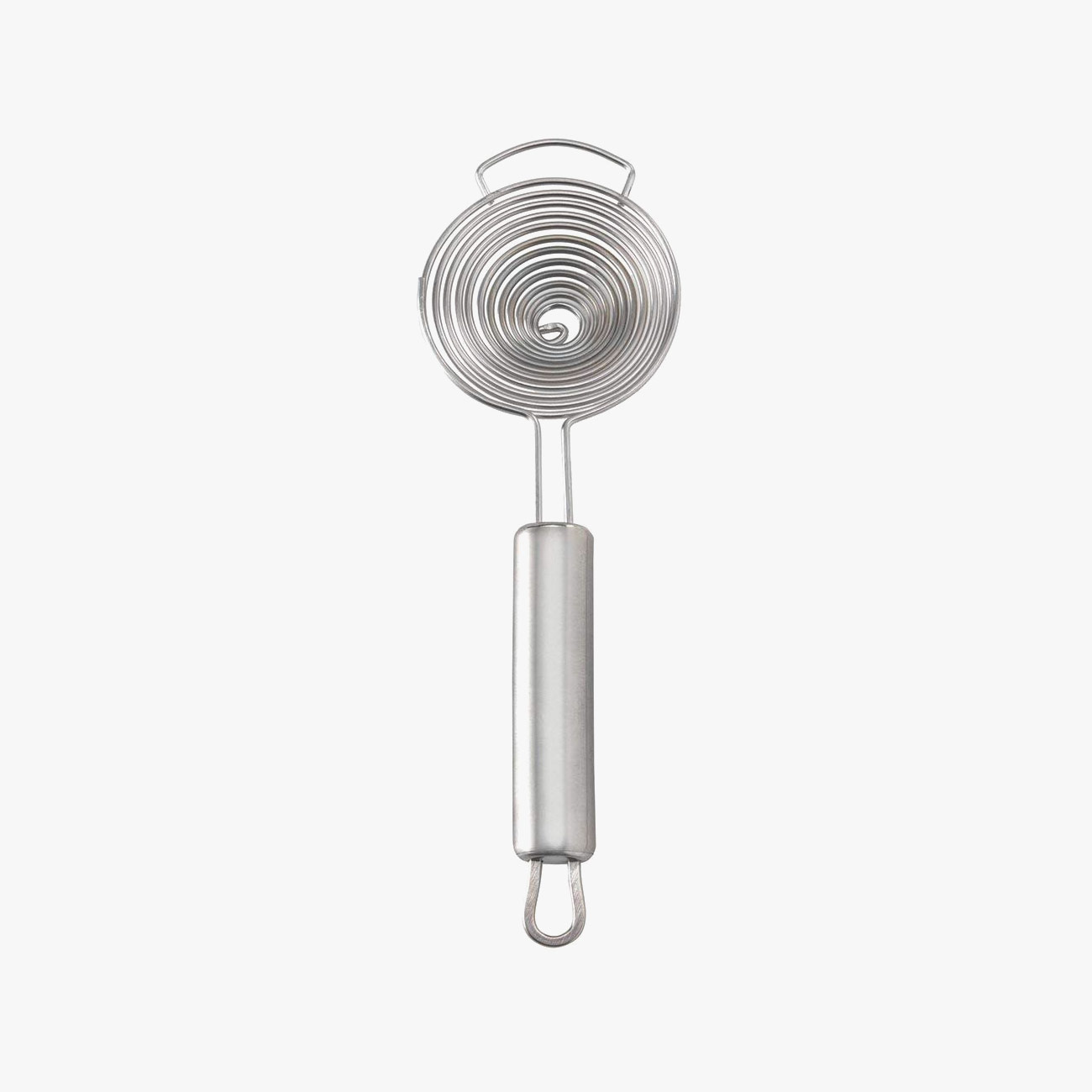
Egg Separator

Ever separated eggs by hand before? It’s not easy. This stainless steel egg separator is how you make sours happen more often.

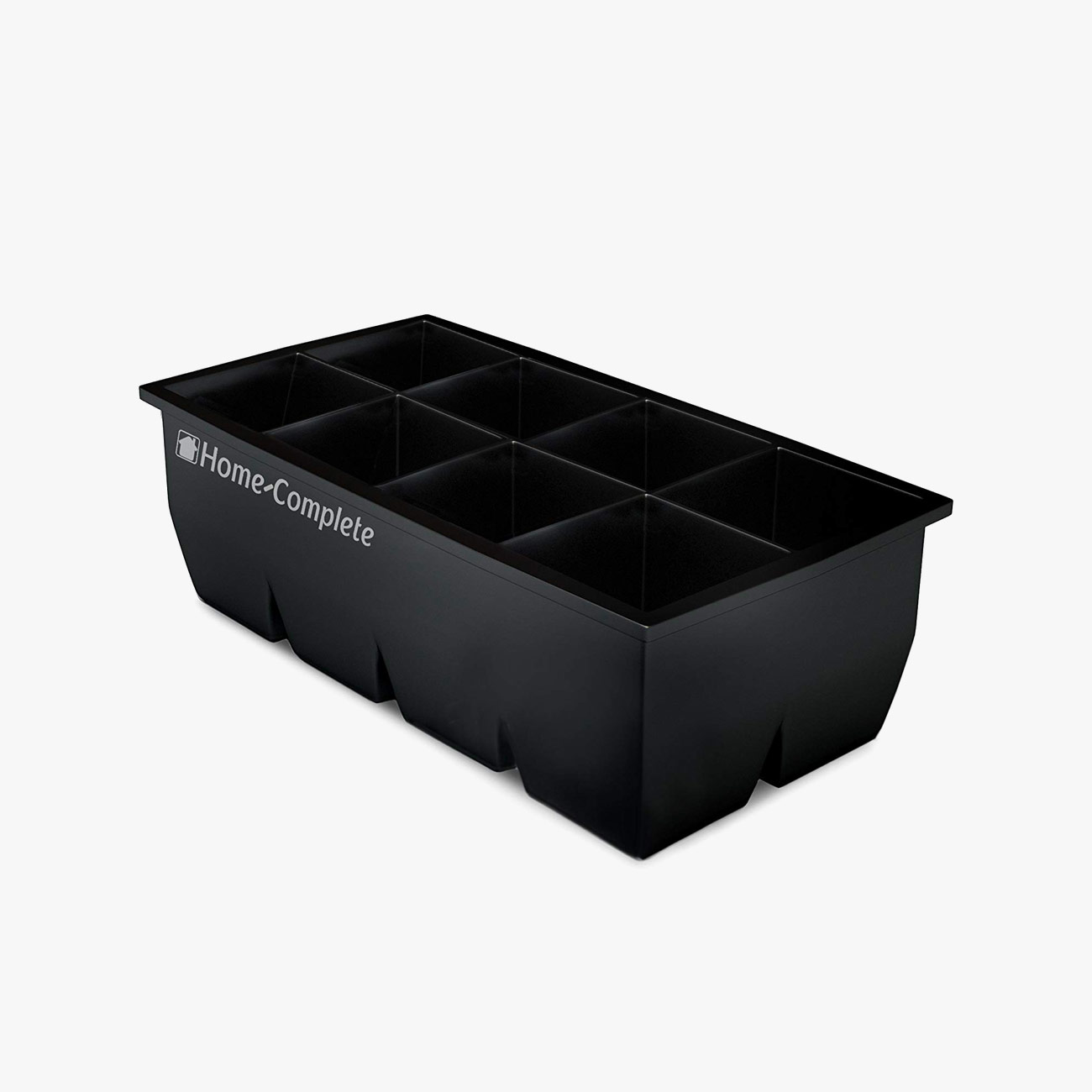
Giant Ice Cube Mold

Big ice is not superior to small ice — despite what you once heard at a bar — but it’s still great for presentation. It also doesn’t slosh around the glass.

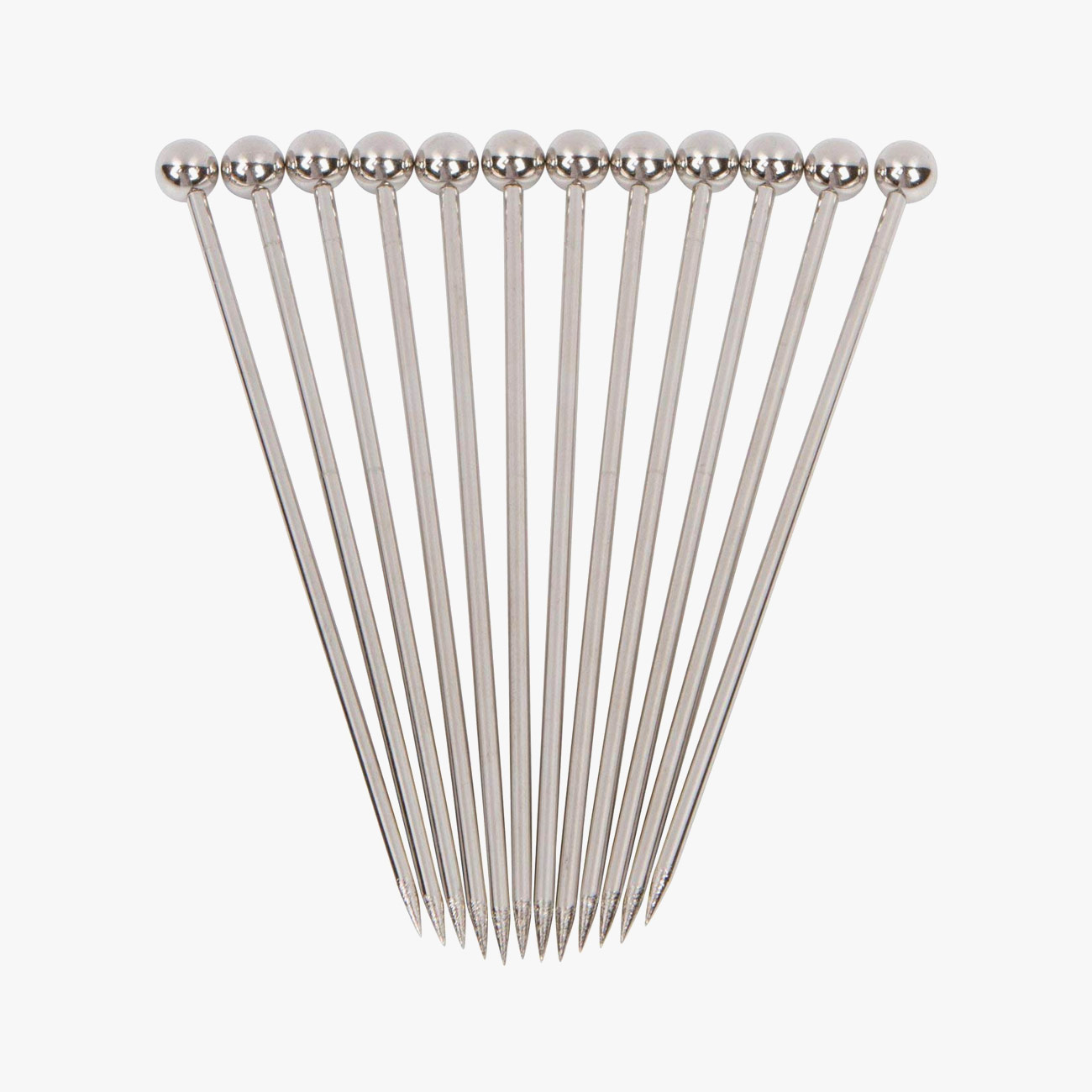
Cocktail Picks

What’s a cocktail without some flair? One of the largest differences between a home bar and your neighborhood cocktail joint is presentation. This multi-pack of steel picks ensures the olives in your next dirty martini stay in line.

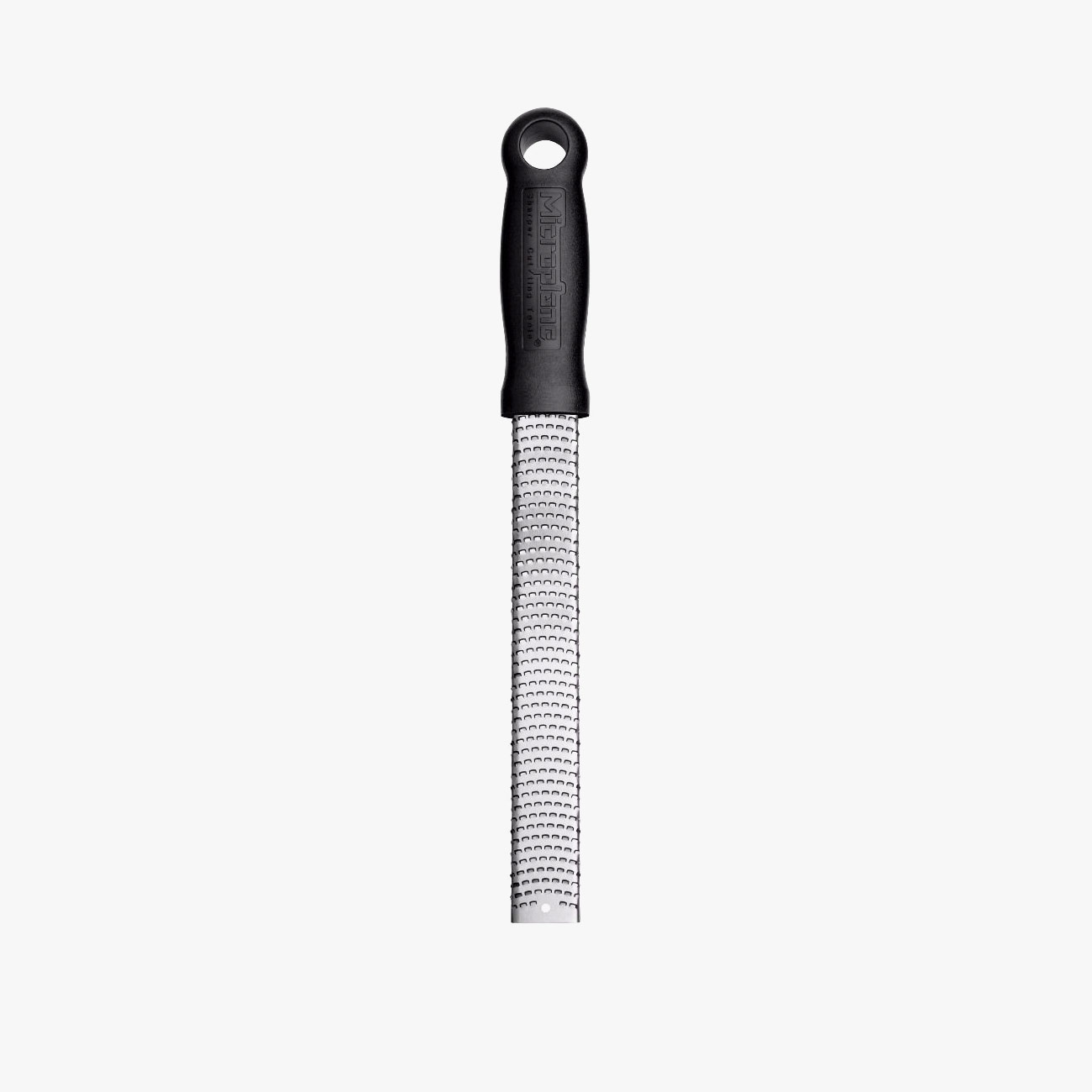
Microplane

The hallowed Microplane is the home kitchen’s best cheese grater and citrus zester. Its price has been happily cheap for decades now, while the origin story is something of a legend in the world of industrial design.

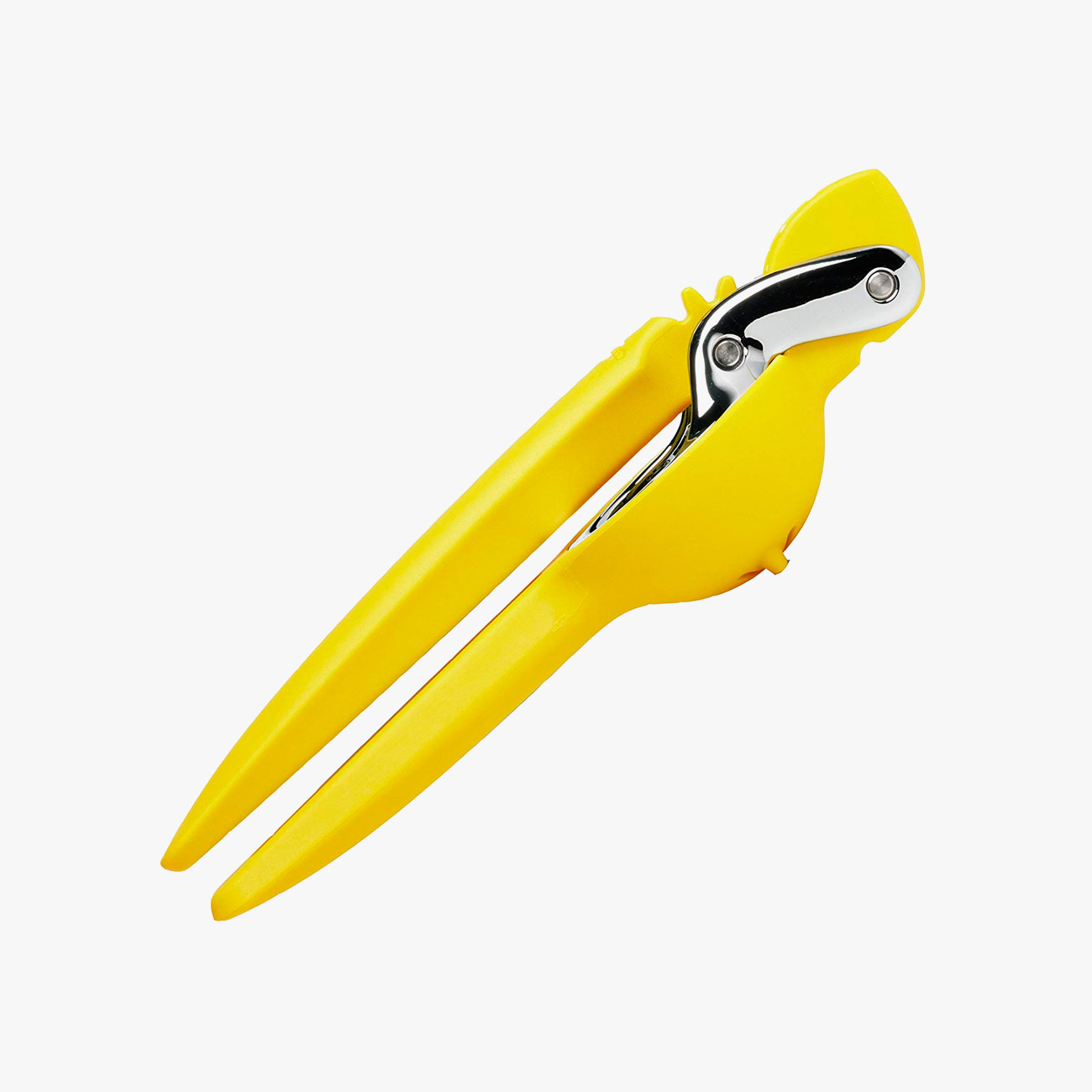
Citrus Juicer

Chef’n’s citrus juicer will come recommended by virtually any bartender you ask. It doesn’t tack on unnecessary features, it just sports a simple hinge and lever mechanism that allows you to pull more lemon juice for the money.

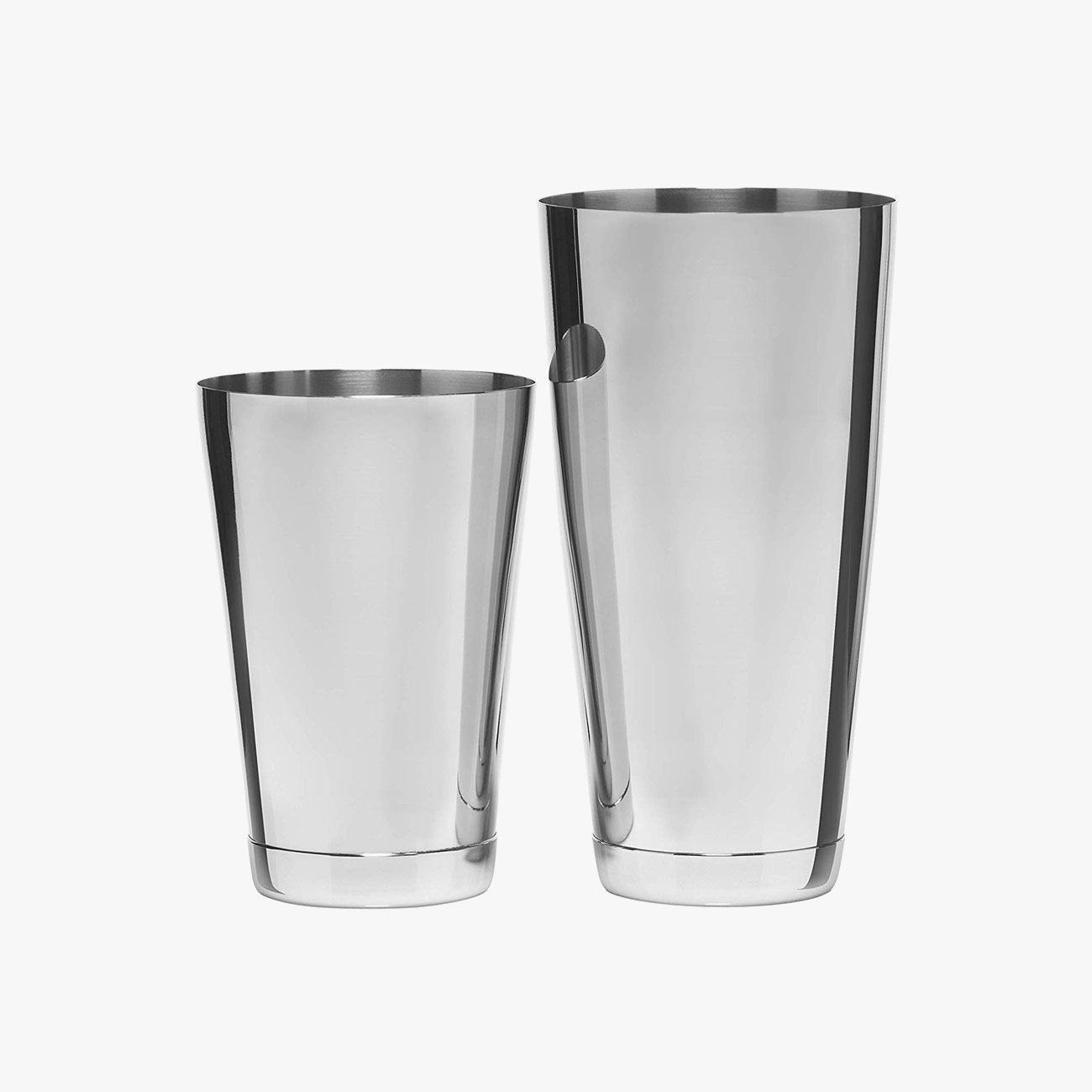
Boston Shaking Glasses

Using a shaking glass with an integrated strainer (called a cobbler shaker) is a quick way to discern if a home bartender is a rookie. And while there’s no problem being a rookie at something you don’t do professionally, it’s nice to look the part. In this regard, classic Boston shakers are the way to go.

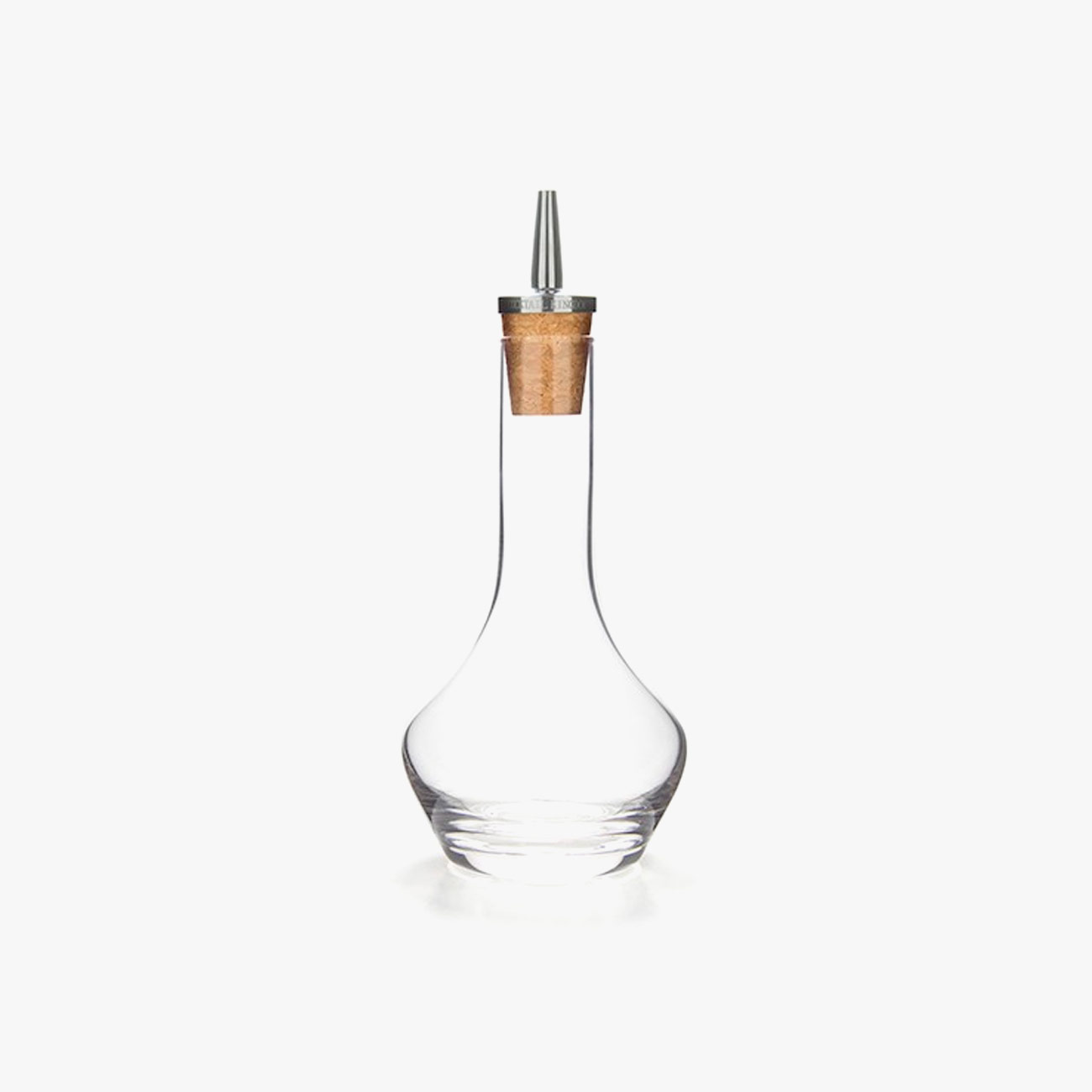
Bitters Bottle

Most bitters these days come with eye droppers as part of the deal. For those that don’t, or just to look cooler, these small bottles do the trick.

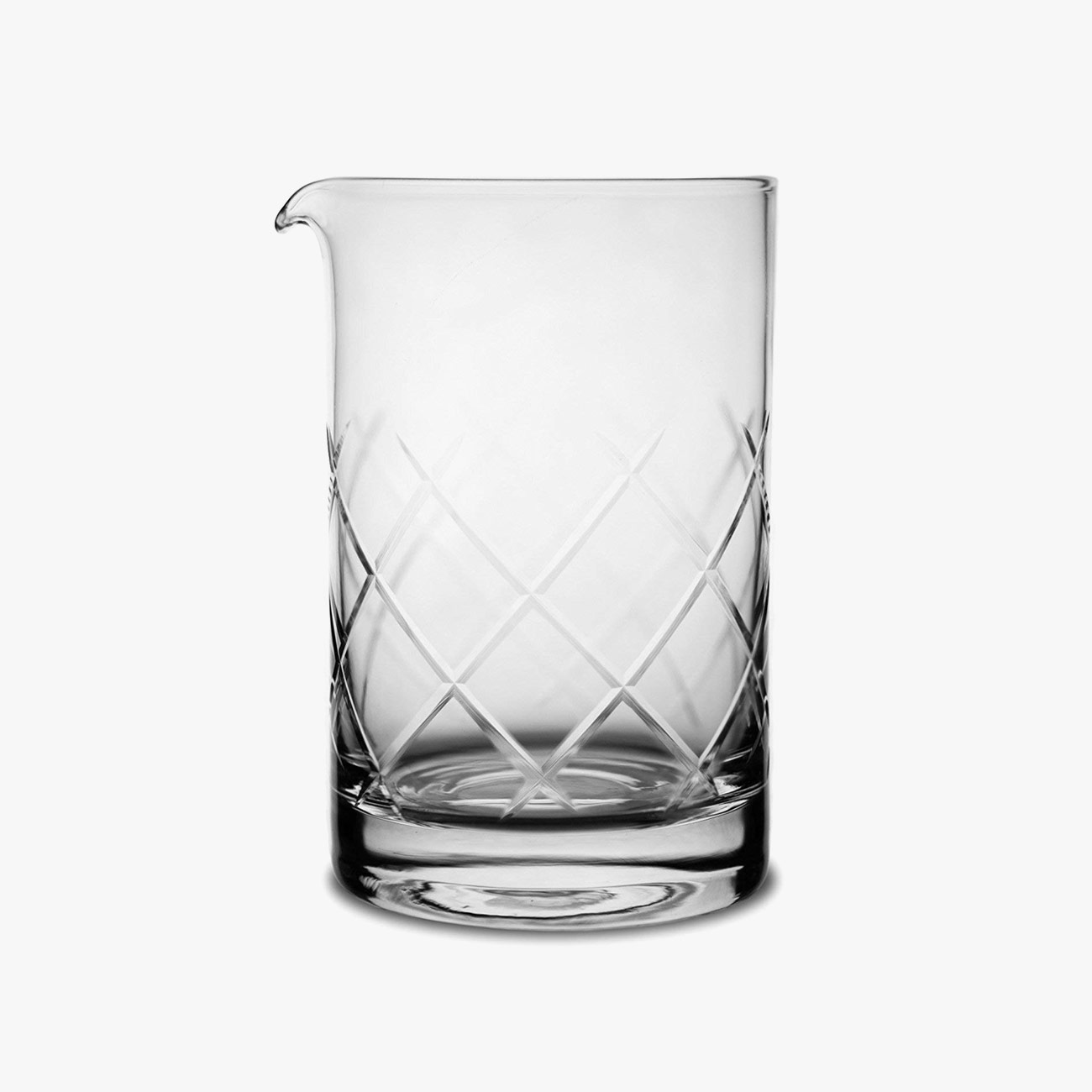
Cocktail Mixing Glass

Though the shaker gets all the hype, the mixing glass is a fine tool for just as many jobs. Not only can you watch your dilution as you stir, but because you don’t have your hands on the glass, you’re not imparting extra heat to the liquid. That means the final drink is less watered down.

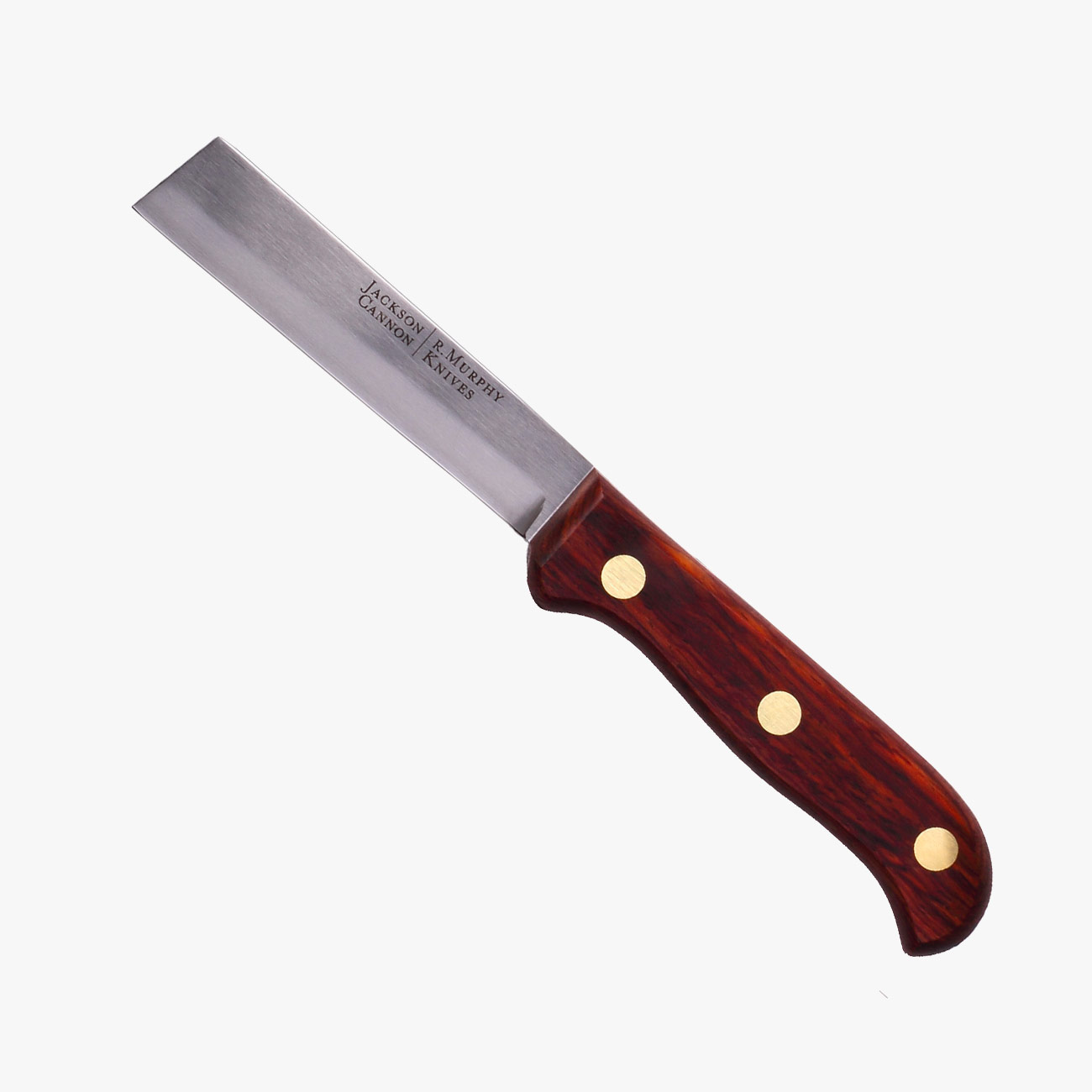
Bar Knife

To be clear, you could use any old paring knife and you’d be just fine. But this knife, designed by Boston-based mixologist Jackson Cannon, rocks a few neat bartender-specific design tweaks — a squared tip that makes plucking seeds from fruit simpler and safer, for example.

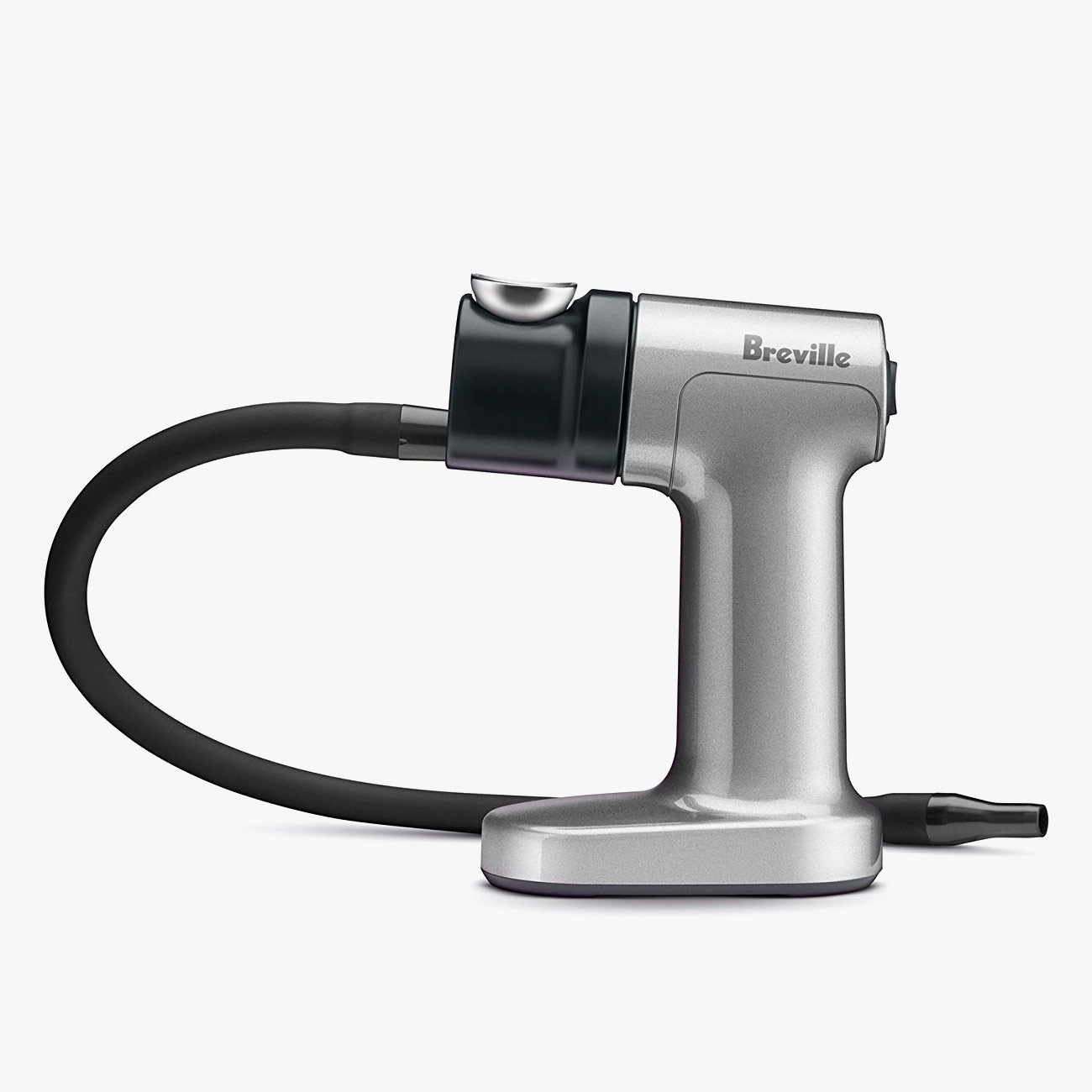
Smoke Gun

A bar doesn’t need a smoke gun. But if you’re getting into smoked cocktails, be sure to get a smoke gun that uses real wood (wood pellets are fine). Lighter fluid imparts a chemically taste.

Note: Purchasing products through our links may earn us a portion of the sale, which supports our editorial team’s mission. Learn more here.

Did a Japanese Design Studio Just Perfect the Ballpoint Pen?

Nendo, a Tokyo-based design with a knack for making pretty much everything, designed a ballpoint pen. In what has become classic Nendo fashion, it’s strangely great.

The Blen ballpoint pen — made for the Japanese pen company Zebra — is a subtle, $2.50 upgrade on the everyday ballpoint. Blen features a brass-weighted tip to keep the head of the pen down naturally, and, according to the studio’s website, “significantly reducing unexpected movements of pen due to the centripetal force created while writing.”

According to Nendo, its ballpoint pen was designed for regular people, not necessarily professionals or sketch artists.

“The approach of the project can be compared to designing a practical compact car that fulfills small needs of our daily lives, rather than designing an aerodynamic sports car that is best for fast and linear drives,” the studio’s site reads.
The pen’s ballpoint tip carries a small brass weight. This allows it to point down naturally while in the hand.

The Blen also features an extra-thick body with small curves around the edges for easy gripping and an interior locking mechanism that reduces the plasticky shaking sound cheap pens often come with.

Nendo isn’t new to this game either. Its been updating design classics and creating helpful versions of old products has been Nendo’s bread and butter throughout 2018. In the last few months alone, its released incredibly odd (but oddly useful) spice containers, cutlery built to hang on racks, a very Japanese take on an 146-year-old Danish chair and a whole lot more.

Nendo’s Blen ballpoint pen is available now through Tokyo Pen Shop for $2.50 a pen. It comes in .5 or .7 line widths and a myriad of ink colors.