All posts in “Events”

Max Verstappen, Formula Drift, Brodozers close out SEMA with massive Vegas party

Share

  • Pinterest

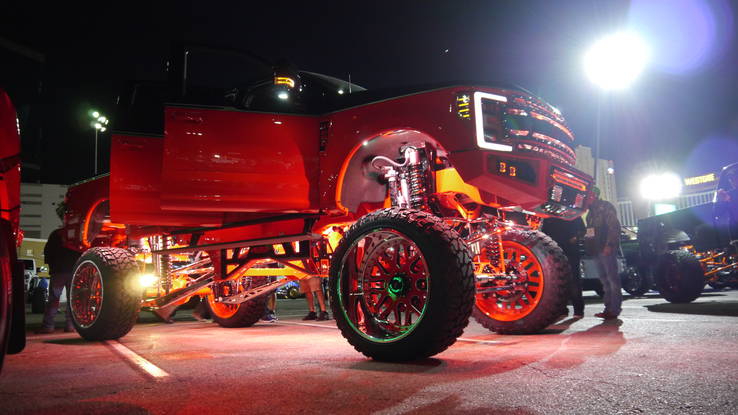
There are 1500 “feature vehicles” at the SEMA Show, and on the last day of the week-long aftermarket extravaganza they all have to roll out of the Las Vegas Convention Center. So four years ago, SEMA decided to turn the whole thing into a giant party. Thousands of fans line the street in front of the Convention Center’s North, Center and South Halls as 1500 cars, trucks, SUVs and even a few motorcycles parade from their show stands out into the streets in an automotive articulation known as the SEMA Cruise.

Once free of the LVCC’s confines they can go anywhere they want, but most take a lap around the Convention Center’s Gold Lot, where a couple thousand more fans pack bleachers to watch them circulate. It’s like American Graffiti with neon-lit monster trucks, intricately painted lowriders and even one Ferrari GTB4. 

Brodozer

Neon makes the Brodozer

Many owners then park their show cars in the Gold Lot’s massive expanse of pavement, crank their stereos and join in the party. A special coned-off area serves as a drifting lot, and competitors from the recently-completed Formula Drift season went sideways lap after lap as the fans cheered from the bleachers that lined the course. There was even an appearance from Formula 1 rising star Max Verstappen, who did donuts in the same Red Bull Racing car that had won the Mexican Grand Prix just the week before.

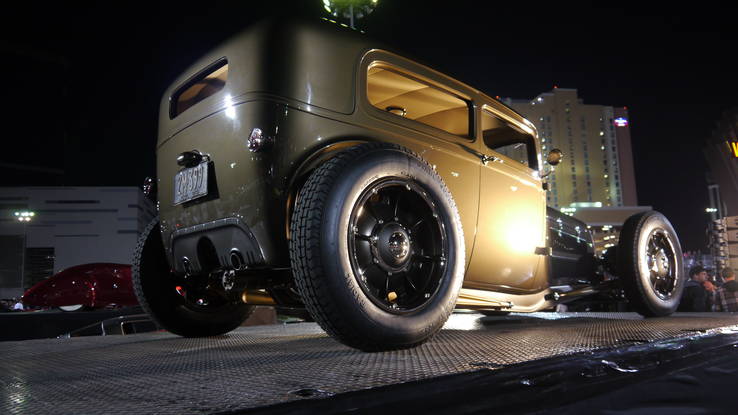
Then, on a big stage in the middle of the Gold Lot, SEMA’s Battle of the Builders crowned its king, hot rod hero Troy Trepanier. His 1929 Model A Ford beat out all comers to take what might be called SEMA’s Best of Show.

“There’s 12 great cars here, I think any one of ‘em’s a winner,” said the ever-humble Trepanier. “We’ve actually built 95 percent of it from scratch. It’s copied off of a ’29 Ford but we built the body, the chassis, its hidden torsion bar-suspension, it’s built to drive more than it is showy.“

He built it for Mark and Dennis Mariani, for whom he had already built two land speed-racing cars. Trepanier, who has been absent from competitions of late, will again enter a car in the America’s Most Beautiful Roadster category of the Grand National Roadster Show “not next year but the year after.”

Troy Trepanier's '29 Model A

Troy Trepanier’s ’29 Model A won SEMA’s Battle of the Builders

The partry, the drifting, Max Verstappen’s donuts, everything went on late into the night. It’s Las Vegas, after all. It’s a heckuva a way to end a heckuva a week. It’s also open to the public and a great way for the public to see most of the cars in the otherwise trade-only SEMA show. The Cruise is free and for twenty bucks anyone can get into the big SEMA Ignited party, so start planning now for next year. 


NASCAR drivers invade SEMA with fleet of custom…Camrys

Share

  • Pinterest

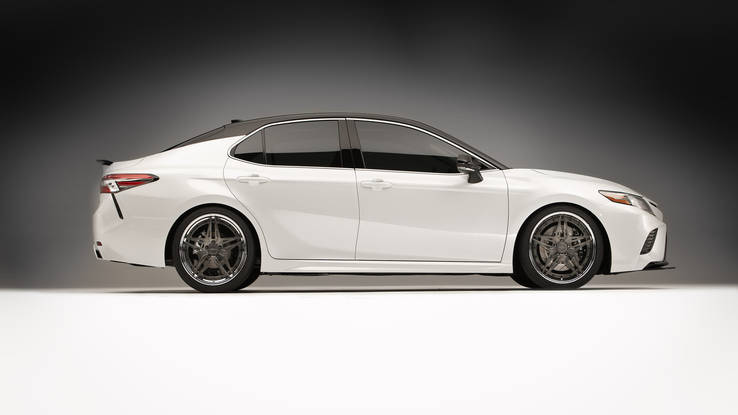
Cup drivers like custom cars, too. And when you drive a Toyota Camry in NASCAR’s headlining Monster Energy Series, part of the job is customizing your own Camry every year for the SEMA show. This year four Cup stars – Denny Hamlin, Martin Truex Jr., Kyle Busch and Daniel Suarez – along with a minor TV star named Rutledge Wood, designed and had built for them customized versions of the Toyota Camry, America’s number-one-selling car.

We liked Hamlin’s car the best, though we’d give the TV dude a runner-up award if we had one.

Hamlin’s white Camry with flared fenders covering red wheels was by far the coolest of the three, and probably the closest to race-ready, something he says he wants to do as soon as he gets the car back from Toyota.

“I wanted the wide-body look: lighter, lower, with the biggest tires I could get on it,” Daytona 500-winner Hamlin said at the SEMA show after they pulled the cover off his car.

He even took the leather from the stock Camry seats and had it reupholstered onto the Recaro racing seats he had installed. Very nice. The wide-body kit was hand-molded and handmade by customizer Steven Klitsch, who did the car at Hamlin’s direction.

“Denny’s whole thing was, ‘Let’s make it racy, but let’s make it classy,” said Klitsch. “He said, ‘I want to take it to VIR (Virginia International Raceway) when it’s done.”

Rutledge Wood Camry

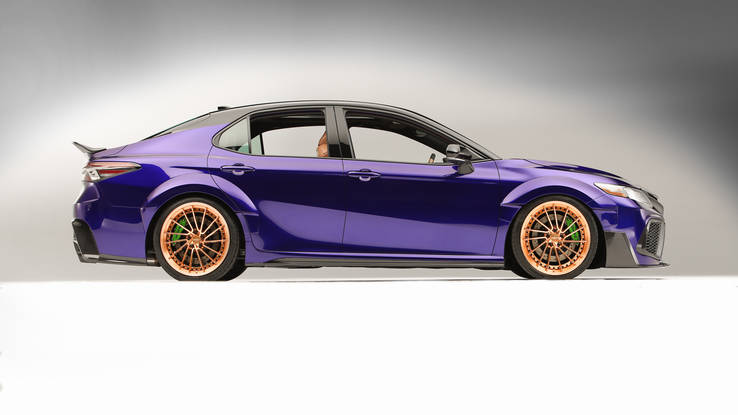
The Rutledge Wood Camry is done up in “blurple”

Second place, if we were handing out places, we’d give to NBC TV racing analyst and former Top Gear USA host Rutledge Wood, the only non-racer in the custom Camry competition. Wood wanted a color he described as Blurple, a mix of blue and purple, as near as we could tell. It looks better than it sounds. Setting off the blurple are what look like copper wheels, but they’re actually “candy rose gold,” according to Wood. Almost lost in all that blurple are numerous 3D-printed parts all over the car. Inside is a baseball-glove leather interior. 

Daniel Suarez Camry

The wildly understated Daniel Suarez Camry

The rest of the Camrys, in no particular order, are:

Daniel Suarez’ barely breathed-on, black-over-white Camry. ”He wanted definitely more of an elegant look,” said the guy from Motorsports Technical Center, which did the build.

Martin Truex Jr. added matte black paint and matching Cup-like wheels.

Kyle Busch’s Rowdy Edition III has chrome accents galore to match the chrome he likes on his older American classics.

Look for perhaps another edition of Cup Starts Cars at next year’s SEMA show.

Our 6 favorite cars of the 2017 SEMA Show

Share

  • Pinterest

Officially, there is no best of show for SEMA; this isn’t the Pebble Beach Concours d’Elegance, and there are no navy blazers and straw boaters here, just T-shirts and tennis shoes. And pants, of course. But that doesn’t mean you can’t pick a few favorites. I certainly saw a lot of the show since rolling into town on Monday. For those keeping track, according to that little health app on my phone, I walked 11,041 steps Monday, 16,999 Tuesday and only 10,376 Wednesday, which is good for 15.7 miles up and down the aisles of the vast SEMA wilderness. So, as a skilled team of podiatrists and chiropractors work over my aching feet and back, my fingers are still able to type out this list of my favorite cool cars from SEMA 2017 — here they are:

Cool Cars of SEMA 2017 Photo 7

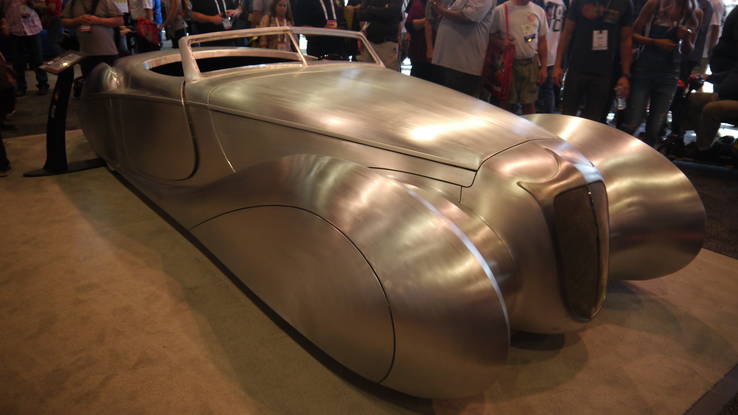
Rick Dore’s “Illusion” Photo by Mark Vaughn

Rick Dore’s ‘Illusion’

Rick Dore builds customs that look like they could have been made in France in the 1930s. But instead of Dore et Filaschi, it’s just Dore, with beautiful metalwork by Luc Delay of Marcel’s. This particular body rides on a chassis by Art Morrison and Steve Wilks. There’s no interior yet, the better to show off all that Dynamat soundproofing — it was parked in the Dynamat booth, after all. Like it? It’s for sale. Contact Rick himself.

Tucker

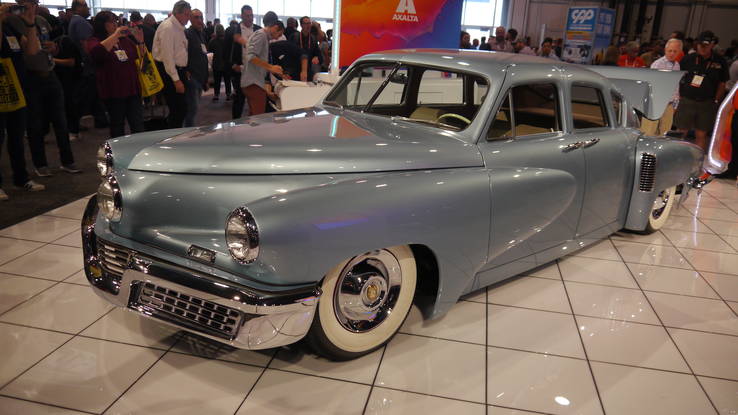
Twin-Turbo Tucker Photo by Mark Vaughn

Twin-Turbo Tucker

Rob Ida Concepts of Morganville, New Jersey, makes all kinds of cool cars, but you may know them best for their Tuckers. They make the whole thing by hand. This particular Tucker is powered by a Cadillac Northstar engine mounted longitudinally, forward of the rear axle and powering the rear wheels. Yes, that would suggest susceptibility to oversteer. So they added lead to the front to balance the weight out. The twin turbos reside in the trunk. I’m moving to New Jersey. 

Emory Motorsports' 356 RSR

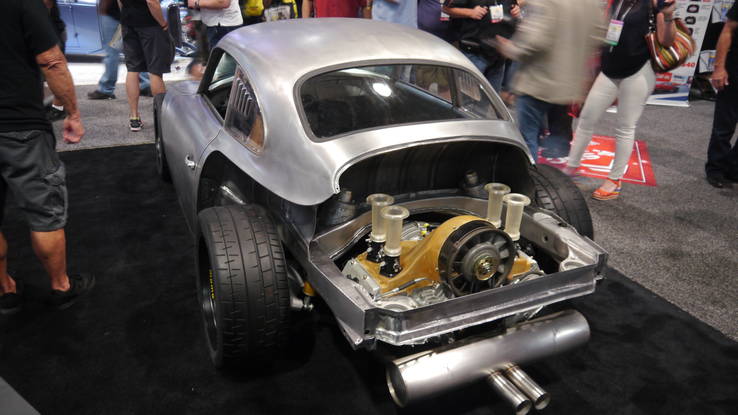
Emory Motorsports’ 356 RSR

Emory Motorsports’ 356 RSR

Emory takes old Porsches and does whatever it is artistically compelled to do with them. Some call it sacrilege to slice up a 356 and do what God and Ferry Porsche never intended. But maybe it’s just that no one else ever thought to do these things? Thus, you get 356 bodies magnificently Frankensteined onto modern running gear, as you see here with this 356 body spirited about by more modern Porsche 964 guts. The retro-cool air ducting and fan shrouding are appreciated, too. The finished car will debut at Rennsport Reunion at Mazda Raceway Laguna Seca Sept 27-30, 2018.

ICON Rolls-Royce

ICON Rolls-Royce

ICON Derelict Rolls-Royce Silver Cloud

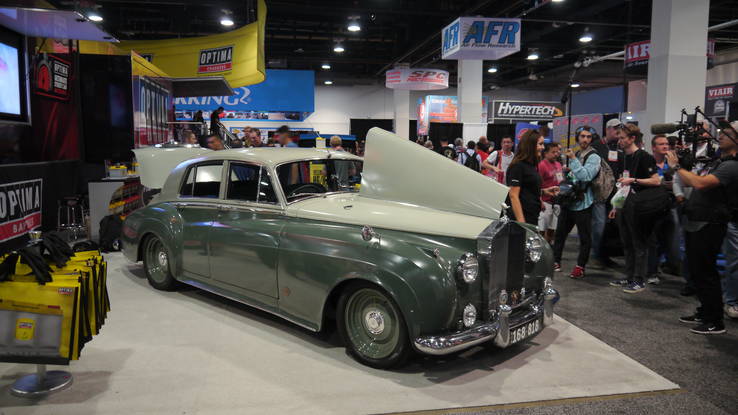
ICON started out rebuilding Toyota FJs, then branched out to Ford Broncos, then to all kinds of crazy things, including old coupes and sedans from the ’40s and ’50s with modern running gear underneath preserved bodies. So it does not comes as a complete surprise to see this ICON creation, a 1958 Rolls-Royce Silver Cloud riding on a modern Art Morrison chassis and powered by a 550-hp Chevy LS7 V8 underhood. It drew a crowd in the narrow confines around the Optima Battery booth. 

Welderup The Train Car

Welderup’s The Train Car

Welderup’s The Train Car

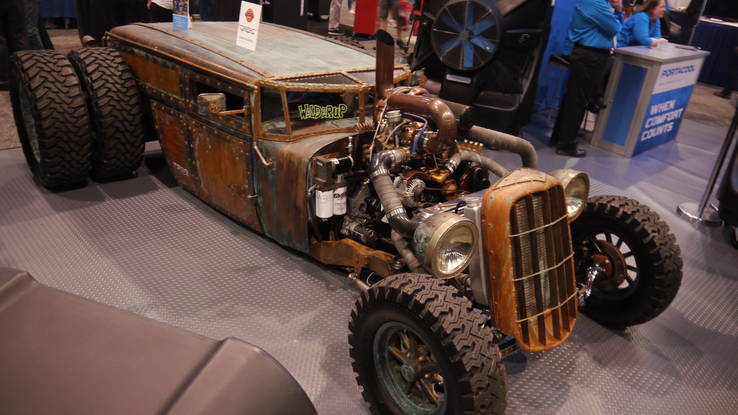
If you get The Discovery Channel with your cable package, you may have seen “Las Vegas Rat Rods,” about the crazy shop out in Vegas that makes vehicles that transcend even the limits of the rat rod culture. There were three or four Welderup creations scattered around the SEMA Show this year. This was the coolest, The Train Car. The Cummins twin-turbo diesel makes 1,250 hp on straight dino juice and 1,600 if you switch on the nitrous. Yes, nitrous. We first saw this two years ago parked in front of the show. Glad to see it’s found its way inside.

Sprintex Scion FR-S

Sprintex Scion FR-S

Sprintex Scion FR-S

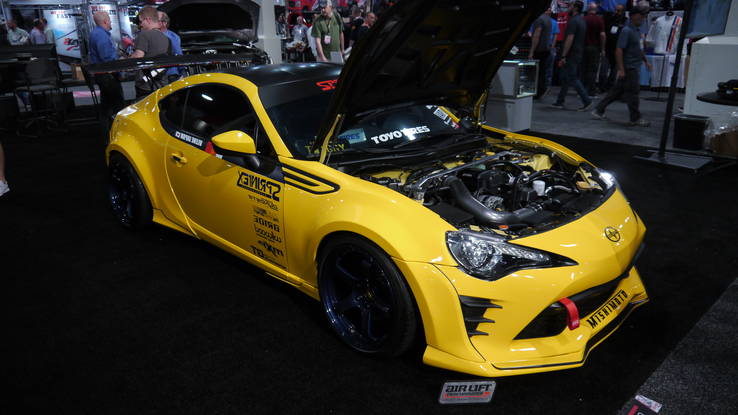
Wait, this is just a plain old Scion FR-S, you yelp! But look closely at the engine. Sprintex makes twin-screw Lysholm superchargers, and you can see a very compact unit bolted right there on top of the block under the crossbar. The Sprintex Stage 1 kit makes 290 hp — versus 200 hp in a stock Scion FR-S — while the Stage 2 makes 300. Price is $5,300 for Stage 1 and $6,300 for Stage 2. They bolt on, Sprintex says. It wouldn’t be SEMA without bolt-on power. 

Chevrolet Colorado ZR2 SEMA concept goes full overland

Share

  • Pinterest

The Chevy Colorado celebrates its third birthday with a truly impressive concept vehicle, the ZR2 AEV concept, just unveiled at the annual SEMA Show. At the core of this concept is an all-new suspension and performance off-road parts package that Chevy has been developing in-house and with the help of Rod Hall Racing. They have been testing these parts on a ZR2 Racing Development truck, as well as in the Best of the Desert races in a custom-built Rod Hall Racing ZR2.

These new parts include: prop shaft, jockey shocks, leaf spring pack, rock sliders, rear diff skid plate, rear shock mount sliders, long travel DSSV coilovers, tie-rods, ball joints, rear diff cover, anti-wrap link and more. While these parts are still in the development stage, demand should drive them to market soon — they are OEM-quality parts that bolt on and still retain all factory vehicle warranties. With the average Colorado rolling off dealer lots with $600-plus worth of accessories already, these performance parts offerings should help boost Chevy’s bottom line.

Chevy invited a handful of truck and off-road journalists to experience these ZR2 enhancements firsthand, with a back-to-back ride-along in a stock ZR2 and in the Rod Hall Racing ZR2. Both trucks were amazingly capable at high speed through the rough desert terrain surrounding Spring Mountain Motor Resort and Country Club in Pahrump, Nevada. The stock ZR2 was impressive in this environment, but the race truck truly showcased the new parts. The Rod Hall Racing ZR2, with its enhanced suspension and performance parts, provided an extremely plush ride and was able to handle sustained high speeds through large off-road obstacles/events.

This supercharged Silverado concept is a modern muscle truck

While the Chevy Performance parts help, it’s AEV (American Expedition Vehicles) that refined the entire package for off-road and overland enthusiasts. The company is well known for its high-quality Jeep and Ram products and builds, but hasn’t stepped outside the Chrysler arena with its offerings until now.

On this concept vehicle, AEV has done its full off-road treatment. This includes front and rear off-road bumpers, complete underbody skid protection, expedition bed rack, high clearance fender flares and a high-rise snorkel. It’s finished off with AEV DualSport beadlock wheels wrapped in 35-inch BFG KM2 tires.

Adding to the package are quality LED auxiliary lighting, an ARB fridge/freeze, Alu-Box aluminum storage boxes, NATO jerrycans and a James Baroud awning. Since recovery is key for such a capable vehicle, it has also been outfitted with a Warn winch, Hi-Lift jack, recovery shackles and MAXTRAX.

In three years of production, the Colorado has sold over 250,000 units in the U.S. alone and holds a 25 percent share of the market. We hope to see this concept truck find its way to production — and soon.

By Bryon Dorr

Japanese design cuts deep at Tokyo Motor Show

Share

  • Pinterest

Wa. Ma. Waku doki. Wabi sabi.

When it comes to car design, the Japanese are literally speaking their own language these days.

The country’s automakers are embarking on a major styling renaissance and digging deep into the local lexicon to describe their upcoming creations. The sensuous curves, avant-garde athleticism and high-tech Zen were on full parade at last week’s Tokyo Motor Show.

The amped-up looks come as Japanese brands race to stand out on the global stage amid the commoditization of technology under the hood and an onslaught of new Asian rivals.

Some brands are leveraging Japan’s cultural heritage — drawing inspiration from samurai swords and rock gardens or tapping traditional words such as wa, which means harmony, or ma, which means space. Others are channeling the Japanese aesthetic in more subtle ways to explore new segments or forge a more futuristic anime-cool Japan vibe.

Yet the angst is palpable across the board, as design becomes a make-or-break differentiator.
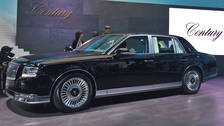
No modern luxury sedan can touch the Toyota Century

“For us, it’s very scary,” said Ikuo Maeda, global design chief at Mazda. “So many brands show up from other Asian countries, so being made-in-Japan is very important to us.”

Pressure is mounting from new demands for autonomous cars, electrification, artificial intelligence and new mobility. But improved global manufacturing techniques have also leveled the quality gap between Japanese brands and competitors in the U.S., Europe and South Korea.

Japan now sees design as a way to break from the pack again.

Swords and gardens

Fresh looks and Japanese DNA were common threads at the Tokyo show.

Mazda unveiled two elegantly sculpted concept cars that preview the next generation of the company’s acclaimed Kodo design language. Maeda said the subtly rounded lines and concave sides were inspired by the slightly curved edges, or sori, of Japanese samurai swords.

Honda clarified its vision for electric cars with a Sports EV Concept, a funky futuristic counterpart to the Urban EV Concept that debuted last month in Frankfurt. Both cars get a high-tech gadget feel, like something straight out of Tokyo’s Akihabara electronics town and counterculture haven.

Toyota meanwhile tested the ground for a new segment with two boxy SUV-cum-family vans, one a futuristic fuel cell vehicle, the other a rugged hybrid.

Even Mitsubishi and Subaru used the home market auto expo to showcase new design directions they hope will inject more emotion and help stoke sales.

Nissan touted its Japanese roots when it unveiled its IMx concept, a model that closely telegraphs the future look of Nissan production vehicles.

Outside, the all-electric crossover gets a fantastical feel with a plethora of slits and creases that match its next-generation drivetrain and autonomous driving technologies.

But inside, Nissan strives for all the serenity of a Buddhist temple. The woodgrain dashboard was inspired by Japanese shoji sliding screen doors, while the flooring and seat fabric motif drew from the karesansui patterns of meticulously raked Japanese rock gardens.

The headrests evoke kumiki, or Japanese interlocking wood puzzles.

“It reflects the Japanese tradition of harmony, or wa,” said Alfonso Albaisa, senior vice president in charge of global design at Nissan.
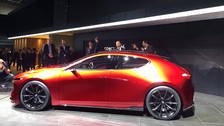
Mazda Kai Concept teases the future of the Mazda 3

Hello Kitty harmony

Despite being a Cuban-American transplant at the helm of Nissan’s Japanese design studio just south of Tokyo, Albaisa is among the most vocal champions of the Japan aesthetic.

At the Car Design Forum, a gathering of global stylists on the eve of the Tokyo show, Albaisa delivered a lecture expounding on the origins and virtues of the country’s concept of beauty. He peppered the address with the key concepts he said capture the Japanese spirit.

Such words as utsuroi — the Buddhist concept of impermanence; iki — simple and refined sophistication; and wabi sabi — a less-is-more beauty seen in imperfection.

“I’ve asked all the studios to look into the Japanese DNA of design and tell me what it is. All of them, even in Brazil. And now it’s starting to show up everywhere,” Albaisa said. “It’s also definitely the moment we’re living in — with the rise of electrification and autonomous vehicles. I want to reach into that Japanese DNA and make sure it imbues what we’re doing.”

Minimalist simplicity is a key element of the new Japan look.

And few designs express that better than Honda’s new EV creations, unadorned white appliancelike runabouts where form follows function but is also friendly.

Think: Hello Kitty meets Asimo, the Honda humanoid robot.
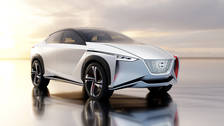
Nissan IMx concept debuts at the Tokyo Motor Show

“We have come up with this cute-looking front, as well as simple and soft plane designs. Cars are becoming more high-tech, but they become friendlier to people,” said Sports EV Concept designer Jun Goto. “We want to make these cars simple and easy to understand.”

Toyota too wants more compelling designs that bond drivers to their cars.

Japan’s biggest automaker also has a homegrown word for the experience it is trying to achieve: waku doki, something akin to heart-pumping excitement.

Beyond cars

On the design front, Toyota looked to pioneer new territory in Tokyo with its boxy Tj Cruiser hybrid activity vehicle and its Fine-Comfort Ride fuel cell rolling lounge. Not quite SUVs, not quite multipurpose vehicles, both concepts push the wheels to the corners for maximum interior space.

Didier Leroy, Toyota Motor executive vice president, said the vehicles play in a space that could potentially become a new segment.

“Unless cars are fun, they are not really cars,” Leroy said. “There is a big risk that the car will become a commodity, and we don’t want to let the car become a commodity.”

Yet, the biggest design statement at the Tokyo Motor Show came from Mazda.

Styling boss Maeda worked for two years on the new look that debuted in the sporty Kai hatchback and the sleek Vision Coupe. Their next-generation styling moves into production cars starting in 2019, timed to the release of the company’s Skyactiv-X engine.

The Mitsubishi e-Evolution is not your old Evo

The Mitsubishi e-Evolution is not your old Evo

At this year’s Tokyo Motor Show, Mitsubishi ripped the sheet off its e-Evolution Concept. Unlike the Mitsu Evo of yore, the e-Evolution Concept doesn’t have a turbocharged I4 and …

“We have set out a design philosophy which encapsulates a distinctively Japanese kind of beauty,” Maeda said. “Much of Japanese traditional culture is based on the minimalist concept of ‘less is more,’ where the emphasis is on removing or minimizing elements.”

Maeda devised Mazda’s Kodo design language in 2010. It was key to the brand’s revival, imbuing the new Skyactiv line of engines, transmissions and chassis with a sexy aura.

The new look drops today’s sharp creases for sensual curves. The result is a rounded, voluptuous surface that reflects in shape-shifting ways as light glides over the undulating body. The goal, Mazda says, is vehicles “that look truly alive” as the viewing angle changes.

The race car-driving, goateed Maeda is as serious about his art as he is about autos.

His father was the veteran Mazda designer who penned the RX-7 sports car. And the younger Maeda created the RX-8 before taking over as global styling chief.

But Maeda isn’t shy about looking further afield. His not-so-secret ambition is to create a line of Mazda-branded design goods to help elevate the brand.

He has already churned out an avant-garde chair, sofa and bicycle. And on the eve of the Tokyo show, he released his latest work: a Mazda-branded designer fragrance.

Automobiles might evoke the aroma of rubber and gasoline for most people, but Mazda’s Soul of Motion claims to achieve a woody-rose-leather bouquet — for those willing to splurge $130.

Mazda wants to step ahead of the crowd by raising transaction prices, slashing incentives and boosting resale values. Creating a near-premium buzz with better-appointed interiors, sexy sheet metal — and now, possibly, must-have merchandise — may help. But why fragrance?

“It is another kind of artist who creates something invisible like a smell,” Maeda said. “That is so interesting to me. It energizes me with new ideas.”

Lindsay Chappell and Naoto Okamura contributed to this report.

Japan’s cool new design vibe” was originally posted at Automotive News on 10/31/17.

By Hans Greimel at Automotive News

Mopar brings 200 products for the 2018 Jeep Wrangler to SEMA

Share

  • Pinterest

The 2018 Jeep Wrangler isn’t even on sale yet and Mopar already has parts for the new off-roader at this week’s SEMA Show in Las Vegas. “Get your parts first, get the Wrangler later,” we’re guessing is Jeep’s logic here. The parts lineup for Wrangler will be 200 strong, with more than 100,000 hours of development, testing and validation. 

“An iconic vehicle such as Jeep Wrangler deserves nothing but the best, which is why the Mopar and Jeep brands have developed a new set of products to meet the unique lifestyles of Wrangler owners,” said Pietro Gorlier, head of parts and service (Mopar), FCA. “From Jeep Performance Parts like winches and wheels to accessories such as bikini tops and tailgate tables, Mopar has incorporated input from Wrangler owners in bringing to the marketplace the most powerful, reliable and authentic lineup of accessories and performance parts available.”

We’ve met Gorlier — he is a dyed-in-the-wool Jeep enthusiast if you couldn’t already guess. Alright, let’s get to the parts.

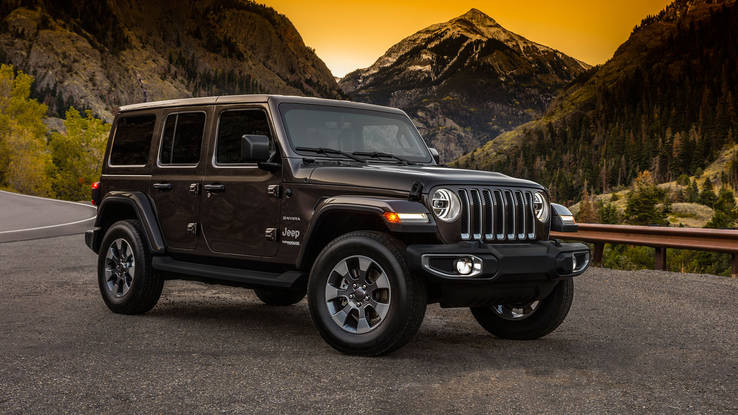
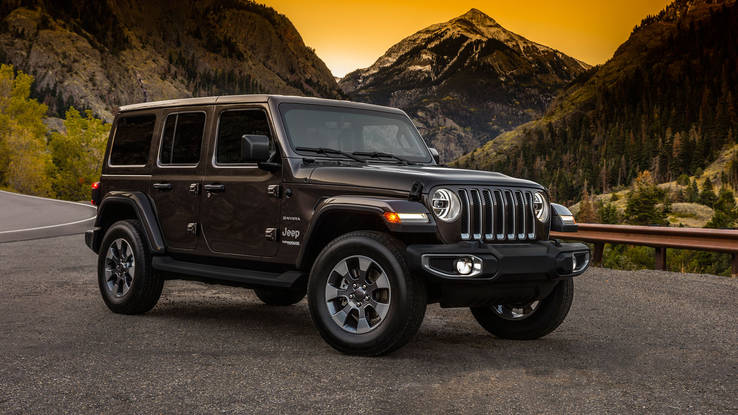
Jeep Wrangler JL at SEMA

You can see details of the grille, headlights — heck, the whole thing!

First we have the Jeep Performance Parts line. That includes LED off-road lights, which mount to the frame rails, winch guard or windshield — they’ll connect to that new auxiliary switch bank we told you about; new rock rails; bedliners for a nonslip finish; off-road bumper guards; 17-inch aluminum wheels with beadlock capability; 2-inch lift kit and high-top fender flares.

From Mopar, we have the roof rack, cargo carriers and a tailgate table that flips out with space for food and beverages. Additionally, Mopar is offering solid bikini tops, screen protectors for the Uconnect screens, graphics, floor mats, tire covers and the like.

“Virtually every Mopar product for the all-new Wrangler is new, redeveloped or redesigned,” said Gorlier. “Our large, new product lineup for this vehicle showcases how the Mopar brand has evolved over 80 years to support our owners in customizing their vehicles to fit any lifestyle.”

Go to mopar.com for more information.

Jeep shows the new Wrangler at SEMA sort of Jeep JL

Jeep shows the new Wrangler at SEMA, sort of

The same morning that the current Jeep JK won, yet again, the “Hottest SUV” title at the SEMA Show, the world finally got to see the coming JL in pretty much full detail.“You might …

Jeep shows the new Wrangler at SEMA, sort of

Share

  • Pinterest

The same morning that the current Jeep JK won, yet again, the “Hottest SUV” title at the SEMA Show, the world finally got to see the coming JL in pretty much full detail.

“You might want to come to the MOPAR press conference,” we heard from a couple sources at SEMA. “You might see something. Bring your camera.”

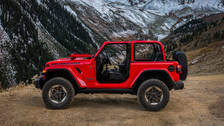
What we saw was the formerly camo’ed-only 2018 Jeep Wrangler, clear as day. Or rather, clear as sunset, which is what looks like was happening in these shots. 

Jeep Wrangler JL at SEMA

You can see details of the grille, headlights — heck, the whole thing!

Jeep released the following statement on its website, along with the crystal-clear photos you see here of the new 4×4.

“The most capable SUV ever delivers even more legendary Jeep 4×4 capability, a modern design that stays true to the original, advanced fuel-efficient powertrains, more open-air options, and is loaded with more safety features and advanced technology than ever before. The all-new Wrangler’s unique design includes an instantly recognizable keystone-shaped grille, iconic round headlamps and square tail lamps, improved aerodynamics, a convenient fold-down windshield for off-road purists, even more open-air freedom, and dozens of different door, top and windshield combinations. Additional images and complete vehicle information will be available Nov. 29 at the Los Angeles Auto Show.”

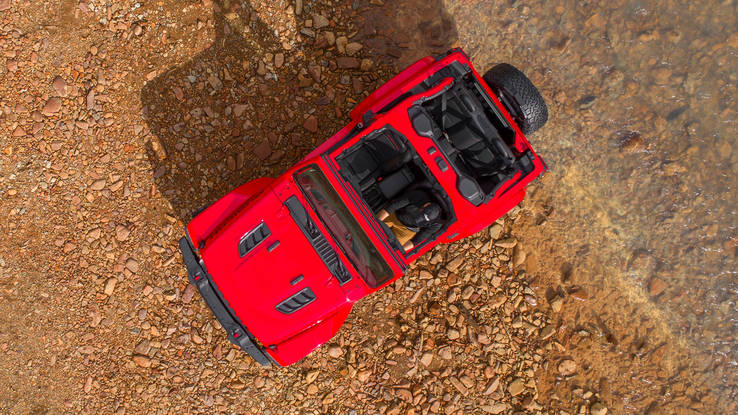
Jeep Wrangler JL from above

Jeep JL from above — maybe you can zoom in and see if it has satellite radio.

So while there wasn’t much in the way of powertrain information, at least now you don’t have to imagine what it looks like under the camouflage.

We await LA.

The 2018 Hennessey Velociraptor at SEMA: Bring it on, AMG

Share

  • Pinterest

“The Velociraptor 6×6 is the ultimate off-road vehicle,” said John Hennessey, founder and CEO of Hennessey Performance. And we have no reason to doubt him.

The Texas tuning ace and namesake of Hennessey Performance Engineering premiered his wildest creation to date at the SEMA Show in Las Vegas on Tuesday: the Hennessey Velociraptor 6×6. The VRap, as we’re going to call it, is based on the Ford Raptor, obviously, but gets a 600-hp twin-turbo upgrade, a new suspension, six(!) new 20-inch wheels and six(!) off-road Toyo tires.

Visually, Hennessey adds new front and rear bumpers, a roll bar and LED lights. A six-piston Brembo brake system is optional, for an additional $22,000. The “base” price, before the brakes, is a wallet-shattering $349,000. But, but, but … that includes the price of 2018 Ford Raptor, which is $51,080.

You can order it from Hennessey, or from select Ford dealers. AMG 6×6? You’ve been put on notice.

This supercharged Silverado SEMA concept is a modern muscle truck

Share

  • Pinterest

The folks at Chevrolet apparently scoured the parts bin in a last-minute dash to create a SEMA show car and showed up with this: a 5.3-liter Silverado with a supercharger similar to the one found on the LT4 engine under the hood of the Corvette Z06 coupe and Cadillac CTS-V sedan. Chevy says the supercharger adds about 100 hp to the 5.3-liter, bringing it up from 355 hp to 455 hp.

That’s a good bump, but it’s still only 35 hp over the similarly sized available 6.2-liter V8. A better argument for a production version of this muscle truck would combine the best of both worlds — use the 6.2-liter V8 with the less aggressive supercharger from this concept. 

Two Cool Camaros Coming to SEMATwo Cool Camaros Coming to SEMA

You can buy these two cool SEMA Camaros

Chevrolet unveiled two new Camaros ahead of next week’s SEMA show — the Hot Wheels 50th Anniversary Edition and the mighty and snarling COPO Camaro drag pack — and the world is a …

The rest of this SEMA show truck could follow along during its transformation from show car to a production vehicle. The six-piston Brembo front calipers will help slow down the now-fast Silverado. Cosmetic upgrades like 22-inch wheels, blacked-out taillights and a competition-style data logger might not be as necessary if this were to go the production route, but they look good on the concept.

Looking back through GM’s history of high-performance trucks, this could be a spiritual successor to the currently extinct Silverado SS. Of course, this supercharged version would be a perfect Ford SVT Lightning competitor — just about 13 years too late. Regardless, this could be the brawn Chevy needs to fill out its truck portfolio. With a performance-minded Tahoe on the horizon, there could be hope for a hot Silverado SS in the future.

Toyota brings 600-hp monster-slayer CH-R to SEMA

Share

  • Pinterest

The star of the Toyota stand at SEMA this year was a lowly crossover SUV. OK, not a stock crossover SUV. This one was a one-off creation that was about as built as built can be. The team stripped the interior and festooned the exterior with aerodynamic add-ons that are fully functional. The rear wing, for instance, manufactures 300 pounds of downforce at 120 mph. There is fabrication everywhere you look.

“We wanted to know what we would have to do to legitimately be a supercar killer,” said Dan Gardner, whose DG-Spec built this car, as well as the Sienna R-Tuned minivan that wowed SEMA two years ago.

Unlike the Sienna, the CH-R R-Tuned has both a Toyota engine and a transmission. But, as you might guess, neither is stock.

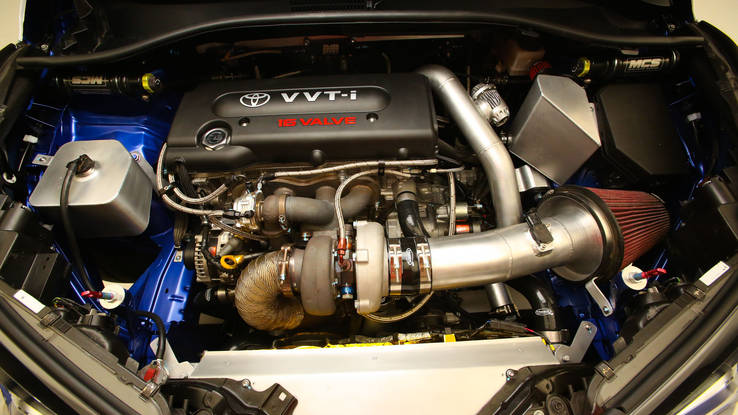
“A big part of the work was figuring out the motor and trans swap, packaging, engine wiring, chassis harness stuff,” said Gardner. “We went from the stock 2.0L with a CVT to a Toyota 2AZ-FE 2.4-liter that has forged internals, along with a Toyota E-Series five-speed manual with treated internals, but all stock parts, except the LSD.” The finished engine makes 600 hp, Gardner said.

The CUV also has: Brembo racing brakes with 14-inch rotors and four-piston calipers, triple-adjustable DG-Spec Motion Control Suspension dampers and 275/35R18 Toyo Proxes RR tires. 

Toyota CH-R SEMA engine

Instead of a 2.0-liter four with a CVT, Toyota put a 2AZ-FE 2.4-liter with forged internals, along with a Toyota E-Series 5-speed manual with treated internals. The engine makes 600 hp. That’s more than stock, we think. Someone check. Photo by Karl Funke

Does it work? How about a lap time around Big Willow of 1:25.22? That’s faster than the professionally driven McLaren 650 S Spyder, Porsche 911 GT3 and Nissan GT-R NISMO, according to Toyota.

“Many (of the competitor laps were driven) by Randy Pobst,” said Gardner. “So (they were) not affiliated with Toyota in any way.  We chose to do this for transparency and to avoid any claim that we ‘sandbagged’ with the other cars.”

You can see the list of lap times here.  

“Craig Stanton and I did all the driving on the C-HR R-Tuned,” said Gardner. “With Craig doing the driving on the day of the 1:25.22 lap. The lap is recorded on video.”

There will be other Toyotas on the Toyota stand at SEMA, including the usual collection of Camrys customized under the sometimes-vague direction of real Toyota NASCAR drivers and built by real custom shops. Look for them all at the back of the Center Hall if you’re in Vegas.

5 cars that need a Honda Civic Type R engine swap

Share

  • Pinterest

At this year’s SEMA Show in Las Vegas, Honda officially made the 2.0-liter turbocharged I4 engine from its Civic Type R available in crate form. Getting 306 hp and 295 lb-ft of torque shipped to your front door has us thinking — what are the cars begging for a Civic Type R swap? Nabbing one of these will set you back a fairly reasonable $6,519.87 before shipping fees, and Honda will only let them go to people who are using one for “verified closed-course racing applications.” So, that might pose a problem if you’re trying to bolt one of these in your street car, but there’s probably a workaround.

Regardless, if you have a connection at Honda Performance Development, or actually want to build a race car with this Type R mill, here are a few places to start:

Mazda Miata

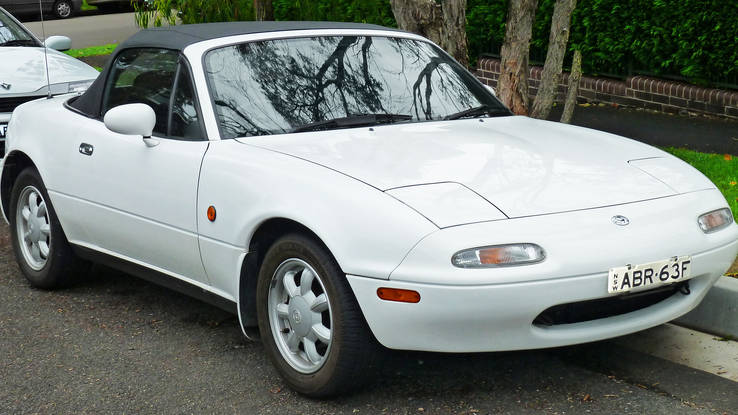
The NA Mazda MX-5 Miata might not be that fast, but with a Civic Type R engine in place of the stock Mazda piece — it would be more than potent enough for track use. Photo by Wikimedia Commons

1. The Mazda Miata

Predictable, yes, but the Mazda Miata is the perennial track rat special and could benefit from a Type R swap. The first generation of Mazda’s legendary Miata roadster is still relatively affordable, especially if you’re not too concerned about cosmetic damage. The bump in horsepower that the 300-plus-hp Type R engine should be enough to help push the lightweight chassis to its limits.  

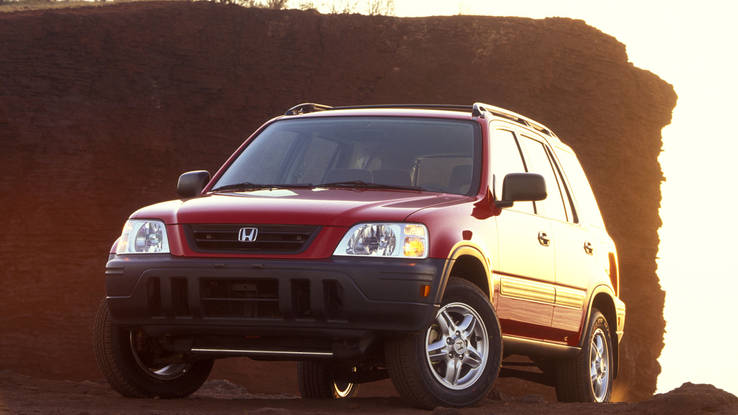
1996 Honda CR-V

The Honda CR-V with a Type R engine under the hood might surprise a few folks at a stoplight.

2. A first-gen Honda CR-V

Not as commonplace as a Miata, the first-gen Honda CR-V would be an interesting home for Honda’s hot turbocharged I4. With crossovers dominating sales, a crossover race series is inevitable. That means you can be ahead of the curve with a powerful race-ready CR-V. Of course, if you can manage to sneak one of these onto the street, a Type R-powered, 20-year-old CR-V would be a great way to embarrass people at stoplights. 

Fiat 1/9X

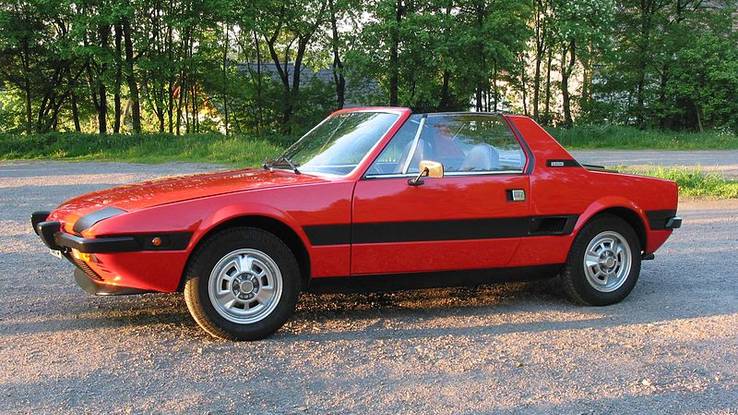
The Fiat 1/9X is a perfect Type R swap candidate. Photo by Wikimedia Commons

3. A Fiat X1/9

The wedge-shaped, Bertone-designed Fiat X1/9 is a refreshing look at the 1970s, especially with a midmounted 2.0-liter turbocharged I4 in place of the 74 hp SOHC naturally aspirated 1.3-liter I4. Of course, the step-up to computer-controlled electronic fuel injection alone might make the Type R swap a good idea, with the horsepower just icing on the cake. 

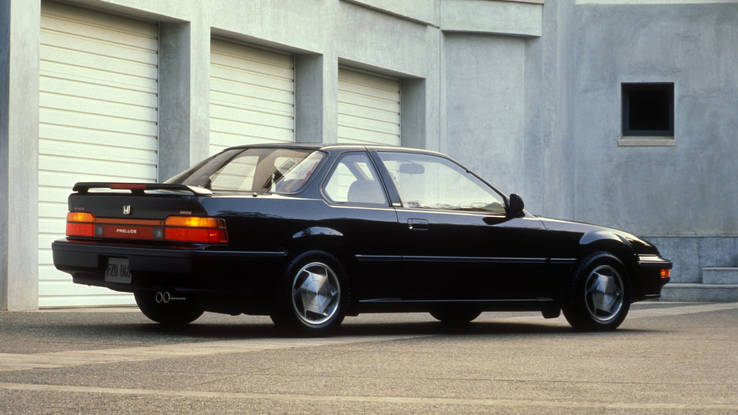
1989 Honda Prelude 4ws

The four-wheel steer would be the perfect track weapon with all the right Civic Type R bits.

4. A third-generation Honda Prelude 4ws

The 1988 Honda Prelude introduced the world to mechanical four-wheel steering, which, as confusing as it sounds, is relatively straightforward. Adding to that, a new Civic Type R engine would make it a force to reckon with on a road course. Of course, you might also find a way to borrow the entire Civic Type R torque steer management system.

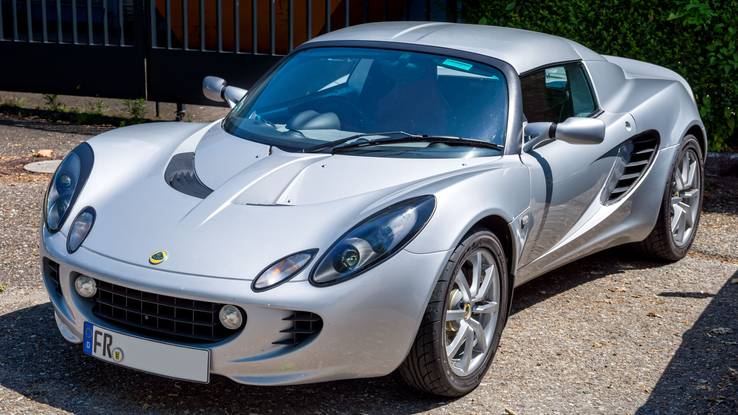
Lotus Elise

The Lotus Elise might not be your first call for an engine swap, but it would be great with a Civic Type R engine. Photo by Wikimedia Commons

5. Lotus Elise

The Lotus Elise might not be the most noteworthy Lotus ever, but it’s a lightweight platform that looks the race car part. Available from 2005 to 2011 in the U.S., the Elise isn’t difficult to find stateside, and replacing the stock Toyota mill with the Type R engine would make for an exciting track car. Stuffing one of these turbocharged Civic engines into the Lotus might take some creative fabrication work, especially to mate it to the existing driveline, but it will be worth it when you button everything up and throw out the crate. 

Airless tires are coming soon to a hybrid or electric car near you

Share

  • Pinterest

Makers of hybrid and electric cars are interested in the latest tire technology, not only to save weight but to reduce rolling resistance. For the last few years this meant tires that were a little too narrow and stiff, as automakers sought to squeeze out an extra fraction of one mpg wherever they could find it. Indeed, the one ingredient of tire technology that has not changed for decades, even as tire technology itself races ahead, has been the fact that they’re still filled with air. Automakers are well on their way to getting rid of spare tires to cut down vehicle weight — almost a third of all new cars now come without a spare — and some are already looking beyond run-flat tires that migrated over from the armored car cottage industry over a decade ago.

Toyota, along with a number of tire manufacturers, is already looking beyond runflat technology, and this is why the automaker showcased airless tires on its Fine-Comfort Ride concept at the Tokyo motor show last week, which is an adventurously styled MPV filled with a technologies that are just over the horizon.

The concept wore prototype Sumitomo airless tires, Bloomberg reports, in which a band of rubber encircles a plastic-aluminum hub, providing support to the interior of the tire. The concept is a little different from the Gyroblade tires that Sumitomo is also developing, in which large rubber spokes in the interior of the tire provide the connection to the center hub. The tire maker has been testing airless tires in a number of kei cars and golf carts, but the obvious promise of such technology in hybrids and electric cars is due to the fact that it can shave 30 percent off each tire’s weight by 2025 at the current pace of development. That’s no small fraction, and it comes with the promise of finally letting go of spare tires altogether.

Hankook iFlex

Hankook develops an airless tire — again

The idea for an airless tire has been around for a while, and concepts pop up here and there, but Hankook Tire has announced development of the iFlex; the company’s fifth prototype for a …

How soon might we see airless tires on production cars? Wako Iwamura, who heads the five-year airless tire project at Sumitomo Rubber, told Bloomberg that his target is 2020 for commercial sales.

While Sumitomo engineers expect significant weight savings with the first commercially offered airless tires, some work remains to be done on the aspect of rolling resistance: Iwamura estimates that airless tires offer 10 to 20 percent worse rolling resistance than traditional pneumatic tires, which is crucial for hybrids and electrics. This means engineers will have to find a way to give these tires a relatively rigid overall structure but the same level of damping as pneumatic tires used by hybrids and electrics, which will permit them to rotate at various speeds without deforming and without slowing the car down.

That’ll be the real test for airless tires: Will their internal structure be able to perform consistently at city and highway speeds for tens of thousands of miles? Sumitomo hopes to have the answer by 2020.

Nearly a third of new cars don't come with spare tires

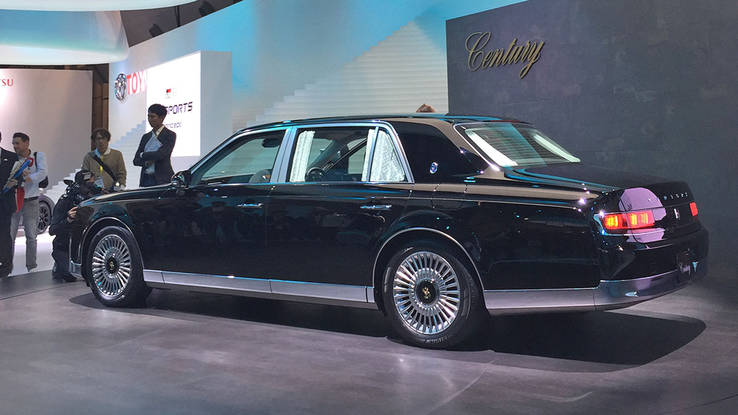
No modern luxury sedan can touch the Toyota Century

Share

  • Pinterest

You may not know much about the Toyota Century; unless you’ve lived in Japan, there’s almost no reason for you to even realize the Toyota Century exists. Launched in 1967, the hand-built flagship sedan/limousine has only ever been sold in its home market, and even there, it’s a sort of an anti-halo car. Istead of showing them off, using them to highlight the level of craftsmanship Toyota’s builders are capable of achieving, Toyota relegates them to special dealerships. You have to be invited to buy one, and the process isn’t exactly linked to your social media following: It’s popular with businessmen possessed of extremely conservative taste and nothing to prove. The Emperor is driven in one.

Toyota rolled out a brand-new Century at the 2017 Tokyo Motor Show. Like the return of Halley’s Comet or a continent-spanning solar eclipse, the debut of a new Century is a momentous occasion — in part because it just doesn’t happen very often. Consequently, I’m thinking more about the model than I normally do.

What is it about the Century that is so endlessly fascinating? A lot of times, car geeks get attached to vehicles because they’re not sold in our home markets. Admittedly, that’s part of what drew me to the Century in the first place. I also happen to love its looks, which are a sort of case study in what happens when you freeze a design language moments after the first car rolls down the line and then slightly defrost it for minor modifications, rarely, over the next fifty years. You might not understand why anyone would buy something that looks vaguely like a pre-oil crisis Lincoln product. I can’t get enough of it. We’ll just have to agree to disagree here; in any case, the style question doesn’t really invalidate my argument: When it comes to luxury cars, other manufacturers have a lot to learn from the Century’s effortless confidence.

Toyota Century finally rolls into this century

Toyota Century finally rolls into this century

 When it comes to regal resonance in Japan, no nameplate rules like the Toyota Century, the official car of the emperor, prime ministers and esteemed captains of industry.Perhaps that’s why, …

The Century isn’t special because it’s opulent. It’s loaded with tech, but never for the sake of having the latest gizmos onboard. Western observers often notice the lack of leather; while other luxury builders are proud of how many hides go into their interiors, most Century seats get cloth in subdued colors or patterns instead. I’ve been told that leather surfaces squeak, which would ruin the serenity of the cabin. There’s something to it: I had the opportunity to drive a later model first-generation Century at Duncan Imports earlier this year, and I can say with (almost) no exaggeration that it was the smoothest, quietest car I have ever piloted. It’s downright freaky.

Likewise, the Century isn’t special because it’s expensive. The price isn’t really that outrageous, for what it is; new Centuries are said to start at around $100,000 (used ones can be had for a tenth of that — talk about depreciation). You can spend more than that on a Porsche Boxster. Quadruple that for a Rolls-Royce Phantom. No, it’s the impenetrable air of, if not exactly snobbery, then at least cultivated exclusivity that surrounds the Century and bolsters its image. Let’s say you won the lotto; the Century is not the car you’d buy. It’s not the done thing. It wouldn’t be appropriate.

To highlight what makes the Century sub-marque special, compare it to other top luxury automakers. Rolls-Royce has attempted to drum up buzz by rolling out a range of questionable special editions; Bentley caved to trends and built an SUV. Even if they can be forgiven for bowing to market forces, the Century should be commended for standing its ground and hewing to the formula established decades ago: It is a luxury sedan meant to be chauffeur-driven, designed and built for customers who feel no particular need to show off their wealth or status. To be successful it doesn’t need a hashtag or a celebrity pitchman. It doesn’t really need to do anything, except exist. That’s rare and remarkable.

Now, you could argue that no other luxury marque could achieve what the Century has. It’s only sold in Japan; it doesn’t have to drum up double-digit sales increases year after year, so it can basically set its own rules. To which I’d say: That’s exactly the point. The Century does’t have to compromise its ideals to meet the disparate needs of international markets, which must be accommodated in order to achieve that all-important sales growth (think of how many automakers have explained away brand-diluting product with a “well, China…”). Instead, the Century is perfectly tailored to its cultural context. It has carved out a niche and it fits that niche perfectly. What could be more luxurious than that?

Mazda Kai Concept teases the future of the Mazda 3

2017 Toyota Century debut at Tokyo motor show

Here’s the new Toyota Century on the floor of the Tokyo Motor Show.

Maybe the other automaker that has come close on that front is Bristol. Yet by the time Britain’s proudly under-the-radar heritage marque ended production (or at least this phase of production; fingers crossed for a revival), its products were, I suspect, intentionally, flagrantly anachronistic. They were bought by the sorts of eccentrics that found value in that.

That’s not the case with the Century. There’s no irony here. It’s evolved over the years, but it’s never done so for evolution’s sake. A new Century launches when the minds behind the company know they can design and build a better one. Until that day, why mess with what works? The result is just three major generations, with minor styling changes here and there, in its half-century run so far. The new one gets a V8 hybrid powertrain instead of a V12. I have no doubt that it lets it run even smoother and even quieter than the vintage car I sampled; the alternative is inconceivable.

The Century may not be to your taste. You many not get why anyone would spend so much on a fancy Toyota with cloth seats and lace curtains on the windows. But study it for a little while and you’ll realize that it has what few other luxury cars or marques possess: Utter, complete self-assurance. It takes something like the Century to show just how rare that quality in the automotive space.

Graham Kozak

Graham Kozak – Graham Kozak drove a 1951 Packard 200 sedan in high school because he wanted something that would be easy to find in a parking lot. He thinks all the things they’re doing with fuel injection and seatbelts these days are pretty nifty too.
See more by this author»

Maxlider Bros bringing big, bad Bronco to SEMA

Share

  • Pinterest

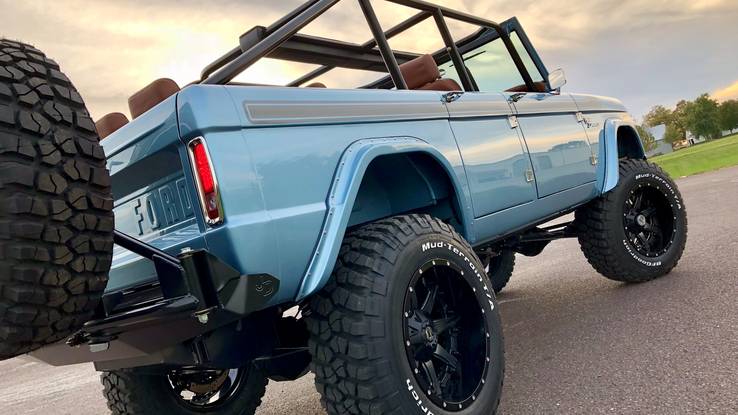
What a beast! Just about any Early Bronco is going to be cool, but Maxlider Brothers Customs just outside Chicago specializes in them.

“Our uncle bought one in 1966, our cousin Rick had several of ‘em over the years, too, and we just always thought they were cool,” said Erik Barnlund, who owns Maxlider Brothers Customs with brother Kris.

He called us from the road, where they were in the process of hauling the Bronco from Chicago to Las Vegas for the SEMA show. He said they’ve been buying and selling cars most of their adult lives – they’re 43 and 41 now, respectively – then five years ago they stated focusing on building and restoring Broncos. A year and a half ago they started this project.

“We wanted this Bronco to stand out as one of the most exotic and modern Bronco builds to date,” said Erik. “Last year at SEMA I saw some incredible Broncos, but we knew we could build something different that the world had never seen before. We also wanted tip our hat to Ford Motor Company on their own anticipated launch of the 2020 Bronco and show them what a throw-back design could look like with 4 doors.”

Maxlider Bronco rear 34

Looks good from several angles

They started with a 1966 Bronco, and when sharing their plans for the stretched chassis with metalfabricating specialists MJR Industries of Worden, Mont., one of the guys there said, “I could fabricate that.” Worden fabricates everything from those huge metal tubes that run up and down grain silos, to Trophy Trucks for racing in Baja. So they sent the chassis to MJR. The Montana crew promptly cut it in half – that’s the only way to add wheelbase, really – and then added 26 inches to the middle. The chassis was then welded and reinforced to make it even stronger than the original.

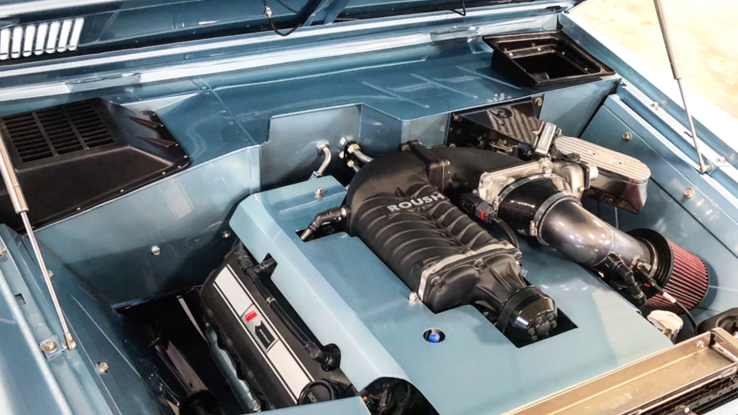
The Bros then teamed with Roush Performance to stuff a supercharged Coyote 5.0-liter V8 under the hood which they say is “capable of putting out 600 horsepower.” Advance Adapters Atlas II Transfer Case and Currie Industries provided new and more durable axles while Yukon Gear & Axle provided the driveshafts, locking hubs and differentials. On the dash is a Powertrain Control Solutions gear selector and the steering wheel is attached to EPAS electric power steering unit.

Underneath, MJR made a custom suspension with Fox Racing Shox, BFGoodrich 37×12.5/20 mud-terrain tires wrapped around 20×12.5-inch Fuel Nutz black wheels and AMP Research added power assist side steps. To stop this big bruiser, Wilwood crafted Superlite 4R Big Brake four-wheel disc brakes for what is promised to be “maximum stopping power.”

Obviously, when you tear everything out of the inside of a vehicle you have to put something back in. Hence, the interior is customized with Maxlider Bros throwback seats wrapped in water-resistant baseball glove brown marine performance vinyl, meant for rugged off-roading. Custom designed inserts hug the rear wheel well arches where Maxlider installed two of the six state-of-the-art Wetsounds Bluetooth sound bars and subwoofers.  

Maxlider Bronco Roush Coyote 5.0

The Maxlider Bronco Roush Coyote 5.0 makes 600 hp

Does it actually drive?

“It’s fantastic,” said Erik.

There’s even legroom.

“It’s not like a conversion van, but you have room for your knees in all three rows,” Erik said.

If you’re thinking you would like to buy this particular Bronco, you’re too late. It is already sold. And it wasn’t cheap – the buyer paid about “…a quarter million” for it.

“We coulda sold it three times already,” said Erik.

So are your three-row Bronco dreams dashed? No. Maxlider Bros is going to make more, incorporating things they’ve picked up in this build. They’ll add suicide doors and eliminate the middle pillar, for instance. And while all their builds are custom jobs, expect pricing to start on a four-door Bronco at $250,000.

Now hang on. That’s for something like this, which is pretty involved. Maxlider Bros sells all kinds of Broncos, between 75 and 100 a year. You could get a solid-bodied Bronco with a good, functional powertrain for between $35,000 and $50,000. And who doesn’t have that laying around?

LINE-X Raptor custom truck will roll into SEMA unscathed

Share

  • Pinterest

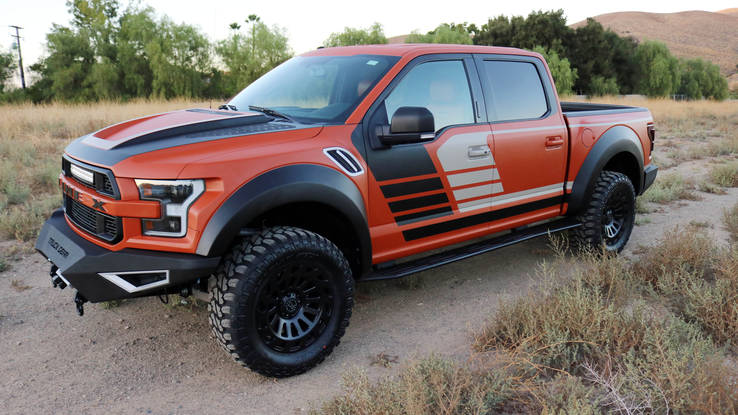
Tired of having your truck’s beautiful finish marred because some jealous ex-spouse keeps keying it? Sick of road grit sand-blasting the bow of your proud Four-By? You want something like the Line-X Raptor.

Line-X is perhaps best known as the maker of spray-in bedliners, those paintlike coatings that eliminate the need for a plastic bedliner. Plastic bedliners just pop out on the freeway, anyway. A spray-in liner is forever. To show off its Ultra line of coatings, Line-X commissioned custom car and concept builder Kenny Pfitzer to build a Raptor.

Pfitzer has the perfect resume for the job. After a youth spent working on customs with his dad, he launched a 20-yearlong career at the best shops you could work for: Metalcrafters, West Coast Customs and Foose Design. While at Metalcrafters, he did the Ford Bronco Concept, so he’s familiar with the marque.

LINE-X Raptor in the wild

LINE-X Raptor in the wild

For this truck, the first order of business was to use as much of the Line-X Ultra as possible — since Line-X was paying the bills. Luckily, the coating can be mixed into any color you want. This one is called “burnt ember,” and it looks nice.

Line-X also makes gear for trucks, and Pfitzer fabricated several new concept parts for the concept truck, including both bumpers, grille, side steps and fender flares. Underneath, it has Fox factory racing shocks, Camburg Kinetik upper control arms, Brembo Type 3 GT brakes, MagnaFlow catback exhaust and Nexen Roadian MTX tires on Black Rhino Madness Alloy wheels. That’s a Warn Zeon 12-S winch in front.

The Line-X Raptor will be in the Upper South Hall at the SEMA show. Unscathed. 

This 1967 Ford Mustang is a Rally Fighter for hot-rodders

Share

  • Pinterest

Ahead of its SEMA Show debut, this 1967 Ford Mustang fastback is already up for auction. Built by former “Top Gear USA” host Rutledge Wood, current “Roadkill” host Mike Finnegan and painter K.C. Mathieu, this Mustang was built with parts primarily sourced from eBay as part of a charity partnership.

Under the Mustang’s hood is a small block mill from Ford Performance that’s stroked and poked to 427 cubic inches. Sitting on top of the engine, and poking through the hood, is a vintage-style stack fuel-injection system from Inglese. The open stacks might not be the best option if you plan to put this Rally Fighter fighter through its paces in the dirt, but it does look incredible.

Two Cool Camaros Coming to SEMATwo Cool Camaros Coming to SEMA

You can buy these two cool SEMA Camaros

Chevrolet unveiled two new Camaros ahead of next week’s SEMA show — the Hot Wheels 50th Anniversary Edition and the mighty and snarling COPO Camaro drag pack — and the world is a …

The custom American Racing wheels and bespoke interior are a few of the parts not found on eBay — and we can’t say we blame the team for going with a custom wheel. The gold paint looks almost like the coating found on vintage magnesium wheels, which adds to the vintage flair. The paint might be a little much for some, but it’s an obvious nod to the American flag suit worn by legendary stuntman Evel Knievel.   

According to the auction listing, the team threw over $140K at this build, and with all the custom parts we don’t doubt it. Proceeds from this SEMA show car will benefit the Juvenile Diabetes Research Foundation — so, you can feel like you’re supporting a good cause while you’re ripping around in this pony car.

The auction will run through the SEMA Show, which means you can check out the car in person at the “Ford out Front” exhibit at the Las Vegas Convention Center. The auction ends at 2 p.m. on Nov. 2 — so stay through SEMA and drive it away. 

More round things! Momo adds tires to its list of products at SEMA

Share

  • Pinterest

Italy-based Momo, normally a purveyor of steering wheels and other racing gear, is getting into the tire game with a full range of rubber for passenger cars, light trucks and SUVs. Momo tires was initially launched in Europe in 2012, but as of this week, they’re coming stateside.

Momo says what all manufacturers say about their tires. They use an advanced silica compound leading to better fuel economy, low road noise, enhanced grip and handling. The 2018 line will feature 12 “unique all-season, winter and summer patterns with new models planned for later next year.”

If you happen to be at the SEMA Show next week, check them out at the Weld Racing booth.

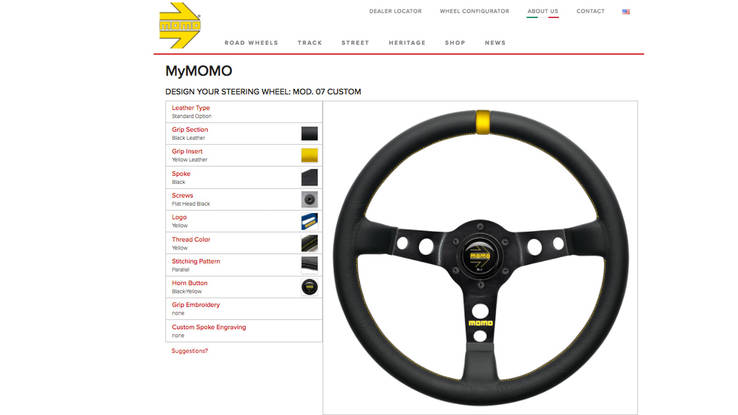
In other Momo news, the company will now allow you to customize a steering wheel with colors, script, materials and even screw heads for your latest ride. The base price is $564; there are a few upgrades like Alcantara, which might add a few shekels to your total.

Check out momo.com for more information.

Momo custom steering wheel config

At momo.com you can customize colors, materials and scripts on your new steering wheel.

Lexus ‘Highway Teammate’ auto drive debuts in 2020

Share

  • Pinterest

Lexus‘ newest concept car, based on the re-engineered LS sedan, will be used to showcase self-driving technologies and design direction.

The LS+ Concept draws heavily from the current flagship that will go on sale in the U.S. early next year, but with a new iteration of its front grille and the use of laser effects on the headlamps.

The concept car, which debuted Wednesday at the Tokyo Motor Show, features an automated mode called Highway Teammate that will be deployed in 2020.

On motor-vehicle-only roadways, the car will be able to keep itself in its lane, make lane changes and maintain a safe distance from other vehicles, Lexus said in a statement.

In a video simulation, an LS using the system asked its driver whether it should pass a slower-moving vehicle and did so once a voice command was given.

Yoshihiro Sawa, president of Lexus International, said cars using the automated system would be able to update software using an over-the-air connection.

Toyota to tout AI at Tokyo Motor Show

Toyota to tout AI at Tokyo Motor Show

Toyota plans to broaden its vision of future mobility at the Tokyo Motor Show with two tiny electric runabouts that predict the driver’s emotions and guide them away from danger.The Concept i-Ride …

“These updates make it possible to introduce new functionalities or improve existing ones, enabling the gradual expansion for an ever better service,” he said during the unveiling. “Moreover, we will also employ artificial intelligence that learns from the big data related to roads and surroundings to dramatically improve the car’s perceptive and decision-making capabilities.”

In the first half of the next decade, the automaker plans to add Urban Teammate for the more complicated task of automated driving on city streets.

“We will aim for an automated driving level of 4 or above to achieve a mobility society where everyone can move safely, smoothly and freely,” Sawa said. Level 4 refers to an automated driving scale, with 5 at the top.

The concept car also will serve as a way for Lexus to explore the next generation of its L-finesse design philosophy.

Sawa said the concept uses a new design language for the front and rear of the sedan, particularly in the headlamps, tail lamps and aerodynamic elements.

It also tweaks the brand’s signature — and polarizing — spindle grille by incorporating a large grille shutter to improve airflow.

Lexus concept showcases self-driving chops” originally appeared in Automotive News on 10/25/2017

By Laurence Iliff at Automotive News
You can buy these two cool SEMA Camaros

Share

  • Pinterest

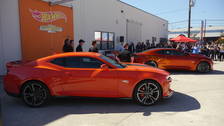
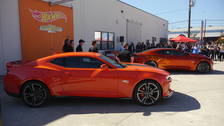
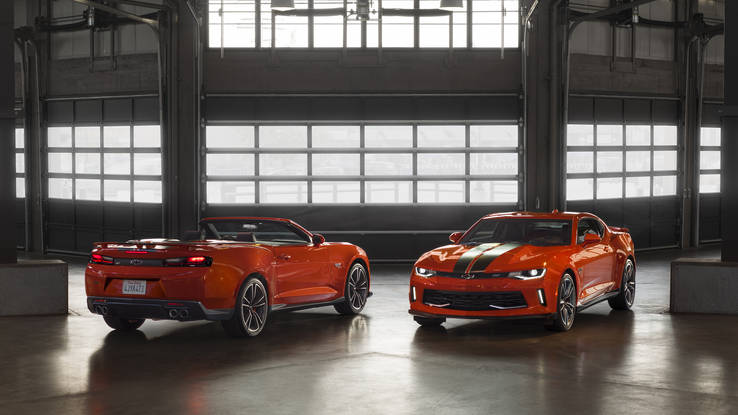
Chevrolet unveiled two new Camaros ahead of next week’s SEMA show — the Hot Wheels 50th Anniversary Edition and the mighty and snarling COPO Camaro drag pack — and the world is a better place because of it.

The Hot Wheels Camaro celebrates 50 years of these two iconic brands. The first Hot Wheels toy car ever made was a Camaro. It came out in 1968 along with 15 other tiny die-cast cars that came to bear the famous flaming-wheeled Mattel logo. Millions of kids pushed them around on shag carpets all across America, saying: “Vroooom, vroom! Crash! Bang! Man, if I could just crawl inside and drive this sucker!” Well, now you can not only crawl inside, you can get a car loan and buy the sucker. 

Hot Wheels Camaros

The Hot Wheels 50th Anniversary Edition Camaro comes in coupe or convertible form. Photo by Chevrolet

The Hot Wheels Camaro is a $4,995 option package on 2LT and 2SS coupe and convertible models. It includes that Crush exterior and stripes that mimic the orange plastic tracks that snaked through living rooms and across kitchens from Duluth to Detroit. The car comes with satin graphite stripes with silver metallic accents, satin graphite ground effects, 20-inch forged aluminum wheels, grille inserts, orange brake calipers, dark tail lamps, Hot Wheels floor mats and a few other flame-colored ephemera. Now granted, five grand for Hot Wheels badges and premium carpets makes no economic sense whatsoever, but who can put a price in reliving a childhood dream?

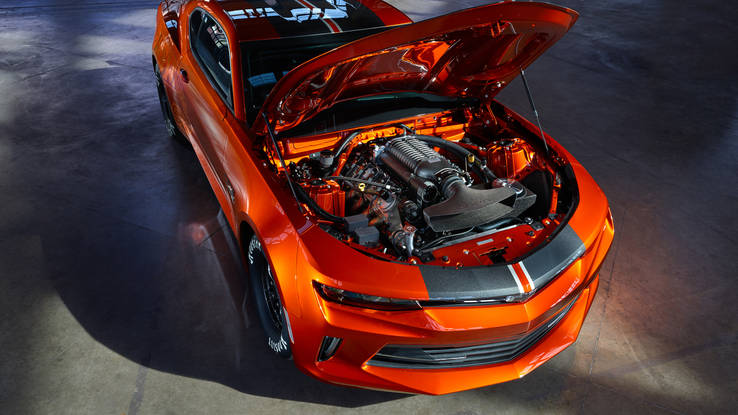
COPO Camaro

The COPO Camaro is set up to run in NHRA’s Stock Eliminator classes Photo by Chevrolet

The COPO Camaro, however, has a more serious list of hardware. With racing chassis and suspension components, including a unique solid rear axle, it is spec’d out to run in NHRA’s Stock Eliminator classes. It comes with three engine choices. New this year is a 302 race engine based on the LT1 from the 2018 Camaro SS but with drag-ready components. You can also order a 427 (7.0-liter) or a supercharged 350 (5.7-liter) race engine. Chevrolet says the 350 does mid-8-second quarter-mile times with trap speeds of almost 160 mph. All three engines are mated to SFI-approved ATI TH400 three-speed automatics.

To get one of the only 69 COPO Camaros that will be made this year, you have to enter a lottery, which, not coincidentally, opened today. Register at chevrolet.com/performance/copo-registration. You have until the end of November to sign up. If you’re one of the lucky winners, expect to pay anywhere from $110,000 to $200,000 for your race ride, depending on how you spec it out.

If that’s too much coin, you can buy a die-cast Hot Wheels version for a lot less.

Look for these ornery oranges on the Chevy stand at SEMA