All posts in “Events”

Detroit’s new trucks are the industry flagships

Share

  • Pinterest

The pickup battle is over. Yet it has only just begun.

Judging by product development strategy, Ford has won.

It has long set the pace by continually introducing new technologies, increasing towing and hauling capability, adding luxury features and carving out new segments — a playbook that has kept the F series on top of the sales charts for 41 years.

The redesigns of the Chevrolet Silverado and Ram pickups taking center stage at the Detroit auto show this week tear not just a page or two out of that playbook, but whole chapters.

The Silverado debuts an industry-first fuel-saving technology and perhaps the most advanced construction process used on a pickup. Ram introduces a giant, Tesla-like touch screen to a luxury-style interior, along with a long list of technical upgrades.

The result is a collection of trucks that showcase some of the most sophisticated technologies each manufacturer has in its arsenal.

They are, in effect, the new flagships of Detroit.

And right now, there’s a great deal riding on their success.

Pickups are the highest-volume, highest-profit vehicles Detroit builds, and they have defied any kind of ceiling on price. In the near term at least, those profits must serve as the ATM that funds manufacturers’ expensive forays into autonomous vehicles, electrification and other risky investments.

They also fuel the cycle of innovation in pickups that keeps escalating the arms race among the big manufacturers.

More fuel-efficient pickups sold in high volume also make it easier for Detroit’s automakers to meet increasingly stringent fuel economy targets. Even though the Trump administration has ordered a review of Obama-era fuel economy standards, automakers must proceed on the assumption that the spirit of those rules will remain in place.

Bigger but lighter

Three years ago, Ford used the F-150 to introduce lightweight aluminum bodies to pickups, shaving as much as 750 pounds off some models. The price tag was huge: Ford spent nearly $1 billion retooling two plants for the new manufacturing system.

The payoff has been tremendous, too. In 2017, Ford sold nearly 900,000 F-series trucks, despite taking flak from Chevy advertising campaigns.

The new Silverado and Ram — despite growing in size — are following Ford’s lead in shedding weight while adding other fuel-saving features.

The Silverado, for example, adopts a version of the mixed-material construction system launched two years ago in the low-volume Cadillac CT6 sedan. It’s a complex manufacturing strategy that combines ultra-high-strength steel and aluminum — with variable thickness — putting the strongest, lightest parts in the proper places. The Silverado’s 450-pound weight reduction is doubly impressive because the new truck is up to 3.9 inches longer than the outgoing one.

The 2019 Silverado also debuts new powertrain technologies, including Dynamic Fuel Management, a computer-controlled cylinder-cutoff system that replaces the mechanical system and fires only the number of cylinders needed to maintain speed. A V-8, for instance, could run on just two cylinders at steady highway speeds and could vary the two so as to maintain engine performance and smoothness. In previous years, such technology would have debuted on a Cadillac and proliferated to other vehicles.

The Silverado also gets General Motors’ first inline six-cylinder diesel engine for a modern light-duty pickup. That engine will put the Silverado in the exclusive 30-mpg-highway club, along with the diesel-powered F-150.

FCA shows its stuff

The Ram redo is perhaps one of the most complete revamps of a vehicle in recent years from any automaker. Nearly every part has been redesigned, re-engineered or outright replaced. The carryover parts are few, and the new features take the Ram brand into uncharted territory.

“I think we underestimated FCA’s investment in the Ram 1500,” said AutoPacific analyst Dave Sullivan. “We were expecting a fairly heavy revision of the current model. … That isn’t the case.”

The 2017 Chrysler Pacifica, Fiat Chrysler Automobiles’ elaborate redo of its bread-and-butter minivan, “really showed the engineering capability that FCA has in-house,” Sullivan said. “The Ram is the next chapter in that book, where they come up with something that really looks to rewrite what we expect and how we use pickup trucks.”

A 12-page press release detailing the changes reveals a number of technologies new to FCA, the pickup segment and even the industry.

Under the hood, a 48-volt eTorque hybrid system is standard on V-6 pickups and optional on V-8 models. And on those with V-8 engines, eTorque can be combined with a cylinder-cutoff system. New to the industry, FCA says, is a thermal warmup system for the transmission and rear axle that helps improve fuel economy in cold weather.

So the Ram should be competitive in fuel economy with the F-150 and the Silverado, even without a diesel. Ram’s 3.0-liter turbo- diesel is delayed for emissions certification issues.

The Ram’s redesigned frame, using 98 percent high-strength steel, contributes to a weight reduction of nearly 225 pounds vs. the 2018 Ram. As with the Silverado, that weight savings is a coup because the Ram’s length grew 9 inches.

A touch of Tesla

But the Ram’s interior is where FCA’s investment is most visible, and that’s where the company is taking the battle straight to Chevrolet and Ford.

Borrowing from Tesla, Ram has installed a touch screen that is 12 inches across in some models. It can be split, showing driving information, infotainment and vehicle control data at the same time. The materials on the dash, door panels and seats all appear to be more in keeping with luxury sedans than work vehicles.

Ram’s center console doubles as a docking station for computers and offers wireless charging for tablets and phones. The second-row seats recline, and the floor is flat for easier cargo storage. Voice recognition, adaptive cruise control, lane-keeping assistance and on-demand audio from a 900-watt, 19-speaker sound system are all available.

All this comes at a price. There’s no doubt that these new trucks will cost more than the outgoing models.

But for automakers, that is more an opportunity than a concern.

Consumers have made the luxury versions of pickups — King Ranch and Platinum from Ford, Laramie Limited and Southfork from Ram and High Country from Chevrolet — some of the fastest-turning vehicles on dealership lots.

Last fall, Ford’s F-450 Limited crossed the six-figure barrier, once taxes and other charges were added, and reportedly is selling well.

The big leaps at Chevy and Ram signal a more competitive battle at the upper reaches of the market.

Changes to Chevrolet’s truck have occurred at a glacial pace over the years, particularly interior improvements. GM has been slow to introduce new powertrains. And it completely missed several important segments that Ford identified and then exploited, such as luxury and high-performance off-road models. Ford says the F-150 Raptor nearly outsold the Chevrolet Corvette last year.

Ram pickups, with their rugged, big-rig styling, essentially have looked the same since 1994, although Ram has been more daring technically, offering a diesel engine and coil-spring rear suspension.

But now, the F series’ biggest competitors are getting the same attention to style, technology and features.

Says Sullivan: “All three of the Detroit full-size pickups have really taken a different direction to achieve roughly the same goal.”

Redesigned pickups showcase the industry’s most sophisticated features and technology” originally appeared in Automotive News on 1/15/2018
By Richard Truett at Automotive News

Infiniti Q Inspiration concept is the antidote to ‘conservative’ luxury sedan design

Share

  • Pinterest

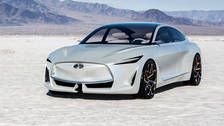
Infiniti is taking the wraps off the Q Inspiration concept at the Detroit auto show this week. It’s meant to demonstrate the direction of Infiniti design in the form of a large luxury sedan in an era of advanced powertrains. The large sedan showcases the next step in the brand’s design language and is also said to preview a new generation of Infiniti vehicles, suggesting that the automaker is considering fielding a large luxury sedan aimed at the likes of the Lexus LS, Mercedes-Benz S-Class and BMW 7-Series.

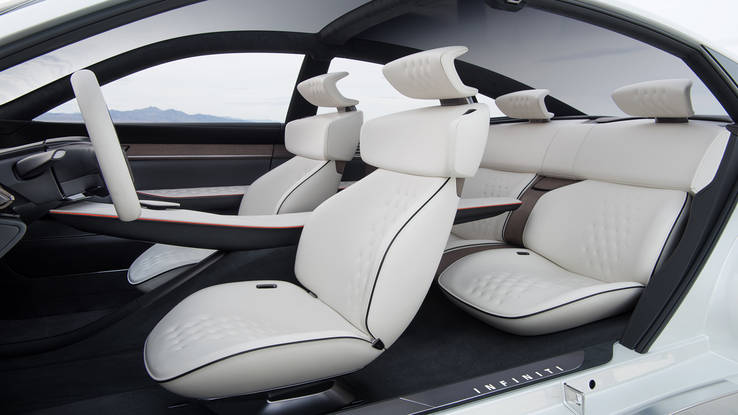
The design of the sedan itself adopts a coupe-like profile — common enough in this age — while featuring sleek, sculpted surfaces with a good amount of surface tension. The front fascia features a large grille opening with two distinct inlets below the nose, as well as two inlets bookending the front fascia itself. Out back, the concept features a thin, single wraparound taillight as well as two large vents at the bottom of the rear fascia. Inside, the Q Inspiration is a study in minimalism, with a visually clean interior meant to convey a comfortable and serene passenger space.

“We aim to take traditional sedan architecture to its next stage of evolution,” Karim Habib, Infiniti executive design director said earlier last week. “The Q Inspiration offers an alternative form: something more flowing in appearance and muscular in stance, with an unusually long and balanced cabin. Experimenting with new proportions in an established segment with the arrival of smarter, compact powertrains, the Q Inspiration features a shorter hood and elongated body, with all the benefits to interior well-being, comfort and space that this layout entails.”

The Q Inspiration concept is powered by Infiniti’s new VC-Turbo technology, heralded as “the world’s first production-ready variable compression ratio engine.” This new powertrain is said to combine the power of a turbocharged gasoline engine with the efficiency of a diesel or a hybrid engine, pointing the way to further development of internal combustion technology.

2018 Infiniti Q Inspiration concept interior

The interior of the concept sports a clean, uncluttered look.

2017 Infiniti Q60 3.0t

“The premium sedan segment has become rather conservative,” said Christian Meunier, Infiniti Global Division Vice President. “The Infiniti Q Inspiration previews something that could appeal to a younger audience, who seek modern design and new technologies to inspire and empower them.”

Will the Q Inspiration concept lead to a production version of a range-topping sedan? The Q45 flagship has been notably absent from the Infiniti lineup, and the tastes of the market have noticeably shifted away from large sedans in the second half of the decade. Infiniti has an E-Class or 5-Series competitor in its lineup, but for now, the automaker is not signaling that the return of larger luxury sedan is imminent. This is quite understandable, given the consumer demand for large crossovers and SUVs as the moment, but the Q Inspiration concept demonstrates the brand’s latest design that could apply to smaller production sedans in the near future.

The Lexus LF-1 Limitless concept previews a robo-chauffeured luxury crossover for four

Share

  • Pinterest

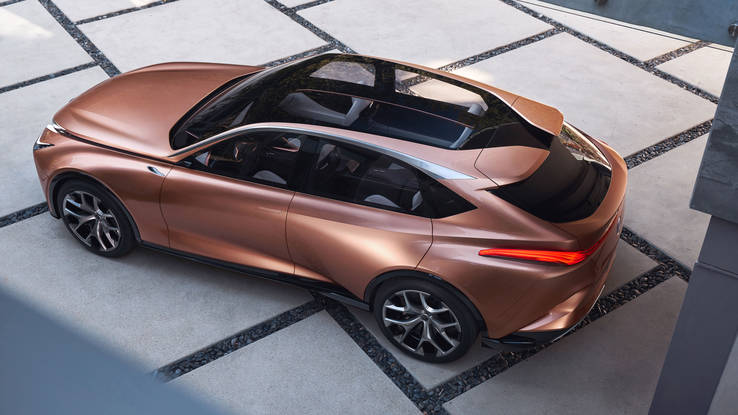
Lexus has a shiny new flagship sedan in the fifth-gen LS, and a flagship coupe in the striking LC. But the Japanese automaker knows people are crazy about SUVs and crossovers — as well it should, given the mint it has made selling the RX over the past two decades. The Lexus LF-1 Limitless concept, then, is a glance at what a flagship crossover could look like, and it’s likely a hint at how Lexuses of all shapes and sizes will look in the coming years.

The fastback-ish four-door, which just debuted at the 2018 Detroit auto show, definitely resembles the current Lexus lineup right down to that spindle grille (we’re sure you’ll tell us how you really feel about that in the comments). But there are differences: Interestingly, the concept has ditched the RX’s “floating roof” design; with a well-defined rear pillar, it’s more like the NX. Its lines flow more cleanly from front to back, reminding us more than a little of the Mazda CX-9.

Lexus specifically says that the LF-1 is “more sports car than station wagon.” We disagree — this looks much more like a wagon than any sort of sports car. But we’re not complaining. We love station wagons.

2018 Infiniti Q Inspiration concept

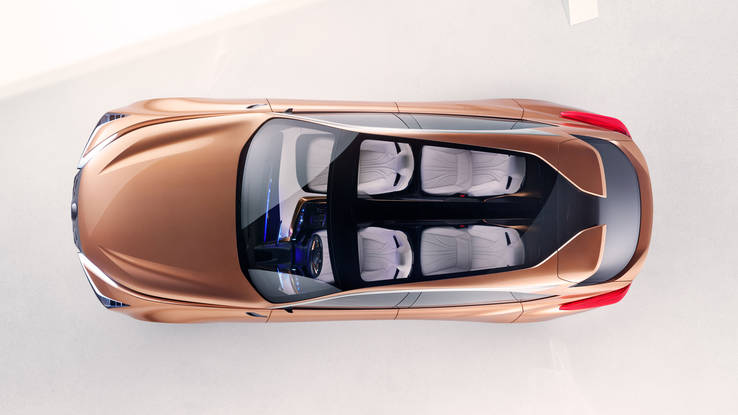
Lexus LF-1 overhead view

Seating for four.

The concept is 197.4 inches long (on a 117.1-inch wheelbase), 78.2 inches wide and 63.2 inches tall. That makes it about 5 inches longer than the current RX, but only about a half-inch longer than the new three-row RX 350L. Its footprint, then, isn’t all that large — but the difference here is that all of the LF-1’s interior space is given over to just four seats; personal luxury, rather than space for the kids and their gear and a few of their friends, is the goal here.

The mission is complimented by the onboard tech; of course, since it’s a FutureCar, it’s got to have some kind of self-driving capability. Lexus says thing would get a conceptual Chauffeur mode — which, now that we think of it, is the coolest possible way to describe autonomous or semi-autonomous driving functions.

The automaker is vague about what the LF-1 is powered by. It could be anything, Lexus, says, which is why they put “Limitless” right there in the name. But it’s got to be futuristic. Batteries! A hydrogen fuel cell! Cold fusion! Anything is possible, apparently, even — gasp — an internal combustion engine or a hybrid system.

There’s no word on whether this car will reach production in anything resembling this form, but again, we wouldn’t be surprised if Lexus’ production vehicles end up looking more like this in the not-too-distant future. And given the popularity of crossovers, especially in the luxury space, this would be a logical and inevitable (and likely profitable) way to make a statement and round out Lexus’ design-forward lineup of range-toppers.

Lexus LF-1 rear 3-4

Lexus says this is more sports car than station wagon. But come on, this is totally a lifted station wagon.

Graham Kozak

Graham Kozak – Graham Kozak drove a 1951 Packard 200 sedan in high school because he wanted something that would be easy to find in a parking lot. He thinks all the things they’re doing with fuel injection and seatbelts these days are pretty nifty too.
See more by this author»

2019 Kia Forte revealed: Fresh looks, better fuel economy and more tech

Share

  • Pinterest

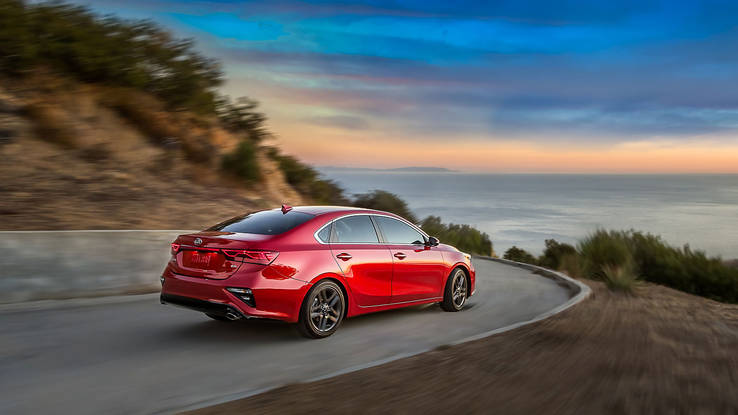
Kia’s compact offering just got bigger: The 2019 Forte sedan, which debuted at the Detroit auto show, is a little over 3 inches longer and 0.7 inch wider than the serviceable but basic transportation unit it replaces. It is consequently blessed with a roomier cabin, extra rear legroom and a bigger trunk. It gets new looks, too, bringing it visually closer — somewhat — to the Stinger GT, the brand’s halo performance sedan; you’ll see it most in the headlights and the semi-fastback roofline.

Beyond that, we’re in (mostly) familiar territory. The new Forte’s Atkinson cycle 2.0-liter inline-four still kicks out 147 hp and 132 lb-ft of torque, unchanged from the outgoing model.

The big mechanical change is the transmission; the six-speed automatic has been replaced by a continuously variable transmission. The goal here is fuel economy, and while complete figures have not been released, the automaker expects the car to squeeze out 35 mpg combined — 3 mpg better than the previous model.

2019 Kia Forte debut rear 3-4

The 2019 Forte is 3.2 inches longer, which means more rear leg room and extra space in the trunk.

Further, Kia says this CVT, which it has dubbed the “Intelligent Variable Transmission,” or IVT, is designed to solve some of the biggest complaints drivers have about the technology — namely, the “rubber band” feel when driving and the annoying, intrusive drone of the powertrain. The first problem, claims Kia, was addressed by using a chain-type belt in the gearbox rather than a push belt, and the second was dealt with by wrapping the gearbox in sound deadening.

We’ll believe it once we drive it; a stiffer body and reworked suspension, along with changes to the power steering system, should help make the Forte a little bit more fun on the road. More relevant to the average commuter, though, is all the onboard tech; an 8-inch Android Auto and Apple CarPlay-equipped touchscreen is standard, and you can upgrade with features like a wireless charging tray. Driver assistance systems, including blind-spot collision warning, lane keep assist and smart cruise control are available.

Pricing has not yet been announced, but that’s been one of the Forte’s, er, strengths in the past, with basic models starting at comfortably under $18,000. We don’t expect that to change much; stay tuned for more information.
 

Graham Kozak

Graham Kozak – Graham Kozak drove a 1951 Packard 200 sedan in high school because he wanted something that would be easy to find in a parking lot. He thinks all the things they’re doing with fuel injection and seatbelts these days are pretty nifty too.
See more by this author»

Mercedes-AMG ups its EQ with 2019 CLS53, E53 Coupe and Cabriolet at NAIAS

Share

  • Pinterest

It wasn’t all Gelandewagen talk for Mercedes Sunday night before the Detroit auto show. The company also introduced the new “53” designation for the CLS, E-Class Coupe and E-Class Cabriolet. The new lineup will use a new turbocharged 3.0-liter inline six-cylinder that, when combined with an electric auxiliary compressor, EQ Boost starter-alternator and 48-volt electrical system, can deliver momentary boosts of 568 lb-ft of torque and 450 hp.

“With the new 53-series models, we are extending our portfolio in a first step towards a hybridized future with a leading-edge combination of sporty design, performance and efficiency,” said Tobias Moers, Mercedes-AMG chairman.

EQ is Mercedes’ forthcoming electric subbrand, previewed at the Paris auto show in 2016.

Mercedes says that with the EQ Boost electric starter/alternator fitted between the engine and transmission, the AMG CLS53 can accelerate from 0-60 mph in an estimated 4.4 seconds. It adds 21 hp and 184 lb-ft to the I6’s 429 hp and 384 lb-ft of torque. Basically the electric motor spins the auxiliary compressor, which builds up boost early in the rev range, before the larger exhaust gas turbocharger gets going.

The 48-volt electrical system responsible for all that hybrid power also allows for the omission of the belt for accessory components, which also saves space under the hood. Mercedes then filled that space with an exhaust gas after-treatment system.

All 53s get the AMG Speedshift nine-speed transmission with paddle shifters and AMG Performance 4Matic all-wheel drive. Drive modes adjust engine response, transmission, suspension and steering. AMG’s air suspension with adaptive damping and self-leveling is also standard.

Visually, the 53 models will get the company’s twin-blade radiator grille in chrome with a black lattice pattern. The front splitter and air intakes are chrome too, while the rear bumper is redesigned.

In the cabin you’ll see the typical outstanding AMG details, starting with the customizable twin 12.3-inch “Widescreen Display” controlled by the central dial or steering wheel controls (or your voice). It’s all under one piece of glass so it looks like one continuous screen. Material choices are wide ranging and include faux leather, faux suede, premium leather and Mercedes’ top-tier Designo leather in an array of colors and patterns. Wood, piano black lacquer and carbon fiber is available for the hard parts.

Like the last few Mercedes models, the CLS line will begin with “Edition 1” cars featuring unique interior treatments with copper accents, carbon fiber and ambient lighting.

The CLS53, E53 Coupe and E53 Cabriolet will go on sale in late 2018 as 2019 models.

2019 Mercedes-Benz G-Class news and details from the Detroit auto show

Mach 1: Ford teases an all-electric performance SUV at the Detroit auto show

Share

  • Pinterest

During its press conference ahead of the official start of the Detroit auto showFord teased an all-electric performance SUV named Mach 1. The short teaser and slight explanation came at the end of Ford’s conference, which featured the Bullitt edition Mustang, the Edge ST and the new Ranger.

Ford didn’t give any information about the vehicles performance or range but did say that it’s shooting for 2020, which could mean the vehicle will come late 2020 as a 2021 model year. The teaser shows a Mustang and Explorer entering The Factory in Corktown, the same facility that houses Ford’s Team Edison electric car division (and hosts our Cars in Corktown event). After the two vehicles enter, a bolt of lightning shoots out of the building into the night.

2019 Ford Mustang Bullitt debuts at NAIAS

While the teaser is on the corny side, it does show that Ford is keeping an eye on vehicle trends. Currently, there aren’t many players in the all-electric performance world, at least from the automaker side. Tesla dominates that market with its Model S sedan and Model X crossover. Porsche is going to enter the all-electric performance world soon with its Mission E, but there’s still room for other players.

The Mach 1 name is an obvious nod to the Mustang that originally used that name, so it’s strange to use it for an SUV opposed to an all-electric Mustang. However, we’ll have to wait and see if it’s worthy of the legendary name. 

2019 Mercedes-Benz G-Class ditches its live front axle for Detroit

Share

  • Pinterest

The Mercedes-Benz G-Class, or G-Wagen as it’s affectionately called, has stayed true to its heavy-duty off-road origins while slowly adapting to modernity. Well, for the 2019 model year, the G-Wagen takes its first leap into the 21st century. After its debut during a Detroit auto show event, we can tell you the new G-Class still looks like it should — boxy and authoritative. However, the styling is subtly sleeker than any previous G-Wagen. The biggest shock for those paying attention (and for die-hard off-roaders) is the switch from a solid axle in front to an independent suspension.

Until now, the G-Wagen’s solid-axle front suspension made it an ideal tool for ripping through jungles, deserts and Los Angeles traffic. Mercedes has retained the three locking differentials, but engineers made the truck more on-road-friendly with a double-wishbone independent front suspension. Switching to IFS forced Mercedes engineers to stiffen the nose of the G-Class by adding a strut tower brace in the engine compartment. Mercedes says that this new suspension improves both on and off-road use, but we’ll wait until we get a chance to thrash one to pass judgment. For the record, Mercedes kept the rear axle solid.

Mercedes says that the 2019 G550 SUV will have 10.6 inches of ground clearance to the front axle housing, which would get even higher if Mercedes continued its 4×4-squared models. That’s slightly higher than the currently available G-Wagen, but it’s probably not the reason you’ll head to the ‘Benz dealer. Mercedes also increased its climbing ability, breakover and departure angles and its water fording depth.

1990 Mercedes-Benz Gelandewagen 250GD

Powering the 2019 Mercedes G550 is a 4.0-liter twin-turbocharged V8 that sends its 416 hp and 450 lb-ft of torque through a nine-speed automatic transmission. We’re sure that AMG is bound to breathe on the latest G-Class by way of the G63 and G65, but until then the 416 hp from the G550 should get you to brunch in Malibu on time.

Inside, the G-Wagen gets dramatic updates, appearing more in line with the E- and S-Class than previous generations of G-Class. We previewed the G-Class interior a while ago, but it’s still worth noting that this cabin should make luxe-oriented buyers feel more at home than the antiquated interiors found on current models. There’s also electric power steering new for the 2019 models.

The list of standard features is also longer for 2019: LED headlights, Mercedes-Benz driver assistance systems and the usual high-end materials you’ll find in a $110K-plus ‘Benz are all present and accounted for without checking any extra boxes.

If you’re hankering for the new G550, you’ll have to wait until it goes on sale later this year. Or if you’ve always wanted a G-Wagen, but want one of the last G-Classes with a stick axle up front, you’re running out of time for a new one.

2019 Volkswagen Jetta: Here’s the new longer, wider VW Jetta sedan

Share

  • Pinterest

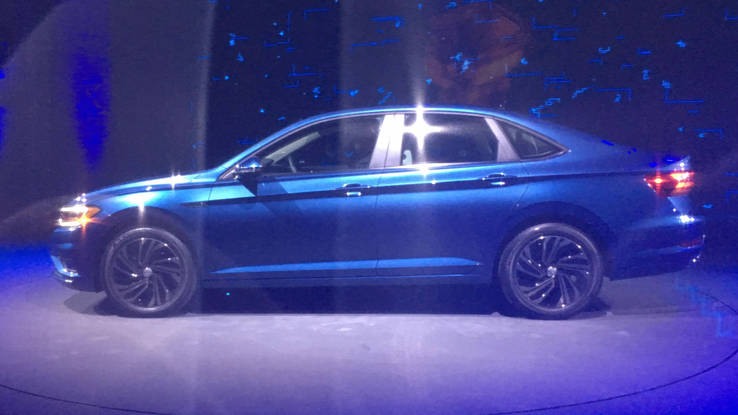
Volkswagen introduced the new, 2019 Jetta on Sunday ahead of the Detroit auto show. It will ride on the company’s modern MQB platform and keep the same 1.4-liter turbocharged four making 147 hp and 184 lb-ft of torque.

The 2019 VW Jetta is longer than the outgoing model by about an inch, with shorter overhangs, and wider and lower than the previous model. It also gets a redesigned front fascia with standard LED lighting. The roof slopes back faster giving it a more coupe-like profile.

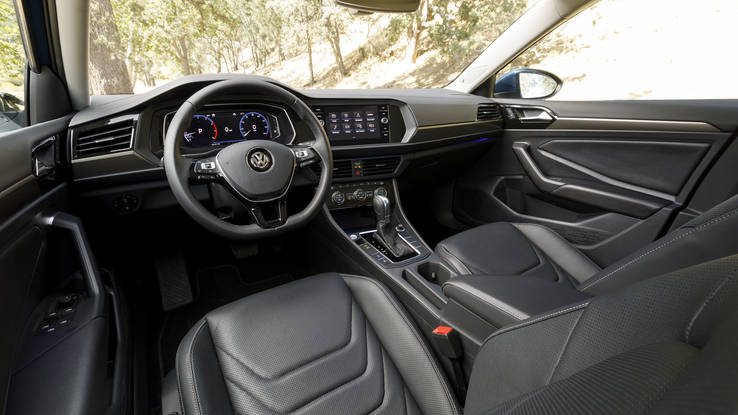
Inside, buyers will find soft-touch materials all around with new trapezoidal elements, new colors and designs along with optional 10-color wrap-around ambient lights. Heated and cooled front seats, power driver’s seat with memory functionality, leather and dual-zone climate control are optional. The new center storage console is large enough to fit a standard iPad, says VW.

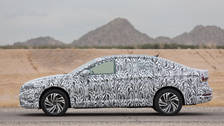
2019 VW Jetta first prototype test drive

More expensive versions (SEL and SEL Premium) come with VW’s new Digital Cockpit: a 12.3-inch customizable display featuring a high-resolution thin-film transistor (TFT) display with 1440 x 540-pixel resolution with ambient lighting, if equipped, radio presets and navigation. Apple CarPlay and Android Auto are standard.

A rearview camera comes standard while forward collision warning and autonomous emergency braking, blind spot monitor with rear traffic alert, adaptive cruise control, high beam control and lane departure warning are all optional.

As mentioned, it gets the same 4-cylinder engine as the outgoing model, now with either a six-speed manual or eight-speed automatic sending power forward.

An R-Line trim features sportier styling, exclusive interior and exterior design elements, R-Line badging, and the XDS electronic front differential.

The 2019 VW Jetta goes on sale in the second quarter of 2018.

2019 Volkswagen Jetta debuts at NAIAS

The 2019 Volkswagen Jetta comes standard with a rearview camera; adaptive cruise control as well as other active safety features, are optional.

Porsche charged with developing EV supercar platform for VW AG

2019 Volkswagen Jetta debuts before the Detroit auto show

The 2019 VW Jetta was revealed on Sunday night before the North American International Auto Show.

2019 Ford Mustang Bullitt rolls on stage before Detroit auto show

Share

  • Pinterest

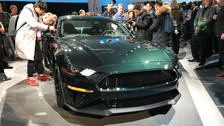
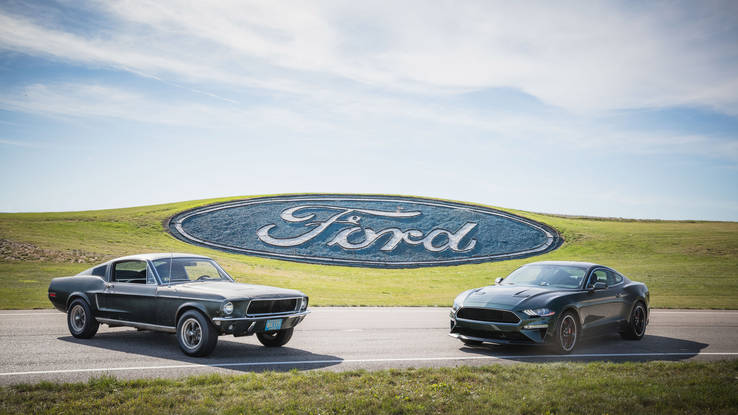
Ford let out the world’s worst-kept secret Sunday night, revealing the 2019 Mustang Bullitt before its debut at the Detroit auto show. It appeared on stage with a surviving dark Highland green 1968 Mustang GT fastback from the classic film starring Steve McQueen.

The new Mustang keeps the current 5.0-liter V8, but output is bumped to “at least 475 hp,” according to Ford, and 420 lb-ft. Top speed is raised to 163 mph, an 8-mph increase over the GT. As McQueen would have spec’d it, it’s only offered with a cue-ball shifter manual transmission.

The Bullitt packages all Mustang GT Premium and Performance Package options and comes standard with an active exhaust system and black exhaust tips. Additionally, the Bullitt steals the GT350’s intake manifold with bigger throttle bodies and the powertrain control module.

Other nods to McQueen’s movie ride include the chrome accents, torque thrust wheel and faux circular gas cap. The only other paint choice is shadow black.

2019 Ford Mustang Bullitt and 1968 Mustang GT fastback

Sean Kiernan, owner of the hero vehicle, inherited the car in 2014 from his late father, Robert, who had purchased the vehicle in 1974.

Inside, it gets leather seats and green accent stitching on the dash, door panels and center console. Only three factory-installed options are available: an electronics package with navigation, memory seats, upgraded sound, blind spot info and cross-traffic alert; the MagneRide adaptive dampers; Recaro leather seats.

Ford showed a couple of short films at the Cobo Center event. One featured a third-generation member of the McQueen family Molly jockeying for a parking spot against a Dodge Challenger; the other is about the original movie car, which went into a private collection after the movie came out but will be on display at the show.

The Mustang Bullitt goes on sale this summer.

Check out the videos below.

[embedded content]

[embedded content]

Welcome back, Ranger! 2019 Ford Ranger shows off ahead of its Detroit show debut

Share

  • Pinterest

The Detroit auto show will be packed with new pickups this year including the 2019 Chevrolet Silverado and the 2019 Ram 1500. Not to be upstaged, Ford is now officially back in the midsize truck game with the 2019 Ranger pickup. It will exclusively house a new version of the company’s 2.3-liter EcoBoost four, though we don’t know the output yet. For reference, the same engine makes 350 hp and 350 lb-ft in the Focus RS; we’d bet it won’t make that much here, but hey, think of the tuning potential!

Two and four-wheel drive versions of the returning Ranger will be available — a truck that, by the way, has been continuously sold outside of the U.S. since 1998—all with Ford’s new ten-speed automatic transmission developed with Chevy. Power goes through Dana Trac-Lok differentials on both two- and four-wheel drive models. An electronic locking rear differential is optional, standard on FX2 and FX4 models.

Ranger will arrive early next year in three trims: XL, XLT and Lariat. Chrome and sport appearance packages as well as FX off-road, SuperCab (rear half-doors) and SuperCrew (full four-door) configurations will all be available.

Like the F-150 Raptor, the Ranger gets Ford’s Terrain Management System featuring normal, grass, gravel and snow; mud and ruts; and sand modes. FX4 models add the new Trail Control feature that takes over the throttle and brakes, leaving the driver to steer through rugged terrain. It works from 1 to 20 mph.

2019 Ford Ranger at the Detroit auto show

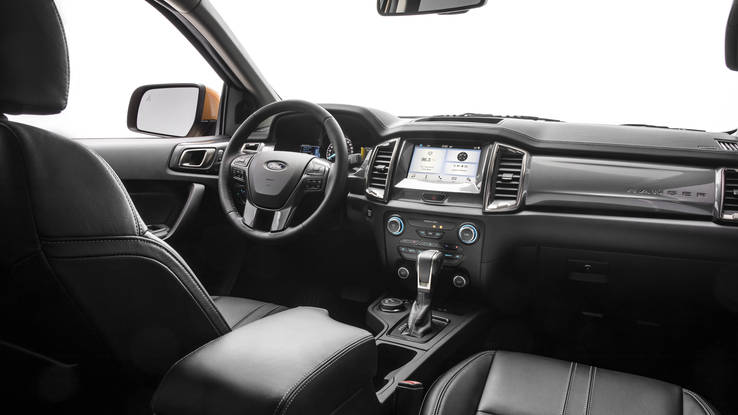
The 2019 Ford Ranger will come with Sync 3, Apple CarPlay and Android Auto as well as optional navigation and premium audio.

Ford didn’t reveal towing and payload numbers but said it’s targeting “best in class.”

The cabin and dashboard will look nothing like the Ranger you drove in high school. Buyers will see the Sync 3 infotainment system, LCD gauge cluster screens, Apple CarPlay and Android Auto, optional navigation, AC power outlets and USB outlets.

This pickup will also be safer than your old truck with standard emergency braking across the lineup and standard (on XLT and above) lane keeping, lane departure warning, reverse sensing system and blind-spot information. The top Lariat model adds pre-collision assist, pedestrian detection and adaptive cruise control.

The new Ford Ranger, ready to do battle with the Chevy Colorado, GMC Canyon, Toyota Tacoma and Nissan Frontier, goes on sale in the first quarter of 2019.

2019 Chevrolet Silverado: Meet Chevy’s redesigned full-size pickup

Share

  • Pinterest

Back in December at a Texas event celebrating Chevrolet’s 100 years of pickups, we got our first clear look at Chevy’s all-new Silverado. And it’s a major departure from the squared-off and safe design that has defined Chevy’s full-size pickups for decades.

The all-new Silverado, which will be offered in eight configurations, was shown in the new LT Trailboss trim which includes a 2-inch suspension lift and aggressive Goodyear Wrangler 275/65R18 tires. It looked tough to be sure. But what engines will the new Silverado use and what other models will be offered?

Tonight, at an event ahead of the 2018 Detroit auto show, Chevrolet gave us a closer look. The model line is comprehensive to put it mildly. Work Truck, Custom and LT occupy the bottom end of the equipment line. The RST is new and could be considered the sport truck trim. The LTZ and High Country, like today’s Silverado, represent the more luxurious end of the spectrum. The LT Trail Boss and lower priced Trail Boss Custom are the off-road models.

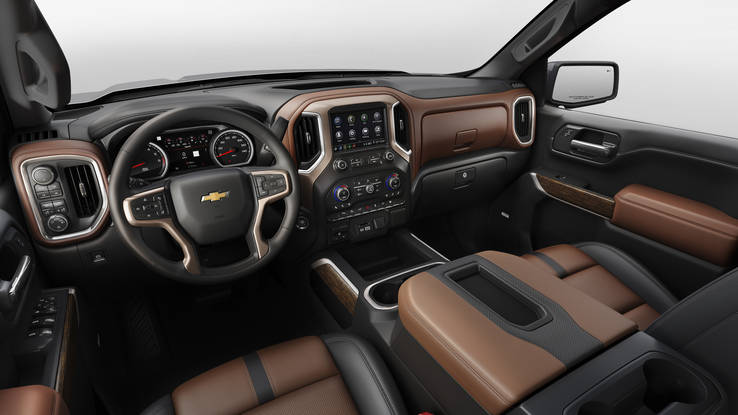
Silverado interior

2019 Chevy Silverado interior

GM is using a mixed material approach on the Silverado. The doors, tailgate and hood are aluminum, while the fixed panels are all steel. Eighty percent of the all-new fully boxed steel frame is made from high-strength steel. It’s also 88 pounds lighter than the old one and has 10 percent greater torsional rigidity. And despite a wheelbase up to 3.9-inches longer on some models, when you compare the old Crew Cab shortbox to the new 2019 Crew Cab shortbox, the new model is 450 pounds lighter. One thing that’s noticeable right away is that the huge rear doors on these new Crew Cab models will open to a ton of room in the back seat: Chevy confirmed rear-seat passengers will have 43.8-inches of legroom, up 3 inches over today’s truck. In fact, Chevy says the interior will be the roomiest of all full-size trucks. A power-operated tailgate will also be offered on some trim levels.

Under that aluminum hood are six powertrain combinations that include revised versions of the 5.3 and 6.2-liter V8s as well as a new 3.0-liter Duramax diesel I6. Both V8s will use a new technology called Dynamic Fuel Management which can shut down any number of cylinders between one and seven. The 6.2-liter and diesel come paired with the 10-speed automatic transmission that’s shared with Ford. Chevy didn’t mention any horsepower or torque figures but did hint that its diesel would not be overshadowed by any other light-duty diesel (like, say, Ford’s new Power Stroke V6) in terms of output.

The suspension at both ends of the Silverado has been redesigned with new forged upper control arms in the independent front suspension. Out back, there are new live axles and a revised leaf-spring suspension design. Some models receive a carbon composite second stage rear spring borrowing a little from the Corvette’s playbook. And those springs save 12 pounds per side.

The beds of the new Silverados are deeper and wider with 63 cu-ft of cargo volume, which Chevy says is about 20 percent better than the competition. They are also made from a higher-grade steel than before. The bed floor has been widened by seven inches and there are new lockable cargo boxes on some models. In other words, the beds are bigger, tougher and more useful. And to keep those heavy loads in place, there are now 12 tie downs.

There’s still more to learn about the all-new 2019 Silverado. But we know enough to know these trucks will provide some stiff competition for Ford and Ram, and it’s definitely time to stage our own battle of the light-duty diesels.

UPDATED: An original version of this story stated the new Duramax diesel was a V6; it’s an inline 6.

Autoweek Podcast Ep. 19: Graham buys a Packard and Robin reviews a Mercedes-AMG GT4

Share

  • Pinterest

On this episode of the Autoweek Podcast, host Rory Carroll talks with Jimmy Pelizzari, Graham Kozak and Robin Warner about the 2018 Dakar Rally and news from the Roar Before the 24 in Daytona. The gang discusses the history of the Dakar Rally and mentions that rally legend Sebastian Loeb still races this race. It should be noted this was recorded before Loeb crashed during the race.

For those unfamiliar, the Paris-Dakar Rally ran from 1978 to 2007 and was an extreme performance rally that covered treacherous terrain and extreme conditions in Africa. The race was moved to South America because of various problems with the route in Africa. The 2018 races started in Peru and will wrap in Argentina after two weeks of constant racing.

After the racing section, Jimmy leaves and Wesley fills his place to join the discussion about Graham’s adventure in Florida. Graham went to Kissimmee, Florida, to cover the Mecum auction. He made the grave financial decision to bid and wound up buying a 1948 Packard. Because he bought a car, Graham explains the ins and outs of purchasing a collector car at auction.  

After Graham’s adventure in auctions wraps, the group talks about what we expect from the Detroit auto show. Afterward, Robin closes the show with his story of driving a Mercedes-AMG GT4 race car. We also give a shout-out to a listener’s letter.

Listen below, or on iTunes, Stitcher or wherever you listen to podcasts. Make sure to leave feedback on iTunes.

Mercedes-Benz’s latest art project: a hybrid of Gelandewagen und resin

Share

  • Pinterest

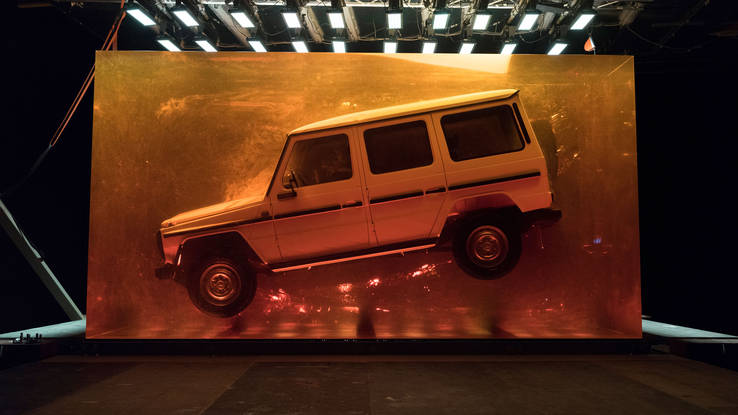
Some day, when all the cool cars are extinct, a mad scientist is going to come across this 1979 Mercedes-Benz G-Wagen encased in a perfect block of resin — 44.4 tons of the stuff, to be exact — extract its DNA and revive the long-dead Gelandewagen species, which should have no problem dominating the feeble autonomous pods that will populate the future’s roadways.

But until that day comes, maybe 10,000 years from now we hope, we’ll all be staring at this G-Wagen and wondering what the heck Benz was thinking. We know there’s a new take on the rugged SUV headed to the Detroit auto show this year, but this is a way of reminding everyone about what came before.

Of course, there’s the whole “Jurassic Park” preserved-in-amber angle at play here, which is really played up in this disorienting teaser video. That can’t be accidental.

G-Class resin sculpture work in progress

The G-Class Cube under construction.

Is it a waste of an early G-Wagen? We love the things here at Autoweek, and it’s always a shame to see a good vehicle rendered inoperable, but rare as these trucks are in the United States (and when they are spotted, they’re typically tarted up to Rodeo Drive-ready AMG spec) they’re workhorses overseas — and not exactly uncommon. We’d imagine this would be like turning a minty CJ7 into an objet d’art.

Which, upon further consideration, does seem like sort of a waste. Ah well.

1979 Mercedes-Benz G-Class cube side view

A 1979 Gelandewagen trapped in amber-like resin, forever. Tragedy, art or both?

That aside, creating this thing was a feat. It took, according to the automaker, 90 days to create the object (would calling it a sculpture be justified?), adding about 1.2 inches’ worth of pseudo-amber in vertical height each day. In its completed form, the whole thing is a little over 18 feet long, 8.4 feet wide and nearly 10.5 feet high.

In other words, it’s unmissable — which, no matter what you think of it, is exactly the point.
 

Graham Kozak

Graham Kozak – Graham Kozak drove a 1951 Packard 200 sedan in high school because he wanted something that would be easy to find in a parking lot. He thinks all the things they’re doing with fuel injection and seatbelts these days are pretty nifty too.
See more by this author»

Bentley Bentayga is finally getting that 550-hp V8

Share

  • Pinterest

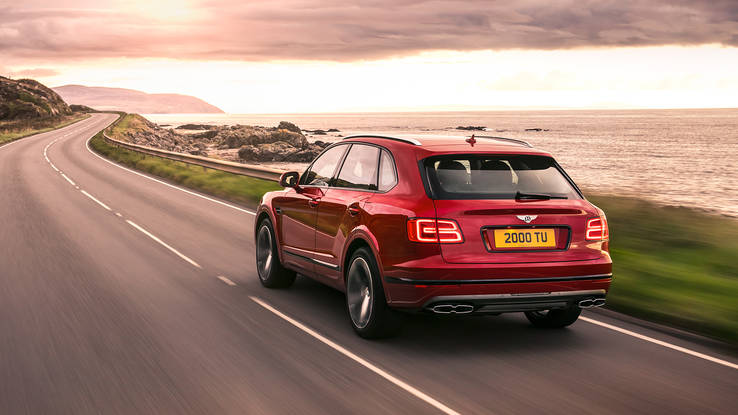
The Bentley Bentayga will gain a third engine in its lineup: a V8 is making its way across the greater Volkswagen Automotive Group empire. Set to debut at the Detroit auto show next week, the V8 Bentayga will be offered globally with a twin-turbocharged 4.0-liter V8 good for 550 hp and 568 lb-ft of torque that will occupy the middle rung in the powerplant lineup, above the diesel V8 but below the W12 gasoline version.

In comparison with the W12, output drops slightly, but most customers won’t notice; the W12 churns out 600 hp and 664 lb-ft of torque and will still be a little quicker from 0-60 mph, getting there in 4.0 seconds flat. Paired with an eight-speed automatic transmission, the Bentayga V8 will be able to propel itself from 0-60 in just 4.4 seconds and up to a top speed of 180 mph, so it’s not far off on paper.

The V8 model will be distinguished by a black and chrome grille, as well as figure-eight-shaped exhaust tips. This model will also offer optional carbon-ceramic brakes that the company calls “the largest and most powerful ever fitted to a Bentley, and the largest front brake system available on any production car.” The discs measure 17.3 inches up front and 14.5 inches in the rear, sitting inside 10-piston calipers, and this braking system can provide 4,425 lb-ft of maximum braking torque to all four wheels.

Speaking of wheels, the Bentayga will be available with a choice of 11 wheels designs (no, you can’t mix and match), including a new 22-inch design finished in black with a polished finish.

2018 Bentley Bentayga V8 rear

Several new trim options, as well as distinctive tail pipes, will set this Bentayga apart from the W12 model.

2018 Rolls-Royce Cullinan

Rolls-Royce Cullinan sneaks out in teaser images

The second age of the SUVs is upon us, and lest we forget that Rolls-Royce will debut a land crusher of their own, the Anglo-German automaker has released images of the upcoming Cullinan, its …

Inside, Bentley will offer high-gloss instead of matte carbon-fiber trim for the first time ever, perhaps reflecting modern tastes, but we wouldn’t bet on carbon fiber saving a lot of weight. New options for the interior will include a new three-spoke wood and leather-trimmed steering wheel, as well as chestnut-colored Cricket Ball leather.

Bentayga V8 models should get a drop in curb weight over the W12 model, allowing the Bentayga to dance a little easier in traffic. Don’t expect a significant change in handling characteristics, but it should still be noticeable. Similarly, the V8 model is expected to land a bit south of the $230,000 starting price of the W12 model.

U.S. pricing hasn’t been announced yet, but in the U.K. the Bentayga V8 will have a starting price of about $186,000. If this carries through to other markets, it shaves off almost $45,000 from the starting price of the W12 version (before options, which will probably add back $45,000). It’s not a lot in the world of new Bentley purchases, but it’s something.

Ford built a city at CES to prove a point

Share

  • Pinterest

Ford is looking into the distant future in an attempt to figure out how to stop traffic gridlock in cities. In a short time — within months maybe — Ford will announce a partnership with a small- to medium-size American city to test out the use of autonomous cars by small businesses and a sort of shared-ride communications system to augment public transportation.

“From subway systems and bus lines to taxi fleets, ride-hailing services and personal vehicles, cities offer lots of ways to get around. This abundance of choice must make life easier, right? Unfortunately, no,” Ford said in a statement. “And that’s because each mode of transportation has been optimized to work as well as it possibly can on its own, but getting them all to work together hasn’t been at the top of too many to-do lists. It would be, though, if more of us involved in the transportation system were focused on optimizing mobility for the people in our cities versus the technology itself.”

There are a few ways to do that.

Ford is working with a company called Autonomic to develop a way for transportation sources like buses, bicycles, self-driving cars and even stoplights to all speak to each other using a common language so they can work more efficiently together. Ford is also working with Qualcomm to create global adoption of C-V2X, or cellular vehicle-to-everything communication that will help share that information. And Ford will partner with delivery service specialists Postmates to get autonomous cars to act as delivery vehicles for businesses within the city, be they pizza parlors, flower shops or package delivery services. The idea is that businesses could thrive if they got together and shared autonomous cars to help them run.

More cool stuff from CESThe Nvidia Roborace car

To illustrate this transportation utopia, Ford built a small city of its own right there at CES, first as a two-dimensional background to Ford president and CEO Jim Hackett’s keynote address Tuesday morning, then as the actual city of the future at the Ford stand in the North Hall of CES. It was a nice little city, both the one on-screen behind Hackett and the one constructed in the Convention Center. Both were filled with happy people walking around, talking, making mobile phone calls, riding bikes and occasionally even driving cars, presumably Fords, though it was hard to tell.

“Transport systems in most major cities have reached capacity,” Hackett said in his address. “It’s time to bring our streets into the sharing economy.”

“The Living Street,” as Hackett called it, was a paradise of shared usage where pedestrians, bicycles and cars got along just fine and no one ever honked or got run over. Even the curbs changed as needed to help everyone and everything keep moving. Will it work? CES is a platform for sharing ideas. Why couldn’t shared streets be one of them? Check back with us in 100 years.

2018 Volkswagen Passat GT wants to be a GTI for grown-ups

Share

  • Pinterest

Volkswagen introduced the hopped-up Passat GT Friday before the Detroit auto show. The limited-run VW sedan gets more than 20 “sporty interior and exterior” enhancements, the most important of which is the company’s 3.6-liter V6 making 280 hp and 258 lb-ft of torque. It will be offered in four colors: pure white, reflex silver, platinum grey and deep black.

Like the Atlas SUV, the Passat GT was designed at VW’s Engineering and Planning Center in Chattanooga, Tennessee, and will be built at the factory.

The new GT comes with standard LED headlights and daytime running lights, VW’s nicer-looking R-Line bumper with a honeycomb grille, GT badge and a red accent line like the Golf GTI. In back, the GT gets a black spoiler, dark taillights and dual exhaust. It gets a lot of R-Line pieces, though it won’t replace the R-Line in the lineup, says VW.

Two-tone, 19-inch “Tornado” wheels and red brake calipers fill the wheel wells, and a sport suspension delivers a better stance.

2018 Volkswagen Atlas first drive review and road test

Inside, there’s a bunch of piano black and carbon-fiber accents, as well as black and gray seats with contrasting stitching. A leather-wrapped steering wheel, eight-way power driver’s seat, heated front seats, dual-zone climate control and heated side mirrors are standard. It also comes with VW’s Composition Media infotainment setup with a 6.3-inch screen, Apple CarPlay, Android Auto, two USB ports and satellite radio.

As for the VR6 engine, peak power comes at 6,200 rpm and peak torque comes at 2,500; a six-speed dual-clutch transmission with paddle shifters is standard. Mileage is rated at 19 city and 28 highway.

We first saw the Passat GT as a concept at the Los Angeles Auto Show in 2016 looking nearly production-ready, so this intro isn’t a surprise. The only thing that is a little surprising is that anyone is adding more sedan variations to the lineup, considering the way crossovers and SUVs are trending. But we’ll never complain about a little more sport in our sedans, and that VR6 engine has been a prime-time performer for years.

The Passat GT goes on sale in the second quarter of 2018 starting at $29,940 including destination. We’ll get a look in person at the Detroit auto show next week — and hopefully a drive in the next few months.

The Genovation GXE is an electric Corvette with 800 hp and a manual gearbox

Share

  • Pinterest

Are you a current or aspiring C7 Corvette Grand Sport owner who would really prefer that your car were electric but still had a manual transmission?

Of course not. But bear with us here …

Genovation is your Corvette augmentation destination, offering electrification and renovation for C7 Grand Sports by turning them into the GXE, which stands for Genovation Extreme Electric. And they’re showing it off at the Consumer Electronics Show.

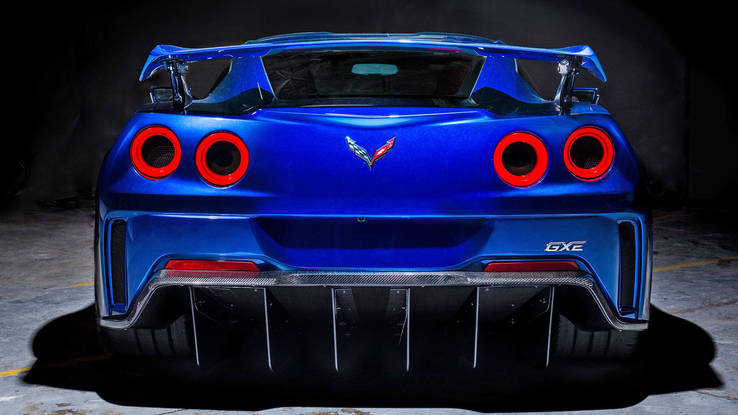
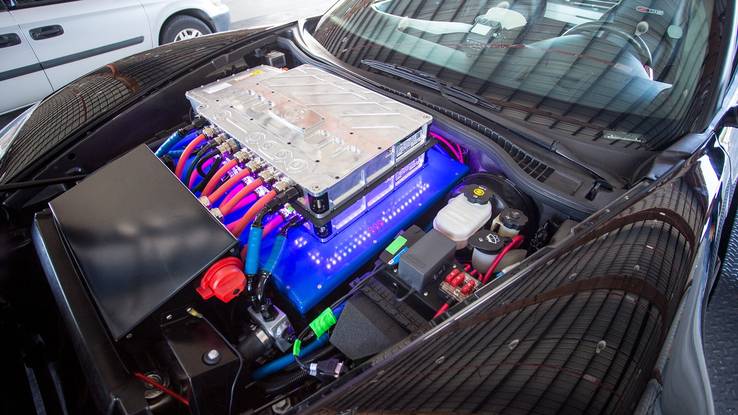
The Corvette Grand Sport trades its engine and transmission for two electric motors, front and back, that quietly pump out 800 hp at the wheels and 700 lb-ft of torque, drawing juice from a 61.6-kWh battery. The surprising bit is that, despite having two motors, the GXE keeps itself rear-wheel drive — the motors are connected to a common driveshaft that sends power to the rear wheels, reportedly providing perfect 50:50 weight distribution. On a full charge, the GXE is said to pack a range of 175 miles, but it’s unclear at what kind of speeds this range can be reliably achieved.

2018 Genovation GXE rear

Genovation plans to build just 75 of these. Photo by Genovation

2017 Chevy Corvette Grand Sport review A true happy medium

The GXE would be another glider-type conversion, akin to the first Tesla Roadster which used a Lotus body, were it not for the transmission options. The base GXE is offered with an automatic, as one would expect in an electric car. But there is also the option of a seven-speed manual transmission.

The car itself is not completely identical to Corvette Grand Sport on the outside, despite first impressions. There is a redesigned front bumper, and almost every interior surface has been trimmed with faux suede. Genovation also ditched GM’s stock magnetic ride control, replacing it with a third-party programmable suspension tuned to a variety of famous racetracks.

How much will all this goodness cost? Prepare to bring about $750,000, which is why the company plans to convert just 75 Grand Sports into GXEs.

2018 Genovation GXE motor

The two motors, fore and aft, produce a combined 800 hp at the wheels and 700 lb-ft of torque, according to the company.

Tesla Roadster sounds incredible but is itTesla Roadster

The bigger question here is whether there is anything beyond a 75-owner market for a soon-to-be-replaced Corvette Grand Sport that has been turned into an 800-hp electric car with a speed limit that cannot be exercised even at the tracks for which the car’s suspension can be tuned. The 3.0-second launches are certainly a good thing (not for the rear tires perhaps), but silent Corvette launches arguably defeat some of the purpose and appeal of Corvette launches in the first place.

The more important question, in our minds, is whether you want to be that guy or gal who tells people who ask why your Corvette is so quiet that it is in fact electric and that you paid $750,000 for it. You’ll need to be comfortable with answering the questions “What is it?” and “How much?” just about every time you go for a drive.

It’s not lost on Genovation that Tesla itself is planning a second-gen Roadster with 1.9-second launch times that will (hopefully) enter production in a couple of years at a price of $200,000. We just hope that, given the investment, the GXE’s battery packs will be upgradeable in the near future as battery technology surges ahead. 800 hp and a range of 175 miles aren’t going to remain impressive stats for much longer.

More crew-cab Silverado and Sierra pickups are on the way

Share

  • Pinterest

General Motors is increasing capacity to produce crew cab versions of its next-generation pickups, according to product boss Mark Reuss.

The automaker, according to Reuss, has been “constrained” when it comes to output of larger, four-door pickups that have significantly increased in popularity in recent years.

“We’re solving things like that,” Reuss, GM’s executive vice president in charge of global product development, purchasing and supply chain, said Tuesday during the J.P. Morgan Tech Forum at CES 2018 in Las Vegas.

A GM spokesman declined to elaborate on Reuss’ comments, which come days before GM is scheduled to unveil the fourth-generation Silverado, on Saturday in Detroit.

Crew cabs have grown from more than 50 percent of GM’s large truck sales in 2013 to more than 60 percent today, a Chevrolet spokesman said.

U.S. sales of the Silverado rose 1.9 percent to 585,864 last year while the large pickup market grew 5.6 percent.

GM produces the Chevy Silverado and GMC Sierra light-duty crew cab models at a plant in Silao, Mexico, while regular cab and double cab versions are produced in Fort Wayne, Ind. Heavy-duty crew cab models are built in Flint, Mich.

The company reportedly spent nearly $3 billion to retool plants to build the next-gen pickups, which Reuss said will be “more profitable” than the current-generation trucks. He added that the company had a “laser focus” on customer needs when developing the next-gen trucks.

Chevrolet introduced the 2019 Silverado LT Trailboss, one of eight 2019 Silverado models planned, at the Texas Motor Speedway last month before hundreds of truck owners as part of celebrations to mark 100 years of truck output.

GM is adopting more lightweight materials and is expected to add a 10-speed automatic transmission and enhance aerodynamics to improve the fuel economy and overall competitiveness of the pickup.

GM to hike output of large crew cab trucks with redesigned 2019s” originally appeared in Automotive News on 1/9/2018

By Michael Wayland at Automotive News

Your electric pickup is here: The Workhorse W-15 lands in 2019

Share

  • Pinterest

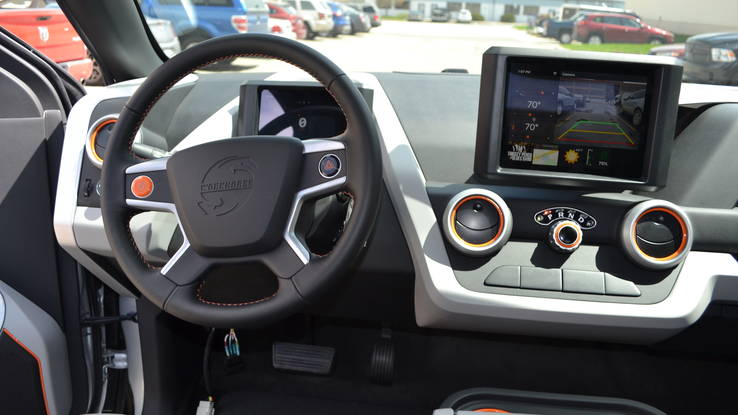
A company called Workhorse showed off its new electric pickup called W-15 at the Consumer Electronics Show. It can do 80 miles on electricity and comes with a BMW-sourced, 1.5-liter gasoline generator to power it for another 310 miles of range.

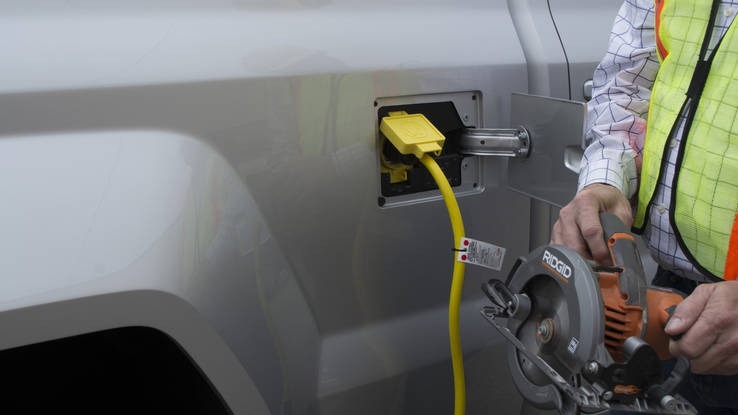
As for truck things like payload and towing, it’ll haul 2,200 pounds and pull 5,000 pounds, and it also comes with a 7.2-kW power exporter that can run your average 110-volt saws, drills and other power tools. Total system output is 460 hp, good for a 5.5-second sprint to 60 mph. The batteries are from Panasonic.

Workhorse W-15 interior

Standard but Spartan.

The body is based on the Chevy Silverado, but the chassis was built by Workhorse with lightweight composite materials. Workhorse also claims the W-15 will have “state of the art collision avoidance” and “autonomous controls.”

The company is building a fleet order of 5,300 trucks by the end of 2018; consumer orders start the following year. The current MSRP is $52,000, before local and federal tax credits.

Workhorse W-15 power exporter

The 7.2-kW power exporter will run power tools without the engine running.

2019 Honda Insight hybrid is back to battle the Prius, and this time it’s a sedan

Share

  • Pinterest

The Honda Insight is back for a third generation, after being on hiatus since 2014. An all-new Insight will debut at the Detroit auto show, and it will be very different from the first two.

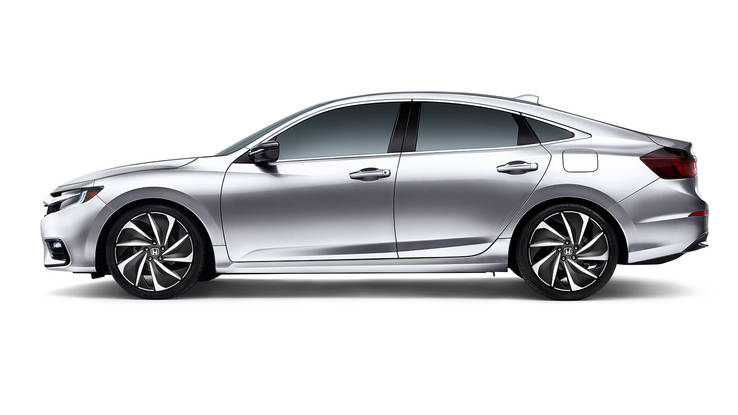
How different? Let’s back up a little first. The first-gen model was a very small and very aerodynamic hatchback that debuted in the year 2000, when gasoline was not particularly expensive. It was very much a two-seat car and it featured tapered rear wheel arches. The second-gen Insight that debuted in 2009 was a five-passenger hatchback with a raised, elongated tail that made it hard to distinguish from the Toyota Prius. The all-new third-gen Insight that will debut in prototype form in a matter of days will ditch the Prius look entirely, instead offering the shape and packaging of a four-door sedan with a premium look and feel. It appears Honda has decided the best hybrid is one that doesn’t look like a traditional, wedge-shaped hybrid with slabby sides.

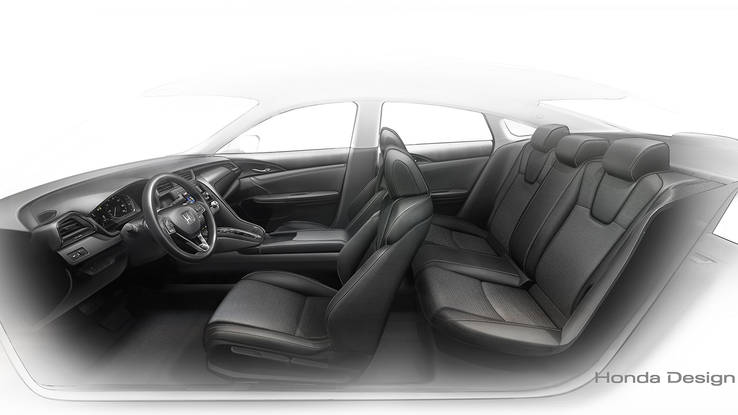
What the all-new Insight will offer is fuel economy north of 50 mpg, Honda Civic and Accord looks, and the versatility of a four-door sedan. In fact, Honda says that the Insight will be positioned above the Civic as a “premium compact,” offering a roomy interior and civilized road manners. A long wheelbase ensures rear seat passengers aren’t short on space, and available perforated leather seating will guarantee that the Insight does not feel like a gas miser of yesteryear.

2019 Honda Insight hybrid sedan side

The new Insight will take a shape of a sedan, positioned above the Civic and just below the Accord.

2018 Honda Accord 2.0T review and test drive

The Insight will be powered by a 1.5-liter Atkinson cycle engine in addition to an electric motor paired with a lithium-ion battery. Honda says that in most driving conditions the Insight will operate using its electric motor, using the 1.5-liter engine as a generator or drawing juice from the battery. That battery, by the way, will be located under the rear seats and won’t rob the Insight of the ability to fold the rear seatbacks for longer cargo.

“The new 2019 Honda Insight signals we are entering a new era of electrification with a new generation of Honda products that offer customers the benefits of advanced powertrain technology without the traditional trade-offs in design, premium features or packaging,” said Henio Arcangeli, Jr., senior vice president of Automobile Sales and general manager of the Honda Division, American Honda Motor Co., Inc. “The Honda Insight is anticipated to receive fuel economy ratings competitive with the best hybrids in the segment, with styling that will have universal appeal inside and out and best-in-class passenger volume.”

2019 Honda Insight prototype interior

Honda promises class-leading interior room, as well as available perforated leather seating.

2017 Hyundai Ioniq Hybrid Limited review

When it comes to interior tech the new Insight will have an 8-inch infotainment touchscreen, Apple CarPlay and Android Auto connectivity, and a 7-inch LCD instrument cluster display for the driver. The new hybrid will also feature Wi-fi-enabled over-the-air software updates, as well as a full suite of Honda driver safety tech including a collision mitigation braking system, adaptive cruise control with low-speed follow ability (for traffic jams), road departure mitigation, lane departure warning and recently-developed traffic sign recognition.

Honda is keeping other details and performance specs under wraps for now, but we’ll get them all in a matter of days when the Insight debuts in Detroit early next week.

The all-new Insight will go on sale later in 2018. Pricing details and trim specifics will be announced closer to launch.