All posts in “McLaren”

VIDEO: McLaren Senna Driven

The McLaren Senna, Woking’s new Ultimate Series model, packs a 789bhp punch and weighs considerably less than the mighty P1 and 720S. Matt Prior talks you around the limited edition hypercar, as he drives a prototype around the international circuit at Silverstone.

[embedded content]

Beijing 2018: McLaren Special Operations 570GT Cabbeen Collection

Whilst other manufacturers are building bespoke vehicles for the Chinese market, McLaren are sticking to their ethos of building performance oriented supercars that are designed to thrill.

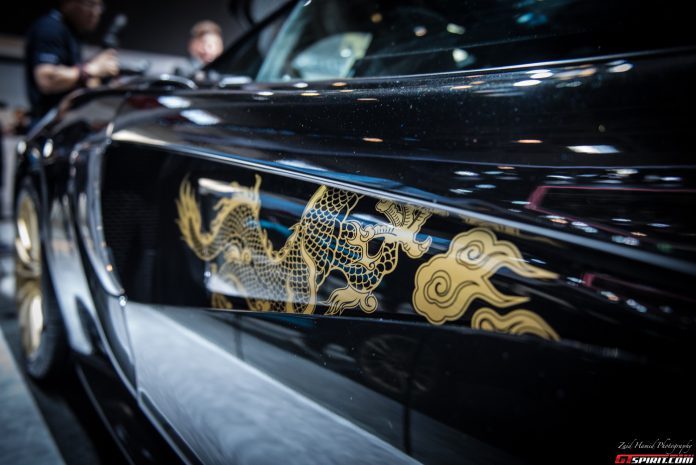
However, for the first time ever the British manufacturer has teamed up with a Chinese designer to design five McLaren Special Operations 570GTs. The McLaren 570GT Cabbeen Collection is finished in MSO Obsidian Black, and features incredible golden hand painted dragon door inserts.

Accompanying the golden dragons are set of 15-Spoke GT wheels and brake callipers completed in bespoke Speedline Gold.

The Cabbeen magic had been applied to the interior in a similar fashion with a stunning and painstakingly intricate dragon adorning the rear luggage deck sewn by Kang Huifang, a preserver of Chao Embroidery. Above the centre console is another golden dragon. Unsurprisingly, McLaren expects the limited run car to sell out at the show.

McLaren EV supercar: Here’s the math that says it’s 5-10 years off

It emerged last December that McLaren had built an all-electric testbed for a future EV supercar, to go along with the English automaker’s $1.4 billion investment in electrified powertrains. But as we told you a few weeks ago, McLaren CEO Mike Flewitt said that such a car was, as a practical matter, years away from production. Now COO Jens Ludmann has put some numbers to the carmaker’s quest, saying, “[The] Senna has 800 PS [Pferdestärke] on 1,200 kg, that’s about the power to weight that we’re looking for.” He’s talking about 789 horsepower in a package lighter than a base Honda Civic Coupe.

The issue isn’t energy capacity, it’s energy density. Said Ludmann, “[The] battery technology should achieve 500 watt-hours per kilogram. That is a level where it really makes sense. Today we are around 180 watt-hours per kilogram.” McLaren Engineering provides batteries for Formula E rated at 216 Wh/kg, but those packs aren’t suitable for a consumer road car. According to what the company’s learned from the battery industry, we’re 5 to 10 years away from 500 watt-hours per kilogram for a roadworthy vehicle.

In 2015 Rimac unveiled a battery it made for the Koenigsegg Regera. Said to be the most energy-dense car battery at the time, it boasted a power-to-weigh ratio of 60 Wh/kg. Figure that the battery industry’s adding 40 Wh/kg per year — which gets us from 2015 to Ludmann’s 180 Wh/kg current state of affairs. Using that measure, we’re 8-10 years away from 500 Wh.

McLaren wants its theoretical EV owner to be able to do 30 minutes or 10 hard laps at the track, be “as exciting as a 675LT,” and recharge in 30 minutes for another half-hour track session. That battery would need exceptionally high energy density, and the cells and electronics would need to stand up to constant high power output and extreme discharge cycles. To enable that with today’s battery tech, you’d end up with a vehicle that could do 500 miles in everyday road use, be far too heavy for McLaren’s aims, and take far too long to charge.

Ludmann told Wheels magazine everything else about the EV supercar is “all resolved — easy.” While we dig in for what could be a lengthy wait, we’ll have to be satisfied with the McLaren hybrids that should start showing up in a couple of years.

Related Video:

McLaren granted trademark for ‘McLaren GT,’ but is even a car?

Last year McLaren Automotive Limited applied to trademark the name “McLaren GT” in the U.S. and the UK. Last week the U.S. Patent and Trademark Office granted the request. It’s tempting to wonder if we’re looking at the name of the new McLaren monster car, the three-seat road-going Ultimate Series offering so far known as BP23. McLaren has, after all, called the coupe a “Hyper-GT” in an official press release.

There are two hitches to making that connection, though. The first and weakest hitch is that last month, Autocar reported that McLaren CEO Mike Flewitt said he wanted proper names for the company’s Ultimate Series cars, “rather than an alphanumeric designation.” The Senna was the first under that regime. Yes, we could consider “GT” a name, and there are no numbers involved. Yet that would be a pretty bland follow-up to the Senna, especially a follow-up that’s meant to be the new capstone on what McLaren can do, faster than the 243-mile-per-hour F1 and more powerful than the P1.

The second, more compelling hitch comes in the line describing what the trademark is for: “Retail store services featuring motor land vehicles.” That pinpoints a different use than a road car trademark. McLaren’s P1, 650S, 12C Spider, Spider, and Longtail trademark applications are all for “Motor land vehicles, namely, automobiles, and structural parts therefor.” McLaren GT, on the other hand, appears to be some kind of storefront that will sell those cars. The trademark for “Jaguar Racing” is also for stores selling cars, among other things, and the trademark for McLaren Qualified applies to “Retail store services featuring pre-owned vehicles.” Perhaps this is part of a future dealer initiative or rebranding effort. Or maybe it’s nothing, you know how trademarks go.

Does this mean the new hypercar won’t be called “McLaren GT?” No. But we’ll need more clues and a stronger case to make the call either way.

£1.6 Million McLaren ‘Hyper-GT’ to Exceed McLaren F1 243mph Top Speed

During the Geneva Motor Show 2018, McLaren shared a few details about another of its upcoming hypercar. The new ‘HyperGT’ is no surprise, codenamed BP23, McLaren have been very open about the fact that they are developing it.

The news released at the Geneva Motor Show was that BP23 will be capable of reaching speeds in excess of the legendary McLaren F1’s top speed of 243 mph (391 km/h). We suspect that it might be even faster, although by how much is still McLaren’s secret!

McLaren have revealed that it will produce just 106. An identical number to the number of McLaren F1’s it sold during that car’s limited production run. The cost for each one will start at £1.6 million plus taxes and, unsurprisingly, McLarne have sold the entire production run already.

McLaren Automotive CEO, Mike Flewitt, also announced during the Geneva Motor Show press conference that a public reveal of the car can be expected this year.

For those that haven’t followed the steady stream of news coming from McLaren, the next McLaren Ultimate Series car is set to see the return of the three-seat cockpit design with a central driving position. It will get a high-tech petrol-electric hybrid powertrain, with a blend of extreme performance and exceptional luxury.

Production is due to begin at the end of next year. Every BP23 will be personalised to the owner’s taste by McLaren Special Operations (MSO). BP23 won’t be the final name of the vehicle. McLaren are keeping that information top secret until closer to the big reveal. We can’t wait!

McLaren Senna GTR Concept

A big reveal during Geneva Motor Show was the track-focused update to the McLaren hypercar, the Senna. Revealed online last year, the Senna is anticipated to be McLaren’s most compelling model produced since the original McLaren F1.

Senna GTR Back

Senna GTR Back

The technical specifications speak for themselves and are able to justify the million-dollar price tag. Firstly, the Senna is powered by a 4.0-liter V-8 engine, producing 789 brake horsepower, enclosed in a carbon fiber tub with an overall curb weight of slightly over 2,400 lbs. The twin-turbo engine can launch the Senna from 0–62 mph (0–100 km/h) in 2.8 seconds. Now imagine all of that, but exponentially faster, with a retuned transmission, suspension tweaks, fancy decals, big wing, and slick tyres.

The track-ready Senna GTR still needs a power boost (ha). I mean, it will still have the same four-liter engine with two blowers for boost. The folks in Woking, however, have not decided how much more power the GTR will need but it’ll definitely be no slouch.

Pirelli Tyres

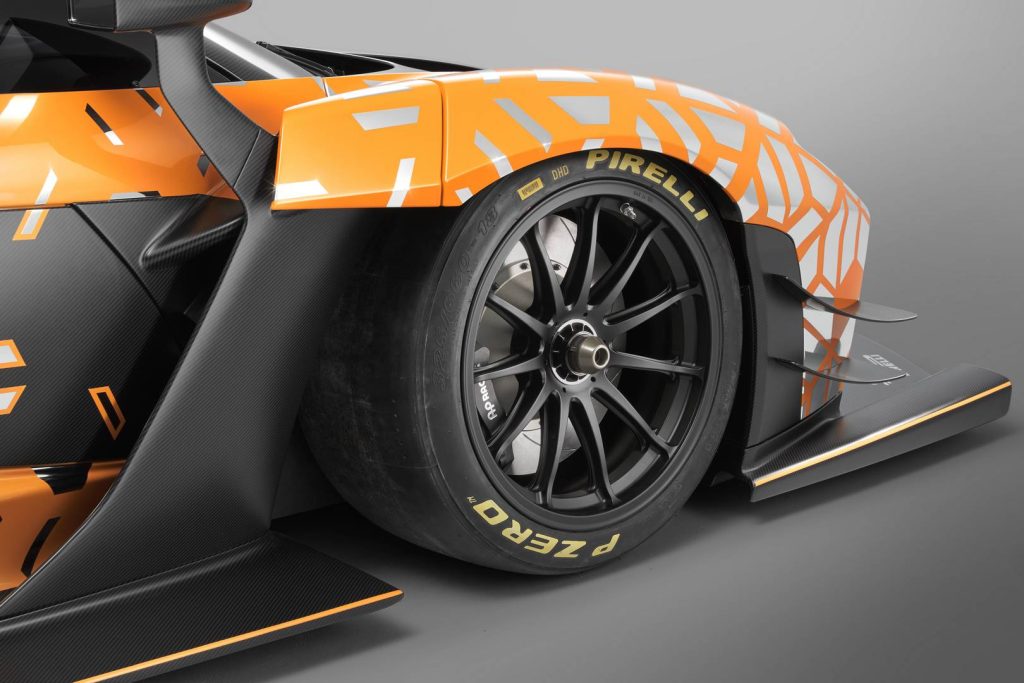
Pirelli Tyres

The main focus of the Senna is a high power-to-weight ratio. If you can’t add more power, lose more weight and the latter is what McLaren did. Focusing on technological advances, McLaren heavily invested in carbon fiber technology, and how to save every gram of excess weight. The aerodynamics are improved with the wing generating downforce of 1,000kg. That’s the equivalent of an American bison sitting on top of the car, keeping the Senna GTR planted.

No official data has been released yet but will be an exciting addition to an already beastly hypercar.

McLaren’s electric supercars are not quite there yet

While Rimac is all about electric supercars and has just revealed its outrageous-sounding 1,914-horsepower C_Two car at the Geneva Motor Show, McLaren is cautious about producing an EV quite yet. Hybrids are far more suitable for McLaren’s immediate need than launching a full electric vehicle, says McLaren CEO Mike Flewitt.

In an interview with Autocar, Flewitt says McLaren’s electric portfolio is still very much in development, and that one in two McLarens sold in 2022 is to be a hybrid. But it wouldn’t be right for the brand to launch a half-baked, full-electric supercar, and McLaren’s standard is that any EV would have to offer performance equal to its existing cars. “It’s a challenge for us to produce the same engagement as with the P1, the Senna and the 675 LT,” says Flewitt.

Earlier, he has stated that for an electric supercar to match the P1’s performance, it would have to weigh two tons.

EV development, however, is still on track, and McLaren has “an electric mule running around.” For the company, getting the desired electric performance in a production-viable package is still at least five years away, Flewitt says. “It’s not in [the Track22 plan] because we don’t have an answer yet.”

McLaren is a lot more positive about hybrids. Flewitt says hybrid tech is a lot easier to integrate into a powertrain design, making it integral instead of bolt-on. As he said a month ago: “Hybrid design is part of the next platform. It is designed-in from day one rather than having to adapt an existing chassis.”

Related Video:

McLaren Senna GTR Concept gets racy in Geneva

The McLaren Senna GTR Concept storms its way into the Geneva Motor Show with one very bold claim attached to it: Outside of the British company’s Formula One cars, this $1.4-million-dollar supercar is the fastest way around a racetrack in a car with the McLaren badge on it. This is especially big news from a manufacturer that targets the likes of Ferrari, Lamborghini, Bentley, and Bugatti; not to mention that McLaren already has legendary exotic cars like the F1 and P1 on its automotive resume.

Based on the recently introduced Senna road car, the Senna GTR delivers more horsepower, more aerodynamic grip, and even more exclusivity. McLaren has promised that the 4.0-liter twin-turbo V8 will produce a minimum of 813 horsepower in the Senna GTR, versus the 789 hp found in the road-going variant.

The enormous rear diffuser, towering spoiler, and snow-plow-like front splitter aren’t just there for show, either. The highly sculpted carbon fiber bodywork delivers upward of 2,200 pounds of downforce at speed. Much of the body is fitted with quick-release catches, making it easier to replace fenders and other exterior pieces during the heat of competition. The Senna GTR also rides on a special set of lightweight, 11-spoke alloy wheels.

Combined with a revised double wishbone suspension, Pirelli racing slick tires, and a race-style transmission, the Senna GTR will “post the quickest McLaren circuit lap times outside Formula 1,” according to McLaren’s press release. That headline-grabbing claim probably won’t stand for much longer, however.

It’s an open secret that McLaren is hard at work on road and race versions of the cryptically-named BP23, the firm’s “hyper-GT” that pays homage to the original F1 supercar, produced from 1992-1998.

“The track-only McLaren Senna GTR will have more power, more grip and more downforce – up to 1,000 kilograms – than the McLaren Senna and post even faster lap times,” said Mike Flewitt, McLaren Automotive CEO. “The very limited number of customers who secure this car will be buying the closest experience you can get to a race car without actually lining up on a circuit grid.”

Interestingly, about the only thing this race-focused McLaren doesn’t offer is the means to drive it on public roads – this is a track-only speed machine. Then again, if you can afford the roughly $1.4-million price and manage to snag one of the 75 scheduled to be built, commissioning the build of your own private racetrack probably isn’t out of the question.

McLaren will reveal exact technical specifications of the Senna GTR at a later date, though the automaker revealed its taking “expressions of interest” during the Geneva Motor Show. McLaren, consider us interested!

Related Video:

Form Follows Function: the McLaren Senna

McLaren has announced the official performance figures for its Senna Hypercar and they just might offer a helping hand to people who were struggling to see past those polarising looks.

The Senna is the latest vehicle in McLaren’s Ultimate Series, the second vehicle in the series after the ballistic P1. The British luxury sports car manufacturer revealed its performance stats ahead of the car’s public debut, which is due to take part on March 6 at the 88th Geneva International Motor Show.

Performance without compromise

From earlier information, we know that a 4-litre twin-turbocharged V8 engine will power the Senna, producing 789bhp and 590 lb ft of torque – McLaren’s most powerful internal combustion engine fitted to a road car. While those power figures are actually less than the previous Ultimate Series car, the plug-in hybrid McLaren P1, that’s no reason for concern.

Thanks to its teeny 1197kg weight, the Senna will reach 62mph from a standstill in 2.8 seconds according to McLaren, with 124mph coming up just 4 seconds later. It will cover the standing quarter mile in 9.9 seconds, and top speed is 211mph. By comparison, the P1 weighed 1547kg, though it had a hefty electric motor and batteries to lug around.


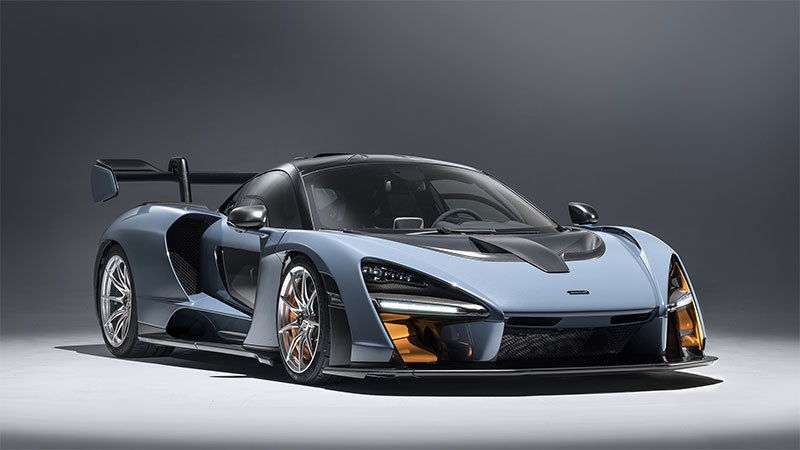
The McLaren Senna, in Victory Grey. All 500 examples of the British luxury sports car manufacturer's latest Ultimate Series vehicle have been assigned to their owners.

The McLaren Senna, in Victory Grey. All 500 examples of the British luxury sports car manufacturer's latest Ultimate Series vehicle have been assigned to their owners.

McLaren’s true focus with the Senna is on bestowing it with razor-sharp handling and, as well as the aforementioned lightness, those looks that caused such a stir when it was unveiled last year are all a part of this.

Built around a carbon fibre monocoque, which McLaren says can trace its roots back to the 1981 McLaren MP4/1 Formula 1 car, all of the shapes and wings on the Senna contribute to downforce of up to 1763.7lbs on-circuit, with the aim of delivering a pure connection between the car and driver.

A huge amount of effort has been put into ensuring the Senna’s aero all works together to provide downforce and sufficient cooling. The rear of the car’s distinctive slashes and diffuser may look somewhat jutting at first glance, but every single part of the design is there to do a job.
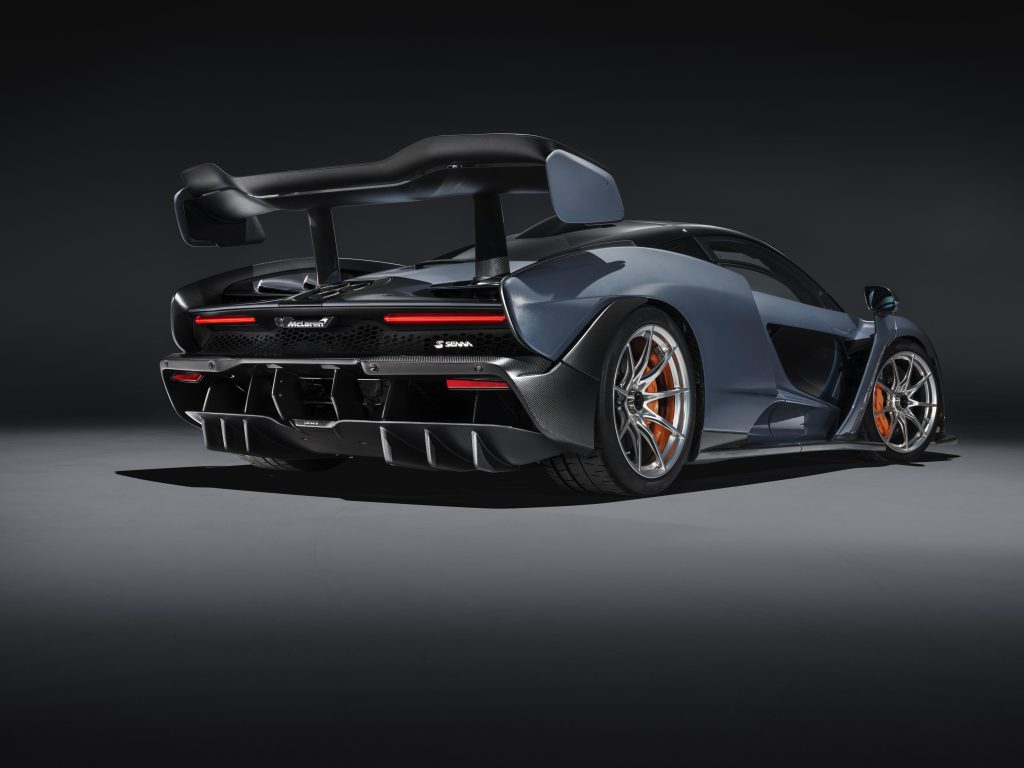
The McLaren Senna, in Victory Grey. All 500 examples of the British luxury sports car manufacturer's latest Ultimate Series vehicle have been assigned to their owners.

The McLaren Senna, in Victory Grey. All 500 examples of the British luxury sports car manufacturer's latest Ultimate Series vehicle have been assigned to their owners.

McLaren says it is impossible to follow a single body line from the front to rear of the car without it passing a functional intake or vent.

On sale and on the road

While the Senna has been designed to provide the ultimate sensation for the driver on track, McLaren say that it has kept the car road-legal. Another figure recently released was the price – $958,966 US.

All 500 examples of the Senna have already been assigned to buyers, with the final model having been auctioned off at a private McLaren customer event for £2 million. Proceeds from that sale went to the Ayrton Senna Institute – a non-profit set up in the name of this car’s namesake that provides education for unpriveleged children and youngsters in the F1 legend’s native Brazil.

Do you think the McLaren Senna will live up to its namesake? Let us know!

Future McLaren cars will be hybrids and autonomous

You may want to look away supercar purists, McLaren views its future as partially electrified and autonomous. Autocarreported today that McLaren’s CEO Mike Flewitt wants to bring in hybrid technology for next-generation McLaren sports cars, with the electrified tech baked in from the beginning rather than adding it on after the fact.

“Hybrid design is part of the next platform,” Flewitt said. “It is designed-in from day one rather than having to adapt an existing chassis.”

The British manufacturer would even offer hybrid-only models in most product lines, rendering conventional, non-hybird McLarens as limited editions only. The powertrain in the strongest-selling hybrid cars would feature a turbo V6, reports Autocar. The upcoming BP23 hypercar will already have an electric motor and a battery pack backing up its 4.0-liter twin-turbo V8.

Flewitt also confirms that future McLaren cars will have autonomous capabilities, which is certainly an interesting move by a driver-centric specialty car manufacturer. Flewitt acknowledged this, but noted that “Autonomy in its own right isn’t that appealing to our customers, but we need to have capabilities designed in for safety, legislation and emissions.”

The first model to be replaced with a hybrid successor would be the entry-level 570S, reportedly by next year. The electrification would then continue until the 2022 replacement of the 720S.

Related Video:

Last of 500 allocated McLaren Sennas sells at auction

If you held any hope of obtaining the last available McLaren Senna, abandon it now: The last of the 500 build allocations has sold at a private auction for McLaren customers. It raised £2 million ($2.67 million) for the Ayrton Senna Institute, the nonprofit non-government organization named for the late three-time Formula One world champion.

The company announced the sale three days after the supercar’s official unveiling and four days after it was leaked during an early reveal party. Excluding taxes, the winning bid from an anonymous buyer was more than three times the U.K. list price for the car.

Originally dubbed the P15, McLaren says the Senna is the “most extreme” road car it has ever created, with a 4.0-liter twin-turbo V8 generating 789 horsepower and 590 pound-feet of torque. It’s also the lightest, at 2,641 pounds. It boasts a RCC II RaceActive Chassis Control hydraulic suspension and unique features like a Jetsons-esque glass greenhouse and glass panels in the doors.

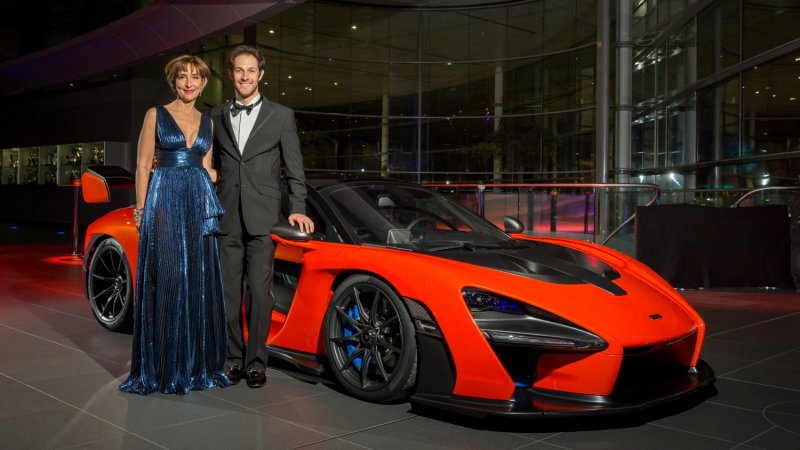
Ayrton Senna won three F1 world championships driving for McLaren. The auction for McLaren customers was attended by his sister, Viviane Senna da Silva Lalli, and Bruno Senna, her son, also a race driver and McLaren ambassador.

The Ayrton Senna Institute provides education to underprivileged children in Brazil.

Related Video:

McLaren unfurls bespoke black-and-gold inscribed 720S for Dubai

Here’s a unique regional spin on a supercar: It’s a bespoke McLaren 720S designed by McLaren Special Operations done in Zenith Black paint with satin finish and gold accents, including an inspirational quote from the company’s founder on the rear wing done in Arabic lettering stylized to echo the Dubai skyline. It’s showing at the Dubai International Motor Show, after which the unnamed new owner will take delivery.

McLaren says achievement was a key theme behind the commission, both for the British luxury carmaker itself and the United Arab Emirates and Gulf states themselves, which form a key client and shareholder base for the company. The quote on the rear wing reads “Life is measured in achievement, not in years alone,” part of a longer quote from Bruce McLaren’s 1964 memoir “From the Cockpit.” A plaque inside the car identifies it as a “1 of 1” MSO commission.

Offsetting the satin black finish are gold accents, such as gold-colored alloy wheels, a 24-carat (!) gold engine heat shield and gold-colored interior components. Also added were carbon fiber exterior packs encompassing the front splitter and air intakes, rear bumper and roof panel. Inside, the trim is a mix of black leather and black Alcantara complemented by MSO Defined carbon fiber sill panels, fascia vents and steering wheel, plus a regular carbon fiber interior upgrade pack. The gearshift paddles are satin gold-painted, and each door inner panel gets a satin gold-colored appliqué.

The car is equipped with the 720S’s standard 4.0-liter twin-turbo V8 that goes 0-124 mph in 7.8 seconds and boasts a top speed of 212 mph.

McLaren says the personalization added more than 120 hours to the production process, including 30 hours alone to complete the rear wing stencil graphic.

McLaren Ultimate Vision GT | 1,134-hp hybrid with a crazy driving position

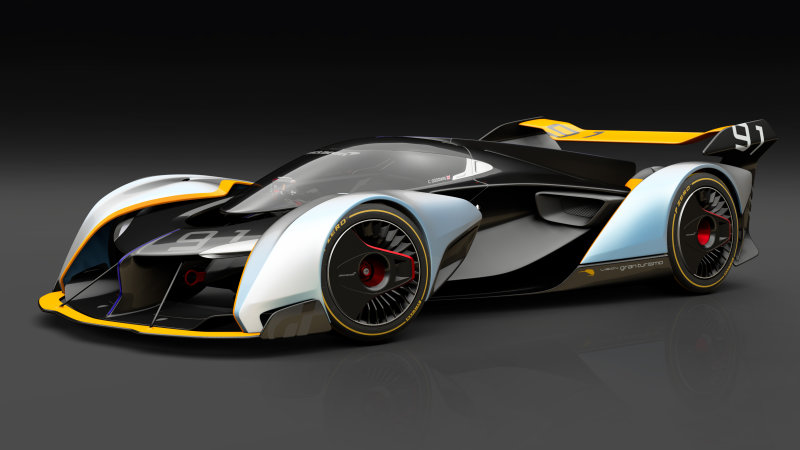
As with Gran Turismo 6, Gran Turismo Sport will feature special Vision GT cars, which are concepts designed by real car manufacturers for use in the video-game series. These cars imagine what a company might produce far into the future, as far as 2030 or later in the case of the car McLaren has just revealed as its contribution. It’s called the McLaren Ultimate Vision Gran Turismo, and it’s a thoroughly wild hybrid.

Starting with performance, the McLaren retains a certain amount of gasoline propulsion thanks to a twin-turbocharged 4.0-liter V8. This engine powers the rear wheels, while the fronts are powered by individual electric motors. The combined output is 1,134 horsepower and 940 pound-feet of torque. While there are some hypercars with greater output right now, those numbers become more impressive when you realize this virtual McLaren weighs a little more than 2,200 pounds, less than a current Mazda Miata. The light weight should also make the inboard carbon ceramic brakes highly effective, too.

The light weight comes from a body and chassis created using a considerable amount of carbon fiber. That body has unique active aerodynamics that rely on opening and closing holes near air inlets to adjust drag and downforce. According to McLaren, this method is simpler and lighter than mechanical flaps for the same purpose.

Aside from the remarkable performance numbers, the McLaren Ultimate Vision Gran Turismo also has a remarkable cockpit. It has a large glass area for good visibility, but the party piece is the prone seating position that McLaren calls “motorcycle-like.” It probably is a cool way to drive, though we do wonder how comfortable that position would be for a length of time. Interestingly, the McLaren isn’t the first to imagine a Vision GT car with this sort of seating. The Chevrolet Chaparral 2X Vision Gran Turismo did something similar. Much more of that car was outlandish though, since it was supposedly propelled by lasers. No, really, lasers. That’s what Chevy said.

Don’t expect to see the McLaren Ultimate Vision Gran Turismo on the road anytime soon, but you can get behind the wheel virtually very soon. It will be featured in Gran Turismo Sport for PlayStation 4, which goes on sale October 17. The car will also join another special sports car, the Fittipaldi EF7, designed by Pininfarina and racing legend Emerson Fittipaldi.

Related Video:

McLaren said to be developing an all-electric hypercar

British supercar maker McLaren plans to produce an all-electric version of its Ultimate Series hypercars, the automotive website Autocar reports.

The new, unnamed vehicle is reportedly not the same as the previously rumored P15, a lightweight Ultimate Series car we learned more about just last month. The EV is set to arrive sometime after the release of both the P15, which comes later this year, and the release of the BP23 hybrid in 2019. The latter is a replacement for the three-seater F1.

Autocar reports that the automaker plans to produce five models of the EV initially and let favored McLaren owners drive them as part of the development process. It also plans to introduce hybrid replacements for its 570 Sport Series and 720 Super Series in 2020 and 2021, respectively.

McLaren has said it expects half of its fleet to feature hybrid powertrains by 2022.

Related Video:

Watch 280,000 Lego bricks become a McLaren 720S in just a minute

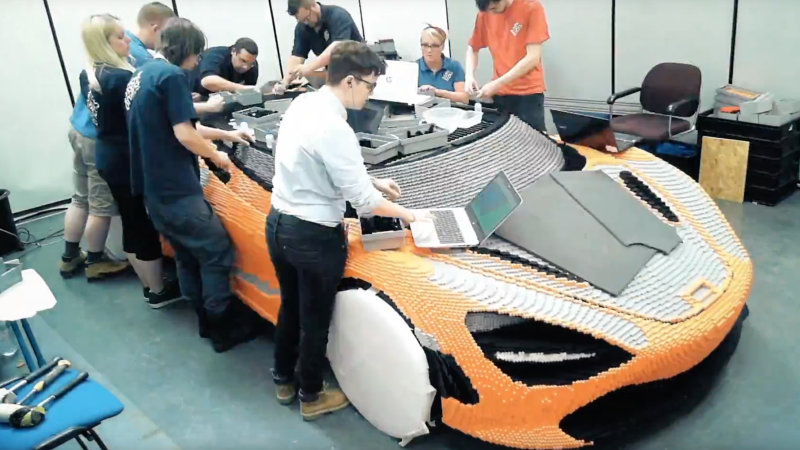
At this year’s Goodwood Festival of Speed, McLaren brought a bright orange 720S constructed almost entirely of Lego bricks. The only parts not obviously made of the little plastic pieces were the wheels and tires. As cool as the finished product is, one of the most fun things about building with Lego bricks is building it, and seeing everything come together. Fortunately, McLaren let us get a peak at the process by releasing this time-lapse video of the process.

According to the video, the final model used 280,000 bricks, and it took a whopping 2,000 man hours to finish it. It’s all condensed into a one-minute video. One of the impressive things to note during the build is that the vast majority of the car really is made of the plastic pieces. Only a metal base and two structures on which to mount the wheels and tires weren’t made of Legos. The Lego 720S also is clearly quite sturdy, as there are a number of times when builders are sitting on the hood section without any issue. It’s a fun way to spend a minute of your day, so check it out above.

Related Video:

McLaren reportedly has another Ultimate Series car in the works – the P15

Automotive publication Autocar is reporting that McLaren has another new Ultimate Series hypercar in development that will be quicker than the P1. The publication says the car is called P15 and will be bare bones with a focus on function and lightweight to make it a monster on the track. The estimate Autocar gives for weight is under 2,900 pounds, and it estimates power to be about 789 horsepower from a version of McLaren’s ubiquitous 3.8-liter twin-turbo V8.

The publication doesn’t say whether the P15 will use some kind of electric assist. If it’s as basic and light as implied, there’s a decent chance it won’t be electrified. But McLaren has previously said it wants to have electrification in all of its cars within 10 years, and that was back in 2014, plus the P1 and the upcoming BP23 had and will have hybrid powertrains. So it would seem natural to give this P15 some form of hybrid motivation.

There are reasons to believe this rumor. Back in 2014, McLaren did confirm to us a report, brought up by Autocar, that it was working on a car with the P15 designation. At the time, it was predicted that this car would fit between the top level Super Series car, which is now the 720S, and the P1, and cost roughly half a million dollars. That would at first seem to contradict this new rumor that the P15 will be quicker than P1, but perhaps McLaren will still position it lower if it’s as bare bones and stripped out as Autocar suggests.

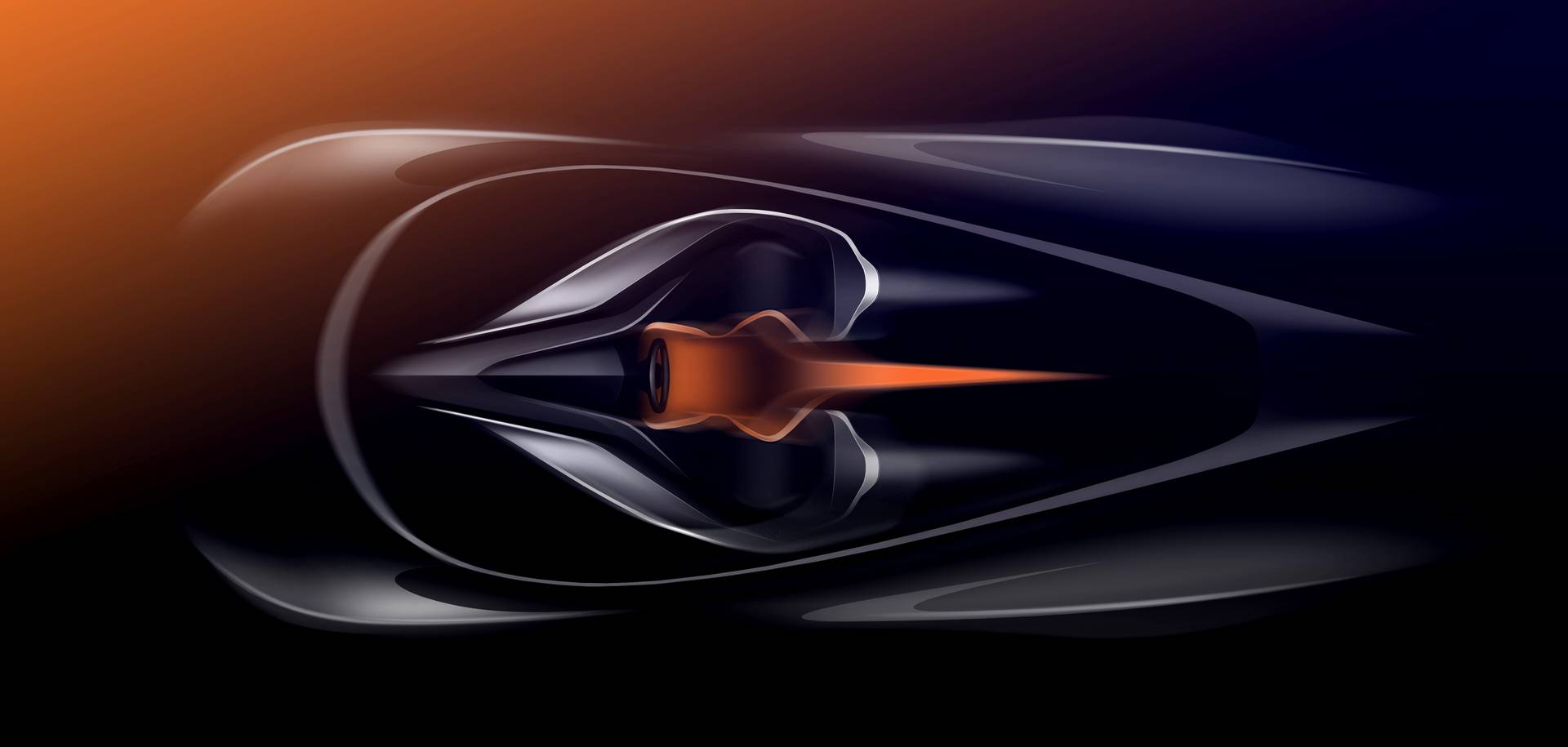
Additionally, Autocar was right about a rumor that McLaren was working on a three-seat F1 successor. which turned out to be the aforementioned BP23. McLaren’s CEO confirmed the car’s existence and three-seat layout along with a few other details. Specifically, it will be the fastest, most powerful McLaren yet, it will use a hybrid powertrain, and McLaren will build only 106 units. Not long after came an official sketch revealing a sleek, slippery profile.

Related Video:

First US-spec McLaren F1 will be auctioned in August

To own any McLaren F1 would be a special experience. It was the fastest car in the world for many years with a top speed of over 230 mph, courtesy of a glorious 627-horsepower V12 from BMW M. But as special as each individual F1 is, there are some few with that extra something, and among them is this 1995 F1 that will be offered by Bonhams at its Quail Lodge auction in August. This particular 1995 F1’s extra something is the fact that it was the very first to be imported to the US and made fully street-legal. Not only that, but it’s only had one owner from the day it was purchased.

According to Bonhams, the owner of this car, number 44 of 64, bought it in 1996. He took delivery of it at McLaren’s factory in Woking, Great Britain, and he immediately took it on a grand road trip across Europe. Following the trip, he had it shipped back to America for a company called Ameritech to go about updating the car to meet US safety and emissions regulations. In the 22 years that the original owner had it, he put 9,600 miles on the odometer.

The lucky buyer of this McLaren will get a thoroughly clean and complete car. The interior and engine bay are immaculate. Even the fusebox and other tertiary parts are in excellent shape. The original tool roll and luggage are included, as well as the complete toolbox for maintaining the car. Also, the original owner returned the car to European specifications after importing it, but he retained all of the parts necessary to make the car US-legal. All of those parts are included with the car in case the new owner wanted, or needed, to reinstall them. All things considered, this McLaren will likely run a very high price, but it could very well be worth it for whomever brings it home.

Related Video:

McLaren ponders Acura NSX-style hybrid all-wheel-drive system

As cars get faster, there will come a point where horsepower will exceed the grip level of even the stickiest tires. There are all sorts of ways to manage traction, from trick differentials to traction control to torque vectoring, but the most tried and true way is adding all-wheel drive. While this isn’t ideal for a number of reasons, sending power to all four wheels generally improves performance. That’s why McLaren is investigating all-wheel drive systems for future products.

Car and Driver spoke with McLaren CEO Mike Flewitt at this year’s Goodwood Festival of Speed. He confirms the automaker is looking at adding AWD on future products, though if and when that happens could be a long way off. He argues that with horsepower and torque levels creeping ever higher, we’re getting close to the limits of what a tire can handle.

Unlike traditional mechanical all-wheel drive systems like those found on the Nissan GT-R, Audi R8, and Porsche 911 Turbo, look for electric motors to drive the front wheels, similar to the Acura NSX. Not only would a hybrid system help packaging, electric motors give McLaren much more control over what’s happening at each individual wheel.

McLaren told Autoblog that the automaker’s plan through 2022 involves mid-engine two-seat sports cars, so don’t look for an all-wheel drive SUV to come out of Woking anytime soon.

Related Video:

Help build the Lego McLaren 720S at the Goodwood Festival of Speed

This year’s Goodwood Festival of Speed will be host to some extraordinary automobiles, but a contender for coolest vehicle will be a full-size replica of a McLaren 720S made from Lego bricks. And part of what will make it so cool, is that it won’t just be a display. It will arrive at the event unfinished, and guests will be able to help finish the build with the final 12,700 pieces.

This doesn’t mean plenty of work hasn’t already been done. According to McLaren, six Lego builders have spent 2,000 hours putting together over 267,000 pieces to the get the car to its current form. That comes to 83 days of non-stop work, which is much longer than the 12 work days the company takes to build an actual McLaren 720S.

In fact, the lengthy assembly time is just one of a few ways the Lego McLaren is actually inferior to the real thing. Instead of carbon fiber and aluminum, the Lego model uses humble steel and plastic. The Lego car is heavier than a dry 720S, too. And this is all without considering the fact that you can’t actually drive the Lego car. Still, Lego cars are awesome, and we’re looking forward to seeing the finished vehicle. And if you happen to be fortunate enough to be at the Festival of Speed, snap on a few bricks for us.

Related Video:

McLaren 720S reaches series production, first car built

The first production example of the McLaren 720S has been finished at the supercar maker’s Production Centre in Woking, England. A 400-car launch edition series follows Job 1, and all of these have been sold already, according to McLaren. In addition to these cars, a batch of 800 720S models are expected to be built in 2017, and next year will see 1,500 cars roll out of the factory gates.

The 720S was formally launched at Geneva in March. It represents the second generation of McLaren’s so-called Super Series cars, and the manufacturer has now moved to the P14 designation from the earlier P11 series of cars. The P11 platform was unveiled in 2009 as the wraps came off the 12C model, which reached production in 2011. More than 7,000 P11 cars have been sold, including the 650S models introduced in 2014.

“The new McLaren 720S entering volume production is a momentous occasion for McLaren Automotive, marking the first time since the company was formed in 2010 that we have replaced a model family with an all-new generation,” says McLaren Automotive CEO Mike Flewitt.

The 720S model name stands for the 720 horsepower put out by the supercar’s four-liter V8 engine, and the manufacturer promises an impressive 2.8-second 0-60 mile per hour time and a 212-mph top speed. Launched from standstill, the car will reach 200 km/h (124mph) in just 7.8 seconds. The various ways a 720S can be configured can be seen in this Autoblog gallery.

Related Video: