All posts in “Motorcycles”

The Best of the 2018 New York Motorcycle Show

The New York International Motorcycle Show always lands at the end of the year, so there tends to be no major reveals or big surprises. However, it is an excellent opportunity to see all the new metal from 2018 under one roof. Find event information and buy tickets here.

BMW

It’s been a busy year for BMW. Between the release of a pair of new middleweight adventure bikes – the F 800 GS and F 750 GS – and the all-new, redesigned S1000RR, the German brand had its hand full this year. BMW’s crown jewel, the S1000RR, gets an all-new engine with a 14,600 redline, a valve-timing system that helps create the bike’s 207 horsepower and loses three pounds for 2019. On the design front, BMW decided to ditch the asymmetrical headlights in favor of a more conventional approach. When it first landed 10 years ago, the BMW S1000RR changed the game with this absurdly advanced superbike — BMW is looking to solidify that top spot. The R Nine T family also gets a few stylish updates with new paint schemes, too.

Ducati

Ducati brought a total of nine new bikes to the show this year, chief among them the insane, MotoGP-inspired Panigale V4 R. But given the recent adventure bike popularity surge, the Multistrada 1260 Enduro will be an important bike for the brand going into 2019. The Scrambler Ducati brand is also leaning hard into the rise in flat track racing popularity by putting more energy and creativity into the Full Throttle Scrambler trim. The Scrambler line hasn’t seen any major mechanical updates but it’s good to see a restyling and new color schemes across the lot.

Honda

Honda had the biggest reveal of the show (quite literally), taking the covers off its new pure sport Side-by-Side – taking the fight to Polaris and Can-Am. The Talon comes in 1000R and 1000X flavors; the 1000R comes with a wider track, more suspension travel and focuses on more hardcore, fast driving. The 1000X has a narrower wheelbase but that makes it better suited for tight trails. Both iterations get the same engine, however, which is the same 1000cc twin-cylinder found in the Africa Twin. Thankfully, Honda cranked up the power and added the Africa Twin’s dual clutch transmission too: leave it in automatic or change gears with steering wheel mounted paddle shifters. Honda also brought has the vintage style Monkey and Super Cub on display.

Indian Motorcycle

It was exciting to see Indian Motorcycle finally put the flat track-inspired FTR 1200 into production. It’s even more exciting to see all the new various trims and styles Indian came up with. It has the same sort of vibe the Scrambler Ducati had when it initially launched, and that’s a good thing. The more FTR 1200 the better. The Sport, Rally, Tracker and Touring lines come with slight differences between them but each seems to have its character of its own. The Touring, for instance, comes with a lower seat and can be optioned out with a higher windshield, luggage racks and waxed canvas saddle bags.

Triumph Motorcycles

The recently announced Scrambler 1200, a bike we’ve always wanted from Triumph, looks so damn good in person. But, despite the hype and excitement around the beefed-up vintage off-roader, the all-new Speedmaster is awesome. It’s Triumph’s second swing at hyper-stylized classic and keeping in mind how successful the Bobber was, it’s no surprise Triumph wants to double down. Even motionless on the stand, it looks like another win for Triumph.

10 Best Cars of the 2018 LA Auto Show

The 2018 LA Auto Show kicks off this weekend, and there are head turners and important launches all over the show floor. If you’re heading to the convention center, pick up tickets and read up on the whole show here. Check out our top picks below whether you’re heading to the show or not. Read the Story

Note: Purchasing products through our links may earn us a portion of the sale, which supports our editorial team’s mission. Learn more here.

Solid Performance Is the AMG of KTM Motorcycles

It’s easy to argue that Aufrecht, Melcher and Großaspach — the names of two men and their town, but better known as the acronym AMG — is and always will be associated with high-performance Mercedes-Benz automobiles. In the late ’60s, the ur-AMG brand was an old-fashioned startup, consisting of just Hans Werner Aufrecht and Erhard Melcher (Großaspach is Aufrecht’s hometown) tinkering and tuning Mercedes engines in a small garage in Baden-Württemberg, Germany, in order to go racing. As former Mercedes engineers, the pair knew their way around the cranks and valves of the varying displacement V8s coming out of Stuttgart at the time. They stayed laser-focused on the machinery they knew and they earned one hell of a reputation around the world, on and off racetracks. Mercedes eventually took notice and in 1999 gained control, making AMG its official performance arm. Today, almost every car brand has a dedicated in-house skunkworks operation similar to AMG. In the realm of motorcycles, however, you can count them on one hand… and have fingers to spare. But, narrow your search to America’s east coast and you’ll find Solid Performance, a garage in Downingtown, Pennsylvania, that’s dedicated solely to modifying KTM bikes.

Evan Yarnall, President of Solid Performance, also started out in a small garage, spinning wrenches, tuning chassis and tinkering with suspensions, his aim being to make motorcycles quicker both on-road and off. He lent a hand to a few road race teams, but got his foot in the door with KTM when he was National Enduro Champion Mike Lafferty’s mechanic for two years. Yarnall met Kevin Schuler, now a part-owner and Sales Manager of Solid Performance, back in 2006 and, as Schuler puts it, “we got along well initially because I was racing at the time and fairly good at setting up a bike. So I got a little respect from him.” The two immediately started discussing plans for a dedicated KTM dealership in the Pennsylvania area. But KTM was just getting out of a financial crisis and adding more dealerships to the network wasn’t in the cards.

Keeping KTM in mind, the pair continued to wrench and tune on the side until around 2012, when they were able to secure a dealership and take an initial order of 35 bikes. Even before Schuler and Yarnall took delivery of their first shipment of bikes, though, it was clear they didn’t want to be just another motorcycle dealership featuring as many brands as possible to solely churn a profit. “As far back as 10 years ago, we always talked about being more of a setup and tuning service for riders, being very specialized in KTM. There aren’t that many KTM-dealers out there at this point.” In that respect, Schuler’s and Yarnall’s vision wasn’t far off from Aufrecht’s and Melcher’s — focus in and lean hard on your strengths and the quality of your product will speak for itself.

Just as AMG utilizes learnings from the intense test lab that is motorsport, Solid Performance does for KTM bikes, fine-tuning suspensions especially. “We try to get riders set up right off the bat so they’re not going down setup routes where they don’t have anyone to go back to, discuss it with and use as a resource. A big part of what we do is suspension and chassis tuning for each individual.” And, according to Schuler, “every bike’s suspension, from the factory (no matter the brand) is sprung for a rider who’s 180 lbs. The minimum we do is re-spring the bike, check the sag when they sit on it and lower it to custom fit the rider’s height.” Schuler went on: “not to name names, but some of these other dealers… you’re lucky if you get a bike with all the bolts tightened up when you get out the door.”

Solid Performance isn’t against doing power upgrades, but considering the way KTM motorcycles come from the factory, they’re not always needed. “We’re constantly battling the internet. People will come in thinking they need to up the horsepower and engine performance, but suspension setup is way more important than anything you can do to the engine. Ride the bike for a little bit and then see if the 165 horsepower on a 1290 Super Duke is not sufficient enough for you — give it a chance. The internet has millions of suggestions and riders can easily fall prey to what they believe is a good option (as far as tuning the bike) because they read it on the internet and it just snowballs from there.”

Riders tend to either accept their new bike as the perfect machine right from the factory or think they need to hot-rod the engine to hell and back. There isn’t really a middle ground, and yet neither is true. And that’s the mindset Solid Performance is out to change: to get the most out of your motorcycle, you need a chassis and suspension that lets you make use of all the power already on tap. Solid Performance – Schuler, Yarnall, their team of mechanics – are just trying to squeeze the most performance out of a KTM motorcycle as they can in the most efficient way possible.

Bazooka 110 LE MANS R

Italian bike-maker Moto Guzzi has been making a name for itself of late. That’s thanks mainly to the burgeoning custom motorcycle community. Its trademark bikes, those with transverse v-twin engines and shaft-drive, have lavished in fanfare for several years. The latest, this 1984 Bazooka 110 LE MANS R, by custom shop Ruote Fiere, comes as yet another example of the great things that come out of restoration.

Story time: Ruote Fiere found the bike in Northern Italy. He took it home and promptly rescued it following a failed attempt at restoration in the ‘90s. The work involved extensive tinkering, but the bike thankfully made it out alive. That’s to the merit of shop owner Davide Caforio. He gave the classic bike enormous TLC. He took inspiration from another iconic vehicle, the Porsche 907, with its clean bodywork in addition to its stark black and white paint job.

As we’ve mentioned, it really took a lot of work to clean up the Bazooka 110 LE MANS R. Besides modifying the frame to suspend the engine, Caforio also put in new electronics and a new ignition system. In addition, he threw in a new monocoque tank and seat arrangement. Don’t forget about its new twin light fairing, too — another notable additional to an already decked-out bike made for the modern man.

As for power, the bike boasts 90 horsepower with 9000 rpm. It has a 90-degree V-cylinder four-stroke engine with two valves per cylinder. It’s air- or oil-cooled via an aluminum racing radiator with aeronautic braid ducts and ergal fittings. You also get increased cup with external oil passage, plus a special camshaft. You’ll never guess it’s this sophisticated and complex at first glance, but masterly craftsmanship doesn’t beg to be noticed; it simply works under the hood, and you’ll be confident it won’t ever fail you.

SEE IT HERE


Photos courtesy of Ruote Fiere

Norton Just Unveiled Two New Beautiful and Affordable Scramblers

Norton has teased that a new motorcycle was in the works for a few weeks now; finally, it’s here. The Norton Atlas is a big break from the company’s modus operandi — it’s not a cafe racer, it’ll be affordable and built in bigger numbers. Like many manufacturers looking for success, Norton is jumping on the wave of scrambler and street tracker popularity, signaling a change and a peek at what’s to come. But keep in mind it’s all relative.

The Atlas comes in two flavors: the Nomad and the Ranger. Both get a 650cc, parallel-twin engine good for 85 horsepower and 47 lb-ft of torque, and both weigh a little over 400 lbs and use Brembo brakes to reign it all in. The Nomad is the more affordable of the pair, starting at $12,900 while the more built up Ranger will come with a $15,000 price tag. For the extra $2,100, the Atlas Ranger gets a bigger 19-inch wheel up front capped with a high mudguard, a skid plate, aluminum rear panel, a cowl with windscreen and raised braced handlebars.

It all fits in line with offerings from Triumph and Ducati, but since Norton hasn’t been in the light off-road game for some time, it’s tough to tell if their 650cc motorcycle can compete with the more powerful, less expensive mainstream models. Price tags in the $15,000 range might be affordable for Norton considering its other bikes run between $20,000 and $30,000, but it might have to lean on its prestige to sell the number of bikes it wants.

Norton will have 250 examples of each bike ready to sell by next week with plans to build and sell more. Now, 250 might not sound like large production numbers to brands like to Ducati, but Norton is likely testing the waters. The Atlas certainly classifies as an ‘affordable Norton,’ however, it still lands in the top brackets of what motorcycle riders are willing to pay. I wouldn’t expect the British brand to sell tens of thousands of these — as beautiful as they are, but it’s going to have to be a damn good bike to take on the segment stalwarts.

Meet the Artist Changing the Look of Motorcycle Helmets with His Uniquely Awesome Designs

From Issue Seven of Gear Patrol Magazine.

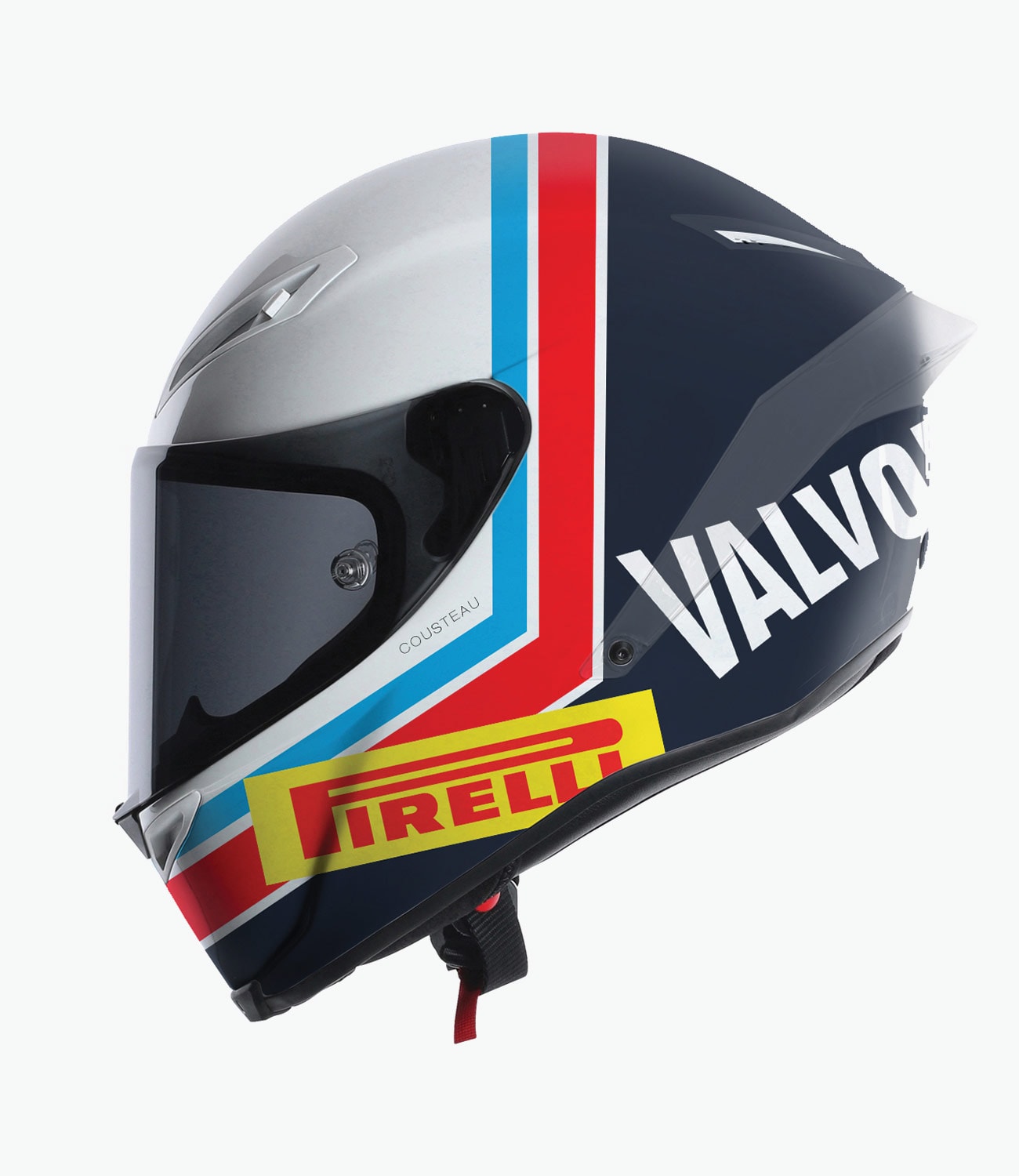
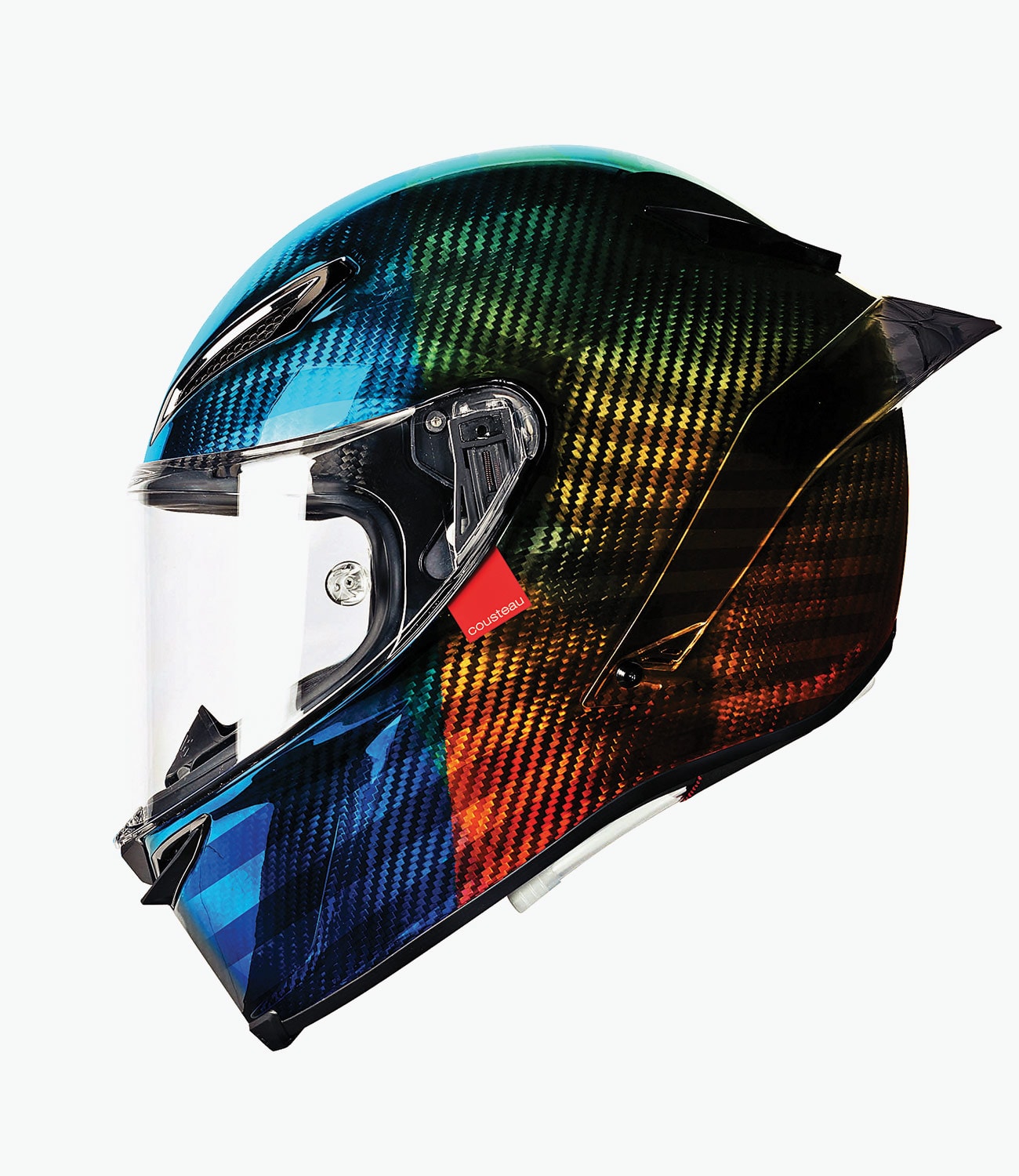
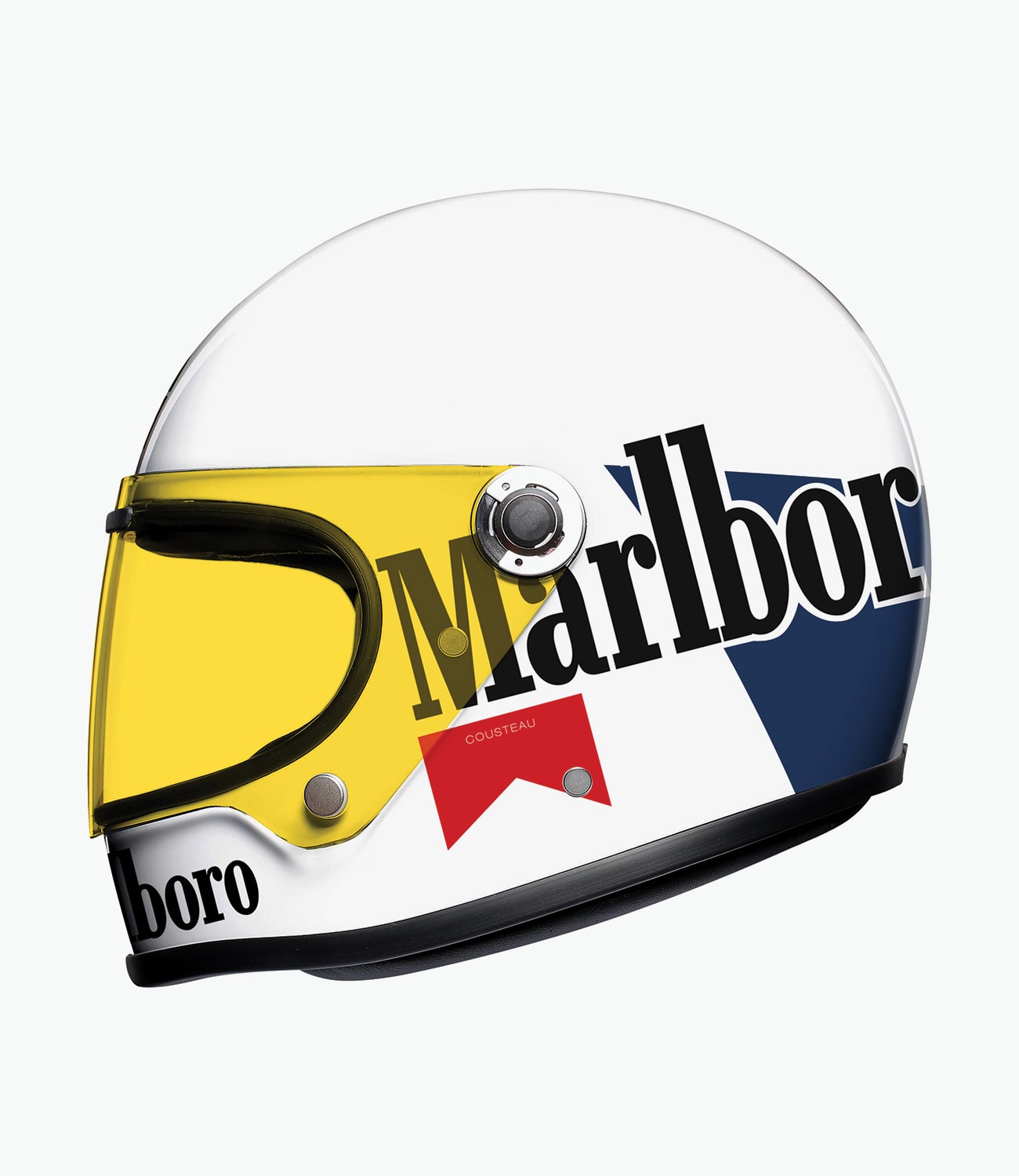
What do you do when you’ve made a living designing everything from toothpicks to super-yacht interiors — and then get bored? Would creating your own motorcycle helmet designs be the obvious choice? It was for Nuno Henriques, more famously known on Instagram as @hellocousteau.

Considering Henriques’s career saw stints at such legendary design firms as Phoenix Design in Stuttgart, Germany, KiBiSi in Copenhagen, Denmark, and Rémi Tessier Design in Paris, France, it’s easy to see how Henriques became frustrated with the helmet market. “I was never a graphic designer, never a helmet designer. I was simply looking for a helmet for myself and couldn’t find anything I liked. They all seemed to be the same, there was no individuality.”

Since starting his Instagram handle @hellocousteau in 2016, Henriques has gained over 20,000 followers and, on occasion, has received more than a hundred emails a day asking where to buy or order his helmets. But to date, only a couple of the renders from Henriques’s Instagram have made the jump to reality — one for AGV, one for HJC and a one-off race suit for Spidi.

Despite the widespread appeal of @hellocousteau designs, Henriques finds that bigger brands — the ones best equipped to bring the creative work to market — are sometimes the biggest hurdles. “People want change, people want different helmets, but the problem is inside the companies,” Henriques says. “A lot of brands have contacted me to work with them, but if you do what they want, you lose your creativity and individuality. You just do one more thing for them.” Design ideas go into approval meetings with promising momentum only to suffer death by committee because “brands insist on making the same thing over and over,” he says.

Why not, then, go the custom route and get a skilled painter to bring the designs to life? That’s when his profits would skyrocket, after all. But Henriques isn’t in it for the money. In fact, he’s turned down requests from Hollywood stars, motorcycle racers and race car drivers — he doesn’t want his designs to come with some ultra-premium price tag. “The main idea behind @hellocousteau was not to make a lot of money, but to give people a choice,” Henriques says. “That’s the reason I’m putting my designs on display: so someone can come and do something about it.”

The Aero 701 Is Stunningly Beautiful and Needs to Be Built

The concept bikes are pouring out of EICMA this year and one stands out among the rest: the Husqvarna Vitpilen 701 Aero Concept. There’s nothing massively different comapred to the Vitpilen 701 currently roaming the streets, but with a couple of well-sculpted fairings and a chic, retro-inspired full-color TFT dash this is a bike that needs building. Because the changes are so simple, it can be built.

The standard 701 Vitpilen is a quirky bike all its own — it’s a 693cc single cylinder with tons of torque and full-bike vibrations to match, yet has futuristic, essentialist Swedish styling to trick you into thinking it’s smoother-running than an electric bike. It’s a hilarious clash of eras in both style and practice, but it works. The motorsport-inspired fairings only multiply the character.

It’s too easy to assume Husqvarna won’t put this into production — the Vitpilen 401 Aero concept from a few years ago never saw production, after all. But, since then, variations of standard naked bikes — cafe racers, scramblers, flat trackers — have exploded in popularity. BMW and Ducati have since introduced their own cafe racers and Triumph put more energy and a bigger engine into its trusty Thruxton. It’s not unfathomable for Husqvarna to bolt on the extra plastic and call it a day. Plus, based on the reactions from around the web, they wouldn’t stay on showroom floors for long.

The landscape is ripe and ready for a bike like the Vitpilen 701 Aero. There’s clearly a demand for sculpted, faired bikes, but the market is definitely oversaturated with retro styling. As beautiful as they all are, there are only so many times you can rehash the ’60s. The Vitpilen 701 Aero is a healthy dose of Swedish modernism the category desperately needs. Husqvarna, just built it. Please.

Ducati Multistrada 1260 Enduro Review: A Huge Leap Forward for Adventure Motorcycles

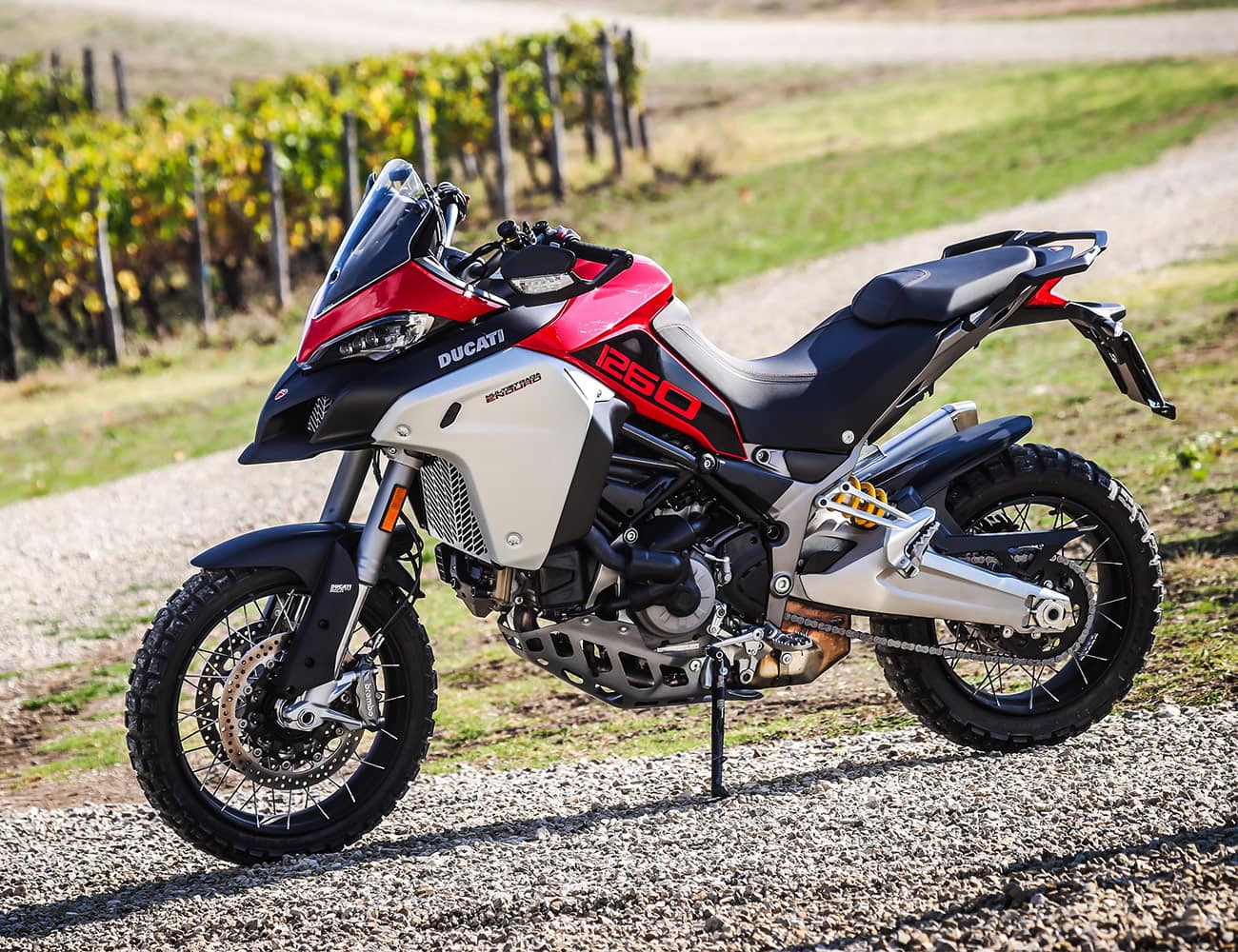
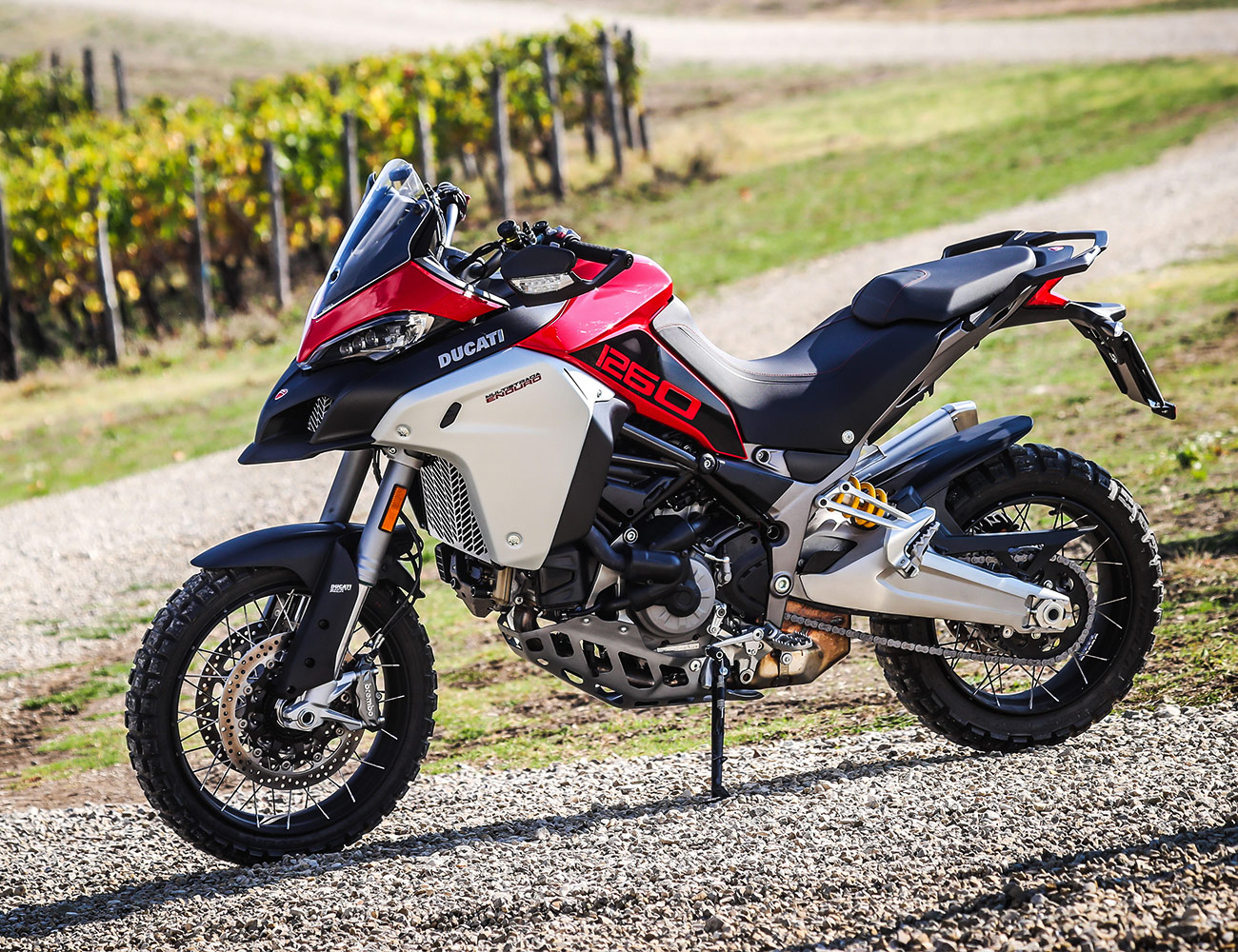
There is no slowing down when it comes to the big bore adventure bike market. Everyone wants a piece of the pie when it comes to a motorcycle that almost does it all. While KTM and BMW are considered leaders in the field, Ducati is no stranger to performance, class-leading design and engineering. And for 2019, the Italian marque has upgraded the Multistrada 1200 Enduro to the Multistrada 1260 Enduro. I flew over to Italy to put the new Multistrada 1260 Enduro through its paces both on road and off to see if the improvements Ducati has made the engine, rider-focused technology, and ergonomics improve upon the outgoing 1200 Enduro.

The day began at Nipozzano Castle in the rolling hillside roads of Tuscany. The same place where Ducati hosts its Ducati Rider Experience (DRE) Academy for those who wish to learn how to ride these big bikes off-road.

On road, the Multistrada 1260 Enduro holds true to Ducati’s performance DNA. It is plush and tempered in Touring mode and a voracious beast in sport mode. In conjunction with a new lower center of gravity, refined power delivery and a bevy of customization parameters within the pre-programmed ride modes, the 1260 Enduro leaves you wanting for very little else whether you are commuting, tearing up the canyons or riding from Los Angeles to Portland. It’s a bike built for the open and twisting road, especially when fitted with a pair of road tires.

I cannot sing the praises of the 1260 Enduro enough in terms of on-road riding. It’s perfectly capable and a terrifying adrenaline pumping machine if wielded recklessly, but it has the moniker Enduro there at the end of its title. And if it’s going to tout that title, it needs to be formidable in the dirt.

When it was introduced in 2016, the 1200 Enduro was plagued by a number of factors that made it not so great. It was extremely top-heavy, the tank was cumbersome, it was too tall for most riders and the torque curve dipped in the low to mid range. The people spoke loudly, they all said the same thing. Ducati listened and went back to the drawing board.

The fix entailed lowering the bike in both saddle and suspension height. The 1260 Enduro now sports a standard saddle that is 0.3 inches shorter and both the front and rear suspension lowered to 7.3 inches from 7.9 inches.

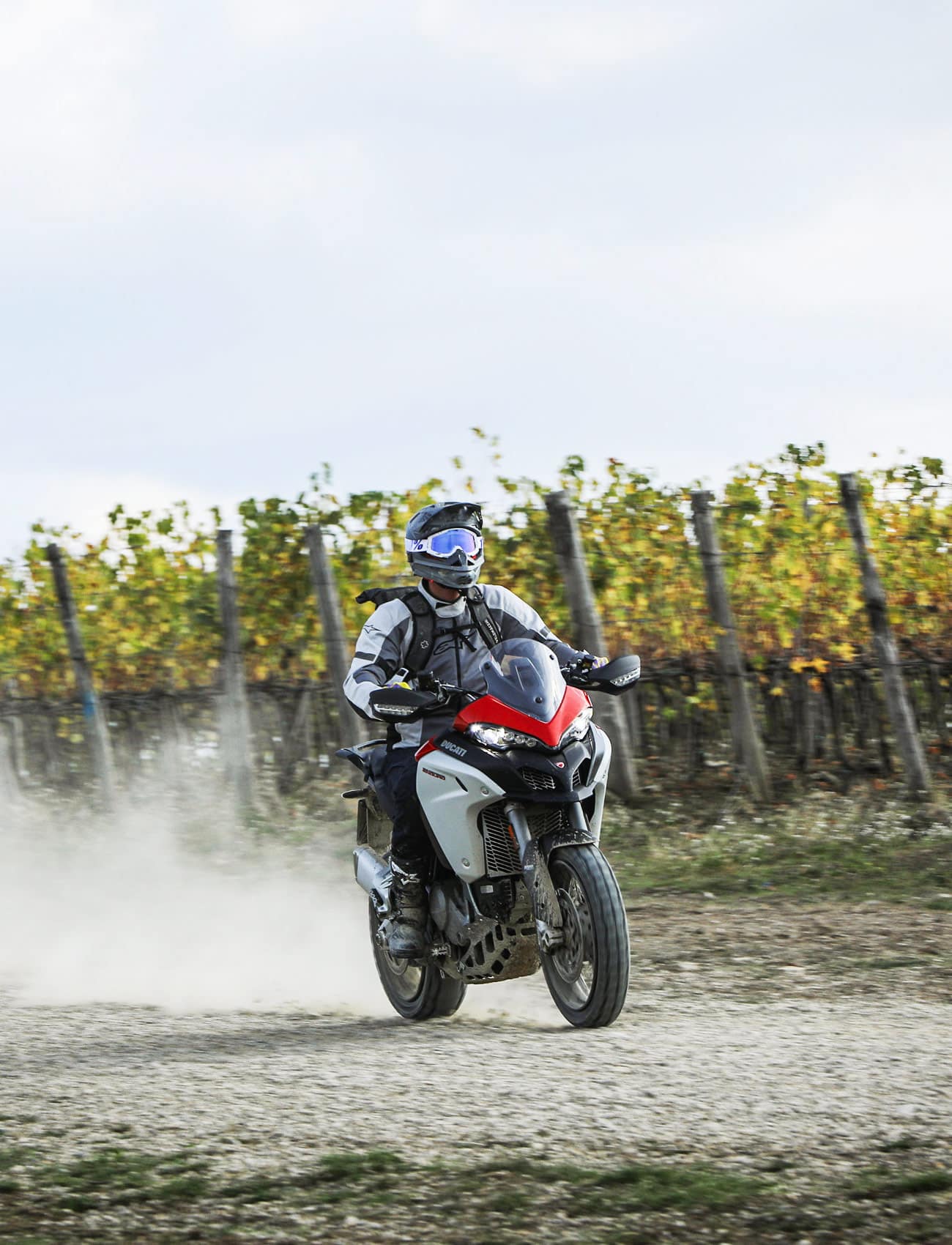
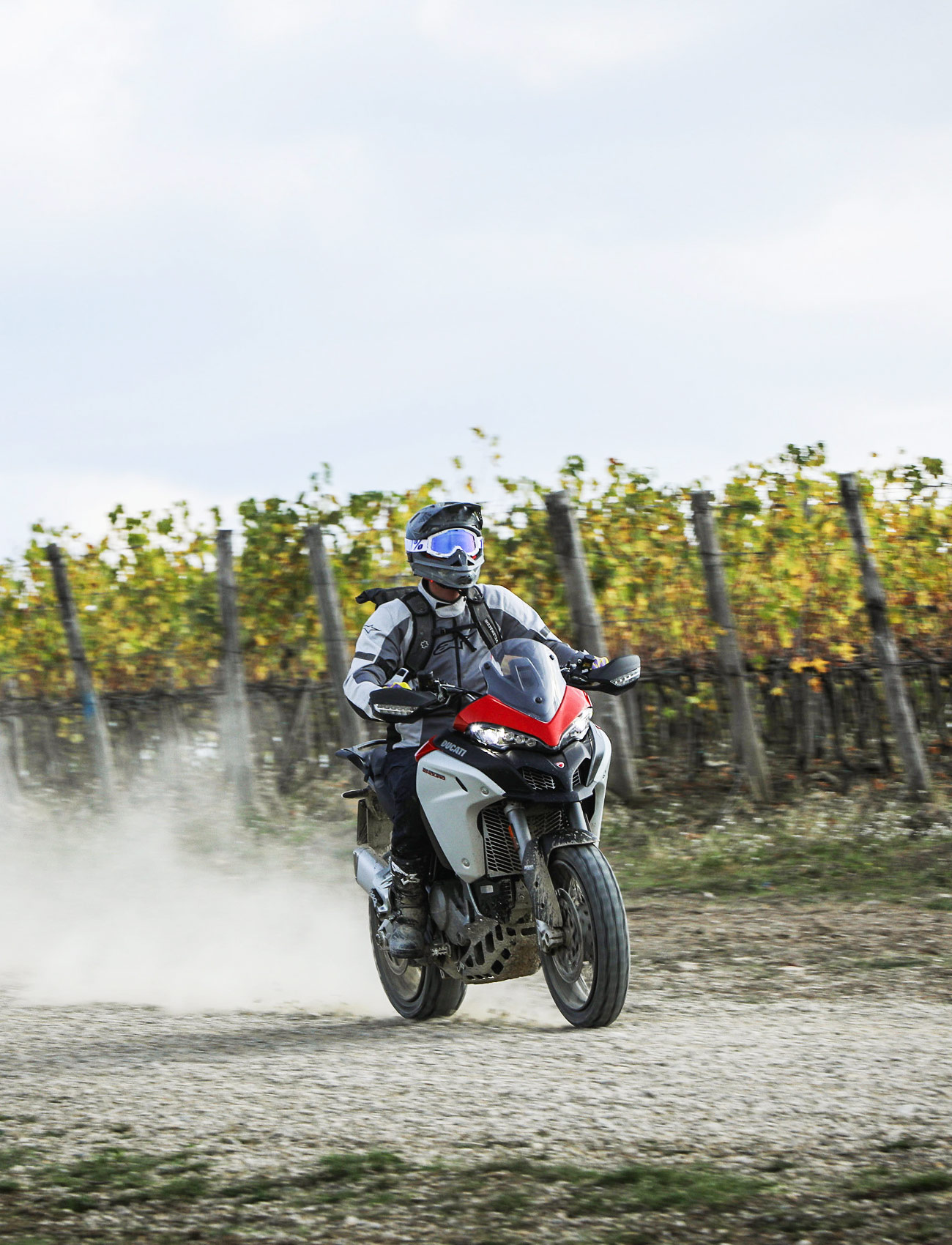
Adventure bike and dual sport enthusiasts will shout from the hilltops, “I need and want more suspension travel on my adventure bike!” However, some sacrifices were necessary: by lowering overall ride height, Ducati was able to greatly decrease the 1260 Enduro’s center of gravity. This coupled with a semi-active suspension, Bosch 6-axis IMU, and dual rate spring system, the mighty Multi is now capable of devouring sections of dirt with aplomb. I found myself tearing through the woods with a newfound confidence while whipping the bike around at a decent quip. Saddle time with the 1200 Enduro felt more like wrangling a pissed off bronco.

Next, let’s talk power. The 1260 Enduro gets a new ticker, and this heart beats strong. The 1262cc Testrastretta DVT (Desmodromic Variable Timing) engine produces a massive 158hp and 94 ft-lbs of torque and does it more efficiently than its predecessor. With variable timing, the engine profile is able to change the timing profile of the camshafts that control the intake and exhaust valves, resulting in great performance and maximum power at high revs while boosting torque and delivering smooth, linear power in the low to mid range.

The 1260 Enduro gets a new ticker, and this heart beats strong.

Out on the various trails surrounding Nipozzano, throttle delivery was butter smooth and never once did I feel like the bike would get away from me. Nor was I lacking for power when I needed it.

Enduro Mode, which is suited for the dirt, also activates the DSS (Ducati Skyhook System) Evolution for off-road. When that mode is engaged, DTC (Ducati Traction Control) and DWC (Ducati Wheelie Control) intervention levels are ratcheted down to Level 1 and ABS is set to Level 1, which enables front wheel intervention but allows the rider to lock the rear.

After spending 20 minutes in Enduro Mode, which limits the engine power output to 100 hp, I jumped into the custom setting to allow ‘full power’ to the engine along with the ‘smooth throttle’ option. With a few clicks through the rather intuitive human-machine interface (HMI) the engine came alive with an added extra punch but with all the smoothness from before.

Rock after rock, rut after rut, not much could phase the mighty Multi. Ground clearance never presented an issue but I am sure hardcore riders and rally enthusiasts will use every inch. Every time we stopped I would look around at my fellow journalists and could see the smiles within their helmets.

And that’s the beauty behind the new 1260 Enduro. Ducati not only altered a slew of physical and ergonomic elements of the bike to make it more accessible across the board, but also added a level of customization and immersive technology found on their flagship Panigale V4 into the mix.

The 2019 Multistrada 1260 Enduro is a leap forward for Ducati in the Adventure motorcycle segment. It will be available beginning in February 2019 at a starting price of $21,995, available only in the color Desert Sand.

Ducati hosted us in Italy and provide the Multistrada 1260 for review.

The Ducati Multistrada 1260 Enduro Is a Leap Forward for ADV Motorcycles

There is no slowing down when it comes to the big bore adventure bike market. Everyone wants a piece of the pie when it comes to a motorcycle that almost does it all. While KTM and BMW are considered leaders in the field, Ducati is no stranger to performance, class-leading design and engineering. And for 2019, the Italian marque has upgraded the Multistrada 1200 Enduro to the Multistrada 1260 Enduro. I flew over to Italy to put the new Multistrada 1260 Enduro through its paces both on road and off to see if the improvements Ducati has made the engine, rider-focused technology, and ergonomics improve upon the outgoing 1200 Enduro.

The day began at Nipozzano Castle in the rolling hillside roads of Tuscany. The same place where Ducati hosts its Ducati Rider Experience (DRE) Academy for those who wish to learn how to ride these big bikes off-road.

On road, the Multistrada 1260 Enduro holds true to Ducati’s performance DNA. It is plush and tempered in Touring mode and a voracious beast in sport mode. In conjunction with a new lower center of gravity, refined power delivery and a bevy of customization parameters within the pre-programmed ride modes, the 1260 Enduro leaves you wanting for very little else whether you are commuting, tearing up the canyons or riding from Los Angeles to Portland. It’s a bike built for the open and twisting road, especially when fitted with a pair of road tires.

I cannot sing the praises of the 1260 Enduro enough in terms of on-road riding. It’s perfectly capable and a terrifying adrenaline pumping machine if wielded recklessly, but it has the moniker Enduro there at the end of its title. And if it’s going to tout that title, it needs to be formidable in the dirt.

When it was introduced in 2016, the 1200 Enduro was plagued by a number of factors that made it not so great. It was extremely top-heavy, the tank was cumbersome, it was too tall for most riders and the torque curve dipped in the low to mid range. The people spoke loudly, they all said the same thing. Ducati listened and went back to the drawing board.

The fix entailed lowering the bike in both saddle and suspension height. The 1260 Enduro now sports a standard saddle that is 0.3 inches shorter and both the front and rear suspension lowered to 7.3 inches from 7.9 inches.

Adventure bike and dual sport enthusiasts will shout from the hilltops, “I need and want more suspension travel on my adventure bike!” However, some sacrifices were necessary: by lowering overall ride height, Ducati was able to greatly decrease the 1260 Enduro’s center of gravity. This coupled with a semi-active suspension, Bosch 6-axis IMU, and dual rate spring system, the mighty Multi is now capable of devouring sections of dirt with aplomb. I found myself tearing through the woods with a newfound confidence while whipping the bike around at a decent quip. Saddle time with the 1200 Enduro felt more like wrangling a pissed off bronco.

Next, let’s talk power. The 1260 Enduro gets a new ticker, and this heart beats strong. The 1262cc Testrastretta DVT (Desmodromic Variable Timing) engine produces a massive 158hp and 94 ft-lbs of torque and does it more efficiently than its predecessor. With variable timing, the engine profile is able to change the timing profile of the camshafts that control the intake and exhaust valves, resulting in great performance and maximum power at high revs while boosting torque and delivering smooth, linear power in the low to mid range.

The 1260 Enduro gets a new ticker, and this heart beats strong.

Out on the various trails surrounding Nipozzano, throttle delivery was butter smooth and never once did I feel like the bike would get away from me. Nor was I lacking for power when I needed it.

Enduro Mode, which is suited for the dirt, also activates the DSS (Ducati Skyhook System) Evolution for off-road. When that mode is engaged, DTC (Ducati Traction Control) and DWC (Ducati Wheelie Control) intervention levels are ratcheted down to Level 1 and ABS is set to Level 1, which enables front wheel intervention but allows the rider to lock the rear.

After spending 20 minutes in Enduro Mode, which limits the engine power output to 100 hp, I jumped into the custom setting to allow ‘full power’ to the engine along with the ‘smooth throttle’ option. With a few clicks through the rather intuitive human-machine interface (HMI) the engine came alive with an added extra punch but with all the smoothness from before.

Rock after rock, rut after rut, not much could phase the mighty Multi. Ground clearance never presented an issue but I am sure hardcore riders and rally enthusiasts will use every inch. Every time we stopped I would look around at my fellow journalists and could see the smiles within their helmets.

And that’s the beauty behind the new 1260 Enduro. Ducati not only altered a slew of physical and ergonomic elements of the bike to make it more accessible across the board, but also added a level of customization and immersive technology found on their flagship Panigale V4 into the mix.

The 2019 Multistrada 1260 Enduro is a leap forward for Ducati in the Adventure motorcycle segment. It will be available beginning in February 2019 at a starting price of $21,995, available only in the color Desert Sand.

Ducati hosted us in Italy and provide the Multistrada 1260 for review.

Triumph Rolls Out A Shred-Ready 1200cc Scrambler

As if their 900cc retro off-road Scrambler wasn’t powerful enough, Triumph is rolling out a 1200cc model for 2019. Powered by the motor from the Thruxton R, this new, gnarlier Scrambler features a design deliberately executed to blur the lines between a retro scrambler and a more modern adventure tourer. It will be available in two models: the 1200 XC and the fully-loaded, more off-road friendly XE, both featuring improved electronics, including bluetooth & GPS, as well as an app that will help manage all your trip data, calls, and performance feedback data.

Essential Motorcycle Gear For the Perfect Autumn Ride

Make the Year’s Last Rides Count

Essential Motorcycle Gear For the Perfect Autumn Ride


The days may be shorter, but this season offers up some of the best opportunities for getting out on two wheels. The scenery lining your favorite twisty roads is at an all-time high, and that crisp autumn air not only helps your bike perform better, but it can keep you sharp in the saddle. Provided, of course, you’re wearing the right gear. Before you hop in the saddle for these final days of autumn, take some time to make sure you’re riding in style and fully protected; some of those corners may be coated in leaves, after all.

Lane Splitter Helmet by Biltwell $250

Brooklands motorcycle jacket by Belstaff $695

Ramble Pants by Aether $495

Marshall Boots by Rev’It $300

Catton Gloves by Merlin $129
Note: Purchasing products through our links may earn us a portion of the sale, which supports our editorial team’s mission. Learn more here.

5 Skills You Need to Know Before You Go Adventure Riding

It’s safe to say taking two wheels into the dirt is a different animal altogether than street riding. Getting ready for an all-day ride out on the trails requires a certain amount of preparedness — not too dissimilar from camping. You might find yourself in the middle of nowhere with a flat tire, broken chain or snapped lever, so proactively learning a few skills and packing the right tools and spares beforehand can go a long way.

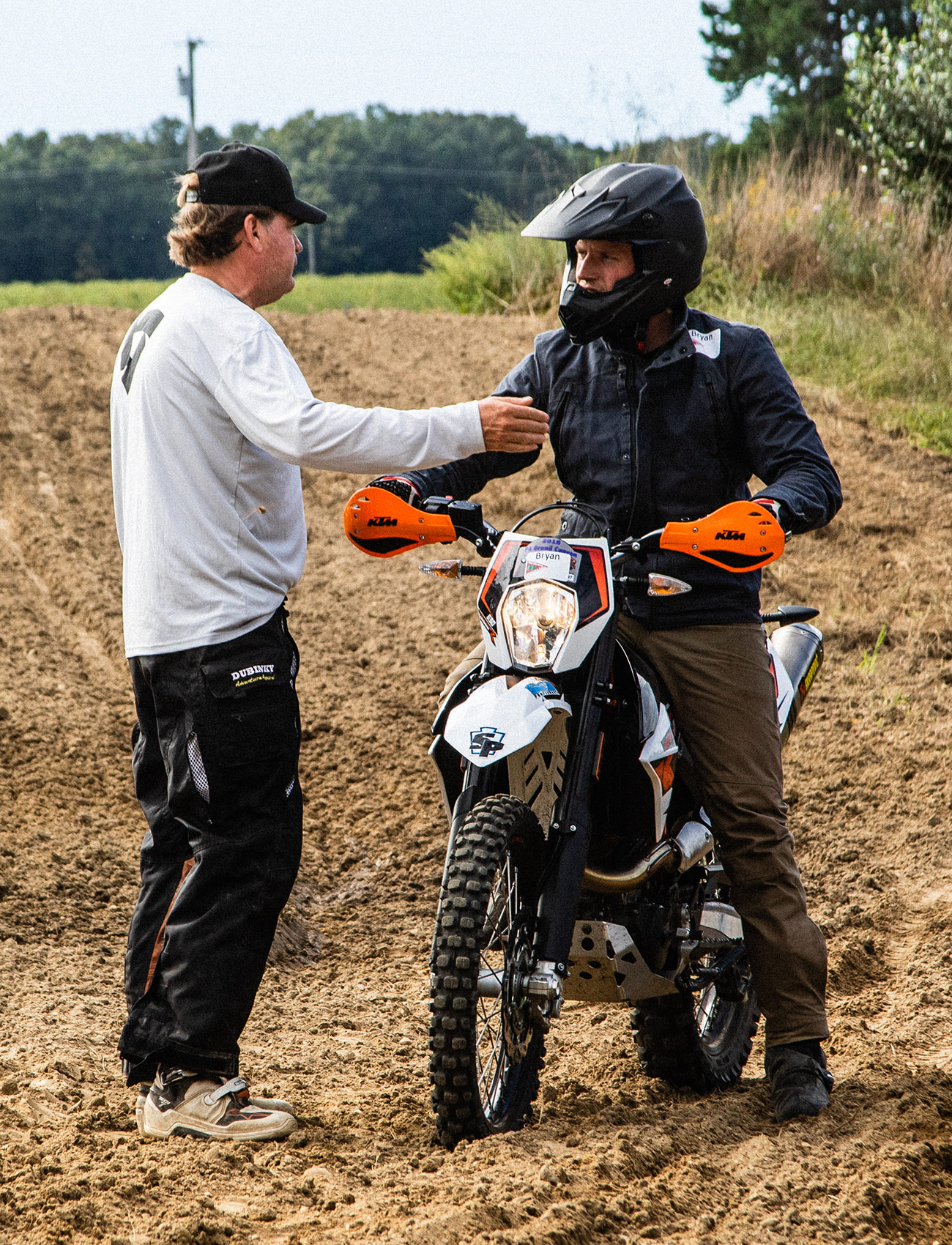
Short of attending a school like the Pine Barrens Adventure Camp (which you should), jotting these few words of wisdom from PBAC lead instructor Mike Bradway isn’t a bad idea. He’s a 2007 East Coast Enduro Champion, 2000-2007 East Coast Enduro Association Top AA rider and veteran of the 400 mile-plus dual sport ride from LA to Barstow to Vegas, so trust that he knows what he’s talking about.

Exercise your balance. It helps a lot of newer riders and riders who are a little rusty and haven’t ridden in a while. Before you even get on your bike you can practice balancing by standing on one foot on a plank of wood with your eyes closed. That sounds silly but will get you in touch with your inner ear. On your bike, with the kickstand up and in the stand-up adventure riding position, see how long you can keep the bike vertical without putting a foot down. It all comes into play out on the trail, especially when you’re maneuvering through tight single track trails crowded by trees.

Learn to read the trail. You want to be paying attention to what’s further down the trail. It’s a rookie mistake to be looking right at the ground in front of you. You want to keep looking ahead and adjust for what’s coming and if there’s anything unfamiliar, you’ll want to slow down before it, rather than correct when you’re right on top of it. People tend to crash more when they make a sudden and unexpected line change.

If it comes down to stopping and scoping out an obstacle, make sure you take the time to do so. Think that murky mud puddle would be great to ride through at speed? There’s a good chance a couple of Jeeps mad some fender-deep tracks in there and their drivers dropped logs or rocks in to gain traction. In other words, it’s always safer to spot it early and go around if you can, or stop and do a depth check with a long branch.

Learn to patch a tube and change a tire. It’s important to bring along tire irons and spoons. Flats happen all the time — it’s almost expected — but bring along one or two spare 21-inch tubes, as they can actually be used as either the front or the rear tube replacement.

Pack spares for your spares. Extra nuts and bolts are commonly overlooked but crucial to have on your ‘packed spares’ list. Any nut or bolt for a fairing or wing mirror can shake loose; having the tools and parts to keep your bike in one piece to the end of the ride makes all the difference. Even having an extra master link for your chain can make or break your ride. Then, of course, it’s always smart to have a replacement for the replacement. And when all else fails, duct tape and zip ties are a good last line of defense.

Customize your ergonomics. See if you need bar risers so you’re not hunched over in the adventure riding position. You want to be standing up straight, but with a slight bend in your knees and elbows, in order to keep good control over the bike’s movement. It might even help to have a friend take a picture of you on the bike so you can get a better sense of your riding posture.

Outside of buying aftermarket parts for your bike, making sure you hand and foot controls are properly positioned can play a big part in rider endurance. Angling your clutch and front brake lever down reduces stress on your wrists so they’re not cracked back when standup riding. Likewise, positioning your foot controls to better suit standup riding as well as accommodate the extra bulk from your boots will earn you a lot more confidence and control out on the trail.

The New Designs For Bell’s Vintage Helmets Are Some of the Best Yet

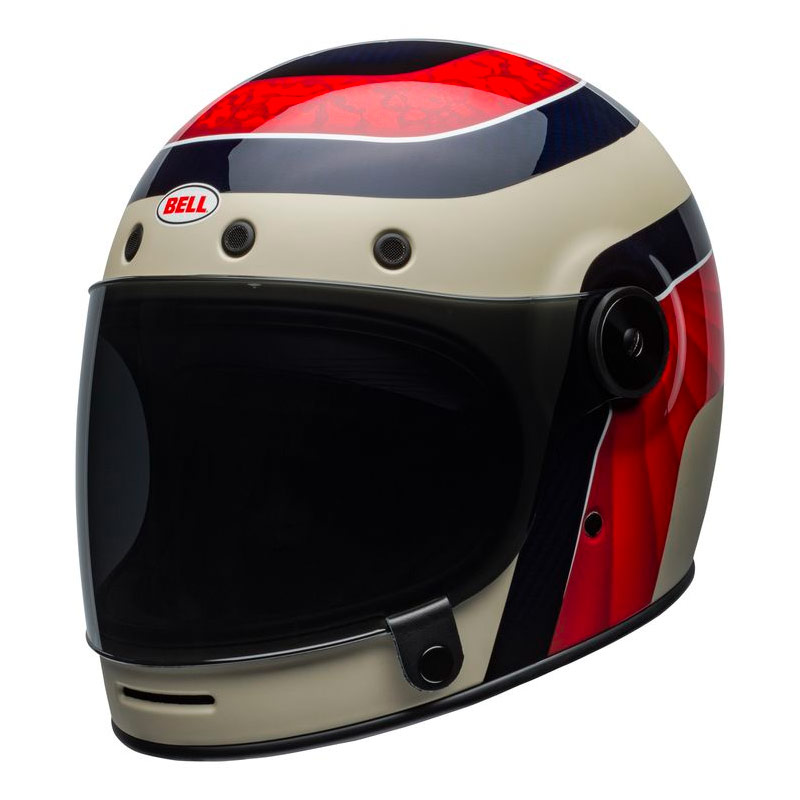
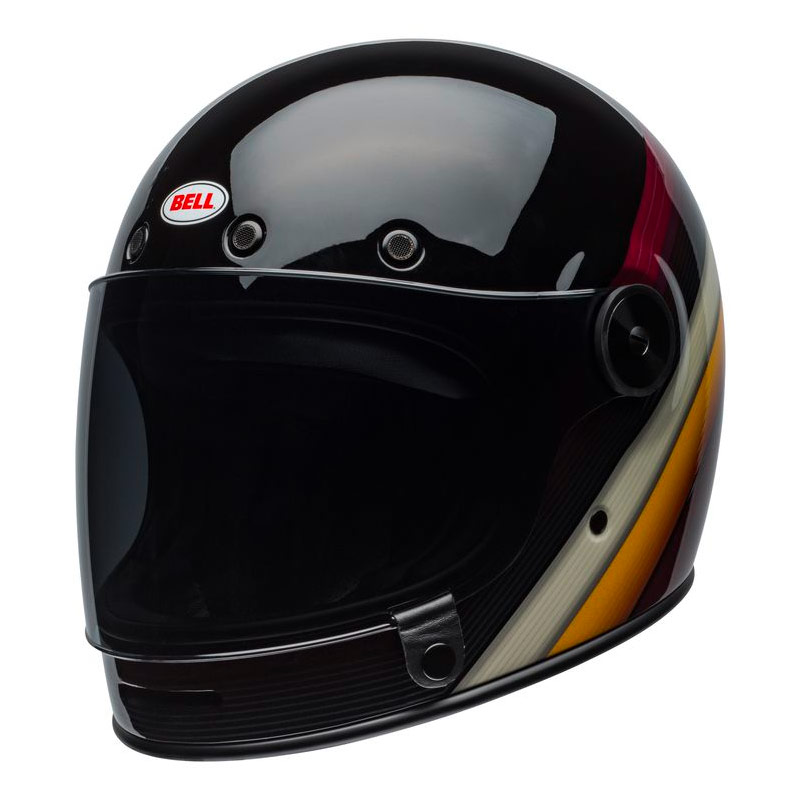
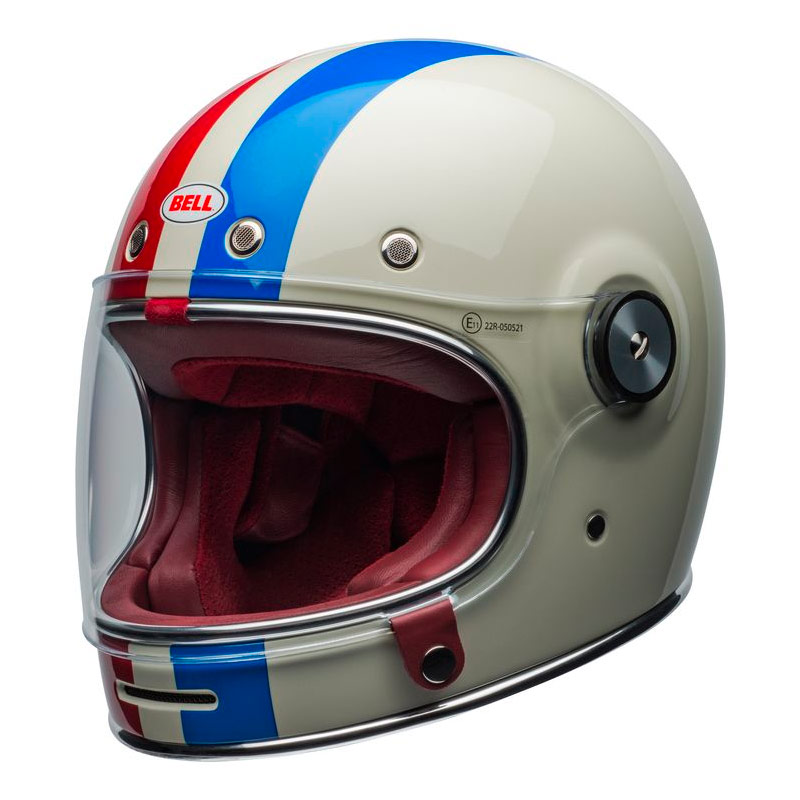
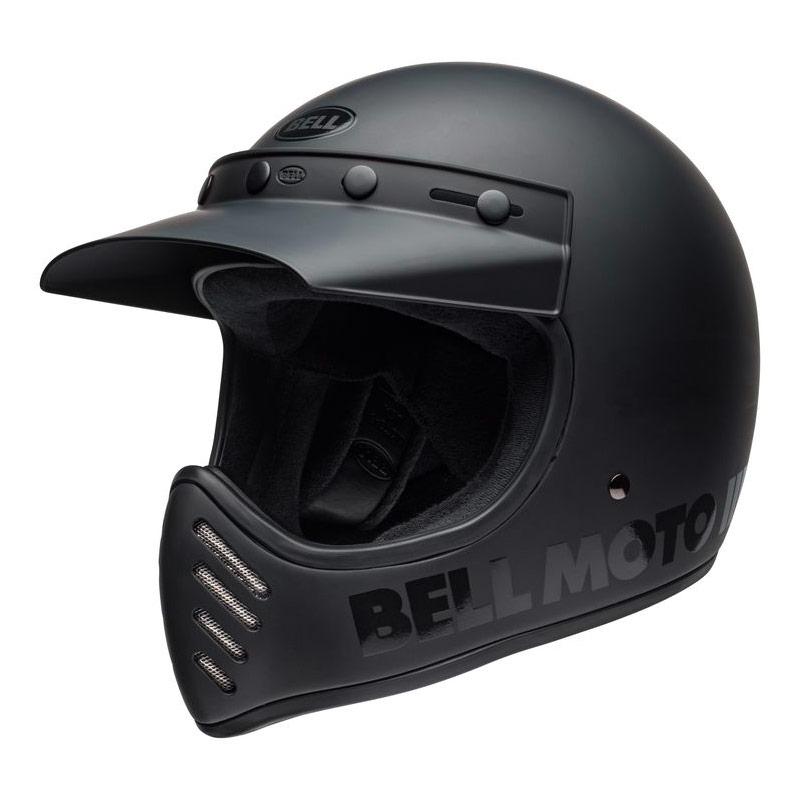
When Bell introduced the Bullit and then brought back the Moto-3, they were both instant successes and continue to be, too. Now, for the Fall 2018 season, Bell introduced a handful of new colorways and designs, not to mention another retro-inspired helmet altogether. The Bullit and Moto-3 continue to ride the wave of love around vintage design but are pulled directly from Bell’s own heritage and that’s exactly what the all-new Eliminator does as well.

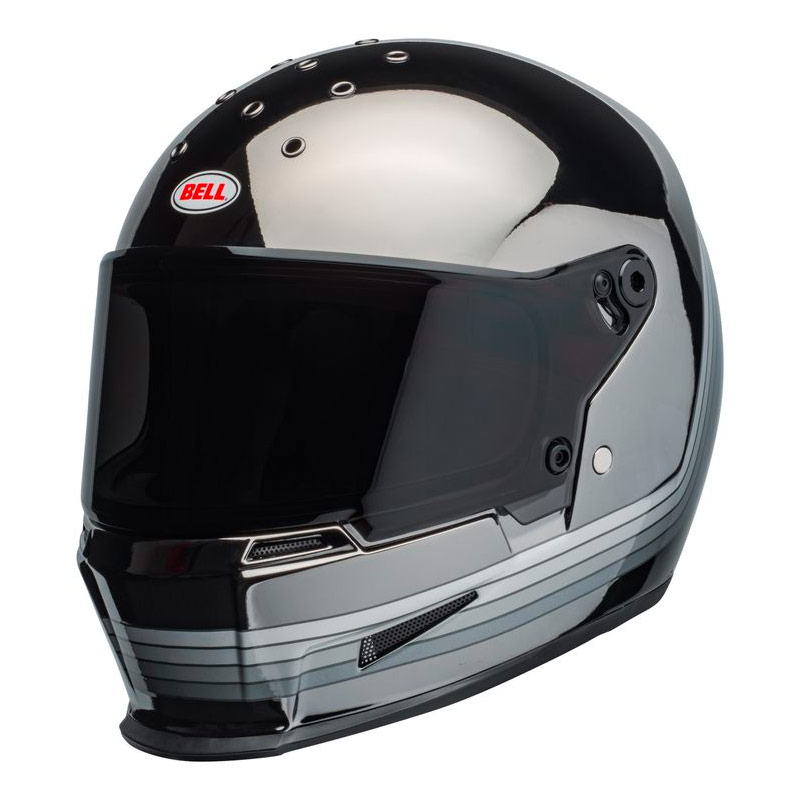
The Eliminator draws on the very first Bell helmets which were auto racing helmets, not motorcycle helmets. The tall chin bar, dirt skirt, and simple, metal-ringed intake holes were designed for the high safety standards of car racing both on the road and off. Coincidently, those features work perfectly for life on two-wheels as well. If you’re a fan of putting two wheels in the dirt, the eliminator’s design helps keep dust from making its way under and into your helmet. The rudimentary venting on the crown is meant to work with simple air and ventilation systems to keep you cool and breathing fresh air. perfect if you find yourself, in say, a bone-dry desert.

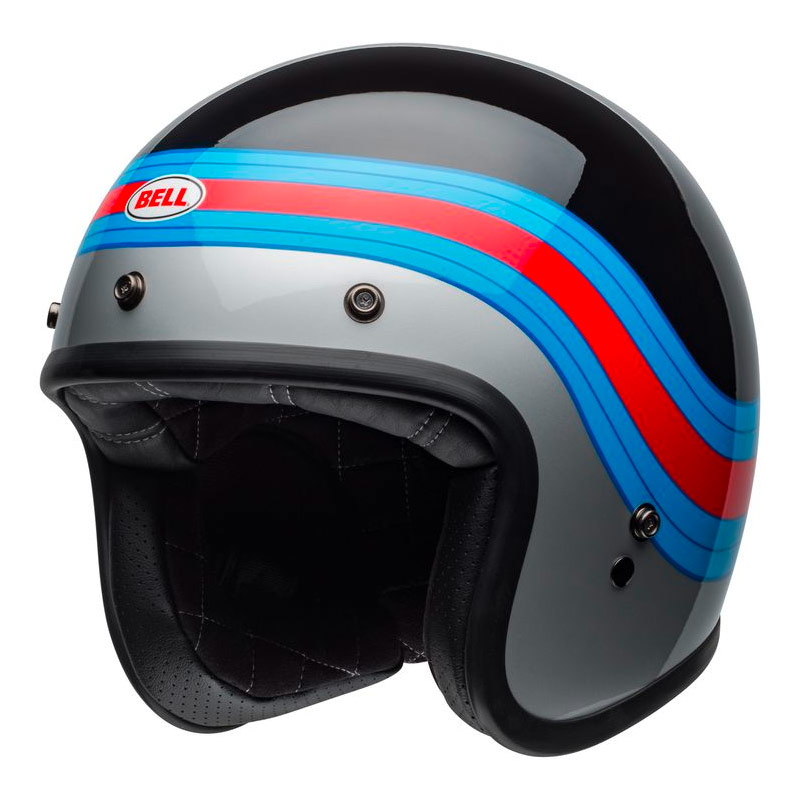
The Eliminator is currently available for pre-order only, but the new pallet classic and neo-classic stripes and designs for the Bullitt, Moto-3 and Pulse are all available now.

Bullitt Carbon Hustle Helmet by Bell $600

Bullitt Burnout Helmet by Bell $400

Bullitt Command Helmet by Bell $400

Moto-3 Blackout Helmet by Bell $290

Custom 500 Pulse Helmet by Bell $120

Eliminator Spectrum Helmet by Bell Pre-Order: $400
Note: Purchasing products through our links may earn us a portion of the sale, which supports our editorial team’s mission. Learn more here.

Get This Used KTM 1190 Adventure R And Save More Than $5,000

Heading into 2019 we’re spoiled for choice when it comes to new adventure motorcycles. All the heavy-hitters from BMW, Ducati and Honda are bringing new bikes to market in the new year. But, if you plan on first buying a new bike and then outfitting it with all the bells and whistles you want and need, there’s potential you may end up spending close to $20,000 all said and done. What you want to do is get this fully-loaded 2014 KTM Adventure R and save yourself the time and money.

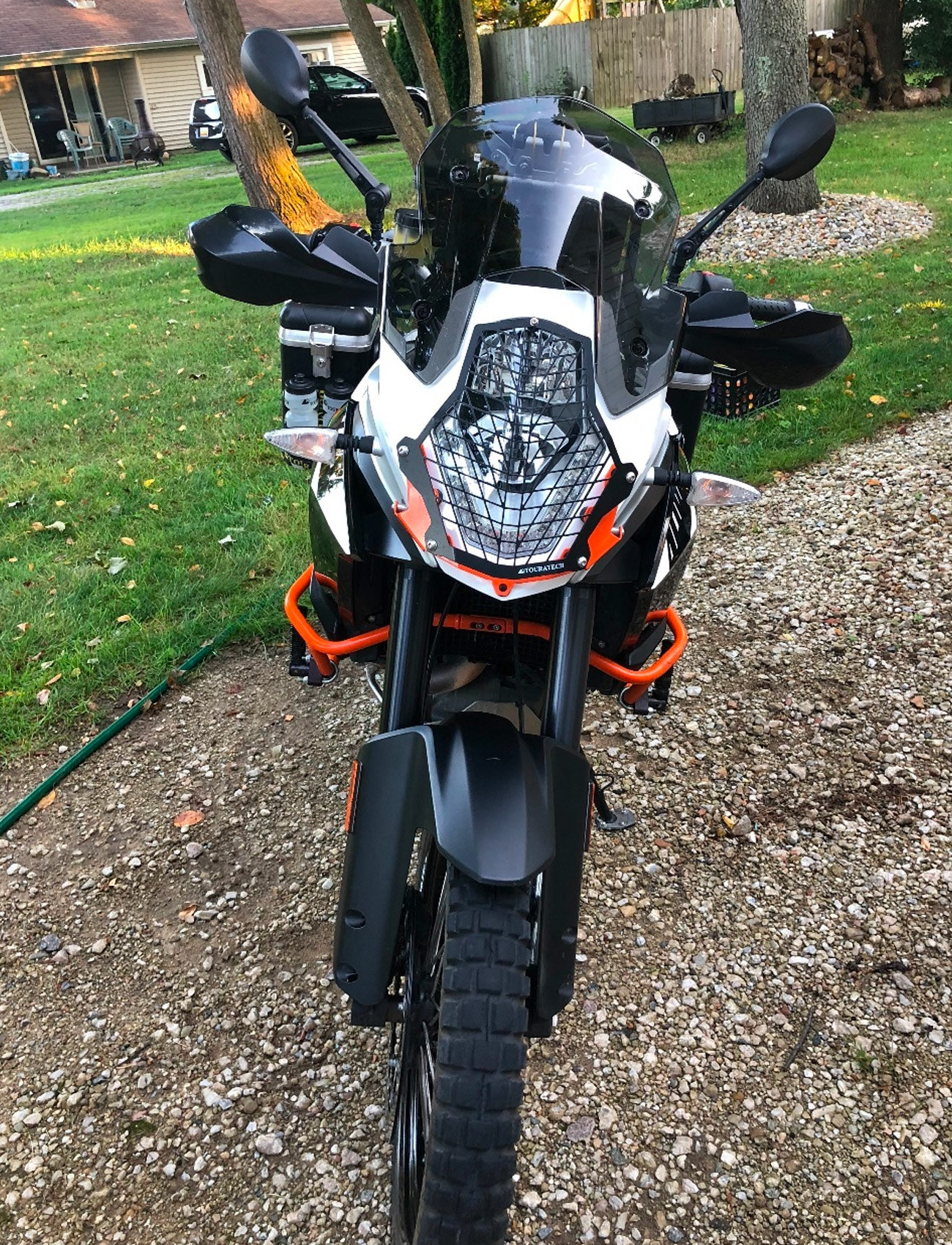
We’ve talked about the importance of customizing your motorcycle, especially if you’re going to take it off-road for long rides. Making sure its ergonomics are just right, that the engine and underbelly are well-protected and ensuring you have proper, helpful tech is essential, but it can also cost thousands of dollars on top of the not-so-insignificant price tag most new adventure bikes carry. This 12,000-mile 2014 KTM Adventure R not only starts just under $10,000 (a new Adventure R costs $14,699), it also comes with almost everything you’d want to tack on to an adventure bike.

A brand-new KTM 1090is more than capable of hitting the trails right off the showroom floor, but kitted out like this 2014 example, it’ll go even farther. Above the dash, there’s a Garmin Zumo 590 navigation system with locking Touratech bracket and mount; out front, there’s a Cycra led headlight bulb to light the way and a Touratech headlight guard to protect it. The stock engine crash bars are paired with a Touratch skidplate. In the back is a Caribou luggage top box and a couple Touratech Zega Pro panniers, which are $550 a piece (and come with water and fuel bottles).

There’s no getting around the expenses that go into adventure riding. The cost of entry can be steep, plus all the gear and modifications you bolt to your bike can rack up quite the bill. However, if you play it smart, you can also save a heap of cash. Expect to dish out double the money than this 2014 model if you buy new and go the DIY route.

Essential Gear For Surviving an All-Day Adventure Ride

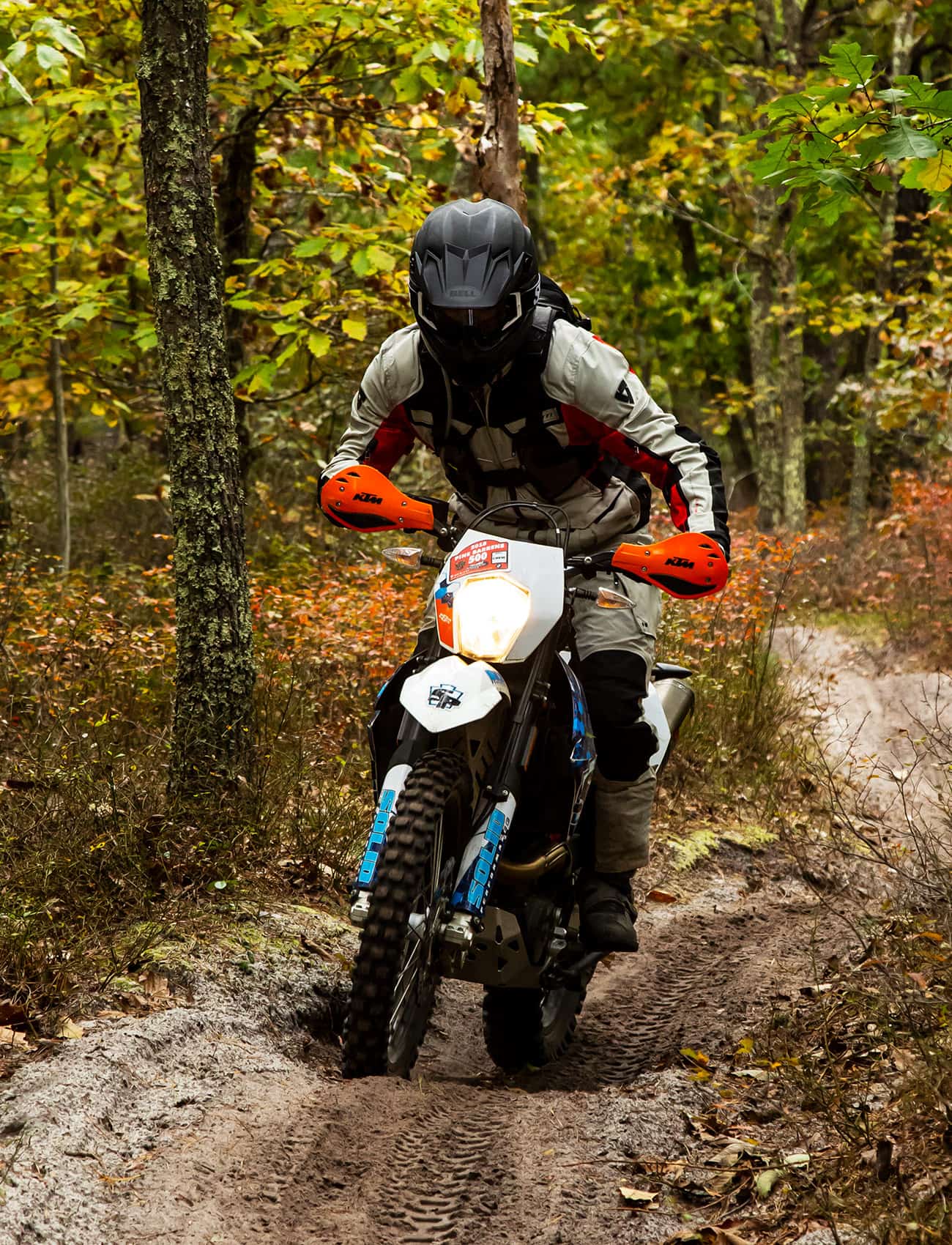
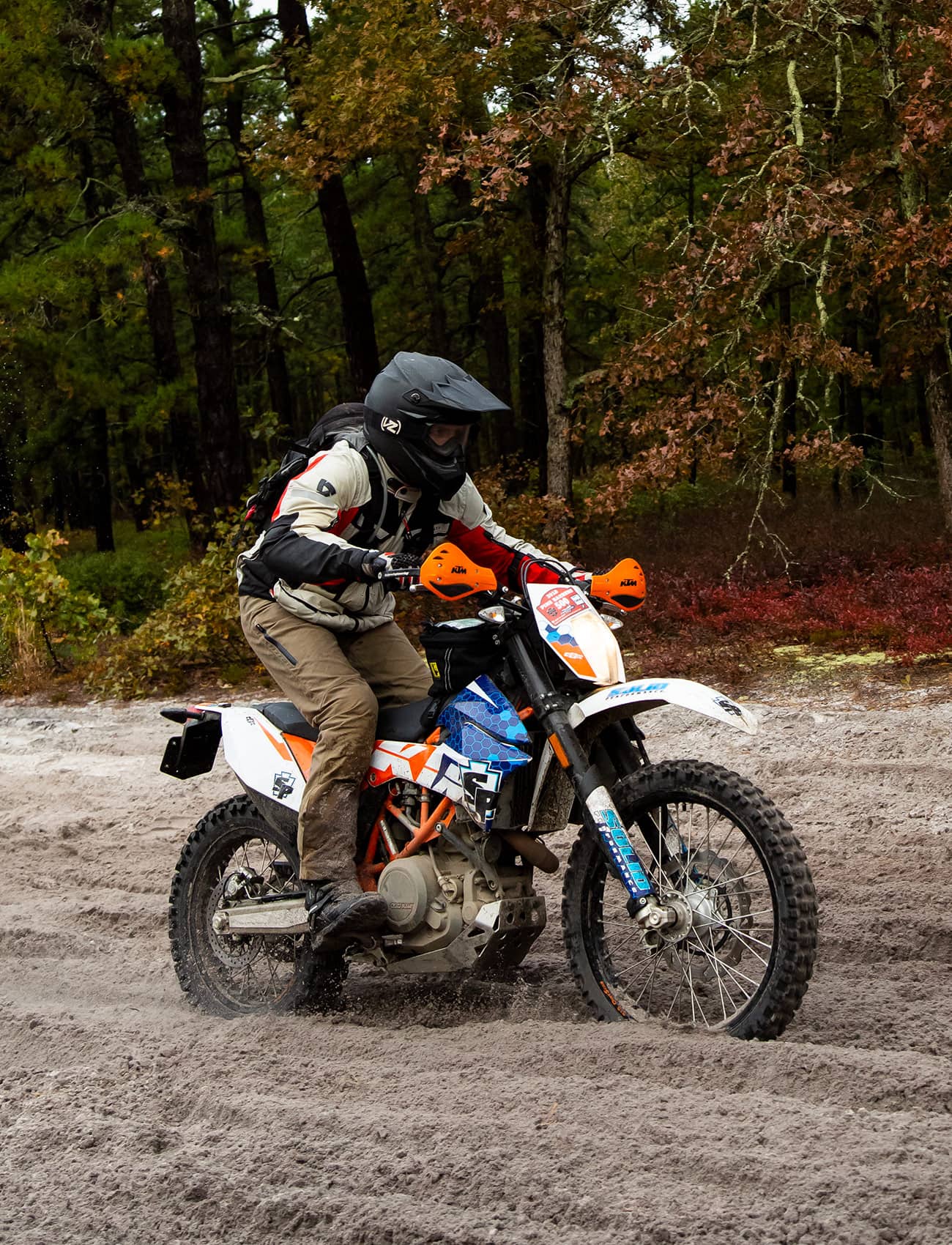
Embarking on a 500-mile off-road ride through 1.1-million acres of dense forest filled will stretches of deep, soft sand, mud pits and narrow single tracks is no walk in the park. In preparation for the three-day, 500-mile Pine Barrens 500, I took a two-day 101 course with Pine Barrens Adventure Camp in the exact terrain I’ll be on for the long ride. Learning new skills and sharpening old ones is just one to prepare for a long-range off-road enduro. Bringing along all the right gear, protection and tools is a must. Naturally, you can’t predict every fall or flat tire, but you can be ready if and when they happen.

Apparel

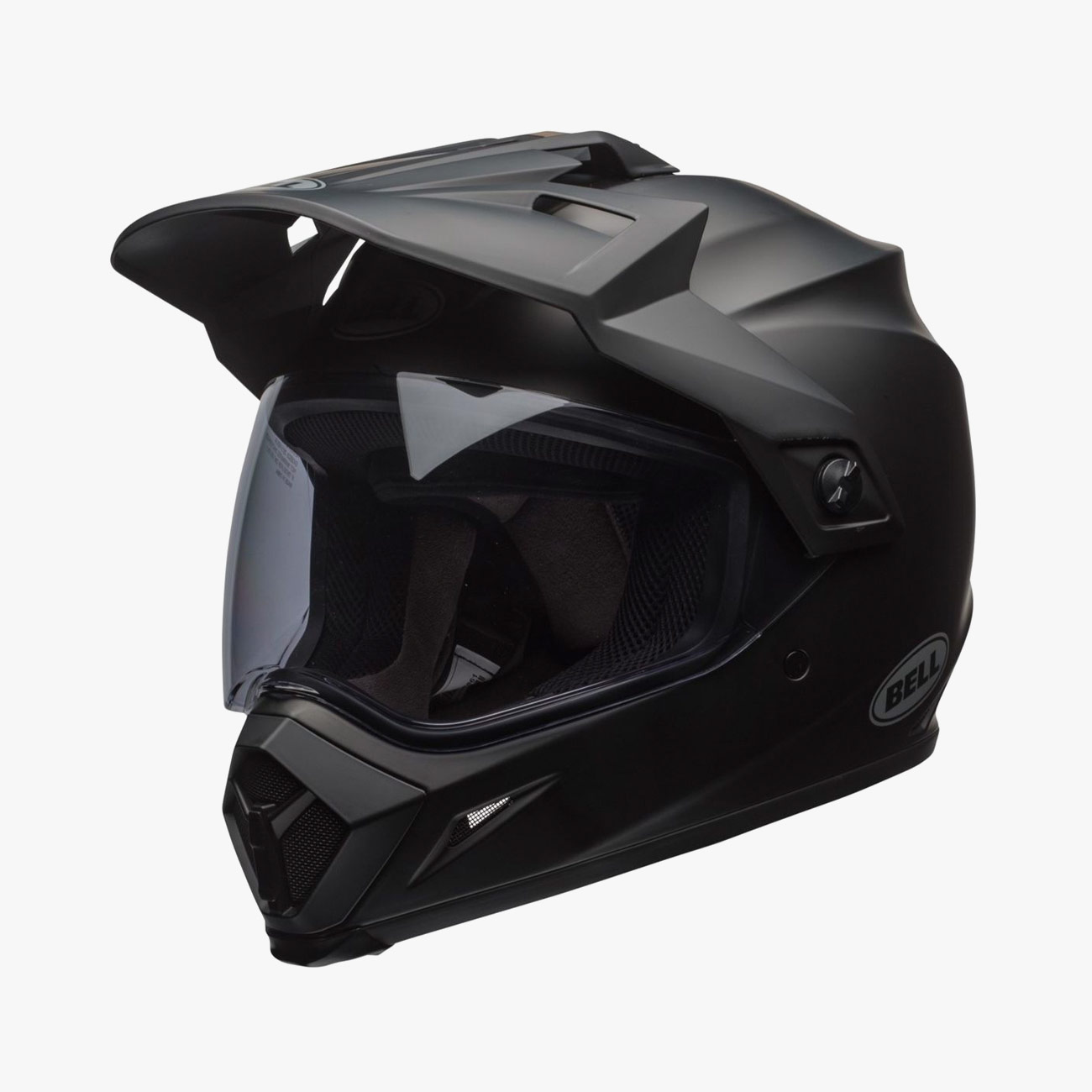
Bell MX-9 Adventure MIPS DLX

Using the already versatile Bell MX-9 Adventure helmet as a base line, the DLX adds a significant upgrade with a transition lens. The simple but critical upgrade means you don’t need to change lenses when the light starts to fade because the UV-sensitive adaptive lens adapts its tint depending on lighting.

Rev’It Sand 3

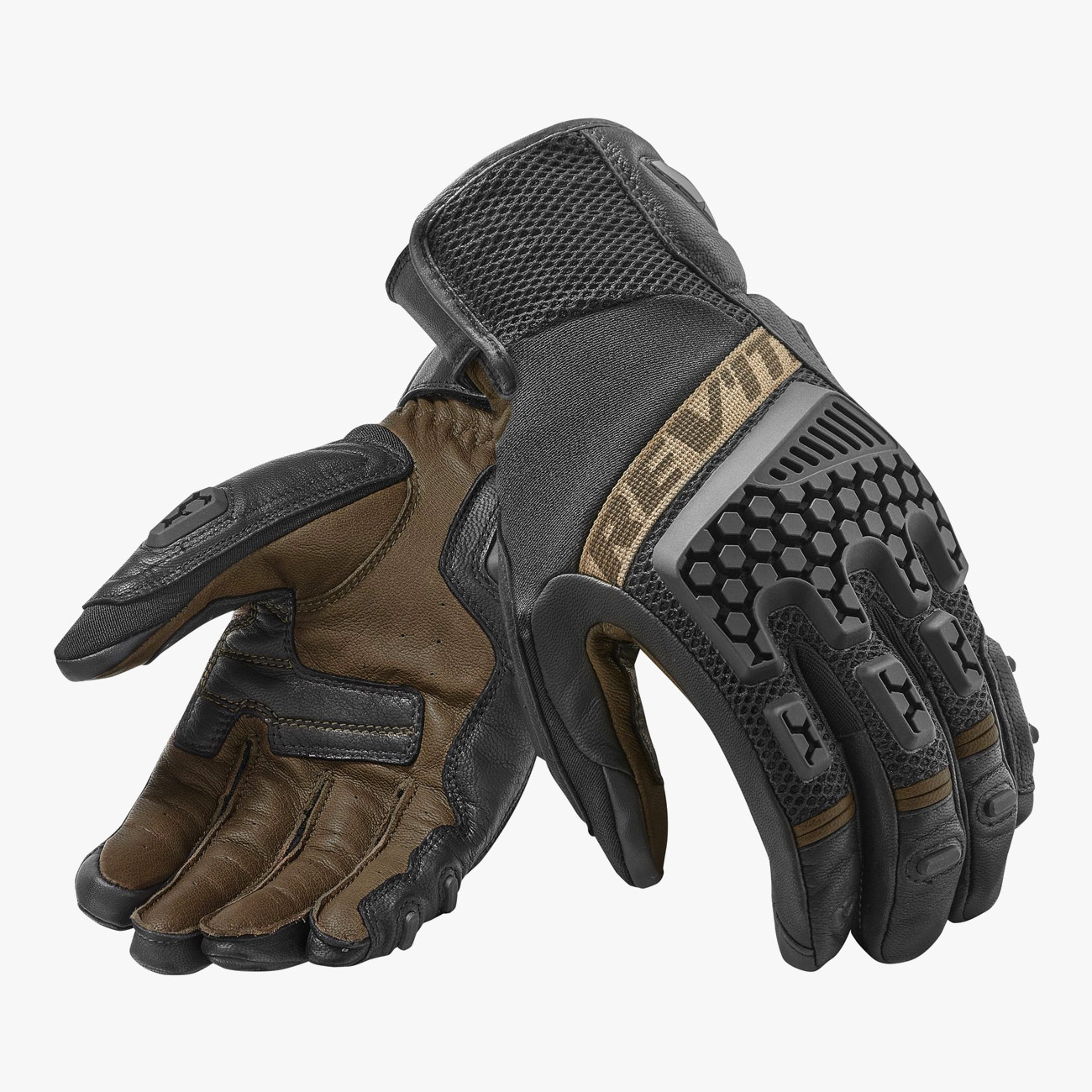
For warmer weather, Rev’It Sand 3 gloves are lightweight and breathble but knuckle and finger padding still provide protection for when the tree branches get too close for comfort.

Klim Vanguard GTX

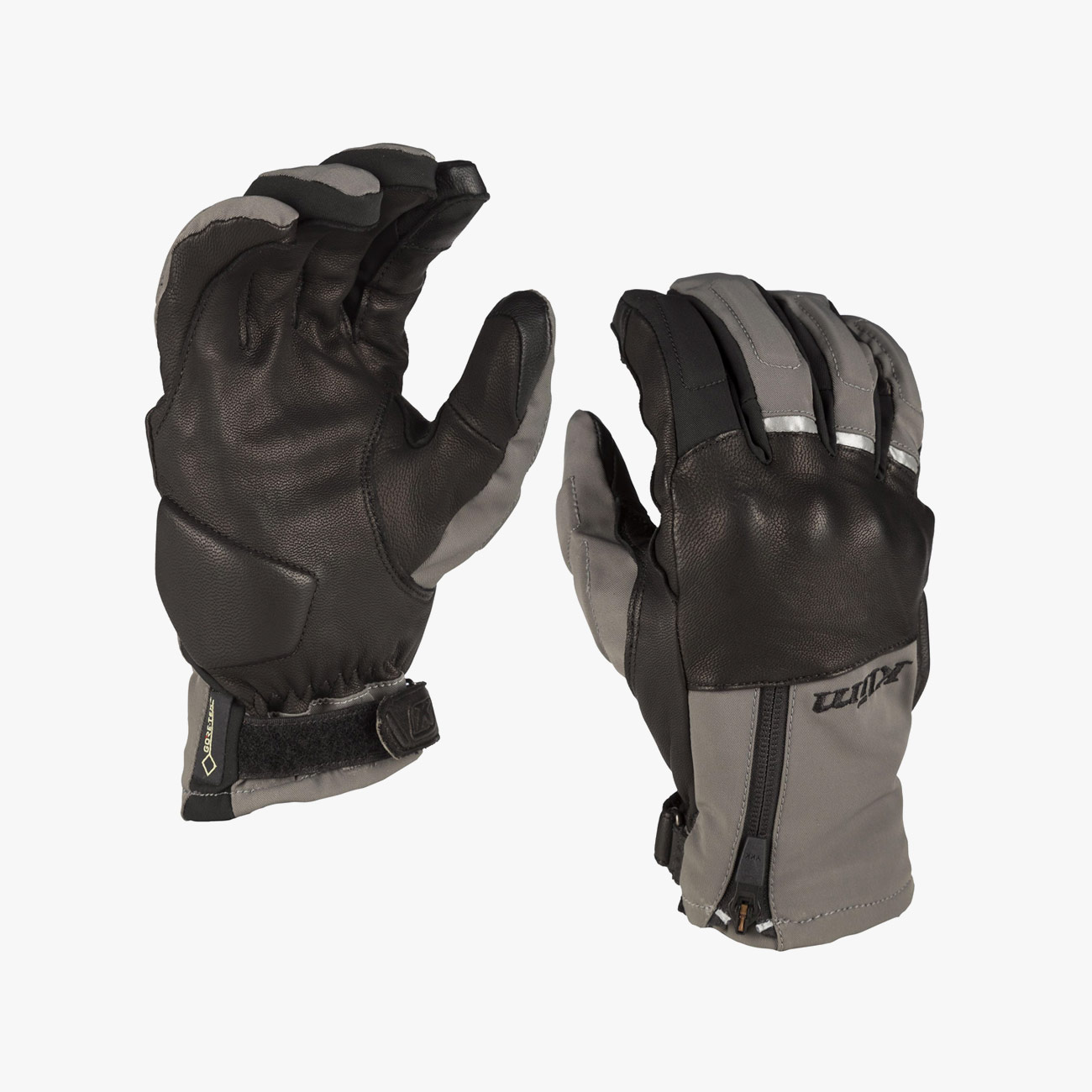
When it gets cold and wet, the Klim Vanguard GTX will keep your digits warm and dry. And unlike most cold weather gloves, the Vanguard GTX has a short gauntlet for better range of motion — useful for when in the stand-up adventure riding position or to provide wrist freedom while jostling side to side.

Rev’It Sand Urban Jacket

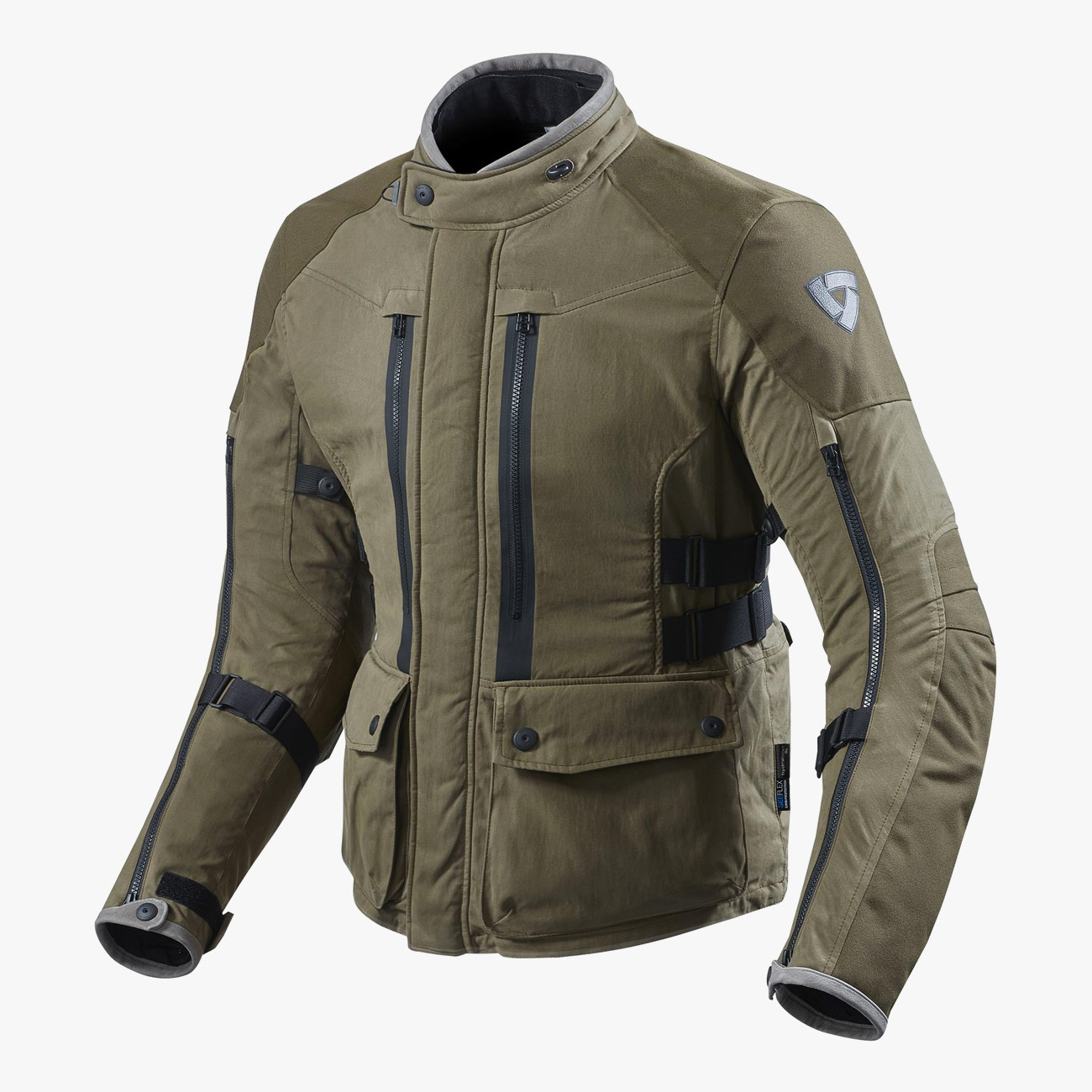
Versatility and adaptabilty are key when it comes to jackets. It’s tough to have all the gear you need and another jacket on top of that. The Sand Urban is lightweight and vented, but also comes with detatchable and easily storable waterproof and insulated linings.

Rev’It Sand 3 Pants

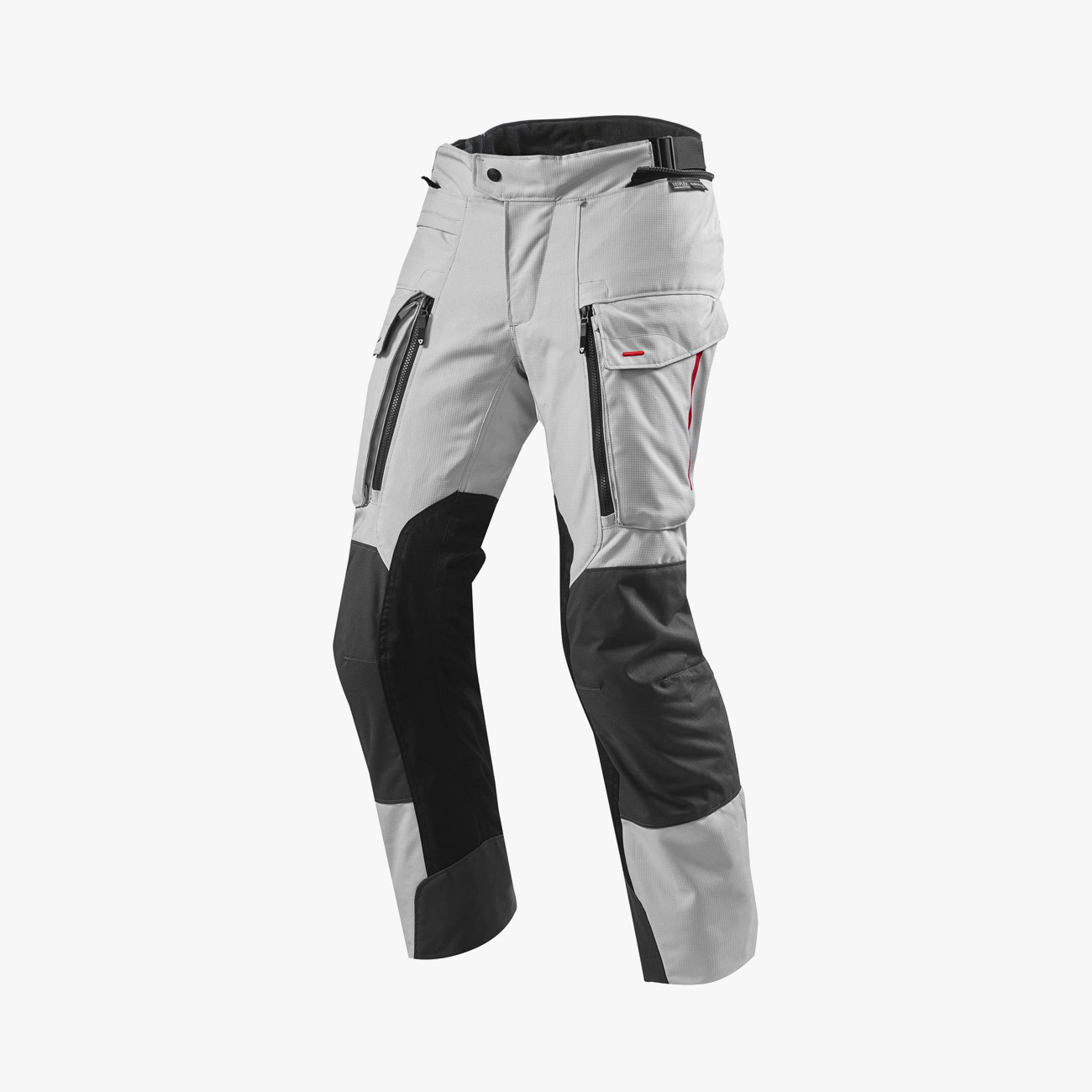
As with jackets, pants need to be adaptable. The Sand 3 comes with removable waterproof and insulated layers like the Sand Urban jacket.

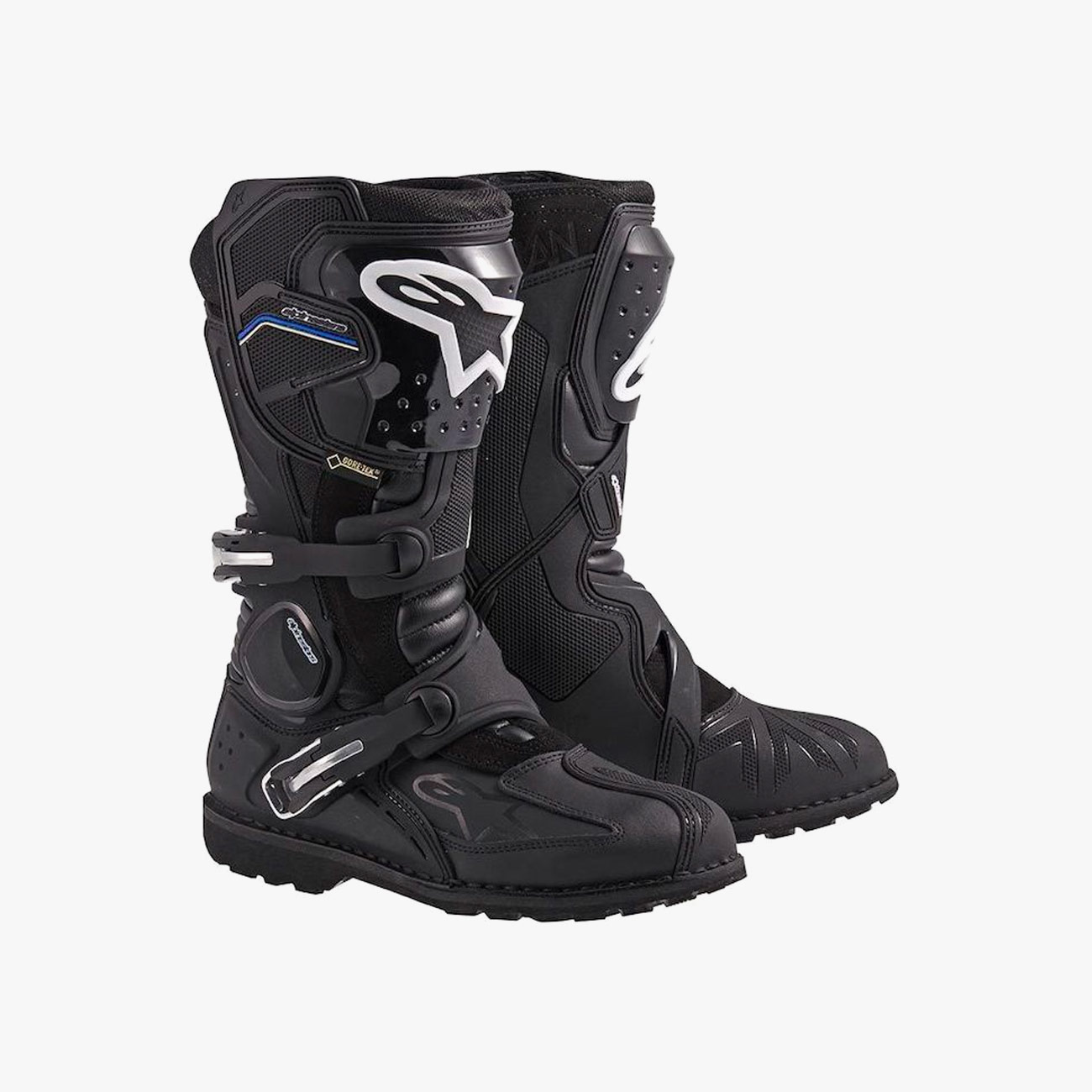
Alpinestars Toucan Gore-Tex Boots

One thing you don’t want for 500 miles is cold, wet feet. The Alpinestars Toucan Gore-Tex Boots are tough enough to handle the bumps and knocks from the trail and use Gore-Tex liners to keep the water out. The Toucan Boots also have treaded soles, which more hardcore dirt boots tend to skip, but come in handy when you’re on a slick surface trying to upright your bike and keep on riding.

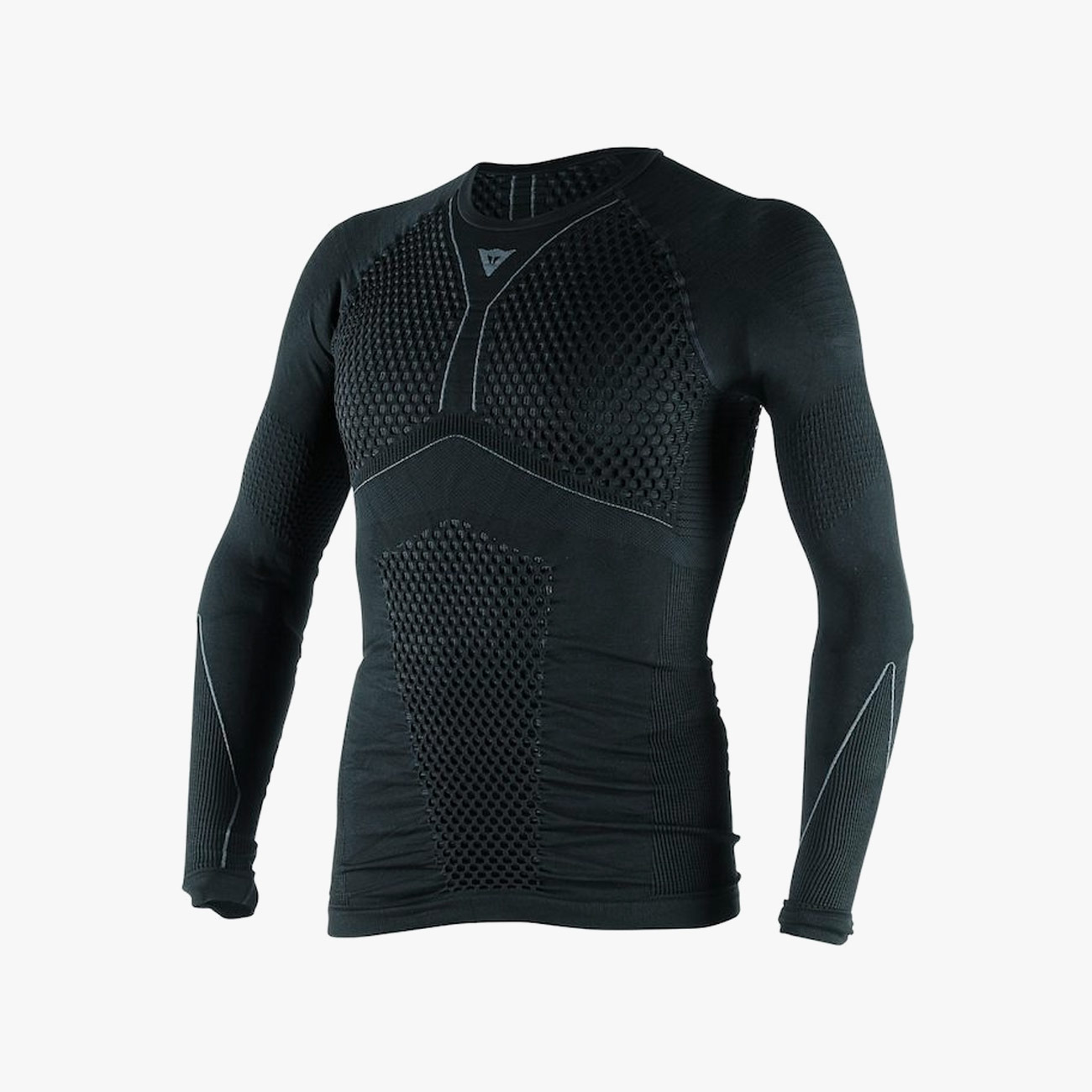
Dainese D-Core Thermo Shirt

Technical base layers are another important layer you’ll wish you brought along when you need it. When temepratures rise and dip, technical layers do a fine job of regulating your body temp under all your other gear.

Gear

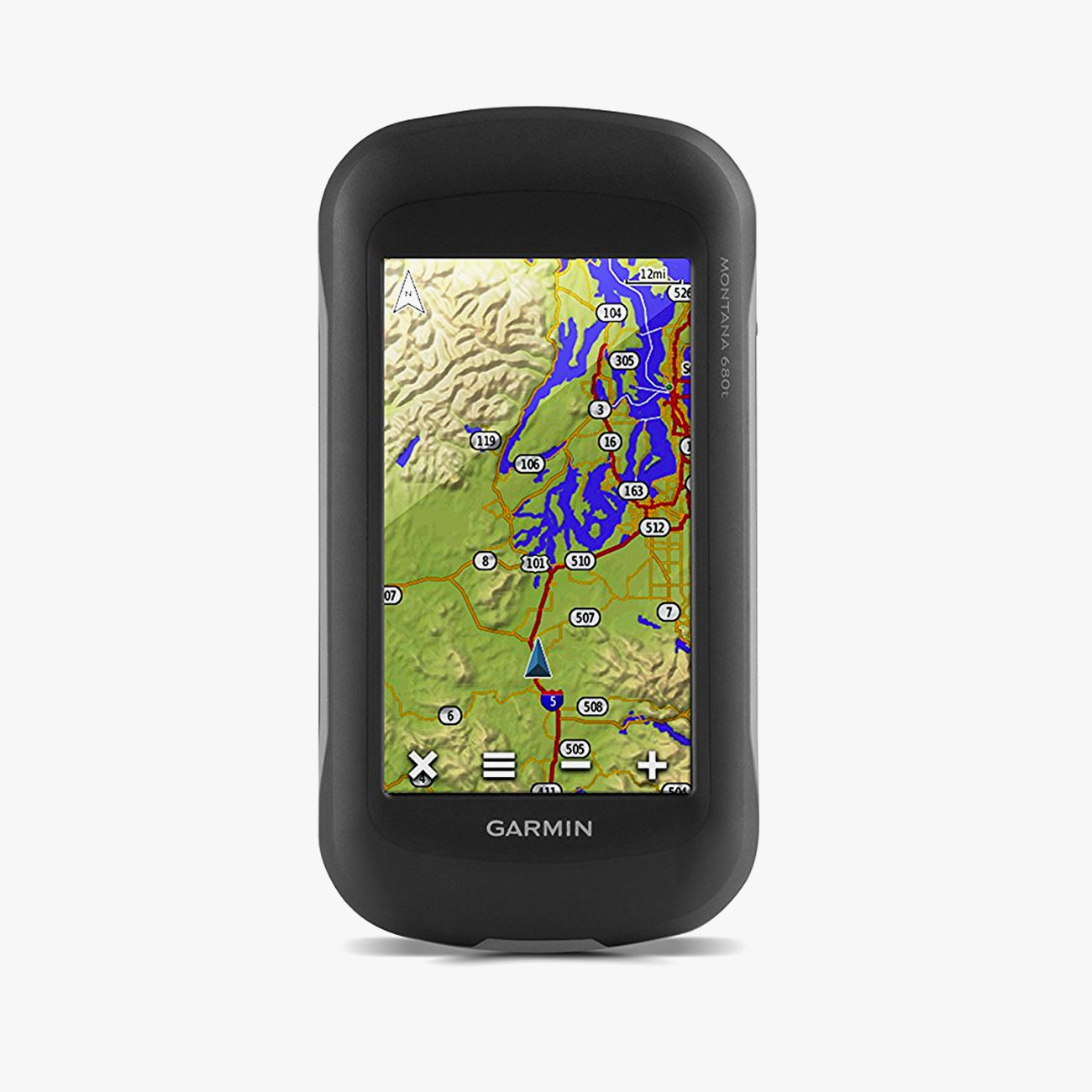
Garmin Montana 680T GPS

Navigating the great outdoors when you can get a GPS signal is a breeze, but without it you’re riding blind. The Garmin Montana 680T is a mountable GPS that lets you download topographical maps so you don’t have to rely on a signal. Unless you’re a fan of stopping every 100 yards to unfold a map, offline navigation is essential.

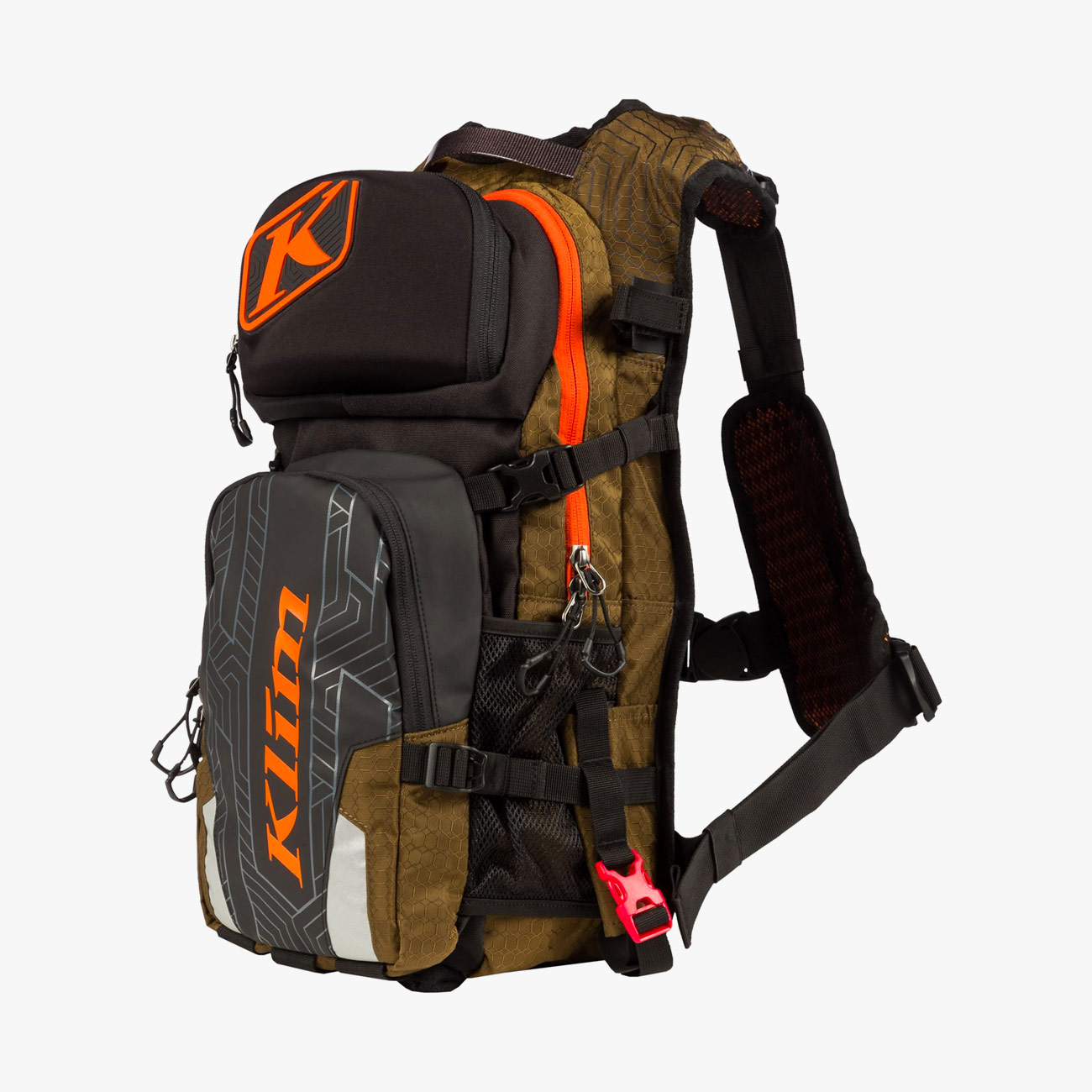
Klim Nac Pak

Carrying a massive rucksack on a 500-mile ride is a terrible idea. It’s far better to distribute the weight of your gear across your body and your bike. Pack extra gloves and a layer or two, but hydration should also be a top priority. The Klim Nac Pak isn’t oversized but includes a hydration system for on-the-go-drinks.

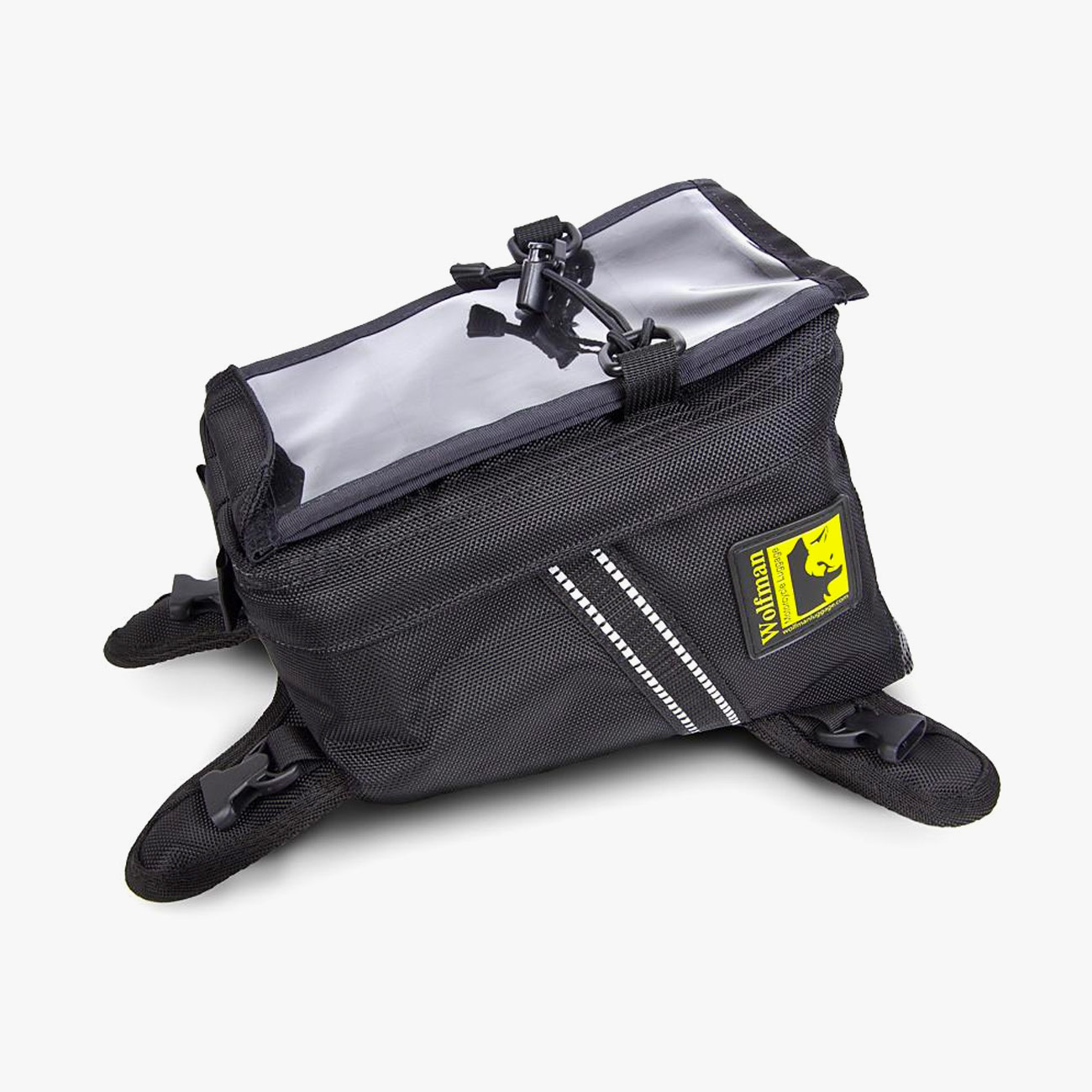
Wolfman Enduro Tank Bag

A compact tank bag that stores gear and snacks at the ready makes life on the trail less of a chore. The Wolfman Enduro Tank Bag is tough, easy to install and detach and is the perfect size for a smart phone and a couple protein bars.

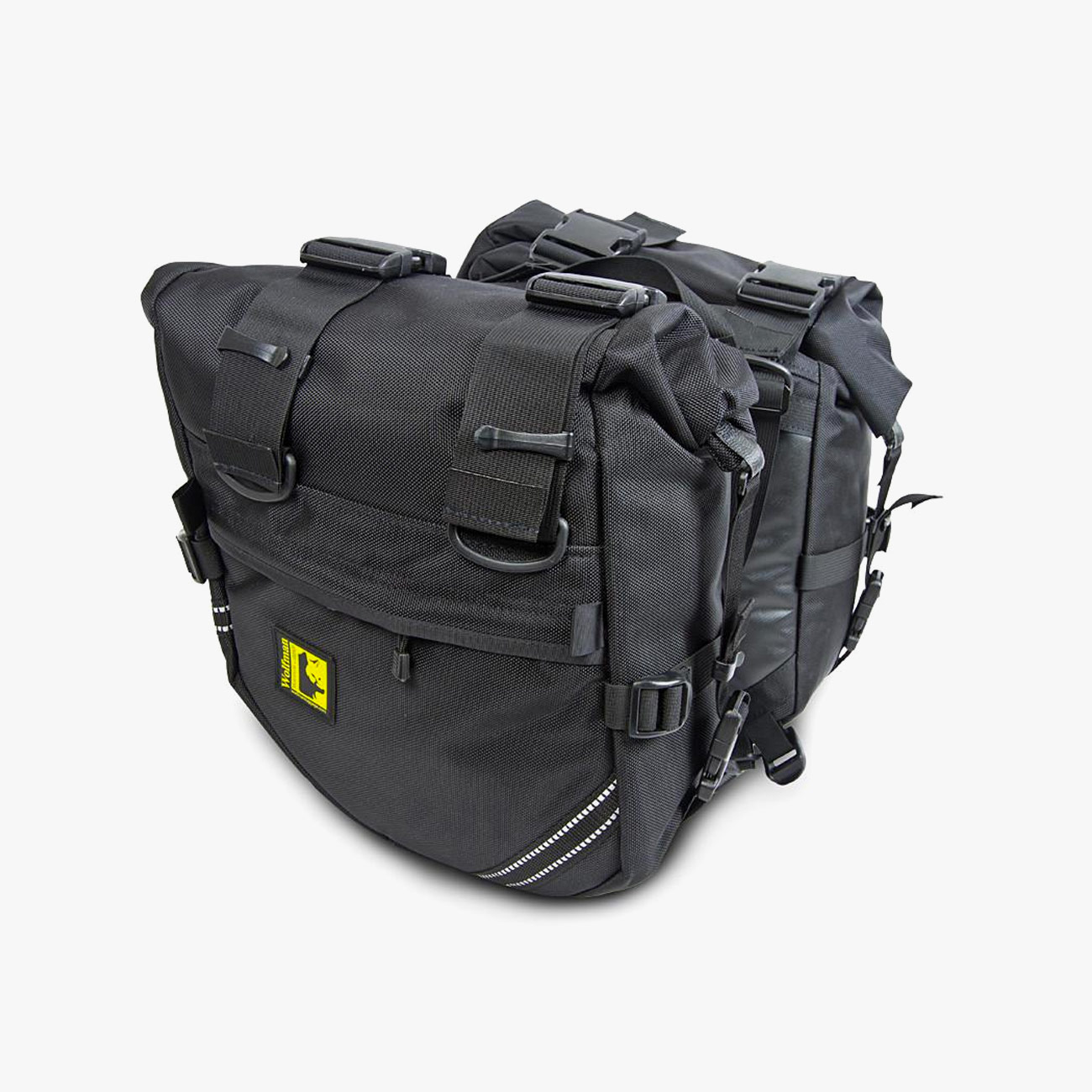
Wolfman Enduro Dry Saddle Bags

Hard saddle bags work for big adventure bikes on long tours but the extra weight and size play against you on the trails. Wolfman Enduro Dry Saddle Bags are quick to install and since they’re soft and collapsable, won’t do damage to your bike if you go down. Just don’t store anything fragile in them — think extra layers and soft gear.

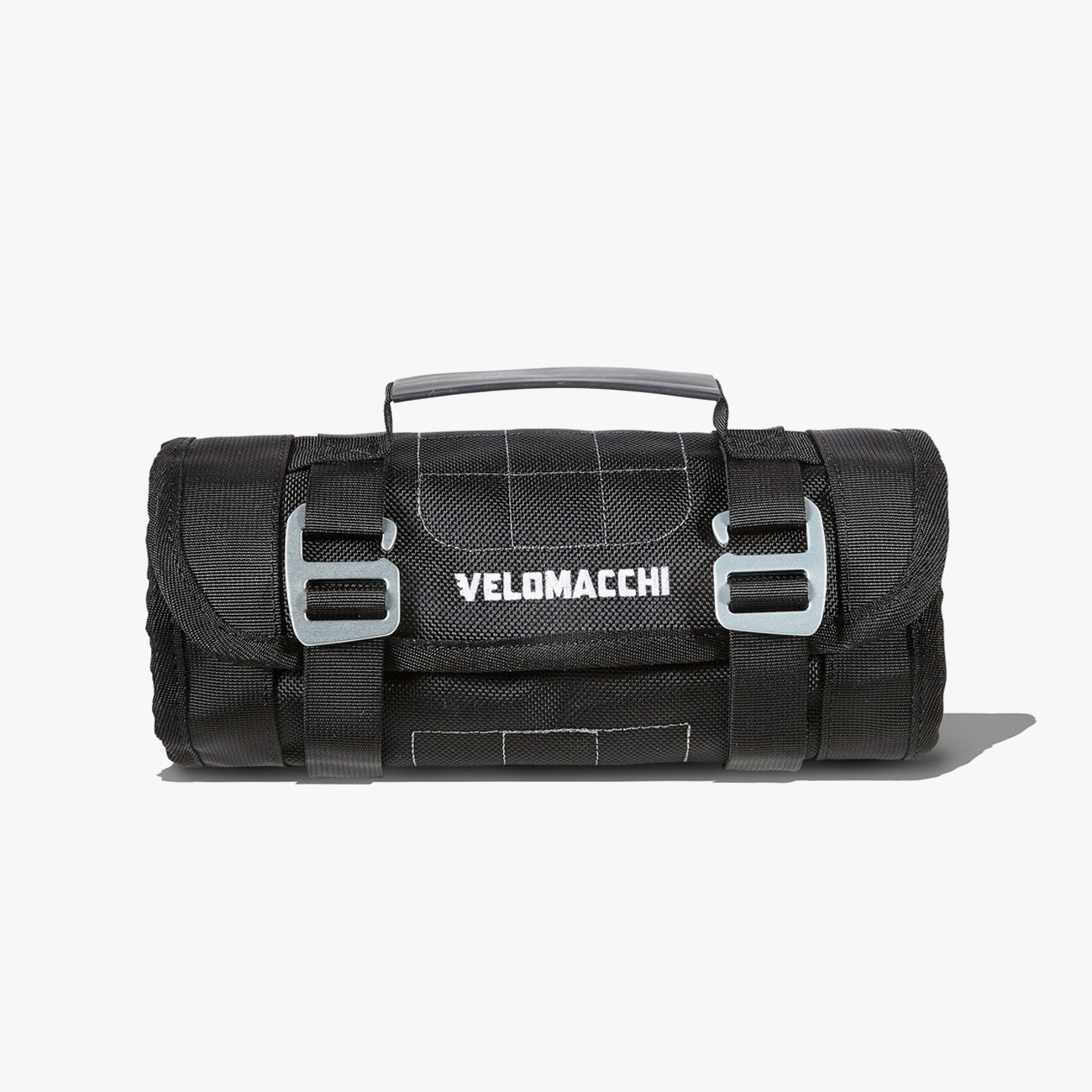
Velomacchi Speedway Tool Roll

Trail fixes are just a fact of life when you ride off-road — flats happen, parts bend and break. A trusty tool roll like the Velomacchi Speedway Tool Roll makes it easier to bring along miscellanious spare parts and essential tools to your specific bike.

Tools

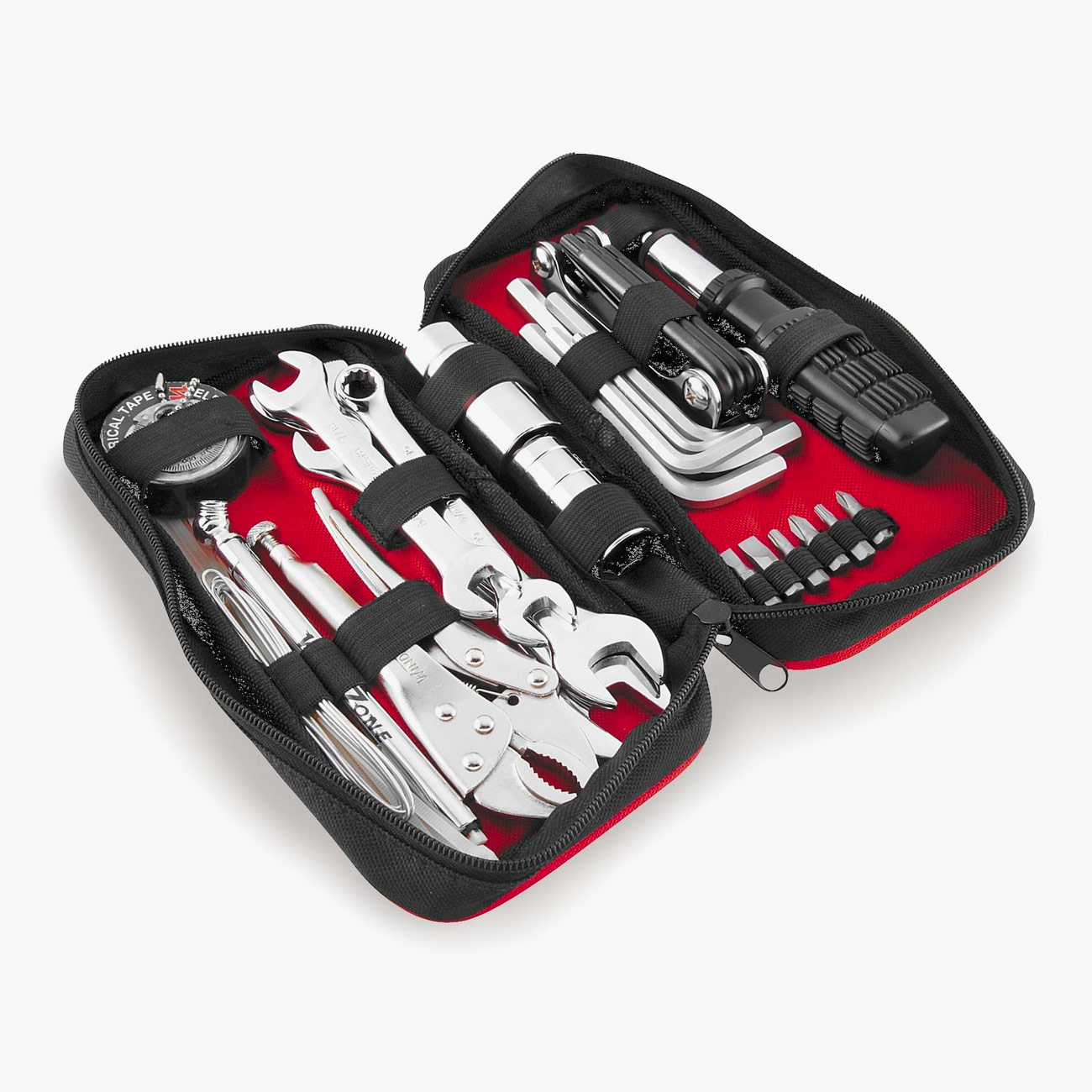
Windzone Essenti-Economy Tool Kit

Where your tool roll might be home to the custom set of wrenches, drivers and spare levers for your bike, a generic toll kit also lends a massive help. For whatever you can’t fit in your tool roll there’s a good chance the Windzone Essenti-Economy Tool Kit has you covered.

Motion Pro T6 Tire Levers

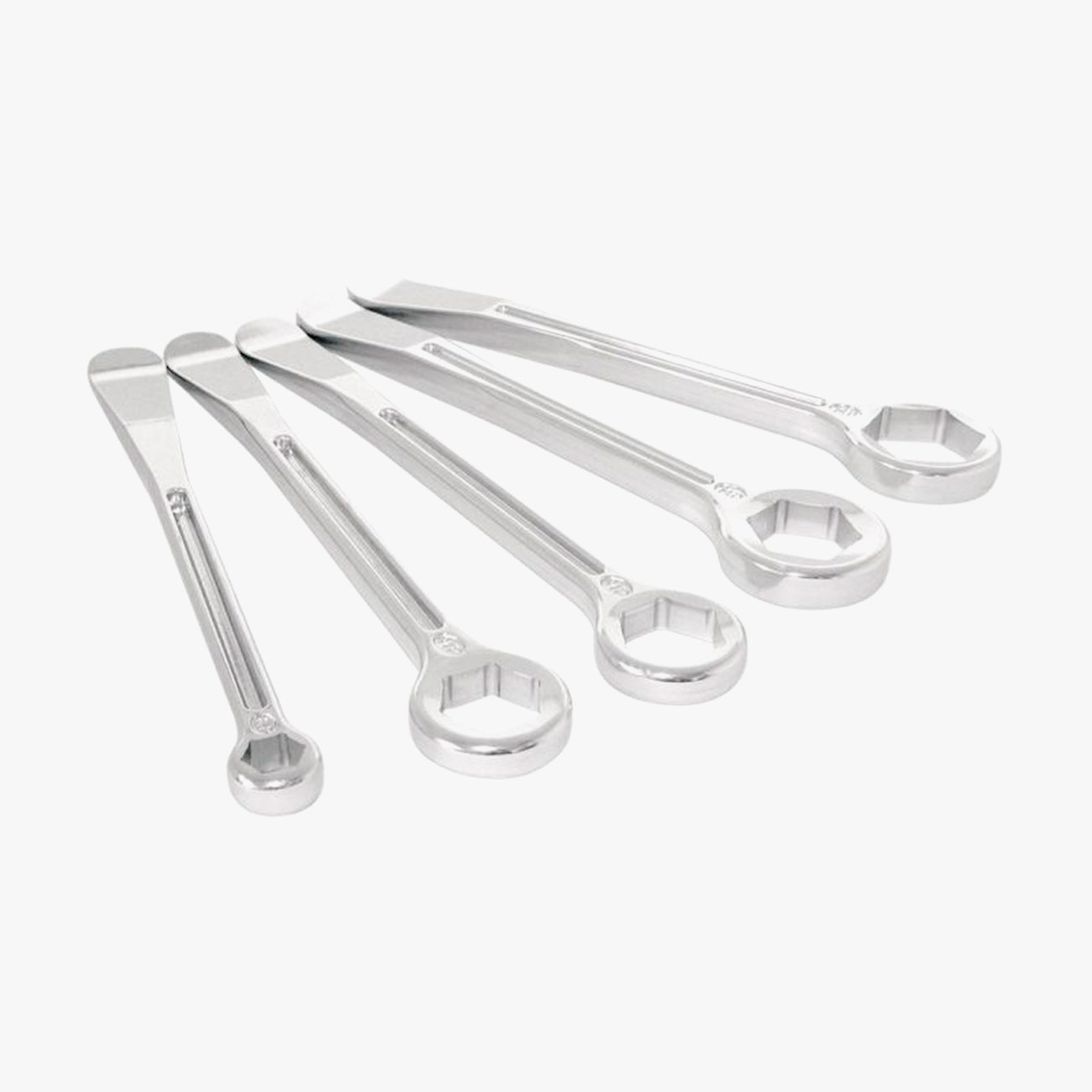
It’s probably more of a case of when – not if – you get a flat tire. Motion Pro T6 Tire Levers are dual-sided wrenches and tire spoons that are neccessary if you want any chance of getting back to camp after a flat.

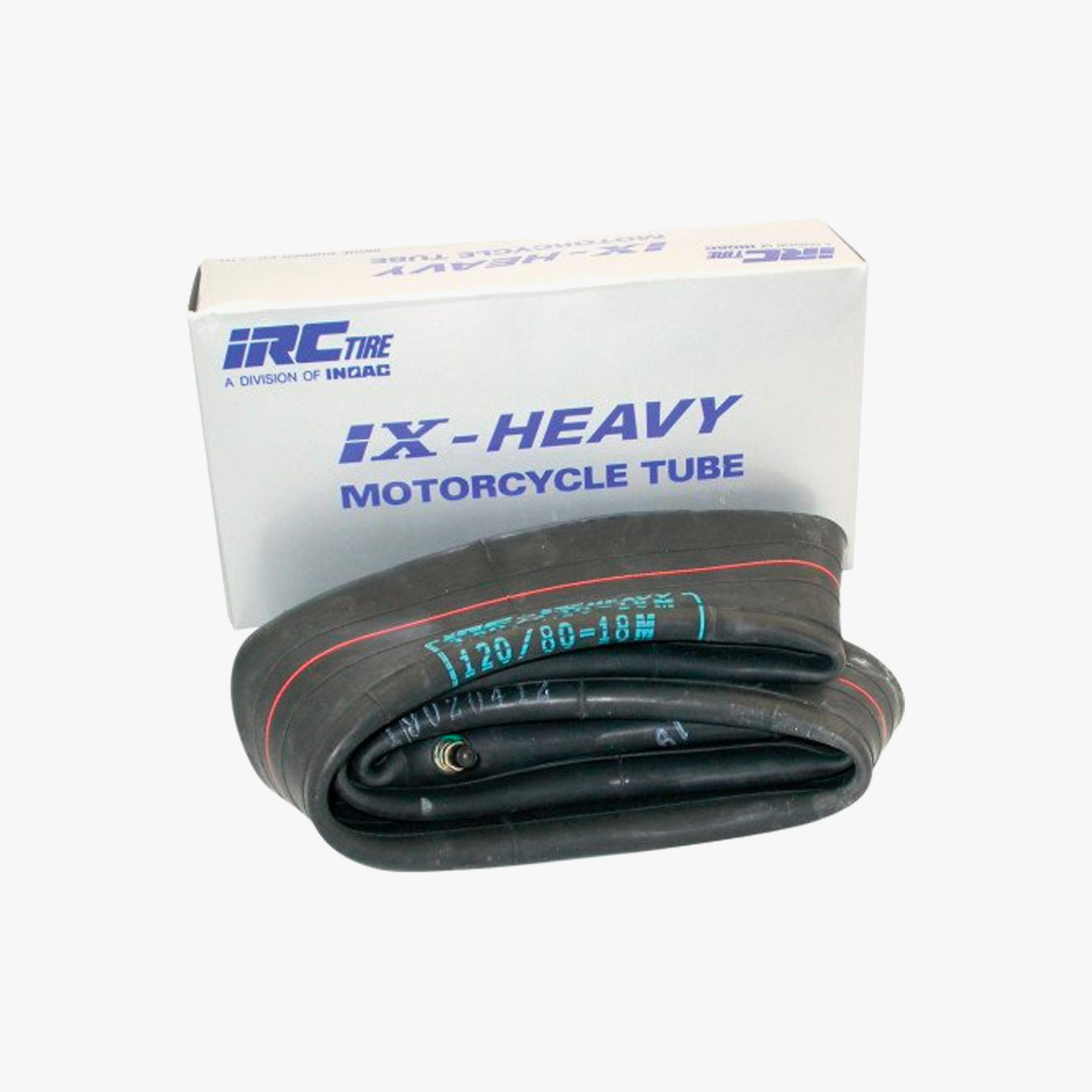
Spare IRC Heavy Duty Tubes

Another crucial, self-explanatory item to bring along.

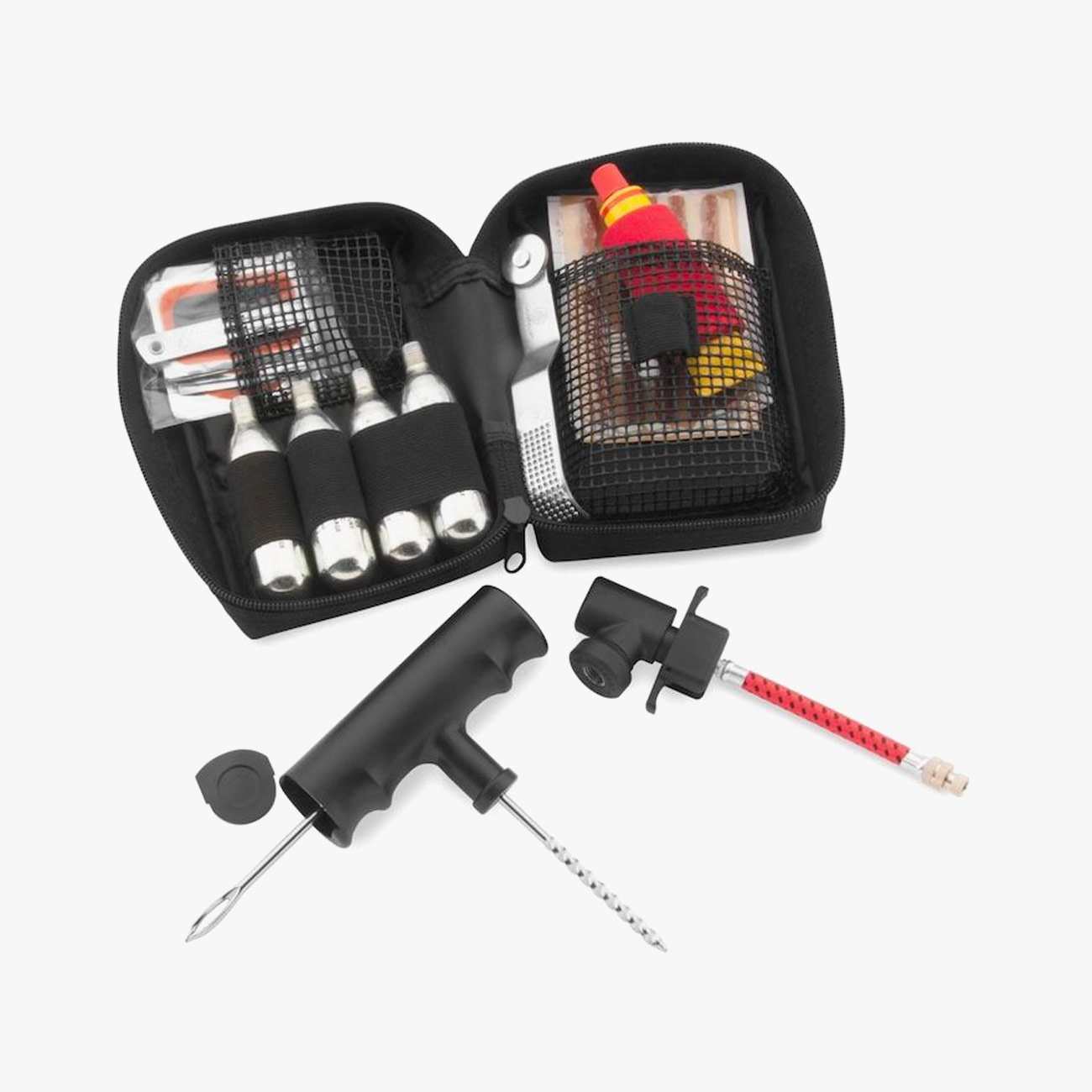
Bike Master Tire And Tube Flat Repair Kit

There are air compressors tiny enough to fit in a tank bag or back pack, but having pressurized CO2 capsules and full tire repair kit are among the simple pleasures of lightweight enduro riding.

Adventure Riding 101

Before a three-day, off-road, 500-mile ride later this month, I head to the edge of Wharton State Forest to learn dirt-riding basics.Read the Story

Note: Purchasing products through our links may earn us a portion of the sale, which supports our editorial team’s mission. Learn more here.

8 Easy and Essential Adventure Motorcycle Mods

Off-road riding is an entirely different beast than cruising down the smooth stuff. Not only does it require a completely different approach and a handful of new techniques, but a full day of trail carving can also wring you ragged, too. The trick is to make sure you and your bike are fit and prepared to handle the rigors of off-road riding. For you, it’ll take practice and some training. For your bike, it’s a little easier.

From the factory, motorcycles are built to fit a wide range of riders, making the chances that the new bike you just bought will fit you perfectly quite slim. It might sound petty to complain that handlebars are half of an inch too low or foot pegs are a touch too forward-set. After a few hundred miles, a sore back and never-ending arm pump, however, you’ll realize smallest changes can make the biggest difference when you’re wrestling a 400-plus pound motorcycle up a mountain. There are a few easy ways to upgrade your bike to both protect it from inevitable falls, crashes and close encounters of the tree kind, and to tailor it directly to you.

Hand Guards

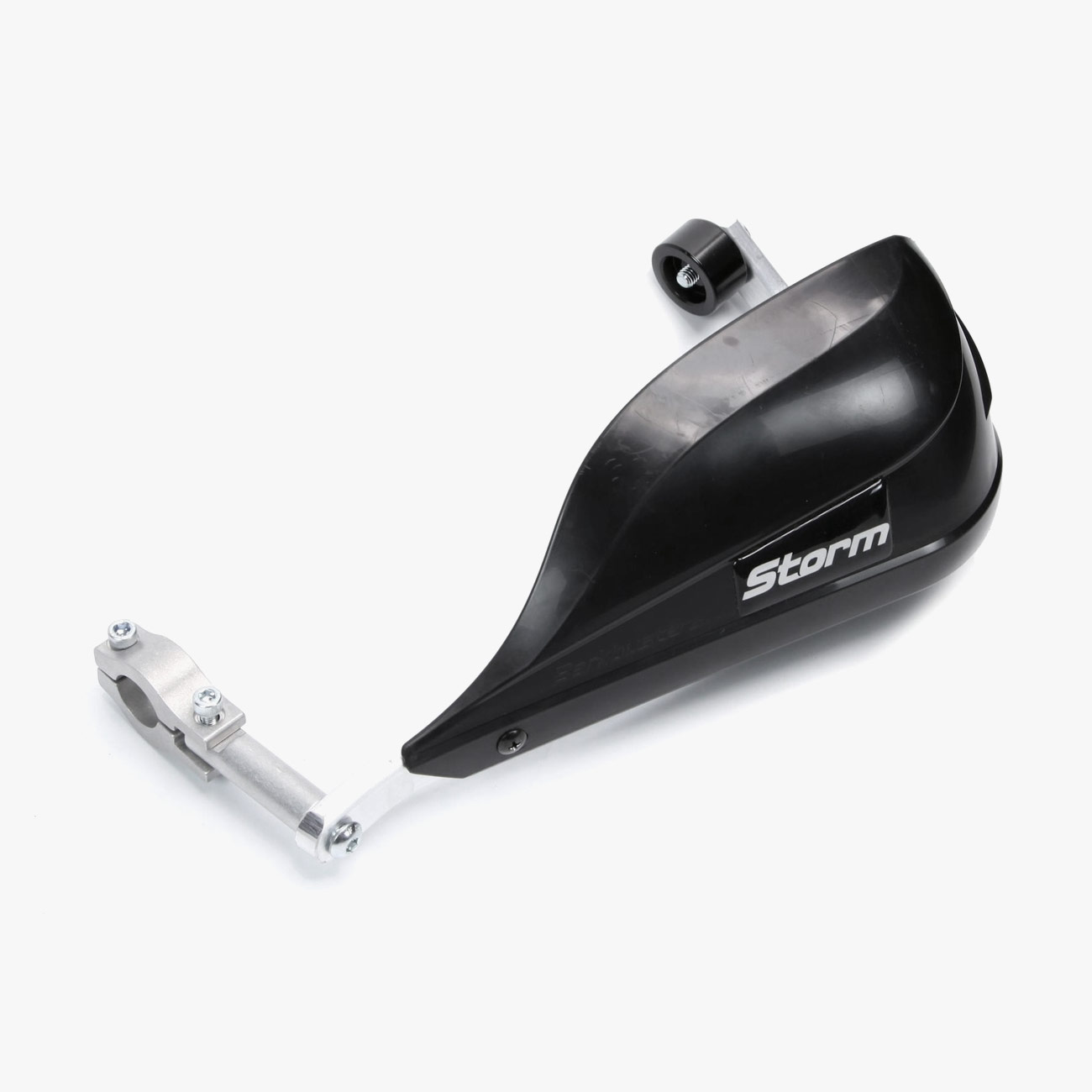
Along with protecting your vulnerable digits, hand guards safeguard against trees and branches catching the clutch or brake lever – and help prevent them snapping off in the dirt or on a rock too. The stronger and more sturdy, the better.

Good: Moose Racing Aluminum Handguards $40+
Better: Barkbusters Storm Handguard Kit $112
Best: SW-Motech Kobra Handguard Kit $124+

Footpegs

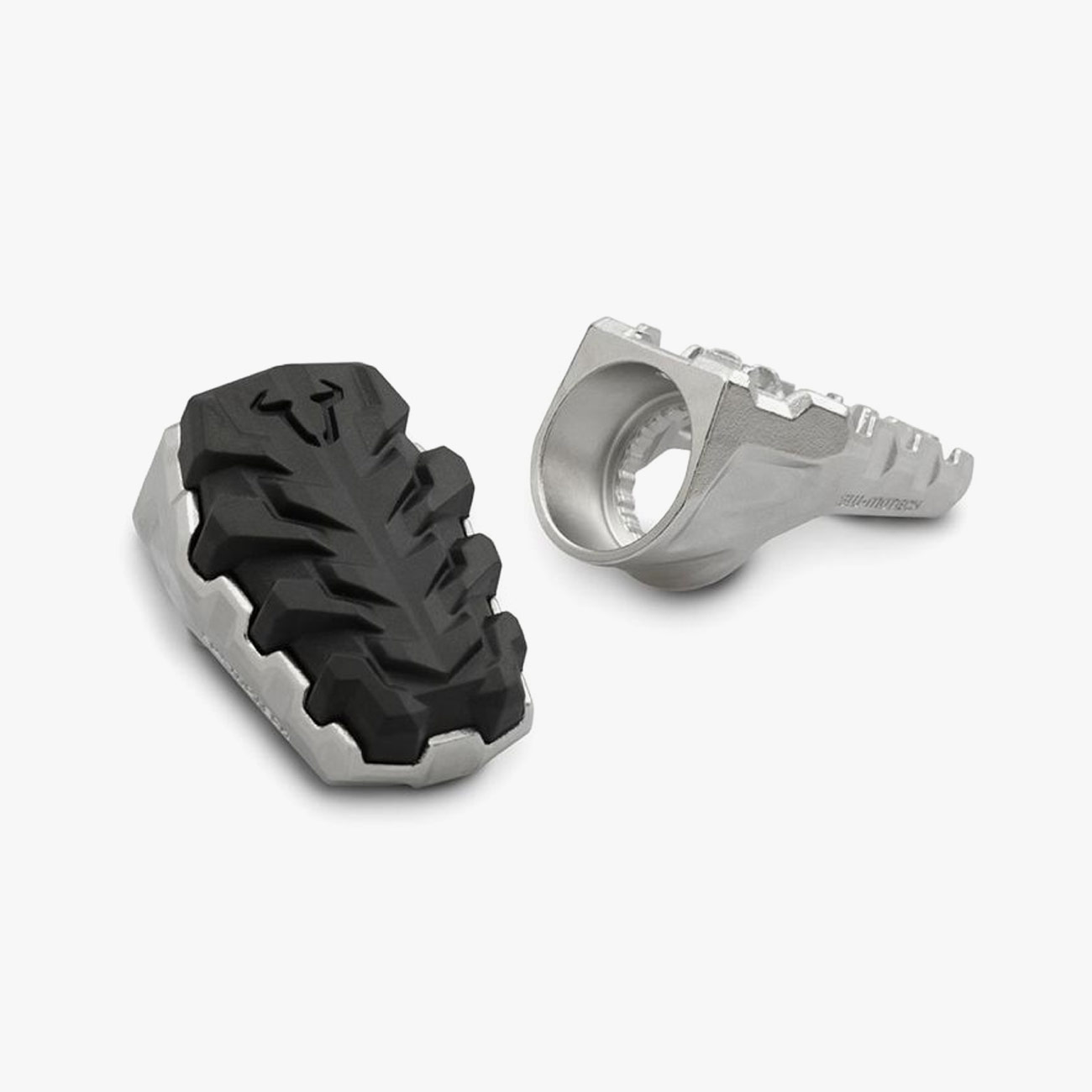
Foot pegs from the factory tend to be one-size-fits-all. For some, stock pegs don’t have enough grip, are too narrow, don’t provide enough support for longer rides and aren’t in the right place. Having the right footpegs in the right place can mean the difference between enjoying 500 miles of riding and considering the first 50 to be pure torture.

Good: Moose Racing Hybrid Footpegs $104+
Better: SW-Motech On-Road / Off-Road Footpegs $121+
Best: SW-Motech EVO Adjustable Footpegs $192

Handlebar Risers

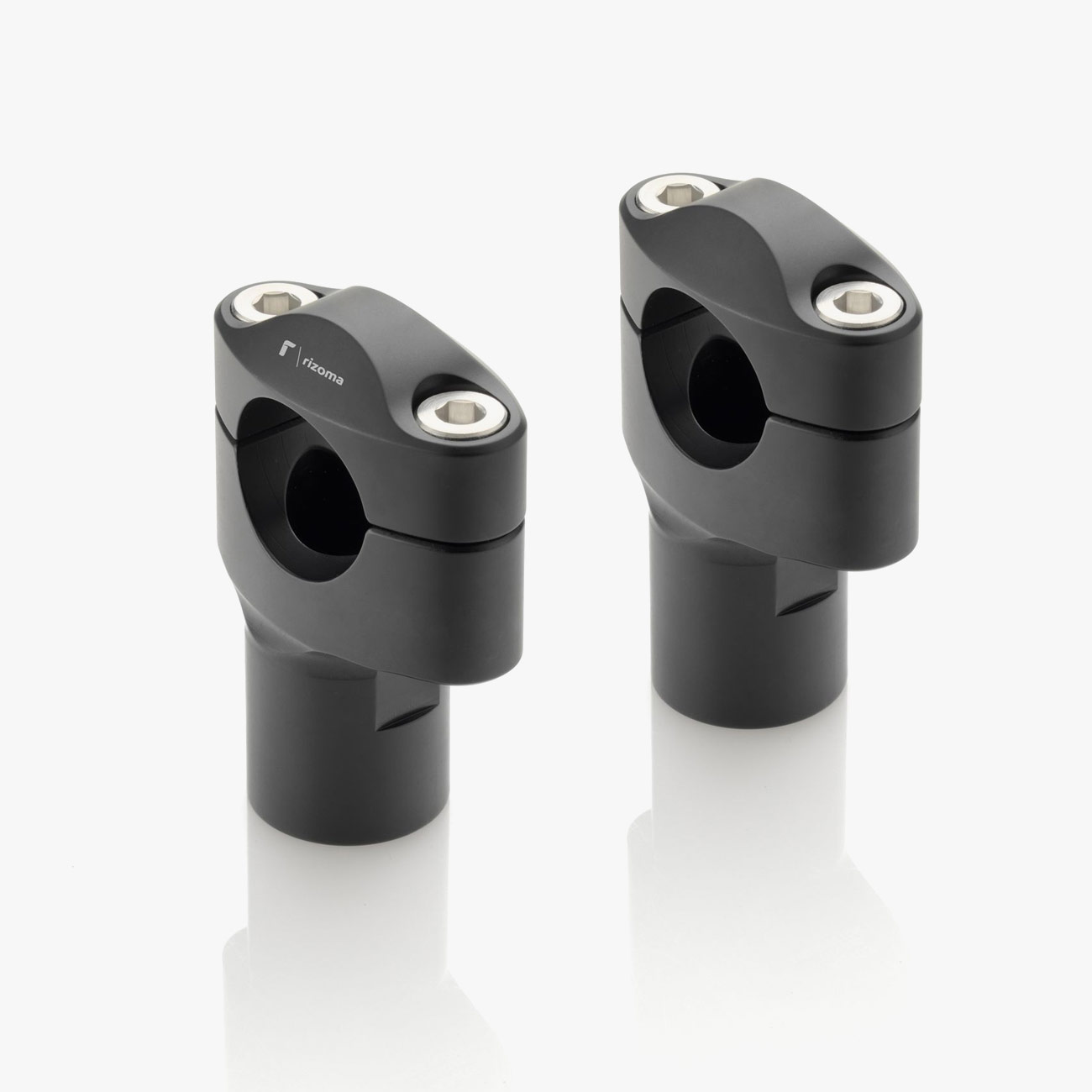
For taller riders, stock placement of the handlebars can be too low. You’ll know that’s the case when you have sore lower back from hunching mile after mile, bump after bump. Being able to stand up straight gives you an incredible and neccessary advantage in bike control.

Good: Zeta Handlebar Risers $46
Better: Rizoma Handlebar Risers $105
Best: Rox Anti-Vibration Elite Pivot Risers $147

Skid Plate

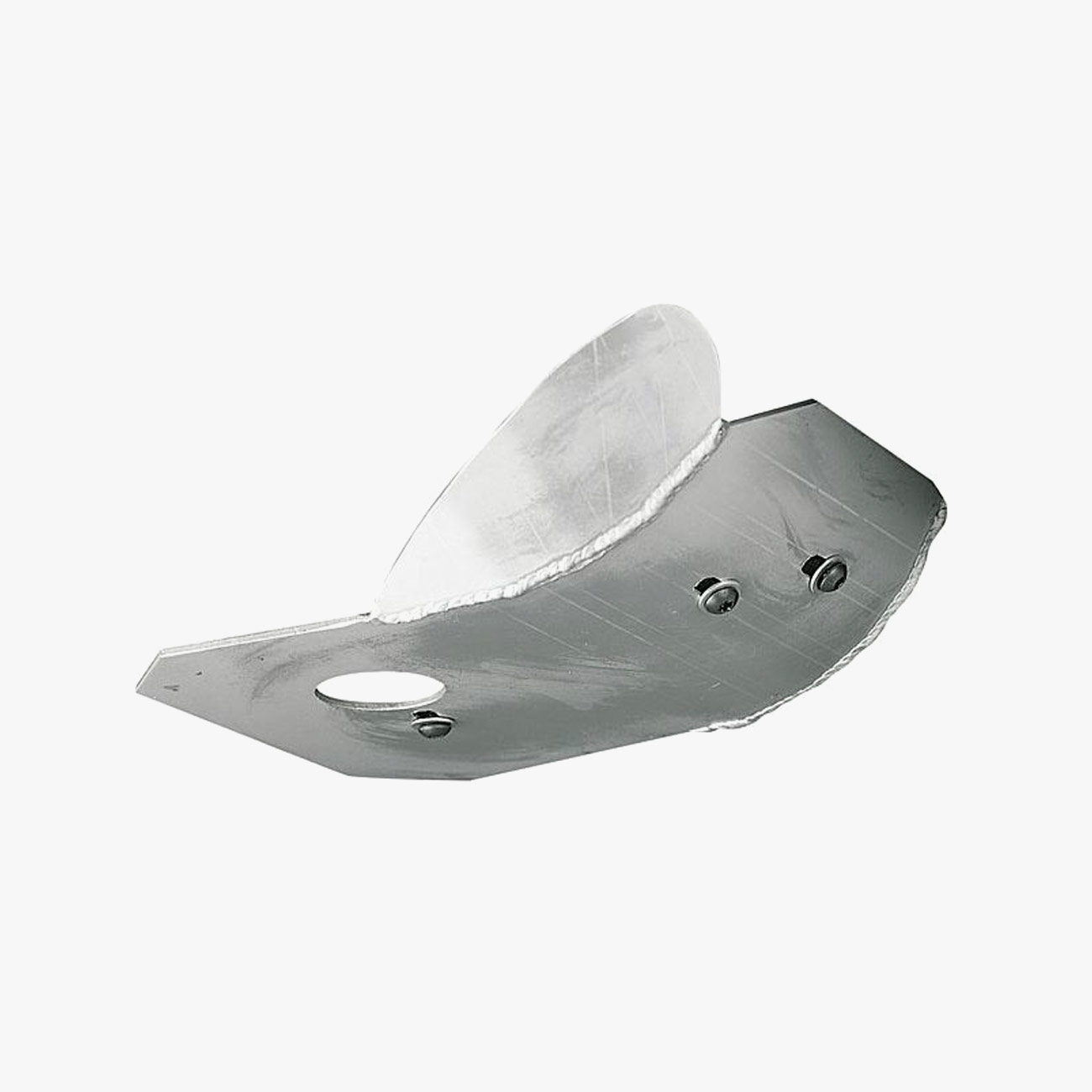
Ruts, logs, gravel flying off the front tire – really, anything that may make an appearance under your bike on a trail – are what the skid plate is there to protect against. More and more off-road bikes are coming with a skid plate from the factory, but often they aren’t robust enough.

Good: R&G Racing Skid Plate $98
Better: Moose Racing Skid Plate $102
Best: EAltRider Skid Plate $127

Side Stand Plate

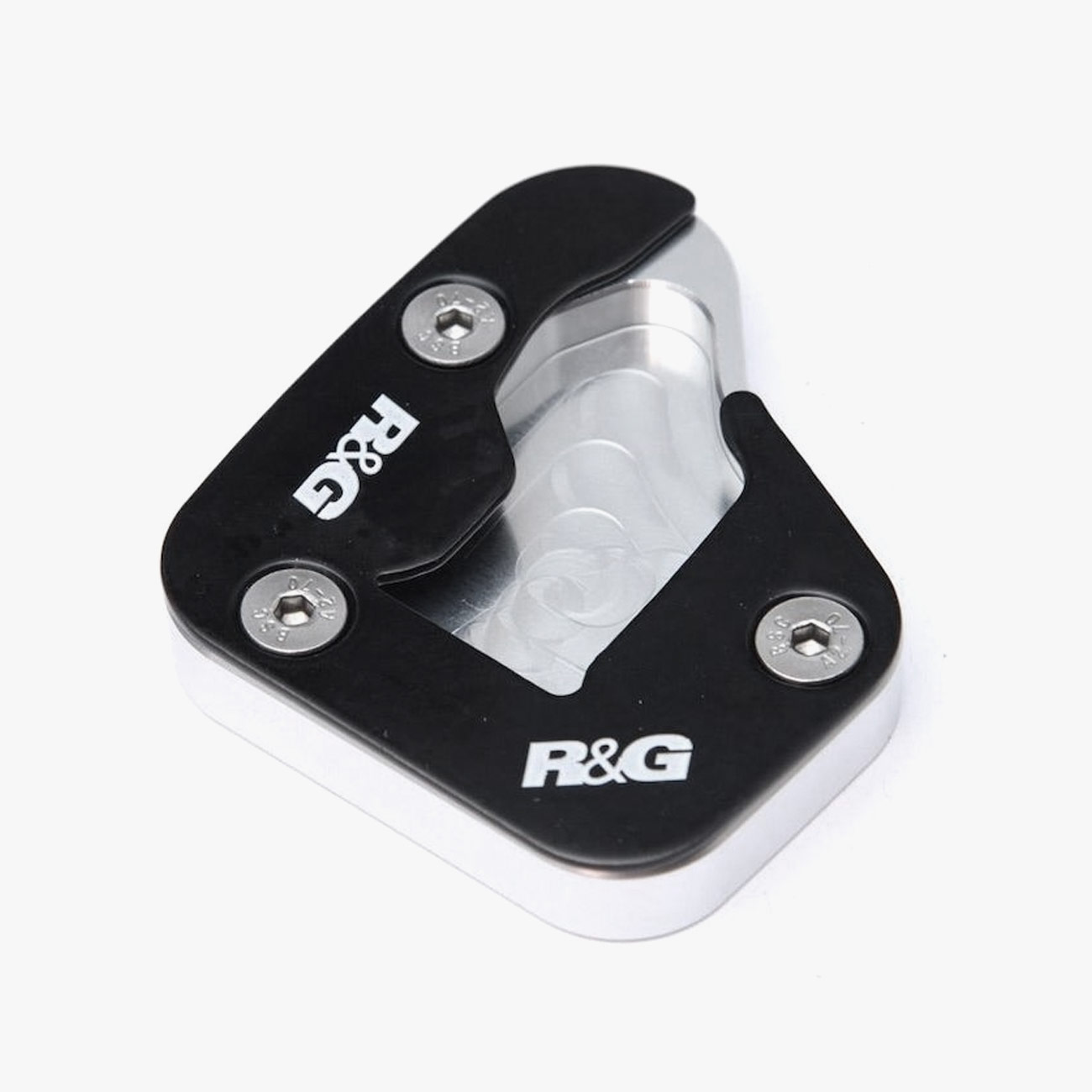
Widening the surface area of your kickstand is a fairly simple but helpful upgrade. You won’t always find a hard surface on which to drop the kickstand. A larger surface area helps distribute the weight of the bike and keeps the sidestand from sinking into the ground. It’s a good way to prevent that embarrisng slow-motion tip over.

Good: R&G Racing Kickstand Foot $48+
Better: Givi Sidestand Foot $49+
Best: SW-Motech Sidestand Foot Enlarger $59+

Crash Bars

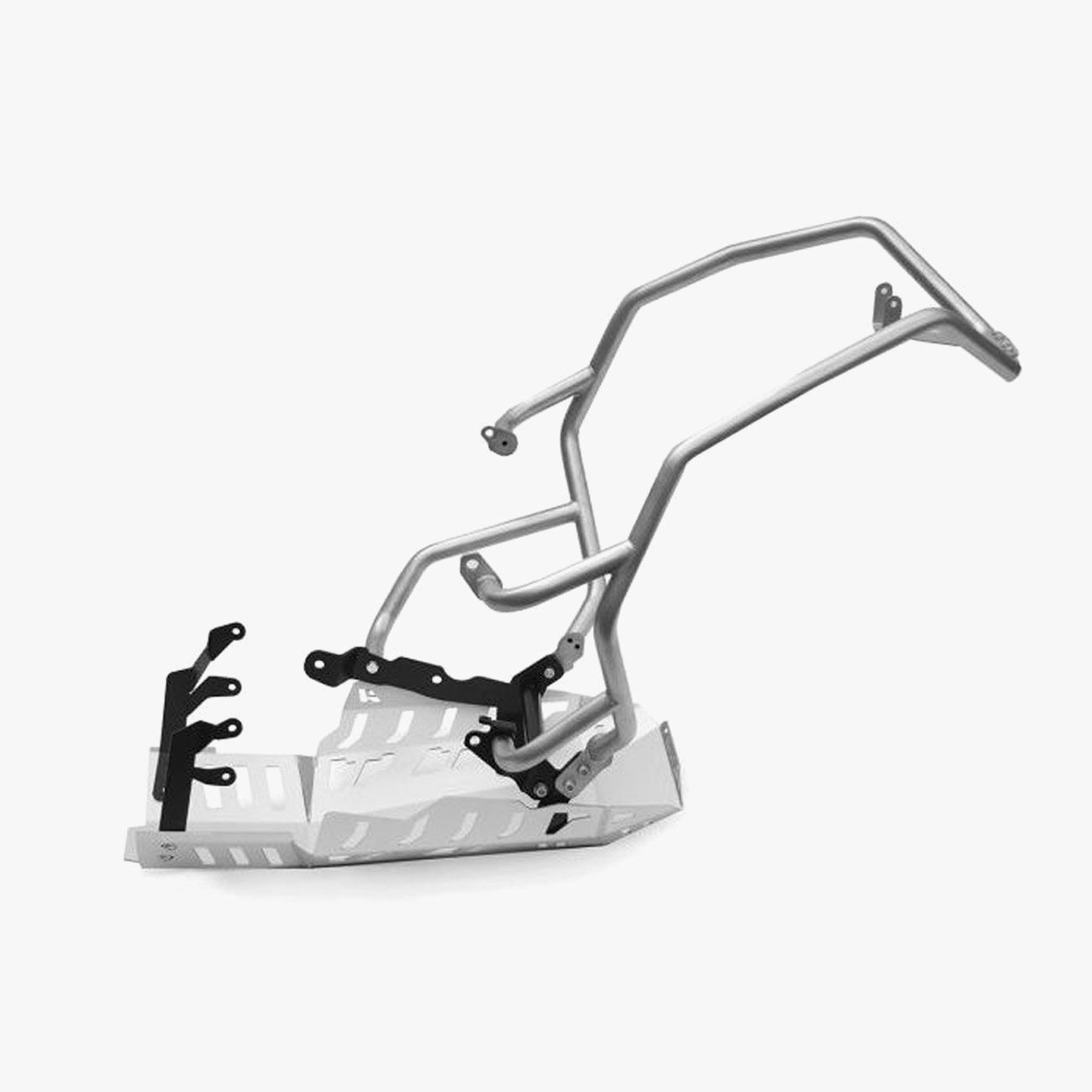
Falls happen when you go off-roading — it’s a fact of life. You never know if it’ll happen on soft sand or mud – or if there’s a rock waiting to crack your crank case. Crash bars are to limit damage, but they can also make a great tow point or grab handle if you bury your front wheel in that mud you didn’t see coming.

Good: SW-Motech Crash Bars $132+
Better: R&G Racing Adventure Bars $138+
Best: AltRider Crash Bar And Skid Plate System $596+

Radiator Guard

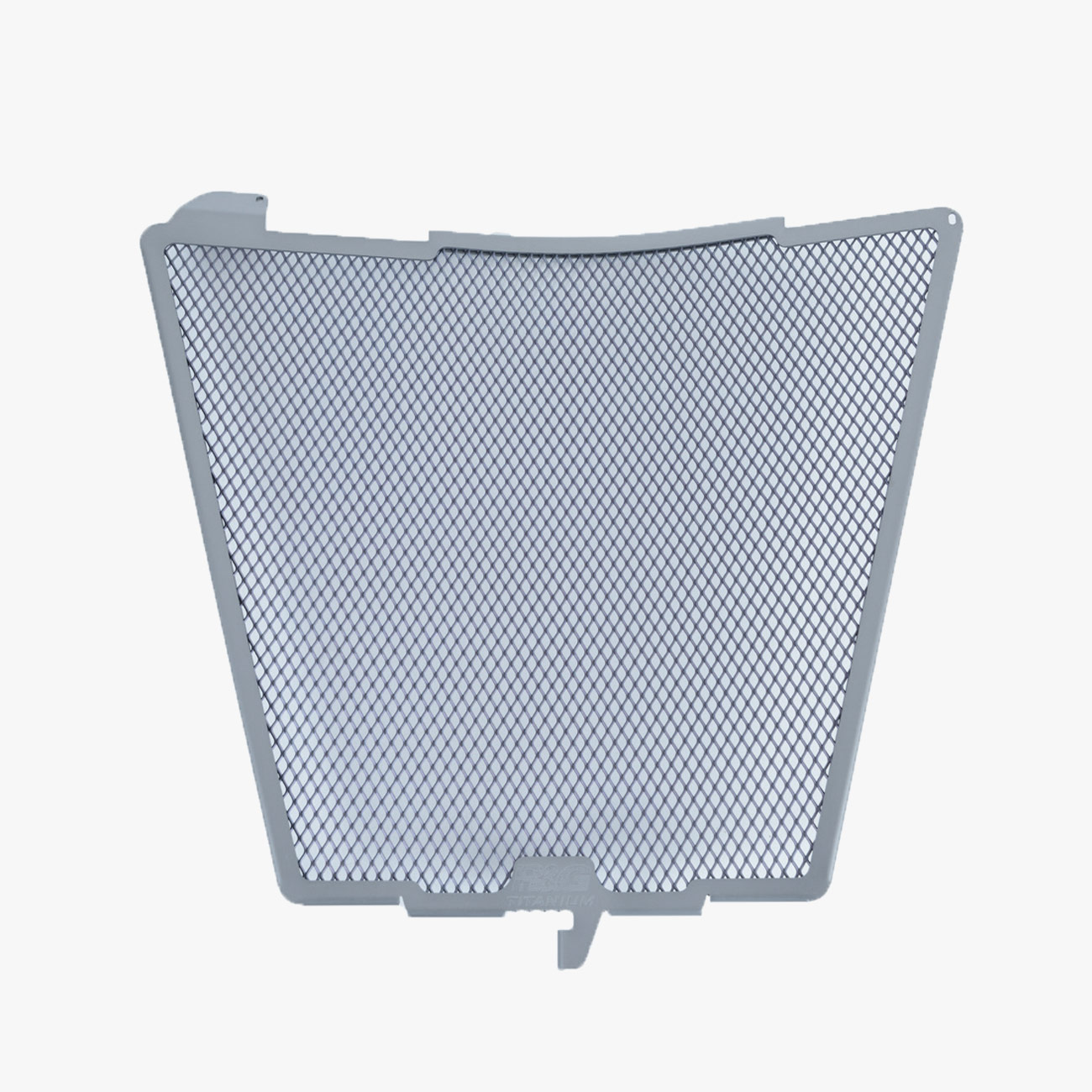
Like a lightweight extension of the skid plate, the radiator guard protects your vulnerable and vital cooling system while still letting through good air flow.

Good: R&G Racing Radiator Guard $58+
Better: Cox Racing Radiator Guard $72+
Best: AltRider Radiator Guard $86+

Headlight Guard

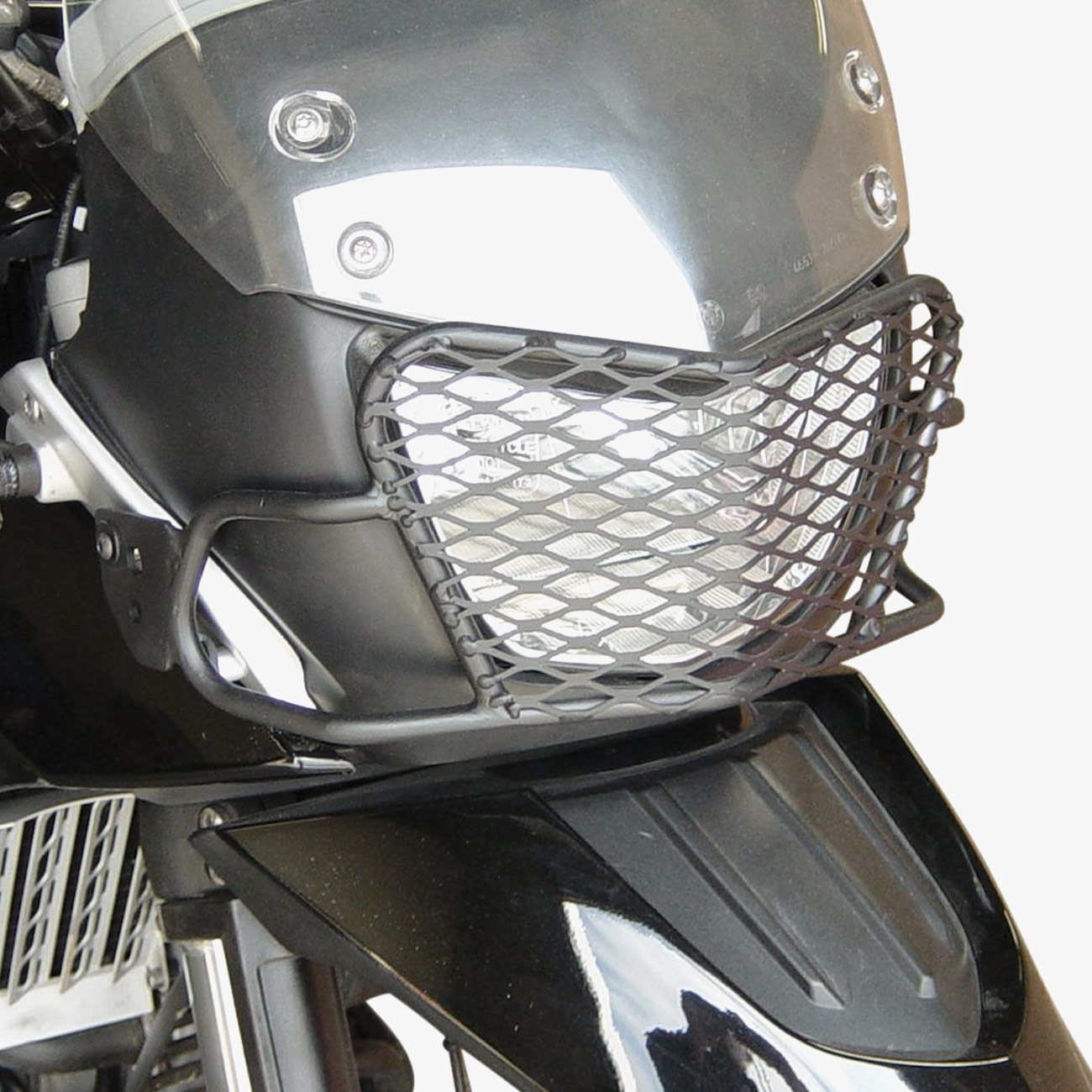
A broken headlight isn’t soemthing you want when you’re stuck out on a trail much longer than anticipated and sunlight starts to fade.

Good: Moose Racing Headlight Guard $58+
Better: Puig Headlight Protector $80+
Best: AltRider Lexan Headlight Guard Kit $110
Note: Purchasing products through our links may earn us a portion of the sale, which supports our editorial team’s mission. Learn more here.

Triumph Rolls Out Updated Street Twin & Street Scrambler

For 2019, Triumph has upgraded its entry-level classic Street Twin and Street Scrambler. The bikes both got a 10-horse power upgrade to their shared 900CC parallel twin motor, up to 65hp. They got improved suspension, Brembo brakes and streamlined ergonomics. Both bikes also got some aesthetic updates, like new handlebars & LED lighting. Triumph also offers “inspiration kits,” which allow riders to easily customize their bikes.

This Old BMW Is Begging for an End-of-Season Ride In the Mountains

The end of riding season is, depressingly, just around the corner. However, that means we’re in that perfect window of weather where it’s not sweat-your-ass-off hot or regret-every-decision-you’ve-made-up-to-this-moment cold. The air is crisp, and the leaves up in the mountains are on their way to the other side of the color pallete. It’s the exact type of scenery an old bike like this ’73 BMW R75/5 thrives in.

Painted in a beautiful metallic orange that BMWs of that vintage wear so well (not to mention is wildly seasonal), highlighted with chrome accents and fitted with factory hard-cases, this Beemer was built for weekend rides in the country. The R75 was the top-of-the-line model with 749ccs worth of air-cooled boxer engine, 50 horsepower and 43 lb-ft of torque to play with, and it topped out at 110 mph.

The R75/5 is one of those classic motorcycles which plays to the buyer’s advantage. It has all the drool-inducing looks and style of the era, but it comes in at an attractively affordable price point. Once the Munich branch switched to solely making cars, the “/5” model was the first BMW bike to be entirely built to Berlin. A total of 68,956 /5 models left the factory floor between ’70-’73. The /5 bikes were well-built and nearly bulletproof, so not only do you get dependability but the large production numbers kill any sort of ‘rarity tax’ classic bikes can pick up, making them more affordable.

For $3,750, how could you not want to pack up the panniers, leave the city and get lost winding through twisty mountains roads upstate? With this bike’s autumnal camouflage paint job, you’ll blend right in.

2018 Has Been a Wild Year For Adventure Motorcycles – Here’s a Recap So Far

New, Reviews and More

2018 Has Been a Wild Year For Adventure Motorcycles – Here’s a Recap So Far


This year saw a noticeable uptick of popularity and interest in adventure motorcycles. Between a slew of new bike launches, throwing a leg over a few ourselves and previews of what’s on the horizon, it’s been a nonstop ADV frenzy. There’s still more to come in 2018 as far as two-wheeled adventure riding goes, but this is a quick recap of ADV highlights.


What’s the Best Way to Learn How to Ride Off-Road? Start Slow and Simple

What’s the Best Way to Learn How to Ride Off-Road? Start Slow and Simple

I have a three-day, off-road 500-mile ride later this month, through New Jersey’s 1.1 million acres worth of dense forest, but first I’m on the edge of Wharton State Forest ready to learn dirt-riding 101.

Honda Introduces a Day-Trip Adventure Motorcycle Built on High Performance

Honda Introduces a Day-Trip Adventure Motorcycle Built on High Performance

Honda jumps into the middleweight dual-sport category with a bike born from a purpose-built race bike.

BMW Overhauled Its Most Successful Adventure Motorcycle For 2019

BMW Overhauled Its Most Successful Adventure Motorcycle For 2019

If you’re aiming to take on an intercontinental ride, spanning time zones with stretches of massively varying topography, it’s hard to find a better way to conquer it than a BMW GS.

A New Adventure Motorcycle With Classic Italian Flair

A New Adventure Motorcycle With Classic Italian Flair

Images of what looks like a production-ready Moto Guzzi V85 adventure bike have surfaced.

MSR Hubba Tour 2 Review: The Definitive Adventure Motorcycle Tent

MSR Hubba Tour 2 Review: The Definitive Adventure Motorcycle Tent

Designed for motorcyclists, by the motorcyclists at MSR, the Hubba Tour 2 was meant for two-wheeled adventures.

You Need to Clear Space in Your Garage for This $15,000 Multi-Tool

You Need to Clear Space in Your Garage for This $15,000 Multi-Tool

The British mid-sized adventure motorcycle, through refinement and performance alone, relegates anything bigger to irrelevance.

Honda’s New Africa Twin Will Change Your Perception of Off-Road Riding

Honda’s New Africa Twin Will Change Your Perception of Off-Road Riding

The Adventure Sports is Honda’s new range-topping Africa Twin not only boasts a full suite of revised rider modes, but it gets some serious upgrades all-around.

Big Adventure Motorcycles Will Soon Die Off, And For Good Reason

Big Adventure Motorcycles Will Soon Die Off, And For Good Reason

It’s safe to assume KTM has a hit on its hands with the 790 Adventure R, but it might be a sign bigger ADV bikes are on the way out.

The Two Best Scramblers on the Market Take On One of the Greatest Riding Roads in America

From Issue Six of Gear Patrol Magazine Issue Seven is available now.

To really put a motorcycle through the wringer, it has to be pushed to the limits of its purpose in the harshest way. Sport bikes are flogged on the track in 100-degree heat, dirt bikes are thrown through the woods and over jumps for hours on end, and cruisers endure endless miles on the world’s greatest highways. But how to put a strain on a scrambler, a bike made both for tame roads in town and for wily dirt trails out in the boondocks? To find out, we took a pair of scramblers 2,678 miles up through the Canadian Rockies and into Alaska to show them North America’s most infamous stretch of road: the Denali Highway.

Scramblers have recently swelled in popularity, but they’re nothing new. The scrambler rose to prominence in the rebellious ‘60s and ‘70s; it was created at a time when motorcyclists stripped down standard sport bikes to their bare essentials, kitting them out with bigger suspensions and knobbier tires to make them competent in the dirt and in off-road racing. But the concept of a scrambler wasn’t all that groundbreaking in the ‘60s, either.

The purpose of the first motorcycles was to render the bicycle obsolete and allow people to travel farther and cover more miles in a day on two wheels than ever before. In the late 1800s, they were just bicycles with miniature engines that supplemented pedal power; they quickly evolved into the utilitarian two-wheeled transportation the world knows today. The evolution wasn’t necessarily driven by a search for speed, but by an insatiable appetite for freedom and exploration, a basic sense of adventure. Before smooth, direct, arterial highways and intricate webs of paved infrastructure spread through the country in the 1920s and ‘30s, connecting all our major cities, there was dirt, mud, gravel, sand and stone. Motorcycles had to be able to tackle it all, and tackle it well.

Having a motorcycle that was capable on both paved streets in town and on dirt roads in the country wasn’t a stylistic choice; it was a necessity. Every time you hopped in the saddle, hitting both types of terrain was a near certainty. As paved roads became more common and the modern highway system introduced more civility to the average motorcycle ride, the mandatory go-everywhere features faded from factory-built road bikes. Sport bikes, cruisers, choppers, they’re all bound to paved roads with stiff suspensions and slicker tires. Scramblers, then, were created as a way to gain back the freedom of comfortably riding any road, paved or not.
Over the decades, scramblers became more focused and purpose-built, eventually morphing into modern dirtbikes, dual sports and hardcore adventure bikes. Somewhere along the way, they became more concerned with function than form and, in the process, lost the interest of casual riders.
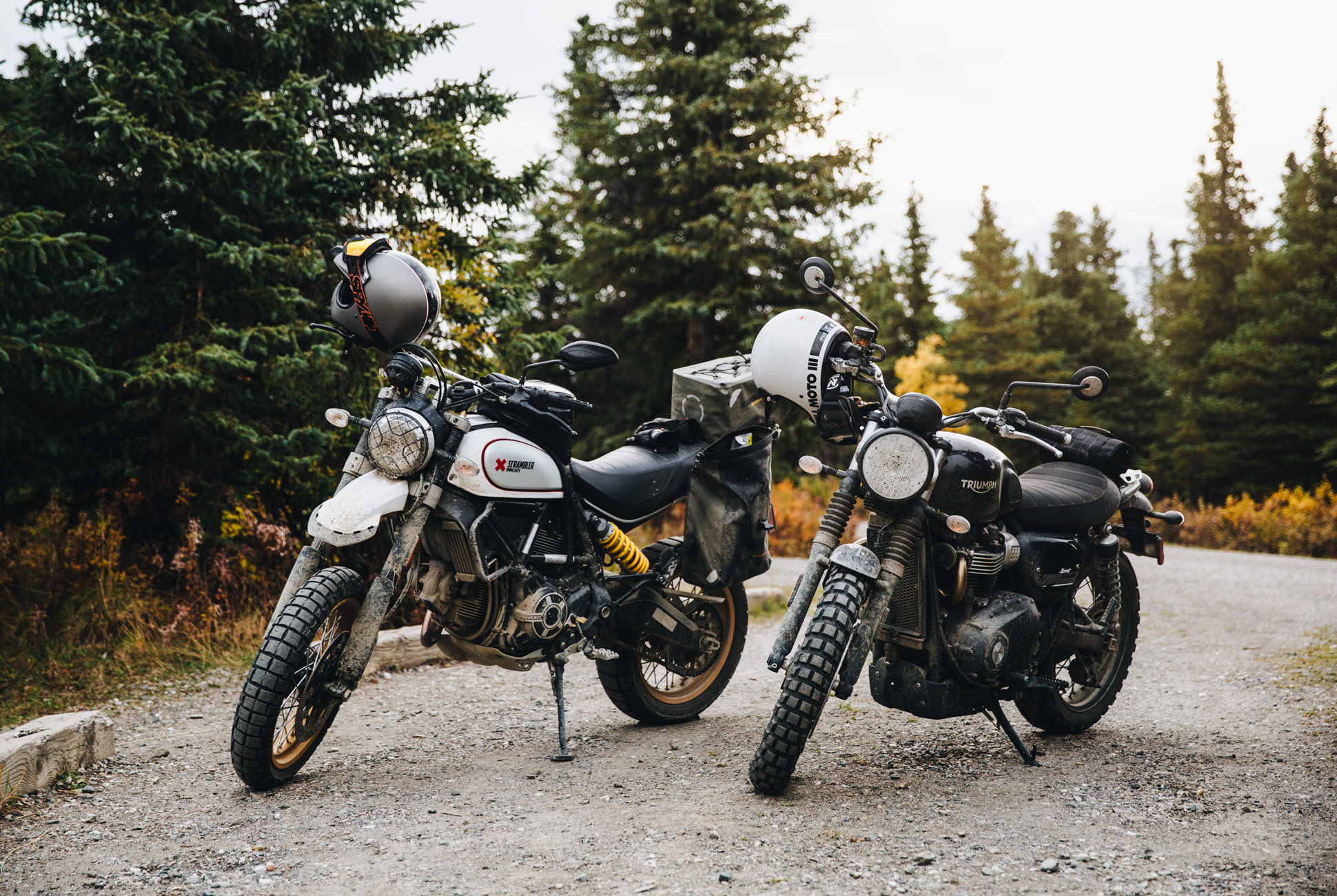
The bikes in question: Ducati’s Scrambler Desert Sled ($11,395) and Triumph’s Street Scrambler ($10,800)

The current crop of scramblers is gaining favor with the masses because they bring back that go-anywhere freedom with old-school style. But most importantly, they’re compact, approachable machines that both new riders and two-wheel veterans can get excited about. Like their forebears, they balance on-road worthiness with off-road prowess.

The Ducati Scrambler Desert Sled and Triumph Scrambler are the headlining stars of the modern scrambler craze, and I wanted to know if both were truly worthy of carrying the torch. Could they hack it outside city limits? If and when these bikes saw dirt, would they falter and fail or take it in stride? Are they just fashion statements? Can they hold their own in a veritable theater of two-wheeled warfare — long highways, sweeping canyon stretches, suspension-shattering dirt roads, sand traps — and survive what would be a torture test for even the most refined and focused adventure bikes?

North of Seattle, up through British Columbia and the Yukon Territory, over into Alaska and down to Anchorage: the northwest passage of North America is a modern-day adventure-vehicle playground of high deserts, mountains, canyons, rivers and glaciers. But the terrain is as majestic as it is life-threateningly treacherous. It’s mostly paved, but dirt, gravel and unfinished, primitive highway make cameo appearances to keep you on your toes. The farther north you venture, the less common average family sedans become. Lifted Jeeps and Toyota 4Runners decked out with high-lift jacks, full-cage roof racks and light bars become the norm, the suggested mode of transport. For two-wheelers here, the recommended bare minimum would be purpose-built, precision all-terrain instruments like the BMW R 1200 GS or 1290 KTM Super Adventure — top-of-the-line adventure bikes with powerhouse engines, active suspension, power outlets and heated grips. Paved roads or not, it’s no place to go underprepared and let Mother Nature catch you with your pants down. Despite all that, we chose to ride out of Seattle astride the fairly analog Ducati Scrambler Desert Sled and Triumph Scrambler, like bringing pocket knives to a trench war.

Day 1

False start. A passport packed in a forgotten bag sat idle in LA. The plan had been to fly into Seattle Friday morning, pick up the Ducati and Triumph and our Mercedes Sprinter 4×4 chase van, then head out of town to Vancouver for the night. Gregor, a friend and experienced off-road racer excited to check off riding in all 50 states with the trip to Alaska, would pilot the Ducati. I called dibs on the Triumph while Sung, our tenacious photographer who, we learned, has a slight aversion to sleeping on the ground, looked forward to calling the Sprinter home for the next seven days. The first day was designed to be less intense, so Gregor and I could get used to the unfamiliar bikes with easygoing city and highway miles. Needless to say, that plan, for the most part, was now scrapped.

After a few four-letter words and a couple frantic phone calls, the passport was arranged to leave LAX the next morning on a Delta flight and get to us by 9:30 a.m., Saturday. We had no choice but to book a room at an airport hotel and hit the road as soon as the passport arrived.

Not the most auspicious start to a journey of this magnitude.

Day 2
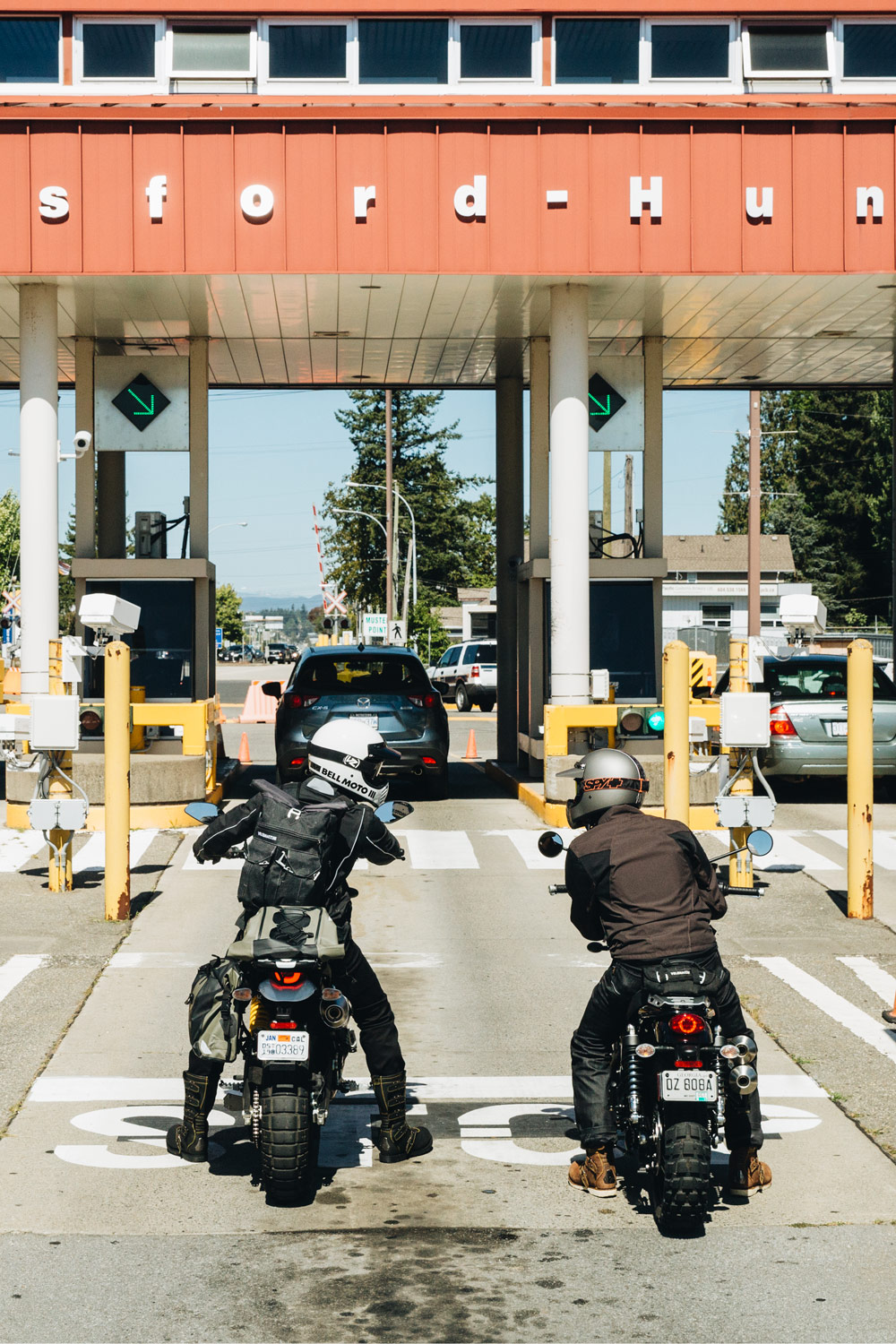
10:32 a.m., passports in hand, blue skies above, we pointed our convoy north and set out on what would be the longest leg of the entire week. To make up for the lost day, we decided to circumnavigate Vancouver completely, combining two days’ worth of riding in order to make it to Prince George on schedule. The easygoing miles we planned for the first day had morphed into an endurance break-in test.

Right away, I decided that a wind screen, even a small something to break up the wind, would have been luxurious. Buffeting at 65 mph isn’t just annoying; after too long, fighting the choppy air is physically exhausting. Our mileage hadn’t even hit triple digits yet and we already could feel this ride trying to wear us down.

As soon as we crossed the U.S.–Canadian border, we hopped on the Trans-Canada Highway and made our way around the bottom of British Columbia’s western mountain range, up through Wells Gray Provincial Park and into what looked like the heart of the Canadian wilderness. In reality, we’d only just dipped our toes into the deep end of a pool, and we couldn’t see the bottom. Emerald waves of mountains gave way to sun-baked high desert, ravines and long, meandering rivers contoured by an endless strip of train tracks straight out of a spaghetti western. Motorcycle paradise. As the light faded, though, so did the novelty of the first day’s ride, and with it, the warm Canadian welcome. Darkness ushered in a bitter cold. At 8:53 p.m., a debate raged inside my helmet: Do I signal for us to pull over so I can pee, or would holding it actually keep me a little bit warmer? Tough call. It’s 10:48 p.m. when we arrive in Prince George — finally

Day 3
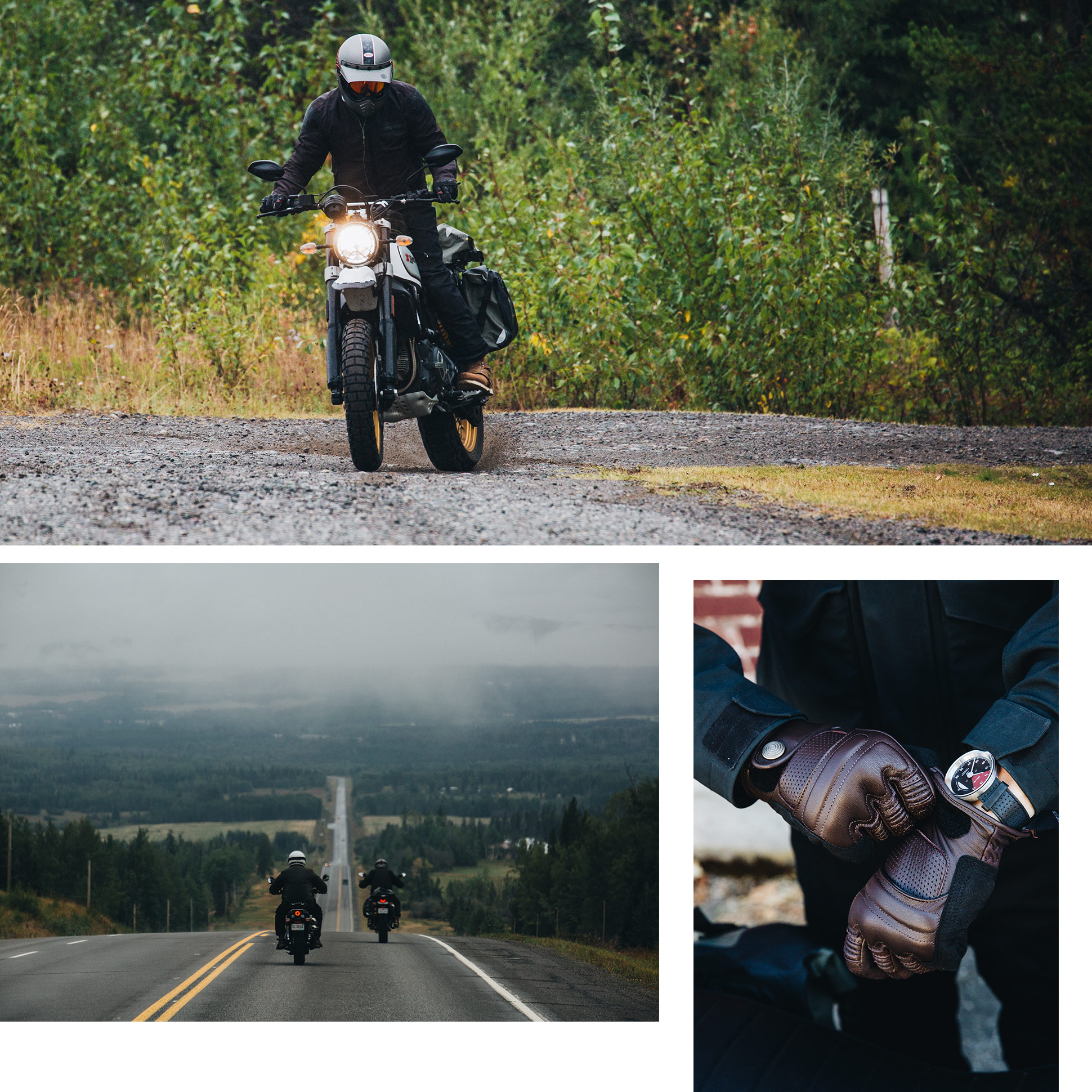
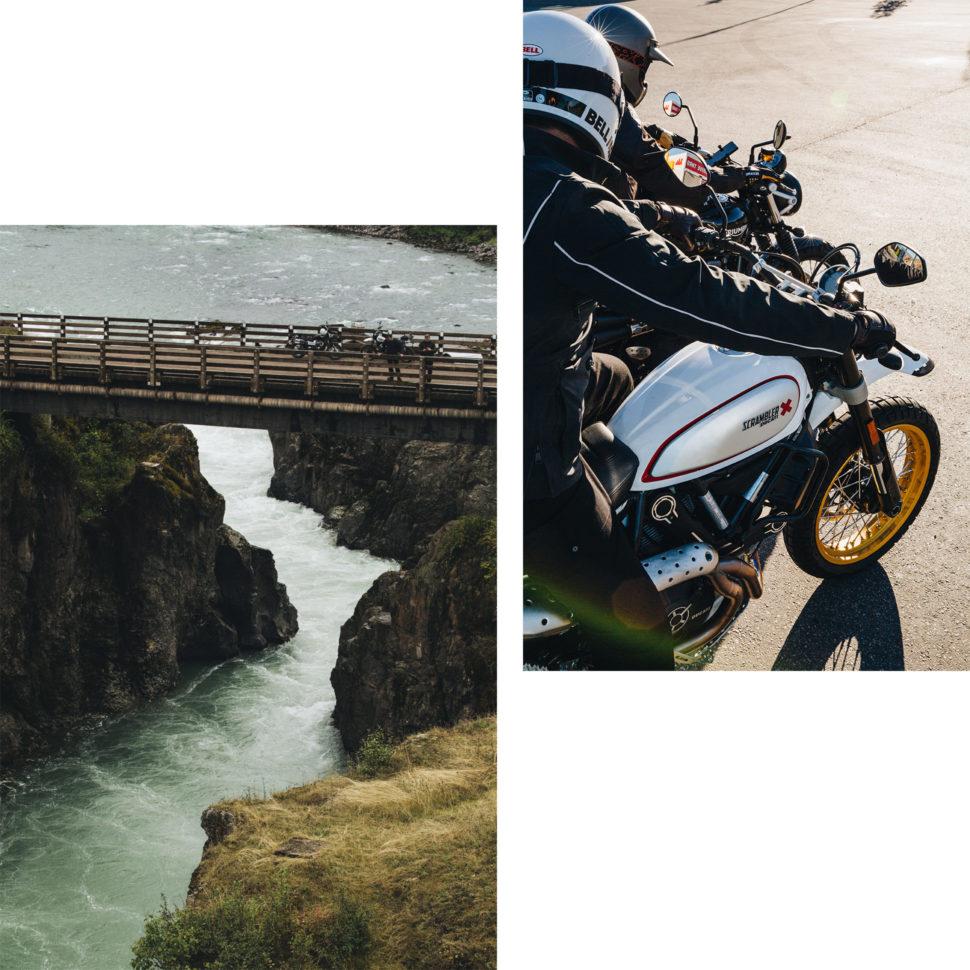
Above: Bell Moto III ($359), Icon 1000 Squalborn Jacket ($300), Rev’it Jeans Memphis H2O ($320), Icon 1000 Elsinore Boots ($245)
Below Right: Oscar Robinson Gloves ($90), Autodromo Veloce ($425)

Overcast skies and cool crisp air greeted us as we saddled up for day two, this time appropriately layered up. Prince George would be the last populous city we’d see for two days. We set out for our waypoint — Meziadin Junction, just under 400 miles to the northwest — which we thought would be our last stop for the day.

Almost immediately, we waded into a vast rolling sea of towering evergreens like surfers getting towed out into big wave swells. Unfiltered aromas of pure pine and maple, frequently accompanied by the scent of smoke from a campfire or a logging compound, flooded my nose at 65 mph — the exact olfactory experience air fresheners aim for but never capture.

Turning north onto Highway 37, we were now racing the sun to the horizon, Otter Mountain looming at the finish line. Gregor was leading at a brisk pace, carving up what felt like Canada’s Nürburgring. Neither of us were interested in getting a second helping of cold Canadian night riding, so there was an unspoken agreement to keep the speed up. About two hours and 90 miles later, the Ducati started to sputter and Gregor signaled to pull over. Out of gas. Judging by my gauges, the Triumph wouldn’t have made it much farther. Nearly 30 miles from Meziadin Junction, the jerry cans full of spare fuel proved to be a wise investment.

Meziadin Junction consists of a fuel pump, a convenience store, a few rooms all taken up by construction workers and a café that closed minutes before we got there — that’s it. No town. No other lodging. I swore this was where our Airbnb was supposed to be. The store clerk explained that the closest town was Stewart, at the end of Highway 37A, about 38 miles away, which a double-check of the reservation confirmed. I could see the enthusiasm physically fall off of Gregor’s face: we suddenly had another hour to go. Soft twilight gave way to pitch black. Worst of all, we’d have to split Otter Mountain and Mount Johnson — prime real estate for avalanches and rockslides. We were riding through a narrow chasm with only our headlights illuminating a relatively small patch of road in front of us. The inky-black sky was nearly indiscernible from the titanic terra looming in the darkness all around us — riding into the ominous, massive void induced a strange claustrophobia.

In Stewart, relieved to finally be off the road (again), we vowed to get early starts from here on out and avoid stints at night. Riding through a vast wilderness in blinding darkness is terrifying.

Day 4
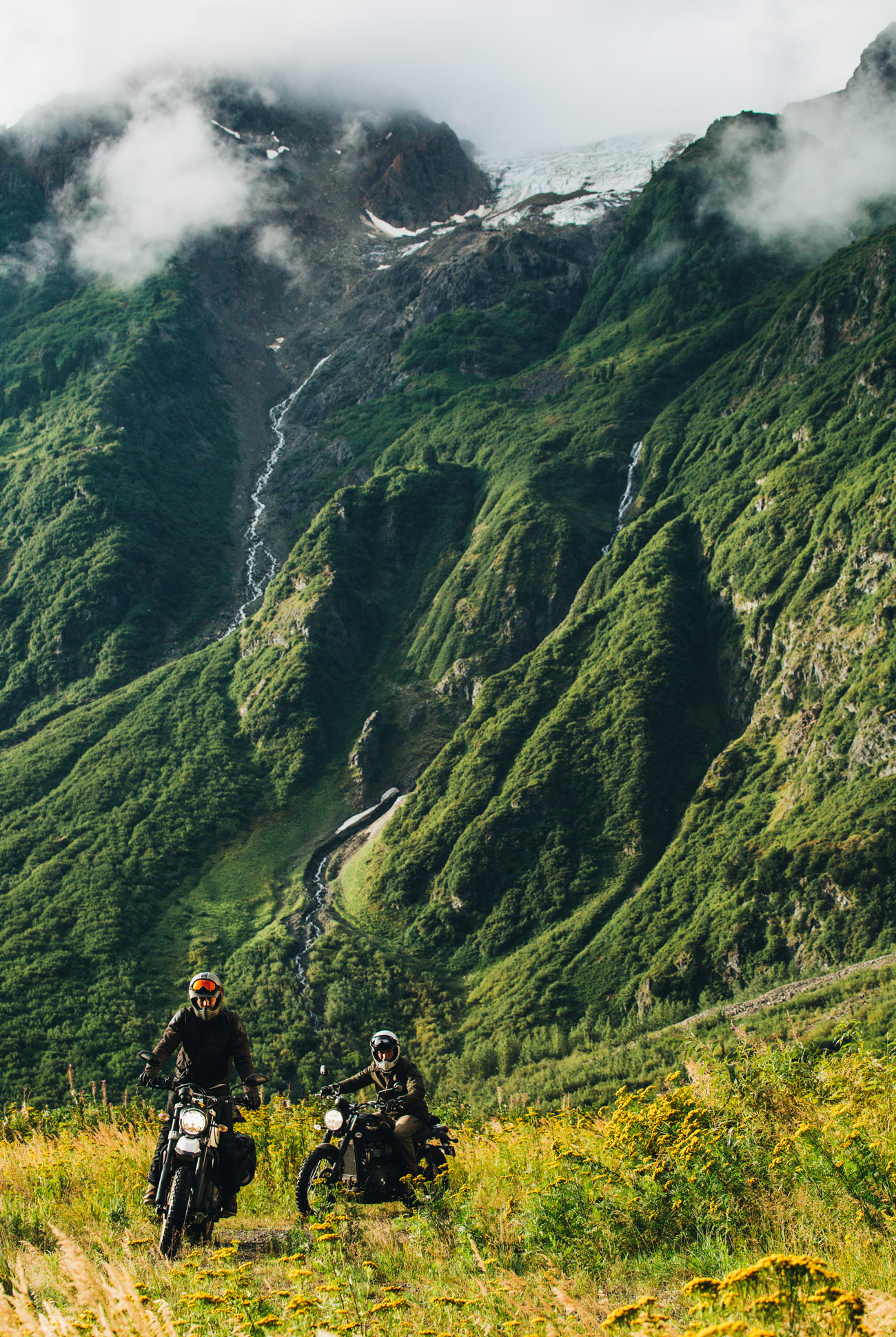
We were forced to backtrack toward Meziadin Junction since Stewart is basically a dead end on Route 37A. Intense morning sun flooded the canyon road, confirming our suspicions of just how close those rock faces were. Manhattan’s Fifth Avenue skyscrapers are less imposing. Beyond the canyon, lush green mountain ranges capped with residual year-round snow sat on pedestals of golden fields flush with wild flowers.

We fueled up both our bikes and bodies in Meziadin Junction, where we ordered Loggers Breakfasts at the café: three fried eggs, sausage, ham, two pancakes, hash browns and a cup of coffee. Yeah, that should hold us over.

Route 37 took us about 400 miles to Watson Lake on nonstop sweeping asphalt that scythed its way through vast swells of dense woodland. After nearly two hours and 130 miles of banked turns at 75 mph, the Triumph started to sputter. My turn to run out of gas. We drained the jerry cans. Fifty more miles down the road, we came to a fuel stop, refilled the reserve cans, grabbed food to cook at that night’s campsite and set off again. The next four hours and 260 majestic miles of northern British Columbia were punctuated by two more roadside fill-ups.

We made it to camp with plenty of daylight to spare (for once). Gregor started a fire, boiled water for asparagus and threw steaks and potatoes on the coals. A toast with Canadian whisky. A meal worthy of the day.
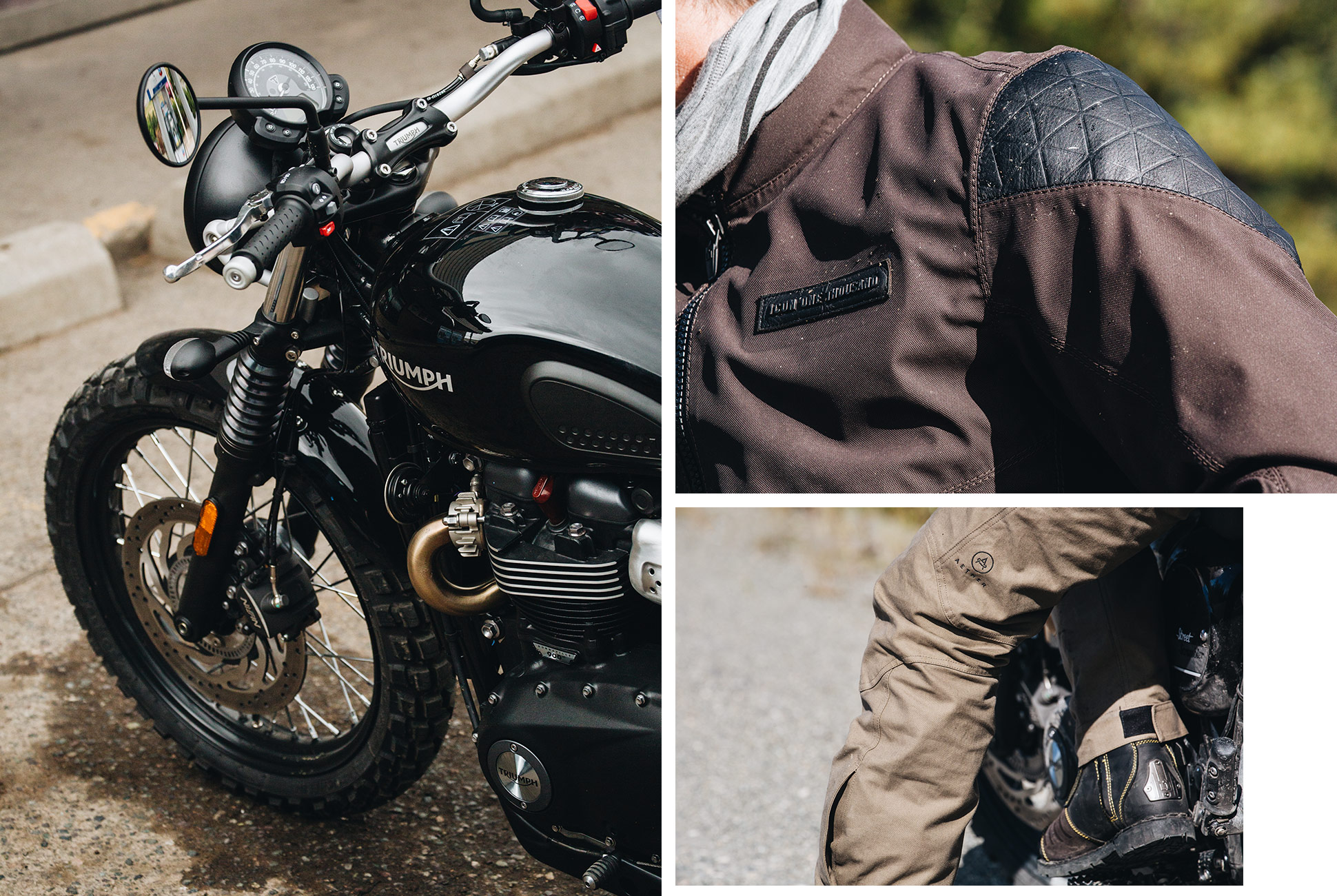
Above Right: Icon 1000 Squalborn Jacket ($300)
Below Right: Aether Range Pant ($395), Icon 1000 Elsinore Boots ($245)

Day 5
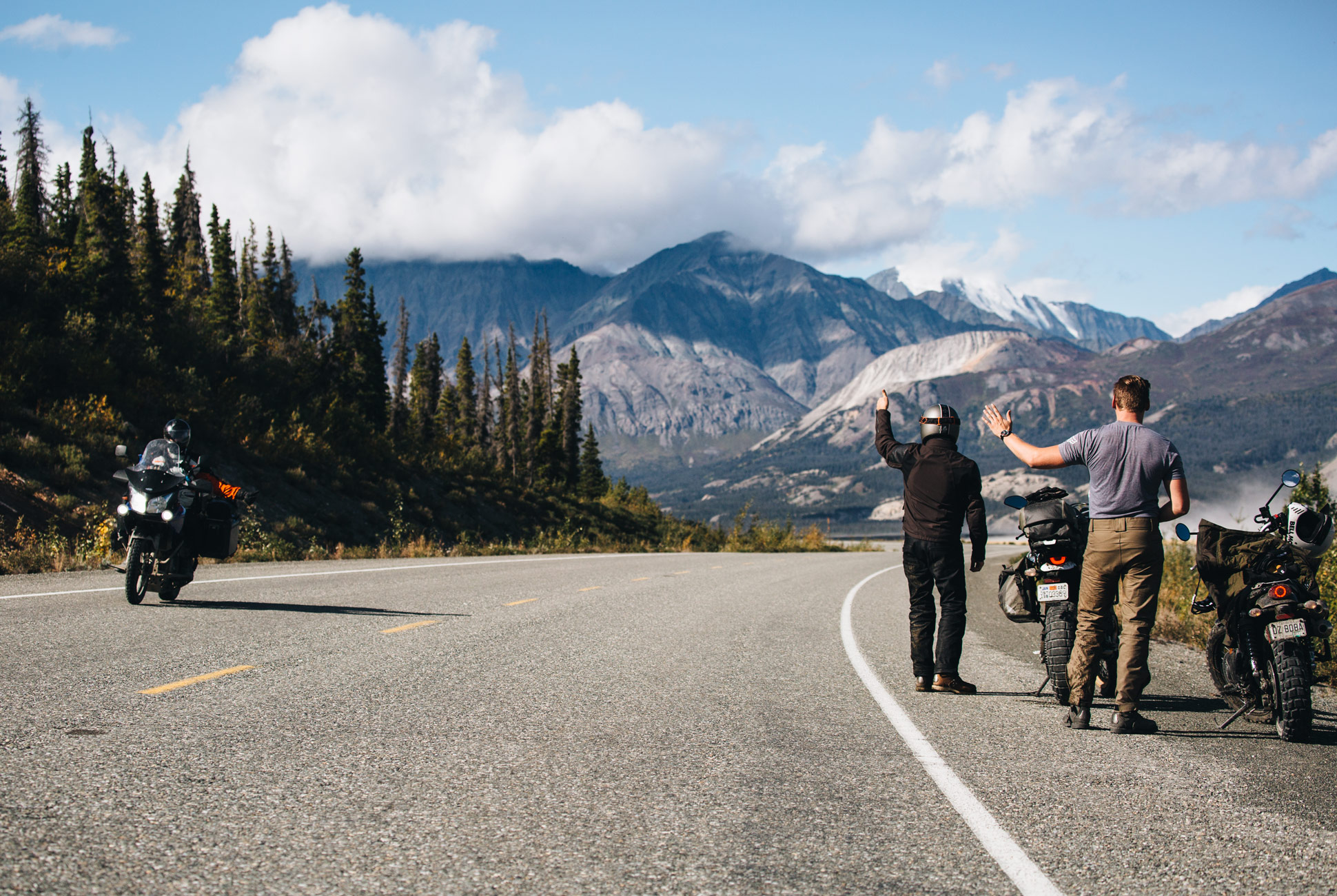
To follow up our two 400-plus-mile days and the first 500-plus-mile day, we cut day five short and set up camp just outside of the 25,000-resident-strong city of Whitehorse. At this point our sense of time and distance was warped, but in a good way; we’d adapted our minds to the long-haul ride and stopped thinking about each leg in terms of miles or hours. Instead, we measured in tanks of gas. Only 278 miles to Whitehorse? We’ll only have to fill up on the side of the road once. Brilliant.

When you’re in the saddle for 130 miles at a time, two things are mandatory to maintain sanity. One: you have to like yourself, because you’re the only person you’re going to be spending quality time with for hours at a time. (A good singing voice is a plus.) Two: you have to like the bike you’re on. It might seem obvious, but if the bike is uncomfortable, it becomes an open-air torture chamber — getting back on every morning for 500 straight miles will have you questioning all your life choices leading up to that moment. It’s a solitary experience, but on a bike as smooth on the road as the Triumph, and with Yukon scenery to stare at all day, a ride like this is downright meditative.

Day 6
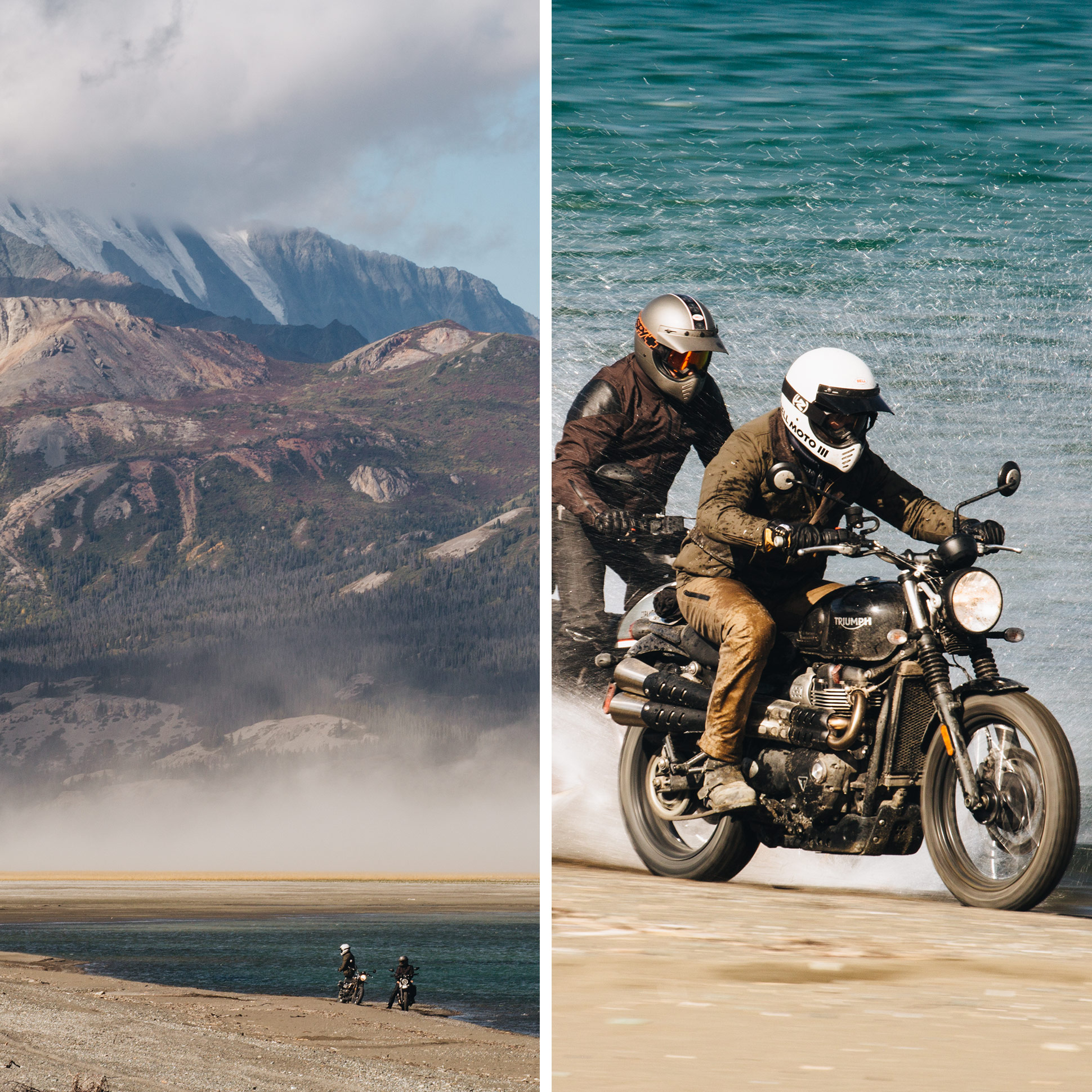
Gregor (Left): Bell Moto III $359, Icon 1000 Squalborn ($300), Rev’it! Jeans Memphis H2O ($320), Icon 1000 Elsinore Boots ($245), Ducati Urban Enduro Waterproof Rear Bag ($169)
Bryan (Right):
Helmet: Bell Moto III Helmet ($359), Von Zipper Porkchop MX Moto Goggles ($75), Ashley Watson Eversholt Jacket ($704)

Almost 1,800 miles in and we hadn’t seen much dirt. But just past Mount Cairnes, the Alaska Highway sweeps along the shore of Kluane Lake. Fog had settled on the lake’s surface, rounded mountains framed the cyan sky and Sung wanted a photo. I spotted a gravel path just off the side of the road. No need to ask me twice.

The narrow two-track led to the beach, which became the highlight of the day. Our scramblers had proven themselves worthy of the road, but sand and pea gravel can make or break a bike. Gregor’s Desert Sled had an advantage on the beach; it’s lighter, has a little bit more suspension travel and more ground clearance. Still, he was putting in hard work to keep from being devoured by the powdery sand. Armed with knobbier tires, but weighed down by a little extra bulk and lower ground clearance, the Triumph was able to keep up, but it did struggle. When I kept my speed up, I positively floated across the beach. Then it came time to slow down and turn back, and I beached it. Skid plate flat on the sand, rear tire roosting and digging, the beach was swallowing the bike whole. After a few side-to-side rocks and a steady throttle, I began inching forward, then free, back buzzing the shoreline like a dog off the leash. Exactly what these bikes were built for.

Back on the road, as if the beach wasn’t enough, the last few miles of the Alaska Highway leading up to the Alaskan border were largely unpaved. For the better part of 30 miles it was open, gravel-covered highway: scrambler country.

Alaska Highway kilometer marker 1,818. The Triumph coughs, sputters. We pulled over in front of Discovery Yukon Lodging, filled up our bikes, then went inside and asked the sweet-little-old-lady innkeeper for coffee, which she said they don’t usually do. But she put on a pot for us anyway and brought out fresh-made apple walnut cake topped with homemade frosting. Lifesaver.

We ended the day across the Alaskan border at our cabin in Tok. The second longest day, but only by a few miles.

Day 7
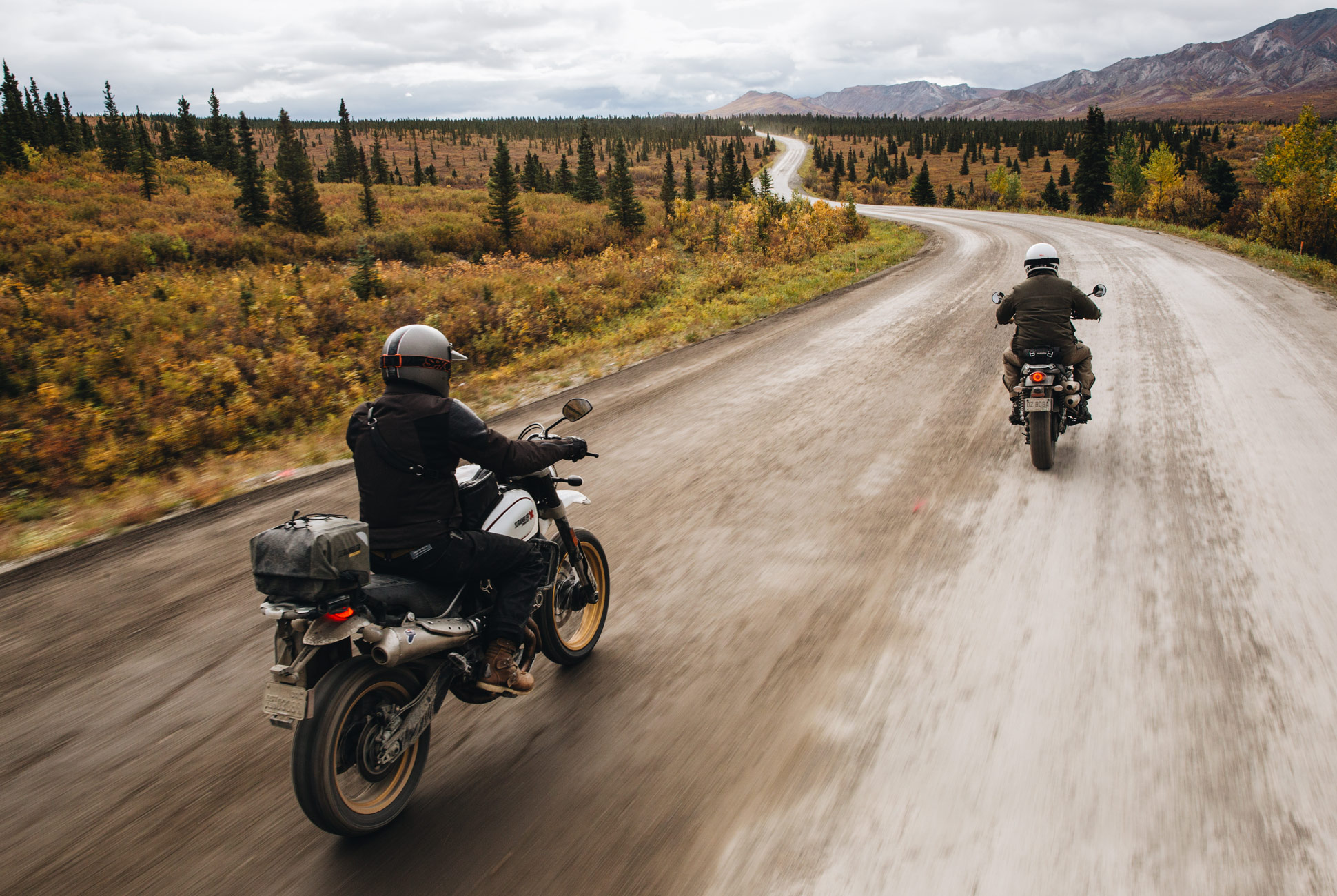
Today was the crown jewel of the entire ride. Alaska Route 8, the Denali Highway: a 135-mile stretch of road connecting Paxson to Cantwell, only 24 of which are paved. A hundred and eleven miles of dusty gravel, wheel-hungry ruts, and bone-shattering washboarding. On the Denali Highway, when the pavement stops, so does the bullshit.

This is all-out adventure-bike territory. It calls for active suspension, adjustable ride height, multilevel traction control and ride mode selectors. We could’ve taken a BMW R 1200 GS or a KTM Super Adventure, which have all the aforementioned tech, to make our lives easier. We could have hopped in the warm, high-riding van with Sung. Instead, on the visceral scramblers, we were involved, working for it. There was nothing filtering out the raw, unadulterated experience of one of the toughest roads Alaska has on offer. The bikes were at home. For 111 miles, the Ducati and Triumph reached scrambler nirvana.

Day 8
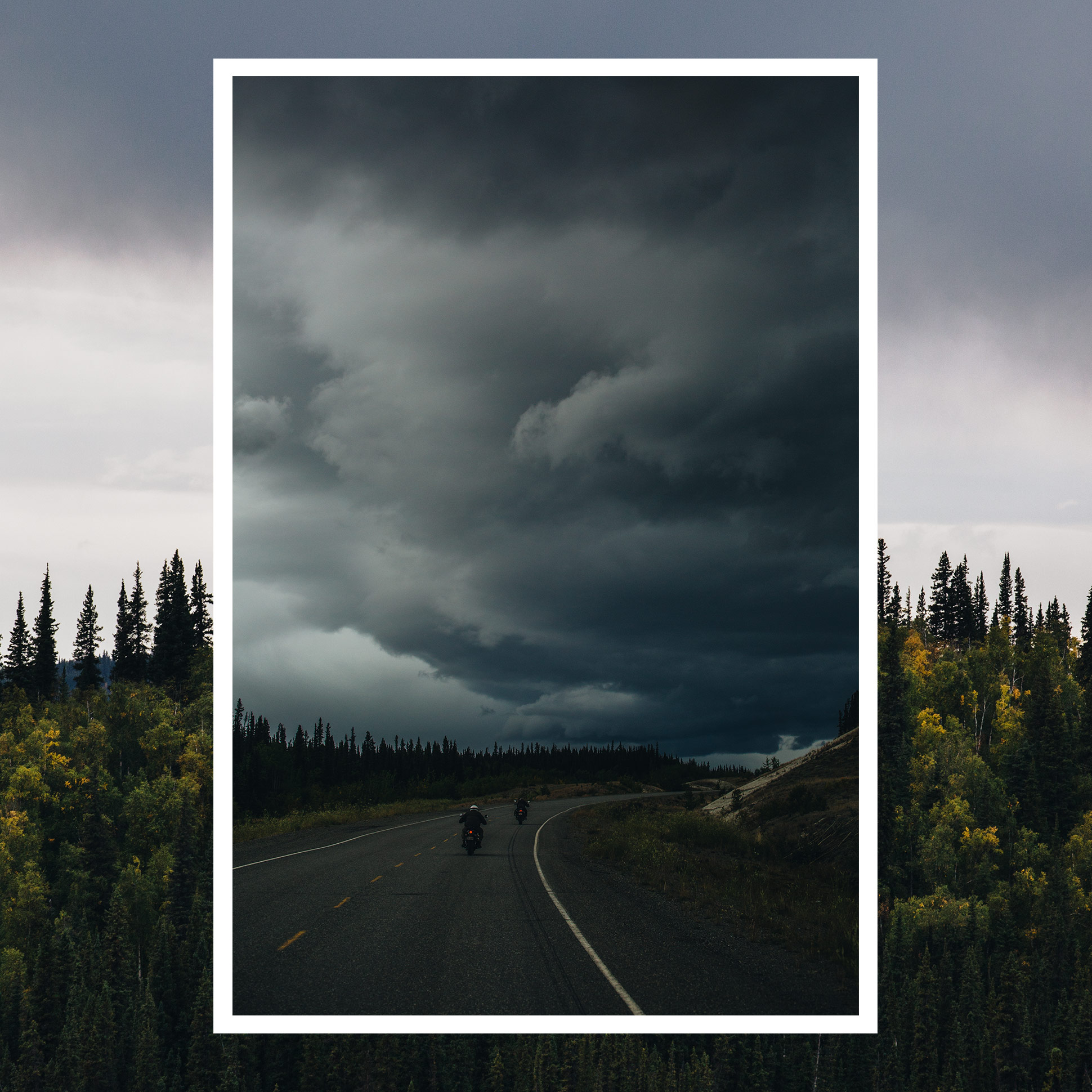
Our last day. The final 200 miles. It’s 10 a.m. as we pack up camp under bright blue skies. The cool, crisp air marinating Denali National Park lulls us into a false sense of comfort with Alaska. Out on the road and barreling down Route 3, it isn’t long before we hit rain. We had come across a few light showers the previous couple of days, but this was the first real storm. Alaska isn’t going down without a fight.

The temperature drops. The bike’s thermometer reads 42 degrees Fahrenheit; seems optimistic. With no windshield to hide behind, rain sticks to the dirt on the goggles. Spray from traffic is killing visibility. There’s a cold creep of freezing rain working its way through my jacket and pants — soon I’m completely saturated. Is the road surface uneven, or am I actually shivering? Hands are numb, stiff. I’m definitely shivering. Another five miles and maybe we’ll be past it. Okay, two more miles. Turn signal, on — we’ll wait it out, warm up and dry off in the Sprinter instead. First things first. Heat on high, heated seats on max. Defrost.

Gregor checks the weather for a sitrep. There’s good news and bad news. Good news is, the rain stops… around 8 p.m.. The bad news is, that’s when it starts snowing.

There’s talk of putting the bikes in the Sprinter and hauling them into Anchorage. I push back. We didn’t come 2,400 miles on these bikes to cross the finish line in the support van. Sung is understandably worried for our safety and Gregor looks miserable. Gregor does the math: at about 40 degrees, traveling at 65 mph creates a 25-degree wind chill. Hypothermia is a tough argument to rebut.

Bikes in the back of Sprinter, onward to Anchorage. The van is silent aside from the barrage of wind and water against the windshield. The lead weight of defeat is sitting in my gut, growing with each passing mile. Alaska was winning the fight in the final hour.

Ten miles later, my eyes are welded to the horizon as the sky brightens and the rain eases up. Gregor checks the weather again. We’re actually outside the radius of where any weather radar stations can see.

Thirty miles still farther, a break in the clouds. We’re in between two weather cells: a chink in Alaska’s armor, a window of opportunity.
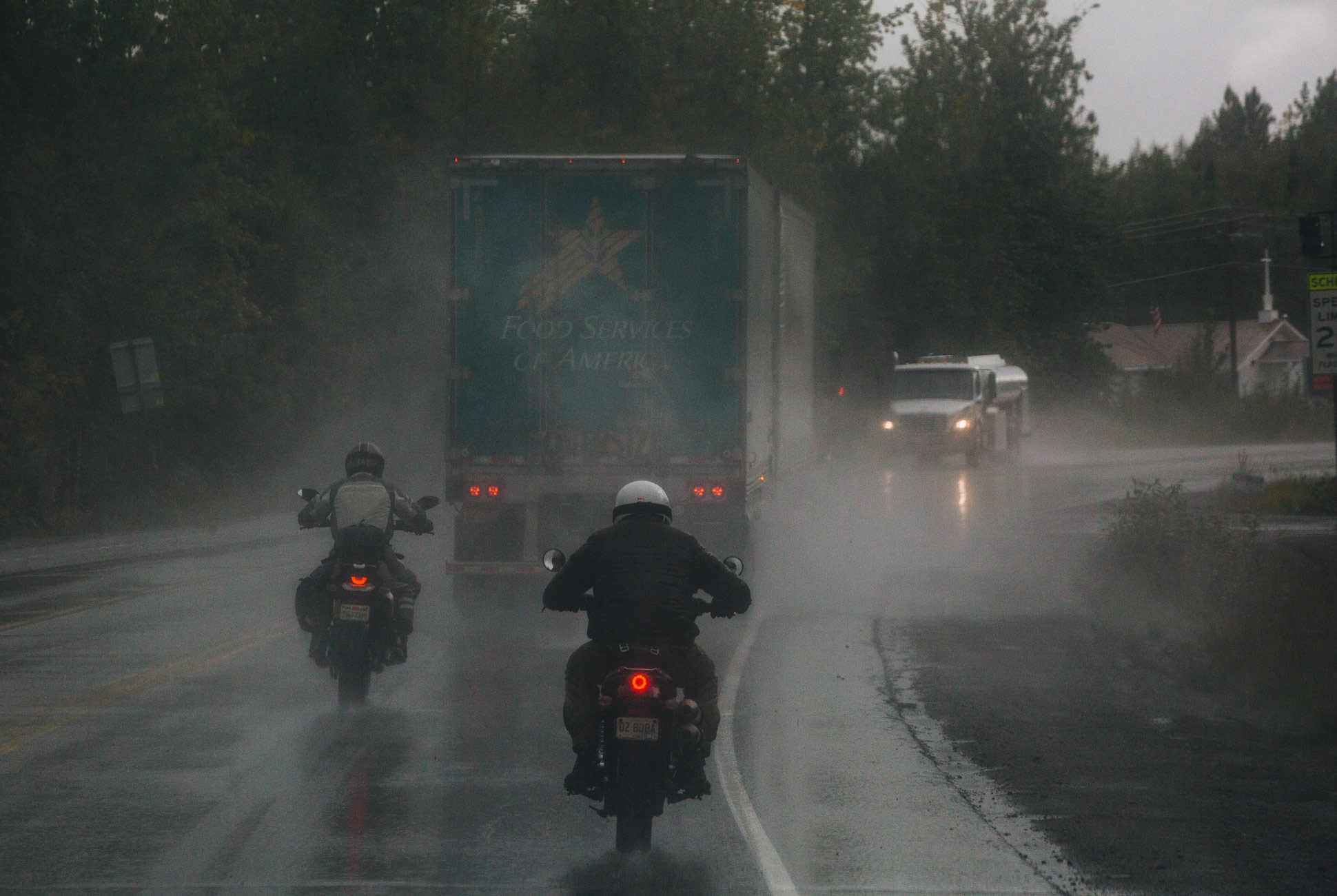
I’ll be damned if I’m going to ride into Anchorage on anything other than that Triumph. I order Sung to pull over — we’re getting the bikes back on the road.

In Trappers Creek, we unload the bikes and throw on some extra gear in case we hit the storm again. Thicker gloves and an extra down jacket under my now warm, toasty, dry motorcycle jacket for me, and a full all-weather suit for Gregor. Fuel for the bikes, filled to the brim.

We’ll have to haul ass if to avoid being caught in that deluge a second time.

Full throttle.

One eye on the road, one eye on the storm cell to our left. Like trying to race a train to the crossing.

Every kink in the highway fiendishly points us ever so slightly toward the wall of water in the distance. Alaska, it would seem, isn’t done with us yet.

Pelting rain turns to a shower, turns to a downpour. We’re back in it, and passing cars and trucks is becoming a game of roulette. Spray from 18-wheelers puts us in a grayout; we’re basically riding blind. We have no choice. Alongside the trucks, all we can do is tuck our heads and lean a shoulder into it.

Soaked.

Seventy-five miles to Anchorage.

Fifty miles to Anchorage.

The sky brightens, and I don’t trust it. But, finally, Alaska relents.

I don’t see any bright, neon “Welcome to Anchorage” sign, no ticker tape parade to let us know we made it. But holy hell, the relief. The overwhelming sense of victory lays on us like a wet wool blanket. Lazily clicking down through the gears, getting off the main highway and into town, we’ve clearly crossed our marathon’s finish line. We made it.

Epilogue

Looking at a 2,600-mile route on a map versus riding every inch of it on a scrambler is like flying over an ocean versus crossing it in a sailboat. You can get a sense of scale, but it’s not until you’re experiencing each bump, rut and crack, looking 30 or 40 miles to the horizon, that you can really appreciate the vastness, the grandeur.

We could have done this trip on terra-dominating adventure bikes with all the electronic assists to make it easier, more comfortable. We could have just taken a fully decked-out Land Rover. We would have seen just as much — and stayed dry. But on the scramblers, on the paved roads, on the beach, in the dirt, through the mountains, it was equal measure rider and motorcycle, the essence of two-wheeled adventure. The reason why we started riding motorcycles in the first place.

Velomacchi’s Over-Engineered Motorcycle Gear Is Literally Military-Grade

From Issue Seven of Gear Patrol Magazine.
It’s a fact that commuting is hell, especially on two wheels. The daily rat race can take its toll, and your gear probably picks up most of its patina and battle scars as a result of the Monday-through-Friday nine-to-five. Road debris and dirt, the beating sun, the pouring rain, traffic and possible falls and slides are all intensified by highway and traffic speeds. And so, gear must be overengineered for survival, which is where Kevin Murray, the founder and designer of Velomacchi, saw a gap in the market.
The name Velomacchi comes from an amalgamation of the Italian words velocità and macchina, translating to speed machine. The name, partly inspired by Murray’s time in northern Italy, draws influences from the region’s style, craftsmanship and approach to cycling, motorcycles and commuting; it makes even more sense when paired with the brand’s motto: Built for Speed, Made to Last.

A linen suit paired with brown leather dress shoes wouldn’t stand up well to barreling down an open highway in rain and smog or worse, and neither would your precious belongings if stored in a bag made from pedestrian materials. As a motorcycle rider, Murray sought tough-as-nails commuter gear out of necessity, but he couldn’t find anything that met his standards. Nothing outside of military-spec packs and ballistic materials rose to the level of toughness he was looking for.

Murray is a lifelong traveler. He globe-trotted as a kid and later got into adventure travel. “I’d be gone for a year. I’d work for a year, save up money and then travel for a year. This was long before cell phones; this was when traveler’s cheques were cutting-edge technology,” Murray says. He admits that “having lived on the road for years at a time” is what led him to a career in industrial design. “I would pick grapes in Mildura, Australia, so we could go climb at Mount Arapiles for four months or so. Then we’d save more money and I’d buy a plane ticket up to Nepal or India, climb Everest and do a bit of trekking around there. I was full nomad. I just worked and lived along the way.”

Eventually, Murray finished a degree in industrial design and joined The North Face in the ’90s. He remained ever the globe-trotter, visiting Africa and Europe to explore new markets and test products. This was when the idea for Velomacchi, at first a pet project, was born. Murray left The North Face to start Syren Industrial Design, working with the USIA (Under Sea Industrial Apparel), which supplies SEAL Team operators, and the United States Coast Guard — organizations for which you would think there’d be nothing too tactical or too protective. “As I ran across really interesting stuff nobody else would touch, whether it was too expensive or whatnot, I would always kick it over to Velomacchi and experiment with new materials and processes. Once we commercialized it, we’d offer it to our military, public-safety gear or outdoor active lifestyle clients.”

During this time Murray gained an in-the-trenches view of factories and manufacturers. A factory’s ethics and environmental approach, he says, is “critical” for his brands. “When it came time to start Velomacchi I had my pick of the top manufacturers around the world — in terms of environmental and social-ethos concerns, as well as performance and quality. And I really didn’t focus in on cost or price point at all. I saw such a huge opening within the luggage market. There was such a gulf between the stuff we were building at The North Face for extreme conditions and what was being made for luxury. And that’s where we wanted to position ourselves,” Murray says.

Over the past year, Velomacchi has established its name in the adventure- and commuter-motorcycling community with products from its Speedway collection, including leather motorcycle gloves, 28-, 35- and 40-liter fully waterproof bags, impact cases for laptops, and other sundries like a tool roll and tie-down straps. The eternal battle between function and form is alive and well and few know this better than Murray. When it came to the design of his bags, he kept the Built for Speed motto front and center. “If you’ve felt our bags and the material we use, the reason it’s so substantive is because a regular bike bag will cavitate at speed,” he says. “At twenty-five miles an hour, your bag or a strap flapping in the wind is not a big deal, but at a buck twenty-five, it’s a distraction and distractions at those speeds can be dangerous and deadly.” Hence Velomacchi’s tri-point harness on the chest-straps take the weight off your back and shoulders and its straps tuck away or tie down. The adjusted weight distribution lessens rider fatigue and the hidden straps can’t repeatedly whip your sides.

Early next year, Velomacchi will roll out its second line of bags and accompanying equipment to complement the brand’s inaugural Speedway collection. Using what he’s learned from the field testing and feedback of his first line, Murray designed the Urban Tactical collection to bring “military precision and industrial strength to the problems of carrying heavy loads at high speeds in extreme environments, while integrating a variety of battery packs and internal cabling to charge your devices.” So whether your daily commute from hell drags you through the concrete jungle or through an actual one, Velomacchi is working on making sure your everyday carry and workday essentials get there with you, day in and day out, with engineered overkill sewn in with each stitch. Because if you can make it to work and back without falling apart, shouldn’t your gear do the same?