All posts in “Events”

Rakish Tokyo concept signals hope for Mitsubishi’s lineup

Share

  • Pinterest

Mitsubishi Motors aims to highlight its crossover prowess at this year’s Tokyo auto show with a low-slung “flagship” concept.

The coupelike e-Evolution Concept blends the Japanese carmaker’s four-wheel-drive system and electric powertrain knowhow with artificial intelligence, the company said.

The name is a nod to the performance heritage of the Lancer Evolution street racer.

2017 Mitsubishi Outlander GT S with power, specs and price

Mitsubishi called the concept a “beacon” of renewed ambition for the company, which was bought last year by rival Nissan Motor Co. after being enveloped in a faked fuel economy scandal. The Tokyo show, it said, will be a “milestone event” in the carmaker’s revival.

A teaser image of the e-Evolution shows a steeply sloped rear window and pinched rear end flanked by a narrow, three-pronged wraparound tail lights. A heavy crease stretches down the side of the vehicle, while the C-pillar appears to get a floating look.

Press days for the Tokyo auto show begin Oct. 25.

Mitsubishi will present low-slung electric crossover concept” oringinally appeared in Automotive News on 9/20/2017

By Hans Greimel, Automotive News

Peugeot coming to America, again, maybe

Share

  • Pinterest

FRANKFURT — France’s PSA Group is engineering its next generation of vehicles to meet U.S. regulations as part of its planned return to North America, CEO Carlos Tavares said at the auto show.

“That means that from three years down the road we’ll be able to push the button, if we decide to do so, in terms of product compliance vis-a-vis the U.S. regulations,” he said.

Opel and PSA already sharing platforms with rumors of purchase

Tavares said PSA already has decided which of its brands — Peugeot, Citroen or upscale DS — will be the first to appear on U.S. roads but isn’t ready to announce the decision.

The automaker says its return will be a 10-year effort, beginning this year with partnerships in car-sharing and mobility services.

PSA making cars for U.S. standards” originally appeared in Automotive News on 9/18/2017

By Peter Sigal of Automotive News

How Jaguar and Land Rover maintain separate identities

Share

  • Pinterest

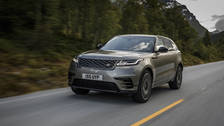
Jaguar Land Rover just showed off a new Special Vehicle Operations product called the Land Rover Discovery SVX. They also recently released the Range Rover Velar, which is quite like the Jaguar F-Pace. Makes you wonder, how similar will the Jaguar and Land Rover lineup be allowed to get? Finbar McFall doesn’t think they’re close at all … nor does he see a future where anyone comes close to confusing a Jaguar for a Land Rover or vice versa. He ought to know, since he’s the product marketing director of JLR.

“The brands are very distinct. It’s one company, but two very distinct brands,” McFall said. Even in the case of the F-Pace and Range Rover Velar? “The F-Pace is a different type of Jaguar, but it looks and drives like a sports car. All Jaguars are sports cars at their heart, and the F-Pace is no exception. Land Rovers should be the most capable vehicles in their class; even the Range Rover Velar will have class-leading levels of approach, departure and brake over angles. There’s reason we give the car air suspension. We may imagine different types, different body concepts of Jaguar Land Rover, but in each instance, they’ll stay true and authentic to what they stand for.”

2018 Range Rover Velar review and test drive

In other words, even if the two brands share platforms, McFall says they’ll have several differences in design and engineering to separate them. And there’s truth to what he’s saying: The F-Pace has 8.4 inches of ground clearance, compared to the V6-equipped Velar’s 9.9; approach and departure angles are also different. In a world where cars are becoming more similar, it’s important to have real differences.

That applies to electrification, too. JLR recently announced their intention to offer an electrified option in every vehicle from 2020 and beyond. But how electricity will supplement combustion engines can vary greatly.

“You can imagine in a Jaguar; the electrification is a performance reality. And that torque being instantly available translating into acceleration. The batteries sitting low in the vehicle giving a low center of gravity and inherently good dynamics,” McFall said, adding, “electrification in a Land Rover and having that ability to infinitely manipulate the torque and instantly manipulate it. Well that’s just perfect in an off-road environment.”

And, as long as we’re electrifying everything, why not the classics? After all, JLR is doing just that with the E-Type Zero, an alteration to 1968 E-Types to make them battery-electric roadsters.

“Well, I guess, it’s a good example, isn’t it, of art of performance, so the very simple way to think about it is: You should derive as much pleasure from looking at a Jaguar as you do from driving it,” McFall said. “That speaks to the design language and of course the E-Type has that, and over the years it’s become iconic. And you can reinterpret performance. The powertrain, actually, isn’t the performance story, it’s what the driver gets from it.”

We live in a fascinating time as car enthusiasts — the world around us is rapidly changing, some of it to the detriment of driving pleasure. But these new restrictions have brought interesting innovation. In the last two weeks, Jaguar Land Rover has shown the breadth of this with the Jaguar E-Type Zero and Land Rover Discovery SVX, not to mention the recently announced I-Pace. Three completely different cars in an ever more homogeneous world, all of them able to whet the appetite of the enthusiast in their own way.

Robin Warner

Robin Warner – Robin Warner is Editorial Manager at Autoweek. He once tried and failed to become a professional race car driver, but succeeded in learning about debt management and having a story to tell. A former engineer, Warner loves cars for their technology and capability.
See more by this author»

Borgward Isabella concept is a radical preview of the company’s electric future

Share

  • Pinterest

The Isabella is perhaps the only Borgward model that those enthusiasts who know Borgward can readily name, so it was only a matter of time that the reborn brand cashed in on its most recognizable nameplate. Borgward, which was brought out of a carbonite freeze of more than 50 years thanks to Chinese funds, kicked off the lineup with a fairly tame-looking SUV in 2015 that immediately invited comparisons to some Audi models, but it will take more than SUVs to get the marque really going again.

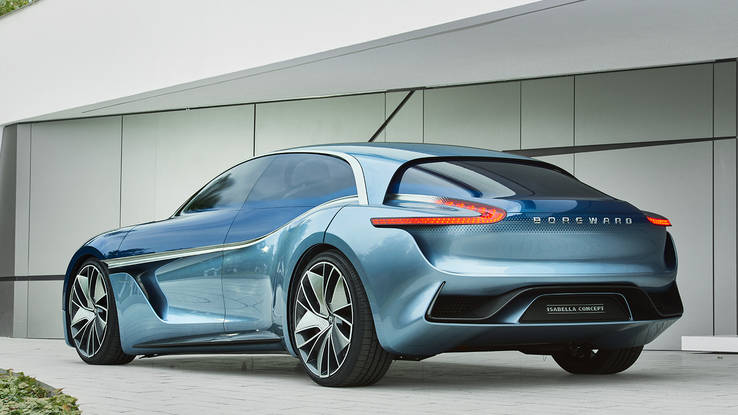
Borgward debuted the Isabella concept “coupe” at the Frankfurt motor show this week, a coupe that you’ll immediately note has four doors. Those four doors slide to the front and rear of the car, revealing a futuristic interior with overlapping touchscreens occupying the center stack and the console. The exterior is equally loud, with a sleek front fascia that may remind some of the modern Alpine. The rear fascia is far busier and does not look like anything on the market today, which is much of the point of this design exercise.

“The carefully coordinated body shape with its smooth transitions creates a perfect balance between rounded organic shapes and precise lines. Our aim was to create stylistic synergies between beauty and technology,” said Anders Warming, member of the board of management and chief design officer of Borgward Group AG.

“Aerodynamic excellence and efficiency play a key role in this vehicle and define its flowing shapes,” Warming added. “We are convinced that a vehicle body through and around which air flows in a perfect way must radiate accessibility, appeal and a commanding presence. This is fully in line with the ‘Impression of Flow’ — our Borgward design principle for the electric mobility of the future.”

2017 Borgward Isabella concept rear

The Isabella is a four-door 2+2 coupe in concept form, with the company staying mum on details of its electric powertrain.

BMW i Vision Dynamics at Frankfurt

But the design is not the entire point of the Isabella concept. It features an electric powertrain, even though the company shared no details about it. It’s not clear if this electric drive was created just for demonstration purposes or for the concept car to move around while being filmed, but the automaker is adamant that it intends to get into electric cars in the near future.

What are the chances of the Isabella going into production in some form? As a two-door coupe, its odds are not that great; coupes (or convertibles, for that matter) are a tiny blip on the radar in China. Its chances as a four-door sedan are far better — the pressure to churn out full-size executive sedans must already be great, given the Chinese market’s appetite for long-wheelbase everything.

Above all, the Isabella concept is a signal to other automakers (some of whom skipped Frankfurt entirely) that Borgward is alive and is starting to get serious. The automaker plans to bring its vehicles to Germany later this year ahead of the launch of a Bremen factory in 2019, where the original Borgward company got its start in the 1920s.

The Honda Urban EV Concept is the enthusiast's green car

Toyota aims a new line of hybrids at the enthusiast market

Share

  • Pinterest

Toyota will add a sportier line of hybrids that will be sold alongside its fuel-saving gasoline-electric models.

“One will provide the traditional benefits of efficiency and fuel economy, like in the current offer. The second will build on this, adding more power and a more dynamic driving character,” Toyota Europe boss Johan van Zyl said at the auto show here.

Toyota will reveal more details about its high-performance hybrids “early next year,” van Zyl said. The decision to add the sportier variants was triggered by customer feedback, he said.

Toyota’s first example of where it’s headed with the line is the C-HR Hy-Power design study that the automaker unveiled in Frankfurt. The concept has been developed by Toyota’s European design center.

Toyota will need to simplify its engine range as it adds more hybrid variants, said the automaker’s European development chief, Gerald Killmann.

2017 Toyota Camry Hybrid road test with photos, price, specs and horsepower

“The Auris currently has two gasoline engines, two diesels and one hybrid, but the hybrid version accounts for 60 percent of sales. Do we need all these engines or can we replace some of them with a second hybrid powertrain?” he said.

Toyota also revealed in Frankfurt its face-lifted Land Cruiser large SUV. The body-on-frame vehicle adds a new locking differential to improve handling. The SUV’s lead engine in Europe is a 2.8-liter diesel. In Russia and other markets in Eastern Europe the Land Cruise will be offered with 2.7- and 4.0-liter gasoline engines.

Toyota increased first-half European sales by 11 percent compared with 2016. The sales rise boosted the automaker’s market share by 0.3 percent to 4.9 percent.

The Toyota Group, which includes Lexus, is on track for full-year sales of 1 million vehicles in Europe (including Russia and Turkey) largely because of the success of the recently launched C-HR compact SUV and strong demand for hybrids, which are up 52 percent compared with 2016.

Toyota will add sportier line of hybrids” originally appeared in Automotive News Europe on 9/13/2017

By Andrea Malan at Automotive News

3 Mercedes-AMG Project One facts we learned from AMG chief Tobias Moers

Share

  • Pinterest

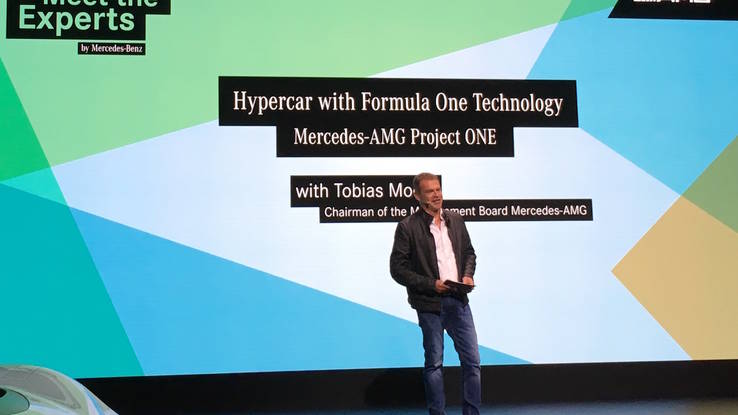
We got a chance to chat with Tobias Moers, CEO of Mercedes-AMG, to gain a little insight into the company’s incredible upcoming hypercar, Project One. Moers got right to the point, and here are three bits of information — including some myth busting — we learned:

One: We believe Lewis Hamilton helped develop the Project One, but he hasn’t yet driven it. Hamilton lent a hand in the development process, but not in the way you think — at least not yet. The powertrain is close to the Formula 1 car, which Hamilton helped develop, and many simulations of the car have been run, so it’s very possible that Hamilton contributed there, too. But he has not yet driven any test mules or prototypes. So far, the engineers have more miles on the car than anyone.

Three Time World Champion Lewis Hamiltons take on the Project One

Two: Yes, it uses Formula 1 tech, but from what years? 2015 and 2016 according to Moers. “2015 and 2016 was the same spec, so it is 15/16 Formula 1 spec.” True, but certainly the powertrain was developed throughout that time period, so we suspect it’s effectively a 2015 power unit from the beginning of that season. This unit comes from Mercedes-AMG High Performance Powertrains in Brixworth, England, just as the Formula 1 power unit does.

Tobias Moers Project One Frankfurt Motor Show

Tobias Moers speaks about Project One at the Frankfurt motor show. Photo by Robin Warner

Three: Over 1,000 system hp, but from where?

Mercedes claims over 1,000 hp, and we believe them. But where does that power come from? Of course, the single biggest contributor is the super-high-tech turbo 1.6-liter V6 with pneumatic valves and an 11,000-rpm redline, which produces 510 hp. Attached to the crankshaft is a 161-hp electric motor to help motivate the car along. Total power in back, 671 hp.

Up front are two more electric motors to power the front wheels; they are the same as the motor attached to the crankshaft, producing 161 hp each, or 322 hp. Total power comes to 993 U.S. spec hp, which converts to 1,006 metric ponies, or pferds, since we’re talking about a German car. And we’re willing to bet those are conservative estimates — look for at least 1,100 hp from the production car.

Mercedes Project One is here to put other hypercars to shame

The initial Mercedes-AMG Project One model run may already be spoken for, but technologies from it will certainly make its way down market — think of the Porsche Panamera Turbo S E Hybrid and its relationship to the Porsche 918 Spyder. It’s only a matter of time before a “regular” AMG product includes some Project One, hence F1, tech.

Robin Warner

Robin Warner – Robin Warner is Editorial Manager at Autoweek. He once tried and failed to become a professional race car driver, but succeeded in learning about debt management and having a story to tell. A former engineer, Warner loves cars for their technology and capability.
See more by this author»

The Honda Urban EV is the surprise retro electro-Civic Honda should build

Share

  • Pinterest

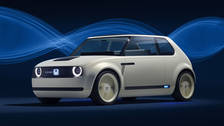
Looking to get in step with other automakers’ electrification aspirations, Honda is showing off its Urban EV Concept at the 2017 Frankfurt motor show. Taking obvious inspiration from the Honda Civic’s early days, the Urban EV Concept would look as much at home on the side of a street as it would at your local cars and coffee.

As tends to be the case with auto show concepts, the Urban EV has some strange-but-highbrow features, like a cool steering wheel, suicide doors and lighting displays all over the exterior. And the concept sports a massive media screen that also appears to be the instrument panel. If you think this concept looks small, don’t get your eyes checked — you’re right. This tiny concept is about 4 inches shorter than Honda’s smallest export, the Fit.

Five Questions for Hondas CEO

Five questions with Honda CEO Takahiro Hachigo

Like most of his predecessors, Honda Motor Co. president Takahiro Hachigo, 58, is an engineer by trade. He was deputy chief engineer for the second-generation Odyssey minivan, chief engineer for the …

While there are no real specs on this auto show concept, it did debut alongside what Honda calls the Honda Power Manager Concept, which is a system that stores energy at your home. That battery system can then backfeed the grid and make you some money.

We don’t know if the Power Manager Concept will see much use, but, according to Honda president and CEO Takahiro Hachigo, this concept isn’t far from reality. Hachigo said, “This is not some vision of the distant future; a production version of this car will be here in Europe in 2019.” If this is the future of Honda’s electric car push, we have to say we’re pleased with what we see. As with the CR-V Hybrid, there’s no word on whether it will make the jump to North America, but we’re always up for surprises.

Aicon and Elaine concepts are Audi’s non-driving future

Share

  • Pinterest

Audi’s two Frankfurt concepts show the company’s version of the last two stages of driverless cars, SAE levels 4 and 5.

First up is the Elaine, the next step for the e-tron Sportback shown in Shanghai in May, possibly due in production in 2020. The Elaine’s 430-hp EV powertrain has an electric motor in front driving the front wheels and two out back. Audi says it should hit 62 mph in 4.5 seconds. Battery capacity is 95 kWh, so range is expected to be around 300 miles.

The roughly A7-sized Elaine uses an advanced version of the new A8’s Level 3 Traffic Jam Pilot for autonomous operation up to 81 mph. In Level 4, it can change lanes to pass on its own, and it has V2X (vehicle to infrastructure) technology, so it’s able to see road hazards early. The car can operate without anyone in the car “at times,” Audi says, in what calls AI Zones, such as parking structures. If there is a human on board, the car watches the occupant’s heart rate and body temp and has several features, including seat massagers and various mood lighting stages, to help keep you alert.

Audi’s other concept, the Aicon, is more pie-in-the-sky since it’s fully driverless, or Level 5. It’s also quite large: At 214 inches long, it’s 9 inches longer than a long-wheelbase A8. This allows for a large interior with no dash, steering wheel or instruments and with front seats more like lounge chairs, able to swivel 15 degrees.

2019 Audi A8 revealed

The powertrain uses two electric motors in front and two in back, for 349 hp total. Audi hopes the car’s batteries will one day be advanced enough for a 500-mile range. The company’s plans for a driverless luxury car include four-wheel air suspension and four-wheel steering.

Other futurist features include high-pixel LED headlamps, full voice control for interior functions, and what Audi calls Personal Intelligent Assistant — it learns your behavior patterns and can do things for you before you tell it to.

Both cars’ names include Audi’s AI designation, the company’s new abbreviation for a group of what it calls “innovative mobility technologies.” Audi says the idea behind AI is to see what’s possible in offering systems that relieve owner stress while also offering new ways to more productively use the time spent in the car. Audi says AI systems will be able to learn and think and continually interact with the outside world as well as the cars’ occupants, aiming for a day in the future when your Audi is “a third living space” alongside home and work.

Wes Raynal

Wes Raynal – Wes Raynal joined Crain Communications’ circulation department while still in college. When he graduated in 1986, he became a reporter for Autoweek sister publication Automotive News. He has worked as Autoweek’s associate editor, news editor, motorsports editor and executive editor before being named editor in 2009.
See more by this author»

The 2019 Porsche Cayenne Turbo is your 550-hp grocery-getter

Share

  • Pinterest

If your current Porsche Cayenne doesn’t feel fast enough, don’t worry: The new one should. The 2019 Porsche Cayenne Turbo debuting at the Frankfurt motor show can rocket to 60 from a standstill in 3.7 seconds and keep accelerating until the speedometer hits 177 mph. Of course, that 0-60 time only happens when the new Cayenne is equipped with the optional Sport Chrono Package.

Under the 2019 Cayenne Turbo’s hood is a twin-turbocharged 4.0-liter V8 that sends 550 hp and 567 lb-ft of torque to an eight-speed Tiptronic S automatic transmission. Like the latest Mercedes-AMG engines, the 4.0-liter’s twin-turbochargers are placed inside the cylinder V between the cylinder heads in the so-called “hot inside V” layout. This design allows for the engine package to be more compact, which translates to it being placed lower in the car. 

Three Time World Champion Lewis Hamiltons take on the Project One

Helping keep the new Cayenne stuck to the ground is a new three-chamber air suspension setup. The air ride system has six height levels and can be manually changed to suit the road. The height can also be automatically controlled by the five different drive modes, which also affect other chassis settings and differential locking. An electric roll stabilization system (Porsche Dynamic Chassis Control), rear-axle steering and a torque vectoring system are all optional, but probably worth the extra dough.

The new Porsche Cayenne Turbo is expected to hit showrooms this fall and will start at $125,650. Of course, all the optional go-fast goodies can drive that price up considerably.

Mercedes GLC F-Cell blends EV flexibility with hydrogen power

Share

  • Pinterest

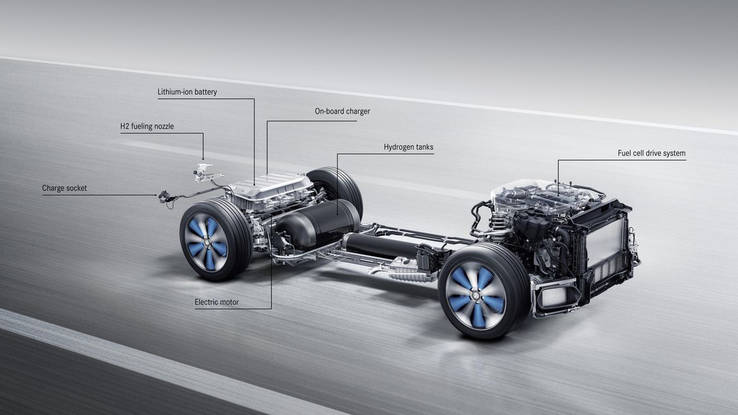
Mercedes-Benz unveiled a hydrogen-electric fuel cell hybrid based on its midsize GLC-Class crossover at the Frankfurt motor show this week. Set to go into production in late 2019, the GLC F-Cell pairs a relatively small 13.8-kWh lithium-ion battery with a hydrogen fuel tank and drive system. On hydrogen, the GLC has a range of 272 miles in the European cycle; the battery provides an additional 30 miles of range once the hydrogen runs out. When it comes to power, the GLC F-Cell produces 197 hp and 258 lb-ft of torque, with the top speed capped at 99 mph.

This isn’t Mercedes first foray into the world of hydrogen: The automaker fielded a fleet of B-Class compact MPVs back in 2009, but this will be the first production effort that will pair familiar plug-in EV tech with hydrogen power. Two carbon-fiber-encased tanks are located under the floor holding 9.7 pounds of hydrogen, providing the vast majority of the vehicle’s total range.

“Our many years of experience with fuel-cell technology pay dividends in the new GLC F- CELL: its long electric range, short refueling times and everyday practicality of an SUV will make it the perfect vehicle,” said Ola Källenius, Member of the Board of Management of Daimler AG, responsible for Group Research & Mercedes-Benz Cars Development. “This is made possible by the compact construction of our fuel-cell system. Another genuine world first is the combination with a large additional lithium-ion battery, which can be conveniently charged using plug-in technology.”
 

2017 Mercedes-Benz GLC F-Cell diagram

The GLC F-Cell opts for a relatively small lithium-ion battery, with the fuel cell drive system taking up the engine bay up front.

2018 Honda Clarity PHEV

The F-Cell sounds like it it won’t be able to stray too far from hydrogen filling stations, which aren’t exactly plentiful anywhere. The F-Cell’s electric range also looks like a bit of a nail-biter outside of EV strongholds, which leads us to suspect that even those willing to try a hydrogen car would have traded some hydrogen range for a more realistic electric range.

The rarity of hydrogen stations hasn’t stopped Toyota from offering the Mirai to the public (of some southern California counties), recently joined by the Honda Clarity, but we have to wonder just how many hydrogen stations Mercedes expects to pop up between now and 2019. That hydrogen pie will be sliced three expensive ways in 2019, even though Mercedes hasn’t mentioned pricing for the GLC F-Cell yet.

Here's the Toyota Mirai Super Bowl ad that most won't see

Discovery SVX is a Raptor-fied Land Rover

Share

  • Pinterest

Jaguar Land Rover’s SVO (Special Vehicle Operations) has so far been specializing in go-fast F-Types and Range Rovers, but for the 2017 Frankfurt motor show it’s built a serious off-roader in the Discovery SVX.

The new SUV comes with a specially tuned Terrain Response 2 system, which lets the driver choose the type of terrain he or she is encountering and adjusts the brakes and traction control to suit conditions. There’s also Hydraulic-Active Roll Control, tech that permits more wheel articulation, improving way-off-road traction; finally, improved approach, departure and breakover angles help you climb over the steep stuff.

The Discovery SVX has more ground clearance than the basic Discovery, plus four-corner air suspension, long-travel dampers and revised knuckles, which help fit the 32-inch, 275/55R-20 Goodyear Wrangler all-terrain tires.

Of course, the Discovery SVX will get the normal off-road stuff, including active center and electronic rear locking differentials, which work with that terrain response system.

2018 Jaguar XJR575 top speed video interview

Though off-roading is the focus, that didn’t stop Land Rover from putting a big, supercharged V8 under the hood. In this application, the 5.0-liter makes 518 hp.

An eight-speed automatic and twin-speed transfer case work with safety features like Hill Descent Control, Electronic Traction Control (ETC), Adaptive Dynamics, Dynamic Stability Control (DSC), All-Terrain Progress Control (ATPC) and variable ratio electric power-assisted steering to keep everything right-side up and pointed straight.

As for visual upgrades, the SVX — not to be confused with the also-awesome Subaru SVX — features front and rear skid plates, Rush orange metal recovery hooks, an anti-glare hood and a winch in the rear. The body is finished in Tectonic gray.

This one IS going into production in 2018, says Land Rover, at the SVO Technical Center near Coventry in the United Kingdom. Customers can register interest at landrover.com.

Here’s Lewis Hamilton’s take on the Mercedes-AMG Project One

Share

  • Pinterest

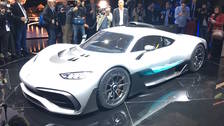
Seeing the Mercedes-AMG Project One in person evokes a mix of emotions that sway between the excitement of seeing a supercar and the thrill of stumbling across some crazy experiment — like someone took an F1 car and threw a body on it. Never has a manufacturer so directly taken Formula 1 tech and managed to make it road legal. Since it’s a Mercedes, why not have its top driver, three-time drivers’ world champion Lewis Hamilton, help with the introduction in Frankfurt?

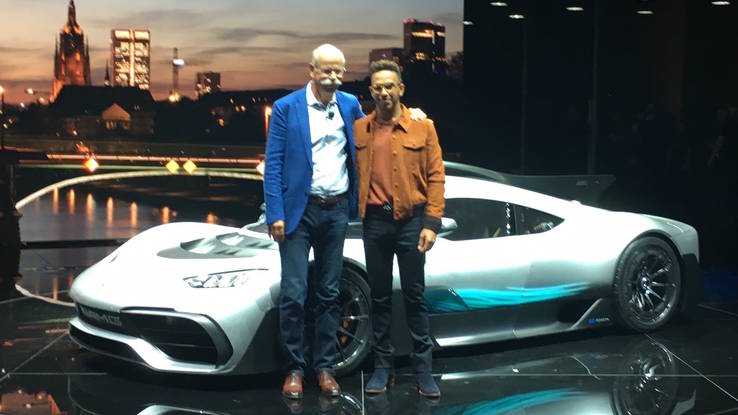
Hamilton himself drove the car onto the stage and then spent a few minutes with Mercedes CEO Dr. Dieter Zetsche to talk about it. As you can imagine, he’s impressed. “What Mercedes has created here — this is history. No one has really done this the right way before. To be a part of this, I helped develop this car, this engine. So to finally see it come to life, it’s magical,” Hamilton said.

During the interview, Zetsche asked Hamilton the most thrilling moment of his job as a Grand Prix driver: “Obviously driving the car,” Hamilton said, “starting the car, when I get to the track, in the garage, put on my suit on, my helmet, ear plugs in, I sit in the car and the guy ahead of me gives the go-ahead to the guy behind me to start the engine. The engine starts, the vibrations. You know you’re about to drive at the craziest speeds. And I can’t help but have a grin on my face.”

Hamilton added, “And as I said just back there, that’s the first time I’ve sat in the car (Project One), and with the engine start and I had the same grin as I have in the garage.”

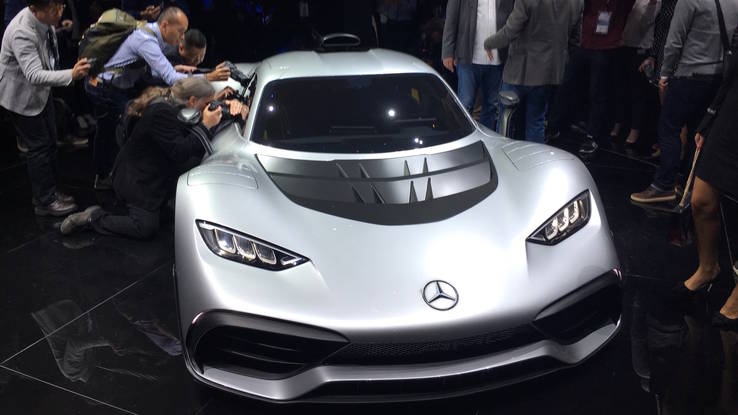
Porject One from the front

The Project One from the front and overhead. It’s low enough to the ground that it’s hard not to be overhead with this thing. Photo by Robin Warner

Of course Hamilton likes the car, but it was interesting to hear he helped develop it. Aryton Senna played a role in the original Acura NSX, and Senna is Hamilton’s idol — maybe this is a milestone that means more to him than we might have thought.

Truth is, none of it matters until we get a chance to drive it.

Project One Photo with Dieter Zetsche and Lewis Hamilton

Dr. Dieter Zetsche and Lewis Hamilton pose in front of the Project One. Photo by Robin Warner

Robin Warner

Robin Warner – Robin Warner is Editorial Manager at Autoweek. He once tried and failed to become a professional race car driver, but succeeded in learning about debt management and having a story to tell. A former engineer, Warner loves cars for their technology and capability.
See more by this author»

Mercedes Project One is here to put other hypercars to shame

Share

  • Pinterest

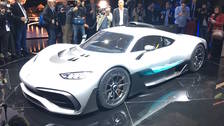
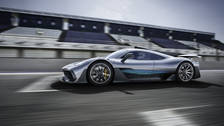
Automakers have been threatening “F1 technology for the road” for years, maybe decades, now. This week, at the Frankfurt motor show, Mercedes has done it with the Project One hypercar.

Let’s start with the numbers. The Project One gets a midplaced 1.6-liter V6 hybrid, direct-injection turbocharged gasoline motor that revs to 11,000 rpm. It’s built at AMG-Petronas’ spot in Brixworth, England; it has four overhead camshafts and pneumatic valve springs. It runs on “commercially available Super Plus” gasoline. Horsepower? More than 1,000. Top speed? 217 mph. Under six seconds to 124 mph.

The exhaust gas and compressor turbines are separated but connected with a shaft that features a 90-kW electric motor that drives the compressor turbine with up to 100,000 rpm. It uses energy from the lithium-ion battery, eliminates turbo lag, according to Mercedes, and reduces throttle response time.

Two 120-kW electric motors drive the front wheels, allowing individual braking and accelerating as necessary. Mercedes also says up to 80 percent of that braking energy can be scavenged under normal driving conditions.
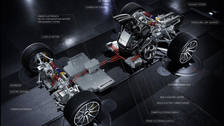
Mercedes AMG Project 1 powertrain details

The hybrid drive system operates at 800 volts, as opposed to 400 in the new Mercedes EQs. That allowed the company to reduce the diameter of the cables, saving space and weight.

Like many hybrids, the Project One will be able to move under just electric power — it has a range of about 15 miles — and if the driver’s foot leaves the gas pedal, it’ll go into a coast mode, as well.

An eight-speed Speedshift automatic will send power to the rear wheels. Remember, the fronts get electric power. The newly developed transmission can be operated in manual mode with paddles, as expected.

Multilink suspensions are used at both the front and rear. Pushrod spring struts have been installed, which replace conventional tubular crossmembers. The Project One will have three stages of electronic stability control: on, sport and off.

Michelin Pilot Sport Cup 2 tires stick to the road, measuring 19 inches in front, 20 inches in the rear. It has 285/35s in front and 335/30s in back. Ceramic brakes slow everything down.
Mercedes-Benz Project One at Frankfurt motor show

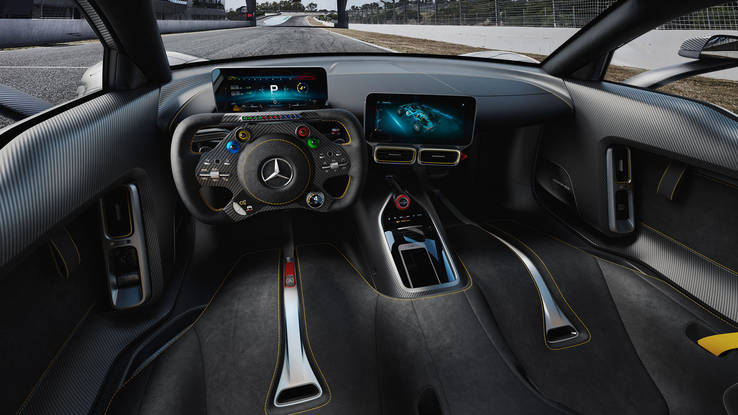
Two integrated controllers can be used to set adjustment functions such as the driving modes and suspension setup, or the LED shift display in the upper steering wheel area.

Now, on to design.

“The Mercedes-AMG Project ONE is the hottest and coolest car we have ever designed. It combines our design philosophy of Sensual Purity with the performance of our Formula 1 racing cars and is the perfect embodiment of

Performance Luxury,” says Gorden Wagener, Chief Design Officer Daimler AG.

“This hypercar’s extreme design marks a milestone in design — there are no lines, and the interior is stripped down to the essentials.”

The Project One is lousy with air intakes on the front, top and sides. Outlets in the hood guide hot air around the body while the automatically extending front splitter keeps the nose on the ground. In back, there’s a vertical spoiler, two-section diffuser and two-stage rear airfoil, all of which keep the rear planted at speed.

Inside, there’s room for two with a F1-inspired rectangle steering wheel (I guess?), bucket seats and a free-floating, wing-like dash. The Project One — resist the urge to call it P1 — gets two 10-inch screens handling infotainment duties. The rearview mirror is replaced with a screen and a camera showing what’s behind.

As we reported earlier this year, it’ll cost about $2.7 million, and require a pricey refresh at about 30,000 miles. Mercedes is building 275 examples, all of which are spoken for.


Official: BMW’s three-row with Concept X7 iPerformance joins the full-size fray

Share

  • Pinterest

BMW pulled the covers off its first full-size SUV a week before the Frankfurt motor show. The Concept X7 iPerformance seats six people in three rows, and like any good concept, features a bunch of future tech and a super modern exterior design.

“Since BMW founded the Sports Activity Vehicle segment with the first X5 back in 1999, every subsequent X vehicle has broken new ground. It also embodies one of the most important elements of our corporate strategy, to grow our presence in the luxury class. Furthermore, the BMW Concept X7 demonstrates it’s perfectly possible to combine a large sports activity vehicle with an electrified drivetrain.”

Speaking of the drivetrain: The Concept X7 comes equipped with BMW’s TwinPower turbo gasoline engine paired with a plug-in hybrid element. BMW says the powertrain will “excel in all driving situations, including running with zero local emissions.”

The Concept X7’s large panoramic roof should make the interior feel more airy. And having only six seats instead of seven or eight should mean more space to move around. Those seats also have shelled backs and are only connected to the floor with a slim seat base, leaving more leg- and kneeroom. The concept features olive-bronze leather with “discreet gold pigmentation” along with white accents.

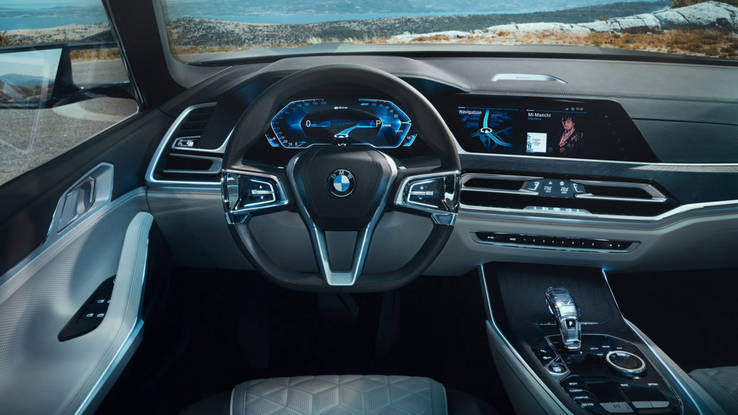
Although decorative materials are minimal — lots of matte finishes — the X7 does get ambient and contour lighting as well as laser lights in the roof. The instrument panel sticks to the necessities, and the 12.3-inch and central-infotainment screens are connected, a la Mercedes-Benz, making it look like one big screen. The iDrive Controller, gear selector and multifunction buttons on the steering wheel remind us this is still a BMW.

Second-row passengers get rear-seat entertainment options with sharable content that can be zipped back and forth between the rear or front screens. BMW says passengers can “send a track to the car’s music system by touch gesture, forward an interesting article to the next-door display for the person sitting alongside them to read or transfer an address from their email directly to the car’s navigation system.” Continuing, interactive LEDs trace the communication flow between the screens. Sounds cool, if a little gimmicky.

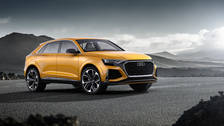
2017 Audi Q8 Sport concept

Outside, the X7 gets a more upright nose with a big 90-degree hockey stick character line running down the side. It cribs some 8-Series Concept design that we just saw at Pebble Beach a few weeks ago. The nose looks pinched with narrow headlights while the squared-off air intakes border the bumper edges. The matte and glossy kidney grille was made to look as if it’s made from one piece of metal.

In back, vertical aero bits frame the sides and the taillights stretch end to end. Otherwise, the rear is cleaner than expected, and it looks much more square than today’s X5 and X3.

The X7 is set to battle Mercedes’ GLS and Audi’s Q8. It joins BMW’s new 8-Series, i8 and new i8 Roadster as part of the company’s “expanded luxury segment lineup,” all sporting a new version of the Roundel logo with the company name “Bayerische Motoren Werke” spelled out.

We’ll get a better look at the Concept X7 iPerformance next week during press days of the Frankfurt motor show.

BMW X7 concept photos leak online before Frankfurt motor show debut

Share

  • Pinterest

Images of the upcoming BMW X7 concept have leaked online ahead of the Frankfurt motor show, showing a preview of Munich’s long and long-awaited full-size SUV that is already undergoing testing. The concept itself previews a production version that will go on sale about a year from now as a 2019 model, with three rows of seats, some off-road ability and an impressive footprint.

First things first: this is not the final look of a production X7, in case you are a little concerned. But the very vertical kidney grille is staying as evidenced by spy photos seen in the last few months. The design will be watered down a bit for production, but it remains to be seen if this front fascia signals the direction in which BMW SUVs will go. The latest X3 and X1 models have opted for a more horizontal and integrated headlight and kidney grille look, though this concept tries a different approach. The vertical slats integrated into the front and rear fascias may invite comparisons to recent Lexus and Toyota SUV designs, but the X7 concept nevertheless features a very horizontal set of taillights, as if lifted directly from a sedan model.

In short, don’t get to used to this look, because the production version of Bavaria’s Range Rover will be different.

2017 BMW X7 interior

The production version of the X7 may be offered in hybrid form as well.

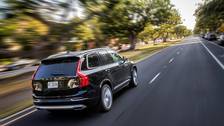
2017 Volvo XC90 T6 review with price, horsepower and photo gallery

One week in a Volvo XC90 T6 AWD Inscription

I finally got into one of these things months after my Detroit colleagues, and I was pleasantly surprised. Of course, in my mind (and in my bank account) I would never spend $72,805 for a car. So do I …

It’s also a little early to talk about engines, but there is no shortage of available powerplants for various markets that BMW will offer in the production version of the X7. At the lower end of the range we could see a 3.0-liter inline-six borrowed from the BMW X5 producing 300 hp and 300 lb-ft of torque, paired with an eight-speed automatic transmission. Mid-grade flavors could see the 4.4-liter TwinPower turbocharged V8 engine, good for 445 hp and 480 lb-ft of torque in the X6 and the X5. The top engine that BMW could put in the X7 could be the aluminum V12 borrowed from the 7-Series, churning out 600 hp and 590 lb-ft torque. As images of the X7 concept demonstrate, a plug-in hybrid version is also quite likely.

When the X7 finally goes on sale it will have no shortage of competitors (who have been on the market for ages), including the Mercedes-Benz GLS-Class, Infiniti QX80, Range Rover, Lexus LX and Volvo XC90, just among foreign vehicles, though it’s closest rival in terms of size and price will likely be the GLS-Class.

Oh come on Upcoming BMW 8 Series coupe may have already spawned a four door variant

The Jaguar E-Type just became our favorite electric car

Share

  • Pinterest

Jaguar Land Rover wants to make sure you know it’s on the cutting edge of new-vehicle tech, so it’s hosting an event in London named Tech Fest showcasing new technologies and concepts they see as the future of the automotive industry. Quite predictably, the event largely revolves around electrification and autonomy. Here are the three pieces of news we learned at Tech Fest, including what may be our favorite EV ever, the E-Type Zero. Read on:

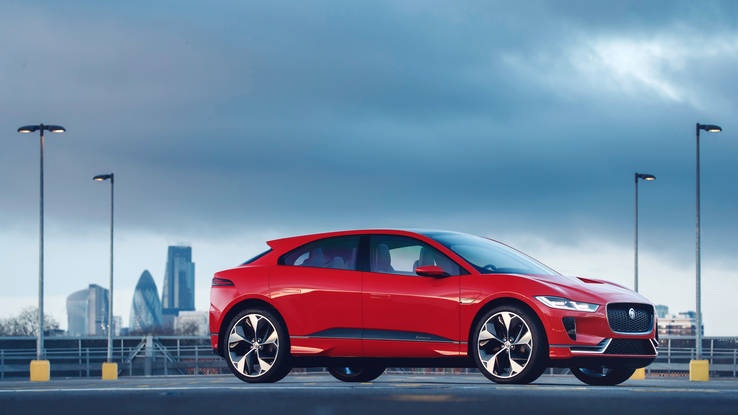
One. From 2020, all new JLR products will be electrified in some capacity. This means the new stuff will either be fully electric, plug-in hybrid or a standard hybrid. And next year Jaguar will sell the I-Pace, an electric SUV.

I Pace

The Jaguar I Pace Concept

Two. Jaguar is going classic with electrification, too, introducing the Jaguar E-Type Zero. Based on the 1968 Series 1.5 Roadster, the E-Type zero makes use of the iconic shape and adds a 220 kw motor (295 hp) and other digital bits and necessities to produce a zero-emissions roadster that can reach 62 mph in 5.5 seconds. The car was built by the Jaguar Classic division of the company.

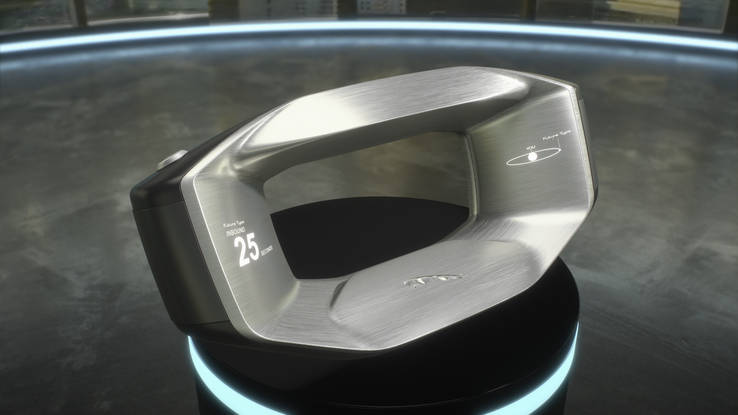
Three. The Jaguar Future-Type is a concept the company believes is a viable concept for the year 2040. It’s an autonomous car that drivers would share, not own. What you would claim as yours is the intelligent steering wheel called Sayer. Named after Malcolm Sayer, a designer who worked for the brand between 1951 and 1970, the wheel is voice-activated and artificially intelligent. Think of it as a combination Amazon Echo/Apple iPhone that communicates with the car, but can also help with groceries and act as your alarm clock. More important, if you still want to drive the car, you can, and the steering wheel will also allow you to steer, a novel idea in a way.  

The Sayer Steering Wheel

The Sayer Voice Activated, Artificially Intelligent Steering Wheel

Robin Warner

Robin Warner – Robin Warner is Editorial Manager at Autoweek. He once tried and failed to become a professional race car driver, but succeeded in learning about debt management and having a story to tell. A former engineer, Warner loves cars for their technology and capability.
See more by this author»

Here’s what Jaguar’s most powerful XJ will offer

Share

  • Pinterest

Jaguar has been filling out its lineup at both ends of the power spectrum. Now, just a few days before the Frankfurt motor show, the British automaker has revealed additional details on its new range-topping sedan first announced this summer.

The 2018 Jaguar XJR575 will have 575 hp  — as its name suggests — and 517 lb-ft of torque on tap, courtesy of a specially tuned version of the corporate supercharged 5.0-liter V8 engine. This will be good enough for sprints from 0-60 in just 4.2 seconds and a top speed of 186 mph, achievable in just 44 seconds — the kind of getaway times that make Bond villains cackle with pleasure.

Based on a long-wheelbase version of the largest sedan in the lineup, the XJR575 will be offered in rear-wheel-drive form only, which should make for some pretty entertaining “Professional Driver, Closed Course” high jinks.

How will you be able to spot the XJR575 in traffic? The most powerful XJ ever produced will wear 20-inch 5 split-spoke “Style 5044” gloss-black wheels, along with a revised front bumper, rear spoiler, side sills and lower air intakes with gloss black surrounds. The XJR575 will also feature red-painted brake calipers, as well as special badging, as one would expect; and Jaguar’s Special Vehicle Operations developed two additional colors just for this model — satin Corris gray and velocity blue — but regular XJ colors will be available, as well.
 

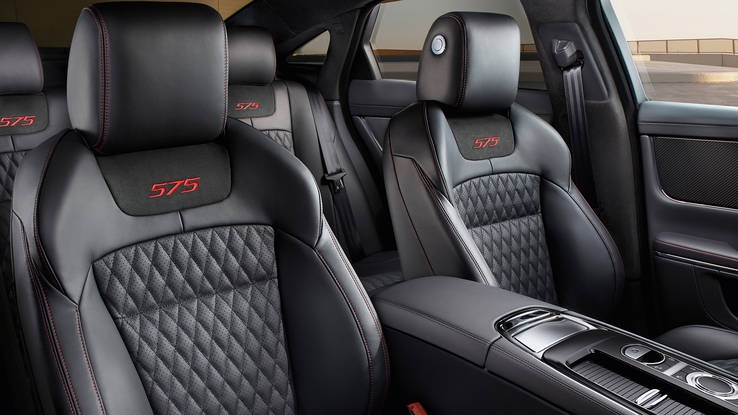
2018 Jaguar XJR575 interior

The XJR575 will offer a few exclusive interior details, including embroidered logos on headrests.

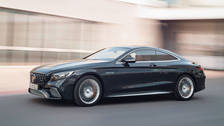
Boom Mercedes rolls out six 2018 S Class Coupe and Cabriolet models

Once safely inside, captains of industry, presidents-in-waiting, presidents-in-exile and presidents-for-life will be treated to diamond-quilted upholstery with embroidered “575” logos and will also be able to order the Premium Rear Seat Package that will offer two Business Class-style reclining seats with three different massage programs. Rear seat passengers will be able to watch stocks go up and down on foldaway, 10.2-inch, high-resolution screens, or sketch a battlefield map of a planned coup d’etat on the leather-surfaced business tables that fold out of the backs of the front seats. XJR575 owners will also be able to stay in touch with their accountants via the sedan’s 4G Wi-Fi hotspot, which can provide a connection for up to eight devices. Up front, the owner or the chauffeur will be able to use the new 10-inch infotainment touchscreen designed for smartphone-like swiping and pinch-to-zoom motions.

How much will all of this cost? The XJR575 will start at $123,395, a bump of $26,100 over the XJR Supercharged that’s powered by a 470-hp version of the 5.0-liter V8. The XJR575 will go on sale in a few weeks.
 

First Drive 2018 Jaguar F Type four cylinder 2018 Jaguar F-Type four-cylinder

Next-gen Jeep Wrangler: 7 things we expect to see

Share

  • Pinterest

The Jeep Wrangler’s successor is getting ready to have the curtain pulled on its new bodywork at the LA Auto Show. While at first glance it might not look too different from the current JK-coded Wrangler or many of the Wranglers in the past, there is a lot going on underneath the so-called JL Wrangler’s new sheetmetal.

What exactly are we expecting? Read on.

1. Jeep Trucks

The next-gen Jeep Wrangler will bring back a full-fledged pickup version. Expected to be called the Scrambler, the Wrangler pickup will have a longer frame than the regular four-door Unlimited Wrangler. According to a leaked CAD file, the frame is supposed to be 33 inches longer than that model, which should be long enough to support a proper truck bed.

2. Diesel power

We don’t have confirmation on the engines that’ll move the new Wrangler, but it’s safe to assume the Pentastar 3.6-liter V6 will live on, and there’s evidence of a turbocharged gasoline I4 too. The new Wrangler, at least in its Scrambler truck form, will also get the 3.0-liter V6 Ecodiesel under the hood. We’re still not sure what transmission will be mated to the diesel, but we’re guessing it’ll have the same eight-speed automatic the diesel gets in its Ram application.

3. Aluminum body panels

The new Wrangler was expected to be an all-aluminum affair, but that was dashed when word got out that only selected body panels would use the lightweight material. Still, the hood and the doors are expected to be stamped out of aluminum sheets to help curb the new Jeep’s final weight. 

4. Full-time four-wheel drive

According to some leaked option lists, it looks like the next-generation Wrangler will use a version of Jeep’s Selec-Trac full-time all-wheel-drive system. Don’t worry — you should still have a transfer case and select your own drive configuration on the standard Jeep.

5. Hybrid power

Electrification is coming, according to Jeep insiders. While not confirmed, the idea of a hybrid Wrangler hitting the trails is something to get excited about. Of course, there will have to be some way to protect batteries and sensitive electronics from waist-deep mud, but the torque of an electric motor would be welcomed when covering obstacles.

6. There’s still a manual transmission

From what we’ve seen, the next Wrangler will harness Chrysler’s eight-speed transmission. While that’s probably the best transmission to use when wheeling, it’s safe to say that the manual gearbox is sticking around. We expect the next-gen Wrangler to have a six-speed stick with throws as long as the manual trans you’d find on the currently available Wrangler — or your grandfather’s tractor.
7. Same great shape

The design team at Jeep will do as little as possible to change the appearance of its winning formula while updating aerodynamics and safety features. A droppable windshield appears to be on the new design, and thankfully we haven’t seen any indication of rectangular headlights.

Here’s a peek at Mercedes’ future electric hatchback

Share

  • Pinterest

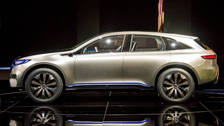
A year after Mercedes-Benz launched the EQ electric sub-brand at the 2016 Paris motor show, the Stuttgart-based automaker plans to follow it up with the EQ A concept at the Frankfurt motor show. While the brand’s very first concept followed the general outline of the GLC-Class, previewing a fully-electric midsize crossover positioned between the E-Class station wagon and the GLC-Class in terms of size, the upcoming Frankfurt concept will be a small hatch about the size of the A-Class, as its name suggests.

While the car that Mercedes will show in Frankfurt isn’t expected to be a production-ready EV, you can expect the EQ A to target the likes of the BMW i3 and Volkswagen’s future I.D. sub-brand electrics.

What can we glean from this teaser video before the concept breaks cover on Sept. 12? The intricate ribbon-shaped taillight and headline elements certainly look futuristic, but the profile of the upcoming hatch suggests this shot will be fired at electric versions of the Golf, rather than going for an upright-hatch bodystyle of the BMW i3 or the first-generation A-Class.
 

2016 Mercedes-Benz Generation EQ concept

Mercedes isn’t hinting at battery and range specs just yet, but the very first EQ concept unveiled in Paris promised an output of 402 hp and 516 lb-ft of torque, along with a range of 310 miles. Initial production EQ models are due on the market in 2020, and will be the first of 10 vehicles that Mercedes plans to field by 2025 — the first EQ concepts are a hatch and a midsize crossover, two segments popular in Europe, China and North America at the moment.

We’ll get a full glimpse at the EQ A concept in Frankfurt in a matter of days, by which time Mercedes-Benz will have more technical details about its first fully-electric hatch.
 

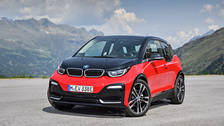
2018 BMW i3s revealed ahead of Frankfurt motor show

Ferrari to auction off impossible-to-get LaFerrari Aperta

Share

  • Pinterest

So Ferrari still won’t let you buy an Aperta despite the Sergio Marchionne tattoo you just had installed on your left cheek? We feel your pain.

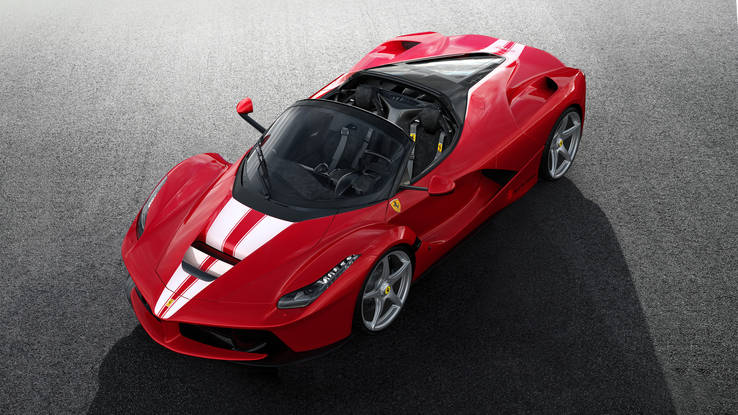
But take heart, tifosi: Ferrari is releasing one single, solitary LaFerrari Aperta open-top ultimate supercar for auction on Sept. 9. All you have to do is outbid all the other bazillionaires to get it. That could mean a tick or two over $4.5 million, according to auction estimates.

You know the Aperta, the open-top version of Ferrari’s LaFerrari, the ultimate hybrid two-seater Italian supercar. Cruelly, at the same time, Ferrari introduced it to the world last year in Paris, it was also announced that all 209 of them had already been sold. The gnashing of teeth could be heard all the way from Wall Street to Monte Carlo. There were threats, cajoling, lawsuits.

Well, Ferrari has taken mercy upon you, oh rich guy car collector. RM Sotheby’s “Ferrari: Leggende e Passione” auction in Fiorano Sept. 9 will include, among some other very cool cars, a LaFerrari Aperta.

“Ferrari is pleased to announce that to mark its 70th anniversary, it will auction a one-of-a-kind LaFerrari Aperta to benefit the charity Save the Children,” read a release from Maranello late yesterday.

The car will get a “one-of-a-kind livery in stunning metallic Rosso Fuoco and featuring a metallic Bianco Italia double racing stripe on the bonnet and rear.” Inside is black Alcantara and shiny black carbon fiber with red leather inserts on the seats with red stitching.

LaFerrari Aperta auction car

Those stripes are unique in all the world, just like your Aperta lust

If you get outbid, which is a very real possibility for which you must be psychologically prepared, there are some other nice cars to consider at the auction. Among our favorites:

1955 Ferrari 750 Monza by Scaglietti, expected to go for between $4.2 and $4.5 million

1960 250 GT SWB Berlinetta Competizione by Scaglietti, $10 to $12 million

812 Superfast wind tunnel model, scale 1:2, $333,00 to $381,000

1994 333 SP race car, $3.3 million to $4 million (roughly)

1959 250 GT LWB California Spyder by Scaglietti, $8.9 million to $11 million

And many more. On the more affordable side, the catalog offers a set of Ferrari Dino Capagnolo wheels and a warranty card (which may have expired by now) for as little as six grand. Ya gotta start somewhere.