All posts in “Rides”

Aston Martin Valhalla interior debuted in Monterey

Aston Martin began releasing estimated specs for the Valhalla supercar last summer. The figures described the thoroughly overhauled car, redrawn with just as dramatic yet smoother lines than the original concept from 2019, and repowered with a plug-in hybrid V8 sourced from technical partner Mercedes-Benz instead of the in-house straight-6. The quick summary describes a mid-mounted 740-horsepower flat-plane-crank V8 with an e-motor in back and another in front contributing 201 horsepower. The front electric motor can pull the coupe for up to eight miles of pure electric running, reversing is also done under electric power, not via the eight-speed dual-clutch transmission. Curb weight of 3,417 pounds pairs with a top speed of 217 miles per hour, the firm hoping its charge can lap the ‘Ring in 6:30, which would be a record for a production car. Deliveries are expected to commence toward the end of next year.

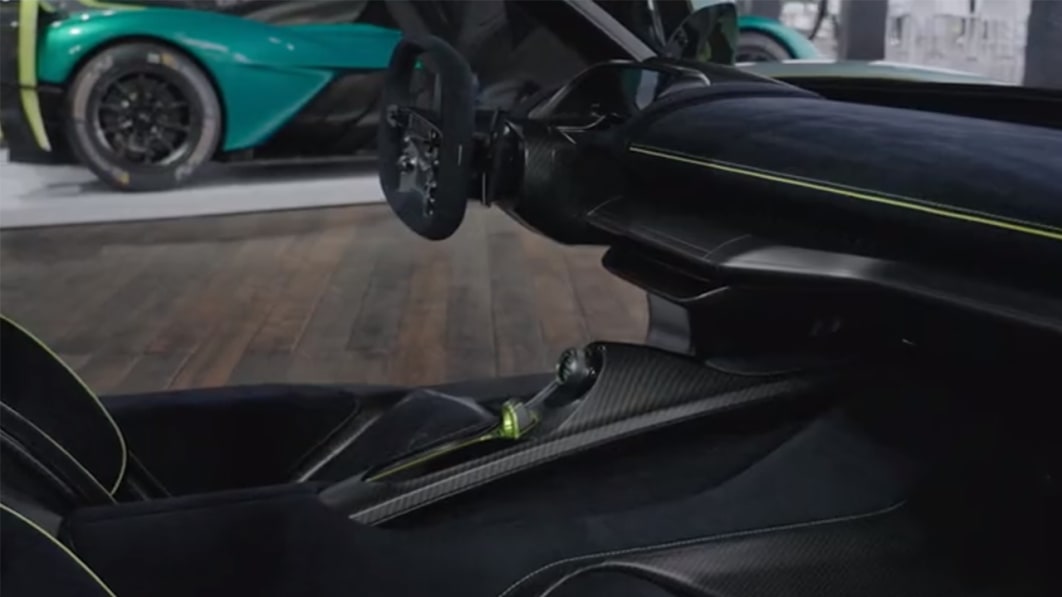
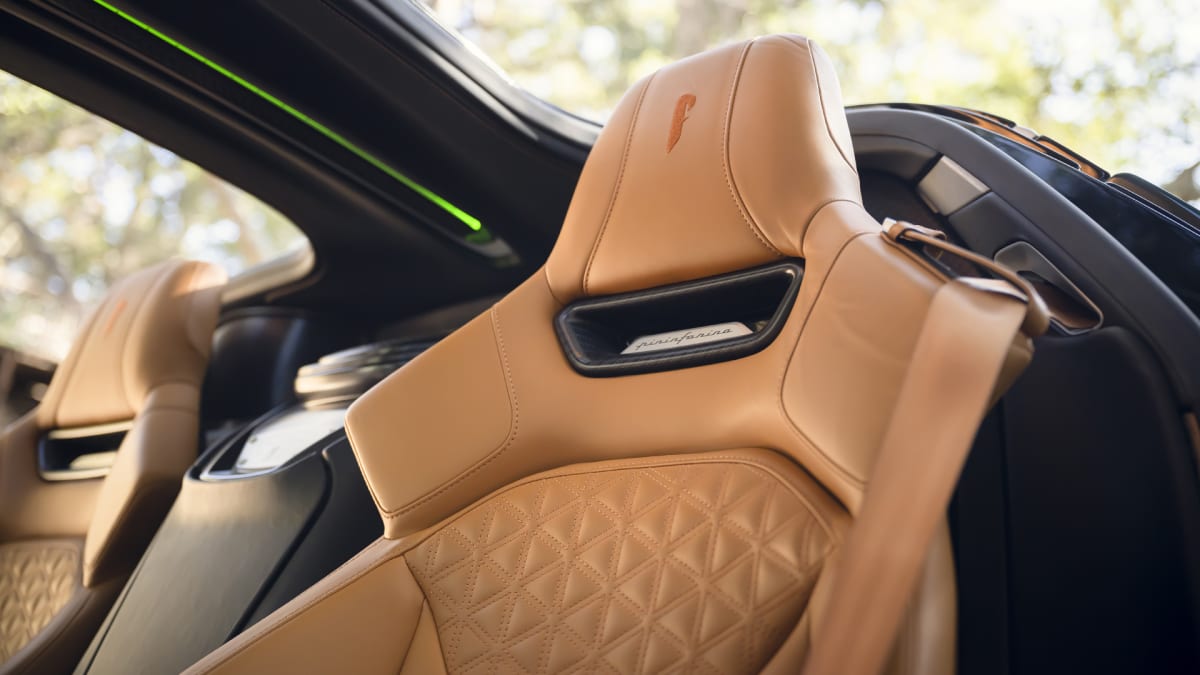
We still hadn’t seen the inside of the car last summer, though. Aston Martin finally lifted the dihedral doors on the show inside during the recent Monterey Car Week. Chief Creative Officer Marek Reichman described the cockpit as being “pure,” “about driver focus” and “concentration,” and “dedicated to the mastery of driving.” So despite an exterior update that injected “a more mature” road-going road ambience into the Valhalla’s silhouette, the cabin makes strong ties to the F1-inspired and track-consuming Valkyrie. These are seats that emphasize the “bucket” in “bucket seats,” supporting driver and passenger such that their heels lie above the level of their hips. The driver grabs a square wheel that’s jettisoned the central display in the Valkyrie’s square wheel. In fact, for those decrying the explosion of screens lately, here is your safe space. A slim rectangle ahead of the driver serves as dash display, and the infotainment screen can be hidden away, which it is in the short Twitter vid. We can see it staying stowed more often than not, in fact. Even if the V8 doesn’t pour its 7,200-rpm flat-plane note into the cabin — along with roof scoop inhalations and rubber-band-thin Michelin thrumming — the passenger quarters cannot be the kindest space to design a stereo for.

We’d been wondering about the production run, Autocar suspects Aston Martin won’t make more than 1,000 examples of the Valhalla. The potential good news for the few who’ll get to own it is that the carmaker might have reduced the price; Autocar heard that instead of costing somewhere around £1 million ($1.3M U.S.), MSRP could fall somewhere between £600,000 ($725,866 U.S.) and £700,000 ($846,844 U.S.).

Related video:

Rimac engineer says 0-60 ‘below one second’ is possible

Monterey Car Week encourages all kinds of questions that are answered with outrageous numbers. How much is the Pebble Beach lawn worth? How many metric tons of palm fronds were sacrificed to make the toquilla straw that make the numberless Panama hats? And how fast can a fast car go? The Drive spoke to Rimac Nevera Chief Program Engineer Matija Renić at The Quail about that last question, wondering what Renić believes is possible for a 0-60 time. His answer: “Below one second.” There aren’t many things humans can complete in less than a second other than say three-word sentences like “Below one second.” The idea of being at rest as one’s lips purse for the “B,” and traveling 60 miles per hour by the time the tongue comes off upper alveolar ridge to finish the “d” is, frankly, absurd.

Regrettably, either The Drive didn’t probe Renić as to what technologies will make the feat possible, or it decided not to repeat Renić’s words. All we have is the oracular pronouncement and little way to conceive of how it could happen, along with lots of questions about tires.

See, people like Engineering Explained who do math for a living have figured that, for a street vehicle on street tires on a regular street, about 2.05 seconds is the lower limit of the stoplight drag. When the Tesla Model S Plaid ripped off a 1.85-second teleport to 60 mph for Motor Trend, that was on “the super sticky VHT-coated surface of Auto Club Famoso Raceway.” On a non-prepped surface, Motor Trend got that down to 2.28 seconds, Car and Driver pruned it to 2.1 seconds. But C/D bettered the Tesla’s time in a Ferrari SF90 Stradale, hitting 0-60 in 2.0 seconds flat.

Rimac claims the Nevera will hit 60 miles per hour in 1.85 seconds, a time also achieved on a prepped drag strip, but we haven’t seen instrumented proof of that yet. Among YouTube videos of the Nevera running the quarter mile, one dedicated thrill seeker pulled off a 2.13-second rip to 60 mph.

Speaking of drag strips, top fuel dragsters are the go-to monsters for hitting 60 miles per hour in under one second, doing the deed in roughly 0.7 to 0.9 seconds. In 2019, Jalopnik tried to figure out the G forces involved in such dashes, the math concluding that getting from zero to 60 in 0.86 seconds put a 5.3-G strain on the body. Having that potential in your street car would be like having your own roller coaster, and what we imagine would be a monumental bill for tires. Until we see such things possible for the regular (rather wealthy) driver, we’ll be paying even closer attention to what what Rimac has coming.

Related video:

Koenigsegg building more CC850s because it sold out fast

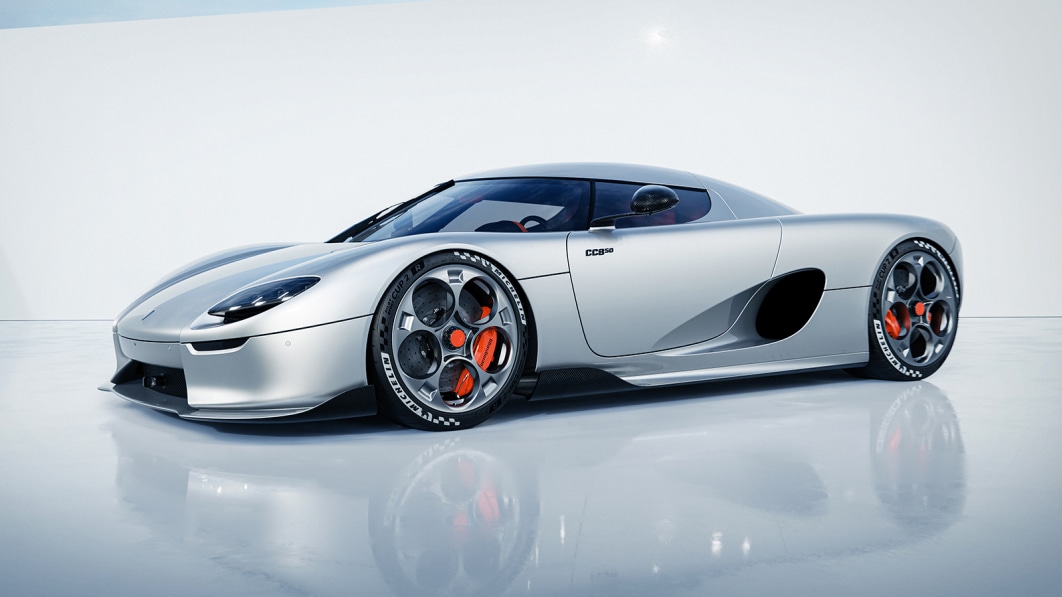
The Koenigsegg CC850 is sold out. That’s completely unsurprising, as these special supercars are snapped up almost as fast as a Jesko’s transmission can shift. But what’s interesting is that the company sold the 50-unit run so quickly, it ended up deciding to expand the production run by almost half.

Instead of just 50 cars, Koenigsegg announced it would expand the run by another 20. According to the company, that initial allocation sold fast enough that a number of long-time Koenigsegg customers missed out on a chance at the supercar. It ended up going back to some early order holders to check if they would be all right with the expansion, and obviously it must’ve gone over fine.

The 50-unit run was based on founder and owner Christian von Koenigsegg’s 50th birthday. The extra 20 was based on the 20th anniversary of the company’s first production car, the CC8S. That’s also the same car that the CC850 is celebrating with its manual-ized version of the nine-speed automatic Light Speed Transmission and more than 1,000 horsepower.

Related video:

Bugatti plots PHEV Chiron successor with more athletic proportions

Bugatti is ready to close the W16 chapter of its history; the Mistral roadster it unveiled in August 2022 is the final street-legal car powered by the quad-turbocharged engine. What’s next remains shrouded in secrecy, but the French firm gave Autoblog a few hints of what to expect.

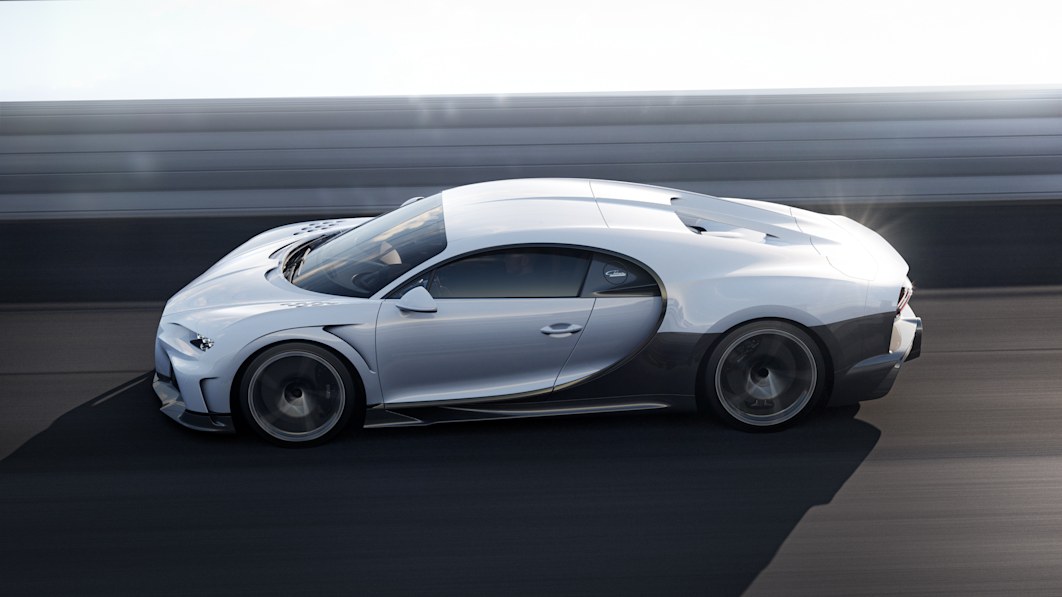
First, let’s dispel a myth: The Chiron’s successor will not be electric. Achim Anscheidt, Bugatti’s design director, confirmed that the model — whose name hasn’t been announced yet — will be powered by a plug-in hybrid powertrain. Rimac has previously described the drivetrain as “heavily electrified,” but precise technical details such as horsepower and layout haven’t been made public. All we know for sure at this stage is that the W16 won’t return and that many key components under the body (including the monocoque and the subframes) will be new.

In terms of design, it sounds like Anscheidt instructed his team to balance evolutionary and revolutionary approaches.

“[The car] will certainly be tailored to one or the other aspect of a hybrid. We see the potential to improve the overall automotive gesture of the car,” he said.

Dialing in new proportions is something his team wasn’t able to do when it designed the Chiron, because parts like the monocoque and the doors were carried over from the Veyron. Beyond the overall shape, Anscheidt noted he’d like to see Bugatti’s design language get leaner and more athletic, but there’s a limit to this stretch. Regardless of what the Chiron’s successor looks like, it needs to stay true to the ambivalent character of “the automotive Beauty and Beast” and be instantly recognizable as a Bugatti

“In comparison to other hyper-sports cars, Bugatti always created its own sovereign segment. It was always slightly different, never trying to be a race car for the road. It is the ultimate GT. That should not change from one day to the other. We don’t want to become somebody else, but we’re opening a new tech chapter which is a challenge as well as an opportunity,” he clarified.

The cabin will evolve as well, but it won’t necessarily follow the industry’s ongoing shift toward wall-to-wall screens.

“When you look at today’s cars, it becomes very apparent that there are screens everywhere. Where is this leading us? Yes, I think that customers deserve to have full entertainment in their daily driver. This is the [interior design trend] of the automotive industry, and we don’t want to question that. However, I wonder: who still has an iPhone 3? Nobody, and you probably don’t want to have one anymore. It likely doesn’t work. What happens to those cars when they are 20 or 30 years old? Do those screens still work? Did one do all of the updates?”

Anscheidt and his team actively debate what this means for Bugatti and its customers as they shape the Chiron’s successor. Not all companies worry about whether the technology they put in their cars will work in two or more decades, but Bugatti is in a unique position: its cars are instant collectibles. They’re rolling works of art created to be enjoyed and admired by enthusiasts who aren’t born yet.

“Bugatti models need to sit on the lawn at Pebble Beach in 50 years and work. Just like we see pre-war luxury automobiles that still work. What a disaster it would be if a Bugatti would sit there and there are only black screens [inside].” We’ll need to be patient to find out the solution that Anscheidt comes up with. “We’re carefully thinking about this. I’m not saying that we have the ultimate answer, but I’m saying there is something that makes precious cars and precious brands worth thinking about for the sake of future generations,” he summed up.

Performance doesn’t matter anymore, it’s all about the feel

We’ve just had a week of supercars and high-end EVs revealed. Many of them boast outrageous performance specs. There were multiple vehicles with horsepower in the four-figure range, and not just sports cars, but SUVs with 0-60 mph times under 3.5 seconds. And it’s not just a rarified set of supercar builders, comparatively small tuners are also building this stuff. Going fast is easy nowadays and getting easier. So what will distinguish the greats from the wannabes? It’s all about how a car feels.

This may seem obvious. “Of course it matters that a car should have good steering feel and a playful chassis!” you say. “Why are you being paid for this stuff?” But a lot of automakers have missed the memo. This past week I spent some time in a BMW M4 Competition convertible, and it’s a perfect example of prioritizing performance over experience. It boggles my mind how a company can create such dead and disconnected steering; the weight never changes, there’s no feel whatsoever. The chassis is inflappable, but to a fault, because it doesn’t feel like anything you’re doing is difficult or exciting. The car is astoundingly fast and capable, but it feels less like driving a car and more like tapping in a heading on the Enterprise-D.

I also happened to drive something of comparable performance that was much more enjoyable: a Mercedes-AMG GT. It was a basic model with the Stealth Edition blackout package, and even though it had a twin-turbo V8 instead of a six-cylinder, it only made 20 more horsepower. The power wasn’t the big differentiator, it was (say it with me) the feel. While not the best example, the steering builds resistance as you dial in lock, giving you a better idea of what’s happening up front. Pulses and vibrations come back to you as you move over bumpy pavement in corners. The chassis isn’t quite as buttoned down, either, providing a little bit of body roll that tells you you’re pushing it. It’s also easier to feel when the car is wanting to understeer or oversteer, and how your throttle and steering inputs are affecting it. The whole thing is much more involving, exciting and fun.

That’s also to say nothing of the Merc’s sounds. That V8 is maybe not the best sounding engine, but its urgent churn through the opened-up exhaust gets your heart racing. It also seems like it’s vibrating the whole cabin, so you feel it as much as you hear it. Though the BMW’s six is also a special sounding unit, too with a melodious howl and a smattering of pops on shifts. So BMW isn’t a total lost cause.

But I digress. The point is, given two cars with similar performance, one is more entertaining. It’s the one car enthusiasts will want to come away with, and as an added benefit, a car with a fun feel is enjoyable even when it’s not being driven at full force. The Mercedes was more entertaining even on public roads when following traffic laws. Many of these new hypercars and electric cars are offering performance that can’t even be used most of the time. But if they’re not fun the whole time, what’s the point?

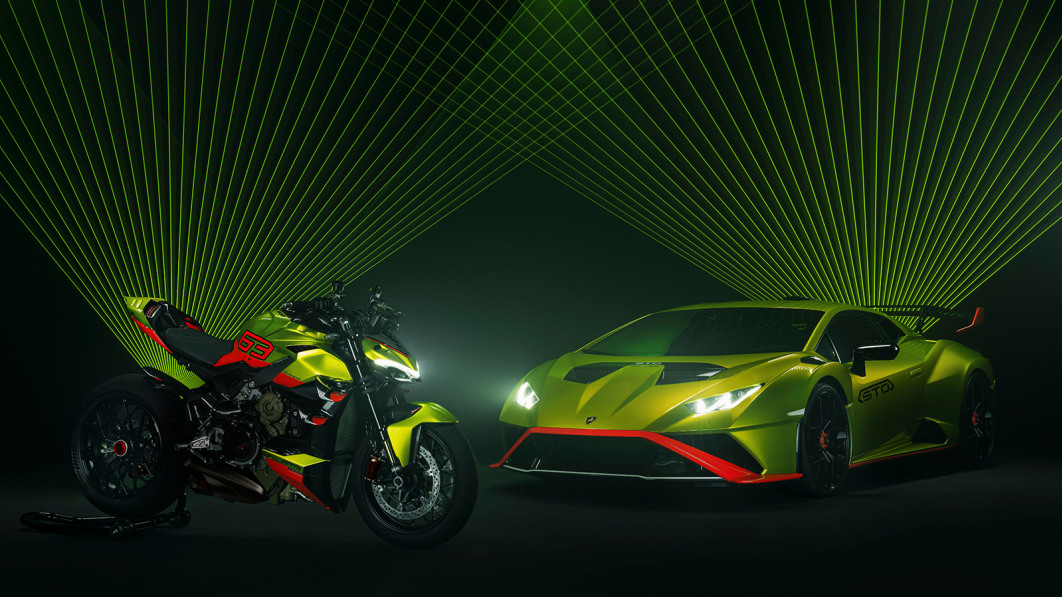
Thankfully, people in the industry are figuring this out. I spoke with Lamborghini Chief Technical Officer Rouven Mohr about the newly revealed Lamborghini Urus Performante. While the faster Urus seemed to be another vehicle that’s about the numbers, Mohr explained that wasn’t the goal. Many of the decisions about the SUV’s upgrades were to make it more fun and more like a sports car. The engineers went to steel springs instead of air for more response and linear, controllable reactions. The Rally drive mode isn’t so much for speed, but for tail-happy shenanigans on loose surfaces. He said a focus on feel and experience is what the company is working on, about making cars that have “good feedback and emotional involvement.” Mohr said a car like the Huracan STO is popular because it “makes you feel like a hero.” I think he nailed it.

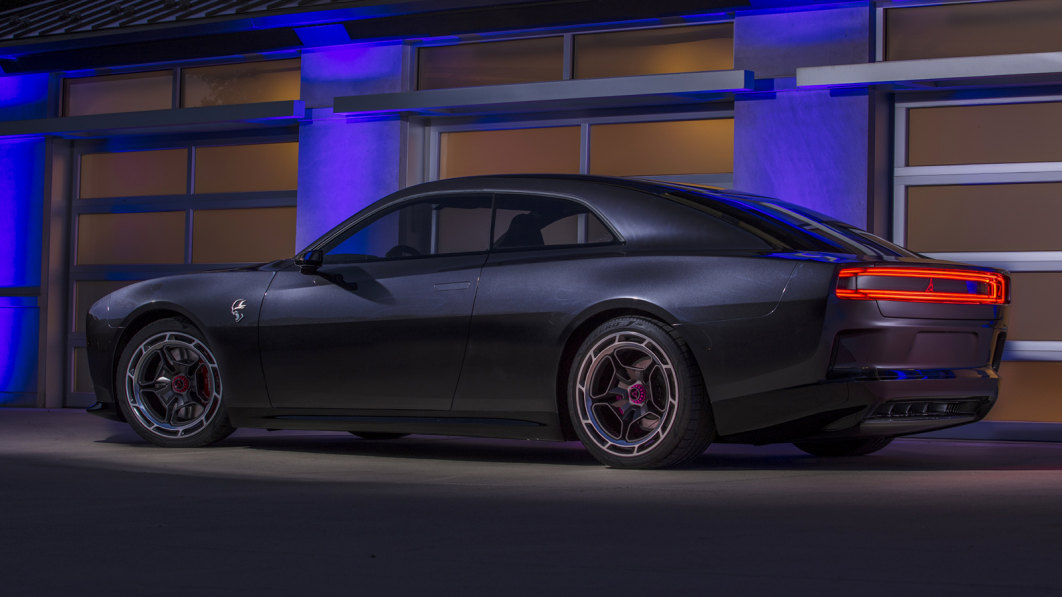
Other reveals this past week show a renewed focus on involvement. The Dodge Charger Daytona EV is more than just another fast electric car concept. Attention was given to the experience, with a piped exhaust to make noise under acceleration. It even has a multi-speed transmission, not for efficiency or performance, but to deliver the feeling of gas-powered muscle cars that Challenger and Charger owners clearly love.

Speaking of transmissions, take a look at the Koenigsegg CC850. It turned its hyper-advanced nine-speed automatic transmission into a gated manual transmission — with a functioning clutch pedal. Partly it’s a tribute to the CC8S, but it’s also to provide extra engagement. Koenigsegg even fitted smaller turbos that produce less power to optimize manual driving feel. This is good to hear from a company that just launched yet another four-figure horsepower supercar.

So the future is actually looking fairly bright, with big names in the car industry recognizing that the quest for more raw performance is less important than the driving experience. This is just a request for other manufacturers to follow suit. Cars aren’t all about the numbers.

Related video:

South Australia proposes special license requirement for high-powered cars

Lawmakers in South Australia have big plans in store for owners of high-powered sports cars, but they likely won’t be received with open arms. The Premier wants to require drivers to complete additional training and will push for a ban on disabling safety tech like traction control.

The proposed shift in policy comes after a Lamborghini Huracán driver killed a teenager in 2019. The driver was acquitted of the pedestrian’s death but pled guilty to a lesser charge. Peter Malinauskas, the South Australian Premier, visited with the girl’s family after the crash and promised the state would take action.

The South Australian Premier’s proposal also aims to ban drivers responsible for a deadly crash from holding a license until their case has worked its way through the courts. Other reforms relate to the penalties and rules around deaths that occur from irresponsible driving. The government aims to have the issues before Parliament by the end of 2022.

While it’s easy to bemoan yet another restriction on car enthusiasts, this might be one area where more, rather than less, regulation is a good thing. Think about it: Most young drivers take their licensing test in a more modest sedan, SUV or minivan and have had no formal training on how to handle a car with several times the horsepower. Couple that with a healthy dose of attention-seeking behavior, and it’s easy to see how things can go sideways — literally.

The Premier is calling for a special licensing requirement, not for a ban on supercars. Sure, more laws feel bad to most people, but making sure that money isn’t the only thing required to drive a Lamborghini isn’t such an awful thing.

Related video:

Woodward Dream Cruise Photo Gallery | Exotics and foreign cars

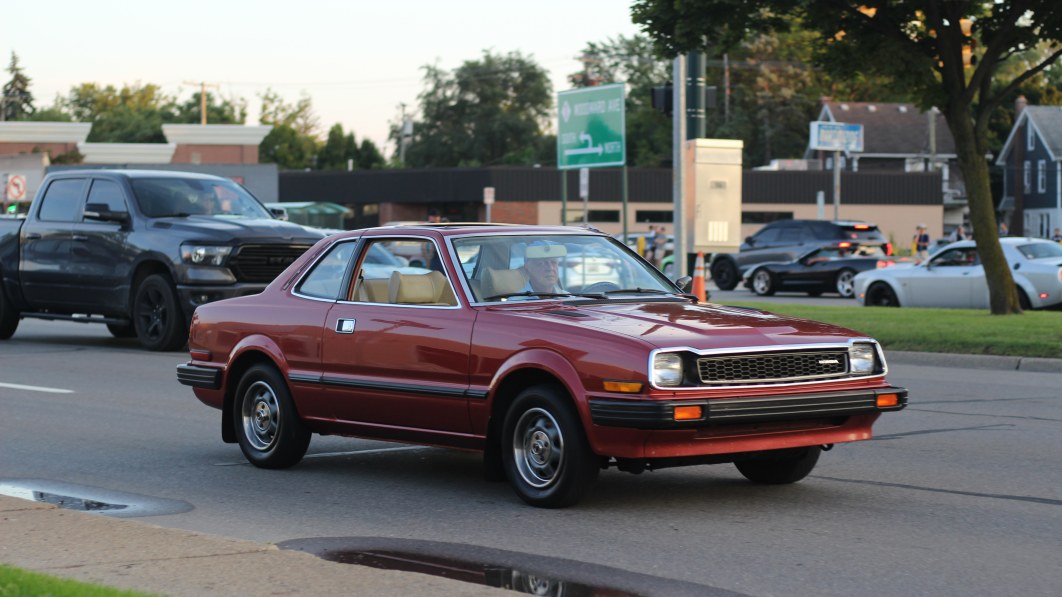
While the Woodward Dream Cruise may be best known for its American muscle and classic cars, the car community as a whole shows up for this single day of epic cruising. That means we get our fair share of foreign cars and exotics from all over, and frankly anything else you can think of.

This year’s cruise saw folks cruising in their Porsches, BMWs, Hondas and plenty more. We also saw our fair share of exotics. McLarens were practically everywhere, but tons of Ferraris and Lamborghinis showed up, too.

If you’re new to this whole Dream Cruise thing, know that it’s an annual event that takes place on Woodward Avenue in southeast Michigan. The cruise runs between Ferndale, Mich., and Pontiac, meaning hundreds of thousands of people line the roadway for miles on end. Traffic moves at a crawl, so the Dream Cruise ends up being a massive, slow-moving car show.

If you want to see more than the foreign and exotic cars of the show, make sure to check out our other galleries. Classics and American muscle can be found here. All the trucks you could ever want to look at are here. And lastly, we have a gallery showcasing all the weird stuff, dogs, motorcycles and more.

Related video:

Czinger 21C gets a V Max variant with new bodywork for top speeds

Even salesmen with delicious cuts of meat to offer know that you sell the sizzle, not the steak. That’s what Czinger went to Monterey Car Week to do with a third version of its tandem two-seater 21C and its planned Hyper GT. We’ll start with the 21C, which, remember, launched with two body styles. There was a road version and a track version whose aero accoutrements provided three times the downforce of the road car. The 21C V Max takes the road car in the opposite direction of the track car, streamlining and elongating the bodywork to trade drag for velocity.

The package should make more speed from the 2.88-liter twin-turbo V8 that sits behind the cabin in all 21Cs, aided by the two electric motors on the front axle. Founder Kevin Czinger said in Monterey the 1,233-horsepower powerplant enables the same sub-two-second 0-60 time as the other variants. Having reworked everything from the front splitter to the rear diffuser, the Vmax should be even faster than the claimed 27-second sprint from zero to 250 miles per hour and back to zero for the regular 21C. Claimed quarter-mile time is 8.1 seconds, claimed top speed is 253 miles per hour.

The V Max will be part of the 80-unit build of the 21C, giving buyers three flavors to choose from at a cost of $1.7 million per. First deliveries are planned for the end of next year.

At some point after the 21C begins deliveries, Czinger plans to have its second vehicle headed to production, known for now as the Hyper GT. It’s powered by the same hybrid setup as the 21C but with the ICE put up front and — we assume — the e-motors in back. Czinger says this will be “the most powerful grand tourer ever produced” and “by far, the top performing GT ever built and ever put out on the street” that also happens to have room for four adults and their luggage; those occupants will enter via gullwing doors, because you can’t see the wow factor of 1,233 hp at the valet stand.

Being so far out from production, we’re not sure what the interior will hold. But the company plans to produce 1,000 of the Hyper GT at its Los Angeles headquarters, each costing between $750,000 and $1 million, and then follow it up with a battery-electric model sometime before 2030. Czinger told Autocar, “The original conception of Czinger was to produce that ultimate road-track car [the 21C] that could set all of the records.” After the reception to the 21C and breaking the Laguna Seca lap record, he said, “Then the idea was ‘This could be a really, really cool brand,’ with the father-son combination [referring to his son and co-founder Lukas], that creates a whole series of the most off-the-hook vehicles in each of the categories.” 

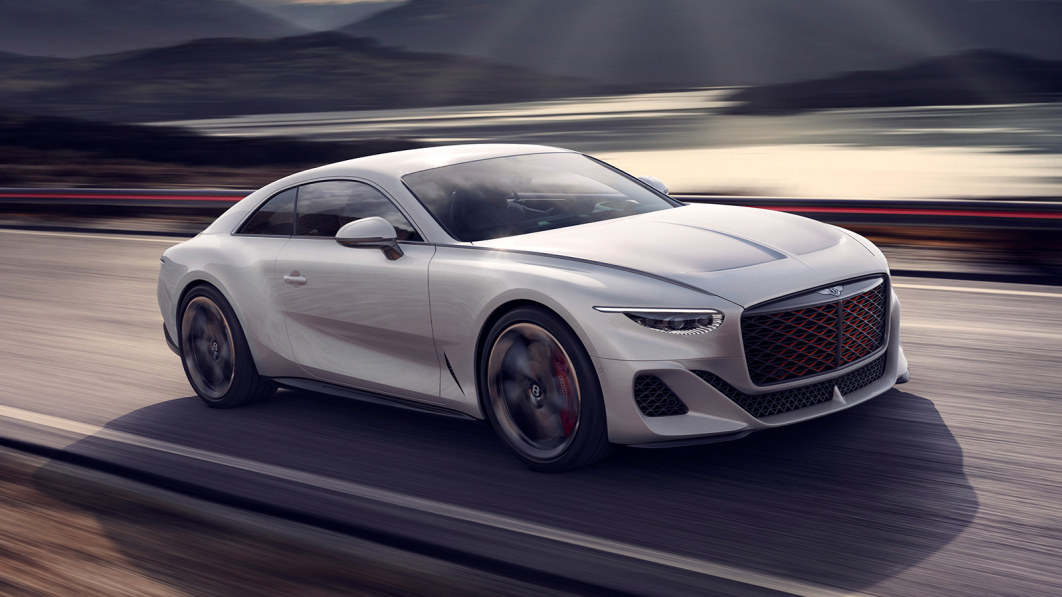
Bentley Mulliner Batur celebrates the W12, previews EV style

Bentley has revealed its second special Mulliner coach-built model, and it represents a crossroads for the brand. It’s called the Bentley Mulliner Batur, and it’s a sendoff for the core engine for Bentley, the twin-turbo W12. It’s also a sign of things to come. The styling you see here will be adapted for Bentley’s future electric cars.

The car is clearly Bentley right from the get-go. It has the long front end, the prominent, rounded rectangular grille, rearward placed cabin and wide, flowing rear fenders. But it has a more aggressive look than some recent Bentleys. The grille looks as though it’s leaning more forward. Instead of round headlights, it has sweptback units that look like eagle eyes. The rear glass, instead of kicking up, stays low along the belt line. The tail has almost a boattail look and has slender taillights. It’s Bentley, but it’s also new.

The inside is clearly closely related to the Continental GT, which is no bad thing. But it can be set apart with special materials. Buyers of the Batur will have the ability to customize almost every aspect of the car with different leathers from different locations, different interior trimmings and upholstery designs. Bentley is offering some very unique materials, too. Metal pieces such as the organ stop vent switches can be made from titanium or even 3D-printed 18-karat gold. Some of the interior trim can be made from a natural fiber composite, which is like carbon fiber, but made from naturally occurring fibers rather than synthetically created carbon. The natural fiber can be used for the front splitter, side skirts and rear diffuser as well. And of course the exterior can be customized with just about any paint and graphics imaginable.

Bentley says that the Batur is powered by the most powerful iteration of the twin-turbo 6.0-liter W12 yet. It makes 730 horsepower and 738 pound-feet of torque. It’s paired with adaptive air suspension, active anti-roll bars, all-wheel drive, four-wheel steering, an electronic limited-slip differential and torque vectoring to help it handle as well as it can go in a straight line. Stopping it are a set of carbon silicon carbide brakes with 10-piston front brake calipers and four-piston rears.

Only 18 Baturs will be built, and they’re all spoken for. Pricing started at 1.65 million British pounds, or $1.95 million. Though there will only be a few of these Baturs, keep an eye out for its design to show up in the Bentley EVs that are coming starting in 2025.

Related video:

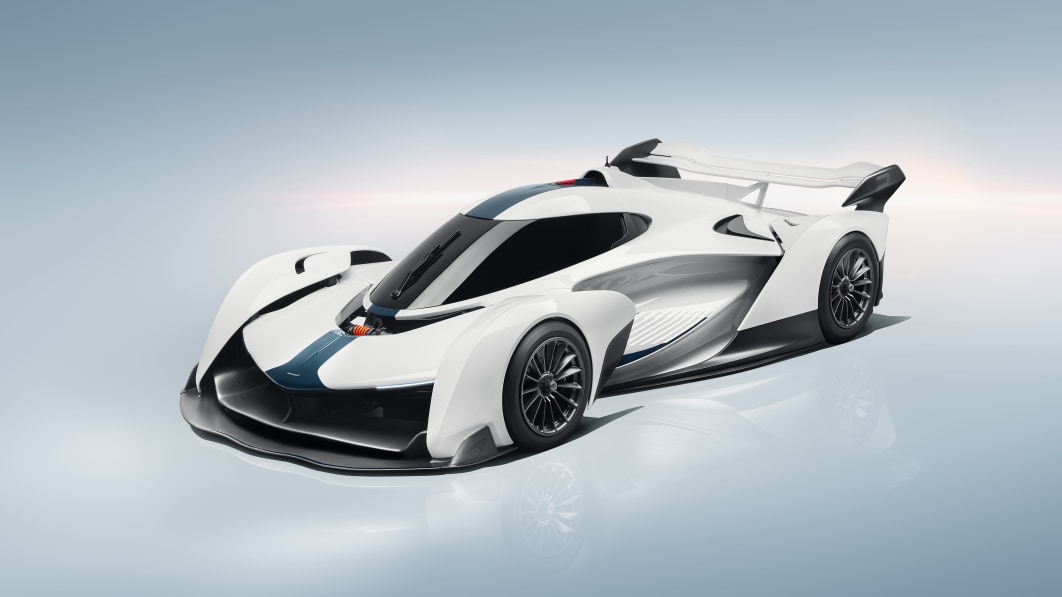
McLaren Solus screams into Monterey Car Week with 5.2L V10

Say hi to the McLaren Solus, a track-only supercar transformed from the virtual gaming world and into reality. McLaren just revealed this winged and wildly-shaped beast at Monterey Car Week in California — there will only be 25, and every last one of them is spoken for.

The most unique part of this McLaren is its powertrain, as it’s propelled by a unique 5.2-liter V10 (not a twin-turbo V8!). We didn’t see that one coming. McLaren says the engine makes 829 horsepower and 479 pound-feet of torque on its way to a redline somewhere above 10,000 rpm. It’s going to scream, and before you ask, McLaren makes clear that it’s nowhere near street legal. Claimed 0-62 mph acceleration is 2.5 seconds, and the top speed is simply listed as greater than 200 mph. 

For the first time in any McLaren, the engine is an integral part of the chassis, removing the need for additional structures or subframes outside the car’s carbon fiber monocoque. The engine is hooked up to a bespoke 7-speed sequential shift gearbox with straight cut gears that you won’t find in any other McLaren, too. 3-D printed titanium is used throughout the car for items like the halo cockpit protection structure. The suspension is a double wishbone design with the front damping being inboard with a pushrod design. The rear suspension is mounted to the gearbox casing — yes, this is some serious stuff . It features 18-inch center-locking wheels, is fitted with LeMans Prototype spec tires and braking is handled by 6-piston monoblock calipers with carbon discs.

This Solus originally saw the light of day as a virtual gaming concept of a hypercar in the Gran Turismo Sport video game. Now, McLaren says it’s the closest thing it’s built to the sensation of driving a Formula 1 car. Curb weight is a miniscule 2,205 pounds, and all of that wild aero — including ground effect tunnels in the full structural floor — is capable of producing “more than” 2,645 pounds of downforce.

It’s a single seater with an aircraft style sliding canopy that opens, allowing you to pop in and out of the car. Each Solus will get a driving seat molded to the owner’s body shape, along with a full race suit, gear and racing coaching to go with. As you’d expect, the Solus can be customized in every way imaginable via McLaren’s MSO program. Deliveries are meant to start in 2023, and no price was provided by McLaren.

Related video:

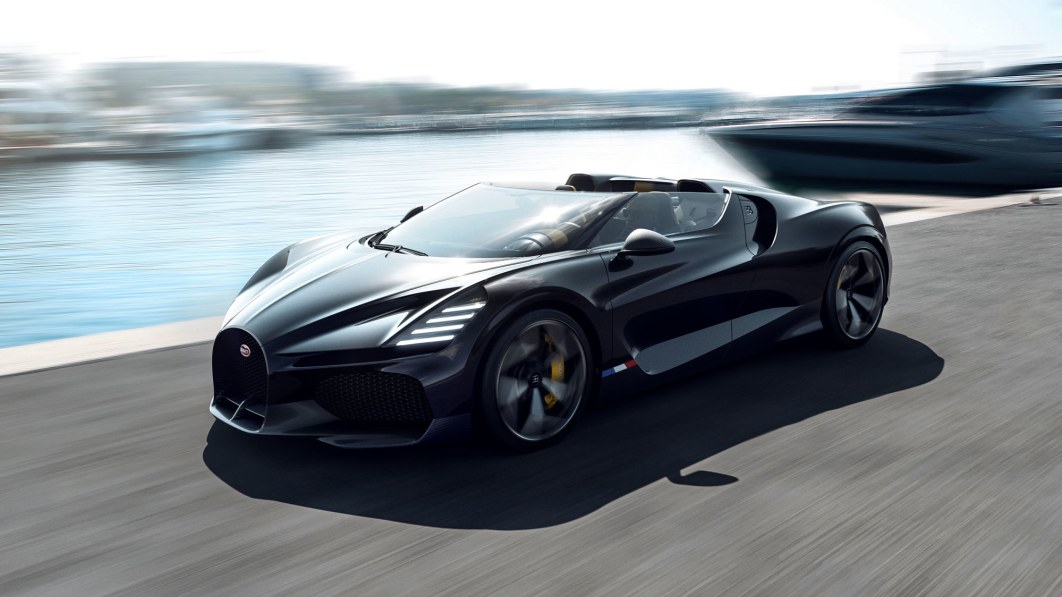
1,600-hp Bugatti Mistral roadster marks the end of the line for the W16 engine

Bugatti’s mighty W16 engine will retire in the coming years, but it’s not sailing off into the sunset quietly. It will power one final street-legal car: a roadster named Mistral that stands proud as the first convertible of the Chiron era. Built due to customer demand, the Bugatti Mistral is a striking, limited-edition model that looks ready to add another speed record to the French firm’s trophy case. I sat down with some of the people who created it, including Bugatti design director Achim Anscheidt and head of design Frank Heyl, to get the droptop’s full story.

“For the final road-going appearance of Bugatti’s legendary W16 engine, we knew we had to create a roadster. Well over 40% of all Bugatti vehicles ever created have been open-top in design,” said Bugatti-Rimac CEO Mate Rimac. Heyl added that customers “begged” Bugatti to create a Chiron-derived convertible, and that granting them this wish was a “bucket-list” item for the members of his team.

Power for the Mistral comes from the same 8.0-liter, quad-turbocharged 16-cylinder engine that propelled the Chiron Super Sport 300+ to a record-breaking 304.773 mph in 2019. It’s rated at 1,600 horsepower, and it spins the four wheels via a seven-speed dual-clutch automatic transmission. Bugatti estimates that the Mistral’s top speed will check in at approximately 261 mph (420 kph). Will this number get verified? Hell, yes! “There can only be one goal in mind: to become the fastest roadster in the world once more,” Bugatti pledged in a statement.

While the Mistral is Chiron-based, Bugatti made several important structural changes to offset the inevitable loss of structural rigidity caused by chopping off the roof. Heyl explained that the monocoque’s sills and transmission tunnel were reinforced and that the a- and b-pillar structures are new, though the front crash structure is the same. And, the two models intentionally share no exterior styling cues.

“We had the pressure of creating something that is precious and valuable in a car collector’s garage. It’s not just a fashion statement: ‘Oh, let’s do a roadster!’ Or, even worse, ‘Let’s take a Chiron and just cut it open,’ which would have looked terrible. This burdens us with the responsibility that this is the last of its kind of that generation and how that’s going to sit in those collections,” Anscheidt told Autoblog.

Up front, the Mistral wears a redesigned rendition of Bugatti’s horseshoe grille and headlights with four LED strips (a configuration chosen as a tribute to the four-wheel-drive system and the four turbochargers) while the X-shaped lights characterize the rear end. There’s a lot more to the design than initially meets the eye, however. Heyl explained that his team added air curtains behind the headlights, for example. And, they separated the intakes that feed air into the engine from those that feed air into the oil coolers to avoid making the Mistral too wide. The former are now right above the front passengers, while the latter remain on the quarter panels. This setup brings a few unexpected benefits.

“The driver hears the air intake system and the turbo blow-off valves, and it’s very nice stylistically; it reminds us of the Vitesse,” Heyl said.

Interior designers kept the Chiron’s basic layout with a handful of exceptions such as new, more ergonomic seats. Check out the gear selector, too: It’s made of wood and features an amber insert with a replica of Rembrandt Bugatti’s “dancing elephant” sculpture. Bugatti told me this part is “just a proposal for the show car,” though it added that it will find a way to bring it to production if customers request it.

What if it rains? Act fast; The Mistral will come with what Anscheidt described as an “emergency roof” but it will not feature a fixed top.

Bugatti will cap Mistral production at 99 units, though it will build an additional car for testing purposes. Pricing is set at €5 million before taxes and options are factored in (about $5 million at the current conversion rate) and the entire production run is already spoken for. And, while many hypercars are only street-legal via loopholes, Bugatti went to significant lengths to fully homologate the Mistral around the world.

Is the Mistral the end of the W16? Sort of. It’s the last W16-powered street-legal car, Anscheidt explained that ever-stricter regulations are escorting the big engine off the stage, but the engine will also power the limited-edition Bolide that was developed exclusively for track use.

“To be honest, I can do all of the design talking that I want, but if we didn’t have the W16 engine [these cars] would not be worth half the money,” Anscheidt said. “The W16 is the ultimate [unique selling proposition] for the modern-day Bugatti brand, from 2005 to today. It means something to us. [The Mistral] is a tribute to this engine, and now we go on to the next generation and think about something else,” 

Related Video

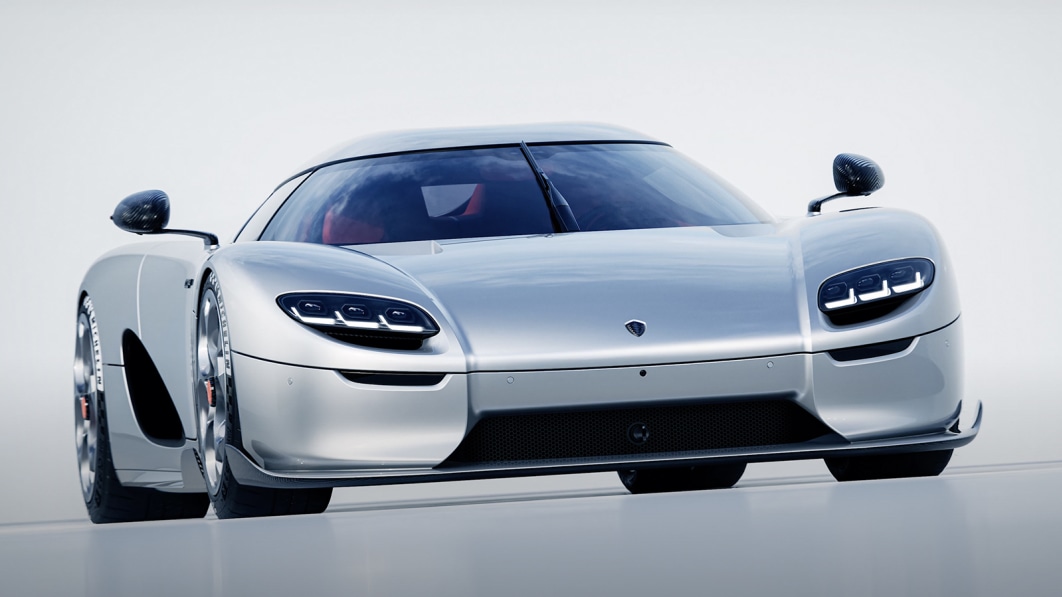
Koenigsegg CC850 shown with 1,185 horsepower, fascinating gated manual

This is a big year for Koenigsegg. It’s the 20-year anniversary of the Swedish supercar builder’s first production car, the CC8S. It’s also the 50th birthday of the founder, Christian von Koenigsegg. To celebrate, the company has put together the CC850, which is a reimagining of that original supercar, but using modern technology. It looks very much like the old car, but packs way more power and some wild features.

The exterior is quite close to the original. The biggest changes are the switches to more flowing LED lighting up front and in the rear. It has reworked wheels with the phone-dial round openings and has a smooth, uncluttered design. Part of that is due to the hidden rear wing that deploys at speed. The car has the signature tumble-forward doors, powered hood and engine cover, and it has a removable top that can be stowed in the car just like the CC8S. The interior is much more modern Koenigsegg, and the highlights include the beautiful analog instrument dials and the gated shifter in the middle. That shifter features a wood knob with a Swedish flag, again like CC8S.

As is often the case with Koenigseggs, the parts that make it go are as interesting if not more so than the swoopy shell. The CC850 is powered by a twin-turbo 5.0-liter V8 that makes 1,185 horsepower and 1,022 pound-feet of torque on gasoline. Put E85 ethanol in it, and power climbs to 1,385. Christian von Koenigsegg noted that these numbers are a bit lower than for the Jesko, which provided the base for much of the CC850. The reason is because the company went with smaller turbos for better response and less lag, since the car has a manual transmission, sort of.

Ok, so let’s talk about the transmission. It’s a version of the Light Speed Transmission, which has a set of seven clutches and nine gear ratios and can jump from any gear to any other gear, unlike most dual-clutch transmissions that have to shift sequentially. In the Jesko, it’s an automatic transmission with paddle shifters. Here, it has an automatic mode, but it also has a manual mode, complete with clutch pedal. The clutch pedal does actuate the transmission’s multiple clutches, and it is possible to stall the car if you’re not balancing your clutch and throttle inputs. And the shifter will tell the car which gear you want. Curiously, there are only six gates for the manual mode. Christian von Koenigsegg said that having to pick through nine gates would be complicated, so the company stuck with six. Depending on what drive mode you’re in, though, the different gates will get you different ratios. So hypothetically, you could have a set of closer ratios for a track mode, and more widely spaced ones with a tall top gear for street and highway driving.

Naturally, the CC850 is also light. With its carbon fiber construction, it weighs in at just 3,053 pounds. It actually has the same power to weight ratio as the Koenigsegg One:1 when measured in metric with the ethanol output. The car also features adjustable ride height and damping.

Only 50 CC850s will be built. No price was given, but we’re sure buyers don’t care. We also imagine that the car will be sold out very soon after this reveal.

Related video:

Koenigsegg livestreaming debut of ‘latest family member’ at 12:00 EDT Friday

On January 1 this year, Koenigsegg teased a new vehicle on Instagram with the caption, “Dear 2022, here’s our New Year’s resolution – More ultimate performance through clever engineering and optimal design.” The company broke its ensuing silence Thursday night by teasing a live debut to begin at 12 p.m. Eastern / 9 a.m. Pacific in Pebble Beach. The teaser image boasts a silhouette that looks like the CC8, the Swedish manufacturer’s first car, with the addition of a roof scoop. Beyond that, we have nothing more than gathered speculation as to what it could be.

There’s the entry-level Koenigsegg that founder Christian von Koenigsegg has said for a while that he wanted to release. There’s the CC12 project with Swiss retailer and supercar garage Carage, which appears based on the CC8S production prototype and would satisfy the note about “ultimate performance and clever engineering,” but the timing is off; in April, Carage owner Kim Struve said the CC12 would “be released in a year’s time.” The Supercar Blog has heard this new thing could be Christian’s 50th birthday gift to himself, called the Annira or the CC850S, packing more than 1,300 horsepower into a 1,300-pound curb weight and fitted with a “magic transmission.” Some surmise it’s Koenigsegg finally reckoning with a battery-electric vehicle, but we think that’s the longest shot of all. He told CarBuzz two years ago, “It actually would be much easier for us to just do a pure electric car, because we could throw away complexity but add weight. But I’d rather have complexity in the super expensive sports car than add weight.”  

That seems to us to be enough guessing for today. The only other rumors we’ve heard that we would believe true are that there will be a tiny production run and every unit is already sold out. We have but a few hours to find out what’s really happening. Based on the company’s products since, oh, ever, it will probably be special.

Related Video

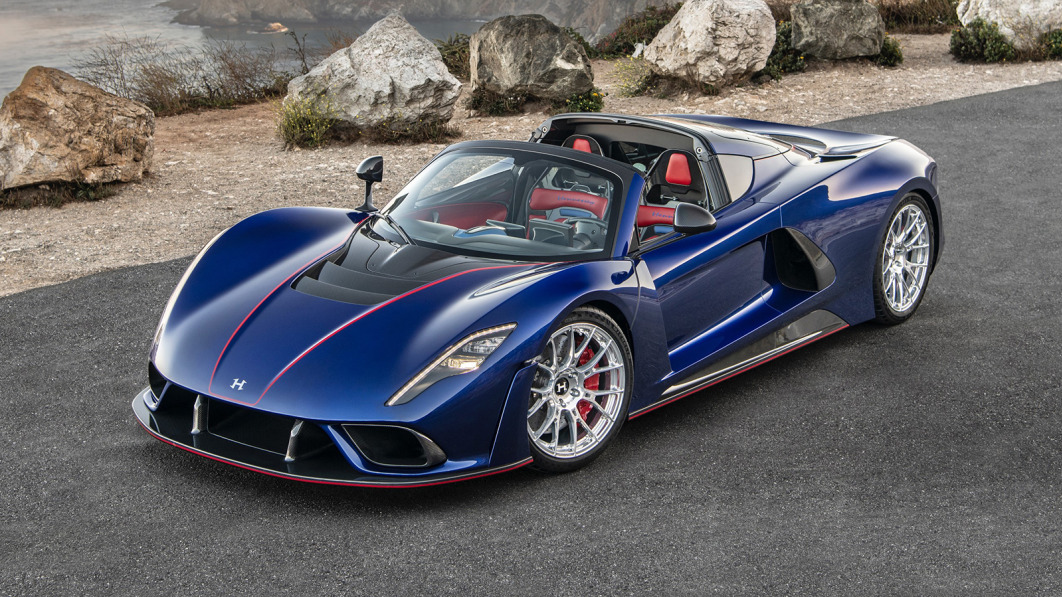
Hennessey Venom F5 Roadster has coupe power, removable roof

As promised, the Hennessey Venom F5 Roadster was revealed during Pebble Beach week. It’s also nearly identical to the coupe it’s based on, albeit with a removable roof and a few subtle tweaks here and there to make it more unique.

The roof is of course the centerpiece, and Hennessey wants that to be the case whether it’s on the car or not, since it comes with a fancy carbon fiber display stand for when it’s removed. There also is a soft travel bag for it, just in case you insist on bringing it along. The insulated top is made of carbon fiber and features an Alcantara lining. It weighs just 18 pounds.

Hennessey also fiddled with the exterior. Most notable is the new engine cover. Instead of a simple vented carbon fiber panel, the Roadster gets large piece of glass framed in carbon fiber and aluminum to make the twin-turbo V8 visible. The aluminum panels and carbon fiber surround are both vented, with holes in the carbon surround formed to match the rear heat extractor. The Roadster also gets unique wheels. They’re milled from forged aluminum billet and have the Hennessey logo cut into one spoke on each wheel.

Mechanically, the F5 Roadster is basically identical to the coupe. It has the same twin-turbo 6.6-liter V8 making 1,817 horsepower and 1,193 pound-feet of torque with a seven-speed automated single-clutch sequential transmission. No 0-60 mph time was given, but Hennessey is still aiming for a 300 mph top speed. At the very least, the company expects it to top the 265-mph top speed of the Venom GT Roadster.

Hennessey will build 30 examples of the roadster, 6 more than the coupe. Each one will come in at $3 million and can be customized to the customers’ desires. The company expects the model to sell out quickly after this reveal. Production will start later this year.

Related Video:

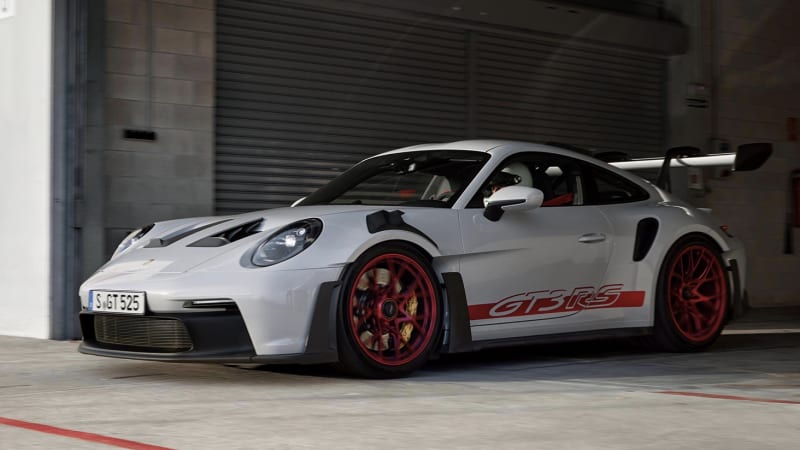
2023 Porsche 911 GT3 RS hits the track with 518 horsepower

Porsche’s track-focused 911 GT3 RS returns for 2023 with more power and tech than ever before – at a correspondingly eye-popping price point. The Turbo S may be the flagship 911, but to many car geeks, the GT2 and GT3 RS represent the true pinnacles of 911-ness thanks to their back-to-basics focus on extracting performance at the expense of virtually everything else. They may not be the quickest in a straight line, but when it comes to on-track composure and raw human-machine interaction, they simply can’t be beat. 

It would be easy to argue that the RS is basically a race car. The 992 GT3 RS is as close as you can get to a 911 Cup car while still being street-legal, but as a street car, it’s unhindered by series regulations or classifications. In other words, Porsche’s engineers can turn the performance dials up just as high as they please without running afoul of a sanctioning body while simultaneously sanding off some of the Cup car’s sharper edges so as to preserve the internal organs of customers who will never drive their RS models at the track. Yeah, you know they’re out there. 

To wit, while the 992 Cup car makes do with 510 horses and a six-speed sequential gearbox, the 2023 GT3 RS extracts 518 horsepower and 346 pound-feet of torque from its naturally aspirated 4.0-liter flat-six and puts it to the ground through a far more refined seven-speed PDK. Porsche says that’s good for a 0-to-60 time of 3.0 seconds flat. From here, Porsche reaches into a different motorsports parts bin for some aerodynamic cleverness. Trickling down from the 911 RSR and GT3 R is a new center-mounted, single-piece radiator that clears way on either side for a new active aerodynamics package. 

This new active aero system utilizes continuously adjustable wing components front and rear to allow for fine control over performance no matter the situation. In combination with the rest of the RS’ air-channeling fixtures, it can provide 900 pounds of downforce at 124 mph and a whopping 1,895 pounds at 177 mph. Flip it over to drag reduction mode and the wings go flat, helping the GT3 RS achieve its 184 mph top speed. The wings can also be deployed in max-drag mode to act as supplemental air brakes

The RS gets a brake upgrade over the standard GT3, with larger (by 2 mm) front pistons grabbing 408 mm discs; the rear axle retains the GT3’s 380 mm discs and four-piston fixed calipers. An optional carbon ceramic (PCCB) package returns with larger rotors (410 mm up front; 390 in the rear). Center-locking wheels also return (20 inches up front; 21 in the rear) wrapped in Michelin Pilot Sport Cup 2s in 275/35R20s and 335/30R21s, respectively. Weight is kept to an athletic 3,268 pounds thanks to a generous helping of carbon-fiber reinforced plastic (CFRP) body and interior components.

The popular Weissach package also returns with its forged magnesium wheels, carbon exterior panels and an even more extensive CFRP regimen (front and rear anti-roll bars, the rear coupling rods and the shear panel on the rear axle). Porsche says the mag wheels alone knock off nearly 18 pounds of unsprung weight. 

But while some may still view the 911 as the everyman’s supercar, the GT3 RS is far from a bargain even at sticker price. For 2023, that’s $225,250 (including $1,450 for destination) — roughly 20% more than the “suggested” price for the old 991-generation GT3 RS. Not that it matters much in a market that treats sticker price like the Pirate’s Code. Look for the RS to arrive stateside in the spring. 

Related video:

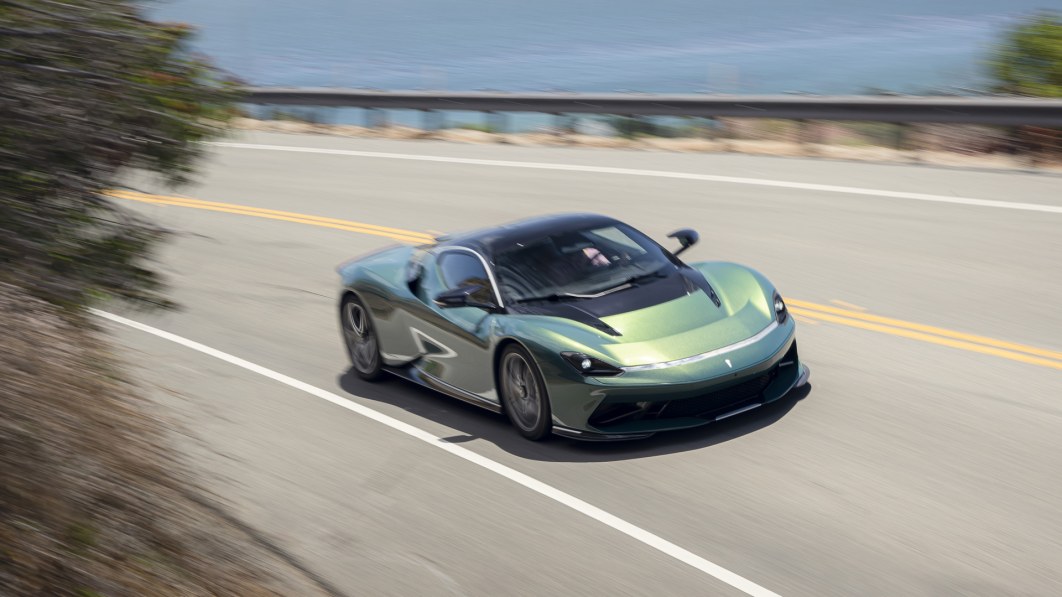
Pininfarina Battista First Drive: Meet the 1,900-hp electric hypercar

MALIBU, Calif. — The all-electric Pininfarina Battista throws around some impressive numbers. Power output in the 1,900-horsepower neighborhood. A 0-to-60 time of less than 2 seconds. A range estimated to be 300 miles. A starting price of $2.2 million. All of that might invite the names hypercar or supercar, but that would imply it’s harsh and unforgiving. Instead, Pininfarina defines the Battista as a hyper GT, giving it the otherworldly power and performance of a hypercar while remaining comfortable enough to take on a road trip.

That’s a tall order for any vehicle, let alone the first car produced by a new manufacturer. After spending an afternoon with the Battista on some of our favorite roads above Malibu, we can definitively say that their boldness has paid off.

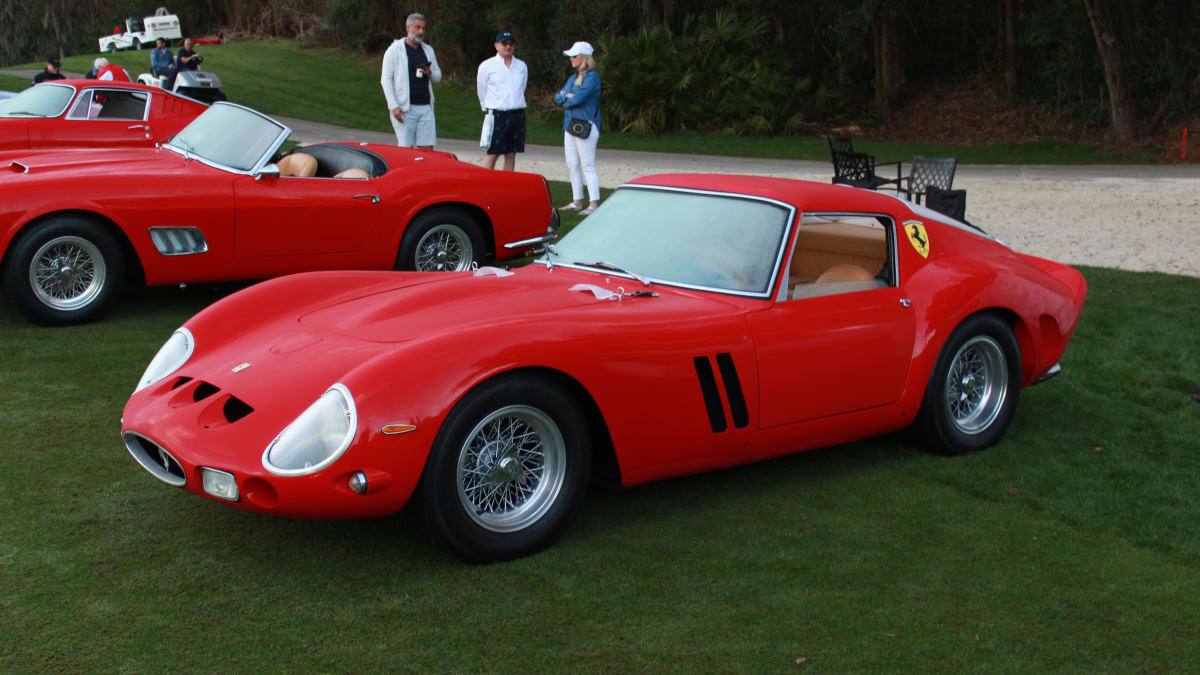
Automobili Pininfarina is the new manufacturing offshoot of the Carrozzeria Pininfarina design firm that has penned some of the most iconic cars in history. These include the 1947 Cisitalia 202, which is regarded as the first car that integrated fenders into the rest of the bodywork. Then there are icons such as the Fiat and Alfa Romeo Spiders (above right) along with the nouveau-classic Cadillac Allante. But it’s Pininfarina’s association with Ferrari that is most notable, including most of the 250 GT line (above left), Daytona, 512 BB, and wild 1980s Testarossa.

The Battista is named for Battista “Pinin” Farina, who founded Carrozzeria Pininfarina in 1930. A lot of its battery, chassis and motor componentry comes from Rimac, the nascent Croatian electric supercar maker that recently paired with Porsche to take over Bugatti.

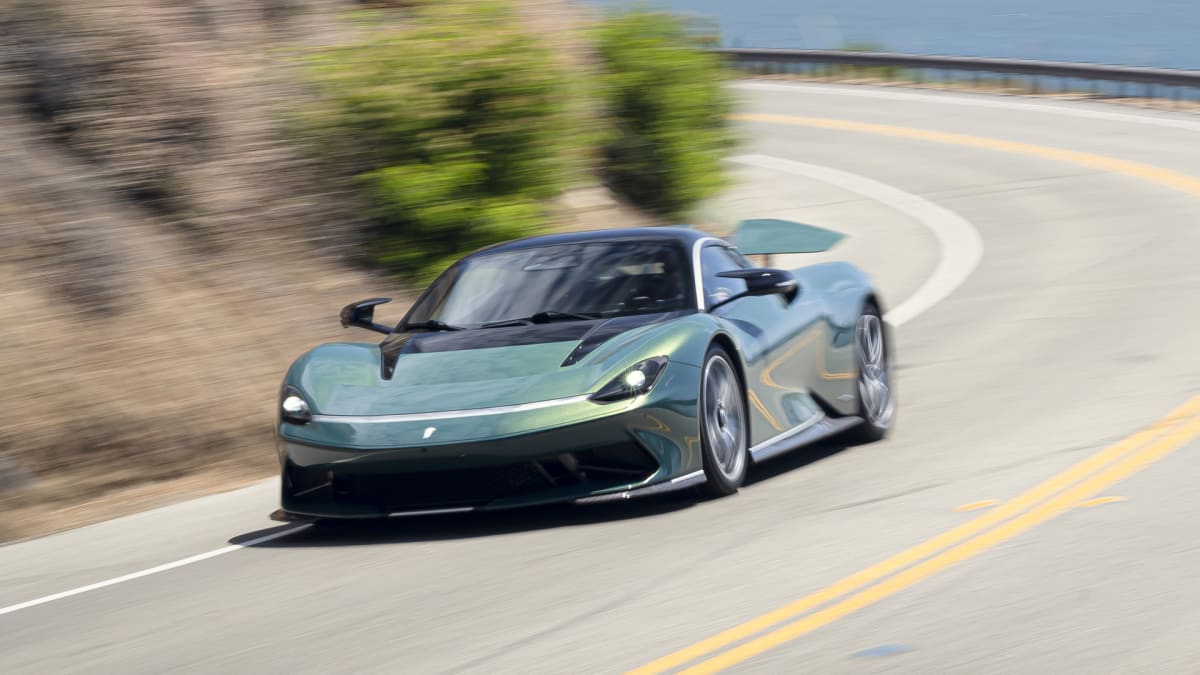
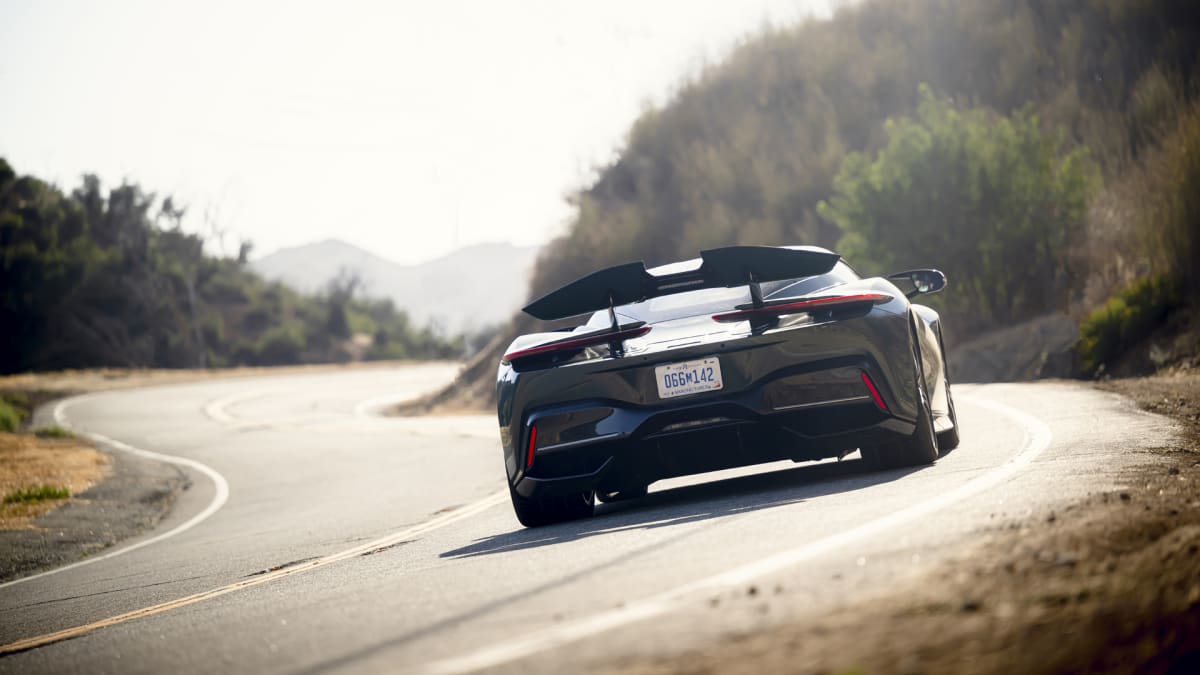
The Battista’s exterior styling certainly has echoes of Ferrari, and really, can you think of a better compliment? As an all-electric vehicle, it doesn’t have the same kind of cooling and air intake needs as the gasoline-powered Ferraris and results in a cleaner and more elemental shape. The design is still aggressive as hell, but less shouty, and that plays well with the hyper GT positioning.

Once you pop the dihedral driver’s door, you’re greeted by a rather narrow passage between the dash and seat. Getting in takes a bit more stooping and maneuvering compared to conventional sports cars, but there are certainly exotics that are more difficult to access. Pulling the door down doesn’t take much effort, but you have to give it a strong slam to get it to fully shut, making it a strong candidate for soft-close doors.

The seats are firm and have excellent side bolstering to keep you in place when cornering. There are also more aggressive racing shell-type seats available, but in our estimation, unnecessary. Your feet can extend mostly straight ahead since front wheelwell intrusion is minimized. We haven’t even moved yet and the Battista is already fulfilling part of its hyper GT promise.

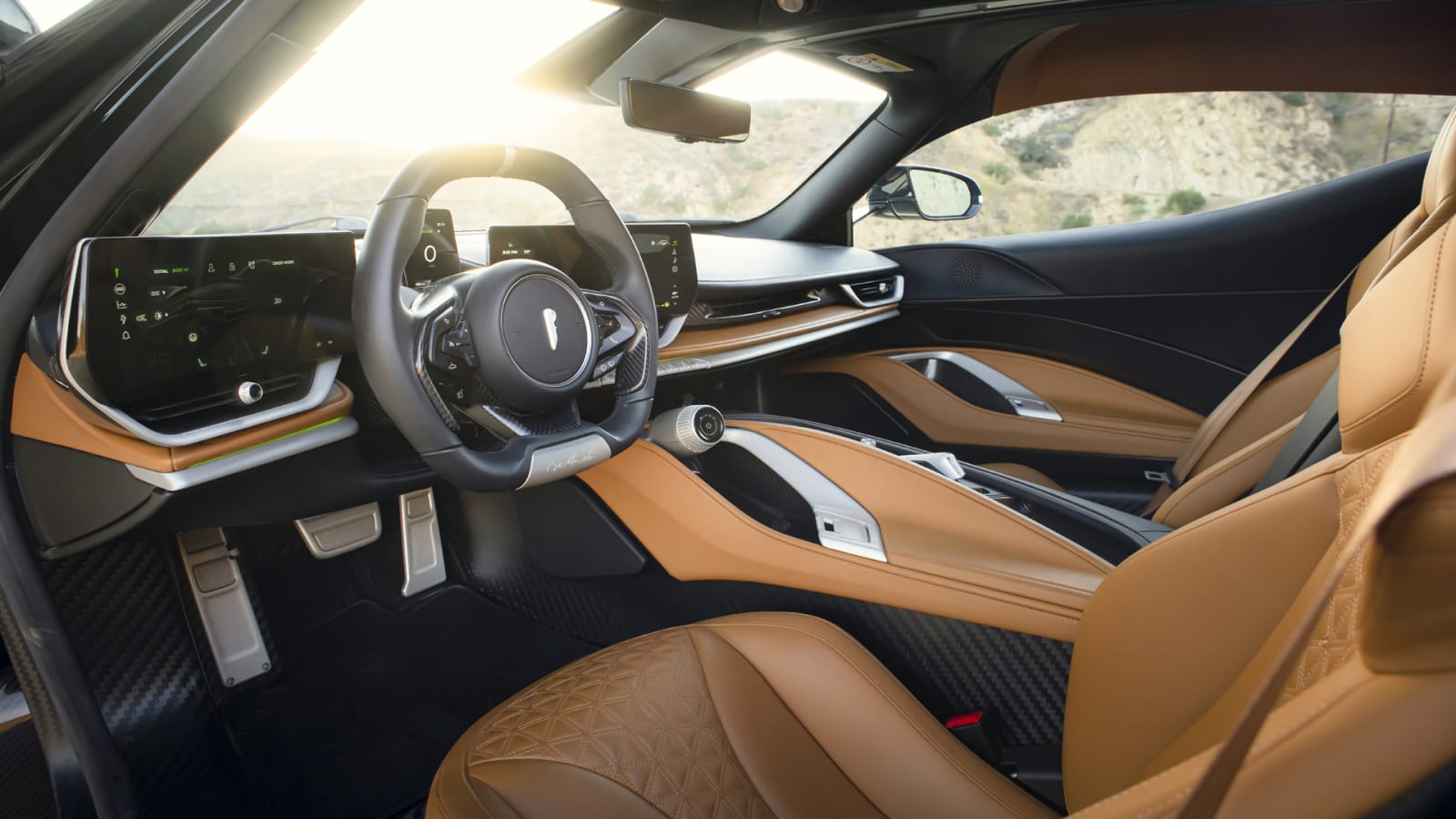
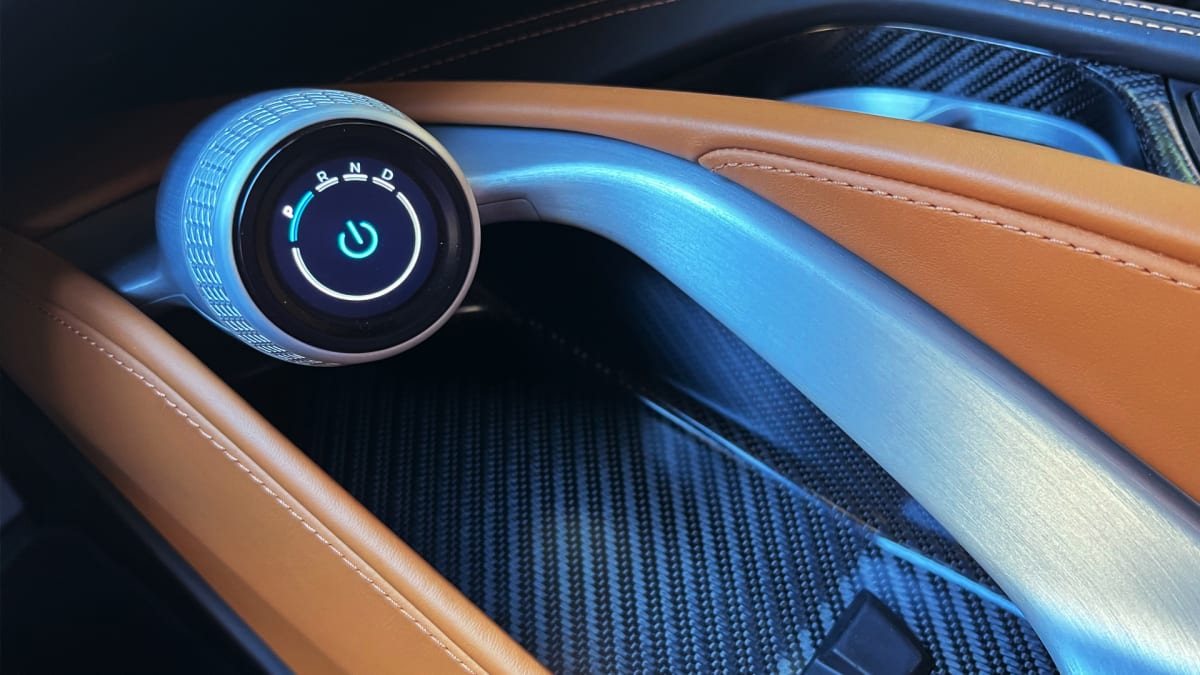
The cockpit is modern and minimal, with two horizontal touchscreens flanking the steering wheel and a phone-like display in the middle that displays speed and other primary information. Off to the sides, at the 5- and 7-o’clock positions, are two dials. The left selects drive modes and the right is the start button and gear selector. The cabin is cozy but not confining, and has a good amount of lateral space.

The Battista is already activated as we get in, a fact indicated by the subtle high-pitched whine and fan noises, much like a jetliner running on its auxiliary power unit as you find your seat. Foot on the brake and a quick spin of the right dial puts it in drive. A little pressure on the throttle and the Battista starts to roll forward on the gravel valet circle. Once on the broad, sweeping roads in the Santa Monica Mountains, it’s striking how well-mannered a 1,900-hp car can be.

We’re in the Pura (Pure) drive mode, which seems equivalent to a default comfort mode. It’s easy to drive, with no fear that you’ll accidentally overdo it and spin into a ditch. At the same time, it’s way more potent than most drivers will ever need. In this way, it’s as approachable as a 911 Carrrera 4S and we fantasize about an alternate reality where this is our daily driver.

The ride is stiff, but not punishing. There’s a lot of jostling over the pavement’s undulations, but the smart suspension keeps potholes from sending sharp jolts into your backside. You also hear every tire impact and slap over seams, along with the frequent ricochets of pebbles and debris off the undertray. There’s just enough harshness to remind you of its sporting potential and just enough compliance to consider driving it six hours somewhere.

Now that we’re acclimated, it’s time to turn up the performance. We skip the Calma (Calm) and Carattere (Character) drive modes, which equate to eco and individual modes, respectively. The Energica (Energetic) mode is what can be considered the sport mode. The ride gets firmer, the throttle response more immediate and the steering seems livelier. The synthetic driveline noises also get louder as you muster enough courage to give that pedal a proper stomp.

The Battista instantaneously obeys, launching forward with unstoppable determination. In a time when sub 3-second acceleration to 60 mph is considered increasingly normal, the all-wheel-drive Pininfarina still manages to impress as it’s estimated to hit 60 a whole second earlier. On the rougher sections of winding pavement, the suspension is just a bit too stiff. Mid-corner bumps will keep you alert and the larger whoops will have you thanking your racing school coaches.

Selecting Furiosa activates an equivalent race or track mode, unleashing the full power output and relaxing the driver assists. It’s every driving trope wrapped up in one. It goes to 11; face-warping acceleration; you’ll see the grim reaper and he’ll give you a thumbs up; pick your favorite exaggeration and it applies here. Off the line, the Battista launches hard enough that your vision gets blurry. There’s a slight side-to-side squirm that also indicates you have indeed found a limit and you should proceed at your own peril. It’s unyielding and unforgiving when provoked, and that’s precisely what we wanted on the high end.

The range of comfort and performance afforded by these drive modes is vast. The Battista does indeed warrant the new hyper GT classification. But it’s also so much more. The details could keep us yammering on for days, but we’ll try to pare it down to a few paragraphs.

The interior features an abundance of impeccable leather surfaces, and those hides are sourced close to the Cambiano, Italy, factory. They’re tanned using more environmentally friendly methods that somehow involve local olive leaves. There aren’t any vegan alternatives as Pininfarina says production of those materials have their own chemical drawbacks. The aluminum trim elements aren’t cast, they’re machined from solid billets. They’re attractive while not going as over-the-top as in a Pagani.

On the outside, the charge port is at the center of the tail, a move that Chief Design Officer Dave Amantea lobbied for and won. It keeps charging cables from being draped over the carbon fiber bodywork and is easily accessible. A Pf logo between that port and the trunk (yes, there’s a trunk) illuminates when charging and the outer frame of the badge shows the charge state so you can know with a quick glance how much juice is left.

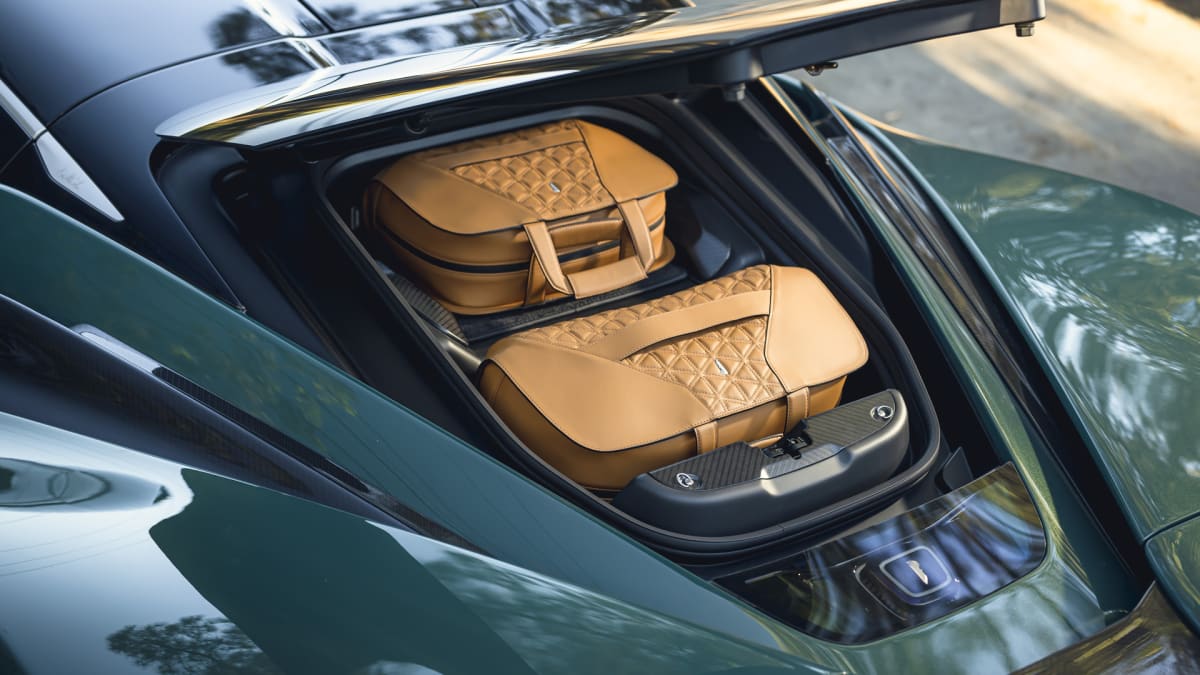
The glass trunk lid is power deployed and closed. Its stepped floor makes it difficult to load even a paper bag full of groceries, but Pinifarina offers a custom set of luggage that fits perfectly and can be upholstered to match the rest of the cabin. The price? Try $20,000, or the equivalent of a new Nissan Sentra.

There’s even a pragmatic side to the Battista, as you can add a five- or 10-year maintenance program and extend the warranty coverage for the massive 120-kilowatt-hour battery pack to 10 years. Then there’s the Eterna program that offers a replacement body parts kit that is painted at the same time as your Battista. Take a moment to let that soak in because we’re already imagining the most amazing garage wall art.

As Paolo Dellachà, Pininfarina’s Chief Product and Engineering Officer was eager to point out, these programs enhance the ownership experience and also increase the value of the Battista. Considering production is capped at 150 examples and no two will be allowed to be identical (unless, we suppose, you buy two!), there’s no doubt it’s an instant collectible that should only increase in price. As a fully electric hyper GT, may also be more future proof than the current raft of internal-combustion supercars.

Trying to remain impartial and objective during this review is a challenge, but with a sub-orbital price of $2.2 million, most normal sensibilities are obliterated. This is one of those cars that have you questioning past life choices or pondering how much you could sell a kidney for (you can’t, it turns out). The few nitpicks are limited to the hard-to-shut doors, a distracting reflection from the dash top in the windshield, and the tedious infotainment screens that you have to use to even adjust the seats. These drawbacks are as easily dispatched as any vehicle trying to keep up with the Battista.

Related video:

Aston Martin DBR22 is a retro roadster for the lucky few

It’s Pebble Beach Concours week, and you know what that means: high-end automakers showing new exotic machinery. Kicking things off is the Aston Martin DBR22. Aston calls it a concept, but that’s more of a stretch than Honda with its “prototype” car reveals. The company has said it will build some. The exact number hasn’t been given, but don’t expect many. The company highlighted a couple of its previous special models such as the Vulcan and V600, each of which were made in numbers below 30 units.

The car is more specifically from Aston’s “bespoke” division, Q, and it’s a celebration of the division’s tenth anniversary. It takes its design inspiration from far longer ago, though. The DBR22’s dramatic curves, lack of a windshield and towering cowls are all based on the company’s 1950s race cars, particularly the DB3S and DBR1 (which already inspired another low-production Aston). The grille is even based on the latter’s. The entire exterior is unique to the DBR22, down to the headlights and full-width tail light bar. It’s all made of carbon fiber, too. The interior is also unique with leather wrapping most surfaces including the carbon seats. And being a product of the Q division, the handful of buyers will be able to customize pretty much every facet of the exterior and interior to their preferences.

No matter how an individual’s DBR22 looks, they should be the same under the skin. Aston’s twin-turbo 5.2-liter V8 sits below the vented hood and makes 705 horsepower and 555 pound-feet of torque. It sends power through an eight-speed automatic transmission to the rear wheels. Top speed is 198 mph, and it will hit 60 mph in 3.4 seconds. No mention was made of what platform the DBR22 is built on, but it likely shares similarities with the DB11 and DBS. It boasts upgrades, though, such as shear panels front and rear for greater rigidity, plus unique tuning for the adaptive shocks. Most interesting is the rear subframe. It’s made of multiple 3D-printed aluminum parts that have been bonded together. It’s a preview of future Aston Martin production techniques and the company says it has allowed them to make a lighter subframe than normal with the same rigidity. It also lets the company more easily produce custom parts for low-production models.

Aston Martin made no mention of when it will start building customer DBR22 models or when it will take orders. We wouldn’t be surprised if the company has already lined up buyers. And if not, well, potential buyers surely know whom to contact. For everyone else, the DBR22 will be on display at the Pebble Beach Concours d’Elegance this weekend.

Related Video:

Hennessey Venom F5 Roadster headed to The Quail

Monterey Car Week is like a debutante ball for supercars, each high-horsepowered hopeful announcing itself to be of good age, etiquette and parenting, and looking for a worthy home. Next up for a planned introduction to the suitors who will crowd the Monterey Peninsula next week is the Hennessey Venom F5 Roadster. The debut happens August 19 at Monterey Car Week’s The Quail, A Motorsports Gathering. The teaser image gives us a clue of what to expect, filling in the blanks should tax too much of the imagination.

Behind the airier cockpit is the same 6.6-liter twin-turbo V8 apparently based on GM’s LS architecture. With a redline at 8,000 rpm, the mill nicknamed “Fury” will spin out 1,542 horsepower and 1,193 pound-feet of torque on regular premium gas, 1,817 hp when given E85 to drink. Those prodigious mechanical facts are shunted through a seven-speed automated manual transmission to the rear wheels only. In the coupe, that results in accelerating acceleration up to 124 miles per hour; it takes 2.6-seconds to get to 62 mph, 4.7 seconds to hit 124 mph. Assuming enough runway and courage, 15.5 ticks of the second hand can see a driver to 250 mph. Hennessey claims a 311-mph practical top speed for the hardtop and a theoretical 328-mph terminal velocity, but so far as we know, prototypes have “only” touched 271.6 mph to now. 

The Texas car creators began delivering the Venom F5 coupe late last year, the entire run of 24 examples already sold. According to Top Gear and Autocar, the Roadster will field a more populous run of 30 units, around seven of which are claimed at a rumored price of $2.75 million apiece. If that’s true, shoppers who like their hair mussed the natural way are paying a $1.15 million premium over the Venom F5 coupe’s price to have that done. We’ll get all the details from the source next week. Also, with a high-downforce version of the F5 supposedly planned after the Roadster, there’s probably a dais at next year’s Quail already reserved.

First Bizzarrini 5300 GT Corsa Continuation reclaims the road

Consider the legendary cars gifted to the world because of people trying to get revenge on Enzo Ferrari. The Ford GT40? Revenge after a falling out with Enzo. The founding of Lamborghini? Ditto. The Monteverdi 375S? Ditto. The Bizzarrini 5300 GT Strada and 5300 GT Corsa? Ditto. That’s four, which isn’t all of them. Italian engineer Giotto Bizzarrini has the distinction of making this list twice. An in-house coup led to Enzo firing a number of key personnel, Bizzarrini included. Where did the engineer who’d worked on Ferrari icons like the 250 GTO and the Breadvan go? To Lamborghini to help develop the 3.5-liter V12 in Ferruccio’s first car, the 350 GT. Then Bizzarrini set up his own shop, designing the 5300 GT Strada for the road and the 5300 GT Corsa to beat Ferrari at Le Mans.

The overall win proved elusive, but the 5300 GT won the Over 5.0-Liter class in its first-ever attempt at Le Mans, finishing ninth overall. If that sounds lackluster, remember that the entire might of the Ford Motor Company couldn’t get the GT40 to the finish line in that car’s first two years competing at Le Mans in 1964 and 1965, representing nine DNFs.

As is the thing to do nowadays, a group of monied-up enthusiasts resurrected the Bizzarrini name in 2020 in the UK and committed to building 24 continuation examples of the 5300 GT Corsa that triumphed in 1965. The outfit finished the first prototype for testing in April of this year, delivering the first customer example this month. As was done with the original Lamborghini Countach prototype, engineers tracked down figures who’d worked on the original, designed the continuation using original blueprints, and sourced materials and components from original suppliers. The changes were made either to employ better technology in the spirit of the original, or for safety. So instead of the glass fiber body of the 1965 car, the modern versions get single-piece carbon fiber bodywork over a steel tube frame. And instead of a fuel bladder running through the door sills, an FIA-approved 95-liter fuel cell was designed to fit behind in voids around the cockpit. 

The result is smashing. When companies designing new sports cars say they want to channel the spirit of the 1960s, this is what they’re after.

Each example comes drenched in Rosso Corsa Bizzarrini 222 red, accented with a white roundel. Under that lengthy hood lives a 5.3-liter V8 breathing through four twin-barrel Weber carbs to pump out more than 400 horsepower. In a car that weighs about 2,700 pounds, that’ll do for giddy-up. Although the car has been built for track duty, the company says clients can get a road-legal version if they prefer.

The 5300 GT Corsa continuation is meant to herald the overall continuation of the brand as well. It’s expected that all 24 versions will be delivered by next year, a company exec saying that now “we are refining initial engineering and design proposals for our modern supercar.”

Bentley Batur is the next Mulliner creation after the Bacalar

Bentley’s Mulliner personalization division launched the Balacar Speedster in 2020 — named after Laguna Bacalar in Mexico’s Quintana Roo state — and sold the limited run of 12 examples almost immediately at about $2 million per. With just four Bacalars remaining to be delivered to customers, and since the first rule of having a hit is having a follow-up ready, it’s no wonder that Mulliner will introduce its next small-batch, bespoke car in 10 days: At 8 p.m. Pacific time on Saturday, August 20, during Monterey Car Week, the Crewe automaker will unveil the Batur.

We know a couple of things about the Batur. It’s not clear what vehicle the model is based on, but we’re told it will be a “hand-built grand touring Bentley.” We’re going to guess this means the Flying Spur chassis gets the nod, because the next thing we know about the Batur is it “showcases themes and forms that will define Bentley’s future range of Battery Electric Vehicles.” Bentley’s first EV is anticipated to be a high-riding sedan sitting on Volkswagen’s SSP battery-electric platform, the even more luxurious follow-up to the Audi Artemis electric sedan that will introduce upscale versions of the SSP architecture. The short video shows a very Bentley diamond grille laid in with burnt orange accents.   

The last thing we know about the Batur is that it’s named after another body of water, this time Lake Batur in Kintamani, on the island of Bali in Indonesia.

There looks to be quite a span between the Batur’s EV-forward design and the first Bentley EV. A report out of Germany in July said the VW Group continues to struggle with software for the swarm of battery-electric product the brand wants by 2030, pushing launches back potentially by years — issues that cost former VW Group CEO Herbert Diess his job. Audi’s retail version of the Grandsphere concept might not show until 2027 instead of 2024, and the first Bentley EV that was due in 2025 might face a similar delay.