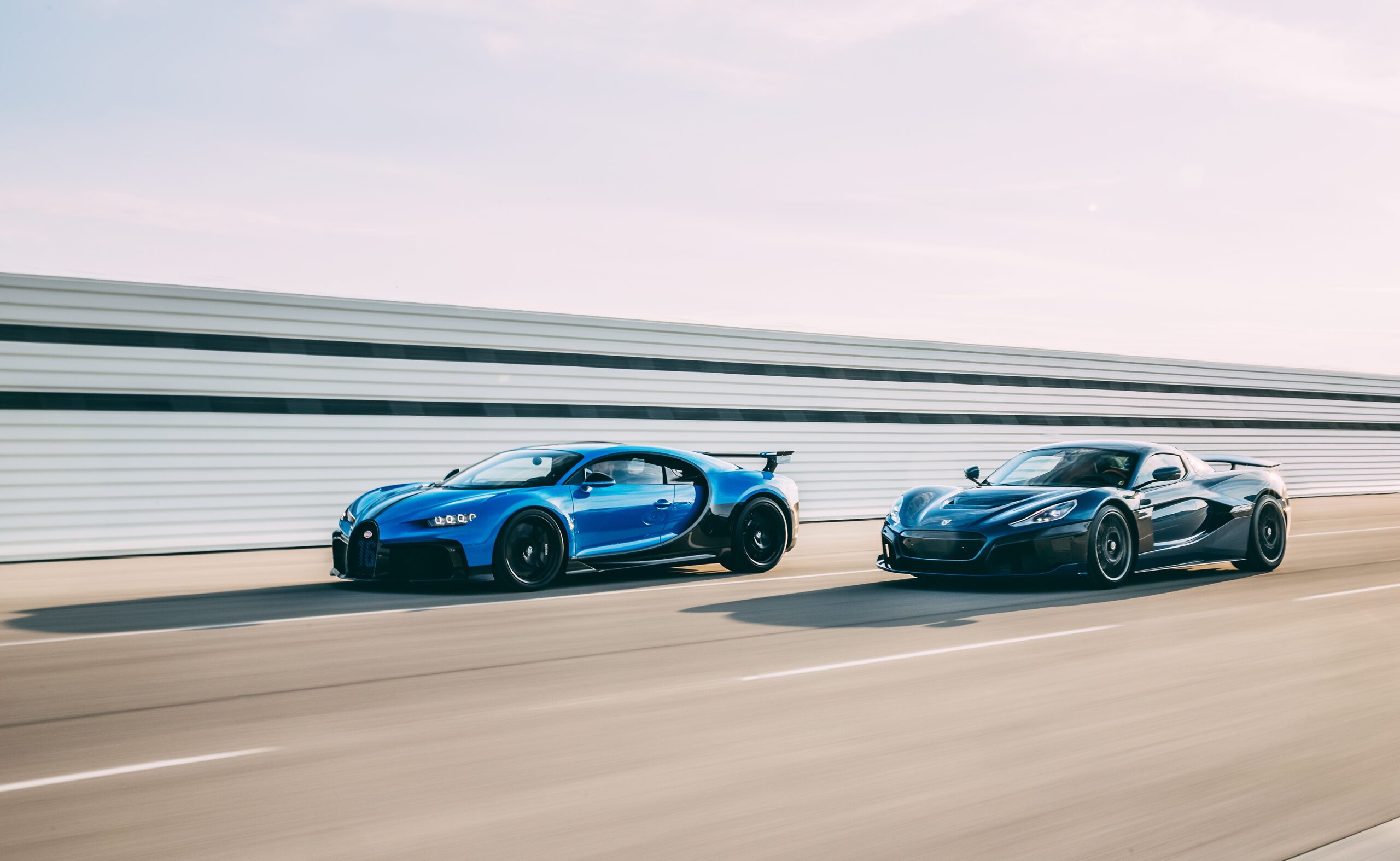
It was only a few months ago that they announced the plans for a joint venture between Bugatti and Rimac, and recently, they officially announced the new company: Bugatti Rimac. The new company brings together two automotive powerhouses Bugatti and Rimac, creating a completely new powerhouse in the automotive industry.
Unlike Bugatti, Rimac is relatively new in the automotive industry, having only started 10 years ago by Mate Rimac as a garage start-up. It has now grown to be its own force, and now, it will be making a huge leap forward as it officially operates under the umbrella of Bugatti Rimac starting November 1, 2021.
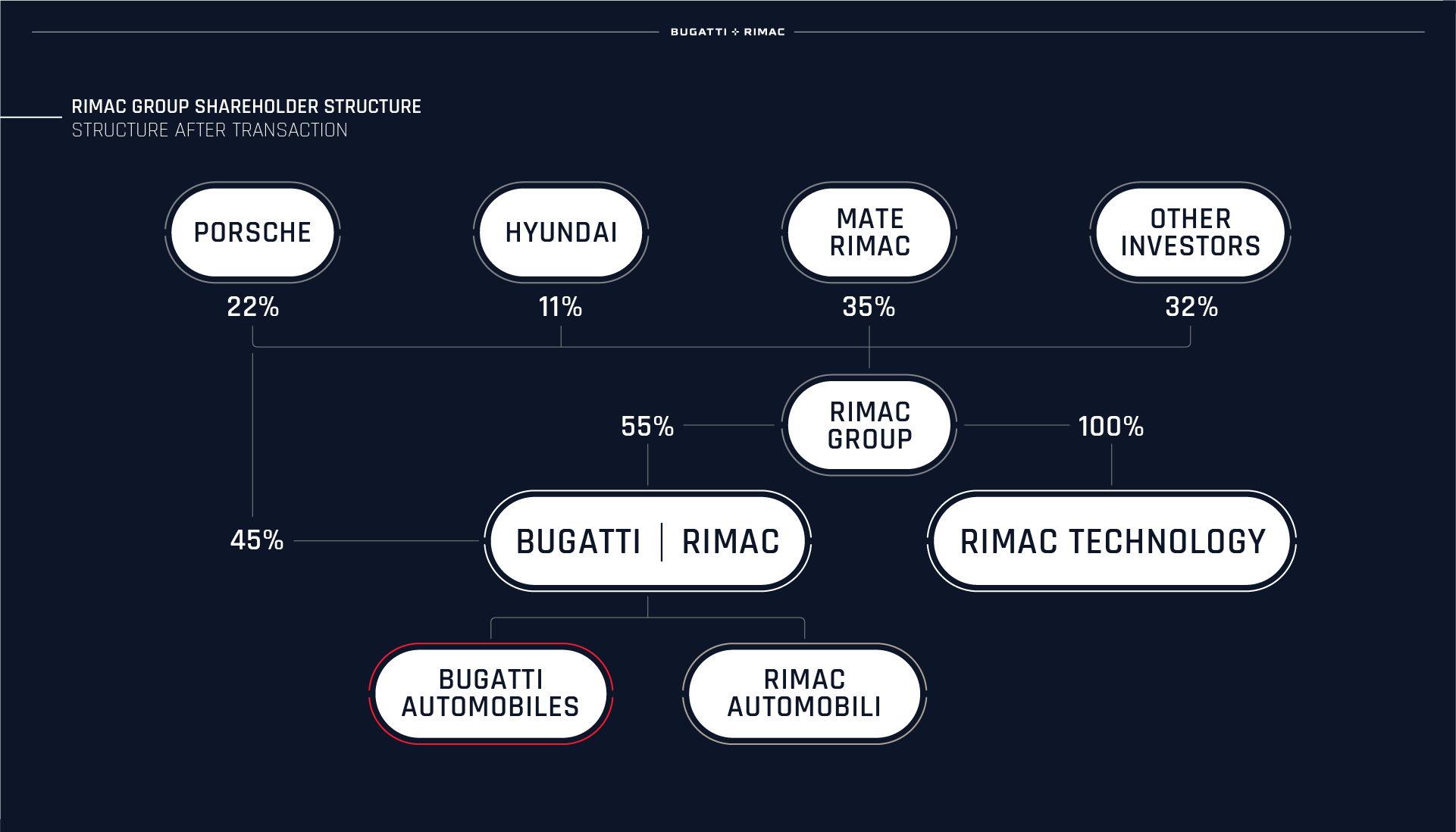
The Rimac Group is the major shareholder in Bugatti Rimac having 55% stake in the company. Mate Rimac will keep his 35% share in the Rimac Group while Porsche has 22% of the company. Hyundai Group has also kept steady with 11% share, with the rest of the investors at 32%.
Rimac Group will keep 100% shares of Rimac Technology which oversees the development, production, and supply of battery systems, drivetrains, and other EV components that Rimac has built their reputation on.
Bugatti Rimac will be overseeing two automotive and technological trailblazers. Bugatti has a 110-year history of design, innovation, and engineering, matched with Rimac’s technical expertise and unquenchable thirst for innovations in the EV niche, are now brought together to conquer the hypercar industry.
Porsche will also be a strategic partner in the new company. Apart from the two managers, the Stuttgart based sports car manufacturer will be appointing two Supervisory Board members, namely Porsche AG Chairman Oliver Blume, and Porsche AG deputy chairman and CFO Lutz Meschke.
“I am convinced that we have found the right mix of experience and know-how, innovative strength and team spirit for the management. That’s why I’m very optimistic. And because the project is very close to my heart, I will continue to accompany it closely and passionately in the future,” Deputy Chairman of the Executive Board and member of the board for Finance and IT at Porsche AG, Lutz Meschke shared.
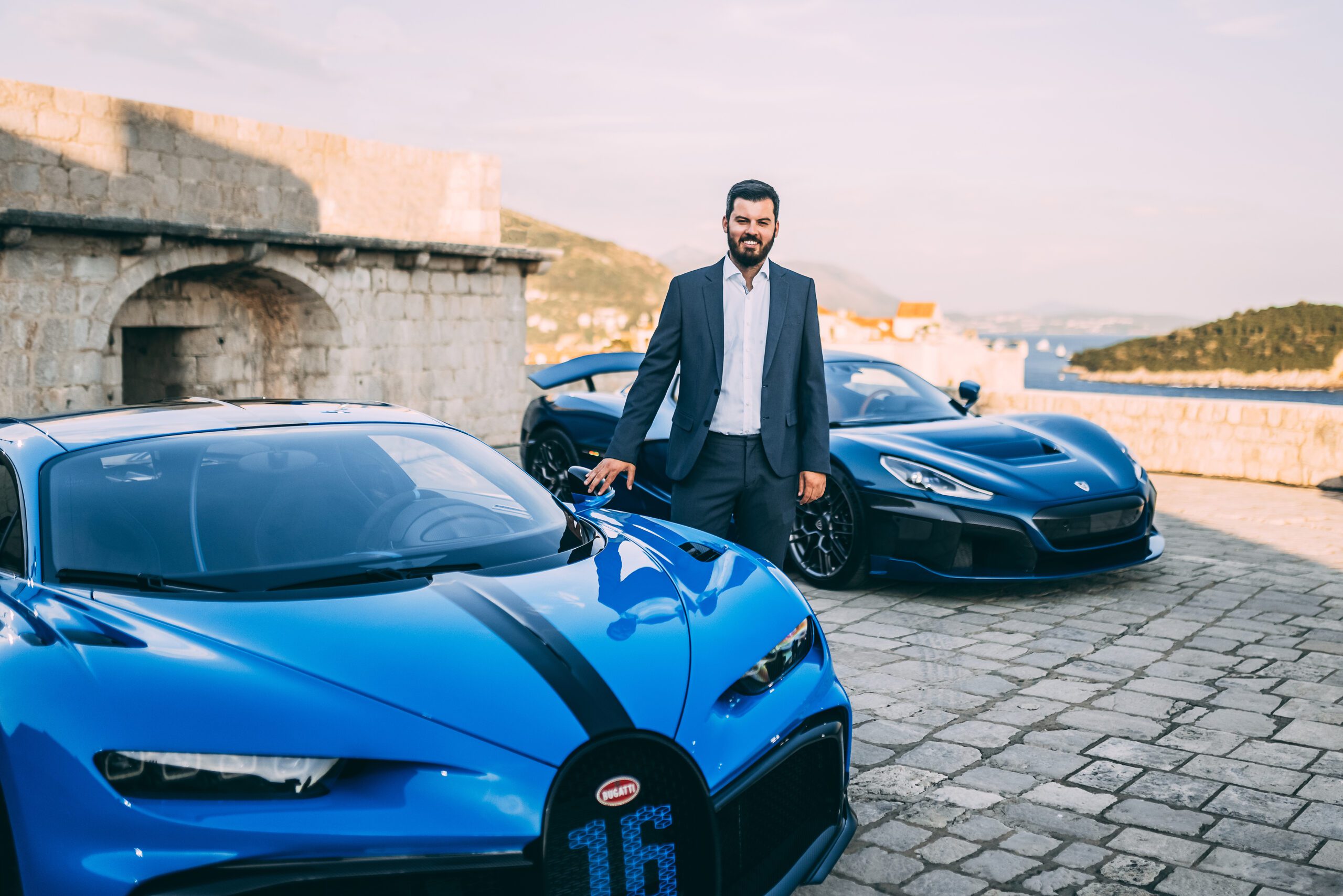
Bugatti Rimac has appointed Mate Rimac as its new Chief Executive Officer. Mate Rimac’s leadership and vision has seen the fledging garage startup grow into an exceptional industry force that it is today. As the current CEO of the Rimac Group, he will be overseeing both the Bugatti Rimac and the new division, Rimac Technology.
Currently, the headquarters of the new Bugatti Rimac will still be at its current base in Zagreb, Croatia. Eventually the new company will be moved to the €200M Rimac Campus which will also be the home of Rimac Technology.
Construction on the campus has now begun. Eventually, joint research and development for future Rimac Automobili and Bugatti hypercars will be done at the Rimac Campus. It is scheduled to open in 2023.
The latest technologies will be seen in the new state-of-the-art facility. It will be able to host 2,500 innovators and it will be the home of groundbreaking developments.
Bugatti Rimac currently has 435 employees in the new company. 300 are currently in Zagreb while 135 are currently in Molsheim, France. There will also be 180 people at the Bugatti Engineering’s Wolfsburg plant that will be supporting the new company. Rimac Technology will have more than 900 employees. Currently, the Rimac Group have more than 1,300 employees in their various locations.
Christophe Piochon is the new Chief Operating Officer at Bugatti Rimac’s new Board of Management. He was the Director General at Bugatti Automobiles.
Larissa Fleischer is the new Chief Financial Officer. She was Porsche’s Director of Digitalization, New Mobility, e-Mobility and Connected Car Controlling.
Emilio Scervo is the new Chief Technology Officer, having held the same position at Rimac Automobili.
For now, Rimac Automobili and Bugatti Automobiles will be operating and working as separate brands and manufacturers. They will also be keeping their production facilities in Zagreb and Molsheim, respectively. The same will be done for their distribution channels.
Rimac Technology will keep on innovating and developing vehicle systems and technologies for global OEMs. These same technologies may also be used in future Bugatti and Rimac models.
Bugatti Rimac CEO, Mate Rimac shared, “I am honored to be leading this new fusion of automotive minds and begin what will no doubt be a successful, revolutionary and exciting new chapter for everyone involved. I am also extremely curious to oversee the profound impact Bugatti Rimac will have on the industry, and I look forward to developing innovative new hypercars and technologies.”
November 3, 2021 / Comments Off on The New Bugatti Rimac Company Launched
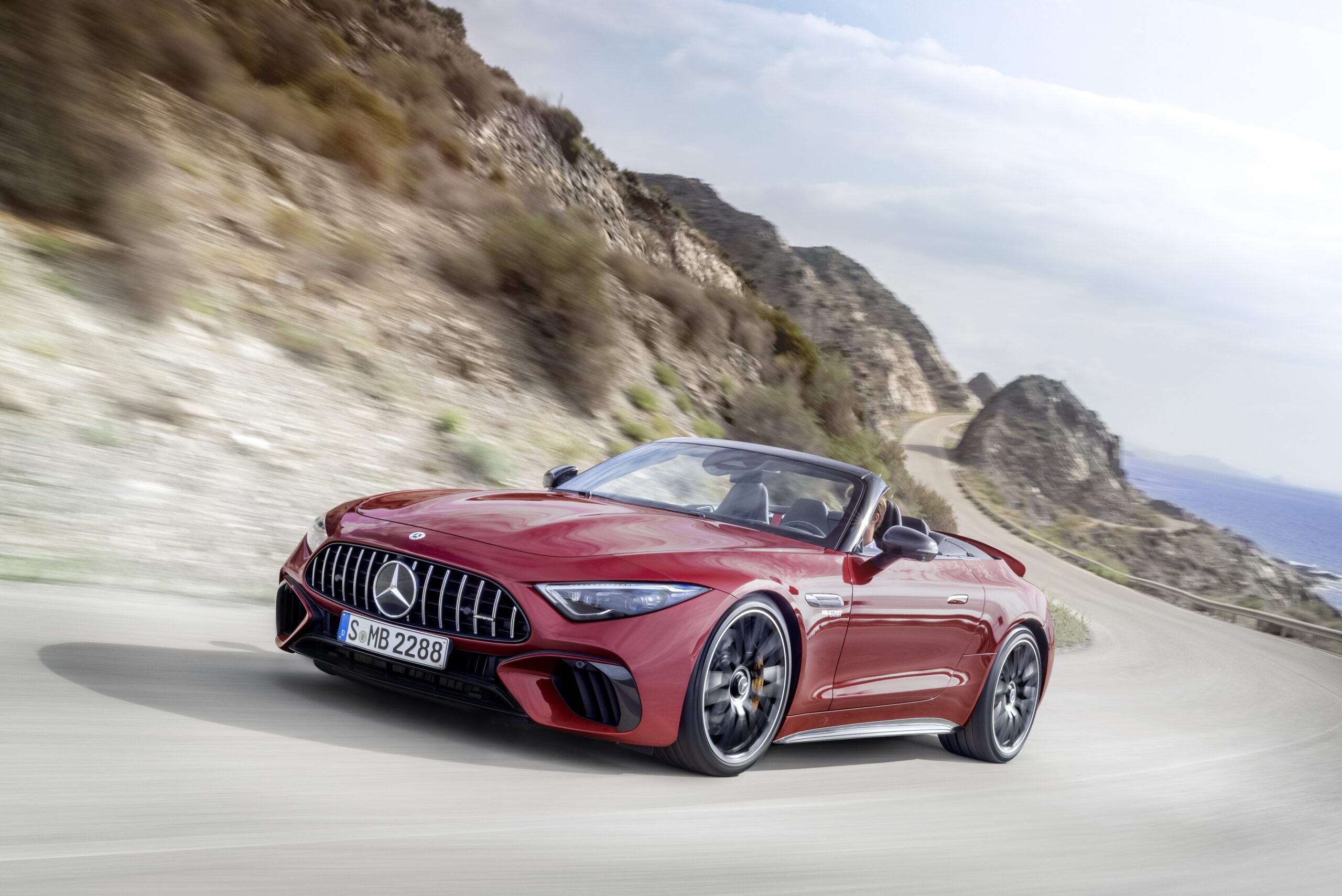
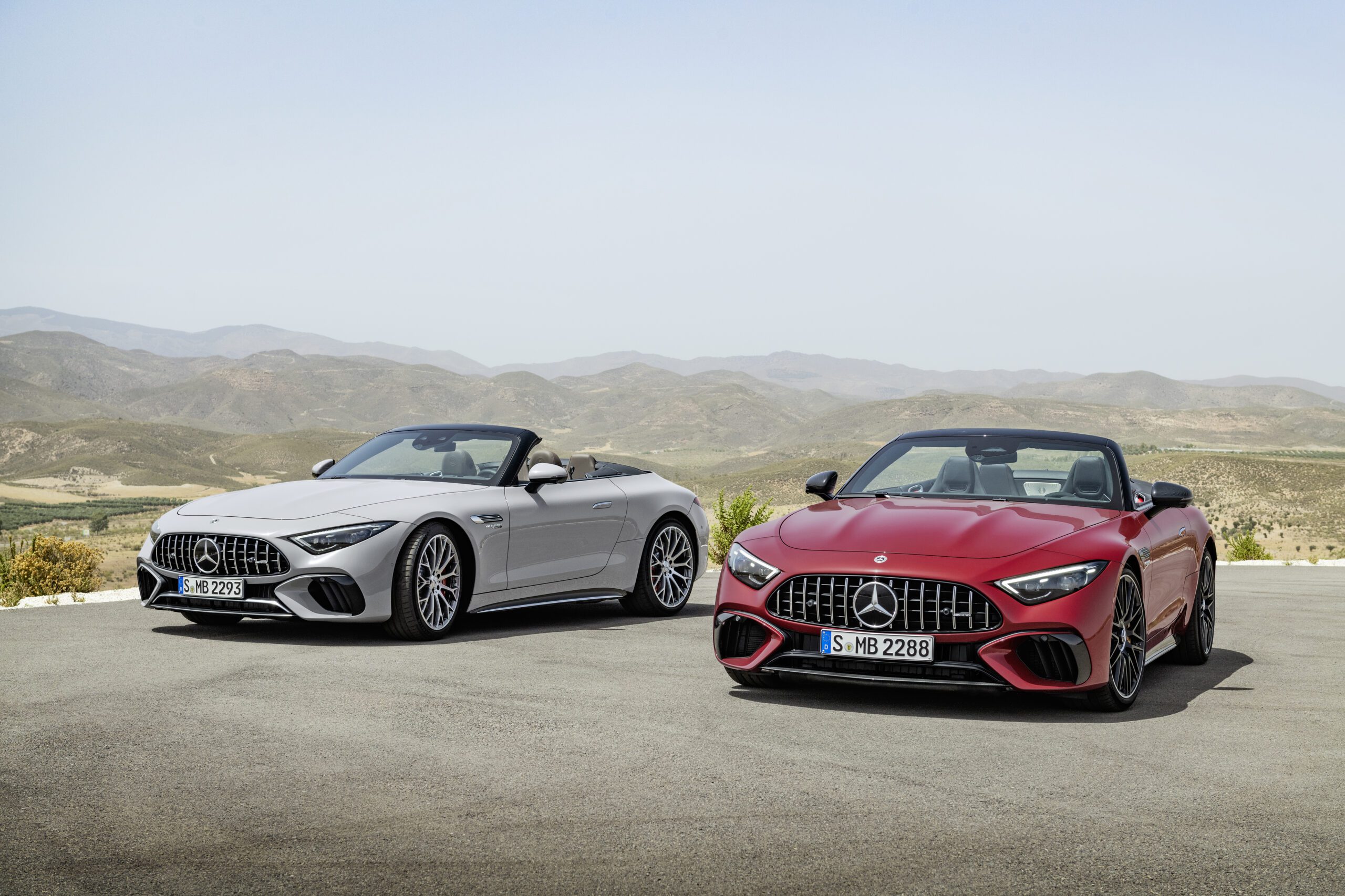
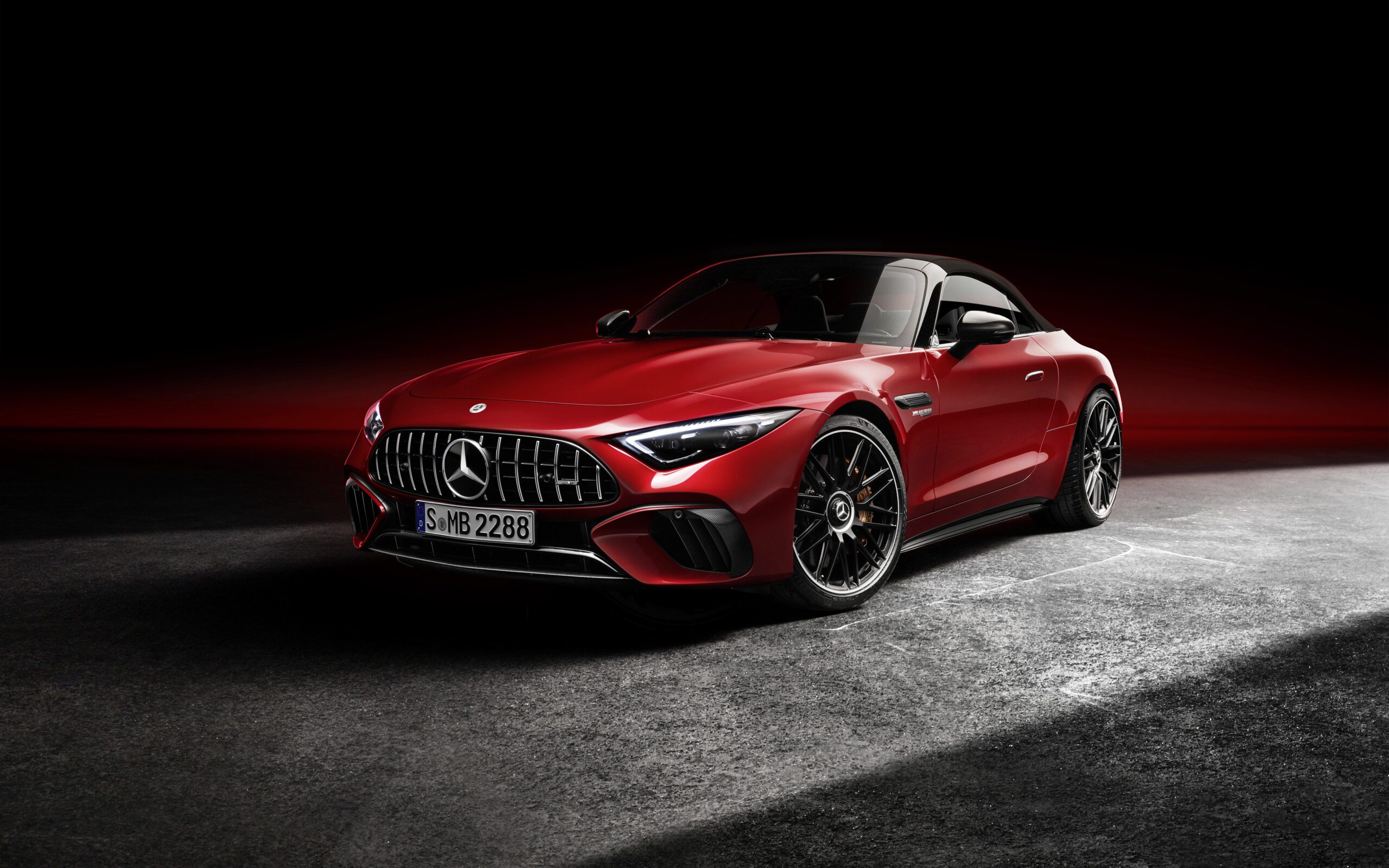
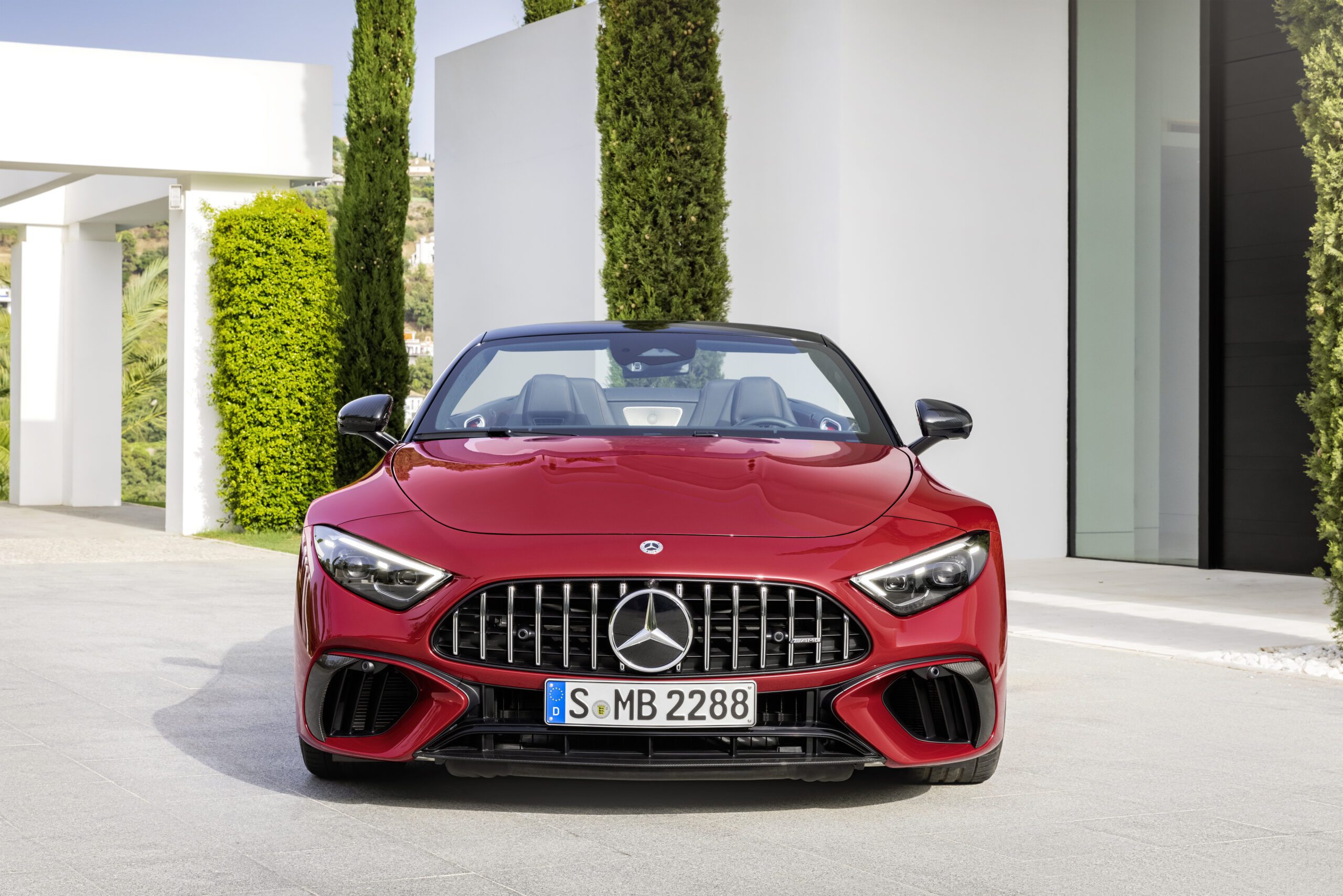
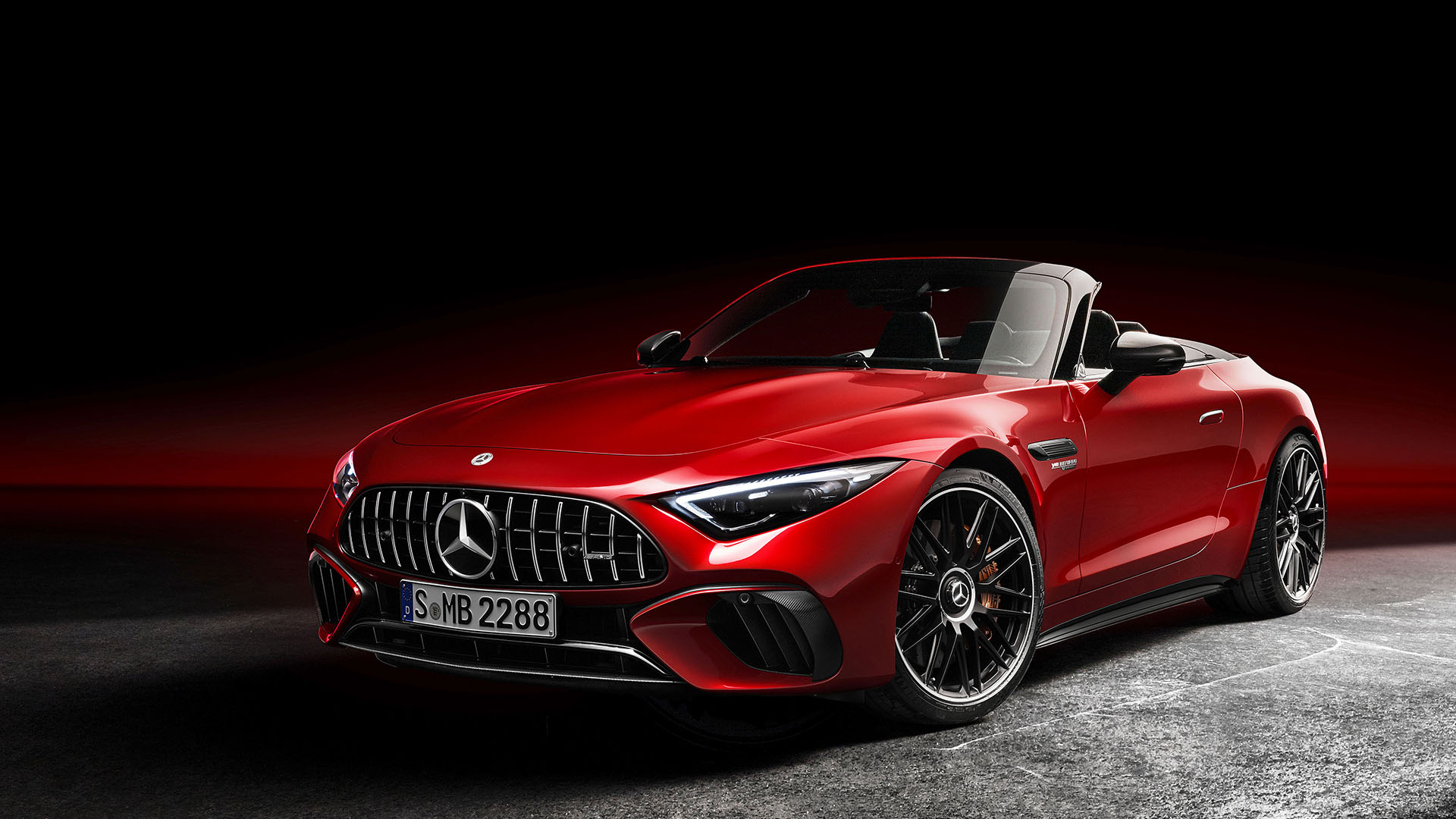
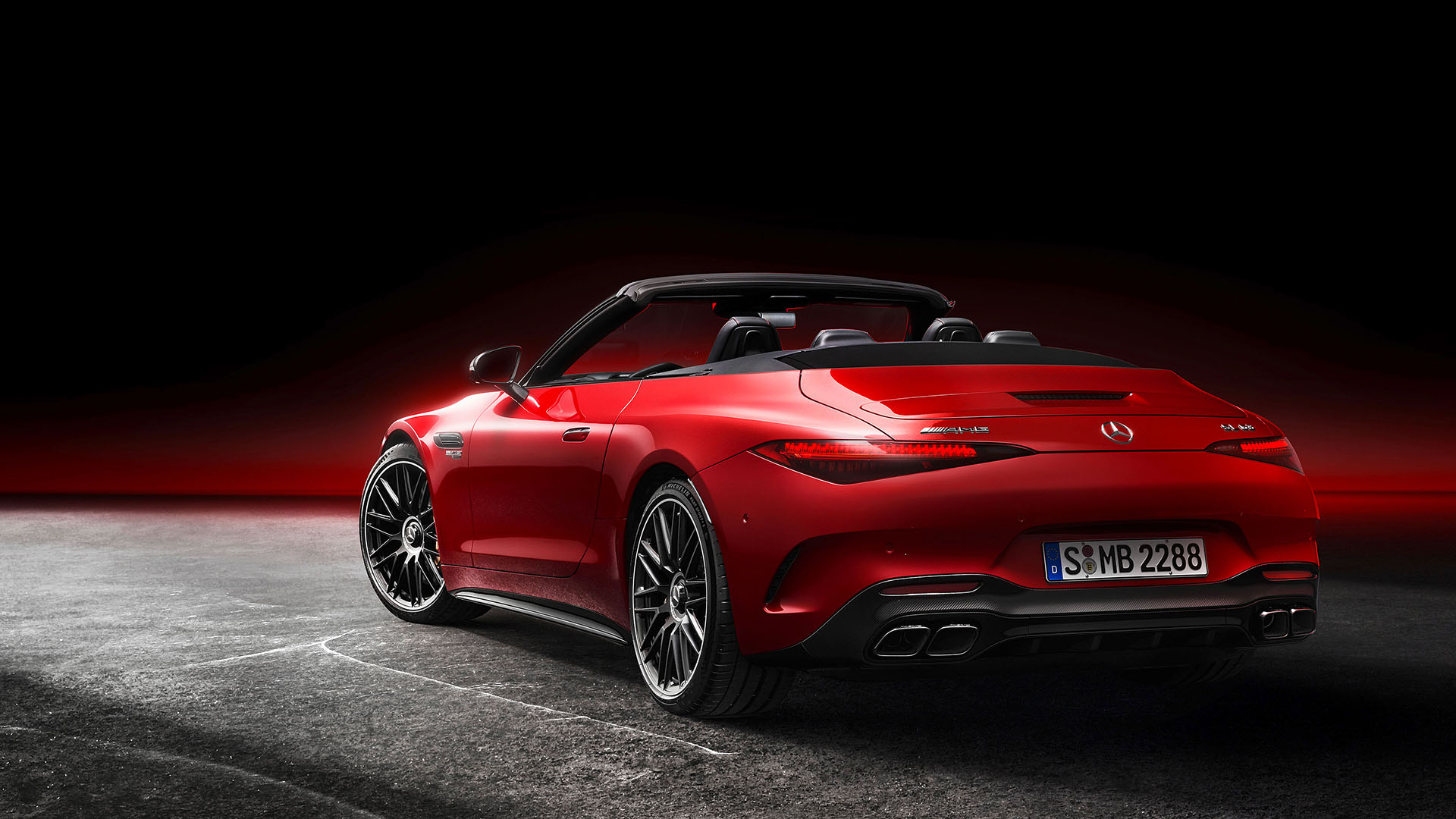
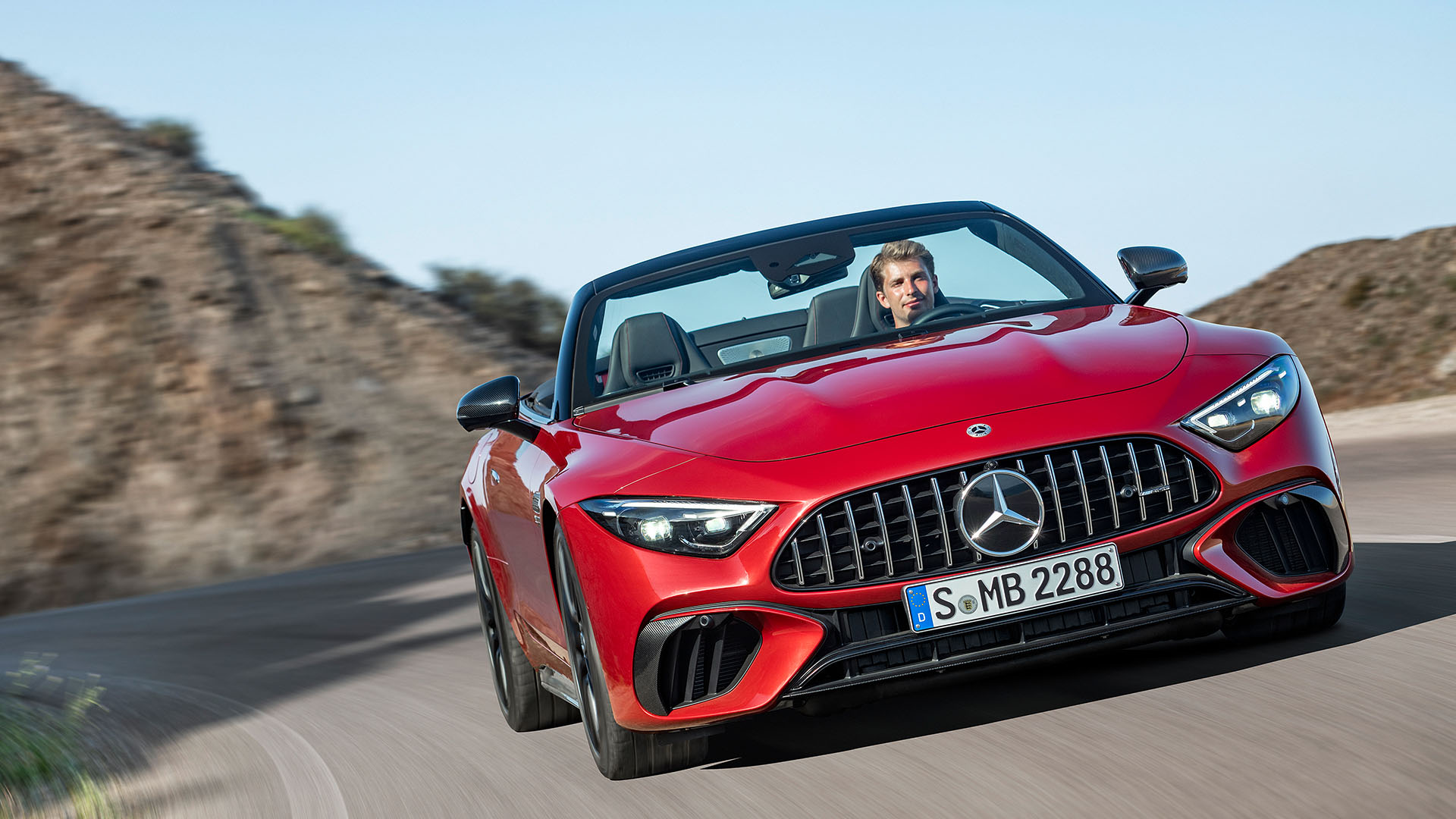
The newest edition of an icon, the Mercedes-AMG SL goes back to basic with a classic soft top and sporty character. The 2+2-seater is great for everyday use and for the first time, they created an all-wheel drive.
The SL is equipped with high-tech components like the AMG ACTIVE RIDE CONTROL suspension with active anti-roll stabilization and rear-axle steering. To really maximize the sporty profile, Mercedes-AMG added as standard the DIGITAL LIGHT with projection function. The AMG ceramic high-performance composite brake system is being offered as an option.
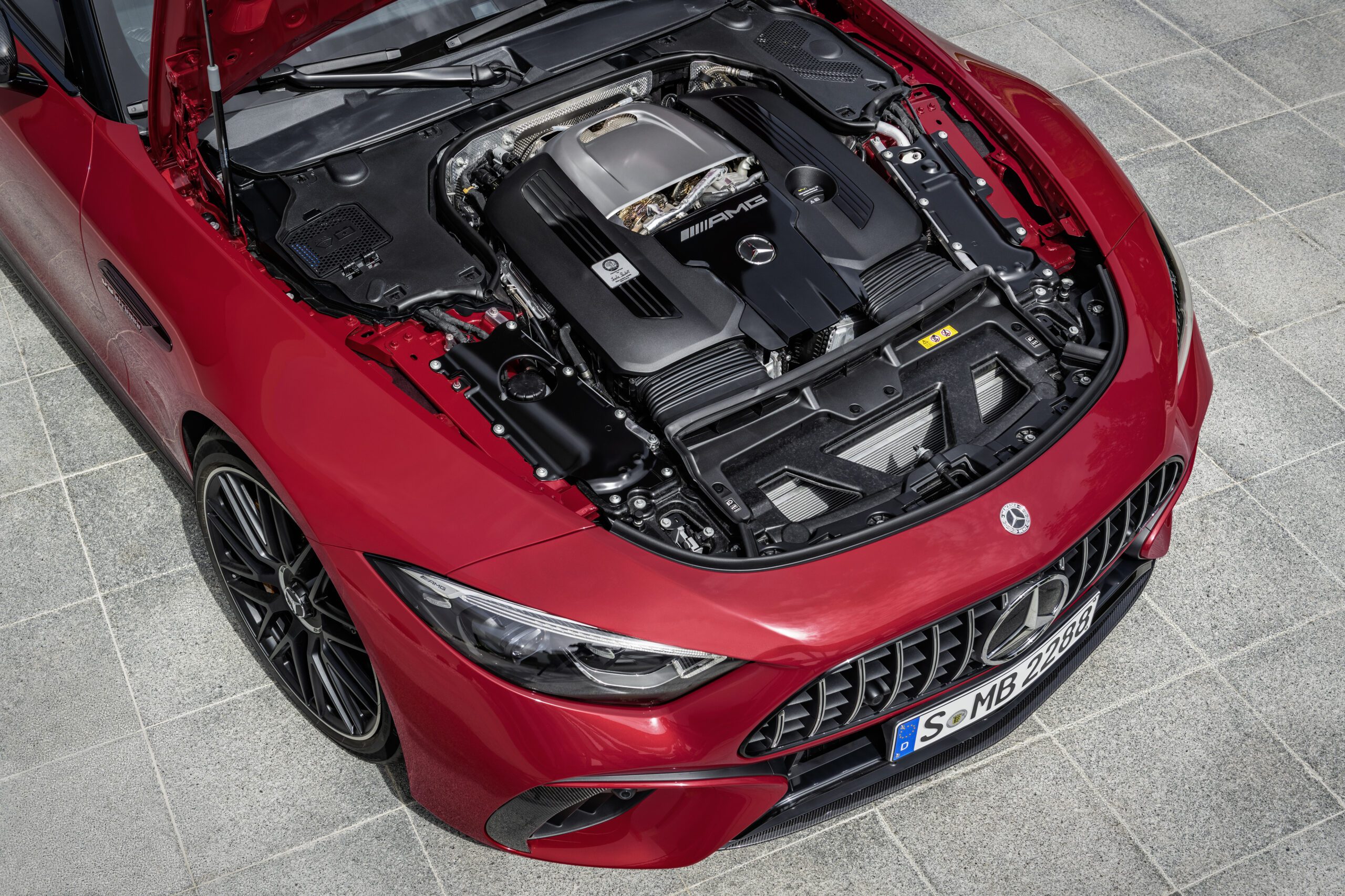
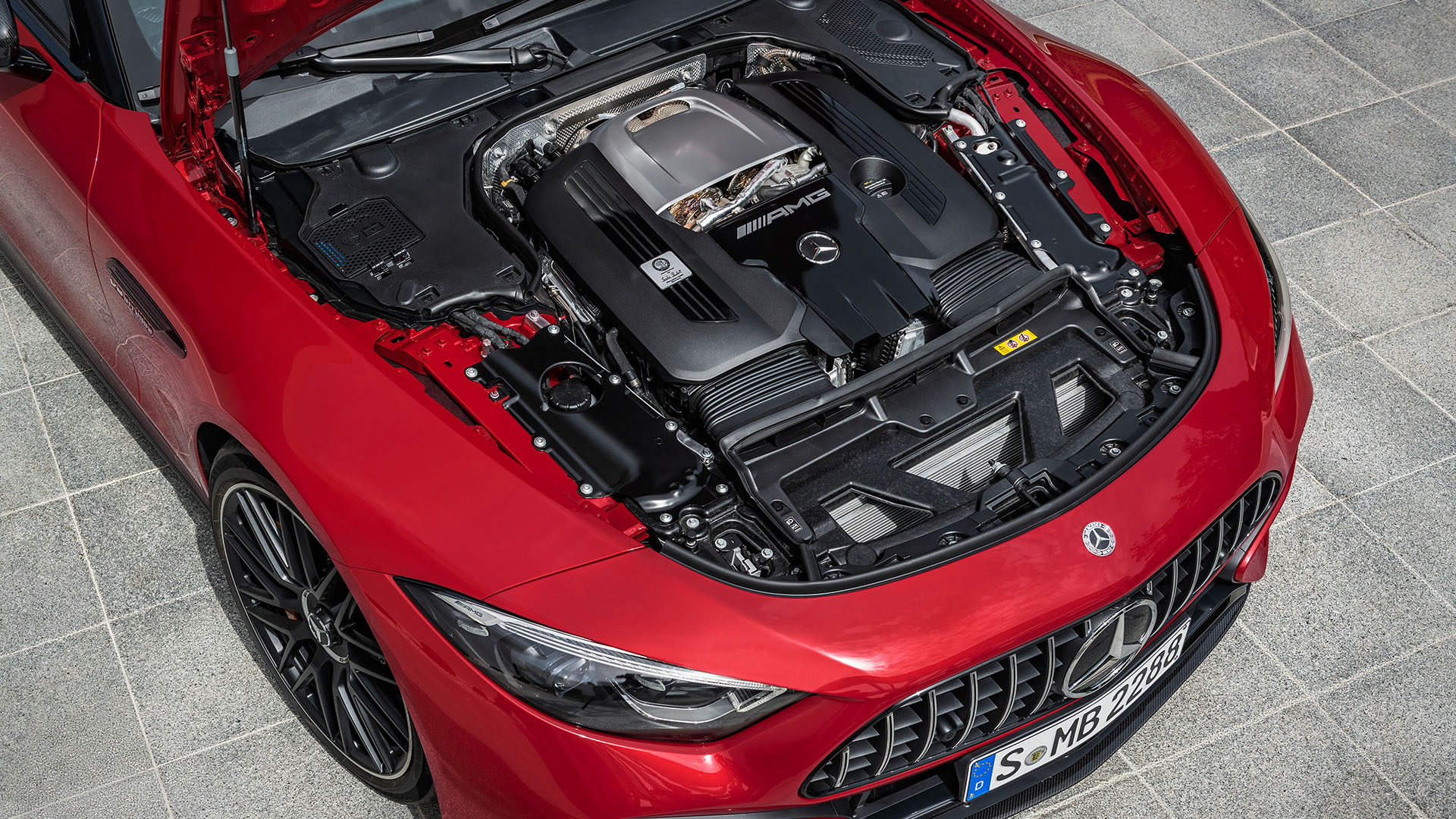
Matched with the AMG 4.0-liter V8 biturbo engine, the combination gives unparalleled driving experience. Mercedes-AMG has built their reputation as a Performance Luxury manufacturer, and the company developed the SL in Affalterbach completely independently.
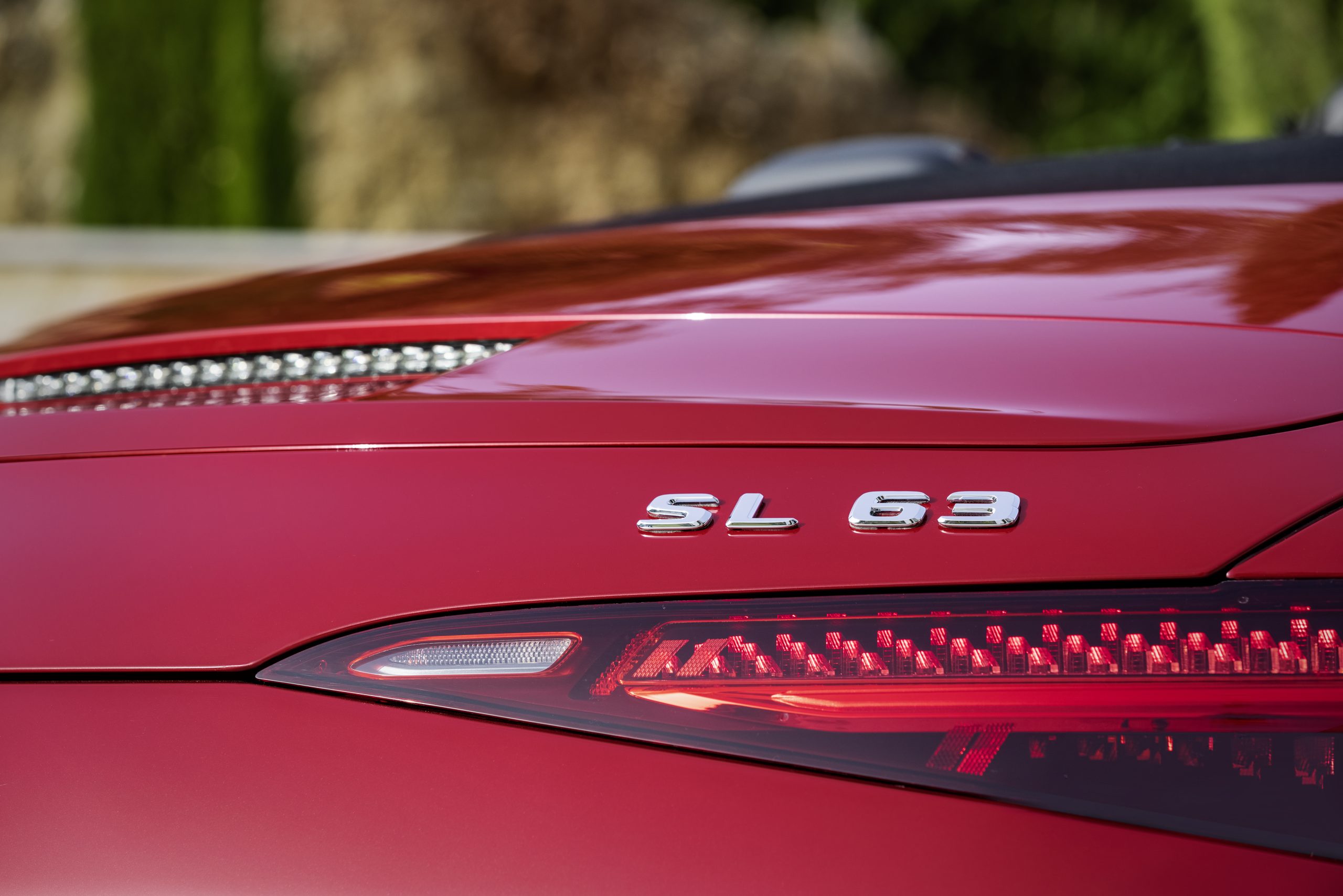
Mercedes-AMG SL 63 and Mercedes-AMG SL 55
Kicking off the market launch are two models with AMG V8 engines.
It has almost been 70 years when a sports car launched in Stuttgart became an instant legend. From that first success, Mercedes-Benz envisioned expanding their potential through motor racing successes. This vision produced the first SL – a road-going racing sports car.
The 300 SL – with an internal designation of W 194 – made its debut in 1952, it recorded victory after victory in various racetracks all over the world. In its first year alone, it achieved an impressive one-two victory in the legendary 24 Hours of Le Mans. If that is not enough, it also recorded four first place finishes at the Nürburgring Grand Jubilee Prize for sports cars. The successes of the 300 SL made it a legend.
In 1954, the highly successful racing car was followed by the production sports car 300 SL – internally dubbed as the W 198. Due to its unusual doors, it was given the nickname “Gullwing”. Its influence is so strong, that in 1999, a jury of motoring journalists picked the Gullwing as the “Sports Car of the Century”.
Other notable cars in its model history include the “Pagoda” called W 113 and was produced from 1963-1971, the evergreen R 107 had a really long production time from its release in 1971, with the last produced in 1989. The R 129 came next and due to its striking wedge shape, was considered to be an automotive structure.
To this day, the SL is considered to be one of the few real automotive icons in the world.
The development of the SL spans for decades with car enthusiasts following its evolution from full-blooded racing cars to open-top luxury sports car. Now, the new Mercedes-AMG SL creates another milestone. It seamlessly brought together the sportiness of the original SL with the luxury of technological advancements that embodies the modern Mercedes models.
“The SL is an icon: For almost 70 years, the distinctive sports car has delighted Mercedes customers of every generation around the world. With the rebirth of the roadster from Mercedes-AMG, the new SL more than ever remains the symbol of this timeless fascination”, shared Britta Seeger, Member of the Board of Management of Daimler AG and Mercedes-Benz AG, responsible for Mercedes-Benz Cars Marketing and Sales.
Mercedes-AMG GmbH Chairman of the Board of Management Philipp Schiemer added, “The new SL combines the sporty genes of the original SL with the driving performance typical of AMG. At the same time, it offers luxury and comfort at the absolute top level. This combination is unique in the sports car segment and is also reflected in the interior – where the highest levels of comfort and quality meet the right helping of sportiness. The high-quality combination of analogue world and state-of-the-art digital equipment makes it clear that the new SL is the rebirth of an icon for the modern era”.
Daimler Group Chief of Design Officer Gorden Wagener said, “With the new SL, we have created a repositioning of the iconic SL design. The expressively modelled exterior conveys a light and purist impression and brings sensual beauty and extravagant design into perfect harmony”.
“We at Mercedes-AMG consider it a great honour to have had the privilege to develop the new edition of this sports car icon. When we were tasked with the overall development of the new SL, we were able to start from scratch without building on an existing structure. We are proud of the result, which once again demonstrates the high level of engineering expertise in Affalterbach. The new 2+2 concept combines agile driving dynamics with a high level of comfort and unrestricted suitability for everyday use”, says Jochen Hermann, Chief Technical Officer of Mercedes-AMG GmbH.
The new Mercedes-AMG SL really raises the bar in the luxury sports car segment with its state-of-the-art technology, outstanding driving characteristics, and exquisite design.
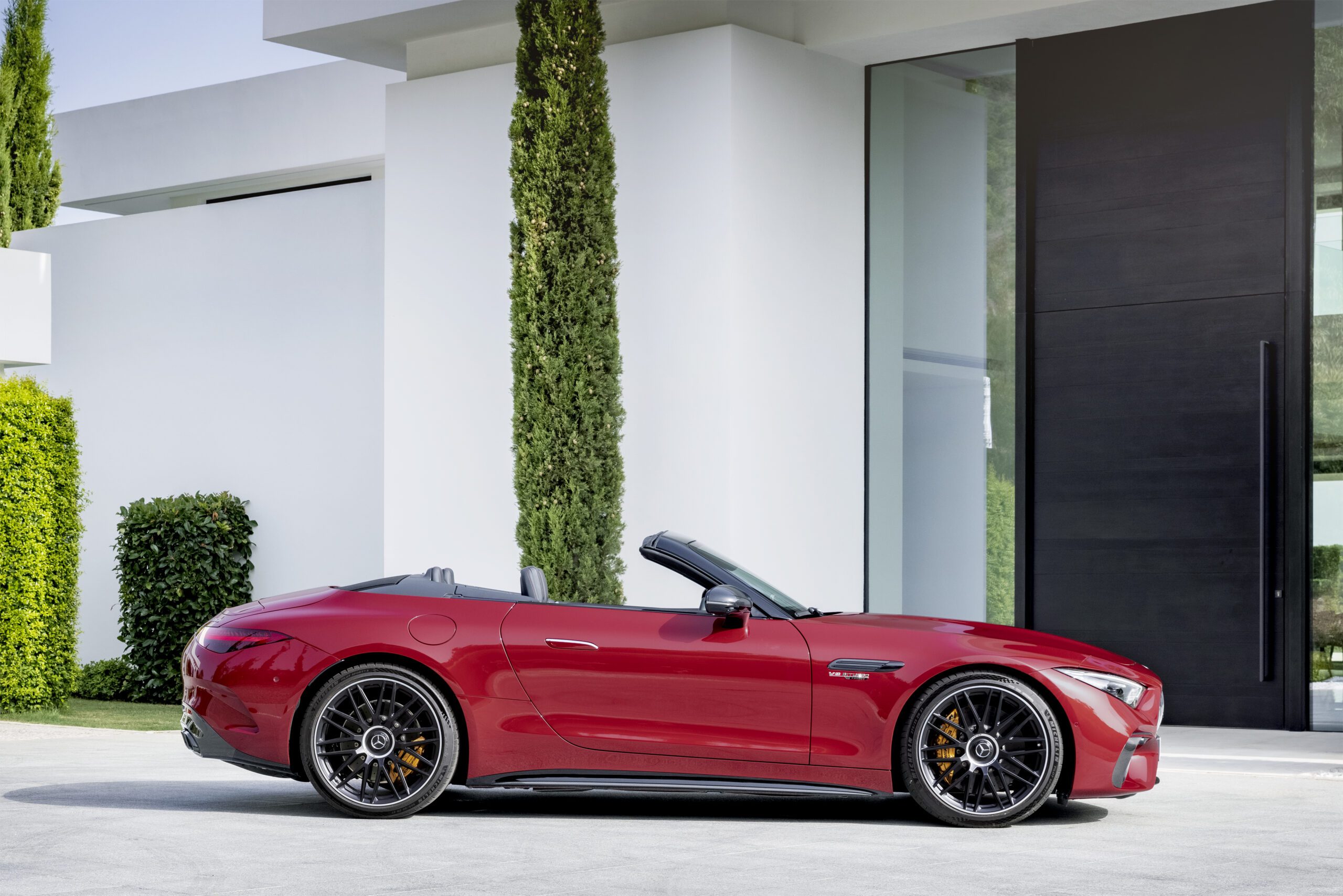
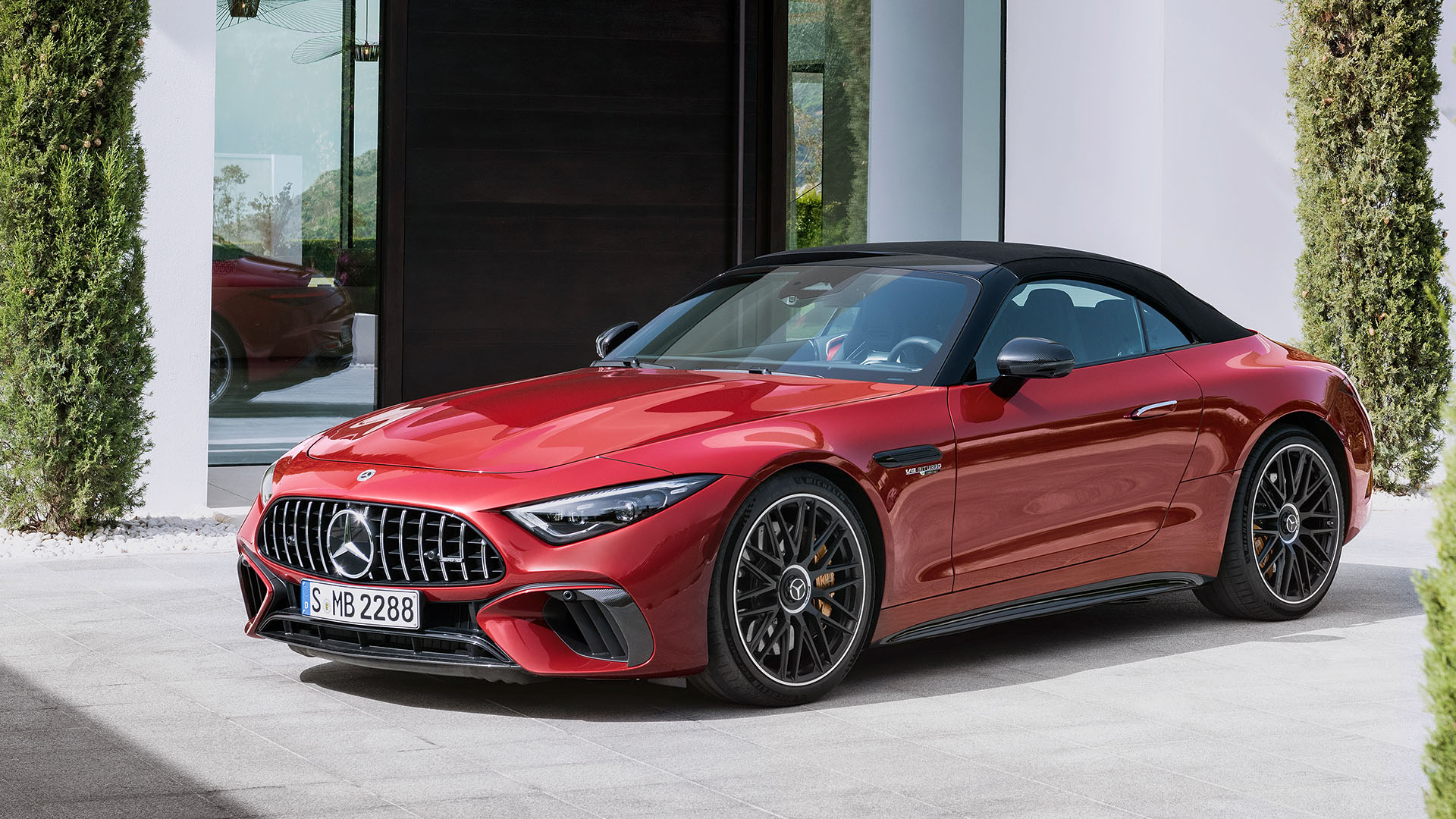
The exterior design of the Mercedes-AMG SL perfectly brings together the sensual purity of modern Mercedes-Benz design with the typical sportiness of AMG, with characteristic details. The two power bulges on the bonnet of the new SL is one of the features that is clearly inspired by the first SL generation. The interaction of the light and shadow on the new SL gives an overall light and low appearance, making it clear at just the first glance that the new SL has gone back to basics with its sporty roots.
Balanced Exterior Design with Sporty Genes
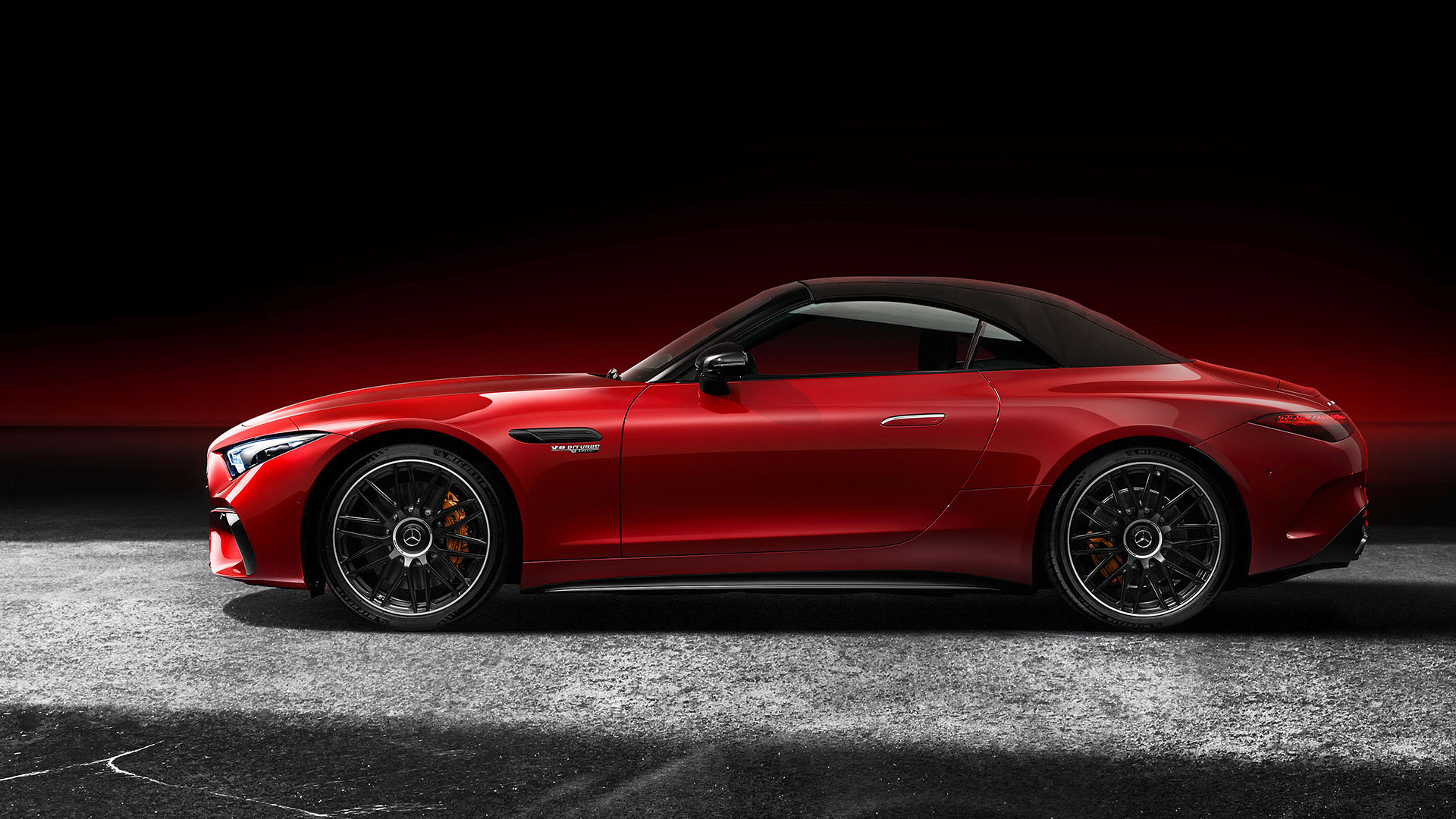
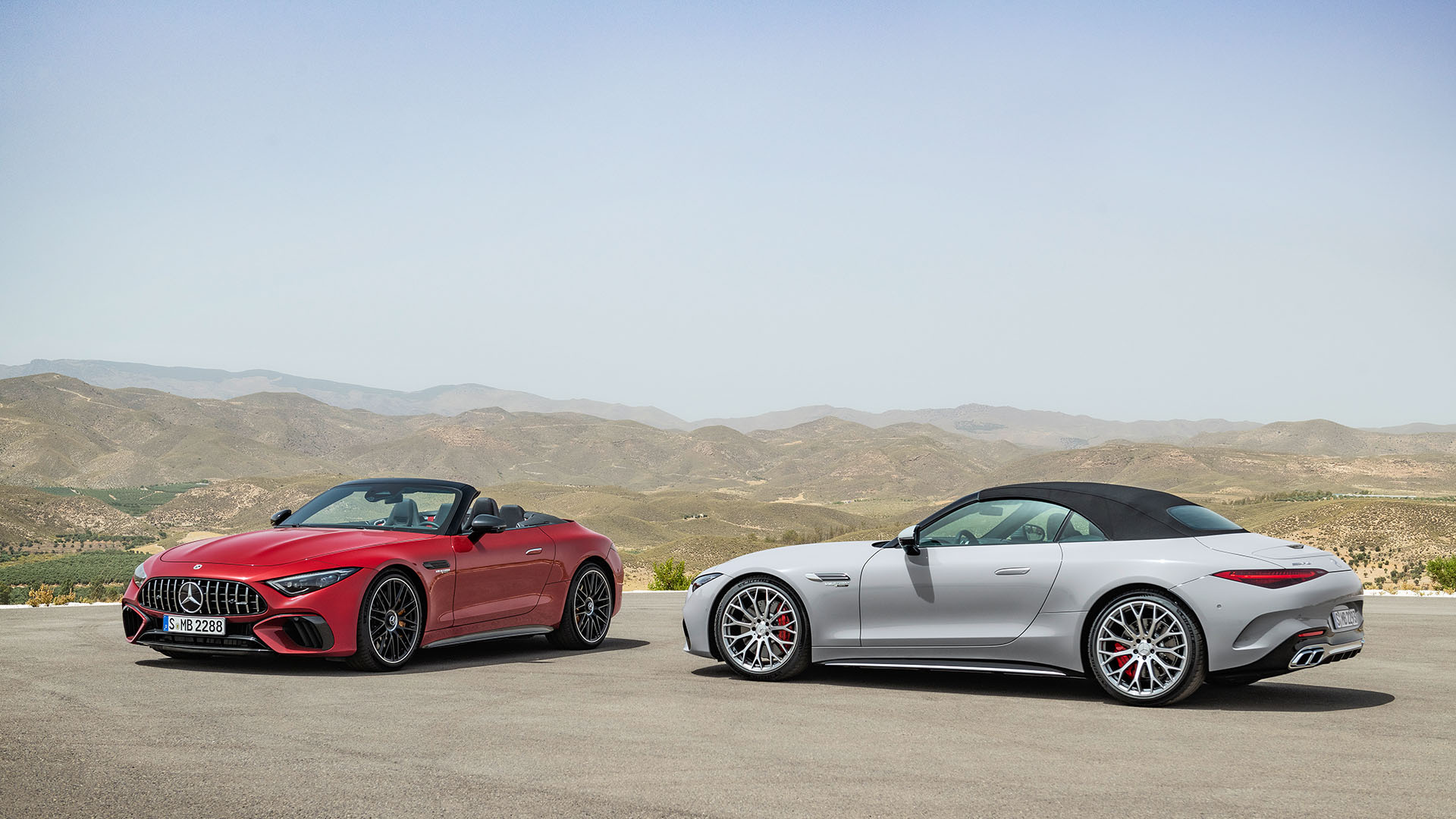
The body design of the new SL has kept some of its characteristic features like the short overhands, long wheelbase, long bonnet, the passenger compartment set back with a strongly raked windscreen, as well as the powerful rear end. Those combinations resulted in a typical SL in terms of proportions. Matched with the large alloy wheels and voluminously sculpted wheel arches, it resulted into a roadster that looks both powerful and dynamic. When the seamlessly integrated soft top is closed, it emphasizes the purist, sporty appearance.
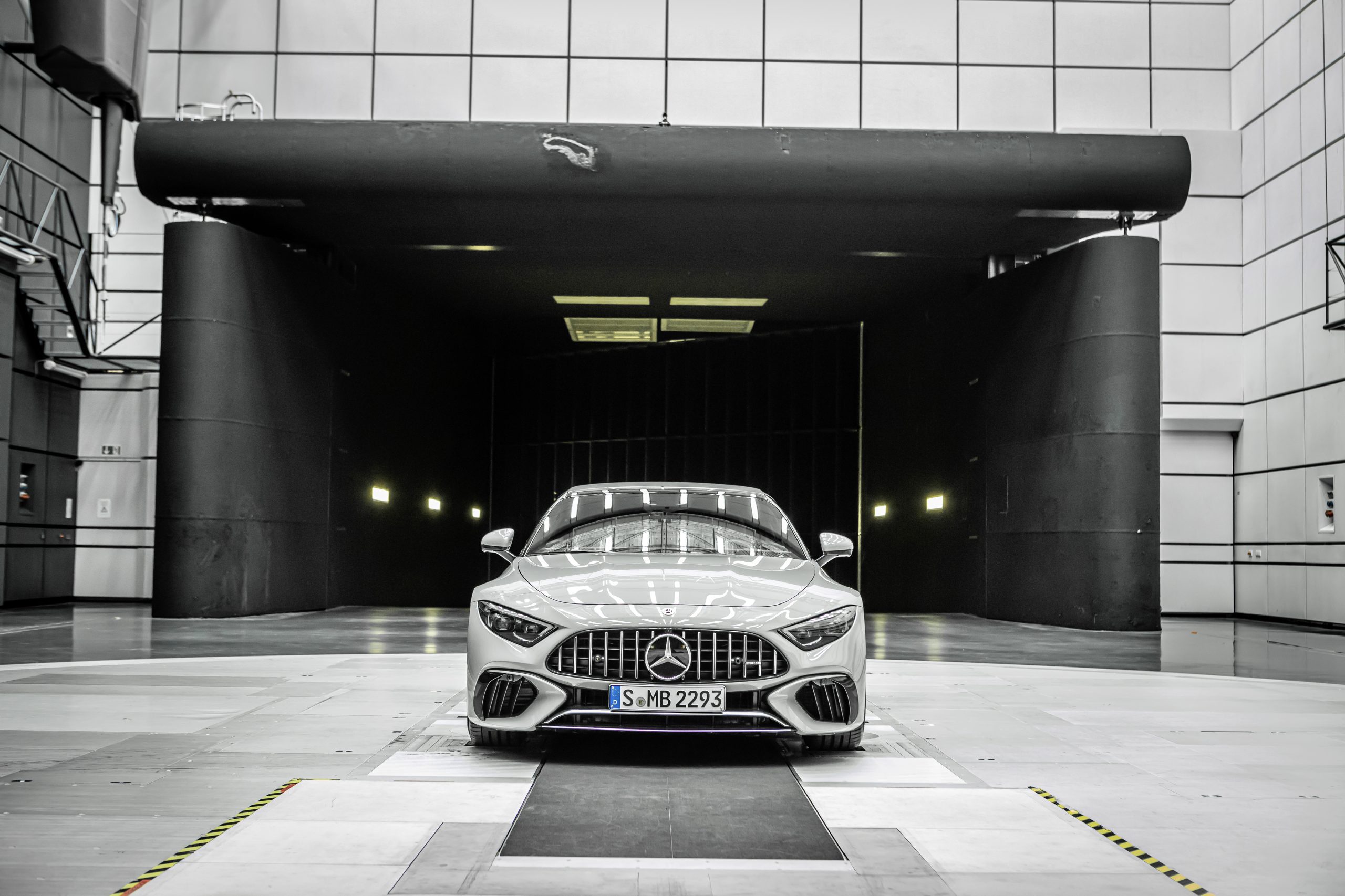
The AMG-specific radiator grille highlights the effect of width of the front and its 14 vertical slats, reminiscent of original SL model: the legendary 1952 300 SL racing sports car. The new SL also has other unique design elements like the thin, sharply outlined DIGITAL LIGHT LED headlamps as well as the really thin LED rear lamps.
Interior design: ‘Hyperanalogue” cockpit and Performance Luxury
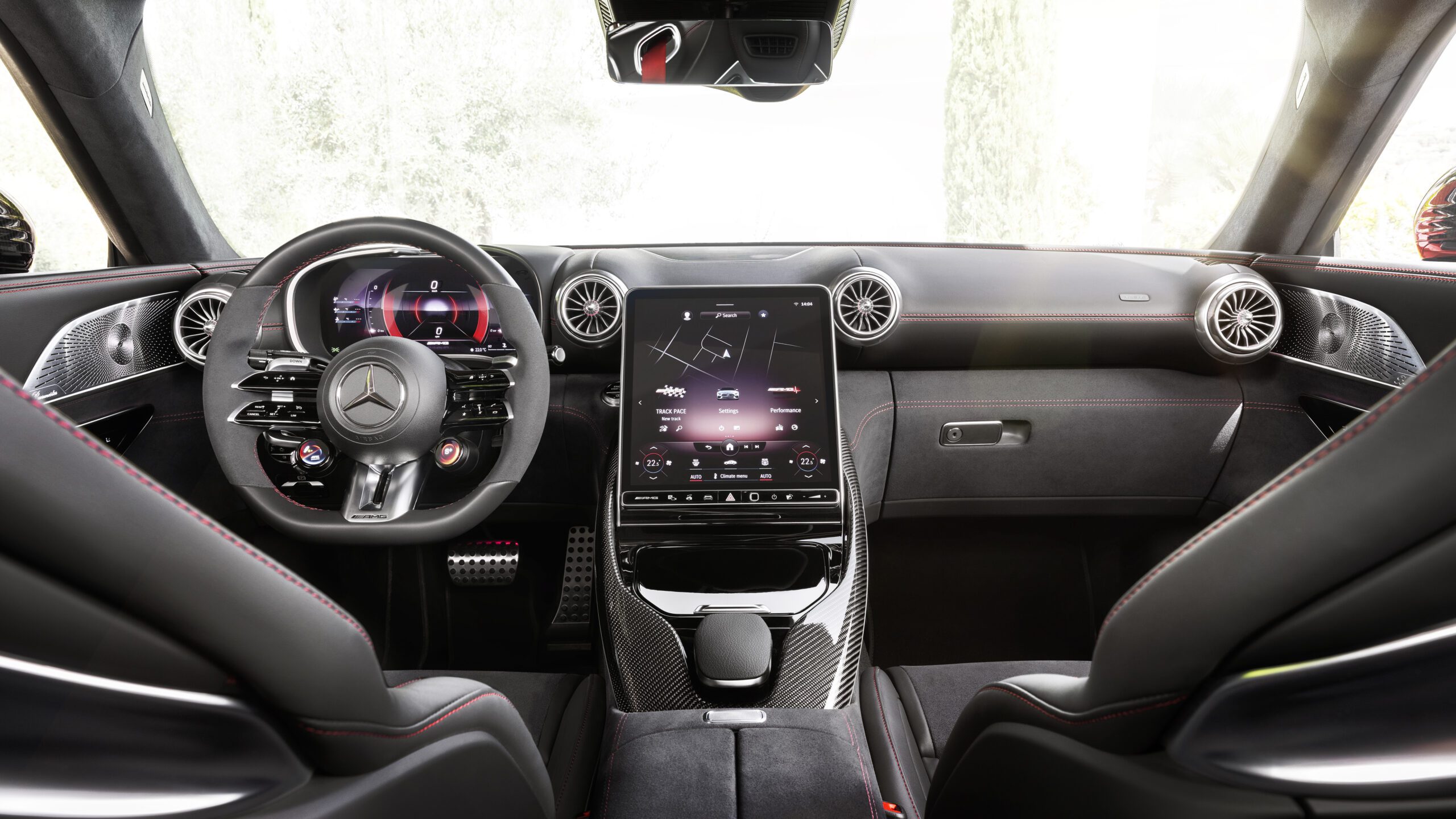
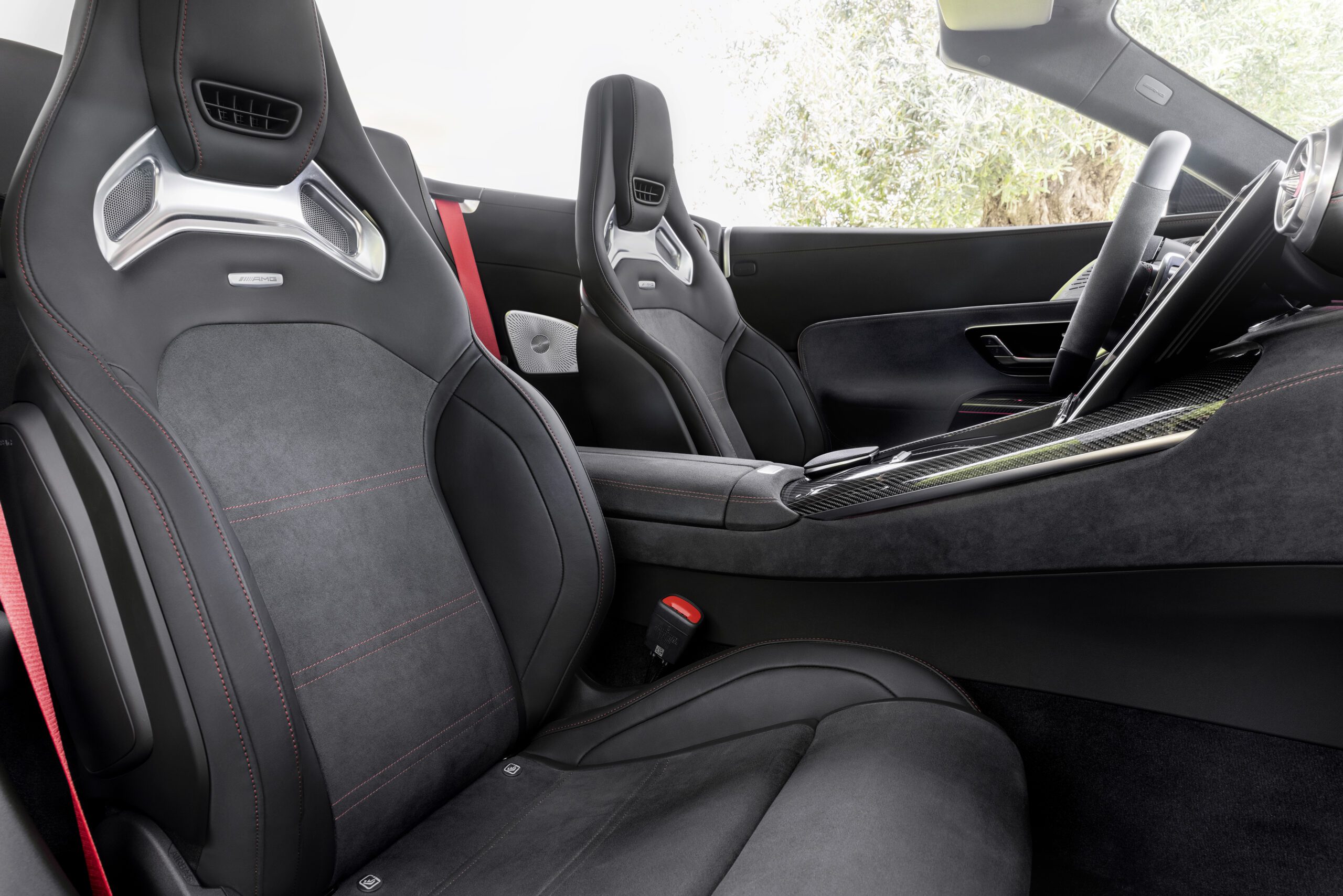
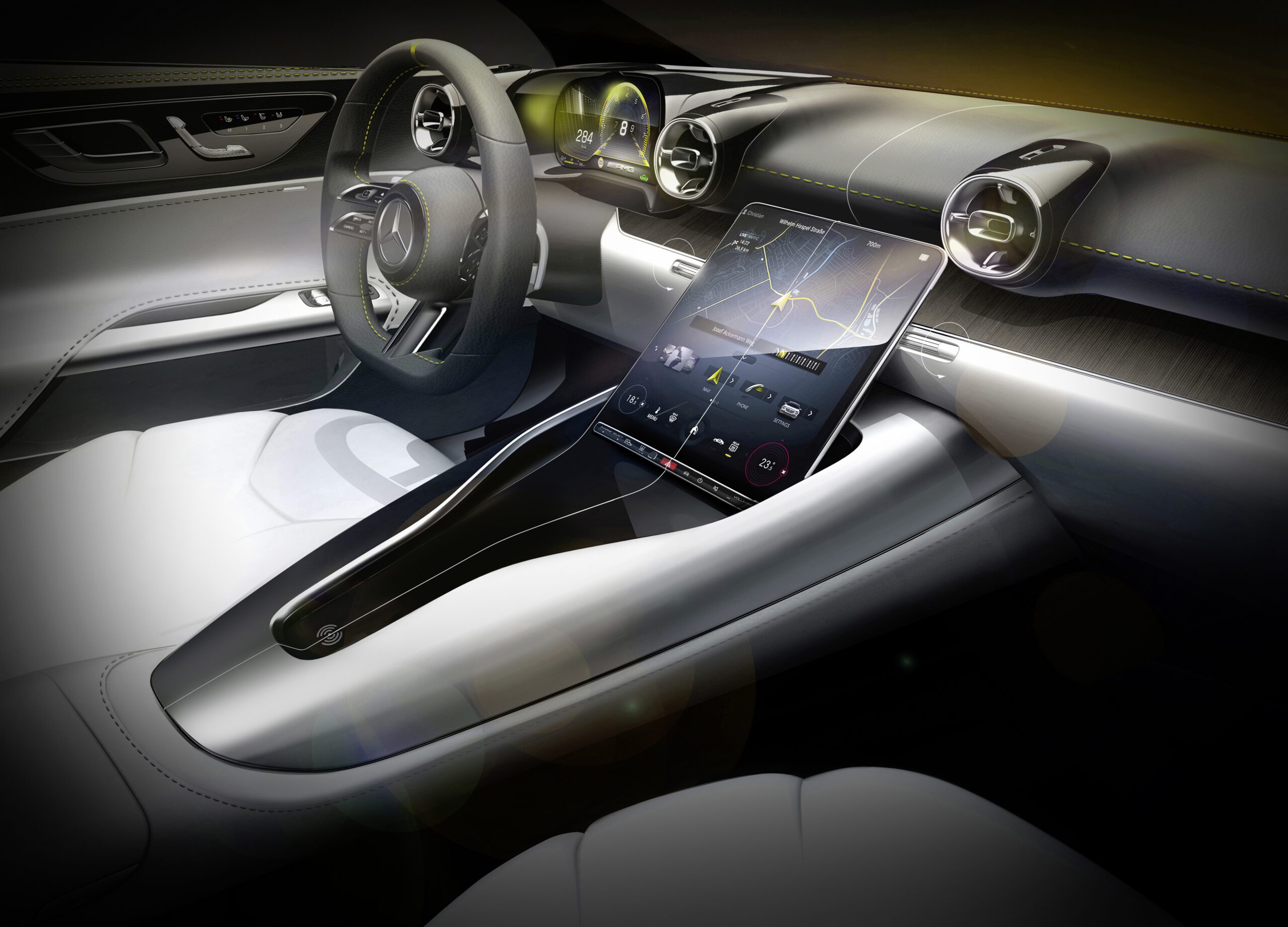
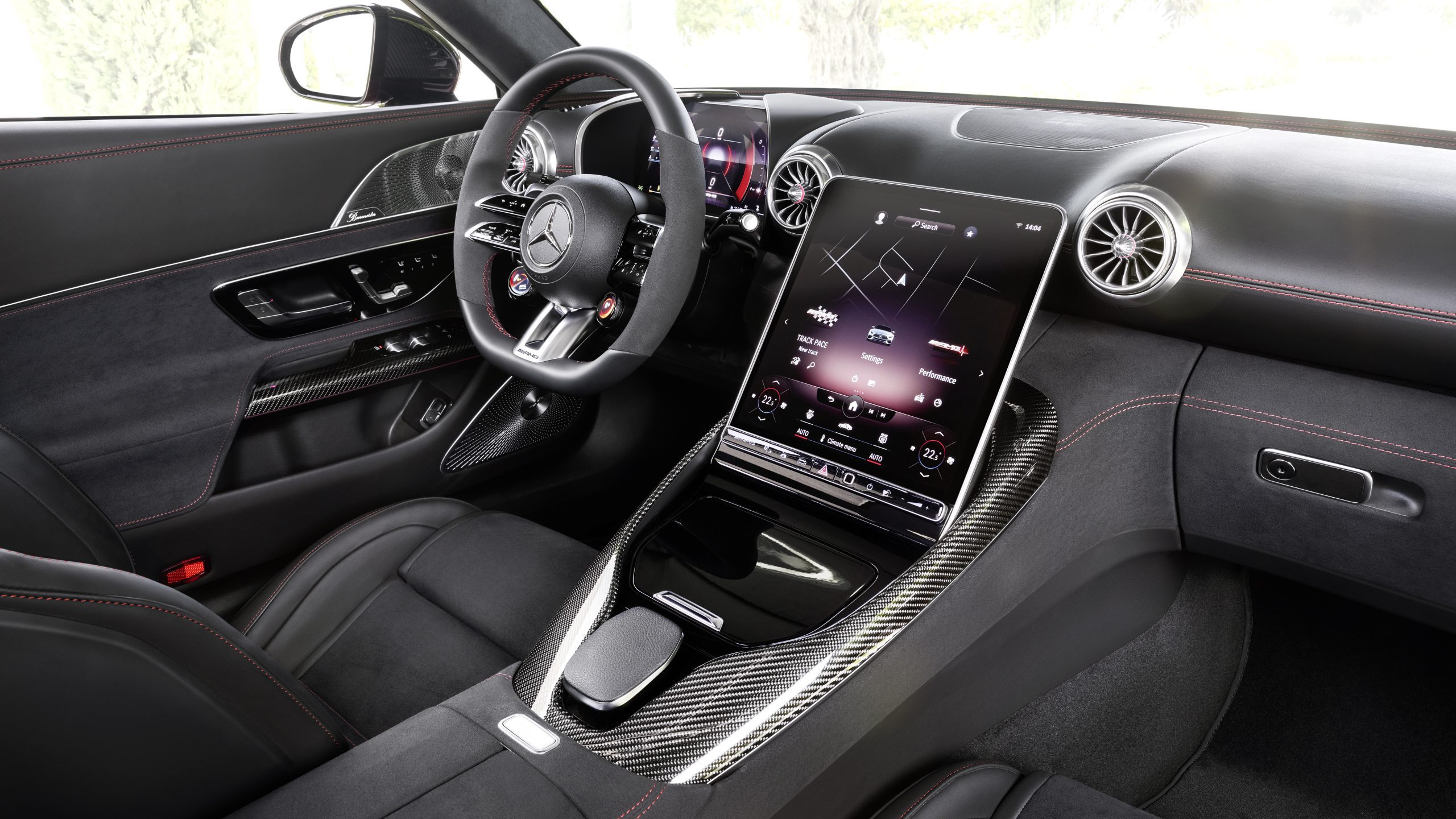
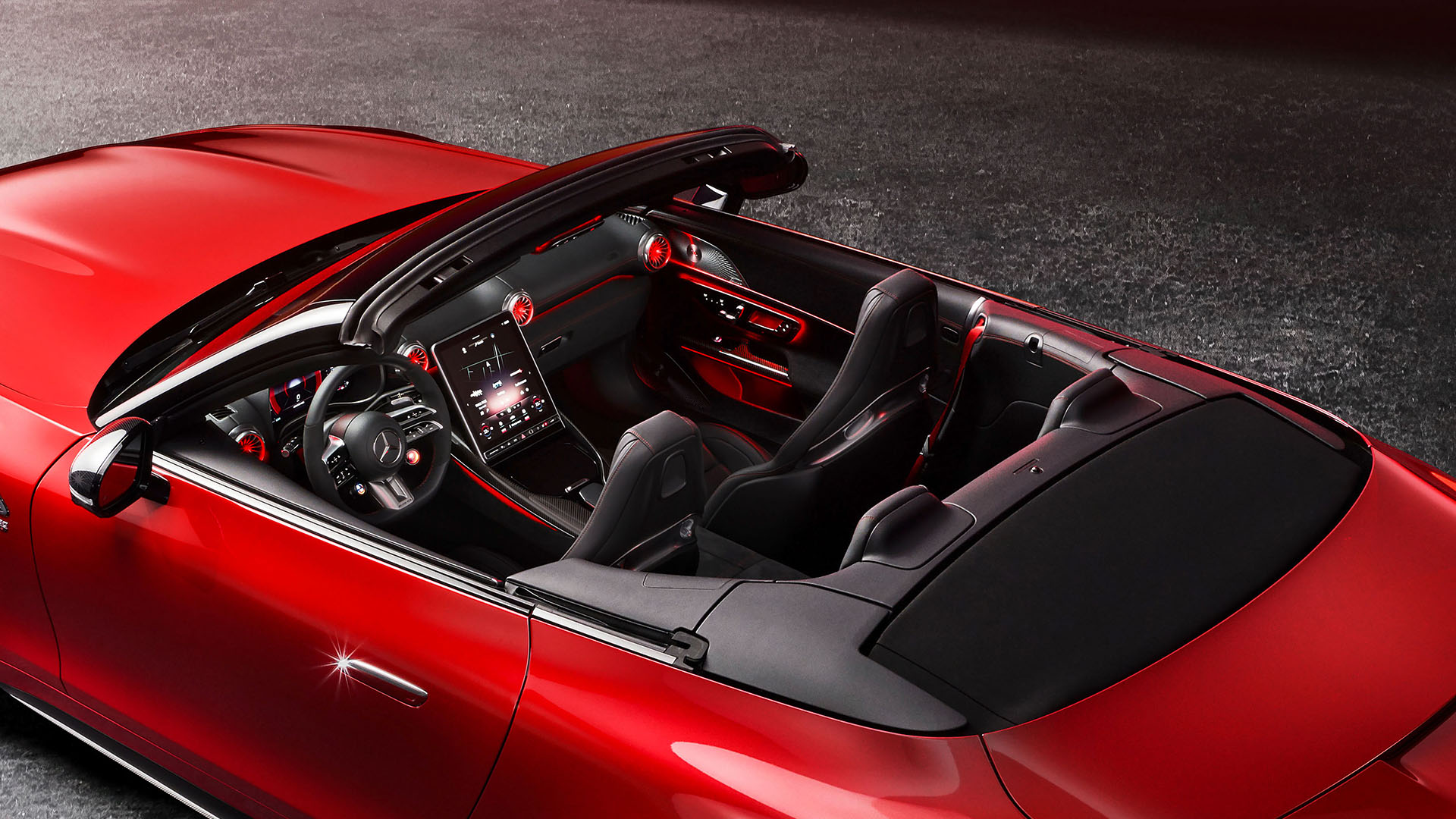
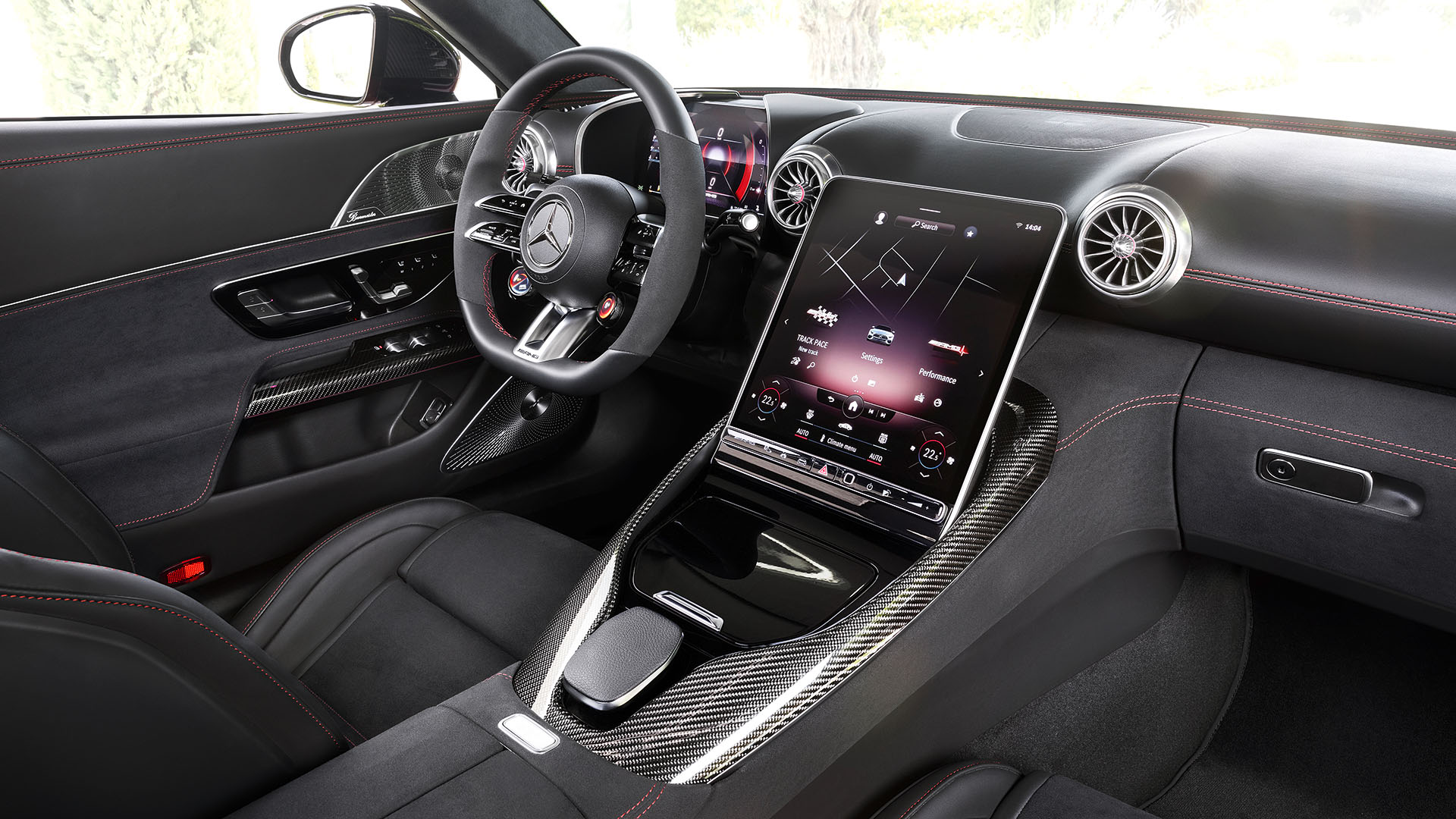
The interior of the new Mercedes-AMG SL brings forward the tradition of the first 300 SL Roadster into the modern era. The new edition is the perfect combination of luxury with sporting virtues. To provide the highest levels of comfort, the new SL used the best materials and expert workmanship. The cockpit was designed with the driver as the focus, even to the adjustable central display in the center console.
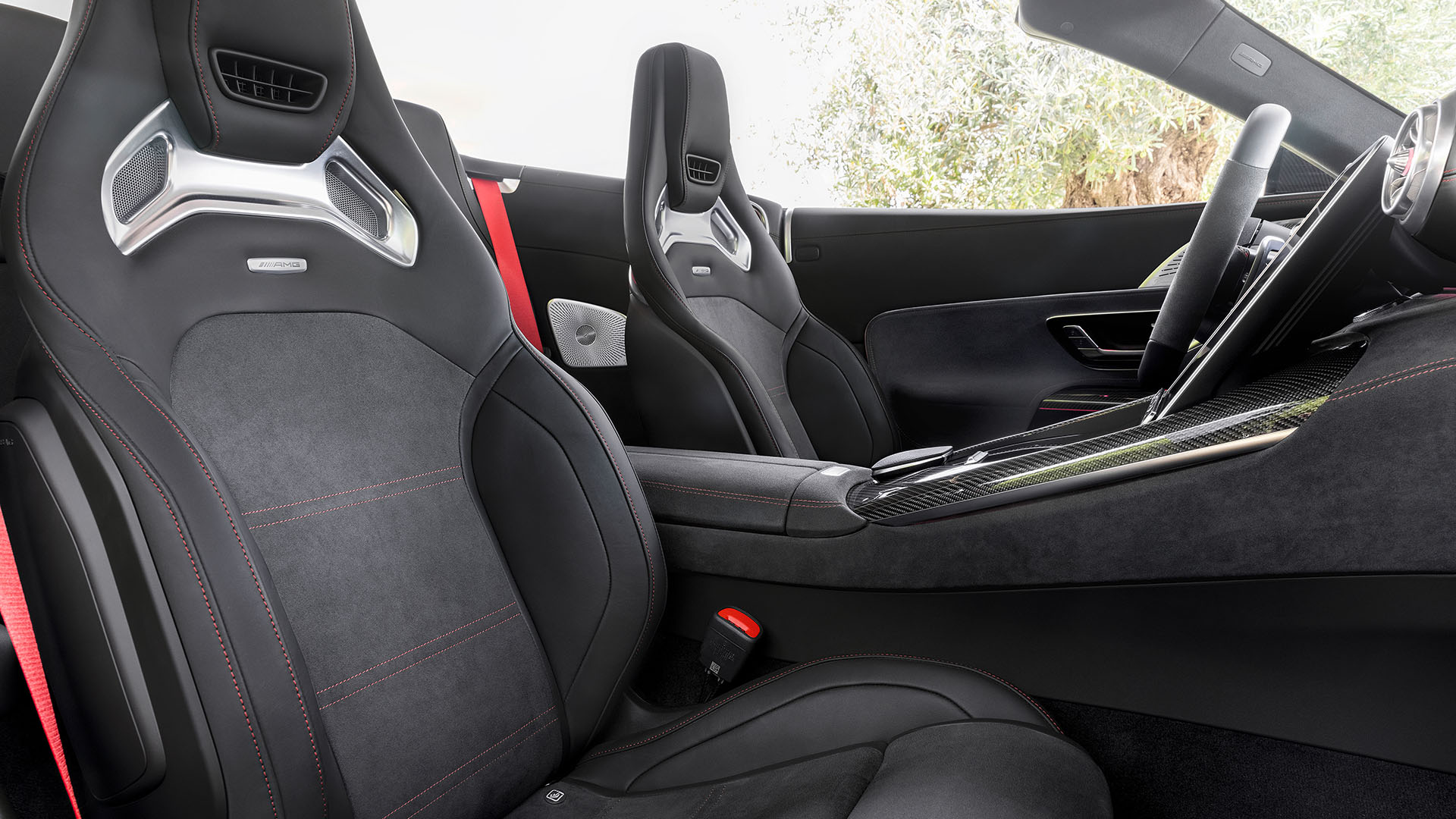
The new interior space concept with 2+2 seats provides more room and functionality. The rear seats make the SL practical for daily use and gives more space for people up to 1.5 meters tall.
The 300 SL Roadster’s minimalist interior using the highest quality materials are what inspired the designers in conceptualizing the interior of the new SL. This resulted in an exciting combination of analogue technology with the digital world, called ‘hyperanalogue”. This is seen on the fully digital instrument cluster which is integrated into a three-dimensional visor. The standard MBUX infotainment system also gives a choice between several different modes and specific display styles.
One of the many notable features in the interior of the new SL is the sculptural seat design that comes in the standard, electrically adjustable AMG sports seats. The backrest integrates the head restraints, emphasizing the sporty character of the car. The AIRSCARF comes as standard. Air outlets in the head restraints allow warm air to flow into the passenger compartment and wraps around the head and neck area of the driver as well as the front passenger like a scarf. The interior has perfect ergonomics. Available as an option are the AMG Performance seats.
The new SL comes with the latest generation Mercedes-Benz User Experience (MBUX) and it has the capacity to learn and is intuitive to use. It has numerous functional contents as well as the operating structure used on the second-generation MBUX system which was first seen in the new Mercedes-Benz S-Class. The SL comes with AMG-specific content that can be seen in the five display styles. The sporty character of the car is emphasized in its exclusive menu items like the “AMG Performance” and the “AMG TRACK PACE”.
Body Shell
Mercedes-AMG developed a completely new vehicle architecture for the 2+2-seater 2021 SL. The chassis was made from a lightweight composite aluminum structure that is made up of an aluminum space frame with a self-supporting structure. The design ensures maximum rigidity that provides the highest comfort, precise driving dynamics, optimal packaging, and sporty body proportions. Like the first SL back in 1952, the new body shell was designed literally on a blank sheet of paper. No component in the new SL came from its predecessors nor from any other model like the AMG GT Roadster.
The body shell architecture aims to provide the driving performance that is expected of AMG focusing on the lateral and longitudinal dynamics while also delivering on the high standards of comfort and safety. The intelligent material mix in the new SL allows the highest possible rigidity at a low weight. Material cross-sections are optimized, and the sophisticated component shapes allows for the comprehensive comfort and safety features as well as the soft top to be added. A mix of materials are used like aluminum, fiber composites, magnesium, and steel to create different parts like the windscreen frame. It serves as a roll-over protection along with the roll bar system at the back of the rear seats which can immediately be extended when needed.
The torsional rigidity of the body shell structure is improved by 18 percent compared to the previous model series. The transverse rigidity is 50 percent better than the already impressive value of the AMG GT Roadster, while the longitudinal rigidity is 40 percent higher. The plain body shell weights around 270 kilograms. Matched with a low center of gravity, the lightweight construction guarantees outstanding driving dynamics.
Active aerodynamics gives perfect balance and high efficiency
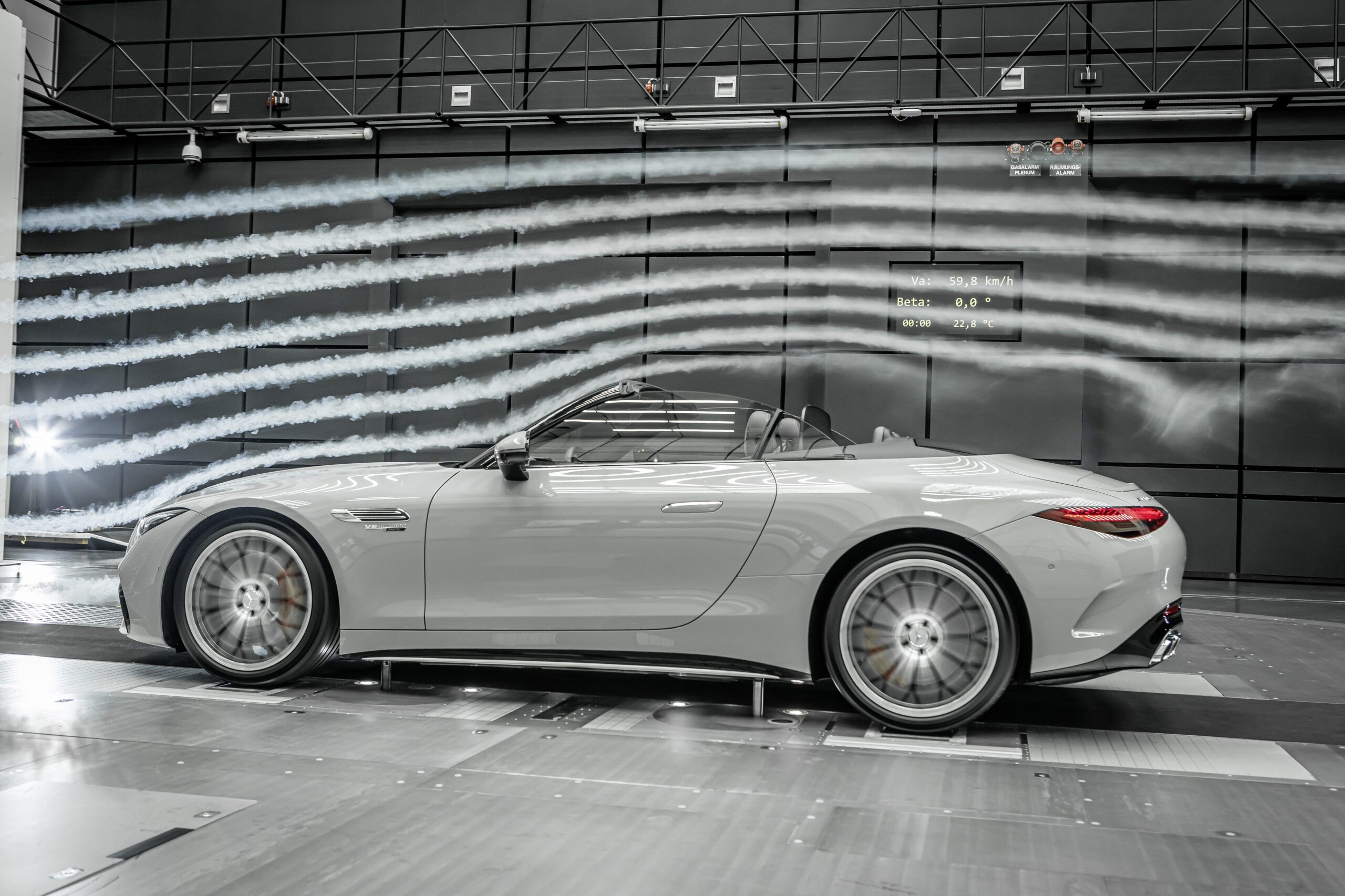
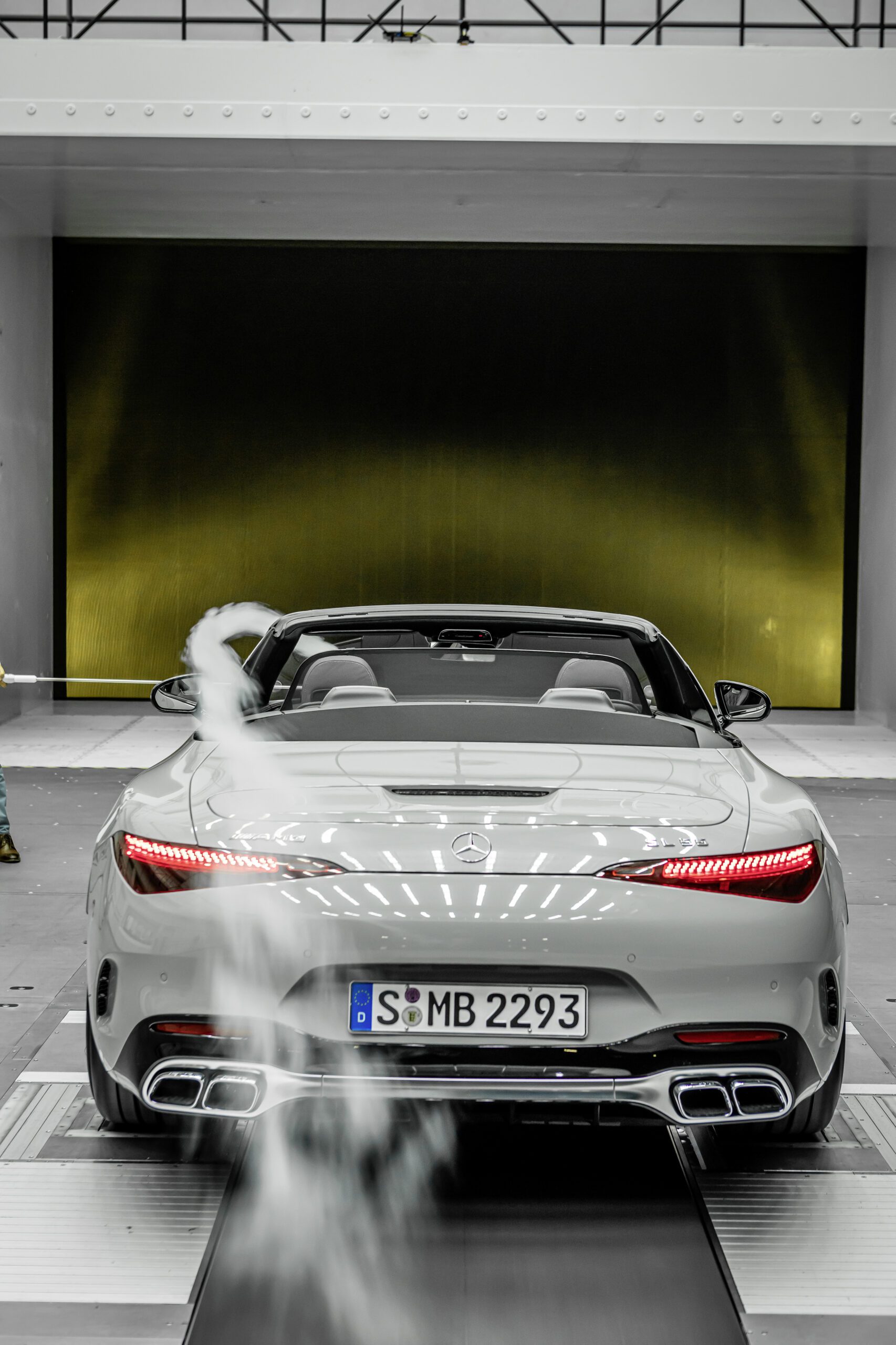
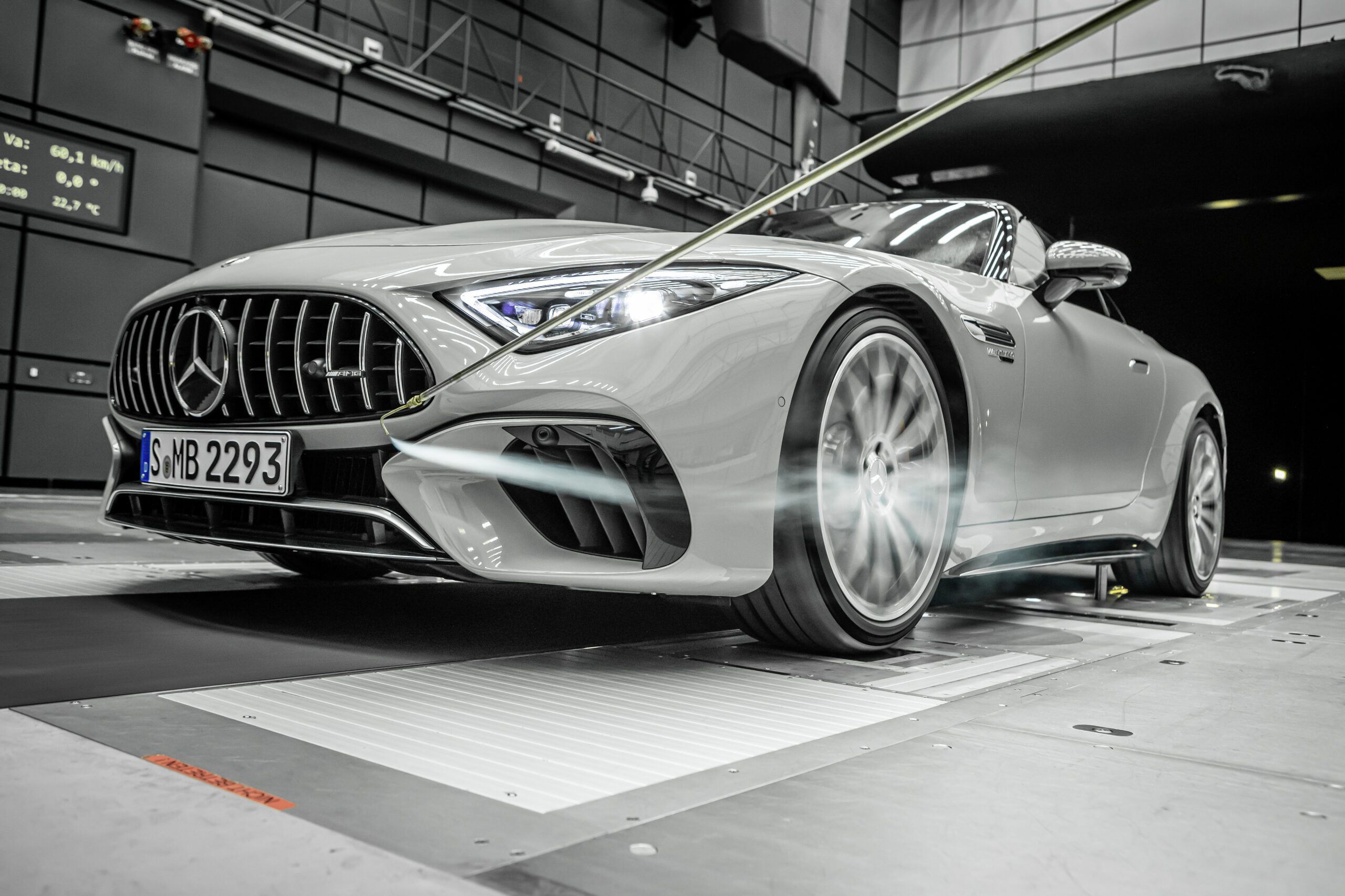
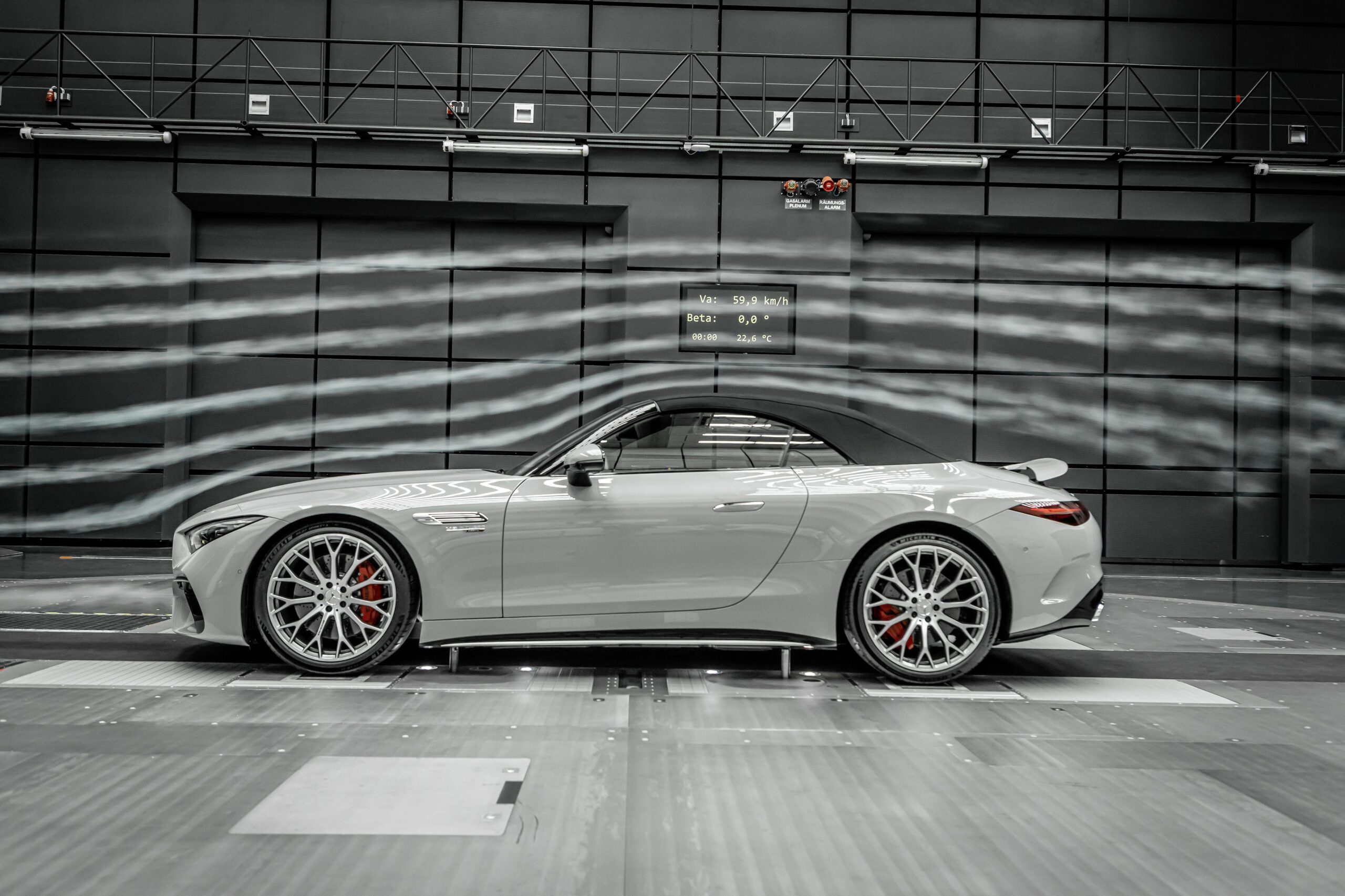
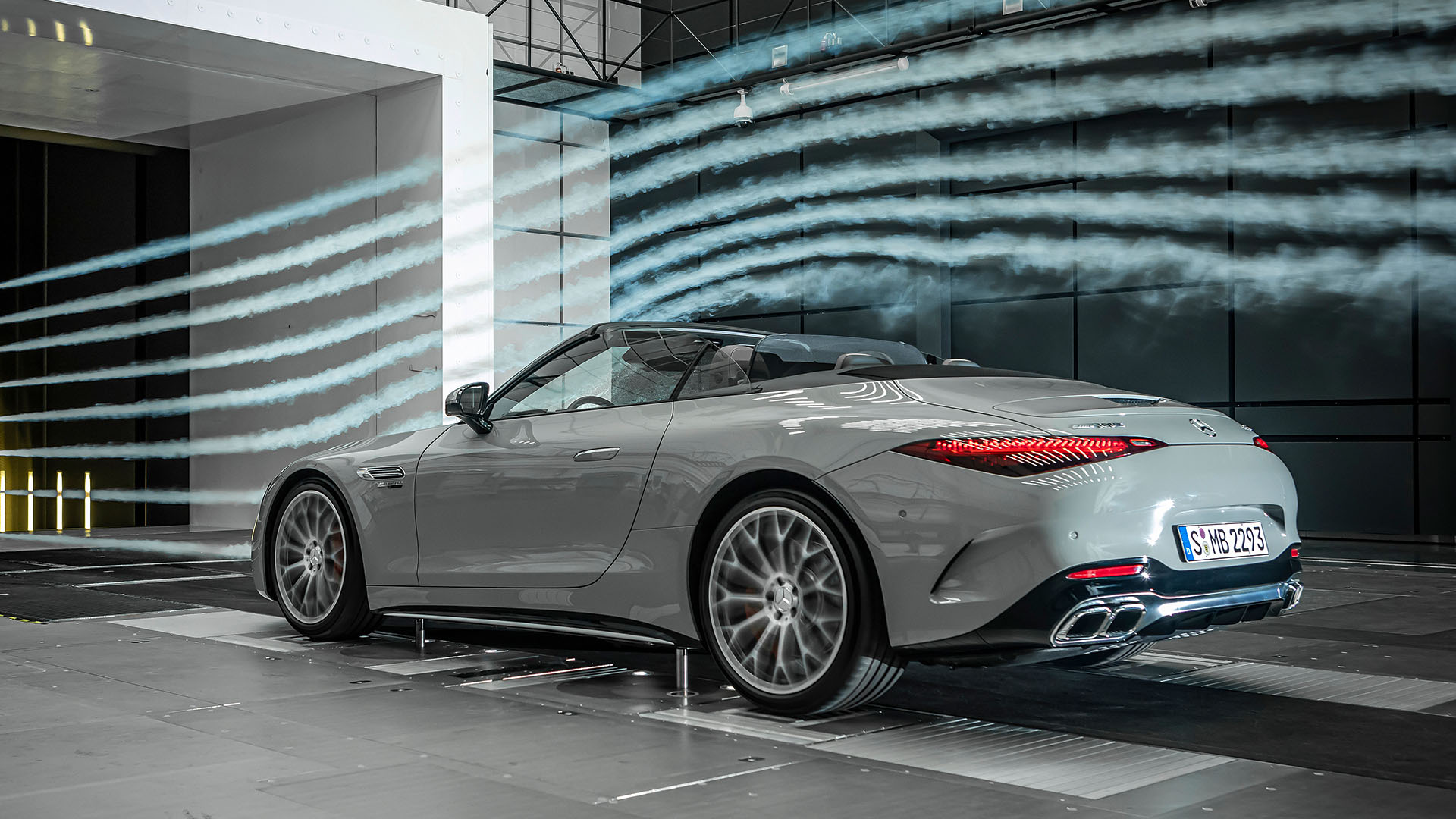
High aerodynamic efficiency was one of the key development focuses of the new SL. They specifically worked on the balance between low drag and reduced lift. This is where the luxurious roadster is greatly benefited from the wide-ranging motorsport expertise of Mercedes-AMG.
Extensive active aerodynamic elements can be seen on the front and rear with all the streamlining elements integrated perfectly with the exterior design. Additional detailed measures lowered the drag coefficient to Cd 0.31 which is an excellent figure for an open-top sports car.
The aerodynamics of the SL had to deal with the complex requirements of drag, cooling, handling stability, and wind noise. The driving characteristics and vehicle character of the new SL are constant whether the top is down or up. The even aerobalance assists in defusing critical driving situations like a sudden evasive maneuver while driving at high speed.
AIRPANEL air control system
The AIRPANEL is an active air control system that is a technical highlight in the aero development of the new SL. The car is equipped with two AIRPANELs. The first piece is placed behind the lower air intake in the front apron, and it operates with vertical louvres. The second piece is hidden behind the upper air intake and has horizontal louvres. All louvres are normally closed. This position minimizes drag and leads the air specifically towards the underbody, further lowering front lift. When certain temperatures on predefined components are reached and there is a need for cooling air, the louvres open. The second system only opens from 180 kph, to let maximum cooling air to flow to the heat exchangers.
The retractable rear spoiler that is flawlessly integrated into the lid is another active component. Its position is changed depending on the driving status. To do this, the control software takes into account a few things: the driving speed, longitudinal and lateral acceleration, and the steering speed. The spoiler has five different angular positions that it can use from 80 kph to either reduce drag or to optimize handling stability.
Hidden in the underbody in front of the engine is the optional active aerodynamic element that also helps in improving handling. The carbon profile roughly weights two kilograms, and it reacts to the setting of the AMG driving modes. At the speed of 80 kph, it automatically extends downwards by roughly 40 millimeters, activating the AMG driving modes. It creates what is called the Venturi effect, which reduces the front-axle lift as it sucks the car more to the road surface. The driver feels the change in the steering, allowing for more precise and stable steering in bends and tracks.
The new SL has a variety of aerodynamically optimized alloy wheels that comes in 19, 20, or 21 inches in diameter, minimizing drag by having less turbulence. The 20-inch wheels with plastic aero rings are particularly sophisticated, and also save weight.
The Soft Top
With the new SL promising to be sportier than its immediate predecessors, it is not a surprise that it was given an electric soft top instead of the metal vario roof that was previously used. It took away a huge 21 kilograms in weight, while also giving the new SL a lower center of gravity, giving it an overall positive effect on handling and driving dynamics. The space- and weight-saving Z-fold, the conventional soft-top compartment cover can be removed. The front roof cap makes sure that the final position of the open soft top is flush with the surface.
The developers were also tasked to create the new SL to be suitable for everyday use and to provide great noise comfort. They created a three-layer design which had a tightly stretched outer shell, precisely crafted roof liner, and in between the two is the acoustic mat made from high-quality 450 g/m² material.
It takes only about 15 seconds to open and close the soft top, and it can even be done even at speeds of 60 kph. A switch panel in the center console operates the soft top. It can also be done through the multimedia touchscreen wherein it’ll show an animation of the car to show how the process is progressing.
Engine, transmission, and all-wheel drive
At market launch, the new SL will have two output levels with the AMG 4.0-liter V8 biturbo engine. The engines are assembled at Affalterbach, purely by hand adhering to the company’s “One Man, One Engine” principle.
The SL 63 4MATIC+ (combined fuel consumption is 12.7-11.8 l/100 km, combined CO2 emissions is 288-268 g/km) the engine produces 430 kW (585 hp) with a maximum torque of 800 Nm on a wide rev range of 2500 to 4500 rpm. It only takes 3.6 seconds to accelerate from 0 to 100 kph. It has a top speed of 315 kph.
The SL 55 4MATIC+ (combined fuel consumption is 12.7-11.8 l/100 km, combined CO2 emissions is 288-268 g/km) the V8 engine can produce 350 kW (476 hp) with a maximum torque of 700 Nm. It takes 3.9 seconds for the car to accelerate from 0 to 100 kph. It has a top speed of 295 kph.
For the new SL, the engine was equipped with a new oil pan while they repositioned the active crankcase ventilation and the intercoolers. To have a more effective gas exchange, the intake and exhaust ducts were optimized, while they made the exhaust gas routing for the catalytic converter box and petrol particulate filter larger. The increased output of the SL 63 4MATIC+ was achieved by the developers mainly through the higher boost pressure, modified engine software, and increased air flow.
In summary, the eight-cylinder engine thrills with its excellent power delivery and powerful acceleration in all engine speed ranges along with maximum efficiency for low consumption and emission values.
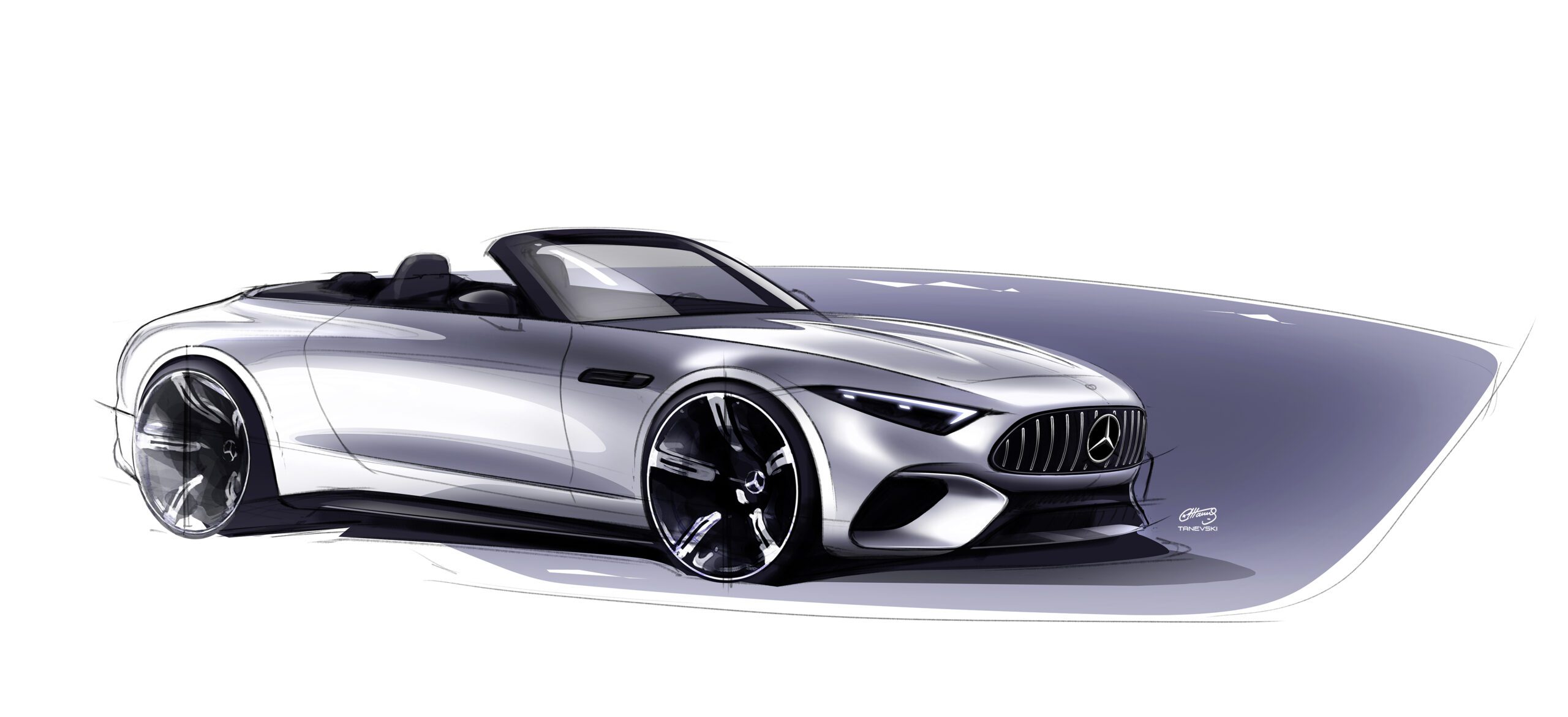
Design sketch of the Mercedes-AMG SL
Performance Hybrid in Development
Mercedes-AMG will also eventually be offering the SL as a powerful Performance hybrid drive. The AMG E PERFORMANCE drive strategy is guided by its principle of providing an electrified powertrain that improves driving dynamics and efficiency.
Transmission
The AMG SPEEDSHIFT MCT 9G transmission brings together a satisfying gearshift experience with short shift times that is specially developed for the new SL. The former torque converter is replaced by a wet start-off clutch. It not only reduces the weight, but it also optimizes the response of the accelerator pedal commands due to its lower inertia especially during spurts and load changes.
In its almost 70-year history, this is the first time that the SL will be available with an all-wheel drive system. As standard, the two V8 models will have the AMG Performance MATIC+ all-wheel drive technology. The intelligent system brings together the advantages of different drive concepts: the fully variable torque distribution to the front and rear axles guarantees optimal traction until its physical limit. The driver can depend on high handling stability and safety in all conditions.
Suspension and Brakes
The newly developed AMG RIDE CONTROL steel suspension with very capable aluminum shock absorbers and lightweight coil springs will come as standard on the SL 55 4MATIC+.
As another first, the series-production Mercedes-AMG will also be equipped with a multi-link front axle with five links arranged completely within the rim, greatly improving the kinematics. A 5-link design also controls the wheels at the rear axle.
Making its debut in the SL 63 4MATIC+ is the innovative AMG ACTIVE RIDE CONTROL suspension with active, hydraulic anti-roll stabilization. Its biggest innovation is the introduction of Active hydraulic elements that replaces the typical mechanical anti-roll bars and compensate for rolling movements of the new SL in milliseconds. The system also provides optimal steering and load-change behavior with the AMG-typical driving characteristics in terms of precision, dynamics, and feedback for the driver. It also improves on ride comfort with driving in straight lines and over bumps.
The new AMG high-performance composite braking system also ensures great deceleration values and complete control. It responds excellently in short braking distances while also providing high stability- even in extreme stress. The new composite brake discs are more compact and lighter which makes it even better for brake cooling. The directional perforation is another innovation, aside from improved heat dissipation and lighter weight, it also gives faster response in wet conditions and has improved pad cleaning after braking.
Active rear-axle steering
Another first in the new SL is the active rear-axle steering that comes as standard. While steering, the rear wheels changes direction from the front wheels depending on the speed. They steer in the opposite direction for speeds up to 100 kph or they’ll steer in the same direction for speeds faster than 100 kph. This allows the system to provide agile and stable handling, characteristics that are contrasting without the rear-axle steering.
Other improvements include better vehicle control at the limits, while also lowering steering effort due to the more direct front-wheel steering ratio.
Six driving modes and AMG DYNAMICS
The AMG DYNAMIC SELECT provides six driving modes: Individual, Comfort, Slippery, Sport, Sport +, and RACE. The RACE driving mode comes as standard in the SL 63 4MATIC+, while the AMG DYNAMIC PLUS can be added as an option for the SL 55 4MATIC+. The six modes give a variety of vehicle characteristics from comfortable to dynamic.
Each driving mode provides a different driving experience tailored specifically for different driving conditions. The SL models also feature the AMG DYNAMICS as a feature of the AMG DYNAMIC SELECT driving modes. The integrated vehicle dynamics control broadens the stabilizing functions of the ESP® with the agility-enhancing intervention in the steering characteristics, all-wheel control, and more ESP® functions. When cornering at speeds, the inner rear wheels get a brief braking intervention through a defined yawing motion around the vertical axis for responsive and precise entry into the bend. The spectrum ranges from highly dynamic to extremely stable.
SL range of equipment
The new SL offers a wide variety of equipment details and options for individualization that can accommodate a variety of customer preferences from the luxurious-elegant to the sporty-dynamic. They offer twelve paint color options including two exclusive SL paints, the Hyper Blue metallic and the MANUFAKTUR Monza Grey magno. It has three roof color variants, and a lot of new wheel designs that make the choice a whole new exciting experience.
There are three exterior design packages on offer to fit better with the customer preference from the more elegant to the more dynamic.
As a standard, the SL 55 4MATIC+ will have a 19-inch AMG multi-spoke alloy wheels, but it can also come in silver or matt black as an option. The SL 63 4MATIC+ has a 20-inch AMG 5-twin-spoke alloy wheels. There are nine different variants of wheels to choose from including two aerodynamically optimized 20-inch options in 5-twin-spoke or multi-spoke design. There are also the 21-inch AMG forged wheels in a 5-twin-spoke design and a 21-inch AMG alloy wheels in a 10-spoke design, both will be offered in two color variants.
Driving assistance systems and MBUX
The new roadster is equipped with a driving assistance system that can observe the traffic and its surroundings using the numerous sensors, radars, and cameras. The intelligent helpers can intervene at lightning speed if necessary. As seen in the current Mercedes C-Class and S-Class generations, a lot of new or enhanced systems help support the driver in everyday situations like distance control, assistance for speed adaptation, steering and lane changes.
The assistance systems have the capability to respond to impending collisions when the situation demands. The instrument cluster has a new display concept that visualizes how the system functions.
The new assistance display in the instrument cluster is transparent and comprehensive in showing how the driving assistance systems work in a full-screen view. The instrument cluster shows the driver their own car, the lanes, lane markings, and other things on the road like other cars, trucks, and two-wheelers in an abstract 3D way. The system status and assistant operations are shown in this depiction of the surroundings. The new animated assistance display uses a 3D scene generated in real time. The dynamic, high-quality render makes the driving assistance systems operation transparent as an augmented reality experience.
Connectivity Services
The Mercedes-Benz User Experience (MBUX) infotainment system provides extensive intuitive operating options and a lot of digital services from Mercedes me connect. Its features include the intuitive operating concept through touchscreen or touch control buttons on the steering wheel, hands-free system via Bluetooth connection, smartphone integration of Apple CarPlay and Android Auto, and digital radio (DAB and DAB+).
Customers already have access to connectivity services like the Live Traffic Information, but the Mercedes me connects helps the SL become more intelligent overall. Additional functions can be used before, during, and after the drive.
All that is needed is to have the roadster linked to a Mercedes me account in the Mercedes me portal and accept the terms of use. Live Traffic Information and Car-to-X communication helps the customer navigate the roads with real-time traffic data. This helps the driver efficiently avoid traffic jams to save valuable time. Car-to-X communication allows connected vehicles to exchange information about traffic events.
Technical data1
Mercedes-AMG SL 63 4MATIC+
Engine
Number of cylinders/arrangement
–
8/V
Displacement
cc
3982
Rated output
kW/hp
430/585
at engine speed
rpm
5500-6500
Rated torque
Nm
800
at engine speed
rpm
2500-5000
Compression ratio
–
8.6
Mixture formation
–
Microprocessor-controlled petrol injection, twin turbocharging
AMG ACTIVE RIDE CONTROL suspension with semi-active anti-roll stabilisation, aluminium double wishbones, anti-dive control, coil springs and adaptive adjustable damping
Rear axle
AMG ACTIVE RIDE CONTROL suspension with semi-active anti-roll stabilisation, aluminium double wishbones, anti-dive control, coil springs and adaptive adjustable damping
Brake system
Hydraulic dual-circuit brake system; front 390 mm composite brake discs, vented and perforated, 6-piston aluminium fixed calliper; rear 360 mm composite brake discs, vented and perforated, 1-piston aluminium floating calliper; electric parking brake, ABS, Brake Assist, 3-stage ESP®
Steering
Electromechanical speed-sensitive power steering with rack and pinion, variable steering ratio (12.8:1 at dead centre) and variable power assistance
Wheels
front: 9.5 J x 20 H2; rear: 11 J x 20 H2
Tyres
front: 265/40 ZR 20; rear: 295/35 ZR 20
Dimensions and weights
Wheelbase
mm
2700
Front/rear track
mm
1660/1625
Length/height/width
mm
4705/1353/1915
Turning circle
m
12.84
Boot capacity
l
213-240
Kerb weight acc. to EC
kg
1970
Payload
kg
320
Tank capacity/of which reserve
l
70/10
Performance, consumption, emissions
Acceleration 0-100 km/h
sec.
3.6
Maximum speed
km/h
315
Combined fuel consumption, WLTP
l/100 km
12.7-11.8
Combined CO2 emissions, WLTP
g/km
288-268
Technical data1
Mercedes-AMG SL 55 4MATIC+
Engine
Number of cylinders/arrangement
–
8/V
Displacement
cc
3982
Rated output
kW/hp
350/476
at engine speed
rpm
5500-6500
Rated torque
Nm
700
at engine speed
rpm
2250-4500
Compression ratio
–
8.6
Mixture formation
–
Microprocessor-controlled petrol injection, twin turbocharging
AMG RIDE CONTROL suspension with aluminium double wishbones, anti-squat and anti-dive control, lightweight coil springs, stabiliser and adaptive adjustable damping
Rear axle
AMG RIDE CONTROL suspension with aluminium double wishbones, anti-squat and anti-dive control, lightweight coil springs, stabiliser and adaptive adjustable damping
Brake system
Hydraulic dual-circuit brake system; front 390 mm composite brake discs, vented and perforated, 6-piston aluminium fixed calliper; rear 360 mm composite brake discs, vented and perforated, 1-piston aluminium floating calliper; electric parking brake, ABS, Brake Assist, 3-stage ESP®
Steering
Electromechanical speed-sensitive power steering with rack and pinion, variable steering ratio (12.8:1 at dead centre) and variable power assistance
Wheels
front: 9.5 J x 19; rear: 11 J x 19
Tyres
front: 255/45 ZR 19; rear: 285/40 ZR 19
Dimensions and weights
Wheelbase
mm
2700
Front/rear track
mm
1665/1629
Length/height/width
mm
4705/1359/1915
Turning circle
m
12.84
Boot capacity
l
213-240
Kerb weight acc. to EC
kg
1950
Payload
kg
330
Tank capacity/of which reserve
l
70/10
Performance, consumption, emissions
Acceleration 0-100 km/h
sec.
3.9
Maximum speed
km/h
295
Combined fuel consumption, WLTP
l/100 km
12.7-11.8
Combined CO2 emissions, WLTP
g/km
288-268
[1] Technical data on power, torque, mileage, fuel consumption and emissions in this publication are provisional and have been determined internally in accordance with the applicable certification method. Confirmed TÜV figures, EC type approval and certificate of conformity with official figures are not yet available. Differences between the stated figures and the official figures are possible.
November 2, 2021 / Comments Off on The New Mercedes-AMG SL
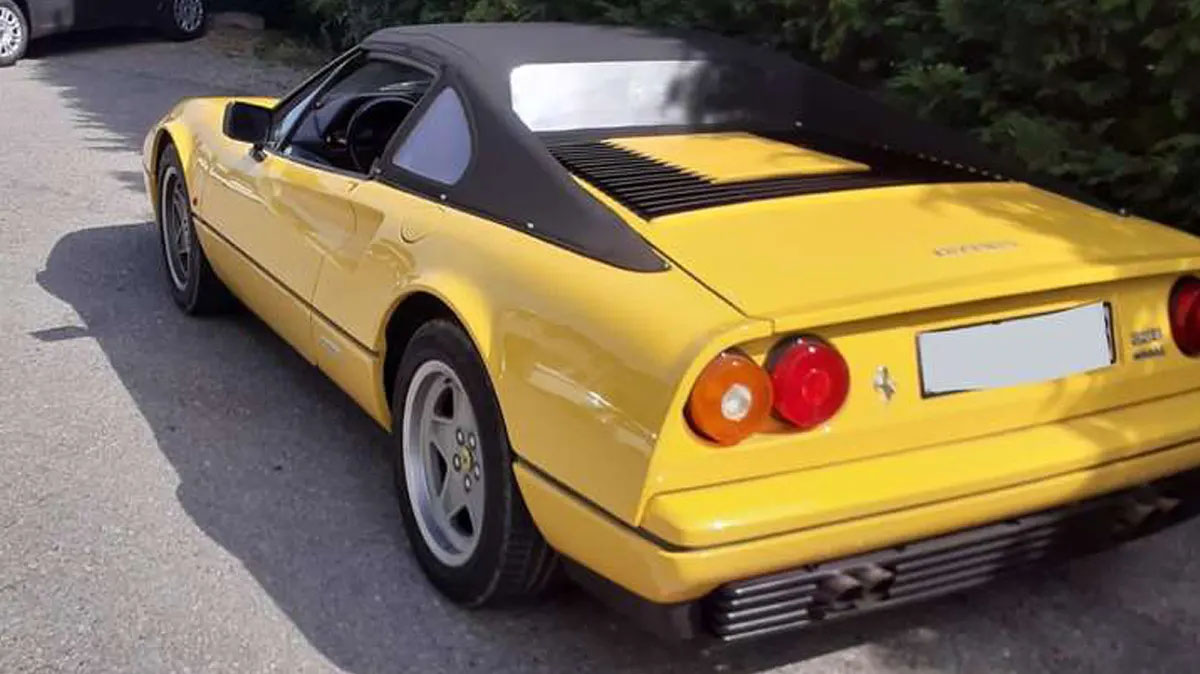
I know you’ve probably seen the rare Ferrari Spider conversions created in the Eighties by companies like Straman, but did you know that there are a few factory-made Testarossa Spider too? One was made specifically for Gianni Agnelli, but the Sultan of Brunei managed to convince Ferrari to make five more for him, and another six Ferrari F512 Spider, so those are very rare today, but how about a one-off 1984 Ferrari 328 Convertible?
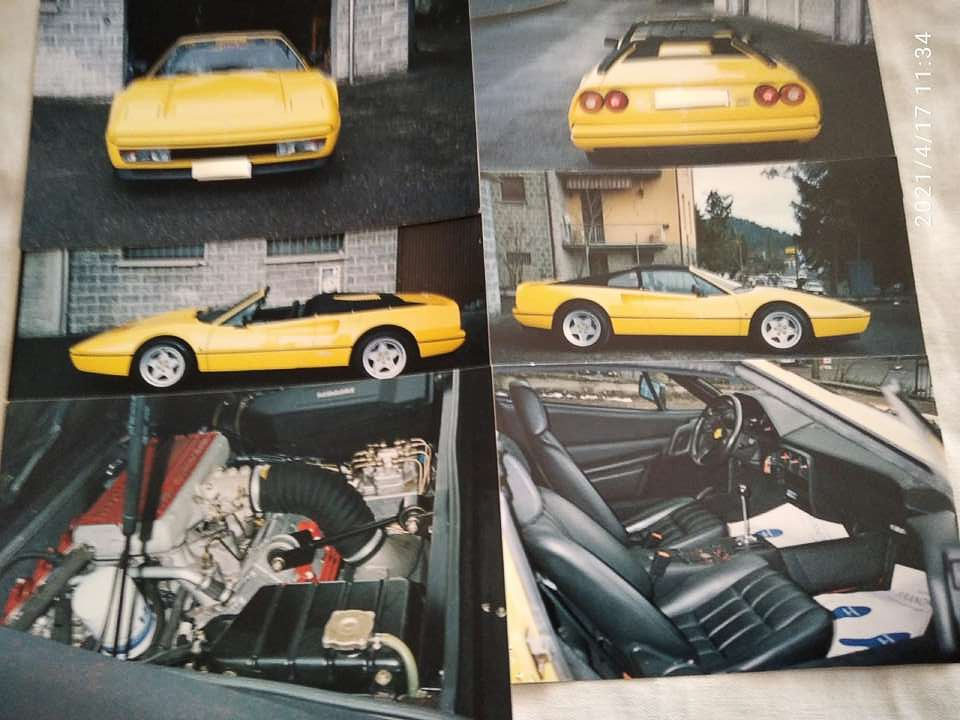
And no, this isn’t a third party conversion, this is actually a real, factory-made, one of a kind 328 Spider or Convertible, whichever you prefer, built on chassis number 49543, this unique Ferrari was finished in Giallo Modena over a Nero interior with matching soft top, and it’s listed for sale in Italy as you read this, but get this … asking price is €1,200,000 (about $1,300,000), while a regular Ferrari 328 GTS in good condition goes for €100,000 on average.
Back in 1984 Ferrari had the intention to replace their 308 with the updated 328 version, named after the 3.2-Liter V8 engine used, and while the 308 came in GTB (closed coupe) and GTS (targa top convertible), Ferrari wanted to offer a full convertible in the 328 series too, so the development prototype for this model was built on chassis 49543, and because they already had the necessary experience with both closed and targa-style cars, they made the development car into a convertible.
A design by renowned Pininfarina, the production-ready 328 Convertible prototype was built by Ferrari’s own Carrozzeria Scaglietti in Modena and went through the full certification path, it was even registered for road use so they could test the new 3.2-Liter engine regarding performance and to see how the improved chassis would handle the extra power.
But the marketing department at Ferrari canceled the 328 Convertible before it ever reached production, they went along with only the 328 GTB and 328 GTS of which 7,412 would be built in the end, the reason we didn’t get a 328 Convertible was simple … marketing feared it would eat into sales of the Ferrari Mondial Convertible that was available at the same time.
Usually, a development prototype like this is kept as a test mule, mostly going through some harsh long-term testing, and subsequently, the car gets destroyed or ends up in the factory museum, but this yellow Ferrari 328 Convertible somehow got sold to a client who drove it for many years, today the 272 hp V8 has covered 14,000 km and is listed for sale in Reggio Emilia.
We tend to look at all-wheel drive as one of more recent automotive inventions, but its roots could be traced way back to the dawn of motorsports years and the 1903 Spyker 60-HP four-wheel drive racing car. But this drivetrain found its ground in rallying, courtesy of the ice breaking Group B Audi Quattro and Lancia Delta that followed.
In between Spyker and Audi, a number of engineers and companies have experimented in the earlier eras of motorsport, trying to make cars faster around the tracks. But as many have found out, this system didn’t always give contenders the edge. Later on, all-wheel drive was heavily regulated and more or less unanimously dismissed, but some cars in recent years used power on both axles to their advantage.
Given that all-wheel drive cars were much more successful in rallying than in closed course racing, a number of cars on the list were chosen for interesting backstories, unique engineering solutions and cool effect rather than results in their respective competition formats. So, let’s go!
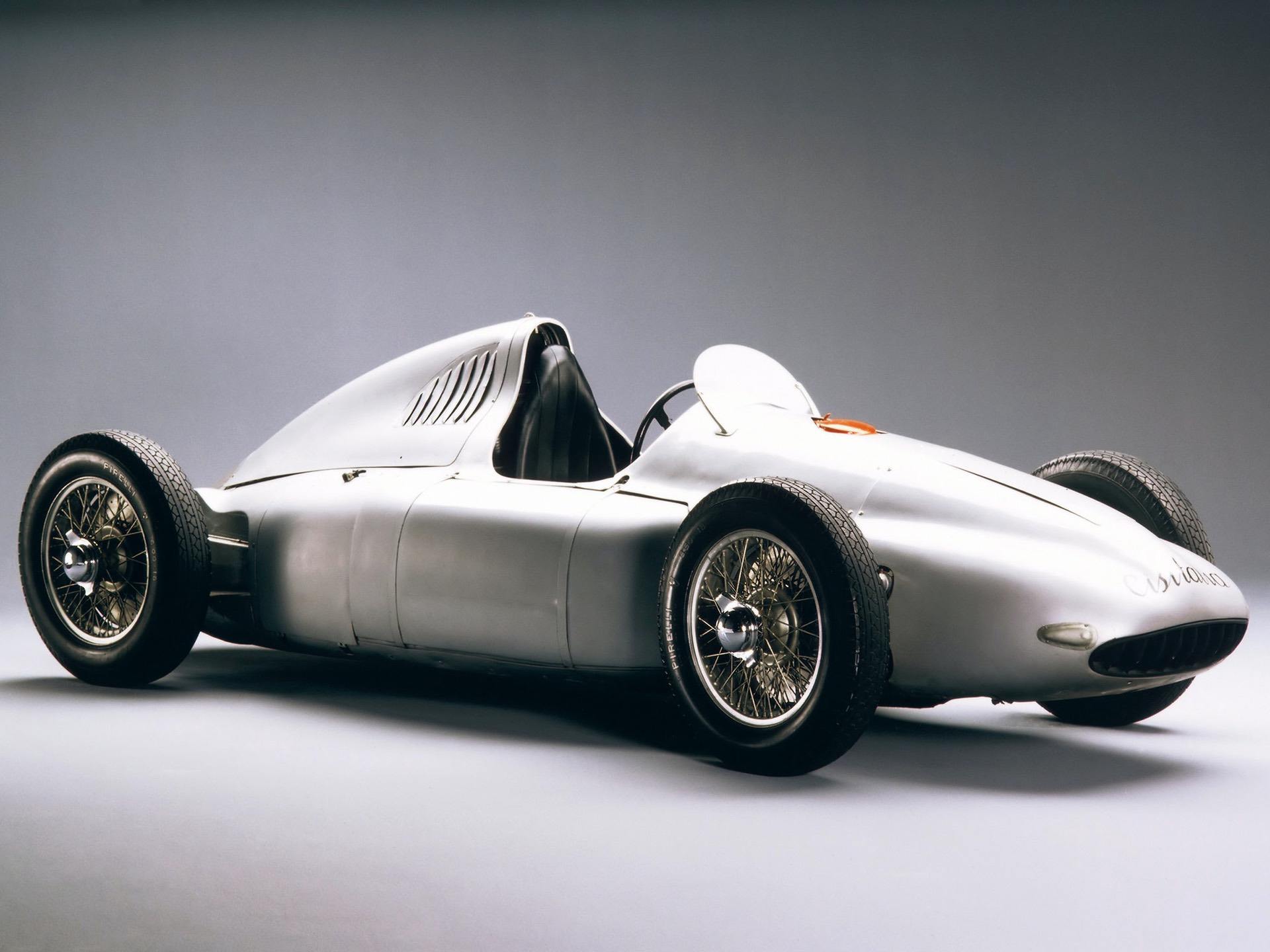
Non-Rally AWD Race Car #1: Porsche Cisitalia Typ 360
Cisitalia is a name highly respected for its immense impact on the modern sports car world, yet rarely known outside of enthusiast circles. The reason for that are financial troubles that stranded Piero Dusio’s quest to produce Italy’s finest automotive marque.
Anyway, if you think the 959 PSK was the first all-wheel drive system engineered by the Porsche family, you’d be wrong, because the Cisitalia Typ 360 open wheel racer came way earlier. By far the most advanced car of the post-WW2 Grand Prix revival era, this mid-engined open wheeler was designed by Ferdinand Porsche himself through 1946 and 1947.
The Typ 360 featured a supercharged 1.5-liter flat-12, a sequential manual gearbox and selectable all-wheel drive, allowing the driver to activate the system whenever they deemed necessary.
Sadly, the Typ 360 never got to race as it was faced with Dusio’s bankruptcy, but the lone example was fortunately preserved, and it now resides in the Porsche Museum.
The early 1960s were a turning point for race cars as an increasing number of open wheelers turned to mid-engined layout, which proved to offer far better weight distribution, thus improving overall performance. Among those revolutionary cars, one front-engined Formula 1 car stood apart for going in the exact opposite direction.
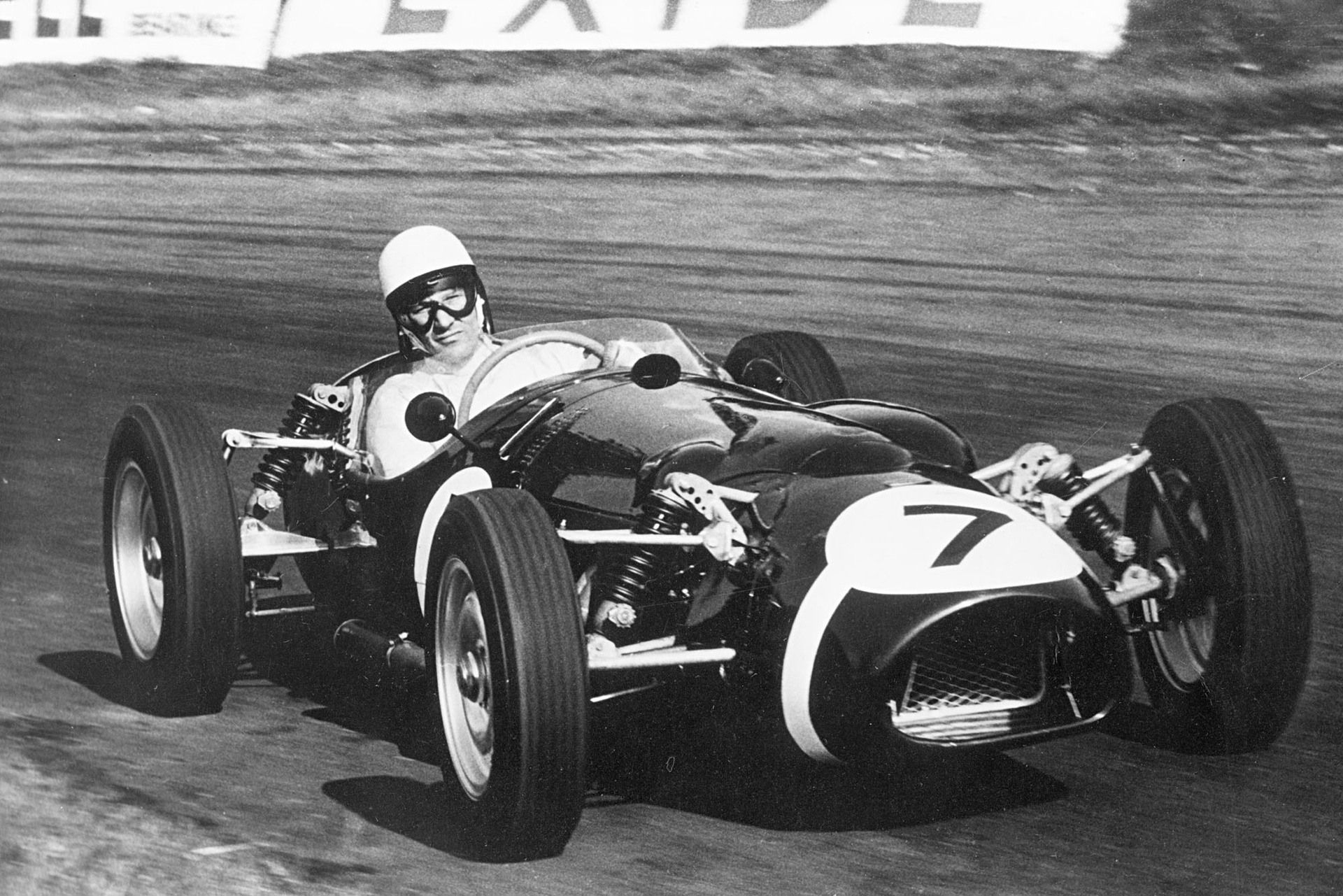
The Ferguson Climax P99 was a car envisioned by racer Tony Rolt and through working with Claude Hill and Harry Ferguson, the P99 was born. Sadly, Ferguson didn’t see the car in action as he passed in 1960, but the work on the car was completed for the 1961 season.
The Ferguson Climax P99 had less than a stellar debut at the 1961 British Empire Trophy, crashing on lap 2 of its inaugural race, only to be disqualified from the 1961 British Grand Prix, the next event it appeared on. However, at the 1961 International Gold Cup event at Oulton Park, Sir Stirling Moss drove it to victory, the first for an all-wheel drive Formula 1 car and the last for a front-engined one.
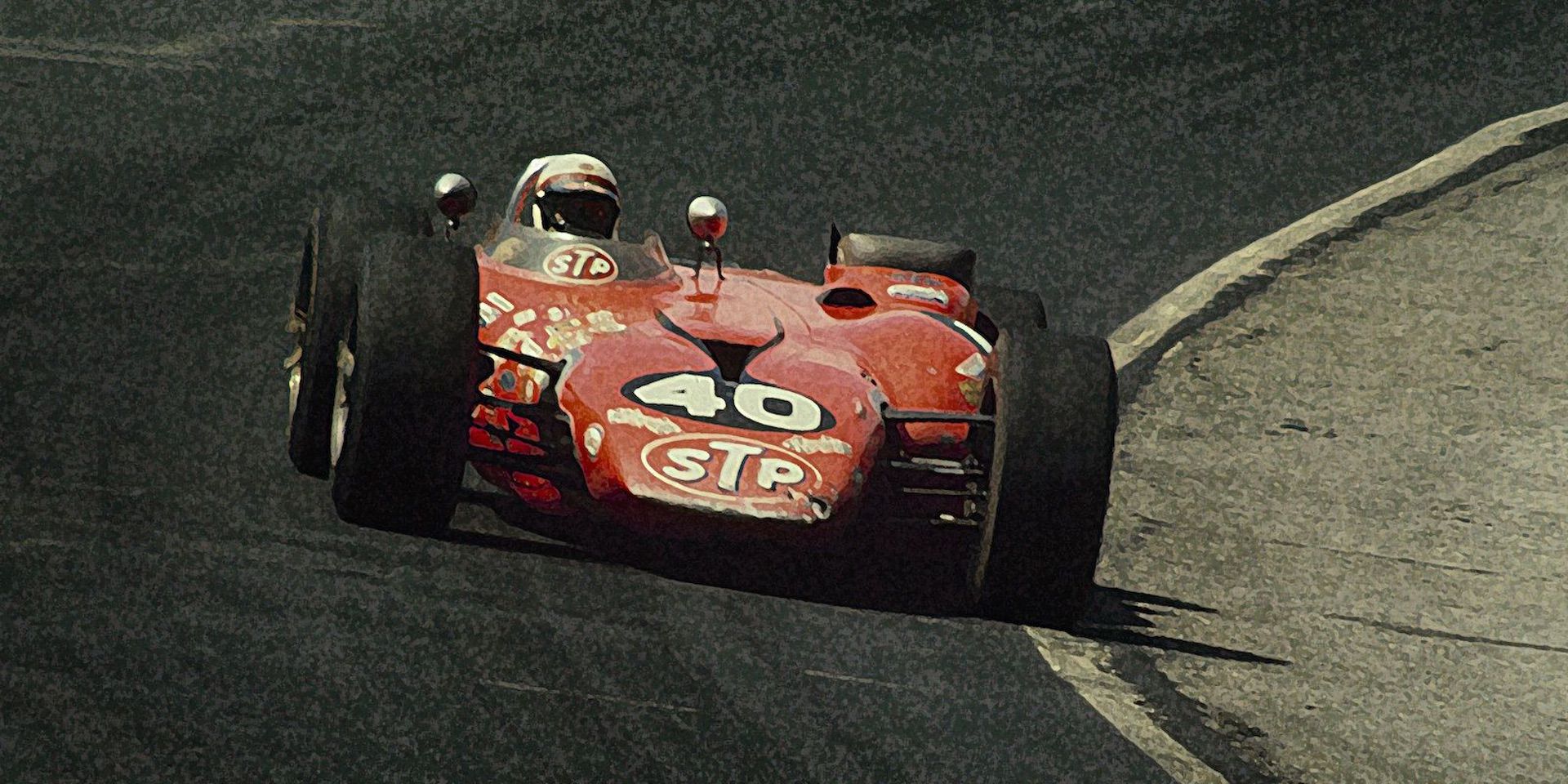
The late 1960s were an era of freedom and wild experiments even in the racing world, meaning turbine-powered cars were a thing for a few visionary constructors. Conceived by Ken Wellis and backed up by Andy Granatelli of STP fame, the STP-Paxton Turbocar, or Silent Sam as it was dubbed by the press, was one of the most advanced racing cars of its era.
Powered by a 500 horsepower ST6B-62 gas turbine engine with no clutch or gearbox and with Ferguson all-wheel drive, the Turbocar put on a show at the 1967 Indianapolis 500, where Parnelli Jones led throughout the race—until the transmission gave out with just eight miles to go. The car raced once more at the 1968 Indianapolis 500, but with no success as its driver Joe Leonard crashed it during practice.
A modified version of the same engine was used to power the Lotus Type 56 experimental Grand Prix car which also featured all-wheel drive. Colin Chapman first campaigned the car at the 1968 Indy 500. In Formula 1, the Type 56 had its best result at the 1971 Italian Grand Prix, where Emerson Fittipaldi piloted it to eighth place.
Non-Rally AWD Race Car #4: Matra MS84
Via: Wikipedia.
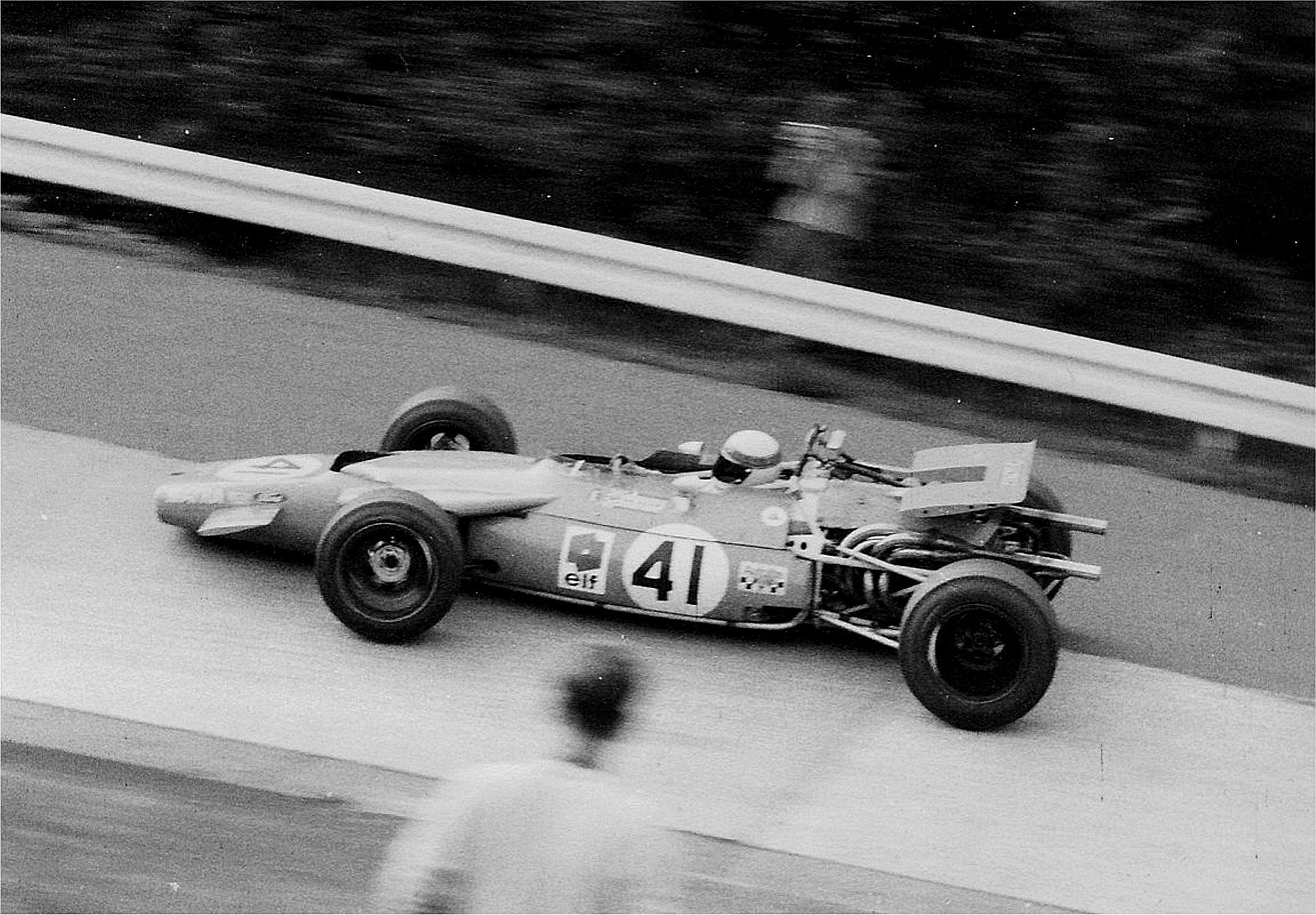
Be it in civilian use or on the racetracks, Matra was well-known for unorthodox and experimental cars, so it’s no wonder it had a foray into all-wheel drive Formula One cars during the late sixties.
The Matra MS84, a predecessor to the 1970 Matra-Simca MS 120, was more related to Jackie Stewart’s 1969 championship-winning MS80, built on a steel tubular chassis rather than aluminum monocoque. The Cosworth V8 was mated to Ferguson all-wheel drive system and the front brakes were moved inboard as well.
Despite all the efforts, the MS84 didn’t prove successful, with Johnny Servoz-Gavin scoring sixth at the 1969 Canadian Grand Prix. It was, however, the best result for a rear-wheel drive car at that event.
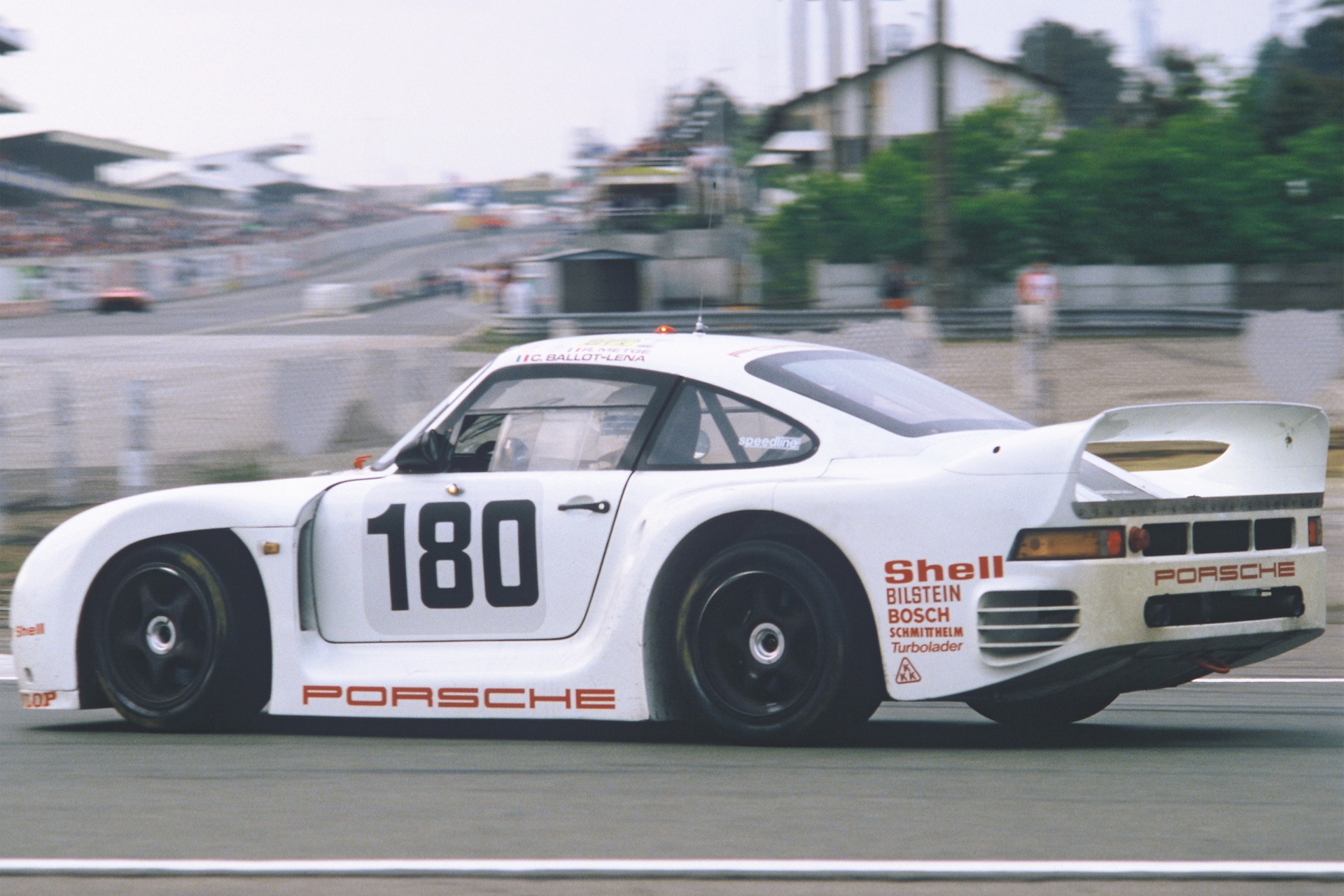
The highly advanced Porsche 959 proto-hypercar was designed to conform to FIA’s Group B regulations and as such it featured a highly advanced all-wheel drive system (PSK).
The Group B rulebook applied both to close circuit racing and rallying, so Porsche eventually outed the 959’s racing derivatives to two of the most famous events in each discipline. The rallied-up 959 won the 1986 Dakar Rally, while the Porsche 961 entered the 1986 24 Hours of Le Mans, finishing at respectable seventh overall.
The 961 had two more appearances, at the 1986 24 Hours of Daytona and 1987 24 Hours of Le Mans—where it eventually crashed and caught fire, prompting Porsche to cancel the project for the remainder of the season. Today, this car is on display at the Porsche Museum, finished in its iconic Rothmans livery.
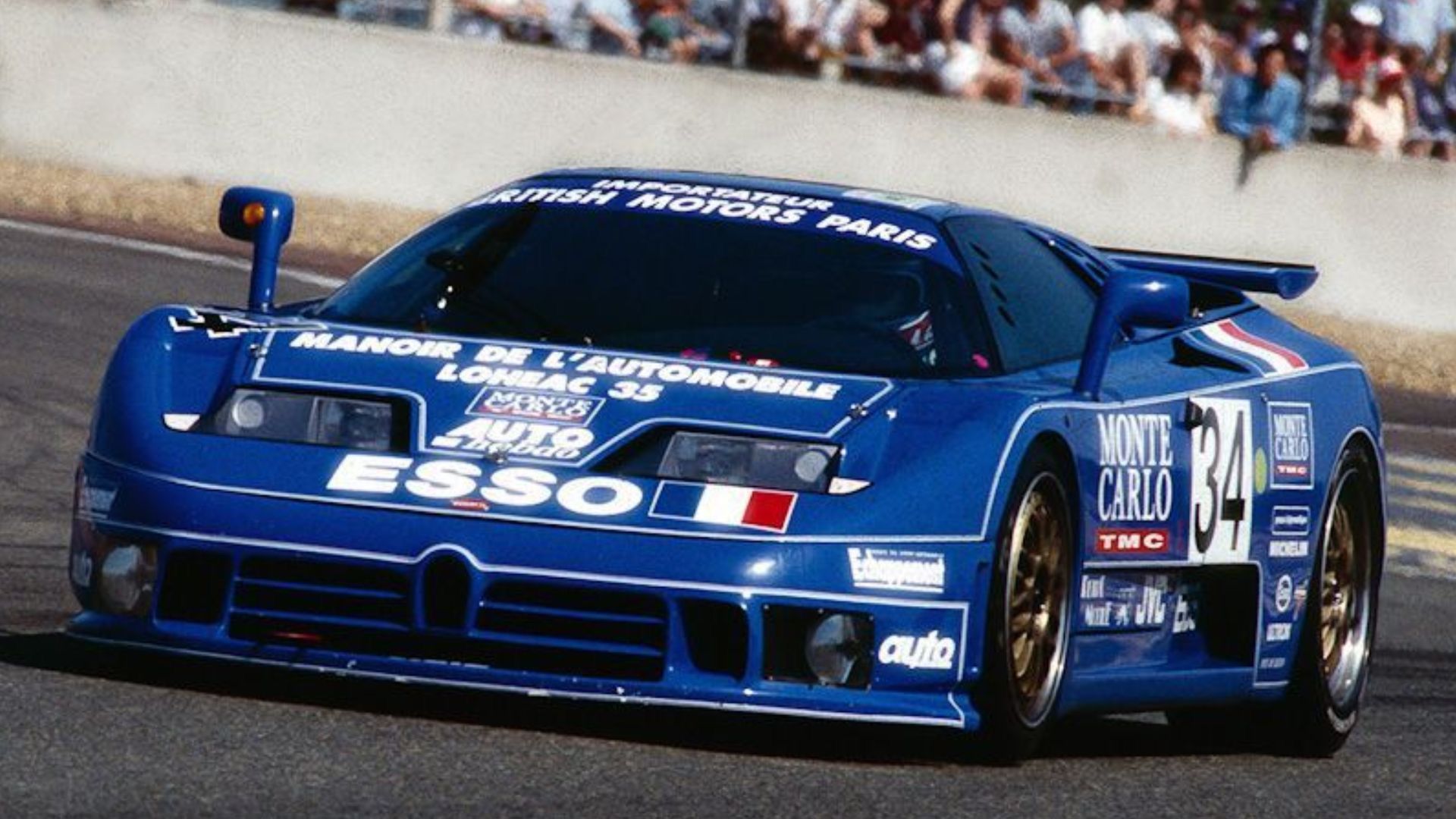
The Porsche 961 wasn’t the only four-wheel drive supercar to test its sophisticated mechanics on the world’s most famous endurance race, since the Bugatti EB110 SS famously entered the 1994 24 Hours of Le Mans. Competing in the GT1 category, it showed heroic pace, qualifying 5th in its class and 17th overall.
Team owner Michel Hommell and engineers from Campogalliano managed to shed more than 600 lb of weight in order to retain the EB110’s all-wheel drive system. Sadly, a number of mechanical troubles plagued this independent entry on the very race day, starting from the fuel tank leak in the opening stages of the race all the way to turbo failures.
Hommell’s dreams of returning Bugatti to its glorious days at Le Mans finally came crashing down in the closing hours of the race when a punctured tire caused the car to crash, rendering it unable to finish.
Non-Rally AWD Race Car #7: Audi 90 Quattro IMSA GTO
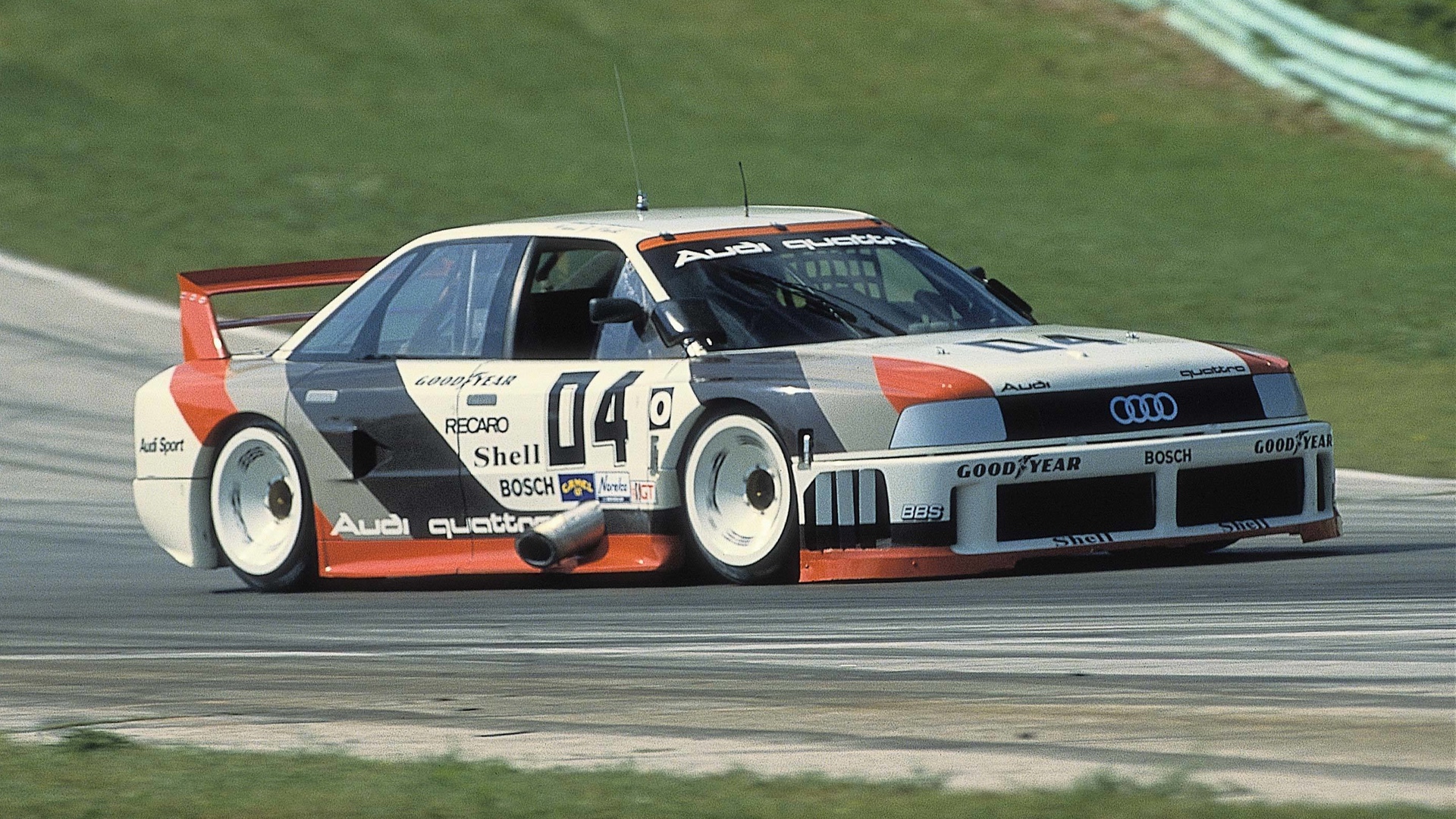
Audi so utterly dominated the 1988 Trans-Am series in a 2.2-liter compact sedan that the governing body banned it for the subsequent season, but how did that exactly happen? The secret (or not so much, given that the car had the word “quattro” inscribed literally all over it) was in the car’s all-wheel drive.
The 500-odd horsepower machinery was powered by a longitudinally mounted inline-five sending power to all four wheels via a center Torsen differential and limited slip differentials in the front and rear. Give that rally-dominating technology to world-class drivers Hurley Haywood, Hans-Joachim Stuck, and Walter Rohrl, and you’ll end up with 8 wins in 13 races.
Following the 1988 ban, the car moved to the IMSA series, where Audi’s engineers modified the base car even further into a carbon composite silhouette racer on a tubular frame with upwards of 700 German ponies. Missing the season-opening Sebring and Daytona due to the car still being in development, Audi finished the season in second place mainly thanks to Haywood and Stuck’s phenomenal driving.
The 1989 season was also the final one for the Audi 90 Quattro IMSA GTO, as Audi focused on the domestic DTM racing championship, giving America one of the sleekest, coolest and most capable import race cars of all time.
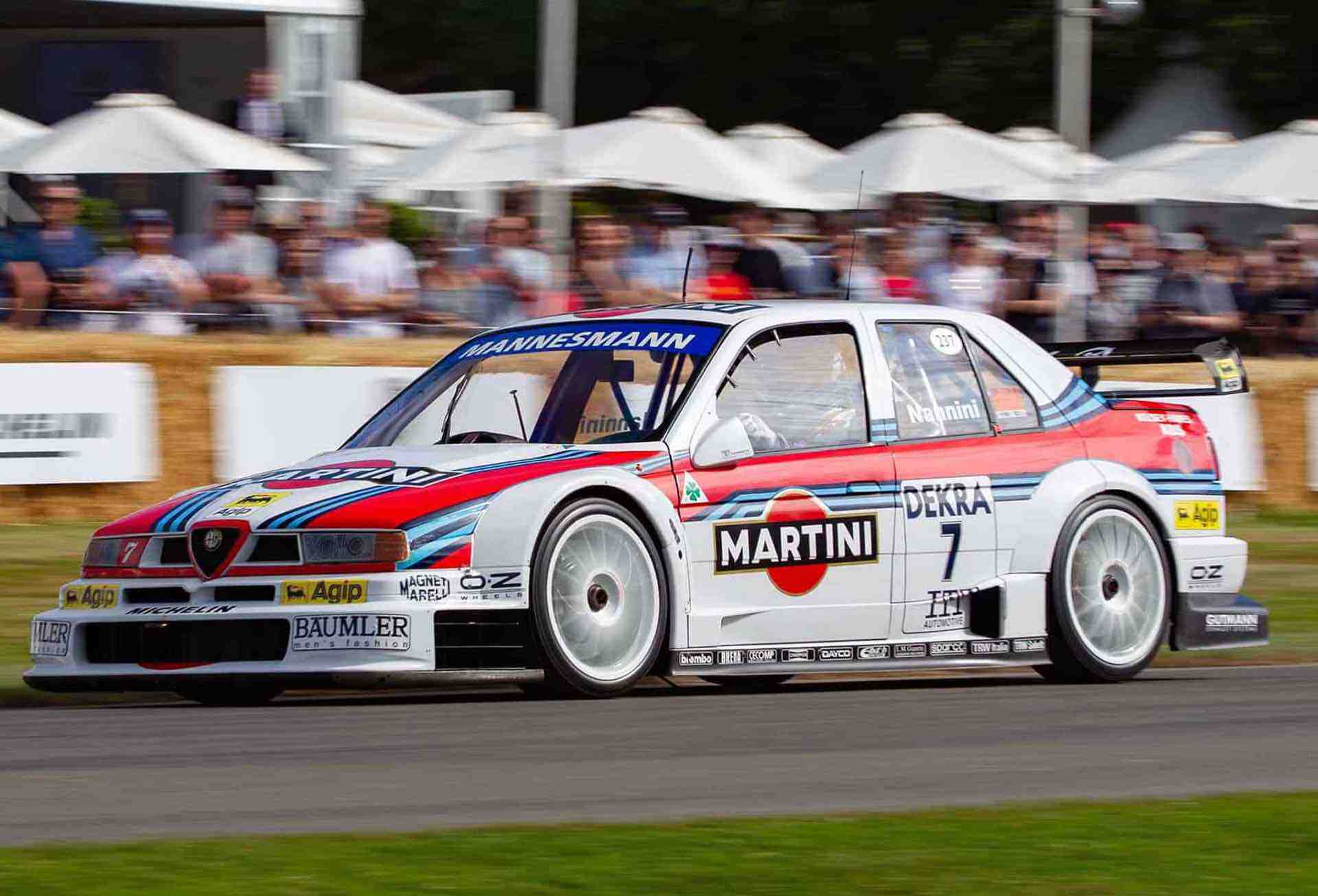
In 1993 FIA introduced Class 1 and Class 2 Touring Cars, with the former allowing a greater degree of liberty, effectively turning touring cars to silhouette racers rather than race-ready variants of their respective roadgoing counterparts. For Alfa Corse, that meant only one thing: thoroughly re-engineering the already competitive 155 sedan it campaigned in the DTM championship.
The new Alfa Romeo 155 initially got a longitudinally mounted 60° 2.5-liter V6 producing astonishing 420 horsepower at 11,500 RPM, while the power figures grew to 483 horsepower at 11,900 RPM in 1996, courtesy of a new 90° 2.5-liter V6. The all-wheel drive was sourced from none other than the Lancia Delta Integrale HF, the most dominating rally car of the era.
In 1993, Nicola Larini dominated the championship, yet himself and Alessandro Nannini had to settle for third and fourth respectively in the 1994 season. Year 1995 didn’t bring much for Alfa Romeo, and for 1996, DTM was merged into a series dubbed International Touring Car Championship with only three entries: Opel, Mercedes-Benz and Alfa Romeo.
Even though Opel won the 1996 ITC, hardly anyone remembers. The Martini-branded Alfa 155 was the car everyone remembered this series for.
Non-Rally AWD Race Car #9: Audi R18 e-tron quattro
Via: Audi AG.
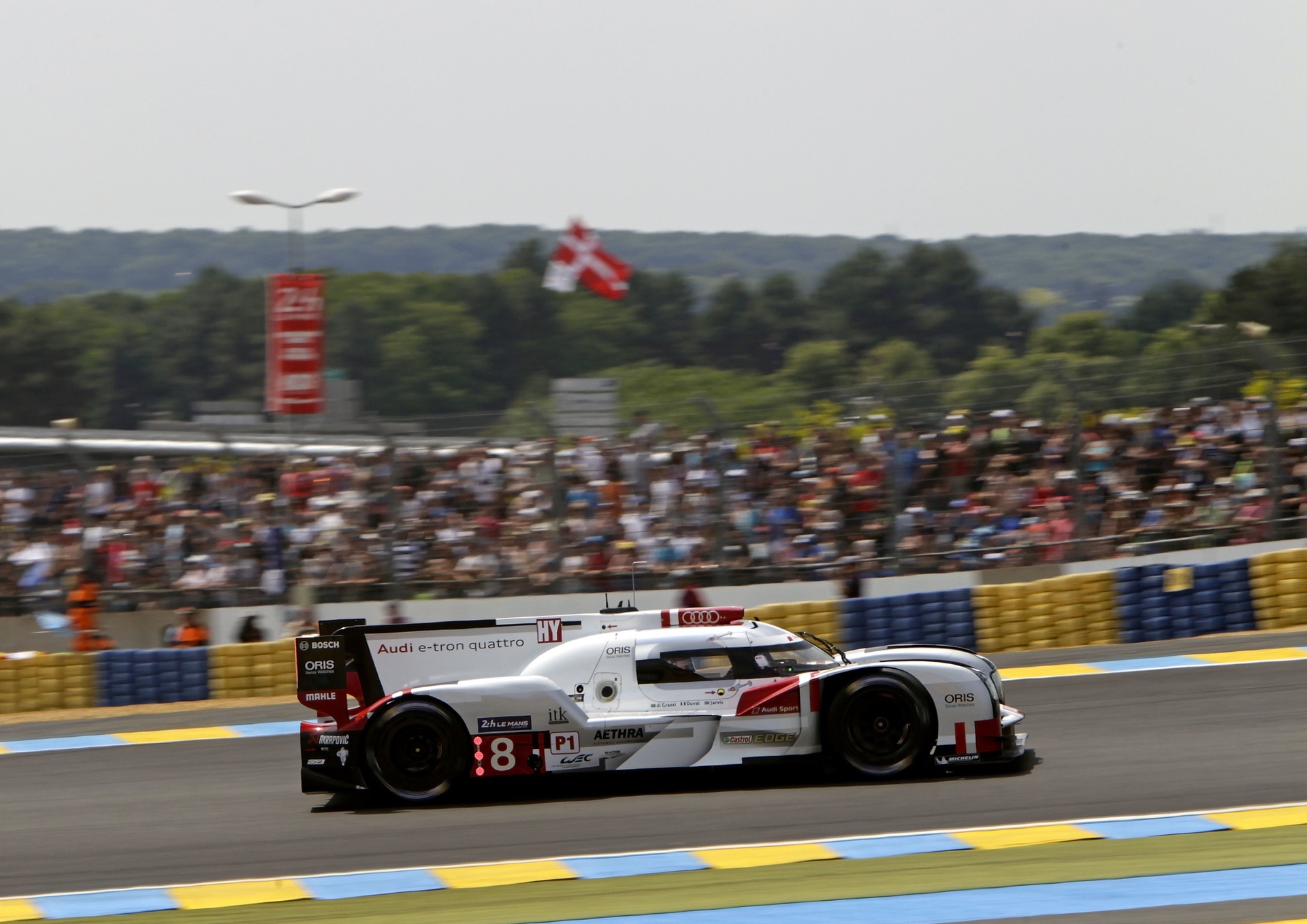
Looking back at Audi’s touring car efforts, it seems that quattro was the only all-wheel drive system successful both in rallying and track racing. Another testament to this claim is a Le Mans-conquering R18 e-tron quattro.
The utmost evolution of the R18 LMP1 prototype, the R18 e-tron quattro was a 3.7-liter V6 diesel-hybrid in which the front wheels were driven by energy accumulated during braking. As per the regulations, the power on the front axle was available only during speeds upwards of 75 mph, meaning that the R18 e-tron quattro didn’t have permanent all-wheel drive like other cars on the list.
Still, this car is remembered for its great results. The R18 e-tron quattro won at the Le Mans in 2012, 2013 and 2014 marking the end of an era for Audi domination in the WEC championship. After Audi, Porsche had its winning streak with the equally impressive 919 Hybrid prototype.
Non-Rally AWD Race Car #10: Toyota TS050 Hybrid
Via: Toyota.
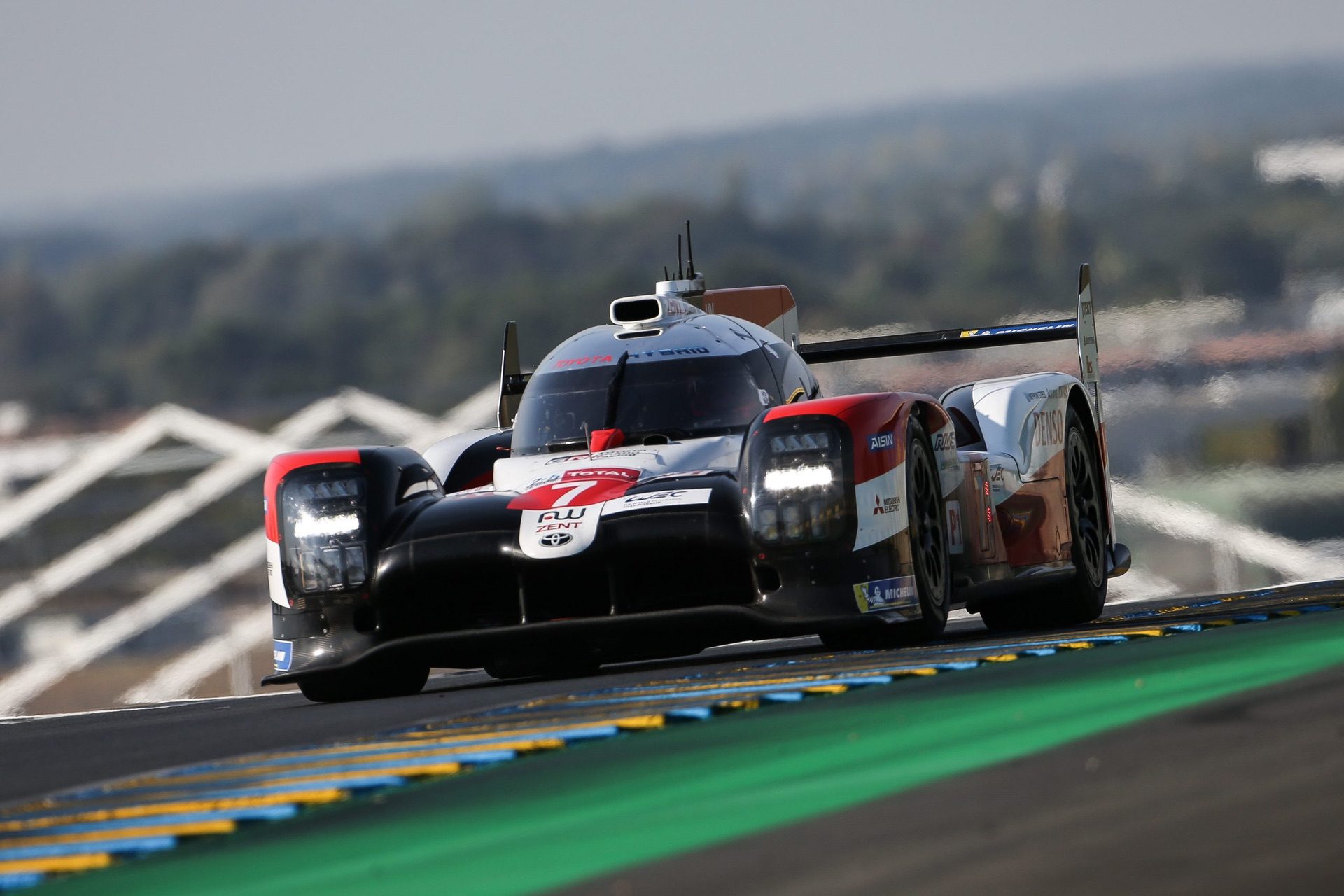
Toyota’s bid to prove itself as a top contender in motorsports produced its first results in 2018, when the Japanese giant finally tasted victory at the 24 Hours of Le Mans after narrowly missing the title in 2016 and 2017. Toyota repeated its success in 2019 and 2020 as well, and the car which brought it victory was the TS050 Hybrid.
The Toyota TS050 utilized a mid-mounted 2.4-liter twin-turbocharged petrol V6 and two motor generator units—one powering the front axle and the other sending additional oomph to the rear. A combination of power, reliability and experienced crews led the TS050 Hybrid to become only the second Japanese car to win at the Le Mans, the first being Mazda 787B in 1991.
After the TS050 had its three back to back victories, Toyota claimed another Le Mans title in 2021 in the new Hypercar class with the GR010, a car with a bright future at the Circuit de la Sarthe.
November 1, 2021 / Comments Off on Top 10 Non-Rally All-Wheel Drive Race Cars
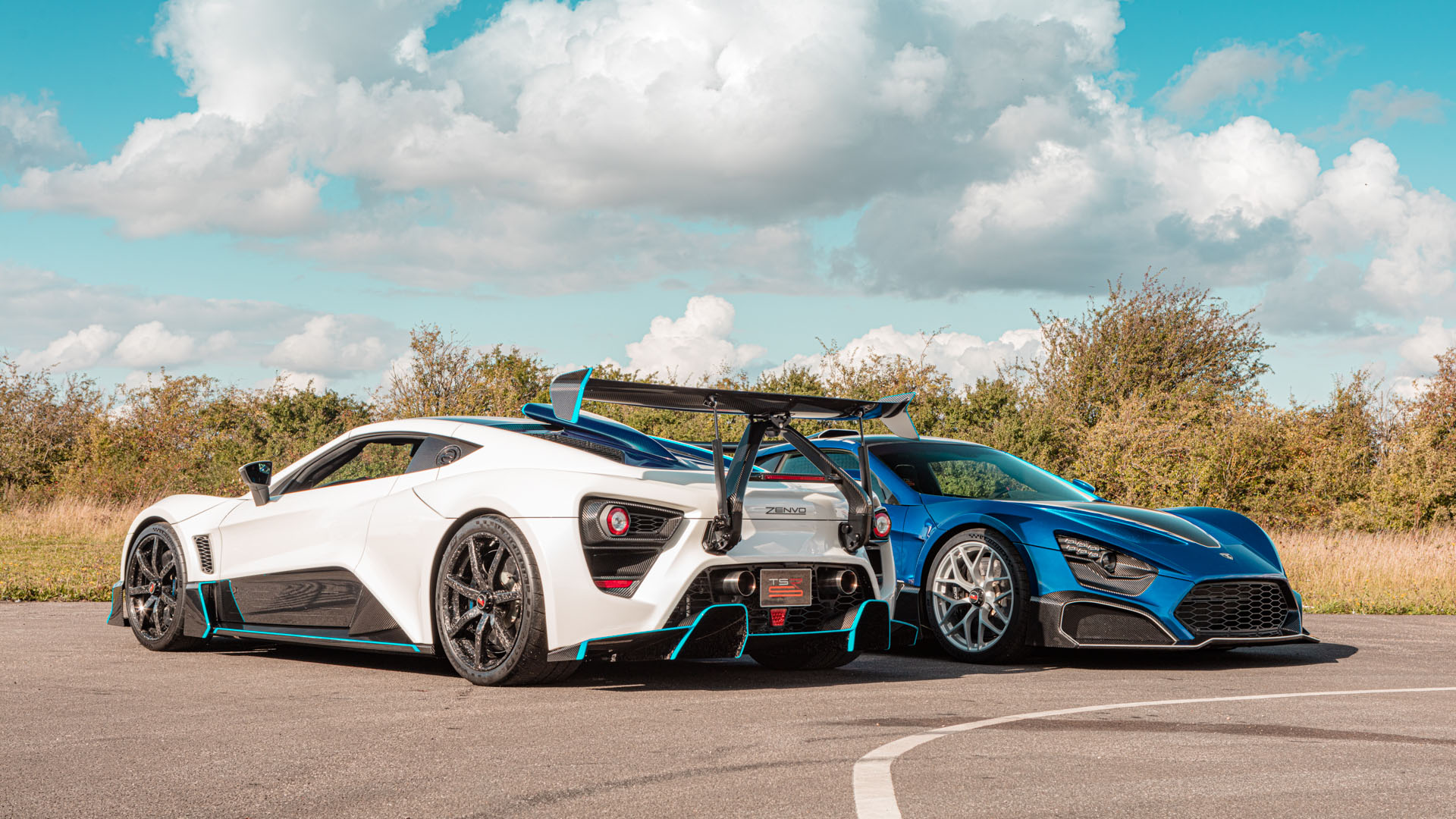
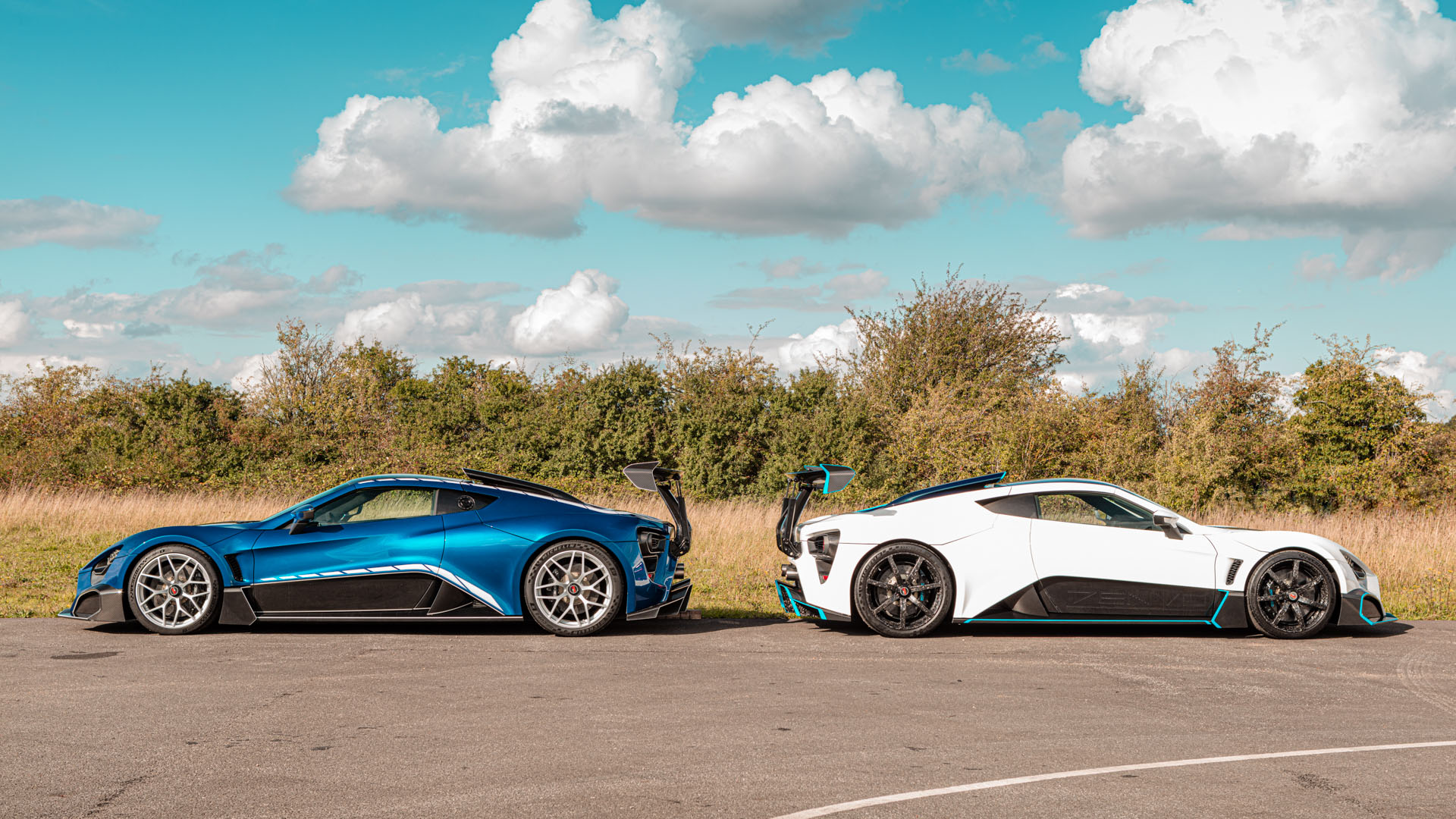
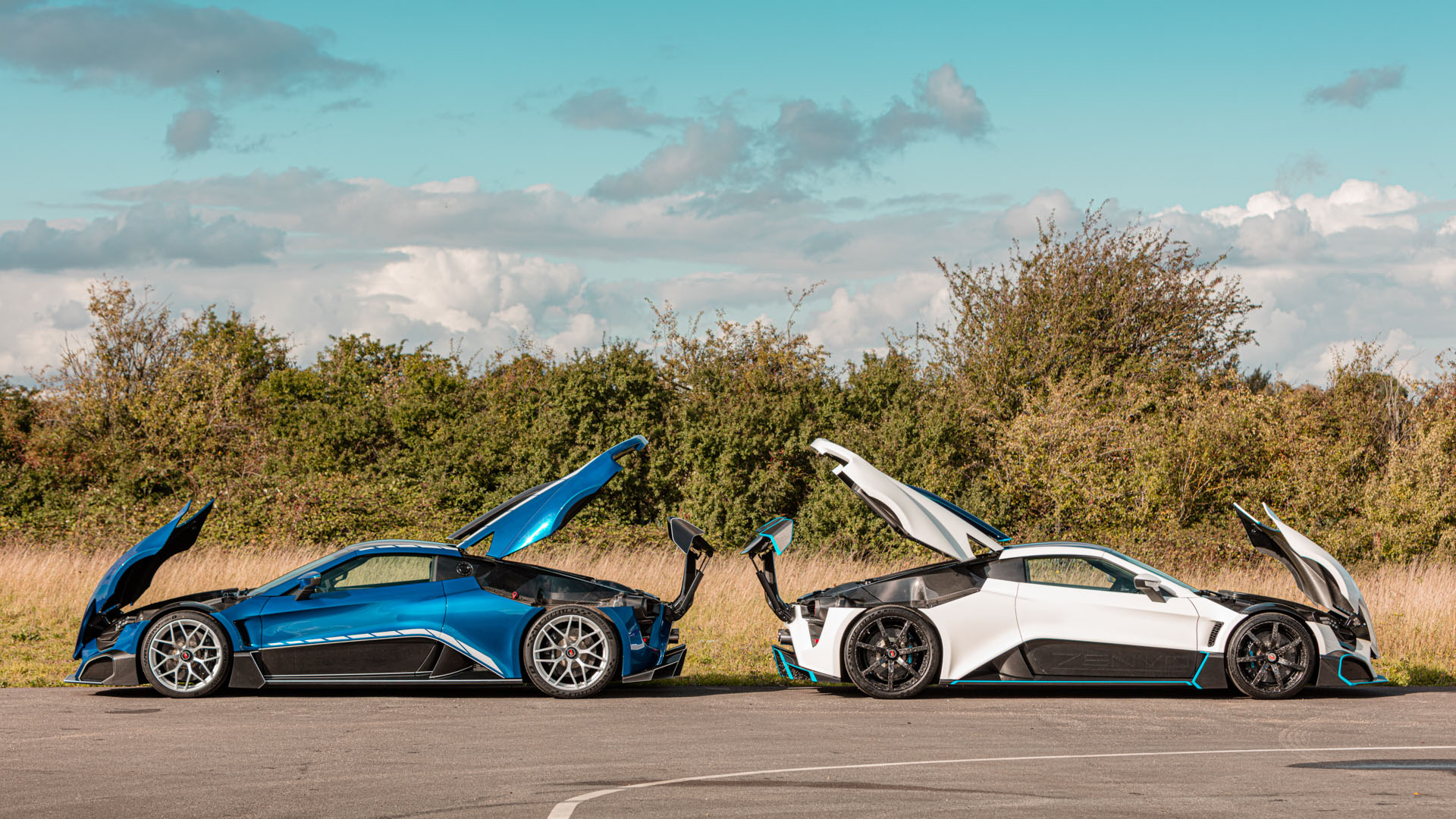
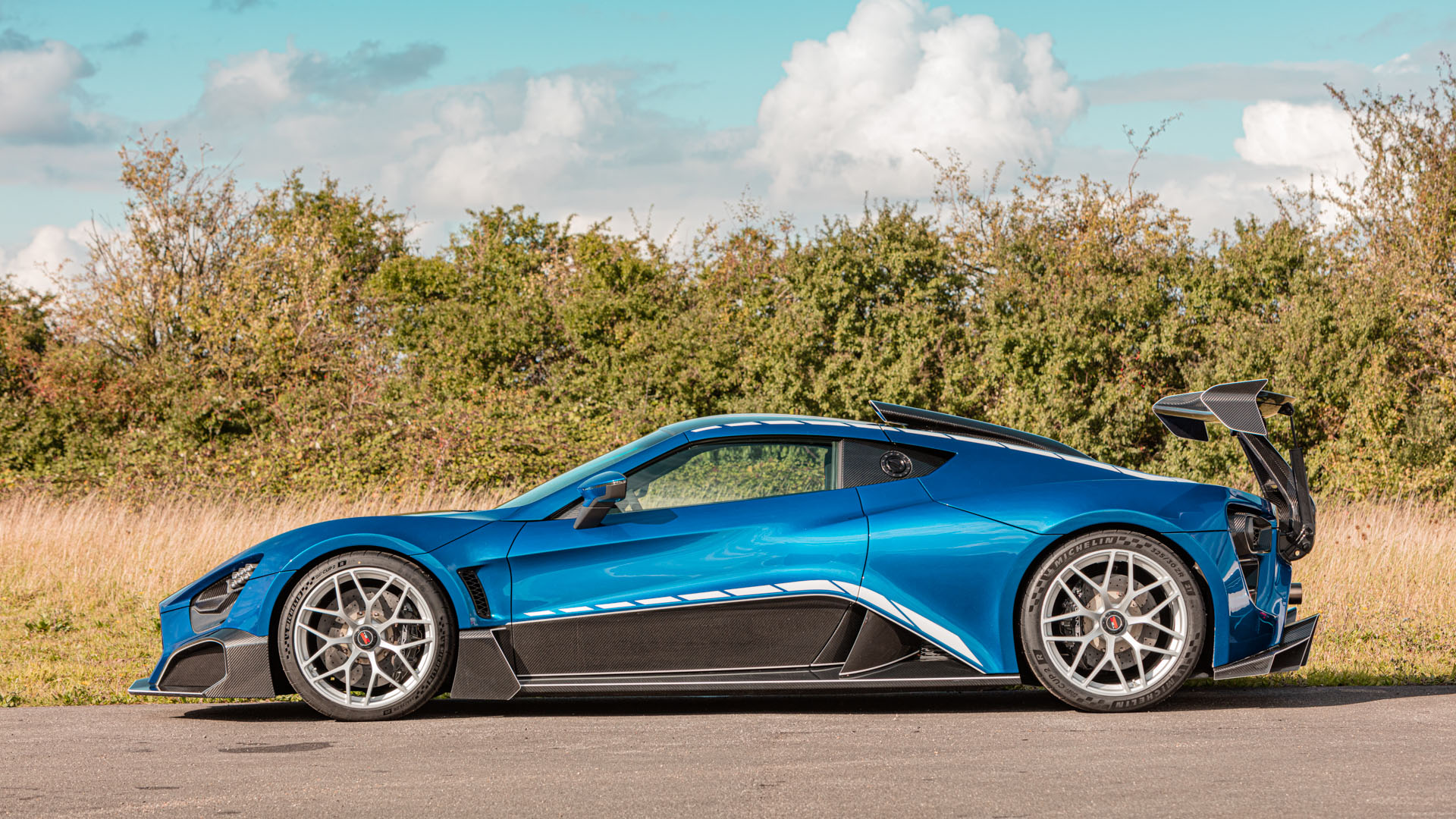
Zenvo Automotive was founded in 2007 in Præstø, Denmark with the intention of building limited-edition hypercars, the first prototype was the TS1 that was developed into the TS1 GT, a TSR track-only car and the ultimate flagship, the TSR-S with a lightweight carbon fiber body built in-house and powered by a flat-plane, twin-turbocharged V8 engine that develops a massive 1,177 hp … but the most intricate detail about the Zenvo TSR-S is still that Centripetal rear wing, a Zenvo patent, that pivots depending on steering input to increase downforce to the axle that requires it.
Only 5 units of these Zenvo models are built each year, so these are very exclusive indeed, and that is exactly why it makes sense for Zenvo to bring their masterpieces to the Riyadh Car Show, held in the capital of Saudi Arabia between November 18 and 28, naturally the new Ishvid Perlemor (white) with the carbon fiber wheels will be shown, but their bright Baltisk Blå (blue) will join the stand in the middle of the show.
Renowned YouTube channel CarWow has recently published a video where Mat Watson drives the blue Zenvo TSR-S on narrow UK roads and talks about how this 5.8-Liter V8 twin-turbo engine with almost 1,200 hp makes you think twice about buying a Bugatti Chiron, the Zenvo reaches 100 km/h in just 2.8 seconds, goes to 200 km/h in less than 6.8 seconds with an electronically limited top speed of 325 km/h … all for €1,45,000 apiece, while a Bugatti Chiron costs about double that, while the latter takes 2.4 seconds to 100 km/h, 6.5 seconds to 200 km/h and goes out of breath at 420 km/h … so it’s extremely fast in top speed, but otherwise the Zenvo TSR-S is just as fast for half the money, take a look at the CarWow video below:
[embedded content]
[embedded content]
Now we have to be honest about this, you can’t really compare a Bugatti with over a century of history and a massive legacy behind her, to a make that’s been around for less than 15 years now, and hasn’t seen too many customer cars out on the road yet … truth to be told, I wouldn’t be surprised if you show up at a car event in your €1.5 million Zenvo TSR-S some of the visitors might confuse it with a kit car … that would never happen if you exit from your Bugatti … just saying.
But back to Zenvo at the Riyhadh Car Show, Angela Hartman, CEO of Zenvo Automotive said: “It is an exceptional opportunity for the company to be able to showcase our work at one of the most talked-about events this year. The Riyadh Car Show is already a highly anticipated automotive show that everyone has on their calendars, and thank the House of Saud for extending their invitation to Zenvo to participate. We are looking forward to welcoming both our customers and visitors of the show to our stand to see the TRS-S, as well as discuss future plans for the brand as we head into a new year.”
I have personally seen the blue Zenvo STR-S at a supercar show in the Netherlands a few years ago, and let’s not forget Zenvo also came to the Goodwood Festival of Speed, bringing both the white and the blue cars, so now it’s time to bring these hypercars back to the Middle East after touring Europe with them, Zenvo will bring people from their commercial, sales, and management team to the Riyadh Car Show, the prestigious event.
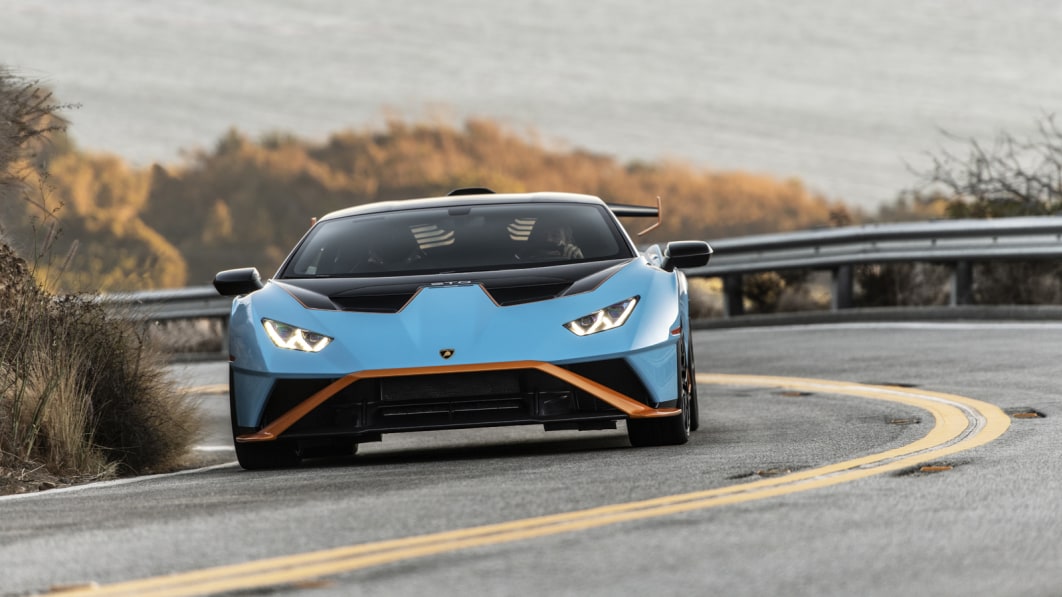
And we’ve just learned none other than YouTube star Tim, better known as Shmee150 has just signed an order form for a Zenvo TSR-S hypercar, no info yet on specs, but if his new Lamborghini Huracan STO is anything to go by, with her Viola Bast exterior combined with gloss black and bright yellow parts, we might be seeing a rather wild Zenvo STR-S in the near future, check out his announcement video below:
[embedded content]
[embedded content]
I for one cant’ wait to see a Zenvo TSR-S at one of the car events we are able to visit next year, I’m looking forward to seeing some impressive combination with clear carbon fiber on this aggressive looking hypercar.
November 1, 2021 / Comments Off on Zenvo TSR-S, the Danish Bugatti, heads to the Riyadh Car Show
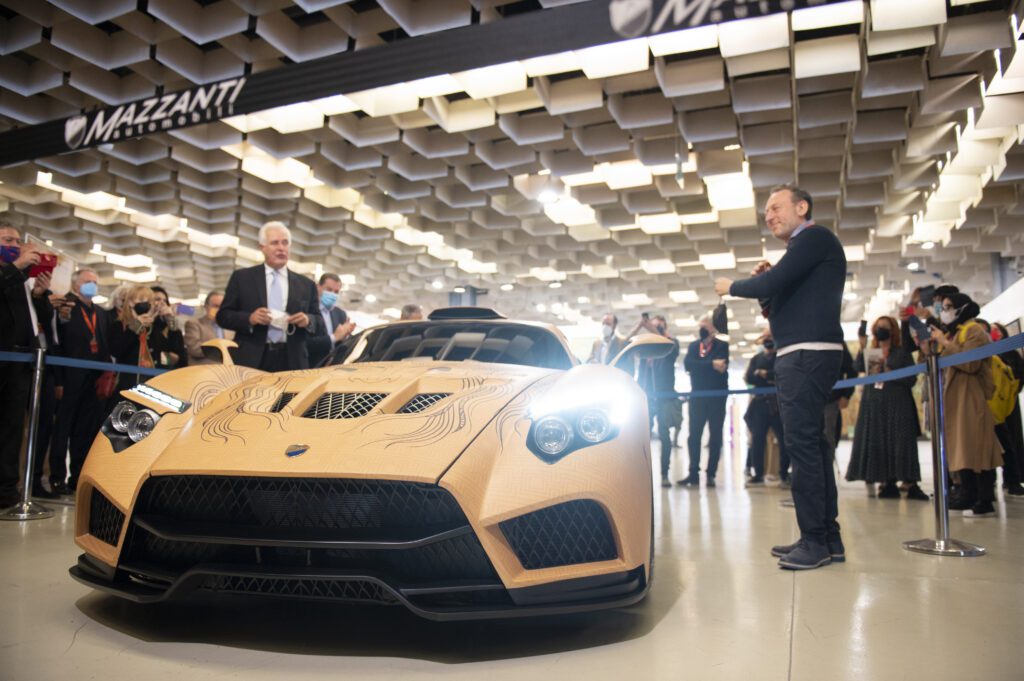
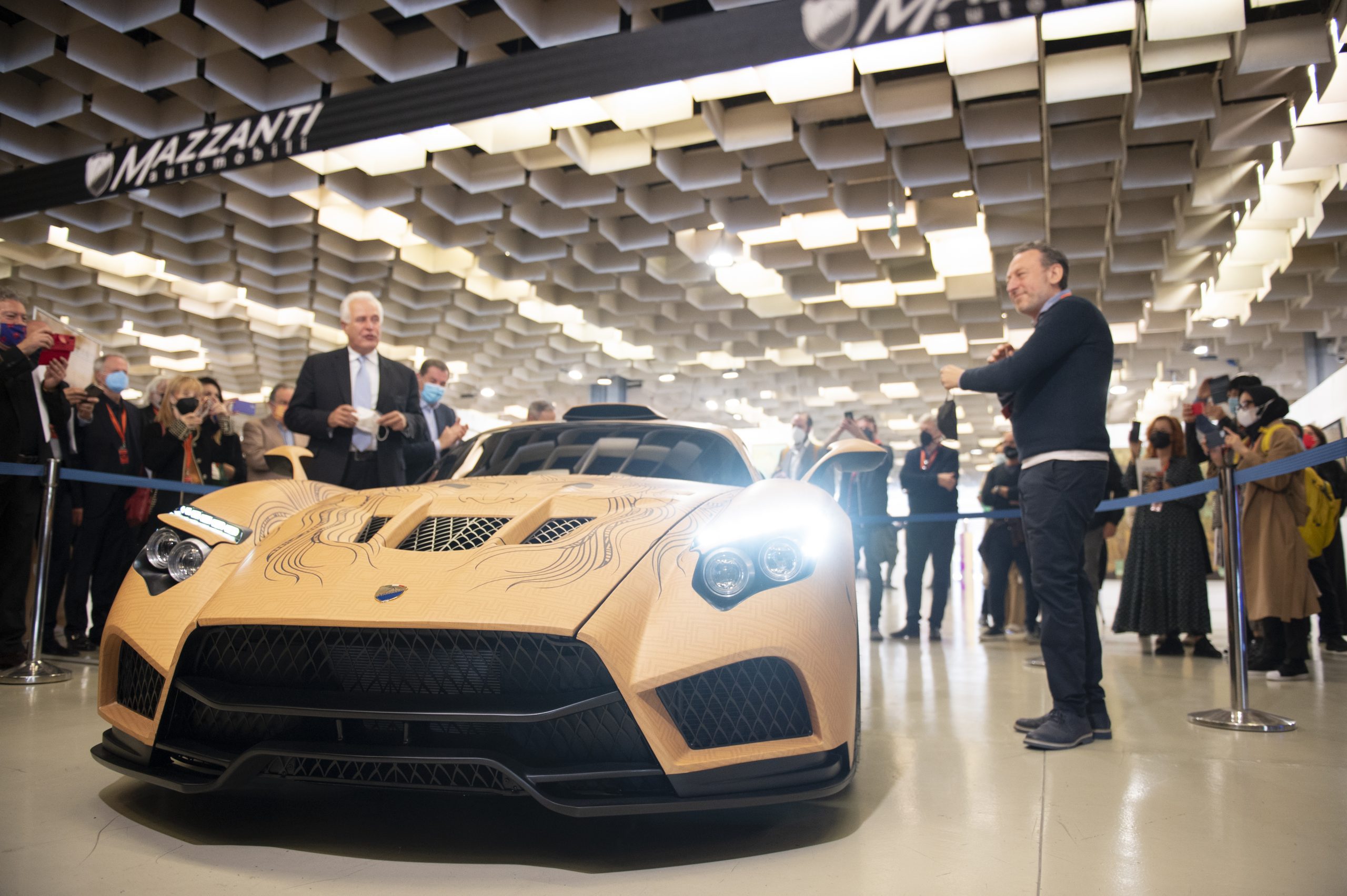
On October 23, 2021, Mazzanti Automobili founder Luca Mazzanti unveiled the new Evantra Pura at the XIII Florence Biennale Art+Design. The President of the Tuscany Region, Eugenio Giani was in attendance during the debut.
The name of the hypercar was deliberately chosen. The hypercar is fast, light, essential, and it focused on the real driving experience. Simply put, the hypercar is “Pure”.
Powering the Evantra Pura is the new V8 6.2-liter dual injection supercharger that can produce 761 hp at 6,600 rpm/min. It has a maximum torque of 970 Nm. The engine is matched to a new 7-speed manual gearbox.
The hypercar is extremely lightweight at only 1,280 kg, and matched with a powerful engine, it is not surprising that the hypercar can go beyond 360 kph. The Pura can also go from 0 to 100 kph in just 2.9 seconds.
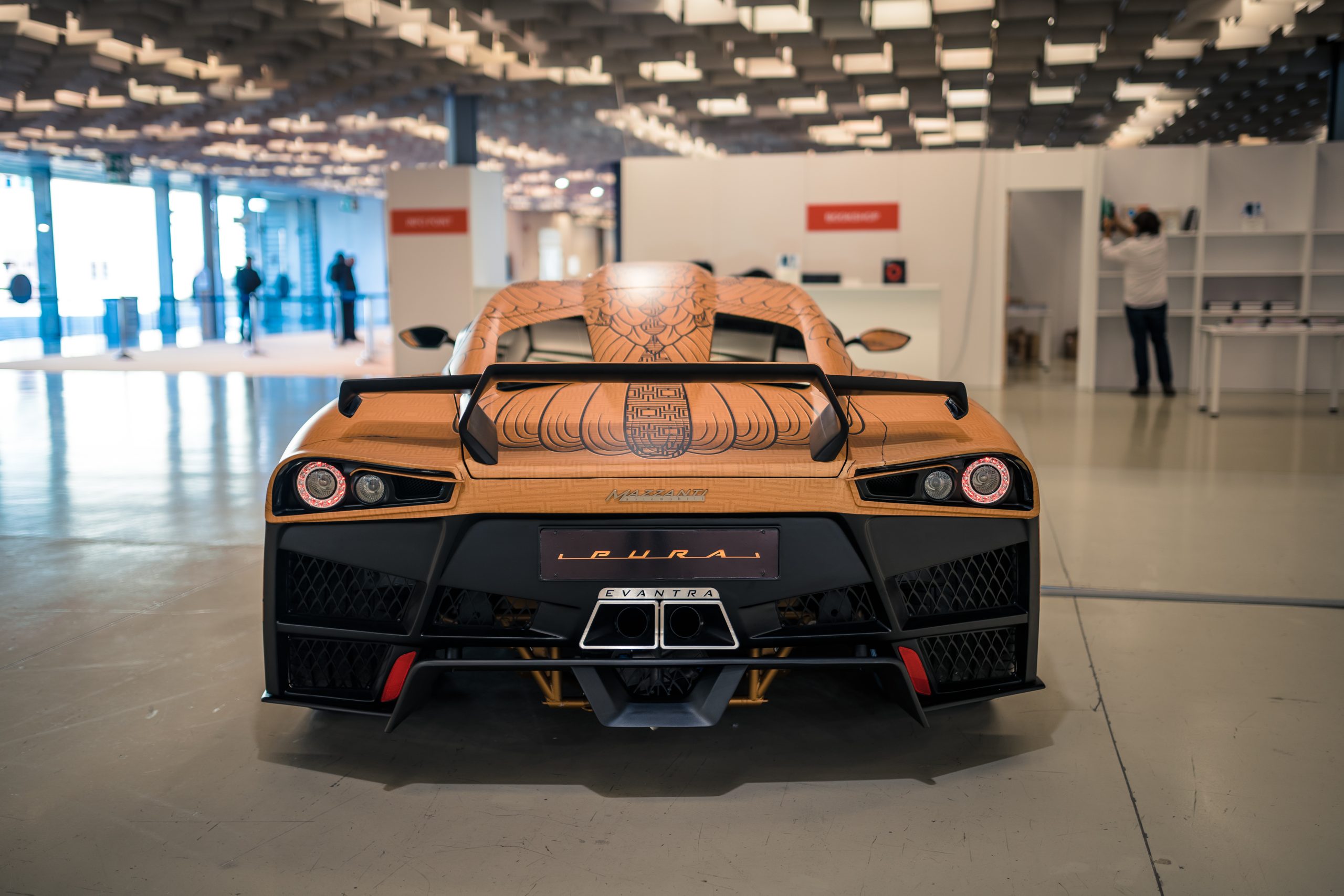
The hypercar is radically designed with innovations seen in the headlights, the front, the mirrors, bonnet, air conveyors, rear headlights, airscoop, exhaust, splitter, and the spoiler.
One of the most notable design is the “Mazzanti” grille, wherein a new design can be noticeably seen on the grills of the air intakes, repeating the compass motif symbol that displays the company’s Mazzanti Automobili logo.
The Pura presented was given a special “mustard” yellow finish done by Wrap Road specifically for the XIII Florence Biennale. The exhibition had an “Eternal Feminine / Eternal Change. Concepts of Femininity in Contemporary Art and Design” theme. Using the theme as a guide and the Etruscan tradition as inspiration, the team tried to pay tribute to the origin of the name “Evantra”, the Goddess of Immortality. The Goddess can be seen on the bonnet of the car along with a bird of prey that is known as “Biancone” or the Eagle of the Snakes.
As the example is sporting a unique livery, the Evantra Pura will be part of an international design contest, “Wrap like a king” wherein industry experts, as well as technical specialists pick the most impressive and the most beautiful wraps. They will then pick regional winners and “Local Wrap Kings” for each continent.
The exhibit of the Evantra Pura at the Spadolini Pavilion, Fortezza da Basso Florence for the XIII Florence Biennale Art+Design lasted from October 23 and ended Sunday, October 31.
November 1, 2021 / Comments Off on Mazzanti Automobili Unveils The New Evantra Pura
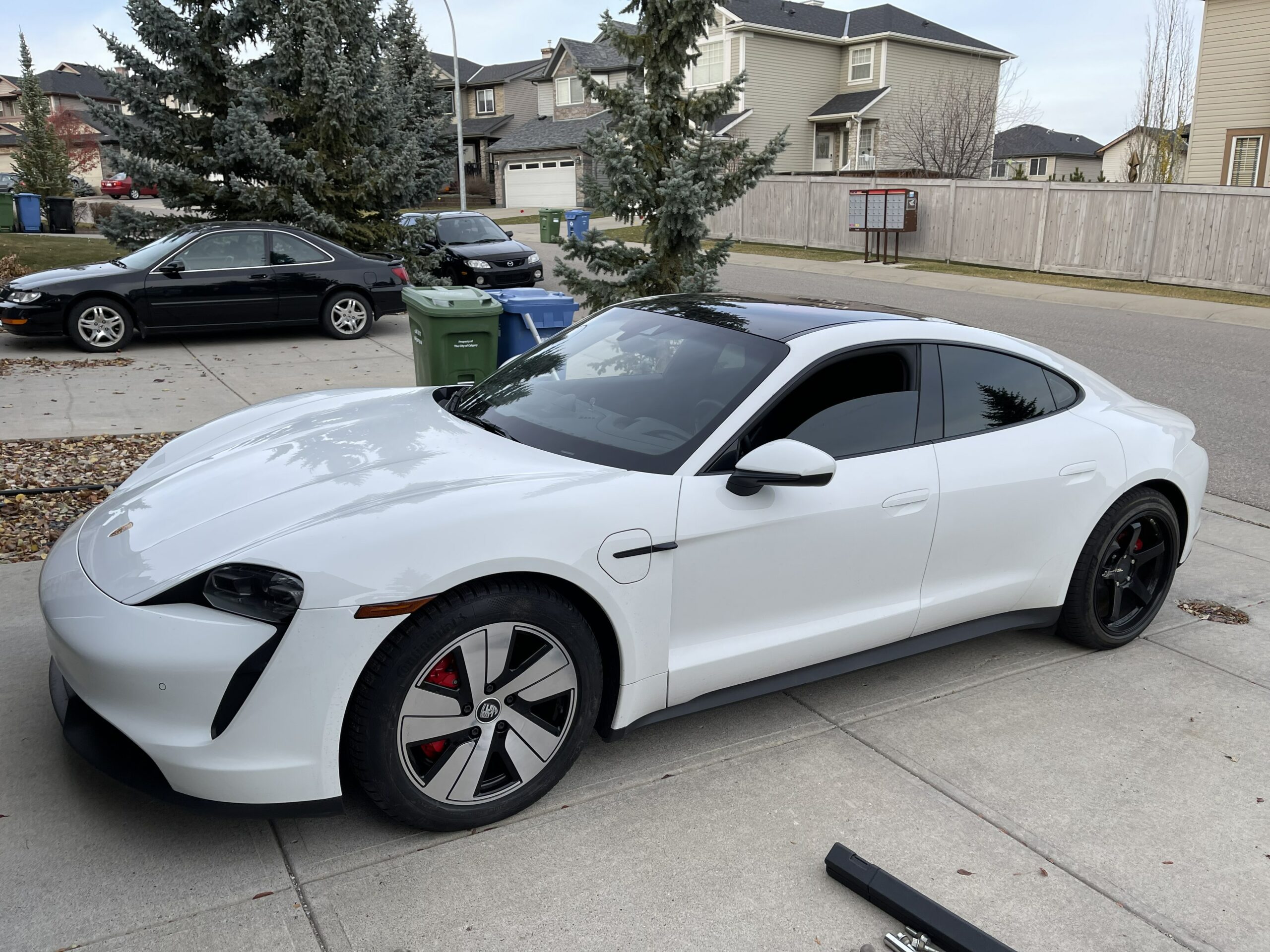
Ladies! Gentlemen! Wow, time really flies, and now we are in the midst of our first taste of winter here in Western Canada. It has certainly been a while since my last “T’s Corner” update, where I looked back on a full year of Taycan ownership. This also marks a bit of a breather for myself after a busy summer; a FIFA World Cup, a few track days (a bit more on that later), some travelling, and whatnot. Now I can finally get back on the mic at T’s Corner.
Mid-tire-swap while getting the Taycan ready for the impending snow fall
Back to the Taycan. I know it doesn’t make for compelling content, but yeah, nothing really has changed since the 1-year anniversary update. It hasn’t even been in for service since I last wrote about it, such are the service demands of owning a Porsche EV. I’ve taken it to around 22,500 km on the odometer, and the car has continued to be a stout performer in terms of its driving dynamics, while still being subject to the unavoidable drawbacks of being a fully electric sports car.
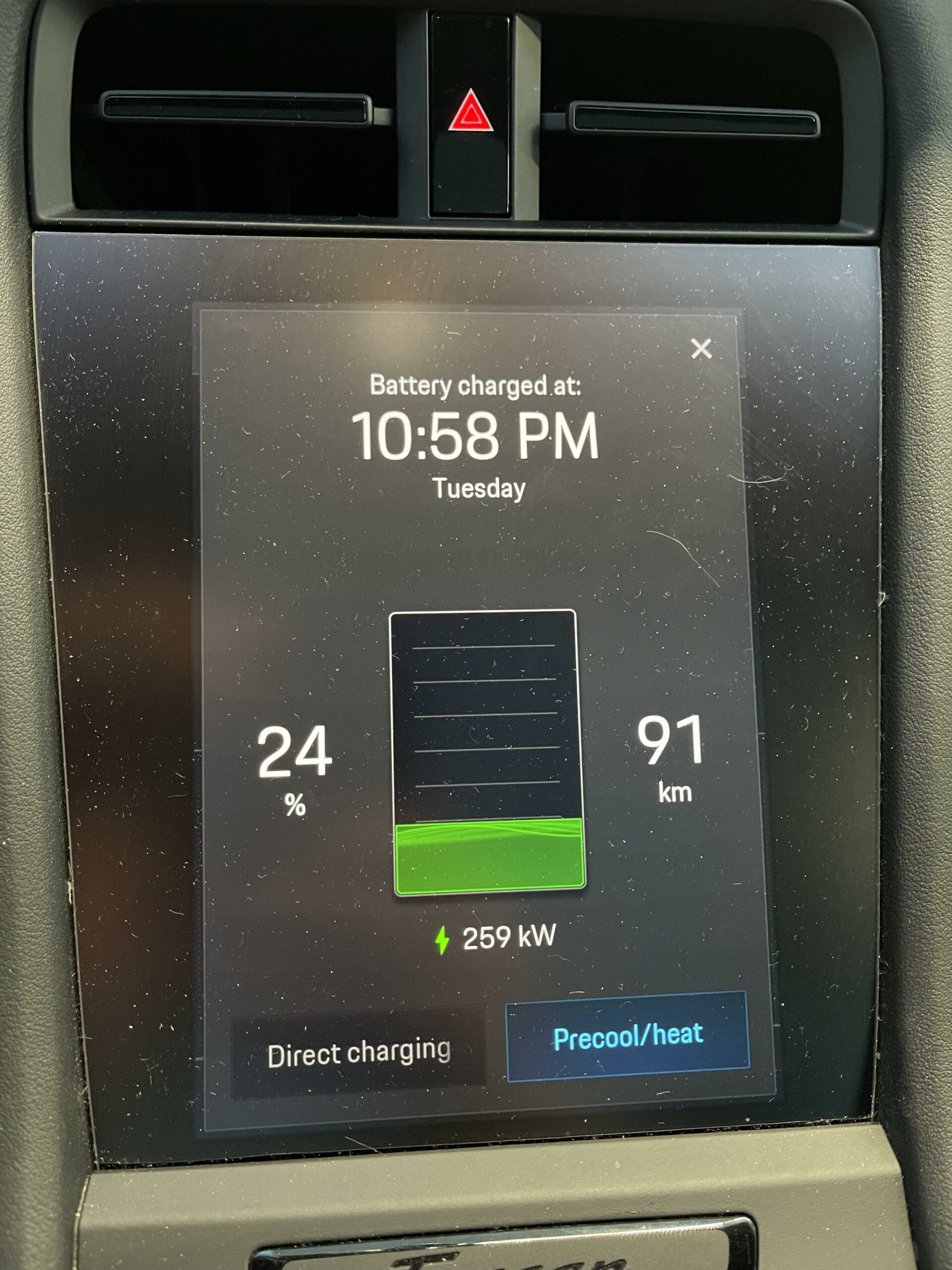
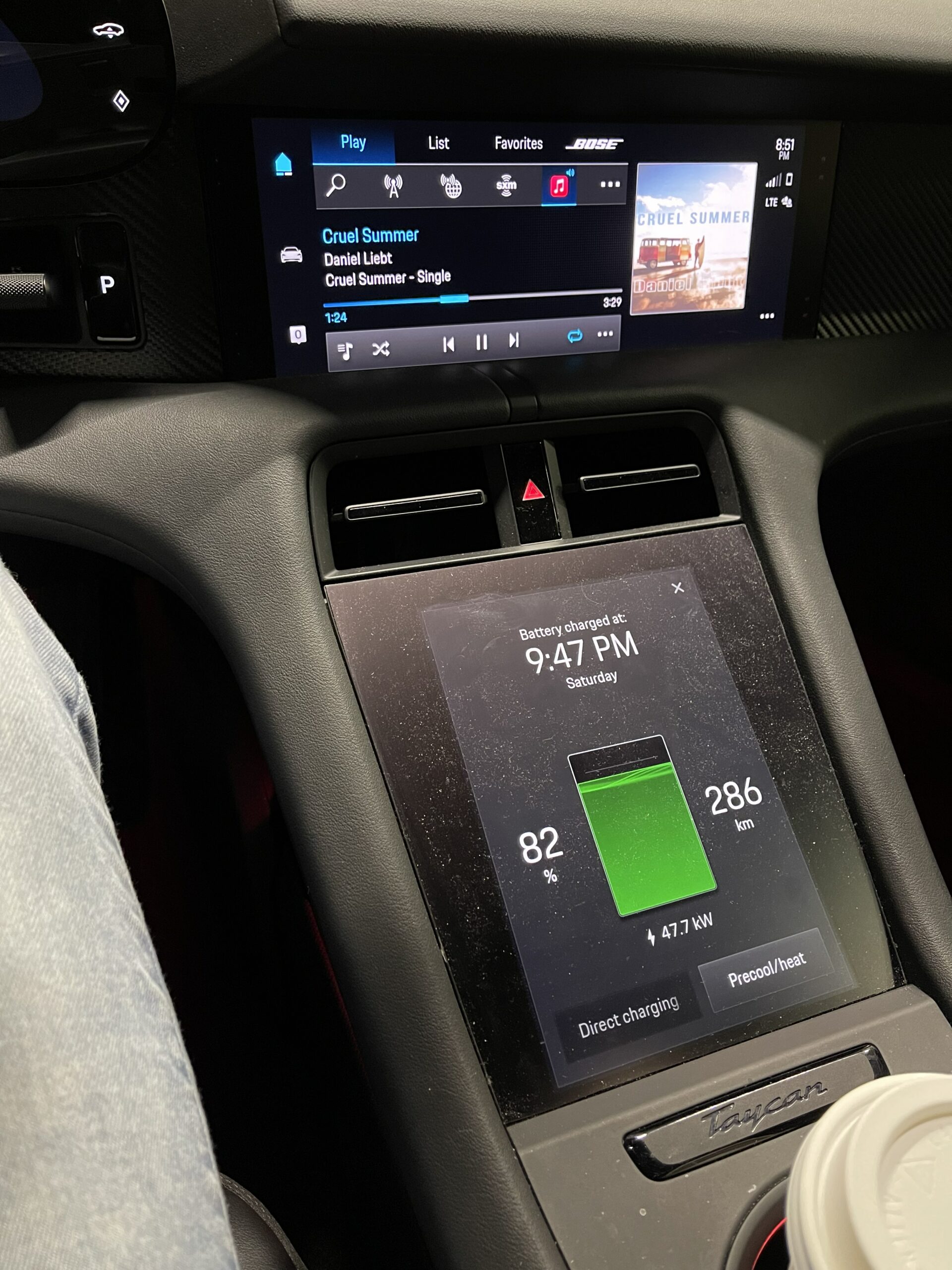
Cold weather affects not only range, but charging speeds too. Above: charging speeds during warm/ideal weather Below: charging speeds when it’s cold outside – both sessions completed at same 350 kW fast charger
The 3 free years of charging at Electrify Canada stations kicking in earlier this year, has been the biggest boon and has ultimately changed my charging habits to where I almost never charge at home now. So again, nothing new; and I consider this a win, particularly as an owner. Stability and predictability are inherently boring; c’est la vie and that’s kind of the whole point, if I may say so.
Free juice for 3 years is definitely a huge plus
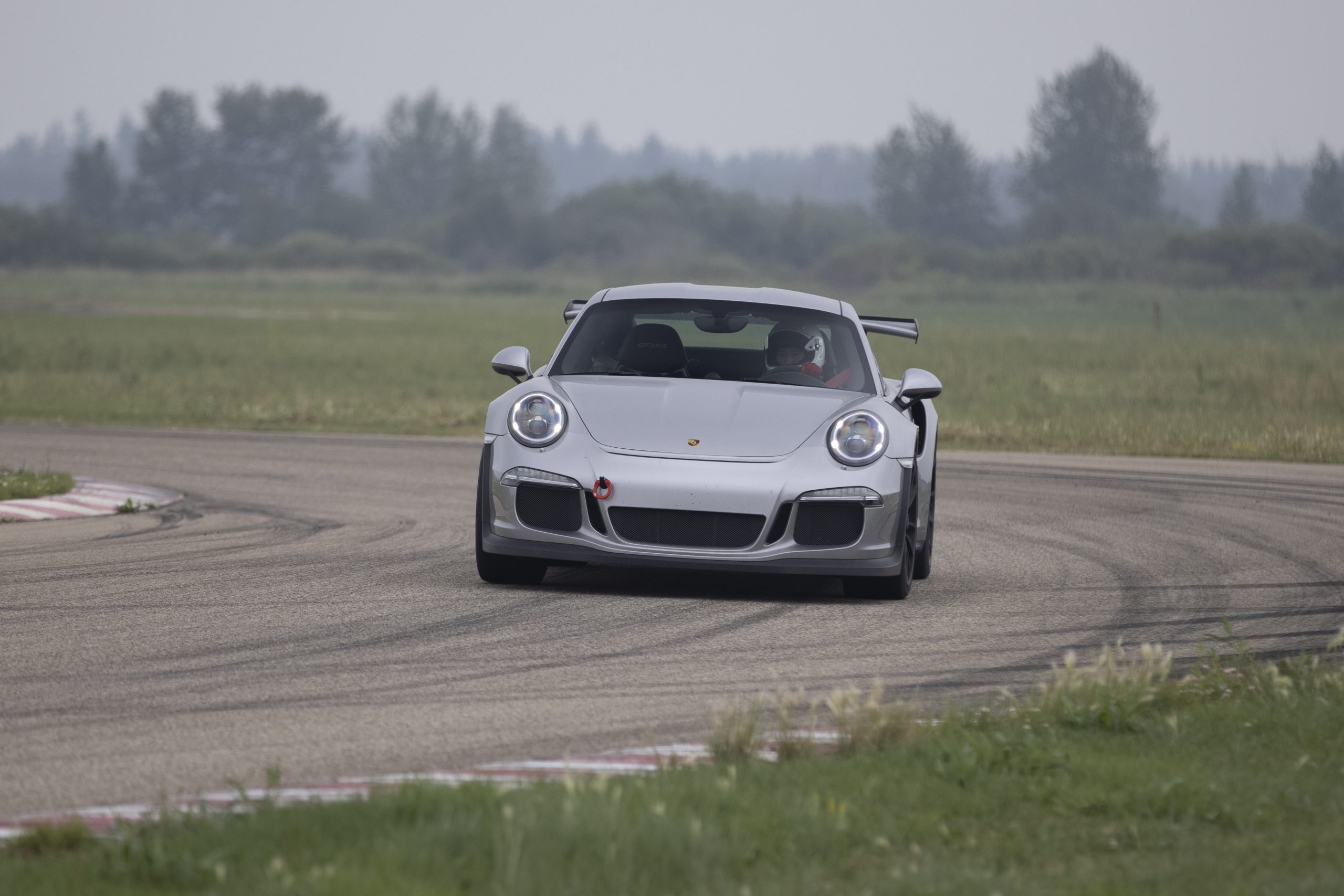
I mentioned in one of my first TC posts that I’d start chronicling my track days. I also mentioned earlier in this post that I attended a few track days this year, but I’ve decided to hold off on blogging about them until next season for a variety of reasons. The first, is that I got a new track car (as the feature image and image below might’ve already hinted) and I spent those driving events getting to know the car better.
2016 Porsche 911 GT3 RS @ Castrol Raceway
I also figured that getting proper lap timing / video recording equipment would be pertinent to showcasing better quality and more meaningful content, which I’ve held off from doing in the interest of learning to truly enjoy the car before getting hyper-focused on lap times and personal bests. I’ve reached a level with the car where I know that next season will be ripe for doing just that – plus a new track will be opening just 25 mins from where I reside, so the timing feels as right as it could ever be. Black Friday / Boxing Day is shaping up to be very busy and hopefully just as fruitful!
Below is some HD footage recorded by my friend Austin while I was driving the RS for some parade laps at Rocky Mountain Motorsports, where myself and others were some of the very first people to experience what’s in store for us when the track is fully complete and open next spring.
[embedded content]
[embedded content]
Stay tuned for more TC content as my journey with the Taycan continues, and as I prepare for next year’s track season with the RS!
Thanks for reading.
-T
October 31, 2021 / Comments Off on T’s Corner – Porsche Taycan 4S Updates & More
V10 engines, like many of their internal combustion counterparts, are an endangered breed today as carmakers continue to explore alternatives like hybrid and all-electric powertrains. But even in their prime, ten cylinders arranged in a ‘V’ were never as popular as other engine types. Automobile manufacturers would either go all out by using the monster V12 in their vehicles or take the conservative route by opting for compact and less-complicated V8 units.
The V10 engine did have its moments, though, and these engines found their way into some pretty impressive cars—as you will discover in a moment. Here’s our list of the 10 best cars that came with V10 engines.
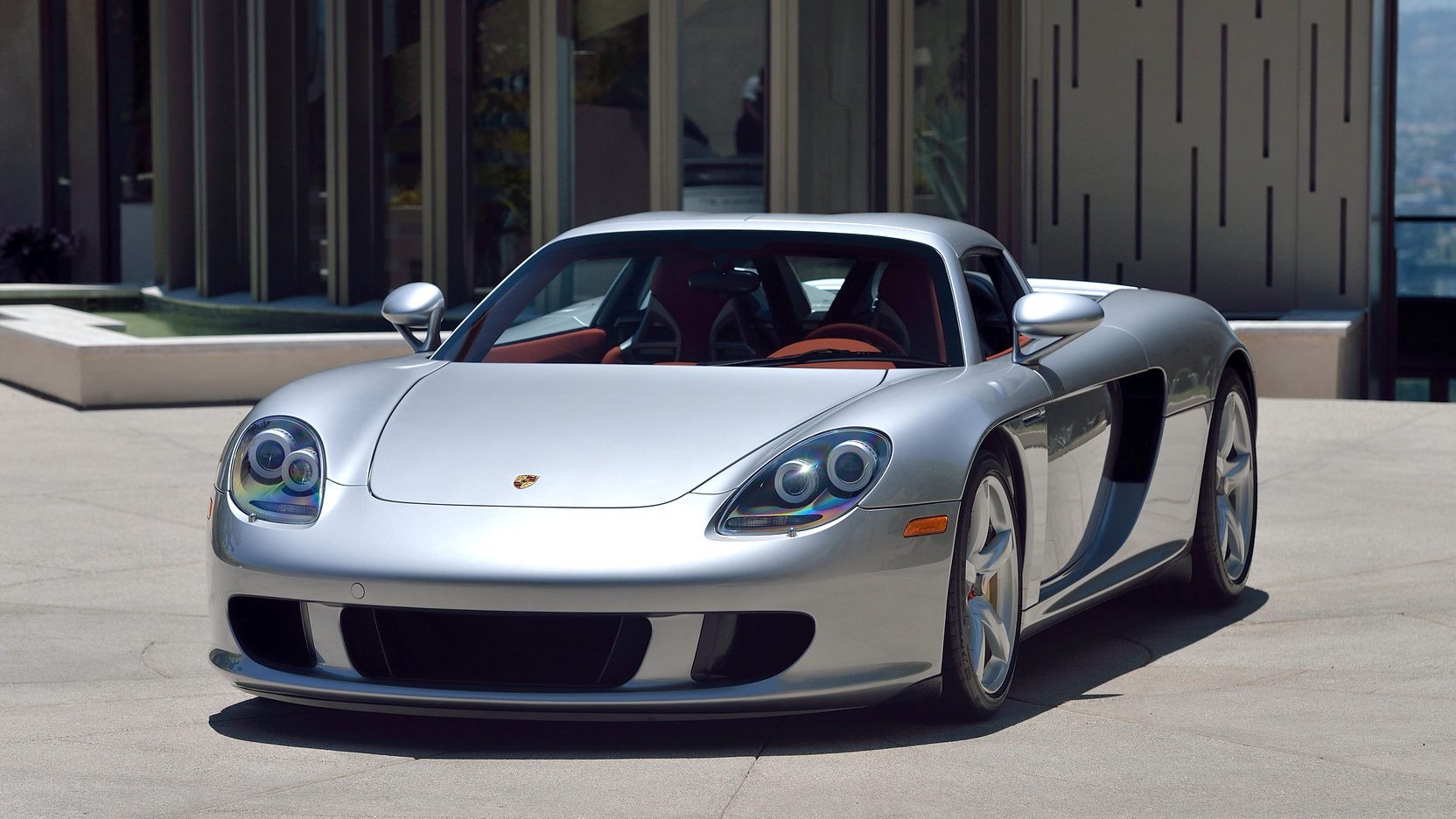
Best Cars with V10 Engines #10: Porsche Carrera GT
Via Mecum.
The magnificent Porsche Carrera GT is considered a legend today, and rightfully so. This hypercar debuted with a host of revolutionary technology that set it apart from the competition.
It was the first car to utilize carbon fibre reinforced plastic for both its monocoque and engine carrier. It also led the line when it came to the use of forged magnesium wheels.
Then, there’s that glorious mid-mounted aluminum V10 power plant at the heart of the vehicle’s performance. It was derived from Porsche’s cancelled LMP 2000 racing program and shares similarities with the 3.5-litre F1 engine of the 1992 era.
The 5.7-litre packs a pretty potent punch, too, able to crank out 605 hp at 8,000 rpm and 435 lb-ft of torque at 5,750 rpm. It delivers all that power with one of the best-sounding engine notes ever emitted by a production car.
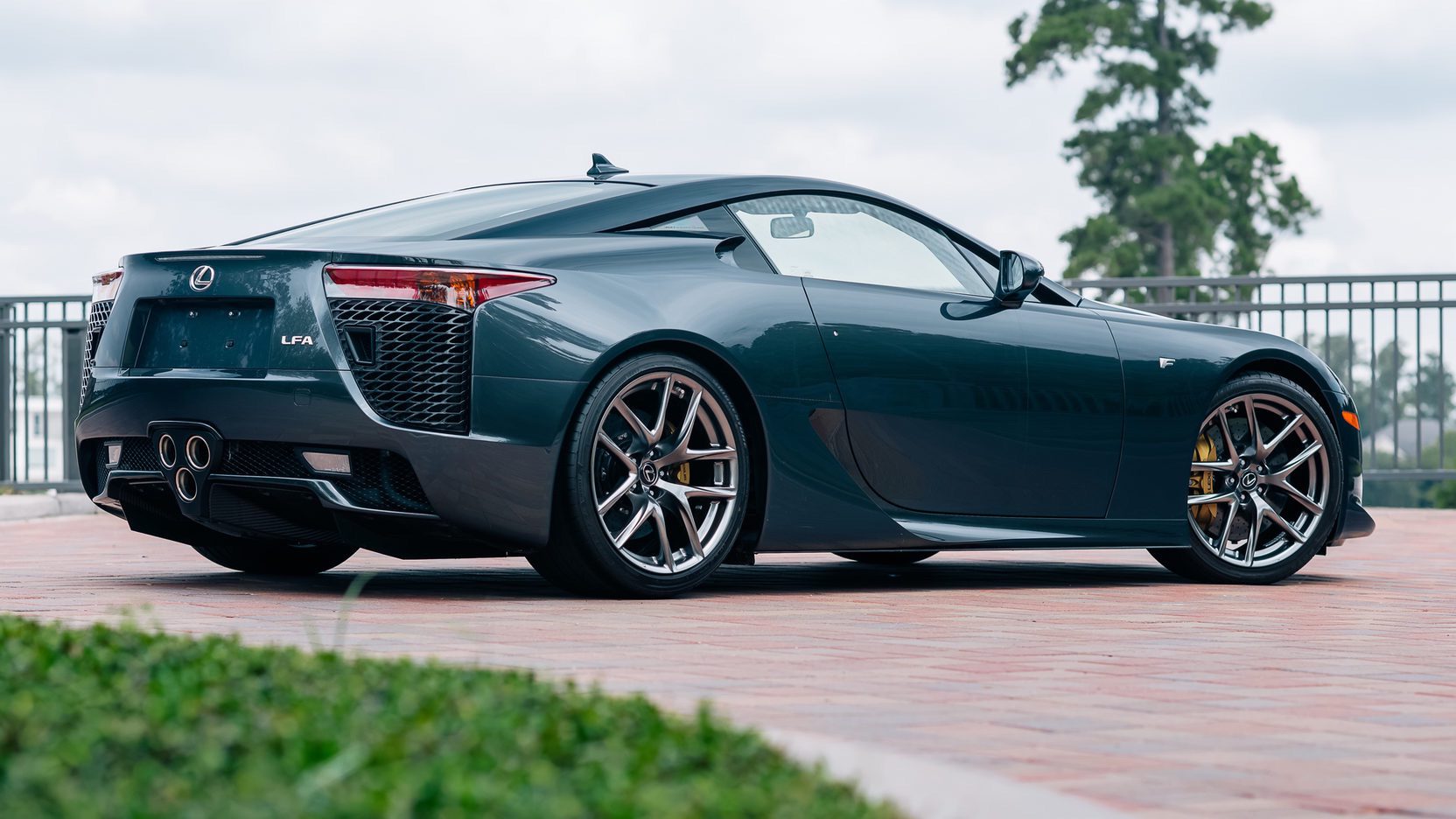
Best Cars with V10 Engines #9: Lexus LFA
Via Mecum.
Lexus did not muck around when it decided to create its first-ever and only supercar to date. The LFA program took off in 2000—an entire decade before the car itself went into final production in 2010.
This supercar earned praise for its excellent grip and handling, but it received the loudest plaudits for its V10 beating heart. The engine unit howls like a banshee, all the way to a 9,000 rpm redline, churning up an impressive 552 hp and 354 lb-ft of torque. It also supplied enough grunt to rocket the LFA to 60 mph in 3.6 seconds, on its way to a 202 mph top speed.
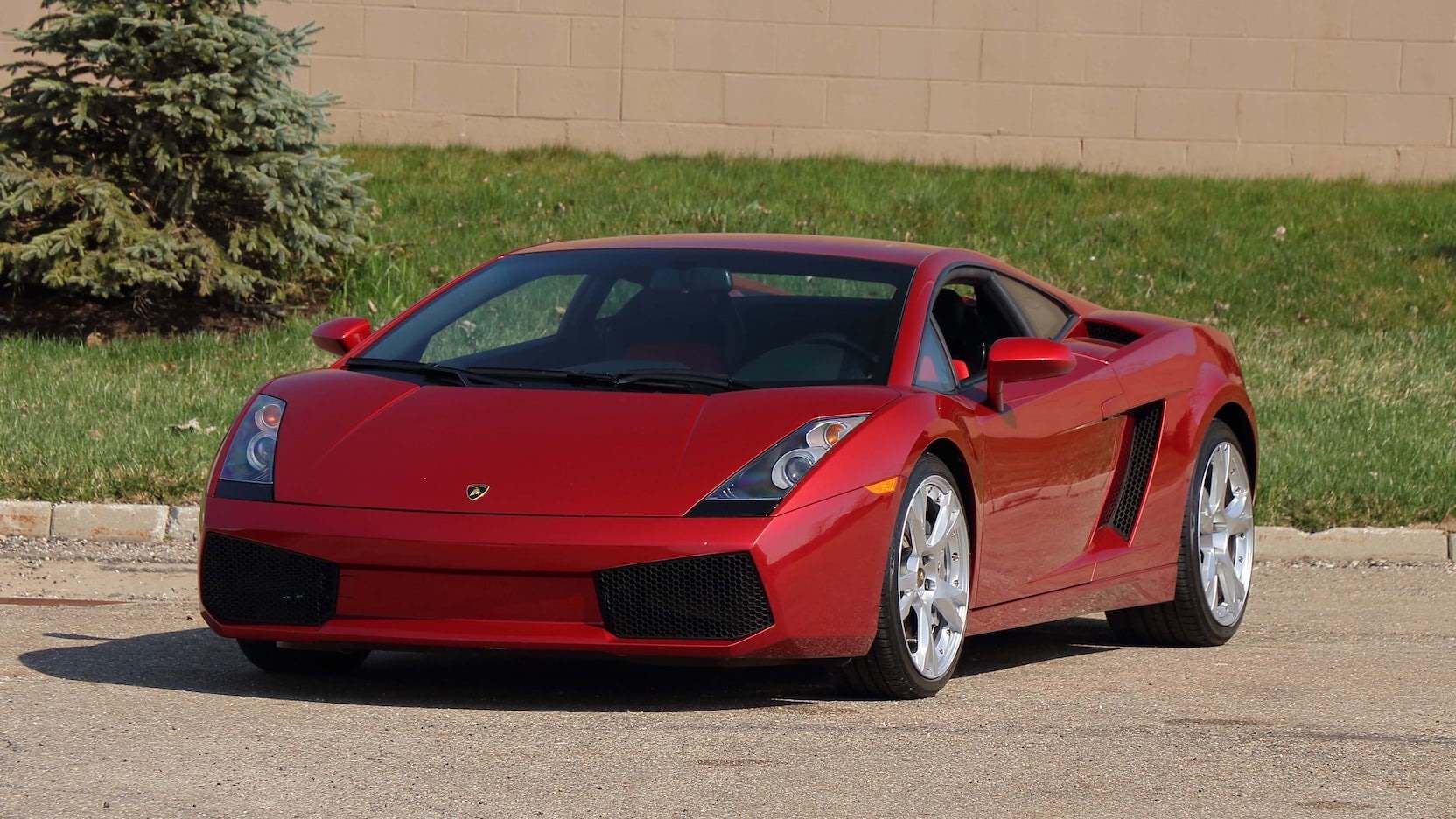
Best Cars with V10 Engines #8: Lamborghini Gallardo
Via Mecum.
The Lamborghini Gallardo is one of the company’s most successful models. Over 14,000 units were sold during a production run that spanned ten years (from 2003–2013).
The Gallardo’s engine played a crucial role in that success story. In its base form, the V10 put out 520 hp and 374 lb-ft of torque. That power could propel the sports car to 60 mph in less than 4 seconds and up to a 196 mph top speed.
Later variants were even more powerful. Tweaks to the engine led to a power bump, resulting in 552 hp and 398 lb-ft of torque in the 2014 Gallardo LP560-4 model.
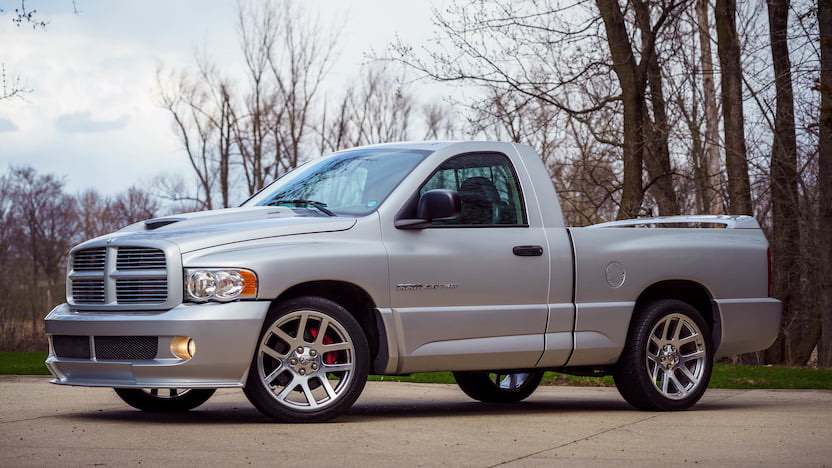
Best Cars with V10 Engines #7: 2006 Dodge RAM SRT-10
Via Mecum.
During the 2000s, pickups were mostly seen as work trucks; just a means to haul small cargo from one point to another. The hulking Dodge RAM SRT-10 did not quite fit that mould, though, when it debuted in 2004.
A lowered ride height, among other modifications, meant this truck was not a very practical road-hauler. What it did have was a reputation as one of the fastest production trucks in the world—enough to earn it some serious bragging rights.
The SRT-10 could barrel its way to 60 mph in just 4.8 seconds. That bonkers performance came courtesy of a Dodge Viper-sourced V10 engine, good for 500 hp and 525 lb-ft of torque.
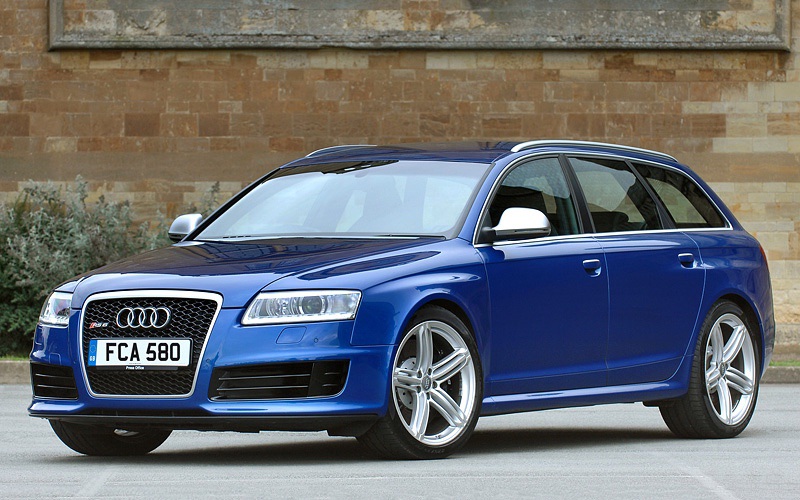
Best Cars with V10 Engines #6: 2008 Audi RS6 Avant
Via Top Car Rating.
The 2008 Audi RS6 Avant created quite a stir when it hit the market. Here was a formidable super wagon that boasted well over 550 hp and had enough of an arsenal to surprise the unwary sports car driver on the highway.
The 5.0-litre V10 at its core was a reworked version of the same engine unit in the Audi S6. It produced a thumping 580 hp at 6,250 rpm and 479 lb-ft of torque from just 1,500 rpm.
That power combined well with Audi’s famous AWD Quattro system to send the RS6 to 60 in about 4.4 seconds. That’s over a second faster than a Mustang sports car from the same period.
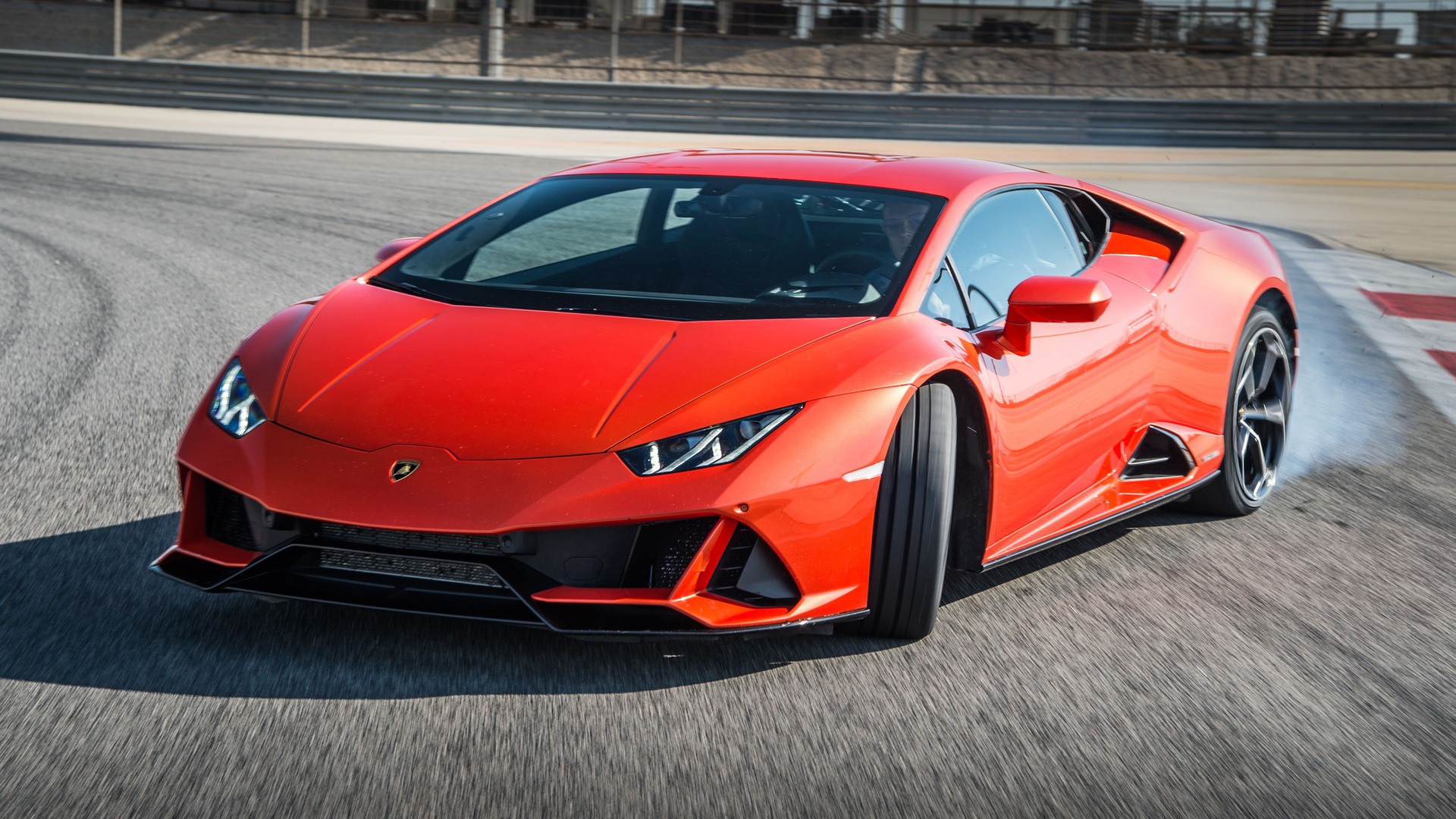
Best Cars with V10 Engines #5: Lamborghini Huracan Evo
Via Mecum.
Lamborghini had found a winning formula with its V10 engine, and the carmaker stuck with it when designing the successor to the Gallardo. The Lamborghini Huracan was named after a fighting bull—and true to form, the supercar was no slouch.
The naturally aspirated V10 engine in the Huracan Evo is a 5.2-litre powerhouse that generates 631 hp, up from 602 hp in the base model. The Huracan Evo was designed to be more of a daily driver compared to the hardcore Performante variant, but it can still check off the 0 to 60 mph sprint in about 2.5 seconds.
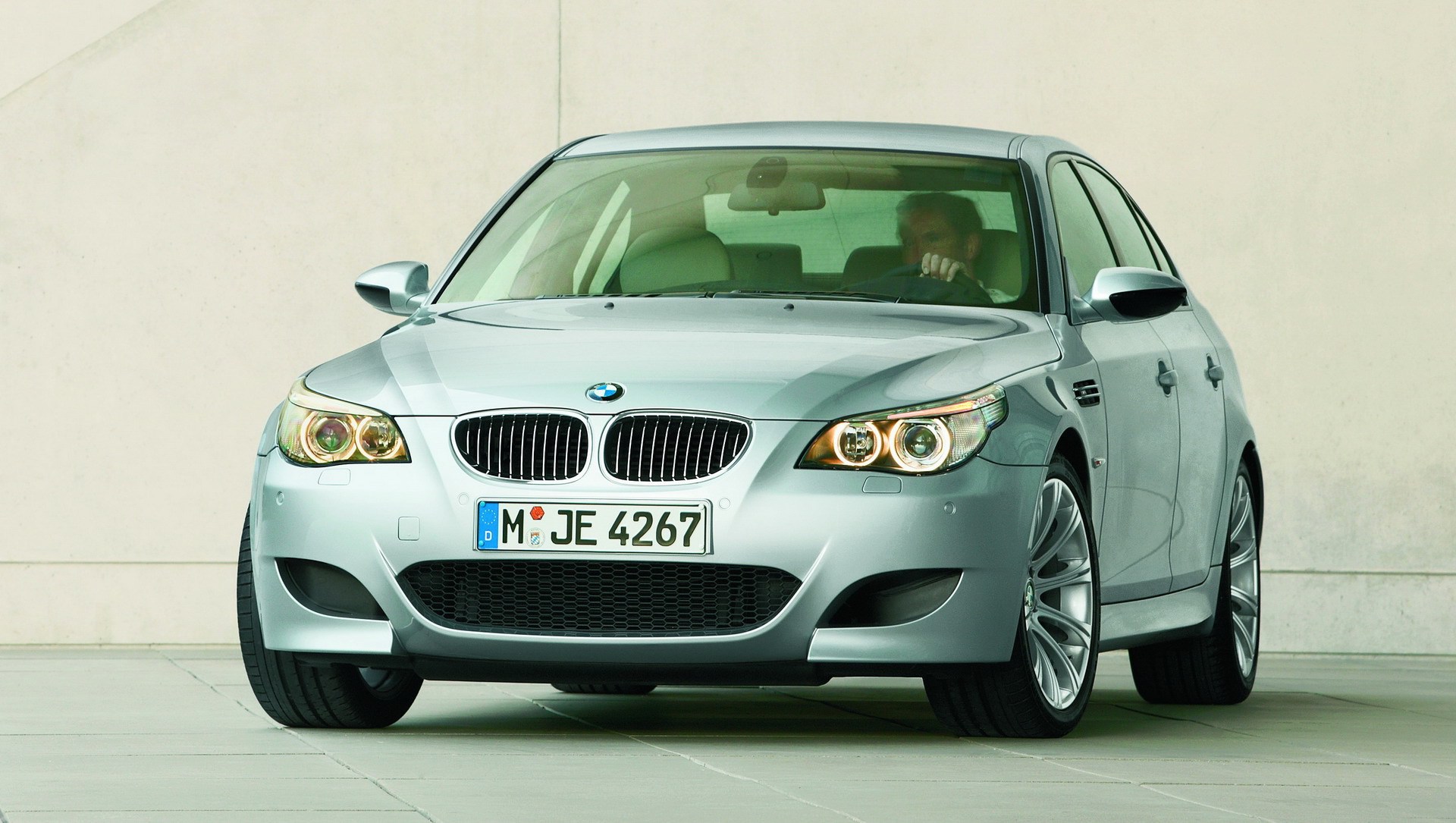
Best Cars with V10 Engines #4: 2005 BMW M5
Via BMW Blog.
This sports sedan marked the end of an era for BMW’s ‘M’ division. It was the last M5 super-saloon that got a naturally aspirated engine, but what an engine it was!
The engine in this car was developed at the same facility used by BMW to build Formula One engines at the time, and it displayed a similar level of technological advancement. Back then, the powertrain packed the most powerful ECU unit ever fitted on a production car.
The 5.0-litre V10 was primed to produce an impressive 500 hp and 383 lb-ft of torque. That power output put it right in the mix with rivals like the RS6 Avant and the Mercedes Benz E55 AMG.
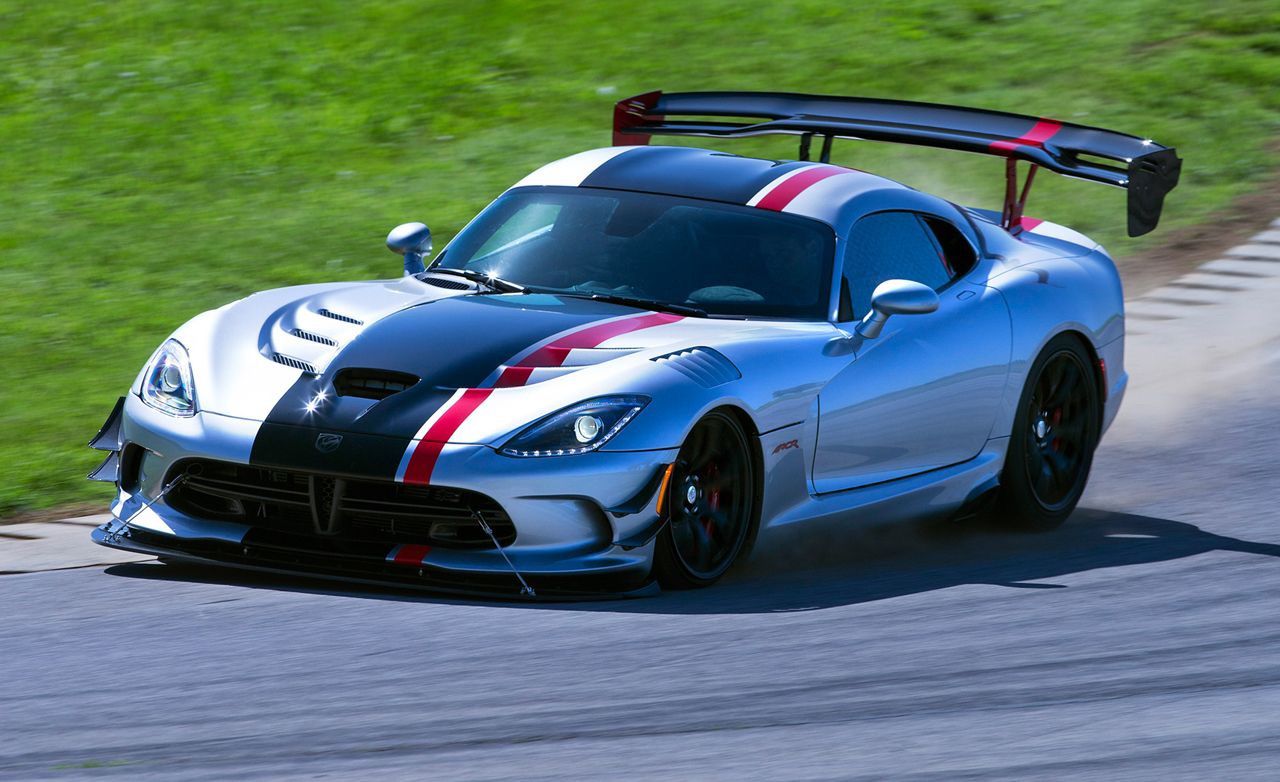
Best Cars with V10 Engines #3: 2016 Dodge Viper ACR
Via Car and Driver.
The Dodge Viper thrilled gear heads for over two decades before it finally bowed out in 2017. But there was no way this all-American sports car was just going to slip quietly into the sunset, and the swansong 2016 Dodge Viper ACR was one of the most potent variants.
This performance car was a beast on race tracks, with a slew of aero upgrades and a gigantic wing for maximum downforce as it attacked corners. It did not disappoint in the power department, either—a massive 8.4-litre V10 shoehorned into the car’s hood provided up to 645 angry horses at peak 6,200 rpm.
Best Cars with V10 Engines #2: Audi R8
Via Mecum.
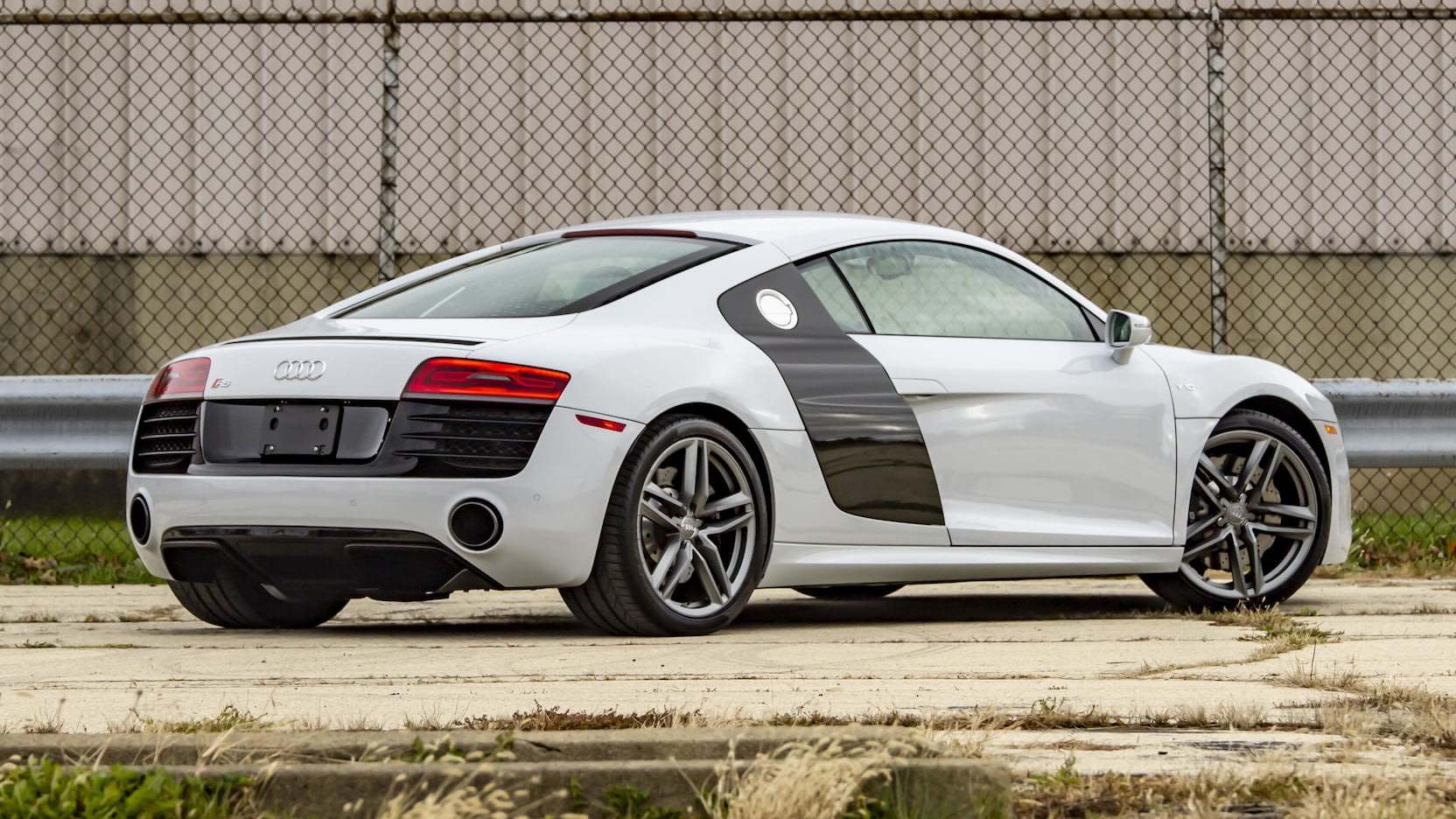
You don’t need to be clairvoyant to know that the Audi R8 is on its last legs. The model line has been trimmed for 2021 and will eventually be phased out as Audi repositions itself for an EV future. Whatever happens, though, the Audi R8 will no doubt leave behind very fond memories.
This car debuted at the 2006 Paris Motor Show as a V8 model, but it soon gained a V10 powertrain—one that has been a part of the supercar ever since. The first V10 was based on the same engine that powered its sibling rival, the Gallardo. It had 525 hp for the 2008 model, but that number has been bumped up over time with various modifications and tweaks.
The V10 in the 2021 Audi R8 boasts up to 602 hp—the same output as the Lamborghini Huracan RWD.
Best Cars with V10 Engines #1: Volkswagen Touareg V10 TD1
Via Car Throttle.
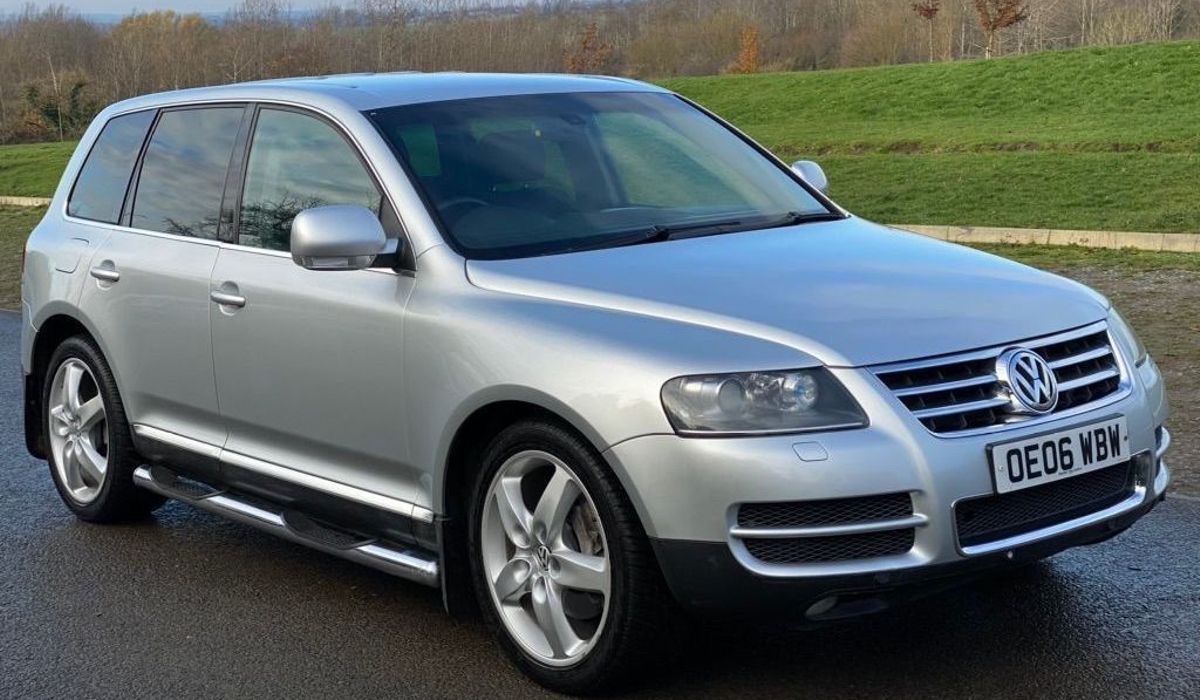
The infamous Volkswagen ‘Dieselgate’ emissions scandal has left a permanent stain on the reputation of the V10 engine that powered this vehicle. It’s such a shame, because the powertrain showcased the best of the carmaker’s engineering prowess when it first launched in 2004 with the Volkswagen Touareg TDI.
This SUV had a well-appointed luxurious interior that targeted the upper-middle-class segment. Even better was its 10-cylinder twin-turbo 5.0-litre diesel engine. Horsepower output was just about average at 309 hp, but it had a truly impressive 553 lb-ft of torque from just 2,000 rpm. Fifth Gear journalists demonstrated the strength of the torquey Touareg TDI when they used it to haul a Boeing 747 aircraft!
October 30, 2021 / Comments Off on The 10 Best Cars that Came with V10 Engines
While many convertibles these days come with a rigid roof that folds down in some way or another, for the next generation of the famous Mercedes SL Super Leight it’s a return to the canvas folding roof, heck, even Rolls Royce and Bentley stick with their fabric roofs on the convertible models, so why shouldn’t Mercedes do the same on this new car that is officially called the Mercedes-AMG SL, a legacy that goes back 70 years into the past with the legendary 300 SL from 1952, a very successful race car.
“The new SL combines the sporty genes of the original SL with the driving performance typical of AMG. At the same time, it offers luxury and comfort at the absolute top level. This combination is unique in the sports car segment and is also reflected in the interior – where the highest levels of comfort and quality meet the right helping of sportiness. The high-quality combination of the analog world and state-of-the-art digital equipment makes it clear that the new SL is the rebirth of an icon for the modern era”, says Philipp Schiemer, Chairman of the Board of Management of Mercedes-AMG GmbH.
The new Mercedes-AMG SL is a combination of the sensual Mercedes design with the aggressiveness of AMG, just one detail is the two ‘bulges’ on the engine cover that are a direct hint to the very first generation of Mercedes SL cars, but another typical giveaway for an SL is the long wheelbase with short overhangs front and rear, the low windshield and wide rear, reminiscent of traditional SL proportions with a modern interpretation, the new car looks great, with or without the roof closed.
If you take a look at the AMG-bespoke front grille you’ll notice a total of 14 vertical slats, once again a direct inspiration from the 1952 Mercedes 300 SL, the Gullwing, but now with very thin LED headlights and taillights to create the impression this already low and wide car is even lower and wider visually.
While on the interior the combination of sports and luxury is another testament to the homage they want to give to the 300 SL, the finest materials fitted by the best artisans possible result in extreme levels of comfort, while still retaining the sportscar feeling, a 2+2 car that is, as the new Mercedes-AMG SL can fit two people in the rear … given they aren’t taller than 150cm that is, while the driver and passenger are seated in electrically adjustable AMG sports seats, complete with the AIRSCARF for more comfort, if you really insist, you can even order optional AMG Performance seats.
The Mercedes-AMG SL is based on a new development vehicle architecture, the 2+2 seater comes with a lightweight aluminum spaceframe chassis, created from the ground up, nothing was taken from either the previous SL or the AMG GT Roadster, the Mercedes-AMG SL is a completely new car altogether, combining materials like aluminum, magnesium, carbon fiber, and steel for the windshield for added safety, still the entire bodyshell weighs only 270 kgs.
The new Mercedes-AMG SL comes with active aero, called AIRPANEL on this car, it’s a two-piece active air control system, the first operates with vertical louvers inside the lower air intake at the front, while the second piece sits behind the upper air intake with horizontal louvers, all louvers are closed normally to drag and allow air to be directed specifically towards the underbody. In this configuration, they also reduce front lift, but when a certain temperature on predefined components is reached, and the demand for cooling air is particularly high do these louvers open, the second piece from 180 km/h and more, to direct a maximum of cool air to flow onto the heat exchangers.
While the rear naturally has an active wing, that sits flush with the boot lid normally, is raised when speeds go over 80 km/h in five different angles, but there is an optional active aero listed, hiding underneath the car just in front of the engine, a carbon fiber lip that can be extended 40 mm down to create a venturi effect that ‘sucks’ the car down to the street to reduce axle-lift.
The choice for a soft-top convertible on the new Mercedes-AMG SL was quickly made when it came out this would shave 21 kgs in weight from the top of the car, hence reducing the center of gravity considerably, it takes just 15 seconds to open, or close, and this action can be performed at speeds up to 60 km/h, the three-layer design of the soft-top consists of a tightly stretched outer shell, precisely crafted roof liner and the acoustic mat made of high-quality 450 g/m² material inserted in between.
For the launch of the Mercedes-AMG SL there is an option of two different power outputs from the famous AMG 4-Liter Biturbo V8 engine, the top of the line model will come with the 585 hp unit and is called the SL 63 4MATIC+, with 800 Nm of torque, acceleration takes just 3.6 seconds from 0 to 100 km/h while the top speed is a staggering 315 km/h. There will also be an SL 55 4MATIC+ with ‘only’ 476 hp and 700 Nm of torque, acceleration figures for this ‘entry-level’ model will be 3.9 seconds while she will run out of breath at 295 km/h, at this time an AMG E PERFORMANCE hybrid is already being developed.
All Mercedes-AMG SL will be 4MATIC models, hence feature four-wheel drive for the first time in 70 years, power from the V8 engine goes through a 9-speed AMG SPEEDSHIFT transmission, fully variable torque distribution to the front and rear axles ensures optimal traction right up to the physical limit, another first in the SL legacy is active rear-wheel steering, and we all know how this alters both low speed and high-speed maneuvers.
I have to admit I’ve been a fan of the topless Mercedes SL for many years, personally, I would prefer a 300 SL convertible of the much more valuable Gullwing model, but that’s just me, I also liked the E107, the classic that was built between 1971 and 1989, specifically the later SL500 model with a removable hardtop for instance, while the R129 is a sculpture of automotive art … and somehow this new Mercedes-AMG SL looks totally different, a lot more contemporary, but she’s still a beauty, and I sure wouldn’t mind parking the SL 63 on my driveway.
October 29, 2021 / Comments Off on A brand new Mercedes-AMG SL
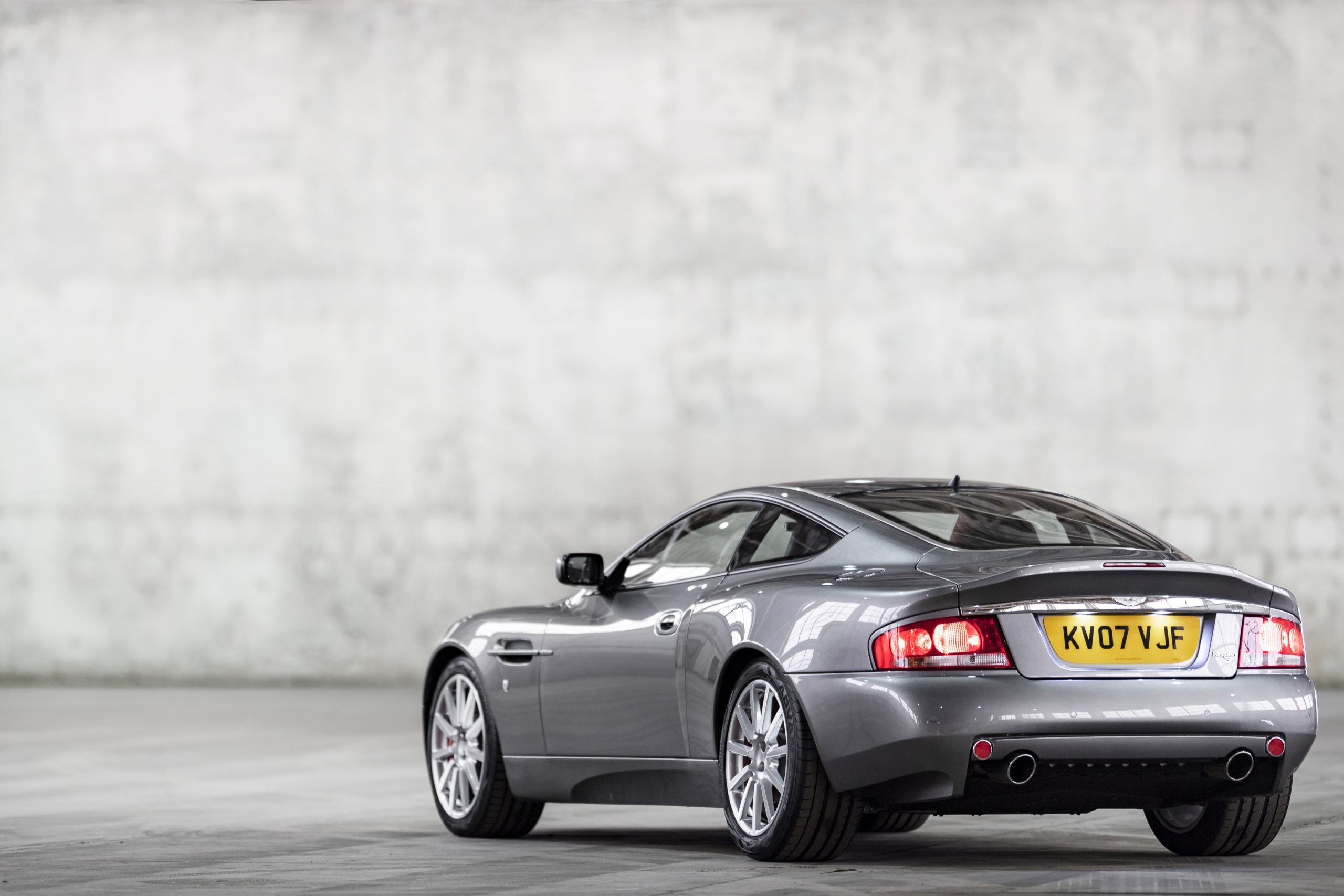
Aston Martin Works is the home of a great British automotive marque. This month, one of the greatest supercars they have produced is celebrating its 20-year anniversary: the original V12 Vanquish.
In 2001, the V12 Vanquish made its debut in front of eager audiences at the Geneva Motor Show. It immediately made an impact as the newest, most sophisticated, and most technologically advanced automobile designed, developed, and presented by Aston Martin.
Expert media critics were immediately enamored by the V12’s beautiful design, exceptional power, and unparalleled performance.
Motortrend in the United States claimed, “Aston Martin’s new Vanquish is one of the most superbly designed front-engine GTs of all time.”
A British magazine, evo, added, “It devours the straight bits with relish, but it also has a ravenous appetite for corners.” The Sunday Times hailed it as “an automotive masterpiece”.
Today, Aston Martin Works President Paul Spires stated, “The original V12 Vanquish represented an important and timely development for our marque. It was, and is, a great super GT with all the character, style and power that is rightly expected of an Aston Martin sports car. 20 years on from that debut, the V12 Vanquish remains a proud part of the marque’s heritage which we celebrate here at Newport Pagnell. It is an exceptional piece of our history, and a car that we can rightly look back on with considerable pride.”
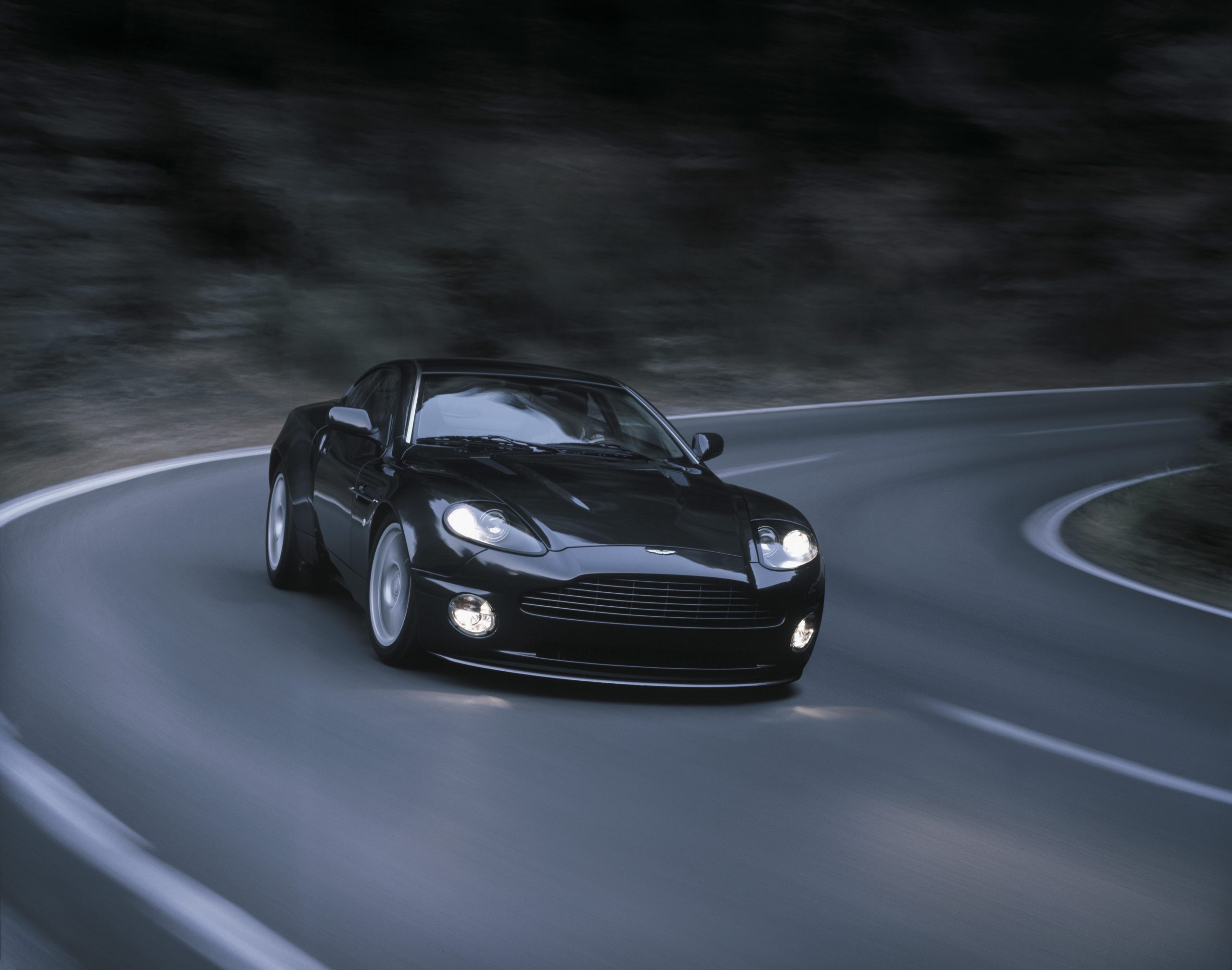
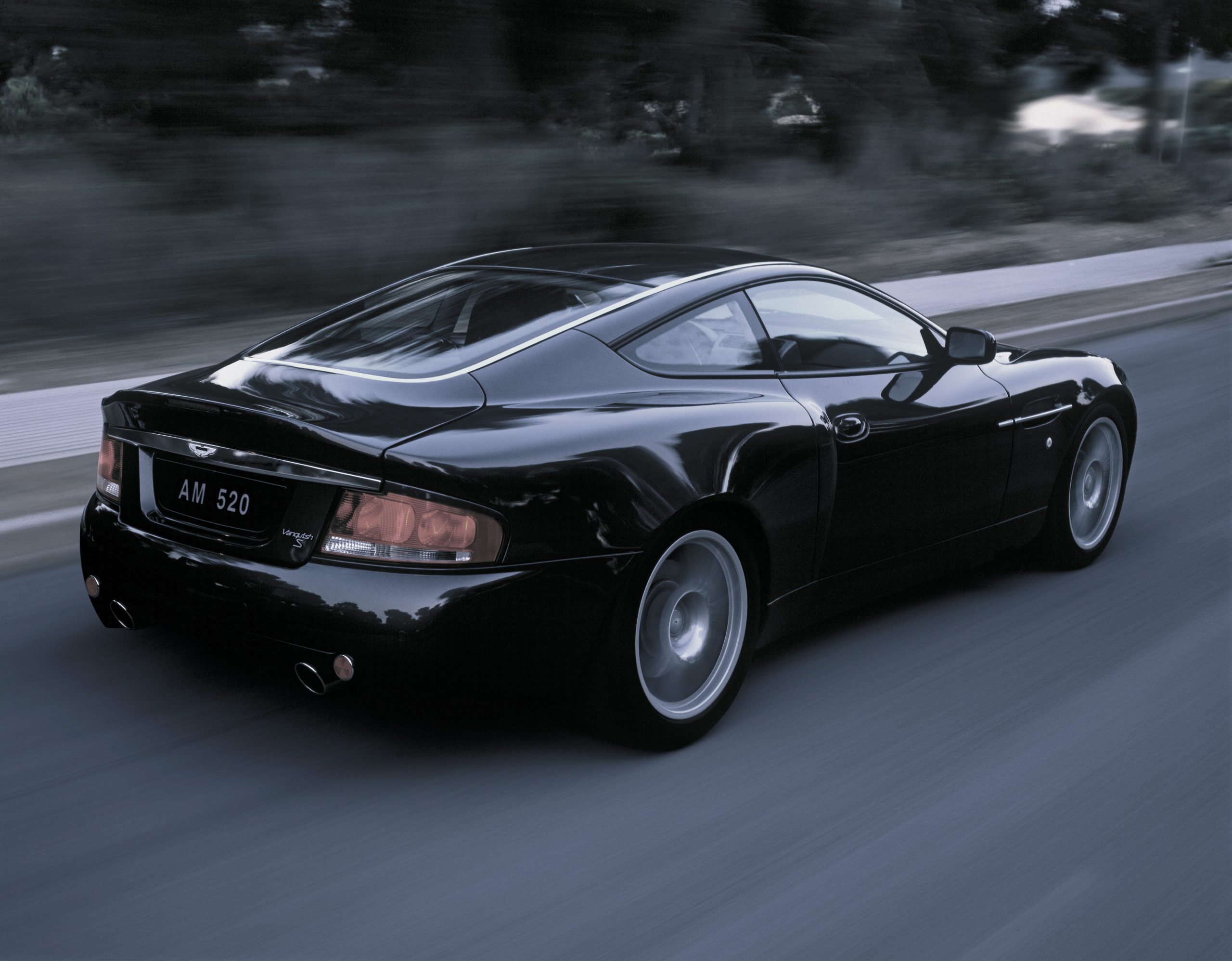
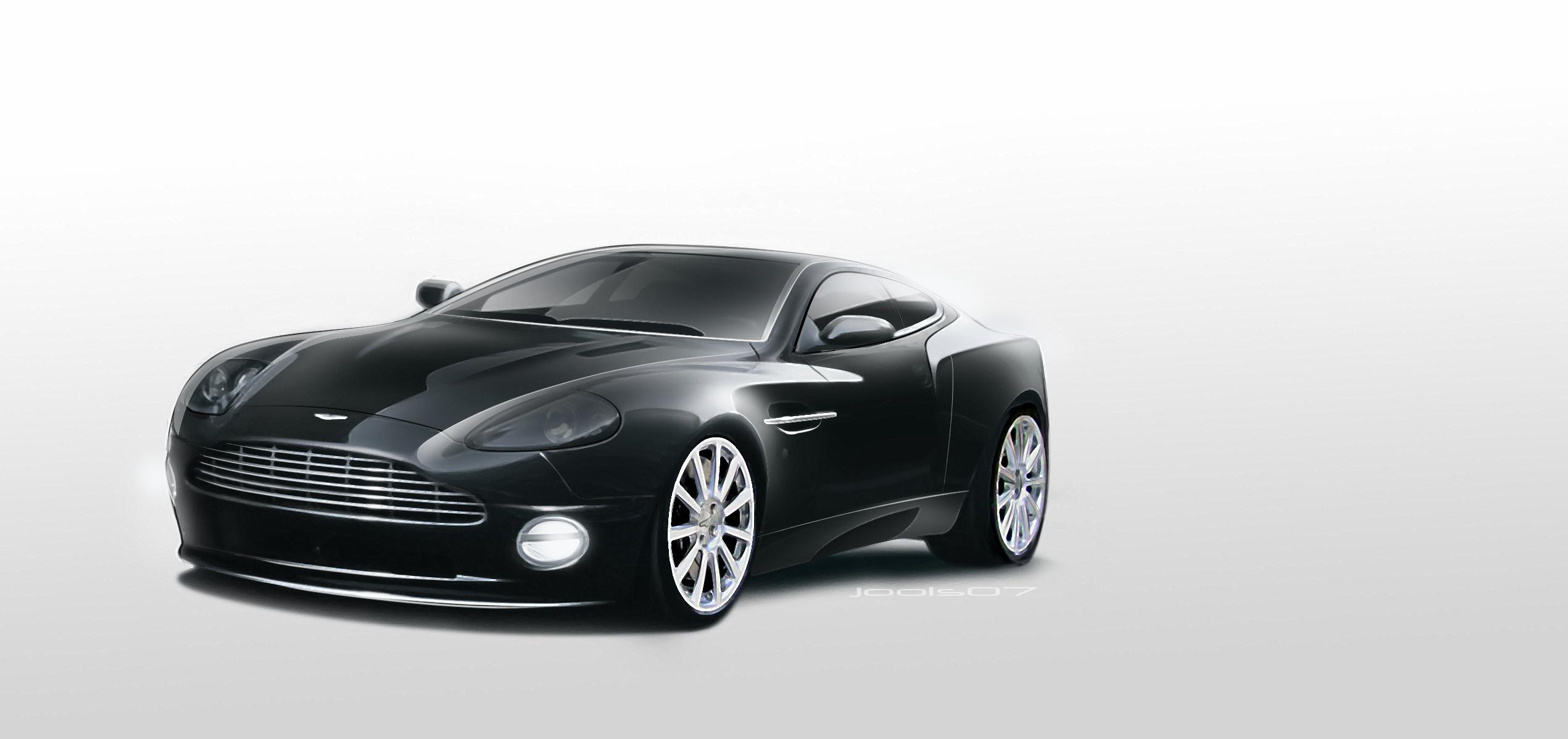
The Aston Martin V12 Vanquish S
The Origin Story
The story of the V12 Vanquish started years before it made its historic debut at the 2001 Geneva Motor Show.
The V12 started with a concept sports car dubbed “Project Vantage”.
The concept car has been in development throughout the mid-90s and in 1998, it made its debut at the Detroit Motor Show. Project Vantage was designed by then styling chief Ian Callum.
Aston Martin continued to develop the program. By autumn of 2000, a group of key media people was allowed to see a pre-production V12 Vanquish, which was clearly greatly influenced by the Project Vantage.
The Aston Martin V12 Vanquish S
V12 Vanquish design and body engineering
The two-door sports car’s elegant and classic body was designed by Ian Callum, and it was created to embody the tradition, pedigree, and heritage of Aston Martin. Offered in 2+0 or 2+2 configurations, it was seen as bold and dynamic, with finely detailed features that can be seen in the interior and exterior of the car.
All the design elements were carefully considered and incorporated into the car to showcase the marque’s commitment to quality and craftsmanship.
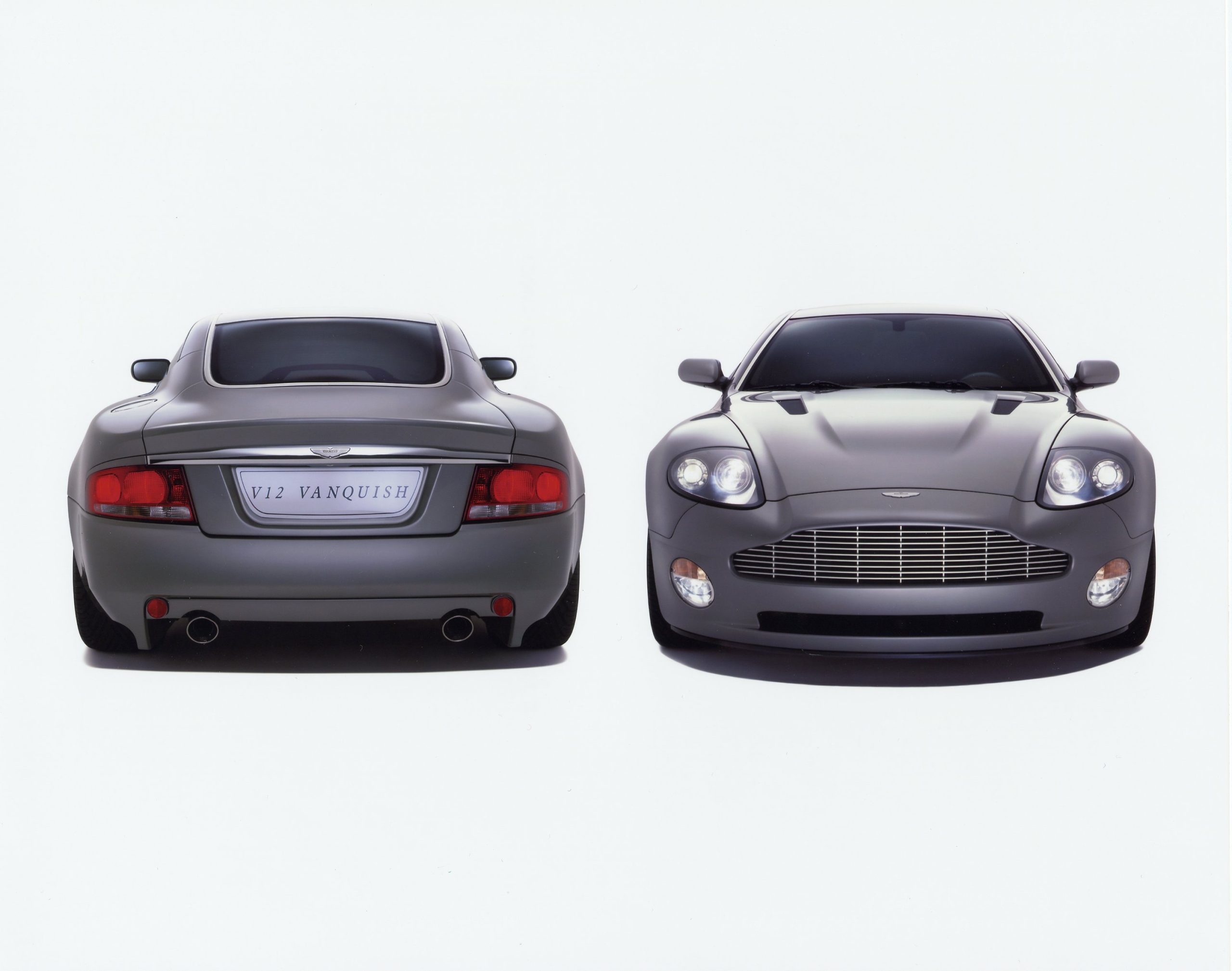
Some of the key features of the car are the bold and distinct auxiliary driving lamps and front direction turn indicators, in between them is the distinct radiator grille and lower air intake which are the marque’s design signature at the time. The front wings and bonnet panels were also given finely detailed compound curves that sweep back to the steeply raked windscreen pillars and low curving roof line.
Adding visual appeal are the sculptured sill and door panels. The rear wheel arches prominently and the rear spoiler and short tail section in the boot lid matches the overall classic look of the V12 Vanquish.
Aston Martin Vanquish S. Photo by: Max Earey
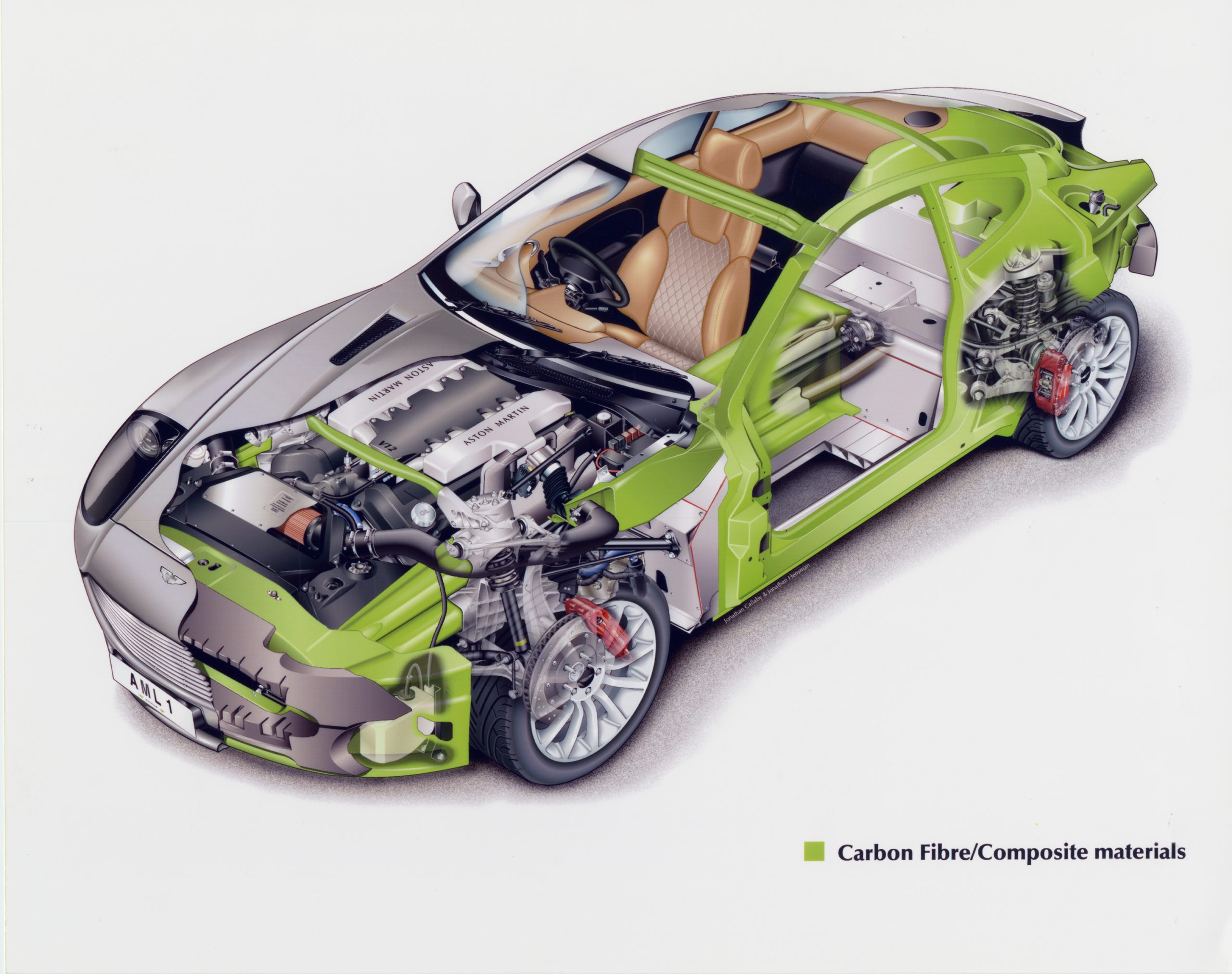
All the exterior body panels were made from aluminum, and each individual panel were tailored manually to the central structure.
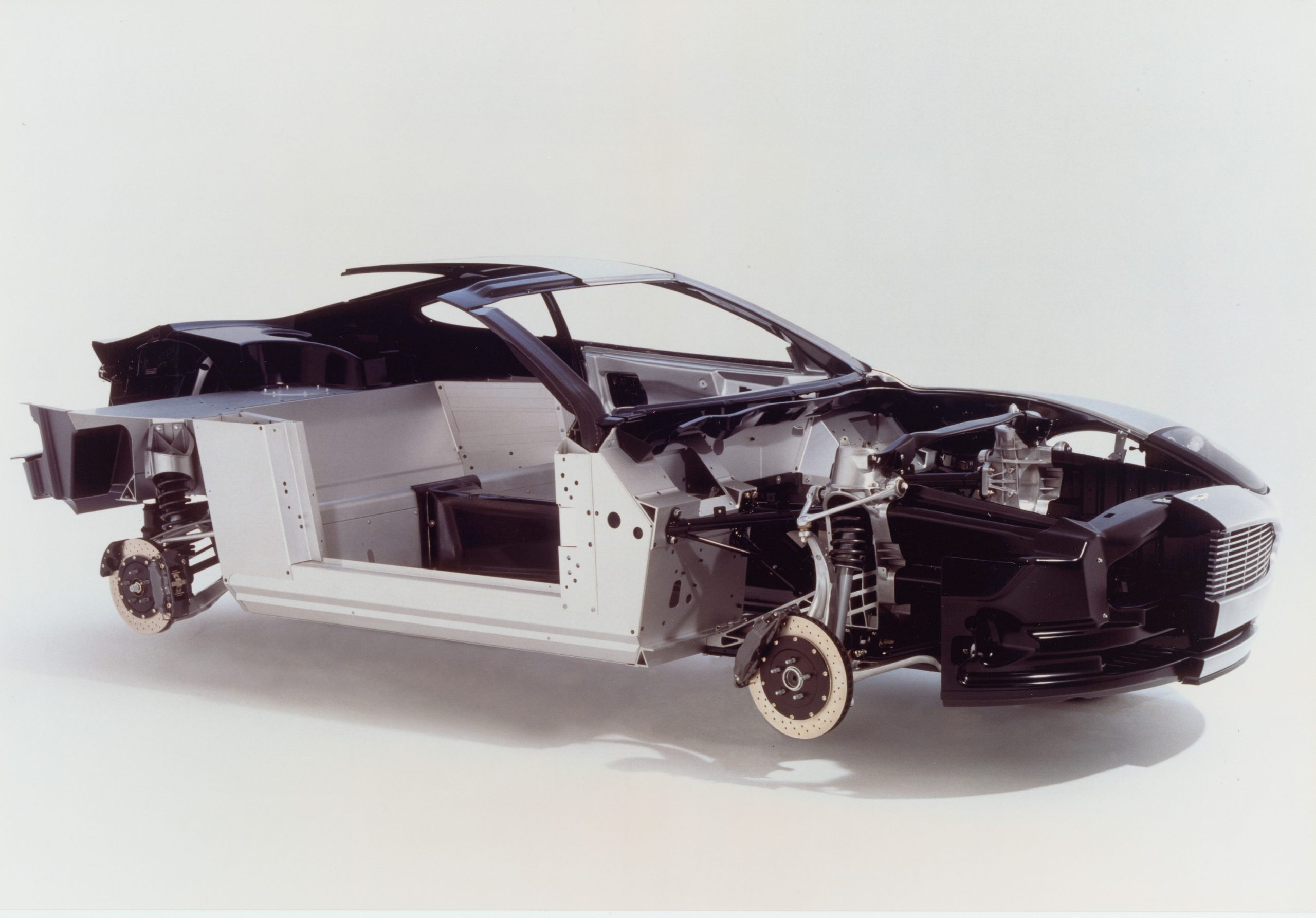
The central transmission tunnel was made completely from carbon fiber while the body structure bonded to it, including the front and rear bulkheads and the floor, were made from extruded aluminum structure.
To create a high strength safety cell, they connected to the central structure a single piece composite inner body side section with carbon fiber windscreen pillars.
To create the structures, they needed a precise, computer-controlled manufacturing process and this was a huge manufacturing undertaking for Aston Martin at the time. These were developed in California’s Silicon Valley in Cupertino and at the University of Nottingham in the United Kingdom.
In front of the driver and passenger compartment is a steel, aluminum, and carbon fiber subframe that houses the engine, transmission, and front suspension which are bolted directly to the front bulkhead. In front of the engine and front suspension is the deformable composite structure that carries the distinct Aston Martin mesh air intake grille. It not only adds crash protection, but it also accommodates the engine, transmission, and air conditioning radiators and intercoolers.
They also developed a completely flat surface for the underbody to allow air to be channeled into a Venturi section at the back to assist high speed aerodynamics.
The composite floor, parcel shelf, and side rails of the luggage compartment were also carefully designed at the rear to give additional deformable crash protection along with the extruded aluminum side impact beams that were in the doors.
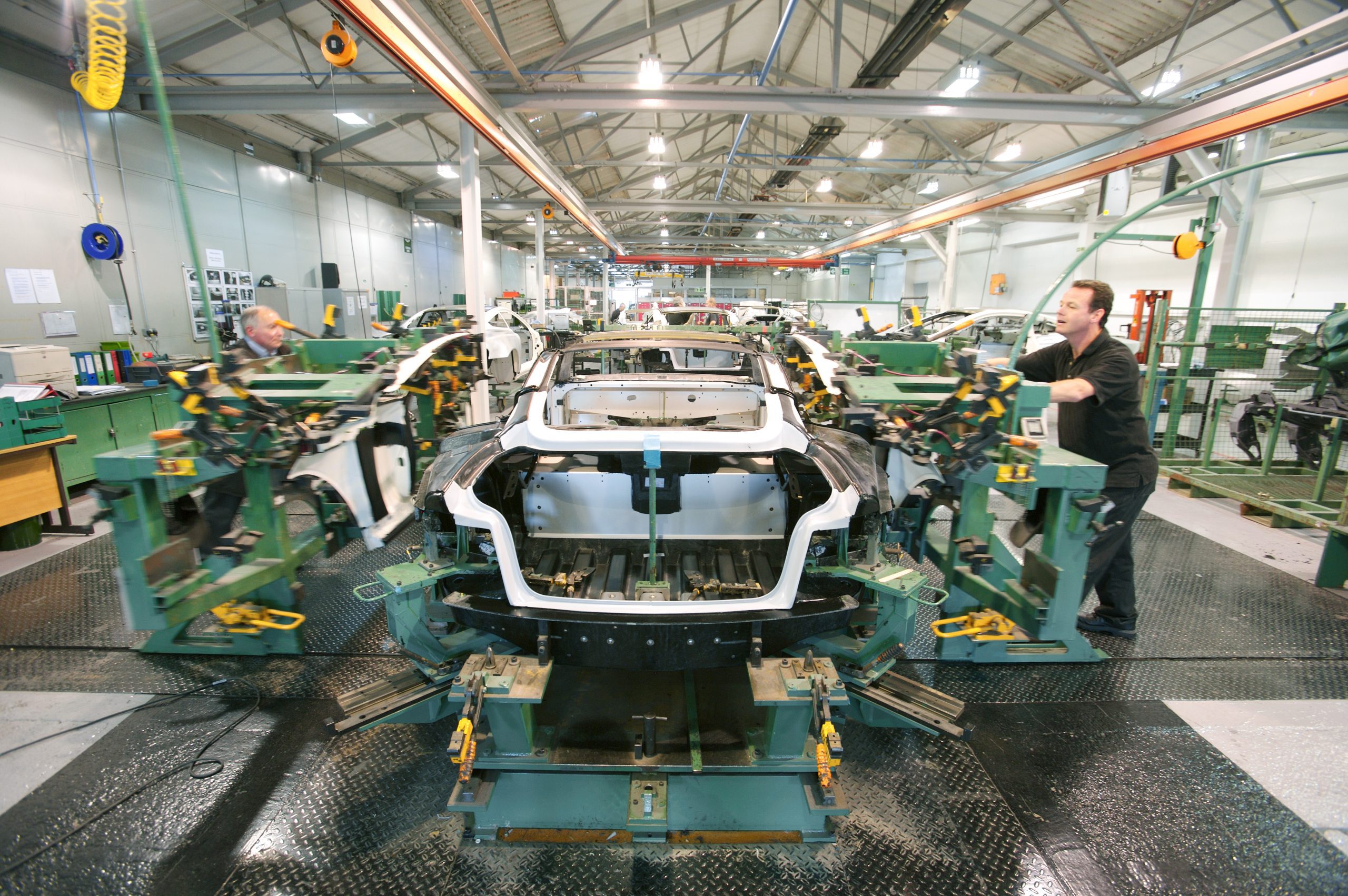
All the exterior panels of the V12 including the bonnet, roof, boot lid, doors, and front and rear wings were made from “super-plastic-formed” and pressed aluminum. Each individual panel were then manually tailored and bonded at the marque’s Newport Pagnell factory in Buckinghamshire to guarantee a perfect fit and finish.
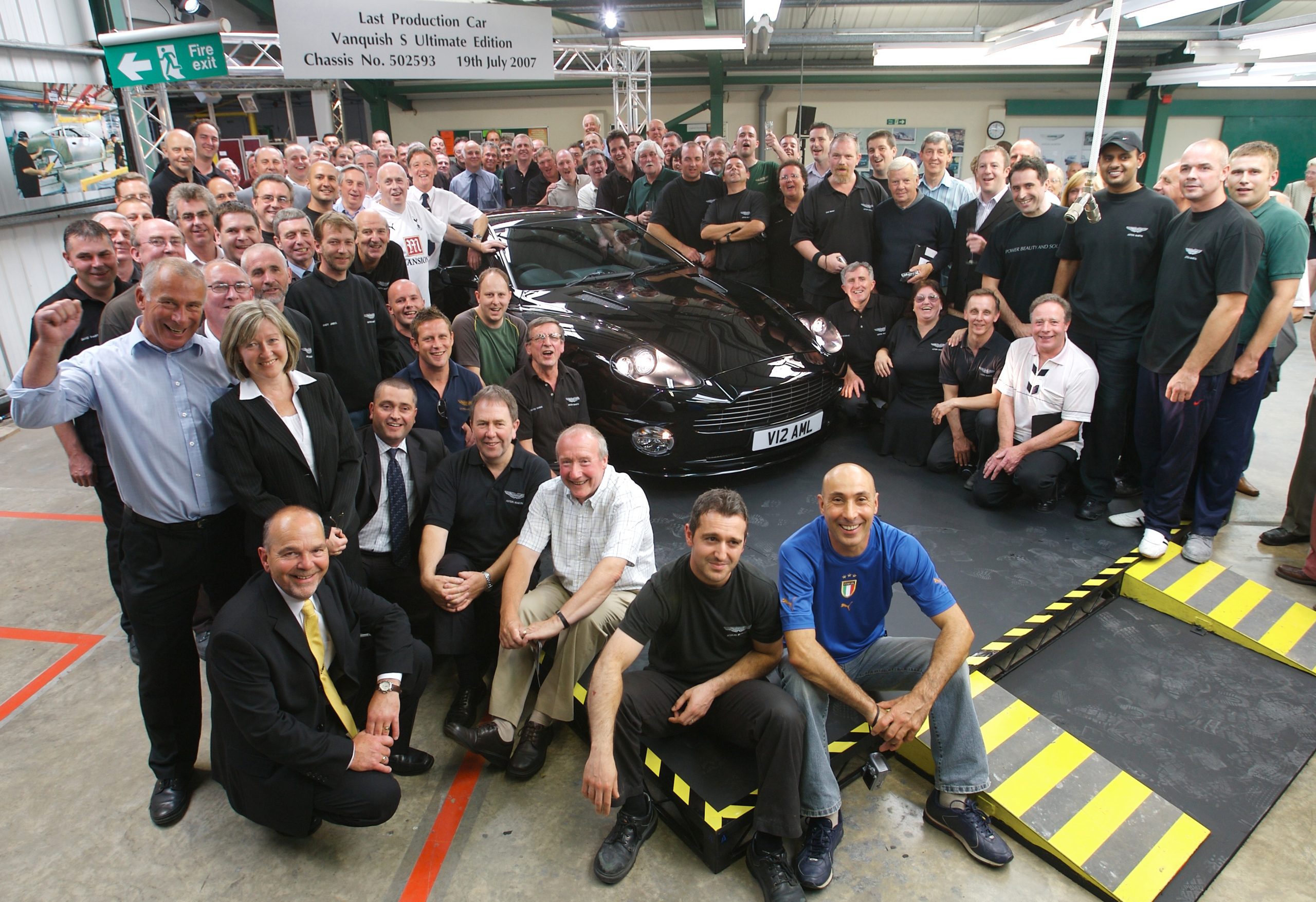
It takes eight full weeks to build each V12 Vanquish. Initially, Aston Martin targeted to create around 300 cars each year. As demand continued to grow, and the waiting list ran into years, the marque raised the target to build around 500 cars a year.
In the six years that the car was in production, a total of 2,589 V12 Vanquish were produced, with all the versions.
V12 Vanquish production at Aston Martin Newport Pagnell
V12 Vanquish engine and gearbox
Under the hood of this powerful car is an all-alloy, twin overhead camshaft 48 valve 6.0-liter V12 engine. It can generate 460 bhp at 6,500 rpm, and 556 Nm of torque at 5,000 rpm, enabling it to run at 190 mph.
The DB7 showed engineering enhancements made on the V12 engine like the new design inlet manifolds, valve gear, camshafts, crankshaft, and a new exhaust system. All these innovations gave an additional seven percent power.
The whole exhaust system and front bulkhead was wrapped in a heat resistant material that was first used and developed for the aerospace industry. This was done to ensure that the body structure was protected from the heat of the engine and exhaust system.
A new engine oil to water heat exchanger sped up and helped the operating efficiency, working together with an ionized gas misfire detection system that continuously monitored all of the engine’s 12 cylinders.
The V12 Vanquish’s six-speed close ratio manual transmission is connected to the electronic drive-by-wire throttle of the car. It is controlled through the twin paddles mounted on the steering column.
A cut away created to illustrate the composite construction in V12 Vanquish
Aston Martin recently engineered a manual conversion package that they offered to owners through their in-house heritage center and new car dealership: Aston Martin Works.
Since it opened, there have been around 130 original Vanquish models that have been given a manual transmission. On average, around ten cars are sent to Works every year for the process to done.
Brakes, Suspension, and Steering
The aluminum alloy road wheels were fitted with an anti-lock ventilated and drilled 355 mm (front) and 330 mm (rear) diameter Brembo disc brakes. It also had variable ratio power steering and independent front and rear suspension systems which had forged aluminum wishbones and cast aluminum front suspension uprights.
The rear axle had a limited slip differential that worked with an electronic traction control system which sensed potential wheel slippage and automatically decrease engine power. When necessary, it applies the rear braking system. The V12 Vanquish had exclusively designed Yokohama 255/40 ZR 19 front and 285/40 ZR 19 rear tires that had the AML initials. The tires were mounted on 19-inch diameter wheels with 9-inch width front rims, and 10-inch width rear rims. An automatic electronic sensing system monitors each individual tire pressure and temperatures.
A sketch of the V12 Vanquish S Ultimate Edition
V12 Vanquish S – the fastest
In September 2004, the V12 Vanquish S made its world debut at the renowned Paris Motor Show. At the time, it was the fastest production sports car that Aston Martin has released.
It had a recorded maximum speed of more than 200 mph, which was roughly 321 kph. It was equipped with a 6.0-liter V12 engine with 520 hp. The V12 Vanquish S was designed to be even more powerful, complemented by subtle steering and suspension upgrades, as well as a number of interior and exterior style changes.
When it was launched, the Aston Martin Chairman and CEO at the time, Dr. Ulrich Bez simply described the powerful V12 Vanquish S stating, “It is the ultimate high-performance Aston Martin”.
The elegant yet muscular body of the V12 Vanquish S was given subtle but effective changes. The distinct Aston Martin grille was given a more rounded and open appearance for better cooling. It also had an aerodynamic splitter for better high-speed stability. They redesigned the boot lid at the rear to improve aerodynamics, lowering lift and giving it better balance and stability while also adding a high mounted stop lamp. All the improvements allowed the V12 Vanquish S to get an impressive 0.32 Cd figure.
Other enhancements include shorter steering arms and stiffer springs and dampers. The modified steering geometry allowed it to respond 20% quicker than the ‘standard’ Vanquish, and it also resulted in a lowered required input for steering response.
The brakes were also upgraded to accommodate bigger six piston calipers and bigger grooved and ventilated front discs. The rear discs are 2mm bigger for better heat dissipation. They used floating discs to give drivers the feel of a more consistent pedal during heavy breaking. A revised brake pedal assembly reduced travel and improved pedal feel.
Other innovations include the all-alloy, quad-overhead camshaft 48 valve, 6.0-liter V12 engine that increased the power from 460 bhp to 520 bhp (388kW) at 7000 rpm. The torque was also boosted so it can give 425 lb ft (577 Nm) at 5800 rpm.
Improvements on the engine include new cylinder heads with fully machined inlet ports and combustion chambers for better airflow. They also updated the engine mapping and placed new fuel injectors.
The final V12 Vanquish S Ultimate Edition rolls of the production linein July 2007
V12 Vanquish S Ultimate – the end of an era
In February 2007, Aston Martin announced that they will end new car production at Newport Pagnell. And production stopped until 2017 when the marque developed their successful Continuation program.
This historic announcement in 2007 was marked by the creation of a strictly limited run V12 Vanquish S Ultimate Edition sports cars.
The 40 cars were all made available by special request of their clients who wants to celebrate the last iteration of a highly significant car in Aston Martin’s history.
The cars were given a specific color and trim combination to set these cars apart. The coachwork was given an ‘Ultimate Black’ finish which is a unique metallic shade. For the interior, the cars were trimmed in semi-aniline leather with coarse stitching, leather headlining, and black chrome finish.
Each car also had a personalized sill plaque that displayed its limited-edition number.
A plaque denoting the final V12 Vanquish S Ultimate Edition
Aston Martin also produced a small number of white V12 Vanquish made for the Middle East, along with their European market Ultimate.
Paul Spires added, “Here at Newport we rightly celebrate the heritage of this great British sports car marque, with particular emphasis on icons such as the DB5 which were almost all built in this seemingly sometimes sleepy corner of Buckinghamshire. However, to also be able to lay claim to a ‘modern classic’ such as the original V12 Vanquish is a great honour for us, and I’m sure that in time people will come to view these cars with the same reverence that is afforded to the early DB cars.”
October 29, 2021 / Comments Off on The V12 Vanquish Celebrates 20-year anniversary
I know the Mercedes G-Wagon is probably the most famous large SUV at this time, but you just can’t discard the famous Range Rover when talking about high-end, luxury SUV, and I know we now have others like the Bentley Bentayga and the Rolls Royce Cullinan, but the Range Rover has been the go-to off-roader for over 50 years, and both farmers and royalty have been seen behind the wheel of this famous SUV.
And while you might see a Bentayga or a Cullinan struggle off-road, both the G-Wagon and the Range Rover are more than capable both on city streets and out in the fields on muddy roads, the Range Rover is a ‘do-it-all’ that can transport the occupants in ultimate luxury while thundering down a field out and about, however, if you look at some of the specs shown in the latest press release for the unveiling of the MY2022 edition, you might think twice about getting in with filthy boots, especially when you opted for a white upholstery.
Thierry Bolloré, Chief Executive Officer, Jaguar Land Rover, said, “The New Range Rover is a superb manifestation of our vision to create the world’s most desirable luxury vehicles, for the most discerning of customers. It writes the next chapter in the unique story of pioneering innovation that has been a Range Rover hallmark for more than 50 years.”
Pricing for the United States market starts with the entry-level Range Rover P400 SE, a mild Hybrid 3.0L Turbocharged I6 (395hp / 406 lb-ft) that comes with an MSRP of $104,000, that number quickly rises once you get into the more powerful models, like the top-of-the-line Range Rover P530 First Edition (LWB) with the powerful 4.4L Twin-Turbocharged V8 pumping out 523hp with 553 lb-ft of torque, starting at $163,500 before options.
The new Range Rover will be available in SE and Autobiography models while as usual there is a ‘First Edition’ throughout the first year of production, based on the Autobiography but with some bespoke specification, exclusively available in a Sunset Gold Satin finish, among a choice of five exterior colors. Just like before the Range Rover gets the Standard (SWB) and the Long Wheelbase (LWB) body designs, the SWB comes with five seats, while the New Range Rover LWB model is available with a third row for extended comfort for up to seven adults.
In Range Rover language the SV isn’t a Super Veloce model like we’ve seen from Lamborghini, in this case, the SV stands for Special Vehicle Operations and boasts a next-level interpretation of luxury and personalization, the special SV model is also available in either SWB or LWB designs, with exclusive features including new SV Serenity and SV Intrepid design themes and a four-seat SV Signature Suite configuration that has a raised central console in between the two rear seats.
Prof Gerry McGovern OBE, Chief Creative Officer, Jaguar Land Rover, said, “The New Range Rover is a vehicle with a peerless character, from the impeccable restraint of its exterior to the flawless tranquil sanctuary of its cabin. Informed by creative intellect and a desire for perfection, it doesn’t follow fashion or trend, but by a modernist design philosophy, combined with over 50 years of evolution, it is quite simply the most desirable Range Rover ever created.”
The Range Rover was the first luxury SUV to come with an Electronic Air Suspension, back in 1992 already, so it made sense for this New Range Rover to continue this pioneering approach with an updated version of that, now called Dynamic Response Pro with pre-emptive suspension that actually uses the built-in eHorizon Navigation data to read the road ahead and prepare the suspension to provide appropriate responses … something we’ve seen on the Rolls Royce Cullinan too.
And another feature seen on the Rolls Royce SUV has made its way into the New Range Rover: power-assisted doors, a first on a Range Rover, available as an option on the MY2023, these doors can be controlled from the Pivo Pro screen on the central console, the doors even have sensors to avoid hitting people while opening or closing, and yes, the traditional two-piece split tailgate that has been a feature on the Range Rovers since the Seventies is back on this new model too.
Nick Rogers, Executive Director, Product Engineering, Jaguar Land Rover, said, “The New Range Rover combines supreme on-road and all-terrain capability with electrified propulsion and new levels of connected capability. In the quest for comfort, we have been obsessed with human science and understanding brain activity to minimize cognitive impact and ensure these advanced technologies work in absolute harmony, creating a truly effortless driving experience. It’s an engineer’s duty to make people’s lives better, and that’s exactly what the New Range Rover will do for you.”
Not only does the New Range Rover come with 360° camera view, as do most higher-end cars these days, but this SUV also has built-in lights all around the car to create a ‘blanket’ of light around her while you maneuver this big lady around … remember those neon underglow in the tuning scene a few decades ago … well, underglow is back now.
Rory O’Murchu, Vehicle Line Director, Jaguar Land Rover, said, “The New Range Rover combines advanced hardware with a pioneering toolkit of digital technologies and software, all enabled by our advanced electrical architecture – moving Range Rover from a mechanical world to a mechatronic ecosystem that delivers an intuitive drive. Our new Integrated Chassis Control system is a prime example of this philosophy and co-ordinates a suite of predictive and reactive technologies, that make this the most comfortable and agile Range Rover ever produced.”
While the New Range Rover isn’t a small SUV by any means, it does come with a turning circle of just 36 feet, the smallest of any Land Rover at this time, and this is thanks to All-Wheel steering now standard on every Range Rover, the rear wheels can be turned up to 7 degrees for better stability and comfort at speed, together with reducing the turning circle at low speeds in the city.
For the 2023 model year a PHEV will join the two petrol engines we’ll see in 2022, the extended-range plug-in hybrid (PHEV) will come with the inline 6-cylinder Ingenium engine coupled to a 105kW electric motor integrated with the transmission, power for this motor will come from a 38.2kWh lithium-ion battery, this setup will allow up to 62 miles of near-silent pure-electric driving, total power output will be 434 hp and this PHEV will be able to reach 87 mph on electric power only.
Michael van der Sande, Managing Director, Special Vehicle Operations, said, “Special Vehicle Operations exists to amplify the core characteristics of Land Rover vehicles, obsessing over every detail with a passion for quality. In the case of Range Rover, that means injecting even more luxury into every part of the car. With more choice than ever before, our customers will be able to create a new Range Rover SV that truly reflects their personality, their dreams, their desires. That is how we interpret modern luxury.”
The New Range Rover will be built solely at the Solihull Manufacturing Facility in the UK, using a state-of-the-art production line housed in the building used to produce early Series Land Rover vehicles, this historic building is the spiritual home of Land Rover and its reimagining as a new, ultra-modern center for Range Rover production showcases the way the company protects its heritage, you can now go to your local dealer and put an order in for the New Range Rover, sales have started already.
October 27, 2021 / Comments Off on There’s a brand new Range Rover in town
Today, Chevrolet unveiled its new range-topping Corvette Z06 model. This marks the return of the Z06 moniker – and all the amazing things it has always stood for – for the first time in the latest C8-generation of their infamous sports car (turned mid-engine supercar). During the livestream, the world got its first look at the most track-focused and performance-oriented iteration of the American automaker’s halo product, with basketball superstar Devin Booker and automotive personality Emelia Hartford co-curating all the latest revelations to a global audience.
“A global supercar, which is tantalizingly attainable.”
– Justin Bell, former British race car driver
The team in charge of the development of the Z06 are confident that their latest model will elevate the car to true global superstar status; for the first time, the automaker will be producing right-hand-drive versions of the Corvette to cater to overseas customers, of whom are already demanding more than what the company says they can readily supply.
You can tune in to the recording of today’s unveiling event on YouTube, below.
[embedded content]
[embedded content]
Engine & Performance
“It’ll perform with the best of the best worldwide… bringing all of our track experience to the everyday enthusiast.”
-Tadge Juecther, Corvette Chief Engineer
In the months prior to the camo coming off, we’d been teased with a couple video snippets of what the new Z06 has on tap; and Chevrolet has made it abundantly clear that their latest Corvette model is a derivative of their latest race-bred technologies and unyielding philosophies. More recently, another promo video made a brief nod to the new Z06’s flat-plane crank engine – dubbed the LT6 – being able to rev all the way to 8,600 rpm. The design team was tasked with achieving this without the use of forced induction (like how a supercharger was used in the previous-gen Z06), and blimey the naturally-aspirated unit sounds fantastic. This is in large part due to a specially engineered “reverse megaphone” exhaust which provides harmonic bliss for the driver and cabin, and for those admiring from the outside.
We now know that the 5.5L naturally-aspirated V8 produces 670 hp @ 8,400 rpm and 460 ft-lb of torque; this is in fact more than that of the C8.R race car (also seen in the video material linked above), which is limited to 500 hp due to IMSA regulations. Aluminum forged pistons and titanium connecting rods are used to enhance the Z06’s performance potential and provide drivers with the ultimate in “mechanical feel”.
Handcrafted by Chevrolet master technicians, the engine pulls strong throughout the entire rev range and is the most powerful naturally-aspirated V8 engine in a production car; not just in a Corvette, but in any car around the world, mind you. This all-modern all-American V8 is mated to an 8-speed dual-clutch transmission which sends power – in a much more traditional sense – exclusively to the rear wheels. Chevrolet has claimed that 0-60 mph in 2.6 seconds is attainable with the Z07 Performance Package included (more on that below).
“The LT6 truly opens the doors to what we can do with a small block V8.”
Chassis & Braking
“Even though the numbers are incredible, it’s not really a numbers car.”
-Tadge Juecther, Corvette Chief Engineer
The architecture for the Z06 has been recalibrated and fine-tuned in order to extract the full performance potential of the Corvette chassis. For starters, this means a 3.6″ wider stance than the Stingray, with redesigned body panels fashioned to accommodate it; and for the first time, the Z06 will feature a standard double staggered wheel/tire setup from the factory which features 20″ (front) and 21″ (rear) wheels, with 275-series and 345-series tires fitted on them respectively. This design takes full advantage of the C8’s rear-biased weight distribution, helping to put power to the ground with greater efficiency than any other Corvette road car before it.
The available Z07 Performance Package really takes things to the next level, and has been specially made for those who are looking to maximize the Z06’s abilities on the race track. Amongst the equipment included are carbon fiber wheels (which shed 41 lbs of unsprung weight compared to the standard forged aluminum wheels), carbon ceramic brakes and Michelin Pilot Sport Cup 2 tires. It also incorporates the otherwise optional Aggressive Aerodynamic Package, which adds a v-shaped carbon fiber rear wing, front dive planes and a more aggressive splitter. When equipped with the aforementioned hardware, the Z06 can produce up to 734 lbs of downforce at 186 mph, though unfortunately, the rumors about there being certain “active” aerodynamic elements, didn’t come to fruition.
“It has all of those feelings of a race car… fundamentally, it’s a race car you can drive on the road.”
– Ollie Gavin, legendary Corvette Racing driver
Design & Styling
“We respect our past, but we’re always moving forward.”
-Tadge Juecther, Corvette Chief Engineer
Many of us are still lingering in the “hangover” phase, since the day Chevrolet transformed the Corvette into a mid-engined supercar; one that has become much more a contemporary of European flair, than American pragmatism. Nevertheless, those of us who have gotten over it will be more than delighted with the trajectory on which the Z06 continues to take the C8 platform.
In spite of its performance-biased nature, Chevrolet will offer the Z06 in both coupe and convertible configurations – important for traditional fans of the brand – with a plethora of exterior colors, interior packages, and wheel packages offering no shortage of possible permutations. There’s room for generous servings of carbon fiber inside and outside the car, including a carbon roof and carbon interior accenting. You can also spec your Corvette with luxurious leathers, with the Adrenaline Red Leather Trim Package adding both popping-contrast and sleek refinement to the cabin. Chevrolet says that there are more than 11,000 unique combinations of options to make the car bespoke to your personal tastes.
Regardless of how you end up customizing your Z06, there are some things which will be standard for all cars. This includes larger wheels, beefier tires and a wider stance compared to that of the Stingray. Flared quarter panels and front fenders, along with unique and exclusive Z06 front and rear facias, further set the car apart from the rest of the C8 lineup. Replaceable spoiler wicker bills, rear brake cooling ducts, a removeable front fascia panel and front underwing stall gurneys all serve the important purpose of increasing downforce, reducing drag and cooling drivetrain and brake components. The aforementioned Z07 Performance Package turns all of that up to 11, while providing the Z06 with a much more aggressive and purposeful silhouette.
Inside, expect features such as the 12.0″ digital gauge cluster, heads-up display, heated and ventilated seats, and Apple CarPlay/Android Auto to be standard. Two tiers of Bose stereo systems will also be offered to enhance the grand touring experience, while a Performance Data Recorder is also available for those who wish to analyze their driving on the race track (or public roads too, if that’s your thing).
Pricing & Availability
Chevrolet has stated that production of the Corvette Z06 will begin in mid-2022 and that the car will be designated as a 2023 model, so we can expect the first deliveries to start trickling in by next summer. The official website suggests that they’re currently entertaining “inquiries” for the Z06 – and you can even start designing your own – although no official word on pricing has been publicly provided yet.
For now we can only speculate, and if past performance is the best indicator of future performance, then we should expect the new Z06 to start at around $90,000 USD; this would put it at about $30,000 more than the base car’s starting MSRP, which seems reasonable based on statistics and history. This is of course before any of the boxes for optional hardware are ticked, but the car remains an absolute bargain for everything that’s on tap, nonetheless.
Verdict
“The Z06 is the next chapter in a very long book.”
It feels like yesterday when Chevrolet had released their new mid-engine performance car, in the process breaking with the decades-old convention of what the Corvette has always been. That was a feat on its own, as the world witnessed the moment with delight; and now, the Corvette Z06 has arrived to elevate our senses to a whole new level. Like every C8-generation model before it, the Z06 allows the Corvette to punch well above its weight class and take on much more expensive (but not necessarily more sophisticated) competition.
The Z06 looks to take this fight to our favorite stage – the race track – where it can have uninhibited access to its exotic-slaying arsenal, and go toe-to-toe with the very best high-performance road cars on the planet. With its 670 hp flat-plane crank V8, unbelievably attainable exotic performance, and near-unlimited customization options, there’s no reason the 2023 Chevrolet Corvette Z06 won’t become an absolute hit amongst impassioned loyalists, data-driven pragmatists and everyone in between – it’s a true winner in every regard.
Under similar pretenses, the Honda NSX forever altered the supercar landscape back in 1990. Will the latest Corvette do the same today? It sure as heck looks like it.
Image Gallery
October 26, 2021 / Comments Off on 2023 Chevrolet Corvette Z06 Revealed
US Bentley retailers have been working together with Bentley Mulliner on three new collection families for the United States market to be applied on a number of bespoke grand tourers.
The three new collections will each feature a specific theme:
1.The Mulliner Nauticus Collection includes four Continental GT V8 Convertibles based on a yachting theme and will be showcased at the end of October at the Fort Lauderdale Boat Show. The convertibles have been finished in Aegean Blue and Ghost White paint from the bespoke paint range. This collection also features a set of 22 inch alloy wheels and color-matched carbon fibre Styling Specifications on the front bumper splitter,side skirts, rear diffuser and boot lid spoiler.
The interior of the Nauticus Collection features a combination of Brunel, Linen and Portland leather finished in a bespoke color, the front fascias, seats and door waistrails have a tonal theme around the cabin in Piano linen and the highlight of the cabin is the open pore chevron light veneer to the centre console.
2. The Mulliner Skyline Collection is the first collection to include all members of the current range and the collection was developed to celebrate Manhattan’s iconic skyline. All the vehicles in this collection are painted in Onyx, a dark black exterior paint. The exterior features 22 inch black and silver alloy wheels whereas the interior features silver accents on the headrest and seats and a silver contrast stitching running through the centre of the seats.
3. Mulliner Miami Collection is inspired by Miami’s colorful art scene and features six Bentleys. The exterior features vibrant paints with Arctica pinstripe highlights, the Orange, Blue, and Lime Green colors have been used to create a collection of cars including the Flying Spur, Continental GT and Bentayga.
The interior of the Miami’s collection features a two-tone paint-matched Piano Veneer on the front occupants and rear door pockets, contrast stitched bespoke quilting on the seats and Klein Blue leather on the gear selector and lower part of the steering wheel.
Bentley Mulliner USA
October 26, 2021 / Comments Off on Bentley Mulliner Reveals Special Models for the US Market
The designer of the groundbreaking 1974 Lamborghini Countach, Marcello Gandini, has issued a remarkable statement to the press regarding the recently released Countach LPI 800-4. In it, he repeatedly affirms that he had nothing to do with the revived Countach that Lamborghini revealed at Monterey Car Week on the occasion of the model’s 50th anniversary.
Gandini alleges that Lamborghini may have misled the public into thinking he had something to do with the Sián reskin, and he wants to make it clear that he had nothing to do with it.
“The external public, seeing and reading what has been communicated by Automobili Lamborghini and consequently by the media during recent weeks, may be led into believing that Marcello Gandini was a part of, or was involved with, or the project may have had his blessing. It is therefore appropriate to clarify the facts and reiterate that he did not participate in, nor was he aware of the project in any way.”
Rarely has a designer of Gandini’s stature and repute so publicly refuted a company they’ve worked for. Though Gandini penned cars from the humble Renault 5 to the masterful E12 BMW 5 Series to the incredible Lancia Stratos, it is Lamborghini — where he was responsible for the legendary Miura, Espada, Marzal and Countach, among others — that Gandini is historically most closely associated with.
Some of the confusion Gandini references stems from a video published by Lamborghini earlier this year. In it, Gandini talks about his design philosophy (which, ironically, includes breaking new ground with every design) and current Lamborghini head of design Mitja Borkert presents Gandini with a scale model of the then-upcoming Countach LPI 800-4. The latter believes that his presence in the video equates to tacit approval of the new design.
“Neither earlier, nor during the interview was it stated that the car was scheduled for limited series production. With the elegance and kindness that have always distinguished Marcello Gandini, when Mitja Borkert presented the scale model during the interview, the former did smile and acknowledge as would be customary to do so.”
Gandini believed that the model was the end of it, but after Lamborghini pulled the wraps off of the LPI 800-4, he says he received “countless requests for clarification” from press and colleagues in the auto design field. He decided to issue the statement to make clear he had nothing to do with the remake. Furthermore, he wants the public to know that he’s against the idea altogether. And though he doesn’t criticize the design itself, he skewers the notion of a remake.
“Thus, Marcello Gandini would like to reaffirm that he had no role in this operation, and as the author and creator of the original design from 1971, would like to clarify that the makeover does not reflect his spirit and his vision. A spirit of innovation and breaking the mould which is in his opinion totally absent in this new design: ‘I have built my identity as a designer, especially when working on supercars for Lamborghini, on a unique concept: each new model I would work on would be an innovation, a breaker, something completely different from the previous one. Courage, the ability to create a break without sticking to the success of the previous car, the confidence in not wanting to give in to habit were the very essence of my work’, explains Marcello Gandini. ‘It is clear that markets and marketing itself has changed a lot since then, but as far as I am concerned, to repeat a model of the past, represents in my opinion the negation of the founding principles of my DNA.'”
For its part, Lamborghini has issued its own response to Gandini, which Top Gear published. The company explains that the Countach LPI 800-4 was the work of designers at their Centro Stile and R&D department.
“The Company has never attributed any role to Marcello Gandini in the realisation of the Countach LPI 800-4. Instead, Automobili Lamborghini have invited Mr Gandini to take part in an interview that took place in June 2021. This was a conversation with the designer and Head of Centro Stile Lamborghini about the comparison between the old model and the new one.”
It’s understandable that Gandini wants to protect his legacy and name, but it also seems obvious that Lamborghini never meant to mislead the public about his involvement. However, it must be said that all 112 units have already been sold out, so someone out there does appreciate them.
All in all, it’s a regrettable misunderstanding that has marred what should otherwise be a golden anniversary celebration of one of the most famous and beloved cars of all time. Perhaps we should just ignore it and revel in the Countach LP500 concept rebirth instead.
Related video:
October 26, 2021 / Comments Off on Original Lamborghini Countach designer wants no association with 2021 remake
Malibu, Calif — There’s no shortage of show in LA. From studio moguls rolling in ultraluxe sedans to wannabe racers using freeways as their own personal circuits, the city of Angels explodes with vehicular energy— much of it, inauthentic.
Slathered in scoops, spoilers, and ducts, the Huracan STO looks like every go-fast visual cliché brought to life, a caricature of real deal racecars. This one is even finished in blue and orange, a sort of flamboyant take on Gulf livery. But the STO’s story is actually authentic.
The last Huracan variant approaching this level of hardcore was the Huracan Performante (2017-2019), which many (including this author) credited as the brand’s first credible track weapon. The subsequent Huracan EVO was launched at Bahrain’s F1 circuit and loaded with ambitious tech. However, its chassis setup, which combined four-wheel steering and a variable steering ratio, lacked the consistency and edge needed for serious track driving.
This time around, the STO draws legitimate inspiration from Lambo’s Super Trofeo and GT3 race cars, which have helped the brand claim more than 100 GT3 wins and three outright Daytona 24 Hours victories in a row. Not a bad starting ground in a bid for relevancy. The STO’s intricate skin is 75% carbon fiber, helping shed some 95 pounds over the Performante. And while it claims 37% more aerodynamic efficiency over its predecessor, the STO’s massive, three-way adjustable rear wing manages a staggering 926 lbs of downforce at 174 mph, which is 53% more than the Performante. Aiding the effort are magnesium wheels and a 20% lighter windshield. Though Lamborghini only publishes dry weight figures (and the STO claims a mere 2,950 lbs without fluids), it’s fair to say that featherweighting has been aggressively pursued. The suspension is more aggressive due to stiffened bushings, revised stabilizer bars, and an updated magnetic adaptive damper setup. Oh, and the frunk? In yet another motorsports nod, it’s designed to accommodate a full-face helmet.
The STO’s 5.2-liter V10 produces the same 640 metric horsepower as the Huracan EVO (that would be 631 in the horsepower you’re more familiar with). For reference, that figure is actually more than Lamborghini’s GT3 and Super Trofeo race cars, which are both rated at 620 metric horsepower — though the GT3’s engine is limited to 550 metric hp in order to conform to the FIA’s balance of power regulations. The STO’s torque drops from the EVO’s 443 pound-feet to 417 lb-ft, with the upside of greater throttle response and quicker shift times from the seven-speed dual-clutch transmission. The torque reduction is also counteracted by ditching the all-wheel-drive powertrain for a rear-drive configuration, saving valuable weight.
Special six-piston front and four-piston rear Brembo CCM-R brakes borrow F1 tech for quadruple the amount of thermal conductivity over standard carbon ceramic stoppers. Maximum braking power also improves by 25%, and a dashboard display offers a brake temperature monitoring readout. Interestingly, the Pirelli P-Zero’s sidewalls were deemed too soft for the STO’s elevated downforce and cornering loads, which led Lamborghini to develop a special street and track compound with Bridgestone tires.
Our tester’s optional trim packages lend it an extravagantly customized feel inside, with contrasting black and white blocks of leather and Alcantara. This particular example flaunts a laundry list of trim options including “Full Livery Exterior Pack” ($37,800), “Contrast Pack” ($4,000), “Full Exterior Carbon Pack” ($21,600), and “Dark Chrome and Carbon” ($8,600). And that’s just for starters. In fact, the options list is so lengthy on our borrowed sled that already had the hefty starting price of $327,838 balloons to a remarkable $442,033 thanks to the sky-high pile of extras.
Ameliorating the dizzying expense is the heady blast of the naturally aspirated V10, which alerts neighbors and friends blocks away that there’s a braggadocious bad boy in town. There’s still nothing quite like sitting in a Lamborghini and firing up a big naturally aspirated V10, even if its doors open this way –>, not that ^^ way. The Huracan’s seats still sit surprisingly tall within the cabin, but the lack of floormats and bare carbon fiber door panels drive home the racecar theme. The digital dashboard and centrally positioned touchscreen add a techy touch. That said, the extreme reductionism annoyingly removes the volume knob. You have to dig into the touchscreen to adjust the sound level.
As before, drive modes are controlled via a small red toggle at 6 o’clock on the steering wheel, managing the behavior of the engine, transmission, traction control, stability control, rear-wheel steering, torque vectoring, and ABS. In this case, the modes are named STO, Trofeo, and Pioggia— street, race, and rain— and each delivers a palpably different character. Pull away in Pioggia, and the STO plays docile and soft, responding to inputs like a purring pussycat. Tap into Trofeo, and the Lamborghini turns into an easily angered predator, with a razor throttle response and sharp immediacy to steering inputs. This is the mode that makes the STO feel most consistent with its aggro looks: it begs you to jam the throttle, which in turn can kick the tail out with dramatic tirespin. Trofeo isn’t the mode you want if you’re seeking the quickest lap times, but it’s arguably the most fun, uncorking the fiery personality of the STO’s sonorous V10, and its disarming effects on yaw angle. While it’s not the torquiest at lower rpm, the engine winds itself up to produce a satisfying rush of power as the virtual tach climbs to a satisfying 8,500 rpm redline. STO mode minimizes the drama in the interest of lap times, trading tire spin for forward motion and curtailing slides in order to more effectively clip apexes. It’s a less fun, but more effective way to maximize this Lamborghini’s elevated abilities.
Piloting the STO through Malibu’s most challenging canyon roads reveals staggering reserves of performance beneath its (mostly) carbon fiber skin. Unlike the EVO, there’s no second guessing the intentions of the chassis, just a direct, linear relationship between driver inputs and vehicle dynamics. The STO meets and exceeds speed limits with staggering ease. And its outrageous appearance would make pleading your cause to an officer of the law all but impossible. This is a supercar that looks fast, and goes even faster— especially when delving towards its indicated 8,500 rpm redline, where the cabin is blasted with the brain rattling roar of the V10.
Despite the considerable sound and fury, there isn’t much learning curve needed to manage the STO’s capabilities, primarily because its machinery feels more analog than digital. Credit the linearity of the naturally aspirated engine, which lacks a turbocharger’s ramp-up under boost. However, the bigger differentiator here is the chassis: the steering, with its fixed ratio in the STO, feels intuitive and offers good feel, the connection to the road yields (mostly) predictable results. The exception is when the throttle is mashed and the sticky Bridgestones are overcome, and at higher speeds it feels like the aero’s considerable downforce is helping keep the wedgy two-seater in contact with tarmac. Brakes? We barely tapped into their capacity on the road despite heavy application, lending credibility to Lamborghini’s claims of their trackworthiness.
If anything, experiencing the Huracan STO on public roads reveals the striking difference between its stratospheric performance envelope, and the stifling limitations of the real world. The STO can have your license yanked quicker than you can say Super Trofeo Omologata, its namesake which indicates its homologation from racing. But what a way to go: this latest Lamborghini samples the best of what its winning race cars have to offer, while offering navigation, Bluetooth, and a sound system that’s almost decent enough to overpower the plaintive wail of its V10. In spite of the creature comforts, the roadgoing STO manages to lap the Hockenheim circuit in 1:48.86, a mere 2 seconds behind its racecar counterpart, which wears slicks.
Its maker calls this Huracan a “celebration of the combustion engine,” which couldn’t be a truer statement since all Lamborghini model lines will be hybridized by 2024. Until then, savor the STO, which achieves its mission of putting a racecar on the road with stunning totality.
October 26, 2021 / Comments Off on Lamborghini Huracan STO First Drive Review | No shortage of show
The magnificent Lamborghini Aventador has been in production little over a decade by now, and despite being such an ‘old’ car in automotive terms, Automobili Lamborghini SpA has been able to keep evolving the model just enough each time to keep it interesting and to keep sales strong on their V12 flagship model of the 21st century.
The Aventador era officially started in March 2011 at the Geneva Motor Show with the public unveiling of the Aventador LP700-4 as the successor to the Lamborghini Murciélago, a brand new flagship in a new color called Arancio Argos, a bright metallic orange over a two-tone black and orange interior, even today, 10 years later, this is still a popular color combination on the top-of-the-line model from Sant’Agata.
Initial reports stated Lamborghini prepared to build a total of 4,000 units on the new Aventador, in line with the total number of Murciélago produced before, but that number quickly changed when the success of the Aventador went way beyond their expectations, only 15 months after the introduction chassis number 1,000 was already built, the factory at Sant’Agata was now building 4.5 units each day and had form orders for another 1,500 cars, and they hadn’t even introduced the Roadster yet, because in March 2012 center stage at Geneva was taken by the one-off Aventador J, a roofless custom build, a trend Lamborghini would continue throughout the Aventador production life.
In late 2012, at the Los Angeles International Auto Show, Lamborghini unveiled the next logical step in their Aventador line up, the Roadster, this time with two lightweight roof panels instead of the canvas top used on the Murciélago Roadster, and these panels could be stored inside the front luggage compartment of the Aventador Roadster, making her a lot more practical compared to her topless predecessor, still, a manual operation going from closed coupe to open-top roadster, but a massive improvement nonetheless.
Now having both the Aventador LP700-4 Coupe and LP700-4 Roadster in production, orders poured in even faster, and by June 2013 we had already seen 2,000 flagship V12 cars leave the gates at Sant’Agata, and Lamborghini wasn’t slowing down one bit, having a perfect base in the Aventador carbon-fiber tub, they went one step further and started building bespoke models on that chassis, in came the Veneno, a LeMans inspired supercar that did use the Aventador chassis, but other than that came with a completely different body, something that looked like it came straight from the racetrack, only 3 units of the Veneno were sold, an additional 9 units of the Veneno Roadster were available, and the future would show Lamborghini was just starting with these ‘few-off’ models.
It only took four years for the total production of the Lamborghini Aventador to reach that mystical 4,000 units mark mentioned back in 2011, but Lamborghini just commissioned more monocoque molds on top of the eight original ones, each of which would be able to produce up to 500 carbon fiber Aventador ‘tubs’, and they would need them as the Aventador was evolving into the next step, the LP750-4 Superveloce, a brutal looking version of the standard LP700-4 model, now with 750 hp instead of the original 700, and with an aggressive-looking aero package, complete with a tall rear wing, all in clear carbon fiber naturally.
Again available as a coupe and a roadster, the Aventador Superveloce was however a limited production model, to make her even more exclusive only 600 units would be made, and just 500 SV Roadsters, with an MSRP of €327,190 in Europe, $485,874 in the United States and £315,078 in the UK for the coupe version, it still sold out rather quickly, most of these being signed for ahead of the first customer car being delivered in the Summer of 2015.
Five years into the production of the Aventador it was time for the mid-life update, which came in the form of the Aventador S, an updated version of the original LP700-4, Lamborghini didn’t go for the LP designation anymore and just called it the ‘S’, much like we’ve seen earlier on the Miura and Countach evolution, do note that the Aventador S was not a detuned SV, but rather an evolution of the original LP700, with different front and rear bumpers, fixed air intakes on the shoulders and a central exhaust, the Aventador S also introduced rear-wheel steering on the flagship model.
This time the Roadster variant came really quick after the introduction of the Coupe, and it seemed Lamborghini was speeding up the production of ‘specials’ based on the Aventador underpinnings with the introduction of the Centenario, a car to celebrate the 100th birthday of the late Ferruccio Lamborghini, the Centenario was unveiled in Geneva with a clear carbon fiber body, rumored to be a €300,000 option, about the price of a regular Aventador … still, several of the only 20 units of the Centenario coupe were ordered with this option, as did some of the 20 additional Centenario Roadster units that were also built at Sant’Agata.
With the Aventador SV being built already, Lamborghini decided to take their V12 flagship to the next level, with the Aventador SVJ, or Super Veloce Jota, inspired by the stunning Miura Jota and later the Diablo SE30 Jota edition, the new Aventador SVJ was another step above the already impressive SV, again a limited production, 900 units for the coupe and 800 units for the Roadster, the SVJ production is still ongoing at the time of writing … but most of them have been delivered to their clients already, which brings us to the final episode it seems.
Lamborghini took the Aventador chassis to another level by adding a supercapacitor and a 34 hp electric motor when they created the Sián FKP37, a completely different looking car to the regular Aventador that became the first hybrid in Lamborghini’s history, but it wasn’t a production model, yet again Lamborghini created a few-off, this time 63 units on the Sián coupe and another 19 units on the Sián Roadster, the first units of the latter are being built as we speak, and Lamborghini liked the idea of a hybrid so much they decided to do a once over when they introduced the Countach LPI800-4, an homage to the supercar from the Eighties, but again a limited run on only 112 units.
But there is a problem, Lamborghini is developing the Aventador successor, and have been for a while now I guess, the new car should be introduced in late 2022 or early 2023, but that leaves some time before customers will be able to receive the new flagship, which as we understand will retain the V12 engine, albeit a completely new design, with additional electric motors making it the first Lamborghini hybrid production model … so how can we keep the factory working until the new car is ready?
Lamborghini decided to make one last run of special Aventador models, called the Ultimae for being the ultimate model in the line, taking the Aventador S and adding some of the SVJ parts, but leaving the entire ALA, Active Lamborghini Aerodynamics, behind, to create the best Aventador yet for those that aren’t looking for a hardcore track-inspired model like the SV and SVJ.
Yet again the Aventador Ultimae is a limited production model, in total 350 coupes and 250 Roadster of this 770 hp masterpiece will be built, and you’ve guessed it, they are sold out already, which means the Aventador era is over, after a little over ten years of being built at the famous ‘Linea Aventador’ in Sant’Agata, the final curtain is ready to come down, production of the remaining orders will continue well into 2022, but chances are that by the time the factory goes on its annual holiday in August 2022, the Linea Aventador will be converted into the Linea … who knows, there isn’t any information on the name for the successor yet, let alone the styling.
Lamborghini has kept their Aventador successor a secret so far, all we know is that it will come with a newly developed V12 engine and be a hybrid, that’s it for now. With all of the 600 Aventador Ultimae being spoken for today, you are no longer able to order a new Aventador at a dealer, the Lamborghini ordering system has stopped accepting V12 orders, you might be able to locate a car in stock or inbound at a dealer, perhaps even be able to change some options on a car a dealer has on order, but orders have been shut down on her majesty the Aventador.
Back in September 2020, the 10,000th Aventador was already built, an SVJ Roadster, and with about 1,000 units of the V12 built per year it is safe to say we might be looking at a total of about 12,000 units in the entire Aventador range being built by the time production is halted and a replacement comes up, a fun fact is that this number is larger than all of the previous V12 models in Lamborghini’s history combined together, even the Murciélago saw only 4,099 units over her production span.
October 26, 2021 / Comments Off on Linea Aventador is coming to an end at Lamborghini
The title might have caught you off guard, but the famous Bentley Mulliner atelier has created a Russian Ballet themed collection with some unique detailing bespoke to these six regional cars, all of them already sold in case you are wondering, the Bentayga Speed Étoile celebrates six specific ballet moves about momentum, speed, and precision … Bentley Mulliner too inspiration from Russia’s great cultural heritage for the handcrafted details found in these six custom-built Bentley.
For the first time in the world, the Bentley Mulliner bespoke division created a collection that pays homage to Russian ballet, probably the most graceful and emotive expression of human artistry, and no other car than the majestic W12 powered Bentley Bentayga Speed would do, with her handbuilt engine assembled right at Crewe itself, the limited run of just six cars is meant to open the first chapter of the Russian Heritage Editions.
These Russian Heritage Edition Bentley will be made each year, with very specific themes intended for Russian clients, this first one centers around the more iconic ballet moves, and every single one of the six cars will emphasize a different move or motion with amazing, handcrafted details that will pay homage to the dramatic sensuality of ballet, and knowing Bentley Mulliner, this will be executed with the utmost attention to detail while using the finest materials to create perfection on wheels.
As mentioned earlier, there will be six different cars in this first chapter, and each of them will be finished in a different paint chosen from the vast Bentley palette, three of these cars will be finished in a two-tone paint scheme while the interior takes inspiration from four different specifications, each with her own interior split with one-off stitching and naturally featuring some special ballet embroidery in silver, there’s even a modern ballet overlay in front of the passenger on the dashboard.
The list of six different combinations for the bespoke Bentley Bentayga Speed Étoile is as follows:
Windsor Blue over Light Windsor Blue – Twine and Imperial Blue leather combined with Liquid Amber Veneer Silver Storm over Damson – Autumn and Damson leather combined with Koa Veneer Moonbeam over Moroccan Blue – Twine and Imperial Blue leather combined with Liquid Amber Veneer Damson – Autumn and Damson leather combined with Koa Veneer Spectre – Cashew and Burnt Oak leather combined with Dark Fiddleback Eucalyptus Veneer Magnolia – Shortbread and Cricketball leather combined with Grand Black Veneer
Each of the six different cars is named after a special move in Ballet, this name is also displayed on the treadplate and is combined with the corresponding ballet imagery found on the interior.
Christian Schlick, Head of Bentley Russia, says, “We are excited to present the exclusive Bentayga Speed Russian Heritage Collection to our Russian customers. This project is built on the passion for perfection, which Bentley shares with such a grand and sophisticated art as ballet, the central motif of this year’s limited edition. These six unique SUVs will be delivered by Bentley Moscow and Moscow-Volgogradskiy at the end of the year, as all of the cars are already allocated.”
The Bentley Bentayga Speed for the regional collection comes with some special features, like darker headlights, color-coded side sills, bespoke front, and rear bumpers while these even receive a special rear spoiler, the radiator and bumper grilles are darker than usual while the wheels on these six cars are unique 22-inch designs, these cars even come with Russian Heritage LED welcome lighting.
For the interior, the Bentayga Speed two-tone pattern gets enhanced by using a dark accent running over the seats and trim, in addition to the edges of the seats and backrest being in a contrast color, these regional commission builds also come with contrast stitching, the press photos even show a stunning Breitling analog clock on the dashboard, absolutely stunning detail.
While these cars are absolutely beautiful both inside and outside, another beauty is hiding underneath the front hood, the impressive 6.-Liter W12 twin-turbocharged engine with her massive 626 hp output that delivers a top speed of 306 km/h (or 190 mph), thanks to a torque number of 900 Nm between 1,500 and 5,000 rpm, acceleration from 0 to 62 mph (100 km/h) takes just 3.9 seconds in this luxury SUV, and thanks to the Bentley Dynamic Ride all this power can be enjoyed with class-leading cabin stability, ride comfort and exceptional handling.
October 25, 2021 / Comments Off on What does the Russian Ballet and Bentley have in common?
For those not in the know, Kyalami Green in Audi-speak is a bright shade that closely resembles Porsche’s more aptly-descriptive Viper Green. That name at least tells you this is a green hue with fangs—a green that stands out like no other and which attracts the attention of others.
While reviewing this car, I was even asked by two gentlemen in the supermarket car park if they could photograph it. And on my return, there was a middle-aged lady hovering around Ingolstadt’s fiery little coupe, muttering flattering words in its direction.
Hoping some of the compliments might have been aimed in my direction, I said to this lady how unusual it was for a grey-haired old codger like me to be piloting a sporty machine decked out in such a daring colour. “Ah no,” she opined, “you look cool in it!” Happily, my wife heard every word but pretended not to have done so—although she did admonish me for having the drive mode set in DYNAMIC, which maximises all the stunning aural effects that envelop the TTRS on the move.
2022 Audi TT RS Design
Exterior Details
On a more serious note, it’s not just the colour that attracts the eye in the case of this Audi supercar. It’s as much the simply fabulous, glossy paint finish and the wafer-thin shut lines together with the beautifully detailed (optional) gloss black trimmings that all combine to massage the senses.
The basic shape of the TT is familiar enough, having retained most of the eye-catching yet simple elements of the revolutionary original, and although its dimensions have grown across the three-and-a-bit generations that have followed, it remains a compact sportster endowed with decidedly cosy cabin dimensions exaggerated by the marked roof curvature and long, sloping tailgate.
As you might expect, opening and shutting the two hefty doors is a pleasure, thanks to the reassuring thunk they make and the precision feel of the process—the effortlessness of which almost seems surreal within a structure solid enough to make a Tiger tank feel like a packet of corn flakes. All of this simply reinforces the feel good factor.
Interior Details
For those lucky souls who enter the cabin, there are even more details to appreciate. Take a close look inside the door jambs and around the sills and you’ll notice that the paint finish is consistently flawless (and that nasties such as spot weld points are absent).
This fastidious detailing is maintained throughout the cabin, which in this instance featured gorgeous quilted nappa leather and alcantara seating, as well as acres of soft-touch surfacing and a mix of textures including (optional) carbon fibre.
It’s certainly a cosy environment, although the low seating position and proximity of the beautifully lined roof ensure that entering and exiting needs a conscious effort for a frame as well worn as mine.
Finding a perfect driving position is not difficult though, thanks to the multi-adjustable seating and leather-wrapped, flat-bottomed steering wheel, which also sports alcantara inlays (as does the stubby shift lever).
This is what I call, in relative terms, old school Audi detailing. Hard surfaces are hard to find, and rotary MMI controllers and tactile switch gear provide functionality beyond mere touch. This makes operating the brilliantly informative and clear multi-functional driver display more intuitive than might be the case in some of the later Ingolstadt productions, where the eye needs to wander off the road. Truth be told, though, the ambience of the TT is not so much luxurious as it is clinically precise.
Cabin Display
The extent of the information on display is terrific and includes:
Front and rear camera images
A G-meter
Boost levels
Sat nav
Audio
A full run-down on the car’s state of play, with details like:
Fuel consumption
Range/level
Odometer Dual speedo displays
Engine revs
Tyre pressures
And more
Naturally, there’s also cruise control on board, along with keyless stop/start, auto air con, electric folding mirrors (optional gloss black in this instance), and electric one-touch windows.
2022 Audi TT RS Comfort
Two occupants will enjoy the low-set front pews that offer more support than observation alone might suggest, but the vestigial and very upright pair of seats in the rear are there to transport wee ones on urban hops only. They’re much more useful when folded to extend the surprisingly capacious (if shallow) load area that provides 305L (10.77cu/ft) with seats in place.
2022 Audi TT RS Performance
Those fortunate enough to own a set of keys for such a sporting bolide will be much more interested in what lurks under the clamshell bonnet, and here the TT RS truly excels. The straight-five injected and turbocharged engine has been refined over the years, during which time it has earned a multitude of international awards.
Notwithstanding its ballistic 294kW (395HP)/480Nm (354lb/ft) peak outputs, it idles with unusual smoothness and lack of aural fuss. But give the gas pedal a decent prod and those five cylinders, with their unusual firing order, transform into a snarling, mildly off-beat symphony that’s sure to be accompanied by the broadest of smiles and simply devastating forward momentum.
Audi’s famed quattro driveline ensures that no energy is fruitlessly expended in spinning wheels as the scant 3.7 second 0-100km/h (62.2 mph) elapsed time indicates—but this diminutive coupe does more than scamper off the line like a scalded hare.
With the aid of a slick and decisive 7-speed dual clutch S Tronic gearbox that’s very willing to drop cogs in DYNAMIC mode in particular, this engine has muscles to flex from as low as 2000rpm. Traversing urban roads with constantly variable traffic flows never triggers a feeling of lethargy from the five-pot mill.
Indeed, it is rarely necessary to employ the services of the wheel-mounted paddle shifters, since the transmission boasts sufficient grey matter to do the right thing most of the time. If the mood arises, though, using a heavy foot and flexible fingers to work those shifters really does produce the most electrifying performance—aided by activating the sound flap in the exhaust system, which terminates in two large circular pipes that warn would-be-challengers to approach with caution.
For the record, this test unit featured the deletion of the usual 250km/h (155mph) speed limiter to allow for a top speed of 280km/h (174mph).
This car’s straight line performance is nothing less than electrifying, as are the brakes. But the RS does more than leave vapour trails in its wake, as its small dimensions, huge 255/30ZR20 Pirelli P-Zeros, quattro drivetrain, inherently stiff springs, and (optional) adaptive suspension prove. All these inputs combine with surprisingly responsive steering to produce a machine that can change direction with pleasing certainty, backed by limpet-like grip.
Sure, it’s not a scalpel in the mould of a Porsche Cayman, but to expect such precision would be a tad unfair, given that the Audi’s underpinnings owe more to a Golf hatchback rather than an out-and-out sportscar. What it offers is a ride, even in the sportiest setting, that feels distinctly firm—but with a measure of pliancy that blunts the worst effects of sharp ridges and deep-set manhole covers (even if it doesn’t entirely eliminate them).
As might be expected, that sport-biased rubber can set up a bit of a din on coarse tar. But in cruise mode on smoother surfaces, the TT RS is decently refined, thanks to excellent suppression of wind noise and an almost total isolation of mechanical interference—until that gas pedal is exercised in a downward direction!
2022 Audi TT RS Mileage
Speaking of gas, the RS recorded a fuel consumption of 11.9L/100km (19.77mpg (US) over a weeks’ varied use with plenty of urban running and bursts of acceleration thrown in. However, a specific motorway check over 30-minutes’ running at around 130km/h (80mph) produced a most encouraging 8.2L/100km (28.68mpg (US).
Final Thoughts on the 2022 Audi TT RS
Sadly, it seems this Audi TT RS will be the last of the breed, as politics and a change of priorities in the world of car manufacturing will soon see the end of fossil fuelled vehicles, especially those of this ilk. Anyone seeking a last chance to take ownership of a surprisingly practical compact sports coupe with stunningly classy build quality and a level of performance almost unmatched in this price range should take the bull by the horns without delay. If all these gloomy predictions do indeed come to pass, then the RS is a truly marvellous swansong for the TT concept.
October 25, 2021 / Comments Off on [Review] 2022 Audi TT RS
After making a static debut at the Concorso d’Eleganza Villa d’Este, the reconstructed 1971 Lamborghini Countach LP 500 prototype has met the track for a proper shakedown. A banner day for all involved, no doubt, Pirelli loaned its Vizzola Ticino test track to Lamborghini, collector Albert Spiess from Germany and the contributors who helped create the car from scratch.
Spiess said he saw the original prototype at the Geneva Motor Show and then put a Countach poster on his wall as a kid, determined like so many other children for the next 15 years to have one. With the Geneva show car destroyed during crash testing, Spiess eventually determined to convince Lamborghini to build one anew. It likely didn’t take him more than 25,000 hours of cajoling to get a “Si” from the principals in Sant’Agata Bolognese, but that’s how long the carmaker’s historic division, Polo Storico, spent on the reconstruction. Polo Storico chief Stefano Castricini said it took “mad and desperate” research through archival materials, on top of the interviews with original workers and help from suppliers like Pirelli and PPG.
It doesn’t look like they worked the LP 500 too hard on track, but it’s not like they needed to. In a world awash in seven-figure customs and restomods from manufacturers, and smaller makers putting out cars with specs to make your eyes go googly — there will probably be three more announced next week — this one is special at any speed. For any who’d like to see it for themselves, this very item will be on display at Lamborghini’s MUDETEC Museum of Technologies in Sant’Agata Bolognese until November 15, alongside the bare tubular chassis of the production LP 400 (the customer cars got a more reliable 4.0-liter 12-cylinder instead of the prototype’s 5.0-liter unit), the second production LP 400 to go down the line, and a Countach 5000 Quattrovalvole.
Related Video:
October 25, 2021 / Comments Off on Lamborghini Countach LP 500 prototype reconstruction baptized on track