
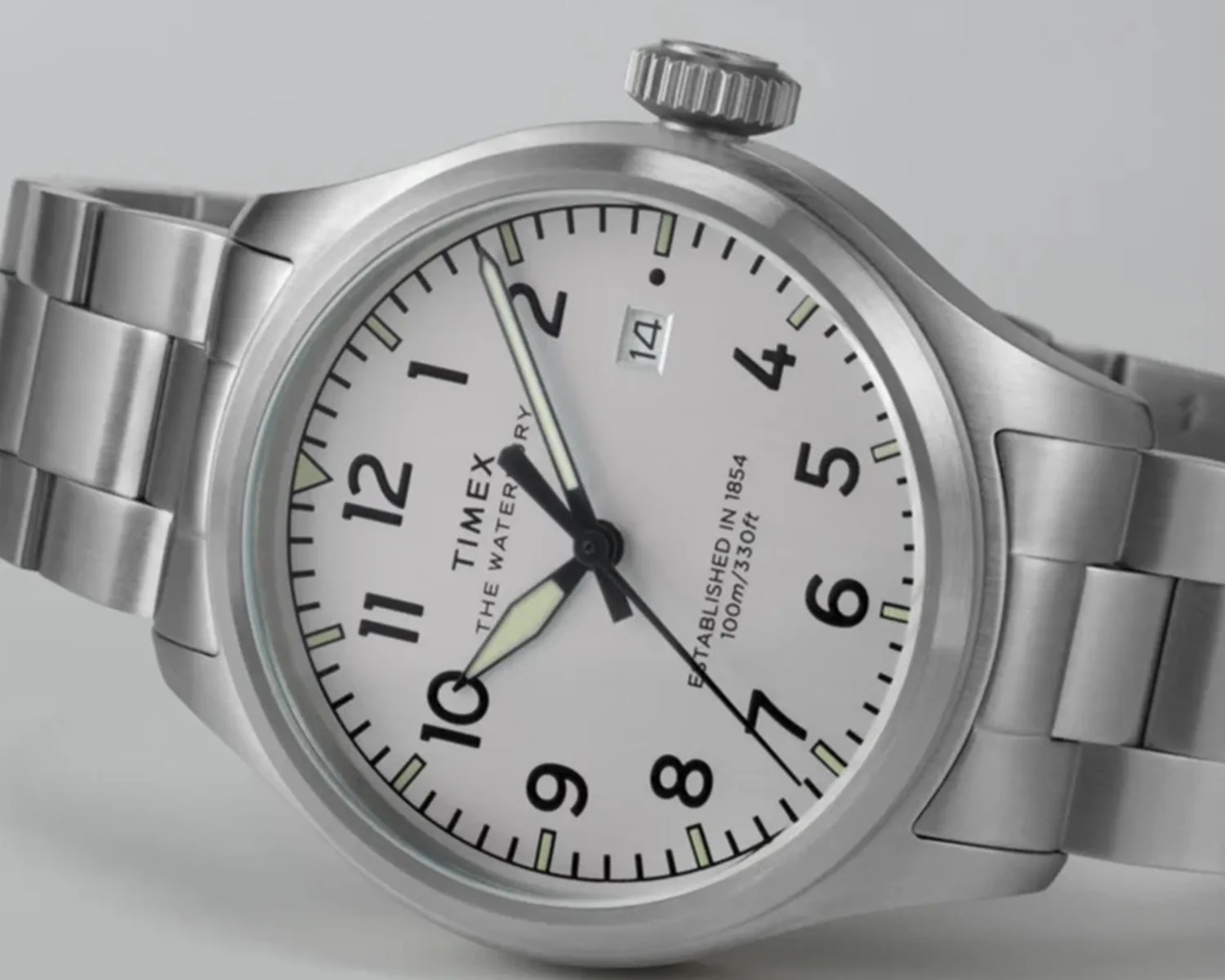
The watch also has a Flieger-style hour hand and slim, unornamented seconds hand, like what you’ll find on an IWC, but the minute hand is a pencil-style hand instead of another Flieger hand. The crown is conical and slightly oversized, aesthetically landing somewhere between the crown on a Mark XX and an IWC Big Pilot’s.
Unlike at IWC, you won’t find any high-end mechanical movements here. The Waterbury Ace is powered by a nondescript quartz movement, which is part of the reason why the watch costs around $200 instead of several thousand.
There are two colors of the Waterbury Ace at launch. One is a blacked-out version with a black case, dial and leather strap. It recalls the look of something from IWC’s Top Gun line of ceramic pilot’s watches. The other has a plain steel case, a vertically brushed gray dial with black markers and comes on a three-link stainless steel bracelet.
The gray one doesn’t bear a strong resemblance to any specific IWC model, but like IWC’s watches, it boasts a pretty innovative bracelet. In the case of Timex, the bracelet not only features a tool-free system for removal from the case, but also a similar system for removing links, meaning you can size the bracelet yourself without any tools.
The other model in the Waterbury Ace lineup is the Waterbury Ace Chronograph. It shares a number of features in common with the three-hand version, including a 41mm stainless steel case and the same handset. The dial layout is also similar, with the same minute track, the same font and most of the same indices. But at 12:00, we get an inverted triangle here instead of the Ace’s printed “12, ” putting this closer in line with IWC’s classic Flieger design.