
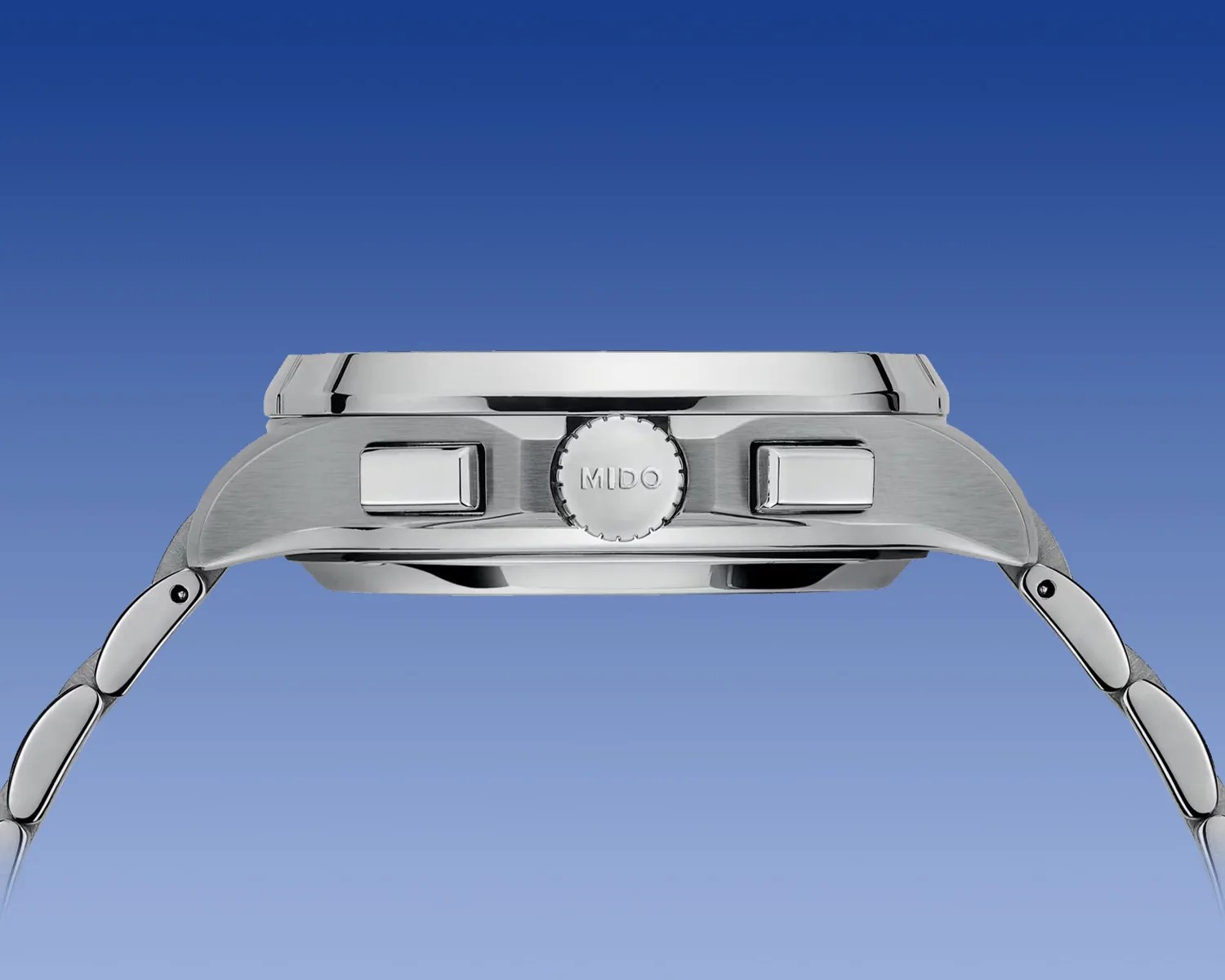
Powering the watch and visible behind the sapphire caseback is the Mido/ETA Cal. 60, an automatic chronograph derivative of the legendary Valjoux 7750. It’s a nice movement for the price, with a 60-hour power reserve, an anti-magnetic Nivachron hairspring and lots of perlage and blued screws for decoration. It’s what the kids call a thicc boi, though, pushing the case thickness to a chunky 14.3mm, nearly 3mm thicker than the Big Date.
Still, that thickness could be worse, and some chunkiness is to be expected in an automatic chronograph in this sub-$3,000 price range. The case is also larger than the 39.2 x 40mm case of the Big Date, measuring 41.2 x 42mm. Those dimensions are extremely close to the Tissot PRX Chronograph, which uses the same movement and is, I would argue, this watch’s biggest competition.
One advantage the Mido has over the Tissot, however, is that it includes a strap and a bracelet, both with a built-in quick-change system to make swaps easy. There’s a blue dial with a woven blue nylon canvas strap with white stitching (which looks fantastic), an anthracite version with yellow accents and a matching canvas strap, and then a full DLC black model with orange accents and a pale orange leather strap.
Pricing and availability
Mido doesn’t have the Multifort TV Chronograph available for sale online, but that could change in the coming weeks, as I assume Mido will, at some point, officially roll out the watch — it’s too significant a release not to.
Pricing is affordable for an automatic chronograph, but honestly is a little higher than I expected. The two plain stainless steel models are each priced at $2,610, while the DLC version is more expensive at $2,820. Tissot, meanwhile, offers the PRX Chrono at $1,995, while Longines’ excellent Conquest Chronograph starts at $3,850.