The thing about disaster striking is that it’ll likely affect more than just you, which is not something that most bug-out bags deliver. If you’re someone who already has a bug-out bag, a pre-packed backpack with survival supplies like freeze-dried food, batteries, a flashlight and a knife, at the base of your bed or in your trunk, you might have previously thought about this — do you need more than one bag for your entire family? The newest brand on the survival kit market is Rino Ready, which makes an all-encompassing 72-hour survival bag for two. In any crisis, from a forest fire to an avalanche to an earthquake to a hurricane to a simple power outage, the likelihood that you’re with another person is high, and the last thing you want to do in a crisis is fight with that person for resources, which is why this new bug-out bag features enough food and water for two people for 72-hours.
Rino, founded by Michael Reed in early January 2019, makes the Rino Ready bag, which is being called the world’s most advanced 72-hour survival bag, or bug out bag. It quickly rose through the ranks on Indiegogo to become over 2000-percent funded. While survival brands tend to do well with crowdfunding campaigns (thanks, preppers), it’s hard for a brand like this to “stay true to the commitment of quality [with] each product needing to perform exceptionally well,” Reed says. This is mostly because many of these kits in the past are flashy but then are filled with crap-quality goods. It’s why those with experience are more apt to design their own kit (backpack, food, water, shelter, etc.) rather than buy one backpack filled with generic equipment.
While there have been a few every couple of years that make people excited about preparedness (we covered Uncharted Supply Co., early last year), Reed says, “These pre-packaged kits pop up many times throughout the year and [you] look at it and buy it and realize it’s another disappointment,” Reed says. He points to the poor quality behind many of the items needed to truly get you through the apocalypse. It’s a tricky balance to figure out how to work with companies that make quality gear, while also staying under a certain price point. “The reason we’re not working directly with Leatherman or Sawyer Filters isn’t that they aren’t great quality, but in order to produce a formidable quality option that doesn’t cost an arm and a leg we have to dig deep and produce the products ourselves.” To address this, Reed tried to pay homage to pre-existing communities who have been building these kits from scratch for decades, like volunteer firefighters, EMS and veterans to name a few. “The overlanding, law enforcement, community emergency response teams and EDC communities are very large and active,” Reed says, “and they are comprised of the most upfront, transparent and brutally honest people out there.” Reed reached out to family and friends, in addition to connecting with communities through crowd-sourcing resources like Reddit. The people Reed met through that process helped to provide valuable feedback on his products. “It’s been humbling to engage with so many likeminded people who want good quality product. It’s that black and white. If we stay true to quality, we earn their respect.”
Rino Ready made sure this pack was dummy-proof. In addition to supplies, like U.S. Coast Guard-approved water and food (meaning it’s been evaluated, tested and approved for use as emergency drinking water and emergency provisions for merchant vessels by the International Convention for the Safety of Life at Sea (SOLAS) for survival crafts), and a two-times-the-standard-thickness tent, plus it has a how-to sheet that won’t evaporate or fade after spending years in your car or basement. “Guys in the military for seven or eight years, they know what they have, where it is, how to access it,” Reed says. “[But] those who buy something online, they will not have that cohesive understanding of how to use each piece. It was fundamental from the get-go to understand that we need to build something that has these quick access components, while also understanding that we need to make it digestible and easy to understand for someone who may not have that experience with products in our kit.” The waterproof, laminated sheet gives step-by-step instructions on how to survive practically anything.
While naming conventions for these types of bags range from straightforward and standard like Ready America to abstract like The Seventy2, Reed tried to fall right in the middle of those two: an association naming convention. “I was looking at what people identify safety and preparedness with and trying to align that with something memorable,” Reed says. “To me, a rhino represented the rugged durability you would need in an emergency.” Combine that with a modular aesthetic, and a strong design utility, and you have the minimalist-looking bag. The ruggedness and natural robustness of the bag reminded Reed of rhinos since they have those qualities in spades.
Rino Ready
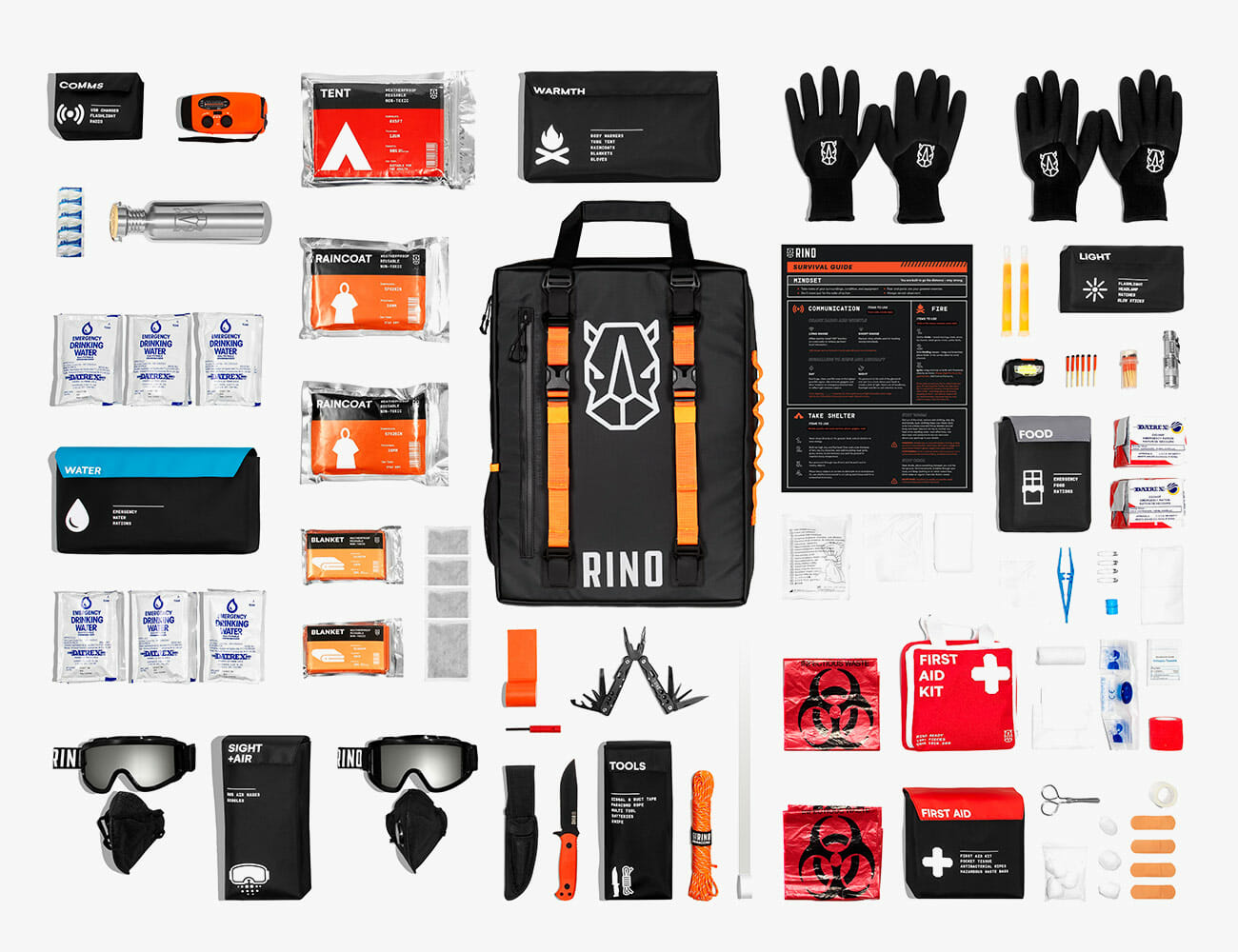
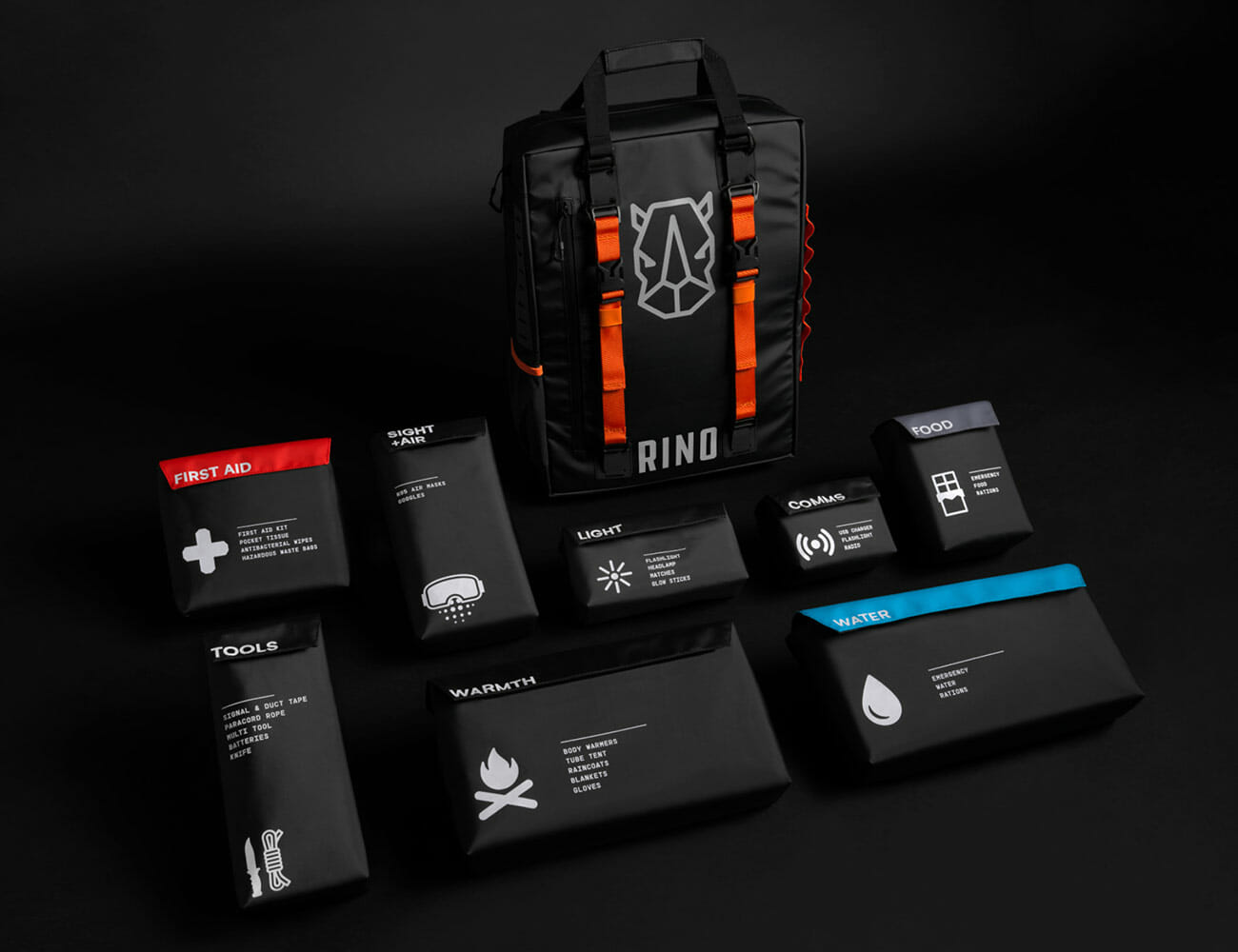
The 16-pound pack starts with a water- and fire-proof exterior made from 1200 denier hybrid fabric. Each bag contains over 40 products, all organized in a modular way so when you unzip and lay the pack flat, you can see the eight sections: warmth, sight + air, tools, light, comms, water, first aid and food. Inside you’ll find a phone charger, radio, goggles and mask, multitool, 550 paracord, blade and firestarter and 100 pieces of banadages, tourniquet, antiseptic wipes, breathing barrier, elastic wraps, non-latex gloves (and lots more) within the first aid kit in addition to a tent, winterized work gloves, hand warmers, flashlight, headlamp, glow sticks and stormproof matches. The food is U.S. Coast Guard-approved and is also non-GMO and nut-free. In June 2019, the packs will be shipped to those who invested on Indiegogo and then will likely be on sale for $399 (with all the gear) for new backers. Before launch, you can buy just the bag and stock it yourself for $159 or shop the fully stocked companion for $299. Each piece was tested and created by the Rino team — whether that took five or fifteen iterations to get it perfect.
|