All posts in “Supercars”

GFG Style evolves Giugiaro design in the Bandini Dora and Vision 2030 Desert Raid

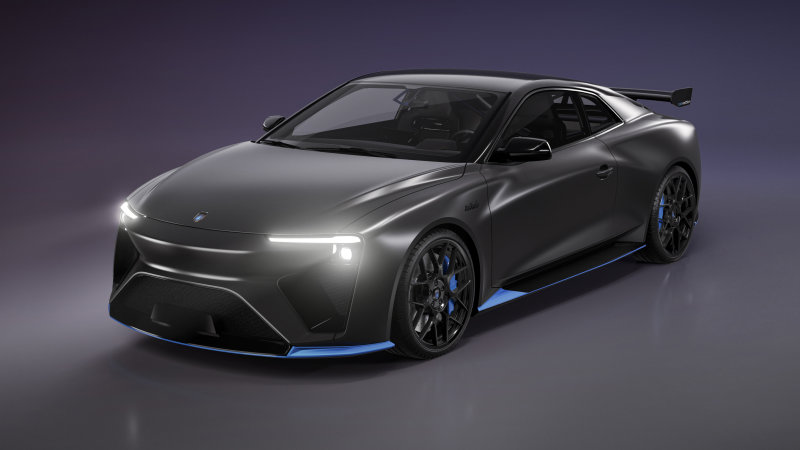
Fabrizio and Giorgetto Giugiaro, the father-son duo who paired up to create automotive company GFG Style, have been swept up in the wave of the times and gone all-in on electric. In the past four months, GFG Style unveiled three new concept vehicles, all of which use batteries and electric motors for propulsion. The Vision 2030 and Vision 2030 Desert Raid offer new perspectives on off-road-ready supercars, and the Bandini Dora evokes Italian history in a stylish barchetta.

GFG Style started in 2015 and has been hard at work envisioning the future of the automobile. Since opening its doors, the design and consultation firm has crafted seven concept cars, including the Kangaroo, an electric all-terrain supercar that was one of the coolest and most interesting vehicles at the 2019 Geneva Motor Show. It seems Fabrizio and Giorgetto couldn’t get the core conceptual nature of the Kangaroo out of their minds, as they debuted another all-terrain EV called the Vision 2030 in November 2019 at the Riyadh Motor Show in Saudi Arabia.

Vision 2030

Pegged as a zero-emission all-wheel-drive hypercar designed for Saudi Arabian roads, the Vision 2030 is named after Saudi Vision 2030, a plan to help the country diversify its core businesses and move away from an independence on oil. “Saudi Arabia asked us to design a model that would perfectly adapt to their region, made up of completely new and decidedly wide roads, but also of deserts with dunes and rough terrains,” Fabrizio said in a press release. Fabrizio continued that the point of the car was a design study in wheels and suspension, which largely dictated the shape of the carbon fiber and aluminum car.

To accommodate the multiple types of terrain, the car’s suspension automatically adjusts based on driving conditions. The Vision 2030 also offers three driving modes, Race, Road and Off-Road, which change the ground clearance between 5.5 to 8.7 inches. Inside, six different digital screens ensure the car is properly connected and the driver is properly informed.

GFG Style says the two-seater Vision 2030 has a 90-kWh battery pack and a single-charge electric range of more than 280 miles. It makes a claimed 510 horsepower and 502 lb-ft of torque, good for a 0-62-mph sprint in 3.8 seconds. 

Vision 2030 Desert Raid

The Desert Raid is one of two concepts that were originally intended to debut at the 2020 Geneva Motor Show before it was canceled due to precautions surrounding the coronavirus outbreak. As indicated by the name, the Desert Raid is an alternate variation of the Vision 2030. GFG Style says the Desert Raid underlines “the true capacity of this project: not to become a hypercar but a hyperSUV.” 

The Desert Raid has the same battery, power, and general performance specifications as the Vision 2030, as they share the same electric powertrain setup. The bodywork, save for the rear, is also the same, but small tweaks make this vehicle specialized for off-roading. Whereas the Vision 2030 had multiple driving modes, this version only has one setup skewed toward handling rough terrain. Thus, it remains at 8.7 inches of ground clearance at all times. It also has a wider track, smaller wheels, new carbon fiber mudguards, and a visible spare tire integrated into the top rear portion of the car. 

Bandini Dora

The second prototype meant for Geneva is the Bandini Dora. Like the other prototypes, it has a space frame aluminum chassis, carbon fiber bodywork, and a 90-kWh battery pack that provides a claimed range of more than 280 miles per full charge. Compared to the Vision 2030 cars, however, the Dora is slightly more amped up. Two electric motors, one on each axle, account for 536 horsepower and 502 lb-ft of torque. Equipped with all-wheel drive, the Dora has a claimed 0-62-mph time of 3.3 seconds.

Riding on 21-inch wheels, the Dora is the work of a collaboration with Bandini, an Italian manufacturer founded by Ilario Bandini that originally ran from 1946 until 1992. The company was resurrected as Bandini Automobili s.r.l, thanks to Ilario’s great grandson Michele, and this car is meant to be an ode to Bandini barchetta race cars of decades past. GFG Style’s Geneva stand was planned to include a Bandini 750 Sport Internazionale from the Mille Miglia Museum.

The Bandini Dora is an open-top two-seater, but its clever design is unlike anything of the past or present. Look closely, and the lines reveal that the windshield and encapsulated cockpit are entirely separate from the car’s roof arches. This was the result of blending old design with new safety standards.

“Today, it is difficult to conceive a Barchetta without considering the evolution there has been in the car concerning safety,” Giugiaro was quoted in the press release. “Inspired by the Halo of Formula One, we thought about creating a car that had a clean windshield as it used to be used with no reinforcements, thus being as linear and light as possible. To solve this need, I thought of an out-and-out superstructure that would integrate into the style with an accentuated structural and protective function for both the driver and passenger.” 

To properly appreciate the affect this design has on the car, it must be looked at from all angles. The prominent lines extends from the front bumper, curve over the front wheels, and swoop inward toward the rear to become part of the active aerodynamics. Because they don’t connect with the glass at any point, they creates all types of negative spaces, intersections, and design features that you just don’t see on normal cars. From the front, it almost looks as if one car has overtaken another car that lives beneath it.

For now, all three vehicles are just prototypes. The video below shows a press conference in which GFG Style announced the new designs.

[embedded content]

Adventum Coupe is the two-door Range Rover that never was

At the 2018 Geneva Motor Show, Land Rover surprised us with the Range Rover SV Coupe, a two-door Range Rover produced by Special Vehicle Operations. The automaker planned to build 999 of them for $295,000 a pop, which would have made the SV Coupe the most expensive from-the-factory Range Rover ever. Not even a year later, after dismal financial returns for Jaguar Land Rover in 2018, Land Rover canceled the SV Coupe, knocking back customers who had already specced units with $60,000 in additional options. Niels van Roij Design came to the rescue not long after, promising its own two-door coachbuilt Range Rover called the Adventum Coupe. The sketches released at the time had us hopeful for the real thing. Now that the first production example has been completed for a buyer, we’re glad to report that the Adventum Coupe is just what we wanted.

Niels van Roij made a few departures from the two-door designed by Land Rover’s SVO. The Adventum goes without frameless windows, the side vents on the doors, and 23-inch wheels. SVO reworked everything but the hood and lower tailgate compared to the standard Range Rover, van Roij also left the fenders and upper tailgate alone. Everything else from the A-pillar back is reshaped to fit true SUV coupe lines. The SVO version was powered by the 5.0-liter supercharged V8 taken from the SVAutobiography Dynamic trim, making 557 horsepower and 516 pound-feet of torque. This particular Adventum uses the slightly less angry supercharged V8 from the Autobiography trim, with 518 hp and 443 lb-ft. .

Dutch coachbuilder Bas van Roomen handles the actual construction, the aluminum D7 architecture strengthened to retain its stiffness and integrity, each body panel worked up in hand-beaten aluminum. The Arctic White exterior pairs with an interior covered in yards of red and black Nappa leather and the sheen of black piano lacquer. This being a coachbuilt design, the minimalist exterior is contrasted by the finely detailed interior. The new door cards get red leather pockets and different door pulls for front and rear passengers. Those rear-seaters get powered captain’s chairs. The floor, from the front footrests to the cargo area, is hand-finished teak with white caulking to match the exterior. A red leather pull handle lifts the cargo area floor, and two matching red and black umbrellas sit in branded Adventum closures on the cargo wall.

Van Roij will build just 100 examples of the Adventum Coupe, each one starting at €270,000 ($299,835 U.S.); choosing a different Range Rover platform to build on could change the price. It takes a €50,000 deposit ($55,525 U.S.) to secure one, the build needing “at least six months.” Our only question about buying the Adventum Coupe, aimed at anyone who’d paid to reserve an SVO-sourced Range Rover SV Coupe, is: Why would you not?

Related Video:

The Apex AP-0 is a 649-hp EV that weighs 2,645 pounds

Apex Motors sounds like a brand new name in the game, but the Hong-Kong-based company’s been around for more a few years and through a few transformations. In 2015 a maverick outfit of car designers banded together under the name Elemental to reveal the RP1, powered by 1.0-liter and 2.0-liter EcoBoost engines. By 2017, the 1,278-pound coupe could produce 2,205 pounds of downforce and was running Goodwood. By 2019, the Elemental RP1 had turned into the even-more-evolved Apex AP1, putting out 400 hp from a 2.3-liter EcoBoost four-cylinder and blitzing from 0 to 60 miles per hour in 2.5 seconds.

The brand new AP-0 is the follow-up. As the naming scheme suggests, it takes the top spot in the lineup ahead of the AP-1 by having battery-electric power, a single electric motor turning the rear axles with 649-hp and 427 pound-feet of torque, a 320-mile range on the WLTP cycle, and a 0-60 time of 2.3 seconds. Top speed is 190 mph.

Just as remarkable, and even more unusual for an EV, the whole package weighs 2,645 pounds. Compared to a McLaren 720S, the AP-0 is 4.5 inches shorter but 3.4 inches wider, and while the Apex gives up 61 hp and 131 lb-ft to the Englishman, the AP-0 weighs almost 500 pounds less than the 720S. Compared to performance EVs, the Apex weighs about 1,380 pounds less than a Tesla Model 3 Performance, 1,700 pounds less than a Rimac Concept 2, and almost 2,500 pounds less than a Porsche Taycan Turbo S.

The Apex packs a floor-mounted, 90-kWh lithium-ion battery that consumes 1,213 pounds of its curb weight. When plugged into the right CCS charger, the pack can refill 80% of its charge in 15 minutes; on a standard Type 2 charger, filling up from empty takes eight hours.

The chassis and bodywork is entirely carbon fiber, a central carbon tub and modular spaceframes laid on a rigid carbon spine connect the front to the rear. Outside, the Le Mans-like fin houses a retractable LIDAR system up front and a cross-shaped taillight in back. Built as a road-legal racer for gearheads and sitting just 3.7 inches off the ground, there’s an adjustable pushrod suspension with automatic ride-height adjustment, 14-inch carbon ceramic rotors with six-piston calipers in front and four-piston in the rear, and a pair of 19-inch center-lock wheels up front paired with 20-inchers in back. 

Behind gullwing doors, the carbon, aluminum, and leather interior makes every occupant feel like a racer with a single-seater-style, reclined and feet-up seating position. Three displays for the driver sit atop the instrument panel behind a square steering wheel. To help drivers make the most of track days, Apex says the AP-0 can “gamify the way drivers can learn new racetracks and deliver the ultimate immersive racing experience” through augmented reality projection. The software-based “instructor” can be improved through over-the-air updates. To ensure the instructor knows what it’s talking about, Apex said it wants to build an FIA-approved race track, followed by a racing academy, around its Hong Kong HQ. 

The ambitions only begin there. When off the track, that LIDAR unit is intended to provide Level 3 autonomous capability at launch, with the company saying Level 4 potential is already built in. More handily, the AP-0 will come with automatic emergency braking, adaptive cruise control, and lane keep assist. That’s all down the way, though, the AP-0 not scheduled to enter production until the latter half of 2022, costing around $195,000 for U.S. buyers. If all goes well from here to there, Apex plans to build up to 500 units per year in Britain, what it calls its second home, on the way to introducing a wider lineup of offerings.

Related Video:

McLaren Elva M1A Theme by MSO channels Bruce McLaren’s 1964 race car

McLaren Special Operations hit up Twitter to show a version of its new Ultimate Series speedster, christened with the full name of Elva M1A Theme by MSO. The Elva takes its design cues from the M1A race car that Bruce McLaren developed for sports car racing in the 1960s. McLaren first entered his black #4 racer in the 1964 Canadian Grand Prix and put everyone on notice; the M1A equaled the lap record at Mosport Park four times and broke the record seven times. As buyers lined up, McLaren commissioned English firm Elva to build replicas for privateers. Although the historic M1A was an advance on the McLaren’s “Jolly Green Giant” Cooper-Oldsmobile, the M1A inaugurated the McLaren lineage that would soon dominate sports car racing. This modern Elva M1A goes about as far as it can to channel its inspiration, adopting the black exterior and red seats of the original — but not the 4.5-liter Oldsmobile engine.

Instead of painting the speedster black, MSO took the much better option of coating the carbon fiber bodywork in clearcoat. The only touches of paint are the silver slash and red pinstripe running front to back, splitting into a low runner along the sills, and the white roundel with the race number. We’re not sure what’s going on with the wheels, though — they’re the same design as those on the Elva that launched in November, but in mirror image. The other big splash of color appears on the seats, topped with crimson Alcantara. 

MSO didn’t mention any limitations on this theme, so it’s possible there could be more than one among the 399-unit Elva production run; Bruce McLaren built three works versions of the original M1A, and Elva produced 24 customer cars. And yes, the historic car was powered by an all-aluminum 3.5-liter Oldsmobile V8 that Traco bored out to 4.5 liters, producing 310 horsepower breathing through four Weber carbs. Oldsmobile not being an option anymore, the Elva homage goes with a 4.0-liter twin-turbo V8 with 804 horsepower and 590 pound-feet of torque, which helps ensure buyers get their $1.69 million worth.

Related Video:

The tilt-winged Zenvo TSR-S now has carbon fiber wheels

Danish auto manufacturer Zenvo only produces five hand-built cars each year, so it’s a fairly big deal every single time one is completed. Not only is each car unique per customer requests, they’re also unique due to newly in-house-developed technologies, options, and techniques. In the case of its most recent build of the TSR-S supercar, it has previously unavailable features such as carbon fiber wheels and a new “hybrid” transmission. 

The TSR-S is mostly known for its insane actively tilting rear wing (see the video below), but this most recent iteration should be known for its beautiful carbon fiber work. In addition to the numerous interior and exterior panels and parts made from traditional carbon fiber weave, the hood features a beautiful blue-tinted geometrically designed weave. On the side of the car, ZENVO is seen in a lower stripe with a hand-laid opposing weave pattern. Zenvo calls this feature a “bespoke watermark carbon fiber graphic.” Customers have the options to color-tint anything that shows exposed carbon fiber, and numerous sections can be designed with special weaves and graphics.

[embedded content]

Yet, the standout carbon fiber feature on this car is not a weave at all. Zenvo used what it calls fragmented carbon fiber, also known as forged composites as seen on Lamborghinis. Essentially, it’s crushed or flaked carbon fibers shaped and molded within resins, which provide a distinct artistically chaotic look. Zenvo used the fragmented carbon fiber on the engine and for the wheels.  

The wheels are created with hand-cut pieces that are then hand-placed, and each one takes two technicians about one week to complete. Using carbon fiber wheels reduces weight by about 133 pounds, as each wheel is roughly 33 pounds lighter than an equal aluminum wheel. 

This TSR-S also has an altered powertrain. The 1,177-horsepower twin-supercharged 5.8-liter flat-plane crank V8 remains, but the transmission is new. Zenvo’s seven-speed sequential gearbox with helical-cut dog gears is joined by a “hybrid module which yields a power boost, further traction control, and even the addition of an eighth forward gear with the electric motor providing reverse drive.” No further details were provided.

This level of exclusivity and customization is easily a seven-figure endeavor. The TSR-S starts at $1,619,000. 

Related Video:

The Mansory Cabrera is a Lamborghini Aventador SVJ with a bullish mug

Mansory does not care if a car is rare or special or unique. If it’s not a Mansory, it’s probably not good enough. But it might qualify to become a Mansory. The aftermarket tuning and design company has captured the limited Aventador SVJ and transformed it into a new vehicle called the Cabrera, which sports new looks and has more power.

Lamborghini will only produce 900 Aventador SVJs, and of those 900, three will go under the knife at a Mansory workshop. Mansory quotes a motto, “one car per decade,” and says the Cabrera “marks the start of several special editions on the occasion of Mansory’s 30th anniversary in 2020.” The name Cabrera is a breeding line of the Spanish fighting bull, similar to the names Miura and Gallardo.

The Cabrera has an entirely distinct face thanks to a new set of LED headlights. Rather than the chunky stock units that point toward the rear of the car, the new four-unit headlights are slim and horizontal. With the adjustments to the headlights came tweaks to the hood and front fascia. New air inlets on the front apron improve radiator air flow and help improve downforce. The carbon fiber widebody kit, which adds 1.6 inches in width, continues with bulbous wheel arches, aerodynamic side skirts, and a rear “double diffuser.” Extra downforce comes courtesy of a massive angular rear wing, and aggressively designed forged lightweight wheels (9×20 and 13×21) are wrapped in Pirelli P Zero tires.

The body kit is also designed to help cool the upgraded 6.5-liter V12 engine. While the “normal” SVJ makes 759 horsepower and 531 lb-ft of torque, the Cabrera makes 810 hp and 575 lb-ft. Mansory claims zero-to-62 mph in 2.6 seconds and a top speed of 221 mph.

Inside, Mansory takes the Aventador’s fighter-jet inspiration literally. The forged carbon fiber has “arrow-shaped decorative seams,” that look awfully similar to stealth bombers. That’s also mimicked with imprints in the seats. Every part of the interior has been redone and refitted with upgraded materials, including the ceiling, which has a colorful accent spine.   

The Cabrera is only one of many vehicles that were launched surrounding the canceled Geneva Motor Show. Other new custom creations include the Lamborghini Urus Venatus and the Bentley Continental GT V8 Convertible.

Related Video:

Cadillac Blackwing gets ticket to Italy, to go to work in a supercar

Some necessary cost-cutting at Cadillac led to switching the new CT4, CT5, and Escalade to older platforms. The revised architecture plan meant Cadillac’s newest top-tier products couldn’t fit Cadillac’s newest top-tier engine, the 4.2-liter twin-turbo DOHC V8 known as Blackwing. That engine would serve limited duty at full power in the now-dead CT6-V, and at reduced output in the CT6 Platinum V8 trim before ending its bright, brief domestic life. But the story isn’t over, the rebirth of Blackwing coming from a most surprising locale: Turin, Italy.

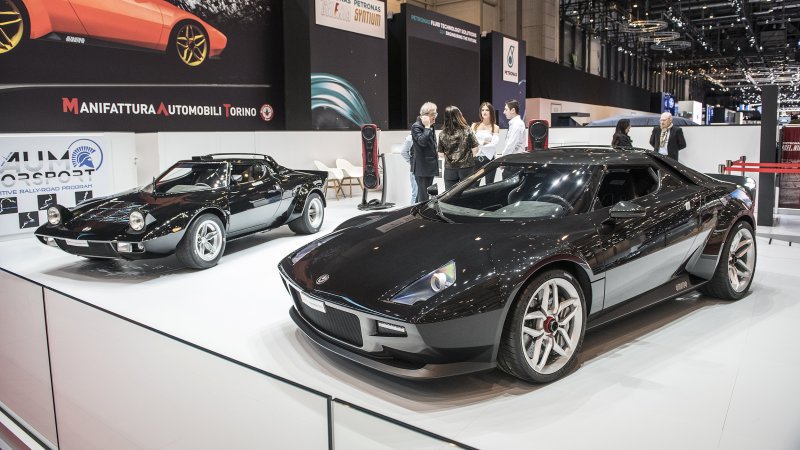
Before the canceled Geneva Motor Show, Hagerty spoke to Paolo Garella, CEO of Manifattura Automobili Torino; that’s the company better known as MAT, makers of the New Stratos and contract engineering house for boutique screamers like the Aspark Owl electric hypercar, Apollo Intensa Emozione, and SCG003C. Garella told the outlet, “We have an agreement with General Motors” for a supply of Blackwings, which would be developed and built at the General Motors Propulsion Engineering Center (PEC) in Turin. Since 2005, the PEC has been used to develop GM’s global diesel engines and electronics. MAT’s plan is to put the V8 into a new limited-run car MAT is creating from its own design.

Then another surprising turn: Belgium-based global auto supplier Punch Group bought the PEC, with plans to work with GM on projects in progress until at least the end of 2021. Nothing changes as far as MAT is concerned, except perhaps a chance for an even closer collaboration with Punch Turin.

The V8 once hand-built at the Performance Engine Center in Bowling Green, Kentucky, made 550 horsepower and 627 pound-feet of torque in its most powerful form. Of course we’re looking forward to the Blackwing-powered vehicle MAT comes up with; the prospect of a V8-powered supercar with a modern mill is the best kind of news. Just as much, though, we’re looking forward to what’s possible with the Blackwing in a high-performance application freed of OEM constraints. The 4.2-liter LTA Blackwing shares its architecture with the 5.5-liter LT7 V8 in the Chevrolet Corvette C8.R racer and headed for the Corvette Z06, the big differences being turbos mounted between the cylinder banks on the Blackwing, whereas the boosters hang outside the banks on the LT7, and the Chevy engine uses a flat-plane crank.

It’s a moonshot, but if the Blackwing proves its might and popularity over time, and sees continuous development, perhaps the engine could one day be recalled to service with a different car at its original brand home. 

Related Video:

Maserati MC20 appears in artsy, blurry teaser

Maserati said it’s entering a new era. Judging by these teaser shots of the a camouflaged MC20 prototype supercar, it’s clear Maserati plans to strut its way into that new era con il coraggio and braggadocio. Maserati took its future flagship to the Piazza degli Affari in Milan, for a set of mostly blurry photos in front of Italian artist Maurizio Cattelan’s sculpture called “L.O.V.E.” Maserati called the artwork “a symbol of Italian audacity in international contemporary art,” for the sake of clarity, we’ll call it a giant marble bird flipped at anyone who might ask, “You talkin’ to me?”

The MC20 is thought to be built around the carbon chassis laid up for the 4C, stretched lengthwise and across to create an overall larger package. We can’t tell much about the real masterpiece in the photos, but it is clear the MC20 prototype has shed its gawky bodywork borrowed from the Alfa Romeo 4C to slip into something more comfortable. A very Maserati nose leads with a large grille and sits prominently ahead of the other bodywork. Behind that, an Italianate supercar form combines plenty of intakes, deep side skirts, a seamless rake to the backlight, and a short rear overhang.

In back, powertrains developed at Maserati and for Maserati should make all sorts of lusty noises. The top powertrain is expected to be a hybrid V6 with three electric motors and around 600 horsepower, there’s hearsay about an all-electric model, and rumors of a turbocharged V8 won’t die. The only gearbox mentioned so far is an eight-speed dual-clutch shooting power to the rear wheels. Autoevolution believes the hybrid engine will translate into a sprint to 62 miles per hour in around two seconds and a top speed beyond 186 miles per hour, just the kind of giddy-up one would expect from a challenger aimed at the Lamborghini Huracán Evo. If anything, 600 hp sounds conservative seeing as the Alfa Romeo Giulia GTA gets 540 hp from its 2.9-liter turbocharged V6 without electric help. The MC20 will take on Lamborghini’s championship-winning finest on the track, too, the MC20 — for Maserati Corse 2020 — surely headed for an FIA entry in track-only form.

For now, the MC20 continues its driving program to prepare for its debut in May. The coupe version should come first, going on sale in Europe late this year and in the U.S. sometime next year, followed by a convertible variant.

Lamborghini Huracán Super Trofeo Omologato preparing for debut

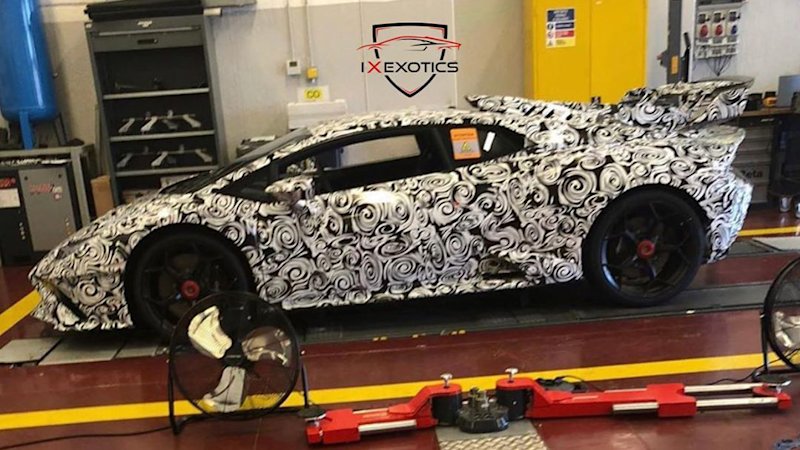
Lamborghini’s Squadra Corse motorsports division will soon be showing two takes on two of Lamborghini’s marquee products. At the deep end, we have the Aventador-based, 830-horsepower track car recently flogged on a dyno. At the other deep end we have this, which Motor1 caught wind of: Instagram user “allanlambo” uploaded pics of a camouflaged Huracán said to be called the Huracán STO, for Super Trofeo Omologato. If you’ve seen the automaker’s one-make and customer race car, the Huracán Super Trofeo Evo, the camouflaged coupe should look real familiar. From what we can tell, everything from the B-pillar back could have come straight from the competition car — the roof scoop, shark fin, bodacious wing, deep-dish spoiler, and center-lock wheels are all looking for the checkered flag. The rear even copies the overall design and negative spaces from the race car, as well as the diffuser, the only major change being the rear lights from the road car. The STO, according to Internet rumor and forum postings, will be a limited-edition road-going version of the race car.

Automobile mentioned this very creature late last year but only in passing, as a side dish to the possibility of a production Sterrato off-road sports car. According to a PistonHeads forum, word is the Huracán STO is about making the most of the Huracán Evo’s already potent package, so the naturally-aspirated 5.2-liter V10 with 632 horsepower and 442 pound-feet of torque goes unchanged. The engine will have less weight to shift, thanks to a diet expected to shed around 330 pounds. All power will go to the rear wheels, and as a Squadra Corse production, the Lamborghini Talk forum claims that the coupe won’t get the ALA system that improves handling. Backroom chatter has it that the STO was designed for superior hotshoes who carry their personal ALA systems somewhere between their solar plexii and their gall bladders, not for the merely average hotshoes who praise technology for keeping them out of gravel traps. Other add-ons like a racing clutch, a mechanical differential, and bigger brakes have been mentioned as potential upgrades.

Both forums peg a debut during Monterey Car Week in August, before the car goes on sale late this year as a 2021 model. The automaker supposedly intended the STO to be a small-batch special for dealer-backed race teams and Squadra Corse clients, akin to the Ferrari 488 Pista Piloti, but has opened sales to a wider audience. That doesn’t mean the opening is large, however; Lamborghini’s apparently spiffed up a customer grading system, so dealers can submit willing buyers and the factory will choose which applicants win. Owners have heard build numbers of between 400 and 700 units, dealers said to be lobbying for that lower number or even fewer. Applicants who lose out shouldn’t despair, there’s rumor of a Huracán Superleggera arriving before the model gives way to the next generation sometime around 2023. 

Roland Gumpert Nathalie is a methanol fuel-cell supercar because why not

Roland Gumpert launched his Apollo more than 10 years ago, eventually losing his fearsome coupe to insolvency and Consolidated Ideal TeamVentures. Gumpert, however, was working on more models, one of them called the Explosion, shown in Geneva in 2014. Based on looks and power specs, our best guess is that Gumpert took the Explosion with him into a new partnership with Chinese automaker Aiways, which owns the carmaker now known as Roland Gumpert, and slowly turned it into the Nathalie supercar meant for debut at this year’s ill-fated Geneva show. Gone is the 2.0-liter turbo four-cylinder with 420-horsepower. In its place, a methanol-fueled powertrain that combines a fuel cell, a buffer battery, and four electric motors. Combined capacity of methanol, fuel cell, and battery is 178 kWh, combined system output tallying 536 hp and more than 730 pound-feet of torque.

It starts with a 17.2-gallon tank that holds the methanol, which takes three minutes to fill. In a process that reverses the laboratory creation of methanol, the alcohol is heated to between 572 and 752 degrees Fahrenheit, separating the liquid into carbon dioxide and hydrogen. The hydrogen gets sent to a 15-kW fuel cell to produce electricity, which is not sent to the battery, but straight to the electric motors located at each wheel, those four motors coordinated by two, two-speed gearboxes. All that chicanery is said to propel the 14-foot-long coupe from standstill to 62 miles per hour in 2.5 seconds, on to a top speed of 190 miles per hour, and a range of 510 miles at 75 miles per hour. When driven in Eco mode, range extends to about 745 miles.

The Nathalie looks mild on the outside, like some JDM-only coupe found in Gran Turismo that spent a little time in the tuning shop getting a huge wing. Yet the Nathalie’s made of supercar build techniques — a chromoly tube chassis overlaid with a skin made of flax and carbon composites for light weight, plus a full FIA roll cage behind the cabin seats. The doors open in the scissor fashion Lamborghini has made famous. A McPherson front suspension and double wishbone rear handle the dynamism. The front brakes are enormous, and so are the rears. Thin lights front and rear, large intakes, and conspicuous ground effects complete the look. The Nathalie’s lines can be seen in another product from Aiways, the U6ion concept (traditional) electric crossover coupe also intended for debut in Geneva, both breathed on by Aiways lead designer Ken Okuyama, who penned the Ferrari Enzo and led Pininfarina design for a spell.

RG will build 500 of the Nathalie, which includes a small number of the First Edition example shown, with deliveries scheduled to begin next year. Each one will run €407,000 ($455,000 U.S.) before taxes. Where is an owner expected to get methanol if he doesn’t live near a race track or commercial depot? Gumpert said, “An overnight delivery service has been installed for the exclusive customer base for Germany, Austria, Switzerland and is currently being expanded throughout Europe. The North America and Middle East regions are also currently being developed.” What’s more, RG will pay for the methanol supply for the first year after delivery.

Related Video:

Pikes Peak Hill Climb Record | Behind the Wheel S02 // E09

“Behind the Wheel” is a video series that shows you a bit of what it’s like to work at Autoblog. The editors and video producers will show you the cars we have in our fleet, and you’ll get a behind-the-scenes look at some of the personalities who help make the site run. 

In this episode, Senior Producer Christopher McGraw packed up his bags, got in the car and moved out to the fantastic state of Colorado. After getting settled in the mountains, his first assignment was to cover VW’s attempt at setting the course record for the Pikes Peak Hill Climb. What followed was one of his favorite days on the job.

Where are you traveling to in 2020? We’d love to hear from you, so please comment below!

Gear used to make this: 

Panasonic GH5s: https://amzn.to/2QsJdHE

Panasonic Lumix 12-35mm F2.8: https://amzn.to/34bl3W4

Rode VidMic Pro: https://amzn.to/2qrDHKN

Tiffen 58mm Variable ND Filter: https://amzn.to/2XpizRw

GoPro Hero 7 Black: https://amzn.to/2Qr3Bcm

Adobe Premiere: https://amzn.to/32ZTA8B

Autoblog is a participant in the Amazon Services LLC Associates Program, an affiliate advertising program designed to provide a means for sites to earn advertising fees by advertising and linking to amazon.com. These deals are available through our affiliate partnership with Amazon.com. Deals are subject to Amazon’s schedule and availability.

The Koenigsegg Gemera has a floating, spinning camera on its dashboard

The Koenigsegg Gemera, a clean-sheet four-seat performance hybrid, debuted this week and instantly became one of the most stunning debuts of the year. But with all the hullabaloo about the two extra seats and the trick engine setup, most people overlooked one of the car’s coolest features. With the purchase of every Gemera, each customer gets his own private Death Star. Sort of.

In looking through social media posts about the Gemera, we noticed a video posted by user @christer.hultberg, who turned out to be the transport manager for Koenigsegg. The short clips shows a levitating, rotating orb inside the car. It’s nestled into the front part of the carbon-fiber dashboard and sits in a small depression.

The cool gadget is a 360-degree camera. It features two lenses at opposite sides and spins on a horizontal axis. It has a similar, but not exactly the same, design as the Insta360 Pro Spherical VR 360 8K Camera, which retails at $3,500.

The exact purpose of the device is unclear, as it was not mentioned in the press release, but it’s probably pretty straightforward. A built-in dash cam would always be useful, especially for people who like to watch themselves driving their new multi-million-dollar toys. A 360-degree view of track laps would also make for good video.

We’ve reached out to Koenigsegg for more information.

Aston Martin V12 Speedster is a $950,000 exotic dream that’s wild as the wind

The roofless, windshield-less, ultra-rare, ultra-expensive supercar space is getting busy. We had the Ferrari Monza SP1 and SP2; then we got the McLaren Elva, and now the Aston Martin V12 Speedster is joining the ranks. McLaren will let you add a windshield to the Elva, but there’s no mention of glass when it comes to the Aston. Invest in some sturdy goggles.

Revealed at Aston Martin’s Gaydon HQ (instead of the canceled Geneva Motor Show), the V12 Speedster is designed to provide the most visceral driving experience in the Aston lineup. There will only be 88 of them, and pricing starts at $950,000. That’s an absolute bargain compared to the Elva, which has a base price of $1.69 million. But if you’re considering buying one of these, its price is likely the last question you’ll have.

Aston says the V12 Speedster is powered by its 5.2-liter twin-turbo V12, making 700 horsepower and 555 pound-feet of torque. That’s mated to a ZF eight-speed automatic, sending power to the rear wheels. It’ll hit 62 mph in 3.5 seconds and a top speed of 186 mph — get some heavy duty headgear for that trip. The platform itself is made by combining elements of the DBS Superleggera and Vantage. It has 21-inch forged, center-locking wheels, huge carbon ceramic brakes and adaptive dampers. But the design is what really caught our eye.

It’s billed as “a living show car,” and we completely agree. The body is made almost entirely from carbon fiber. Miles Nurnberger, director of design at Aston Martin, detailed the design’s inspiration in a statement.

“There’s clear lineage from the 1959 Le Mans winning DBR1 to our Centenary celebratory CC100 Speedster Concept in 2013,” Nurnberger says. “There is also a bit of 1953 DB3S in the mid-section, so it really is our latest incarnation of the Speedster concept. It’s also inspired by fighter jets as much as it is by our history, and it has been created to deliver an incredibly visceral experience, hence why it is a V12, rather than a V8.”

The front hood nostril is especially eye-catching. Aston hasn’t implemented this design touch on a car in a long while, and we love seeing it on a new vehicle like this. Nurnberger says it allowed for some extra space under the long hood that it needed for the V12, too.

That interior is similarly stunning. It’s separated into two distinct cockpit areas by a slab of carbon fiber, but it still allows for interaction between the two people in the car below that piece. The design, like so many supercars and sports cars before it, is said to be inspired by fighter jets. This specific spec is a special F/A-18 spec that Aston says will be available to order. It features a number of fighter jet touches throughout. You’ll get to hear the car’s roar better than other Aston’s, too, as the company developed an especially loud stainless steel exhaust system for the V12 Speedster. Its lack of a roof should make it even more audible for those in the cockpit.

Aston Martin says its order books are open now for the V12 Speedster, so it’s not completely sold out yet. Deliveries are slated to begin in the first quarter of 2021. All 88 cars will be hand-built and made to the spec you desire.

Related Video:

Bugatti Chiron Pur Sport: born to speed (and drift) through the twisties

Bugatti made automotive history in 2019 when it built a long-tail variant of the Chiron that was still accelerating when it smashed through the 300-mph barrier. With the speed record broken and set, the French company wants to prove it also knows a thing or two about handling with a new Chiron version named Pur Sport.

“It’s a lot of little details that add up to a very different driving experience. You immediately feel the car is nimbler and more agile,” explained Frank Heyl, the company’s deputy design director, in an interview with Autoblog.

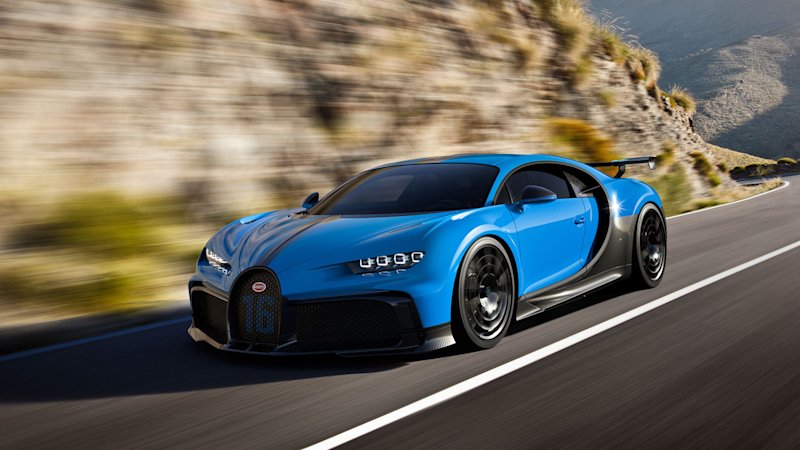
Heyl’s team worked directly with Bugatti’s engineering department to create a front fascia with wider air intakes, a redesigned splitter, and a bigger grille. Out back, it’s impossible to miss the 74-inch long wing that unlocks quicker cornering speeds by adding downforce. Below it, a pair of exhaust tips 3D-printed in titanium are integrated into a taller air diffuser made with carbon fiber. There’s no way to miss the Pur Sport if it passes you on the highway.

The rear wing is fixed, and its mounts form an X-shaped insert. Heyl told us Bugatti deliberately sent the Chiron’s hydraulically-operated spoiler back to the parts bin to save as much weight as possible. It shaved a total of 110 pounds, which is far more impressive than it sounds. “You have to consider this: we’ve done everything we could to save weight on the base Chiron. We’ve put the most expensive materials inside this car, and used the most expensive solutions already. To gain another [110 pounds] was quite a challenge,” he pointed out.

The wheels received attention, too, and we’re not just talking about the design or the -2.5 camber angle. “[The two rings] suck air from the inside of the wheel to the outside, which creates downforce and improves the brake cooling by increasing airflow through the wheel,” Heyl explained. The 20-inch front and 21-inch rear wheels are made of magnesium to reduce unsprung mass by 35 pounds, and they’re wrapped by Bugatti-exclusive Michelin Sport Cup 2 R tires manufactured with a stickier compound. All told, the tweaks made at the Chiron’s four corners increase its lateral acceleration by 10%. Heyl’s equation is beginning to add up.

Alcantara upholstery largely replaces leather in the cabin. It’s lighter, and it does a better job of ensuring the driver’s butt doesn’t slide around when racing up a mountain road. Model-specific stitching on the seats and on the steering wheel, trim pieces, and miscellaneous accents further set the Pur Sport apart from the Chiron.

Bugatti then turned its attention to the chassis. The front and rear springs are 65% and 33% firmer, respectively, and the braking system is lighter thanks to the use of brake pads with a titanium base panel and different brake discs. Owners will be able to exploit the Pur Sport’s full potential by engaging a new driving mode named Sport + that wards off the traction control system’s intervention to allow a controlled drift — on a race track, of course.

“This mode enables the car to be placed on the throttle, so you can steer on the throttle a little bit more. It will allow you to go into a drift, and it will still catch you if things go wrong,” Heyl told Autoblog. If that sounds familiar, it’s because the gyro-based technology is similar to what Lamborghini offers in the rear-wheel drive Huracán.

Finally, let’s answer the question trotting through your brain: no, you won’t find more power in the engine bay. It’s the same quad-turbocharged, 8.0-liter W16 engine found in the regular Chiron, meaning it delivers 1,500 horsepower and 1,180 pound-feet of torque, but it’s bolted to a new seven-speed automatic transmission with shorter gear ratios. Engineers raised the 16-cylinder’s redline to 6,900 rpm, an increase of 200 rpm, and these seemingly small changes (along with the weight reduction) make the Pur Sport nearly two seconds quicker from 37 to 75 mph than the Chiron. Elasticity improved by 40% across the board, so it should feel strikingly quick in a straight line. The trade-off is that engineers had to limit its top speed to 217 mph due to the shorter gear ratios and the huge wing.

“Everything works together beautifully for the car to handle much better,” Heyl summed up.

Bugatti will make 60 examples of the Chiron Pur Sport, and each one costs €3 million before taxes, a sum that represents $3.3 million. Autoblog asked the company how many units are already spoken for, and we’ll update this story if we learn more. In the meantime, the French firm is preparing to deliver the first examples of the Divo.

The 1,700-hp Koenigsegg Gemera hybrid has two more seats than any Bugatti

The rumor was right. Koenigsegg has just unveiled the Gemera, an all-new member to the family that sports four seats, two scissor doors, and a massively powerful hybrid powertrain that still allows for pure electric driving. In the same breath, Koenigsegg also unveiled the Jesko Absolut, the fastest road car the company will ever produce.

As the brand’s first four-seater, the Gemera marks the start of a new era for Koenigsegg. While others, even many of the world’s top performance names, are making high-utility crossovers and SUVs, Koenigsegg has chosen to add function while maintaining the coolness factor of a coupe. A real coupe. Who cares if you have to cram into a rear seat when the cramming is achieved through a scissor door? 

With the Gemera, which has a shape inspired by an egg, Koenigsegg aimed to make a car with the personality of a mid-engined two-seater but the practicality of a road-trip vehicle. CEO Christian von Koenigsegg says he’s been planning this car since 2003 and wanted to make sure every seat is equally as spacious and comfortable, unlike many 2+2s that only have two usable seats. 

The front seats are made from hollow carbon-fiber monocoques and weigh only 37.5 pounds. The slim design of the seats, which integrates the back into the bottom, and the nature of the scissor doors mean ingress and egress is simple and doesn’t require moving the front seats. 

The rest of the interior is focused on luxury. The sideview mirrors have been replaced with cameras, seats are heated and cooled, the front and rear each both have large digital infotainment touchscreens to control entertainment and climate, each seat has a hot and a cold cup holder, and the audio system has 11 speakers. The clever design packaging allows all this, plus storage for four pieces of luggage, three in the rear and one up front.

The Gemera will coddle and comfort, but it will also thrill with its high-tech hybrid powertrain. Koenigsegg claims 1,700 bhp and 2,581 lb-ft of torque, and a zero-to-62-mph sprint in 1.9 seconds. This is accomplished with a combination of three electric motors, a twin-turbocharged 2.0-liter three-cylinder camless gas engine, and a direct-drive transmission. It also has all-wheel drive, all-wheel torque vectoring, and all-wheel steering.

Two of those electric motors, each of which makes 500 bhp and 738 lb-ft of torque, are on the rear wheels. A third e-motor is attached to the engine crankshaft and makes 400 bhp and 369 lb-ft of torque. Simultaneously, these electric motors make 1,100 bhp. Working with the e-motor to propel the front wheels is what Koenigsegg calls the Tiny Friendly Giant (TFG) engine. It is rated at 600 bhp and 443 lb-ft of torque and uses the company’s Freevalve technology. 

The Gemera, which uses carbon fiber for the chassis, body, and wheels, is built to be eco-conscious, as well. An 800-V, 15-kWh battery allows up to approximately 31 miles of totally electric driving, and the car has an overall range of 621 miles. The Gemera is a flex-fuel vehicle, too, so it can run on Gen 2.0 ethanol or C02-neutral methanol. That means it could potentially be as C02-friendly as an electric vehicle, under certain circumstances.

Koenigsegg is limiting Gemera production to 300 vehicles.

Jesko Absolut

Koenigsegg says the Jesko Absolut is the fastest car it’s ever made, and that “the company will never endeavor to make a faster series-production road car – ever.” So, it’s likely Koenigsegg will make faster one-offs and track specials, but this will be the pinnacle of speed, and will be used to chase the top-speed record.

The Jesko launched as an all-new Koenigsegg in 2019, and the Absolut continues its story with a different purpose. With the Absolut, Koenigsegg set out to reduce drag as much as possible and make the Jesko as slippery as possible. That started with reducing downforce, so the massive wing was replaced with two fins inspired by F-15 fighter jets. These fins “clean up airflow over the rear end,” which helps increase high-speed stability. 

Further reducing the drag coefficient to 0.278, Koenigsegg extended the rear hood, added rear wheel covers, lowered the ride height, removed the front wheel louvres, and removed the front hood closed air duct. The front suspension, which is more compact that the setup found on the Jesko, is also slightly softer, which makes the car more comfortable on the road, as well.

Getting comfortable with the power might be a different story. The engine is unchanged from the Jesko, so it carries on with the twin-turbocharged V8 that is connected to a nine-speed transmission. The engine revs up to 8,500 rpm, and Koenigsegg claims 1,600 bhp on E85 fuel. Unique innovations also allow drivers to shift from any gear to any other gear. 

Related Video:

New BAC Mono launches, and it’s even lighter than before

There’s a new BAC Mono in town, folks. It’s running under the same name as before, but the car is now entering its second generation. The ethos and purpose of the Mono hasn’t changed — it’s still a single-minded track machine with room for one. However, the design is new, and so is the powertrain.

BAC says each and every body panel was redesigned from scratch for this new model. The height was reduced by 0.79 inch, and its length was reduced by 0.98 inch. This Mono has a smaller frontal area, too, making for better aerodynamics. It has new LED lights front and back; the rear spoiler is larger, and the new design makes for a sleeker looking Mono.

Street legality was still a priority for the BAC team, and that prompted a switch to a new turbocharged engine. Keep in mind, we’re talking street legality in Europe and other countries, not the U.S. That new engine is a 2.3-liter turbocharged four-cylinder that was developed for this car by Mountune. It makes 332 horsepower and 295 pound-feet of torque, and it also features a new dry sump oil system. BAC claims the engine meets the latest European emissions regulations and every other regulation necessary for it to be driven across the European continent. BAC says the transmission and chassis components were also updated, but didn’t specify in what way.

In true Mono fashion, though, the weight has been reduced. It now weighs 1,257 pounds, a 22-pound reduction from the previous-gen car. Thanks to its featherlight weight, performance is startling. It’ll get to 60 mph in just 2.7 seconds and hit a top speed of 170 mph. BAC admits that meeting the new European emissions targets ended up adding weight to the car, but it was able to win all that weight back by shaving grams off elsewhere. It uses the lighter carbon fiber floor, AP brake calipers and carbon ceramic brakes from the Mono R. Panels are also made using graphene-enhanced carbon fiber (like the Mono R), which BAC says also reduces weight. Even the wheels are significantly lighter, with each corner saving 2.7 pounds over the previous design — each wheel weighs only 4.9 pounds now.

The Mono’s center of gravity was lowered even further, as BAC managed to lower the fuel tank and place the battery directly under the driver. Suspension geometry was “optimized,” reducing pitch under braking and maximizing rear traction. Pirelli Trofeo R tires are also fitted as standard now.

Its price is steep. You’ll be able to pick up a new Mono in the UK for £165,950. Converted to U.S. dollars, that’s about $212,000.

Related Video:

2021 McLaren 765LT is longer, lighter, and more powerful than the 720S

Supercars are proliferating in England. Built to be equally at home on the road and on the track, the McLaren 765LT picks up where the 675LT left off by giving buyers a lighter and more powerful alternative to the 720S

LT stands for Longtail, a name inaugurated in the 1990s by the track-only F1 GTR. McLaren redesigned the front splitter, the front bumper, the side skirts, the rear bumper, and the rear diffuser, but the 765LT’s most impressive party trick is its hydraulically-operated rear wing. It’s bigger than the one fitted to the 720S and it’s positioned a little bit higher even when it’s resting. The spoiler fully deploys when the driver smashes the brake pedal.

McLaren left no avenue unexplored in its quest to remove as much weight as possible. It made the body panels with a lighter, model-specific type of carbon fiber, fitted thinner glass, and removed creature comforts like the stereo as well as the air conditioning system. Fear not, brave commuters: both can be added back at no extra cost. Some of the parts inside the transmission are formed from a high-performance nickel chrome named 20NiCh commonly found in Formula One cars, and McLaren fitted a lithium-ion battery that’s 6.6 pounds lighter than the battery in the 720S. All told, the 2,709-pound 765LT weighs 176 pounds less than the 720S, with one catch: buyers need to order the car with the optional, Senna-sourced carbon fiber bucket seats to achieve that figure.

The heart of the 765LT is a twin-turbocharged, 4.0-liter V8 engine that makes 755 horsepower at 7,500 rpm and 590 pound-feet of torque at 5,500 rpm. It’s bolted to a seven-speed automatic transmission with comfort, sport, and track modes. 60 mph arrives in just 2.7 seconds, while holding the pedal to the floor for 7.2 seconds gets the 765LT to 124 mph. From there, slide your foot from the gas to the brake to decelerate to a complete stop in 361 feet. Or don’t, and the V8 will continue screaming its heart out until the speedometer shows 205 mph.

The steering is much quicker, carbon ceramic brake discs come standard, specific Pirelli tires provide tremendous grip, and engineers applied lessons learned while developing the Senna and the Speedtail to make the suspension algorithm more precise. Enthusiast who regularly drive on a track will also notice the aerodynamic add-ons give the 765LT about 25% more downforce than the 720S. Horsepower, speed, agility, and stability are difficult to argue against, especially when they’re wrapped in such a head-turning, instantly-collectible package.

McLaren will make 765 examples of the 765LT, and it’s encouraging customers who want to add one to their collection to get in touch with their nearest dealer as quickly as possible because demand will certainly exceed supply. Pricing information hasn’t been announced yet. Deliveries will begin in September of 2020.

One of the coolest features on the list of extra-cost options is a double-glazed panel embedded into the rear parcel shelf that gives the occupants a glimpse into the engine bay. Collectors who want to make their car even more unique can work hand-in-hand with McLaren Special Operations to configure a one-of-a-kind 765LT.

Related Video:

McLaren GT by MSO has a cashmere interior and next-level paint job

Because the 2020 Geneva Motor Show is canceled, McLaren declared it will digitally host a McLaren Motor Show on March 3, 2020. The main focus of the livestream will be the “world premier of the next chapter in the McLaren LT story,” but a secondary car will also show for the first time. Although it’s not a new model, the GT Verdant Theme by MSO gives another example of what bespoke options can look like.

The McLaren GT Verdant Theme has a unique paint job that’s unlike any other MSO released before it. It’s satin, it’s tri-color, and it blends in a way that gives the GT an entirely different attitude. Verdant means “green with grass or other rich vegetation” or “of the bright green color of lush grass,” and McLaren is 100% on the nose with this one. McLaren says the Verdant GT “revels in a feeling for the verdant landscapes and fresh horizons that the GT has been designed to explore.” The exterior combines Horsell Green, Arbor Green and Steppe Green, all colors bespoke to this vehicle. To accomplish the ombré look took 430 hours of prep and paintwork. 

Further building on the exterior look, MSO added hand-painted Napier Green pinstripes on the body and the front splitter. The brake calipers match with Napier Green paint, and the MSO Black Pack darkens the wheels, the upper window surround, and the exhaust tips.

Inside, McLaren claims the first manufacturer use of cashmere in a supercar. The charcoal grey cashmere covers the center tunnel, the door inserts, the lower dashboard, the sun visors, the head restraints and the upper rear back of the seats. The rest of the seats and cabin are covered in Dark Green, Laurel Green and Jet Black leather, and Laurel Green piping adds an extra layer of contrast. 

For those who prefer the GT to have a quieter presence, MSO previously customized one with MSO Defined Flux Silver paint and a Flux White interior. Either route, the options are there, and the $15,000 bespoke GT luggage set will be available to match.

Automobili Pininfarina unveils its next vehicle (sort of)

TURIN, Italy — Today, at its headquarters near Turin, Automobili Pininfarina unveiled for an exclusive group of reporters’ eyes only, a concept that very firmly presages its next production vehicle.

The boutique electric automotive subsidiary of famed coachbuilder and design consultancy Pininfarina Spa wowed attendees at the Geneva Motor Show last year with its $2.5 million, battery-powered hypercar, the Battista, and promised, back then, that more models were forthcoming. This concept, the Pura Vision, is an ultra-luxury, ultra-potent, four- or five-passenger SUV that is meant to combine the sportiness of the Lamborghini Urus with the five-door grand-touring shooting-brake practicality of the Porsche Panamera SportTurismo at a price that slots in above both of them but below that of more extortionate high-riders like the Rolls-Royce Cullinan. It thus has in its competitive SUV sights on offerings like the forthcoming Aston Martin DBX and Ferrari Purosange. Pricing wasn’t revealed, but we’re expecting something in the mid- to high- $200,000s range.

The Pininfarina’s unique selling proposition is two-fisted. First, as one would expect from an Italian company that spent many decades as the designers for Ferrari, is design. Though we were strictly forbidden from sharing images of the vehicle, we can attest to its stunning and unique shape. More than 16.5 feet long, and quite broad, the aluminum-skinned SUV features a blunt and grille-less front end, minatory slits of narrow headlamp, a surprisingly long hood given its engineless-ness, tucked-in Coke bottle flanks, rear-hinged “suicide” rear doors, extremely muscular haunches that mimic the flared and spatted rear wheels of the Battista, a fastback rear, and protruding razor thin taillights.

“We wanted to get rid of designs that are messy, and go back to basics with great proportions,” says Automobili Pininfarina head of design Luca Borgogno, referring to the elongated GT-inspired dash-to-axle ratio and short rear overhang of this sporting form. “And the SUV shape is great because, when you think of the EV platform, with the battery pack down low, it’s simpler to integrate in a higher riding vehicle. You can still be super-fast, and deliver some all-terrain capability with the ride height. It’s a perfect mixture.”

True to the second half of its name, the Pura Vision also has a fully glass roof, inspired in part by the bubble-topped Superflow concepts Pininfarina created for Alfa Romeo in the middle of the past century. Of course, in the contemporary case, the glass is ultra strong, undergridded by supports, and self-darkening. “It encloses you so much while surrounding you in this glass teardrop,” Borgogno tells us. “It links you with the environment, connecting you with the idea of sustainability.”

In fact, sustainability, or something like it, is the Pura Vision’s other significant attribute. Built on a new platform that will also underpin future Pininfarina automobiles, it hosts a battery pack large enough to produce 1,000 hp, powering what promises to be a hefty chunk of vehicle from 0-60 mph in fewer than 3 seconds on the way to a top speed of over 180 mph, whilst providing a claimed 550 km (340 miles) of range. Putting all of this power to the Pura’s Pirelli P-Zeros — mounted, to stunning effect, on gigantic 26-inch wheels — is accomplished with a quartet of torque vectoring electric motors. And, in case you were still wondering about its sporting, go-anywhere, grand touring intentions, it has carbon ceramic brakes and a 46/54 front/rear weight distribution, just like the Ferrari GTC4Lusso.

The vehicle’s interior also shines with distinctive materials and material usage. A wooden prow surrounds occupants above and along the dash and along the tops of the doors, kind of like in a Riva speedboat. Echoing this Italian nautical heritage, the fully flat floors can also be spec’d in unvarnished wood. This trim, though probably not the floors (?) can alternately be ordered in carbon fiber for a more technical effect. The rear seat can be configured in a two-place, first-class-esque arrangement with the de rigueur recline feature, or as a more conventional bench. Either way, the passenger compartment is sealed off from the cargo area, and the seat doesn’t seem to fold flat, so don’t plan on carting home sheets of plywood. Not that you’d want to risk getting splinters in all the sustainably tanned leathers, processed with (what else?) olive oil.

Pininfarina plans to build at least three other vehicles on this same platform, and some veiled, ghost-like images in the presentation the executives showed us suggested to our eyes that these would be: a smaller SUV-like thing; a grand-touring coupe of indeterminate number of doors; and a two-door convertible. The Battista hypercar is going to be hand-assembled in an atelier, so in order to build these slightly higher-volume exclusive supercars, Pininfarina is seeking out an existing factory nearby to their headquarters in Italy’s famed Motor Valley that they can convert to a production facility. In addition to vehicle assembly, it will also host prototype, product development, purchasing, supply chain management, testing, training, customer experience, and delivery services. Fortunately, one of the areas into which the Italian design house has recently expanded has been architecture, so they’ll handle the conversion of said factory in-house.

Borgagno warns us that the concept that we saw was not precisely production ready, but that it is “very close.” He says that we should expect to see the wheels decrease in diameter to “just” 24 inches, and the rear suicide doors to be replaced with traditional front-hinged ones, but didn’t specify much else that would change. We don’t typically get too worked up about SUVs, but this one promises to be a bit different, should it retain its current form. “It’s almost romantic,” Borgogno says wistfully, glancing again at the Pura Vision’s glass bubble-top. “To look around at the sky, the sun.” 

Related Video:

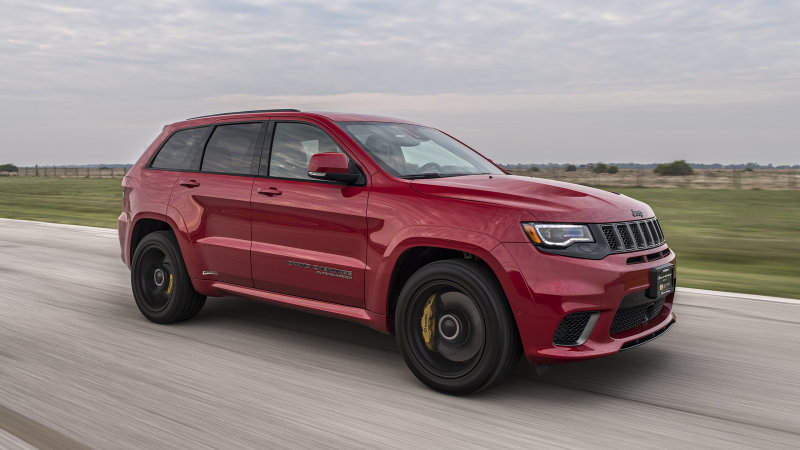
2019 Hennessey Jeep Grand Cherokee Trackhawk HPE1000 First Drive | Sounds like war, goes like hell

LOS ANGELES — To get our hands on Hennessey’s 1,000-horsepower Jeep Grand Cherokee Trackhawk HPE1000, we agree to meet Vinny Russo in an alley across the street from the practice facility of the Los Angeles Clippers. Noon sharp.

We hear the Hellcat-powered SUV before we see it, its raspy idle reverberating off the concrete buildings and expanse of fence. It rounds the corner and comes into view, its thunder growing as it slowly approaches over the dirty broken asphalt. It sounds like my big-block ’69 Camaro: thump, thump, thump.

Russo climbs out. “Sorry I’m late,” he says before reaching back in and shutting down the Jeep’s blown Hemi. The silence seems to hang in the air along with the Grand Cherokee’s spent hydrocarbons. It smells like an old-school big block, too.

“This is John’s personal truck,” he says handing me the SUV’s red key. “It’s the one on the internet going 181 mph with a Christmas tree on top and all that other cool stuff. It’s got 20,000 miles on it of …”

He pauses for a second. I’m sure he wants to say abuse. That the Jeep has seen 20,000 miles of abuse. But he’s a good PR man so he stopped himself. I can see him searching for another word. Any other word. He clears his throat.

“It’s got 20,000 miles on it of R&D,” he says. “Just make sure you have it pointing straight and have a good grip on the wheel the first time you go to full throttle. It’ll shock you.”

John, of course, is John Hennessey, and his company Hennessey Performance down in Houston offers up an extensive range of 1,000-hp machines, from McLarens to supercharged Camaros, Corvettes and Hellcats. It’s a good place to drain your 401(k).

After modifying his personal Mitsubishi 3000GT VR4 and driving it to a class record at Bonneville in 1991, he built his first Dodge Viper in 1992, the Venom 500, opened Hennessey Performance and paid the bills cranking out disgustingly powerful Vipers for the next decade and half. Then he built his own supercar about 10 years ago, the Venom GT. Steven Tyler famously bought one.

At some point he began turning up the wick on pickups and SUVs. Today Hennessey says it has built more than 10,000 specialty vehicles, and last year trucks and SUVs made up about 50 percent of its business. There’s the usual fare on the menu, including 600-hp Navigators, 650-hp Escalades and 800-hp Tahoes, but the company’s products can get pretty wild. Its V8-swapped Ford Raptors are popular. Or how about a Chevy Silverado with two rear axles? Not into a 6×6? Maybe I can interest you in a $225,000 1,000-hp Hellcat-powered Jeep Gladiator called the Maximus?

Last year we drove its least powerful and least expensive model, the 360-hp VelociRaptor Ranger. So this time we asked for something more extreme. Hennessey offers three versions of the Jeep Grand Cherokee Trackhawk, the HPE850, HPE1000 and the HPE1200, which the company says makes 1,200 hp and 1,000 lb-ft of torque at the crank on 109-octane fuel. We settled for the one with only 1,000 ponies.

Hennessey says the modifications it makes to the Jeep’s supercharged 6.2-liter Hemi V8 increases its output from 707 hp at 6,000 rpm and 645 lb-ft of torque at 4,800 rpm to 1,012 hp at 6,500 rpm and 969 lb-ft torque at 4,200 rpm. And trust me when I tell you, meeting a guy at a gas station with a new ZR1 Corvette and telling him your SUV has 245 horses more than his supercar is a hoot. You should have seen his face.

With the Trackhawk’s all-wheel drive, 20-inch Pirelli Scorpion All-Season Run Flats and launch control putting the power down, the guy’s Corvette didn’t stand a chance and he knew it. Hennessey says the Jeep hits 60 mph in 2.6 seconds and blows through the quarter mile in 10.2 seconds at 133 mph — and it really does feel that quick. According to Jeep, a stocker hits 60 mph in 3.5 and runs the quarter in 11.6 seconds.

So how do you make a Grand Cherokee that weighs 5,363 pounds accelerate like a Lamborghini Huracán Evo? Hennessey basically adds boost and fuel. The size of the factory-installed IHI root-type supercharger is increased from 2.38 liters to 2.65 liters. It also spins faster than before thanks to a smaller pulley, up from 14,600 rpm, and generates a maximum of 18 psi of boost, up from 11.6 psi.

A Kenne Bell Boost-A-Pump is installed to increase fuel pressure and volume to the Fuel Injector Clinic 1,000cc injectors, which supply fuel at a rate of 110 lbs/hr. Hennessey also adds tubular headers, an open element air filter and reflashes the ECU, raising the engine’s rev limiter from 6,200 rpm to 6,500 rpm in the process.

That’s all there is to it. The SUV even looks pretty much stock under the hood, and Hennessey doesn’t touch its suspension, brakes, all-wheel drive system or its ZF-supplied 8HP90 eight-speed automatic. And it can all be yours for $34,950, not counting the cost of the Jeep, of course.

Hennessey backs the package with a one-year / 12,000-mile warranty. Unfortunately it does void the Grand Cherokee’s factory warranty, and Hennessey doesn’t guarantee any of its kits are CARB legal. So California residents may have a problem at the smog check. “The rest of the states haven’t been an issue,” Russo told us.

Around town you can’t help but feel like you’re the king of the hill in this thing. How can you not? You’re driving one of the quickest SUVs on earth. A mommymobile that runs with hypercars. And it’s a serious sleeper. Hennessey removes the Trackhawk badge from the tailgate and the Supercharged lettering from Jeep’s doors. Unlike Saleens and Roushes, which are covered in branding, he adds a single and subtle Hennessey script to the left side of the SUV’s rump. Either you know, or you think it’s a V6 with a (very loud) exhaust leak.

After driving it for a couple of days, you start getting cocky. I remember passing a guy in an SRT Grand Cherokee and thinking, “Man, what a loser. He only has 475 hp to play with. Must be frustrating.” 

Quarter throttle at any speed leaves traffic in the dust. Half throttle and you’re at 100 mph before you know it. Full throttle is simply violent. Use the launch control, which unleashes the SUV at 2,800 rpm, and the thrust is so brutal it ripped my kid’s sunglasses from the top of her head, sending them from backseat into the cargo area and up against the tailgate.

And the entire time the Hemi spits a cacophonous mix of exhaust thunder and high-pitched supercharger whine. It isn’t just supercar fast, it’s supercar loud. At wide-open throttle, it sounds like the Tasmanian Devil, its eight-speed grabbing gears at 6,000 rpm, still 500 rpm below the engine’s power peak. At red lights, people in Teslas and Priuses roll up their windows in a feeble effort to escape its ruckus, sealing in their smug. One man’s noise is another man’s music, and the Jeep is playing Extreme Metal.

Unfortunately there’s a metallic resonance between 1,500 and 2,000 rpm, which is a problem when you’re putting around town. “It sounds broken,” my wife said. But above 2,000 the tone levels out and the engine is pretty quiet on the highway. At 80, the Jeep cruises like a stocker, but the big blown Hemi’s presence is always felt. Even at a steady 2,200 rpm, it sends a slight thump through the Grand Cherokee’s chassis like an elevated heartbeat. 

In perfect comfort, with the family and dog onboard, we cruised this 1,000-hp beast a few hours to grandma’s, averaging 13.6 mpg on the highway and just over 12 mpg in about 400 miles of mixed driving. Honestly, we were expecting worse.

Maybe Hennessey should consider a 6×6 version.

Related Video: