All posts in “Supercars”

Short-tailed Bugatti Chiron Super Sport spied testing

One of our spy photographers has caught a rather odd Bugatti Chiron prototype out testing. It features no camouflage, which reveals that it seems to fuse a regular Chiron with the Chiron Super Sport 300+. And that begs the question, what is this?

The front of the car is all Super Sport 300+. It has the revised air intakes, clusters of round vents in the hood, and big vents in the fenders. But unlike that top speed challenger, this has a normal, truncated tail from the regular Chiron. In fact, everything from the front fenders back appears to be regular Chiron. The one difference is the exhaust, which consists of two oval tips that most resemble the tailpipes of the Chiron Pur Sport. But the rear fascia is definitely regular Chiron, not the revised design of the Pur Sport.

So what is it? It could simply be a mash-up of leftover Chiron parts for some kind of test mule. It could also be shortened Chiron Super Sport 300+ that will share the same 1,600-horsepower engine as the high-speed car, but without the cost of the extra aerodynamics. Whatever it is, Bugatti’s testers evidently weren’t happy about the spy photographer catching the car, as he reports the car was hurried into a trailer and security sent to confront the photographer and stop him from sharing the photos. So it seems Bugatti has something interesting coming, whether it looks exactly like this or just has this car’s underpinnings.

Related Video

Maserati teases MC20 prototype again reminiscing about the Targa Florio

Maserati spent its weekend reminiscing about victory in the 1940 Targa Florio, putting an MC20 prototype to work enhancing the gravitas of the anniversary. After winning the Targa in 1937, 1938, and 1939 with the Maserati 6CM and its 1.5-liter supercharged inline-six throwing 175 horsepower, the House of the Trident showed up in 1940 with the brand new 4CL powered by a 1.5-liter turbocharged four-cylinder cranking 220 hp. Luigi Villoresi, who’d driven the 6CM to triumph the year before, crossed the line first in the 4CL to close out European racing until the end of World War II.

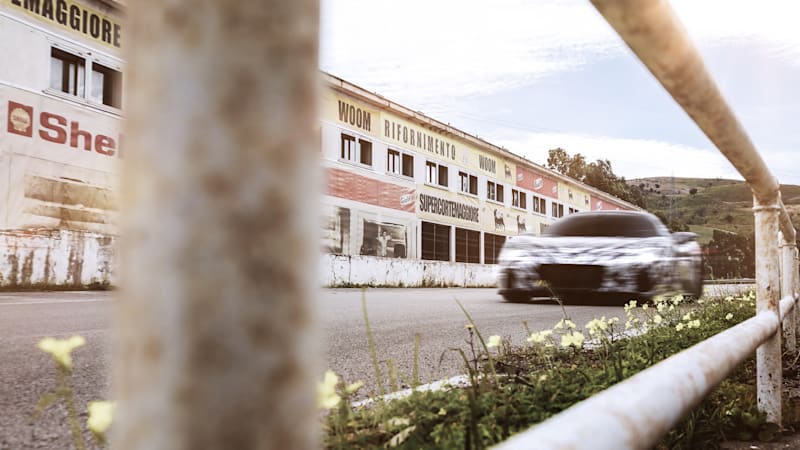
With a return to racing on the automaker’s mind, Maserati took a camouflaged MC20 to the same Favorita Park roads that hosted the Targa. The soft-focus spy shots were taken in front of the Floriopoli stands, a stretch of bunting and banners not far from the Targa start line as historic competitors headed into the Sicilian mainland.

The MC20 is as photogenic in these shots as all the others, and as mysterious. The automaker seems intent on making everyone wait until the September debut to for any details that the prototype doesn’t put on display. Prime among enthusiast interest is the powerplant. With Ferrari shutting down its supply of engines to the fellow Modenese sports car maker, Maserati says its new mid-engined coupe will be “the first car to use [its] new engine, brimming with innovative technological contents, developed and built by Maserati in-house.” Short odds figure on a molto potente twin-turbo V6 sending power to the rear wheels through an eight-speed dual-clutch transmission, the long money isn’t afraid to bet on a 4.0-liter twin-turbo V8  to replace the F154 V8 that Ferrari provides.

With race engineers undoubtedly sorting out a version for sports car racing as we speak, Maserati will certainly hope the competitive version matches the exploits of the 4CL. The vintage race car took pole in its first race, earned its first victory two races later, snatched up a bag of silverware before WWII, won the first race held in Europe after the war ended, and continued winning in 4CL and 4CLT trim until 1951 to take 31 total victories — nine more than the MC12 race car.

Related Video:

Acura NSX, a pair of 2 Series Gran Coupes and a time machine | Autoblog Podcast #628

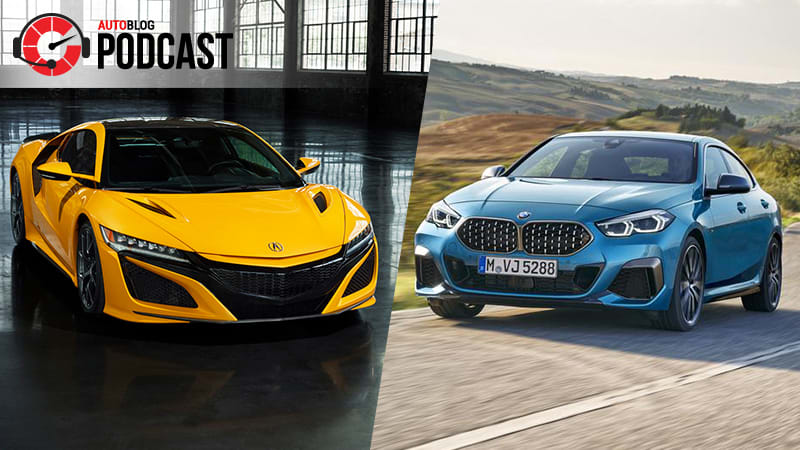
In this week’s Autoblog Podcast, Editor-in-Chief Greg Migliore is joined by West Coast Editor James Riswick and Road Test Editor Zac Palmer. This week, they’re driving a 2020 Acura NSX, two versions of the BMW 2 Series Gran Coupe (M235i and 228i) and the updated 2020 Honda Civic Si. Then, the gang gets to talking about what they’d drive in 1975 and 1985, along with plenty of other tangents. Finally, they wrap it up with news about the upcoming 2021 Acura TLX Type S and the fate of this year’s Woodward Dream Cruise.

Autoblog Podcast #628

Get The Podcast

  • iTunes – Subscribe to the Autoblog Podcast in iTunes
  • RSS – Add the Autoblog Podcast feed to your RSS aggregator
  • MP3 – Download the MP3 directly

Rundown

Feedback

Related Video:

2020 Lamborghini Urus Luggage Test | Loading the bull

A Lamborghini was recently at my house, which is sort of like the queen dropping in. And though I assiduously avoided carrying anything that could spill, splash, smudge or muss, one aspect of the 2020 Lamborghini Urus we wanted to check was just how much luggage it can carry considering the limitations imposed by the SUV’s extremely sloped roofline.

So I hopped onto the Lamborghini Store’s website to order up just the right stuff, co-branded by Lamborghini and TecknoMonster — hmm, perhaps the carbon-fiber small trolley case for $4,904, or the carbon-fiber Bynomio big trolley case for $7,874, or the Bynomio Hold Maxi carbon-fiber suitcase for $17,388. Perhaps the whole set. Now you might be saying to yourself, “That’s sure an expensive way to haul my clean underwear.” But rest assured these suitcases emerge from the autoclave after a cutting-edge aerospace process that merges two different types of carbon fiber and ensures “top performance and excellent mechanical properties, requiring extreme accuracy in all manufacturing steps.” Pity the fool who has a suitcase that’s anything less.

But tragically, there’s at least a 20-day lead time in ordering, and the Urus was only here for the weekend. So I guess that fool is me, having to resort to the same old world-weary, beat-up suitcases I usually use, which share space in the garage with the lawn tractor and cat litter box.

Six suitcases were at my disposal. Three would need to be checked at the airport, and one of those is particularly ungainly (29x19x11 inches, 26x17x10, 25x16x10). Three others would be small enough to carry on (24x14x10, 23x14x11, 22x14x9), if we were getting on airplanes anymore. Several of these bags have four wheels that jut out and were counted in the dimensions. It’s a shame not to have Riswick’s wife’s fancy bag for such a fancy car.

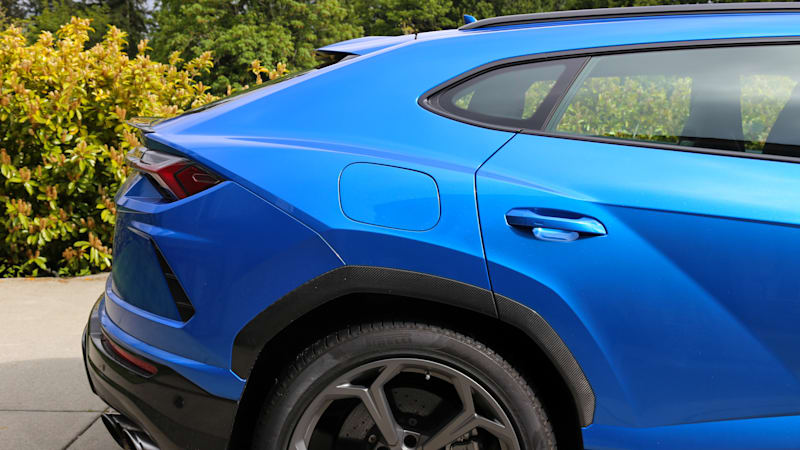
The Lamborghini Urus is pretty big. At 201 inches long and 79 inches wide, it is 2 inches longer than a Ford Explorer, and the same width. It’s 4 inches shorter than the big Mercedes-Benz GLS, but 2 inches wider. Plus, those are vehicles with third-row seating; the Urus has two rows and seats five. (Four if you get the backseat buckets and console.) Yet its cargo hold is 21.75 cubic feet, which is only about 3 cubic feet bigger than the others’ space behind the third row. It’s also much less than various five-seat, midsize SUVs.

We’re told it is wide enough to fit a couple bags of golf clubs, which looks feasible. In fact, it’s a pretty square space, and a set of clubs might even fit longitudinally. The problem is not the footprint. The volume is so little thanks to the sloped roof. Nothing boxy is ever going to fit in the back of the Urus.

By the way, that black bag contains Lamborghini roof racks.

Here’s what the cargo space is like with the package shelf removed (it easily slides out) and the second row dropped. Long cargo would fit well. It just can’t be tall.

OK, let’s try some luggage. Here’s the first attempt. Getting all six bags in is probably not in the cards. The hatch wouldn’t close on this, coming in contact with both of the upright red bags. Furthermore, there is a small, secondary section of package shelf that’s attached to the inside of the hatch and would need to be removed. But do that, and tilt the second-row seats upright, and you might jam this in. Just don’t expect to see anything.

This next arrangement is slightly less overburdened, and the hatch will definitely close if you remove that section of package shelf and nudge the seat up a little. The three biggest bags make the cut, with the biggest on its side, and two smaller ones to boot. Shift the smaller ones into the middle, and you’d preserve a sliver of rear view, though smaller than the sliver that you normally get. It’s not ideal, though.

Here’s a closer look at the accent-stitched Alcantara cargo shelf, which slides out easily. Ooh, soft …

Finally, in this configuration, you get to keep the cargo shelf, thereby denying the riffraff a chance to size up your fancy luggage. Four suitcases will fit this way — two large and two carry-ons. And thanks to an indent in the left cargo-bay wall, the Lambo roof racks fit, too. Or, leave those in the garage and you can get a small bag on its side, and all five passengers will be able to dress up for whatever fancy rich-people party they’re going to.

Related Video:

McLaren 600LT Spider Segestria Borealis is a spider edition of a Spider

It’s been a year and change since we drove the McLaren 600LT Spider, and McLaren has just wrapped up building the last few of this car’s run for North America. To celebrate, McLaren Special Operations (MSO) put together 12 Segestria Borealis special edition 600LT Spiders. They will be the last 12 available for sale in the U.S.

As a quick reminder, the 600LT Spider is at the very top of McLaren’s Sports Series. At its heart is a 3.8-liter twin-turbo V8 that makes 592 horsepower and 457 pound-feet of torque. That’s good for a 0-60 mph time of 2.8 seconds and a top speed of 201 mph. The 600LT Spider turns heads without a wild paint scheme, and the Segestria Borealis just makes this car stick out even more. McLaren says the design was inspired by the Segestria Florentina, a venomous spider pictured below for your nightmares. Since it’s a spider edition of a Spider, McLaren jokingly named this car the “Spider Spider.” How fitting.

The twin Napier Green stripes that run from the nose of the car to the top-exit exhaust are meant to symbolize the spider’s fangs. The spider it’s based on is black, which the Borealis Black paint is meant to represent. It’s a fairly special black that features deep green and purple undertones depending on the light. Yeah, sounds intimidating to us. There’s Napier Green pinstriping found all over the car, most of which can be seen lining the aero bits to make them stand out. The Napier Green paint also covers the brake calipers hiding inside the forged, gloss black wheels.

And of course, it wouldn’t be a spider-themed car without webbing. McLaren has used a web motif on the rear wing, side mirrors, seat headrests and the seats themselves. Yes, it is slightly childish, but it fits the theme. There are additional Napier Green accents found throughout the cabin, as well.

McLaren says each of the Segestria Borealis cars are equipped with the MSO Clubsport Pack, which includes carbon fiber racing seats, carbon fiber interior trim, titanium wheel bolts and glossy carbon fiber fender louvers. McLaren also threw in (for free!) the Bowers and Wilkins audio system, McLaren track telemetry, nose lift system, parking sensors and an alarm system upgrade. Fancy.

All of this will cost you $275,500. The Segestria Borealis 600LT Spiders should be arriving to a few McLaren dealers soon where they’ll be made available to purchase.

Related Video:

Bugatti walks us through the Chiron Pur Sport’s testing process

Bugatti is emerging from weeks of lockdown loudly, and sometimes sideways. Its engineers have started testing the Chiron Pur Sport unveiled in March 2020 on the Blister Berg track nestled in Germany’s Teutoberg forest.

Blister Berg is a private track, so the team only has three days to fine-tune the Pur Sport’s chassis, steering, suspension, and gearbox — the latter isn’t the same unit that’s found in the Chiron because its gear ratios are shorter in order to deliver quicker acceleration. Engineers are also monitoring wear-and-tear items, like the tires, and keeping an eye on the model-specific engine components. That’s a lot to cram into three days, especially since Bugatti had to reduce the size of the team it sent to the track in order to comply with the social-distancing measures that remain in effect throughout much of the world. Germany’s dense, fairytale-like forest is no exception.

Luckily, sensors aren’t affected by health-related restrictions, and there’s no limit to the number Bugatti can stuff into the two pre-production prototypes tirelessly lapping the Blister Berg track. They’re monitoring a variety of parameters, including the exhaust temperature. They’re also helping engineers set up the new Sport+ driving mode that relies on gyro-based technology to make the Chiron more eager to drift. Creating this profile requires a tremendous amount of calibration work. Testers download data after each run, analyze it, and make changes if needed. Bugatti told Autoblog the Chiron can already drift, but the new mode makes it a little bit easier.

Going through this costly, time-consuming process is a way for the firm to demonstrate that its definition of performance doesn’t end at straight-line speed. It wants to show a lesser-known side of its personality.

“Bugatti has always proven it can build fast cars in terms of top speed,” the company told Autoblog, pointing to cars like the Chiron Super Sport 300+. “However, we also have a history of building cars devoted to agility. This is often forgotten or overshadowed by the incredible top speed feats. We, as did some of our valued customers we talked to about this, felt we should complete the spectrum of performance of the Chiron lineup.”

Validation testing will continue in the coming months; Bugatti will notably take the Pur Sport to the Nürburgring. Jachin Schwalbe, head of chassis development, explained every part of the car needs to work perfectly on its own, but also as part of the broader package. While that’s par for the course when it comes to developing a new car, the Pur Sport needs to work perfectly over a much larger speed range than the average car.

Pur Sport production is scheduled to begin in the second half of 2020. Sixty units will be built, and pricing starts at €3 million, a figure that makes it slightly more expensive than the Chiron. In the meantime, the company’s factory in Molsheim, France, is assembling the first examples of the limited-edition Divo introduced in 2018. Bugatti’s lineup has grown considerably in a few short years, which adds a level of complexity to its production.

“We are currently building the Chiron, the Chiron Sport, and the Divo. And, we’ll be building the Chiron Pur Sport, the Chiron Super Sport 300+, the La Voiture Noire, and the Centodieci as soon as their development has concluded. We naturally had to adjust or optimize our structures and processes, not only in the production or in R&D, but also in the design, procurement, and logistics departments — in all departments, really. We have successfully done so, and the team is proud to see the portfolio grow.”

Although it couldn’t share more details about what’s next, the company assured us it’s not idling in neutral. “We can’t disclose what we are working on, but our team doesn’t know boredom.”

Related Video:

Brabham Automotive BT62 Competition delivered to first U.K. customer

Despite the difficult circumstances created by the spread of the coronavirus and the resulting COVID-19 pandemic, Brabham Automotive has continued production of its BT62 throughout the past few months. Staying on schedule, Brabham plans to produce 70 units of the supercar, some for the road and some specifically for racing on the track. The first of the motorsport bunch, a BT62 Competition, has just been completed and delivered to Horsepower Racing in the United Kingdom.

Unlike major manufacturers that produce vehicles in large quantities in large facilities using a large number of people, Brabham is a small operation. Each car is hand-built, allowing for individual attention to various parts of the vehicle. Because of this, Brabham has been able to carry on while using precautionary measures.

There are technically three variants of the BT62: Ultimate Track, Competition Spec, and Road Compliant. Because it has been stripped of pieces such as a passenger seat, the BT62 Competition is the lightest of the three cars, but it has all the performance of the Ultimate Track version.

Under the hood, the Competition features a 5.4-liter naturally aspirated V8 that pairs with a six-speed sequential gearbox and makes a claimed 700 horsepower. In addition to an FIA-compliant carbon-chromoly safety cell with an integrated roll cage, the Competition model also has center-locking wheels, a pneumatic jacking system, a competition-ready gauge display and lightweight, removable, multi-function steering wheel, carbon-on-carbon brakes, motorsport ABS, and motorsport traction control. In part due to its massive rear wing, the BT62 Competition is expected to put down about 2,646 pounds of downforce

This particular example is headed to Horsepower Racing, a motorsport team based in the U.K. It will be driven in the Britcar Endurance Championship (when it happens) by owner/racer Paul Bailey, as well as Ross Wylie. The Brabham BT62 is priced at approximately $914,000 by current conversion rates.

2020 Acura NSX Suspension Deep Dive

The Acura NSX has been a special car as long as I’ve been in the business. The first one came out in 1990, the same year I started my career in automotive engineering. I vividly remember driving one briefly back then when we brought one in for benchmarking. I’d drive it again 22 years later when my previous employer bought a used 1991 example for a long-term test. Reader interest was sky-high and the car was still gorgeous, but the march of time and automotive engineering had clearly left it behind.

Then, in 2016, a second-generation NSX emerged, and it was packed with bleeding-edge thinking. It has a 3.5-liter twin-turbo V6, but this new NSX is a hybrid with an electric motor-generator sandwiched between the engine and its nine-speed DCT transmission. Two more electric motors – one for each wheel – power the front axle. There they can add traction, regenerate electricity under braking and dole out hyper-accurate levels of torque vectoring.

The car’s tire package was changed from Continental SportContact 5 to SportContact 6 tires in 2019, and numerous suspension re-tuning tweaks came along with them. The result is a lively and well-balanced car that is relentless when driven hard and a pussycat around town. Let’s see what they’ve got going on under there.

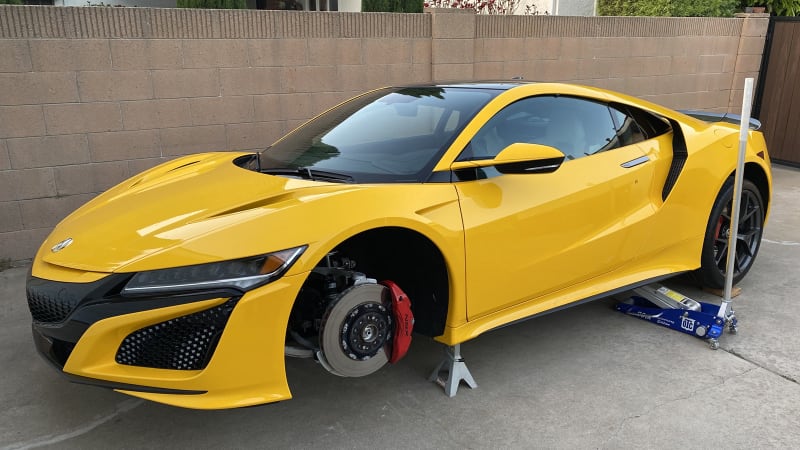
At first glance the 2020 Acura NSX appears to have dual wishbone front suspension. But we can’t tell for sure because that big two-piece brake rotor is in the way. The coil-over shock looks obvious, but a few odd details are apparent even from here.

This view also seems to indicate double wishbone suspension. But the pivot axis (green arrow) between the upper and lower ball joints looks wrong – it’s far too vertical. We’re missing something.

But I would be remiss if I failed to point out a few other things before we moved on. For one, the front drive axle confirms this to be an all-wheel-drive machine. Second, the forged aluminum damper mounting fork (yellow) that envelops the axle is mounted to the lower arm about 75% out from the arm’s inner pivot. The spring and damper motion ratio would be 0.75-to-1 relative to wheel movement, with a tiny reduction due to its lean angle.

Lastly, just look at the huge cast aluminum upright (white). Beautiful. Normally these are called hub carriers or steering knuckles, and I use the terms interchangeably. But the motorsports-derived term upright is normally applied when the piece is tall and, well, upright like this one.

This explains everything. The lower end of the upright is located by two forged aluminum links, each with its own outer ball joint. This type of suspension is often called Double Wishbone with Dual Lower Pivots even though we’re not technically looking at a wishbone.

That plastic piece is a fence that guides cooling air for the brakes. This will be your last look at it because I’m about to unbolt it.

The apparently too-vertical steering axis we saw earlier was a false first impression. The real lower pivot is a virtual point that lives in a physically impossible place where the lines of each link intersect. The angled forward link (yellow) locates the wheel in the fore-aft direction and absorbs longitudinal forces, while the rear lateral link (green) manages the camber angle and takes up cornering forces.

As you might expect, that virtual point moves about. Here’s what it looks like in action with the wheel off, and with the wheel on I can scrub the tire (and the driveway) to show where the pivot axis intersects the contact patch.

The point of all of this is to put the steering axis in a more favorable position relative to the tire’s contact patch in order to improve steering feel and lessen kickback and torque steer from the electric motors.

The actual pivot points do not reside where the nuts appear at the bottom. They live within the rubber bellows and the aluminum link. The two link ends are stacked and angled because they want them to be closer together than they could be if both were arrayed side-by-side on the same horizontal plane.

The arms and links of the front suspension are bolted to the chassis with what I call tie-bars, but I like the term dogbone used internally by Acura. The rear lateral link’s dogbone is spaced from the chassis by color-coded shims of varying thickness to achieve the desired camber angle.

The forged aluminum upper arm uses a low-mounted “in wheel” ball joint (yellow) similar to what we saw on the MX-5 Miata. That choice was made here for many of the same reasons: keep the hoodline and center of gravity low.

It’s mounted with a pair of dogbones, but the oddest bit may be that it serves as the attachment point for the front stabilizer bar’s end link (green). It’s mounted about 60% of the way out from the pivot for an approximate 0.6-to-1 motion ratio.

That non-standard link position does make it easy to locate the stabilizer bar itself in a quiet corner.

The NSX uses magnetorheological dampers (MR, but Mr. Dampers makes me smile) that are controlled by a system of suspension height sensors (yellow) at each corner, a steering angle sensor and g sensors. Probably others. The MR damper itself is made by BWI – the current patent holder – but Acura has developed its own control software and sensor suite.

MR dampers are continuously variable. The valving is fixed, but the viscosity of the damper fluid that passes through that valving can be varied proportionally by the application of an electrically-generated magnetic field. This gives them exceptionally quick reaction times.

Meanwhile, the upper mount pokes up to where we can see daylight and the yellow-painted underside of the hood.

The upper mount is laterally bolted to the chassis so the hoodline can be as low as possible. But it’s not a simple single-shear mount. Hidden stepped dowel extensions make it so the bolts aren’t doing everything on their own.

The brake master cylinder is mounted sideways and is operated by a stepper motor (yellow). This is common on hybrids and electric vehicles because they seek to prioritize magnetic “regenerative” braking for routine stops before using the pads and rotors. The brake pedal is attached to a smaller hydraulic cylinder to generate authentic feel and a pressure signal the system can use along with pedal position sensor data to calculate its response.

If this sounds like brake by wire, it absolutely is. And the feel is fantastic. Acura engineers told me the feeling can be so consistent that they had to program in an artificial “long pedal” to let an aggressive track-day driver know when the brakes were getting hot and losing effectiveness. If the by-wire system utterly fails – an exceedingly unlikely event – that smaller hydraulic cylinder attached to the pedal becomes the back-up system.

The brakes are made up of six-piston Brembo fixed calipers and two-piece rotors. Steel rotors are standard, but long-lasting lightweight ceramic ones that save 52 pounds of total unsprung mass are available as an option.

The calipers use an open-window design, but they have a bridge bolt stiffener (yellow) that must be removed before the pads can be extracted.

The initial view of the rear looks similar to what we first saw up front, except there are two calipers back here.

There’s another forged aluminum upper arm back here, and it’s mounted with dogbones that are deep-set into a vast ablation-cast aluminum section of the rear chassis.

The lower end of the rear damper (yellow) is mounted directly to the knuckle, which gives it a 1-to-1 motion ratio. This is a high mounting point above the rear axle, and the mounting bolt itself also anchors a bracket for the stabilizer bar end link (green), which means it has a 1-to-1 motion ratio, too.

Meanwhile, the rear position sensor’s strut (white) and its upper arm attachment are clearly visible.

The rear damper’s somewhat high lower mounting doesn’t indicate a short damper. Like most mid-engine cars, the rear of the NSX has high haunches. And the upper attachment is the same low-profile sideways-bolted mount we saw in the front.

The lower end of the rear knuckle is located by a pair of links, making this a multilink suspension that just happens to have one wishbone. Each carries a plastic brake cooling air deflector that must be removed so we can see better, but an unusual-looking nozzle (yellow) remains.

That noozle is the terminus of a tube that is enclosed within the forward half of the two-piece rear subframe, and the source of its air is a NACA duct located closer to the middle of the car.

The forward link is an angled semi-trailing link that is mainly concerned with the wheel’s fore-aft location. Its high mounting relative to its partner link is a sign of anti-squat rear geometry.

The lateral link’s dogbone attaches to the chassis in an angled orientation that makes its pivot axis (yellow) roughly line up with the forward link’s elevated pivot point.

As we saw up front, the rear wheel’s camber is adjusted via color-coded shims that are sandwiched between the dogbone and the chassis. This view also shows the overlapping interface of the two-piece subframe (green) at a point where both parts share a mounting bolt.

The toe link sits behind the rest, and it is quite a bit longer than its partners. Mid-engine cars are very responsive to steering inputs, so a healthy dose of roll understeer is necessary to keep them in line. This one has a turnbuckle (yellow) in the middle for easy static toe adjustments.

Here’s how this trio of links bolts to what is a tidy cast-aluminum knuckle.

No I didn’t forget about the rear stabilizer bar. Its pivots (yellow) are sandwiched between the rear subframe half and the chassis, and it arcs over the lateral link to meet its own connecting link (green). Try to ignore the bracket, which holds the air deflector I removed.

The main brake is a Brembo four-piston fixed caliper with an open pad-extraction window, while the smaller one is an electronically-controlled parking brake. The extremely flat central hat section of the two-piece brake rotor leaves no room for the in-hat drum parking brakes that less performance-minded cars tend to favor.

For their size, the Acura NSX’s wheel and tire package are admirably light. The 2019 and 2020 versions of the NSX use Continental SportContact 6 tires mounted on Y-spoke rims, a design that was chosen for its superior strength-to-weight ratio. It doesn’t hurt that they look fantastic, too. The 19-inch front rims are 8.5 inches wide, wear 245/35ZR19 tires and the assembly weighs just 41.5 pounds. The 20-inch rears are 11 inches wide, are shod with 305/30ZR20 tires and weigh just 54.5 pounds each.

There’s a lot of fascinating engineering hidden within the wheelhouses of the second-generation Acura NSX. And it all works beautifully. The 2020 NSX is an epic-handling machine that is also quite livable day-in day-out on the street. It is a thoroughly modern supercar, but it also plays homage to the original. It’s a pity we don’t see more of them out there on the road.

Contributing writer Dan Edmunds is a veteran automotive engineer and journalist. He worked as a vehicle development engineer for Toyota and Hyundai with an emphasis on chassis tuning, and was the director of vehicle testing at Edmunds.com (no relation) for 14 years.

Read more Suspension Deep Dives below and let us know which cars you’d like to see Dan put up onto the jack stand next …

Mazda MX-5 Miata Suspension Deep Dive

Toyota GR Supra Suspension Deep Dive

Porsche Taycan Turbo Suspension Deep Dive

Related Video:

Ferrari mule lapping Fiorano could house V6 hybrid

Ferrari spoke of plans to add a V6 to its lineup two years ago, without dropping its two other trademark motors. The brand’s SVP of commercial and marketing, Enrico Galliera, told Australia’s WhichCar last year, “So the technology we are going to have, V12, V8, V6 turbo. Hybrid will give us the possibility to have a platform that we can mix to achieve emissions targets.” There’s been much chatter around when and where the V6 in turbo and/or hybrid form would show. We still don’t know, but it’s possible that we’ve had our first sound check for it, thanks to four brief videos on Instagram.

Instagram user simonemasetti_photography, a regular around Ferrari’s Fiorano test track in Maranello, captured the vids, while Instagrammer cochespias uploaded them. The camouflaged 488 mules lapping the circuit wear camo similar to that on a 488 mule spotted on Maranello roads with an electricity warning sticker on its frunk.

We can’t be certain of what engine lurks behind the cabin of the test cars, but all the cars are much quieter than one would expect Ferrari’s 3.9-liter twin-turbo V8 to be. In the first video, the coupe accelerates so hard that a long lick of fire shoots out the exhaust, with only a gentle ‘whoosh’ — no wail or roar — to accompany it. The third vid makes the best comparison, the one that opens on two 488-looking coupes in the far distance, one black and one camo’d. When the camo’d car takes off, moving away from the camera, we hear the sound we’d expect from a charging Ferrari V8. However, when the car we suspect is a hybrid V6 passes right in front of the camera, even under acceleration it makes hardly any noise compared to the car in the distance.

These cars, in fact, sound just like the car Masetti caught testing at Fiorano last September, which he believes is the V6 hybrid.

No matter what’s being tested, we know little about Maranello’s V6. One origin story says the mill has been developed from the 2.9-liter twin-turbo six-cylinder in the Alfa Romeo Giulia Quadrifoglio, which itself is suspected to be derived from the 3.9-liter twin-turbo V8 in the F8 Tributo. Another origin story figures the V6 is a brand new engine. No matter where it began, consensus is that the hybrid unit will enter production around 2022 and produce more than 720 horsepower.

Related Video:

Lotus Evija’s wild aero setup is detailed by chief aerodynamicist

The Lotus Evija is a car of firsts for Lotus. To that end, the company has spent a lot of time talking over the details. Today, we get to learn about the wild shape’s aerodynamics and what Lotus engineers were trying to accomplish. Richard Hill, chief aerodynamicist for Lotus takes a dive into all the details, and the video at the top of this post offers a great visual.

“Most cars have to punch a hole in the air, to get through using brute force, but the Evija is unique because of its porosity,” Hill says. “The car literally ‘breathes’ the air. The front acts like a mouth; it ingests the air, sucks every kilogram of value from it – in this case, the downforce – then exhales it through that dramatic rear end.”

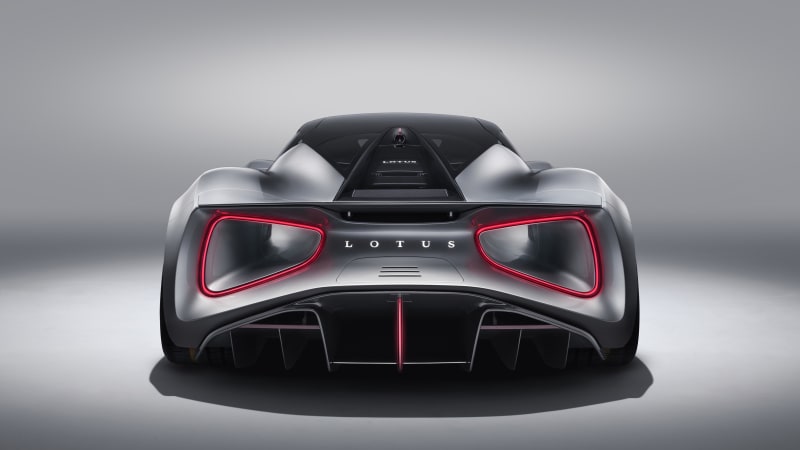
We can see what Hill means as we look at the Evija in photos. Instead of a regular front bumper, this one has pass-throughs that direct the air back into the side of the car. Lotus hasn’t released the all-important coefficient of drag figure yet, but we have to imagine it’s very low. The front splitter (below, left) is responsible for a few different things.

The opening in the center takes in air to cool the battery pack that is mounted behind the seats. Then, the outer section of the splitter channels the air to the “e-axle” for cooling of the electrical components. And finally, it also produces downforce. 

There are a couple more tunnels for air to pass through in the rear. These “holes” are likely the most distinctive design feature, especially when accentuated with the LED taillights. Hill says that these are also fully functional and help to reduce drag.

“They feed the wake rearward to help cut drag,” Hill says. “Think of it this way; without them the Evija would be like a parachute but with them it’s a butterfly net, and they make the car unique in the hypercar world.”

On top of all these porous body structures, there are pieces that move. The rear wing can elevate upward from its flush body position and deploy into clean air above, creating more downforce. And then there’s an F1-style drag reduction system. This uses a horizontal plane that deploys from the car to make it slipperier through air.

The final big piece of this puzzle is the underbody sculpting that directs air into the massive rear diffuser. This causes an upwash of air, in turn creating a massive amount of downforce. Hill sums it up quite nicely.

“It’s about keeping the airflow low and flat at the front and guiding it through the body to emerge high at the rear,” Hill says. “Put simply, it transforms the whole car into an inverted wing to produce that all-important dynamic downforce.”

Related video:

One day later, junior car thief bags his Lambo

Five-year-old Adrian Zamarripa made headlines when he boosted his parents’ SUV and set out for California from his home in Utah. With $3 in his pocket, the young supercar fan was on a quest to buy a Lamborghini. His plan unraveled, however, when Utah state police pulled him over on I-15. Or at least, it seemed to. Thoguh thwarted in his attempt to get to California, one day after his story appeared, a Lamborghini came to him.

As Fox 13 News Utah reports, local Lamborghini owner Jeremy Nevis drove to Zamarripa’s home in Ogden to give the fellow Lambo lover a ride in his matte-black Huracan. “The success principles that he displayed were magnificent to me,” Nevis said.

Oh, and Fox 13 reports that an unidentified California business has offered to fly Zamarripa to the Golden State and let him actually drive a Lamborghini (under supervision).

As his sister says in the segment, “It’s like he planned everything, which is crazy.”

The important lessons: Crime pays. And when you fail big, it’s really just a preamble to success.

Lamborghini turns the Huracán EVO into a tail-wagging rear-wheel-drive roadster

The latest evolution of the Lamborghini Huracán Evo loses its top and its front axle to deliver a wind-in-your-hair driving experience whether it’s going forward or sideways. The company proudly explained the newest addition to its line-up relies on hardware — not software — to make driving as engaging and thrilling as possible.

Lamborghini added Amazon Alexa integration to the Huracán earlier in 2020, but there’s no guarantee the digital assistant will hear your voice commands when you’re driving flat-out with the roof down. The two passengers sit low in the Huracán, and they’re merely inches away from a naturally-aspirated, 5.2-liter V10 that screams and shouts as it develops 610 horsepower at 8,000 rpm and 413 pound-feet of torque at 6,500 rpm. These figures are a little bit lower than the ones posted by the 10-cylinder when it powers the all-wheel drive Huracán Evo.

The rev-happy V10 spins the rear wheels via a seven-speed dual-clutch automatic transmission that’s quick when it needs to be, and docile when the occasion calls for it. Hitting 62 mph from a stop takes 3.5 seconds, meaning it’s there before you’ve reached the end of this sentence, and its top speed checks in at 201 mph.

Lamborghini re-tuned the Performance Traction Control System (P-TCS) to give the driver as much grip as possible in a wide variety of situations. If you don’t want grip, however, the Huracán Evo is more than happy to go sideways thanks to clever, gyroscope-based technology that allows its rear end to break loose and limits the engine’s torque output if it detects the oversteer angle crosses a pre-determined threshold. This function works when the driver selects Sport mode using a steering wheel-mounted switch; it’s off in Strada (or street) mode.

Even supercar manufacturers need to inject a generous dose of connectivity into their cars, and Lamborghini is no exception. There’s an 8.4-inch touchscreen in the center stack that displays an infotainment system the firm developed in-house. It allows the front passengers to browse the internet on-the-go, make hands-free phone calls, and load Apple CarPlay. Android Auto isn’t available, so motorists without an Apple device are out of luck.

The 3,326-pound rear-wheel drive model stands out from its all-wheel drive counterpart thanks to model-specific front and rear ends shared with the hardtop variant. Lowering or raising its power-operated soft top takes 17 seconds, even at speeds of up to 30 mph. The rear window can be lowered to better hear the V10, too.

On sale now, the Lamborghini Huracán Evo Rear-Wheel Drive Spyder (yes, that’s its full name) carries a base price of $229,428 in the United States before taxes enter the equation. Deliveries will begin in the summer of 2020. Enthusiasts can work directly with Lamborghini’s Ad Personam program to personalize their car.

Lamborghini resumed production in its historic Sant’Agata Bolognese, Italy, factory after a brief coronavirus-related hiatus, and 2020 is nonetheless going to be a busy year for the firm. It’s preparing to introduce a track-only, V12-powered supercar with 830 horsepower on tap, and it told Autoblog it will take the Urus — its only SUV — racing before the end of the year. Meanwhile, another team within its research and development department is busily working on a gasoline-electric plug-in hybrid variant of the Urus due out sooner rather than later.

Related Video:

SSC Tuatara shown screaming down an empty highway in new video

Nearly three months after SSC North America finally unveiled the production version of the Tuatara, and after more than a decade in development, the company has released video showing the supercar in action.

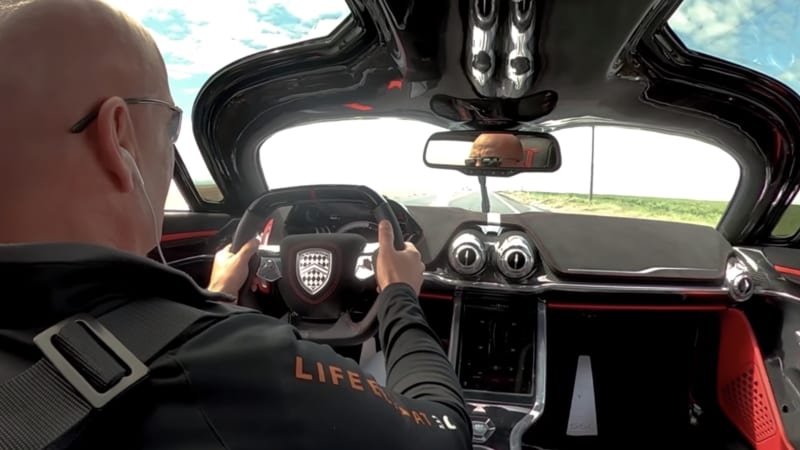
The 49-second clip shows company founder Jerod Shelby piloting the Tuatara at speed down an empty highway along a windswept, treeless landscape. The rear-mounted camera gives us a good view of the cockpit and its sense of openness, thanks to the expansive glass roof panels on the butterfly doors.

We also get a view of the CIMA seven-speed automated manual gearbox, developed by Automac Engineering of Italy and sending power to the rear wheels as Shelby uses the paddle shifters on the wheel. There’s no indication of how fast he was driving, but we hear the sound of its engine, which has an 8,800-rpm redline, and the video is tagged with #lifebeginsat300 and #yearofthetuatara, reminders of the company’s boast that the Tuatara can go “well over” the vaunted 300-mph mark.

The car boasts a 0.279 drag coefficient and active aerodynamics. Its 5.9-liter twin-turbo flat-plane crank V8 was developed with Nelson Racing Engines. It puts out 1,350 horsepower using 91-octane fuel, and 1,750 hp on E85. Torque is 1,280 pound-feet at 6,800 rpm.

Others have already broken the 300-mph barrier, of course, including a street-legal 2006 Ford GT and a Bugatti Chiron longtail prototype last September, with Koenigsegg claiming that simulations suggest the Jesko Absolut is capable of doing 330 mph. Still, we look forward to SSC’s inevitable assault.

Related Video:

Alois Ruf details 80 years of history in ‘RUF: Love at the Red Line’

Alois Ruf, Jr. knows the exact moment he and his father Alois Ruf, Sr. realized just how fanatic Porsche people are about their cars. While sitting at a stoplight in their Porsche 356 Karmann hardtop one Sunday afternoon, a stranger knocked on the window and begged for a chance to buy that exact car. The Rufs agreed to follow the person to his house, and the random buyer used cash from a candy box to overpay for the car that same day. After handing the cash over, the trusting stranger then loaned the Rufs a different Porsche to use to grab the necessary paperwork. “These Porsche people, they must be crazy,” Alois, Jr. remembers his father saying. “Everything is different with these people. Something is there that is not normal.” The Rufs went on to use craziness to build an 80-year business that is now engrained in Porsche lore.

Marking eight decades of service, Ruf put together a 30-minute documentary about its own history and recently released the project in full on YouTube. The video is spearheaded by Alois, Jr., and includes several other notable Porsche employees, owners, historians and fans. Ruf remains headquartered at Pfaffenhausen, Germany, where Alois, Sr. first opened a small repair shop.

Senior’s first Porsche was the result of a terrible crash. In 1963, while driving a Mercedes-Benz O 321 HL, he witnessed a Porsche 356 Karmann hardtop pass his slow-moving omnibus. When the Porsche try to correct into the proper lane, it lost control, drove into a ditch and flipped twice. Senior calmed the man down, brought him to the hospital, and explained he had an auto shop that could repair the car. But the owner ended up selling the car to Alois, and Alois sold it about a year later in the previously mentioned scenario. From that seed, a lasting relationship grew.

The car RUF is known for, the Yellowbird, came from an idea that emerged back in 1979. At the time, Junior called it the 945 R, and he planned to give it 450 horsepower with a twin-turbo version of the 935 engine. He ended up building the CTR 1 out of a shell from a 911 Carrera 3.2, and the car’s pure performance characteristics filled a gap left by Porsche at the time. In part due to a popular VHS tape, that car later became a legend.

Learn more about RUF’s beginnings, and how the business progressed, straight from Alois, Jr., in the video above.

Related Video:

Ferrari to gradually restart operations from Monday

MILAN — Luxury carmaker Ferrari said on Thursday it would restart operations at its Maranello and Modena plants on May 4, when Italy is set to start lifting coronavirus lockdown measures.

The two facilities, both located in Italy’s northern Emilia-Romagna region, have been closed since mid-March when Rome imposed curbs on people’s movements and froze manufacturing activities deemed as non essential, to contain the spread of the coronavirus.

The sites will resume operations “gradually” and return to full production on Friday May 8, Ferrari said.

Ferrari said that before resuming operations it was organizing training sessions for workers — focused on precautionary measures they must take — as part of its “Back on Track” program, unveiled earlier this month and aimed at preparing for a safe working environment at the sites.

Under this program, Ferrari staff, families and suppliers will first take blood tests and will then be given an app which will alert them if they’ve been in close contact with any of the people taking part in the scheme who had contracted COVID-19.

During the closure period Ferrari has produced parts to convert snorkel masks into respirators for treating patients with coronavirus and to protect medical workers, using its 3D printing technology at its Maranello plant.

(Reporting by Giulio Piovaccari, editing by Giulia Segreti and Susan Fenton)

Related Video:

McLaren Speedtail reveals its hybrid powertrain secrets, and of course it’s impressive

Until now, McLaren has been keeping secrets about its three-seat Speedtail hypercar. We’ve known it’s packing a hybrid powertrain that produces a combined 1,055 horsepower and 848 pound-feet of torque, but that’s about it. Today, McLaren is spilling the beans, and what impressive beans they are.

The combustion engine is a 4.0-liter twin-turbo V8, rated for 747 horsepower and 590 pound-feet of torque on its own. Its output is nearly identical to that of the 765LT (rated for 755 horsepower and 590 pound-feet). And yes, the two are both equipped with McLaren’t M840T engines. However, the Speedtail’s hybrid powertrain is named M840TQ, since it features an electric motor to help it along.

And help the Speedtail along it does. McLaren says the single electric motor generates 308 horsepower on its own, which is an astounding figure for its application. The tech on display here is derived from Formula E, and McLaren is claiming it’s the “highest performing installation — including cooling and integration — of any electric motor currently in use in a production road car.” 

McLaren is also bragging about its new battery unit. It’s a 1.647-kilowatt-hour (mighty precise there, McLaren) cylindrical-shaped unit that’s “arranged in a unique way.” What way? McLaren doesn’t say. However, it’s an extremely compact unit, and McLaren claims it’s able to provide the best power-to-weight ratio of any high-voltage battery available today. It says the power density of the battery is four times that of the McLaren P1, the company’s only other hybrid vehicle

As for the cooling system, it’s also state-of-the-art. McLaren says the cells are “thermally controlled by a dielectrical cooling system and permanently immersed in a lightweight, electrically insulative oil which quickly transfers heat away from the cells.” This cooling technology is also being claimed as a first in a production road car. The benefit? It’s highly efficient, and will “allow the cells to run harder and for longer.” All of this is great news for future hybrid McLaren supercars, which are coming soon.

Related video:

McLaren recalls Senna and several other models over potential fire risk

McLaren is recalling multiple models due to a potential fire risk. The models in question include the 2016-2020 720S, 2019 Senna, 2020 GT and 2017-2019 570GT. In total, that amounts to 2,763 cars.

The Senna being part of this recall caught our eye, since so few of those will ever be sold. McLaren says that 157 Sennas will be subject to recall. As for the issue itself, the fire risk stems from an NVH foam pad that is placed underneath the fuel tank. McLaren says there is a possibility that this pad collects and retains corrosive moisture from the environment while driving. Over time, this could corrode the surface of the fuel tank where the pad is in contact with it. Those “micro-porations” in the fuel tank could trigger the release of gas vapor or fuel liquid. McLaren says this wouldn’t immediately cause a fire, because the fuel would be exiting into a “cool part of the vehicle” (not the exhaust or powertrain). However, fuel could ultimately leak onto the ground under the vehicle, increasing the risk of a fire under the car.

McLaren says it first learned of the issue from a Latvian customer who claimed to smell fuel coming from his 570GT. The customer’s car was a former press car, “subjected to high mileage, wear and tear and greater range of road conditions than a typical vehicle of the same type and age.” Yeah, we can attest to that. After another similar complaint from a UK customer, McLaren opened an investigation, and this recall is the result.

To fix the 720S, Senna and 570GT, dealers will be removing the NVH pad from the car and inspecting all the gas tanks for corrosion. If McLaren deems it necessary, the fuel tank will be replaced. As of now, that NVH pad is just being removed from the car with no replacement part. McLaren hasn’t specified a remedy for the McLaren GT yet, suggesting that something else is going on there. McLaren also states that there is no defect in the design or the materials used in the fuel tank. The foam pad is the potential issue here.

Related Video:

Ferrari SF90 Stradale Spider spied out testing for the first time

The Ferrari SF90 Stradale is the most powerful and most tech-forward road car to come out of Maranello ever. It’s a plug-in hybrid that puts out a combined 986 horsepower between the boosted V8 and three electric motors. So, of course it’s getting a convertible variant.

These spy shots are our first look at what is likely the SF90 Spider. It’s not exactly clear that this heavily covered up Ferrari is a convertible at a glance. However, the shark fin antenna has been moved from the roof to the rear deck, indicating to us that it might not work on the roof anymore. The bump for the new location is around where we’d expect the engine cover to be. As for the rest of the car, Ferrari does a hell of a job making this supercar look like a shapeless blob. The dual exhaust exits in the same place as the coupe, mounted high up on the rear fascia. Its big, scalloped side air intakes are also semi-visible.

We can’t see the taillights, but Ferrari has left part of the headlight element uncovered. These closely resemble the look of the standard SF90 Stradale. They’re relatively small, horizontal in shape and have small, powerful-looking LED beams.

Expect the Spider to be nearly as quick as the coupe that’s rated to go 0-62 mph in just 2.5 seconds. The all-wheel drive Ferrari is equipped with an eight-speed dual-clutch gearbox. Ferrari estimates an electric range of 15.5 miles when the battery is fully charged, so it’ll only be useful for short trips. Deliveries for the coupe are expected to begin this year. We haven’t heard any hard timing for a convertible yet, but expect a reveal sometime in the next year or two.

Related video:

Czinger 21C comes in 1,331-hp widebody version, too

Two months after Czinger introduced its 21C tandem-seater hypercar in regular and track-focused trims, there’s already another variant on the table. Jens Sverdrup, the company’s chief commercial officer, told Pistonheads that Czinger wanted to have a widebody derivative with a higher output ready for the Geneva Motor Show, but that didn’t happen. Sverdrup detailed the new version, explaining that engineers tweaked the 2.9-liter twin-turbo V8 and the twin high-power electric motors to increase output by an extra 98 horsepower, from 1,233 hp to 1,331, without increasing the weight of the 992-pound entire hybrid powertrain. This makes what was already the most power-dense V8 engine in the world even more power-dense. The widebody component shows itself in new bodywork over a wider track and wider tires, and it gets its own chassis tune. Said Sverdrup, “Anybody who buys one of our 80 21Cs can tick for a widebody version on the options list, giving them a hypercar that might not be the best for narrow Scottish or Welsh roads, but will definitely be great for the race track.”

Czinger’s spending the time before deliveries begin in 2021 honing engine characteristics to ensure tractability throughout the V8’s 11,000-rpm rev range. We’ve been promised a coupe that’s tame around town, Sverdrup saying, “With the hybrid system you can lean more on the batteries at low revs for more refinement at low speed.” Get above 6,000 rpm, however, and it apparently sounds like “an old F1 engine.”

The California company’s vision for life after the 21C is also in the works, with three models slated to launch starting in 2023. These could be more practical than the opening act, adopting 21C philosophies from the powertrain to the build, and continuing the push toward synthetic fuels. With Czinger backed in part by 3D-printer Divergent 3D and Hong Kong venture capital, engineers are already considering how to design a monocoque with built-in cavities for wiring and fluids, and “complex internal structures that enhance crash safety.” 

The 80 planned builds for the 21C should keep the company busy for the next few years, each car said to take 3,000 to 4,000 man-hours to print and assemble. As for the question of whether Czinger will be around that long, of course, one never knows, but the company supposedly has funding for the next three projects already and, unusual in this space especially, Czinger isn’t asking for deposits for the 21C in order to pay for production. Seeing the dealer network is planned to include “20 established supercar sellers in Europe” by the end of this year, further insight into what’s ahead shouldn’t be long in coming.

Related Video:

SCG 007 hypercar to swap twin-turbo V6 for twin-turbo V8

Scuderia Cameron Glickenhaus began the long tease to its SCG 007 LMP1 hypercar with a set of sketches in June 2018 that clearly incorporated cues from the SCG 003. Refining that original sketch for 18 months produced a longer, smoother design with pontoon-like front fenders and a rear wing seamlessly integrated into a more tapered rear end. The first powertrain mentioned for the 007 was a twin-turbo V6 with 800 horsepower and a 200-hp hybrid component. In the WEC’s Hypercar class where SCG will try to win Le Mans outright, regulations cap maximum combined output at 740 horsepower, and electric assistance can only power the front wheels above 80 miles per hour. Late last year, Jim Glickenhaus told us SCG decided to shed the hybrid portion, since “We can make max allowed HP from our ICE, and our powerplant will be lighter and less complex.” A new announcement last week means the end of the V6, too, SCG partnering with French engine developer Pipo Moteurs on a “whole new custom V8 twin-turbo engine.” 

Pipo Moteurs opened for business in 1973, and has a track record of wins mainly in World Rally Championship with teams like Peugeot and Ford, and European hillclimbing with BMW. We expect the 007 to mark the first time SCG takes a V8 into top-level racing; the SCG 003 road car was powered by BMW’s 4.4-liter twin-turbo V8, but the road car housed a 3.5-liter twin-turbo V6 from Honda

SCG plans to get the 007 down near the WEC’s minimum weight of 1,100 kilograms (2,425 pounds). Evo reports that the first wind tunnel tests are finished, the engineering program scheduled to continue through to summer 2020. Subsystems should enter production in August 2020, the first shakedown runs happening a month later. The math so far shows the hypercar regulations enabling laps times of three minutes and 30 second around the Circuit de la Sarthe, about 15 seconds off the best qualifying lap for the pole-sitting Toyota Gazoo Racing TS050 Hybrid at Le Mans last year, 13 seconds adrift of the fastest lap set during the race by the second-place Toyota.

Next year’s a long way away, though. The hypercar class only has three entries for the moment, Toyota, SCG, and ByKolles scheduled to run after Aston Martin dropped out, and many wonder if that will be enough to keep a top-level worth running. The ACO and IMSA announced a new class to integrate the former’s LMP1 with the latter’s DPi into a new category possibly called LMDh, the first race the 2022 Rolex 24 at Daytona. Lamborghini had been examining a hypercar entry and Peugeot had committed, but Peugeot pulled out after the LMDh announcement. Being able to race internationally and run Daytona, Sebring, and Le Mans with one car is a huge lure to automakers. It’s not clear yet if the hypercar rules can be shoehorned into the new category, of if ACO will want to try. 

Assuming the 007 makes it to Le Mans at some point, SCG will produce at least 20 roadgoing versions to satisfy homologation rules, priced around $2.1 million, roughly the same price as the SCG 003. 

Related Video: