All posts in “Supercars”

Delage D12 prototype coming to tour the U.S. this summer

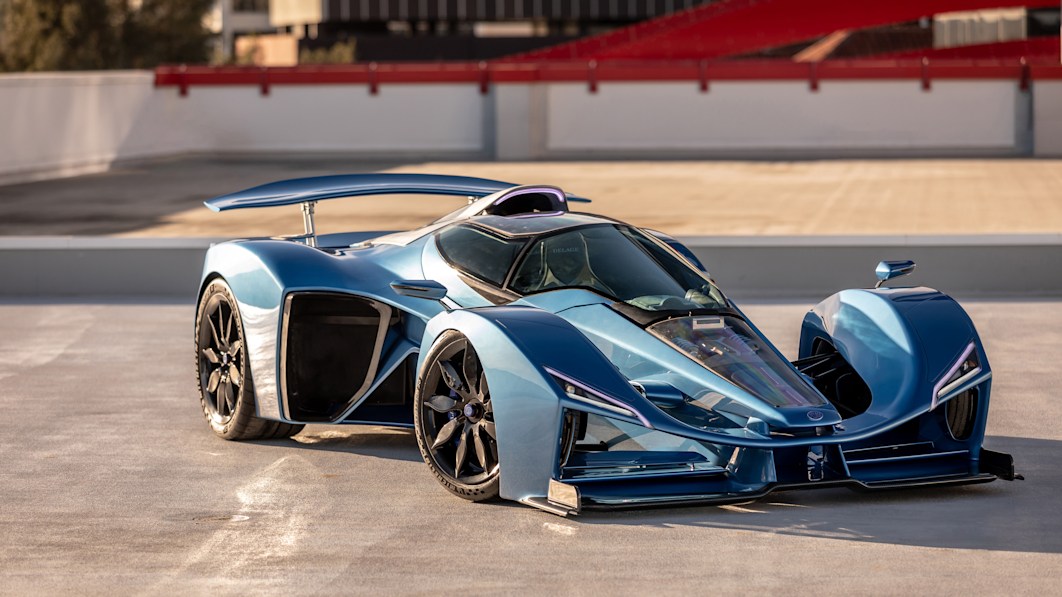
We’re sure someone can count how many plans were deranged by Covid over the last two years, but that someone isn’t us. What’s important is that we know the Delage D12 was one of those kicked off the tracks for a bit, but the revived French brand is still here and says its F1 car for the road is shortly headed for production. The outfit finally has a working prototype, and it’s already been sampled by potential European buyers. The wild blue looker was meant to take an honorary lap around the Miami Grand Prix circuit during last weekend’s festivities, but we’re not sure that happened. The south Florida city is home to one of Delage’s two dealers in the U.S., Specialty Car Collection. The other is Southern California Delage in Newport Beach. The D12 runner is planned to make another trip to Monterey Car Week in August this year, the same venue where Delage pre-sold a few units in 2020. 

Picking up where things left off in 2020, CEO Laurent Tapie unveiled the vehicle he wants to break the Nürburgring’s passenger car lap record. There are two D12 trims, both powered by a 7.6-liter naturally aspirated V12 developed in-house, putting out 960 horsepower and shifting through an eight-speed, single-clutch automated manual transmission. In the GT trim, the ICE gets help from a 110-hp electric motor, making a total 1,100 hp. In the track-focused Club trim, the e-motor makes just 20 horses, but the vehicle loses 200 pounds and is faster around a track than the GT. The Club’s electric motor is really just used for street driving, reversing and parking.

And yes, this is a passenger car. Two occupants sit in tandem in the cockpit, the bubble canopy opening like that of a fighter jet — two traits that make the Delage D12 similar to the Czinger 21C, four if you count the carbon fiber body panels and alliteration. Tapie says the D12 separates itself from all other road cars by having a pushrod suspension. French engineer Mauro Biancchi is said to hold the patent on the pushrod design, and gave his blessing to Tapie’s team. When we get a chance to speak to Tapie, we’ll ask how his pushrod design is different than the pushrod setup Lamborghini has used in the Aventador for a decade.

This fall, the two-seater enters a production run of just 30 examples, 10 for the U.S., the remainder for the rest of the world. First deliveries are scheduled for early 2023, and buyers will get the chance to sign up for driving lessons from Delage’s development driver, ex-F1 Driver’s World Champion Jacques Villeneuve. All it will take is €2 million ($2.1M U.S.) for a base D12 before options, and getting on that list of 30 customers. For everyone else, check out Tapie’s lengthy interview with Maxim to know more about how he got the idea for the D12, why he insisted on a naturally aspirated V12, and why he wanted a racing driver over an engineer to tune the dynamics.  

Related video:

Pagani C10 spy photos give us a peek at the Huayra successor

It’s been about a decade since the Pagani Huayra entered the supercar market. And since then, we’ve seen myriad variants with and without removable roofs. So it’s high time that a new Pagani supercar show up. That’s exactly what we have here, at least as far as we can tell. And it certainly appears to stick to Pagani styling tradition.

The proportions of this supercar, reportedly codenamed C10, are exactly what we’ve come to expect of the brand’s machines. It has a short nose and long rear. It has a low grille with a support in the middle that blends into a triangular hood section. And the rear is wide with signature quad tailpipes in between the taillights.

Looking closer, we can see some subtle differences from the Huayra. The lower grille opening is, well, lower, looking more like that of the Zonda. The cabin area looks shorter in length. There aren’t any apparent air intakes along the car’s flanks, possibly supplanted by intakes just behind the cabin. The tail looks more Zonda-like, too. Instead of the high-set, more flowing arrangement of lights, this C10 has just two simple lights on each side in square-shaped panels.

This prototype clearly isn’t quite production-ready, based on the large amount of camouflage and prototype components such as the headlights. But we’ll be seeing the production model soon. A previous report said that the car will make its debut this year. It will apparently use a version of the twin-turbo AMG V12 also used in the Huayra, though this time it will be available with a manual transmission.

Related Video:

Ferrari SF48 Unica one-off is based on the F8 Tributo

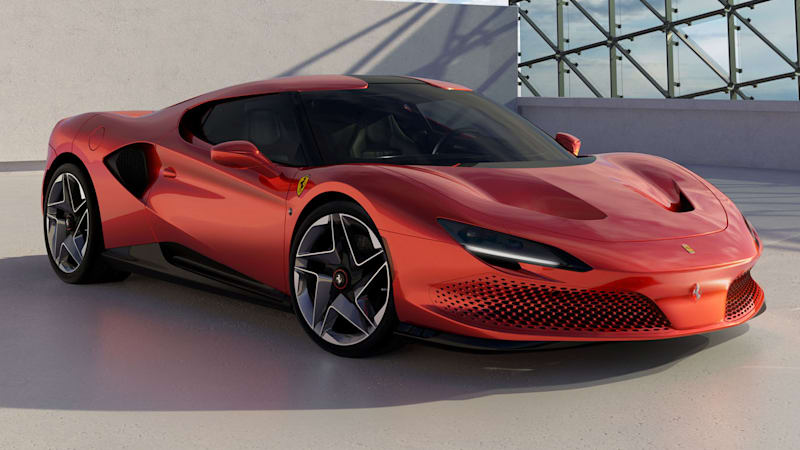
Ferrari has unveiled the SF48 Unica, the latest addition to its portfolio of customer-commissioned one-off models. Based on the F8 Tributo, the coupe was created by the Ferrari Styling Center for an anonymous client who participated in every step of the design process.

Nearly every part of the F8 Tributo‘s exterior has been redesigned. Up front, the SF48 Unica features new-look lights, a reshaped bumper with honeycomb-like inserts, and twin vents. Blacked-out a-pillars create the illusion of a wrap-around windshield. Even the door skins are specific to the model, and designers relocated an intercooler to move the engine’s air intakes down. Out back, thin rectangular lights replaced the F8’s quad round units and the rear bumper is new as well. One of the most striking styling cues is the lack of a rear window.

Creating a one-off model requires a tremendous amount of time and resources, especially because many of the changes alter the coupe’s aerodynamic profile. The SF48’s rear overhang is a little longer than the F8’s, and the extra inches increase downforce on the back wheels. Procedural-parametric modeling techniques and 3D prototyping helped the Prancing Horse’s designers make the one-of-a-kind car a reality.

Ferrari notes that the SF48’s cabin looks a lot like the F8’s, though it stopped short of releasing photos. The two cars aren’t exactly identical inside, however: the customer who commissioned the Unica requested black laser-perforated Alcantara upholstery draped over a layer of fabric that matches the body’s color, for example. Matte carbon fiber trim and Grigio Canna di Fucile accents were specified as well.

We’re guessing that no significant mechanical changes were made, meaning that power comes from a 3.9-liter, twin-turbocharged V8 rated at 710 horsepower and 568 pound-feet of torque. Mid-mounted, it spins the rear wheels via a seven-speed automatic transmission.

As is normally the case, Ferrari hasn’t revealed the identity of the SF48 Unica’s owner or how much the car cost to build.

Related video:

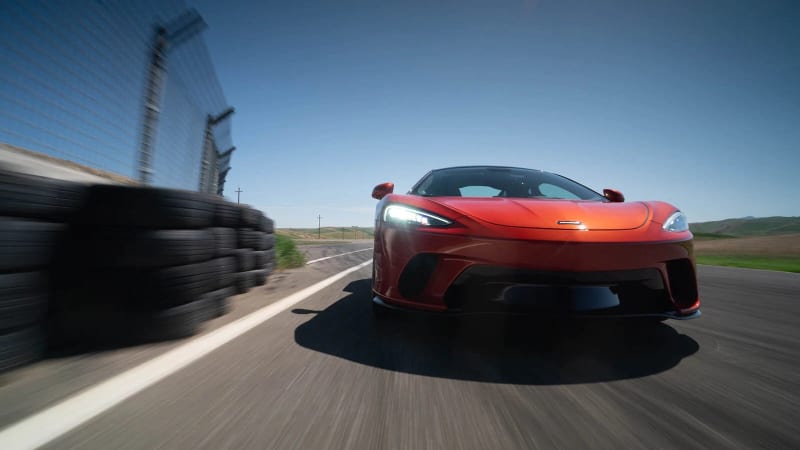
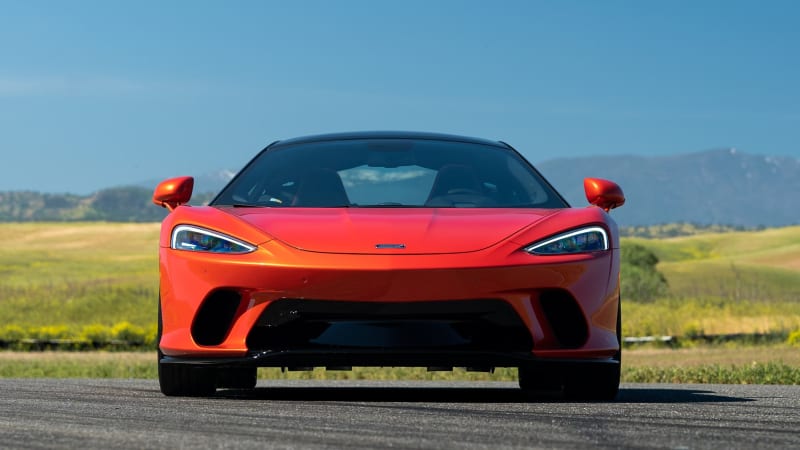
Win Mother’s Day by giving your mom a 2022 McLaren GT

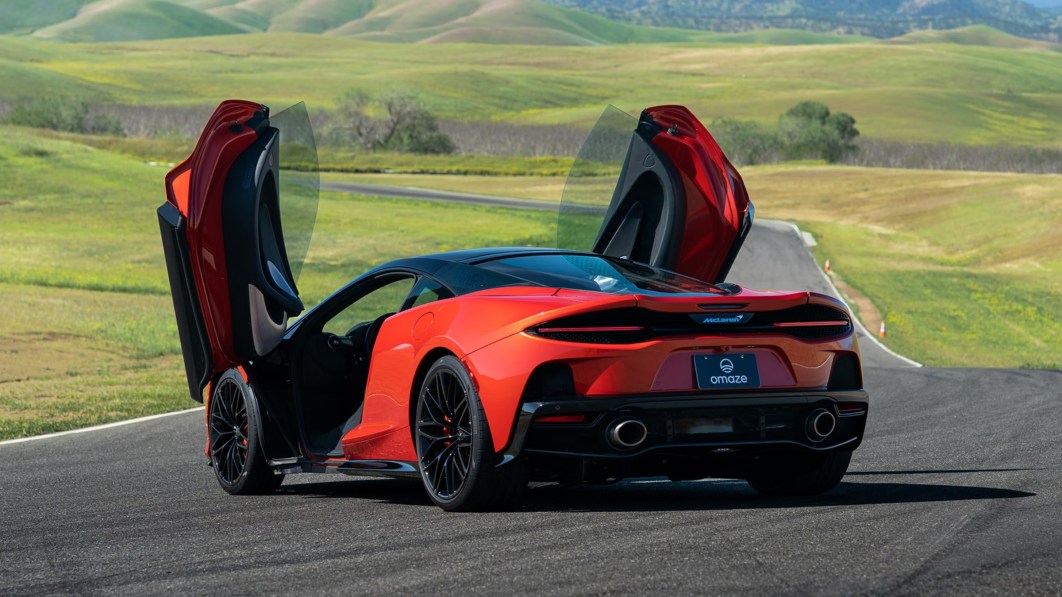
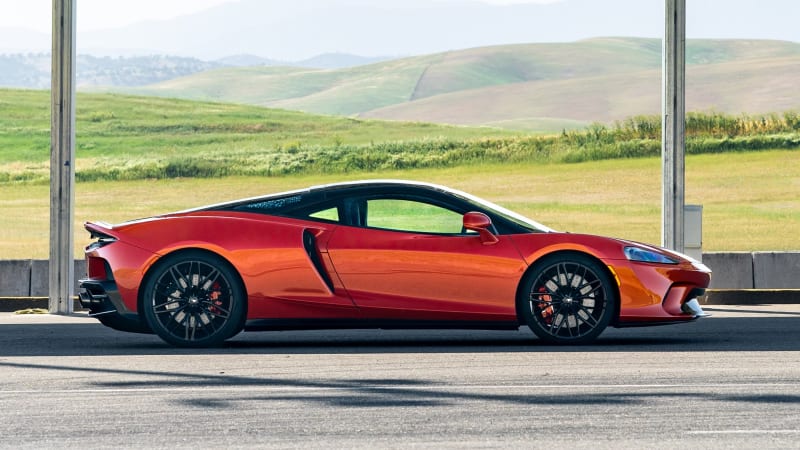
Unless you’re an only child, there’s no doubt you’ve experienced the competitiveness that Mother’s Day brings. This year you can take it up a notch beating out the bath bombs and brunch that your siblings are bringing to the table with something no one has any chance of topping: the keys to a 2022 McLaren GT.

Here are the specs for the McLaren GT, according to Omaze:

  • Max Seating: 2
  • Powertrain: Twin-turbocharged 4.0-liter V8 engine
  • Transmission: 7-speed dual-clutch automatic
  • Drivetrain: Rear-wheel drive
  • Exterior Color: Ember Orange
  • Interior Color: Black
  • Horsepower: 612 hp
  • Torque: 465 lb-ft
  • Acceleration: 0-60 mph in 3.1 seconds
  • Top Speed: 203 mph
  • Fuel Consumption: 15/21/17 mpg city/highway/combined
  • Fuel Capacity: 19 gallons
  • Approximate Retail Value: $243,875.00
  • Cash-Alt: $182,906.25
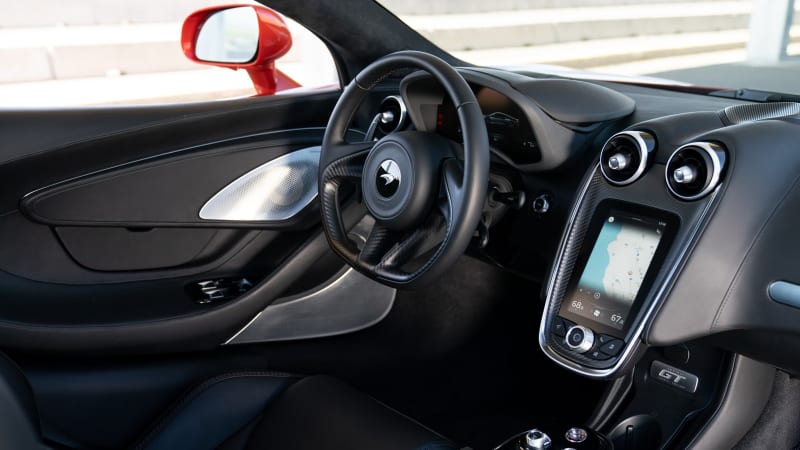
  • Special features: Dihedral “butterfly” doors; 20″ and 21″ MSO wheels; 12.3″ instrument screen; 7″ portrait infotainment screen; 12-speaker Bowers & Wilkins sound system

Here’s what we thought about it, the last time we drove one:

“As the winter settles in, I find myself reflecting on the most memorable cars that I’ve tested this year. Chief among them, the McLaren GT.

“I drove the GT on a damp midsummer evening. After a lengthy heatwave, temperatures dipped into the low 60s and it was raining lightly. Not the ideal time to drive a $263,000 supercar. And yet, it was impossible not to be excited and curious. 

McLaren has come a long way in a short time. With a decade under its belt as a standalone automotive operation, the company is delivering on ambitious growth plans and now counts four product lines in its portfolio, ranging from the Ultimate to this GT.

“It’s a surprising trajectory considering McLaren is best known for making shooting stars, like the 1990s F1 that captured the zeitgeist for supercars of that era. The F1 was followed by the indelible Mercedes-McLaren SLR from 2003-2010. 

“It wasn’t until 2011 that McLaren Automotive — freshly spun off from the racing team — attempted a credible road-going car that could actually be purchased and driven by normal enthusiasts. That car, the 12C, was a first step that ultimately led to proliferation of vehicles and technology for McLaren.

“After a few hours of spirited driving the GT, my conclusion boiled down to one word: maturity. It over-delivered as a grand tourer, though the car is about as much of a GT as the Ford GT, which is to say, not much. My back was a little tight when I returned home, fatigued but not abused. The McLaren GT is a driving workout on par with an Audi R8 or Lamborghini Huracán.
“Performance? It has plenty. But also notable, the fit-and-finish is solid, the looks are striking and it felt like the product of a company that’s been doing this for awhile, which McLaren hasn’t. Certainly competitive with Ferraris and Lamborghis and interesting in its own way. A small shop like McLaren is always going to face challenges achieving scale and consistent prosperity, and the pandemic wreaked havoc on the automaking and racing units. Still, the GT is indicative the company can expand without overreaching.”

According to Omaze, “no donation or payment is necessary to enter or win this sweepstakes.” If you do choose to donate, $10 will get you 100 entries, $50 will get you 1,000 entries, and $100 will get you 2,000 entries. Donations benefit Make-A-Wish. Per Omaze, “Make-A-Wish creates life-changing wishes for children with critical illnesses. Not only can these wishes help kids build the physical and emotional strength they need to fight a critical illness, they also restore hope for families, volunteers, medical teams and entire communities. Right now, for every wish granted, there are three more that need financial support. Your generosity will help Make-A-Wish grant even more life-changing wishes for children when they need it most.”
If you want this head-turning McLaren in your mom’s driveway, enter here. The deadline to enter is July 22, 2022, at 11:59 p.m. Pacific.

Other Omaze sweepstakes:

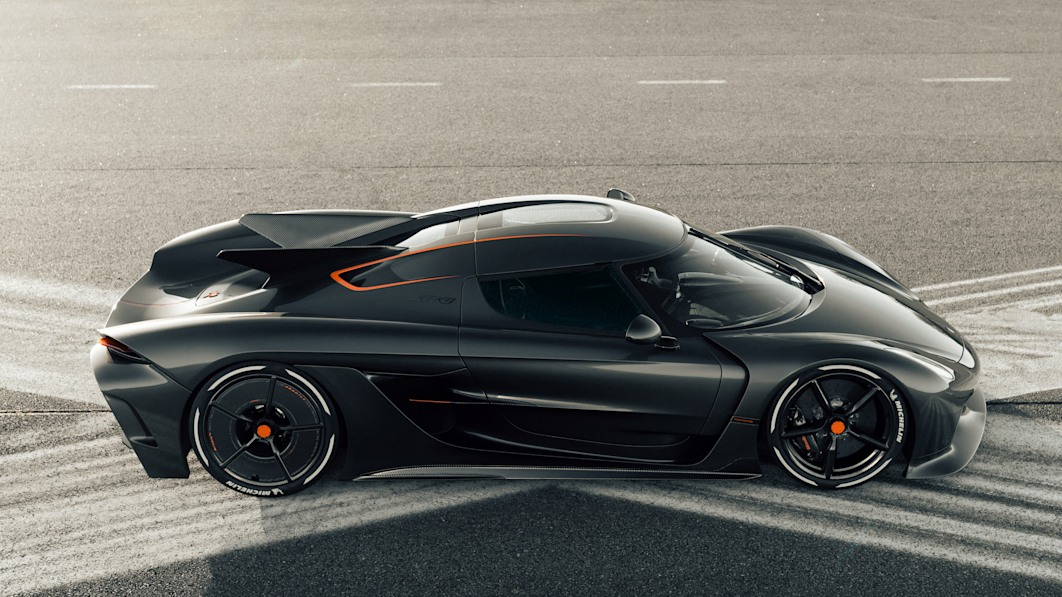
Koenigsegg Jesko Absolut gets its first prototype

If there is a Koenigsegg that will break through the 300-mph barrier, this is it. If there is a Koenigsegg that will be the fastest car the Swedish automaker builds, this is also it. Not long after watching the bewinged Jesko Attack dash through the snow, Koenigsegg has shown that car’s brother, the wingless and ultimately refined Absolut.

Created to go as fast as possible, company boss Christian von Koenigsegg said: “We spent thousands of hours in CFD calculations. We’ve streamlined this car from not just an aerodynamic and design perspective, but also from a high-speed stability perspective. As a result, the Jesko Absolut has a phenomenally low drag of only 0.278 Cd.”

The development model is done up in Graphite Grey with Tang Orange stripes. Remind us to ask Christian one day if that color really refers to the chemical concoction relentlessly advertised to kids decades ago as the favorite beverage of astronauts. 

To be fair to aerodynamicists around the world, we should clarify that it’s a “phenomenally” low drag figure on a relative scale. After all, cars looking to stretch gallons or kWhs of fuel do better; the Lucid Air claims a drag coefficient of 0.21 Cd, the current Mercedes-Benz S-Class a 0.24. But compared to other hypercars, the Koenigsegg is well ahead. Hennessey says its Venom F5 comes in with a drag coefficient of 0.39, the Bugatti Chiron Super Sport 300+ in Top Speed mode is 0.33 — 0.02 better than the standard Chiron — and SSC cites a figure of 0.279 for the Tuatara. If these numbers are accurate, Koenigsegg has claimed the hypercar aero crown from SSC by 0.001. Probably just a coincidence.

The Absolut’s internals almost entirely mimic those of the Attack, with a 5.0-liter twin-turbo V8 producing 1,600 hp and 1,107 lb-ft. Weight savings from changes like the lack of that rear wing mean the Absolut weighs 3,064 pounds compared to the Attack’s 3,131 pounds.

Koenigsegg hasn’t given a timeline for when customer units will be ready, but it shouldn’t be long. The Attack is expected to start reaching customers this quarter.

Related Video:

European dealer working with Koenigsegg on a CC12 secret project

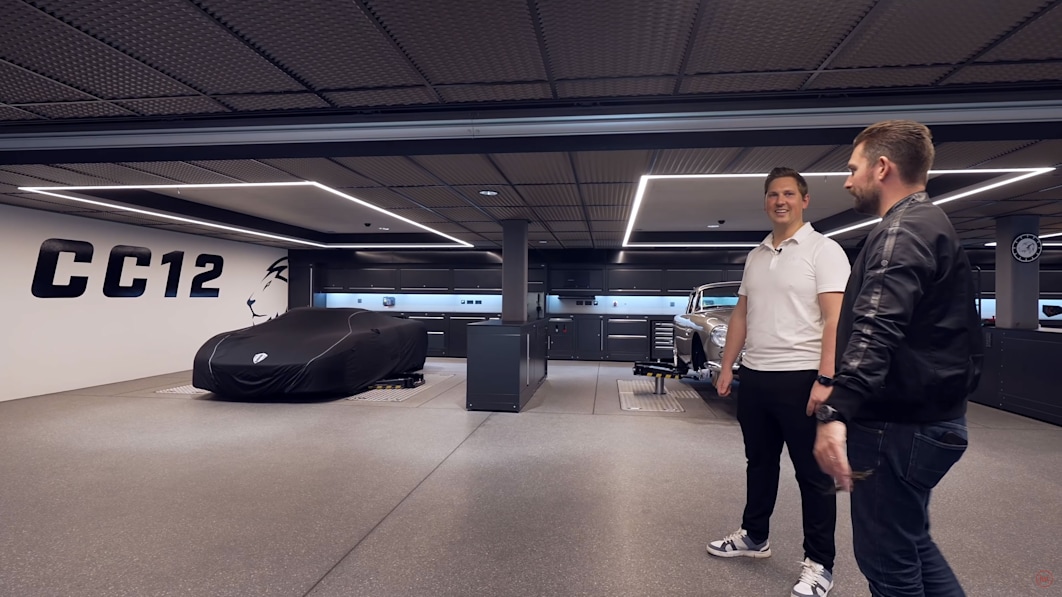
We tuned into James Walker’s latest episode on YouTube because The Supercar Blog reported there’s a special Koenigsegg on the way called the CC12. There isn’t much known about the coming coupe, just that was supposedly commissioned by a European dealer in ultraluxurious things called Carage. Upon tuning in to the 51-minute video, we discovered that Walker talks about the CC12 for maybe ten seconds (38:47) — he doesn’t even call it by the name written on the wall next to it, and the project is so secret that his host won’t say a word about it. Here’s the thing: The episode is called “The Best Garage in the World?”, and the answer might be “Hell yes.” We showed up for one car, we stayed because of all the amazing car stuff.

We’d never heard of Carage before, a dealer with showrooms in Lucerne, Switzerland and Marbella, Spain that specializes in “modern hypercars [and] unusually sporty vintage cars.” If a line could win an award for Swiss understatement, this is it. Walker tours just some of the Swiss facility, which is five floors and nearly 54,000 feet of luxury architectural space housing many millions of dollars in cars. The Koenigsegg room is designed to create Swedish vibes. The five cars parked inside it include CC8S Chassis #002, the first customer car of the first model Koenigsegg built, one of two Trevita’s with white carbon and clearcoat with diamond dust, and the Agera Prototype Chassis #077 that was not only the development vehicle for every evolution of the Agera, it was customized with a trunk.   

There’s are a few rooms with Aston Martins (12:50) including James Bond’s DB10 (25:15), another with Ferraris, a modern Iso Rivolta (11:30), and the most magnificent tool and replacement parts sets we have ever seen (32:05) created for the Aston Martin DB4GT Continuation. Then there’s the garage, with the obligatory lifts and clean-room appearance. The garage also contains an indoor wash bay, because Carage washes every vehicle before working on it; there’s an exhaust vent on a rail that can be fitted to any vehicle in the garage; there are tire fitting and alignment machines in custom colors to match the garage; and a pump system to send used oil into a large containment tank beneath the garage. Plus the on-site carbon production and CNC machines. And other things. Carage is spectacular.

Back to that Koenigsegg CC12, though. It hasn’t been commissioned by Carage, it’s being built by Carage, CEO Kim Struve saying he’s working with Koenigsegg on the project, but he wants to show potential clientele what Carage can do. The form under the tarp looks like the CC8S that, earlier in the video, Struve says was bought “for a special project that’s going to be released in a year’s time.” But we can’t know if the two are related. What we do know is that Koenigsegg built just six examples of the CC8S, its name partly signifying the modular Ford V8 behind the cockpit. The re-engineered and supercharged 4.7-liter small block produced 646 horsepower and 553 pound-feet of torque. The automaker switched to CCR and CCX names after the CC8, never making a CC12. Whatever Carage is up to, we’re looking forward to it, and if the 12 in the name refers to the cylinder count, all the better.

Related video:

Lamborghini builds 20,000th Huracan, looks back on eight years of production

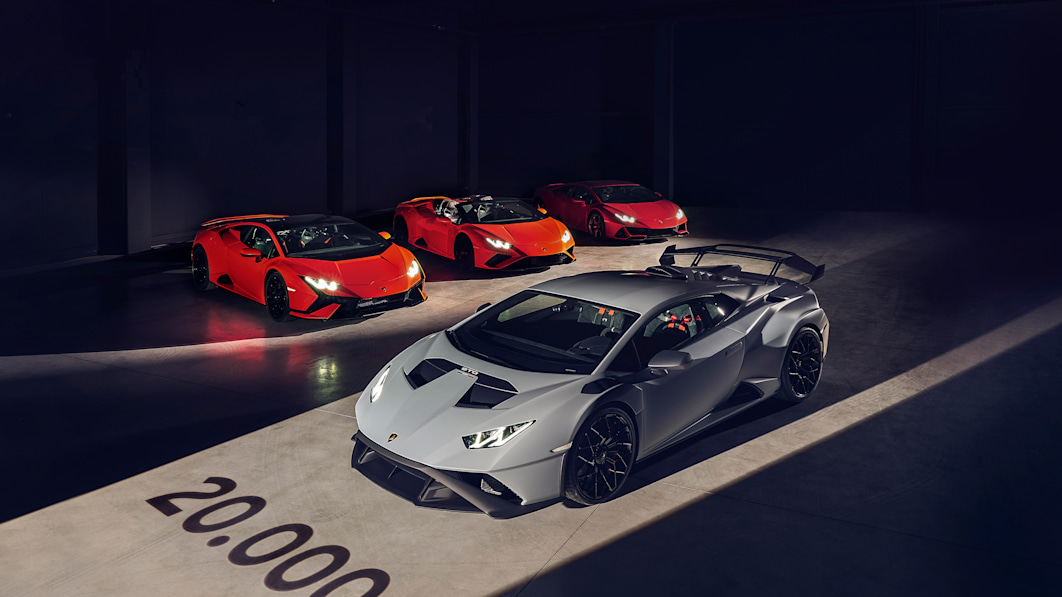
Lamborghini is celebrating a significant milestone: It has built 20,000 examples of the Huracán, its entry-level supercar. While that number might not sound impressive, it cements the V10-powered Huracán’s positioning as the Italian firm’s best-selling supercar by a wide margin.

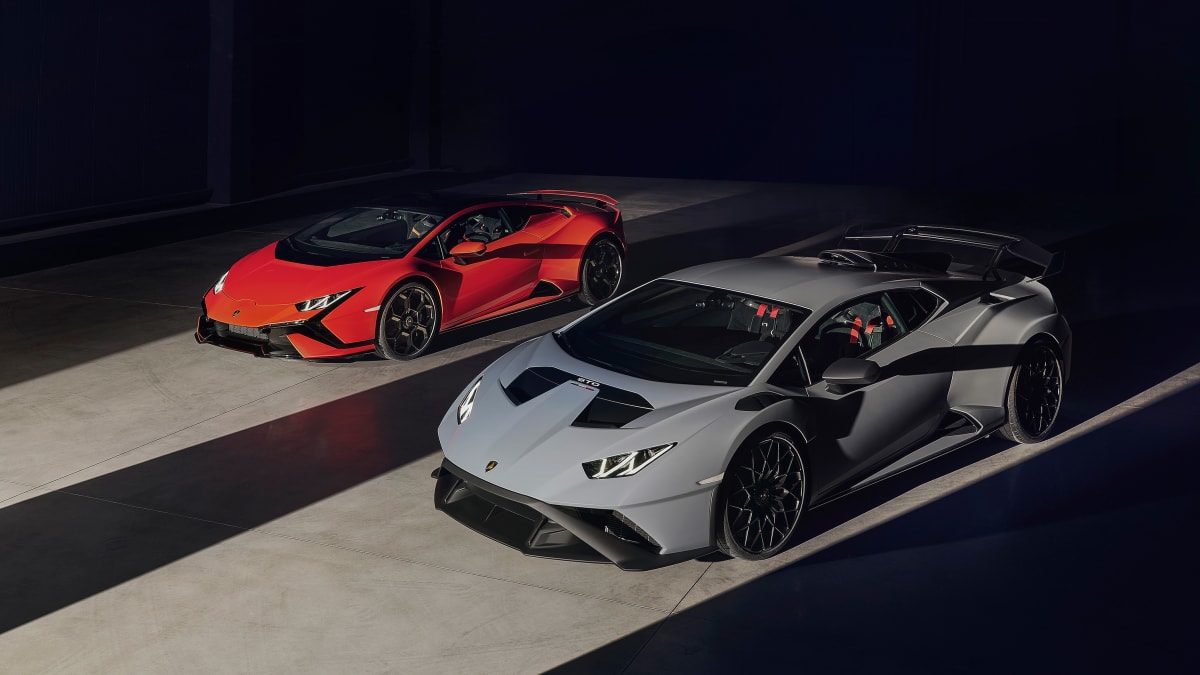
Finished in an eye-catching color called Grigio Acheso Matte, the 20,000th Huracán is an STO model that was built for an anonymous buyer in Monaco, so you won’t find it basking under the spotlights in Lamborghini’s official museum. Reaching the 20,000-unit mark also gives the Raging Bull the opportunity to look back on an eight-year-long production run. As of writing, 71% of Huracán buyers have chosen the coupe while 29% have selected the Spyder. The model’s main market is the United States; that’s where 32% of examples built have been sent.

Lamborghini has gone to significant lengths to keep the Huracán fresh and competitive since it started building the model in 2014. An updated variant called EVO was released for 2020; it’s available with rear- or all-wheel drive, and the aforementioned STO joined the lineup shortly after to bridge the gap between the production model and the cars that Lamborghini builds for various racing series around the world. The range grew again in 2022 with the unveiling of the Huracán Tecnica, which offers a 631-horsepower V10 engine and rear-wheel drive.

Keep in mind that the Huracán remains a niche model made by a small company that used to be even smaller; building 20,000 cars is an impressive feat. Lamborghini manufactured an average of 250 cars annually during the first four decades of its existence. Precisely 1,999 units of the Countach, one of the Raging Bull’s most emblematic models, were built during a production run that lasted for 17 years.

Related video:

Koenigsegg Jesko gets its turn to throw snow

Yes, it’s a tad bizarre to be posting winter testing videos in the middle of April, the same way it’s a little strange for it to be 38 degrees in parts of the Midwest this week. We can do without the weather, but we’ll take the videos, and here’s another — a counterpoint to a vid from a week ago. Rimac provided our last trip to northern Sweden, the Croatian hypercar maker there to test the Nevera in temperatures well colder than 5 degrees Fahrenheit. Two hours east of that, turns out Swedish hypercar maker Koenigsegg was testing its Jesko in the frozen stuff. The Swedes called their video Egg Hunt for obvious reasons, but there wasn’t much of a hunt, just a guy gathering giant neon eggs in the forest until the trail leads him to the Jesko. Seems the Swedish Easter Bunny might be way cooler than ours.

What’s cool about these two videos is they ask, “How do you like your ice dancing?” With four motors producing 1,914 horsepower and 1,741 pound-feet of torque to move 4,960 pounds, and emitting a gentle whine that can be barely heard above the soundtrack? Or with a 5.0-liter twin-turbo V8 producing 1,600 hp and 1,107 lb-ft to motivate 3,130 pounds and a Battlestar Galactica wing, emitting a roar that would have had the Easter Bunny apologizing to every hibernating bear and rethinking his egg hunt strategy? Take your time deciding, there’s no wrong answer. By the way, that wing and the power figure mark this as the standard Jesko on E85. The Jesko on standard gasoline makes ‘just’ 1,200 horsepower.  

The Jesko and Nevera should be finding their way to the first customers shortly. Maybe next time they both vacation in northern Sweden, they’ll go together. That would be a video.

2022 New York Auto Show Roundup | All the reveals, reviews, pictures

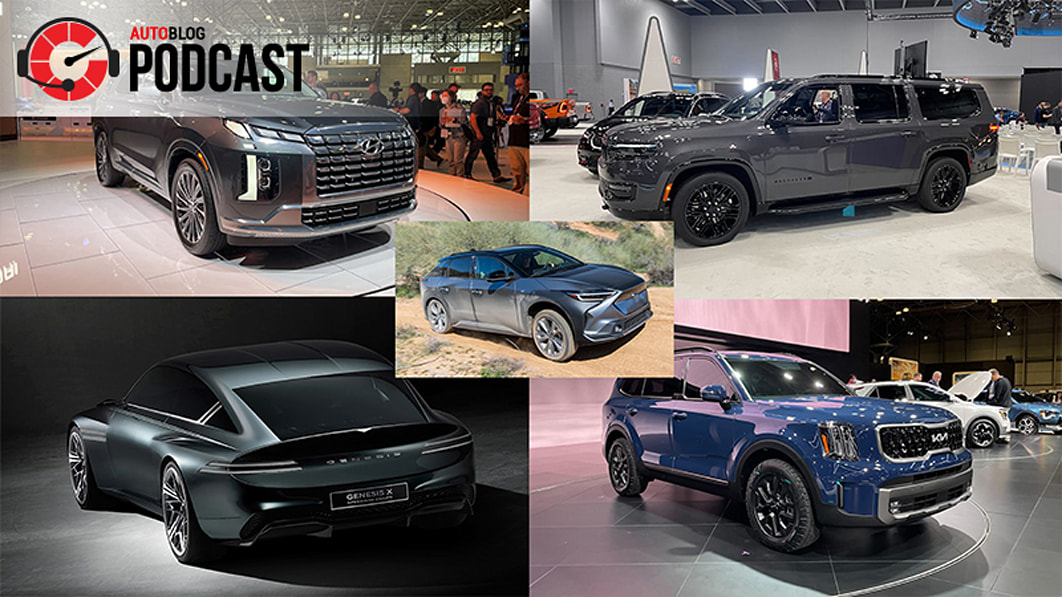
NEW YORK — In case you missed it, the New York Auto Show took place this year after being canceled in both 2020 and 2021 due to Covid. A lot of manufacturers showed up in force, but not everybody did. No matter, we were there, and we brought you news, photos and scoops from the floor throughout the show. All of our New York-related stories can be found at our central hub here, but if you’d rather just get a small taste of everything in a quick and digestible format, keep scrolling.

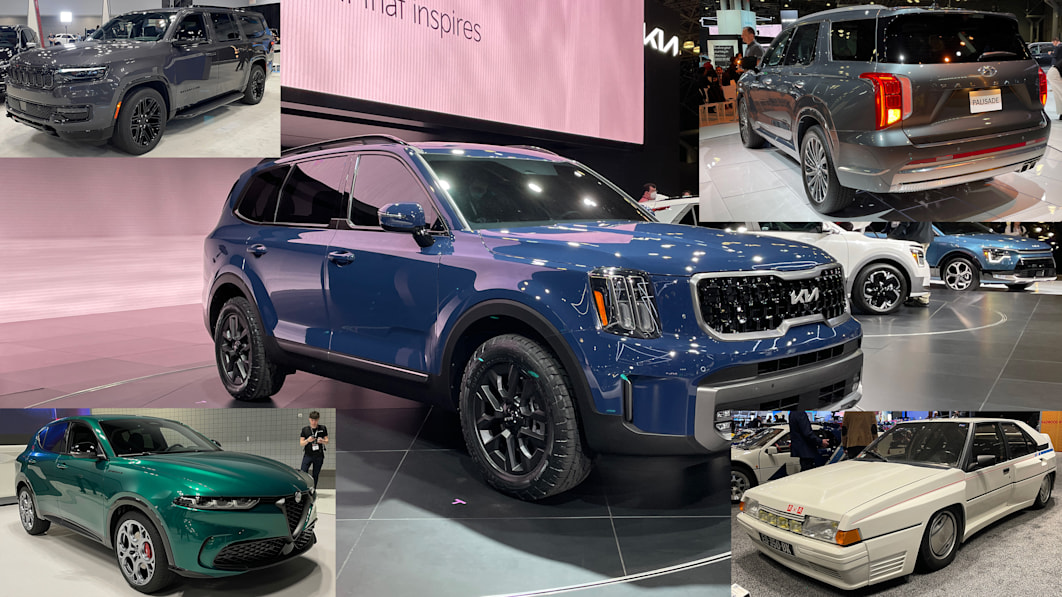
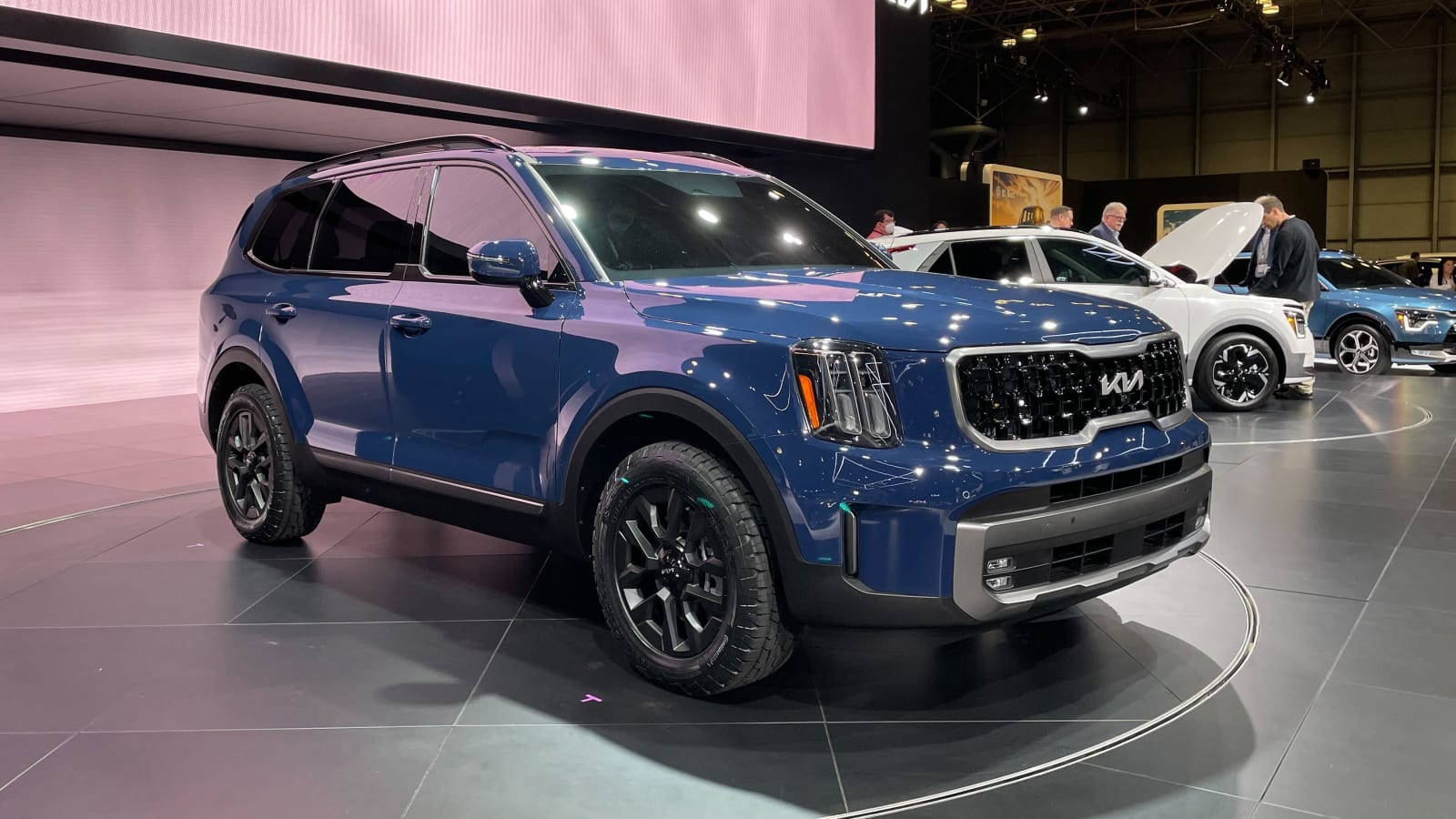
Kia revealed the Telluride’s first major refresh at New York, and it makes the three-row crossover a little bit more desirable without screwing up what we liked about it before. There’s a new X-Line and X-Pro trim for someone who might want a little more off-road capability, and a number of tech improvements. Most notably, a newly-designed dash features new and bigger screens.

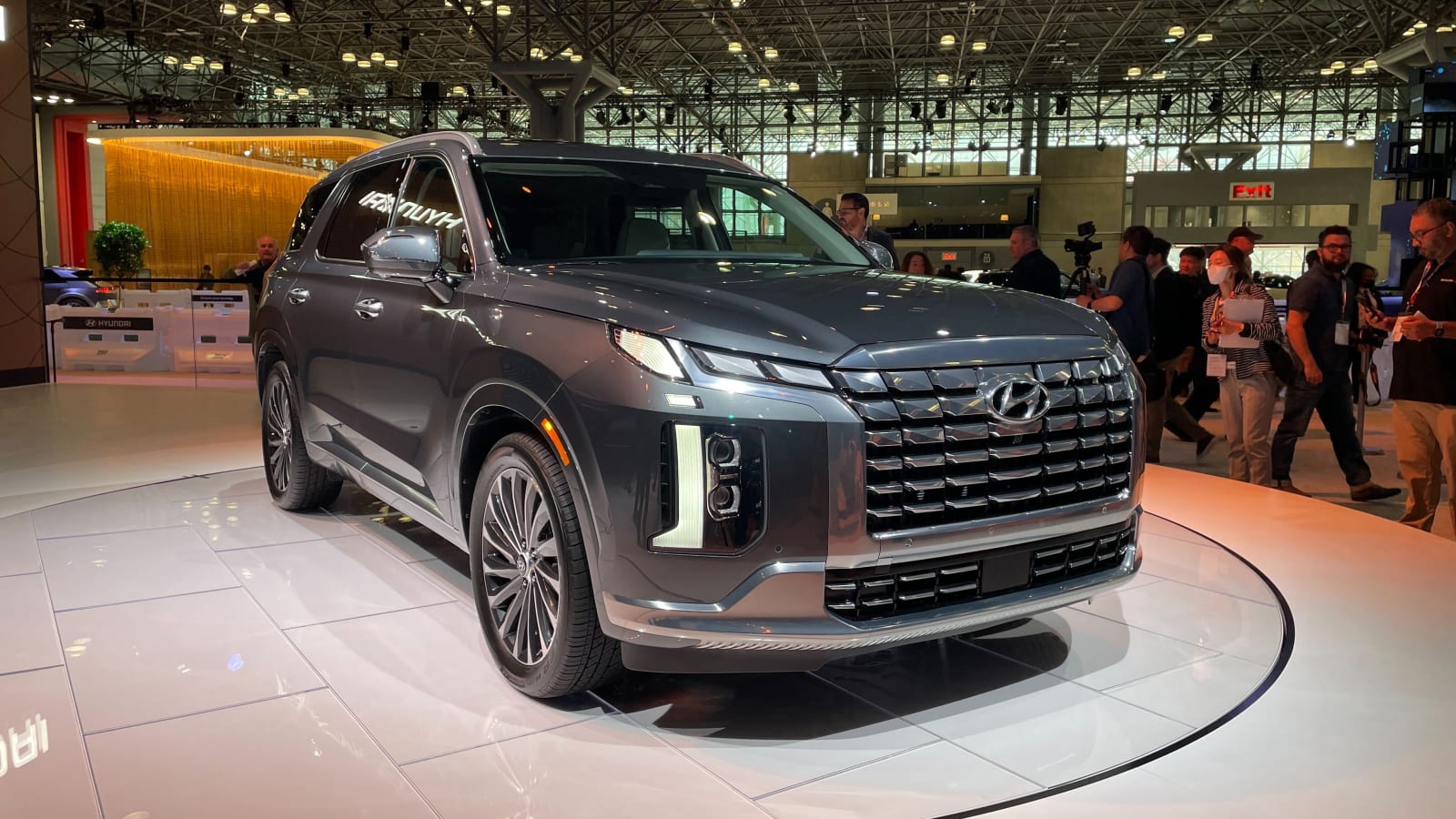
The Telluride’s sister car from Hyundai was treated to a similar refresh. Like the Telluride, Hyundai gave the Palisade a slightly revised look, a new off-road trim (called XRT in the Palisade’s case), more tech inside and a new dash design with full-width air vents. If we had to choose, we’re a little more impressed with the Telluride’s refresh, as a number of us on staff actually prefer the pre-refresh Palisade styling over the new one.

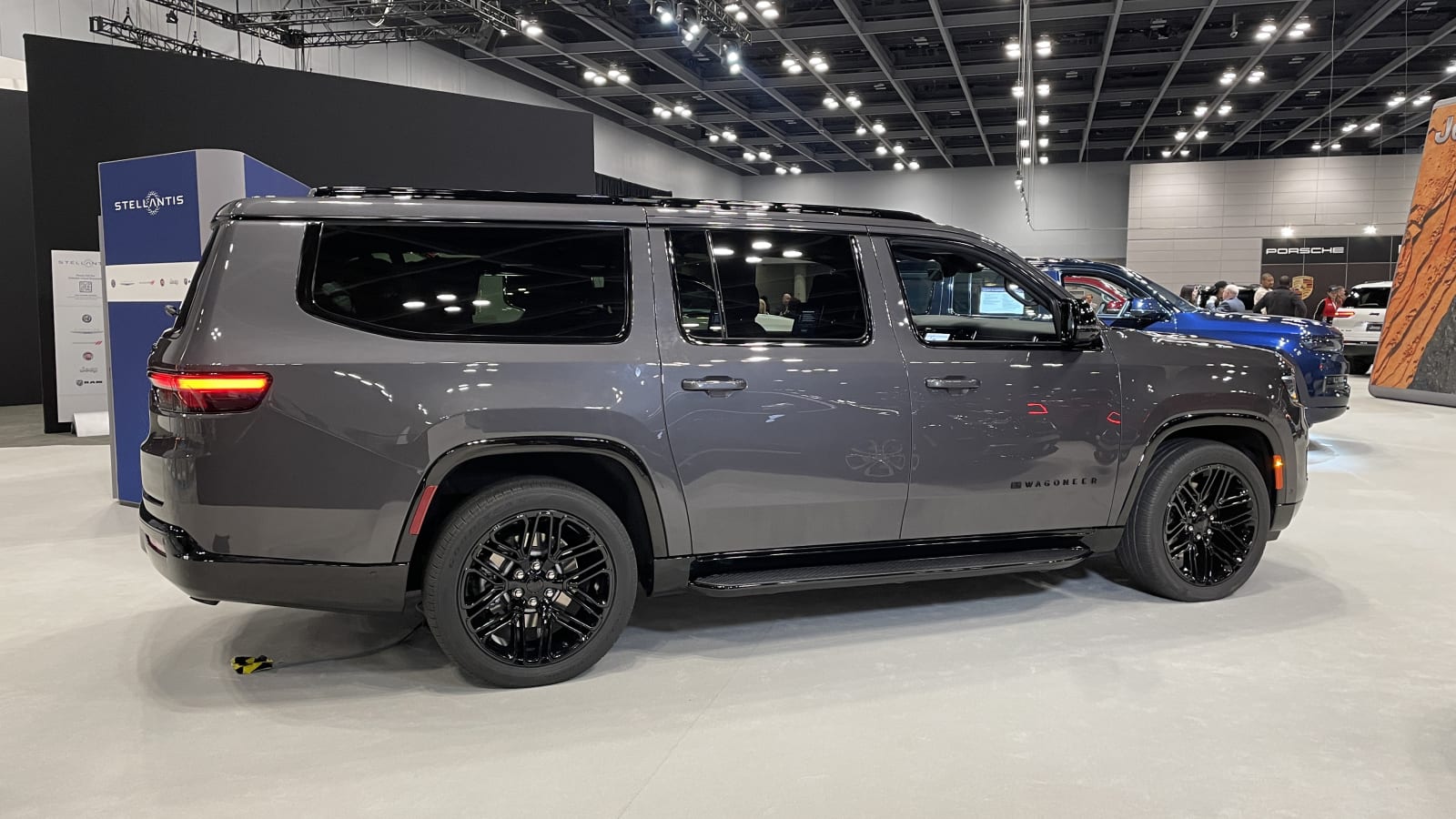
This one was inevitable. Jeep revealed the longer, roomier versions of its Wagoneer and Grand Wagoneer in New York, and they’re designated with an “L” at the end of their names. Total length grows by a foot, and the wheelbase goes up by 7 inches versus the standard Wagoneer models. Jeep has essentially allocated all this extra room to the cargo area, as it now offers a staggering 44.2 cubic-feet of space behind the third row.

Besides the L, Jeep announced that its new Hurricane inline-six engine would find its first home in the Wagoneer. Efficiency gets a small boost, and power is more than sufficient at either 420 horsepower (standard output) or 510 horsepower (high-output version) from the twin-turbo I-6.

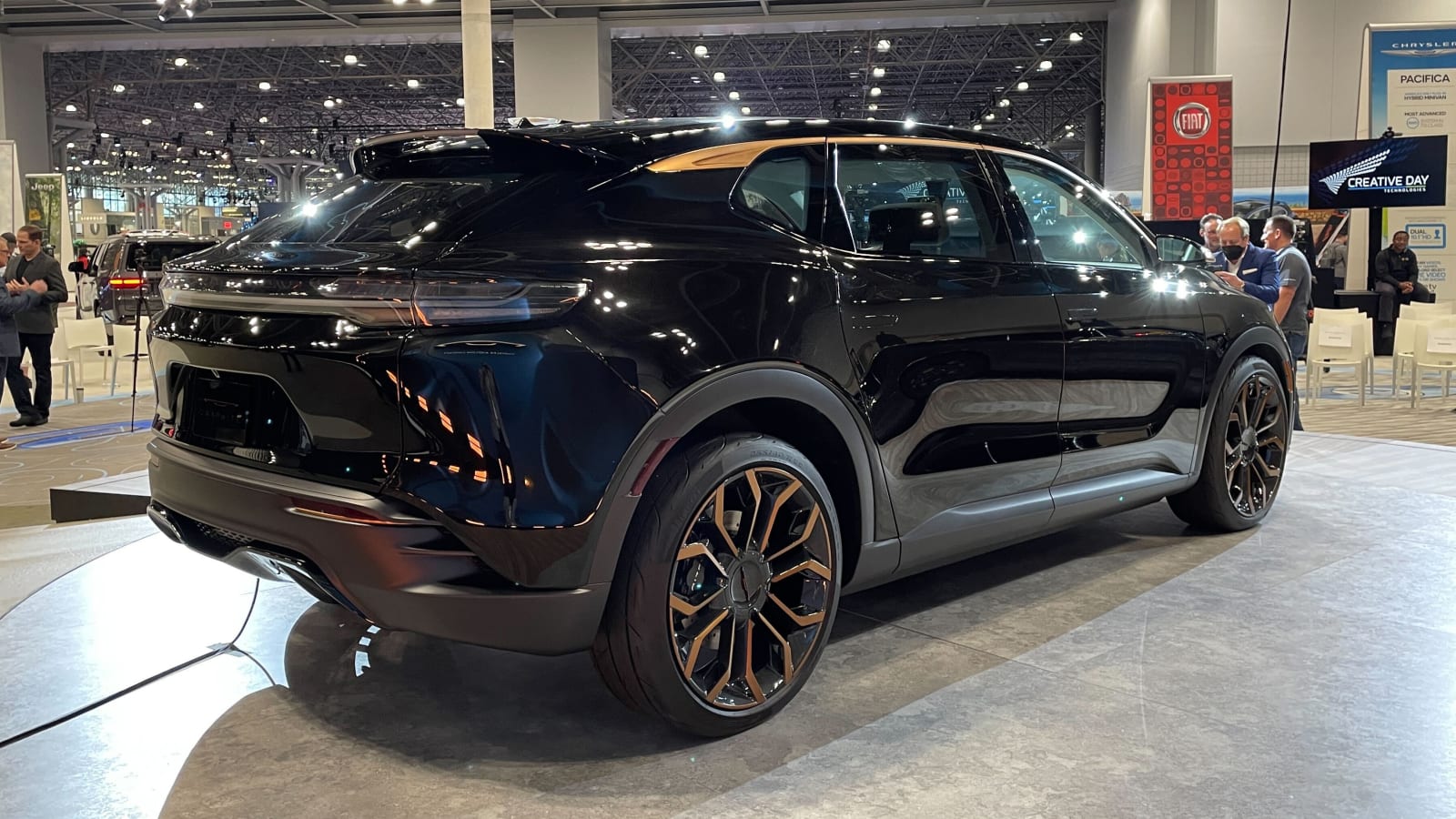
The Stellantis party continues with Chrysler and its slightly revised Airflow. Re-styled for the New York market after initially debuting at CES in Las Vegas, the Airflow Concept gets new paint, changed accent colors, a slightly changed interior design and a new interpretation of the Chrysler logo.

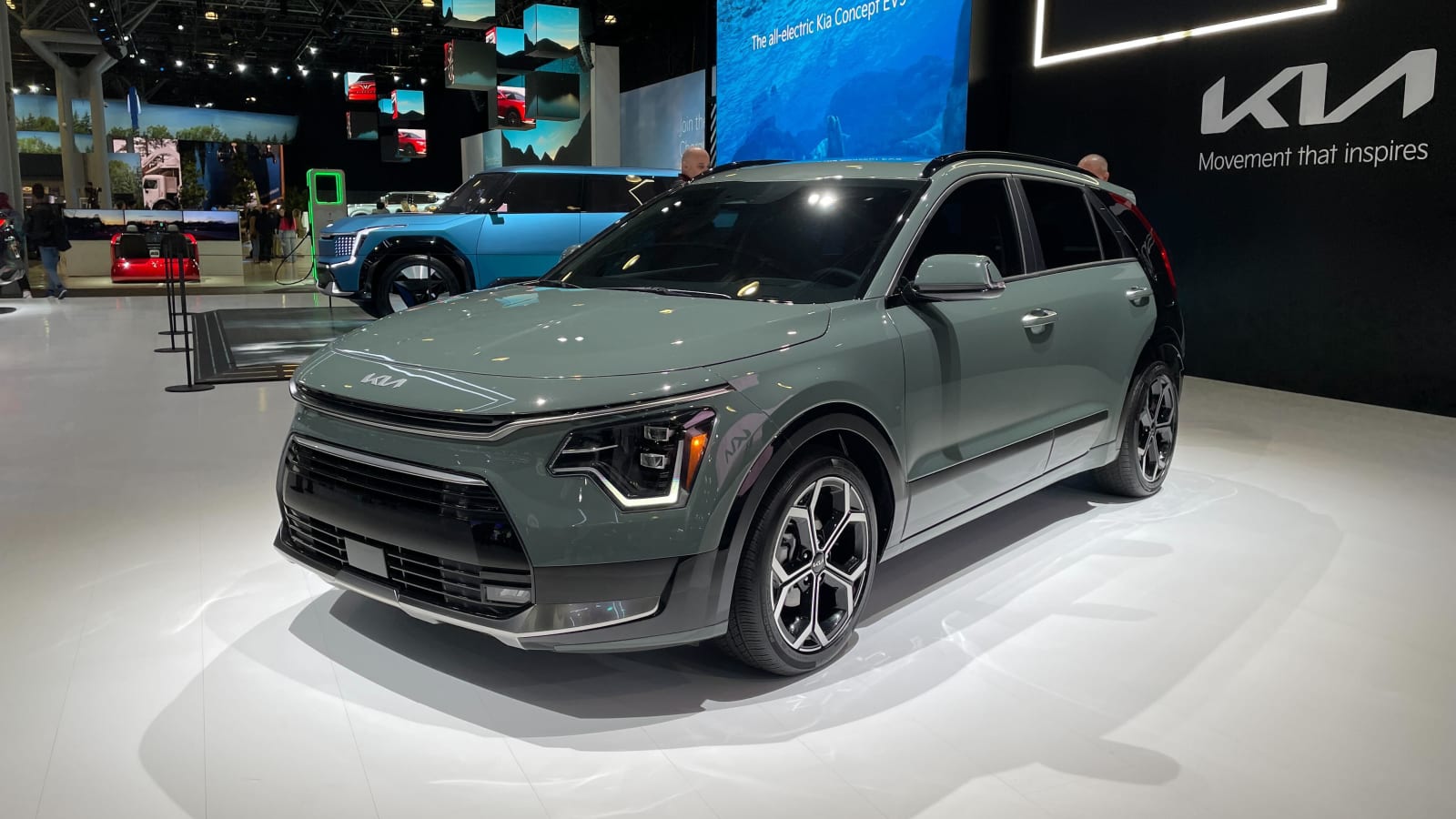
This was our first chance to get a good in-person look at the new Kia Niro models headed our way, and we were impressed. It gets a totally new design, massaged powertrains in all three variants and an EV6-inspired interior. We even got to take a little deep dive into the standout Aero Blade design feature seen on all new Niros.

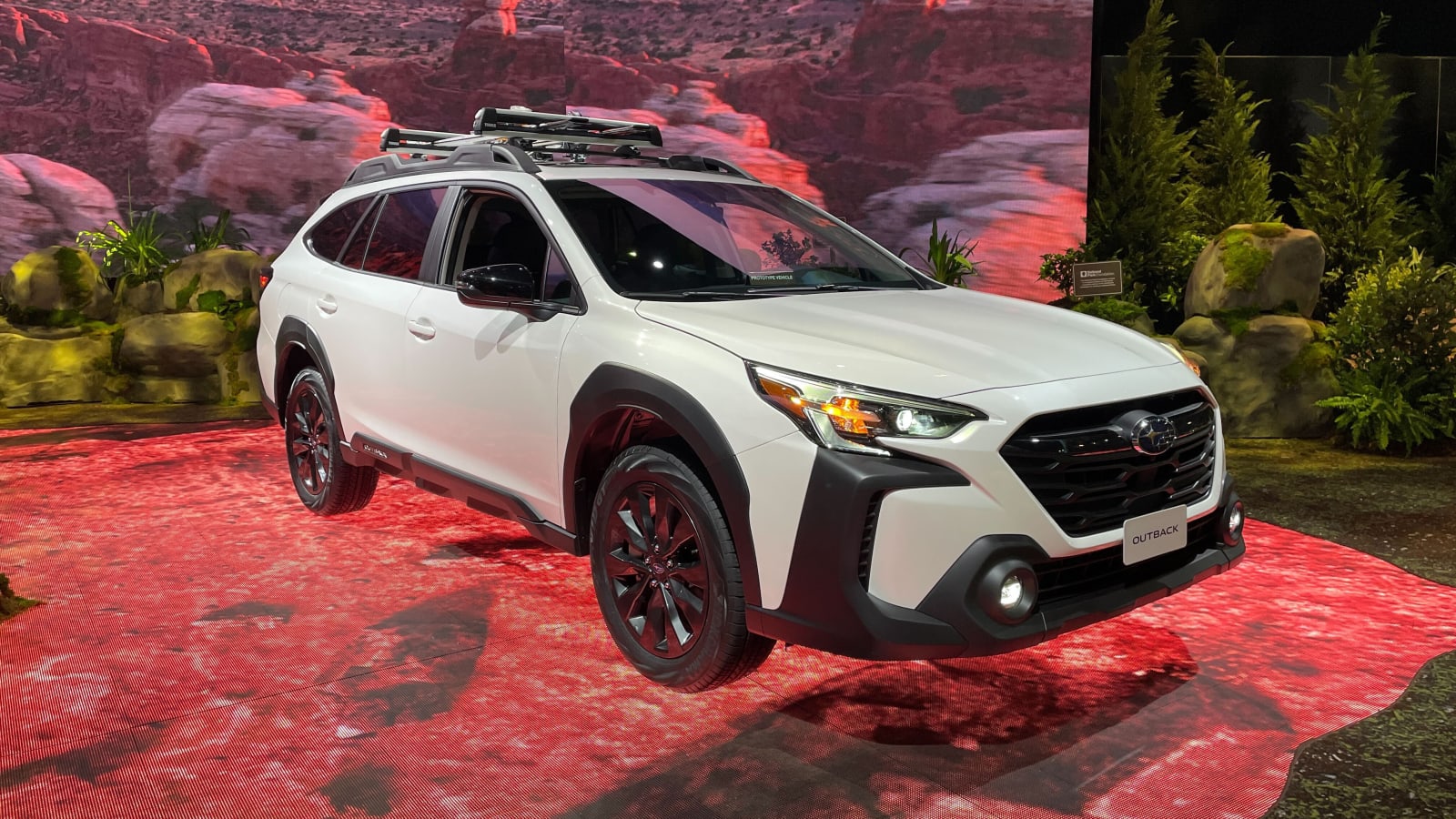
This was one of the minor debuts of the show — Subaru didn’t even hold a press conference. But the Outback was there on the show floor, and it was showing off its new Wilderness-inspired looks. The cladding is much more prominent, it has new lights up front, and Subaru packed it with a number of new tech features.

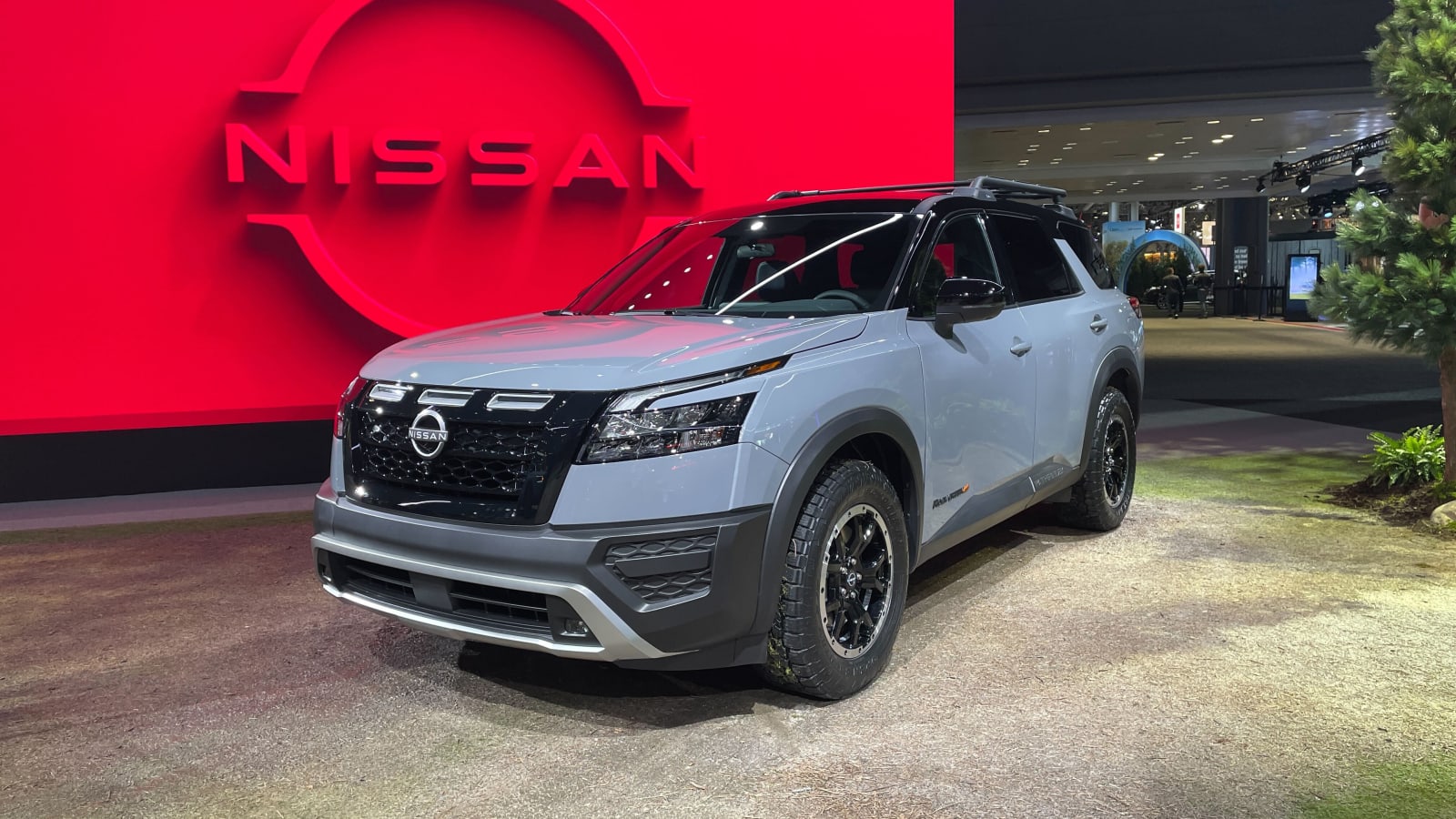
One year on from the Pathfinder being all-new, and Nissan just added an off-road-focused Rock Creek trim. It gets a slightly revised suspension, more power when run on premium fuel, all-terrain tires and a fairly comprehensive styling package. We liked the looks of it on the show floor, and while it may not be a super-capable SUV, having the option of a more rugged-looking SUV is seemingly a good thing to have in dealers these days.

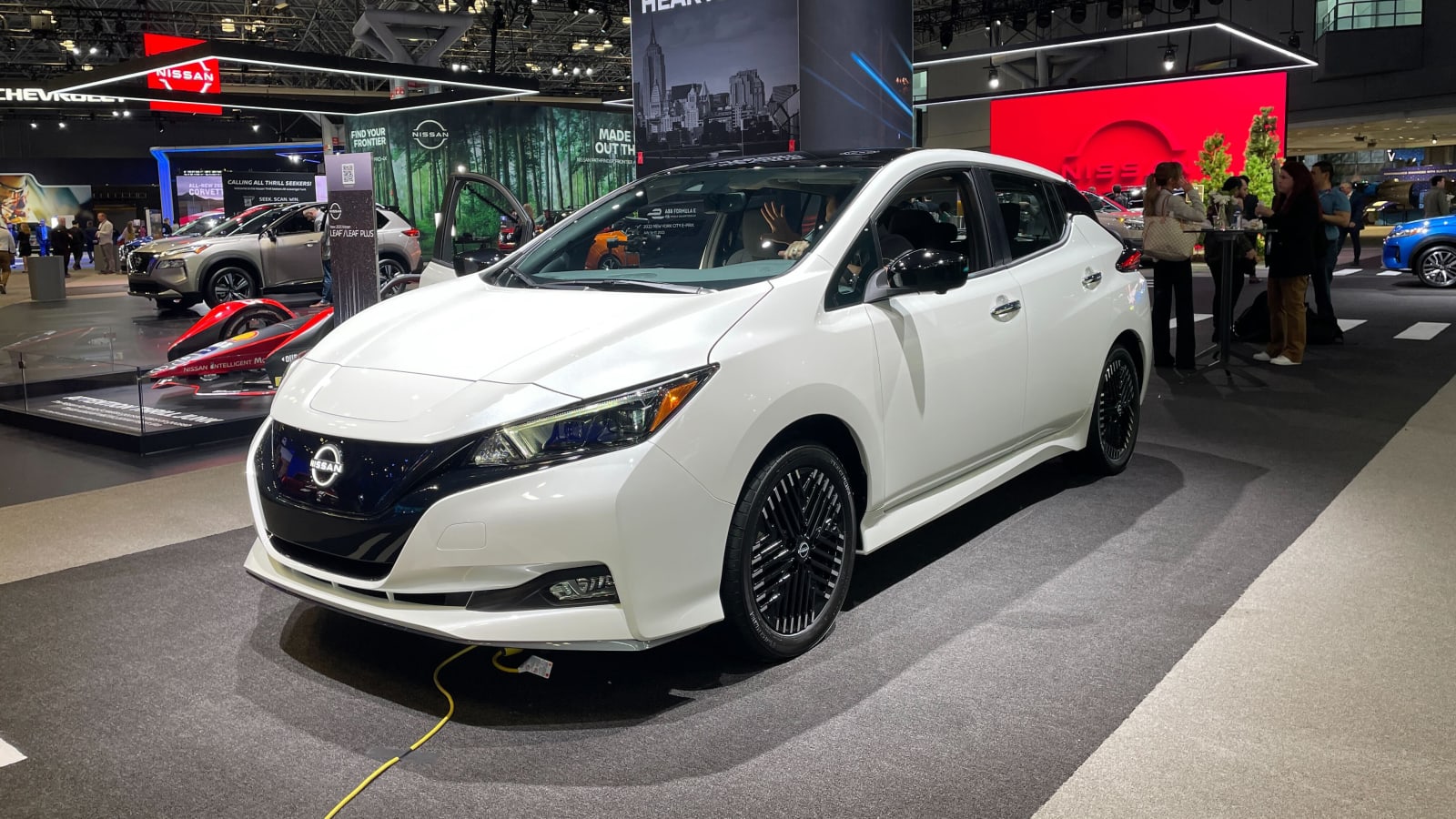
The Leaf is getting outpaced by EVs with far more range, better tech and more power, but that hasn’t stopped Nissan from giving it a small nip-and-tuck. It gets a new grille, light-up Nissan logo, wild new wheels and a couple of aero enhancements.

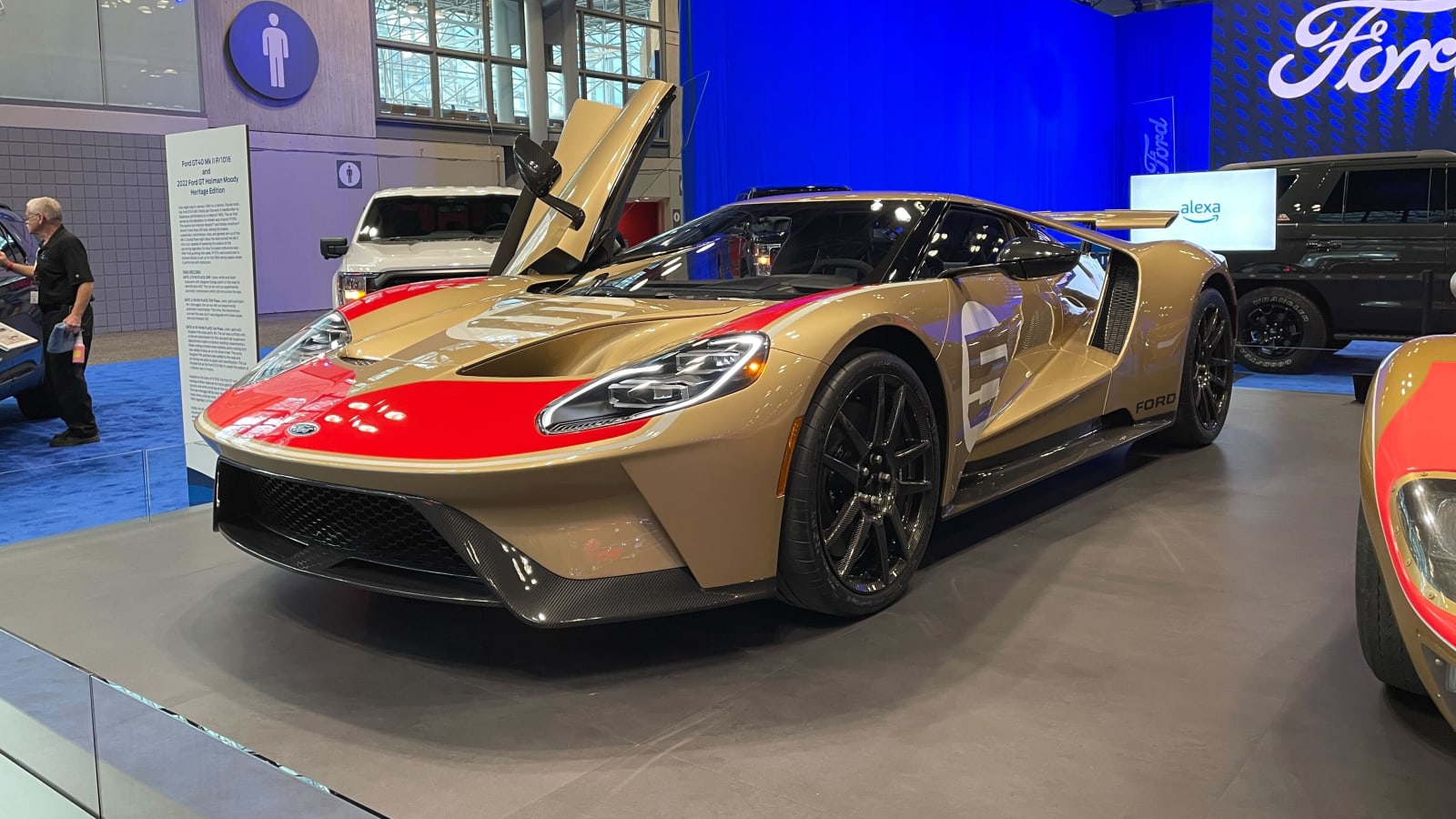
This special-edition Ford GT pays tribute to the third-place car at the 1966 running of the 24 Hours of Le Mans. It re-creates that car’s look via matching paint, red accents and a number of other small details. Ford put it on display next to the car that raced at Le Mans back in 1966, making it an excellent display for any racing history geeks.

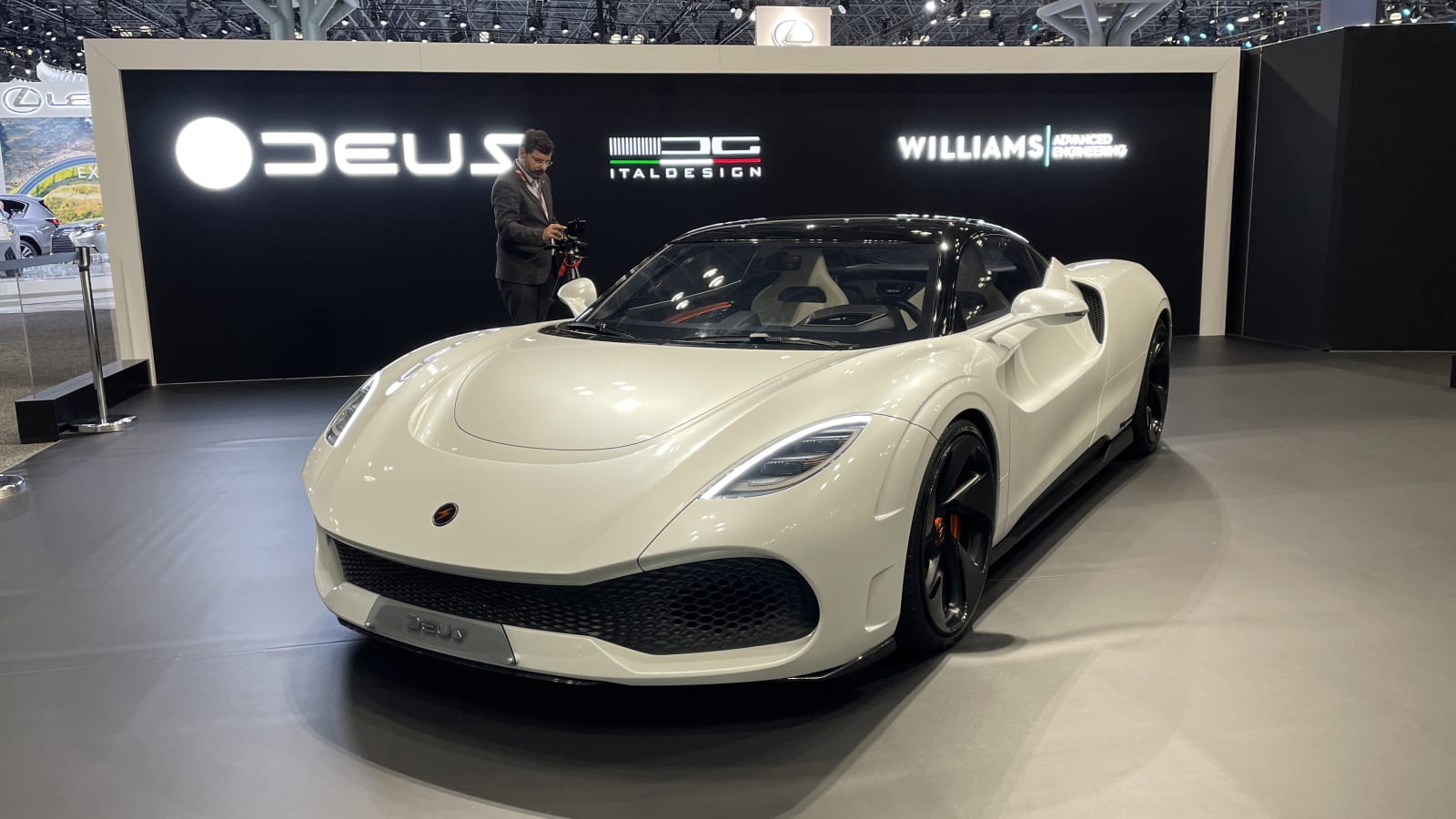
A collaboration between Williams Engineering, Italdesign and Deus, this electric hypercar is planned for super-low production, but incredibly high performance. Output is meant to be “more than 2,200 horsepower” and it has a claimed 0-62 mph time of 1.99 seconds. Only 99 are meant to be built, but we know that will be a tough, uphill battle to accomplish. Maybe, just maybe, you’ll see a Deus outside of the N.Y. Auto Show stand one day.

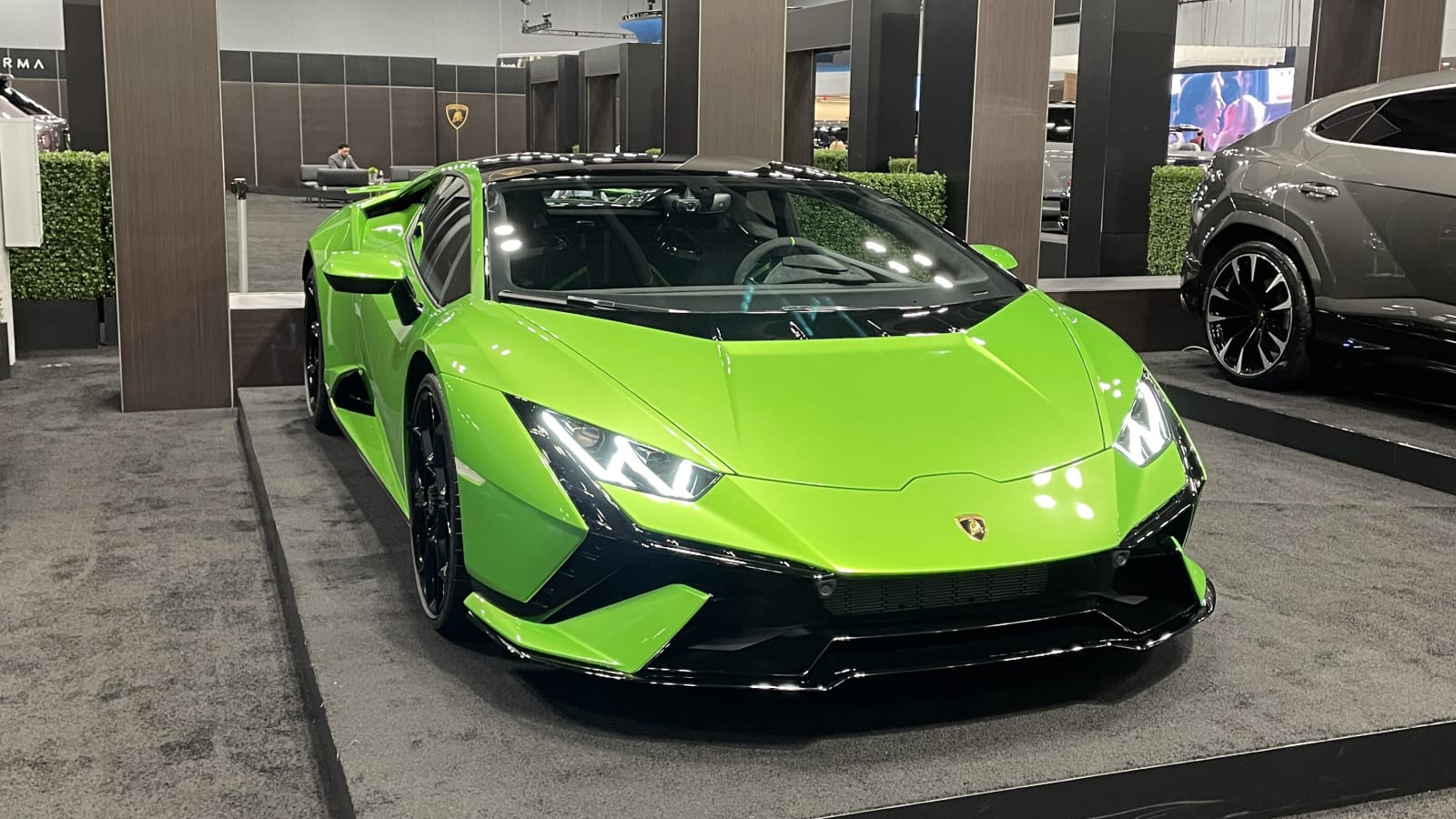
Yes, it’s another Huracán variant. This one steals a lot of the go-fast STO parts, but pairs them with a much more subdued appearance. It does well to make the appearance stand out as different from other Huracáns, and the 631 horsepower being sent to the rear wheels sound like Italian supercar bliss.

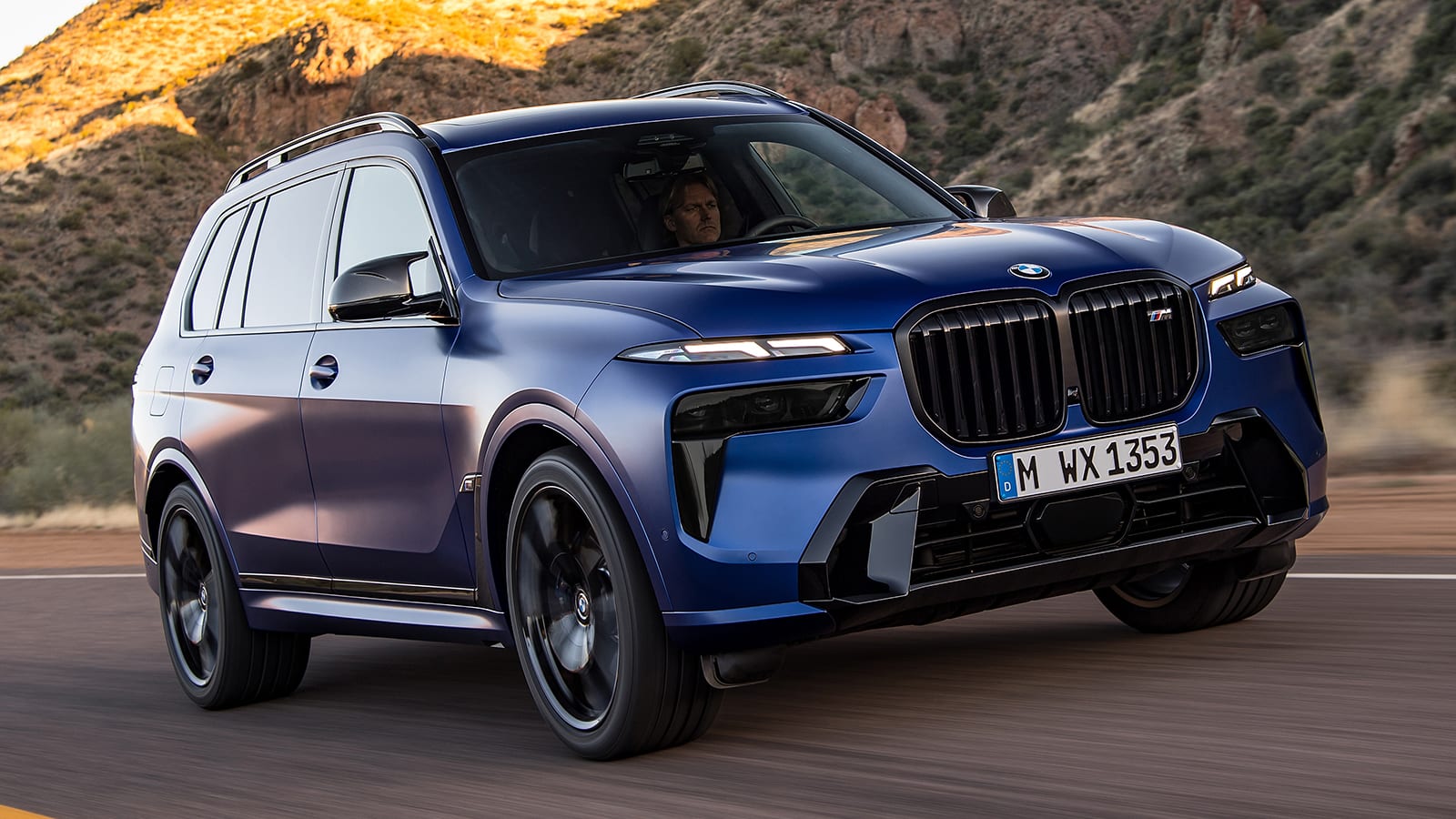
2023 BMW X7 M60i

BMW didn’t bring it to the show floor, but we still got to see the refreshed X7 in New York this week. The design both inside and out gets a heavy revamping. Its look certainly isn’t for everyone, but nobody can deny that the car is turning heads. We’re impressed with the new interior, and the base xDrive40i powertrain gets a huge performance boost, giving the entry-level X7 a whopping 375 horsepower.

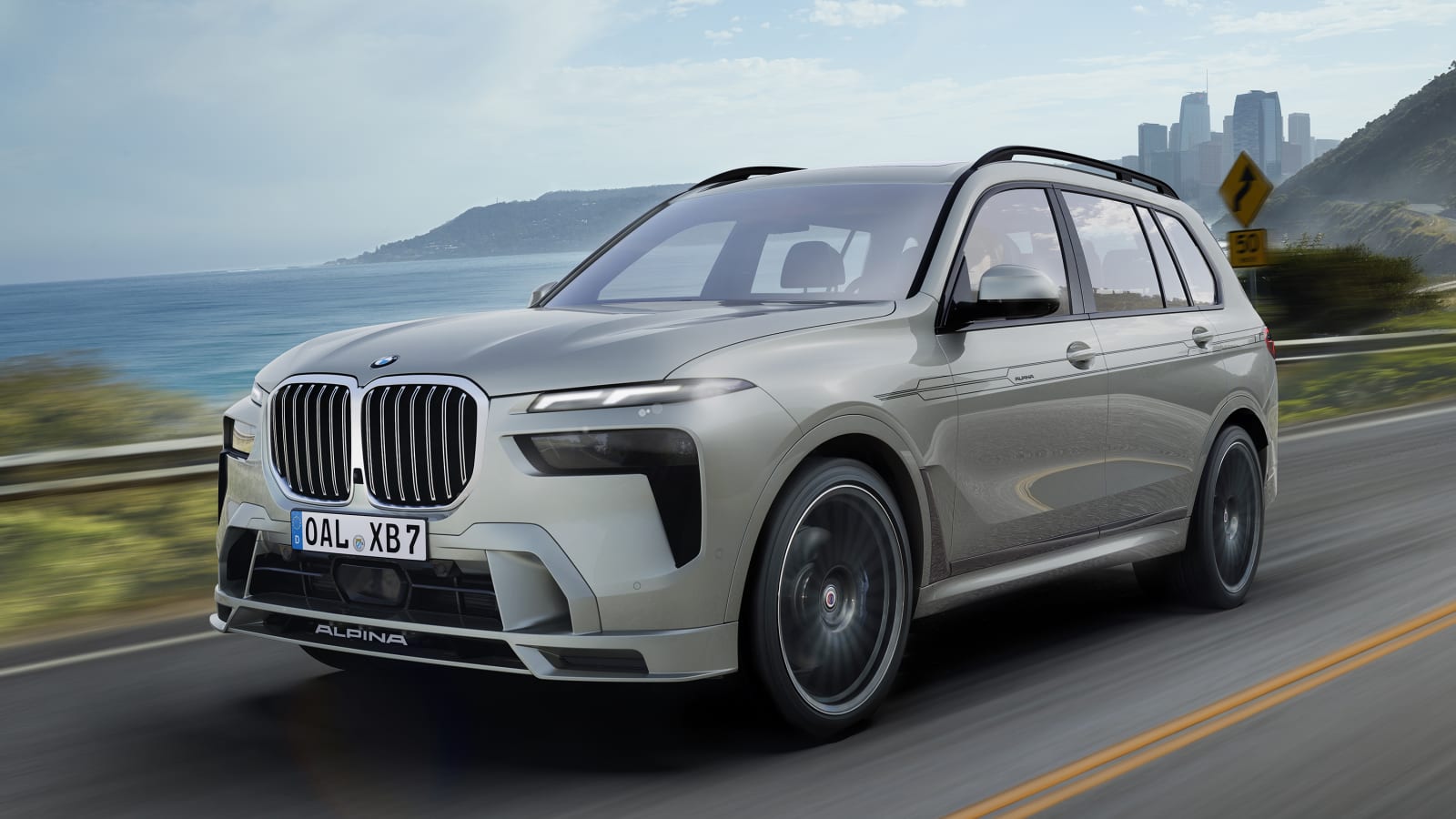
Debuting alongside the regular X7 was the Alpina XB7 that received its own styling tweaks to keep it current. It also adds 8 horsepower, bringing it up to 621 ponies from the twin-turbo V8.

Genesis X Speedium Coupe

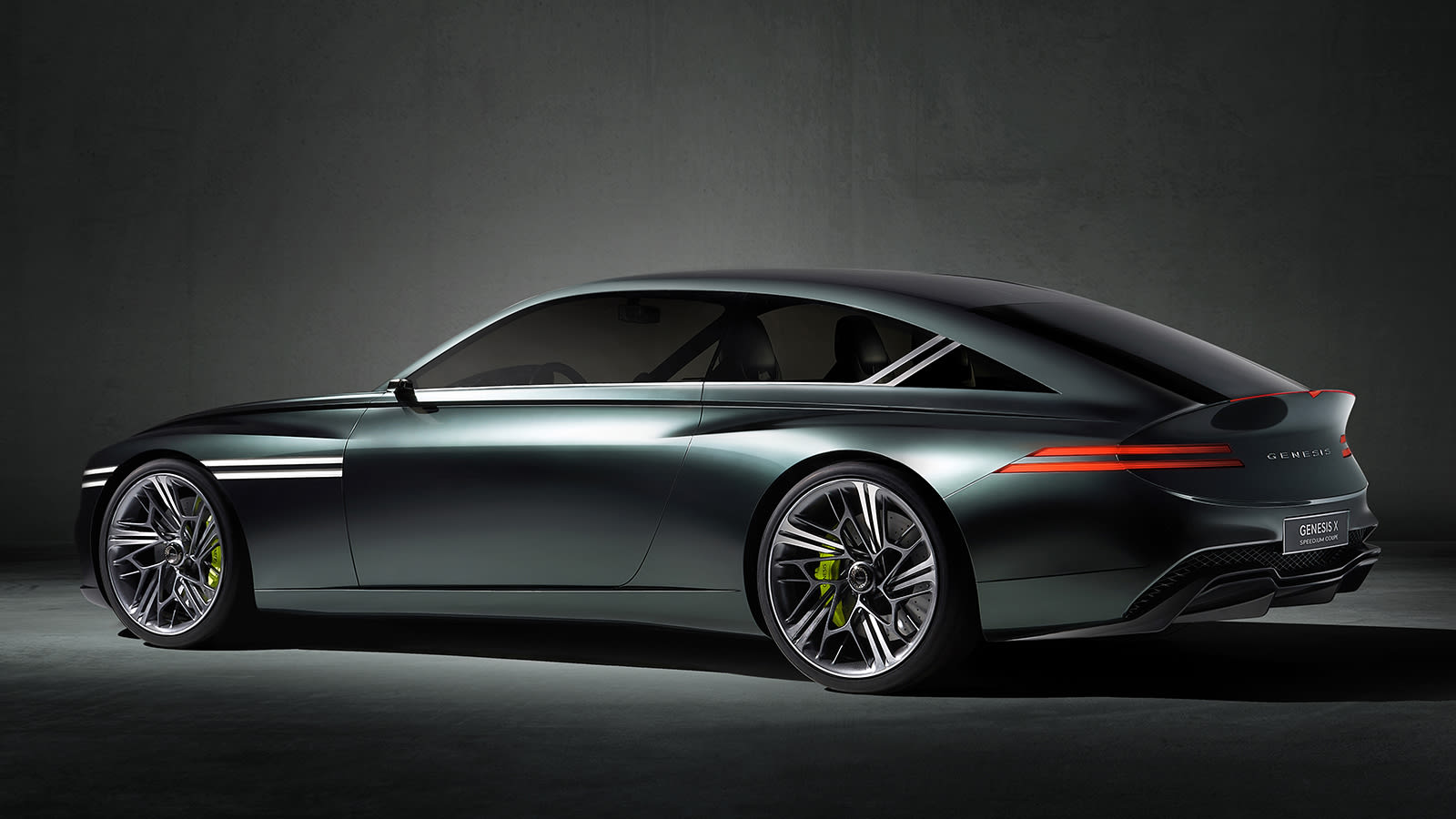
It wasn’t on the show floor, but Genesis still revealed it in New York during auto show time. The X Speedium Coupe Concept is far and away the most beautiful thing there. Its shooting brake/fastback design is long and wide, and its proportions make it a total stunner. The concept is electric, and while Genesis hasn’t committed to putting it into production, we can hope to see it on the roads one day.

Random other musings

Fiat 500 Electric

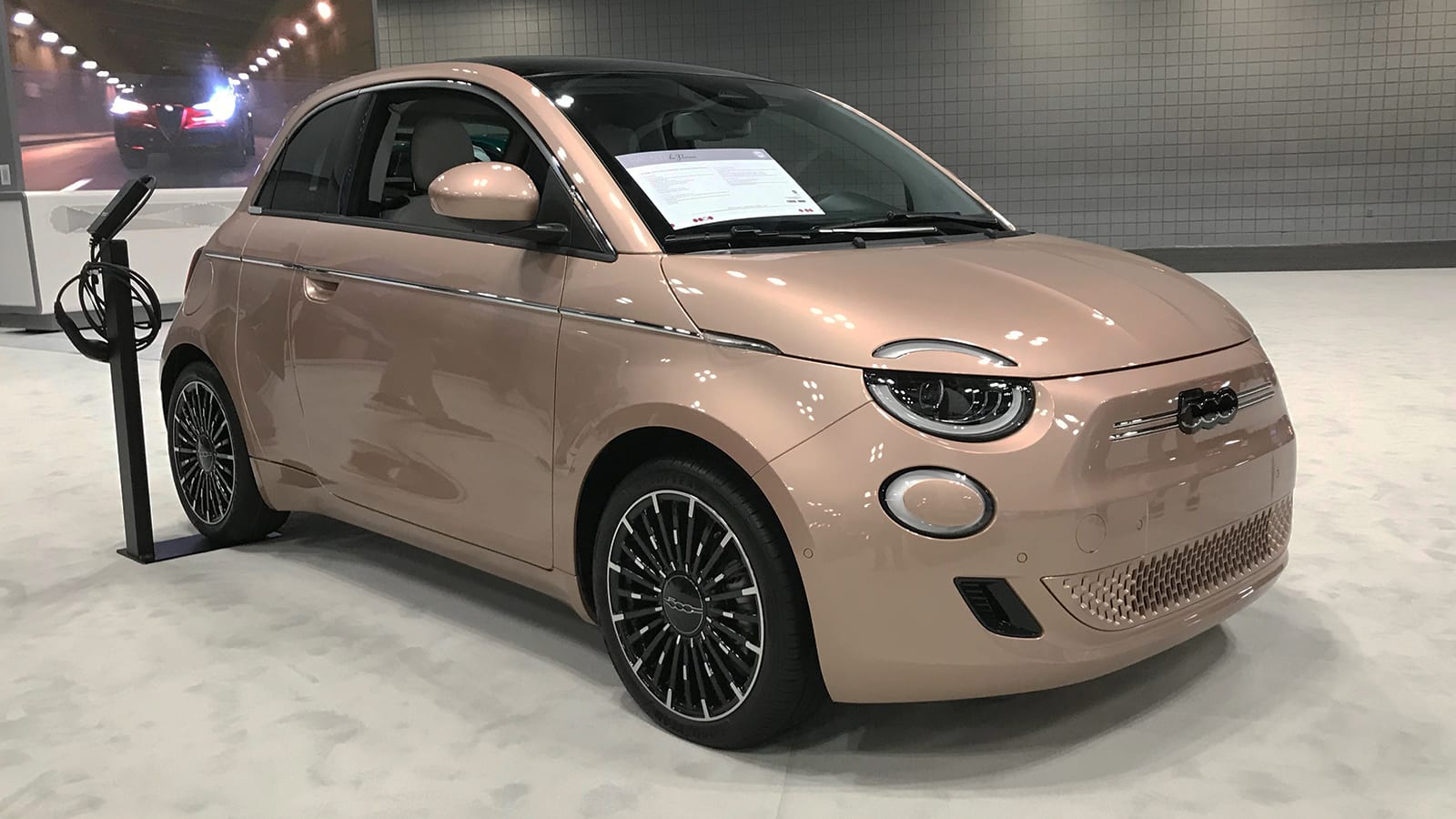
For whatever reason, Fiat brought the Europe-only electric 500 to N.Y. Our Joel Stocksdale took a close look at it, and made a case for why Stellantis should bring the little EV to America.

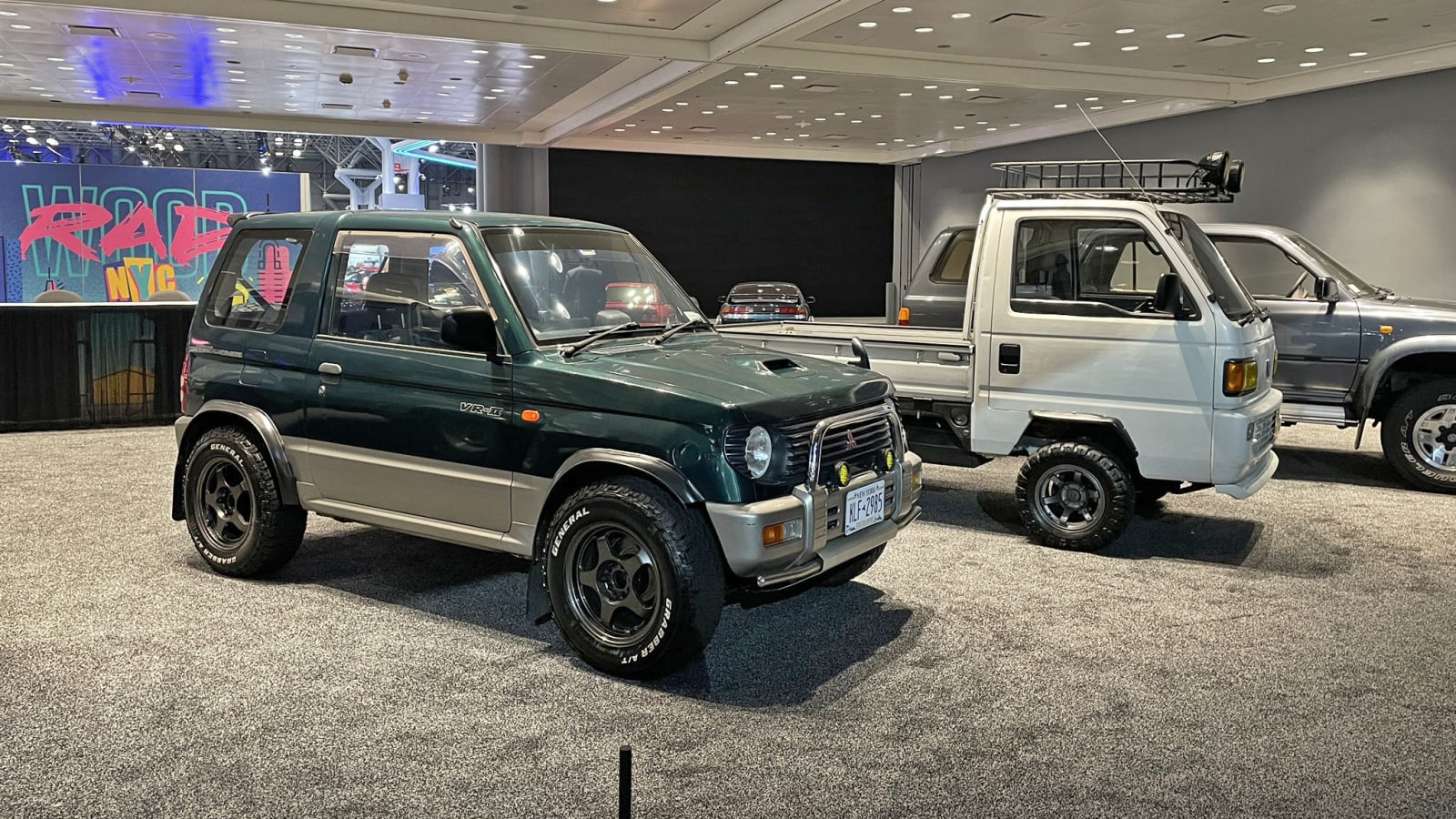
Radwood showed up with a large collection of epic cars from the 1980s and 1990s. They were easily the coolest part of the show, and if you’re in town, it may be worth going just to see this group of cars at the Javits Center.

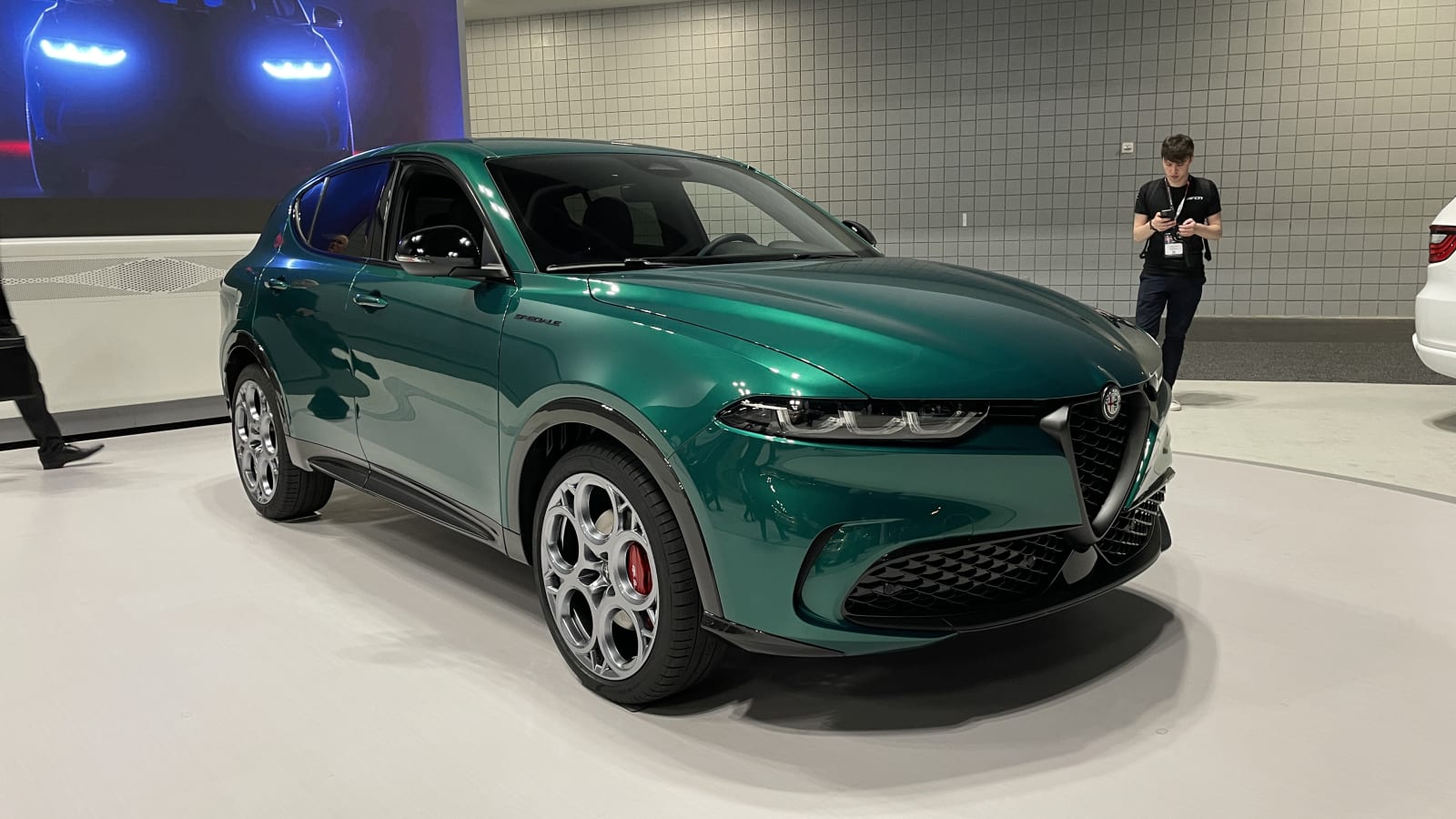
Lastly, Alfa brought the Tonale for us to check out in a gorgeous Montreal Green paint. It’s a sharp little crossover in the flesh, and we’re really looking forward to seeing how this Alfa drives.

Related video:

2022 New York Auto Show, and Subaru Solterra driven | Autoblog Podcast #725

Please consider allowing Autoblog.

Hi! We notice you’re using an ad blocker. Please consider allowing Autoblog.

We get it. Ads can be annoying. But ads are also how we keep the garage doors open and the lights on here at Autoblog – and keep our stories free for you and for everyone. And free is good, right? If you’d be so kind as to allow our site, we promise to keep bringing you great content. Thanks for that. And thanks for reading Autoblog.

Hey again!

You still haven’t turned off your adblocker or allowed our site. It only takes a few seconds.

Deus Vayanne EV hypercar reaches for 2,200 horsepower

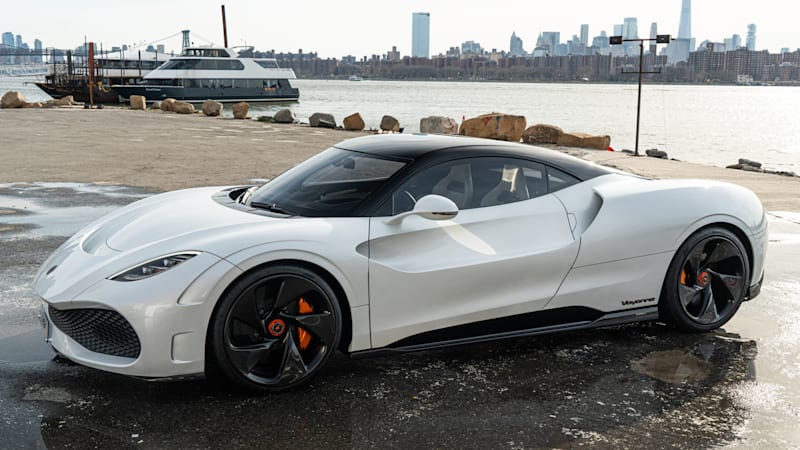
The Deus Vayanne has touched down at the New York Auto Show. Despite a word salad press release about timelessness and infinity and symmetry and divinity, the battery-electric hypercar from an Austrian-led consortium looks like courtly but pretty standard stuff. We’re told that with “a ground clearance of 4.7 inches and useable storage space, the car integrates performance and practicality” and “truly deserves the title of master of versatility.” Hmmm. Perhaps the definition of “versatility” has changed recently.

The coupe is built on an EV platform created by Williams Advanced Engineering and Italdesign, the bodywork penned by Italdesign according to Deus’ ambitions. The front and rear grilles are abstractions of the infinity symbol. Between them is the undeniable shape of a mid-engined ICE super sports car, and since everyone’s going to pick another car or cars to compare this to, we’ll go with the silhouette of a McLaren 720S from the side. The interior checks all the hypercar boxes—sleek design, stitched leather, toggle switches, chunky shifter. It’s perfectly fine.

The wild side of the Vayanne is its target performance figures; the company wants to make this the first production EV with more than 2,200 horsepower. The Aspark Owl already touted a pony count of up to 2,012, the the Lotus Evija, Rimac C Two, and Pininfarina Battista are at or above 1,900 hp, so if Deus succeeds, it will put daylight between itself and the competition. Combined with 1,475 pound-feet of torque, Deus says it expects a teleport from zero to 62 miles per hour in under 1.99 seconds and a top speed beyond 248 miles per hour. Two vital caveats here: Deus didn’t mention any powertrain specs, and all of these stats and figures are derived from computer simulations.

We’re told there will be just 99 Vayannes produced, the first one reaching customers in 2025 for an as-yet-undisclosed price. However, the version on display in New York at the moment is still a “production-oriented concept,” so anyone reaching for their wallet might want to hold off to see what changes may come in the next three years. Until then, we’re going to go find a dictionary and look up some words that start with “V.”

Related video:

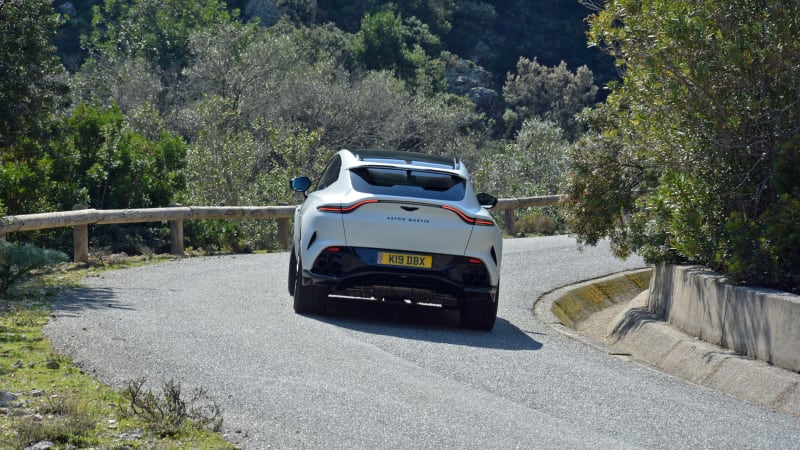
2023 Aston Martin DBX 707 First Drive Review | Supercar SUV

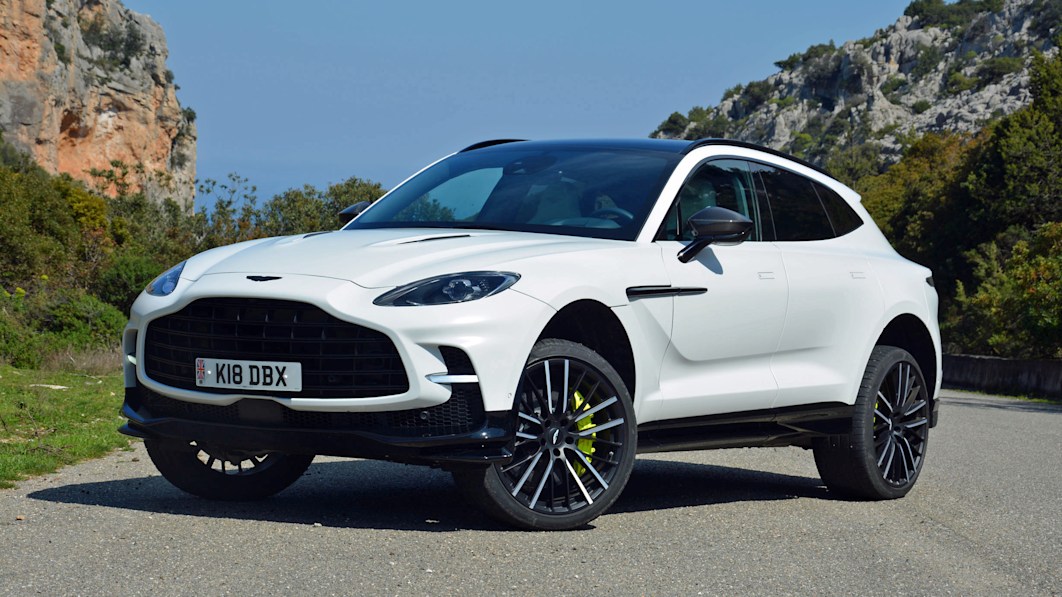
OLBIA, Sardinia – What is the definition of a supercar? It varies from generation to generation, from country to country, and from brand to brand. It’s the type of complex question that could fuel pub talk until the taps run dry. Aston Martin’s supercars have historically been the low-slung two-door kind, but the British firm submitted a different answer by releasing the 2023 Aston Martin DBX 707. It’s an SUV that serves supercar-like power, supercar-like acceleration, and a supercar-like price. Does it deserve a spot in this elite group in spite of its family-friendly proportions? I traveled to the Italian Mediterranean island of Sardinia to find out.

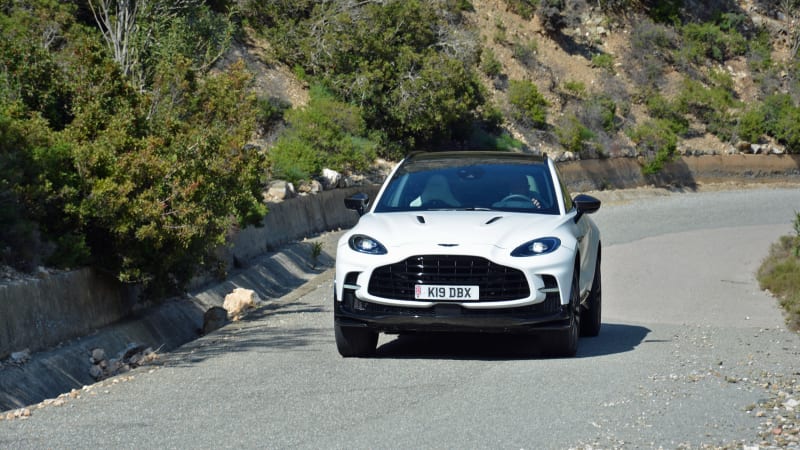
On paper, the 707 is a DBX with a more powerful engine – that’s one way to sum it up but it’s cruelly unfair. Dig deeper and you’ll discover hundreds of changes made to differentiate the two models, both in terms of design and in terms of driving dynamics. The grille is 27% bigger (it’s not just BMW riding this train), the side skirts have been redesigned, there’s a carbon fiber spoiler attached to the top part of the hatch, and the rear bumper is now vented. One of the most striking design cues is the rear diffuser: loosely inspired by the unit fitted to the Valkyrie, it sticks out far beyond the bumper and looks ready to pick a fight with every curb that comes its way. Aston Martin told me you can still fit the 707 with a hitch, so that’s a relief. Wait: tow? With this? Certainly! Bolt that hitch on it and you can pull approximately 6,000 pounds.

While some of these tweaks are purely aesthetic, others allowed Aston Martin to hone the DBX’s aerodynamic profile. Adding splitters to the front bumper stabilizes airflow, for example, and Sam Holgate, Aston Martin’s chief designer for mid-engined models and SUVs, pointed out that the 707 has about 5% less lift than the regular DBX.

“Mainly, that came out from the front of the car by venting air out of the arches, but then we got it back with the rear spoiler, so this car is completely lift-neutral front to rear, regardless of whether you’re traveling at high or low speeds,” he told me.

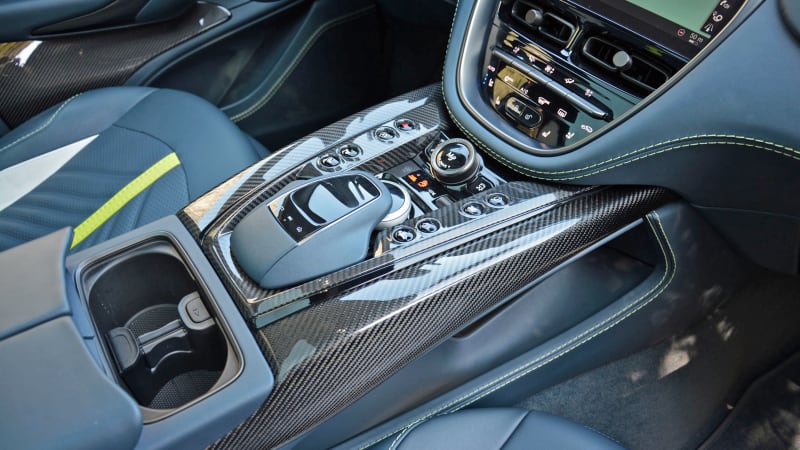
In a way, the 707 is a laboratory that incorporates some of the feedback that Aston Martin has received about the DBX since production started in 2020. Buyers wanted soft-close doors; it’s got them. And, there is one improvement that Aston Martin’s engineering team is particularly proud of. “We redesigned the cupholders to take a bigger variety of cups,” said Andrew Tokley, Aston Martin’s senior manager of vehicle engineering. Customer feedback, much of it from American buyers directly shaped the new cupholders (no mention of American car reviewers). Scoff if you must, but they were surprisingly useless before.

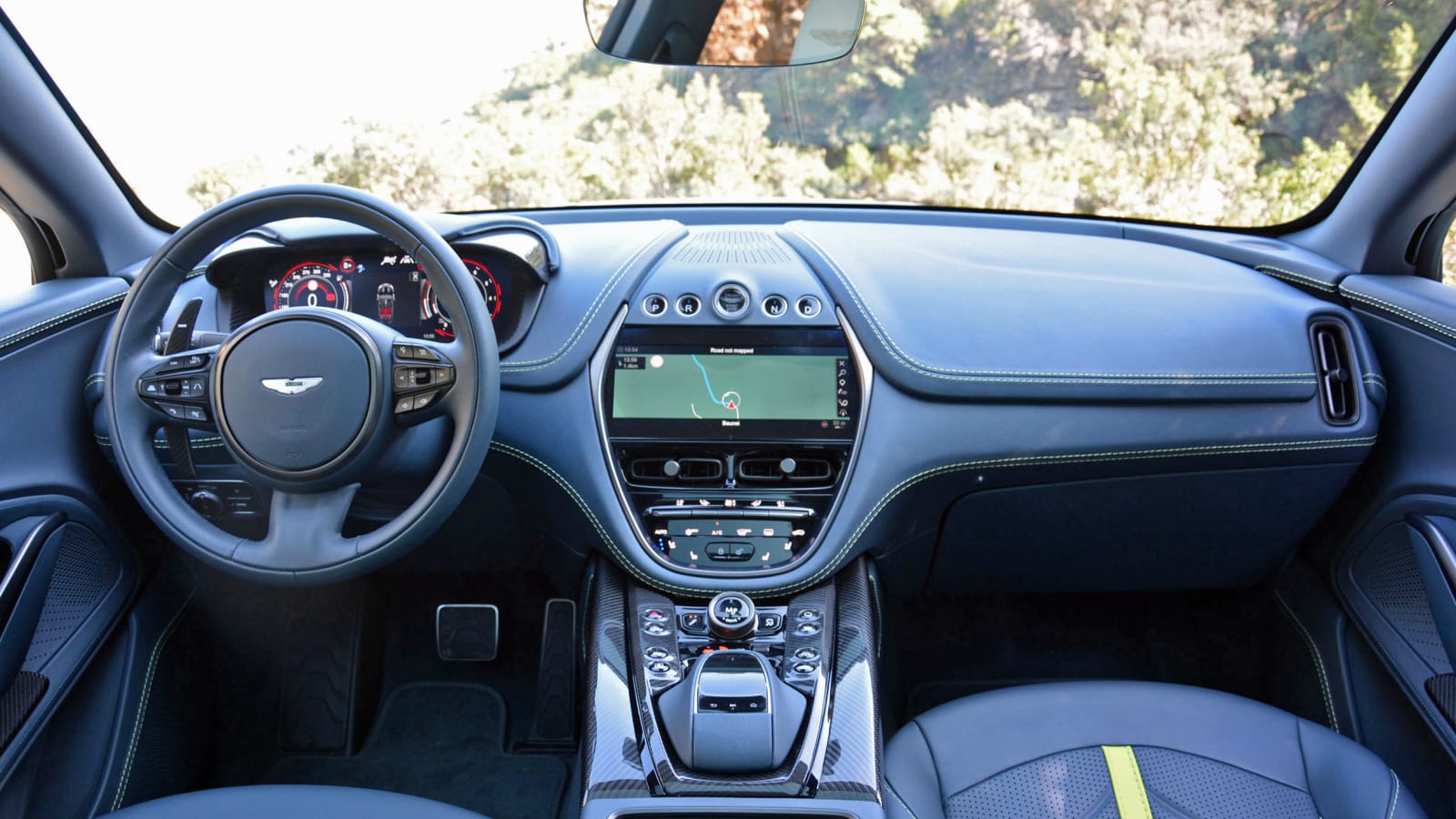
As in the regular DBX, all of the materials that the passengers see and touch are top-notch, which you’d rightfully expect in a vehicle that goes deep into $200,000 territory. Aston Martin really sweated the details: every stitch is correctly aligned and every switch feels solid. Its heritage is rooted in luxury, after all.

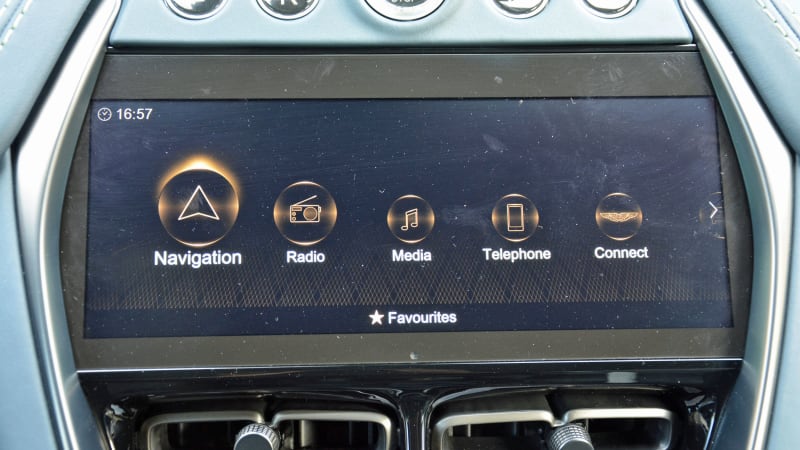
The only disappointment inside – and it’s not an insignificant one – is the infotainment system. Yep, I heard you: “no one buys an Aston Martin to get a fancy touchscreen!” Fair enough, but technology has, for better or worse, become one of the yardsticks used to measure luxury cars and the DBX falls short here. It’s fitted with what’s essentially an older Mercedes-Benz infotainment system, meaning one controlled by a touchpad and a dial rather than a touchscreen. It’s bulky and unintuitive; the DBX deserves better, especially since there are some cool features and menus stuffed into the software.

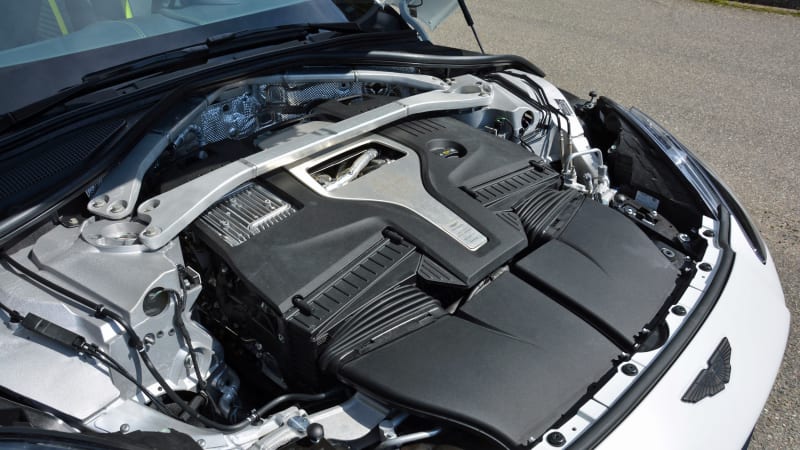
Power comes from a twin-turbocharged, 4.0-liter V8. It’s the familiar eight-cylinder that Aston Martin borrowed from Mercedes-AMG to drop into several of its models, including the regular DBX, but here it’s tuned to develop 697 horsepower at 6,000 rpm (or 707 pferdestärke – hence the name) and 663 pound-feet of torque at 4,500 rpm. Enthusiasts familiar with AMG’s V8 cookbook will recognize that no in-house recipe yields these numbers, and that’s because this is a British recipe, not a German one.

“The Mercedes-Benz technology transfer agreement is very important for us, and this is one of the outcomes. We were able to make several refinements to the engine. The agreement also gives us the leverage to be much quicker to the market,” said Aston Martin boss Tobias Moers. Importantly, and this is not a coincidence, his last job was running the very company that designed the engine: AMG. His gravitational pull was strong enough to bring a few key people with him to England, including Ralph Illenberger. He’s now Aston Martin’s head of powertrain having previously been AMG’s head of engine development.

Tokley explained that some of the changes made in-house include fitting turbochargers equipped with ball bearings instead of journal bearings. Software and calibration tweaks entered the equation as well.

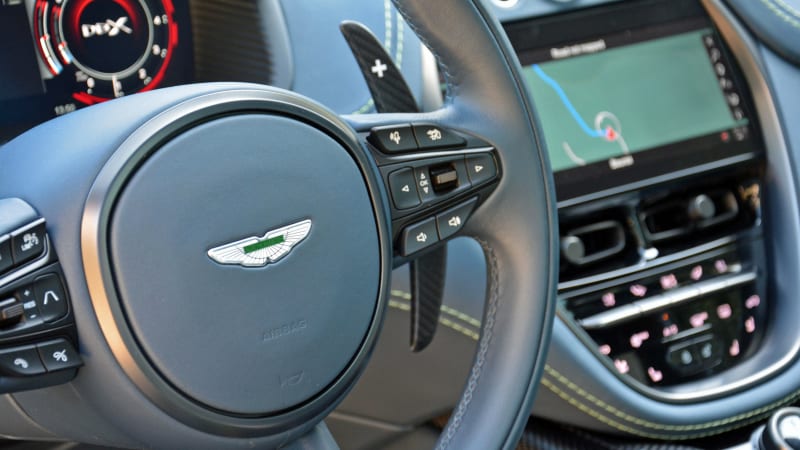
From the crankshaft, the V8’s cavalry reaches the four wheels via a nine-speed automatic transmission linked to beefy shift paddles, an active transfer case, an upsized carbon fiber driveshaft (which doesn’t have a center bearing in order to save weight), and an electronic limited-slip rear differential with a final drive ratio that’s 7% shorter than the standard DBX’s. Hitting 60 mph from a stop consequently takes 3.1 seconds, a number that becomes even more impressive when you take into account the 4,940-pound mass that the engine needs to lug around. The nine-speed automatic keeps up with the pace by delivering quick, crisp shifts, either on its own or manually. The shift paddles are even larger than those in the regular DBX, and are made of carbon fiber rather than metal. 

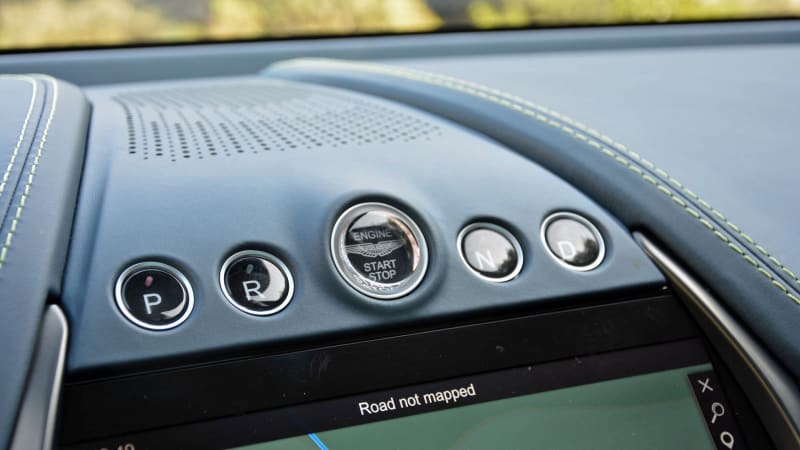
Aston Martin lets you choose how loudly the DBX 707 comes to life. For the standard exhaust note, simply push the “engine start/stop” button located on the dashboard, between the buttons used to put the transmission in gear. To turn it up, which I highly recommend, keep the left shift paddle pulled as you push the ignition button. The difference in decibels is perceptible, both inside and out. The V8’s song is worth turning down the audio system for, and Aston Martin spent a great deal of time fine-tuning it. Moers, a man whose love of great-sounding engines is well documented, personally weighed in on it.

Unless you’re a current Aston Martin owner, the brand’s long-standing automatic shifter location takes a little bit of time to get used to; your hand instinctively reaches for the center console. But, once you’re off, you’re off. The DBX’s acceleration is nearly instantaneous, which is surprising because the engine’s full horsepower and torque outputs aren’t available until 6,000 and 4,500 rpm, respectively. There is so much of both under your right foot that the engine curve matters far less than it does in a car with, say, 150 horsepower. At full throttle, the DBX delivers the type of gut-twisting acceleration associated with a supercar. Try launch control once, and I’ll bet the cost of my test car’s optional 23-inch wheels (that’s $5,100, by the way) that you’ll immediately stop to do it again.

The chassis improvements came to life on twisty Sardinian roads. This is not a light car, and it never feels like one, but dialing in a 52% front and 48% rear weight distribution ensures it’s not as front-heavy as you’d expect. It’s reasonably well balanced, especially considering the segment that it competes in. The air suspension and 48-volt anti-roll control keep body motions in check, and the massive tires unlock a reassuring (and almost supernatural!) level of grip. Bend after bend, the DBX 707 delights with precise, well-weighted steering … until I come out of a sharp right-hander, foot half-buried in the throttle, and realize I’m barreling towards a group of goats chilling in the middle of the road. That’s where the standard carbon ceramic braking system comes in. Rest assured: the DBX passed the goat avoidance test with flying colors.

On straighter, faster roads where the odds of encountering cheese-producing livestock are lower, the DBX 707 is a pleasant and comfortable car to cruise in. Like the regular DBX, actually, the 707’s wild side is entertaining, but it knows how to be calm when the occasion calls for it. It’s also quiet thanks in part to remarkably thick windows. Only the V8’s song permeates the cabin. Some of it comes from the speakers, though Tokley stresses that the actual exhaust note is being piped through rather than a fake sound emitted by a synthesizer. For the braver souls among us, there’s an off-road mode that increases the ground clearance.

Due out in the second quarter of 2022, the 2023 Aston Martin DBX 707 starts at $239,086 including a massive $3,086 destination charge, and the $300,000 threshold is effortlessly reached when you begin ticking option boxes – my tester cost $291,586. At this stage, what are you really cross-shopping the DBX 707 with? Any of the other family haulers that cost nearly a quarter of a million dollars, sure, but you could also get a used Cessna or buy a cabin in a picturesque part of the Alps and a four-wheel-drive Dacia Duster to get there. That’s the point: the heart crushes the brain in this equation. No one needs a 697-horsepower SUV, but the acceleration, the sound, the design, and the luxury make you want one. Cast in this light, ground clearance and seat count be damned: the DBX 707 is a modern supercar.

Related Video:

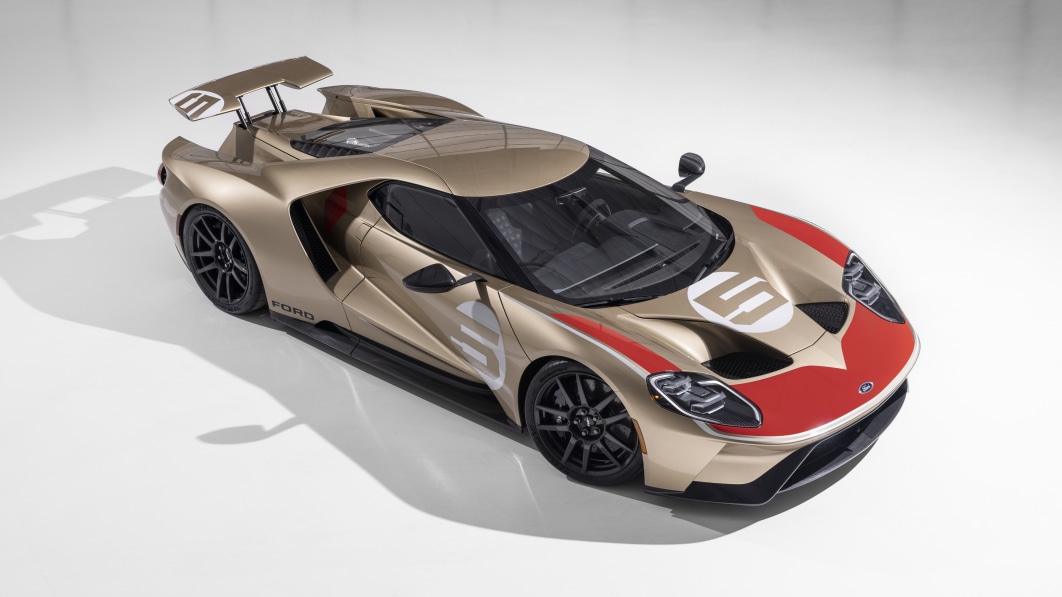
2022 Holman Moody Ford GT debuts as 1966 Le Mans tribute

For those who may have forgotten, yes, Ford (along with Multimatic) is still making the GT supercar. The latest iteration is this 2022 Ford GT Holman Moody Edition that pays tribute to Ford’s 1-2-3 finish at the 1966 24 Hours of Le Mans. If you were wondering, the Moody car finished third among the trio of GT40s. As you can tell in the photos, the new GT is meant to replicate the original Holman Moody livery from that race.

To do so, Ford applied that unique gold and red color combo to the new GT and added the number 5 roundels in Oxford White to match the original’s racing number. The number roundels have been modernized, but considering how much exposed carbon fiber this sucker has, that’s small potatoes. Ford uses glossy carbon for the splitter, side sills, rear diffuser and engine louvers. The package also includes the 20-inch carbon fiber wheels that hide Brembo brakes finished in black with silver graphics. 

Holman Moody touches on the interior include a number 5 emblazoned on to the door panels, gold trim on the instrument panel and paddle shifters in gold, as well. The carbon fiber continues inside, too. Ford applies visual carbon to the door sills, console, lower A-pillars and more.

Ford says that the Holman Moody Heritage Edition GT is being made available for approved GT customers and notes that deliveries will begin this spring. No price was provided for this special model. If you want to see it in person, Ford says the Holman Moody GT will be displayed at this year’s New York Auto Show alongside the original third place Holman Moody Ford GT40 MK II, chassis No. P/1016.

Related Video

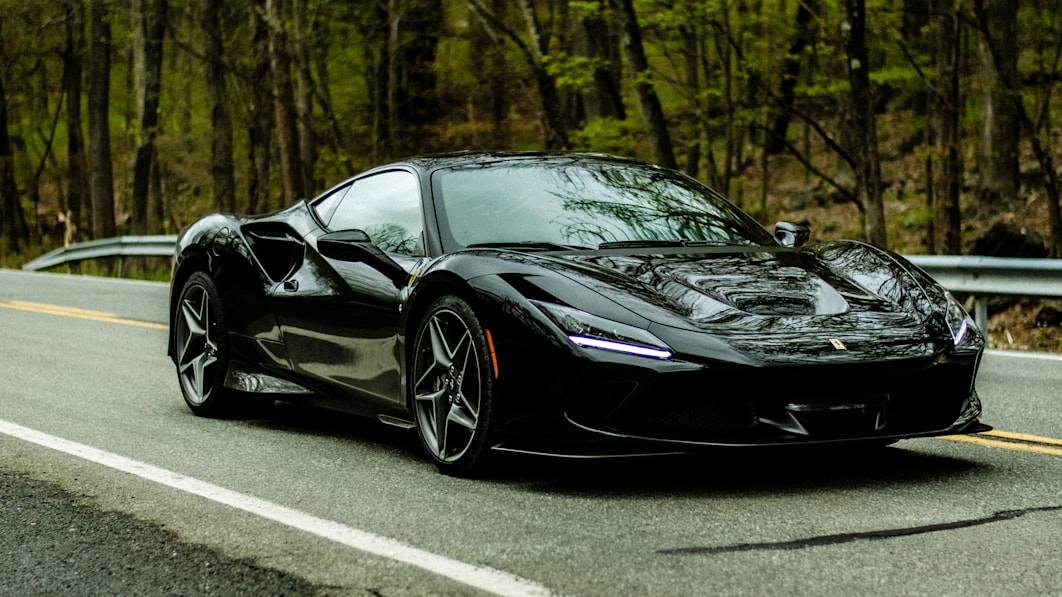
Ferrari F8 Tributo order books already closed

With everything else going on, well, everywhere, it’s easy to forget about that sensational little number known as the Ferrari F8 Tributo. The coupe isn’t even three years old, the Spider barely two, and word has come down they won’t be in production for much more than another year. Automotive News Europe reported last month that Ferrari stopped taking orders for the duo. The folks in Modena didn’t offer any reason, but Ferrari Australasia told Australian outlet Drive that the F8 is off the menu because of “the volume of orders received,” and that “currently there are no plans to recommence orders for either model.”

The automaker’s mid-engined supercar line is without a non-hybrid V8 for the first time in nearly 50 years when the 308 GTB appeared in 1975. The only place to get an unelectrified V8 in Maranello is the Roma or the Portofino M, placed down in front. The powertrain flow chart for mid-engined cars now forks up to the SF90 Stradale PHEV and down to the 296 GTB PHEV. Both outdo the 711-horsepower 3.9-liter twin-turbo V8 in the F8 for output, the SF90’s 4.0-liter V8 and three electric motors good for 986 hp, the 296 GTB’s 3.0-liter twin-turbo V6 and single electric motor spinning out 819 hp.  

We could consider the 296 GTB the F8’s successor, but Ferrari hasn’t said anything about such positioning. 

With Ferrari CEO CEO Benedetto Vigna telling analysts his firm is working through “the strongest ever order book in its history,” with enough demand to keep lines busy “well into 2023,” it’s unlikely the F8 will get another chance at life. It’s also unlikely the car will get the same kind of hardcore variant that has elevated its predecessors going back to the 360 Challenge Stradale

Although the Australasia spokesperson told Drive “the brand will re-evaluate [F8 production] again at a later date,” we don’t see much coming of it. The Purosangue is due shortly, the new SUV a lock to become Ferrari’s most popular vehicle, perhaps pushing the overall order backlog into 2024.

Related video:

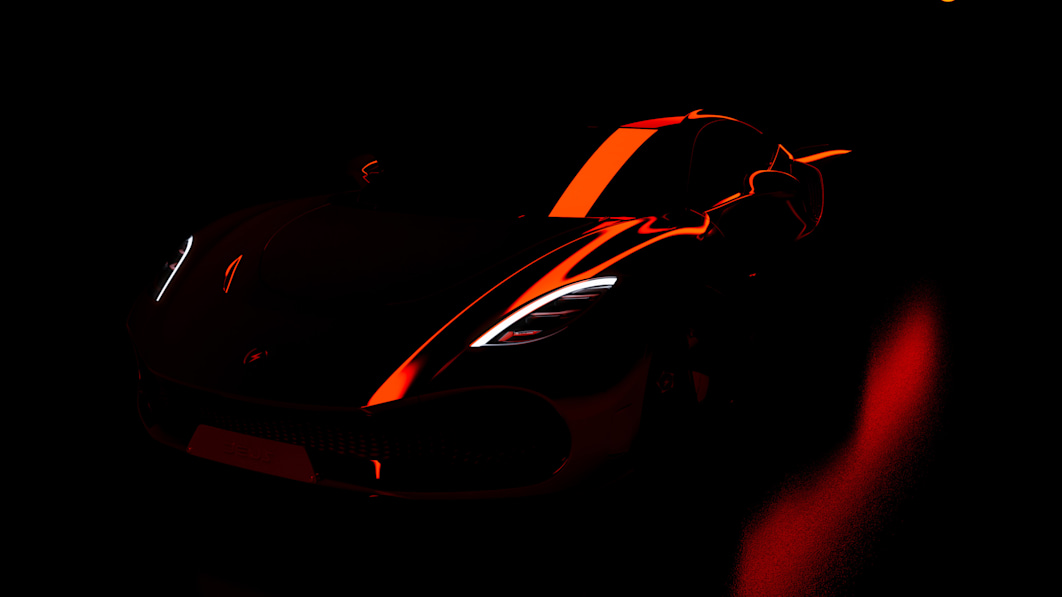
Deus Automobiles’ Vayanne electric hypercar headed to NYC

It feels a smidge heretical to say, “Oh man, another electric hypercar. From what country this time? (Sigh…)” But here we are, and here’s another electric hypercar hailing from Vienna, Austria — a first-time national entry in the segment that will offer more choice above six figures than there are cars costing less than $20,000 in the States. The company is called Deus Automobiles, not to be confused with the Australian motorcycle and cafe brand. In this case, the name is because it wants customers to anticipate “divinity,” and the first of its planned “ultra-limited” and “timeless” products is called the Vayanne, pronounced vy-ahn. Deus claims it is “an exclusive brand born from the unique technical partnership with Italdesign and Williams Advanced Engineering, ready to shape the future of 100% electric and luxury hypercars.”

We don’t know what that means, but we’ll see the first fruits at the New York Auto Show next month. Based on the 13-second video and a few teaser shots, the Vayanne bears quite a few traits one would expect of a mid-engined super sports car, like a trio of mesh-filled intakes in front, mesh-filled rear fender intakes, and a rear fascia with even more mesh. The photo gallery below includes three shots from Deus, two of which have been brightened for a better view of the details. Our guess is that the intakes mainly serve aero purposes, especially in front; the hood looks like little more than a vent to usher that front intake air over the body in a clean sweep.

We also don’t know who’s behind Deus, but other outlets have reported that Deus was “part of a group of businesses with more than 30 years success in industries ranging from publishing to packaging.” This would make sense, as the Vayanne looks like a packaging exercise. A year ago, Williams Advanced Engineering announced a modular electric vehicle platform called EVX it created with Italdesign to be a “complete, high-performance EV solution.” According to WAE, after buying the platform, it “is ready for customization by the Italdesign styling team who will shape the final vehicle to match the brand’s requirements in terms of marketing positioning, design direction etc.”

The EVX architecture can fit batteries of 104, 120, or 160 kWh and power motors of up to 1,341 horsepower, or a round 1,000 kilowatts. We expect to find out which battery has gone underneath the Vayanne’s bodywork and how much power comes on tap when the debut takes place at 1 p.m. EDT April 13.

Related video:

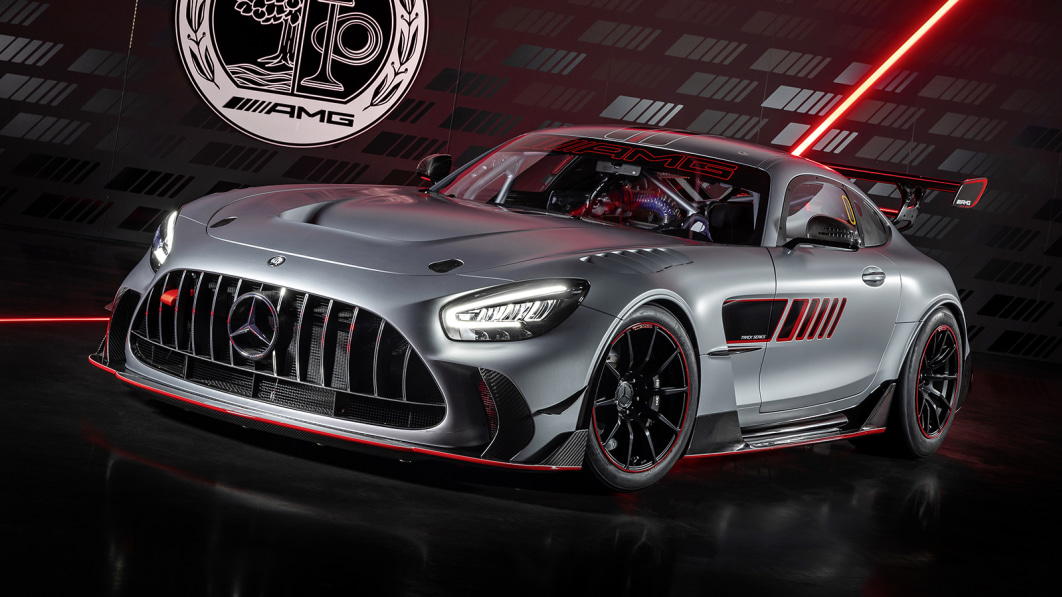
Mercedes-AMG GT Track Series is basically a 778-hp race car

Whenever we think we’ve seen the most hardcore Mercedes-AMG GT, the German automaker one-ups itself. That’s the case with the GT Track Series. It’s a track-only special edition that’s lighter, more powerful and more outrageous than the Black Series that preceded it.

The seriousness is pretty obvious from the outside. It has even more aggressive splitters and wings than before, much of which is adjustable either for more downforce or less drag. Carbon fiber makes up much of the body including the hood, fenders, side skirts, trunk lid and rear bumper.

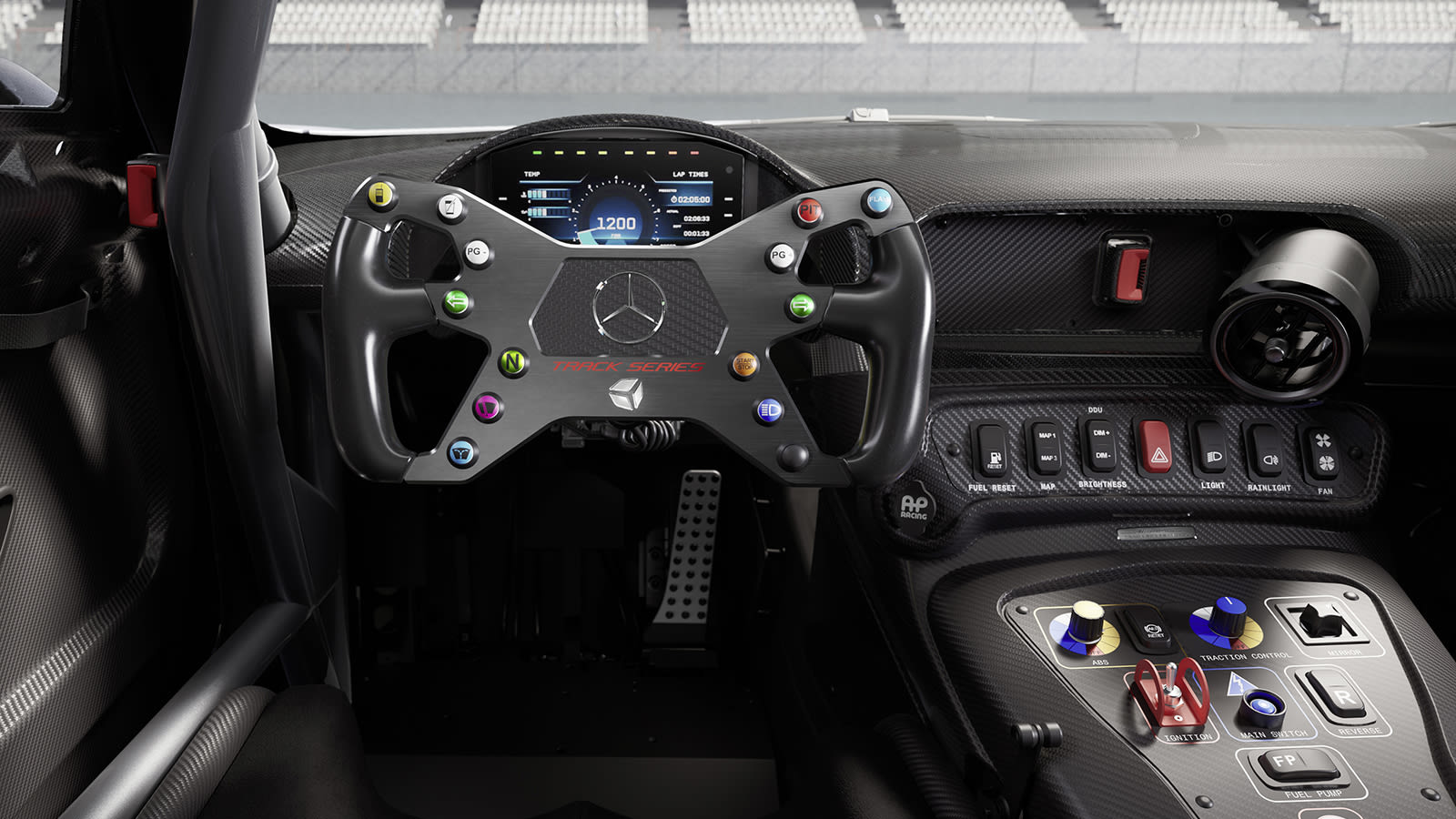
On top of that, the car has been stripped as bare as possible, all to get the weight down to 3,086 pounds. There are hardly any comfort items to speak of in the single-seat cabin save for air conditioning, and the optional ventilated helmet and seat system as well as a drink system. In place of all that is a custom racing wheel, carbon fiber seat, five-point harness, roll cage, multifunction instrument screen, safety nets, excape hatch and a fire suppression system, all meeting FIA standards.

Mercedes-AMG GT Track Series

The carbon-intensive body hides the most powerful version of the Mercedes-AMG twin-turbo V8 yet. Like the Black Series, it features a flat-plane crankshaft, but it has “motorsports” injectors and a new tune that brings output up to 778 horsepower and 627 pound-feet of torque. Power goes down a carbon fiber torque tube to the six-speed sequential transaxle at the back.

The suspension and brakes are motorsport-quality, too. It features four-way adjustable suspension with adjustment for rebound, damping and ride height. The anti-roll bars are adjustable, too. The brakes use steel rotors measuring 15.4 inches up front, and 14 inches at the back. The front calipers have six pistons while the rears have four. It all rides on 18-inch forged wheels with tires that measure 325-mm wide. Additionally, brake bias, traction control and ABS are all adjustable.

Mercedes is only building 55 examples of the Track Series, as it’s a celebration of AMG’s 55th anniversary. Each car starts at 369,000 euros, or about $406,000. In addition to the car, owners will receive training on how to use the car, along with a support line, and the availability of an engineer for track events for help setting up and running the car.

Related Video:

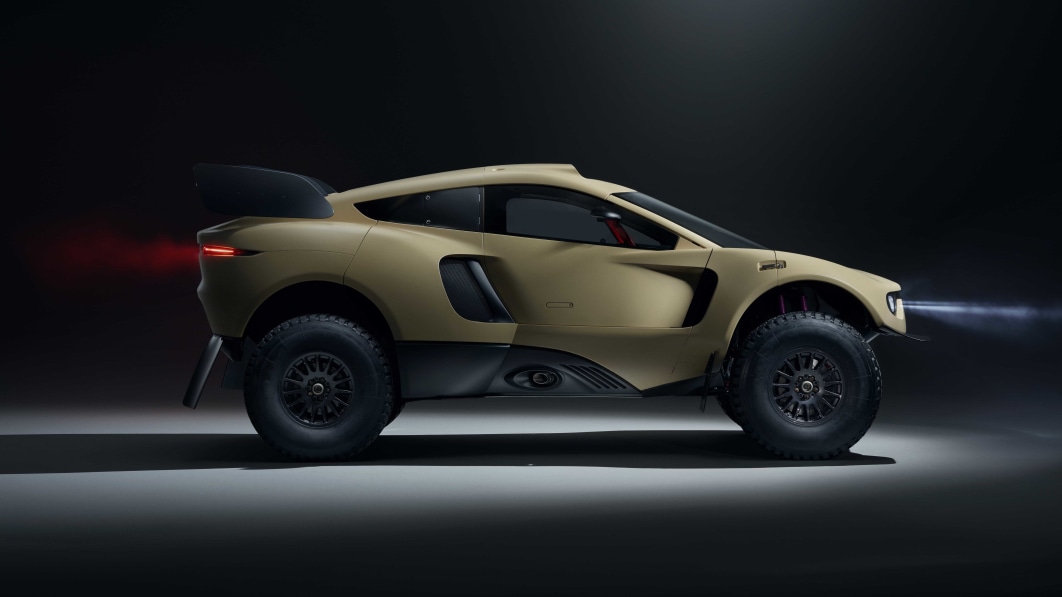
The ProDrive Hunter is an extreme off-road racer for the street

If your idea of a daily driver is a nearly-600-horsepower anime monster on wheels, ProDrive has just the car for you. The Hunter, based on the BRX extreme off-road race car of the same name, is billed by developer ProDrive as the “World’s First All-Terrain Hypercar,” and it can be yours for just £1.25 million ($1.63 million). Plus tax. 

“There are numerous hypercars on the market, however they all need good roads or even race tracks to show their performance,” said ProDrive chairman David Richards in the company’s announcement. “We identified that in certain parts of the world, particularly the Middle East, there are vast expanses still to be explored that go way beyond the access provided by asphalt roads. Therefore why not create a vehicle that gives the opportunity to explore these regions with performance way beyond that offered by any off-road vehicle before.”

The Hunter is built around an old-fashioned internal-combustion engine. The twin-turbo, dry sump Ford six-cylinder produces at least 592 horsepower (600 bhp) and 516 pound-feet of torque, which is significantly more than it makes in race spec. That’s one benefit of the street; there are no regulations (and corresponding restrictor plates) to spoil all your big-horsepower fun. Power goes to the ground by way of a six-speed paddle-shifted gearbox mated to front, rear and center differentials routing torque to all four wheels. ProDrive says this combo is good for a 0-62 time under 4.0 seconds and a top speed in the neighborhood of 180 mph, but stressed that on-road performance is not the Hunter’s raison d’être. 

“We took the deliberate decision to keep the Hunter Hypercar as close to the original as possible,” said Richards. “It’s about giving owners the opportunity to experience what it is like to drive Loeb’s Dakar car across the desert, but with all the comforts of a road car and the ability to drive it from your home, through a city, to any destination of your choice.”

Like the race car, the Hunter’s chassis is a steel tube-frame setup wrapped in carbon fiber body panels. The suspension is a double-wishbone setup front and rear with adjustable dampers. 17-inch wheels with 35-inch off-road tires are standard; behind them you’ll spot six-piston Brembo brakes. The Hunter street car also gets an extra 50mm of suspension travel to improve ride quality over the racer’s. The exterior may look a bit like Pikachu auditioning for a “Cars” sequel, but at least you can tell all your friends that it was penned by Ian Callum. That means it’s basically a Vanquish, right? 

We’re normally not convinced by the typical race car for the street (or in this case, “Ferrari of the desert” turned race car for the street) hyperbole, but the Hunter is an incredible performance machine that is conspicuously lacking in creature comforts. How lacking? Well, ProDrive’s list of interior features includes carbon fiber seats, six-point safety harnesses, a fire suppression system and lightweight battery.

That’s not exactly an excess of creature comforts, but Callum was brought back in to help design some cabin elements that were necessary to make the Hunter more livable in daily life, including a center console with slightly more conventional switchgear. The announcement made no specific mention of air conditioning, but there’s a snowflake icon visible amongst the controls, so we’re going to assume it at least offers that. For nearly $1.5 million, that seems reasonable.

Related video:

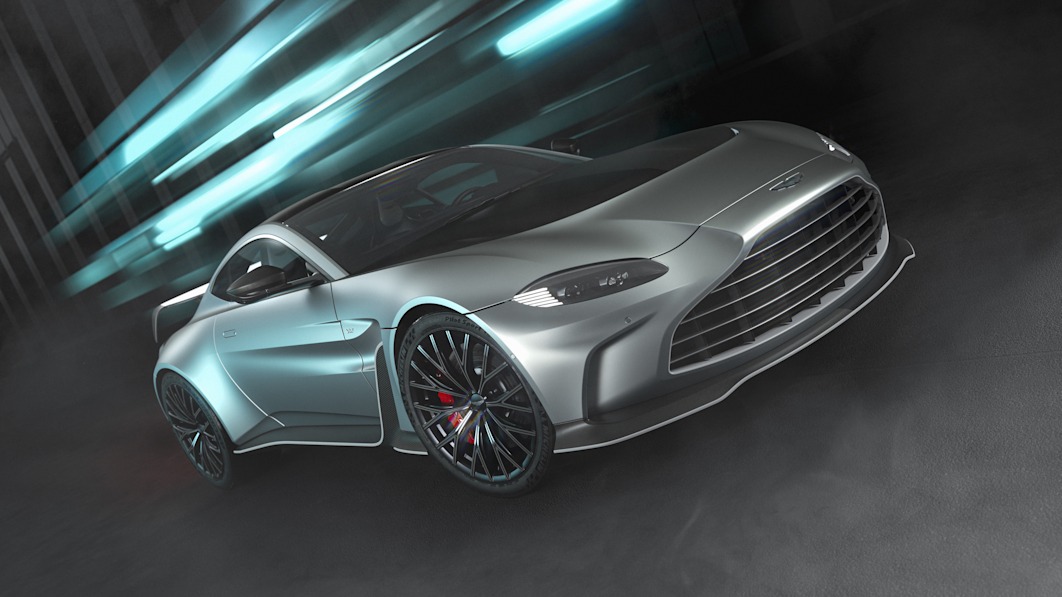
Aston Martin V12 Vantage revealed as the last of the line

The Aston Martin V12 Vantage is here, and it’s a wild sendoff to the littlest 12-cylinder, front-engine sports car in the company’s lineup. Yes, this will be the last Vantage to get the twin-turbo 5.2-liter V12. As such, it’s going to be produced in very limited numbers with a whole bunch of special features to make the most of the beefy engine under the hood.

That V12 is a familiar unit, as it has also appeared in DB11 and DBS variants, as well as the Vantage-based V12 Speedster. The engine is tuned to the V12 Speedster’s specifications with 690 horsepower and 555 pound-feet of torque, the latter of which is available from between 1,800 to 6,000 rpm. It’s paired to an eight-speed ZF automatic transmission in the middle and a mechanical limited-slip differential at the rear. Aston says the powertrain will propel the V12 Vantage to 60 mph in 3.4 seconds on the way to a 200 mph top speed.

Surrounding the engine is a thoroughly revised body. It’s about 1.6 inches wider overall to accommodate the wider track and fat tires (275-mm front and 315-mm rear). The front grille is 25% larger than on a normal Vantage to provide more cooling, and the hood has a scalloped vent for the same reason. Many of the body components are made of carbon fiber for weight savings including the bumpers, side skirts, fenders, hood and trunk lid. Adding both visual excitement and additional downforce are the front splitter, side skirts, rear diffuser and wing. They provide 450 pounds of downforce at top speed. If a buyer finds the wing to be a bit much, though, it can be deleted, though downforce would be reduced. The V12 Vantage also gets a special center-exit exhaust that weighs nearly 16 pounds less than the standard Vantage exhaust.

Naturally, the chassis gets upgrades to handle the V12 Vantage’s power. In addition to being wider, the V12 Vantage’s chassis is stiffer thanks to added sheer panels, a rear shock tower brace and fuel tank bracing. The adaptive suspension features stiffer springs are stiffer, as are various bushings and the front anti-roll bar. The rear anti-roll bar is actually softer, though. Carbon ceramic brakes are standard with six-piston front calipers and 4-piston rear calipers.

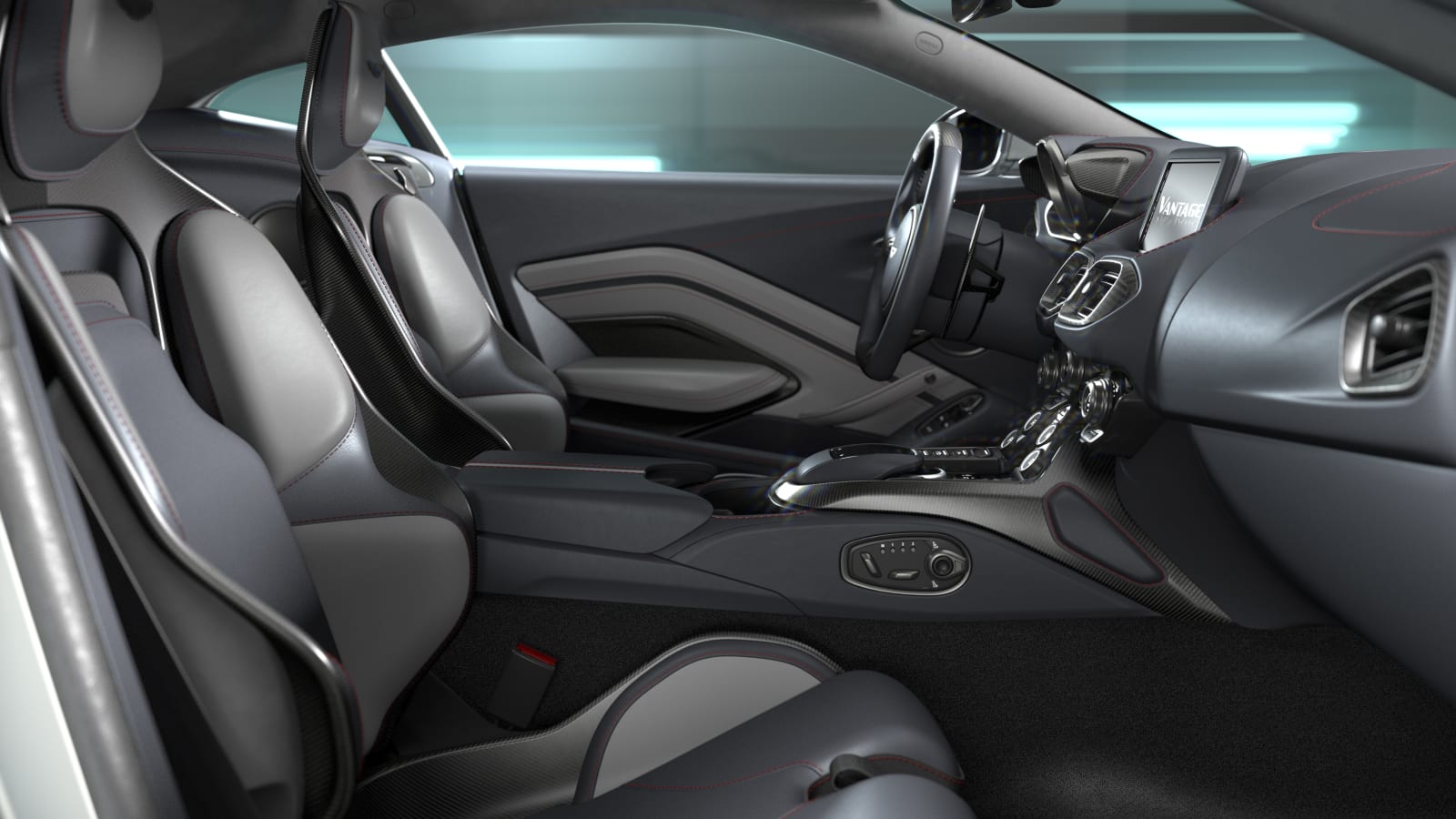
On the inside, the V12 Vantage is pretty similar to a regular model, but it gets standard Sports Plus Seats with semi-aniline leather with quilted stitching and perforations. Lightweight carbon fiber seats are also available, and Aston Martin’s Q division offers all kinds of special ways to personalize a model for extra fees both inside and out from color anodized knobs to custom graphics and tinted carbon fiber.

Aston is only building 333 examples of the V12 Vantage, and that’s for the whole world. Pricing hasn’t been announced, but it also doesn’t matter much, as every example is spoken for. Production begins this year, and deliveries will start in the second quarter of next year

Related Video:

Aston Martin teases V12 Vantage twice more ahead of debut

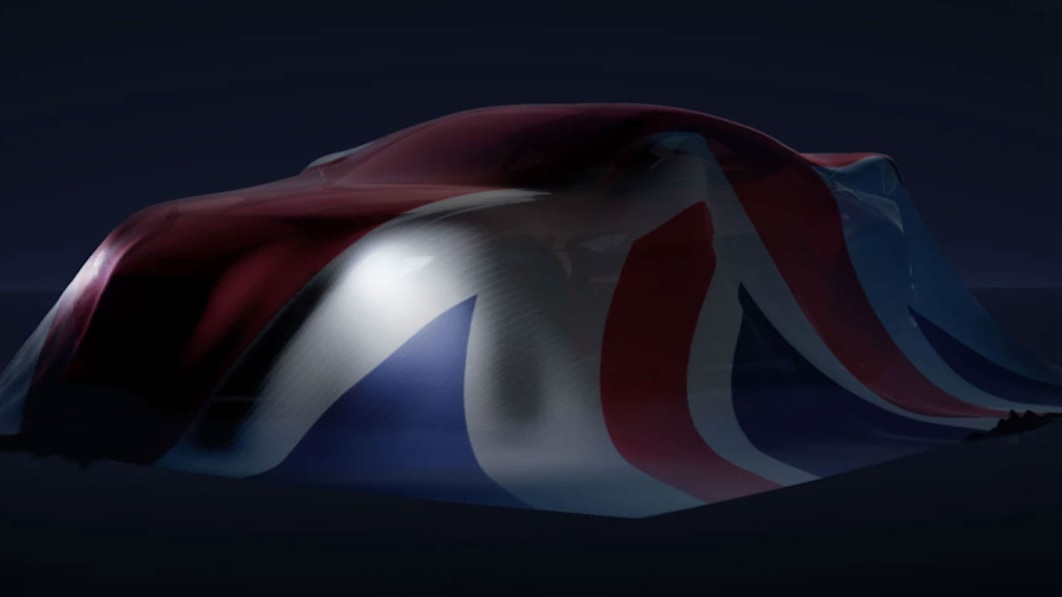
If you can handle another tease of the coming Aston Martin V12 Vantage, here are two. The first is a photo of what will certainly be a riotous super coupe under a partially opaque Union Jack. We can’t spot anything on the obscured car that we don’t know about from prototypes (or suspect from reports); the headlights, side mirrors, fender vents, and wheels are all there. Phew!. Out back, the drapery hangs high, pulled over a high wing that will be part of the V12 Vantage’s numerous aerodynamic accoutrements. The test vehicles we’ve seen have been wingless, fitting nothing more than a Gurney flap to the Vantage’s tidy ducktail, so we’ll have to find out if the wing is standard fit or an option. 

Behind the extra large grille, everyone is expecting the brand’s 5.2-liter V12. In the limited edition Speedster, which married the Vantage’s chassis to the Superleggera’s front end, that 12-cylinder made 690 horsepower and 555 pound-feet of torque. Predictions for V12 Vantage out range from about 600, roughly in line with the DB11, to about 670, which would be a massive hoot while leaving room enough not to fluster Speedster owners.

The second teaser is a brief Twitter video mood board with the admonition to “Never leave quietly.”

We’ll hear the supercar’s noise and find out about its backside on March 16, when the reveal happens. We should also find out then how many Aston Martin plans to make. A previous rumor put that production number at 299. The vehicle itself is expected to arrive for the 2023 model year as part of the standard Vantage’s model update, sources saying there will only be 299 made. The standard 2023 Vantage will be part of an overhaul of the front-engined Aston Martins that result in more power, better dynamics, and better interiors.

Related Video

Ferrari 296 GTB First Drive Review | Design and technical showpiece

Seville, Spain – Even when its founder Enzo was a pup, Ferrari was famously wringing maximum performance from miniscule engines. Today, that spirit lives on in the Ferrari 296 GTB plug-in hybrid – the first real V6 road car in Ferrari history – and a blistering track romp and road trip through Andalusia, Spain, proves again that automotive brilliance often comes in bite-sized packages. That talent, now combined with the modern shove and zero tailpipe emissions of electricity (in short distances) is coming in handy as regulators demand gasoline engines be downsized or eliminated entirely. When downtown Rome finally says basta to internal-combustion cars, the 296 GTB will get a free pass and a proud salute from locals.

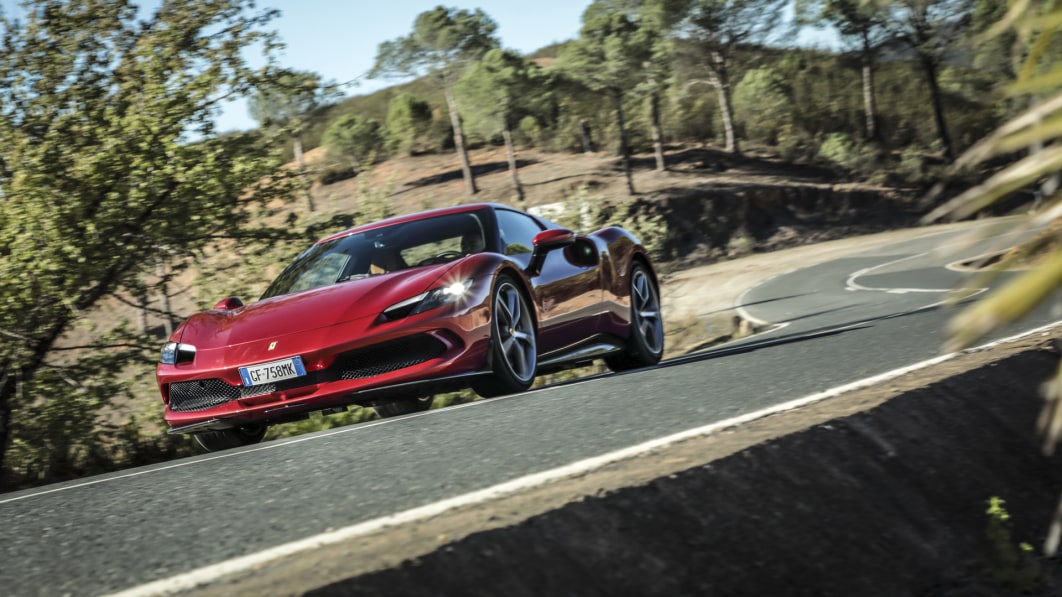
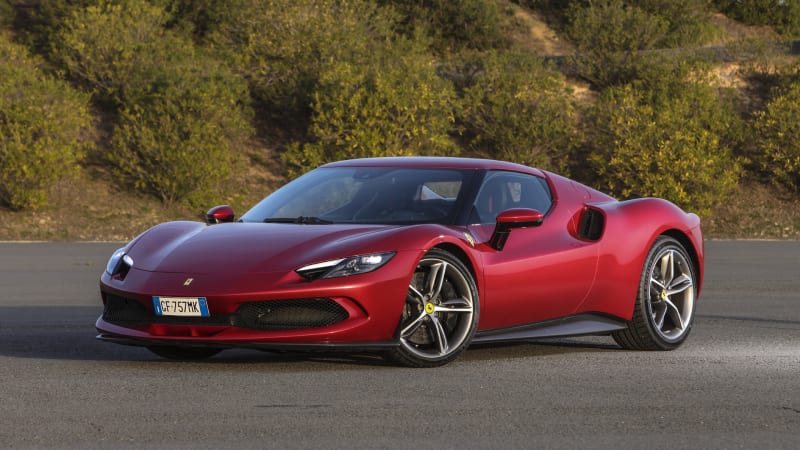
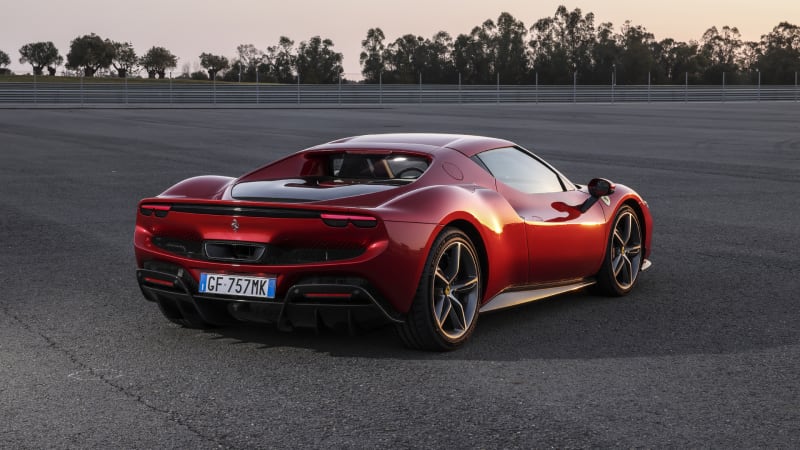
This Ferrari will draw its share of wolf whistles as well. New tech aside, the 296 GTB is more old-school Ferrari in styling; a swoopy object of lust from its flying buttresses to a carved-out Kamm tail.

Press the haptic e Drive switch on the 296’s exotic steering wheel and it can cover 15.5 miles on pure electricity at up to 84 mph. Its twin-turbo 3.0-liter V6 is sidelined via an electric clutch, and a ghostly hum emanates from within. No, that’s not the sound of Enzo turning in his grave. Just the opposite, I’d say. That dude loved to win, even (or especially) when people called him crazy, and said his tiny 12-cylinder jewels (Phrasing? -BH) would never work (Oh, it got worse -BH).

So if you assume the 296 GTB is the Ferrari customers must “settle for,” think again. This short-wheelbase, mid-engine Ferrari is gorgeously evocative of classic models like the 250 LM, including roller-coaster haunches that seem extruded from a fast-flowing body. With a ridiculous 819 rear-driven horsepower, the 296 GTB is also faster and more reactive than every larger V8 car in Ferrari’s lineup, including the 488 Tributo and wicked 488 Pista. How fast? Well, this six-cylinder warrior circles the Fiorano factory track in less time than LaFerrari — the seven-figure hybrid wonder of just a few years ago. “But it doesn’t have a V8,” your say? Well, fine: The 488s, Roma coupe and Portofino convertible remain eminently defensible choices. Just get used to the 296 GTB wagging its saucy tail in your face at track days (with its signature, high-mounted single exhaust outlet), while you mumble something about the “Good Old Days.”

I’m mumbling something else after storming through Andalusia on HU 4103, a two-lane, EU-funded fantasy road that resembles a private/public racetrack in the countryside: All mirror-smooth pavement, double-stacked guardrails, helpful bright-blue turn arrows and a dearth of other drivers. The 296 GTB bullets from corner to corner, as fast in full Automatic mode as when using the rabbit-eared, carbon-fiber paddle shifters. Braked with my left foot for balanced pendulum swings against the throttle, the Ferrari’s eight-speed dual-clutch gearbox self-downshifts as low as second gear at roughly 6,000 rpm.

Incredible by-wire brakes create a fierce double-whammy of engine braking and electric regen, and then the Ferrari is off again. On a long ascent and descent, the regen brakes slurp so much energy that the battery remains fully stuffed, even at maximum attack. This is a hybrid that basically never runs out of electric breath, a kind of junior F1 car for the street.

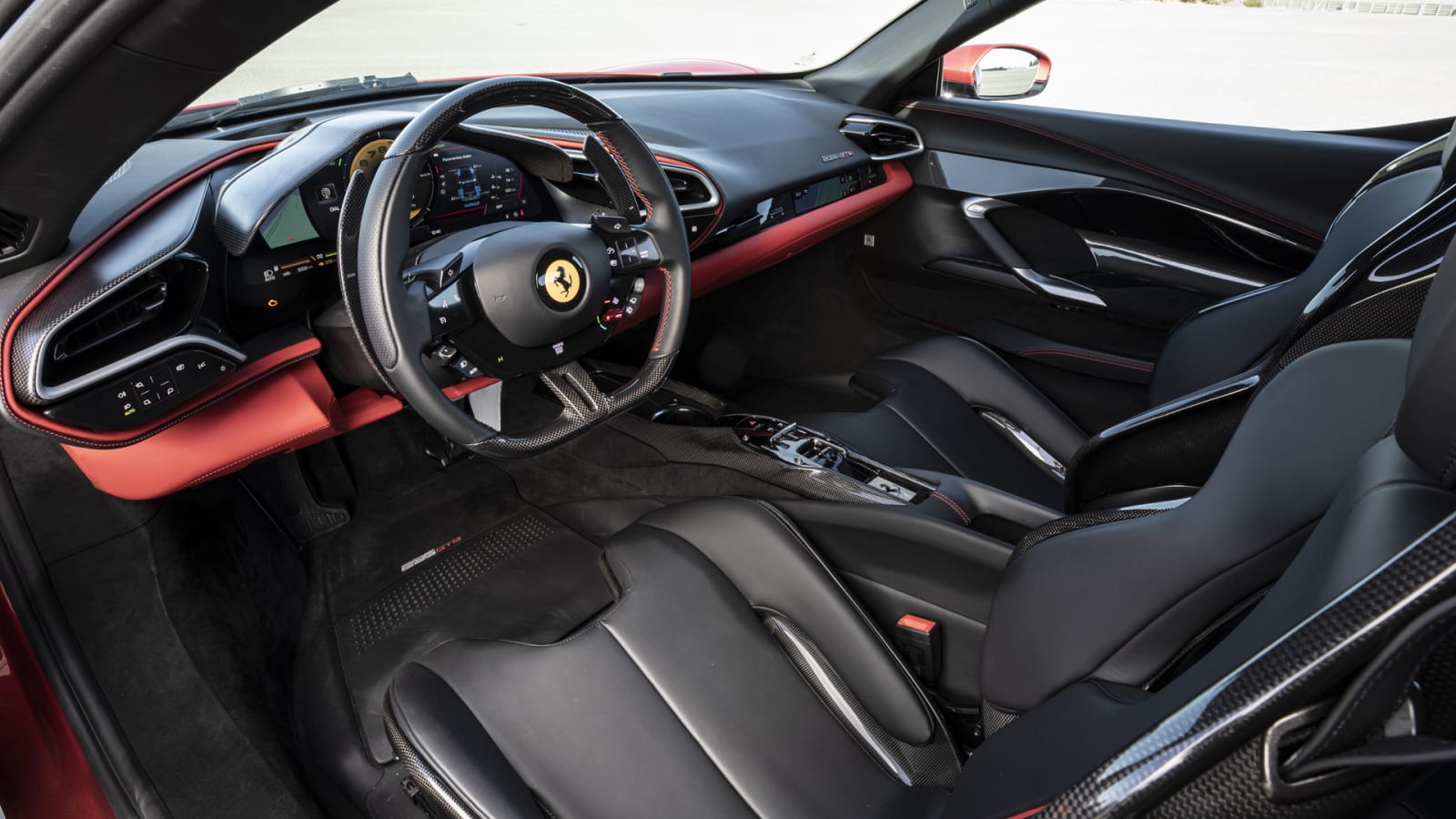
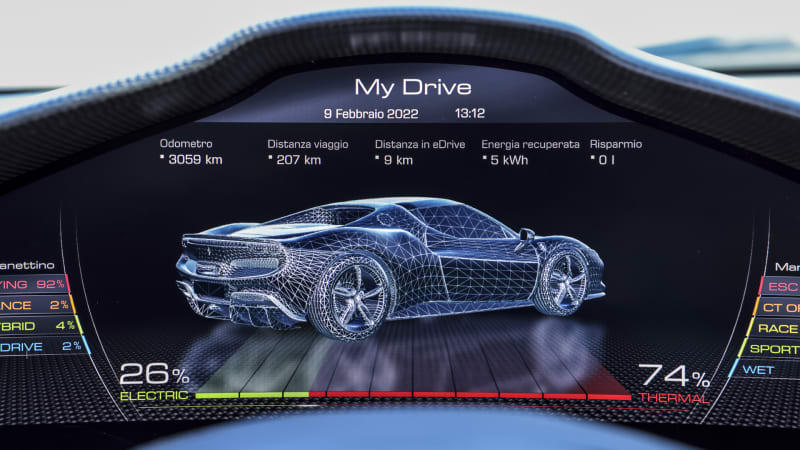
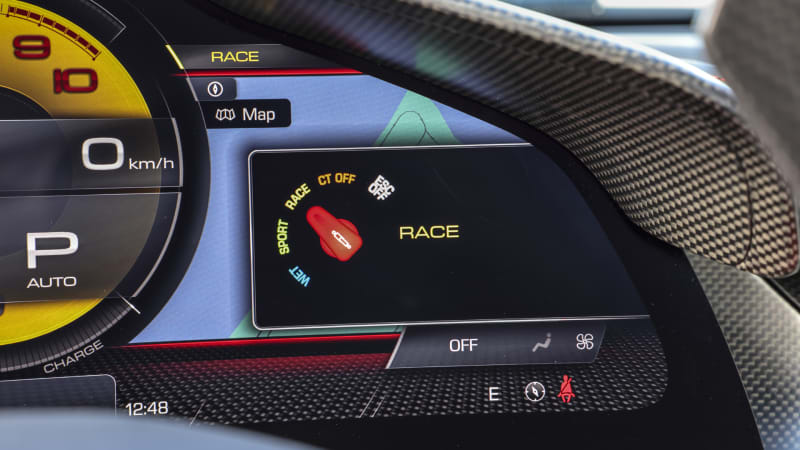
A “Qualifying” mode summons maximum performance for shorter bursts, but also fully recharges the 7.5-kilowatt-hour battery (with 80 lithium-ion cells) in less than 15 minutes in my hands. The 296 is also super-satisfying in Hybrid mode, cruising gasoline-free at a brisk clip, but ready to fire up the engine and lunge ahead with a firmer press of the throttle. After a perspiring 115-mile drive, the all-digital instrument panel, descended from the SF90 hypercar, informs me that I’ve used gasoline for 80% of the trip, electricity for the rest – and saved 1 liter of fuel in the process. Every little bit, si?

Seemingly limitless front-end grip is amplified with joyful, high-pitched 8,500-rpm shrieks from an engine that Ferrari engineers call the “piccolo V12” — “little V12.” That’s not all Italian hyperbole, as I’ll explain later. As for the “first Ferrari V6” claim, recall that the six-cylinder, mid-engine Dinos – sold from 1967 to 1974, named after Enzo’s tragically fated son – were intended as a “son-of” sub-brand, and never wore a Ferrari badge. Ferrari, of course, has enjoyed racing success with V6s in multiple eras, from Mike Hawthorn’s 1958 F1 championship to the 1982 campaign that saw the 126 C2 become F1’s first turbocharged title winner.

These Spanish roads wind through the Rio Tinto (“Red River”) whose mineral-infused waters flash a striking crimson, though our convoy of Ferraris may have created some spillover effect. Regarding red Ferraris, I’ve never been a fan of that too-obvious choice, but the 296 GTB’s Rosso Imola definitely works, a smoldering lipstick shade for this Italian supermodel. And while I do love me some 488 Pista, our long road-and-track day convinces me the 296 GTB is the smarter, better all-around sports car. The 296 – the name combining the 2,992-cc engine, and “6” cylinders – feels even more responsive, less high-strung and demanding, thereby more appealing as a daily driver. And that’s without getting into the electric advantages; including a redesigned electric motor, sandwiched between the engine and gearbox, that supplies 122 kilowatts (165 horsepower) and 232 pound-feet of torque, filling in all the low-rev and shifting gaps until there’s no chink in the armor.

Quicksilver handling recalls a Lotus by way of Maranello, but with double or triple the power. Its electric steering is immediacy personified, with a lightness that underlines the wrongheadedness of sports cars and sedans that confuse burly effort with actual road feel. A highway blast on the Autovia lets the 296 GTB demonstrate its searing pace and stability, surging to 150 mph and more as boggled drivers pull to the right to watch the Ferrari soar past. 

The craziest part is how a sports car can send 819 horsepower to the ground through rear wheels, effortlessly, without ever feeling like a handful of dynamite. Credit in part the specially developed, 20-inch Michelin Pilot Sport 4S tires, or the available Pilot Sport Cup 2s that nearly match the dry grip of racing slicks but remain DOT-legal.

Actually, this may be the craziest part: Company executives and engineers define the 296 GTB as the most “fun-to-drive” Ferrari, by intent and design. That may come as a shock to people who plunk down at least $523,000 – $200,000 beyond the GTB’s $323,000 base price – for its philosophical parent, the SF90 AWD plug-in. But Ferrari executives are nothing if not confident, saying there’s a Ferrari for every type of buyer, and obviously big enough garages that some can avoid making a choice altogether. While “fun to drive” has a subjective element, engineers insist there are objective parameters, including lateral/longitudinal response to throttle and steering inputs; shift times and sensations; brake pedal feel and response; and sound level and quality in the cabin. Designers and engineers parsed, mapped and quantified everything that makes a Ferrari “fun” – price tag didn’t make the list – and sought to elevate the 296 GTB to new highs, for owners who prize pure sensation and immediacy.

Sensations begin with a 2.0-inch shorter wheelbase and lower center-of-gravity versus any V8 Ferrari, which helps this sports car shrink around its pilot. The engine trims 66 pounds versus the V8. Dry weight is a commendable 3,234 pounds — 70 more than an F8 Tributo, thanks to the hybrid hardware and battery — but with 108 faster-acting horsepower on tap. That gives the 296 a better weight-to-power ratio than any rival. Meanwhile, the feelsome by-wire braking system, the company insists, lets the 296 GTB brake later and deeper into corners than any other Ferrari, allowing owners to attack apexes and just crush the pedal with no fear of upsetting the car.

Extensive aero work includes a “tea tray” doohickey up front to direct air along the underbody. Hidden headlamp ducts cool brakes, themselves fitted with ventilating “aero” calipers. Underbody height is as low as roadgoing rules allow, allowing reworked vortex generators to boost ground-effect suction and front downforce. Greedy cavities in those blush-worthy rear fenders feed turbo intercoolers. An active aero panel, hidden between taillamps, rises in an instant to generate up to 100 pounds of extra downforce, including under braking. I wasn’t arguing after my track drive at the Monteblanco circuit, where a roughly 165-mph straightaway abruptly ends at a near-hairpin corner. An optional Assetto Fiorano package forms that panel from carbon fiber, with stiffer Multimatic shock absorbers and other bits to further boost downforce and trim 26 pounds.

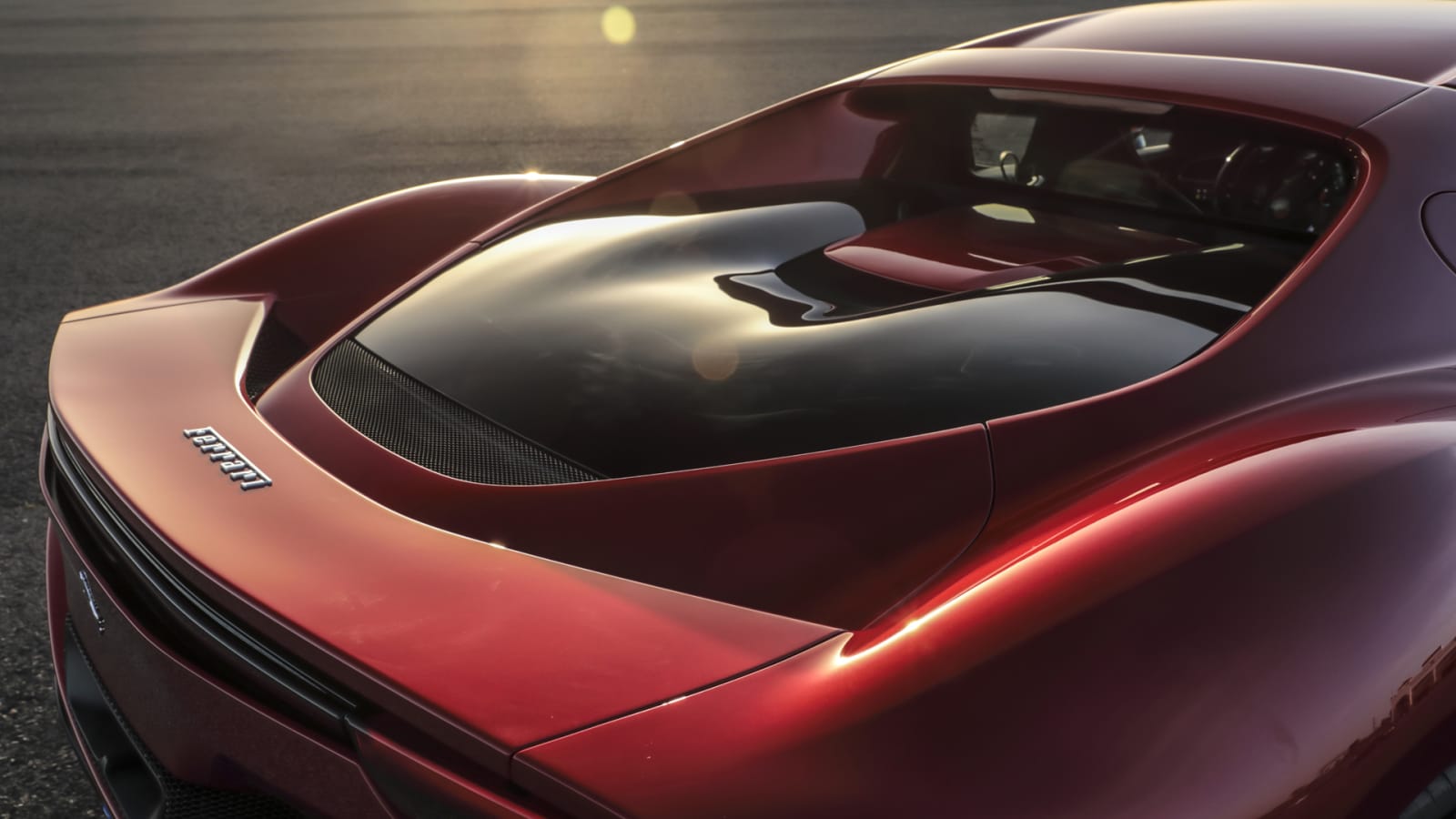
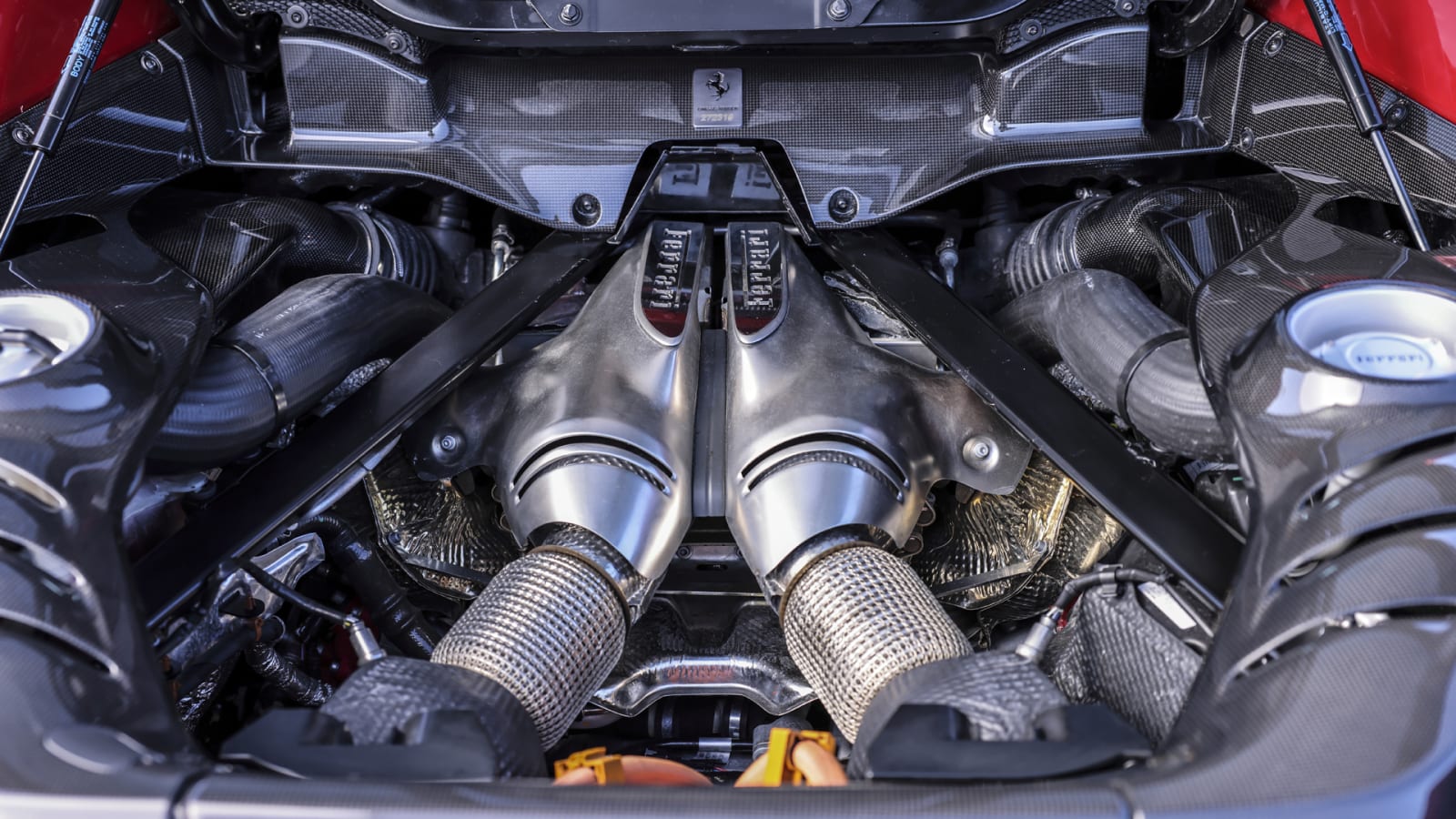
I’ve barely discussed that masterwork engine, discreetly hidden below dark-tinted, three-dimensional glass. Twin exhaust banks provocatively come together in a long, single central exhaust formed from thin-walled Inconel alloy. “Aluchrome” is used for the cavernous, high-mounted rear outlet, an alloy that maintains shine under extremely high temperatures.

Consider Enzo Ferrari’s first solo effort, the 125S racer of 1947, which made 118 horsepower from 12 dainty cylinders that displaced just 1.5 liters. This V6 alone generates 654 horsepower from just twice the displacement. Its 218 horsepower-per-liter becomes a historic high in specific output for any production automobile. The engine cradles a pair of turbochargers in the “hot-V” cleavage of 120-degree cylinder banks. Those turbos spin up to 180,000 rpm, with a huge 24% jump in performance and boost efficiency versus the V8 turbos. This engine is also a testament to high compression (including 350-bar fuel injection) and low inertia. The whistling turbos and a forged, nitrided crankshaft help reduce rotating masses by 11% versus the 3.9-liter V8.

This first in a new F163 engine family also combines two elements that can seem diametrically opposed: The force of turbocharging with the euphonious revving and trebly wail of a naturally aspirated V-2: Hence, “the piccolo V12.” The crankshaft’s 120-degree geometry, symmetrical cylinder firing order and tuned, equal-length exhaust runners deliver both the pressure pulses and harmonic sound orders of a V12. Those natural, odd-numbered harmonic orders are further amplified via a “hot tube” prior to exhaust treatment that push those sweet frequencies into the cabin, even at low revs. If a Mercedes-AMG V8 is basso profundo, this V6 is a La Scala tenor, sailing to 8,500-rpm peaks with enough force and emotional drama to bring tears to one’s eyes. Nobody, and I mean nobody, would guess there are only six cylinders churning below decks.

To all that, add 165 horses of inverted AC juice from the axial, dual-rotor motor. All told, this V6 Ferrari can shriek to 60 mph in 2.8 seconds, and to 200 kph (124 mph) in 7.3 seconds. Terminal velocity is 206 mph. That 0-200 kph figure is especially telling. It’s about 0.5 seconds quicker than a V8 McLaren 720S, and 0.9 seconds quicker than a Lamborghini Huracan Evo with a naturally aspirated V10. 

When I first clapped eyes on the 296 GTB and its stand-displayed V6 in early 2021 during an SF90 drive at Fiorano, I assumed it was some kind of “starter model.” That was before I realized what this crew was up to, and definitely before I experienced the car. The 296 GTB is a design and technical showpiece, like an SF90 Jr., but with the advantage of being smaller, lighter and rear-wheel-drive. As ever, there’s no free lunch in Maranello, even at the newly restored Cavallino restaurant where Enzo dined and did business almost daily. So a plug-in, small-engined showboat that’s faster than a V8 Ferrari must also cost more than a V8 Ferrari.

Thus, the 296 GTB starts from $323,000, a solid $42,000 hike over the 488 Tributo at $281,000; but a skosh less than a 488 Pista at $331,000. Some Tifosi will find that difficult choice keeping them up at night, perhaps counting cylinders. Some will rest easy, and buy one of each.