All posts in “Specialty”

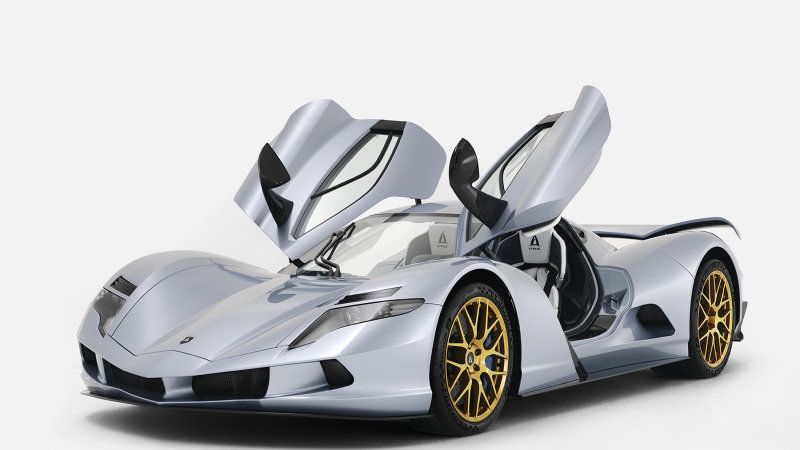
The Aspark Owl electric hypercar has 1,985 hp and a $3.3 million price tag

In 2017, Japanese electric hypercar maker Aspark showed the world its Owl concept at the Frankfurt Motor Show. Six months after that, Aspark showed a prototype Owl covering the 0-to-60-mph sprint in less than 2 seconds. Six months later, a more refined Owl appeared at the Paris Motor Show touting pre-production figures of 1,150 horsepower, 652 pound-feet of torque, and a dry weight of roughly 3,300 pounds. More absurd than any of that, Aspark wanted potential customers to put down a 1-million-euro non-refundable deposit. Now, a year later, the production-spec Owl touched down at the Dubai Motor Show having reworked its math, blowing up its output figures and asking for a rational deposit. The new totals come to 1,985 hp and 1,475 lb-ft from four permanent magnet synchronous motors, and a 4,188-pound dry weight.

The power boost works the expected effect on the 0-to-60 time, lowering it to a claimed 1.69 seconds. That’s on the road-legal, production-spec tires, either Michelin Pilot Sport Cup 2s or Pirelli P Zeroes. There’s an asterisk, though, in that the Aspark time was achieved with 1-foot of rollout, which is typically used by most car publications when testing 0-60 times. The earlier runs, which yielded times of 1.87 and 1.92 seconds, were run from a standstill but on Hoosier racing slicks. So proper zero to 60-mph sprints will be slower on street tires, however, the Owl is in with peers like the Rimac Concept Two (1.85 seconds) — at least on paper. Top speed is supposedly 249 mph. Ten-piston front brakes clamping carbon ceramic discs are apparently confidence-inspiring enough for someone to carry out acceleration runs in a parking lot.

The 800-volt, 64-kWh battery is good for 280 miles of range on Europe’s generous NEDC cycle, but Aspark says it’s working on a higher-capacity battery. A 44-kW on-board charger can restore the full charge in 80 minutes.

There’ve been a few other changes from the concept days in Frankfurt. A few tweaks were made to improve aerodynamics and aid worldwide homologation, like losing the louvered rear backlight for a smooth, windowless panel. The former fixed rear wing is now an active rear wing that rises at 93 mph and lowers at 62 mph. The concept’s side cameras are now side mirrors with additional cameras. And the side windows, thanks to an inset section like on the old Lamborghini Countach and Subaru SVX, open further.

The Owl’s built with carbon fiber body panels placed on a carbon fiber monocoque, the only metal reinforcement is used to strengthen the roof. That roof, by the way, is just 99.3 centimeters (39 inches) off the ground at the Owl’s standard ride height. A hydraulic suspension can raise the car 3.2 inches in two steps. 

Vehicle switches like the start/stop button are on the cockpit ceiling, while lower down, four screens convey information from the car, the infotainment system, and two side cameras. Drivers get cosseting features like climate control, ambient lighting, keyless entry, and a 50-liter luggage compartment, which comes out to a tiny 1.7 cubic feet. Safety kit includes anti-lock brakes, traction and electronic stability control, and an emergency stop alert.

Manifattura Automobili Torino in Turin, Italy, will build the Owl and expects to have the first customer unit delivered in April 2020. This is the same MAT that builds the Apollo IE and graced the world with the Ferrari F430-based MAT Stratos. Aspark will sell just 50 Owls for 2.9 million euros apiece ($3.3 million U.S.), and interested buyers are welcome to reserve a slot with a non-refundable 50,000-euro deposit. If buyers need more convincing, Aspark CEO Masanori Yoshida said he plans on taking the Owl to the Nürburgring early next year to claim the outright lap record.

2019 SEMA Show Mega Photo Gallery | Wild West show

LAS VEGAS — Car shows across the planet are struggling, as automakers look for fresh ways to reach the buying public. But out in Las Vegas at the SEMA show (SEMA stands for Specialty Equipment Market Association, in case you didn’t know), things have seemingly never been better. This year’s show has 2,400 exhibiting companies with 3,000 products on display, filling five halls. Off-road, performance, racing, hot-rods, coolness, weirdness — there’s something different around every corner.

The show ends Friday, so unless you’re about to hop a plane, you might just miss it. But here, from the comfort of your own home or cubicle, are the highlights — 45 cars that caught our eye. So sit back, crack a Zima and SEMA it up:

2020 Acura RDX with Concept A-Spec AccessoriesAcura shows off RDX accessories and 2020 NSX at SEMA

B is for Build Twin-Turbo V8 Huracan Widebody2015 Lamborghini Huracan is getting twin-turbo Chevy power for SEMA

Button Built Ferrari BB355TTToyo Tires will bring another wild catalog of rides to SEMA

2020 Chevrolet COPO Camaro John Force Edition – The Force is with you in this one-off Chevy COPO Camaro

2021 Chevrolet Colorado ZR2 Dusk Edition – 2018 Chevy Colorado ZR2 Midnight and Dusk Editions to debut at SEMA

Chevrolet Performance E-10 ConceptChevy truck transformed from farm work to 450-horsepower electric hot rod

2021 Chevrolet Silverado HD Carhartt Special EditionYou’ll know the 2021 Chevrolet Silverado 2500 HD Carhartt Special Edition when you see it

2020 Dodge Challenger Drag Pak2020 Dodge Challenger Drag Pak comes solely with supercharged power

Factory Five Romulan V12 SupercarFactory Five developing new supercar with 755-hp LS V12

Foose Jaguar E-Type Chip Foose cooks up a custom 1974 Jaguar E-Type for SEMA

Jay Leno’s GT500-powered 1968 Ford BroncoThis classic Ford Bronco has a modern GT500 engine and a manual

Ford F-Series CustomsFord previews custom F-150s and Mustangs for SEMA

Ford F-Series Super Duty CustomsCheck out the Ford Super Duty lineup rolling into SEMA 2019

Ford Mustang CustomsFord previews custom F-150s and Mustangs for SEMA

Ford Mustang LithiumLithium Mustang EV from Ford and Webasto is lightning in an bottle for SEMA

Ford Ranger Customs2019 Ford SEMA builds feature off-road-ready Rangers and wild Transit Vans

2020 Ford Ranger RTR 2019 Ford SEMA builds feature off-road-ready Rangers and wild Transit Vans

Ford SUV CustomsFord will bring more than 50 tricked-out vehicles to SEMA: Here’s a preview

Hennessey Jeep Gladiator Maximus Hennessey Maximus turns 2020 Jeep Gladiator into a 1,000-horsepower monster

Honda Civic Si Formula Drift CarHonda to show custom 1968 S800 Coupe, three Civic Si builds at SEMA

Honda CR-V CustomsHonda CR-V, Passport and Ridgeline highlighted at SEMA

Honda Rally PassportHonda CR-V, Passport and Ridgeline highlighted at SEMA

Honda Ridgeline HFP ConceptHonda CR-V, Passport and Ridgeline highlighted at SEMA

Honda Vintage VehiclesHonda to show custom 1968 S800 Coupe, three Civic Si builds at SEMA

Hyundai Kona Ultimate ConceptHyundai Veloster N ‘Type R Killer’ and lifted Kona on their way to SEMA

Hyundai Veloster N Performance Concept2020 Hyundai Veloster N Performance Concept gets an aftermarket makeover

Hyundai VelosterRaptor N ConceptHyundai Veloster N ‘Type R Killer’ and lifted Kona on their way to SEMA

Jack Roush Edition Mustang Jack Roush Edition Mustang brings 775 horses to Ford’s pony car

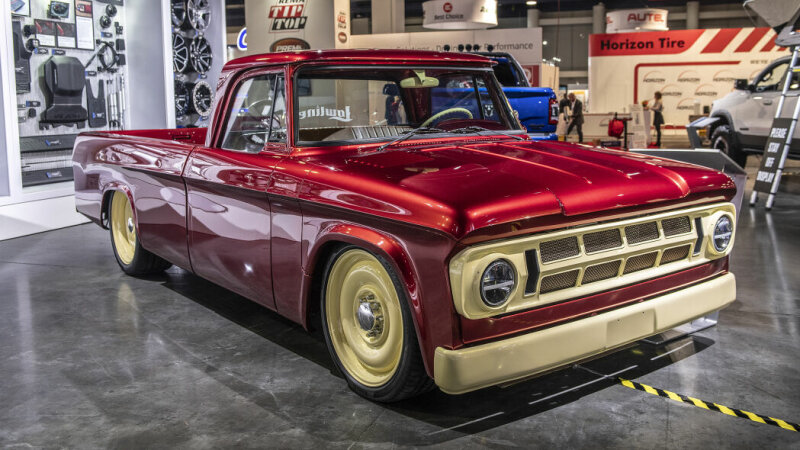
Mopar Lowliner Concept1968 Dodge D200 ‘Lowliner’ adds low-down diesel torque to a lowrider

Moparized Jeep Wrangler RubiconRam 1500 diesel overlander, off-road Jeep Wrangler show present and future of Mopar

Nissan Global Time Attack TT 370Z ProjectNissan Frontier 600-hp desert-runner, 370Z with 750 hp lead assault on SEMA

Nissan Frontier Desert Runner ProjectNissan Frontier 600-hp desert-runner, 370Z with 750 hp lead assault on SEMA

Nissan Kicks Street Sport ProjectNissan Frontier 600-hp desert-runner, 370Z with 750 hp lead assault on SEMA

2020 Nissan Titan with Genuine Nissan AccessoriesNissan Frontier 600-hp desert-runner, 370Z with 750 hp lead assault on SEMA

Nissan Titan XD Dually Project

1958 Plymouth Fury ‘Christine’ Tribute 1958 Plymouth Fury ‘Christine’ tribute has a 1,000-hp Hemi crate engine

Quintin Brothers Dodge ChallengerThis Dodge Challenger was stolen, used in police chases and recovered all in the week before its SEMA debut

Ram 1500 Rebel OTGRam 1500 diesel overlander, off-road Jeep Wrangler show present and future of Mopar

Ring Brothers 1969 Chevrolet Camaro ValkyrjaRingbrothers 1969 Chevy Camaro ‘Valkyrja’ ready to take SEMA to Belgium

Ruffian Ford MustangToyo Tires will bring another wild catalog of rides to SEMA

Russell Built Porsche 911 BajaToyo Tires will bring another wild catalog of rides to SEMA

Shelby GT500 Dragon SnakeShelby brings Dragon Snake GT500, Super Snake F-150 truck to SEMA

Speedkore AWD Twin-Turbo Dodge Charger WidebodySpeedkore AWD twin-turbo Carbon Charger, best birthday gift ever

Toyota Avalon TRD Pro ConceptToyota floods SEMA with a slew of Supra concepts

Toyota GR Supra CustomsToyota floods SEMA with a slew of Supra concepts

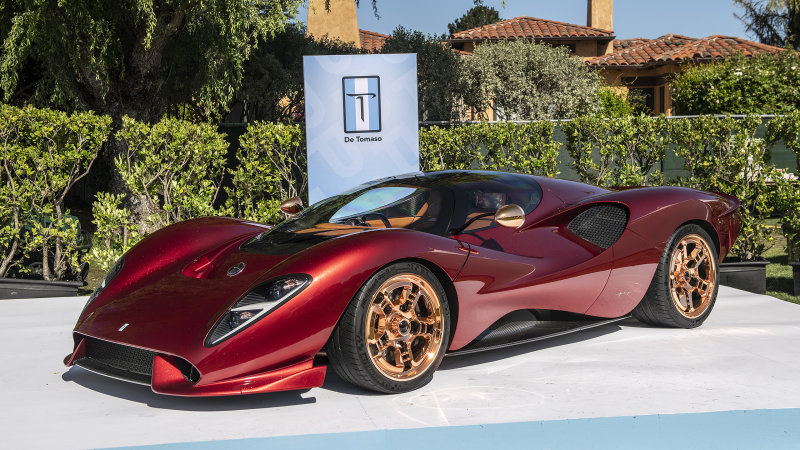
De Tomaso P72 gets a 5.0-liter Ford V8 with 700+ horsepower

All the comments the Hong Kong-based Consolidated Ideal TeamVentures (CIT) have made about resurrecting the De Tomaso brand have stressed the company’s focus on staying true to De Tomaso’s intentions and the values of his car company. The first proof of that came in CIT deciding to pay homage to the practically unknown De Tomaso P70 with the P72, instead of going for the slam dunk with a Pantera facsimile. The second proof comes in the choice of engine for the P72: Ford’s 5.0-liter Coyote V8 further developed by De Tomaso and Roush Performance. From De Tomaso’s first road car, the Vallelunga, to his last, the Guarà, he used Ford engines.

Final output figures will come in north of 700 horsepower and 608 pound-feet of torque thanks to a Roots-type supercharger. Yes, that’s less grunt and gumption than one gets from the 2020 Ford Mustang Shelby GT500, a coupe that costs one-tenth the P72’s 700,000 euros ($842,000 U.S.). But the men behind the project say blinding power figures are “irrelevant to ethos of this project and what we are trying to achieve.” In the words of general manager and chief marketing officer Ryan Berns, “In our opinion the market is now over-saturated with commercially driven ‘limited edition’ models primarily marketed on performance metrics. We have grown tired of this notion and thus took a contrarian approach with the P72.” The point with this car, rather, is “the provenance and the overall experience as a brand and for our clients.”

We can’t judge all of that yet, but the engine looks good on paper. Roush Performance tweaked the two four-lobe rotors in the supercharger for faster operation, better airflow and thermal efficiency, and less noise and vibration. The supercharger provides the power and response De Tomaso wants, along with regulation compliance in the U.S. and Europe. Yet the engine’s still in development as De Tomaso works to reduce the apparent presence of the supercharger, stressing an “old-school American V8 soundtrack” and the naturally aspirated spirit of the Sixties. Roush also added dry-sump lubrication, and it’s planned that the engine’s redline will lie beyond 7,500 rpm. Power gets sent to the rear axle through a six-speed manual gearbox, and we’re told to expect an audio clip soon of the “symphonic exhaust system” that exits atop the rear deck. If done right, the sound “brings one back in time as if they were on the starting grid at Le Mans in 1966.”

Miller Motorcars is the U.S. dealer for anyone still interested, but it seems this is a matter of snoozing and losing; De Tomaso will only build 72 examples of the P72 – hence the name – and the car already has more than 72 people standing in line for the chance to buy.

Factory Five developing new supercar with 755-hp LS V12

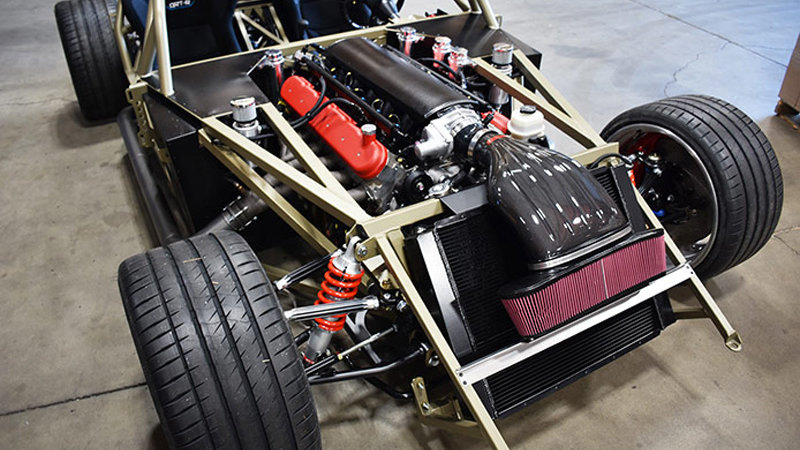
Factory Five has produced its mid-engined GTM supercar for more than 10 years, that car using C5 Chevrolet Corvette internals wrapped in a steel tube frame chassis and original composite bodywork. The Massachusetts-based company is working on a replacement now, coming to SEMA next month as an engine and chassis, due for debut in February 2020. Called Project Romulan, the chassis is a stretched and widened version of the Gen 3 Type 65 Coupe, otherwise known as the Shelby Daytona Coupe kit car the company sells. Yet whereas the kit car normally uses a Ford-sourced V8, Project Romulan gets a General Motors LS3-based 9.5-liter V12 with LS7 type heads made by Australian company Race Cast. The output: a turnkey 755 hp and 694 lb-ft on pump gas.  

And those numbers aren’t the wildest part. Hot Cars reports Project Romulan comes with a “Star Trek” backstory by way of Gaydon, England. Seems Factory Five benchmarked its supercar specs against the Aston Martin Vulcan. The Vulcan, remember, was a track-only car limited to 24 units, each powered by a 7.0-liter V12 with 820 hp and 575 lb-ft, although a few were converted to road-legal status. In “Star Trek” lore, when most of the once-violent and emotional Vulcans gave up their warfare for logic, as per Spock, a Vulcan faction quit the planet and settled planets Romulus and Remus. One coin, two sides.   

The 580-cubic-inch LS V12 will rev past 6,000 rpm, and Factory Five turned up the engine it calls “our mini Merlin” just a touch for a couple of Facebook videos. It’s mean. And even with an extra 4.5 inches across the chassis and nine more inches of chassis length, the fit is snug. Race Cast also provides the ECM and harness for the motor, Factory Five worked up custom bits like the oil pan and coil mounts. The tuner says the engine “will be available as one part number for anyone building this kit once it’s released.” Compared to a Coyote V8, the LS V12 will put about 140 more pounds on the front — 444 pounds for the Ford V8 vs 584 pounds for the Race Cast iron block V12 — but double-adjustable Koni shocks will do their best to make the weight worth it, and a serious set of Wilwood brakes will manage stopping.  

Factory Five says the super coupe will get a finished carbon fiber body with a new, modern design that needs no additional work. Assuming all goes well, after the February debut, production will begin later in 2020.

Lamborghini Squadra Corsa previews 830-hp hypercar and racing Urus ST-X

At the conclusion of last year’s Lamborghini Super Trofeo series, the Sant’Agata Bolognese carmaker’s Squadra Corse division unveiled the SC18 Alstom. That was a one-off, customer-commissioned, extreme track car based on the Aventador SVJ, and the first wholesale creation from the racing department. At this year’s series finale in Jerez, Spain, it teased a limited-run hypercar and an evolution of the race-bound Urus ST-X. The hypercar proves a rumor from earlier this month, when a poster at the McLaren Life forum said he was “Going to spec next week and test drive the SVR V12 track version of AV,” that AV standing for Aventador. Lamborghini says the track-only car, designed by the company’s Centro Stile department, will debut next year.

The rumor had posited the hypercar as a ne plus ultra expression of the Aventador’s 6.5-liter V12, and that seems to be the case. Engineers extracted 830 horsepower from the naturally aspirated engine, 70 hp more than found in the SVJ. In place of the road car’s seven-speed, single-clutch ISR transmission, the unnamed hypercar uses a six-speed Xtrac sequential gearbox, and a mechanical limited-slip differential can be adjusted by the driver for preload. The standard Aventador chassis has been reworked around that powertrain for aerodynamic and safety reasons. The front structure’s made of aluminum, a more pliant — and less expensive — material to deal with in case of incidents on the track. The engine’s been wrapped in a steel cage in order to increase torsional and bending stiffness. Airflow improves thanks to dual intakes on the hood, an airscoop over the cockpit, and a stonking rear wing. 

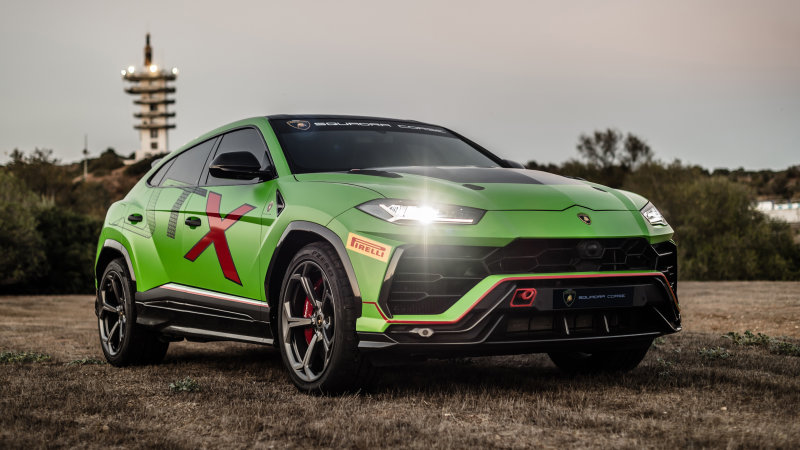
The Urus ST-X has undergone a few changes since its debut last year. The Verde Mantis SUV has been lightened by about 25 percent compared to the production version with “a lighter structure,” a vented carbon fiber hood and rear wing, and a racing exhaust. The cabin’s luxurious appointment are replaced by a roll cage, racing seats, and a fire suppression system. Scheduled to make its race debut at the end of October 2020 in Misano, Italy, the first pilots to get a chance behind the wheel will be winners of the four classes in the Super Trofeo series.