
All posts in “Special and Limited Editions”

Aston Martin teases V12 Vantage twice more ahead of debut

If you can handle another tease of the coming Aston Martin V12 Vantage, here are two. The first is a photo of what will certainly be a riotous super coupe under a partially opaque Union Jack. We can’t spot anything on the obscured car that we don’t know about from prototypes (or suspect from reports); the headlights, side mirrors, fender vents, and wheels are all there. Phew!. Out back, the drapery hangs high, pulled over a high wing that will be part of the V12 Vantage’s numerous aerodynamic accoutrements. The test vehicles we’ve seen have been wingless, fitting nothing more than a Gurney flap to the Vantage’s tidy ducktail, so we’ll have to find out if the wing is standard fit or an option. 

Behind the extra large grille, everyone is expecting the brand’s 5.2-liter V12. In the limited edition Speedster, which married the Vantage’s chassis to the Superleggera’s front end, that 12-cylinder made 690 horsepower and 555 pound-feet of torque. Predictions for V12 Vantage out range from about 600, roughly in line with the DB11, to about 670, which would be a massive hoot while leaving room enough not to fluster Speedster owners.

The second teaser is a brief Twitter video mood board with the admonition to “Never leave quietly.”

We’ll hear the supercar’s noise and find out about its backside on March 16, when the reveal happens. We should also find out then how many Aston Martin plans to make. A previous rumor put that production number at 299. The vehicle itself is expected to arrive for the 2023 model year as part of the standard Vantage’s model update, sources saying there will only be 299 made. The standard 2023 Vantage will be part of an overhaul of the front-engined Aston Martins that result in more power, better dynamics, and better interiors.

Related Video

De Tomaso P72 sounds glorious while winter testing

Tis the season of ESC calibrations on ice and throwing snowflake roostertails, otherwise known as winter testing. Audi likes to throw walls of white in northern Sweden, as it’s doing now with the 2023 E-Tron electric crossover. De Tomaso Automobili seems to prefer Switzerland, having taken its coming P72 coupe to an alpine valley for wintertime exercises. The best thing about what is essentially another snowy drifting video is the sound of the engine. The P72’s curves drove straight out of 1965 and some enthusiasts might not harbor any nostalgia for them. The rumble from the mid-mounted, supercharged Ford 5.0-liter Coyote V8 that De Tomaso and Roush Performance further tuned into something vintage and cantankerous, well, that should get near-unanimous approval.

De Tomaso said the supercar and hypercar trend of massive engine output is “irrelevant to the ethos of this project and what we are trying to achieve.” It’s clear that the noise is very relevant. You wouldn’t suspect the Coyote breathed through a Roots-type supercharger, but such is the case. Roush tweaked the blower for faster operation, better airflow and thermal efficiency, and less noise and vibration, that latter bit in order to stress an “old-school American V8 soundtrack” and the naturally aspirated spirit of the Sixties. Assuming the A/V crew didn’t play with the supercharger sound levels when editing the vid, the P72 has become a lot more attractive having learned it will bellow some old-school commotion through its top-mounted exhaust. We’ve been told final output will coast somewhere north of 700 horsepower and 608 pound-feet of torque, the planned redline beyond 7,500 rpm. 

The P in the coupe’s alphanumeric name represents Prototipo in the name of the original De Tomaso race car from the 1960s, the 72 representing how many of these will be made. They were priced at 700,000 euros apiece ($763,000 U.S.) last year, but many things have happened since then, so that might be revised upward. Not that the target demo will care much.

Related Video

2022 Ford GT Holman & Moody Heritage Edition teased

The Ford GT is reportedly ending production this year with the full allotment of 1,350 cars built. The automaker is loading up on special editions for the run to the finish, revealing the 1964 Prototype Heritage Edition last August, the Alan Mann Racing Heritage Edition last month, and now teasing a Holman & Moody Heritage Edition. This throwback celebrates one of the major partners in Ford’s Le Mans effort, the North Carolina shop Holman & Moody Racing that prepped NASCAR racers for Ford teams. The outfit gets less publicity than Shelby — the fate of just about every other collaborator once Shelby shows up — but the tuners helped develop GT40 MkII vitals like the 427-cubic-inch engine and the braking system. Their entry, the #5 driven by Ronnie Bucknum and Dick Hutcherson, finished third at the 1966 24 Hours of Le Mans behind the Shelby American cars. 

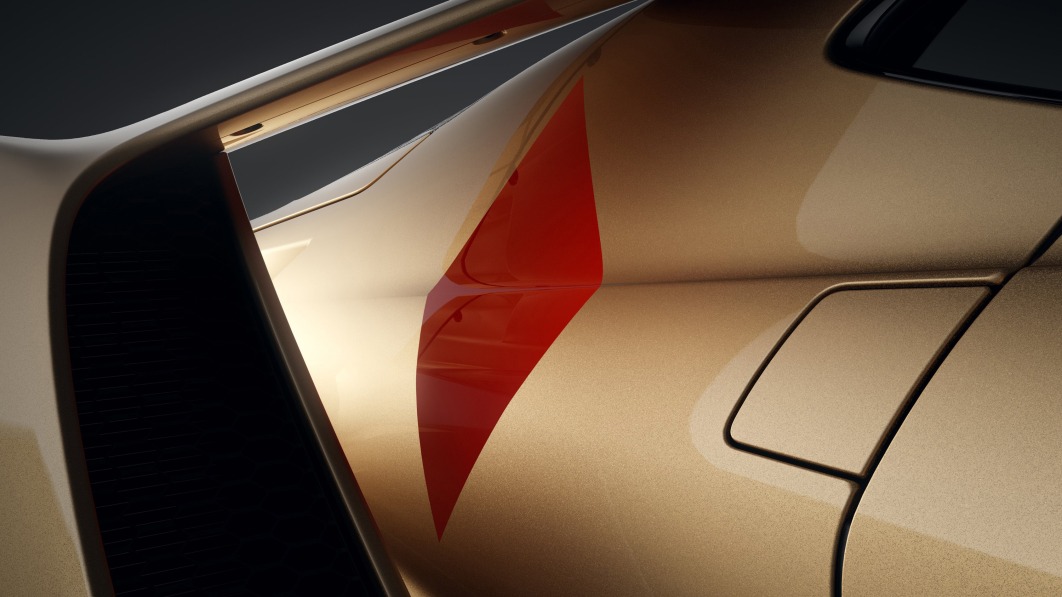
The teased GT only gives away the traditional Holman & Moody livery colors of gold and red, and a roundel bearing the number 5. We expect the formula for this coupe won’t change from previous the previous retro treats, with colors and special accents inside being the extent of the changes.

What’s wild about this heritage edition appearing at this time is that not even two weeks ago, an owner listed his personal 2020 GT done up in a Holman & Moody tribute livery for sale on Collector’s Garage. The owner had asked Camilo Pardo, who designed the 2004 Ford GT, to create the design, then had the car painted in Atomic Gold with white and pink accents, finished with a set of custom green HRE wheels. And yes, it was painted, not wrapped. It’s still for sale for $1.2 million.

The official 2022 GT Holman Moody Heritage Edition will be less than half that, for those who can get it. Ford says the debut comes this spring, which isn’t far away.

Related video:

RML Short Wheelbase restomod is ready for testing

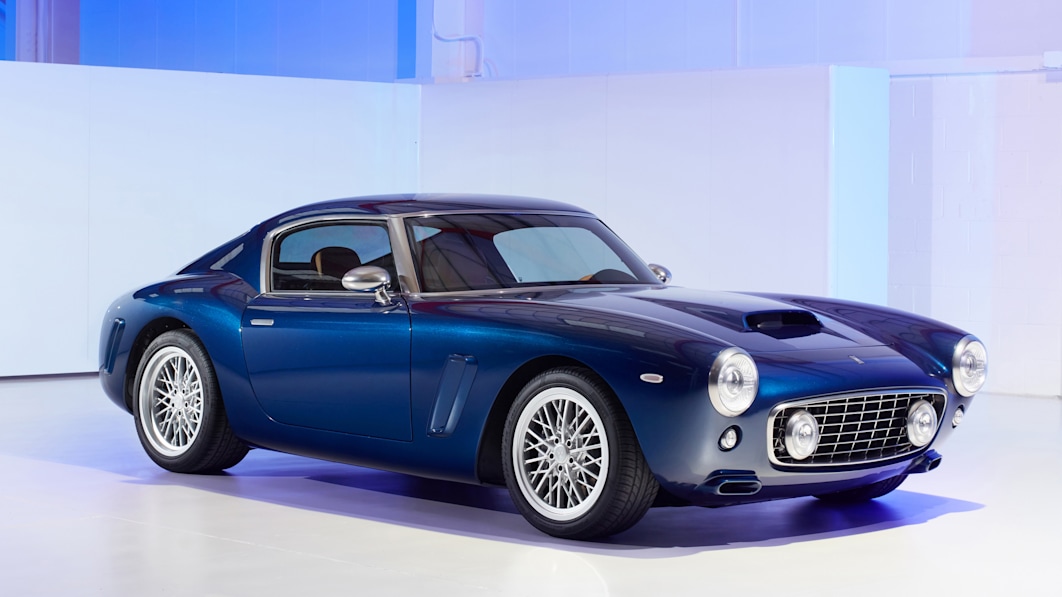
Eight months ago, English motorsports firm RML released renders of its first venture into customer cars, the RML Short Wheelbase. The restomod turns a Ferrari 550 Maranello into a reboot of the 1959 Ferrari 250 GT Berlinetta Short Wheelbase, dressing the Maranello’s chassis and engine in a carbon fiber body and bespoke cabin, then employing RML’s motorsports expertise to perfect the driving manners. Car Zero, the first pre-production model, is finally ready for “an intensive durability program” in the UK. Its maker didn’t skimp on getting Car Zero ready for the spotlight, either. No mere collection of glued and bolted parts, this one wears a multi-layer paint job with a carbon primer, regular primer and silver base coat under its luscious metallic blue overcoat.

The 550’s 5.5-liter atmospheric V12 makes the transfer with no change to power, putting out 485 horsepower and 419 pound-feet of torque. It’s been tuned to “emulate the exhaust note of a classic V12 road racer,” the classic 250 family known for just such exploits. The modern coupe’s six-speed manual is along for the ride, too, worked through an open-gate shifter. A slightly lower curb weight thanks to the lighter body improves a performance a skosh, the RML claimed to hit 62 miles per hour in about four seconds and reach a top speed of 185 mph. Maintaining high-speed, long-distance composure in a vehicle designed to “drive from [England] to Le Mans and get out and still be able to walk at the other end” is the job of custom Ohlins dampers, as well as subtle bodywork mods to dismiss unsettling aero effects the vintage silhouette would otherwise allow. For a personal tour of the Short Wheelbase, check out the video with RML CEO Michael Mallock explaining what the designers and engineers wanted to achieve, and how they did so.  

RML will only build 30 of these, deliveries beginning this year. We’ll be happy to see one in person, but we’re also happy that not many 550 Maranellos will need to be sacrificed for the cause. Each Short Wheelbase takes about six months to make, pricing estimated to be around £1.5 million ($2.04M U.S.). Head designer Jonathon Bowen said, there will be a “a variety of exterior trims to choose from,” and that his team is “developing some period-correct graphics, such as door roundels and parallel stripes, which suit the car’s design and remit perfectly.”

Ford GT Alan Mann Heritage Edition revealed, celebrates lightweight pioneer

Of the six Heritage Editions Ford has released to celebrate the newest Ford GT, two have commemorated original GT40s from 1966. Here is the third, the Alan Mann Heritage Edition. It recalls the lightweight Ford GT40 experimental prototypes that Alan Mann Racing (AMR) created in England in 1966, referred to at the time as AM GT-1 and AM GT-2. Mann’s team reskinned the GT40 in aluminum and made a small number of mechanical changes to the MkI GT40 powered by the 289-cubic-inch V8, aiming at Le Mans that year. Of the five his crew ordered, he received just two before Ford shifted its attention to the GT40 MkII that used the 427-ci V8. AMR campaigned his two cars in Europe anyway. Although the pair never won a major race, Ford learned important lessons from what Mann had done, hence this carbon-fiber-bodied tip of the hat.

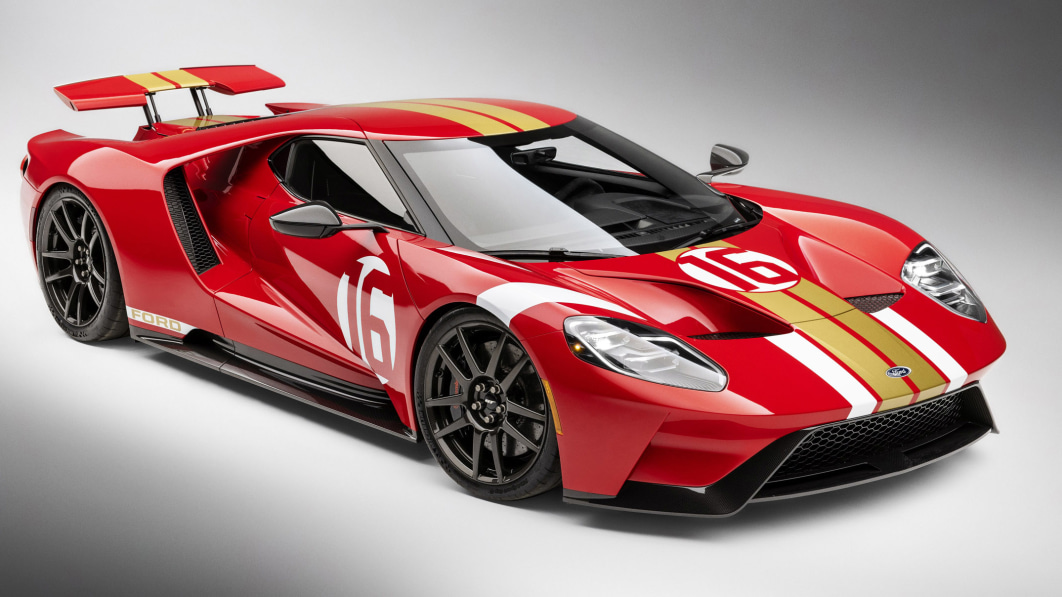
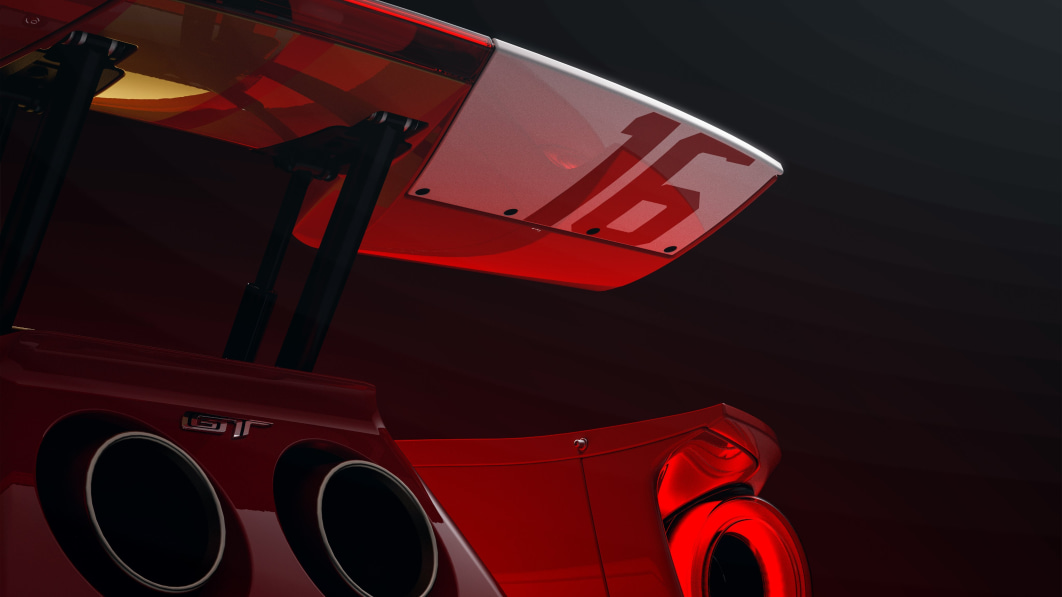
In December, the automaker teased a few lustrous red angles of the new GT accented with gold and Frozen White stripes, AMR’s signature colors. The revealed coupe is just as pretty as we suspected, those dual gold stripes running from tip to extendable tail. AM 1 raced with the number 16 in its roundel, reproduced here on the doors and hood as with the original, and again on the underside of the rear wing instead of on the top corner of the rear fender. Glistening black accents come in the exposed carbon fiber front splitter, mirrors, side sills, engine louvers and rear diffuser, and 20-inch wheels hiding lacquered black Brembo brake calipers.  

Inside, more carbon fiber in places like the center console and vents mixes with Ebony Alcantara surfacing for the instrument panel, steering wheel, headliner and carbon seats. Contrast stitching in gold and red ties the cockpit to the exterior, as do gold appliques on the instrument panel, vent bezels and seat X-brace. The paddle shifters can’t be missed in Alan Mann Racing’s hot red.

Those heading to the Chicago Auto Show that runs from February 12-21 will get to see the original 1966 Alan Mann Racing AM GT-1 next to the 2022 GT Alan Mann Heritage Edition. Those who want to get even closer to the modern special in this final year of GT production are free to order the GT Heritage Edition from Ford after securing the necessary approval to be a GT customer. First deliveries happen this quarter. For folks with too much money parked in the Caymans, AM GT-1 crossed the block at Gooding & Co’s 2021 Pebble Beach auction, given a pre-sale estimate of $7 to $9 million but not selling, so there could still be an opportunity there.

Related Video:

Hennessey Venom F5 continues high-speed stability testing

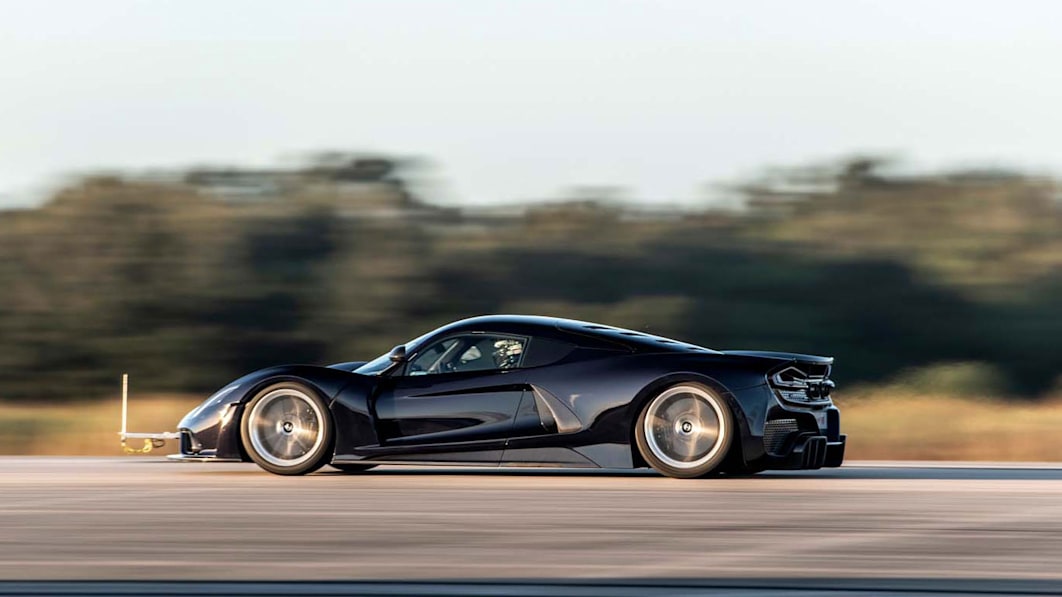
Having just posted about Hennessey putting its Venom F5 “Fury” engine on the dyno, we wondered when the total package would be showed on test. Well, here you go. The Lone Star manufacturer of gangbuster machines took a Venom F5 to the Johnny Bohmer Proving Grounds on Merritt Island, Florida, for high-speed stability and vehicle dynamics testing, with ex-GM engineer John Heinricy on piloting duties.

This follows other speed runs in places like Hennessey’s Sealy, Texas, home base, the UK’s Silverstone Circuit, and a runway at an ex-U.S. Air Force base in Arkansas. The day had nothing to do with testing the upper limits of the car’s velocity, merely how the Venom felt as it approached those limits. Having said that, Hennessey tells us that when Heinricy chose the F5 driving mode, he made it past 250 miles per hour at least once. 

That F5 setting unlocks the entire 1,817-horsepower potential of the 6.6-liter twin-turbocharged pushrod V8 nicknamed “Fury” when the tank is filled with E85. When not in that mode, the redline comes down by 300 rpm, to 8,200 rpm. 

It’s said there’s a proper top speed run planned for the not-too-distant future, again on Merritt Island, along with testing runs at Texas’ Circuit of the Americas and California’s Laguna Seca. Before the year is out, we should know if the Venom will be equal to the purpose it was created for: hitting 311 miles per hour. With a hotspur goading it on, the Venom F5 certainly does make a sweet noise on the way up there.

Spyker is back again, maybe

The motto of Dutch car company Spyker was, “Nulla tenaci invia est via.” That’s Latin for, “For the tenacious, no road is impassable.” If nothing else, no other outfit has lived its motto more fully than the outfit still headed by Victor Muller. After buying Saab in 2010 and foundering under the purchase, going bankrupt in 2014, being bought by private equity in 2015 and foundering again, declaring new investors in 2020 before going bankrupt again in 2021, we have another new announcement that Spyker is back. The investors this time are the same as in 2020 — when funds never came through and Spyker went bust again — Russian businessmen Boris Rotenberg and Michail Pessis. According to a press release, a new round of meetings last month led to new agreement between all parties about the direction of the company, so hands will finally get to work building new cars.

Rotenberg owns SMP Bank in Russia, title sponsor of SMP Racing that Rotenberg co-owns with Pessis. He also co-owns energy company SGM Group and runs BR Engineering, which entered the BR Engineering BR1 in the World Endurance Championship. Pessis owns luxury firm Milan Morady out of Luxembourg and the automotive tuner R-Company in Germany. Both are Spyker owners, Pessis saying in August 2020, “Since Boris Rotenberg and I ordered our first Spyker almost a decade ago, we passionately fell in love with the beauty and craftsmanship of these hand-built sportscars. As of 2015, the cooperation with Spyker intensified through Milan Morady, which now culminates in the collaboration agreement announced today. Moreover BR Engineering and Milan Morady have for the past few years already been involved in the development and production of a number of Spyker C8 Ailerons in so-called Limited Edition BR configuration in our German facilities.” 

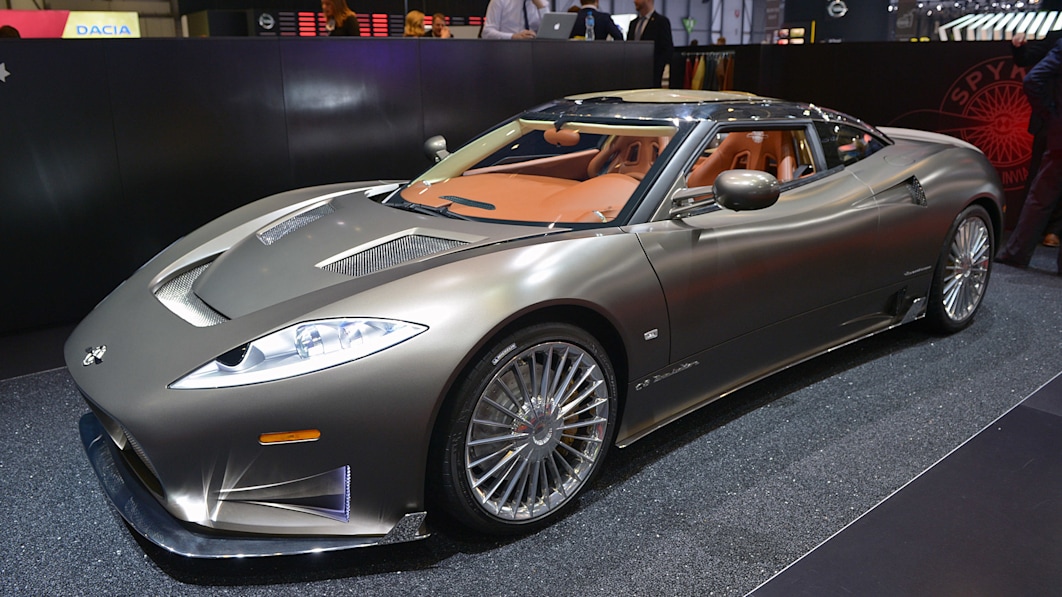
Muller wants to pick up where Spyker left off years ago, building the C8 Preliator (pictured) and B6 Venator cars, and D8 Peking-to-Paris crossover starting this year. The Preliator debuted in 2016 as the most recent version of Spyker’s core C8 model in production since 2000, powered by a supercharged version of the 4.2-liter Audi-sourced V8 that was Spyker’s favorite engine. The Venator was from 2013, powered by a V6 to provide a lower cost of entry to the range. The D8 was from 2009, once touted to employ a V12, then rumored with that Audi V8. The brand wants to go racing again, too. That could be down the line, but backing from SMP Racing could make such a venture much easier.

We don’t know which cars will come to life this year, if any, but we’ve been promised that any which do come will use internal combustion engines. They’ll also employ an international workforce; Germany and Russia will lead model development, Russia will supply carbon fiber bodies, the hand-built workforce will toil in a new production facility in the Netherlands, Luxembourg accountants will attend to Spyker’s finances, and there will be new service centers in the South of France and somewhere around the Benelux area.  

The caveat to all of this is that the presser informs us, “As soon as a written agreement is reached and the use of trademark rights secured, activities can restart.” Spyker has taught us that anything can happen on the way to the finish line, so perhaps hold off on sending deposits to the Netherlands just yet.

2022 Ford GT Heritage Edition celebrates Alan Mann Racing

2022 will be the last model year for the Ford GT, the craftsmen at Multimatic turning out the last of the 1,350-unit production run. We already knew there’d be one more Heritage Edition coming, Ford using this year’s Monterey Car Week to reveal models that would honor the original 1964 prototypes. Now Ford Performance has teased a second Heritage Edition for next year, this one a nod to England’s Alan Mann Racing. The Surrey-based race shop prepped Fords for races like the Monte Carlo Rally and Tour de France Automobile before becoming a European factory team in 1964. AMR ordered five GT40 MkI racers with the small block 289-ci V8, intent on honing them to win Le Mans. Ford sent just two of the five before changing focus to the GT40 MKII powered by the 427-ci big block, believing the 289s couldn’t get the job done.

Mann had his way with the two cars anyway, reskinning them in aluminum, designing a new coil-spring suspension, an oil fill tube accessed through the clamshell rear end, and Phil Remington’s quick-change braking system. Called the AM 1 and AM 2, Mann entered both lightweight GT40s wearing his trademark Monaco Red, gold, and white livery in the 24 Hours of Le Mans in 1966, leading the race for a brief spell before having to retire both cars. Ford then had Holman Moody convert the car to into a 427 MkII B model, but never homologated nor raced it, then had Holman Moody revert AM 1 to its Weber-carbed 289-ci spec. That original coupe has made a few appearances at Pebble Beach recently, owner Rex Meyers pulling it onto the lawn for judging and a sound check in 2019 — the first time it had been on display since 1968. Now Gooding & Company has put AM 1 up for auction this year with a pre-sale estimate of $7 to $9 million.

On a side note, Ford’s factory team won Le Mans twice with the 427-ci GT40s, retiring immediately after the win in 1967. John Wyer then created his own lightweight GT40 racers known as the Mirage cars, powered by the 289-cubic-incher, and won Le Mans in 1968 and 1969. 

AM 1 wore the #16 in its roundel, and this is the car the new Ford GT Heritage Edition references by having “16” painted on the underside of the rear wing. Yes, it would be awesome if Ford went all the way with the AM 1 honor and rolled out a lightweight GT, but here’s to dreaming. Back on Earth, expect a lively paint job and a 3.5-liter twin-turbo EcoBoost V6 with 660 horsepower and 550 pound-feet of torque, akin to the previous GT Heritage Editions. Production will start sometime early next year, we await word on how many of the Alan Mann units are on the way.

Related video: