Updated April 2018: We Help You Pick Your Perfect New Porsche 911 By Dissecting & Rating Every Single 911 Variant Available (there are more than you think).
Updated: April 2018
So, which 911 should you buy?
You want to pull the trigger and buy a new Porsche 911. Whether you can finally afford your dream car and want a Porsche 911 but don’t know which one to buy or whether you’re returning to the 911 world again, this guide is designed to help you find the perfect new 911.
Looking at Porsche 911 sales numbers you can see that 8,970 Americans, 1,235 Canadians and 15,053 Europeans ponied up and bought a new 911 in 2017. A big driver behind the continued growth of new 911 sales has been the increasing number of variants available. Porsche really does make a 911 for every budget, taste and `driving style. For instance, in the 2018 model year we counted 24 distinct 911 models. While many look similar there are real and important distinctions between variants that impacts all facets of ownership from cost to driving enjoyment and daily practicality.
Pricing wise there is a lot of variation. At one end, the entry level 911 Carrera will set you back US$91,100 (£77,891) and at the top end a 911 GT3 RS is yours for US$293,200 ( £207,506). And it isn’t just about price either. A GT3 RS while awesome is definitely not the kind of car you can drive every day while a 911 Turbo is the perfect daily driver and cruiser.
Buying Your First 911?
Buying your first 911 is usually a special occasion. You have worked hard and earned enough to splurge on a dream 911 you have imagined for decades. It is tempting to go nuts and buy the most expensive and extreme 911 you can afford. Maybe a GT3 or Turbo S is the way to go since you know everybody loves them. Our only word of caution is that it is important to take your time and really think through your needs and driving style.
We note this especially for new 911 buyers because this is where we see people buy cars that are too much for them to handle or they want the most extreme car and never end up driving it because they are too scared to wreck the car or it sucks day to day. Talk to your local Porsche sales person if you’re note sure and read the summaries in detail so you know what you are getting into. The reality is that every single new 911 available in 2018 is awesome. It is just the balance between budget, style and daily drivability that is altered so you won’t be disappointed.
Know Thyself (Style & Needs)
This is a post about “Porsche 911s” so it is easy to assume that all 911s are basically the same and you should just pick one that fits your budget. Perhaps more than any other model however, the range of personalities in the 911 range is vast. We recommend that you take some time to think about your needs in a 911. Want a proper track day beast that only gets used a few times a year? Get a GT3 RS. Want a track day toy you can also drive on weekends in warm weather? Get a 911 GT3. Want a convertible you can cruise around Miami in? Get a 911 Cabriolet. Want a car that’s sometimes a convertible, but not entirely then maybe a 911 Targa 4S is your pick. We can keep going but you get the idea.
Know your style and ow you are going to use the cars and don’t just look at the power numbers (yes we know a lot of people do that). Perhaps more important than the actual horsepower numbers is the way these engines make their power because that dictates so much about how these cars drive. The 3 liter turbo motor pulls hard in all gears and the torque is a big jump from previous generations. The bump in power in both the S and GTS models is noticeable and feels like more than the difference in horsepower suggests. They are linear and powerful engines that are great for everyday motorway driving and weekend jaunts on back roads. Climb into a GT3 and the and the naturally aspirated motor is utterly addicting in a totally different way but you better have a long runway because it takes big speeds and high revs to really enjoy.
Be honest with yourself and truly understand why you’re getting a 911 and what you want from it.
The Current Model Range Highlights
We will dive into each 911 variant separately later in this guide but we thought it would be helpful to outline the broader 991.2 platform details too for some context. The seventh 911 generation (called the 991) was launched in 2011. The 991 was an entirely new platform, only the third since the original 911 launched. The 991 platform was revised for the 2017 model year (called the 991.2). The updated 911 range introduced subtle new styling and options but is most notable for the move to an all new, smaller 3.0-litre twin-turbocharged flat-six engine powertrain.
This is the first time standard models have turbocharged engines rather than naturally aspirated ones. Purists decried the move because the new motors don’t have the spine-tingling buzz-saw engine note we love, but the increase in torque and performance largely makes up for it. The 991.2 also has better calibrated electric power steering, getting back some magic steering fee of yesteryear. If you still want a naturally aspirated flat six, don’t worry because on some special models it is still available as is a manual gearbox on the GT3 (which is a big deal).
From a design perspective, the 991.2 gets a basic facelift. It is basically lots of little detail changes that Porsche calls a refresh. The 991.2’s interior is pretty much identical to the outgoing model, with the main change being the new steering wheel which is sportier and based on the 918 Spyder. The interior, as on every new 911, benefits from Porsche’s latest touchscreen display that is much quicker to respond and has more logically laid-out menus than before. There still are too many buttons clustered in a compact area of the center console.
Engine power numbers are all over the board and we know that this is usually the most important thing for buyers, so check below for a quick summary:
| Model |
Engine |
Power |
Torque |
| Carrera |
3L turbo flat 6 |
370hp @ 6,500rpm |
331lb/ft |
| Carrera S |
3L turbo flat 6 |
420hp @ 6,500rpm |
368lb/ft |
| GTS |
3L turbo flat 6 |
450hp @ 6,500rpm |
405lb/ft |
| GT3 |
4L nat asp flat 6 |
500hp @ 8,250rpm |
339lb/ft |
| GT3 RS |
4L nat asp flat 6 |
520hp @ 8,250rpm |
346lb/ft |
| Turbo |
3.8L turbo flat 6 |
540hp @ 6,400rpm |
486lb/ft |
| Turbo S |
3.8L turbo flat 6 |
580hp @ 6,750rpm |
516lb/ft |
| Turbo S Exclusive |
3.8L turbo flat 6 |
607hp @ 6,750rpm |
553lb/ft |
| GT2 RS |
3.8L turbo flat 6 |
690hp @ 7,000rpm |
550lb/ft |
In the entry level space is a 370hp lump which powers the Carrera, Targa and Carrera 4 models. Power is upped in the Carrera S range (including Targa S and 4S models) with the GTS models getting 450hp. Next up is the GT3 with its fantastic 4 liter naturally aspirated unit at 500hp (the GT3 RS has 20hp more than the GT3). The 911 Turbo makes 540 horses, while the Turbo S cranks out 580 and the super rate Turbo S Exclusive creeps over 600hp at 607hp. That same 3.8L twin turbo powers the GT2 RS which has a barely believable 690hp.
Understanding the 911 Range
If you’re new to Porsche 911 buying then this may help you. It is meant to be our simplest definition of each model. Porsche nerds are sure to want to tell us a million other differences between models, but now that Porsche has 24+ models we wanted a quick way to help you spot the differences. The main 911 trim levels are: Carrera, Targa, Turbo, GTS and GT3.


Carrera
Prices from: US $91,100 | UK £77,891
The Carrera is the cheapest and least powerful 911. It comes with 19 inch wheels, is well equipped and its engine makes 370 horsepower. Upgrade to a Carrera S and get 420hp (50hp more) and cool stuff like bigger brakes, unique wheels, uniquely tuned suspension and more. The Carrera S was the sweet spot until we became smitten with the (new for 2018) Carrera T. A back to basics 911 it has the same engine as the base Carrera mated to a manual gearbox and shorter gearing. Add a “4” on any 911 Carrera and you get all-wheel drive and a wider body. Add “Cabriolet” and you get a convertible.
Variants: Carrera, Carrera S, Carrera Cabriolet, Carrera S Cabriolet, Carrera 4, Carrera 4S, Carrera 4 Cabriolet, Carrera T
Our Pick: Carrera T

Targa
Prices from: US $110,300 | UK £91,718
The best looking 911. Perfect for open top motoring while keeping a hardtop. We love the clever folding mechanism that looks super cool and makes taking the top off easy. There are three Targa models (Targa 4, 4S and 4 GTS). All Targa models are all-wheel drive. The Targa 4 has the same engine as the base Carrera, making 370hp while the Targa 4S has the Carrera S engine with that extra 50 hp. While performance in a straight line is pretty close to the Carrera models, it is less of a weapon than those cars. Not the most dynamic performer but with good looks does it really matter?
Variants: Targa 4, Targa 4S, 911 Targa 4 GTS
Our Pick: 911 Targa 4 GTS

GTS
Prices from: US $120,700 | UK £95,795
The GTS range is essentially Porsche combining all of the best options and sticking them on a single model. You enjoy the extra power in GTS variants but they are not the fastest 911, nor are they Porsche’s the angriest or most challenging cars. The GTS range is loaded with performance goodies, including the standard Sport Chrono package, Porsche Active Suspension Management (PASM), sport suspension, and sport exhaust. They also get more aggressive black trim and new rims. The GTS range are cars more for performance fans than for posers.
Variants: Carrera GTS, Carrera 4 GTS, Carrera 4 GTS Cabriolet, Targa 4 GTS
Our Pick: Carrera GTS

911 Turbo
Prices from: US $161,800 | UK £128,692
The original Porsche supercar. The “base” Turbo has an insane 540 hp twin turbo flat six (Turbo S gets 580 and limited Exclusive gets 607 hp). The Turbo has has a masterful 7-speed dual-clutch auto and all-wheel-drive traction. The 911 Turbo range rockets to 60 mph in less than three seconds. Take your pick of coupe or cabriolet, each being available in Turbo and Turbo S guise. The Turbo is more luxurious than the rest of the 911 range with comfy seats and posh interior. If the GT3 is all about track performance this is about everyday comfort and effortless performance. The executives Porsche.
Variants: Turbo, Turbo Cabriolet, Turbo S, Turbo S Cabriolet, Exclusive Series
Our Pick: 911 Turbo S

GT3 & GT2
Prices from: US $139,900 | UK £109,622
These are the “race car for the road” variants. Each new generation of GT3/GT3 RS/GT2 RS gets a little more civilized but these aren’t everyday cars (people will tell you that you can daily drive a GT3 but that is a stupid idea). The GT3 has aggressive looks and a 500-hp 4.0-liter flat-six that revs to 9000-rpm. With rear wheel drive it has either a 7-speed dual-clutch or six-speed manual. No-cost Touring package loses the large wing for a subtler appearance. GT3 RS and GT2 RS have more grunt, less creature comforts, more money an seriously addictive additional racing performance.
Variants: 911 GT3, 911 GT3 RS, 911 GT2 RS
Our Pick: 911 GT3 (with Touring Package)
See Also: Our Porsche Hub, Porsche Model List & Stats and Recent Porsche Posts.
Every 911 on Sale Today
Carrera

While the 911 is a consistently brilliant car all the way up to the range-topping Turbo S, the fundamental goodness of the base Carrera model is often under appreciated.
Other manufacturers chase the Carrera by making their cars more extreme, faster in a straight line and louder and more obnoxious. If you’re shopping in the sub-$100k market you can buy a souped-up Audi, AMG or M Division product or you can opt for a base 911. In our eyes, the 911 has everything you need in its most basic form and even in “base trim” beats most other sports cars on the market for overall sports car fun.The base Carrera is quite refreshing. With the new turbocharged flat-six engine and 370hp with a healthy 331lb/ft of torque, the turbo motor pulls hard in the midrange and can be enjoyed more of the time than in previous generations. You can choose from 7-speed manual or PDK auto and both are great options depending on your preference.
The Carrera sits on 19-inch wheels and the clean body styling creates the perfect balance of tradition restrained 911 looks while still feeling special amongst competitors. Even in its basic form, the 911 has a 1.00-g chassis and the ability to stop from 70 mph in 145 feet with strong acceleration and overall top speed it is still a serious performer. Steering is sharp and talkative and if mated to a manual gearbox this is perfect for most people. If you’re not chasing numbers and want a daily driver that is fun, easy to drive and still feels special, a 911 Carrera is arguably the purest distillation of the original sports car formula you can buy.
Other Resources: Motor Authority Video Review
Verdict
Purest and least pricey of modern 911s is usefully quick thanks to turbo power. A great daily driver and all around option for somebody looking to get into their first 911. Note that there are lots options go nuts with and it is easy to get to $120k in a base Carrera. Stick to the basics and don’t overspend. If you drive mostly on the street, the base 911 Carrera will easily fulfill your needs, and you’ll save a bundle of cash to boot.
Specs
| Model |
Porsche Carrera |
| Power |
370 hp at 6,500 rpm |
| Torque |
331 lb-ft (1,700 – 5,000 rpm) |
| Engine |
Twin-turbocharged boxer 6 |
| Drivetrain |
Rear-wheel drive |
| 0 – 60 mph |
4.4 sec (manual) 4.2 sec (PDK) |
| Top track speed |
183 mph |
| Fuel Economy |
23 MPG (Manual) 25 MPG (PDK) |
| Base Price |
US $91,100 | UK £77,891 |
Carrera S

Porsche’s most popular 911 gets more power and stock gear than regular Carrera, including 20-inch rims and an LSD (or e-LSD on PDK cars). The Carrera S is the sweet spot in the 911 range. More than enough performance for almost any real-world use case, a great chassis and superb steering feel, all in a package still civilized enough for the daily commute.
The Carrera S has two-millimeter-larger turbo impeller and tweaks to the engine-management software versus the base Carrera and that adds up to 50 more horsepower and sub three-second0-60 time (Porsche always sandbags 0-60 times). Power delivery is very similar to the Carrera but the performance in the Carrera S feels stronger than the numbers suggest. Revs rise quicker and with more urgency in the Carrera S and it will pin you in your seat on hard runs (that’s not the case with the base model). Options we would tick are the awesome sport exhaust which lets you be a little obnoxious and looks cool with center exhaust, Sport Chromo package and rear-wheel steering. Not only does the rear steer enable the Carrera S to turn in more quickly, but you’re also physically moving the steering wheel less – in practice it means that left and right transitions are much faster. Overall this is a sweeter ride and has more performance than the base Carrera and is worth the premium.
Other Resources: 2016 Porsche 911 Carrera S review | evo DIARIES
Verdict
It’s quicker and more capable than ever. If you plan on driving your Porsche daily to work and want to hit the track once in a while too, then the Carrera S is perfect for you. It has meaningfully more power and driving ability that the base Carrera for not unreasonably more money. It isn’t going to scare the shit out of you like a GT3 and other race-spec 911s either.
Specs
| Model |
Porsche Carrera S |
| Power |
420 hp at 6,500 rpm |
| Torque |
368 lb-ft (1,700 – 5,000 rpm) |
| Engine |
Twin-turbocharged boxer 6 |
| Drivetrain |
Rear-wheel drive |
| 0 – 60 mph |
4.1 sec (manual) 3.9 sec (PDK) |
| Top track speed |
191 mph (manual) 190 mph (PDK) |
| Fuel Economy |
23 MPG (Manual) 24 MPG (PDK) |
| Base Price |
US $105,100 | UK £87,335 |
Carrera Cabriolet

Talk to “car guys” and they will give you all sorts of reasons for why you should stick with a coupe 911 (the cabriolet has flex at the limit, it isn’t as fast as the coupe etc etc). We call bulls**t. Nobody reading this is ever going to wring out a 911 for all it is worth and 90% of drivers won’t be able to tell any difference in performance as a result. The Cabriolet is an epic sports car. It accelerates strongly, has magical steering and grips hard when things get more spirited. The engine is actually more exciting in the convertible because you can hear more it more of the time.
Inside the cabin, cockpit aerodynamics are superb and with the roof down things are always calm thanks to an electric roller-blind wind blocker behind the front seats. For owners in cold weather climates, the epic seat heaters work a charm. Add child-sized seats in the back and a decent boot in the front, the 911 Cabriolet lives up to its reputation of being the world’s most practical sports car.
Other Resources: New Porsche 911 Cabriolet 2015 review
Verdict
As the folks at Top Gear said when they reviewed the 2018 Carrera Cabriolet: “We can’t quite believe we’re saying this, but the 911 Cabrio might just be better than the Coupe”.
Specs
| Model |
Porsche Carrera Cabriolet |
| Power |
370 hp at 6,500 rpm |
| Torque |
331 lb-ft (1,700 – 5,000 rpm) |
| Engine |
Twin-turbocharged boxer 6 |
| Drivetrain |
Rear-wheel drive |
| 0 – 60 mph |
4.6 sec (manual) 4.4 sec (PDK) |
| Top track speed |
181 mph (manual) 180 mph (PDK) |
| Fuel Economy |
23 MPG (Manual) 25 MPG (PDK) |
| Base Price |
US $103,400 | UK £86,732 |
Carrera S Cabriolet

A Carrera S Cabriolet is a soft top sports car that can accelerate to 60 mph in 3.9 seconds. We love Porsche. Our best advice when it comes to the Carrera S Cabriolet is to not to think about it in comparison to other 911s. If you want a no-compromise all-rounder with excellent roof, coupe-like driving dynamics and awesome performance the it is hard to look past this machine. The lack of a roof makes no real-world difference.
The new turbo 3.0-liter engine is just as spectacularly responsive, torquey, and sweet sounding in the cabriolet Carrera S as in the coupe. In fact the new turbocharged mill makes daily driving more fun in the Cabriolet versus the coupe because with the roof down and all that extra torque you find yourself dipping into the performance more often and enjoying that intoxicating soundtrack. The urge is available lower in the rev-range and it really transforms how you drive in a good way. It isn’t just your senses either because the Carrera S Cabriolet is seriously quick. Like the coupe it has over 1.00 g of lateral grip and brakes to a halt from 70 mph in 146 feet.
Other Resources: 2017 Porsche 911 Carrera S Cabriolet Review
Verdict
So much for the old days when going roofless degraded performance. The 911 Carrera S Cabriolet has epic acceleration, delightfully visceral soundtrack and daily comforts that we expect from Porsche. The sensory enjoyment of top-down driving makes a strong case for this amazing convertible.
Specs
| Model |
Porsche Carrera S Cabriolet |
| Power |
420 hp at 6,500 rpm |
| Torque |
368 lb-ft (1,700 – 5,000 rpm) |
| Engine |
Twin-turbocharged boxer 6 |
| Drivetrain |
Rear-wheel drive |
| 0 – 60 mph |
4.3 sec (manual) 4.1 sec (PDK) |
| Top track speed |
190 mph (manual) 188 mph (PDK) |
| Fuel Economy |
23 MPG (Manual) 24 MPG (PDK) |
| Base Price |
US $117,400 | UK £96,176 |
Carrera 4

The C4 seems a little boring compared to the other 911s you can buy, but boy is this thing impressive. If you live in cold weather climates this is the 911 for you. With the same 370hp direct-injection, twin-turbocharged flat-six coupled with all-wheel drive traction effortlessly rockets the C4 off the line and onto crazy speeds. Just mash on the right pedal, and the C4 gets up and goes. Turn the steering wheel and the 911 dives into corners and is impossible to unstick. There is so much grip and it’s so easy to exploit thanks to the advanced all-wheel-drive system sending torque to the front as soon as the computers detect slip. It just flat refuses to let go.
It does feel different than a rear wheel drive 911 at the limit but its no less rewarding. The C4 is nothing less than an absolute blast to drive hard in any kind of weather you can think of. On the downside the C4 has less storage and is a bit more expensive. We live in the New York area and the security and traction of all-wheel drive is a necessity. We love that you can take the Carrera 4 through post-snow storm traffic without a care and it soldiers on and when you want to push on you just put your foot down and take off.
Verdict
Porsche Carrera 4s premium price gets you wider wheel arches and advanced all wheel drive. A must if you live in bad weather climates and still want sportswear fun all year long. If you’re looking for a super fast, do-anything, go-anywhere in any weather sports car, the Carrera 4 should be on your 911 short list.
Specs
| Model |
Porsche Carrera 4 |
| Power |
370 hp at 6,500 rpm |
| Torque |
331 lb-ft (1,700 – 5,000 rpm) |
| Engine |
Twin-turbocharged boxer 6 |
| Drivetrain |
All-wheel drive |
| 0 – 60 mph |
4.3 sec (manual) 4.1 sec (PDK) |
| Top track speed |
181 mph (manual) 180 mph (PDK) |
| Fuel Economy |
23 MPG (Manual) 24 MPG (PDK) |
| Base Price |
US $98,000 | UK £82,877 |
Carrera 4S

The 4S is an all-weather GT built for crossing large distances with ease. It effortlessly goes from easy grand tourer to rabid sports car like few other cars here. Like the base C4 the C4S is rear-drive. When Porsche Traction Management (PTM) detects or anticipates slippage, it engages a clutch, directing some of the available torque to the front axle. Mashing the throttle on corner exit rarely results in wheelspin. You have to really provoke this car into a drift. Its general demeanor is subdued. But if you’re in the mood and want to wring its neck, you can throw anything you want at this car and the drivetrain and chassis sort it out.
On the downside, the C4S is prone to understeer if you drive too fast into a corner. If it happens it is predictable and very, very quick once you get used to it. It’s perfectly fast enough to get you into trouble, but the thing is, it just doesn’t feel like a natural track car, and it’s more convincing as daily driver.
Other Resources: Carrera 4 Review by EVO, Porsche 911 Carrera 4S Review
Verdict
Fast. Solid. Stable. Fast again. This is the best all-weather daily driver on the planet.
Specs
| Model |
Porsche Carrera 4S |
| Power |
420 hp at 6,500 rpm |
| Torque |
368 lb-ft (1,700 – 5,000 rpm) |
| Engine |
Twin-turbocharged boxer 6 |
| Drivetrain |
All-wheel drive |
| 0 – 60 mph |
4.3 sec (manual) 4.1 sec (PDK) |
| Top track speed |
190 mph (manual) 188 mph (PDK) |
| Fuel Economy |
23 MPG (Manual) 24 MPG (PDK) |
| Base Price |
US $112,000 | UK £92,321 |
Carrera 4 Cabriolet

We don’t have much to say about the Carrera 4 Cabriolet. It feels a little pointless. I guess if you live somewhere that has bad winters and amazing summers then maybe it makes sense. There are better 911 convertible options and better all-wheel drive 911 options.
Other Resources:
Verdict
You’d still pick the cabriolet last for your 911 football team but the rock solid structure and semi-rigid roof mean its a decent drive.
Specs
| Model |
Porsche Carrera 4 Cabriolet |
| Power |
420 hp at 6,500 rpm |
| Torque |
368 lb-ft (1,700 – 5,000 rpm) |
| Engine |
Twin-turbocharged boxer 6 |
| Drivetrain |
All-wheel drive |
| 0 – 60 mph |
4.3 sec (manual) 4.1 sec (PDK) |
| Top track speed |
182 mph (manual) 180 mph (PDK) |
| Fuel Economy |
23 MPG (Manual) 24 MPG (PDK) |
| Base Price |
US $110,300 | UK £91,718 |
Carrera 4S Cabriolet

Like the Carrera 4 Cabriolet, we just aren’t big fans of the Carrera 4S Cabriolet. If you want summer open air fun with all wheel traction in crappy weather then this is a great choice, but for us it is trying to do too much. The C4 nomenclature means it’s wider in the rear fenders and offers all-wheel drive. The S means more power and some tasty performance extras. During normal, dry conditions, the rear wheels do all of the driving. Throw in snow or slippery conditions and the Porsche Traction Management (PTM) does its magic and pushes torque around. It manages wheel slip and power output almost seamlessly. It works magically in the C4S Cabriolet but it also works and is more fun in the coupe version of the C4S. Likewise, the S levels of performance are super fun in the convertible, but to some degree you don’t want that in your GT-like open top sports car.
Other Resources: Porsche 911 Carrera 4S Cabriolet
Verdict
A great performer and all-rounder if you want open top fun and all wheel drive traction. Lacks focus in our eyes.
Specs
| Model |
Porsche Carrera 4S Cabriolet |
| Power |
420 hp at 6,500 rpm |
| Torque |
368 lb-ft (1,700 – 5,000 rpm) |
| Engine |
Twin-turbocharged boxer 6 |
| Drivetrain |
All-wheel drive |
| 0 – 60 mph |
4.2 sec (manual) 4.0 sec (PDK) |
| Top track speed |
188 mph (manual) 187 mph (PDK) |
| Fuel Economy |
22 MPG (Manual) 24 MPG (PDK) |
| Base Price |
US $124,300 | UK £101,162 |
Carrera T

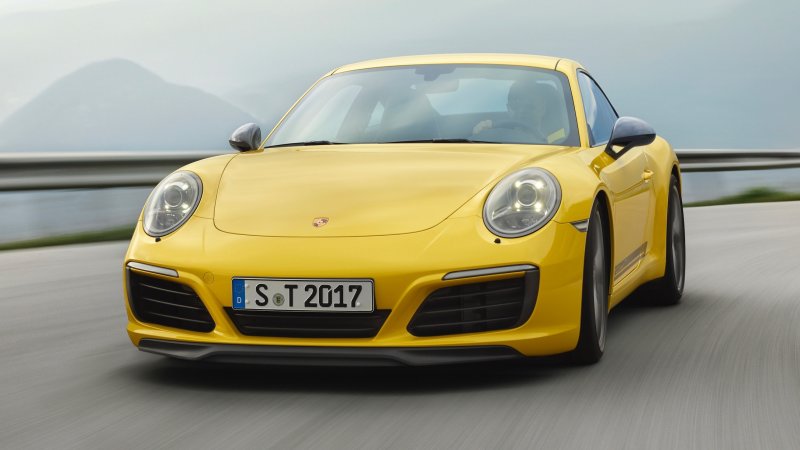
New for 2018 the Carrera T is one of our favorite Porsche models in recent years. This is a first-order driver’s car, a basic 911 equipped with purposefully selected, road-annihilating hardware. The point of the T (for Touring) is to be a spartan model equipped with only the necessities that a dedicated driver might want. It has the same 370hp as the base 911 mated to the (good) seven-speed manual transaxle. Add shorter gearing and a limited-slip differential and this is a tasty package. The Carrera T also gets two-mode PASM sport suspension and a custom Sport Chrono package. There are other weight saving measures that add up to 44 pounds in less weight than a standard Carrera.
Downsides. Well for one there are no rear seats so some it won’t work if you like taking your kids for a drive. The weight saving measures sound cool but ultimately make the Carrera T a little less practical and noisy if you’re using it for daily commuting. Performance-wise the car is fun, but a Carrera S has it licked in terms of outright pace and the GTS variants are better all-around in many respects.
We will quote the guys at Car & Driver who tested the T in Italy in terms of how it drives:
The 911 T just might be the best 911 for this road. It’s low but not too low. Its damping control is a thing of stunning effect; the softer of its two settings provided the compliance necessary to produce real grip in corners filled with chassis-twisting undulations. Its steering is something magical for a car with a rear weight bias of well over 60 percent. Enough information is transmitted through the steering wheel to divulge when the front tires are overburdened, but because there’s so much control available, regaining purchase was always possible. The standard short shifter ripped off gearchanges with military precision and satisfying snap while freeing up tiny increments of time to return both hands to the wheel. And the T’s standard sport exhaust howled against the stone canyon walls.
Other Resources: Carrera T: GT3 On A Budget?, Carrera T Tearing Up Canyons, Carrera T: Unfiltered Passion,
Verdict
Shorter gears, LSD, thinner glass, no rear seats plus a preselected mix of the base 911’s best hardware. This is the more driver-focused Carrera that Cars & Driver nailed when they said: The simple 911 for the dedicated driver is oh so right. Our pick of the 911 Carrera range.
Specs
| Model |
Porsche Carrera T |
| Power |
370 hp at 6,500 rpm |
| Torque |
331 lb-ft (1,700 – 5,000 rpm) |
| Engine |
Twin-turbocharged boxer 6 |
| Drivetrain |
Rear-wheel drive |
| 0 – 60 mph |
4.3 sec (manual) 4.0 sec (PDK) |
| Top track speed |
182 mph (manual) 180mph (PDK) |
| Fuel Economy |
TBA |
| Base Price |
US $102,100 | UK £85,576 |
911 Targa 4

Porsche’s most famous “cool model” has been updated with the reintroduction of the distinctive roll hoop and a cool electronic roof mechanism that folds away the roof in 19 seconds to give you some open-top motoring fun. If you leave it in place the Targa feels as rigid and secure as a standard coupe. During open top motoring the interior does become a bit blustery as the speed picks up, but it’s still possible to hold a conversation without shouting.
All 911 Targas are equipped with all-wheel drive to give them all-weather ability. The Targa is also a great daily drive with its suspension soaking up bumps and bad roads really nicely. We recommend adding PASM adaptive suspension (standard on S model). Acceleration is brisk, with the Targa hitting 60mph in 4.7 seconds. Note that this is the slowest 911 but with the new turbo flat six strong torque it is enjoyable and fast enough in real world driving for most drivers.
In part due to having four-wheel drive as standard, but primarily because of its roof arrangement, the Targa costs a significant chunk more to buy than a standard 911. In return it does feel tangibly more special, while the retro roof bar harks back to the original Targa of the 1970s. Visibility is generally excellent for a sports car, although the shape of the rear screen can distort how traffic appears in your rear-view mirror.
Where a Targa does split from other 911s is that, in creating a car that is 200+ pounds heavier than the coupe, Porsche has chosen to modify the suspension to cope. It is a little slower like we mentioned above but where you notice the extra weight is when you’re pushing hard in corners as its roll axis feels higher. Targa variants also display more understeer and generally don’t drive as playfully as other 911s. We like it because it feels a little more old-school in that way. Because there’s more compliance and roll in the chassis in normal PASM mode, there’s also a shade less precision to the initial steering response and marginally less outright lateral grip than in a Carrera 4S.
The Targa’s biggest selling point is that it’s still a 911. We love the way the Targa looks but wish it didn’t come along with the extra heft and weakened structure that dulls the 911 experience. We also think it is a missed opportunity by Porsche to differentiate the Targa range further. If you like the look of the Targa then go for it, but it isn’t unique enough in any other way vs the rest of the range.
Downsides.
Other Resources: Porsche 911 Targa review
Verdict
Fetching vintage Targa looks, fun open top driving, fast enough performance. The added weight dulls the 911 experience. Heaviest and slower of the 911 body styles, but cool in the way Targa’s weren’t for years. All-wheel drive only.
Specs
| Model |
911 Targa 4 |
| Power |
370 hp at 6,500 rpm |
| Torque |
331 lb-ft (1,700 – 5,000 rpm) |
| Engine |
Twin-turbocharged boxer 6 |
| Drivetrain |
All-wheel drive |
| 0 – 60 mph |
4.5 sec (manual) 4.3 sec (PDK) |
| Top track speed |
179 mph (manual) 178 (PDK) |
| Fuel Economy |
22 MPG (Manual) 24 MPG (PDK) |
| Base Price |
US $110,300 | UK £91,718 |
911 Targa 4S
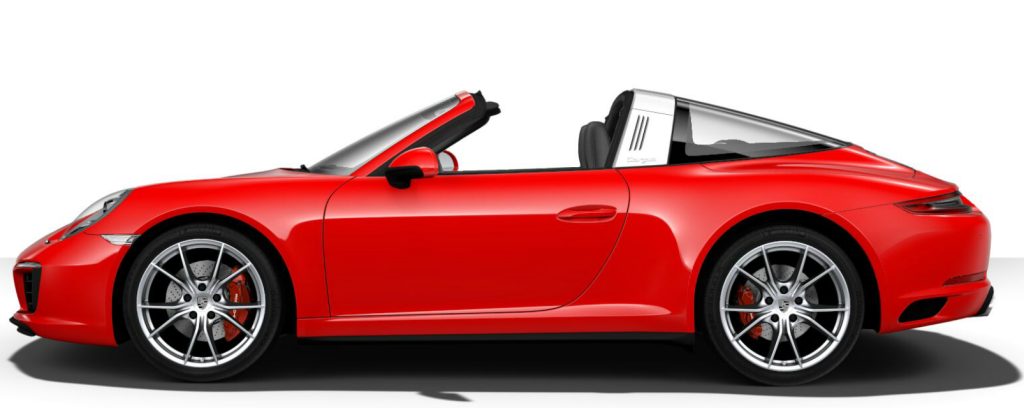
If we’re choosing between Targa models then this is the one for us. Like other S models you get more power and trick options standard that make a big difference, especially in this case where we’re talking about a heavier car than the standard coupes. Power is consistent with other S models at 420 horsepower at 6500 rpm and 369 lb-ft of torque available from 1700 rpm all the way up to 5000 rpm.
The Targa 4S is as fat at the Targa 4 at 3500+ pounds. Like all all wheel drive 911s, the body is wider than the regular rear-drive Carrera and there’s all the traction you could ever want. The extra weight is well hidden though and in the 4S we couldn’t feel the difference in straight line performance versus a Carrera 4S. The Targa 4S 0 to 60 mph was 3.3 seconds when tested by Car & Driver which is just a tenth behind the 4S coupe confirming our butt-o-meter feelings in the cockpit. And at 8.1 seconds, its zero-to-100-mph time is only 0.3 second behind the lighter hardtop. The 911’s new turbocharged engine works seamlessly with the transmission to always have enough torque on tap to plug a gap in traffic or pass.
In other respects—such as cabin comfort and ergonomics—the Carrera 4S Targa is the same high end awesomeness as any other Carrera. In our view that is a missed opportunity because other than the awesome roof the Targa 4 and Targa 4S don’t feel all that different or unique. The only downside with the roof if that highway driving does have wind buffeting which sucks. The ride quality is amazing making the Targa 4S a great daily commuter. It has great daily drivability with strong levels of performance.
I’m not sure that the extra money for the Targa 4S is worth it over the Targa 4. We’d rather go all out and get the Targa 4 GTS which is faster still and at least has the best exhaust sounds out there to make wind buffeting more bearable. If you forced me to choose between the regular 911 Cabriolet and the Targa, I’d choose the Targa because it looks more unique and cool, knowing that I’m giving up a little dynamic ability in doing so. Regardless, the Targa has lost very little character or drivability in the transition to turbo power, and has gained better steering and infotainment in the process. If you can stomach the Everest-steep asking price, you’re unlikely to feel disappointed.
Other Resources: Porsche 911 Targa 4S Review, 911 Targa 4 GTS by Carfection: The 911 That Gives You More – Carfection
Verdict
With that top down, that flat-six pulling hard and a great country road on a Sunday morning and the Targa 4S makes loads of sense. Wake up in the morning for that ride to work and that comfort and compliance also makes loads of sense. Sure it’s heavier and not as agile than a two-wheel-drive coupe(s), but these days the gap is so narrow it comes down to personal taste. You either like the idea of a Targa or you don’t.
Specs
| Model |
911 Targa 4S |
| Power |
420 hp at 6,500 rpm |
| Torque |
368 lb-ft (1,700 – 5,000 rpm) |
| Engine |
Twin-turbocharged boxer 6 |
| Drivetrain |
All-wheel drive |
| 0 – 60 mph |
4.2 sec (manual) 4.0 sec (PDK) |
| Top track speed |
188 mph (manual) 187 (PDK) |
| Fuel Economy |
22 MPG (Manual) 24 MPG (PDK) |
| Base Price |
US $124,300 | UK £101,162 |
911 Turbo
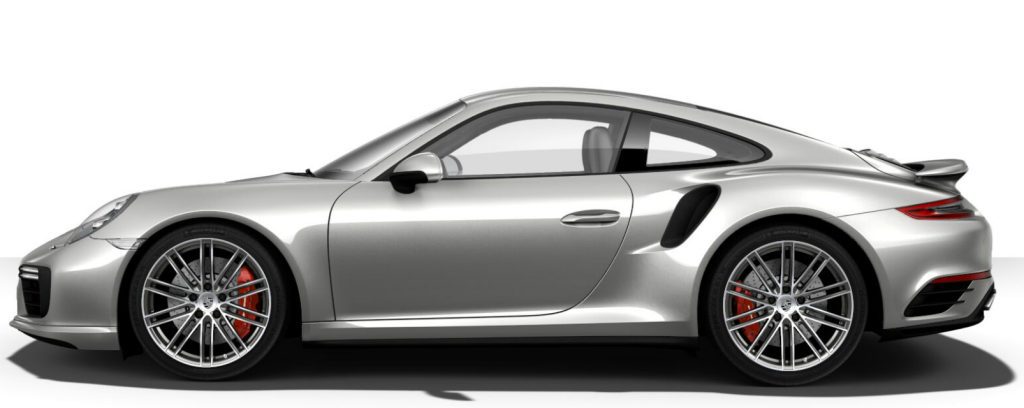
If a 911 GT3 is about involvement, feel and motorsport-derived gratification, a 911 Turbo is about going very quickly with minimal effort and ample safety and comfort. The 911 Turbo is the original Porsche supercar and it is no different in 2018.
The Turbo range get their own unique body style. It has a wider track, those gaping air pods above the rear wheels and and a host of other design tweaks to differentiate it from the rest of the 911 range. The interior while similar to the rest of the range is a step up in opulence and quality. Everything wrapped in leather and there is Alcantara everywhere. It feels more expensive that other 911s.
The Turbo range also gets a twin-turbocharged flat-six that but instead of 370hp like the entry level 911, it gets a staggering 540 to 607 horsepower (depending on variant). Torque is 487lb ft in the “base” Turbo model. That is good for a quarter-mile time of 10.7 seconds at 129 mph in the base Turbo model. Drive is to all four wheels via a PDK dual-clutch automatic gearbox. Even in base trim, the new 911 Turbo is stupid fast. The base model is also as quick as the Turbo S to 60 so we are not sure why you’d need to pony up more money.
This is a serious performance machine but it is not some race car for the road. The steering lacks the detail of the GT3 and it definitely isn’t at agile, but we think that is ok. This is a supercar that isn’t just “ok to drive daily”, this is a supercar that revels in daily driving. The 911 Turbo achieves its greatness through its supreme usability and approachability. You can drive it to the shops at crawling speeds one minute and be perfectly happy and then you can floor it and scare the bejesus out of yourself the next. Thrust feels practically limitless and the ride is smooth and supple like a luxury GT should be.
Verdict
The 911 Turbo is a sports car that dares to combine supercar performance with everyday ease. Stupendous straight-line speed with comfortable interior and ride. Still, the new Turbo continues to be the defining everyday supercar for those who couldn’t live with a supercar if they wanted to.
Specs
| Model |
911 Turbo |
| Power |
540 hp at 6,400 rpm |
| Torque |
486 lb-ft (1,950 – 5,000 rpm) |
| Engine |
Twin-turbocharged boxer 6 |
| Drivetrain |
All-wheel drive |
| 0 – 60 mph |
2.9 sec(PDK) |
| Top track speed |
198 mph (PDK) |
| Fuel Economy |
21 MPG (PDK) |
| Base Price |
US $161,800 | UK £128,692 |
911 Turbo Cabriolet
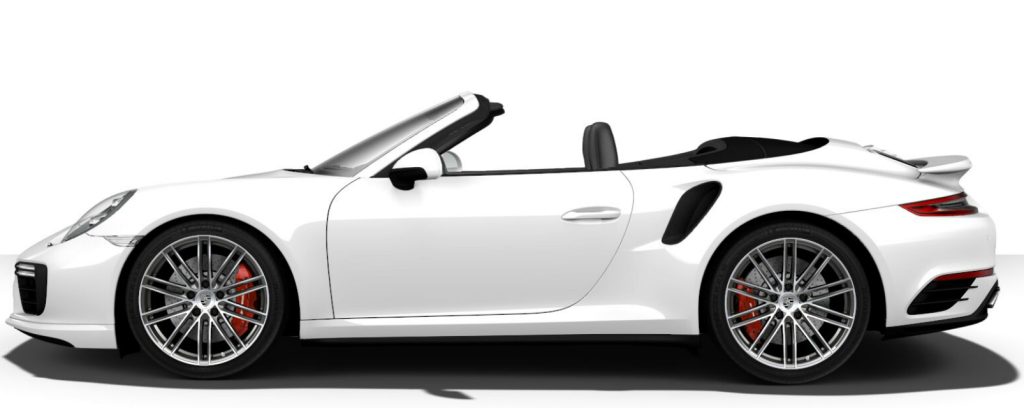 The Porsche 911 Turbo cabriolet is a niche car. It is expensive and fast and is perfect for Rodeo Drive and Miami. The reality is that most 911 Turbo buyers just buy a Turbo S Coupe. Like we mention below we think that is a waste. If you’re going to spend extra on a Turbo then this is the one to buy because at least you get open top motoring for the extra cash.
The Porsche 911 Turbo cabriolet will spring to 60 mph in 2.7 seconds. It’s PDK gearbox and all-wheel drive traction are just perfect for this kind of GT. It is almost impossible to get this car unstuck and if you ever did want to carve up the back roads that is important in a 500hp+ car. In daily driving it is perfect, the car soaks up bumpy roads and bad surfaces with ease. This is a great way to spend almost $200,000.
Other Resources: Porsche 911 Turbo S | Chris Harris Drives, Porsche 991.2 Turbo S – One Take, Porsche 911 Turbo S review by evo
Verdict
Time-warping acceleration. Amazingly high quality cabin. The best open top sports car on the planet.
Specs
| Model |
911 Turbo Cabriolet |
| Power |
540 hp at 6,400 rpm |
| Torque |
486 lb-ft (1,950 – 5,000 rpm) |
| Engine |
Twin-turbocharged boxer 6 |
| Drivetrain |
All-wheel drive |
| 0 – 60 mph |
3.0 sec (PDK) |
| Top track speed |
198 mph (PDK) |
| Fuel Economy |
21 MPG (PDK) |
| Base Price |
US $174,100 | UK £137,533 |
911 Turbo S
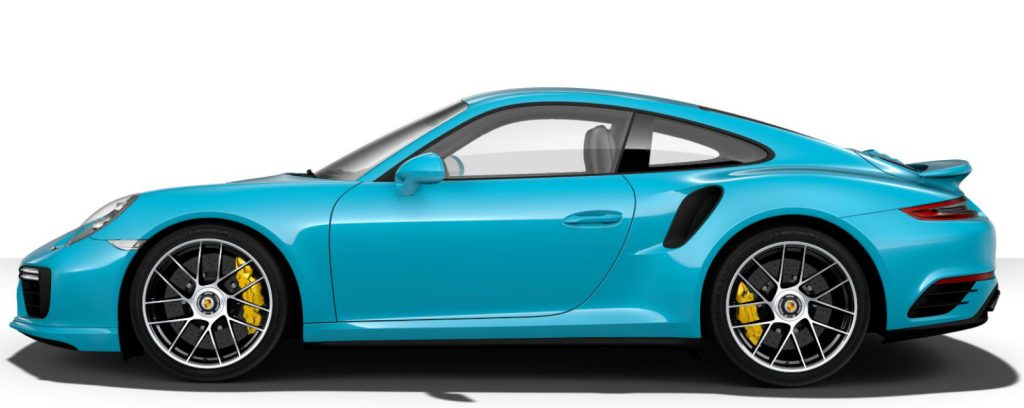
While we love power here at Supercars.net at some point extra power isn’t worth the extra money. The base Turbo is already stupid quick and the acceleration pins you to the seat in any gear. The Turbo S has the same 0-60 time and is faster at the top end but nobody is ever going to use it. Save the almost $20k and buy the base Turbo. In saying that most Turbo buyers opt for the Turbo S so what the hell do we know.
Other Resources: Porsche 911 Turbo S | Chris Harris Drives, Porsche 991.2 Turbo S – One Take, Porsche 911 Turbo S review by evo
Verdict
Breathtaking acceleration in an everyday package. Too expensive when compared to the just as awesome base Turbo.
Specs
| Model |
911 Turbo S |
| Power |
580 hp at 6,750 rpm |
| Torque |
516 lb-ft (2,100 – 4,250 rpm) |
| Engine |
Twin-turbocharged boxer 6 |
| Drivetrain |
All-wheel drive |
| 0 – 60 mph |
2.8 sec (PDK) |
| Top track speed |
205 mph (PDK) |
| Fuel Economy |
21 MPG (PDK) |
| Base Price |
US $190,700 | UK £147,540 |
911 Turbo S Cabriolet
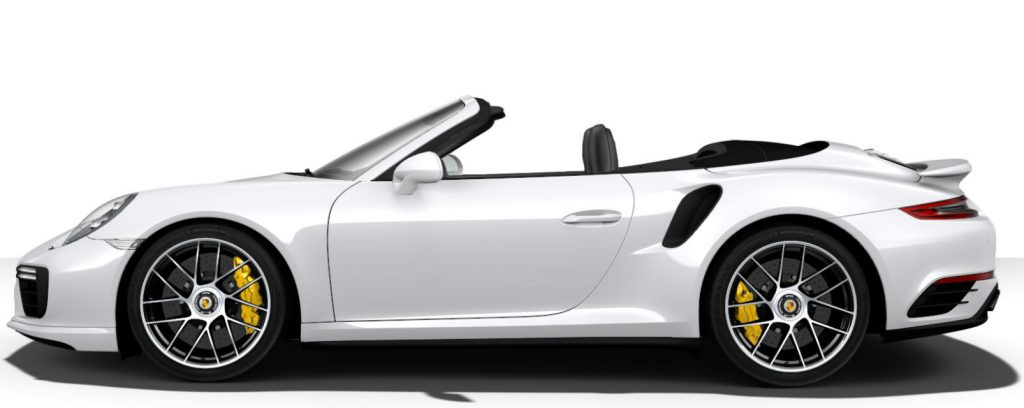
See what we said above about the Turbo S. We’d stick with the non-S version Turbo Cabriolet.
Verdict
Stick to the Cabriolet Turbo.
Specs
| Model |
911 Turbo S Cabriolet |
| Power |
580 hp at 6,750 rpm |
| Torque |
516 lb-ft (2,100 – 4,250 rpm) |
| Engine |
Twin-turbocharged boxer 6 |
| Drivetrain |
All-wheel drive |
| 0 – 60 mph |
2.9 sec (PDK) |
| Top track speed |
205 mph (PDK) |
| Fuel Economy |
21 MPG (PDK) |
| Base Price |
US $203,000 | UK £156.381 |
911 Turbo S Exclusive Series
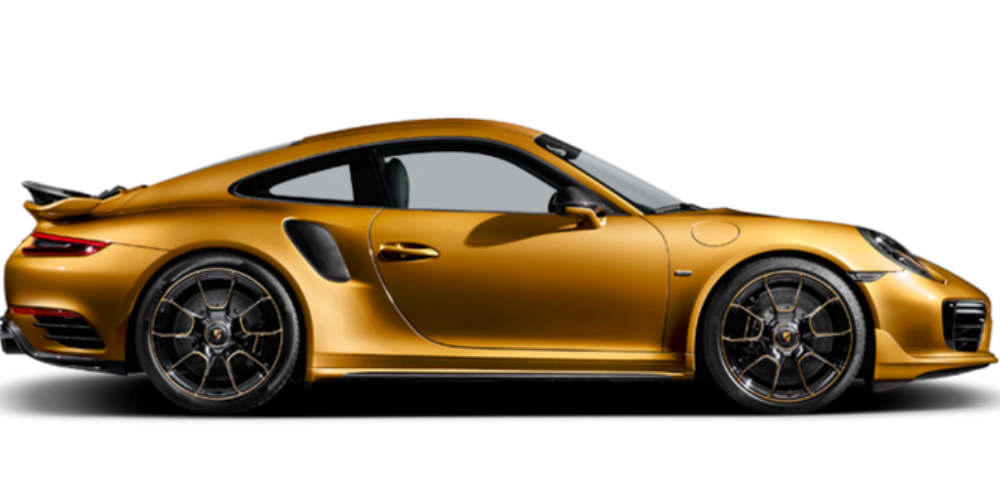
Porsche will build only 500 copies of the 911 Turbo S Exclusive. It gets hands on love from Porsche’s customization team. Lots of leather and lots of carbon fober. The engine has also been tickled with an extra 27 horsepower over the standard Turbo S to a pretty nuts 607 hp. We haven’t tested one but from other reviews it sounds like you cannot tell the difference in performance verses the Turbo S so it is hard to justify $250k+ price point.
Verdict
The guys at Car & Driver once again put it best: It appears Porsche is making this ultimate and rare 911 to test the quarter-million-dollar waters; while undeniably cool, the Turbo S Exclusive will appeal to the Porsche faithful who especially prize rarity. The rest of us could be more than satisfied with the $191,750 Turbo S or even the 540-hp Turbo for $162,850.
Specs
| Model |
911 Turbo S Exclusive Series |
| Power |
607 hp at 6,750 rpm |
| Torque |
553 lb-ft (2,250 – 4,000 rpm) |
| Engine |
Twin-turbocharged boxer 6 |
| Drivetrain |
All-wheel drive |
| 0 – 60 mph |
2.8 sec (PDK) |
| Top track speed |
205 mph (PDK) |
| 1/4 Mile |
10.7 sec |
| Fuel Economy |
TBA |
| Base Price |
US $257,500 | UK £186,916 |
911 Carrera GTS
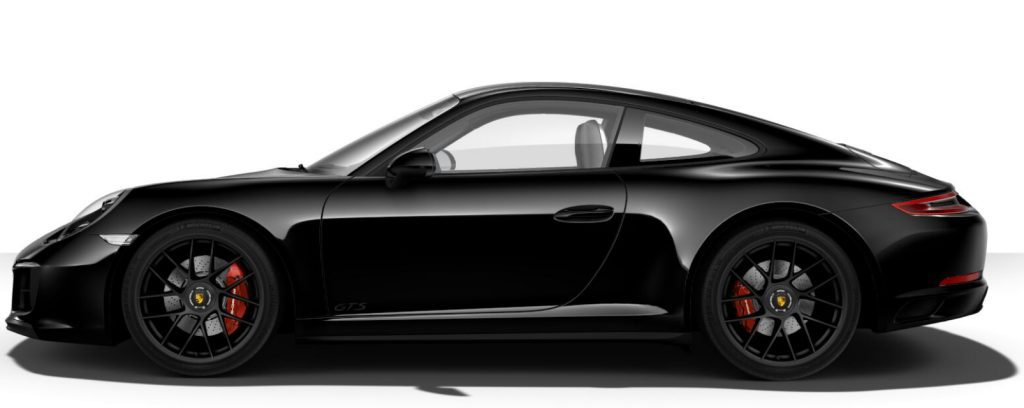
The Carrera GTS sits nicely between the Carrera S and the GT3. The GTS gets a larger turbocharger and a little more boost than the Carrera S, giving it 30 more horsepower and an extra 37 lb-ft of torque. That means 450 hp at 6,500 rpm and 405 lb-ft of torque between 2,150 rpm and 5,000 rpm. You can really feel and hear the differences behind the wheel, the twin-turbo flat-six is so quick to respond and there is so much power across the rev range. 0 to 60 mph takes 3.9 seconds with the manual gearbox and just 3.5 seconds with the PDK. We say that’s conservative and expect the GTS is actually four tenths faster.
The GTS models take the best options you can buy on a Carrera S and are include them as standard. That means the Carrera GTS gets Sport Chrono and the cool different drive settings that come with it. If you opt for dual clutch you also get a cool “push-to-pass” power button on the steering wheel. GTS Coupes get PASM Sport Suspension, which drops the ride height 0.4 inch, though the standard PASM setup is available for those who want the option to dial up a more comfortable ride. Cars ordered with the seven-speed stick get Porsche Torque Vectoring and a mechanical rear diff lock as standard, while those equipped with a PDK transmission are equipped with the Porsche Torque Vectoring Plus system, which includes an electronic rear diff lock.Also standard is the sport exhaust combined with less sound deadening. You also get cool center-lock wheels and black trim kit that looks epic. Not to mention a lower sport suspension setup and the mean-looking wide-body shell from the Carrera 4, with the rear fenders pushed out 1.7 inches, and the rear track widened 1.6in. We recommend adding the rear-wheel-steering package but that’s about it. The GTS is pretty perfect. Our pick is the manual gearbox but the PDK is awesome too.
Inside, the GTS gets standard four-way power sports seats trimmed in Alcantara, a 14.1-inch sports steering wheel also trimmed in Alcantara, and the Sport Chrono Package, which includes the analogue stopwatch, a performance display on the dash, and the nifty Porsche Track Precision app. There is also a top of the range navigation system and Porsche Connect Plus, which delivers the 7.0-inch touchscreen user interface and onboard Wi-Fi connectivity.
In terms of personality, the GTS is more Carrera S than GT3. It is a great daily driver, with good visibility, a relatively upright seating position, supportive buckets good for long-distance travel, and an easy-to-use cockpit with its controls arranged logically. This is one of the best cars we have ever driven and is nearly perfect.
Other Resources: Is The Porsche 911 GTS a Daily Driver GT3?, 2017 Porsche 911 GTS, Manual – One Take, This Is The 911 You’re Looking For – XCAR, 2018 Porsche 911 Carrera 4 GTS Car Review
Verdict
The best-value, all-around street-oriented 911 and in our review probably the best all-around 911 ever. Balanced, bracing, and the best driving experience under $150,000. Manual GTS is a perfect synthesis of power and grip: to drive and live with every day.
Specs
| Model |
911 Carrera GTS |
| Power |
450 hp at 6,500 rpm |
| Torque |
405 lb-ft (2,150 – 5,000 rpm) |
| Engine |
Twin-turbocharged boxer 6 |
| Drivetrain |
Rear-wheel drive |
| 0 – 60 mph |
3.9 sec (manual) 3.5 sec (PDK) |
| Top track speed |
193 mph (manual) 192 mph (PDK) |
| Fuel Economy |
21 MPG (Manual) 23 MPG (PDK) |
| Base Price |
US $120,700 | UK £95,795 |
911 Carrera GTS Cabriolet
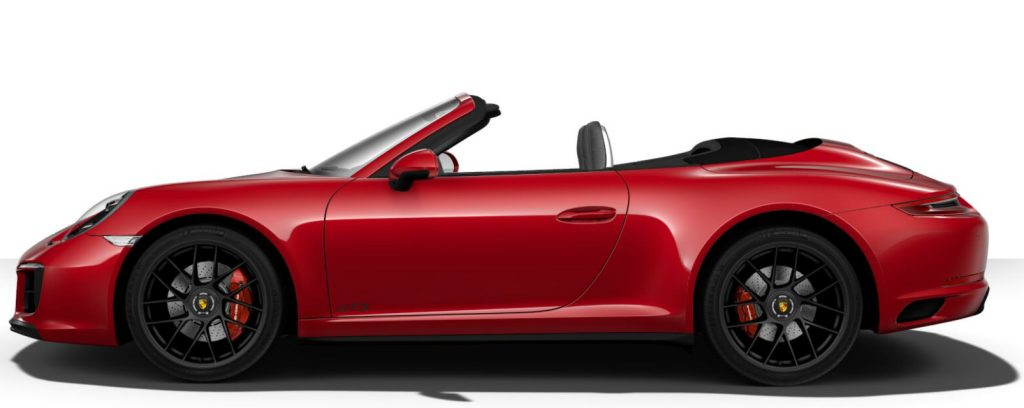
If you think of this as a Carrera S Cabriolet with just a few extra add-ons then you are missing the point of GTS range. The GTS variants are about the right goodies packaged together to create brilliance. Like the coupe the Carrera GTS the Carrera GTS Cabriolet is almost perfect.
In many ways the surprising thing with the convertible is how it closes the gap to the coupe in GTS guise. This car’s 1.03 g of maximum grip is very close to the coupes 1.05 g and straight line performance is basically exactly the same. The GTS Cabriolet makes a case for being the better allrounder when you consider the open top fun you get too.
In terms of differences between the cab and coupe, the convertible is not as low to the ground (0.4 inch higher). This is thanks to the cabriolet having Porsche’s Active Suspension Management adjustable dampers that drops ride height almost half an inch (coupes have a different version that drops it lower).
Porsche says about half of all GTS buyers will opt for the hardtop, which is marginally stiffer and certainly more oriented toward the occasional track day outing with a sports car club. Around a third will go for the Cabriolet, with the remaining buyers snapping up the all-wheel drive-only Targa. Ultimately this is a matter of preference because we find all the GTS variants absolutely perfect.
Other Resources: Carrera GTS Cabriolet – POV Drive
Verdict
Just as gifted as the coupe GTS which means it is bloody perfect. Our favorite soft top sports car available today.
Specs
| Model |
911 Carrera GTS Cabriolet |
| Power |
450 hp at 6,500 rpm |
| Torque |
405 lb-ft (2,150 – 5,000 rpm) |
| Engine |
Twin-turbocharged boxer 6 |
| Drivetrain |
Rear-wheel drive |
| 0 – 60 mph |
4.0 sec (manual) 3.6 sec (PDK) |
| Top track speed |
192 mph (manual) 191 (PDK) |
| Fuel Economy |
21 MPG (Manual) 22 MPG (PDK) |
| Base Price |
US $133,000 | UK £104,636 |
911 Carrera 4 GTS
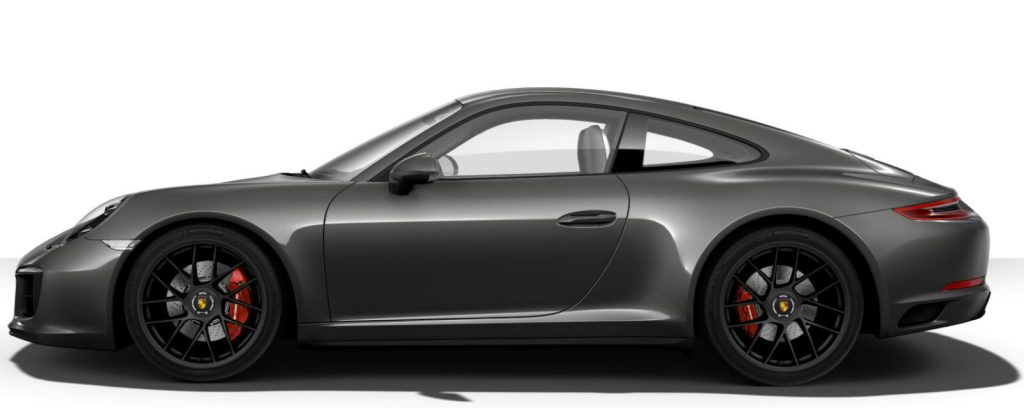
This is a 911 Carrera 4 GTS coupe with all-wheel drive. The body is the same as the coupe since all GTS models already get the wider 4 body style. The all-wheel-drive Carrera 4 GTS is easier to launch than the rear-drive version and this thing is quick.
As expected the car sticks in the corners too, with a 1.06g skidpad enough to make your neck hurt. Grip around even the most technical of corners in the dry and wet is stellar.
Other Resources: Carrera 4 GTS tested | As good as a GT3? | Autocar,
Verdict
If you need a car that gives you all-wheel drive security and astonishing performance too, this may be the 911 for you.
Specs
| Model |
911 Carrera 4 GTS |
| Power |
450 hp at 6,500 rpm |
| Torque |
405 lb-ft (2,150 – 5,000 rpm) |
| Engine |
Twin-turbocharged boxer 6 |
| Drivetrain |
All-wheel drive |
| 0 – 60 mph |
3.8 sec (manual) 3.4 sec (PDK) |
| Top track speed |
192 mph (manual) 191 mph (PDK) |
| Fuel Economy |
21 MPG (Manual) 22 MPG (PDK) |
| Base Price |
US $127,600 | UK £100,781 |
911 Carrera 4 GTS Cabriolet
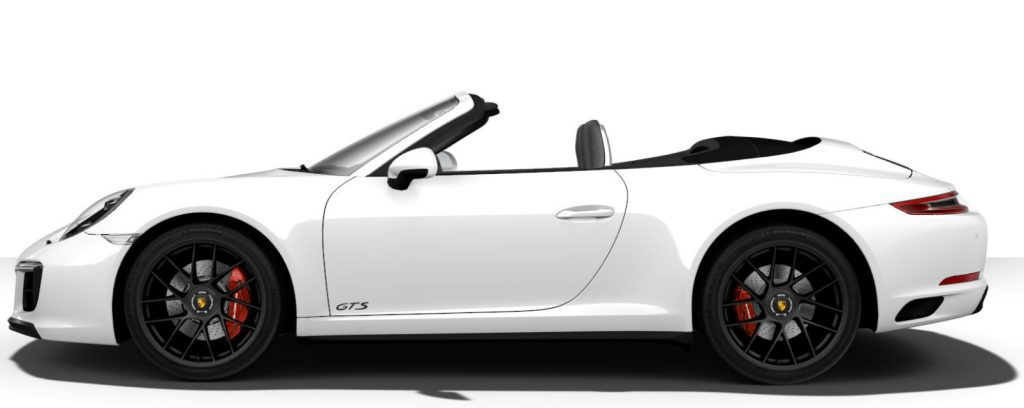
Aside from the Targa this 4 GTS Cabriolet with the PDK transmission is just about as heavy as the Carrera gets. At 1585kg it is no lightweight. Inevitably, the 4 GTS Cabriolet is no match for the brilliant rear-wheel drive Coupe in the fun-to-drive stakes but it is pretty bloody close. The structure remains reasonably stiff given the roof has been sawn off, but you can feel it shudder and see the windscreen surround rattle when you drive quickly over rough road surfaces. It is noticeable in the C4 GTS because of the additional traction at the limit due to all-wheel drive. You can push harder, but you notice the shortcomings of the convertible body.
The steering is direct and responsive in the Coupe but a touch imprecise in this car. There’s also an underlying sense of inertia and lethargy in the way the Cabriolet changes direction, a small amount of float and wallow as the road bends this way and that where the Coupe is razor sharp. It’s a matter of degrees, though, and only in a back-to-back comparison is the Cabriolet shown up in any way by the Coupe.
Verdict
A solid drop-top 911 but we’d opt for the rear wheel drive Cab if it were our money.
Specs
| Model |
911 Carrera 4 GTS Cabriolet |
| Power |
450 hp at 6,500 rpm |
| Torque |
405 lb-ft (2,150 – 5,000 rpm) |
| Engine |
Twin-turbocharged boxer 6 |
| Drivetrain |
All-wheel drive |
| 0 – 60 mph |
3.9 sec (manual) 3.5 sec (PDK) |
| Top track speed |
191 mph (manual) 190 mph (PDK) |
| Fuel Economy |
21 MPG (Manual) 22 MPG (PDK) |
| Base Price |
US $139,900 | UK £109,622 |
911 Targa 4 GTS
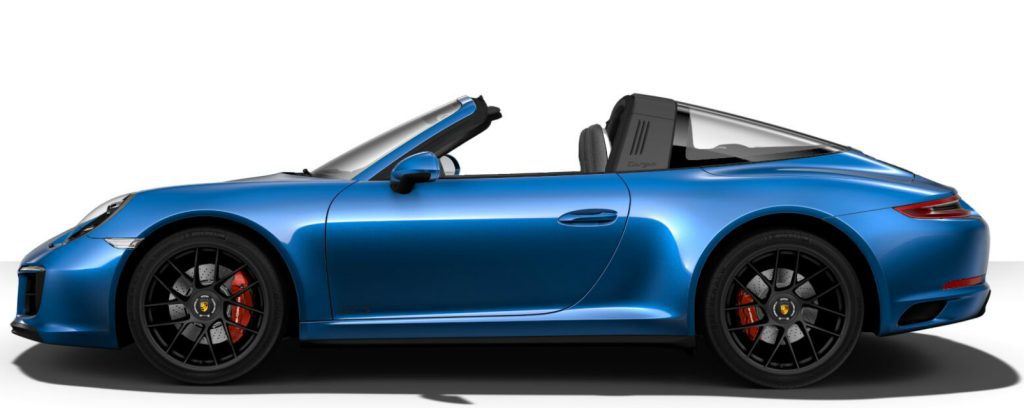
If I had the money Targa GTS is on my shortlist. I know the Targa GTS is heavier and less focused than the rear drive GTS but man this thing looks awesome and the performance is more than I would ever need. We have already talked about the GTS models offering all the right goodies as standard. 450 horsepower and 405 pound-feet of torque is appreciated in the heavier Targa and it feels significantly faster and pulls harder than the Targa 4S.
There’s something really iconic about the look of the 911 Targa models, with the wraparound rear glass, off-color pillar, and soft top that stows just behind the passenger compartment. As far as topless 911s go, the Targa not only looks better than the Cabriolet, but that big area behind the rear seats means it’s super functional – combined with the small front trunk, you get 10.1 cubic feet of cargo space. There isn’t any serious wind turbulence with the roof removed when driving at higher speeds, and the weight penalty (about 300 pounds versus a Carrera 4 GTS Coupe) is barely noticeable. It will get to 62mph in 4.1 seconds on its way to a 191mph top speed. Acceleration-wise, that’s three tenths faster than a Targa 4S.
The main issue with the Targa GTS is that it is pretty expensive even in Porsche world. A 911 GTS Coupe is nearly $20,000 cheaper and that drives better and can be tracked. That’s hard to justify unless you absolutely must have the best looking 911. Options wise you don’t even get the PASM Sport suspension (can’t be fitted to the Targa.
Other Resources: Porsche 911 Targa 4 GTS Carfection, Targa 4 GTS (450hp) – DRIVE & SOUND (60FPS)
Verdict
It’s a 450-hp Targa! The ultimate poser and serious sports car as a daily driver and our choice if you aren’t doing track days and don’t mind spend $20k more than a Carrera GTS to look good.
Specs
| Model |
911 Carrera 4 GTS Cabriolet |
| Power |
450 hp at 6,500 rpm |
| Torque |
405 lb-ft (2,150 – 5,000 rpm) |
| Engine |
Twin-turbocharged boxer 6 |
| Drivetrain |
All-wheel drive |
| 0 – 60 mph |
3.9 sec (manual) 3.5 sec (PDK) |
| Top track speed |
191 mph (manual) 190 mph (PDK) |
| Fuel Economy |
21 MPG (Manual) 22 MPG (PDK) |
| Base Price |
US $139,900 | UK £109,622 |
911 GT3
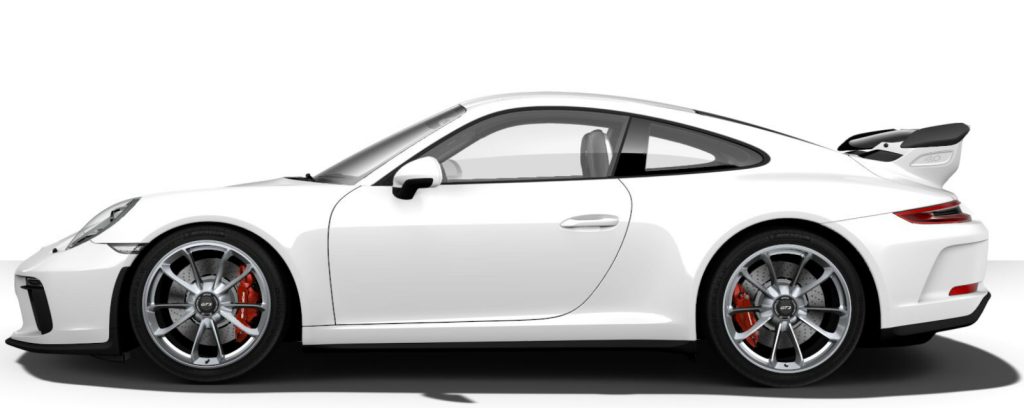
The Porsche 911 GT3 car belongs on a track.
Porsche forums everywhere are filled with people who say they drive their GT3 every day and while that is admirable the reality is that for most people it is just too compromised. I asked a friend who owns a GT3 whether he would recommend it as a daily driver in my cracked and potholed paved NY neighborhood. His response was simple: “it depends how high your threshold for pain is”. That says it all. The GT3 ride is harsh and punishing. You will need physical therapy every time you drive it and you will be frustrated because you can only use 1/10th of the power on offer anyway. If you want a daily driver buy the awesome 911 Carrera GTS or Turbo S and you will be much happier.
This is a beast that wants to be driven hard on track. Featuring a screaming flat-six engine, razor sharp handling and an aggressive body and huge fixed wing, the 911 GT3 is one of the most driver-focused cars on sale by any carmaker on the planet. The powerplant is a masterpiece. It’s a dry-sump, 4.0-litre flat six engine that can scream up to its 9000-rpm redline, making 500 horsepower and 339 pound-feet of torque. While the rest of the 911 range has torque-rich turbocharged engines, this is one you still have to work with and one you want to wind up to 9,000 rpm. The GT3 can be equipped with a six-speed manual transmission or a seven-speed dual-clutch PDK gearbox. The PDK is faster but as manual men we know we’d opt for the stick shift every time.
With the PDK and the launch control system activated, the 2018 Porsche 911 GT3 gets to 62mph in 3.4 seconds. With the manual gearbox, a similar sprint takes 3.9 seconds. That makes the GT3 barely faster than the 911 GTS which is a better daily driver and a 580-hp 911 Turbo S is an entire second faster to 60 so why would you choose the GT3 over these models. It’s easy. It is how it drives and how it makes you feel.
The GT3 has the best handling I’ve ever experienced. It is fast, precise and you can feel everything going on beneath you. The car is surgically precise, the suspension is firm with almost no body roll, and the various scoops and vents on the body not only help cool down the mechanical components, but also increase downforce so the car sticks to the pavement. A GT3 feels like a totally different experience to other cars. It’s loud, stiff, rough and pointy. It is full sensory overload at slow speeds around town and an almost religious experience at speed on track. There is nothing better.
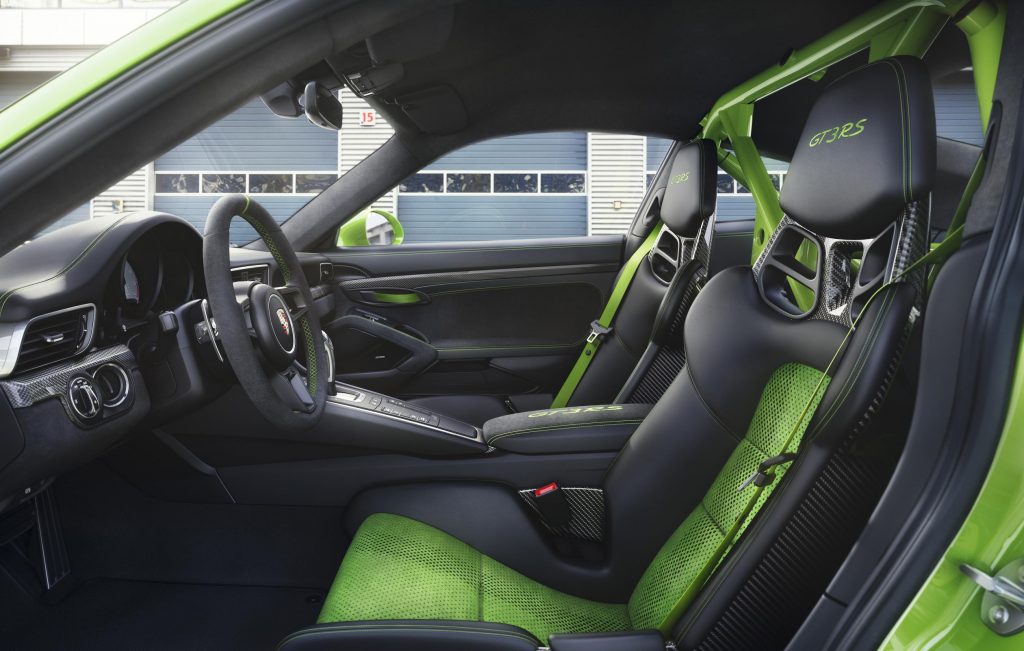
Inside the cabin isn’t luxurious, but the basic stuff is present and accounted for. A Turbo feels like a Bentley in comparison but this isn’t meant to be a luxury GT, this is meant to be a track weapon you can drive to and from home to the race.
A Note on the GT3 Touring Package
New for 2018 is the GT3 Touring Package. There’s the deletion of the regular GT3’s fixed wing replaced with a classic pop-up rear deck, albeit embellished with a ‘GT3 Touring’ badge and a unique lip spoiler on the trailing edge. It only comes with a six-speed manual and inside the trim is kept classic – all-leather and cloth, no Alcantara. Other than that, it’s as per the GT3, with all the same options (ceramic brakes, nose lift, LED headlights, Chrono Package, audio upgrades), which is great news. A subtle-looking GT3, maybe I need to rethink the earlier daily driver comment.
Other Resources: GT3 Reviewed by Chris Harris, GT3 On Track with Carfection, Porsche 911 GT3 evo Review
Verdict
Screaming engine, available with a manual and the most involving sports car money can buy. It is a little rough around town so opt for a different 911 of you are looking for a daily driver. Our pick includes the Touring package.
Specs
| Model |
911 GT3 |
| Power |
500 hp @ 8,250 rpm |
| Torque |
339 lb-ft @ 6,000 rpm |
| Engine |
4.0 L naturally aspirated flat-6 |
| Drivetrain |
Rear-wheel drive |
| 0 – 60 mph |
3.8 sec (manual) 3.2 sec (PDK) |
| 1/4 mile |
11.6 sec (manual) 11.3 sec (PDK) |
| Top track speed |
198 mph (manual) 197 mph (PDK) |
| Fuel Economy |
16 MPG (Manual) 17 MPG (PDK) |
| Base Price |
US $143,600 | UK £111,802 |
911 GT3 RS
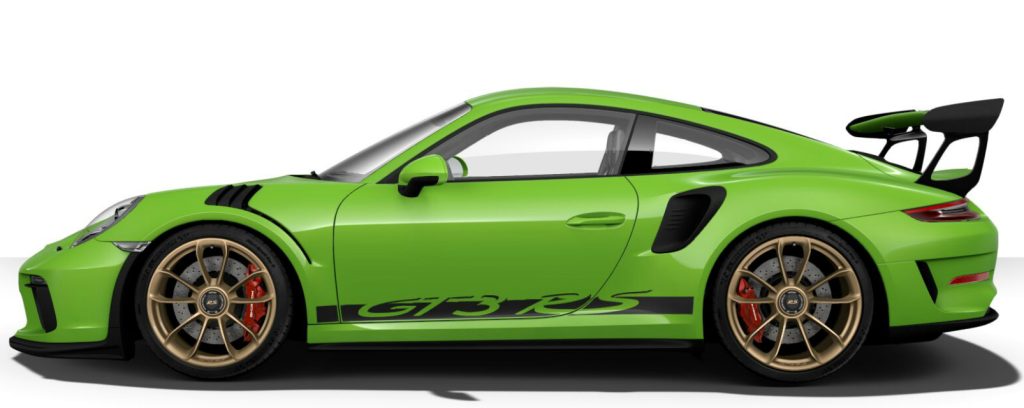
The GT3 RS gets 520 horsepower and 346 lb-ft of torque from the same flat-six engine in the GT3. In fact the whole car is heavily based on the GT3 with lots of shared stuff. But it’s the engine that sets the RS apart thanks to an extra 20 horsepower, as well as the fact that you can’t get it with a manual transmission. The chassis setup is also different, so the RS is quicker on the race track. The GT3 RS is 0.1 second quicker than the old GT3 RS to 60 mph, which now happens in just three seconds. The car also gets front brake cooling and new ball joints inspired by the GT2 RS, and a tweaked rear-steering system. If you think of the GT3 RS as a GT3 with more downforce, more power and more grip then you are pretty close to the money.
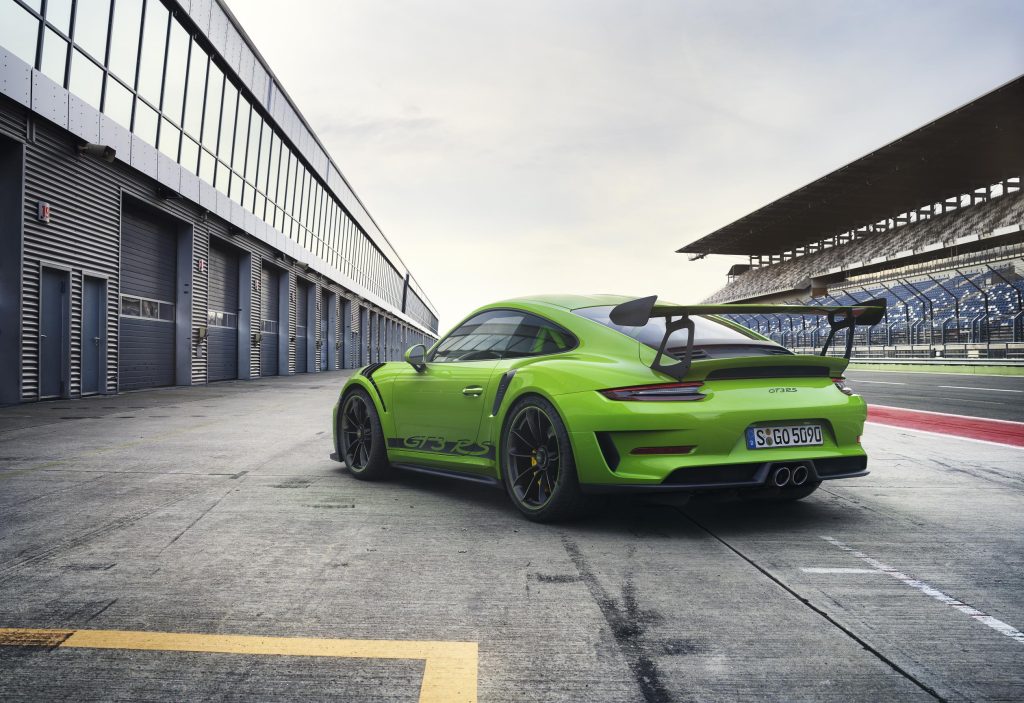
The more aggressive aerodynamic features stand out on the GT3 RS with NACA ducts guiding air to cool the brakes and smoother channeling air to a new diffuser. The side sills come straight off the GT2 RS, as does the manually adjustable carbon-fiber wing. The GT3 RS makes a lot more downforce than the GT3—more than double at 124 mph, in fact. It also effectively makes more than the GT2 RS, because while both make the same maximum downforce at top speed—750 lbs with wings in their stock settings, 992 lbs at maximum attack—the top speed of the latter is much higher, 211 mph verses 193 mph. This means the GT3 RS is making more downforce at lower speeds.
You guessed it, the GT3 RS is a race car and doesn’t make much sense on the road.
And while the engine isn’t the big story here, it’s still worth talking about. It’s largely a carryover from the new GT3—where it debuted last year—but a new intake, titanium exhaust, plus a revised spark curve and camshaft timing give it 520 hp. Its 4.0-liter displacement remains unchanged, as per homologation requirements for the race car, and redline is set at 9000 rpm, making it the highest-revving GT3 RS ever. Torque, when compared with the turbo engines of lesser 911s, is relatively low at 346 lb-ft, but that doesn’t really matter. The only transmission option is Porsche’s seven-speed dual-clutch, PDK, so if you want a manual, you’ll have to get a regular GT3.
Other Resources:
Verdict
The GT3 RS is a GT3 with more downforce, more power and more grip.
Specs
| Model |
911 GT3 RS |
| Power |
520 hp @ 8,250 rpm |
| Torque |
346 lb-ft @ 6,000 rpm |
| Engine |
4.0 L naturally aspirated flat-6 |
| Drivetrain |
Rear-wheel drive |
| 0 – 60 mph |
3.0 sec (PDK) |
| 1/4 mile |
10.9 sec |
| Top track speed |
193 mph (PDK) |
| Fuel Economy |
TBA |
| Base Price |
US $187,500 | UK £141,346 |
911 GT2 RS
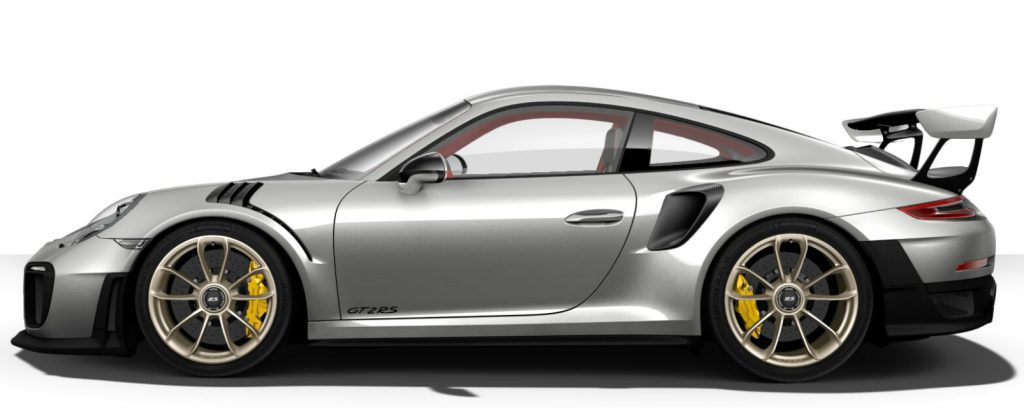
The 991.2 GT2 RS is powered by a 3.8 L twin-turbocharged flat-6 engine that produces a maximum power of 700 PS (515 kW; 690 hp) at 7,000 rpm and 750 N⋅m (550 lb⋅ft) of torque, making it the most powerful 911 ever built. Unlike the previous GT2 versions, this car is fitted with a 7-speed PDK transmission to handle the excessive torque produced from the engine. Porsche claims that this car will accelerate from 0 to 60 mph in 2.7 seconds, and has a top speed of 340 km/h (210 mph). It is by far the most expensive and extreme 911 available and is really only useful on track.
The GT2 RS has a roof made of magnesium, front lid, front and rear wings and boot lid made of carbon, front and rear apron made of lightweight polyurethane, rear and side windows made of polycarbonate and features a titanium exhaust system. Porsche claims that the car will have a wet weight of 1,470 kg.
Inside the interior is as stripped back as you expect of a GT 911, with liberal usage of lightweight plastics and metal, with Porsche stating you could save an additional 12kg by swapping the steel roll cage for an aluminum one. It is rougher, less civilized and louder than both the GT3 and GT3 RS. As expected the steering is brilliantly communicative and fabulously responsive. On the road there is some turbo lag but this engine is phenomenal, with a level of responsiveness and linearity that not many years ago would have been unthinkable on this kind of turbocharged output. On track you won’t notice because it is always on song. While a GT2 RS would be amazing on country roads, its level of performance is so ferocious that it really needs to be on track to be enjoyed.
Other Resources: Porsche 911 GT2 RS review by Autocar,
Verdict
The GT2 RS is the ultimate track car and is too compromised for the road. On the road a GT3 or GTS are better for a lot less money. On track, in expert hands though the GT2 RS is ridiculousness turned to 12 and we love it. Since this is a car for the track would I take it over a GT3 or GT3 RS. Toss up between this and the GT3 RS, they are both epic.
Specs
| Model |
911 GT2 RS |
| Power |
690 hp at 7,000 rpm |
| Torque |
550 lb-ft (2,250 to 4,000rpm) |
| Engine |
3.8 L twin-turbocharged flat-6 engine |
| Drivetrain |
Rear-wheel drive |
| 0 – 60 mph |
2.7 sec (PDK) |
| Top track speed |
211 mph (PDK) |
| Nurburgring Time |
6:47.3 |
| Fuel Consumption |
TBA |
| Base Price |
US $293,200 | UK £207,506 |
The Final Word
We covered 24 Porsche models and probably didn’t make your buying decision any easier. Don’t worry because every 911 on sale today is pretty awesome so picking a bad 911 is impossible. What you should have learned above is that you really need to understand your own needs and your style.
911 Chooser Exercise