All posts in “Food&Drink”

Brooklyn Lager: What It Is, and Why It’s So Popular

Everything you need to know about the most iconic beers in history from grocery staples to cult favorites. This time: Brooklyn Lager, a Brooklyn-born beer that’s gone worldwide.

Brooklyn is the birthplace of a lot of talented people. Jay-Z, one-third of the Beastie Boys, Larry David. Brooklyn is also the birthplace of an amazing craft beer, Brooklyn Lager. Like a lot of things to come from the outer-borough, Brooklyn Lager has grown far beyond its Brooklyn roots, and has since reached worldwide acclaim. Here’s what you should know about Brooklyn Lager.

What is Brooklyn Lager?

Brooklyn Lager is an amber lager with a 5.2 percent ABV that tastes like citrusy, toasted bread. Poured into a glass, the lager is definitely amber in color, and it’s unlike what you would expect from a beer that’s classified as a lager nowadays. That’s because in the late 1800s, Brooklyn used to be a hub for brewing, with the most popular style being the Vienna-style lager, marked by its dark orange color and caramel, toffee and bread notes — all very apparent in Brooklyn Lager. Additionally, the beer is dry-hopped to give it a flavorful and pleasant bitterness.

Who makes Brooklyn Lager?

Brooklyn Brewery is the brains behind Brooklyn Lager. Founded by Steve Hindy and Tom Potter, Brooklyn Brewery has been around since 1988. The two founded the brewery to bring beer-making back to Brooklyn. Their mission was so well-received that highly acclaimed graphic designer Milton Glaser helped design the brewery’s famous “B” logo. In 1996, Brooklyn Brewery tapped Garrett Oliver to be its brewmaster, and he has since expanded the brewery’s beer lineup to include a number of delicious offerings from IPAs to its new line of non-alcoholic beers.

Where can you buy Brooklyn Lager?

Brooklyn Brewery has a huge distribution web. Its beers, including the flagship Brooklyn Lager, are available nationwide, and it’s also available in over 30 countries spread across five continents. If you’re having trouble locating Brooklyn Lager near you, check out the brewery’s beer finder page.

Why is Brooklyn Lager so popular?

new york mayor rudolph giuliani wears a baltimore

Stan HondaGetty Images

boxer schumer stanley cup bet

Bill ClarkGetty Images

The love of Brooklyn Lager crosses political divides. Both from Brooklyn, Rudy Giuliani and Chuck Schumer have used the beer to settle sports bets with out-of-staters.

Brooklyn Lager is popular because it’s a damn good beer, and also because of its brewery’s contributions to the craft beer movement. Besides revitalizing the brewing industry in Brooklyn, the brewery also makes donations to non-profits and has been an avid supporter of LGBTQ+ rights. Brooklyn Lager has a score of 84 on Beer Advocate, which the website considers “good.” The beer is tasty and comforting, while also being easy to knock out a few in one sitting. If you’re ever in Brooklyn, stop by the brewery — which has become somewhat of a tourist destination — or get a pint wherever you can find it. It won’t be hard because the beer is almost everywhere.

This content is created and maintained by a third party, and imported onto this page to help users provide their email addresses. You may be able to find more information about this and similar content at piano.io

The Complete Guide to Breville Espresso Machines: Every Model Explained

Welcome to Brand Breakdown, a series of comprehensive yet easy-to-digest guides to your favorite companies, with insights and information you won’t find on the average About page.

Equipped with dozens of knobs and buttons, commercial espresso machines — those found in cafés — suggest making espresso at home is a complicated process. This isn’t necessarily the case, and Breville’s prosumer machines are evidence the quality drop-off isn’t as extreme as you might expect.

Breville has been making kitchen appliances since 1932, and while the Aussie company dabbles in a bit of everything — toasters, pizza ovens, juicers, waffle makers, etc. — it’s arguably best known for its coffee and espresso lineup.

“A commercial espresso machine is a workhorse,” Kaleena Teoh, co-founder of Coffee Project NY, says. “It is able to pull shots and froth milk at the same time and has no recovery time between shots. The steam and water pressure is also very consistent and thus able to produce consistent espresso extraction.”

Teoh says residential machines ones are designed to be used by even the most amateur espresso fans. This is everything you need to know about our favorite espresso-at-home brand.

breville espresso

Breville

Breville Espresso Machines 101

Are Breville espresso machines any good?

Both amateurs and pros praise Breville’s line of espresso machines for pulling solid shots of espresso. Home espresso machines, the good ones at least, usually start around $300 and go up from there. Breville’s entry-level model — the Bambino — costs $300, with models getting relatively more expensive before capping off at $2,800 for the feature-packed Oracle Touch.

From a feature and build quality perspective, Breville’s espresso machine lineup rides the line between commercial and residential. Unlike pod-based machines like Nespresso, Breville espresso makers often come with quality-focused features like pre-infusion, commercial-level pressure, built-in grinders and powerful boilers that deliver fairly consistent pressure and heat. They’re not as powerful or consistent as machines you’ll find at the local coffee shop and the warm-up times are lengthier, but the gap between pod-based espresso (which is really closer to coffee than espresso) and Breville machines is similar to the gap between Breville and commercial level espresso makers.

breville espresso machine

Williams Sonoma

What’s the difference between an automatic and manual espresso machine?

In general, Chi Sum Ngai, Teoh’s fellow Coffee Project NY co-founder, says automatic machines are those “that will complete your drink with the touch of one button.” You do not need to have any coffee skills to make the coffee with these machines, she says. Nespresso machines are probably the most popular example of fully auto espresso makers.

Manual espresso machines give more control over to the user. “You have more control over how the cup of coffee tastes, but you will need good coffee skills to make a good cup of coffee,” Sum says. “Features that you usually control are grind size, temperature, extraction time, pre-infusion time, pressure, etc.”

Semi-automatic machines – what Breville makes – lie in the middle. You get control over variables within the espresso-making process, but there are guardrails built into the machine to guarantee a solid shot every time.

Breville Espresso Machines

The Bambino

Breville Bambino

williams-sonoma.com

$299.95

  • Entry-level machine with a wallet-friendly price
  • Super-fast startup time
  • Built-in steam wand
  • Available in two finishes
  • Long wait time between pulling shots and steaming milk
  • Requires manual tamping
  • No built-in grinder

Breville’s Bambino is the brand’s entry-level espresso machine that’s equipped with the minimum it takes to get a shot into your cup. The compact machine comes with a 54mm portafilter, milk jug and tamper. The Bambino can pull single or double shots, and with the integrated steam wand, you can froth milk to create espresso-based drinks like lattes and cortados. For those who want to preheat their cup or make an Americano, the steam wand also doubles as a hot water outlet. The Bambino can do all the work in pulling a shot at the push of a button, but if you who want to experiment manual override is available and allows for programming shot volumes. The Bambino uses low pressure to pre-infuse the coffee before brewing at 9 bars, and it only takes about three seconds to start up the machine. (Bars are the unit of measure of pressure, with 9 bars being the ideal number for pulling a shot of espresso.)

The Duo-Temp Pro

Breville Duo-Temp Pro

amazon.com

$429.00

  • Under $1,000
  • Includes single and dual wall brew baskets
  • Compact counter footprint
  • No auto-tamp function
  • Manual milk steamer

The Duo-Temp Pro is another beginner’s machine, like the Bambino, with a slightly larger countertop footprint. It makes espresso in pretty much the same way as the Bambino; namely it does uses low pressure pre-infusion and 9 bars of brewing pressure. Instead of choosing between one shot or two, users can manually adjust the volume of their espresso by using the dial on the front. The machine houses a hidden storage tray, which is a nice touch to store away miscellaneous espresso-brewing tools, and the machine is equipped with maintenance and cleaning indicators so you can keep the Duo-Temp Pro in tiptop shape.

The Bambino Plus

Breville Bambino Plus

amazon.com

$499.95

  • Automatic milk frothing
  • Three second heat-up time
  • Quick to go from pulling a shot to frothing milk
  • No auto-tamping function
  • No built-in grinder

The Bambino Plus is the Bambino’s smarter sibling that’s meant to make the brewing of café-quality espresso easier. Pulling a shot is the same as the cheaper Bambino, but the Bambino Plus has an automatic milk frother, which allows you to choose between three milk textures and three milk temperatures. While you can’t pull a shot and steam at the same time, it’s noticeably faster to go from one to the other than say the Duo-Temp Pro, which takes some time to heat up the steamer after immediately pulling a shot.

The Infuser

Breville The Infuser

williams-sonoma.com

$579.95

  • Includes a built-in pressure gauge
  • Hands-on for more customizatin
  • Slow heat-up time
  • No built-in grinder

Breville’s Infuser starts to let the coffee nerds geek out over their shot pulling. Either use Breville’s settings to pull a shot or two, or take full control over how you want your shot to come out. The pressure dial that’s front and center on the machine lets you know whether or not you’re pulling a shot properly, which will be affected by how much coffee you used, the ground size and tamp. The Infuser reverts back to the manual milk frother, so there’s no one-push operation for getting your desired milk temperature and texture.

The Barista Express

Breville Barista Express

amazon.com

$599.95

  • Built-in dosing grinder
  • Under $1,000
  • Built-in steam wand
  • Two color options
  • Comes with pressurized and non-pressurized brew baskets
  • Requires manual tamping of shots
  • Single boiler for steam wand and pulling shots

The first of Breville’s Barista line of espresso makers, the Express is our favorite of the whole lineup. Why? It’s the lowest-priced Breville that comes with a built-in grinder. Espresso grinding requires a very nice coffee grinder, which can cost $200-plus on its own. The Express (as well as all other Breville’s with a built-in grinder) also features what the brand calls “dose-control grinding,” which effectively replaces another necessary accessory: a scale.

You can’t eyeball how much coffee you need to grind for espresso: if you use too much, you could damage the machine; if you use too little, the pressure may not be enough to properly pull a shot. Performance-wise, it hits the 9-bar benchmark consistently and the steam wand works beautifully. It also comes with both pressurized and non-pressurized brew baskets, meaning you have the choice between simple or more manual brewing. This is Breville’s bestselling model for a reason.

The Barista Pro

Breville Barista Pro

amazon.com

$790.00

  • Built-in dosing grinder
  • LCD display
  • Built-in steam wand
  • Eight color options
  • Under $1,000
  • Comes with pressurized and non-pressurized brew baskets
  • No auto-tamping function
  • Single boiler for steam wand and pulling shots

The middle-child of Breville’s Barista sub-line, the Pro model offers a couple important upgrades on the Express. Importantly, it features the same strengths: built-in dosing grinder, consistent shot-pulling and a price tag under $1,000. The upgrades are two-fold: power and control. The Pro model is equipped with a more powerful heating element than the Express, meaning pre-heat times will be reduced significantly. It also comes with a shiny new LCD display in place of the pressure gauge of the Express. The goodness of this change is up for debate; some will appreciate seeing the pressure their shots are pulling, live. Others still will appreciate the clarity the LCD brings.

The Barista Touch

Breville Barista Touch

amazon.com

$999.95

  • Touchscreen display provides simple step-by-step guides
  • Built-in dosing grinder
  • Three color options
  • Built-in steam wand
  • Single boiler for steam wand and pulling shots
  • No auto-tamp function

The pricier Barista-level Breville is better-suited to newcomers than espresso geeks. The price hike includes the more powerful heating element from the Pro model but uses a touchscreen in place of the LCD display and every button except the On/Off switch. If you value having your hand held through the process to some degree, the Touch is worth it; when you press your desired drink the machine walks you through every step. Otherwise the Pro or Express are likely better values.

The Dual Boiler

Breville Dual Boiler

williams-sonoma.com

$1,499.95

  • Two-year repair warranty
  • Over pressure valve limits bitterness in shot
  • No built-in grinder

The Dual Boiler exists in a precarious in-between spot within the Breville espresso machine lineup. It’s zapped with more power than any lower-priced models, but it’s not as powerful as the Oracle machines that succeed it. It comes with some of the sneakier upgrades the Oracle line gets — dedicated boilers for pulling shots and steaming milk, an over pressure valve that limits bitterness in the espresso and additional customization options — but it doesn’t come with a built-in dosing grinder, meaning you will have to purchase your own espresso-level grinder to go with it (Breville sells the Dual Boiler together with its own grinder under the name “Dynamic Duo“). If you don’t want to spend the extra cash for the supped-up Oracle line or you have your own grinder already, the Dual Broiler is worth checking out.

The Oracle

Breville Oracle

williams-sonoma.com

$1,999.95

  • Two-year repair warranty
  • Over pressure valve limits bitterness in shot
  • Built-in dosing grinder
  • Auto-tamps coffee
  • Very expensive

The Oracle line is the ceiling of Breville’s espresso machine group. The more affordable Oracle (it’s $800 less than the touchscreen option) features the same duo of dedicated boilers for steaming milk and pulling shots, and its heating element and power level is the highest in the Breville lineup (along with the Touch). In other words, the guts are mostly the same from Oracle to More Expensive Oracle; the lower-priced variant just uses more buttons and a standard LCD display instead of the slightly cleaner touchscreen version. The over pressure valve limits bitterness, and the built-in dosing grinder and auto-tamper makes the Oracle line the closest thing to a push-and-pull espresso machine there is.

The Oracle Touch

Breville Oracle Touch

williams-sonoma.com

$2,799.95

  • Two-year repair warranty
  • Over pressure valve limits bitterness in shot
  • Built-in dosing grinder
  • Simple touchscreen display
  • Three color options
  • Auto-tamps coffee
  • Nearly $3,000

The tippy-top of the Breville espresso maker tree comes with firepower and ease of use in equal measure. The machine’s touchscreen provides step-by-step walkthroughs for lattes, cortados, flat whites and more, and the lack of buttons makes for a dramatically less intimidating learning curve (though, it must be said, if you read the manual each Breville machine is fairly straightforward).

All said and done, this is a very expensive product for your kitchen, and one that, over time, will deliver value over dropping by a coffee shop every day. You’re paying the premium for features like lower pre-heat times, more consistent (and higher quality) espresso and convenience.

This content is created and maintained by a third party, and imported onto this page to help users provide their email addresses. You may be able to find more information about this and similar content at piano.io

Make Virtually Any Hot or Cold Brew Coffee Drink You Can Think of With This Single Machine

Designed to make everything from a double shot of espresso to a trendy flat white, the Z10 merges several cutting-edge JURA technologies for a top-tier brew, every time. Each coffee starts with JURA’s proprietary Product Recognizing Grinder (known as P.R.G.) to identify and specify the unique grind fineness for the selected drink. The Z10’s eighth-generation brewing unit is the result of a legacy of luxury brewing technology, plus, JURA developed a special Cold Extraction Process for cold brewing with the Z10. In this process, cold water is pulsed through fresh coffee at high pressures for a refreshing, full-flavor cold brew specialty. From the modern convex-concave aluminum panelling to the easy-to-use touchscreen display, the Z10 isn’t just the peak of at-home brewing, it’s the only coffee machine you’ll need.

Price: $3,999

SHOP NOW

This content is created and maintained by a third party, and imported onto this page to help users provide their email addresses. You may be able to find more information about this and similar content at piano.io

This Beautiful Coffee Maker Has the Ultimate Stamp of Approval

Shopping for a new coffee maker is a complicated task. Luckily, to help weed out the bad coffee makers from the good ones, you can turn to the Specialty Coffee Association (or us), which has a list of certified home brewers that the association deems as being the best of the best. Its list of 30 brewers is now a list of 31 thanks to the recent certification of the Ratio Six coffee maker.

The Ratio Six is a sleek brewer that essentially recreates the pour-over brewing process with the press of a button. The water flow is engineered to saturate coffee grounds evenly, while releasing the correct amount of water to perfect the bloom and brew phases. The Ratio Six brews up to 40 ounces of coffee, which stays warm for up to an hour in the brewer’s thermal carafe. The Six is designed to be used with a flat-bottomed coffee filter, but it can be swapped out for a conical filter, which comes with the pricier Ratio Eight, or you can even take it all away and brew directly into a Chemex minus the manual Chemex work.

ratio six coffee maker
The Ratio Six’s water head ensures even water distribution so that coffee grounds are evenly saturated.

Ratio

Besides all of its unique features, the Ratio Six ticks all of the boxes that the SCA looks for in a certified home brewer. Namely, it passes the rigorous test of brewing an SCA Golden Cup. In coffee nerd terms, a Golden Cup yields a cup of joe with a coffee-to-water ratio of 55 grams per liter, and it does so within a 10 percent margin of error using water heated between 195 and 205 degrees Fahrenheit. (For a more detailed breakdown of what constitutes an SCA Golden Cup, check this out.)

Setting aside all of the coffee jargon, the Ratio Six is just a damn beautiful coffee maker. Since 2012, Ratio has set out to make coffee makers that not only make a great-tasting coffee but machines that combine beauty, simplicity and quality — and it’s very apparent with the Six that the brand has done its job.

The Ratio Six is available on Ratio’s website, as well as select retailers like Williams Sonoma and Huckberry, with an MSRP of $345. For more details about the Six’s certification, head to the SCA’s website to learn more.

Price: $345

SHOP NOW

This content is created and maintained by a third party, and imported onto this page to help users provide their email addresses. You may be able to find more information about this and similar content at piano.io

The 7 Best Instant-Read Thermometers for Precision Cooking

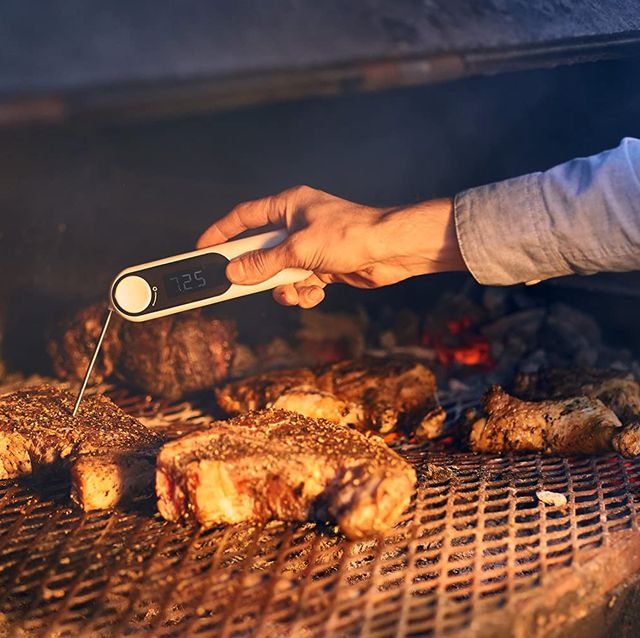
oxo hand held themometer measuring temp of steak

OXO

Everyone who cooks needs an instant-read thermometer, full stop. These handy little gadgets aren’t just about making sure your steak is cooked to your liking; they ensure that your steak — or whatever you’re cooking — isn’t raw and poses a threat to your wellbeing. In the past, you might’ve used a manual, dial-faced thermometer to check your food’s doneness. Helpful as they were, they took a long time to get a reading, and you never really knew when the temperature had stabilities. Um, is this turkey really at 170 degrees? Instant-read thermometers do all of that in an instant, hence the name. (Though an “instant” can mean a lot depending on the brand.) So instead of cooking your chicken until it’s bone-dry to make sure the salmonella is out, get one of these instant-read thermometers to get perfectly cooked food every time.

What to Look For in an Instant-Read Thermometer

Tip #1: Slow and steady does not apply

You want your instant-read thermometer to get you a reading in a literal instant. We only found one thermometer that can do that — giving a read-out in one second — but anything faster than three to five seconds is ideal. Why? For one, you don’t want to expose your hand to high heats for a long time, and those couple seconds can save you from some singed arm hairs. And if you’re checking something that’s in the oven, keeping your oven door open for just a second or two can significantly drop the oven temperature.

Tip #2: It’s OK to be a little off

Every brand will tout its instant-read thermometer as being super accurate. They’ll even offer up a margin of error so you know what to expect. In reality, most instant-read thermometers, even the dirt-cheap ones, will be very good at getting a good reading. Most thermometers have a margin of error less than two degrees, plus or minus, while more expensive ones will have a margin of error in the decimal place. Those tiny margins of error will have little to no impact on your food, so there’s no need to get too obsessive over brands’ estimations for margins of error.

Tip #3: Going for a splash or a full-on dip?

Not all instant-read thermometers are waterproof, with some being splash-proof. (And when it comes to water- or splash-proof ratings, they’re going to apply strictly to the thermometer’s handle.) If you want to make sure you can fully submerge your thermometer in water, say for cleaning, make sure to look for a waterproof rating. Otherwise, a splash-proof option can take on an excessive beating from water, steam or other liquids.

The Best Instant-Read Thermometers of 2021

Advertisement – Continue Reading Below

Best Overall Instant-Read Thermometer

ThermoWorks Thermapen Mk4

Almost every professional chef calls the Thermapen Mk4 their go-to instant-read thermometer, and it’s ours, too. While ThermoWorks has discontinued the Mk4 for the new Thermapen One, the former is still an exceptional instant-read thermometer with temperature readings in two to three seconds, with a margin of error of 0.7 degrees. Throw in extra features like an auto-rotating screen, motion-sensing sleep and wake mode and an IP67 waterproof rating, and you have yourself a winning pick. Because the Mk4 is on closeout, the 30-percent discount makes this an even more enticing purchase.

  • Fast readings
  • Waterproof unlike other options
  • On closeout, so while it’s a good price, it could be sold out for good soon
  • Suited for right-handed people

Best Splurge Instant-Read Thermometer

ThermoWorks Thermapen One

Eventually the Mk4 will be gone for good, and the One will reign supreme. The biggest improvement from the Mk4 to the One, is the latter’s ability to get a temperature reading in an actual instant — just one second. It’s also more accurate than its predecessor — with only 0.5 degrees of potential deviation — and more brightly lit. It also retains all of the good stuff the Mk4 has like its waterproof rating, auto-rotating and auto-off functions and a comfortable-to-hold handle. While this has nothing to do with overall performance, the number of color options is also nice to find something that best suits you.

  • Super-fast readings
  • Long handle keeps your hands away from heat sources
  • Expensive, especially if you’re not cooking often

Best Budget Instant-Read Thermometer

ThermoPro TP-02S Instant-Read Thermometer

Don’t get this brand, ThermoPro, confused with ThermoWorks. ThermoPro is seen as a more budget-friendly option in the thermometers field, and its TP-02S is a worth-while pick for an instant-read thermometer. It clocks temperatures anywhere between four and seven seconds, with an accuracy within 0.9 degrees. It has an extra-long probe, and while it doesn’t fold up, the TP-02S comes with a sheath to protect you from accidental stabbings.

  • Extremely cheap with accurate readings
  • Extra-long probe to keep your hands away from heat
  • Not waterproof
  • Probe is fixed

Best Instant-Read Thermometer for Left-Handed People

Oxo Good Grips Thermocouple Thermometer

A major qualm people have with some instant-read thermometers is that, while they’re comfortable to hold, they’re designed to be comfortable for just right-handed people. Take the Thermapen Mk4 and One, for example, which is ridged on one side. On the other hand, the Oxo Good Grips Thermocouple Thermometer is flat on both sides so it’s easier to use for all people. It has an easy-to-read display that gives readings in about three seconds. It’s accurate within 0.9 degrees and has a splash-proof rating of IP66. The design of the rotating dial means you can whip out the probe without touching it, and you don’t need to fully extend it for more ergonomic uses. 

Best Magnetic Instant-Read Thermometer

Lavatools Javelin Pro Duo

When it comes to cooking gadgets, it’s the little things that count. For the Lavatools Javelin Pro Duo, its standout feature is its integrated magnet, which makes for easy storage. It’s a tiny detail that’s only made better by what an overall excellent instant-read thermometer this is. It looks a lot like the Thermapen Mk4 and One, and similarly has fast read times between one to three seconds. It has a large, legible display that rotates 360 degrees, while also having an IP65 waterproof rating. One added feature of the Pro Duo is its stabilization alert, which beeps to tell you that the temperature has stabilized.

  • Magnetic backing
  • Fast readings
  • Stabilization alert ensures you’re getting the right reading
  • Not for induction stovetops, which can interfere with readings

Best Pocket-Sized Instant-Read Thermometer

ThermoWorks ThermoPop

Peeping out of many chef’s pockets is the ThermoWorks ThermoPop. The tiny little thermometer is a handy tool to have, especially thanks to its fast readings — give it three to four seconds — and accuracy within two degrees. The display takes up most of the handle, so you have to be particular about how you hold it, otherwise you’ll cover the reading. However, the numbers are legible, and you can rotate the reading and turn on the backlight with the touch of a button.

  • Has a wider margin of error than other thermometers
  • Doesn’t auto-rotate and backlight isn’t automatic

Best Instant-Read Thermometer with Infrared

Taylor Precision Thermocouple Thermometer

Taylor Precision’s Thermocouple Thermometer is a two-in-one thermometer that uses a probe to clock internal temperature and infrared to clock surface temperature. The Thermocouple has one of the widest range of temperatures it can read, and its probe is also on the longer side, another bonus. 

  • Wide range for readings
  • Long probe
  • No backlight

This content is created and maintained by a third party, and imported onto this page to help users provide their email addresses. You may be able to find more information about this and similar content at piano.io

Advertisement – Continue Reading Below

Get Your Grubby Hands Off My Garlic Press, You Kitchen Minimalists

Welcome to Counterpoint, a series in which we challenge commonly held ideas about well-known products. This time: single-purpose cooking tools.

The world of kitchen gadgets is vast and unwieldy. Most of those gadgets are what people call “unitaskers,” or hyper-specific tools that perform a single task. If you need an example, check out an avocado slicer, which as its name suggests only slices avocados. Even beloved celebrity chef Alton Brown is on record knocking unitaskers for being useless, overcomplicated and, in a lot of cases, just really stupid. But not all unitaskers are created equal, and some of them are just pretty damn ingenious.

In professional kitchens, chefs only really need a handful of tools to perform a plethora of kitchen tasks. Except most people are not professional chefs, and some unitaskers are actually clever ways to make cooking and food prep easier. Take the humble garlic press for example. While crushing and mincing a clove or two of garlic is not complicated, imagine having to do that for a whole head of garlic. The garlic press (unitaskers don’t have very inventive names) makes light work out of a tedious process. Where kitchens hire food preparation workers to do work like that, home cooks have things like the unitasker.

As Brown demonstrates in his takedown of unitaskers, some do deserve some light-hearted flak. I’m pretty sure I don’t need Wolverine’s claws, er, pulled pork shredders when forks exists (albeit cosplaying as everyone’s favorite X-Men is worth the price of admission). Is one person eating that many taco salads that they need a taco bowl mold taking up valuable cabinet space? While we’re poking fun at these somewhat arcane contraptions, they do make certain kitchen tasks more accessible. Those with disabilities could find great use in products like an apple slicer or a butter dispenser, just two tools that make everyday tasks less challenging.

While those who hate clutter could make a case for having as few cooking tools as possible, those who cook often enough will know that they’ll take as many shortcuts as they can to get food on the table as quickly as possible. Here are five unitaskers that deserve a spot in your kitchen.

Zyliss Garlic Press

Amazon

Susi 3 Garlic Press

Zyliss amazon.com

$21.50

Although the recipe calls for two cloves of garlic, you know you’re going to end up using the whole head. And you can mince it all easily with a garlic press.

Oxo Strawberry Huller

OXO

Strawberry Huller

Oxo oxo.com

$8.99

Whether you’re prepping strawberries to make a shortcake or you just need a snack, this huller makes it fast and easy to get the hull out of your strawberries without wasting precious fruit.

Tovolo Seal N’Store

Crate&Barrel

Seal N’Store

Crate and Barrel crateandbarrel.com

$16.00

So often produce goes to waste because you don’t need the whole thing for whatever you’re making. Ditch the plastic wrap for these mixed-material produce savers that save your fruits and vegetables, and your wallet.

Cuisinart Stainless Steel Chopper

Amazon

Stainless Steel Chopper

Cuisinart amazon.com

$24.90

All those dumb hacks for preventing watery eyes while chopping onions are moot when you have a hand chopper like this.

Chef’n FreshForce Citrus Juicer

Amazon

FreshForce Citrus Juicer

Chef’n amazon.com

$24.99

$14.79 (41% off)

If you’re squeezing citrus by hand, you’re missing out on 60 percent of the juice. That’s a made-up number, with owning a juicer makes sure you get every last drop of citrus juice with just a bit of forearm strength.

This content is created and maintained by a third party, and imported onto this page to help users provide their email addresses. You may be able to find more information about this and similar content at piano.io

Ninja’s Foodi Grill Isn’t Really a Grill

I remember a time when people only thought of Ninja as a blender they saw on an infomercial. Today, the company has come to dominate the kitchen aisles at Target and Walmart. They make an appliance for just about everything — food processors, coffee makers, juicers, cookware, ice cream makers and even indoor grills. No word yet on the brand’s expansion to outdoor grills, but the indoor grills — called the Ninja Foodi Grill, starting just above $200 full price — have become increasingly popular since their 2019 release. Ninja markets them sort of like an Instant Pot that grills instead of pressure cooks. Could it actually replace your grill? We tested it to find out.

SHOP NOW

What’s Good?

Maximum efficiency: It takes very little doing to cook in the Ninja Foodi Grill. On virtually any setting, its preheat times are significantly shorter than full-sized ovens, and because the machine has preset programs for most standard items (chicken breast, steak and so on), there’s no getting up from the sofa to check cooking progress. Unlike an oven set to broil or any temp above 400, it doesn’t super-heat the air in the room it’s located either, so you’re not opening windows or turning on the A/C for cooking respite.

Dishwasher-safe: There are many attachments, odds and ends used in cooking with the Ninja Foodi Grill (splatter shield, grates, grease catch, etc.). Initially, I didn’t realize all of them were dishwasher-safe, so I found myself washing each piece — cracks, crevices and gaps included — by hand. My advice read the manual in full before cooking. You won’t lose 20 minutes of your life scrubbing between grates.

Non-grilling functions: The cooking functions not in the name of the Foodi Grill are very good. The air-frying function does what any good air fryer should: preheat quickly, cook fast and deliver a satisfying crunch with minimal oil or fats required. It bakes well enough, too, which makes sense considering air frying is essentially baking by another name. I made a tray of brownies that came out perfectly.

tech roundup
After testing the Ninja Foodi Grill for a month, I’m not entirely sure it should be called a grill at all.

Courtesy

The Not so Good

More oven than grill: Ninja’s clever countertop multicooker does many of its jobs well, but it’s not going to replace a grill. Enameled cast iron grates can do the trick if the heat source — charcoal, gas or otherwise — is powerful enough, but the Foodi Grill isn’t reaching the blazing temperatures found in charcoal grills or gas grills with infrared burners (both reach well above 800 degrees). What makes grilled food great and different from food cooked indoors is sky-high temperatures, and the Foodi Grill isn’t cutting it in that respect. The grates will leave grill marks, but grill marks aren’t what you’re after either; you want a full sear, which you won’t get from the machine.

The best way to mimic the sear achieved on a hot grill indoors is still a cast-iron skillet, though you will have to deal with lots of smoke in your kitchen, which is a problem the Foodi Grill doesn’t have.

RIP countertop space: No matter which size Foodi Grill you get, be prepared to lose a significant percentage of your open countertop space. The appliance is wide, tall and generally awkward to lug around. Heed the same advice given to those interested in a heavy Dutch oven: if you’re willing to keep it in the kitchen all the time in its own dedicated space and will use it regularly, fear not.

Also, because there’s so much enameled iron inside, it’s not light.

Verdict

While the grill feature is more imitation than evocation (it just doesn’t have the requisite firepower), the Foodi Grill is consistent, intuitive and fits nicely within the Ninja kitchen appliance universe. If you’re willing to temper your expectations and understand the grill function is more aesthetics than taste, you’re good. Therefore I wouldn’t recommend the Foodi Grill as a replacement or stand-in for a grill, but it executes its many other functions to a high degree of consistency.

SHOP NOW

This content is created and maintained by a third party, and imported onto this page to help users provide their email addresses. You may be able to find more information about this and similar content at piano.io

Dogfish Head 60 Minute IPA: What It Is, and Why It’s So Popular

Everything you need to know about the most iconic beers in history from grocery staples to cult favorites. This time: Dogfish Head 60 Minute IPA, a beer that helped to popularize one of the leading beer styles today.

Sequels are rarely as good as the original. Just don’t tell that to the Godfather 2, Spider-Man 2 or Dogfish Head 60 Minute IPA. For almost two decades, 60 Minute IPA has been one of the most popular beers in the US, and it’s not one you have to line up for hours for. So what exactly is the 60 Minute IPA (we’ll give you a hint: It’s not a beer that takes 60 minutes to drink), and how did it become such a pivotal beer? This is the story of 60 Minute IPA.

What is Dogfish Head 60 Minute IPA?

As its name suggests, 60 Minute IPA is an IPA. First released in 2003, 60 Minute IPA is a continually hopped beer, which means during the course of a 60-minute boil, hops, specifically from the Northwest, are continually added to provide a super hoppy flavor minus any harsh bitterness. The 60 Minute IPA is actually a follow-up to Dogfish Head’s 90 Minute IPA, an imperial IPA, that helped to popularize the style when everyone else was drinking amber ales and lagers. Besides its 60 Minute and 90 Minute IPAs, Dogfish Head also has a 120 Minute IPA, a knock-you-out-of-your-seat imperial IPA with anywhere between 15 and 20 ABV.

60 Minute is a 6 percent ABV beer with 60 IBUs, and holy hell is it a good beer. The beer is shockingly crisp for an IPA with a relatively high ABV, and its predominant flavors include citrus and pine. Despite being an absolute hop bomb, it’s not overly bitter to the point that you want to rip your tongue out.

dogfish ipas

Dogfish Head

Who makes Dogfish Head 60 Minute IPA?

The brewery behind Dogfish Head 60 Minute IPA is, get this, Dogfish Head. The Delaware-based brewery, which celebrated its 25th anniversary last year, is a legend in the craft beer world, helping to popularize the trend towards microbreweries and away from the Big Guys. While the brewery has gone through some major changes, including an acquisition by Boston Beer, Dogfish Head remains the same scrappy and inventive brewery it once was with its founder, Sam Calagione, at the helm.

Where can you buy Dogfish Head 60 Minute IPA?

You can find Dogfish Head beers all across the country, with distribution in all 50 states, as well as Washington D.C. The beer is a grocery store staple as much as it is a staple in craft beer stores. If you’re looking for 60 Minute (or another specific Dogfish Head beer) around you, check out the brewery’s “Fish Finder.”

Why is Dogfish Head 60 Minute IPA so popular?

In a 2009 Youtube video, Calagione says “60 minute has sort of become the de facto session beer for hardcore hop heads.” 60 Minute is by no means a session IPA, especially with its 6 percent ABV, but it is on the lower end of the ABV spectrum when it comes to IPAs. Over 12,000 people on Beer Advocate have rated 60 Minute, which currently sits at a score of 91, or understanding. What makes the beer so popular is its complex, balanced flavors, and also the story behind its inception. The legend goes: Calagione fashioned an electronic football game, which uses a vibrating metal field to move pieces, to move hop pellets into boiling wort at a consistent rate. The invention has had such an impact on the world that Dogfish Head donated its continual hopping machine to the Smithsonian’s National Museum of American History collections.

This content is imported from YouTube. You may be able to find the same content in another format, or you may be able to find more information, at their web site.

This content is created and maintained by a third party, and imported onto this page to help users provide their email addresses. You may be able to find more information about this and similar content at piano.io

The Best Cheap Whiskey You Can Buy in 2021

Even when your whiskey budget is tight, the liquor store shelf beckons like a boozy vending machine. Whiskey, despite going off like a bomb this past decade, remains an affordable man’s game. But it’s also tough. If you have, say, a twenty and a fiver in your pocket, you are spoiled for choice. And while there are no right or wrong picks on the path to loving whiskey, some decisions might be wiser than others. Here are some of the best whiskeys to reach for, all affordable and well worth the price.

Maker’s Mark Bourbon Whisky

drizly.com

Distillery: Maker’s Mark
Proof: 90
Price: $20-$30
King of the Affordable Wheaters: The red wax seal; the Scottish spelling of “whisky.” It’s easy to love Maker’s and its quirks. Particularly easy, since it’s an affordable wheated bourbon. It’s got a big name, which sometimes pushes its price up — but in California, I find mine for $20 at Trader Joe’s. That’s hard to beat.

Courtesy

Wild Turkey 101

drizly.com

Distillery: Wild Turkey
Proof: 101
Price: $20-$25
Bang for Your Buck: Wild Turkey bourbon has been around for a long time, since the 1940s; its master distiller, Jimmy Russell, has too (his son Eddie Russell is a master distiller now too). Wild Turkey also makes an 80-proof bourbon, but the 101 is its true flagship. It has a mash bill that’s “high rye” (75 percent corn, 13 percent rye, 12 percent malted barley) and is aged in barrels with a deep char, then bottled at near barrel-proof. The result is a flavor bomb.

Courtesy

Old Overholt Rye Whiskey

totalwine.com

$17.99

Distillery: Jim Beam Distillery
Proof: 80
Price: $18
Cheap Rye, Big Flavor: A quintessential cocktail whiskey. Thanks to its low price and consistent, balanced flavor, Old Overholt has been a go-to choice by bartenders for decades now.

Old Forester Signature 100 Proof

Distillery: Old Forester Distilling Company
Proof: 100
Price: $25-$30
Classic Flavor Profile: Old Forester is indeed an old brand — at 150 years and going, it’s the longest-running bourbon brand. It’s so old that its big innovation was being sold only in sealed glass bottles. In the past few years the brand has gained some lost ground back in prestige, and the 100 proof is part of that. It’s a rich, flavorful bourbon with a mash bill that’s 70 percent corn, 18 percent rye, and 10 percent malted barley. In his 2019 Bible, Jim Murray called the Old Forester 86 “criminally under-rated,” and the same thing can be said for the 100-proof.

Courtesy

Early Times Bottled-in-Bond

drizly.com

Distillery: Brown-Forman / Sazerac
Proof: 100
Price: $25 (1L bottle)
Party Bourbon: Early Times, recently acquired from Brown-Forman by Sazerac, is one of the best kept secrets on the bottom shelf. Firstly, it comes in a one-liter bottles that are perfect for keeping as your home bar’s well bourbon or, even better, a bourbon to pull out when a crowd comes over. It’s also a really balanced bourbon that weds price, proof, age and flavor profile nicely.

Courtesy

Old Pulteney 12 Years

reservebar.com

$52.00

Distillery: Brown-Forman / Sazerac
Proof: 80
Price: $50
Budget Sipping Scotch: “Budget” is best considered in relative terms in the scotch world. No, $50 is not cheap whiskey, but it is cheap and good scotch. Old Pulteney’s 12-year has been a favorite of value-minded scotch drinkers for years, and you can still enjoy it for a good price today.

Larceny Small Batch

drizly.com

Distillery: Heaven Hill
Proof: 92
Price: $25-$30
The Alternative Wheater: Heaven Hill’s budget wheated bourbon took over for its Old Fitzgerald line of whiskies around 2012 (Old Fitz is available now in limited runs at high prices). Heaven Hill’s mash features 20 percent wheat, which is a slightly higher percentage than Maker’s. It’s an excellently balanced wheater, with notes of baking spices and lemon peel; the bottle I bought in place of my $20 Maker’s Mark has been emptied quickly.

Courtesy

Suntory Toki

mashandgrape.com

$40.00

Distillery: Suntory (multiple throughout Japan)
Proof: 86
Price: $40
Japanese Whisky on the Cheap: In all likelihood, if Toki were made in the U.S. it would be cheaper. But it’s not, so… it’s not. Toki is Suntory’s mass-produced highball whisky. It’s made up of a number of spirits created across the company’s Japanese distillery collection, and it is as clean and crisp a whisky as you’ll taste.

Buffalo Trace

drizly.com

Distillery: Buffalo Trace
Proof: 90
Price: $30
The Benchmark: Buffalo Trace’s flagship bottle is an industry standard — so much so that it often feels less exciting than its affordable competitors. But there’s much to be said for plain old quality. The juice in the buffalo bottle is aged at least eight years, according to BT, and it’s a younger version of some of the stuff that finds its way into some of bourbon’s most sought-after bottles. Its flavor isn’t as unique or punchy as some other bottles on this list, but it’s a great benchmark for simple, delicious “bourbony” flavors.

Old Grand-Dad 114

drizly.com

Distillery: Jim Beam
Proof: 114
Price: $25
Big Fat Bourbon: A quote from my editor, unedited: “OGD114 is the fullest, meatiest, fattiest cheap bourbon you can buy.” Don’t just take it from him: the stuff has a cult following. As it should. It’s cheap, it’s got huge flavors, and, if you sip it neat, it’ll get you drunk. With a mash bill of 63% corn, 23% rye, and 10% malted barley, it’s a study in the power of secondary grains.

Evan Williams Single Barrel Vintage

drizly.com

Distillery: Heaven Hill
Proof: 87
Price: $25-$30
Single Barrel Beauty: Single barrel whiskey is fun. You’re not drinking the blender’s best shot at bourbon — you’re sampling the boozy fruit of a single tree, which tends to have distinct flavor characteristics. But then, that depends on the barrel you get, doesn’t it? The problem: that sort of delicacy costs you more money. Evan Williams must have a brilliant barrel program, because it does a solid job with this affordable version, with barrels that are usually between seven and eight years old. You can give it a taste and decide for yourself if you like what Evan Williams does with their whiskey.

Four Roses Yellow Label

drizly.com

Distillery: Four Roses
Proof: 80
Price: $20-$25
The Solid Blend: Bourbon dudes clamber for the small batch and single barrel versions from Four Roses. But this baseline bottle is made combining barrels from two high-rye mash bills, making it a balanced sipper or an excellent base for a cocktail.

Jim Beam Single Barrel

drizly.com

$35.00

Distillery: Jim Beam
Proof: 95
Price: $25-$30
The Beam Upgrade: It’s pulled from a single barrel of Jim Beam’s bourbon, which means you never know quite what you’re going to get. Overall though, it’s known as a steady-on whiskey, and a fun alternative version of your normal old black label Jim.

This content is created and maintained by a third party, and imported onto this page to help users provide their email addresses. You may be able to find more information about this and similar content at piano.io

Here’s What $100,000 Worth of Blanton’s Bourbon Looks Like

By nearly every measure, Buffalo Trace Distillery’s Blanton’s Bourbon is one of the most sought-after American whiskeys in the world. There are hundreds of Facebook groups dedicated to finding bottles at retail, showing off completed sets of horse stoppers or hunting down bottles with specific dates scrawled on the label to commemorate life events. By the numbers, it’s among the most-searched whiskeys on Google, and the most-searched whiskey on spirit pricing site Wine-Searcher multiple years running. It’s also the poster child of whiskey price rising across the U.S. Nobody can find it, except Dominic Guglielmi.

“I don’t even drink it or like it for the flavor. It’s all about the collectability. I see people post all over the place about waiting in line all day and missing out on a bottle. If you want it, you just gotta know where to look,” Guglielmi tells me over the phone.

Based in Ohio, Guglielmi collects ultra-rare, one-off Blanton’s expressions, many of which were never sold to the public in the first place: Bottles commemorating a small town’s bicentennial, bottles celebrating the life of Japanese Elvis, bottles given as gifts to Japanese liquor retailers and more. He’s been called the “Ultimate Blanton’s Tater” — watch the video for tasting notes on some extremely rare Blanton’s — and has built a catalog of rare Blanton’s on his website, Warehouse H. He estimates his collection of Blanton’s is worth somewhere between $75,000 and $100,000. Here’s how one of the world’s most successful Blanton’s collectors pulls the bottles you didn’t even know existed.

Q: Why Blanton’s? What did you start with?

I’m all in on Blanton’s. I may have two other bourbons in my house at most; I’m not a well-rounded bourbon collector. My boss suggested it to me, gave it to me as a gift and I liked the horse toppers and collecting the letters like most people.

That brought me to the internet and Googling it. When I stumbled into photos of the other varieties, and some of the Japanese releases, it was over. I travel to Japan for work so I thought I’d bring some home. I found the standard lineup — the Red, Gold and Black at the time — and I was bringing them back in huge quantities. I think one time I brought back 28 bottles in one go.

At that point, I didn’t think I could own them all so I thought I could document them. Eventually I started hunting them down like Pokémon.

blantons
Clockwise, from left: Memory of Yujiro, produced in 1991 to commemorate Japanese actor Yujiro Ishihara; Silver Edition and a full set of Silver toppers; Le Maison Du Whisky Gold Promise and a full set of stoppers.

Dominic Guglielmi

Q: How long have you been collecting Blanton’s?

It’s been about two years with the past year-and-a-half going full steam ahead, all-in. The pandemic definitely accelerated it. I’ve gone in pretty quick, driven mostly by my OCD and desire to get as many as I can. I see something go for auction in Europe and I think “I have to get it before it goes away.”

I don’t think of it as an investment, but these bottles do hold their value. I’m not seeing it as a growth opportunity, but it could be worse. Two years ago I was asking anyone would listen about this stuff; now they’re asking me questions about valuation and rarity and what company makes the stoppers.

If you looked at my site and said I want all these bottles. I would think it would be $75,000 to $100,000. I’ve sunk something like $50,000 into it so far.

Q: How many bottles of Blanton’s do you own, roughly?

I keep pretty detailed records so I can understand my investment and what I have and need. I probably have, out of collectable-only bottles, about 42. Those aren’t for drinking. At any given time I’ve got some dusties and others open as well.

Q: What’s the most valuable or rarest bottle you own?

The first thing you should know is it’s not like Pappy, where bottles comes out once every year. Most of these bottles came out of one or two barrels in one place 10 or 20 years ago; it’s a different kind of thing.

Most Blanton’s collectors would call my Sterling Silver the unicorn. A lot of people call it the ‘Starling’ because the name tag was printed with a misspelling of ‘sterling’ on it, but the documentation that comes with the bottle calls it the ‘Sterling.’ The story is that there’s fewer than 100 bottles ever in existence, but there’s not much in the way of verifiable proof of that.

blanton
There are fewer than six known bottles of Blanton’s Sterling Silver in the world right now (there were only 100 ever made), and one is the vault at Buffalo Trace Distillery. The bottle was gifted to Japanese retailers in 1991.

Dominic Guglielmi

But the true unicorn is the 2012 Le Maison Du Whisky release. They only made one barrel’s worth of bottles in those days, so they’re far more rare. The bar didn’t even hang onto one. They’ve got most of the old ones in there, but not the old one.

The third bottle is the Tazuka 100 year anniversary. There are only seven bottles we know of in the collecting community, and I’ve got two of them.

The 2007 LMDW with the handwritten label was called the Private Stock, that one is very rare as well.

Q: What’s the most valuable or rarest bottles you don’t own but are hunting down?

There’s five LMDWs I need. The ’98 and ’99 — Paris By Day & Paris By Night — as well as some others. There’s something called the Frankfurt 200th Anniversary bottle, and it’s supposed to be the first special bottling of Blanton’s ever, done in celebration of Frankfurt, Kentucky’s bicentennial. It has a unique topper and doesn’t even say Blanton’s on the label.

There’s one that was sold or given — I don’t know the true story — to readers of a German magazine I can’t pronounce well (Süddeutsche Zeitung Magazin). It’s hard to find, for sure. We just call it the German Bottle.

There’s also the My Only Blanton’s bottle. In 2006, Takara released a private barrel program. You could buy a barrel yourself or you could buy an allotment of a barrel with a group of 20 people. Both of those labels are extremely unique. The shared offering is actually more rare now. I only know of one bottle.

Q: What’s the best Blanton’s you’ve ever drank?

The 2019 Polish M&P Festival release was exceptional. It was amazing. Everyone I’ve talked to that’s tried it agreed it’s one of the best Blanton’s ever.

The 1992 Takara Red is highly coveted as well. It’s the choice vintage I think. It’s great.

blanton watch set
An extremely rare Blanton’s watch, and other Blanton’s-adjacent merch Guglielmi has collected.

Dominic Guglielmi

Q: Are you the most prolific Blanton’s collector out there?

Not necessarily, but I am probably the merch guy. There are “box guys” who obsess and collect the packaging exclusively. There are of course bottle guys who have basically every bottle. I’m a merch guy. Again, with the Japanese tie-in, a significant amount of the marketing they’ve done for Blanton’s has been in the Japanese market. I’ve got all sorts of chotzkies; watches, signs, mirrors, keychains, Zippo lighters and all sorts of other stuff. In these groups I’m in if someone is going to sell something they immediately tag me because they know they can empty my pockets for it. I paid $1,000 for a Blanton’s watch. It’s not Cracker-Jack cereal box quality, but it’s definitely not a Rolex. It’s ridiculous but I had to have it; I’d never seen it before.

All in all, though, there are probably four or five ‘uber’ collectors that I’m aware of. My collection has holes and several others have more depth, but they are missing the super-rare ones that I have, which is what elevates me into one of the top five or so collectors. I’m aware of one person who has 99 percent of the bottles I track on my website. She is the ultimate collector!

This content is created and maintained by a third party, and imported onto this page to help users provide their email addresses. You may be able to find more information about this and similar content at piano.io

Whiskey Science: Inside Buffalo Trace’s Quest to Create the “Holy Grail” of Bourbon

The following passage was excerpted from F. Paul Pacult’s new book on the history of Buffalo Trace Distillery, Buffalo, Barrels, & Bourbon, available for preorder now or on September 8 wherever books and eBooks are sold. It has been lightly edited from its original version.

Kris Comstock was the Buffalo Trace Distillery senior marketing director when I interviewed him in late 2020. Kris departed in January 2021, but his insights still ring true. Having worked at BTD since January of 2003 strictly on the marketing side, Comstock had his finger on the company pulse. He succinctly summarized this company desire to always push the envelope, saying, “Experimentation is in our DNA. It’s been there since E.H. Taylor and his pursuit for excellence . . . True, we’re a big distillery but within this complex we’re also a craft distillery that experiments.” Concurred current master distiller Harlen Wheatley, who assumed that role after Gary Gayheart’s retirement in 2005, “We’re carrying the torch that E.H. Taylor lit in the 1870s, no doubt.”

Wiley

Buffalo, Barrels, & Bourbon

A superb example of an employee who embodied the commitment to being bold and venturesome was the late warehouse manager Ronnie Eddins, a contemporary of Elmer T. Lee. Eddins was hired in 1961. After initially working on the bottling line and in the shipping department for several years, he was assigned to warehouse operations. In 1984, the year of Blanton’s Single Barrel release, Eddins was named to one of the more inconspicuous but vital distillery jobs, that of Warehouse Manager. Working in tandem with his friend and colleague, Leonard Riddle, Eddins became a respected authority on such issues as the best way to inspect new barrel stave deliveries, properly filling the barrels with whiskey, laboriously hunting down leaking barrels in the warehouses and then patching them up, determining the optimal warehouse placement for the newly filled barrels, and understanding the seasonal temperature variations of each of the company’s roster of 13 warehouses. Eddins’s position demanded that he master these tasks in order to closely monitor the aging cycle of every barrel, all 300,000 of them. Rarely does someone come along with the acumen and uncanny insight of a Ronnie Eddins.

eagle
Ronnie Eddins (left) accepting his induction into the Kentucky Bourbon Hall of Fame in 2010 alongside Mary Lee Beam, accepting a posthumous induction for her husband Charles Beam along with Wild Turkey’s Eddie Russell.

Courtesy

But Eddins’s story is one about pure curiosity, an unbridled inquisitiveness that mushroomed into something spectacular. As part of his job, Eddins traveled to the Independent Stave Company in the Missouri Ozarks region to examine and choose white oak trees for use as barrels. One could say that Eddins was that rare individual who could clearly see the forest for the trees. On one particular trip in the late 1990s he selected 96 old white oak trees for a specific undertaking that would eventually be dubbed the Single Oak Project (SOP). Eddins, with the blessing of new CEO Mark Brown, had a quest, a personal mission to try to find the right combination of key factors with which to make the ideal bourbon. The baseline of the experiment would be the 192 barrels, gleaned from the top and bottom halves of the 96 trees. Eddins’ idea, in conjunction with the distilling team, was to ascertain how 192 bourbons would react in 192 individual barrels, with each barrel’s maturation being guided by a unique set of conditions based upon seven variables. Could the Holy Grail of bourbons be identified using these criteria?

The seven factors that would come after eight years of barrel aging to produce 192 distinctive experimental bourbons were:

  1. Mash bill: the recipe consisting of either a corn-WHEAT-barley or corn-RYE-barley combination
  2. Variety of warehouse: a wooden rick floor or a concrete floor
  3. Length of barrel stave seasoning: oak staves left either 6 or 12 months in open air and elements so that natural impurities can be leeched out
  4. Char level of the oak barrels: level three or the deeper level four – bourbon by definition must be aged in new oak barrels that have been fire-charred on the inside to varying degrees, defined as being on a scale of level one, the lightest, to level four, the most heavily charred
  5. Top or bottom half of oak tree: each tree provided only one barrel from each end.
  6. Grain of the tree: designated as tight grain, average grain, or coarse grain – the grain type involves cell size, surface appearance, degree of porosity, and direction of the wood cells
  7. Entry proof: degree of alcohol percentage of the whiskey when it is pumped into the oak barrel, either 105-proof/52.5% alcohol or 125-proof/62.5% alcohol
    1. The concept, as well as the actual preparation for the 192 barrels, was mind-bogglingly complex. Veteran whiskey journalist Liza Weisstuch, who participated as a taster in the project, called the SOP, “. . . the human genome project of the spirits world. Just think of the sheer mindboggling mathematics of it all. Only Buffalo Trace would take on such an epic project in order to learn more about the production process.”

      bt
      Among other goals, the Single Oak Project aimed to identify flavor compounds derived from variations in the wood used to barrel whiskey. This included the tightness of the wood grain, the part of the tree the wood came from and char level.

      Sung Han

      For easier understanding of the intricacies of the project that was undertaken by Eddins and the Buffalo Trace team, I offer the following two paragraphs as, hopefully, illustrations of the scope of the SOP and what it proposed to determine:

      1. Under the guidelines of the SOP, Whiskey #1 would have a factor list that would include having corn-wheat-barley recipe, a barrel taken from the top of a white oak with tight-grained staves that were seasoned outdoors for six months, then charred to level three. The whiskey would be pumped into the barrel at 105-proof and the barrel would be stored in a warehouse with a concrete floor.
      2. Whiskey #2, again purely for example’s sake, would purposely share all the same variables of #1 except for one, the mash bill recipe, which would instead be corn-rye-barley rather than number one’s corn-wheat- barley. With six of the deciding factors between #1 and #2 identical, tasters, both professionals and average consumers, were charged with the task of discerning which recipe was preferred and, more importantly, why.
        1. For the purpose of obtaining as much professional and private data as possible, when the whiskeys were deemed ready to disperse Mark Brown decided to open up the SOP to acknowledged whiskey journalists (including yours truly, spirits critic Christopher Null, the aforementioned Liza Weisstuch, Lew Bryson, Chuck Cowdery, and others) as well as to any consumers who expressed an interest in participating. Liquor stores also became involved acting as conduits between Buffalo Trace and consumers. Over a four-year span, the journalists and consumers took part in this intriguing exercise, answering a questionnaire that featured a dozen questions that arrived with each of the 16 sets containing 12 individual bourbons. The distillery reported that, “In total, 5,645 people participated in the Single Oak Project which collected 5,086 unique whiskey reviews. On average, each of the 192 whiskies was evaluated 26.2 times.”

          bt
          To be called bourbon, whiskey much mature in new charred oak barrels, but the legal definition does not specify just how charred the interior of the barrels must be.

          Sung Han

          Aside from being a clever public relations coup for the distillery, the Single Oak Project served to provide exceptionally detailed information about what types of bourbon could be produced in the future using different criteria. The most highly regarded bottling of the 192 proved to be SOP #80, a luscious bourbon with a heavy rye percentage that was matured in a level-four char barrel from the bottom half of a white oak tree with average grain. The staves were air-dried for 12 months in the open air and the entry proof was 125. The barrel was stored in a concrete floor warehouse for eight years.

          But, was the accumulated data worth the herculean effort? “The knowledge gained from conducting this research experiment is priceless,” concluded Mark Brown. “We can now compare and confirm how each of these variables in the bourbon-making process affects the finished product, which will only assist our experimental program and help us create even better whiskeys in the future.”

          Could the SOP barrel #80 be bourbon’s Holy Grail? In the view of some whiskey lovers, perhaps it can be. The winning formula has been reproduced and is currently aging in Frankfort. The projected release date is 2025. What is so undeniably compelling boils down to the unbridled spirit of adventure that permeates the Buffalo Trace Distillery team. Predictably, there have been some muttered concerns by intramural rivals that Buffalo Trace’s mission to push boundaries might be as much P.T. Barnum as genuine scientific interest. One thing is certain, however: Many people who are making American whiskey follow Buffalo Trace’s exploratory excursions more than for the fun of it.

          Excerpted with permission from the publisher, Wiley, from Buffalo, Barrels, & Bourbon by F. Paul Pacult. Copyright ©2021 by Spirit Journal, Inc. All rights reserved. This book is available wherever books and eBooks are sold.

      Treat Yourself with These CBD Gumdrops

      Bring a sense of calm home with Lord Jones’s Hemp-Derived CBD Gumdrops. Handcrafted with natural fruit essences, the Wild Berry and White Peach flavors bring a kick to your favorite gumdrops. The White Peach is reminiscent of juicy sun-ripened peaches and a perfect way to wind down after a long summer day. The Wild Berry brings flavors of fresh-picked blueberries, raspberries and boysenberries. With 20mg of CBD per gumdrop of hemp grown in the USA, this is a treat you can feel good about putting into your body. Designed to promote a calm sense of wellbeing,* these gumdrops from Lord Jones are the perfect way to wind down from your nine-to-five.

      Price: $45

      SHOP NOW

      *This statement has not been evaluated by the Food and Drug Administration. This product is not intended to diagnose, treat, cure, or prevent any disease.


      Any claims to health or wellness benefits are solely those of the advertiser and not those of Gear Patrol, LLC or Gear Patrol Studios. Always consult a physician before taking any new supplement or altering your wellness routine.

      This content is created and maintained by a third party, and imported onto this page to help users provide their email addresses. You may be able to find more information about this and similar content at piano.io

      Everything You Should Know About Le Creuset Dutch Ovens

      Whether you’re proficient in the kitchen or not, you’re likely aware of the allure of the Le Creuset Dutch oven. The cookware is known to catch the eye thanks to its brightly hued exterior, and those who have cooked in one can attest to its virtues in making anything from soups to sourdough bread and fried foods to braises. They’re also known for their high price tag (the popular 5.5-quart Dutch oven costs $370), which could explain why it ends up on so many wedding registries and wish lists. The expensive pot is often touted as the best of the best, but is it actually that good of a piece of cookware?

      The History of Le Creuset’s Dutch Oven

      Before you dive in to the history of Le Creuset’s Dutch oven, you have to understand what a Dutch oven is, which Merriam-Webster defines as “a heavy pot with a tight-fitting domed cover.” That generic definition can apply to a lot of things, yet somehow not every “heavy pot with a tight-fitting domed cover” is marketed as a Dutch oven.

      The Pennsylvania Dutch invented the Dutch oven — hence the name — in the 1700s, consisting of brass pots with tightly fitting lids. After jet-setting around around the world, the Dutch oven arrived in France in the 1920s, its brass construction switched to cast iron. In 1925, two Frenchmen, Armand Desaegher, a casting specialist, and Octave Aubecq, an enameling expert, took the Dutch oven and gave it an enamel glaze, thus birthing Le Creuset’s flagship item — and the brand itself later that year in the town of Fresnoy-le-Grand. Ttlhe pot that we know and affectionally call the “Dutch oven” from Le Creuset isn’t really a Dutch oven. It was, after all made in France. The term “French oven” never caught on, so it’s still colloquially called a “Dutch oven,” or “cocotte” in French meaning “casserole.” Though most people will just call it a “Le Creuset” in the same way someone asks for a Kleenex when they need a tissue.

      Le Creuset’s enameled cookware has become its calling card, and the brand’s first enamel color, Flame, was inspired by the glow of molten cast iron, which radiated with a vibrant, fiery orange. The enamel isn’t all just for looks. The coating provides a naturally non-stick interior that’s easy to clean, and it also foregoes the need to season the cast iron underneath, while still retaining its ability to get ripping hot.

      le creuset vintage ad 1935
      Le Creuset launched its first print and radio advertisements in the 1935 touting the benefits of cooking with enameled cast iron.

      Le Creuset

      These days, Le Creuset’s Dutch oven is available in over one hundred colors, with some limited-edition offerings (like one the brand did with Star Wars). The brand still occupies the same factory in Fresnoy-le-Grand, where it continues to churn out cookware since people are continually being turned on to the cult of Le Creuset.

      Why Is Le Creuset’s Dutch Oven So Expensive?

      Le Creuset markets itself as a luxury brand, and it has the price tags to justify that. Those high price tags aren’t just for prestige — Le Creuset makes a damn good Dutch oven. We love it more than its direct competition, Staub, and it’s far superior compared to cheaper iterations, even those from direct-to-consumer cookware brands like Milo or Misen.

      In its almost 100-year history, Le Creuset has continued to improve upon its Dutch oven through innovations from better heat retention to improved enameling. Despite some parts of the process becoming automated, actual humans are still behind the construction of Le Creuset’s cookware. Before a Dutch oven is even ready to be sold, it has to be inspected by at least 15 people to ensure it’s up to par.

      cp

      Chase Pellerin

      Is Le Creuset’s Dutch Oven Worth the Money?

      Unequivocally, yes. The Dutch oven is maybe the only piece of cookware that can do it all in the kitchen. Think of a method of food preparation, and you’ll probably be able to do it in the Dutch oven. From the perspective of only needing one piece of cookware to do everything, the Dutch oven — and especially Le Creuset’s — is that thing. Plus, they’re built to last a lifetime, and the brand isn’t just blowing smoke with that assertion. With a lifetime limited warranty, Le Creuset’s Dutch oven (and all other enameled cast iron products) will be replaced free of charge if it doesn’t hold up over time.

      If you can cut it, buy a Le Creuset Dutch oven. It’ll probably be the best thing you own in the kitchen.

      Sur La Table

      Le Creuset Signature Round Dutch Oven, 5.5 qt.

      surlatable.com

      $369.95

      This content is created and maintained by a third party, and imported onto this page to help users provide their email addresses. You may be able to find more information about this and similar content at piano.io

      Is It Time to Take Jack Daniel’s Whiskey Seriously?

      Due in large part to the ubiquity of Old No. 7, it’s widely understood Jack Daniel’s is the best-selling whiskey brand in the world. But in conversations with whiskey enthusiasts, the brand’s massive popularity isn’t seen in a positive light; it’s viewed as a label designed for affordability and easy-drinking above all else, including quality. Quietly, and between a never-ending rollout of different flavored whiskeys and canned cocktails, that might be changing.

      Available starting in September, Jack Daniel’s latest is a 10-year Tennessee Whiskey. It’s the brand’s first age-stated whiskey in more than a century and the first whiskey it’s ever bottled at 97 proof. The whiskey itself is classic Old No. 7 that was moved around the aging warehouse for a few additional years.

      jack daniels single barrel lineup
      Jack Daniel’s single barrel lineup is available around the U.S. at reasonable prices, but it’s rarely discussed among whiskey drinkers, likely because of its connection to Old No. 7.

      Courtesy

      The 10-Year release is another step in a methodical expansion into more premium whiskey. The distillery launched its single barrel lineup in 1997 with Single Barrel Select and has since added Single Barrel Barrel Proof (one of the worst-named products in whiskey), Single Barrel 100 Proof, Single Barrel Rye and one-off limited releases like 2020’s collab with country music artist Eric Church.

      There are plenty of whiskey makers that balance affordable, mass market hooch with middle- and top-shelf spirits — think Evan Williams and Elijah Craig under Heaven Hill — so there’s no reason the biggest whiskey brand on the planet can’t pull it off, but it is interesting to consider that it may be its mass market appeal that dissuades premium whiskey drinkers from climbing aboard the bandwagon. Maybe we need a Jack Daniel’s Pappy Van Winkle equivalent?

      Jack Daniel’s 10-Year Tennessee Whiskey will be on shelves in limited capacity in September, retailing for $70.

      This content is created and maintained by a third party, and imported onto this page to help users provide their email addresses. You may be able to find more information about this and similar content at piano.io

      Give Your Trailside Coffee Routine a Much Needed Upgrade

      Camping, bikepacking or traveling far from home can often mean forgoing simple creature comforts like your morning cup of coffee. Well, now you can bring your favorite coffee on the go with the VSSL JAVA, a durable and packable hand coffee grinder. VSSL, a Canadian-founded company, focuses on making functional gear to make sure you’re prepared as you head into the wild. The JAVA was designed for those who want to enjoy a perfect cup of coffee no matter where they are in the world. Built with best-in-class stainless steel burrs, the JAVA grinds beans to a uniform shape quickly and with great results. It’s also made from aircraft-grade aluminum, which is ultra-durable and will stand up to the wear and tear of your trek. Plus, with 50 grind settings, you can obtain the right grind size no matter what brew method you use. The VSSL JAVA will make sure you have the perfect cup of joe whether you’re in the backcountry or the comfort of your own home.

      Price: $150

      SHOP NOW

      This content is created and maintained by a third party, and imported onto this page to help users provide their email addresses. You may be able to find more information about this and similar content at piano.io

      Blanton’s Bourbon: Where to Buy It, What It Is and Why It’s So Popular

      Everything you need to know about the most popular bourbon whiskey on shelves today. This time: Blanton’s Bourbon, a weird-looking single barrel bourbon the whiskey world can’t get enough of.

      What is Blanton’s Bourbon?

      Named for Albert B. Blanton, Blanton’s is a high-rye bourbon made in Frankfort, Kentucky. It was introduced by Elmer T. Lee, master distiller of George T. Stagg distillery (now called Buffalo Trace Distillery), in 1984. Lee (and Blanton’s) is credited for pushing premium bourbon in a time when it did not make financial sense to do so, and in turn Blanton’s is considered one of the bourbons that created the modern bourbon boom. The brand also claims it was the first single barrel bourbon product, a category that’s become increasingly popular over time. Since the original Blanton’s release, the brand has incrementally launched additional expressions to the brand: Special Reserve, Gold Edition and Straight From the Barrel.

      Who makes Blanton’s Bourbon?

      Buffalo Trace Distillery is the sole producer of Blanton’s Bourbon and its many expressions and limited edition bottlings. All Blanton’s whiskey begins as Buffalo Trace’s #2 mashbill (high-rye) and matures for 6 to 8 years in the distillery’s Warehouse H, a metal-clad rickhouse that’s said to more rapidly age the whiskey inside.

      The question of who owns Blanton’s is a more complicated story. Blanton’s was created at the George T. Stagg distillery, but the distillery was owned by Age International at the time. Age International commissioned Elmer T. Lee to make a premium bourbon for the booming Japanese market. In 1992, Age International sold the Stagg distillery and its brands to a Japanese company called Takara Holdings, who then sold the distillery but not the Age International brands to Sazerac (who owns Buffalo Trace). Basically, Sazerac is contracted to make Blanton’s and owns the rights to sell Blanton’s in the U.S., but Takara owns the brand itself.

      Where can I buy Blanton’s Bourbon?

      Because all Buffalo Trace Distillery bourbons are allocated and there isn’t a widely understood rhyme or reason to how those products wind up where they wind up, the short answer is this: no one knows. Generally, Blanton’s will not be readily available at any liquor store in America, and if it is on the shelf often its price is likely marked up significantly. Your best bet at landing a bottle is to build a relationship with your local liquor store: talk to the employees, ask questions and inquire about allocated product delivery. We find this approach more successful in the long run than one based upon cold calling numerous area liquor stores and asking about Blanton’s inventory.

      How much is Blanton’s Bourbon?

      A bottle of Blanton’s carries an SRP of $60. Typically, bottles sell for about twice that amount, though, per price-tracking app BoozApp.

      This content is created and maintained by a third party, and imported onto this page to help users provide their email addresses. You may be able to find more information about this and similar content at piano.io

      The 13 Types of Whiskey You Should Know

      For good and for bad, there is more whiskey on shelves today than there has been in the history of the spirit. More competition between producers makes better products, no doubt, and the quality of whiskey on shelves is in all likelihood also at an all-time high, but the wealth of options breeds confusion, too. How is corn whiskey different from bourbon whiskey? Is light whiskey for people on a diet? Why does Tennessee insist its whiskey isn’t bourbon? We’ve got your answers. Here are all the types of whiskey you should know about, and what they are.

      Whiskey Styles

      Straight Whiskey

      The “straight” prefix on a whiskey like bourbon or rye indicates that, legally, the whiskey inside those bottles has to have been aged in charred new oak containers for at least two years. In line with any whiskey designated as a bourbon, it is illegal for straight whiskeys to include added coloring.

      Bourbon Whiskey

      Bourbon is whiskey made from a mash of at least 51 percent corn. Contrary to popular belief, bourbon does not have to be made in Kentucky to be called bourbon (though Kentucky is often appended on the name of bourbon made there for marketing purposes). Bourbon also must not exceed 80 percent ABV (160 proof) in the mash, and cannot enter maturation barrels — all of which must be charred new oak — above 62.5 percent ABV (125 proof). Bourbon is the largest American whiskey category, and is known for appeasing a wide range of tastes and preferences. There is more variance and choice within bourbon than any other whiskey category.

      Read more: The Best Bottles of Bourbon You Can Buy

      Rye Whiskey

      Rye has the same production proofing rules bourbon has — mashed below 80 percent ABV (160 proof) and aged below 62.5 percent ABV (125 proof). The difference is in the balance of grains used in the mash with, as you might guess, rye making a majority of at least 51 percent. While no rules exist with exceptions, most rye whiskey is relatively affordable, and the spirit is known to reach peak maturity — when the whiskey is at its best — sooner than other whiskeys. Expect more pepper and spice-forward whiskeys from the rye category.

      Read more: The Best Bottles of Rye You Can Buy

      Wheat Whiskey

      Like bourbon, rye and most American whiskeys, wheat whiskey is subject to the same production proof thresholds and must matured in charred new oak barrels. Wheat whiskey is created from a mash of at least 51 percent wheat, too, and it far less popular than rye or bourbon. For whiskey purposes, wheat is often considered the opposite of rye: where rye gives strength and spice, wheat brings soft sweetness and floral notes. The most popular wheat whiskey is probably Heaven Hill Distillery’s Bernheim Straight Wheat Whiskey.

      Malt Whiskey

      Set to the same standards as wheat, rye and bourbon, but built off a minimum 51 percent malted barley mash. For most whiskey drinkers, malt whiskey is first and foremost scotch whisky, because most scotch is malt whiskey of some kind. But there’s plenty of American malt whiskey as well, most of which is coming from craft distilleries like Westward, Stranahan’s and Copperworks experimenting with new mashbills.

      Single Malt Whiskey

      Though not defined so strictly for American labeling purposes, single malt whisky is very well defined in its native Scotland. All malted barley and entirely made at a single distillery, single malt whisky (without the “e,” this time) is Scotland’s most famous export. American whiskey makers are not bound to follow Scotland’s single malt production restrictions (one could make a single malt American whiskey with malted barley and rye, for example), but many abide by them regardless.

      whiskey
      Made purely in a pot still from malted barley, single malt whisky must be made at a single distillery and aged in barrels under a certain size for three years minimum.

      Courtesy

      Corn Whiskey

      A mostly forgotten category dominated by the very cheap Mellow Corn and its corn-obsessed cult following. Corn whiskey must be made of a mash of at least 80 percent corn and is subject to the usual production proof restrictions. Interestingly, according to the TTB, corn whiskey cannot be subjected to any manner of extra treatment to charred wood beyond the standard aging process. Corn whiskey is notably sweet, and very few distilleries make it.

      Light Whiskey

      It’s not diet whiskey. Born in 1968, the light whiskey designation is rare nowadays, but some craft distillers (notably High West) have released bottles of the stuff. Light whiskey exists somewhere between standard whiskey and neutral grain spirit (it’s lighter than whiskey, but darker than grain spirit, in color). Production proof must be greater than 80 percent ABV (but less than 95 percent), and it has less strict maturation requirements. In modern times, most “light whiskey” is used as a part and parcel to blended whiskey, most commonly Canadian blended whisky.

      Whiskey Regions

      Tennessee

      Tennessee whiskey is not a legally defined style of whiskey, but most location-based whiskey styles aren’t either. Tennessee whiskey makers like George Dickel and Jack Daniel’s pride themselves on not being bourbon makers, but for all intents and purposes this is bourbon with an additional step added. That step, called the Lincoln County Process, sees the final distillate run through charcoal (chips or a proper filter) before entering barrels for maturation. It’s said that this process smooths the rough edges of the distillate.

      whiskey
      Tennessee whiskey (it can be spelled with or without the “e”) is bourbon for legal purposes. Its boosters claim the Lincoln County Process — an extra charcoal filtration before maturation — make it a different type of whiskey.

      Courtesy

      Irish Whiskey

      Irish whiskey is famously light and easy-drinking because of the region’s focus on malt-based whiskey and virtually no interest in peat. The law of the land in Ireland states Irish whiskey must have malt in the mash. Other grains may be added, but malt is a required. It must also be produced in Ireland or Northern Ireland, and it must be bottled above 40 percent ABV. Unlike American whiskeys, Irish whiskey makers may use caramel coloring to deepen the color of the whiskey in the bottle.

      Japanese Whisky

      Some Japanese whisky makers are making strides to further define the category, but for now it’s a little complicated. The gist is many whiskies marketing themselves as Japanese are made, at least in part, outside of Japan. This is done to keep up with demand and lower costs, but the cost is consumer confusion.

      As far as distilling methods and ingredients are concerned, legitimate Japanese whisky shares a great deal with scotch whisky, but because the rules are more touch-and-go in Japan, there’s room for more creativity. Japan’s larger distillers may blend dozens of malt and grain whiskies aged in everything from extremely rare mizunara oak casks to sherry butts to ex-bourbon casks. Therein lies the trade-off: when made with integrity and purpose Japanese whisky is exceptional, but a lack of rules creates opportunity for more unscrupulous producers as well.

      Read More: The Best Bottles of Japanese Whisky You Can Buy

      whiskey

      Canadian Whisky

      Canadian whisky has a little more wiggle room with some classic spirit-making no-nos than other designations. Producers can use coloring and added flavoring (up to 9.09% of the bottled spirit) and any mix of cereal grains they please. Because most Canadian whisky is blended, most finished whiskies contain some combination of rye, corn, wheat and malt whiskeys. Naturally, it also must be produced in Canada. Canadian whisky is usually bottled at lower proof points than its American whiskey contemporaries which, combined with a preference for malt bases, creates a nice and light drinking experience.

      Scotch Whisky

      It must be made in Scotland, first of all. Other rules that define scotch whisky include a minimum 40 percent ABV, some production proof requirements and malted barley in the base mash. Scotch producers may use other cereal grains, but malted barley must be present. They’re also permitted to use coloring if they so choose. Though the peaty single malt scotch is what comes to mind for most whiskey drinkers, peat and single malt are merely popular iterations of the spirit rather than rules of production. Depending on the producing region — Speyside, Islay, Highlands, Lowlands, Campbeltown — the production method and taste may vary widely. In other words, there is no “best” scotch or a singular scotchy flavor profile, but there are lots of great options.

      Read More: The Best Bottles of Scotch You Can Buy

      This content is created and maintained by a third party, and imported onto this page to help users provide their email addresses. You may be able to find more information about this and similar content at piano.io

      Eagle Rare Bourbon: Where to Buy It, What It Is and Why It’s So Popular

      Everything you need to know about the most popular bourbon whiskey on shelves today. This time: Eagle Rare, Buffalo Trace’s ultimate gateway bourbon.

      What is Eagle Rare?

      Eagle Rare is a low-rye, low-proof bourbon made at Buffalo Trace’s Frankfort, Kentucky distillery. It’s aged for 10 years before bottling, and belongs to the Mashbill #1 family of bourbons at Buffalo Trace; which includes the likes of E.H. Taylor Small Batch, Stagg Jr., the distillery’s namesake bourbon and others. The whiskey has won numerous awards, and remains one of the most popular premium American whiskeys in the world. Because of the mechanized single barrel bottling process, it’s neither a vatted small batch bourbon nor a single barrel product, technically speaking. It’s also the foundation to collector favorites Eagle Rare 17-Year-Old and Double Eagle Very Rare.

      Who makes Eagle Rare?

      Sazerac, Buffalo Trace’s parent company, has owned the brand since 1989 and, apart from a short period of sourcing whiskey for the label after its initial purchase, has been producing Eagle Rare from its Frankfort, Kentucky distillery since (known as the George T. Stagg distillery, later renamed Buffalo Trace Distillery).

      Before 1989, it was made by Seagram’s at the Spanish Mission-style Lawrenceville, Kentucky distillery of Four Roses. Created by Kentucky Bourbon Hall of Fame inductee Charles L. Beam in 1975, it was one of the last new, premium bourbon brands introduced before the market for less premium spirits forced many bourbon makers to change tack.

      eagle
      Mary Lee Beam, Charles Beam’s wife, accepts his posthumous induction into the Kentucky Bourbon Hall of Fame in 2010 along with Eddie Russell (Wild Turkey master distiller) and Ronnie Eddins (longtime Buffalo Trace warehouse manager).

      Courtesy

      Where to buy Eagle Rare bourbon?

      Eagle Rare is distributed to all 50 states, but it, like all Buffalo Trace-made bourbons, is available on allocation only. This means that stores only receive a certain number of cases of Eagle Rare, rather than have their stocks replenished on demand or when supplies are low. To find a bottle, our advice is to become a consistent patron at a local spirits shop and build a relationship with the staff. Knowing when bottles might show up is half the battle.

      Why is Eagle Rare so hard to find?

      A combination of factors. First, it is an allocated spirit, meaning Eagle Rare will never reach equilibrium. It’s also a premium bourbon produced by Buffalo Trace Distillery, which, even if the whiskey inside the bottle were average, adds a layer of shine for bourbon drinkers. Above all, though, Eagle Rare is exceptional whiskey and fills out the scorecard like few others can: affordable, well-aged, low-proof, award-winning. Its low-rye mash keeps the whiskey on the softer side, and the drinkable 90 bottling proof and 10 years spent in a barrel make it a crowd pleaser.

      How much does Eagle Rare cost?

      Speaking about whiskey price in terms of a bottle’s suggested retail price is naive at this point, but, unlike some of the obscene gaps between real-world bottle value and MSRP (looking at you, Weller) Eagle Rare’s $30 SRP and roughly $50 shelf price isn’t too bad.

      This content is created and maintained by a third party, and imported onto this page to help users provide their email addresses. You may be able to find more information about this and similar content at piano.io

      What’s the Most Expensive Bottle of Bourbon?

      Bourbon whiskey’s reputation as the everyman’s drink is well-earned, but there’s still plenty of high-end hooch out there. Whether it’s age, provenance, rarity or a tornado tearing open a distillery, bourbon collectors of the last decade have driven prices through the roof (more on the tornado later). Historically, it was scotch whisky that attracted the type of person willing to spend thousands of dollars on a single bottle. Today, there are bourbons valued in the tens of thousands, and prices are only rising as the spirit’s popularity grows. Excluding extreme vintage and historical bottles sold at auction, our collection of the most expensive bourbon you can buy begins above the Pappy 23-Year Line — or just about $3,500 a bottle.

      A.H. Hirsch Reserve 16 Year Old

      Price: $3,500 – $4,500

      Released: Distilled in the spring of 1974, aged or 16 years, then kept on ice until its release in .

      What’s so special about it? A weird whiskey with a confusing history, A.H. Hirsch Reserve (both gold foil- and blue wax-topped bottles) is one of the most surprising high-value bourbons out there. Its relevance and cost is due in part to ties one Julian Van Winkle, who bottled in the brand in the ’80s, and the quality of the spirit. But many attribute its ballooned value to the early-Internet bourbon geeks. The whiskey’s provenance and means is the subject of a book by longtime whiskey writer and Kentucky Bourbon Hall of Famer Chuck Cowdery called The Best Bourbon You’ll Never Drink.

      Michter’s 25 Years Old

      Price: $5,000 – $7,500

      Released: No set schedule.

      What’s so special about it? Michter’s brand history is up there for the richest in the bourbon business. The provenance of the whiskey inside the 25-year-old expression is unknown, as are the mashbill and release schedule. The distillery releases bottles when and only when a barrel of sufficient age meets their criteria (also unknown). Given only three expression have been released since 2008, and each release sees a couple hundred bottles hit shelves (the metaphorical shelf; most will sell privately or in backroom deals), it is highly sought after in the collecting community.

      Double Eagle Very Rare

      Price: $6,000 – $8,000

      Released: First in 2019, annually since.

      What’s so special about it? At 10 years old and a buttery smooth 90 proof, Buffalo Trace Distillery’s standard Eagle Rare offering remains one of the best values in whiskey. Double Eagle Very Rare — a strange if not fitting name — is aged for 20 years and far, far more rare. It also comes in an enormous silver box, and is bottled in a decanter made of pure crystal. Only 200 to 400 bottles are released a year.

      O.F.C. Vintages

      Price: $3,000 – $10,000

      Released: Intermittently.

      What’s so special about it? Early releases were extremely limited and were not so much “releases” as they were Buffalo Trace charity bombs. The distillery gifted and auctioned bottles to non-profits, raising north of $1 million in the process. More recent releases have been made available to the public, but given the age of some of the bourbons released in the collection — some north of 30 years old — they will always be unobtainable to most whiskey drinkers. The name O.F.C. is an abbreviation of Old Fire Copper, which is what the distillery that would eventually become Buffalo Trace was called in the middle of the 19th century.

      E.H. Taylor, Jr. Warehouse C Tornado Surviving

      Price: $10,000 – $14,000

      Released: 2011.

      What’s so special about it? All E.H. Taylor limited releases are expensive and hard to find, but two bottles are far more valuable than the others. Tornado Surviving bourbon got its name after a storm tore Buffalo Trace’s historic Warehouse C to shreds back in 2006. Ninety-three barrels were exposed to open Kentucky weather for months while repairs were made to the building, and those barrels were married together, bottled and sold in 2011. The whiskey inside is the stuff of legends.

      The Last Drop (Buffalo Trace, 1980)

      Price: $10,000 – $15,000

      Released: 2020.

      What’s so special about it? Less than 250 bottles available worldwide, the 40-year-old whiskey (20 years in the barrel, 20 patiently waiting in steel tanks) is a time capsule. The whiskey was distilled at George T. Stagg Distillery by Gary Gayheart, the teacher of Buffalo Trace Distillery’s Harlen Wheatley. The Stagg distillery was renamed Buffalo Trace Distillery in 1999. The whiskeys from this release show us that exceptional bourbon was made even when the market for it was not there.

      Willett Family Estate Single Barrels

      Price: $1,000 – $20,000

      Released: Intermittently.

      What’s so special about it? Willett has a long history in bourbon, and its Family Estate single barrels are among the most coveted prizes in whiskeydom. They’re all sourced barrels bought up from other distilleries and they vary dramatically in proof, age and price. Though there are exceptions, typically the older the Willett the higher the price, and some of the 20-plus-year-old bottlings have sold for more than $20,000 a pop.

      E.H. Taylor, Jr. Old Fashioned Sour Mash

      Price: $17,000 – $20,000

      Released: 2011.

      What’s so special about it? The first E.H. Taylor limited release is the most valuable by some distance. The whiskey was made using the eponymous “old-fashioned sour mash” technique used by the brand’s namesake, Colonel E.H. Taylor, Jr., in the late 19th century. The whiskey inside was distilled in 2002 and matured for 9 years before being bottled and hitting shelves in 2011.

      Old Rip Van Winkle 25 Years Old

      Price: $20,000 – $35,000

      Released: 2017.

      What’s so special about it? A super-rare, one-off release within the most famous collection of bourbon the world over that was made at a historic (and shuttered) distillery. Distilled and barreled in 1989 at the famed Stitzel-Weller plant, Pappy 25-year was moved out of barrels and into steel tanks for a few years before bottling to prevent over-oaking the whiskey. Only 710 bottles were made.

      This content is created and maintained by a third party, and imported onto this page to help users provide their email addresses. You may be able to find more information about this and similar content at piano.io

      Stagg Jr. Bourbon: Where to Buy It, What It Is and Why It’s So Popular

      Everything you need to know about the most popular bourbon whiskey on shelves today. This time: Stagg Jr., the younger sibling of one of the most iconic whiskeys in the world.

      What is Stagg Jr.?

      Stagg Jr. is a Buffalo Trace Distillery-made, barrel-proof bourbon whiskey. It’s one of two bourbons (the other belongs to the Antique Collection) the distillery makes that is named after 19th century bourbon businessman George T. Stagg, who built the distillery that would eventually be renamed Buffalo Trace. Batches have released twice a year, usually with one season in between batches, since the bottle was first released in the fall of 2013. The whiskey is made with Buffalo Trace’s Mashbill #1 — the same mash used to make Eagle Rare, mainline E.H. Taylor Jr. bourbon, the brand’s eponymous Buffalo Trace bourbon and more.

      Why is Stagg Jr. so popular?

      Three key factors make Stagg Jr. as popular as it is. First, it’s made by Buffalo Trace Distillery, a distillery known for quality to the point that most of its premium products are popular to the point of shelf extinction. Second, it’s barrel-proof bourbon, which is exceedingly popular with bourbon enthusiasts for its powerful flavor profile. Third, it’s released in batches just twice a year, making it somewhat rare by default. Together, you have rare, barrel-proof Buffalo Trace bourbon, and that’s before mentioning how it tastes. Stagg Jr. sells itself.

      stagg jr
      George T. Stagg went from whiskey salesman in St. Louis to bourbon baron and one of the most important names in American whiskey history. Before being renamed in 1999, Buffalo Trace Distillery was known as the George T. Stagg Distillery.

      Courtesy

      Where to buy Stagg Jr.?

      As with all Buffalo Trace Distillery-produced hooch, Stagg Jr. is on allocation, meaning bottles are not regularly shipped to liquor stores. This, compounded with the fact that Stagg Jr. releases in batches twice a year, means it will not be available year-round for most bourbon drinkers. The best way to find a bottle before a new batch sells out is knowing when your liquor store will be getting bottles. For that, you’ll have to establish a relationship with your local store through consistently shopping there and talking to staff. That, and follow batch releases, which Buffalo Trace Distillery posts on its website.

      How much is a bottle of Stagg Jr.?

      Stagg Jr. is close to $90 to $100 for a bottle these days. Because the product is highly allocated and released in batches a couple times a year, bottle value ebbs with availability in your area (which is not something you can know without scoping out a few stores), but most stores will mark it up because that’s how much drinkers are willing to spend on high-proof, mature Buffalo Trace bourbon. Crowdsourced spirits pricing network BoozApp reports that $105 is a fair price.

      How old is Stagg Jr.?

      The only publicly known difference between Stagg Jr. and its big brother, George T. Stagg, is time spent in barrels. Stagg Jr. is always older than 8 years old, but rarely reaches the double-digit maturation rage. George T. Stagg is typically 15 to 19 years old.

      Stagg Jr. batch info

      Stagg Jr. releases twice a year and, because it’s typically aged for 8 to 9 years and bottled at barrel-proof, maintains a somewhat consistent proof point of around 130. It’s also unfiltered, meaning it does not undergo chill filtration, which is a process that removes congeners and “flock” that become cloudy when the whiskey reaches cooler temperatures. Together, this makes for an extremely powerful flavor profile that many would do well to try first with a few drops of water or ice. Expect heat and a savory backbone with a little brown sugar sweetness once you’ve fought through the first few sips.

      • Batch 16: Summer, 2021 – 130.9 proof
      • Batch 15: Winter, 2020 – 131.1 proof
      • Batch 14: Spring, 2020 – 130.2 proof
      • Batch 13: Fall, 2019 – 128.4 proof
      • Batch 12: Summer, 2019 – 132.3 proof
      • Batch 11: Winter, 2018 – 127.9 Proof
      • Batch 10: Spring, 2018 – 126.4 Proof
      • Batch 9: Fall, 2017 – 131.9 Proof
      • Batch 8: Spring, 2017 – 129.5 Proof
      • Batch 7: Fall, 2016 – 130.0 Proof
      • Batch 6: Spring, 2016 – 132.5 Proof
      • Batch 5: Fall, 2015 – 129.7 Proof
      • Batch 4: Spring, 2015 – 132.2 Proof
      • Batch 3: Fall, 2014 – 132.1 Proof
      • Batch 2: Spring, 2014 – 128.7 Proof
      • Batch 1: Fall, 2013 – 134.4 Proof

          This content is created and maintained by a third party, and imported onto this page to help users provide their email addresses. You may be able to find more information about this and similar content at piano.io