All posts in “Features”

Ferrari F8 Spider Review – Roofless Driving Perfection

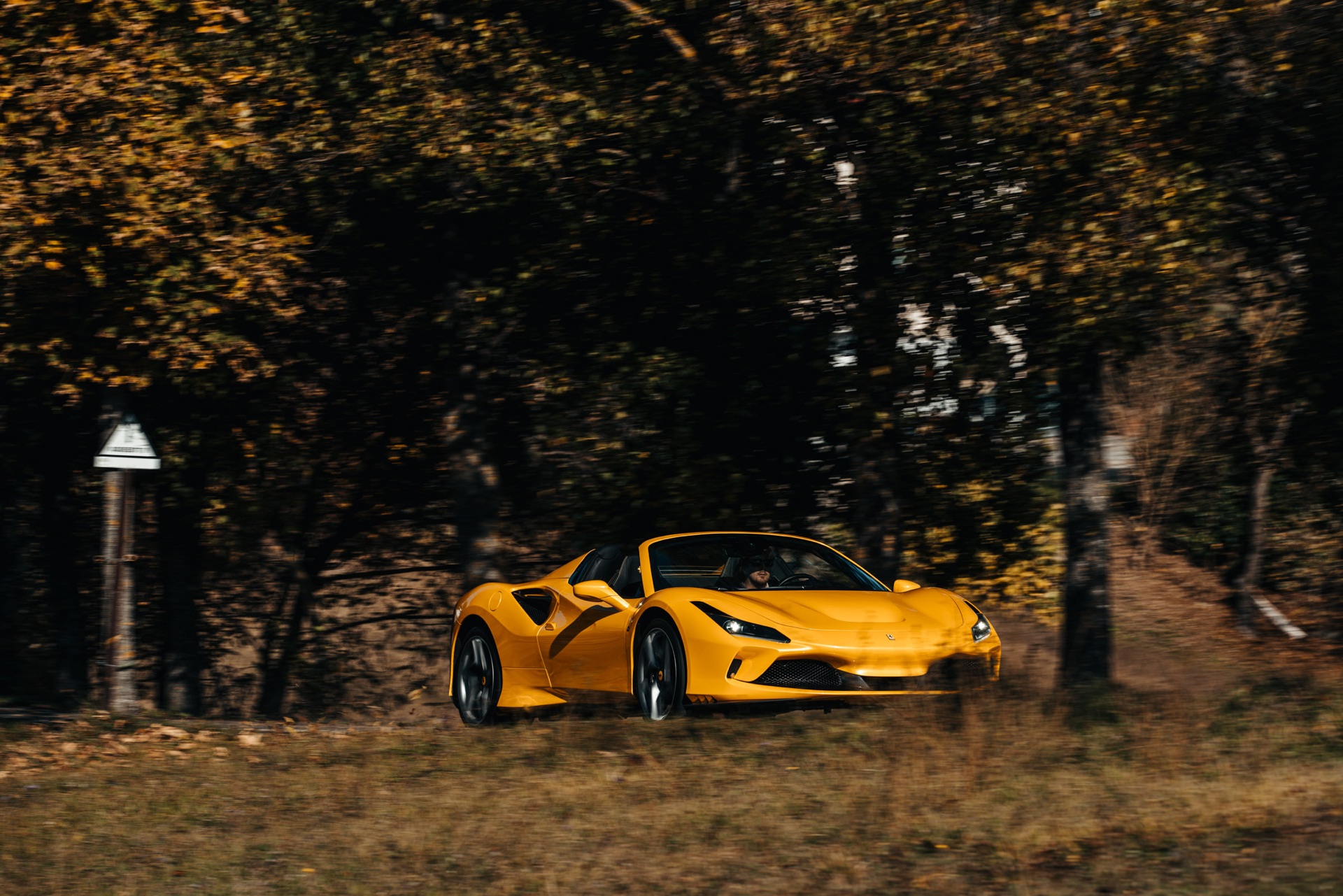
It is 9.30 sharp when I walk through the gates of the Ferrari factory in an eerily quiet Maranello. In one of the two parking spots in front of the iconic factory building a Giallo Modena yellow Ferrari F8 Spider is waiting for me. Following one of the quickest and easiest test car handovers in years I’m out through the gate as fast as I came in. 

The Ferrari F8 Spider is the successor to the 488 Spider launched in late 2015. The 3.9 liter twin-turbocharged V8 engine internally known as F154CD delivers the same output as the 2018 488 Pista Spider. While delivering 720hp and 770Nm of torque the F8 Spider can sprint from 0-100 km/h in 2.9 seconds, 0-200 km/h in 8.2 seconds and continue to accelerate until the top speed of 340 km/h. Weighing in at just 1,400 kilograms the F8 has a power-to-weight ratio of less than 2 kg per hp. It is the most powerful and possibly last non-hybrid Ferrari V8 produced to date. 

Ferrari F8 Spider

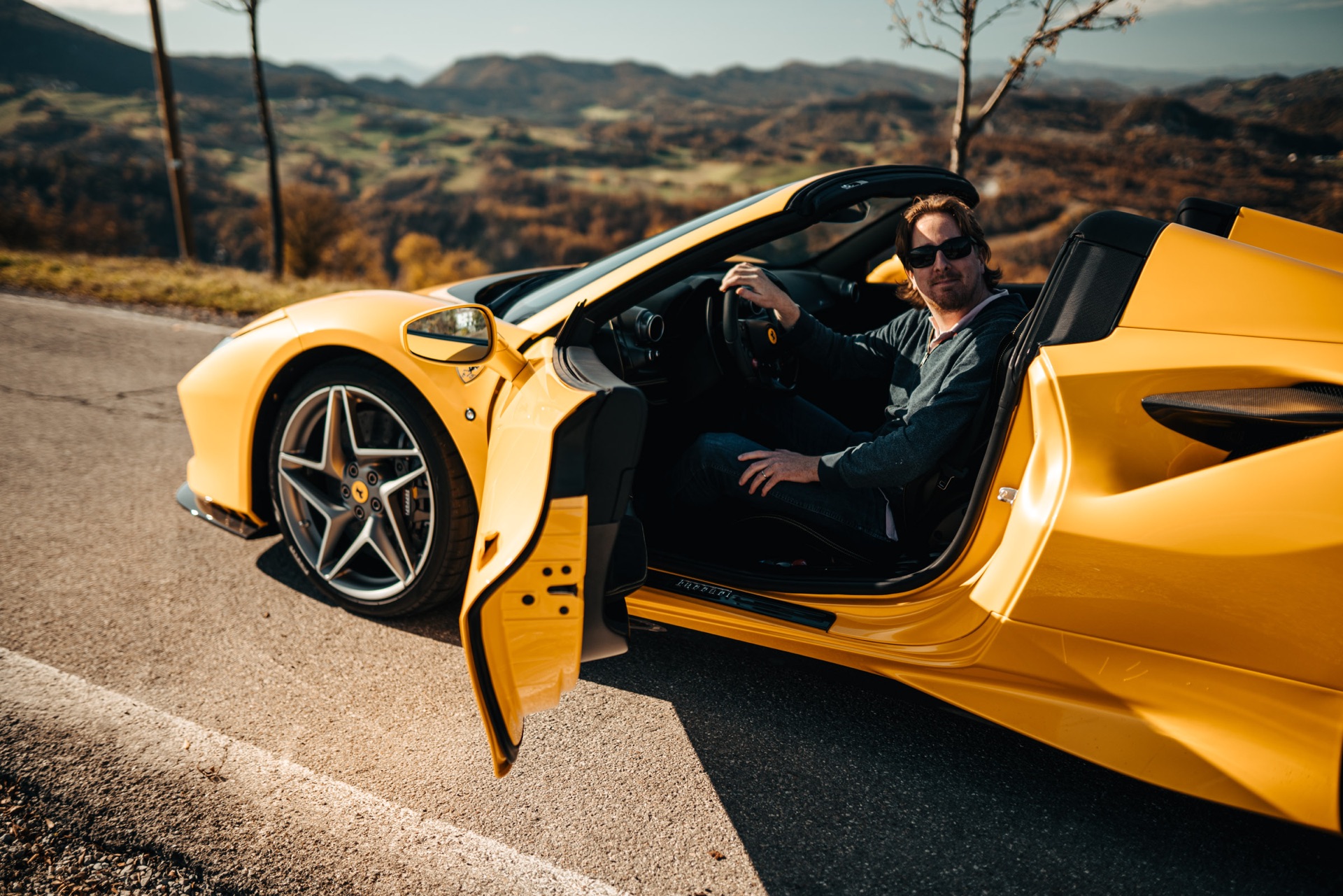
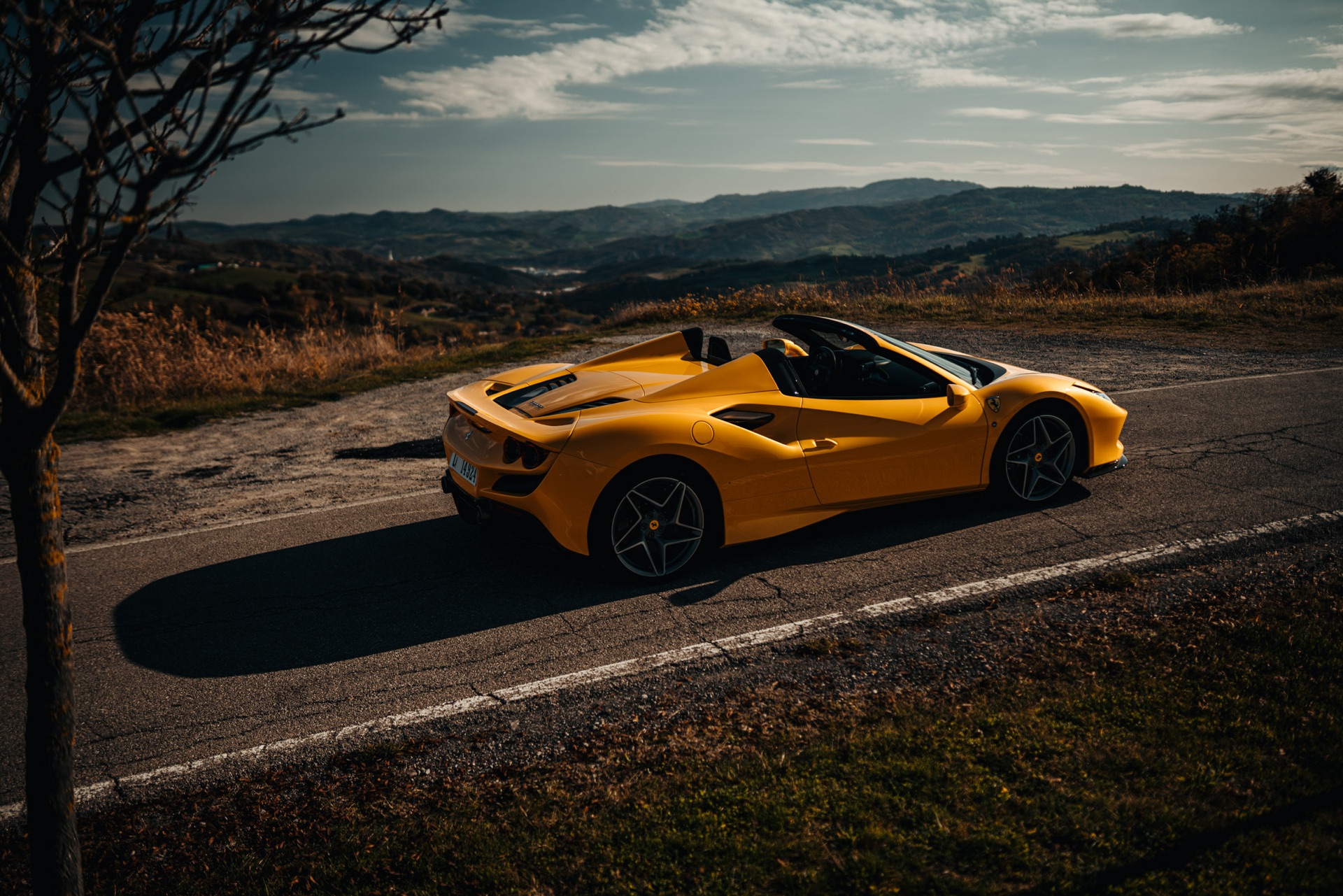
Despite my test drive taking place at the beginning of November the sky is blue and the outside temperature already passed 15 degrees this morning. So it is time to drop the folding hardtop by pressing the button in the center console. In around 14 seconds the roof drops down and this can be done up to speeds of 45 km/h. One of my favorite features of this kind of roof is the small rear window you can open while the roof is up; it keeps the wind noise out but let’s all the beautiful tunes of the mid-engined V8 in. 

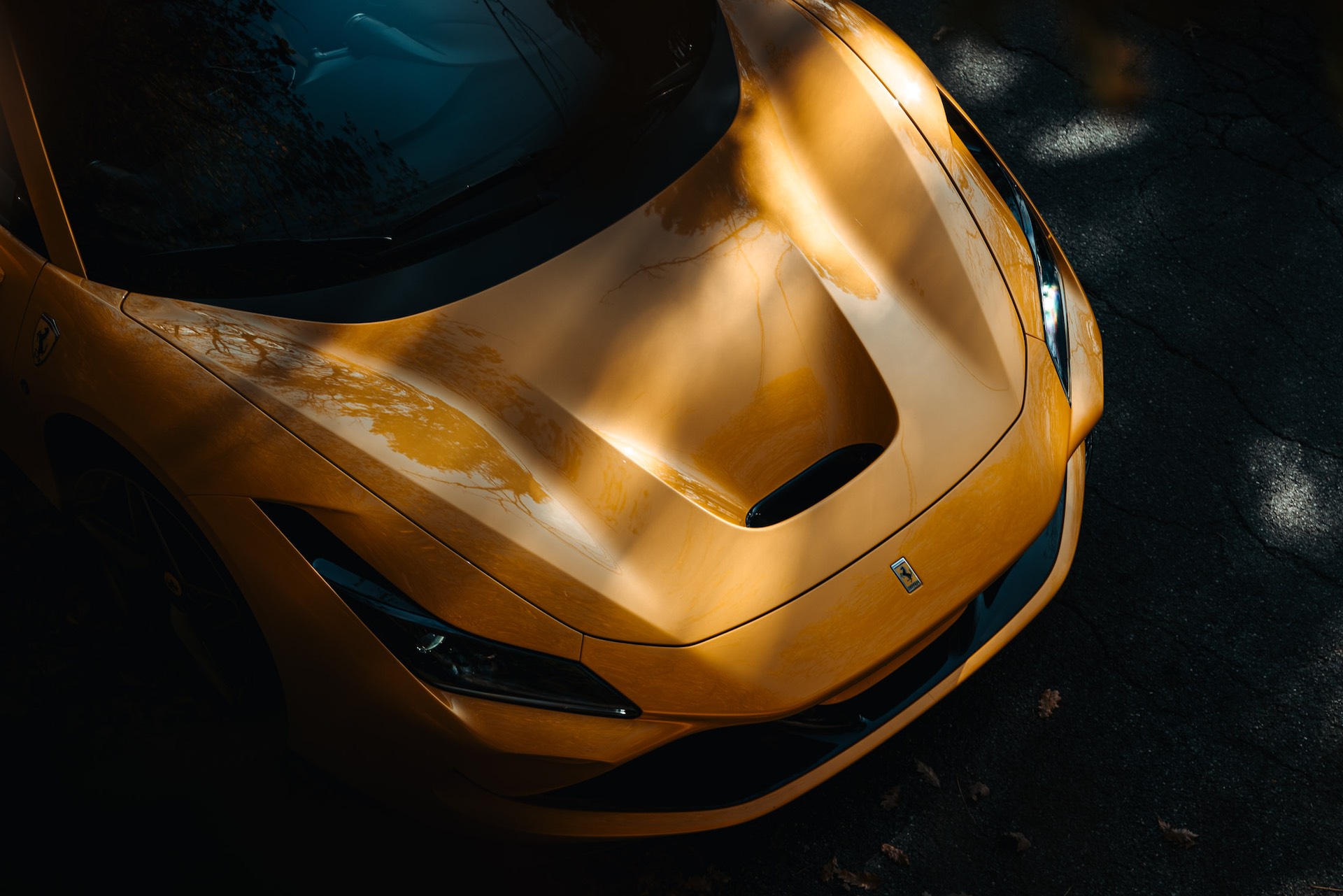
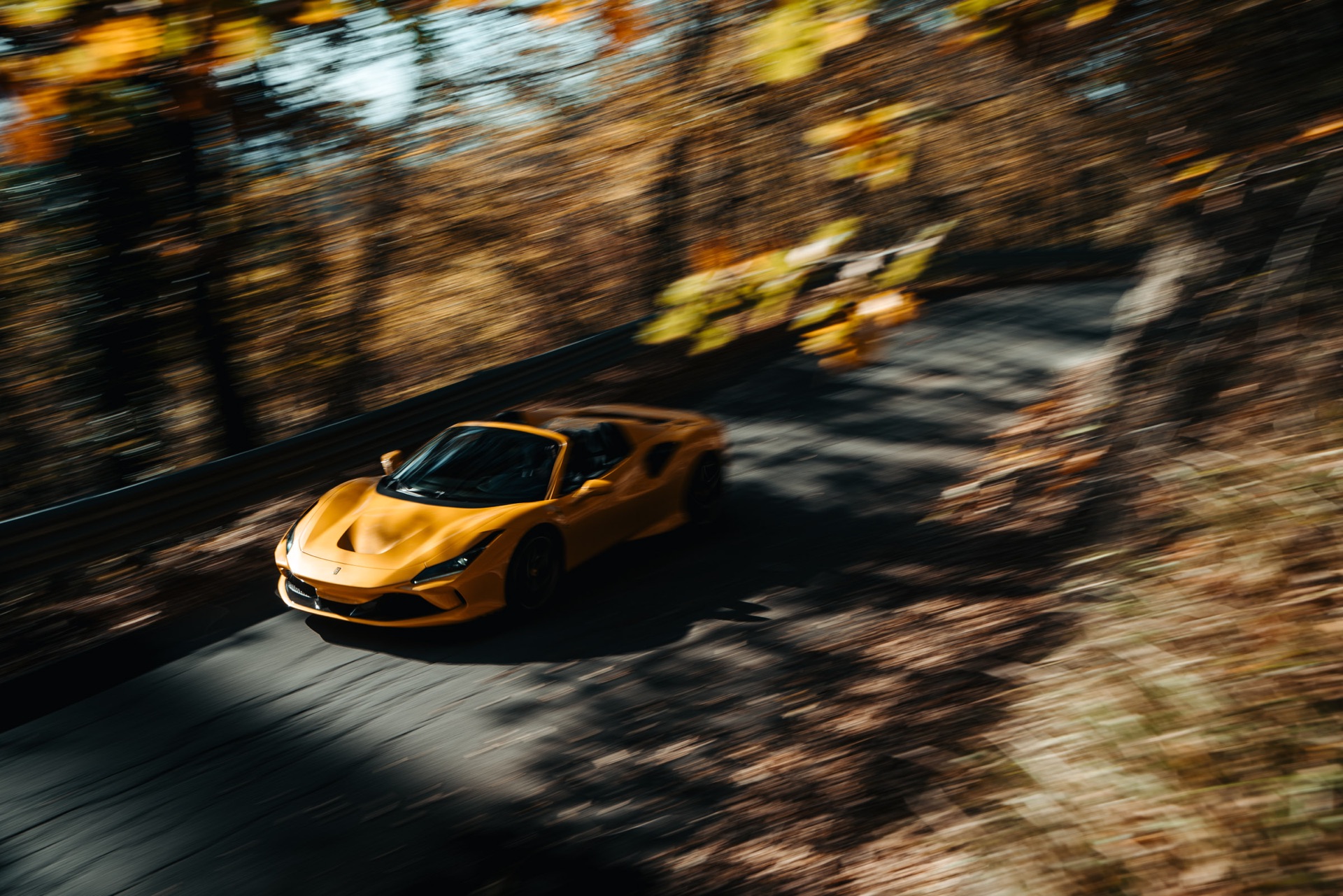
Design-wise the new F8 Tributo and F8 Spider continue in the footsteps of the stunning and incredibly sexy Pista. The S-Duct dominates the front of the car and the new side intakes and slimmer, longer LED lights give the front a wider and more aggressive appearance. The large air intakes are moved slightly further back to improve the airflow to the engine. The sideskirts taper outwards towards the rear wheel. It is a part of the car you will want to clean after every drive as they seem to catch a lot of dirt coming from the front wheels and seemingly the only part where form and function don’t go hand in hand. 

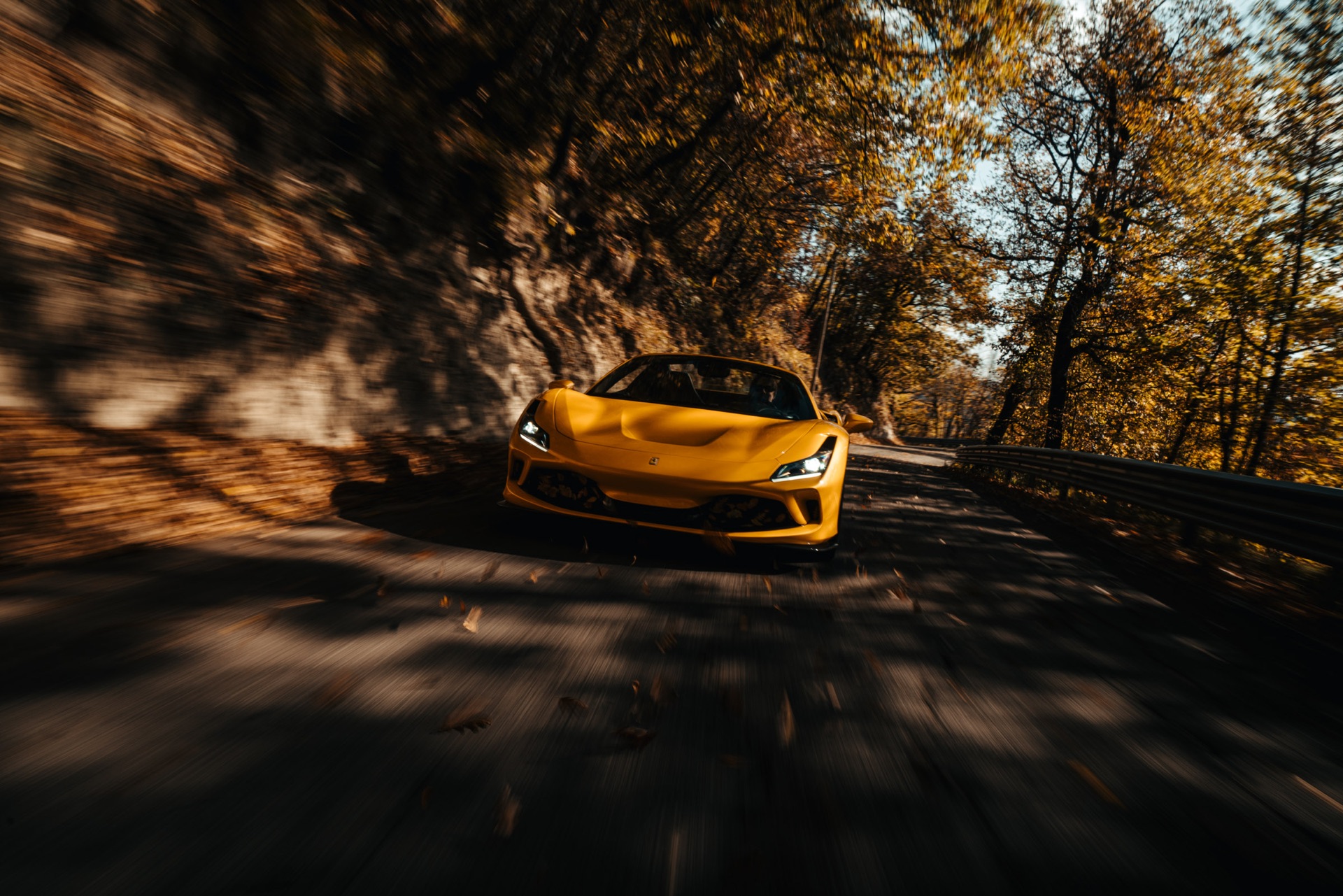
Ferrari F8 Spider front

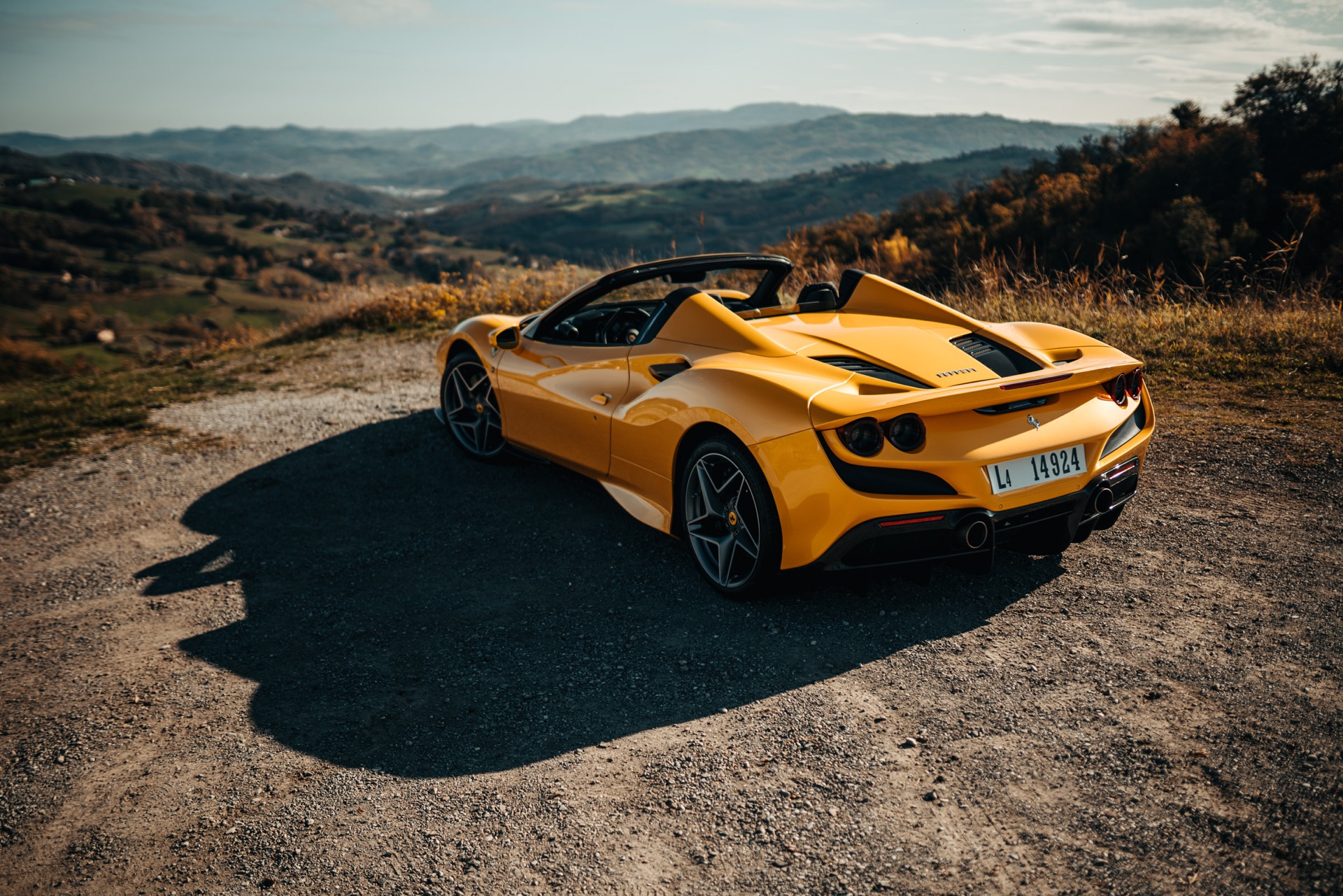
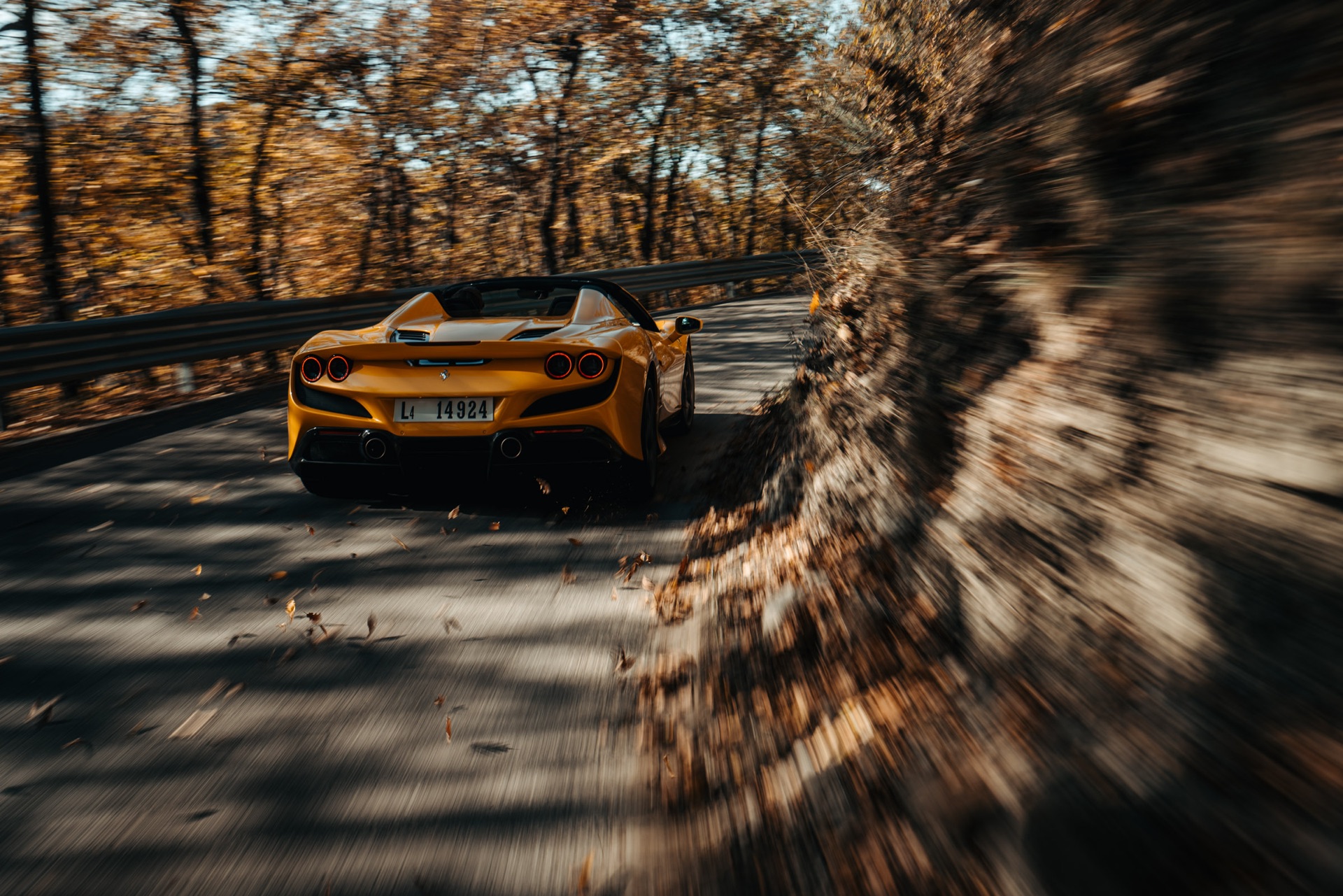
For the first time since the F430 quad tail lights returned. Photos don’t do justice to the level of depth these LED lights provide in real life. The lower part of the rear is very similar to the Pista with a wide diffuser and two large exhaust pipes. Being a spider the engine is hidden mostly below the foldable hard top. 

Ferrari F8 Spider LED Rear Lights

The quality of the design continues beyond what you can see on first glimpse. Under the front bonnet beautifully sculptured carbon covers the inside around the actual trunk. It is details like this that set Ferrari apart from the competition. 

Ferrari F8 Spider Front bonnet luggage space

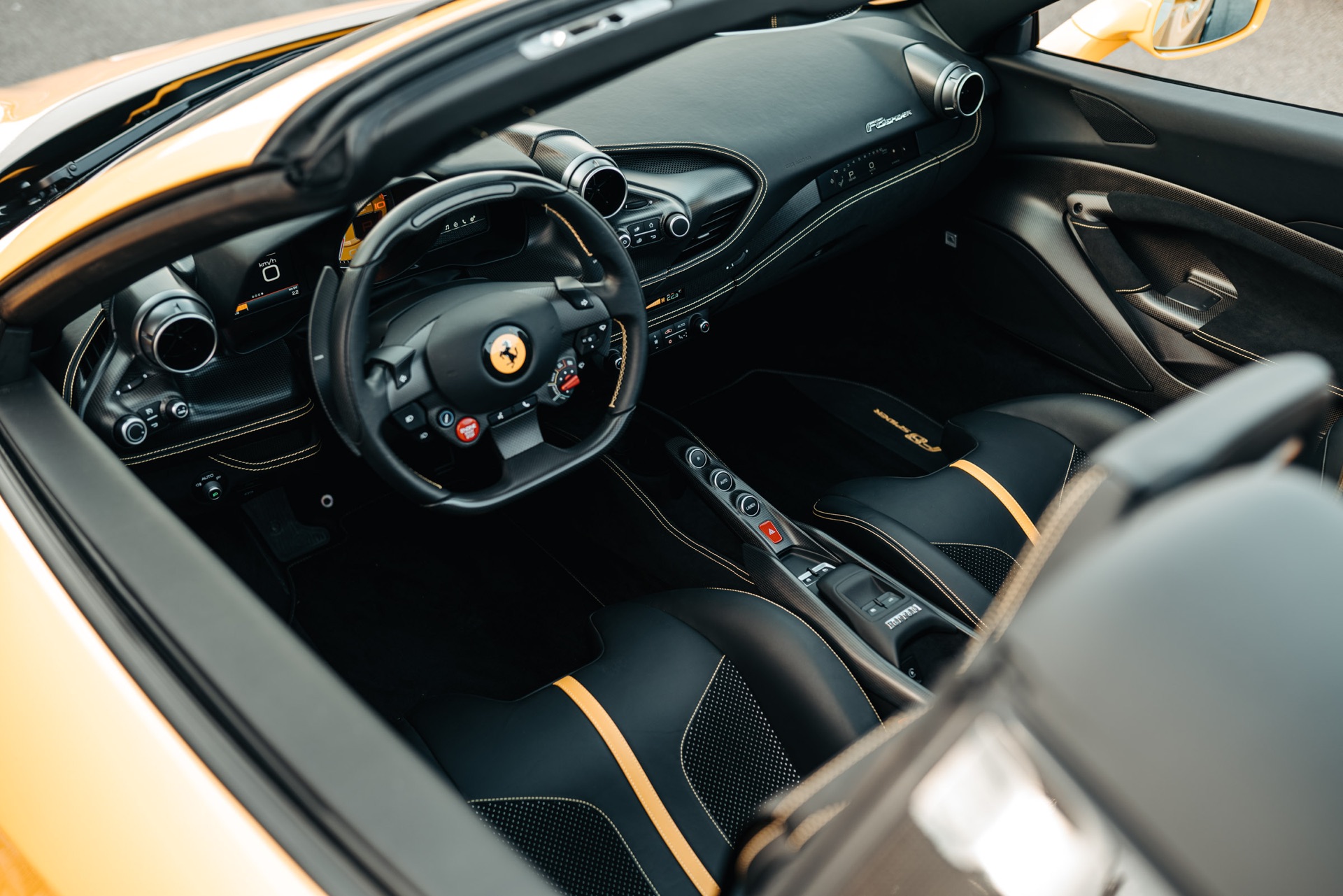
The inside of the F8 Spider is dominated by leather and carbon fibre. The carbon fibre racing seats are a perfect fit. And although the convertible has slightly less space than the F8 Tributo there is enough space to sit comfortably even for taller people. Being 1,90m tall myself I struggle to sit well in many mid-engined sports cars but in the F8 Spider I had no issues at all. This also thanks to the extremely low and elegant center console that provides both excellent leg space as well as a general sense of space. 

Ferrari F8 Spider Interior with Carbon Racing Seats

Ferrari’s have always been extremely driver oriented and the F8 Spider makes no exception. All vital controls are located directly on the steering wheel; including indicators (takes some getting used too), big beam, engine start / stop, dampers, voice control and phone, wipers and last but not least the Manettino which allows quick and uncomplicated change of drive programs from Wet and Sport to Race, TC off and finally ESP off. 

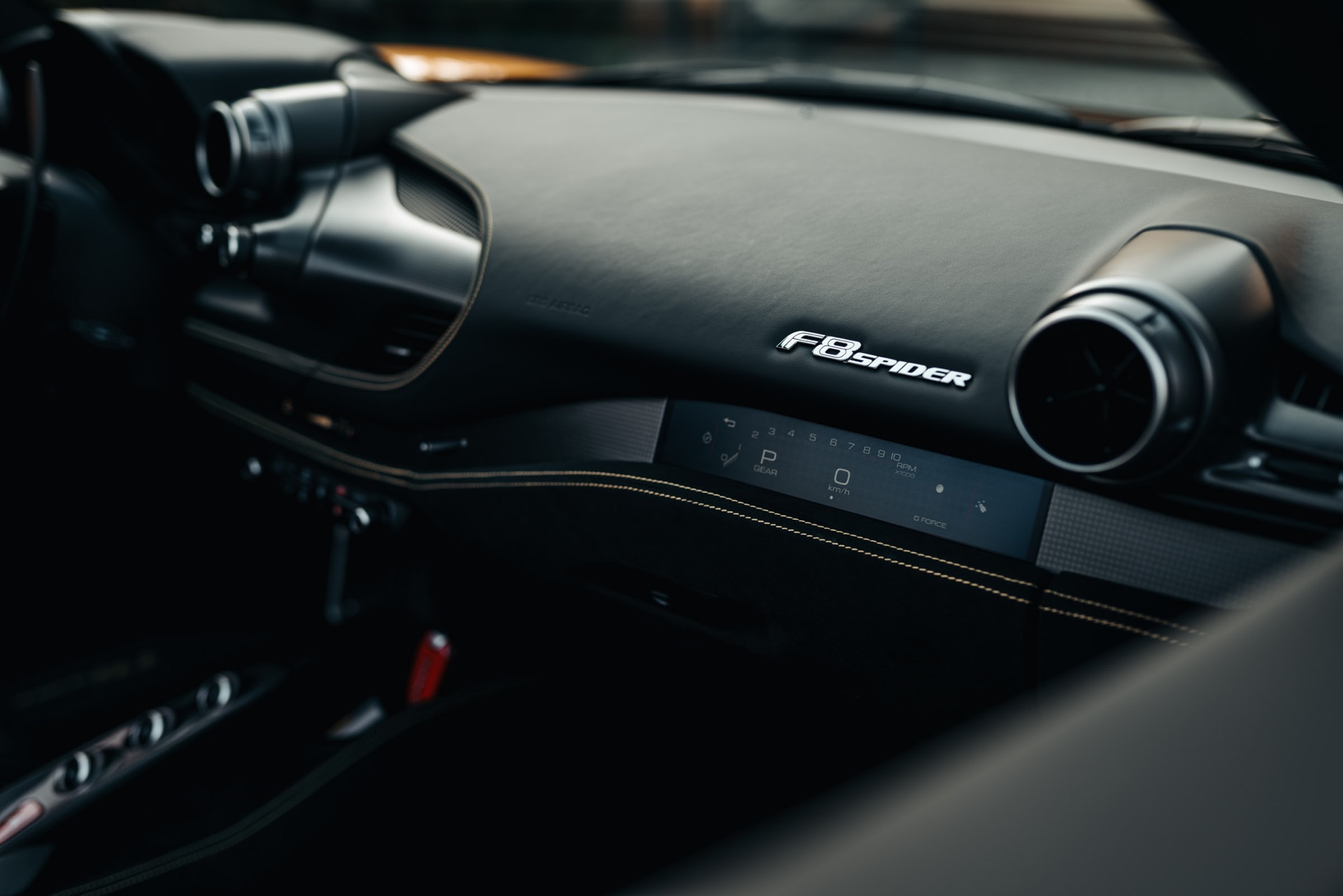
Ferrari F8 Spider HMI Passenger display

Unlike most other new cars the only touch screen is solely for the passenger. The driver can control everything by the touch of a button and I wish more manufacturers would follow this example. Key driver information is displayed only on two displays on either side of the rev counter. 

Ferrari F8 Spider Des

Time to find out what it is like to drive the F8 Spider. Normally I head South from Maranello straight into the mountains but this time I want to go East and find some new locations. The first part of the journey takes me via the truck heavy SP467 with its dense traffic and destroyed road surface. Not ideal for a 720hp V8 supercar but with the soft damper setting the F8 copes well. 

Ferrari F8 Spider

Leaving the main road and the traffic behind me as I head into the hills I can let the engine howl a bit more. The V8 packs an incredible punch and presses me firmly into my seat as I sprint from bend to bend on the first empty mountain road. The audible drama is not quite as it used to be but this is mainly due to the EU and their emissions (OPF) and sound restrictions that Ferrari has to comply with.

What is remarkable is the balance and predictability; the throttle, braking and steering are all equally easy to dose and give you a perfect sense of control. This makes that the Ferrari F8 Spider doesn’t feel like a 720hp supercar, and all the glitches that normally come with it, when you are cruising in town or in traffic but as soon as you find that perfect bit of road or hit the track it morphs into a breathtaking razor sharp machine within a split second.

Ferrari F8 Spider roof down

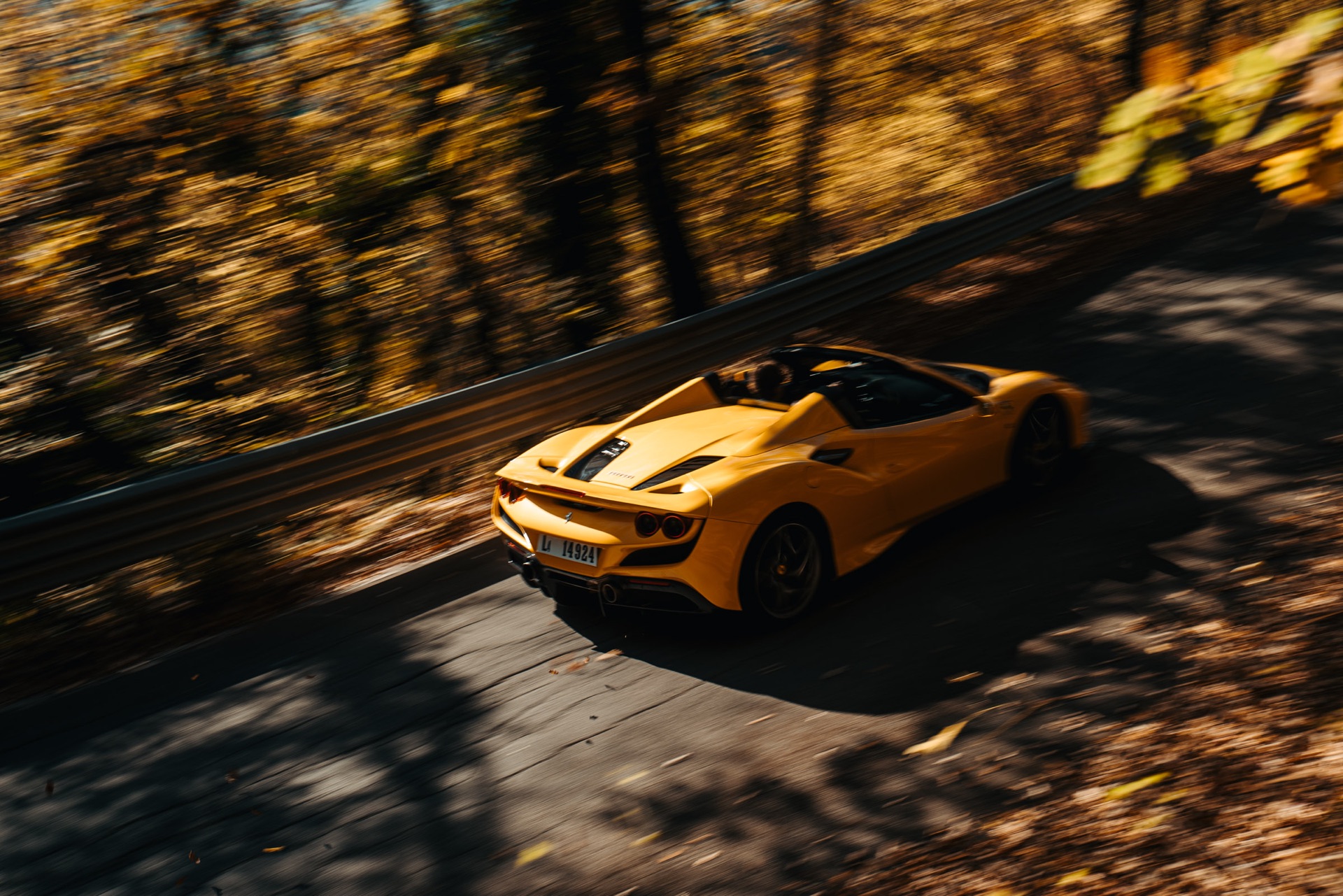
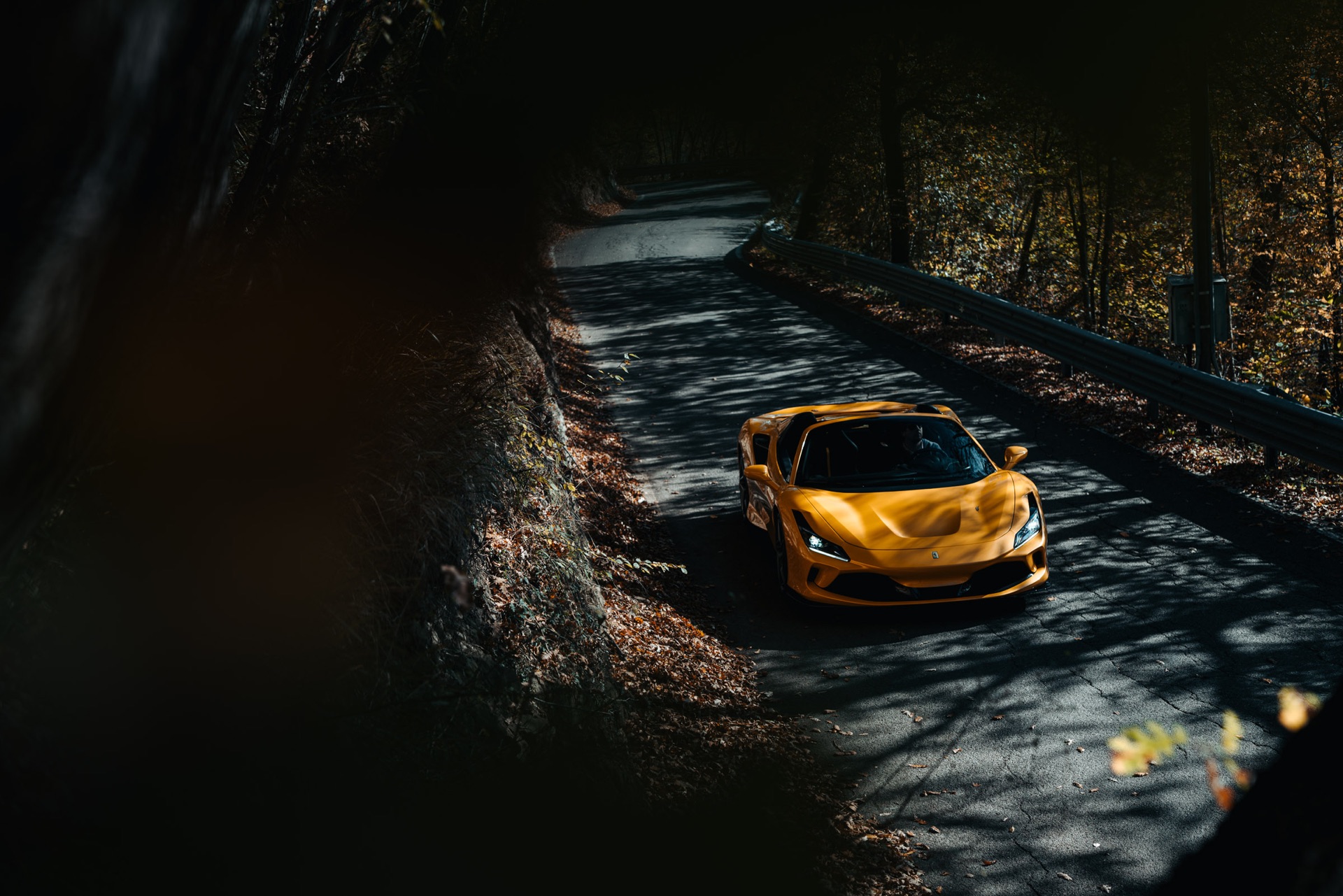
By chance we find a mountain road with sunlight peeking through the trees for our photographer Philipp Rupprecht to work his magic on the Ferrari F8 Spider. 

2021 Ferrari F8 Spider Rear

Ferrari F8 Spider

Ferrari F8 Spider GTspirit 86

On the second part of my journey the roads straighten and are much smoother, yet the F8 is so incredibly fast that it is hard to enjoy the full potential on any public road. From an engineering perspective we live in incredible times that you have to take a mid-engined convertible on track to utilize it to its maximum. Nonetheless I can think of few things more enjoyable than driving through the Italian hills with a prancing horse while the wind rushes through my hair.  

Ferrari F8 Spider GTspirit 91

A day with a Ferrari is always too short. If it wasn’t just for the experience itself, it is for the wonderful things that just happen when you travel through Italy in such a car. A restaurant owner obliging you to park on the no-parking space directly in front of his locale, to kids smiling from ear to ear when they see the car.   

Ferrari F8 Spider Giallo Modena Yellow

After returning the Ferrari F8 Spider at the same place where I picked it up this morning it is time to reflect. The F8 Spider is incredibly close to automotive perfection. Stunning design paired with a driver-oriented cockpit without touch screens which is a relief for true drivers. The available performance is more than sufficient in all situations except maybe at a hypercar trackday. All of my comments sound like whining at the highest level, only the lack of volume in the soundtrack is something that impacts the otherwise perfect score.

2021 992 Porsche 911 Turbo Review

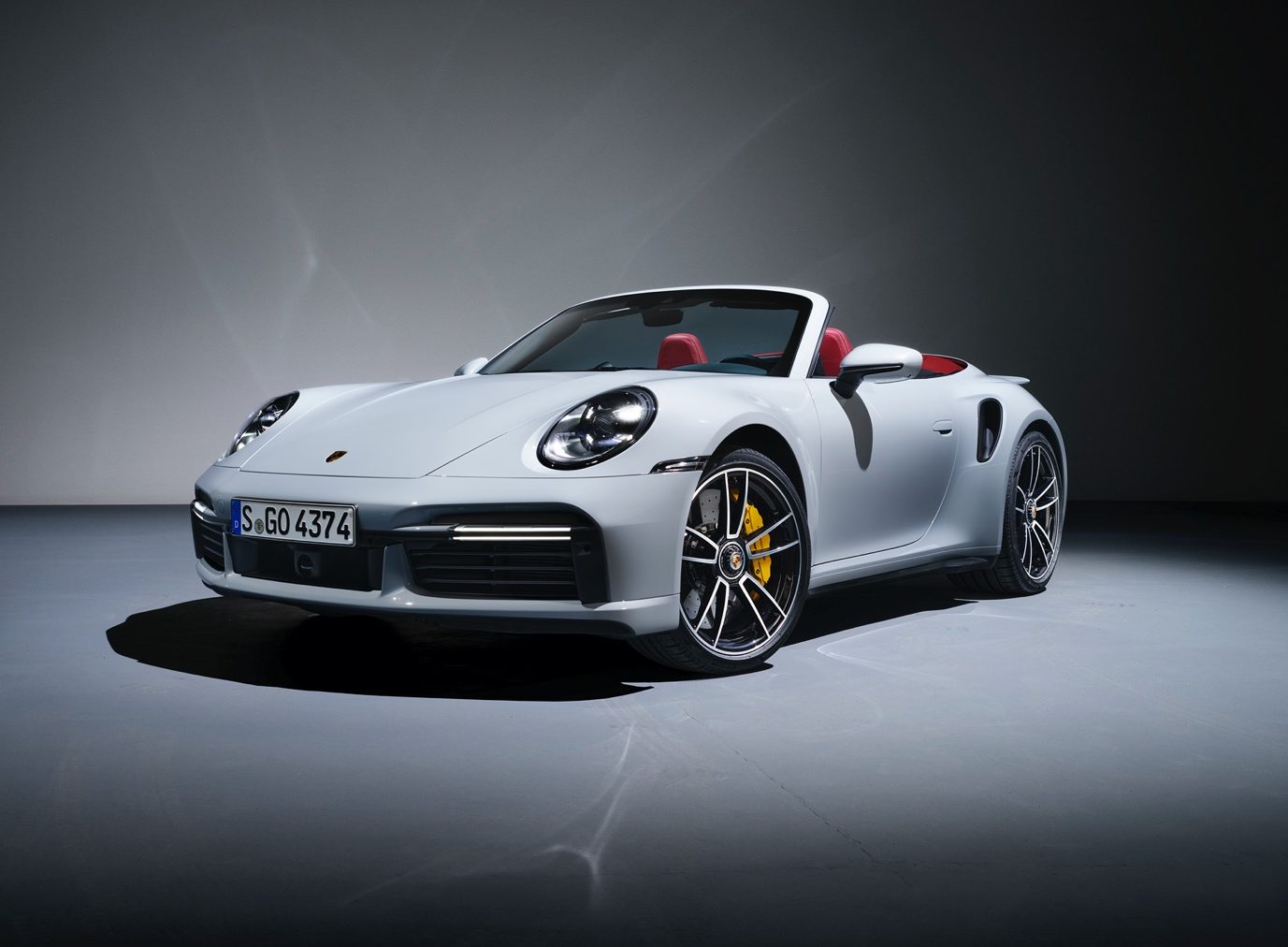
The 992 Porsche 911 Turbo S took the world by storm in 2020 with many hailing it as the best 911 Turbo S ever to be unleashed my the team in Stuttgart. The numbers are bombastic. 650bhp, 800Nm, 0-100 in 2.7, a top speed of 330km/h and a price tag starting at £155,970 before options. Impressive, but is it necessary? This is a super-GT car that is more likely to find itself on the a morning commute with a child in the back than going flat out on the Nordschleife.

Porsche know this and offer a Turbo with the ’S’ knocked off the rear end. A Porsche Turbo, without the S, is still a speed and numbers freak, but not to the same extent as the biggest baddest S model. That being said, 580bhp, 750Nm, 0-100 in 2.8, a top speed of 320km/h and a £134,400 are certainly not modest, by any measure. 70bhp, 50Nm, 0.1 to 100, 21km/h at the top end and £22k are all that separate the two. Visually you’ll have to be a proper Porsche nerd to tell the two apart, especially now that S and non-S can be specced with the same wheels and badges on the rear deck. To my knowledge, the only badges that cannot be hidden are on the screens, door sills or the extendable front splitter. Debdage it and don’t let anyone in and they’ll never know you’re not in an S. The other telltale sign is the yellow brake callipers that are standard on the Turbo S to denote the PCCB ceramic brakes, but you can option identical brakes and callipers on the Turbo.

Can the Turbo show itself to be just as well rounded and the S? I flew to Germany to the Porsche Experience Centre, Hockenheim to find out. I will forever love Porsche for never messing around on launch events. I had almost an hour on track with the Turbo to gather my thoughts on how the car performed and I learnt a lot. Initial impressions are dominated by the tremendous and unrelenting force that the rear mounted 3.7-litre flat-six twin turbo engine send to all four wheel via an eight-speed PDK gearbox.

Why anyone would need the extra 70 horses, I’m not quite sure. The what the power in sent to the wheels along with the sublime PDK shifts means the Turbo launches itself from one apex to the next. Slowing down is just as impressive an experience as the car I am in is fitted with the PCCB brakes which cost around €10,000(!) and bring the 1,640 kilogram 911 to a halt with tremendous force and feel in the pedal – the confidence is unparalleled. The same can be said for the chassis, too. Th example I was piloting featured the firmer 10 mm lower PASM Sports suspension designed to enhance the agility of the new 911 Turbo. There was not a hint of roll in the body and through the fast Hockenheim GP sweeping bends the body composure was mighty. The adjustability on the limit was so soft, approachable and confidence inspiring.

This really is one of the finest allrounders on sale today. It is refined, quiet and comfortable on the road and an absolute joy to drive on circuit. That being said, it is not as focused as something like a McLaren 570S or Lamborghini Huracan, but they are not worthy of mention in the same breath when considering a daily driver. The 992 Turbo really is the Swiss Army Knife of the automotive world. It is perfectly at home in city traffic, crossing a continent or pounding around a racetrack. There really is no substitute. The Turbo offers a more affordable package than the Turbo S and one that, in the real world, left me wanting nothing more.

2021 BMW iX3 Review

I’ll be honest, I am not a fan of electric cars. Having experienced battery powered offerings ranging from the Renault Zoe to the Porsche Taycan Turbo S, I can categorically say that I am not ready to drop my addiction to fossil juice for the volt life. That being said, there are a few applications in which I can picture myself driving an electric car – short, mundane and preplanned journeys. I have suffered from the stress and anguish of range anxiety on road Trips on which I’ve spent more time staring at the battery percentage and range than I did enjoying the views or fabulous roads.

The BMW iX3 is not intended to be used for cross country cruises or for blasting up mountain passes. This is a car for the school run, weekly shop and the odd trip to visit friends and family on the weekends. That is not to say it cannot cross continents, it can but there are other X3s better suited to such applications. This is the first BMW model to be available with petrol, diesel, plug-in hybrid or full EV powertrains to choose from.

With ‘the power of choice’ in mind, I hit the road in the iX3 to see what this 286 horsepower ‘Sport Activity Vehicle’ with a claimed WLTP range of 460 kilometres felt like. I tried to be sensible and drive in a fashion I imagine a buyer of such a car would, but as with all electric cars, I immediately engaged sport mode and floored it. The instant torque was amusing, the way that 2.2 tonnes shifted was impressive and the accompanying, configurable ‘drive sound’ added some character. 0-100km/h is dispatched in a respectable 6.8 seconds with the top speed capped at 180.

After a few accelerations the novelty wore off and I set about driving the car the way it was intended to be. I turned my attention to the braking regeneration options starting with ‘one-pedal’ driving. This was surprisingly good fun, I challenged myself to not use the brake pedal at all, it took some focus but was achievable after a few minutes of experimentation. I could not get comfortable with was the ‘adaptive’ mode where the braking force would automatically adjust itself using the navigation system to bring the car to a standstill without using the brakes. The level two autonomous systems worked brilliantly, only requiring assistance at traffic lights, roundabouts and coming to a stop with no car ahead of you on the road. I found myself trusting the systems almost immediately. The steering was accurate and did not have iX3 bouncing between the white lines.

When the twisty roads between towns presented themselves, I took control and engaged sport mode with maximum regeneration and found myself having much more fun than expected. Yes, the inherent feel and feedback in minimal, but the steering is quick and sharp and when applying max power out of bends there were noticeable rear-wheel-drive characteristics to be felt. Back to real world testing – the iX3 handled its weight with grace, the ride was firm in sport but the adaptive dampers meant this could easily be remedied. Being electric meant that wind and road noise could be intrusive at higher autobahn speeds, but not to uncomfortable levels. The cabin was well appointed and the usual BMW iDrive goodies are all you could want from an infotainment system. You could never tell this is a BMW that had been built in China. There was almost as much space as in a conventionally powered X3, the only difference was the marginally shallower boot as the electric motors hid beneath the boot floor.

As mentioned in the opening of this review, I can see the application and allure of having an electric car and this 150kW offering which can be charged from 0-80% in 34 minutes on an IONITY fast charger, certainly makes a case for itself. It is as comfortable and capable as I hoped with an added sense of humour. If you’re in the market for an electric family car that can take care of your simple commutes this may well be the car for you!

Our 10 Favorite Chore Coats for the Fall

With the perfect mix of sharp, classic style, nostalgia and value reflected in workwear, there’s good reason the chore coat went from vintage clothing trend to universal staple. It’s continued to be adopted and adapted…

2020 BMW M8 Competition Gran Coupé Review

Size matters – but does 200mm make a difference? This seemingly small measure is what differentiates the 2020 BMW M8 Competition Gran Coupé from the M8, minus the GC nomenclature. However, 200mm means this M8 can accommodate an extra pair of doors and seating for five. With four in the back things are habitable. Headroom is not great, but if you wiggle them around a bit, two 6-foot adults could handle a long journey back there. You can try and shoehorn a fifth in, but they have to straddle the central armrest and make everything a little too cosy in the back seats.

Enough of the practicalities, this is an M car and all I care about is how this massive twin-turbo V8 powered 625bhp brute performs. With xDrive 553lb ft, and 0-100 banished in a supercar worthy 3.2 seconds, the numbers look good near identical to the two-door, making it BMW’s equal-fastest production model.

The xDrive means the power can be utilised, even on the road and in almost any conditions. However, weighing in at 2,055 kilograms means that this is a car which you have to consider the laws of physics in. The way speed builds is borderline scary and you’ll swear that the speedometer is making things up as the numbers rapidly approach and fly past legal limits. With a bewildering number of settings for the steering, engine, suspension and exhaust, you’ll have to find what suits you. With everything in the most aggressive settings things are a handful and the car bounces up and over bumps. Knock the suspension back into comfort and leave everything in full attack mode with the traction control in M Dynamic Mode and you’ll be having a fabulous time. The traction control system in MDM means you can apply proper slip angles on the throttle and let the xDrive system display a true sense of humour. You can, of course go to fourth base and engage rear-wheel-drive mode, but with the weight and all of that power I was not brave enough to explore this on a wet British country road, there is no way to have 100% of the power being sent to the rear with any assistance systems engaged, you are on your own.

The M8 Competition Gran Coupé does handle surprisingly well for a car of this size, I would argue that it is a viable alternative to the Mercedes-AMG GT 4-door which is worthy praise, indeed. There is a surprising amount of feedback in a car this size, but do not expect it to be as engaging as a BMW M2 CS, this is still designed to be a comfortable daily driver. This is where the M8 Competition Gran Coupé excels. The way it can be transformed from a taught speed freak into a sedate city cruiser with undeniable presence is astonishing and impressive in equal measure.

As great as a cruiser/daily driver the M8 Competition Gran Coupé is, it cannot disguise its large dimensions. The M8 coupe felt like a big car with a surprisingly small cabin and the M8 Competition Gran Coupé is not much different. On the road is looks large, I caught a glimpse of the reflection of myself in a shop window and laughed at how gargantuan the car looked. I also noticed that the car is a very good looking thing, to my eye anyway. The interior is a fantastic place to soak up the miles with all of the latest tech you could come to expect from a car priced at more than €130,000.

I would strongly recommend the M8 Competition Gran Coupé. It offers supercar performance, saloon car usability and a compelling breadth of ability. The biggest problem with the M8 Competition Gran Coupé is the BMW M5 Competition. It fulfils the same philosophy at a much lesser price. If I had the choice and did not have to consider price, the striking design and imposing face of the M8 Competition Gran Coupé would have my vote, but both would be a pleasure to own.

2020 BMW M440i xDrive Coupe Review

Don’t judge a book by its cover is the phrase I repeated in my head as I approached the 2020 BMW 4 Series Coupé, the M440i xDrive to be specific. The 4 Series caused something more akin to a tsunami than a stir when the covers were pulled back in May 2020. The design may polarise, but there is more to any BMW than its design. After all, these are supposedly the ‘ultimate driving machines’. The M3 and M4 recently broke cover and I hope to drive them shortly, but for now it is this, the M440i xDrive that is the range topper.

Having driven the M340i xDrive on track last year, my expectations of how the car would drive were high. The numbers look good, too. With a mild-hybrid-assisted 3-litre turbocharged six-cylinder petrol engine and standard xDrive, the M440i puts out 374 horsepower. This includes the 11 horsepower that the 48v system can apply to aid acceleration and economy. This means 0-100km/h is dispatched in a respectable 4.5 seconds – plenty fast for an M Performance model.

There is the typical BMW 50:50 weight distribution and the car feels handy on the twisty country roads around Oxford. That being said, when starting to push on there is a hint of understeer. The xDrive promises to shuffle power between the wheels but often felt overwhelmed, perhaps the car would be better suited to more open flowing roads than tight country lanes to display its true dynamic traits. The benefit of xDrive is, of course, the all-weather usability that was once the USP of Audis.

There is an eight-speed Steptronic Sport transmission which proved to be slick and quick, straight line acceleration felt strong, although the only sign of the 11hp boost being deployed from the mild-hybrid-system was the dashboard letting me know. The steering, like with so many modern cars lacked any discernible feedback and the weighting felt artificial. The same can be said for the synthesised noise that was so obviously being emitted from the speakers.

In the real world these are unlikely to ever be issues or concerns for aspiring buyers. Owners of a 2020 BMW M440i xDrive Coupé are not looking for hardcore thrills and a car that bristles with feel, these are cars that will be driven everyday, have to go to the supermarket and be comfortable over long journeys. On that note, the ride over broken tarmac was a touch harsh – seeing M Sport suspension on the spec list always sends alarm bells ringing, but these are adjustable and much better when set into comfort mode. The interior is familiar BMW with all the tech you could want with fancy bells and whistles such as gesture control and a host of driver assistance systems being offered.

Assuming that potential buyers are not put off by the styling or the price (the car I drove was priced up to an eye-watering £61,100), I am sure that the M440i xDrive Coupé will be a sales success. From my time behind the wheel it is clear that this will be a practical, enjoyable and exciting daily driver. I guess the thrills, adrenaline rushes and track day credentials will be served up by the fistful in the eagerly anticipated M3 and M4.

2020 Mini John Cooper Works GP3 Review

There are few things as exciting as a naughty little hot hatch. There is something cheeky about taking a small car and pumping up the power to deliver accessible thrills on the road. Supercars are all show and no go in a world of poorly surfaced roads, speed bumps and narrow lanes. Other road users won’t turn their noses up at you in a hot hatches and they make sense with modest power figures and relatively modest price tags.

As a result I was giddy with excitement when Mini unveiled the Mini John Cooper Works GP3 with its crazy carbon body extensions, giant wing, the news that it packed a mighty 306 horsepower and that just 3,000 units will be produced – my time to drive the pocket rocket could not come soon enough.

Walking up to the Mini GP3 is an occasion in itself. The car looks like someone sent the blueprints of a base Mini Cooper to an 8-year-old and told them to go crazy with the crayons for their evening homework. There are vents, extensions and wings everywhere you look. I love that it is fit to reside in a mental asylums underground car park, but can understand that your grandmother may be a little embarrassed emerging from the passenger seat outside the bingo hall. Stepping in, things are just as bonkers. There are bucket seats with huge bolsters to hug you, and that’s where the seats end. The rear ones have been removed, replaced by a cavernous space and a red beam which serves no purpose other than to look cool.

Under the fake-grill garnished hood there is the powertrain from the most recent BMW M135i shoehorned into a Mini body. The 2.0-litre turbo 4-cylinder engine sends 306hp and 332lb ft through an eight-speed automatic gearbox. Where the BMW and other hot hatches such as the Mercedes-AMG A35, Audi S3 and VW Golf R, the Mini features no four-wheel-drive trickery. Instead, all the power is sent to the front wheels via a limited-slip differential.

Other changes include 10mm lower springs, beefier brakes and the GP style wheels. The plethora of visual changes are all style and very little substance as it is not stated that there is any aerodynamic benefit or downforce. At 1,255kgs, it is light, but not mind-blowing given its size and when you consider that half of the interior is missing.

Enough on the details and specs, time to drive it. First impressions were that the gearbox feels lethargic, real hot hatches need manuals to be as riotous as they should be. Into the first bend the gearbox decided not to give me the downshift I requested, frustrating, but let’s move on. Turning in, the grip was mighty as was the lack of any conceivable body roll, it just stayed flat. The trade-off of such body control makes itself apparent when I turned onto the first country road on my route. The ride is beyond harsh. I can understand a GT3 RS or Mercedes-AMG GT R being hardcore, but in a Mini? It was one trait I could not put to the back of my mind. Under heavy throttle there was torque steer and the differential felt overwhelmed on many occasions, wildly sending power haphazardly seemingly giving the steering a mind of its own and making me work to keep the car heading in the intended direction.

The Mini GP3 is amusing. The exhaust it loud, not particularly tuneful, but it will make you smirk and the body control had me turning into corners at scarcely believable speeds. Behind traffic, I turned my attention to the interior which does feel special. The seats play a big part in this, the rest of the cabin is funky Mini with functional BMW switchgear scattered around the place. The iDrive system is good, as is the rather odd looking instrument binnacle.

The Mini GP3 is an exciting car, unfortunately to the detriment of the usability and driver satisfaction. It feels blunt, angry and not particularly rewarding. I left the driver’s seat wishing it wasn’t as powerful as it is, was a touch softer and had a manual gearbox as both of its predecessors had. I wanted to love it, I enjoyed that it was a challenge, but it isn’t a car I am left yearning to have the keys again.

Special Report: My First Lotus Experience – Goodwood SpeedWeek

The cliches are strong when it comes to Lotus. ‘It handles like a Lotus’ and ‘the steering wheel brims with feel like in a Lotus’ are phases that have peppered reviews of supercars in magazines for decades. Goodwood SpeedWeek offered up the chance for me to, finally, put the claims to the test and drive a Lotus in anger for the very first time. Could the British built sports cars really live up to the hype?

First up was an opportunity to explore the glorious roads around Goodwood in an Evora GT 410 Sport. This is the less hardcore, more road focused Evora. That being said, it’s still plenty quick – as the name would suggest, there is 410 horsepower and 410Nm of torque on tap from the 3.5 litre supercharged V6. Adding lightness is the Lotus ethos and as a result, the 1,361kg Evora with a 6-speed manual transmission will hit 100km/h in 4.2 seconds.

Our on the road initial impressions are that the GT 410 Sport feels small on the road, heading down narrow lanes in a car this size means that I felt confident in finding the limits without grimacing every time a car passed me in the opposite direction. The other overriding impression is made from the sensational exhaust note. The tone may be a touch too trumpet like, but every time the revs built so did the size of my grin. Chasing the redline is a joy, as is the gear change. The exposed linkage is a cool touch, but the real joy is in shifting that towering metal stick that rises from it. When you’re done with engaging the next gear and jump back onto the throttle, you notice something moving in the rear view mirror over your left shoulder. There is a window directly behind the driver and passenger which gives a view of the engine and the throttle linkage actuating the fuel to air ratio – a very neat touch.

Finally, there is the handling. Much like the gearshift, the steering is fabulous, as are the pedal weightings. Heeling-and-toeing takes some getting used to the as brake and throttle pedal are a couple of centimetres too far apart – the entire pedal box is a touch offset to the left, but it is not uncomfortable. The ride over the broken Chichester roads was a touch on the harsh side, but the road surface really was as bad as it gets.

Trundling back into the Goodwood Paddock, I was sad to hand the keys back, but my dejection was short lived as a Lotus Exige Cup 430 was waiting for me to hustle around the circuit. I’ve had the pleasure of driving a number of cars on track lately. From the McLaren 765LT to a Mini GP3, nothing has immediately felt as dialled in, yet entertaining as this. The mid-engined balance immediately feels sublime, the unassisted steering is a joy at speed and the pull of the 430 horsepower culminate in one of the friendliest and exciting track experiences I’ve had.

All of the feedback, from the base of the seat through to the steering feedback in my palms, is far more concentrated and communicative than any Porsche Cayman I have driven. A Cayman GTS 4.0 is the natural rival for the Cup 430, but the Porsche cannot compete when it comes to track day focus. I suspect that if you could only have one car to live with, the Porsche would be the obvious choice, but if you are looking for something better suited to learning a racetrack in, the Lotus has the Porsche on the ropes and that is not a conclusion I expected to be making. Bravo Lotus, believe the hype. Forget about the 2,000 horsepower electric hypercar race, the Evora and Exige are what Lotus and know for and do best.

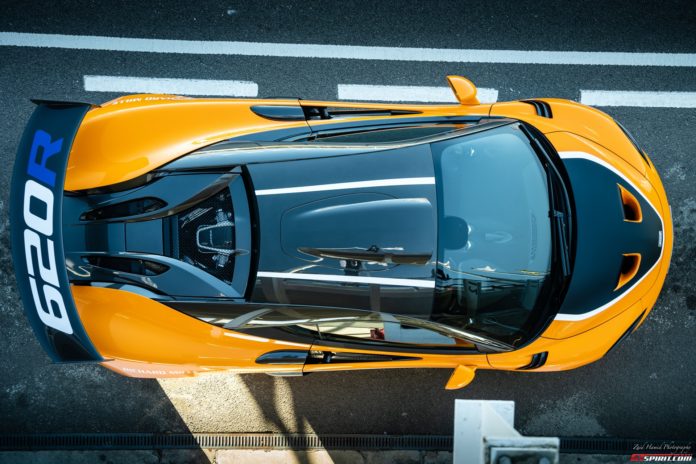
McLaren 620R Track Review

McLaren have a reputation for releasing new models quicker than Apple unveils new iPhones. From the expected LTs and Spiders to the surprise HS, MSO and Carbon Series models, it is fair to say that the line up can be a touch perplexing. One model that was not predicted was the 620R, a car based on the GT4 car which was based off of the 570S. ‘Just buy a 600LT’, I hear you pine – well, this is a different proposition. Where the 600LT is a fine road car with track day credentials, the 620R a race car which can be used on the road.

Whenever pushing a road car on track, even something as focused as a Senna, the general criticism is that the tyres are always the limiting factor. Bolting on a set of slicks is no simple feat as it requires significant geometry adjustments. Being a race car at heart, the 620R is an exception. It requires no chassis adjustments to accommodate a slick, in this case rubber which has specifically been formulated for the 620R by Pirelli. This is an entirely more track focused proposition than the 600LT, a toned down racer, not a turned up road car. So long as you find a way to have a spare set of wheels shod in the slick at the track you’re heading to, you can drive the 620R to the track on Trofeo Rs, swap over to the track tyres before swapping back to the road legal rubber and heading home. In my mind, this makes more sense that the Senna does, and at a fraction of the price of the Ultimate Series car.

I jumped behind the wheel at the Goodwood Motor Circuit during SpeedWeek. There was no road drive, but I hope to remedy this soon. Being cold and damp in places, the Trofeo R was the tyre for my drive, seeing as the circuit is such a high speed one, it was a chance to feel the aero offered up by the slightly altered GT4 package which now produces 185kg of downforce at 250km/h.

It is not just the downforce figure that is impressive, this is the most powerful Sports Series car yet with 612bhp and 620nm on tap meaning the 1,282kg (1,386kg wet) 620R will accelerate from 0-100km/h in 2.9 seconds and onto a top speed of 322km/h. What does this unique package cost? There will be 225 620Rs built, each starting from £250,000. For and additional £25,000 there is an optional R Pack available in EMEA regions which comprises of a titanium SuperSports exhaust, fully-functional roof scoop and visual carbon fibre upgrades to add to the race car vibe.

Enough of the details, what is this race car with numberplates like on circuit? If ever a car drives the way that it looks, this is it. The 620 looks light and extremely aero focused with it large wing, splitter and dive planes. The Goodwood Motor Circuit is an extremely high speed circuit and above 250km/h you can feel the downforce working. This in conjunction with the magnificent hydraulically assisted steering makes the 620R incredibly stable and surefooted. This encourages you to push harder and try to find the limits of the grip. Having only had a few laps to enjoy the car, I was far from exploiting its full potential, but can report that the 620R is one of the most balanced, planted and confidence inspiring cars I have driven on track. I left the drivers seat telling the McLaren team that I wished I could have had a weekend on track with it. This is a car you learn more about with every addition lap you complete.

Where the 765LT makes you think twice about how you deploy full throttle, the 620 is on your side and lets you focus on honing your skills and learning the lines of a circuit. Furthermore, you are treated to a much louder and raw experience courtesy of the titanium exhaust and the whooshing sounds of the air rushing through that towering snorkel. I cannot imagine how much more dialled in it would feel on a slick and look forward to completing this review with a road drive to understand what a road car transformed into a GT4 and then fettled with to become road legal once again, is like to drive on the street.

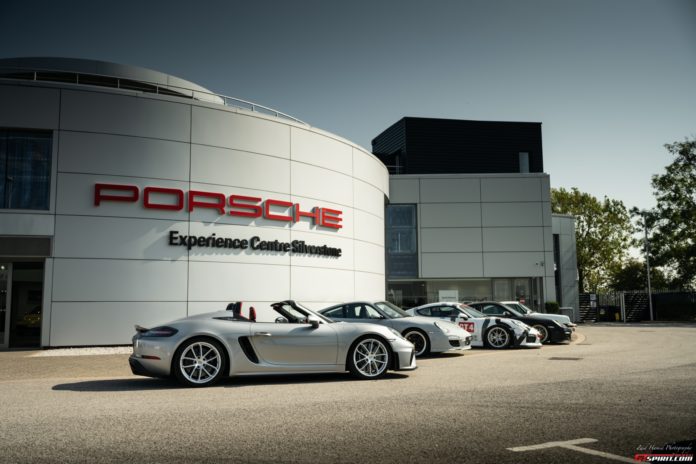
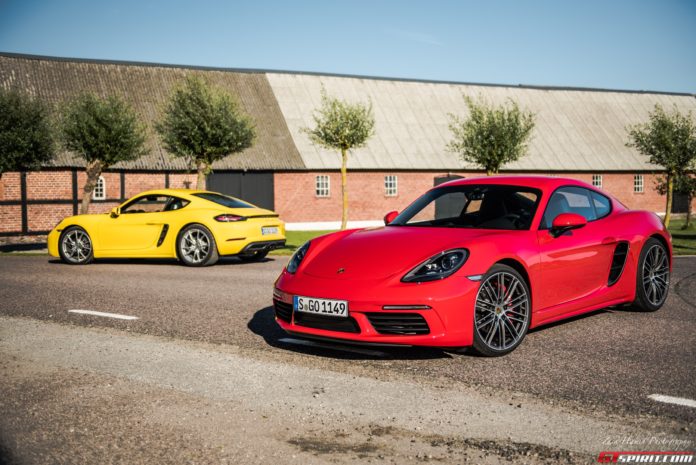
Special Report: Why a Porsche 718 is The Sports Car You Need

Boxster or Cayman, Base, S, T, GTS, GT4 or Spyder – The Porsche 718 family is broad. There are manuals, PDKs, 4-cylinders and 6-cylinders to choose from. The shared chromosome in the family DNA? The enthusiasm to connect the driver to the tarmac and administer joy like few other automobiles can.

Think mid-engined cars and you’ll most likely conjure images of a howling Ferrari V8 or shrieking Lamborghini V12. It’s all drama, power and fuel exploding glory. The 718s are mid engined cars that still benefit from the dynamic traits of supercars that cost five times as much, but combined with significantly more practicality, usability and accessibility. Regardless of the engine/transmission blend that you choose, you will be driving a class leading car. The competitors in the relevant classes, with perhaps the exception of the Alpine A110 or a Lotus of some flavour, will not be able to match the balance and sublime handling characteristics of the 718. The 718 family can offer the complete package.

I was one of the first people that was not a Porsche employee to pilot a 4-cylinder 718. No, I was not the biggest fan of the Cayman S which I was driving, but then I considered that this was not the flagship model, this was a sports car designed not to just be enjoyed a handful of times a year before being stored in a covered garage and plugged into a trickle charger.

This was a car that could genuinely be driven everyday. Furthermore, there was a band of torque which meant the performance, and that magnificent chassis, could be enjoyed without having to push into the upper echelons of the rev range as you would do in an NA car. Any reservations about the 718 evaporated with the introduction of the GT4 and Spyder. These were the special GT models that felt extraordinary courtesy of the reintroduction of naturally aspirated 6-cylinder engines and a plethora of parts from the 991 GT3, notably the suspension and subframe. But not the GT3 4.0 engine, this was all new and based on the 3.0 Carrera engine bored out and freed of turbocharging. It is so different that Porsche engineers say there is almost no carry over from the 911 engine.

That brings me to this, the 718 Spyder. A side note, it is no longer the Boxster Spyder but carries 718 badge which was reintroduced to help relate to the 4-cylinder, bizarre as this is a 6-cylinder. For the first time, the Spyder shares all of its mechanical organs with the GT4. With the previous 981 generation, the Spyder was a slightly less frisky and less focused than the GT4. This was a decision that I thought was a tad strange, thankfully Andreas Preuninger did too and he is now in charge. The Spyder is now just as potent, making it just as, if not more, appealing than the GT4, in my mind anyway.

Unlike most convertibles which are conceived as coupes with the roof removed and additional strengthening in the floor, the Cayman is derived from the Boxster. This means that there is no compromise having the Boxster (or Spyder) over the Cayman (or GT4), this is reflected in the weight of the cars with both coming in at 1,495 kilograms (wet). That being said, unlike most convertibles, the Spyder has no heavy electric/hydraulic systems to raise and lower the roof, no, that’s powered by you – as with the Speedster, it is a manual affair.

Put the hood down and leave it there. The Spyder is best enjoyed topless on a sunny morning whilst all the boring people are asleep or watching BBC Breakfast. The is all about dynamic driving, just a well as that is what makes it one of the most phenomenal cars on sale today, regardless of purpose or price. The way you can barrel into a corner, enjoy oodles of feedback from what is one of the best EPAS systems in the game and feel the chassis balance through the turn. You may not be adjusting the rear end on the throttle like you might in an M2, but this is a dialled in, focused machine that rewards you with supreme precision and communication.

The same can be said for the rest of the 718 family, but the Spyder is a peach. I would struggle to choose between this and a GTS 4.0 as Porsche have exceeded expectation with the sportiest non-GT car and the full fat Spyder and GT4. Choosing between the two is not a bad problem to have as both pay testament to the class leading engineering and devotion Porsche has towards making drivers cars and not just for the very few. As long as you can cope with having room for a single passenger, there is a 718 for you. I implore you to have a go in one that in any configuration that suits your lifestyle and budget, I assure you that you will not be disappointed.

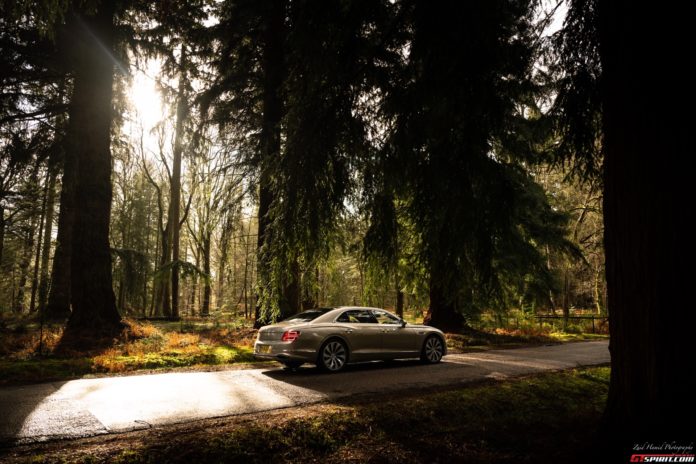
Special Report: Exploring The UK In The 2020 Bentley Flying Spur

There is an element of romance when you travel, not just to reach a destination, but for the thrill of the journey. The ultimate freedom and best way to uncover the undiscovered is by road, guided by a sense of adventure and the desire to make memories. Driving a new exciting road or parking along side one to mentally save an image that will he cherished and looked back upon is one of the greatest automotive experiences you can have. 

When Bentley invited me to create memories in a Flying Spur I was quick to express my desire to accept the brief. It was a not a complicated mission. Have a Flying Spur for a week and drive anywhere I fancied as long as it was in the UK and take a bunch if photos on the way. Simples. This was not the first time I had been set such a task – a few years ago the GTspirit crew took a Bentley Mulsanne all the way up to Scotland to write a story and create a short film. The Bentley took the journey in its stride, not once faltering on the two thousand mile journey and carrying us in supreme comfort and opulence. 

I had no doubt that the 2020 Flying Spur would be any less refined. What I was not expecting was ferocious speed and a breadth of ability that this 2.5 tonne behemoth of a limousine displayed. The size of the FS, literally, is the elephant in the room. It is massive and you notice when you try to negotiate the narrow lanes of London and its, narrower still parking garages. After breathing in an using the plethora of cameras to keep the 21 inch diamond cut wheels unscathed, you’ll find a bay to park in and reverse right to the back of before jumping out and laughing out loud about how the Flying Spur hilariously stretches over the white lines by a considerable length. You’ll never be wondering where you parked it, you can see it poking its chrome grille nose out from quite a distance away. Thankfully manoeuvring the 5.3 metres of metal is far easier than you would expect thanks to the extremely aggressive rear wheels steering. Apply enough lock and you will see the rear wheels turning in the side mirrors, on full lock you will hear them juddering behind you as they shrink the turning circle. 

Back to the task at hand! I adore the South Coast of the UK. Places such as New Forest and Portsmouth are only a couple of hours south of London, waking up at 5am means I am in the forest for sunrise and can spend the day exploring before heading to Portsmouth for a view of sunset on the beach. The massage seats pulsated and kept me relaxed, I was only stopping for coffee and a few splashes of fuel for the W12 to chomp through. And chomp it does, 626bhp and a barmy 0-100 time of 3.8 seconds means the Flying Spur has quite an appetite. Stopping to fill up meant there were plenty of opportunities to exploit the ferocious speed when rejoining the motorway and get back up to cruising speed. The pull in 2nd and 3rd gear is alarming, the numbers build quickly but the sensation of speed is somewhat muzzled by in the cabin that shields occupants from the sounds and harshness of speed. Building velocity in such a manner in any sort of sports car would be significantly more uncomfortable. 

The theme of luxury and comfort continues when I’m off the motorways with the Bentley nonchalantly wafting over horrible road surfaces as though they are marble top smooth. The 48 volt antiroll system that has been around since the first generation of Bentayga is still a marvel, it means the car combats the slightest hint of roll but the air-suspension can remain focused on an keeping occupants isolated from bumps and poor surfaces. The results are sublime. As I arrived at Portsmouth for sunset, I feel as if I can carry on driving for another 7 hours without fearing fatigue. So I do carry on, this time towards Bristol so I can rise early and catch first light in Cheddar Gorge. The 100 mile journey in the dark is just as effortless, the LED lights are terrific and the adaptive cruise control combined with the adaptive high beam assist makes this one of the easiest drives I think I’ve had in any car. 

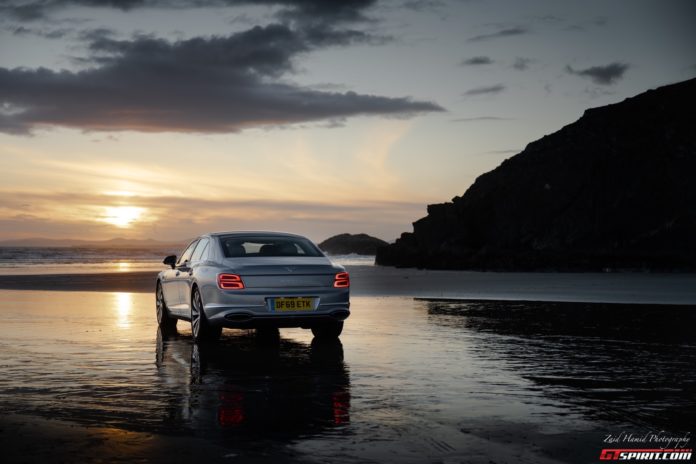
The trip to Wales was the one which would determine if this trip would have been a success or not. The locations in the Brecon Beacon mountains and the surround coast were far more dramatic than those of previous days. The next and final stop was the Bentley factory where I would part ways with the car, so Wales had to deliver. This journey was one focused on natural beauty and the Flying Spur, I hope the photos give you a sense of just how beautiful the car looks in a variety of settings.

Top 15 Cool Cars of 2020: A Dark Year with Exciting Cars

Magma Beam Mercedes-AMG GT Black Series

What a year it has been so far, eh? But also one filled with an array of amazing new car debuts, there will be even more to come as we come to a slow end of the year. For now though, lets look at some of the cars that kept the car world buzzing with excitement, from sports cars to hypercars and SUVs – hard to even talk about cars nowadays without an SUV coming up.

Here we go…

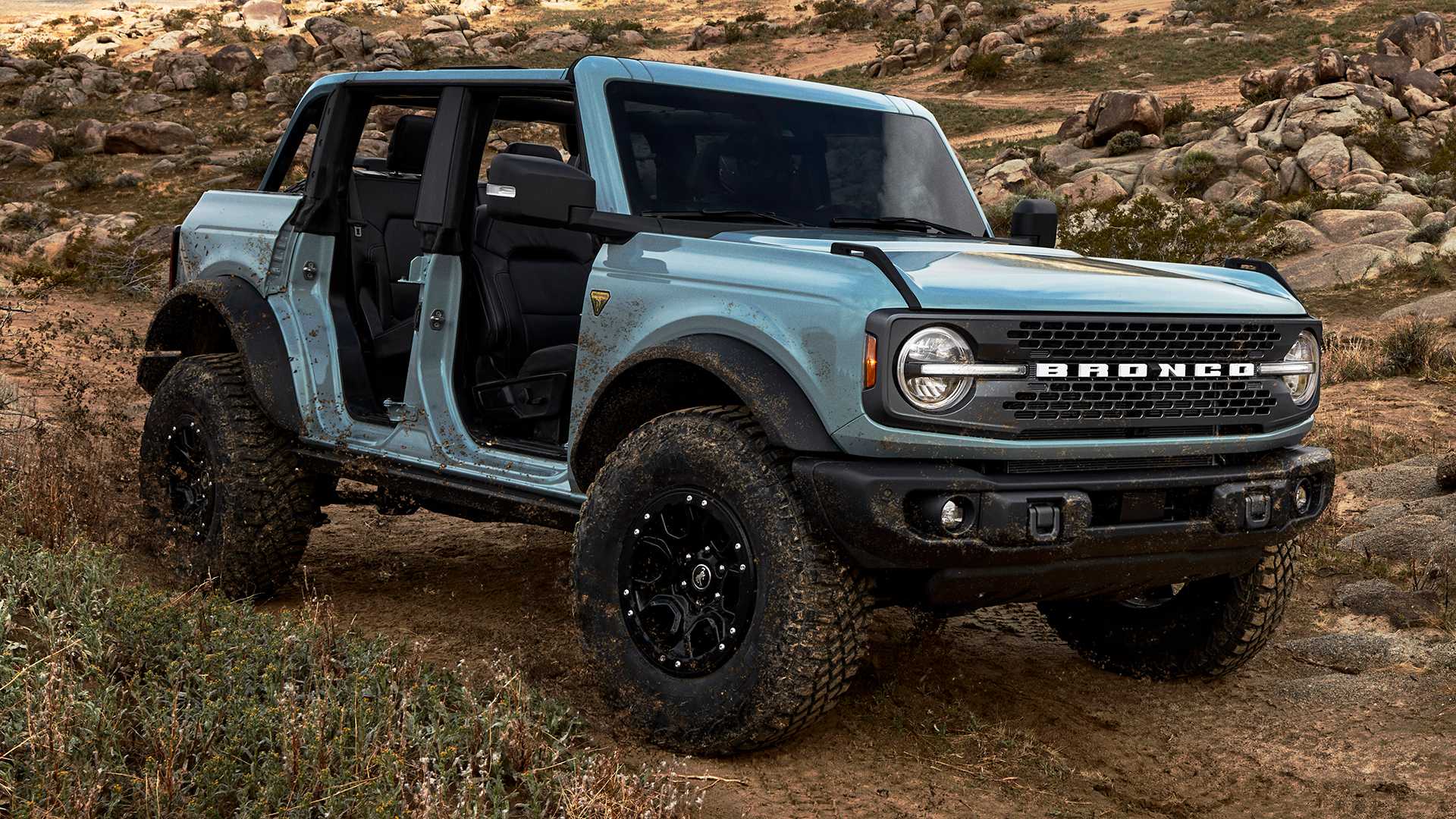
1. Ford Bronco

My personal favorite, one of the few rugged 4×4 SUVs on the market in a very niche market dominated by the Jeep Wrangler. The Bronco is an old soul reborn, and Ford did not disappoint. From the design, to the options available (including a manual transmission), this is easily the coolest SUV on the market right now.

2021 Ford Bronco Off-road

Engines:
2.3L EcoBoost turbo 4: 270hp/420nm – 7spd manual
2.7L V6 turbo: 310hp/542nm – 10 spd auto only
Off-road: 2H, 4H, 4L

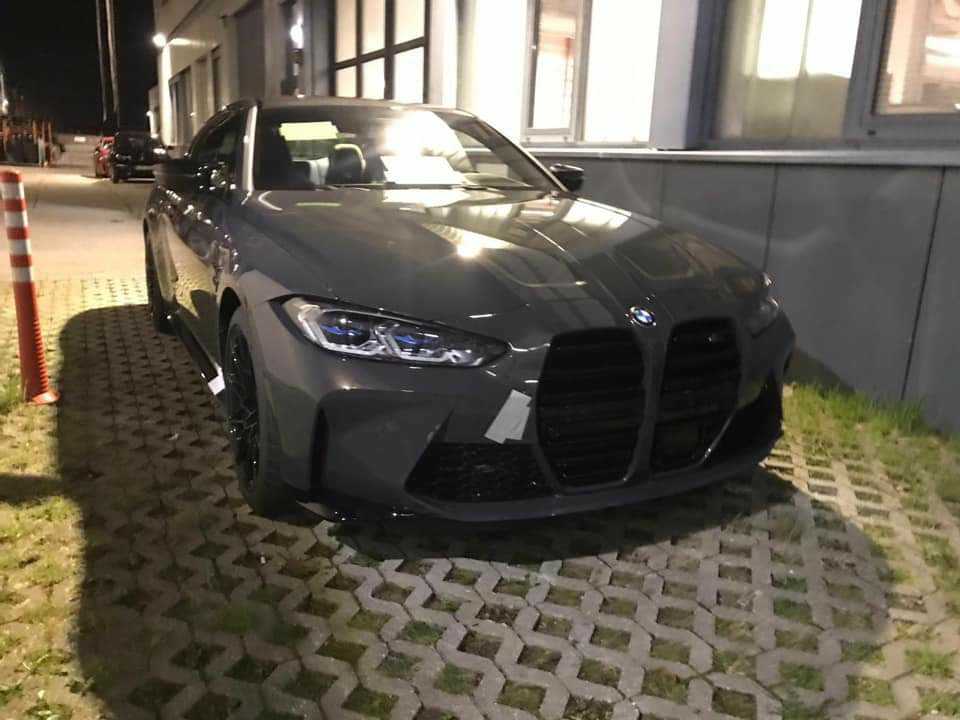
2. BMW M3 & M4

September 23rd reveal. We can’t wait! For now we know the following:

Trims
Standard:
Engine: 3.0L S58 inline6 twin-turbo
Output: 480hp, 600nm
Gearbox: 6-spd manual, RWD

Competition:
Output: 510hp, 650nm
Gearbox: 8 spd auto, AWD with RWD mode.

3. Porsche 992 Turbo S

This is a $200k hypercar, deserves that title more than some actual hypercars. Porsche did not fail, they never have when it comes to the 911 Turbo. Incredibly powerful and very quick. See below.

Engine: 3.7L F6 twin turbo
Output: 641hp/800nm
0-100kmh(62mph): 2.5s or less, Cabrio already did it in 2.5s.
Top Speed: 330kmh(205mph)

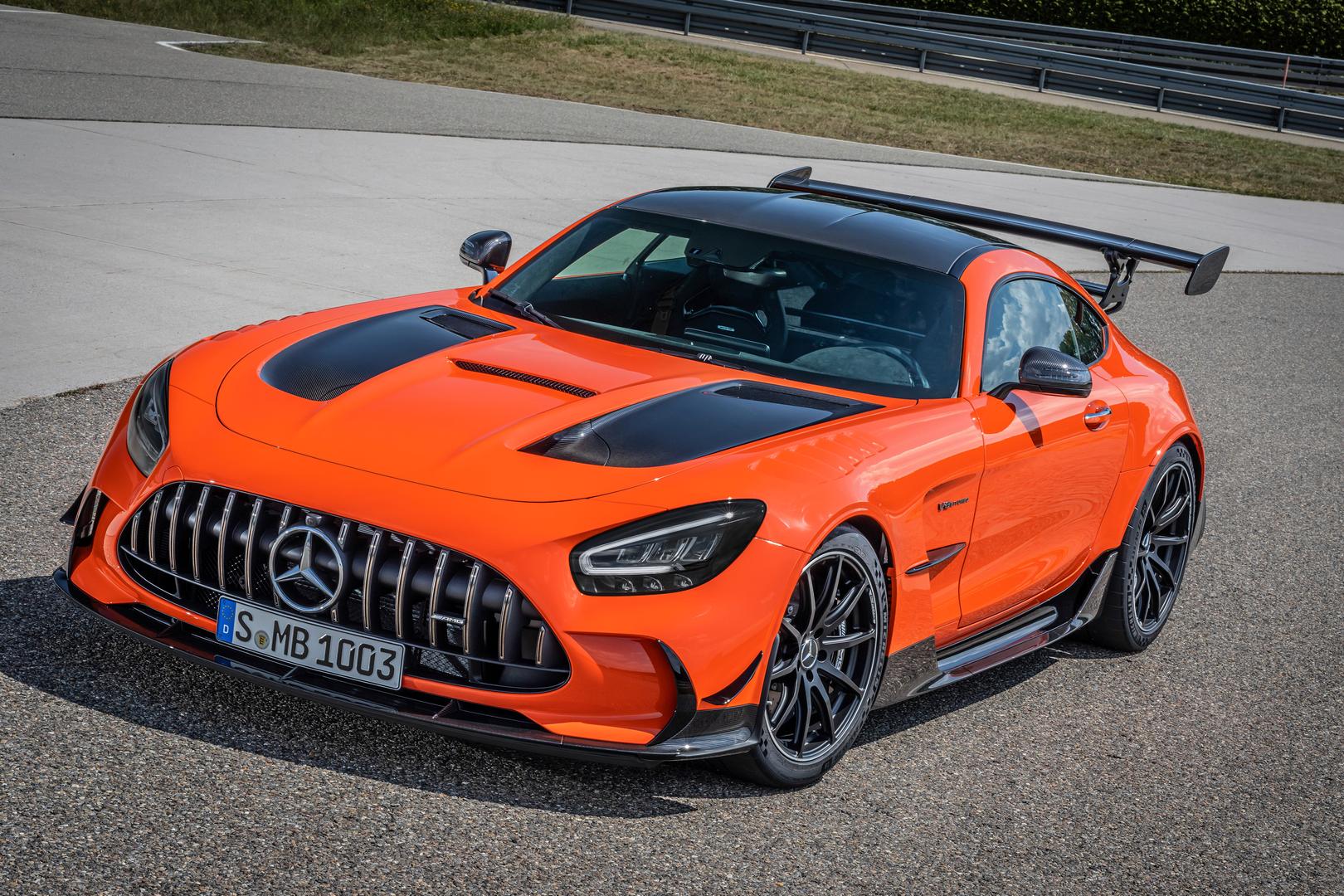
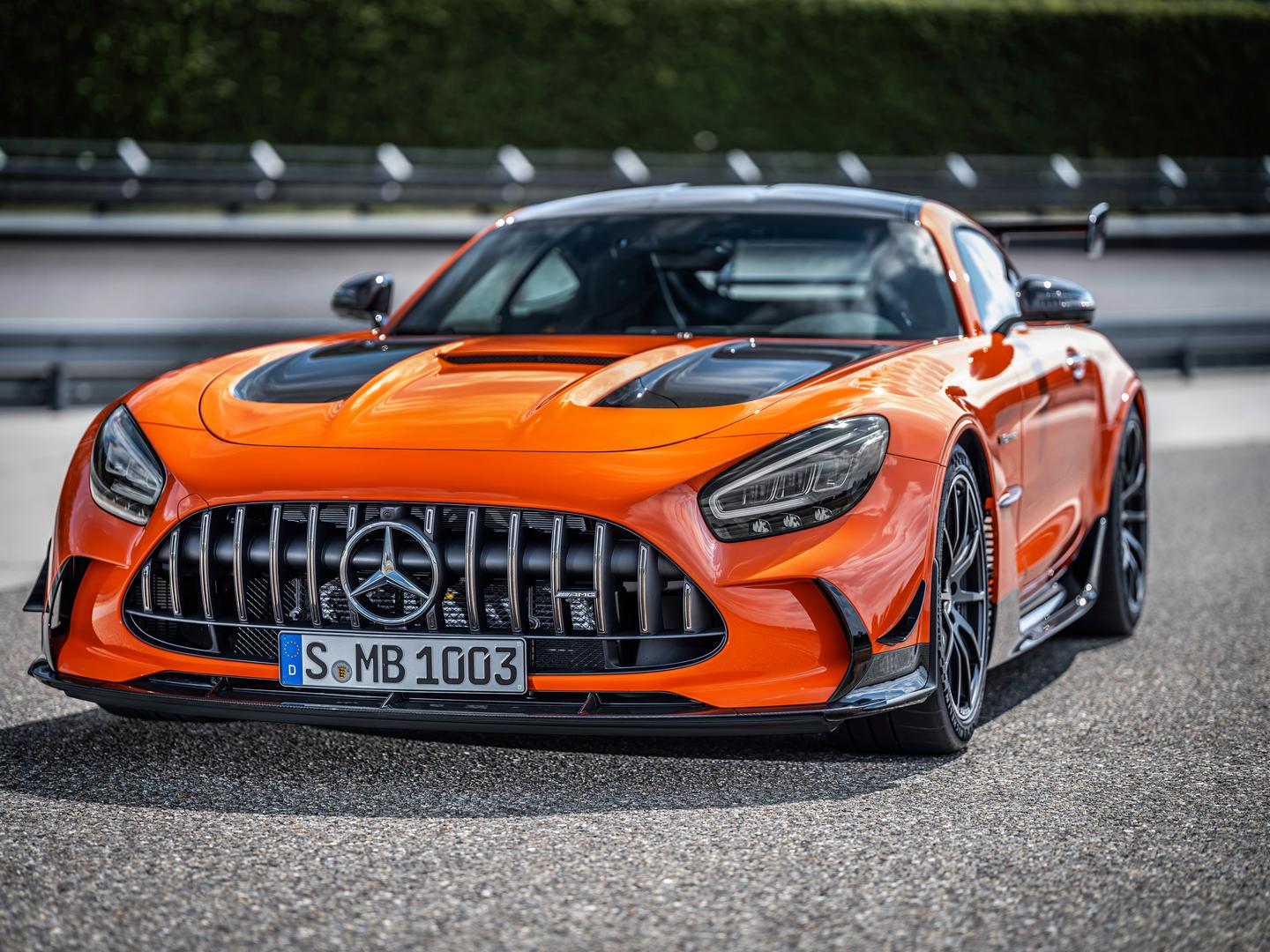
4. Mercedes-AMG GT Black Series

Orange AMG GT Black Series Wheels Price

The most expensive Mercedes-Benz vehicle on the market today, it’s also the most powerful Mercedes-AMG of all time. The price is 335,240 Euros with taxes in Germany (281k without taxes). The same price as a McLaren 765LT.

Power: 4.0L V8 Biturbo
Output: 730hp, 800nm
0-100km/h (62mph): 3.2s
Top Speed: 325km/h (202mph)

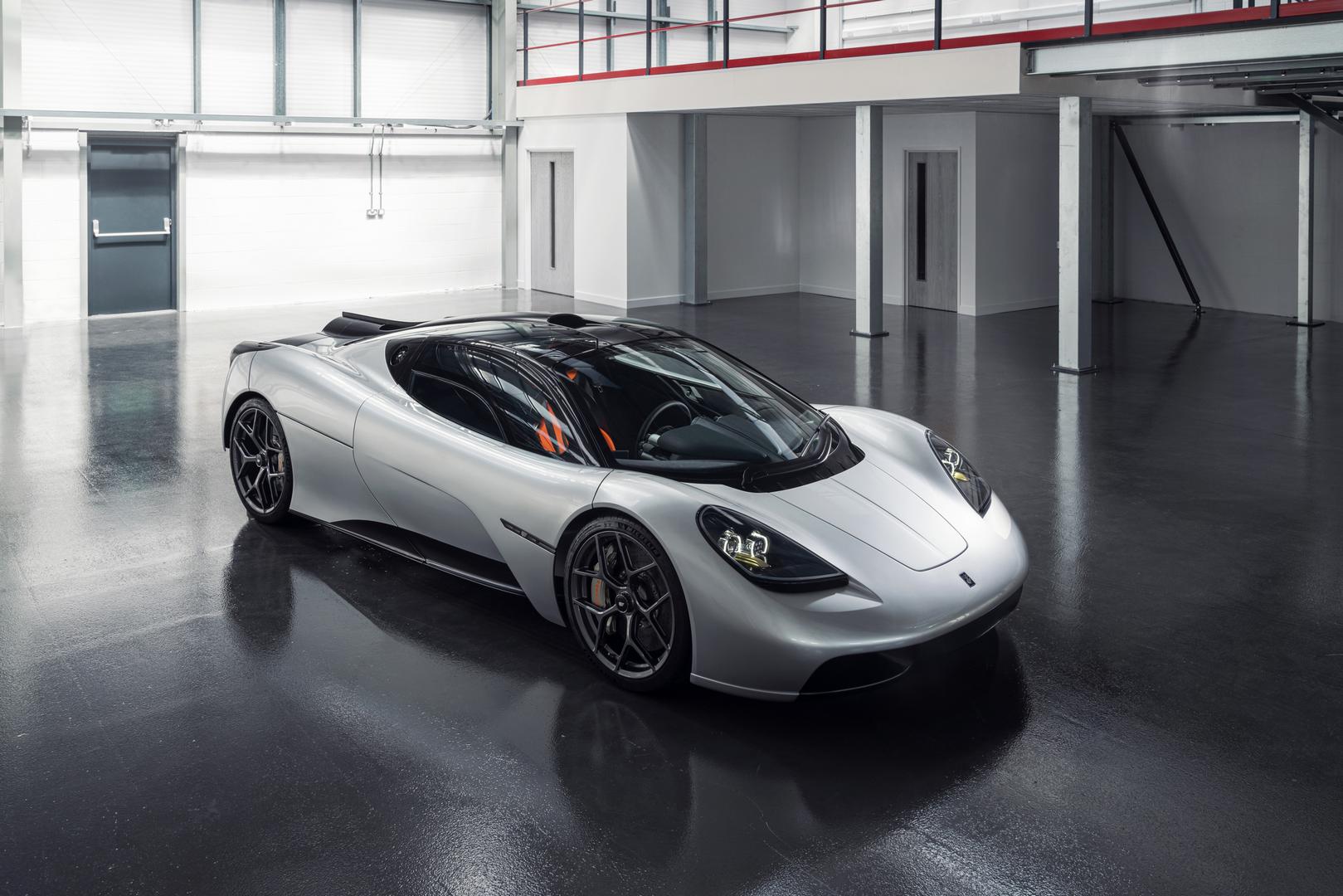
5. Gordon Murray T.50

Gordon Murray T.50 Price

Reviving the 90s: this is the new Gordon Murray T.50 supercar. It has a center driver’s seat, and the world’s highest-revving engine…and yes 3 pedals in a V12, in 2020!

Engine: 3.9L V12
Trans: 6 spd manual
Output: 663hp & 467nm
Redline: 12,100rpm
Weight: 986kg
Price: $3.08 million, 100 cars only

6. VW Golf 8 GTI & R

Golf 8 R
Photo by Autocar

The people’s hot hatches are back. At the time of this article the R has not yet been revealed, an update will however follow.

2021 Golf 8 GTI
2.0L turbo 4 EA888 evo4
241hp, 370nm (up from 217hp)
6-speed manual or 7spd DSG

The Golf 8 R will comes with the same motor, but power will increase to 335hp, DSG only this time round.

7. Bentley Bacalar

Bentley Mulliner Bacalar
Only 12 of these will be made worldwide. Showcasing the future of Bentley’s design.

Power: 6.0L W12 with 660hp.⁣
Inspired by EXP 100GT⁣

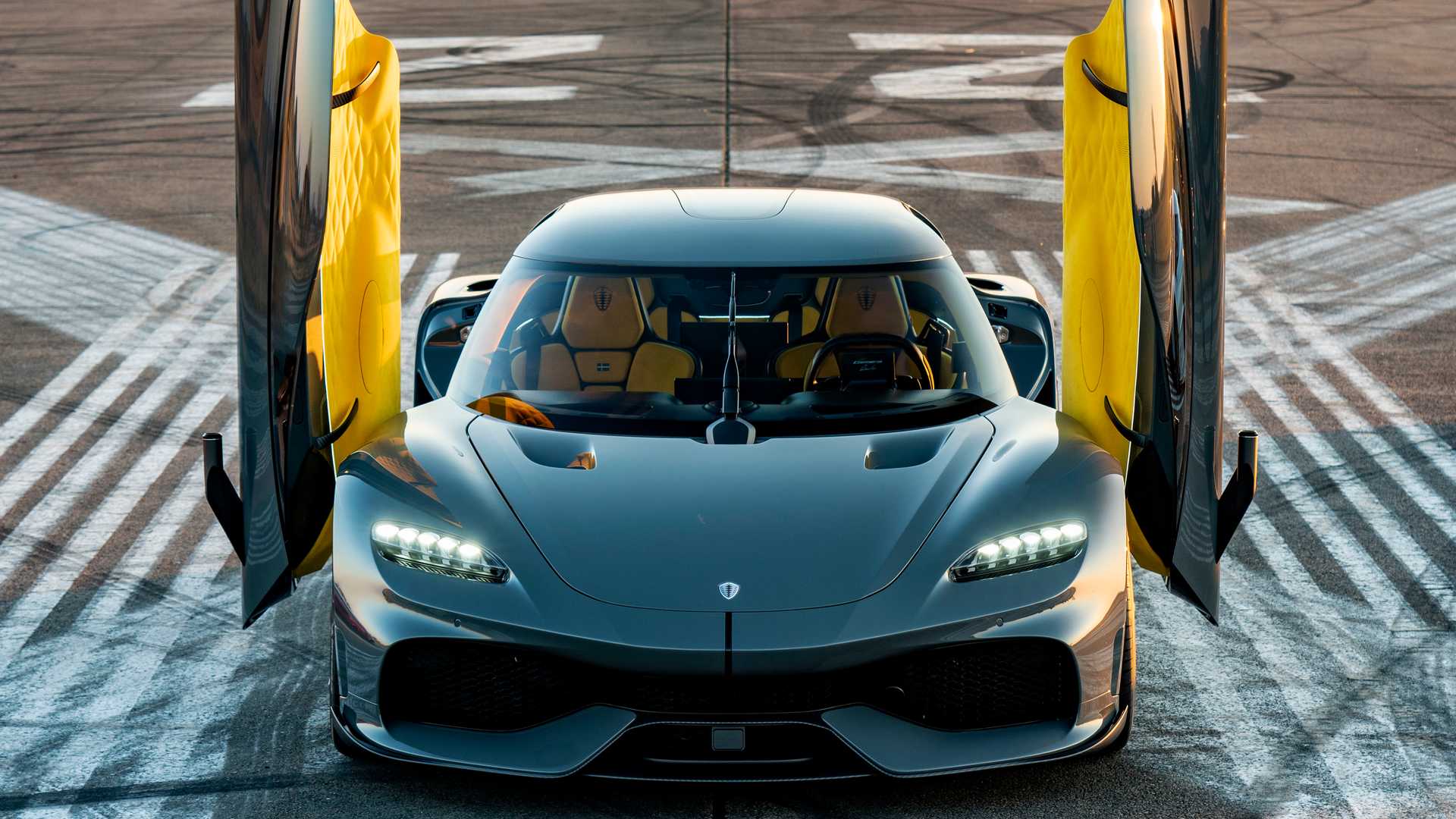
8. Koenigsegg Gemera

Koenigsegg-Gemera
A Koenigsegg with 8 cup holders, even your SUV doesn’t get that. It’s a hyper GT from Koenigsegg with luxury, power enough to wear the Koenigsegg badge and a matching speed. Oh, and a hovering 360 degrees camera in the rear.

Engine: 2.0L 3 cylinder twin turbo + 3 eMotors
Output: 600bhp + 1100bhp = 1700bhp, 3500nm
0-100km/h(62mph): 1.9s
Top Speed: 400km/h

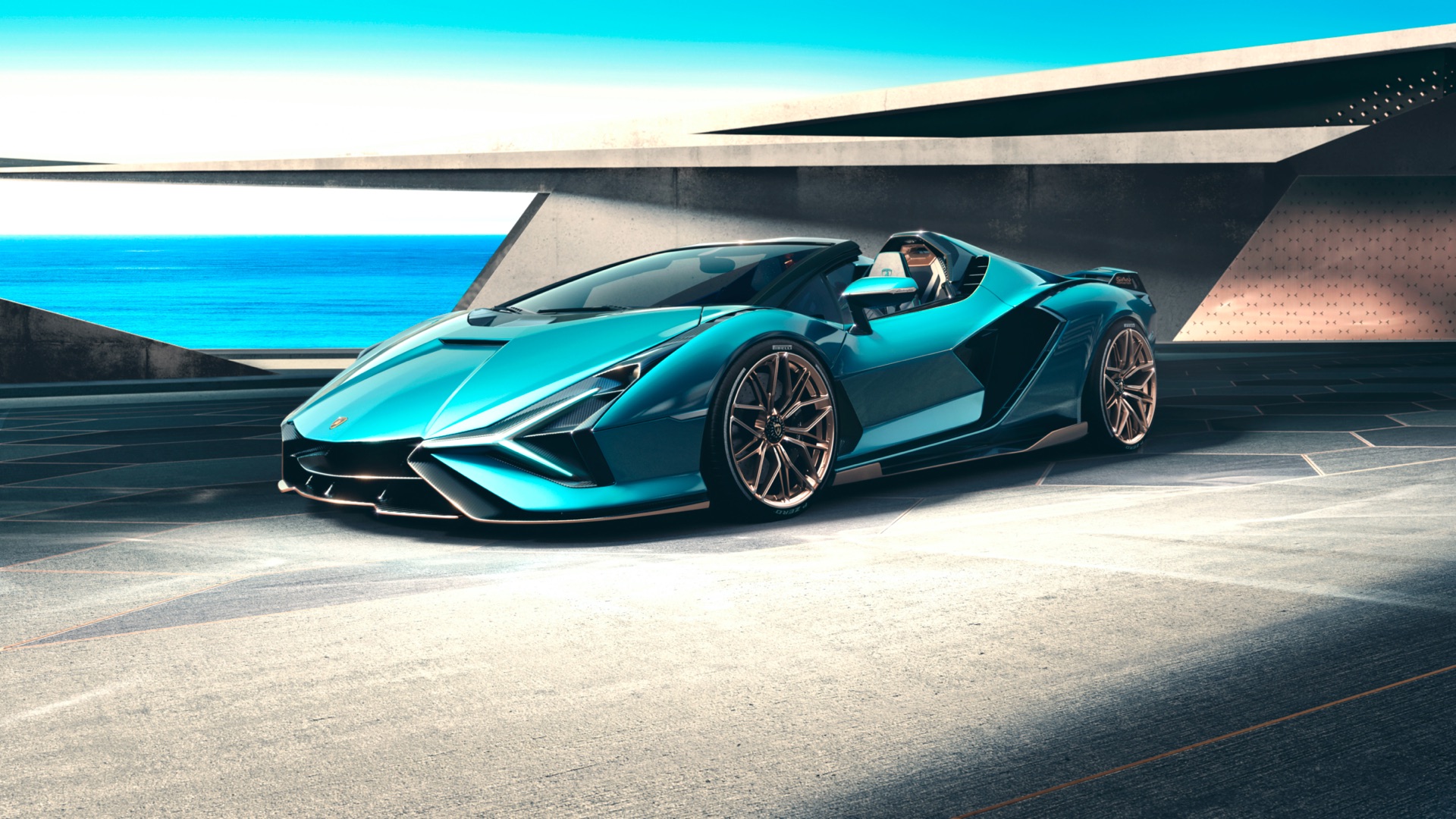
9. Lamborghini Sian Roadster

Lamborghini Sian Roadster
Only 19 of these will be made, and will join the Sian Coupe (63 units only) which was revealed last year. It also serves as an engine preview of the Aventador successor: V12 + mild hybrid.

Power: 6.5L V12 N/A + Mild Hybrid
Output: 819hp
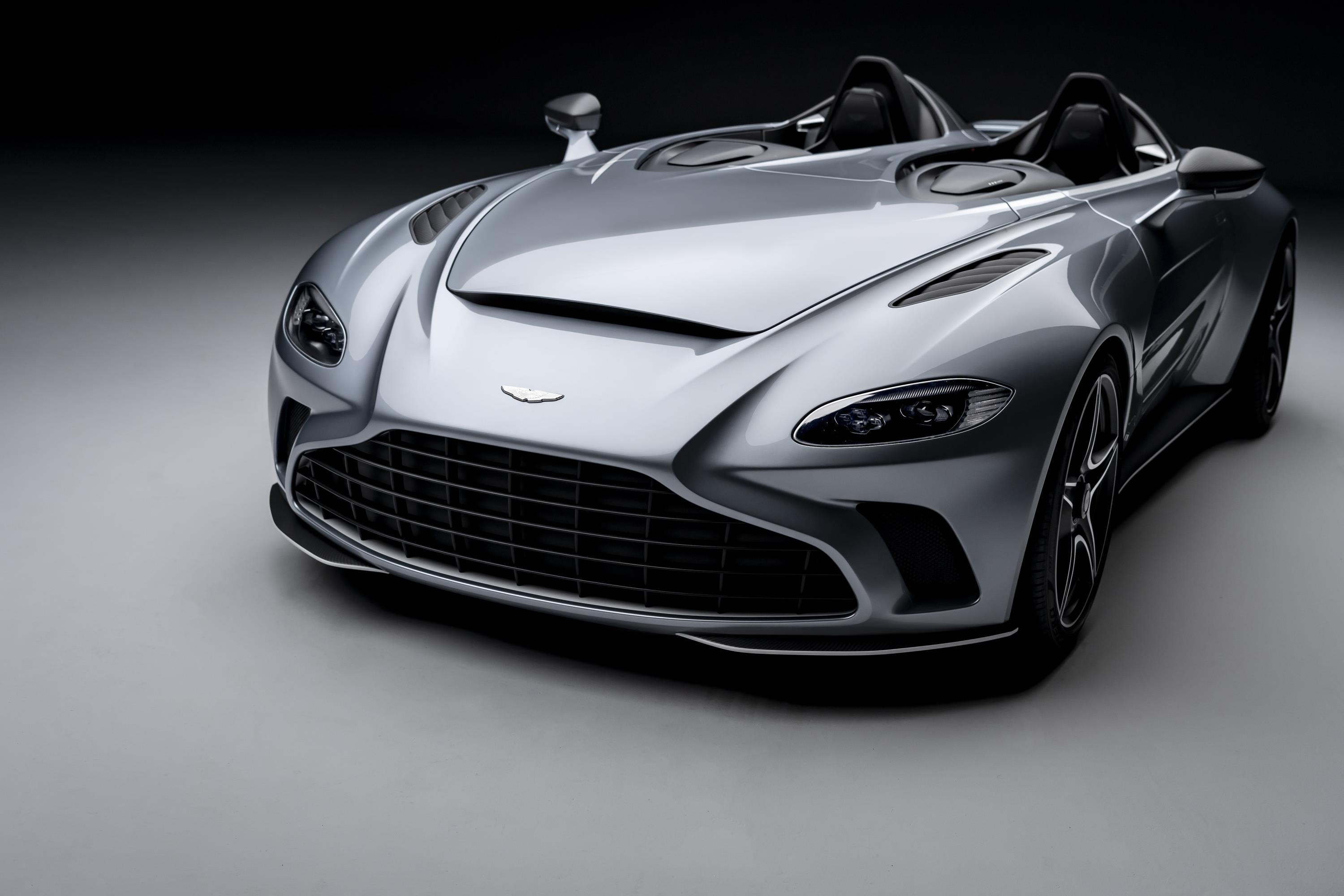
0-100km/h: 10. Aston Martin V12 Speedster

Aston Martin V12 Speedster Specs
Speedsters are the new thing now among supercar manufacturers. This one is limited to only 88 units and is inspired by the 1953 DB3S, 1959 DBR1 and the 2013 CC100 Concept.

Power: 5.2L V12 twin-turbo
Output: 700hp, 753nm
0-100km/h (62mph): 3.5s
Top Speed: 3.5s
Price: £765,000 in UK, £637,500 without VAT

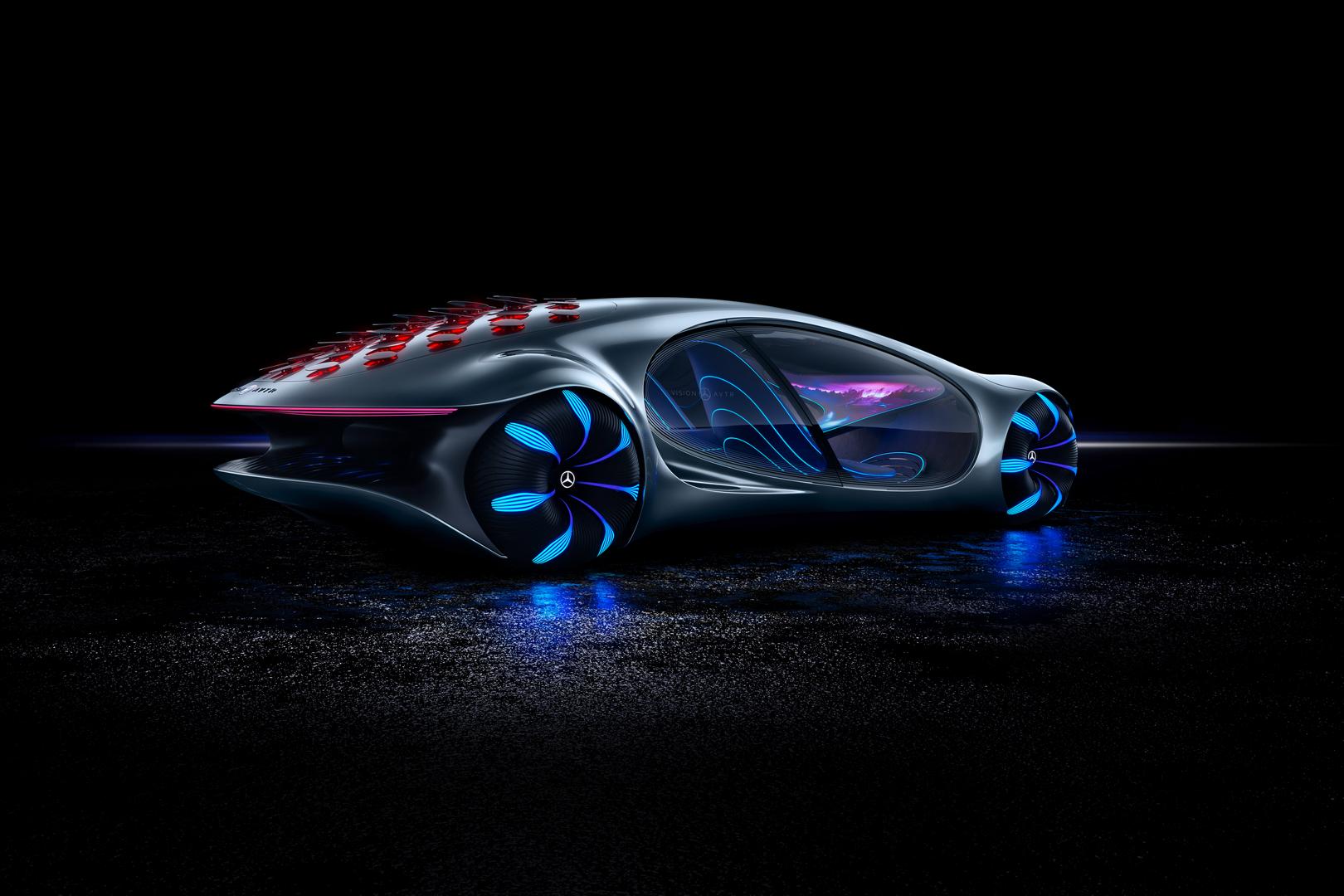
11. Mercedes-Benz AVTR

2020 Mercedes-Benz VISION AVTR Concept
This one is a tribute to Avatar movie.

– No steering wheel, connects to human owner by touchFlushed face
– can move sideway like a crabCrab
– 33 scales (bionic flaps) for communication with aliens

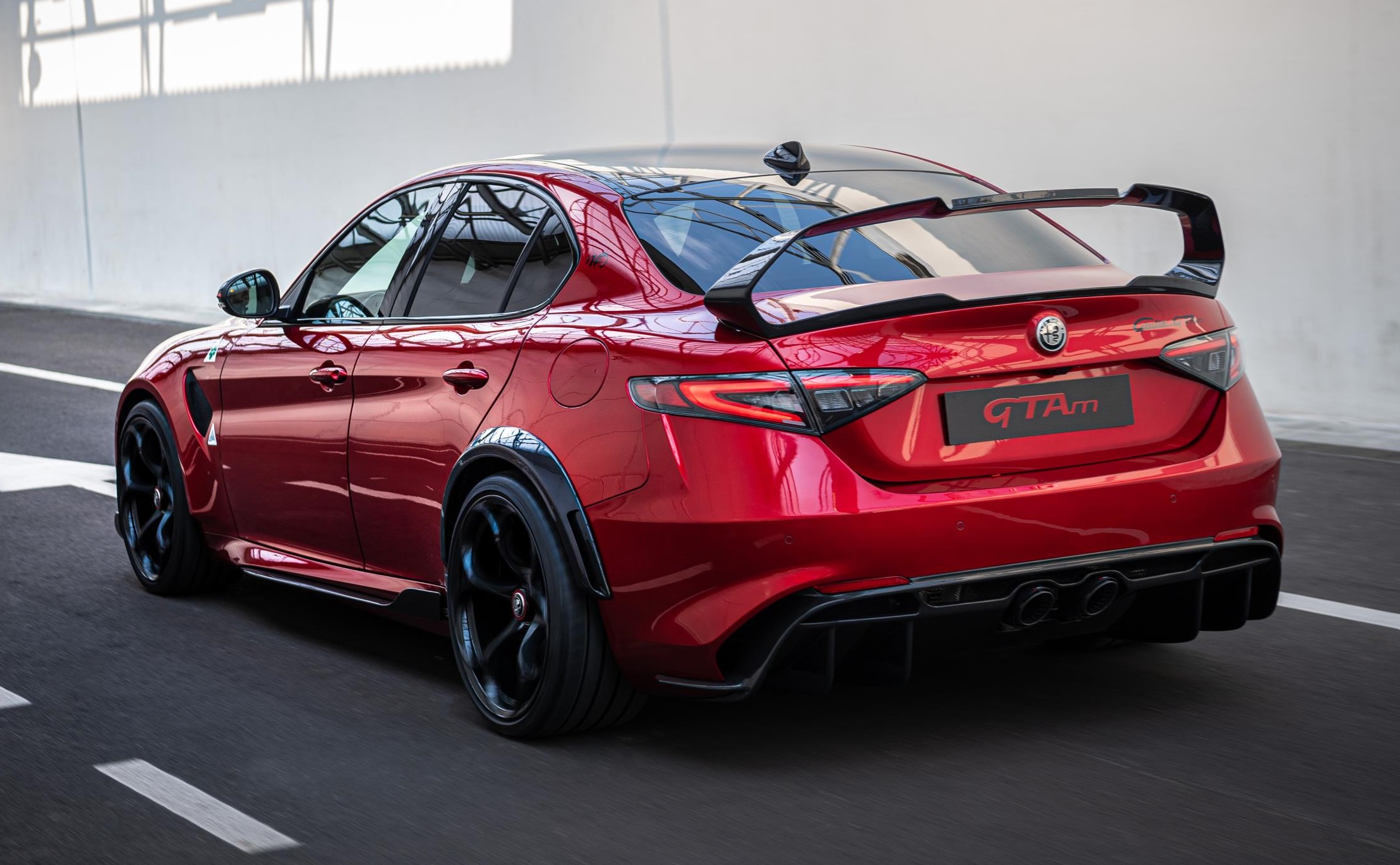
12. Alfa Romeo GTA

Alfa Romeo GTA Rear Wing
A limited edition based on the Giulia QV, 500 units only. There is a GTAm version with 2 seats only and roll cage.

Power: 2.9L V6 Biturbo
Output: 540hp
0-100km/h: 3.6s

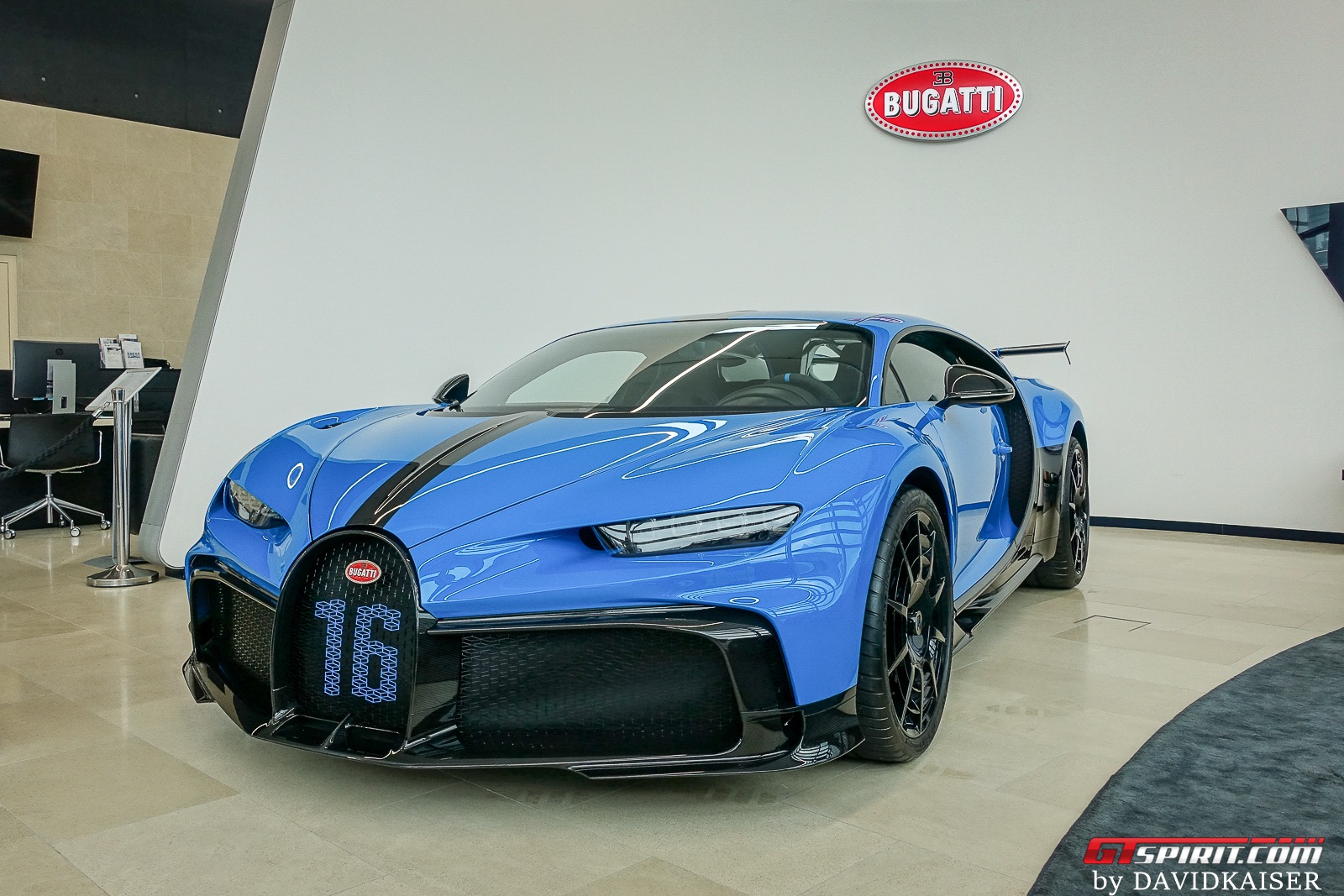
13. Bugatti Chiron Pur Sport

Bugatti Pur Sport in Zurich
Limited to 60 cars only this is one of the many special editions based on the Chiron. It’s 50kg lighter than the standard Chiron with more downforce as well.

Power: 8.0L W16 Quad Turbo
Output: 1500hp, 1600nm
Top Speed: 350km/h
Price: €3,000,000 or $3.35 million

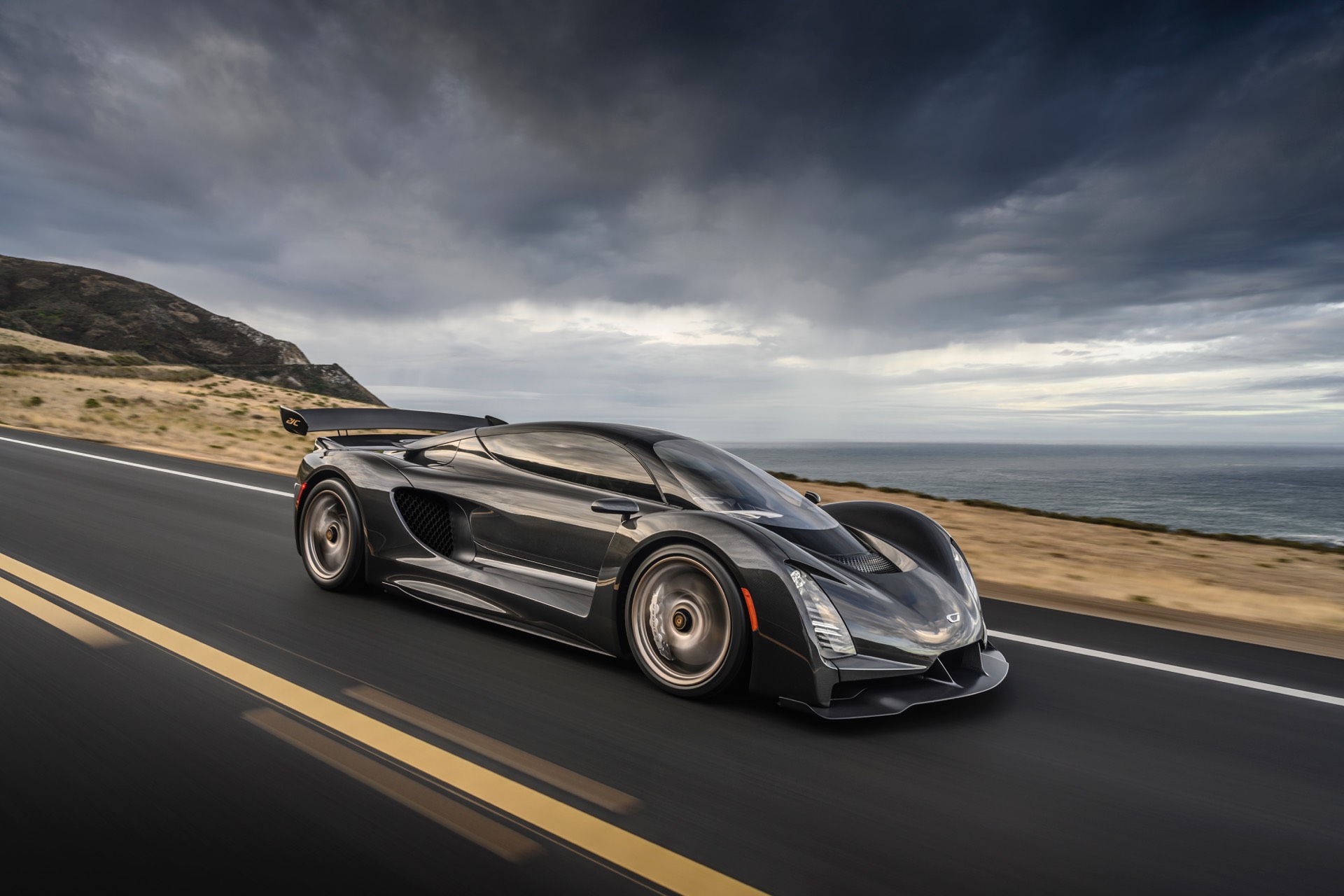
14. Czinger 21C


A hybrid hypercar powered by a V8 and 2 electric motors with AWD. Limited to just 80 cars.

Power: 2.88L flat crank V8 twin-turbo + 2 electric motors
Gearbox: 7-speed auto manual
Output: 1250hp
Redline: 11.000rpm
0-62 mph (0-100 kph): 1.9s
0 to 248 mph (400 kph): 29s
1/4 mile: 8.1s

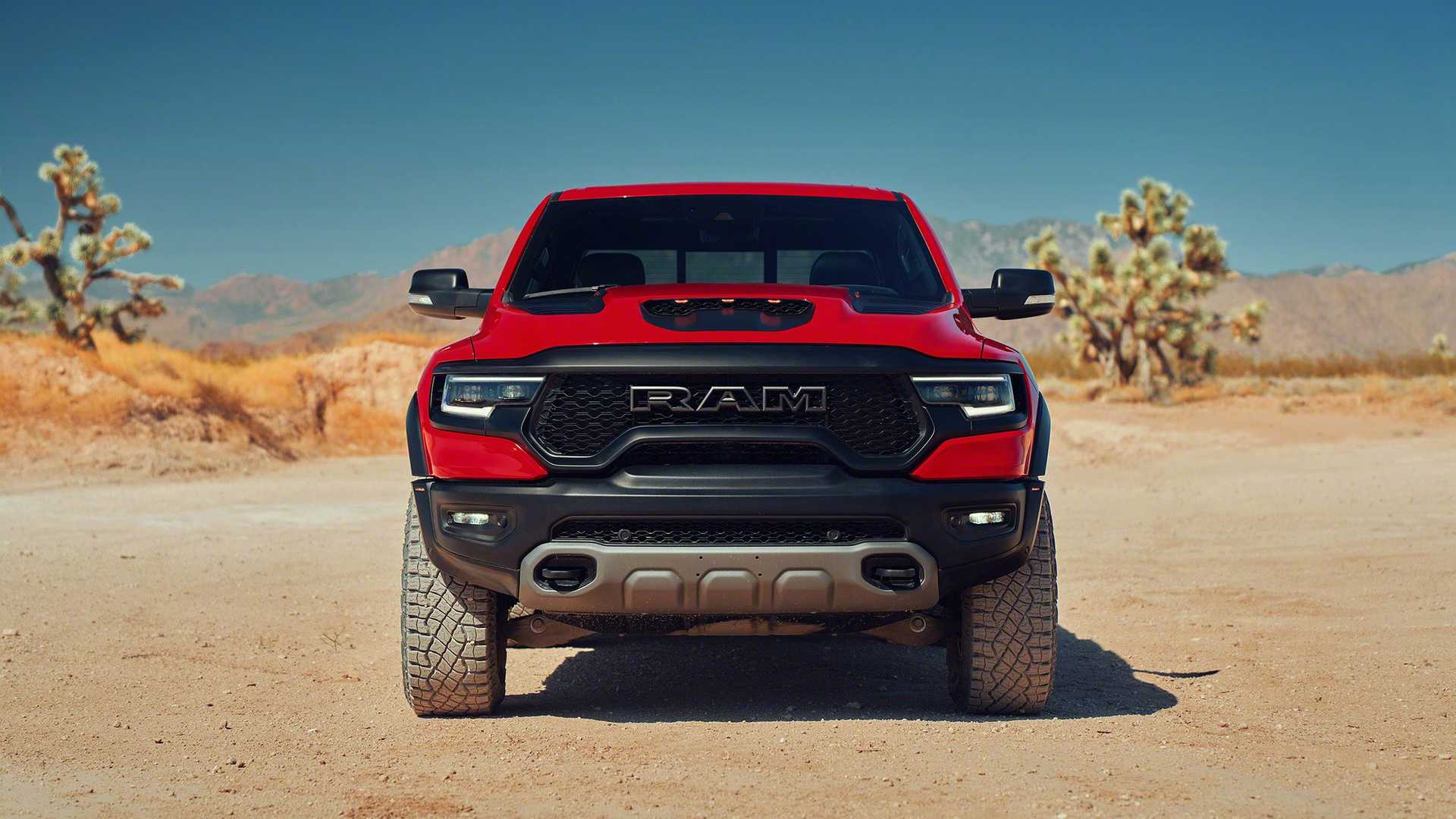
15. 2021 RAM 1500 TRX

RAM 1500 TRX
Only in America where a production truck would have such intense specs. The price starts from $69,995, your average specs A45 S AMG is more expensive.

New 2021 RAM 1500 TRX
Power: 6.2L Hemi V8 Supercharged
Output: 702hp, 881nm
0-60mph: 4.5s
¼ Mile: 12.9s
Top Speed: 118mph (yes, normal for this segment)

2020 BMW M2 CS Review

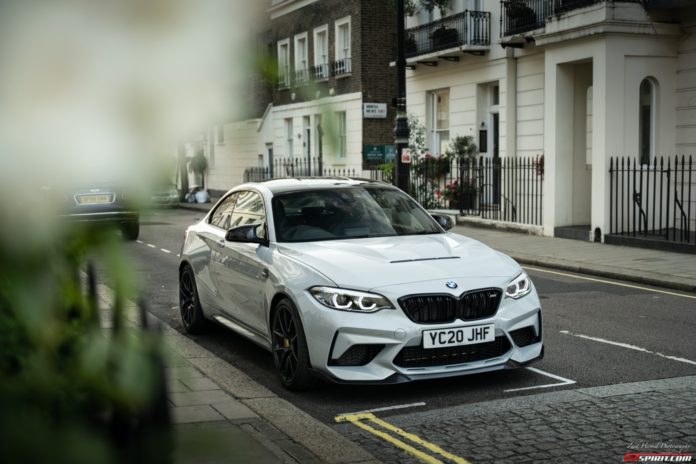
The BMW M2 CS: this is the one I’ve been waiting for. When I first drove the M2 in early 2016, I was perplexed by the choice BMW M made to not drop the M3/4 engine into the M2. A remedy arrived in 2018 with the M2 Competition and the introduction of the S55 from the F80 & F82. On the launch I questioned BMW M directors as to why there was no option of adaptive dampers in the baby M car. It was openly discussed that it was a key differentiator between the M2 and it’s bigger brothers with which it shared an engine. 

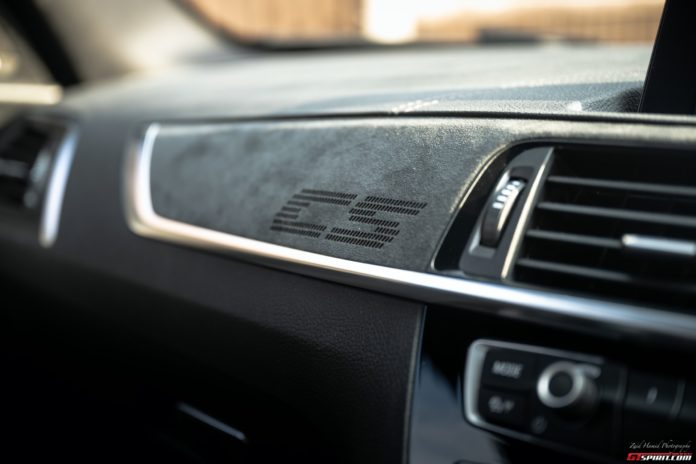
The M3 and M4 are no longer in production and finally, the M2 can be uncorked without fear of it showing up the big boys – meet the M2 CS. It’s got the same S55 as the now discontinued M2 Competition, but it’s putting out the same 444bhp as the F80/82 (up from 404), torque remains unchanged at 406lb ft. As mentioned, it comes with the welcome addition of adaptive dampers and even a carbon roof which is constructed using a stunning chequer board weave. Furthermore, carbon ceramics can be optioned for the first time on an M2 and that’s not where the carbon ends. Inside there are massive lengths of the shiny stuff on both sides of the central tunnel and door handles. Back on the outside, the entire bonnet is carbon and vented, the entire is part is a carbon copy of the one used for the CS Clubsport customer racing car. At the back there is a sizeable spoiler made of carbon that is so tall it can be seen in the rear view mirror. Furthermore, the front splitter and rear diffuser are also constructed out of motorsport inspired material.

Enough of the brochure talk, what is the M2 CS like to drive? It is certainly a step on from the M2 Competition and a large part of that is down to the dampers. As with the steering and engine, there are three settings – Comfort, Sport and Sport Plus, Sport being the default setting when firing the car up. Comfort is where thing are noticeably different, the secondary ride relating to the handling of lumps and bumps brings a new level of composure to the M2 and the way it handles itself when attacking a bumpy road.

Where the original M2 would be bouncing around like a rabbit on a pogo stick, the M2 CS remains calm and collected bringing greater confidence levels which allow the fun to continue over less accommodating tarmac. Sport is well judged and deployable on a good road surface, Sport Plus is best reserved for the track. The engine and dual-clutch transmission are as brilliant as in the Competition but with an added punch in the sportier modes. For those looking for freedom from the electronic nannies, the M Dynamic Mode allows for more slip’n’slide in the M2 CS before cutting in to stop you making it into a YouTube crash compilation. That being said, you’ll have to be on your worst behaviour to unstick the CS now that it is fitted with Michelin Pilot Sport Cup 2 rubber that makes the a significant difference over an M2 Competition and its Pilot Sport 4S compound. The optional carbon ceramics are supreme and the gold callipers look fabulous, to my eyes anyway. 

Much like the M2 Competition, this car wants to be driven hard. The harder you push the M2 CS the more you can feel the additional hardware at work. After my first spirited drive I was not convinced and wanted more, it felt like an M2 Competition. A 5am spanking the next morning revealed just how impressive it is when you really put the M2 CS through the wringer. The front axle grip is beyond belief, turn it in and grips and goes. This is an M2 turned up to 11.

But it is not perfect. The Comfort steering mode is too light and Sport too heavy, Sport plus is best left unused. The interior could be more exciting, the main difference in the CS is the removal of the armrest along with its storage space and the added carbon and alcantara. The steering wheel is still very thick, it can be forgiven as the seating position is sublime. The most significant gripe is the disappointing exhaust tone, although the same can be said for almost any car fitted with particulate filters. 

All up, the changes are significant, but there is an elephant in the room. The M3 & M4 CS were released with a hefty premium over the standard models. The used market for these cars reflects what many believe to be their true values. When new the M4 CS without costly options such as ceramic brakes, cost £87,150. A 5,000 mile used M4 CS can be yours for £57,000 just two years on. The production run of the M2 CS is limited by time not a set number, the base price is £72,600 before options. After adding a the DCT box, carbon ceramics, electric seats and reverse camera, the car I tested came in at an eye watering £83,260 with taxes and fees. That puts it in the direct line of fire of a Cayman GT4, although the GT4 arguably appeals to a different audience with no rear seats and mid-engined layout.  

Without a doubt, the M2 CS is an incredibly exciting proposition. It is one of the best M products I have ever driven, the move from passive to adaptive dampers combined with the boost in power and addition of Michelin Cup 2s really has brought out the best in the M2 chassis. I suspect I would be walking into a BMW dealer to register my interest if I had been given the manual press car to play with, but the price tag sours the package. If the rumours are true and production numbers are very limited, this may become a collectors special. If you can swallow the price and fancy an incredible drivers car, go out and get one – preferably in Misano Blue with gold wheels. If it isn’t justifiable for you, don’t fret, an M2 Competition will give you almost as much joy for substantially less cash. BMW have done brilliantly with the M2 CS (and the Competition). Let’s see what the next generation M2 has to offer, it has big boots to fill.

2020 Caterham Super Seven 1600 Review

When Alpine released the A110, the critics struggled to contain their adoration for the little French sports cars. They pined on about how it was so simple, light and different from the alternatives on the market. Recently, I spent some time in an even skinnier sport car – the Caterham Super Seven 1600.

This is not the first time I’ve driven a Caterham, I was thrown in at the deepest of deep ends last year when I was tossed the keys to one of the most violent and fastest accelerating cars on the planet, the 620R. Having somewhat broken me with its savage sequential gearbox and eye watering speed, I moved down the ladder to a 310R with a traditional 5 speed that was the closest thing to a road legal go kart I have ever experienced.

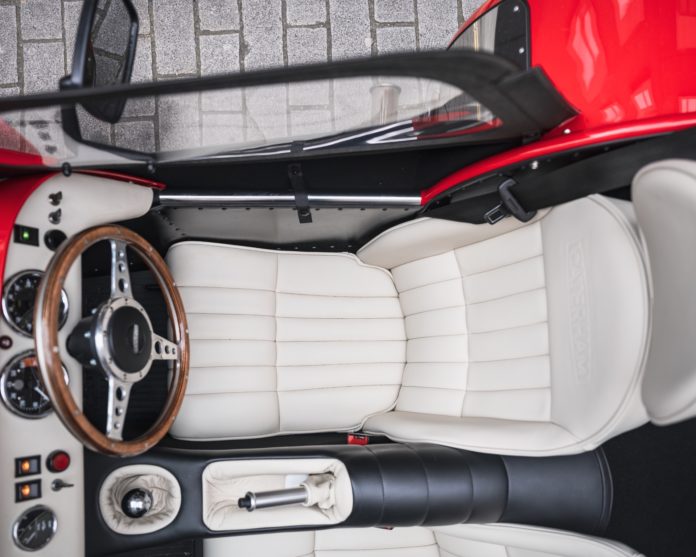
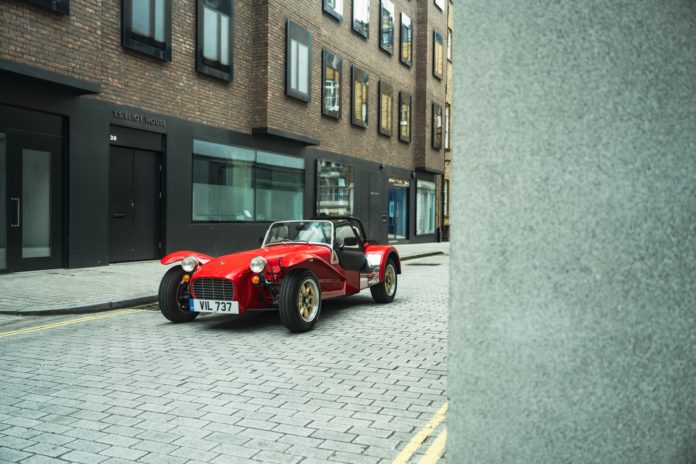
This time the power is being diluted once more with the Super Seven 1600 which is a very different proposition to the 310 and 620R models with a gorgeous wooden steering wheel, leather interior and just 135bhp. It looks like something Stuart Little would drive with its little gold wheels and cartoonish flared front fenders. It immediately looks more retro, road focused and comfort oriented than the rest of the Caterham model range.

Out on the road my visually generated impressions were confirmed. The touch points feel homely, almost like furniture, the steering wheel wouldn’t look out of place on a mantle piece in a quaint cottage and the chrome ball used to shift gears is a far cry from the intimidating black lever I had to slam home in the 620R.

The stats covey a leisurely feel too: there’s only 135bhp on tap, the max speed is a modest 196km/h (122mph) and there’s a 1.6-litre Ford Sigma engine up front. But this is a Caterham meaning the stats are irrelevant in reality as the entire package weighs in at a cute 540 kilograms. 250bhp per tonne means the 1600 will sprint to 97km/h (60mph) in just 5 seconds. It’s when you reach into the upper echelons of the rev range that things start to really come together.

The twin 40s throttle bodies and air filters, which punch their way through the body work, make this a special car. The engine relishes revs, and treat you to a symphony of induction and exhaust parp like no other. It rasps away into a loud and addictive crescendo. The redline is at 7k and you will stay flat until you reach it, the sound builds builds in volume and depth, you engage the clutch and pull for another gear to do it all over again. The beauty of the modest power figures is that you’re grinning from ear-to-ear with the wind in your hair feeling like you’re doing well over the speed limit, but in reality you are travelling at half the speed you feel you’re bumbling along at. Huge power figures are impressive to imagine but in reality are unusable.

This is genuinely useable power, the accompanying sense of fun and joy are off the charts. Find a twisty country road and you’ll be having the time of your driving life. In a car with more than 400bhp you’ll be paying roulette with your driving license before you’re half way through third gear. The lightness means everything feels more alive. Yes, it does not feel as planted as other Caterhams with a touch more suppleness to the damping a more lean courtesy of a softer (non adjustable) suspension setup. Like its bigger brothers there is not a driver aid in sight. No power steering, traction control or ABS put you on high alert, it soon becomes apparent that the 1600 is playful yet secure and the fear fades away, you can push on the limit with confidence.

What’s the catch? Well, it’s not cheap at £40,000 with a couple of options and I view the Super Seven 1600 as a toy. It’s not practical or very comfortable in comparison to a hot hatch or most conventional automobiles in the same price bracket. If you can swallow the price and understand that this is a car for fun, then go out and buy one. I challenge anyone to drive the 1600 on a twisty road on a sunny afternoon and to not laugh out loud. 

Special Report: Grand Touring in The McLaren GT

‘I’m sorry, I know it’s a Saturday, but I’ve been called into work. I’ll see you tonight if I can escape. If you can, please could you pick up cheese bread and chocolate. Everything will be closed before I’m back. I know we had plans today but I’ll make it up to you! Xx’

This really is how my weekend began. Empty bed, thwarted plans and no chocolate to drown my sorrows with. There was, however, a silver lining to be exploited – I had the keys to a McLaren GT, rather than crawling through Mayfair traffic before posing aimlessly outside Novikov, I could cancel my, now redundant, lunch reservation and do what the McLaren GT was designed to do – pick up bread, cheese and chocolate. The local Daylesford Farm Store and Wholefoods were too close to justify driving and did not present a tantalising driving experience. My partner’s insatiable workaholism was only matched by her equally unhealthy appetite for chocolate and all things sweet. It was still early, what if…

90 minutes later I’m approaching the warmly familiar check in booths at the Folkestone end of the now ironically named Eurotunnel. Why? Well, why settle for anything less than the best of chocolates when I could stretch the legs of the McLaren and bag the best chocolates anywhere in world to sweeten the mood of my horrendously overworked and under appreciated lady friend – as win win scenarios go, I can think of few better.

The Eurotunnel Terminal presents well known surroundings, this feeling continues as I recite my algebraic coffee order to the tired, eye bag plagued Starbucks barista that soullessly wishes me a safe journey. I respond to her well-wishes with ‘I’m only popping over to get some chocolate’. I imagine she feels that she is dreaming and/or delirious. I nonchalantly head back out to duck under the GT’s dihedral door before sinking into the leather and alcantara cocoon. The only smell better than warm caffeine may well be the surroundings in which I am drinking it in.

Passport checked, ‘random’ drugs test completed (they really just wanted to nose around the GT), I held my breath as the wheels of the McLaren rhythmically trundled over the metal carriage breaks just centimetres away from a gut wrenching scrape against the train’s metal curbs. My perfected imitation of a dog with its head out of the window ensures the safety of the very smart diamond cut wheels. Coffee emptied and MPH swapped to KM/H, it was time to see how good a cruiser the GT really was.

The French darkness shrouded the autoroutes and invited the GT to stretch its legs. This is a car that presents credentials that are unusual in a McLaren, but one which maintains a crucial McLaren: being ferociously fast. Ignore the 0-100km/h time of 3.2 seconds, that might seem quick, but the acceleration when you’re up and running is what really boggles the mind. In second or third gear, anything about 4,000rpm is as fast as you would expect any McLaren to be. In my mind, the performance is not where this car needs to make a point, it is every other measurable GT element that needs to shine.

This journey is not my first in the GT, I drove the car on the press launch that was set on the French Riviera. It is all too easy to get caught up in the romance of the scenario, the weather and the fabulous roads. This drive to Bruges would emulate something far more realistic, less fabricated and very varied. I had already crawled through London, felt the ride on harsh concrete British motorways leading to the English Channel and was now floating over the billiard table smooth Autoroute. France comes to end in a snoozy blink, Belgium is up next and the surface worsens. With the ‘Active’ panel engaged and handling and powertrain modes both is comfort, the ride is supple and the engine quiet, murmuring at 1,200 rpm. On a 130km/h cruise this 327km/h McLaren sips just 8l/100km (30mpg), that being said, the 72 litre fuel tank means stops are more frequent than you would hope for continent swallowing GT car. Then again, getting out to look at the car every couple of hours is no bad thing.

The reception from fellow road users, petrol station attendants and generally, anyone you pass in the car, is exceptional. Perhaps it is that it does not scream, ‘LOOK AT ME’ like an 720S or carbon clad 600LT, until you open the doors at least, but comments of the elegance and maturity of the design are plenty.

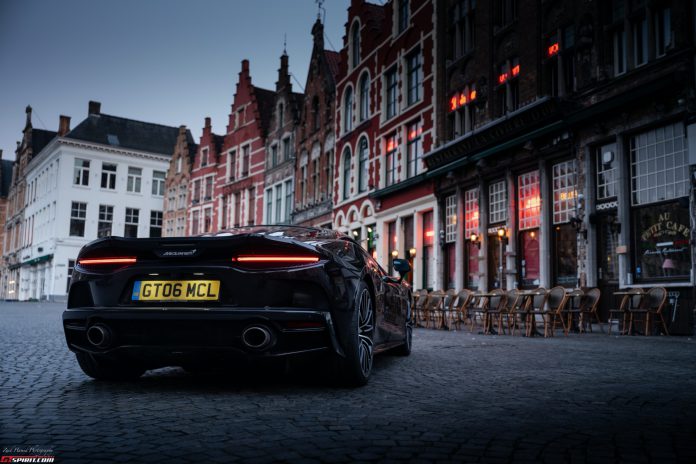
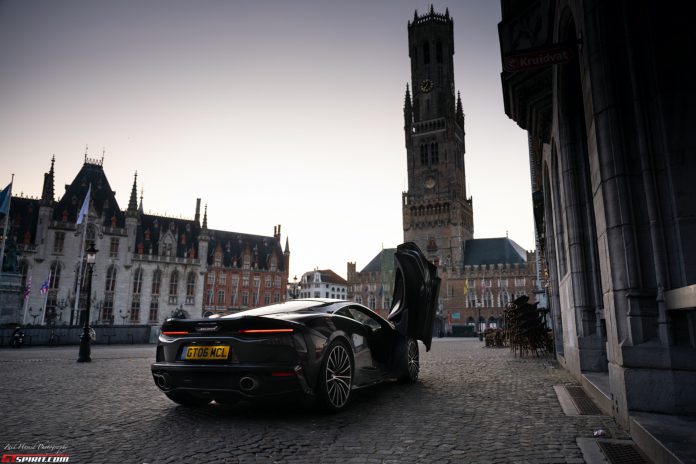
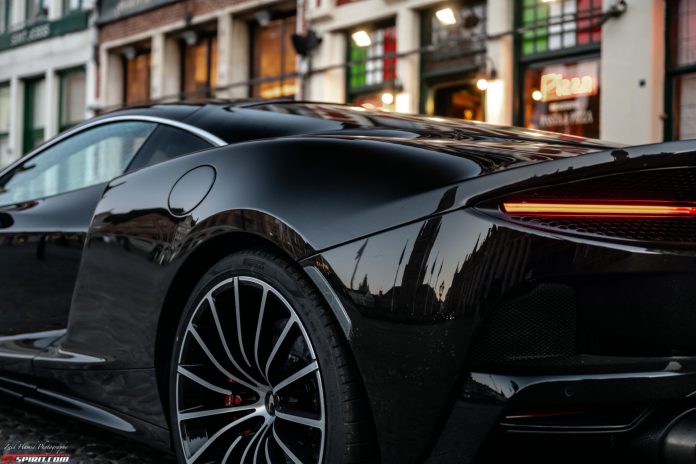
Creeping into Bruges minutes before sunrise presents the perfect opportunity to enjoy the iconic sights of the Markt Square void of the teams of tourists that are attracted by the medieval architecture and the charm of the waterways that snake in-between. Finished in Black Ingot, this is the most subdued McLaren I have piloted. The paint appears to be a rather boring black, but park it in any light, sunlight or artificial street light, and the car glistens as if coated in glitter. McLaren are unrivalled in their creativity and sparkle offered in their paint options. As the sun peeks between the turrets and spires, the complexity of the shapes that forms the body panels of the GT are highlighted. It is dramatic, but in a different way.

Enough of the architecture, I was here for a purpose. As the sun rose, the quaint shop shutters did too, the smell of fresh bread lingered in the crisp morning air. Bruges is awash with chocolatiers, all of which boast they are the best in Belgium, and therefore the world. Chocolates bagged, cheese soon followed – mission accomplished, with time to spare. A chocolate and banana waffle, two coffees and a nap in the McLaren later, it was time to crawl out of the perilously narrow car park and back to the Eurotunnel. By mid-morning all but one of the roads in the UNESCO World Heritage Site remains open to traffic to allow cars in and out of this car park. The pedestrian is king in the daylight, my cue to leave.

Upon arrival to Bruges, I felt fine with no backache or considerable fatigue. The beauty of a true GT is the absence of tiredness on a long journey, such as this. En route to Calais I begin to feel a little tired, my body was beginning to feel uncomfortable in the ‘Comfort Seats’. The noise of the V8 started to intrude and I felt the need to pull into the services to take a break. It must be said, this feeling of weariness came after 10 hours into my adventure and chances are I would have felt agitated driving a Rolls-Royce at this point, but the McLaren was taking more of a toll on my body than a Bentley Continental GT would have. A massage seat wouldn’t have gone amiss either. It is creature comforts where the McLaren lacks. It is, indeed, a McLaren and the purpose of it is to be very fast, something it does fantastically. With that in mind, the absence of massage seats, Apple Car Play and self parking capabilities are not as crucial as they would be in other cars.

It is when you write a list of missing options that it becomes clear that many GT car buyers, that are not so hellbent on going supercar fast, may start to look elsewhere. Yes, I can live without active cruise control, lane keeping assist and blind spot assist – but it is nice to know that you do have them helping you out on a long drive. You can relax and be a little fresher when you arrive at your favourite mountain pass or coastal road.

Boarding the train back to the UK gives me another chance to reflect and relish another quick nap. This is a GT car, it can do journeys like the one I was about to complete, but it will do it in its own McLaren style. It will get you to your favourite road with a boot full of luggage, then challenge you and blow your mind when you unleash its turbocharged fury. Buyers of a McLaren GT will treasure that high adrenaline, intense offering that no other GT car can offer. They will also know that there are more comfortable GTs on the market. This is the drivers GT and the tradeoff is obvious, it is unashamedly McLaren and for that I cannot help but admire it.

GTSPIRIT NEWSLETTER

The Coronavirus and the Lockdown of the Car Industry

The rapid spread of the coronavirus is taking large parts of the world by storm. The car industry is hard hit and also at GTspirit we feel the effects of the coronavirus. Our GTspirit Tour 2020 is postponed and due to the many travel restrictions, closed borders and recommendation to stay home most car launches and other car related events have been cancelled. We wish all of our readers the best and recommend you to stay home and take care of loved ones and high-risk groups.

It is clear the coronavirus will have a large impact on car manufacturers, car buyers and car journalists alike. Many car manufacturers already shutdown their operations or are planning to do so in the very near future. Here is a short overview of the situation on Wednesday 18th of March 2020.

Lamborghini and Ferrari closed their factories

Lamborghini idled its plant in Sant’Agata Bolognese last week, and Ferrari followed suit at facilities in Maranello and Modena over the weekend. Both are located in the particularly hard hit areas in Northern Italy.

Bugatti launches Bugatti Chiron Pur Sport online, factory closure nearing

Bugatti planned to launch the Bugatti Chiron Pur Sport in Geneva but with the Geneva Motor Show and all other major motor shows in the near future cancelled they have decided to launch the Bugatti Chiron Pur Sport online. Recent reports also suggest the Bugatti factory in Molsheim, in the hard-hit North-Eastern part of France, will be closed soon.

The most recent Bugatti statement:

“The COVID-19 pandemic and measures to contain the outbreak are having an unprecedented impact on public life. The current situation affects our team and our work no less than the rest of France, Europe and the world.

We are constantly monitoring the situation and adapting our response daily to the development of the COVID-19 pandemic in accordance with the recommendations of the French government and the World Health Organization (WHO).

We recommend that you follow the instructions given by the authorities in your place of residence and the WHO to protect yourself and others from the virus. Priority number one: please stay healthy.’

Aston Martin closes facilities to visitors

Andy Palmer, Group President and CEO of Aston Martin Lagonda, just sent out a statement regarding the coronavirus:

Our primary concern continues to be the health and safety of colleagues and their families, customers, our business partners and the local communities. All Public Health measures advised by governments are being followed in support of efforts to contain the spread of the virus, our UK sites, regional offices and global dealer network are complying with local advice in order to safeguard the health of staff, customers and the wider community.

We have taken the decision to close our facilities to all visitors, so if you were planning a factory tour at Gaydon for example, please contact your Aston Martin Dealer who will confirm when we have re-opened the factory for visitors. We have also postponed or cancelled our upcoming F1™ experiences and Art of Living events, if you were planning to join us our team will be in touch in the coming days to confirm next steps.

Porsche stops production due to the coronavirus

As from the coming week (23rd of March), Porsche will suspend production for an initial period of two weeks. By taking this step, the sports car manufacturer is responding to the significant acceleration in the rate of infection caused by the coronavirus and the resultant measures implemented by the relevant authorities. In addition to the primary protection of the workforce, bottlenecks in global supply chains no longer allow orderly production. At the same time, Porsche is preparing for a decline in demand and securing its financial strength with these decisions. The parent plant in Zuffenhausen and the production location in Leipzig will be closed from Saturday (21 March 2020). These steps have been taken as part of an orderly process and in close cooperation with the works council.

BMW halts production in Europe and South-Africa

Due to the rapid expansion of the coronavirus BMW is reducing its production and prepares for a significant drop in revenue and profit for 2020. The measures include the stop of production in Europe and at the Rosslyn factory in South-Africa from today until at least the 19th of April. In other factories part-time working could be implemented to adjust the production capacity to the current situation.

Daimler suspends most of the production in Europe

On Tuesday 17th of March Daimler announced:

Due to the worsening situation of the COVID-19 pandemic, the Daimler Group has decided today to suspend the majority of its production in Europe, as well as work in selected administrative departments, for an initial period of two weeks. By taking this action, the company is following the recommendations of international, national and local authorities. The suspension applies to Daimler’s car, van and commercial vehicle plants in Europe and will start this week. Connected to this is an assessment of global supply chains, which currently cannot be maintained to their full extent. An extension of this measure will depend on further developments. Wherever operations need to be continued, the company will take appropriate precautions to prevent the infection of its employees.

Audi stops production until end of the week

Audi announced they are closing all their factories until end of the week. The spread of the coronavirus also affects the parts delivery making regular production soon impossible.

Volkswagen suspends European production

Latest statement by Volkswagen:

The Volkswagen Passenger Cars brand is gradually suspending production at its European plants. This will also affect Volkswagen Group Components plants. This is the brand’s response to the impending rapid decline in demand on the automotive markets. Risks in connection with suppliers’ supply chains are also increasing. This is due to the significantly accelerated rate of infection by coronavirus and the resulting measures taken by the authorities. Initially, the factories are therefore expected to remain closed for two weeks. For the affected German sites, the measures are to apply from the end of the late shift on Thursday.

Fiat Chrylser Automobiles

Fiat Chrysler Automobiles announced on Monday it will close most of its factories in Europe including production facilities for Alfa Romeo and Maserati. This includes factories in Italy, Serbia and Poland.

For more information about the coronavirus and how to protect yourself and your family visit the coronavirus report.

GTSPIRIT NEWSLETTER

Mountaineering’s Drug Problem

Editor’s Note: Thanks in part to Nims Purja’s incredible scaling of the 14 highest mountain peaks in just over six months, we’ve got mountaineering on the brain. But before your next climb, check out this resurfaced 2017 investigation, which explores thought-provoking questions about the different kinds of assistance we use to get high.

Before Hermann Buhl’s first ascent of Nanga Parbat in 1953, the 26,660-foot peak in the western Himalayas was synonymous with death. Thirty-one climbers had died on summit attempts, including 10 in an infamous 1934 debacle. Many more had been thwarted by impossible conditions. But Buhl, a “small and delicate” (his words) 29-year-old Austrian, did it with a faulty crampon and without supplemental oxygen, Sherpa support, or Gore-Tex gloves. On his descent, he was forced to spend the night standing up in a notch below the summit, hallucinating while drifting in and out of consciousness. Then, at the end of his tether, as he recalls in his memoir, Nanga Parbat Pilgrimage, he remembered his methamphetamine pills, Pervitin: “It was the only chance; its brief renewal of my strength might last long enough for me to get down to the tent.” Pervitin — prescription speed, basically — was well known among German and Austrian climbers then for inducing superhuman energy and focus. It had been distributed during WWII to Nazi infantry, who called it panzerschokolade, or “tank chocolate.” Buhl popped two. Later on, he took some Padutin, a blood-flow agent that wards off frostbite, and eventually three more Pervitin; he had also been drinking tea brewed from coca leaves, the raw material for cocaine. Buhl survived. And as he hints in Nanga Parbat Pilgrimage, without the drugs, he wouldn’t have.

Buhl is widely considered one of the greatest alpinists ever, a shining model of the spirit and élan of high-altitude climbing. None other than Reinhold Messner — a Titan among climbing mortals — has called him “a classic mountaineer without equal.” To date, his Nanga Parbat route has been repeated just once. Yet Buhl was essentially tweaking his nuts off, or was at least well sauced on the alpine version of a speedball. By today’s standards, he’d be cast out from the mountaineering temple, stoned for blasphemy, and crucified on the nearest tree. It’s a given that alpinists now rely on all kinds of state-of-the-art technical assistance to get them through the rough spots — crampons, ice axe, helmet, emergency shelter, wicking base layers, hundreds of feet of dry rope, two-way radio, avalanche transceiver, sunscreen, lip balm, hand warmers, rehydrating juice — half of which Buhl lacked. Only a crackpot would suggest ditching any of it. But prescription drugs? Eh. Everyone knows that’s cheating.

It’s no surprise that 8,000-meter climbs can require a medicinal crutch, and Buhl is just one link in a long chain of doping in climbing that includes some of the most storied alpinists in history. Maurice Herzog and Louis Lachenal, twin spires in the sport, were both zonked on morphine when they broke the 8,000-meter barrier in a harrowing 1950 summit of Annapurna. Stephen Venables’s 1988 ascent of the Kangshung Face, thought to be insane at the time, was accomplished with the help of prescription-strength caffeine pills. I could go on.

“In Hermann Buhl’s day, drugs weren’t constructed as a problem — it was like taking a cup of coffee with you.” – Verner Møller

What’s surprising is the recent hand-wringing in the sport over prescription drugs and stimulants, on which alpinists have long relied. Steroids, amphetamines, erythropoietin (or EPO, Lance Armstrong’s drug of choice), epinephrine and nifedipine, morphine and codeine, what else? Viagra and Cialis, which increase blood flow to the lungs (among other places) and mitigate high-altitude pulmonary edema (HAPE). Lesser painkillers like aspirin and Ibuprofen. Rehydration salts and electrolyte solutions. All have been regularly used, if rarely discussed in mountaineering.

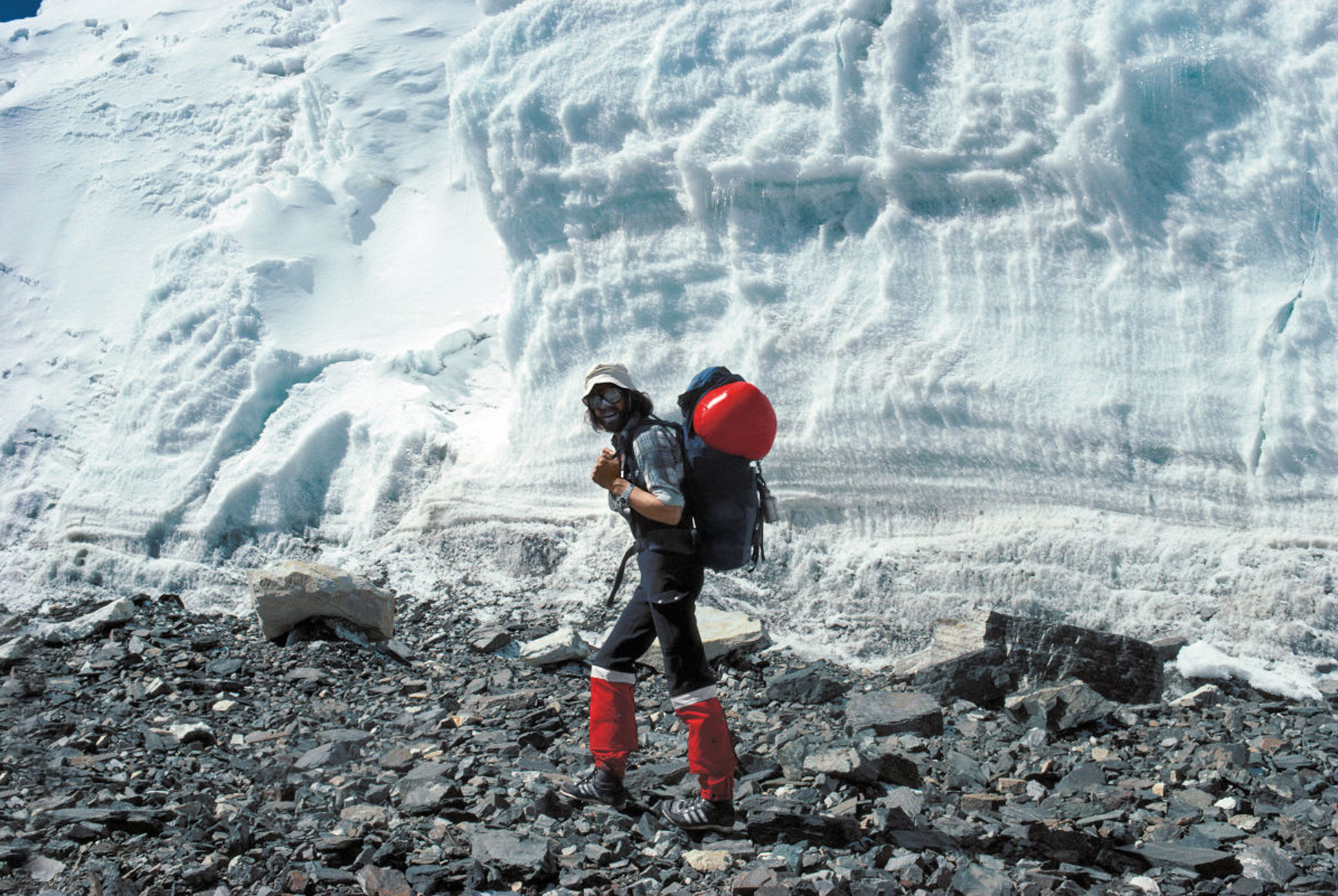
“The climber who doesn’t rely on his own strength and skills, but on apparatus and drugs, deceives himself,” wrote legendary mountaineer Reinhold Messner in his 1999 book Everest: Expedition to the Ultimate. But Messner also had great praise for Hermann Buhl, who used meth to survive a descent on Nanga Parbat in 1953; Messner’s own climbing partner, Peter Habeler, was “heavily drugged” during their legendary 1978 Everest summit, the first done without supplemental oxygen. (Photo: Adidas Archive)

Outdoor Skills Everyone Should Know
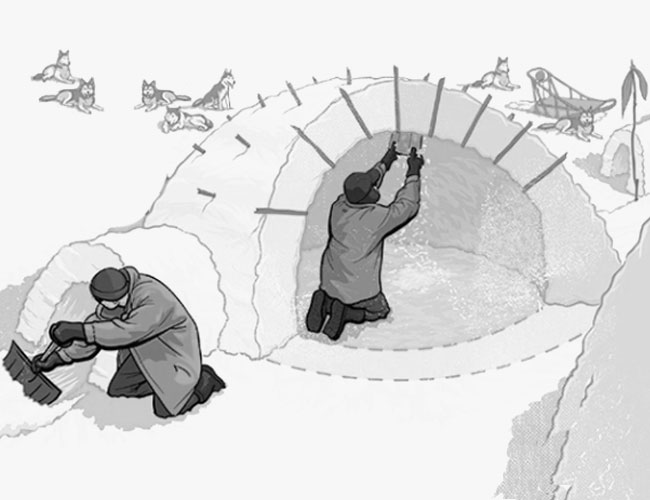
Re-waterproof your rain jacket, get more life out of your tent, save your life in a winter snowstorm and more.
Read the Story

For much of the past half-century, when drug use in the mountains has cropped up, elite climbers were quick to vilify it — mostly they were concerned with the use of supplemental oxygen, which many still consider a betrayal of the lofty ethos of high-altitude climbing. The issue of prescription drugs and stimulants was largely ignored. But in 2013, a strange new drug hysteria swept mountaineering after Outside magazine published an article about an Everest climber who almost died after binging on multiple medications, including dexamethasone (dex), an anti-inflammatory steroid that lessens brain-swelling and is used to treat altitude sickness and high-altitude cerebral edema (HACE). Dex is a potential lifeline for alpinists struggling on big ascents like Everest. It has saved dozens of lives over the years — Beck Weathers got a four-milligram injection during the 1996 Into Thin Air disaster — and has been part of every guide’s first-aid kit for decades. But misusing dex, as the Outside piece detailed, carries some risks, and the article foretold of “a dangerous trend in mountaineering: rampant use of performance-enhancing drugs.”

Today’s professional climbers consider preemptive use of dex, or of any “performance-enhancing drug” for that matter, to be cheating, though there’s been scant public reflection on what “performance-enhancing” and “drug” might mean, and no regulatory agency exists in climbing to define it. Mild painkillers and stimulants like coffee and tea typically get a pass, and are even considered part and parcel of a climber’s gear, while prescription drugs and acclimatization meds like dex don’t; the use of supplemental oxygen falls somewhere in between. The upshot is a general state of confusion in the sport about what kinds of pick-me-ups are permissible at extreme altitude. Many climbers are reluctant to discuss the topic; in some quarters a veil of secrecy prevails.

“Climbers are definitely using performance-enhancing drugs and hiding it,” says Cory Richards, who recently summited Everest without the help of supplemental oxygen. “There’s no governing body in climbing, so there’s no rule against drugs, and the logic is, why disclose it?”

“Sucking Os is definitely doping. And it is clearly cheating. Not one ascent made with Os counts in my book.” – Steve House

Richards is mostly referring to dex when it’s used not as a recovery aid but as a failsafe measure to increase a climber’s chances of summiting. These days you can buy it on the street in Nepal for about a dollar. Some outfitters and guides are said to encourage its use on summit day. Dr. Luanne Freer, the founder of the Everest ER at base camp, has taken care of several climbers suffering from side-effects of dex and other prescription drugs, including one who took large doses of dex on his ascent and died of HACE near the summit. “Using dex on summit day as a performance-enhancer is dangerous,” she says. “It makes it less likely that it’ll work in a rescue situation. I would liken it to pulling the cord on the parachute too early. When you really need it, you’ve lost your rescue. For this climber, there were no drugs left to get him moving for descent.”

According to Dr. Peter Hackett of the Institute for Alpine Medicine, however, the misuse of dex is exceptionally rare. “In the Outside piece, the guy took dexamethasone every day for two months, which is really stupid. It was totally inappropriate use of a drug. If you use any drug that way, you can get into trouble…I think [the article] was more hype than reality, a big to-do about nothing.”

Another potential lifeline for climbers is acetazolamide, also called Diamox, which speeds up acclimatization and helps prevent altitude sickness. It, too, has been a part of high-altitude climbing since at least the 1970s. Unlike dex, however, Diamox’s side effects are fairly innocuous: it’s a diuretic, so it makes you pee a lot. While technically not a performance enhancer — Diamox actually inhibits your ability to exercise — climbers have been known to take it early on summit mornings to prevent altitude sickness. To purists, that still counts as cheating.

In 2013, a drug hysteria swept mountaineering after Outside magazine published an article about an Everest climber who almost died after binging on multiple medications, including dexamethasone (dex), an anti-inflammatory steroid that lessens brain-swelling and is used to treat altitude sickness and high-altitude cerebral edema (HACE). Another potential lifeline for climbers is acetazolamide, also called Diamox, which speeds-up acclimatization and helps prevent altitude sickness. To purists, that still counts as cheating.

Both dexamethasone and acetazolamide are banned by the World Anti-Doping Agency (WADA), which has helped monitor doping in the Tour de France and the Olympics. (It should be noted that the original Olympic athletes, in first-century Greece, had few qualms about doping; they ate sheep testicles, coca plants, hallucinogenic fungi and cacti, and drank seed extracts that contained pharmacological agents, “magic” wine potions and strychnine, in the hopes of gaining a performance edge. If caught, however, they were banned from the games for life.) WADA prohibits substances that fulfill two of three criteria: (1) they’re performance enhancing; (2) they’re harmful to your health; or (3) they run counter to the spirit of the sport. But WADA has no regulatory say in mountaineering, which is entirely self-governed. The only semi-official oversight in the sport comes from the International Mountaineering and Climbing Federation (UIAA), but it has little enforcement power either and concerns itself instead with preserving the ideological “spirit and traditions” of alpinism.

“Why should you only be allowed to use a drug in the event that you become sick or die, if you can prevent it beforehand?” – Verner Møller

In climbing, then, climbers make the rules. The professional take was captured by Reinhold Messner in his 1999 book Everest: Expedition to the Ultimate: “The climber who doesn’t rely on his own strength and skills, but on apparatus and drugs, deceives himself.” (One sentence later he decries the use of supplemental oxygen: “The face mask is like a barrier between Man and Nature.” More on that in a moment). In a later interview, he suggested drug-testing Everest climbers. “I am curious if anyone is willing to give a urine sample,” he said. Messner must’ve blanked on Buhl’s meth use, not to mention that of his climbing partner Peter Habeler, who was “heavily drugged” during their legendary 1978 Everest summit, the first done without supplemental oxygen. The implication seems to be that, for Messner, certain climbers and certain kinds of drugs — speed, painkillers — are acceptable, while the newer wave of bucket-list Everest summiters and the acclimatization meds they sometimes rely on aren’t.

Verner Møller, author of The Ethics of Doping and Anti-Doping: Redeeming the Soul of Sport? and professor of public health at Aarhus University in Denmark, thinks the moral censure on drugs in alpine climbing is at best an argumentative rabbit hole, at worst an obfuscating con intended to distance big-mountain climbers from the average schmo.

“The ‘purity’ of alpinism is a ridiculous concept,” he says. “It’s a narrative that elite mountaineers decided to write. But some of them, they’re sitting around drinking coffee at base camp and nobody questions it. A day may come when someone says, ‘You know, coffee has caffeine, which is a performance-enhancing drug, so you’re destroying the ideal of alpinism if you’re drinking coffee.’ And that would be a new narrative.”

Caffeine, it’s easy to forget, is the most widely consumed stimulant in the U.S., one that can have profound physiological effects: a sharp decrease in fatigue and the artificially stimulated release of fatty acids into the blood, allowing the body to conserve glycogen and increase physical output. It was only removed from WADA’s list of prohibited substances in 2004.

For Møller, there’s been a widespread “abdication of logic” with regards to drug use, a rigidity in our thinking that deserves serious reconsideration both on the mountain and off.

“The ‘purity’ of alpinism is a ridiculous concept,” said Verner Møller, author of The Ethics of Doping and Anti-Doping: Redeeming the Soul of Sport? and professor of public health at Aarhus University in Denmark. “It’s a narrative that elite mountaineers decided to write.” (Photo: Morten Flarup/Polfoto)

“In Hermann Buhl’s day, drugs weren’t constructed as a problem — it was like taking a cup of coffee with you,” he says. “Today, they are constructed as a problem. But back then, we didn’t have all of these remedies we have now. We didn’t have the boots. We didn’t have the quality of crampons. The ropes that are in place on Everest now weren’t there when Hillary was trying to climb it. The more technical advances we’ve seen, more and more people have had a chance at summiting Everest, something that was previously reserved for the select few. So it’s very convenient to suddenly declare ‘performance-enhancing drugs’ off-limits.”

According to Møller, the recent international cycling scandals and pervasive doping in the Russian Olympic team are to blame for some short-sightedness with regard to drug use in high-altitude climbing. When it comes to mountaineering, in which participants risk far more than medals and endorsement deals, he says, a broad cultural prohibition on doping in sports is obsolete.

“Why should you only be allowed to use a drug in the event that you become sick or die, if you can prevent it beforehand?” says Møller, asking us to imagine being held to such unremitting strictures in other aspects of our lives. “There’s this thinking that drugs are a crutch [in the mountains], which is one way to interpret it. You could also interpret it as climbers putting on their safety belts. If you’re driving a car, nobody complains about you putting on your seat belt before you hit the ignition.”

When you really get down to it, Møller says, drugs and stimulants — everything from Pervitin to caffeine to dexamethasone — are “just another technology, just another piece of equipment” on a continuum from Edmund Hillary’s Shetland wool jumper to today’s FlashDry base layers. “What’s the logic in saying, ‘You’re allowed to use these various forms of fancy gear, crampons, ropes, etc.,’ and in the same breath saying, ‘Wait! You’re also popping a pill? You’re a disgrace to the alpinist idea!’ Often these are the same people who’re saying you shouldn’t be allowed to use supplemental oxygen either.”

Of the 4,000 or so climbers who’ve summited Everest, only about 200 have managed it without bottled oxygen. For the vast majority, the trophy-hunter climbers paying $65,000 for the privilege, supplemental O2 is an indispensable part of their equipment. Without it, most wouldn’t make it to Camp I at 19,900 feet.

“Oxygen is the ultimate drug,” says Conrad Anker, the iconic mountaineer who has summited Everest three times, with and without supplemental oxygen. “It drops the elevation of Everest by 7,000 feet or more, depending on where you’re at with it.” Dr. Hackett of the Institute for Alpine Medicine agrees: “Supplemental oxygen is the only drug that has been shown to be absolutely performance-enhancing at high altitude. Most people couldn’t climb Everest without it.” Ditto Cory Richards: “With the new regulators, lighter bottles and more efficient masks, you’re getting a medicinal amount of oxygen, which it makes it much easier.” Pro guide Adrian Ballinger: “It takes doping to a whole other level.”

Writing on the Patagonia website, famed alpinist Steve House took the hardest line: “Sucking Os is definitely doping. And it is clearly cheating. Not one ascent made with Os counts in my book.”

“It’s no longer just a question of cheating. There’s a deeper moral implication, because by using Sherpas you’re putting their lives at risk for your benefit.” – Conrad Anker

Anker has a more charitable view. “Climbing Everest without supplemental oxygen, there’s only a few people who have the skills to do it, because it’s so physically debilitating,” he says. The debate over its use bleeds into other ethical facets of the sport. In 2007, Anker free-climbed the Second Step on Everest’s north side (free-climbing means ascending without pre-fixed hooks, ladders, ropes, etc.; in mountaineering, if you free-climb something, it becomes the new standard). “It was my choice, and I felt I had the strength within me to do it,” Anker says. “But would I now take the two ladders that are up there and throw them off the mountain and say to everyone, ‘You have to do this by my standard?’ It’s a little harsh trying to foist your accomplishments onto everyone else.”
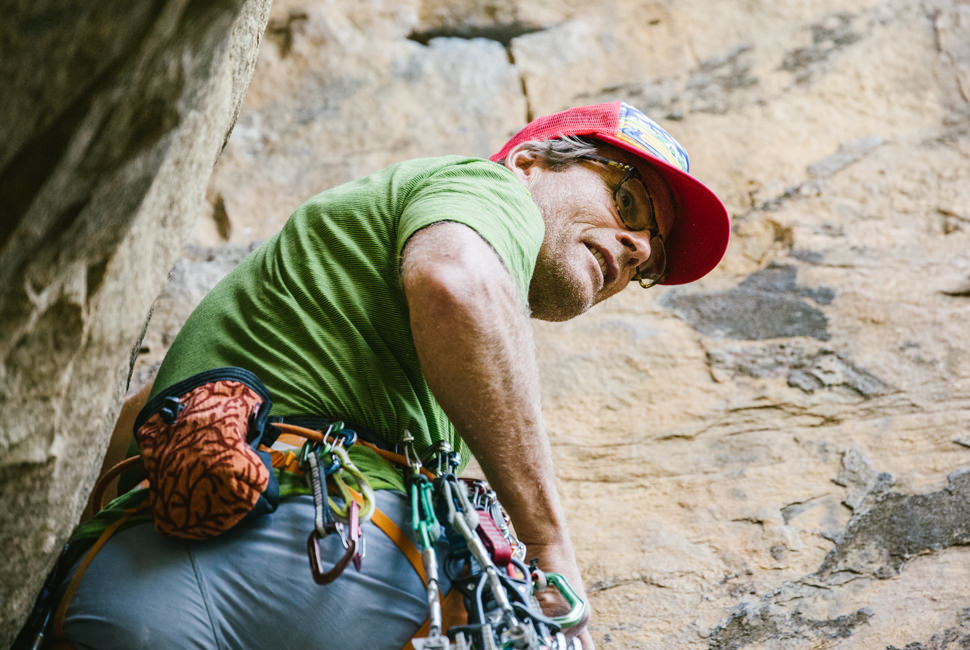
Conrad Anker, another climbing and mountaineering legend, says the reliance on Sherpa support in the mountains is a bigger ethical question than drugs and supplemental oxygen use. (Photo: Sung Han)

A bigger question, Anker says, is the reliance on Sherpa support in the mountains. “Sherpas do more to make a climb easier than supplemental oxygen,” he says. “To climb Everest by fair means would really mean doing it with no Sherpa support.” Around 95 percent of Himalaya climbers rely on Sherpas to carry gear, set ropes and establish routes. On Everest, it’s the Sherpas who take many of the risks — for instance, crossing and recrossing the dangerous Khumbu Icefall. Between 125 and 130 have died while working for Westerners and bucket-list climbers, including 16 in the 2014 earthquake.

“It’s no longer just a question of cheating,” says Anker, whose Alex Lowe Charitable Foundation aids Sherpa communities in Nepal. “There’s a deeper moral implication because by using Sherpas you’re putting their lives at risk for your benefit. You have to come to terms with the moral fallout of that.”

The sin, then, isn’t in trying to do what you suspect you’re not quite up to except on the best of days, but is much more complicated and profane, because it suggests that intense experience can be bought and sold, and that feats of courage and ability in the mountains are in a sense transactional. The most obvious remedial gesture is to take a moral stand.

“We get into climbing because it’s basic freedom,” Anker says, “a way to exist without the temporal constraints of time and space and without all of the rules and human constructs that we impose on every other sport. Climbing is simple. You go to the top, you have a good time, and you don’t harm other people in the process.”

Perhaps this should comprise alpine climbing’s guidelines and nothing more. Perhaps we should conclude what Buhl did 60 years ago near the summit of Nanga Parbat, when he was out of food and water, and with blood and spittle pouring from his mouth, when time was running out: maybe, sometimes, meth is the answer.

Up Next: An Interview with the Greatest Living Mountaineer

Drinking beers and climbing rocks with mountaineer Conrad Anker. Read the Story

2020 BMW M235i Gran Coupe Review

The BMW M235i Gran Coupe is a little difficult to wrap your head around if you’re a traditionalist. For one, it is not very closely related to the outgoing, and soon to be replaced, M240i which is a coupe driven by its rear wheels and a 3-litre 6 cylinder engine. Instead, it’s more of a stretched M135i sharing the same 2-litre 4 cylinder engine and front wheel drive biased all wheel drive system (boo hiss). There will be a new M240i Coupe that will feature a 6 cylinder engine and will have the correct number of doors to wear the coupe name. Gran Coupe seems to skew more than just the number of doors in this instance.
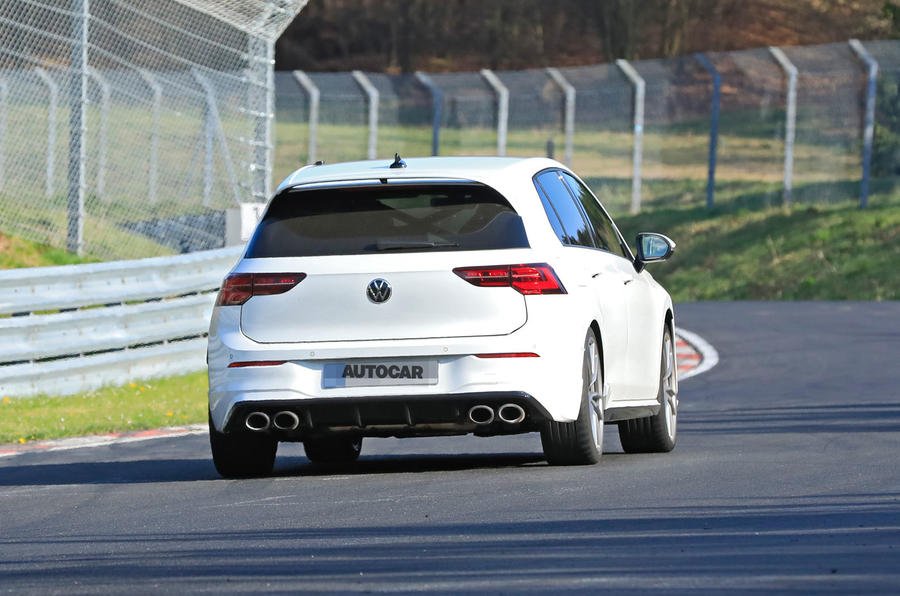
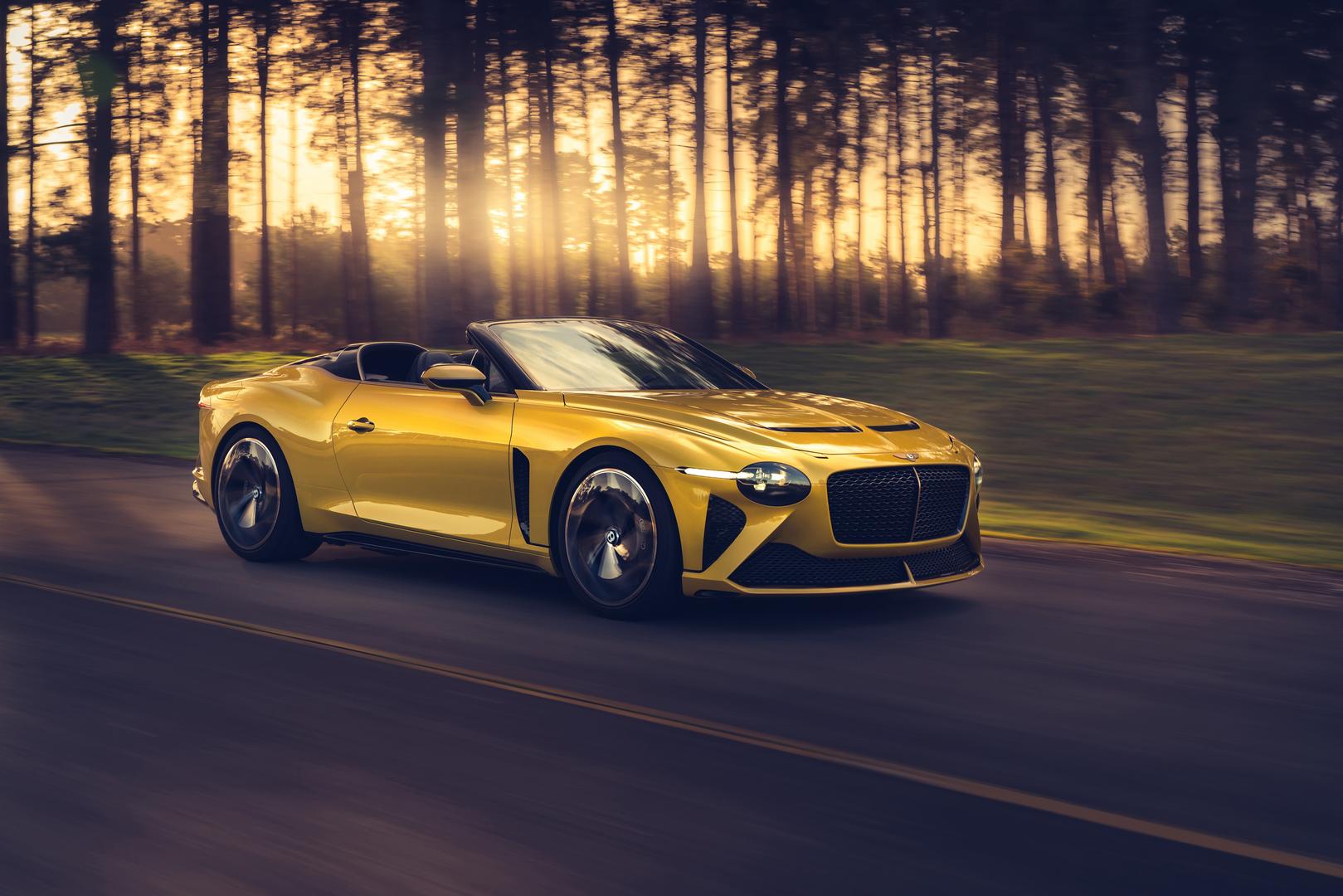
The M235i and other 2 Series Gran Coupe models are, obviously, the result of the successes of the Audi A3 Saloon and Mercedes-Benz CLA models. Mercedes-Benz seem to have an appetite for niches and recently added an A Class Saloon to the range that makes no sense in my mind given that it looks like a slightly podgy CLA with no significant space gains. I’m sure the researchers at MB have their justifications…

Visually BMW were quick to flash up profile images of the, to my eyes, gorgeous 8 Series Gran Coupe overlaying sketches of the 2 Series Gran Coupe at the evenings press presentation. Again, to my eyes, one of these cars looks taught, sharp and rather tasty. Unfortunately the scaled down 2 Series doesn’t seem to wear the lines so well, they aren’t striking and melt away into the large and aesthetically heavy rear end.

Maybe it is a peach to drive? Well, the 1 Series is not available in China or the United States of America so it is up to the 2 Series Gran Coupe to whet the appetite of American and Chinese buyers. As a result, this is not just a stretched 1 Series. The suspension set up is softer to better accommodate poorer surfaces. The road route set up by BMW features a variety of road surfaces which the M235i I am piloting takes in its stride.

Make no mistake, the car is very good for doing the tasks that the vast majority of buyers will use their cars for, daily commutes and school runs. It is relatively spacious inside, comfortable, features tech that you would find in a 7 Series and it even feels plenty quick off the line with all wheel drive traction. 0-100 is done in 4.9 and accomplished courtesy of 306 horsepower and 450Nm.

My gripes relate to feedback and feel: there is, literally, none. Yes, the steering rack is quick and BMW have fitted a Torsen limited-slip differential in addition to the BMW Performance Control which ‘intelligently applies the brakes at the wheels on the inside of the bend before the slip threshold has been reached’ a bit like a McLaren does. As great as this sounds, the M235i GC is not engaging or particularly exciting to chuck into the bends.

Understeer still plagues the driving experience and when the front end is not pushing on, the car remains neutral and does not have you lusting to explore your favourite twisty roads with zeal. The M badge typically denotes more dynamic, and adrenaline fuelled drives. The synthesised exhaust noise is very clearly fake, more so than in other BMW models.

By no means does this mean that the 2020 M235i Gran Coupe is a bad car. If you are looking for a car to ferry your family around on short city journeys in comfort with great connectivity and convenience, this could well be the car for you. The M235i variant looks more imposing that lesser models and is well equipped. But if you’re looking for something with a little more zing, the Golf R is more dynamic and the Mercedes CLA 35 AMG is equally well appointed and feels more alive.

GTSPIRIT NEWSLETTER

Special Report: The Mercedes-AMG G 63 Is The Ultimate All-Rounder

What do Britney Spears, Kylie Jenner, Sylvester Stallone, Bradley Cooper, Paris Hilton, Kim Kardashian and The Weeknd all have in common? Yes, they are all household names, but, they also all drive Mercedes-Benz G Wagons. The G was born back in 1979 and was an instant success. As I write this, Iran and the United States of Donald J Trump are locking horns and driving fuel prices through the roof. Thanks Iran, just what I needed to kick of my week with a G 63 AMG. In something of a coincidence, it was the Iranians that triggered the production of the G Class more than 40-years ago.

The Shah of Iran at the time suggested to the German manufacture that it would be interesting to see what a MB 4×4 would be like. Mercedes-Benz teamed up with Austrian military vehicle manufacturer, Steyr-Daimler-Puch, and started production of the “Geländewagen” (German for cross-country vehicle). This was not restricted to military use, but also civilian cruising.

The G Class was an instant hit, the price tag has always been as big as the boxy wheel arches and, as a result, the 4×4 has been an object of desire. The desire, price tag and power all grew to new levels in 1998 with the introduction of the Mercedes-Benz G 55 AMG, a V8 brute packing 358 horsepower. The foray into the AMG power for the G Class continued as the G 55 transitioned into the G 63. The on road handling continued to improve, but never to the detriment of the offroad capabilities. Every G Wagon model still has to pass the gruelling trail of conquering the Shöckl mountain in Austria.

As you would imagine, the G has been getting better with age, that being said, few generations have improved as much as the latest model that was updated in 2018. It won many awards including the GTspirit Car of The Year accolade. The engine is downsized to 4.0-litres but power and torque were significantly improved. Remarkably, the engineers were so confident in the improvements that they made to the chassis that they dropped a V8 closely related to that of the AMG GT R halo car into the 2.485 tonne brute. The power figure is identical, that’s right, 585 horsepower in a truck with a near vertical windscreen. Who said Germans don’t have a sense of humour?

I had a week to understand the G 63 in a plethora of different environments. I lived with it through the traffic plagued City of London and spent a weekend in the country to explore the AMG side of the G.

In the city the G looks monumental. London is a city that is home to exceptional wealth, G wagons, particularly 63s, are a common sight. That does not detract from how much presence they have. Against architecture, old and new, it looks imposing and modern, yet still harks back to Gs of old. Enough posing, what’s the G 63 AMG like to drive? Having driven every variant of the current model and almost all of the precious generation, I feel I am well placed to comment on just how vast the improvements are. It’s difficult to overstate just how much more dynamic and willing the latest offering is in comparison to its predecessors.

Having escaped the cities narrow streets and constricting speed limits at dawn, it was time to see what the G felt like when it could stretch its legs. Make no mistake, this is no Caterham or GT3 RS, the 63’s nose points to a sky under throttle like a cigarette racing boat with a sizeable bow wave. It leans in the corners, but the chassis can really handle the power. The steering is a revelation in comparison to the agricultural style system has been replaced by a modern, conventional rack and pinion and the difference could not be more significant. In conjunction with an independent suspension arrangement up front, there is a confidence that was absent in its predecessors that makes this an SUV that really can be driven enthusiastically. The trade-off is the suspension which is stiff, well engineered dampers take the edge off harsh bumps and holes, but it does not possess S Class rivalling levels of comfort.

In 63 guise, there is genuine speed mixed into the G Wagon recipe. The G 63 is a wonderful car, one that could be considered the ultimate all-rounder. I guarantee that any challengers will not be as iconic, capable in such a wide range of scenarios or cool to look at as the G 63. It is a living legend and one that laughs in the face of the endless new ‘SUVs’ that the markets are needlessly demanding. Don’t think about buying one, just do it.

GTSPIRIT NEWSLETTER

Winter Special: Visiting Ski Paradise Val Gardena

Our latest winter road trip destination is a famous ski destination in Northern Italy. Easily reached from Germany and most of Western Europe just over the Brenner Pass that connects Austria and Italy it is a true ski paradise. But that is not all Val Gardena has to offer!

Val Gardena, also known as Gröden in German, is a valley in the Italian Dolomites. The three main towns St. Ulrich, St. Christina and Wolkenstein are all directly connected to the ski slopes and provide direct access to over 79 lifts and 175 km of pistes. With the Dolomiti Superski pass there is even more to explore – 448 lifts and 1,258 km of slopes await visitors across 12 ski resorts all surrounded by the magnificent peaks of the Dolomites UNESCO world heritage site. Val Gardena also provides direct access to the Seiser Alm, a plateau especially suitable for families with kids and beginners.

The most famous ski tour in the Dolomites is the Sella Ronda which laps the Sella mountain range. It can be skied in two directions, we prefer the green counter-clockwise variant as it crosses the Sella pass, Pordoijoch, Campolongo pass and finally the Grödner Joch before returning to the Val Gardena valley. The orange variant runs clockwise and can be started and finished from any of the four valleys it passes. The tour is about 30 kilometers skiing distance and can be done by average skiers. More advanced skiers who keep up the pace can do the Sella Ronda twice in one day.

But Val Gardena offers a lot more than Sella Ronda. We particularly enjoyed the south facing slopes in the Santa Christina’s Col Raiser area. With only a handful of lifts and slopes it is not the most extensive ski area in Val Gardena but what it lacks in numbers it makes up in sunshine and gastronomy. There are no less than 12 restaurants and bars to choose from. One even better than the other. Keep reading for an overview of our favorite mountain side restaurants.

Despite having fairly little fresh snow this season the slopes were in excellent condition. Thanks to dozens of snowmaking machines and the latest slope preparation techniques the conditions were perfect. Add modern lifts and seemingly endless slopes and it is not hard to understand why we consider Val Gardena one of the best ski resorts in the world.

Where to stay?

Val Gardena offers a large range of hotels from simple bed & breakfast to luxurious spa hotels. Here are our favorites:

Dorfhotel Beludei

The Dorfhotel Beludei in Santa Christina provides 24 rooms and suites, a modern spa, restaurant and bar. It opened in 2014 and combines modern amenities with a cozy alpine style. The young team managed by Luis Schenk provides a personal service and makes you feel at home quickly. A hotel shuttle takes guests to a from the ski slope.

Hotel Adler Dolomiti Spa & Sport Resort

This five star hotel has welcomed guests in Sankt Ulrich for more than 200 years. The Adler Dolomiti resort offers a 3,500 m2 spa and wellness area with two different indoor- and outdoor pools, waterfalls, jacuzzis and a dozen or so different sauna and steam baths. If its luxury and wellness you are after this hotel is not to be missed.

Mountain Design Hotel Eden Selva

Ski-in, ski-out at Mountain Design Hotel Eden Selva. Located directly next to the slope of the Sella Ronda this new design hotel in Wolkenstein provides modern rooms and suites, a wellness area and restaurant. It is located within walking distance of Wolkenstein with its bars and restaurants.

Alpina Dolomites

Technically the Alpina Dolomites hotel is not in Val Gardena but located up on the Seiser Alm but we still want to include it. This modern five star resort is regarded as one of the best hotels in the entire Dolomites and provides spacious rooms, an incredible wellness center with indoor- and outdoor pools and perfect service.

Where to eat?

The Dolomites are not just famous for their mesmerizing mountains and natural beauty but also for the high quality Italian food. We made a list of our favorite stops during our stay in Val Gardena:

Berghaus Zallinger

Hidden away in the furthest corner of the Seiser Alm ski area Zallinger is a true refuge. Enjoy the sun with a glass of wine and some of the fine homemade dishes served on the terrace.

Troier Hütte

Troier Hütte

This cozy mountain hut in the Santa Cristina ski area provides authentic South Tyrolean dishes and panoramic views of Val Gardena.

Baita Daniel Hütte

A little further down from the Troier Hütte next to the main ski slope is Baita Daniel Hütte. A great place to stop for a nice lunch or a refreshing drink.

Boe Alpine Lounge

If you decide to ski the Sella Ronda you will probably want to stop at some point too. One of the nicest places is the Boe Alpine Lounge. At the top of the Boe cable car you find a pizza and burger bar, a self service restaurant and last but not least Kelina fine-dining restaurant with panoramic views of Corvara.

Where to Apres-Ski?

The Italian apres-ski does not come close to the parties you can find in Austria and France. But every town in the Gröden valley has a few bars where skiers meet for a drink or two after a long day at the slopes. These include Siglu in St. Ulrich, the snowbar at the bottom of the Saslong World Cup track in Santa Christina and La Stua and Luislkeller in Wolkenstein. Those looking for a party are best served in Wolkenstein.

GTSPIRIT NEWSLETTER