All posts in “Convertible”

Bentley designers show off how custom the custom coachbuilt Bentley Mulliner Bacalar can be

One of the draws of the Bentley Mulliner Bacalar, besides its gorgeous two-seat roadster style, is that it’s a unique custom coachbuilt car. The company touts the fact that not a single piece of the exterior is shared with another Bentley. It will always be particularly rare, too, since only 12 will be built. But the unique, custom nature of the car extends beyond that to giving customers nearly free rein with interior components and colors. To show this off, Bentley designers created six gorgeous example models that have us wishing the company would make a few more than 12 Bacalars.

Speaking broadly, customers will get to choose unique exterior paint, but the interior is perhaps the most interesting, as choices will include bespoke fabrics, piping, stitching and dash materials. The first of these shown in the gallery is one of our favorites, named Clerkenwell. It features two shades of green leather, and some contrasting green tweed fabric on the seats and the dash, and it’s matched with huge swaths of a light wood veneer that stretches from the dash to the doors. The Greenwich interior that follows is also eye-catching with its oxblood leather, gray tweed, and two kinds of 5,000-year-old Riverwood veneer, part of it left as open pore, and the other part given a gloss finish.

The other trims in order of appearance are Fulton, Menlo, Brickell, and Randwick. These show additional variations on leather color, and some of them swap the wood veneer for carbon fiber, or the tweed for Alcantara. And of course, all six of these cars get their own corresponding paint colors. Let us know in the comments which ones you like the best, and here’s hoping Bacalar buyers get really creative with their cars.

Related Video:

McLaren Elva gets another retro paint scheme from McLaren Special Operations

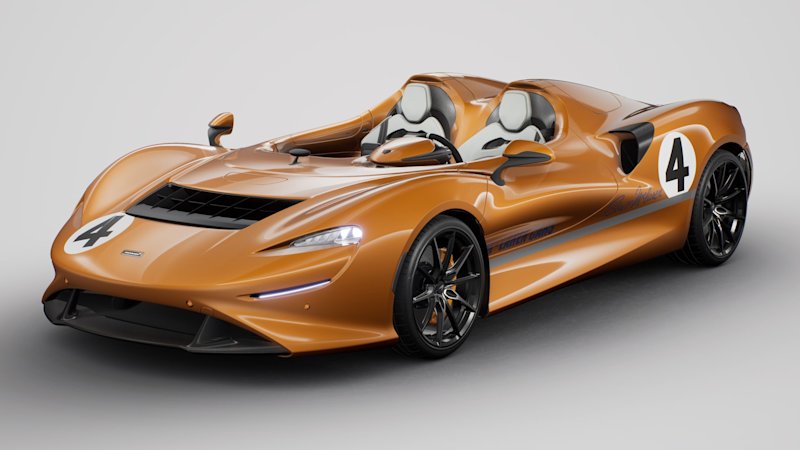
You may have noticed that McLaren’s official brand color is a bright shade of orange. That dates back to Bruce McLaren’s M6A Can-Am race car of 1967, the first to feature the all-orange paint scheme and the car that helped him win his first Can-Am championship that year. So what better way to honor a wild open-top race car than by painting the wild open-top McLaren Elva supercar in the same color?

The McLaren Elva M6A Theme is the second race car-themed Elva to come from McLaren Special Operations (MSO). The group offers customization services to McLaren customers, particularly unique paint and carbon fiber finishes. The special was revealed on Twitter, and it is quite faithful to the 1967 car. It’s finished in a unique orange that looks a little less bold with more of a pearl finish than the glowing solid orange of the race car. It’s paired with big simple number circles featuring the number “4” like one of the race cars. On the sides, a metallic stripe is added to mimic the chrome divider between the top and bottom sections of the Can-Am car. It also gets the same “McLaren Cars” logo and Bruce McLaren’s signature down the side. As cool as this is from a historical standpoint, the orange really shows off how the body blends right into the interior, something McLaren did to evoke the feeling of being outside and exposed to the world, rather than hidden inside the car’s cabin. The dark launch color was far less effective at conveying that feeling.

[embedded content]

As previously mentioned, MSO did another race car-themed Elva, a black and white car inspired by an older 1964 McLaren M1A race car. Clearly there will be one of each, but McLaren hasn’t put any limits on the designs, so it’s possible there may be multiple examples in the car’s 399-unit run. We also wouldn’t be surprised if McLaren rolls out some other motorsports-inspired liveries in the future, as it has many famous racecars to pull from. The reddish-orange and white Honda-powered Marlboro F1 cars of the late 1980s and the black and silver Mercedes-powered F1 cars of the early 2000s both seem like strong choices. Or if McLaren doesn’t do it themselves, maybe a rich reader could commission one painted as such. Though we wouldn’t want to tell that person how to spend their $1.69 million (or more) on their car.

Related Video:

2021 Porsche 911 Turbo S dressed up with Exclusive Manufaktur parts

The last time the Porsche Exclusive Manufaktur overhauled a 911 Turbo S, the result was a more powerful limited edition called the Exclusive Series, with carbon fiber racing stripes and carbon wheels. Stuttgart’s couturier is at it again with the 2021 911 Turbo S, this time to show off what’s possible with off-the-shelf Exclusive Manufaktur components, the same way it did recently with the Taycan’s SportDesign Package Carbon.

The makeover begins with a coat of Indian Red paint. As far as we can tell from perusing Porsche forums, Indian Red has a long and convoluted history with, but little difference from, Guards Red. The naming seems dependent on international market, model year, and which Porsche factory built the car. We make the point because the Porsche USA configurator offers Guards Red but not Indian Red. 

The configurator does, however, present the choice of the staggered, center-lock Exclusive Manufaktur wheels that were fitted to that low-volume 911 Turbo S Exclusive Series. The rims add $2,490 to the price. Normally painted Platinum Silver, for this application the wheels receive a silver and black finish that could cost more. The exterior comes with additional alterations including black-rimmed LED Matrix Design headlights for $970, clear taillights for $990, and rear side air intakes in high gloss black for $600.

Plenty of Indian Red has bled into the cabin, the hue running along the doors, the length of the instrument panel, and around the center console. That is a no-cost option, which is pretty special from a carmaker that charges $370 for a rear windshield wiper and considers the $900 painted black brake calipers an exterior performance option. There are no such gimmies for the extended red accents in the tachometer ($420) and dash-mounted Sport Chrono clock (also $420). Deleting the “S” logo on the seat headrests in order to put the Porsche crest there requires $290. In case that switcheroo causes occupants to forget the particular model they left the garage with, embossing the center console lid with the Turbo S logo can be done for $340.

Those aren’t the only upgrades being prepared for the new GT. CarBuzz found early photos of a new SportDesign Package and Aerokit designed for the Turbo S. On the Carrera Coupe, the optional SportDesign Kit costs $4,890 to add a new lower front bumper and splitter, deeper, body-colored side sills, and new rear bumper with a matte black diffuser. Carrera buyers can also get just the SportDesign front fascia for $3,240, while the Aerokit includes all of that and adds a fixed, high-rise rear wing for $6,910. We don’t have detailed info yet on the breakdown of the Turbo S packages, but combined, they install the new lower front fascia, sharp side sill extensions, new rear fascia with a reshaped diffuser, two large oval exhaust pipes instead of the four square pipes, and a new active rear wing design with curled-up edges.

Related Video:

GFG Style evolves Giugiaro design in the Bandini Dora and Vision 2030 Desert Raid

Fabrizio and Giorgetto Giugiaro, the father-son duo who paired up to create automotive company GFG Style, have been swept up in the wave of the times and gone all-in on electric. In the past four months, GFG Style unveiled three new concept vehicles, all of which use batteries and electric motors for propulsion. The Vision 2030 and Vision 2030 Desert Raid offer new perspectives on off-road-ready supercars, and the Bandini Dora evokes Italian history in a stylish barchetta.

GFG Style started in 2015 and has been hard at work envisioning the future of the automobile. Since opening its doors, the design and consultation firm has crafted seven concept cars, including the Kangaroo, an electric all-terrain supercar that was one of the coolest and most interesting vehicles at the 2019 Geneva Motor Show. It seems Fabrizio and Giorgetto couldn’t get the core conceptual nature of the Kangaroo out of their minds, as they debuted another all-terrain EV called the Vision 2030 in November 2019 at the Riyadh Motor Show in Saudi Arabia.

Vision 2030

Pegged as a zero-emission all-wheel-drive hypercar designed for Saudi Arabian roads, the Vision 2030 is named after Saudi Vision 2030, a plan to help the country diversify its core businesses and move away from an independence on oil. “Saudi Arabia asked us to design a model that would perfectly adapt to their region, made up of completely new and decidedly wide roads, but also of deserts with dunes and rough terrains,” Fabrizio said in a press release. Fabrizio continued that the point of the car was a design study in wheels and suspension, which largely dictated the shape of the carbon fiber and aluminum car.

To accommodate the multiple types of terrain, the car’s suspension automatically adjusts based on driving conditions. The Vision 2030 also offers three driving modes, Race, Road and Off-Road, which change the ground clearance between 5.5 to 8.7 inches. Inside, six different digital screens ensure the car is properly connected and the driver is properly informed.

GFG Style says the two-seater Vision 2030 has a 90-kWh battery pack and a single-charge electric range of more than 280 miles. It makes a claimed 510 horsepower and 502 lb-ft of torque, good for a 0-62-mph sprint in 3.8 seconds. 

Vision 2030 Desert Raid

The Desert Raid is one of two concepts that were originally intended to debut at the 2020 Geneva Motor Show before it was canceled due to precautions surrounding the coronavirus outbreak. As indicated by the name, the Desert Raid is an alternate variation of the Vision 2030. GFG Style says the Desert Raid underlines “the true capacity of this project: not to become a hypercar but a hyperSUV.” 

The Desert Raid has the same battery, power, and general performance specifications as the Vision 2030, as they share the same electric powertrain setup. The bodywork, save for the rear, is also the same, but small tweaks make this vehicle specialized for off-roading. Whereas the Vision 2030 had multiple driving modes, this version only has one setup skewed toward handling rough terrain. Thus, it remains at 8.7 inches of ground clearance at all times. It also has a wider track, smaller wheels, new carbon fiber mudguards, and a visible spare tire integrated into the top rear portion of the car. 

Bandini Dora

The second prototype meant for Geneva is the Bandini Dora. Like the other prototypes, it has a space frame aluminum chassis, carbon fiber bodywork, and a 90-kWh battery pack that provides a claimed range of more than 280 miles per full charge. Compared to the Vision 2030 cars, however, the Dora is slightly more amped up. Two electric motors, one on each axle, account for 536 horsepower and 502 lb-ft of torque. Equipped with all-wheel drive, the Dora has a claimed 0-62-mph time of 3.3 seconds.

Riding on 21-inch wheels, the Dora is the work of a collaboration with Bandini, an Italian manufacturer founded by Ilario Bandini that originally ran from 1946 until 1992. The company was resurrected as Bandini Automobili s.r.l, thanks to Ilario’s great grandson Michele, and this car is meant to be an ode to Bandini barchetta race cars of decades past. GFG Style’s Geneva stand was planned to include a Bandini 750 Sport Internazionale from the Mille Miglia Museum.

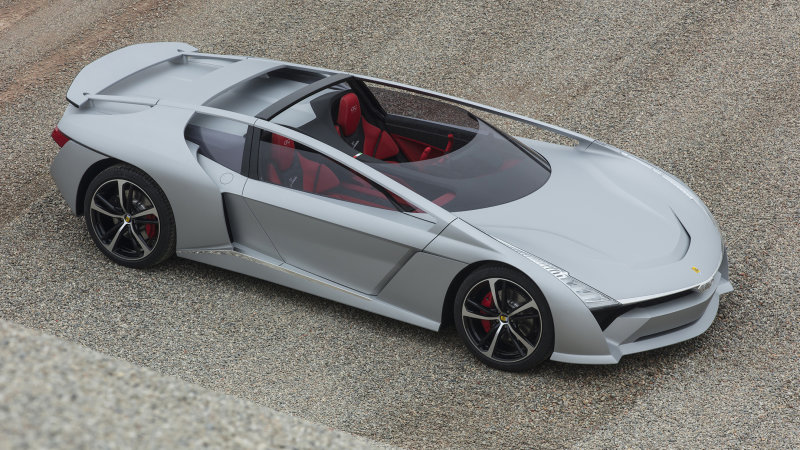
The Bandini Dora is an open-top two-seater, but its clever design is unlike anything of the past or present. Look closely, and the lines reveal that the windshield and encapsulated cockpit are entirely separate from the car’s roof arches. This was the result of blending old design with new safety standards.

“Today, it is difficult to conceive a Barchetta without considering the evolution there has been in the car concerning safety,” Giugiaro was quoted in the press release. “Inspired by the Halo of Formula One, we thought about creating a car that had a clean windshield as it used to be used with no reinforcements, thus being as linear and light as possible. To solve this need, I thought of an out-and-out superstructure that would integrate into the style with an accentuated structural and protective function for both the driver and passenger.” 

To properly appreciate the affect this design has on the car, it must be looked at from all angles. The prominent lines extends from the front bumper, curve over the front wheels, and swoop inward toward the rear to become part of the active aerodynamics. Because they don’t connect with the glass at any point, they creates all types of negative spaces, intersections, and design features that you just don’t see on normal cars. From the front, it almost looks as if one car has overtaken another car that lives beneath it.

For now, all three vehicles are just prototypes. The video below shows a press conference in which GFG Style announced the new designs.

[embedded content]

McLaren Elva M1A Theme by MSO channels Bruce McLaren’s 1964 race car

McLaren Special Operations hit up Twitter to show a version of its new Ultimate Series speedster, christened with the full name of Elva M1A Theme by MSO. The Elva takes its design cues from the M1A race car that Bruce McLaren developed for sports car racing in the 1960s. McLaren first entered his black #4 racer in the 1964 Canadian Grand Prix and put everyone on notice; the M1A equaled the lap record at Mosport Park four times and broke the record seven times. As buyers lined up, McLaren commissioned English firm Elva to build replicas for privateers. Although the historic M1A was an advance on the McLaren’s “Jolly Green Giant” Cooper-Oldsmobile, the M1A inaugurated the McLaren lineage that would soon dominate sports car racing. This modern Elva M1A goes about as far as it can to channel its inspiration, adopting the black exterior and red seats of the original — but not the 4.5-liter Oldsmobile engine.

Instead of painting the speedster black, MSO took the much better option of coating the carbon fiber bodywork in clearcoat. The only touches of paint are the silver slash and red pinstripe running front to back, splitting into a low runner along the sills, and the white roundel with the race number. We’re not sure what’s going on with the wheels, though — they’re the same design as those on the Elva that launched in November, but in mirror image. The other big splash of color appears on the seats, topped with crimson Alcantara. 

MSO didn’t mention any limitations on this theme, so it’s possible there could be more than one among the 399-unit Elva production run; Bruce McLaren built three works versions of the original M1A, and Elva produced 24 customer cars. And yes, the historic car was powered by an all-aluminum 3.5-liter Oldsmobile V8 that Traco bored out to 4.5 liters, producing 310 horsepower breathing through four Weber carbs. Oldsmobile not being an option anymore, the Elva homage goes with a 4.0-liter twin-turbo V8 with 804 horsepower and 590 pound-feet of torque, which helps ensure buyers get their $1.69 million worth.

Related Video:

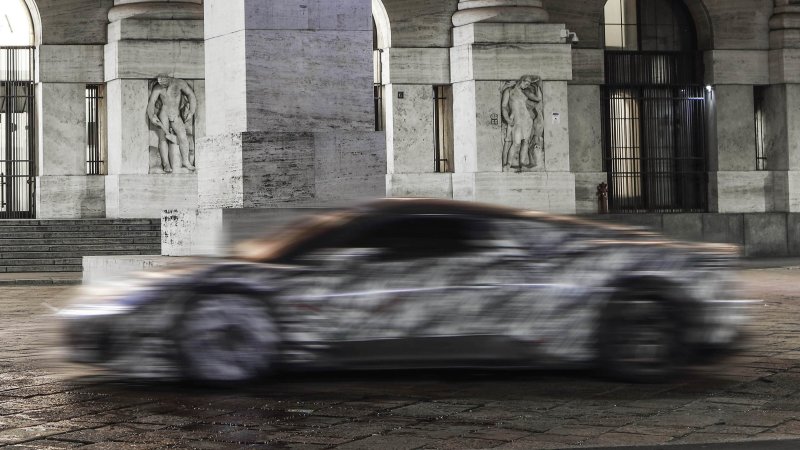
Maserati MC20 appears in artsy, blurry teaser

Maserati said it’s entering a new era. Judging by these teaser shots of the a camouflaged MC20 prototype supercar, it’s clear Maserati plans to strut its way into that new era con il coraggio and braggadocio. Maserati took its future flagship to the Piazza degli Affari in Milan, for a set of mostly blurry photos in front of Italian artist Maurizio Cattelan’s sculpture called “L.O.V.E.” Maserati called the artwork “a symbol of Italian audacity in international contemporary art,” for the sake of clarity, we’ll call it a giant marble bird flipped at anyone who might ask, “You talkin’ to me?”

The MC20 is thought to be built around the carbon chassis laid up for the 4C, stretched lengthwise and across to create an overall larger package. We can’t tell much about the real masterpiece in the photos, but it is clear the MC20 prototype has shed its gawky bodywork borrowed from the Alfa Romeo 4C to slip into something more comfortable. A very Maserati nose leads with a large grille and sits prominently ahead of the other bodywork. Behind that, an Italianate supercar form combines plenty of intakes, deep side skirts, a seamless rake to the backlight, and a short rear overhang.

In back, powertrains developed at Maserati and for Maserati should make all sorts of lusty noises. The top powertrain is expected to be a hybrid V6 with three electric motors and around 600 horsepower, there’s hearsay about an all-electric model, and rumors of a turbocharged V8 won’t die. The only gearbox mentioned so far is an eight-speed dual-clutch shooting power to the rear wheels. Autoevolution believes the hybrid engine will translate into a sprint to 62 miles per hour in around two seconds and a top speed beyond 186 miles per hour, just the kind of giddy-up one would expect from a challenger aimed at the Lamborghini Huracán Evo. If anything, 600 hp sounds conservative seeing as the Alfa Romeo Giulia GTA gets 540 hp from its 2.9-liter turbocharged V6 without electric help. The MC20 will take on Lamborghini’s championship-winning finest on the track, too, the MC20 — for Maserati Corse 2020 — surely headed for an FIA entry in track-only form.

For now, the MC20 continues its driving program to prepare for its debut in May. The coupe version should come first, going on sale in Europe late this year and in the U.S. sometime next year, followed by a convertible variant.

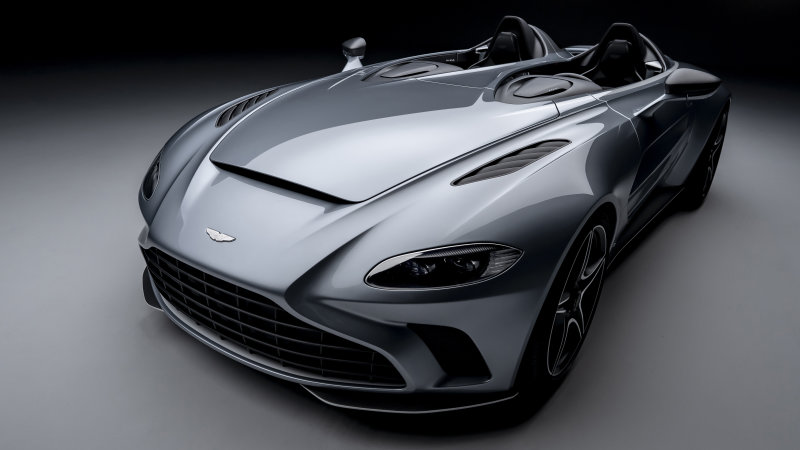
Aston Martin V12 Speedster is a $950,000 exotic dream that’s wild as the wind

The roofless, windshield-less, ultra-rare, ultra-expensive supercar space is getting busy. We had the Ferrari Monza SP1 and SP2; then we got the McLaren Elva, and now the Aston Martin V12 Speedster is joining the ranks. McLaren will let you add a windshield to the Elva, but there’s no mention of glass when it comes to the Aston. Invest in some sturdy goggles.

Revealed at Aston Martin’s Gaydon HQ (instead of the canceled Geneva Motor Show), the V12 Speedster is designed to provide the most visceral driving experience in the Aston lineup. There will only be 88 of them, and pricing starts at $950,000. That’s an absolute bargain compared to the Elva, which has a base price of $1.69 million. But if you’re considering buying one of these, its price is likely the last question you’ll have.

Aston says the V12 Speedster is powered by its 5.2-liter twin-turbo V12, making 700 horsepower and 555 pound-feet of torque. That’s mated to a ZF eight-speed automatic, sending power to the rear wheels. It’ll hit 62 mph in 3.5 seconds and a top speed of 186 mph — get some heavy duty headgear for that trip. The platform itself is made by combining elements of the DBS Superleggera and Vantage. It has 21-inch forged, center-locking wheels, huge carbon ceramic brakes and adaptive dampers. But the design is what really caught our eye.

It’s billed as “a living show car,” and we completely agree. The body is made almost entirely from carbon fiber. Miles Nurnberger, director of design at Aston Martin, detailed the design’s inspiration in a statement.

“There’s clear lineage from the 1959 Le Mans winning DBR1 to our Centenary celebratory CC100 Speedster Concept in 2013,” Nurnberger says. “There is also a bit of 1953 DB3S in the mid-section, so it really is our latest incarnation of the Speedster concept. It’s also inspired by fighter jets as much as it is by our history, and it has been created to deliver an incredibly visceral experience, hence why it is a V12, rather than a V8.”

The front hood nostril is especially eye-catching. Aston hasn’t implemented this design touch on a car in a long while, and we love seeing it on a new vehicle like this. Nurnberger says it allowed for some extra space under the long hood that it needed for the V12, too.

That interior is similarly stunning. It’s separated into two distinct cockpit areas by a slab of carbon fiber, but it still allows for interaction between the two people in the car below that piece. The design, like so many supercars and sports cars before it, is said to be inspired by fighter jets. This specific spec is a special F/A-18 spec that Aston says will be available to order. It features a number of fighter jet touches throughout. You’ll get to hear the car’s roar better than other Aston’s, too, as the company developed an especially loud stainless steel exhaust system for the V12 Speedster. Its lack of a roof should make it even more audible for those in the cockpit.

Aston Martin says its order books are open now for the V12 Speedster, so it’s not completely sold out yet. Deliveries are slated to begin in the first quarter of 2021. All 88 cars will be hand-built and made to the spec you desire.

Related Video:

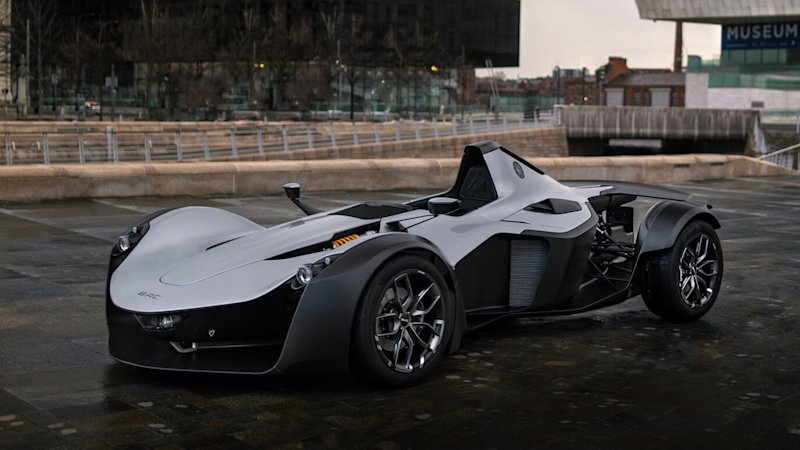
New BAC Mono launches, and it’s even lighter than before

There’s a new BAC Mono in town, folks. It’s running under the same name as before, but the car is now entering its second generation. The ethos and purpose of the Mono hasn’t changed — it’s still a single-minded track machine with room for one. However, the design is new, and so is the powertrain.

BAC says each and every body panel was redesigned from scratch for this new model. The height was reduced by 0.79 inch, and its length was reduced by 0.98 inch. This Mono has a smaller frontal area, too, making for better aerodynamics. It has new LED lights front and back; the rear spoiler is larger, and the new design makes for a sleeker looking Mono.

Street legality was still a priority for the BAC team, and that prompted a switch to a new turbocharged engine. Keep in mind, we’re talking street legality in Europe and other countries, not the U.S. That new engine is a 2.3-liter turbocharged four-cylinder that was developed for this car by Mountune. It makes 332 horsepower and 295 pound-feet of torque, and it also features a new dry sump oil system. BAC claims the engine meets the latest European emissions regulations and every other regulation necessary for it to be driven across the European continent. BAC says the transmission and chassis components were also updated, but didn’t specify in what way.

In true Mono fashion, though, the weight has been reduced. It now weighs 1,257 pounds, a 22-pound reduction from the previous-gen car. Thanks to its featherlight weight, performance is startling. It’ll get to 60 mph in just 2.7 seconds and hit a top speed of 170 mph. BAC admits that meeting the new European emissions targets ended up adding weight to the car, but it was able to win all that weight back by shaving grams off elsewhere. It uses the lighter carbon fiber floor, AP brake calipers and carbon ceramic brakes from the Mono R. Panels are also made using graphene-enhanced carbon fiber (like the Mono R), which BAC says also reduces weight. Even the wheels are significantly lighter, with each corner saving 2.7 pounds over the previous design — each wheel weighs only 4.9 pounds now.

The Mono’s center of gravity was lowered even further, as BAC managed to lower the fuel tank and place the battery directly under the driver. Suspension geometry was “optimized,” reducing pitch under braking and maximizing rear traction. Pirelli Trofeo R tires are also fitted as standard now.

Its price is steep. You’ll be able to pick up a new Mono in the UK for £165,950. Converted to U.S. dollars, that’s about $212,000.

Related Video:

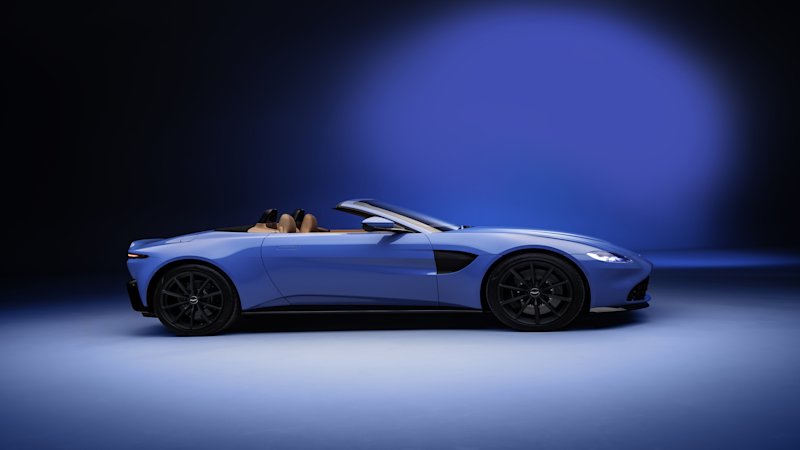
Aston Martin Vantage Roadster finally doffs the cap

Two years after the hardtop Aston Martin Vantage redefined the Vantage nameplate yet again, the coupe has dropped its top. Below the shoulder the Vantage Roadster holds true to nearly everything that compelled us to label the coupe “a significant milestone.” Above the shoulder, a fabric top envelops an “ultra-compact” Z-frame that drops in 6.7 seconds and unfurls in 6.8. The carmaker says it’s the fastest fully electronic mechanism out there, and operates at speeds of up to 31 miles per hour. Thanks to the frame’s compact design, the car’s lines don’t differ much from the hardtop. Nor do the performance specs: The convertible gains 132 pounds over the fixed-roof, needs 3.5 seconds to hit 60 mph instead of 3.5, and maxes out at 190 mph, five miles per hour less than the coupe. Losing the rear hatch takes a bit out of luggage space, though, which declines from 12.4 cubic feet to seven. Aston Martin says the cubby will still swallow a full-sized golf bag and related paraphernalia.

The Mercedes-AMG-sourced 4.0-liter twin-turbo V8 delivers the full 503 horsepower and 505 pound-feet of torque. Engineers tuned the suspension, differential, driving aids, and driving modes specifically for the convertible. The carmaker has made its seven-speed manual transmission newly available on the coupe this year — it was offered previously only on the Vantage AMR — but the droptop is barred from the row-your-own party. The Vantage Roadster sticks with the ZF eight-speed automatic. Convertible buyers can avail themselves of other additional kit introduced this year to celebrate 70 years of the Vantage name, said first applied to a more powerful version of the 1951 DB2 called the DB2 Vantage. The potential extras include Aston Martin’s historic vane grille as well as new wheel designs.

Deliveries begin in Europe during Q2, U.S. shoppers can expect summer delivery. Pricing starts at $161,000, an $8,000 premium over the coupe.

Related Video:

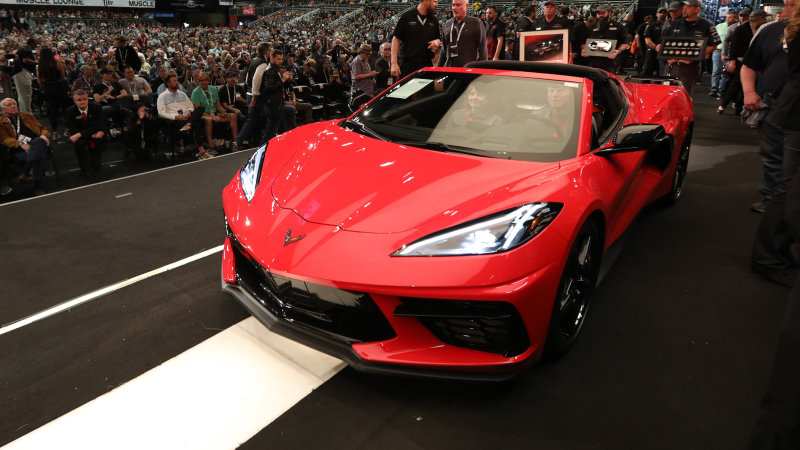
Top 5 most expensive cars at the 2020 Barrett-Jackson Scottsdale auction

Please consider whitelisting Autoblog.

Hi! We notice you’re using an ad blocker. Please consider whitelisting Autoblog.

We get it. Ads can be annoying. But ads are also how we keep the garage doors open and the lights on here at Autoblog – and keep our stories free for you and for everyone. And free is good, right? If you’d be so kind as to whitelist our site, we promise to keep bringing you great content. Thanks for that. And thanks for reading Autoblog.

Hey again!

You still haven’t turned off your adblocker or whitelisted our site. It only takes a few seconds.

Zombie cars: 9 discontinued vehicles that aren’t dead yet

  • Image Credit: Dodge

Like zombies, these dead cars still sell among the living

Car models come and go, but as revealed by monthly sales data, once a car is discontinued, it doesn’t just disappear instantly. And in the case of some models, vanishing into obscurity can be a slow, tedious process.

That’s the case with the nine cars we have here. All of them have been discontinued, but car companies keep racking up “new” sales with them.

There are actually a lot more discontinued cars that are still registering new sales than what we included here. We kept this list to the oldest and most unlikely vehicles still being sold as new, including a couple of supercars. Every car on this list was discontinued at least two years ago. We’ve ordered the list in order of fewest vehicles sold. Click on the image above to get started.

Last updated January 2019

  • Image Credit: Dodge

2014 Dodge Avenger: 1 sale

Wow. We’re truly amazed. Someone actually bought a brand new 2014 Dodge Avenger in 2019. The Avenger was uncompetitive when it was new, and it’s woefully uncompetitive now. Here’s hoping the sole individual who parked a new Avenger in their driveway in 2019 got a smoking deal.

Dodge Avenger Information

Dodge Avenger

  • Image Credit: Lexus

2012 Lexus LFA: 3 sales

The first supercar on this list (which otherwise is full of highly lackluster automobiles) is the Lexus LFA. It’s an exhilarating car to drive, and is packed full of interesting technology. Lexus sold a total of 3 LFA coupes last year to what we have to guess are very satisfied customers. By our count, there ought to be 5 more unsold LFAs sitting somewhere on dealer lots in America.

It’s also worth noting that Lexus only sold the LFA for two model years, 2011 and 2012, which means it is by far the oldest new vehicle on this list.

Lexus LFA Information

Lexus LFA

  • Image Credit: Chrysler

2016 Chrysler Town & Country: 5 sales

The Chrysler Town & Country was already an old vehicle when it was officially killed off in 2016. The basic van was introduced for the 2008 model year, and saw only refreshes until its conclusion eight years later. Some of those updates were helpful and kept the car at least somewhat competitive.

Still, we’re thankful Chrysler replaced it with the Pacifica, a superb van that is arguably the best in the segment. And if you do happen to really like Chrysler’s older minivan offering, the Dodge Grand Caravan is still on the market.

In any case, Chrysler managed to sell five of these minivans so far this year. Here’s hoping the buyer scored a great deal.

Chrysler Town & Country Information

Chrysler Town & Country

  • Image Credit: Dodge

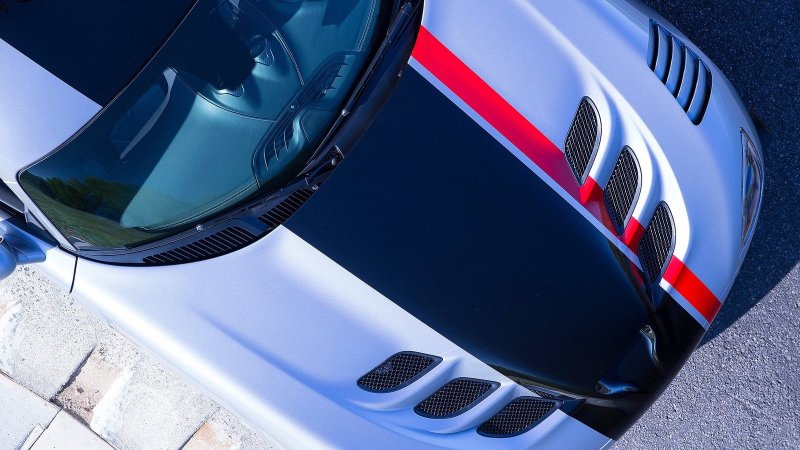
2017 Dodge Viper: 5 sales

The second supercar on our list out is one that we love. We don’t think there are a bunch of unsold Dodge Viper coupes sitting on dealer lots all across America. Nevertheless, five lucky individuals managed to bring new Vipers home in 2019.

At least we know those buyers are out there having fun!

Dodge Viper Information

Dodge Viper

  • Image Credit: Mercedes-Benz

2017 Mercedes-Benz B-Class Electric Drive: 8 sales

Mercedes-Benz sold the B-Class Electric Drive in the United States from 2013 through 2017. Though the rest of the world gets other versions of the B, only the electrified variant was sold here in the States. And it was never a big seller — just over 3,500 were sold over its production run in America. Now that 2019 has come to a close, we can add eight more to the total.

Mercedes-Benz B-Class Electric Drive Information

Mercedes-Benz B-Class Electric Drive

  • Image Credit: Dodge

2016 Dodge Dart: 25 sales

Dodge discontinued the compact Dart back in 2016, just three years after its launch. The automaker just wasn’t able to compete with the segment leaders like the Honda Civic or the sales juggernaut that is the Toyota Corolla. Despite the fact that it’s been dead for several years, Dodge managed to sell 25 Darts in 2019.

Dodge Dart Information

Dodge Dart

  • Image Credit: Jeep

2017 Jeep Patriot: 27 sales

The Jeep Patriot initially launched back in 2007 alongside its more car-like Compass sibling, but while that vehicle got a redesign and is still on sale in Jeep dealerships, the boxier Patriot ended production in 2017.

Apparently there are a handful of Patriots still collecting dust on dealership lots in America, because the automaker tallied 27 total sales last year.

Jeep Patriot Information

Jeep Patriot

  • Image Credit: Chrysler

2017 Chrysler 200: 48 sales

The Chrysler 200 is actually a pretty nice sedan, with good looks and decent driving dynamics let down by a lack of roominess, particularly in the back seat. Chrysler never really found its footing in the ultra-competitive midsize sedan segment, but apparently has a bunch of leftover 200s floating around in America with a total of 48 sold in 2019.

  • Image Credit: Volkswagen

2017 Volkswagen CC: 58 sales

Volkswagen discontinued the CC in 2017, and the slinky coupe-shaped sedan recently got a replacement in the form of the 2019 Arteon. Here’s hoping last year’s 58 CC buyers managed to get a good deal on their new old sedans.

Volkswagen CC Information

Volkswagen CC

Lamborghini Huracan Evo gets Amazon Alexa tech at CES 2020

In-car technology is a must, Lamborghini development boss Maurizio Reggiani told Autoblog as he unveiled the Huracán Evo‘s touchscreen-based infotainment system in 2019. Amazon Alexa integration announced at CES 2020 is the next part of the march towards supercars that are as smart and connected as they are quick.

By programming the voice assistant directly into the native infotainment system, rather than adding it as a third-party app, Lamborghini claims it achieved seamless integration that lets drivers control an extensive list of functions in the car, and in their home. If your butt is cold, you can ask Alexa to turn on the heated seats. You can also make calls, turn the map lights on or off, get directions, check the weather at your destination, and set the A/C, among other things. And, because Alexa speaks to connected devices, you can raise the temperature in your living room while doing hot laps at Watkins Glen, or turn on the porch lights as you pass a Porsche. The catch is that Alexa goes on strike if the Huracán isn’t connected to the internet.

Lamborghini and Amazon plan to deepen their cooperation in the coming years, though they didn’t reveal precisely what they’re hoping to achieve. They could teach Alexa new functions, but don’t expect the Italian brand to release a car with an entirely button-free cabin in the near future. The driver still has to manually switch between the driving modes, for example, and the ignition button remains under a fighter jet-like red flap positioned on the slanted center console.

Amazon Alexa will be available across the entire Huracán Evo range — which will grow to include a rear-wheel drive model developed to replace the 580-2 — by the end of 2020. Lamborghini told Autoblog it hasn’t decided whether the feature will be standard or optional yet.

Related Video:

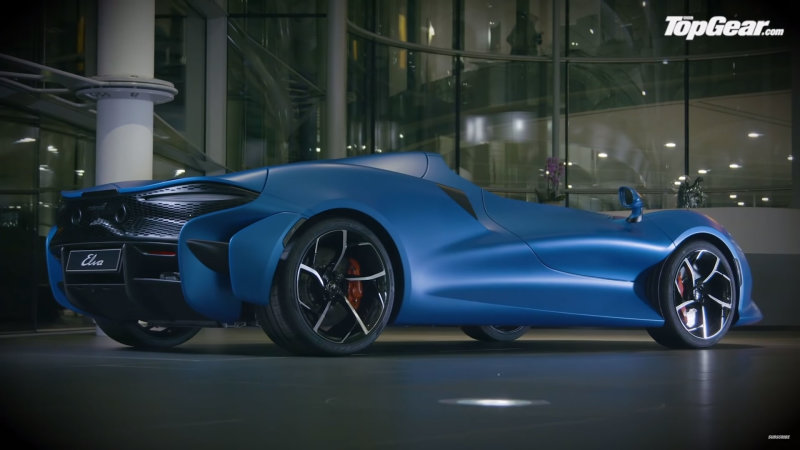
Top Gear magazine climbs all over the McLaren Elva

Top Gear deputy editor Jack Rix took a camera crew to McLaren’s Technology Center for a closer look at the Elva roadster. Not only did Rix provide his usual, thorough once-over and explanation of design features, but thanks to the magic of moving pictures, we get graphic demonstrations of how the Elva’s most interesting feature works. McLaren engineers needed to figure out a way to protect helmetless occupants from getting their faces painted with bugs and detritus at speed. Their solution is the Active Air Management System (AAMS), composed of a deflector and a network of vents that create a “bubble of calm” around the passenger cell. Unlike the rest of the Elva, the AAMS ain’t pretty, but beauty always loses tie-breakers to effectiveness in Woking. 

For a vehicle with so little to it, including the number of body panels, there’s a ton going on all around the open-top. The rear mesh is 3D-printed titanium. Short seat squabs combined with a moving steering wheel and gauge cluster improve ingress and egress. Four high-flow exhaust pipes are placed in two locations and pointed two directions in order to separate tones as if the exhaust were an audio system – because, in truth, it is. And there’s more, but we’ll let Rix explain. 

As an aside, for all the Elva does have, we think it’s a shame the roadster doesn’t have a roofed version. Digital artist Nikita Aksyonov drew up an Elva Coupe, and we’re fans. Better looks than the McLaren GT, in a package that appears more compact than the 720S, with a more powerful engine than the Senna? Yes. All day yes.

But we digress, so check out Rix’s take in the video.

2020 Audi R8 Coupe and Spyder First Drive | V10 > turbo

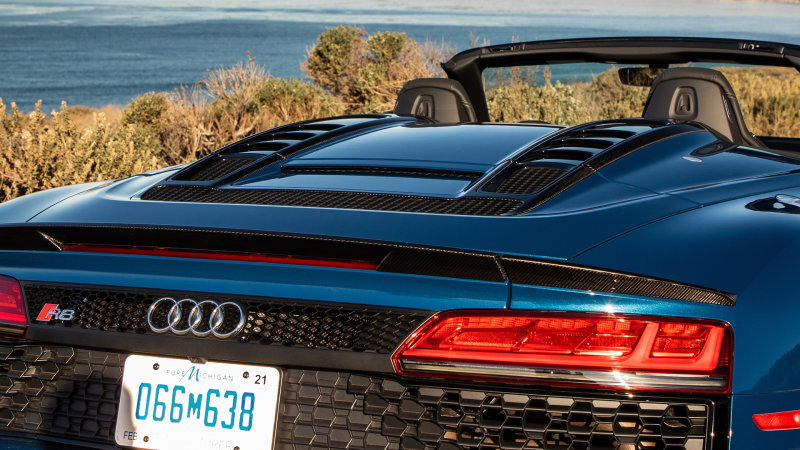
SANTA BARBARA, Calif. — It’s usually a bad sign: Rocking out of Los Padres National Forest in the updated 2020 Audi R8, I spot two California Highway Patrol cars lying in wait on Highway 33, one of the fantasy driving roads the state is known for. But these officers aren’t here to hand out tickets, but to lend a hand — closing off the road so we can run repeated launch-control starts in these mid-engine, all-wheel-drive supercars.

The drag-racing demo, in both coupes and Spyder convertibles, highlights reasons why one might drop $197,150 on the R8’s V10 Performance edition, or $209,350 on the Spyder V10 Performance. (They replace last year’s V10 “Plus” models). One is the 602-hp, naturally aspirated 5.2-liter V10. It’s a spectacular anomaly in a world dominated by turbocharged powerplants, the last of two production cars in the world with a V10. The other is its Italian cousin, the Lamborghini Huracan. Audi powers its R8 LMS race car with the identical V10, and both R8 coupes and racers are built on the same assembly line.

We stand in awe as Audi after Audi crackles off the line and sprints into the distance, rending the air with throaty howls en route to a wicked 8,700-rpm redline. (A Sport exhaust button that amplifies the sound is right there on the steering wheel, and owners are likely to wear it out). Audi plays it cool with a conservative 3.2-second 0-60-mph estimate for the R8 Performance coupe; 2.9 seconds is closer to the truth, as achieved in previous tests of the R8 in this engine spec. The Spyder is estimated to run only a tenth slower to 60 mph. Both models deliver the 200-mph bona fides of a self-respecting supercar, at a 205-mph peak for the Coupe and a hair-mussing 204 mph for the Spyder.

The 2020 update also brings a healthy 30-horsepower bump for the base R8 coupe and convertible, from 532 to 562 horsepower, and eight additional pound-feet of torque, now at 406 pound-feet. Audi pegs their 0-60-mph dashes at 3.4 and 3.5 seconds for the base coupe and Spyder, respectively, and sets their prices at $171,150 and $183,350. There’s also a coupe-only Decennium edition, limited to 222 copies, with the final 50 coming to the States. It’s a trim package that comes only in Mythos Black paint and all-black interior, with an intake manifold and wheels in matte-bronze finish and side blades, rear wing and other components in gloss carbon fiber.

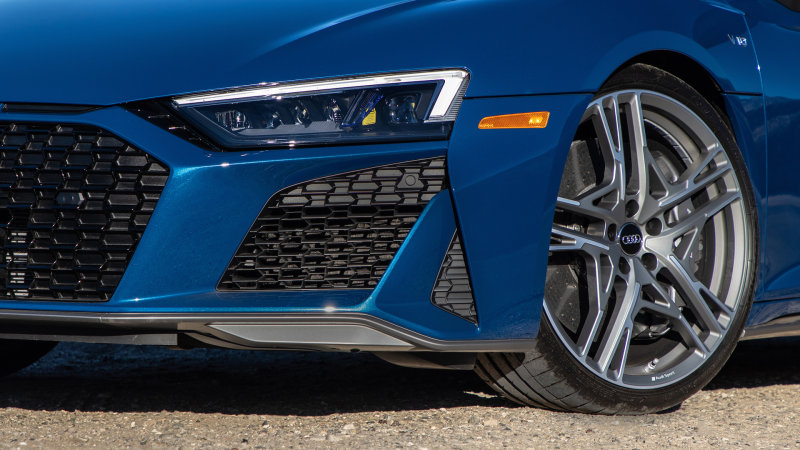
On the 2020 design front, a reworked front bumper features a more horizontal perspective that accentuates the Audi’s lowness and width. That includes a dramatically stretched, black honeycomb grille, a new spoiler lip and lateral air intakes. That front end now incorporates a faux, winged inlet that bookends the bumper — and whose plastic-capped “opening” seems more from the Lexus school of overworked design than Audi’s typical understatement. Headlight lenses have been darkened, and a redesigned rocker panel gets a new inlay. Audi’s Laser Light high beam is standard on Performance versions, and their crisp, ultra-long-range illumination steps in for conventional high-beams at speeds above 40 mph. The Laser Light’s decorative blue element illuminates on European-market models, but U.S. regulations forbid any trace of blue lighting.
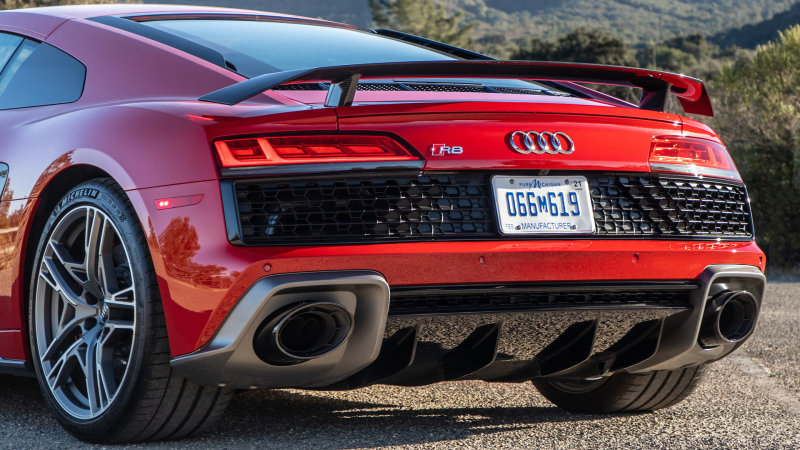
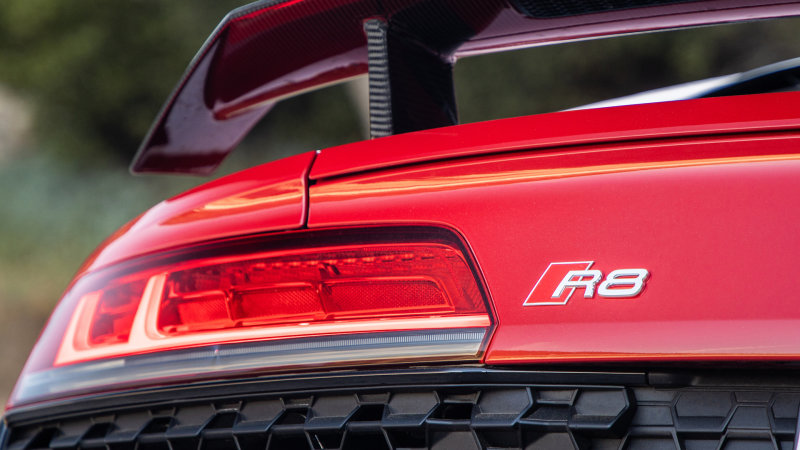
The new rear bumper adds a pair of generously sized oval exhaust outlets, more honeycomb for air outlets, and a new rear diffuser. Basic V10 models get standard 19-inch forged wheels, with optional 20s. Performance editions now come standard with 20-inch forged wheels with a somewhat busy, milled-cut design with a black-and-titanium finish. Our colorful selection of R8s tended to look better with optional 20-inchers with a simpler profile and titanium finish.

Two lovely new colors join the R8 palette: Kemora Gray and Ascari Blue metallic, the latter only available on V10 Performance cars. Ceramic brakes, standard on V10 Performance models, offer a choice of red calipers in addition to standard gray. Finally, the Performance coupe alone offers a world first for Audi: a carbon-fiber front sway bar that trims 4.4 pounds of weight. Every little bit helps for the R8, a relatively chunky sports car — especially compared with carbon-fiber monocoque McLarens — that plops as much as 3,957 pounds on the scales (for a base Spyder). All told, the wide-flanked R8 looks familiar, yet formidable, its ability to draw admirers undimmed by time.

Our day begins in Santa Barbara with a Spyder Performance, its fabric top down and its wind-deflecting rear glass up. After heading along coastal Highway 101, we’re soon detouring into California’s bone-dry, tinderbox canyons, even as fire crews battle new blazes in nearby Los Angeles. The Audi saves its scorching for the pavement, as I dial its dimpled, asymmetric steering wheel and get into a nice rhythm through the twisting mountain roads. 

This R8 is dearly priced by any standard, but you get what you pay for in the high-design interior, decked out with carbon fiber, burnished aluminum and diamond-stitched leather on 18-way power sport seats. Racing-style shell seats are available, but those aggressive chairs don’t seem to fit the Audi’s daily-driving personality. Audi might disagree, considering the R8’s impressive race record, including three wins at the 24 Hours of Nürburgring.
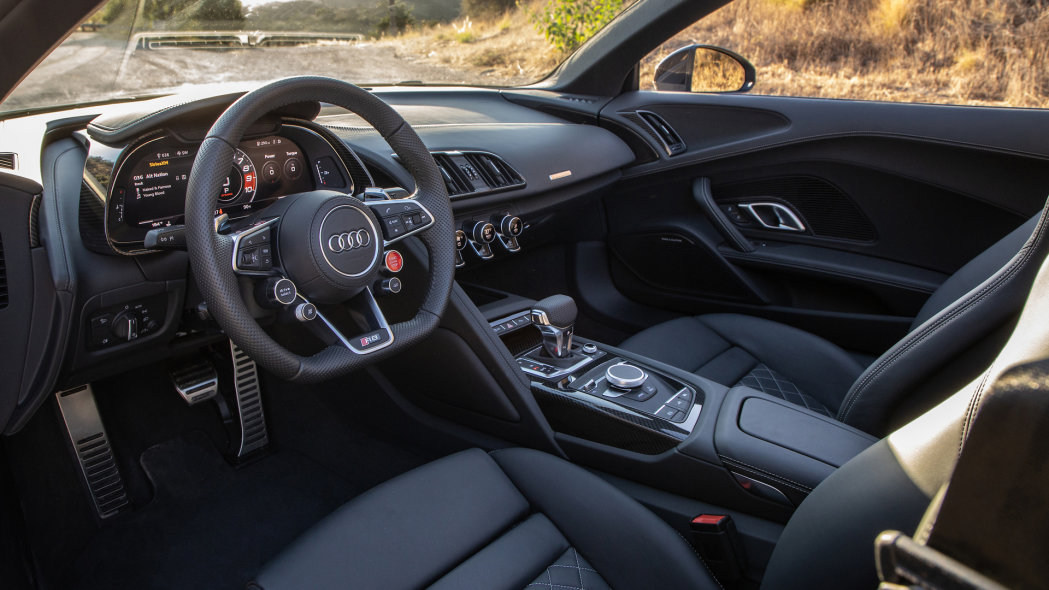
That personality combines accommodation and excitation like few cars; the R8 helped create the notion of the “everyday supercar,” and its precision build quality and user-friendly technology remain strong points. That extends to Audi’s Google-mapping virtual cockpit infotainment system and 13-speaker Bang & Olufsen sound system (standard on Performance models), which continue to set the standard in its class. If all-black Audi cabins strike you as boring, Pastel Silver or Palomino brown are new interior colors.

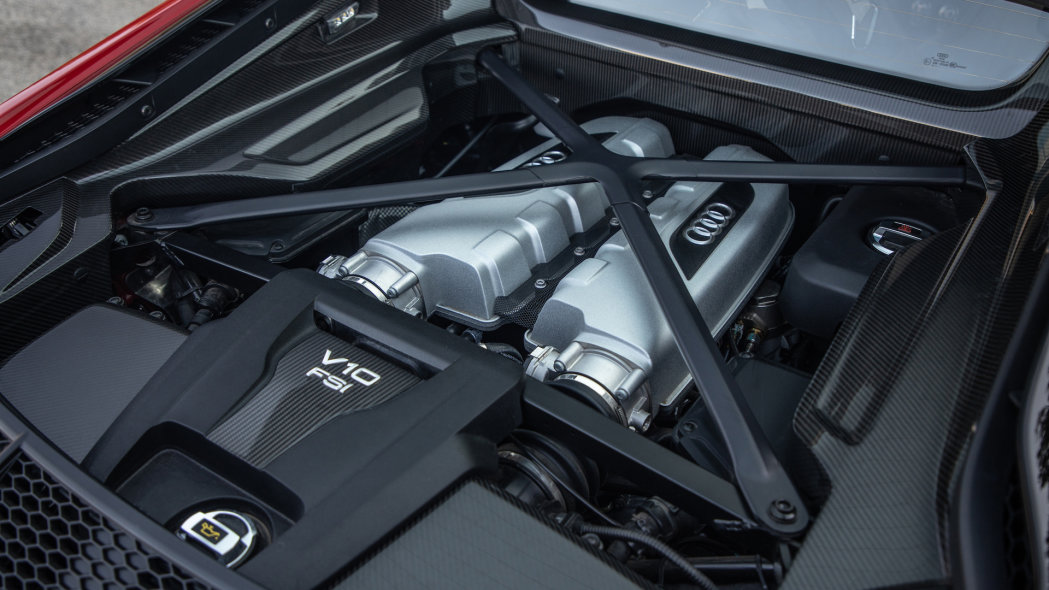
The Spyder looks sweet top-down, and admits more of that glorious 10-chamber orchestra, but those advantages don’t seem enough to overcome its drawbacks: a shortage of seat travel (the chairs wedge right up against the rear firewall), and the attendant lack of useful recline from the seatbacks. The coupe, in contrast, carves out room behind seats for small bags, backpacks or odds-and-ends — not a ton, but enough to make a difference in a car that’s otherwise limited to a modest frunk below the hood. And where the coupe proudly exhibits its signature V10 under glass, topped with a black X-brace, the Spyder’s engine stays out of sight below its vented, power-folding tonneau cover.

As it’s evolved, the R8 has steadily become more rewarding to drive, less victimized by understeer and more limber-feeling at the helm. For 2020, the electrically assisted steering reduces the assist during cornering to deliver more weight and feedback though the wheel. Optional Dynamic Steering (at $1,400) aims for more-natural feel as well, with less-aggressive ratio adjustments relative to vehicle speed and steering angle.
Where standard models come with a versatile, adjustable magnetically controlled suspension, Performance editions get a stiffer, fixed steel suspension for superior control, though with a notably firmer ride. For 2020, Audi has traded the R8’s previous Pirelli P Zero tires for a grippier set of Michelin Pilot Sport 2s with a custom rubber compound. (You’ll spot a little “AO” symbol on the sidewall, for “Audi original”). Stability control and ABS programming are mildly retuned to account for the improved grip, and the (optional) variable-ratio steering makes subtler ratio adjustments than before. Throw in a seven-speed dual-clutch S-Tronic transmission — which Audi says can swap speeds in as little as 120 milliseconds — and it’s a delight to rip through those gears to the tip-top of redline, whether in full automatic mode or by thwacking the finely weighted, metal paddle shifters. Hold that left paddle down, and the Audi will limbo to the lowest possible gear, skipping from, say, fifth gear to second in one swoop. This is an extremely short-geared car, with second gear topping out at around 67 mph, and fourth gear running out at barely 105 mph.

On one long, canyon-blasting descent, I employ left-foot braking to balance the Audi into blind apexes, then roll onto the throttle and feel the Haldex-based front axle come online, maximizing grip and exit speed as I hurtle toward the next corner like a barrel over Niagara Falls. This is one fast, confident sports car, and its V10 gushes power and never quits, as evidenced by that 200-mph-plus top speed.

The R8 still makes a vivid statement of design and performance, yet it’s always run a bit below the radar, including in sales. Since its debut in 2007, Audi has moved about 800 R8’s a year in America on average, including a high-water mark of 1,145 cars in 2011.  This is a supercar for a more practical-minded, German-favoring buyer, a contrast to the flashier form and naked emotionalism of the Lamborghini Huracán. Those Audi fans are just the type to do some practical math as well: The standard R8 Coupe undercuts the Huracan Evo’s price by about $90,000. 

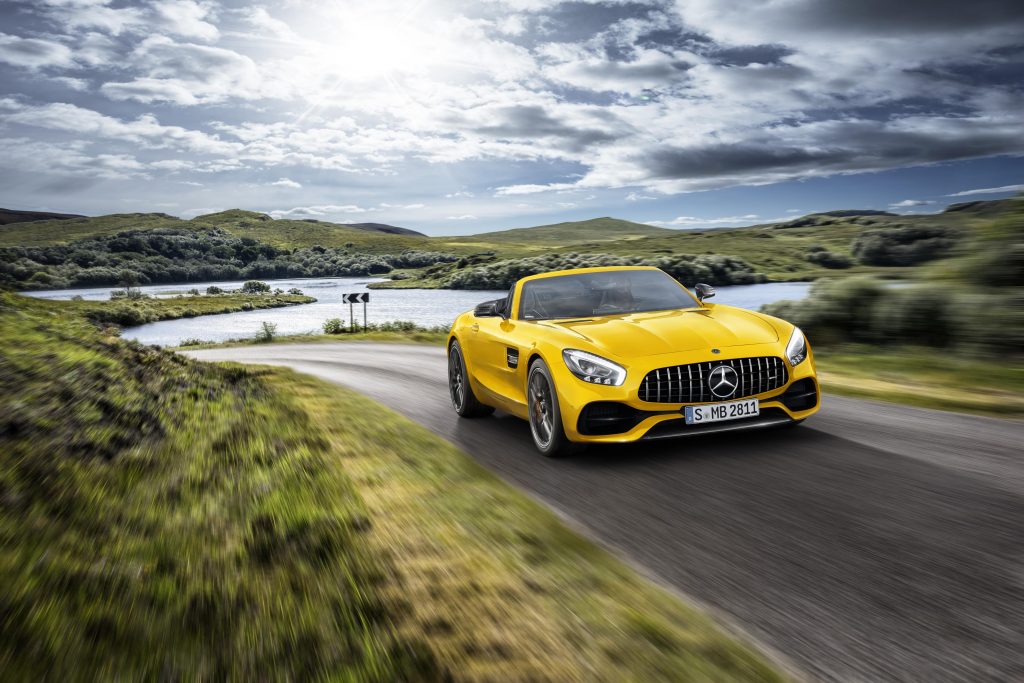
Outdoor Activities with the new Mercedes-AMG GT S Roadster

Some people play Badminton in their leisure time. Some play ping pong, and some play chess. The Mercedes-AMG GT S Roadster is for those who like to jet ski.

Bear with me on that analogy – with the GT S Roadster that Mercedes-AMG has just announced, you get all of the kicks of the AMG GT S coupe, but you get to enjoy them out in the fresh air.

Slotting in between the current lineup of the AMG GT Roadster (for those that enjoy lycra-ing up of a weekend and heading out on a road bicycle) and the AMG GT C Roadster (for full-on lunatics who enjoy bobsledding in their spare time), the GT S Roadster gets the same twin-turbo AMG 4-litre V8, though in this instance it’s tuned to produce 515hp at 6250rpm and 494 lb-ft of torque between 1900 and 5000rpm.

That means it’s got the edge on the 469hp, 465 lb-ft GT Roadster, though isn’t quite as ballistic as the 550hp, 502 lb-ft AMG GT C Roadster.
b Mercedes-AMG GT S

b Mercedes-AMG GT S
Like all the best AMG Mercs, the GT S should still be able to get slidey at will thanks to that power being sent straight to the back wheels via an electronically controlled limited-slip differential.

The driver will get the full cacophonous AMG soundtrack as we’ve come to expect, too, with the roof down-experience allowing the sound to carry direct from the performance exhaust system also offered on the AMG GT C to their ears – up to a certain point on the way to the car’s 192mph top speed at least before the wind does its thing.

0-60 is dispatched with in 3.7 seconds – which should be fast enough for those seeking thrills but not all-out speed. That time still brings it within a tenth of a second of the more speed-focused GT C Roadster, though.

Stopping power isn’t bad either, with that limited-slip diff combining with composite brakes – 15.2 inch fronts with six-piston calipers and 14.2 inch rears with single-piston calipers – that AMG say will provide exceptionally short stopping distances and an outstanding resistance to fading.

Aluminium has been used throughout the bodywork to keep weight to a minimum while ensuring rigidity, and the car’s centre of gravity is kept low thanks to use of a three-layered fabric soft top – for when the noise (or the weather) becomes too much for the occupamnts.

European order books are open now, but US customers will have to wait until later this year when the AMG GT S Roadster will reach US dealerships.

If you were seeking outdoor excitement from your V8 Mercedes, which Roadster would you pick? The GT, GT S or GT C? Let us know in the comments!

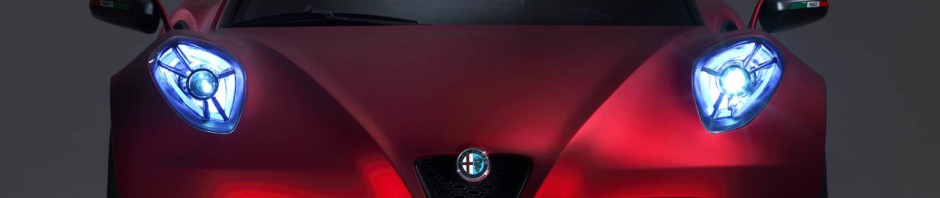
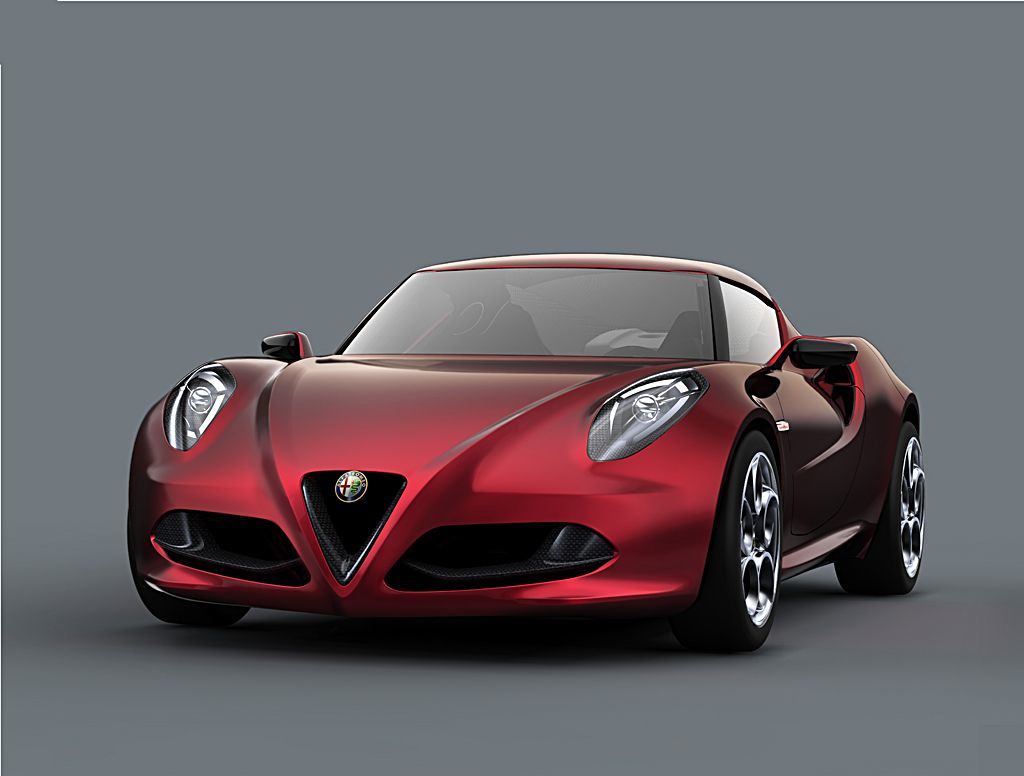
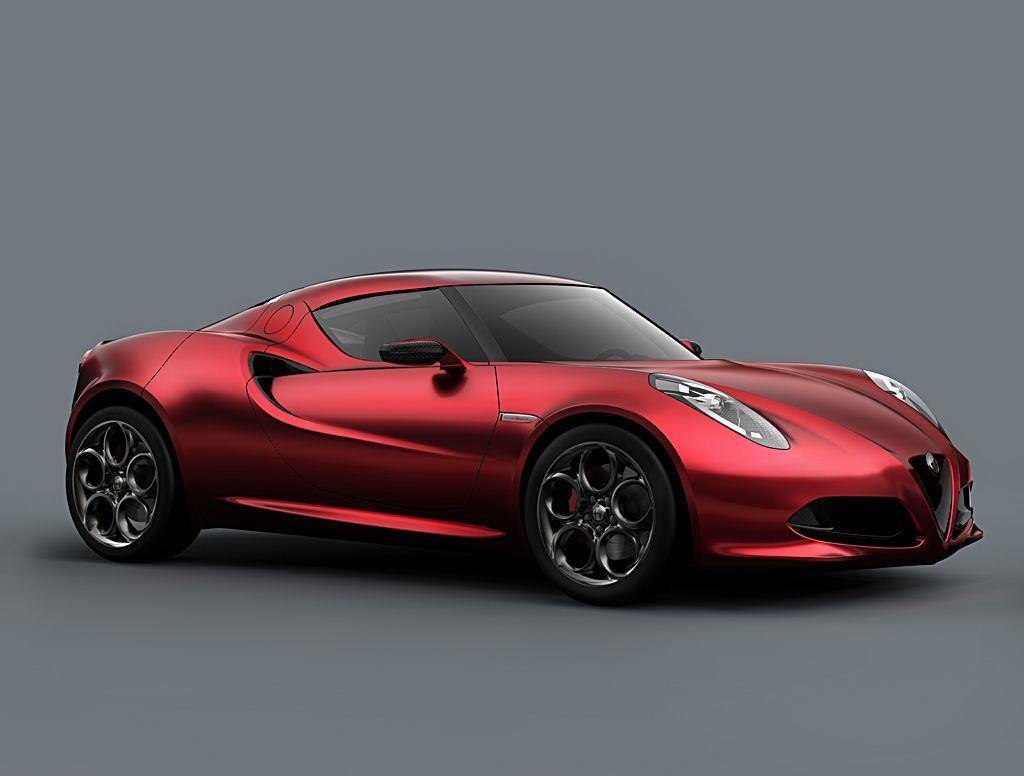
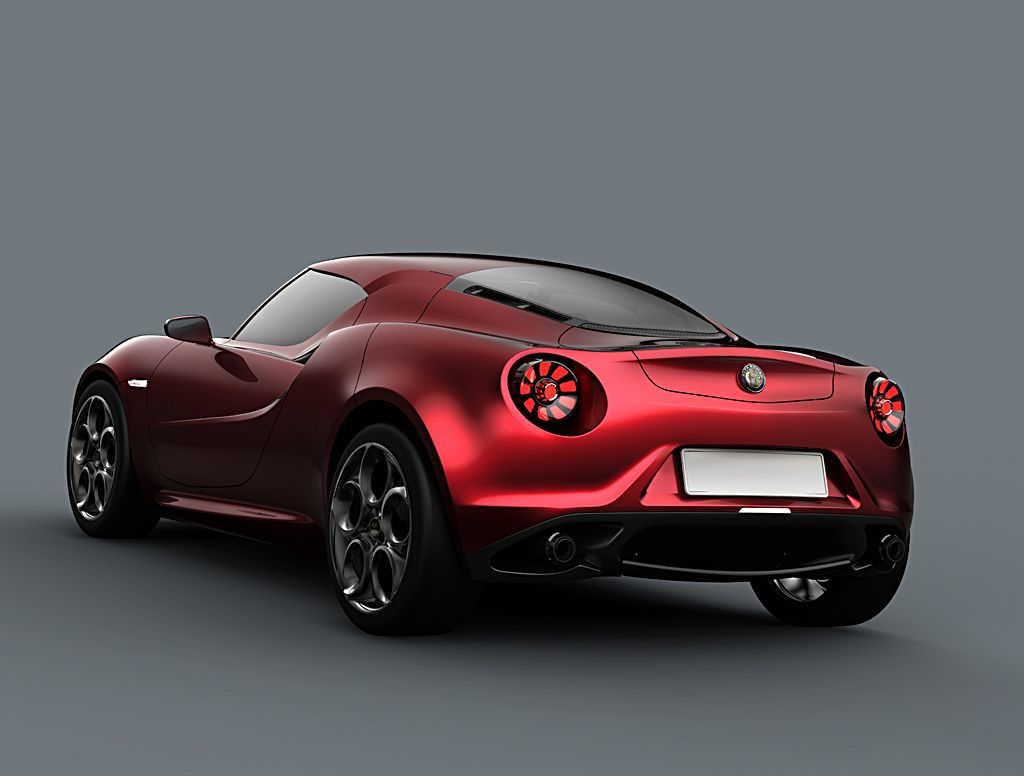
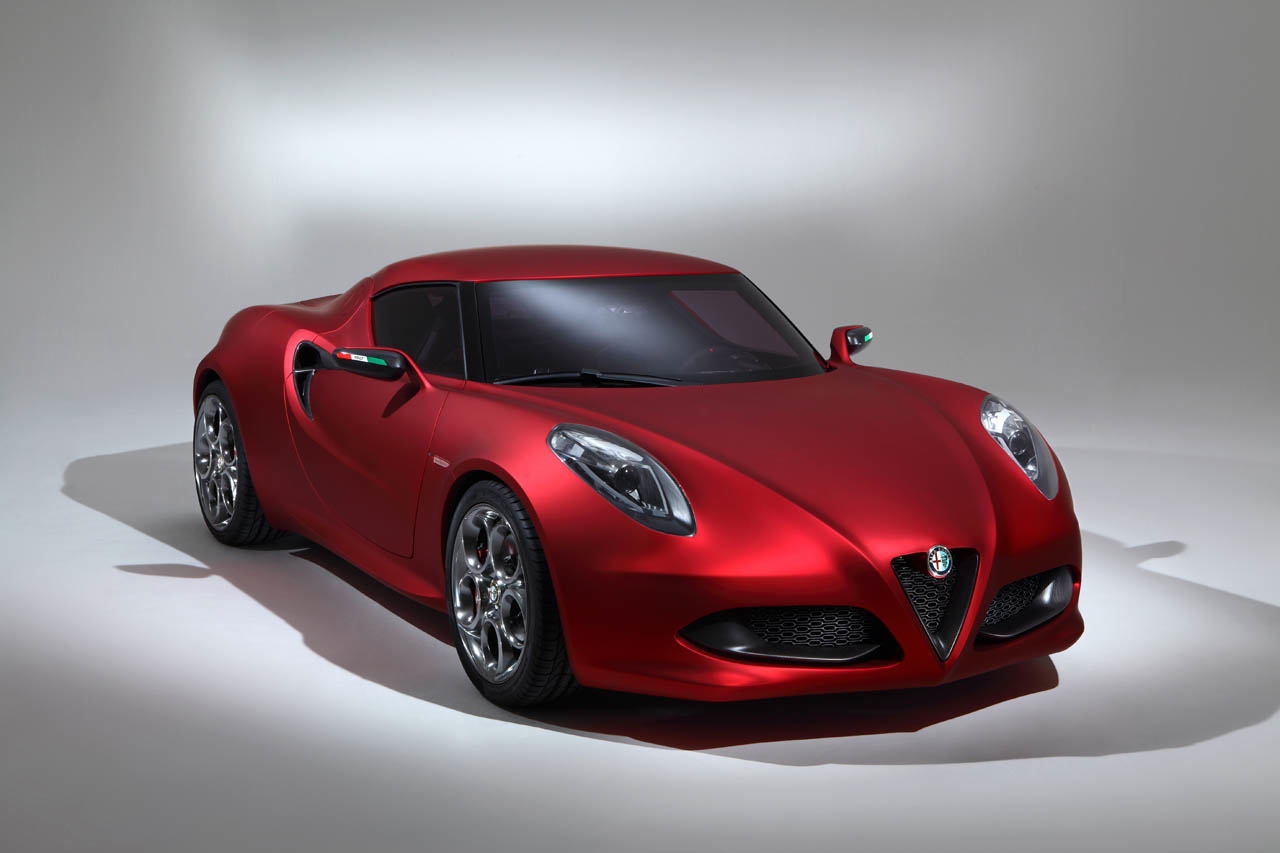
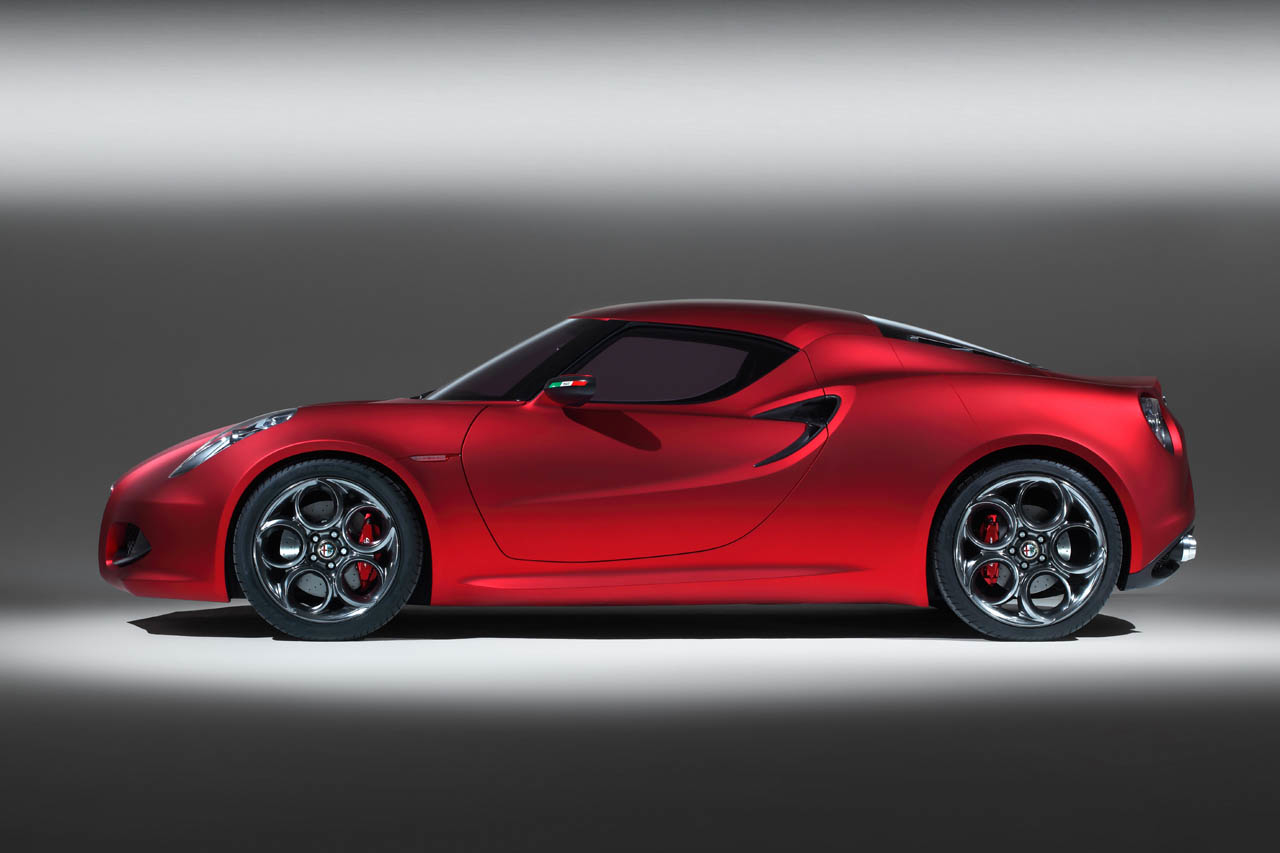
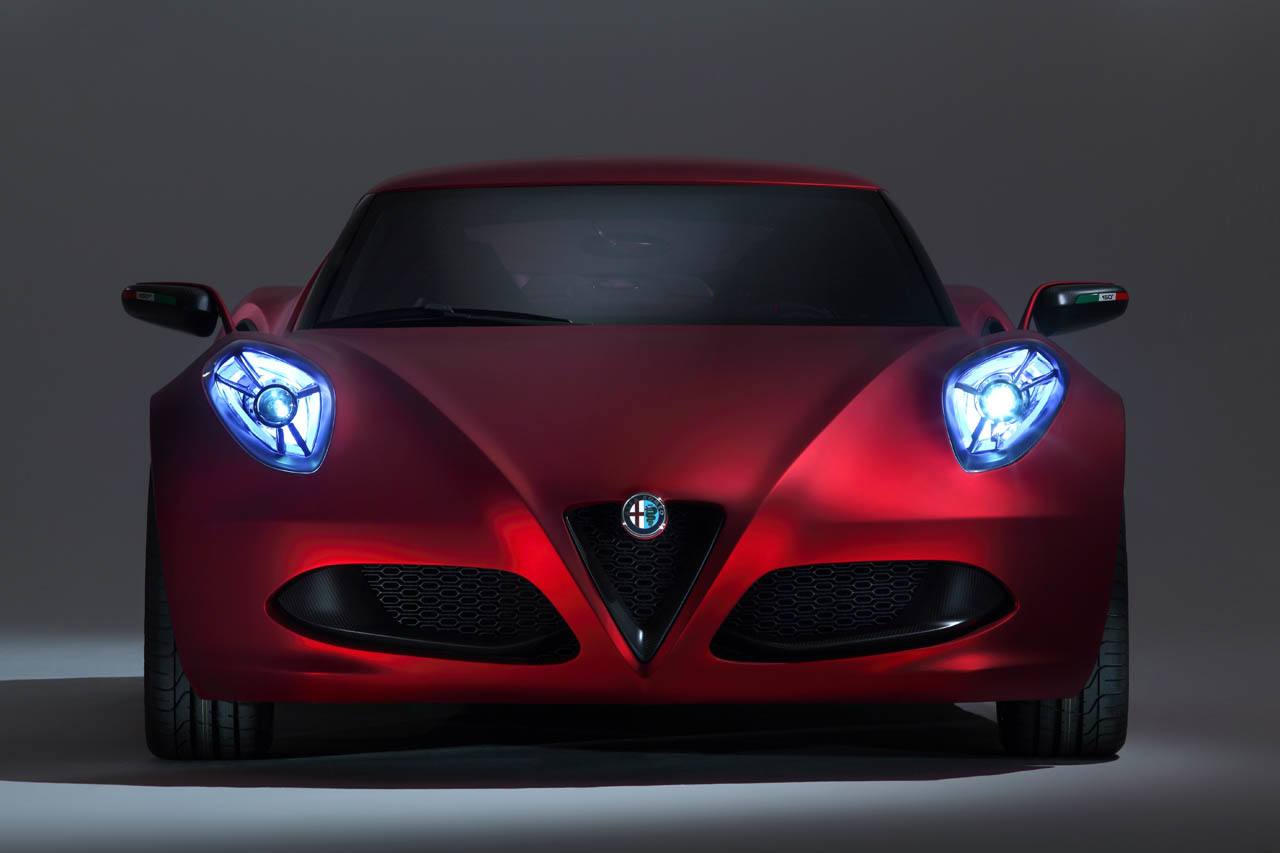
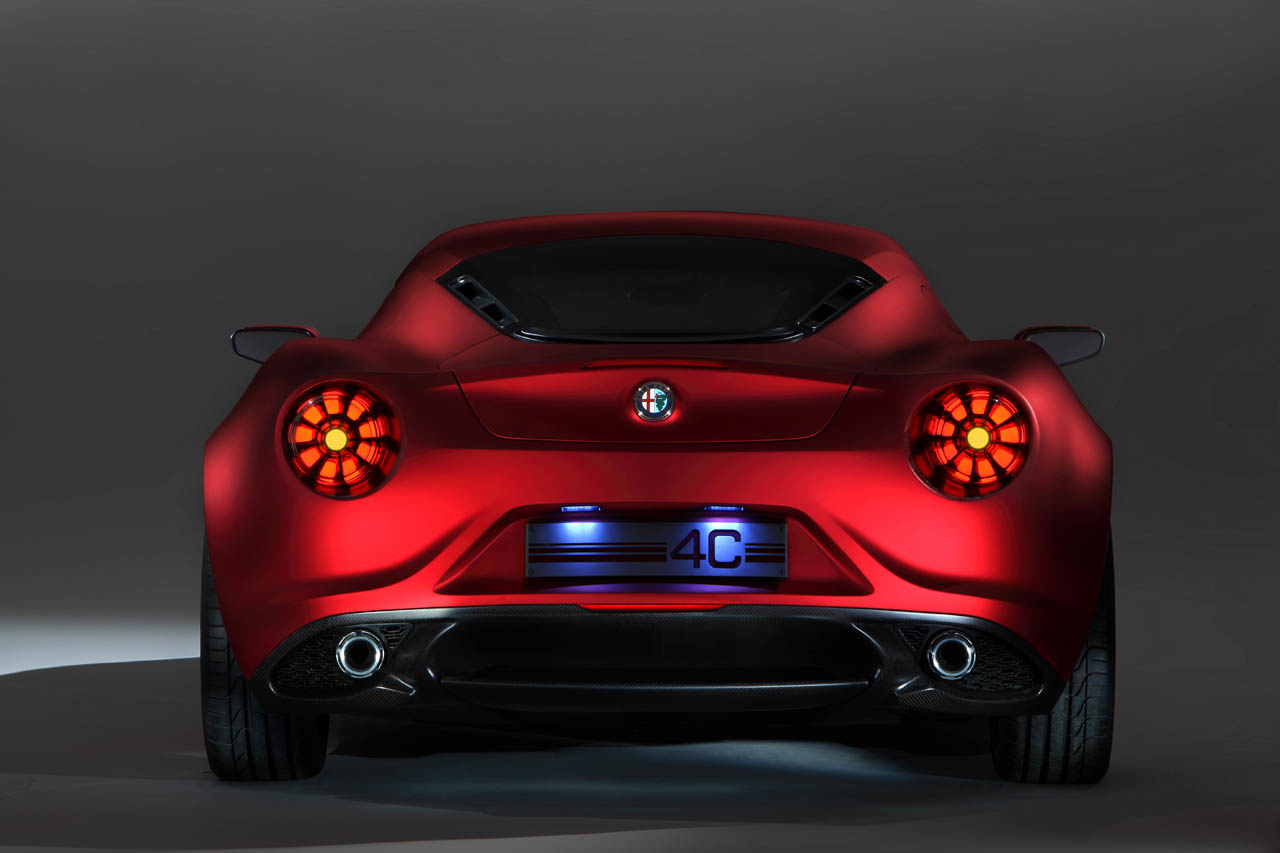
Sx-Z | Alfa Romeo 4C Convertible

Alfa Romeo 4C Convertible To Compete With Porsche 911

Sx-Z | Alfa Romeo 4C Convertible Version To Compete With Porsche 911

The Alfa Romeo 4C Coupe is still at least a year away from production. The upcoming 4C will debut on the market as a mid-engine bruiser with a 0-60 sprint of around 4.5 seconds and curb weight of under 2,000 pounds, making it a contender to Porsche 911 buyers.

Alfa Romeo handed over early development and then brought in-house, Dallara, the company behind carbon fiber components found in the Alfa Romeo 8C, Bugatti Veyron and the KTM X-Bow.

Now, rumor has it that the Italian automaker could be stepping up the competition to Porsche with a drophead version of the 4C.

If the rumor is true, we won’t see the 4C convertible until 2014 at the earliest.

Sx-Z | Alfa Romeo 4C Convertible

Sx-Z | Alfa Romeo 4C Convertible

Sx-Z | Alfa Romeo 4C Convertible

Sx-Z | Alfa Romeo 4C Convertible

Sx-Z | Alfa Romeo 4C Convertible

Sx-Z | Alfa Romeo 4C Convertible