All posts in “Audi”

2020 Audi A4

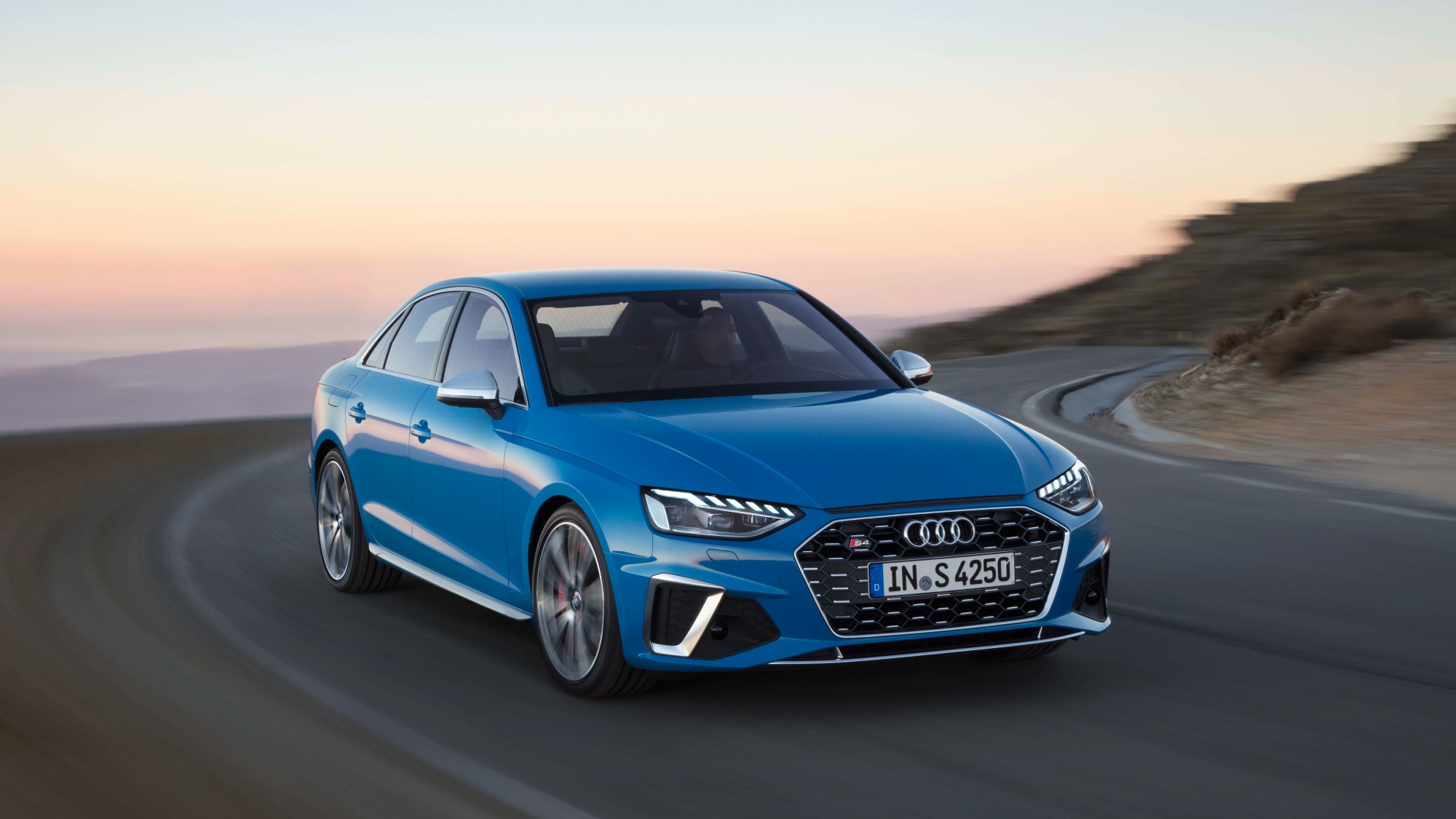
Audi has now unveiled the 2020 Audi A4, which looks sharper and fresh compared to last-generation’s entry. For real — the styling is more aggressive this time, perhaps in keeping up with how bold Audi’s other cars are.

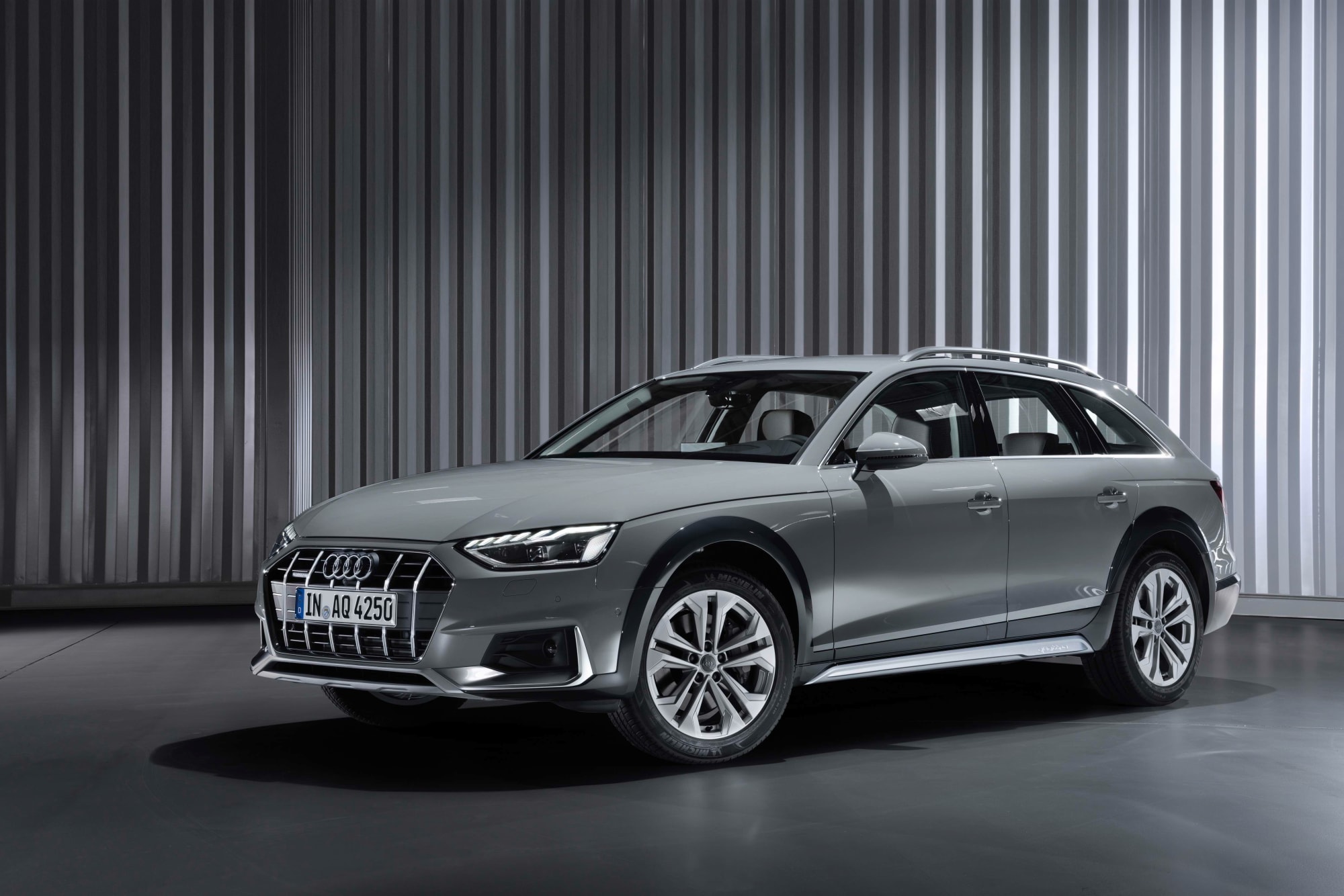
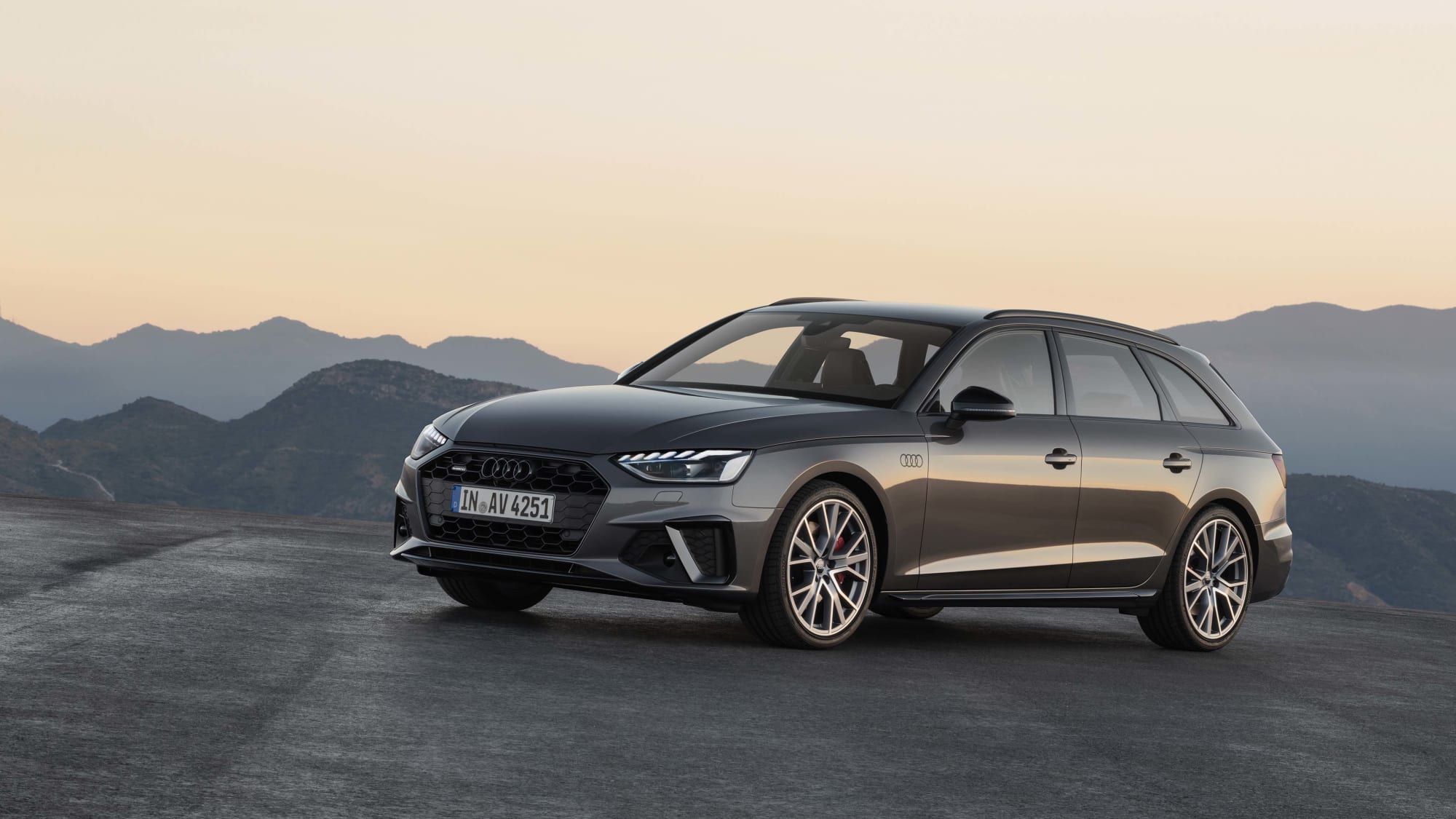
For starters, there’s the immediately eye-catching hexagonal grille accentuating the front fascia. Yes, the headlamps have lashes. All kidding aside, though, they look pretty sick. The lines are a nice touch, bringing some heft sensibility to what’s already a pretty car. These are new LED DR you’re looking at, by the way, which just adds to the overall formidable look of the ride.

The car comes with LED headlamps by default, but you can opt for Matrix LED technology if need be. Off to the back, you’ll find an equally sharp-looking rear bumper. That’s on top of LED tail lights that punctuate intimidation even further.

Inside, things have changed, too. There’s a new infotainment system, which is Audi’s MMI that introduces a 10.1-inch touchscreen. Music lovers will have a field day during commute thanks to the in-built acoustic feedback and more user-friendly navigation system. You can choose between two partially analog clusters or go for the all-virtual cockpit option.

There will be a range of engines. First, there’s the 2.0-litre TDI engine, which will churn out 187 horsepower. Then the 2.0-litre TFSI petrol engine, which tops out to 241 horsepower. Finally, you can go all out with the 3.0-litre TDI option, which should produce 227 ponies. A4 is coming to India later this year. If not, early next year.

VISIT AUDI

Photos courtesy of Audi

Watch the Porsche 992 take on the Audi R8, Nissan GT-R Nismo, and BMW M850i in a Drag Race

The Ultimate AWD Drag Race

The website Carwow wanted to see just how the New Porsche 911 Carrera 4S stacks up against the other all-wheel-drive high-end sports cars out there. That meant the company had to stage a serious test, and that led the testers to the drag strip. The company took the new Carrera 4S and put it up against an Audi R8, Nissan GT-R Nismo, and a BMW M850i. 

The Porsche 911 Carrera 4S comes with a turbocharged 3.0-liter flat-six engine. That engine produces 443 hp and 391 lb-ft of torque. When compared to the cars it was racing, the Porsche might seem a little outmatched. However, it’s all about how the car can put that power down to the wheels and then transform that into acceleration. The guys doing the video also did a rolling start race and a brake test, which proved just as entertaining as the drag race. 

I’m not going to ruin the video results by discussing them here. I will say the results are somewhat surprising. You might not expect to see what happens. Some of the results can be attributed to the drivers, but it really appears that everyone does a good job of driving the cars to their fullest. Check out the video below to see just how impressive all of these cars are. 

[embedded content]

Check Out This 9-Second Audi TT RS

This TT Is Not Like Others

The Audi TT RS is a notable sports car. The standard vehicle makes a strong 400 hp from a 2.5-liter turbocharged five-cylinder engine. That’s pretty impressive, but it pales in comparison to the TT RS in the video below. That car was fitted with a TTE700 Hybrid Turbo, new fuel injectors, a bigger intercooler, and some new software for the engine. The car now puts out 734 hp to all four wheels.

The video below was taken by the YouTube page VeeDubRacing, and shows the car pull a 9.7-second time on the drag strip. According to the video description, the company APR UK built this car. The boss of that company told his team they had three days to turn the regular TT RS into a 9-second car. It’s pretty clear they pulled it off. 

On the car’s 9.7-second run it hit 144 mph. This run took place at the Santa Pod Raceway in the UK. The car did its sub-10-second runs on some sticky Hoosier tires and appears to have a good day for it.

the 2.5-liter five-cylinder engine in the TT RS is known for being an excellent engine and one that you can get impressive power numbers out of with minimal modifications. You can believe it could put out more than 734 hp. It’d be interesting to see just how far this engine and the TT RS, in general, could be pushed. 

[embedded content]

Audi R8 V10 Decennium Is an Homage to the V10

It’s Quite the Tribute

The Audi R8 you see here is the V10 Decennium. It’s Audi’s homage to the V10 engine and, as Audi says in its press release, “ten years of fascination on the road and success in motorsport.” The car is available only as a coupe and comes in a Daytona Gray paint job with some milled matte bronze wheels. The intake manifold comes in the same beautiful bronze color. The front spoiler, side sills, diffuser, and some other small accents come in a gloss black. Altogether, it’s one sinister-looking package. 

The interior of the car is just as dark, featuring all-black materials. There’s diamond-quilted stitching on the seats, plenty of carbon fiber inlays, and contrast copper stitching on the gear shifter and steering wheel. The car also gets special badging that shows it is a V10 Decennium.  It all comes together elegantly and works well with the exterior of the car.

This limited edition V10 Decennium is based on the top-spec R8. The car gets a 5.2-liter V10 engine that produces 620hp and 428lb-ft of torque. The car can do the 0-60 mph sprint in just 3.1 seconds and has a top speed of 205 mph. It’s just as much of a performer as any other version of the R8.

This special limited edition R8 will go on sale with the updated regular R8, but far fewer models will be produced. Audi said it would make only 222 units of the car, which will make it a rare version of the vehicle, indeed. It will cost 222,000 euros or about $253,000. 

ABT Audi Q8 Adds Power and Aero Package

ABT’s package for the Audi Q8 has arrived. Due to be unveiled at the Geneva Motor Show 2019 in a few weeks time, the ABT Audi Q8 adds power and style through a subtle aero package. The display car is built upon an Audi Q8 50 TDI, although the parts will work for other engine variants in the range.

The ABT body kit consists of a front skirt add-on with a front blade and air inlet panels, rear skirt add-on and fins, an ABT rear wing and an ABT emblem set. Small parts but they set the ABT Audi Q8 apart from the standard model. All of the additional parts are available in a glossy black finish.

The Audi Q8 50 TDI gets an ABT Power boost. The German company installed an ABT Engine Control (AEC) unit boosting power from the 3.0 litre TDI from 286 hp up to 330 hp. Torque increases from 600 to 650 Nm. ABT have carried out some work on the suspension too. The ABT Level Control module allows greater control over the electronic air suspension.

ABT supply wheels for the Q8 too. This show car features an ABT Sport GR set. They measure 10 x 22 inches with a concave base, finished in matt black or gloss black with diamond polishing. Alternatively, ABT has revealed a 23-inch version of the same wheel design. Personalised interiors are also possible.

For some reason, the press release makes constant reference to James Bond with ABT reminding us that they modified an Audi 200 quattro for the film “The Living Daylights” in the 1980s. ABT think this might be the perfect car for 007, do we agree?

Audi TT RS Coupe and TT RS Roadster Get Facelift

Audi have taken the covers off of the Audi TT RS Coupe and the Audi TT RS Roadster. The two models receive a mild series of aerodynamic tweaks but no boost in performance. The visual tweaks should allow it a few more years of faithful service. The official reveal will likely take place at the Geneva Motor Show 2019 which starts early next month.

The design takes its cues from the facelift Audi TT. The front air vents are redesigned with the vertical stips moving to the inside of the vent with a larger air vent on the outside. The side sill is completely new too, with a gloss black finish. At the rear, a new wheel vent has been added. Finally, the rear spoiler has been redesigned with larger end plates.

A new set of matrix OLED reversing lights have also been added to the option list. They are said to put on a display when the ignition is turned on. Kyalami Green becomes an RS-specific colour, and two further colours, Turbo Blue and Pulse Orange, join the option list.

The 2.5 litre inline 5 cylinder engine returns for the facelift. The power remains the same, 400 hp and 480 Nm of torque. Performance is also identical with a 0 to 100 km/h (0 to 62.1 mph) sprint occurring in 3.7 seconds. The power is routed through a seven-speed S tronic to the quattro permanent all-wheel drive system.

Inside, Audi fit the latest RS sport seats with RS logos on the seats, steering wheel, door sill trims, and selector levers. The Audi virtual cockpit gets a special RS display which provides information on tire pressure, torque, and g-forces. A new RS sport leather steering wheel is also on offer.

Order books open for the facelift Audi TT RS Coupe and Audi TT RS Roadster tomorrow with deliveries from the spring of 2019. The price for the Coupé is 67,700 euros. The Roadster starts at 70,500 euros.

Audi Will Build Production Version of PB18 e-tron

An All-Electric, German Supercar

Audi confirmed in a recent interview that it will take the PB18 e-tron concept car that it showed off last year and make a production model. The all-electric supercar is a model that wowed everyone when it appeared at Monterey Car Week.

However, I didn’t expect it to actually become a production car. With that said, Audi is pushing hard for EV development, and this is one way to continue that progress. 

Audi’s Global CEO Bram Schot told Autoweek Netherlands that the company would make 50 of the unique EV supercar. He also said the car would be launched in the next two years. 

Schot didn’t let slip many details about the car. If it has performance specifications close to the actual concept, the vehicle could have 671 hp and 612 lb-ft of torque. Audi claimed the car could go from 0 to 62 mph in just two seconds. I hope the production car will be that powerful and fast or even faster. 

Powering the concept car was a 95-kilowatt-hour battery that provided enough juice for about 310 miles of range. Audi claimed that the 800-volt charger allowed the battery to reach full capacity in about 15 minutes. 

I don’t know if we should expect the production car to have more impressive or less impressive technology than the concept car. My first instinct is to suggest it would be slightly less impressive. However, with the way EV technology is developing, I wouldn’t be surprised if Audi could squeeze a little more performance out of the design by the time the car came to market. 

According to The Supercar Blog, the car will be a precursor to the new Audi R8, which it says will be a 1000 hp all-electric supercar. 

Audi R8 Refreshed for 2019

Earlier this quarter, Audi unveiled the 2019 R8 amid reports that the iconic supercar will be discontinued as early 2020.  The upcoming iteration of the second-gen R8 features facelifted versions of both the coupe and spyder, which are expected to go on sale in Europe early next year.

When it comes to aesthetics, ‘facelift’ accurately depicts the extent of the changes, with the new models benefiting from a redesigned, more aggressive front bumper. The new bumper also incorporates a wider grill, new front splitter and more menacing air inlets.

Significant styling changes elsewhere are forgone, although Audi has introduced new optional exterior packages which add “various highlights to the front splitter, the side trims and the diffuser” for a more bespoke touch. Redesigned 20” ultralight milled wheels are available as an option and two new paint colors are also on offer – Kemora Gray and Ascari Blue.

In the cabin, new upholstery options have extended the catalogue and include the likes of “pastel silver with rock gray contrasting stitching, palomino brown with steel gray stitching and black with utopia blue stitching.” The top of the line R8 V10 Performance will also be available with specially designed leather/alcantara upholstery and unique carbon fiber trim pieces.

The refreshed Audi R8 will also feature performance upgrades for both its engine options, with the V10 now producing 562-horsepower and 405 lb-ft of torque –  an increase of 29-horsepower and 7 lb-ft of torque over the 2018 engine, respectively. The V10 will do 0-100 km/h in 3.4 seconds with a top speed of 324 km/h.

The V10 Performance engine receives more modest upgrades, now producing 611-horsepower and 427 lb-ft of torque – an increase of 9-horsepower and 14 lb-ft of torque over the 2018 engine, respectively. The V10 Plus will do 0-100 km/h in 3.1 seconds with a top speed of 331 km/h.

With a renewed focus on driving dynamics, Audi has reworked the suspension to provide “even more stability and precision”. The reprogrammed Electronic Stabilization Control (ESC) system improves braking distances while the standard power steering and optional dynamic steering systems have also been improved to enhance driver feedback and response.

All the new 2019 Audi R8 models remain naturally aspirated and all-wheel-drive, and there is no word yet on whether Audi will release a ‘RWS’ version of the refreshed car. Pricing has not yet been officially revealed for either the Euro or US-spec R8, with this information likely to be available closer to the release date.

Audi R8 2019 Image Gallery

Audi e-tron GT Concept

Audi’s Electric Grand Tourer Green-Lighted For Production

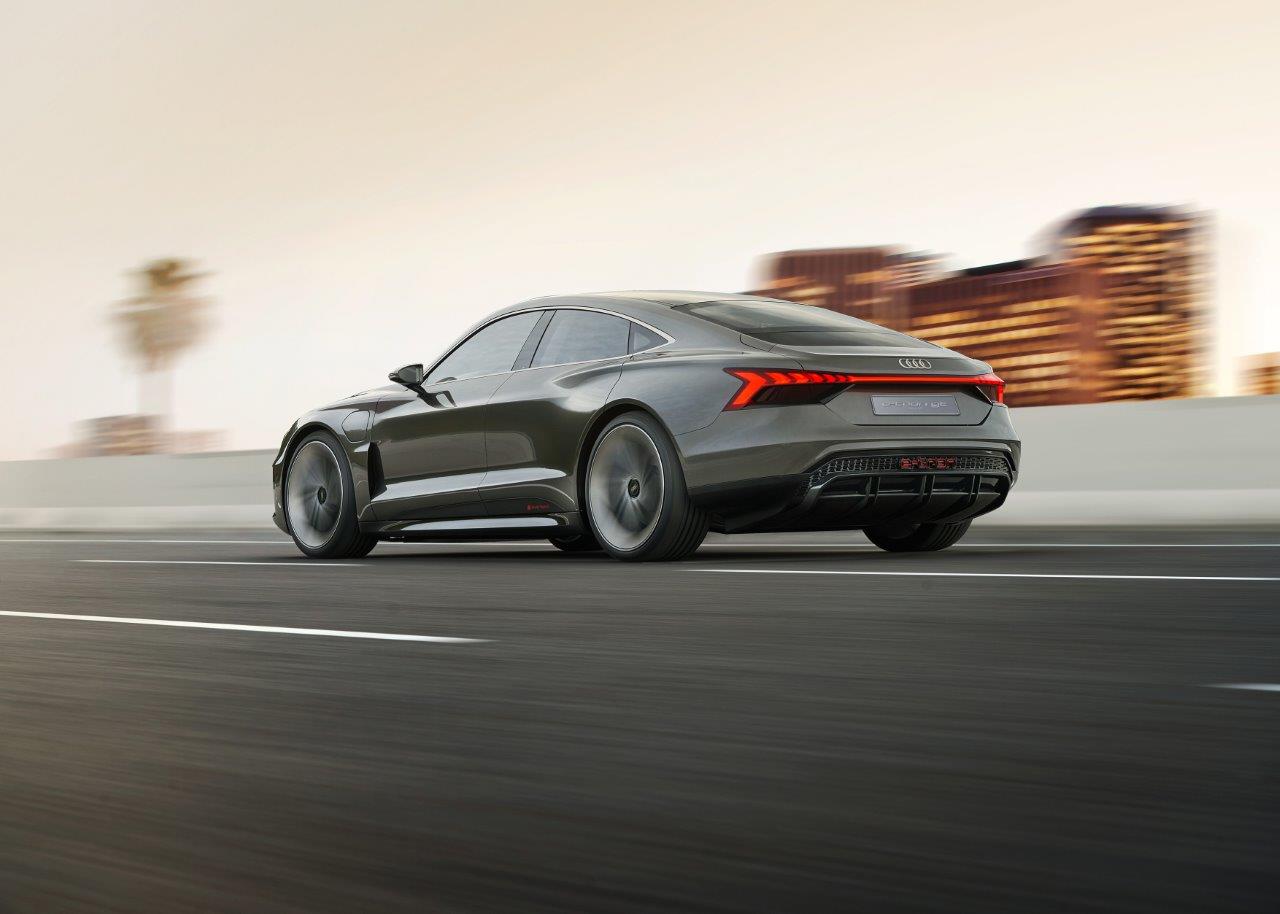
Showing that they are fully committed to a future with EVs, Audi unveiled its electric grand tourer earlier this quarter at the 2018 L.A. Auto Show. Audi believes that the broad appeal of the e-tron GT will give the automaker mainstream status as an EV manufacturer.

This is huge part due to its emphasis on sleek styling, which takes the form of a four-door coupe/fastback silhouette. Audi intends to use this as a differentiator in the EV market, where the majority of vehicles – past and present – are either bland, peculiar looking, or lacking the charisma needed to captivate customers at first sight.

In short, the Audi e-tron GT is an EV with sex appeal with the cosmetic underpinnings of the Audi A7. “This is a very low car with big wheels. It still has classic proportions, but gorgeous proportions.” according to Marc Lichte, Head of Audi Design.

The Audi e-tron GT shares the same platform as the Porsche Taycan, though Audi and Porsche are said to have been in regular correspondence to ensure that both cars would take different design paths and deliver distinguishable end products. The e-tron GT will have similar range as its e-tron SUV which offers 248 miles on a single charge, based on the new standardized WLTP test.

Audi e-tron GT

Audi e-tron GT

Aside from its design, the e-tron GT will also be steered more towards performance than its SUV counterpart. Rumoured to be at around the 600-horsepower mark, the e-tron GT will set its sights on its intended rival – the Tesla Model S P100D – which does 0-62 mph in 2.7 seconds and has a top speed of 155 mph.

Audi has set a target of having 12 EV models in its line-up by 2025, and intends for the e-tron GT to become its flagship vehicle. The car will be in production by 2020 and will not be far off from the Concept. The e-tron GT is certainly not deprived of marketing fanfare either, as the car is set to feature prominently in the upcoming ‘Avengers 4: Endgame’ movie, as part of the illustrious fleet of vehicles and gadgets owned by Tony Stark/Iron Man (played by Robert Downey Jr.).

Audi e-tron GT Image Gallery

Super Limited Edition 2018 Audi R8 V10 Plus

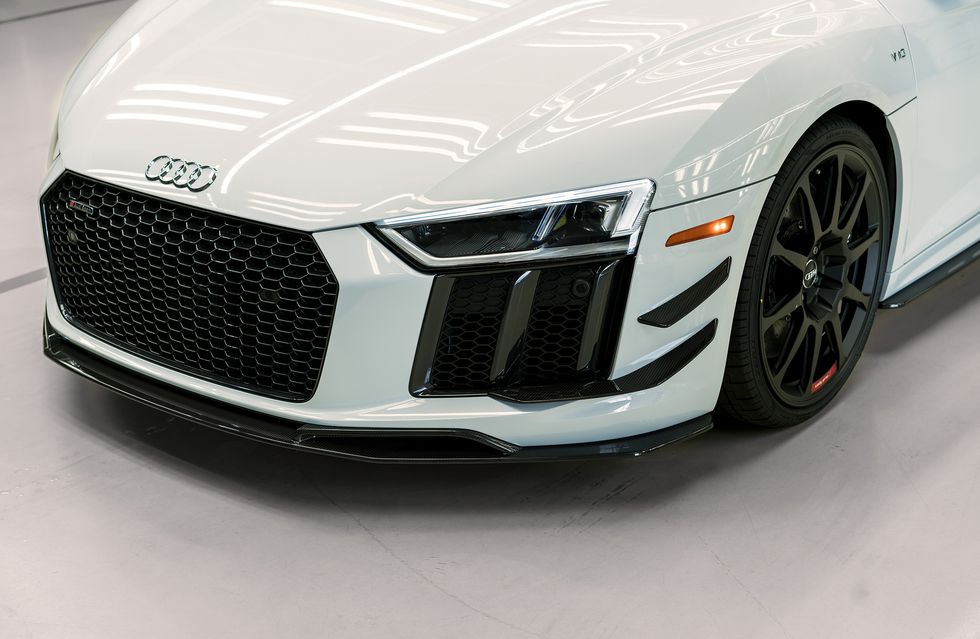
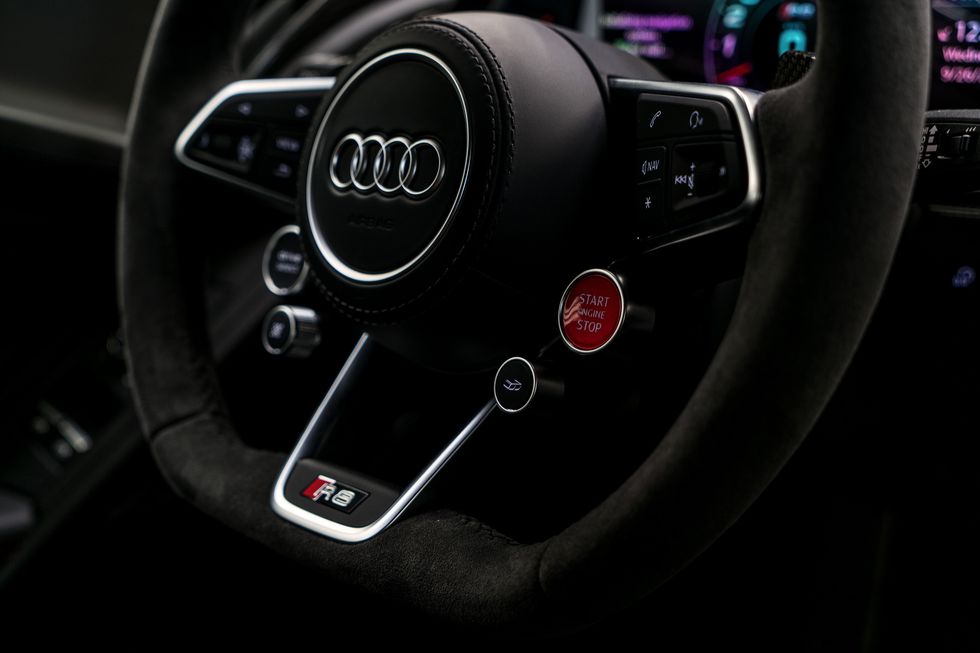
Audi is currently working on an improved version of its R8 model, so tide fans over in the meantime, the automaker has officially unveiled the ultra-limited edition R8 V10 Plus Coupe Competition. And by limited edition, we mean Audi is only making 10 units.

Yes, you read that number right. Audi is billing the car as the most “performance-oriented production R8 model ever produced,” and that’s no surprise considering it comes equipped with all of the components offered by Audi Sport performance parts.

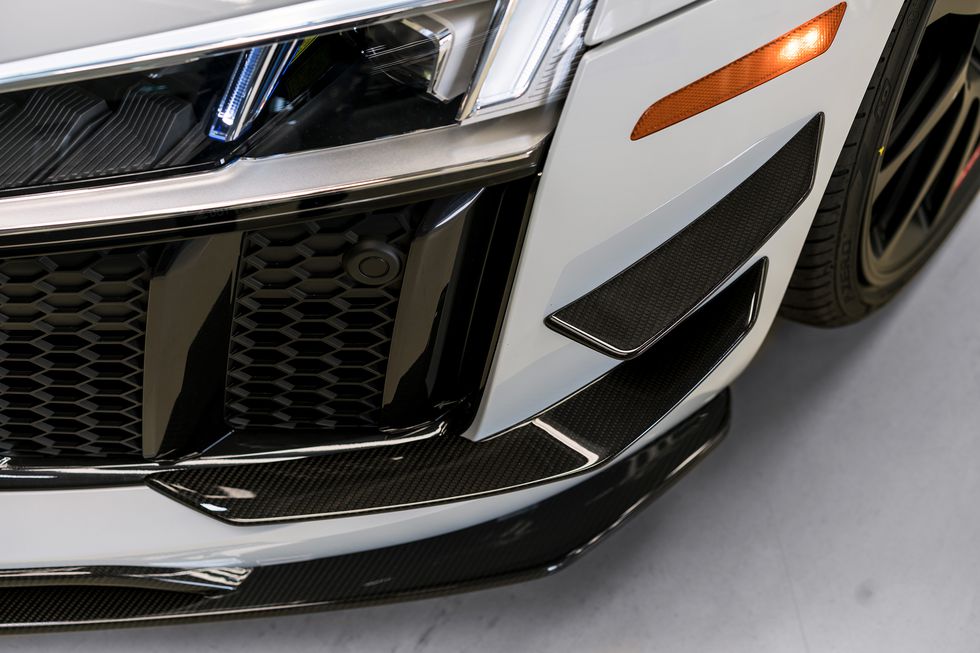
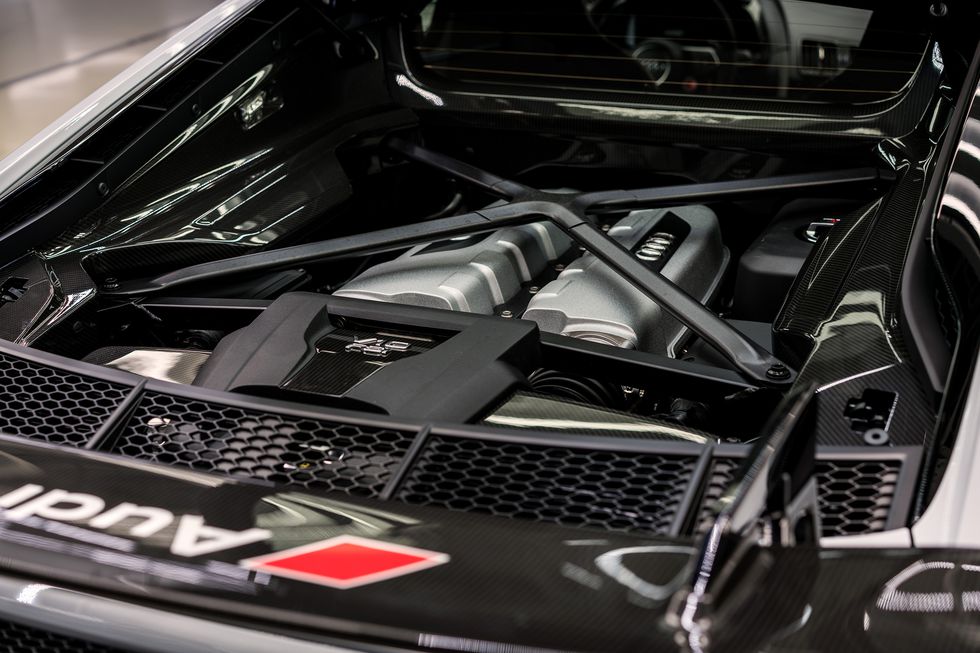
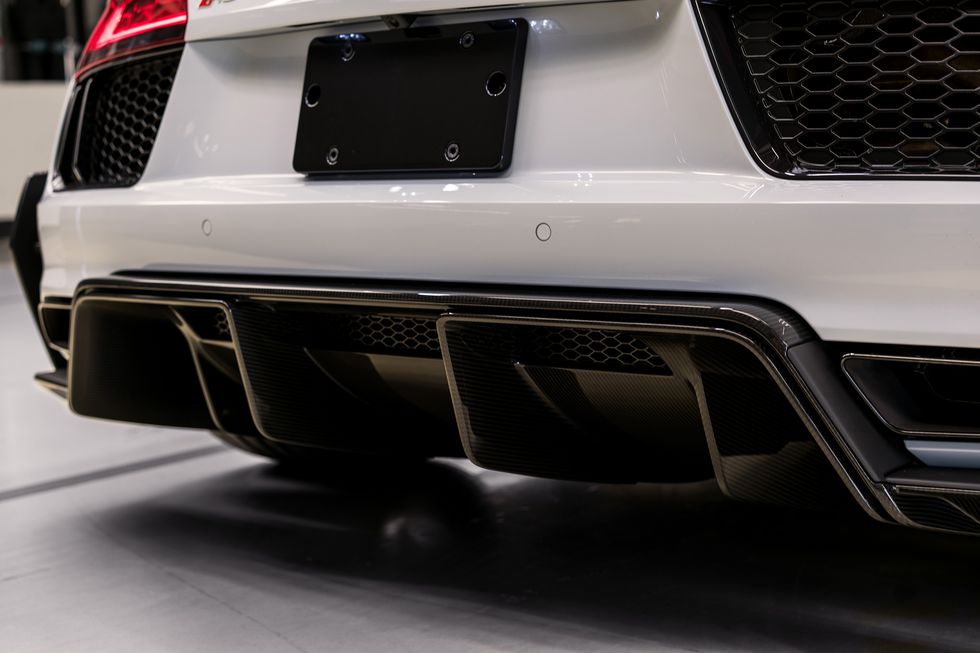
The result of such a radical upgrade is an aggressive carbon fiber body kit that includes a front spoiler, flics, and side skirt extensions. Carbon fiber also arrives on the fixed rear wing and the sporty rear diffuser.

The carbon fiber treatment isn’t just for aesthetic improvements, however. Audi explains that it also helps increase downforce. This thing tops up to 114.6 pounds of downforce, says the carmaker. In other words, twice the amount of base R8 V10 Plus.

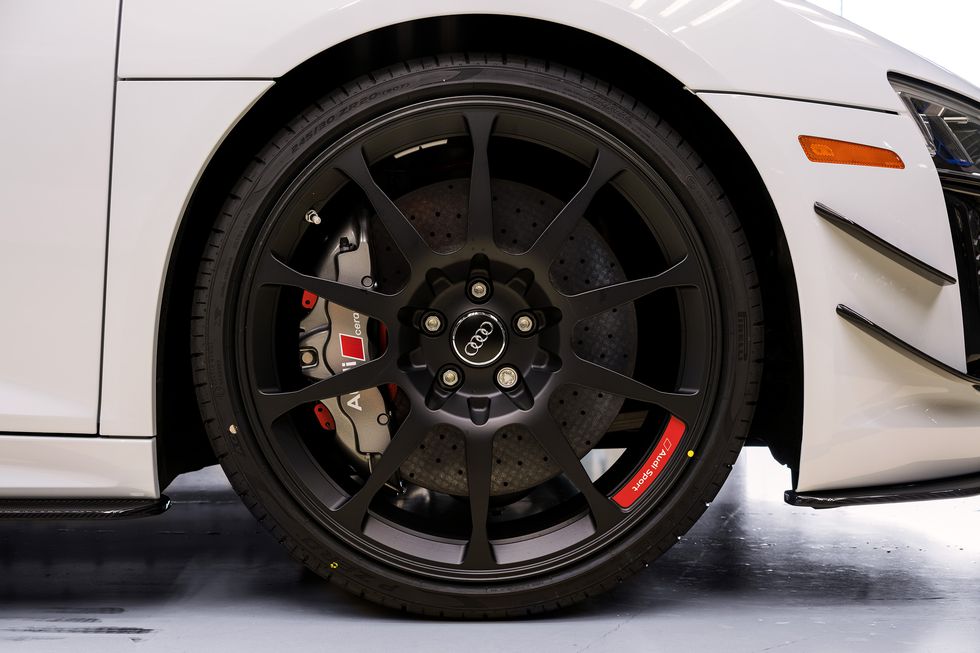
You’ll also find new Titanium backing plates for the R8’s carbon-ceramic brakes. Through this, Audi shaves off 2.2 pounds off the car’s curb weight. Audi also threw in new 20-inch alloy wheels that are just like the one used in the R8 GT4 race car, cutting off an additional 26.4 pounds.

You’ll find the powertrain unchanged, though. It’s still the same 5.2-liter V10 that produces 602 horsepower 413 pound-feet of torque, fed to all four wheels through a seven-speed dual-clutch transmission. The only difference is that this model has a specific three-way adjustable coilover suspension.

The car hits dealerships in the United States in November at a whopping $239,900. You’ll be one of only ten owners in the country, though.

MORE FROM AUDI

Photos courtesy of Audi

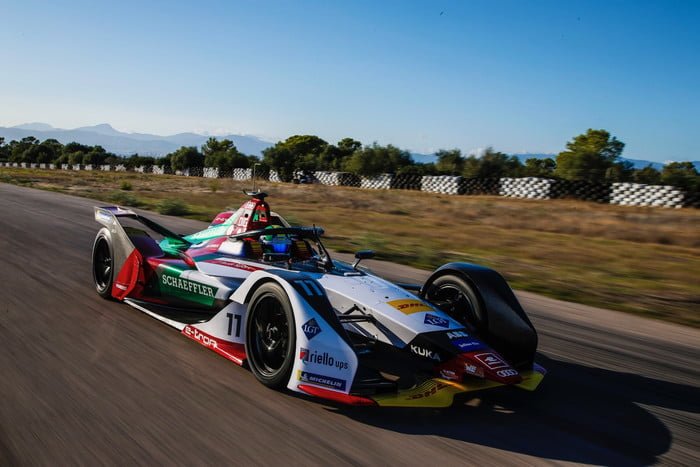
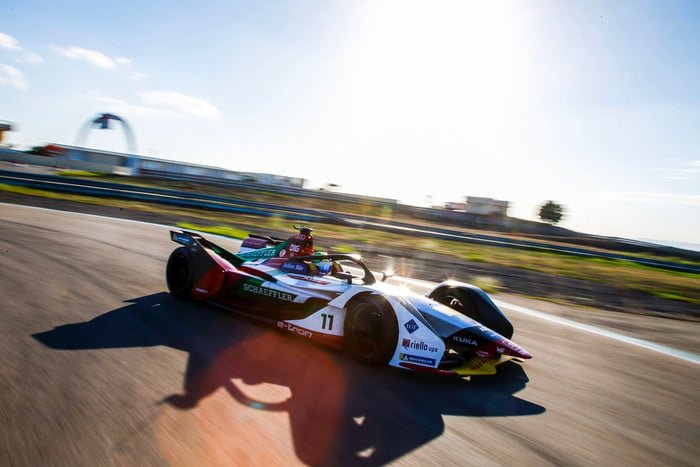
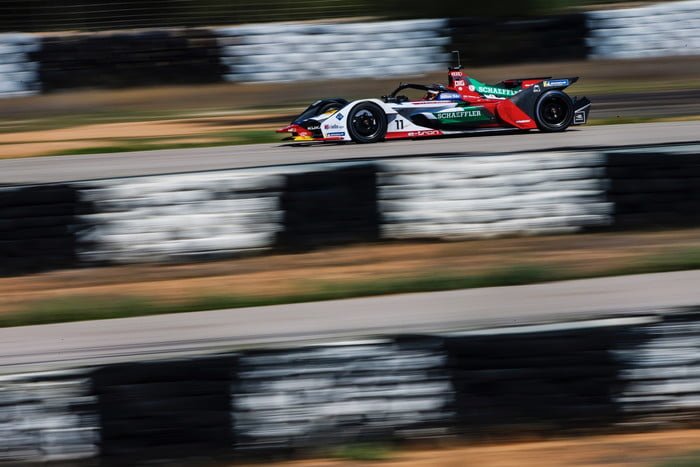
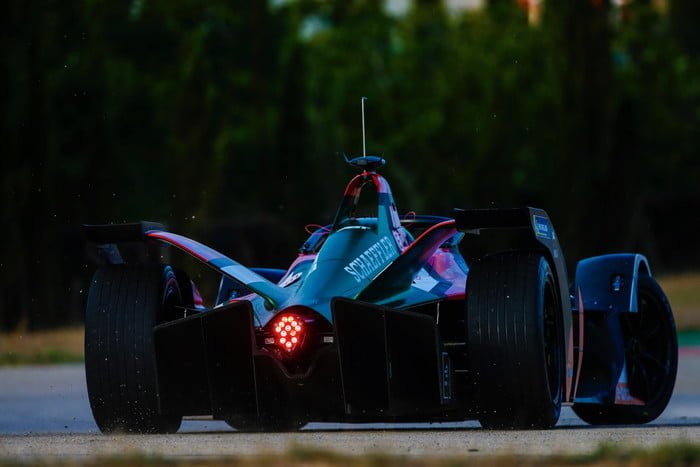
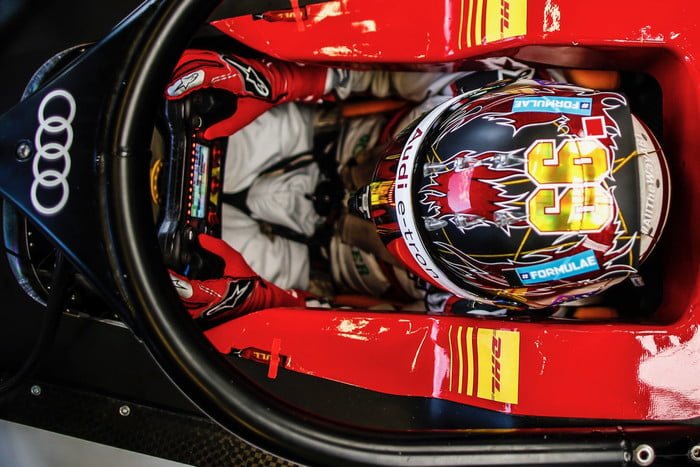
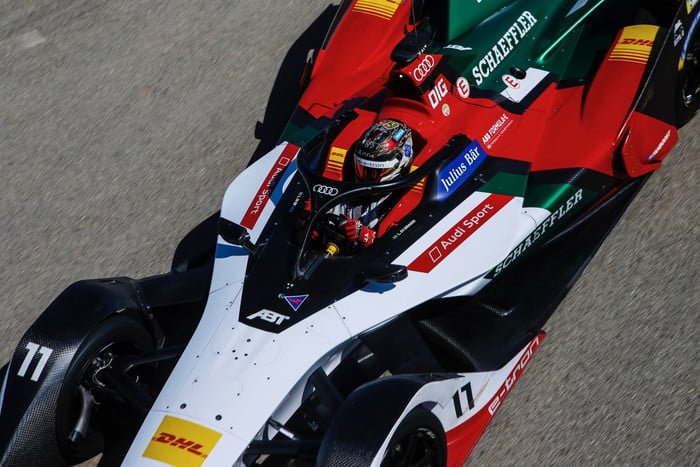
Audi E-Tron Formula E Race Car

Back in September, Audi unveiled the e-tron, the brand’s first mass-market electric car that’ll take on Tesla’s Model X. Fast forward to today and we now have a variant for the race track, the still all-electric e-tron FE05 Formula E series.

The car hits the tracks Dec. 15, using the same “Gen2” design used by all other teams. All Formula E cars use the same 52-kilowatt-hour lithium battery pack, the FE05 included. It can hit zero to 62mph in just 3.1 seconds and can reach a top speed of 149mph, Audi says. It’s also fairly light — just 1,984 with the driver onboard, courtesy of Formula E rules.

While Formula E imposes rules designed to create a level playing field for all, this time, teams were free to design their own electric motors and other components as they saw fit. In Audi’s case, it hopes to gain an advantage through greater efficiency with its in-house motor design. And because Formula E cars don’t rely too much on aerodynamic downforce for performance, the designers had a field day on making them, well, look insanely cool. Audi says 95% of this car uses new components, and its designers found a way to shed 10% off the total weight.

The fourth season’s Audi powertrain was widely perceived as the most efficient in the FE field, which gave it a boost in races. However, it did suffer from reliability issues in the first four rounds of the 2017/2018 championship. It’ll be interesting to see how fat this car goes this Dec. 15 when the next Formula E season kicks off.

LEARN MORE HERE

Photos courtesy of Audi

VW Group plan puts Porsche in charge of a ‘super-premium’ division

An Automobile report looks into what’s happening on the organizational and technical sides of the Volkswagen Group, and what those changes could mean for the premium brands. The wide-angle view is that Porsche appears to have been anointed to “coordinate the future activities” at Audi, Bentley, Bugatti and Lamborghini. Audi would cede Lamborghini guardianship to Stuttgart, and Ducati — via a new concern called Ducati Enterprises — would become the shepherd for VW’s other Italian investments. Executives target Jan. 1, 2019, to complete the reshuffle.

VW wants to save a boodle by tying up four of its five top-tier brands, and putting the one with the highest ROI in charge. Porsche, within its own house, wants to reduce expenditures by $2.3 billion per year over for four years, the savings already earmarked for improving internal processes like R&D and production. Having Porsche share those gains as well as lead development of platforms, components and future-tech strategies for the sister sports car brands could benefit everyone.

In the near-term, the brands have their own plans:

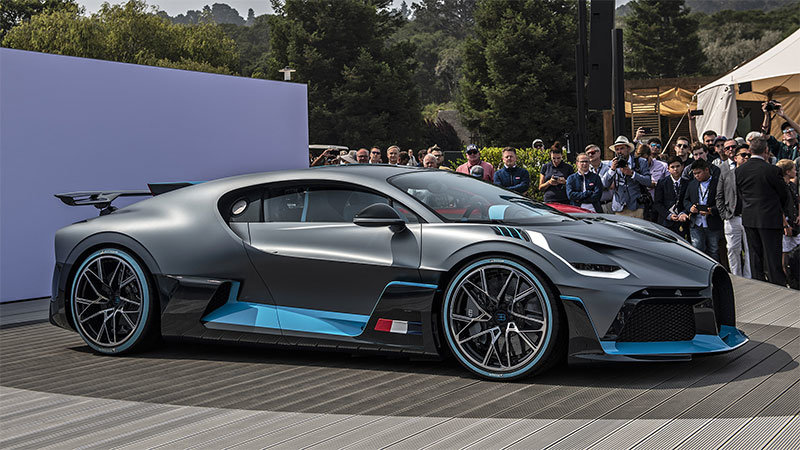
Bugatti CEO Stephan Winkelmann is said to want a Chiron Superleggera, a roofless and “completely reskinned” Chiron Aperta, and a track-only Chiron SS. The Superleggera could take the Chiron Sport‘s and Divo‘s Jenny Craig routines even further. The Aperta seems a natural successor to the Veyron Grand Sport, a natural evolution of the recently introduced Sky View roof, and a reskin might include numerous Divo cues. It’s also said Bugatti’s considering “an all-electric high-end model” in conjunction with Porsche, Rimac, and Dallara, but name one supercar or hypercar manufacturer that isn’t considering a lightning-fast EV.

Lamborghini, deep into work on follow-ups for the Huracán and Aventador, might get a bit of a bump with the new plan. The carbon “monofuselage” for the next V12 flagship is said to be too far developed and too complex to scrap. It puts two electric motors on the front axle, batteries in the middle, and a naturally aspirated V12 with around 770 horsepower plus another e-motor with 402 horsepower in back.

The Huracán is said to get a version of the same carbon architecture at the moment, but the corporate reorganization might press pause on it. Automobile says options include continuing the Huracán/Audi R8 twinning, but that depends on Audi saying “Ja” to a third-gen R8 with Lamborghini bones. Beyond that, the Huracán could move to the Mimo II platform created by Porsche for the in-limbo-since-2011 mid-engined 960, or the entire premium group could get a new aluminum architecture for a “modular multi-brand sports car.”

Bentley and Audi need the most help at the moment. The UK carmaker needs to flesh out its current financial issues and vision for the future, and the latter relies in large part on the former. Audi remains in upheaval — the Automobile piece calls the brand “seriously overstaffed and worryingly over budget.” — and we can’t know when that will end. The ex-CEO who made the brand VW’s highest earner remains in jail, and we wouldn’t be surprised by any new bombshell that drops when he gets his days, or weeks, in court.

A total reintegration, if it all comes off, means monumental work. Yet according to a Bloomberg corporate analyst, potential rewards from going all the way with the plan might make it impossible to resist. Bloomberg said that if VW created a premium group and floated it on the markets, the result “could be valued at more than 120 billion euros,” when the stock market capitalization of the entire VW Group right now is 67 billion euros.

Related Video:

Audi PB18 e-tron Concept

Audi’s Latest Take On The Mid-Engined Electric Supercar

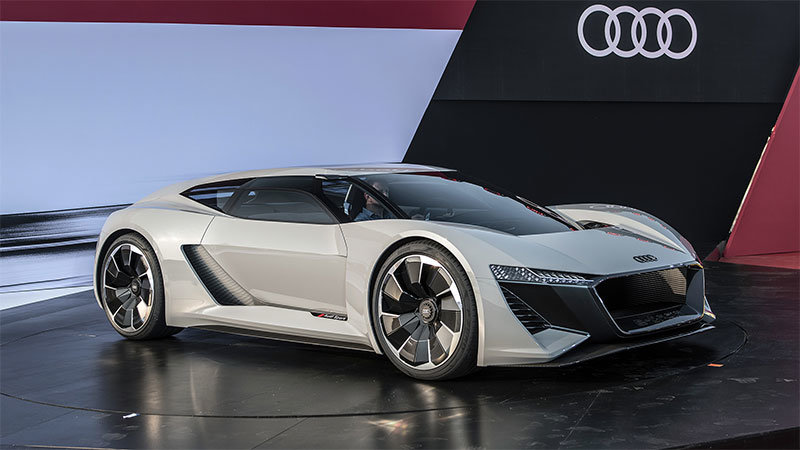
The Audi PB18 e-tron Concept was recently unveiled during Monterey Car Week taking place in Pebble Beach, California. Just a few hours’ drive away is where it was designed, at the new Audi Design Studio in Malibu.   

This new concept car derives its naming scheme – and some of its DNA – from the Audi R18 e-tron LMP1 racing car. The PB18 also carries an uncanny resemblance to the company’s Audi Aicon concept which appeared at the 2017 Frankfurt Motor Show. However, unlike the aforementioned which was touted as a completely autonomous vehicle, the PB18 requires a driver behind the wheel.

Powering the PB18 are three electric motors which deliver a combined output of 670-horsepower and 612 lb-ft of torque to the all-wheel-drive system, and achieves 0-100 km/h in just over 2 seconds. The 95-kWh battery is stated to provide over 310 miles of driving range on a full charge, and can be recharged in under 15 minutes with an 800 volt station.

The PB18 body is the amalgamation of an extensive use of aluminum, carbon fibre and other lightweight composites. The car still weighs a not-exactly-flattering 3,417 pounds, though taking into account that this is a fully electric vehicle will save Audi any blushes. Afterall, the battery placement ensures that the PB18 has the weight distribution of a mid-engine car, while also borrowing the magnetic suspension from the R18 race car.

Most notable – as far as eye-catching features are concerned – would have to be the central seating position. Even with the proliferation of high performance, track-oriented supercars and hypercars these days, this is very rare to see. There are however, controls which allow the seat to shifted to the side and allow room for a passenger.  

[embedded content]

Third-gen Audi R8 to be an all-electric, high-horsepower supercar?

Schroedinger would be proud of the impossible-to-know state of the Audi R8. In March we heard that there’d be no third generation for one of the most well-known sports cars of the era. Most, however, did expect an R8 V6 to bow this year at the New York Auto Show. If the downsized coupe actually exists as a production proposition, it skipped out on NYC. But three months later, a report said the six-pot two-door would come with the 2019 R8 refresh. While we await provable info on that, Autocar reports that a third-generation R8 is on the way around 2022, and it will be an all-electric offering aiming its rings at the genuine supercar crowd.

Autocar, going on what “senior company sources have hinted,” said we could be looking at “perhaps as much as 1,000 bhp,” and a return of the R8 E-tron badge on a rocket “likely to have a 0-62 mph time of about 2.0 sec.”

A third-gen, electric R8 would mark the third attempt at a battery-powered halo car for Audi, and — if this is the rumor that becomes fact — would be the first one with a genuine chance for success. The Ingolstadt carmaker developed an electric first-gen R8, canceling the project in 2013 before going to market. Audi tried again with the second-gen coupe in 2015 and got all the way to showrooms, but the car was handicapped by an output of 376 horsepower and 605 pound-feet of torque, and a 204-mile range — performance that couldn’t surpass the Tesla Model S — attached to a seven-figure price. Company execs pulled the car from the market after one year and fewer than 100 sales.

The recent PB18 concept from Pebble Beach is a good place to start thinking about a potential R8 EV. The PB18 contained three electric motors, 764 horsepower and 612 pound-feet of torque, and a simulated 62-mph sprint of “scarcely more than two seconds” on the way to a 186-mph top speed. Coincidentally, the PB18 fit the same dimensions as the current Audi R8, though the PB18’s body was shaped into a two-door shooting brake. Autocar wrote that the “E-tron GT will feature a two-door, four-seat design and offer more than 800 bhp,” and that its technology could be ported to the third-gen R8.

This raises a bit more confusion. Peter Oberndorfer, Audi’s global head of product and technology communications, told Motoring in March that the E-tron GT would be “a very sporty four-door car, not the successor to the R8.” Our guess is that even though the PB18 was a two-door, that it contains more clues about the E-tron GT, expected to arrive in 2020, than any R8.

Yet the PB18 featured a 95-kWh solid-state battery pack, and Audi’s known to want solid-state juice for any sports car. As Oberndorfer told Motoring in that same interview, “[If] you go very fast you need a lot of battery and don’t want to spend three days going from the Nürburgring to Munich or the other way around. …” Solid-state power could get the R8 the output and recharging times to make sense, and an R8 EV could provide the same halo service for the new E-tron division as the original R8 did for the regular Audi lineup.

We’re still not ready to put any faith in this yet. In March, the carmaker’s R&D boss said Audi Sport hadn’t come up with any plan for a next-gen R8. If Audi’s really settled now on an all-electric R8 to bow in just four years, we think Audi Sport would have had a roadmap laid out in March; look at how long the Porsche Taycan has been publicly under development, and how long we still have to wait for it. When Slashgear queried its sources, the outlet said, “So we’re hearing, things are still very much at the discussion phase as to what Audi might do for the new R8’s powertrain,” including the possibility of a V10-powered coupe and an electric R8 E-tron.

At this rate, we’re going to run out of our monthly allotment of salt to use on other rumors before September’s out.

Related Video:

2019 Audi Q8

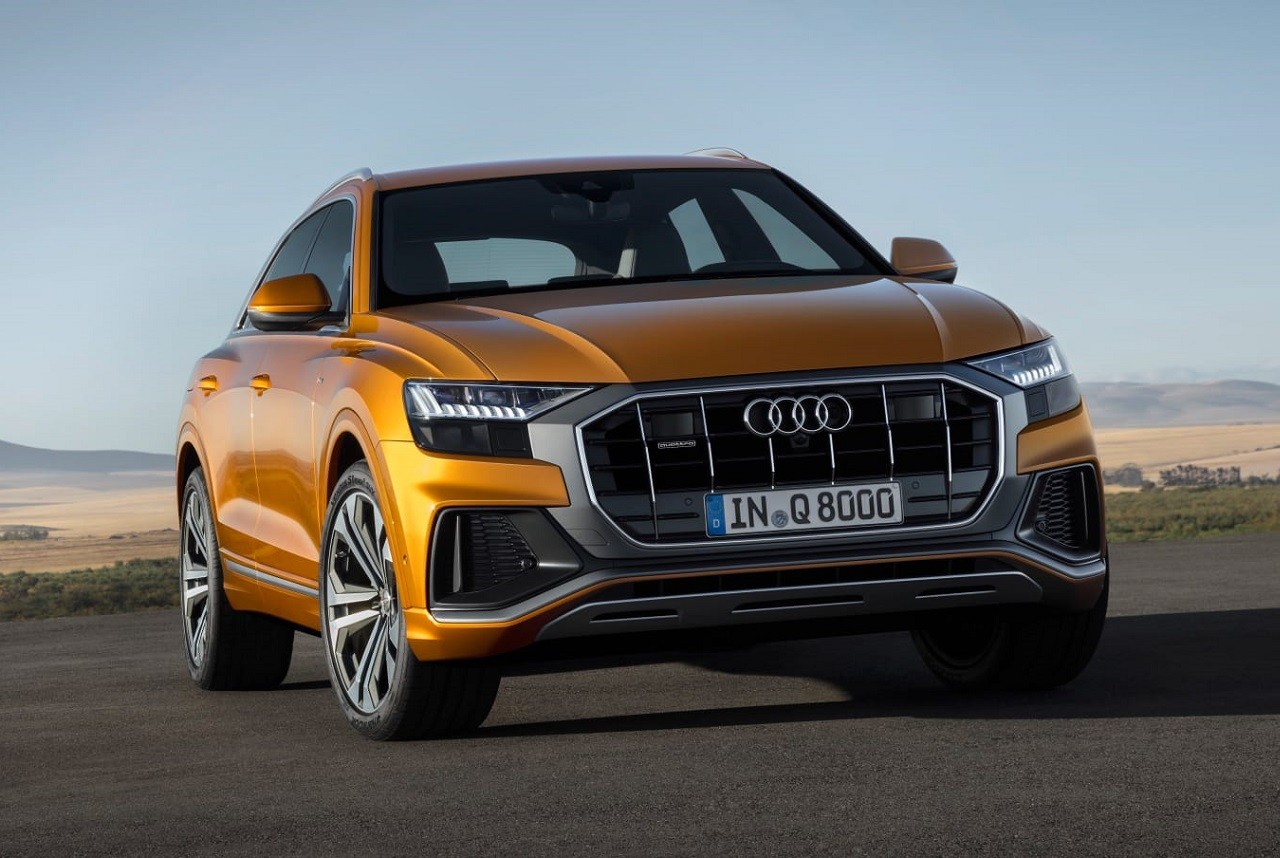
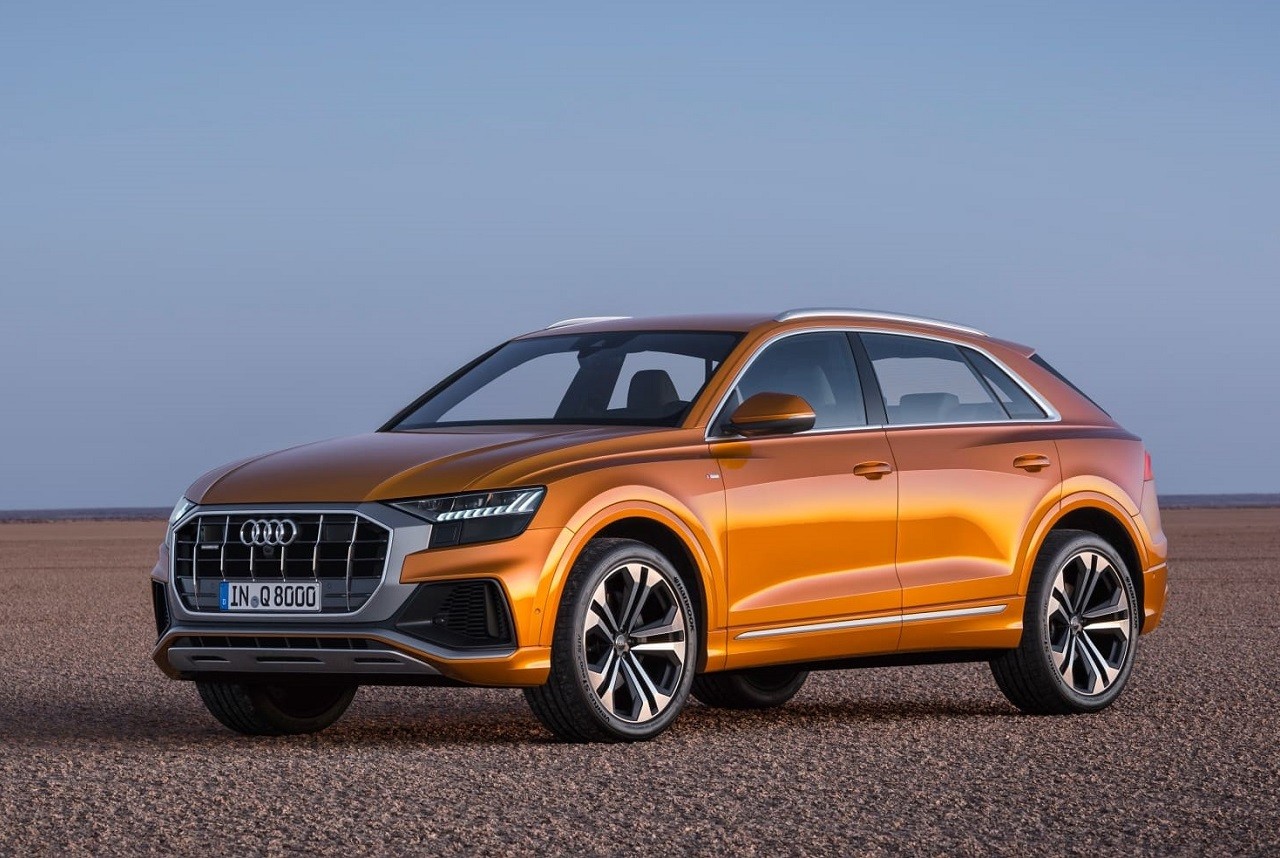
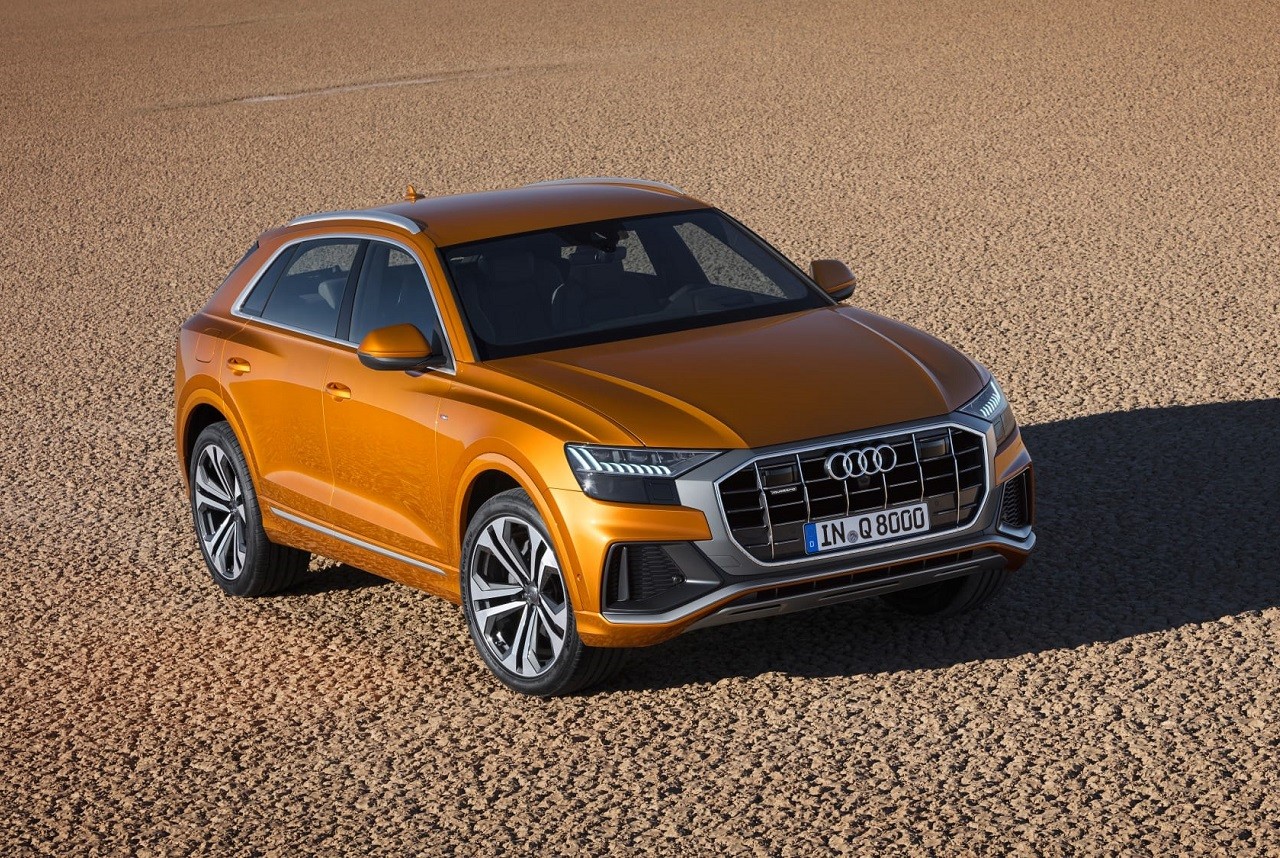
Combining modern technology with design cues taken from the original 1980’s road & rally car Ur-Quattro, the 2019 Audi Q8 introduces a new look for the brand’s popular Q line, one that is sure to raise mixed feelings.

The Q8 sits lower and wider than its predecessor, just like a svelte coupe, while its bold front-end with octagonal single-frame grille reminds us that this is an SUV at its core. Power figures are yet to be revealed, but we do know that each drivetrain will feature a “mild-hybrid” technology.

All-wheel-drive will be available on tap of course, and the latest MMI infotainment system will offer haptic and acoustic feedback matched with a Bang & Olufsen 3D sound system. The Q8 is set to be released by the end of this year.

Learn more From Audi

Audi Q8 – Official Details are Finally Announced!

The brand new Audi Q8 has finally been unveiled this evening. The launch event for the Q8 took place in Shenzhen in China, the home of the biggest Chinese technology companies. If anything, thats an indication as to Audi’s target market!

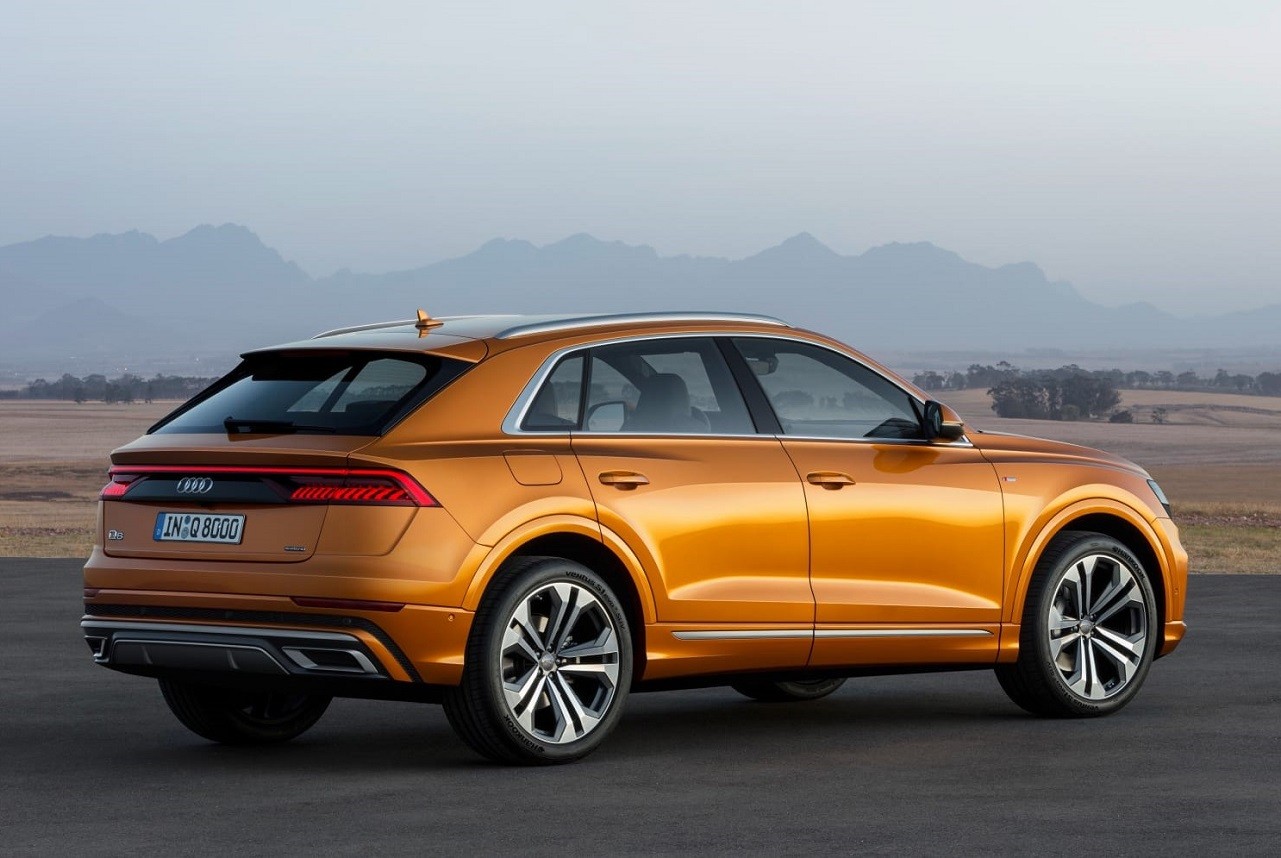
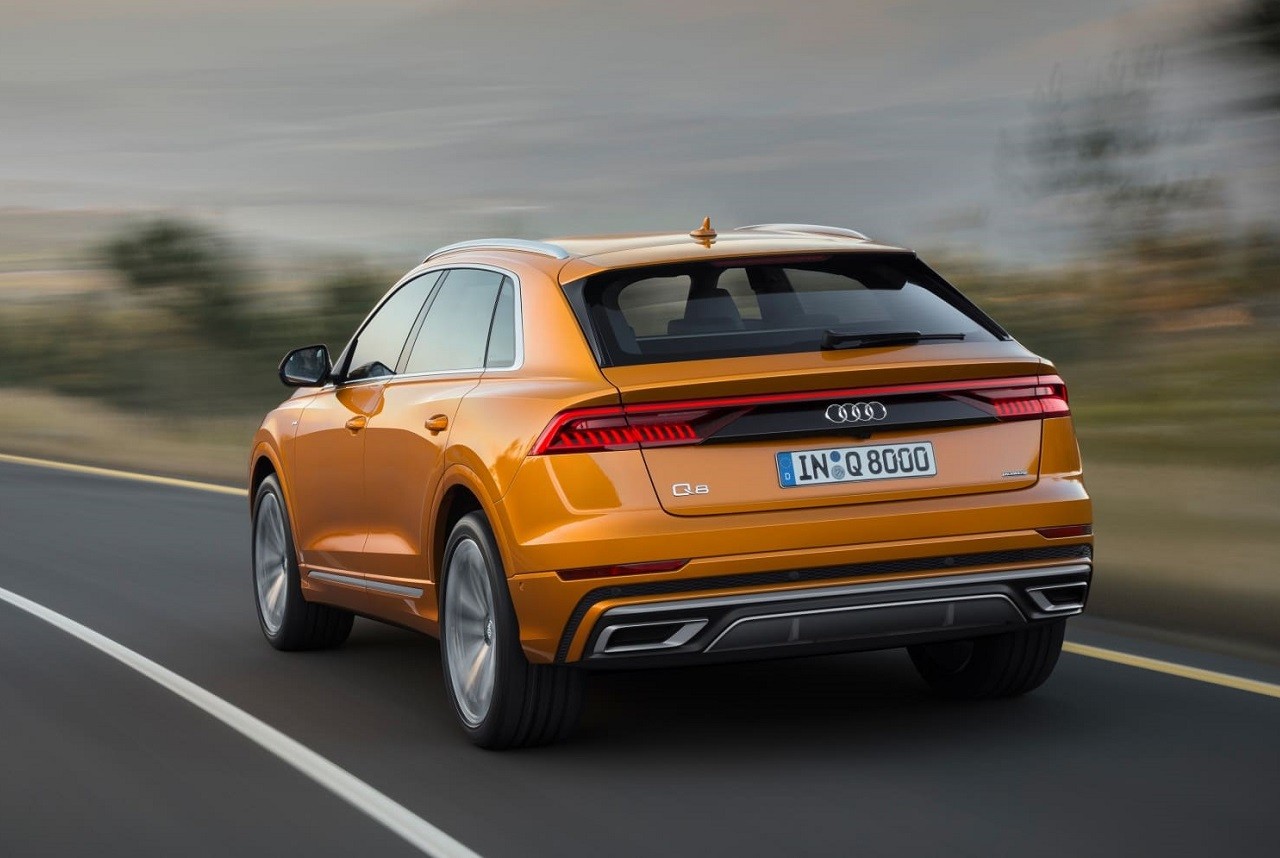
There are no surprises when it comes to shape. The Audi Q8 gets design language carried over from the A8. Among the standout features are the frameless doors which allow a coupe style look and the long roof spoiler. At the front, the single frame grille gets and octagonal design with six vertical chrome fins. The side profile clearly displays the trademark quattro blisters while the rear gets the integrated light strip which is now standard Audi issue.

Two headlight technologies will be available on the Q8. Both are LED, with the optional HD matrix LED headlights offering 24 individual LEDs. With a cd value of 0.34, the designers seem to have done a pretty good job of creating an efficient design.

The bodywork makes use of the Audi Space Frame concept. It is a blend of aluminum and steel components. Steel accounts for 14.4 percent of the body-in-white, cast aluminum 15 percent, aluminum plates 23.7 percent. All in, the Audi Q8 weighs 2,145 kilograms (4,728.9 lb).

In terms of size, the Audi Q8 measures 4.986 metres in length, 1.995 millimeters in width and 1.705 metres in height. Compared to the Q7, it is 66 millimeters shorter and 27 millimeters wider. Compared to the competition, the Q8 is slightly longer than, for example, the GLE Coupe and around the same height. It sits slightly narrow by comparison.

The rear tailgate is electrically powered as standard with a foot gesture option available on request. 605 litres of space are on offer which increases to 1,755 litres with the rear backrests folded down. The space the Q8 offers is class leading.

Audi Q8 Studio Photos

Quattro is standard. It uses a mechanical centre differential to transfer 40 percent power to the front and 60 percent to the rear. When struggling for grip, the Q8 has the ability to transfer power to any axle to optimise traction.

From an engineering viewpoint, the five-link front and rear suspension systems are constructed largely of aluminum. Audi offer three suspension options. The standard is a version with damper control. Optionally, an adaptive air suspension can be chosen. It includes controlled damping across four modes with the Audi drive select dynamic handling system. The most expensive option incorporates the all-wheel steering system. All three systems feature a progressive steering rack. Audi drive select gives seven different driving profiles.

Like most in this segment, the Audi Q8 gets off-road credentials. Ground clearance, the the adaptive air suspension systems is 254 millimeters. On slopes in excess of 6 percent, Audi’s hill descent control is available with the MMI system displaying the tilt angle.

The Audi Q8 sits on 19 inch wheels with options up to 22 inches available from launch. Being the bling sits a set of six-piston brakes with fixed aluminum calipers.

Audi Q8 Studio Photos

From launch (which will take place exclusively in Europe for the time being), the Audi Q8 will have one option. The 3.0 TDI with mild hybrid system is familiar and has been a feature of the A7 and A6 models we drove recently. The systems uses a lithium-ion battery and a belt alternator starter. A battery underneath the luggage compartment floor stores 10 Ah of electricity allowing the Q8 to efficiently coast between 55 and 160 km/h (34.2 and 99.4 mph) with the engine switched off.

The first model is the Q8 50 TDI which uses a 3.0 litre TDI unit. It generates 286 hp and delivers 600 Nm of torque, enough for a 100 km/h sprint of 6.3 seconds and a top speed of 232 km/h (144.2 mph). A smaller 3.0 litre diesel Q8 45 TDI will follow with 230 hp and a 3.0 TFSI gasoline-engine Q8 55 TFSI with 335 hp next year. The later will form the basis of the Asian and US model ranges. All engines will get the eight-speed tiptronic gearbox.

One thing point to note is that Audi fit the Q8 with a double-layer windshield as standard with the option of acoustic glass at an extra cost. The A7 and A8 are supremely quiet machines, the Q8 is likely to share these qualities despite it’s obvious disadvantages.

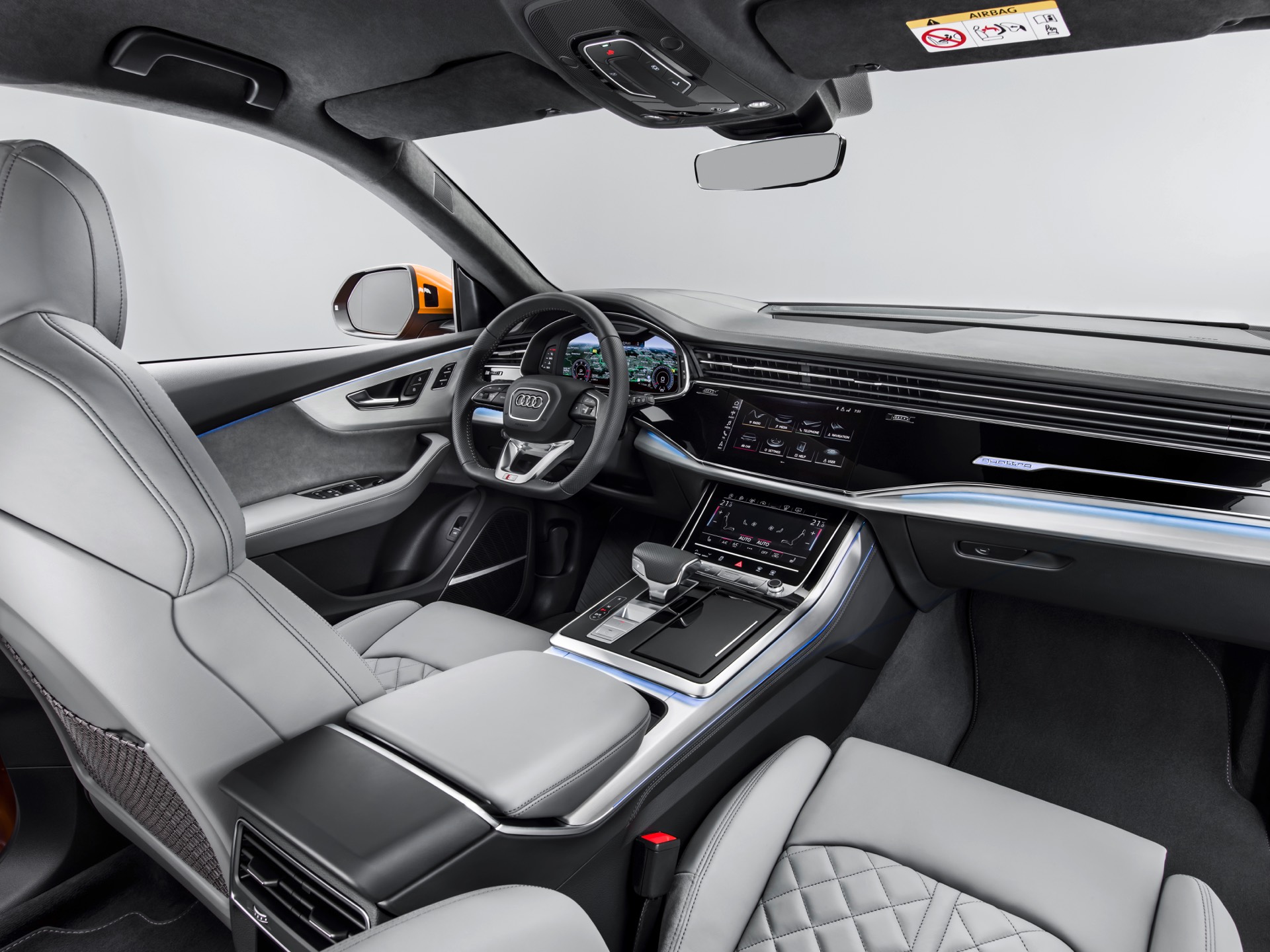
Inside, three trim levels will be made available; Premium, Premium Plus and Prestige. Leather seating is standard across the range with leather seats in all three versions. The top version benefits from Valcona leather. An optional S line sport package adds S sport seats with integrated head restraints, rhombus pattern and S logo. Four seat versions are available in total. All versions also include open pore wood or alluvium inlays.

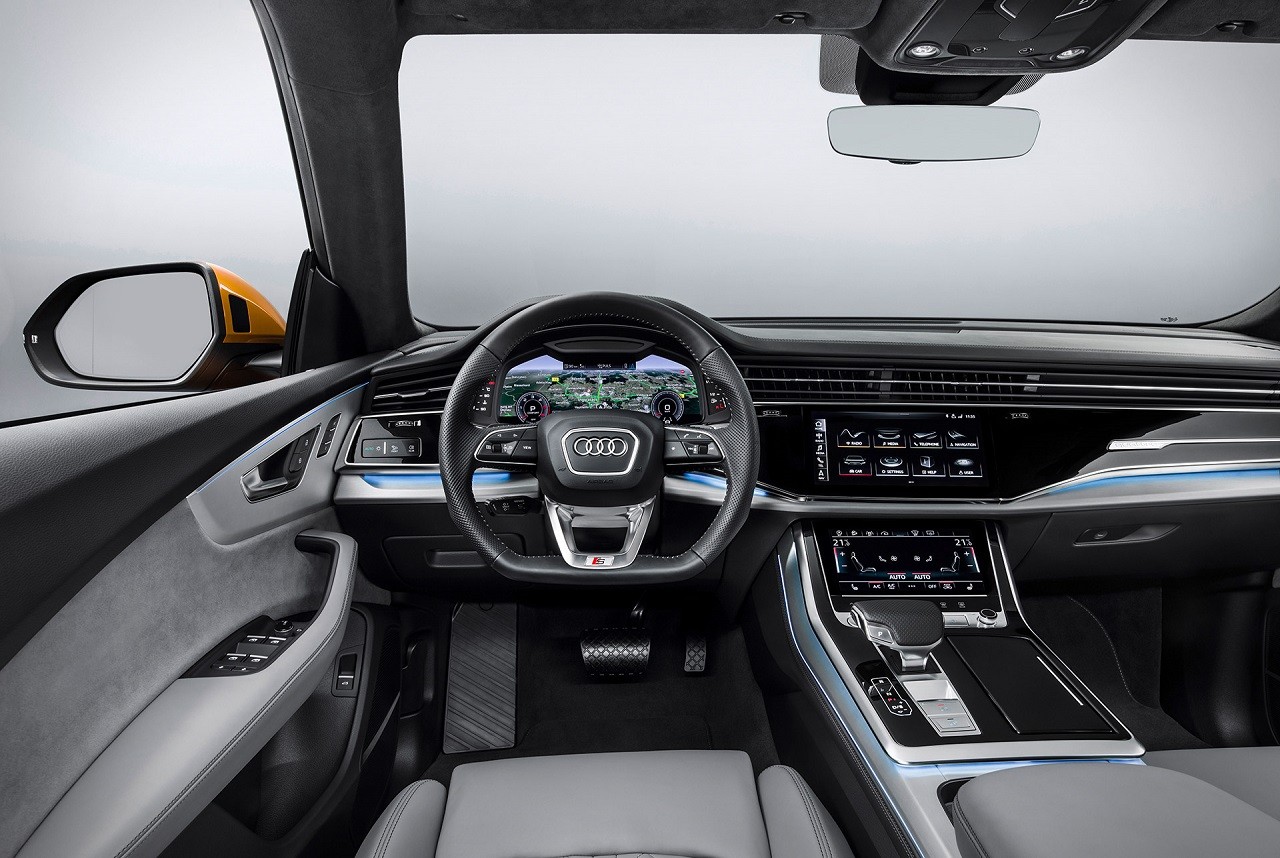
The Q8 gets the familiar split upper and lower MMI touch response display from the A8, A7 and A6. The upper display uses a 10.1 inch screen for controlling the infotainment and the navigation system. The lower 8.6 inch display allows the driver to manage the heating, ventilation and air conditioning as well as comfort functions and text input.

MMI is where Audi excels. The system incorporates features such as natural language voice control which uses locally stored information together with intelligent cloud-based information to understand most voice commands. MMI navigation plus comes as standard.

Audi Q8 Studio Photos

Key features include the new LTE Advanced standard. The navigation system includes intelligent destination suggestions based on previous journeys. It is supplemented by information calculated online by navigation provider HERE. HERE uses real-time data from the Car-to-X services to ‘swarm’ intelligence from the Audi fleet. The Audi virtual cockpit is also standard with a high-resolution 12.3 inch display. It gets two views – classic and navigation – with a third Audi virtual cockpit plus option offering a sport look soon after launch.

For the ultimate in technology, Audi offer the Audi Connect key which allows access to the car from an Android smartphone. This will allow you to lock and unlock the car and start the engine remotely as well as to change the position of the drivers seat, set the air conditioning and program navigation details.

Audi also makes available its range of assistance systems in four bundles. The Tour assist package includes adaptive cruise assist, efficiency assist, an active accelerator pedal and emergency assist. The City package bundles five systems including crossing assist, Audi pre sense 360, exit warning and lane change warning. The Park plus package (available after launch) includes manoeuvring assist, curb warning, (remote) parking pilot and remote garage pilot. The final package is dedicated to towing.

Audi will build the Q8 at its Bratislava plant with the first cars hitting the European markets in July 2018. Twelve colours will be available including dragon orange and galaxy blue, two of its latest colours.

2015 Audi S3: A Future Used Car Bargain?

Three generations later, the Audi S3 is still going strong, capturing the hearts of young professionals everywhere. Evolving to be better, the S3 still has performance in mind while living to expectations that Audi is known for. The S3 is only offered in a sedan and while it looks very sleek, it does have issues. What better way to explore the best and the worst than a road trip!? Let us at Supercars.net take you on a cross-border journey with our companion from Ingolstadt.

A New Generation

Image result for mqb platform

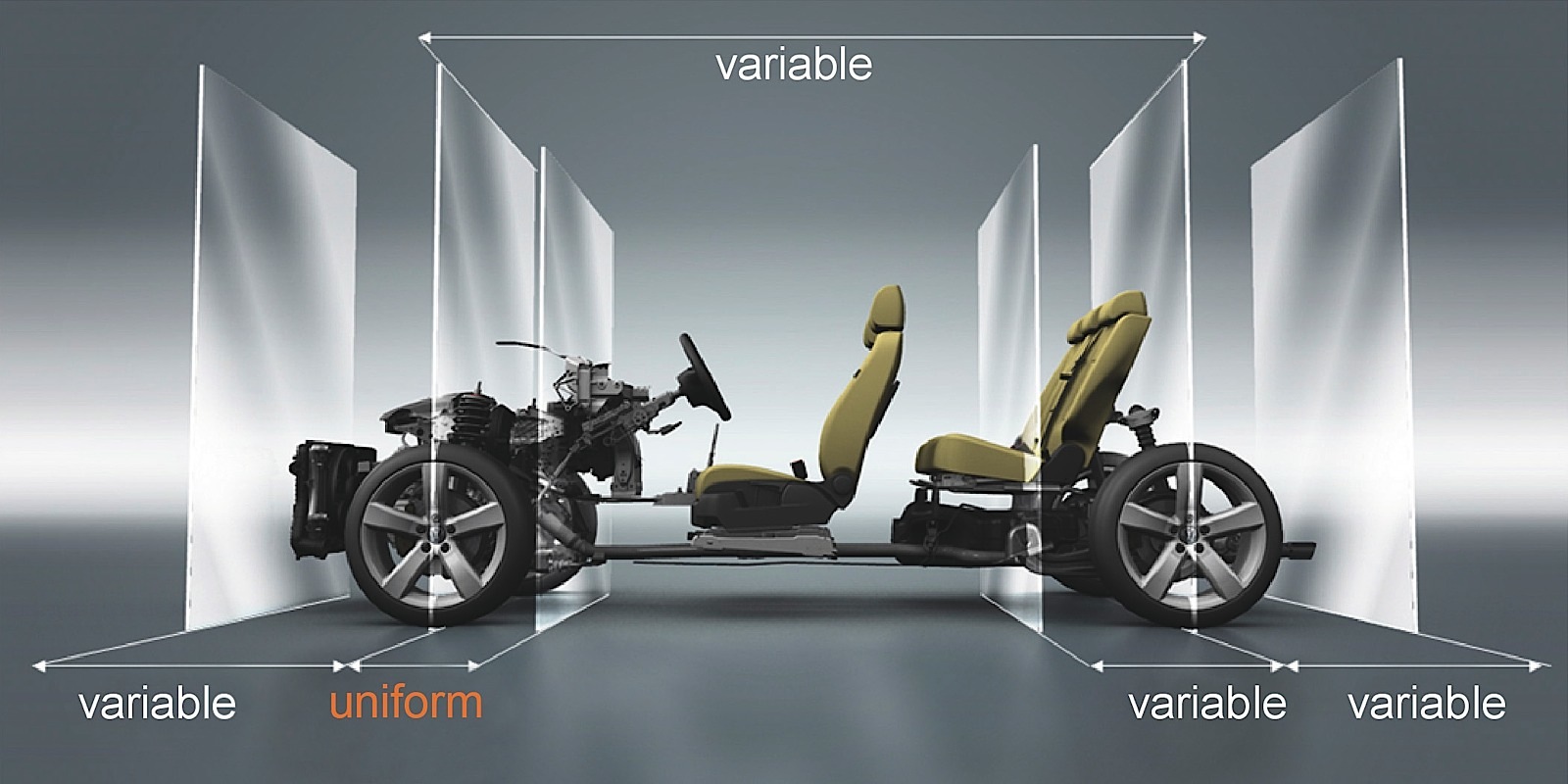
Image result for mqb platformThe current generation was designed and developed with modularization in mind: meaning interchangeable pieces for efficiency and cost-savings in mind. Under the MQB platform, the Volkswagen Group is able to create the S3 in the same underpinning as the Volkswagen Golf GTI/R to compete with the Mercedes Benz CLA, and the BMW 2 series. The MQB, which stands for “Modular Transversal Toolkit” in English, gives the Group a singular platform to provide easy maintenance, engine/secondary parts interoperability while giving unique design cues on the exterior and interior. Modularization also gives the Group a competitive advantage, by creating individuality on aspects that matter.  The reason why the engine is uniform is that the mounting point is the most exhausting part to develop in order to meet regulations. Beyond electrical and physical mounting points, anything is fair game.

Third Time is the Charm

The third generation of the S3, dubbed 8V, has a complex and interesting history,

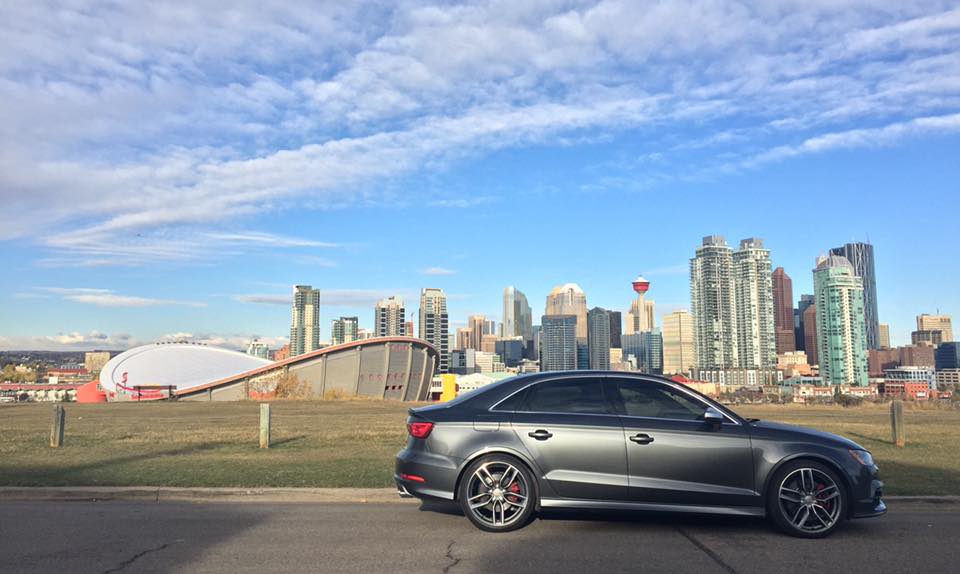
Since North America is tasting the S3 for the first time, we’llImage may contain: cloud, sky, car and outdoor

Image may contain: cloud, sky, car and outdoor focus as if the other two doesn’t exist. In this case, they got this package right. As a compact sedan, it’s reminiscent of the early Audi S4 sedans of the late 90s/early 2000s. The early B5/B6 iterations of the S4 were the right balance of power and handling, with a slight understeer. Compared to the new S4, the S3 is a pocket rocket with great design features that give it a special charm. It’s not as slick as the Mercedes Benz CLA, but once you get inside, you’ll know why that’s a disadvantage.

With a muscular stance, the side profile is very intimidating, with a great flare line at the back, and it’s a great silhouette overall. With the S series, the side mirrors are contrasted with silver and depending on the technology package, the 2015 S3 may have 18 or 19-inch alloy wheels. It’s a pretty car to look at in the sea of beige econoboxes.

On the Road Again…

For this exciting adventure, we brought the 2015 Audi S3 to a road trip from Canada to Portland, Oregon. In the land where keeping things weird is the norm, it’s the perfect location to test out the quirkiness of this delightful vehicle. A mixture of twisty roads, flat, buttery-smooth interstate highways, and early Americana-designed roads filled with random turns, tight spaces, and potholes, it’s a testament to what this machine can do.

This 2,400km round trip gave us a long time to get acquainted with the S3 and we feel that it was quite adequate on the highway. With a peppy 2.0 liter engine, the oomph was definitely there when you need it, and with the S-Tronic transmission, the quick shifts made it easy to pass slow moving traffic. The 2015 version has the 6-speed gearbox versus the newer 7-speed and you don’t really feel the need for another gear. The powerband does peak at around 5000-ish rpm and no point going to redline. It’s just buzzing noises after that. The DSG shifts add that exhaust ‘fart’ that is common with this transmission and you do feel the torque when you punch it.

Choose Your Path

The S3 has a ‘Drive Select’ mode, where you can switch between driving profiles with an option of creating your own. By selecting a mode using a button located in the central console, you can choose:

  • Comfort: Turning radius isn’t as tight, the suspension is cushy, and the launch starts at second gear with earlier shifts to minimize jolt and a smooth transition
  • Dynamic: Tighter turning radius, a more responsive (hint: stiffer) ride, and launches at first gear with the option to go to redline (although it will auto-shift for you if you don’t action it)
  • Auto: The car predicts which profile you need
  • Individual: You can manipulate steering/suspension/acceleration based on one of the three criteria above

The 2015 Audi S3 has Magnetic Ride or ‘MagneRide’ developed by Delphi and described as,
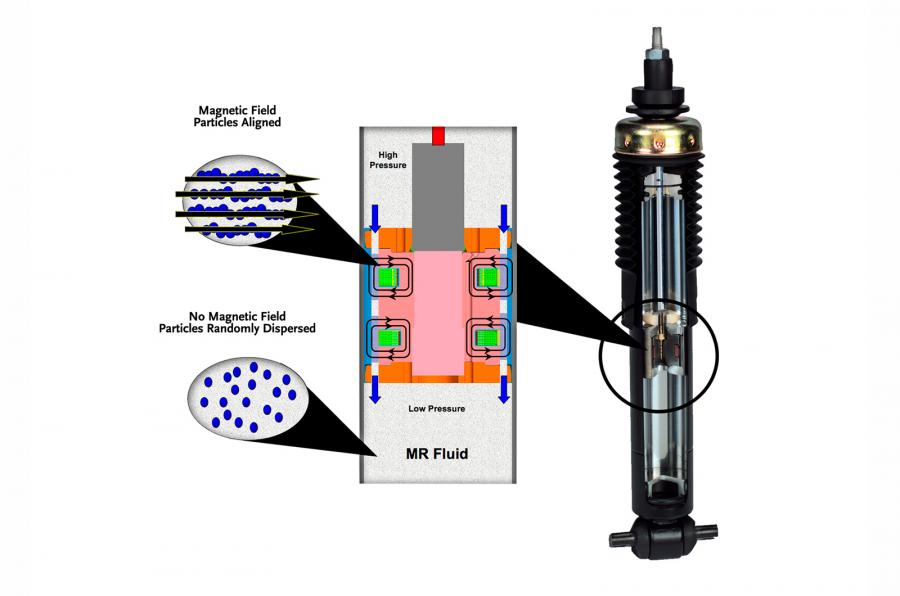
Image result for delphi magnerideImage result for delphi magneride“[…] When the magnets are off, the fluid travels through the passages freely. However, when the magnets are turned on, the iron particles in the fluid create a fibrous structure through the passages in the same direction of the magnetic field. The strength of the bonds between the magnetized iron particles causes the effective viscosity of the fluid to increase resulting in a stiffer suspension. Altering the strength of the current results in an instantaneous change in force of the piston. If the sensors sense any body roll, they communicate the information to the ECU. The ECU will compensate for this by changing the strength of the current to the appropriate dampers.”

Neat stuff, eh? Well, the end result is either stiff or stiffer. You can tell the difference on the twisty mountain roads, but when you’re driving on flat Interstate roads, you can feel every bump. It’s like driving on a teenager’s acne-prone face. It’s not bone jarring but it’s not a sublime ride by any means.

The transmission responds well to the Drive Select and I kept mine on ‘Individual’ with:

  • Dampening: Comfort
  • Steering: Dynamic
  • Transmission: Dynamic
  • Engine Sound: Dynamic

A Tight Squeeze Interior
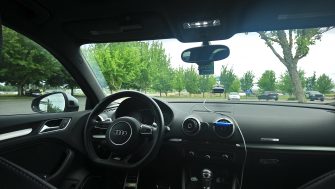
Audi S3 Front InteriorAudi S3 Front InteriorAs the S3 ate up the miles, we got intimate with the car. Our convoy was a 4-person crew with an average height of 5’7″ Overall, the interior layout is nothing but phenomenal.

We love how it lacks a touchscreen but has a pop-up display in the middle of the dashboard. The instrument cluster was clean, unobtrusive, and ergonomically sound. The HVAC display works great. The sound/volume knob is an odd placement, as we kept turning off the blower instead of turning down the radio. When you park the car, it has a clean design and you have the option of stowing the screen away when you’re driving at night to minimize light distractions.

The sport bucket seats at the front are multi-adjustable and you’ll be able to find your comfort spot. The steering wheel is comfortable, with the ridges at 3 and 9 o’clock for a prime driving position. A lot of cars don’t have this feature and it makes a difference when you’re driving for a long time. This Audi S3 has the blind-spot monitoring package but not the active braking, lane departure warning, etc. which is nice. Yes, we understand the great advances in safety technology but it’s just nice to have minimal nannies and just have the essentials. The blind-spot monitoring is a nice touch because as small as this car this, the B and C-pillars are horrendous when you’re switching lanes. I wouldn’t depend on it but is it ever annoying to look at the pillars. They are huge.
The Audi navigation interface has vastly improved throughout generations, especially with the addition of touchpad with handwriting recognition within the control knob. It makes navigating for an address way easier. The voice recognition needs work, as the Mercedes voice navigation I found, was better at recognizing addresses, or contacts.

Not everything is rainbows and butterflies though: the sunroof shade is flimsy and rattles at times, so you have to slide it back into place. The rear seating with the sloping roofline is adequate but not if you’re 6 feet tall and over. On the plus side, the rear seating is worse on the CLA. This is how much room I have with someone sitting the same height as me (5’7″). I mean, one Kleenex box is enough knee room, plus there are built-in passages within the front seat to add more leg room. Overall, it’s not bad to sit in the back but I don’t know how my passengers dealt with that. Maybe it’s the Candy Crush.
A good interior modification that we did was adding Clear Mounts. A custom-fabricated solution, Clear Mounts is an ingenious solution that gives a smartphone a magnetic mount that fits on the Audi A3/TT air vents. You can check them out more here, and we’re just big believers of the product. It’s well-built, well-packaged, and adds more room for other items to take space.

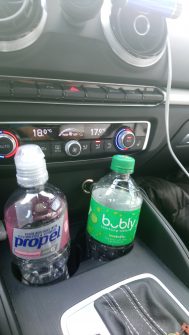
However, the worst offender of all: the front cupholders. In our opinion, this was a complete afterthought. The cups are too close to each other and sometimes, not deep enough. We had trouble fitting two small-sized coffee cups from McDonald’s, and they basically had to overlap one other. Which means if I wanted to drink my coffee, I had to inform my passenger to lift his out first before I can retrieve mine out. Also, check out the configuration when we add water bottles into the equation.  As you can see, the tall bottles get in the way of the HVAC controls, but I feel like we’re just nitpicking now.

It also gets in the way of the 12V plug, but at least there’s a tiny shelf in the back of the cupholders to fit random change or hand sanitizer.

Exploring Portlandia

Hours later, we did arrive in Portland. Navigating through the early streets of the Pacific Northwest requires a vehicle that’s agile, small, and easy to park since everyone in Portland loves parallel parking. In comparison to a fellow MQB vehicle, the S3 isn’t that imposing and is perfect to navigate around the city. It has more than enough power to do over-takes, while it’s short enough to park with ease. The rear-view camera and the surrounding sensors are a great touch to easily park the car in-between.

While exploring this great city, we found that it has great eateries and breweries throughout! It was a foodie’s place to explore and we are so fortunate we had a great car to navigate along with. As we drove through narrow streets, many roundabouts and random one-way, a longer car like an S4 or a Mercedes-Benz C-Class might be a little bit of a struggle but not by much. Having the length of the S3 made things way easier though. An oddity in Portland though is that it’s illegal to fill up your own gas tank! How bizarre is that? Our first instance of this event involved a Q&A session with the gas attendant, to which came up with no conclusion. No one could really tell me why this law exists, but it just does.

We first stopped by Oven and Shaker to grab some delicious pizzas late night and enjoy our first night in Portland. The 50 liter tank in the S3 made long-distance travel a cinch, but with the

premium octane requirement, the savings were diminished but not by much compared to a V8 engine. As we continued to explore downtown Portland, the sports suspension does show their true color, bouncing around bridges, ruts, and train tracks. It becomes annoying as the days go on, but that’s completely based on your tolerance level.

The next day we stopped by Pioneer Square and visited Nike’s flagship store. Inside was a multi-level nirvana for any sneakerhead and had the NikeID section where you can customize your own shoes. I mean, I couldn’t walk away without getting a pair of my favorite brand so it had to be done. I’ll leave you guessing as to what it is, but it wasn’t an Air Max 270 since they didn’t have my size.

Next, we stopped by a new Vietnamese fusion restaurant called Hem 23, which gave us a unique take on Vietnamese noodle soup called phở. A spicy beef noodle version with mixed greens was a delight there. Parking as always, is tough, but relatively easy for the S3. The spicy beef broth was as impeccable as the leather seats and the soft-touch dashboard but unfortunately, not as delicious as the soup itself. Then for dinner, we stopped by the legendary Pok Pokwhich was just a single Portland restaurant way back when that turned into a food empire. Providing traditional Thai cuisine to Portland, it was an eclectic atmosphere that was out-of-character for the proper, refined Audi. However, we did enjoy some great eats that will definitely fuel up for the ride home.

You’re probably wondering why only these places?

Because we literally drove for the weekend to enjoy the sights and sounds. That might sound odd to some, but as a car fanatic, you’d understand. You’ve had random nights where you just drove, drove… And drove. There were days where you just took your favorite car out to go on a ride to the mountains, or just to be one with your prized possession. This is what we did and we had a goal of enjoying every minute of it!

All Good Things Must Come to an End

So while we ate, we did do some outlet mall shopping and this is where the S3’s other disadvantage comes into play: trunk space (or the lack of it). Because it’s a compact sedan, it doesn’t leave much room to the imagination on what it can fit in the back. We filled our suitcases to the brim with goodies, and with our soiled clothes from the vacation, trunk space was tricky. Here is what we had to fill in at 5AM on the way home:

  • Two computer bags
  • Four hardshell carry-on bags
  • Multiple plastic bags of soiled clothes
  • First Aid Kit
  • Emergency Tire Inflation Kit
  • A small messenger bag

Through some joint manipulation and many hours of Tetris training, we got everything to fit. The thing that makes the S3 gorgeous is also the most fatal flaw: the wide arches in the back, the small stature with a sharp tail sacrifices trunk space. Compared to an S4, what we carried could have been swallowed up easily. In the S3, we struggled and that is the sacrifice you have to make when you travel with the S3. The peppiness, the good looks, and the efficiency comes at a price.

The Definitive S3 Conclusion

The Audi S3 is a great addition to the Audi lineup. With three years in, you can slowly pick up one of these for a relative bargain and with the introduction of the faster, five-cylinder RS3, expect the S3 to slightly going down in value. It would be a great pick to anyone’s stable and as you read up top, it’s a great weekend cruiser but be prepared to have some sacrifices to enjoy what this car was meant for: a fast sedan for the young professional.

Plus:

  • Great on gas
  • Gorgeous looks
  • Usable power band
  • Compact and easy to park
  • Well equipped for the age
  • Pop-up screen is a joy
Minus:

  • Terrible design on value-added features (cup holders)
  • B/C-Pillars are huge and unsightly when shoulder checking
  • Trunk space leaves little to be desired for
  • Carriage-like ride
  • Below-average rear seat space

2018 Audi R8 RWS – Limited Edition And Rear-wheel Drive

The First Ever Rear-wheel Drive Audi

Yes, you read that right. It is widely known that Audi is recognized as a manufacturer that specializes in the production of all-wheel drive vehicles. Dubbed ‘Quattro’, it’s their schtick and they’re very good at it.

However, something that is less common knowledge and more difficult to imagine is that Audi has not produced a single rear-wheel drive vehicle since being acquired by Volkswagen in the 1960s – not one in almost 60 years and after millions of cars produced.

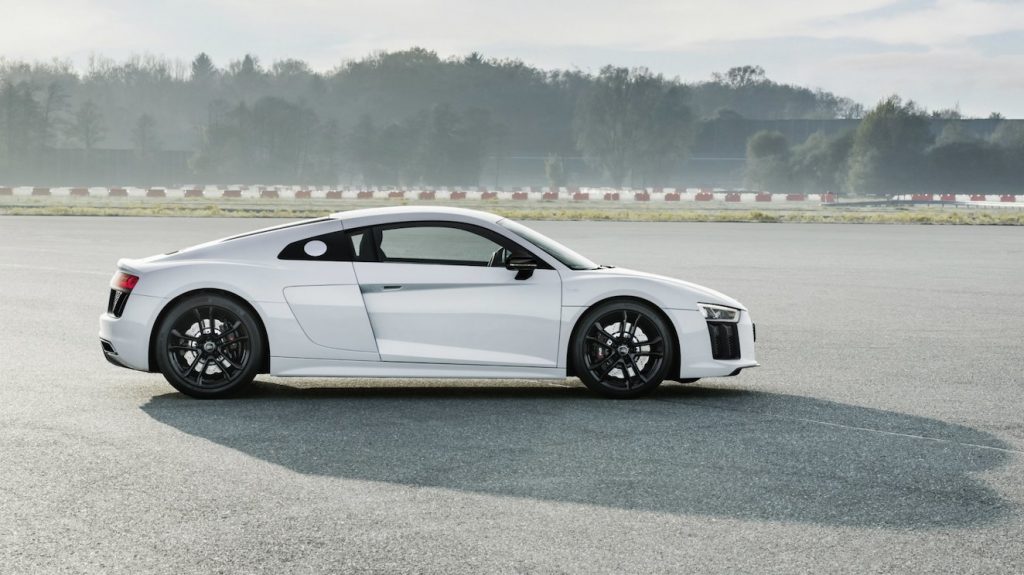
All of that changes with one car. The 2018 Audi R8 RWS. A car that no doubt intends to be a game changer for the model it is based on, and also the brand that breathes life into it.

2018 Audi R8 RWS

The ‘RWS’ moniker could be misleading to those who don’t already know what it represents on this new R8. It could be confused as being an acronym for ‘rear-wheel steering’, a feature in production cars where the rear wheels are engineered to turn and assist with steering the car in certain situations. This technology has seen some proliferation lately, which may further add to the confusion.

However, the ‘RWS’ simply stands for Rear Wheel Series. According to Audi Sport CEO Stephan Winklemann, the Audi R8 RWS is a “limited edition rear-wheel drive R8, made for purists”. He has made this as clear as what we now know the ‘S’ stands for.

With that in mind, Audi has forgone the Quattro system for the R8 RWS which means that the front driveshafts and other all-wheel-drive-essential components were removed from the regular model. Not only does this convert the car to rear-wheel drive, it also sheds about 50 kg of weight.

Although Audi is only producing 999 examples of this vehicle (320 for North America), the RWS is hard to differentiate from the standard R8 aside from some ‘Audi Sport’ badges (which replace the ‘Quattro’ ones) and a numbered dash plate to designate its exclusivity.

The most welcoming fact about the car is that despite being a limited production model, the RWS is actually priced a fair bit less than a standard R8, making it the cheapest R8 available off the showroom floor. Starting at just $139,950 USD, the Quattro-less R8 RWS is more than $26,000 USD less than its more complex and heavier variant.

Features And Highlights

Engine

The RWS employs the same power plant as the base R8 – a naturally aspirated mid-engine V10 which produces 540-horsepower and 398 lb-ft of torque. Built in Hungary, the 5.2L engine is also shared with the Lamborghini Huracán.

Touted as a proper sports car engine, it makes peak power at 7,800 rpm and smoothly revs all the way to a euphoric 8,700 rpm redline, all the while providing a delightful symphony of sound via its howling engine note. The absence of forced induction means that the engine is perpetually responsive and reacts to throttle inputs instantaneously.

In a 0-100 km/h sprint, the RWS achieves a time of 3.7 seconds, which is about 0.3 seconds slower than the base model Quattro R8. This should be expected, as off-the-line-traction is something that the Quattro system greatly enhances; in any case, the RWS isn’t about raw power. Being the lighter car, it should make up that time over a longer sprint anyway.

Chassis

The engine remains mated to the same 7-speed dual-clutch transmission equipped on the standard R8. While the DCTs are undoubtedly the best piece of machinery for handling the power of a modern-day sports car, perhaps Audi should have considered a manual transmission option which would have shed more weight and leaned even more in favor of the purist demographic they are targeting.

The steering ratio remains the same at 15.7:1 and was not a hugely popular trait in the Quattro-equipped variants. However, the suspension geometry has been modified to accommodate the new layout and weight reduction – as a result, the RWS responds faster to steering inputs, provides better feedback and the turn-in is much sharper than before. The brakes are the “regular” steel fanfare but work in a balanced harmony with the car as a whole. Carbon ceramic brakes are available as an option.

Exterior

With only 320 examples headed to North America, it will be very difficult to spot an RWS in person. Even if you are so fortunate, telling it apart from a Quattro R8 will prove to be just as challenging.

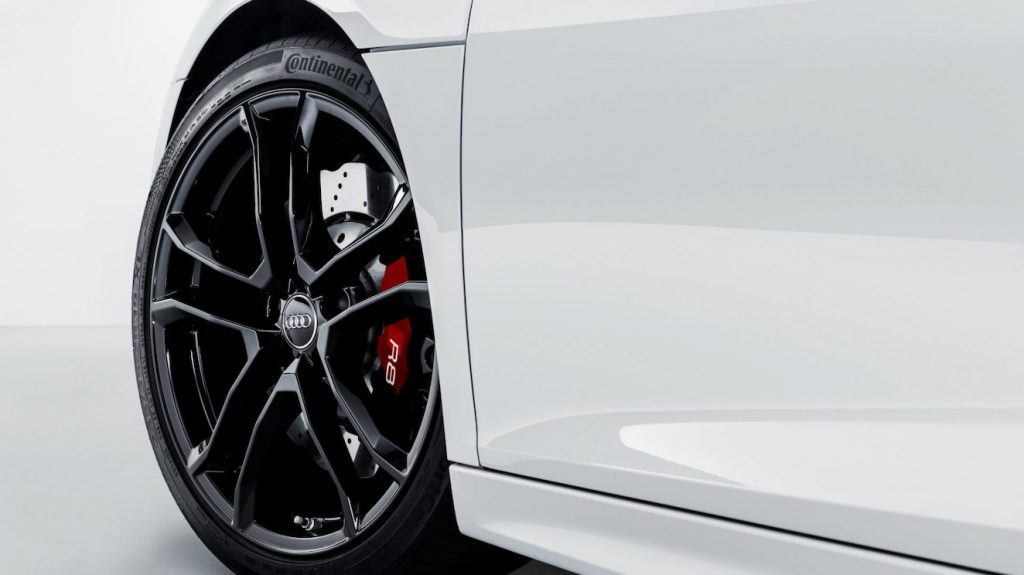
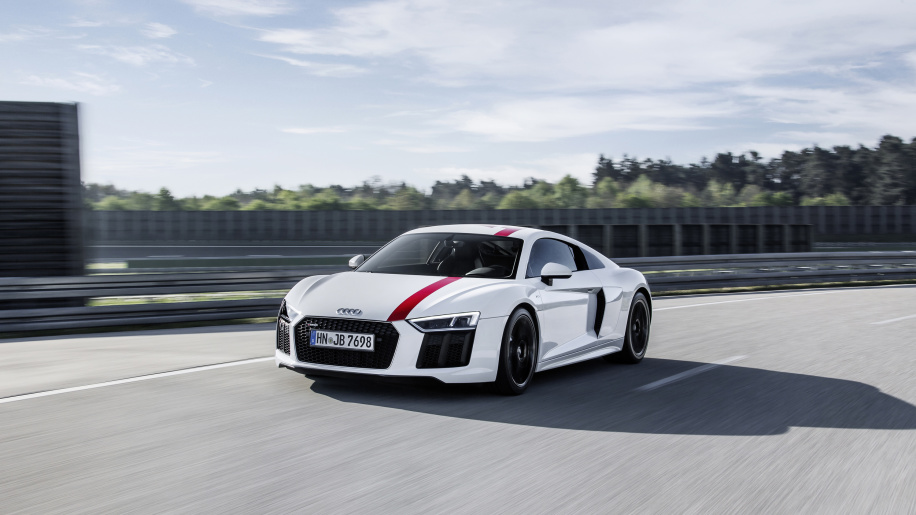
At first glance, the RWS will appear to be no different than the other variants; a gloss black upper side blade, body-colored lower side blade, matte black grilles, gloss black wheels and optional red vinyl stripe being the only distinguishing factors.

The RWS will be available in just coupe form for North America, but will also have the added choice of a convertible in other markets.

Interior

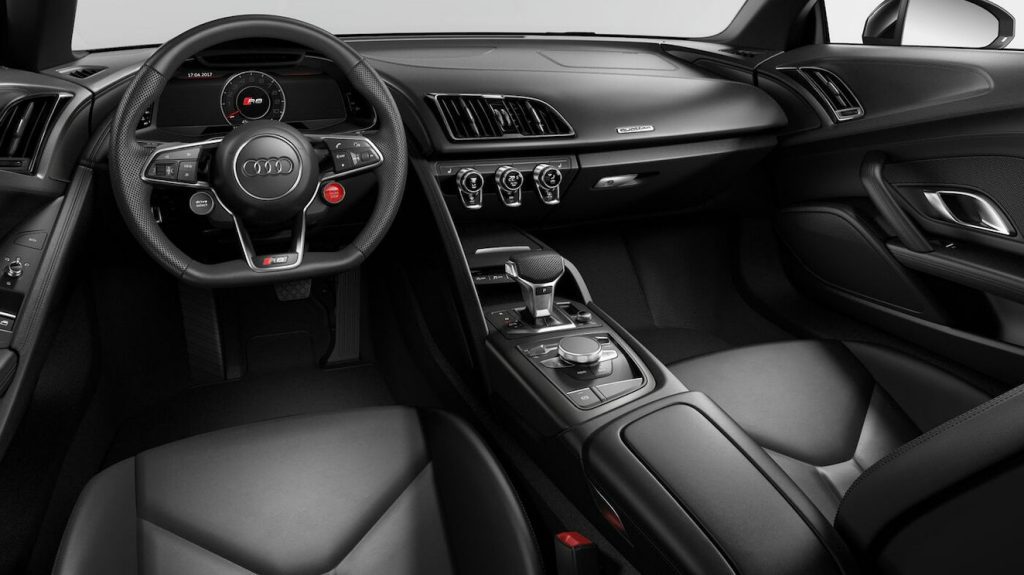
Nappa leather sport seats come standard as does an infotainment system with navigation. A Premium package is offered which provides more leather and Alcantara finishes along with an upgraded sound system and 18-way power-adjustable seats.

The Carbon packagewhich can only be optioned on top of the Premium package – adds carbon fiber overlays on the center console and instrument-panel surround.

Verdict

A rear-wheel drive Audi-anything is certainly something special; add an R8 to the equation and you’ve got something like no other.

In my opinion, it would be hard to imagine how someone wouldn’t see the massive appeal that the Audi R8 RWS provides:

  • It’s the very first and only rear-wheel drive Audi – and it will be exclusive
  • It has a wailing, naturally aspirated V10 with an 8,700 rpm redline
  • It benefits from a lighter and meticulously balanced chassis

Also, don’t forget that you get all of this for almost 20% off the sticker price of the base level Quattro (and it is more than $60,000 USD less than the top-of-the-line V10 Plus model).

The experts say that the RWS remains as easy to drive and is as compliant as its Quattro versions. This they say, makes the cars feel virtually indistinguishable, until at the race track or during inclement weather conditions.

While it’s not the life-altering change that would be experienced from something more akin to say – going from a Porsche 911 Carrera (4WD, in this case) to a 911 GT model – the RWS is really a great buy for anyone considering an R8; or a mid-engine, rear-wheel drive supercar in general.

Specifications And Performance Summary

Pricing And Model Info

Make Audi
Model R8
Generation 2018 – Present
Car type Coupe, Convertible (only outside North America)
Category Series Production Car
Built At Neckarsulm, Germany
Units Produced 999
Base Price (US) $139,950

Chassis And Powertrain

Curb Weight 1,610 kg (3,550 lbs)
Layout Mid-engine
Driven wheels Rear-wheel drive
Engine DOHC 40-valve V10 with aluminum block and heads, direct fuel injection
Aspiration Naturally Aspirated
Displacement 5.2 Litres
Transmission 7-speed DCT

Engine Output

Power 540 hp @ 7,800 rpm
Power / litre 103.8 hp / litre
Power-to-weight ratio 6.57 lb / hp
Torque 398 lb-ft @ 6,500 rpm

Performance

0-100 km/h 3.7 seconds
0-60 mph 3.5 seconds
0-100 mph 7.6 seconds
¼ mile 11.6 seconds
Top Speed 199 mph (320 km/h)

Photo Gallery

[Include images from task zip file]

Video Reviews

[embedded content] [embedded content] [embedded content]

First Impression: 2019 Audi Q8

Like it or not, the crossover SUV segment is here to stay: It has become wildly popular in virtually every price range. The market niche that interests us most, of course, is the premium luxury category. And while there are many interesting entries, few of them are coupes. In fact, there is only the BMW X6 and the Mercedes-Benz GLE Coupe, and perhaps also the Range Rover Sport. Now they will face formidable competition from a new contender: The Audi Q8, an SUV coupe that is based on the Q7.

Even though the Q8 won’t be offered a third row of seats, it retains the wheelbase of the Q7. And thus, it dwarfs the competition from Stuttgart and Munich. Moreover, while the X6 and the GLE Coupe are clearly just derivatives of the X5 and the regular GLE, the Q8 features a completely different style. While the Q7 is an aestetically challenged holdover from a former design era, the Q8 epitomizes the new styling language conceived by chief designer Marc Lichte.

When Audi invited us to go along with the technical project director, Dr.-Ing. Werner Kummer, for a test round, we didn’t think twice. So here we are: Pulling the handle slightly, the door lock opens electrically. And like in a real sports car, the side windows are frameless. The dashboard is still covered, but it is clearly visible: The Q8 takes Audi’s SUV interiors to the next level. It is more A8 than Q7.

Just as expected, the Q8 is equipped with an ultra-fast telematics and infotainment system that offers multiple customisation options. The space is extremely generous, even in the rear. Surprisingly, Audi only plans to offer a five-seat layout. If one car is predestined for single second-row seats, this is it.

The Q8 is fitted with five-link axles front and rear, and the chassis is available in three variants: A steel suspension with damper control is standard, and as an option, Audi offers a regular and a sporty level of its air suspension. An optional four-wheel steering system reduces the turning circle at low speeds and enhances high stability at autobahn velocites. Power is sent to all four wheels through a mechanical center differential.

On our test lap, the Q8 prototype mastered bumpy roads confidently, and it charged through fast corners with virtually no body roll. The chassis offers high reserves and is tuned more sharply than the Q7’s. The standard progressive steering becomes more direct with an increasing steering lock angle.

In Europe, the Q8 will be launched with a 3.0-liter V6 TDI engine with 48-volt hybridization; a V6 gasoline engine will be added later, and we suspect Audi will add SQ8 or RSQ8 models later, powered by V-8 gasoline and diesel engines. Meanwhile, the V6 TDI, whose exact performance figures Audi keeps secret, leaves little to be desired. Except for a bit of sound: It is almost eerily quiet.

Going forward, all engines will be coupled with an eight-speed automatic transmission. And on the vast majority of markets, they will be fitted with 48 volt-hybridization (except for a possible high-voltage plug-in hybrid).

In Europe, the Audi Q8 comes to market this summer. Prices are not fixed yet. But one thing is clear already: With its futuristic shape, its clean and powerful engines and its perfectly integrated infotainment system, it will give the competition a lot to chew on.

2019 Audi Q8 Teases a Familiar Rear

We’re getting closer to the release of the range topping Audi Q8 if these sketches are anything to go by. Audi released them earlier today. They show the rear angle of the upcoming SUV. They show a rear that shares styling cues with the A7 and A8.

The release accompanies an announcement that the unveil will take place via a cinematic five-part miniseries starting on 21 May. Spy shots show a car that stays similar to the Q8 Concept we saw last year with an SUV-style roofline, LED headlights and a full width rear light bar.

The Q8 is expected to rival BMW’s X6 with a mechanical package shared with the Q7. It is expected to be of similar width and length to the Q7. Audi hope to attract customers in key markets including Europe, China, the US and Russia.

Expect the Audi Q8 to be powered by a 3.0-litre TDI in entry level format with new V6 and V8 models and a top of the range petrol-electric plug-in hybrid. The engine range will likely follow the Q7 format, perhaps with the units from the new A7 and A6 models providing a fresh twist.

The Audi Q8 is set to be built at Volkswagen’s Bratislava plant in Slovakia alongside the Q7, Porsche Cayenne and Touareg.