
All posts in “Stuff”

Soundcheck: Aston Martin Valkyrie begins to scream

In July, Aston Martin published the first video of the Valkyrie on track at Britain’s Silverstone Circuit during the Formula One Grand Prix weekend there. Test driver Chris Goodwin didn’t push the 1,160-horsepower coupe to its limits, merely massaging the throttle for the camera a few times. The English carmaker headed back to Silverstone this month with a group of guests in tow, and this time the test driver put a little more muscle into the fly-bys. Since the track was wet, the soundtrack still can’t be considered the ultimate experience, but even so, the 6.5-liter Cosworth V12 sounds exceptionally good.

This new video injects a high-pitched wail that was missing in July, the kind of wicked, soaring keen that jellies one’s organs and notifies the mind of blinding terrors on approach. In fact, the Valkyrie now makes all the noises Formula 1 fans wished the F1 race cars could make. That’s no hyperbole, either. Compare the modern Cosworth to the 3.5-liter Honda V12 in the 1991 McLaren MP4/6, the resemblance is clear. Remove the street-legal equipment on the Aston Martin and let Goodwin uncork it, as we expect to happen in next year’s World Endurance Championship, and it’s clear the WEC might have the best sounding racers in all of motorsport.

Deliveries are scheduled to begin before the end of the year, so Aston Martin should be wrapping up its validation testing on Verification Prototype 1 if it hasn’t already. After that come competition entries into the FIA World Endurance Championship (WEC). And after that, someone will need to convince at least one owner to drive the Valkyrie on the street so that we can all enjoy the noise.

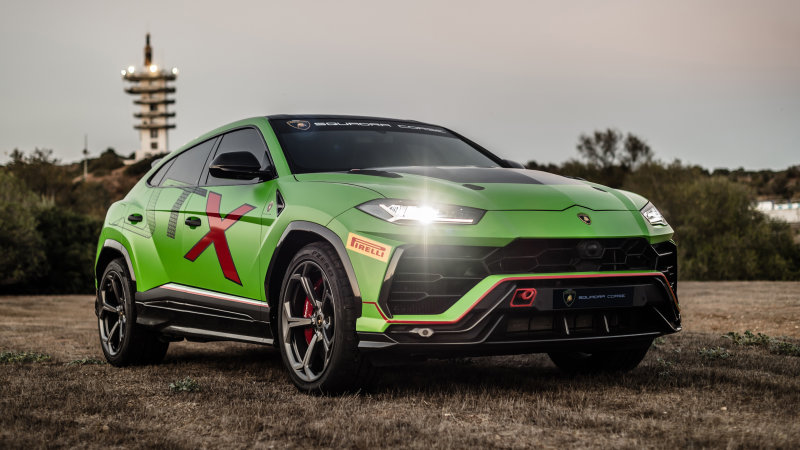
Lamborghini Squadra Corsa previews 830-hp hypercar and racing Urus ST-X

At the conclusion of last year’s Lamborghini Super Trofeo series, the Sant’Agata Bolognese carmaker’s Squadra Corse division unveiled the SC18 Alstom. That was a one-off, customer-commissioned, extreme track car based on the Aventador SVJ, and the first wholesale creation from the racing department. At this year’s series finale in Jerez, Spain, it teased a limited-run hypercar and an evolution of the race-bound Urus ST-X. The hypercar proves a rumor from earlier this month, when a poster at the McLaren Life forum said he was “Going to spec next week and test drive the SVR V12 track version of AV,” that AV standing for Aventador. Lamborghini says the track-only car, designed by the company’s Centro Stile department, will debut next year.

The rumor had posited the hypercar as a ne plus ultra expression of the Aventador’s 6.5-liter V12, and that seems to be the case. Engineers extracted 830 horsepower from the naturally aspirated engine, 70 hp more than found in the SVJ. In place of the road car’s seven-speed, single-clutch ISR transmission, the unnamed hypercar uses a six-speed Xtrac sequential gearbox, and a mechanical limited-slip differential can be adjusted by the driver for preload. The standard Aventador chassis has been reworked around that powertrain for aerodynamic and safety reasons. The front structure’s made of aluminum, a more pliant — and less expensive — material to deal with in case of incidents on the track. The engine’s been wrapped in a steel cage in order to increase torsional and bending stiffness. Airflow improves thanks to dual intakes on the hood, an airscoop over the cockpit, and a stonking rear wing. 

The Urus ST-X has undergone a few changes since its debut last year. The Verde Mantis SUV has been lightened by about 25 percent compared to the production version with “a lighter structure,” a vented carbon fiber hood and rear wing, and a racing exhaust. The cabin’s luxurious appointment are replaced by a roll cage, racing seats, and a fire suppression system. Scheduled to make its race debut at the end of October 2020 in Misano, Italy, the first pilots to get a chance behind the wheel will be winners of the four classes in the Super Trofeo series.

Feast Your Eyes on Nike’s Unreleased Running Shoe Used to Break the Two-Hour Marathon

Well, it’s official — even if it’s unofficial. With the help of a flat, optimized course, a crew of elite pacers and Maurten supplementation, Eliud Kipchoge did what was once considered impossible over the weekend: run a marathon in under two hours. Though it’s not an actual world record (thanks to the aforementioned factors), it’s still an incredible feat, one that’s left many people asking about one other key ingredient: Was it the shoes??

Ah yes, the shoes. Tackling this challenge in Vienna, Austria, Kipchoge — the current marathon world record holder and 2016 Olympic champ — laced up a pair of as-yet-unreleased Nike Next% running sneakers. While the brand continues to play it a bit close to the vest, thanks to some investigative work by Believe in the Run, we do know a few things about these mystical shoes. 

The blog uncovered a filing with the US Patent and Trademark Office that reveals the specifics of what may be this particular shoe, which may be called the alphaFLY. Short takeaway: this thing is funky, flexy and fast. What follows are some of the highlights. 

Carbon Fiber Is Critical

The sole consists of four cushioning pods, two layers of midsole foam and (wait for it) three carbon-fiber plates. That’s two more than any other shoe, and now we can’t help thinking of the Schick/Gillette razor race of yesteryear, when they just kept adding blades, to the point where an Onion article started as a joke and became reality. 

The Divided Midsole Has Many Layers

The midsole has four different levels, and it’s fully segmented between the heel and forefoot, with the rear section looking comically beefy but not all that different from past Vaporfly shoes. Meanwhile, the forefoot really showcases the plates and cushioning pods, which are either filled with fluid or foam. 

Energy Return Seems Inevitable

The plates and pods team up to prevent hotspots, nurture a more responsive ride and add extra stability, theorizes Believe in the Run’s Robbe Reddinger, who adds that there must be some energy return involved as well, considering what Kipchoge was able to accomplish.

We’ve Seen This Upper Before

The lightweight, meshlike upper appears consistent with material seen on track spikes at the recent World Championships in Doha, so it’s likely Nike strongly believes in this approach and that we will see it on a variety of shoes in the future.

Time will tell if consumers will be able to purchase these exact shoes or some sort of modified version. Meantime, the next best thing is the Nike ZoomX Vaporfly NEXT% ($250), a pretty kickass shoe in its own right. 

MORE GREAT DEALS

Save 74% on These Cole Haan Leather Weekend Bags
Save 50% on This Affordable Automatic Pilot’s Watch
Save $88 on Bonavita’s Elite Drip Coffee Brewer
Save $70 on Master & Dynamic’s Wireless Earphones
Save $69 on Patagonia’s Best Light Down Jacket
Save $58 on These Military-Grade M-65 Jackets
Save $50 on the Patagonia Nano Puff Jacket
Save $20 on Adidas Originals Stan Smith Sneakers

Deals Last Updated: 10/14/19

3 of 2019’s Best Products: a GP 100 Preview

The Magazine

Each issue of Gear Patrol Magazine is a deep dive into product culture. Inside, you’ll find seasonal buying guides, rich maker profiles and long-form dispatches from the front lines of product design. The stunningly designed Gear Patrol Magazine is ready for your coffee table. Quarterly. $39

The Newsletter

Get the best new products, deals, and stories from across the world, in your inbox daily.

Hands-on With the $1,980 Galaxy Fold Smartphone

The Magazine

Each issue of Gear Patrol Magazine is a deep dive into product culture. Inside, you’ll find seasonal buying guides, rich maker profiles and long-form dispatches from the front lines of product design. The stunningly designed Gear Patrol Magazine is ready for your coffee table. Quarterly. $39

The Newsletter

Get the best new products, deals, and stories from across the world, in your inbox daily.

Amazon’s Echo Buds Sound Great But There’s a Catch

One of the star products to be announced at Amazon’s big hardware event today was the Echo Buds ($130), the company’s first true wireless earbuds. Not only do they undercut the cost of most true wireless earbuds, including AirPods, by a ton but Amazon revealed that they’ve partnered with Bose to integrate its noise-reduction technology (which is a little different than its noise-canceling technology) into the Echo Buds. And these earbuds cost just $130.

After the event, I was able to get a little hands-on time with Echo Buds and was even able to listen to two songs (“Trampoline by Shaed” and Bruce Springsteen’s “For You”) and here are my initial impressions.

First and foremost, they sound great, especially for $130 earbuds. It was loud with good mids and strong bass. I’ve tested a boatload of true wireless earbuds in the past two-plus years and these are right in the mix with the better ones.

The noise-reduction ability also seems good at first blush, but I’m not ready to say its perfect just yet. I tested the Echo Buds in a crowded room, and while I could barely hear the noise around me, these earbuds fit really snug, and it’s hard to tell which of these two things was primarily responsible for the effect. Still, there’s plenty to be hopeful for here so far. (It’s also worth noting that, to my understanding, noise-reduction technology isn’t as Bose’s full-fledged noise-cancellation technology.)

But there are a couple of catches. The biggest is that the Echo Buds require you to download and use the Alexa app to get the most out of them, which is at best a hassle. You need the Echo Buds setup properly in your Alexa app to enable the noise-reduction technology and the “Hey Alexa” features, and Amazon still has a ways to go in proving that these added Alexa features will actually be useful. If you don’t want to deal with the app, you can use them as standard Bluetooth buds, but you’ll be missing out on the noise-reduction technology.

They also charge with micro-USB, a style of charger that’s rapidly phased out and can’t deliver the kind of quick charge power that USB-C can. But mostly it’s frustrating you won’t be able to charge your earbuds with the same charger you use with a new laptop, Nintendo Switch or Android phone.

Lastly, the plastic Echo Buds do feel a little bit cheap compared to headphones like Master & Dynamic MW07s or Sennheiser Momentum True Wireless. But at the price point, you can’t really complain too much.

All in all, Amazon’s first buds are certainly impressive, and it’s a real surprise that they’ve got a type of Bose’s noise-canceling tech before Bose’s true wireless buds have even come out. But with Bose is gearing up to release the Bose Noise Cancelling Earbuds 700 in early 2020, it seems more that the headphone maker has plenty more in store for its own product, which will no doubt cost a lot more.

The Echo Buds ($130) are available for pre-order right now, for a ship date of October 30th.

These Pots and Pans Were Designed to Teach You How to Cook

Cookware brand Equal Parts isn’t trying to make peak performance cooking equipment. It doesn’t want to be a direct-to-consumer All-Clad and it doesn’t make a big deal of how much money you save buying directly from them. Instead, Equal Parts, the first brand under the Pattern umbrella, makes pots, pans and kitchen gear for people who don’t know the difference between a sauté pan and a skillet.

Pattern co-founder and chief creative officer Emmett Shine and Equal Parts general manager Tyler Sgro started with a simple task: create a cookware company that got people who aren’t cooking into the kitchen.

“Not a lot of people actually know what poaching is versus frying, searing, blanching and so on. If you didn’t grow up in a kitchen, those things are intimidating,” Shine said. “What does the home cook want? What’s something they’re actually going to use?”

The culmination of years of research, data collecting and testing, Equal Parts’ beginner-friendly cookware collections are here.

Equal Parts murdered-out “Big Pan” in action.

Sgro and Shine say every feature is tied to pain point with traditional cookware. The cookware is aluminum because it’s lighter and heats faster than steel, and it’s coated in a ceramic mixture that cleans up easily and heats evenly. Everything from the pots and pans to the mixing bowls are designed to nest, making cabinet space less of an issue, and every item is dishwasher-safe. Even the vocabulary is edited for simplicity — “big pan” instead of sauté pan, “small pot” in place of saucier.

The brand even goes as far as offering an 8-week text-based “coaching” package with every cookware set. Buyers can text coaches cooking-related questions seven days a week, from simple recipe queries to custom meal advice based on what ingredients are on hand.

“Our intention was not to be another pro-sumer brand, it was to focus on the millions and millions of young adults in America who have worked hard, live in a space that’s not as big as they’d like and have less skill in the kitchen than they’d prefer,” Shine said.

Equal Parts products are available in sets starting at $249. Sets may include anything from a few pieces of ceramic-coated aluminum cookware or an entire kitchen suite.

Four Years in the Making, This Minimalist Pen Is the First of Its Kind

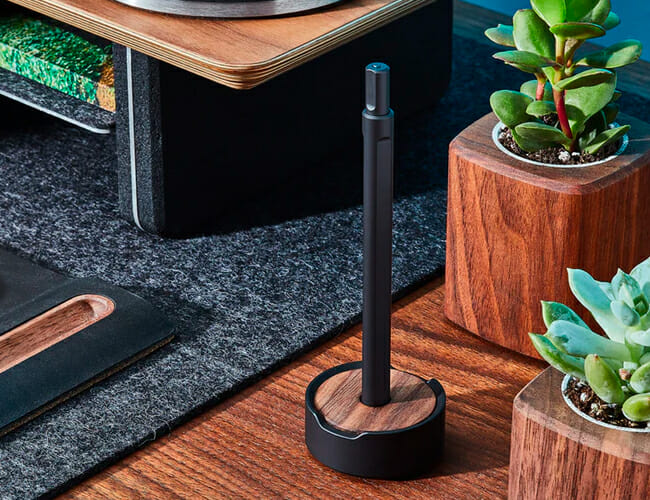
Grovemade CEO and co-founder Ken Tomita takes no issue with cheap pens — he appreciates Pilot G-2s and Muji gel pens as much as the next guy; but in Tomita’s vision of the perfect workspace, disposable pens felt out of place. After four years of starting, iterating, giving up and starting over, Tomita and team made their own replacement. The Grovemade Desk Pen, a pen meant to stay put in one spot, is here.

The pen is available in a matte black finished aluminum or a heavier, glossier brass and start at $50. The two said the idea of a desk pen — a pen that’s left on a desk for display, notetaking, signing documents and so on — hadn’t dawned upon them until they looked through the results of a customer survey that asked past customers to send photos of their workspaces in.

Tomita said the photos were full of put-together workspaces and not-so-nice pens. “You know how there are these nice t-shirts now that cost like $70 and last five times as long? It’s kind of a leap until you’ve gone to that level and realize what you’re missing out on. I’ve never had a nice pen before the one we made,” he said.

The Grovemade Desk Pen in ceramic-coated aluminum.

The final product is a weighty, twist-action pen made from billets of aluminum or brass run through a Swiss Screw Machine. It features a satisfying snap when the action completes and the pen tip is in place, and three facets that provide a better grip and ensure it can’t roll off the desk. Also to ensure it doesn’t roll off the desk, pens can be purchased with pen stands made of the same material as the pen, with hardwood inlays and a cork base. Plus, the pen insert itself is a Schmidt Rollerball P8126, a refill well known in pen geekdom.

Tomita recognizes his pen is never going to be the one pen for all people — he says that’s an impossible task to place on a designer. Instead, it’s a minimal, idiosyncratic take on a bygone category. They’re available now starting at $50.

This Affordable, Field-Inspired Watch Celebrates Fossil Watches of the 1990s

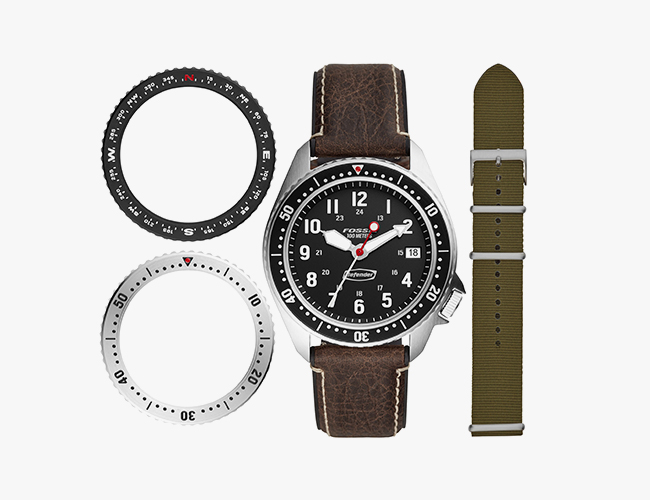
Fossil’s Archival Series features limited-edition sets that recall early Fossil watches, the newest of which is the Defender. Featuring a 42mm brushed stainless steel case with 22mm lugs, the Defender is a throwback to a watch first introduced in the 1990s that featured both field and dive-inspired influences.

The new Defender ships in a handsome leather box with two straps — one a brown leather type with rubberized backing, and the second a green NATO strap — and, interestingly, three interchangeable “top rings.” These can’t be called “bezels” in the classic sense, as they don’t turn, but they provide the wearer with an opportunity to easily swap them out for a fun look. Two are diver-style count-up bezels (one in brushed steel and one in aluminum), and the third is a black steel compass bezel. The crown is a push-down type and is located at 4 o’clock, giving the watch a water-resistance of 100m.

If you’re on the lookout for an affordable field/diver-style watch or happen to have grown up in the 80s or 90s and have fond memories of Fossil, the quartz-powered Defender, which is available for $255 in select Fossil stores, could be the watch for you.

Here’s a Look at the Porsche Taycan’s Interior

The Electric Porsche’s Cabin Is Gorgeous

The Porsche Taycan is the company’s first all-electric car, and it will be an impressive machine by all accounts. The company will reveal the car in full on September 4 of this year. That’s not far away, and the company has been teasing the car recently to great fanfare. The most recent teaser sent out were some shots of the car’s interior. 

Technology Everywhere

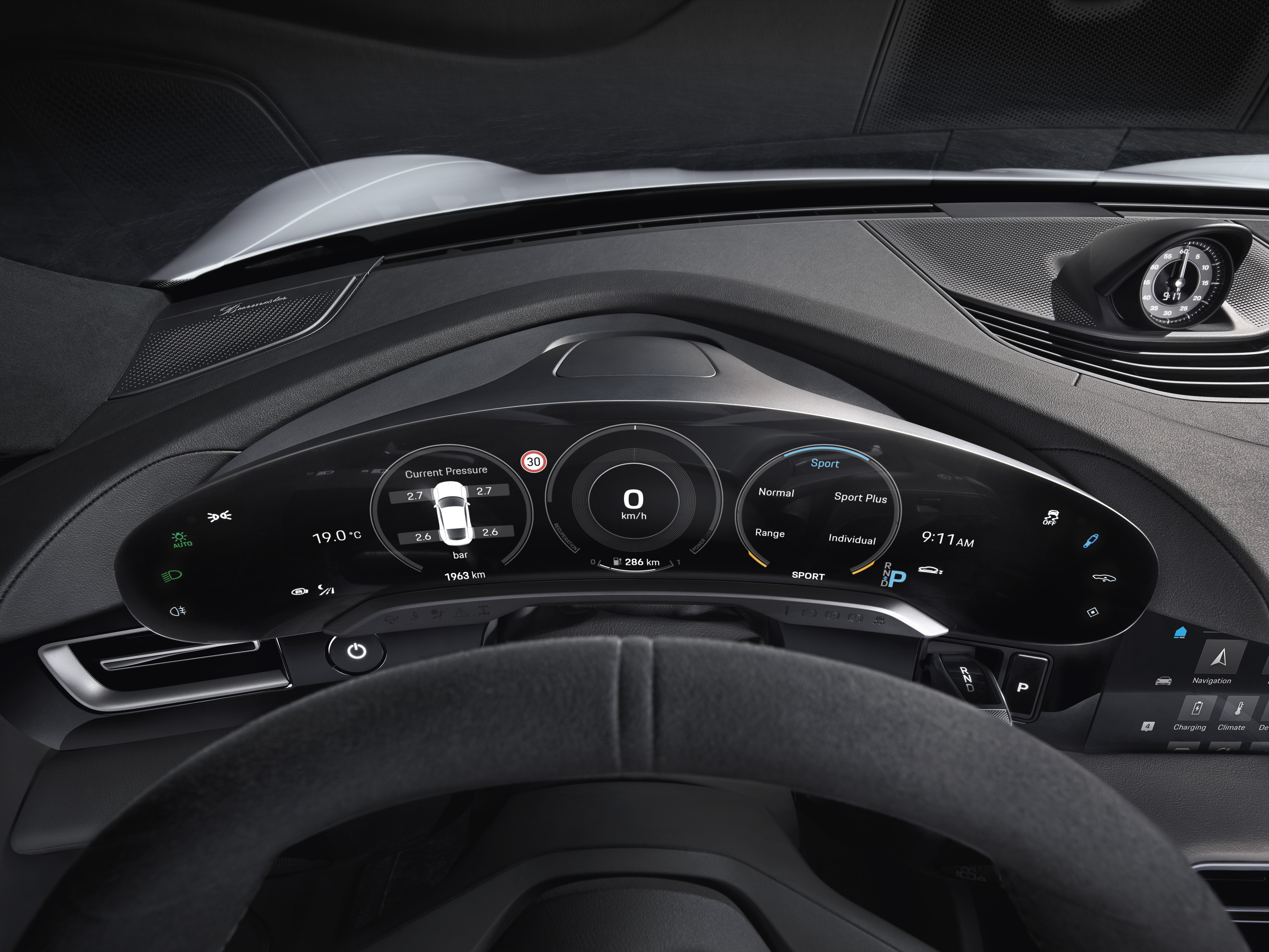
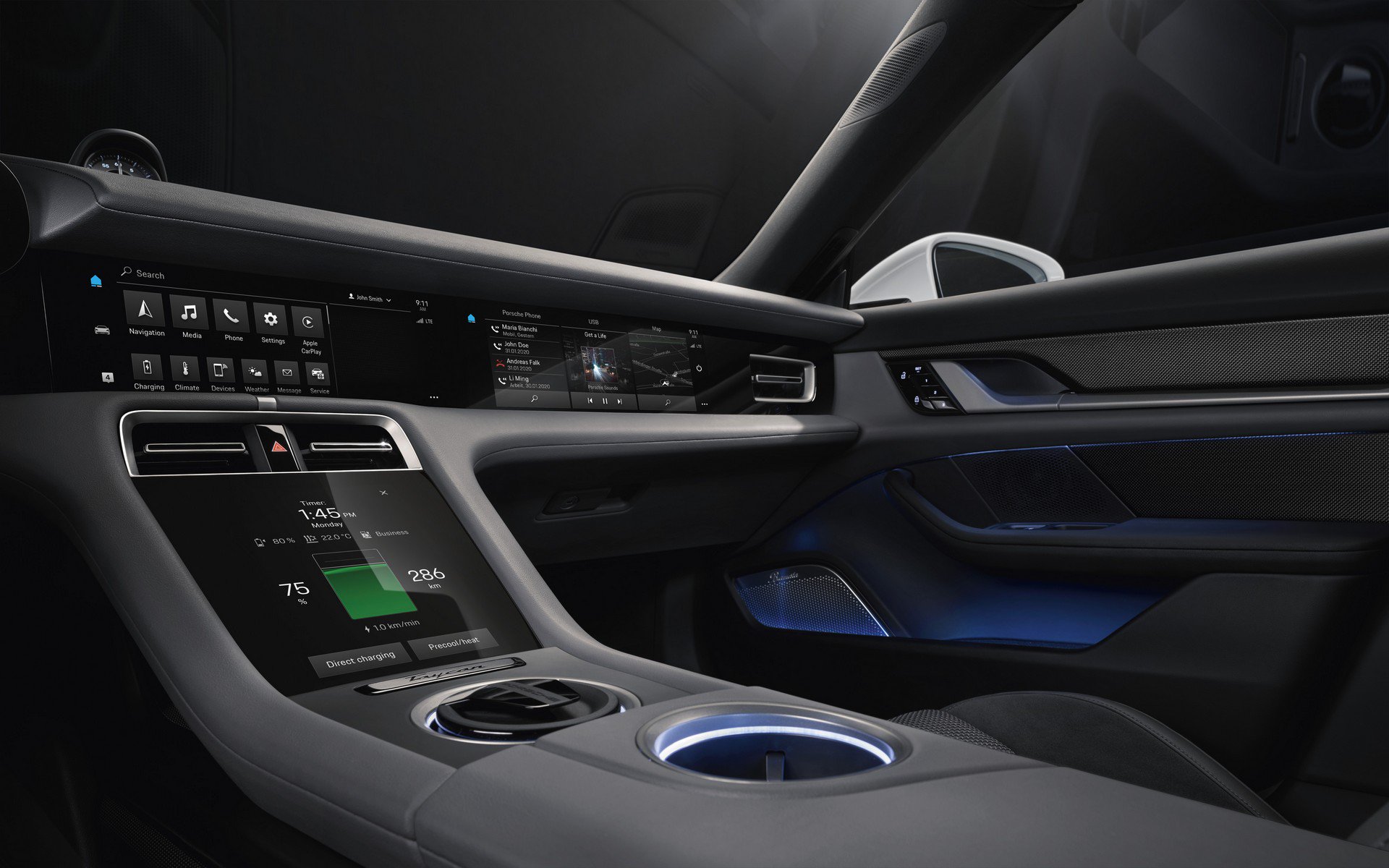
You might expect the cabin of the car to be pretty tech-savvy, but there’s even more than we thought. The cabin is completely full of screens and advanced technology. There are four different screens on the dash and center console, including a digital instrument cluster. The passenger gets their own touchscreen. 

The digital instrument cluster is a massive 16.8-inch curved display that uses real glass with a vapor-deposited, polarizing filter. This makes the cluster anti-reflective. By doing this Porsche could get rid of the unsightly cowl over the cluster that so many cars have. To either side of the instrument cluster are some touch buttons for basic controls like the lights and driving settings.

2020 Porsche Taycan Interior2020 Porsche Taycan Interior

The main, central infotainment screen measures 10.9 inches. It provides access to Porsche’s user interface and gives you access to apps, navigation, phone connections, media, comfort settings, and Porsche Connect. Below this screen is another with haptic feedback. It’s an 8.4-inch screen used for the climate controls and offers a handwriting area. This means you can write in an address you want the navigation system to use. 

The screen in front of the passenger is for just the passenger. It won’t even turn on if the driver is the only one in the car. TechCrunch reported that Porsche is playing with the idea of having it stream video, but right now it’s just for making adjustments to settings that impact the passenger. 

Minimalistic Interior

2020 Porsche Taycan Interior2020 Porsche Taycan Interior

The overall design of the cabin is minimalist. Porsche stayed true to its roots for the most part. The lines of the interior are simple and actually look considerably similar to the 911. This is no surprise. Why mess with a good thing? The 911’s interior is handsome and recognizable, and it makes sense for the Taycan to follow suit. 

When it comes to interior materials and colors, you can expect some of the best. Porsche will have wood trim, matte carbon, aluminum, fabric, and leather in it. You can get a leather-free version if you’d like. The car also comes with your choice of three color schemes: black-lime beige, blackberry, Atacama beige, and Meranti brown.

The Taycan’s interior lives up to the hype of the overall car for us. With the interior looking so good, we can’t wait for the rest of the car to be revealed in September. 

There’s a New Orange Supra in Fast and Furious 9

The Orange Sports Car Returns

We kind of can’t believe they’re shooting the ninth Fast and Furious movie. With that said, you have to admire the franchise for how it has helped to popularize performance cars. While these movies might not be amazing cinematic masterpieces, they’re darn enjoyable to watch and filled with plenty of beautiful cars. 

According to the Instagram profile @_pw40_ a new orange Toyota Supra will appear in Fast 9. The user posted some images to the profiled showing the car being unloaded at the set of the movie. There’s also a video of the car during the filming of a chase scene. 

The Instagram profile is a tribute page to Paul Walker. Walker famously drove a previous generation Supra in the first film. The orange Supra in the new film will mark the return of an orange Supra to the franchise. The movie is supposed to hit theatres in 2020. 

It will be interesting to see how the car is worked into the storyline and if there are any references to the past character who drove an orange Supra. We would expect that would be the case. 

This Iconic American Brand Just Introduced Its Boldest, Most Affordable Watch Yet

Shinola is a rising name as an American maker of gear, including watches, as well as for its mission of bringing manufacturing back to Detroit. Affordable and stylish has long been part of the brand’s approach, and the new Detrola collection of colorful and fashionable watches is Shinola’s most affordable line yet.

The Detrola collection, debuting today, is a new take on Shinola’s signature watch design. High-grade resin cases make the Detrola lightweight and durable but also offes nearly endless color options — and many of the new models are intensely vibrant. Readers should be reminded that while “resin” is a nicer way of saying “plastic,” plastics science has come a long way, and it offers a range of practical properties — in addition to (often) being economical to produce. The particular resin Shinola used is called TR90.

TR90 can also be transparent, and a very cool touch is that the case backs for some of the new Detrola models offer a view of the quartz movement inside. Made from Swiss parts, the Argonite 705 movement is assembled by Shinola in Detroit and housed in a steel core. At launch, there are seven total variants available, each in different colors with 43mm cases water-resistant to 50m. A scratch-resistant K1 mineral crystal tops it off, and each watch comes on a quick-release silicon band.

Priced at $395, the new Shinola Detrola is limited to 250 units per variant and available directly from the brand.

Gear Patrol also recommends:
Timex X Todd Snyder Military Watch ($138)
Junghans Max Bill Quartz ($495)
Defakto Vektor (~$739)

The Audi RS 6 Avant Is Coming to America

A Mild Hybrid Rocket of a Wagon

The Audi RS 6 Avant is a powerful wagon with a mild-hybrid powertrain. The vehicle utilizes a 48-volt hybrid system. That system restarts the engine and helps manage electrical power. At the heard of the car is the twin-turbo 4.0-liter V8 engine that puts out a whopping 591 hp and 590 lb-ft of torque. This is the first RS wagon to come to America, and Audi wants to make it count. 

The car comes with dramatically different sheet metal shapes than the regular A6 model. According to Road & Track, the car only shares its front doors, roof, and tailgate with the regular version of the car. Everything else has been tweaked to make the RS 6 more enticing. The car is 1.6-inches wider, giving the car a more capable, muscular look. It has 22-inch wheels and dark accents. The thing looks sleek and dangerous. Enough so that even AMG owners will be gawking. 

The numbers are impressive, too. The burly turbo V8 lets the car sprint from 0-62 mph in just 3.6 seconds. The car tops out at 155 mph. Road and Track noted that the car can actually do 189.5 mph when properly specced (the U.S. car is electronically limited to 155 mph). 

The car uses a 40:60 front-to-rear torque split for its all-wheel drive and the car can shift power side to side as needed as well. Adaptive air suspension comes as standard equipment. The RS sport suspension with Dynamic Ride Control is available for those who want it. 

Audi will bring the car here in 2020 and says it will take orders on the car closer to the date that it’s available. That date and the official price of the car will be announced at a later date. 

The McLaren F1 LM-Spec Sold for $19.8 Million at Auction

That’s Slightly Less Than the Estimates

The McLaren F1 LM-Spec that went up for auction at the Monterey Car Week in California sold for $19.8 million, making it the most expensive McLaren F1 to ever be sold. This impressive number, however, was still slightly below estimates, according to The Supercar Blog

The RM Sotheby’s auction was expected to see somewhere between $21 million and $23 million for the car, but the bidding never quite climbed that high. The car is the real deal. It has the production number 18 and an immaculate service record and record of ownership. 

The car’s first owner had it in Midnight Blue Pearl with a black interior. When the car sold, its second owner decided they wanted to have the car altered. So, it was sent to Surrey to the McLaren facility there to be restored and reworked. What it looked like at the auction at the Monterey Car Week is how the second owner wanted the car. 

It has a Platinum Silver exterior, cream-colored leather-clad interior, and a large rear wing was added. The owner also had McLaren work on the enigne, adding new radiators and cooling elements as well as a tune. The V12 engine now makes 680 hp over the original 627 hp. Despite the fact that the car didn’t get what the estimates expected at auction, this is still the most expensive F1 ever sold. 

The Drako Motors GTE Is a 1,200 Horsepower Electric Supercar

A Powerful Electric Based on a Fisker Karma

The Silicon Valley startup called Drako Motors has a new all-electric supercar called the GTE. The car is based on the old Fisker Karma chassis, according to Top Gear. Unlike the Karma, the GTE isn’t some high-end luxury hybrid. It’s a bonafide electric supercar with 1,200 hp. It also comes with an absolutely insane 6,500 lb-ft of torque.

the GTE can run all the way up to 206 mph before not being able to go any further. The car comes with a 90kWh battery pack, which is similar in size to the batteries used in Tesla’s machines. Drako has not stated a range, but we’d expect it to be similar to Tesla’s cars. 

The car comes with Ohlins suspension and Brembo brakes as well as a special torque vectoring system, so it should ride, corner, and stop properly for a supercar. The company claims it will be a fatastic car on the twisties, by saying “cornering precision unlike any other supercar on the road today.” That is yet to be seen. However, the car certainly looks the part, and we’d expect the company not to be bragging too much. 

The car comes with four electric motors to produce all of that power. There’s a motor for each wheel. There are various drive modes, too, including a drift mode. The company is calling its system Quattro Manettino, which as Top Gear points out will probably annoy both Audi and Ferrari. 

Drako Motors has a fully functional prototype right now and is taking orders from customers. The company plans to build only 25 of the cars. Each one will cost $1.25 million. 

Lamborghini Reveals the Aventador SVJ 63 Roadster

A Special Roadster

At The Quail in Monterey, California, Lamborghini unveiled a special 63 edition roadster of the Aventador SVJ. Only 63 of the cars will be made. The 63 is significant to Lamborghini due to the fact that the company started in 1963. The car is special not only because of the fact that so few will be made, but also because there will be eight different designs used for the paint and exterior and interior elements. 

The car that was shown at The Quail featured a matt grey Grigio Acheso paint job and orange Arancio Dac accents. The 63 Roadster comes with a slew of carbon fiber accents and components inside and out. The cabin is fitted with plenty of Alcantara and Lamborghini’s patented CarbonSkin. 

The roof, engine cover, air vents, rim around the windscreen, and the side mirrors are all made of carbon fiber, according to GTSpirit. Other than the unique exterior and interior components, the car is an SVJ Roadster. It gets Lamborghini’s V12 engine that puts out 770 hp and about 531 lb-ft of torque. This makes the car good for a 0-60 mph time of just 2.9 seconds. It has a top speed of over 217 mph.