All posts in “Rides”

A new Lamborghini Countach is coming soon

Lamborghini just announced that a new Countach is coming. Let us repeat. Lamborghini just announced that a new Countach is coming!

OK. Let that soak in for a few seconds, or minutes, however long it takes. We’re a bit shocked over here, too.

There’s one teaser image to go off of, and Lamborghini hasn’t let loose any details beyond giving us the name. You can see the car under a car cover and shrouded by haze in the photo above. However, there’s a video that’s been posted to Twitter that you can watch below.

We get some great engine noises, and the new Countach appears to be parked a long way away from the camera at the end of the video. It appears to be painted white, but that’s all we can tell about it from that distance. There’s no doubt that Lamborghini is leaning heavily into nostalgic feelings, as you see original Countach posters pinned up to a kid’s room in the video. Lamborghini seems intent on recapturing that wild, exotic magic that the old Countach brought to the supercar landscape. It’s tough to say what the styling will be like besides being a wedge like most Lambos. It could be a very retro design, sort of like the Miura concept from over a decade ago. It could also be a thoroughly modern Lamborghini design that happens to have a classic nameplate attached. For what it’s worth, Lamborghini’s design boss seemed to be against anything overtly retro as of a few years ago.

For the time being, our best guess is that this could be the car housing a hybrid V12 powertrain. The Italian supercar maker has said the only way to keep the V12 alive is to hybridize it. Starting off with a hybrid V12 Countach sounds like one hell of a way to kick off a new era of hybrid Lamborghinis. Plus, with an anticipated launch date of 2023 for a hybrid, the timing would be pretty good for the new Countach.

We’ll just have to wait and see what it is before we get too far ahead of ourselves, though. Lamborghini says it “is coming,” but doesn’t say when. For now, all we can say is stay tuned.

Related Video:

New Lamborghini Countach Homage to Cost €2 Million Each

Lamborghini has officially teased a new Countach which could see a debut at Monterey Car Week 2021 this weekend or a European debut at Villa d’Este in October. Another possible debut venue could be IAA 2021 in September, Lamborghini has in the past used Frankfurt Motor Show to unveil the Reventon and Sian in 2007 and 2019 respectively.

For now, the Italian car maker only says “a new Lamborghini Countach is coming”. 2021 marks the 50th anniversary of one of the greatest poster pin-up cars. Like the Sian before it, only a handful will be produced – most likely 50 cars worldwide. According to our inside source, each unit will go for €2.01 million before taxes and options.

It will share the same powertrain with the Sian, a 6.5L V12 engine assisted by a 48v e-motor whose power is stored a supercapacitor unit. Lamborghini will most likely retain the Countach name as this is essentially a homage model. The Countach was officially revealed to the world in 1971 at the Geneva Motor Show before going into production between 1974–1990. A total of 1983 cars were made.

We will be sharing more information on the new Lamborghini Countach as soon as we have it!

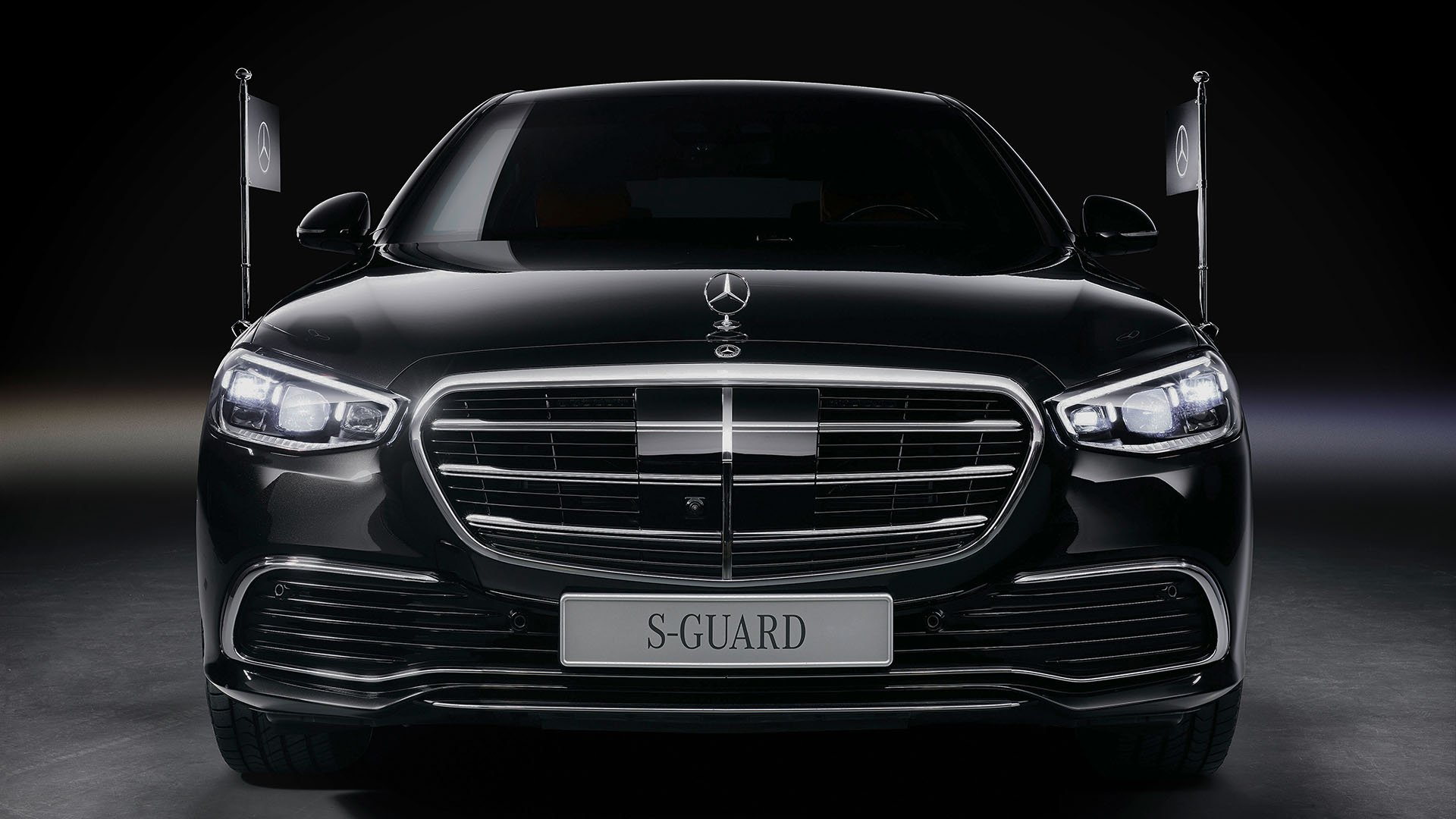
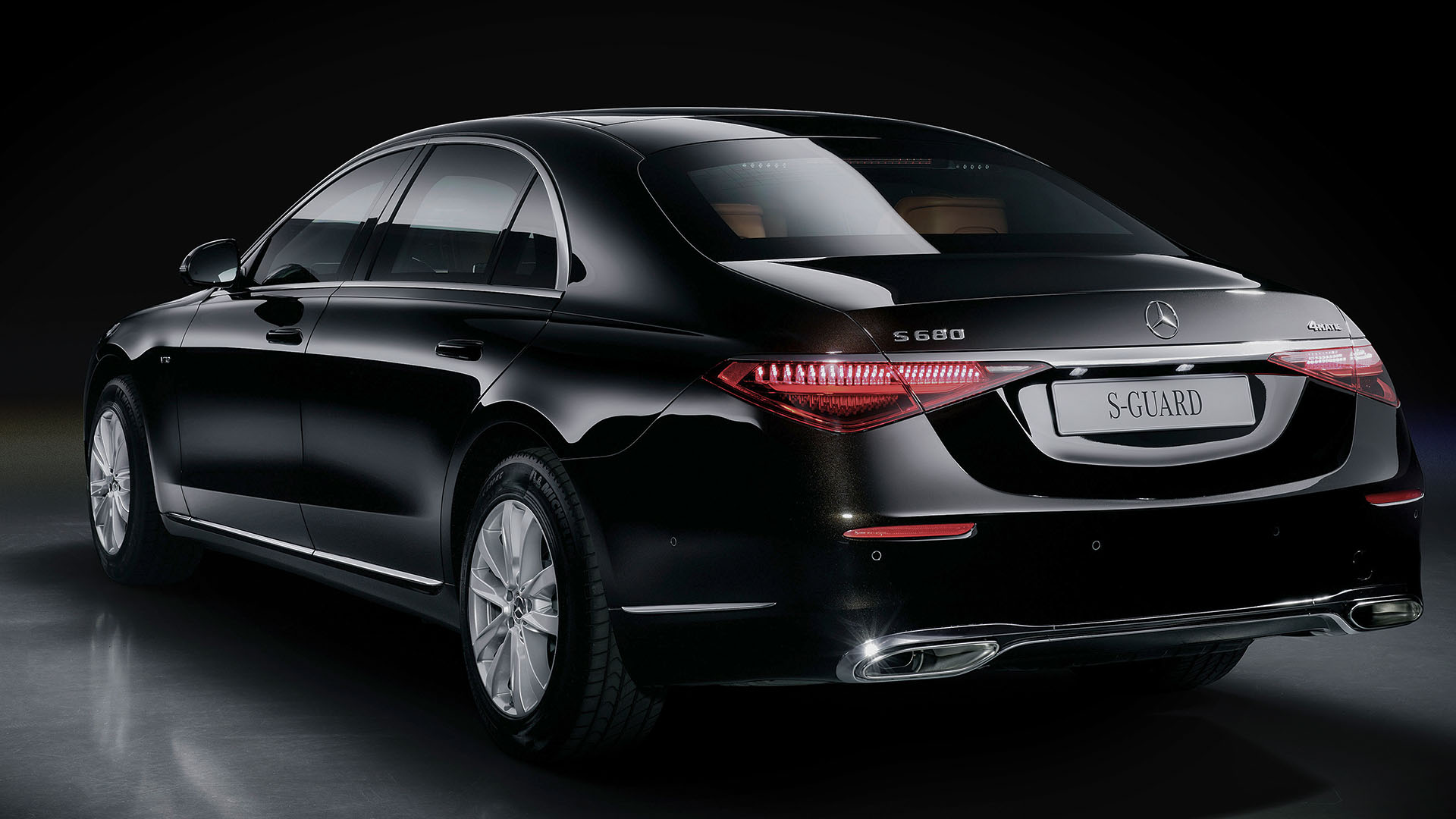
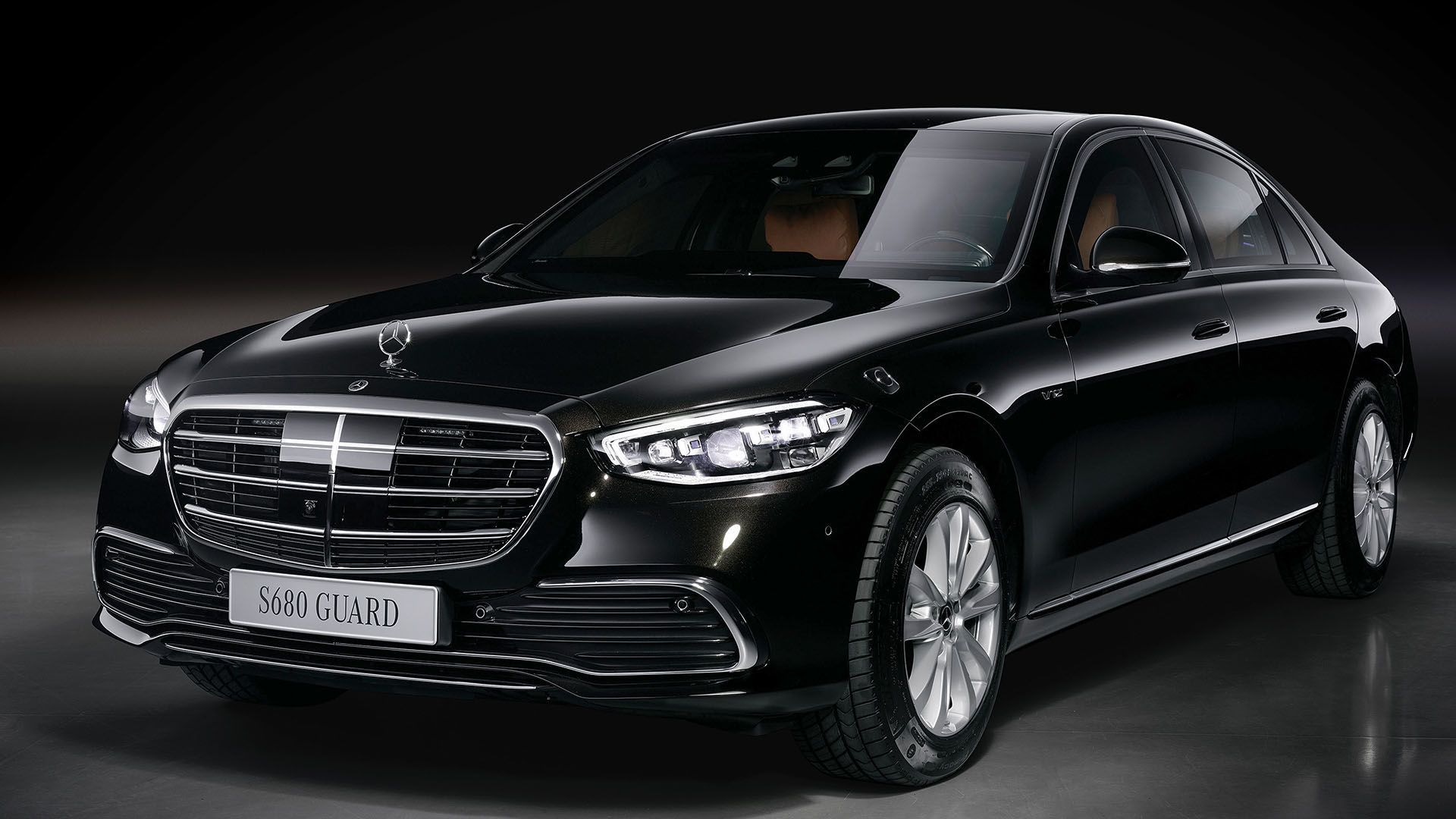
The S680 Guard, piece of mind on wheels

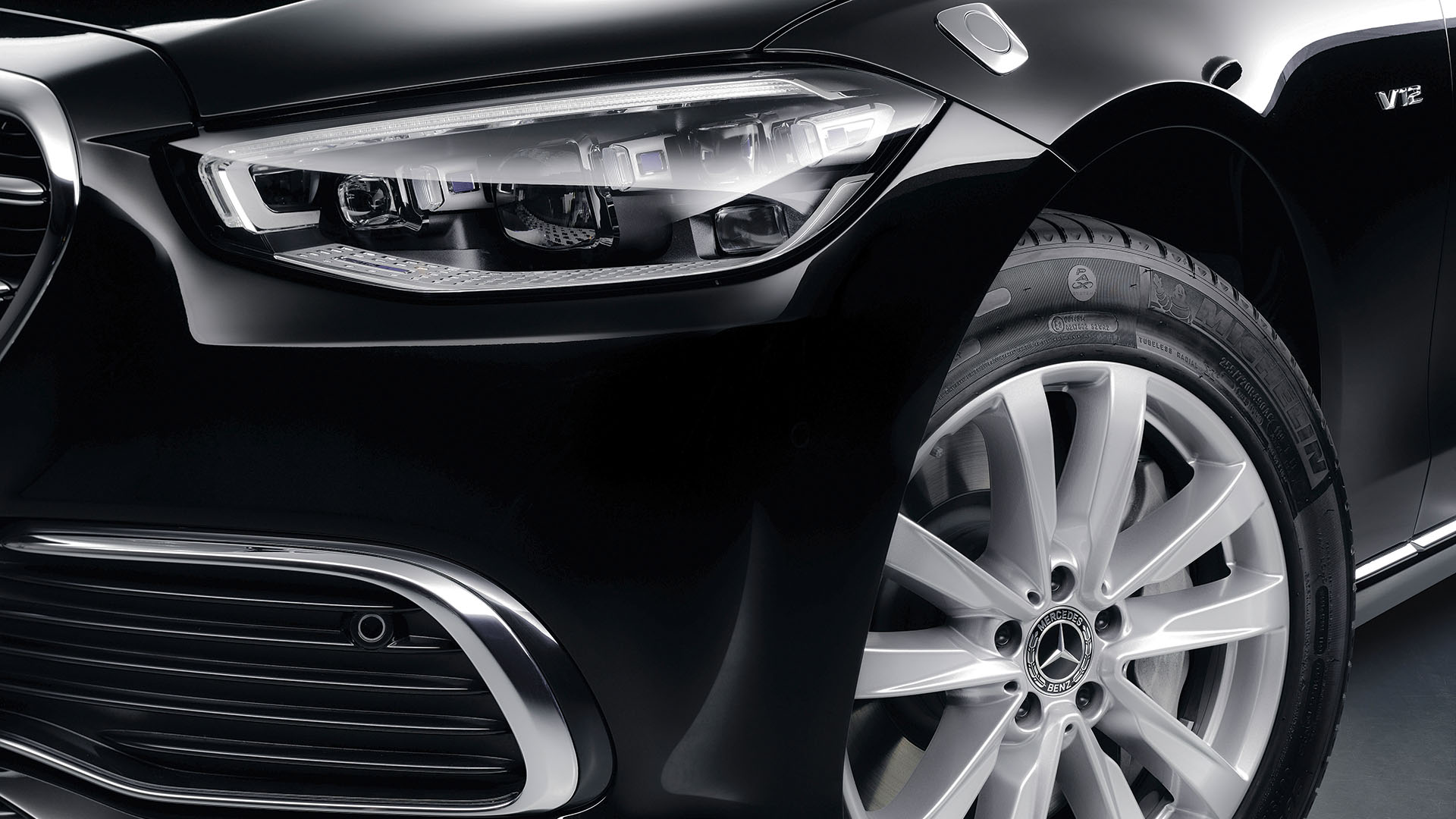
This is the latest of what Mercedes-Benz calls their ‘Special Protection’ vehicles, better known as the ‘Guard’ series, based on regular Mercedes models but modified into behemoths that offer the highest protection level for civilian vehicles, the latest S680 Guard now introduces all-wheel drive into this segment for the first time.

The new S680 GUARD 4MATIC offers protection class VPAM and meets the highest ballistic test level for civilian vehicles being particularly resistant to explosive charges, the official certification by Beschussamt Ulm (ballistic testing authority) was carried out for the first time using so-called biofidelic dummies that come with bone and soft tissue-like constructions to imitate the human body particularly realistically.

With a base price of €457,100, the S680 GUARD 4MATIC is powered by the renowned M279 V12 engine from Mercedes, delivering 612 hp (450kW) and it’s the first time a GUARD model comes with all-wheel drive in the more than 90 years Mercedes-Benz has been building these Special Protection models since 1928, over that period they have perfected every aspect it takes to create a car that literally has to protect the lives of the occupants, even under attack.

On earlier GUARD versions of Mercedes-Benz cars, the required protective materials were added or integrated onto the original chassis and body of the base model, on this S680 GUARD the entire bodyshell has been developed as a GUARD-specific unit from the start to raise the iSS, the integrated protection system, to an entirely new height, this is now a self-supporting protective cell core part of the iSS, the exterior aluminum body panels are just there for looks, and to camouflage the fact this is a high-level, bullet-proof car to drive high-net-worth individuals around.

The GUARD iSS not only consists of a new protective cell, a car with this kind of added weight also requires a bespoke suspension to cope with the additional weight compared to the regular series model, this also includes modifications to the engine and transmission, so the driver can expect similar handling as he would behind the wheel of a normal S-Class Mercedes-Benz because these new GUARD models are being developed alongside the normal production models, but they also reach production level longevity.

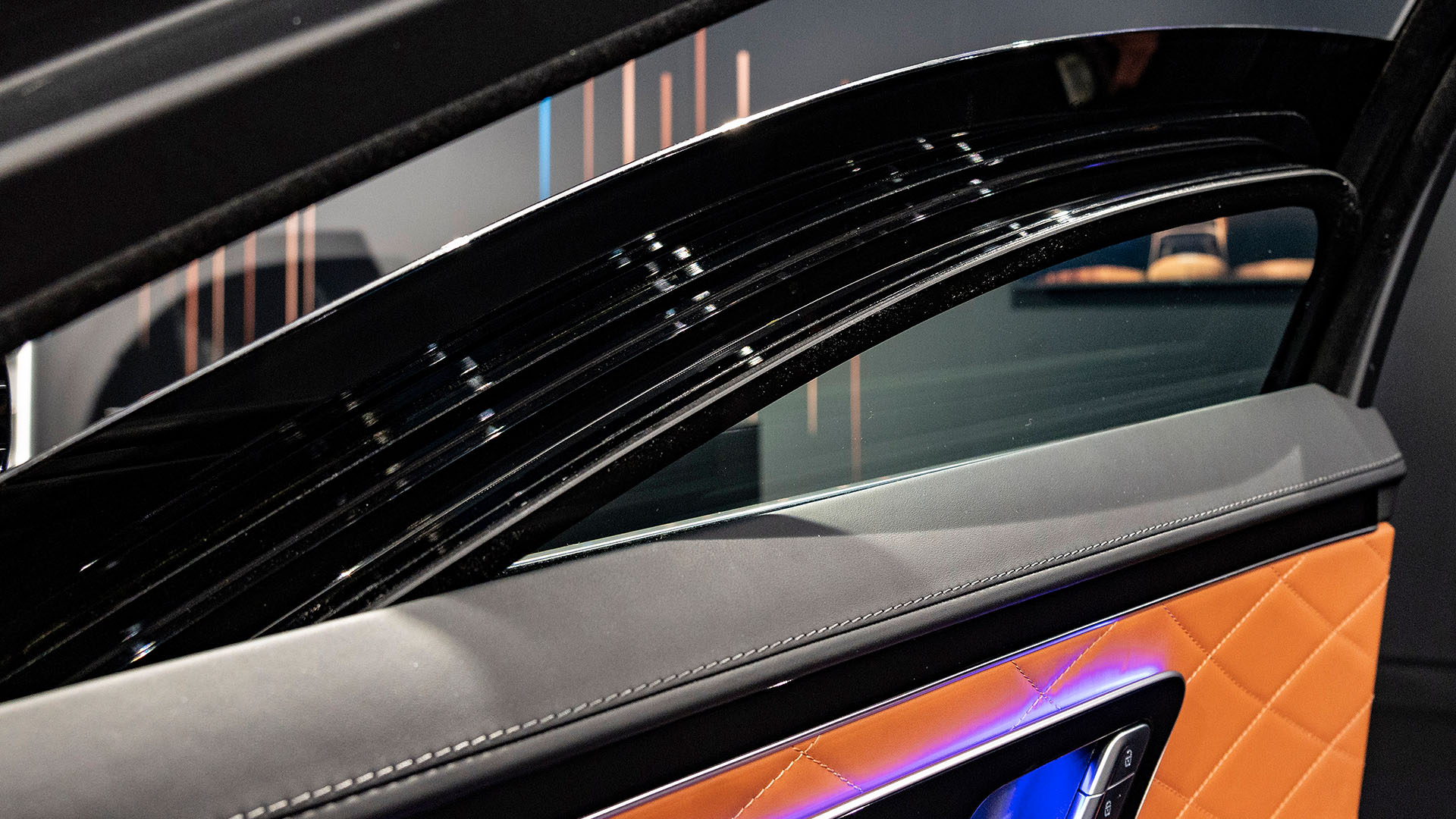
When it comes to the glass surfaces on a GUARD model, the multi-layer glass ‘sandwich’ has to meet the highest requirements of VR10 safety classification, on the inside the glass gets a polycarbonate coating for splinter protection but still show excellent visibility, while at the same time the thick glass has been integrated in such a way that they are not noticeable at first glance, another significant advantage of the integrated protection system.

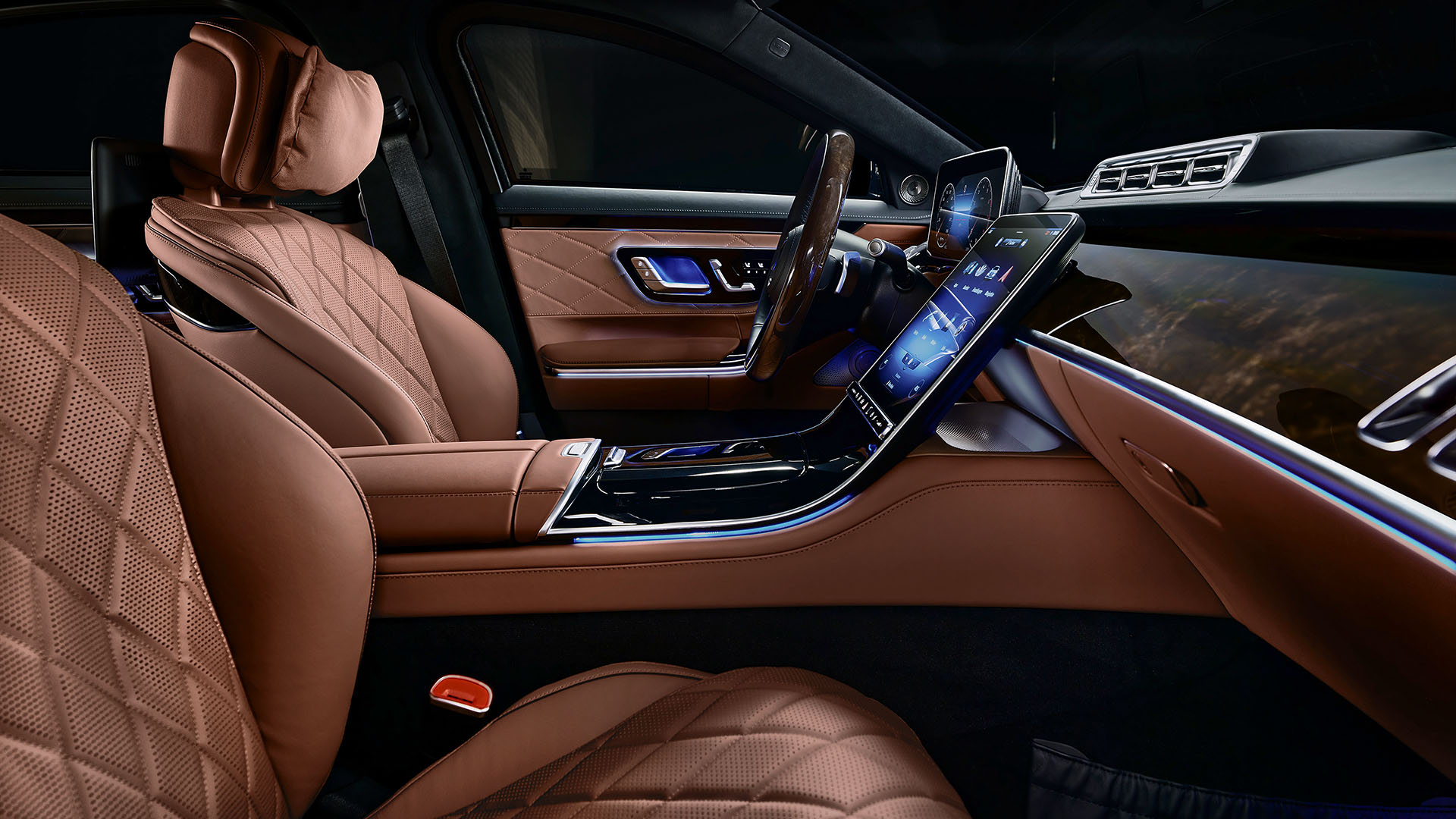
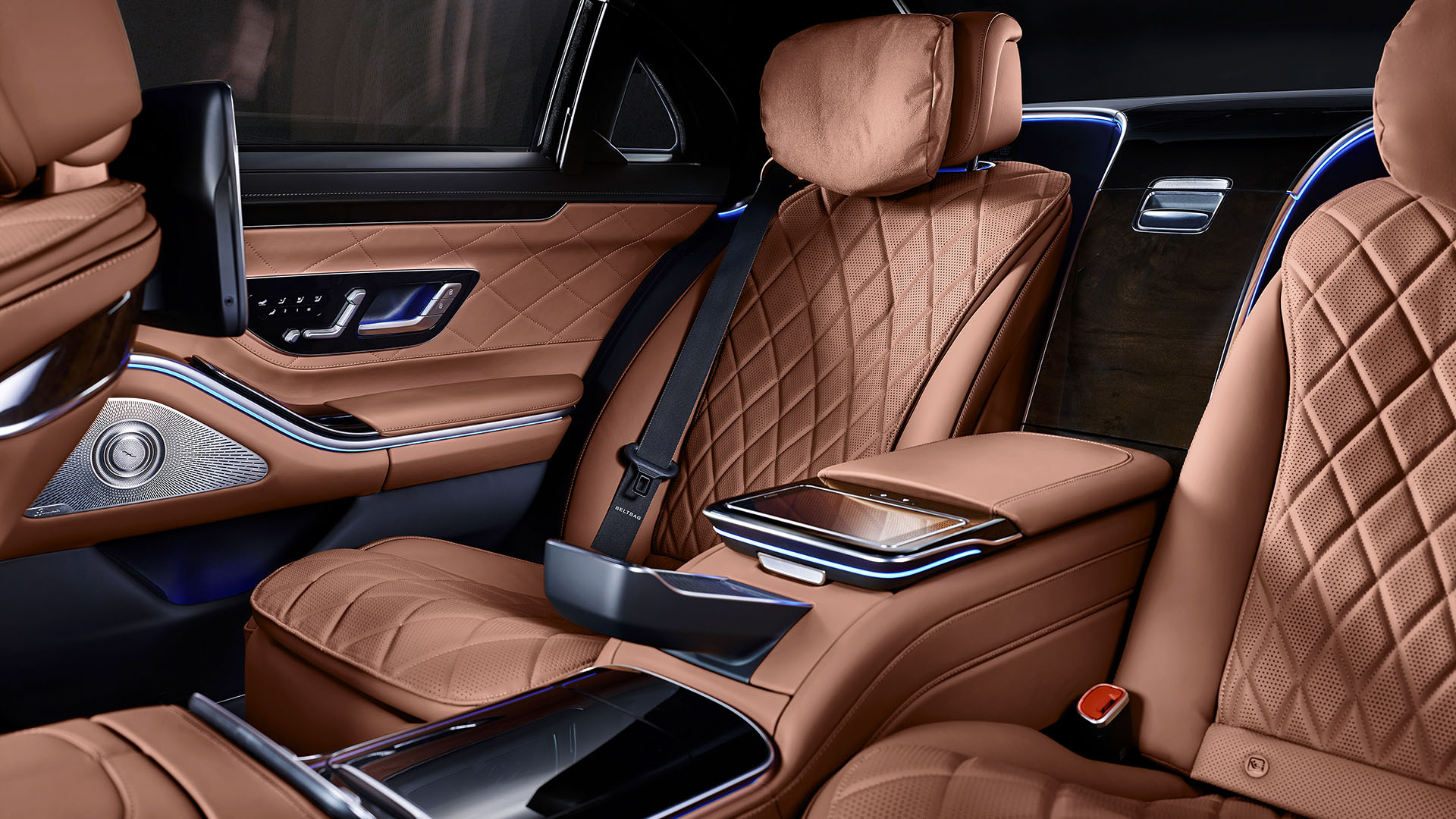
On the S680 GUARD 4MATIC you can get just about every option for the exterior and interior as you would on the regular Mercedes S-Class, with a total of more than 80 options from interior lights, integrated media systems with OLED tech to Mercedes’ First-Class rear suite … you can opt for a three-seat rear or a two-seat rear compartment, whichever the client prefers … always keeping in mind that any ‘unsafe’ options will not be available … a large panoramic sunroof is not possible for instance.

This new S680 GUARD meets the requirements of the highest civilian protection class VR10 according to the standard VPAM BRV version three (Bullet Resistant Vehicles), during testing, both the body and the windows must be able to withstand direct impacts from an assault rifle using armor-piercing ammunition, this new S-Class GUARD also meets the requirements of Germany’s Federal Criminal Police Office (BKA). Protection against blast attacks is documented by compliance with the latest version of the VPAM ERV(Explosive Resistant Vehicles) standard, the test criteria for which are not freely available. The S 680 GUARD 4MATIC was not only the very first vehicle to complete the current tests, it also achieved the top scores in all three tests (roof, floor, and side) with three out of three stars. Test result: “no damage” to dummies and indicators according to assessment scheme VPAM ERV.

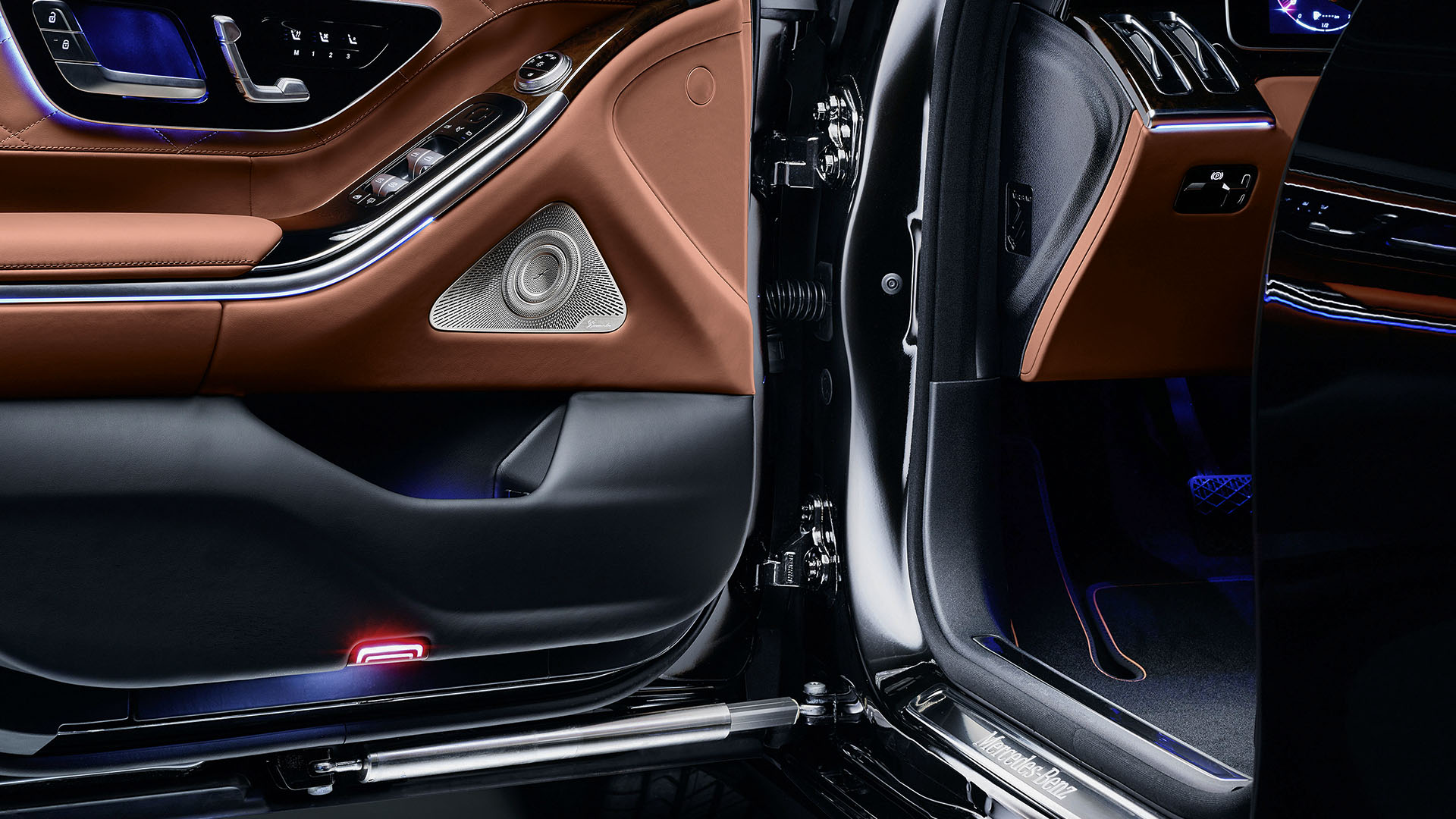
The problem with highly-armored cars like this is weight, the added layers of protection add a lot of weight to the base model, for instance, the doors are reinforced on the inside, but they also carry a lot of weight from the thick glass that has to be fitted, this requires special hydraulic window lifters to cope with the heavy glass, but imagine opening the door on a slope, that would be almost impossible without electro-mechanical door actuators that actively push the door open when you pull the latch to facilitate the work of the bodyguards, and at the same time, they can keep one hand free.

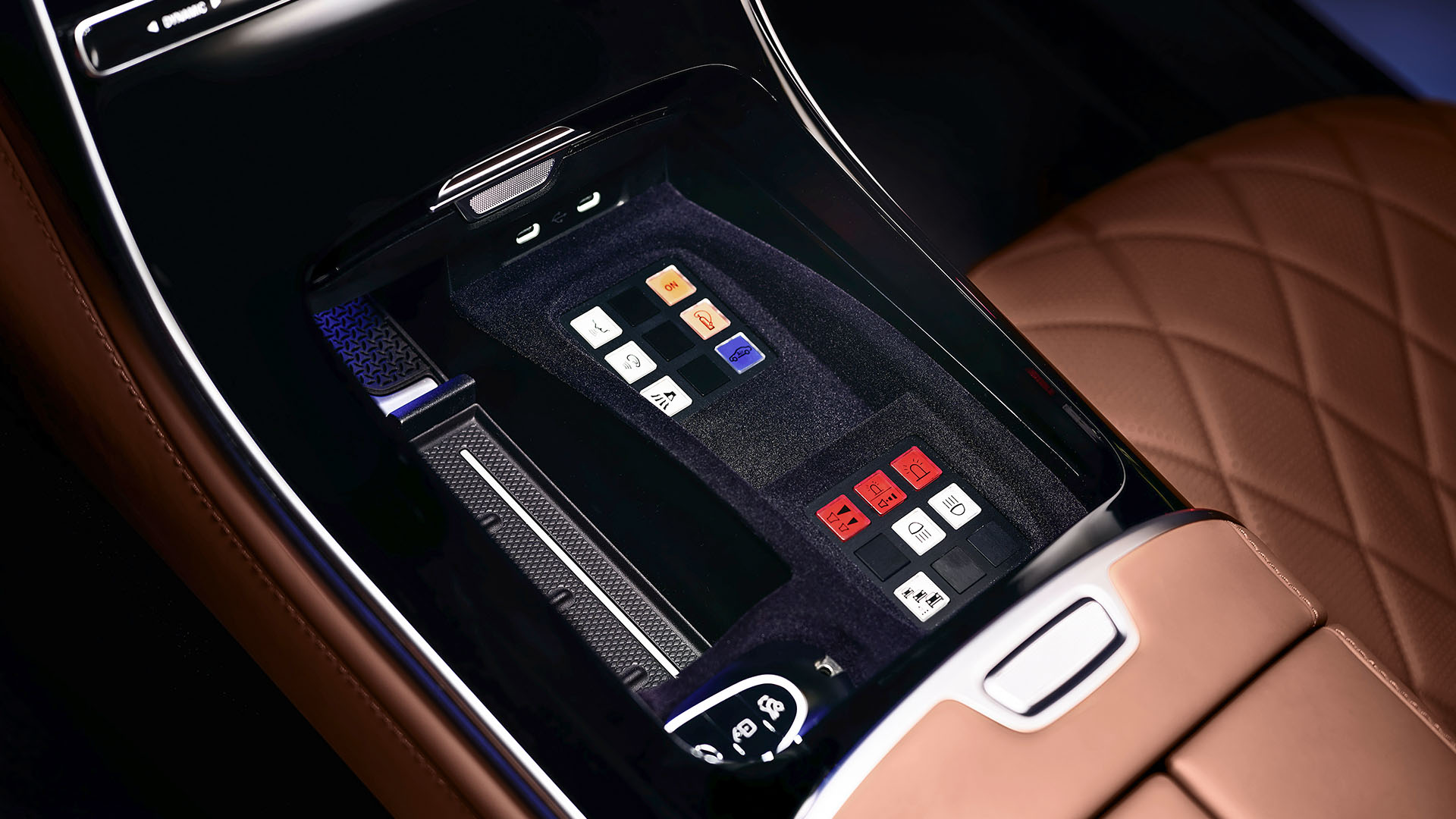
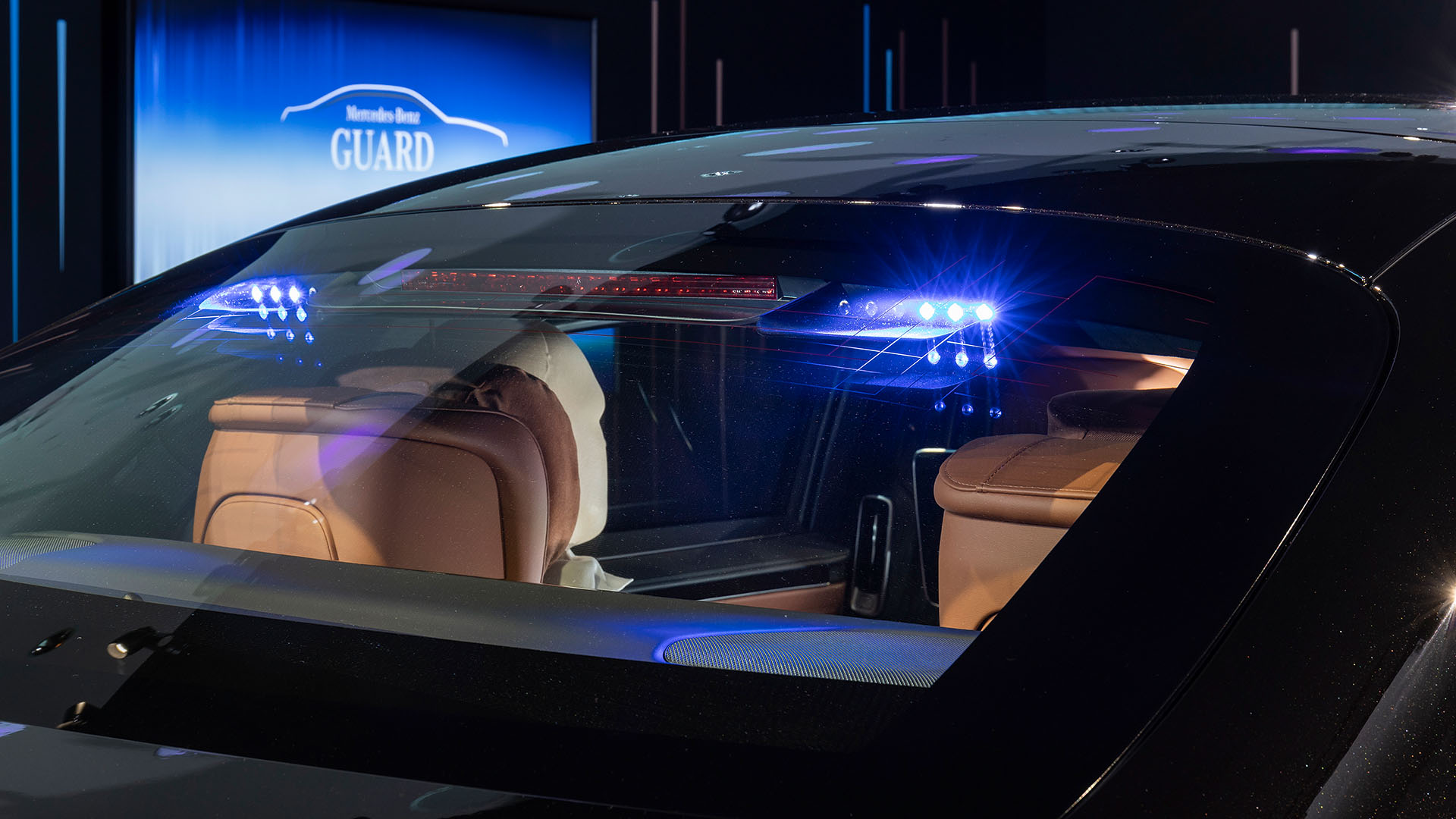
Cars like the S 680 GUARD 4MATIC include a lot of special equipment bespoke-made just for them, like a fire extinguishing system with an automatic triggering function, or an emergency fresh air system that protects occupants from penetrating smoke or irritant gases, but there are also options available that aren’t listed on the normal S-Class list: including an extensive range of equipment for official authorities, such as a siren, flashing lights, and radios, as well as a panic alarm system.

Naturally, a car like this Mercedes-Benz S680 GUARD 4MATIC doesn’t roll on standard tires, this car comes with a set of Michelin PAX run-flat tires are a standard feature, even when perforated these can keep going for up to 30 kilometers to get the occupants safe and out of harms way in case of an emergency, and while the 6-Liter V12 engine boasts 612 hp and 830 Nm of torque at as low as 2,000 rpm, due to the increased weight of the GUARD version, the top speed has been electronically limited to 190 Km/h … but you can have people move out of your way with the flashing blue lights on this car.

BRX is revamping its lineup for the 2022 Dakar Rally with the Prodrive Hunter T1+

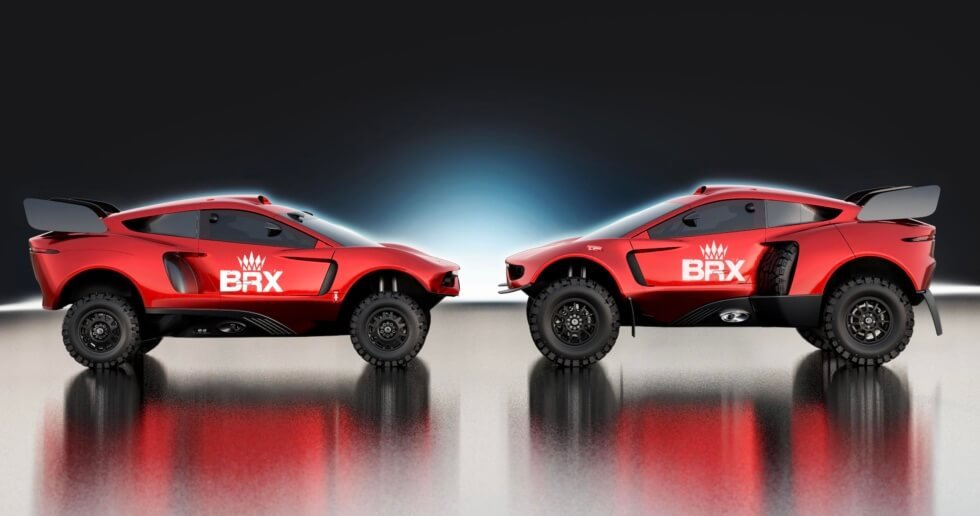
The 2022 Dakar Rally is shaping up to be an exciting one with the world’s leading carmakers teasing exciting new machines. Just last week, we learned of Audi’s plan to compete with the hybrid RS Q E-Tron rally car. Now, we have Bahrain Raid Xtreme (BRX) and its Prodrive Hunter T1+ to watch out for come race day.

Instead of just mulling about their 2021 outing, the BRX team are busy learning from their mistakes and adjusting. The tweaks they are making are not only for boosting performance. These are, in fact, to abide by the latest regulations set by the FIA.

“We are very pleased the organisers have addressed the disparity in regulations between the buggies and the four wheel drive T1 cars, where larger tyres had an advantage over rough terrain,” said BRX team principal, Gus Beteli.

With the new rules in place, both 4WD and 2WD configurations will be more balanced. To be specific, the bodywork, suspension, and drivetrain are receiving some upgrades. BRX notes that the suspension now boasts longer dampers and wishbones. Travel is now set at 350 mm from 280 mm.  

Now that the Prodrive Hunter T1+ rides on bigger 17-inch wheels with 37-inch all-terrain tires and larger brake systems. What follows is a wider stance at 2.3 meters from 2 meters. As for the bodywork, BRX is keeping the familiar aerodynamic silhouette of its predecessor.

BRX is already using the T1 version, while Prodrive Hunter T1+ is under construction. The team estimates that it should be ready for testing in September. This should give their drivers enough time to adjust to the new driving dynamics and handling before the 2022 Dakar Rally.

Discover more

imageimage

Images courtesy of BRX

5 Things To Buy For Active Men

Finding the perfect present for the man in your life is not as easy as you might think. With so many products designed for men readily available on the market, a lot of people feel the whole process can be slightly overwhelming. 

With the internet at your fingertips, you can access a wide range of marketplaces and online stores in a matter of seconds. However, this might make things even harder for you if you have no idea where to start. If he likes to keep himself active, you should have no issues finding a practical gift. Because so many people like to stay active, there are plenty of fantastic products out there. In this article, we will look at some unique gift ideas that are available this year.

1.   Inflatable Stand Up Paddle Board (SUP)

image

Paddle boarding grew in popularity about 15 years ago, but very few people owned their own board. Most of these boards were over 10 feet long and were made with fiberglass. They were so heavy and big, bringing them from point A to point B proved extremely challenging. Plus, they often cost a small fortune.

But when the inflatable stand up paddle board came along, the industry exploded. Instead of hauling around a large heavy board, you could buy an inflatable that you could easily store in a bag, which made them a lot more convenient in comparison to boards made of fiberglass. Most of these boards come with the following:

       A pump: A small pump that connects to the board which allows you to manually push air into the board. It normally takes about 5 to 10 minutes to fill it with air.

      A paddle: Paddles that come with most inflatable paddle boards allow you to adjust the size so you should have no problem storing it.

      A bag: Once the board is deflated, you can store it in this large bag.

You can pick up a top of the range inflatable SUP for around $600. Most traditional surf stores and online marketplaces stock a wide variety of inflatable boards. Unlike a traditional surfboard, you don’t have to rely on strong waves to enjoy it. He can use it in almost all weather conditions, any time of the year. It is a great product that will allow him to enjoy the great outdoors and it is fantastic for building muscle.

 2.   E-Scooter

image

Electric scooters were invented in 1985, but over the past few years, they have become very popular. For those living in a city, this is an ideal energy-efficient gift that allows them to get to their destination quickly. With growing concern about global warming, a lot of guys are looking for a mode of transport that doesn’t harm the environment. Because these devices run off rechargeable batteries and not fuel, they are environmentally friendly.

There are lots of stores online that sell these quick and agile scooters, like E-Ride Hero. Not only are these devices energy efficient and practical, but they are really good fun to drive too. They allow you to weave in and out of traffic, and you don’t need a lot of space to park them. For those who work in the city, getting stuck in traffic jams can consume a lot of their time, but an e-scooter makes getting stuck in traffic a thing of the past.

Unlike cars or other motorized vehicles, e-scooters require very little maintenance. Most people who own them manage to fix and maintain the device themselves, so they don’t have to spend a lot of cash on mechanics and spare parts

3.   Protein Gift Box

image

If the man you are buying a gift for goes to the gym regularly, he probably spends a lot of his savings on protein products to gain muscle. For those who work out a lot, protein supplements can prove to be a very costly expenditure. Once you run out of protein products, you have no other choice but to buy more. Otherwise, you will eventually end up losing all your gains after some time.

Protein boxes are packed with lots of different protein products including:

      Bars

      Snacks

      Cookies

      Drinks

      Powders

If he is a vegan, you can easily find a protein box that just includes plant-based sources of protein. Protein boxes are selling really well these days, so you will have plenty of options. If you are working off a tight budget, you should be able to find a box for less than $50.

4.   Gym Membership

image

If he likes to go to the gym, or if he wants to go but hasn’t yet joined the gym, purchasing him a gym membership is a great idea. Most guys will appreciate it because it is something they really need.

If you want to go the extra mile, you can include a massage, a trainer, or even some exercise clothes. Not all gyms are the same, so it might be worth your while checking out some gyms in your area first. Some gyms offer more than others, and some even include a swimming pool and sauna. If you don’t go to a gym yourself, it might be a good idea to do some research about the different gyms in the area first. Ask around, or check out reviews posted online. A lot of gym enthusiasts post reviews on the web about the different gyms they go to. This will give you a good insight into what you are paying for. A lot of employees working there will be more than happy to give you a small tour of the gym, so don’t hesitate to ask.

5.   Green Fees for a Nice Golf Course

image

Joining the best golf courses can cost a lot of cash, so a lot of guys can’t afford it. But you can pay to use most courses for a day, so if the man you want to buy the gift for enjoys playing golf, then getting him green fees for the best golf course in the area is a great idea.

If he is new to the game, or if he has never played in his life but you think he might enjoy it, consider getting him lessons from a PGA professional golfer. In many towns and cities, there are lots of professionals that teach others how to play. If he is new to playing golf, he will love getting lessons from seasoned professionals. Even if he has been playing golf for several years, golf lessons can help him boost his skills to the next level.

Conclusion

image

If you only know the guy for a short period, consider asking his close friends or family members for advice, or scroll through his social networking account for ideas. Before you start spending your cash, know your budget so you don’t find yourself going overboard. Just in case he owns the same thing already, make sure you keep the receipt just in case he wants to change it for something else. When you’re about to pay for the item, explain to the employees that it is a gift, and ask if he can exchange it for something else if he doesn’t want it. Before shopping, make a list of all his interests and hobbies and find out what products are available in those areas.

SCG to compete in the 2022 Baja 1000 with the Zero Emission Hydrogen Fuel Cell Boot Pickup

Aside from battery-electric systems, another promising technology that is yet to see mainstream use are hydrogen fuel cells. Unfortunately, there are issues that stand in the way of its mass adoption. Scuderia Cameron Glickenhaus (SCG), on the other hand, envisions a different future. One wherein vehicles like its Zero Emission Hydrogen Fuel Cell Boot Pickup compete with other sustainable rides.

However, electric powertrains continue to dominate. Given the scarcity of hydrogen refueling stations, it is difficult to market vehicles that run off them. SCG’s Zero Emission Hydrogen Fuel Cell Boot Pickup could be facing an uphill battle down the line.

Nonetheless, the boutique carmaker based in Sleepy Hollow, New York says a prototype will be available soon. As suggested by its lengthy name, the SCG Zero Emission Hydrogen Fuel Cell Boot Pickup is based on the group’s Boot Buggy model.

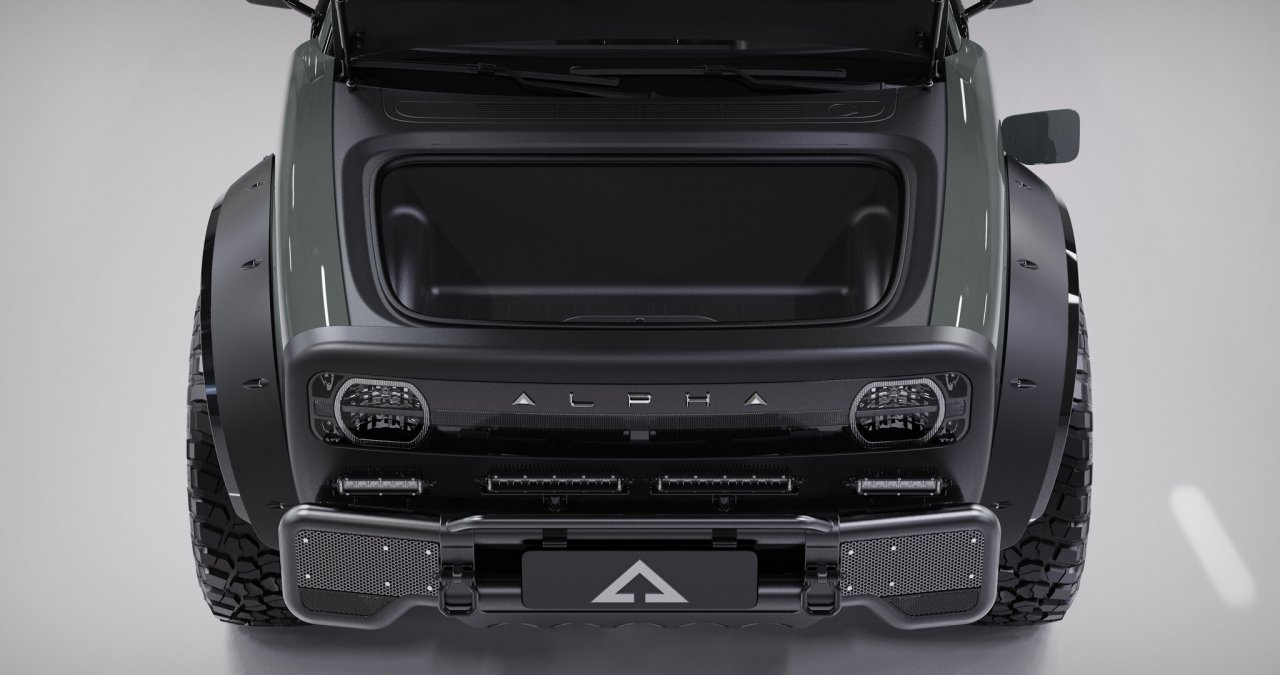
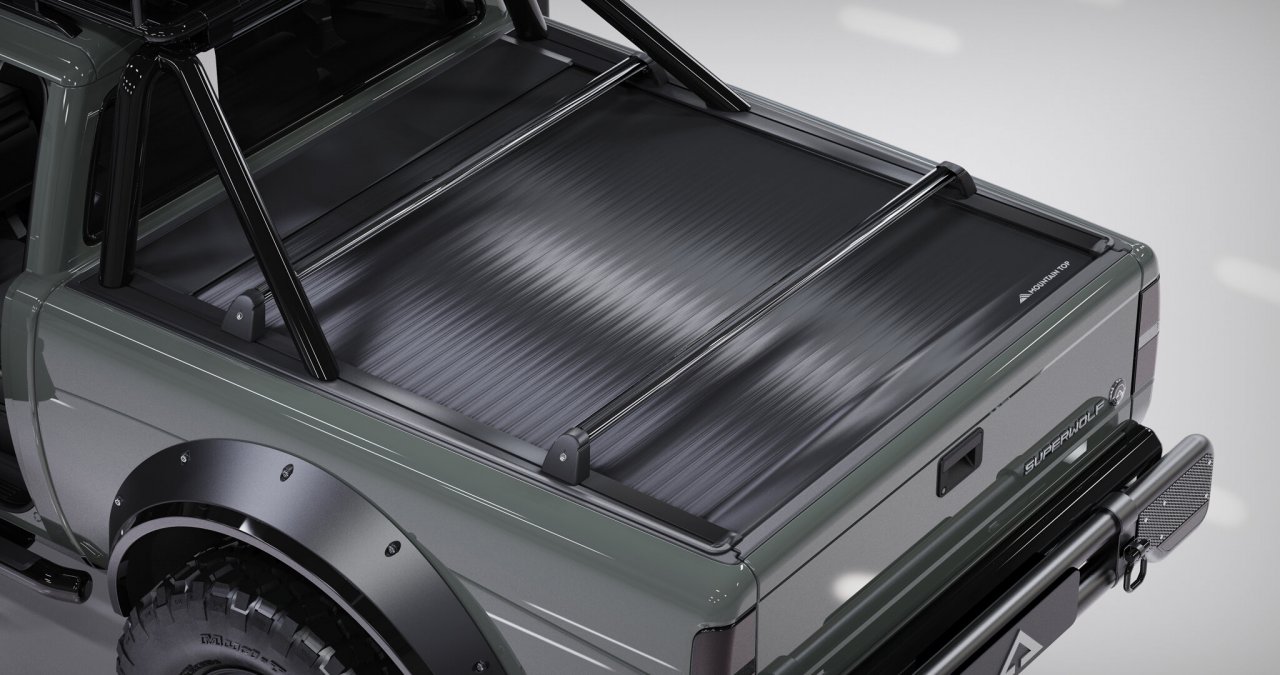
From a design perspective, it looks like a beefy crew cab truck that would be at home on or off the road — camping anyone? Looking at the renders, it seems there are no rear seats liquid hydrogen storage tank occupies the space as well as a section of the bed.

Enhancing its off-roader stance is a roof-mounted LED light bar. Additional reinforcement bars on the front and rear bumpers give it a menacing profile. SCG is also giving the Zero Emission Hydrogen Fuel Cell Boot Pickup huge wheel wells for the chunky all-terrain rubber it’s shipping with.

According to the manufacturer, it can be used as a generator for multiple applications. To showcase what the Zero Emission Hydrogen Fuel Cell Boot Pickup can do, SCG plans to compete in the 2022 Baja 1000. Finally, mileage should be anywhere between 600 to 1,200 depending on the trim and configuration.

Learn more

Images courtesy of SCG 

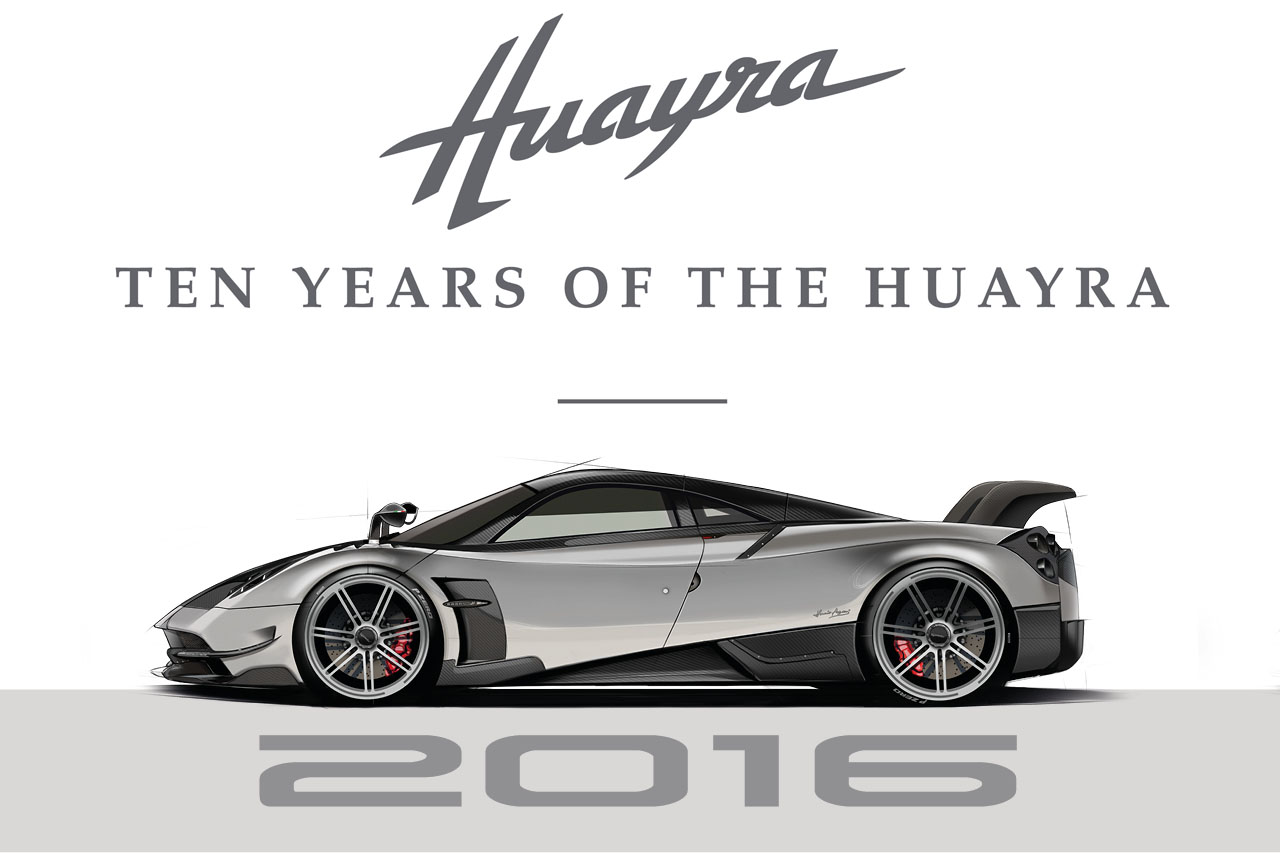
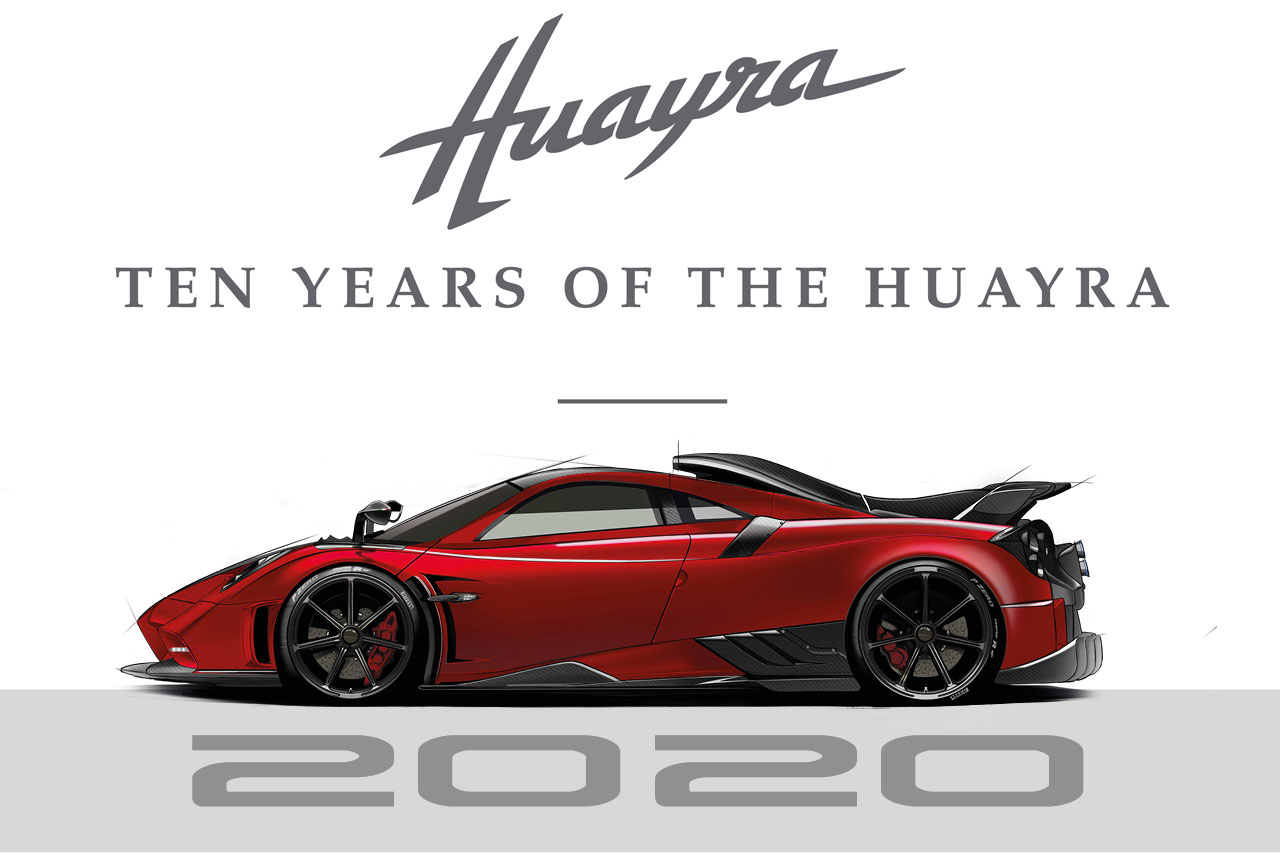
The Huayra is a decade old this year

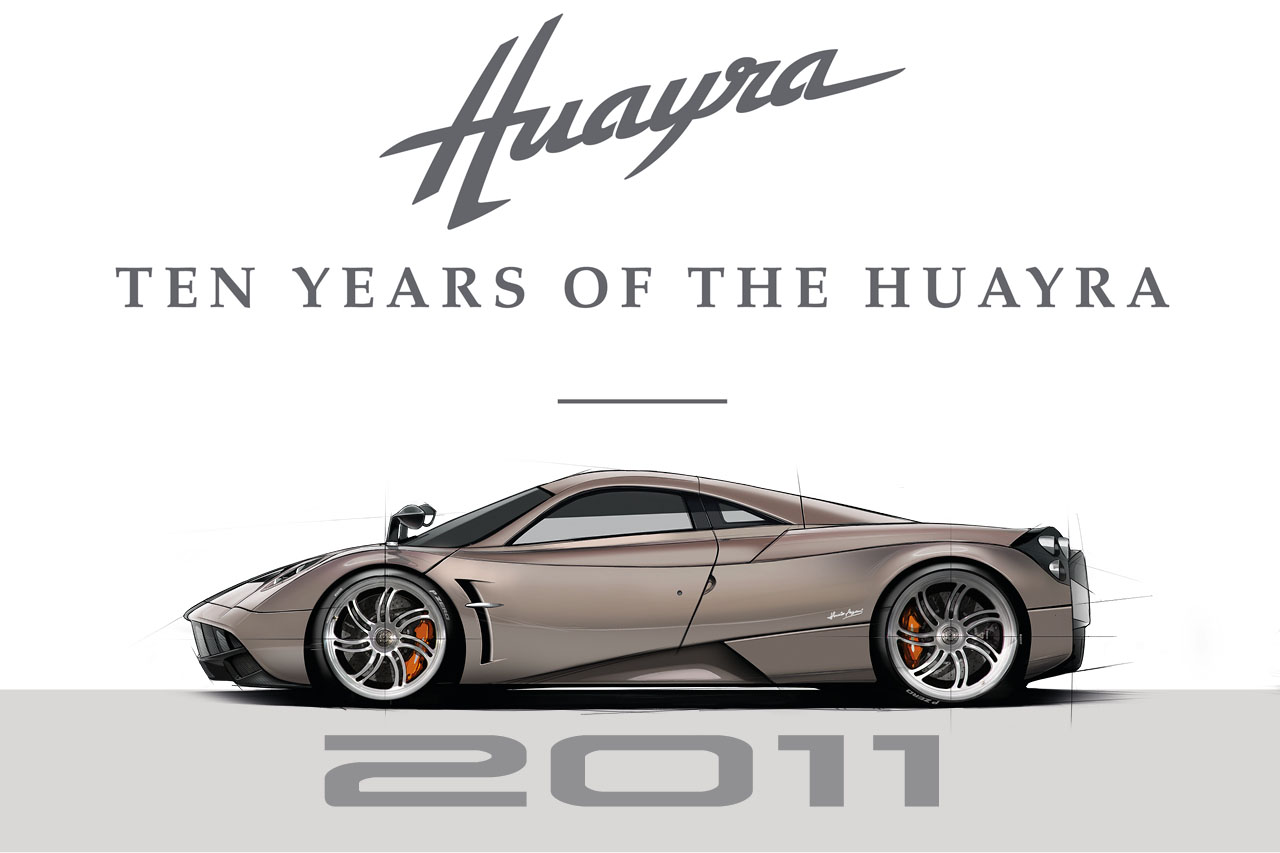
I am sure there are people out there that never have seen a Pagani Huayra in real life yet, but this amazing model from Horatio Pagani was introduced back in 2011 already, the Huayra is celebrating her 10th anniversary this year, and with Monterey Car Week in little over a week, Automobili Pagani found the perfect venue to commemorate this event, by bringing something new to California for us to enjoy … the Huayra BC Pacchetto Tempesta.

But let’s take a trip back to 2011, when Pagani officially unveiled the Zonda successor, called Huayra, in a simple online press release in January 2011, due to the close collaboration with Pirelli the world premiere featuring a real car was done at the Milan headquarters of Pirelli a month later, because Pagani used a Mercedes-AMG sourced engine for the new Huayra, production was limited at only 100 units … four years later, by February 11, 2015, this very special Pagani was sold out.

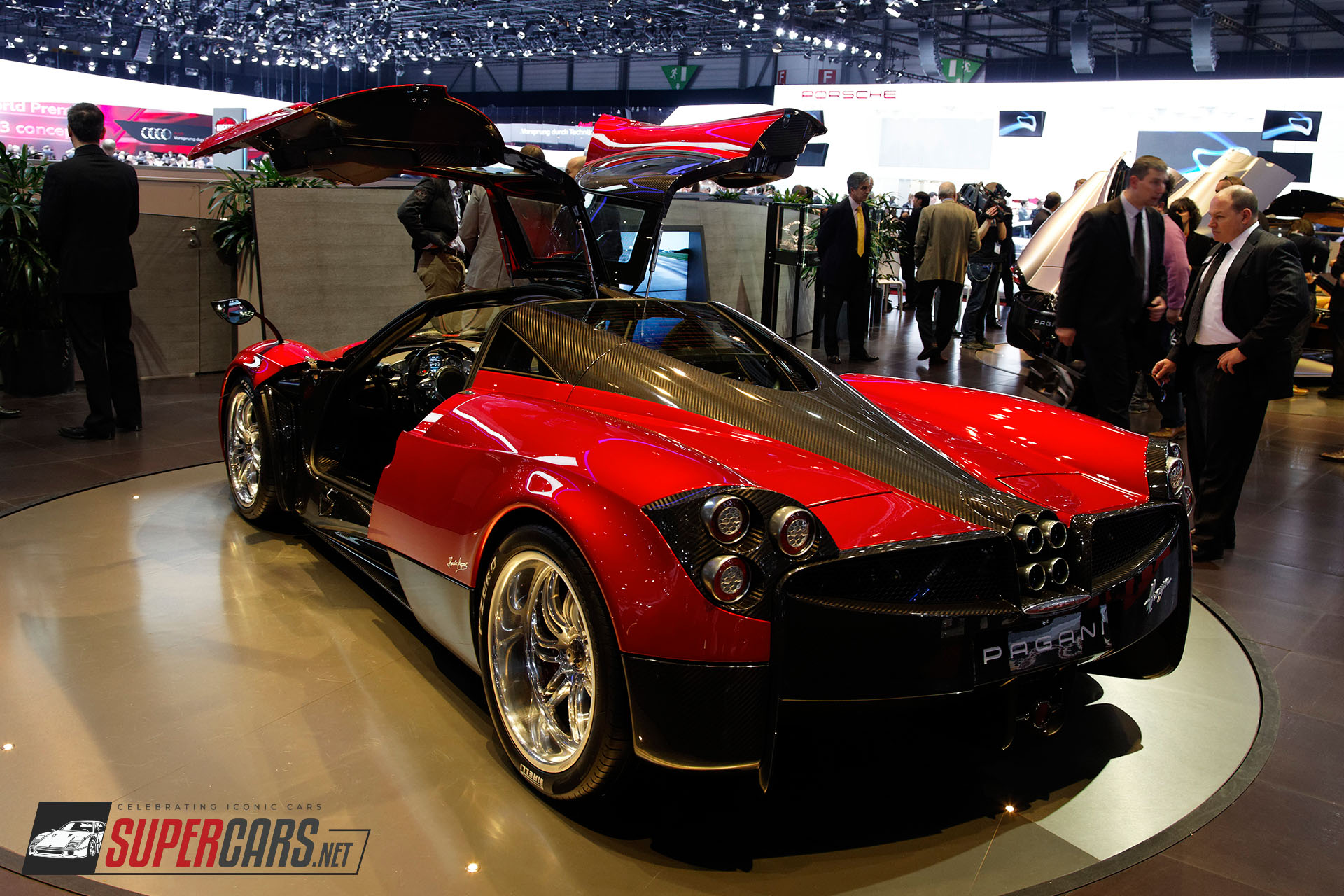
The Pagani Huayra at the 2011 Geneva Motor Show

A more public unveil for the new Pagani hypercar occurred at the 2011 Geneva Motor Show where the two cars on the stand drew a lot of attention, keep in mind at that same Geneva show Lamborghini unveiled the long-awaited Aventador LP700-4 and Koenigsegg showed the bright white Agera R, yes, the one with the ski box on the removable roof panel!

The engine for the Pagani Huayra might have been sourced from Mercedes-AMG, but it was a bespoke built for this car only, a 6-Liter twin-turbo V12 unit (internal code M158) that would deliver 720 hp at 5,800 rpm, but more importantly a massive 1,000 Nm of torque between 2,250 and 4,500 rpm … weighing in at only 1,250 kg, the Huayra was extremely fast on the track, in part due to the active aero ‘flaps’ at the front and rear of the car.

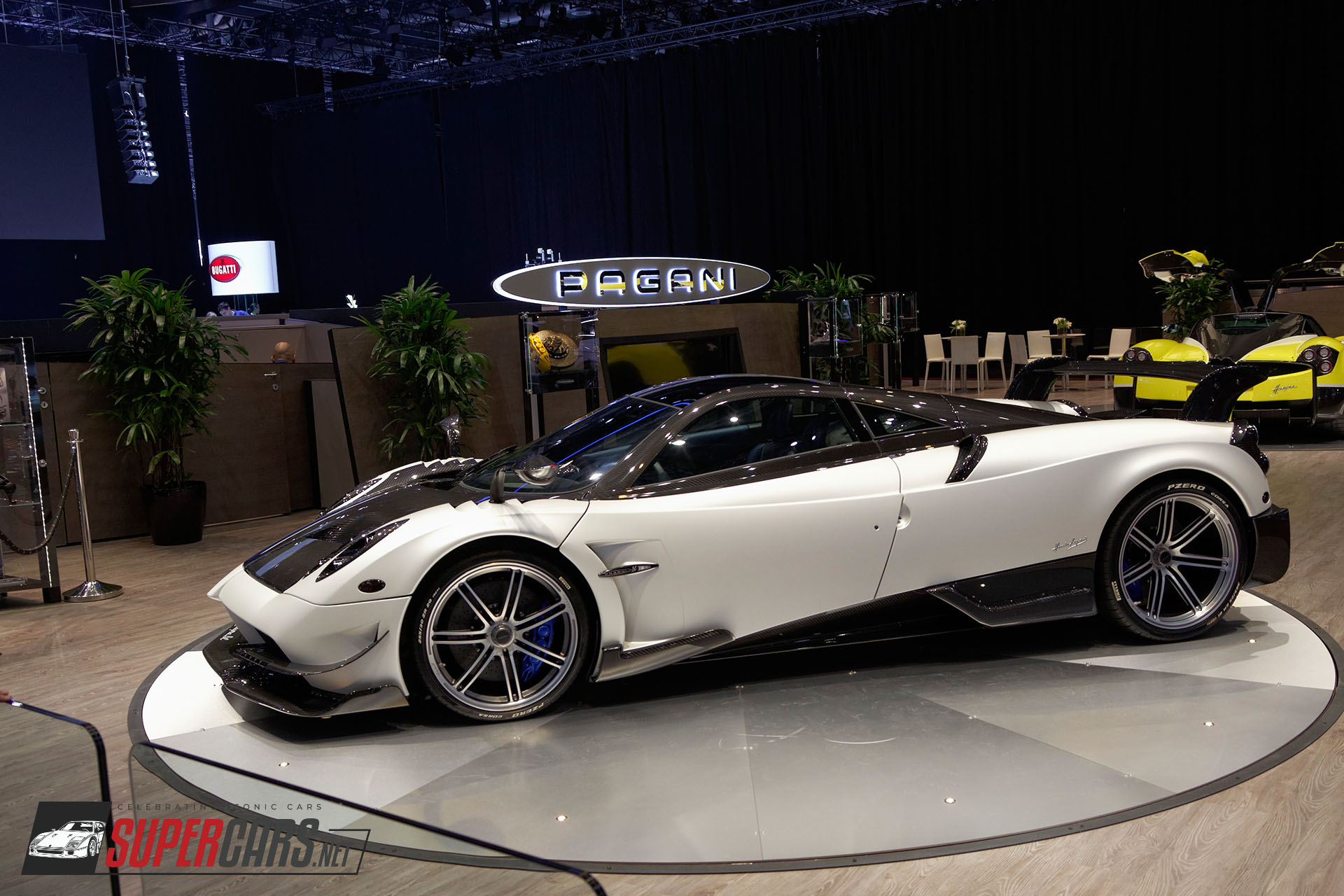
It took Pagani a few years to come up with an improved Huarya because the 100 units of the ‘base’ Huayra were sold out (not all delivered yet, however), we got the BC shown to the public at the 2016 Geneva Motor Show, a more track-focused model named after the late Benny Caiola, a close friend of Horacio Pagani, and the first Pagani customer.

The Pagani Huayra BC at the 2016 Geneva Motor Show

The Pagani Huayra BC came with more power from the 6-Liter twin-turbo V12 engine, now rated at 745 hp with 1,100 Nm while overall weight got reduced to 1,218 kg, one of the options available on the limited edition Huarya BC was an impressive air intake on the engine cover and roof to make the car look even more like a race car … only 20 units of the Pagani Huayra BC were built.

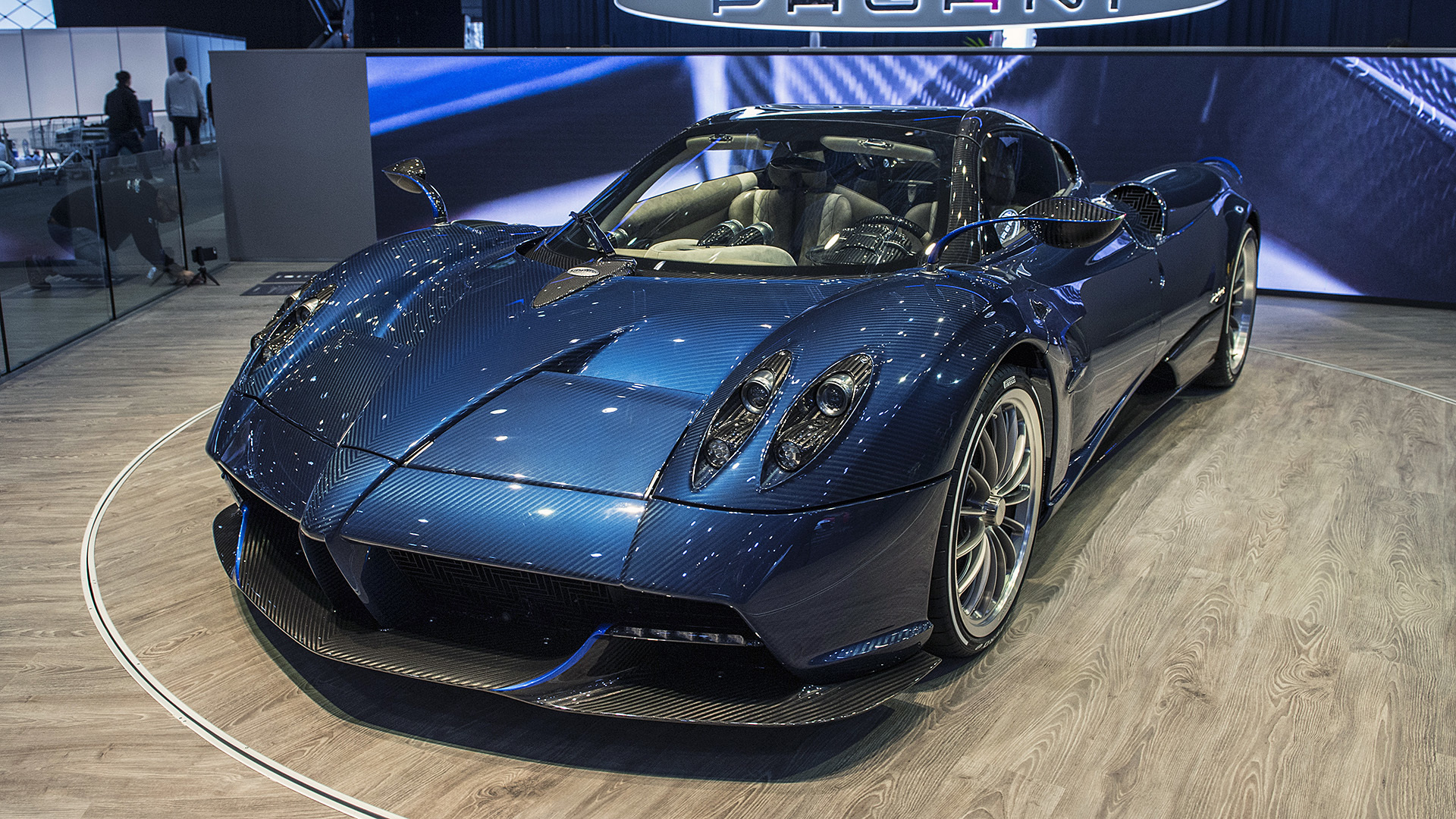
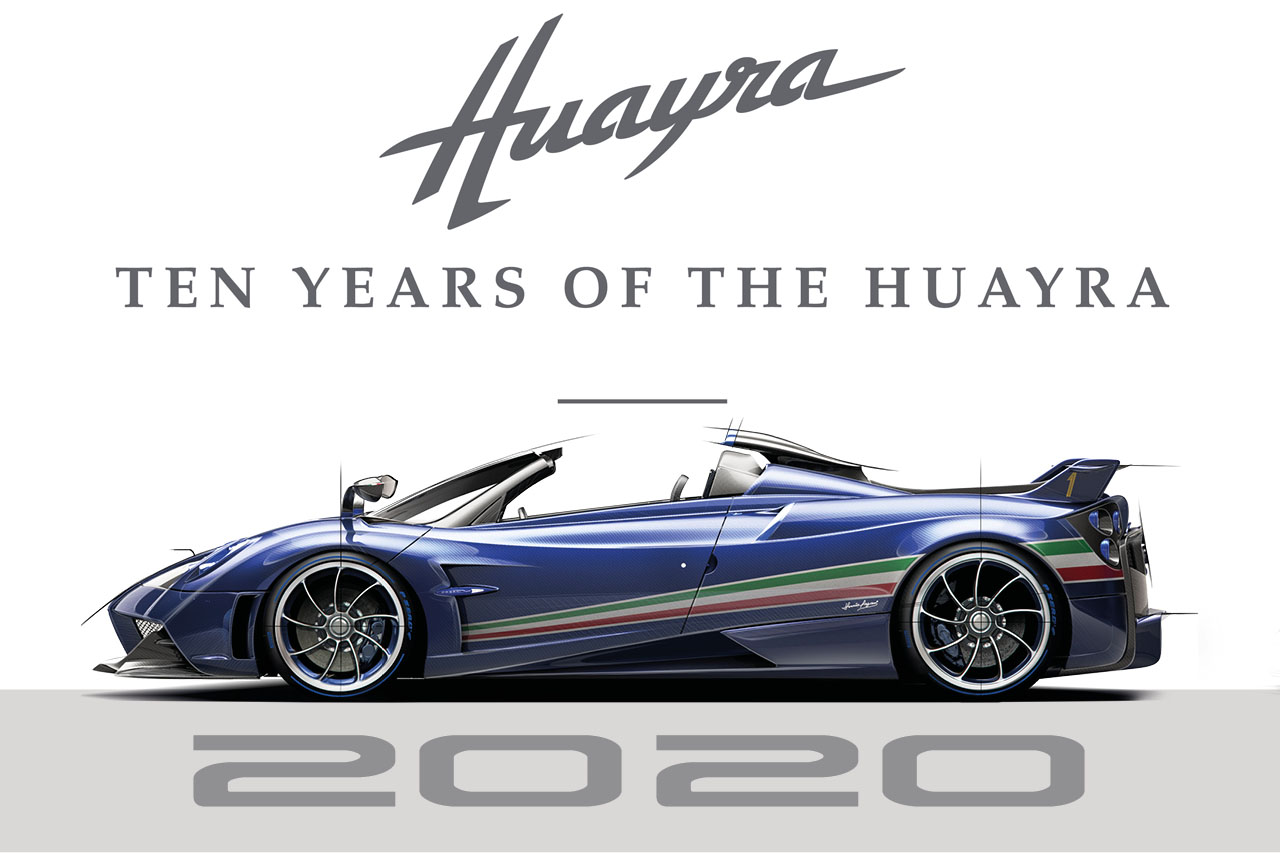
A year later Pagani released the version of the Huayra I would be interested in the most, the Huayra Roadster, I prefer convertibles for my personal use, and the Huayra Roadster showed a rather radical, bespoke design, and I love it, she looks stunning. Naturally, the entire section over the engine had to be redesigned to offer open-top motoring, Pagani style, and on a car like this a canvas folding roof would be blasphemy, so the Huayra Roadster came with a removable hardtop section that could be left in the owner’s garage on a custom frame.

The new Pagani Huayra Roadster at the 2017 Geneva Motor Show

Unlike the Huayra that has those jaw-dropping gullwing style doors that open up, the Huayra Roadster comes with traditional doors, there is no roof to fix the hinges needed for gullwing doors, and while Horatio Pagani did some testing with a different way of opening for the doors on the Roadster, in the end, he deemed all the more ‘special’ solutions to be too heavy for this topless Huayra, so he settled for regular, horizontally swinging doors but still increased power from the V12 engine to 754 hp, the Roadster was again limited to 100 units only.

Just as with the closed coupe, the Pagani Huayra Roadster received an even more powerful BC variant, introduced in 2019, this time 40 units would be available of this $3,210,000 hypercar, now with almost 800 hp still from that Mercedes-AMG sourced twin-turbo V12 engine with a 6-Liter displacement. New to the roadster was a set of exhaust diverting flaps that would move some of the exhaust down, under, and more importantly over the sides of the rear diffuser, in effect making the Huayra BC Roadster a derivation of Formula 1 blown-diffuser technology developed in 2011 by Red Bull Racing.

The Pagani Huayra BC Roadster was intended to be unveiled at the 2020 edition of the Pebble Beach Concours d’Elegance during Monterey Car Week, but sadly that event was canceled due to the worldwide pandemic, fortunately, the 2021 edition will take place, during which Pagani intends to offer some serious experience for their owners by gathering a large number of Pagani cars on the track, more on that later.

The most powerful, street-legal Pagani Huayra is the 2020 Imola version, with 827 hp, this very special model took its name from the fact Pagani did about 16,000 km of testing on the famous Italian Imola track, with an overall weight of only 1,246 kg thanks to a new way of producing the carbon fiber body, the more obvious points to recognize this version must be the new side sills, big roof scoop, and a vertical ‘shark fin’ that runs into a fixed rear wing … this looked like a race version of the Huayra, but that one was still on the drawing boards at Pagani, only 5 units of the Huayra Imola were made.

If you think a production run of 5 units on the Pagani Huayra Imola was limited, think again … the Huayra Tricolore came in only 3 units, even an MSRP of € 5,500,000 before VAT didn’t keep people from buying this ultimate Pagani. In 2010, Pagani paid tribute to 50 years of the Frecce Tricolori by creating the Zonda Tricolore, with only three built too, making it the most exclusive and sought-after Zonda model in the world.

In 2020, the Frecce Tricolori reached their 60th anniversary and Pagani wanted once again to celebrate this milestone with another piece to a mosaic created from passion, tradition, and the spirit of collaboration, inspired by the Aermacchi MB-339A P.A.N., the Huayra Tricolore is powered by a new Pagani V12, a twin-turbo engine specially developed by Mercedes-AMG, now capable of delivering 840 hp at 5900 rpm and 1100 Nm of torque from 2000 to 5600 rpm in this latest iteration.

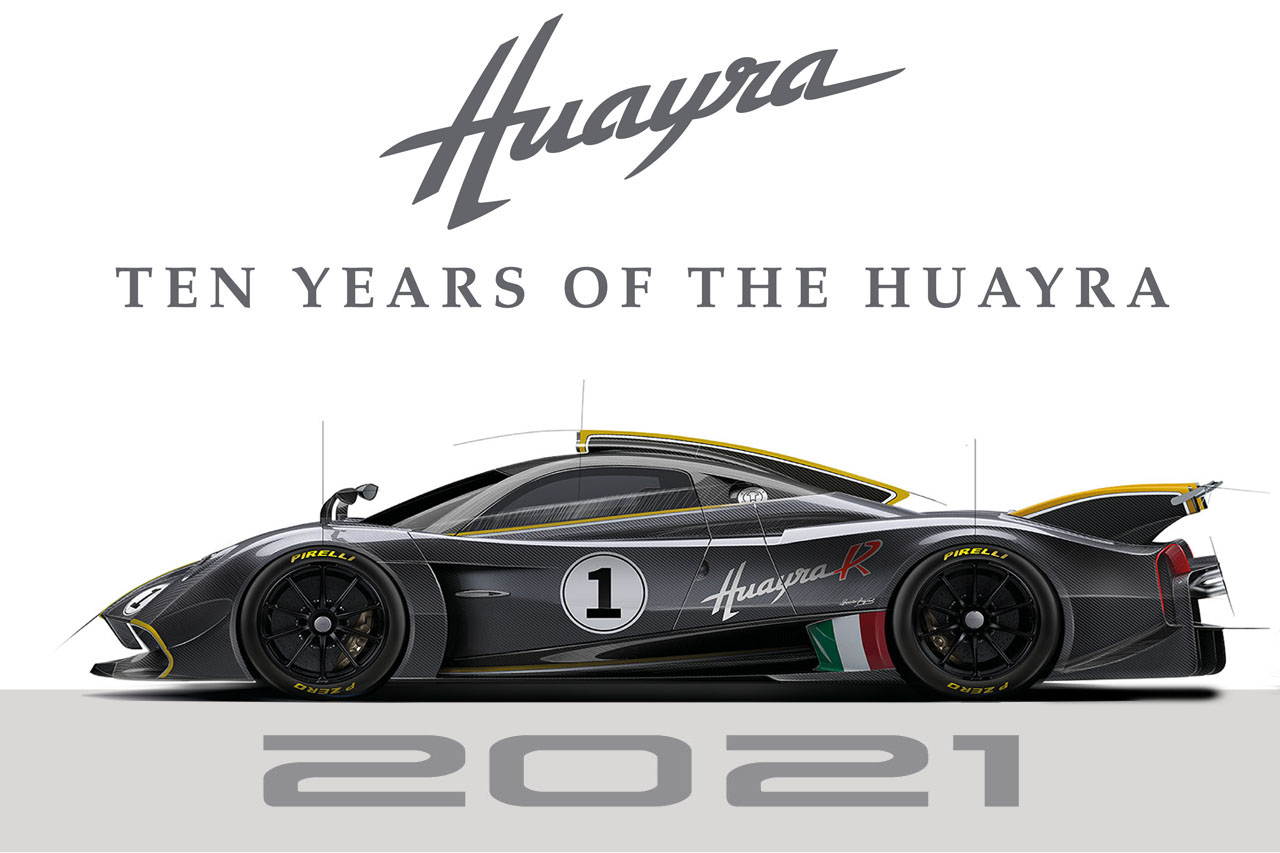
2021 marked the year when Pagani came up with the long-awaited R version of the Huayra, much like the Zonda R presented at the 2009 Geneva Motor Show, the Huayra R is a track-only car, this beast is not street-legal, but she still looks amazing, although we haven’t seen a rolling prototype yet, only a static mockup in a YouTuber video, the intention is to build a total of 30 units of the Huayra R, against 15 units of the radical Zonda R.

The Pagani Zonda R at the 2009 Geneva Motor Show

And it seems Pagani isn’t ready to unveil a working Huayra R yet either, their latest press release states ‘key components of the Huayra R project are on display’ at the 2021 Monterey Car Week, so we won’t be seeing an actual car in California this year, at least not a Huayra R, but we will be able to enjoy some serious Pagani hypercars over that weekend as Pagani will showcase the most iconic Huayra models at The Quail, A Motorsports Gathering, together with the world premiere of the Huayra BC Pacchetto Tempesta.

Pagani will bring along the first Huayra BC to be fitted with the new Pacchetto Tempesta together with one of the 40 units in the Huayra BC Roadster production, as they couldn’t unveil that car back in 2020 at the same event, the Pacchetto Tempesta is specifically developed to improve the already potent Huayra BC even further towards its racing attitude.

The Pacchetto Tempesta distinguishes itself from a regular Huayra BC with a different front splitter and dedicated air intake to maximize aerodynamic efficiency, a new rear wing featuring an integrated central fin comes into play, a different six-pipe exhaust system together with a new suspension. To enhance both comfort and looks, the interior of the Huayra BC gets some striking interior details and an all-new Soft Driving mode makes its appearance, power is increased by 8% to a total of 827 hp and 1,100 Nm torque.

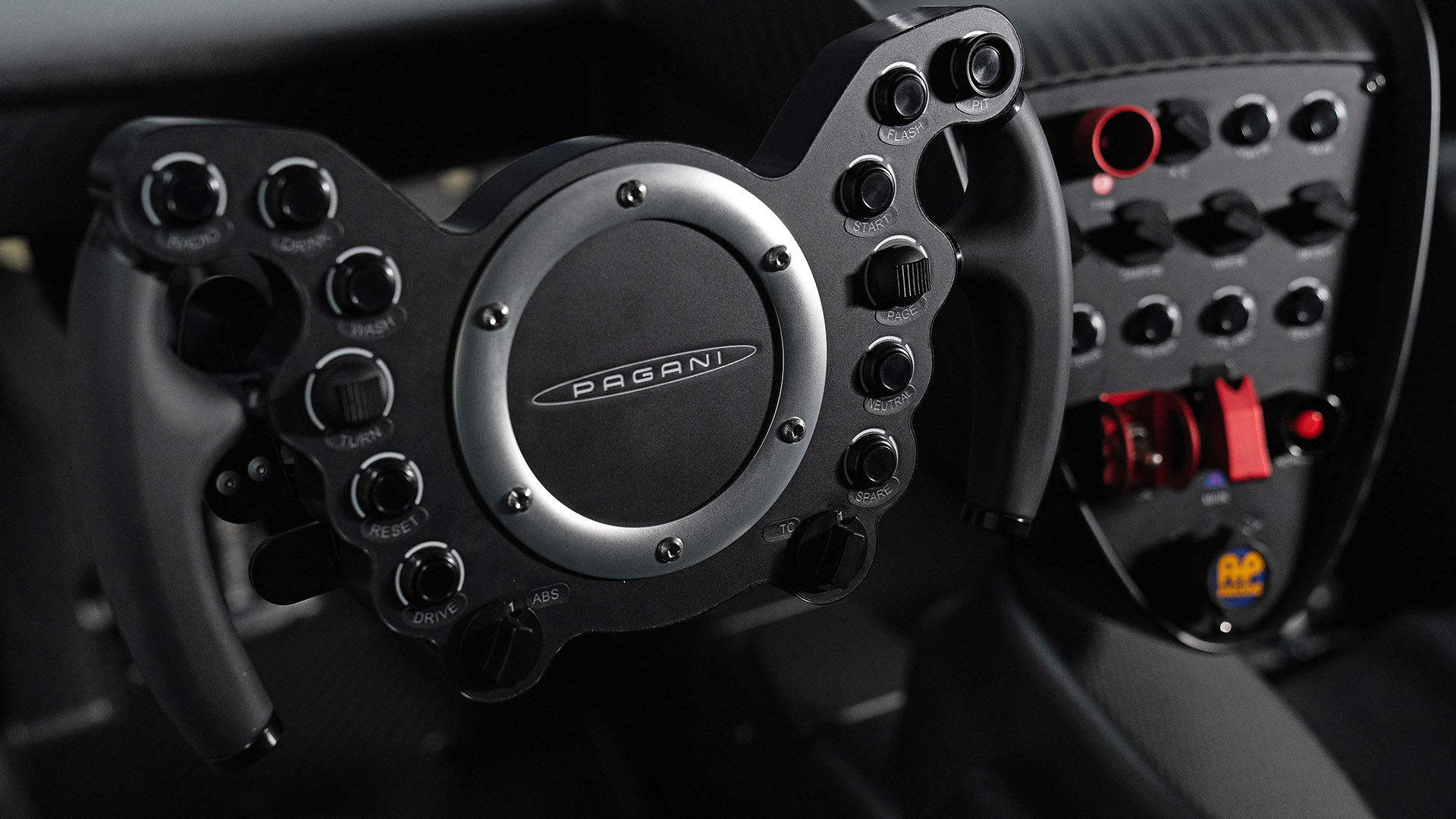
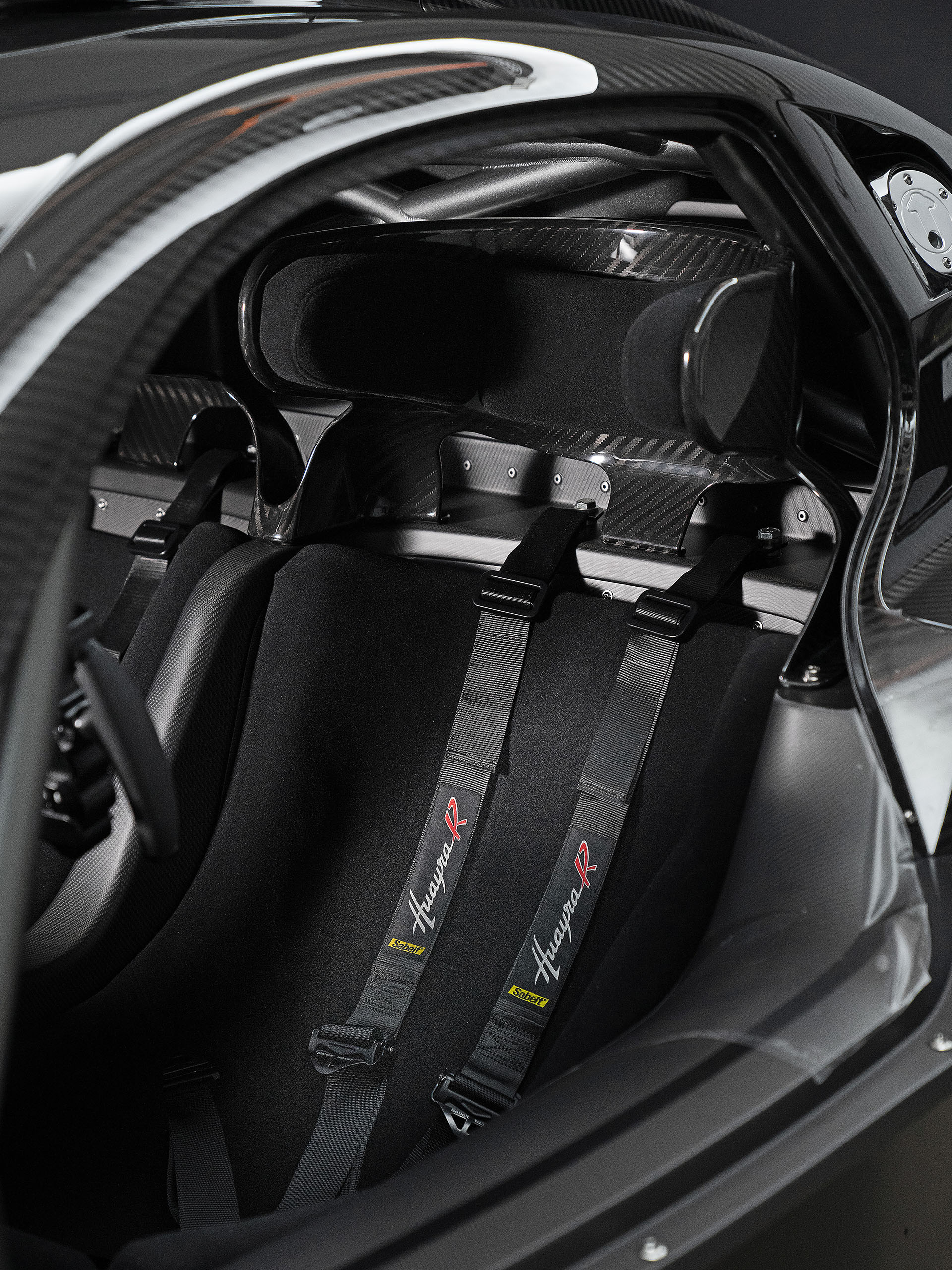
While there won’t be a completely functional Huayra R on display this year, Pagani will showcase some key components of the project, like the all-new Pagani V12-R naturally aspirated engine, the six-speed sequential gearbox (created in collaboration with HWA), and the ultra-light Carbo-Titanium HP62-G2 and Carbo-Triax HP62 monocoque, specifically designed to provide the driving thrill of a true racing car, in line with the most stringent FIA requirements.

The monocoque interior to be featured inside the Huayra R shows a true racing setup, but will still be a testament to how even the most extreme, cutting-edge, models are fitted with unparalleled craftsmanship and unmistakably refined Pagani details, as even the R version, while not being street-legal, remains a Pagani masterpiece.

In the words of Pietro Berardi, CEO of the North American Market: “Passion and the continuous desire to go beyond our limits are some of the values that Pagani and Pirelli have shared for over 10 years in one of the most fruitful partnerships in the automotive world. Over the last years with Pagani we have implemented several research and development projects, always focused not on only maximum performance but also the new quality and safety standards: from the first record beaten in 2010 with a Pagani Zonda R on Pirelli P Zero at the Nürburgring, the iconic German racing track, to the use of Formula 1 modeling to develop the P Zero Trofeo R tires for the new Pacchetto Tempesta for the Huayra BC. Last but not least, just a few months ago, on the legendary Spa-Francorchamps racing track, the record set by the Roadster BC equipped with specially developed P Zero Trofeo R tires set a milestone in the history of “Motor Valley” supercars. With the new slick tires, specially developed for the Huayra R, the outlook looks much brighter for the years to come!”

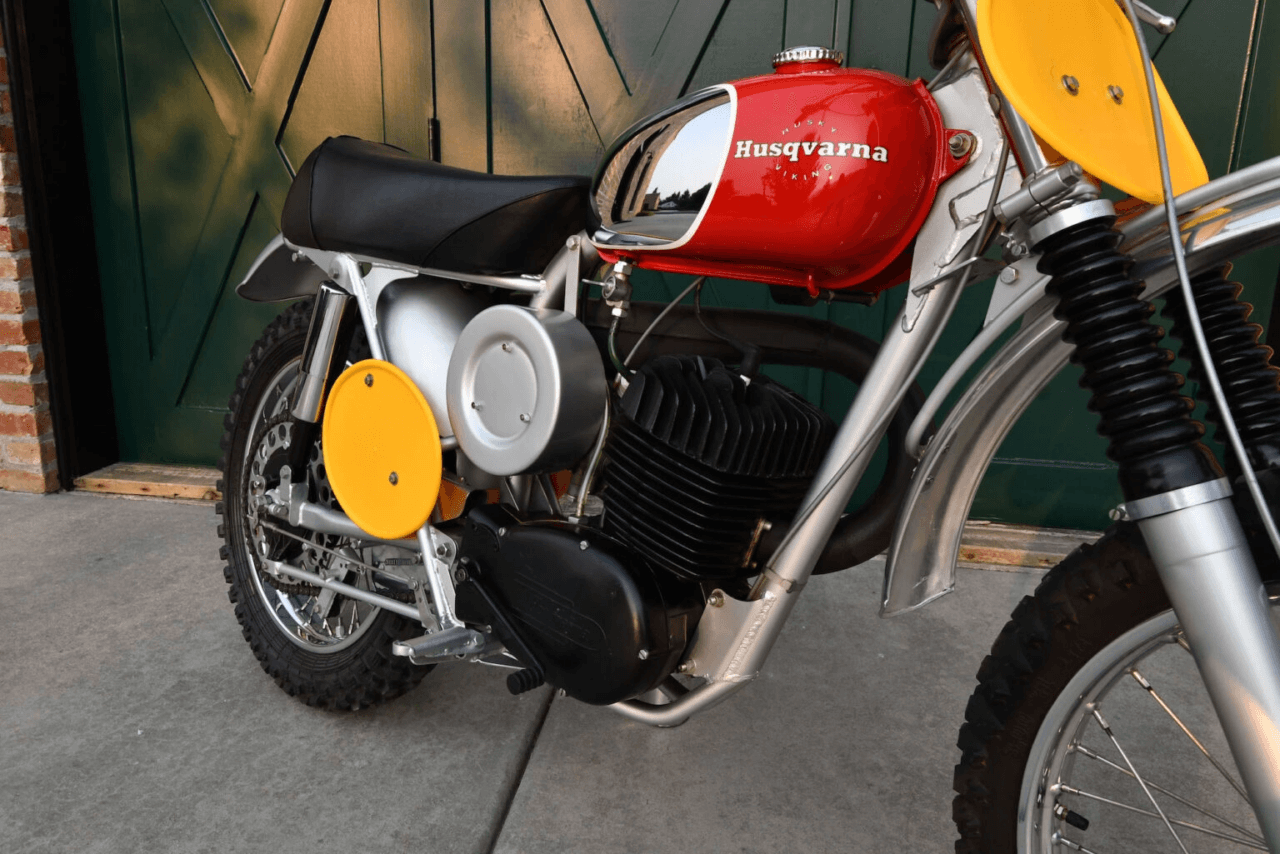
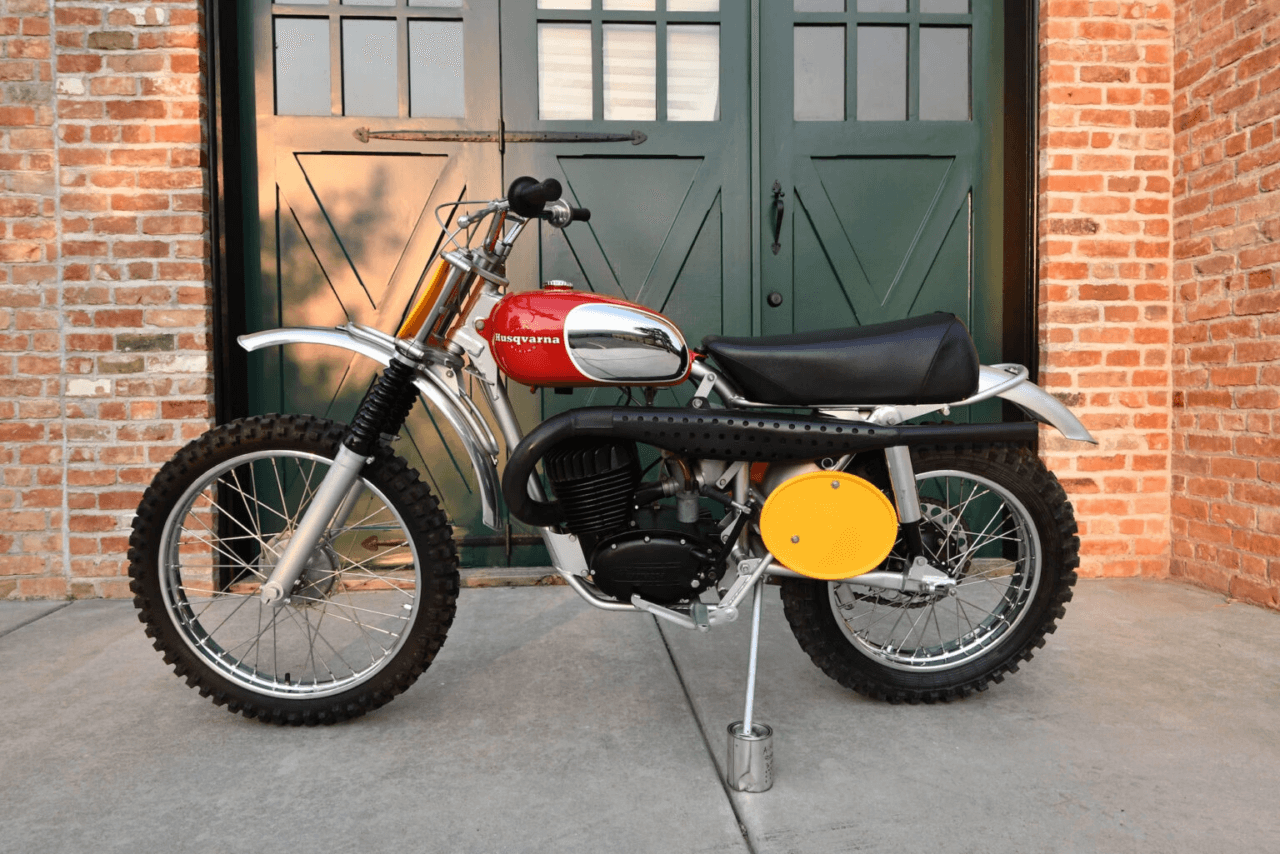
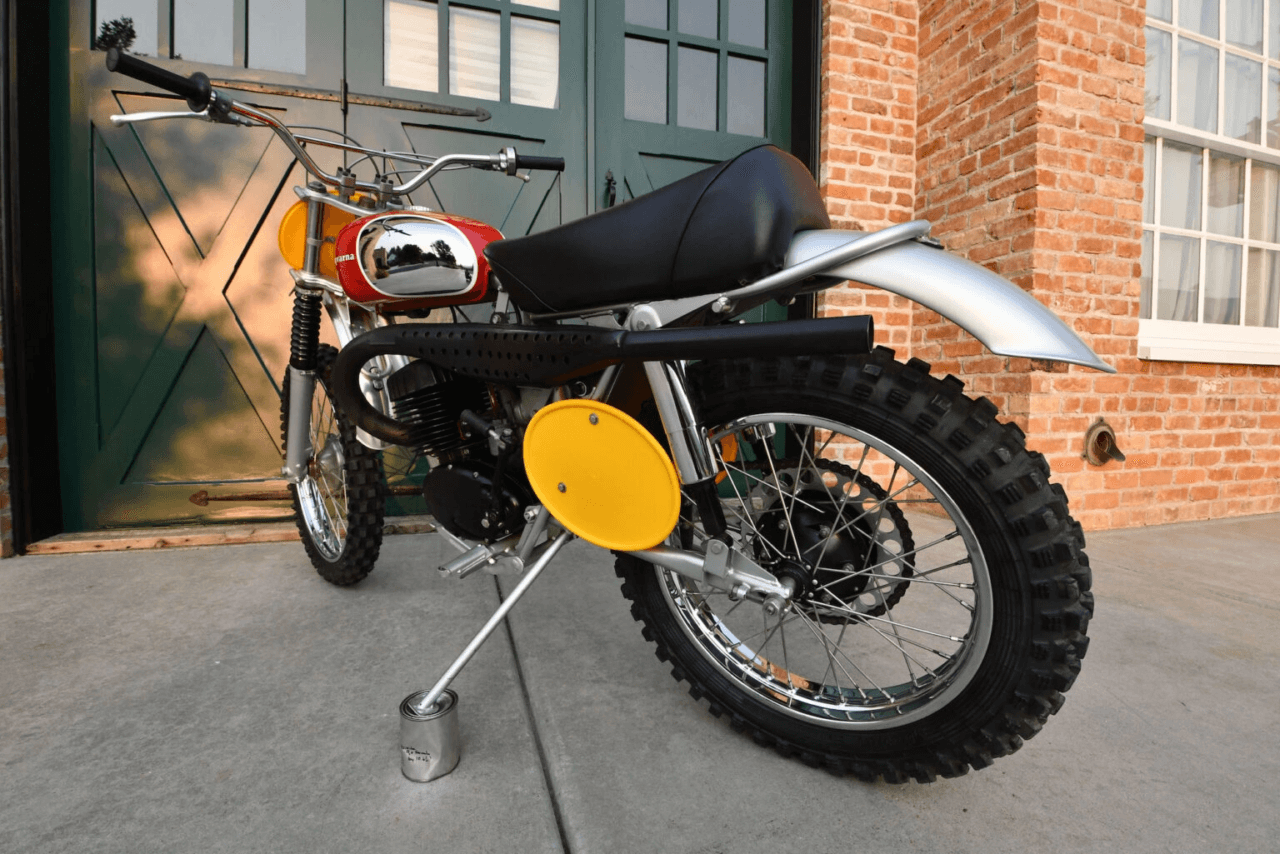
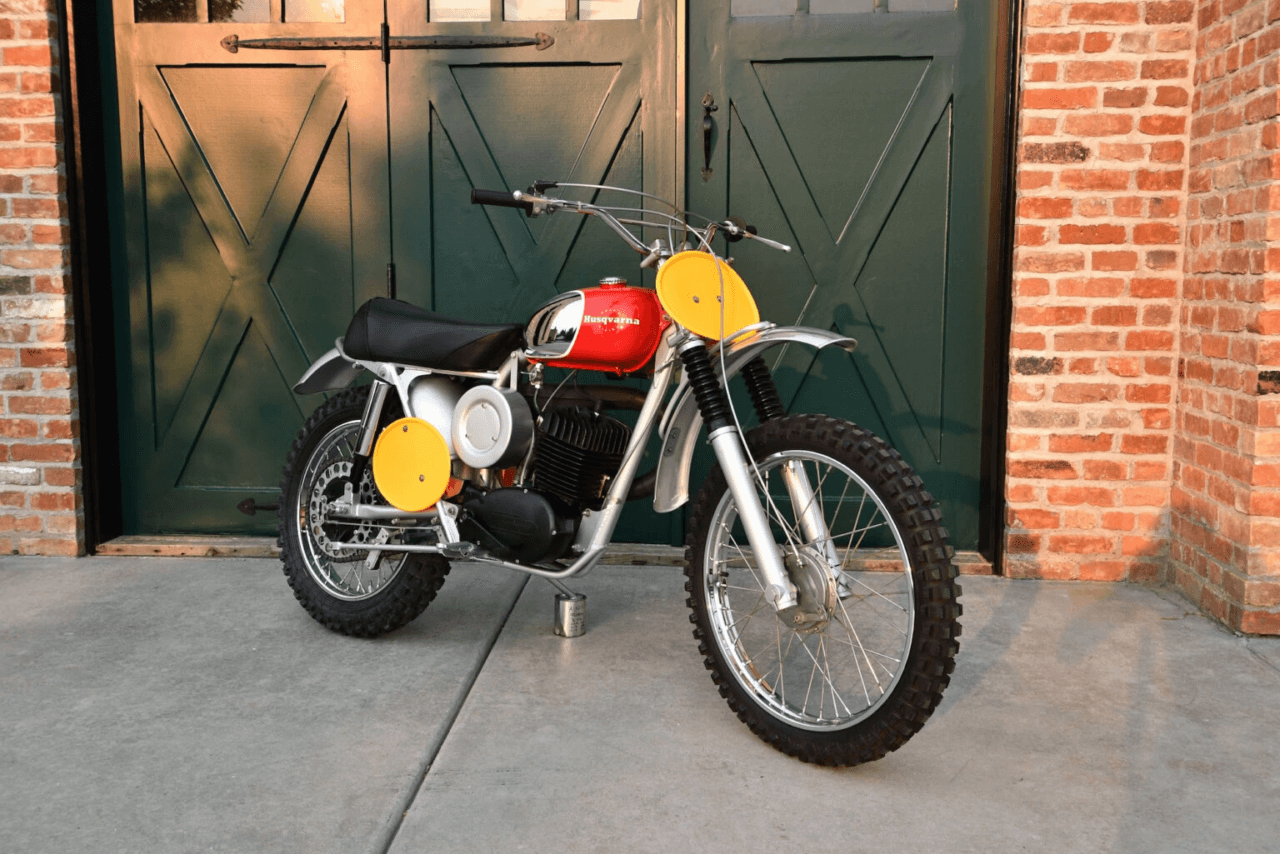
Steve McQueen’s 1968 Husqvarna Viking 360 is up for auction courtesy of RM Sotheby’s

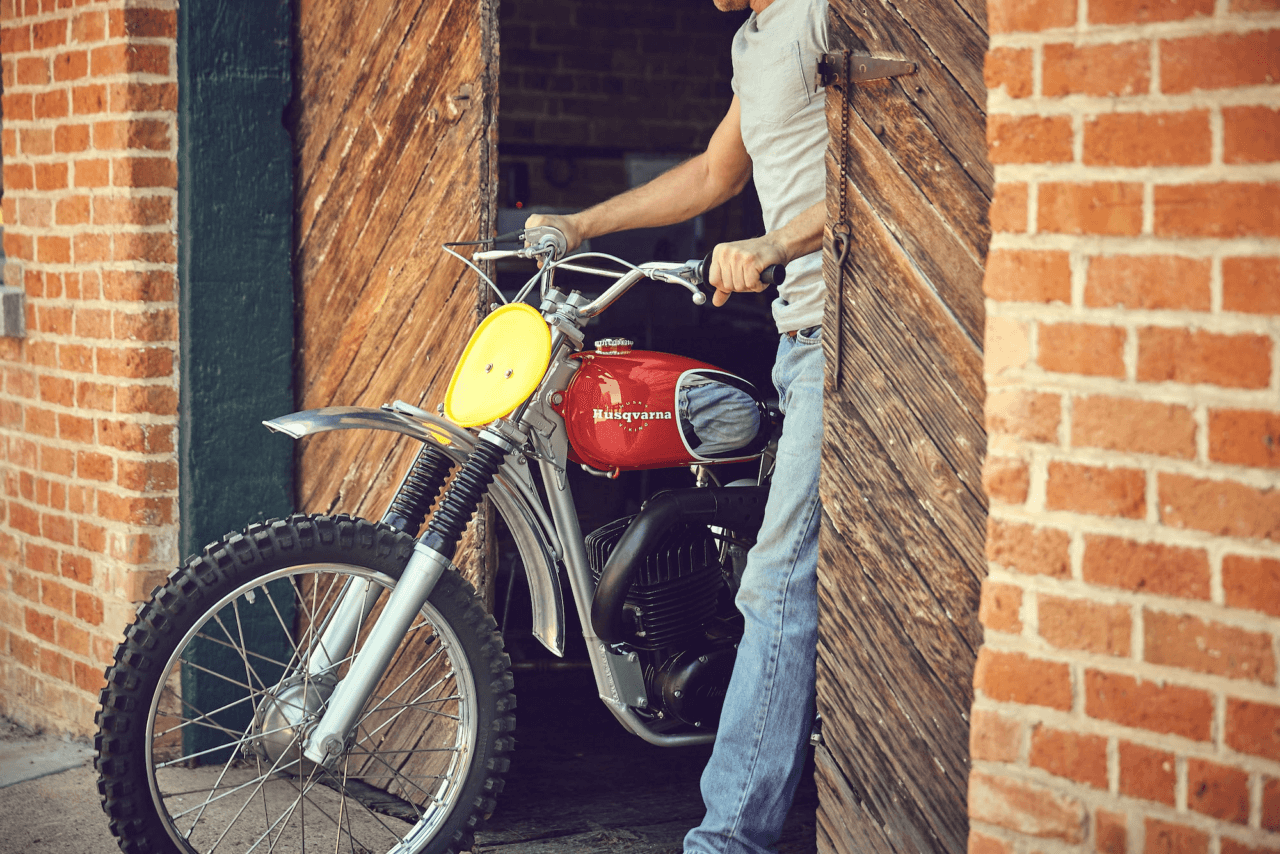
Collectors of automobiles and motorcycles make it a point to pay close attention to announcements from RM Sotheby’s. The prestigious auction house normally gets first dibs on many of the world’s exclusive items. Meanwhile, for its upcoming event in Monterey, California on August 13, 2021, the prize here is a 1968 Husqvarna Viking 360 which was a property of Steve McQueen.

Fans of the King of Cool are aware of his love for fast cars and motorcycles. In fact, the badass actor’s tendency to favor certain brands and models have done nothing but turn these into legendary machines of their time.

RM Sotheby’s is offering a once-in-a-lifetime chance to own what was once the property of the man himself. According to the auctioneers, McQueen’s love for the Swedish-made motorcycles all started in 1968. This was after seeing motocross rider Bengt Aberg aboard a 1968 Husqvarna Viking 360.

From this point onward, there was no turning back. McQueen’s company – Solar Productions – is listed in a California ownership interest form dated February 18, 1969. Moreover, RM Sotheby’s says all the documentation will accompany the sale of this Husqvarna two-wheeler.

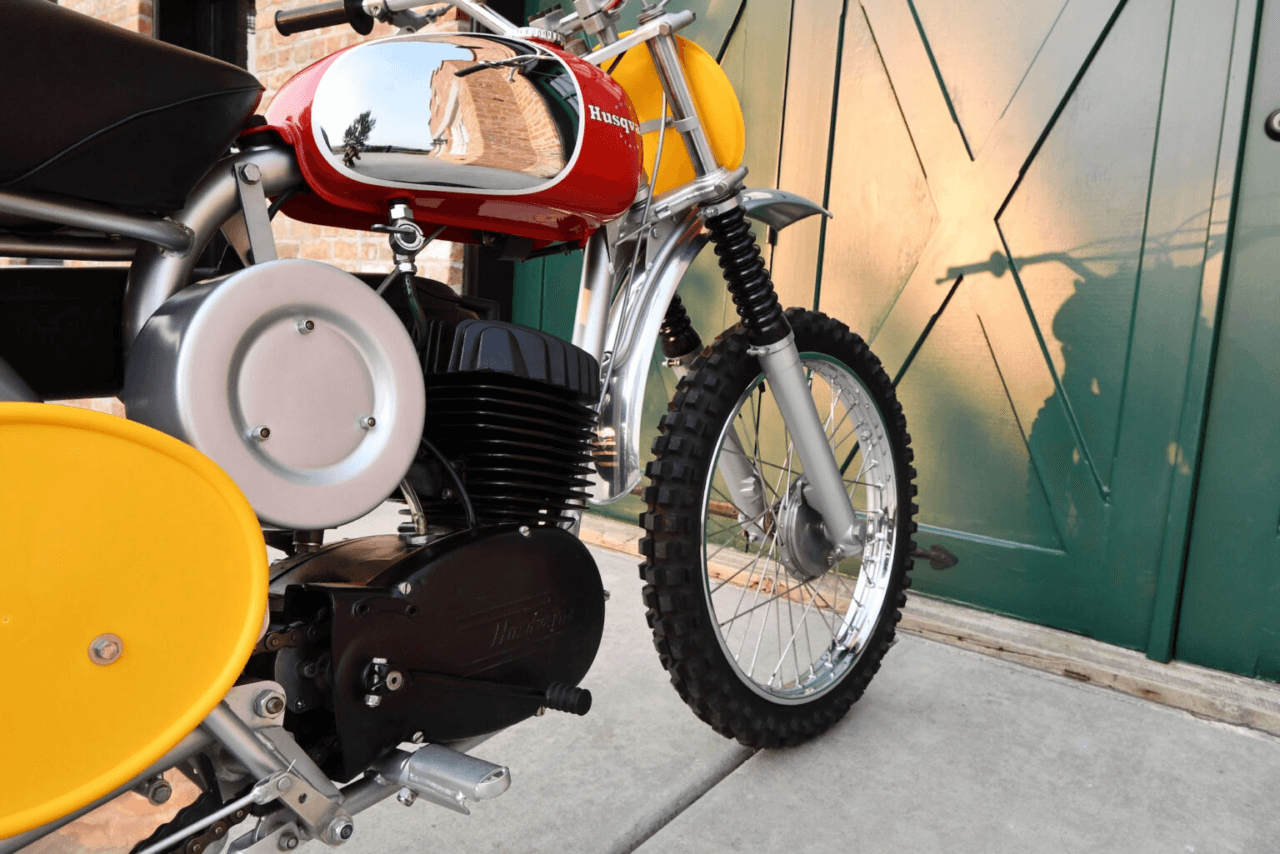
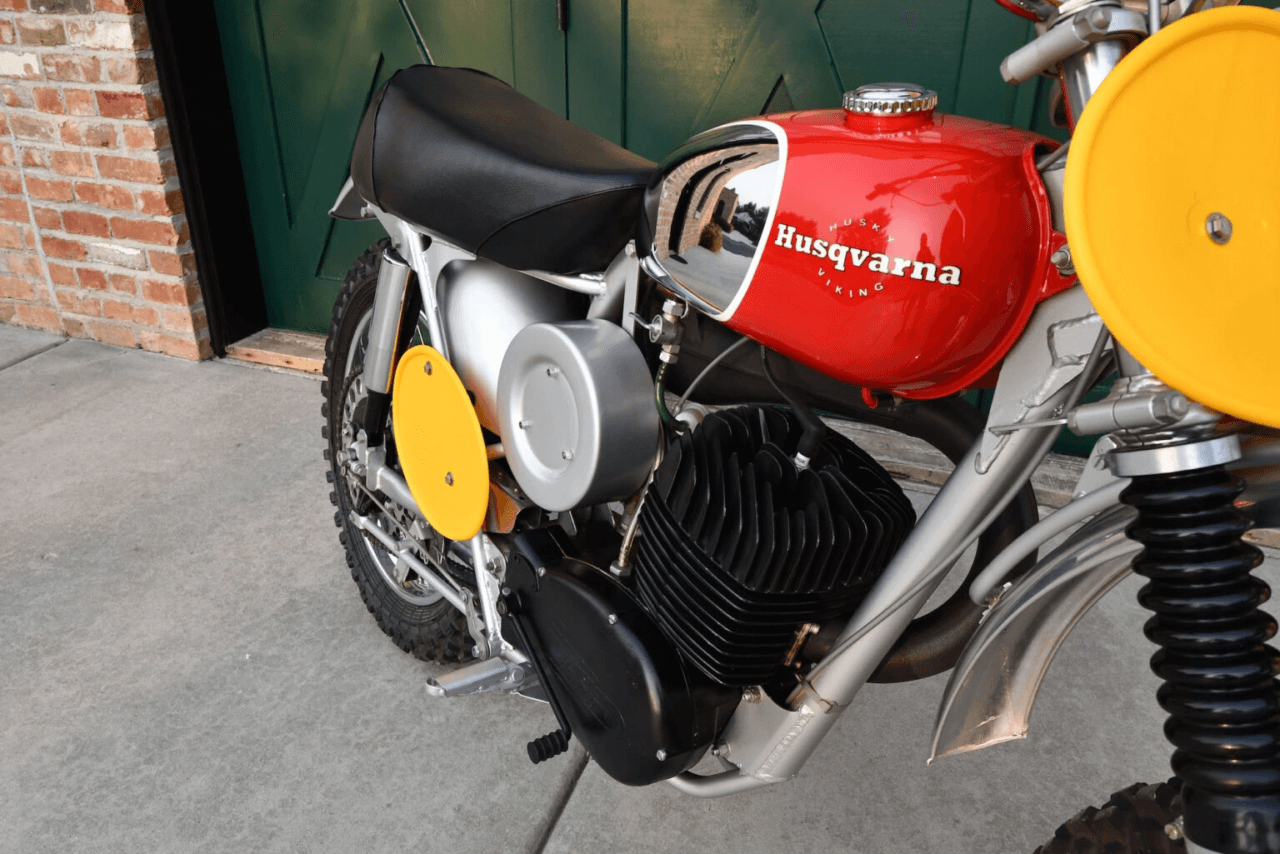
This 1968 Husqvarna Viking 360 touts a single-cylinder 360-cc two-stroke engine with a 37-horsepower output. Likewise, the original engine, four-speed gearbox, and 32-mm Bing carburetor are all intact. A 14-month restoration process ensures everything is in working order.

With Steve McQueen and Bengt Aberg racing it at one point, RM Sotheby’s is expecting a favorable turnout. Images of the 1968 Husqvarna Viking 360 suggest it is in remarkable condition. Finally, it will quickly become a prized acquisition for whoever outbids everyone else.

Bid for it now

imageimageimageimageimageimageimageimageimage

Images courtesy of RM Sotheby’s

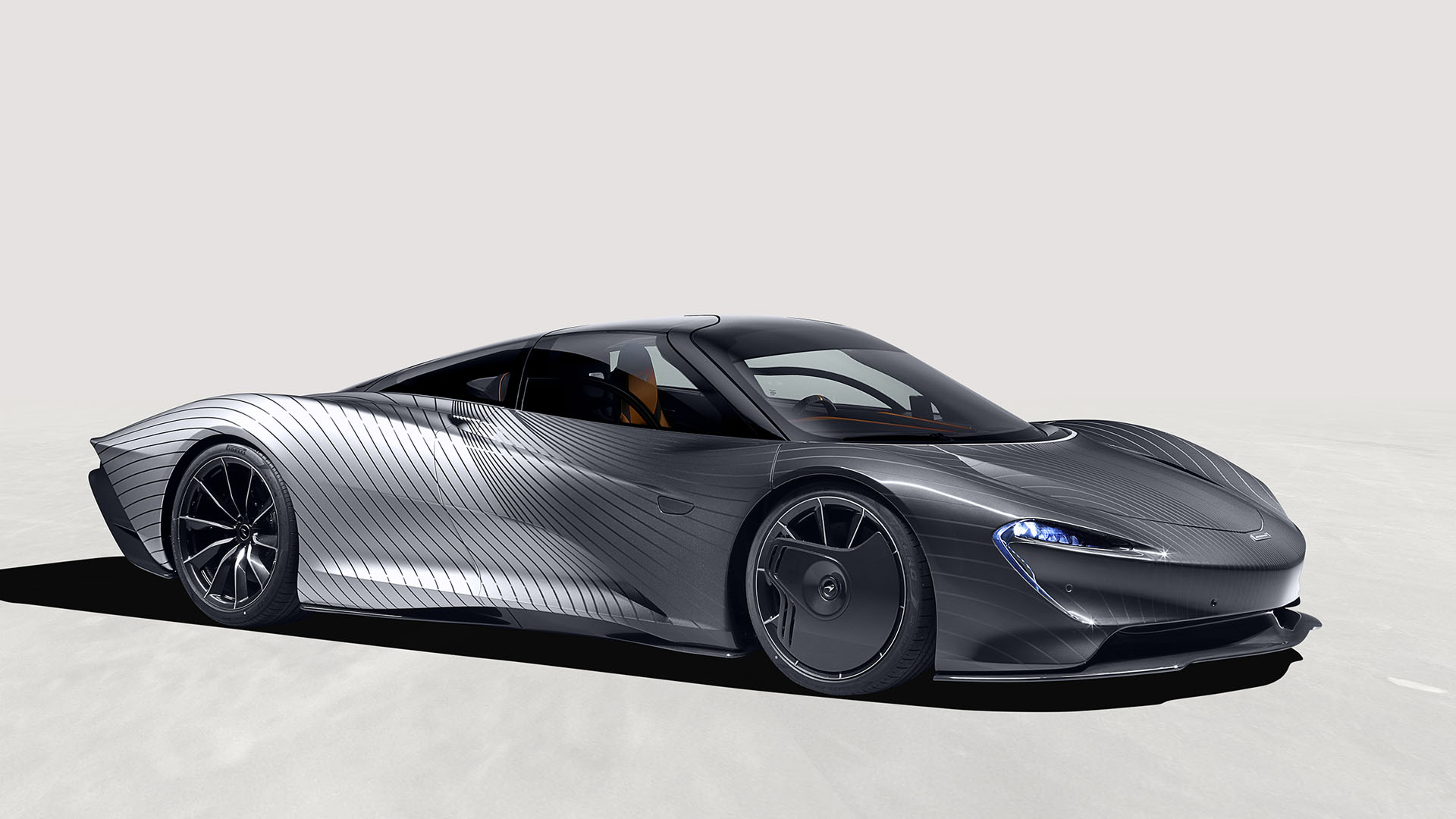
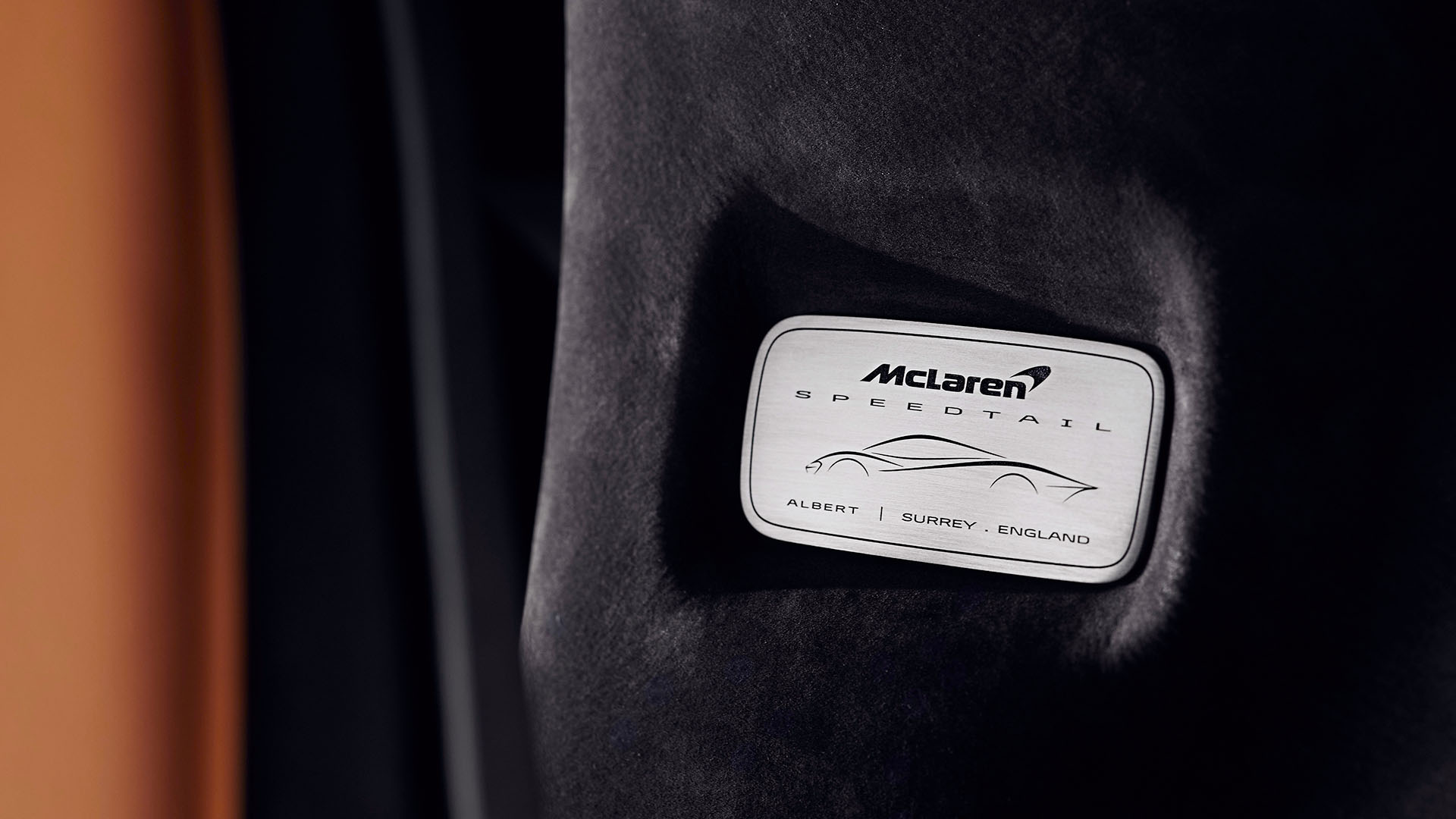
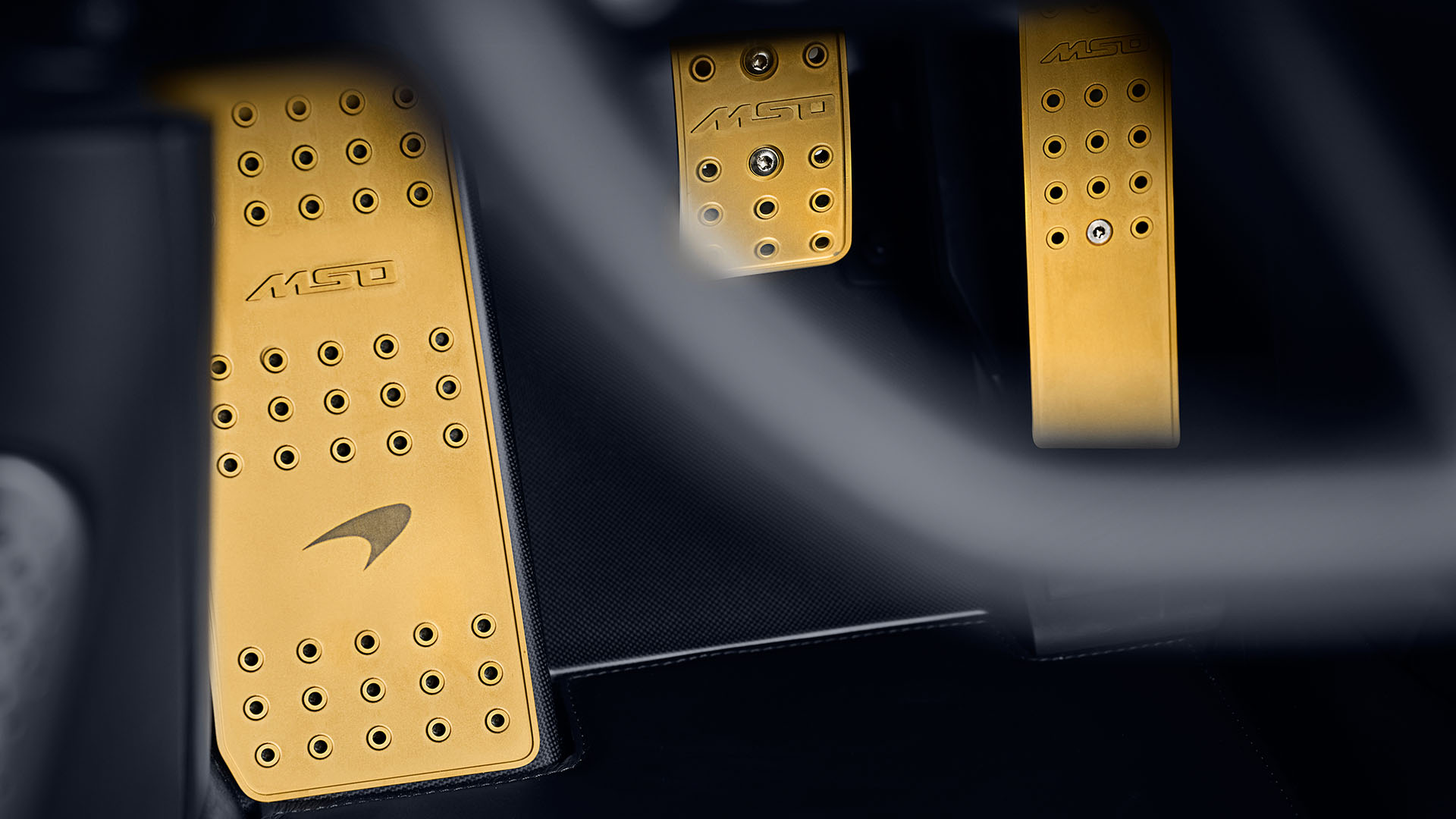
The MSO ‘Albert’ Speedtail

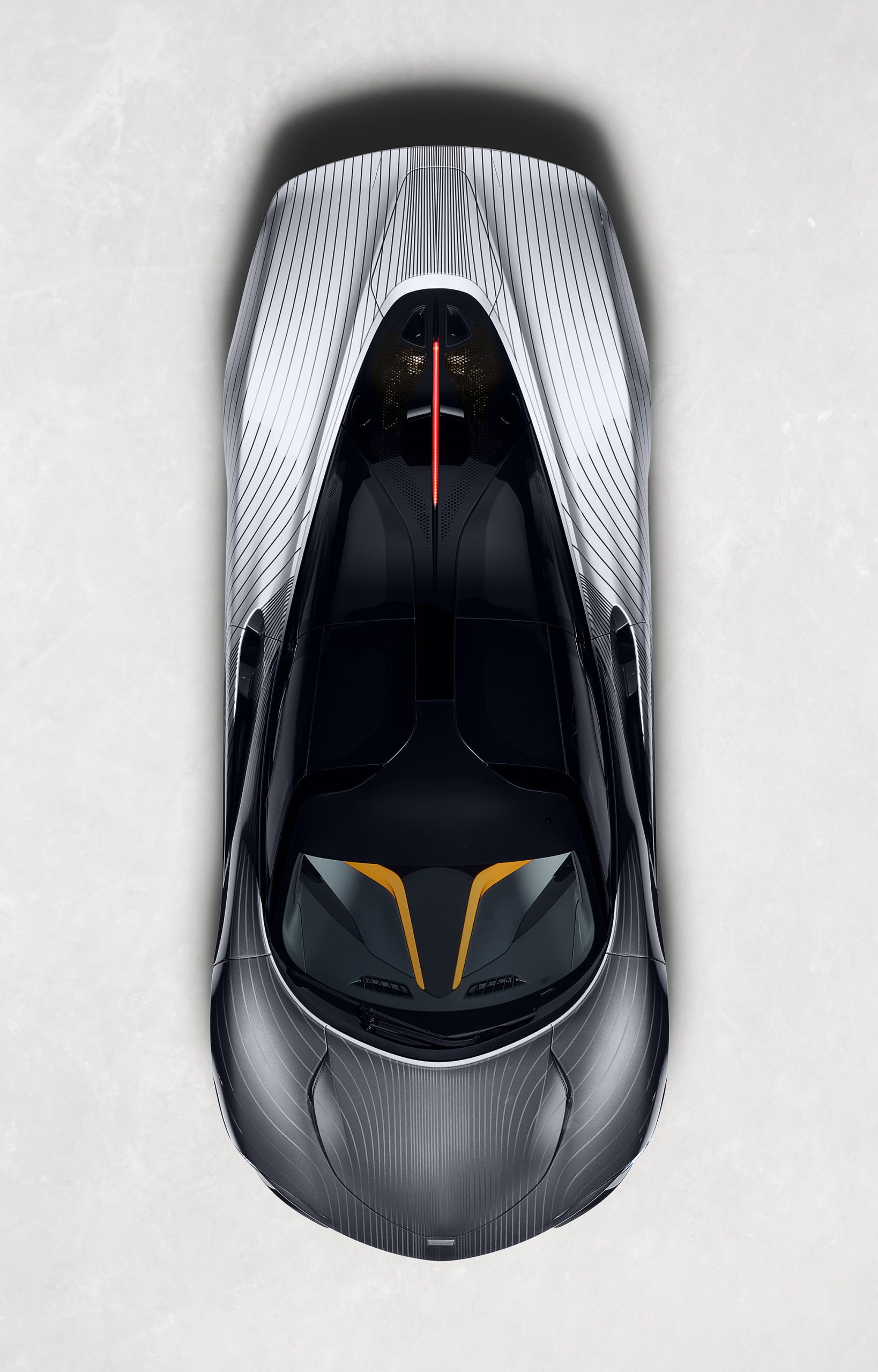
The legendary McLaren F1 test mules from back in 1992 were built at Woking in England, inside premises on Albert Drive, to commemorate that special event, McLaren Beverly Hills commissioned a rather special McLaren Speedtail from MSO, McLaren Special Operations to be inspired by those first F1 testing prototype vehicles … meet the bespoke ‘Albert’ Speedtail.

McLaren Special Operations (MSO) recently unveiled the ‘Albert’ Speedtail, as mentioned above a very special, bespoke commission by McLaren Beverly Hills, the North American McLaren retailer, this car is one of the final vehicles in the 106-car Speedtail production run, and apart from taking inspiration from the 1992 F1 test mules, this specific car is also an homage to the very first Speedtail attribute testing vehicle made back in 2018.

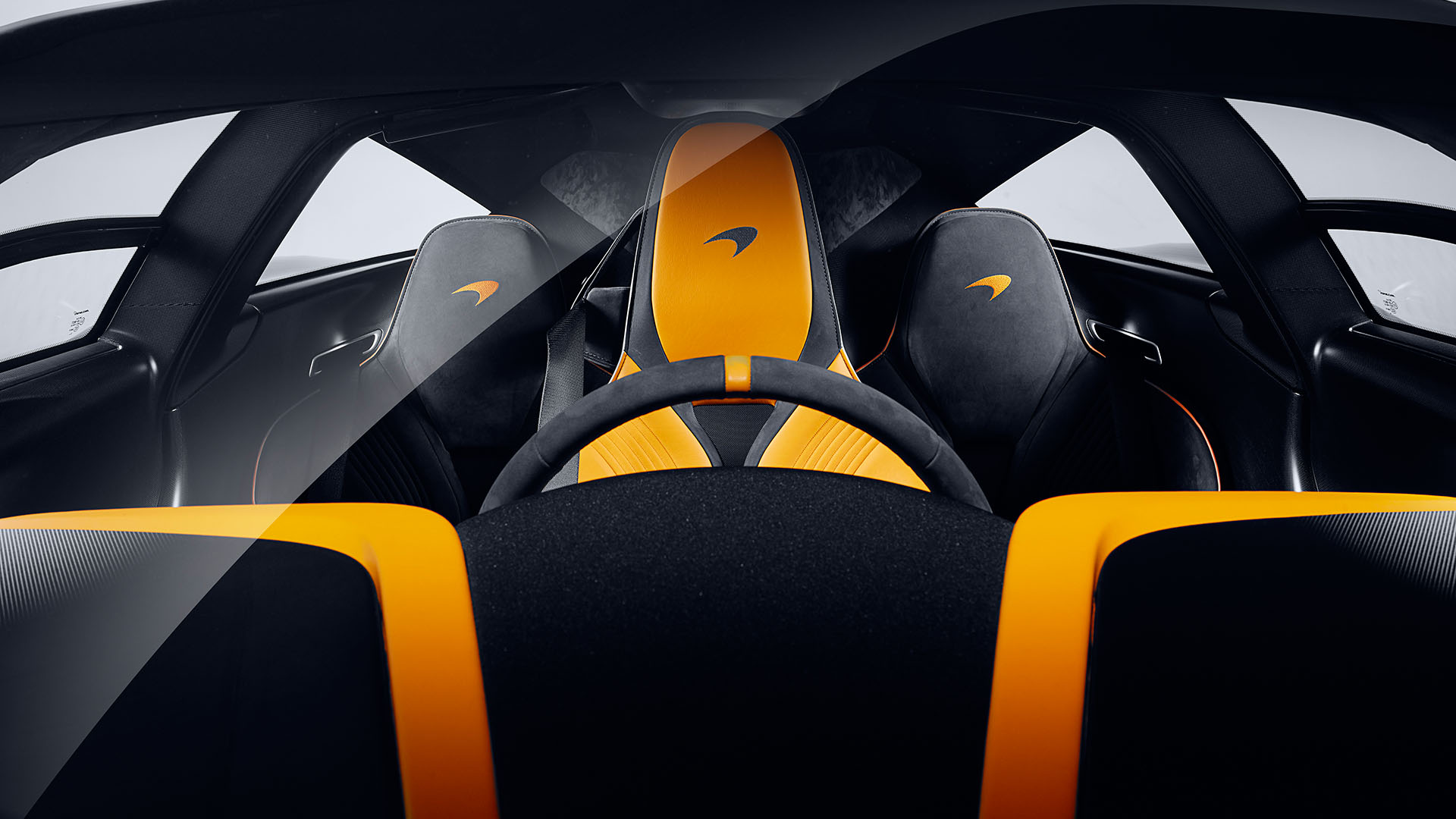
The original McLaren MVY02 Speedtail prototype vehicle was in fact christened ‘Albert’ as a tribute to its three-seat predecessor, the legendary McLaren F1, it is noteworthy that the ‘Albert’ prototype vehicle was the first Speedtail to see actual road use, at that time with front panels from a 720S as a disguise, but already with the three-seat, central driving position fitted so McLaren could test the driver ergonomics, general visibility, and figure out the optimum rear-view camera positions.

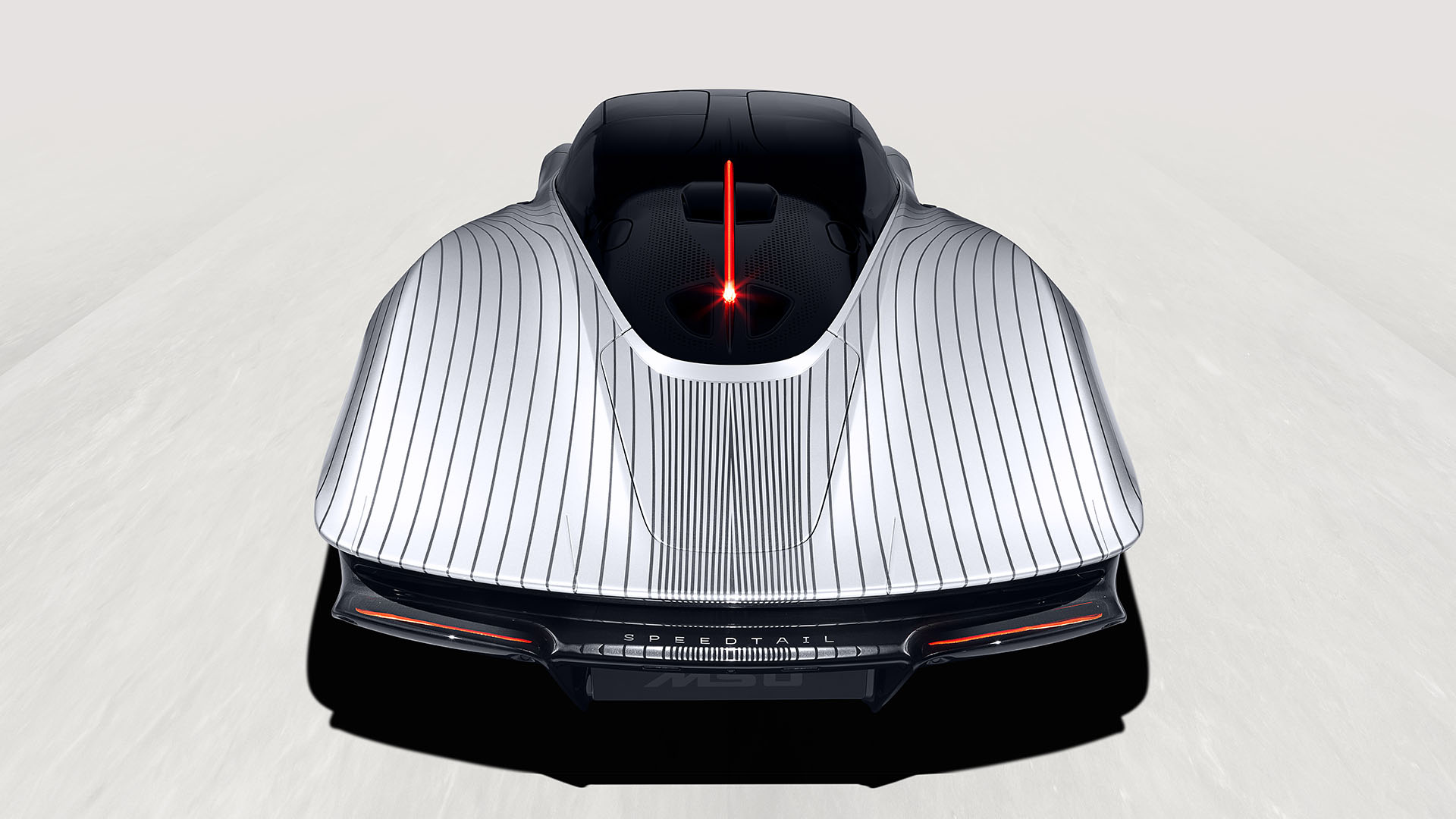
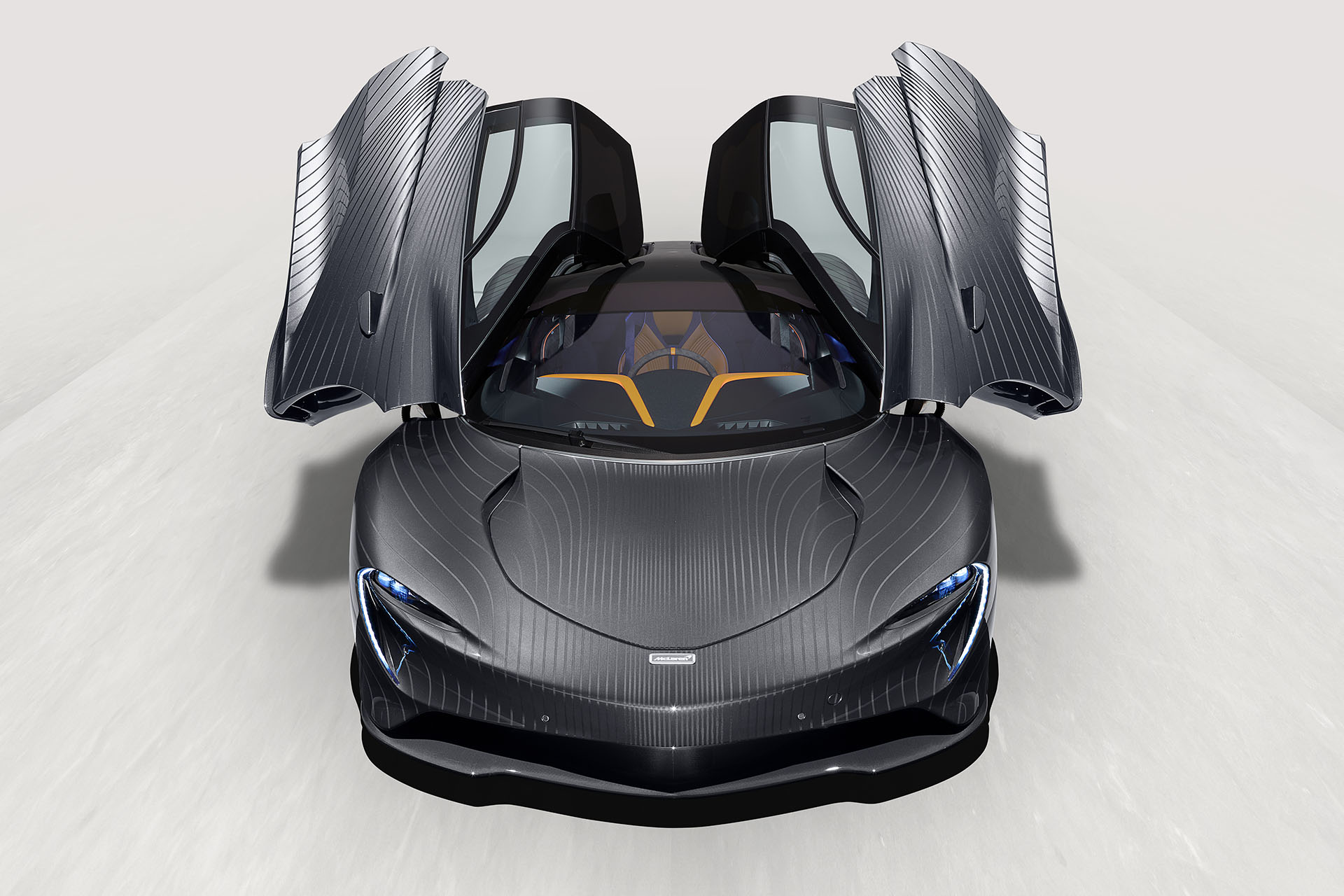
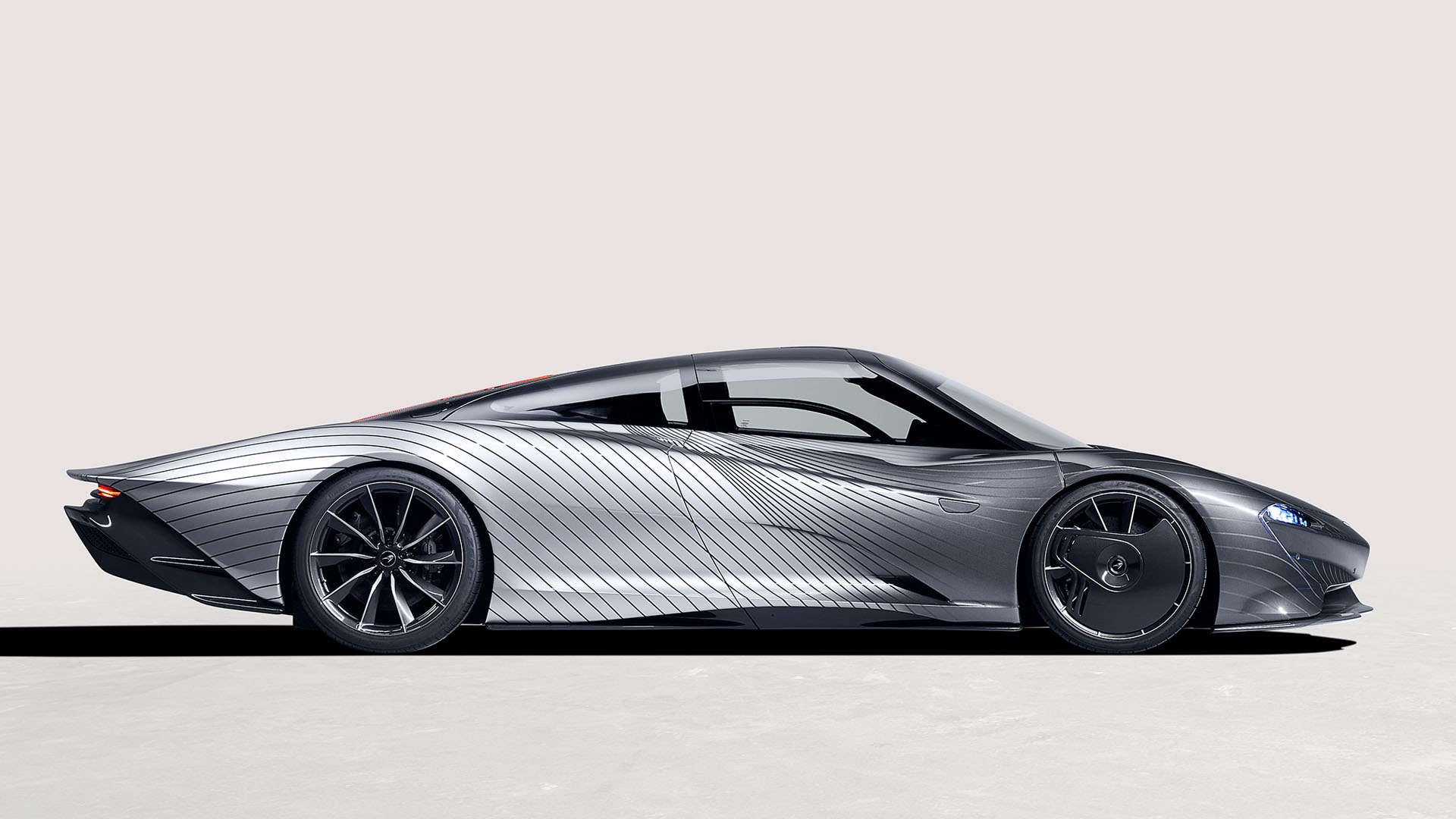
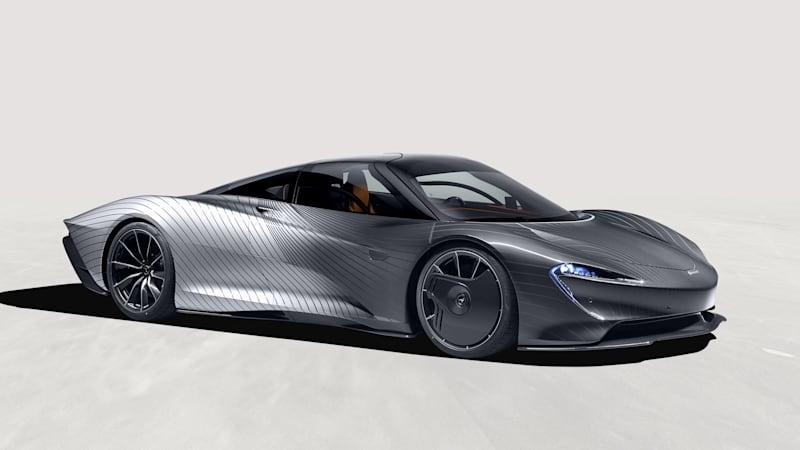
This new ‘Albert’ Speedtail homage ordered by McLaren Beverly Hills took inspiration from the camouflage wrap used on the road-going prototype that had a simple two-meter vinyl body wrap with design lines printed to represent the optimized airflow over the car, taking this into real paint by MSO took 12 weeks to complete.

The ‘aero lines’ became one of the most complex paint themes ever completed by MSO, using Magnesium Silver, the exact color used on the F1 road car when she was shown at the 1992 Monaco Grand Prix, in a combination with Ueno Grey, taken from the F1 GTR that won the 24 Hours of Le Mans in 1995, taking both shades into a design based on the 2018 vinyl ‘cameo’ wrap.

‘”As one of the very last Speedtails to be built at the McLaren Production Centre, it was very important to us at McLaren Beverly Hills that ‘Albert’ honors the brand’s rich heritage, particularly paying tribute to the icon that is the McLaren F1. We worked alongside MSO through every stage, including concept ideation, to produce a truly bespoke and beautifully detailed car that celebrates the innovation and design excellence behind the fastest McLaren road car to date. We are fortunate to have been able to procure ‘Albert’ for one of our top clients and are absolutely thrilled with the finished result.”’ Parris Mullins, McLaren Beverly Hills

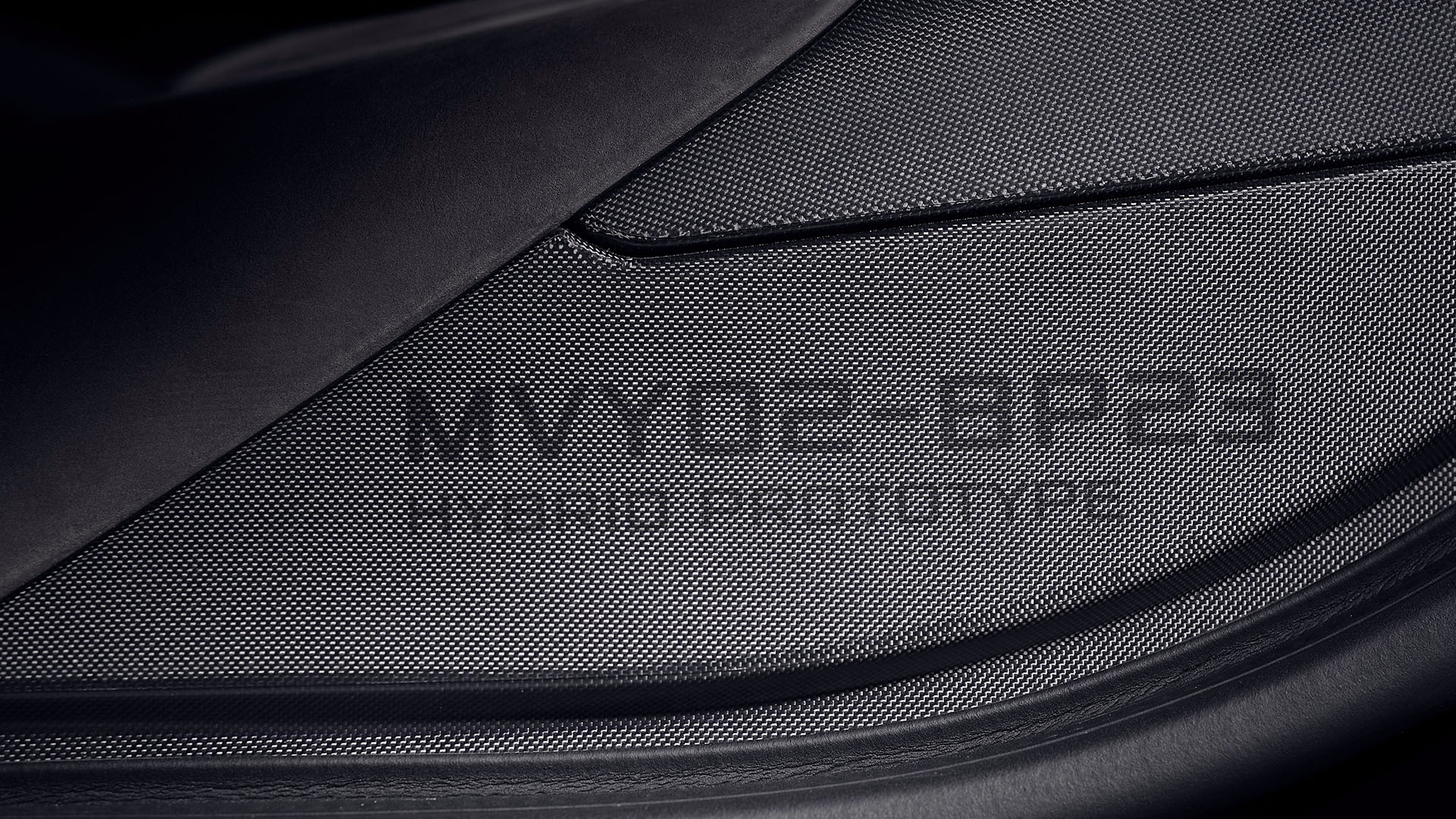
The new ‘Albert’ was built in the McLaren Production Centre (MPC) with a 1K gloss visual carbon fiber body. Due to the incredibly complex and detailed nature of the paintwork design, the MSO team completed test panels first to understand process feasibility and worked alongside the visualizer team to refine renders. In total, ‘Albert’ would require a 12-week post-build modification at MSO’s facility to reach completion; this included two week’s masking, six week’s painting, and the remaining time to dry and reassemble the vehicle after spraying.

In the end, they printed their initial renders in full scale before masking it all out on the actual car, after the car was built, including the wheels, this was the only way they could be sure it all aligned well over the entire car, during the two-week masking process the MSO specialist paint technicians used almost two kilometers of fine line-out tape to complete the airflow design layout.

“The name ‘Albert’ has a special resonance with MSO, as we are the custodians of the McLaren F1 and are based at the Albert Drive premises that McLaren Cars occupied in the 1990s. The Speedtail experience has been an exciting journey for our customers, from visualising their imaginations to realising these inspirations and sharing their delight when unveiling the finished product. ‘Albert’ brings this project to a conclusion and we are thrilled to finish on a high note.” Ansar Ali, Managing Director, McLaren Special Operations

The McLaren Speedtail is the fastest road car from Woking to date, it’s the third model in the McLaren Ultimate Series, a three-seat hypercar with 1,070 hp from a hybrid powertrain that’s capable of reaching a 402 km/h (250 mph) top speed, this amazing looking ‘Albert’ Speedtail will be shown at Sunset GT, a luxury cars and coffee event hosted by O’Gara Beverly Hills on Sunday 8th August 2021 in Sunset Plaza, Los Angeles, USA.

The Battista at Monterey Car Week

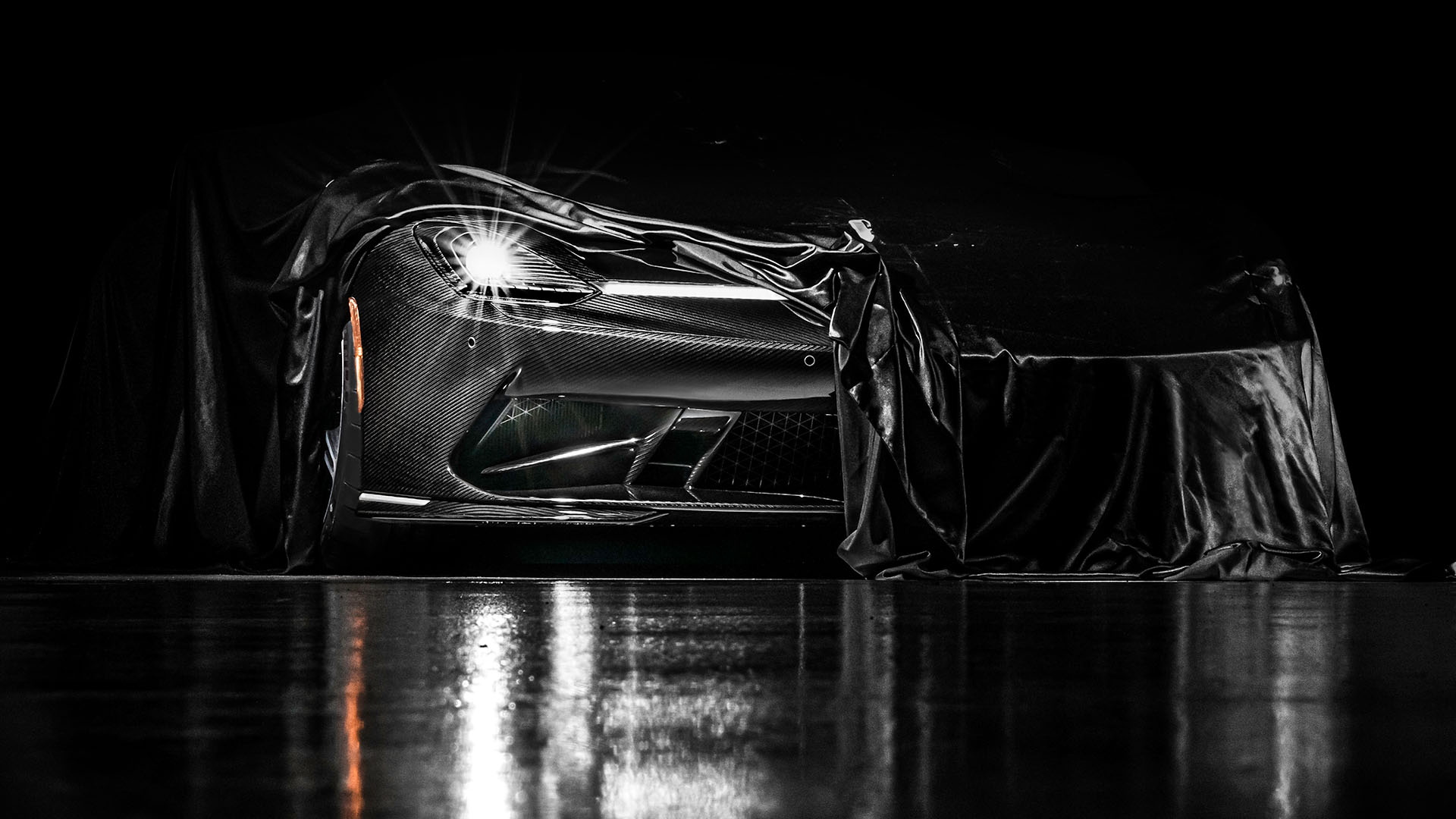
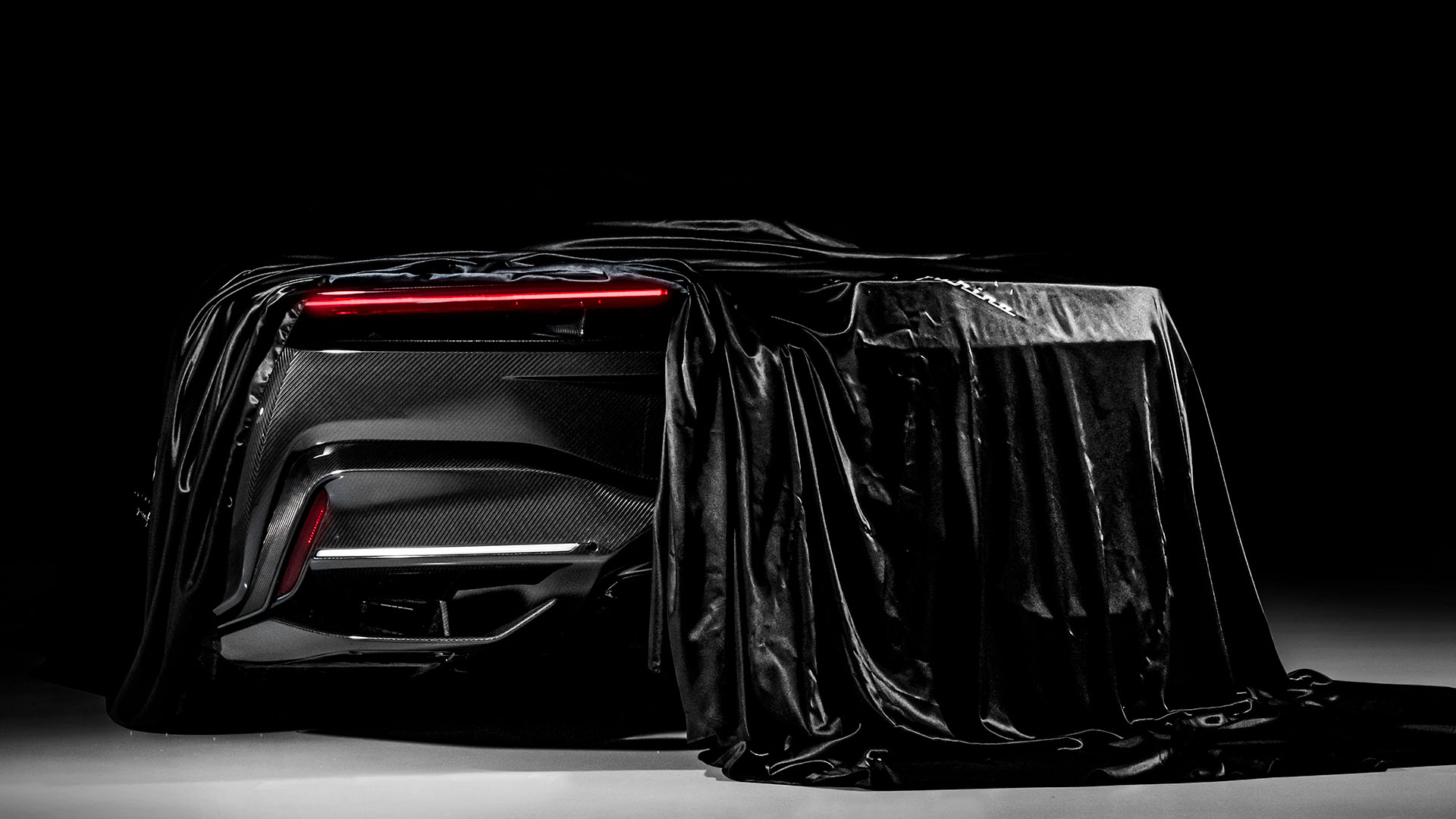
If you are dreaming about a clear carbon fiber, all-electric hypercar with an amazing pedigree from a famous Italian automotive design firm, you can now feel comfortable as Automobili Pininfarina is about to unveil the Battista, this Hyper GT will make her US debut at The Quail and Pebble Beach Concours d’Elegance during the 2021 edition of the famous Monterey Car Week, this will consequently also be the world première of this car to the public.

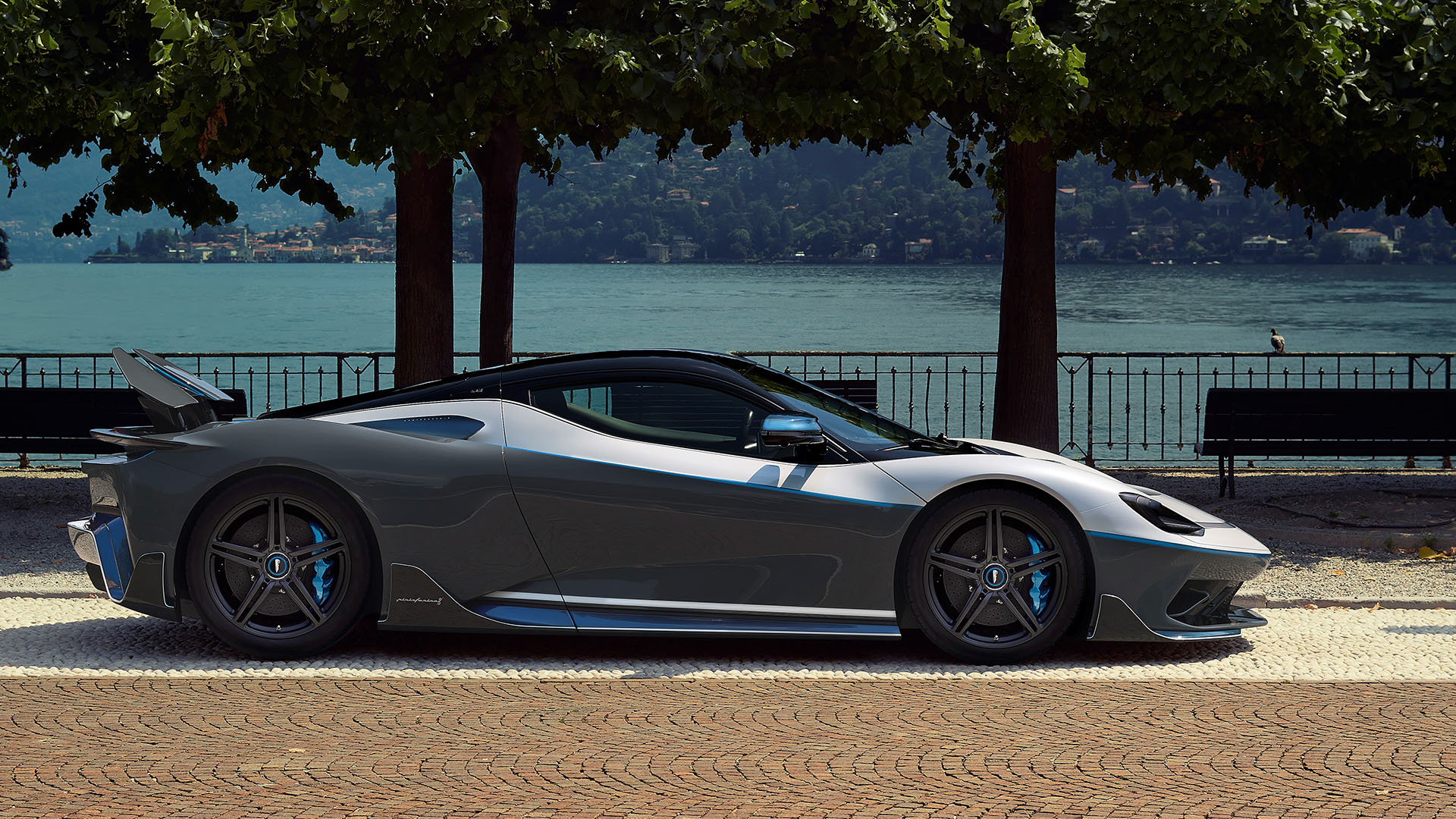
And Automobili Pininfarina will bring another, even more special, car to Monterey this year, the Battista Anniversario, a tribute model to the life and work of design icon Battista ‘Pinin’ Farina, this version will come with bespoke aerodynamics and special details only available on this Anniversario edition, that will be limited to only 5 units worldwide, all in a unique Automobili Pininfarina-designed livery and bi-color tinted Furiosa Pack consisting of a front splitter, side blades and rear diffuser, with outer carbon parts finished in black exposed signature carbon while the inner parts will be made in exposed carbon fiber tinted in Iconica Blu.

But back to the ‘regular’ Automobili Pininfarina Battista, the show car for Monterey Car Week will be finished in their signature black exposed carbon fiber for the entire body while the interior comes with Iconica Blu details, many electric cars have hints of blue usually, this specific Battista is actually a production prototype, the car is ready for production as we speak.

During Monterey Car Week, none other than Luca Borgogno, Chief Design Officer at Automobili Pininfarina, will be part of the judges’ panel at the Pebble Beach Concours d’Elegance, where a fleet of iconic Pininfarina-designed vehicles will gather to celebrate over 90 years of design excellence by Pininfarina.

Per Svantesson, CEO of Automobili Pininfarina, said: “The premiere of the first production-specification Battista in the US marks the beginning of another significant chapter in the Automobili Pininfarina story. We are excited to showcase the beautiful and sustainable future of luxury to our clients while celebrating more than 90 years of Pininfarina design heritage during Monterey Car Week. We look forward to our clients in the US experiencing the immense dynamic performance and personalized luxury of Battista for the first time.”

And while the clear carbon fiber exterior of this show car might attract a lot of attention, the interior is just as amazing, with black sustainable leather combined with Iconica Blu contrast stitching and quilted Pilota seats themselves also finished in Iconica Blu Alcantara while also featuring Pilota Carbon Components finished in the same black exposed carbon fiber as the body of this Hyper GT.

This is the first time the 1,900 hp hypercar from Pininfarina will be shown to the public as a production-ready vehicle, this hypercar will be able to reach 100 km/h (62 mph) from standing still in less than 2 seconds, priced at $2,200,000 each there will be only 150 units available for the entire world, while the battery can come with a warranty up to 10 years into the future.

If you are interested in one of these 150 Automobili Pininfarina Battista you can turn to a global network of selected salespoints, for the USA these are located in San Fransisco, Los Angeles, Denver, Dallas, New York, and Miami, further up north, you are also able to buy this car in either Toronto or Vancouver … but why not visit their stand at the Monterey Car Week on August 13 to get an impression of this amazing hypercar first hand.

These Are The Most Expensive Car Crashes Ever

There are thousands of fender benders every day in the US alone and in most cases, the vehicles involved can easily be replaced. When it comes to supercars and hypercars alike, they can be irreparable or even irreplaceable should they be crashed.

Owning a supercar for most people is an honor and a privilege. For others, it is just another object among many others they own. In any case, we come across some horrific crashes that end in the destruction of some of the most sought-after vehicles on the planet.

The prices of the cars listed may vary but that doesn’t make it any less painful to read for us auto enthusiasts. Crashes like this can result in significant injuries so if you’re ever lucky enough to drive an exotic but unlucky enough to wreck such a beauty of a machine, you’re likely dealing with at least whiplash or some sort of muscle strain. Whether it was you or the other party at fault, it pays to have a legal professional who specializes in car accidents that can walk you through the process.

Without further ado, let’s look at some of the most expensive accidents to rock the supercar world.

Pagani Huayra Roadster – $3.4 Million

Boy posing with Purple Pagani Huayra Roadster
Photo Credit: GG Exotics

In November 2020, a 17-year old YouTuber crashed a Pagani Huayra Roadster while out for a drive with a friend. Gage Gillean took his father’s 3.4 million dollar hypercar and unfortunately lost control before colliding with a tree.

Gage walked away from the crash with minor injuries while the hypercar was completely destroyed beyond repair. Not to worry though, Gage’s father, Tim Gillean still has many other exotics in the stable including a Ferrari LaFerrari, Bugatti Chiron, McLaren Senna just to name a few.

I’m sure Gage was taught a very valuable lesson throughout the ordeal while he continues to drive his rich father’s multi-million dollar cars.

Crashed Pagani with Ambulance in background

Bugatti Veyron – $1 Million

In 2009, supercar owner Andy House took his 2006 Bugatti Veyron for swim…literally. While on a Texas road, House was driving beside a lagoon where he says a pelican flew into his path causing him to swerve into the lagoon.

[embedded content] [embedded content]

According to the video taken of the crash, there were no birds in sight, leaving House to deal with an unsuccessful insurance claim. Despite already losing a million-dollar supercar, he was ultimately sentenced to 1 year in federal prison in 2015. That sentence was among the $600,000 he paid back to the insurance company along with three years of supervision once he was released.

In this video, Tavarish explains the horrible undertaking of repairing the flooded 2006 Bugatti Veyron.

[embedded content] [embedded content]

Pagani Zonda F Clubsport – $2 Million

Crashed Pagani Zonda on flatbed truck
Photo Credit: Mirror

German investment banker, Steffen Korbach was driving his rare, $2M hypercar on a wet Italian highway at low speed before hitting a puddle and hydroplaning into a road barrier in 2011. Both Korbach and his passenger were able to walk away from the collision while the 1 of 25 Zonda looks completely destroyed.

Crashed Pagani Zonda into guardrail
Photo Credit: Prestige Cars

As luck would have it, Korbach was on his way to Milan to see a Pagani Huayra he had on order to replace his Zonda F Clubsport. Though he never made it to Milan, he wasn’t left without a nice set of wheels. He also owned two Bugatti Veyrons, Lamborghinis, and a Gemballa Mirage.

SSC Tuatara – $1.6 Million

People looking at Exotic car on flatbed truck
Photo Credit: TheDrive

In May 2021, TheDrive reported SSC transporting a Tuatara to Florida for another high-speed record attempt but unfortunately, it never made it to the destination. The car carrier used to transport the $1.6M, 1,750 horsepower twin-turbocharged V8 hypercar was tipped over as a result of strong winds during transit.

Lots of damage to the delicate cargo is set to be repaired as the chassis, drivetrain, and suspension were unharmed in the car carrier topple. This car is chassis number 001 and was due to set a high-speed record of well over 300mph, but that will have to wait until it’s back in shape.

Rimac C_Two – $2.4 Million

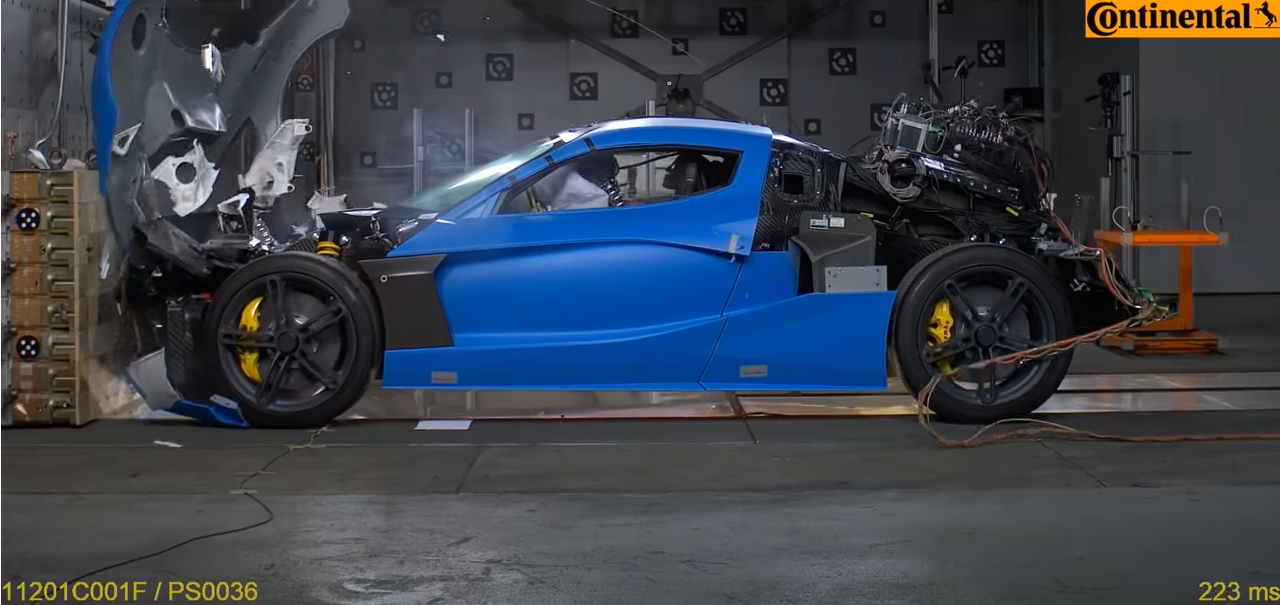
Rimac C_Two crash test

Though this isn’t an “owner crash” per se, it still hurts to watch. In this video, Rimac performs crash testing on the Rimac C_Two to collect data on safety restraints and real-world crash safety results.

[embedded content] [embedded content]

Regardless of the accidental crash testing performed by Richard Hammond in 2017 while filming an episode for The Grand Tour, Rimac still needed to perform formal testing on their latest prototype. For those of you who had forgotten Richard’s 3rd near-death experience, here’s a video to bring you up to speed.

[embedded content] [embedded content]

Once it’s released, the C_Two will cost $2.4M and while it seems like a lot of dough, it will have the power to back it up. The C-Two comes with a heart-stopping 1,887bhp and 1,696lb-ft of torque along with a 0-60mph time of 1.97 seconds and a 0-100mph time of just 4.3 seconds.

Bentley says the Flying Spur Hybrid Odyssean Edition is both luxe and sustainble

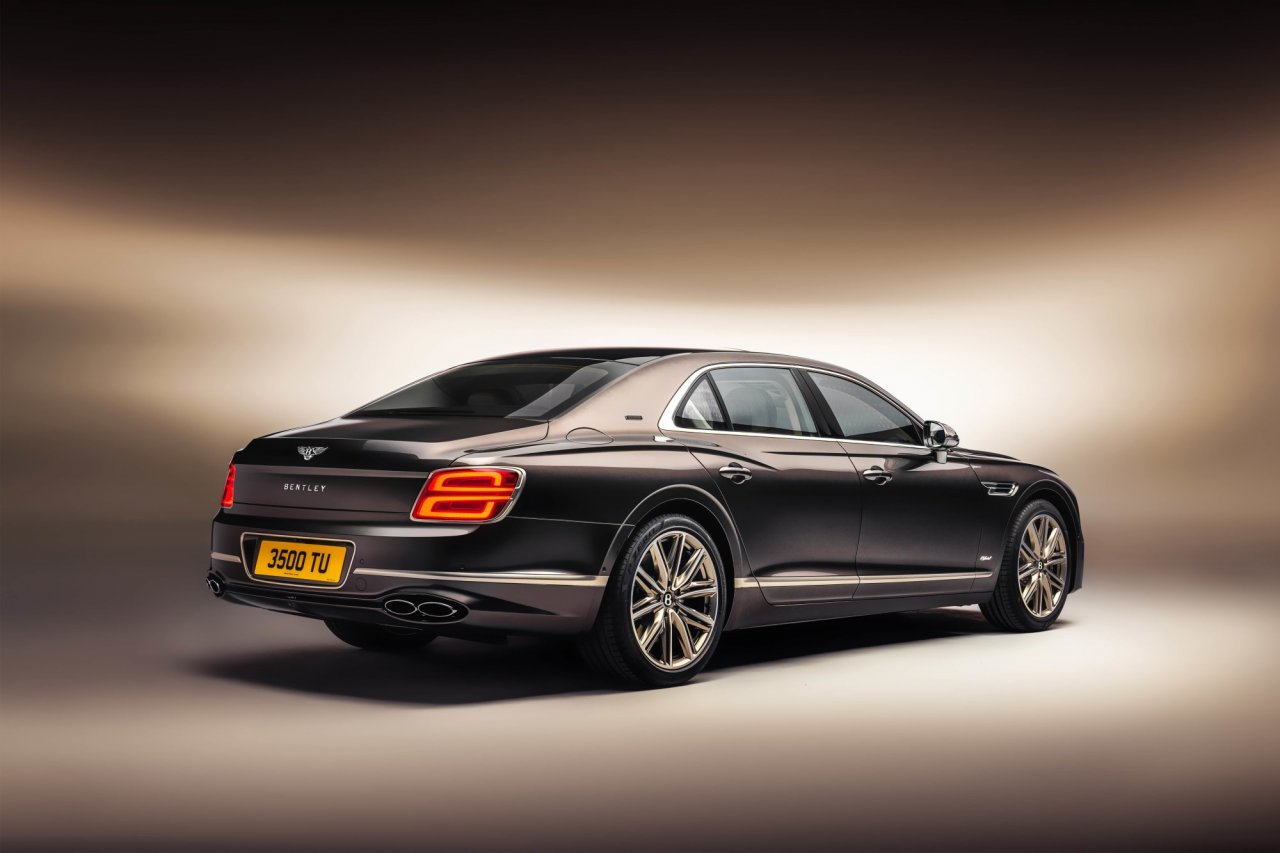
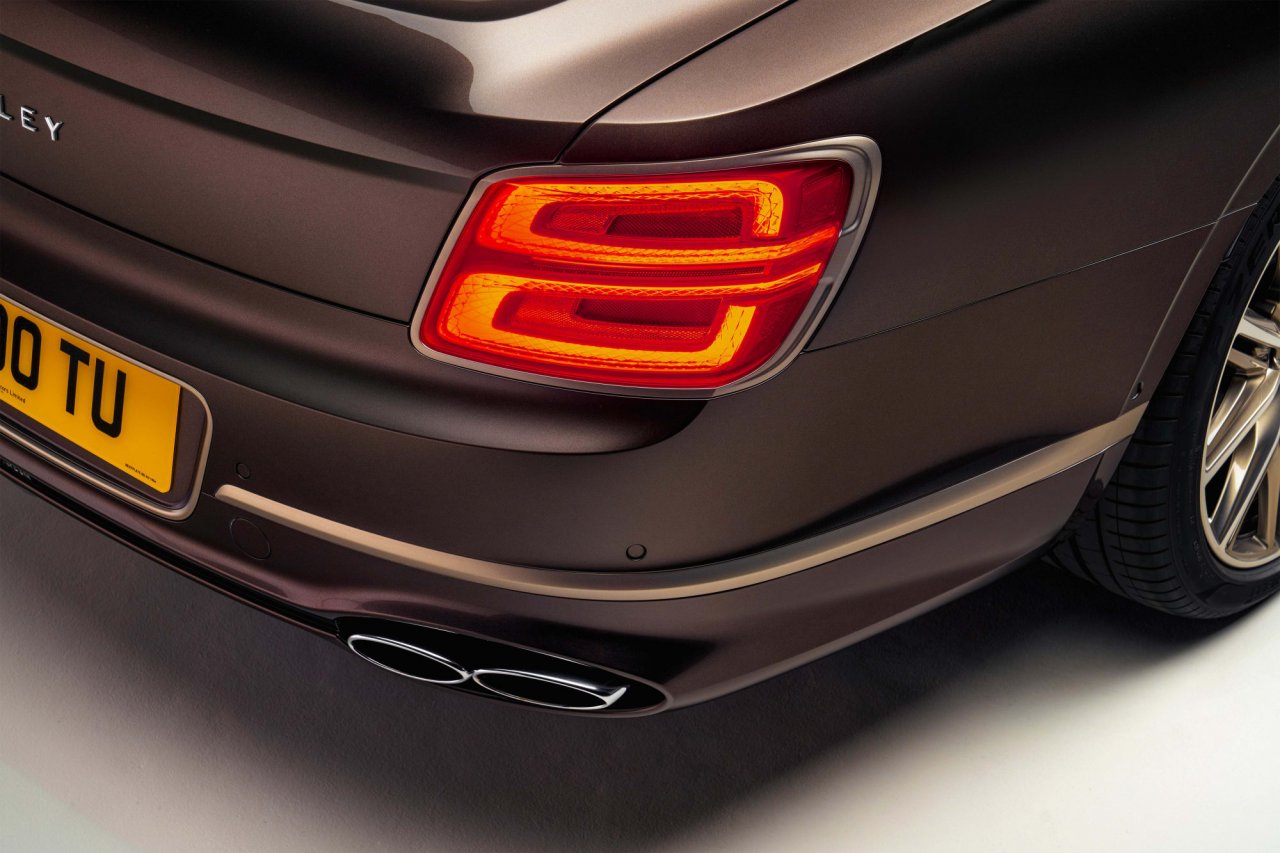
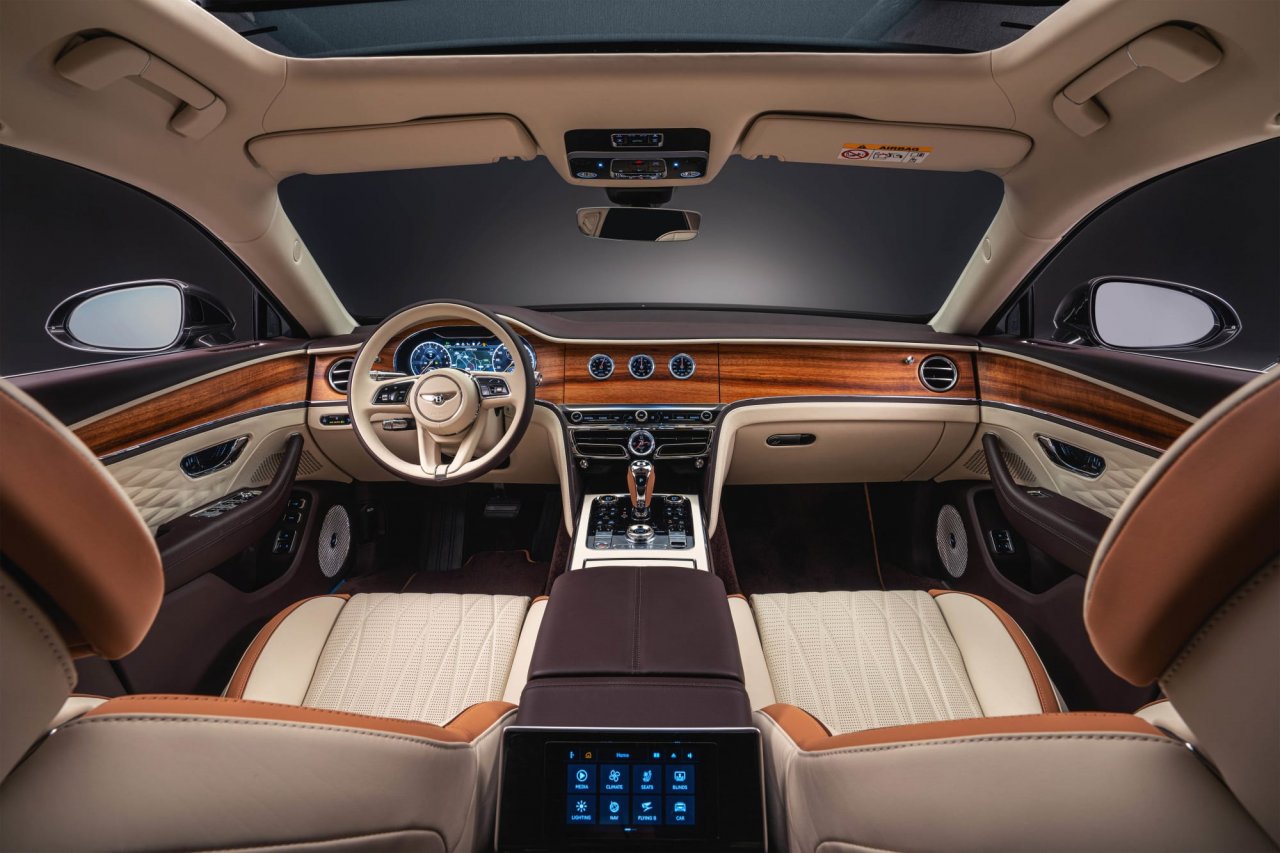
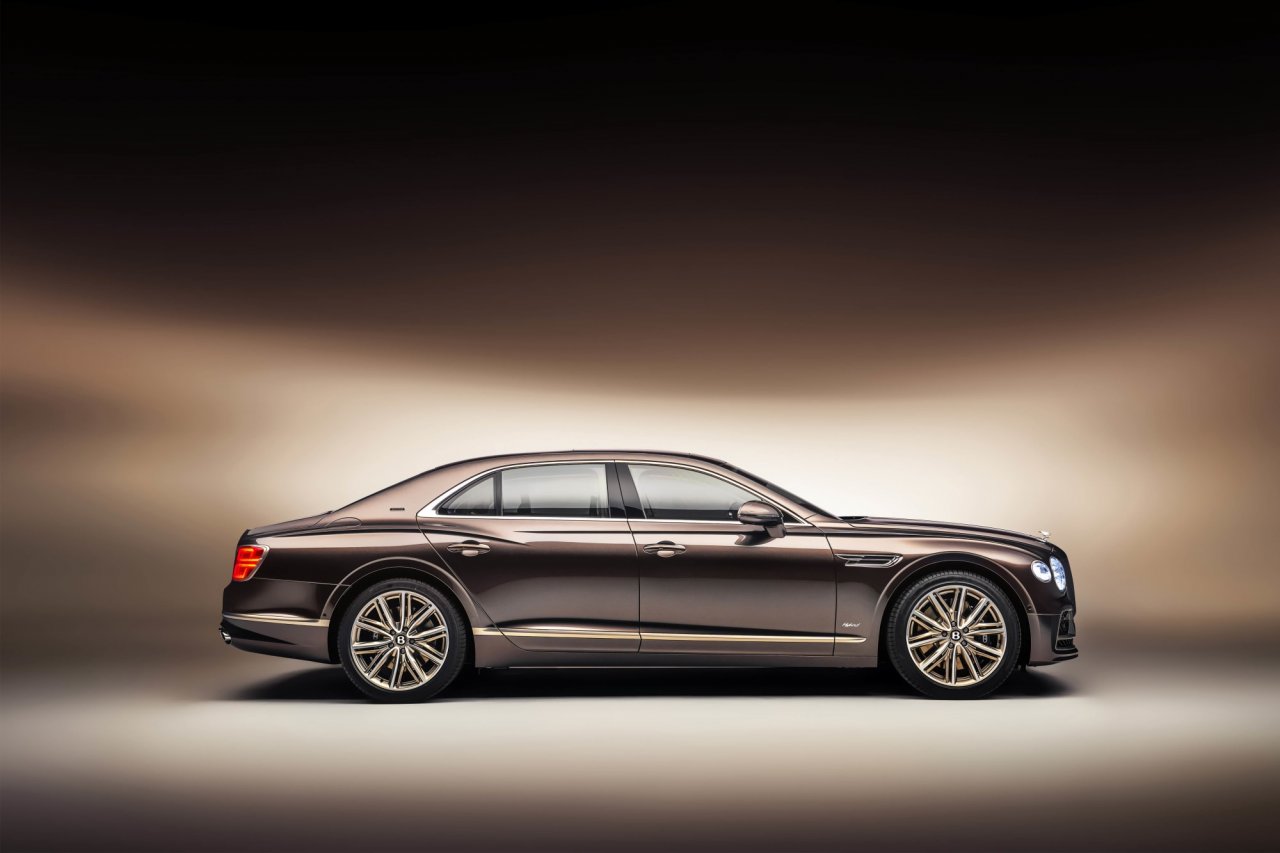
In addition to blackout themes for, gear, accessories, gadgets, and automobiles, we also love to see certain shades of metallic brown. To illustrate what have in mind, take a look at the Flying Spur Hybrid Odyssean Edition from Bentley. This high-class sedan embodies the carmaker’s vision for future luxury automobiles under its banner.

This limited-edition offering supposedly showcases the marque’s plans for its cutting-edge platforms. The company is ready to fully phase out combustion engines in the coming years. Therefore, a hybrid powertrain is an acceptable solution for the time being.

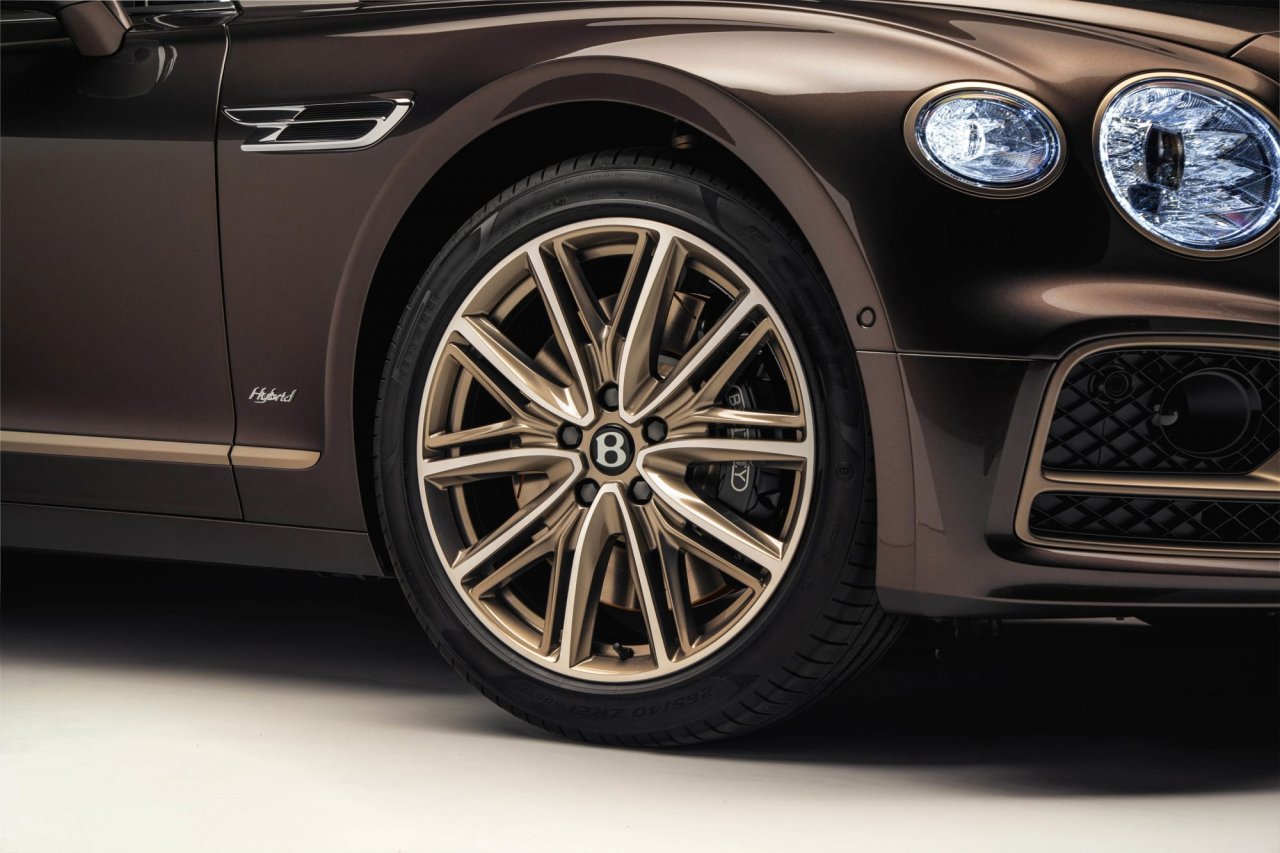
Bentley points out that clients can choose the base color of the Flying Spur Hybrid Odyssean Edition. However, each unit retains the Pale Brodgar accents. These are applied to the lower bodywork, brightware, and all four of its 21-inch wheels with ten twin-spokes each.

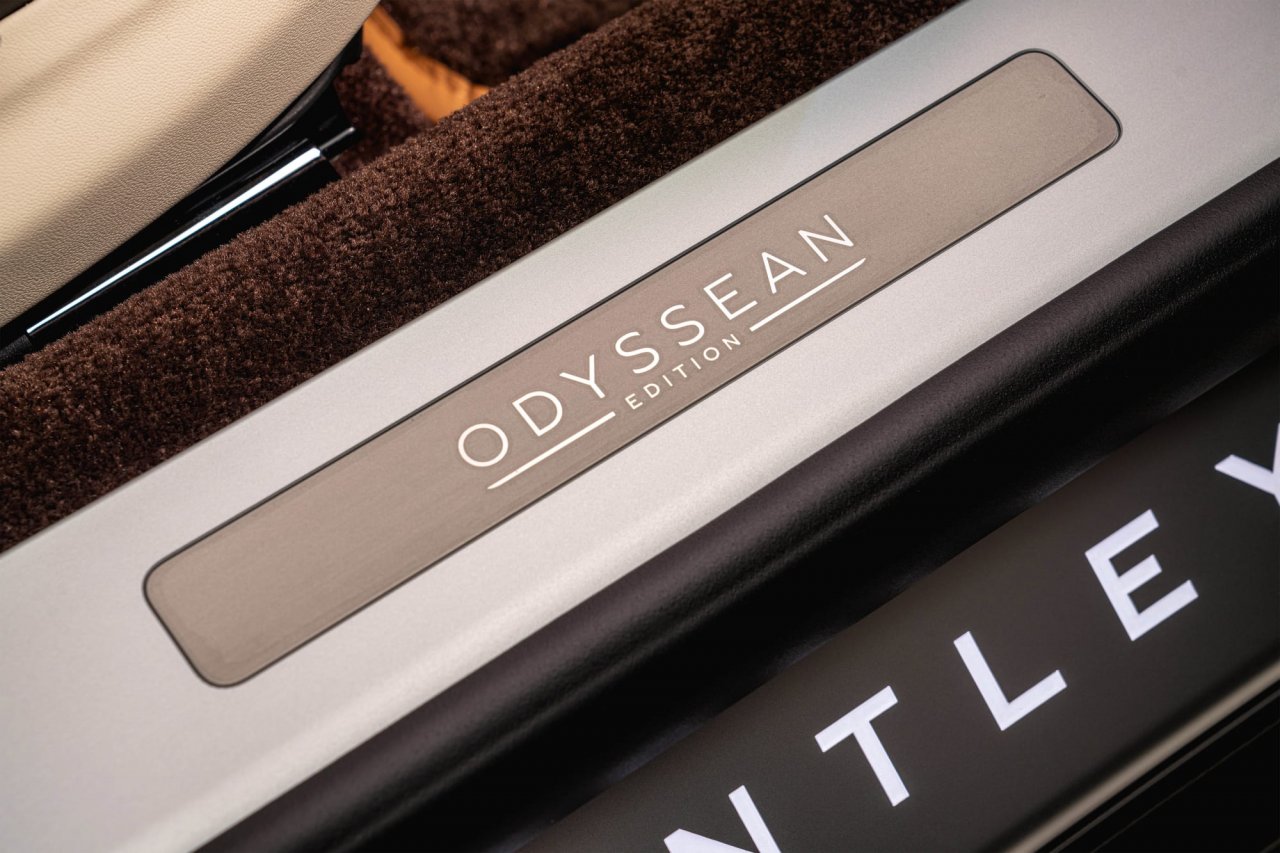
Odyssean Edition badges are visible on the “D” pillar to remind everyone of its exclusive distinction. Drawing inspiration from the EXP 100 GT concept car, the profile is sleek and sexy. What follows is the lavish interior of the Flying Spur Hybrid Odyssean Edition that uses only the finest yet sustainable materials.

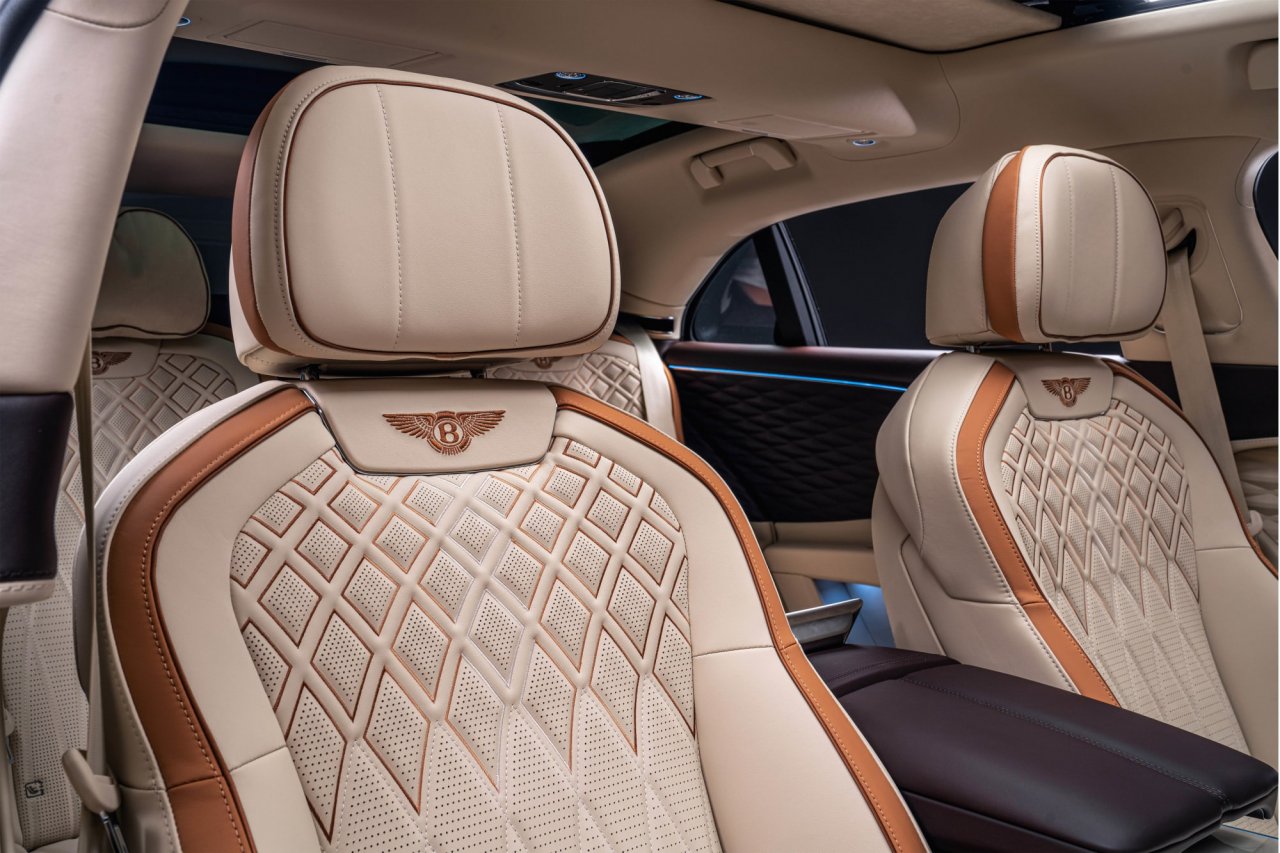
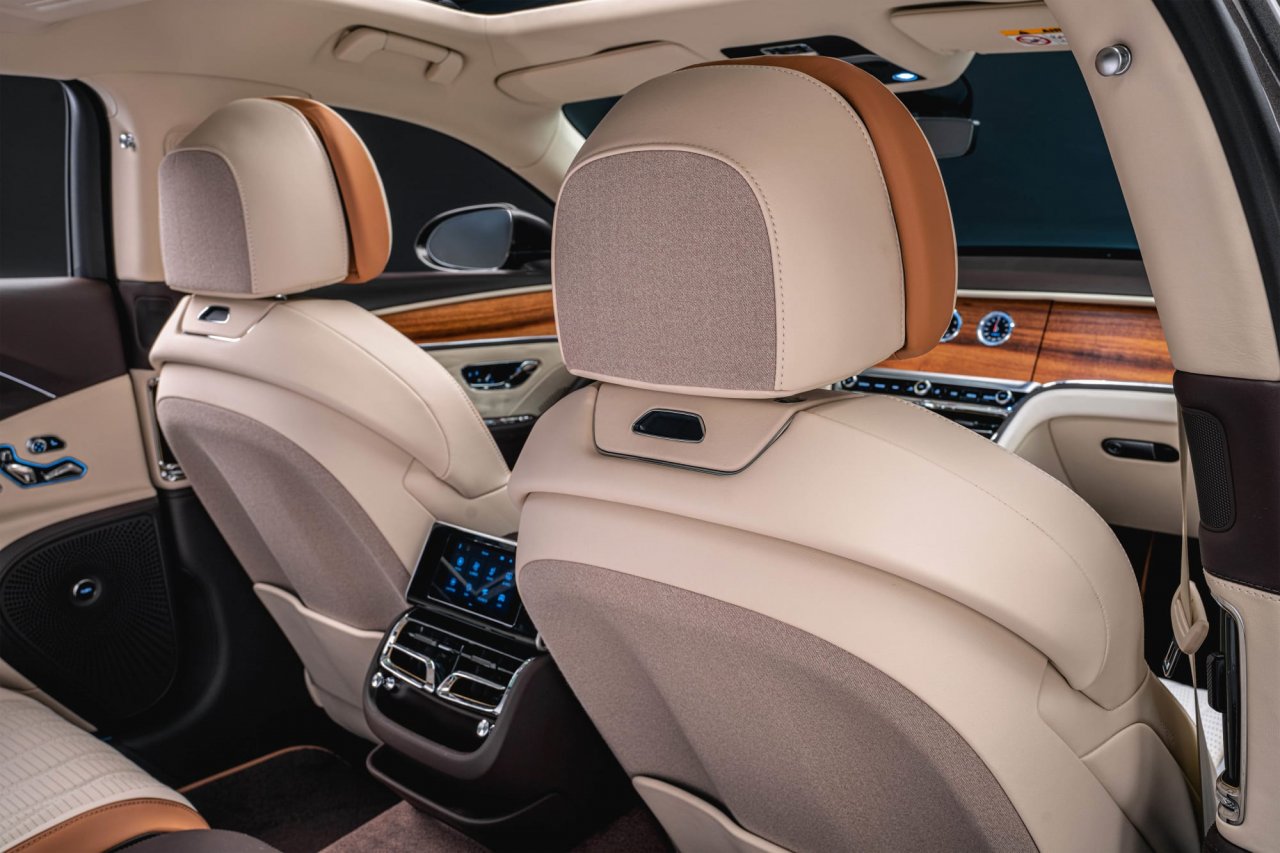
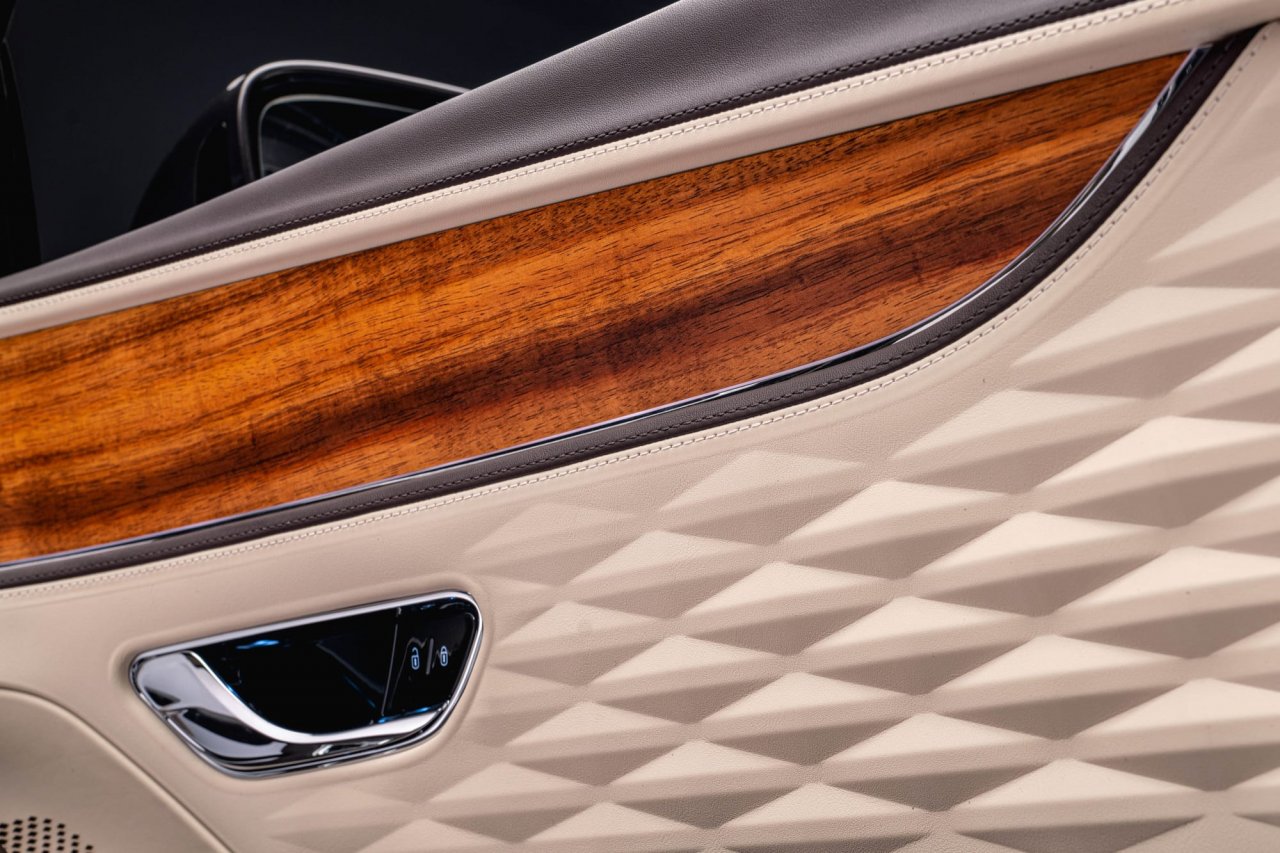
You’ll find British wool tweed on the seats instead of leather. These feature diamond textures and the Bentley emblem just below the headrests. Meanwhile, the Koa wood elements of the cabin boast an open-pore finish. The designers are only applying a thin coat of lacquer to retain the texture and reduce pollution.

The Bentley Flying Spur Hybrid Odyssean Edition is endowed with a 2.9-liter twin-turbo V6. Accompanying the power plant is a 100kW electric motor. These two combine for a total output of 536 horsepower with 553 lb-ft of torque.

Discover more

Images courtesy of Bentley

Watch as Devel begins testing a prototype of its Sixteen hypercar

It’s taken over a decade, but Dubai-based Devel has started testing the Sixteen hypercar it claims can reach 310 mph. Footage of a prototype undergoing shakedown tests on a track in Italy was published recently on YouTube.

If you need a refresher course, the Sixteen was shown to the public for the first time as a concept car in Dubai in 2013, though its development reportedly started in the late 2000s. It was revealed in its final form in 2017, and footage of it driving on a desert road surfaced in 2019. We haven’t heard much from the company since, which is hardly a surprise; 2020 was a difficult year for major carmakers, so smaller firms took an even meaner punch.

And yet, against any and all odds, Devel is back. Its prototype is unpainted and unfinished, the turbo system hasn’t been installed yet, but it runs, drives, and stops, which is a major accomplishment for the company. While no specifications were released, Devel outlined plans to build three versions of the car in 2019. First, a base model powered by a 2,000-horsepower V8. Second, a mid-range variant with a 3,000-horsepower, quad-turbocharged V16. Finally, a range-topping configuration with a quad-turbocharged, 12.3-liter V16 engine tuned to develop 5,000 horsepower. Yes, five thousand; that’s not a typo. It’s unclear which engine powers the car shown in the video.

Photos posted by Devel on its official Instagram account show the Sixteen being tested in Pininfarina’s wind tunnel, so the car is seemingly inching towards production. How many examples will be built, where, and how much each one will cost remains to be seen. What’s certain is that this hypercar could be a lot more real than many assumed.

Sweet 16

If the Sixteen reaches production, Devel will join the short list of manufacturers that have built a car with 16 cylinders. One of the most famous 16-cylinder models is the Cadillac V-16, which was built from 1930 to 1940. It was offered in a dizzying number of configurations, and many examples were fitted with a coachbuilt body. BMW briefly experimented with a V16-powered, E32-generation 7 Series in the early 1990s, at about the same time Italy-based Cizeta was putting the final touches on the Marcello Gandini-designed V16T. Only a handful were built.

In recent years, the glorious 16-cylinder layout has been associated exclusively with Bugatti. Different evolutions of its 8.0-liter, quad-turbocharged W16 have powered the Veyron, the Chiron, and few-offs like the Centodieci.

McLaren Speedtail ‘Albert’ has a paint job you absolutely must see

There’s no McLaren Speedtail that looks as wild and exotic as this one. Say hello to the “Albert” Speedtail, made as an homage to the first Speedtail testing vehicle.

That initial test vehicle featured a similar look, only done using crude vinyl body wrap. This Speedtail was meticulously painted and sweated over by the McLaren MSO team. The Albert name is derived from McLaren’s 1992 F1 test mules — those testers were given the name Albert, as the name of the road where the F1 was designed and built was called Albert Drive. Since the Speedtail is another three-seat McLaren, the name stuck.

The paintwork for this specific Speedtail took 12 weeks total to complete. McLaren broke that down into two weeks of masking, six weeks of painting and the remaining time for drying and reassembling. The MSO team also spent a good deal of time practicing and preparing to paint the actual car before it started. All the masking had to take place on the fully-built car, too, as painters had to ensure everything flowed around the vehicle with panel alignment and the wheels.

The final colors chosen for this project are Magnesium Silver and Ueno Gray. That silver is the first color the F1 was ever shown in, and the gray is the color of the 1995 Le Mans winning F1 GTR. The Speedtail’s teardrop shape lends itself to this sort of patterning and design better than most, and we absolutely adore it. This car already looks like a spaceship on wheels, and adding this paint job only elevates the feeling.

McLaren of Beverly Hills originally commissioned this car, and it will make a official public debut at a Beverly Hills Cars and Coffee this Sunday, August 8, in case you were curious to see it in person. Lastly, McLaren noted that this is one of the final Speedtails in the 106-car production run, so McLaren is almost done with this hypercar.

Related video:

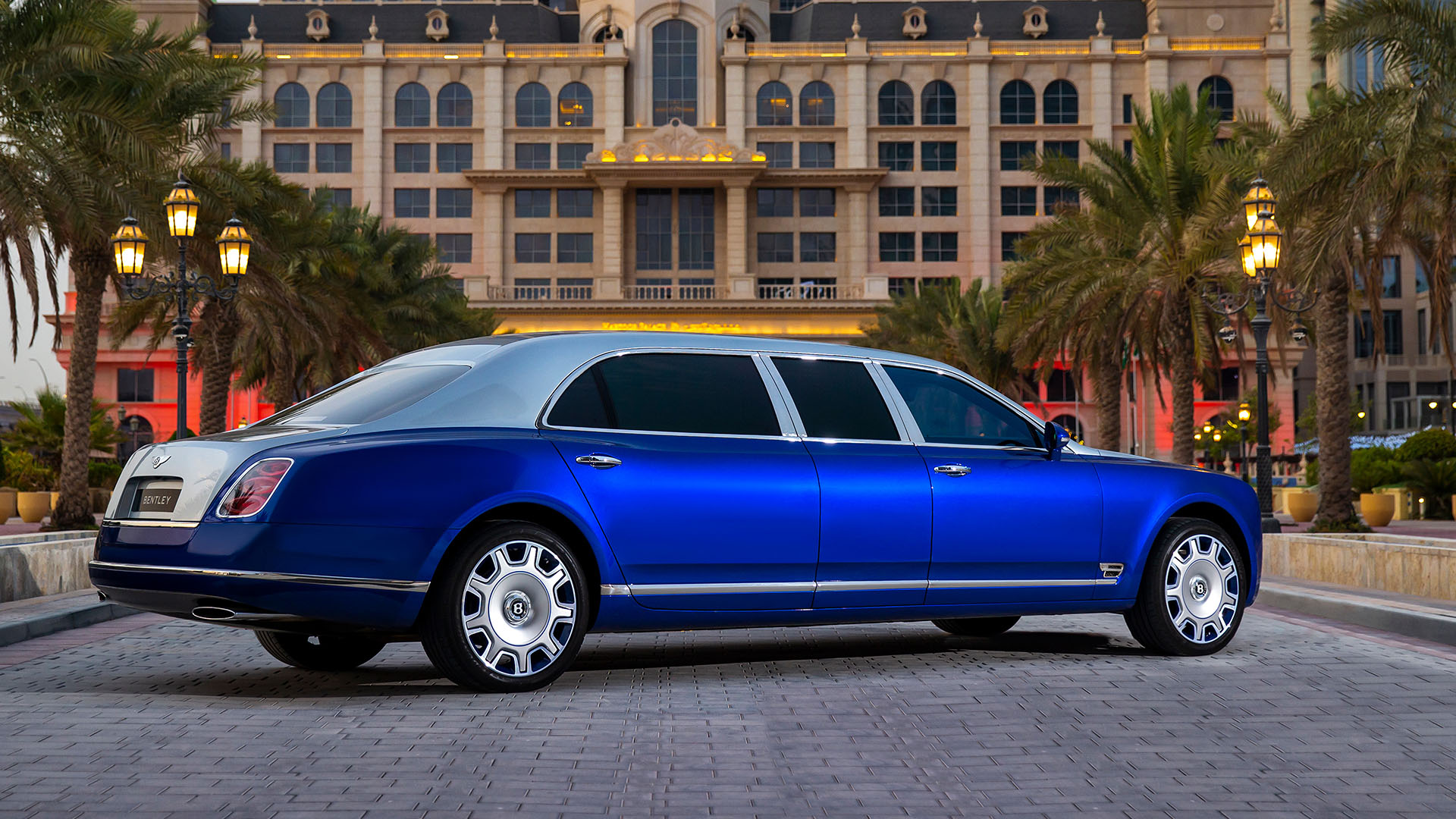
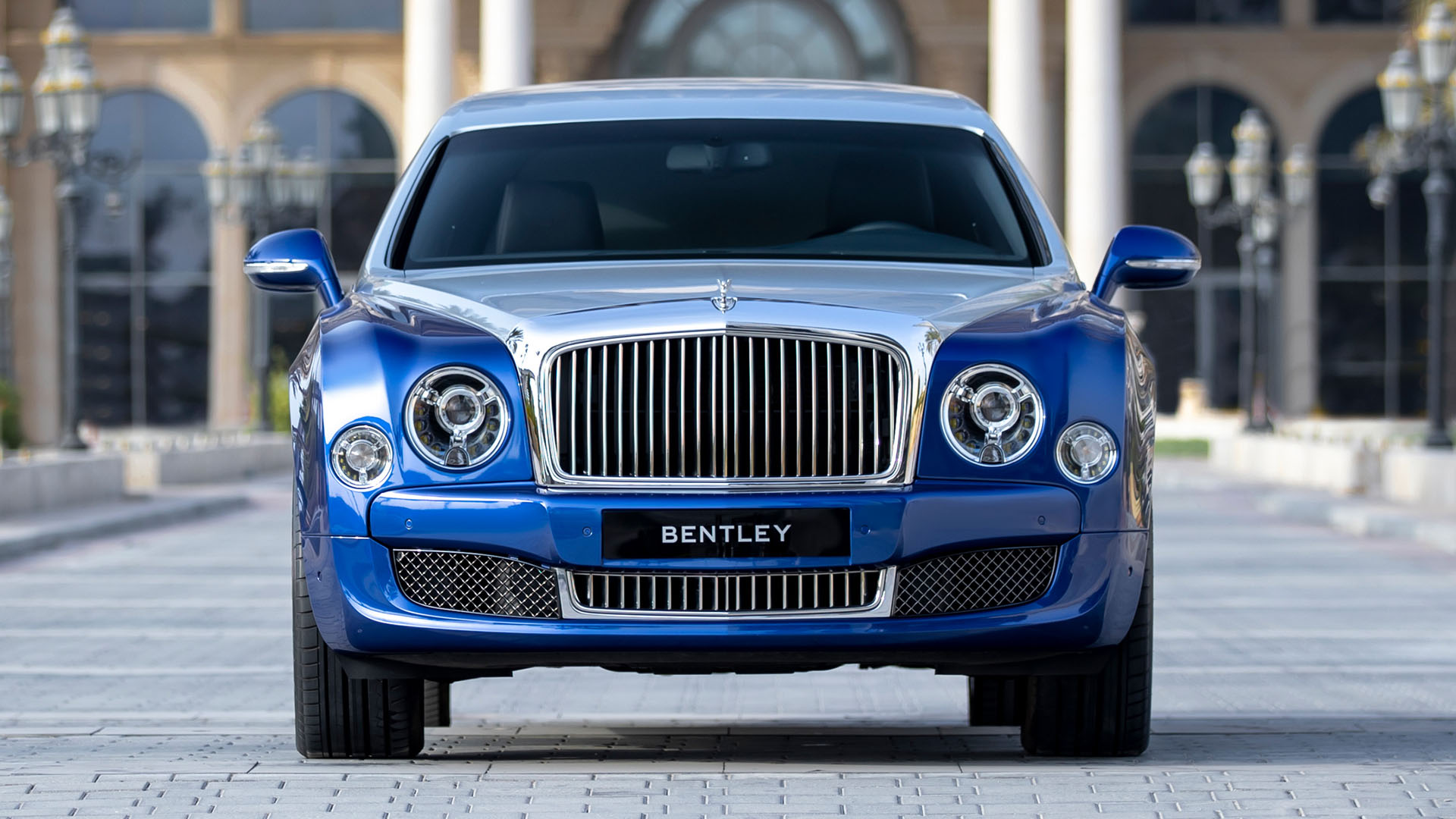
The Mulsanne Grand Limousine by Mulliner

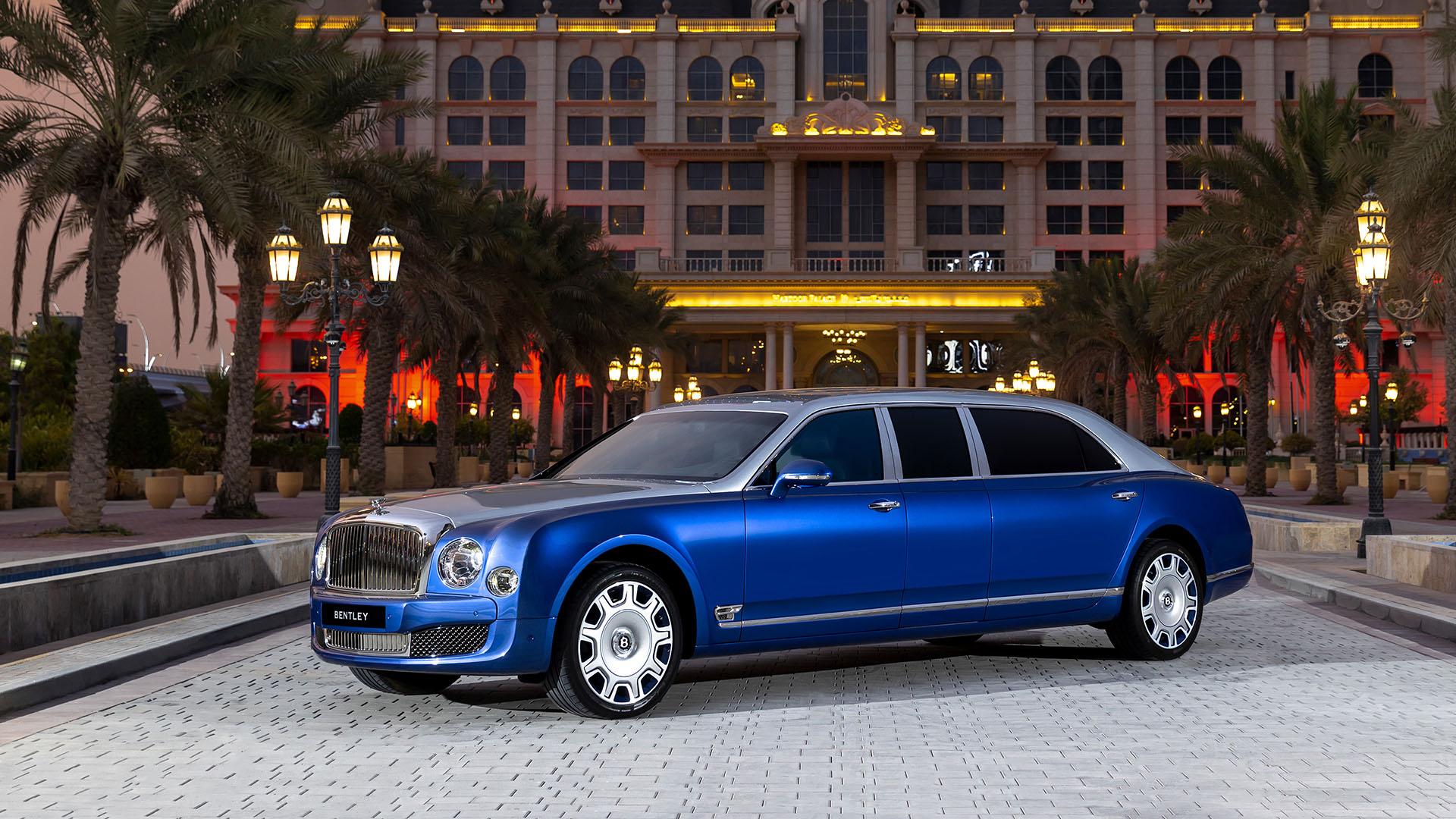
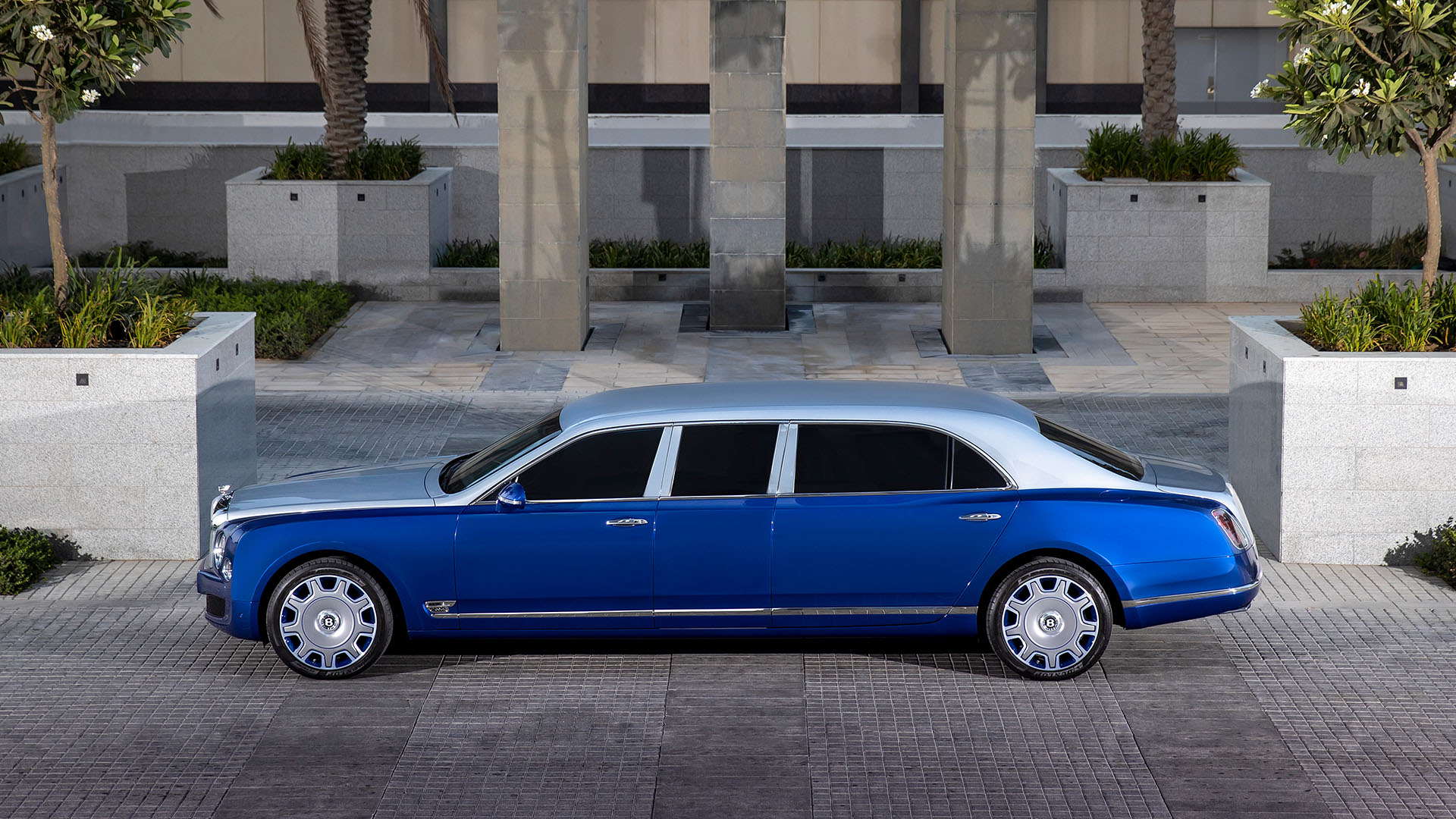
Built for a world where size does matter, the Mulsanne Grand Limousine by Mulliner was a special commission built for customers in the United Arab Emirates, and while these cars were handbuilt back in 2015, today they are still considered ‘new’ and none of the five that are available for purchase now have ever been registered, these are five-year-old, brand new cars that have just been put on the market for those that are seeking the ultimate in luxury limousines.

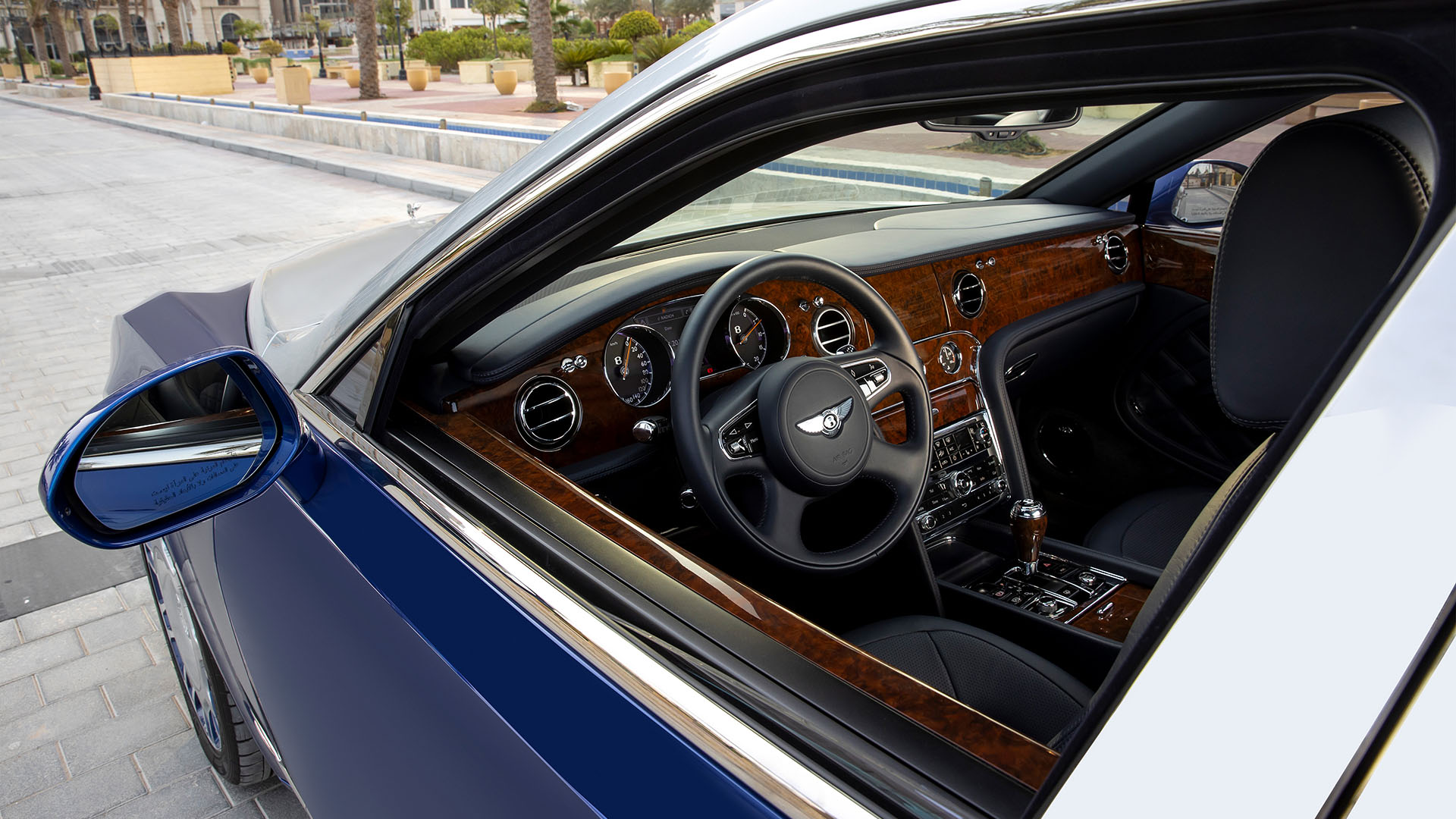
The first Mulsanne Grand Limousine by Mulliner was a bespoke build, a private commission so to speak, taking Bentley’s famous Mulsanne from the production line in Crewe and taking it to the Mulliner atelier for a 1,000 mm stretch (39.47 in) to create a lot more space for the occupants behind the driver, or in this case, the private chauffeur. To make the passengers in the rear even more comfortable, Mulliner also raised the roof on the Mulsanne by 79 mm in the rear (3.11 in).

After this car was built and delivered to her happy customer, Bentley Mulliner was allowed to have this Mulsanne Grand Limousine by Mulliner as a limited production model in the books, and some were ordered by high-net-worth individuals that didn’t want to be driven around in yet another Rolls Royce Phantom (which was also available as a ‘stretch’) but preferred a similar experience of utter luxury inside a more sporty designed Bentley like the Mulsanne.

Today it seems you can’t order the Mulsanne Grand Limousine by Mulliner anymore, but fear not, if you still want to add one of these amazing handbuilt limousines from the UK to your garage, the opportunity has come up to obtain one of five of these 2015 cars that are still brand new, these five were ordered by Bentley Emirates for the rich and famous in that region, but in the end, none of these were ever registered, and they still come with delivery miles only.

The only downside to these is the fact they are ready-built, so no bespoke specs can be ordered, but the upside is that these are available right now, no delivery time, nothing, and Bentley Emirates can deliver these Mulsanne Grand Limousine by Mulliner anywhere in the world within days, making this a unique opportunity for clients to obtain an icon of modern Bentley history.

As we would expect from a Mulliner built Bentley limousine, each of these five 2015 cars has her individual identity as customers that shop in this kind of market do not want to encounter the same car when they drive up to the restaurant or the latest party in their friend’s mansion, an overview of the five different Mulsanne Grand Limousine by Mulliner now available:

  1. Silver Frost over Moroccan Blue exterior paint, paired with an Imperial Blue and Linen interior completed by Burr Walnut veneer
  2. Damson over Black Crystal paintwork, complemented by Damson and Twine leathers and Dark Stained Burr Walnut veneer
  3. Onyx over Candy Red exterior, with a Hotspur and Camel interior, finished with Olive Ash veneer
  4. Rubino Red over Light Gazelle bodywork, with an interior in Fireglow and Twine leather paired with Burr Walnut veneer
  5. A single tone Black Sapphire exterior, with an Imperial Blue and Camel interior contrasted by Dark Stained Burr Walnut veneer

The car depicted in these photos is the nr 1, Silver Frost on Moroccan Blue, a very nice color combination, although I would prefer my Mulsanne Grand Limousine by Mulliner to be all black … a dark and sinister-looking 6,575 mm (258.9 in) long beauty with space for four passengers in the rear in a ‘face-to-face’ configuration.

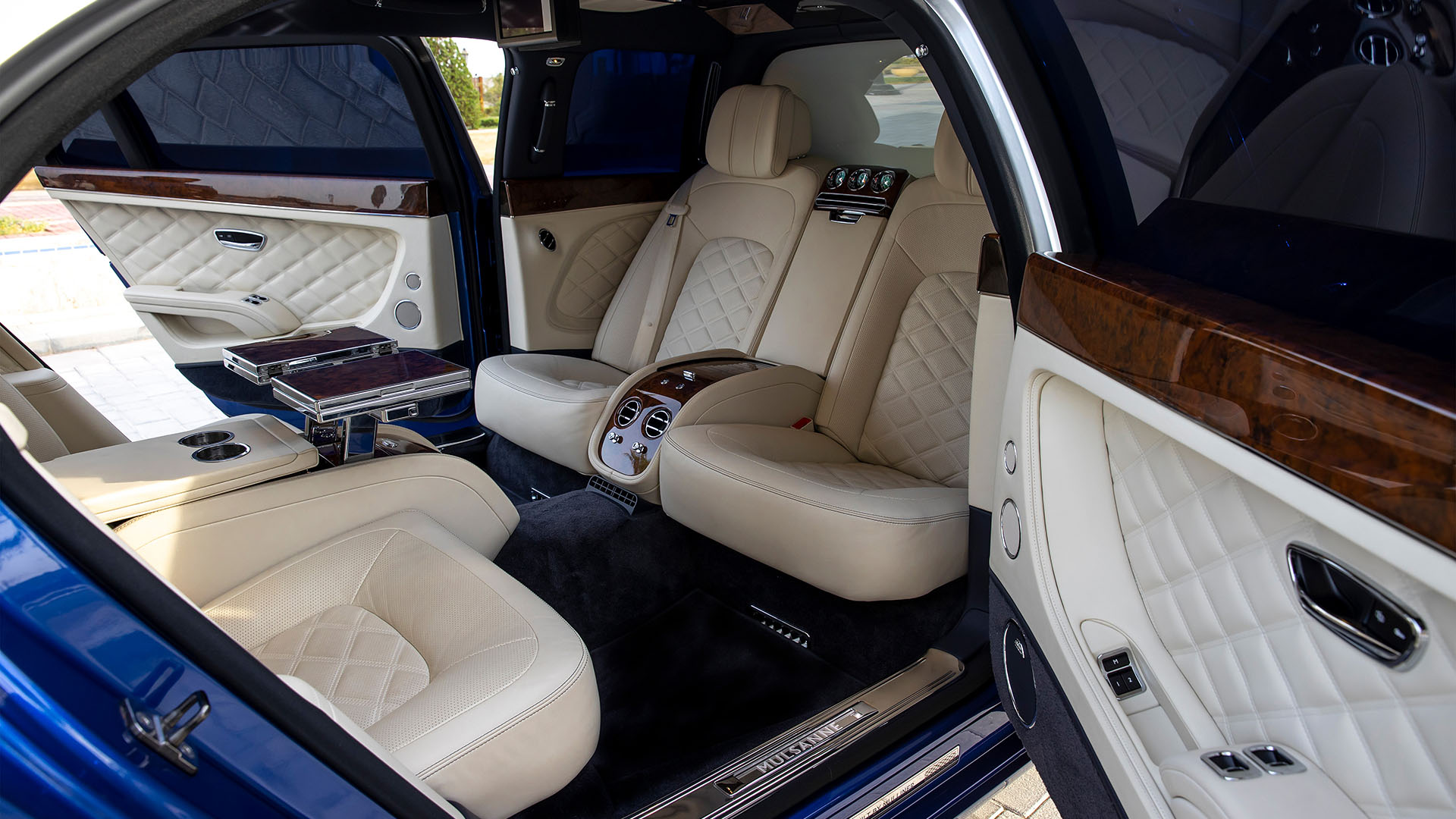
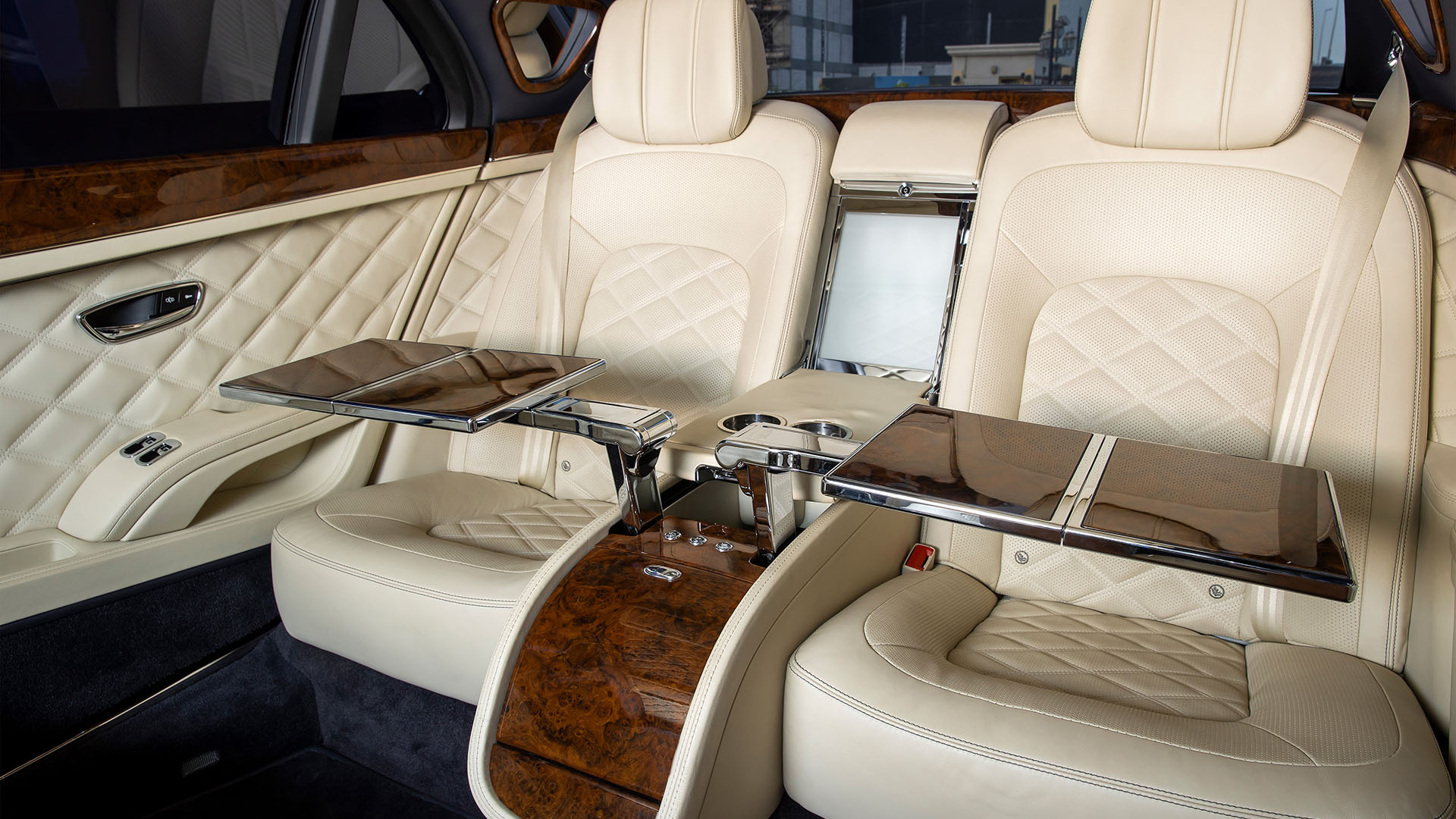
The clients that are in the market for a car of this caliber usually own a superyacht with a helicopter and a private jet, and that’s where the inspiration for the rear ‘cabin’ on the Mulsanne Grand Limousine by Mulliner came from, having a setup that would allow four people to be seated two side by side, in front of each other so a conversation could be maintained with ease while being driven around in the best possible luxury available.

Inside such a car you’ll find a bottle cooler with bespoke flutes between the rear seats, facing forward, a special cabinet for ‘other’ beverages was fitted between the seats facing backward, complete with Mulliner bespoke crystal tumblers, just in case you needed to get some work done before arriving at your venue in style, there are foldable veneer picnic tables for the occupants, complete with iPad docking station and USB chargers.

The rear passengers even have a view of three custom dials, one displaying the local time, a second one showing UK time, while the third one shows the outside temperature. A custom heating, ventilation, and air conditioning (HVAC) system was designed and built by Bentley Mulliner, specifically for the Mulsanne Grand Limousine to offer two separate zones for the rear cabin, each of the four rear passengers can control their own micro-climate, independently from their fellow companions.

These Mulsanne Grand Limousine also used a ‘smart glass’ divider for the first time on a Bentley, not only does it separate the driver from the passengers in the rear, but at the touch of a button the glass turns opaque, for convenience inside this private bubble there is an intercom system installed to talk to the driver.

Each of the Mulsanne Grand Limousine is powered by Bentley’s famous 6¾-litre twin-turbo V8 engine, delivering 505 hp and a very impressive 1,020 Nm of torque while riding on one-of-a-kind 21-inch wheels that match the car’s paint, if you look really close at the ‘Flying B’ above the majestic grille, you’ll notice the engraved ‘Coachbuilt by Mulliner’ script to set these limousines even further apart from their lesser Bentley Mulsanne siblings.

Bentley Mulliner has become a testament to what can be done if a company like Bentley goes above and beyond for their more discerning clients, Mulliner goes back almost five centuries in history when it comes to coachbuilding, they have recently celebrated the 1,000th bespoke commission, a special Bentley Bentayga since the Mulliner Design Team was put together by Bentley in 2014, and just as a reference, these Mulsanne Grand Limousine are still the longest manufacturer-built limousines in the world, other limousines are ‘stretched’ by third-party companies to greater lengths, but the Mulsanne Grand Limousine is different, it’s ‘Rare by Design’ as stated by Bentley Mulliner.

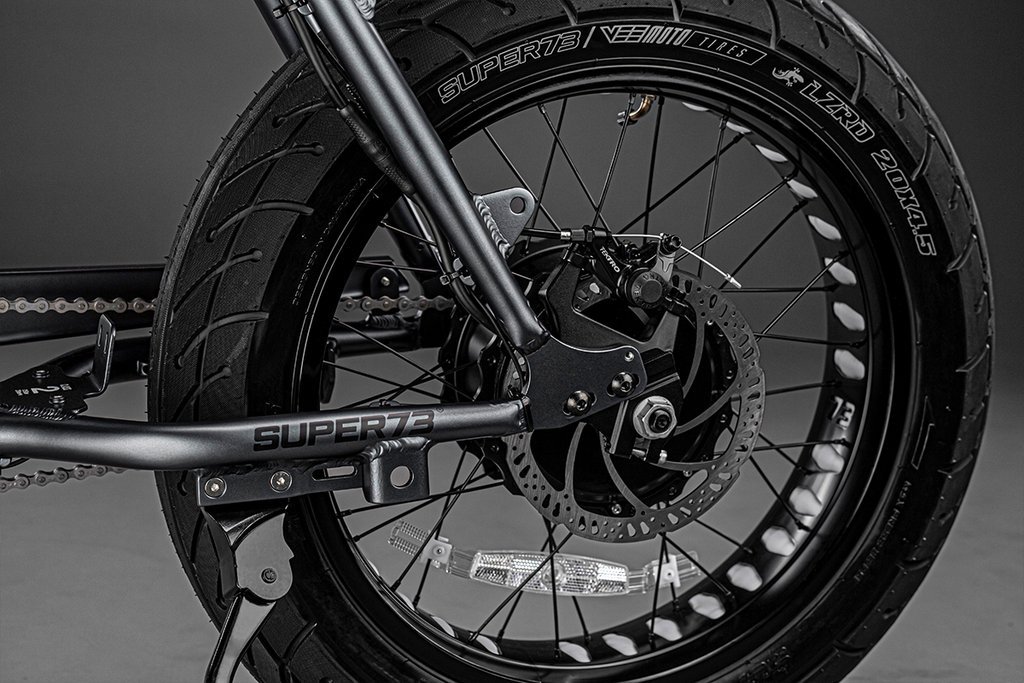
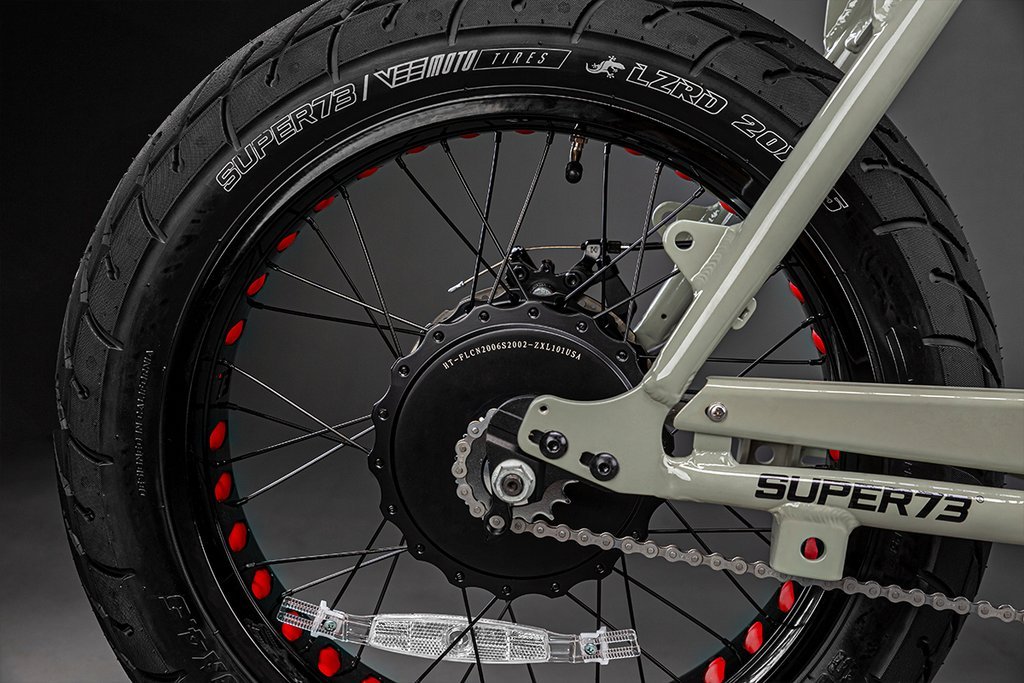
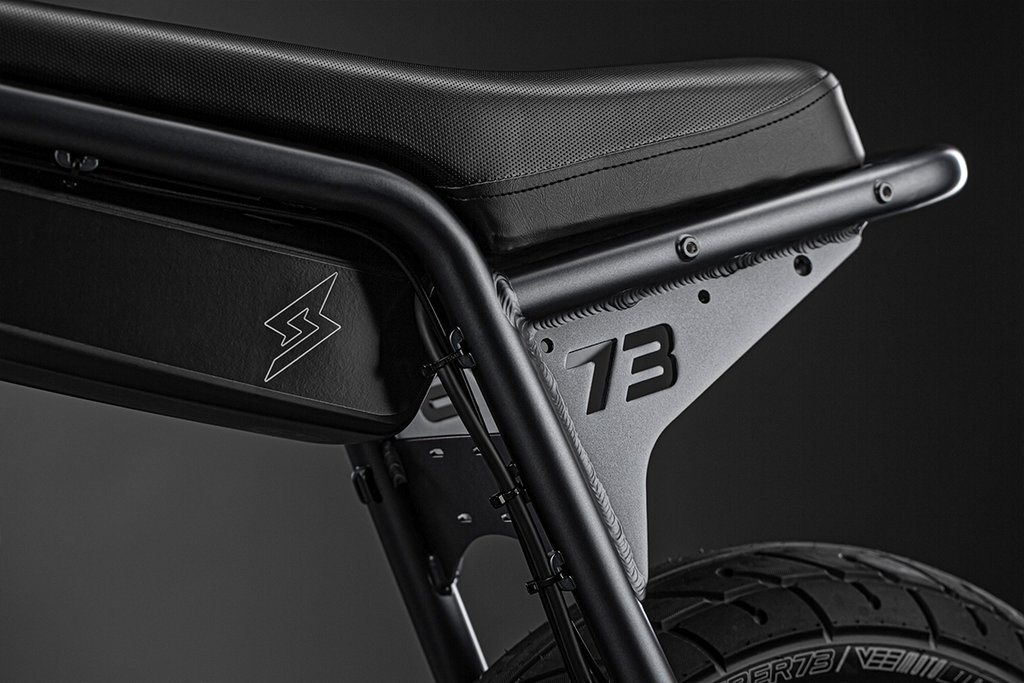
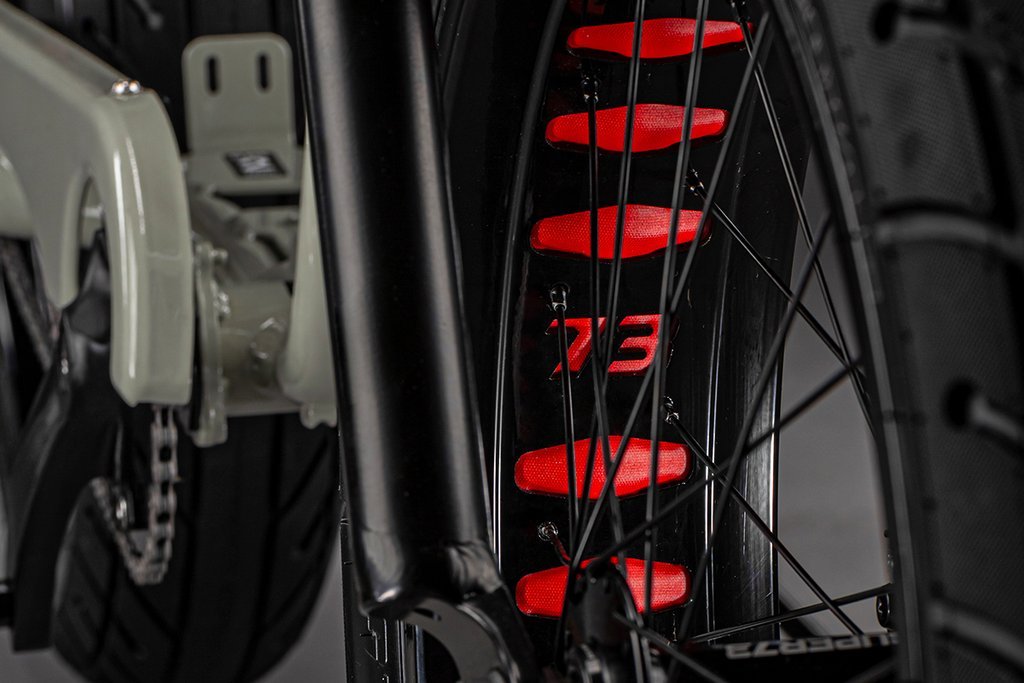
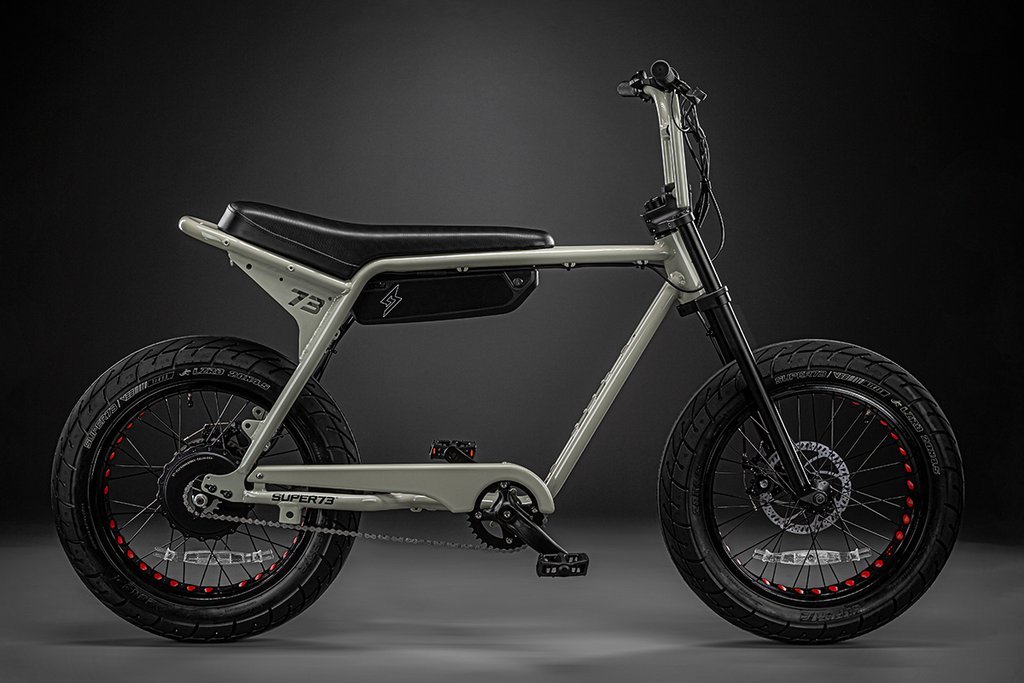
SUPER73 adds the ZX e-bike as a range-topping model under its Z-Series catalog

SUPER73 is here to share a new addition to its Z-Series lineup of electrified bicycles. Although there’s nothing wrong with conventional pedal power, motorized assistance is a handy feature to have as a backup anyway. The ZX brings a slew of upgrades to the table to make your commute smoother and fun.

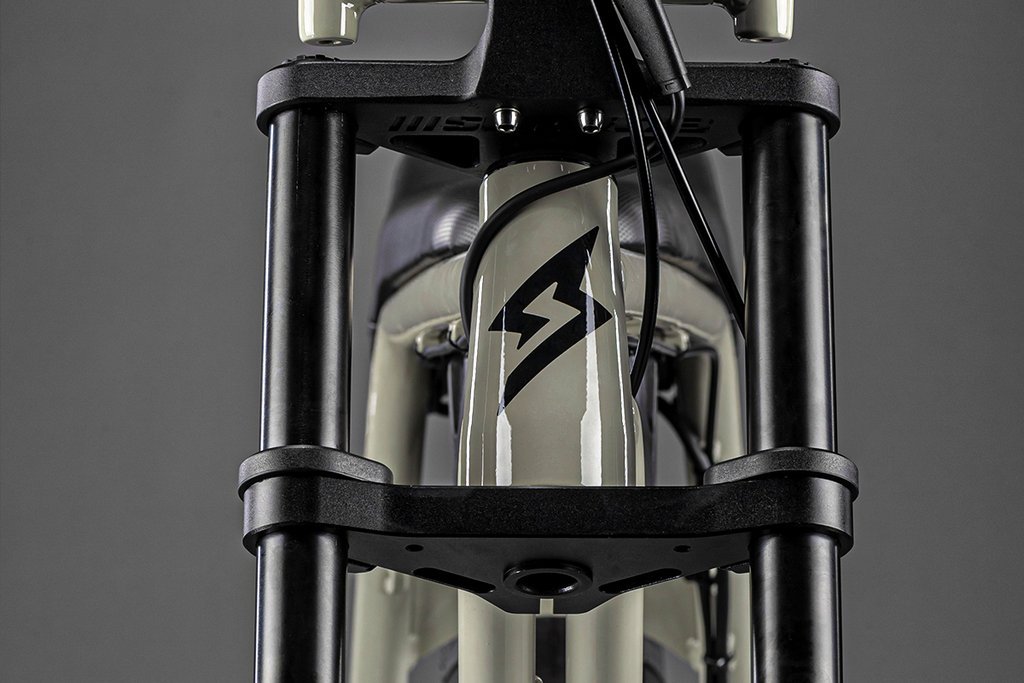
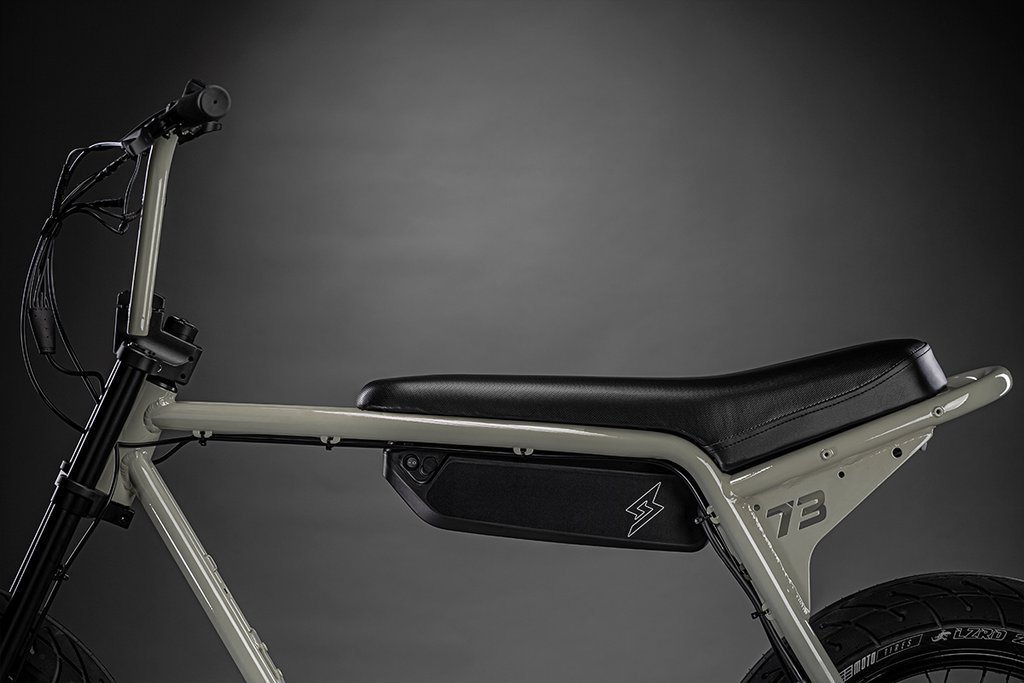
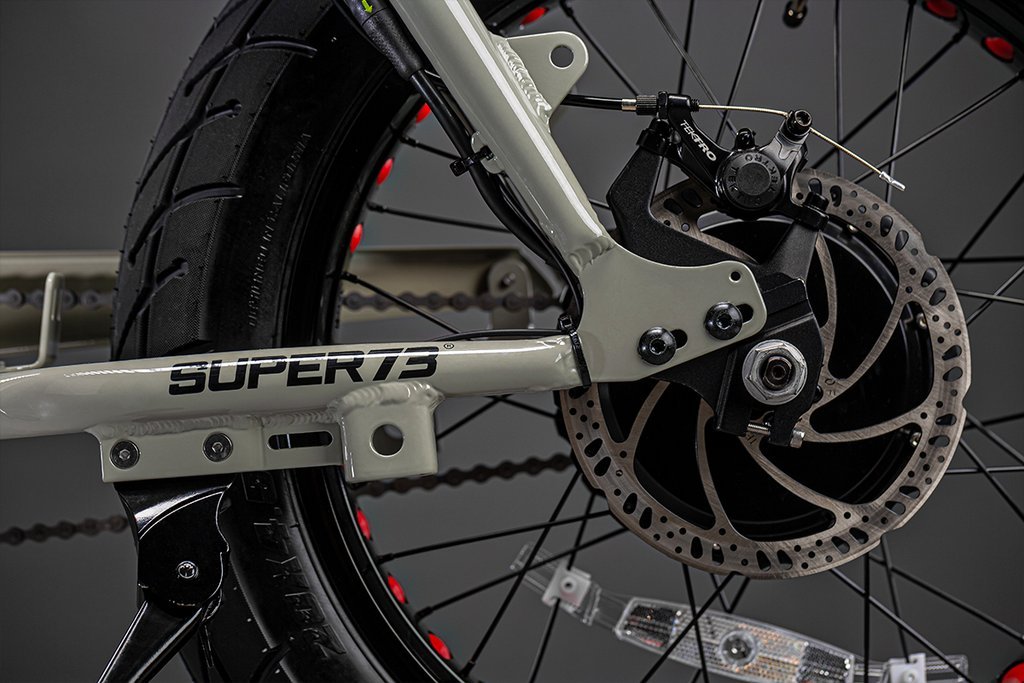
For the frame, it uses aircraft-grade 6061-T6 aluminum for extreme durability minus the weight. Moreover, even under extreme weather conditions, the metal should stay corrosion-free for a long time. SUPER73 also equips it with what it calls a multi-class ride mode feature.

Upon activation, it allows you to engage the throttle and pedal but limits the top speed to 20 mph. This makes it possible to take the ZX on public roads and bike paths sans a license, insurance, or registration. In short, you can have fun right away upon its delivery.

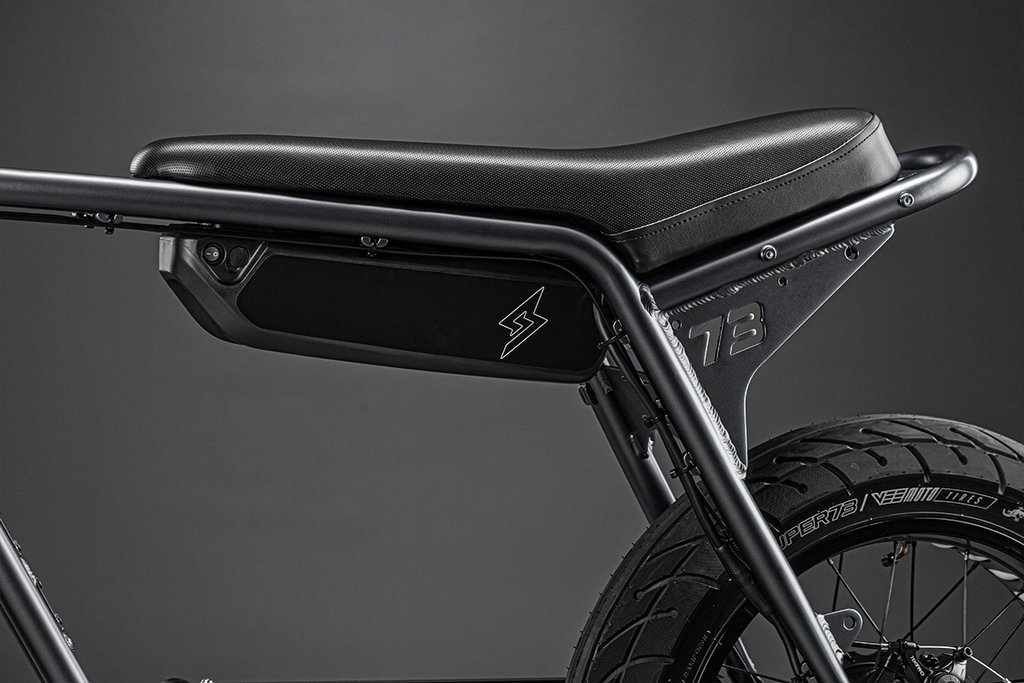
Powering the electric drive system is a 615-Whr user-replaceable battery unit. Its brand-new motor boasts up to 1,350 watts of peak power depending on the ride mode. Throttle-only operation claims to have a range of up to 30 miles, while ECO pedal-assist mode bumps that up to 50 miles.

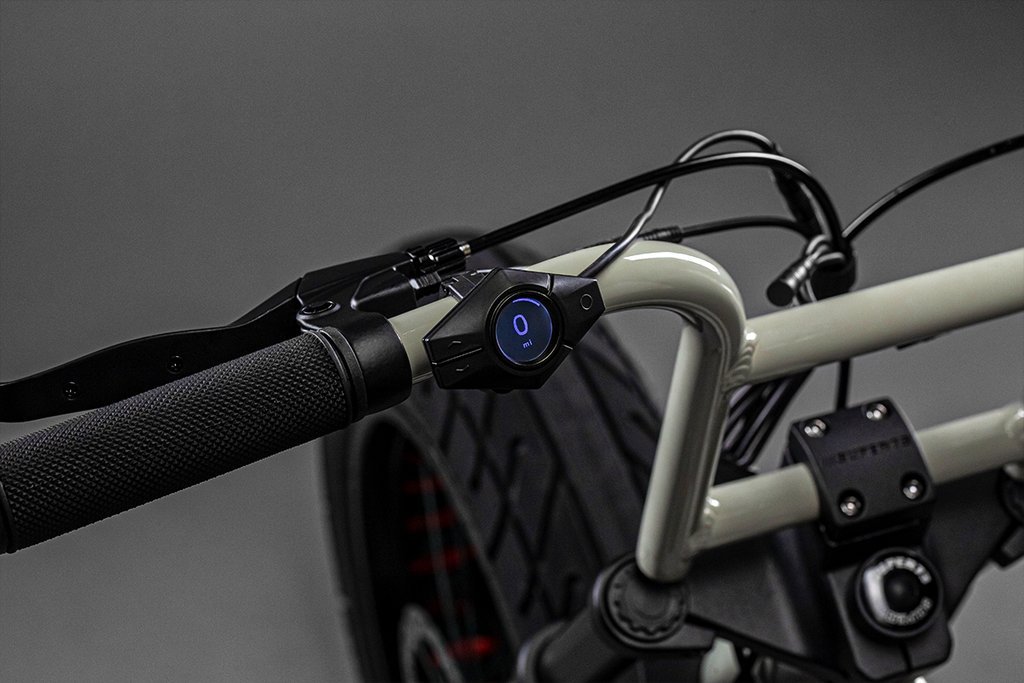
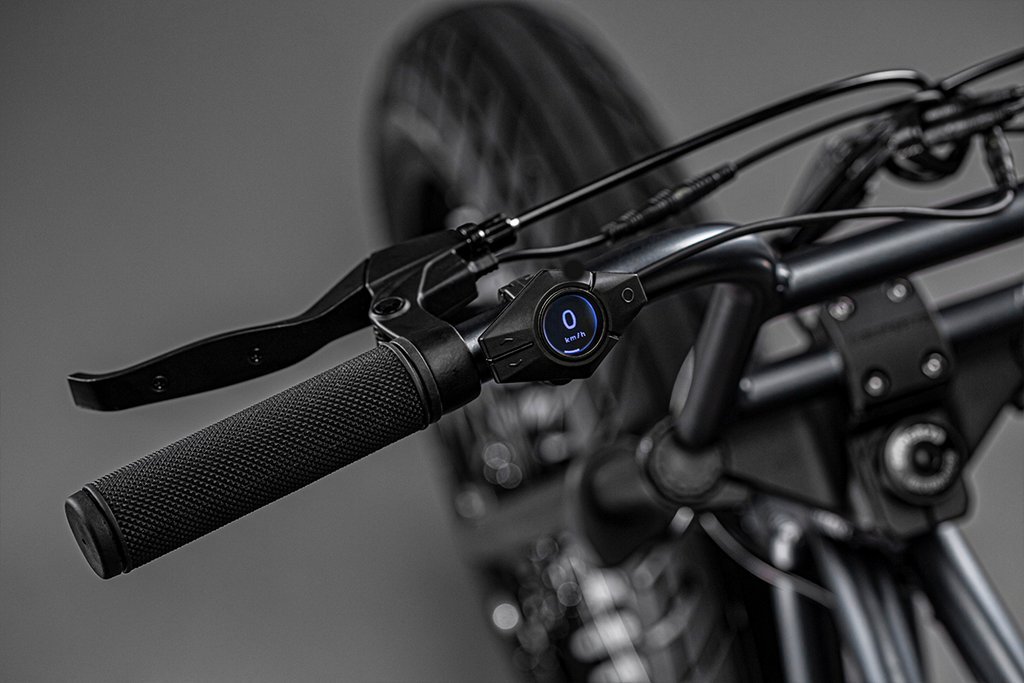
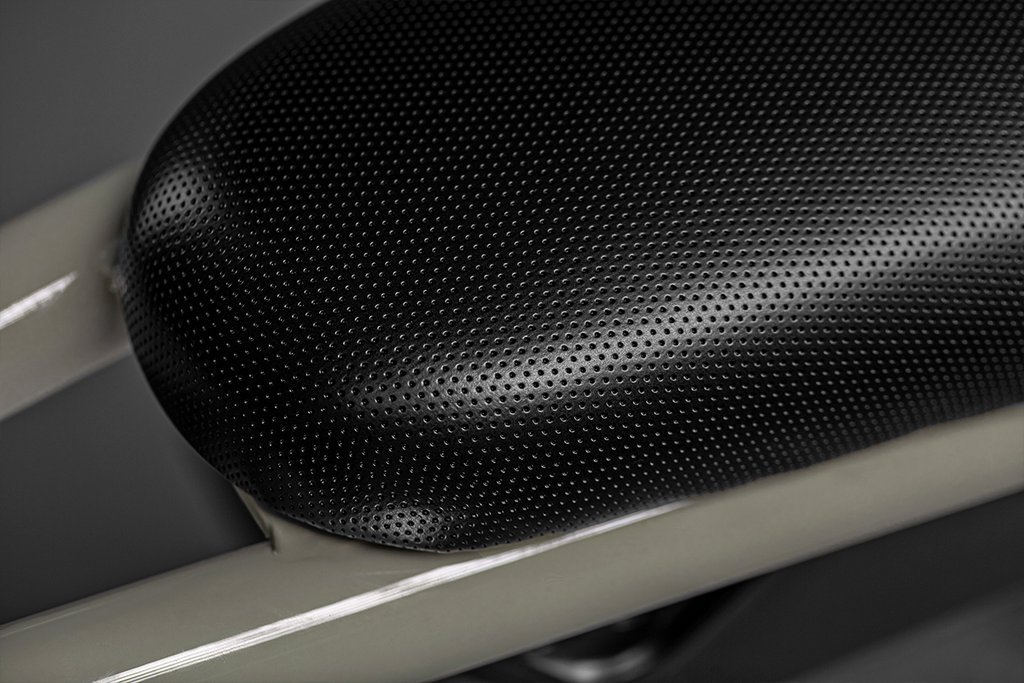
Long rides won’t be an issue thanks to the ergonomic placement of its seat and handlebars. The ZX comes with a transflective monochromatic LCD display. Pair the electric bike with your smartphone to activate turn-by-turn navigation.

Make adjustments on your smartphone and get over-the-air (OTA) firmware updates. SUPER73 offers the ZX in two colorways: Storm Gray and Moon Rock. There’s also an option to get with LZRD or Trooper tires. Likely due to popular demand, each buyer is limited to only 2 units.

Buy – $1,995

Images courtesy of SUPER73

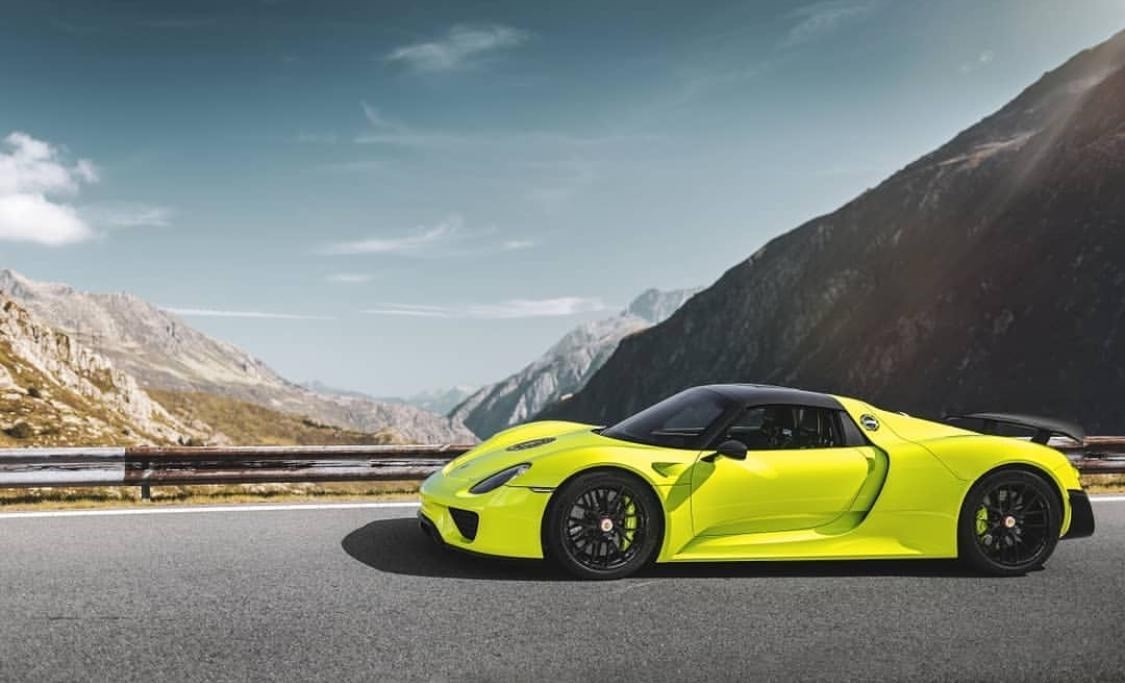
Acid Green Porsche 918 Spyder for Sale – 1 of only 4 Made in this Color

Acid Green Porsche 918 Spyder for sale

Leave it to Porsche to pull 50 shades of green on their supercar and still manage to make each shade look absolutely beautiful. Acid Green is the kind of color you only find on vinyl wraps, but this Porsche 918 Spyder for sale in Switzerland has that paint straight from the factory.

Acid green was an exclusive PTS color used on only 4 918 Spyders, this is as green as it gets and anything beyond this falls into yellow territory. The car for sale here is equipped with the desirable Weissach Package originally from the factory, worth noting that some regular 918s were later equipped with this package after Porsche offered the Weissach parts through their after market store.

The previous owner(s) were not shy of driving either as the car has already covered 17,000km, almost double the average mileage for 918s. But that’s not a bad thing as it could very well be a sign that service records are extensive and in good order.

This 918 Spyder also benefits from a full body 3M paint protection film, a treatment that costs northwards of $10,000 on hypercars. The seller adds that it’s condition is “like new”. As always pictures don’t do justice and interested buyers should instead schedule a physical viewing.

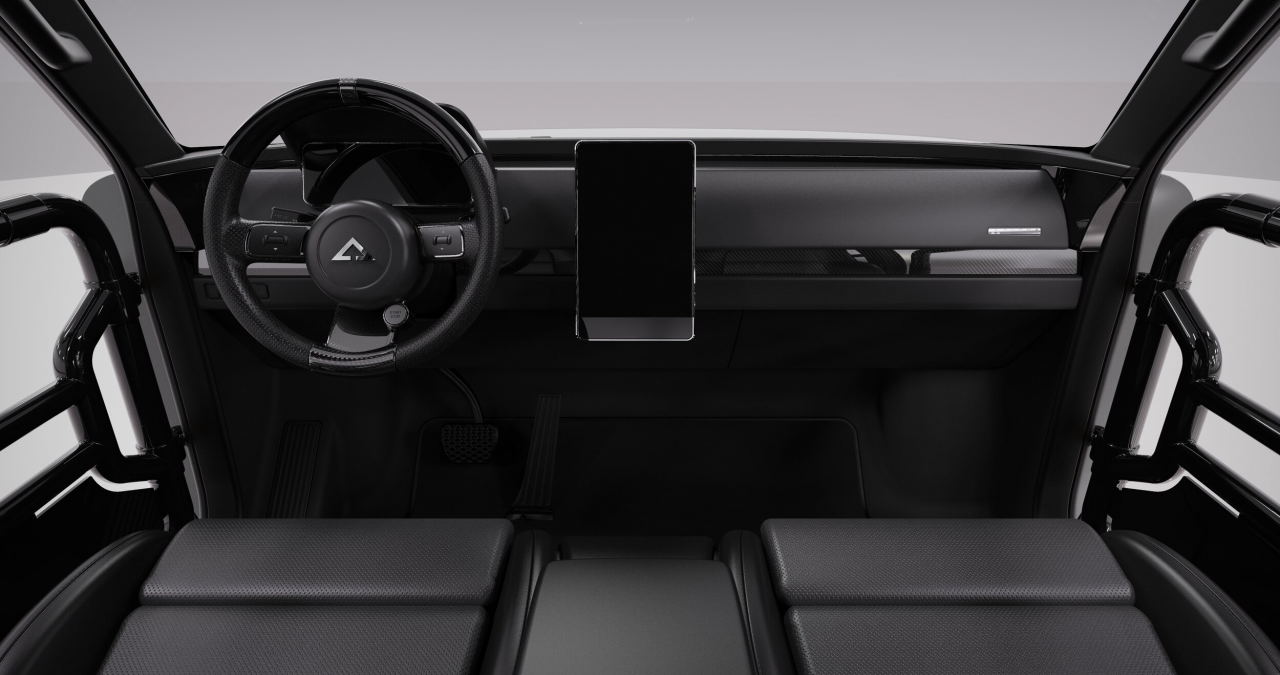
Alpha Motor Coproration introduces the modular SUPERWOLF electric pickup truck

A while back, we chanced upon a cool-looking retrofuturistic vehicle from Alpha Motor Corporation – the ACE. It has been some time, but we’re hyped to hear about its new project. The SUPERWOLF is the electric pickup truck to watch out for.

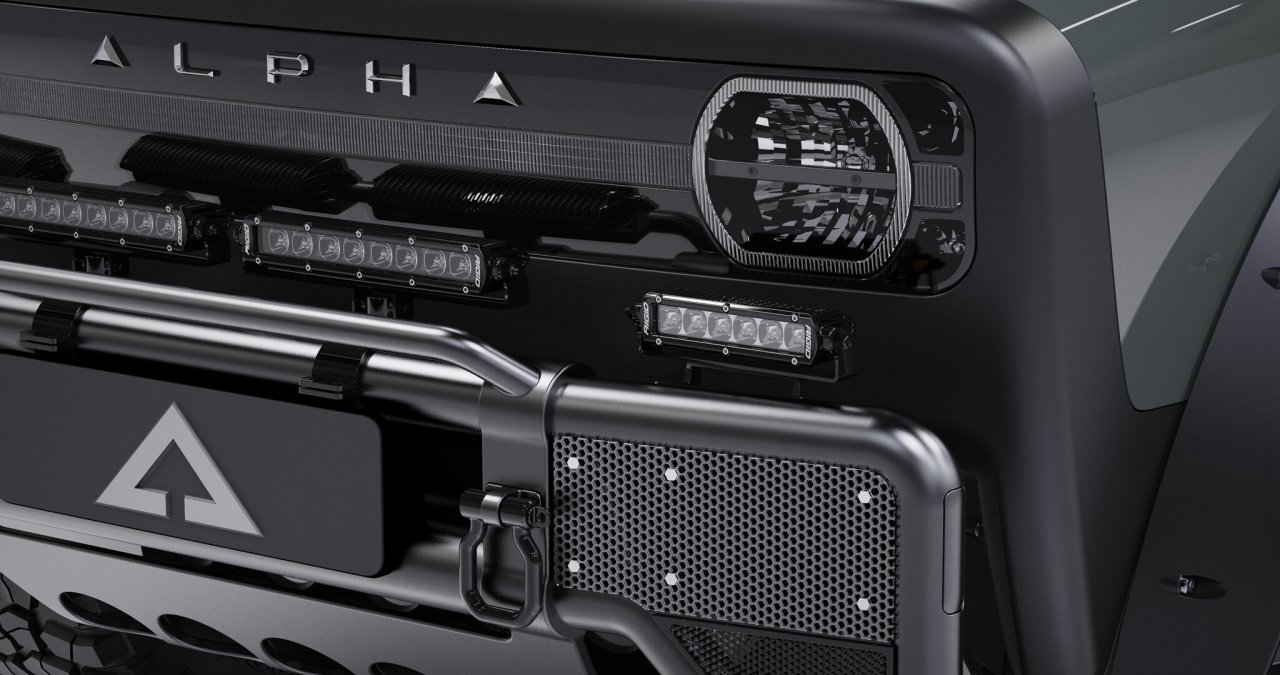
Similar to the ACE, the California-based EV company backs off from an overly futuristic design. Unlike the Tesla Cybertruck, which goes all-out with sharp angles on almost every surface, the SUPERWOLF is more refined.

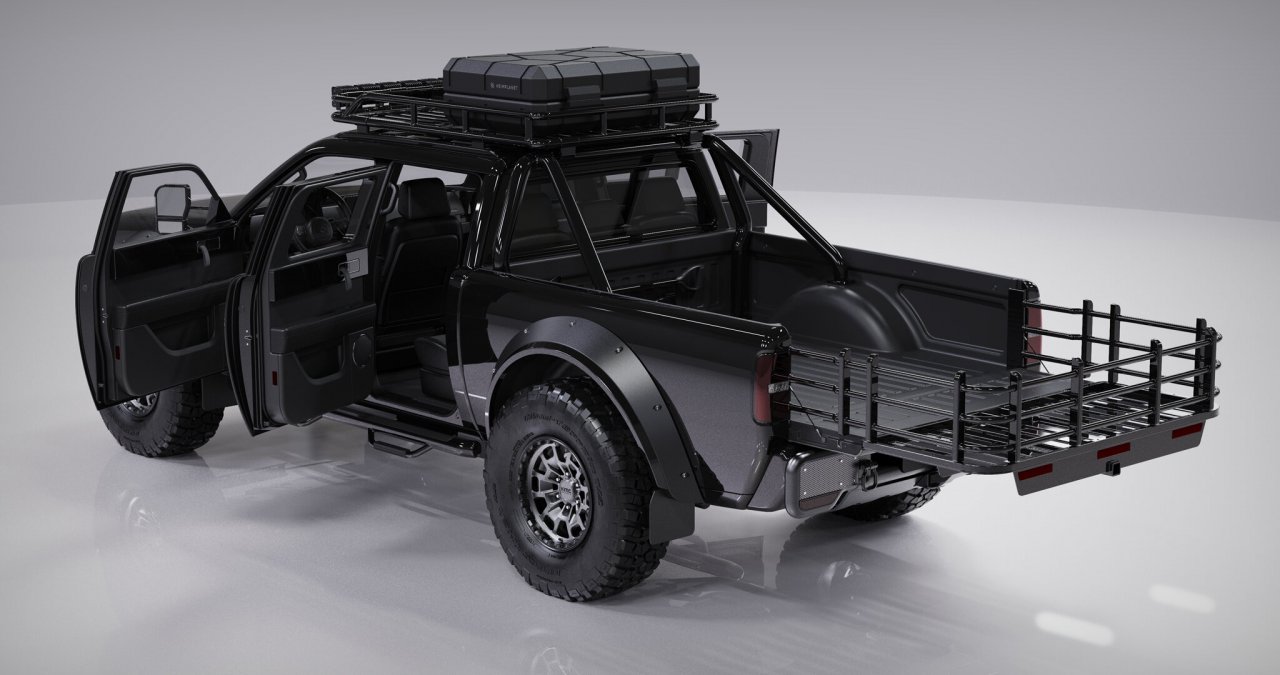
Moreover, it appears to be on the modular side as well which is a big plus in our opinion. It arrives in a crew cab configuration courtesy of its long wheelbase. No 2+2 seating arrangements here as Alpha Motor Corporation optimizes everything for comfort and utility.

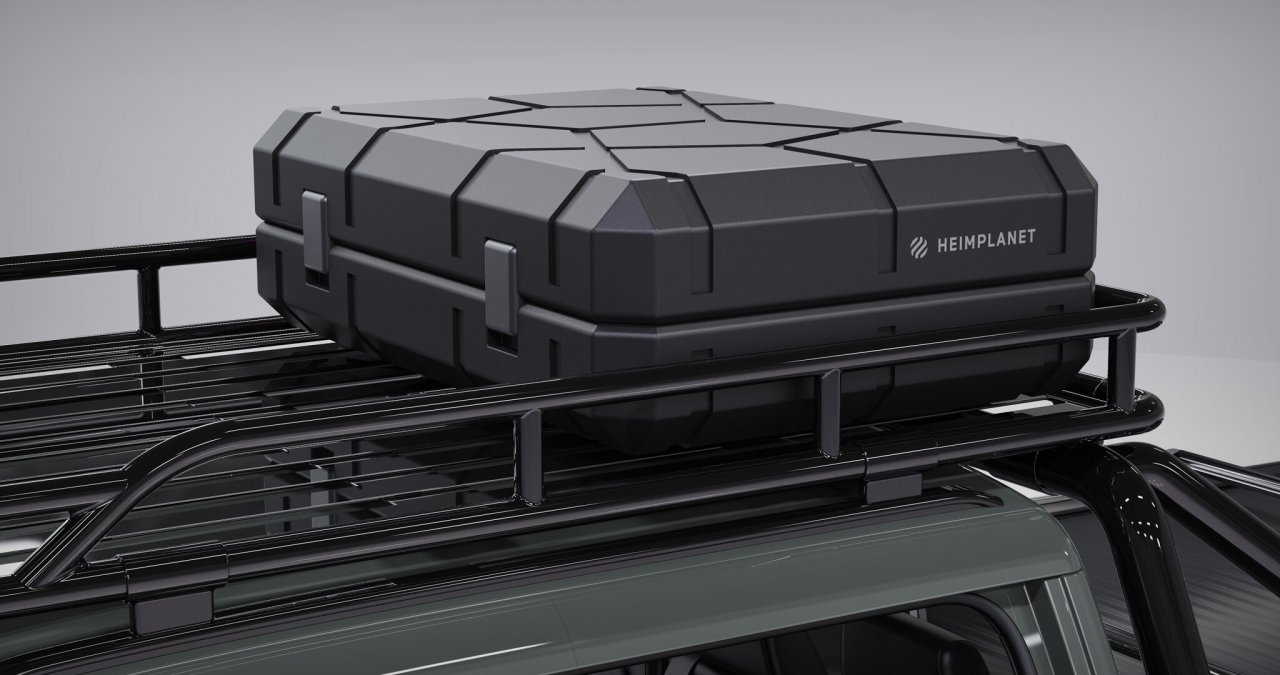
Specification available on the website list the sustainable truck at 214 x 79 x 69 inches (length x width x height). As for the bed, owners have 65 x 59 x 18 inches (length x width x height) to work with for hauling cargo. Additional spaces are available under the hood and on the roof rack for your luggage.

The truck uses two electric motors for its all-wheel-drive system. Alpha Motor Corporation says the SUPERWOLF can go from zero to 60 mph in 6.5 seconds. Meanwhile, towing capacity maxes out at 6,724 lbs. Next, depending on your driving, a full charge of its batteries should get you anywhere between 275 to 300 miles.

So far, the renders show the many ways clients swap or add different parts to customize their rides. Moreover, the minimalist theme of the interior is a great match to its classic vibe. The SUPERWOLF is a zero-emission workhorse to watch out for.

Discover more: here

Images courtesy of Alpha Motor Corporation

Five Exotic Car Technologies You’ll See On ‘Regular’ Cars Within 5 Years

Supercars – and more recently, a new class of Hypercars – continue to showcase the very best and most advanced technologies currently available in production road cars. While that’s not going to change (it’s the natural order of things, really), we should be anticipating an influx of exotic and wild features on the common vehicles of tomorrow.

The top-down succession of technologies has been occurring since the dawn of automobiles; however, with the exponential rate at which technology is improving these days, it won’t be inconceivably long before your average commuter car will be boasting many of today’s supercar credentials.

The proliferation of EV technology adds yet another dimension to this communal melting pot of automotive prosperity, where we’re already seeing once unimaginable horsepower and torque figures become quite easily attainable – not to mention all the other groundbreaking advancements in aerodynamics, hybrid technologies, software, and more.

Here are Five Exotic Car Technologies You’ll See On ‘Regular’ Cars Within 5 Years.

Active Aerodynamics
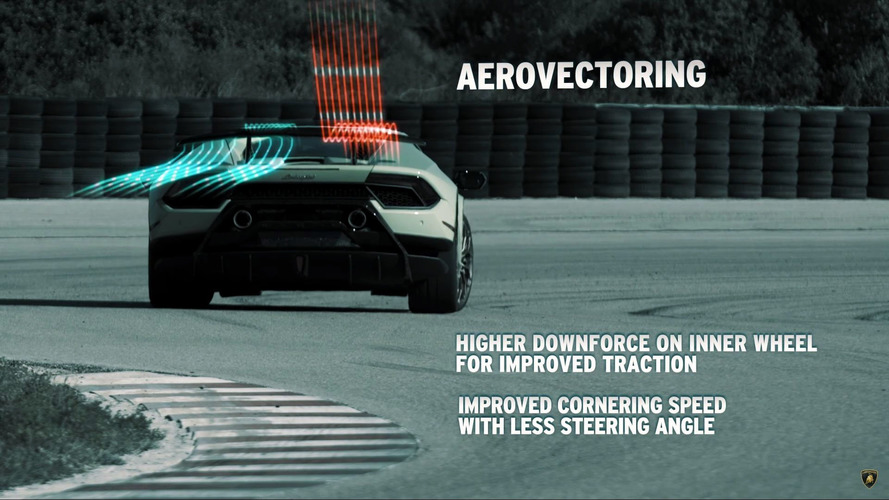
Disclaimer: I am fully aware that advanced aerodynamic technologies (of which active aero is certainly a part of) will be overkill for the majority of production road cars, both now and in the future.

However, we can certainly expect it to start featuring more regularly on flagship performance models – particularly those from mainstream producers – within the next few years. In fact, it has been basically confirmed that the new 992-generation Porsche 911 GT3 RS will have at minimum, an actively-adjusted rear wing. Ok, so Porsche isn’t exactly your typical “mainstream” automaker, but there’s no reason we won’t see similar adaptations on next-gen versions of cars such as say, the Honda Civic Type R, Ford Mustang Shelby GT500 and Nissan GT-R.

By the way, active aerodynamics can (and should) involve a lot more than just a rear wing that changes its position at certain speeds. We’re talking more along the lines of the Lamborghini Aventador SVJ’s ALA 2.0 system, which controls actuators that open and close flaps on the front splitter, engine cover and rear wing. In conjunction with Lamborghini ‘Dinamica Veicolo Attiva’ 2.0, the SVJ’s computer processors are able to determine where downforce is needed in live time.

In the same way that some cars have torque vectoring, this essentially provides the Aventador SVJ with “aero” vectoring. That is, the ability to actively manage the car’s non-static aerodynamic features to improve cornering speeds and stability with minimal adjustments to steering and pedal inputs. For example, on your typical turn, having more grip (and hence, more downforce) on the inside wheels will improve turn in. Flaps on the front splitter and rear wing will be adjusted by the system to decrease relative downforce over the outside turning wheels, creating a grip bias towards the inside. Aided by other features such as rear-wheel steering, this can significantly improve the car’s general handling capabilities.

Supercapacitors

It’d be prudent to first speak about what supercapacitors basically are, before getting into the the nitty-gritty of how they fit into the general automotive landscape – so let’s do that. After all, the likelihood is that most people don’t know what they are, and the fact of the matter is that they’re not currently a hot topic in any of the broader conversations about EVs or hybrids. So that was your first clue: it’s some sort of electrical thing-a-ma-jig. Its present application is predominantly in that of hybrid technology, storing energy which can be converted into thrusting the car forward. If this sounds to you like what your typical EV battery does, you’re definitely on the right track. However, that’s where the similarities end.

First of all, capacitors are hardly a new technology – they’ve literally been around since electricity – nor are the proprietary to automobiles. In fact, most of the gadgets we use today have them; smart phones, computers, stereos, or just about anything you can think of that has a circuit board. That’s because of their very crucial ability to store and release energy at a rapid pace, without suffering from degradation like a typical battery.

The Lamborghini Sián is the most notable example of an automobile which uses a supercapacitor – the ‘super’ added because, well, you need a really, really big capacitor to help power a car. In this configuration, the supercapacitor collects and stores energy (primarily from regenerative braking). In certain moments (such as a launch), the supercapacitor dumps all of its energy into an electric motor which immediately and briefly adds an extra 34 hp on top of what the Sián’s 785 hp naturally-aspirated V12 engine produces.

As long as the supercapacitor keeps getting recharged – which can be achieved with just seconds of hard braking – there will always be that extra bit of power boost at the car’s beckoning. Compared to an EV battery which takes much, much, longer to fully recharge, and weighs substantially more, you might be wondering why supercapacitors aren’t the dominating technology in electric or hybrid vehicles today.

Well, there are a few very important reasons for this. By nature, supercapacitors aren’t able to store energy for long periods of time like a battery, making them unviable to be the primary food source for an electric vehicle. At least for now, simply replacing a battery with a (mega?) capacitor isn’t the solution; they’re not going to be powering cars on their own, any time soon. On that note, the ‘wee-little’ 34-hp-producing supercapacitor in the Sián probably isn’t cheap either. However, we should expect that to change as the technology gets refined, eventually becoming scalable at mainstream levels.

I’m no engineer, but I figure these same principles could be applied to fully-electric platforms, with some sort of battery-supercapacitor amalgam creating a “best of both worlds” scenario. This means we could see more supercapacitors on everyday cars sooner than later, with the shift to EVs already well underway. Then there’s the concept of solid-state batteries too… but we’ll leave that one for another story.

Magnetorheological Suspension System

Magne-what? Modern automobile suspension technologies have also been put through perpetual rethinks throughout the years, significantly evolving from more humble beginnings with leaf springs and the like. Although there is still work to be done to realize the full potential of magnetorheological suspension systems, they do presently represent the current peak of suspension technology as far as handling performance is concerned; i.e. they’re good for go-fast automobiles like supercars and hypercars.

In principle, MR suspensions work very much the same as hydraulic suspensions in that they are filled with a fluid which travels between different chambers in the piston. This allows “shock” energy to be converted into heat, essentially absorbing impacts from road contact to improve ride quality and performance. The difference with an MR suspension is that it also incorporates an electric circuit into its piston assembly.

This is where the technology is revolutionary: the electrical currents supplied to the suspension create magnetic fields inside the piston, which can instantaneously change the properties of the fluids inside, subsequently altering how the suspension responds and behaves. Adaptive suspension systems rely on this process in order to calibrate the characteristics of the suspension in any given moment. Computers help monitor factors such as steering angle, g-forces, pitch and various other factors and decide on how best to optimize the geometry based on the data. Advanced systems are able to do this in real time, making calculations and adjustments at a rate of thousands of times per second.

While MR suspension systems do still face challenges – such as the dampers not being serviceable, while being prone to problems such as hysteresis, leakage and sedimentation – the technology continues to be refined. It’s destined to become a more common feature on the cars of tomorrow as things continue to improve and scale. If you like the idea of active aero, then MR dampers are basically what that is, but for suspensions. Imagine driving a car equipped with both such systems!

AI & Cloud-based Driver Aids / Monitoring Tech

When we think of ‘connectivity’ these days, we often refer to social media, various smartphone apps, zoom meetings and some degree of cloud computing. All of the aforementioned typically exist within the ecosystem of mobile devices and personal computers, but connectivity is starting to apply very much to automobiles too. Features such as GPS navigation, in-car Wi-Fi – and more recently, self-driving capability – immediately come to mind, but with the direction the industry is going, we can expect so much more than just those things.

Connectivity as we know it, is now a big part of how we get from one place to another – physically, as well as virtually. And you only need an imagination (albeit one rooted in reality) to conjure up some of the fascinating tech we’re about to see integrated into the everyday automobile. Real-time warning systems that can detect intricate anomalies or hazards using artificial intelligence? That’s already being developed by Porsche in partnership with HERE Technologies and Vodafone, and will feature a system which identifies animate objects, monitors the behavior of other drivers and anticipates inclement road conditions. Trials are currently taking place in Aldenhoven, Germany – using a Porsche Taycan amongst other vehicles – where the system will be further optimized before its rolled out to more test sites.

“5G and data processing on the roadside help to transmit hazard warnings without delay and make road traffic even safer,” Michael Reinartz, Director of Innovation at Vodafone Germany, said in a statement. “We are currently trialing this under everyday conditions.”

Rimac is working on an “AI Driving Coach” program, which should be ready before the first examples of its Nevera hypercar roll off the production line. This system uses, as its name implies, an artificial intelligence which guides drivers while they’re on a race track. Using visual and audio aids, the AI will give drivers real-time tips on how to improve their lap times. An “augmented-reality” racing line will even be available for a select group of renown international race circuits. The same AI system is also capable of providing self-driving features. Awesome.

“What we are building is a system where AI plays a key role in teaching the driver how to perform on racetracks, at the maximum vehicle performance,” Sacha Vrazic, Director of Rimac’s autonomous driving department explains. “Not all of our customers are professional drivers, but we want them to really enjoy the car and have fun with it.”

Michelin has recently released a new range of Pilot Sport Cup 2 tires, which work with their proprietary ‘Track Connect’ app to deliver unparalleled access to essential data related to a car’s handling, grip and the suitability of its tires. This data is then translated into advice for the driver with regards to optimizing tire pressures, inflation, temperatures and much more. It also provides inputs on the driver’s style, performance and skill, whether pushing the limits on the racetrack or simply commuting around town.

Naturally, the newest and most advanced technologies will typically debut on more expensive cars, before proven dependability and the economies of scale bring them to the mainstream. Expect the aforementioned technologies, and many more, to start featuring on a growing number and variety of automobiles.

Synthetic Bio Fuels (Hydrogen)

Even with the likes of Porsche taking the reigns on this recently (with McLaren and Audi also continuing to play major roles), bio fuels – or ‘eFuels’, as they’re calling it in Stuttgart – won’t require much of a trial period on exotic cars before being rolled out to the rest of the crowd; should eFuels proliferate as a viable alternative to power the world’s vehicles, it will undoubtedly benefit all players within the entire automotive landscape.
Porsche said its first iteration of Esso Renewable Racing Fuel is a blend of advanced biofuels, formulated from food waste products by ExxonMobil’s in-house team of scientists and engineers. The automaker has already begun experimenting with eFuels in its GT Cup race cars; so if it’s ultimately good enough for that level of performance, the assumption is that it will definitely suffice for production road cars as well.

The big-wigs at Porsche are already suggesting that this latest version of eFuels may even allow internal combustion cars to achieve a smaller overall carbon footprint than an electric car, particularly when taking into consideration, the byproducts created from battery manufacturing. “This technology is particularly important because the combustion engine will continue to dominate the automotive world for many years to come,” said Porsche R&D Executive, Michael Steiner. “If you want to operate the existing fleet in a sustainable manner, eFuels are a fundamental component.”

“Porsche is committed to three powertrains: purely electric, plug-in-hybrids, and highly efficient gasoline engines. From Porsche’s point of view, eFuels open up an opportunity for our plug-in hybrid models as well as our icon, the 911—either with a combustion engine or as a very sporty hybrid. This means that we could continue to drive the 911 for many years to come, which will certainly make our customers and fans happy.”

Without diminishing the significance or role that EVs will play in the more distant future – we should still expect them to become the prevailing technology – perhaps an optimally balanced coalition of clean burning fuels and fully-electric solutions is not only better for business, but for the environment too. It looks as though Porsche is already creating a model for how this could work, and if the science behind eFuels checks out, then there’s no reason that it couldn’t become the conventional formula in the years to come.