
In depth on the new McLaren Arturo
The McLaren Artura: in detail
Every drop of McLaren’s technical expertise and experience has been channeled into making the all-new Artura extraordinary to drive and wonderfully enjoyable to own. Ever since the 12C revolutionized the supercar segment a decade ago, McLaren Automotive has continued to push the boundaries of supercar innovation. The McLaren P1™ brought McLaren hybridization to the hypercar sector as long ago as 2012. The Speedtail introduced astonishing new levels of hybrid performance, its 403km/h (250mph) maximum speed making it the fastest-ever McLaren.

The brief for the Artura was even more challenging: to create a series-production High-Performance Hybrid supercar that excels on every level, with performance, engagement, and efficiency sharing equal top-billing. The engineering and design team approached the challenge holistically – no single part of the process was undertaken in isolation – with ambitious targets set in every area: weight; performance; driver engagement; efficiency; agility; refinement; quality and usability.
Every target was met – and in most cases, surpassed – heralding the arrival of the Artura as a next-generation McLaren High-Performance Hybrid that introduces a new supercar era.
“The way we design cars at McLaren is different. We use a holistic approach comprising both technical design and studio design, areas that in the automotive industry are often separated and sometimes even compete; McLaren sees these pillars as integrally linked and working towards common goals.”
Dan Parry-Williams, Director of Engineering Design, McLaren Automotive
Super-lightweight engineering
McLaren Carbon Lightweight Architecture (MCLA)
- The Artura is the first McLaren to use MCLA, which is designed and produced at McLaren Composites Technology Centre in Sheffield, UK
- Optimized for High-Performance Hybrid models, MCLA comprises three elements: carbon fiber monocoque, electrical architecture, and chassis and suspension structures
- Carbon fiber monocoque is safer, stronger, and like-for-like lighter than previous McLaren monocoques
“The new McLaren Carbon Lightweight Architecture (MCLA) is quite literally at the core of the super-lightweight engineering philosophy that is inherent throughout the Artura. We developed this all-new, High-Performance Hybrid supercar with all of our learnings from decades of working with advanced composite and other lightweight materials, using world-first processes and techniques to deliver weight savings that offset heavier hybrid powertrains, ensuring greater energy efficiency and maintaining the outstanding agility and dynamic performance our customers expect.”
Jamie Corstorphine, Director of Product Strategy, McLaren Automotive

To achieve the very specific aims of the Artura program McLaren started right at the core of its new supercar, with a completely new carbon fiber architecture. This had to not only be true to the company’s philosophy of super-lightweight engineering for dynamic and performance reasons but also crucially to offset the extra weight of a hybrid powertrain, as well as being tailored to accommodate the battery pack.
The new architecture – called McLaren Carbon Lightweight Architecture (MCLA) – features three elements: an all-new carbon-fiber monocoque occupant structure, a new chassis with aluminum crash beams and rear subframe, and a first-to-market domain-based ethernet electrical architecture.
Four years in the making, MCLA is the first architecture to be manufactured at the McLaren Composites Technology Centre (MCTC), a new, state-of-the-art facility in the Sheffield region. Flexible in the application (but physically incredibly stiff and strong) this scalable platform architecture heralds the beginning of a new era of McLaren supercars.
Carbon fibre monocoque
At the center of the new platform is the carbon fiber monocoque. McLaren pioneered composite technology in Formula 1™ racing nearly 40 years ago and first transferred it to the road in the carbon fiber chassis and body of the McLaren F1. When the 12C was unveiled in 2009 it introduced a unique one-piece molded carbon fiber chassis that was 25% stiffer than an equivalent all-metal structure and 25% lighter than a comparable aluminum chassis. McLaren’s revolutionary technologies also allowed carbon fiber monocoques to be productionized in volumes never before achievable.

The McLaren Artura marks another revolutionary leap. No McLaren monocoque, whether designed for the road or race track, has ever had to do more: the carbon fiber structure now additionally provides a safety cell for the battery pack and integrates further crash and load-bearing functionality. Yet it remains incredibly lightweight, weighing just 82kg including the battery compartment, aero surfaces, B-pillars, and door-hinge fixings, contributing to the low overall weight of the Artura, despite its 130kg of hybrid components.
At first glance, the MCLA monocoque may appear similar to other McLaren carbon fiber structures, but the geometry of every surface is new, and it is constructed from four new carbon materials, a new resin system, and a new structural core material. These new properties accommodate both the platform requirements and new, bespoke mechanized production processes now on stream at MCTC.
The in-house approach ensures McLaren can constantly innovate monocoques to accommodate new technologies or new models, without compromising the qualities that ensure its chassis are the lightest, stiffest and strongest in their class.

The MCLA monocoque is taller around the A- and B-pillars than previous McLaren monocoques, as it integrates additional strength and load-bearing functionality into the carbon structure, replacing bonded metal parts. The windscreen surround is also carbon fiber. To achieve the requisite battery and fuel-tank safety cell, the sides of the monocoque extend back beyond what would traditionally be seen as the rear bulkhead. This provides side impact protection for the battery pack and also the fuel tank.
There is an exacting tolerance to the monocoque dimensions of +0.75mm across the structure with the tightest tolerances between machined features down to +/-0.25mm. This is fundamental to factors such as the accuracy of the suspension geometry control. Additionally, the high torsional rigidity of the monocoque ensures less compromise for the flexibility of the suspension itself, further enhancing the unique balance between a supple ride and precise handling.
The structure also plays a role in aerothermal optimization. Chamfered corners at the trailing edge of the front wheel arches guide airflow out of the arches and along the underside of the doors. The extended outer skin of the doors traps the air in this channel and it is driven rearwards into intakes that feed the lower portion of the high-temperature radiators (HTRs).
Chassis structure
Situated at either end of the carbon fiber monocoque are aluminum subframes that provide the Artura’s deformable crash structures. Designed to absorb impacts, the structures can be repaired or replaced easily and very cost-effectively. Cars with a full aluminum or steel chassis use their entire structure to absorb and crumple on impact, causing more damage to the whole structure, often including the passenger cell.

On the Artura, the front upper wishbone is mounted to the carbon monocoque, while the lower wishbone is attached to the aluminum crash subframe. The rear subframe is bolted to the monocoque, with the carbon fiber floor beneath the battery bridging the lower cross members transversely across the vehicle, ensuring the required torsional stiffness and optimizing the rear frame weight. The length of the lower portion of the frame is shortened to accommodate a bespoke rear diffuser, and the geometry of the new multi-link wishbone rear suspension concept is particularly aggressive.
Electrical architecture
Just as the carbon fiber monocoque incorporates greater functionality than any previous McLaren structure, so too does the electrical system. The Artura debuts an array of firsts for McLaren, including advanced driver-assistance systems (ADAS), Over-The-Air (OTA) software updates, and Pirelli Cyber Tyre® tire-monitoring technology. These are all made possible by the new electrical architecture, which also supports an all-new McLaren Infotainment System (MIS II).

Additionally, the complex powertrain necessitated an electrical architecture that can control McLaren’s first gasoline direct injection (GDI) fuel system at 350 bar; completely new transmission software; the E-differential and e-reverse functionality; battery management and implementing the different types of driving experience via the integration of the electric drive and engine drive.
To achieve all of this, McLaren is one of the first-to-market with a zonal domain-based ethernet architecture as the core backbone of the vehicle. The technology is the stepping point towards the industry trend of vehicle architecture redesign.
The domain-based ethernet system utilizes four controllers, each positioned in a key area within the vehicle to optimize data rates and cable lengths. Placed in the same zones as the loads they control, the controllers are connected, via ethernet, through a central gateway. Linked functions at the front, rear, or across the vehicle don’t need independent wiring and control systems, but instead, transfer data via this central ‘backbone’.
By moving to a single standard, all communications can coexist on the same ethernet network. Spreading outwards from each domain, data transfer still occurs via LIN (Local Interconnect Network) and CAN (Controller Area Network) for subsystem communication but processing power has increased. The use of domain-based technology has reduced the length of cabling in the vehicle by 25%, reducing weight by more than 10%.

This has been achieved while at the same time significantly upgrading the electrical capability of the vehicle – and adding new technologies such as the advanced driver-assistance systems (ADAS) features that debut in the Artura. The processing tools are integrated, with centralized software that can be constantly scaled and upgraded as new functionality becomes available, creating a platform that can adapt to future legislation and technology.
The advantage of this will most immediately be obvious to the owner because it allows for Over-The-Air (OTA) updates. When connected via wi-fi, either at home or via a hotspot, the vehicle is able to download new software when it becomes available. Updates related to vehicle safety will require a visit to a McLaren retailer, but OTA updates mean the customer can spend more time in their vehicle and instantly enjoy the benefits of newly downloaded functionality.
Working across all of these systems are new cybersecurity protocols, with enhanced algorithms. And in addition to OTA updates, depending on the market the new electrical architecture includes integrated stolen vehicle tracking within the telematics as well as E-call, which can dial emergency or recovery services in the event of an accident or breakdown.
eHVAC system
The new Arturia platform also incorporates new electric heating, ventilation, and air-conditioning (eHVAC) system, designed to work with or without the assistance of the internal combustion engine. The compact unit, incorporating an electric compressor, condenser, and evaporator, is located in the front of the car to improve weight distribution, without the need for ‘pipework’ to run forward from the engine. Not using the internal combustion engine to drive the compressor allows optimal control of compressor speed for better cooling in arduous conditions.

The eHVAC system is able to heat or cool quicker than a conventional HVAC system, and provide greater precision between chosen temperatures. It uses a diffused vent that runs horizontally across the dashboard. This design increases flow into the cabin at lower velocities and with consequently improved occupant comfort and reduced system noise.
High-Performance Hybrid powertrain
The benefits of a High-Performance Hybrid powertrain are already in evidence in McLaren’s current range with the Speedtail – and of course previously from the McLaren P1™. The Speedtail has the greatest power and torque of any McLaren road car, with a combined 1,070PS (1,055bhp) and 1,150Nm (848lb ft) and even though it is an ultra-limited hypercar, the exhaustive development that produced it – and the philosophy of greater efficiency and lower emissions without compromising performance – helped to define the Artura’s unique attributes of hypercar innovation in a series-production supercar.

The Artura’s hybrid powertrain combines an all-new twin-turbocharged six-cylinder petrol engine together with an industry-leading axial flux electric motor (E-motor) integrated within an all-new eight-speed transmission and a lithium-ion battery pack.
The combined output of the High-Performance Hybrid powertrain is 680PS and 720Nm, with the torque of the E-motor ensuring instant throttle response. Straight-line acceleration of 0-100km/h (62mph) is achieved in 3.0 seconds and 0–300km/h (186mph) in just 21.5 seconds; yet at the same time the Artura is capable of driving up to 30km on battery power alone, making the car fully zero-emissions capable for most urban journeys. The cleanest and most efficient McLaren road car ever, the Artura returns more than 50mpgand 129g/km CO2 on the EU WLTP cycle*.
The McLaren Artura has four Powertrain modes, covering every driving requirement: E-mode, Comfort, Sport and Track. E-mode is the default for silent start-up and zero-emissions, fully-electric driving. In Comfort mode, the V6 petrol engine runs in tandem with the E-motor, with maximum assistance for fuel saving. In Sport model, the E-motor provides torque infill at lower revs, while the V6 targets maximum performance. Track mode delivers the same blend of hybridized power, with transmission software delivering faster shifts.
All-new V6 petrol engine
- 2,993cc twin-turbocharged V6; 120° v-angle with turbos in ‘hot vee’
- Develops 585PS – a specific output approaching 200PS per litre – and torque of 585Nm
- Light and compact: 50kg lighter and 190mm shorter than McLaren V8 engine
“Our all-new V6 engine is compact, light, powerful, and extremely efficient. The dimensions aided packaging of the hybrid system and enabled a lower center of gravity for the Artura, while the 120° vee design allowed us to have a very short and stiff crankshaft, which means the engine can rev all the way to 8,500rpm, delivering the drama and excitement you expect from a McLaren supercar.”
Richard Jackson, Head of Powertrain, McLaren Automotive

Designed by McLaren engineers to set new standards for smaller capacity V6 turbocharged engines, an all-new 3.0-litre V6 is at the heart of the Artura’s powertrain. Generating 585PS (577bhp) and 585Nm (431lb ft) of torque, the M630 produces more PS per litre than any McLaren engine except for the 4.0-litre V8 of the Elva and McLaren Senna. Lightweight – at just 160kg it weighs 50kg less than a McLaren V8 – and extremely fuel-efficient, its unique wide-angle configuration and compact size enable a High-Performance Hybrid powertrain package that is shorter than McLaren’s V8 engine and seven-speed transmission. That’s all the more impressive given the addition of an eighth gear, as well as the inclusion of McLaren’s first electronically controlled differential.
Mounted longitudinally and driving the rear wheels, the engine is a 2,993cc dry-sump V6 with an 84.0mm bore and 90.0mm stroke. Valve timing is continuously variable. Peak power of 585PS (577bhp) is produced at 7,500rpm, with the redline at 8,200rpm (8,500rpm intermittent). 585Nm (431lb ft) of torque is generated from 2250-7000rpm. Gasoline direct injection (GDI) operating at 350bar pressure ensures precise fuelling for increased power and reduced emissions, with one central injector per cylinder, while Gasoline Particulate Filters (GPFs) and catalytic converters ensure all legislative requirements are met.
The engine employs a 120˚ ‘hot vee’ layout. This configuration allows shared crank pins enabling a very short and stiff crankshaft appropriate for high power, high-revving engines. The wider angle brings advantages that include a lower center of gravity and the creation of a cavity within the vee to house the twin turbochargers. This is one of the factors that makes the engine 220mm narrower than McLaren’s twin-turbocharged 4.0-litre V8, its compact nature assured by additional advantages in length and weight.

The ‘hot vee’ configuration additionally optimizes performance and emissions. This enables short, equal-length exhaust runners feeding the turbos, allowing faster spooling with very close-coupled catalysts feeding straight to the rear with minimal pressure drops.
Unusually, the compact mono-scroll turbochargers are symmetrical, removing the performance compromises usually seen in the exhaust and intake systems of twin-turbo vee engines. The system uses ball-bearing technology to reduce friction within the turbo, allowing it to spin up faster. Combined with electronically actuated wastegates that can instantly adjust position regardless of system pressure, turbo-lag and response time are minimized. This – together with the power from the E-motor – gives the Artura extremely rapid response to throttle inputs.
A series of complex heat shields tightly surround the ‘hot vee’ to cool it efficiently. These enclose the engine to stop heat diffusing through the rear of the vehicle, with nozzles fed from the back of the high-temperature radiator (HTR) fans to blow air at high speed between the top of the ‘hot vee’ and the underside of the heat shield. This heated air is funneled out through the powertrain chimney, an opening in the heat shield in the center of the rear deck mesh.

The lightweight engine block, cylinder heads, and pistons are all aluminum. The block has directly coated parent bores rather than separate coated liners. This technology allows the engine to be significantly shorter. The cylinder head and block utilize 3D printed cores, a technology more typically used in Formula 1™ than road cars, allowing uncompromised precision cooling, for example, a micro-compact 2mm cooling passage between the cylinders.
Another innovation – this time benefitting refinement and packaging – is the location of the chain drive at the rear of the engine. This reduces NVH intrusion into the cabin, as well as torsional vibration. Overall, the new V6 produces very little mechanical noise, either from the engine itself or associated pump and valvetrain sounds. Intake noise has also been optimized for refinement.
The combination of enhanced refinement and instant driver engagement under throttle enables the Artura to fulfill its dual role as a vehicle that can be driven every day in normal urban traffic and an incredibly immersive supercar on road or track.
The advances in refinement have allowed McLaren to tailor a unique exhaust sound when the throttle is depressed. The delta between on- and off-throttle sound is the greatest of any McLaren to date, acknowledging the differing demands of the High-Performance Hybrid powertrain’s driving modes. This has been achieved through a number of routes, including the reduction in length of the exhaust system itself – the exhausts exit straight back from the ‘hot vee’, reducing weight and allowing for the creation of a full-width rear diffuser. The lightweight exhaust system has optimized resonators to enhance the Artura’s harmonic and full-bodied exhaust note.
All-new eight-speed transmission
- Newly designed and developed specifically for the Artura
- Lightweight and compact, with E-motor integrated within the clutch bell housing
- Short individual gear ratios optimize power/torque delivery and driver engagement
- No mechanical reverse gear – E-motor runs in reverse instead
“With eight forward gears, all with short individual ratios, the all-new, twin-clutch transmission encourages the driver to keep the V6 engine in the power and torque band for more of the time and fully enjoy the Artura driving experience. The transmission is lightweight and very compact, especially when you consider that it has the powertrain’s E-motor – which also fulfills the role of mechanical reverse gear – integrated into the clutch bell housing.”
Geoff Grose, Chief Engineer, McLaren Artura

The McLaren Artura has a completely new and technically advanced eight-speed seamless-shift transmission. Designed to integrate the E-motor yet still be very compact, the technically advanced transmission offers high performance and significantly improved CO2 figures. Despite an extra gear over the seven-speed transmission on McLaren’s V8-powered vehicles, the length of the gear cluster has been reduced by 40mm, helped by the use of a nested clutch rather than a parallel clutch.
The transmission acts to transfer torque from both the E-motor and the V6 engine. This allows the vehicle to operate in a zero-emissions mode using only the E-motor after the internal combustion engine is disconnected.
The use of eight gears allows the ratios to be more closely stacked, giving lightning-fast gearshifts – close to 200 milliseconds – while twin clutches enable the continuous transfer of torque from the input to the driveshafts during each change of gear. The E-motor’s torque can also be utilized during gearshifts, particularly those at low vehicle speeds and low engine rpms, to smooth the transition from one ratio to the next. The eighth ratio is used as an overdrive to improve consumption characteristics on motorways.

Both electric and mechanical oil pumps feature; the electric pump is necessary whenever the engine is disconnected from the transmission, but it can also be used to supplement the mechanical pump which, as a result, is smaller than would otherwise be the case.
Cooling for the transmission is provided by two new medium-temperature radiators (MTR). A feed is taken from the high-temperature radiator (HTR) circuit and each MTR is fed by an air intake at the base of the roof buttresses, pre-cooling the water to enable clutch cooling to lower temperatures than the engine and transmission.
E-motor and battery pack
- Compact, high power density E-motor generates 95PS and up to 225Nm
- Five-module Lithium Ion energy dense battery
- Usable energy capacity of 7.4kwh; 30km of electric-only range
“The compact, high power density axial flux E-motor and energy-dense Lithium-Ion battery pack that comprise the electric element of the Artura powertrain bring 95PS and up to 225Nm to the total power and torque outputs of McLaren’s new High-Performance Hybrid. This contribution is key both to the electrifying supercar performance and the 30km of emissions-free, EV driving capability.”
Sunoj George, Head of Electric Drive Technology, McLaren Automotive
So much innovation has been concentrated into the compact dimensions of the all-new petrol V6 that it’s easy to overlook the other driving force inside McLaren’s High-Performance Hybrid powertrain – the electric motor and battery pack that comprises the electric element.

The E-motor is truly ground-breaking, being the first application of an axial flux motor in a series-production road vehicle. Most E-motors in the automotive world use radial flux technology, where magnets are positioned around a rotor. An axial flux motor is fundamentally different, featuring a stator sandwiched between two rotor hubs and able to deliver exceptionally high power and torque density, while also being smaller and lighter.
The Artura’s E-motor weighs just 15.4kg including the transmission interface, which is less than half the weight of the 38kg radial flux E-motor in the McLaren P1™. It generates 95PS (94bhp/70kW) – power output of 4.6kW/kg that is 33% higher in terms of power density than the unit in the McLaren P1™ – and maximum torque of 225Nm (166lb ft). The E-motor is capable in conjunction with the battery pack of propelling the Artura in pure EV mode for up to 30km, and to a maximum speed of 130km/h/81mph. The torque delivery profile of the E-motor is different to that of the V6 petrol engine; the peak of each does not occur simultaneously, hence the Artura’s 720Nm maximum overall.
The short axial length of the E-motor fits neatly inside the bell housing of the Artura’s bespoke eight-speed twin-clutch gearbox. By packaging the E-motor in line with the engine and transmission, its power and torque are transferred directly to the main transmission shaft, improving response. By contrast, with an offset radial flux motor, additional gearing is needed to transfer its outputs to the main transmission shaft. The E-motor also fulfills the role of a reverse gear by spinning backward when required, meaning that there is no need for reverse gear in the Artura’s transmission.

The Artura’s battery pack is another example of McLaren honing its hybrid expertise. Whereas both the McLaren P1™ and the Speedtail have ‘power batteries’ akin to those found in motorsport, the Artura features an ‘energy battery’ that enables both impressive acceleration performance and a practical 30km zero-emissions range when fully charged. The usable battery energy is 7.4kWh.
The battery pack consists of five lithium-ion modules, which sit on a cooling manifold. The battery management unit sits alongside the modules, and the power distribution unit (PDU) is integrated into the battery to save space. The battery is indirectly cooled via the refrigerant in the cooling rails of the manifold; the refrigerant circuit runs from the front of the monocoque where the new electric heating, ventilation, and air conditioning system is located. Optimized cooling of the battery delivers greater power and supports consistency of the zero-emissions range.
The entire battery assembly is enclosed within a fireproof cover and mounted on a structural carbon fiber floor that is bolted as one piece into the rear section of the carbon fiber monocoque. The floor, which features aluminum inserts and a structural foam core, provides crash protection below the battery pack. Protection from the side and above comes from a bespoke cavity engineered into the monocoque, shared with the fuel tank which sits above the battery. The engine, transmission, and rear frame shield from any rear impact, meaning the battery pack is incredibly well protected. It is also located as low as possible in the vehicle, benefitting the Artura’s center of gravity.

From the battery pack, a high-voltage DC supply runs to the integrated power unit (IPU) at the front of the car. It is a combined DC/DC converter, on-board charger, and front power distribution unit, and the sharing of power electronics in this unit reduces weight. The DC/DC converter changes the high-voltage DC current from the battery to the low-voltage DC current that is used in the vehicle’s 12v system. The electronics also convert AC taken from the plug-in vehicle charger to the DC that charges the battery.
Artura customers can maintain the charge in the battery pack through the use of the engine, including via a ‘set charge to 100%’ function that prioritizes using the internal combustion to recharge it, for instance ahead of entering an urban area. However, you can also plug in – a charge from zero to 80% takes around two and a half hours via a standard EVSE cable. The batteries can also harvest power from the combustion engine, with the driver able to influence this behavior from the cockpit.
The battery is never allowed to completely discharge, thanks to a number of power reserve functions. These include a reserve to crank the engine on vehicle start-up, a reserve to power reverse ‘gear’, and a reserve for when the car remains parked for extended periods.
The power distribution unit located inside the battery gives its distribution to the state-of-the-art, super lightweight motor control unit (MCU), which converts the high-voltage DC current of the battery to the AC current that the E-motor needs under acceleration. As further evidence of the pace of development at McLaren, the MCU weighs around 68% less than the equivalent unit in the McLaren P1™.
Driving dynamics
“The Artura is super-lightweight, with the entire powertrain packaged centrally in the vehicle and as low down as possible. The rear suspension is a clever multi-link wishbone system that’s designed to be significantly stiffer than anything we’ve used before, and advanced Proactive Damping Control is also a central part of the car’s dynamics. We wanted to make a thrilling, engaging supercar that asks very few compromises of the driver or the passenger and the Artura truly delivers on the McLaren promise of class-leading driving dynamics and cutting-edge technology. ”
Geoff Grose, Chief Engineer, McLaren Artura

The Artura’s engineering credentials are guaranteed to excite anyone who values incredible driving dynamics. The only supercar in its class to offer the combined attractions of super-lightweight carbon fiber construction, a mid-engined, rear-wheel-drive configuration, the purity of electro-hydraulic steering, the instant torque of an E-motor (which helps to deliver throttle response that is twice as rapid as any non-hybrid McLaren) and the advanced handling benefits of an E-differential, the Artura has been designed to engage and delight in the way that only a McLaren can.
McLaren engineers have ensured that the Artura has two distinct characteristics that would ordinarily be diametrically opposed: increased agility and increased stability. This has been possible because of a combination of actions and innovations beyond the core advantage of a carbon-fiber monocoque structure, notably a completely new rear suspension concept and McLaren’s first electronically controlled rear differential, which together allow the enjoyable accessibility of the car’s dynamic behavior to be separated from its high-speed stability.
Chassis settings can be adjusted electronically with three Handling modes: Comfort, Sport, and Track. Each set has its own distinct set of parameters for the dampers, for example, a compliant ride for urban driving when in Comfort mode or enhanced dynamic response through tighter damper control when in Track. The settings for the E-diff are also altered as the driver cycles through the Comfort, Sport, and Track settings.
More experienced drivers can utilize the expertise of the Electronic Stability Control (ESC) system, where conditions allow. The ‘ESC On, ‘ESC Dynamic’ and ‘ESC Off’ settings are distinct from the Handling and Powertrain modes, offering the driver full control over the level of vehicle intervention available.

Along with throttle response, the steering feel is the most immediate and pure connection between car and driver and the most tactile way to maximize driver engagement. McLaren has always favored electro-hydraulic assistance over a fully electric steering set-up and has maintained this with the Artura, to best deliver the immediacy, on-center feel, and detailed feedback for the driver.
The Artura also features a new steering column. A fundamentally different design concept that enhances modal stiffness, the column is mounted directly onto a super-stiff, cross-car beam behind the facia. There is also a bespoke torsion bar in the steering rack to create a more nimble and agile dynamic experience, with a greater weight build-up away from the center, and a more natural and unassisted feel.
Suspension
The McLaren Artura features an all-new, completely redesigned rear suspension. The upper-link is a unique wishbone, but what would ordinarily be a lower wishbone has been split in two to become a multi-link component. Viewed from above, rather than connecting to the upright through one central joint, it now features two joints that are further apart. At the same time, the toe control arm has been positioned much further from the wheel hub than is usual, in an extreme location almost at the inner rim of the alloy wheel.

By splitting the wishbone and maximizing the distance between the toe control arm and upright, there is a much greater separation between the connecting points. The result is significantly increased toe stiffness on the rear axle. Additionally, the large, forged uprights deliver stiffer camber, which allows the load to be taken off the suspension links, in turn aiding weight reduction.
The lighter, more compact V6 engine and the geometry of the rear aluminum frame gave McLaren engineers greater freedom in choosing the inboard pick-up points of the suspension. The lower link points in particular are much further forward than is usual. By aggressively using the kinematics in this way, the weight of the rear suspension was able to be reduced by 2.4kg of unsprung mass on each side of the car, benefitting both ride and grip levels. The toe control arm is also located in front of the wheel, rather than behind it, moving the weight distribution towards the center of the vehicle.
The result is a rear axle that is considerably stiffer around the z-axis, with the stiffness of both camber and toe also significantly increased. This gives greater control under braking and acceleration, with stability improved overall across the board and grip levels during cornering enhanced.
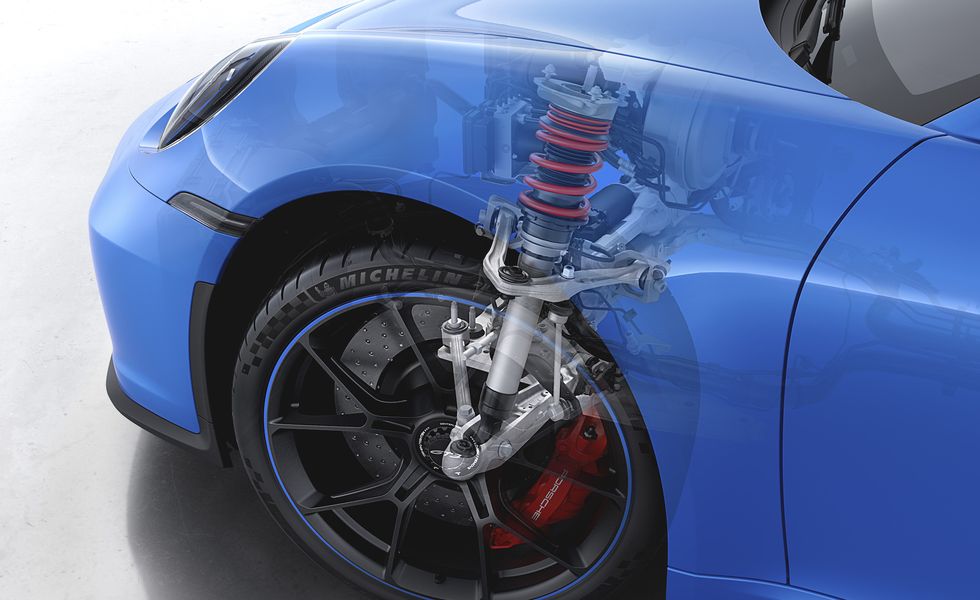
The front suspension, which features dual aluminum wishbones, is similar to the system developed for the McLaren 600LT. This combination of lightweight uprights and double wishbones delivers enhanced steering and precise vehicle reactions, with faster responses to driver inputs and heightened feel.

The grip is enhanced by continuously variable, twin-valve hydraulic dampers that feature individual compression and rebound characteristics. Single-stiffness springs and mechanical anti-roll bars are used, in combination with a new iteration of McLaren’s Proactive Damping Control system. Developed from the technology pioneered on the McLaren GT, PDC II is the most sophisticated example yet of the Optimal Control Theory software algorithm first developed for the 720S.
The Proactive Damping Control system uses inputs from sensors to ‘read’ the road rather than reacting to camera-based information. Feedback from four-wheel accelerometers, three body accelerometers, and two pressure sensors per damper – as well as multiple sensors that measure steering angle, vehicle speed, yaw rate, and lateral acceleration – is processed in less than two milliseconds to ensure the vehicle state is optimized for outstanding levels of control.
As acceleration, braking and cornering continually alter, and the road surface constantly changes, so Proactive Damping Control interprets data and uses its digital models to predict the perfect damping response. The regulation of the body’s movement is tailored for occupant comfort, but the vertical load and contact patch variation is optimized to enhance grip levels by ensuring each tire remains more consistently in touch with the road surface.
E-differential
The Artura is the first McLaren to have an electronically controlled differential (E-diff). Smaller and lighter than a mechanical locking differential, the E-diff is integrated into the all-new eight-speed transmission, optimizing packaging and weight.
The adoption of an E-diff brings the enhanced levels of control required to manage torque moving across the rear axle of the Artura, with the immediacy needed to respond to the instant delivery by the E-motor. A mechanical differential would not be able to react with sufficient speed or precision to ensure the behavior of the car is always proportional to throttle inputs.

The calibration and tuning of the E-diff encompass values including corner radius, vehicle speed, damping characteristics, and torque split across the differential. This in turn allows levels of understeer and oversteer to be precisely calculated and controlled, constantly fine-tuning the Artura’s agility/stability attitude to benefit a driver drifting the car on a track or controlling yaw gain with the throttle. Traction when coming out of corners is also enhanced by the closer control parameters.
The Artura also features McLaren’s innovative Variable Drift Control (VDC), which allows the driver to adjust the level of traction control assistance – and therefore the limit of oversteer – using a slider control on the Central Infotainment Screen.
Braking
The brakes on the Artura are the latest-generation carbon-ceramic brakes and lightweight aluminum calipers from the same family as the system used in the McLaren 600LT and 720S. The carbon-ceramic discs measure 390mm at the front and 380mm at the rear and, working in conjunction with the kinematics of the new rear axle design, deliver superior high-speed braking power and stability.
In addition to the discs and forged aluminum calipers (6-piston front monobloc, 4-piston rear), the Artura adopts a version of the Formula 1-inspired integrated caliper cooling ducts seen on the 765LT. This technology delivers cooling air to the front calipers and discs, reducing brake pad temperatures during track driving.

The McLaren Artura features a bespoke brake booster and electrically driven vacuum pump, to ensure pedal pressures remain consistent whether the car is running on its internal combustion engine or electric power alone. There is no function to regenerate the battery through the vehicle’s braking system because the engine can provide sufficient charging, and this ensures feel through the brake pedal is entirely consistent.
Tires
McLaren’s tyre partner, Pirelli, has delivered three bespoke tires designed to maximize the Artura’s dynamic characteristics and performance. The tires – 235/35Z R19 at the front and 295/35 R20 at the rear – are all marked ‘MC-C’ to indicate they are a Pirelli Cyber Tyre® tailor-made for McLaren.
The P ZERO™ tire fitted as standard features an asymmetric tread pattern that improves braking and enhances handling and control across a wide range of road conditions, with a particular focus on wet weather performance. The compound developed for the Artura ensures maximum grip and stability, while the structural integrity of the tire improves steering response.
Two optional tires are available. The P ZERO™ CORSA tire is designed for use on both road and track and features racing-type compounds and unique tread patterns, achieving higher grip levels as well as improved braking and traction. The P ZERO™ WINTER is the tire of choice for winter, its bespoke compound and tread pattern maintaining the levels of control of the P ZERO™ summer tire.

The Artura also features the innovative Pirelli Cyber Tyre® system. Consisting of hardware and software integrated into the vehicle electronics, the system has an electronic ‘chip’ in each tire and generates a stream of high-value data based on tire-specific conditions that is relayed to the control systems of the Artura to deliver the best tire performance.
Able to recognize whether a P ZERO™, P ZERO™ CORSA or P ZERO™ WINTER is fitted, Pirelli Cyber Tyre® produces accurate, real-time monitoring of temperature and pressure and a broader data set than a wheel rim sensor. With this information, drivers can set tires to the recommended levels to optimize performance; a ‘park mode’ refreshes the information when the driver returns to the car.
Additionally, by using a ‘track mode’, tire pressure thresholds can be changed on the infotainment display to a performance configuration that further enhances circuit driving enjoyment.
Driver assistance systems
The Artura is the first McLaren to offer Advanced Driver Assistance Systems (ADAS). These extend to Intelligent Adaptive Cruise Control with Stop/Go, Road-Sign Recognition, Lane-Departure Warning, and High-Beam Assist. Intelligent ACC automatically decreases or increases the speed of the Artura to keep pace with the car in front, including in stop-start traffic conditions, with the driver able to set the distance between the vehicles. Additionally, the speed limit, which is recognized by a front-facing camera, is displayed on the digital screen and prompts the driver to adjust the cruise control.
The Lane-Departure Warning system is designed to warn the Artura driver when the vehicle begins to move out of its lane. High-Beam Assist recognizes oncoming vehicles at night, switching the Static Adaptive Headlights between main and dipped beam automatically. This enhances night driving by better illuminating the road ahead while removing the need for the driver to manually adjust the headlights.
Design
- All-new body, all-new interior; design principles guided by purity, technical sculpture, and functional jewelry
- Perfect supercar proportions – ‘cab-forward’ stance; long, low sleek nose; long roofline, very fast windscreen angle
- Organic, ‘shrink-wrapped’ bodywork, following the philosophy of ‘everything for a reason’

“Our mission was to create a piece of pure technical sculpture, where technology doesn’t distract but enhances the visual experience. We were guided throughout by three key phrases – purity, technical sculpture, and functional jewelry. The purity is not only purity of line, but also in the integration of components; technical sculpture references the need to be stunning to look at, but there for a reason, like the forms you see in nature; while functional jewelry is best explained by the fact that we don’t decorate, we do what is needed and make it beautiful.”
Rob Melville, Design Director
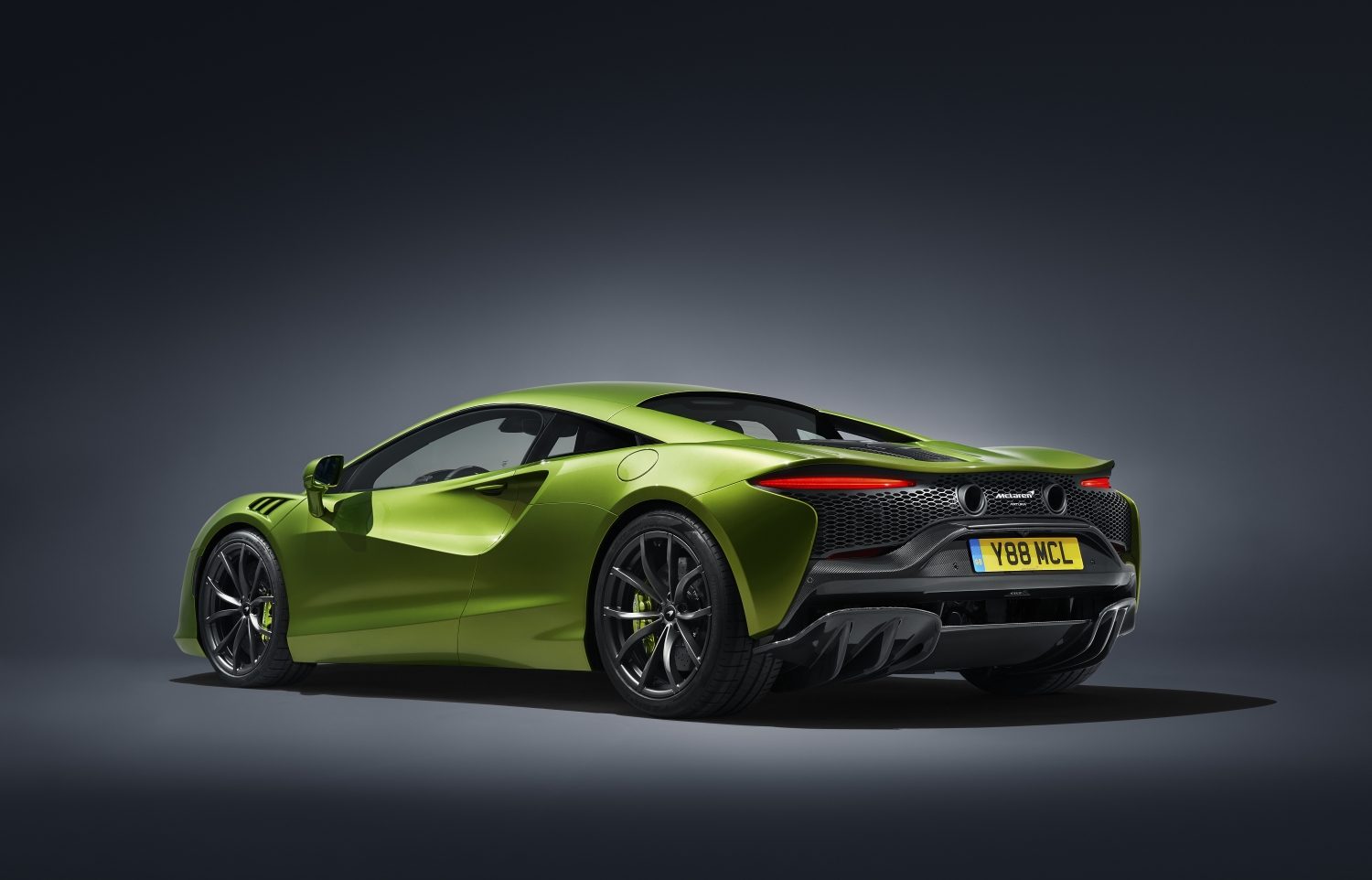
The McLaren Artura’s pure, minimalist aggressive beauty appears almost effortless, but nothing could be further from the truth. The design mission was as sharply focused as every other aspect of this game-changing supercar program.
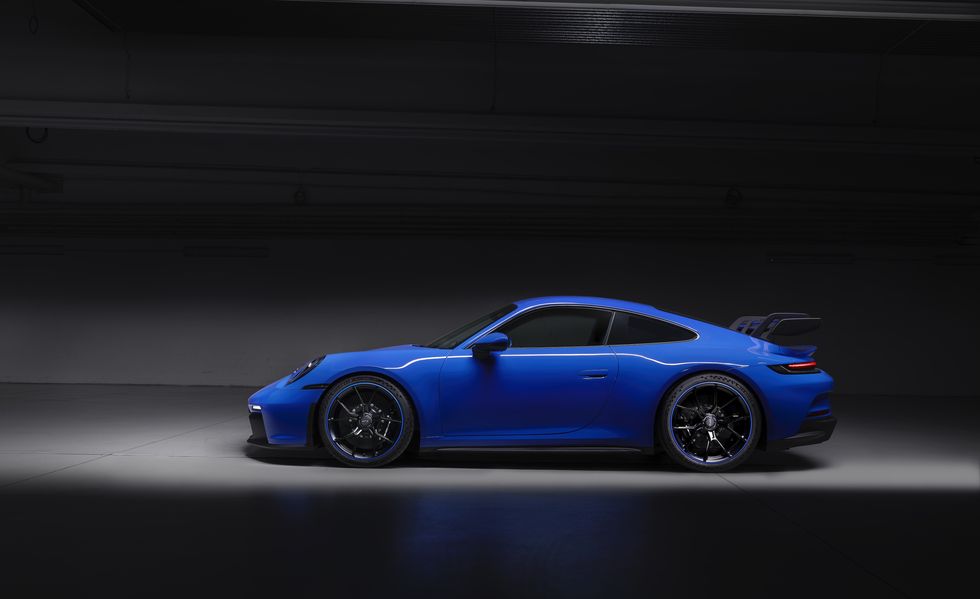
The Artura has perfect supercar proportions – a long, low sleek nose, long roofline, very fast windscreen angle, and very ‘cab-forward’ stance. Coupled with a compact wheelbase, 19-inch, and 20-inch wheels, and high fenders and haunches, the result is a superb dynamic feel overall, enhanced by the extremely compact rear overhang.
Viewing the Artura head-on, the signature hammerhead line is clearly visible running forward across the front, dissecting the airflow down into the radiators or accelerating it over the bonnet. The line ‘kicks up’ in the outboard corners, leading your eye into the eye-socket features that house the deeply rebated static adaptive headlamps. The lights are so deeply recessed that they alone give the Artura a mean, menacing look, contributing to the overall appearance of a car that displays a rare combination of both beauty and aggression. The large side intakes also help to endow the Artura with a striking visual character, captured in a pinched waist, powerful nose, and particularly curvaceous rear haunches linked by a tightly packed core.

The Artura’s sense of purity is achieved partly through the reduction in shutlines, which creates a visual cleanliness that emphasizes the bold form language. The air intakes in the nose and doors cut deeply into the body, while the elegant flying buttresses appear to ‘pool’ where they fall from the single-piece aluminum roof to meet the bodywork, creating a graceful visual effect in the remarkable one-piece rear clamshell.
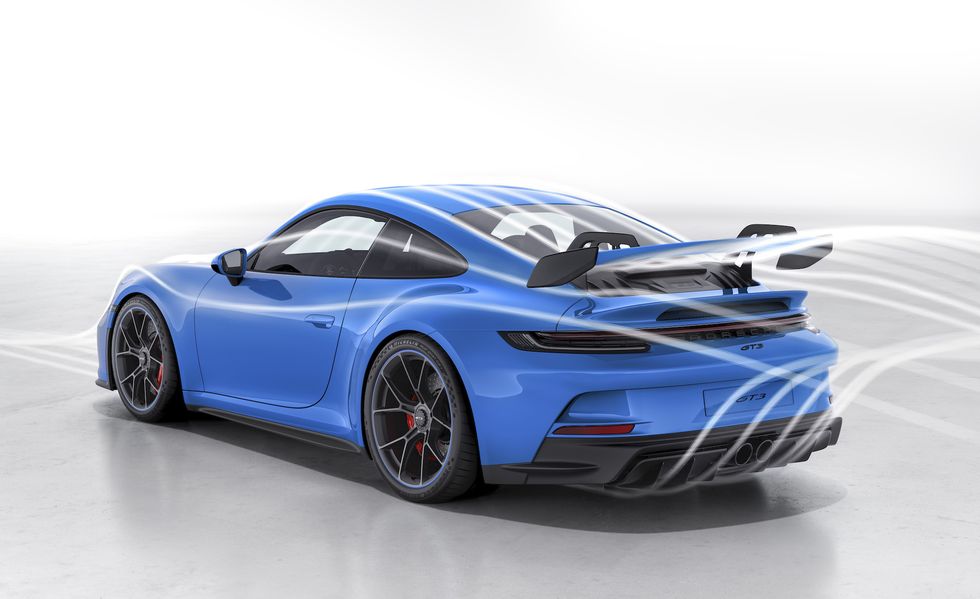
Every vent, duct, fold, even the door mirrors, have a specific purpose in managing airflow, cooling radiators, optimizing downforce, and enabling onboard technology. Vented louvers on the front fenders, for example, reduce pressure in the wheel arches and guide ‘dirty’ air away from the side intakes; while ‘clean’ air is guided into those intakes via a complex aero path involving sculpted door channels.
The side intakes conceal the discreet inlets that feed air to the intake manifolds, along with the high-temperature radiators (HTRs) which cool the powertrain. The HTRs, which feature a new core technology, is a complex elliptical shape to ensure the maximum surface area is placed within the airflow. They’re also much smaller, having less engine capacity to cool.
The intake for the eHVAC system (along with the ADAS radar if optioned) is located in the center of the front splitter. The radar’s offset location creates an asymmetrical intake, maintaining maximum intake volume rather than artificially closing the opposing side for the sake of styling.
The organic ‘shrink-wrapped’ bodywork contrasts with the sheer sides of the dihedral doors. These vertical surfaces play a distinct aerodynamic role while their shape, which transforms into the curvature of the air intake, allowed McLaren engineers to optimize the weight and rigidity of the aluminum doors.
The complex technical areas where air enters and exits the Artura – including the front splitter, rear deck mesh, and open rear end – are dark in color, while the bodywork that guides and controls the flow contrasts in body color. The roof and flying buttress can be painted either in exterior body color or specified in gloss black, offering a customer two distinct personalities. The Artura is also available with a full optional Black Pack, which applies a gloss black finish to the door mirror casings, exhaust, hot vee finishers, and front fender louvers, as well as to the roof and buttresses.

The full LED headlights feature 21 LEDs apiece, with four LEDs providing the main beam, five delivering the dipped beam, and the remaining 12 utilized for McLaren’s Static Adaptive functionality. The system moves the dipped headlight beam according to steering movements, allowing both the road ahead and surrounding areas to remain illuminated while turning. The system is fully digital, utilizing an array of LED lights with a variable intensity that become brighter or dimmer in relation to the direction of the turn. They also dip automatically via Auto High-Beam Assist when ADAS systems are optioned.
The LED rear lights continue the ultra-slim design concept, combining three functions into one unit: tail lights, brake lights, and indicators. Each rear light blade is made up of only nine components and a single blade of LEDs, minimizing both component count and overall weight – and as a result, each blade weighs half of those on a 720S, a car widely recognized as a champion of super-lightweight engineering.
The central-exit exhausts are set between the two light blades. Positioned high within the center of the rear mesh, the twin tailpipes exit straight out from the engine’s ‘hot vee’, having passed through the catalysts and gasoline particulate filters (GPFs). Positioning the exhausts this high allows for the Artura’s full-width, dual-level diffuser, which functions by the expansion of air across its full span, especially at the outboard corners.
A new seven-spoke cast alloy wheel design that is unique to the Artura is the standard specification, in a silver finish. Five-spoke lightweight flow-formed cast alloy wheels and 10-spoke super-lightweight forged alloy wheels are options, available in a range of finishes and delivering both a different visual dynamic and reducing unsprung weight by up to 10kg. Black, cast aluminum brake calipers with a white printed McLaren logo are standard, with six further caliper color choices as options.
The Artura is available in 15 exterior paint colors, including three – Flux Green, Ember Orange, and Plateau Grey – that are unique to the vehicle at launch. A further 16 MSO Defined exterior colors are also available through McLaren Special Operations, which also offers the opportunity for virtually any color to be specified as an MSO bespoke commission.
Customers can also specify components from a range of MSO carbon fiber body parts, either individually or as a pack. The MSO Carbon Fibre Pack sees the front splitter, diffuser, rear bumper, and door mirror casings finished in gloss finish visual carbon fiber, while gloss-finish carbon fiber front fender louvers can also be selected as a standalone option, as can an MSO rear spoiler, which is available from September 2021.
Interior
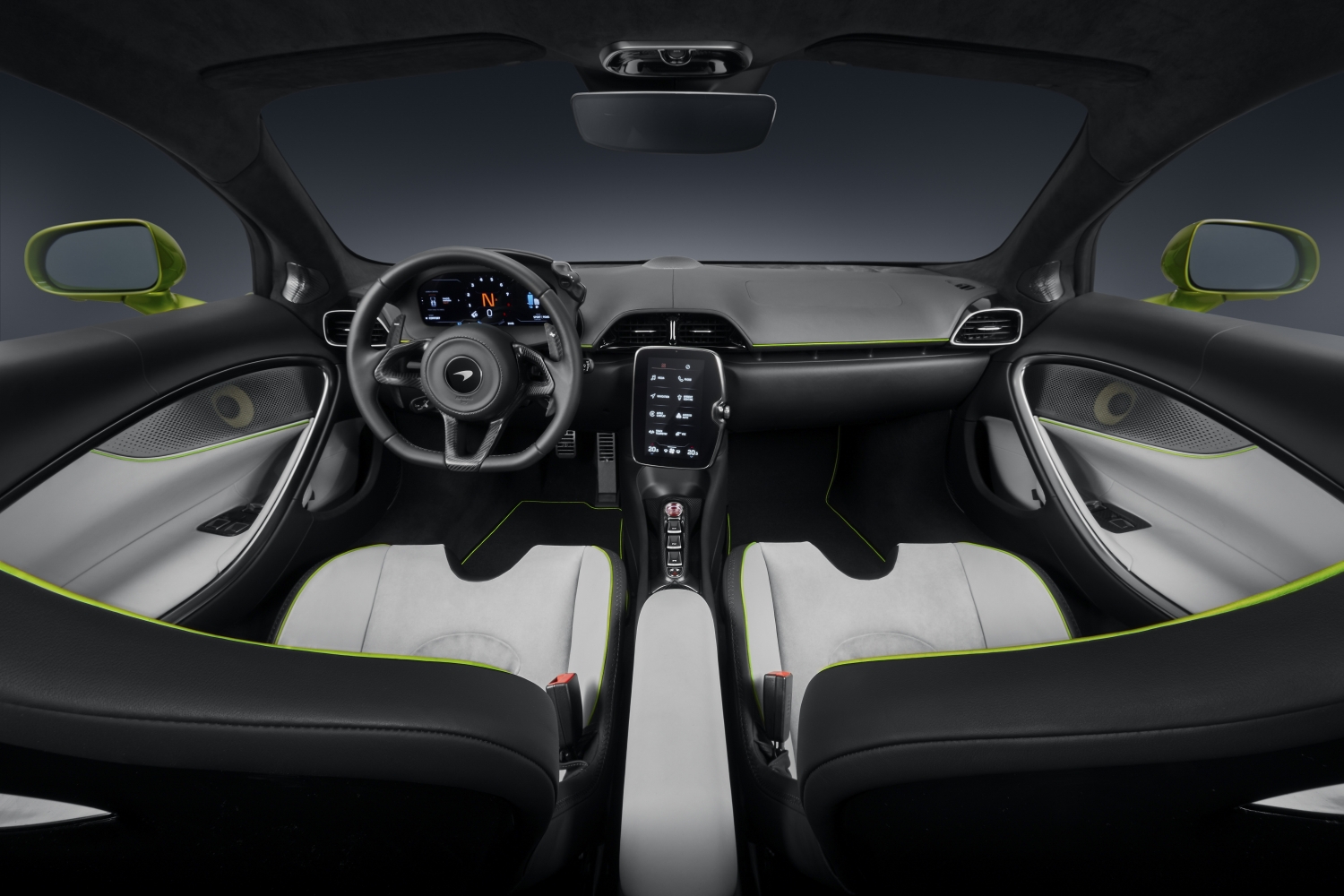
An Artura driver and passenger are both able to enjoy an environment that blends revolutionary ergonomics, technology, design, and refinement. An increased feeling of space is created by all surfaces being as far outwards as possible in order to maximize the interior volume, and the materials used throughout – from leathers to machined switchgear – create a technical and contemporary ambiance.

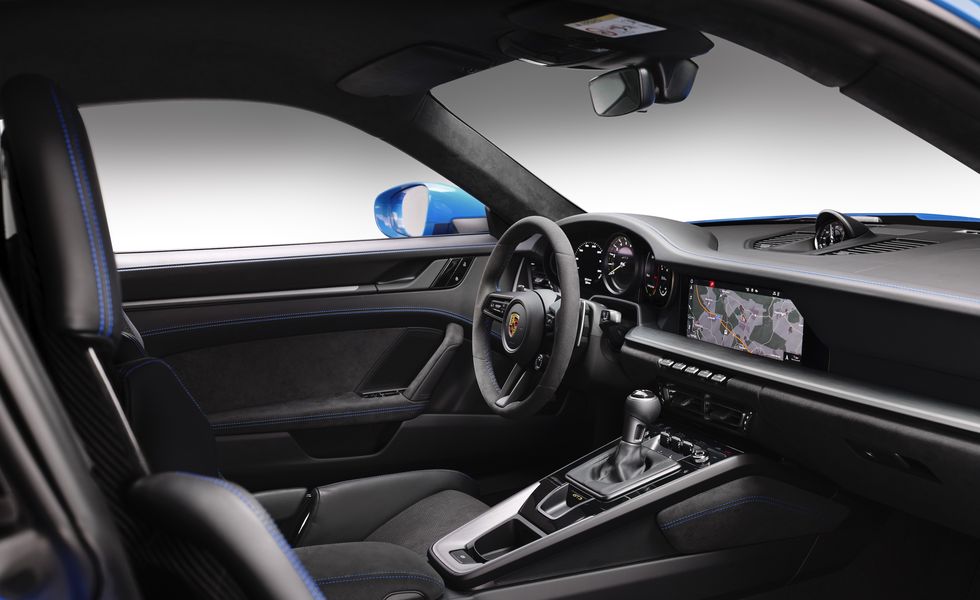
The interior design has been driven by the same principles of purity, technical sculpture, and functional jewelry that dictated the exterior of the Artura; the upper facia rises up to meet the wide and deep windscreen, which is bordered by a carbon-fiber structure that ensures particularly slim A-pillars; the facia seems to almost float, creating a sense of calm focus with no visual interruptions in the driver’s eye line and complementing the unmatched visibility.
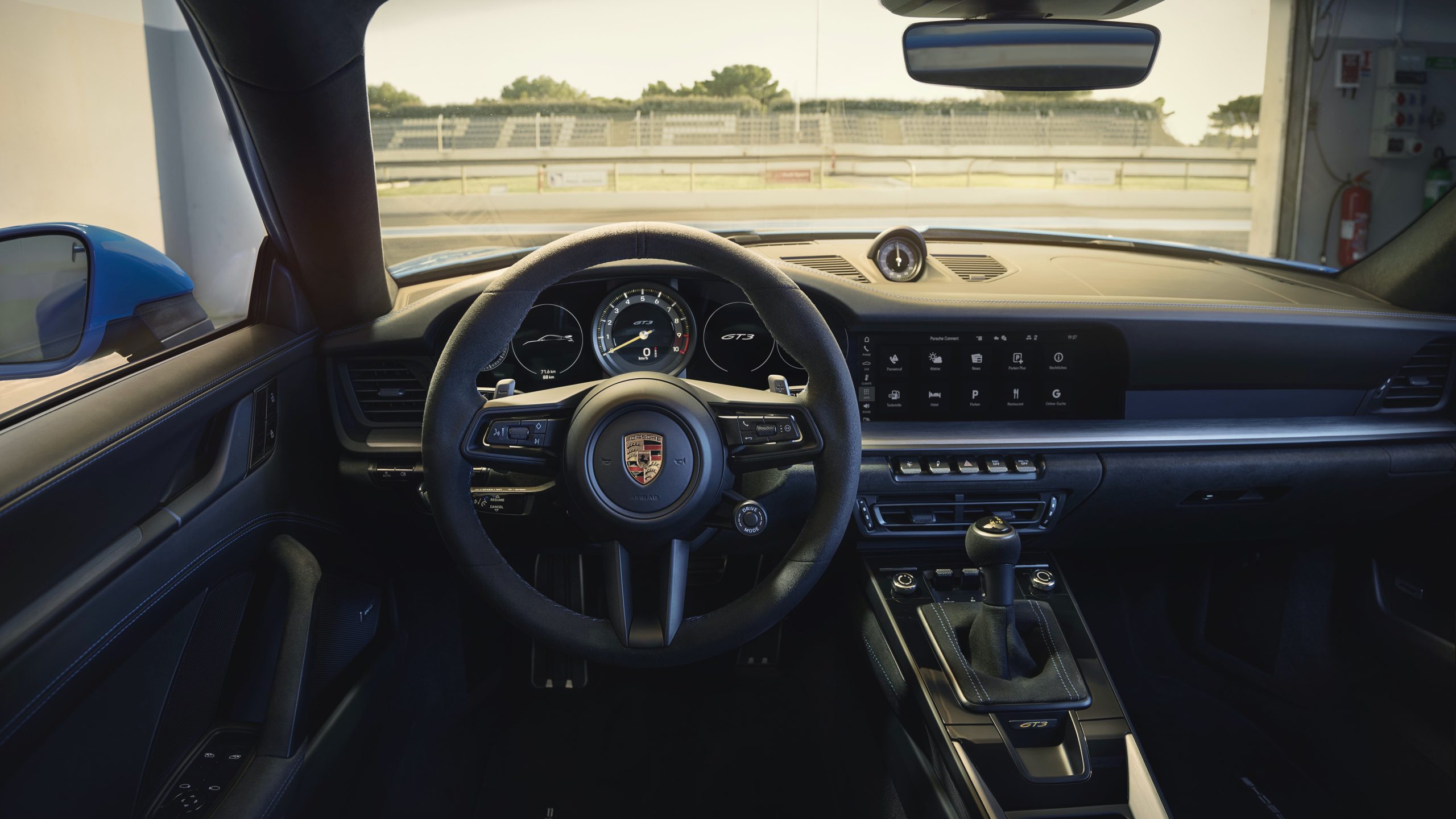
Every McLaren cockpit is built around the driver, but the Artura brings a new level of meaning to that principle. This is achieved by mounting the Digital Instrument Cluster to the steering column, so it moves in conjunction with the steering wheel. As a driver adjusts the column to their preferred position, perfect visibility of the instrumentation is maintained – and better still, the rocker switches for the Powertrain and Handling modes are at their fingertips, being mounted on either side of the binnacle.
There are no controls on the steering wheel, a clear signal that its sole function is to steer the car and provide feedback to the driver. Additional key controls such as the Drive/Neutral/Reverse switches are close to the driver’s field of view, reducing distraction while driving.

With all controls centered on the binnacle, the vertically mounted, 8-inch (20cm) high-resolution Central Infotainment Screen has the center of the facia virtually to itself. As the primary hub for vehicle convenience, comfort, and connectivity functions, the screen displays audio, media, navigation, and other convenience features, with all key applications just a tap or two away in the same style of operation as a smartphone. The climate control function always remains visible at the bottom of the screen, enabling optimum usability at all times.
The new MIS II uses an Android-based platform that allows for continual advancement and additions. The system works through a series of apps, just like a smartphone. Multiple applications can be run simultaneously and scrolled through on an app list or activated using voice control. Support for Apple CarPlay® and Android AutoTM also integrates a mobile phone into both the instrument cluster and central display screen.
The Artura driver’s interaction with MIS II begins as they approach the car, using a new vehicle key that transmits via Bluetooth to unlock the car and commence booting the system. The system also works in reverse, shutting the system down and locking the doors when the driver exits the car and walks away at the end of a journey.

As with all McLaren models, the touchscreen is mounted in portrait, rather than landscape, mode. This reduces the width of the screen, enabling vehicle occupants to be positioned closer together while still enjoying generous space. Bringing them closer to the center of the car also helps further optimize Artura’s response and agility.
The all-new Clubsport seats, fitted as standard, are a particular point of focus in the interior of the Artura. Developed specifically for the all-new High-Performance Hybrid supercar, these single-shell seats uniquely combine the lightweight and support of a bucket seat with the range of motion expected of a seat with a moveable backrest. The innovative method of adjustment is simplicity itself: the driver sets their relationship to the pedals with the fore and aft adjustment, and then uses a singular control that tilts the whole shell elliptically around the same H-point to achieve the perfect driving position. With the recline and height combined, the seat moves upright as it comes higher, or reclines as it lowers, with an occupant’s thighs always supported. This adjustment enables a swift transition between an upright vehicle maneuvering position and a lower, driving-focused one, and removes the need for driver or passenger to alter their seat incrementally using multiple controls.
As with the super-lightweight carbon-fiber racing seats developed for the McLaren Senna, the upper portion of the seat is wide but thickly padded, giving equal support to broad-shouldered and wiry drivers alike. The new seats are compatible with an optional MSO Defined Harness Bar and MSO Defined six-point harnesses, and the single-shell construction and single electric motor reduce weight, to the extent that each Clubsport seat is up to 9.5kg lighter than the optional Comfort seat. Fully electric 10-way adjustable heated sports seats with memory function and comfort entry/exit are also optionally available for those wanting more luxurious comfort and support.
Interior refinement
McLaren engineers worked tirelessly to enhance cabin refinement in the Artura, building on lessons learned during the development of the GT and Speedtail. A car that will run for part of the time in silent mode faces more complex challenges than a vehicle powered only by an internal combustion engine.
Engine refinement has a major influence on both the cabin sound levels and ride comfort of a car. Factors such as the engine chain drive being located at the rear of the all-new V6 reduces NVH intrusion into the cabin, as well as torsional vibration. Fluid-filled mounts for the powertrain help to separate and ‘tune out’ certain mechanical frequencies of the V6 that would otherwise pass to the carbon monocoque and subframe.

The monocoque itself plays a key role in refinement, not only through its structural consistency and stiffness but also in the way it is integrated; in the McLaren Senna, for example, the carbon fiber chassis was used to amplify the low-frequency sounds into the cabin, while in the Artura specific work was undertaken to actively eliminate this effect in order to maximize refinement during everyday use.
New suspension bushes, particularly large on the rear axle, also improve NVH performance, as do the designs of the front and rear aluminum subframes and suspension spring stiffness. McLaren technical partner, Pirelli, also plays a major role in cabin refinement.
To assist driver comfort, the Artura Pirelli P ZERO™ tire is equipped with the Pirelli Noise Cancelling System (PNCS), a Pirelli-patented technology that reduces road noise by using a polyurethane sponge inside the tire to absorb vibration and minimize noise transmission into the cabin.
The Artura’s electrically driven heating, ventilation, and air-conditioning (eHVAC) system also brings multiple refinement advantages. Able to heat or cool quicker than a mechanically driven system, it is also more controllable and enables cabin pre-conditioning, either for cooling or defrosting. A new diffused air vent spans the facia of the Artura and, in combination with the foot, face, and windscreen vents, this increases mass flow into the cabin – but at lower velocities, meaning that desired cabin temperatures can be better maintained without an increase in blower noise. Dual-zone climate control and air-conditioning are standard on the Artura, with the system allowing fully automatic and independent settings for both the driver and passenger.
Model range, specification, and ownership
Beyond standard trim, three further levels – ‘Performance’, ‘TechLux’ and ‘Vision’ – offer a variety of interiors carefully curated by the design studio at the McLaren Technology Centre (MTC). And as with every McLaren, customers seeking further personalization can explore the realm of McLaren Special Operations (MSO), which makes almost anything possible.
In standard trim, the new Clubsport seats are finished in lightweight Alcantara® – along with the dashboard, headlining, central armrest, and door armrests, ensuring that all primary surfaces feature highly aesthetic finishes in a tactile and technical material. A leather-trimmed steering wheel with a power-adjust steering column is standard.

Decorative elements around the window switch surround, center tunnel, instrument binnacle, and cast aluminum gearshift paddles are finished in Satin Black. The Central Infotainment Screen and overhead console have a Dark Titanium finish. The shift paddles are upgraded to extended, machined, and brushed in TechLux, Performance, and Vision.
The Performance, TechLux, or Vision trims feature either Alcantara® or supple Nappa leather on almost every surface, with the Extended Nappa Leather specification covering the whole cabin, including the doors, rear parcel shelf, central tunnel, and lower dashboard.
Sporty, aesthetic, and technical, the four Performance interiors available all feature lightweight Alcantara® on the seats, headlining, doors and dashboard, alongside Nappa Leather throughout the rest of the interior. The ambiance is sporty, functional, and aesthetic, with Performance stitching and contrasting color accents throughout. Dark Carbon Black, Graphite, and Ink Blue hues dominate, contrasting with a hint of color from Ember Orange or McLaren Orange accents.
The four TechLux interiors epitomize technical luxury and style, creating a sporty yet refined ambiance. The Extended Nappa Leather interior sees the entire cabin indulgently trimmed in the natural hide, the leather color is paired with vibrant highlight accents and finished with a stitch pattern bespoke to the TechLux trim. Interior components are finished in Brushed Dark Titanium, featuring Extended Brushed Metal gearshift paddles.
Avantgarde and sporty, the two Vision interiors available combine lighter hues of dual-tone Extended Nappa Leather and Alcantara® with simple, bright, and off-piste accents. Unique stitching highlights the details of the sophisticated environment. A vivid, reflective Zest accent unique to the Vision interior highlights the attention to detail, or alternatively a more restrained Vision Orange accent creates a darker, more subtle effect.

Hidden-until-lit ambient lighting, which McLaren introduced on the new GT, adds a further touch of elegance to the Performance, TechLux, or Vision models. This innovative technology features subtle chrome trim highlights around the door cards; cold-to-the-touch and seemingly solid metallic, a distinct lighting pattern become visible within them when the vehicle ignition is engaged, casting a subtle and soft glow across the cabin. Each Performance, TechLux, and Vision interior features a specific 12-color ambient lighting scheme, complementing the three trim themes.
The Artura is equipped as standard with a generous suite of comfort and convenience features, including a McLaren five-speaker audio system and satellite navigation that includes turn-by-turn instructions and a simplified map displayed in the Digital Instrument Cluster alongside a full map on the Central Infotainment Screen. There is also DAB/FM radio, Bluetooth telephony, iPod/iPhone Integration, USB-C, and USB-B fast-charge connectivity.
The McLaren Track Telemetry app has also been enhanced with a preloaded track database, while a new key features Bluetooth technology to wake the car up sooner – enhancing welcome and start-up experience – and commercial-grade cryptography software to combat against potential relay attack.

A world-class Bowers & Wilkins audio system can be specified as part of an optional Technology Pack. McLaren and Bowers & Wilkins worked together to develop and tune the system to the Artura’s cabin architecture and acoustics. This includes QuantumLogic Surround technology to accurately identify and redistribute audio streams, Dynamic EQ processing to more accurately adjust for external sounds, and Clari-Fi for real-time restoration of low-quality audio signals. The 12-speaker system incorporates ContinuumTM cones for better damping and response than Kevlar, with a dual subwoofer integrated into the front of the Artura’s carbon fiber monocoque to provide an extremely stable location from which to deliver undistorted bass.
Further features of the Technology Pack include Full Adaptive LED Headlights Plus with Auto High-Beam Assist, Road-Sign Recognition, Intelligent Adaptive Cruise Control with switchable follow mode, 360-Degree Park Assist, and Lane-Departure Warning.
A Practicality Pack includes Vehicle Lift, power-folding heated door mirrors with ‘Dip in Reverse’ functionality, four front and four rear parking sensors, rear-view camera, Homelink® (where available), and soft-close doors. The optional driver-controlled vehicle lift system raises the nose of the car, for instance over speed bumps or when entering or exiting car parks, while Homelink® allows for remote opening of up to three electric garage doors or house gates.
Ownership & warranty
Peace of mind – on quality, durability, and cost – were as important in the design, engineering, and development of the Artura as any of the other core considerations, such as performance and driver engagement. With the car being all-new – including the High-Performance Hybrid powertrain – and the distillation of more than five decades of McLaren experience and expertise in race- and road-car engineering, it is no surprise that the test and development program undertaken by McLaren was it’s most rigorous ever.
The Artura comes with a five-year/75,000km vehicle warranty, outstripping the three-year cover offered by most rivals. The battery is warrantied for six years/75,000km. A 10-year body (anti-perforation) warranty is also included, as is a five-year roadside assistance package.
McLaren Artura technical specification
| Engine configuration | M630 V6 engine, 2,993cc twin-turbocharged, hybrid powertrain with axial flux electric motor |
| Drivetrain layout | Longitudinal mid-engined, RWD |
| Power PS (bhp/kW) @ rpm | 680PS (671/500): 585PS (577/430) @ 7,500rpm from petrol engine; 95PS (94/70) from electric motor1 |
| Torque Nm (lb ft) @ rpm | 720 (531): 585 (431) @ 2,250-7,000rpm from petrol engine, 225 (166) from electric motor1 |
| Transmission |
8-Speed SSG (reverse using electric motor) with electronic locking differential (E-diff). Electric, Comfort, Sport and Track modes |
| Steering | Electro-hydraulic; power-assisted |
| Chassis | MCLA carbon fibre monocoque with aluminium front and rear frames and chassis structures |
| Suspension |
Independent adaptive dampers, front: dual aluminium wishbones, rear: upper wishbone and lower multi-link setup. Proactive Damping Control (PDC). Comfort, Sport and Track modes |
| Brakes | Carbon Ceramic Discs (390mm front; 380mm rear) with forged aluminium brake calipers (6-piston front monobloc; 4-piston rear) |
| Wheels (inches) | Front: 19 x 9J; Rear: 20 x 11J |
| Tyres |
Pirelli P-ZERO™ and Pirelli P-ZERO™ Corsa and Pirelli P ZEROTM Winter tyres with Pirelli Cyber Tyre® technology Front: 235/35Z/R19 91Y Rear: 295/35/R20 105Y |
| Length, mm (inches) | 4,539 (179) |
| Wheelbase, mm (inches) | 2,640 (104) |
| Height, mm (inches) | 1,193 (47) |
| Width, with mirrors, mm (inches) | 2,080 (82) |
| Width, mirrors folded, mm (inches) | 1,976 (78) |
| Width, without mirrors, mm (inches) | 1,913 (75) |
| Track (to contact patch centre), mm (inches) | Front: 1650 (65); Rear: 1613 (63.5) |
| Lightest dry weight, kg (lbs) | 1,395 (3,075) |
| DIN Kerb weight [fluids + 90% fuel], kg (lbs) | 1,498 (3,303) |
| Fuel tank capacity, litres (UK/USA gallons) | 72 (15.8/19) |
| Usable Battery capacity | 7.4kWh |
| Battery charge time | 2.5 hours to 80% charge (via EVSE cable) |
| Electric-only range (km/miles) | 30/19* |
| Electric maximum speed | 130km/h (81mph) * |
| Luggage capacity, litres | 160 |
Performance data
| 0-97km/h (0-60mph) | 3.0 seconds* |
| 0-100km/h (0-62mph) | 3.0 seconds* |
| 0-200km/h (0-124mph) | 8.3 seconds* |
| 0-300km/h (0-186mph) | 21.5 seconds* |
| 0-400m / ¼ mile | 10.7 seconds* |
| Maximum speed | 330km/h (205 mph) – electronically limited |
| 200-0km/h (124mph-0) braking, metres (ft) | 126* |
| 100-0km/h (62mph-0) braking, metres (ft) | 31* |
Efficiency
| CO2 emissions, g/km WLTP EU (combined) | 129* |
Warranty
| Vehicle (years/km) | 5/75,000 |
| Battery (years/km) | 6/75,000 |
| Roadside assistance (years/miles) | 5/unlimited |
| Body (anti-perforation) (years/miles) | 10/unlimited |