The new 2022 Mercedes-Benz C-Class saloon and Estate have officially been launched. The C-Class was the highest volume Mercedes-Benz in the last decade, since the introduction of the previous generation in 2014, more than 2.5 million units of the saloon and estate were sold. China, USA, Germany and Britain have been the largest sales market of the Mercedes C-Class Estate and Saloon Variant in the last decade.
Exterior
The exterior and interior of the new C-Class have been slightly increased in dimensions, elbow room has increased by 22mm in the front and 15mm at the rear, headroom has increased by 13mm in the Saloon variant and 11mm in the Estate variant and the knee room at the rear has been increased to 35mm. The interior also features display and operating concept similar to the one on S-class and the central display and a slightly tilted central display and dashboard. The turning circle has been reduced to over 40cm under 11m with rear axle steering, this feature is optional.
Digital light with projection function is optional, the system ensures safe driving by projecting guidelines, symbols and animations on the road that indicates how close the vehicle is to objects and other cars. Voice recognition is available and can be used to control home appliances and domestic equipment using ‘Hey Mercedes’ voice assistant. Over-the-air updates feature is also available.
The rear design features similar design cues to the new S-Class while the front fascia has been twisted a bit and is unique to the C-Class.
Mercedes-Benz C-Class
Interior
The interior design features dashboard divided into upper and lower section, high resolution LCD screen and driver display with three display styles ( Discreet, Sporty, Classic) and three modes (Service, Navigation, assistance). The driver has a large “floating” screen in place of the traditional round dials – a choice of 10.25-inch or 12.3-inch screen. The center screen dominates the interior with a choice of 9.5 inches or a massive 11.9 inch screen.
The dashboard is covered in synthetic leather, industry standard now as activists fight to keep real leather away from regular luxury cars. The new C-Class also used the second generation of MBUX, and benefits from a new voice assistant known as “Hey Mercedes”. Over the Air updates will be standard, and just like a phone, whenever an update is available MBUX will alert you.
Engines
The new C-Class is now exclusively available with 4 cylinder engines from the FAME (Family of Modular Engines). Dubbed M254, it’s a shorted M256 straight six, favored due to the flexibility during electrification. In fact, all engine options in the new C-Class are electrified and feature either a mild hybrid 48V system or a plug-in-hybrid. The EQ boost represents an additional 20hp and 200nm torque.
Plug-in-Hybrid
The 2.0L engine found on the C300 will get an electric motor in future, to be used on later models sitting above the C300. The electric motor is rated at 129hp and 440nm of torque, and an all electric range of 100km. Depending on the driving style, the hybrid engine will choose the most effective mode for the car. In the city, it will choose an all electric mode powered by a 25.4 kWh battery that can be recharged to 100% in 30 minutes.
The hybrid models will have a haptic accelerator pedal with a pressure point set at an accelerator pedal angle of 9.7°. Less pressure on the pedal will activate electric mode, but if the pedal angle is exceeded then the petrol engine kicks in to provide additional boost.
The rear wheel steering reduces its turning circle by 43 centimetres to 10.64 metres and will steer in the opposite direction to the front wheels at speeds below 60km/h. During parking, they will steer 2.5° opposite to the front wheels.
Pricing has not yet been announced, expect to see more models in future including the AMG variant.
Mercedes-Benz C-Class Estate
February 23, 2021 / Comments Off on 2022 Mercedes-Benz C-Class Launched: 4 Cylinder Engines Only
The Porsche Taycan range is expanding, it all began with the bang and ballistic battery power of the Taycan Turbo S and Turbo before the 4S joined the family. The latest offering is the Taycan, just Taycan. The big news is that it is the first rear-wheel-drive model liberating the front axel of a significant 90kg. Porsche marked the introduction of the car by casually setting a new world record for the longest drift at a lengthy 41km.
It costs £70,690, which is close to £13,000 less than a Taycan 4S or about half the price of a Taycan Turbo S (and they look identical…). For that you’ve got 321bhp from its single rear motor with 402bhp on overboost. Fork out another £4k and you can have 375bhp with a temporary 469bhp on overboost. Range will also climb from a 431 to 484 kilometres. 0-100km/h is achieve in 5.4-seconds with the bigger battery.
Zaid H – Taycan
5.4 is not exactly ferocious speed, is it? Well, no. The base Taycan doesn’t have that neck snapping acceleration the world has come to expect from EVs, but that isn’t all bad. I’ve had the honour of piloting every variant of the Taycan and the Turbo(S) models deploy monumental speed in such a savage manner that it is almost impossible to use it on the public road. In the latest Taycan, this isn’t the case. You can plant your right foot and be satisfied knowing that you’re using all of the oomph on tap. You can exploit all the car has to offer without finding yourself in jail.
Fitted with smaller 19-inch wheels and optional PASM air suspension in conjunction with acoustically insulated laminated glass, this Taycan is a fantastic cruiser. When not focusing on the insane speed which other Taycans are capable of demonstrating, you focus on different elements of the driving experience. You are absorbed by and relish the tranquility and technology. There is regeneration under braking but you wouldn’t notice this when you’re hitting the pedal, feel is uncorrupted. One pedal driving is difficult as the force of the regen is rather mild and not configurable as it is in other EVs.
Taycan Dynamic
The screens in the Taycan are sublime. The curved driver’s display is a masterpiece that I found mesmerising. This is a seriously comfortable car to cover vast distances in. That’s not to say it cannot be quick when you need it to be. Yes, you’ll need to look for a bigger gap for overtakes, but it still has that ‘point and squirt’ instant torque. It’s agile too, assuming you remember that it weighs 2,130kgs DIN. The steering provides good feel and is well weighted. The seating position is as good as a 911’s and the infotainment is the best in class.
If only my experiences outside of the car were as good as those within the plush cabin. The charging infrastructure in the UK is abysmal and does a disservice to the Taycan and its marvellous refinement and quality. It will get better, hopefully soon.
Taycan Details & Interior
Porsche GB have just started their own charging network across the UK meaning there will be fast, easy to use chargers. You’ll also be able to have a look around the Porsches on offer instead of a boring service station.
For most people the entry level Taycan will suit all of their needs with a significant saving over the rest of the range. However, if I was in the market for a Taycan it would have to be the 4S as it offers more of the allure of EVs with 530bhp and shocking acceleration (4.0 to 100). I can’t comment on the true hooligan facets of the rear wheel drive Taycan as the car I was driving (Coffee Beige) was not fitted with the optional torque vectoring rear differential. Perhaps that will add a touch of excitement to the Taycan. For now, the base Taycan is all that you could need from an EV and it’s a very good one by any measure.
Taycan Rear Wheel Drive
February 23, 2021 / Comments Off on 2021 Porsche Taycan (Rear Wheel Drive) Review
I don’t know about you, but I have spent way too many hours online in configurators (or visualizers) for some of the world’s most exclusive car makers, I just love to play around with options on cars I will probably never be able to afford anyway, but it’s so much fun putting dreams together on a computer’s screen, this went so far as me actually designing and programming my very own Lamborghini virtual configurator because I felt the factory one didn’t go far enough.
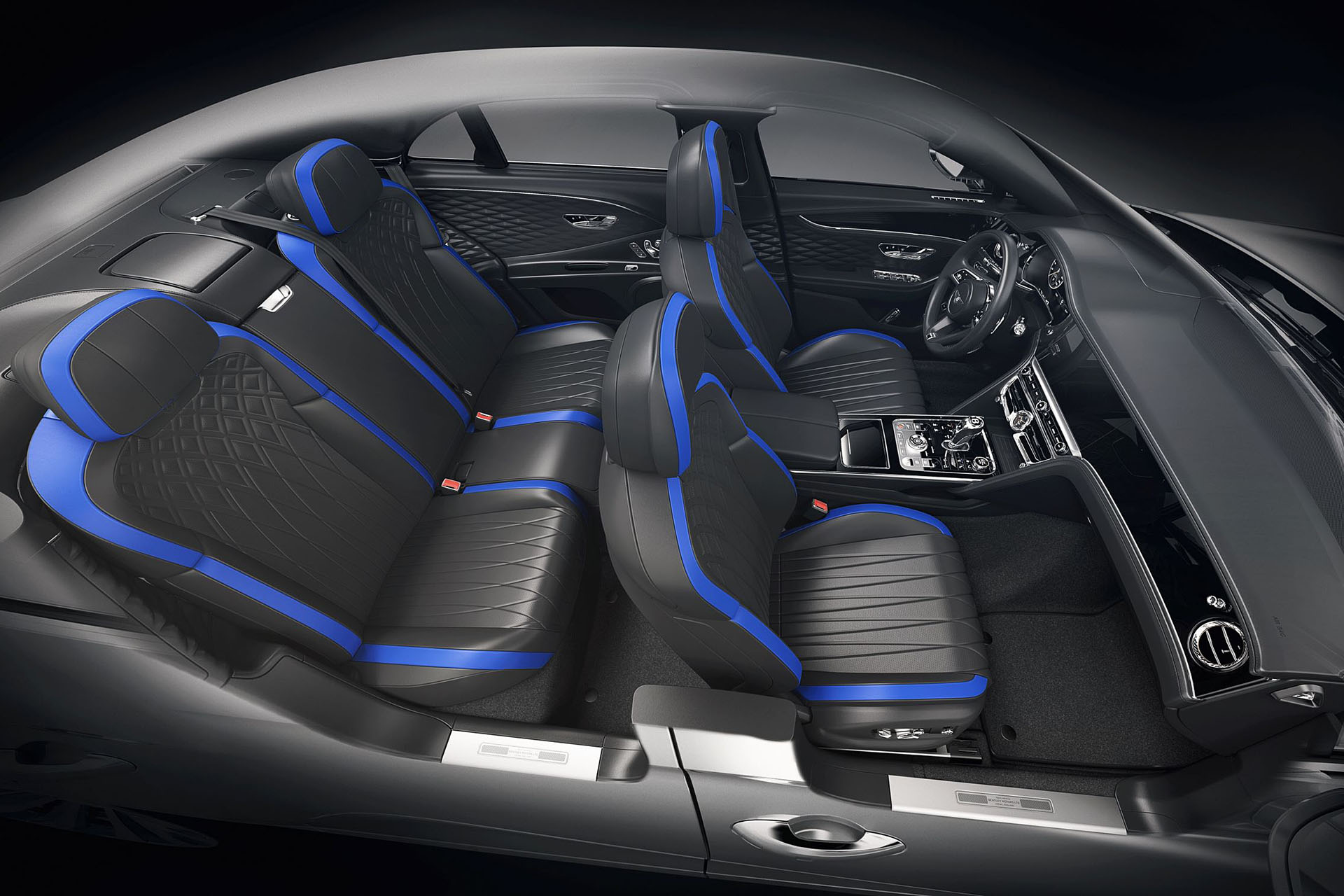
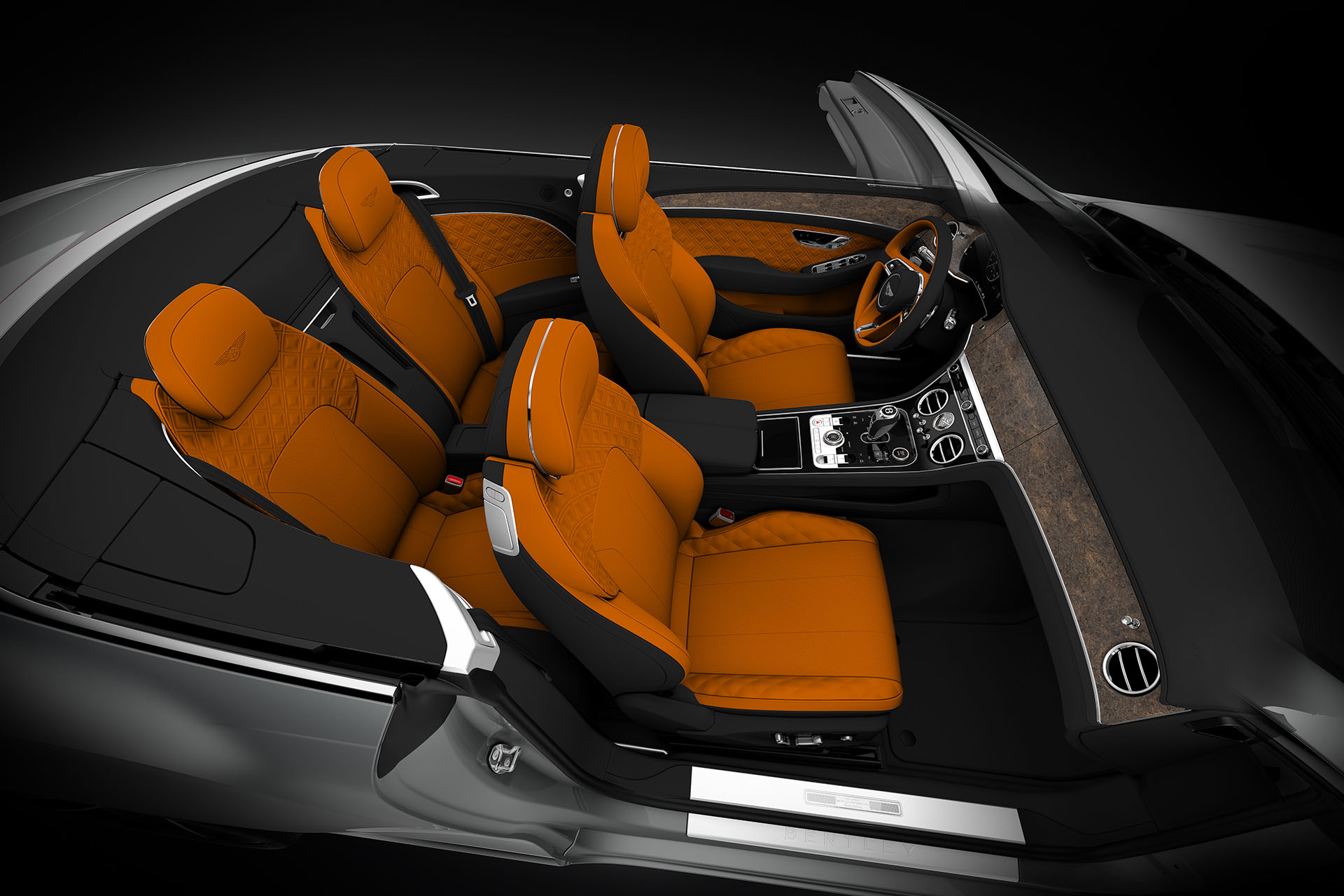
Now it seems management at Bentley in Crewe, UK, had the same sentiment, they just released their Mulliner visualiser to have customers create their very own, bespoke car by using an application together with their retailer or with a designer from Bentley, without leaving the comfort of their house.
From within the Mulliner virtualiser, the customer can view their new car, both from the outside and on the inside, complete with their selected choice of paint and upholstery, it is even possible to color match the hides on the interior to the outside, and have the correct color code sent directly to Bentley Mulliner for the dye on the leather.
Naturally the choice of stitching options is almost endless, and now the client can even specify how the veneer inside his (or her) new Bentley will be finished, Mulliner offers the fascias and waist-rails painted to the same piano-finish standard as the exterior, in any one of the scores of colors on offer.
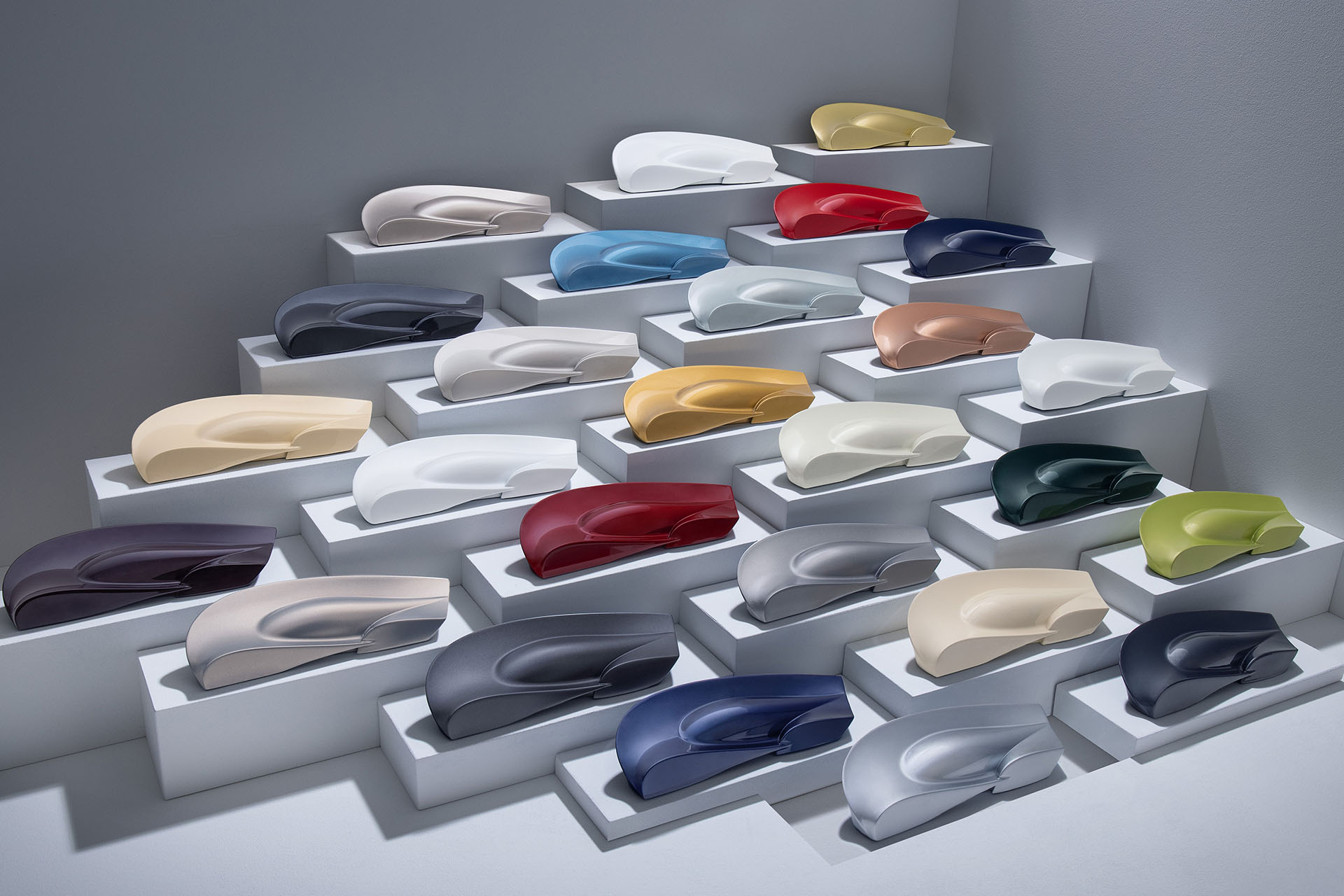
I know for a fact the list of paint colors on a Bentley is daunting to say the least, it contains 62 colors, and with the new Mulliner visualiser, things get even more complicated with the addition of 26 more shades, fifteen of those are solid or regular metallic, but Mulliner also offers 4 new satin finishes and no less than seven complex, pearlescent three-layer paints, all applied in a combination of hand spraying and robot technology for the best possible finish … the ‘stock’ pallet of Bentley colors is one of the largest in the industry.
Some of the additional paints from Mulliner:
First created in the 1960s, Oxford Blue is a stunning solid paint and one of the darkest blues in the Bentley palette. This mesmerizing Mulliner paint recalls the power and elegance of the Oxford and Cambridge Boat Race.
Viridian
Viridian is the latest metallic paint to be introduced and is a modern take on the traditional British racing green. This mysterious dark emerald is inspired by the EXP 10 Speed 6 concept car shown at the Geneva International Motor Show in 2015. The deep green with light green and blue undertones creates depth and a sporting dimension, while flecks of amber and gold embody the character of luxury.
White Sand Porcelain – White Sand was the launch colour for the Continental Flying Spur. A silky, creamy colour, it is created by blending two hues to a warm finish.
Snow Quartz is a modern white three layer pearlescent paint, which creates a simple and fresh silhouette. The finely layered pearl effect creates a beautiful shimmering and lustrous whiteness, providing an infinite amount of opportunities to complement interior color combinations.
The glimmering surface of Extreme Silver has been given a striking new finish to create Extreme Silver Satin. This distinctive Mulliner Paint alters the character of this warm silver almost beyond recognition, replacing the metallic gleam with a subtle satiny sheen that brings the sharp Bentley design lines to the fore.
Storm Grey – Storm Grey has appeared on several Bentley models since its introduction in the 1990s. It blends hints of blue into a strong grey base to create a powerful and eye-catching finish.
And if that doesn’t fit your specific needs, no problem, Bentley’s personal commissioning division can color-match virtually any sample provided, using innovative color recognition software to analyze the composition of the sample provided and reproducing it to perfection.
Radium – A Mischievous sporty and youthful colour, with a superfine metallic effect, invoking the feeling of confidence.
February 23, 2021 / Comments Off on The Bentley Mulliner visualiser
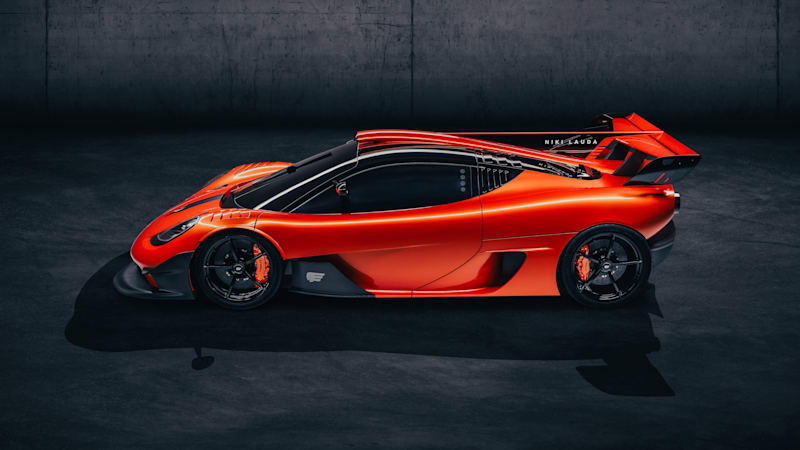
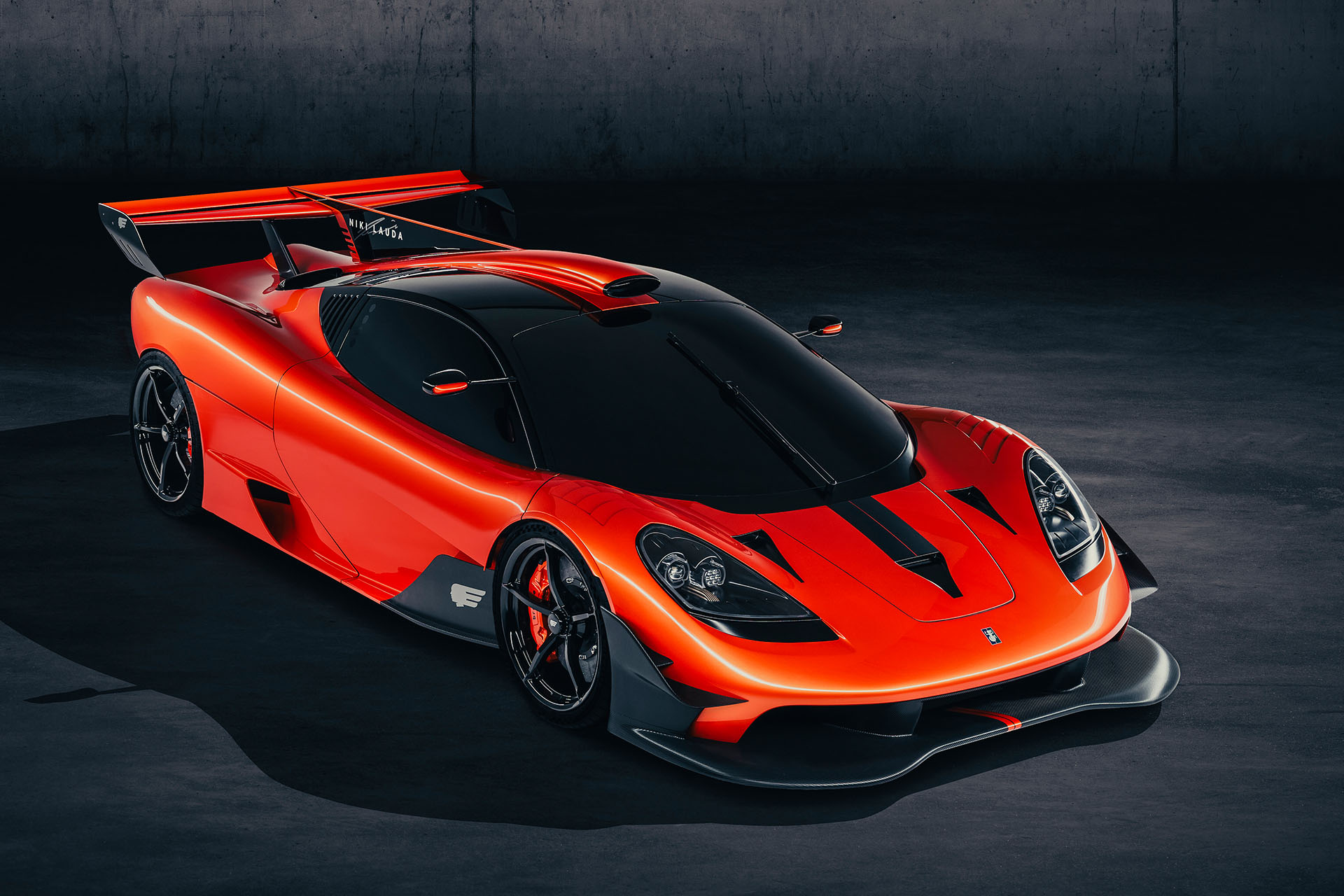
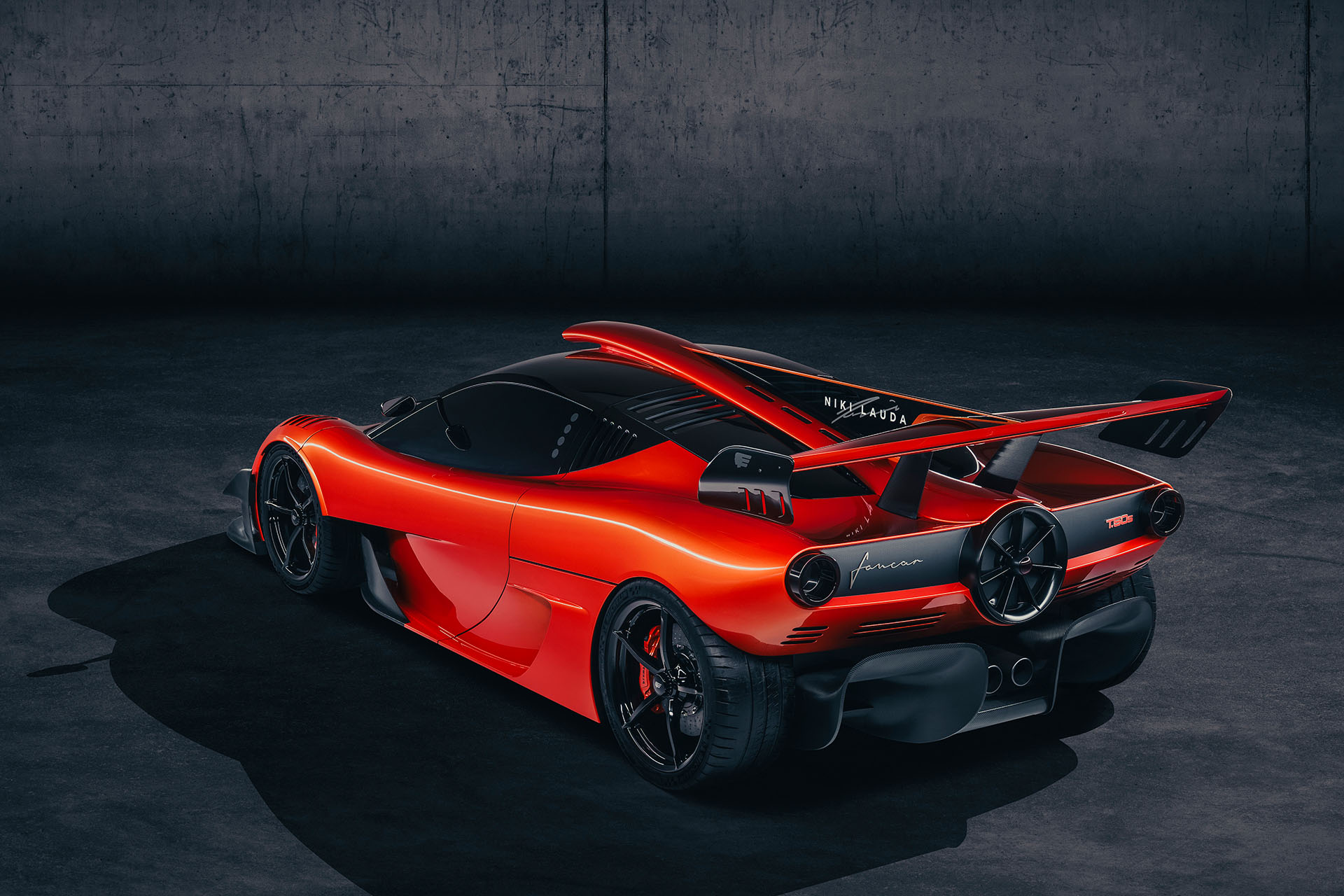
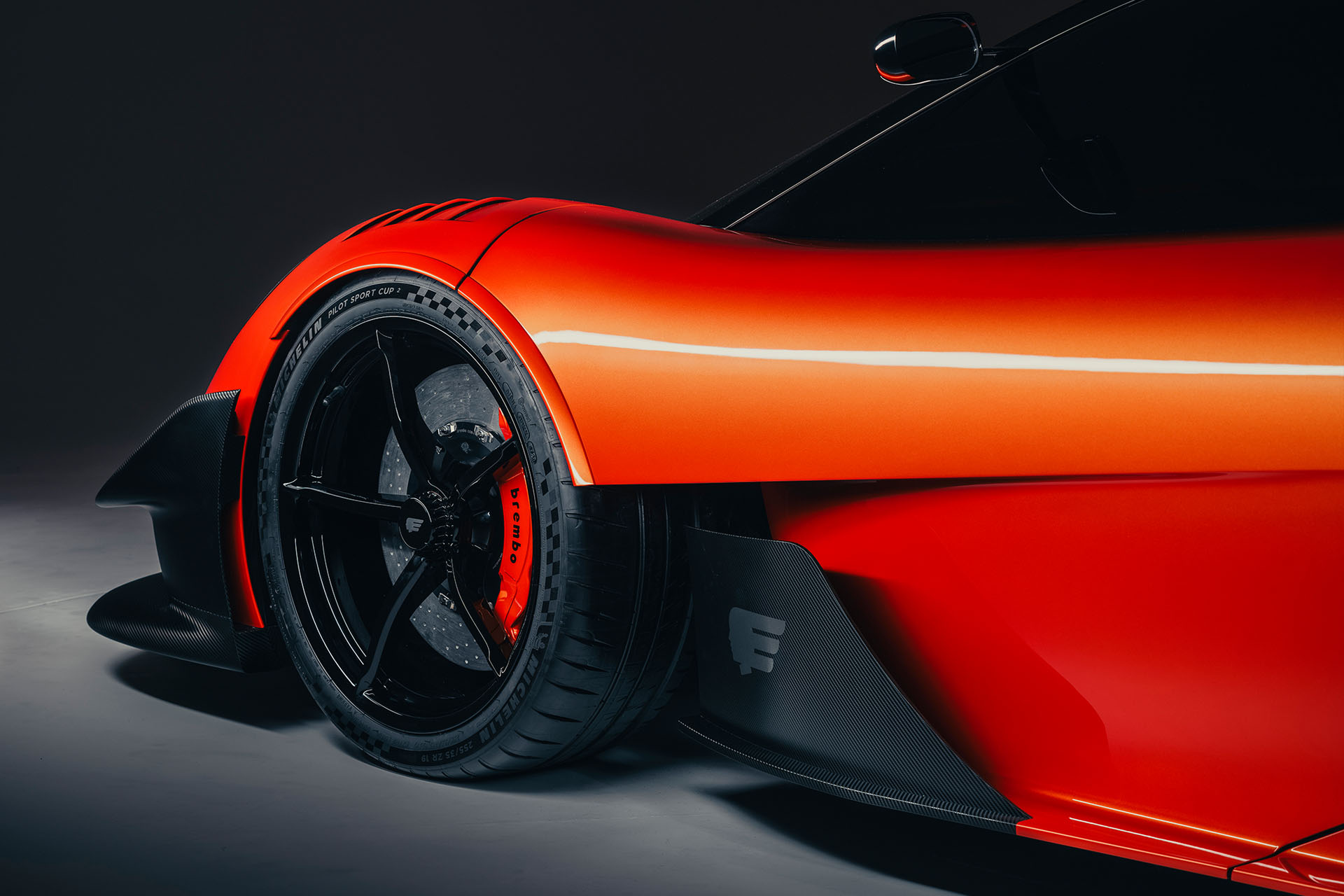
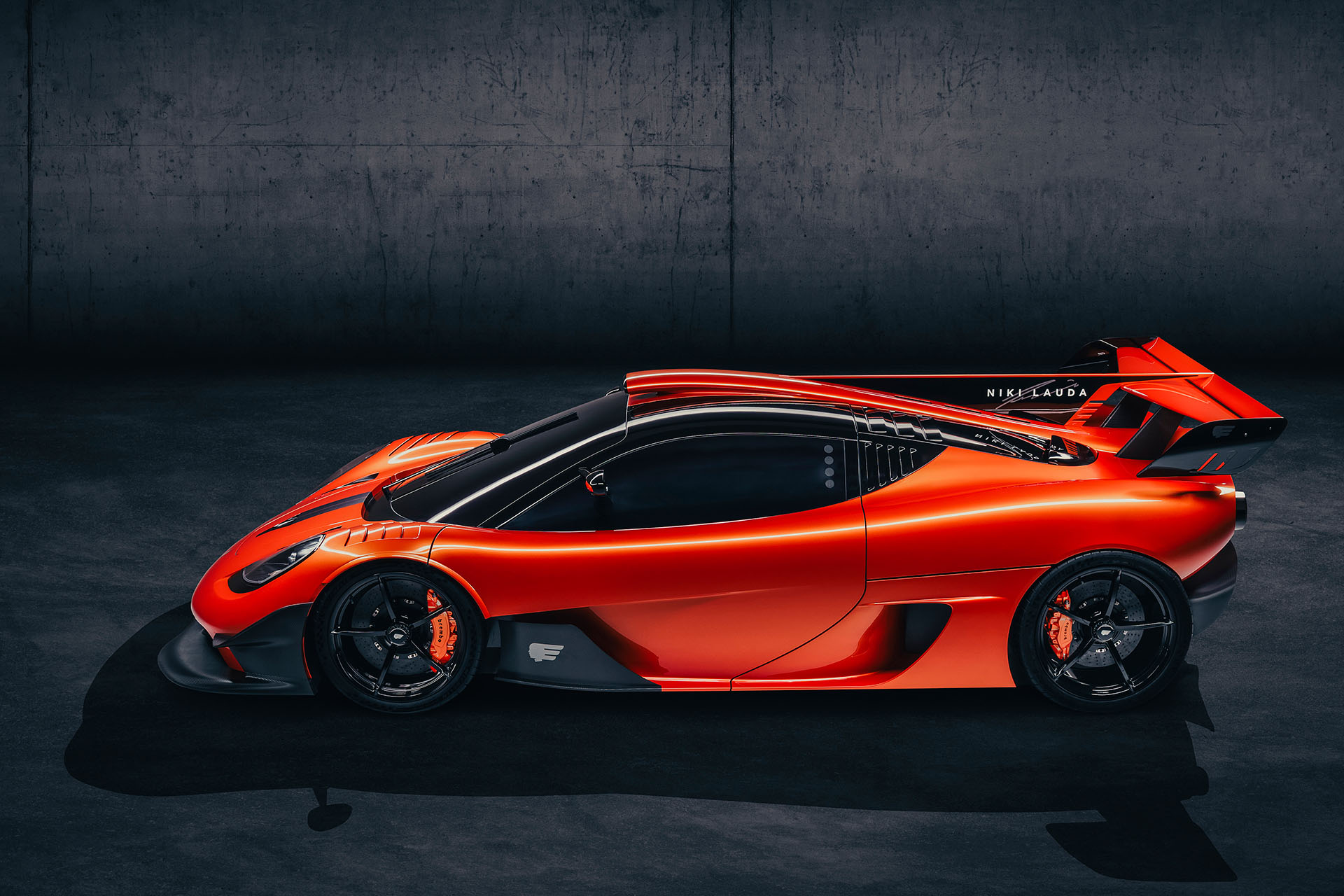
Gordon Murray Automotive has revealed its limited edition T.50s Niki Lauda Supercar developed in parallel with the T.50 and engineered for ultimate on-track performance experience.
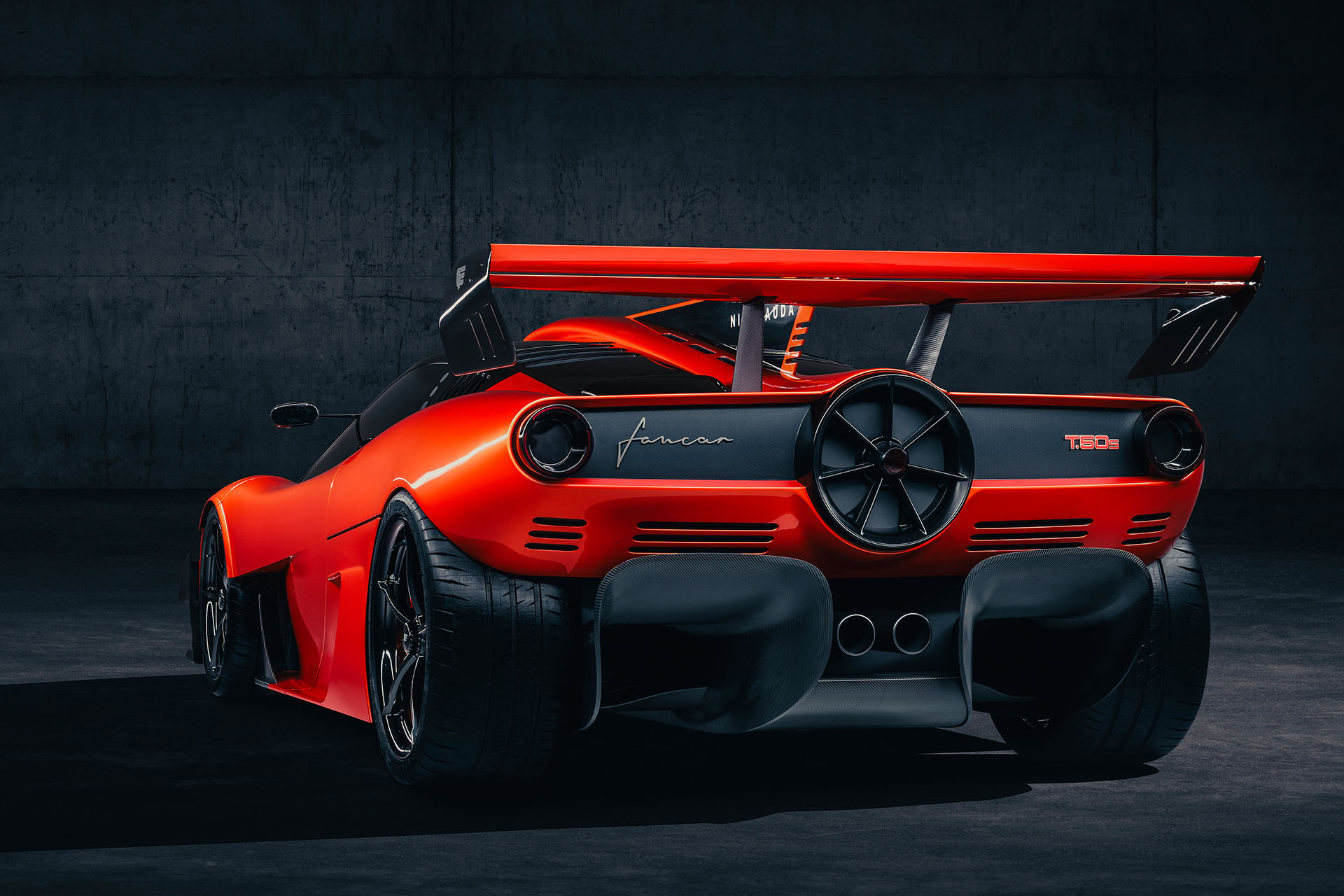
The T.50s Niki Lauda weighs 852kgs only and will be powered by a Cosworth-engineered 3.9L V12 Engine with an output of 725bhp, maximum torque of 485Nm achieved at 9000rpm and a rev-limit of up to 12,100 rpm with a new six-speed paddle-shift gearbox. The 400mm rear fan produces 1500kg downforce for best track performance. Top speed is approximately 200-210mph.
The Engine of the T.50s weighs 162 kgs, 16kgs lighter than the lightest V12 engine ever produced. In comparison, an AMG V8 Biturbo weighs over 200kg. The reduced weight improves the engine performance, intake, exhaust and control system.
A bespoke instantaneous gearshift six-speed paddle shift gearbox by Xtrac contributes to 5kg total weight reduction. Both the gearbox and clutch are electronically operated.
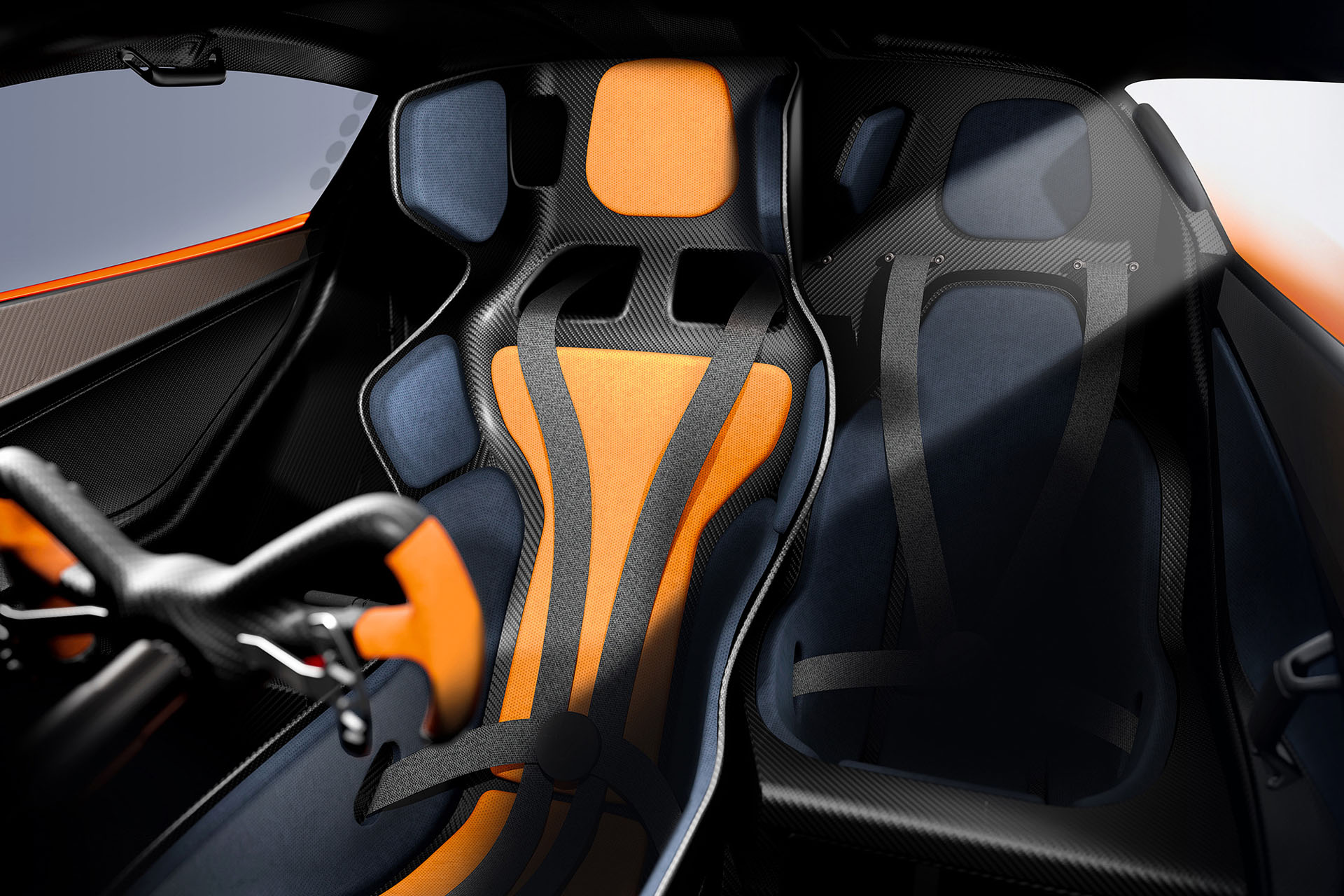
The exterior body is built around a light-weight carbon fiber monocoque and carbon fibre wrapped around a honeycomb aluminum core, passengers are protected by F1 style safety cells. Exterior body panels are all made of carbon fibre and the screens and windows use lightweight glazing. The interior consists of a race car oriented cabin, full racing carbon fiber driver seats with six-point harness and carbon fiber steering wheel.
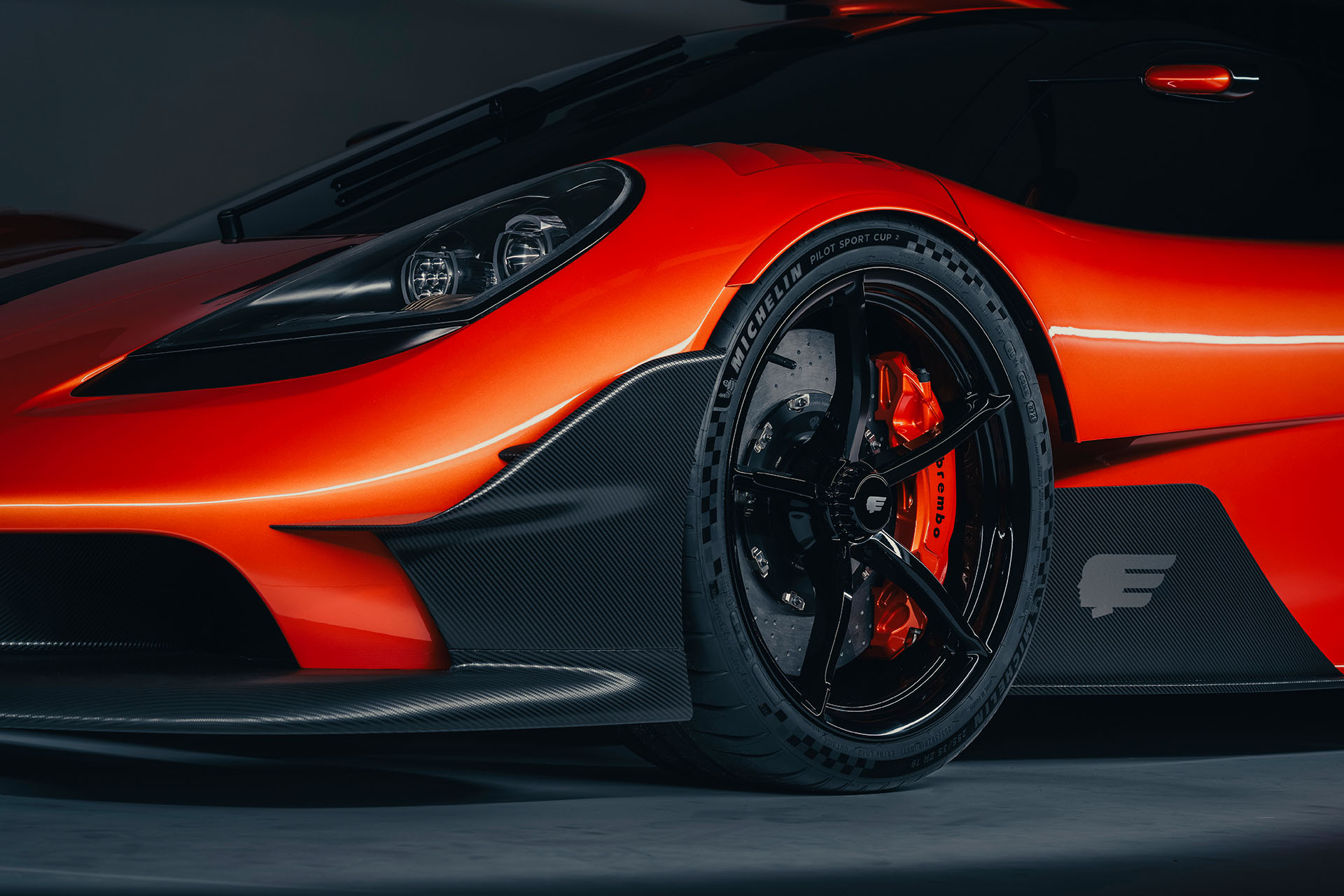
The vehicle is fitted with light Magnesium forged 18 inch wheels weighing 6kgs each and Michelin slick tyres that measure 250mm wide at the front and 300mm wide at the rear. A wet option is also available.
The springs, dampers and anti-roll bar have been provided to optimise track performance and have lowered the cars height to 87mm at the front and 116mm at the rear. Both the chassis settings and the aerodynamics are fully adjustable.
Gordon Murray T.50s
The T.50s Niki Lauda will be limited to only 25 units each priced at $4.3 million before taxes. Production is expected to start in January 2023.
February 23, 2021 / Comments Off on Gordon Murray T.50s is a $4.3 Million Track Only Hypercar – 25 Units Only
Formula One legend Niki Lauda would have been 72 years old if he were alive today. Though he died in 2019, we think he would have heartily approved of the new Gordon Murray T.50s, which will also be called the Niki Lauda as an homage.
That’s because Lauda drove the Brabham BT46B “fan car,” the Formula One car that inspired the T.50’s technological centerpiece, to its only victory. The downforce-generating fan helped Lauda win the 1978 Swedish Grand Prix to the dismay of rival teams. Murray also designed that car, and wanted to pay tribute to his friend and three-time F1 champ.
Like the Brabham, the T.50s is not street legal. It’s billed as a track version of the GMA T.50, the supercar Murray designed as a pure driver’s antidote to the status barges that modern supercars have become. The Lauda leans harder into Murray’s philosophy of lightness. Over 200 pounds have been stripped from the road-going T.50, thanks to one less passenger seat in the 1+2 layout, a stripped-out interior, and thinner glass. Total weight, 1,878 pounds.
However, reduced mass isn’t the only performance enhancement. The Cosworth-built 3.9-liter V12 now makes 725 horsepower, or 66 more ponies than the standard model. Part of that gain comes from a central roof-mounted intake drawing air into the engine, as well as the removal of any sound restriction hardware from the exhaust.
For the track model, one of the street T.50’s dearest features, an old-school manual transmission, has been replaced with a six-speed paddle-shift Xtrac. According to GMA, the gear ratios are more closely spaced on the race car, so a stick shift didn’t make sense; the driver would lose precious milliseconds switching gears and taking hands off the wheel.
The Lauda adds several aerodynamic aids that visually differentiate it from the T.50, starting with a wide lower air dam. A trio of NACA ducts funnel fresh air into the cabin and toward the front brakes. A long dorsal fin like the ones found on Le Mans prototypes extends from the cabin roof to the rear, where a GT-style rear wing spans the tail. According to GMA, it generates as much as 3,300 pounds of downforce at 175 mph.
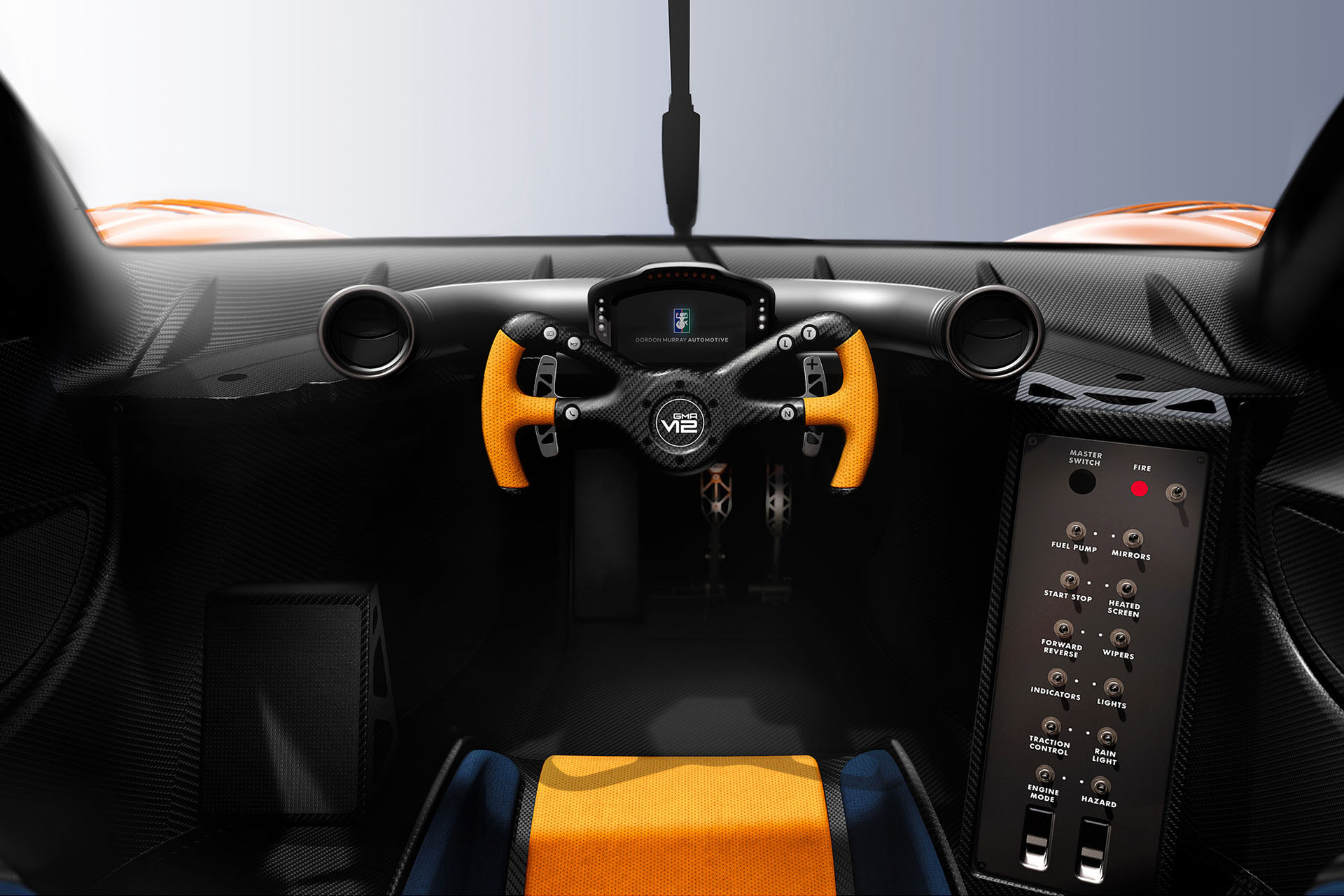
Inside, the central instrument pod has been replaced with a digital screen, and the standard steering wheel with a yoke-type handle. Taking the space on the right, where the manual shifter and console would have been, is a board of toggle switches.
There will only be 25 Niki Laudas produced. Each will feature a plaque celebrating a victory by one of Murray’s many F1 car designs, starting with the 1974 South African Grand Prix at Kyalami Circuit. Production begins January 2022, and despite a $4.3 million price tag, GMA says 15 cars are already spoken for.
February 22, 2021 / Comments Off on Gordon Murray unveils the 725-horsepower track-built T.50s Niki Lauda
Gordon Murray Automotive has just unveiled the T.50s Niki Lauda, a track-focused car that was developed in parallel with their T.50, the most driver-centric supercar ever built, the T.50s Niki Lauda has been conceived, designed, and engineered to offer the ultimate on-track driving experience.
T T.50s Niki Lauda weighs just 852kg and will be powered by a substantially redesigned version of the T.50’s Cosworth-engineered 3.9-litre V12, producing 725bhp, revving to 12,100rpm, coupled to a newly-designed Xtrac six-speed paddle-shift gearbox. And yes, the 400mm fan at the rear is still present, together with advanced aerodynamics to produce up to 1500kg of downforce for the best track experience yet.
Production has been limited to 25 units of the special T.50s Niki Lauda, each with an MSRP of £3,100,000 before taxes (about $4,400,000), and you’ll have some time left to come up with that kind of money as production only starts in January 2023, after the run of 100 T.50 supercars is completed.
Professor Gordon Murray CBE:“The T.50 is the ultimate road-going supercar, but I always dreamed of taking it one step further… to build a version that will deliver an on-track driving experience like no other car in history.”
With the T.50s Niki Lauda they had no interest in achieving the ultimate lap time or creating an over-engineered spaceship looking vehicle at the expense of the driver, the T.50s Niki Lauda can be driven by someone who isn’t a professional F1 driver, and still be able to get the best out of the car.
Just like an F1 car, and the legendary McLaren F1 road car, the T.50s Niki Lauda comes with a central driving position, and a high-revving V12 engine just inches behind the driver, delivering more than 700 hp. Maximum downforce has been set at 1,500 kg for a car that itself weighs less than 900 kg …this is a track-day beauty you can drive without an entire support team, just show up, and drive!
With 725 hp in a car that puts only 852 kg on the scales, you are looking at a power to weight ratio that’s better than a naturally aspirated LMP1 car, and it drives like an F1 car too … and with a 12,000 rpm engine and next to no silencers, it will scream like an F1 car too.
Starting with a car like the T.50 and making it even more impressive might not be a simple task, but Gordon Murray and his team managed just that when they created the T.50s Niki Lauda, and they still kept it classic. A massive central fin stretching from the top of the roof to the rear lip of the car, not only adds vertical stability at speed, but it also allows to show the Niki Lauda logo, a bigger rear diffuser, and a new rear wing, inspired by the front wing on Murray’s 1983 Brabham BT52 Formula One car, changes the looks even further from the road car.
Naturally at the front things were modified for the T.50s Niki Lauda too, improved airflow into the side intakes, but also a special splitter, all inspired by aerodynamics, in fact, not a single body panel from the T.50 road car has been used on this track-only version, the intention is to create 25 individual car by offering a plethora of choices for both paint and liveries.
While the T.50 also uses a Cosworth-designed V12 engine, the one for the T.50s Niki Lauda is almost completely different, capable of hitting the rev-limiter at 12,100 rpm, the use of a roof-mounted, RAM induction airbox can increase the maximum power output to 725 hp with a compression ratio of 15:1, maximum torque of 485 Nm is achieved at 9,000 rpm … and with a ‘straight-through’ exhaust you might want to consider earplugs.
At this point, the lightest V12 road-going engine weighs 178 kg, this new Cosworth GMA V12 puts only 162 kg in the car, this is achieved by using titanium valves, and no, there isn’t a variable valve timing system here because that would be too heavy, instead, there are 12 individual throttle bodies on top, fed by a race-inspired airbox. No catalytic converters, thin Inconel tubing, and small silencers … the T.50s Niki Lauda isn’t intended to be silent.
Gordon Murray and Dario Franchitti
A bespoke Xtrac IGS (Instantaneous Gearshift) six-speed paddle-shift gearbox is fitted, designed to fit the exacting packaging and weight demands of the T.50s Niki Lauda. As part of Xtrac’s efforts to minimize weight wherever possible, even the gears are lighter, contributing to a 5kg total weight reduction. Both the gearbox and the clutch are electronically actuated.
Ratios have been chosen to optimize on-track performance and driver enjoyment and engagement, delivering a top speed of approximately 200-210mph. A set of closer ratios optimized for shorter circuits will also be offered, allowing owners to make the most of all six gears via the steering column-mounted paddles. In this configuration, the T.50s Niki Lauda will reach around 170mph flat-out.
Just about the entire T.50s Niki Lauda is made from carbon fiber, from the lightweight carbon fiber monocoque to the bespoke body panels. The chassis is actually carbon fiber wrapped around a honeycomb aluminum center, there is even an F1-style ‘passenger safety cell’, while all the glass has been made thinner compared to the T.50 road car, to make this car as lightweight as possible, without compromising on safety.
The T.50 already comes with Brembo sourced carbon ceramic disk brakes (six-piston 370mm x 34mm front/ four-piston 340mm x 34mm rear), and with their 3.5G deceleration, they were deemed enough for the T.50s Niki Lauda, for the latter they did add modified ducts for better cooling. Covering these impressive brakes are bespoke, 18-inch forged magnesium, center-lock wheels that wear Michelin slicks, 250 mm at the front and 300 mm at the rear (25/64 18” and 30/68 18” respectively) … naturally ‘wet track’ tires are also possible.
Both the chassis and the aero parts on the T.50s Niki Lauda can be adjusted for a perfect balance on whichever track you want to tackle, by adjusting the fins at the front, and the rear wing, you can raise or lower the downforce, lowering the car’s ride height further increases it’s performance.
Professor Gordon Murray CBE:“When we first ran the CFD we were already ahead of our downforce target. At one point we were achieving 1,900kg of downforce, but we backed it off to 1,500kg to make the car more manageable for the owners.”
The T.50s Niki Lauda comes with a central seating position, the ‘pilot’ has a full racing carbon fiber seat with minimal adjustment, secured by a six-point harness. But the T.50s is a two-seater only, there is a fixed passenger seat to the left of the driver, which also comes with a four-point harness, but on the right side of the driver, you’ll find a fire extinguisher system and a vertical switchgear panel inspired by the McLaren F1 GTR. You can even order the T.50s Niki Lauda without a passenger seat to really turn it into a lightweight race car.
The dashboard inside the T.50s Niki Lauda consists of a single digital screen showing essential data on the car itself and the high-revving V12 engine, added with aero info, the gearchange indicator, telemetry, lap time, tire pressures/temperatures, g-forces, and a camera video feed.
Professor Gordon Murray CBE:“Engineering the ultimate track-focused supercar has to start with the driver. It was essential that we retained a central driving position, with every control arranged within easy reach and with no distractions or unnecessary information on display. And in my opinion, you don’t get a better view than that from the central driving position, one which allows you to place the T.50s Niki Lauda with millimeter precision on any circuit. You are left with nothing to take away the pure pleasure of pushing this car as hard as you can on your favorite race circuit.”
By now you probably gathered this new T.50s was named after a Formula One legend, none other than three-time world champion Niki Lauda, but it doesn’t end there, each individual car will be named after one of Gordon Murray’s Grand Prix wins on different circuits. The first car will be designated Kyalami 1974 and further cars will be named after the 24 subsequent wins in chronological order. Each car will also come with a specially commissioned book about the race that it is named after, with Murray’s view and memories of the victory.
Each of the 25 individually specified cars will be bespoke, both in setup and in the choice of colors and liveries, a Trackspeed package will also be included which comprises both engineering support and all the equipment needed to run the car at a track, including a full set of pit tools and refueling equipment. Each customer will receive a track day so that ‘his’ car is configured perfectly to their driving style and capabilities.
February 22, 2021 / Comments Off on The T.50s Niki Lauda
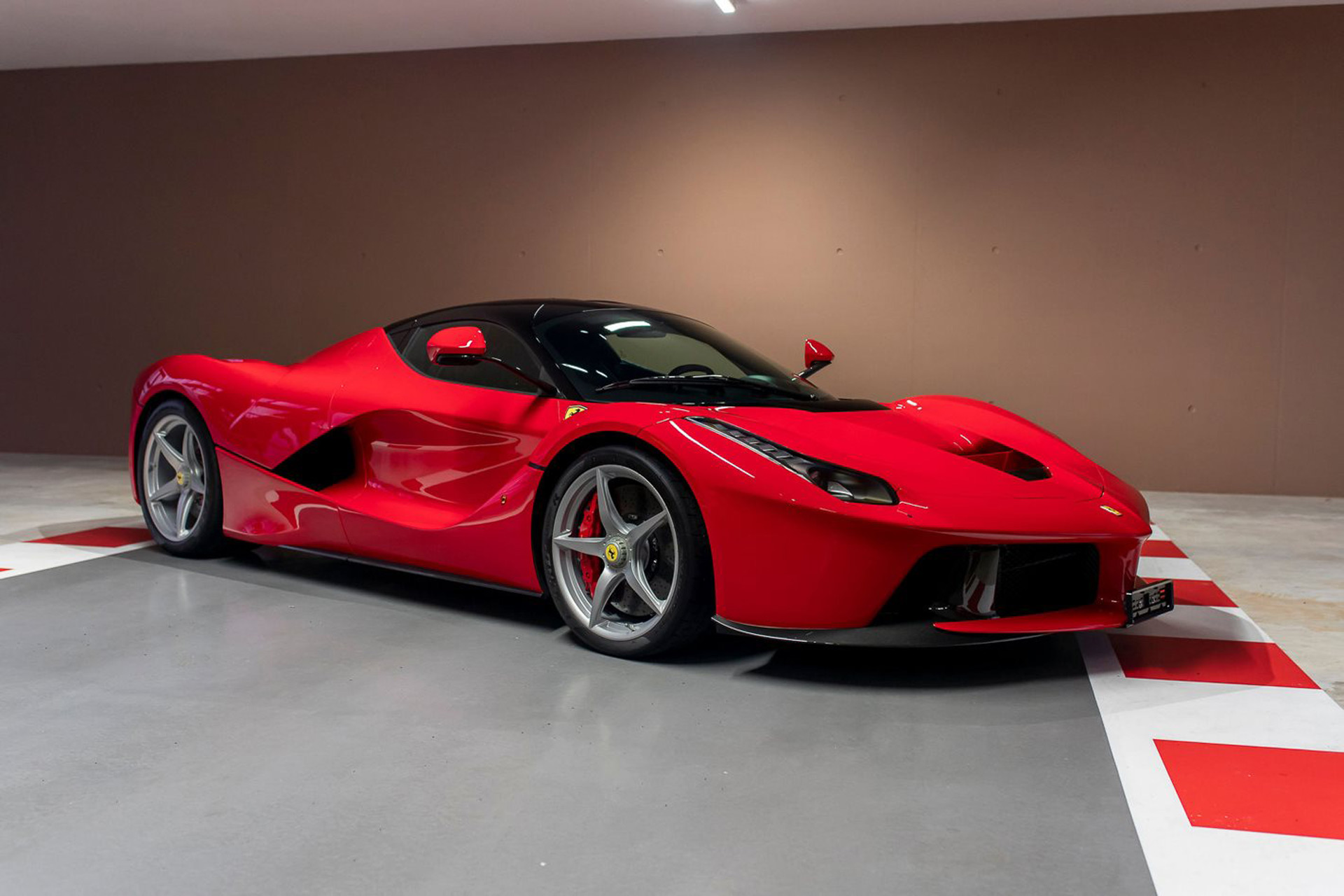
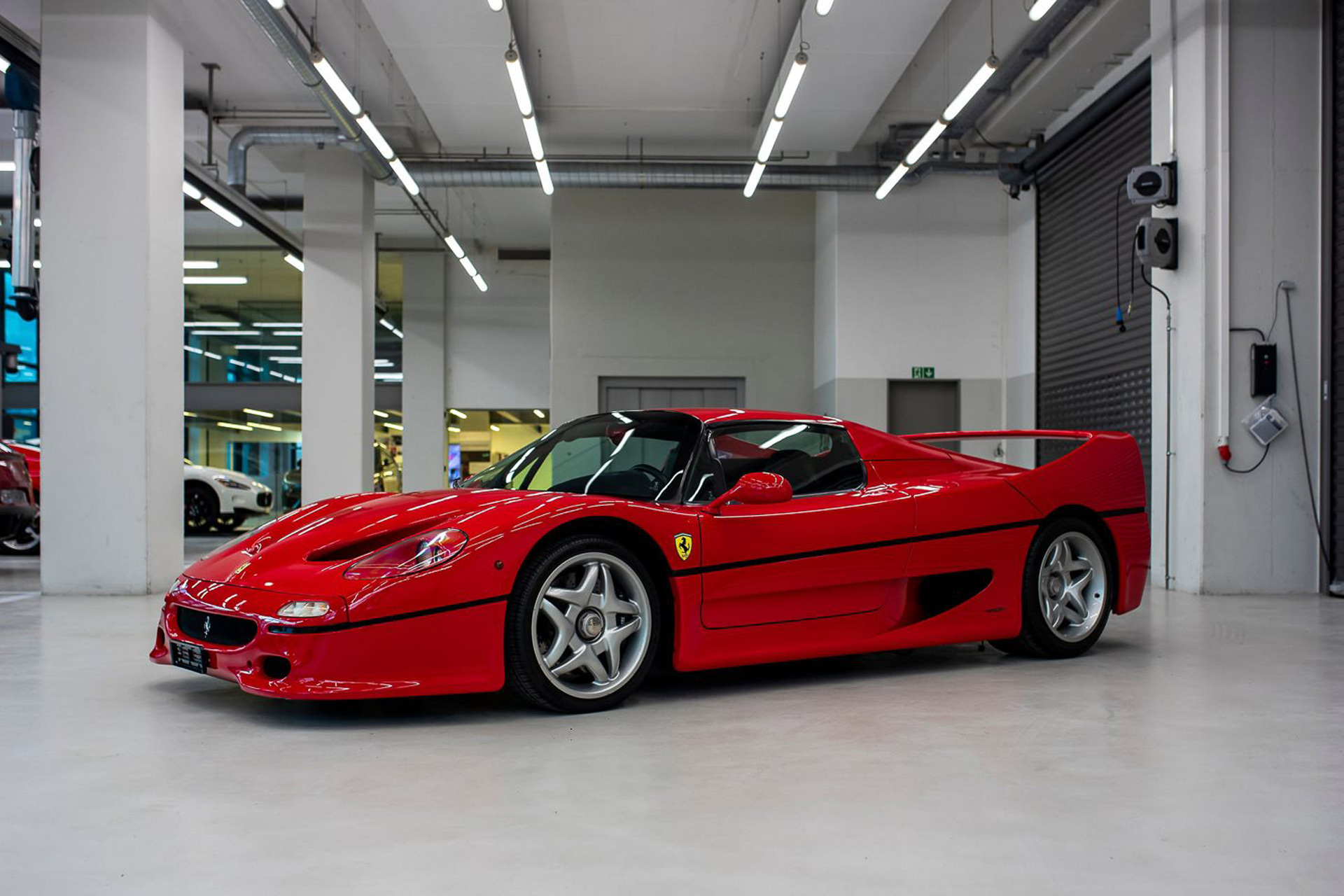
After finishing the worst year of his F1 career, four-time world champion Sebastian Vettel will no longer be racing for Ferrari. He will also be cutting ties with his amazing Ferrari collection he had gathered throughout the years. He will begin a fresh start for the 2021 season with Aston Martin.
Vettel’s Ferrari collection currently rests in Switzerland at his home and they are now for sale through veteran supercar dealership Tom Hartley Jnr located in the United Kingdom.
Though the split between Vettel and Ferrari is said to amicable, it does seem like Vettel is throwing away all memories and making way for his new love. This comes as no surprise as the Ferrari’s in his collection were acquired after his start with the Italian F1 team in 2015.
Image from: Tom Hartley Jnr
Vettel has also been seen sporting the Aston Martin DBX SUV in promotional footage. He could be making room for some new British supercars in the near future.
Vettel will be driving alongside Aston Martin teammate Lance Stroll. Aston Martin will be unveiling its new F1 car on March 3rd and complete official testing on March 12-14. The first race of the F1 season will be the Bahrain Grand Prix on March 28. Ferrari has since replaced Vettel with Carlos Sainz who will be alongside Charles Leclerc for the 2021 F1 season.
February 22, 2021 / Comments Off on Vettel Sells Ferrari Collection for a Fresh Start with Aston Martin
Rumors started circulating last year that the next C63 AMG will no longer feature the beloved V8 that has powered AMG cars for years. It was even reported that the then CEO Tobias Moers stormed out of the the very meeting that sealed the C63’s fate. A few weeks later Moers stepped down as CEO of AMG before moving to Aston Martin, again as CEO. Here, he gets to work with his former love child, the 4.0L AMG V8 Biturbo that powers the current lineup of Aston Martin V8 cars including the new DBX SUV.
Speaking to Automotive News Europe, W206 chief engineer Mr. Christian Früh was quoted saying: “With the 3.0L (straight-six M256) engine, the front end would have grown by 2 inches in length, not to mention the higher axle load and its impact on driving dynamics.” While he never mentioned the AMG variants specifically, one can easily join the dots and realize that the entire W206 Class lineup will not have an engine exceeding 4 cylinders.
The key reason seems to be weight and dimensions, which was quite expected. A C63 AMG powered by a straight six hybrid would result to a heavier car than the successor. Additionally, they plan to have AWD in the next C63.
they probably didn’t want a I6 turbo + hybrid as it would have been too heavy…so a smaller 4 cylinder + hybrid = 550hp+. Personally at this stage i would rather get a Model 3 Performance and call it a day?
BMW has used straight 6 engines in the rival M3/M4, and most recently adopted AWD for the first time. A genius system that was first used in the F90 M5, it behaves like a 4×4 with a transfer case thus allowing the driver to switch from RWD to AWD and vice versa. Unlike Mercedes, the Bavarian brand has no problem with weight, largely because they have mastered it over the years with only one switch to a V8 during the E90-93 M3 era.
Mercedes on the other hand ditched the M276 V6 that was formerly used on mid tier performance cars like the E43/450 AMG and the C43/450 AMG. A new M256 straight 6 has been in production since 2017, and is now used on 53 AMG models and on cars that previously had the V6. Popular cars like the S500 were known for a V8, but now feature a straight 6 with a V8 only available from the S580. While this engine is efficient and potent enough, it doesn’t seem very compact especially on smaller models like the C-Class, as Christian Früh explained.
Writing on the Wall
The rumors did not come as a surprise however, industry trends had already put petroheads on notice for the longest time as downsizing of engines became prevalent in the 2010s. Tight emission rules culminating to the diesel gate event further accelerated the hybridization of engines and most importantly the quick roll out of EVs from almost every car manufacturer.
Mercedes has already launched an EV variant of the popular GLC suv (EQC) and most recently the EQA which represents the EV variant of the GLA suv. In addition, their lineup now features a mild hybrid 48V setup found on several models such as E53 AMG, CLS 53 AMG just to name a few.
We put you on the Map
See, even a switch to a straight six would not have gone down well with the enthusiasts. AMGs are not known for sprinting down the drag strip quicker than a GT-R, or putting down quicker lap times faster than a 911, no. AMGs have always been known for their bold character, the ability to cause a stir even by pulling next to a Ferrari thanks to it’s unique sound. Anybody can make a V8, Americans make the most popular V8s in the world, but AMG goes above that by making the best cars with a V8. The Best or Nothing as they say.
However, the AMG cult did not just grow out of thin air. Over the years enthusiasts have helped build the brand from a small town German tuner to a global mammoth. Before social media could spell the term “woke” or learn how to write “climate” without missing the “ate” through typos – forums were brimming with this newly found joy of big V12s and V8s in the 90s. The original love for AMG by the people came from V8s, whether it was a big 6 liter SL60 AMG or an E55 AMG – there was always more room for a V8. There was no replacement for displacement, the menu came with two items only, a V8 or a V12.
And even when times started catching up with big engines, downsizing was still done in an acceptable fashion. They ditched the lovely 6.2L V8 that was featured in models such as the W204 C63, SLS AMG, S63 and so on. The 6.2L era took the Black Series badge to the moon, a badge that is now used on $400,000+ models like the new AMG GT Black Series. It was followed by the 5.5L Biturbo era, loved and adored across the world before the 4.0L era kicked in. The same enthusiasts made sure that these transitions were well accepted within the community.
And before you knew it, your favorite 2-car garage had an AMG and something else, a Ferrari maybe.
Big Grilles vs Cylinder Castration
Recent times have seen car makers make bold decisions, and some have not been received very kindly. BMW’s move to big grilles was seen as an abomination by many owners, but BMW stood by their decision insisting this is the way to their future image.
Now, this seems like nothing compared to the cylinder castration about to go down at AMG. The C63 losing 4 whole cylinders is a huge disappointment. But it is expected, many will follow this route as the scare towards a full EV industry continues to roam around us like a hungry pack of wolves.
The M3/M4 vs C63 rivalry will still go on regardless, and there will be compromises to be made by the buyers. You will have to choose a massive grille or a castrated AMG.
the scare towards a full EV industry continues to roam around us like a hungry pack of wolves.
The Reality: Why Mercedes is Not Worried One Bit
The 4 pot used in the A45 AMG is currently the most powerful 4 cylinder engine in production with a max output of 421hp and 500nm torque. Mated to an electric motor this could very well produce 550-600hp and 700-800nm of torque.
New age buyers mainly care about numbers and performance, the marketing team at Mercedes will not lack a dot of sleep over who is mad about their cylinder castration. The reality is only a few people will get triggered by this move. The car industry has changed a lot, the good cars are only getting more expensive, the oldies (even those from the 90s and 2000s) are also appreciating very quick. R34 GT-Rs going for $300k is absurd, but also a true reflection of how the industry is changing.
The rich have no problem paying more for a loud V8 or V12 supercar.
The newly rich have no problem buying their favorite 90s car even if it means paying $300k more.
The average car enthusiast is just after numbers, and will eat whatever marketing feeds them.
The “i love cars yay” enthusiast is probably the largest group in today’s market. They drive sales up and keep executives happy. Ask them the difference between a C43 and a C63…”wat-eva, aren’t they both AMGs?”. They will ride the badge till they die, not for love but for the status. To make them happy, car makers will dish out a few badges even on non performance models. It’s a symbiotic relationship that allows these enthusiasts drive “cool” cars and in return any complaints or criticism to the brand is buried by an overwhelming wave of yes riders praising the brand till kingdom come. Do you know why the market is full of aftermarket bodykit conversions? Allowing your diesel C class to look like a C63? – I love cars.
The triggered car enthusiasts are very few in numbers, nothing they say or do matters anymore. The forums are empty, they lost their passwords as Windows 2000 is no longer supported. The only thing they can do is scramble for coins, buy a used W04 C63 and straight pipe it…drive it once in a while and live to repeat one sentence to their grandchildren “they don’t make them like they used to”
The future car enthusiast will not care about that sentence, they will not have to deal with oil changes or the smell of an engine after an early morning boost. They will simply not give two poops about what stories The triggered will have for them.
It’s Not Done until It’s Done
My faith in AMG still stands as much as the rumors and pointers all show a common direction. I want to believe that a V8 C63 still has one more life run, and that the future is not yet here until research proves hydrogen (or something else) is a viable fuel option for the ICE. Denial is better than giving up.
When you are a high-net-worth individual, life is different compared to other people, you’ll probably live inside a large mansion with security guards and camera surveillance, and when you leave this compound, you’ll be driven around inside an armored vehicle, most likely even with one or more additional cars around you.
The BRABUS INVICTO LUXURY
You can opt for one of the Mercedes-Benz Guard versions, the world’s widest ex-factory range of special protection vehicles … or you can turn to Brabus for one of their Invicto models, a series made up of three different versions to cater to the customer’s wishes, discreet, rugged, or luxuries …
All three versions come with the ‘Invicto Shelter Cell’, a self-contained, self-supporting and bolted-down protective cell. In addition, there are further protective elements that are in part produced using a special 3D printing process and, of course, all-around extremely tough bulletproof glass.
Based on the Mercedes-Benz G-Class, the Invicto can resist 7.62×39 caliber bullets, used in the AK-47 for instance, but also being hit with hand grenades, and even 12.5-kilogram PETN explosive charges, this certifies the Invicto per the VPAM BRV 2009 and VPAM ERV 2010 standards, all while remaining discreet, and nearly invisible from the outside.
The BRABUS INVICTO bulletproof glass
Sometimes this kind of car requires making a fast getaway when faced with intrusion, therefore the BRABUS Invicto comes with a special suspension and high-performance braking system to cope with the additional weight of the armoring, but the 20-inch Invicto wheels come with special run-flat tires.
Because of the required performance, BRABUS advises using either a Mercedes G500 or the G63 as a base for their €345,600 Invicto protection package, but it can be ordered with other gasoline engines from the G-Class model range.
The armor meets the VR6 Plus ERV standard, the same standard that protects many limousines of heads of state, to meet the requirements the doors and hatch are now fitted with new protective elements, all the glass is replaced with extra tough bulletproof material, which required an innovative structure for the frames to be developed by BRABUS.
The BRABUS INVICTO Shelter Cell
The Invicto Shelter Cell is unlike other vehicles where the armor is retrofitted, this BRABUS system is a self-contained, self-supporting, and bolted-down unit. This design makes it possible to put it into the body shell of the G-Class part by part and then assemble and fasten it. To this end, the company manufactures precise-fit, hot-rolled steel armor plates and additional protective elements made from materials such as carefully selected fabric and fiber structures as well as from ceramic and metal composite materials.
Among the many special constructive features of the “INVICTO Shelter Cell” is the fact that there is no narrowing of the door openings whatsoever. Getting in and out of the vehicle comfortably is crucial for many owners of a G-Class. In addition, the protective cell has a zero-gap design. This means that the individual components of the armor are installed without any gaps between them, which is of elementary importance for providing maximum security under small arms fire or an explosive attack. This is achieved by means of material overlaps and the so-called labyrinths.
The BRABUS INVICTO PURE
Surprisingly enough, the entire BRABUS Invicto protective armor only adds about 1,000 kg on top of the base Mercedes-Benz G-Wagon, but it still required both the front and rear suspension to be completely modified by the BRABUS engineers, even the frame of the G-Wagon needed to be reinforced at key points to support the additional weight, but still be agile enough for maximum security and durability.
A high-performance braking system with vented 402-millimeter discs and six-piston brake calipers at the front as well as 380-millimeter rotors and four-piston brake calipers on the rear axle is another major factor in the outstanding active safety of the INVICTO.
BRABUS fits Invicto 9.5×20 inch wheels specifically developed for the higher wheel load rating, large 275/50 R 20 W113 high load rating tires are fitted, BRABUS even developed a new run-flat system for their Invicto, even with completely destroyed tires, this car can continue for another 50km at a speed of 50 km/h.
The BRABUS INVICTO PURE
The BRABUS INVICTO PURE
This model has been created by BRABUS for those customers that need protection, but don’t want to stand out in traffic, the Invicto Pure looks exactly like a factory original Mercedes-Benz G-class … this is protection in her purest form, both the exterior and the interior of the Invicto Pure are visually unchanged.
The BRABUS INVICTO PURE
The only visible changes are the new Invicto wheels in 20-inch, required to fit the BRABUS run-flat system, but other than that, this version is “undercover” as much as possible.
The BRABUS INVICTO MISSION
The BRABUS INVICTO MISSION
The Invicto Mission edition is not intended to have the high-net-worth individual in the rear seats, this version is made for the security guard companies that accompany that person, possibly even armed forces, or police and emergency services. Based on the Mercedes G500 or G63, the Invicto Mission includes not only the 20-inch off-road tires with the run-flat capability and a winch at the front this edition also comes with a powerful LED headlamp assembly at the front of the roof rack, flashing beacons behind the windshield, remote-controlled rotating searchlights at the rear, and even an armored escape hatch on the roof.
The BRABUS INVICTO MISSION
The original seats have been replaced by four custom bucket seats, designed in such a manner they allow the security detachment to wear protective vests inside the vehicle, five-point seatbelts keep them in place, even during high-speed, spirited driving.
The BRABUS INVICTO MISSION
But the Invicto Mission doesn’t stop there, it comes complete with a fresh air system with NBC filter for the interior, or how about an infrared package complete with night-vision together with an elaborate monitoring and navigation system, even the doors and backrests are fitted with the MOLLE system (Modular Lightweight Load-carrying Equipment) to secure equipment.
The BRABUS INVICTO MISSION fresh air systemThe BRABUS INVICTO MISSION
The BRABUS INVICTO LUXURY
The BRABUS INVICTO LUXURY
This is the most exclusive version in the Invicto series, based on either Mercedes G 500 or the Mercedes-AMG G 63 with a 4.0-liter twin-turbo eight-cylinder engine and 430kW / 585hp, this model offers 850 Nm of torque to offer impressive active safety, the 20-inch run-flat tires do require a limitation of the top speed to 210 Km/h.
The BRABUS INVICTO LUXURY
The Invicto Luxury also stands out, this is not the model for the owner that wants to travel unseen, incognito … BRABUS fits the WIDESTAR body on this model, optionally even with clear carbon fiber components, remember the Invicto Shelter Cell sits on the inside, which gets refined with a BRABUS interior made from the finest leather and Alcantara to suit the owner’s personal color and design preferences.
If the owner wants to have some more power to get out of any dangerous spots, he or she can opt for the BRABUS 800 engine, with an output of 588 kW / 800 hp at 6,600 rpm and a peak torque of 1,000 Nm at a low 3,600 rpm.
The BRABUS INVICTO LUXURY
It is clear BRABUS isn’t focusing on their usual customer that wants to turn a standard, factory Mercedes-AMG into a high-performance supercar with their Invicto model, this car is intended to offer the best protection possible for those that require it … but still want to travel in style.
The INVICTO special protection vehicles as per VR6 Plus ERV standard are built in small-series production at the plant of BRABUS Automotive in Bottrop, and while these three versions should already cater to the most discerning customer, BRABUS is always open for individual requests, as long as it doesn’t jeopardize the initial goal: protection and driving safety.
February 21, 2021 / Comments Off on The BRABUS Invicto
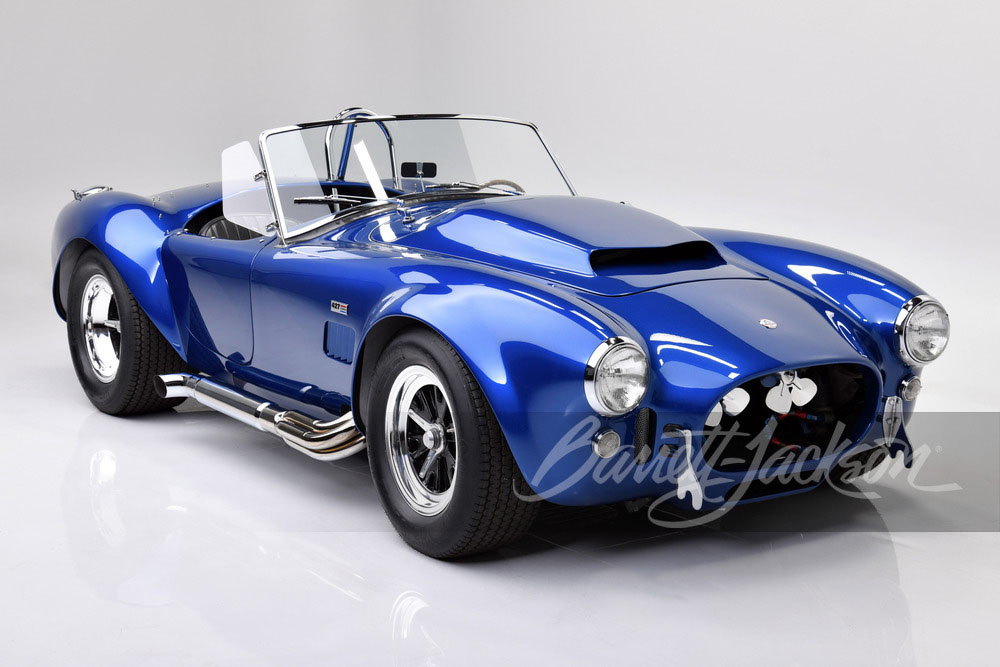
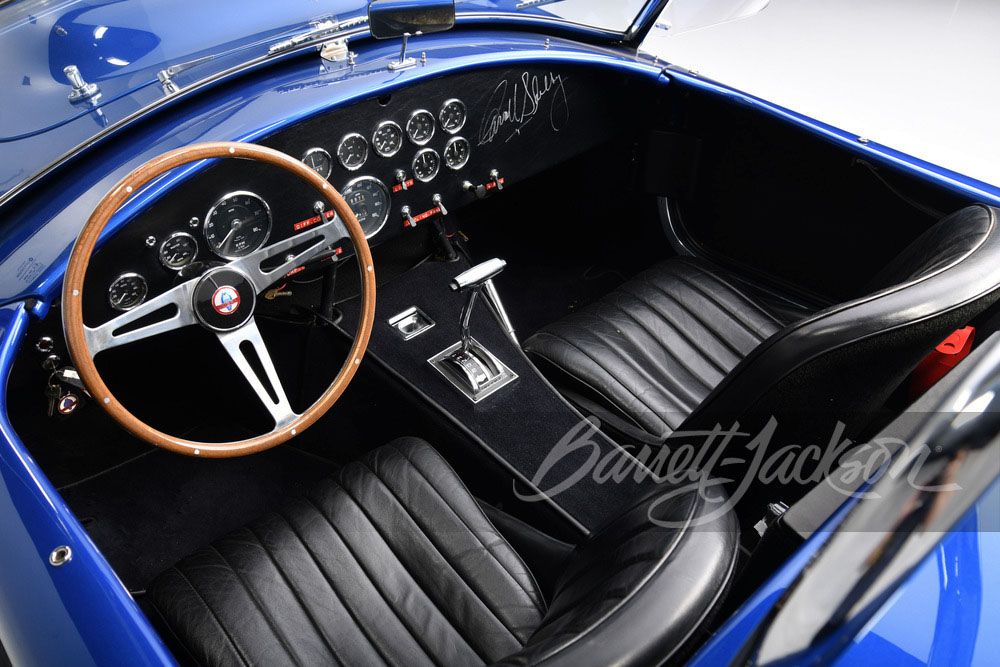
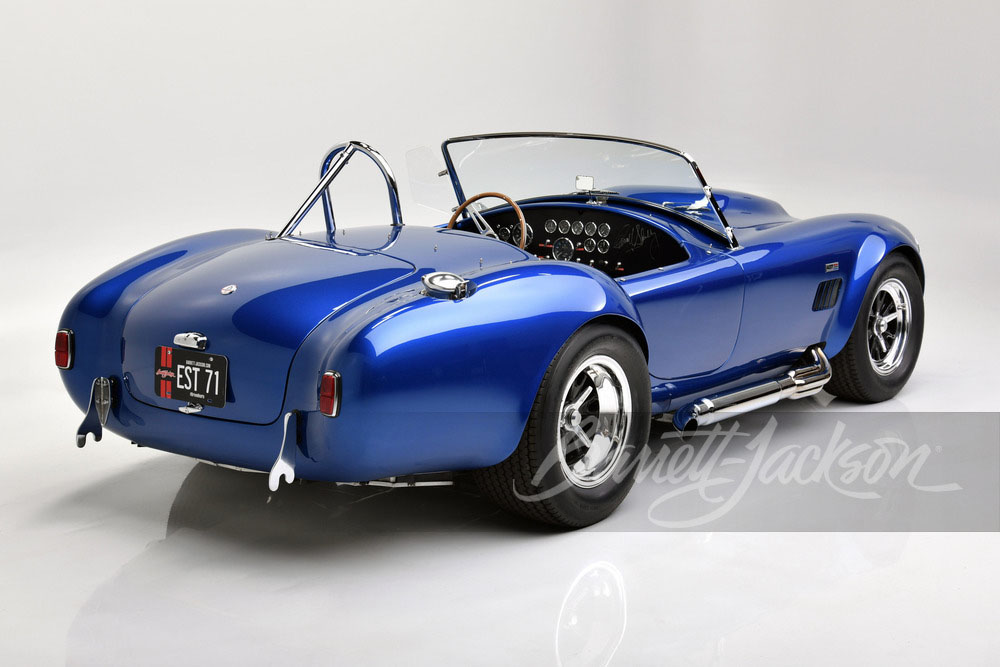
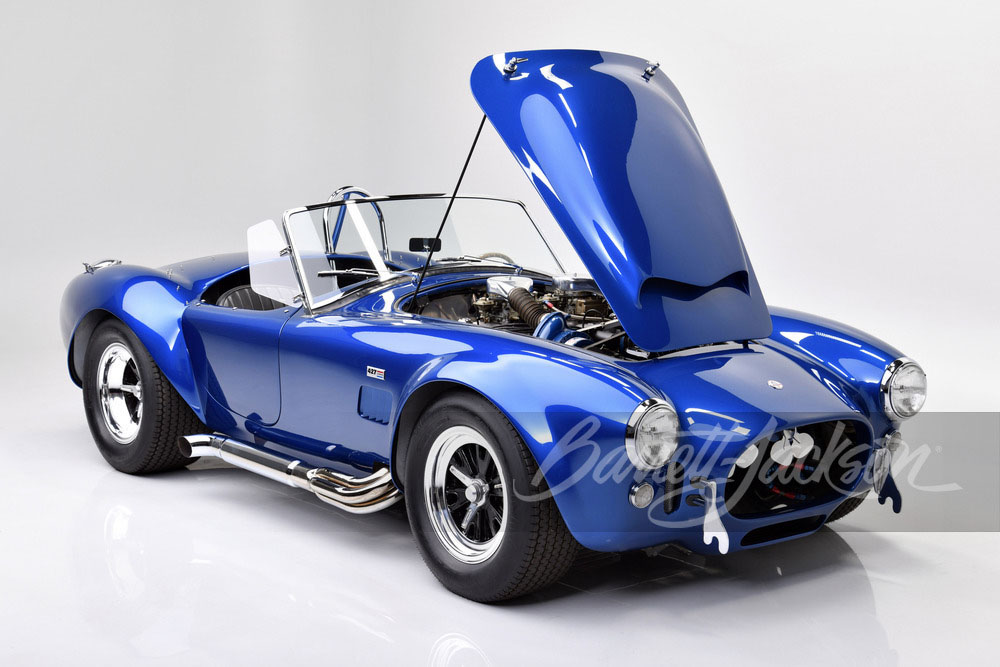
I have to admit, I rather like the Shelby Cobra, putting a massive V8 engine into a lightweight body, styled like these are … a Cobra looks sexy. And they are demanding a serious bank account to add to your garage, just read up on our story on Carroll Shelby’s personal 427 Cobra Chassis CSX3178, that sold for $5,940,000 at the Mecum Kissimmee auction in January 2021 … but this one might fetch an even higher bid at the Barrett-Jackson Scottsdale Auction in late March .
This car is a unique Cobra, CSX 3015 is one of only 23 original 427 Competition Roadster, and it is the only surviving 1966 Super snake, back in 2015 this specific car sold for $5,100,000 at auction, we’re six years down the road now, so chances are this Guardsman Blue beauty will be even more expensive this time around.
Craig Jackson, CEO of Barrett-Jackson:
“This is the ultimate, it was made to go kick Ferrari’s ass on the street after just doing it on the track.”
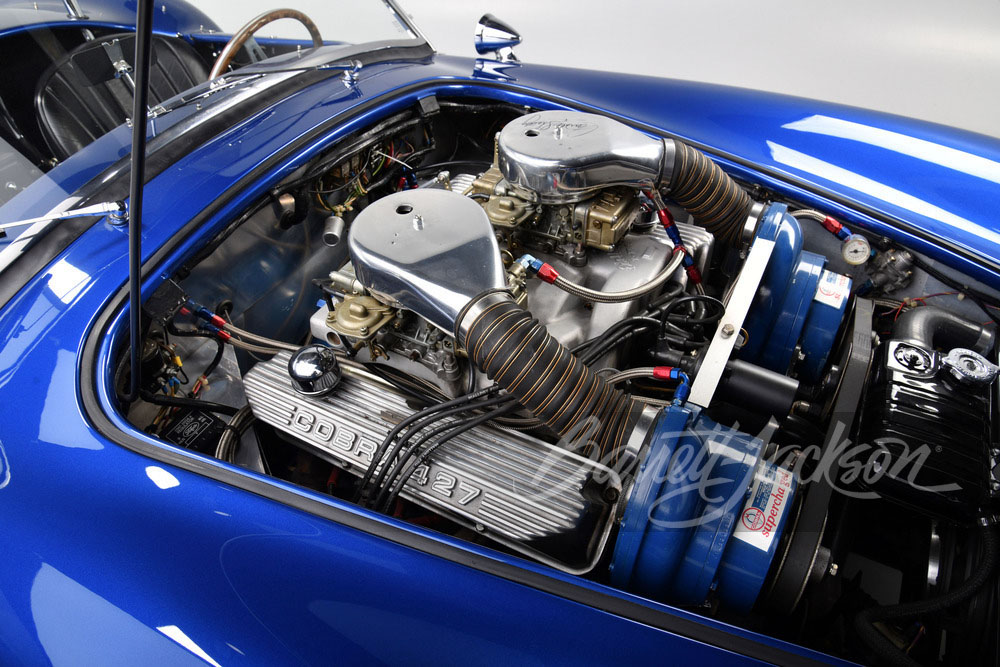
Not only does this specific Shelby Cobra come with a 427ci V8 engine, it also has two Paxton superchargers fitted by Caroll Shelby himself, because of the massive power, he also had to fit a 3-speed automatic transmission … this Super Snake was fast … extremely fast … 190 mph is no problem at all behind the wheel of this Super Snake.
Chassis CSX 3015 was actually shipped to the UK in September 1965, together with CSX 3014 and two R-model Shelbys, both CSX chassis were original 427 Competition roadsters, these didn’t have mufflers, nor a windshield, nor any bumpers, these were Competition models, race cars … and these weren’t street legal.
The CSX 3015 came back from Europe in late 1966, still in her factory original Competition form, but in 1967 Caroll Shelby turned her into a Super Snake, and turned her into a Cobra 427 SC model (for Semi-Competition), adding mufflers and a windshield, thus making the car legal to drive on the open road. In fact all Cobra 427 SC models were street-legal, but most of them only saw a track during their lifetime.
There was a second Super Snake built, based on a 1967 427 road car, chassis CSX 3303 was initially a public relations car, but Shelby America converted her into a Super Snake too, sold to a dealer in San Fransisco after which she ended up with Tony Maxey … unfortunately both Tony and CSX 3303 got involved in a serious, lethal accident, the car was a total-loss, which makes CSX 3015 the only Super Snake in the world.
Today chassis CSX 3015 is considered a genuine Competition roadster with original body (which is different from other Cobra 427 SC models), and includes the 1967 Super Snake hood, the Girling CR and BR calipers are still date coded to 1965, and the original 377 rear end with oil cooler and pumps are genuine 427 Competition spec.
The 5m17 427ci V8 engine block is date-coded to December 17, 1965, with the original headers and those impressive, chrome side pipes … the estimate for this unique Cobra 427 Super Snake is set between $5,000,000 and $8,000,000 … and I couldn’t have put it any better than Craig Jackson himself, when he stated:
“This car is a very special car, it’s Carroll’s personal car, one he built for himself. You just don’t get any rarer than that.”
February 20, 2021 / Comments Off on 1966 SHELBY COBRA 427 SUPER SNAKE
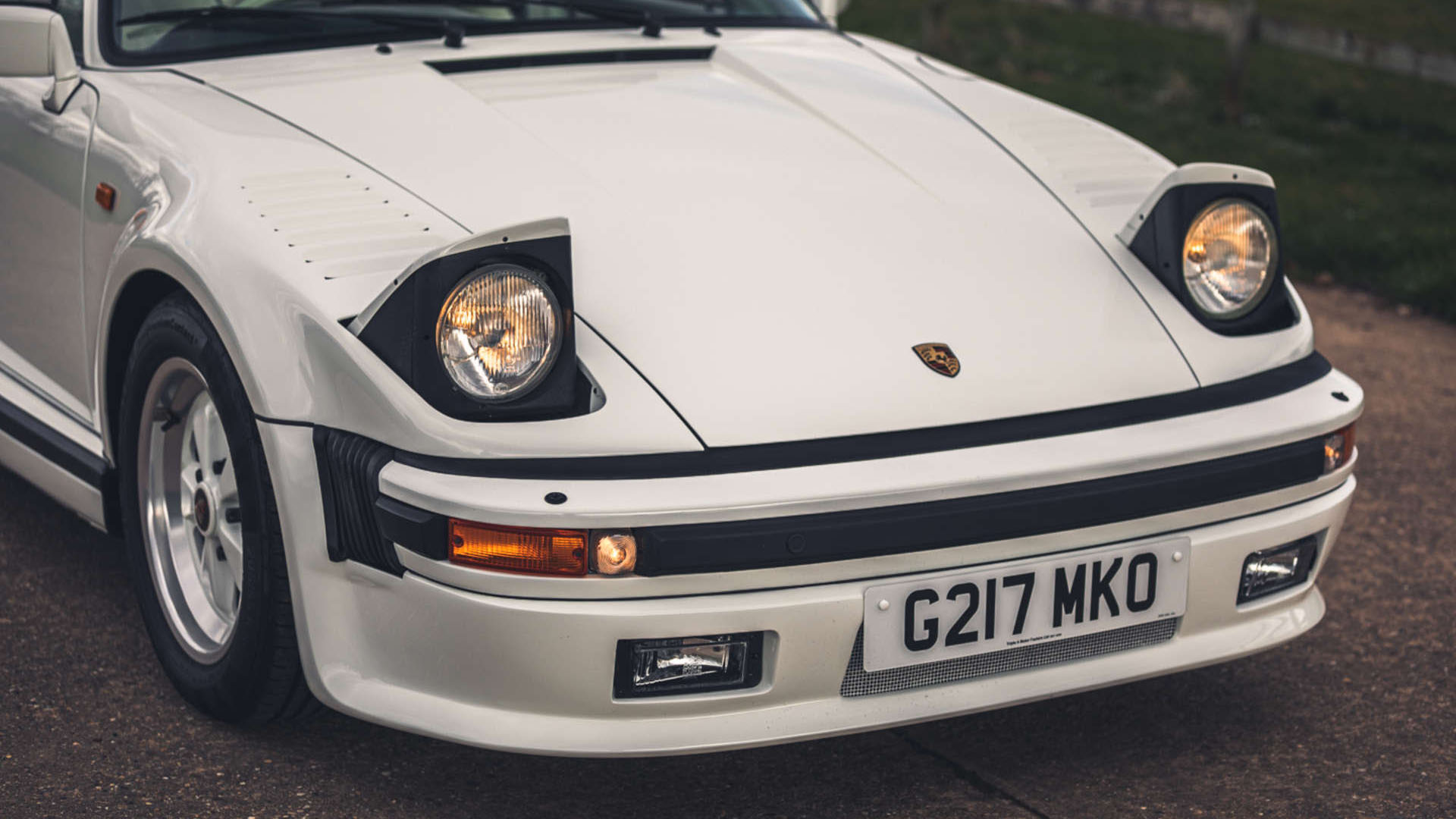
Anyone who followed the ‘World Championship of Makes’ (essentially an International championship for long-distance Sports Car racing), will remember their surprise at the shape of the new Porsche 935 when it first appeared at Mugello in March 1976. Subsequently, these ‘Flatnose’ 935s and 936s (in Group 6) were to prove very competitive in the hands of Ickx, Mass and Stommelen and during the next two seasons managed four victories in eight World Championship races and a triumph at Le Mans in each year.
However, Porsche began to worry that all these victories by the works Flatnose cars might alienate the vast number of private clients who were investing their own money in conventionally-shaped competition 911s, and decided to restrict their efforts for 1978 to an entry at Le Mans.
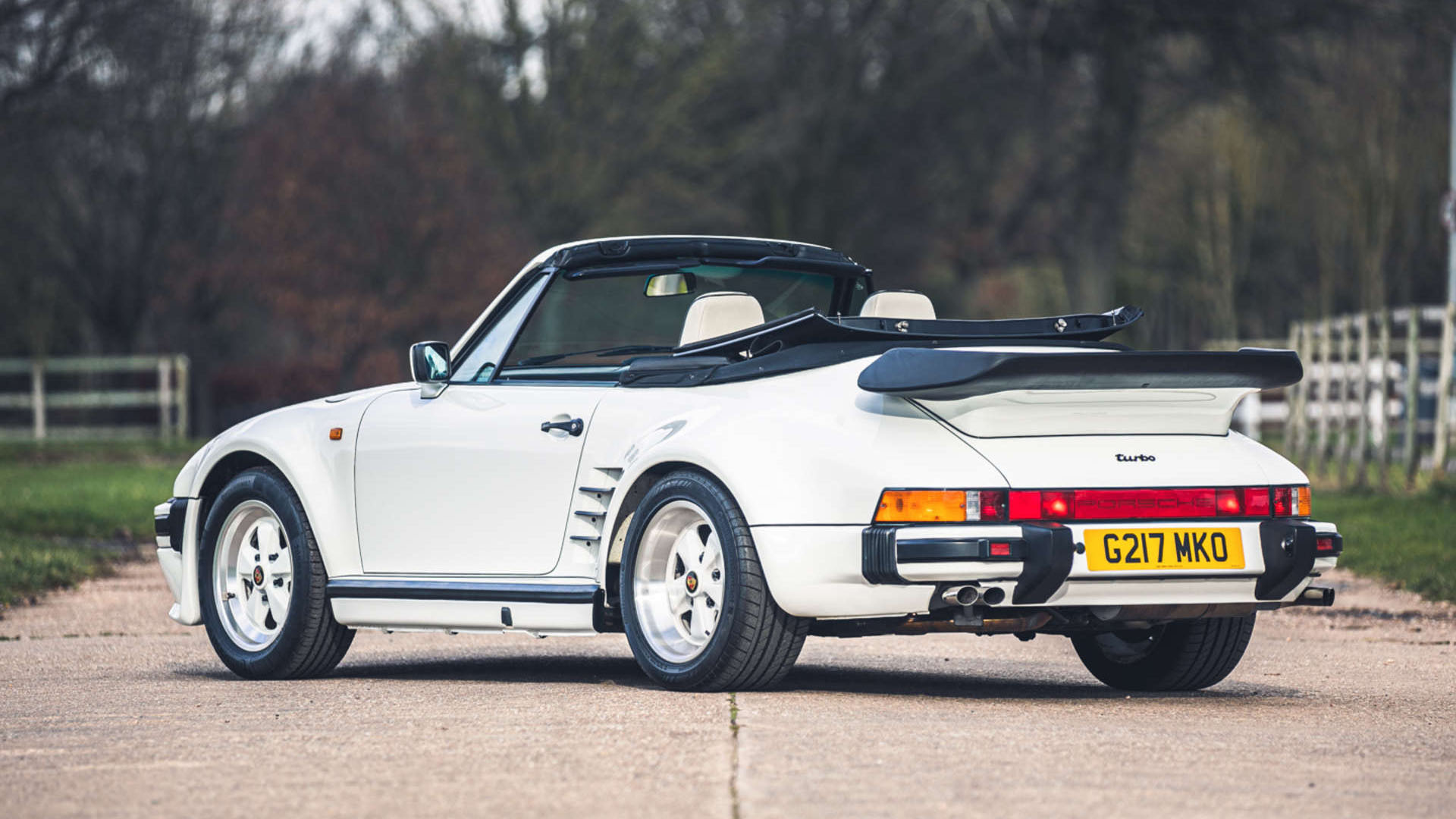
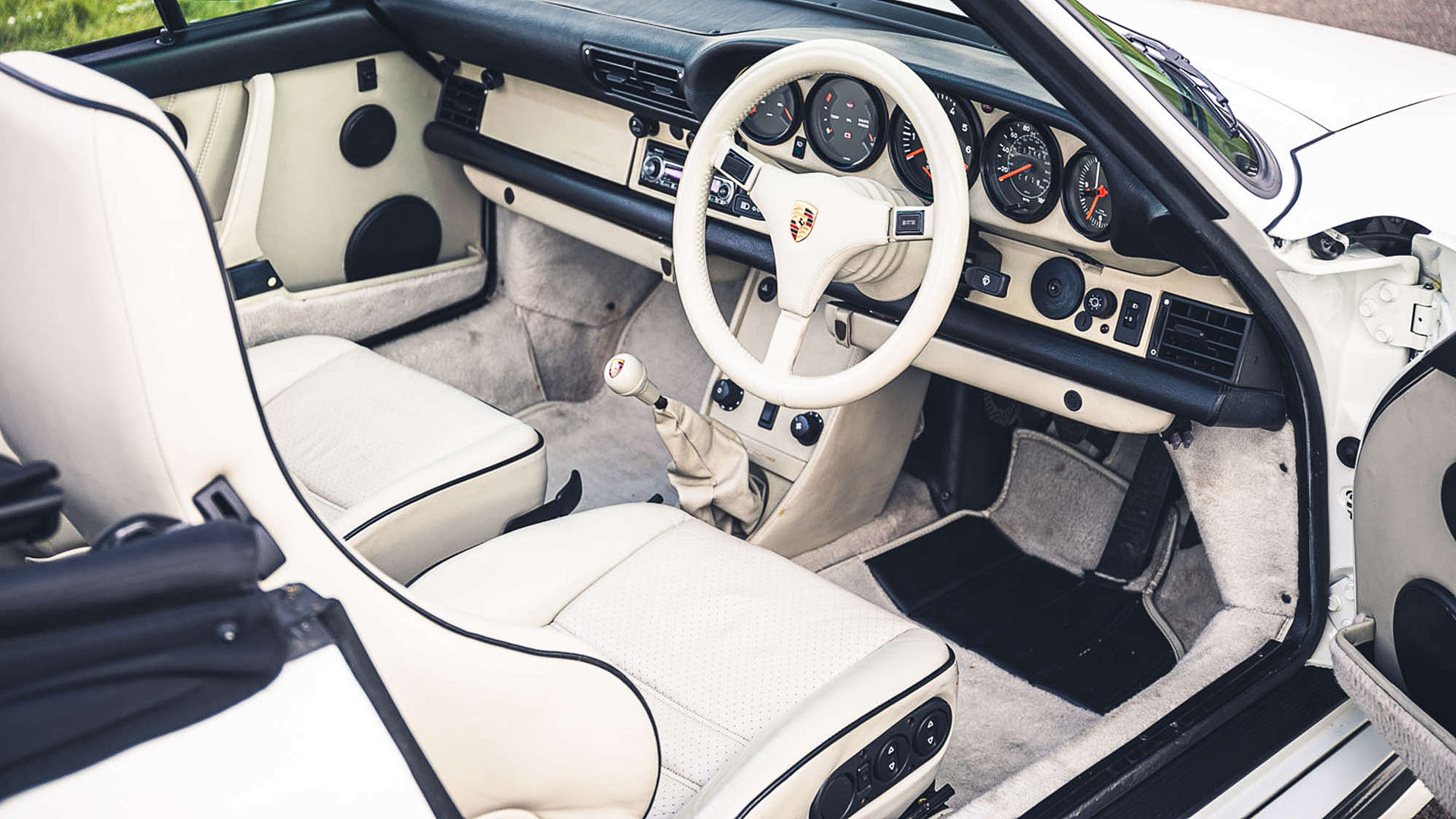
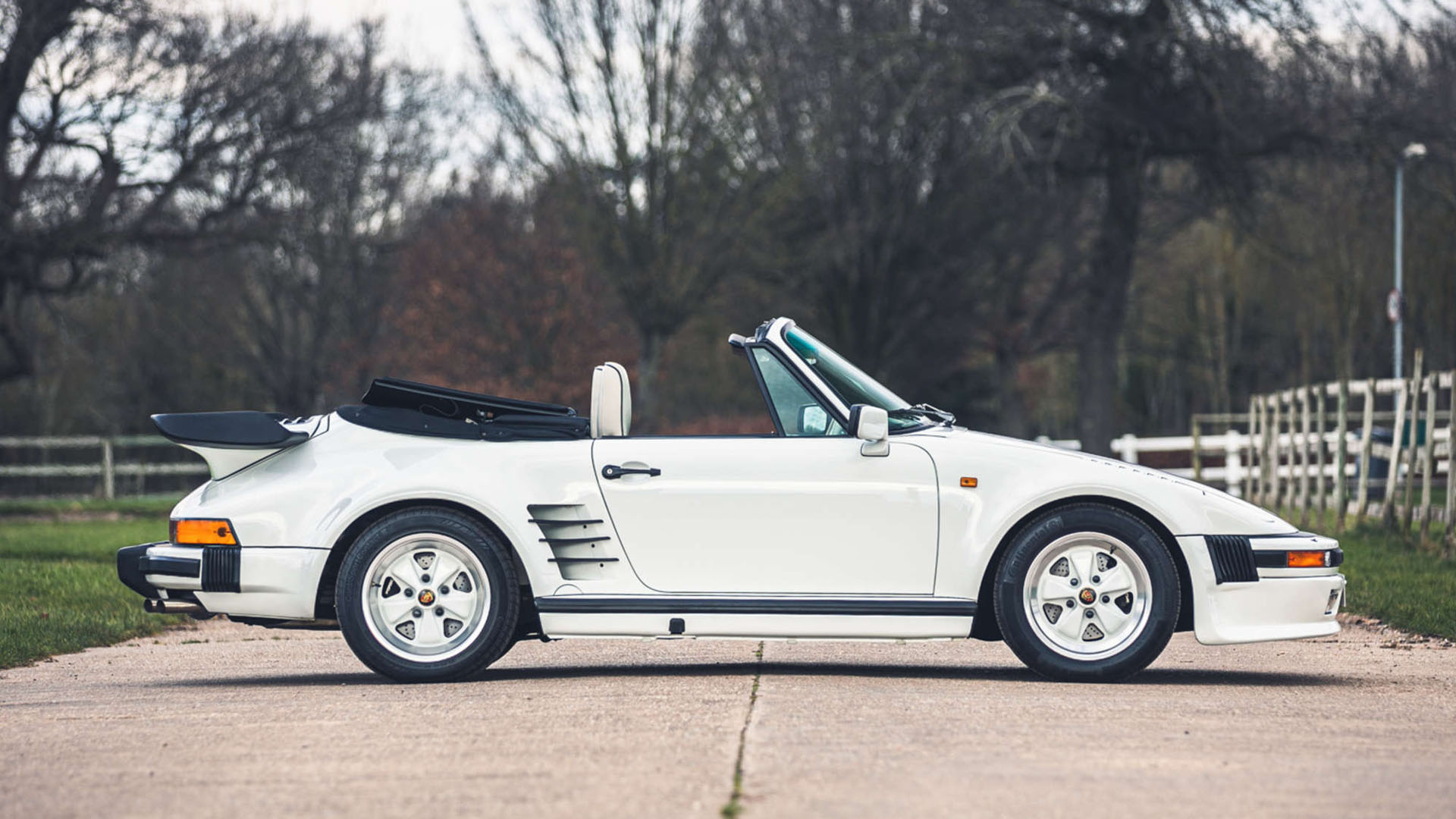
The distinctive look of the “Flachbau” (literally translated as Low Build) obviously retained its appeal in the minds of their road car customers and, from 1981 until early 1989, Porsche 930 Turbo buyers could specify their car in this style to special order. Just 50 ‘C16’ cars were manufactured for the UK-market, initially equipped with an uprated engine of 330bhp (from 300) mated to a 4-speed transmission. However, at the end of 1988, the uprated 5-Speed G50 gearbox was introduced, dramatically easing the peaks in power delivery by reducing the effects of ‘turbo-lag’. The factory SE also benefited from a dual-exit exhaust system, limited-slip differential, heated front seats and a sunroof.
This example is a genuine, factory-produced, C-16, Porsche 930 Turbo SE G50 Cabriolet built in 1989 under the ‘Sonderwunchprogramm’ (Special Wishes Programme). It’s superbly finished in White Pearl with a matching leather interior and has covered just 33,168 miles in the hands of three private owners prior to spending time in two of the highest-profile exclusive collections in the UK since 2014.
It’s supplied with an extensive history file detailing expenditure of over £45,000 lavished on this stunning Porsche during 2017 to ensure that it presents today in the best possible condition for an enthusiast or collector alike. The history file also contains all its previous MOTs and the service book displays sixteen service stamps helping to corroborate the indicated mileage.
With only seven C-16 examples of this specific model produced in 1989, this really is the ‘Holy Grail’ when considering a 930 and we would welcome any inspection of this rather special Porsche.
The Right Hand Drive on this specific Porsche might limit the possible market for it, but I still think Silverstone Auctions will find a buyer for this one, I personally really love this generation of Porsche, and a Slantnose Convertible is just the ultimate one … I even had a 1/18 scale model of this exact spec, white on white … but it was a LHD.
February 20, 2021 / Comments Off on Porsche 930 Turbo SE G50 ‘Flachbau’ Cabriolet
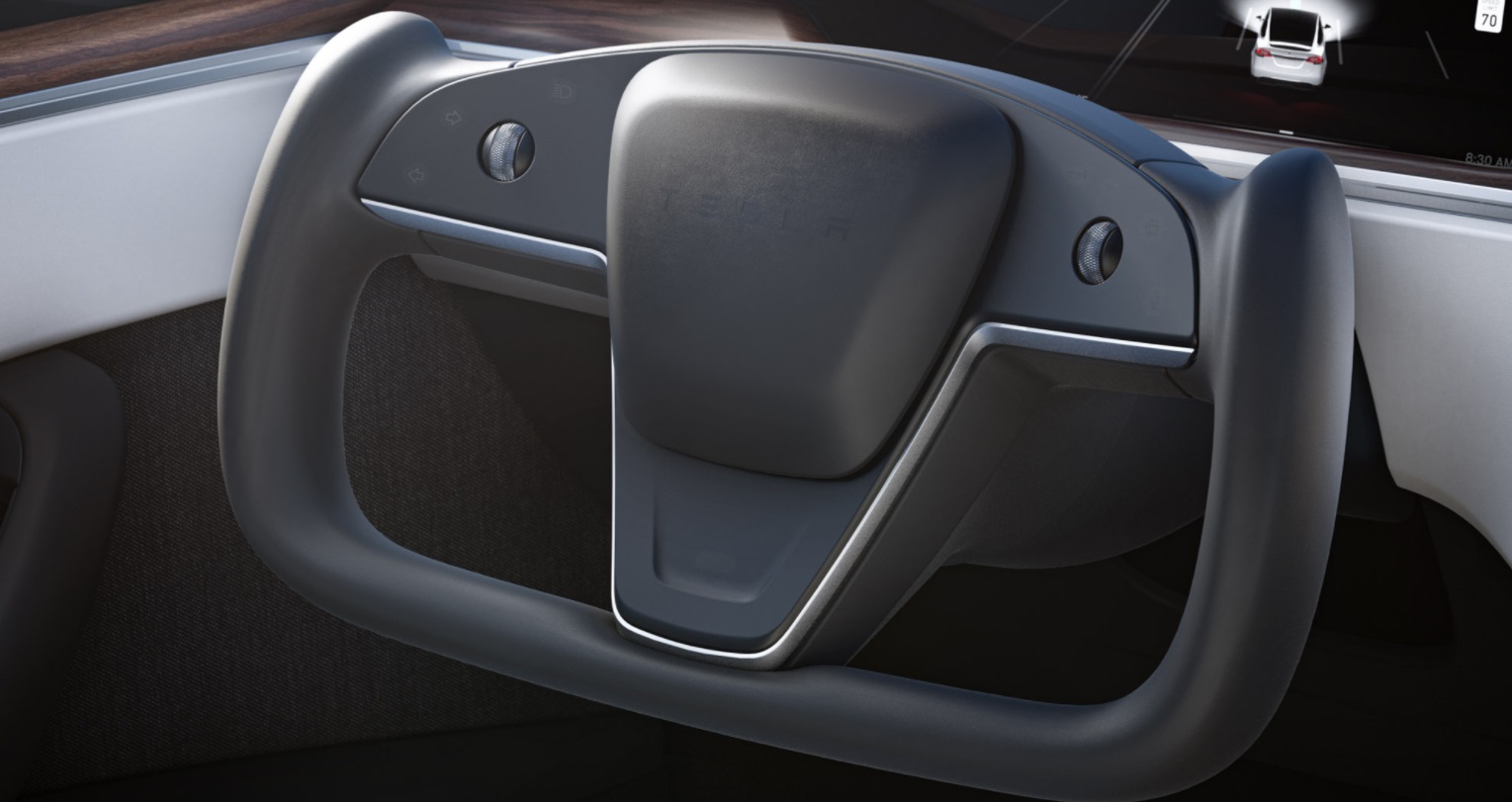
The newly announced Tesla Model X Plaid is the most powerful production SUV in the world, besting even some million dollar hypercars. The upgraded battery architecture delivers instant torque, quick acceleration and high power at any speed.
The Long Range and Plaid platforms connect powertrains and battery technologies for improved performance,range and efficiency. New Module and the battery architecture improves the power, endurance and enables fast charging in all conditions.
The Model X Plaid features a Tri Motor All-Wheel Drive platform with 3 torque transmitting independent motors with carbon fiber-sleeve for each rotor that support peak power outputs completely to top speed. The output of the Model X Plaid is 1,020hp, 340miles range and the acceleration from 0-60mph is achieved in 2.5 seconds.
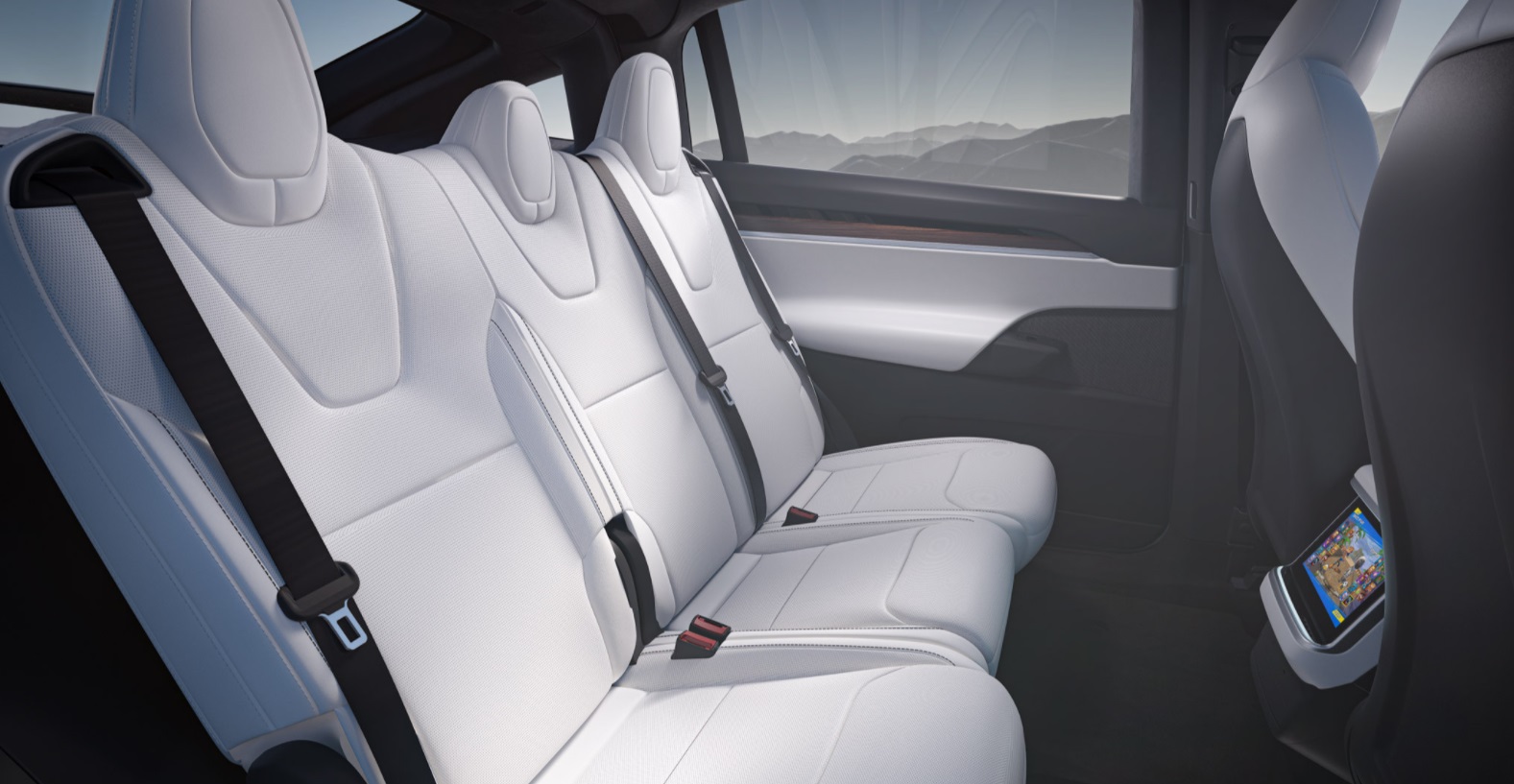
The vehicle delivers maximum utility with the most storage space and towing capacity of any electric SUV. The front doors and Falcon wing doors open and close automatically. The maximum towing capacity is 5000 lbs and seating allows up to 7 adults.
The Model X is built for power and range with the lowest drag coefficient of any SUV. Upgraded aerodynamic systems work together with the high-performance wheels and tires to provide maximum agility, handling and comfort at any speed.
The Estimated range on a single charge is 360 miles and charging time using a supercharger to 175 miles can be achieved in 15 minutes. The availability of Tesla’s fast charger and access to over 20,000+ superchargers stations globally enables the driver to spend less time charging and more time travelling.
The Model X is built with a high-strength architecture and battery pack mounted on the floor to protect the occupants and lower the risks of rollover. Every Model X comes with the latest active safety features including Automatic emergency braking at no extra cost. Other safety features include front and rear cameras, 12 ultrasonic sensors to detect nearby cars and 160m forward facing radar for a long range view.
Autopilot enables the car to accelerate, brake and steer automatically within its lane under active supervision. Over-the-air updates and the latest enhancements are available instantly.
February 20, 2021 / Comments Off on Tesla Model X Plaid: World’s Most Powerful SUV Revealed (1020hp)
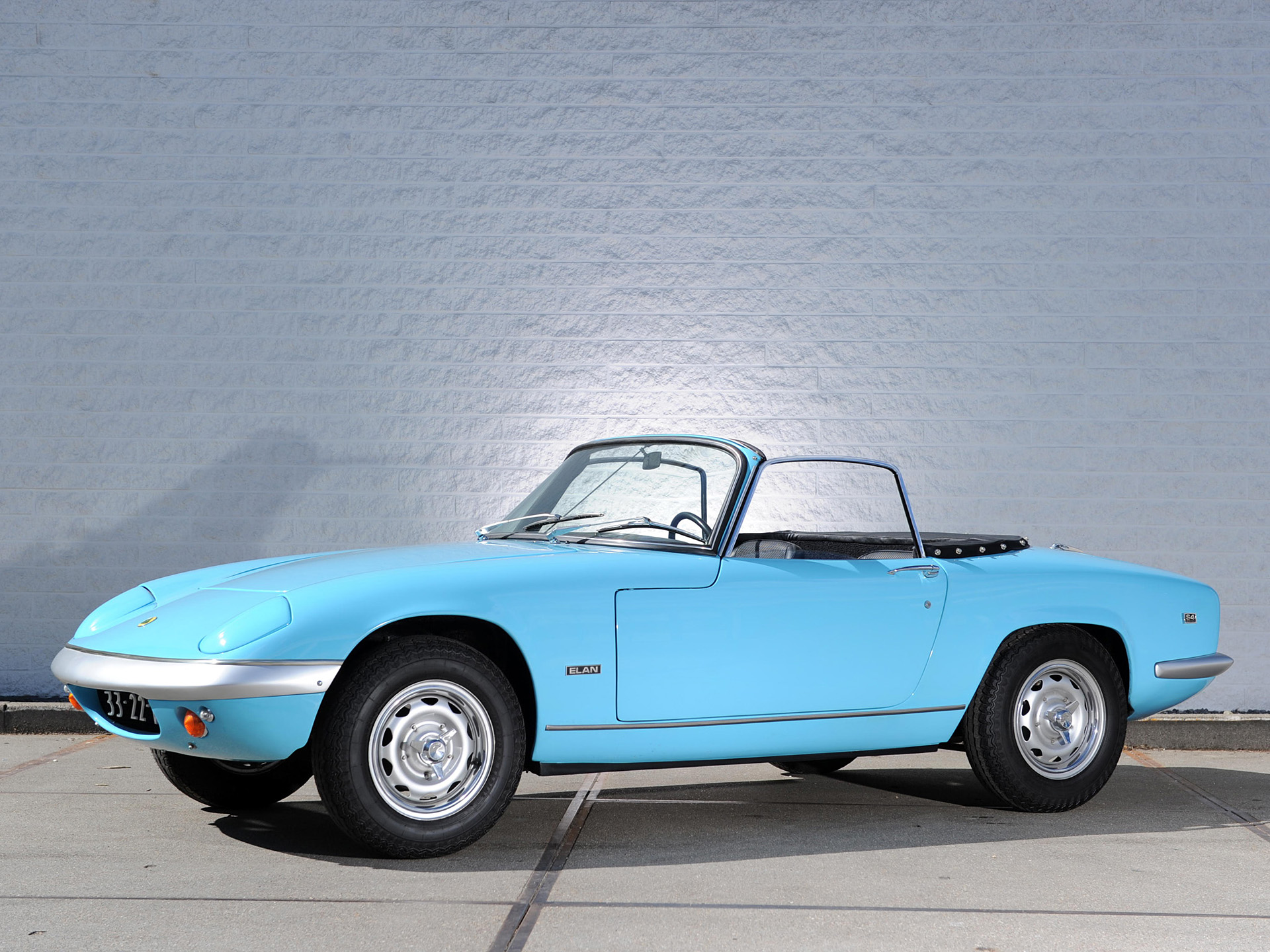
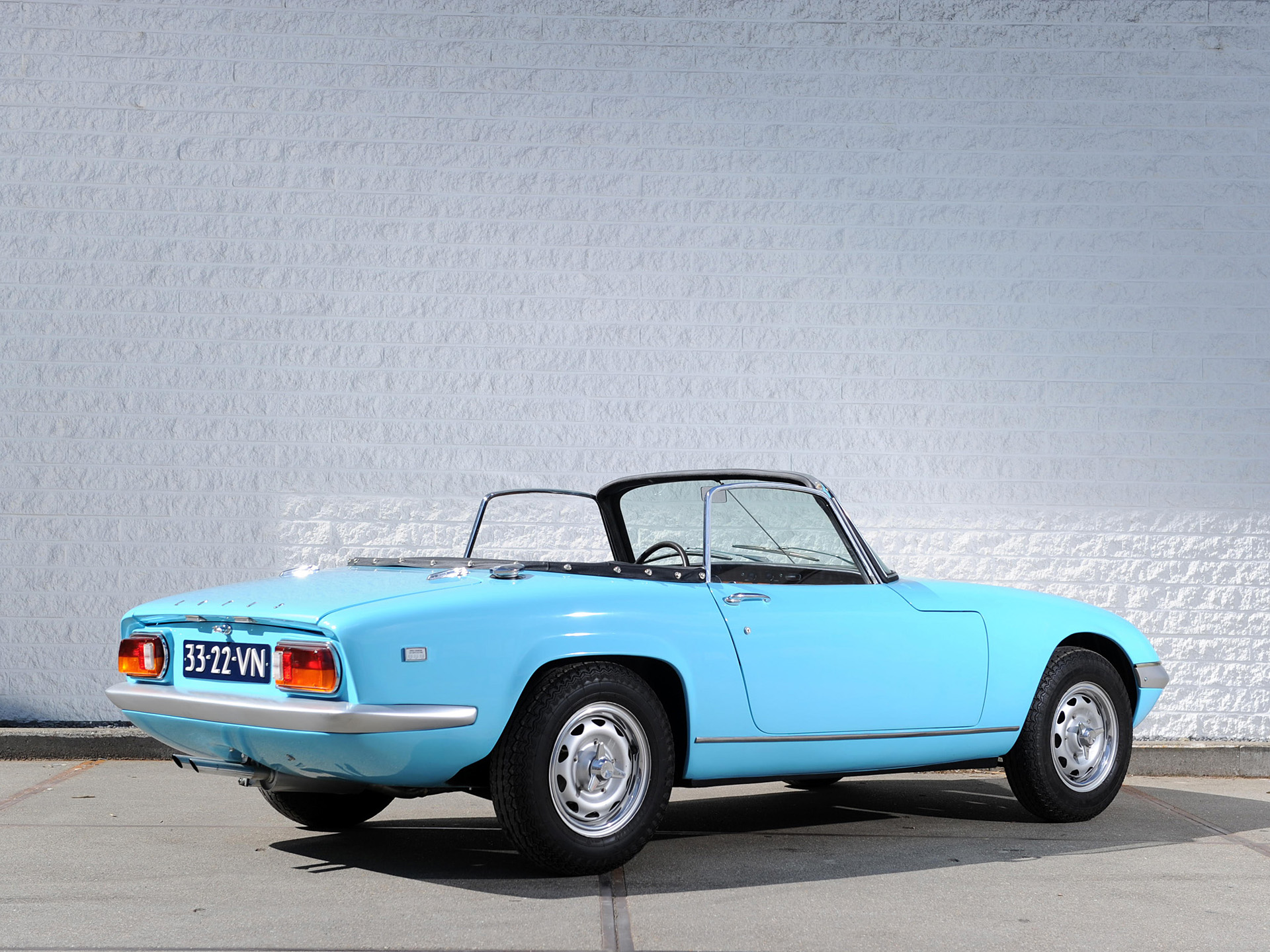
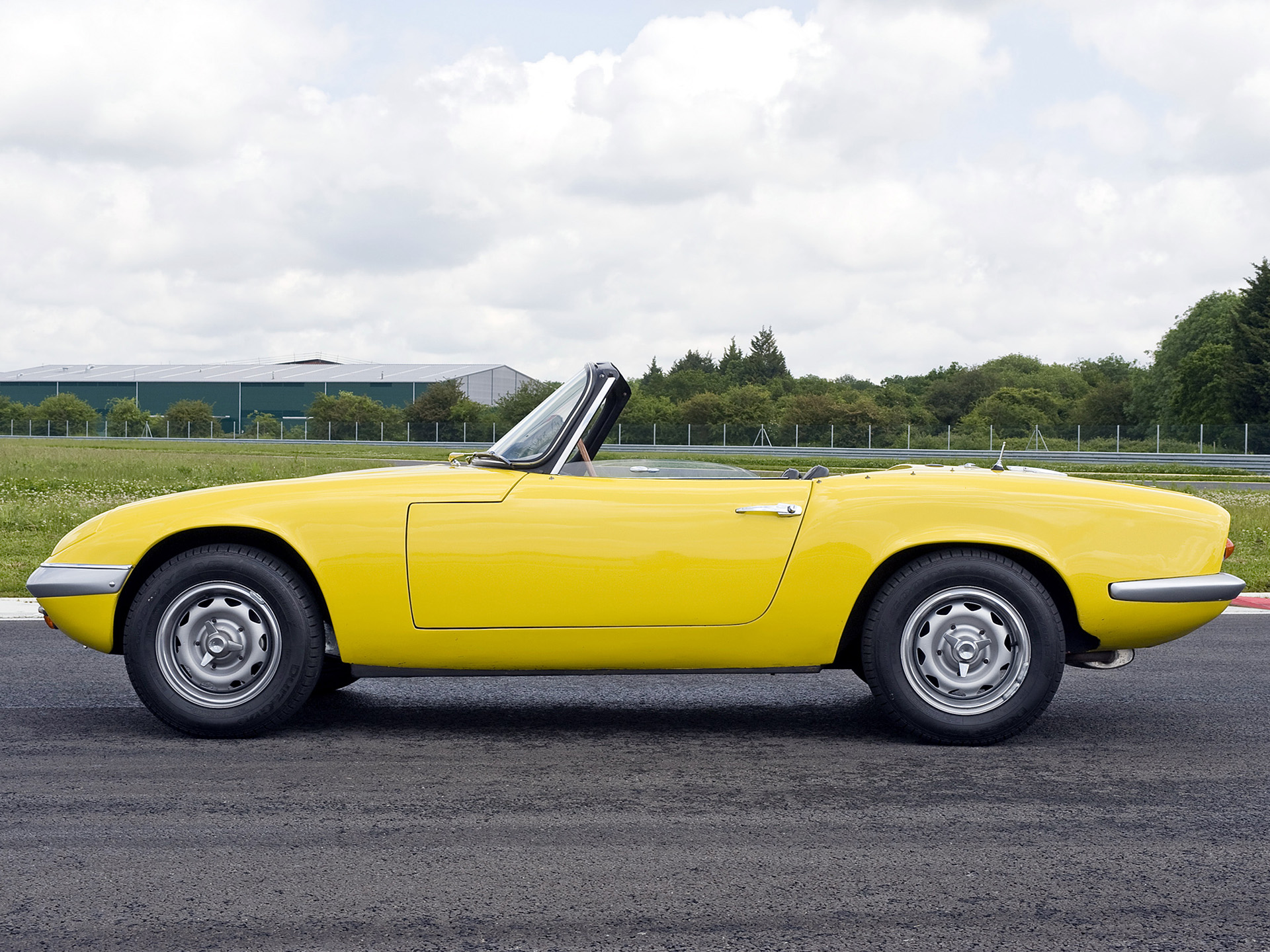
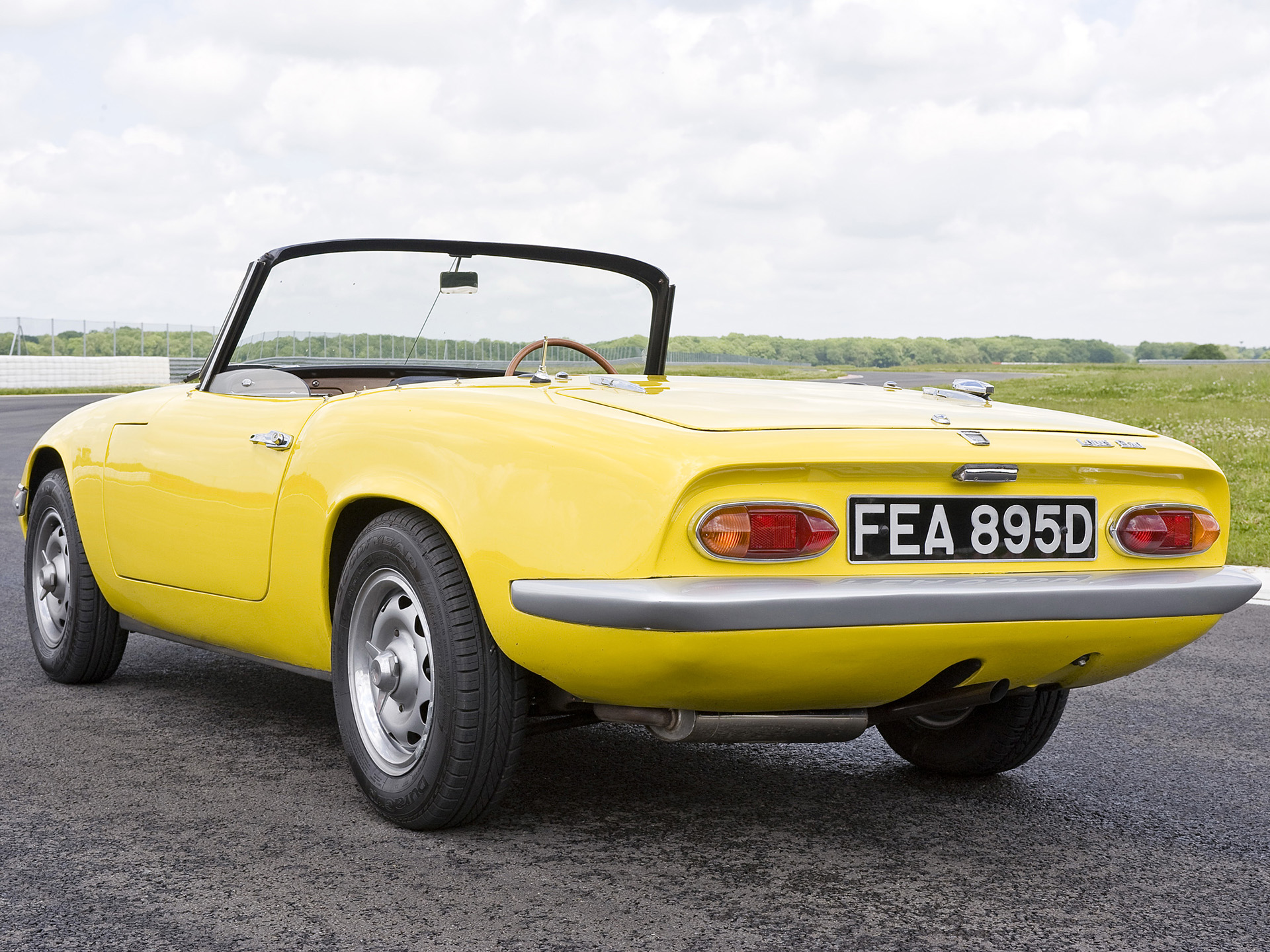
We have curated the ultimate collection of the best 1968 Lotus Elan S4 Wallpapers and HD backgrounds for you to enjoy. Our team focused on finding the top 1968 Lotus Elan S4 Wallpapers only to keep the quality high. These 1968 Lotus Elan S4 Wallpapers are free to download so go ahead. To download any of these pictures for use as a wallpaper, right click the picture and choose Save As…
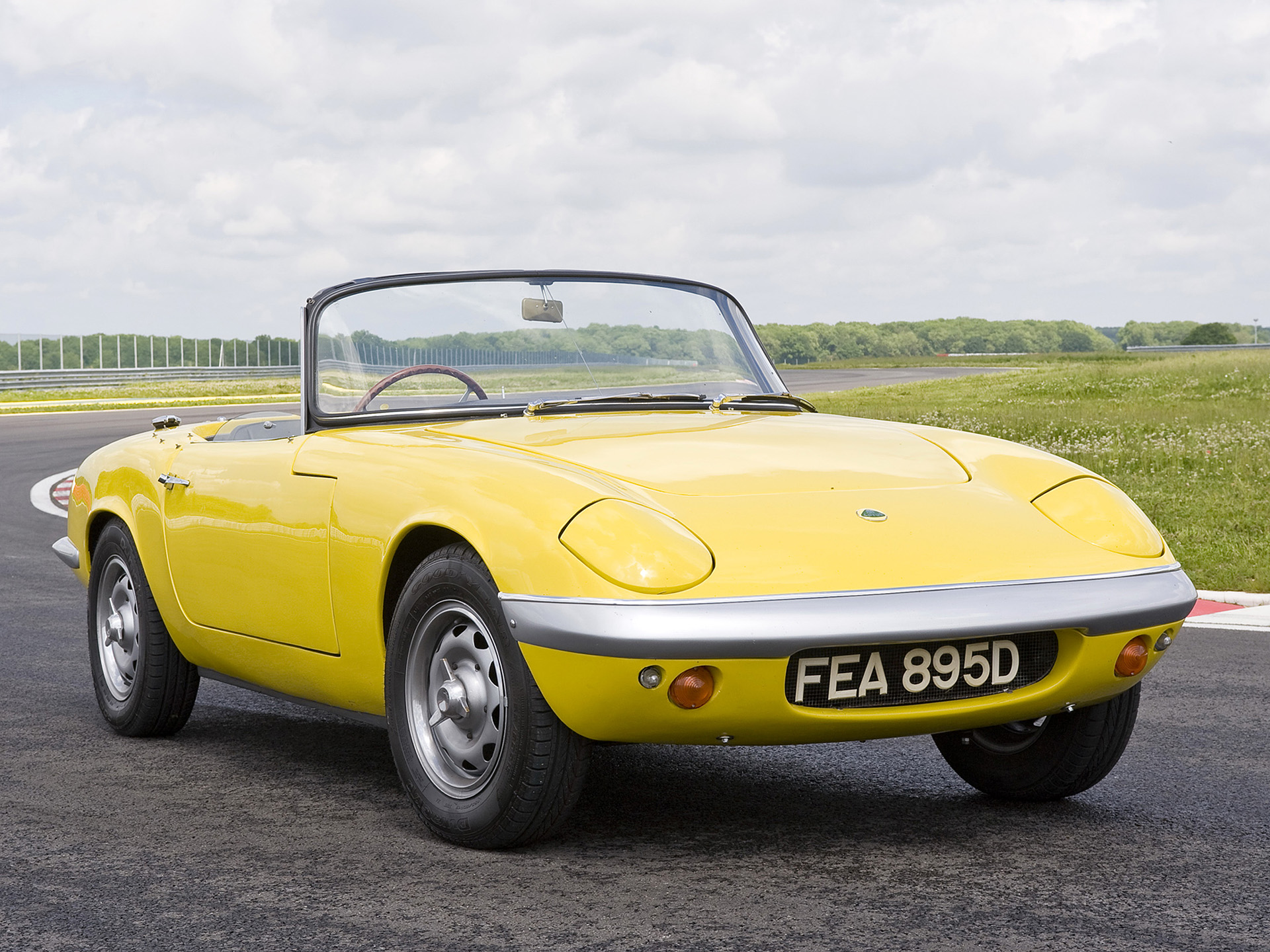
We have curated the ultimate collection of the best 1962 Lotus Elan Wallpapers and HD backgrounds for you to enjoy. Our team focused on finding the top 1962 Lotus Elan Wallpapers only to keep the quality high. These 1962 Lotus Elan Wallpapers are free to download so go ahead. To download any of these pictures for use as a wallpaper, right click the picture and choose Save As…
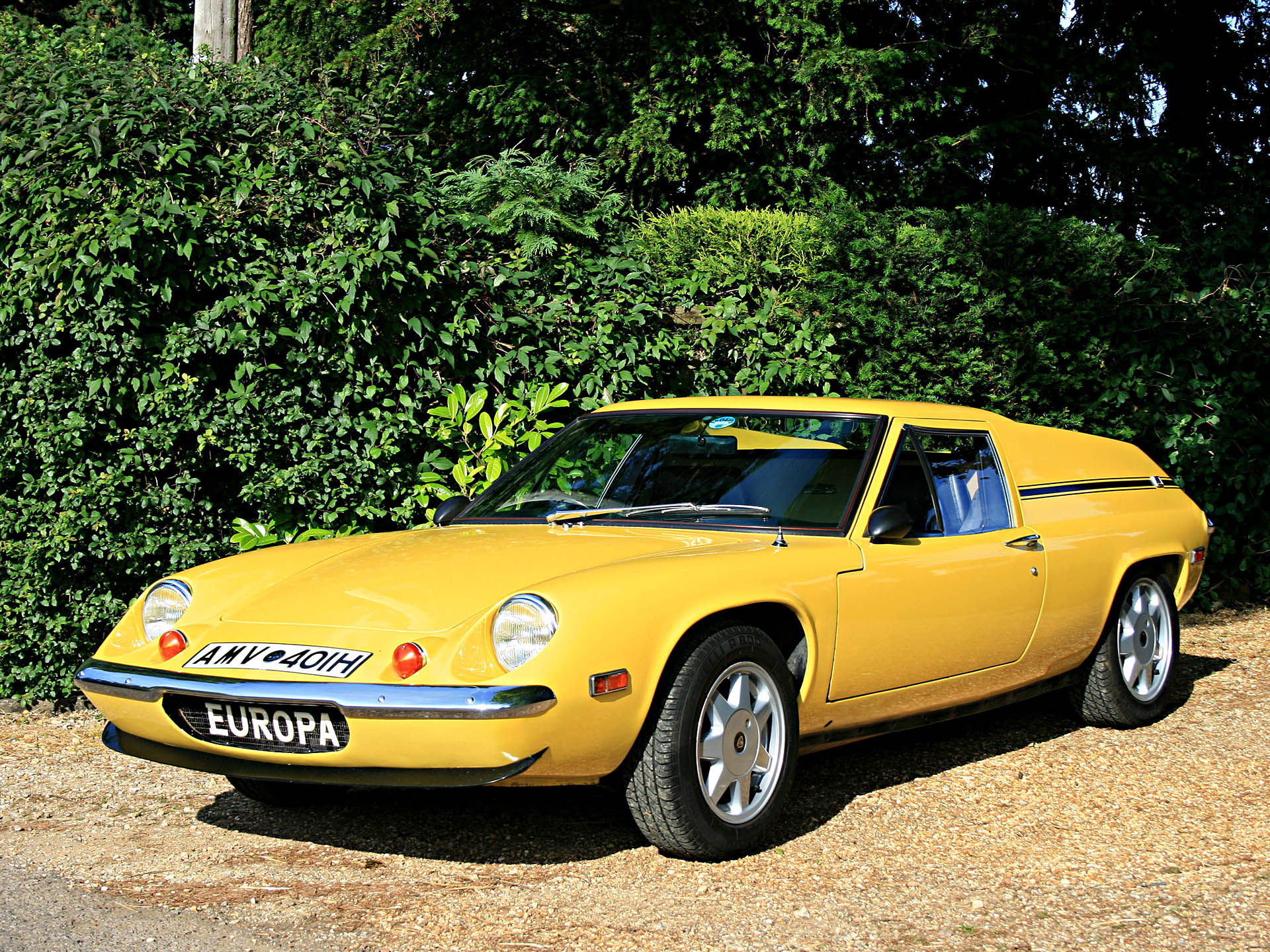
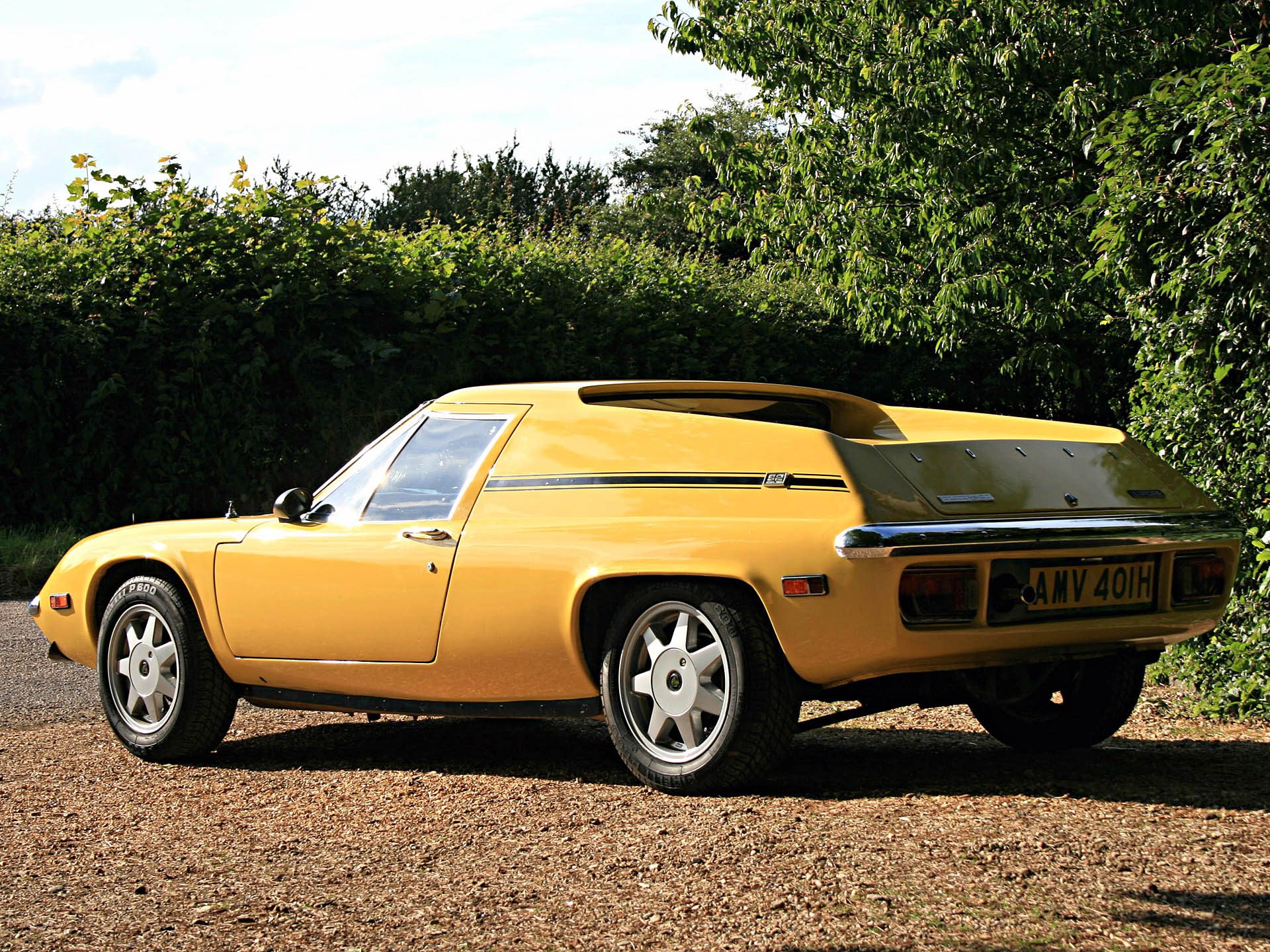
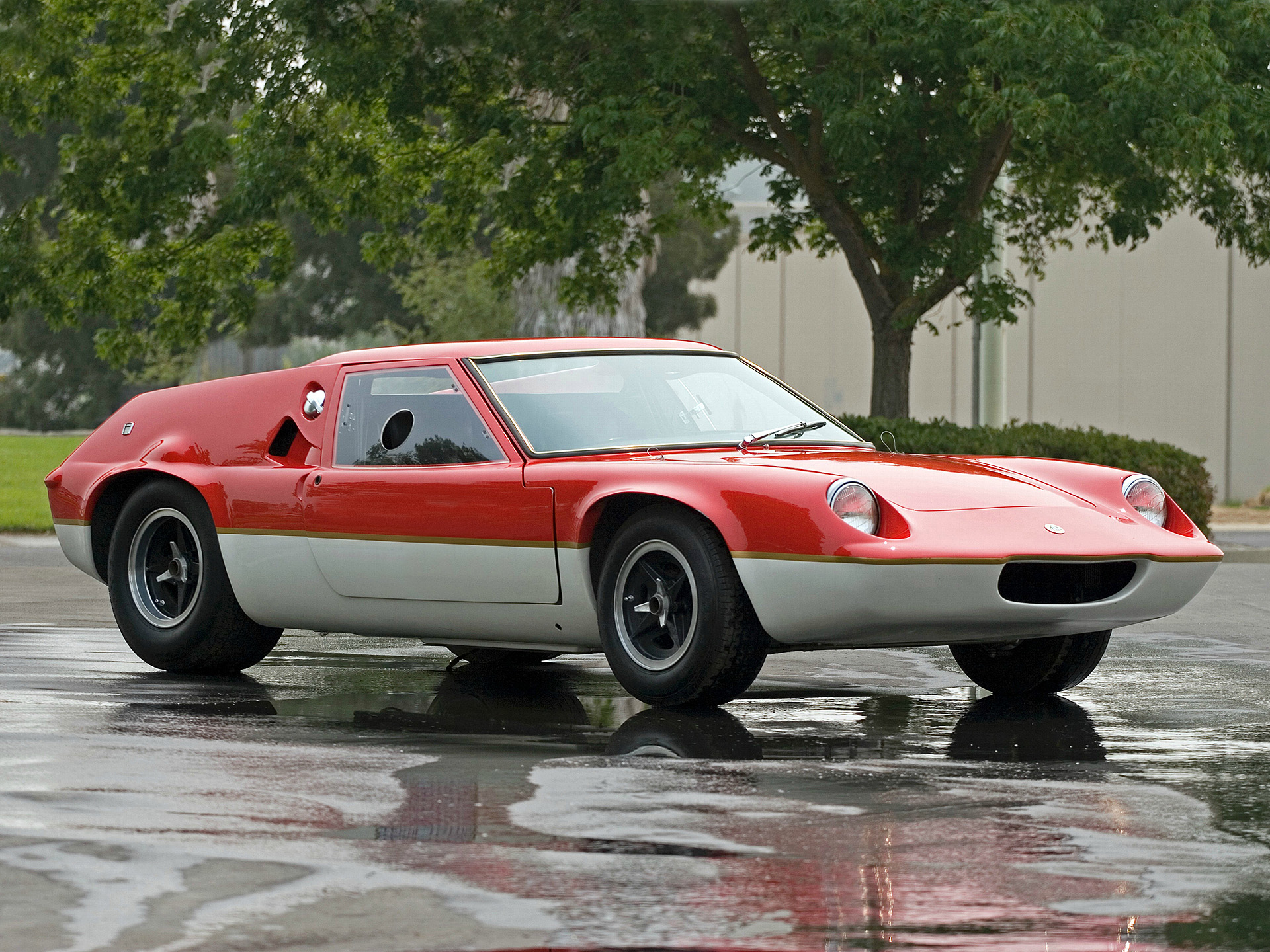
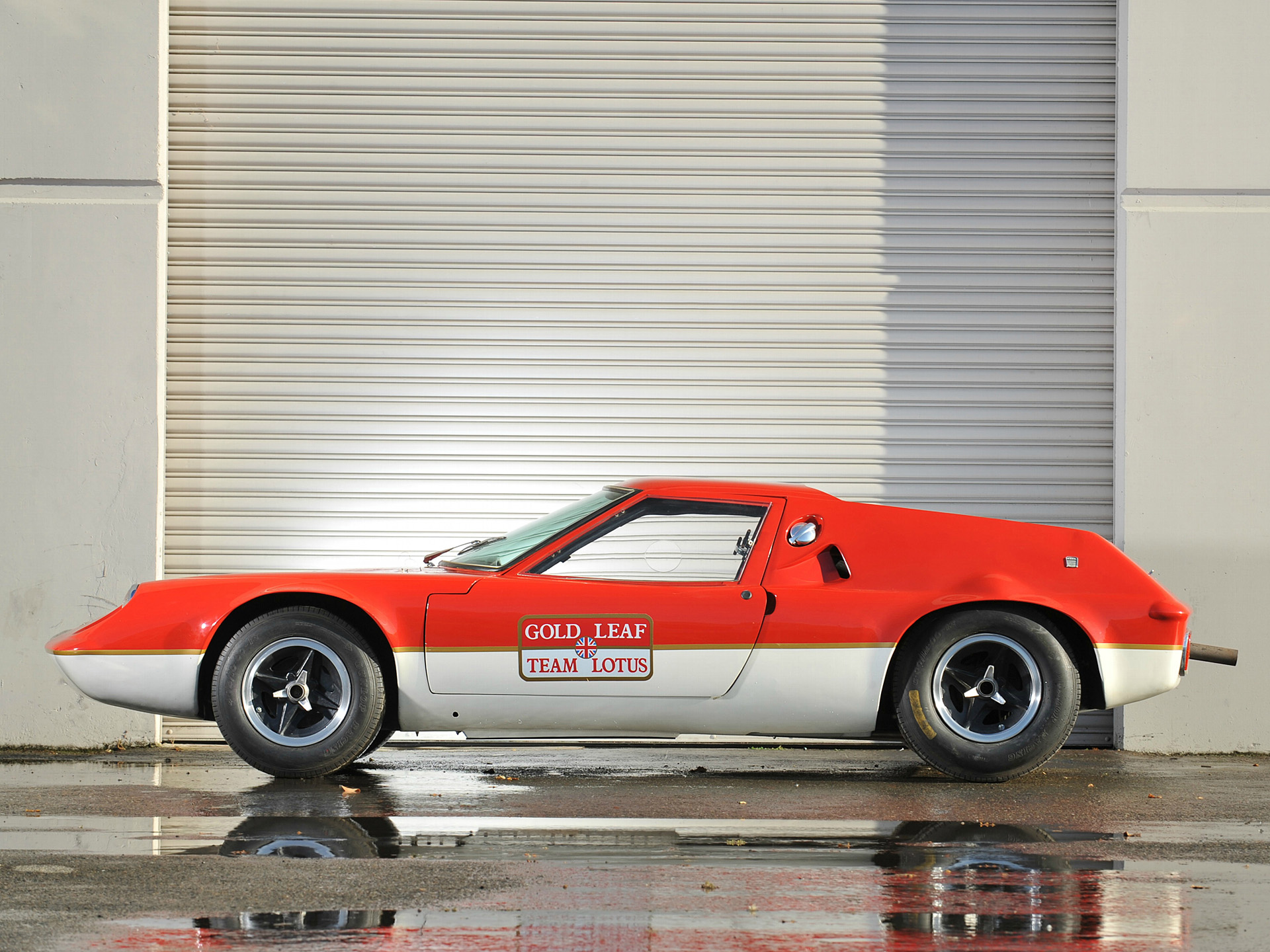
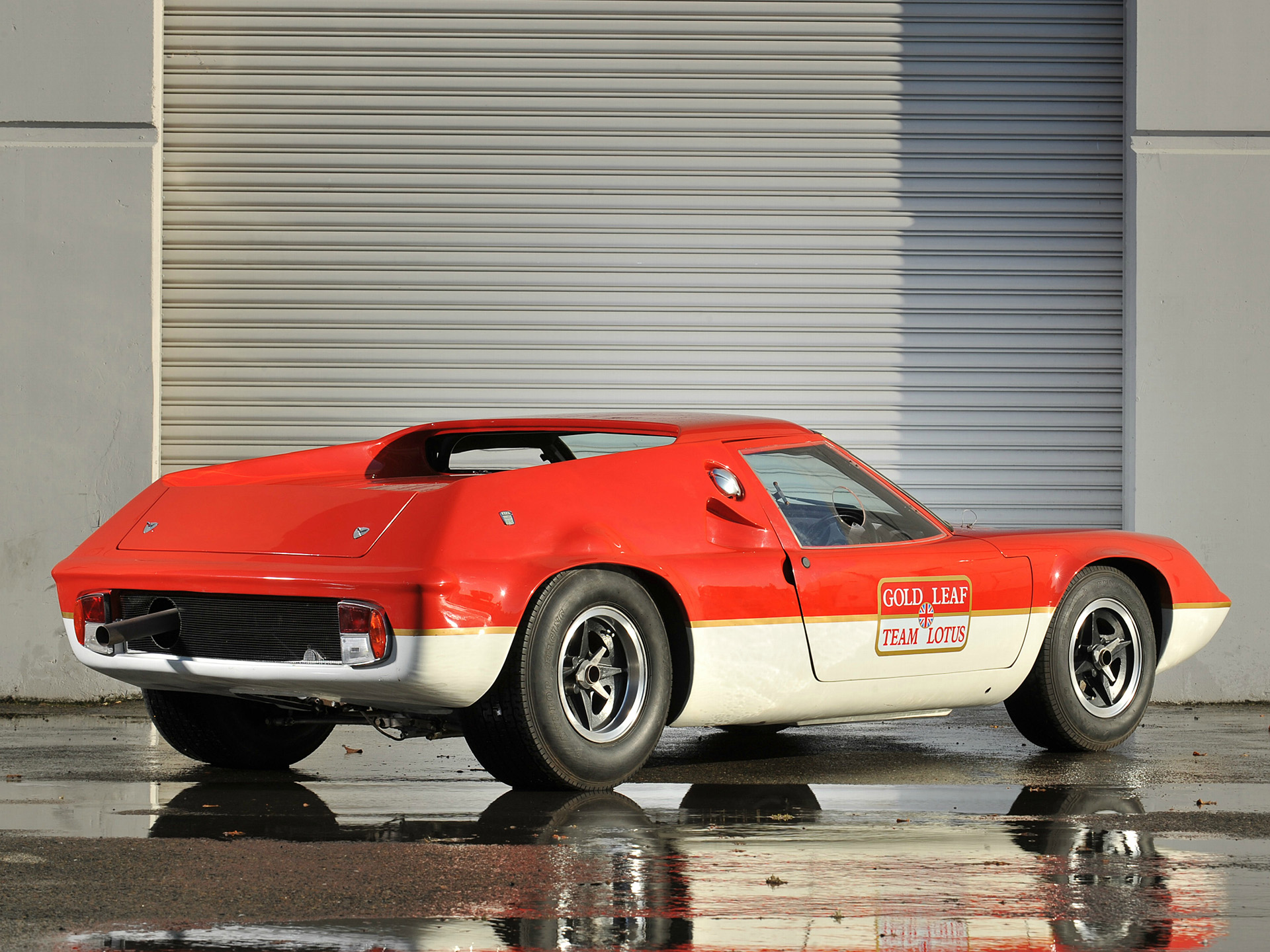
We have curated the ultimate collection of the best 1968 Lotus Europa S2 Wallpapers and HD backgrounds for you to enjoy. Our team focused on finding the top 1968 Lotus Europa S2 Wallpapers only to keep the quality high. These 1968 Lotus Europa S2 Wallpapers are free to download so go ahead. To download any of these pictures for use as a wallpaper, right click the picture and choose Save As…
We have curated the ultimate collection of the best 1966 Lotus Europa Wallpapers and HD backgrounds for you to enjoy. Our team focused on finding the top 1966 Lotus Europa Wallpapers only to keep the quality high. These 1966 Lotus Europa Wallpapers are free to download so go ahead. To download any of these pictures for use as a wallpaper, right click the picture and choose Save As…
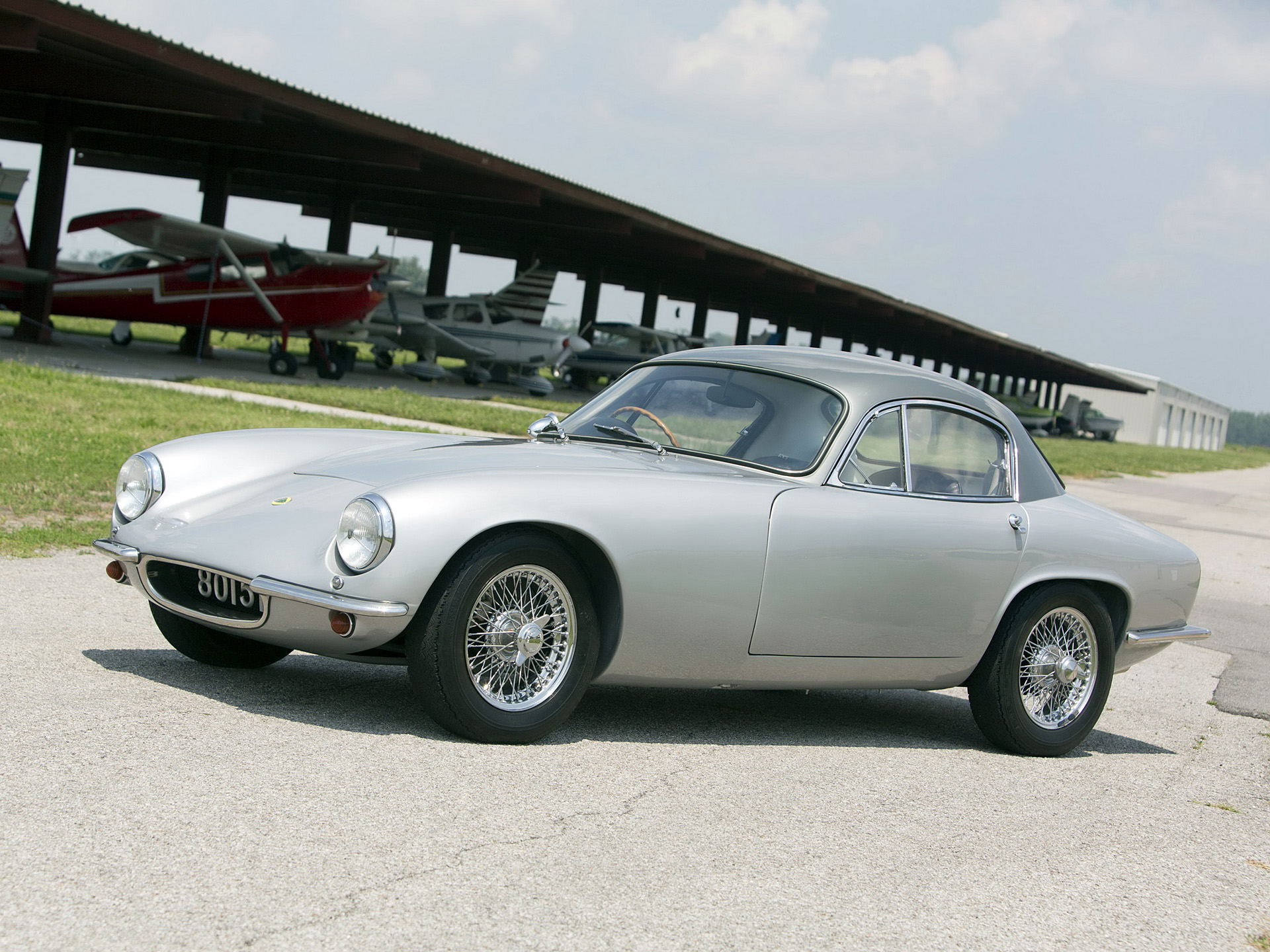
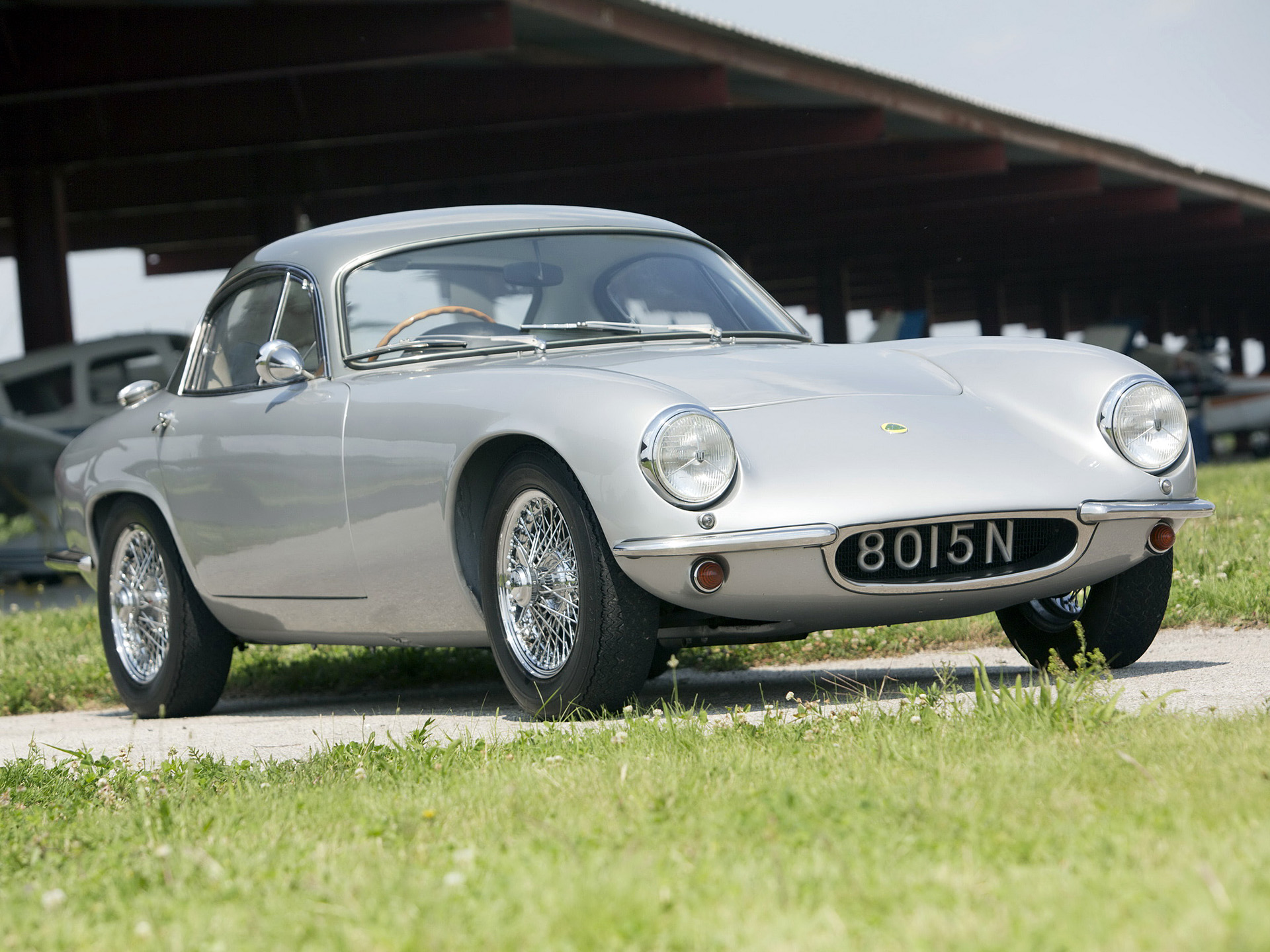
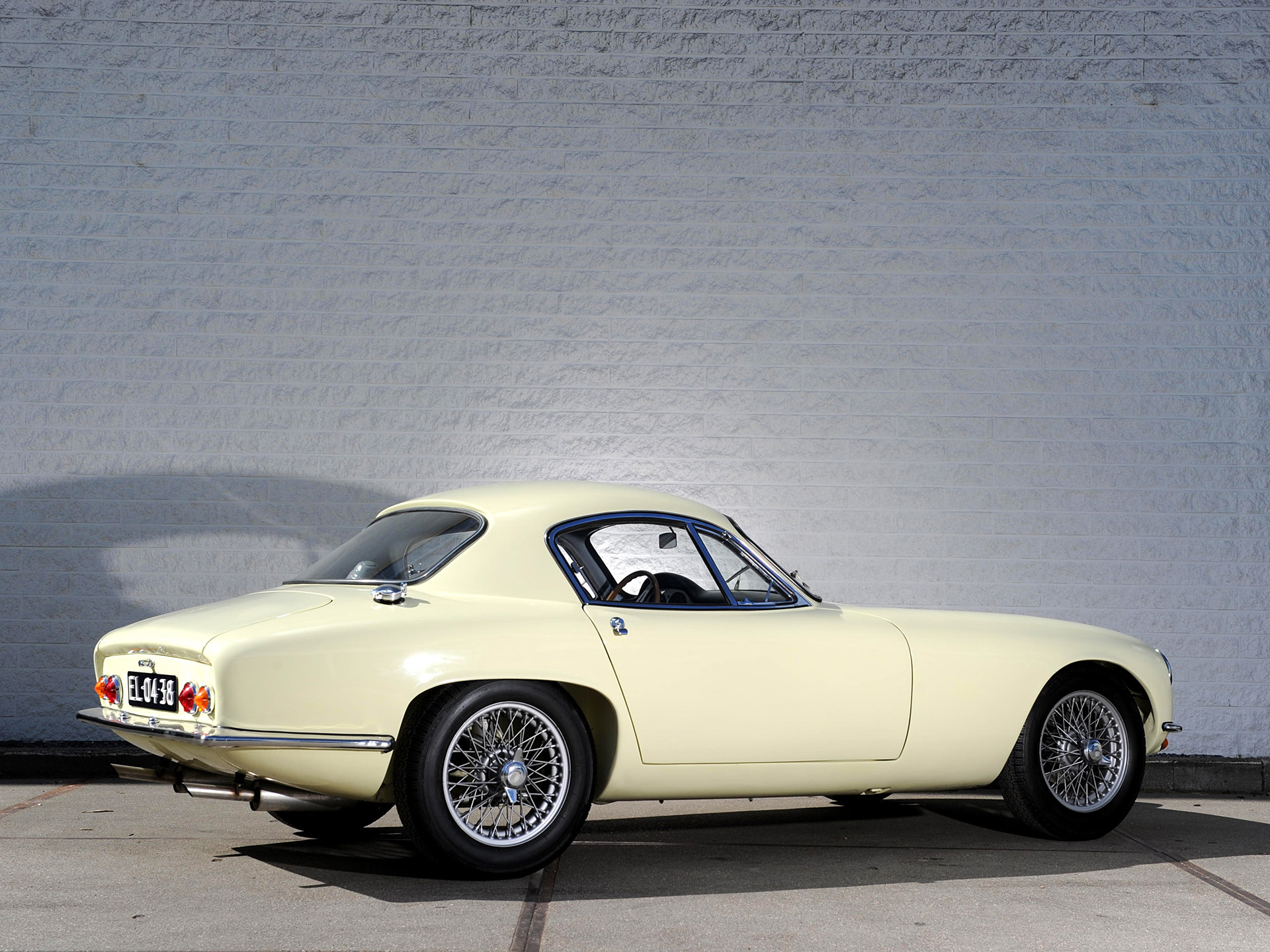
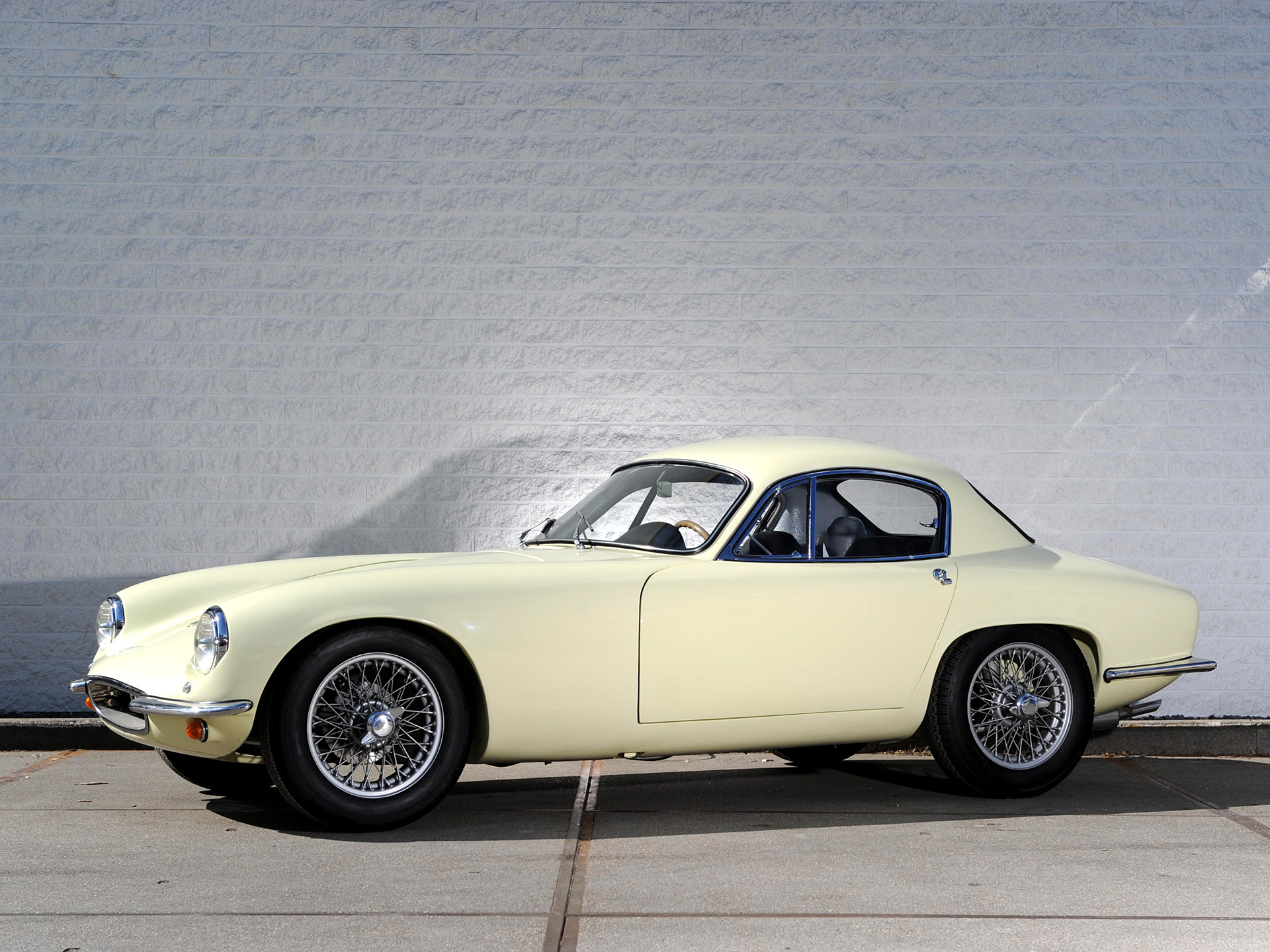
We have curated the ultimate collection of the best 1957 Lotus Elite Wallpapers and HD backgrounds for you to enjoy. Our team focused on finding the top 1957 Lotus Elite Wallpapers only to keep the quality high. These 1957 Lotus Elite Wallpapers are free to download so go ahead. To download any of these pictures for use as a wallpaper, right click the picture and choose Save As…
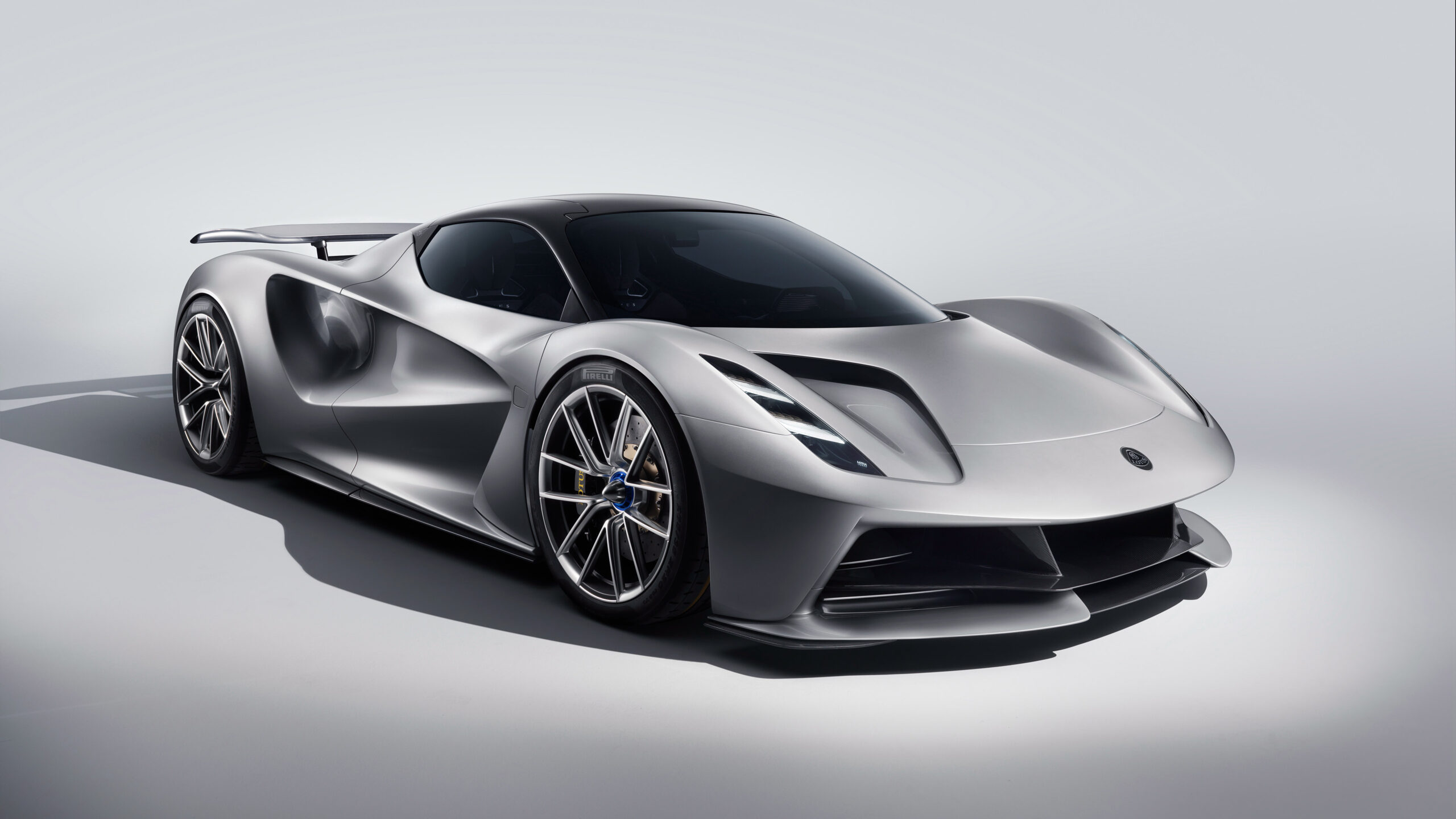
We have curated the ultimate collection of the best 2020 Lotus Evija Wallpapers and HD backgrounds for you to enjoy. Our team focused on finding the top 2020 Lotus Evija Wallpapers only to keep the quality high. These 2020 Lotus Evija Wallpapers are free to download so go ahead. To download any of these pictures for use as a wallpaper, right click the picture and choose Save As…
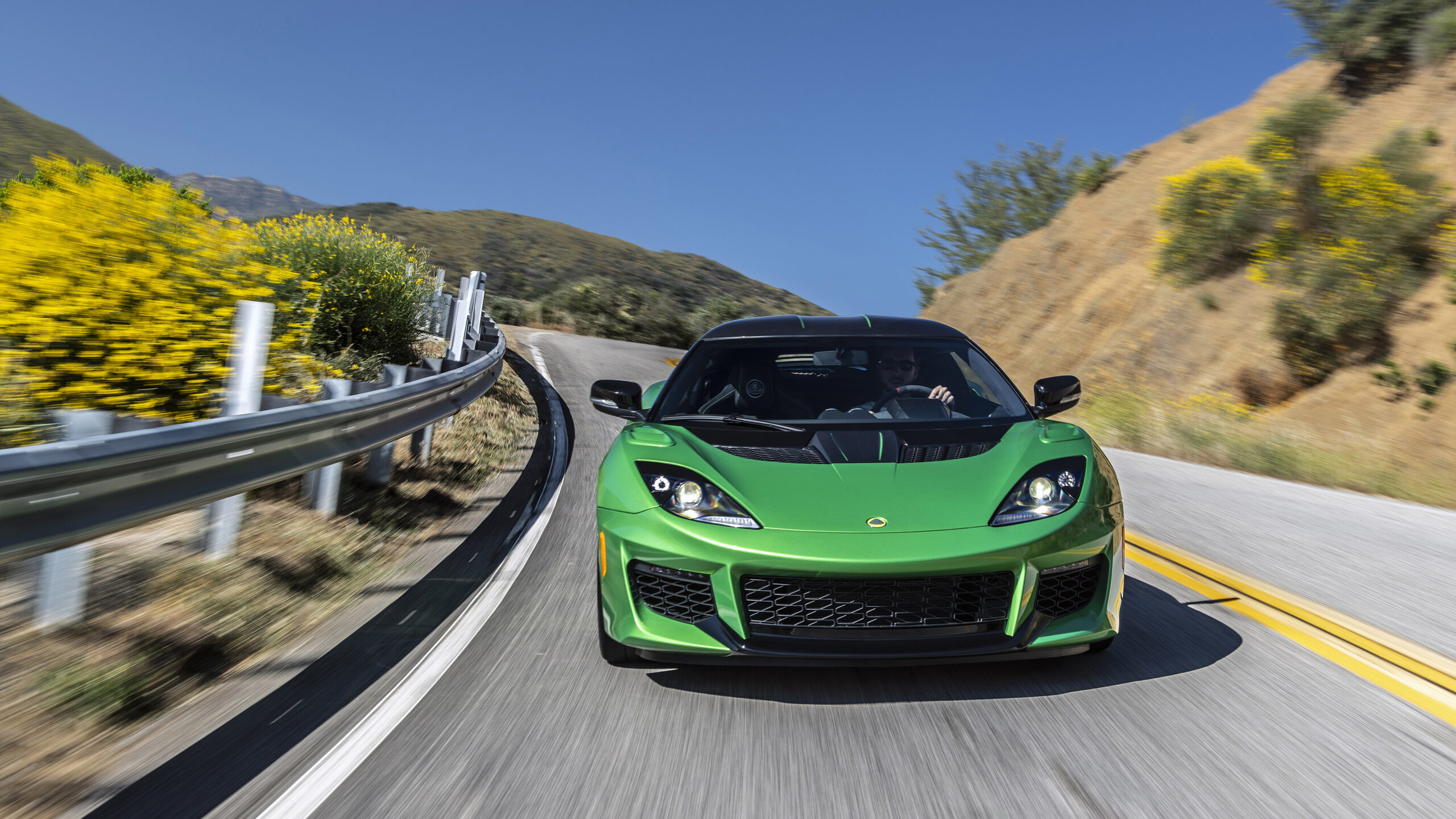
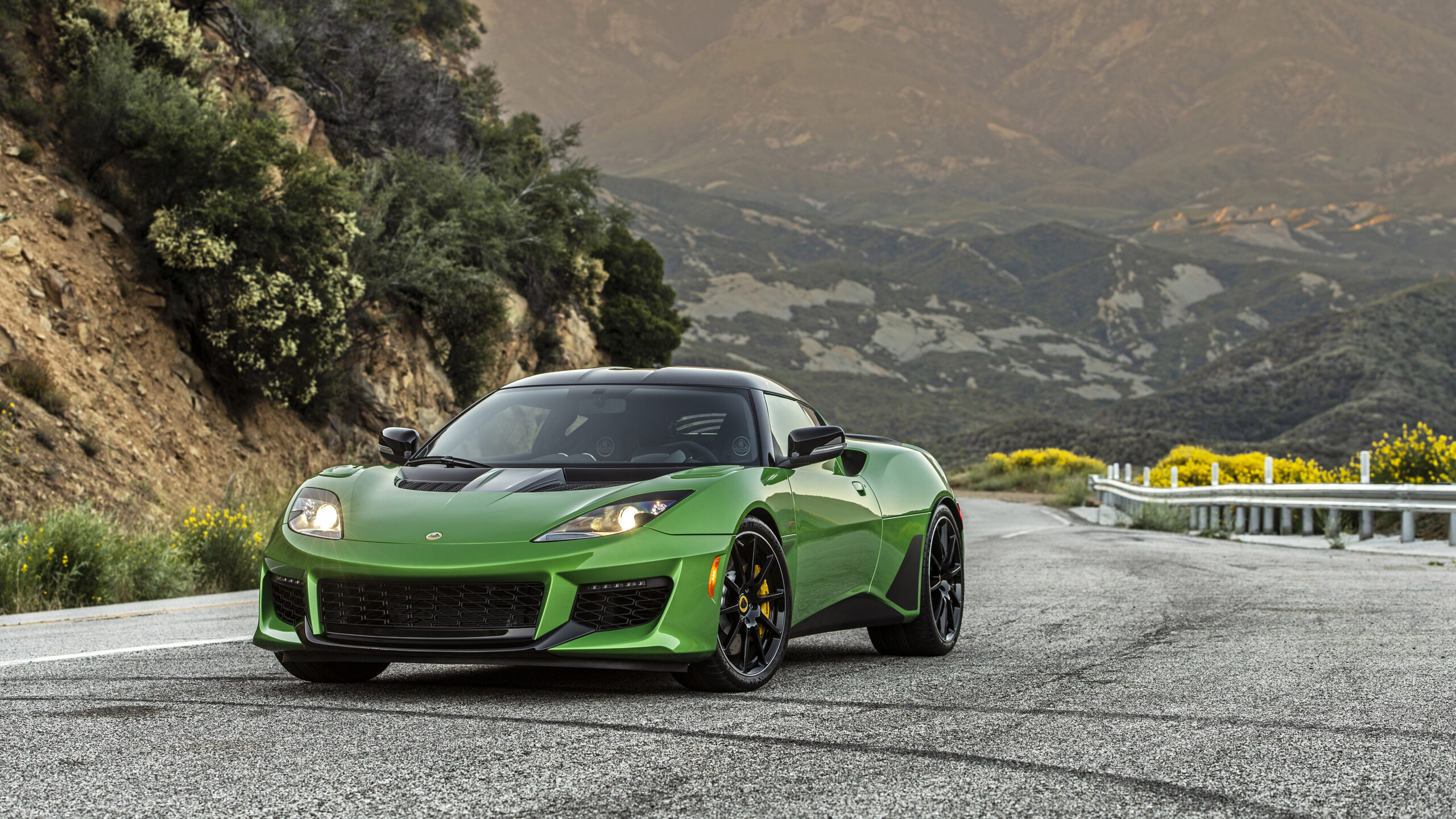
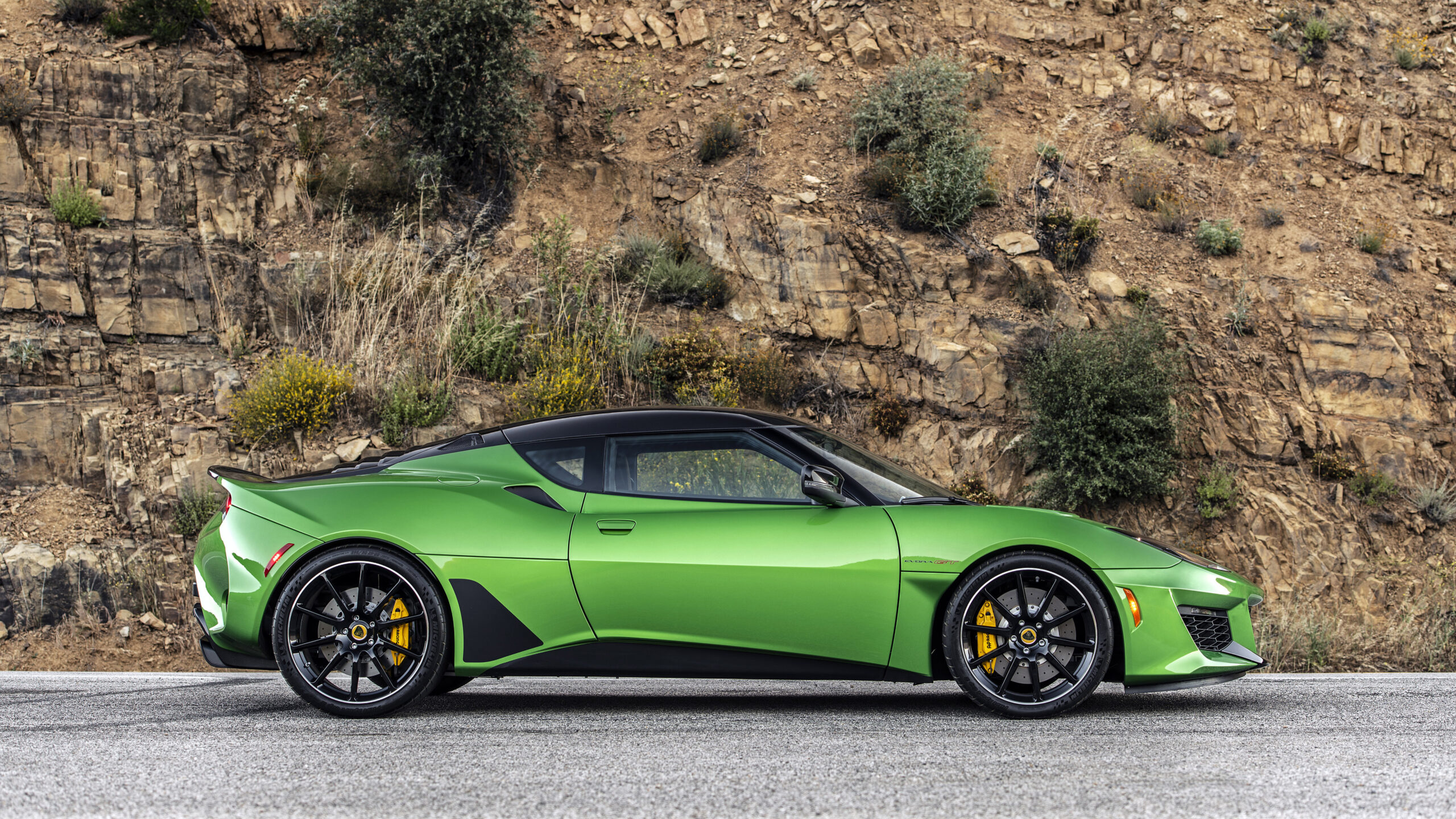
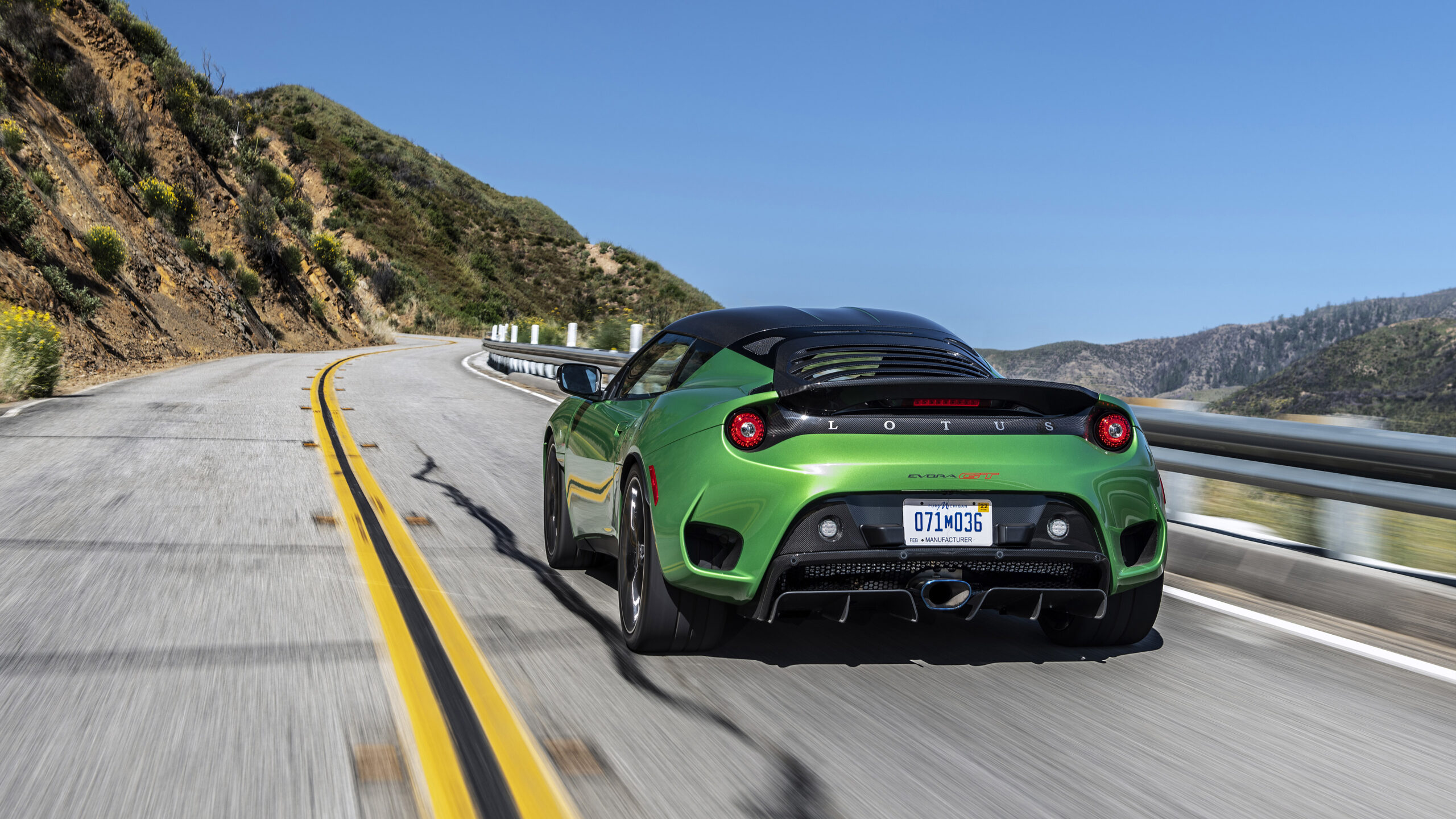
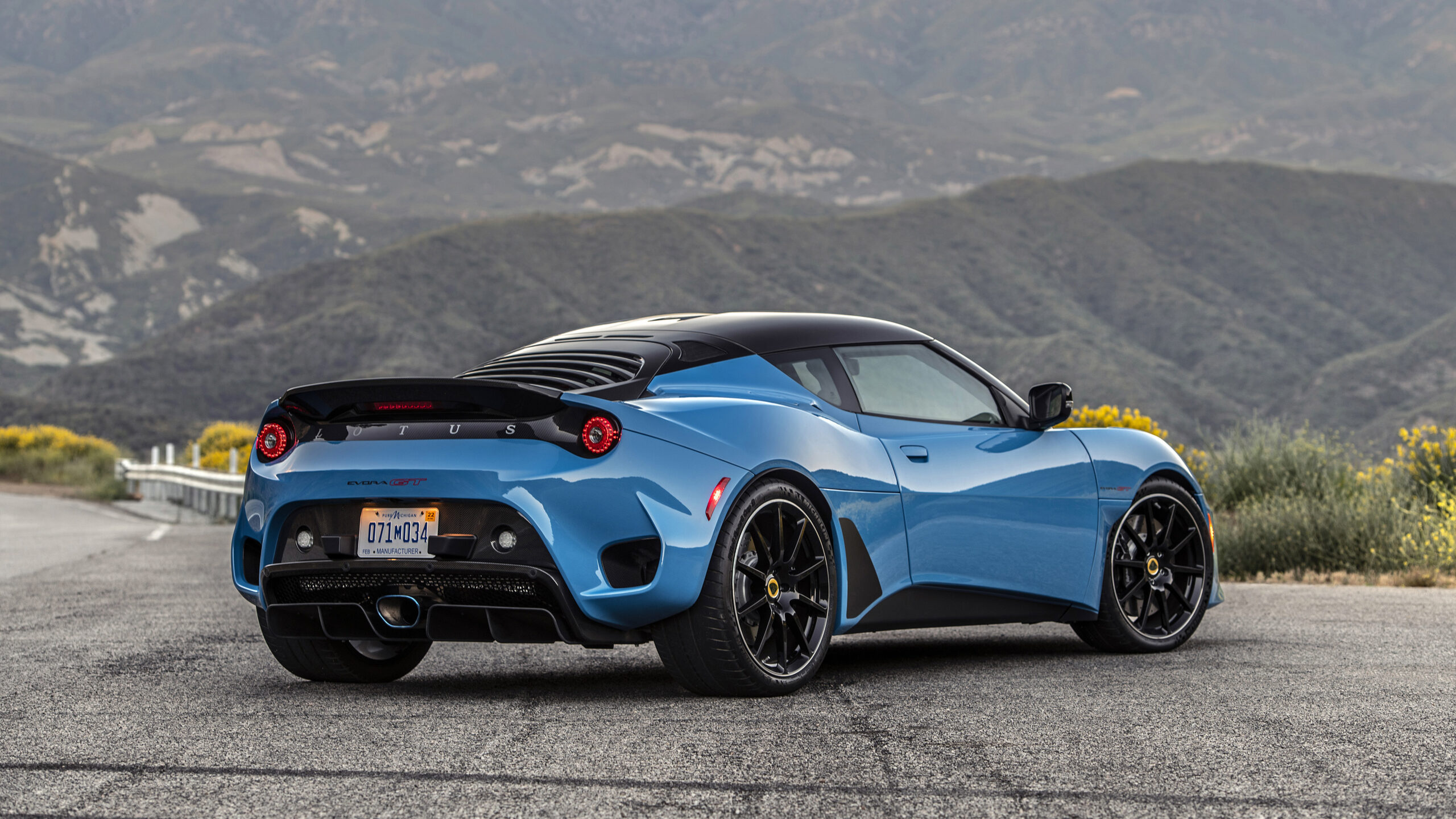
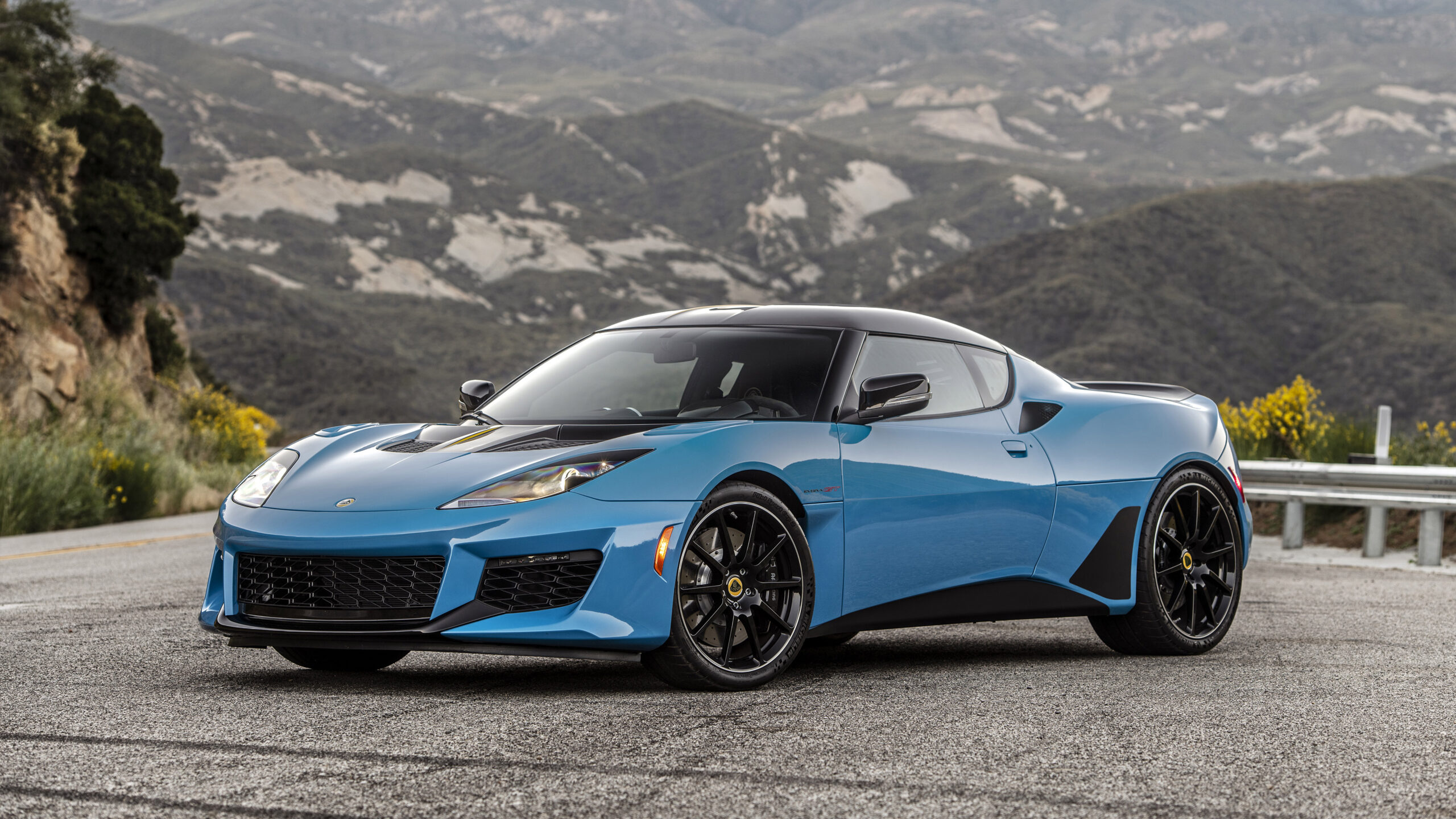
We have curated the ultimate collection of the best 2020 Lotus Evora GT Wallpapers and HD backgrounds for you to enjoy. Our team focused on finding the top 2020 Lotus Evora GT Wallpapers only to keep the quality high. These 2020 Lotus Evora GT Wallpapers are free to download so go ahead. To download any of these pictures for use as a wallpaper, right click the picture and choose Save As…
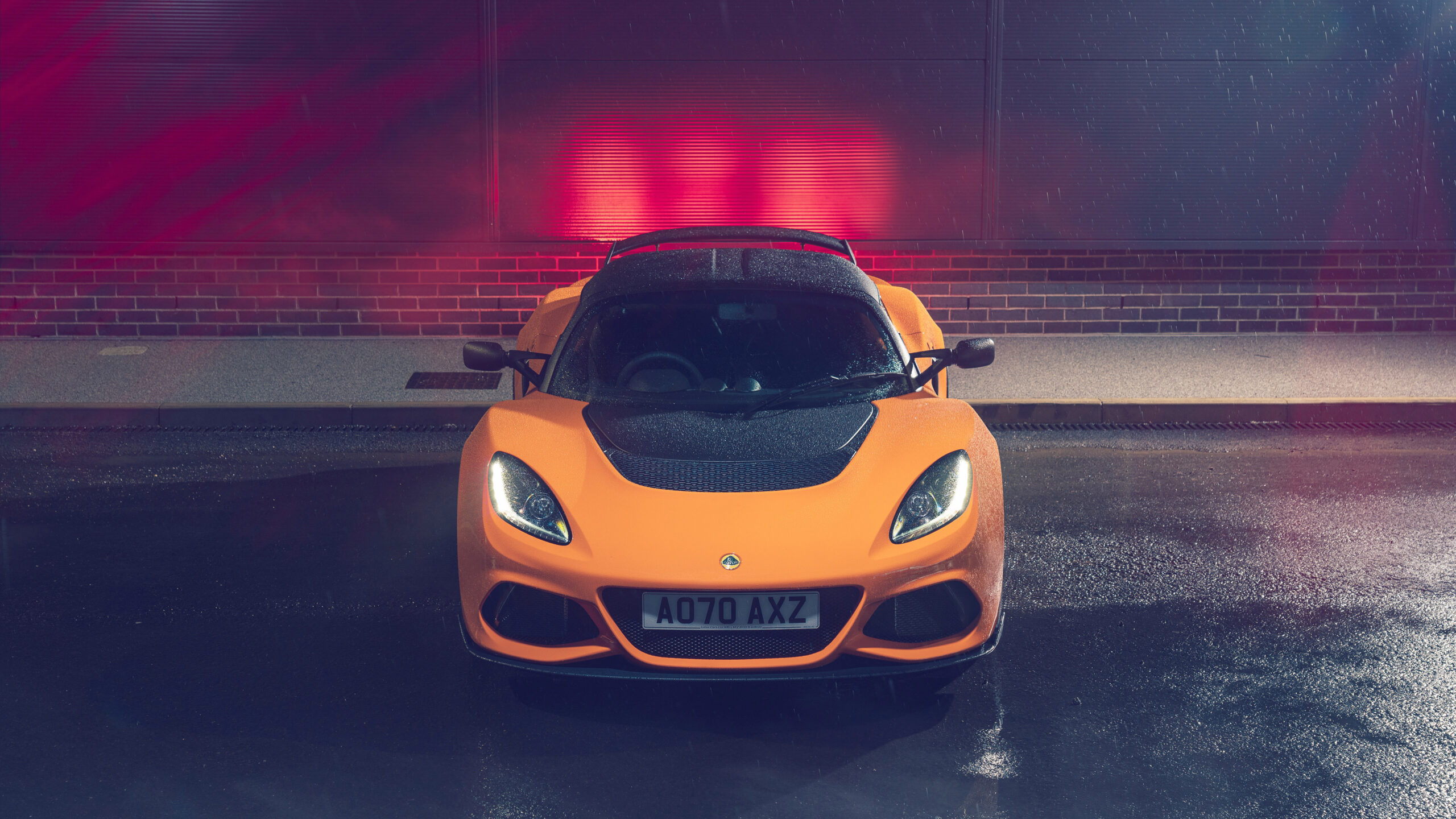
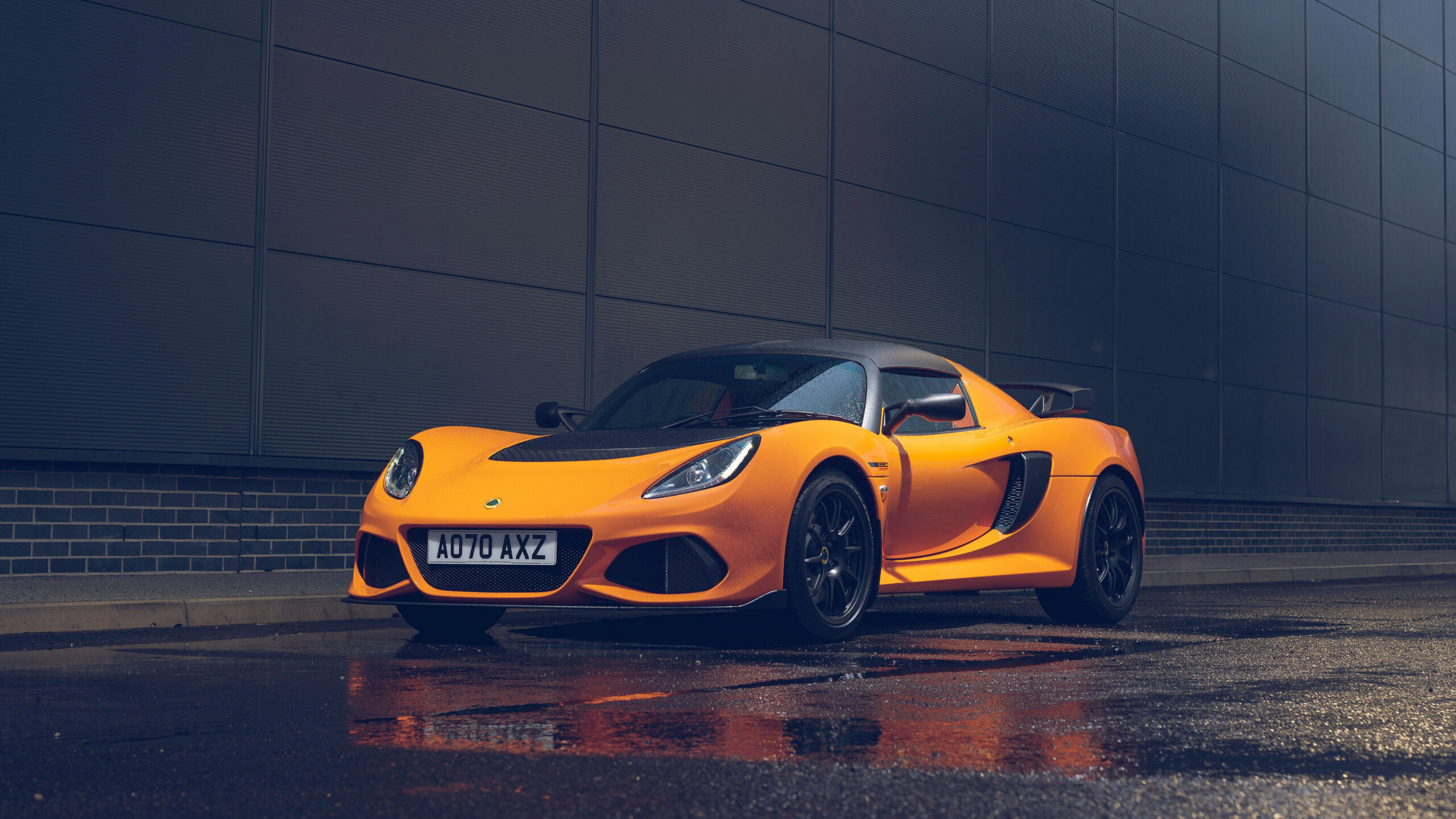
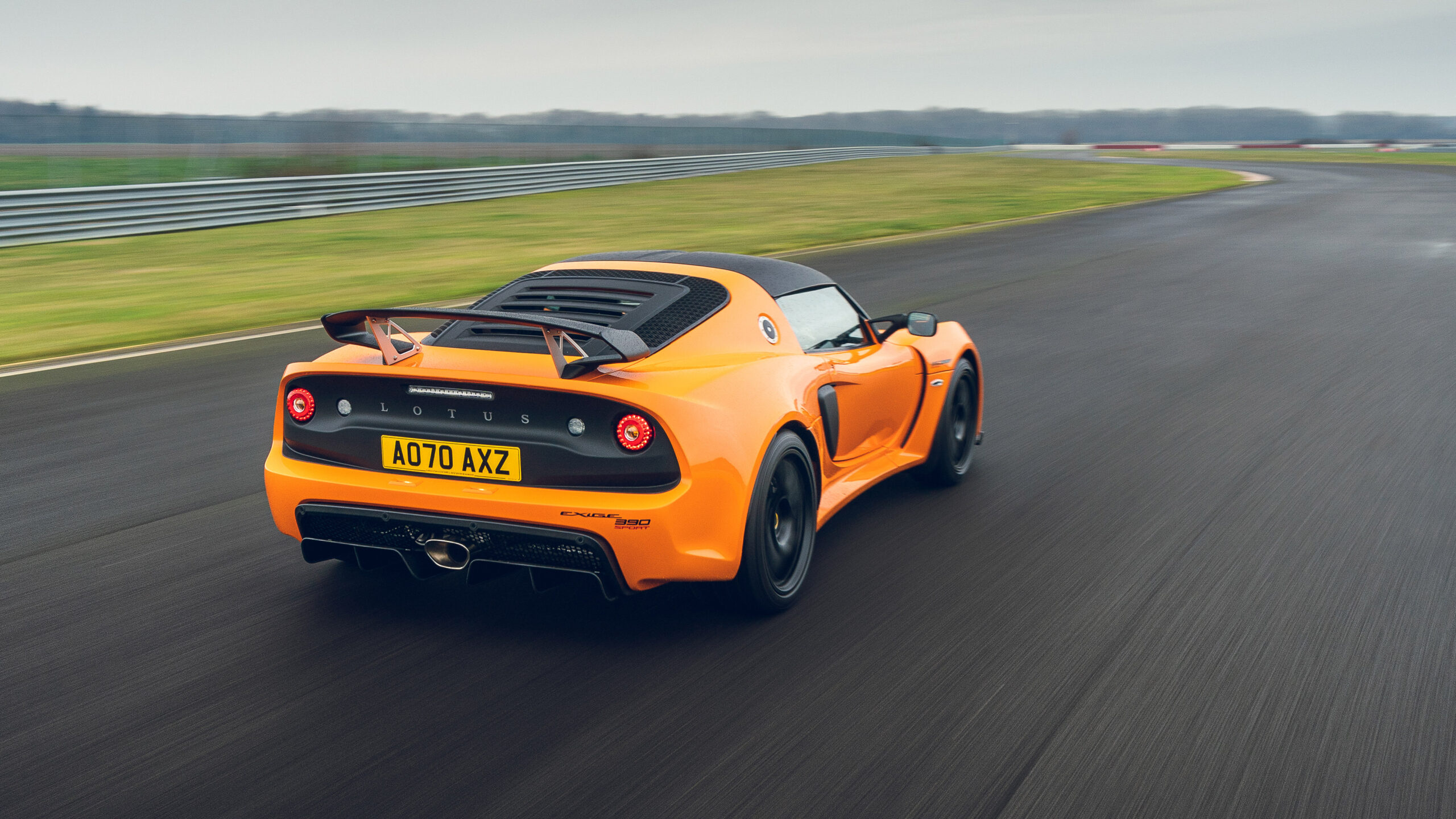
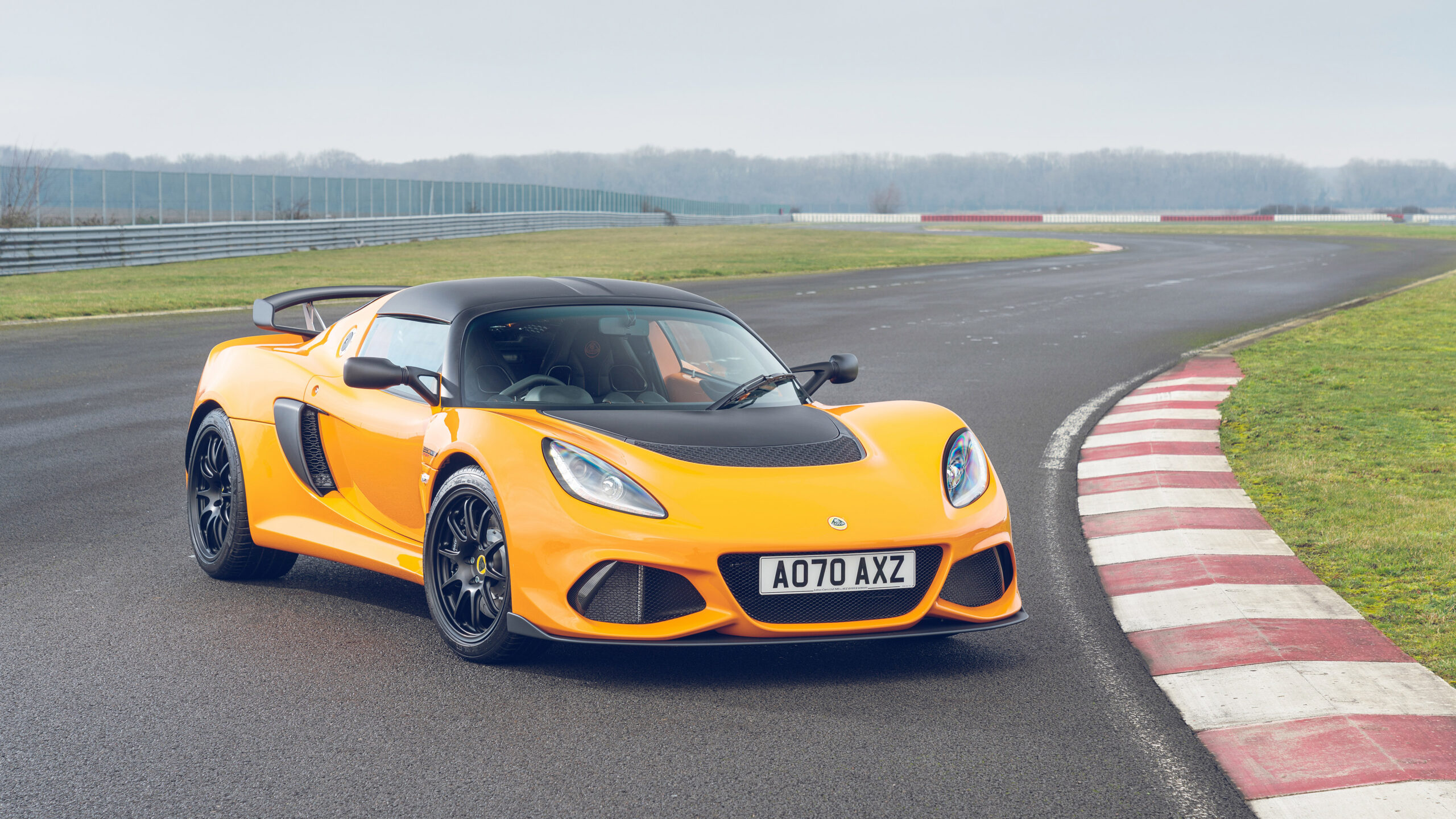
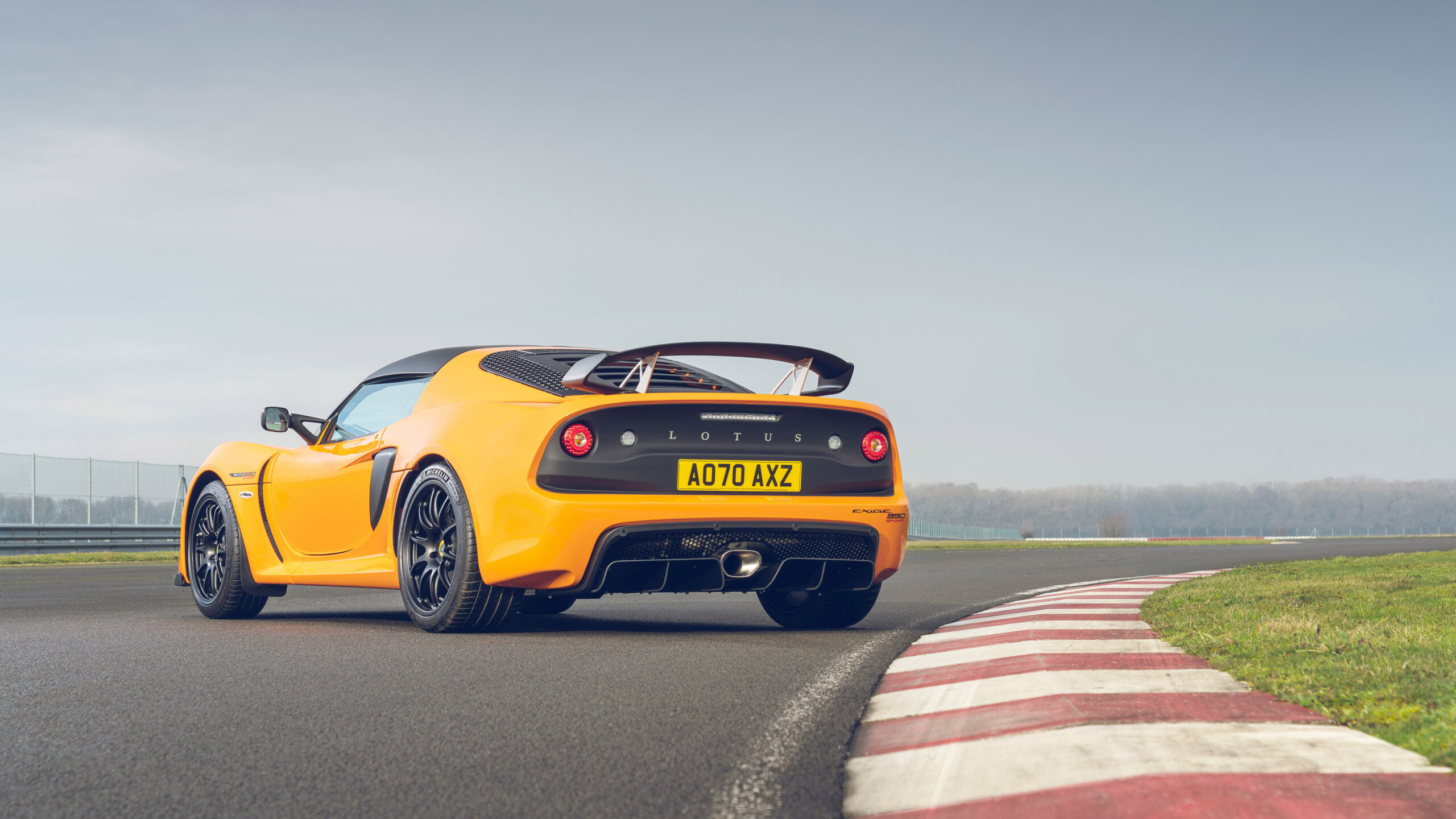
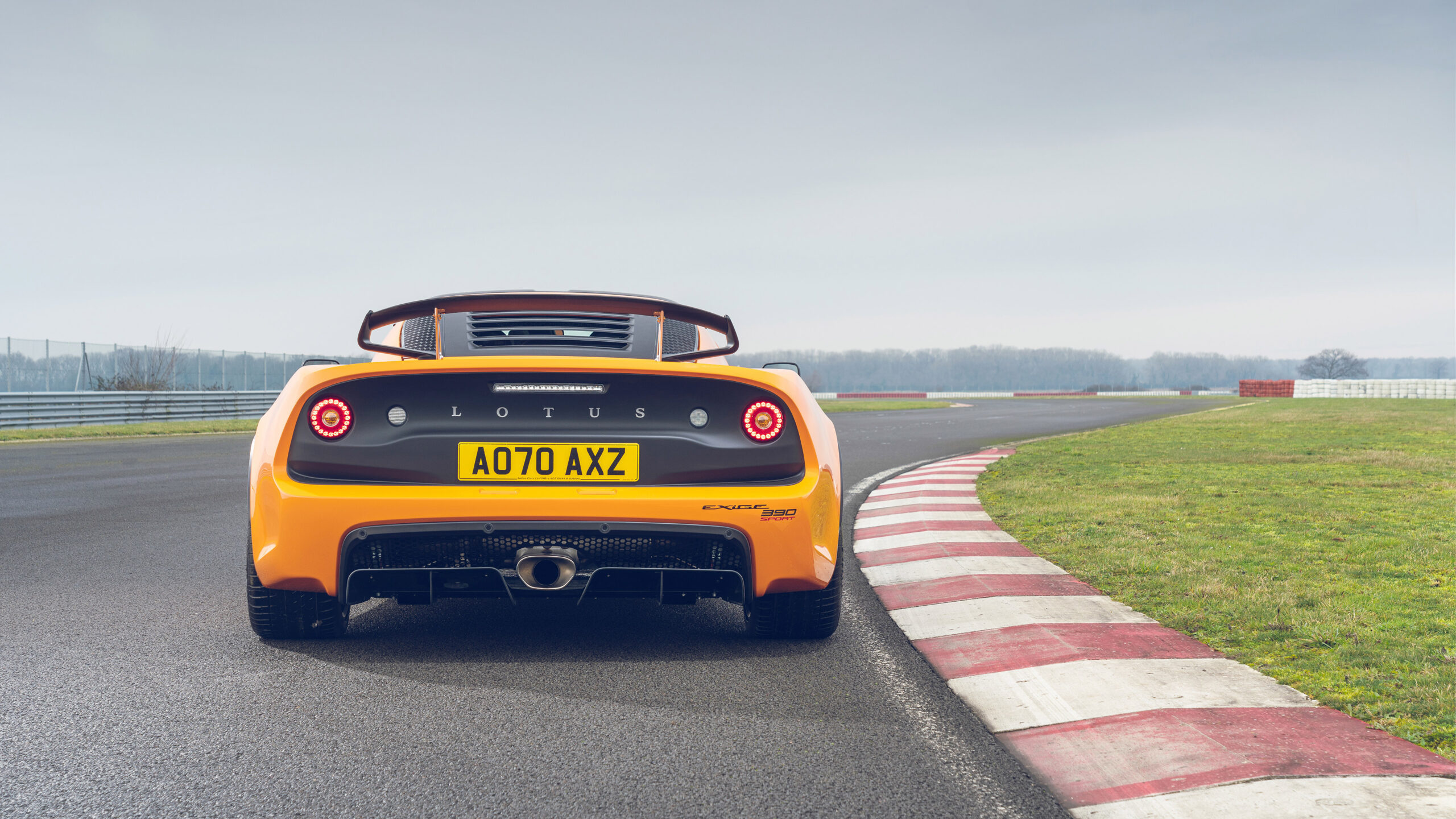
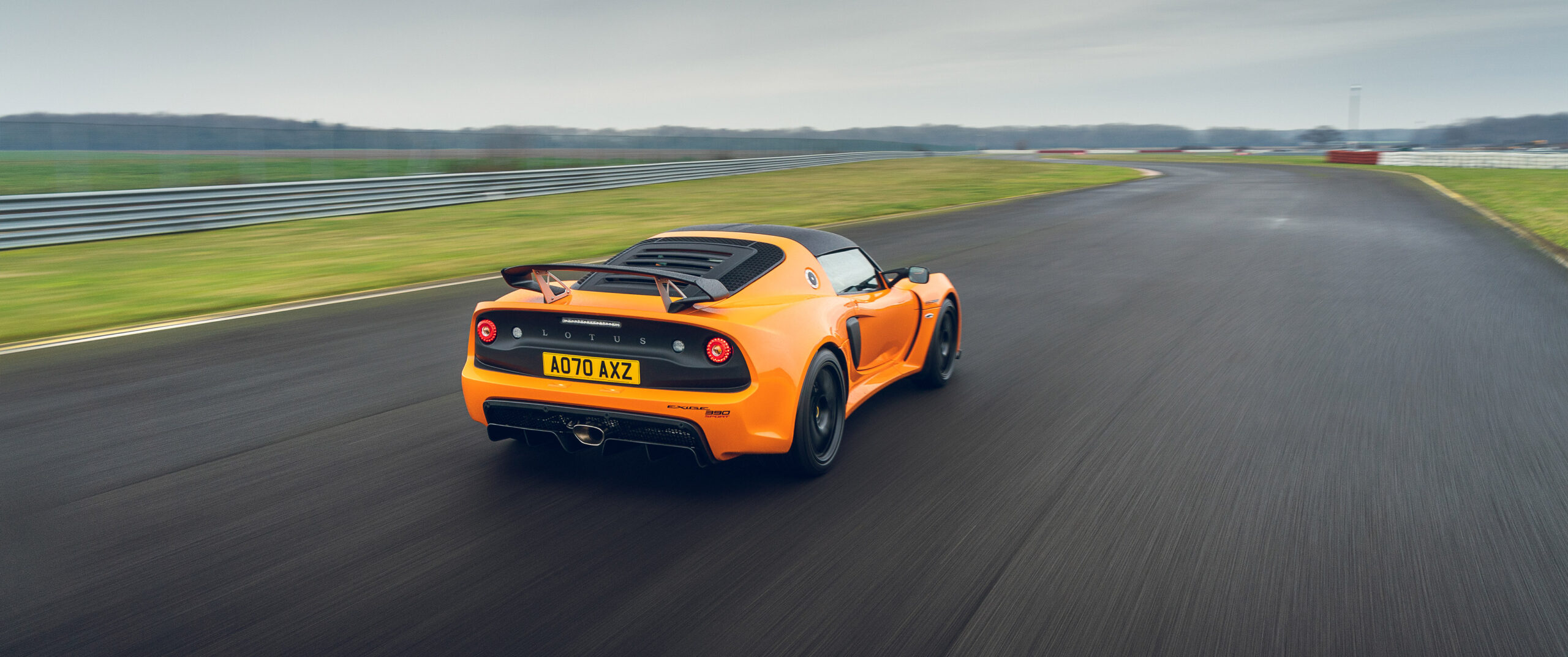
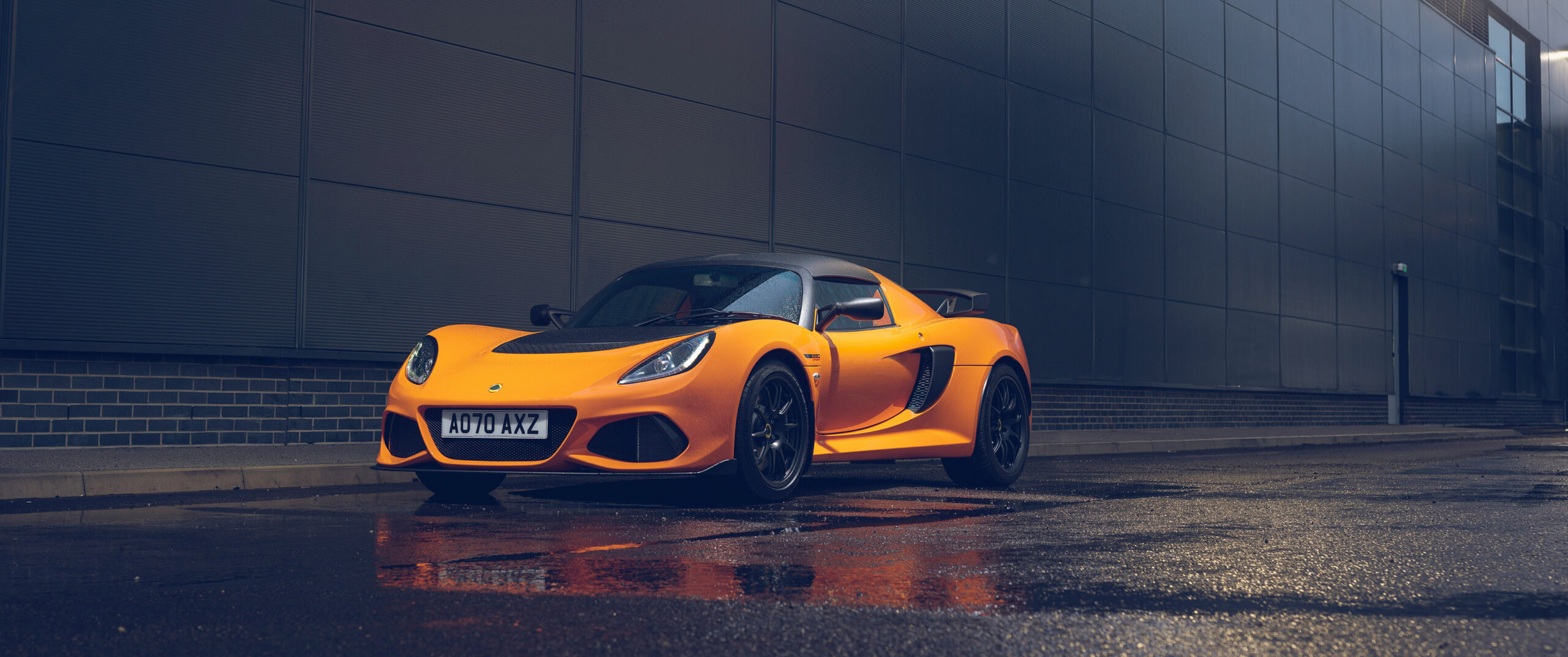
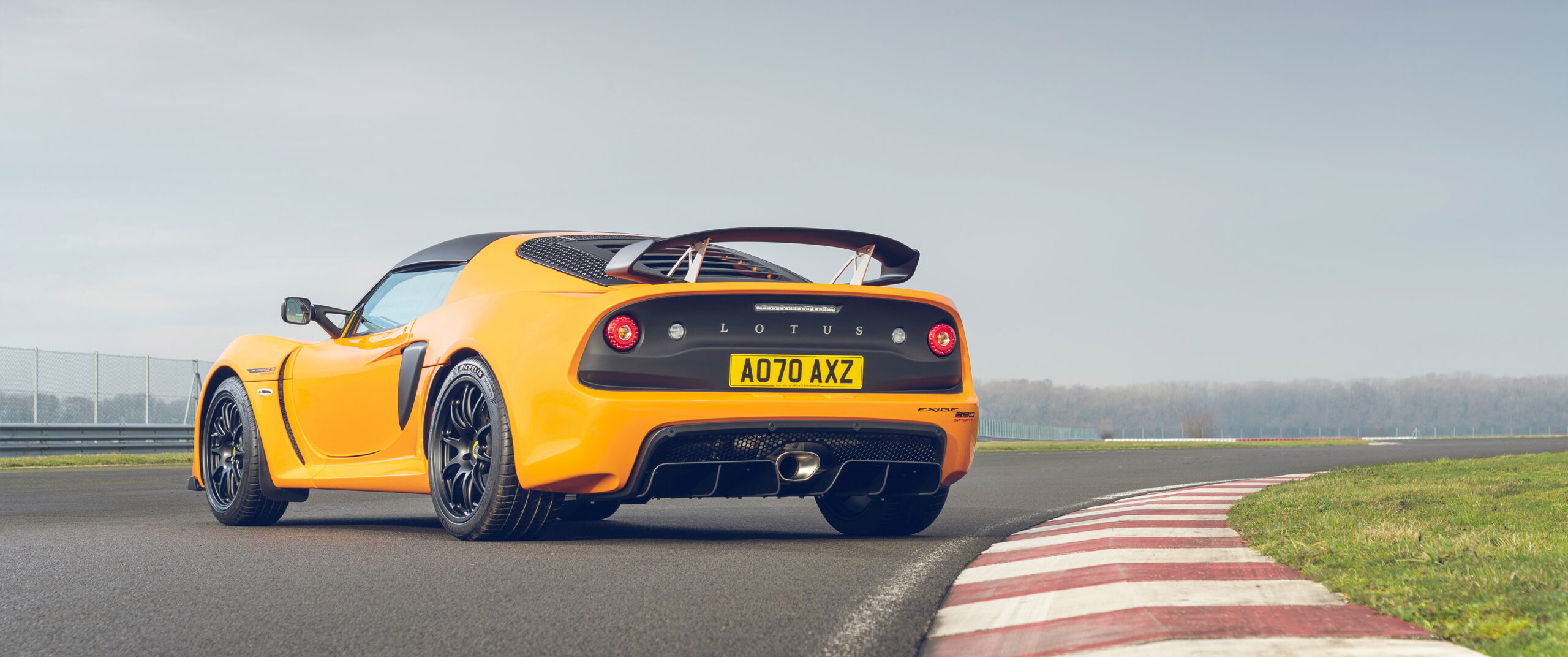
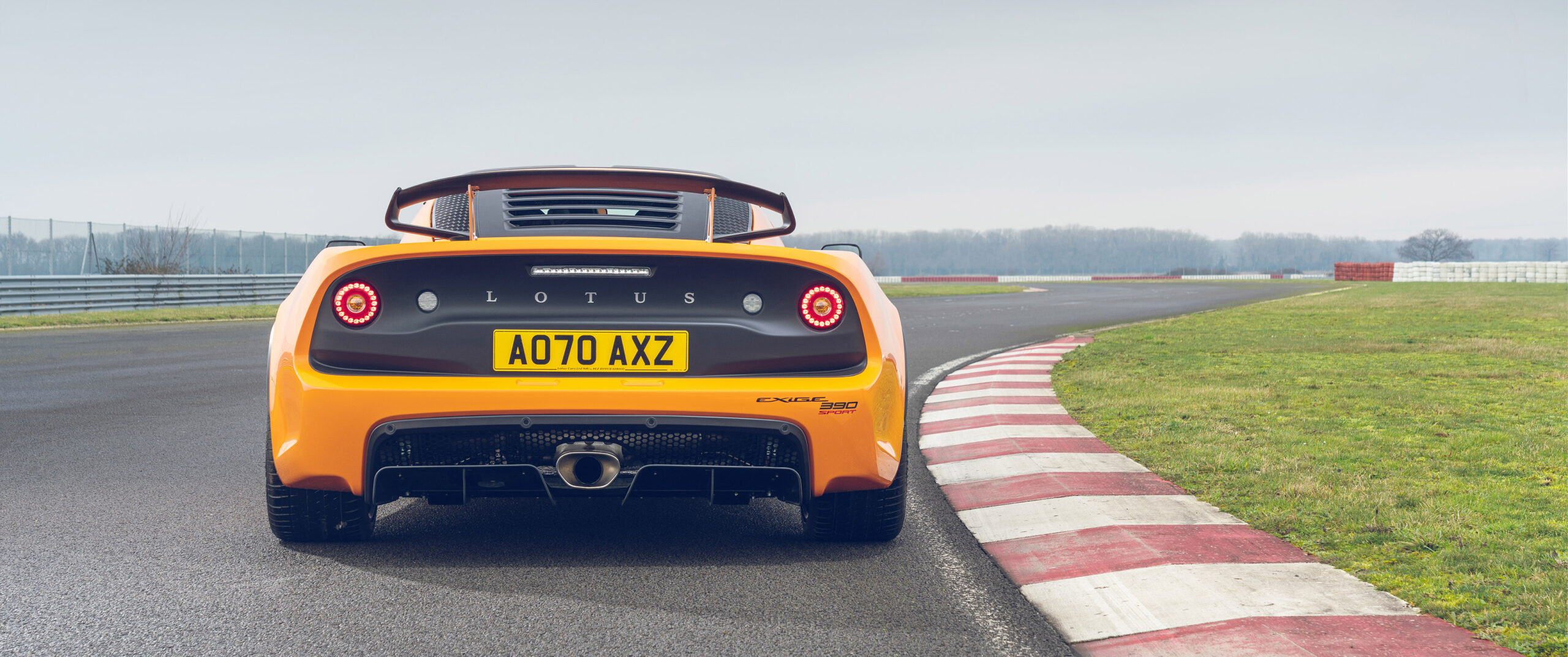
We have curated the ultimate collection of the best 2021 Lotus Exige Sport 390 Final Edition Wallpapers and HD backgrounds for you to enjoy. Our team focused on finding the top 2021 Lotus Exige Sport 390 Final Edition Wallpapers only to keep the quality high. These 2021 Lotus Exige Sport 390 Final Edition Wallpapers are free to download so go ahead. To download any of these pictures for use as a wallpaper, right click the picture and choose Save As…