All posts in “Cars”

How to Drift a Car Around A Tight Turn

One of the most famous tricks in motorsport is the Scandinavian Flick (or the Pendulum Turn). Rally drivers have been using it for decades to help get their cars around turns in conditions with little to no grip. The technique leverages the car’s ability to make a negative (no grip) a positive (speed). As a convenient byproduct, if you pull the flick off, you look like an absolute hero.

Of course, there’s more to the maneuver than just chucking the car into a turn and spinning the wheels. To break down how to properly execute a Scandinavian Flick, we spoke to Wyatt Knox, an instructor at Team O’Neil Rally School – a guy who does this maneuver on a daily basis.

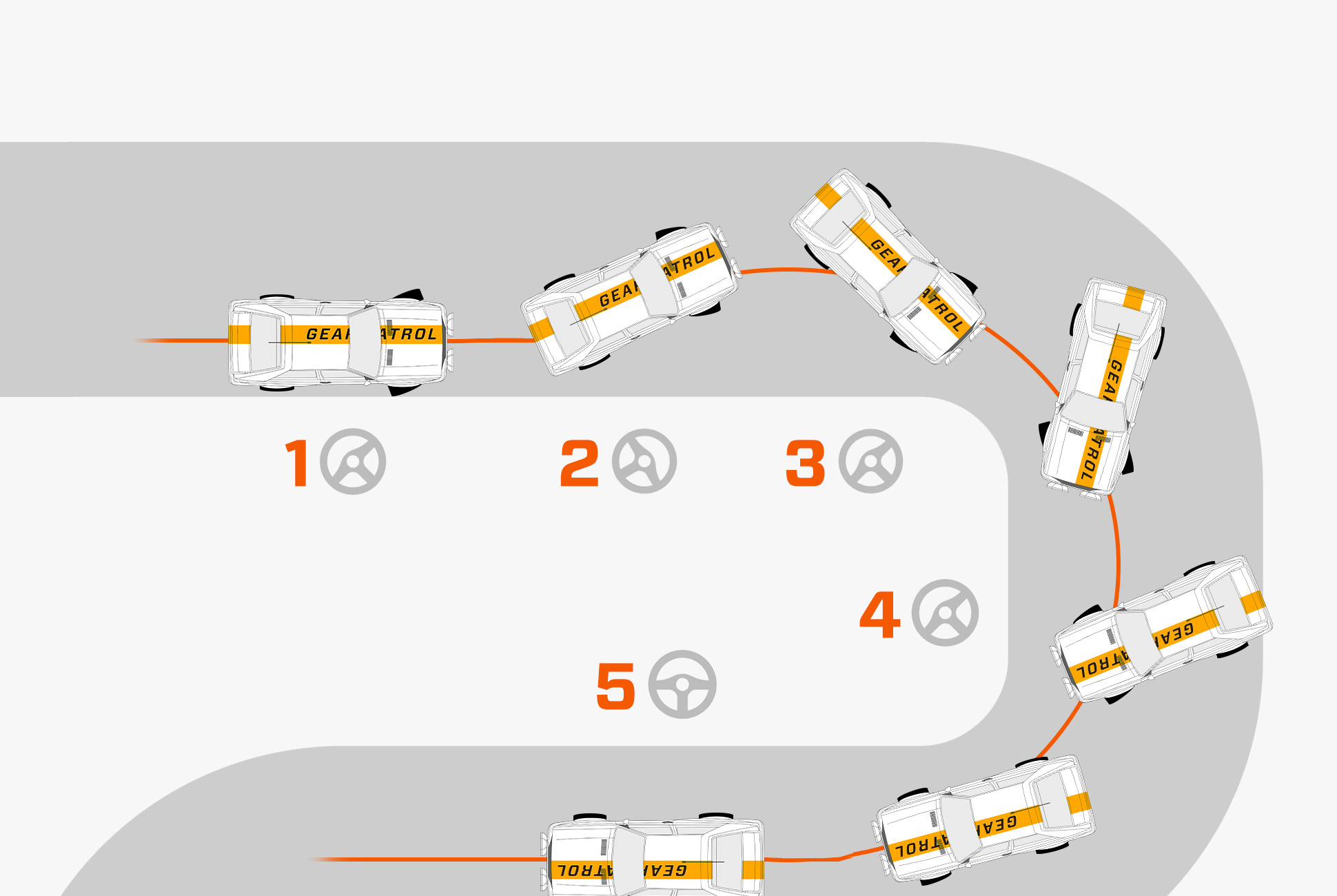
Scandinavian-Flick-Step-By-Step-Gear-Patrol-2

Illustration by Henry Phillips

1Lift, turn, brake. This is where you counterintuitively turn the car in the opposite direction of the turn. By letting off the accelerator, turning the wheel and applying the brakes, you’re putting weight over the front tires. This motion gives you grip in the front and swings the rear end out. Think of it as winding up before a pitch.

2Turn back, release the brake and blip the throttle. This shifts weight back to the rear of the car, giving those wheels grip. With the front wheels pointed into the turn, the rear of the car will pivot and rotate back the other way. Make sure you have your eyes on the apex because that’s where you want to go.

3Countersteer as much as you need. Depending on the road surface, the back end can rotate at different speeds, so be prepared to adapt. With the wheels pointed at the apex, you should already be looking at your exit. The car will go where your eyes are looking.

4Be patient. Wait for the car to tell you what it’s doing. Modulating the throttle and brakes will keep the car under control as you come around the apex, but it’s possible that you won’t need to touch either pedal and you can just let the car do its thing.

5Exit smooth. The hardest part is behind you, so there’s no sense in rushing to get back on the gas and screwing it all up. As you straighten the car out, slowly lean into the accelerator and feel for the grip in the road. Now that you’re out of the turn and pointed down the road, get back on the gas and enjoy the adrenaline buzz.

About Our Expert

Wyatt-Gear-Patrol

Wyatt Knox has been the chief instructor at Team O’Neil Rally School for the better part of the past decade. Since he started rallying at the age of 21, he has rarely found himself finishing a rally off the podium. He’s the 2011 2WD National Rally Champion and has racked up victories at legendary rallies like the Sherwood Forest Eastern Regional and 100 Acre Wood Rally.

VIDEO: Porsche 911 GT3 v McLaren 570S Track Pack

[embedded content]

I am a big fan of Steve Sutcliff’s video reviews. He gets cars and you can tell just how genuinely excited he is to be behind the wheel. In this video he focuses on comparing the GT3 and the McLaren 570S Track Pack. It’s funny because we talk a lot about choosing cars here at Supercars.net and we often struggle with this very choice and whether McLaren can unseat the GT3 as our favorite all round car. Watch this video to find out.

Are Any Car Leasing Subscription Plans Actually Worth It?

Cadillac will “pause” its BOOK subscription service at the end of 2018. The company could reanimate the idea in the intermediate to long-term future. But, for now, BOOK is as good as kaput. That’s not too surprising. American car subscription models, as presently conceived, stink. They are expensive. They fill a hyper-specific niche that does not really exist.

The reasoning behind subscription plans is clear. Carmakers are rebranding as savvy, au courant tech firms. With pushy dealers and byzantine paperwork, the car buying experience is primed for disruption. There should be an app for that. The trouble is the current apps meeting any reasonable usefulness threshold.

Manufacturer subscription plans are ludicrously expensive. The idea – tapping your iPhone on a whim and having a gassed-up 600-horsepower performance beast replace your practical crossover – is simple. Providing that service requires substantial infrastructure and overhead. Improved tech can’t bring down that cost over time. Scaling up would prove an even greater challenge.

Customers absorb those bloated costs. BOOK by Cadillac subscribers were paying $1,800 per month — a lot by any measure. Even in the Cadillac realm, that’s a lot. We’re talking $400-plus more per month than a reasonable financing deal on a CTS V, the most expensive car in the BOOK fleet. Cadillac’s plan was far from the most costly. Top tier plans for Porsche, Mercedes, and BMW meet or approach $3,000 per month.

Paying a premium on top of a premium may not feel absurd if the affluent get something in return. But, what exactly are they getting?

Variety? That could be the spice of driving life. But, how spicy is it? Even the most bowled over fanboy would get a bit bored swapping one BMW for another after a while. That weekend where all life’s practical concerns float away for some intimate time with the sport coupe? Probably not going to be a regular event. One suspects most users probably spend the bulk of their time with the crossover they would have leased anyway.

Volvo offers novelty with Care by Volvo. You can subscribe and get a new Volvo as soon as every 12 months. That model works for iPhones. A Volvo is not an iPhone. One year makes far less difference in the car world. There’s little benefit to frequent renewal. Losing the residual value from the vehicle costs far more than not having an outdated phone at the end of your deal.

A subscription plan eliminates some minor ownership annoyances, sure. You don’t have to clean. You avoid that onerous once-a-year-or-so call to the insurance company. You don’t have to get your plates renewed. Is that extra convenience worth thousands more per year?

The company that “disrupts” the car buying experience will make it more efficient, more affordable and more tailored to the modern urban driver. None of the present plans do that. They offer the absence of commitment at a very steep markup. That freedom, for the few in select locales that even have the option right now, is not worth the expenditure.

Road Trip Gifts: For Those Who Love the Open Road

Committing to a road trip — cross-country or just zig-zagging your way across a map for a couple of days — is a unique beast as far as traveling ventures go. It’s not like sitting on a plane for a few hours or riding a train through the country. A real road trip, whether solo or with companions takes planning, be it for fuel stops, on-the-go in-car meals, music, entertainment or (knock on wood) accidents and mishaps. If you don’t do it right, you’re asking for trouble.

The next time the road-tripper in your life decides to hit the open road, make sure it’s not on a wing and a prayer. Give them the tools they need to make the next road trip the best one yet.

National Geographic Guide to Scenic Highways and Byways

If you’re looking to provide the ultimate inspiration for an on-road adventure, the ‘National Geographic Guide to Scenic Highways and Byways’ is a perfect place to start. The goal is to skip the boring, featureless, never-ending highways and instead discover the 300 best drives in the country.

Oak Street Bootmakers Brush Brown Waxed Canvas Utility Tote

Long road trips don’t just take a toll on the driver. What you carry necessary in-cabin cargo matters too. The Oak Street Bootmakers Brush Brown Waxed Canvas Utility Tote is built to last – not to mention hold on to its style for its entire lifetime.

Rumpl Original Puffy Throw Blanket

For those cold nights under the stars or, you know, sprawled across the back seat because it’s raining, the Rumpl The Original Puffy Throw Blanket has road trippers, well, covered. It’s easily packable and water and stain resistant. Crucially, the insulation is compressable so it takes up little to no space.

Spotify Premium 3-Month Trial

Traveling with a companion on long road trips means most of the DJing responoibility rests on their shoulders. Make that job easier: Spotify Premium is super cheap for a three-month trial. All the music any driver and passenger could hope to endlessly argue over is right there at their finger tips.

KRAVE Jerky Variety Pack

When it comes to road trip essentials, not many food items rank higher than jerky. On the open road, it can even be considered acceptable as breakfast lunch and dinner. Luckily, the Krave Varity pack comes in a multitude of flavors so you can at least discern those mals from each other on those cross country drives.

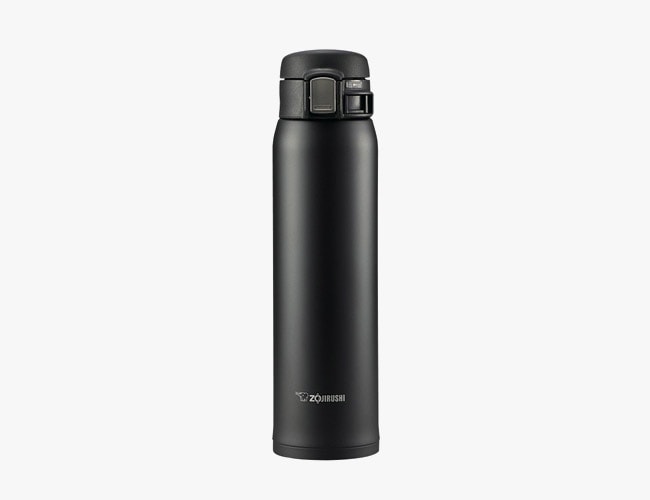
Zojirushi Stainless Steel Insulated Mug, 20-Ounce

Unless your road tripper has a brand-new luxury car fitted with a fancy refrigorator in the arm rerst or heated cup holders, their coffee will cool and the ice in their soft drink will melt. The easiest solution — aside from buying them a new car — is getting a Zojirushi Stainless Steel Mug, which can keep beverages hot or cold for hours on end.

Yeti Hopper Flip 12

Some of the best road trips mean heading off-road and off the grid. When that’s the case, a proven storage unit is necessary. The Yeti Hopper Flip 12 is a soft, cubed-shaped cooler build to go anywhere. It’ll keep whatever is inside colder for longer.

NOCO Genius Boost Plus GB40 1000 Amp 12V UltraSafe Lithium Jump Starter

Mistakes happen on road trips, both big and small. Sometimes you take a wrong turn and go miles out of the way. Other times you leave the dome light on while you go to grab a bite to eat and the battery dies. For the former, turning around and heading back is the most simple solution. For the latter, however, you can pack the NOCO Genius Boost Plus and not even have to worry about asking for a jump. The NOCO is rated at 1,000 Amps or up to 20 jump starts on a single charge and can also charge smartphones and tablets like any other external battery.

Audible Audiobook Subscription Plan

Using music and podcasts to fill the silence on a road trip isn’t foreveryone. One of the best alternatives is access to Audible. After a free 30-day trial, the monthly subscription allows for streaming of one audiobook and two Audible originals, the brand’s own productions.

High Road TrashStash Hanging Car Trash Bag

Some people can let their cars get too messy and let garbage accumulate in the footwell, side pockets or under the seat. The High Road TrashStash Hanging Car Trash Bag is a move in the right direction. It’s not the masssive step-to-open trash can you have in your kitchen but this is easily the automotive equivalent.

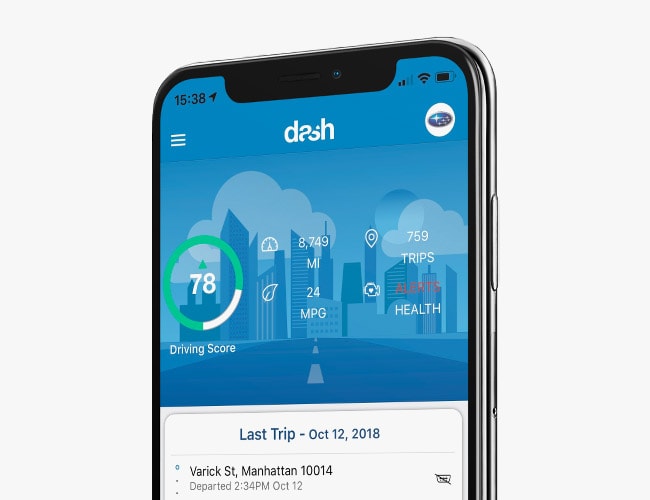
Dash App/OBD-II Performance Tracker

The days of trying to guess what a check engine light means are over. OBD-II Performance Tracker plugs right into a car’s OBD outlet and doesn’t just transmit regular diagnostics, it also sends data right to the app on the your phone letting you know how to save fuel, when maintainance is needed and helps to save money on resale, sending remote alerts all in real time.

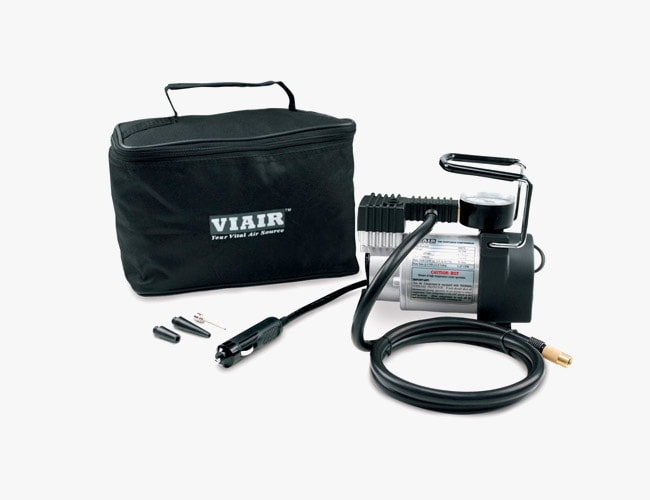
Viair Heavy Duty Portable Compressor

It’s one thing to fix a punctured tire on the side of the road, but it’s not like an inflatable pool toy you can blow up with lung power — an air compressor is necessary. The smart move is to pack one as compact as the Viair 00073 70P Heavy Duty Portable Compressor. It stows away in a bag not much bigger than a classic lunch pail, runs off your car’s electricity and can pump up to 100psi. The Viair is one of those things everyone should keep in the car, road trip or not.

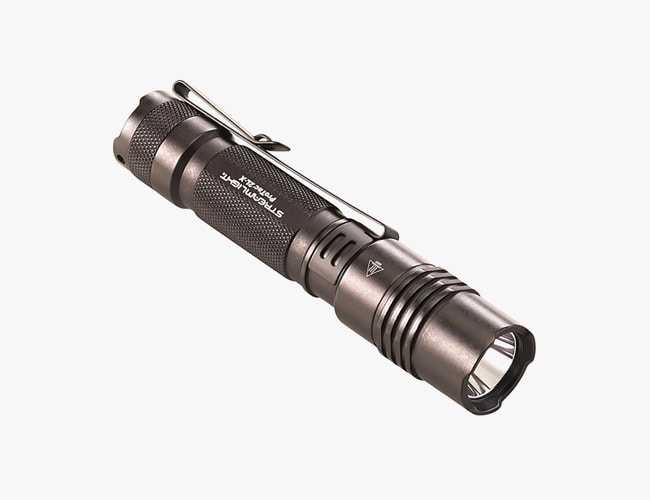
Streamlight 88062 ProTac Professional Tactical Flashlight

The thing about flashlights is that you don’t always need one, but you’d better hope to have one when you do. It seems fairly obvious, but how many times have we all found ourselves crawling around in the dark, looking for change or eyeglasses dropped under the car? Solution: Streamlight 88062 ProTac Professional Tactical Flashlight. It’s compact EDC-sized, waterproof, impact resistant and can clip to your pocket — so it’s one less thing you have to go searching for. Plus, we named it one of the best EDC flashlights avbailable.

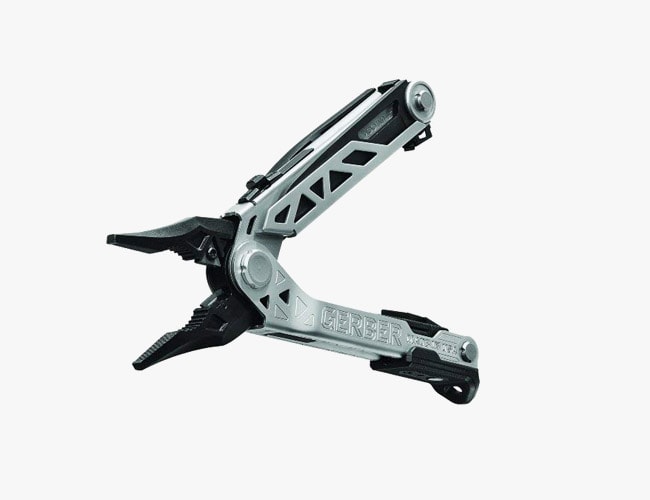
Gerber Center-Drive Multi-Tool

While it’s always smart to have a fully-stocked tool chest, bringing 100-plus pounds of wrenches and drivers on a road trip isn’t the most practical thing to do. But, give your giftee a fighting chance with more manageable jobs by arming them with a Gerber Center-Drive Multi-Tool, a 12-piece standard which includes, among other things, a center-axis screwdriver that provides torque and grip like a regular driver.

Tod’s Gommino Full-Grain Nubuck Driving Shoes

Just like running, hiking and formal occasions, driving is always more enjoyable with the proper footwear. The best part of Tod’s Gommino Driving Shoes? They’re full-grain nubuck leather and can double as more formal footwear if need be. If your point ‘B’ is quite a ways away and you need to look as dapper as possible when you get there, the Gommino leather driving loafers at least have your feet covered.

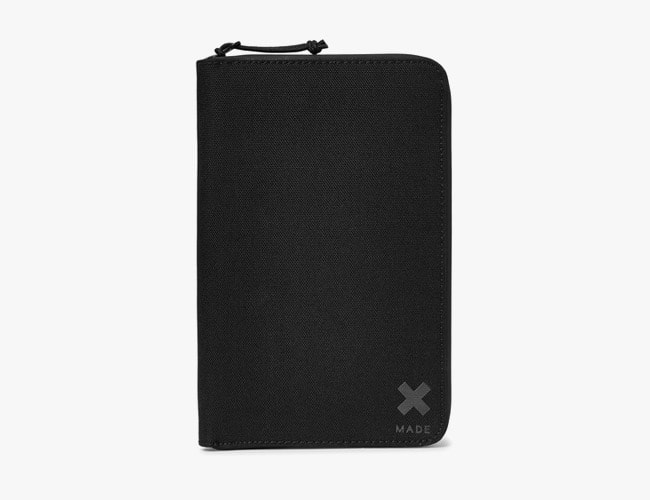
Best Made Co SWS CORDURA Field Case

Whether it’s insurance, registration, road notes or the road map, keep it safe in something you know will last. The Best Made Co Field Case made from tough as nails cordura is exactly what you’re looking for.

Outlier Ultrafine Merino Shirt

One of the more obvious tips for a long road trip would be to dress comfortably. Jeans and t-shirts work well for a grocery run, but spend an entire day getting in and out of a car to eat and refuel and you’ll soon find there are far better choices. The Outlier Ultrafine Merino Shirt is made with Mackenzie 17.5 micron Merino fibers, meaning it’s some of the finest, softest and lightest fabric on the market.

Wavian Red 1.3 Gallon Gas Can

Not all road trips keep you within spitting distance of gas stations — some of the best ones don’t. For drivers going the distance and tempting the remaining fumes left in the tank, it’s always good to have a spare can of fuel onboard. And if the 1.3-gallon Wavian can is good enough to be standard issue for NATO forces, you can bet it’ll handle the odd road trip.

District Vision Keiichi Standard Gray District Sky Sunglasses

Whether they’re heading west chasing the sun to the horizon or that fireball is lighting the easterly morning road, drivers need eyewear to battle back the rays. District Sky G15 is a shatterproof polycarbonate lens with a 15 percent light transmission and maximum sun protection.

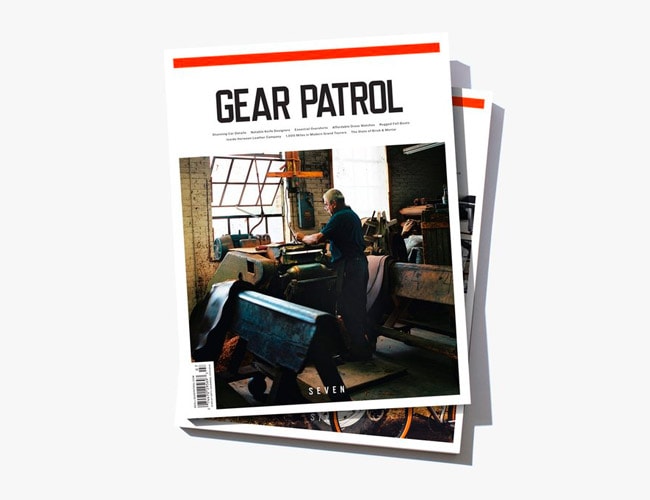
Gear Patrol Magazine

Perfect for whoever is manning the back seat. Inside its 200-plus pages, we explore what it takes to turn an office chair into a thing of beauty, an accidental invention into a culinary essential and a 1970s French automobile into one of the most evocative cars of the last century. Plus much more.

Note: Purchasing products through our links may earn us a portion of the sale, which supports our editorial team’s mission. Learn more here.

Tools You Need To Take Care of Your Exotic Supercar

An exotic supercar or a high-end car is a piece of treasure, and the last thing that would be expected of you is to let it get dirty. Keeping the luxurious automobile clean, including on the inside, is crucial, as people will turn their heads to admire its exterior and will want to catch a glimpse of its interior. Also, you need to ensure that your car is safe and well secured from thieves who may steal it or pluck its parts, such as side-mirrors or lights, by installing it with devices or products from EyeRide, like DVR and camera surveillance systems, GPS tracking system, and more.

The following are some tools you need to take care of your exotic supercar:

Air compressor

A good air compressor is a crucial automotive care tool that you certainly need for your high-end car. This tool can perform several basic tasks, like blowing up a tire or providing compressed air to do away with cobwebs from some car parts. Also, it comes in handy to do other jobs, like powering air tools and paint guns. It is advisable when buying an air compressor to get the best and biggest you can afford. Another thing to have in mind when buying an air compressor is to ensure you have sufficient electrical power to operate it.

Portable car vacuum cleaner

For a very clean car, especially the interior, a portable car vacuum cleaner—especially one with a long nozzle accessory—can easily clean the deep places. It can help to remove dirt, dust, pet hair, and other unwanted pieces or particles on the surfaces of car seats, and pet hair. The vacuum cleaner can also remove dust particles from the air in a car. A wet and dry auto-cleaning tool is the best choice.

Tire pressure monitoring gadget

Tire pressure can affect the comfort and the safety of your exotic automobile. You can check your car owner’s manual for the recommended tire pressure for your specific car. Also, there are other gadgets and simple tools that you can use to monitor the tire pressure. Normally, you can do the check, and you should do so on a daily basis. Your car could also be fitted with an automatic tire pressure monitoring system by the manufacturer, in which case you wouldn’t need any other tool. There are also smart gadgets that you can link with your mobile devices and that will constantly keep track of tire pressure. They will send you alerts in case one or more of the tires needs some attention.

Car windscreen protector

This is a protective cover to protect the windscreen from extreme weather conditions, such as frost, ice, and snow. It also protects the windscreen from dust. It is simply placed on the windscreen, and two side tab sections get tucked into the passenger and driver doors, thus ensuring it does not get removed.

The above are only a few of the tools that you need to take care of your exotic automobile, but there are many more, for example, safety-enhancing ones, like cameras and PS tracking devices. The best thing is that most modern cars come with these tools, so all you need to do is familiarize yourself with them and install a few additions.

2019 Acura NSX Track Test Review | Exotic tech, exhilarating performance

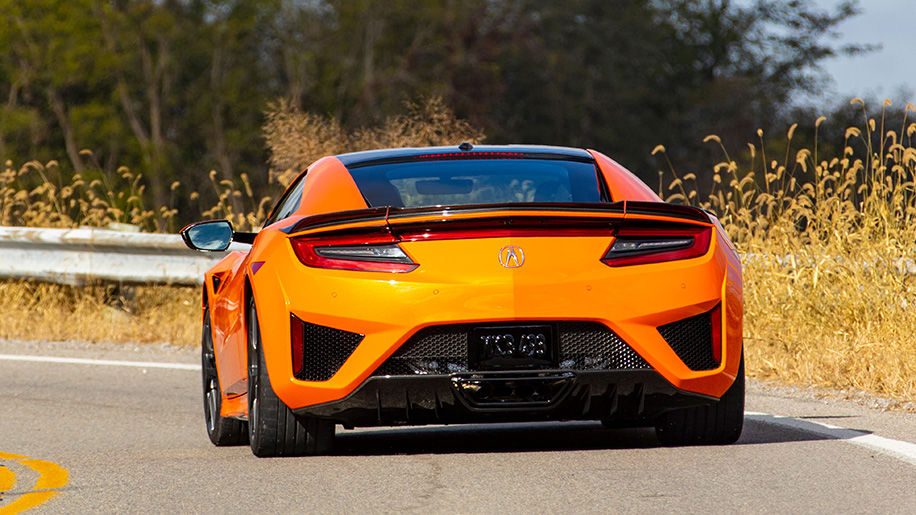
EAST LIBERTY, Ohio — The 2019 Acura NSX makes sonorous noises behind my ear as the tachometer soars toward 7,500 rpm. My hands grip the squared-off steering wheel a bit too hard as I scrub off about 60 mph and dive into the first corner of the Transportation Research Center (TRC) dynamic handling course. There’s 3,878 pounds of car beneath me, but the front tires do exactly what my hands tell them to, without hesitation, and I’m through the double apex corner without even thinking about the defiance of physics I just witnessed.

On paper, a nearly 4,000-pound track car makes no sense. Yet in practice, it’s just as tossable and eager to change direction as something much lighter. This is the NSX’s party trick, thanks to some magic with the suspension and all-wheel drive system on this car. And while the new NSX is a very different vehicle than its predecessor, it was born of a similar spirit of innovation and forward thinking.

The original Acura NSX hit the streets in 1991, establishing a new set of rules for every supercar released since. Constructed of an aluminum body — still an exotic material mainly used in competition vehicles — with curves that still drop jaws today, it was every bit as sophisticated as a Ferrari. But unlike Ferraris of the time, it was also reliable and easy to drive. Slide behind the wheel of a 1991 NSX, and you’ll be transported back to a time when outward visibility was still in style. You can see the ground right in front of the nose. Turn around, and there’s nothing blocking your view but a low wing. It’s essentially a bubble canopy.

Acura knows owners of the original NSX, your author included, absolutely love this about their cars. The effort to make the cockpit of the NSX similar is appreciated, even if modern crash standards prevent a perfect implementation. There are other subtle throwbacks. Every original NSX made a distinctive intake whine when winding it up to 8,000 rpm, and the new NSX has real intake noise physically pumped into the cabin to replicate this sweet sound all the way through the rev band. Another echo of the original is the simplified, sedate dash layout — eminently usable and likely to age well. A simplified version of the new RDX infotainment system would have fit the bill, too, but sadly it’s not present.

2019 Acura NSX2019 Acura NSX2019 Acura NSX2019 Acura NSX

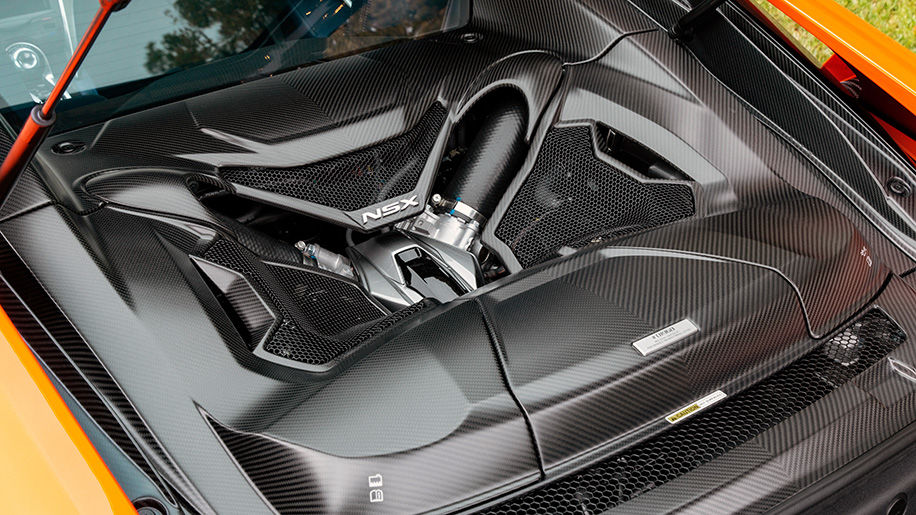
Under way, however, the generational similarities cease. Our time on this trip in the 2019 model was spent solely on track at TRC, and it was a wholly different experience from the old car. Take drive modes, of which the original had zero and the new model has several. Pop the center dial over to race mode, and the 2019 NSX idles loudly but inoffensively in our makeshift pit lane. Easing out onto the track, the nine-speed dual-clutch transmission holds onto low gears awaiting a takeoff run. After pit exit, all 573 horsepower and 476 pound-feet of torque are unleashed. Acceleration is instant. There’s no waiting for the turbos attached to the 3.5-liter V6 to spool up, because the electric motor sends a shock through your system straight away. The original NSX, with its naturally-aspirated V6, is lovely but has no answer for the high-tech assistance the new NSX gets from turbocharging and its wild hybrid system.

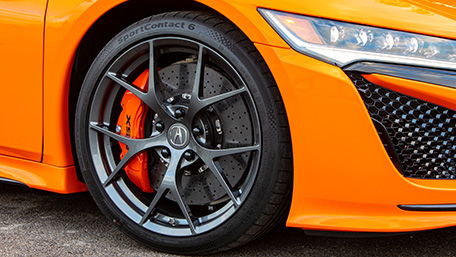
When the second-generation NSX came out for the 2016 model year, the steering drew complaints. This refresh focused heavily on fine-tuning the steering and suspension, and it worked. Front and rear stabilizer bars are 26 percent and 19 percent stiffer respectively. Rear toe link bushings are 21 percent stiffer, and rear hub rigidity has increased by 6 percent. Much-improved tires — the Continental SportContact 6s — replace the less sticky SportContact 5Ps. Tying it all together is a total recalibration of the SH-AWD system, magnetorheological dampers, electric power steering and stability control settings. If you want the Pirelli Trofeo R rubber, it’s still available as well, but we didn’t get to try those out.

2019 Acura NSX

It all works together perfectly, creating that quasi-telepathic connection that the best drivers’ cars have. Of course, it sets blazing lap times with ease, something the original can’t touch. But there’s also an impeccable balance through long sweepers. The car doesn’t feel like it wants to oversteer, but it’s easy to kick the rear end out in corners, then control it with the throttle in race mode. Stability control is still there, imperceptible but under the surface, and it doesn’t interfere with the fun. You can switch it off entirely if you’d like. The operation of the SH-AWD system, sending power front and rear, is apparent as it yanks you through corners.

The magic is that the complex torque vectoring spits you out on the other side of the corner, making it feel like you did it all by yourself, rather than with the help of a lot of computing power. That could easily make the NSX feel cold and clinical, but it doesn’t. It produces grins that last long after you’re off the track.

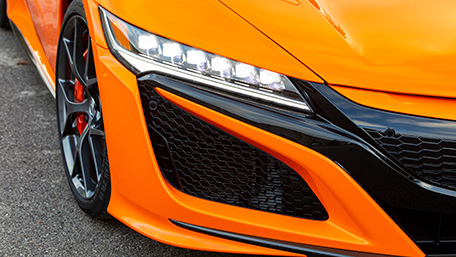
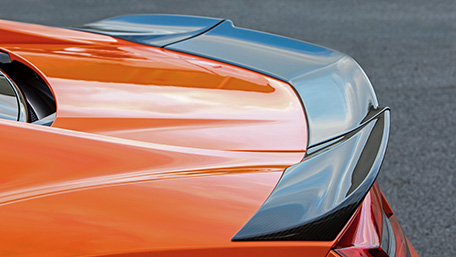
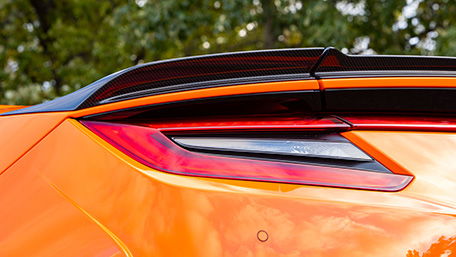
Subtle, but tasteful changes were made to the design, too. A new orange paint color is available (it seemed popular during our tour of the NSX’s Performance Manufacturing Center in Ohio) along with a blue and black interior scheme. Full red leather is another new option if you were looking to pop some eyeballs. The front beak directly above the grille was silver before, but now is painted in whichever paint color you choose — a huge improvement. Acura made several cost options standard too, like the four-way power seats, ELS audio system, navigation and proximity sensors.

Driving feel is something that the original NSX did better and arguably still does better than nearly any other car on the road. Gordon Murray thought the connection between the driver and road was so perfect in the original NSX, that he sought to make the McLaren F1 emulate it. Now that’s a compliment.

But I’m not prepared to say the new one matches it. Electric steering can never offer as intimate of a connection to the road as the manual steering in the original NSX does. This is where we’re supposed to accept the inevitable march of “better” technologies, but there’s still a bug in my head telling me it could be better. Getting the 2019 NSX out onto real roads will be the test to see how much it’s improved. For a track, it was good enough with the tires talking to me and some amount of simulated road feel.

While the 2019 NSX updates seem small on paper, the sum is appreciable. You keep the neck-breaking acceleration, but the rest of the car is taken up another notch. It’s no Type R-style upgrade, but think of it as going part-way there.

2019 Acura NSX

All of this extra equipment and performance comes with a small price hike. The 2019 NSX starts at $159,300 including destination charges, a $1,500 increase. If you were to tack on some options, the price begins to approach $200,000, which hurts the value proposition it is at base price. We tested cars with the $10,600 carbon ceramic brake rotors. You probably don’t need them, but if you’re going to be using this car for what’s it’s designed to do, they’re the most important option box to check.

Another roadblock to success the NSX faces is the stiffer competition today versus when the original went on sale in 1991. Nobody expects supercar sales to be robust, but Acura sold just 11 NSXs in September this year. The original NSX died off because Acura couldn’t sell any of them, and they were significantly more expensive by the end of production. Now Acura has to deal with the Audi R8, McLaren 570S and even the 911 Turbo at or near its price point. Those cars are no slouches themselves.

Living up to the legendary reputation of the first Japanese supercar is difficult too. The original NSX is a tough act to follow, particularly in terms of driving feel. But the new NSX is so incredibly dazzling on track, it’s easy to forgive the few areas in need of some polish. The bottom line is that the ’19s gain welcome and noticeable improvements that make it a better supercar. Consider me smitten.

Related Video:

2019 BMW Z4 M40i Review

Z is an extremely significant letter for BMW. The latest iteration of the Z4 has caused something of a stir, not for its 340hp twin-turbocharged 3-litre straight-six TwinPower unit, not for the 7min 55sec Nurburgring lap time, but because of an automotive icon called the Toyota Supra. The previous generation of the Z4 may have suave looks with its swooping lines and artsy interior, but the driving experience left enthusiasts wanting more. The same cannot be said for the last of the Supra that was unveiled way back in 1993, the year in which I was born. BMW and Toyota have developed this new Z4 in partnership with the forthcoming Supra, a project which allows a saving in cost and shared engineering knowledge and expertise. This is good.

Enough of the background, what’s the finished product like? Well, I’ll have to wait to comment on the Japanese Coupe offering and try the topless option that is the Z4 for now. There will be a handful of four cylinders soon, but for now it is the range topping Z4 M40i that is on offer for me to get my grubby mitts on – no complaints. You’ll probably know what comes with the M40i badge by now – the good old straight-six 3-litre with 340hp and 500Nm, pretty potent, but this is no Lotus with a weight of 1,480kgs, thankfully the 50:50 weight split helps mask it a little.

I am in Lisbon leaving the opulent Penha Longa resort the the roof down in search for some testing roads for the Roadster. First impressions are burbly with the M developed power unit clearing it’s throat on start up and gargling at every given lift off the throttle and downshift. It’s not just the acoustic pleasures that make the Z4 feel quick, the acceleration swells and the 4.6 to 100km/h time would is more than convincing. The 8-speed steptronic transmission is lightning fast and smooth. That is where the feel, unfortunately, seems to come a premature end.

The steering wheel doesn’t wriggle with feel in the palms and communication to the tires at either axle is fairly muted. For a sports car these are elements that are fundamental to the driving experience. It makes it difficult to gauge where the limits of adhesion are and where the understeer ends and the snap oversteer begins. Ease off a little and things make a lot more sense – soak in the views, listen to the pops and bangs, enjoy the blue skies and the wind running through you bald patch – life is good. The ride is brilliant courtesy of adaptive dampers. Even in Sport mode there is a softness to the suspension that is refreshing.

The cabin is great with pleasant ergonomics and the iDrive system is still fantastic. However, the horrible trend of making everything touch screen and making buttons touch sensitive continues to bug me. The screen carries nasty fingerprints that smear and show up in the sun and the touch buttons are annoyingly difficult to feel when you’re on the move focusing on the road.

What was ever wrong with an old fashioned button to change drive modes? Sorry to sound like a broken record, but the new digital dash might look badass to your 5 year old son, but the dials are a challenge to read without a needle, the new space displays information that is all then projected onto the heads up display. I digress – on a more positive note, the cabin does look cool and cohesive, it is a nice place to sit.

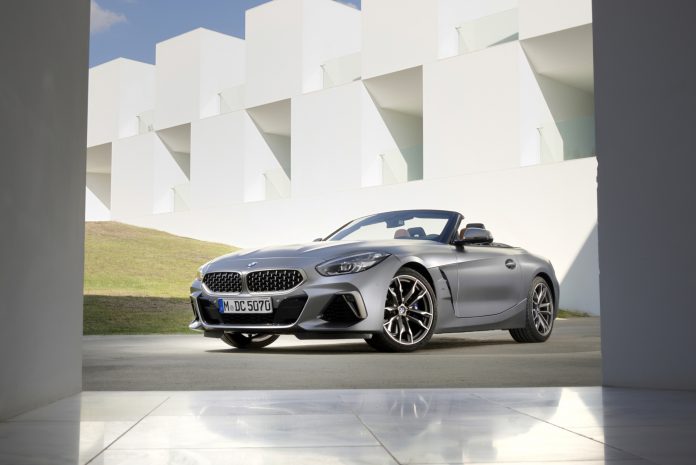
To my eyes, the good looks continue on the outside. Yes, it is not as dramatic as the concept car we all fell in love with, but production models rarely are. It looks muscular and imposing with the ever growing kidney grilles dominating the front end. There are nice details in the LED headlamps and it looks like a premium product. Speaking of premium products…the Porsche Boxster is undoubtedly going to be compared to the offering from BMW.

The 718 is only available with a 4-cylinder that has taken a beating as it had huge shoes that the 6-cylinder Boxster left to be filled. The M40i has a strong engine but the mid-engined Boxster is very alluring to sports car fans. As mentioned earlier, when you’re cruising or driving around town, what I imagine Z4s will spend most of their lives doing, the BMW is a compelling proposition and a fantastic cruiser. I would not be disappointed to own an Z4 M40i, just do not expect it to pump your veins with adrenaline or make you laugh with out loud with glee.

Scuderia Cameron Glickenhaus to build factory in Connecticut

Specialty sports car and race team Scuderia Cameron Glickenhaus is planning to build a new assembly plant in Connecticut for its upcoming 004 and 006 road-going sports cars.

The new facility would add to its factory in Sleepy Hollow, N.Y., where SCG restores its personal collection of cars and conducts final assembly of the 003, but only has capacity to build around one car per month, said Jesse Glickenhaus, managing director and son of founder and film producer James Glickenhaus. The firm expects to close on the new property at a small airport in Danbury, Conn., a 45-minute drive from Sleepy Hollow, by the end of this week.

In an email to Autoblog, Glickenhaus adds “we are building out this space so that eventually it could build 15 cars per week (although we won’t be at the capacity for several years), and we are building the factory to scale 50 cars per year.”

Clients will easily be able to land a plane and taxi straight to the factory to park. “The main building is a round building that was originally built to manufacture giant revolving turntables for restaurants in skyscrapers or also for railroad stations where trains needed to turn around,” he wrote. “There is also a smaller 4-bay garage that will display vehicles, and contain offices and conference rooms.” He said the company plans to make the facility environmentally friendly and is researching powering the building entirely with solar panels and batteries.

The National Highway Traffic Safety Administration earlier this year granted the company status as a low volume manufacturer, meaning it will be allowed to produce up to 325 cars in the United States and be exempt from certain regulations that larger, volume automakers must contend with. The company currently builds most of its cars in Turin, Italy.

The 004 is the mid-engine, central-seat sports car available in road-legal form as the GT 004S, a carbon fiber-bodied three-seater, and the 004CS, the road-going version of the 004C race car that will be powered by a tuned version of the 3.8-liter twin-turbo V6 from the Nissan GT-R. It’s expected to launch from the new plant in late 2019 with an optional 800-horsepower LT5 engine along with the base 650-hp LT4 engine, both available in manual or automatic transmission with paddle shifters, according to Motor1.

The 006, meanwhile, is a retro 1960s-style two-door roadster that will produce 650 horsepower and start around $250,000. The company first showed off the 003 supercar at Geneva in 2015, and it’s also planning to re-animate the Baja Boot off-roader with a naturally aspirated 5.0-liter V8, reportedly in California.

Here’s a little more color that Jesse Glickenhaus shared with Autoblog:

We are a small company that is a passion more than anything. Jim and I dream up dreams that seem crazy and impossible to the world (let’s make a pure race car for the road that is better than anything else on the market, let’s build a car in the United States to compete in the 24 Hours of Le Mans for 1st Overall, let’s build a road legal car that can drive to from California to the Baja, race the Baja 1000, and drive home, let’s build a car from the ground up to race the 24 hours of Nurburgring and be competitive for first overall). Then we both go and make that happen. My main job is working together with my dad to figure out how to make these dreams and adventures happen.

Related Video:

The 11 Best Winter and Snow Tires You Can Buy

Updated for the 2018/2019 winter season: This post has been updated to include the best new winter tires for the 2018/2019 winter season. Links and specs have also been updated.


Every pro driver will tell you a car is only as good as its tires. You can go out of your way to get a car with the best handling and the most intelligent AWD system on the market, but if you can’t put the power down with proper traction, all those millions of dollars in R&D are worth precisely nil.

Winter tires are impressive feats of engineering: water, slush, snow and salt are controlled and pumped out from underneath via intricate channels between treads while the soft rubber composition molds to and grips the road surface, despite low temperatures. That’s why winter tires look so much more extreme in design than summer or all-season tires. Where a summer tire’s near-slick surface would simply aquaplane, the tread on a winter tire shovels and pumps water out of the way while gripping firmly to keep you going in the right direction. They are the right tools for the job; for cars that tackle winter weather, they are the most necessary upgrade.

Buying Guide: The 11 Best Winter Tires of 2018

The winter tire market is a vast one, and picking the right tires for your vehicle can seem to be the hardest part — but it can actually be quite simple. Woody Rogers, Tire Information Specialist at The Tire Rack, explains: “Think about the worst conditions you’ll encounter and how often that will happen. Prioritize your needs and wants, including snow and ice traction, clear road handling and driving fun.” There’s no need to spend hundreds of dollars on super high-performance tires if all you’re doing is commuting in the family sedan or truck. Likewise, if you’re looking to do winter autocross or you have a high horsepower sports car, specially-designed performance rubber may be what you want.

Standard Tires

These are the tires most buyers need: good for commuting, driving around town and sticking to paved and plowed roads.

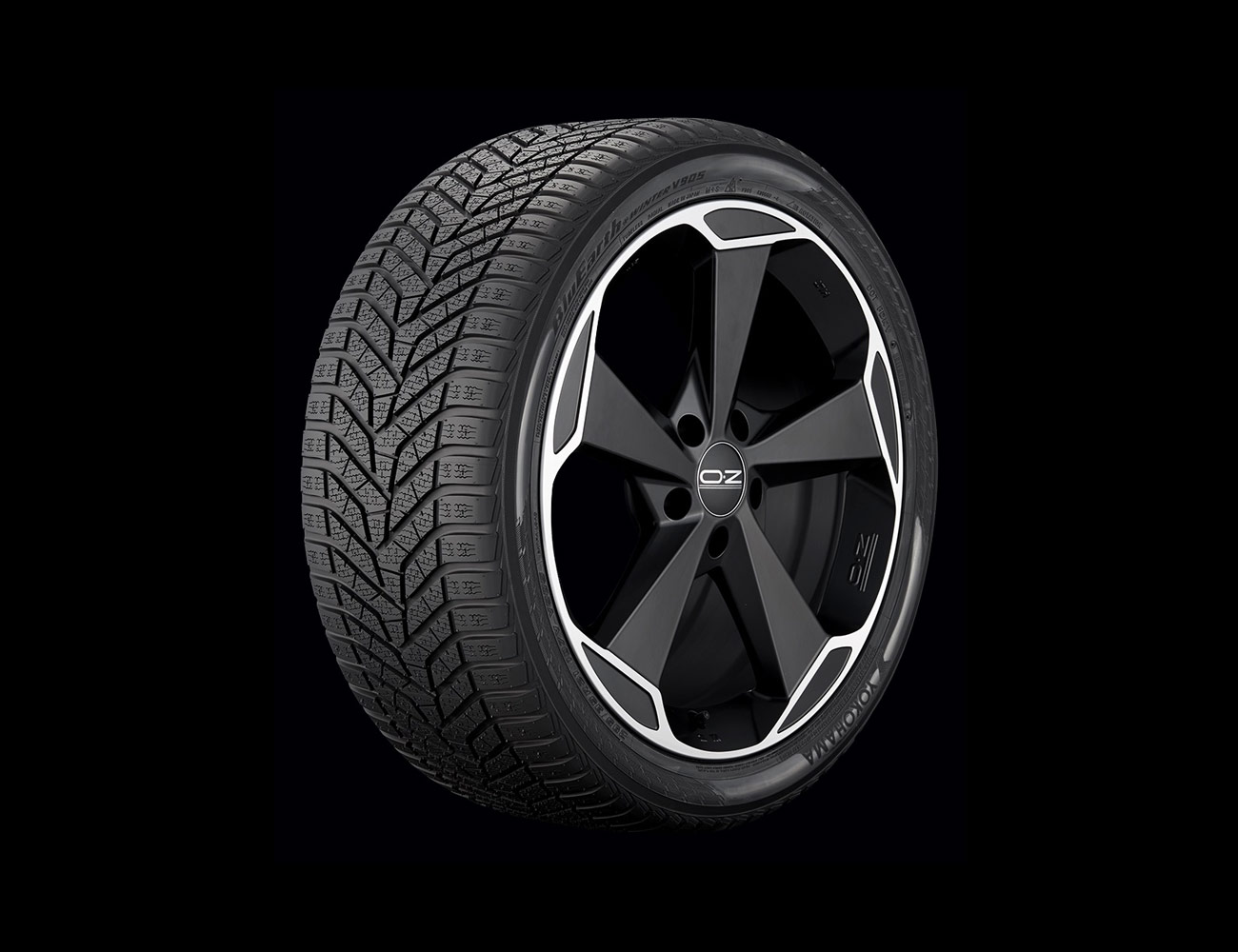
Most Environmentally Friendly: Yokohama BluEarth Winter V905

Not only does the Yokohama BluEarth Winter V905 fall closer to the perfromance end of the spectrum, but its high silica rubber and orange oil infused compund make it environmentally responsible. The surface tread pattern works to help funnel water and slush away in wet conditions. But the tread you can’t see — the tread in between the blocks — works to grip snow and also maintain its block rigidity despite a softer rubber makeup.

Three Peak Mountain Snow-Flake Cerified: Yes

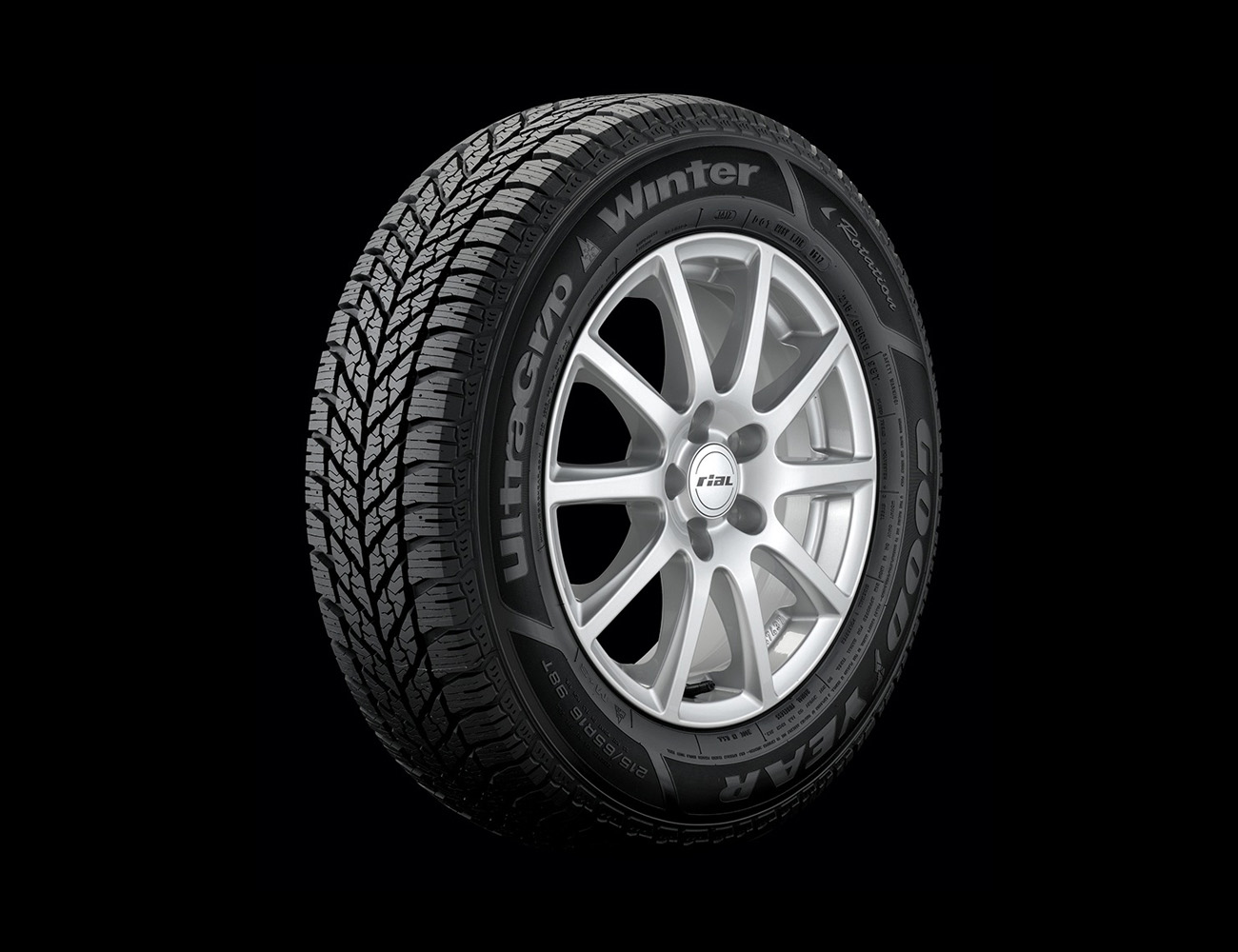
Most Versatile Line of Tires: Goodyear Ultra Grip

Where most tire are developed for one type of car, the Goodyear Ultra Grip’s design allows it to be put to use on anything from coupes and sedans to crossovers, minivans and SUVS. If you’re looking for dependable winter performance and have multiple, varying sized cars in the garage, the Goodyear Ultra Grip line is a one stop shop.

Three Peak Mountain Snow-Flake Cerified: Yes

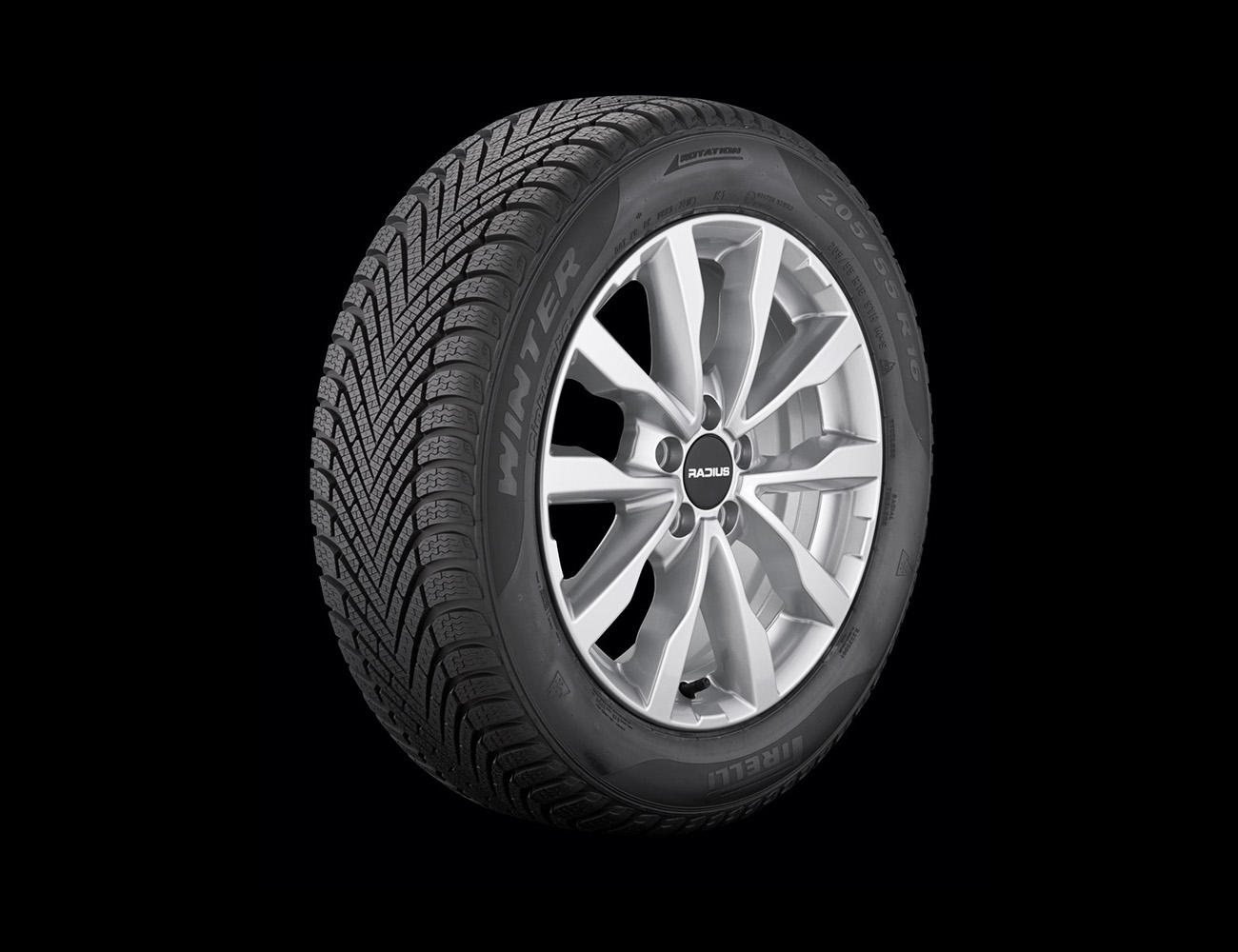
Best High-Mileage Tire: Pirelli Cinturato Winter

The Cinturato was designed with European winter driving in mind. That is to say, the Cinturato was built specifically for coupes and sedans and to handle a wide array of environmental changes over a greater chunk of the year. The steeply angled tread pattern helps evacuate water from underneath the tire, allowing for stabilty at highway speeds on clear or wet roads. The density of siping on each tread block greatly reduces the risk of hydroplaning, and, at the same time claws back grip on snow and ice.

Three Peak Mountain Snow-Flake Cerified: Yes

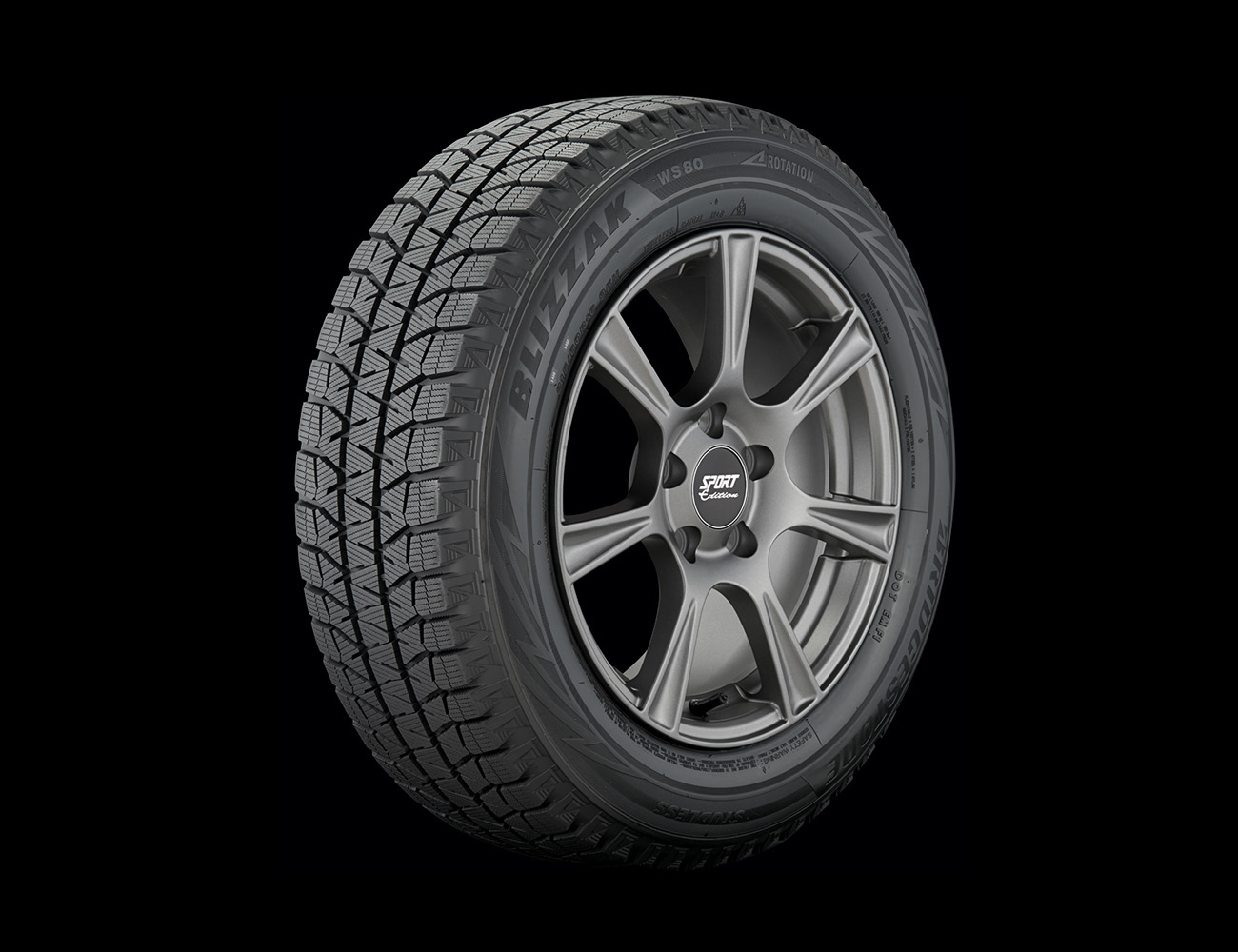
Best All-Around Winter Tire: Bridgestone Blizzak WS80

When it comes to balancing price and performance, Blizzaks are legendary. The unique NanoPro-Tech Multicell hydrophilic compound wicks water off the road while microscopic bite particles, blended into the rubber dig into icy surfaces.

Three Peak Mountain Snow-Flake Cerified: Yes

Truck Tires

Trucks are, generally, designed to optimize traction, and will do well with more aggressive, specifically designed rubber.

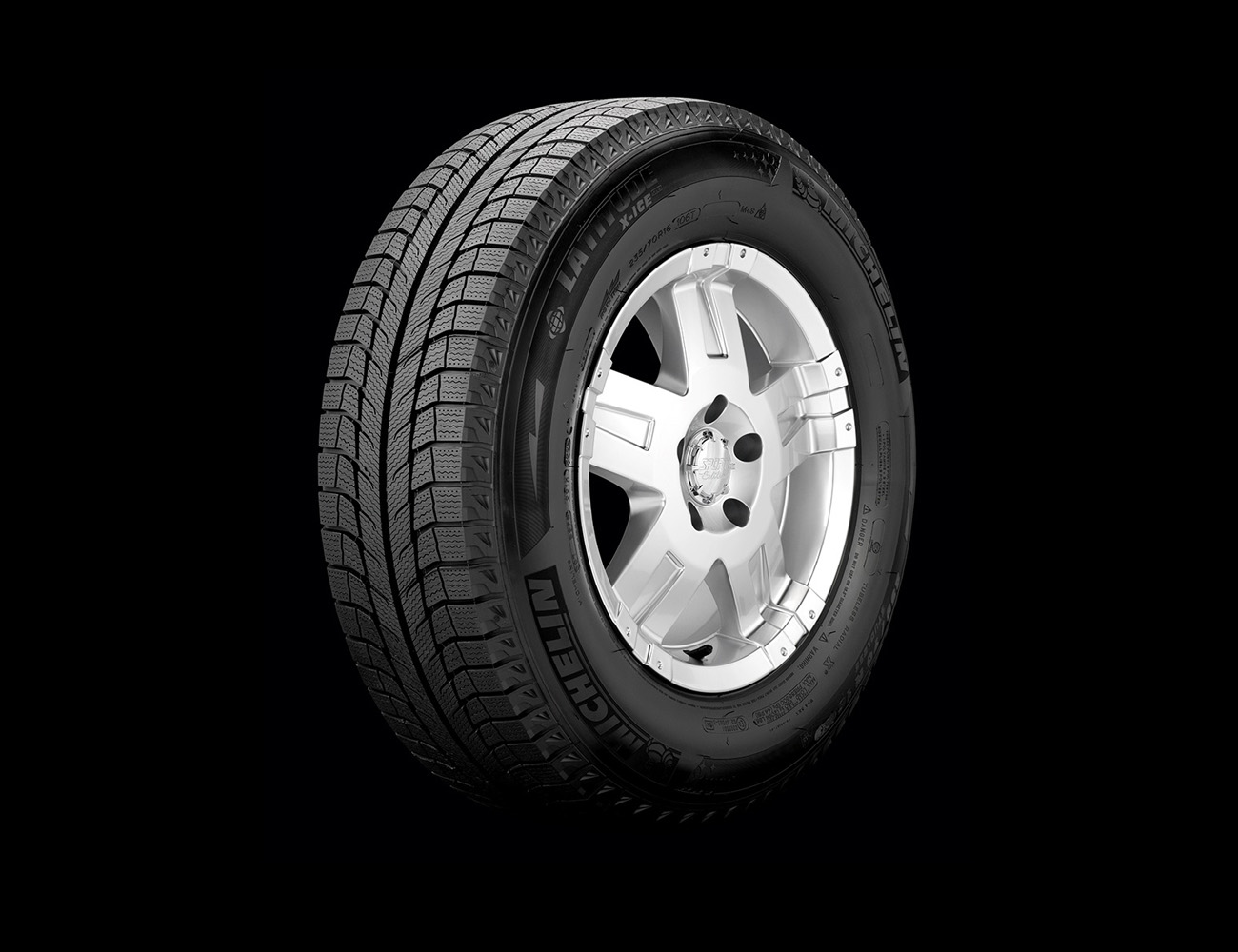
Best Shoulder (Transitioning) Season Truck Tire: Michelin Latitude X-Ice Xi2

Michelin’s X-tra-Ice silica-based winter tread rubber compound gives the X-Ice Xi2 a larger temperature window to work in. The compound remains stiff at higher temperatures for better traction in dry or wet conditions but is still soft enough at low temperatures to give you traction on snow and ice, regardless if you’re driving a compact crossover or light duty truck.

Three Peak Mountain Snow-Flake Cerified: Yes

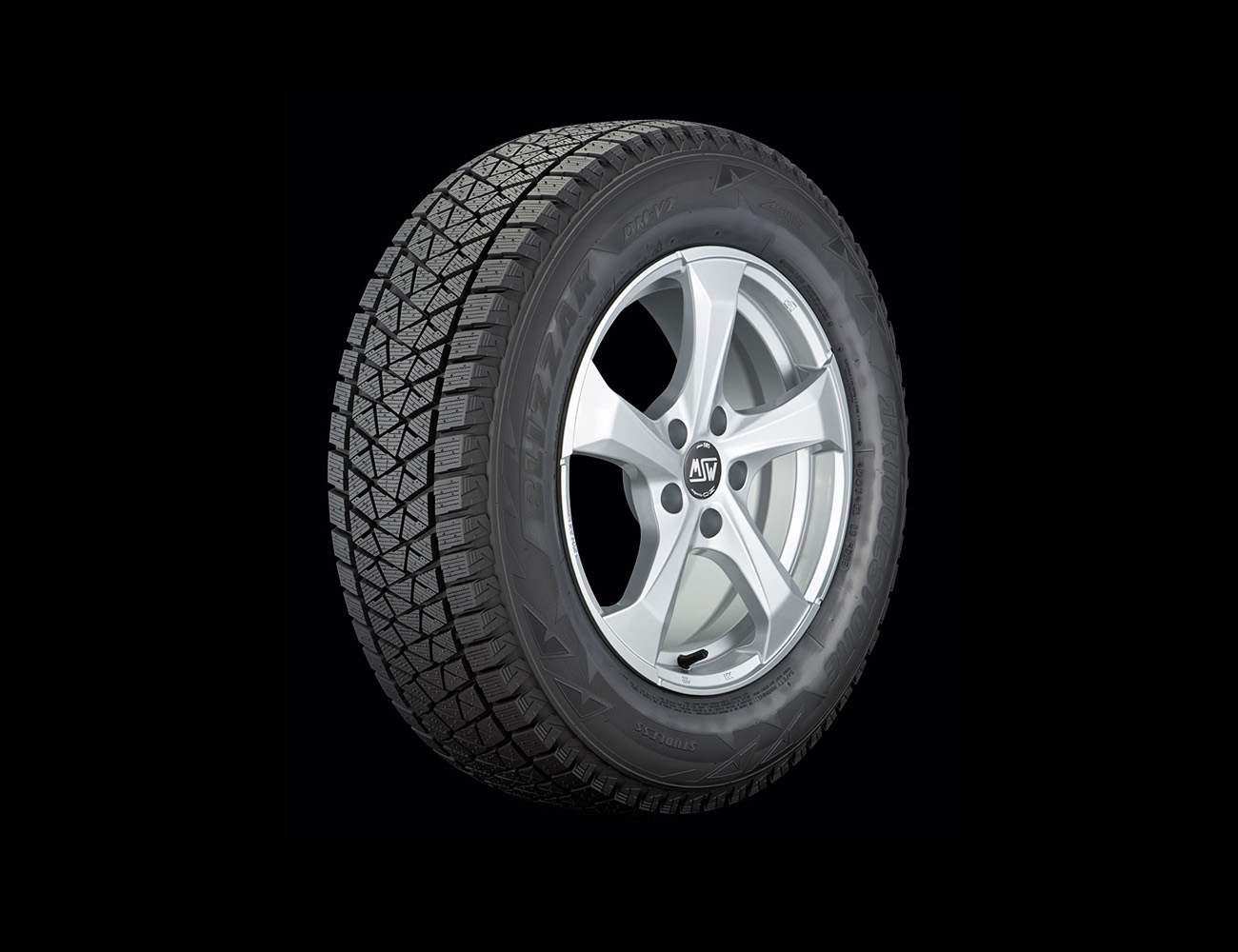
Best All-Around Truck Tire: Bridgestone Blizzak DM-V2

Much like the standard Blizzak is a fantastic all-around tire for coupes and sedans, the DM-V2 carries that reputation over into the truck universe. The same hydrophilic, multi-cell compound and aggressive siping design pumps away slush and holds on to snow for more grip on ice, but with a size designed for pickups, crossovers and SUVS.

Three Peak Mountain Snow-Flake Cerified: Yes

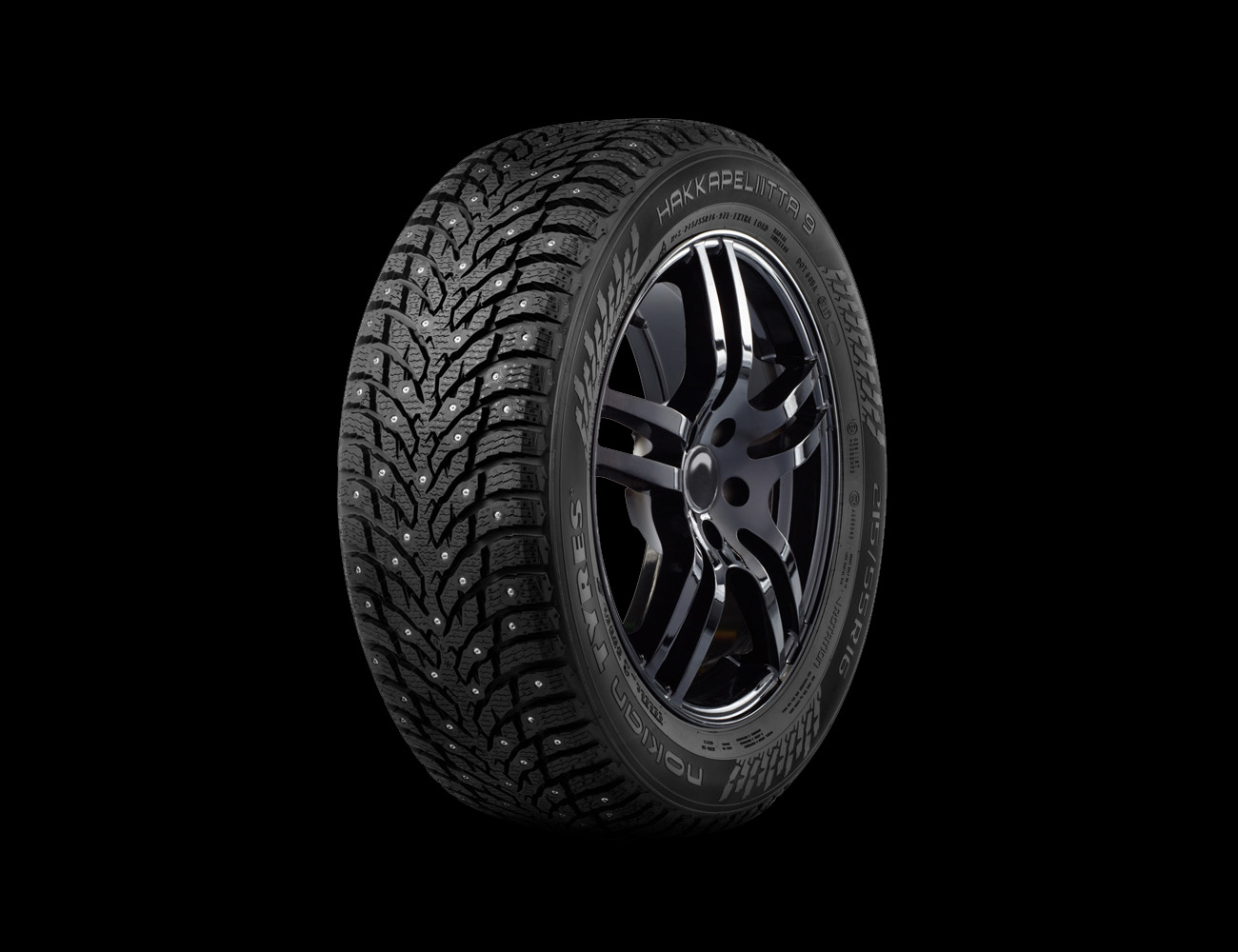
Best Performance Truck Tire: Nokian Hakkapeliitta 9

Where most studdable winter tires actually carry a design, more akin to an all-season with stud holes throughout the tread pattern, the Hakkapeliitta 9 is designed as a grear winter tire, first and foremost. Perfromance on snow and ice is its main objective, the option to place studs is merely a plus should you find yourself in winter conditions that are really getting out of hand.

Three Peak Mountain Snow-Flake Cerified: Yes

Best Budget Truck Tire: Firestone Winterforce UV

When it comes tires in general, it’s always worth spending a little extra since the tires are the only thing touching the road and are therefore the most important aspect when grip is the topic of conversation. But it is understandable to say buying a whole new set of tires just to use for a few months out of the year is a costly endeavor. So if you are aiming for the economical route, Firestone Winterforce UVs are your best bet.

Three Peak Mountain Snow-Flake Cerified: Yes

Pure Perfromance Tires

Sports cars can definitely tackle winter conditions, so long as your skills are sharp and you take care to clean salt off your riade as often as possible.

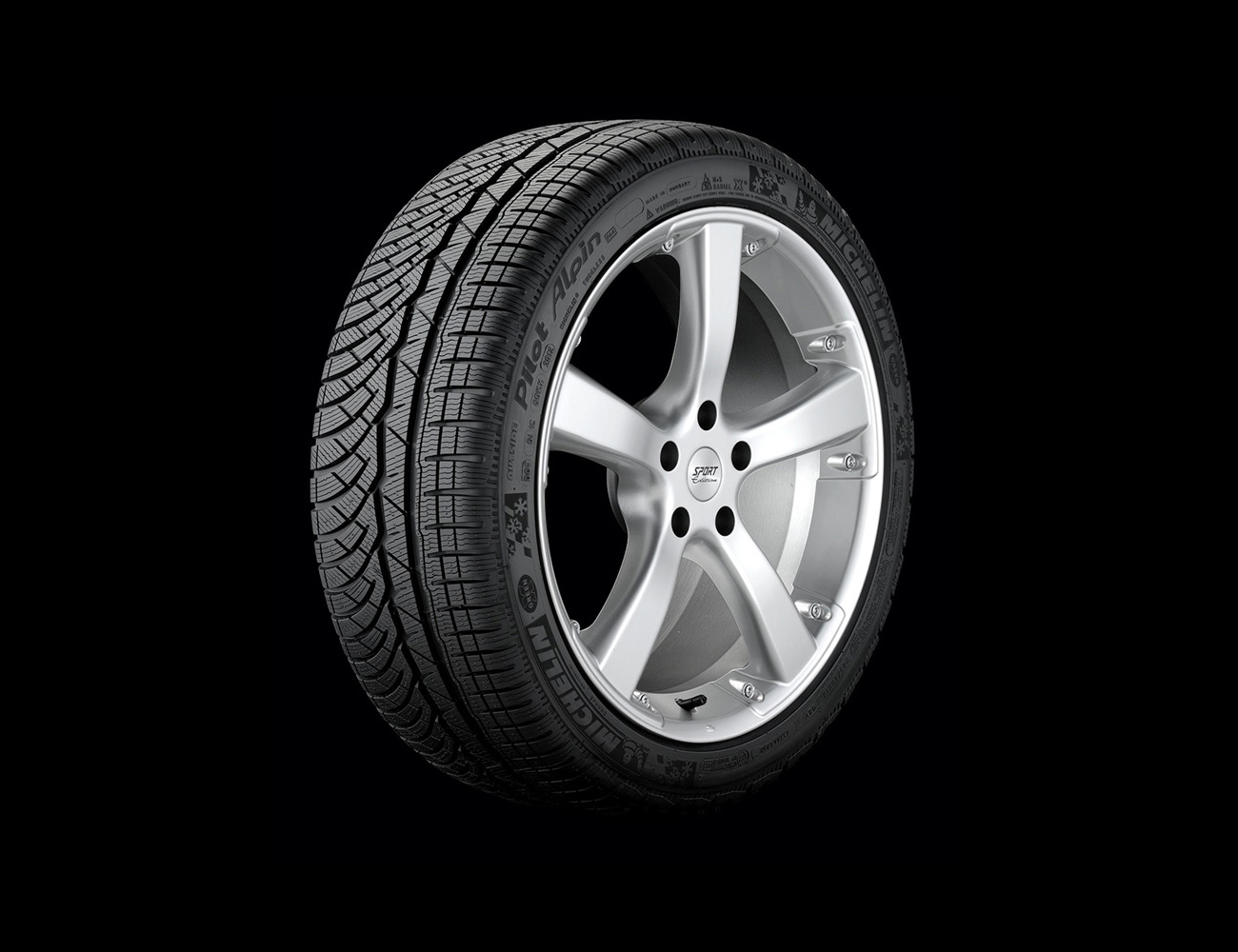
Best Winter Performance Tire: Michelin Pilot Alpin PA4

Just because the skies aren’t blue and road conditions aren’t ideal for high-horsepower performance cars, it doesn’t mean your sports car has to stay hidden all winter. The Alpin PA4 is the winter equivalent of Michelin’s remarkable Sport Cup 2 summer tires. They’re designed to give high-end sports cars the grip they need even when the temperatures dip and the roads are miserable.

Three Peak Mountain Snow-Flake Cerified: Yes

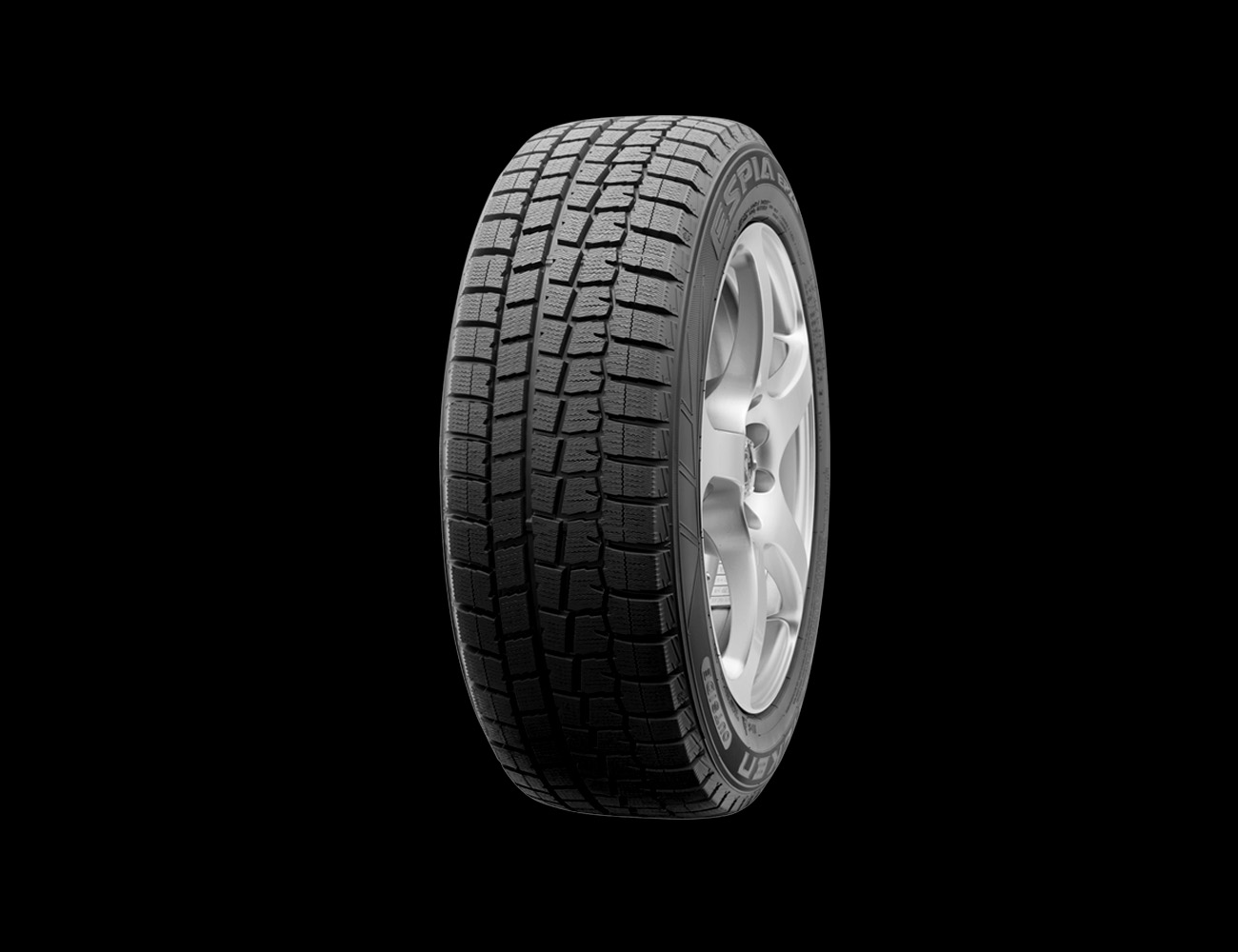
Best Budget Performance Tire: Falken Espia EPZ II

If you’re looking for pure performance but don’t see the need to spend too much money, the Falken Espia EPZ II is your tire. The tread design and rubber compound mimic the higher-teir perfromance tires well, but doesn’t offer as much grip. The Espia EPZ II still offers great winter perfromance, just at the fraction of the price.

Three Peak Mountain Snow-Flake Cerified: Yes

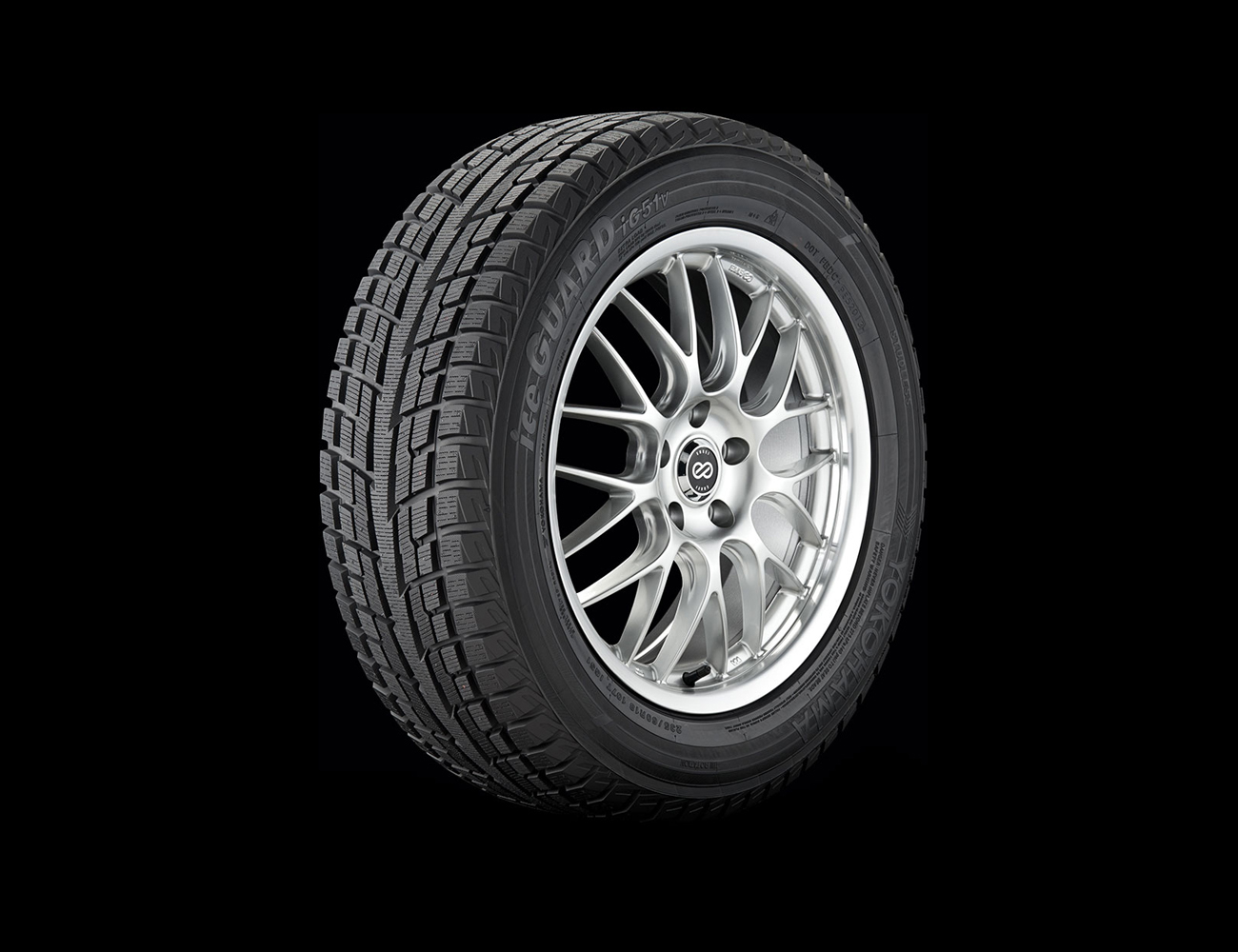
Best Perfromance SUV Tire: Yokohama iceGuard iG51V

Now that manufacturers are building more and more street performance-oriented SUVs and crossovers — and the public are buying them up — there’s more demand for a specialized winter tire that can keep up. The Yokohama iceGuard iG51V brings together the best aspects of performance winter tires and also meets demands an SUV or Truck asks of its tires.

Three Peak Mountain Snow-Flake Cerified: Yes

Winter Tire Buying Advice

Understanding Winter Tire Design

All tires are not created equal, and the same goes for the winter tires subset. The most basic categories winter tires fall into are Studless Ice and Snow, Studdable and Performance. From there, things get more specific depending on vehicle type: passenger cars, trucks and SUVs.

Studless tires have incredibly complex tread design, specifically meant to pump standing water away from the tread. In addition, those designs also grip and hold onto packable snow and ice with super soft rubber and intricate, multi-layered tread-block patterns in order to — counterintuitively, perhaps — provide more traction.

Studdable tires are, compared to their studless cousins, less extreme in design with regards to the tread but are outfitted to accept metal studs. Studdable tires greatly improve traction on ice, but as Rogers points out “they come with a trade-off in the form of noisy clear-road driving, damage to bare road surfaces and are of no benefit when driving on snow. Many states restrict or ban the use of studded tires.” So quite often studdable tires never see their full potential.

Performance winter tires focus more on clear road handling than on actual snow and ice. Even though you may never see snow or ice, winter tires are still recommended for cold weather and low temperatures because of their softer rubber compound which grips the road surface despite the much lower temperatures. This focus lets the driver get more use out of their sports car’s performance.

Terms to Know:
Tread blocks – Tread blocks refer to the larger sections of rubber that give the tire’s pattern its overall design. Depending on how they are arranged and angled can affect a tires efficiency to pump away water and grip road surfaces.
Siping – Invented by John F. Sipe in 1923, siping is the process of cutting thin grooves across a tires tread blocks to increase grip in wet and wintery conditions. The tactic makes the rubber tread blocks more pliable and flexible and better at gripping snow, cold asphalt and pumping away water mitigating hydroplaning. (You’ve also seen siping on the bottom of Sperry boat shoes.)
Compound – The compound of the tire refers to the mixture of ingredients in the rubber of the tire itself. Modern winter tires have a higher silica content than say an all-season or summer tire because it allows the winter tire to stay softer at lower temperatures, stay malleable and grip the road better.

Pro Tip: Look for the Three Peak Mountain Snowflake (3PMSF) symbol. The 3PMSF symbol confirms the tire meets a minimum requirement for acceleration and traction on snow in conditions considered severe by the weather service. All dedicated winter tires will have the symbol. But be aware that a small but growing number of all-season tires also have this mark.

Winter Driving Tips

With large portions of the country soon to be blanketed in snow, you might find it challenging to get to work or even step out to get groceries. Even with a well-maintained road, appropriate tires and all-wheel-drive, you can still never be too careful about driving in snowy or icy conditions.

1. Look where you want to go. Instead of looking at what you don’t want to hit, look where you want to go. If you start to lose the control of your car, don’t look at oncoming traffic because your eyes and hands have a natural tendency to move in the same direction.

2. Don’t panic. In order to accomplish step 1, you have to keep your cool. Easier said than done? Probably, but it’s important. Prevent panic-inducing situations by driving smart, smooth and slowing down on the ice.

3. Allow time for the car to react. A lot of people don’t understand just how much the vehicle weighs; on slippery surfaces, it’s going to take a while for it to move around in response to your course corrections. The people who drive out of their means are the dudes always getting into accidents.

4. Let the vehicle find its way. If something happens, concentrate on relaxing your hands and moving them slowly, look where you want to go and let the vehicle find its way. The worst thing you can do if you’re coming around the corner and start to slide is slamming on the brakes to avoid obstacles or other vehicles; momentum is going to take you wherever it wants to take you.

The 10 Best SUVs Under $50,000

This list of the 10 best SUVs under $50,000 serves as a guide to one of the most popular consumer automobile segments and includes important terminology and recommendations for almost every driver.Read the Story

Hennessey Reveals 2019 VelociRaptor with a 758hp V8

It has already featured within our top 10 from SEMA 2018, so you should know a little about the V8 transplant Hennessey performed on the 2018 Ford Raptor. It debuted last week at the SEMA motor show and will undoubtedly find a place among Ford Performance purists who prefer the V8 to the V6 that the current generation comes equipped with.

Named the Hennessey VelociRaptor, the biggest talking point is that the 450 hp twin turbo V6 EcoBoost engine has been replaced. Hennessey have instead fitted a specially modified Ford 5.0 litre V8 engine, with a supercharger, which helps to produce a peak output of 758 hp.

[embedded content]

As well as the power, Hennessey fit their own VelociRaptor bumpers front & rear, LED front lights, Stage 2 off-road suspension with a six-inch lift, Hennessey 20-inch alloy wheels and massive 37-inch BF Goodrich KM03 off-road tires.

The Hennessey VelociRaptor V8 manages to put down a 4.1 second 60 mph sprint with a quarter mile dispatched in 12.2 seconds at a terminal speed of 115 mph. That performance is all the more surprising when you consider the sheer size and the massive tyres.

Prices for the 2019 Hennessey VelociRaptor V8 start at £147,950 which includes the Ford Raptor F150. Production will be limited to just 100 cars per year which each on receiving a 3 year / 36,000 mile warranty.

Porsche 911 GT2 RS MR: New King of the Ring with a 6:40.3 Min

Action at the Nurburgring has been frantic these past years. First we had the Lamborghini Huracan Performante which set a 6:52.01 time back in 2016, then Porsche took back the title in 2017 with a 6:47.25 time, then, in July, Lamborghini announced that it had set a 6:44.97 time with the Lamborghini Aventador LP 770-4 Superveloce Jota. Little surprise then that Porsche have been attempting to take the record back.

Today, Porsche have confirmed that they were able to achieve a faster time for the Porsche 911 GT2 RS. In collaboration with Manthey Racing, the German team have put together a 6:40.3 time, almost 7 seconds faster than in 2017. The time was set by Lars Kern on 25 October 2018, who also set the 2017 time for Porsche.

[embedded content]

The car in question is being described as the Porsche 911 GT2 RS MR, which suggests that something is different. The MR actually contains subtle tweaks to the RS which increase its ability to perform on the ‘Green Hell’. The MR Performance Kit was tailored to the specific conditions of the circuit in this instance.

While precise details are thin on the ground, it is clear that this particular GT2 RS has a new coilover suspension system, wagnesium wheels, a new brake set, new brake lines and an additional water tank. The MR was also fitted with a racing bucket seat for obvious reasons!

Manthey Racing have confirmed that their new kit will be available from March 2019 as a tuning package for existing GT2 RS. It will be on display at the Essen Motor Show 2018 which begins at the end of the month.

Aston Martin DBS Superleggera Volante – First Spy Shots

Spy shots for the Aston Martin DBS Superleggera Volante have surfaced. Traditionally, Aston Martin is quite brazen about testing its Volante models in public. They carry little camouflage and, as a result, it is quite easy to get a flavour for what the car will look like once it hits the market.

The photos show that the DBS Superleggera will get a traditional soft-top, much the same as Aston Martin’s other Volante models. We expect it will debut at the Geneva Motor Show 2019, although that hasn’t yet been confirmed.

Design cues have been taken from the DB11 Volante. As the DBS sits higher in the market, it will get more aggressive aerodynamics with the front splitter, rear diffuser, active rear wing and bonnet vents all carried over from its Coupe counterpart.

Under the bonnet, the Aston Martin DBS Superleggera Volante will share its engine with the Coupe. Its 5.2-litre twin-turbocharged V12 engine produces 725 hp and 900 Nm of torque. Expect 100 km/h sprints to take just over 3.2 seconds and the top speed to be just shy of the 340 km/h the Coupe manages.

Next year will be extremely busy for Aston Martin. Following its IPO earlier this year, the company’s share price has deflated somewhat. There is optimism that this will increase and for 2019, the company appears to be preparing the launch of three models.

Alongside the DBS Superleggera Volante we are also expecting to see the Aston Martin DBX, Aston Martin’s take on a luxury cross-over. We are also expecting deliveries to start with the Aston Martin Valkyrie. We could also see a Volante version of the new Vantage, however, the rumour mill has been quiet recently on this front!

Top 10 Cars at SEMA 2018

Chances are that if you haven’t heard of the Specialty Equipment Market Association (SEMA) show which takes place in Las Vegas every year, you haven’t much interest in the world of aftermarket tuning. The biggest event of its kind, SEMA brings together 6,383 companies from all over the world to showcase the latest developments in the aftermarket world.

As you would expect, it attract some pretty interesting projects from niche operations as well as a few new releases from mainstream manufacturers. We thought we might bring you a cross section of the best SEMA 2018 cars we have seen. Our top 10 is in no particular order!

1. Hennessey VelociRaptor V8

Hennessey VelociRaptor V8

Hennessey are one of the largest aftermarket tuners in the US. They focus mainly on US muscle, in recent years, the Ford F150 Raptor has been one of its most popular products. Hennessey used SEMA 2018 to take the covers off of its latest project. It has transplanted a 758 hp, supercharged, Ford 5.0 litre V8 engine into the space that was previously occupied by the 450 hp twin turbo V6 EcoBoost engine. Hennessey has capacity for just 100 of these conversions with a price of $147,950.

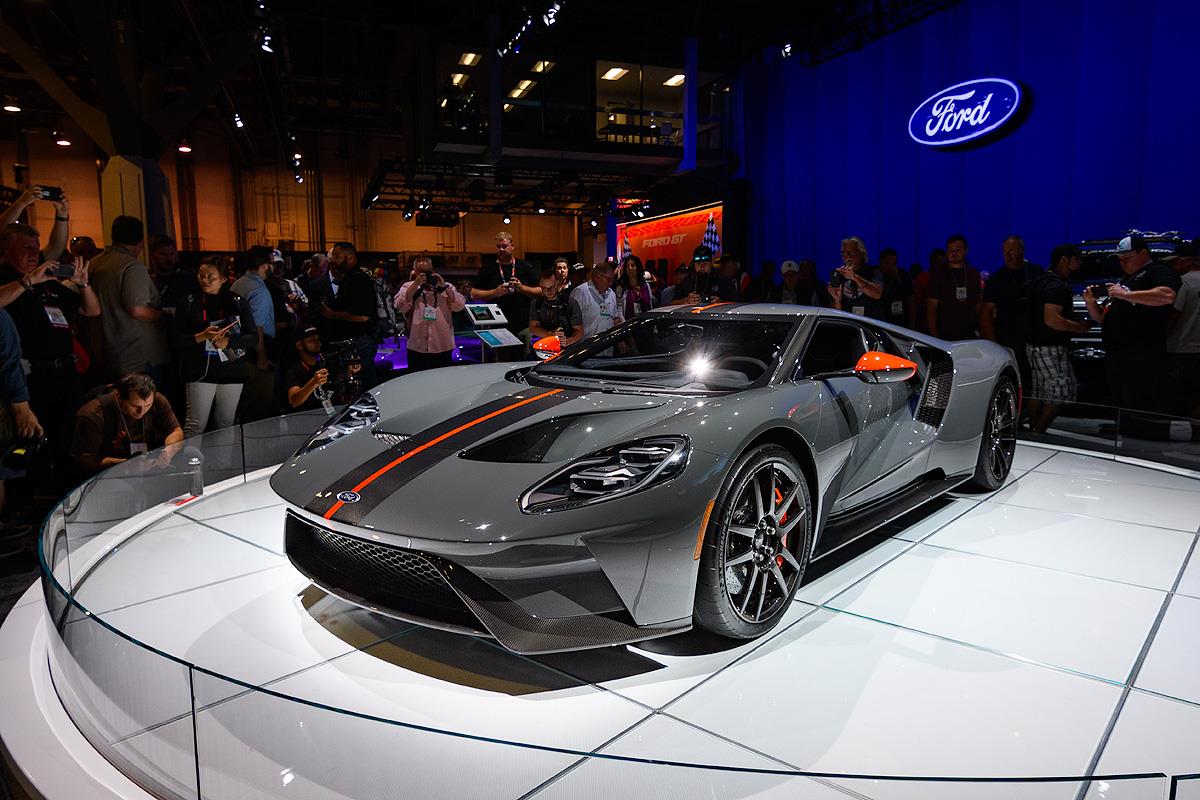
2. Ford GT Carbon Series

SEMA 2018

Keeping things interesting from the OEM side of things, Ford released a new Ford GT Carbon Series option at SEMA 2018. The specification adds a raft of carbon fibre options, including carbon fibre wheels. Shedding 18 kg in the process through exposed carbon fibre stripes running down the centre, A-pillars and lower body panels.

3. ABT Audi RS5-R

ABT Audi RS5-R

ABT have cars on the show floor at SEMA 2018 too. The German tuning company are obviously looking to expand into the US market. What better way to do so than to showcase a project based on an Audi RS model! Just 50 will be produced with carbon fibre exterior parts including a new front lip, flics, side skirt and rear spoiler lip. The engine sees power increases up to 510 hp and 680 Nm of torque.

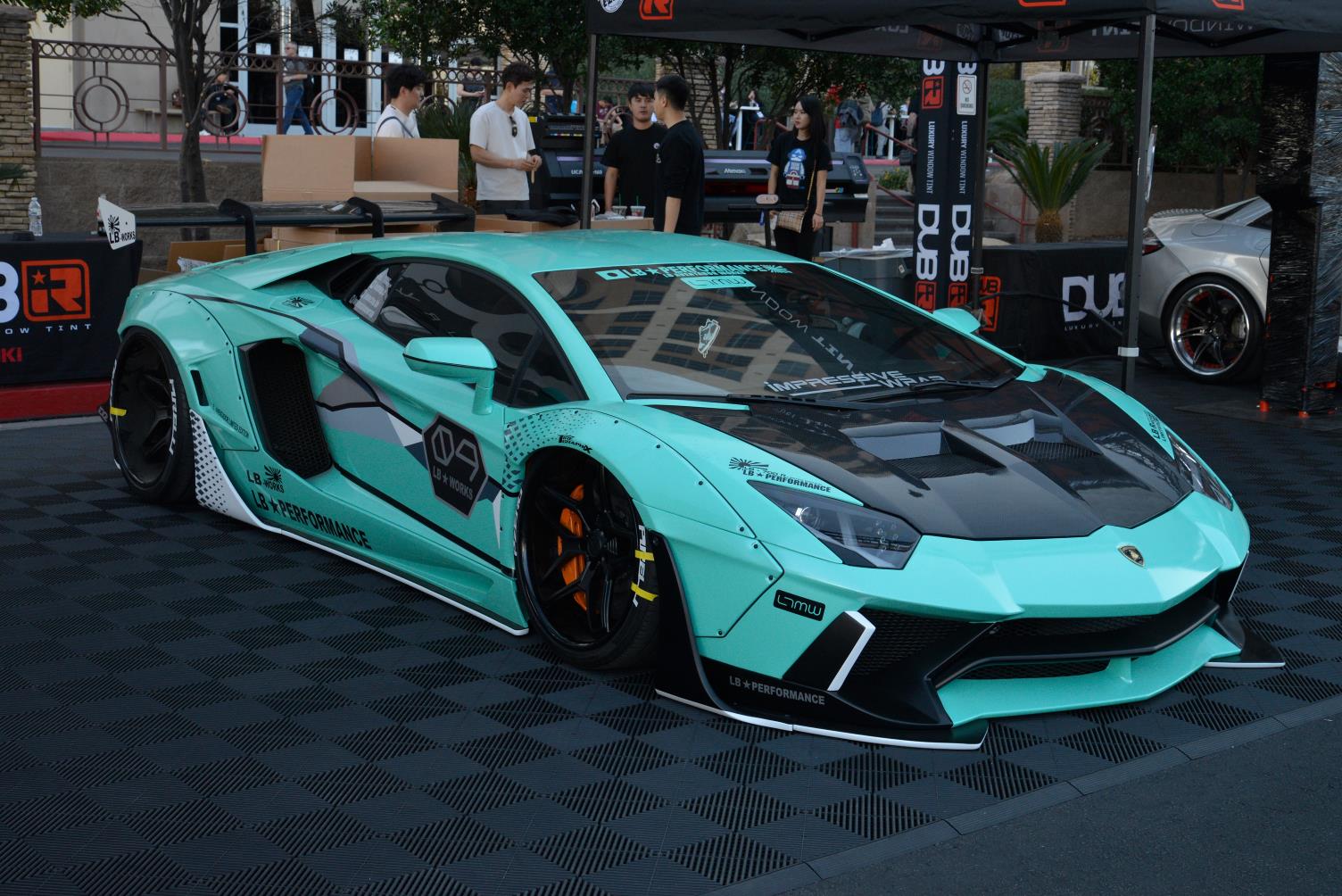
4. Liberty Walk Lamborghini Aventador

SEMA 2018

Liberty Walk have added to one of their Lamborghini projects at this years SEMA show. The car in question is the first LB Works Lamborghini Aventador Limtied Edition with second generation front bumper, third generation front diffuser, rear diffuser and rear sing together with a new bonnet hood and bolt on wheel arches. It costs a staggering $59,400 for this conversion, big money in the aftermarket world!

5. Button Built Ferrari 328

SEMA 2018

Another odd project car makes our list, the Button Built Ferrari 328. The owner, Mitch Button, has created this butchered Ferrari using the mirrors from a 458 GT3 car, the fog lamps from a Ferrari 288 GTO and a Grigio Media Ferrari paint. The bodywork is a carbon-Kevlar construction with an integrated ducktail. It is slammed to the ground with AccuAir e-Level air suspension with a set of Rotiform DNO wheels finishing the retro look. It certainly won’t win any concours points, but it looks incredible.

Photo: Rotiform

6. Liberty Walk BMW i8

SEMA 2018

Liberty Walk’s second offering from our list is based on the BMW i8. It was announced fairly recently. This particular example gets the most extreme options, a full bodykit complete with bolt on fenders and a small rear wing.

Photo: Impressive Wrap

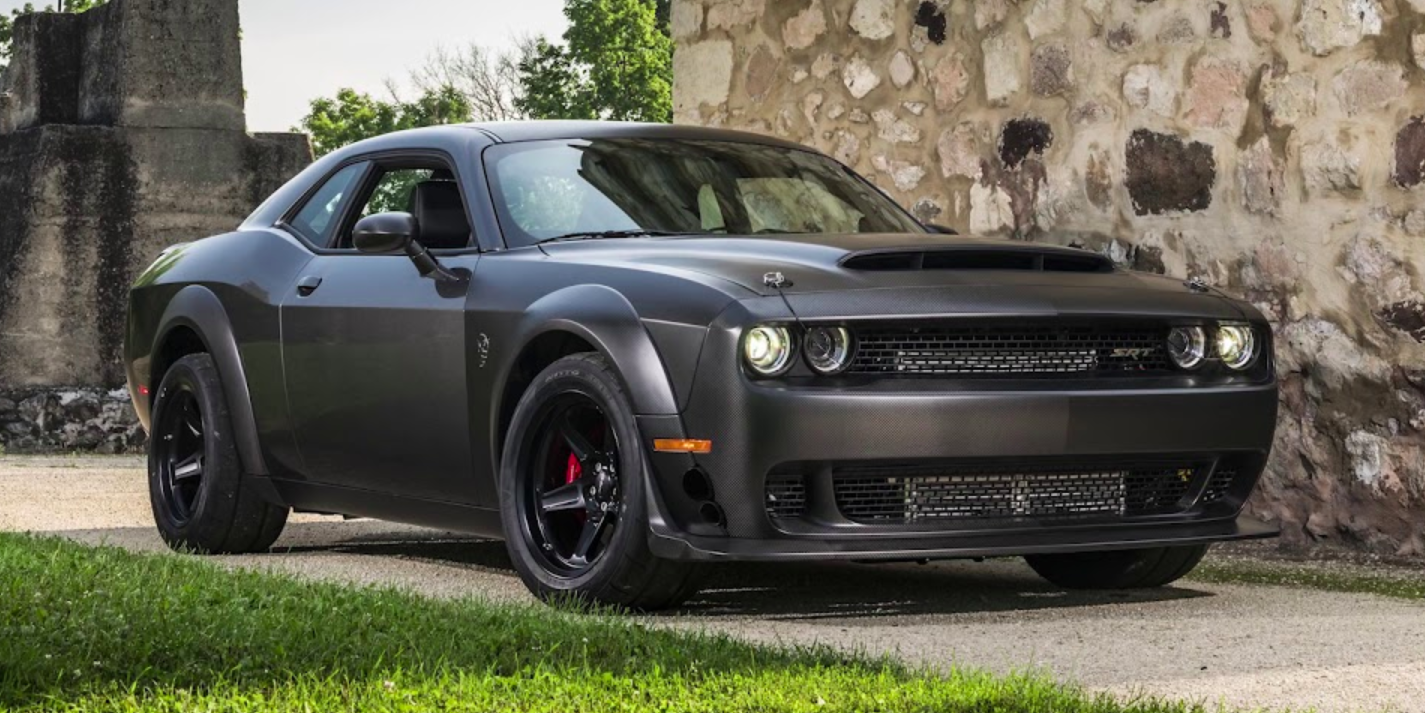
7. Speedkore Full Carbon Dodge Demon Twin Turbo

SEMA 2018

Speedkore have some very interesting, high quality projects on display. One of the most exciting is this full carbon fibre Dodge Demon. While the bodywork is impressive, it is the performance which really sets this project appart. From the same supercharged 6.2-liter Hemi V8 engine as the standard model, Speedkore have managed to wring out 1,200 hp at the crank, 980 hp to the ground. The supercharger is larger with upgraded throttle bodies and a new cold air intake.

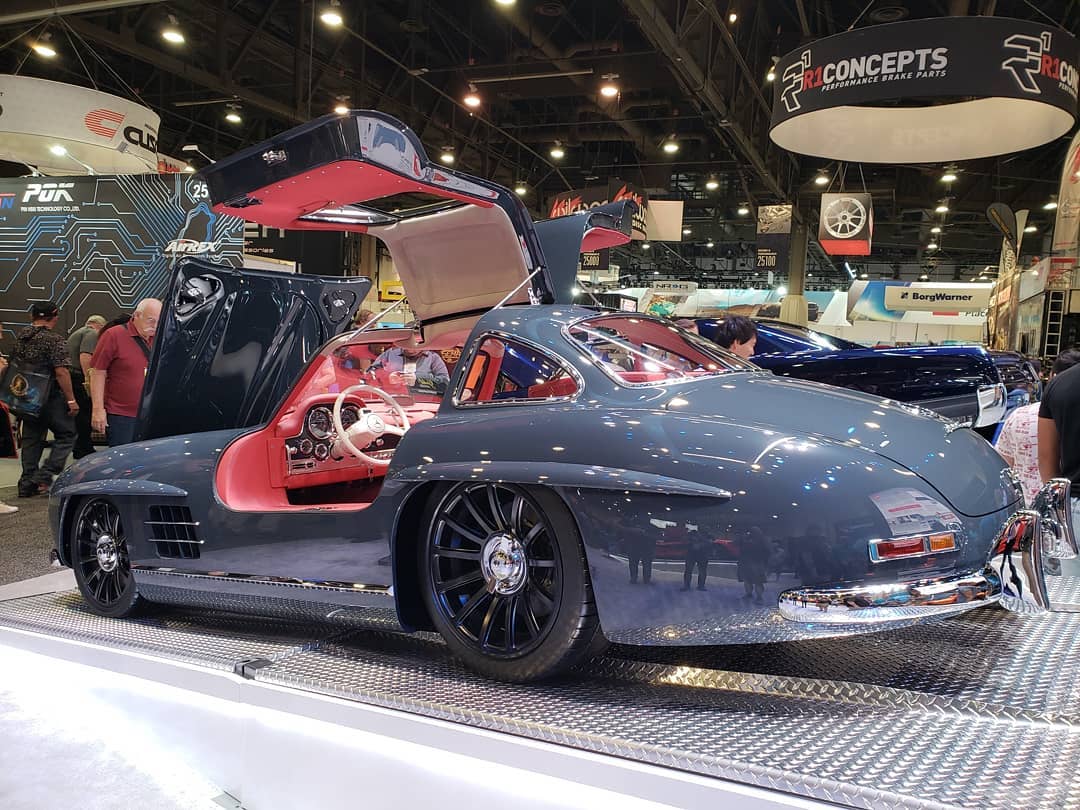
8. Mercedes-Benz 300SL Gullwing Restored by Kindig It Designs

SEMA 2018

Another interesting project comes in the form of this Mercedes-Benz 300SL Gullwing, by Kindig It Designs. We have seen 300SL resto mods before, usually based on the chassis of something more generic. This car is a complete custom fabrication we believe although there is no official information. We think the chassis was built by Fast Track IRS with power coming from an American V8.

Photo by Jeff Evans

9. Audi R8 LMS

SEMA 2018

At SEMA 2018 you also find this Audi R8 V8 fitted with the LMS bodykit, albeit this time road legal. The LMS is the official racing version of the R8, traditionally racing cars have inspired road going models especially in the tuning scenes. This is one of them.

Photo: R8.LMS

10. Unplugged Performance Tesla Model S

Our final entry is a bit left field. Tuning companies have been reluctant to touch Tesla, most likely due to the high tech underpinnings and a fear of upsetting the dynamics of these. Unplugged Performance have a Tesla Model S on display at SEMA 2018, built on the P100D. The S-APEX body conversion consists of 19 pieces of carbon fibre and increases width by forty millimetres. Unplugged Performance UP-03 Carbon Fiber wheels save 50% over the standard models!

Supercar Care to Make Your Investment Last

Have you always dreamed of owning a car that simply can’t be missed on the road? Let’s face it, few people can resist staring after a distinctive roar of a Supercar engine. Buying a Supercar will set you back a tidy sum, and maintaining it is quite a process as well. After all, you can’t let it sit and gather dust in the garage – nobody will see it in there!  

It’s quite fascinating how a person changes from the moment they take the keys to their first supercar in their hands for the first time. It’s actually quite a sobering experience. At first, there’s the rush of everyone staring as you pull out of the driveway and down the road. But soon, you start receiving menacing looks from misers and responsible drivers who assume you’re arrogant…

Suddenly, you’re concerned about where you park. Repairing dents and scratches can be pretty expensive! You also start to spend a lot of time at the detailing shop.

You might have dreamed about driving at breakneck speeds, but suddenly, you realize that your car that has the potential of well over 200 mph, will rarely have an opportunity to exceed 65 mpg – the legal speed limit. Look for instance at Tesla’s P100D, which can go from 0-60 in under 2.3 seconds. It’s really a pity that you have to adhere to speed limits (most of the time).

But the reward is well worth the effort you put into taking care of your supercar.

What You Need to Know About Supercar Care

Supercar care is crucial to maintaining your investment according to OEM standards. It’s especially important to keep your paintwork and alloy wheels in tip-top shape and shiny clean. Therefore, you can’t let two weeks pass without washing it. However, standard car washing will not cut it.

In order to maintain that luxurious sheen on your supercar, you have to have it detailed, polished and waxed every time. Here’s what you should know about washing and caring for your supercar:

Before washing your supercar, you should first clean the inside and remove road dirt by hand. Then, start from the top and wash the body and wheels. Next, you should clean the windows and mirrors and then, you need to wax your exterior. The frequency will depend on weather conditions. For the interior, leather wipes work best, but you must occasionally condition the leather to prevent cracks.

Caring for your Supercar Engine

Be sure to inquire about the manufacturer’s maintenance policy. Before you sign on the dotted line, be sure to check the service intervals and costs. Most dealerships that sell new cars will offer a maintenance package with fixed-price services based on a time period or a mileage limit. Keeping a stamped service history will help maintain the value of your vehicle.

Servicing and parts are even more important than the exterior cosmetics. Why? Well, a supercar is a powerful piece of equipment. As such, only the best OEM parts and professional maintenance will do – even if your supercar is a classic from the 80s or 90s. If your car is new, it’s important to have it serviced by accredited service shops. Speak to your dealer about the nearest approved workshop.

Dealers usually tend to move away from servicing the older models in order to focus on the latest technology, but there are many specialists who can still service your classic car. In fact, sometimes independent specialists are better able to care for a classic supercar than the dealer.

Part of owning a supercar is accepting the fact that services and maintenance can be expensive. Don’t skimp on this crucial aspect of owning a supercar, and always opt for quality parts.

Ready to Buy a Supercar?

If you’ve done your research about supercar care, and you’re ready to take the plunge – congratulations! The next step is to shop around for the best deals. Naturally, you will want to buy from a reputable source. Some people take advantage of online deals by buying supercars through clubs or reputable dealerships.

Always test drive the vehicle first, and don’t forget to review the service history.

If you’re buying your first supercar from out of state, it’s a good idea to have it shipped to you. Your first trip in a Supercar should not be across many hundreds of miles.  Many classic supercar owners rely on nationwide car shipping companies to bring their vehicles to them from dealers out of state, and to move their classic supercars to shows or exhibitions.

2019 Porsche 911 Speedster – Concept Becomes Reality

911 Speedster Green-Lighted For Production: Specifications Provided

It wasn’t long ago that Porsche unveiled its 911 Speedster Concept in July 2018, during the Goodwood Festival of Speed. This retro-inspired car is based on a 991 chassis, and is a celebration of Porsche’s 70th anniversary of producing sports cars, and also serves as a parting gift for the conclusion of the current generation 911.

While we always expected the concept to be green-lighted, Porsche only just released news that it would be officially moving forward a production version in early 2019. Along with this news, Porsche also provided some specifications of the car, which has undergone several changes from the concept version.

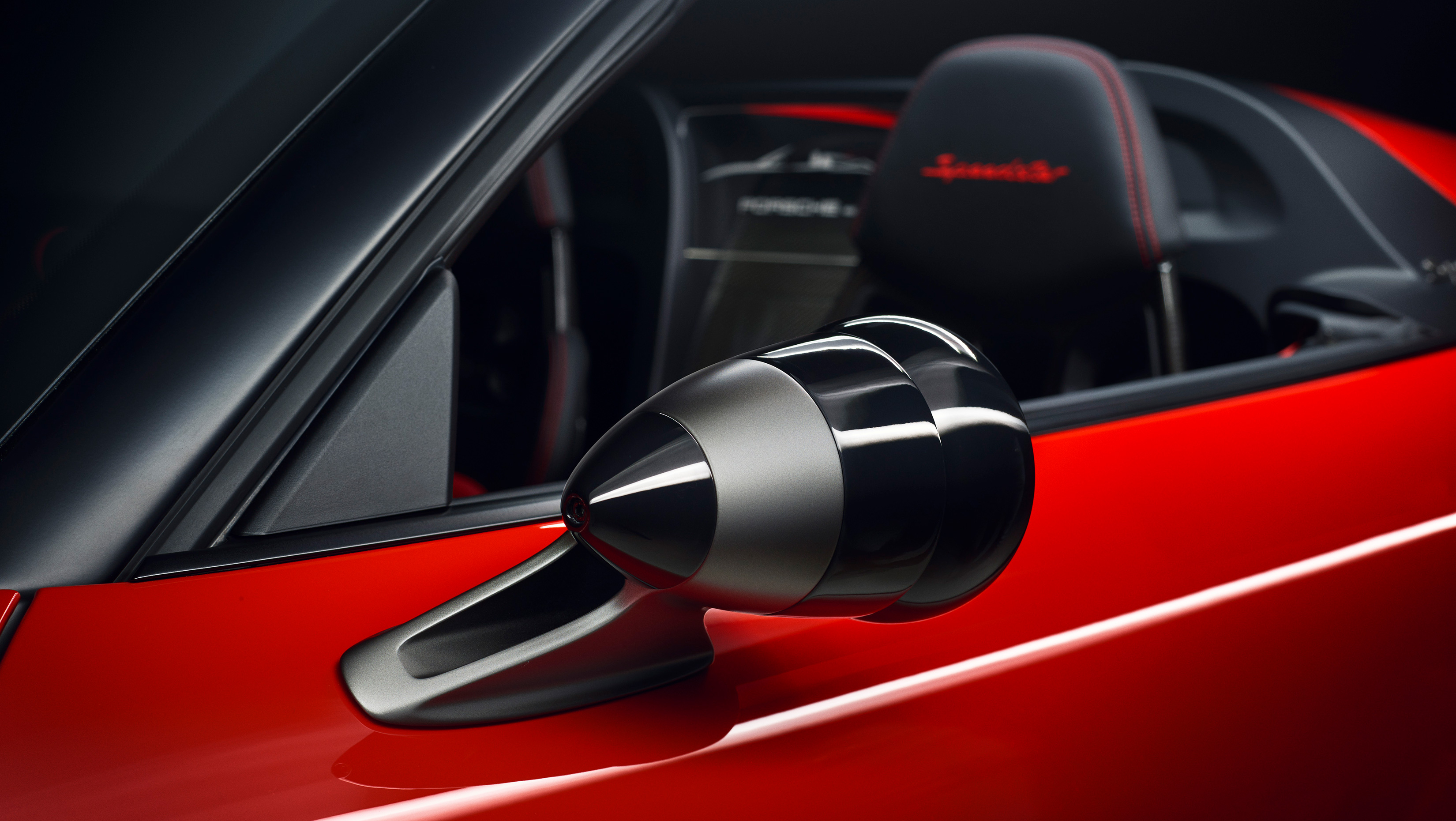
The most notable change would be the new paint color – known as ‘Guards Red’ – which pays homage to the original 1988 Speedster. The concept car was unveiled in a primarily metallic silver scheme, with only the front bumper and parts of the fenders donned in white – a nod to some of Porsche’s older race cars. Some of the other tweaks include new 21-inch center lock alloy wheels, and retro-styled door mirrors and fuel caps finished in dark chrome paint.

Overall, the embodiment of the car is retained from the concept version. This means that the production car will be an open-top without a roof option (hardtop or otherwise), has shortened window frames, a “double bubble” engine cover and plenty of carbon fiber.

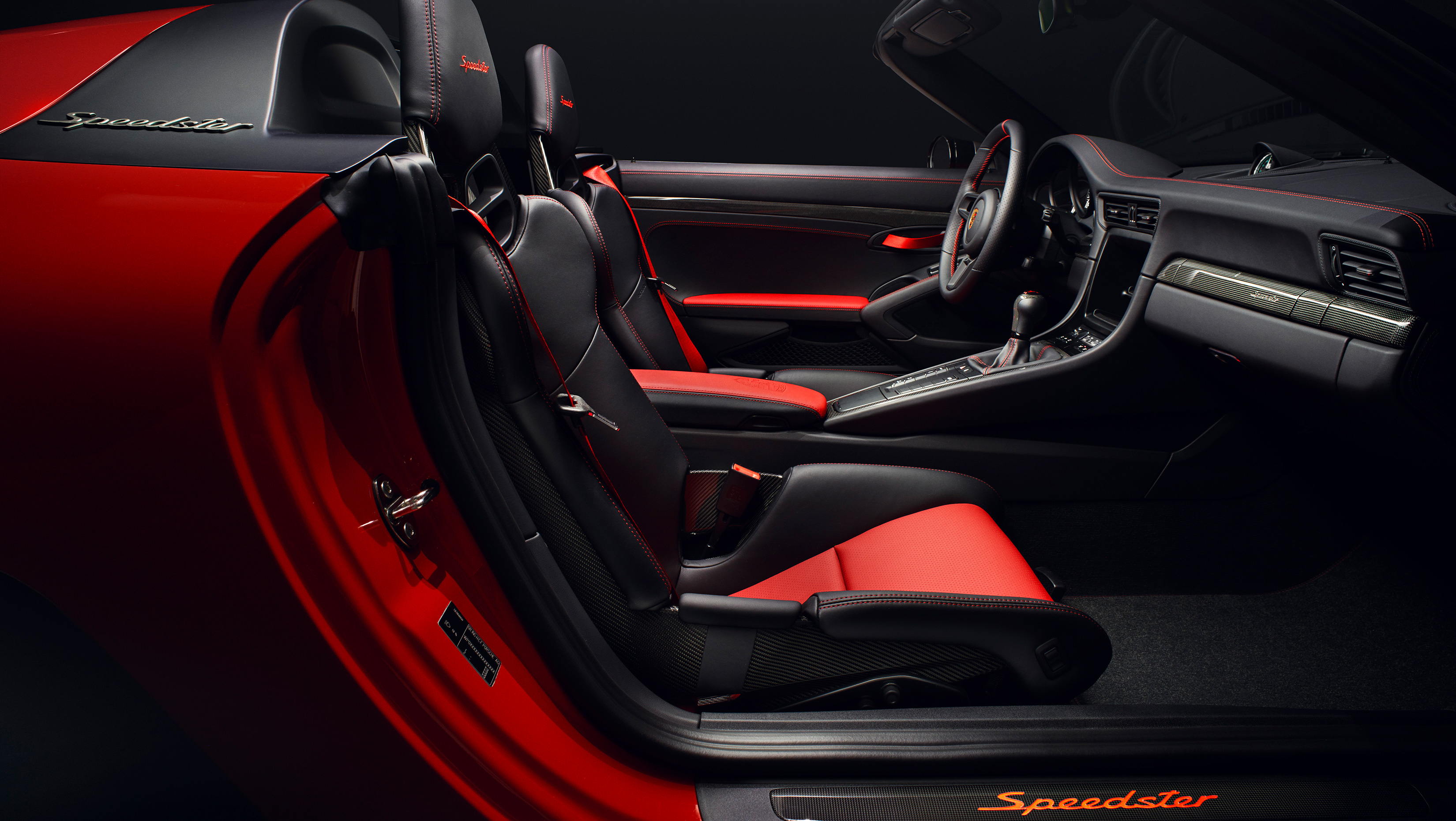
The interior is trimmed in “Cognac 356” leather and comes standard with carbon fiber bucket seats. To reduce weight, there is an absence of conveniences such as infotainment, navigation, and air-conditioning.

Performance specifications are more tight-lipped, though the production version is expected to use the same engine as seen in the concept – the 4.0L flat-six naturally aspirated engine from the 911 GT3, which produces 500-horsepower. As part of the car’s celebration of nostalgic qualities, the engine will be mated to a six-speed manual transmission.

No word either on pricing just yet; but Porsche has announced that only 1,948 units will be produced. As is the case with any limited-edition vehicle Porsche releases, getting your hands on one will be anything but conventional and its exclusivity will ultimately dictate its true price.

Porsche 911 Speedster Gallery

Lamborghini Aventador SVJ full onboard record lap at Nürburgring

[embedded content]

ventador SVJ laps the Nürburgring Nordschleife in 6:44:97 minutes under the formal scrutiny of Remak personnel who managed time and GPS certification using VBOX-Racelogic instrumentation. The new king of the ‘Ring’ driver was Marco Mapelli that managed the challenge with Lamborghini’s Research and Development team and the extensive tire support from Pirelli technicians and driver.

Ford GT Carbon Series is the lightest version of Ford’s supercar

Following up on the announcement that it will build 350 more GTs, Ford revealed another version of its supercar that will be available to customers. It’s the 2019 Ford GT Carbon Series, and it’s the lightest version of this GT model.

Visually, it’s recognizable by its gray paint and the standard exposed carbon fiber stripe down the middle, which showcases the perfectly reflected carbon weave on either side of the car. This stripe can be accentuated with a contrasting color stripe down the middle, along with mirror caps the same color. The accent color choices are restricted to silver, orange, red and blue. Inside, upholstered parts get unique silver stitching, and matte carbon fiber is used for the air vent pods, side sills and center console.

While the visual upgrades are nice, the real appeal of the Carbon Series is that it’s the lightest current GT. Total weight loss is 39 pounds. This is because it includes as standard the optional carbon fiber wheels, titanium exhaust and titanium lug nuts. It also gets a unique rear hatch with lighter glass and additional ventilation. We suspect that Ford could have shaved off a few more pounds if it removed the climate control and radio, but Ford said that GT buyers didn’t want to sacrifice those features.

Related Video:

Ford May Be Planning a High-Performance Four-Door Mustang

Leaks and rumors spew out of the internet every second of every day, so it’s important to look at each one with a critical eye and healthy pinch of salt. Last weekend videos of the 2020 Shelby GT500 made their way out of a closed-doors dealer meeting, but more intriguingly attending dealers were allegedly told a four-door Mustang is on the way. When we reached out, Ford responded with “no news to provide at this time, but we will absolutely keep dialing up Mustang excitement year-after-year.”

Earlier this year, Ford announced it was axing plans to invest in any future hatchbacks and sedans. So, it’s easy to dismiss any rumblings of a Mustang-based sedan as false. With the market trending the way it is, hatchbacks, trucks and SUVs are an easy way to make money and if Ford wants to keep investors happy and the ROI high, shedding the dead weight is one way to go. With that said, Mustang is safe — it will always be safe unless Ford wants an angry mod with torches and pitchforks marching on Dearborn.

Ford also has a track record of making seemingly snap decisions as well as keeping incredibly tight-lipped about future projects. If (and that’s a big ‘if’) Ford were to make an entirely new sedan, basing it off of the Mustang would actually make sense. Supposedly, one or two attending dealers reported the four-door Mustang would come with a turbo V8 and go up against the likes of the Porsche Panamera and Audi A7. It’s difficult to think a Ford will go after that sort of price point. Aiming at other coupe-styled four-door cars makes more sense. In the performance luxury world, four-door ‘coupes’ are almost as ubiquitous as crossovers — BMW, Audi, Mercedes, even Kia and Toyota make coupe-like sedans.

Do I want to believe Ford took a step back, looked at itself and realized there is a place for sedans in this world if done right? Of course. I’ve been quietly pleading for someone to shoehorn a Mustang V8 in a new Taurus for years. Should Ford extend a Mustang, add two more doors and still call it a Mustang? Hell no. Bring back the Falcon. So, do I think Ford, has it in them to bring this project to life? Maybe the Ford that greenlit the new GT and Focus RS, but not Ford as it is today. I’d love to be proved wrong. If we do hear an official announcement it’ll likely be at the North American International Auto Show in January — until then, we’ll keep an ear to the ground and salt in hand.

Porsche Rennsport Reunion VI On-Scene Review

The Rennsport Reunion VI just concluded on September 30 in Monterey, California as Porsche celebrates its 70th birthday. Happy birthday, Porsche!! If anyone is wondering, Rennsport (renn-sport) translates into “race-sport”.

Before the event began, it seemed that four days of event duration might be excessive. But that really is insufficient time to explore all offerings thoroughly while watching only part of the races too.

The Rennsport only occurs once each three years or so, and only in one location. At Rennsport, Porsche is revealed on the grandest of scales. Raceway officials hinted that attendance over these four days may have reached 80,000 Porsche-Nation fans!

2008 Porsche RS Spyder graphite2008 Porsche RS Spyder graphite

The chief displays included seventy noteworthy race cars revealed in the massive Porsche Heritage Tent. Champions Garage was located in Auto Alley displaying 11 more triumphant Porsche race cars. In the large parking area beyond Barbecue Island near Turns 2 and 5 lied the bulk of the Porsche Club of America corrals, reputed to have over 1,300 cars.

Adjacent was the Michelin and Mothers exhibits of still more exotic Porsches. The paddocks included a veritable menagerie of Porsches that also raced in the wheel to wheel competition on the track.

Beginning of a Legacy
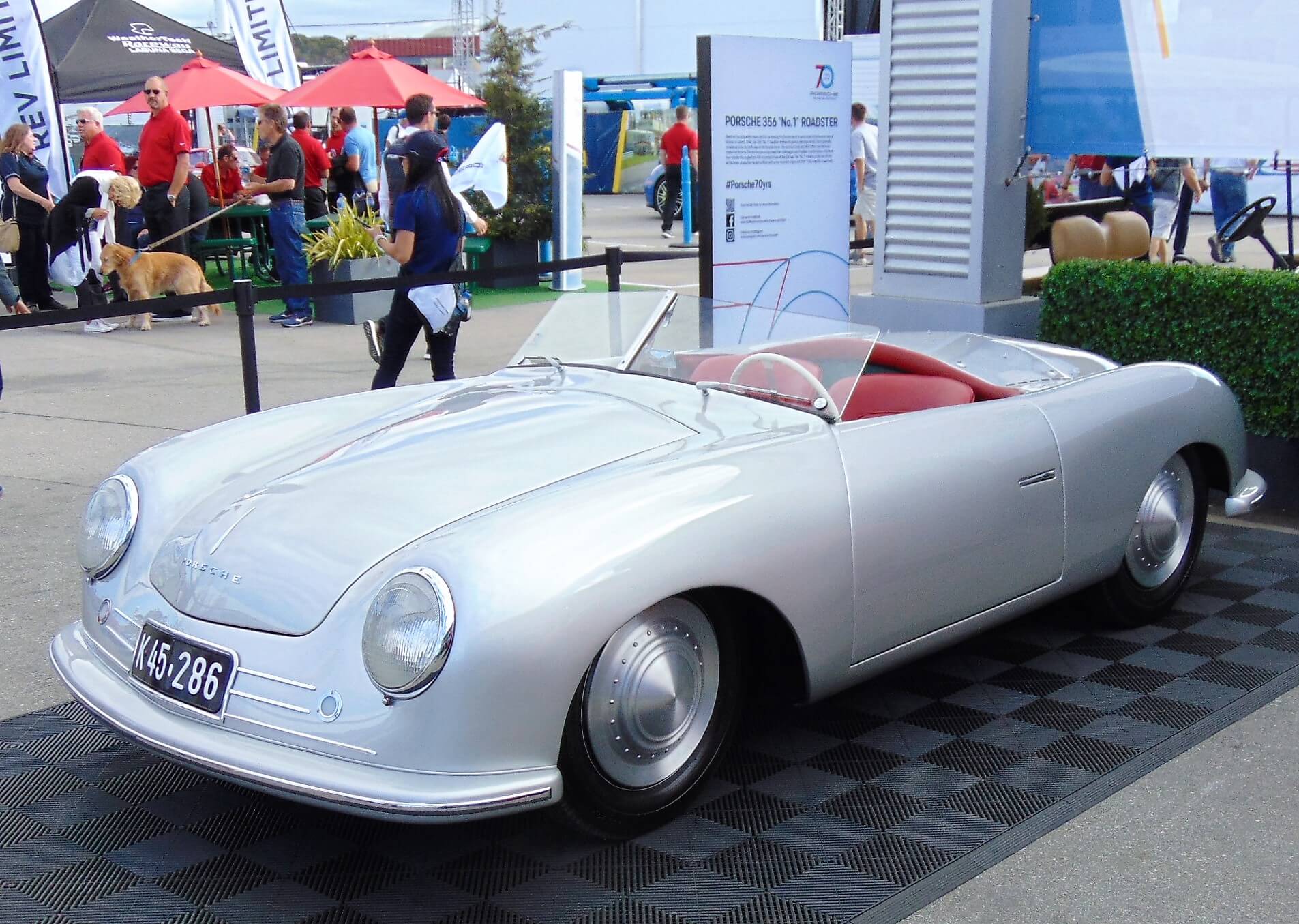
Porsche-356 “No. 1”-Roadster replicaPorsche-356 “No. 1”-Roadster replicaOn Sunday morning, a replica of the car that began the celebrated Porsche legacy, Porsche’s 356 “No. 1” Roadster, was positioned in front of Champions Garage in a bright metallic silver paint.

“No. 1” was the very first Porsche that Ferdinand “Ferry” Porsche created. It received its “street certification” on June 8, 1948.

Champions GarageChampions Garage

On a Mission for the Future

Porsche’s 70th birthday was a fitting time to review their progress on Mission E.

This project helps elucidate how far Porsche has come from the 356 “No. 1”, to the 911, to Porsche’s first fully electric car on display at Rennsport VI in the Exclusive Manufaktur area showing really stunning styling and wheels.

2018 Mission E concept car white2018 Mission E concept car white

Porsche stated, “Mission E represents the future. A possible future. A fascinating future.” Porsche held that this is the form their first completely electric sports car could take. Importantly, the concept-car would meet all Porsche standards for fuel efficiency, daily-drive practicality, and performance entirely based on groundbreaking technology.

They called it “the 911 of e-cars.” Porsche proclaimed their mission statement: “Our core area of expertise lies in complex, efficient, and high-performance powertrains.” The car’s driving range is 300 miles, and a 15-minute charge gives another 250 miles. “Turbo-charging” Porsche says!

Klaus Zellmer, Porsche President and CEO of Porsche Cars North America, Inc. said the vision of Mission E recently received the name Taycan. He added, “Next year the vision becomes reality.”

There She Blows

2018 Porsche 935 white2018 Porsche 935 white

Also at Rennsport VI, Porsche unveiled a new 700 hp race car with the body based upon its renowned 935/78, “Moby Dick”.

Vice President Motorsport and GT Cars, Dr. Frank-Steffen Walliser said, “This spectacular car is a birthday present from Porsche Motorsport to fans all over the world.” The car will have a limited produced run of 77 units.

Porsche-Nation fans came and revered the iconic make during the four days appropriately themed, “Marque of Champions”. Why does Porsche have such a large and faithful clan of devotees? There are several reasons.

First, it is because Porsche stands for excellence and innovation in automotive engineering. Another reason is due to the uniqueness in the way Porsche does things. Porsche’s following also derives from its many achievements, which represent milestones of greatness.

Finally, the performance of Porsche automobiles and race cars are unequaled in many cases, which is the ultimate recognition.

Roundup at Porsche Corrals

Part of the Porsche corralsPart of the Porsche corrals

Porsche excellence and innovation in automotive engineering is universally renowned. Brilliance in design and production is a given. Quality and performance are taken for granted in Porsche road and track cars.

Reliability is a byword for Porsche production, as exemplified in their victories in the 24 Hours of Le Mans, an endurance race. A first-drive in a Porsche indicates quality. Importantly, owning a Porsche delivers reliability.

Porsche 356 corralPorsche 356 corral

Porsche seems to have unique views in their approach to automotive design. Their engineers practice the mantra “form follow function”, and performance derives from function.

Examples of uniqueness at Porsche, or at the very least adhering to “the path less followed” are their opposed-cylinder engines, long-time use of air-cooling for engines, rear, and mid-engine positioning, and retaining the same basic style for the 911 model for 55 years.

Porsche’s achievements are too numerous to be mentioned. But some of the cars that I will describe will elucidate a few of Porsche’s accomplishments.

To experience Porsche performance, all one must do is to drive the 911 model. The overall feeling is of lightness, agility, and well tied together. The much-used phrase, “You are one with” the car actually applies here.

The brakes are unequivocally superb, and grand touring on roads with long curves is a dream. The engine revs high, sounds silky-smooth, and performs professionally and faithfully.

The Eternal 911

Porsche Turbo S Exclusive Series restored representationsPorsche Turbo S Exclusive Series restored representations

As I entered the large square with the interview stage complete with giant screen, autograph tables, the Porsche store, picnic tables, and much, much more, I first stopped to admire two 911’s strategically placed at the main entrance in “golden yellow metallic” paint.

Yes, the “eternal 911” and its many variants, the car that best exemplifies Porsche and its philosophy. These were two cars restored from 993 chassis to be auctioned off with proceeds to charity and representing Porsche’s new 2018 Porsche 911 Turbo S Exclusive Series, limited to 500 units with prices starting in the $250,000 range.

While I wandered about exploring the astoundingly massive extravaganza called the Rennsport VI, I mused if there were an all-Porsche Hall of Fame, which street cars or race cars might be in it? In this writing, I will mention several Porsche street cars and Porsche race cars, past and present at the event that, I think, deserve special recognition. No secrets here, I believe we all know them.

Porsche race cars are a little greater challenge. There are so many of them, and with 20,000 to 30,000 racing victories over the years, a little time is required to consider the candidates. If Porsche blesses us with a Rennsport VII, that may be a good opportunity.

The “eternal Porsche 911” the Porsche 911 whiteThe “eternal Porsche 911” the Porsche 911 white

In any case, the premier member of a Porsche Hall of Fame would be the “eternal 911”. At 55 years of age and still going strong, it would blow completely off the charts in terms of kudos, accomplishments, and enthusiasts! Nothing more need be said.

Porsche 917’s Blaze the Track

1973 Porsche 917/301973 Porsche 917/30

Another lock for special recognition would be the 12-cylinder 917 juggernaut, along with the variants it parented. There were several 917s at Rennsport VI with most located in the Porsche Heritage tent, or in the Paddocks where I spotted American Patrick Long, a factory Porsche driver, mounting one.

The 917K, meaning Kurzheck (short-tail), won the 24 Hours of Le Mans in 1970 and again in 1971. In 1972 the 917/10 won the Can-Am Challenge. In 1973 the 917/30, the most powerful racing sports car ever built at 1,580 bhp, also won the Can-Am Challenge. Known as the Can-Am killer because it won so often, Mark Donohue said the 917 was the only car he ever drove that could generate wheelspin at 200 mph!

Notably, Donohue turned in a blistering lap at Atlanta’s Talladega race track in 1975 piloting a 917/30 to a new world record of over 221 mph average speed, yes average! A 16-cylinder 917 version was made but never actually raced due to handling issues of the longer chassis. Perhaps thankfully, because what could have challenged it?

Patrick Long, Porsche 917-10Patrick Long, Porsche 917-10
Porsche 917/30Porsche 917/30

I think it’s safe to say that the Porsche 919 hybrid race car deserves special recognition. This car has already won the 24 Hours of Le Mans three times, in 2015, 2016, and 2017. Also, in 2018 the Evo version of the 919 became the fastest race car in history to circulate the Nürburgring in Nürburg, Germany, smashing the previous record, set 35 years ago by a Porsche 956, by over 51 seconds.

Earl Bamber and the 919 Evo

2018 Porsche 919 Evo2018 Porsche 919 Evo

At the Rennsport VI, I watched Earl Bamber pilot the 2018 Porsche 919 Evo as it clocked 186 mph through the speed traps. What impressed me most was how effortlessly it negotiated the Andretti Hairpin and Turn 5. The EVO was as smooth as silk – no smoking, flat-spotted tires, no broadsided curves.

Exiting the curves, it was almost shot out of a gun and back to speed in no time. I say “almost” because the car was absolutely glued to the track without any jerkiness. It appeared to be locked onto a rail, gobbling up the track with robot precision with ever-increasing speed until the next curve arrived.

This car is a real piece of work! Back in Champions Garage, see my photo below where a hoard of mechanics swarmed the car attending to every potential need.

Mechanics, 2018 Porsche 919 EvoMechanics, 2018 Porsche 919 Evo
I was always curious about how massive downforce felt to the driver of a race car. So, I made a point of catching Porsche factory drivers Bamber and Laurens Vanthoor just as they sat down at the autograph tables before lines formed. Bamber has overall victories in the 24 Hours of Le Mans in 2015 and 2017 in Porsche’s 919 hybrid, and Vanthoor races a Porsche 911 RSR.
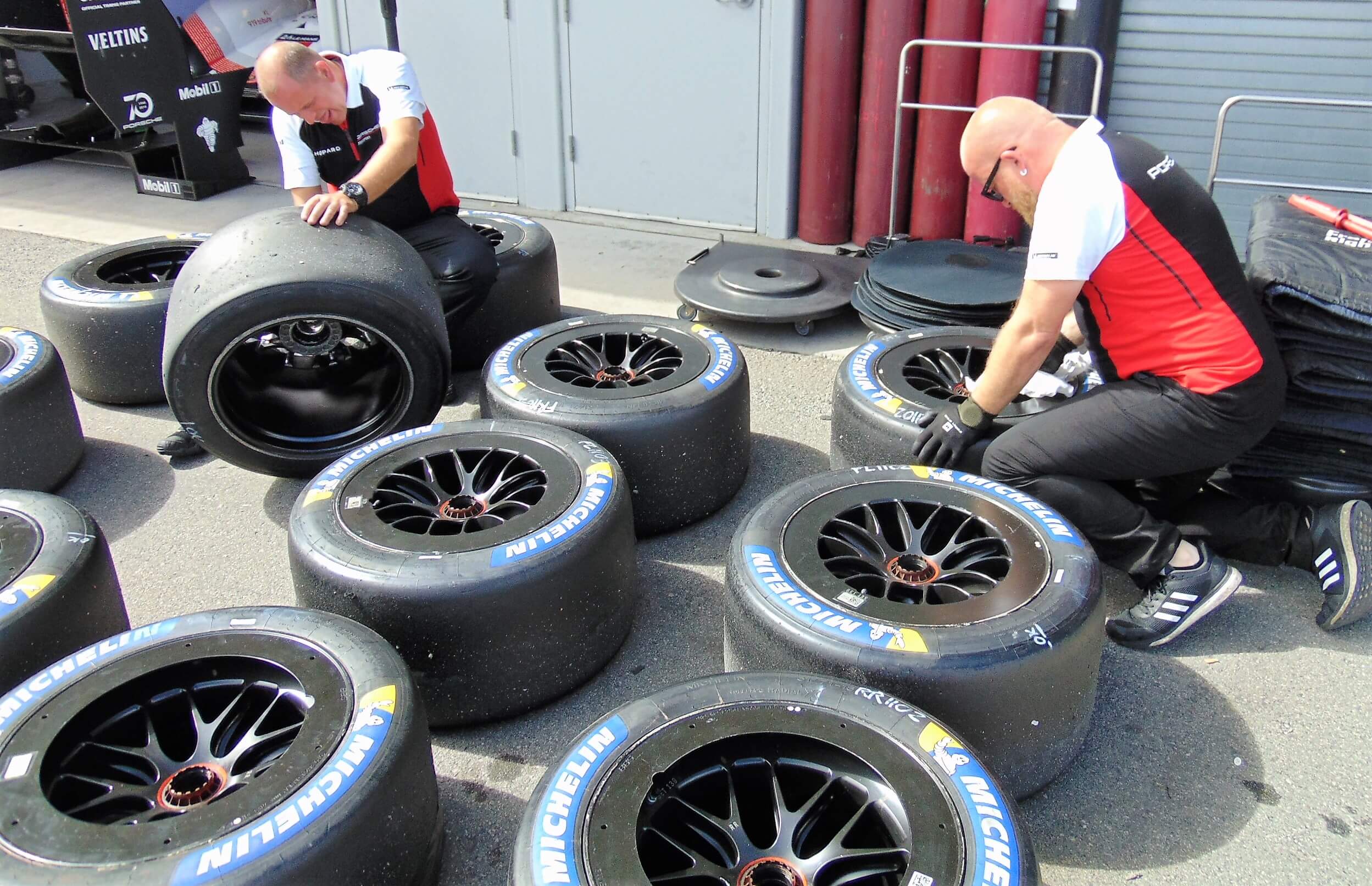
Mechanics readying tires for Porsche 919 EvoMechanics readying tires for Porsche 919 Evo

I requested of Vanthoor “What does the aerodynamic downforce feel like when you are racing”? He replied, “You have to actually experience it to understand it”.

Not much chance in my driving his factory RSR soon, so I asked: “How much G-force do you experience in cornering and braking?” Vanthoor responded, “Three to four Gs in the 911 RSR.” That would definitely result in a sore neck.

Sufficient downforce is generated on some race cars such that if they could be placed on the roof of a tunnel at speed, they would remain stuck there. That intrigued me greatly, so I asked Bamber the same questions. He replied, “Downforce makes you feel like the car is really glued to the track. Due to large downforce, in cornering and braking, you experience about four to five Gs in the 919.”

We talked about driving at a race car’s limits, and both explained that is where driver experience enters. My only hope is for someone to give me a seat in historic races someday. I thanked my hosts and moved on.

Hype for the 918
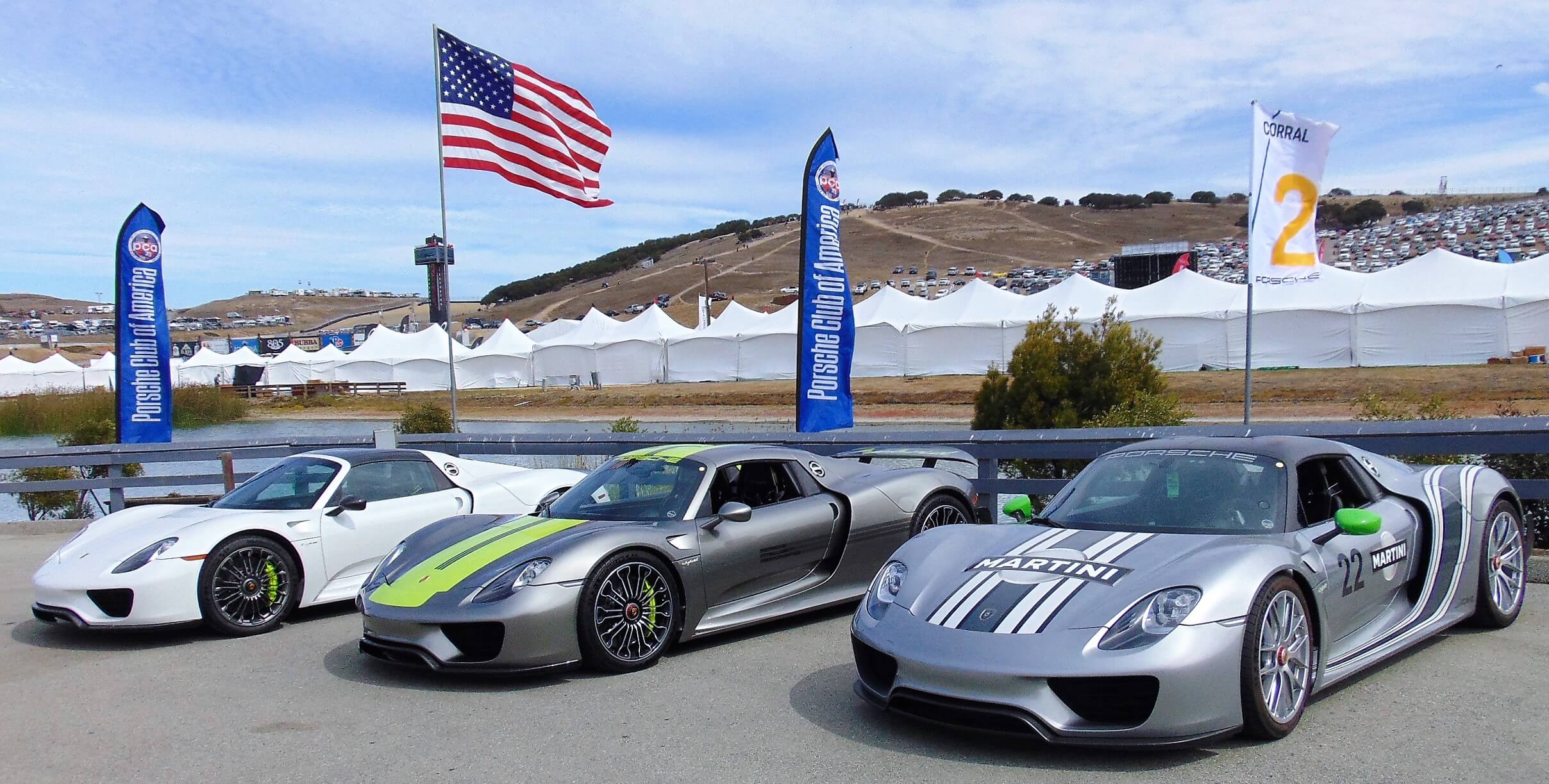
Porsche 918 hybridPorsche 918 hybrid

Next, I found Porsche’s latest hypercar, the Porsche 918 hybrid, in a dozen-sized-group on Barbecue Island near Turns 2, 3, 4, and 5. I believe this car also deserves special recognition on an all-time list. Its merits are too great not to be left in awe.
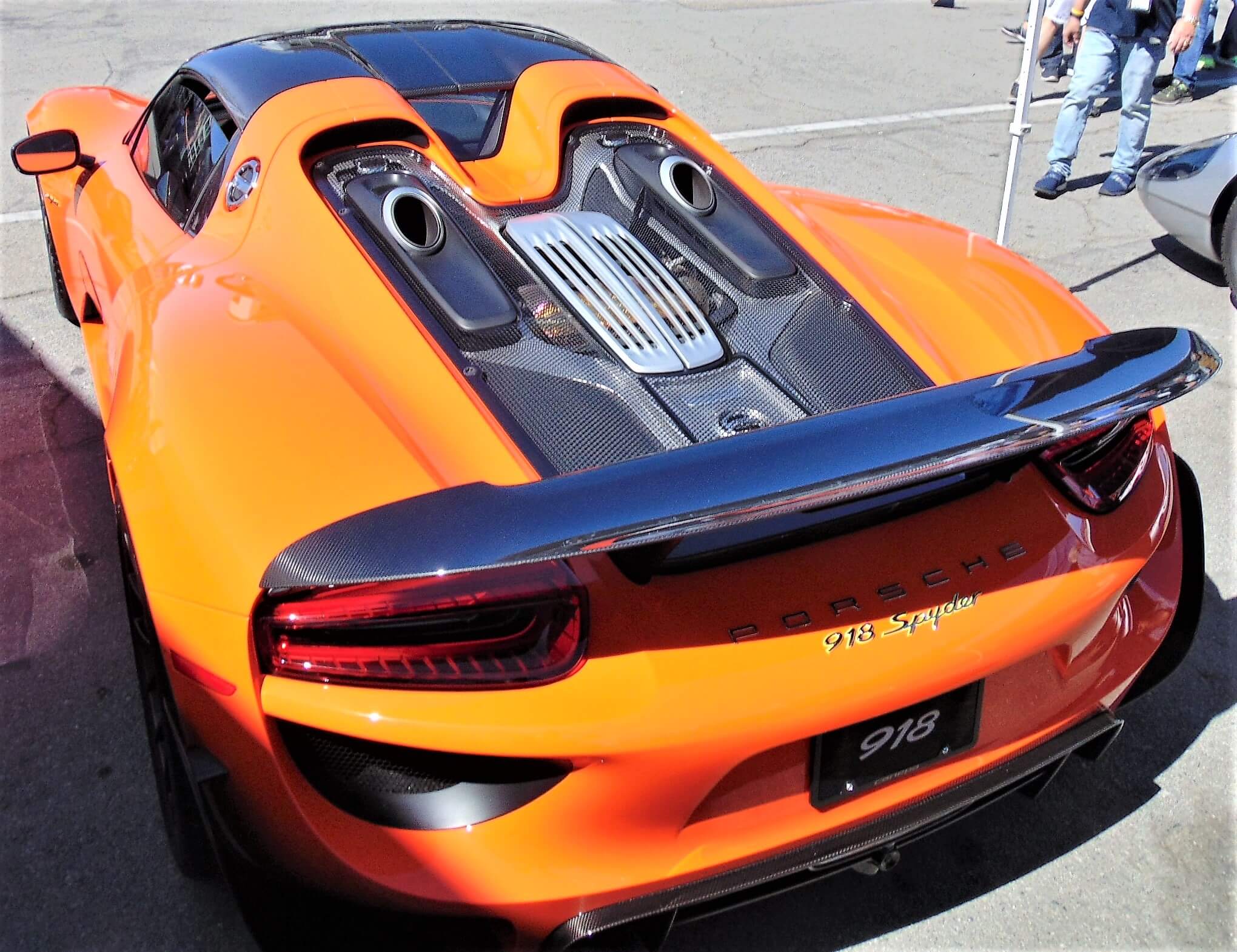
High exhausts, Porsche 918 SpyderHigh exhausts, Porsche 918 Spyder

To start, this astonishingly complex car possesses absolutely stunning, creative styling, remembering that at Porsche form follows function. The 918’s engineering is also state of the art, and frankly, beyond.

Innovative features abound, like the exhaust pipes exiting high on the car and not below the engine, allowing extension of the rear diffuser resulting in improved aerodynamics. The high exhaust pipe design also assists the lithium batteries to remain within their operating temperature range.

One might say, “The car should offer something at $998,000.” But the aftermarket voted quickly and the 918 appreciated to $1,700,000, nearly doubling!
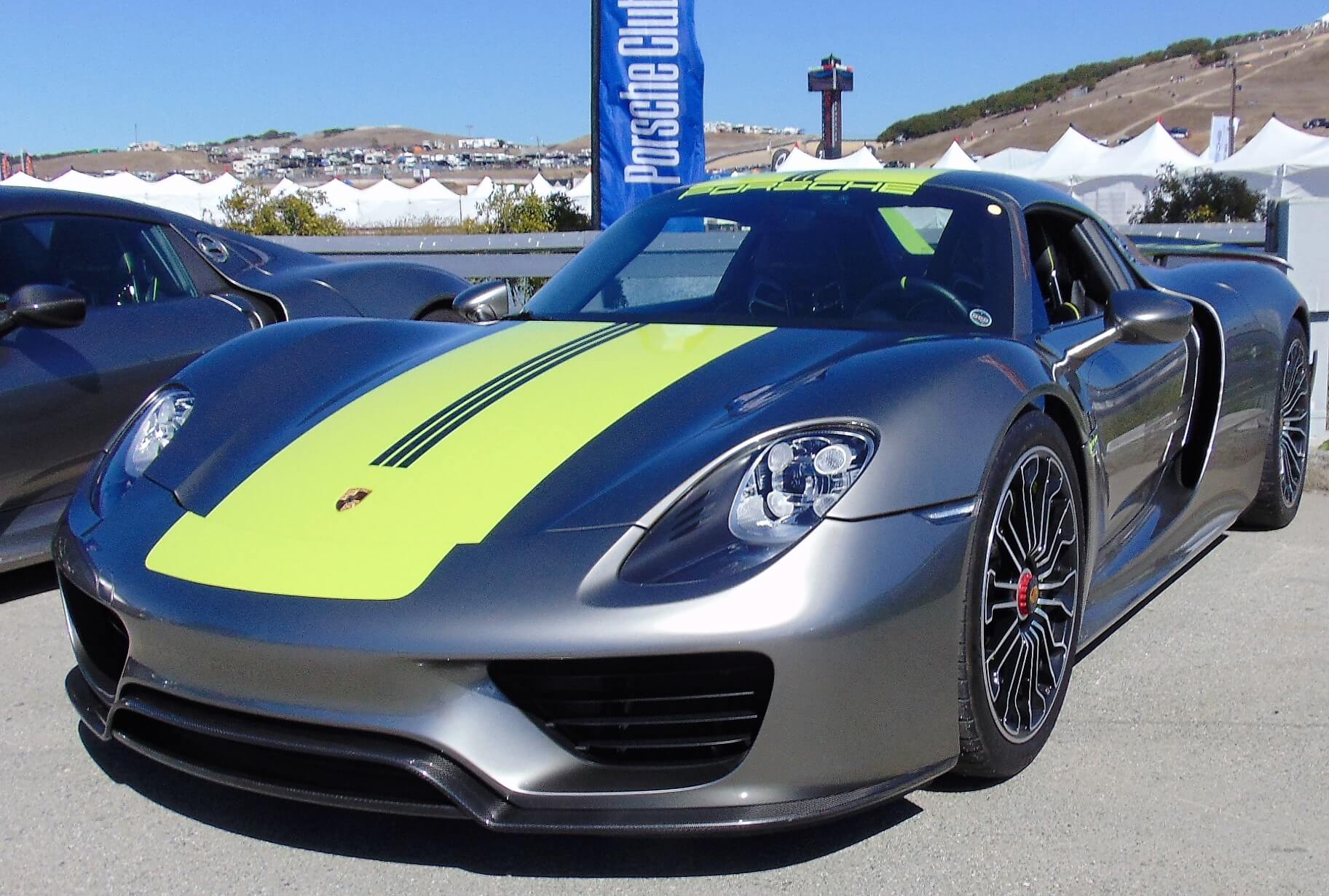
2014 Porsche 918 hybrid graphite2014 Porsche 918 hybrid graphite

The 918 was first introduced as a concept car in 2010 at the 80th Geneva Motor Show along with the 911 GT3 R hybrid race car, while the racing version, the 918 RSR, followed the next year at the North American International Auto Show in Detroit. The street production model was finally introduced at the Frankfurt Motor Show in 2013 and produced through 2015.

The 918 Spyder is powered by a mid-engine, naturally aspirated, 4.6-liter V8 through a 7-speed PDK dual-clutch gearbox driving the rear wheels. The V8 yields 600 bhp at 8,500 RPM, but that’s not all. Two electric motors provide an added 286 bhp to the front wheels. The combined total of gasoline and electric yields 875 bhp and 944 ft-lb of torque! Weight lies between 3,600 and 3,800 lbs.

A flexible and very practical feature is that the battery can be refreshed either by a plug-in or regeneratively while driving and braking similar to the KERS system used in Formula One racing. KERS stands for “kinetic energy recovery system”. A flywheel accumulator rotating near 40,000 RPM located in the passenger compartment stores the energy. The car’s 6.8 kwh liquid-cooled lithium-ion battery alone gives a 12 mi (19 km) driving range.

Internally at Porsche called “race lab, the 918’s performance numbers deliver a knockout:

  • 0-100 km/h (0–62 mph) in 2.5 seconds
  • 0–200 km/h (0–124 mph) in 7.2 seconds
  • 0–300 km/h (0–186 mph) in 19.9 seconds
  • Maximum speed is 350 km/h (217 mph)!

In September 2013 a 918 fitted with the optional ‘Weissach Package’ which reduces weight nearly 100 lb recorded a record lap time of 6:57 min on the 20.7 km (12.8 mi) Nürburgring uncombined course. The 918 truly exemplifies engineering brilliance!

All-Time Greatest in the Carrera GT
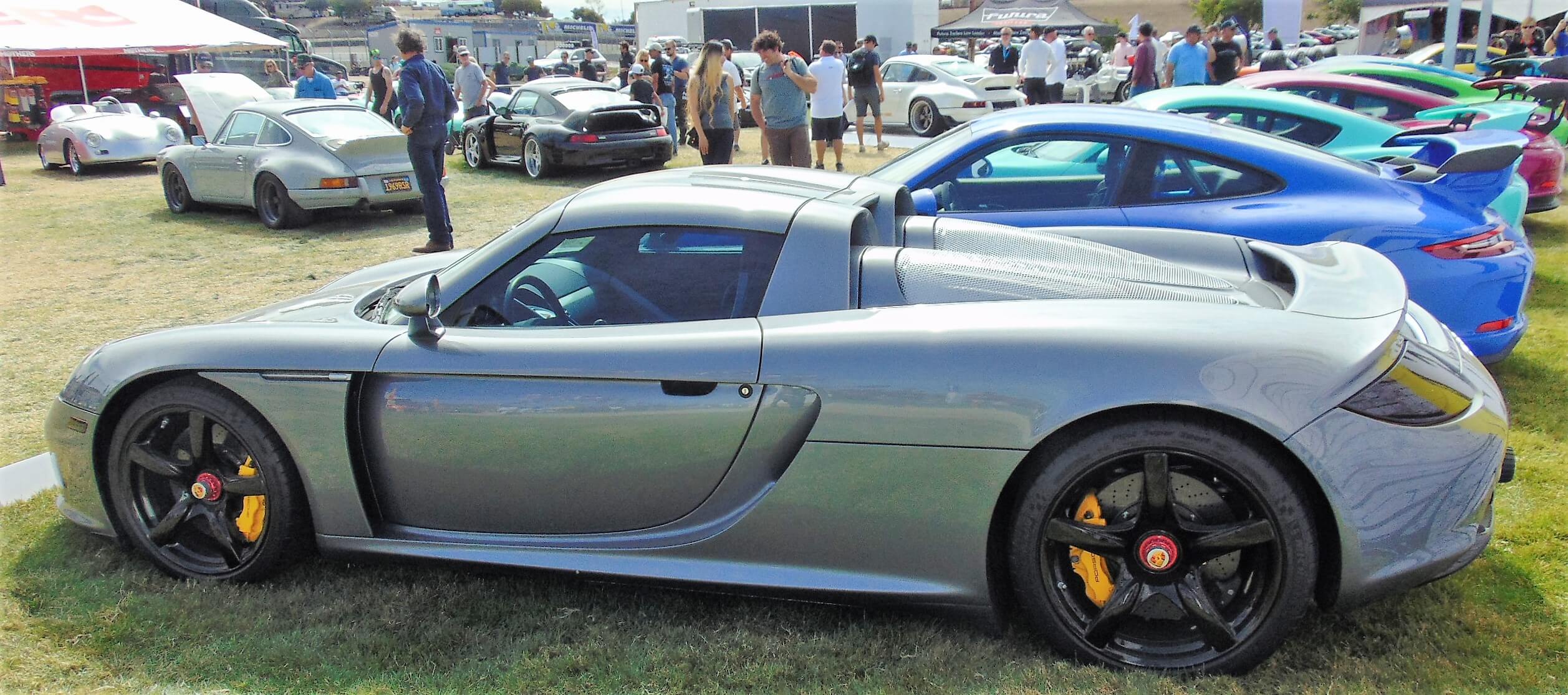
2005 Porsche Carrera GT silver2005 Porsche Carrera GT silver

The Carrera GT (2003-2007) should definitely receive special recognition for Porsche’s all-time greatest. This mid-engined sports car preceded the 918 and is high on, or at the top, of many lists for best petrol-powered sports cars, some for all time.

The GT project was a sporadic one, occurring in starts and stops over a long period of time. In the beginning, a Porsche engine was built for a Formula One effort in 1992. That task was canceled, then revived for a Le Mans project. However, concern about conflicting with Audi’s Le Mans plans caused termination of this project too. Eventually in 2000, a decision was taken to build 1,500 cars.
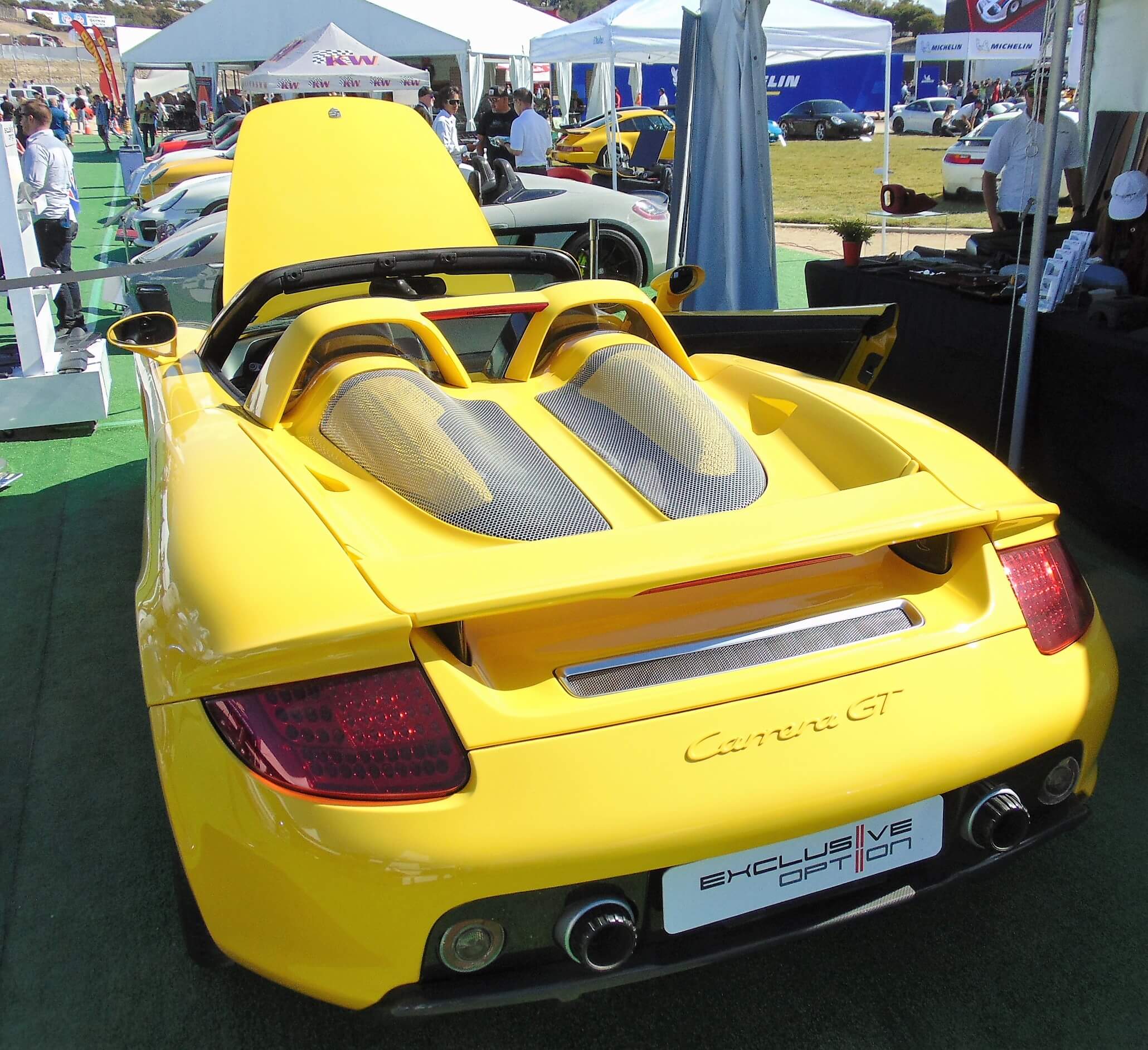
2005 Porsche Carrera GT yellow2005 Porsche Carrera GT yellow

The Carrera GT two-door roadster is powered by a naturally aspirated 5.7-liter V10 engine employing 4 valves per cylinder which produces 603 bhp, 435 lb⋅ft of torque at 5,750 rpm, with red-line at 8,400. The lack of turbochargers might appeal more to those with purist tendencies, but the car performs quite well without them. Adhering to the simpler path generally offers reliability and weight savings.

The car will do 0-60 mph in 3.5 seconds, 0-100 mph in 6.8 seconds, and achieves a maximum speed of 205 mph. The curb weight of this rear-mid-engine V10, rear-wheel-drive car is 3,040 lb. Its predecessor is the Porsche 959, and the successor the Porsche 918 Spyder.

The Carrera GT’s rear wing is electronically operated, deploying at speeds over 70 mph. The sizeable side inlets and air dams add cooling to the engine. Weight is reduced by a carbon fiber monocoque and chassis. Porsche brakes are usually superior and the GT’s are no exception sporting a carbon fiber-reinforced silicon-carbide ceramic-composite braking system.

Face to face, the GT appears very low and wide, and somehow you just know it will perform. The V10 engine does not sound large but presents a rather beguiling note. Yes, the Carrera GT is one for the ages!

The 959, a Rare Sighting
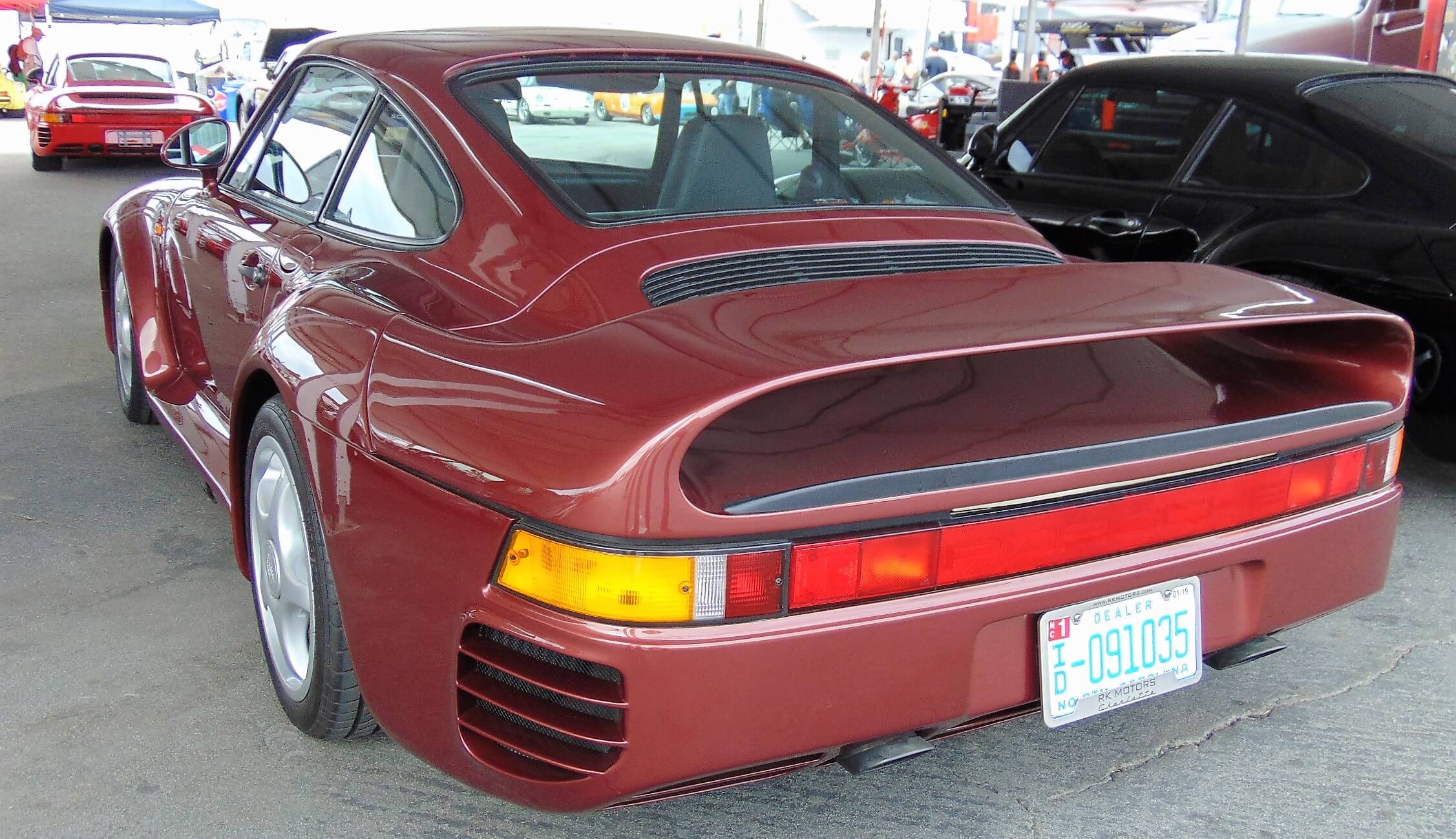
Porsche 959 burgundyPorsche 959 burgundy

The Porsche 959 sports car (1986-1993) should also receive special recognition among Porsche’s best. However, the car’s intended use as a race machine was brief and had issues finishing races.

The 959 was initially envisioned as a Group B rally car. Later it was produced for road use but did not comply with US street requirements until billionaire Bill Gates assisted in getting the “Show or Display” law passed.
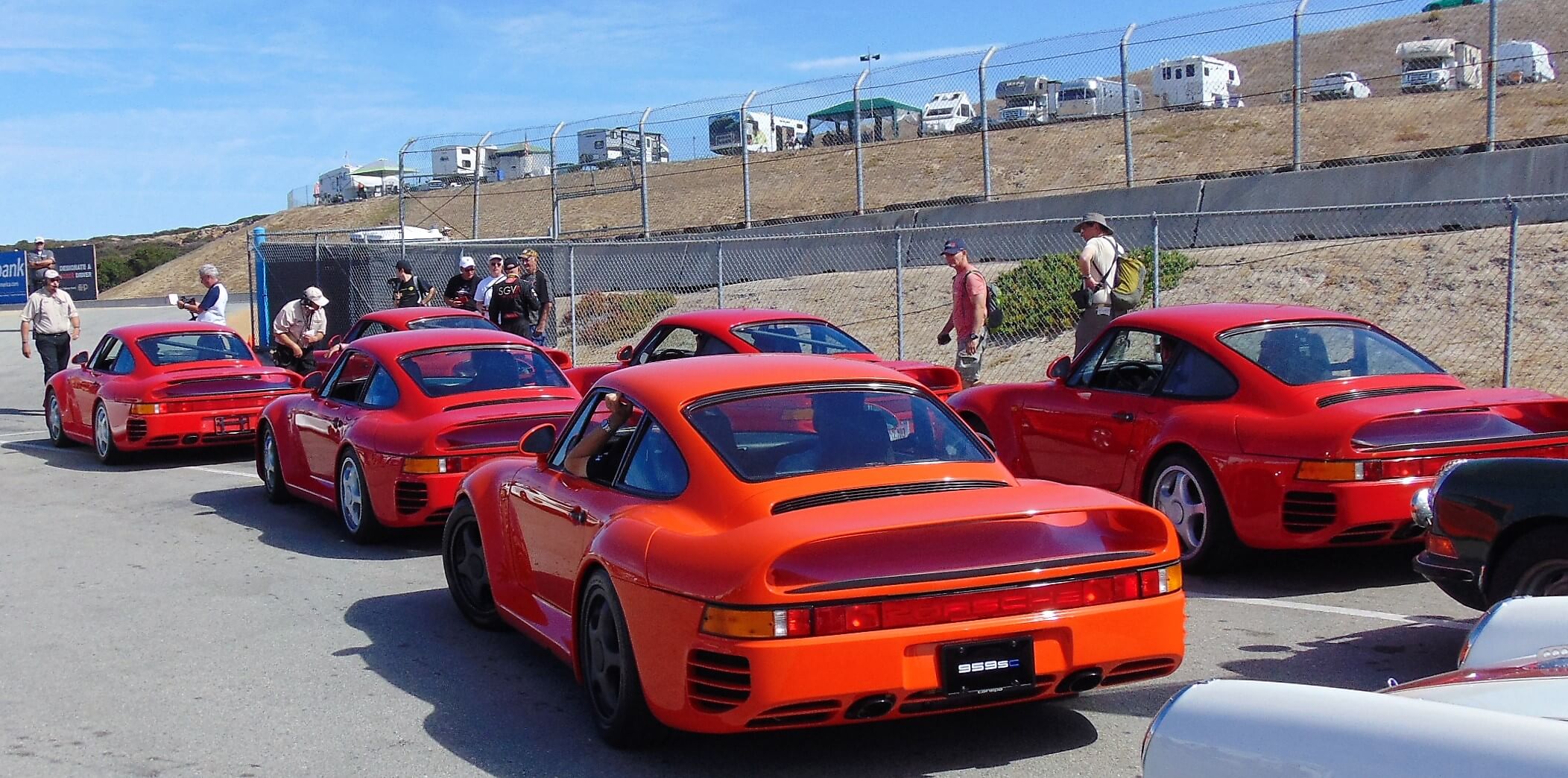
Porsche 959 group entering the trackPorsche 959 group entering the track

The 959 is rarely seen as only 345 were ever produced. When one does appear, it is almost certainly alone. As I perused the paddocks I was astonished to come upon nearly a dozen under one of the large tents. A little later this rare grouping formed a line and entered on track in the exhibition.

The technological achievement in creating the 959 in the 1980s was noteworthy. The twin-turbo vehicle was then considered the most technically advanced sports car ever made. It was the world’s fastest street car clocking 197 mph.

The 3,200 lb 959 was powered by a 2.8-liter twin-turbo flat-6 generating 444 bhp and 369 ft-lb of torque applied through a 6-speed manual gearbox. One of the earliest high-performance cars offering all-wheel drive, the car also automatically adjusted its ride-height.

Porsche Heritage Tent

The 936
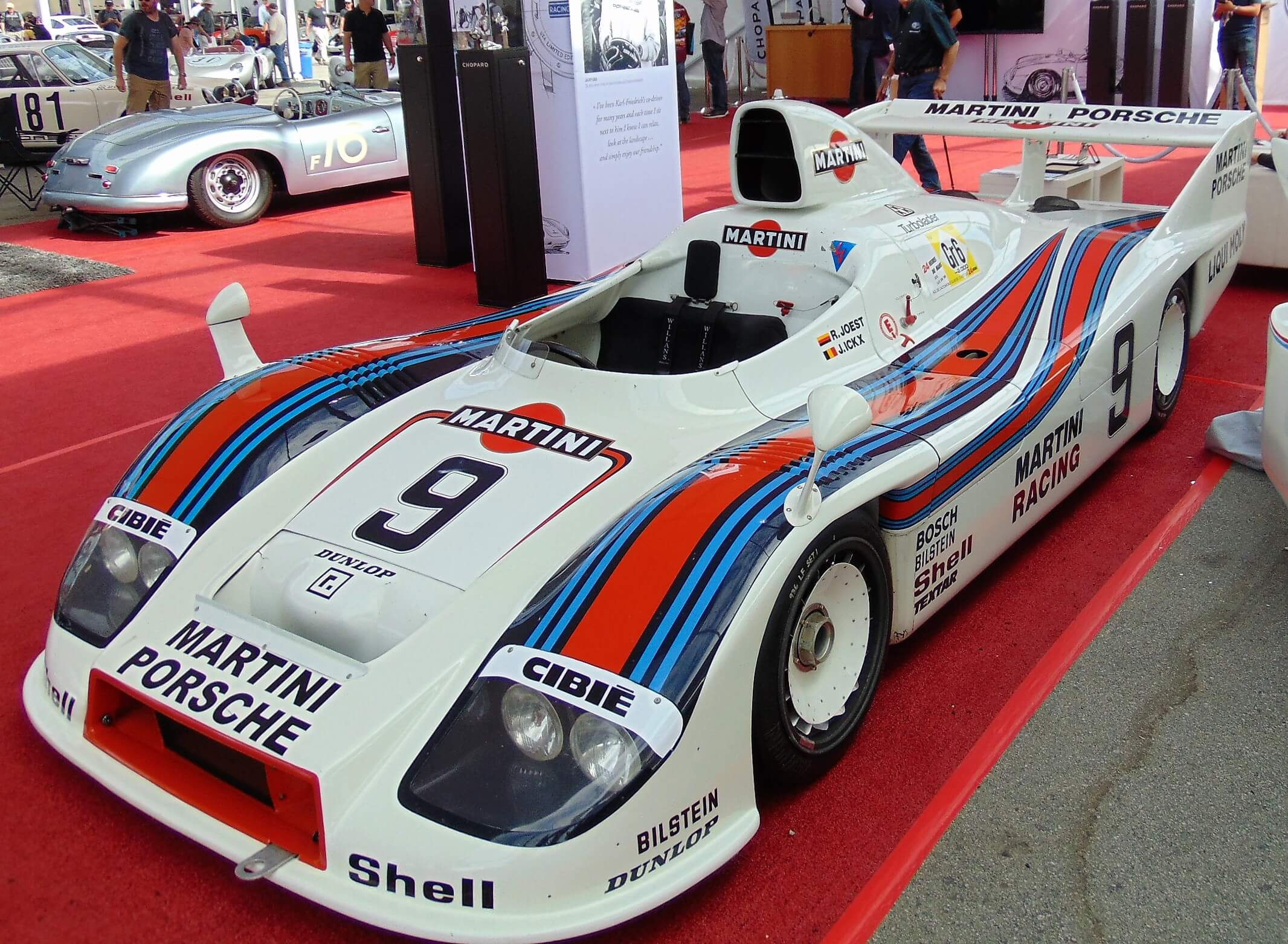
1979 Porsche 936 white1979 Porsche 936 white

Text – 1979 Porsche 936

There were 70 Porsche race cars under the Porsche Heritage tent, and the 936 was the first to catch my attention. It looked racy with stylistic, gracefully flowing lines, remembering that at Porsche “form follows function” when it comes to styling.
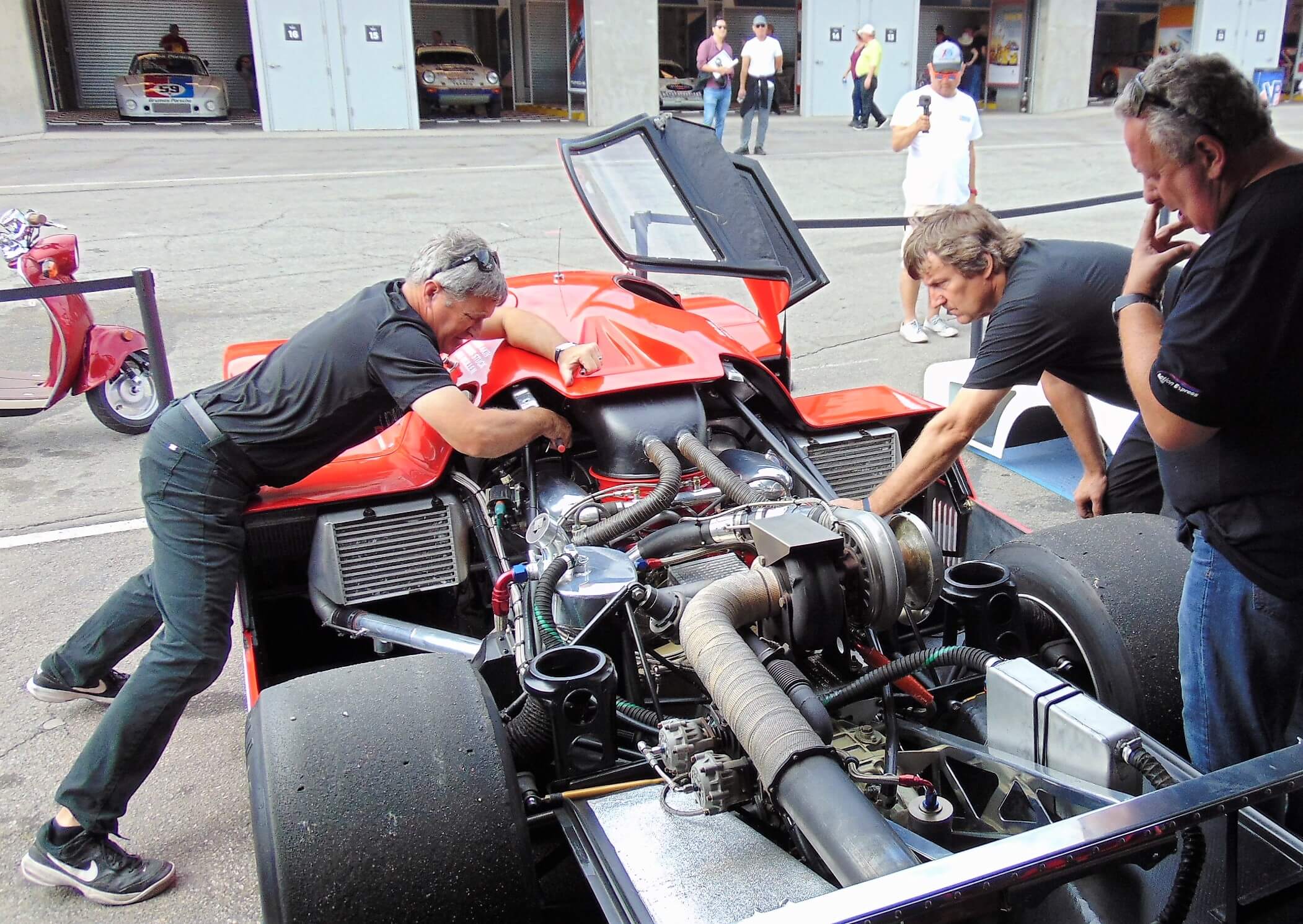
Porsche Ready for trackPorsche Ready for track

The Porsche 936 (1976-1981) was developed to compete in the World Sportscar Championship Group 6 category in 1976 by Porsche as a successor to the 917 and 908.

The power in this 1,587 lb race car was provided by a 2.1-liter opposed-six-cylinder twin-turbocharged engine generating 540 hp at 8,000 RPM, transmitted through a five-speed gearbox.

The Porsche factory entered the 936 in the 24 Hours of Le Mans with Jacky Ickx piloting to wins in 1976, 1977, and 1981.

The 935
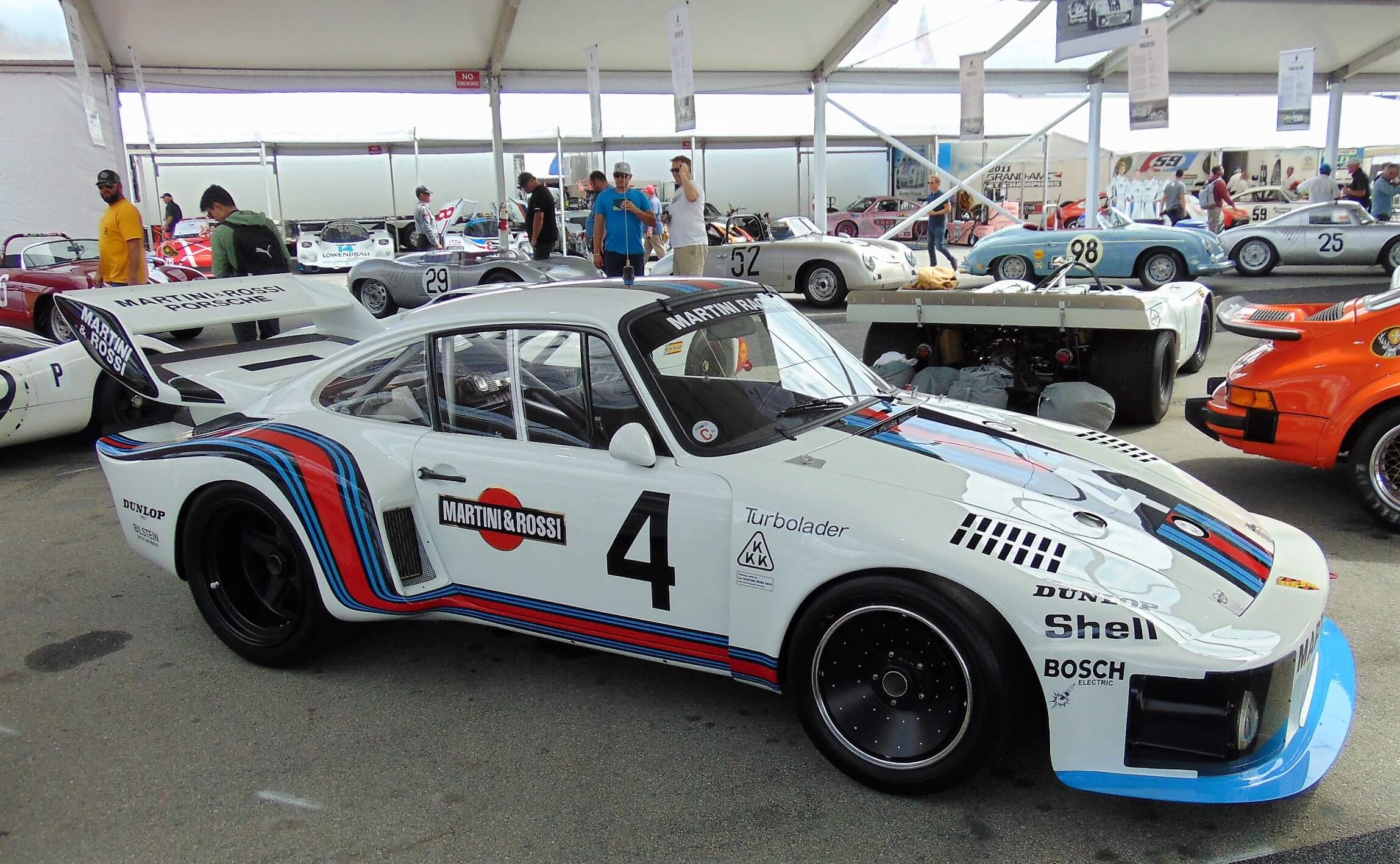
1976 Porsche 935 white1976 Porsche 935 white

Nearby I spotted a Porsche 935 (1976–1981), a 911-based race car introduced in 1976 as the factory entry for the FIA’s new Group 5 rules. It derived from the Carrera RSR 2.1 turbo prototype. Group 5 rules allowed liberal alterations to production-based cars.

Power was supplied to the 2,138 lb 935 by a twin-turbo flat-six of 2.9 to 3.3-liter employing mechanical fuel injection producing from 540 to 845 hp through a 4-speed manual gearbox.
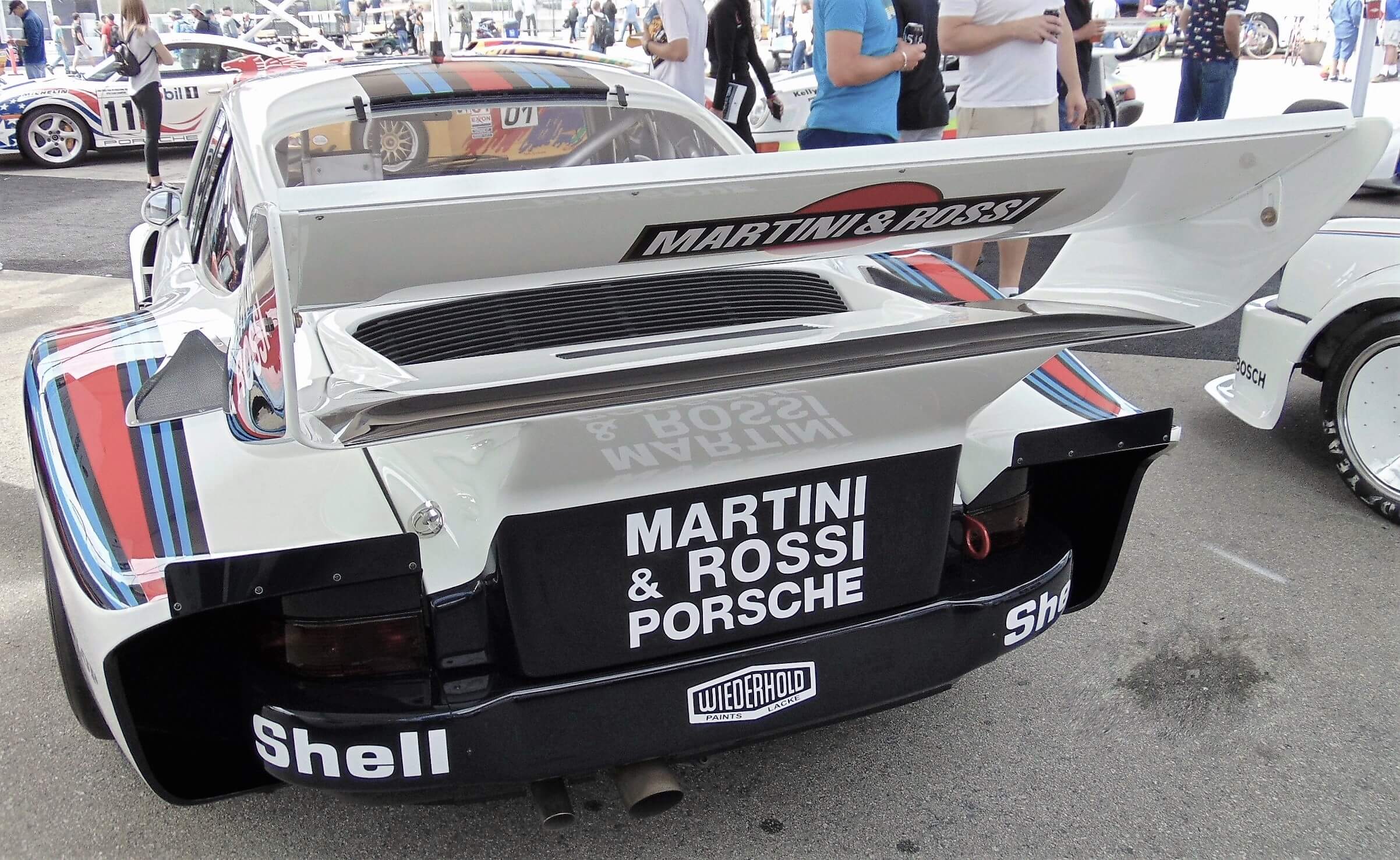
1976 Porsche 935 white1976 Porsche 935 white

Few were able to challenge the 935 in major endurance races, and the car eventually won the 24 Hours of Le Mans in 1979, overall. The 935’s domination ended in 1982 with FIA rule changes.

Derek Bell Pilots the 962
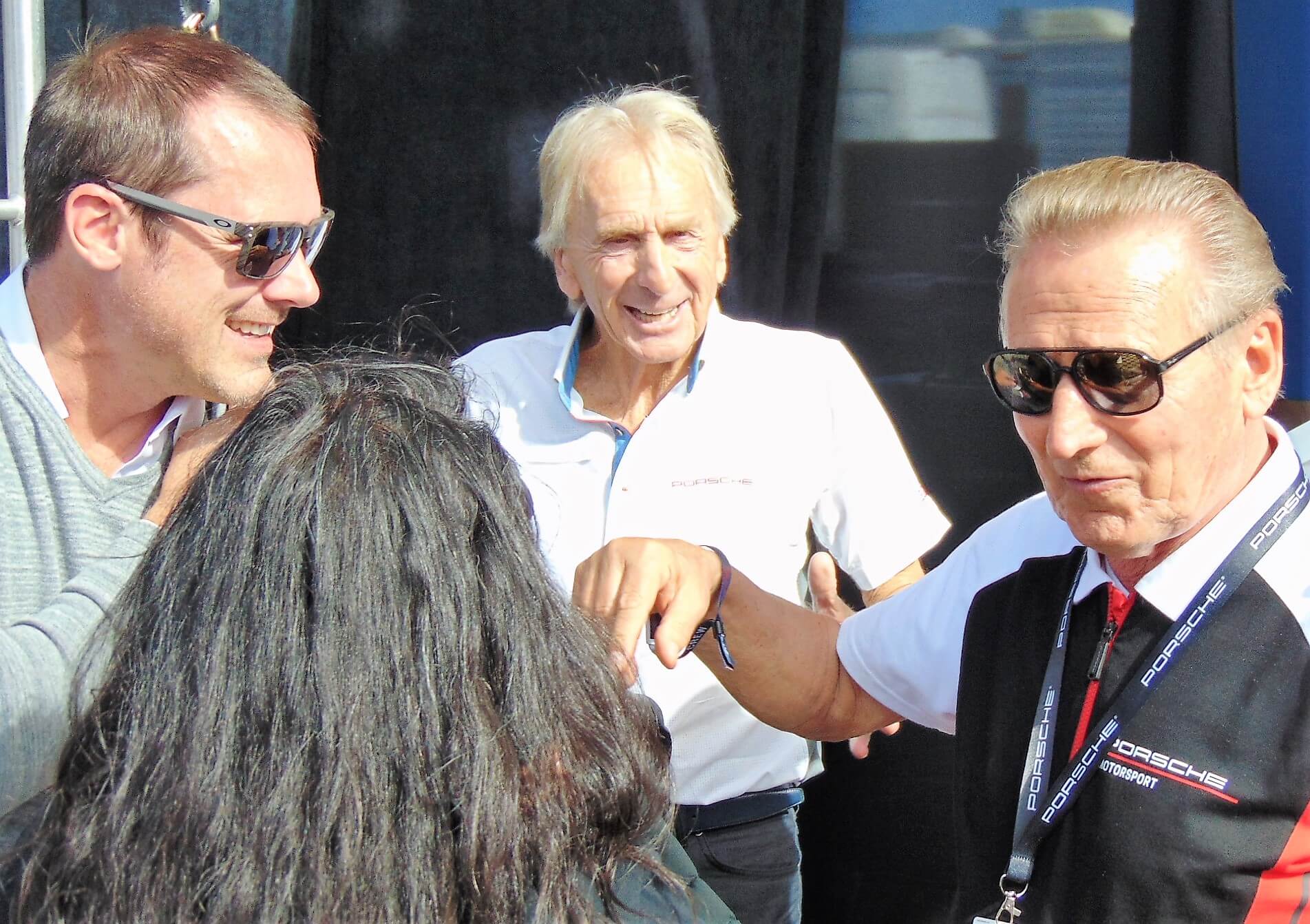
Driver Derek Bell with fans, centerDriver Derek Bell with fans, center

A 1984 Porsche 962 (1984-1991) was also under Porsche Heritage Tent. This sports-prototype racing car was made (91 units) to replace the 956 in order to meet IMSA’s GTP regulations. The 1,874 lb car was powered by a 3.0 to 3.2 liter bi-turbo flat-6 engine through a 5-speed transmission generating 760 hp at 8,200 RPM, pushing the car to 220 mph.

Famed Hurley Haywood (Porsche “ambassador) and Derek Bell (24 Hours of Le Mans winner four times in Porsches) were among the pilots. The 962 achieved an overall win at the 1987 24 Hours of Le Mans. In its initial years, the 962 was one of the most successful cars in racing. The car was succeeded by the WSC-95.

In Closing Tribute

Sincere compliments should always be given. This was an enriching Rennsport VI, and honestly, I am already anticipating the next. Surely most Porsche fans are too. Porsche, please bless us with another Rennsport soon!

Porsche Rennsport Reunion VI Image Gallery