All posts in “Cars”

2020 Bentley Continental GT V8 Review: A Continent Crusher Steps Up Its Game

It’s not much of an exaggeration to claim the Continental GT changed the course of Bentley for the better. In the late Nineties and early Aughts, the company was a British also-ran, turning out rebadged Rolls-Royces at a snail’s pace and selling less than a thousand cars a year. Then, in the year 2003, the Continental GT burst onto the scene. Sure, it may have been built on the same platform as a Volkswagen sedan and built using mass-production techniques the Flying B had never dallied with before — but with styling that induced whiplash in passers-by, a 552-horsepower twin-turbo W12 under the hood and a price significantly cheaper than other cars boasting the Flying B, nobody gave a damn. Thousands who had the means flocked to dealerships buy it; millions more who couldn’t drooled with envy as they saw it pop up in movies, TV shows and music videos, a rolling symbol of style and success.

The second generation, which hit the streets in 2011, revised the same architecture to great effect, bringing greater luxury, improved looks, and a new V8 engine option that dropped the price and the power — albeit both to such a small degree than many wouldn’t have noticed. But the third-generation version, new this year, ditches the old bones for a new VW Group framework: the MSB platform, originally developed by Porsche for its second-gen Panamera. Between the Zuffenhausen-designed architecture, a host of new technology and an interior that’s more luxurious than ever, the newest Conti seems primed to be the best version yet. But the proof of the pudding is in the eating, right?

The Good: Many cars with price tags closing in on the $200,000 mark feel a little bit obscenely priced at that figure. That, in large part, is because many of the cars on sale at that price are simply gussied-up versions of cheaper cars; a $233K Mercedes-AMG S65 isn’t 2.5 times as nice as a $92K S450, nor a $158 BMW M760i 1.8 times better than an $86K 740i. Not so the Bentley. Everything you see, smell and touch seems worthy of the house-sized pricetag, even before you fire up the engine and feel the thrill of its power.

Who It’s For: Anyone seeking the ultimate road trip car — the sort of machine capable of gobbling up hundreds of miles at a go with ease and leaving its occupants feeling Downy fresh at the end of the trip. (Well, anyone seeking that who doesn’t need room for more than two adults.)
Watch Out For: Road noise, believe it or not, if you opt for the biggest wheels. Granted, that’s only under the worst possible road conditions — think pavement more pockmarked than Edward James Olmos — but even so, it’s a little jarring to hear so a loud thrum in such a luxurious car. Bentley doesn’t believe in active noise cancellation; such technological trickery is beneath the brand. Yet even the geniuses in Crewe can only do so much about mitigating the impacts of 22-inch wheels with painted-on tires whacking against potholes and frost heaves, especially with more than two tons of mass pressing down on those four rims.

Alternatives: Rolls-Royce Wraith ($320,500+), Mercedes-AMG S63 ($169,450+), BMW M850i ($111,900+), Porsche 911 Turbo S ($190,700+)

Review: Bentley managed to make some damn fine lemonade out of the lemons with the second-generation Conti GT; while it may have been able to trace its platform back to a VW that started development in the Nineties, it was still fairly entertaining to drive, especially in wilder trims like the GT3-R and Supersports. But with the change to a modern Porsche-designed platform, the car finally achieves the levels of athleticism it’s always deserved.

The Porsche commonalities extend beyond the basic framework of the car. The V8 engine beneath the hood, for example, is effectively the same as the one in the Panamera Turbo; the eight-speed dual-clutch gearbox hooking the motor to all four wheels likewise has its origins in southern Germany. It’s a combination that proves stupendous in the top-shelf versions of Porsche’s largest cars, serving up autobahn-dominating acceleration anywhere from a dead stop up to sanity-questioning speeds.

Which is why it feels odd at first blush that those 542 horses and 568 pound-feet feel merely adequate in this car — or any car, for that matter. Then again, most cars don’t have this Bentley’s mass: this two-door weighs in at 4,773 pounds, about 300 more than a Panamera Turbo Sport Turismo station wagon. The V8 version is hardly slow — Bentley claims a 3.9-second 0-60 mph time, and that very much feels accurate. But after experiencing the infinite power of the turbocharged 12-cylinder version and its 626 horsepower and 664 pound-feet, the eight-pot feels a little…underwhelming. (Sadly, while those in other markets have the pleasure of playing with the W12 version this year, we in America can only choose the V8 for now.) Unlike the always-effortless W12, which feels more empowered than labored when you nail your right foot to the carpet, the V8 seems like it actually has to work to vault this bolide up to meteoric speeds.

It certainly sounds better than the 12-pot, though — all sturm und drang under heavy throttle, roaring and bellowing a battle cry that sounds like a punk rock Wookie. That engine also makes the eight-cylinder model a little lighter in the nose than the W12 version — which stands to reason, as the bigger engined-car weighs around 300 pounds more, with most of the added mass sitting closer to the front wheels than the back.

Still, those seeking delicate handling from their rolling leather cocoon are more likely to look to the likes of a top-shelf 911, a Ferrari Portofino or a McLaren 570GT. It’s involving, even entertaining when winding its way though curves, but never truly involving. On California’s Highway 1, it proved a little hard to place. (Partly, I admit, because I was trying to drive smoothly enough to keep my seasick passenger’s breakfast in his gullet while still pushing it hard enough to get a feel for it.) The car carried a ton of speed into each turn, way more than I realized, because it’s so smooth and effortless — until I was on top of the curve, realized how tight it was (and how large the car was), and dove onto the brakes harder than planned. This is a grande grand tourer, better suited to gentle curves you can wind through at highway speed.

Admittedly, the roads along the Cali coast might be the worst for this sort of car; they’re tiny things, with lanes thin as Kate Moss and curves like Botticelli’s Venus. Not helping matters, of course, are the overcrowded roads of the area, where cyclists and retiree-helmed RVs lurk behind every third turn. Given the circumstances, it was better to twist the knurled drive mode past the default “B” (it stands for Bentley, obviously, but feel free to tell the gullible it stands for “Beyonce”) to Comfort, allowing the car to relax along with its occupants. Left that way, it becomes an impeccable road trip companion, loafing along as fast as you dare in silence and comfort.
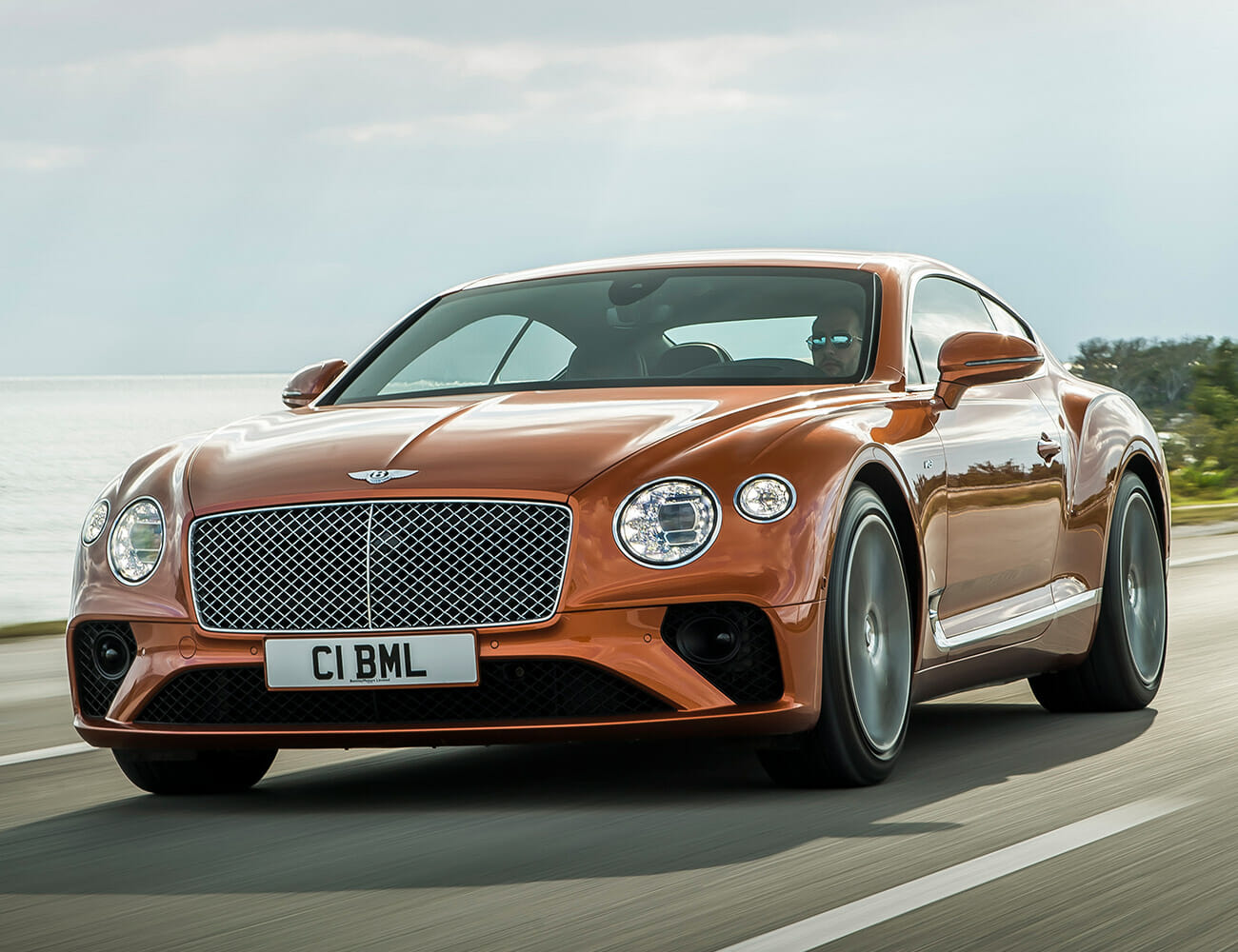
Design-wise, it’s a subtle yet significant break from older models, though most people probably won’t realize as such. The biggest change, proportionally speaking, is that it hangs its beak out far less than the older version, the front axle pushed forward several inches to create a much more aggressive stance than in the past. The new front end continues the Continental GT trend of growing one set of lights and shrinking the others, with the new headlights bringing crystal-cut glass and a spread of LEDs to the face. (Admittedly, the new look bears a stunning resemblance to those shocking close-ups of spiders, a fact you’ll likely never be able to shake from your brain now that you know it.)

In profile, the roofline has been stretched out into an elegant curve reminiscent of Art Deco streamliners; to the stern, the third-gen’s tail has been swept-back and sculpted to the point where it brings an unexpected delicacy to this mighty Bentley. Overall, it’s a look that’s unmistakably modern, yet clearly tied to the previous two models — the sort of design consistency few vehicles beyond the Porsche 911 have been able to pull off.

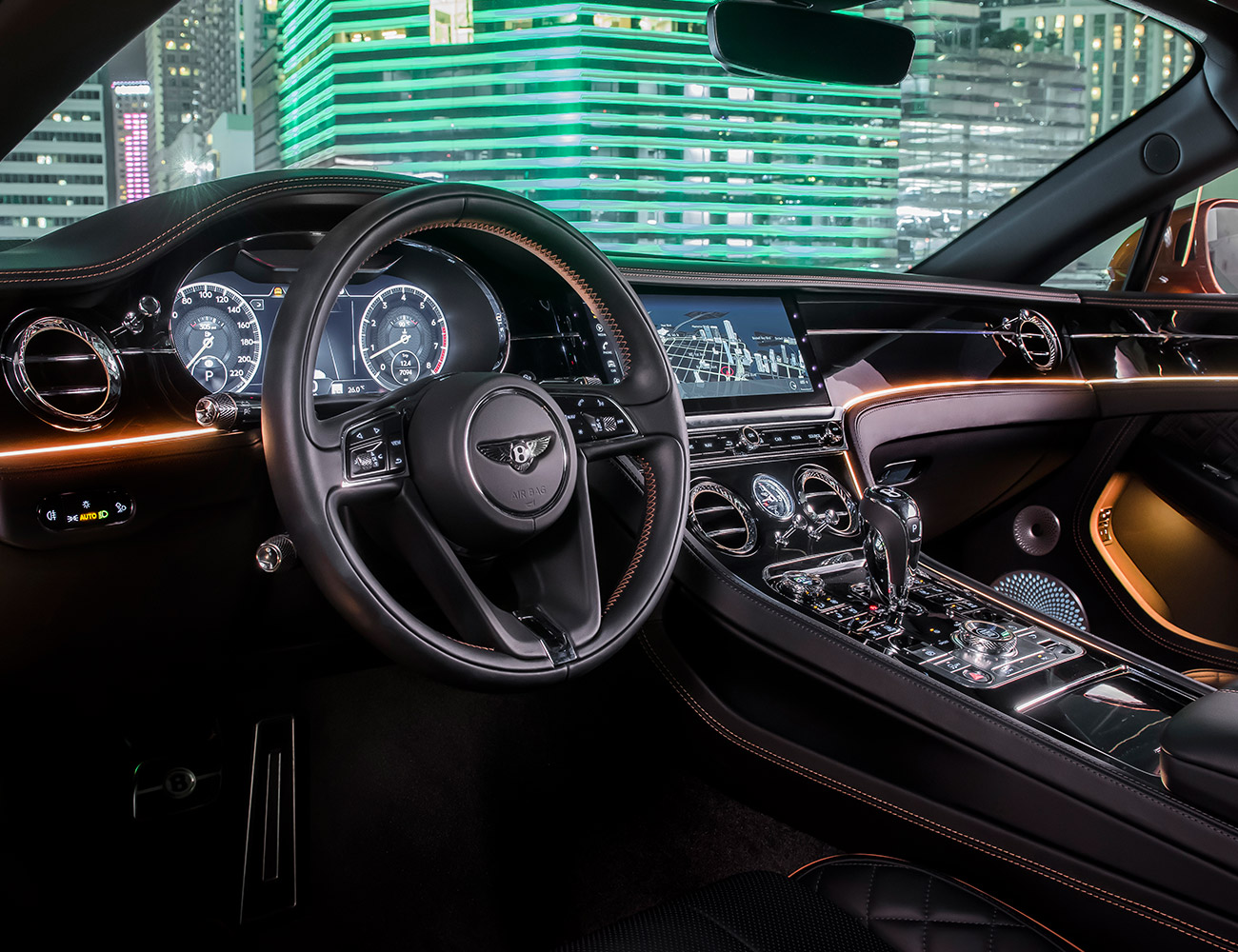
The interior is about as nice a place as you can imagine to knock out a few hundred miles on a whim, so long as you only have two adult humans to transport. The rear seats are better than those in many speedy two-doors, but they’re still tight for grown-ups; save them for when your dinner companions go a little too hard on the peeno greege and can’t drive their own car home. (You can always use them for storage, but with 12.6 cubic feet of trunk space, you likely won’t need to very often.)

Everything you touch feels designed to justify the car’s price, from the meticulously-knurled metal (with available Côte de Genève veneer) to the 10-plus hides of hand-stitched leather (taken only from bulls, because cows can have stretch marks) to the carefully-selected wood (all from the same tree to keep the grain consistent, and sustainably sourced to boot). Every car company takes quality seriously to some degree; Bentley is the only one I’m aware of with an entire page of their website dedicated to craftsmanship. It shows.

Porsche drivers will find the infotaiment screen’s dimensions and layout oddly familiar; they’re a redesigned version of the one found Cayenne and Panamera. Should the similarity prove a disconcerting reminder of Bentley’s attempts to save money, however, the Continental GT lets you do something the Porkers don’t; opt for the Bentley Rotating Display (a $6,270 option), and at the press of a button, the screen flips and rotates away to be replaced with either a smooth sheet of veneer or a trio of analog gauges. The whole effect is rather like the revolving license plates on James Bond’s old Aston Martin DB5 — albeit with a sensitive high-def touchscreen in lieu of a sheet of tin. A gimmick? Sure. But one that’ll delight you and your passengers on a regular basis.

Verdict: Elegant, athletic and luxurious in equal measure, the Bentley Continental GT is the sort of vehicle that defines what a luxury car should be. If money’s no object and you don’t mind the wait, it might be worth holding out for the 12-cylinder version in 2020 — but the V8 version is a delightful choice all on its own.

2019 Bentley Continental GT V8 Key Specs

Powertrain:  4.0-liter twin-turbo V8; eight-speed dual-clutch transmission; all-wheel-drive
Horsepower: 542
Torque: 568 pound-feet
0-60 MPH: 3.9 seconds
Top Speed: 198 mph

Bentley hosted us and provided this product for review.

Read More Gear Patrol Reviews

Hot takes and in-depth reviews on noteworthy, relevant and interesting products. Read the Story

Note: Purchasing products through our links may earn us a portion of the sale, which supports our editorial team’s mission. Learn more here.

Monterey Car Week 2019 Preview

The Monterey Car Week has evolved into one of the world’s most desirable events for car collectors and enthusiasts alike. GTspirit will be there from Wednesday 14th of August until Sunday 18th of August to provide you with the latest and greatest from Monterey.

The Monterey Car Week is a collection of stand alone events taking place in and around the city of Monterey in California. The most famous of these events include the Pebble Beach Concours d’Elegance, The Quail and Monterey Motorsports Reunion at nearby Laguna Seca race track.

The origin of the Monterey Car Week date back to 1950 when the Pebble Beach Concours d’Elegance was first held at the Pebble Beach golf club along with a road race called the Pebble Beach Road Race. The road race was last held in 1956 but the Pebble Beach Concours d’Elegance is held until this day and regarded as one of the most prestigious Concours events in the world.

In recent years the Monterey Car Week expanded with dozens of events taking place all over the Monterey area aimed at both car collectors, drivers and fans. This year the event starts on the 9th of August with a classic car show in downtown Monterey followed by two days of racing at Laguna Seca called the Monterey pre-reunion. Things really start to heat up from the 13th onwards with nearly a dozen auctions and special events taking over. Car manufacturers from around the globe have also found Monterey as a location to introduce their exclusive new models. Below you can find a selection of events we will visit during our stay and some information about what you can expect at those events.

MCCALL’S MOTORWORKS REVIVAL

WEDNESDAY AUG 14, 2019 AT 5:00 PM TO 10:00 PM

McCall Motorworks Revivial 2019

Our visit to Monterey starts at McCall’s Motorworks Revival at a hangar at Monterey Airport. For the 28th consecutive year Gordon McCall hosts VIP guests on Wednesday night uniting vintage race cars, motorcycles and private jets accompanied with some culinary delights provided by local and award winning chefs.

ROLEX MONTEREY MOTORSPORTS REUNION

THURSDAY AUG 15 – SUNDAY AUG 18

MONTEREY MOTORSPORTS REUNION

The Rolex Monterey Motorsports Reunion brings together over 550 race cars which compete in over 10 different classes this year including IMSA Prototypes, 1983-2016 Masters Endurance Legends and 1947-1955 Sports Racing and GT cars to name a few. Particular attention is paid to the 50th anniversary of IMSA this edition. Racing drivers from all over the world come to Laguna Seca to compete including legends like Mika Hakkinen driving a 1970 McLaren M8D Can-Am ‘Batmobile’.

MONTEREY AUCTIONS

THURSDAY AUG 15 – SATURDAY AUG 17

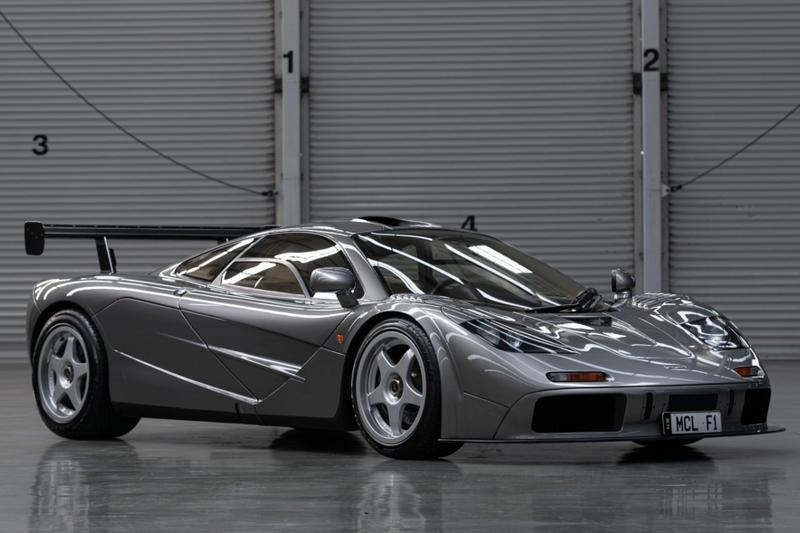
McLaren F1 LM Auction

Monterey is the global center of automobile auctions. Everything from classic cars, modern cars, motorcycles and collectibles will go under the hammer. This year you can expect auctions from Russo and Steele, Mecum, Worldwide Auctioneers, Bonhams, RM Sotheby’s and Gooding and Company. We already wrote about some auction highlights including one of two McLaren F1 LMs going up for sale on Friday at RM Sotheby’s and will keep an eye out for other auction highlights at Monterey Car Week.

THE QUAIL, A MOTORSPORTS GATHERING

FRIDAY AUG 16, 2019 AT 10:00 AM TO 4:00 PM

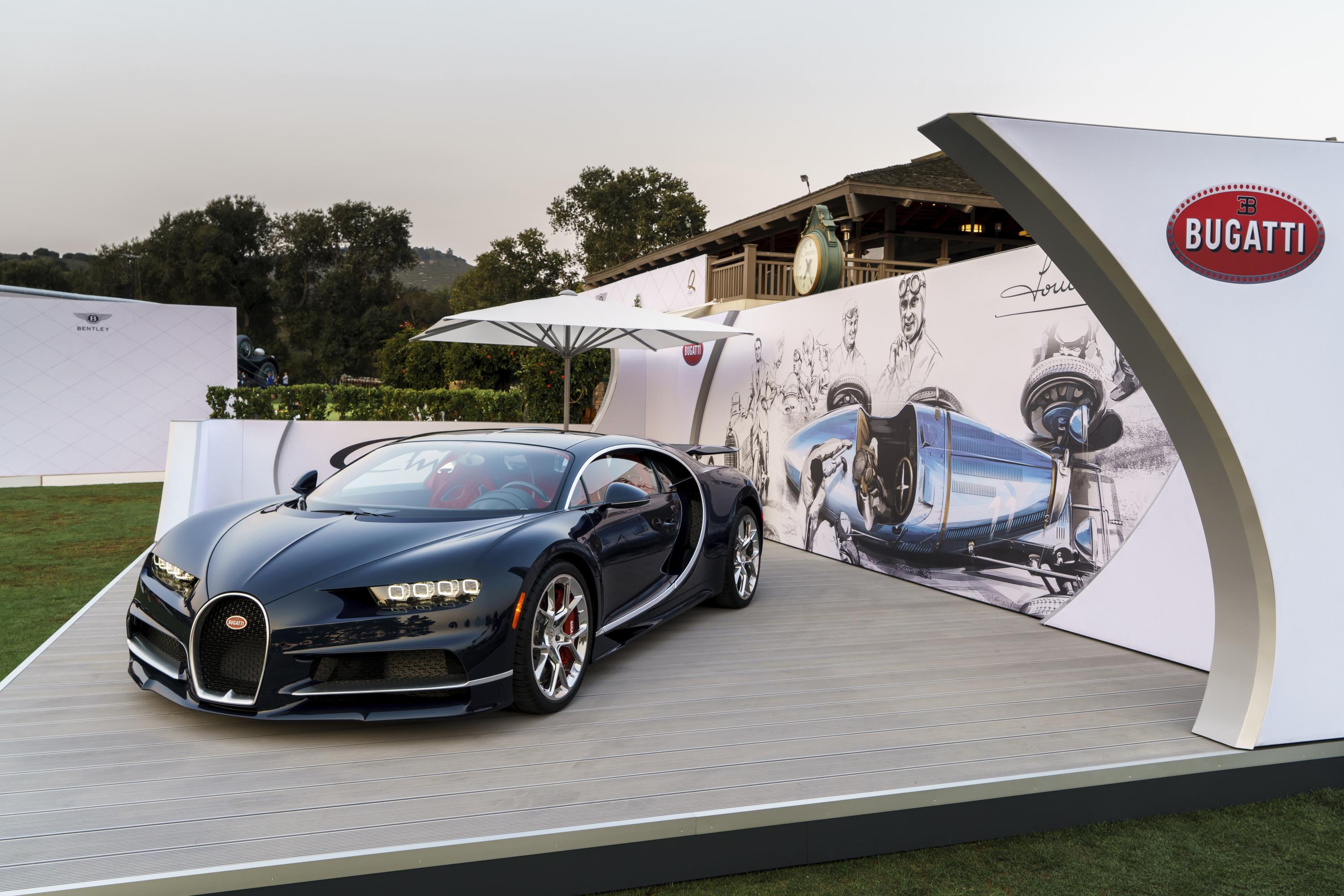
Bugatti Chiron THE QUAIL

The most exclusive event during Monterey Car Week is without a doubt the Quail. Hosted at the Quail Lodge and Golf Club it combines the greatest classic sportscars with the latest modern cars. It is here where brands like Pagani show their latest models for the first time. The themes for 2019 are 100 Years of Bentley Motors, the 25th Anniversary of the McLaren F1 and a Tribute to the Electric Car Movement.

SEASIDE SATURDAY

SATURDAY AUG 17

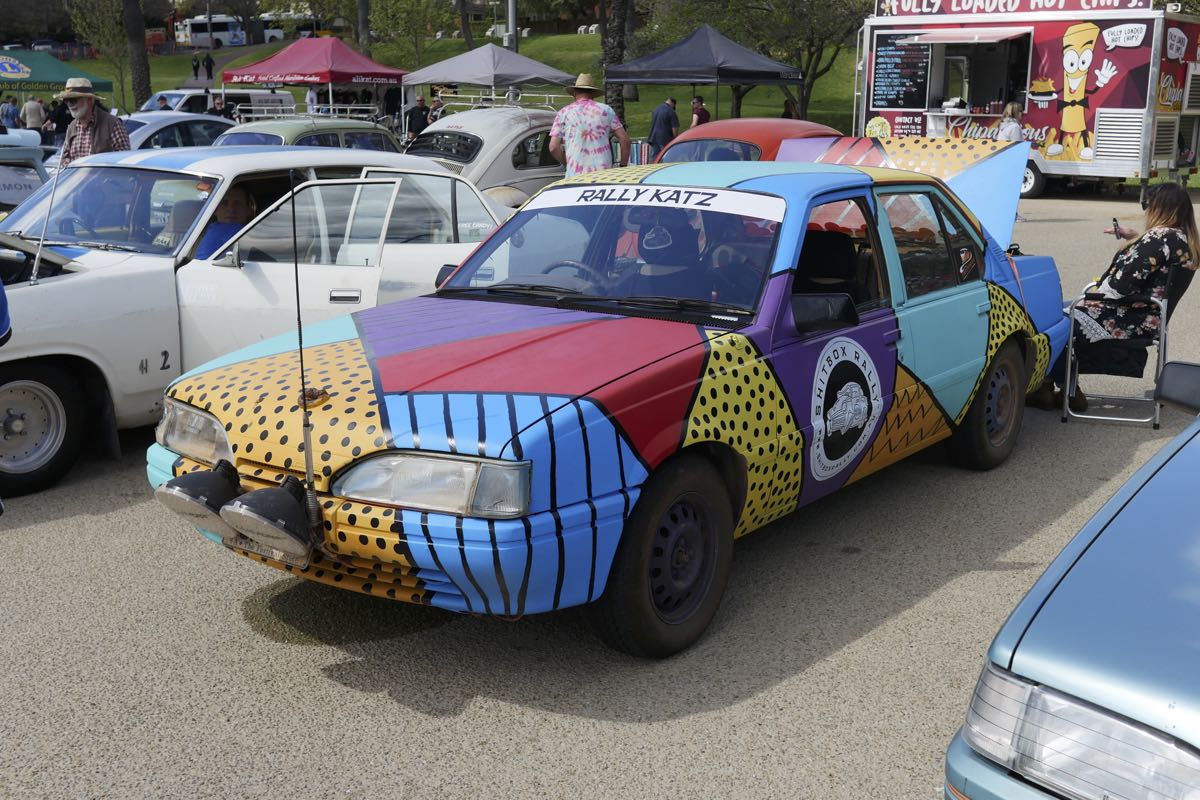
Saturday there are three events in the town of Seaside which are worth visiting: Start the day at Seaside City Hall for Concours d’LeMons. This event puts the ugliest and worst automobiles in the limelight. Then continue to the Black Horse Golf Club for Concorso Italiano with over 800 cars on display of Italian origin and end the day at Broadway for Exotics on Broadway. This event formerly known as Exotics on Cannery Row brings together exotics and tuning cars for fans to enjoy.

PEBBLE BEACH CONCOURS D’ELEGANCE

SUNDAY AUG 18, 2019 AT 10:30 AM TO 5:00 PM

PEBBLE BEACH CONCOURS D'ELEGANCE

Last but not least is the event that brought global fame and attention to the Monterey Car Week; the Pebble Beach Concours d’Elegance. The automobiles and motorcycles are judged for their historical accuracy, their technical qualities and their style. They compete to be the best in their class and the highly regarded best-of-show award. The Pebble Beach Concours d’Elegance 2019 features following classes: Bentley Centennial, Zagato Centennial, Bugatti Race & Touring Cars, Historic Hot Rod “Cover Cars”, Thomas Flyers, Ballot and Lamborghini Miura.

MONTEREY CAR WEEK WORLD PREMIERES

More and more car manufacturers pick Monterey as location of choice to unveil their latest creations. This year is no exception with special editions and concept cars from various manufacturers being unveiled at The Quail or the Pebble Beach Concours d’Elegance.

Pagani Huayra Roadster BC

Huayra BC Roadster Wallpaper Desktop HD

The ultimate open Huayra will celebrate its official debut at the Quail on Saturday 17th of August. It comes with a newly developed turbocharged V12 from AMG and optimized body and aerodynamics. Price tag? More than 3 million Euro. It will appear along side the first Pagani Zonda every produced to celebrate the 20th anniversary of the Zonda.

Bugatti Concept Car

Bugatti-logo

Bugatti CEO Winkelmann already told us a few weeks ago that he regards to events around the world as ideal venues to launch a new car: the Geneva Motor Show and Monterey Car Week. What exactly Bugatti will launch is still a secret but we look forward to seeing it at The Quail on Saturday.

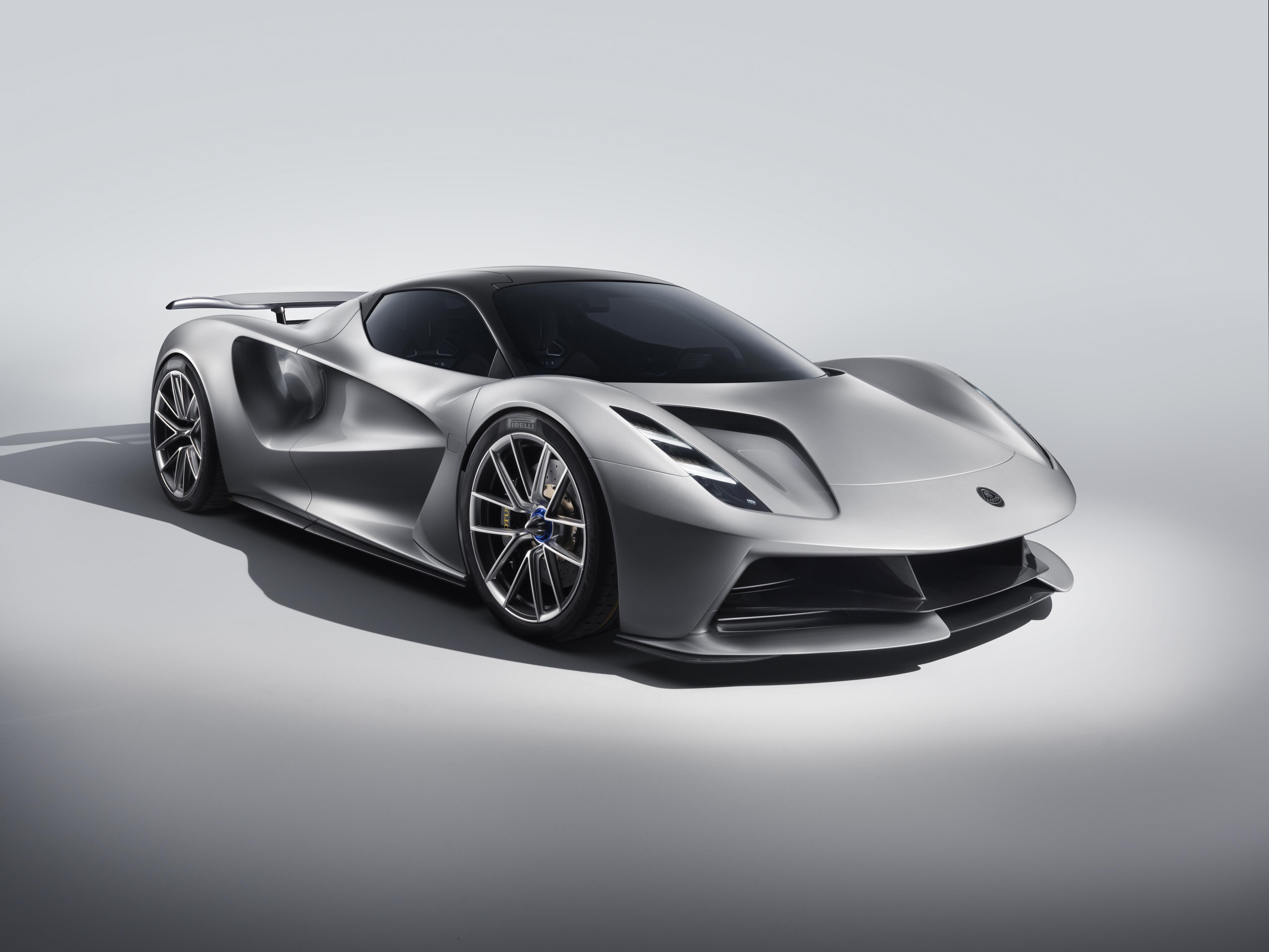
Lotus Evija

Lotus Evija Hypercar Price

The Lotus Evija celebrates its American debut following its unveil in the United Kingdom only weeks ago. The 2 million usd+ all-electric hypercar produces 2,000hp.

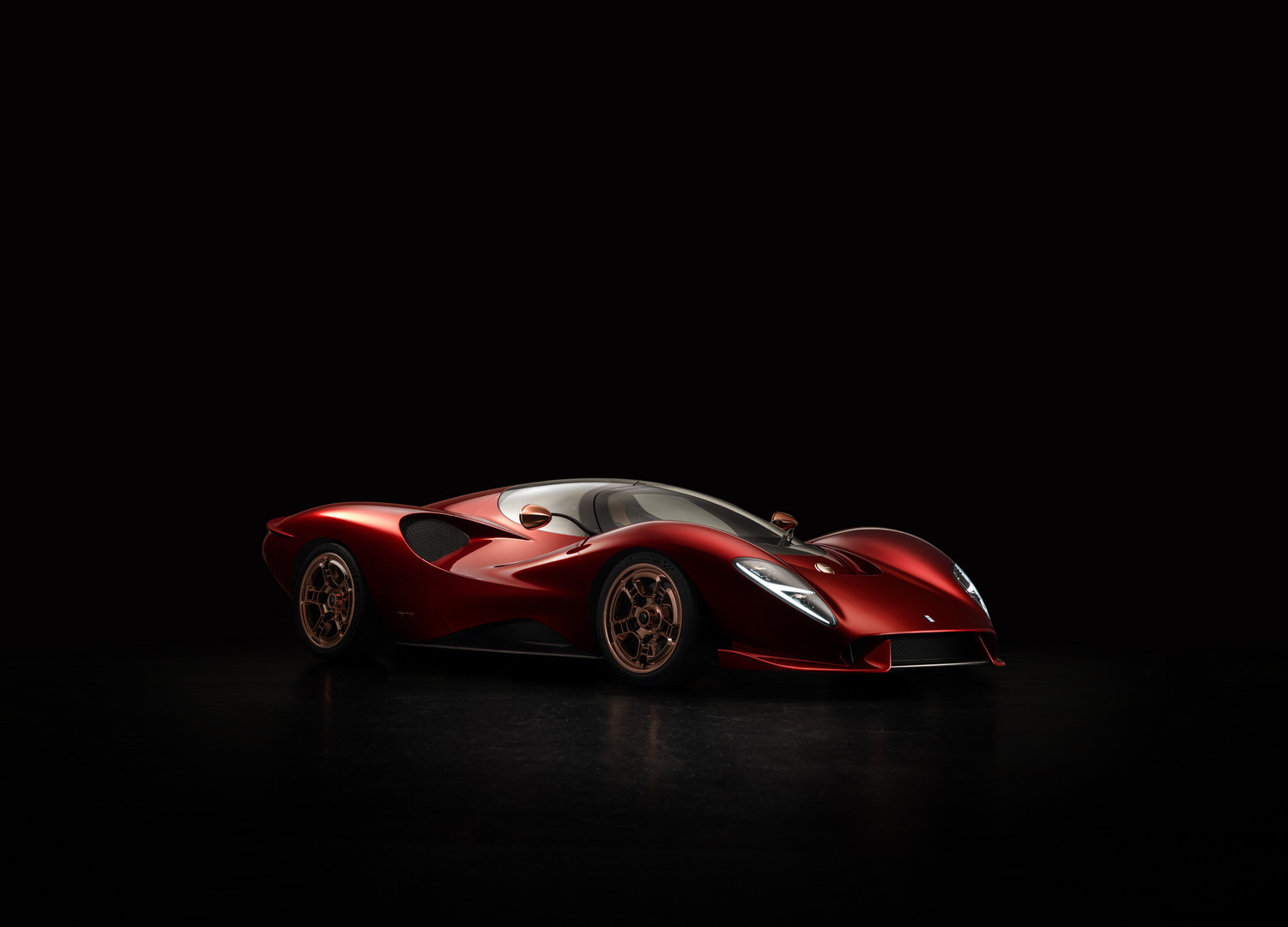
DeTomaso P72

De-Tomaso-P72-Front-angle

Following its global debut at Goodwood Festival of Speed 2019 the DeTomaso P72 will celebrate its North American debut at the Pebble Beach golf club on Thursday August 15 alongside the classic DeTomaso P70.

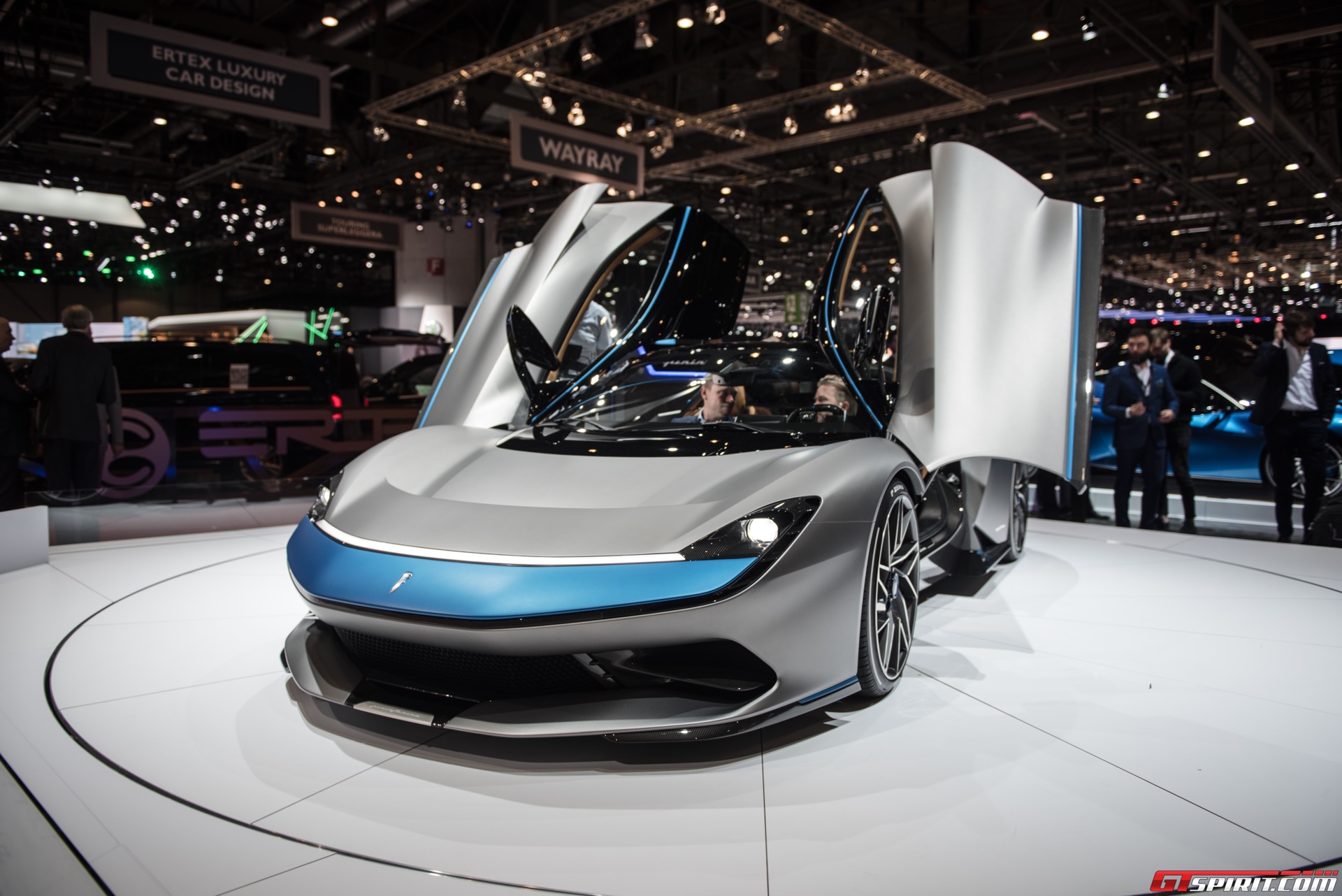
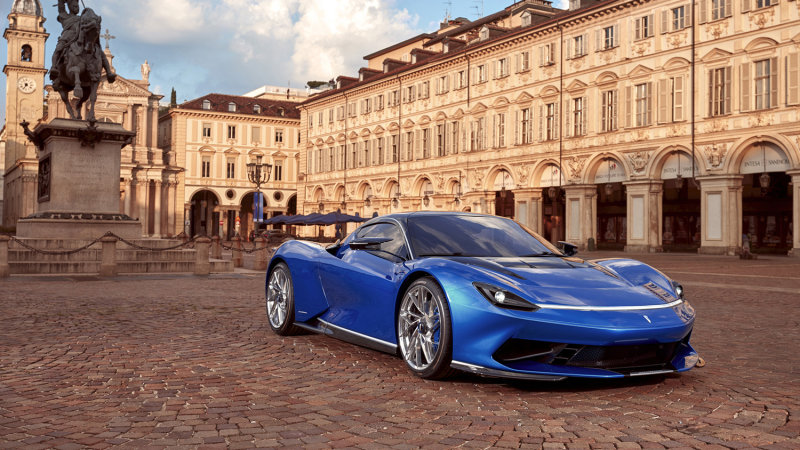
Pininfarina Battista

Pininfarina Battista

Pininfarina will bring an updated version of its 2,000hp electric hypercar to the Quail on Saturday following debut of the Battista concept in Monterey exactly one year ago.

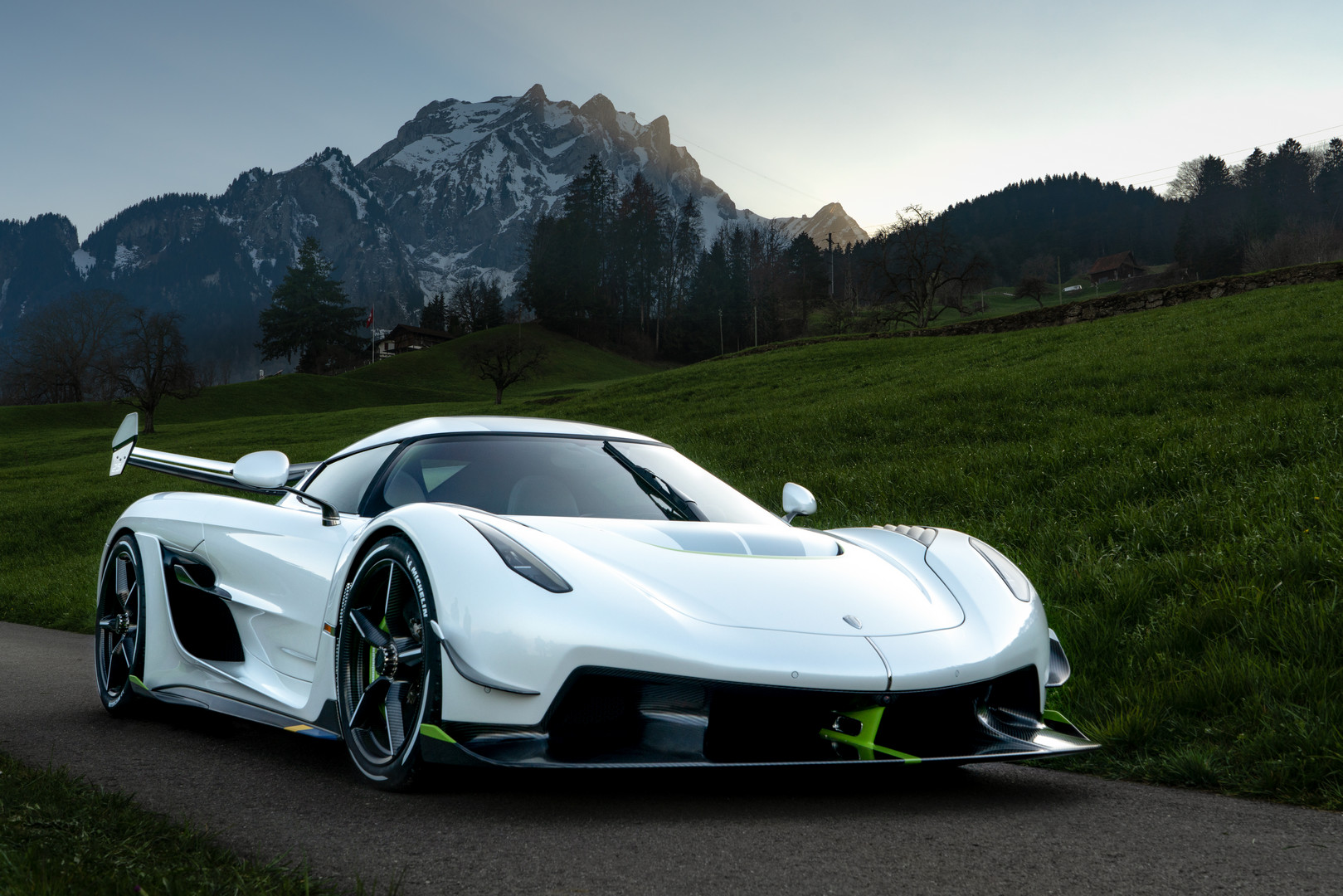
Koenigsegg Jesko

Koenigsegg Jesko Wallpaper

Not a world premiere as such but still one of the most spectacular new cars on the hypercar market this year. Koenigsegg will also bring a Regera to Monterey.

Other Manufacturers

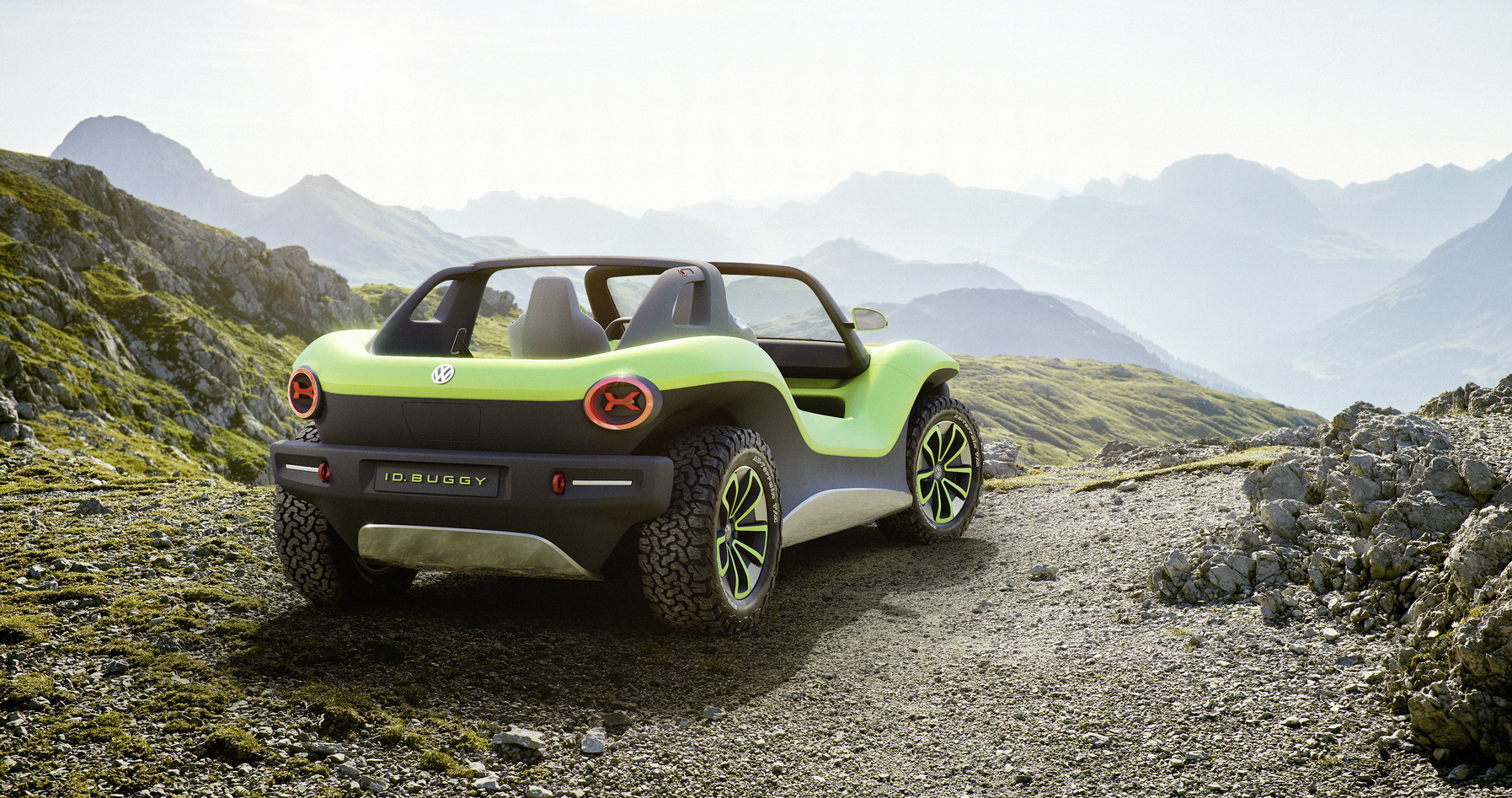
Volkswagen ID. BUGGY Showcar

Volkswagen will bring their ID. Buggy to the concept lawn at Pebble Beach Concours d’Elegance. At the Quail we can also expect the North American debut of the Aston Martin Valhalla supercar; two North American debuts from Bentley Motors; the public debut of the Type S Concept car from Acura and the world premiere of the Drako GTE four-seat EV. Oddly enough Mercedes-Benz is absent this year following various show-stopping concept cars stealing the show in Pebble Beach in recent years.

Follow us on Instagram or Facebook for live updates during the Monterey Car Week or drop us a message if you are also in Monterey and would like to meet our team.

GTSPIRIT NEWSLETTER

McLaren Is Working on a 720S Longtail

The March Forward With New Models Continues

In about decade, McLaren has put out eight cars. The next could be a 720S Longtail. McLaren has no plans of slowing down, and the longtail version of the 720S makes quite a lot of sense. According to PistonHeads, one of the two cars coming to the company’s lineup next year will be a 720S Longtail. The other is the already reported McLaren roadster or speedster

While the speedster or whatever, McLaren ends up calling its roofless car will be impressive, the longtail version of the 720S will arguably be the more important car because it’s more of an all-around, use-it-everyday car. The vehicle will likely get more power than the regular 720S and be improved in many of the ways that people would like to see the car improved. 

This Longtail move will also probably earn the supercar a new name. In the case of the 600LT, that car got its start as the 570S. Motor Authority suspects the name will by 750LT, but there’s no indication beyond the naming schemes of the previous Longtail cars that this will be the case. 

There are no concrete details on what McLaren will do with the model, but we suspect it will have revised styling but still fit in with the McLaren lineup easily. This should be a wonderful Longtail model, and we’re excited to see what comes of it. 

Pininfarina Releases Photos of the Battista on the Road

This Hypercar Is a Stunning Sight

The Pininfarina Battista is an insane hypercar, and now the company has released photos and video of the car driving on the road. The car was debuted at the Geneva Motor Show, but the vehicle seen here is slightly revised. There are a new front fascia and some minor changes to the exterior of the car. It’s still undeniably the Battista, and it’s absolutely gorgeous. 

According to Motor Authority, the recent design changes to the exterior of the car will help the vehicle achieve an even more impressive 300 miles per charge. Previously the company claimed 280 miles per charge, so that bump is significant. 

Otherwise, the car is unchanged. It still features the Rimac-sourced powertrain. This system includes four electric motors that produce up to 1,877 hp and 1,696 lb-ft of torque. That amount of power should make the car sprint up to 60 mph from a stop in just 2.0 seconds. 

As you can see in the video below, the Battista was brought to New York City for its on-the-road photoshoot. The company also has some stunning shots of the car on what look like curvy mountain roads and a beautiful harbor. It’s all good stuff, and you should check out all the images and video included below. 

[embedded content]

Pininfarina’s skateboard platform will underpin a full range of zooty EVs

Pininfarina has historically operated as a respected design house, as a coachbuilder, and as a contract manufacturer. It’s leveraging its expertise in all three areas to morph into a full-fledged automaker, and CEO Michael Perschke revealed how his team aims to position the brand as a credible alternative to some of the world’s most exotic automakers.

Its first model, an electric, 1,900-horsepower supercar named Battista (pictured), is already on its way to limited production. Pininfarina will build 150 examples of it starting in late 2020. It’s a statement of intent that points to the direction the firm wants to take as it builds a full lineup of cars. Its future models won’t all have 1,900 horsepower, for better or worse, but they’ll be electric, luxurious, exclusive, and correspondingly expensive.

Pininfarina needs to release more volume-oriented cars to stay afloat, and to stay relevant. Perschke told Automotive News Europe his team has “a very clear intent not to remain a one-hit wonder.” The automaker is talking with an unnamed supplier about jointly developing a platform to build high-end electric cars on. It will be a skateboard-like chassis, meaning it will incorporate the battery pack and the motors, and it will be modular enough to underpin a number of body styles.

There are many turn-key electric car platforms available now or in the not-too-distant future, and the companies developing them are eager to share in order to split their sky-high development bill. However, Perschke ruled out using the Volkswagen Group’s PPE platform (the one found under the Porsche Taycan and the Audi E-Tron GT) because it can’t underpin a tall SUV. He didn’t comment on an earlier report claiming the high-riding super-EV would use Rivian bones, but his quest to develop a platform from scratch makes it sound like the deal is off the table. That table has turned, too; Pininfarina now hopes to license the use of its upcoming platform to other brands.

The firm will gather feedback from potential customers around the globe as it crafts its lineup. The aforementioned SUV might be joined by a sedan during the early 2020s, and it’s not difficult to imagine a stately coupe. Regardless of doors and ground clearance, its electric cars will offer up to 372 miles of driving range thanks to a lithium-ion battery pack with a capacity of 100 to 125 kilowatt-hours.

While the Battista starts at $2.2 million, the more down-to-earth models will cost between 200,000 and 400,000 euros (about $225,000 and $450,000, respectively). They’ll land in the same price bracket as well-regarded members of the Bentley and Rolls-Royce range, and the Lagonda-badged electric models currently under development at Aston Martin’s headquarters. Taking on the luxury car segment’s stalwarts is easier said than done, but the shift towards electrification improves Pininfarina’s odds of winning because, technologically, the players are all starting the race on the same line.

Pininfarina has one previous stint as an automaker under its belt. In 1983, when Fiat stopped selling the original 124 Spider and left the United States, Malcolm Bricklin’s International Automobile Importers acquired the distribution rights and sold the roadster as the Pininfarina Spider. Production finally ended after the 1985 model year.

Watch Shmee Gush About Driving a Mercedes CLK GTR Alongside a McLaren F1, Porsche 993 GT1, and Others

A Momentus Event

In this video put together by VINwiki, YouTuber Shmee discusses the time he randomly got to drive the Mercedes-Benz CLK GTR alongside five other insane supercars, two of which were the McLaren F1 and the Porsche 993 GT1. He tells an interesting story about how he flew into Bahrain to attend an event at the Bahrain International Circuit. 

He’d originally flown to the Middle East to go to a Lamborghini event and then to see some car collections in the area. He did those things and then had the opportunity to go back to Bahrain to partake in another event. So, he wrangled together some flights to get him there. 

Once there, the owners of the cars were going to do a parade lap of the circuit for some photography and video shoots, he was asked if he’d like to drive one of the six cars that would be in the lap. Of course, he said yes, and after some discussion ended up in the Mercedes CLK GTR. 

Before the lap was over, most of the cars decided to go out for one more lap when they weren’t supposed to. Speeds climbed and it sounded absolutely amazing. Watch the video below to see Shmee tell the story himself. 

[embedded content]

Ferrari Will Reveal Two New Models In September

Get Ready for Some Prancing Horses

Ferrari plans to expand its lineup in the future, and two of those new models will come in September according to the company’s CEO, Louis Camilleri. The company will hold the reveal of these new models at the Fiorano Circuit in Maranello. Invites for the event have already been sent out, according to reports

The company plans to introduce five new models. These are the first two and another will come before the end of the year. What the new models will be is still unknown. It could be a convertible version of the 812 Superfast. Ferrari has yet to put out a drop-top version of that car. It was rumored that would be one of the vehicles.

It’s also rumored that Ferarri will release its first SUV. The SUV in question is reportedly called the Purosangue. While it may seem sacrilegious for The Prancing Horse logo to feature on an SUV, it’s a vehicle that will likely sell well. Lamborghini, Bentley, Rolls Royce, and other companies have SUVs now. It only makes sense for Ferrari to follow suit. 

The final car that’s rumored is a new version of the Ferrari Dino. It has been said that the company is working on a new engine, and that engine is being produced for a new Dino. It will be interesting to see if this is the case. No matter what you can expect Ferrari’s additional models to be impressive. 

The Puritalia Automobili Berlinetta Will Appear at the UK Salon Privé

It’s UK Debut

Since the Puritalia Automobili Berlinetta made its official debut at the Geneva Motor Show, we’ve not heard much about the stunning supercar. Now, reports indicate that the car will make its UK debut at the Salon Privé in September. The model is a beautiful blend of Italian styling, high horsepower, and a modern hybrid powertrain. Paolo Parente, the CEO and co-founder of the company, sounded excited about the event. He said the following, according to EVO:

“We are thrilled to present our Berlinetta for the first time in the UK at this year’s Salon Privé. The huge interest we have received from the UK proves how much the British motor culture still appreciates traditional skills and craftsmanship where Italians cars, just like the British ones, are second to none.”

The hybrid powertrain of the Puritialia Berlinetta is one of its many notable features. The V8 engine and electric motor put out 965 hp and 920 lb-ft of torque. For perspective, that’s more powerful than the McLaren P1 and the Ferrari LaFerrari. 

That kind of power output is said to make the car’s 0-62 mph time a mere 2.7 seconds. The car is said to have a top speed of 208 mph. It has a carbon-fiber body and a perfect 50:50 weight distribution, making it an excellent car to drive in just about any road or racetrack. 

Each of the Berlinettas produced will be made to the customer’s exact specifications. Each car will take well over 800 hours to build. Only 150 of the cars will be made. 

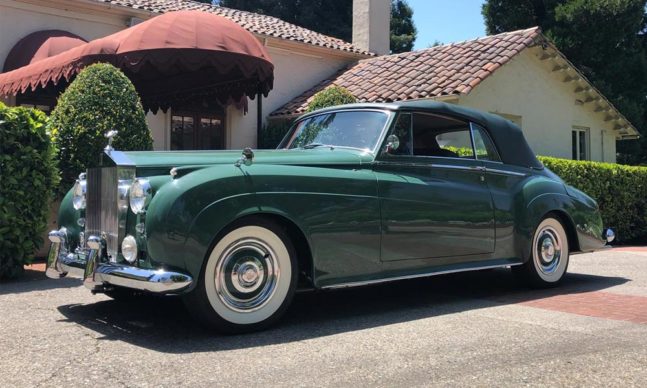
Elizabeth Taylor’s 1961 Rolls-Royce Silver Cloud II Convertible is Going to Auction

Elizabeth Taylor is an iconic actress that requires no introduction, well, anywhere. What you might not know is that she owned one particular, very special Rolls-Royce that was with her longer than any of her…

2020 Chevrolet Silverado 2500 HD Diesel Review: Tow, Haul, It Does It All

After selling millions of copies over the last several years and watching Ram and Ford roll out improved heavy-duty pickups, Chevrolet’s bigger Silverado is hittin’ the ol’ dusty trail with some shiny new tech, as well as new powerplants and a complete redesign from Bowtie badge to tailpipe. And now, there’s optional Tech Package that brings buyers eight cameras to help see better and is certain to de-stress greenhorn haulers and have veteran ones thinking: Where has this been all my life?

The Good: Heavy Duty models come in five different trim levels, with additional options galore. The Tech Package is a must, if you’ve got deep pockets. And in terms of powerplants, the turbodiesel V8 is 100% the engine of choice.

Who It’s For: Silverado HD buyers typically haul the heavy stuff like it’s their job — and often enough, it is. It’s a tool for the job site, the perfect mate to a racecar’s trailer, and in some cases, the Mercedes-Benz S-Class of the Florida-Georgia line.

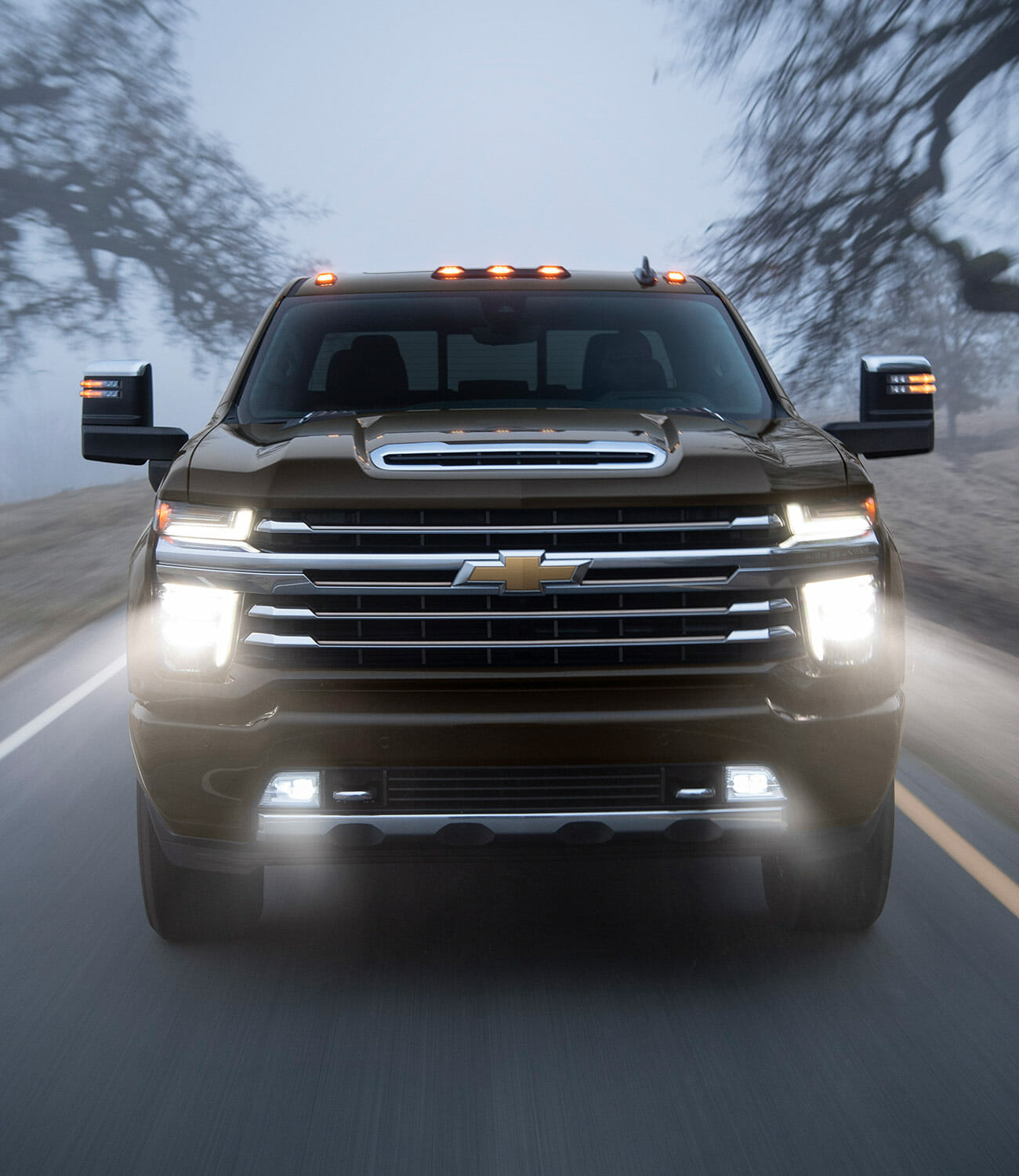
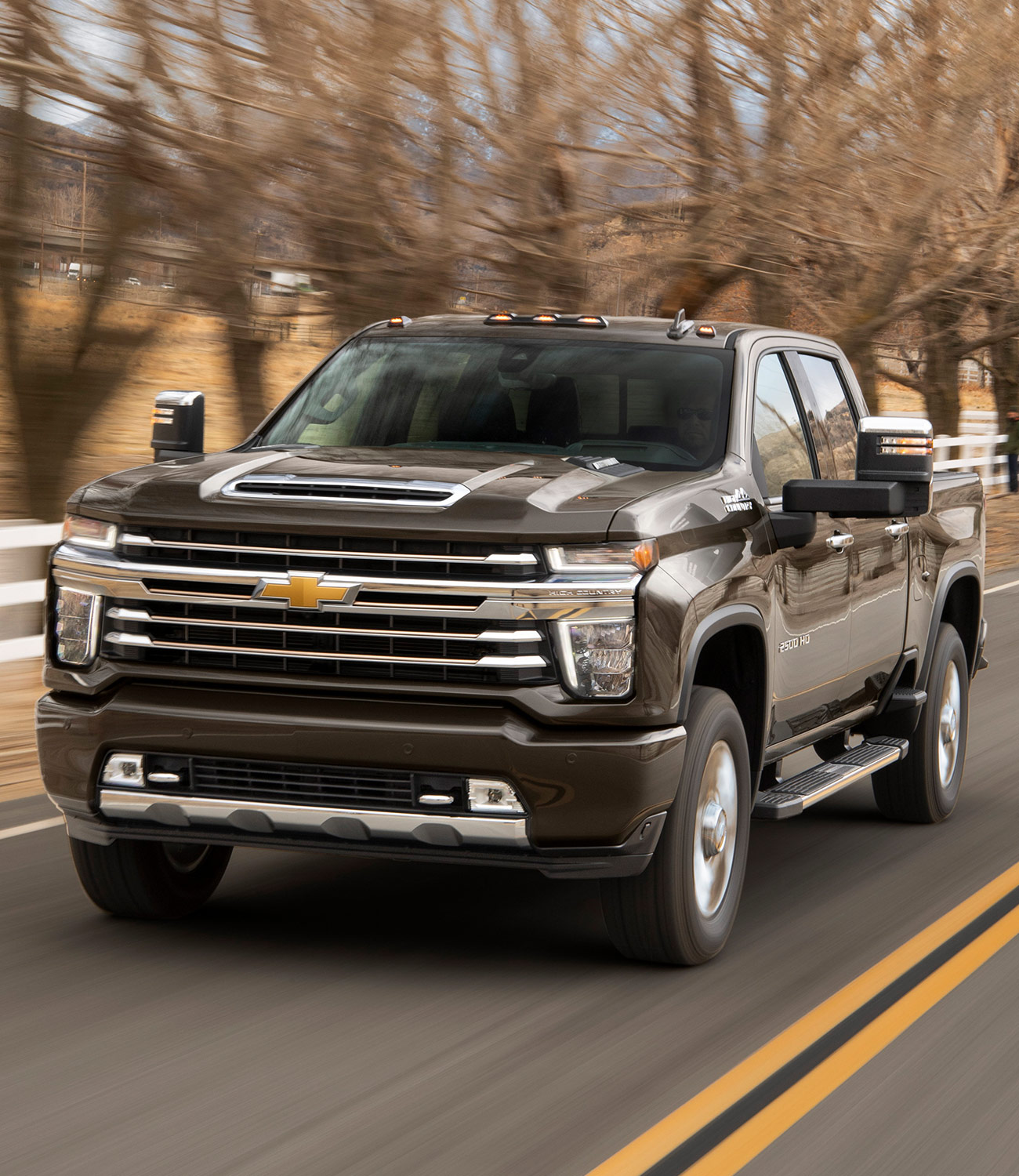
Watch Out For: Different trim levels yields different front fascias, which in turn alter the truck’s personality; it ranges from ho-hum fleet spec rental rig to confident luxo-truck with color-matched body panels and bowtie grille. (Also, that front end is very much a matter of taste.)

Alternatives: Ram 2500 ($33,645+), Ford F-250 Super Duty ($33,150+), Nissan Titan XD ($32,990+)

Review: A pickup truck’s job is never done. Their mission, which they have no choice but to accept, is to act as a multitool on wheels and a mobile office, as well as as a status symbol veiled in brand loyalty. Every fascia chiselled into every heavy-duty truck on the market is big and brash. They unapologetically stroll through tollbooths chest first. It’s what they do.

The Silverado’s bisecting horizontal-bar-behind-the-bowtie is the rig’s signature, and just like the evolution of automotive design, it’s become, well, more. Whether or not you agnostics happen to like it is largely irrelevant; most pickup truck drivers are Big Three party loyalists, so aesthetics matter far less than the brand.

Of course, you’ll still want to peek over the fence at what your rival is working with under the hood. Which, in this case, maxes out at an optional turbodiesel V8 twisting out 910 pound-feet of torque at 1,600 rpm, mated to a 10-speed automatic.

We started driving the Silverado HD Duramax at 3,600 feet above sea level, in the high desert of central Oregon. The forced induction made short work of getting us up even higher, as we quietly chugged up another 2,000 feet to Mount Bachelor while dragging a trailer packing 9,300 pounds of weight.  Without cargo in tow, the truck will get up and move if you’re heavy with your right Wolverine; floor it, and the 10-speed blips through gears with ease as the RPMs slowly rise and the next gear, ready for acceleration, engages to sends you on your way to extralegal speeds — a little too effortlessly for a heavy-duty truck.

Inside the cabin, there’s almost none of the audible clacking and tapping you’d expect from diesel engines of yore. At speed, the Silverado is poised, shrugging its shoulders at bumps, humps and ratchety railroad crossings. The side view mirrors, each the size of twin iPads, are mounted to the door, not the A-pillar (a feature exclusive to the HD model), which makes visibility even more clear. That’s important for towing, obviously; a critical component to familiarizing yourself with all your sightlines is knowing your surroundings.

Which brings us to the optional $2,125 Advanced Trailering System technology package, available on the fancier LTZ and High Country trims. Think of it as Xanax for novice haulers. It utilizes six cameras around the truck and an additional two accessory cameras for the trailer (one for insid-the- trailer view and one for behind the trailer), for a total of eight cameras that unlocks a suite of 15 camera views. There’s even an “invisible trailer” feature, which makes whatever you’re trailering “disappear” by stitching together images from two cameras to make it look as if you can see through your trailer via the 8.0-inch infotainment screen. Overkill much? Well, consider this: Considering the sorts of camping trailers, boats and horses this Chevy will tow, the cargo is probably worth than the truck itself.

Does the tech in our lives make the routine easier? Not always. But in this case, it allows for the utmost situational awareness. However, it’s not a cure-all; when parking, for example you still need to know the basics of towing. Otherwise, solely relying on the cameras is like trying to shave in the mirror with your opposite hand.

Verdict: Chevy’s new heavy-duty pickup truck may not be the most handsome big rig on sale, but its sheer breadth of capability means those GM lifers won’t be missing out when it comes time to tow or haul. Indeed, the standard and optional tech and potent power means heavy duty truck life could be easier than ever. (And hey, you can’t see the front from inside.)

2020 Chevrolet Silverado 2500 HD Diesel Key Specs (as tested)

Powertrain: 6.6-liter turbodiesel V8, 10-speed automatic, four-wheel-drive
Horsepower: 445
Torque: 910 pound-feet
Max Curb Weight: 10,650 lbs
EPA Fuel Economy: Don’t ask

Chevrolet hosted us and provided this product for review.

Read More Gear Patrol Reviews

Hot takes and in-depth reviews on noteworthy, relevant and interesting products. Read the Story
Note: Purchasing products through our links may earn us a portion of the sale, which supports our editorial team’s mission. Learn more here.

2019 Volvo S60 AWD R-Design Review

Now in it’s third generation, the S60 continues to evolve and improve and the 2019 version shows that Volvo is working hard to make great cars and successfully compete in the world market. We recently drove an AWD R-Design version to assess the state of Volvo’s popular sedan. The R-Design model provides a little extra level of design flair over the standard S60.

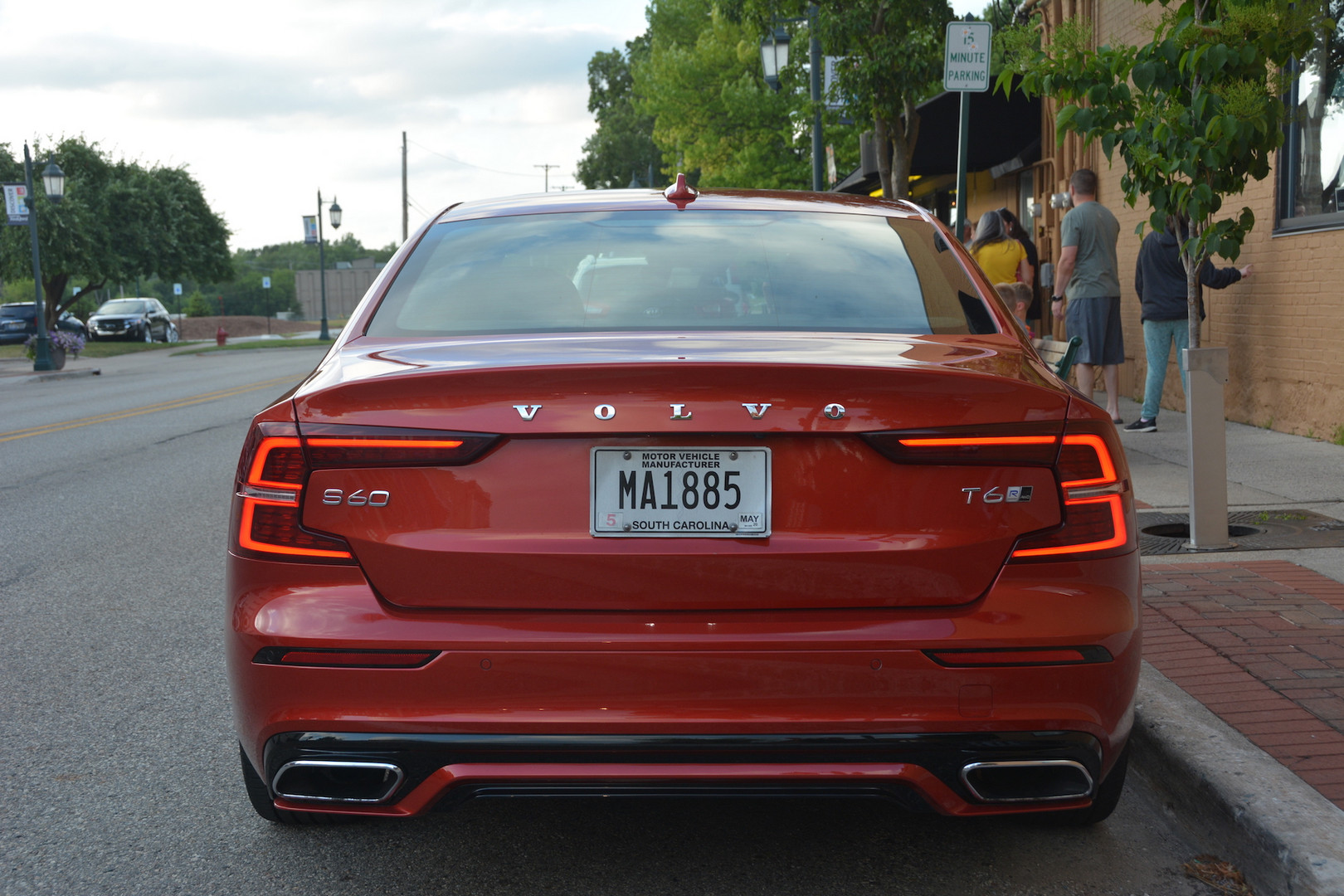
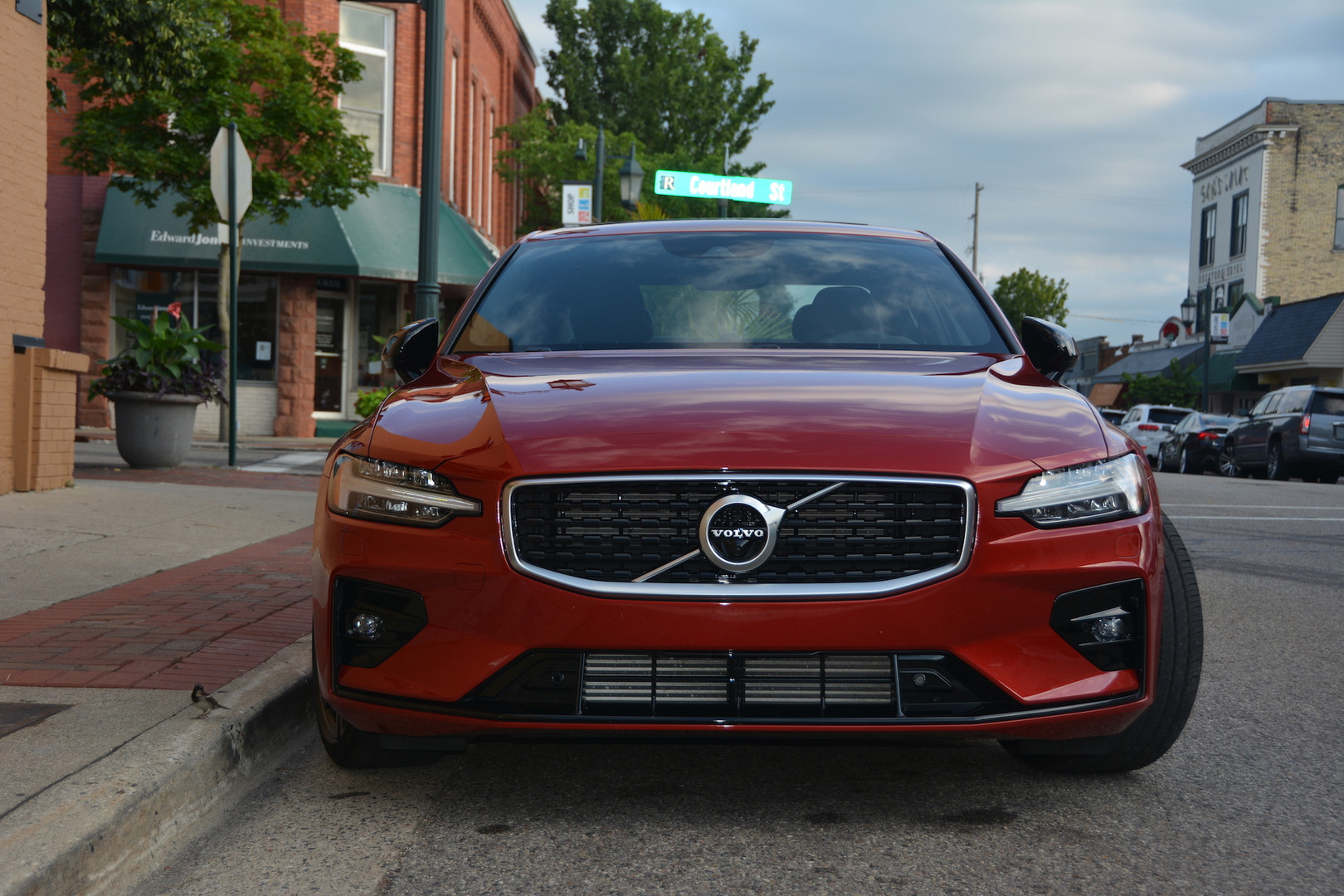
Outside, the R-Design has the same overall shape as the standard S60 but has some unique details to distinguish it. Black window trim instead of chrome. Black upper and lower grilles instead of chrome. Special tailpipes and different 18” wheels round out the exterior differences. These changes give the car a more sporting look than the base model.

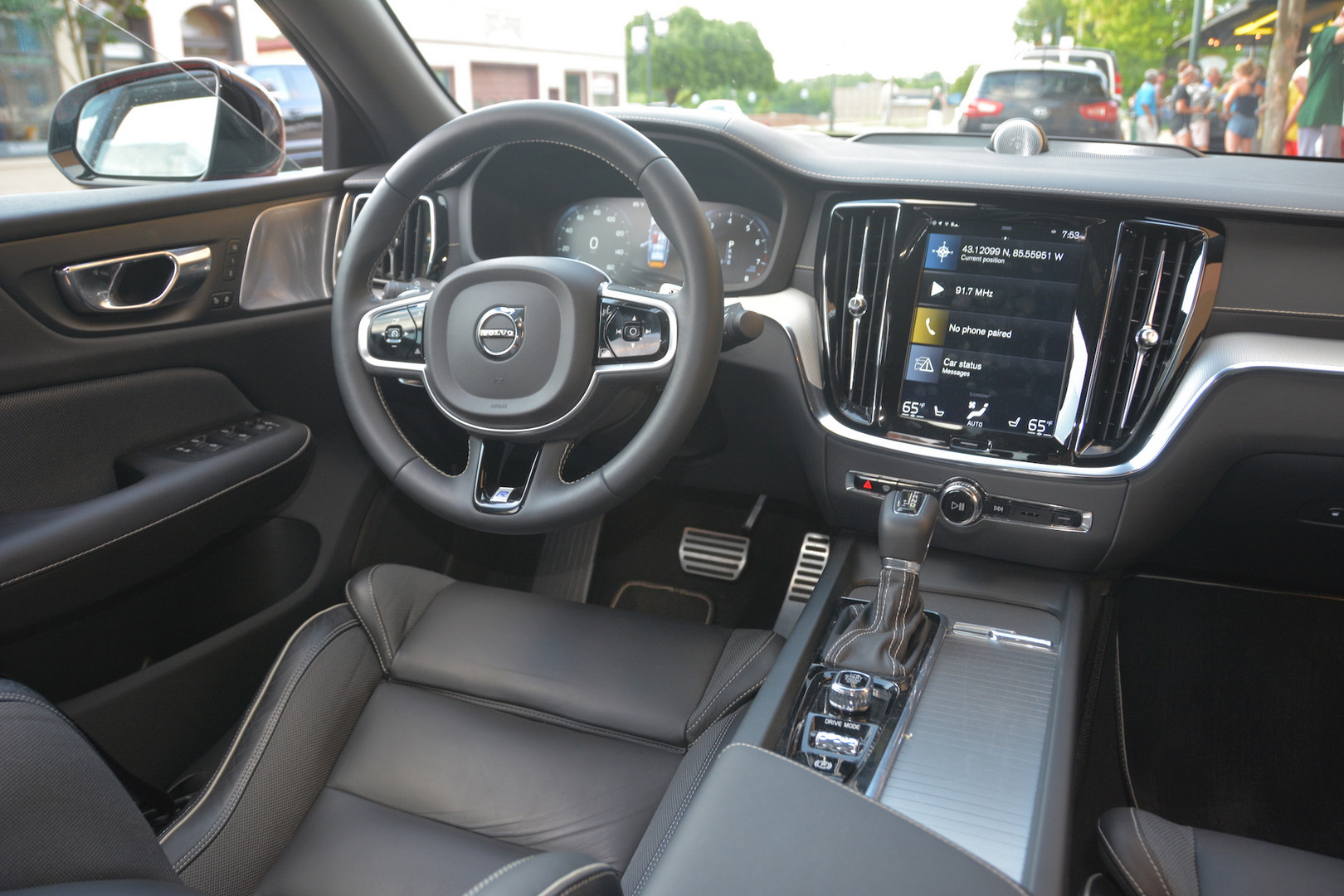
Inside, the R-design has unique Nappa leather and upholstery on the seats. The R-Design also gets a unique leather-wrapped steering wheel and gear selector. The seats are 10-way electrically adjustable, and electric seat pad extensions are part of the package and are very comfortable and well bolstered.

A charcoal headliner is standard, and cool metal mesh deco aluminum inlays spiff up the interior. An updated nav system, a Harmon Kardon sound system, and a raft of electronic safety instruments complete the package. You get a lot for your $6100 R-Package option investment. Our car also came with heated rear seats and steering wheel, an advanced technology package, an improved Bowers & Wilkens sound system, and an upgrade to 19” R-Design wheels.

2019 Volvo S6 Interior

Under the hood is Volvo’s T6 engine that we’ve become quite fond of. It’s a dual-charged (super- and turbo-charged) 2.0L four-cylinder engine that makes 316hp and 295 ft-lbs of torque. No slouch, it rarely feels caught out, providing a nice flat torque curve to ride through the rev range. This time around however, it felt a little slower than normal. Perhaps the AWD added some extra weight or perhaps the fact that we’d just stepped out of a Maserati Levante Trofeo with a twin-turbo Ferrari-built V8 under the hood, but the T6 in this car felt a little taxed moving the car up the road. Not slow, mind you; but slower than we recall. This isn’t something we’ve experienced in other Volvo applications so we think it was more our perception than actual performance.

The 8-speed automatic does an excellent job of making subtle but quick shifts as it directs power to the AWD system. The car has shifters behind the steering wheel but they’re slower to respond that we’d like and they didn’t get much use because of that.

The ride has a firm, sporty feel that we enjoyed. It’s not rough or harsh in any way. It corners well with a little lean, but not enough to unsettle you. It’s performance is confidence-inspiring and it’s a delight to fling into a set of S-bends. The automatic transmission is quick to kick down and provide good power coming out of curves without upsetting the balance of the chassis. There is a drive mode controller on the console that allows you to select “Dynamic” and that makes the car’s responses much quicker and sporting. We actually preferred the car in Dynamic mode, although it didn’t quicken the steering wheel shifters like we hoped it would.

2019 Volvo S60 Rear View

The brakes do an amazing job of stopping the car. You can control the degree of braking intensity with ease. They’re disk and calipers at all four corners with an electric parking brake. We never pushed them hard enough to see if they fade but they were still confidence inspiring.

The controls are well laid out. We’re quite fond of Volvo’s operating system. The navigation system that shows up in the gauge cluster is brilliant. The large screen above the center console is easy to see and use. The heads up display is nice when driving in heavy traffic so you don’t have to take your eyes off the road. The seats are very comfortable.

Large bolsters keep you in place nicely but don’t complicate ingress and egress. We were really hoping for seat massagers like we experienced in the V90 last year but no such luck, although the electrically extendable seat pads were nice for drivers with longer legs; It offered a bit more support on long trips. Another nice feature that the S60 had was a button to fold down the rear seats. Push it and the headrests flopped down against the seat backs and then the seat backs would lower flat, making it easy to prepare to load the rear cargo area with several dozen boxes when your friends asks you to help him move.

2019 Volvo S60 Front

All in all, the S60 is a very competent car. Sure-footed, safe, comfortable, with a lively engine to boot. Mileage is rated at 32 on the freeway and 21 in the city and that’s about what we saw.

Our favorite thing about the car was the engine’s easygoing power-band and the interior. One of the biggest reasons we enjoyed driving the car was because of the sense of stylish refinement and the logical layout of the controls. All the controls felt right and worked well. We enjoyed the interaction with the car. Our least favorite thing was the slowness of the operating system (nav, entertainment, etc) to boot up and the slow response from the paddle shifters. While other car’s systems come up instantly, it takes Volvo’s operating system between 30 – 45 seconds to come up and become responsive. And while we appreciate the option of shifting with the paddles, they were really too unresponsive to ever add to the driving experience. If anything, they detracted from it. But these are little things and as annoying to us as they were, we still enjoyed the S60 a lot.

The S60 starts at about $40,000. Our stickered at $55,000 but a big chunk of that was the R-Design package and the Bowers and Wilkens sound system upgrade.

GTSPIRIT NEWSLETTER

2019 Lexus ES 350 F Sport Review

Lexus has a reputation for exacting quality standards and while the ES 350 may be as near to an entry-level car as Lexus has, it certainly doesn’t feel like it. We spent some time with an ES 350 F Sport recently and came away surprised. We didn’t have the highest hopes for the FWD sedan, no matter the F Sport designation. How can a FWD car have any honest street cred as a sporting model?

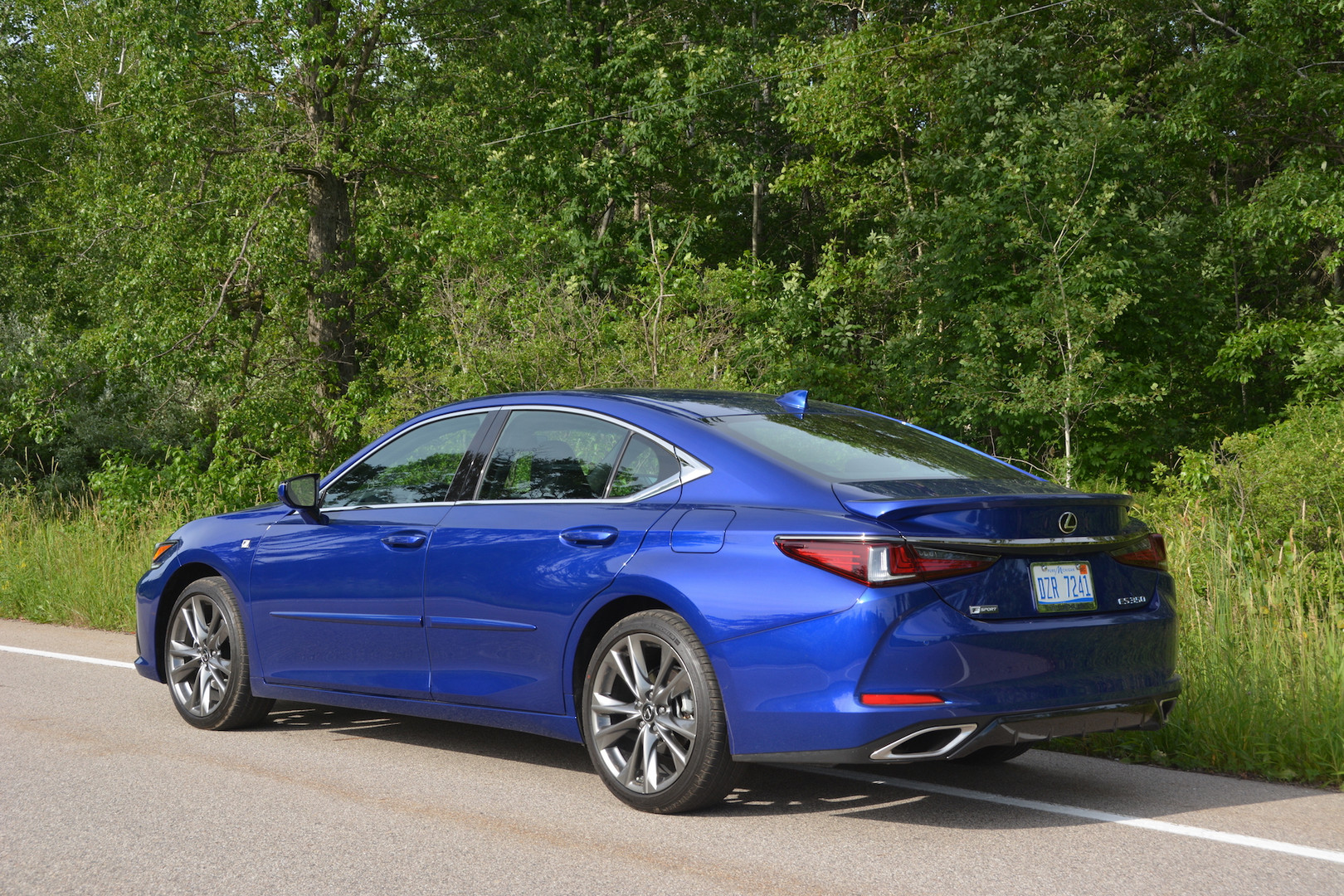
A quick walk-around shows the ES to be an attractive but somewhat inconspicuous car. The Ultrasonic Blue Mica paint attracts plenty of attention. We even received a few compliments on it. The styling is pure Lexus, from the cheese grater grill popping through the front body work to the chrome window surrounds, to the beautifully sculpted taillights.

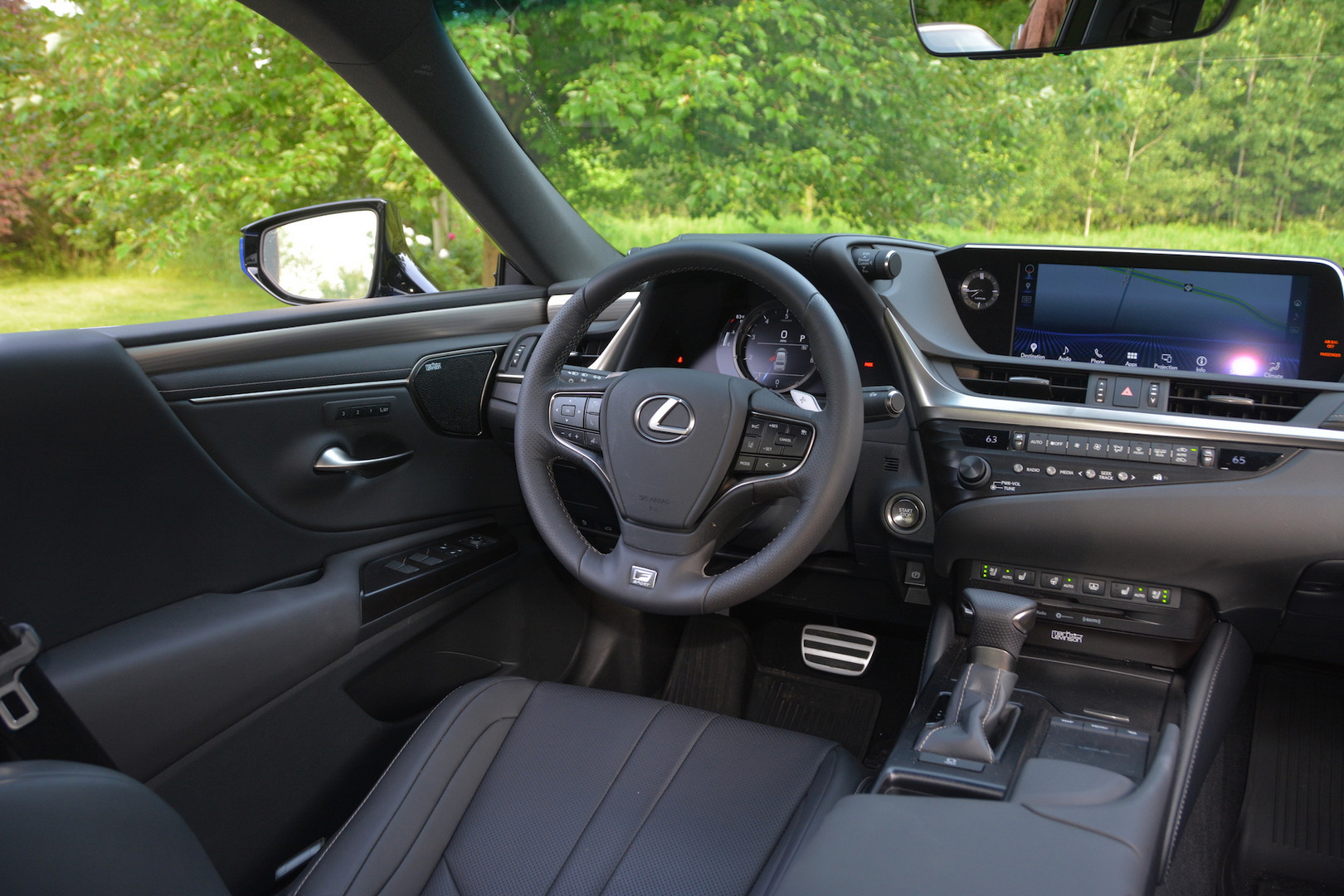
The best design work, however, can be found inside. Amidst the sea of monochromatic black, it quickly became clear that this is the easiest set of Lexus controls to navigate. Everything was intuitive and easy to figure out. The touchscreen can be utilized by either touch, the control knob, or the Lexus touchpad on the center console.

2019 Lexus ES 350 Steering Wheel

The dash wraps around into the doors nicely and there are other lines wrapping through the dash and center console that keep things interesting. The seats are decently bolstered and both heated and ventilated. The shifter for the 8-speed automatic transmission is a simple lever that you pull back to select a gear. There’s nothing complicated for the sake of being different. There’s a set of shifter flaps behind the steering wheel but they’re really not effective enough to select over the automatic transmission.

The 3.5L V6 engine, rated at 302 hp and 267 lb-ft of torque, effectively moves the car down the road. While quiet, it makes decent noises when you step on it and the thrust pushes you back into your seat. The engine is smooth and vibration-free. The transmission shifts smoothly and softly, almost behind the scenes. Very seamless.

Our car had the F Sport package that adds some sporting touches. Besides the special 19” wheels, it comes with unique sportier bodywork touches that signify it as an F Sport ES. It also comes with an adaptive variable sport suspension that is comfortably firm but with the twist of a knob, firms up and gets even more sporting. Another twist of the knob electronically quickens the responses of the engine, the transmission, and the steering, providing a platform that feels a little more fun to drive than the base ES 350.

How is it to drive? It’s very comfortable to drive. The ride is silky smooth, like most Lexus models. I’m not sure how Lexus does it but the car just absorbs bumps and road imperfections so that you end up with a glasslike smoothness. The brakes hiding behind the 19” wheels are strong and haul the car down from speed with no fade. In F Sport mode, things feel sportier, but we found ourselves just enjoying the soft, comfortable ride. For a FWD car, it handled corners better than expected and when launching the car from a standstill, there wasn’t nearly as much FWD body movement as we expected to find. It’s no IS or RC, but for the money it does a pretty decent job of imparting a sense of sportiness.

2019 Lexus ES 350 F Sport Price

The only disappointment we had was one to nearly all Lexus cars: road noise from the tires is much louder than in many of its competitors. In fact, we’ve found that even many entry-level cars have better insulation from road noise. It happens to be extra noticeable in a car that takes such pains to be so good at other things with a price tag like it has.
The ES 350 F Sport is a pleasant car to drive and look at. While it’s not really a performance car, it works hard to be playful. Where it succeeds most is in the smooth ride and the creature comforts. The 2019 model starts at $44,000. Our test model came in at nearly $55,000. Given Lexus reliability and resale values, that price seems reasonable.

GTSPIRIT NEWSLETTER

The used Ford GTs are coming

New Ford GTs are on their way to the used market. The two year waiting period is slowly expiring for more and more GT owners, and you can actually find a fair (but still small) amount of the supercars for sale now. DuPont Registry says the first GT deliveries took place in spring 2017, so it’s no surprise to see some of these cars trickle onto the used market.

There are a couple GTs going up for auction during Monterey Car Week this year. One of them through RM Sotheby’s, and the other is being offered through Bonhams out in California. There’s a GT listed for sale through Autoblog’s Cars for Sale listings — this one is coming out of Houston. Someone has a GT listed on a Dubai used car website. Others can be found scattered across the web, as well.

These 2017 model year GTs can be fully legal sales of the supercar, too. We all know of the famous John Cena Ford GT that has changed hands on numerous occasions. Ford took great issue with that car being sold before it was supposed to be. The Blue Oval says it’s not commenting on all the individual cars for sale now, though. That’s understandable, especially as more cars slowly become eligible for sale.

You won’t want to know the prices/estimates for the GTs up for sale now, though. The norm appears to be somewhere between $1 million and $2 million. If you bought a GT as an investment, let’s just say that you’re looking like a wealthy genius at this point. The base price was a hefty $450,750, but most folks selling now are lined up to at least double that if the estimates are right. Unfortunately, (or fortunately, depending on your point of view) most of the cars that are on sale now have hardly been driven. This outcome was inevitable, but it’s still disappointing to see, given that Ford handpicked owners that would actually get out and drive the car.

Of all the GTs going up for auction or on sale, we’re personal fans of the ‘66 Heritage Edition listed for auction at Bonhams. This one is the most collectible out there, but we can’t advocate anything but miles for all the Ford GTs in existence. Even if you had bought one in 2017 and put 20,000 miles on it, the car would still be worth an absurd amount of money. We expect to see more GTs pop up for sale as time goes on. Ford is said to have made 138 GTs for the 2017 model year, so we’ll see how many folks eventually look to sell once their two years are up.

Related Video:

1965 Shelby Cobra 427 Roadster: History, Specifications, & Performance

Introduction

Birth of the Cobra

1965 Shelby Cobra 427 Roadster1965 Shelby Cobra 427 Roadster

The Shelby Cobra 427 Roadster is arguably the most famous and relevant of all the automotive legends. In 1962, the Shelby Cobra (or AC Cobra, in the UK) wrote its storied beginnings as a collaboration between Ford and British automaker AC with the release of the first production Cobra known as the CSX2001 / Mark I. 

In the early 1960s, Ford endeavored to build a car that would oust the Chevrolet Corvette as the USA’s most significant sports car. The American automaker was well prepared to take on their local rival and had already produced the engine they would take to the fight – a new, lightweight, thin-wall cast small-block 3.6L V8. However, they still needed a chassis to go along with the powerplant.

Here enters the charismatic Carroll Shelby – financially backed by Ford for this venture – who recognized the racing success of the AC Ace in the late 1950s and would end up brokering an agreement with the Britons who would manufacture a chassis based on the Ace, which Ford would then use its fledgling V8 engine to breathe life into. 

Although the Ace was an aging design near the end of its life cycle, its lightweight structure would become the ideal complement in creating one of the greatest American sports cars ever made over the next few years. Thus, the Shelby Cobra was born; and the rest, as they say, is history.

Shelby Cobra 427

1965 Shelby Cobra 427 Roadster1965 Shelby Cobra 427 Roadster

By 1963, the Cobra was subject to its first major design refresh (Mark II) and in 1965, a new chassis was designed (Mark III) for what would become the platform for the Cobra 427. Production of the Mark III Cobras began early in 1965, with the goal of homologation for the racing season that year. 

However, only 53 out of the 100 required for homologation were produced by the time the deadline had passed, leaving Carroll Shelby with a fleet of non-road-legal, competition race cars which could not be sold or raced. He decided that the best recourse was to modify 31 of the competition cars to be allowed for road use, fitting them with windshields and detuning the engines. 

These variants became known as the S/C – an abbreviation for ‘Semi-Competition’ – and would go on to become the fastest production cars in the world at that time. Today, original and mint condition examples of the S/C are sold for more than $2 million USD.

Engine & Performance

Specifications:

  • Engine Type & Size: Front-mounted 7.0L (427 cu. in.) Naturally Aspirated V8
  • Horsepower: 410 bhp (485 bhp in Competition Model) @ 6,000 rpm
  • Torque: 480 lb-ft @ 3,700 rpm
  • Drivetrain: Rear-wheel Drive
  • Transmission: Four-speed Borg-Warner Manual Transmission
  • 0-60 mph: 4.2 seconds

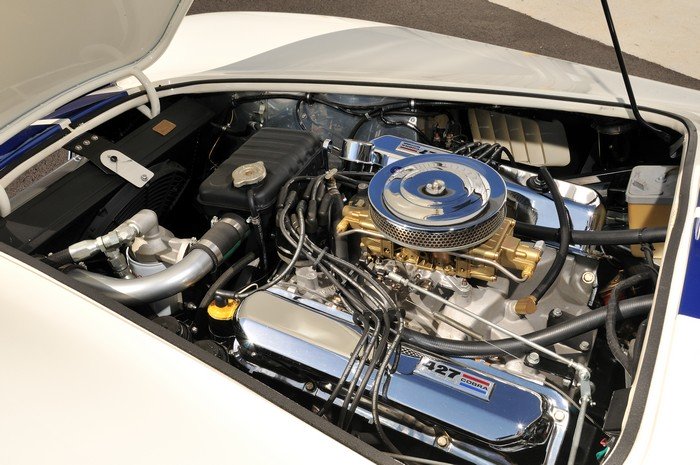
The Shelby Cobra 427 gets its moniker from the 7.0L (427 cu. in.) Ford FE V8 engine it uses. This single 4-barrel 780 CFM Holley carbureted engine was originally designed to be used in race cars, with its most notable feature being its ‘side oiler’ design which prioritized oil distribution to the crankshaft and main bearings before the oil made its way to the cylinder head and valve train.

1965 Shelby Cobra 427 Roadster1965 Shelby Cobra 427 Roadster

Ford produced two versions of the FE V8 for the Mark III Cobra – the standard version which produced 410 bhp @ 6,000 rpm and 480 lb-ft of torque @ 3,700 rpm, and the competition version which output an additional 75 bhp, for a total of 485 bhp. 

Due to traction limitations, both engines propelled the Cobra from 0-60 mph in 4.2 seconds and enabled it to complete the standing ¼ mile in just 12.4 seconds. However, the extra horsepower in the competition version did allow for a higher top speed of 185 mph vs. the standard version’s 164 mph.

Chassis, Handling, & Design

When it came to power and displacement, it was no secret that Americans strongly believed that more was always better. Acutely aware of this, Carroll Shelby knew that his biggest challenge with the 427 would be to find an acceptable common ground in the marriage of the 7.0L monster engine and the lightweight damsel of an AC chassis.

1965 Shelby Cobra 427 Roadster1965 Shelby Cobra 427 Roadster

The Mark III chassis would continue to be largely based on the original AC schematic, with the overall design elements of the car remaining largely intact. Under Ford’s direction, the new chassis would continue to be produced by AC and would feature a variety of changes deemed necessary to accommodate the engine’s significant displacement boost. 

The most notable improvements included bolstering the main chassis frame with 4” diameter tubing, up from the 3” tubing used before. On the exterior, new fenders were installed to house the now wider wheel track of the Mark III Cobra, while a reimagined front bumper provided a larger opening for the front radiator. These changes also gave the new Cobra a more aggressive appearance, befitting of its improved-self. 

As far as the suspension was concerned, the transverse leaf springs were replaced with coil springs for the Mark III, although the use of equal length wishbones was carried over from the original chassis.

Based on these specifications, Ford received the first shipment of unpainted Mark III chassis from AC in October of 1964, allowing Carroll Shelby and his team their first opportunity in figuring out how to fit the engine and transmission in; which they did so, in January of 1965. 

Variants

AC 289 Sports

Shelby AC 289 SPORTSShelby AC 289 SPORTS

The Mark III Cobra was designed with, mostly, Americans in mind, with its 427 cu. in. engine at the forefront of the new platform. Though chassis producer AC was obviously on board with Ford for this new venture, they had realized there were broader markets in places like Europe, Australia and internationally that would be much more receptive to a more road-friendly, and economical version of the car. 

They had the Mark III chassis fitted with a small block Ford 289 cu. in. V8 engine. This ended up producing an incredibly balanced sports car which didn’t overwhelm the dextrous chassis with a robust engine. It was a hybrid of British chassis and American muscle which highlighted the best elements of each.

Dragon Snake

Shelby DRAGON SNAKEShelby DRAGON SNAKE

Recognizing the popularity of drag racing in America, Shelby introduced a drag package known as ‘Dragon Snake’, which fitted the car with a ¼-mile-winning arsenal made especially for straight-line racers. 

This equipment included a 3.77 rear end, Koni shocks, a roll bar, shoulder harnesses and in some of the models, a 289 cu. in. engine. Each example was made to order and highly customizable, where clients could opt for different ‘stages’ which each came with its own selection of options. 

The Dragon Snake won several NHRA National events with Bruce Larson or Ed Hedrick at the wheel. Only six of the 289 cu. in. Dragon Snake Cobras were built, making them amongst the rarest Cobras in existence. There are said to be 8 built in total.

Slalom Snake

Shelby Slalom SnakeShelby Slalom Snake

The Slalom Snake version of the Cobra was designed with auto-cross events in mind, with notable upgrades including Koni struts, front and rear anti-roll bars and Goodyear Blue Streak Sports Car Special tires.

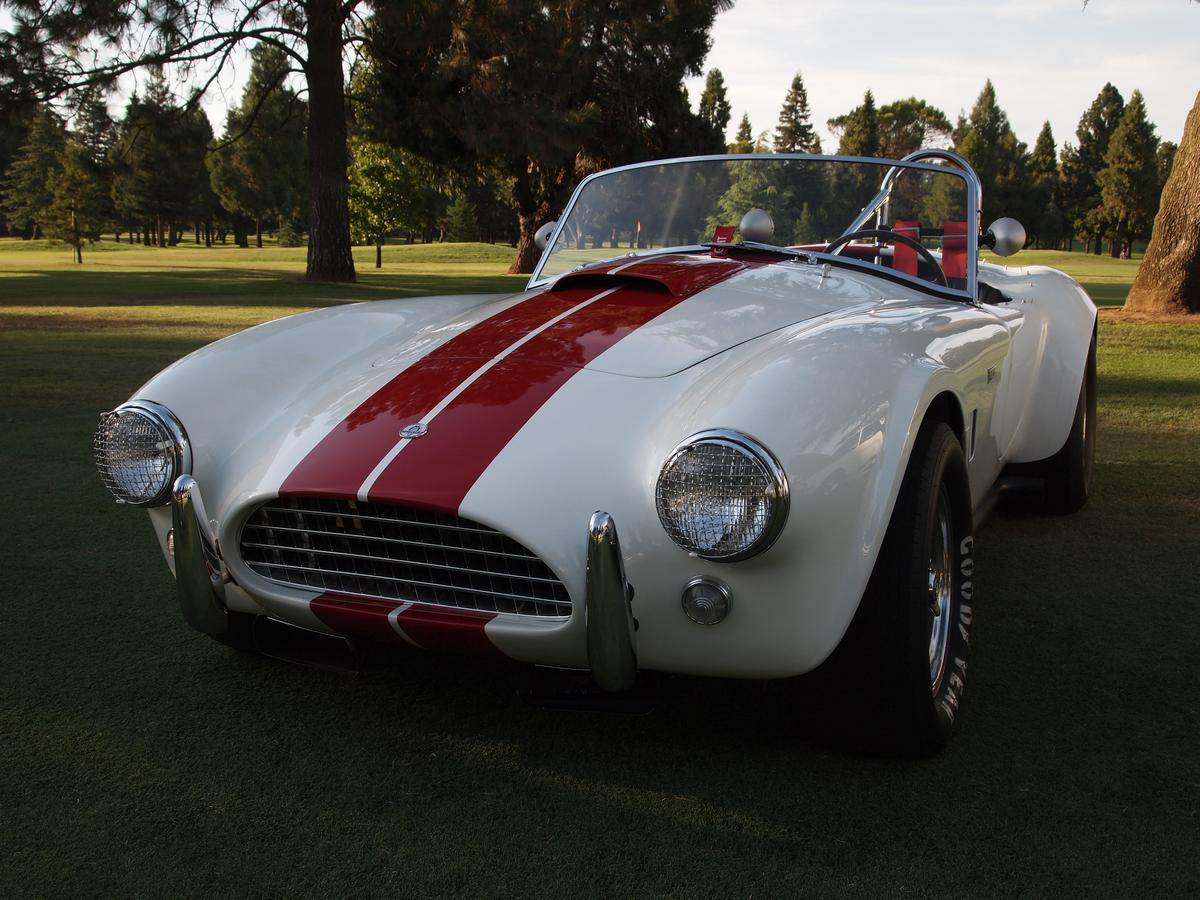
These are also extremely rare, with only two examples were produced. Both cars were finished in white exterior paint with red racing stripes down the middle, and red leather interiors. Each of the two owners opted for some bespoke features such as a hood scoop, side exhaust and a painted roll bar, which would have been amongst the only distinguishing features between the two.

Super Snake

Shelby Super SnakeShelby Super Snake

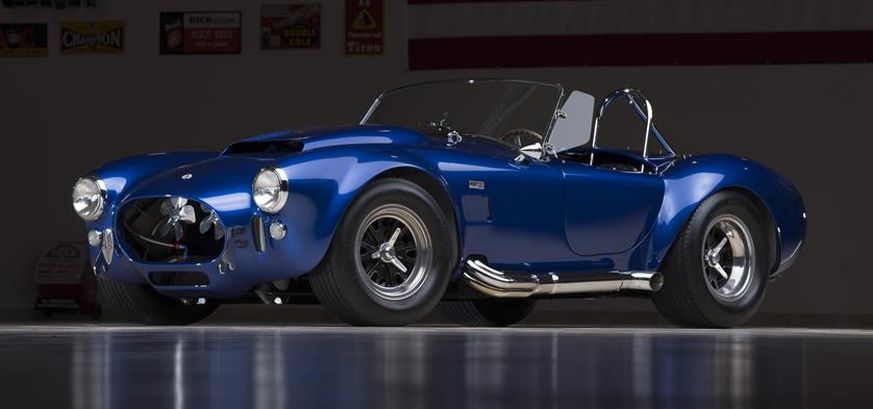
In 1966, Carroll Shelby embarked on a mission to create the “Cobra to End All Cobras”. He had an S/C version converted into a special model which was called the Super Snake. As the mission objective clearly reveals, this Shelby would become the fastest and most brutal yet, thanks in large part to the addition of Twin Paxton Superchargers.

Other modifications include the use of the racing rear end, brakes and headers that were used in the competition car, though the car remained road-legal since it was based primarily on S/C infrastructure.

Only two examples were made, with one given to Carroll Shelby’s close friend and comedian Bill Cosby. He would end up returning the car shortly after, remarking that the car was “too difficult to control”. The second car was used as Shelby’s personal car which he would sometimes enter into local races or shows.

Pricing

The price of the Shelby Cobra 427 brand new in 1965 was around $7,500 USD. However, other than being a historical tidbit, that information has become vastly insignificant when the economics come into play today.

Such is the car – so rich in history and exceptional in nature – that the prices of original Shelby Cobras at auction in recent years have become out of this world. It is common to see Mark III Cobras with a strike price starting at $800,000 USD with the more rare versions such as the S/C models, going for north of $2 million USD. 

Then there are the truest of unicorns; the Super Snake which auctioned in 2007 for $5.3 million USD, and the very first Shelby Cobra ever made, going for a record $13.75 million USD (for an American car) in 2016!

Here is an article by RCN Magazine which lists some of the most expensive Shelby Cobras ever sold. 

Performance & Specifications Summary

Model & Pricing Info

Make Shelby
Model Cobra
Sub-model 427
Car type Roadster
Introduced 1965
Units built 343

Chassis, Suspension & Powertrain

Curb Weight 1,035 kg / 2,282 lbs
Layout Longitudinal Front Engine, Rear-wheel drive
Cooling Water-cooled
Body / Frame Aluminum over Tubular Steel Frame
Suspension (F) Equal Length Wishbones w/ Coil Springs over Dampers
Suspension (R) Equal Length Wishbones w/ Coil Springs over Dampers
Steering Rack-and-pinion
Brakes

(F) Discs, 297 mm

(R) Discs, 273 mm 

Transmission 4-speed Manual 

Engine, Output & Performance

Engine V8
Displacement (Litres) 427 cu. in. (7.0 L)
Aspiration Naturally Aspirated
Power (hp) 416 bhp @ 6,000 rpm
Power (hp) / liter 59.4 hp / liter
Power (hp) / weight 0.40 hp / kg
Torque 480 lb-ft @ 3,700 rpm
0-60 mph time 4.2 seconds
¼ Mile (standing) 12.4 seconds
Top Speed 164 mph (264 km/h)

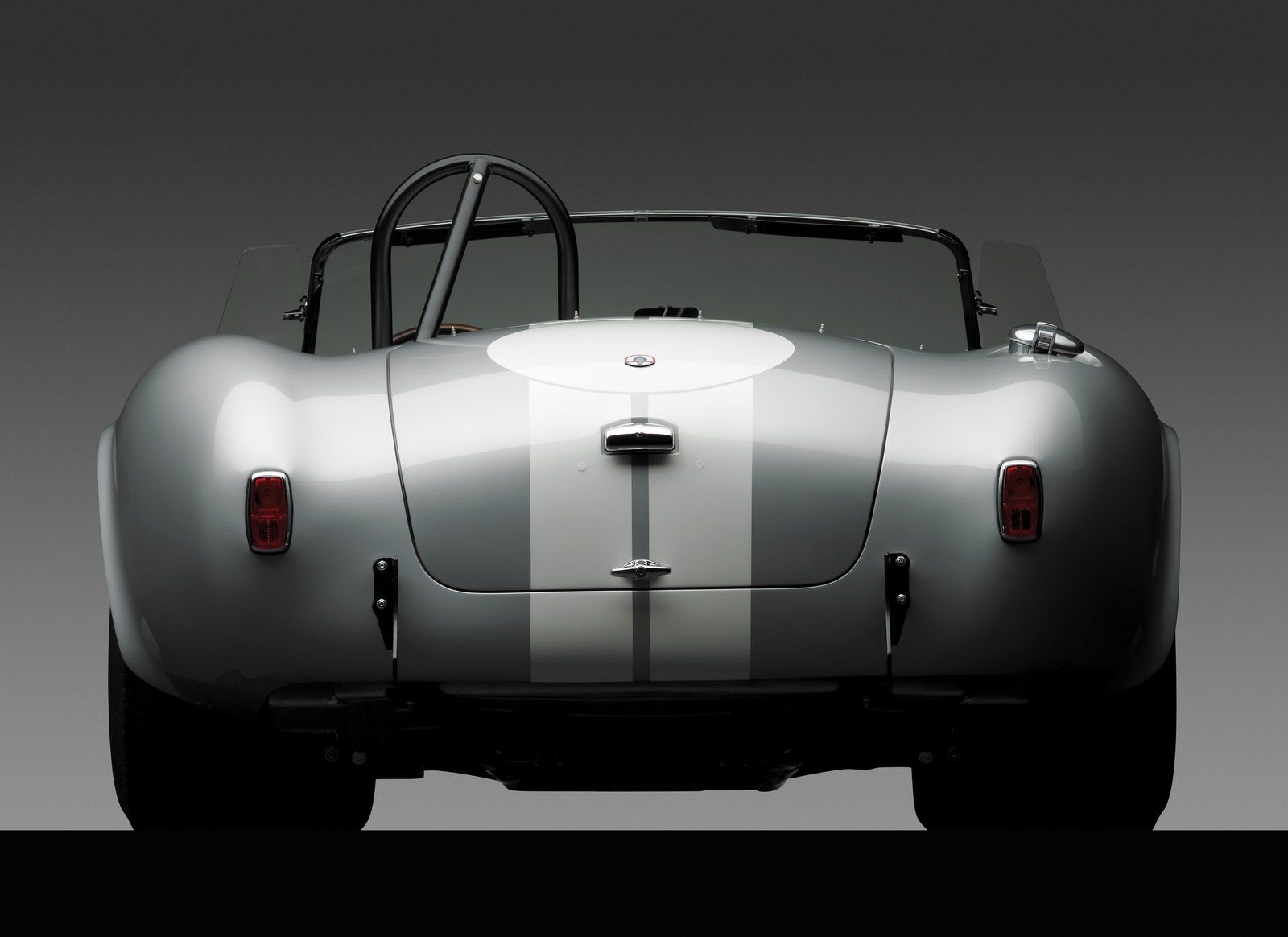
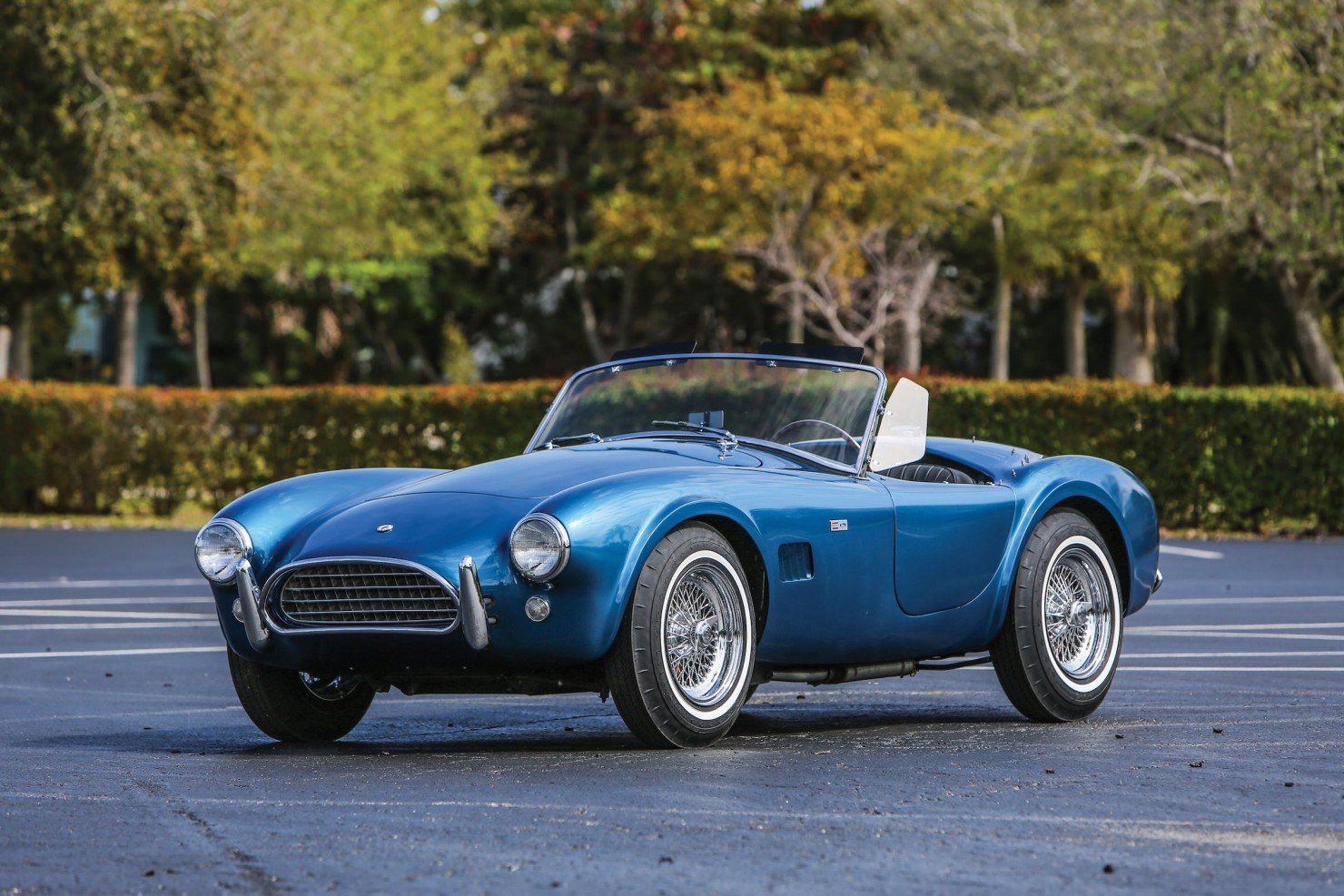
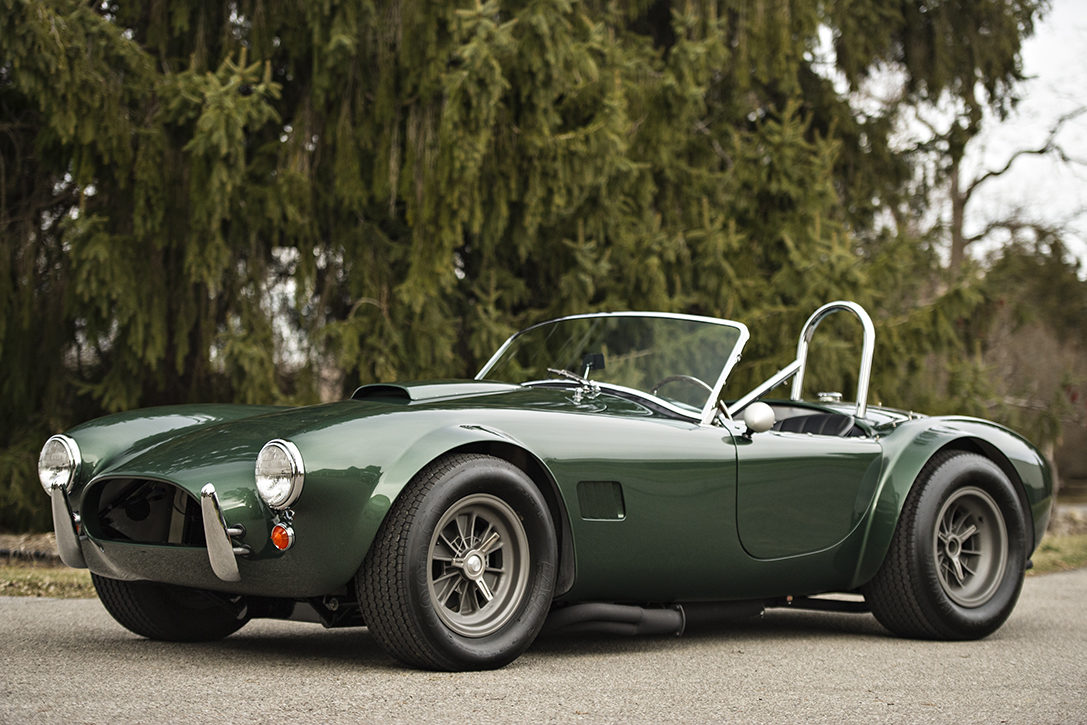
The Shelby Cobra 427 is a car that has an unmistakable appearance. Its race-derived, British-made tubular chassis would become the platform on which one of the world’s most iconic cars was built. Boasting its flared wheel arches, a bulging stern, and a low stance with meaty tires, the car’s presence is one that is menacing but also somewhat elegant in nature. 

Over the years, there have been many copy cats which have ranged in quality from atrocious to outstanding; which in any case, speaks volumes about the fascination and allure this car commands. It is truly one of the most recognizable and timeless designs of an automobile, and will only continue to enthrall us for perpetuity.

One of the better video reviews of the Shelby Cobra on YouTube was done by a channel called Vehicle Virgins. While the chosen video title is “THIS 1965 SHELBY COBRA IS FASTER THAN A LAMBORGHINI”, the reviewer also remarks that the car “handles a lot better than I was expecting.”

[embedded content]

ThatDudeinBlue was lucky enough to have Superformance in California invite him to drive one of their Shelby AC Cobras for the chance of a lifetime. Built under the approval and certification of Shelby themselves, these cars are built completely from scratch in house down to the millimeter. 

[embedded content]

Donut Media tells us everything we need to know about Shelby the company, and its namesake founder Mr. Carroll Shelby. It is an informative and humorous documentary which chronicles the journey of the man – and his company – during his quest to attain sports car hegemony.

[embedded content]

Car and Driver – November 1965 Issue

Car and Driver - November 1965 IssueCar and Driver - November 1965 Issue

1965 Shelby Cobra 427

Not long ago, the Cobra 427 would have been the hot setup on any race track. Now it’s a civilized street machine!

From the November 1965 issue of Car and Driver

JESSE ALEXANDER

Several years ago, the manufacturers of a posh Brit­ish grand touring car got a fair amount of mile­age out of the claim that their vehicle could accelerate from 0–100 mph and brake to a complete stop in less than 25 seconds.

This was indeed an impressively brief period of time during which all that change of velocity happened, but automotive development has come a long way since then and today perhaps half a dozen produc­tion cars of one kind or another can perform on that level. What’s more, there are several automobiles being produced in the United States that will breakthrough that arbitrary 25-second barrier like the Germans through the Maginot Line. One is the 427 Sting Ray; another, most certainly, is the new 427 Cobra from Shelby American.

Alright, you say, if 25 seconds from 0–100–0 isn’t so hot anymore, what the hell is? Twenty seconds?

Forget twenty seconds.

How about 18 seconds?

Not too bad, but the Cobra can do better.

How much better, wise guy?

How about maybe 14.5 seconds? Get that, 14.5 sec­onds to accelerate to 100 miles an hour and then stop again. Until something better comes along, that may have to stand as some sort of high watermark in performance for cars that are readily available to the general public. 

That figure, mind you, is obtainable by the average Cobra driver with the regular 8.15 x 15 Goodyear Blue Dot street tires. Cobra test driver Ken Miles has done the job in as little as 13.8 seconds, and who knows how much improvement could be made with racing tires that would nullify some of the tre­mendous wheel spin?

The 427 Cobra does accelerate and decelerate at unbelievable rates, as the above figures should imply. What’s more, it is a more civilized machine than the original 289 Cobra that brought the fabulous Shelby organization into being four years ago. It handles properly, thanks to a completely new all-independent suspension system that is traceable to the deft hand of Klaus Arning, the Ford Motor Company genius re­sponsible for the impeccable handling of the Ford GT.

Everyone at Shelby is more than candid about ad­mitting that the handling of the original Cobra was considerably less than optimum. In fact, C/D was once informed by a Shelby lieutenant that the old tubular AC chassis had considerably less torsional rigidity than the rail frame of a Model T! Coupled with this flexible frame was an antiquated suspension system, designed in the post-war years, that utilized leaf springs and lower wishbones. 

One staff member recalls a partic­ularly painful day in southern California when he was outrun down a bumpy orange grove lane by an MG 1100. “There I was, with all that Cobra horse­power, and the rear wheels were bouncing and leaping around so badly that I could barely keep the beast on the road, much less catch up to the MG. It was terrible!”

Road Review of the Porsche 718 Spyder by Carfection

Watch Henry Catchpole Take the Topless 718 Around Scotland

The Porsche 718 Spyder is new and improved and features a wonderful six-cylinder engine. Henry Catchpole of Carfection recently had the chance to take the car to Scotland on some beautiful roads and discuss the merits of the model and how it’s different than the previous version of the car. 

As you can expect, Catchpole likes the car. “Oh yes, it’s brilliant,” he said. “Just as well all expected.” Of course, it helps that he’s driving the car on some of the most beautiful country roads ever. However, even if he weren’t on those roads, you can tell that the car would have performed admirably. 

In the end, he says the Spyder is a notable improvement over the previous car and even says he finds that he thinks it justifies upgrades more so than the coupe if you owned the last generation model. You can watch the full video below. 

[embedded content]

15 Fun-Filled Cars for Under $200,000

While the glamour of the Monterey Car Week is most commonly associated with cars bearing multi-million-dollar estimates, automobiles that are slightly gentler on the checkbook can also be had. These fifteen cars run the gamut from modern supercars, like the Aston Martin Vanquish S, to the diminutive Italian city-cars like the Ferves ranger. No matter your tastes or budget, rest assured there is something for everyone at Monterey.

RM Sotheby’s record-setting Monterey auction—which this year features a special third auction night on 15 August, “An Evening with Aston Martin”—will present 184 motor cars and a selection of memorabilia, of which 43 lots carry million-dollar-plus pre-sale estimates and of which nearly 45 percent are offered without reserve. Register to bid today and streamline your auction experience.

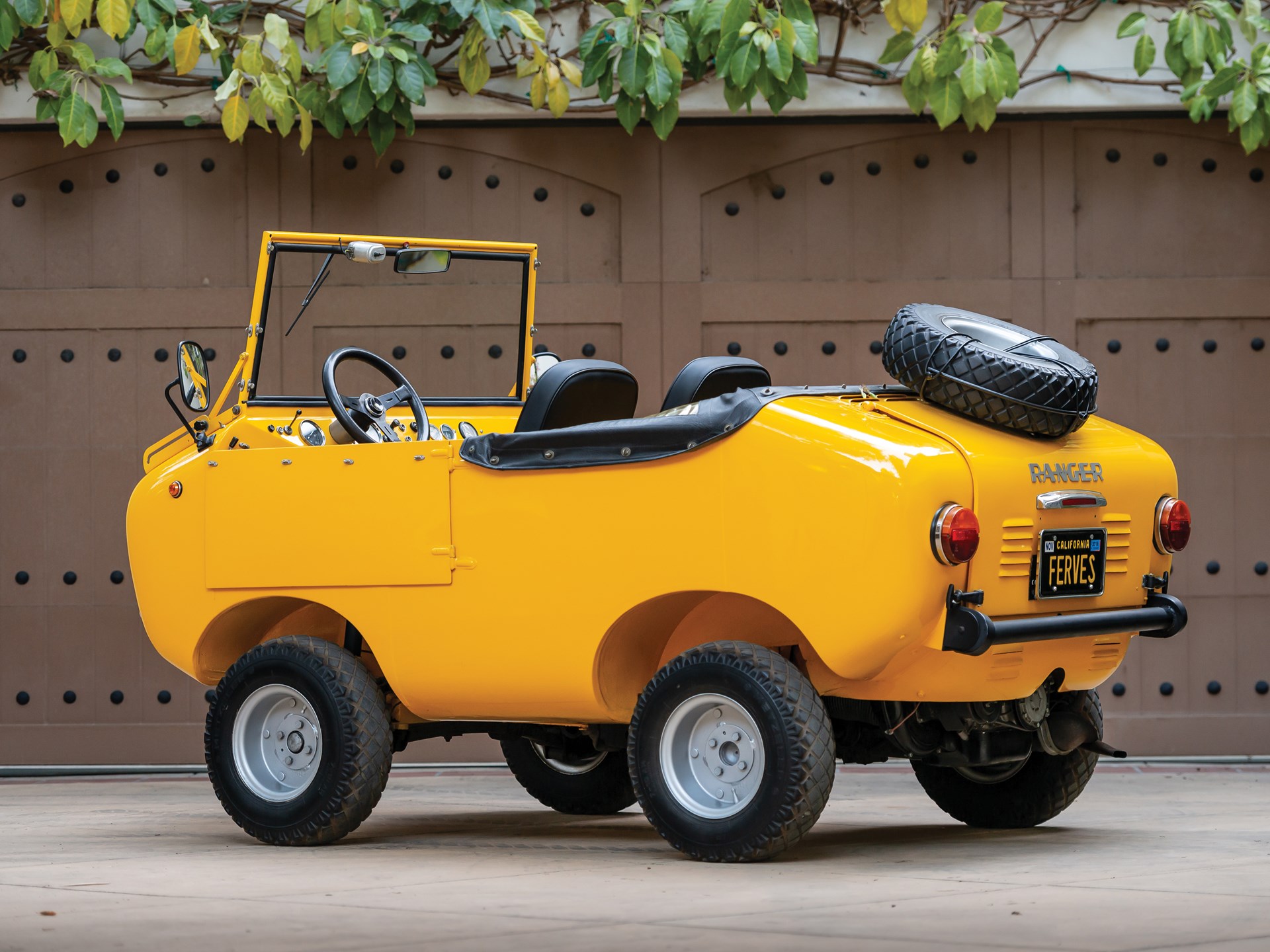
Lot 202 1967 Ferves Ranger

For Sale 1967 Ferves Ranger

Chassis No. FVS 0387
Estimate: $30,000 – $40,000
Offered Without Reserve

The ultimate Italian microcar oddity, about 50 Ferves Rangers are believed to be left in existence. A wonderful and characterful alternative to a Fiat Jolly or a Mini Moke, it’s sure to be a conversation starter wherever it goes.

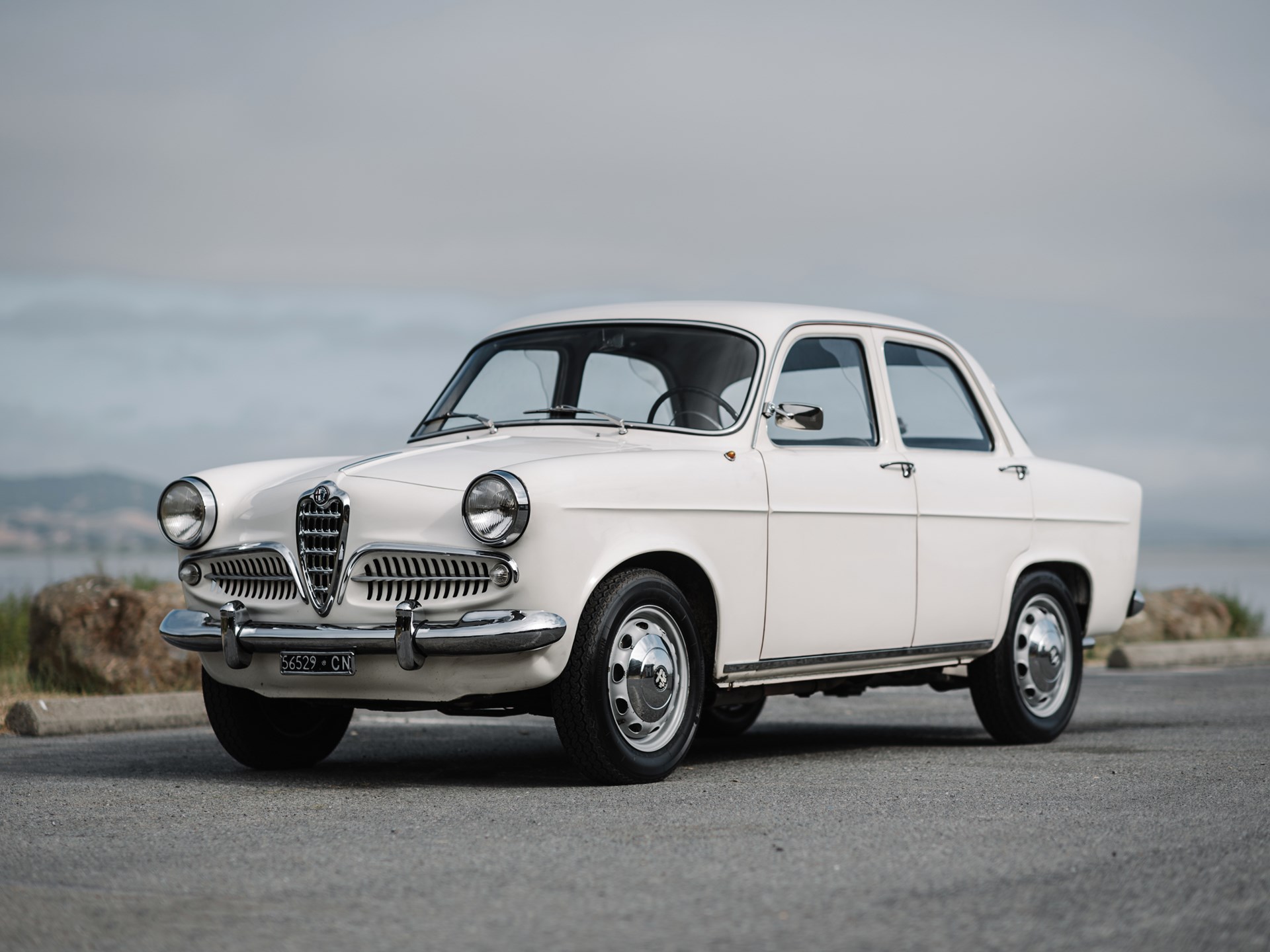
Lot 376 1959 Alfa Romeo Giulietta T.I. Berlina

1959 Alfa Romeo Giulietta T.I. Berlina For Sale

Chassis No. AR1468 17109
Estimate: $40,000 – $50,000
Offered Without Reserve

Offered from the Swig family collection, this charming Giuletti T.I. Berlina is a highly original example. Retaining its original engine and having traveled just 35,000 km from new, this would be the perfect addition to the stable of a veteran collector or, alternatively, for someone looking for their first collector car with both practicality and Italian flair.

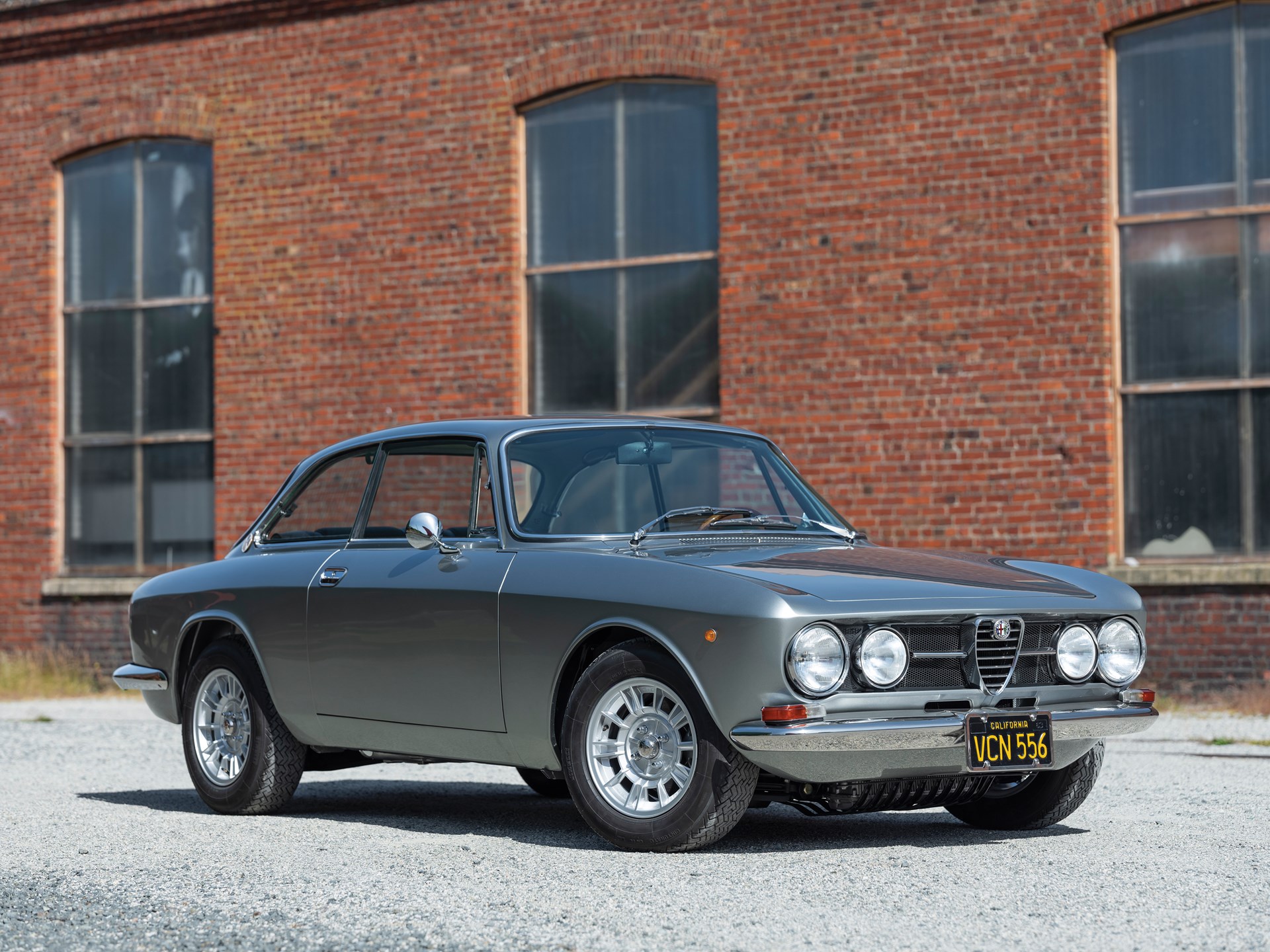
Lot 363 1969 Alfa Romeo 1750 GT Veloce by Bertone

1969 Alfa Romeo 1750 GT Veloce by Bertone For Sale

Chassis No. AR 1369869
Estimate: $125,000 – $150,000
Offered Without Reserve

One of Alfa Romeo’s most beloved post-war models, no expense was spared in the restoration of this lovely 1750 GT Veloce, undertaken by Coachwerks Restorations of British Colombia, Canada. Beautiful to behold, it is surely equally as stunning when enjoyed on the open road.

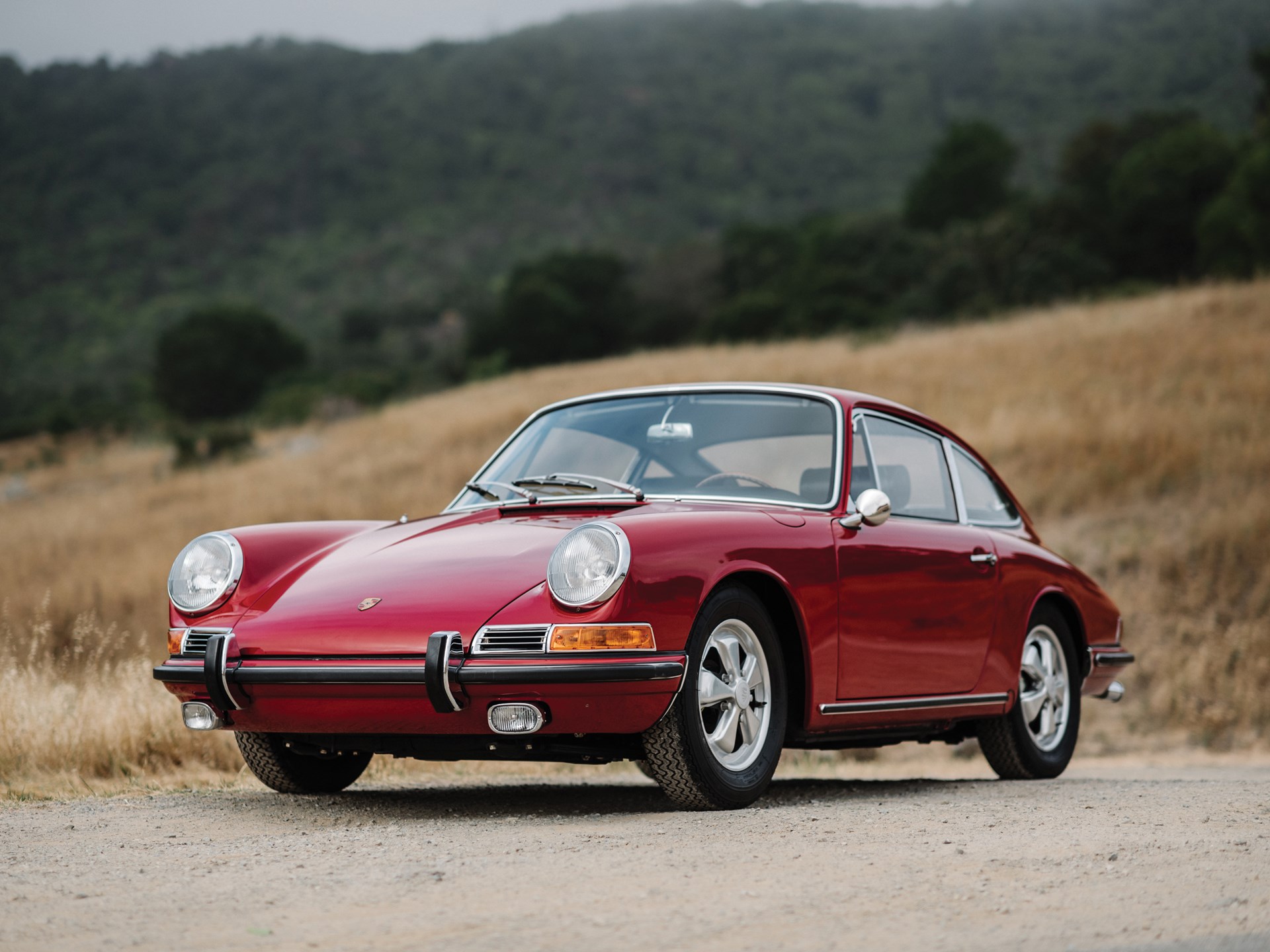
Lot 262 1967 Porsche 911 S Coupe

1967 Porsche 911 S Coupe For Sale

Chassis No. 308081 S
Estimate: $175,000 – $225,000
Offered Without Reserve

Without doubt the most iconic and beloved series of 911, the small-bumper pre-1973 911s are a staple in the collector car community. This example checks all the right boxes, boasting known ownership from new, a numbers-matching drivetrain, and a recently completed restoration. In its original Polo Red, it needs nothing but a new owner.

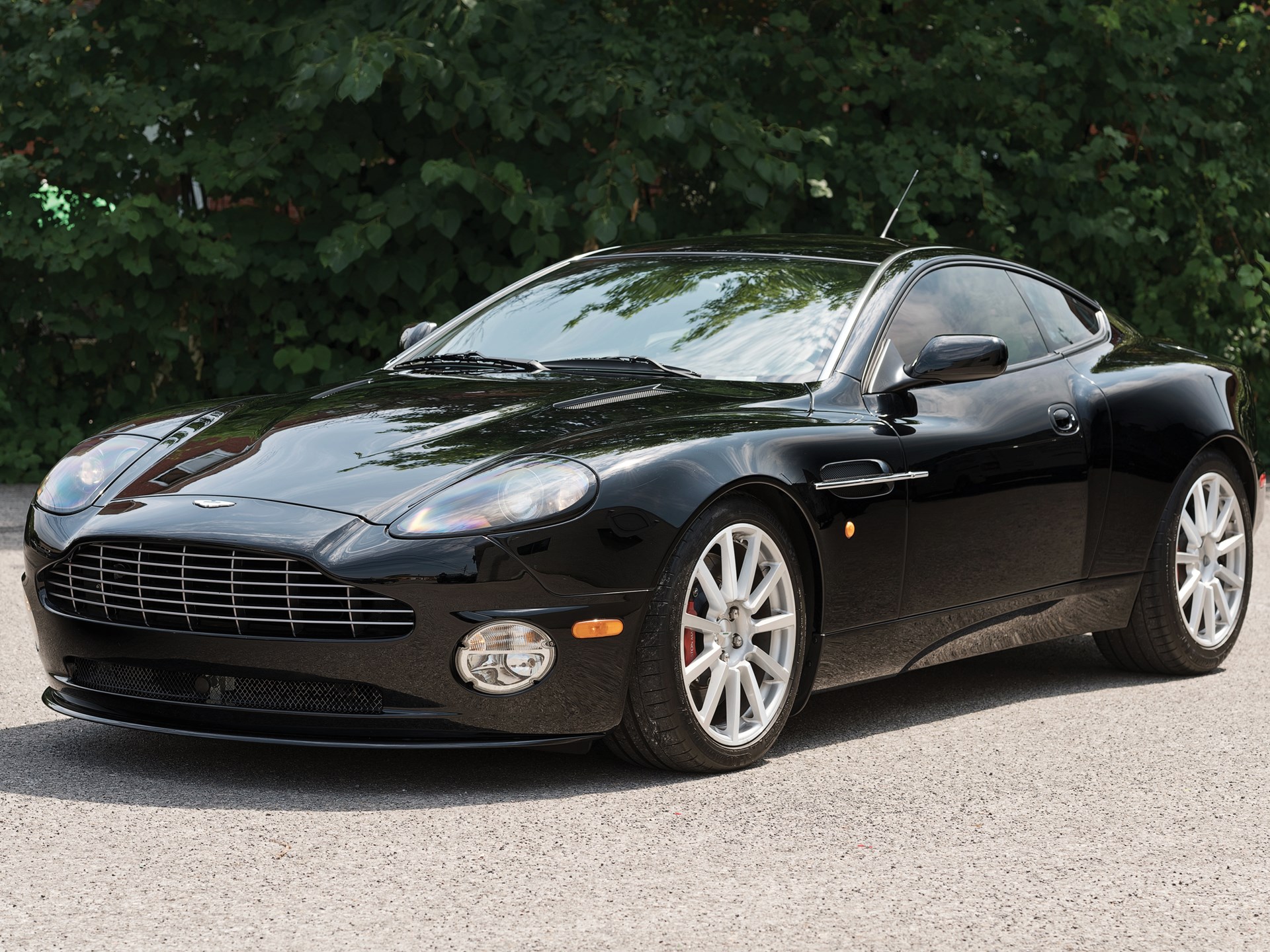
Lot 110 2006 Aston Martin Vanquish S

2006 Aston Martin Vanquish S For Sale

Chassis No. SCFAC243X6B502007
Estimate: $90,000 – $110,000
Offered Without Reserve

Made famous due to its stunning looks and starring role in James Bond’s Die Another Day alongside Pierce Brosnan, the Vanquish is arguably the most beloved Aston Martin of the early 2000s. While this late-model Vaniqush S didn’t appear on the silver screen, it is chassis number “007” and boasts the desirable “2+0” seating configuration. It is one of only 326 Vanquish S imported to the U.S. when new.

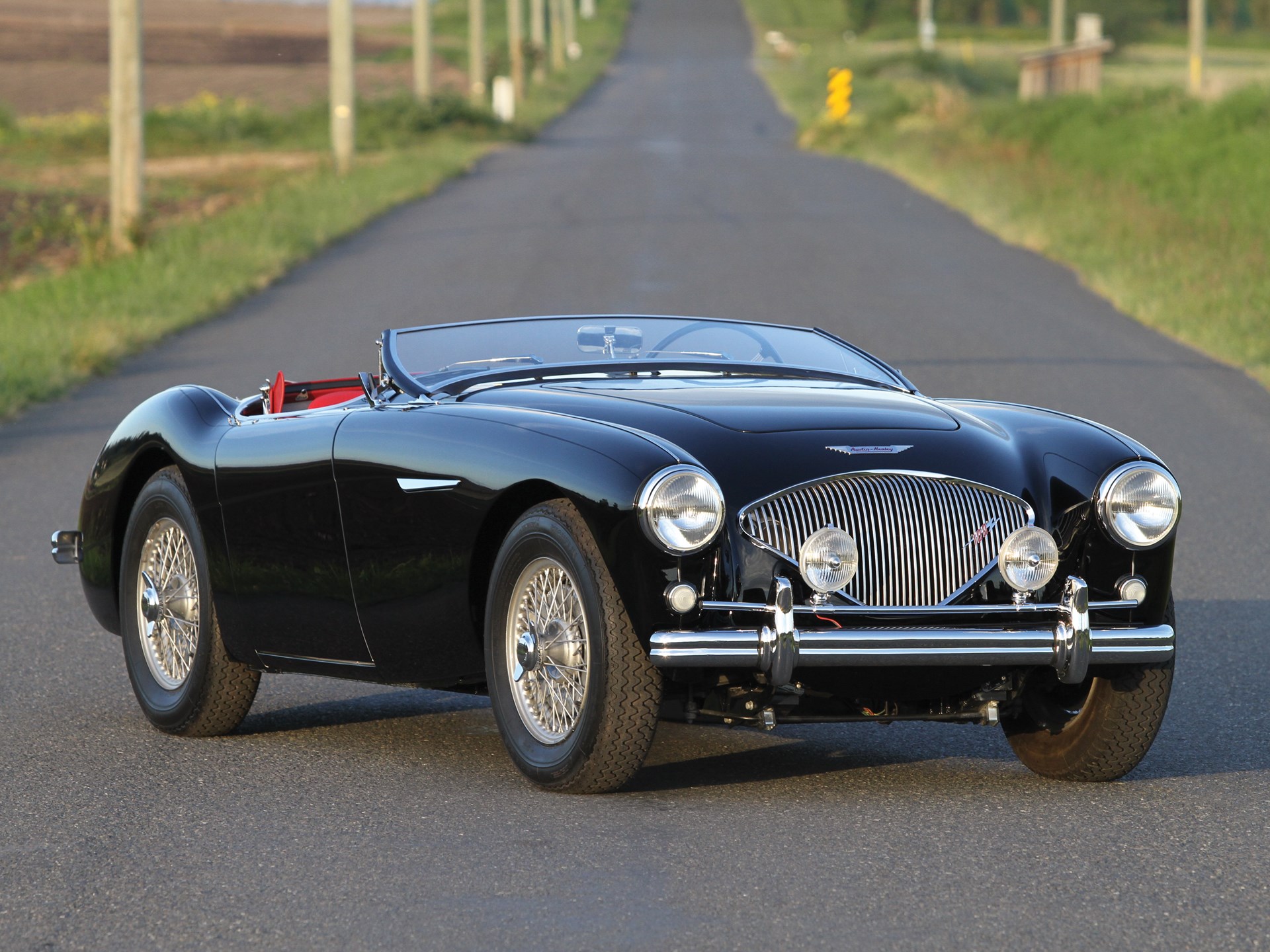
Lot 307 1955 Austin-Healey 100 BN2

1955 Austin-Healey 100 BN2 For Sale

Chassis No. BN2-L/228730
Estimate: $70,000 – $90,000
Offered Without Reserve

Undoubtedly one of England’s most iconic automobiles of the 1950s, the little Austin-Healey 100 played a vital role in jump-starting the sports-car craze in the U.S. immediately following WWII. Found as a barn find several years ago, this example has received a meticulous concours-quality restoration and begs to be used and enjoyed.

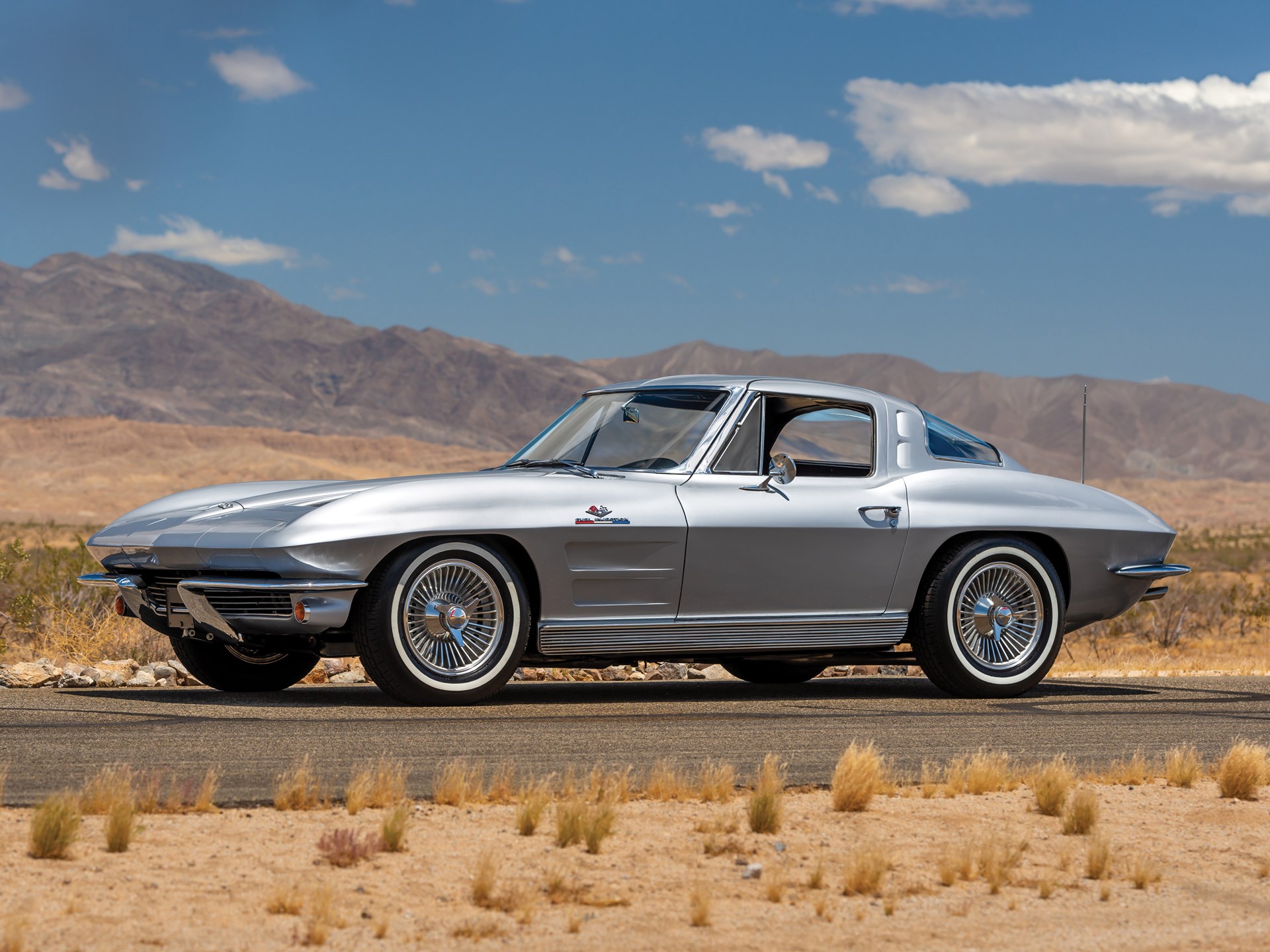
Lot 212 1963 Chevrolet Corvette Sting Ray ‘Fuel Injected’ Split-Window Coupe

1963 Chevrolet Corvette Stingray For Sale

Chassis No. 30837S105345
Estimate: $120,000 – $160,000
Offered Without Reserve

Arguably one of America’s most attractive sports cars, the “Split-Window” Corvettes of 1963 are truly a watershed moment in American automotive design. Outfitted with both fuel injection and a four-speed transmission, this is a Corvette to cherish.

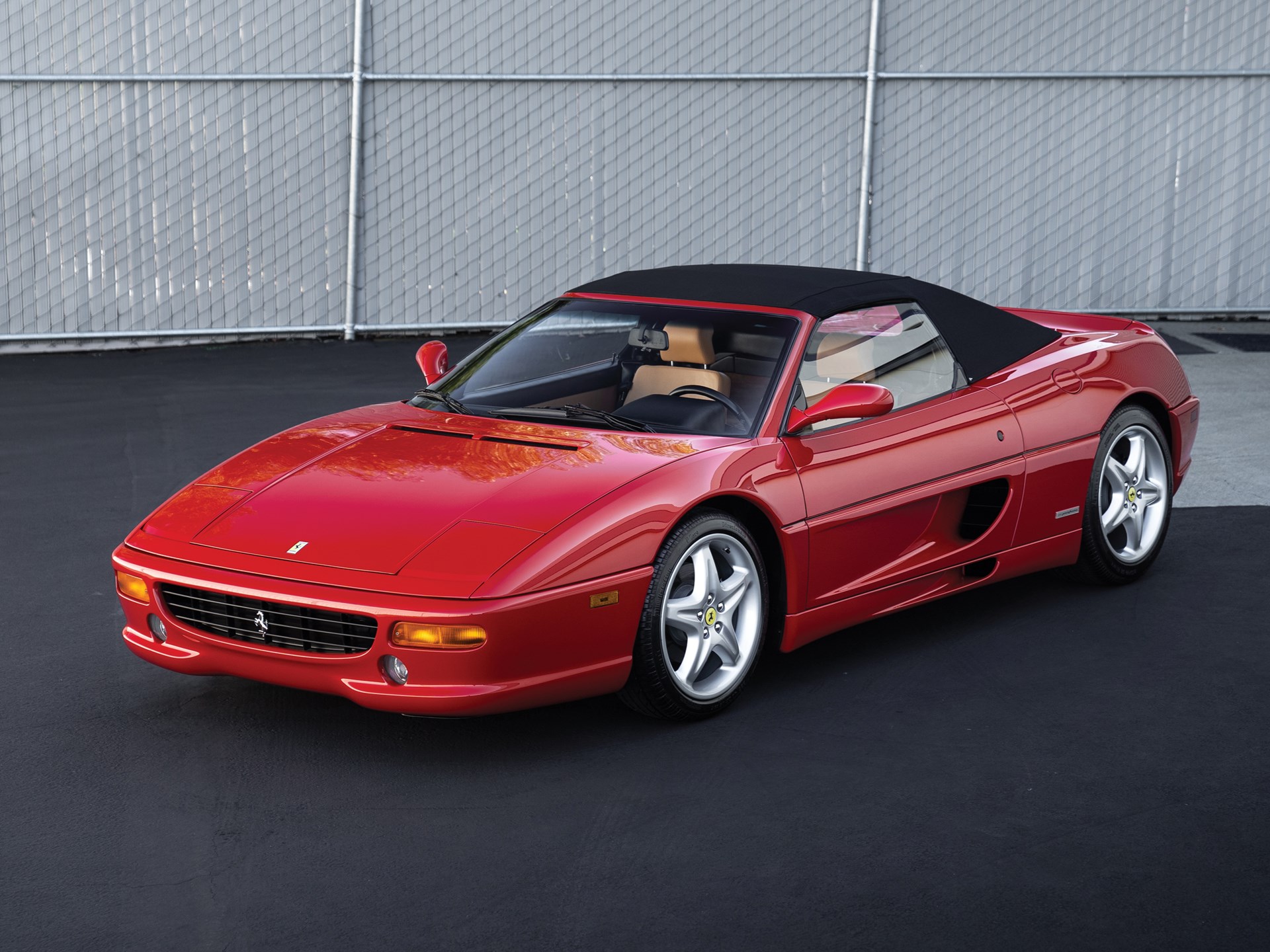
Lot 317 1997 Ferrari F355 Spider

1997 Ferrari F355 Spider For Sale

Chassis No. ZFFXR48A2V0107584
Estimate: $125,000 – $150,000
Offered Without Reserve

Offered from the Ming Collection, this is perhaps one of the lowest-mileage F355 Spiders in existence, showing just 704 miles from new. Having been recently serviced, this is the perfect opportunity to buy an as-new F355 for the individual who missed out on buying one in 1997.

Lot 364 1986 Ferrari Testarossa

1986 Ferrari Testarossa For Sale

Chassis No. ZFFSA17A9G0066469
Estimate: $150,000 – $200,000
Offered Without Reserve

No car epitomizes the 1980s as well as the Ferrari Testarossa. A desirable early-production “Monospecchio” Testarossa, this example is finished in quintessential Rosso Corsa over tan leather.

Lot 276 1967 Jaguar E-Type Series 1 4.2-Litre Roadster

1967 Jaguar E-Type Series 1 4.2-Litre Roadster For Sale

Chassis No. 1E 14936
Estimate: $150,000 – $200,000
Offered Without Reserve

Benefitting from just two long-term owners prior to 2015, this Series 1 4.2-litre E-Type coupe is finished in its original colors and retains its original engine. Opalescent Silver Blue is considered by many to be one of the most stunning colors on an E-Type, and this example does not disappoint.

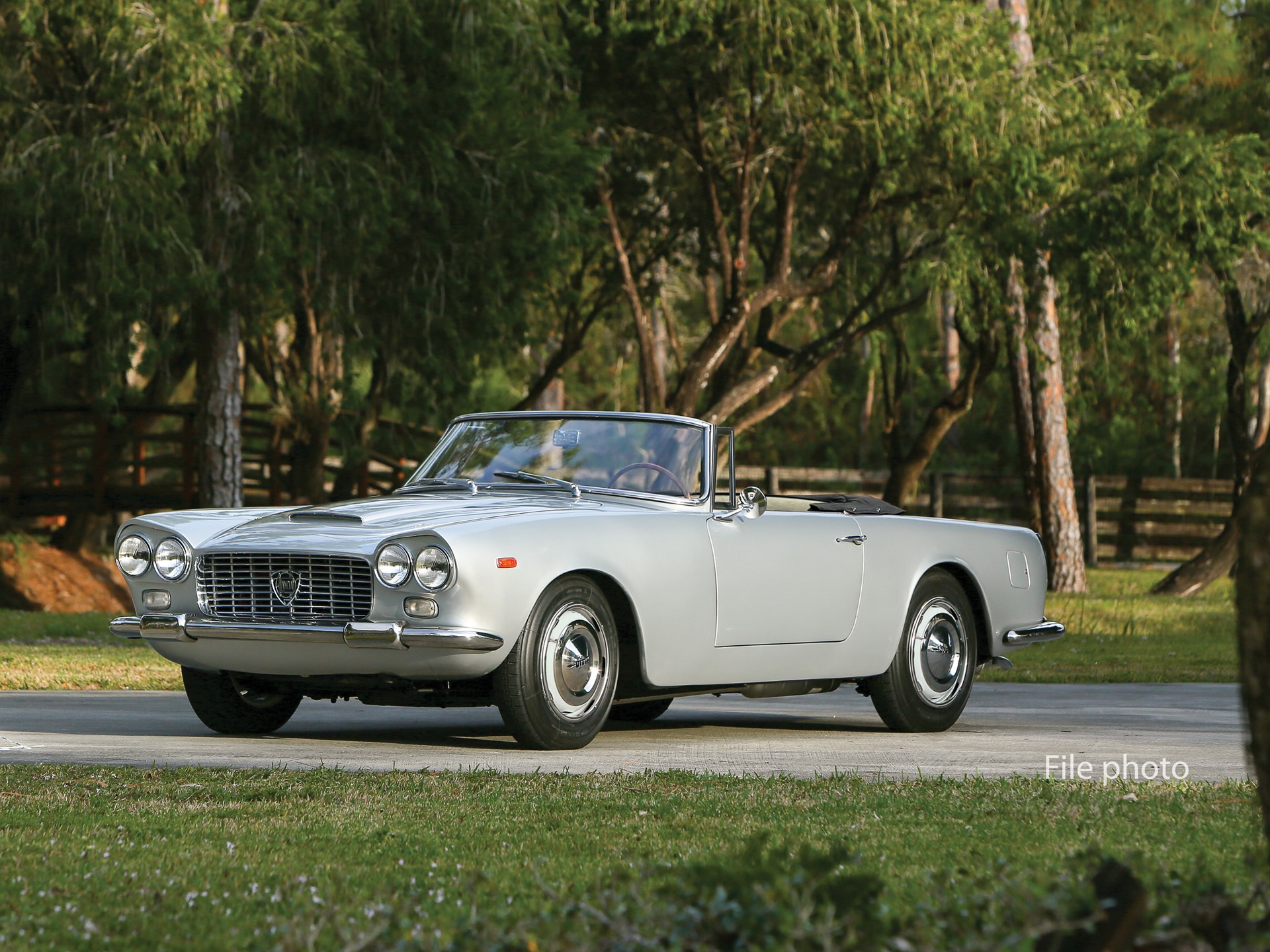
Lot 227 1960 Lancia Flaminia GT Convertible by Touring

1960 Lancia Flaminia GT Convertible by Touring For Sale

Chassis No. 824.04 1157
Estimate: $140,000 – $180,000
Offered Without Reserve

One of only 421 examples produced, this stunning Flaminia is a fine example of Italian design and engineering, boasting Touring’s cabriolet coachwork and a sophisticated 2.5-liter V-6 engine at its heart. This is truly la dolce vita at its best.

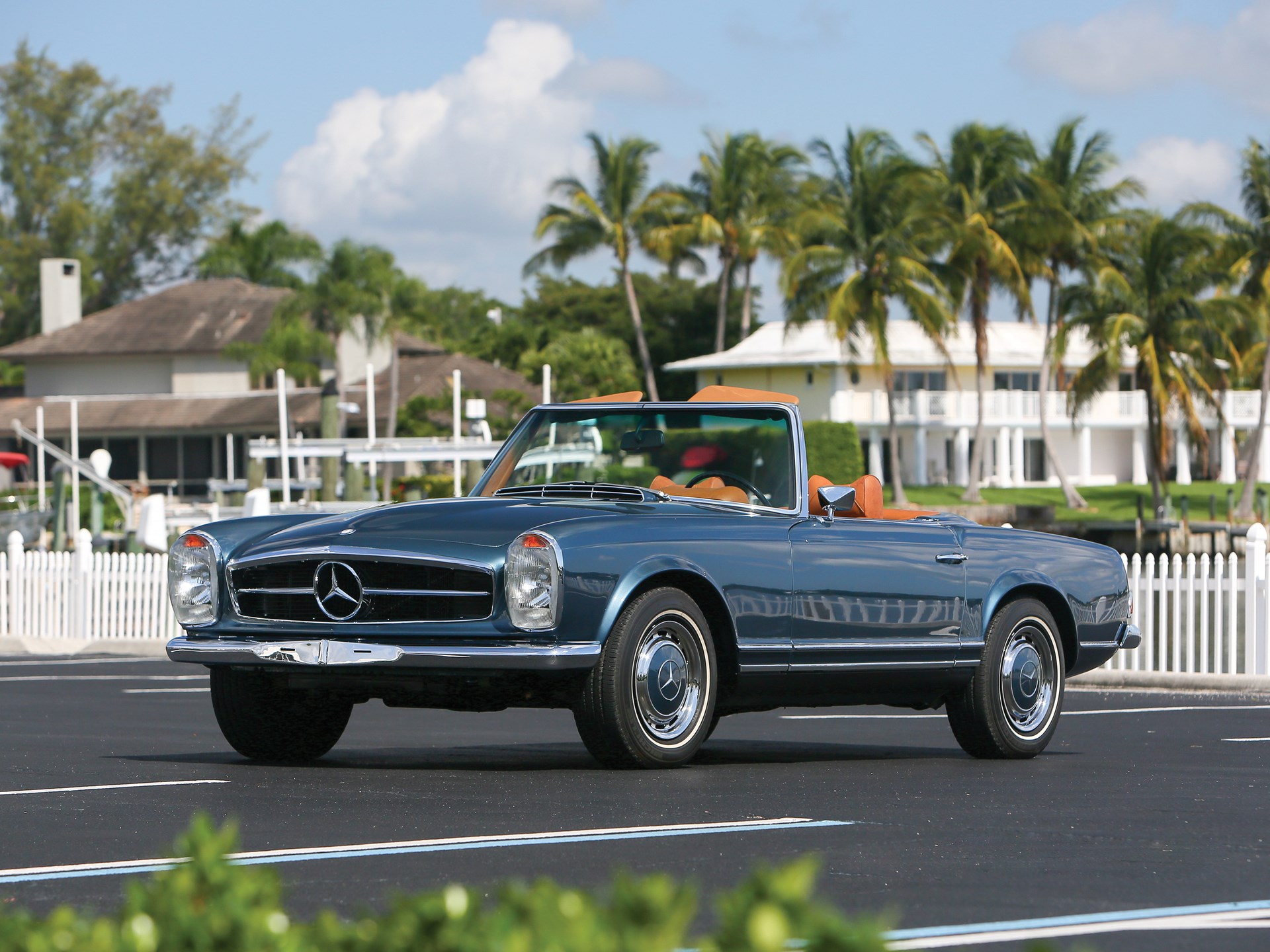
Lot 332 1971 Mercedes-Benz 280 SL ‘Pagoda’

For Sale 1971 Mercedes-Benz 280 SL 'Pagoda'

Chassis No. 113.044.10.022644
Estimate: $150,000 – $200,000
Offered Without Reserve

Fully restored by Mercedes-Benz specialist Mark Passarelli, this 280 SL boasts the desirable four-speed manual transmission and is equipped with a set of fitted luggage. A truly timeless design, the 280 SL ‘Pagoda’ is just as popular now as it was when it was first introduced over fifty years ago.

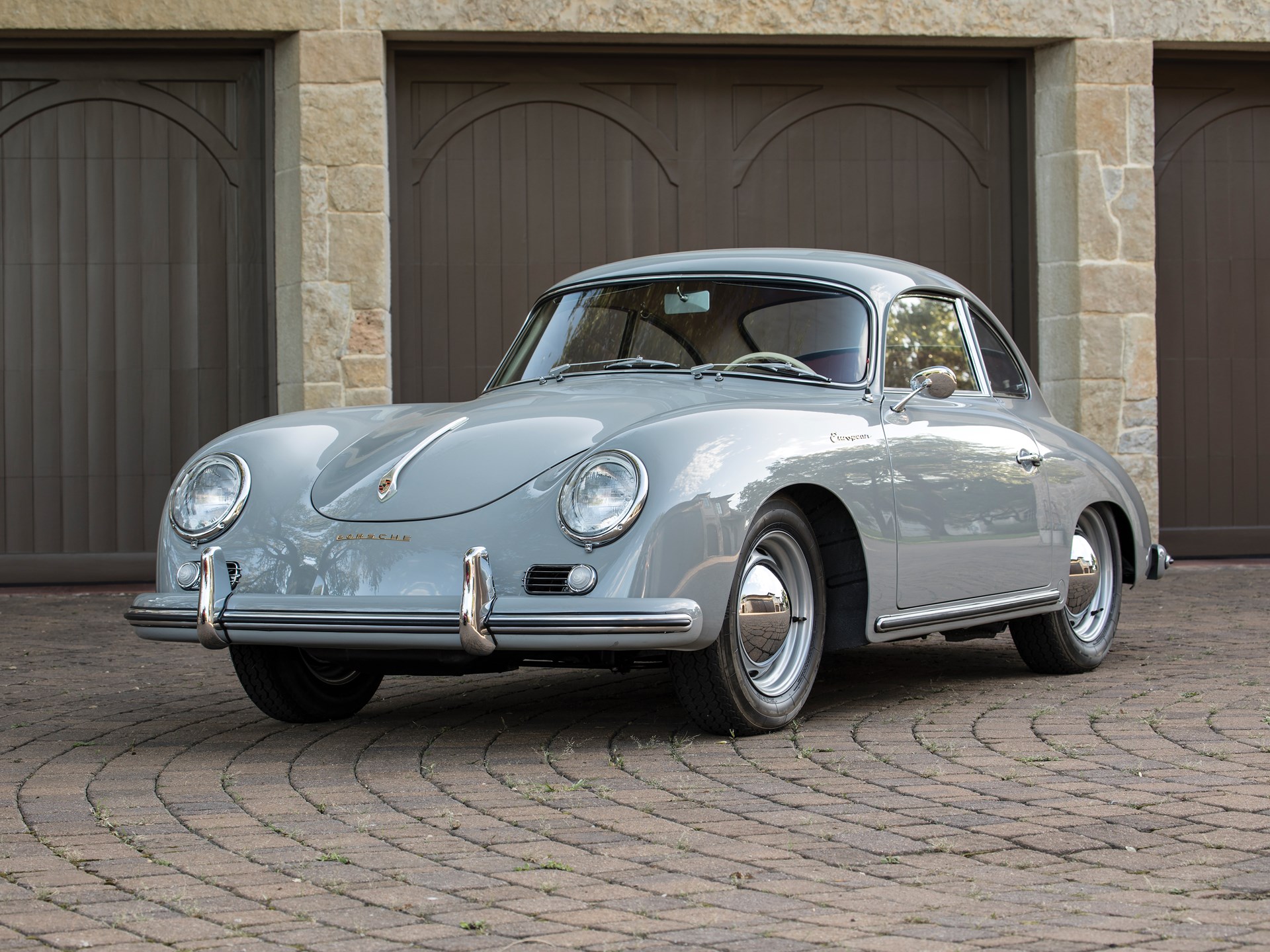
Lot 260 1956 Porsche 356 A European Coupe by Reutter

For Sale 1956 Porsche 356 A European Coupe by Reutter

Chassis No. 55425
Estimate: $150,000 – $200,000
Offered Without Reserve

An exceptionally early 356 A, just the 34th 1956 1600 coupe, this car was beautifully restored by marque specialists and was featured in Excellence magazine in May 2017, following a score of 296/300 points in PCA judging. Finished in beautiful Fashion Grey over Red leather, this is an exceptional Porsche in every way.

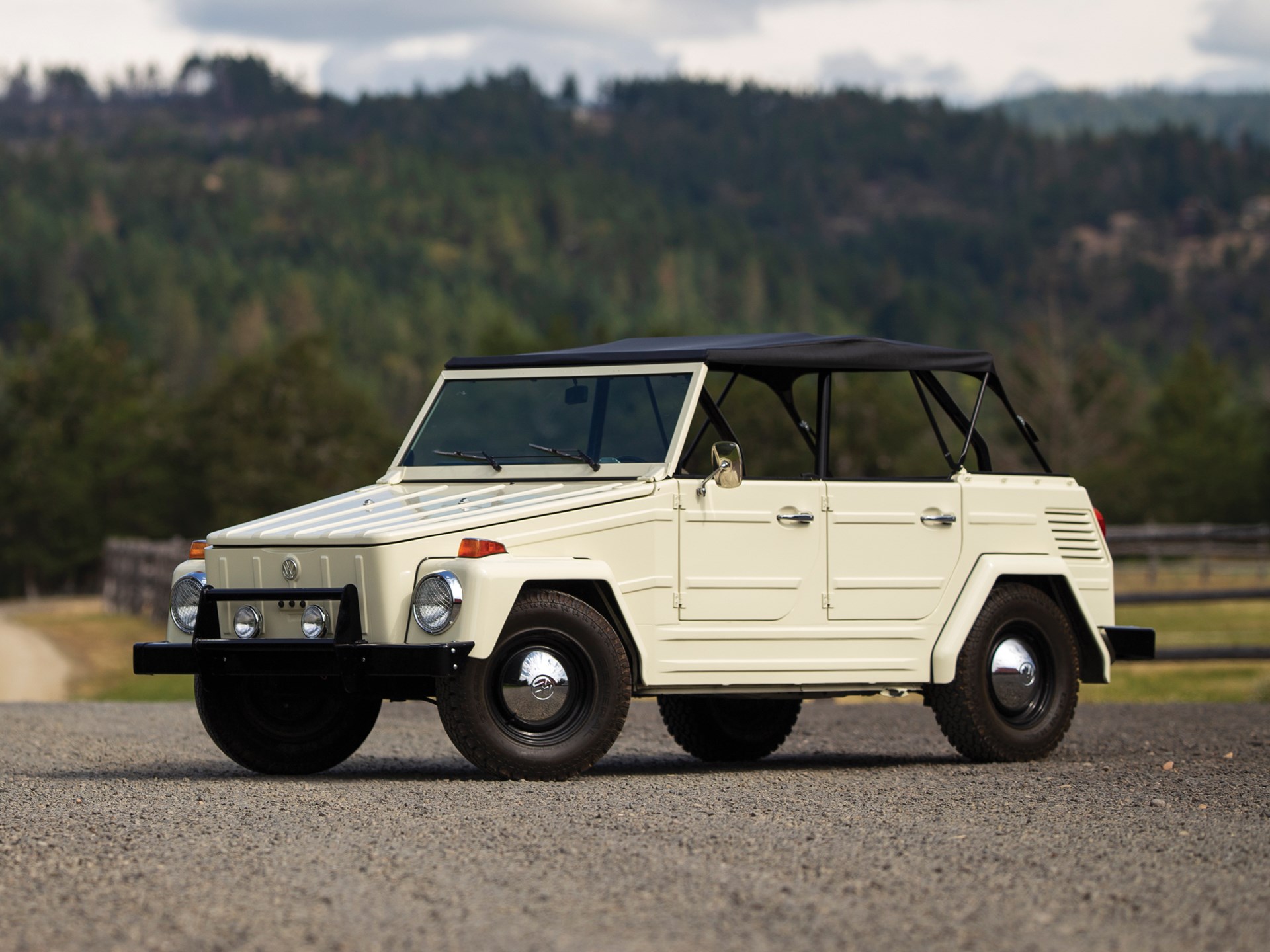
Lot 304 1973 Volkswagen Type 181 Thing

For Sale 1973 Volkswagen Type 181 Thing

Chassis No. 1833024537 E
Estimate: $25,000 – $35,000
Offered Without Reserve

Beautifully restored in Cream White over Black, the VW “Thing” is Germany’s more practical alternative to Citroën’s Mehari. A perfect warm-weather daily driver, this “Thing” will certainly attract only the most favorable of comments wherever it goes.

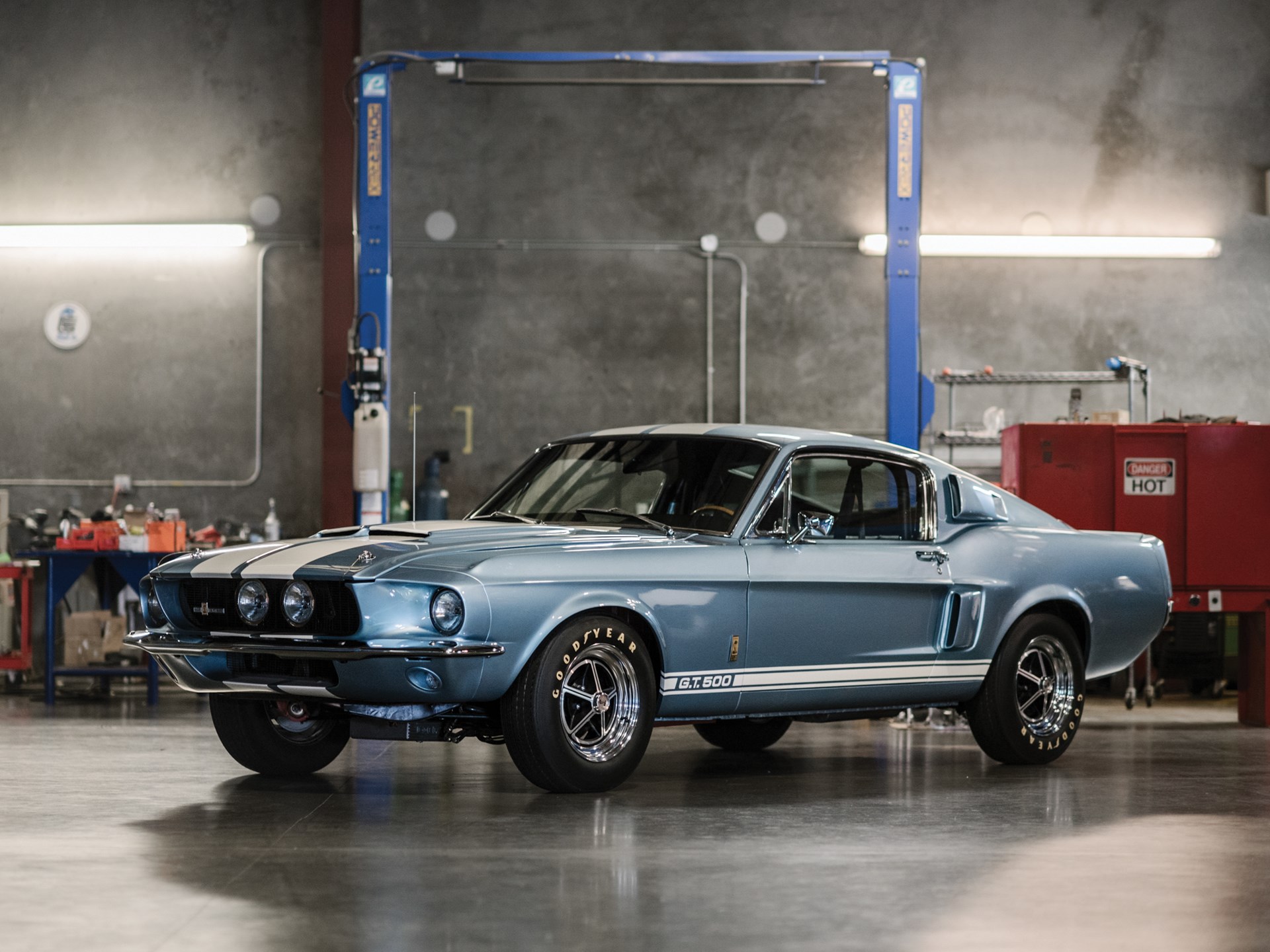
Lot 306 1967 Shelby GT500

For Sale 1967 Shelby GT500

Chassis No. 67402F8A00607
Estimate: $130,000 – $160,000
Offered Without Reserve

A remarkably original, unrestored example, this GT500 has called California home from new and was carefully stored for decades. Fitted with a 428 cu. in. V-8 topped with dual carburetors and mated to a factory four-speed, this is American muscle at its best.
GTSPIRIT NEWSLETTER

One of 58 Special Street-Legal McLaren P1 GTRs Is For Sale

For The Person Who Wants a P1 for the Road

If you’ve always dreamed of driving a McLaren P1 on the road, then you need to check out this P1 GTR that is currently for sale. Only 58 of the road-legal version of the P1 exist. Lanzante Limited is the company that handled the P1’s road conversion, and now the website Luxury and Expensive has listed one for sale, and it’s very yellow. 
McLaren originally built the P1 as a track-only car, but as you might expect something so cool and fast and innovative was eventually taken to the streets by folks with plenty of money to pay for the conversion. The British company Lansante Limited has worked with McLaren in the past and did so again to make the dreams of having a road-legal P1 a reality. 

The car in question here is number 34 of the 58 cars that underwent the changes needed to make the car legal for the road, at least in the European Union. Each of the street-legal cars is a little different, so no two are exactly alike. What doesn’t change, though, is the powertrain. All of the cars, including the one see here have a twin-turbo 3.8-liter V-8 and an electric motor. Together they put out 986 hp. 

So, what’s the price of this particular one? Well, if you’re worried about price, then you can’t afford it. The website says the price will be disclosed upon request. You can bet it will be more than the P1’s $1.15 million original price tag due to its exclusivity.