All posts in “Cars”

Toyota May Build a Land Cruiser Homage That’s Also Part Van

Once upon a time, Toyota  of the FJ Cruiser, a nostalgic homage to the iconic FJ40 Land Cruiser. That model ended production in 2014, but we finally might be getting a sturdy successor to that vehicle, and it’s also a super-practical van.

Reports from Japan translated by Jalopnik suggest a concept car called the TJ Cruiser will make it to production, and that Toyota could unveil the production version at the Tokyo Auto Show in October.

Toyota debuted the TJ Cruiser concept at the 2017 Tokyo Motor Show.  It was ostensibly a mid-size SUV shaped like a boxy van. A 108-inch wheelbase made it about two inches shorter than a 4Runner. (Per Toyota marketing, the T stood for “toolbox,” and the J stood for “joy.”) The production-spec TJ Cruiser will reportedly be an AWD hybrid and seat either five or seven passengers, instead of the concept TJ’s four.

The TJ Cruiser’s most distinctive feature was versatile fold-flat seats that could accommodate different combinations of people and gear. Folding the front passenger seat could offer about nine feet of length — enough to hold surfboards.  More compact and cost-effective than the Toyota overlanding campervan, such a rig would be perfect for outdoorsy types or young families.

One downside? The reports also suggest the TJ Cruiser might be a limited production run, with only 1,500 per month being made — which may mean it’s not bound for the U.S. market. But the TJ Cruiser would reportedly use Toyota’s global TNGA platform, which would make scaling up for international production easier. As with the factory manual edition of the Supra, a U.S. market TJ Cruiser may require relentless campaigning.

Audi’s New Electric Concept Is a Badass Futuristic Off-Roader

Like its sibling brands across the VW Group, Audi is going all-in on electric powertrains. That will mean 12 new EV models by 2025, and an array of intriguing concepts in the meantime to tide us over. On Monday, Audi teased its AI:Trail Quattro off-roader concept (which it styles “AI:TRAIL quattro,” for some reason) that will emerge at the Frankfurt Motor Show in September. Under cover of partial darkness, it looks incredible.

The German company offered few details about the car, but it presumably will run on the VW Group’s new electric MEB platform, like the VW Dune Buggy does. The “Quattro” indicates it will have some form of Audi’s trademark four-wheel-drive system. And while it’s hard to make out details, the AI:Trail Quattro’s cut-off fenders mean it somewhat resembles a luxurious version of a Halo Warthog.

Off-roading, as we’ve seen with burgeoning companies such as Rivian and Bollinger, will be a natural application for electric vehicles. Heavy battery packs permit balanced weight distribution and give the cars a low center of gravity. Immediate torque is a major plus. And capable off-roaders are popular right now, so they may be the best way for EVs to infiltrate the mainstream market.

There’s a small but possible chance the AI:Trail Quattro leads to a production car — perhaps with a bit less side-window glass, though. Let’s hope the next few years allows Audi enough time to rethink that brutally idiosyncratic capitalization.

Toyota’s 2 Best Off-Roaders Are Fresh for 2020

Overlanding and off-roading are not synonymous. The ballistic-missile ascent of the former term into the modern vernacular has left hardcore trail enthusiasts wincing at its ubiquitous misuse by the masses who simply guide their tires from asphalt to gravel and bop around a little. Overlanding and off-roading are about intent, not actions. When a remote journey itself, not the destination, is the purpose of the trip, you’re overlanding. And when you attempt to conquer mighty earthly obstacles, you’re off-roading.

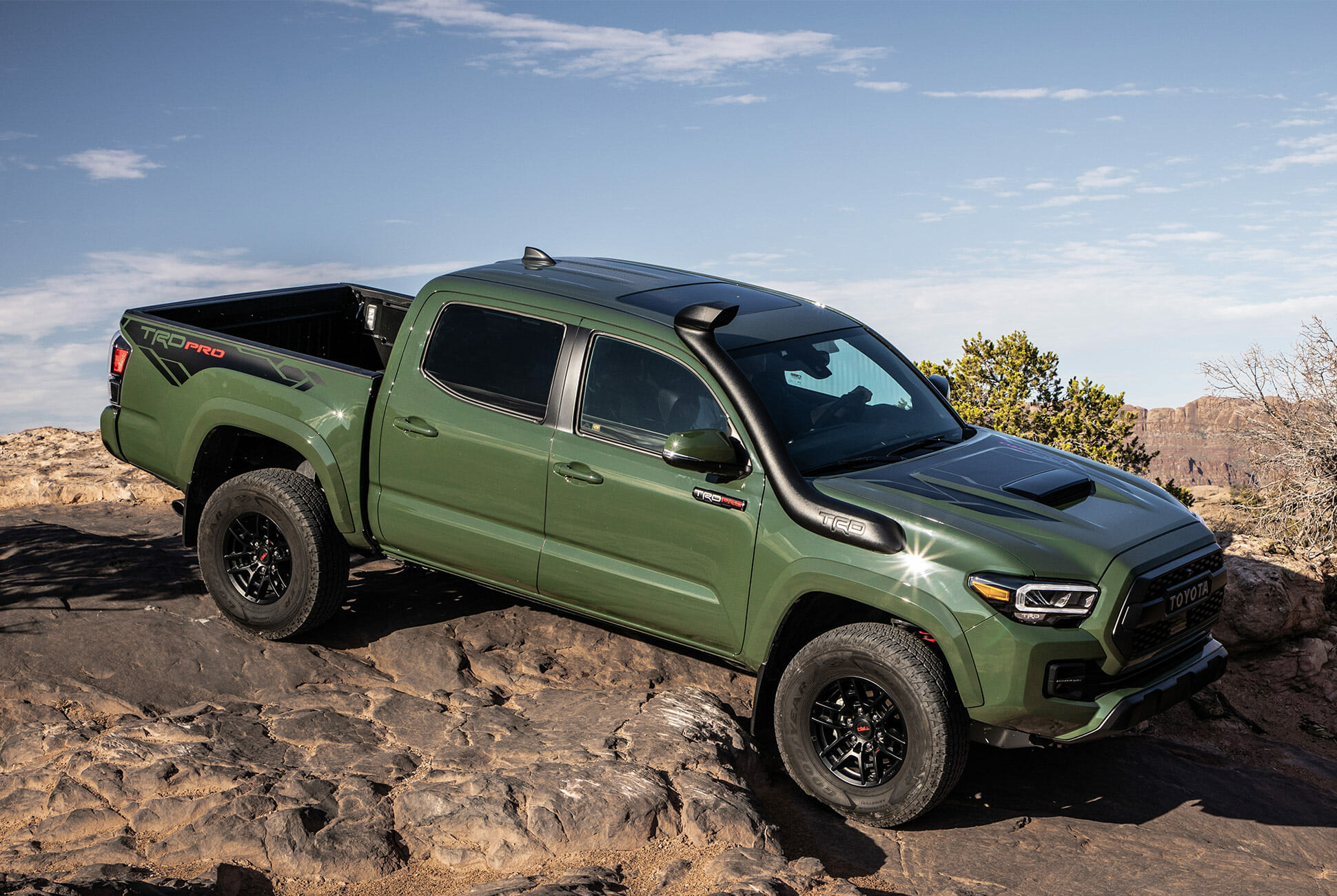
Informed denizens of the four-by-four community are quick to note that not all 4x4s are suitable for both endeavors. Toyota, however, builds two steeds capable of dominating both domains: the Tacoma TRD Pro and the 4Runner TRD Pro. Both have been treated to a light refresh for the 2020 model year. To sample them in their rightful element, we (along with a gaggle of other journalists) took them on an excursion across the American West, from the blistering Utah deserts to the lush Colorado mountains.

The Good: Reliability and durability are two defining attributes across Toyota’s entire lineup. The Tacoma and 4Runner have always exhibited both qualities in such spades that when it came time to reimagine them for 2020, it was hard to fix what’s not broken. The workhouse powertrains remain unchanged, as does the beefy exterior styling. So what is new? On the 4Runner, a TRD-branded cat-back exhaust system has been added. A redesigned instrument panel brings a touch of modernity to the spartan cabin, as does a honking 8.0-inch touchscreen multimedia display that now features Apple Car Play, Android Auto and Amazon Alexa capabilities. 

The same 8.0-inch screen and connectivity addition in the Taco breathes new life into the low-tech brute that launched in 2005 and has since gone largely unchanged, save for a 2016 update. The Tacoma also receives an eye lift in the form of new LED and Daytime Running Light headlights and the inclusion of LED foglights. Lastly, the helpful and effective Panoramic View Monitor (PVM) and Multi-Terrain Monitor (MTM) features both come standard on the new Tacos.

Who They’re For: No-frills adventure-seekers who’ll spend a considerable chunk of wheel time on unpaved ground. And people who will it drive often, on their way to the 250,000-mile club. Accordingly, the economically-minded will appreciate the low-maintenance requirements, long life expectancy and impressive resale value these vehicles offer.
Watch Out For: While the Tacoma and 4Runner are big strides forward, especially in the cabin, there’s still room for improvement in the creature-comfort department. The 4Runner remains sparse inside compared to rival SUVs. Despite being a beloved bombproof legend, the Tacoma has long suffered from a seat design that offers no real comfortable way for gangly-limbed occupants to comfortably rest. (The flat raised floor does afford better ground clearance off-road.) Toyota’s tried to address seating woes by bestowing the Taco with new 10-way power-adjustable seats; they help a smidgen but don’t rectify the issue. Lastly, there’s no telescoping wheel in the Taco, which is a true head-scratcher in this day and age.

Alternatives: Buyers of the Tacoma would likely cross-shop the Ford Ranger in Lariat trim (starting at $33,350) and the Chevrolet Colorado ZR2 (beginning at $42,000), while 4Runner prospectives would eye the Jeep Grand Cherokee (from $32,045) and perhaps the new Ford Explorer (from $36,675), though the Blue Oval wouldn’t stack up as well off-road.

Review: It was a withering 103 degrees when we hit the trailhead of Hell’s Revenge, a 5.5-mile off-road route nestled in the outskirts of Moab, Utah. The name doesn’t obfuscate what you’re about to undertake: The sinewy route is tricky and treacherous, riddled with boulders the size of dumpsters, cross-axle obstacles and steep hills that frequently leave you staring at the pristine blue sky.
As we queued up, seriously-kitted-out Jeep Wranglers streamed past — lifted to the sun, affixed tall jacks glistening. Our TRD Pros were bone-stock — a condition our fearless and affable trail guide Kurt Williams of Cruiser Outfitters claimed he’d never run here despite his 100-plus passes, though he had the utmost confidence we would emerge unscathed. (Even Williams’ lead vehicle, his own 2004 Land Cruiser, was modded with rail and rocker guards, a sizable lift, aftermarket shoes and custom bumpers, though he left the drivetrain untouched.) 

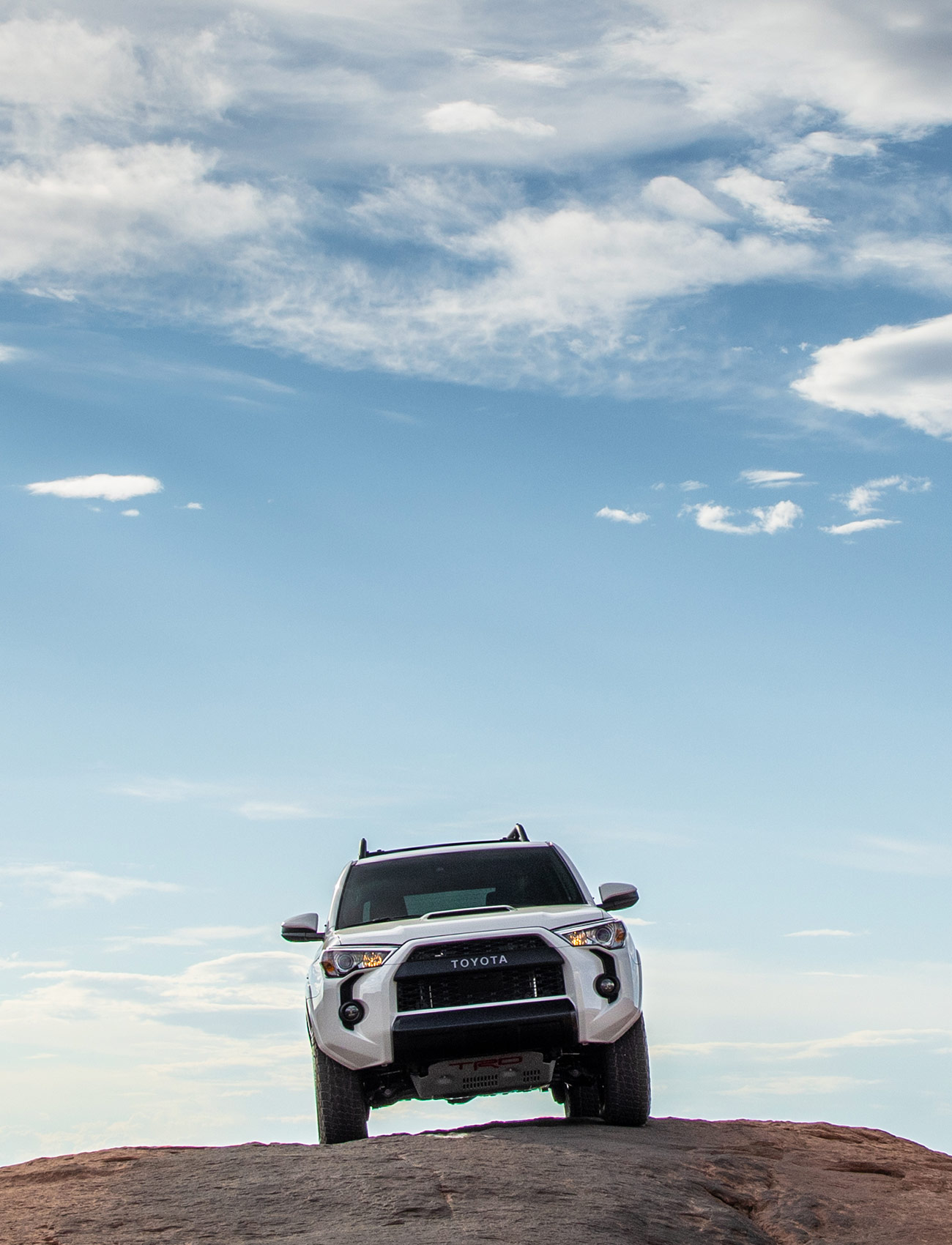
The mantra of off-roading is “as slow as possible, as fast as necessary.” So we inched our way forward in a 4Runner. On this harsh, undulating terrain, the body-on-frame SUV is at its best. The Nitto Terra Grappler tires — slightly deflated for the affair — offer impressive grip, and the 2.5-inch Fox internal bypass shocks that bestow an extra inch of lift over other 4Runner models will keep the sweat from beading on your brow as you crawl over everything in your path. The aging 4.0-liter, naturally-aspirated V6 offering 270 horsepower and 278 pound-feet of yank are more than sufficient, and you won’t use more than two of the automatic transmission’s five gears available while scrambling around off-road

The Multi-Terrain Select system lets you select from Mud and Sand, Rock and Dirt, Loose Rock, and Mogul and Rock modes. Each changes the brake-based torque vectoring to eliminate wheel spin, along with adjusting the throttle’s responsiveness. Coupled with an electronically-locking rear differential, you’re unstoppable. Ascending stretches where the gradient exceeded 25 degrees was a breeze, provided you’d locked the diff. (Fail to do so, and the 4Runner will shudder and skitter in place.)

The five-level Crawl Control system is a neat parlor trick that’ll help keep everything tidy by taking throttle and braking control out of your hands and allowing you to focus on steering and your line, but it’s more fun to modulate the pedals on your own. Loose steering and long accelerator pedal travel provide a nice buffer for you to find exactly the right amount of input, thus allowing you to keep trucking.

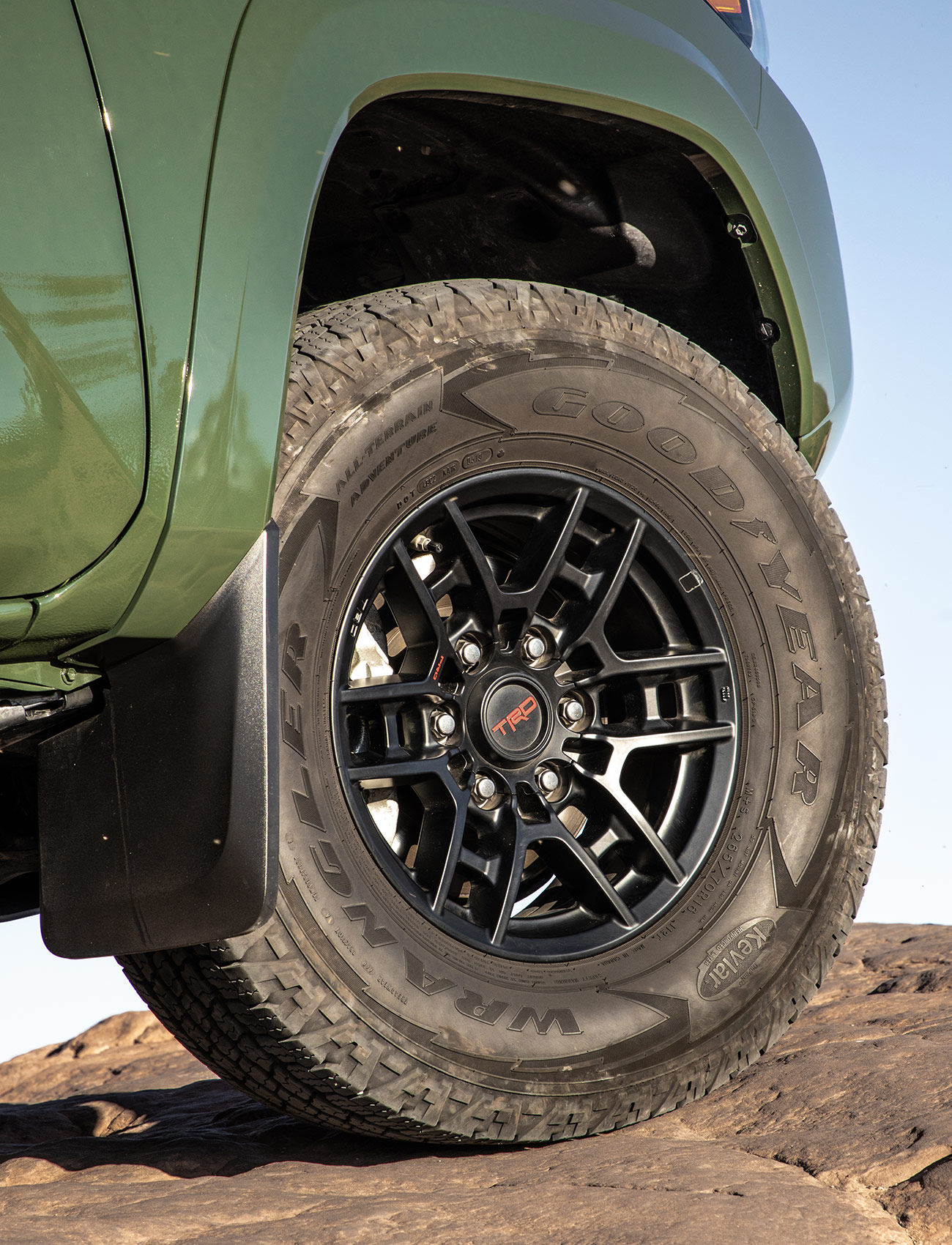
The short wheelbase of the 4Runner meant no trailer hitches kissed the umber Utah rocks. The lengthier Tacoma Double Cab, however, did make contact at a few points, albeit briefly — and no real damage was done. On Hell’s Revenge, the Taco shone bright, its surefooted prowess demonstrating why it’s such an icon in these conditions. It also enjoys the same lifted suspension and Fox shocks as the $Runner, and the 3.5-liter V6 mill good for 278 horsepower and 265 lb-ft of twist keeps you clambering forth with ease. Goodyear Wrangler All-Terrain Adventure 16-inch tires impart impeccable grip, even in slippery spots.
The PVM and MTM systems, which show the area around the vehicle via screen, are a kind feature that comes in handy when you’re climbing and the hood — sloped down a few degrees for better sighting — rises above the head of your trail guide. You can use the cameras to make sure you’re aimed the right way, and that your forward path is free of large obstacles. The downside is the pixelated resolution of the screen; it’s not crisp enough to see individual rocks in your blind spots, something engineers acknowledged they’d continue to tinker with. Still, you’re better off with the systems than without.

En route to Ouray, Colorado, we did some light pseudo-overlanding over the La Sal Mountains, where both the Tacoma and the 4Runner lapped up the gravel and dirt trails some 10,000 feet above sea level. Bashing around the loose surfaces was a hoot, but it was here that the transmissions started to show their age. The Taco suffers from incessant gear-hunting, seemingly never content with its own selection. It’s constantly rowing through the six-speed auto (this problem wouldn’t exist in the optional manual version);  just when it settles, you’ll inevitably need more power, forcing a downshift — and the whole process starts anew. Engineers have recalibrated the transmission recently, tweaking shift points for improved fuel efficiency, but a little more time spent here may benefit drive quality. The 4Runner’s gearbox is better, but hints of the same issue show under harder pushes.

Verdict: The final stretch of the trip was on the highways of Colorado. If you’re looking for a sedate and plush mile-logger, the Taco and 4Runner may disappoint. The same attributes that make them impeccable off-road leave something to be desired when it comes to pavement manners; there’s a bit of brake dive on both vehicles, and the loose steering becomes unwelcome at a highway clip. But the people who understand the intent of these immutable machines — the overlanding and off-road zealots seeking uncharted exploration and adventure — certainly won’t be disappointed by the 2020 4Runner and Tacoma TRD Pros in the least.

2020 Toyota 4Runner and Tacoma: Key Specs

Powertrain: Tacoma – 3.5-liter V6, six-speed automatic or six-speed manual, four-wheel-drive; 4Runner – 4.0-liter V6, five-speed automatic, four-wheel-drive
Horsepower: Tacoma – 278; 4Runner – 270
Torque: Tacoma – 265 lb-ft; 4Runner – 278 lb-ft
0-60 MPH: Tacoma – 7.3 seconds; 4Runner – 7.5 seconds
Fuel Economy: Tacoma – 18 mpg city, 22 mph highway; 4Runner – 17 mpg city, 20 mpg highway (2019 model)

Toyota hosted us and provided these products for review.

Read More Gear Patrol Reviews

Hot takes and in-depth reviews on noteworthy, relevant and interesting products. Read the Story
Note: Purchasing products through our links may earn us a portion of the sale, which supports our editorial team’s mission. Learn more here.

C8 Chevy Corvette Z06 rumored to get 800 hp and 700 lb-ft or more

Automobile has squeezed a few more rumors out of its news press, this time concerning the C8 Chevrolet Corvette. The whispers allege that sometime around late 2021, as a 2022-model-year offering, the eighth-generation Corvette Z06 will arrive with 800 horsepower and something like 700 pound-feet of torque, perhaps more. That mother lode of power will come courtesy of an evolution of Cadlllac’s 4.2-liter twin-turbo Blackwing V8. The engine won’t be called Blacking, as Cadillac has already made clear, but will likely adopt a generic GM name like LT7. This would make the next performance step in the Corvette lineup 305 ponies greater, with roughly 230 lb-ft more torque than one gets from the naturally aspirated, 6.2-liter V8 in the base Stingray.

There are years of insider intel to support this. If we go way, way back, Motor Trend reported in 2010 that the next Corvette would employ a brand new 5.5-liter V8, but the magazine was referring to the C7 generation. In November 2017, Corvette Forum discovered a leaked document from auto industry analysts IIHS Markit that broke down coming engine options for the Corvette and a Cadillac. The Automobile piece doesn’t mention a displacement for the Z06 motor, but it’s expected to be the 5.5-liter engine from the IIHS Markit report, with a maximum output of 850 hp and 720 lb-ft. The following month, Corvette Forum got hold of CAD drawings of what was labeled the Gen6 LT7. Then, last month, GM Authority got even more information on the TTV8 LT7, breaking down its similarities and differences to Cadillac’s related 4.2-liter Blackwing TTV8.

Another GM Authority piece, based on the Automobile report, presented a handy chart of step changes in horsepower from the C7 generation, and we’ve added the C6 performance variants:

  • Corvette C6 Z06: 7.0L NA V8 – 505 hp, 470 lb-ft
  • Corvette C6 ZR1: 6.2L Supercharged LS9 V8 – 638 hp, 604 lb-ft
  • Corvette C7 Stingray: 6.2L LT1 NA V8 – 460 hp, 465 lb-ft
  • Corvette C7 Z06: 6.2L Supercharged LT4 V8 – 650 hp, 650 lb-ft
  • Corvettte C7 ZR1: 6.2L Supercharged LT5 V8 – 755 hp, 715 lb-ft
  • Corvette C8 Stingray: 6.2L LT2 NA V8 – 495 hp, 470 lb-ft
  • Corvette C8 Z06 (rumored): 5.5L TT LT7 V8 – 800 hp, 700 lb-ft

Looking at the power increases from the ZR1 models to the next-gen Z06 models, 800 horses for the C8 generation is eminently reasonable. The coming Z06 will put on a sturdy range of mechanical and aero gear to harness every hoof in the corral, including wider fenders hiding larger rubber, active and passive aerodynamic features, and what should be an intense wing and diffuser package, the latter perhaps in mild and extravagant flavors. 

At the intoxicating end of Automobile‘s scuttlebutt, there’s a suggestion that Chevy could swap out the Stingray’s eight-speed dual-clutch trans for a 10-speed dual-clutch, and that the Z06 could get a manual transmission option on top of that. Since we’re already thrilled with the base Stingray, we’ll be more than satisfied with 800 horsepower. Everything after that is just ginormous cherries.

Thanks to Urus, Lamborghini Now Valued at $11 Billion

Bloomberg recently published a report on the Italian brand Lamborghini. Long seen as a competitor for Ferrari, the two have moved further apart in recent years with Ferrari pursuing a public offering while Lamborghini has remained under the wing of parent company Lamborghini.

As a result, Lamborghini has been able to benefit from group platforms with the release of an SUV, the Lamborghini Urus. The Bloomberg report focuses on the sale effect that the Urus has had. Last year, Lamborghini saw sales rise 51% to 5,750 units, including more than 1,700 Urus models.

This year, further improvements are expected with the U.S. leading the charge. The US market accounts for three times as many car sales as any other region.

These successes mean that Bloomberg’s analysts have placed a valuation of $11 billion. Of course, this means nothing in circumstances where Volkswagen Group has no plans to sell the Italian brand, yet it makes for some interesting comparison.

Ferrari closed on Friday with a market capitalisation (the value of all of its shares) of €26.83 billion making it more than two times as valuable as its competitor. Aston Martin, on the other hand, closed at £1.08 billion. With Volkswagen’s market cap at €71.53 billion, Lamborghini appears to have some value to the German behemoth!

GTSPIRIT NEWSLETTER

Challenges to Selling Your Car in the UK (and the Solutions)

Navigating the Tricky Car Sales Landscape

So, you’re trying to sell your car and you live in the UK? Well, as you likely know, this is no easy task. The car sales process is a long and arduous one, especially because the process can vary from person to person and sale to sale. Selling your car privately will often get you the best price, but it’s a huge hassle and takes considerable effort and time. It’s easy to get frustrated. 

With that in mind, we wanted to take a look at the challenges UK car owners who want to sell their car face and how they can overcome these challenges and find a buyer that’s willing to pay a respectable price. 

The Different Challenges Facing Sellers

selling your car in the UK Audiselling your car in the UK Audi

We chatted with the team at Motorway, a leader in car comparisons and car sales, to get a closer look at the challenges that car sellers face in the UK and how they can address these challenges. Here’s what we were told. 

Car Values

According to Motorway, many sellers overprice their car at the outset. This leads to few people being interested in their car and that means it can take a long time for them to find a seller if they do at all. “Most people simply do not know how to value their car correctly and therefore how much to sell it for,” a spokesperson told us. 

Where Should You List Your Car?

There are many places to list your car for sale in the UK. There are many sites that offer eBay-like listings and this means buyers and sellers have several options. This can make finding the right place to list your car troublesome. You have to deal with shady buyers, work around other people’s schedules, and list your car and your personal contact information. 

There are also, a large number of scams out there that target people selling cars. According to Motorways, you need to take the time to vet the website you decide to work with. Find out what other sellers’ experiences were like. Would they do it again if given the chance? How smoothly did the process go? These are all things you need to find out ahead of time. 

Should You List Privately? 

Listing privately can yield the best deal in some cases, but it’s also time-consuming and a hassle. According to Motorways, many sellers find that going through a service like the one the company provides is a much better experience and often just as much money as they would get selling their car privately. 

Are You Ready to Deal with the Buyers?

If you do want to sell privately, you’re going to find it more difficult. You have to list the car, take photos, prep it for the sale, etc. This is only half the battle. The other side of things is dealing with potential buyers. You’ll have to work with people you don’t know, find a place or a way for them to look at the car if you don’t want them coming to your home, and then you need to be sure you get your money.

If you’re meeting in person, this is easy. If you’re not, then there’s always the question of if the money will come through, and it’s important to only sell a car through a reputable service of some kind. Never take someone at their word when dealing with a car sale. Double-check things and do your best to avoid any issues. This is why it makes sense to work with a dealer or a company that will connect you to the right buyer. 

The Solution to Selling Your Car in the UK

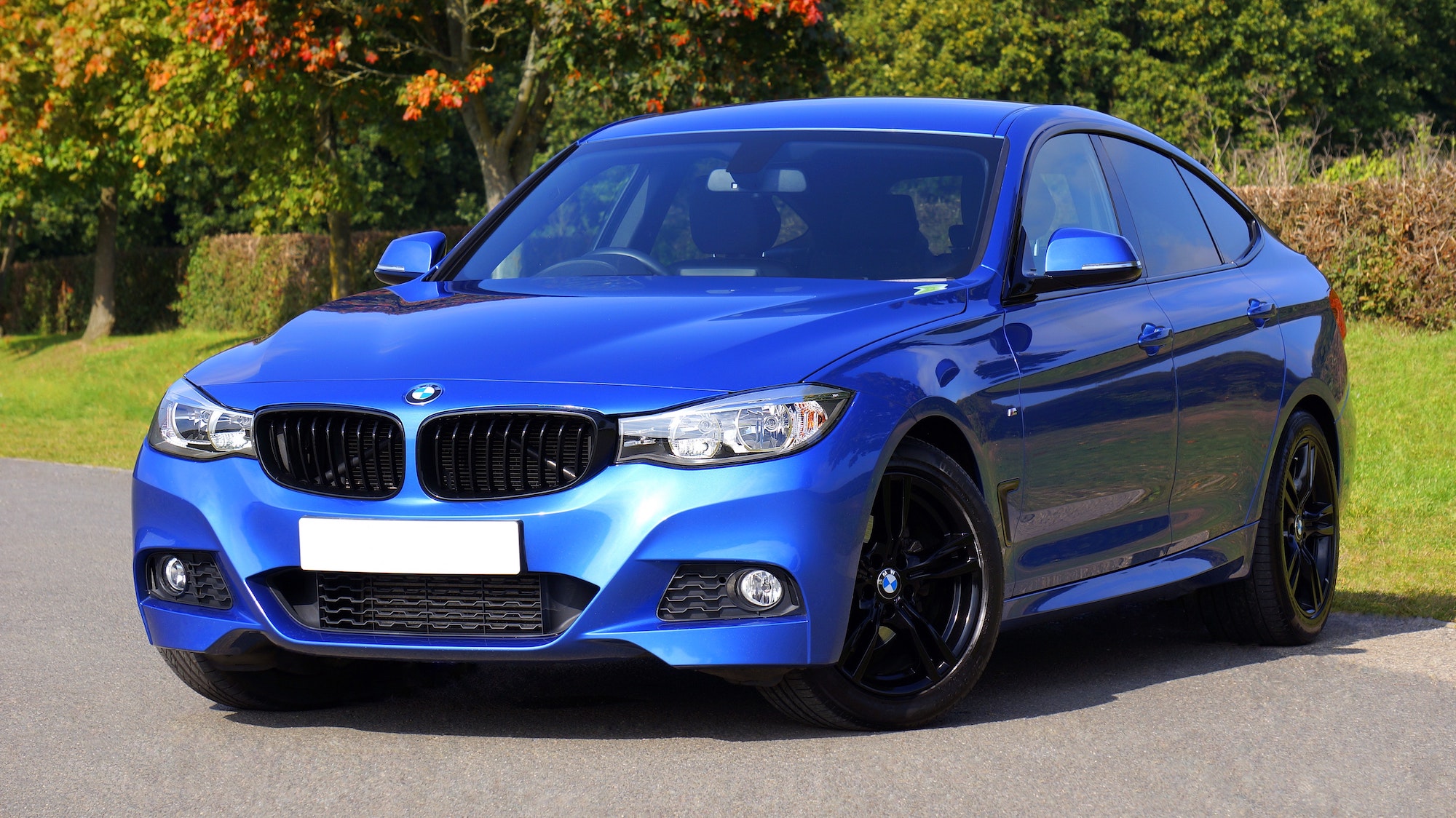
selling your car in the UK BMWselling your car in the UK BMW

What’s the solution? First off, research your car ahead of time to see what the true value is. From there, you should give your car a deep clean inside and out and prep it for the sale. You also need to find any and all documentation for the vehicle. Finally, you need to choose a good service that will give you the best options and deals. This is where things get tricky and where many people turn to websites that will offer to purchase or help them with the sale. If you’re at this stage, Motorway is a smart choice.

Once you provide your car’s information, the website will provide you with deals to choose from. There’s no meeting with potentially shady buyers or finding a way to make sure you get your money. Motorway will collect all the information on your car and then give you some quotes that you can choose from. From there, it’s a matter of setting an appointment for the car to be picked up or dropped off, and then you collect your money. It’s quick and simple. 

The 2020 Audi RS6 Avant is Coming To America

For model year 2020, the United States is finally allowing Audi to bring their heretofore Europe-only RS6 Avant wagon to our shores. This fully updated 591-horse super wagon is powered by a twin-turbo V8 which delivers some pretty sick numbers: 0 to 60 in 3.6, top speed of 190+ w/optional Dynamic Package Plus. The RS body is wider overall by 1.6” than the standard A6, plus features adjustable sport suspension, a racy exhaust system, and that sinister RS body kit.

Here’s a Look at the Porsche Taycan’s Interior

The Electric Porsche’s Cabin Is Gorgeous

The Porsche Taycan is the company’s first all-electric car, and it will be an impressive machine by all accounts. The company will reveal the car in full on September 4 of this year. That’s not far away, and the company has been teasing the car recently to great fanfare. The most recent teaser sent out were some shots of the car’s interior. 

Technology Everywhere

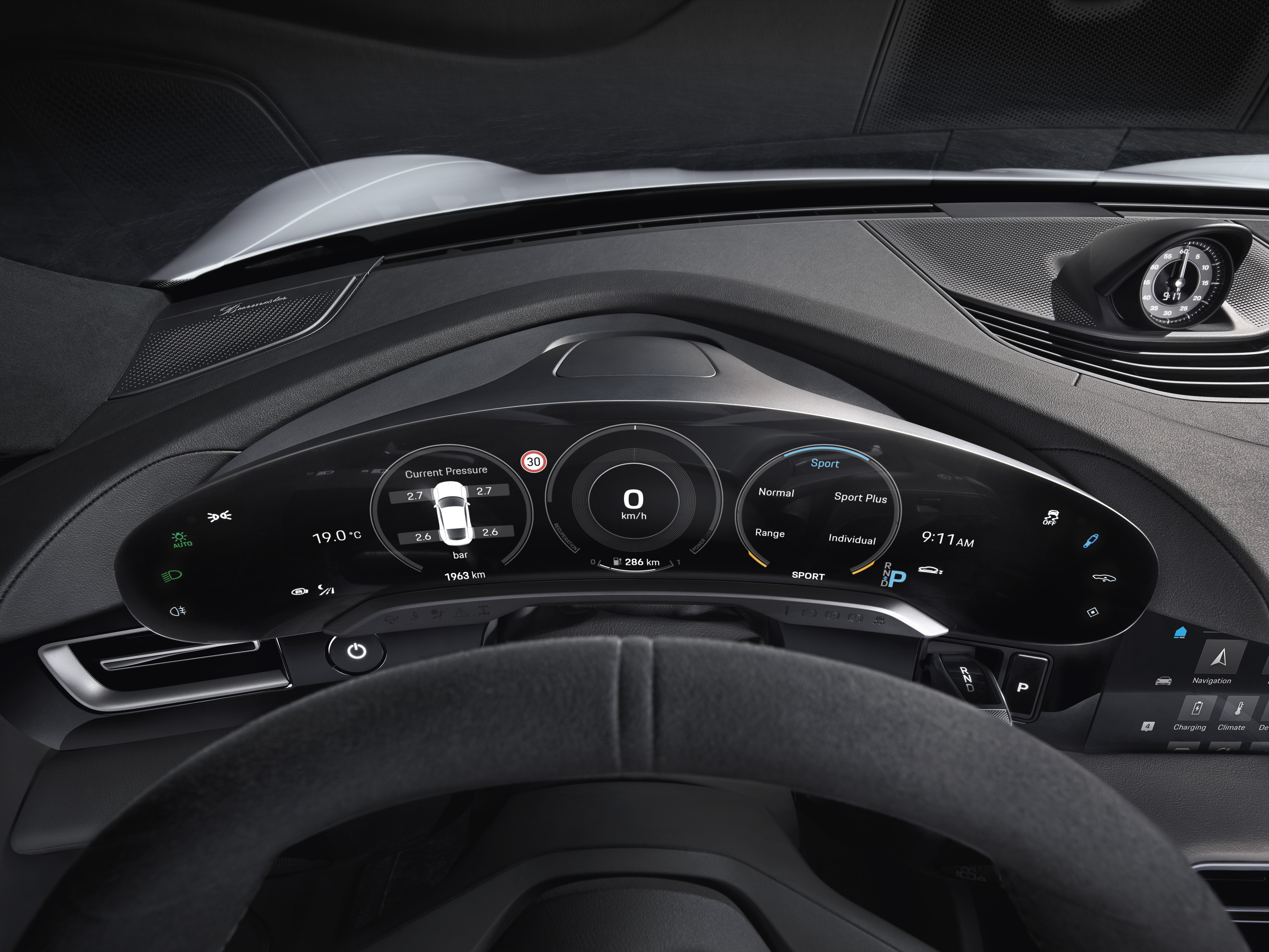
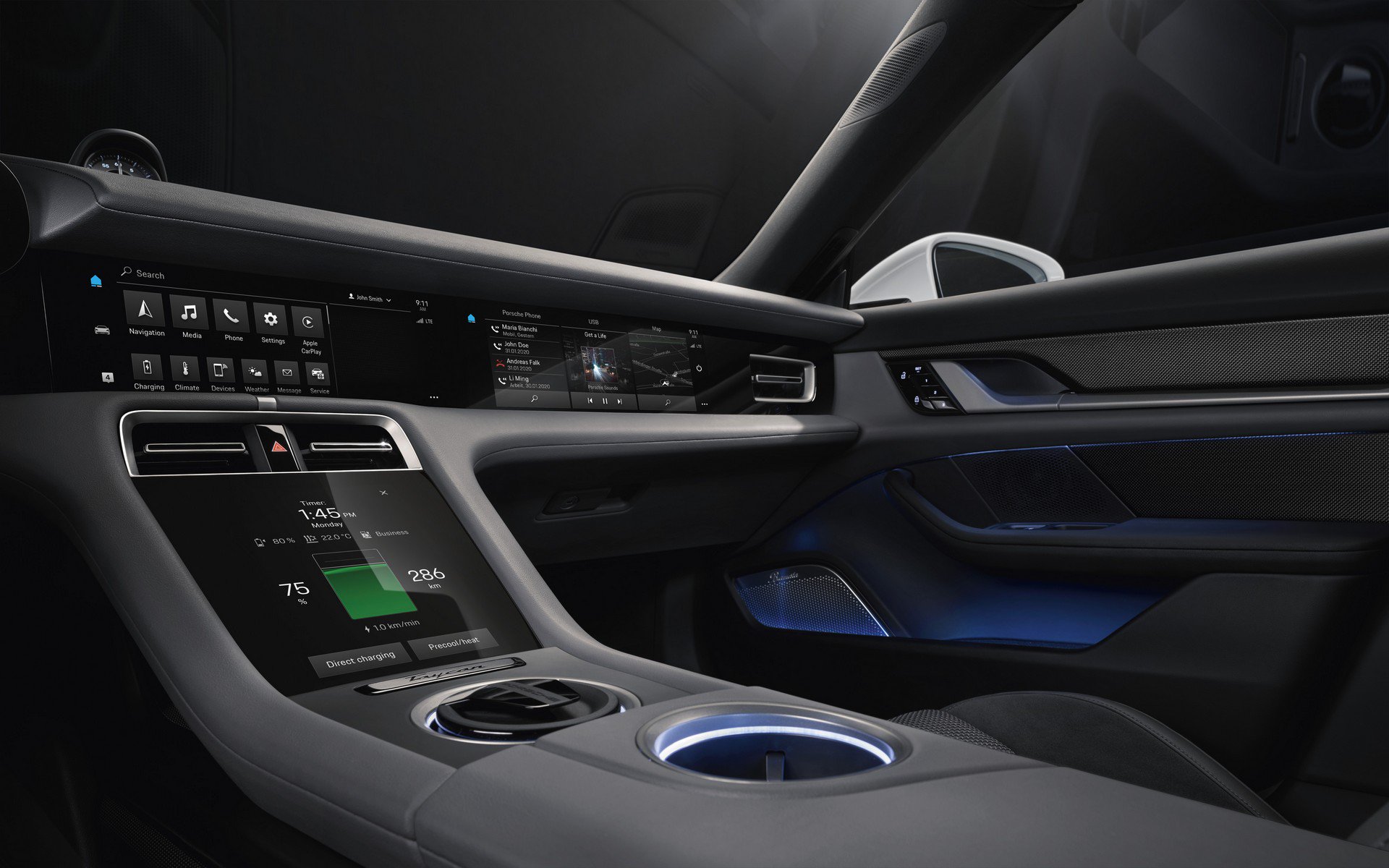
You might expect the cabin of the car to be pretty tech-savvy, but there’s even more than we thought. The cabin is completely full of screens and advanced technology. There are four different screens on the dash and center console, including a digital instrument cluster. The passenger gets their own touchscreen. 

The digital instrument cluster is a massive 16.8-inch curved display that uses real glass with a vapor-deposited, polarizing filter. This makes the cluster anti-reflective. By doing this Porsche could get rid of the unsightly cowl over the cluster that so many cars have. To either side of the instrument cluster are some touch buttons for basic controls like the lights and driving settings.

2020 Porsche Taycan Interior2020 Porsche Taycan Interior

The main, central infotainment screen measures 10.9 inches. It provides access to Porsche’s user interface and gives you access to apps, navigation, phone connections, media, comfort settings, and Porsche Connect. Below this screen is another with haptic feedback. It’s an 8.4-inch screen used for the climate controls and offers a handwriting area. This means you can write in an address you want the navigation system to use. 

The screen in front of the passenger is for just the passenger. It won’t even turn on if the driver is the only one in the car. TechCrunch reported that Porsche is playing with the idea of having it stream video, but right now it’s just for making adjustments to settings that impact the passenger. 

Minimalistic Interior

2020 Porsche Taycan Interior2020 Porsche Taycan Interior

The overall design of the cabin is minimalist. Porsche stayed true to its roots for the most part. The lines of the interior are simple and actually look considerably similar to the 911. This is no surprise. Why mess with a good thing? The 911’s interior is handsome and recognizable, and it makes sense for the Taycan to follow suit. 

When it comes to interior materials and colors, you can expect some of the best. Porsche will have wood trim, matte carbon, aluminum, fabric, and leather in it. You can get a leather-free version if you’d like. The car also comes with your choice of three color schemes: black-lime beige, blackberry, Atacama beige, and Meranti brown.

The Taycan’s interior lives up to the hype of the overall car for us. With the interior looking so good, we can’t wait for the rest of the car to be revealed in September. 

‘We’ve Got the Formula:’ Bentley’s CEO Talks the Future of the Luxury Brand

Adrian Hallmark looks pretty much exactly like you’d expect the CEO of Bentley Motors to look. Middle-aged, square-jawed and broad-faced, he’s the sort of generically good-looking British fellow who you’d see playing M in a Bond film before Dame Judi Dench owned the role.

He’s also holding the reins of the company at a pivotal moment in time. Bentley isn’t just celebrating its 100th birthday this year; the brand is celebrating its centenary with what Hallmark himself described to Bloomberg as “probably the worst year in our history” squarely in its rearview mirror.  And the road ahead is a twisty one; parent company Volkswagen AG is pushing full steam ahead into electrification, with plans to invest $91 billion in electric cars and tech in the near future in order to crank out three million EVs a year by 2025.

For a brand based around the idea of grand tourers designed to drive for days on end at high speeds, pushing into electric cars — which, for all their rapidly-gaining capabilities, still can’t come close to the range of their internal-combustion equivalents, let alone the “recharging” time of a $500 hooptie — seem like a honker of a pill to swallow. Hallmark, for his part, isn’t in denial about the challenges. In order to work for Bentley, the CEO says, batteries need to reach parity with the range and performance of the carmaker’s current gas-powered cars.

“We don’t see anything until the mid-2020s that’s big and strong enough for our needs,” Hallmark says. “We would need probably a 150-kilowatt-hour battery to propel something the size of a Flying Spur or a Bentayga.” (The largest electric car battery currently used, for the record, is the 100-kWh unit in top-trim Tesla Model S sedans and Model X crossovers.) A slightly smaller battery could be practical, he hedges — “We can maybe get 130-135 kWh” to work, he says — but that would have to be in part due to better battery management technology as well as bigger electron tanks, so to speak. 

Vero eos et accusamus et iusto odio dignissimos ducimus qui blanditiis praesentium voluptatum deleniti atque corrupti quos dolores et quas molesti Photo by John Doe.

Also — new types of electron tanks. The current type of battery technology commonly used — lithium-ion, which use a liquid electrolyte to carry charge around — just doesn’t have what it takes, at least for the Flying B. “Lithium-ion is not the long-term solution. Full stop,” Hallmark says. “We’re looking forward to solid-state.”

Solid-state batteries, unlike lithium-ion, don’t have a liquid component, instead using solid materials such as ceramics as conductors for electricity; this can make them both safer and more power-dense than other, more traditional batteries, but the technology is still in its infancy compared to the power packs found in iPhones and TeslasTo that end, the VW Group has invested in a solid-state battery startup called QuantumScape, whose work should be ready for production car integration by 2023-2025, according to Hallmark. (Hence, presumably, why Bentley has locked onto a target date of 2025 for launching its first pure electric car.)

It’ll still be more expensive than li-ion, as the common battery type is abbreviated, but Bentley’s positioning near the top of the market means it can lead the way for the whole VW Group on the new tech. “In a $250–$300,000 car, people can afford to carry that premium,” Hallmark says. 

And in spite of what you might assume, while Hallmark claims Bentley’s customers aren’t particularly jazzed about self-driving cars — “I wanna be the last customer in an autonomous car” is the sort of remark they often drop in research clinics and casual conversations alike, he says — they are enthusiastic about the idea of EVs. Every two years, Hallmark says, the company does a survey of 1,500–2,000 current and potential customers; over the last four years, interest in electric cars jumped from just 8 percent to a whopping 40.

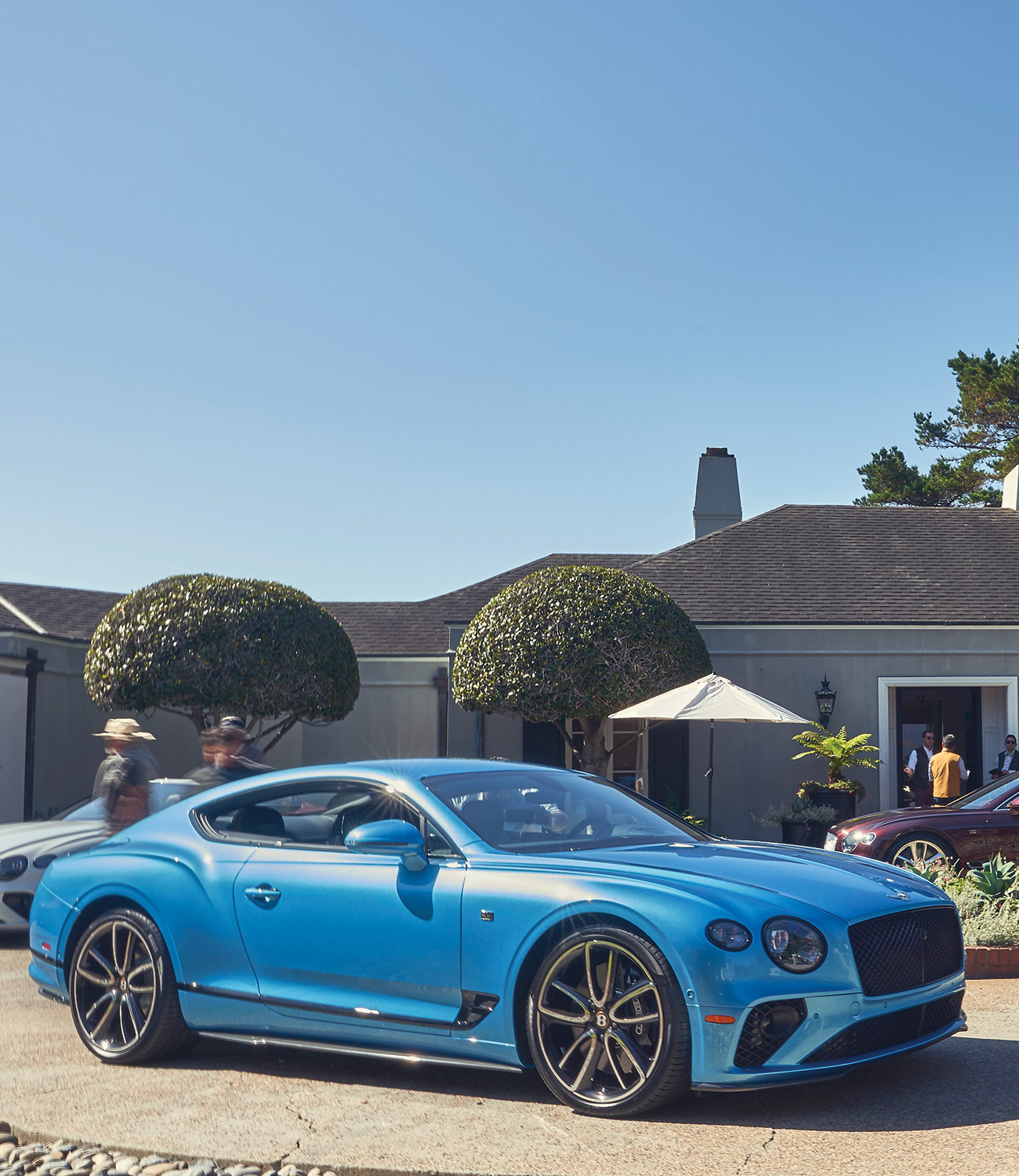
Hence, in part, why the EXP 100 GT concept car — unveiled last month and shown off to the public at Monterey Car Week — is powered by electrons, not fossil fuels. But the choice of powertrain is hardly the only thing differentiating that idea of Bentley-circa-2035 from the new Continental GT coupe parked next to it at The Quail. Sustainable materials make up a far greater chunk of the car than current models: the interior uses 83 percent less leather than a modern car would, subbing in upholstery made from winemaking-sourced grape skins that would otherwise be discarded; cotton from a farm in the north of England makes up much of the rest of the insides.  It’s all part of a broader vision for the super-luxury brand’s future, one that holds sustainability as a watchword as much as elegance and craftsmanship.

“It’s not tokenism,” Hallmark says. The brand already uses sustainably-sourced wood appropriated from trees that fell on their own, but going forward, the CEO says the company might even invest in buying entire forests — partly to guarantee a supply of hardwood, yes, but also to help offset the company’s own carbon emissions. The goal, he says, is to make the company carbon-neutral by 2023, balancing out emissions on every continent from both the vehicles they sell and the facilities that build them. (The Bentley factory in Crewe, he says, will be the second one in the entire VW Group to negate its CO2 footprint.)

“We have to reinvent Bentley,” he says.“If that appeals to vegetarians, carnivores, velociraptors, I don’t care. As long as they’ve got a driver’s license.”

“The potential is huge,” he adds. “The next 100 years, although we have to redefine everything, we’ve got the formula.”

In the short term, however, that means hybrids. The Bentayga is first; the 3.0-liter-turbocharged-V6-and-17.3-kWh-battery plug-in hybrid goes on sale towards the end of the year. Every model in the portfolio is ripe for partial electrification, however — though Hallmark admits the Mulsanne won’t be able to integrate a battery and electric motor until a new version replaces the current one, which has gone largely unchanged since its 2010 debut. (“Where the petrol tank is probably the worst place for electrification,” he says.)

It isn’t just hybrid tech that’ll be coming to the existing lineup. Hallmark says the company’s current four models have room to develop further; “there’s a lot more innovation we can do with each of those models” than with new ones, he says. Faster versions and longer wheelbases could both be in the cards, he says — the latter, presumably, reserved for the likes of the new Flying Spur and future Mulsannes. 

One addition you shouldn’t expect to see: a Bentley hypercar. While Hallmark admits it’s the sole high-end automotive segment that’s been growing in the last decade and a half that the brand doesn’t play in, the brand’s VW Group cohorts Bugatti, Lamborghini and Porsche already own the space well enough.

“As a group, we don’t need a fourth member of the family sharing the same chicken,” he says. 

One pool where Bentley still sees a place to dip its toe, however: one-offs and limited-run models. They’ve been both a sales success and a media boon for other brands in the group (and elsewhere), yet so far, the crew from Crewe hasn’t done much in the way of those high-margin specials. That seems likely to change.

“We’ve got some ideas,” Hallmark says. “You can expect some positive news,” he adds, before mentioning that we won’t need to hold our breath too long. “It’s months, rather than years.”

Lease a Jeep Gladiator, It’ll Be Cheaper Than a Wrangler

The Jeep Gladiator has received stellar reviews. Experts predict the new midsize pickup truck will outperform both the formidable Tacoma and the Wrangler on the resale market. That’s great news if you’re leasing.

We’ve seen incredible Gladiator lease deals pop up on Jeep’s website (and off it). Now, a CarsDirect analysis shows the Gladiator is expected to have 18 percent greater residual value than the Wrangler after 36 months. Which means rthat, despite the higher sticker price, the Gladiator is cheaper to lease than the Wrangler.

CarsDirect looked at automatic transmission-equipped base models of the two. The Gladiator Sport’s MSRP of $37,040 is more than the base Wrangler Unlimited’s $36,235, yet the effective lease for the Gladiator ($363 per month) is seven percent lower than that for the Wrangler Unlimited ($391 per month).

The effect is particularly significant when comparing the Gladiator — admittedly, slightly unfairly — to the two-door Wrangler with a lower residual value. The Gladiator is $5,500 more expensive than the base Wrangler Sport ($31,540). But, that base two-door Wrangler’s $438 monthly lease is $75 per month higher. Moral of the story: Do not lease a two-door Wrangler.

One slight caveat is that Jeep’s response to the Gladiator’s popularity has often been to option ones found on dealerships out to the max to ramp up prices. Bare-bones base models will be hard to find. (My closest dealer, for example, does not have a single Gladiator priced under $45,000.)

There’s a New Orange Supra in Fast and Furious 9

The Orange Sports Car Returns

We kind of can’t believe they’re shooting the ninth Fast and Furious movie. With that said, you have to admire the franchise for how it has helped to popularize performance cars. While these movies might not be amazing cinematic masterpieces, they’re darn enjoyable to watch and filled with plenty of beautiful cars. 

According to the Instagram profile @_pw40_ a new orange Toyota Supra will appear in Fast 9. The user posted some images to the profiled showing the car being unloaded at the set of the movie. There’s also a video of the car during the filming of a chase scene. 

The Instagram profile is a tribute page to Paul Walker. Walker famously drove a previous generation Supra in the first film. The orange Supra in the new film will mark the return of an orange Supra to the franchise. The movie is supposed to hit theatres in 2020. 

It will be interesting to see how the car is worked into the storyline and if there are any references to the past character who drove an orange Supra. We would expect that would be the case. 

Add Some Retro Style to Your Off-Roading With This Old-School Land Cruiser

What does any discerning overlander or off-roader look for in a truck? Reliability. Which is something the Toyota Land Cruiser has in spades. From their genesis to the modern-day versions, these beefy four-wheel-drives have boasted trustworthy dependability, no matter which version you pick

Yet for as many cool models of the Land Cruiser that exist, the FJ40 remains one of the most iconic. Toyota produced the FJ40 from 1960 until 1984. Like many manufacturers of the time, Toyota felt the need to respond to the king of off-roading: the Jeep CJ. The FJ40 used a similar, boxy body, an interior devoted to practicality above all and a motor and transmission built for the apocalypse. 

They also followed in the Jeep’s tire tracks with the enormous about of options and configurations offered on the FJ platform to assist in any type of trucking imaginable. Nearly 60 years after the creation of the FJ40, they’ve solidified their place right next to Jeep as one of the most iconic and durable off-road vehicles in history.

And now, our friends at Bring a Trailer are offering a beautiful example of a 1978 Toyota Land Cruiser FJ40 for you to grab. 

This particular one has the factory 4.2-liter straight six mated to a four-speed manual gearbox, topped off with a two-speed four-wheel-drive transfer case. A number of repairs and maintenance has been done, including a new head gasket and main oil pan and rebuilt alternator; the carbs have also cleaned. The soft vinyl roof was replaced with a Toyota-branded aftermarket soft top. And in addition to a fresh coat of paint, a previous owner graciously refinished the frame as well. 

As of this writing, the auction has four days left, and the bidding stands at $6,972. Get this truck. Go outside. Give it hell.    

Defender by Himalaya 110 Review: The O.G. Land Rover, Resurrected

Understanding Land Rover Defender restoration firm Himalaya nomenclature can be a tad confusing, so let’s clear it up right here at the start: Himalaya is the name of a South Carolina-based company that specializes in high-end restorations of the boxy Land Rover from the late ’80s and early ’90s. That company builds two types of Land Rovers: super-high-end versions with modernized interiors and powerful aftermarket engines, which are called “Himalayas;” and more basic versions that hew closer to the original Defenders in spec and spirit, each of which is called a “Defender by Himalaya.”

Or, to sum up: If a Himalaya has “Defender” in its formal name, it’s basically the closest thing you can buy to a brand-new version of Land Rover’s iconic four-wheel-drive box here in the United States. Jaguar Land Rover, after all, hasn’t sold the Defender 90 or 110 in America since new episodes of Seinfeld were the backbone of Must-See TV Thursdays — or anywhere else since early 2016, for that matter. (Not counting the limited-run Defender Works V8 models of 2018, which were as much a part of the regular production run as Aston Martin’s DB5 James Bond “continuation cars” were made for Goldfinger.)

While they’re generally made to order, Himalaya brought one of its lovingly-recrafted Defender 110 models up to New York earlier this summer for us to take a spin in — not just on the streets, but on the gnarly off-road trails hiding in the woods behind Monticello Motor Club.

The Good: The Defender by Himalaya is, in almost every way that matters, simply a new Defender — not a New Defender, mind you, but a new copy of the classic Land Rover whose basic shape can be traced directly back to the Series I of 1948. As such, it delivers all the joys that come with a simple, all-conquering Landie: simple, mechanically-based off-road capability that humbles most modern SUVs; an open-air driving experience that puts you closer to Nature (and, admittedly, the diesel exhaust belching from the tailpipe) than current vehicles; and a design that even people who know zilch about automobiles can identify.

Who It’s For: Die-hard Land Rover enthusiasts who will happily put up with the sacrifices of an old vehicle to gain driving purity.

Watch Out For: Any car designed in the early ’80s bears its share of quirks and peccadillos by modern standards, but the Defender is a whole different story. After all, it wasn’t designed to be a comfortable road vehicle; it was designed as a tool, off-road equipment made for the likes of farmers and soldiers. Seating is tight — my admittedly-long limbs had to take on a mantis-like fold in order to squeeze behind the wheel and work the controls. The engine’s specs seem laughable in this day and age. . The steering is downright nautical, both in feel and speed. And while it can clean the clock of practically any passenger vehicle off the beaten path, once you hit dry pavement, it feels shockingly out of place by modern standards.

Alternatives: Arkonik D110, East Coast Defender ECD 110, a used Land Rover Defender on Bring a Trailer.

Review: Reviewing a refreshed, improved version of the most iconic Land Rover ever isn’t like reviewing a regular car. The people considering buying one won’t be cross-shopping it against similarly-priced new SUVs like the Mercedes-Benz GLS-Class or the Porsche Cayenne; they likely won’t be looking at other capable four-by-fours like the Jeep Wrangler Rubicon or Toyota Land Cruiser. The folks interested in a restored or resto-modded Land Rover Defender know exactly what they want: a restored or resto-modded Defender.

The Defender by Himalaya 110 won’t disappoint those folks. While it’s very clearly a vintage Landie, it boasts just enough modern touches to make it more respectable to modern audiences. The LED headlamps slotted into those familiar sockets are the most apparent, but the changes go far deeper. The company builds its Defenders by melding older chassis to new bodies, but adds onto them with newer pieces. Those door handles may look original, but they’re better than new; they’re metal, where the old ones were plastic. And good luck finding any original Defender with upholstery as nice as the leather wrapping all eight seats in this long-wheelbase three-door.

Of course, there are the occasional anachronistic touches; the giant aftermarket screen mounted inside is hardly 1997-spec, and looks every bit as awkward in the militant interior as seventh graders at a Sadie Hawkins dance. But that’s a small price to pay for the added convenience of a modern-day infotainment system that delivers Bluetooth and other handy features.

And you won’t give a damn about any of that once you’re plowing through the rough stuff beyond the asphalt. The little turbodiesel’s 107 horsepower seems more appropriate for a lawnmower than an off-roader these days, but that engine is more than capable of pushing the SUV around with confidence. Drop it into low range, keep the loooooong stick shift bopping between first and second gears, and the Defender will crawl up and/or over just about anything in its path — including nearly three feet of water. Which, for the record, is doubly entertaining when doing it in a Land Rover with a canvas top rolled up, making the water lapping around the sides feel even closer than it actually is.

Verdict: If you’ve already sucked down the Defender Kool-Aid, a Defender by Himalaya is probably exactly what you’re looking for: the classic Land Rover, made better. It’s not as wildly revisionist as, say, a Singer-customized 911; if you’re seeking Bentley-esque refinement, AMG-like power or even modern Toyota Corolla creature comforts, keep on looking. But if the first thing you’d do with a time-traveling DeLorean is zip back to the ’90s and snap up a D90 or 110 from the local dealership, the Defender by Himalaya’s probably the right rig for you.

Defender by Himalaya 110: Key Specs

Powertrain: 2.5-liter turbodiesel inline-four; five-speed manual transmission; four-wheel-drive
Horsepower: 107
Torque: 188 pound-feet
Claimed Seating Capacity: Eight
Actual Seating Capacity: Four to five, depending on how long the legs of the people in back are

Himalaya provided this product for review.

Read More Gear Patrol Reviews

Hot takes and in-depth reviews on noteworthy, relevant and interesting products. Read the Story
Note: Purchasing products through our links may earn us a portion of the sale, which supports our editorial team’s mission. Learn more here.

Pikes Peak Collection: 6 McLaren 600LT Spiders Delivered in US

We have seen before how McLaren’s dealership network creates unique collections for its customers. All manner of special editions are possible through MSO, McLaren Denver recently took full advantage. This special edition run of McLaren 600LT’s has been named the Pikes Peak Collection and consists of 6 600LT Spider’s.

Each example is different to the next. The cars were revealed a month ago, inspired by the Pikes Peak International Hill Climb. Each car is finished in MSO Bespoke or MSO Heritage paintwork – Black Gold, White Gold, Nerello Red, Volcano Red, Aurora Blue and Midas Grey. All 6 get a gold and matte black vinyl stripe over the hood and roof, as well as Satin Speedline Gold Wheels.

Inside, the theme continues. A Satin Gold centre band is applied to the steering wheel, extended paddle shifters and contrast stitching. The headrest features the Pikes Peak logo in gold embroidery, and a dedication plaque reading “Pikes Peak Collection 1 of 6”. All 6 cars get the MSO Club Sport Pack, which features carbon fibre cantrails, carbon fibre front fender louvres and titanium wheel bolts, as well as the Super-Lightweight Carbon Fibre Racing seats found in the McLaren Senna.

The rest of the package is identical to the rest of the McLaren 600LT Spiders. This means power is provided by a 3.8-liter twin-turbocharged V8 which produces 600 hp and 620 Nm of torque.

GTSPIRIT NEWSLETTER

Audi’s Coolest Car Is Coming to America for the First Time

Langston Hughes once wrote, “A dream deferred is a dream denied.” Well, Hughes may have been one of America’s greatest poets, but he certainly wasn’t much of an automotive prognosticator, because after decades of looking on fondly from afar, U.S. buyers will soon finally be able to buy one of the coolest station wagons — nay, coolest cars — never officially sold Stateside: the Audi RS 6 Avant.

More specifically, the latest and greatest RS 6 Avant: a 592-horsepower two-box so quick it ought to steal the “speedwagon” name back from those Illinois dad rockers.

Granted, we Americans will probably be more impressed by the new RS 6 Avant than the lucky folks overseas who’ve had access to it for years. After all, its specs aren’t a massive jump over the previous model that dates back to 2013; it still uses a 4.0-liter twin-turbo V8 and an eight-speed torque converter automatic. (Indeed, the new model’s 592-hp output is actually lower than the Performance sub-model of four years ago.) Still, there’s enough power that, when combined with the all-wheel-drive system’s traction, can launch the car from 0 to 62 miles per hour in a claimed 3.6 seconds en route to a governed 155-mph top speed.

Every RS model needs to handle as well as it hauls ass, however, so the RS 6 Avant offers an available torque-vectoring sport differential out back and a choice of two suspensions: a specially-tuned adaptive air suspension as standard, and an available sport model with Dynamic Ride Control, which uses hydraulic lines between kitty-corner dampers to push oil back and forth to reduce body roll.

Something the new model brings that people all around the world are sure to appreciate, however: One hell of an angry face. The latest addition to the Audi Sport performance line’s front end is the sort of lantern-jawed mug that could prompt the occasional Code Brown amongst slow-moving autobahn drivers when they see it bearing down on them at a closing speed of 90 miles per hour; the wide, trapezoidal front grille is accentuated by a pair of LED light strips on either side that jut down like Smilodon fangs, while the bulging hood seems to be straining to keep the power inside contained, and the narrow LED headlights bring a squint that would impress Clint Eastwood. Out back, there’s a new bumper to contain the thicc oval tailpipes and a small new fixed spoiler atop the rear hatch.

Of course, it’s an Audi, so the new RS 6 comes with an interior every bit as technical and glamorous as the exterior is fast and furious. The black-panel dashboard and infotainment system uses a pair of touchscreens in lieu of most conventional controls, a feature sure to impress often and infuriate occasionally. There’s a flat-bottomed steering wheel that connects to a progressive rack that builds boost as the yoke winds (and also can steer all four wheels, should you check the right option box). Behind that sits a new version of the VW Group’s “virtual cockpit” all-digital instrument panel, which brings new RS-specific gauges that reveal info like g-force, boost pressure and how much of the 590 pound-feet of torque you’re using at any given moment.

And of course, go past the rear seats, and you’ll find a capacious cargo bay that can put plenty of crossovers to shame. Not that they’ll be able to stick to that rear you long enough to turn envious.

The Jeep Wrangler Has a Secret Discount, But There’s a Catch

Jeep rarely offers cash incentives to buy a Wrangler. There’s never a need, since it usually sells so well. But today’s your lucky day: Right now, Jeep is offering a secret, unadvertised $1,000 dealer cash incentive on the Wrangler through Labor Day. Is now the time to buy? Potentially. There’s a catch.

The incentive, it turns out, is only on Wranglers that have the 2.0-liter turbocharged four-cylinder engine with the eTorque mild hybrid system. It wipes out the $1,000 premium buyers would pay for that more efficient engine over the standard-issue naturally-aspirated V6.

But here’s the aforementioned catch: The turbo engine only comes with an eight-speed automatic, which adds an additional $2,000 to the pricetag.

If you’re thinking about buying a Wrangler with an automatic, this is a good deal. It eliminates one of the big primary reason to stick with the V6. But if you’re one of the ever-decreasing number of people looking to stick with a stick, it’s still cheaper to forego the incentive, buy the V6 and row your own gears.

One other caveat: The $1,000 also a dealer cash incentive, not a manufacturer incentive. In other words, there’s no obligation for dealers to pass that incentive on to customers; a dealer having no trouble selling Wranglers may well pocket the cash. So, you might have to hop around looking for a dealer looking to move some inventory in order to make the most of this bargain.

Pininfarina revealed updated Battista, gave private preview of Pura Vision design concept at Monterey

Pininfarina Automobili looks to be following a similar scheme it used to successful effect last year with the Battista launch. In 2018, the car company held private VIP viewings of the Battista electric hypercar, gathered reservations, then revealed the final product at this year’s Geneva Motor Show. At the 2019 Pininfarina VIP events, the company brought a tweaked version of the Battista, shown above, but also showed off the new Pura Vision, an “inspirational view of the aesthetics of a future pure-electric Luxury Utility Vehicle from the Italian marque.” Pura is the name of the design language that Italian-based Pininfarina SpA, the 89-year-old design firm, applies to products created for one-year-old Germany-based car company with the similar name of Pininfarina Automobili.

Unfortunately, the Pura Vision’s reveal was only to private eyes, and the only image, shown below, the company shared was of part of the roof in front of the company’s design director, Luca Borgogno. Borgogno said the “Pura Vision… is absolutely an insight into our future; a luxury vehicle like no other and once again designed to deliver thrilling EV performance.”

The Pura Vision is likely a lightly dressed concept version of the SUV due to be launched in 2021, as well as a more general presentation of what we can expect from less hyper Pininfarina products. Based on the tightly cropped photo of Borgogno with the Pura Vision concept, we can can make a smooth stretch of glass from the windshield to a wraparound rear wing, the roof in between partitioned by a design element similar to the channel running up the center of the Battista’s roof. 

We could know more come the 2020 Geneva Motor Show, when the Pura Vision possibly scheduled for a public debut by the lake. If this is indeed the SUV to challenge the Lamborghini Urus, our last report said it could use a skateboard chassis purchased from Rivian, with Rivian’s middling 135-kWh battery pack, electric motors producing a combined 1,088 horsepower, and a range of around 375 miles on a charge. The price should take a steep climb down from the Battista’s cumulonimbus heights, suspected to come in between $220,000 and $445,000.

As for Pininfarina evolved version of the Battista, it’s not restyled just for aesthetics, but for functional reasons. Having put the slinky speeder through additional wind tunnel testing in Italy, the automaker says a re-sculpted front end and “final design refinements” have unlocked another 50 kilometers (31 miles) of range from its 120-kWh lithium-ion battery pack. On top of that, the company said it doubled the number of Battista reservation holders during its time in Monterey; only 50 coupes are slated for the North American market, 50 for Europe, and a final 50 for the Middle East and Asia.

5 Cars Under $35,000 That Prove Excitement Is Not Expensive – Read Our Reviews Now

The Magazine

Each issue of Gear Patrol Magazine is a deep dive into product culture. Inside, you’ll find seasonal buying guides, rich maker profiles and long-form dispatches from the front lines of product design. The stunningly designed Gear Patrol Magazine is ready for your coffee table. Quarterly. $39

The Newsletter

Get the best new products, deals, and stories from across the world, in your inbox daily.

The Audi RS 6 Avant Is Coming to America

A Mild Hybrid Rocket of a Wagon

The Audi RS 6 Avant is a powerful wagon with a mild-hybrid powertrain. The vehicle utilizes a 48-volt hybrid system. That system restarts the engine and helps manage electrical power. At the heard of the car is the twin-turbo 4.0-liter V8 engine that puts out a whopping 591 hp and 590 lb-ft of torque. This is the first RS wagon to come to America, and Audi wants to make it count. 

The car comes with dramatically different sheet metal shapes than the regular A6 model. According to Road & Track, the car only shares its front doors, roof, and tailgate with the regular version of the car. Everything else has been tweaked to make the RS 6 more enticing. The car is 1.6-inches wider, giving the car a more capable, muscular look. It has 22-inch wheels and dark accents. The thing looks sleek and dangerous. Enough so that even AMG owners will be gawking. 

The numbers are impressive, too. The burly turbo V8 lets the car sprint from 0-62 mph in just 3.6 seconds. The car tops out at 155 mph. Road and Track noted that the car can actually do 189.5 mph when properly specced (the U.S. car is electronically limited to 155 mph). 

The car uses a 40:60 front-to-rear torque split for its all-wheel drive and the car can shift power side to side as needed as well. Adaptive air suspension comes as standard equipment. The RS sport suspension with Dynamic Ride Control is available for those who want it. 

Audi will bring the car here in 2020 and says it will take orders on the car closer to the date that it’s available. That date and the official price of the car will be announced at a later date. 

The McLaren F1 LM-Spec Sold for $19.8 Million at Auction

That’s Slightly Less Than the Estimates

The McLaren F1 LM-Spec that went up for auction at the Monterey Car Week in California sold for $19.8 million, making it the most expensive McLaren F1 to ever be sold. This impressive number, however, was still slightly below estimates, according to The Supercar Blog

The RM Sotheby’s auction was expected to see somewhere between $21 million and $23 million for the car, but the bidding never quite climbed that high. The car is the real deal. It has the production number 18 and an immaculate service record and record of ownership. 

The car’s first owner had it in Midnight Blue Pearl with a black interior. When the car sold, its second owner decided they wanted to have the car altered. So, it was sent to Surrey to the McLaren facility there to be restored and reworked. What it looked like at the auction at the Monterey Car Week is how the second owner wanted the car. 

It has a Platinum Silver exterior, cream-colored leather-clad interior, and a large rear wing was added. The owner also had McLaren work on the enigne, adding new radiators and cooling elements as well as a tune. The V12 engine now makes 680 hp over the original 627 hp. Despite the fact that the car didn’t get what the estimates expected at auction, this is still the most expensive F1 ever sold.