All posts in “Cars”

Dubai Ambulance Adds Corvette and Nissan GT-R to Fleet

Dubai has a reputation as the city where hedonistic opulence dominates. Everything is more luxurious. From the seven-star hotels to the endless luxury shopping malls, everything seems gold-plated. In an effort to maintain the city’s reputation, and no doubt in pursuit of Dubai’s show-stopping police department, the city’s ambulance service has this week announced the purchase of three high-end luxury cars.

The police force already runs a fleet of mega-expensive hypercars. The collection includes some of the most desireable cars on earth; the Bugatti Veyron and the Aston Martin One 77, two examples. Dubai’s ambulance service follows this month with the announcement that it has purchased a Nissan GT-R and Chevrolet alongside a new Range Rover.

Dubai Ambulance Corvette

If you suffer a heart attack while out shopping, or get struck watching one of the famous (but highly illegal) Tafheet drift events, don’t expect these vehicles to rush to your assistance. The Dubai ambulance service will use them mostly for patrols in tourist areas and for the odd sporting event.

The Dubai ambulance service suggests that response times can be reduced from 4 to 8 minutes using the vehicles. Each one has been equipped with cardiopulmonary resuscitation (CPR) equipment and oxygen cylinders as well as road traffic-specific resuscitation equipment.

The three vehicles join a Lotus Elvora, a Dodge Challenger and two Ford Mustangs which the service ran prior to its latest announcement.

GTSPIRIT NEWSLETTER

Well, that was expensive: Pagani Huayra BC and Porsche GT2 RS collide

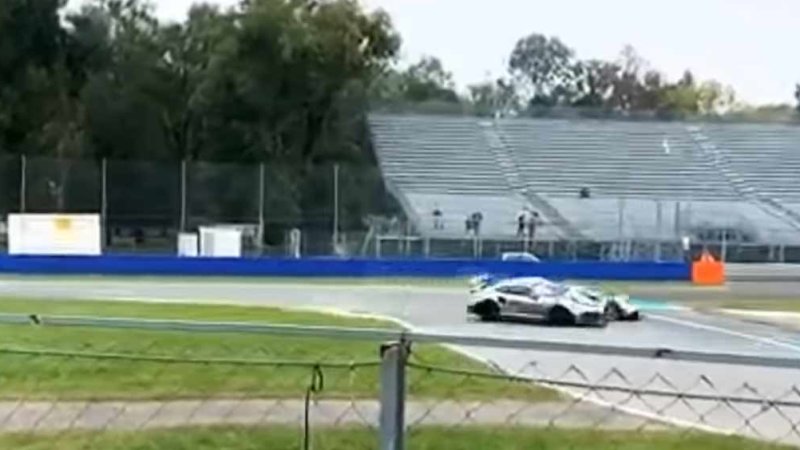
Various European outposts of Top Gear magazine host an event called GTCup at tracks on the Continent throughout the year. The Monza Grand Prix circuit welcomed this year’s third GTCup over the weekend, as well as a very unwelcome crash. Instagram user Varryx caught video of a Porsche 911 GT2 RS plowing into a Pagani Huayra BC Coupe at Prima Variante, Monza’s tricky first corner that comes at the end of an exceptionally long straight. 

It would be funny to quote one of the Instagram commenters and say, “Gran Turismo passing didn’t work in real life,” but we don’t know the setup. The Huayra BC didn’t look in a hurry, and crossed from the outside of the track to the apex. It’s possible the GT2 RS driver thought the Huayra BC driver would stick to the outside of the turn; in that case, even if the Porsche driver was coming in too hot, he might have avoided the Pagani. This is the same kind of bang-up that’s snagged a few of the best Formula One drivers, especially at tracks like Monza and Belgium’s Spa-Francorchamps. In spite of an impact hard enough to spring the Pagani’s passenger door open and ruin the Porsche’s front left, viewers said neither driver was injured. 

Another commenter said the Huayra BC is Pagani’s test car. If so, that would explain the Pirelli stickers and hood script when a different Instagram user caught the Huayra earlier in the day. Varryx got a shot of the GT2 RS under a tarp afterward, and it looks… sad.

Based on video YouTube user LV R4cing took of the GTCup’s assembled supercars, we’re submitting this crash as automotive version of the Buttered Toast Phenomenon: Somehow, among a large field of Porsches, Mustangs, Ferraris, GT-Rs, WRXs, and the Frangivento Asfani DieciDieci, the Porsche driver managed to hit the one car costing six times more than anything else there.

These Great Cars We Love Are Being Killed Off for 2020

The 2019 automotive model year is ending, and as usual, automakers have been trimming their model trees as the leaves fall. Many of the vehicles vanishing, well, are no great loss — but some are simply delightful ones that we’re sorry to see go. So we’ve picked six new cars that will not be coming back for 2020 that we’re really going to miss.

That said, if you like any of these, keep an eye out for any 2019 models sitting around in your local dealer inventories. You may be able to snag a great deal.

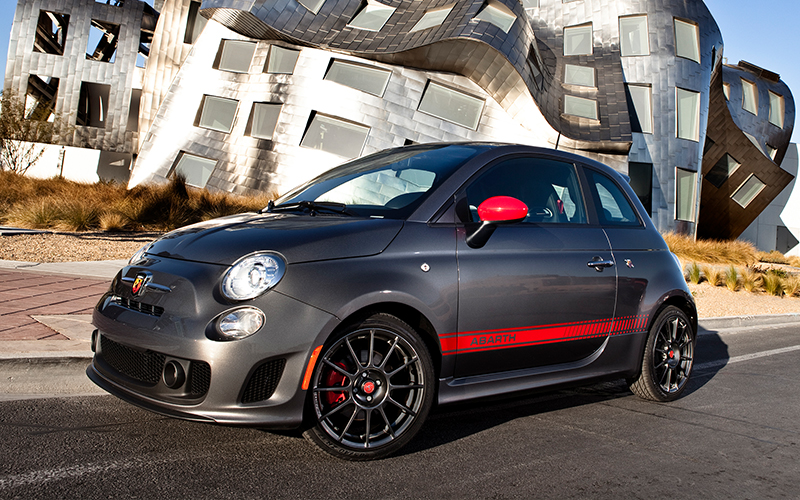
Fiat 500 Abarth

grey_placeholder

The classic Fiat 500 was a work of art. With this 21st Century version, Fiat put forth a solid remake with a manual transmission for a reasonable price. The Abarth was the tuned-up version with aggressive styling and a tuned-up 160-horsepower turbocharged engine. The 500’s main drawback was that it was horrifically impractical for American requirements, unless you were Charlie Sheen shredding tires under house arrest.

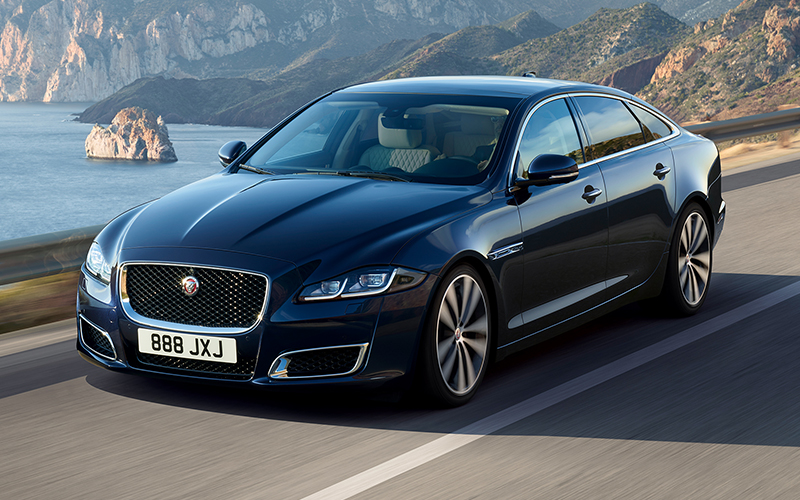
Jaguar XJ

The XJ is Jaguar’s iconic four-door sedan. Famed designer Ian Callum reinvented it for the modern era. But luxury buyers stopped wanting sedans in recent years, and the XJ is now departing after more than 50 years in continuous production. Expect Jaguar to revive the XJ nameplate next year, though the car should have electric propulsion like a Tesla, and may not even be a sedan.

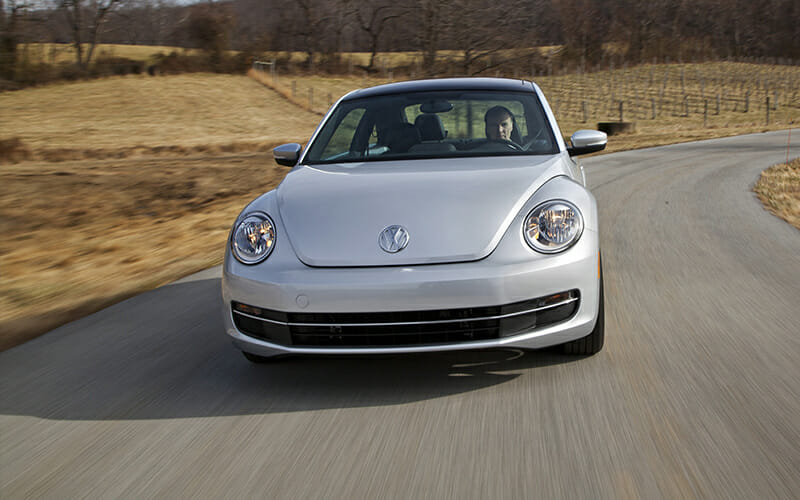
Volkswagen Beetle

After two generations and more than 20 years in production, New Beetle nostalgia has run its course. The second-generation (also known as the A5) New Beetle was the beneficiary of a less-cutesy, more-macho redesign. It put up a strong fight for the manual transmission, holding onto it until 2017. Sadly, VW is now looking toward its vibrant future of electric cars, Tiguans, and having far fewer Golf options in the U.S.

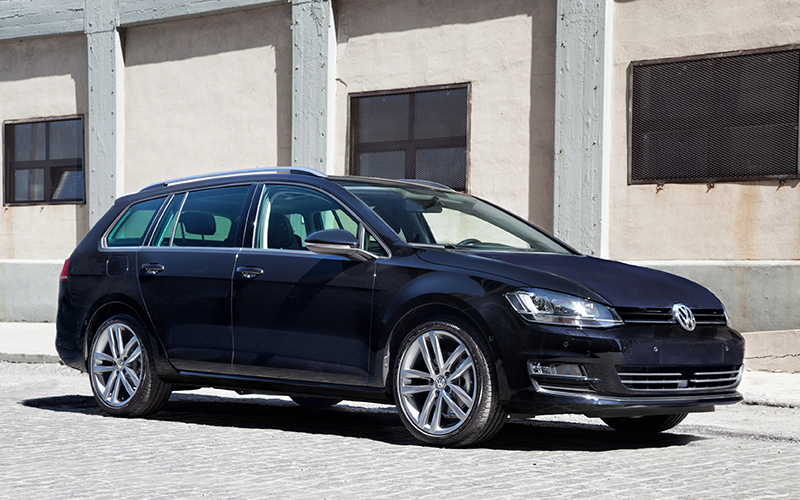
Volkswagen Golf Sportwagen

Speaking of fewer Golf options: Volkswagen is eliminating its entire wagon lineup from the American market. That means the Golf Sportwagen, one of the best-value cars on the market, is departing after this year. Guess Americans didn’t want a superb-handling long roof with great gas mileage and a six-speed manual.

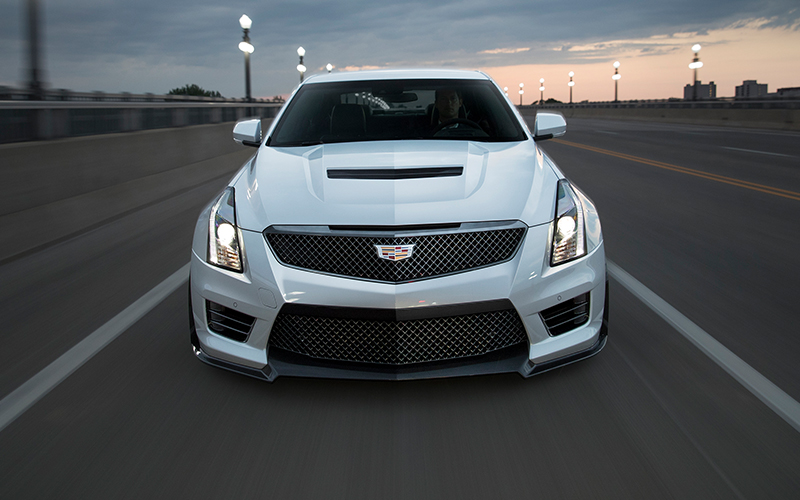
Cadillac ATS-V

grey_placeholder

Cadillac regrouped after the GM bankruptcy last decade and built a badass performance sedan/coupe — precisely when Americans stopped buying them. The ATS-V had 464 horsepower, an available manual transmission, 0-60-mph acceleration in under four seconds, and was a legitimate competitor to cars like the BMW M3, but with a lower sticker price. Goodnight, sweet prince.

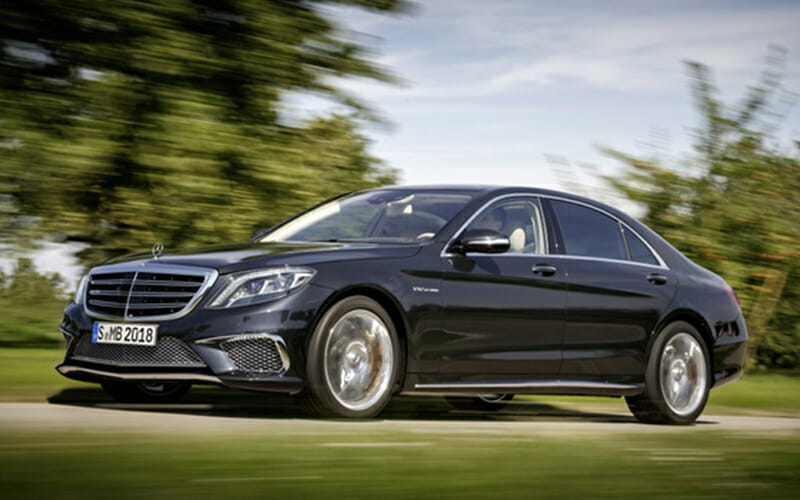
Mercedes-AMG S65

grey_placeholder

Mercedes-AMG is ditching the V12 engines. That’s costing us perhaps Mercedes’s purest testament to extravagance, the AMG S65. The AMG S63 is already a 600-plus-horsepower implement of destruction; for an additional $83,000,  the AMG S65 “upgraded” buyers to a 6.0-liter twin-turbo V12 putting out a dash more horsepower and a stunning 738 lb-ft of torque. Sure, it was nearly $100,000 more for a car that was less efficient and the better part of a second slower from 0-60 mph, but you got to make this noise.

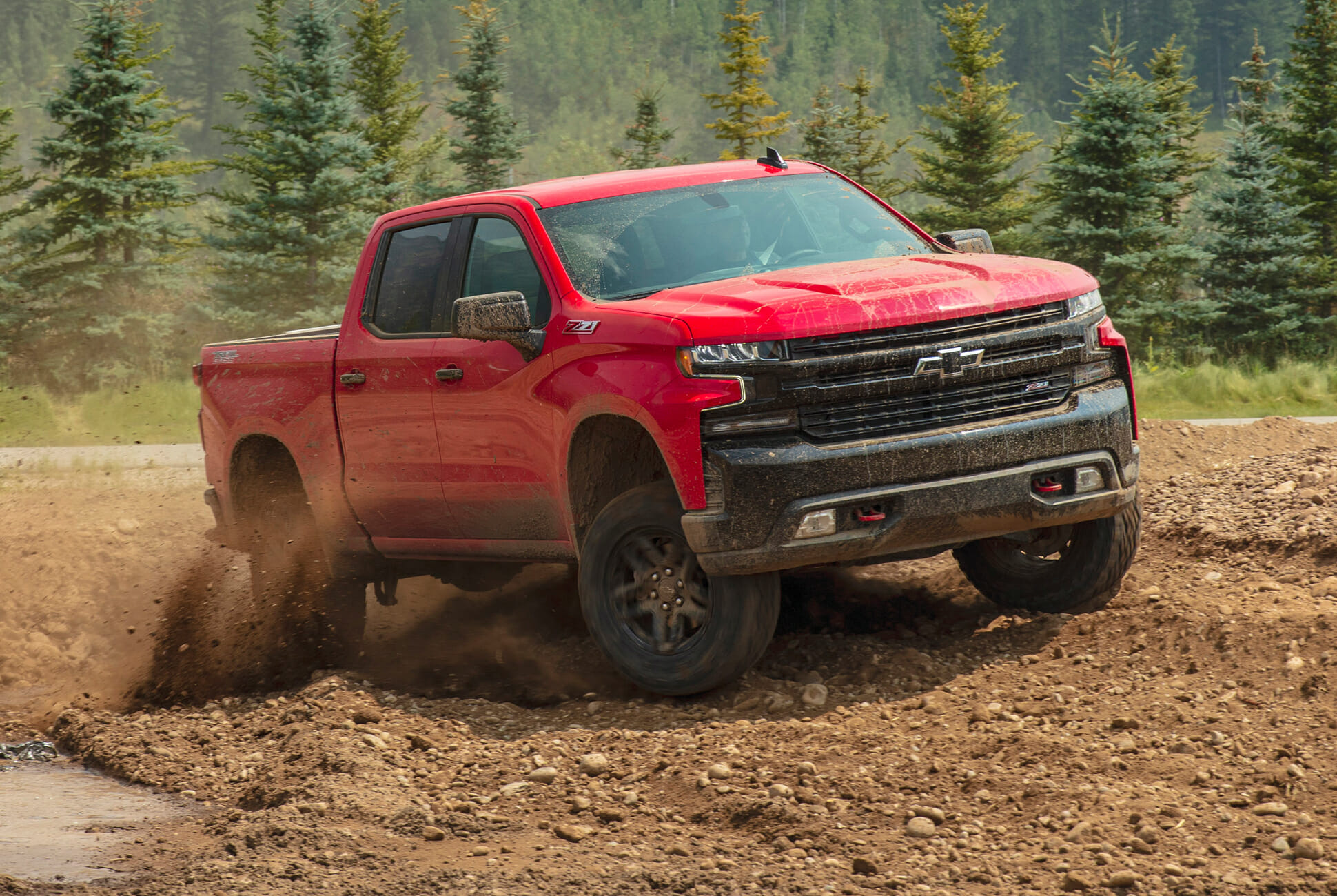
The Complete Full-Size Truck Buying Guide: Every Model, Explained

grey_placeholder

F-150, Ram, or Silverado? Here’s all the info you need to decide in one place. Read the Story

Note: Purchasing products through our links may earn us a portion of the sale, which supports our editorial team’s mission. Learn more here.

Porsche Panamera 10th Anniversary Editions Revealed

It’s hard to believe that the Porsche Panamera is 10 years old. The production version debuted at the Auto Shanghai International Automobile Show in 2009. It was a controversial design back then. It has mellowed in recent years, yet it has also proved a massive sales success, shifting 251,000 models.

The Porsche Panamera 10th Anniversary Editions have been revealed to celebrate the milestone. The special edition package is available for the four Panamera 4 models; the Saloon and Sport Turismo models of the Panamera 4 and Panamera 4 E-Hybrid.

Each example will get a ‘Panamera 10’ badge repeated on the interior and the exterior. White-gold decorative stitching will punctuate the interior leather.

The Porsche Panamera 10th Anniversary Editions will get new 21-inch Panamera Sport Design wheels in satin-gloss White Gold Metallic.

A huge amount of additional equipment will also be bundled in; LED matrix headlights including PDLS Plus, Lane Change Assist and Lane Keeping Assist, Park Assist, panoramic roof system, privacy glass, heated 14-way comfort seats and the BOSE Surround Sound system.

The special edition models will also receive adaptive three-chamber air suspension, Porsche Active Suspension Management (PASM) and Power Steering Plus.

The catch? The Porsche Panamera 10th Anniversary Edition will only be made available in Germany.

GTSPIRIT NEWSLETTER

2020 Chevrolet Corvette Convertible: First Time Ever as a Hardtop

Chevrolet launched details of the Corvette Convertible earlier this week. In its eighth generation, the Corvette receives a pretty radical makeover. While the C8 Corvette gets a targa-top, a fully convertible version was always on the cards.

Chevrolet’s Corvette Convertible is the first hardtop convertible in the Corvette’s 66-year history. The top is arranged in two-pieces, can be activated at speeds up to 30 mph and retract in as few as 16 seconds. The system uses six electric motors with the hardtop painted in the body colour as standard or Carbon Flash metallic as an option.

The folding electronic hardtop stows in a compartment behind the rear seats. It folds into a compartment made from lightweight composite panels and heat shields to manage heat from the engine. Storage space is unaffected by the stowage of the roof. A glass divider window can be opened with the roof up to let in the sound of that V8 engine.

Like the Coupe, the Convertible uses a Chevrolet 6.2 litre LT2 V8 engine. Chevrolet brags that it is the only naturally aspirated V8 in the segment, producing 495 horsepower and 637 Nm of torque. It also gets the new eight-speed dual-clutch transmission.

Chevrolet hasn’t made any announcements about the effect of the new folding hardtop on the weight or performance statistics.

GTSPIRIT NEWSLETTER

Study Shows Why You Can’t Rely on High-Tech Pedestrian Detection Systems

Many automakers make a big deal of proprietary safety systems featuring driver assistance technologies such as pedestrian detection and automatic emergency braking. So it’s only natural they can be a deciding factor for buyers looking for the best family cars. On top of that, they’re a first glimpse at an autonomous driving future. But a new AAA study warns that such systems do not work when we need them most.

AAA assessed the systems on four midsize sedans: the Chevy Malibu, the Honda Accord, the Tesla Model 3, and the Toyota Camry. The company tested those cars in four different pedestrian scenarios, day and night, and at both 20 mph and 30 mph. The results were alarming.

Most pedestrian fatalities (75 percent) happen at night, which is when the safety systems were particularly ineffective. None of the systems detected or reacted to an adult pedestrian crossing the street at night.

The risk for death or severe injury in a collision increases dramatically for the pedestrian when the car is moving faster. It more than doubles from 20 mph (18 percent) to 30 mph (47 percent). Worryingly, AAA found that “in general, the systems were ineffective in all scenarios where the vehicle was traveling at 30 mph.”

One of AAA’s scenarios simulated a child darting out from between two cars. Even at the more favorable 20 mph speed, the four vehicles collided with the child 89 percent of the time.

AAA notes that manufacturers are “on the right path” with their systems. But they caution that significant gaps remain. Drivers should be alert, be extra vigilant at night, and consult both the dealer and vehicle owner’s manual to understand their cars’ safety technologies.

2020 Aston Martin DBS GT Zagato launches with 760 horsepower

The 2020 Aston Martin DBS GT Zagato has finally been revealed in real life, following renderings shown this summer. And with the reveal come additional details, such as the fact that it bears the most powerful version of Aston’s twin-turbo 5.2-liter V12 at 760 horsepower. That’s an increase of 45 horsepower over the DBS Superleggera.

That engine is wrapped in some stunning Zagato-designed bodywork. The fluttering multi-piece grille and rear-windowless roof are the big attention getters, but the fine details impress, too. The front and rear Aston badges are made of 18-carat gold.

The interior is unique to the Zagato, featuring a new dashboard and center console. The geometric parts shown in the console are 3D-printed and can be produced in carbon fiber, aluminum, or in the case of the Centenary Specification car above, stainless steel with a real gold coating. The seats also are finished in leather and dotted with Zagato Zs. If those special parts aren’t special enough, Q by Aston Martin is willing to work with you to make further modifications.

Only 19 DBS GT Zagatos will be built, and all of them have to be purchased as a pair with a DB4 Zagato continuation car. Each pair starts at $7.9 million. Everyone that orders up a pair will have the cars delivered by the end of the year.

5 of the Best New Car Lease Deals You Can Find in October 2019

As Dane Cook once noted ad nauseam, there’s only one October. With the 2019 model year drawing to a close and automobile dealers clearing out inventory like nobody’s business, it’s a good time to score a deal on a new car lease — especially if you don’t need to rack up too many miles per year.

Here are five of the best new car lease deals you can find in the United States as of October 2019.

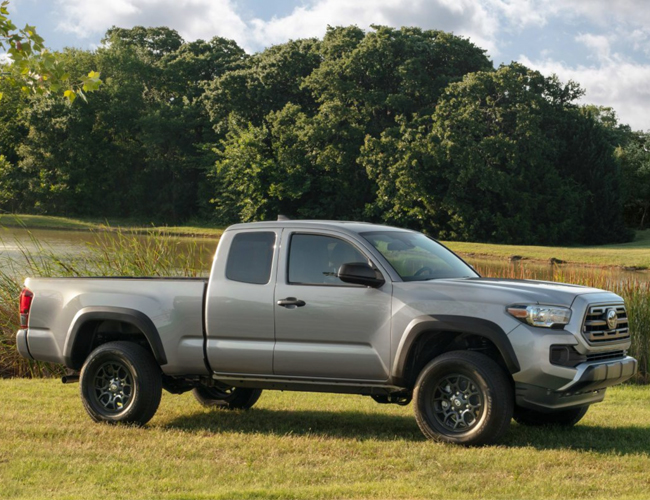
Toyota Tacoma – $229/mo.

grey_placeholder

Let the Toyota Tacoma’s insane resale value work for you. For 2019 model year models, you can lease the middle-tier SR5 trim Tacoma with a double cab and the bigger V6 engine for just $229 per month with $3,499 at signing.

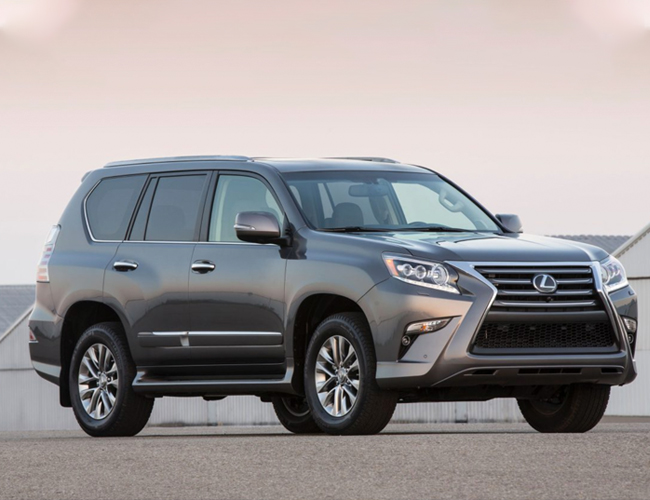
Lexus GX 460 – $439/mo.

grey_placeholder

The Lexus GX 460 (also known as the Toyota Land Cruiser Prado in other markets) is a body-on-frame off-roading beast. You can lease the outgoing 2019 model, with a sticker price nearing $60,000, for $439 per month with $3,999 due at signing. The deal expires Nov. 4.

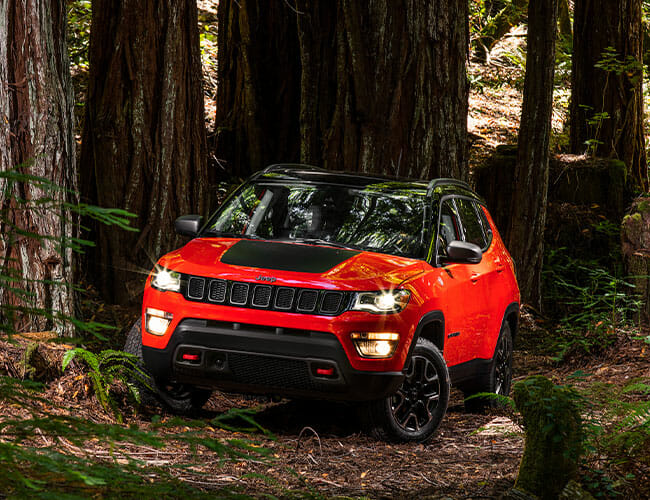
Jeep Compass – $199/mo.

grey_placeholder

The Jeep Compass has improved its appearance in recent years, and it’s quite affordable. Jeep has a lease offer on it through the end of October. You can get an upper-level Limited 4×4 trim of the 2019 Compass for $199 per month on a 36-month lease with $3,725 at signing.

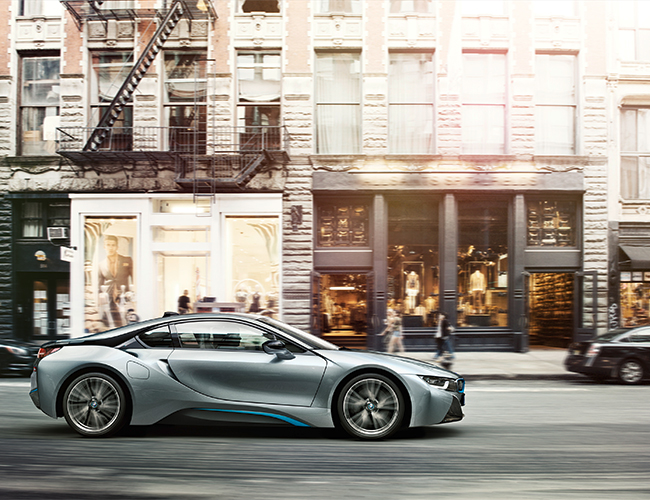
BMW i8 Coupe – $1,019/mo.

grey_placeholder

The plug-in hybrid BMW i8 is a now-antiquated vision of the future. But it’s still a cool-looking BMW, and the company is eager to lease one to you. Through the end of October, you can score an i8 Coupe for $1,019 per month on a 36-month lease with $7,944 due at signing. For a $150,000-plus sports car, that’s a solid deal.

Chrysler Pacifica – $299/mo.

grey_placeholder

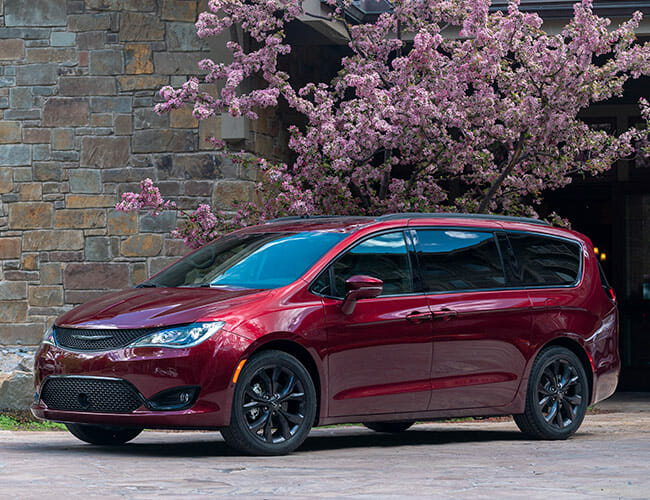
Moving to minivan-life is a transition, but it need not be a terrible one. Chrysler has a lease deal on the top-tier Limited trim of 2019 Pacifica minivans: $299 per month with $4,127 due at signing for a 36-month lease.

2019 Toyota 4Runner TRD Pro Review: An Off-Roader Worth Its Weight in Mud

The term “jack of all trades” comes up a lot when talking about modern cars and trucks. Buyers typically can’t afford more than one vehicle per person in the household, so it’s understandable they’d try and find a vehicle that covers as many of their needs as possible — be it comfort, luxury, speed or off-road capability. But seeing as how the other half of that famous saying is “master of none,” there’s something to be said for a vehicle dedicated primarily to one discipline.

The Toyota 4Runner TRD Pro is just such a vehicle — one that shines brightest when it’s in its specific element.

The Good: Like the other TRD Pro models, this Toyota 4Runner is a rugged, durable, purpose-built off-roader that can take a beating and keep on trucking.

Who It’s For: Anyone looking for a no-nonsense SUV that’s ideal for adventures off the grid, and doesn’t mind dealing with the compromises of an aging truck-based platform in the daily grind.

Watch Out For: A sparse, dated interior; laborious acceleration; a chore to drive when you’re not out on an adventure.

Alternatives: Jeep Wrangler Rubicon ($41,795+), Lexus GX 460 ($52,505+)

Review: “That’s…quite blue,” was my first reaction upon seeing my test car. Voodoo Blue, to be specific — and its vibrance delivers quite a shock when you’re expecting a rugged overlander. It was a sour first impression — but by the end of my time with the Toyota 4Runner TRD Pro, the truck had won me over. Powerful Voodoo indeed.

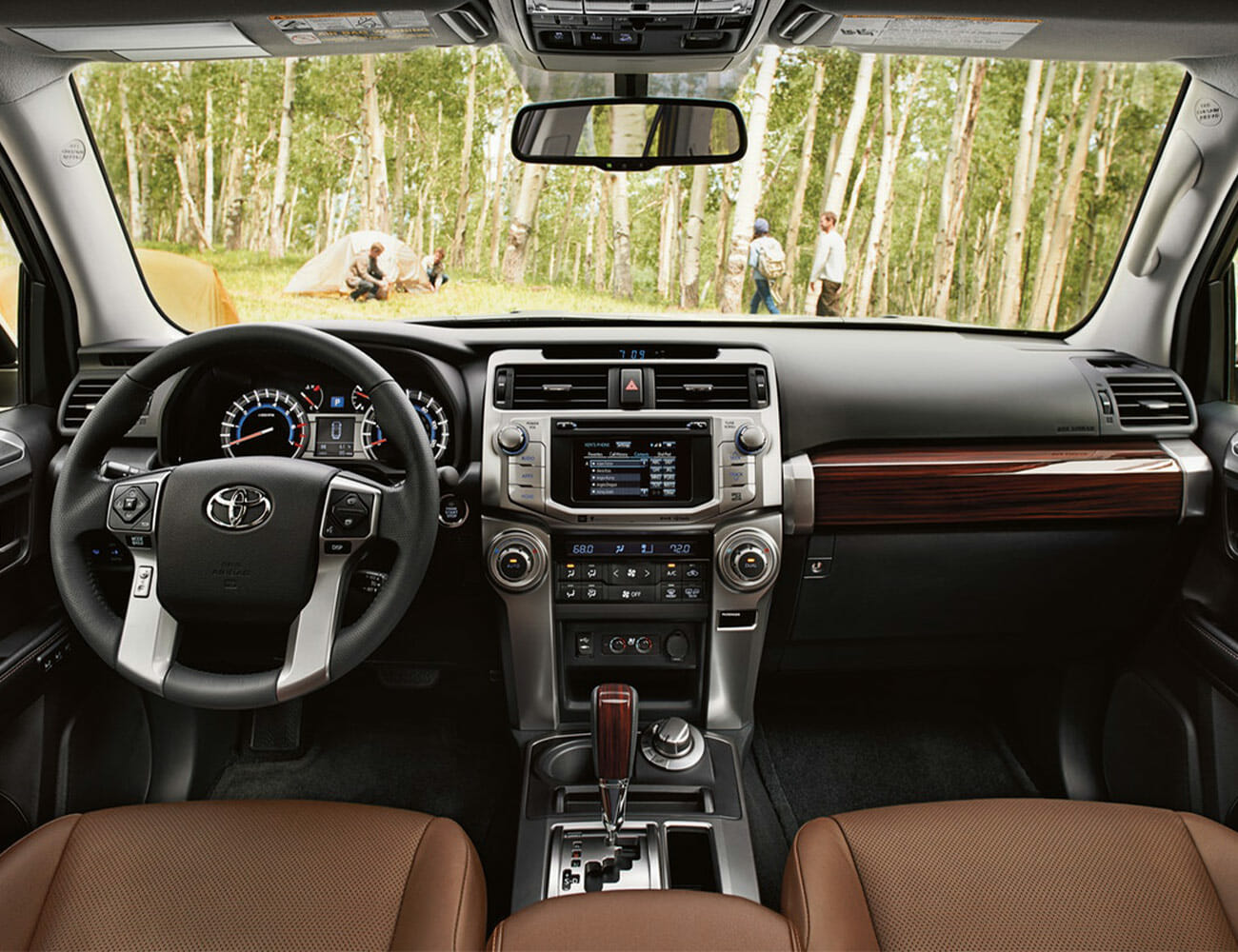
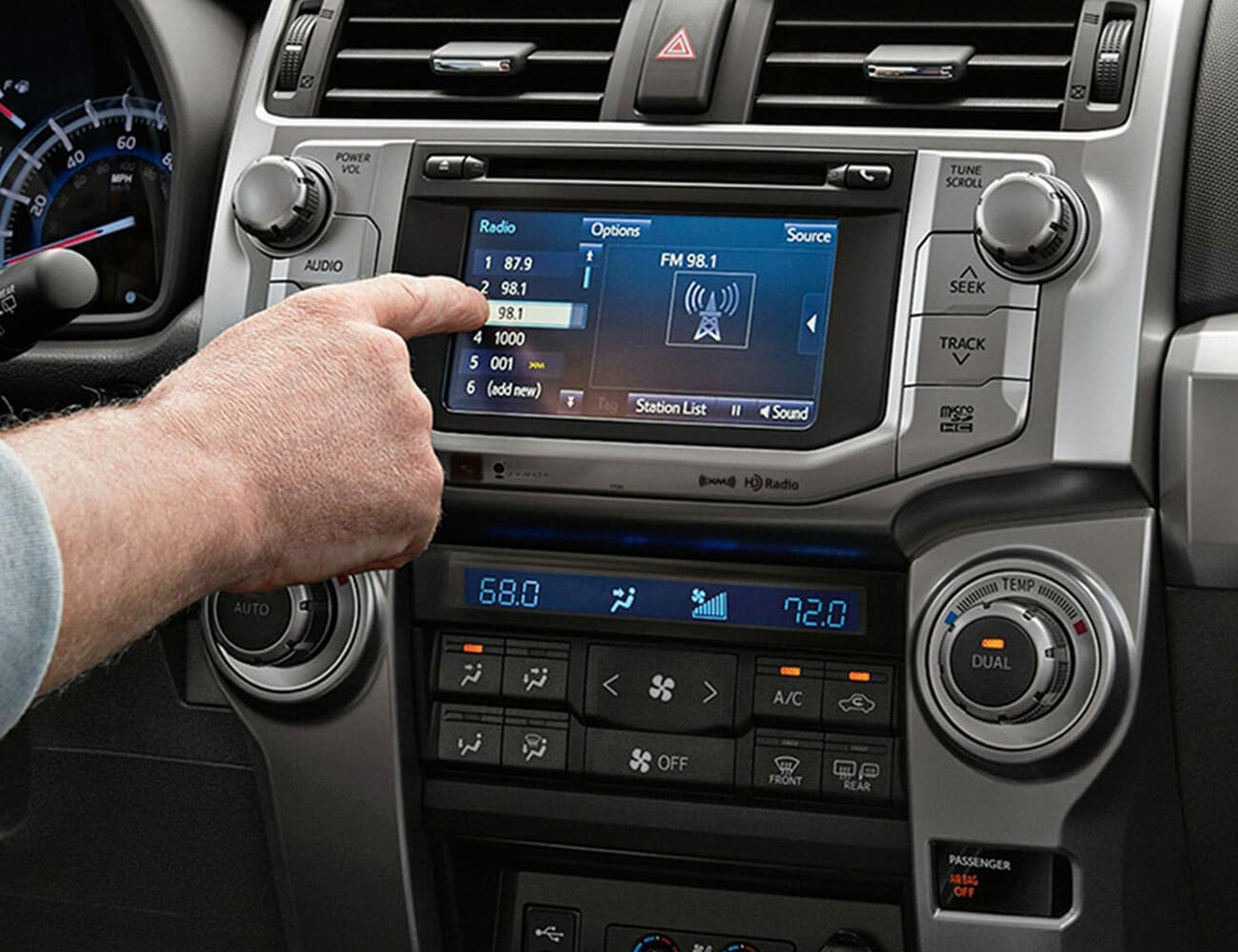
My tester was a 2019 model, which matches the 2020 in every mechanical way. The upgrades include feaures a new instrument panel and an 8.0-inch touchscreen infotainment system with Apple CarPlay. Fiddling with the aging 6.1-inch in my 2019 model makes me glad Toyota updated those features for 2020.

Apart from the eclectic paint job, the exterior was saddled with the same aggressive features the 4Runner has sported since 2014. Compared to the other 4Runner models, the TRD Pro sports 17-inch matte black wheels, a matte black roof basket, a unique grille and a 1/4-inch branded skid plate under its chin. The Pro also picks up unique Fox high-performance shocks, with the whole suspension tuned less for pavement-based driving and more for off-road capability.

Which leads us to why the TRD Pro was initially underwhelming. Driving about town, the body-on-frame Toyota handled like a crate on wheels; the 4Runner weighs 4,750 pounds, and you feel every ounce of it when stopping or turning. Brake response felt delayed by a whole precious second, scaring me just as much as it did drivers in front of me. Under the hood, the 4Runner TRD Pro packs a 4.0-liter V6 that musters up 270 horsepower and 278 pound-feet of torque, which means it doesn’t go anywhere in a hurry. I often found myself switching from Eco mode to Sport for overtaking and merging, in spite of the hit it would mean to the already-poor gas mileage.

Since daily driving the TRD Pro left me a little cool, I took the 4Runner on a little excursion to Monticello Motor Club’s off-road course in upstate New York to seek out the sort of challenges the 4Runner was built for. The course there is a mixture of rough, narrow paths, steep hills and drops, mud traps, rocks and ruts; while I was confident the 4Runner could tackle what lay ahead, off-roading demands a lot of trust in your vehicle. If it underperforms, you’re not slow, you’re stuck.

The multi-terrain system in the 4Runner, however, proved more and more handy the further we crawled into the woods. The dirt paths were easy going, but the loose boulders that followed were mildly intimidating. Selecting the setting that matched the terrain meant the Toyota kept its wheels from spinning needlessly, instead directing power where it needed to go.

Then came a deeper-than-anticipated mud pit, which overcame the truck’s momentum and left stranded just shy of dry dirt. Utilizing the five-level crawl control, the TRD Pro worked to find some traction underfoot; with a little finesse, the Nitto Terra Grappler tires found some purchase and heaved the SUV out of the muck.

The 4Runner emerged from the trails victorious, leaving me with a wholly different view of the TRD Pro: there’s value in being particularly good at one task rather than trying to make everyone happy.

Verdict: The Toyota 4Runner TRD Pro proved itself in the mud and on the trails — not as a spectacular SUV, but as a damn good piece of equipment. It’s one that any serious overlander or off-roader should be happy to include in their adventure kit.

2019 Toyota 4Runner TRD Pro: Key Specs

Powertrain: 4.0-liter V6; five-speed automatic; full-time four-wheel-drive
Horsepower: 270
Torque: 278 lb-ft
Weight: 4,750 pounds
EPA Fuel Economy: 17 mpg city, 20 mpg highway

Toyota provided this product for review.

Read More Gear Patrol Reviews

Hot takes and in-depth reviews on noteworthy, relevant and interesting products. Read the Story
Note: Purchasing products through our links may earn us a portion of the sale, which supports our editorial team’s mission. Learn more here.

2020 Lincoln Aviator Review: A Well-Dressed Beast, Best Tasted in Hybrid Form

The Navigator may be the ne plus ultra flagship of the Lincoln lineup, but the new 2020 Lincoln Aviator is absolutely the fancy FoMOCo SUV to buy. It’s not the hulking monster that the Navigator must be in order to stay competitive with the Escalade, nor does it come with a commensurately steep price tag.

Rather, the Aviator is a sleeker, more stylish, better proportioned and more tech-forward alternative that comes with a hybrid option — one that will blow the doors off the Navigator at a stoplight. With 494 horsepower and 630 lb-ft of torque — numbers that a topped by but a handful of German SUVs — the Aviator Grand Touring Plug-In Hybrid is easily the most fun you can have in a truly luxurious SUV.

The Good: The design is first-rate, with elegant lines inside and out and a slight arc from front to rear that gives it a distinctly sporty vibe. But the real experience of the Aviator is the interior; it’s comfortable yet supportive, roomy and sublimely elegant. The sounds system will sweep you away, and the technology offerings will keep you safe and refreshed on the longest of trips.

Who It’s For: Lincoln has traditionally been something of an awkward fit among the options for American buyers. After all, the snobs will argue, why would you buy this over a Cadillac, BMW, Mercedes, Audi, et cetera? It’s always had an unfortunate retiree/golf-dad vibe to it.

That’s something Lincoln’s brand-rebuilding exercise has attempted to replace with an aura of elegance and sophistication. I hope this effort continues to take, because the Aviator, along with Lincoln’s other recent efforts, absolutely runs with the big dogs of the automotive world. It’s a car for grown-ups, yes, but grown-ups with the ability to thumb their noses at the more-cliché premium driving alternatives.

Watch Out For: The nose. There’s only one design weakness in the Aviator: a slight downward arc from the hood to the grille. Replace that in your imagination with a slightly more aggressive right-angled transition, and it looks stronger and more enduring. Ten years from now, that curved snout will likely be seen as the only element of the design that isn’t timeless.

Of course, that’s about as minor of a gripe as you can get, and many will likely disagree. But the truth is, there’s not a lot to complain about with this car.

Alternatives: From Germany, the BMW X5 and the Audi Q7 are the obvious three-row alternatives; Stateside, it’s really only up against the Cadillac XT6. All are fine vehicles, but none will truly draw a second glance as Lincoln does.

Review: For obvious reasons — great roads, awesome restaurants — the Napa Valley region of California is a popular draw for car companies launching new vehicles. As a result, I’ve been there quite a bit recently, and have seen most of what the region offers. Given that there’s so much exploration going on in the region, I’d assumed, as well, that there weren’t any surprises left. Every square inch of the place has been driven, drunk, Instagrammed, and Facebooked to within an inch of its life.

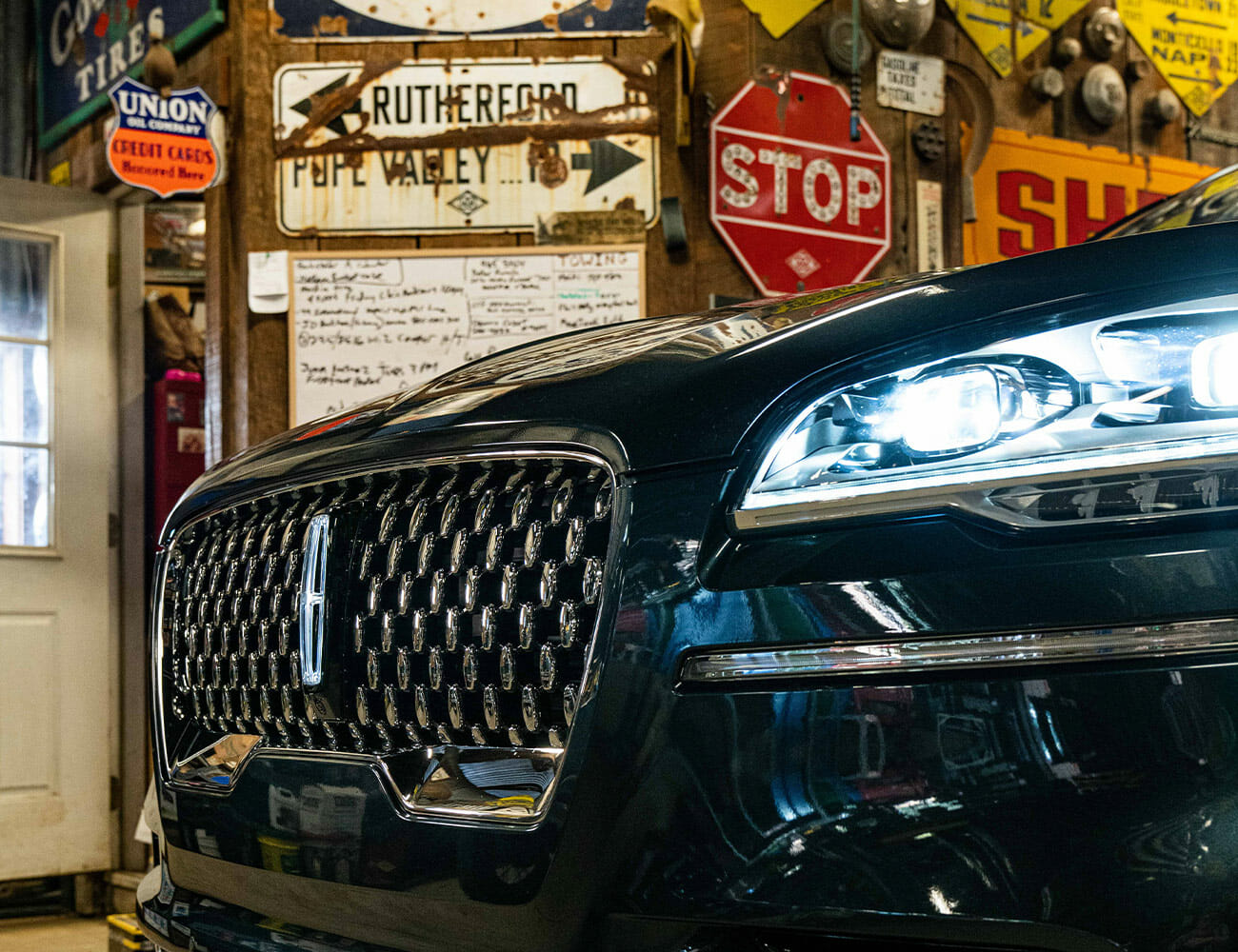
But there are surprises left. I found two. One is Pope Valley Repair and Towing, a garage that turns precisely 100 years old this year and looks for all the world like a vintage film set, right down to the ancient road signs, WWII-era Willys Jeep undergoing restoration in the back, display of barbed wire on the wall and the cage holding a pair of rattlesnakes. My colleague and I caught sight of it on our drive, and turned around to investigate. We pulled in and chatted up the owner and his buddy — both at work on a 1930s Ford Model A pickup truck and a ’60s-vintage F100. When we asked if we could bring our car into the front of the shop for some pics, they didn’t bat an eye.

Which brings me to the second surprise I found out there: this Lincoln Aviator. The gents in the shop — clearly Ford guys to the bone — spoke of their relief at seeing Lincoln’s newest, best model roll in unannounced, and of their enthusiasm for vehicles made in the U.S. The words weren’t freighted with any hint of anti-globalism, either. They’re just glad Lincoln’s pushing hard to thrive.

The Aviator, as they experienced when they dipped in for an inspection, indeed pushes hard — for both the company and the customer. It’s a beautiful ride, with crisp details, rich colors and a robust roster of features, including a plug-in hybrid version that delivers startling amounts of power: 494 horsepower and 630 pound-feet of torque, compared to the conventional turbocharged V6’s 400 hp and 415 lb-ft. It’s a blast to drive, and offers a preliminary range of about 18 miles of all-electric performance as well.

Branded as the Grand Touring version, the hybrid packs a 13.6-kWh lithium-ion battery that increases power, but, along with the additional hybrid hardware, adds about 800 pounds. You don’t notice it, though. Nor do you notice the overall mass slowing down even the conventional V6 version; it moves just as smoothly and authoritatively, helped along by a silky 10-speed transmission.

The drive experience is virtually unsurpassed in this class, thanks to the firm and seemingly infinitely-adjustable (okay, 30-way adjustable) seats and the premium Revel sound system, which allows you to dial in whether or not you want to feel like you’re sitting on the stage with the artists, or just right in front of them. Good stuff, that—and it makes for a blissfully engaging drive among people who crave quality audio while carving out road trips or daily commutes.

Driver-assistance systems include the optional Co-Pilot360 package that includes evasive steering assist, active rear braking to prevent backing into something and active parking assistance, along with adaptive cruise control and a lane-keeping system. The head-up display is large and detailed — though I had some trouble getting it to focus properly — and the optional Phone as Key system is a logical, long-awaited development for people who are a bit sick of carrying fobs around.

Once we left the garage in Pope Valley, the drive turned into twisty heaven, with an abundance of switchbacks that, for some passengers, could turn into twisty hell if the vehicle’s body roll were to become excessive. That’s my barometer for a vehicle’s handling when in the passenger seat: How queasy I feel under hard driving. The Aviator did well, though I felt hints of nausea percolating as the miles and g-forces stacked up. But I’ve had far worse in vehicles of this size. The Aviator’s standard air suspension performed admirably, fighting the rolling motion as well as could be expected. Besides, powering out of all the turns with the kind of oomph that both powertrains provided more than made up for a bit of boatiness here and there.

Verdict: There’s no question that the Aviator is one of the most aggressively packaged SUVs on the road today. Not only does it come with top-shelf technology, including the startlingly powerful hybrid option, but it also has an aesthetic that handily trumps the competition. It’s a looker on the outside, and a sublimely satisfying habitat on the inside.

2020 Lincoln Aviator: Key Specs

Powertrain: 3.0-liter turbocharged V6 or 3.0-liter turbocharged V6 with electric motor; 10-speed automatic; rear- or all-wheel-drive
Horsepower: 400 (conventional engine); 494 (hybrid)
Torque: 415 (conventional engine); 630 (hybrid)
Maximum Seating Capacity: 7
Base Curb Weight: 4,764– 5,678 pounds

Lincoln hosted us and provided this product for review.

Read More Gear Patrol Reviews

Hot takes and in-depth reviews on noteworthy, relevant and interesting products. Read the Story
Note: Purchasing products through our links may earn us a portion of the sale, which supports our editorial team’s mission. Learn more here.

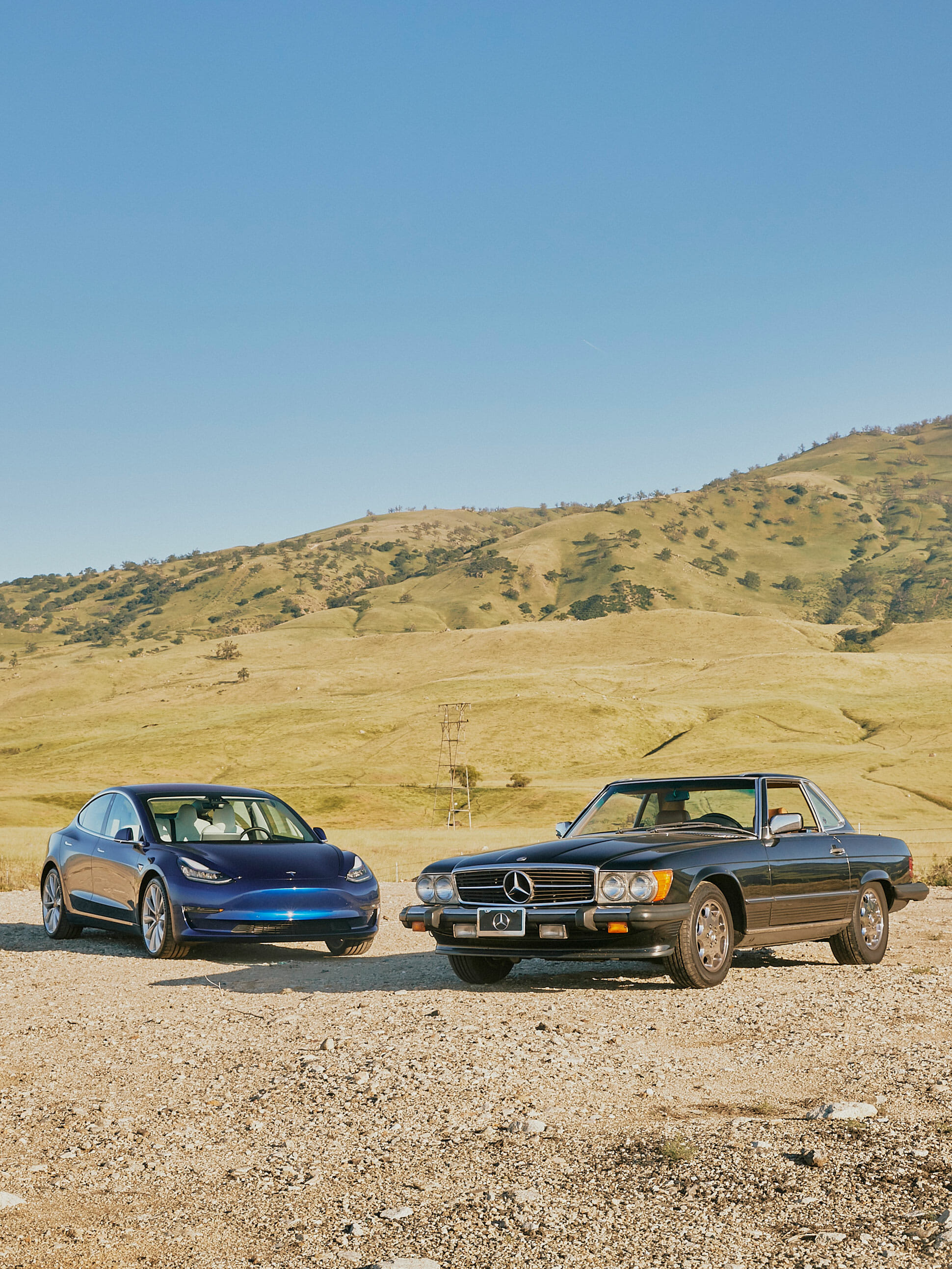
Past Meets Present With a Tesla, a Vintage Mercedes-Benz and California

Tesla Model 3 vs. 1987 Mercedes-Benz 560 SL: One Hell of an Unorthodox Comparison

A version of this article originally appeared in Issue Ten of Gear Patrol Magazine with the headline “The Future Perfect.”  Subscribe today

The future is smart. It’s learned to sneak up on us so that we don’t overreact and start lighting things on fire. When the news hit that self-driving cars were not only real but heading our way, fast, we were too busy chasing cartoon holograms on our phones to care much. Our collective response to a sci-fi dream going back a hundred years was a collective, petulant shrug. The future, being smart, chose to reveal itself at a time when we are easily delighted with technology and almost never impressed by it.

But it’s not just autonomy, whenever that comes, that’s changing the car. It’s electrification, battery power with instant torque and dirt-cheap energy. It’s the erosion of the ownership model and the rise of a connected car that can communicate with other vehicles on the road and the surrounding infrastructure. The idea of what a car can be has never been so up in the air, even back when the automobile was first invented.

Most people don’t care. They just want to get to work and back. But the promise of the American automobile has always been freedom — the idea that at any time you can head off into this huge, wild country under your own steam, beholden to no one. Can that dream survive in a rolling computer packed with sensors, constantly monitoring you, relaying not just your location but where you stopped for lunch and what you’re listening to on the radio?

I want to know what we’re trading for it, this safe, connected, convenient, hardworking car of the future, so I’m heading to California, spiritual home of the American road trip. I’ve sourced an old fast car, sleek and elegant and utterly brainless, to drive from LA to Silicon Valley, and the absolute newest, most futuristic vehicle on the market to drive me back. In between, I want a glimpse of what we’re being promised — and what, exactly, we’ll be expected to give up for it.

PART 1: Los Angeles to Fremont

1987 Mercedes-Benz 560 SL

In the sunset days of Reagan’s Morning in America, before Straight Outta Compton and what we know as the internet, when you could still smoke on planes and get shot at the Berlin Wall, a brand-new 1987 Mercedes-Benz 560 SL offered modern amenities like power windows and a cassette player. It came with a large, sturdy German engine and a thin metal key to start it. Safety technology consisted of seat belts, anti-lock brakes and an airbag. At the time, it cost around half the price of a new home in the U.S.
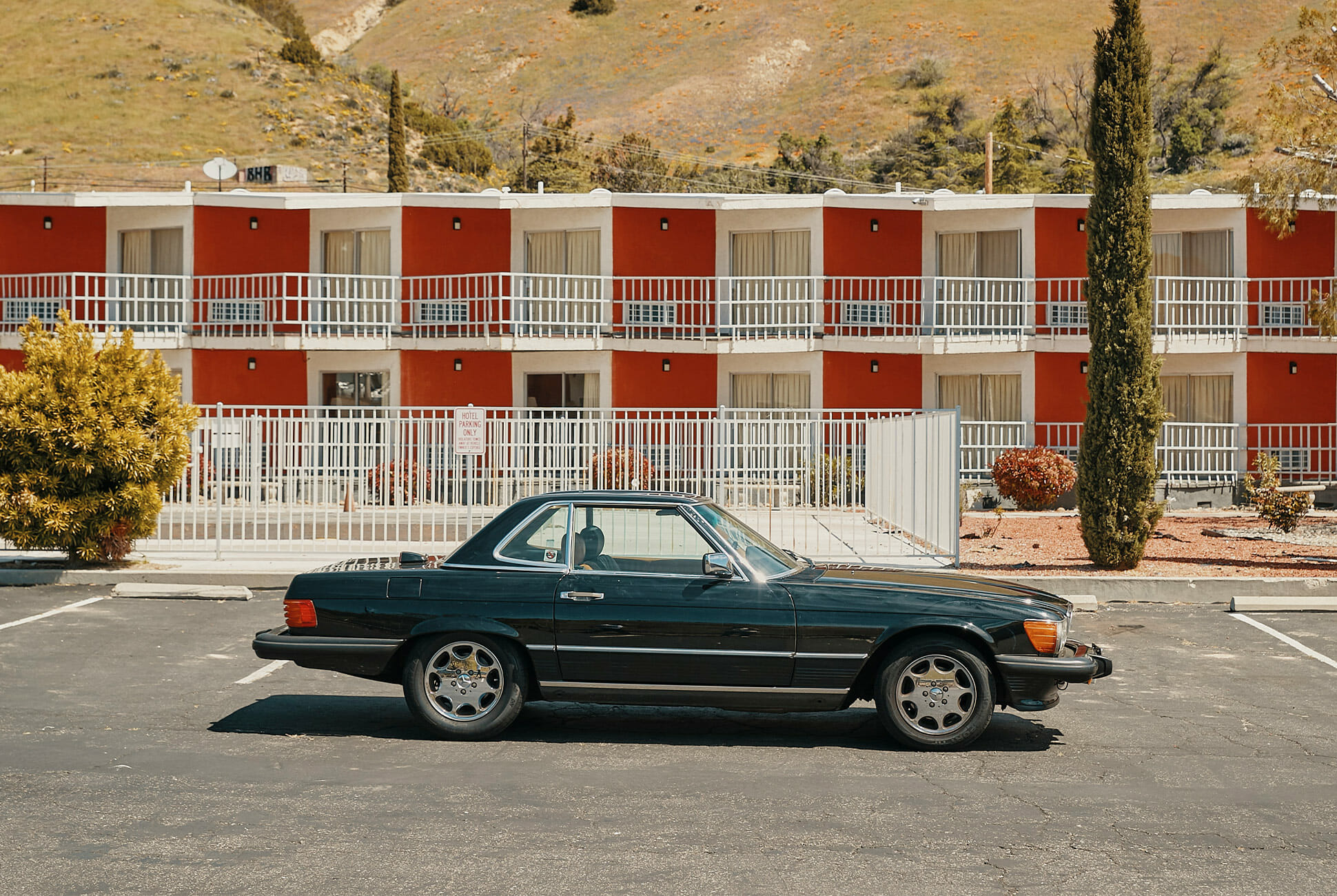
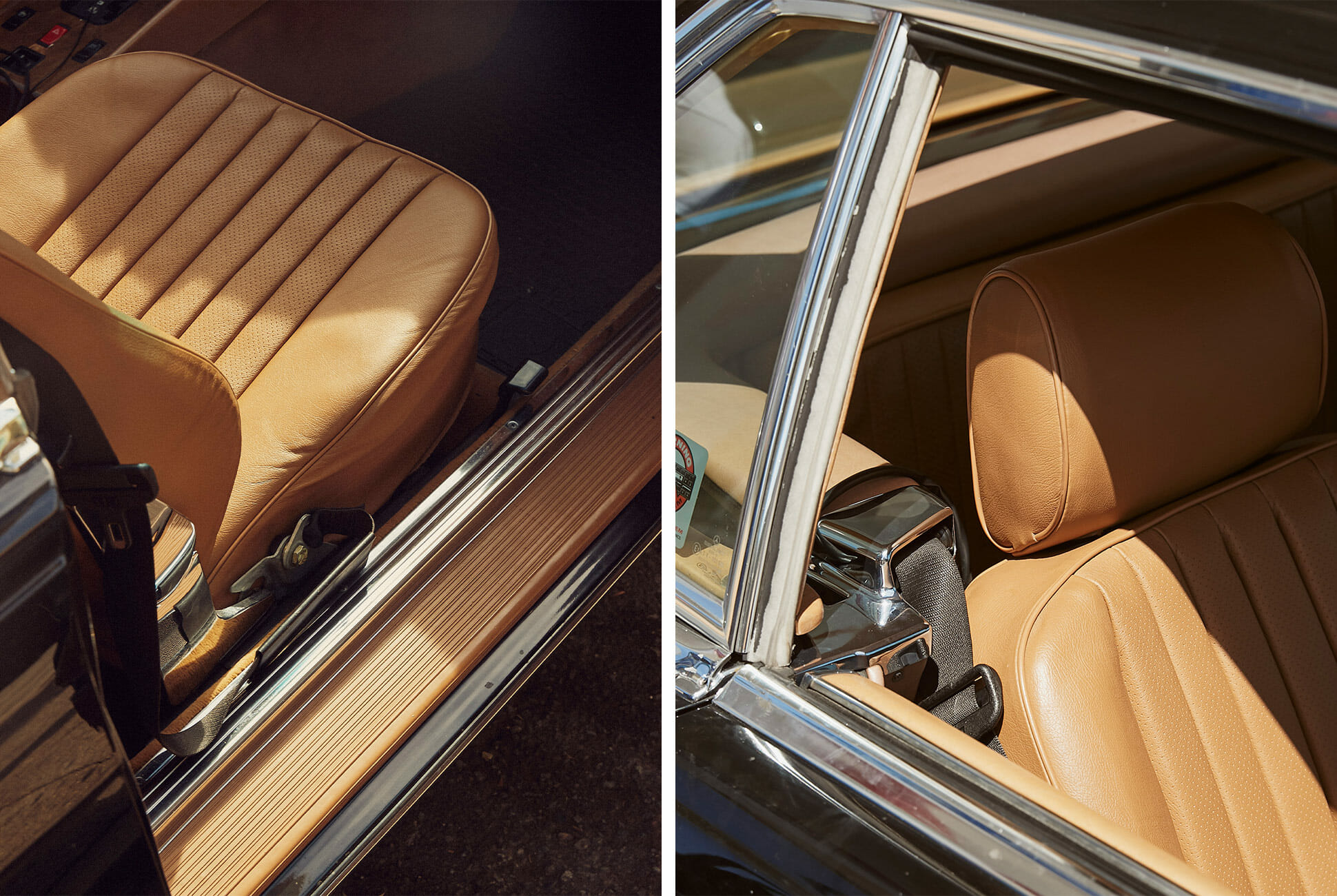
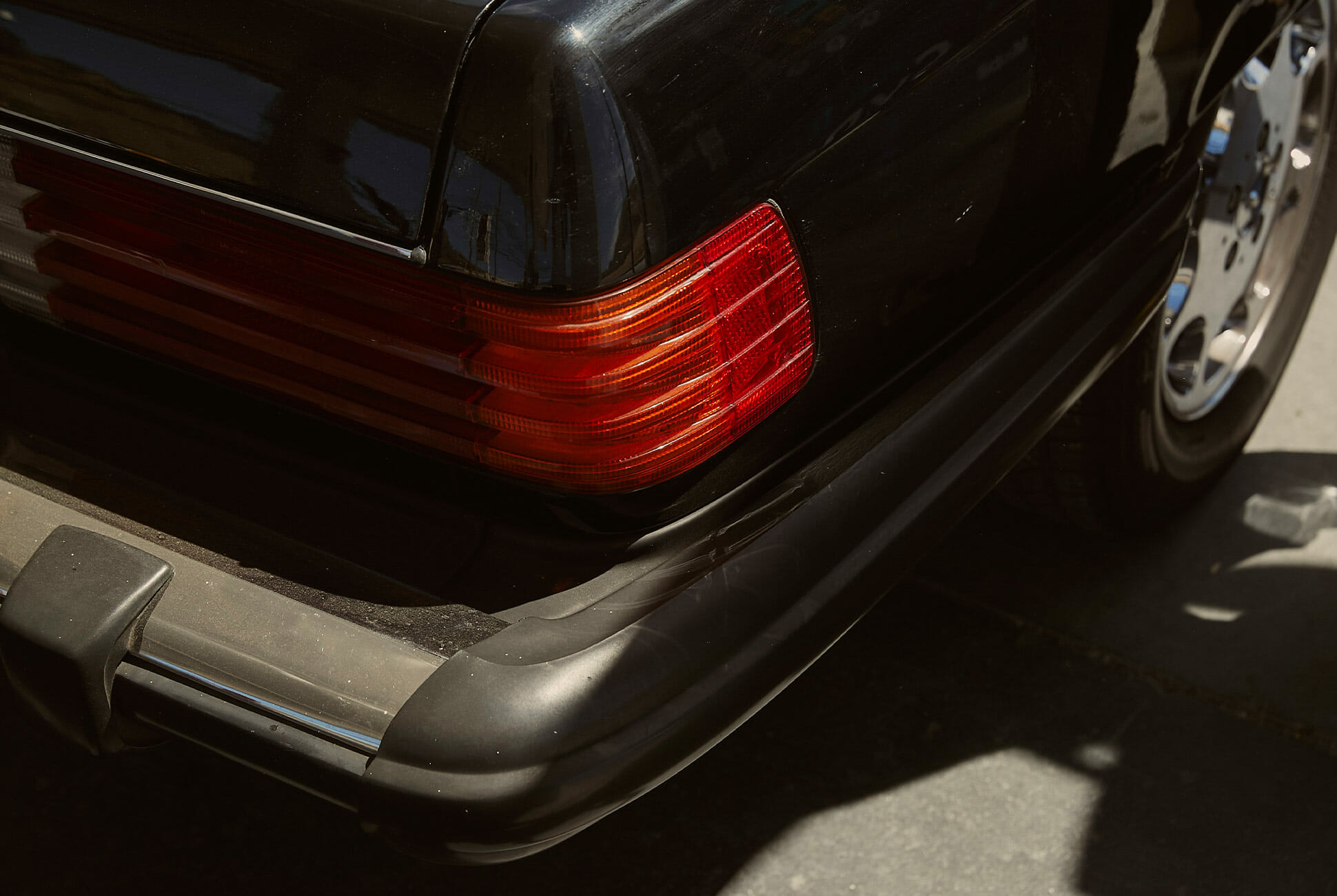
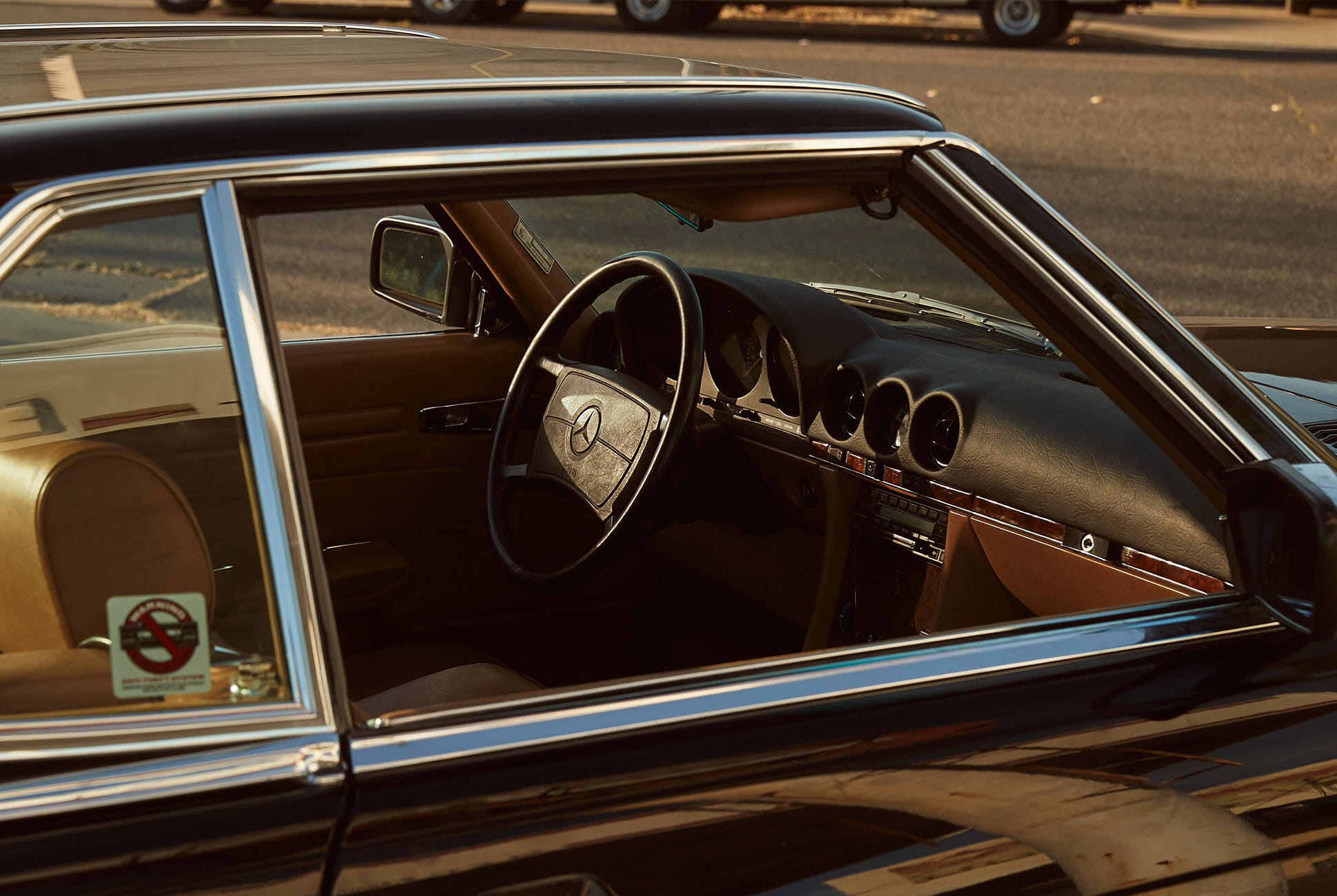
This is the car I pick up 32 years later, in a leafy residential stretch off Wilshire Boulevard, in LA — a low, polished black sled with the moneyed swag of a horsebit loafer. The cockpit appears airy, delicate, like the greenhouse canopy of an old Zero fighter plane. The inside is covered in well-massaged leather and shiny old wood. There’s a 227-horsepower V8 in the long nose and rear-wheel drive in the back, and the car jumps like a spooked cat when you stomp the gas.

We point it north from LA, towards Bakersfield. The coupe barrels through the hot air like a hurled brick. The 560 SL was born before the modern art of aerodynamic modeling and it’s better for it, the beltline so low your arm can’t help but hook itself out the window. The windshield’s curved glass frames the world like a viewfinder.

Age has robbed the seats of their posture; they sag, and the leather bakes immediately in the heat. On our way out of LA, we scroll the AM/FM dial, trying to guess our way to some period-correct ‘80s music but settling for whatever comes through clear.

The radio grows shy as we move inland through the hot, kaleidoscopically brown parts of southern California. I shut it off and listen to the car instead. The motor has a soft steady chug and the suspension sighs over fast crests. The tires drum a constant low hum into the cockpit and any adjustment fills the space with the clack of buttons and dials and levers. Even mostly alone in the midday desert, the car has the false quiet of a city apartment.

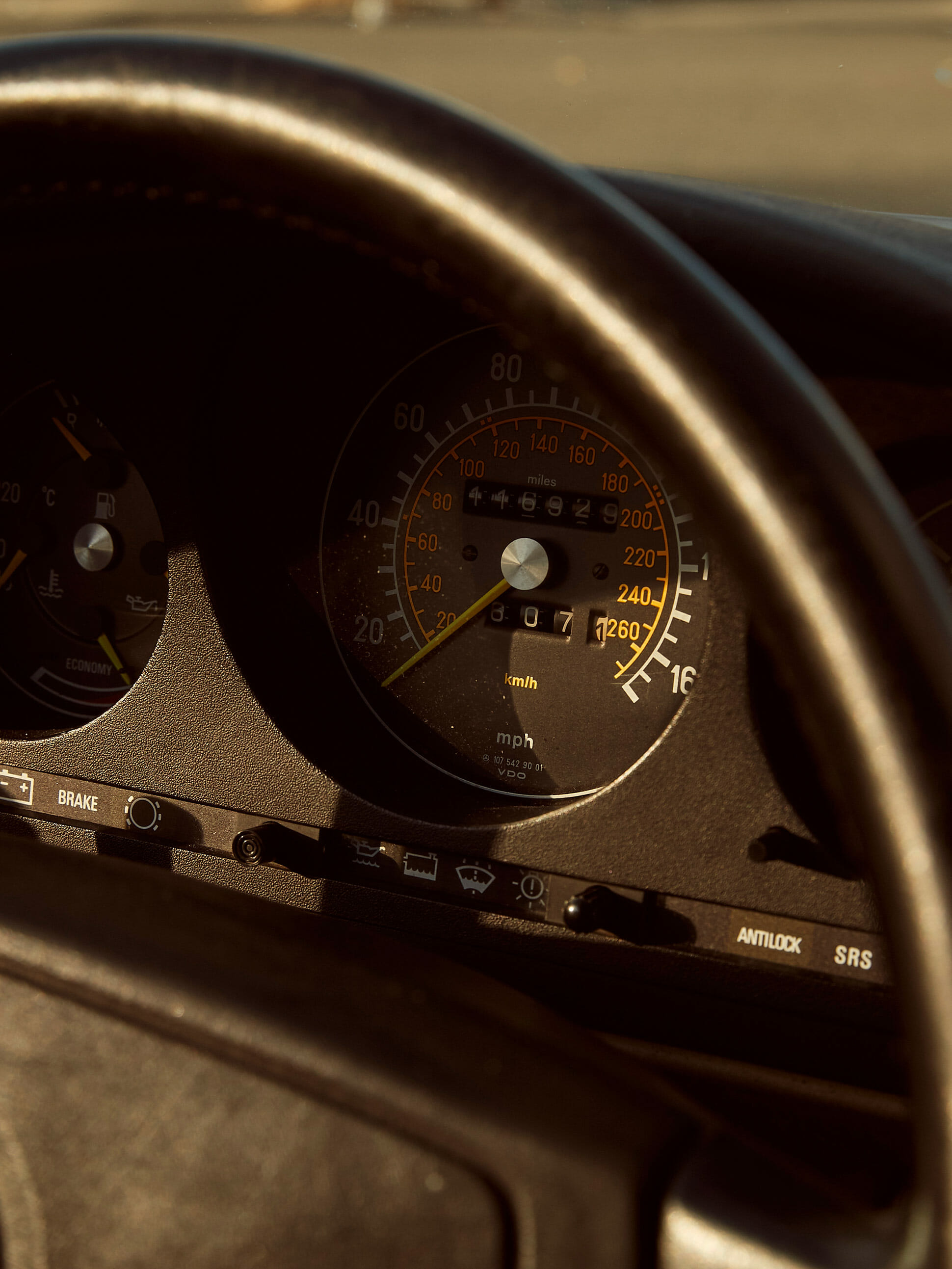
The 560 SL settles into a nice canter around 80 mph. I settle in, too, watch my arm turn sunburned as McFarland becomes Delano becomes Pixley becomes Tripton. I cast around the cabin at the various surfaces — metal, leather, veneered wood, glass, plastic, cloth — and at the handsome, analog gauges and the thin needles that hover at some vague approximation of speed or RPM.

Uninterrupted hours of highway driving requires a sort of meditation, an ability to maintain concentration through stillness, because there’s almost nothing to it: minute adjustments to the wheel or the gas, the occasional glance in a mirror.
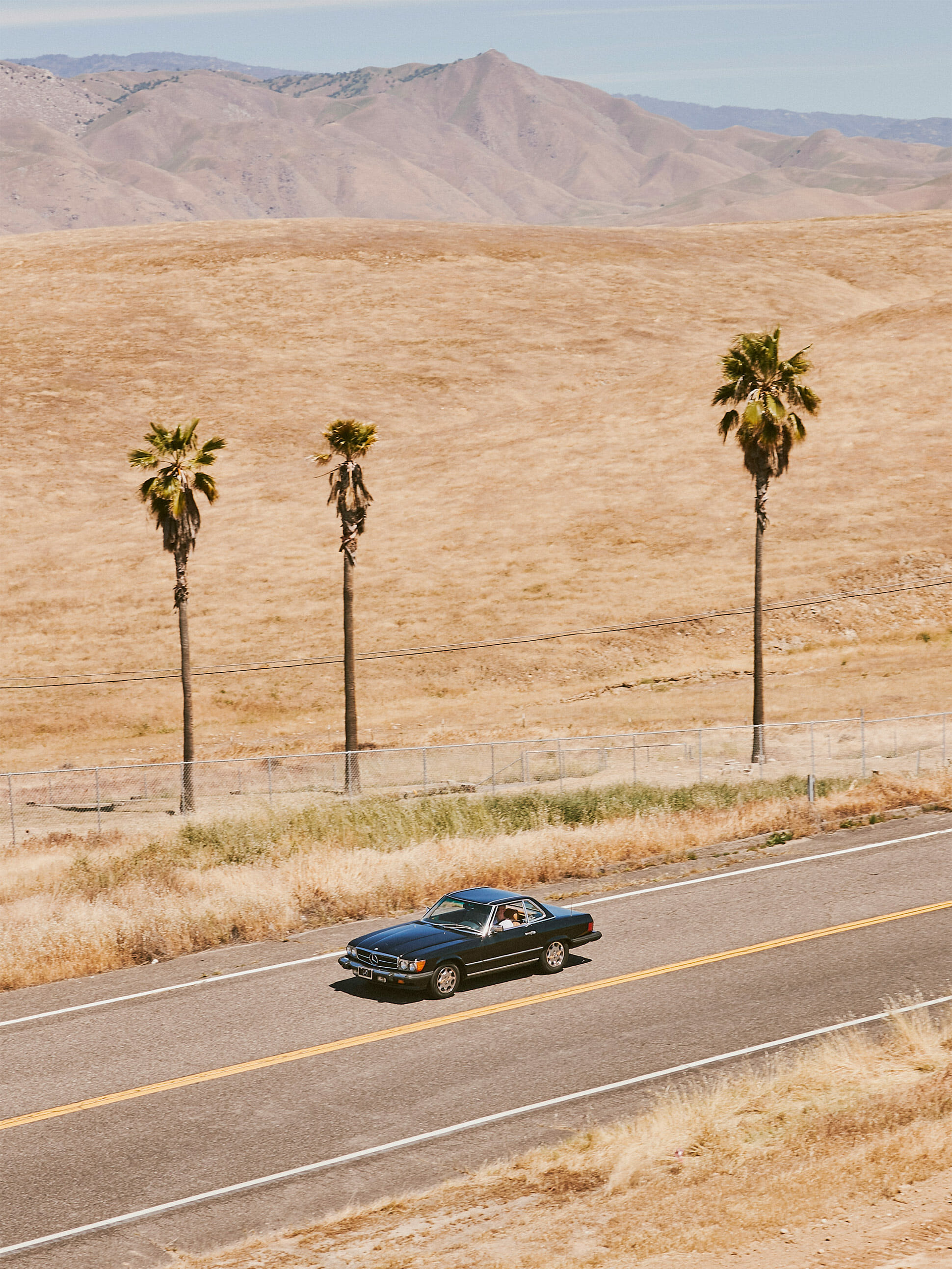
But within the stillness there’s a subtle conversation taking place between me and the Merc. I tell it where to go and how fast to get there; the car tells me about the condition of the pavement, any irregularities or debris in the road, available tire grip. Even with hydraulic assist, the rack-and-pinion steering is hardly more complicated than a wheel and axle, but it offers something the most advanced cars on the market today cannot: a physical connection to the road, linked from the tires through a series of rods, knuckles, joints, pistons and shafts up through the steering wheel and into my fingertips.

The steering is fuzzy and wanders after grooves in the pavement. The steady sound of the engine chugging tells me it’s breathing well; the travel of the brake pedal indicates how much stop is left in it.

Enthusiasts venerate these sensations but most people can’t translate them, like trying to explain the taste of good wine. The degree and detail of this feedback separates a good car from a great car from a sublime car. But it’s also work: the baseline attention and constant microadjustments needed to keep a car on course becomes tiring, and as we make our way past Fresno I feel the first fuzzy creep of fatigue.

We drive through Herndon, through Fairmead, turn west on the 152 just south of Chowchilla, stop at one of the thousands of gas stations in the state and perform the same rituals: swipe the card, pump the gas, wander past the burnt coffee.
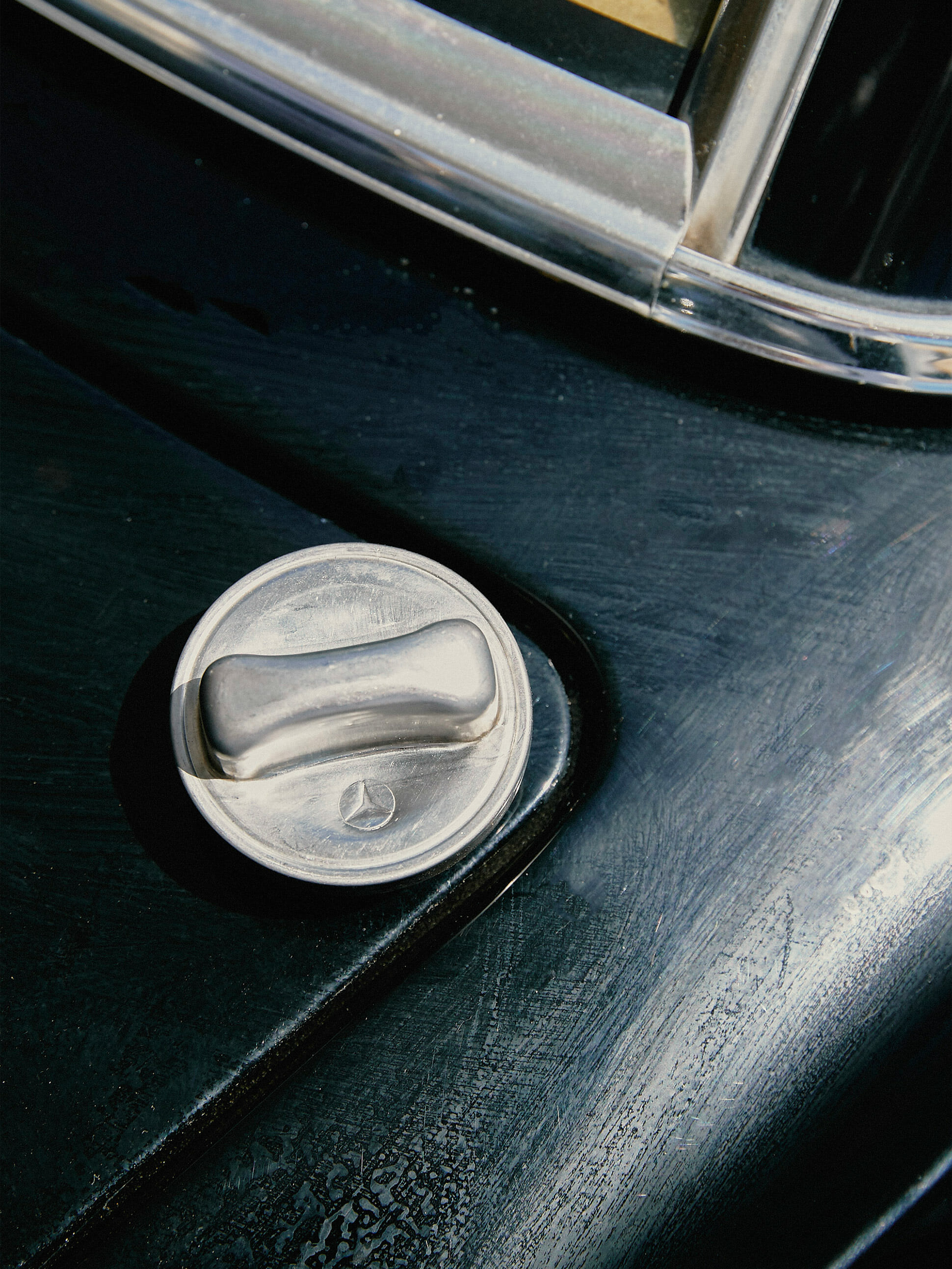
It’s a pristine example of the modern American gas station, a wide, bright, depressing junk food aisle with a side hustle in cigarettes and lottery tickets. It’s not a place meant for lingering but I’m thirsty and the car’s hot. I get a couple thumbs up from Leno fans for choosing something old and sufficiently difficult. The Merc has less horsepower than a new six-cylinder Toyota Camry, and all things being square, any modern crossover will utterly thrash it around a racetrack, but when I stretch I can still feel the road in my hands and the churn of the engine under throttle.

After five hours in the car, its personality has vibrated into my bones — the long brakes and loose steering, the way the suspension dips and rolls through corners. I told it where to go and how fast to get there, and it gave me 227 horsepower and a four-speed automatic to use as I pleased.

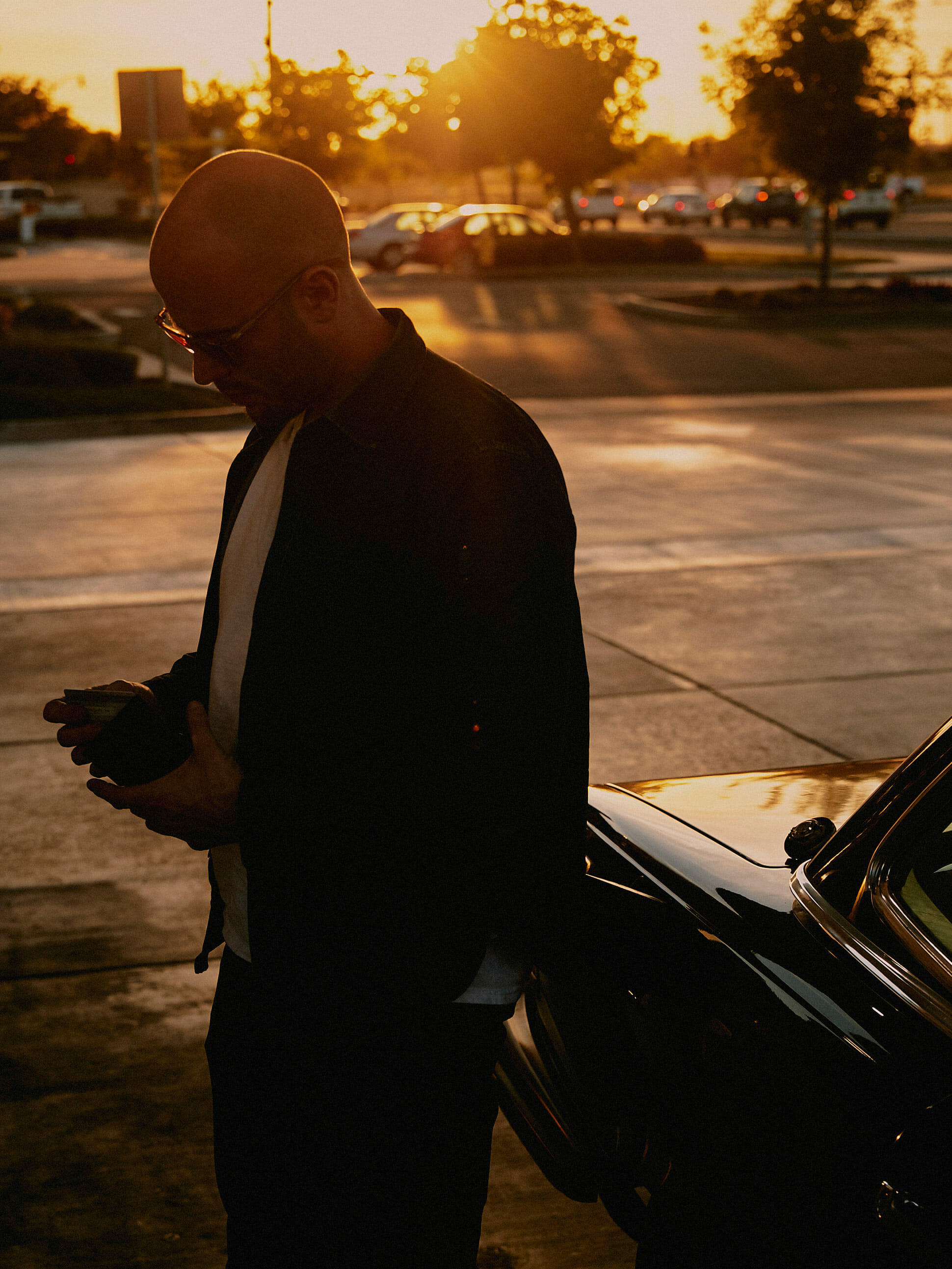
Back on the road the FM picks up staticky blues as we roll into Fremont, the music pulled out the open windows and tossed into the breeze. It strikes me that if I tossed my phone out alongside it I would be nearly in the wind. The old Merc’s airy, delicate cabin is a bunker of its own sort, utterly impenetrable by phone or email or text. Once, back when no one could call you if they didn’t know where you were, cars were a moving target, hard to hit. Now, we go on vacations and retreats and social media fasts just to unplug the way the average American commuter did five days a week some 30-odd years ago.

But I’m tired when I park the car in the sprawling lot, so I pull out my phone and drop a pin to the car’s location, since it won’t do it for me. Technology ain’t all bad.

PART II: Fremont to Los Angeles

2019 Tesla Model 3 Performance

Pinning the throttle in the Tesla Model 3 is something like what hitting hyperspeed looks like on TV: there’s a silent whump and then at some point you realize you’re pulling a stupid face with your mouth hanging open and you’re maybe in another zip code.
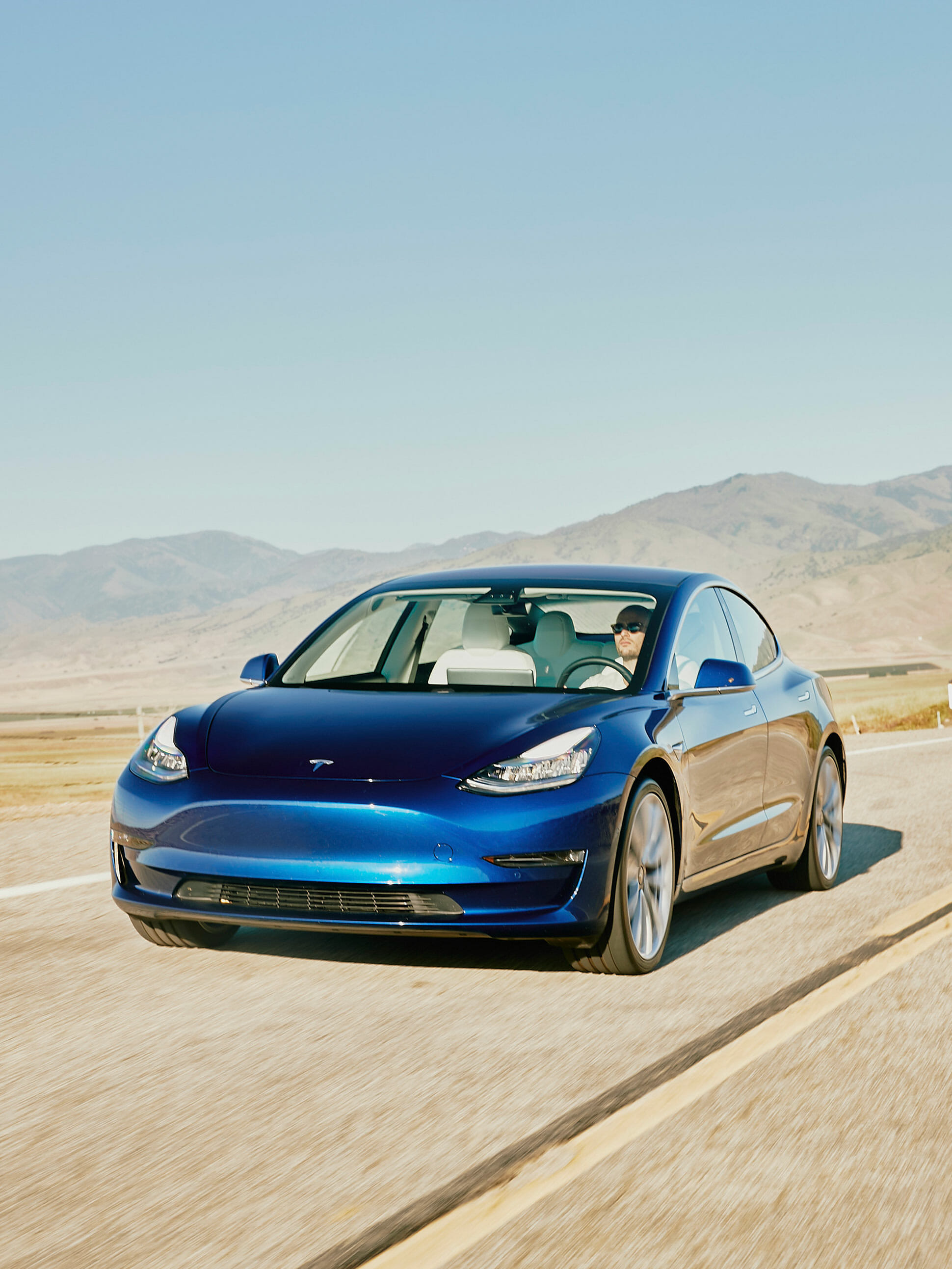
Before we get into anything else, the weird shape or the “self-driving” or the hermetically clean interior, it should be noted that the Tesla Model 3 Performance is a car you can drive mercilessly, viciously and without sympathy. It’s delightful, stupid, knee-slapping fun — all-wheel drive, beefy
brakes and an extremely low center of gravity. It’s one of the most aerodynamic production cars in the world, with instantaneous torque and a dedicated track mode developed by racing champ Randy Pobst. It embarrasses supercars on the drag strip and can smack around high-priced sports sedans on a road course, for around $60K. If Enzo Ferrari or Carroll Shelby had access to the Model 3, they would have never pursued internal combustion. Like using a stopwatch to time an explosion, it’s hard for human senses to comprehend just how fast the car is.
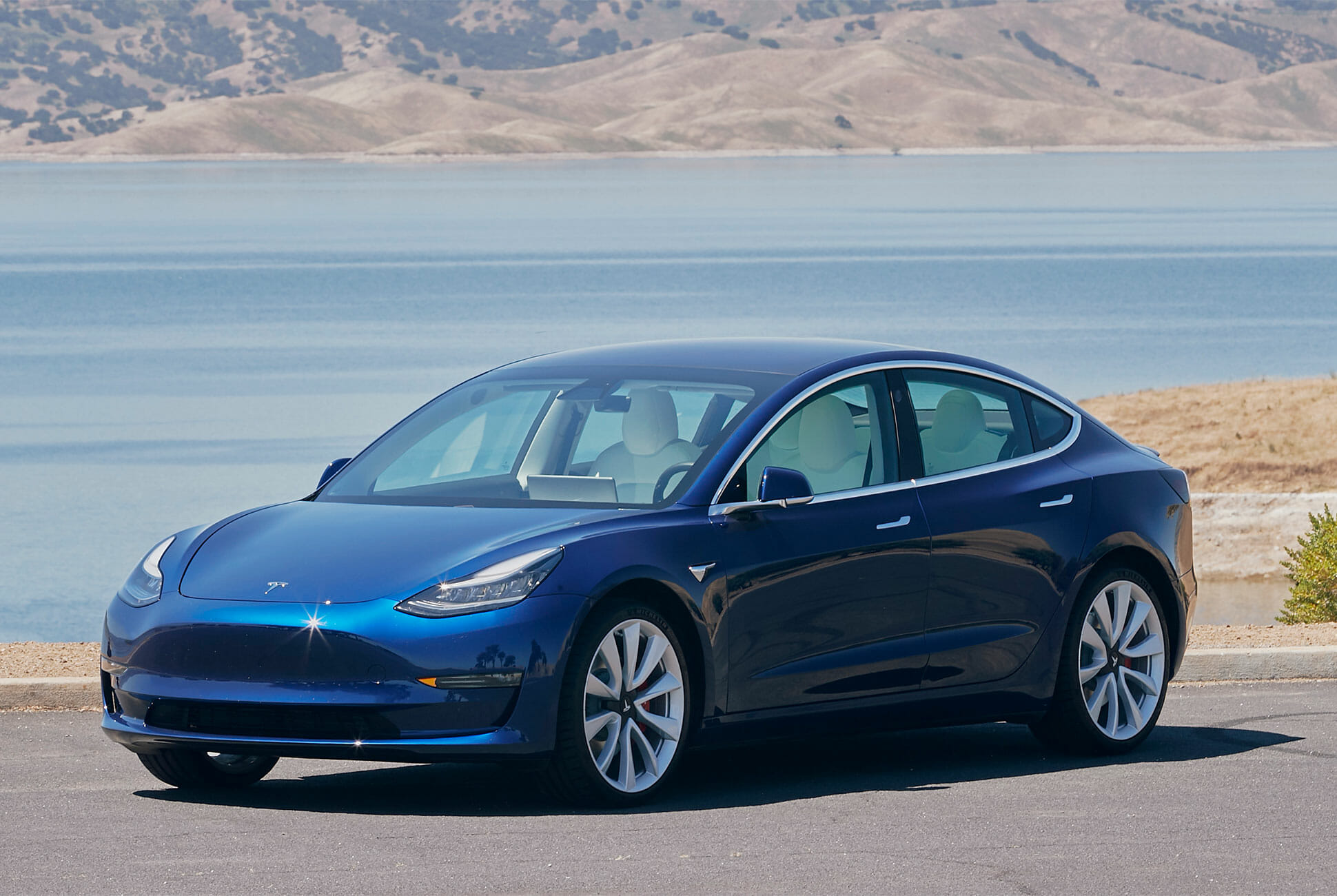
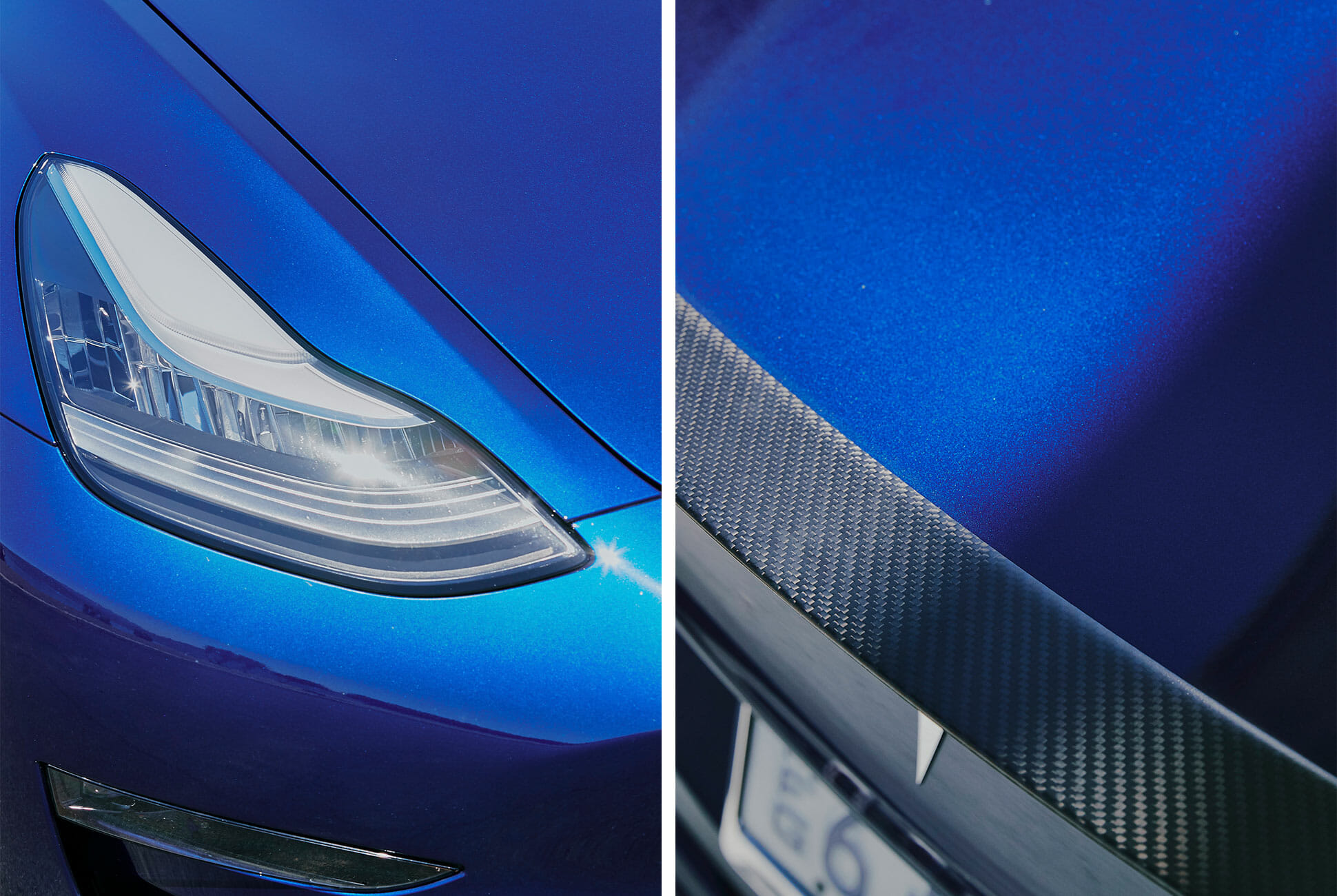
The entire car hovers into the uncanny valley between car and not-car, with a slight (no doubt purposeful) spaceship vibe. Seen in the wild, a Tesla appears slippery and dense, ovoid but aggressively planed. There is no grille because the battery-powered car has no engine; instead, there’s a wide, fat lip to lift air over the body. It turns out the car of the future is not a smooth missile like the ‘56 Oldsmobile Golden Rocket concept or a windswept stealth fighter like the 1970 Vauxhall SRV, but an expensive computer mouse with the face of a bullfrog in a wind tunnel. There is something sexy about the Model 3, but it’s not a car’s sexiness — it has the sleek, minimalist allure of a beautiful smartphone or wireless speaker.

Inside, the car is cool and hushed and almost completely unadorned under the tinted panoramic glass roof. There are no gauges, buttons, dials, knobs, switches or hidden storage compartments. There is no key — the key lives on your phone, locking and unlocking the doors automatically, among many other tasks — and no vents or speakers to be seen within the smooth, colorless expanse of vegan leather. In fact, the interior has only one feature: the Screen.
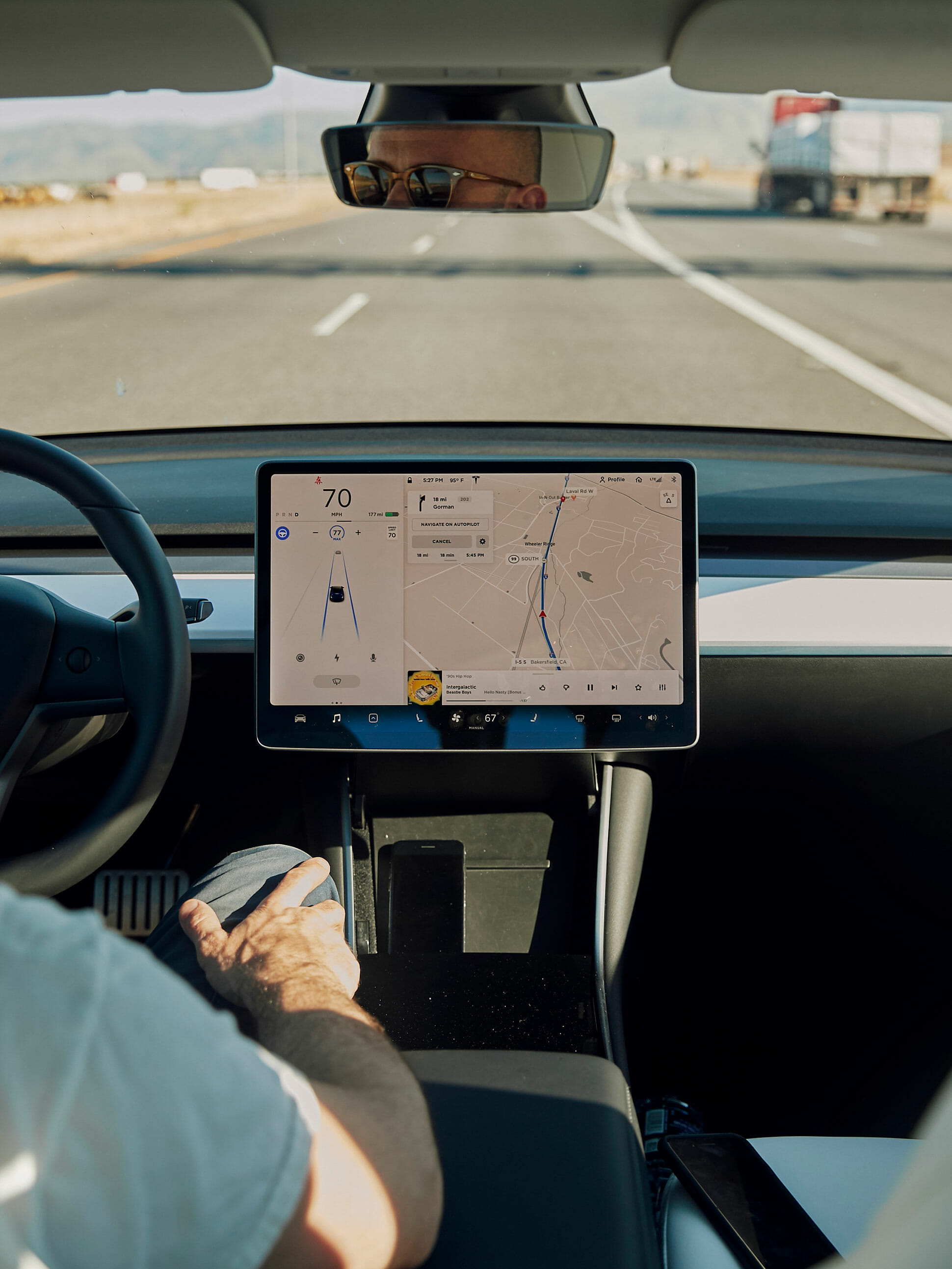
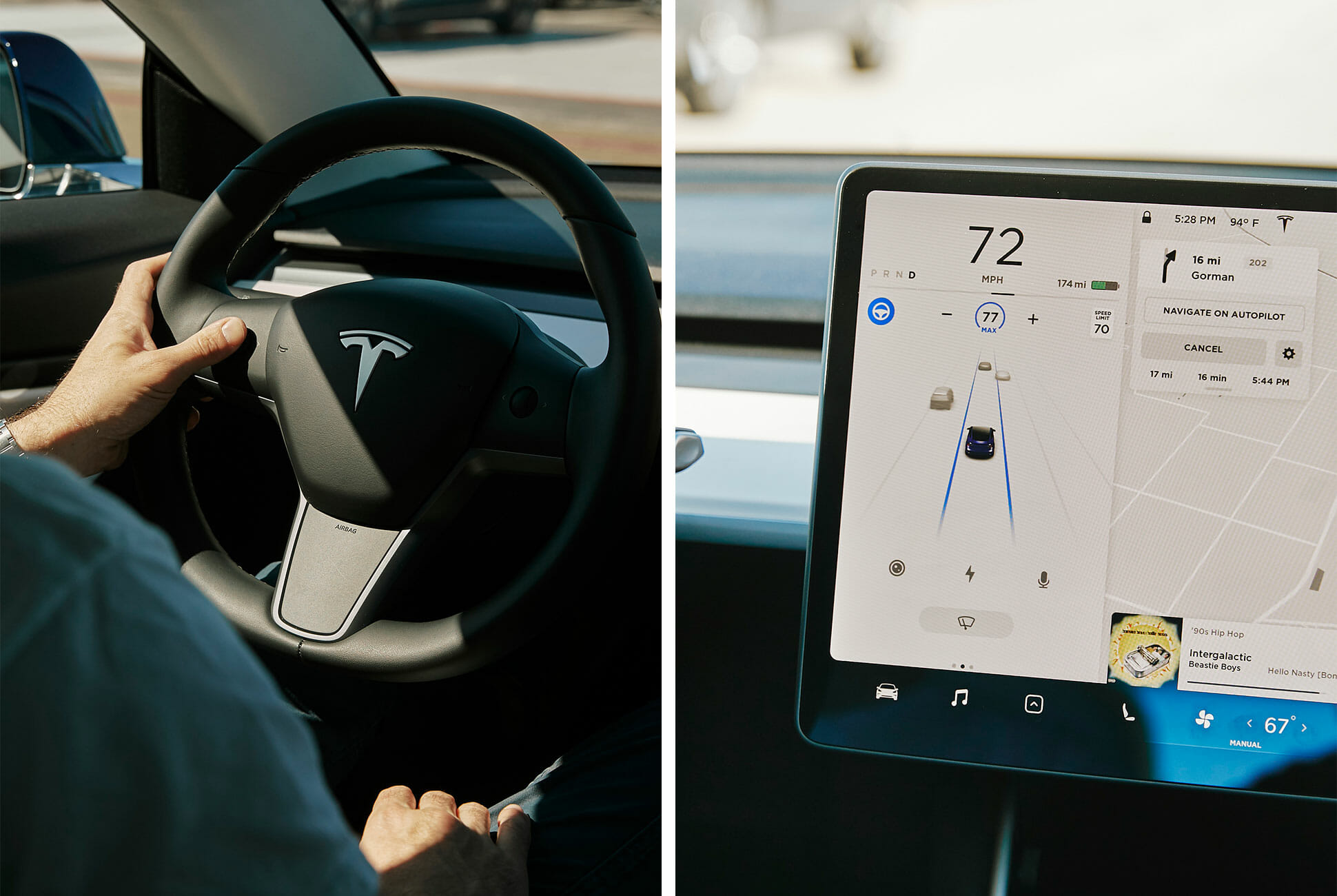
The Screen is a 15-inch horizontal tablet, the size of a platter for serving tomahawk steaks. It’s beautiful, rich in color and detail, softly glowing. Nearly every interaction with the Model 3, from the radio to the seat coolers, calls, texts, vent controls, vehicle diagnostics, security and charging port access, is done through the Screen. It feels high-tech and, at 85 mph on a six-lane highway, utterly terrifying, because there’s no way to use the huge touchscreen and its labyrinth of sub-menus without completely ignoring the road.

The Model 3 has a novel solution to the attention problem: it offers to drive. I depress a steering column-mounted stalk twice, engaging Autopilot. On the Screen, a wheel icon glows green to confirm the system is engaged. The car is now driving, using a combination of automatic cruise control, emergency braking, lane-keep assist and an assortment of additional cameras and radar sensors, and I have been relegated to monitoring status. So I sit and observe the car as it attempts to figure out things like traffic and lane closures.

For long stretches the car is utterly capable, keeping pace with traffic, navigating bends in the road, even switching lanes when I engage the turn signal. I watch the wheel juke and twitch and am struck by how little movement happens during the normal commute. For all the fidgeting, singing, eating, drinking, talking and stretching that takes place inside a car, the mundane act of commuting usually requires only the smallest, most subtle human inputs.

At other times, the Model 3 is hesitant, easily confused, at one point slowing almost to a stop on the freeway rather than accelerate past a slow-merging hatchback. On several mystifying occasions, the system tosses off an irritated bong and disengages.

As close as I can figure, Autopilot works on the highway about as well as a nearsighted 12-year-old, which on the one hand qualifies it as a staggering technological achievement and on the other means I’m hardly tempted to take a nap while it’s in charge. Still, I find myself surprisingly willing to let Autopilot take the wheel for a spell, when I’m sleepy or bored or I just want to play with a bright glowing screen for a minute. Hell, that squinty bugger got us most of the way to Tesla’s Kettleman City Superchargers three hours south, and it planned the whole route to boot.
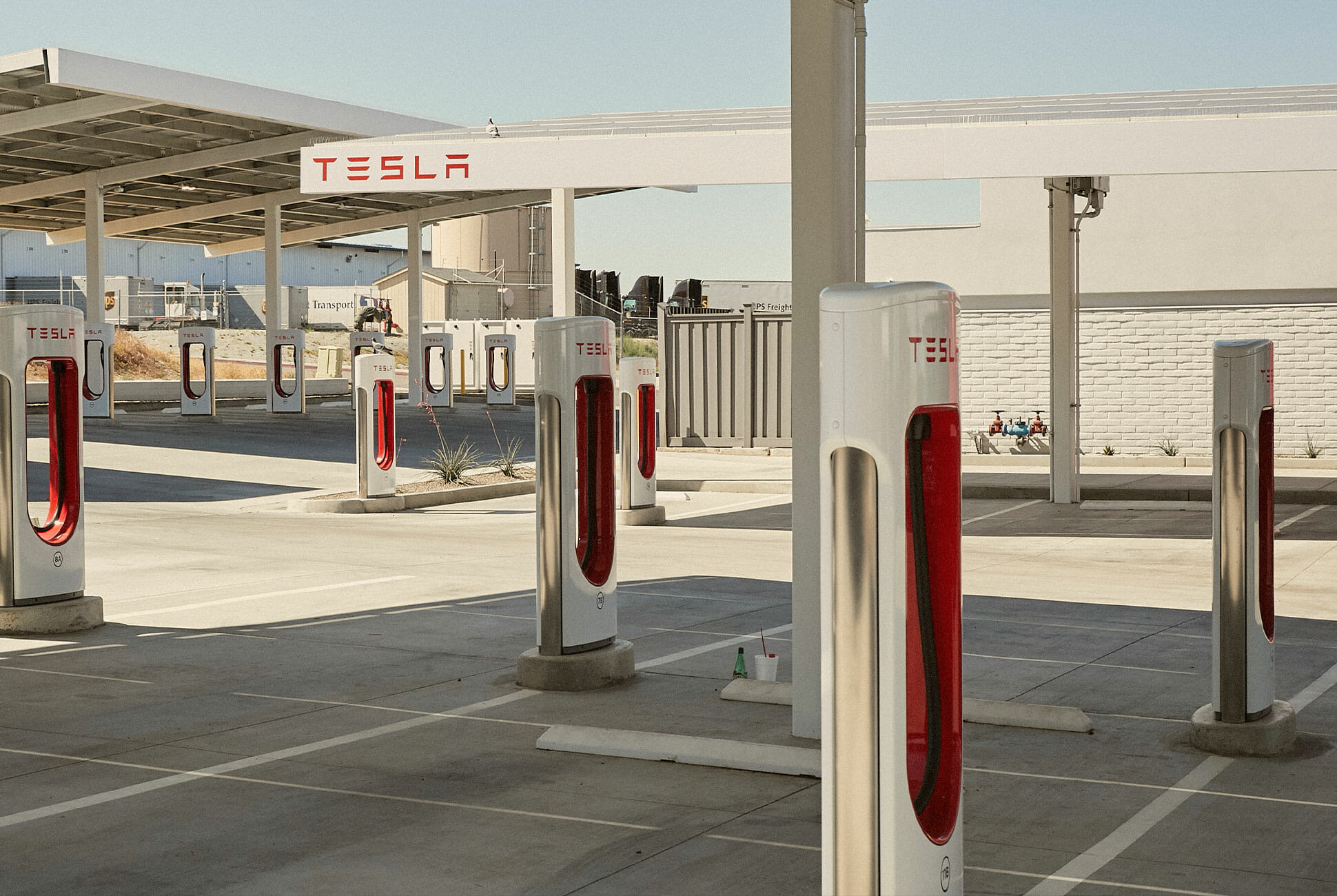
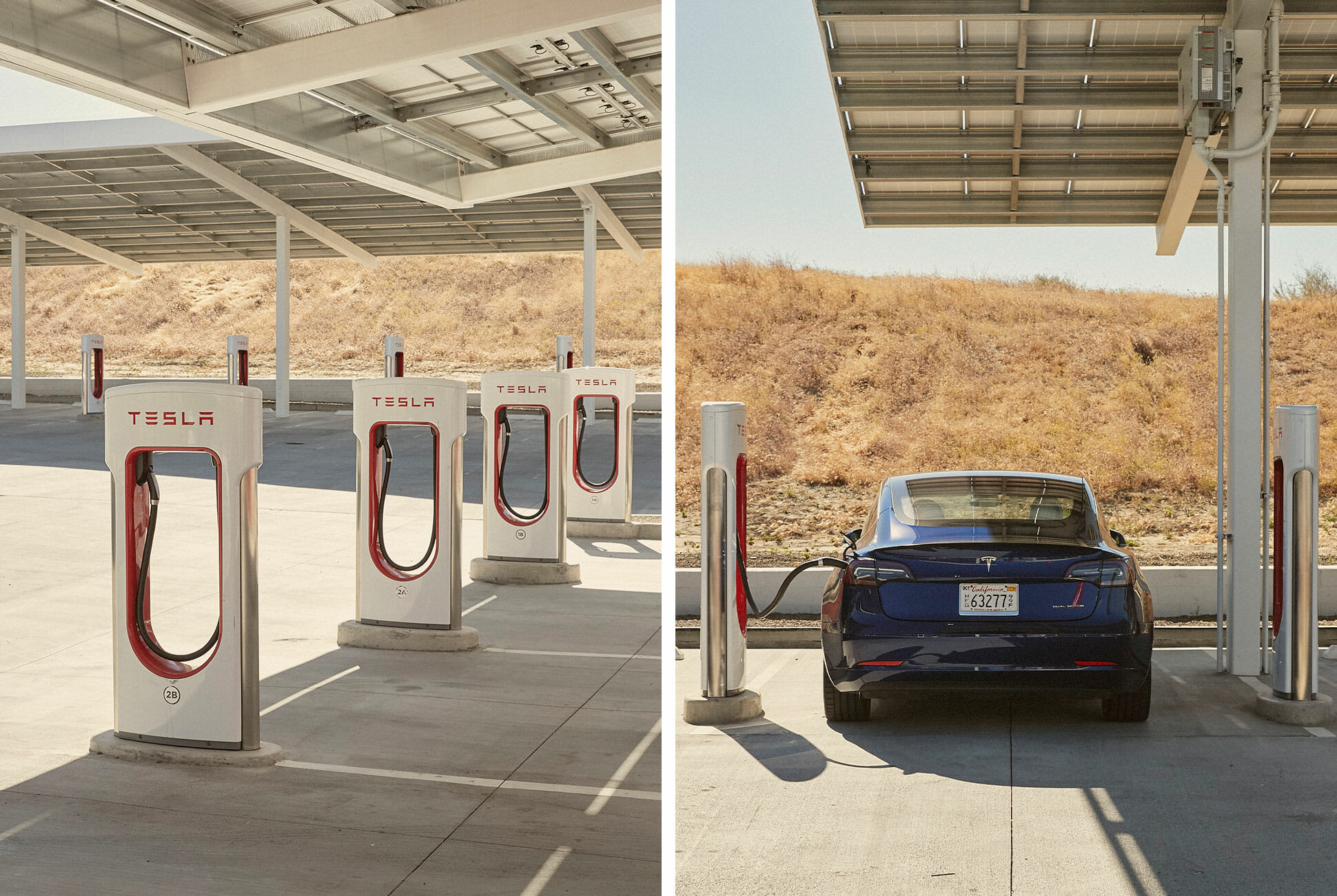
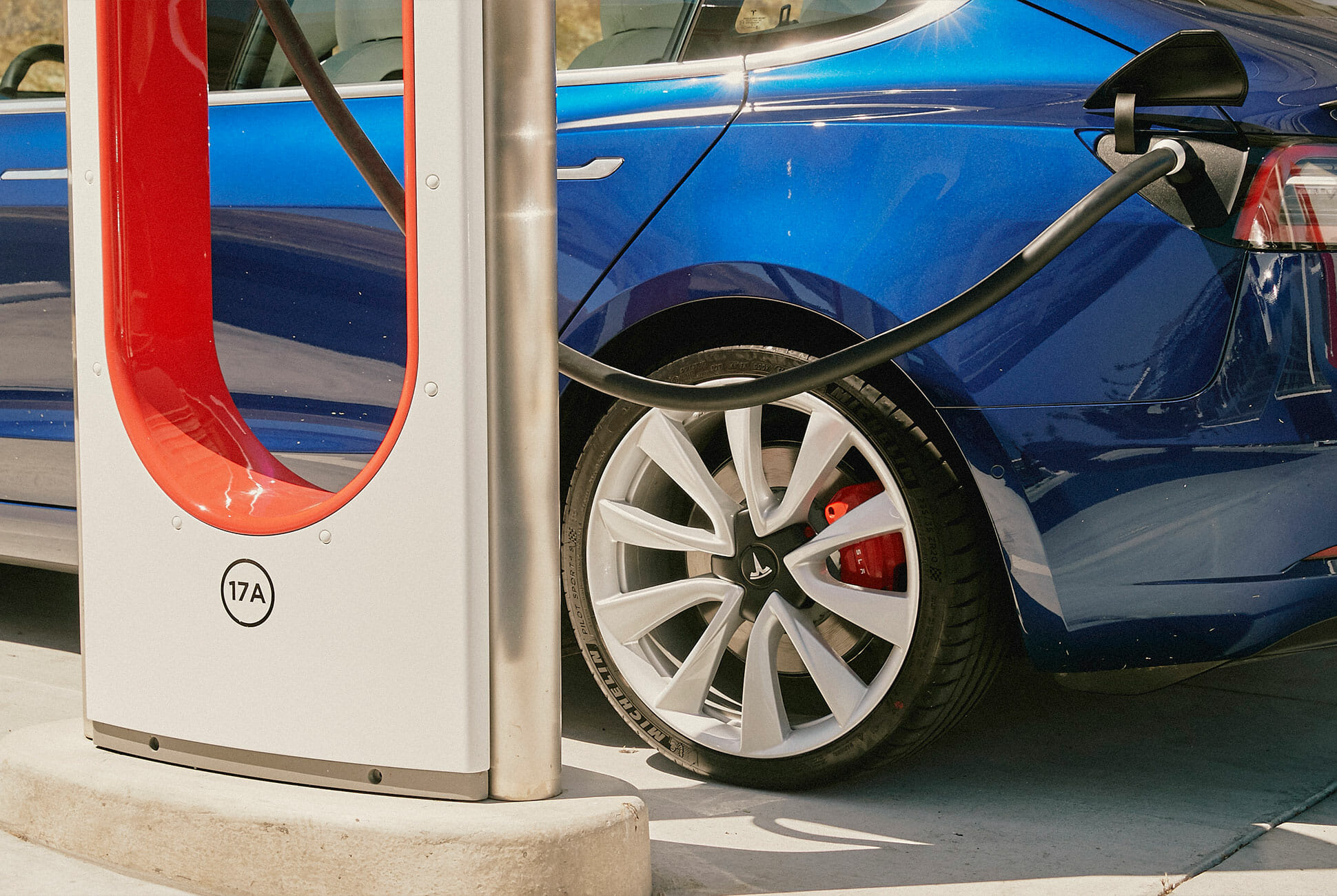
The grass outside the Kettleman City Supercharging station is very green and all the blades are exactly the same height, because it’s fake. The door is locked with a keypad; when you arrive, your phone key sends the passcode to unlock it. It’s spacious and cool inside, with a barista selling espresso drinks, a playpen for kids, plentiful outlets and comfortable chairs for efficient telecommuting, like a business class airport lounge in Burbank.

It’s comfortable enough to spend an hour and 14 minutes, precisely how long the phone key tells me it will take to recharge, but there’s an In-N-Out Burger within walking distance so time is passed there, instead. I track the charging on my phone and time my return exactly to the moment it’s complete.

The Model 3 delivers me back to LA in around seven hours, including the charging, and I’m about as fresh when I get out of the car as when I got in. This is the great shouted promise of the autonomous, electric, connected vehicle: the car will do the work for you — and it will, and it will delight and amaze. The only catch is that the car needs to remove you from the decision-making equation when it sees fit, and you get no say.

The starkest example of what we’ll give up in our artificially intelligent future is this: you can drive that old Merc straight into a wall as fast as your courage and runway allow, but the Tesla won’t let you do it. Neither will a modern Mercedes, or Volvo, or anything with emergency braking. The simple computers that controlled things like electronic fuel injection (quicker acceleration, on demand!) have grown so powerful they now outrank the human driver. Computers determine how much throttle the car uses and how much steering, when to add to or subtract from your speed. I spent a lot of time in the Model 3 wrestling with the steering wheel, trying to determine who’s in charge. It’s not an argument I can win.

In the car of the future, the need to drive will be replaced with the freedom to answer emails. The car will give you the feeling of escape but will never stop watching you, never let you truly get lost. It can seem a sad, silly thing to mourn the ability to run a car headlong into a wall because you want to, but freedom lost is often lost forever, and it requires mourning all the same.

2020 Audi RS4 Avant Updated with a Fresh Look

The Audi RS4 Avant has fallen out of favour in recent years. There was a time when the RS4 was the darling child of the Audi Sport range. In recent years, it is the Audi RS6 Avant which has driven the fortunes. Audi will be hoping that its latest update to the baby Avant will push sales back to where they belong.

The Audi RS4 Avant gets updates that mirror those applied to the Audi A4 range earlier this year. The front has been completely redesigned. It gets a wider and flatter single-frame grille, similar in style to the version found on the recently released Audi RS6 Avant. It is fitted with black gloss, three-dimensional honeycomb, typical of RS models.

The LED headlights also receive a refresh. Optional matrix LED units get darkened bezels. They complement the gloss black, matt aluminium and carbon fibre styling packages which add sill inlays, exterior mirror housings and elements to the front and rear bumper.

The side profile remains unchanged. The wheel arches are 30 mm wider at the front and the back compared to the A4 Avant. At the rear, a new twilight design should make it clear to the rest of the world that you are driving the latest and greatest. New air vents next to the tailpipes are also evident. Otherwise, everything else appears untouched.

The power unit is what really matters with the RS4 Avant though. The 2.9 litre V6 receives some work. It now produces 450 hp and 600 Nm of torque, sprinting from zero to 100 km/h in just 4.1 seconds. Audi engineers the twin turbochargers to act on each individual side of the cylinder bank, mounted within the V.

Power is routed through the quattro system via an eight-speed tiptronic gearbox. A torque vectoring system is on offer too, assisting with handling on difficult surfaces. An optional quattro sport differential provides an even better response.

Inside, the latest 10.1 inch MMI touch display welcomes the driver with the option of the Audi Virtual Cockpit with unique RS displays showing information on tire pressure, torque, power output and other performance-oriented details.

The Audi RS 4 Avant will make its debut at the DTM finale at the Hockenheimring on 4 to 6 October 2019. Sales in Germany and other European countries will start in October 2019. Prices for the RS4 Avant should start at 81,400 euros.

GTSPIRIT NEWSLETTER

It’s Official: There Will Be a Next-Gen Toyota 86 and Subaru BRZ

The Magazine

Each issue of Gear Patrol Magazine is a deep dive into product culture. Inside, you’ll find seasonal buying guides, rich maker profiles and long-form dispatches from the front lines of product design. The stunningly designed Gear Patrol Magazine is ready for your coffee table. Quarterly. $39

The Newsletter

Get the best new products, deals, and stories from across the world, in your inbox daily.

Hennessey Venom F5 engine officially makes over 1,800 horsepower

Details on the Hennessey Venom F5 hypercar have been trickling out of the Texas-based company, and they seem to change every time we hear about it. But hopefully things are becoming more concrete, because Hennessey revealed it has finally dyno-tested the engine slated for the car and have final numbers.

It makes 1,817 horsepower at a screaming 8,000 rpm and 1,193 pound-feet of torque at 5,500 rpm. It also apparently will make at least 1,000 pound-feet of torque from 2,000 to 8,000 rpm. Redline is 8,200 rpm. It’s worth noting that these numbers put the Venom over 200 horsepower ahead of the Bugatti Chiron Super Sport 300+, Koenigsegg Jesko, and Hennessey’s original power goal. The engine revs 1,000 rpm higher than the original prototype, too. This is all good news considering Hennessey wants to break the 300 mph barrier like Bugatti has and Koenigsegg aims to do.

Just as the Venom F5’s power isn’t what was previously announced, the engine itself has changed since we last saw it. When it was shown at The Quail last year, it was all-aluminum and had a displacement of 7.6 liters. Displacement has dropped down to 6.6 liters, and the engine block changed from aluminum to forged steel. But as with the prototype, it’s twin-turbocharged, uses pushrods instead of overhead cams, and the heads, intake manifold and pistons are all still aluminum. The engine has a name, now, too: Fury.

Hennessey also announced it will begin testing the whole car later this year. The company will build 24 examples total, each with a price of about $1.6 million. Provided that all goes well with the regular Venom F5, the company has plans for a roadster variant to come afterward.

Abt Creates One-Off 400hp Audi A1 as Ultimate Pocket Rocket

Not content with waiting for a performance version of the Audi A1, Abt recently announced a one-of-one tuning package. The Abt A1 “1of1” was built for Daniel Abt, Abt racing driver and the son of owner and principal of the Abt Sportsline team, Hans-Jürgen Abt. The ultimate pocket rocket features a unique set of updates.

The Abt A1 is fitted with a bespoke Abt bodykit. The design is clearly inspired by DTM with new front fascia, incorporating a deep front splitter and a new set of air intake surrounds and multiple canard-style air channels. The fenders receive a bolt over look, widening the bodywork significantly. There is a new bonnet, side skirt and mirror coverings. At the back, Abt have fitted a massive rear spoiler alongside a new rear diffuser.

The package is finished with a new set of wheels. The 19-inch ABT ER-F forged wheels are finished in black and recieve a set of internally mounted golden aero-rings, evocative of Abt’s Formula E car.

Based upon the 40 TFSI model, ABT has breathed new life into the 2.0 litre TFSI engine. How have they managed to generate 400 hp? The explanation is complicated, because Abt have infact switched the engine from a standard 2.0 litre TFSI to an unspecified 2.0 litre TFSI, likely with racing parts.

Still, should you wish to have your own version, Abt will hapily forego the engine transplant and fit a set of modest performance enhancements, with a new stainless steel exhaust system and 114 mm tailpipes, booting power to 240 hp.

The “1of1” is complete with a set of H & R suspension sprints, rear seat roll bar and a complete Alcantara interior upgrade. Last but not least, Abt are proud of the Erik Aleksanjan, geometric pattern designed which they have termed the “polygon split design”. The design was penned by the same man who styled Jon Olsson’s Audi RS6 Avant!

GTSPIRIT NEWSLETTER

Mercedes-Benz Needs to Build a G-Class Pickup Truck

Pickup trucks are the most popular (and among the most profitable) vehicles sold in the United States. It’s a rich segment of the market, but it’s also a segment where foreign manufacturers haven’t been able to find any traction. Ford, Chevrolet/GMC and Ram have formidable brand loyalty, which they’ve earned and kept by producing fantastic vehicles. Those companies pour tremendous effort and resources into their pickups to make sure they’re capable of dispatching all competitors. Those profits are too vital not to.

Those profits (and the potential for more of them) have been causing the pickup market to evolve. Once-utilitarian trucks are morphing into genuine luxury vehicles., with companies touting their high-end leather trim and open-pore wood. High-output powertrains are pushing performance boundaries. (Who’d have thought an F-150 could ever do 0-60 mph in 5.1 seconds?) Trucks are becoming tricked-out formidable off-roaders. Top trims can have price tags surpassing $70,000.

Those rising prices open up an opportunity for new competitors to jump into the pickup truck space. Most manufacturers would sink while trying to swim with Ford, GM and Fiat Chrysler in the mass market. But at the high-end level, domestic manufacturers are pushing beyond their traditional depths. There may be room at the for a luxury competitor to swoop in at the top of the market and offer, shall we say, the “Mercedes-Benz” of trucks. And the best candidate may be Mercedes itself.

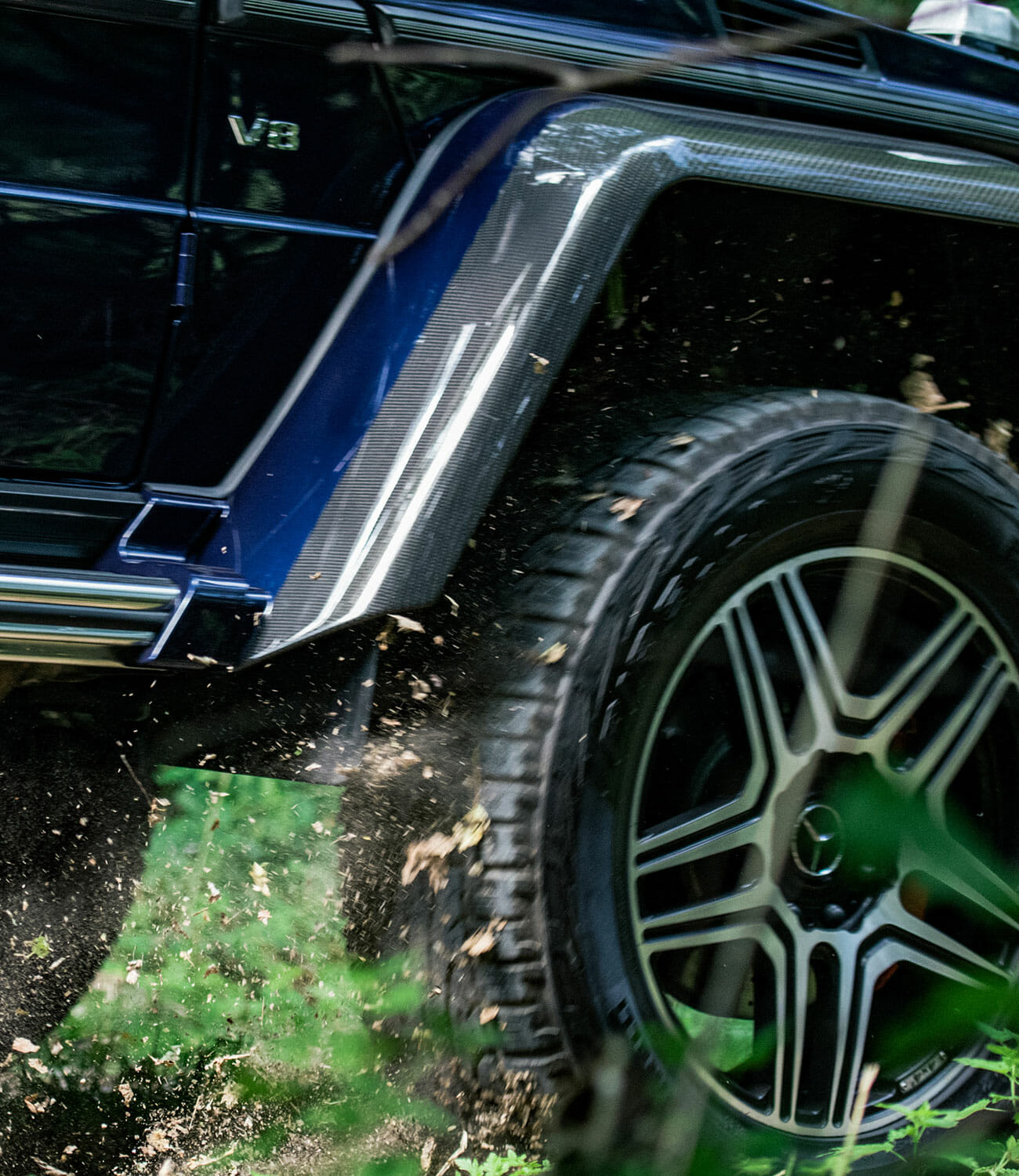
After all, Mercedes already has a versatile, capable platform to build a truck on: the G-Class. The G-Class offers everything the top end of the truck market is trying to do but better and in one complete package; it just has a roof all the way to its rear instead of a bed. Luxury? A Mercedes hallmark from the humble A-Class upward. Performance? Mercedes can match or surpass every truck engine with its twin-turbo V8s. Off-roading? The G-Class has legendary off-road proficiency; it’s just visible only on those rare occasions when owners let them leave the pavement.

The G-Class platform has spawned trucks before — ones that were much more involved than modifying an SUV into a regular pickup. Mercedes-AMG built a limited run (and manifestly insane) 6×6 off-roading truck from the previous generation G-Class earlier this decade. Mercedes also has made more utilitarian G-Class versions, like Australia’s pared-down flatbed “G-Class Professional.” If a G-Class cabriolet can exist, it’s not that much of a stretch to make the modifications needed for a pickup.

Now, Mercedes has said it’s exiting the truck game just two years after debuting the X-Class pickup. But that failure does not disprove the viability of a Mercedes truck. The X-Class was a rebadged Nissan pickup with a wimpy engine intended for markets outside North America. It did not show what Mercedes could do with a truck if it went for the true high-end market — and how American buyers would react.

It may be a conceptual hurdle for Big Three truck buyers to embrace Mercedes. But Mercedes-Benz’s brand cachet may attract luxury buyers not otherwise interested in trucks. If we judge the idea in comparison to other respected off-roaders, there should be interest in a G-Wagen truck effort. Jeep Wrangler buyers have embraced the Gladiator. Ears perk up at the mere mention of a new Defender-based pickup or Land Cruiser-based options available in other countries.

I don’t expect Mercedes to actually attempt making this ultimate high-performance lux truck. Bean counters would no doubt be reticent to sanction anything risky, given the present instability in the automotive market. But a pared-down G-Wagen with a bed would be natural, awesome — and, notably, something Mercedes-Benz’s rivals like BMW can’t compete with, however cool that specially-engineered X7 one-off was.

Porsche Vs. Jeep: The $100,000 Performance SUV Showdown

You know you’re living in unusual times when a Porsche and a Jeep can rightfully be considered competitors. Yet here we are in late 2019, a year where Porsche’s first crossover is well into its third generation and Jeep builds a Grand Cherokee with a 707-horsepower engine. Porsches for off-roading, Jeeps on the track; it’s pure Bizarro World logic.

Indeed, the Jeep’s outlandish specs are so wild, they might well distract you from the fact that the Grand Cherokee Trackhawk, as the Hellcat-powered SRT-tuned performance Jeep is formally known, is the most expensive Jeep in the brand’s history. Its base price of around $87,000 is a full $55,000 more than the most affordable Grand Cherokee you can buy new, four times the price of the cheapest Compass you can snatch up at a Jeep dealership, and, adjusted for inflation, 6.8 times the price of that first Willys MA that began rolling off production lines back in 1941. And that $87K MSRP is, of course, just the starting price. Our test Trackhawk came in at $99,470, thanks to add-ons like the “Signature Leather Wrapped Interior Package” and a panoramic sunroof that comes with what Jeep calls a “suede-like premium headliner.”

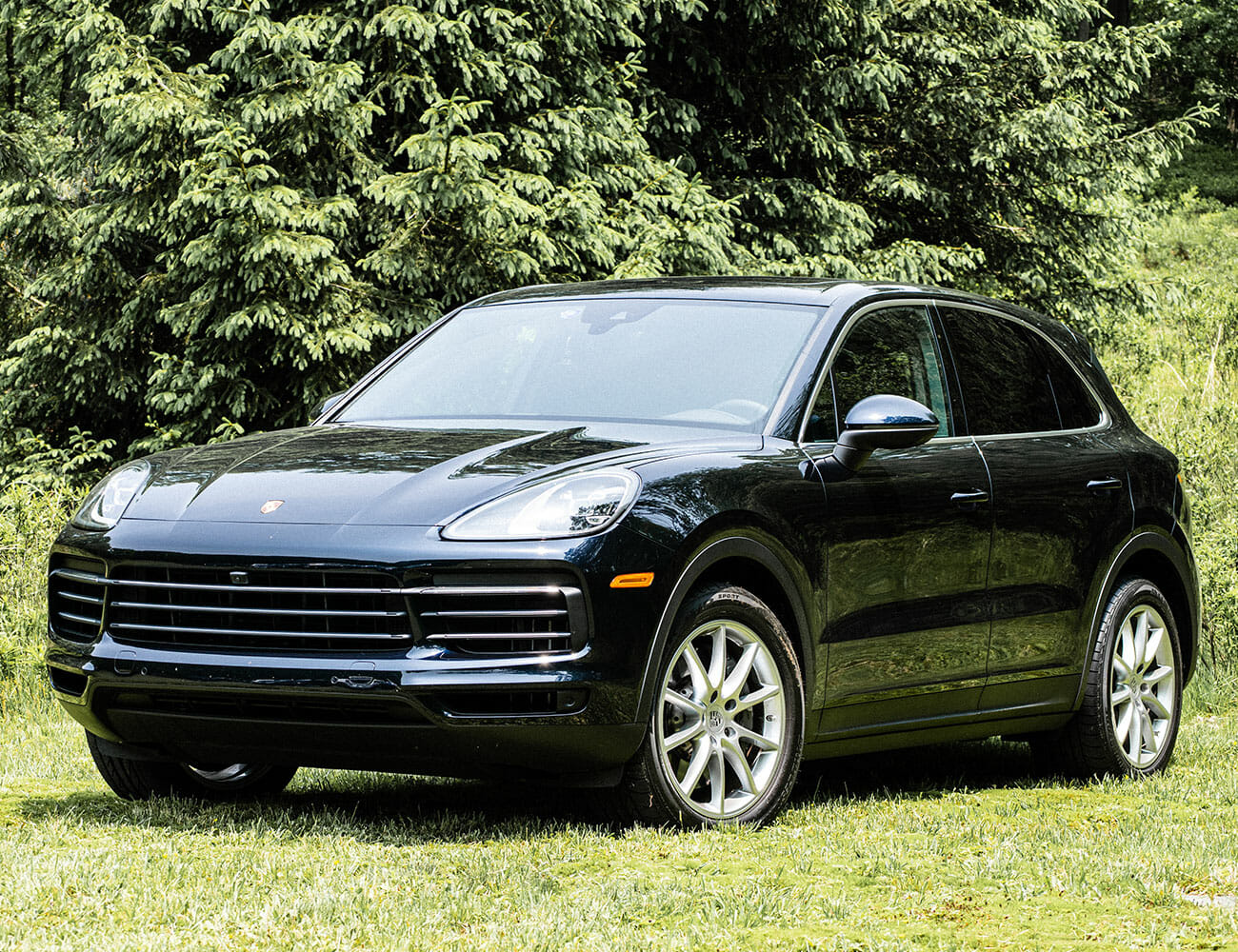
The Porsche Cayenne S, meanwhile, came $101,660 with all its options and the destination fee, thanks to an options list that was surprisingly spare for a new Porker. (Go buckwild, and you can add a full $100,000 in options onto this car’s $84K base price.) The biggest chunk came in the form of a Premium Package that added handy features like “Comfort Access” key-in-pocket entry, LED headlights, power seats, blind-spot warning and a Bose stereo; a leather interior and heated steering wheel gussied up the inside a bit, while rear axle steering, an adaptive suspension, summer tires and the Sport Chrono package added a dash more performance.

So with both of these performance-minded SUVs wandering through our office around the same time, we wondered: Which one of them is more worth writing that $100,000 check for?

Exterior

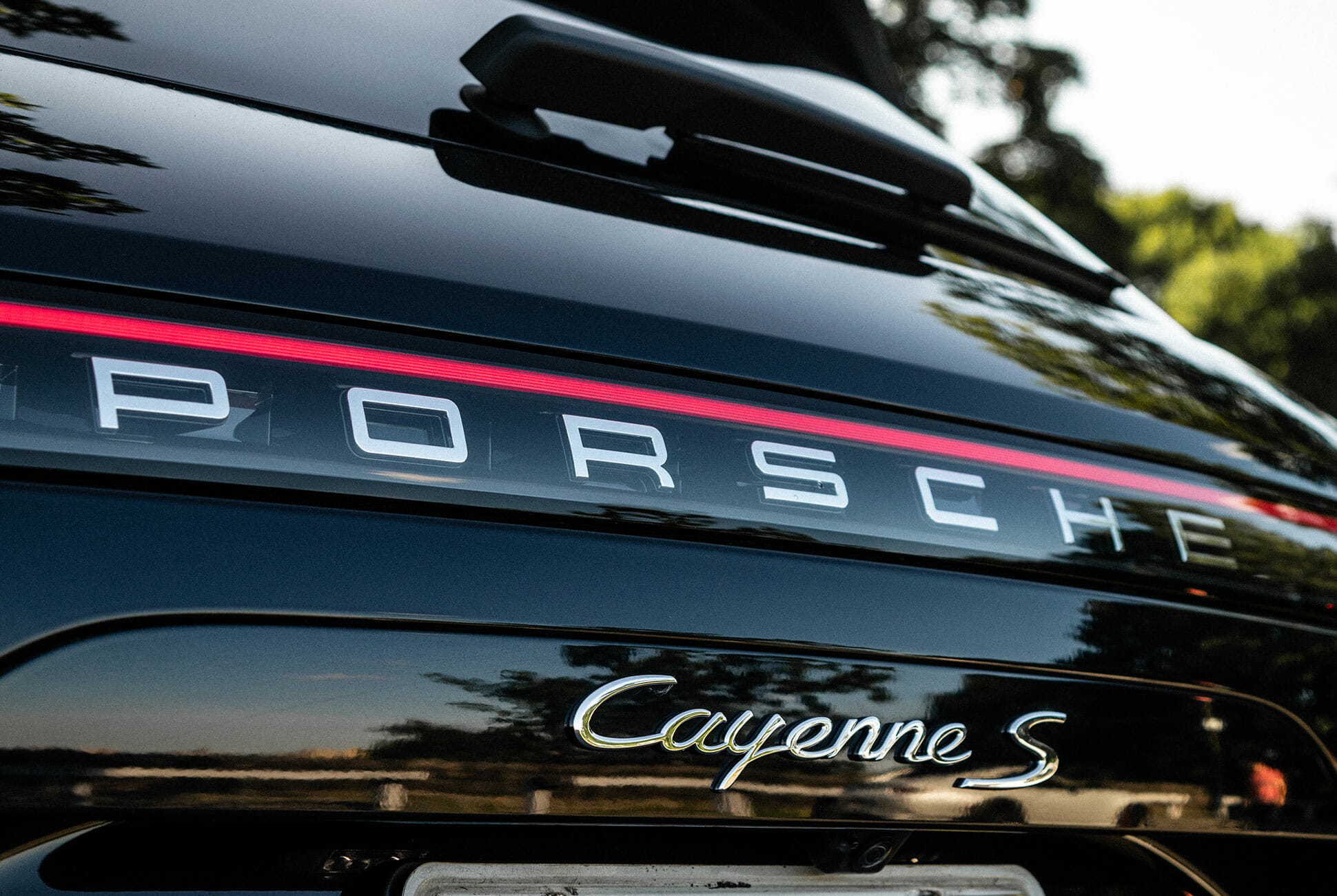
Don’t be alarmed if you can’t tell the third-generation Cayenne from its predecessor at a glance, especially from one of the forward angles. It’s largely identical, hewing to the previous version’s face with a consistency that makes successive 911 generations look like a sea change. Which is a little unfortunate, in all honesty; the carmaker has done its damndest to try and make the familiar Porsche design language work on a lifted two-box shape of this size, but the front end still looks exaggerated and awkward in a way the lesser Macan doesn’t. The stern view, at least, is more cohesive — a stylish, if generic, collection of familiar Porsche curves and shapes.

The Jeep, however, is a handsome thing, if awfully familiar-looking for a car with a six-figure price tag. Indeed, apart from a thin strip of an air intake front and center on its schnozz, it’s identical to the Grand Cherokee SRT, which cranks out a “mere” 485 horses from a naturally-aspirated 6.4-liter V8. That’s a good thing. In spite of its age (it went on sale in 2010), the Grand Cherokee is one of the best-looking SUVs on sale, and the flared fenders, mighty wheels and exaggerated front fascia of the SRT/Trackhawk only add machismo to the appearance.

Interior

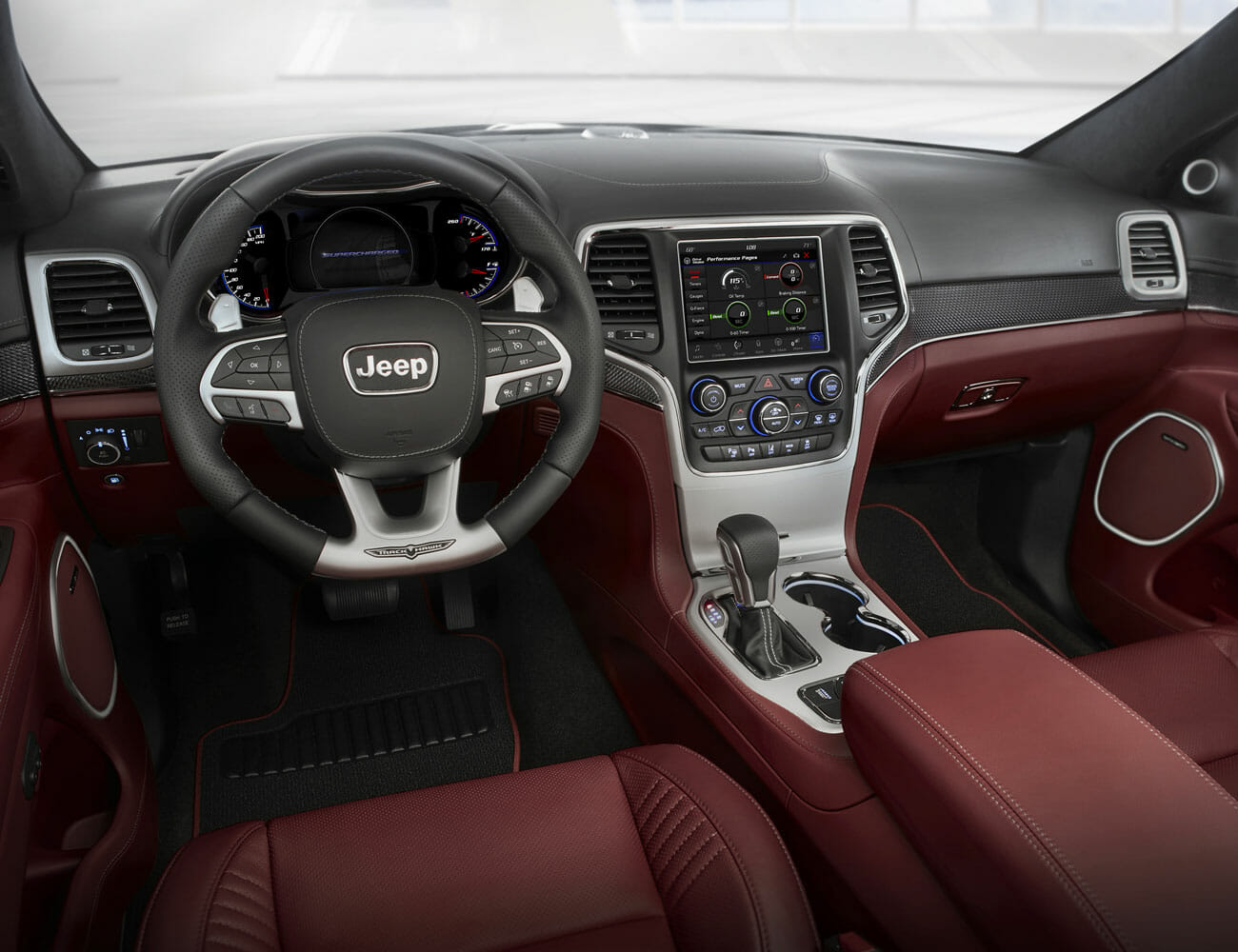
As has become common with Fiat Chrysler vehicles these days, the Jeep’s infotainment system is a delight of usability. It’s simple and effective, with large physical knobs and buttons augmenting the touchscreen, which in turn uses graphics and fonts so big and clear, the display seems like it was laid out by the same folks who designed the Jitterbug. Considering it’s designed to be used while controlling two-plus tons of steel holding you and your loved ones at 75-plus miles per hour, that’s very much a good thing.

The rest of the interior, however, is a bit of a letdown. It’s largely identical to the rest of the Grand Cherokee lineup — which is to say, fine for a $50,000 car, but not worthy of one selling at twice that, even with the $5K leather upgrade. Indeed, that cowskin looks kinda cheap; my test car’s interior already looked a good year or two old with just 2,800 miles on the odometer.

The two-box body style helps make this the most sensible Hellcat; entry and egress are easier than the Charger, let alone the Challenger. Indeed, the interior is every bit as usable and functional as any GC; I used it to help my mom move, folding the back seats down easily with the convenient lever near the floor that flips and folds the seat in one motion. (Nobody does second-row seats like FCA). 36.3 cubic feet aft of the second row is enough for most lesser loads, and nearly 10 cubes more than the Cayenne.

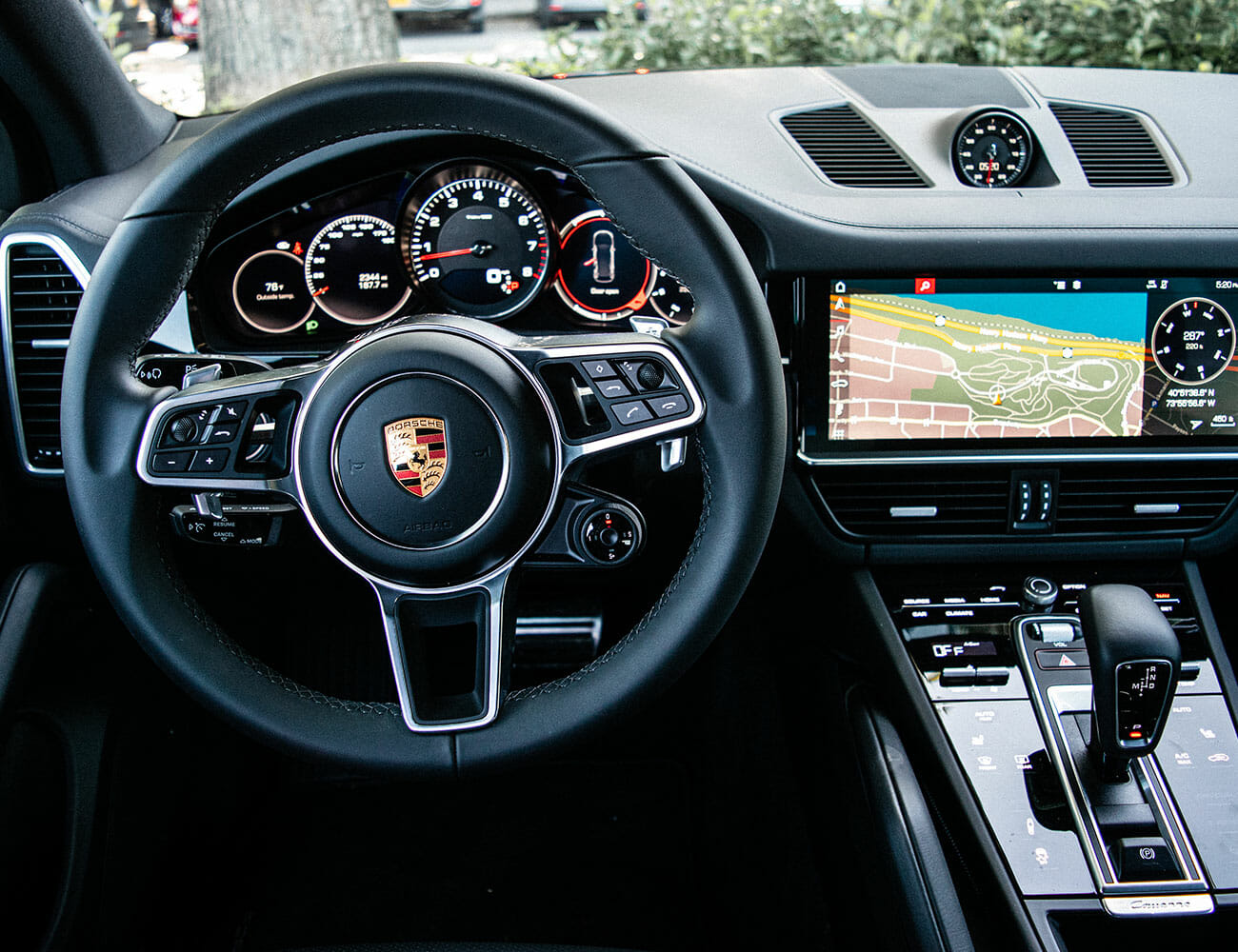
The Porsche, however, looks every bit worth that bougie price inside. The 12-inch widescreen touchscreen infotainment system is the same found in the Panamera and other new Porkers, delivering the same deep menus and crystal-clear graphics as in all of them, and just as handy here as in every other car wearing the Zuffenhausen shield. Same goes for the twin screens on either side of the centrally-mounted-as-always analog tachometer, which shuffle through high-res menus with the smoothness and speed of a card shark. Indeed, the whole interior is put together with a degree of fit and finish that could make FCA’s designers weep; the layouts and materials all project luxury in a manner both subtle yet commanding.

Still, it’s not without flaws. All the haptic feedback Germany can summon isn’t enough to make up for the fact that the Cayenne‘s expansive pane of glass with touch-sensitive “buttons” in the center console is a poor substitute for the (admittedly numerous) hard buttons of the previous version. The back seat feels a half-size smaller than the Jeep’s, while the wide transmission tunnel saps front legroom from the tall. And whoever approved the volume knob — a tiny rolling drum awkwardly mounted behind the gearshift — needs to spend some time in medical school to learn how the joints of the human hand work.

Performance

Not surprisingly, the Porsche is a far better-handling vehicle than the Mopar machine. The Jeep sticks to the pavement well enough, but it never feels like it’s enjoying itself as it digs through turns. It still drives like a Jeep; the steering is numb, uncommunicative, and sloppy, though going to Sport or Track mode takes some of the slack out of it. The Cayenne S, on the other hand, drives like a Porsche should — or at least, a Porsche that’s this tall should. The steering is great; sure, it’s electrically assisted, but it’s taut, responsive and quick. Likewise the suspension; it’s compliant and comfortable, but lob it into a turn, and the S feels willing in a way most luxury crossovers aren’t. You won’t find many SUVs quite as skilled at darting through traffic, or comfortable on a winding back road.

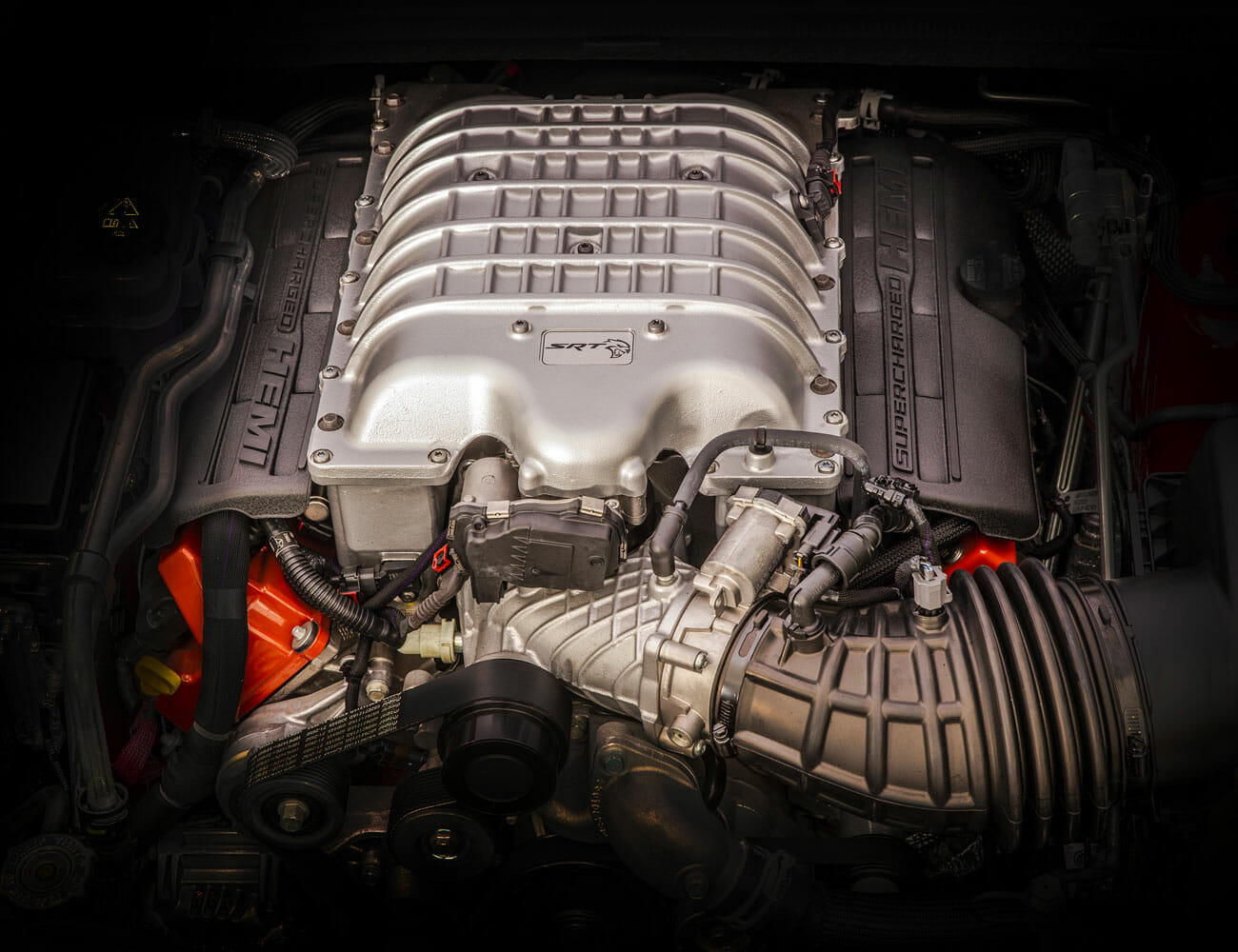
The Jeep will outrun the Porsche in a straight line, however. (Which is a sentence I never would have thought I’d write.) Car and Driver‘s testing found the Trackhawk will dash from 0 to 60 mph in 3.5 seconds and crack off a quarter-mile in 12 seconds flat while doing 115 mph at the end of that distance. Yet thanks to a combination of that mass, the all-wheel-drive system and the early-onset power of its supercharged V8, the Jeep never feels explosively quick; rather, it simply feels supremely confident, gaining speed with the invincibility of a Saturn V until well past 100 mph, at which point drag starts to claw its acceleration back towards mortal levels.

The Porsche feels almost lethargic when left to its default settings; the gearbox snaps to the tallest gear possible in the name of efficiency, leaving the 2.9-liter V6 to lope along at speeds too low for its twin turbos to contribute much to the party. Snap the steering wheel-mounted drive mode controller (reason alone to buy the Sport Chrono package, which is the only way to get it) to Sport mode, though, and the snails start to come alive, with the meat of the powerband never more than a quick shift away. Dial it one step further to Sport Plus, and the eight-speed automatic holds the rpms even higher, keeping it wound as tight as a racing driver would. (The car also lowers visibly in that mode, to help it carve corners more aggressively.)

Should you rather not drive around with the engine turning 4,000-plus rpm, the Sport Response button situated in the middle of the drive mode wheel is your friend for passing. Instead of leaving you worried about turbo or transmission lag, punch it with your right hand as you flick the signal with the left by the time you’re in the left lane, you’ll be right in the heart of the power band, with no worries about waiting for the engine and gearbox to sort things out of their own accord.

As an aside: you can opt for an off-road package on the Cayenne, an option not available for the Trackhawk — which means, theoretically and bizarrely, the Porsche is superior to the Jeep off-road. Neither of these is likely to spend much time off the beaten path, except for the occasional bounce down a couple hundred yards of two-track to a hiking trail or fishing spot. Still…again, strange times we live in.

Value

Neither vehicle is really what you’d describe as a great bargain — not at these prices. Still, when you consider that they offer performance comparable to honest-to-God sports cars (the Trackhawk outruns the outgoing Corvette, while the Cayenne S is only a few ticks behind GM’s speed machine), the interior volume of a medium-sized station wagon and the ability to climb over rocks that would murder regular cars.

The Jeep does admittedly suffer at the pump, especially on highway slogs. You can’t fight drag; the faster you go, the more the fuel economy suffers in a brick-like car such as this. I saw an average of just over 16 mpg over about 800 miles, most of that on the highway. The Porsche is solidly better, netting an EPA rating of 23 mpg on the highway versus the Trackhawk’s claim of 17; that may not sound like much, but it works out to 35% better than the Grand Cherokee. To use the EPA’s numbers, you’ll spend an extra $6,000 over five years on gas if you choose the Jeep.

Still, the Jeep does have its value advantages over the Porsche. It’s liable to be cheaper to keep up and fix up over the years, for one thing. And let’s face it: Only one of these has the potential to be a Bring a Trailer special in 20 years, and it ain’t the one from Germany.

Verdict:

The Grand Cherokee Trackhawk comes across as sort of the ultimate 21st Century version of the muscle car recipe: a popular family car, outfitted with the biggest, baddest engine possible. The Porsche, on the flip side, feels more well-rounded, like 2019 America’s version of the E39-generation BMW 540i station wagon: a Germanic two-box designed to balance performance and practicality in equal measure.

In the end, were it my hundred grand to spend on a midsize SUV that was fun to drive…I’d take the Porsche. But it’d be a close call — which says an awful lot about the appeal of this 707-hp Jeep.

2019 Porsche Cayenne S: Key Specs

Powertrain: 2.9-liter twin-turbo V6; eight-speed automatic; all-wheel-drive
Horsepower: 434
Torque: 406 lb-ft
Cargo Volume (second row folded flat): 60.3 cubic feet
Approach / Breakover / Departure Angles: 25.2° / 18.7° / 22.1°

2019 Jeep Grand Cherokee Trackhawk: Key Specs

Powertrain: 6.2-liter supercharged V8; eight-speed automatic; all-wheel-drive
Horsepower: 707
Torque: 645 lb-ft
Cargo Volume (second row folded flat): 68.3 cubic feet
Approach / Breakover / Departure Angles: 18° / 18.4° / 23.1°

Porsche and Jeep provided these products for review.

Read More Gear Patrol Reviews

Hot takes and in-depth reviews on noteworthy, relevant and interesting products. Read the Story
Note: Purchasing products through our links may earn us a portion of the sale, which supports our editorial team’s mission. Learn more here.