All posts in “Cars”

Acura shows off RDX accessories and 2020 NSX at SEMA

Following its successful season on the track, Acura speeds to SEMA to showcase a range of performance and race vehicles as well as a new line of concept A-Spec and Acura-branded accessories. Also on the luxury division’s stand will be the Type S Concept sedan and the 2020 NSX, both unveiled in Monterey Car Week in August, the latter wearing the classic Indy Yellow Pearl exterior paint.

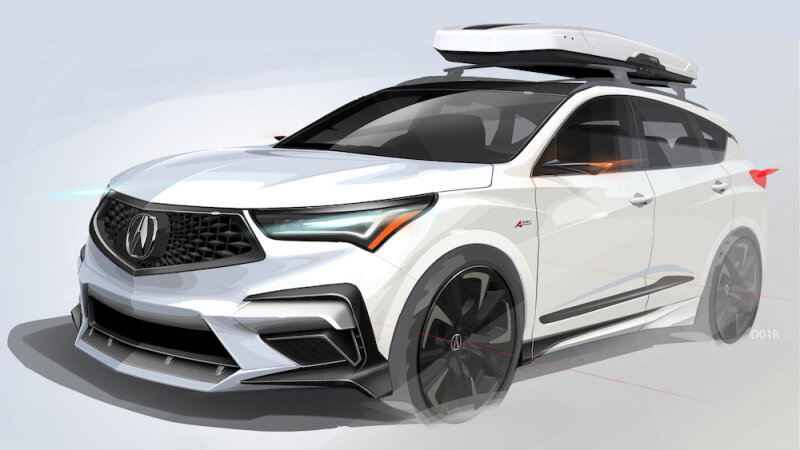
Acura will show off its accessories on a 2020 RDX. Carbon fiber is the name of the game for its concept A-Spec treatment, used on the grille surround and on the lower front fascia, lower side sill, rear diffuser, lower doors and side mirror caps. There’s also a dark chrome theme on the rear Acura badge and A-Spec emblems. A-Spec is offered as a sport appearance trim on the RDX and is supposed to be part of all core Acura models in the future, so we’ll see whether this “concept” A-Spec packages eventually makes it way, whole or in part, to future variants.

The Acura Genuine Accessories to be shown on the same RDX, by contrast, are available IRL and include roof rails and crossbars, replete with a fork-mount bike attachment, 20-inch wheels with a custom dark tint finish, black lug nuts, black chrome emblems, a carbon-wrapped tailgate accent, illuminated A-Spec trim on the door sills and A-Spec carpet floor mats. It’s topped with a Thule cargo box.

The 2020 NSX will wear the Indy Yellow Pearl color in homage to the old Spa Yellow, one of two yellow paints offered with the first-generation version of the supercar and a favorite among collectors. It joins two generations of championship-winning NSX cars: the 1990 pre-production model driven by Hall of Famer Peter Cunningham to 14 wins and 26 podium finishes between 1991 and 2002, and the NSX GT3 Evo that has won multiple IMSA and SRO races. The carbon fiber-bodied supercar with custom-designed livery is offered for sale globally for around $525,000, Acura says.

Special Report: The McLaren 720S Spider is Britain’s Finest Export

Be warned, this tale features the B word, Brex*t. The title has been coined to address the colossal saga that is the United Kingdom’s departure from the European Union and must be one of the most used words in international news in the past three years. There have been amendments, referendums, prorogations, high court rulings and even Queen’s Speeches. I shall not dwell, you’re not here for politics, but for automobiles.

Ever switch on the 10 o’clock news and see politicians being ferried from conference to conference in rather dull executive limousines? The best you can hope for is a Mercedes-Benz S Class, black on black, of course. This got me thinking, it was the night before the final European Union Summit that would be deliberating the latest iteration of the Brexit deal, Prime Minister Boris Johnson’s first attempt. Tomorrow, news agencies from across the world would crowd and jostle outside Le Berlaymont to catch a word from the 27 EU leaders that would be reviewing the latest version of proposed deal.

What if BoJo didn’t arrive in a mundane, vanilla S Class or Jaguar XJ, but instead stunned the crowds by representing British business, an example of the very businesses that will be impacted so significantly by the outcome of this tumultuous series of events? I felt Boris needed a helping hand, I took matters into my own palms. The next morning I left home at 0630 on a mission to not only improve Boris’s image, but to showcase one of the finest exports that Britain produces. It is an example of why the UK is one of the worlds leading automotive manufacturing countries, and why trade deals with the UK should never be doubted, but encouraged.

The ambassador of choice was perfect. Bentley and Rolls-Royce are British brands, but are both now parts of Audi and BMW, respectively. Jaguar is Indian and Lotus Chinese. Caterham and Morgan are British, but neither are known internationally as representing the best of British, more cottage industry forerunners. There is only one brand suited to this endeavour – McLaren.

I recently was on the continent in a McLaren GT, a car that left me somewhat conflicted and confused. Having previously driven to Paris and back to London in a single day in a 720S, I was in no doubt that it doubled as both a track monster and a capable GT car. To reaffirm my thoughts, I had a 720S Spider for the ride to Brussels to see if the additional 49 kilograms for the roof mechanism would alter the driving characteristics and if the GT would make more sense for such a journey.

One thing that does not change, roof or no roof, is the fuel economy. It is abysmal, even when trundling towards the Channel Tunnel with the cruise control set to a smudge above the speed limit. Seeing anything above 23 miles per gallon was a rare treat. Boris’s refusal to take no deal off the table had sent the pound into a tizzy and fuel prices were through the roof, premium unleaded was emptying my wallet faster than the my ex girlfriend – just as thirsty too. Best not to worry about saving fuel and instead blow it to thy kingdom come with a smile on your face and bangs and cracks coming from the twin exhaust pipes.

A grey drive to Folkestone, quick Starbucks and a deep breathe in to squeeze onto the train later, it was time to cruise across the Continent. Well, part of it at least. It is always surprising how quickly the French autoroute gives way to terrible Belgian tarmac. With the active panel engaged and the handling and drivetrain toggles in comfort, the 720S cruises quietly and somewhat comfortably. The hydraulic suspension is fabulous and plaint. It is upset by bigger holes and cracks in the road, but it is a tradeoff worth making for the terrific handling through the bends on more engaging roads. One element that, still, cannot be faulted is the steering. It remains hydraulically assisted and a pleasure to work with.

The mighty torque is impressive too. The gearshifts are as great as you would expect from a McLaren dual clutch, but when touring you need not be pulling the left carbon paddle for downshifts as you can ride the torque in the upper gears. This is, of course, when the revs are above 2,500rpm, there is a world of lag below this threshold. As the kilometres trickled by, the weather worsened and the chances of experiencing the 720S Spider with the roof down diminished. A special mention, once again, to the awesome rear window that can be lowered or raised regardless of the roof being up or down. It is a great way to enjoy both fresh air and that hard edged engine tone, even when it is raining.

This car featured a clever and very expensive option, an electrochromic glass roof panel. This meant that the panoramic glass was able to go from fully clear to dark in a couple of seconds. It is cool and strangely satisfying to press the button and watch the glass ceiling change from ‘shade mode’ to ‘full sunlight’.

Other interior highlights included the luxurious Cognac leather in this ‘Luxury’ spec 720S. The 720Ss I had previously driven were all configured in ‘Performance’ trim meaning there was far more Alcantara and less leather to be found. The quality of the leather is great, as is the colour, my opinion of course. The infotainment is a generation behind the updated McLaren GT system, but I was not a huge fan of the update and the older system felt no less capable as it also lacks Apple CarPlay and Android Auto systems.

As Brussels neared, the rain relented and there was time to relish precious minutes with the roof down. Heated seats work brilliantly to negate wind chill and the car looks utterly spectacular in shop front reflections. Say what you like about the eye-socket headlamp design, few will argue that the 720S does not look like a missile from its side profile. The well behaved demeanour from the motorway cruise continues in the congestion of Brussels. The Start-Stop system decided to go on strike, other than that the 720S Spider was flawless around town. Visibility was good, the ride supple and the turning circle…acceptable. Things are a little scarier when squeezing through narrow gaps or high kerbed car parks, more a case of driver fear and being unfamiliar with the supercars dimensions.

As the infamous Berlaymont building neared, Theresa May had been collected, riding shotgun and Boris Johnson jumped in behind the wheel. The time had come to change the bumbling Prime Ministers image once and for all. Passers by gasped and laughed in equal measure. Camera phones flashed and selfies were taken. It seemed that it was mission accomplished, a hypothesis that was all but confirmed later that day when Boris Johnson announced that Jean Claude Juncker had accepted his governments proposed deal. I’m not saying that it had anything to do with the McLaren or my mission…but maybe, just maybe, it did.

In another bizarre ‘coincidence’, McLaren CEO Mike Flewitt confirmed that McLaren Automotive will keep production entirely UK based despite Brexit in an interview to CNBC on the same day. He continued saying that the firm is ‘born and bred’ in the UK. The brand is one that is proudly British and one that should be celebrated. The McLaren F1 is, arguably, the greatest car ever and when the 12C rolled off the production line in 2011 a new era was born. McLaren seemingly came out of the blue and shattered any complacency that the likes of Ferrari, Porsche and Lamborghini had, pushing performance to new levels.

Almost 9 years on, McLaren continues to push it rivals to the extent that it is difficult to compare its offerings to that of the aforementioned rivals. The 720S is pitched against cars like the Porsche GT2 RS, Ferrari 488 Pista and Lamborghini Huracan Performante – hardcore special edition models that are stripped out track animals. The 720S obliterated the trio in a number of tests and it is the ‘standard’ car complete with creature comforts and touring credentials that make it just as usable as the McLaren GT. The LT model is expected to demolish its European rivals. McLaren Automotive represents the best, not only of British, but supercars produced anywhere in the world. Brexit or not, deal or no deal, McLaren will continue to be a flag bearer of British innovation and technology for years to come.

GTSPIRIT NEWSLETTER

Jaguar C-X75 From James Bond’s Spectre is up for Sale

A rare Jaguar C-X75, used in the James Bond film Spectre, has been announced to join RM Sotheby’s first Abu Dhabi auction. The auction is set to coincide with the finale of the Formula 1 2019 championship. A wealth of headline lots has already been announced with the Jaguar joining the best collector cars from the likes of Ferrari, Lamborghini and Pagani.

What makes this auction lot extremely rare is the fact that, although versions clearly made their way to the general public, the Jaguar C-X75 never officially made production. It was born from a concept car Jaguar released at the Paris Motor Show 2010, at a time when it was considering whether to offer a hypercar. The original concept centred around a four YASA electric motors recharged using two diesel-fed micro gas turbines instead of a conventional four-stroke engine. The idea would have been unique had Jaguar chosen to give production the red light. They didn’t and the project died a death until it caught the attention of Spectre’s production team.

Upon the production team’s request, Jaguar’s Special Vehicle Operations produced six Jaguar C-X75 mock ups for use within the film. These cars were built through Williams Advanced Engineering, Jaguar’s original collaborator on the C-X75 project. All six cars were used to film sequences of Spectre and to promote the film.

One of those cars will be offered for sale at the RM Sotheby’s soon. Chassis number 1 was the first of four versions built for stunt car purposes. This particular example was used for the car chase through the Italian capital, driven by one of the villains, Mr Hinx.

Rather than using Jaguar’s unconvential setup, the Spectre Jaguar C-X75’s use a more dependable V8 engine from the F-Type which was installed behind the drivers seat. A six speed Ricardo gearbox and rear-wheel drive setup allowed for extreme stunts. This sat on a tubular spaceframe made of extra-thick steel tubing with a World Rally Championship specification suspension system.

Interestingly, this particular example has spent a little over a year at UK supercar dealer Kaaiman’s. It was an attractive shade of blue during that time and it is not clear whether the car is being ‘flipped’ by a new owner. RM Sotheby’s explain that it was originally sold to a British collector in May 2016 and has been displayed twice at the Chateau Impney Hill Climb, once at the Shelsley Walsh hillclimb, and once each at the esteemed Salon Privé Concours d’Elegance and the 2019 Silverstone Classic.

It joins an auction that includes lots such as a rare Aston Martin One-77, a 2002 Ferrari F002 and an extremely rare Pagani Zonda Aether.

GTSPIRIT NEWSLETTER

More Details on Upcoming Gemballa Hypercar Revealed

Legendary German tuning firm Gemballa recently revealed that it would be working on a proprietary hypercar project. The Gemballa hypercar was announced earlier this year. The development process has now officially began with funds sourced from a series of investors.

Gemballa has released a new photo previewing the direction it intends to take with the hypercar. The company has announced that it intends to show a prototype as early as the beginning of 2020 with development continuing.

The aims of the project are to produce a hypercar that hits 100 km/h in less than 2.5 seconds and 200 km/h in around 6.5 seconds. Although information on the drivetrain is yet to be released, we are told that the unnamed Gemballa hypercar will make extensive use of carbon fibre and lightweight design to achieve this. Previous releases have suggested that the engine will be pur combustion with around 800 hp.

Steffen Korbach, Gemballa’s CEO, said: “We’re now concentrating on building one of the last pure sports cars, a modern classic with an outstanding appearance and performance. A pure GEMBALLA car needs petrol and sound. Not all new trends are cool.”

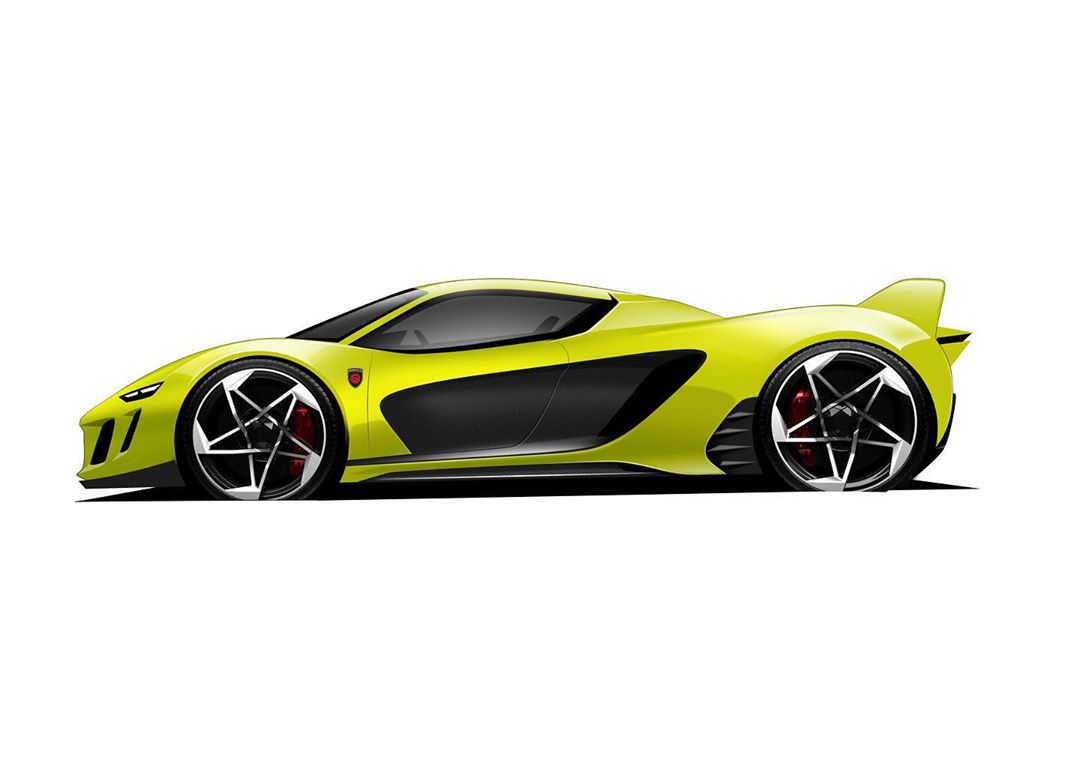
The hypercar would be the first in Gemballa history. Until now, Gemballa has only modified existing hypercars. The photo shows a mid-engined hypercar with a huge rear wing and strong aerodynamic cues. The use of carbon fibre is clear to see within the front spoile and cannards, the door bonnet, the side panels and the rear wing.

There is no word on when the car might eventually be released, although if the timeline Gemballa announced earlier this year remains correct then we could see it as early as 2022.

GTSPIRIT NEWSLETTER

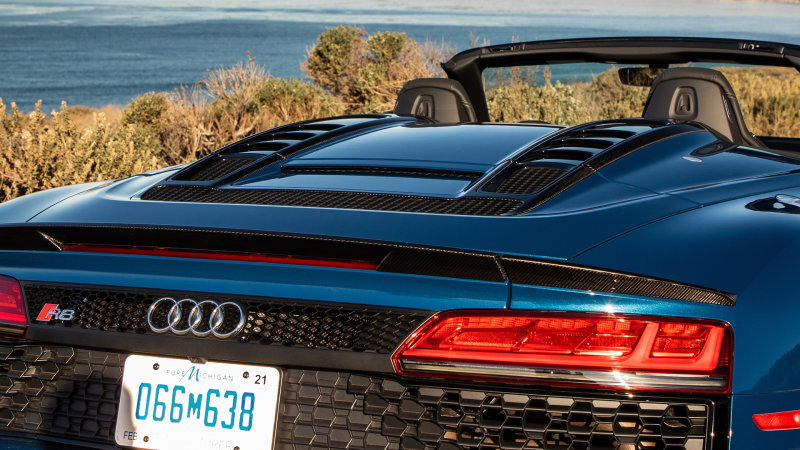
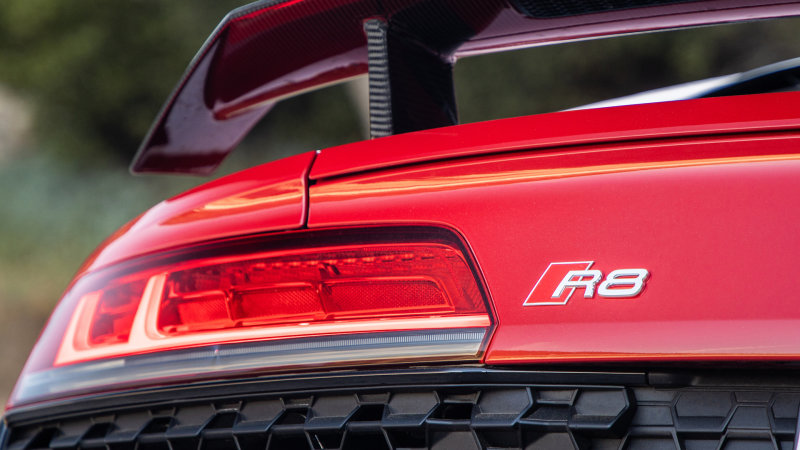
2020 Audi R8 Coupe and Spyder First Drive | V10 > turbo

SANTA BARBARA, Calif. — It’s usually a bad sign: Rocking out of Los Padres National Forest in the updated 2020 Audi R8, I spot two California Highway Patrol cars lying in wait on Highway 33, one of the fantasy driving roads the state is known for. But these officers aren’t here to hand out tickets, but to lend a hand — closing off the road so we can run repeated launch-control starts in these mid-engine, all-wheel-drive supercars.

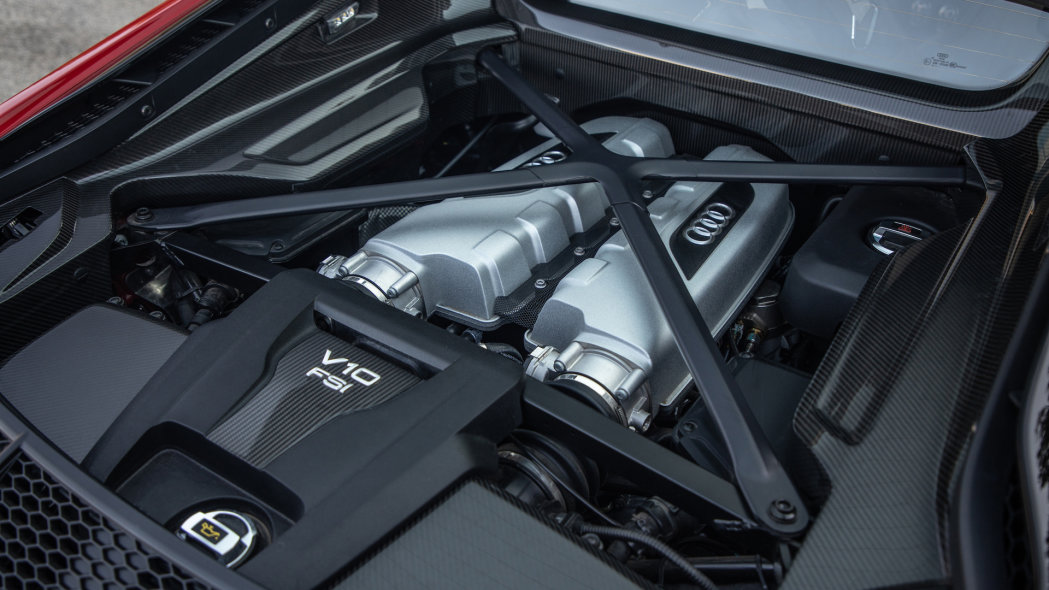
The drag-racing demo, in both coupes and Spyder convertibles, highlights reasons why one might drop $197,150 on the R8’s V10 Performance edition, or $209,350 on the Spyder V10 Performance. (They replace last year’s V10 “Plus” models). One is the 602-hp, naturally aspirated 5.2-liter V10. It’s a spectacular anomaly in a world dominated by turbocharged powerplants, the last of two production cars in the world with a V10. The other is its Italian cousin, the Lamborghini Huracan. Audi powers its R8 LMS race car with the identical V10, and both R8 coupes and racers are built on the same assembly line.

We stand in awe as Audi after Audi crackles off the line and sprints into the distance, rending the air with throaty howls en route to a wicked 8,700-rpm redline. (A Sport exhaust button that amplifies the sound is right there on the steering wheel, and owners are likely to wear it out). Audi plays it cool with a conservative 3.2-second 0-60-mph estimate for the R8 Performance coupe; 2.9 seconds is closer to the truth, as achieved in previous tests of the R8 in this engine spec. The Spyder is estimated to run only a tenth slower to 60 mph. Both models deliver the 200-mph bona fides of a self-respecting supercar, at a 205-mph peak for the Coupe and a hair-mussing 204 mph for the Spyder.

The 2020 update also brings a healthy 30-horsepower bump for the base R8 coupe and convertible, from 532 to 562 horsepower, and eight additional pound-feet of torque, now at 406 pound-feet. Audi pegs their 0-60-mph dashes at 3.4 and 3.5 seconds for the base coupe and Spyder, respectively, and sets their prices at $171,150 and $183,350. There’s also a coupe-only Decennium edition, limited to 222 copies, with the final 50 coming to the States. It’s a trim package that comes only in Mythos Black paint and all-black interior, with an intake manifold and wheels in matte-bronze finish and side blades, rear wing and other components in gloss carbon fiber.

On the 2020 design front, a reworked front bumper features a more horizontal perspective that accentuates the Audi’s lowness and width. That includes a dramatically stretched, black honeycomb grille, a new spoiler lip and lateral air intakes. That front end now incorporates a faux, winged inlet that bookends the bumper — and whose plastic-capped “opening” seems more from the Lexus school of overworked design than Audi’s typical understatement. Headlight lenses have been darkened, and a redesigned rocker panel gets a new inlay. Audi’s Laser Light high beam is standard on Performance versions, and their crisp, ultra-long-range illumination steps in for conventional high-beams at speeds above 40 mph. The Laser Light’s decorative blue element illuminates on European-market models, but U.S. regulations forbid any trace of blue lighting.
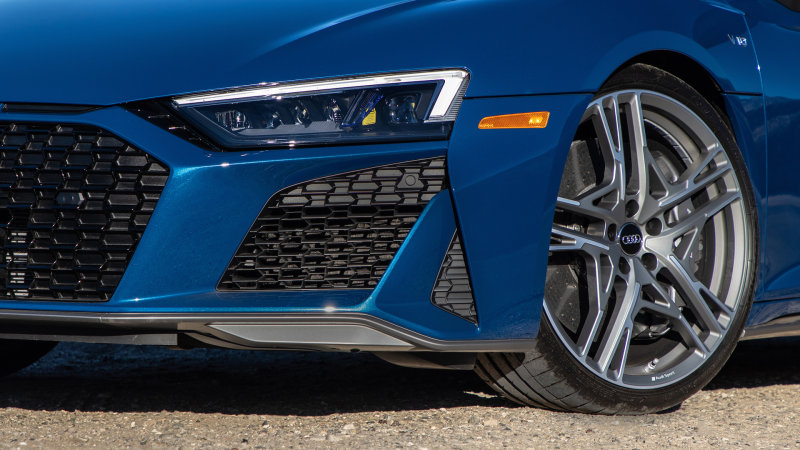
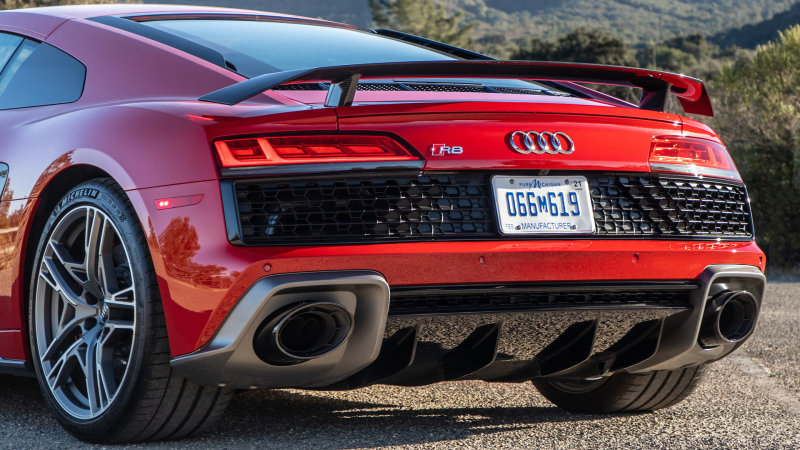
The new rear bumper adds a pair of generously sized oval exhaust outlets, more honeycomb for air outlets, and a new rear diffuser. Basic V10 models get standard 19-inch forged wheels, with optional 20s. Performance editions now come standard with 20-inch forged wheels with a somewhat busy, milled-cut design with a black-and-titanium finish. Our colorful selection of R8s tended to look better with optional 20-inchers with a simpler profile and titanium finish.

Two lovely new colors join the R8 palette: Kemora Gray and Ascari Blue metallic, the latter only available on V10 Performance cars. Ceramic brakes, standard on V10 Performance models, offer a choice of red calipers in addition to standard gray. Finally, the Performance coupe alone offers a world first for Audi: a carbon-fiber front sway bar that trims 4.4 pounds of weight. Every little bit helps for the R8, a relatively chunky sports car — especially compared with carbon-fiber monocoque McLarens — that plops as much as 3,957 pounds on the scales (for a base Spyder). All told, the wide-flanked R8 looks familiar, yet formidable, its ability to draw admirers undimmed by time.

Our day begins in Santa Barbara with a Spyder Performance, its fabric top down and its wind-deflecting rear glass up. After heading along coastal Highway 101, we’re soon detouring into California’s bone-dry, tinderbox canyons, even as fire crews battle new blazes in nearby Los Angeles. The Audi saves its scorching for the pavement, as I dial its dimpled, asymmetric steering wheel and get into a nice rhythm through the twisting mountain roads. 

This R8 is dearly priced by any standard, but you get what you pay for in the high-design interior, decked out with carbon fiber, burnished aluminum and diamond-stitched leather on 18-way power sport seats. Racing-style shell seats are available, but those aggressive chairs don’t seem to fit the Audi’s daily-driving personality. Audi might disagree, considering the R8’s impressive race record, including three wins at the 24 Hours of Nürburgring.
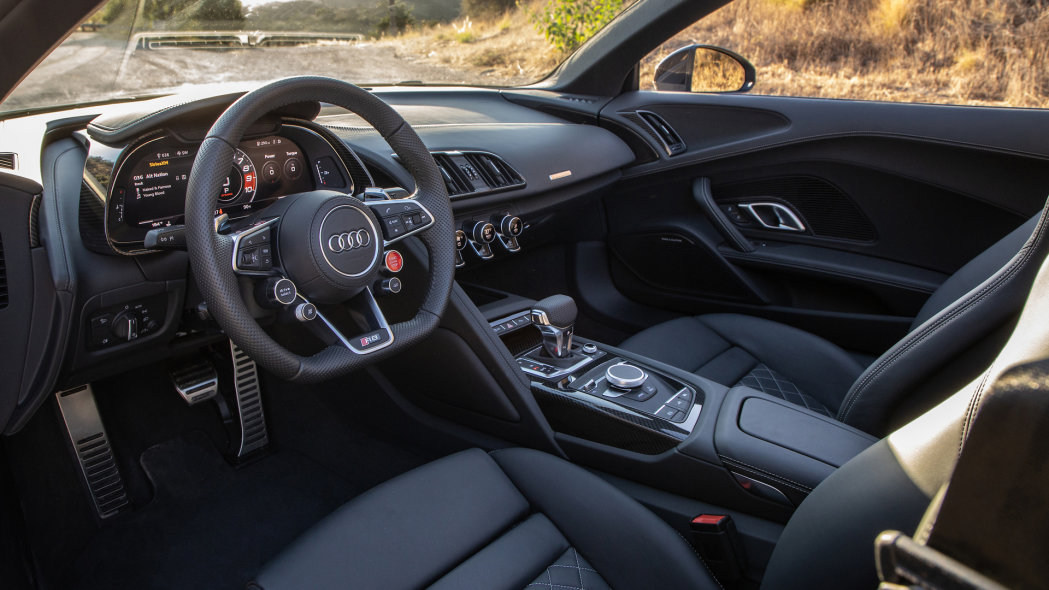
That personality combines accommodation and excitation like few cars; the R8 helped create the notion of the “everyday supercar,” and its precision build quality and user-friendly technology remain strong points. That extends to Audi’s Google-mapping virtual cockpit infotainment system and 13-speaker Bang & Olufsen sound system (standard on Performance models), which continue to set the standard in its class. If all-black Audi cabins strike you as boring, Pastel Silver or Palomino brown are new interior colors.

The Spyder looks sweet top-down, and admits more of that glorious 10-chamber orchestra, but those advantages don’t seem enough to overcome its drawbacks: a shortage of seat travel (the chairs wedge right up against the rear firewall), and the attendant lack of useful recline from the seatbacks. The coupe, in contrast, carves out room behind seats for small bags, backpacks or odds-and-ends — not a ton, but enough to make a difference in a car that’s otherwise limited to a modest frunk below the hood. And where the coupe proudly exhibits its signature V10 under glass, topped with a black X-brace, the Spyder’s engine stays out of sight below its vented, power-folding tonneau cover.

As it’s evolved, the R8 has steadily become more rewarding to drive, less victimized by understeer and more limber-feeling at the helm. For 2020, the electrically assisted steering reduces the assist during cornering to deliver more weight and feedback though the wheel. Optional Dynamic Steering (at $1,400) aims for more-natural feel as well, with less-aggressive ratio adjustments relative to vehicle speed and steering angle.
Where standard models come with a versatile, adjustable magnetically controlled suspension, Performance editions get a stiffer, fixed steel suspension for superior control, though with a notably firmer ride. For 2020, Audi has traded the R8’s previous Pirelli P Zero tires for a grippier set of Michelin Pilot Sport 2s with a custom rubber compound. (You’ll spot a little “AO” symbol on the sidewall, for “Audi original”). Stability control and ABS programming are mildly retuned to account for the improved grip, and the (optional) variable-ratio steering makes subtler ratio adjustments than before. Throw in a seven-speed dual-clutch S-Tronic transmission — which Audi says can swap speeds in as little as 120 milliseconds — and it’s a delight to rip through those gears to the tip-top of redline, whether in full automatic mode or by thwacking the finely weighted, metal paddle shifters. Hold that left paddle down, and the Audi will limbo to the lowest possible gear, skipping from, say, fifth gear to second in one swoop. This is an extremely short-geared car, with second gear topping out at around 67 mph, and fourth gear running out at barely 105 mph.

On one long, canyon-blasting descent, I employ left-foot braking to balance the Audi into blind apexes, then roll onto the throttle and feel the Haldex-based front axle come online, maximizing grip and exit speed as I hurtle toward the next corner like a barrel over Niagara Falls. This is one fast, confident sports car, and its V10 gushes power and never quits, as evidenced by that 200-mph-plus top speed.

The R8 still makes a vivid statement of design and performance, yet it’s always run a bit below the radar, including in sales. Since its debut in 2007, Audi has moved about 800 R8’s a year in America on average, including a high-water mark of 1,145 cars in 2011.  This is a supercar for a more practical-minded, German-favoring buyer, a contrast to the flashier form and naked emotionalism of the Lamborghini Huracán. Those Audi fans are just the type to do some practical math as well: The standard R8 Coupe undercuts the Huracan Evo’s price by about $90,000. 

Porsche-Designed Superyacht Hits the Market

A Porsche-designed superyacht has hit the market. The 135-foot catamaran has been listed for sale with brokers Camper & Nicholsons. Named Royal Falcon One, it has taken a decade to complete. In recent years it was docked at the Kockums outfitting facility in Nynäshamn, Sweden.

Camper & Nicholsons have not revealed the asking price for this one-off design. Considering the amount of work that has gone into it, we expect that the price is pretty unique too!

It was built by Royal Falcon Fleet with the design work carried out by Porsche Design Studio and naval architects Incat Crowther. Work was finished in August this year which means that the current owner has had just 3 months of enjoyment.

Royal Falcon One has three guest cabins on the main deck, together with a master suite and “VIP suite” on the upper deck. In the twin hulls, there is enough space to accommodate a 10-person crew. The design incorporates whites, greys and blacks. The top sun deck featuring a Jacuzzi with cushioned sun pads.

At the business end of things, the Royal Falcon One is powered by twin 4,600 hp MTU 16V 4000 M93L diesel engines and twin Rolls-Royce KaMeWa waterjets. It has a top speed of 35 knots and a range of 2,000 nautical miles at a cruising speed of 30 knots.

GTSPIRIT NEWSLETTER

2006 Lamborghini Concept S split-cockpit Gallardo heads to auction yet again

Many Lamborghini concepts are completely wild, but the 2006 Lamborghini Concept S is unique in that it’s totally wild but also somewhat practical. The practical part comes from the fact that it’s effectively a Lamborghini Gallardo, but with a split cockpit and speedster shape. According to RM Sotheby’s, which is selling the car, there were plans to build 100 of them for special customers, but that never happened. So this is your only chance to own this speedster.

The concept’s Gallardo bones are obvious. Most of the lower body is the same as a production Gallardo, with slightly different grille openings. But the complete lack of a roof, the vestigial nubs of windscreens and angular roll hoops transform the car. From the side, it’s about the wedge-iest Lamborghini of all time. The split cockpit is also extreme, and it’s accomplished by placing a beam between the driver and passenger seats.

Mechanically, it’s about the same as a regular Gallardo. In the middle is a V10 bumped up to 520 horsepower coupled to the Gallardo’s E-Gear automated manual transmission and all-wheel drive. It would have been cool if Lamborghini had fitted the regular six-speed manual and its lovely gated shifter, but we suppose they didn’t want drivers whacking their hands and arms into that center beam to shift.

This car has less than 125 miles on the clock, which is remarkable, if also a little sad. It has also been shown at Pebble Beach twice. No price estimate has been given, though when RM Sotheby’s offered at an auction in 2015, the company expected upwards of $3 million for the car. It goes across the block at the RM Sotheby’s Abu Dhabi auction on November 30.

Supercars, classics, more come to ‘Gran Turismo Sport’ and ‘Forza Horizon 4’

Two years after the release of Gran Turismo Sport, and just over a year after the launch of Forza Horizon 4, both games continue to receive extra content. The latest updates for each game add a slew of new cars, and in the case of Gran Turismo, a new track.

Starting with Gran Turismo the game gets four new cars, one of which is the Porsche Taycan electric sports sedan previewed early in October. Alongside it are some interesting choices including the 2015 Lamborghini Aventador LP750-4 Superveloce, 2015 Mazda Demio (also known as the Mazda2 or the U.S.-spec Toyota Yaris), and the 1971 Mercedes-Benz 300 SEL 6.8 AMG. The latter of those is known better as the “Red Pig,” a huge and powerful touring car. Besides these cars, Gran Turismo adds the famous Spa-Francorchamps race track in both dry and wet configurations, plus a few more single-player race events.

Over in Forza Horizon 4, the latest update adds four new cars as well. Top billing goes to the limited-production and shockingly expensive Bugatti Divo. Then there’s the racing-spec 2008 Koenigsegg CCGT, the V8-powered 2010 BMW M3 GTS, and the Rossion Q1, the American continuation of the Noble M400. The update also adds a some new single-player events to play through. Both game updates are available now.

ABT Reveals Audi SQ8 TDI with 510hp

Looking for a diesel luxury crossover with enough power to take on the best petrol competitors? ABT has you covered with its latest release, based upon the Audi SQ8 TDI. Power and cosmetic tweaks are the order of the day with this series of upgrades!

We drove the Audi SQ8 TDI earlier this year. It gets a 4.0 litre V8 engine producing 435 hp and 900 Nm of torque, which plenty for most people. Not ABT’s customer base though! The German VAG specialists have delivered a new engine control unit which accounts for an additional 75 hp over the standard model. The SQ8 TDI now produces 510 hp and sheds 0.2 seconds off the sprint time to hit 100 km/h in 4.6 seconds.

ABT also take care of a number of other elements. The suspension benefits from an ABT level control module which allows the SUV to sit up to 65 mm lower in varying stages. To get the driver amped, ABT has even named the most extreme setting ‘Coffee’ mode…

The body kit is always the most imposing feature of these builds. The SQ8 is no different. It uses front and rear skirt add ons together with a new rear spoiler and a set of quad tailpipes. To finish the look, a set of 22 or 23 inch rims are available.

GTSPIRIT NEWSLETTER

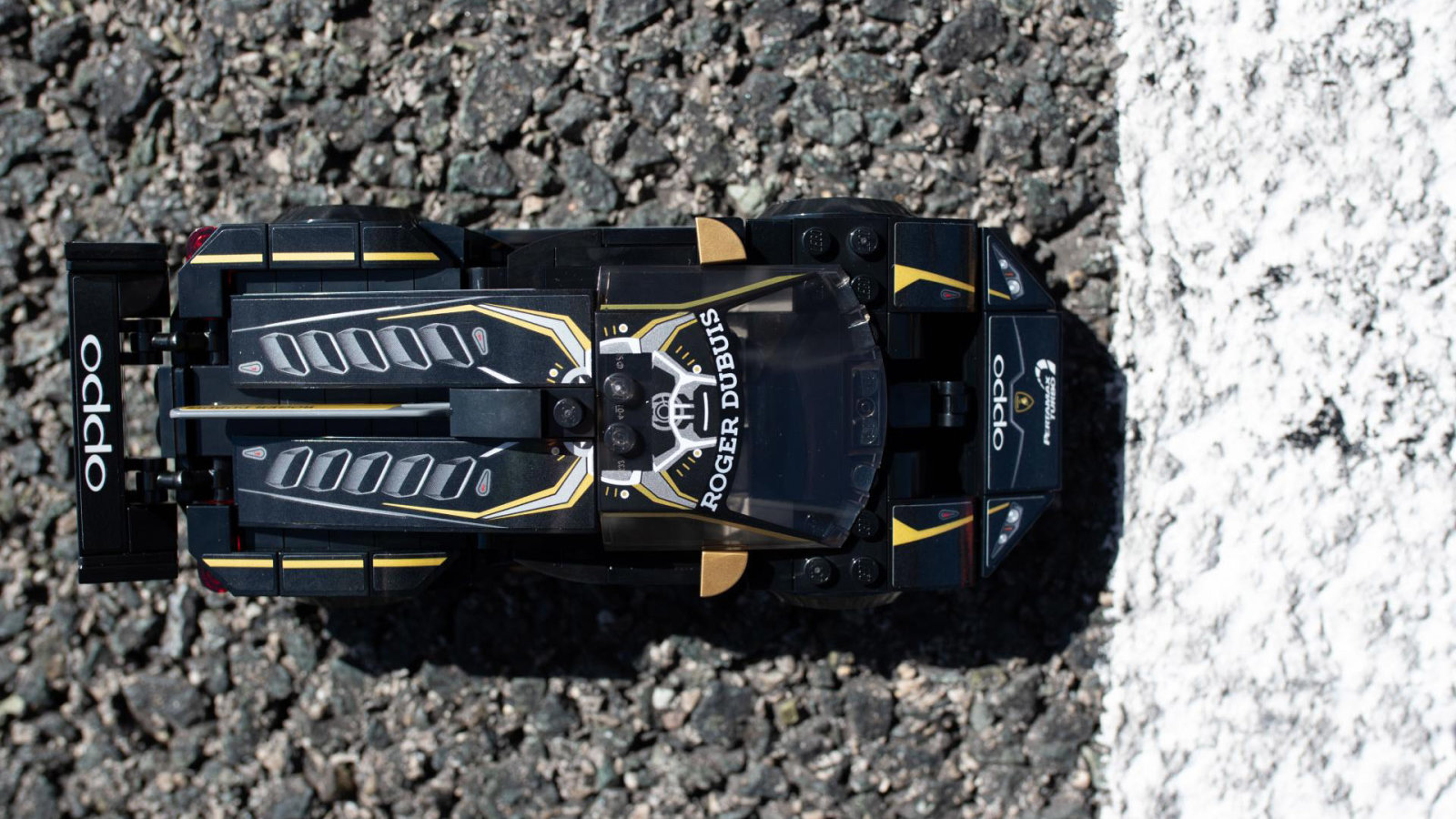
Lamborghini previews Huracán Super Trofeo EVO and Urus ST-X Lego sets

At the Super Trofeo World Finals at the Jerez de la Frontera Circuit in Spain, where world-class athletes put their driving skills to the test in the big kid toys, Lamborghini unveiled two brand-new toys for everybody that are set to launch in 2020. The Huracán Super Trofeo EVO and Urus ST-X are paired for the next Lego Speed Champions set.

The Huracán Super Trofeo EVO is already one of Lamborghini’s most popular racing models and competes in the single-make Super Trofeo series. The Urus ST-X is set to compete in track and off-roading competitions starting in October 2020 at the Misano World Final in an all-new race. Now both of these cars will be available for purchase in Lego form. 

Fortunately, 2020 marks the start of a new chapter for Lego Speed Champions with the evolution to the more accurate ‘8 Studs Wide’ design, and we felt that we could now do the popular brand justice,” Lego Speed Champions design manager specialist Chris Stamp said. “Especially the wide body of the Huracán Super Trofeo EVO. And with the awesome Urus ST-X we also introduce our first Super SUV into the theme, which fans will hopefully be just as thrilled with as we are.”

The Huracán model includes realistic parallels such as the shark fin, air scoop, front diffuser and large wing. It features a black scheme with slick accents and advertising sponsors. The set is 659 pieces in total and also includes starting “lights” and two figurines. Though pricing is yet to be released, the set will be available starting January 1, 2020. Seems like a missed Christmas opportunity, no?

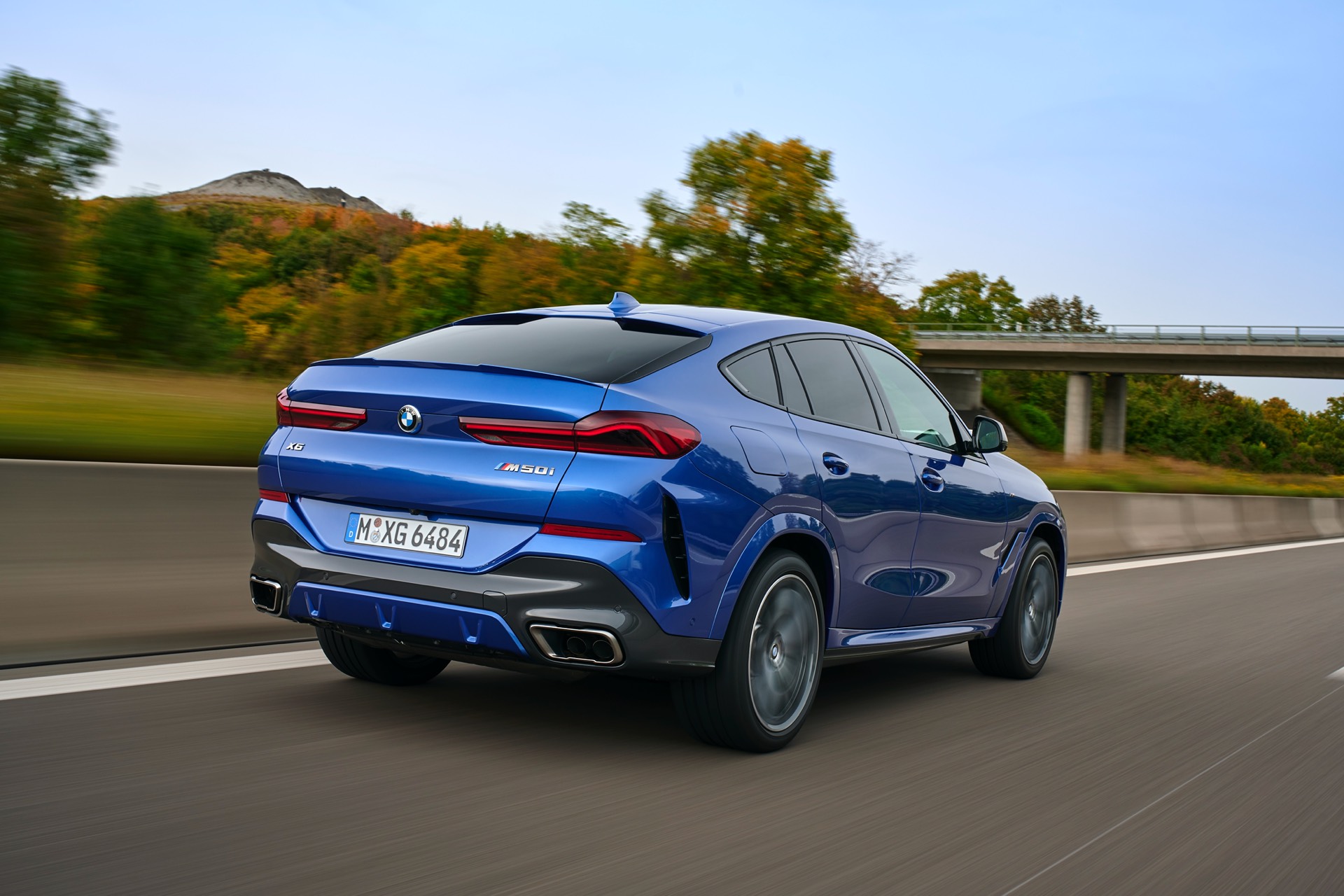
BMW X6 M50i Review

BMW created a market for the mid-size luxury crossover with the original BMW X6. When it launched, back in 2008, it was the only SUV of its kind. A sleeker, sportier version of the BMW X5, it compromised boot space and practicality for a dose of sportiness. As unique as it was aesthetically challenging, the X6 divided opinions, yet sold remarkably well.

Now in its third generation, the BMW X6 has a significant amount of competition. It blazed a trail for cars like the Mercedes-Benz GLE Coupe, Range Rover Velar, Porsche Cayenne Coupe and the Audi Q8. The second generation was a simple facelift. This third-generation uses a completely new platform, shared with the recently released BMW X5.

The X6 uses BMW’s latest Cluster Architecture (CLAR) platform for the first time. It underpins cars like the 7 Series and the 5 Series, with the capacity to accept fully electric drivetrains, alongside plug-in hybrid and conventional drivetrains.

The new BMW X6 measures 26 mm longer, 15 mm wider, and 6 mm lower than the outgoing model. It uses double-wishbone front suspension and a five-link rear suspension.

Dynamic dampers are a standard feature with two settings to switch the experience from comfort to sport. An Adaptive M suspension Professional system adds active roll stabilisation and Integral Active Steering. The former attaches electric motors to the roll bars while the later adds rear-wheel steering. Other optional suspension programs include air suspension which is capable of raising or lowering the ride height by 40 millimetres.

The engine also receives some work. Those who care little for the technical details, feel free to skip a paragraph or two…

The N63 4.4 litre TwinPower Turbo V8 continues to use BMW’s xDrive all-wheel-drive combined with an M Sport electronic differential, M Sport exhaust system and model-specific suspension tuning.

In terms of the gritty detail, it is much the same as we saw in the X5 recently. BMW engineers have utilised a stronger aluminium alloy for the engine block, wire-arc sprayed iron coatings for the cylinder walls, grafal-coated pistons and a viscous damper on the crankshaft. The changes are geared towards enhancing the smooth running of the engine.

The X6 M50i puts out 530 hp and 750 Nm of torque through an eight-speed sport automatic transmission. It hits 100 km/h in 4.3 seconds and a top speed, electronically limited to 250 km/h.

On the de-restricted sections of the autobahn, we had the X6 M50i up to 250 km/h. At that speed, it felt as though the front end was beginning to lift a little. Most owners will never push these limits though. On the twisty stuff, it feels wide. It’s not a car you could confidently place into a corner without some practice! The suspension also feels hard, even with air suspension all round. We suspect this will be less obvious in more mundane models.

If the full-blooded X6 M50i is not your cup of tea, BMW offers one other petrol model and a choice of two diesels. The BMW X6 xDrive40i uses a six-cylinder 3.0-litre engine with an output of 340 hp and 450 Nm of torque. An M50d and xDrive 30d both use a six-cylinder diesel until with 400 hp and 760 Nm of torque and 265 hp and 620 Nm of torque respectively.

Of course, if the M50i isn’t quick enough for you, BMW recently announced a new X6M. If you want ultimate performance, that’s probably the one to have. That said, the X6 M50i performs well enough that you won’t feel shortchanged. In the round, it is a well rounded package with the types of compromise you expect from a vehicle of its size.

On the outside, the design looks less shocking post-4 Series revelations. The kidney grille is the dominant feature, similar in size to the X5. BMW debuts a new concept with the X6. The illuminated kidney grille. Lights shine down from the top bars of the grille, highlighting its size. Most owners will care more about the kerb appeal than anything else, the illuminated grille is clearly designed to appeal to them.

A new set of angular headlights sit either side with a sharper front bumper. A new set of front and rear fender vents lead to broad-shouldered wheel arches. At the rear, the hatch looks similar to that of the X4. The bootlid spoiler has become an M car characteristic of late.

All in, the X6 is an evolution rather than revolution. If you liked the outgoing version then you are likely to love the updates.

Inside, the changes are similar to those found in the new X5. The dash display is fully digital. Our test model had a head-up display and the centre console featuring a large 12.3-inch display. The combination of BMW’s Operating System 7.0 and Live Cockpit Professional brings the X6 bang up to date. The system allows for remote software updates too.

The X6 was always criticised as having cramped rear seats. While the exterior proportions have grown, the interior remains cramped somewhat. Rear passengers gain a small amount of additional space, although we didn’t spend a great deal of time exploring whether the new design makes a practical difference.

An interesting feature is the BMW Display Key. Due to the short amount of time we had with the X6, it wasn’t possible to get to the bottom of its features. However, it works like a smartphone, using Near Field Communication and an integrated display to offer options that a conventional key simply will not.

From a pragmatic point of view, the X6 shouldn’t work. It is an unholy compromise between the practicality of an SUV and the sporting prowess of a coupe. That said, the demand for luxury crossover SUV’s is strong at the moment, with plenty of competition. BMW has seen huge success with previous generations of X6 and this latest version is likely to appeal to its established customer base. If it is what the people want, who are we to complain?

GTSPIRIT NEWSLETTER

Jaguar C-X75 James Bond movie car is going up for auction

Back in 2010, Jaguar presented a show-stopper of a concept: the C-X75. Besides its curvaceous body, it boasted a wild hybrid powertrain with a gas turbine engine providing electricity. Sadly, it never reached full production, and it only reappeared as a villain car in the James Bond film Spectre. But between the concept and the film, there were a few production prototypes built as part of a planned 250, and a few stunt cars. Auction company RM Sotheby’s is offering one of the latter cars.

This Jaguar C-X75 stunt car is actually the first stunt car built, according to the auction house. The stunt cars were built by Williams Advanced Engineering, the same company that has been competing in Formula 1 for decades. The stunt car has little in common mechanically with the concept, or the five prototype cars Jaguar built with four-cylinder hybrid powertrains. Under the skin is a custom tubeframe chassis and long-travel rally car suspension. Powering it is a version of the Jaguar F-Type’s V8 engine with a dry-sump oiling system. It’s coupled to a sequential manual six-speed transmission and a rear transaxle with a mechanical limited-slip differential. Brakes are AP Racing units and are adjustable from the cabin, and they feature a hydraulic handbrake.

One consequence of this stunt car’s burly underpinnings is that the cockpit is more like that of a race car, with a small Momo steering wheel and toggle switches and controllers all over. But this unsophisticated cabin has played host to some famous folks. The car was used for getting shots with the actors, with a driver’s seat mounted to the top. Since this was a villain car, the actor in the driver’s seat was Dave Bautista. The car also was featured at the Mexico Grand Prix to promote the movie, and Felipe Massa took it for a test drive.

RM Sotheby’s hasn’t given an estimated price for the car, but expect it to be expensive. If you have the means, it will be crossing the block at the auction company’s Abu Dhabi sale on November 30. The car will come with a bill of sale, a movie call sheet and a specification sheet from Jaguar Land Rover Special Vehicle Operations. We’re not sure that this car would be able to be titled in the U.S., but we bet it would be just as fun, if not more so, on a race track, rather than public roads.

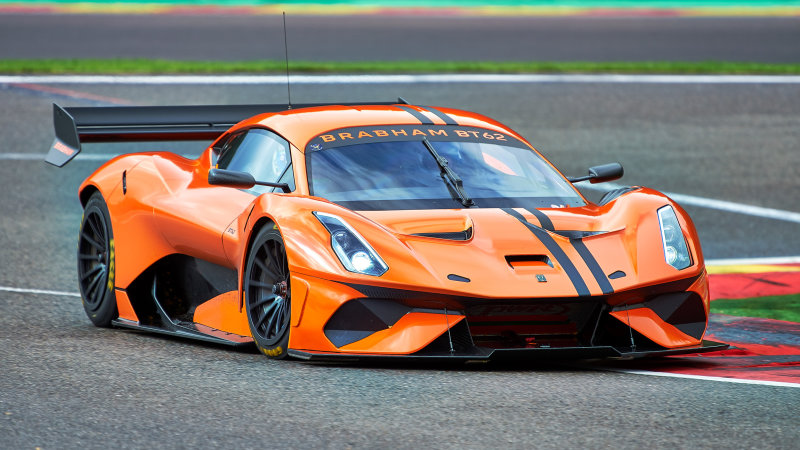
Brabham BT62 adds a Competition spec variant to the mix

The Brabham BT62 supercar is now available to order in a new Competition spec, in addition to the “Ultimate Track Car” spec and the “Road Compliant” spec. Brabham is still limiting total production of the V8-powered supercar to only 70 units, but now you have options.

Most things about the Competition are the same. It’s powered by the same naturally aspirated 5.4-liter V8 that produces 700 horsepower and 494 pound-feet of torque. This is exclusively mated to a six-speed sequential transmission which sends power to the rear wheels. However, the “Competition” version of the BT62 is stripped back even further than the Ultimate Track Car spec, so maybe they have to change the name? We kid. But still, the Competition is even lighter than the others, as it foregoes exterior paint in favor of a wrap. All the interior trim has been removed, so it’s just bare carbon fiber wherever you look — as of now, there are no photos of the Competition interior, though. It’s also delivered without a passenger seat or maintenance kit. Unfortunately, Brabham has not yet detailed how much weight you save with the Competition. The Ultimate Track Car spec weighs 2,143 pounds.

Due to the de-contenting done here, Brabham actually prices the Competition lower than the other versions of the car. It can be yours for £750,000, or $965,396. That compares rather nicely to the $1.4 million Road Compliant spec. Brabham says that you’ll be able to upgrade from the Competition spec to the Ultimate Track Car or Road Compliant spec at any time of your ownership — just expect to pay for it. You can order a BT62 for track use here, and it can even be had in left-hand drive. However, the Road Compliant car is still not available for road use in the U.S. — it’s designed for European markets.

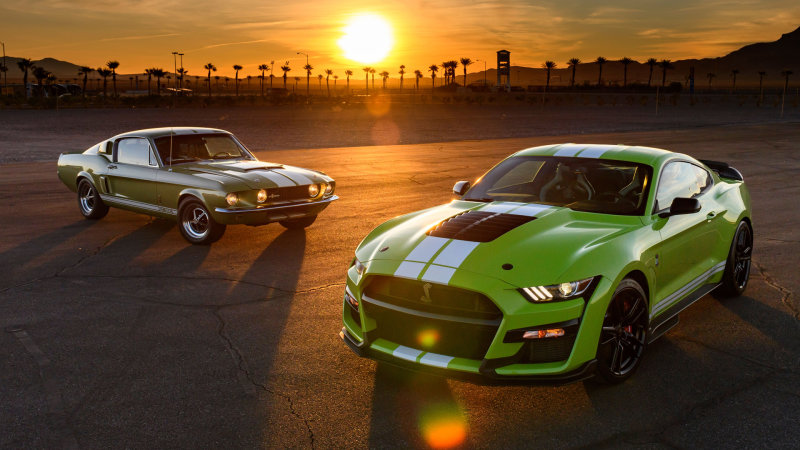
Shelby American could push the 2020 Mustang Shelby GT500 beyond 1,000 hp

After a daylong media drive, auto media and enthusiasts have only just opened the discussion on the 2020 Ford Mustang Shelby GT500. Nevertheless, the only thing better than the great toy you have in your hands is the potentially greater toy you might one day get. That why, on a trip to the Shelby American Heritage Center during the GT500 launch, CarBuzz asked the folks at Shelby American how far they might push the GT500’s 5.2-liter supercharged Predator V8. Remember, Shelby already gets 800 horsepower out of the 5.0-liter Coyote V8 for its top-shelf Super Snake model, a gain of 340 hp over the current Mustang GT. It wasn’t a Shelby exec who answered the CarBuzz query, however, but Ford Performance marketing manager Jim Owens, who said, “at least 1,000 [horsepower.].” That sounds like an insider’s nod to how much firepower Ford left on the table waiting to be unlocked by a company like Shelby. An even four-figure number would, as with the Super Snake, add 240 hp to the stock GT500 tally.

Don’t expect the Super Snake to go away, though. CarBuzz also asked what such a car might be called, and this time Shelby answered. Company President Gary Patterson told the site that Super Snake belongs to models powered by the 5.0-liter V8. The Predator would need to be christened with something else, which “may be a new name, or may be a name from the past.”

Elsewhere on the same launch, The Drive cornered a Ford exec to ask about the 647-hp Ford GT. The regular, $450,000 GT is clearly Ford’s official halo car, right next to the track-only, 700-hp, $1.2 million GT Mk II. The standard GT has two more years to go to finish production, those years potentially out of the limelight since the coupe retired from racing. In the interim, the GT500’s supergiant star turn could outshine Ford’s intended angels by being the most powerful Ford to leave Dearborn, by being so close to so many GT performance specs, and by not yet having shown what’s its genuinely capable of. The GT500, for instance, is just 0.3 seconds shy of the GT’s 0 to 60 mph time and is faster through the quarter-mile even though the GT500 weighs 900 pounds more.     

The unnamed Ford exec who spoke to The Drive explained the GT’s power figures as mandated by homologation rules, but now that competition concerns are moot, “Maybe we’re not done there.” When the outlet asked if there could be a road-legal GT Mk II or some other more aggressive variant on the way, the exec answered, “You’ll just have to wait.” On one hand, these could be artful deflections to forestall anyone trash-talking the GT for the moment. On the other, we’d be surprised Ford would let the GT stand still for two years in the face of in-house, cross-town, and overseas competition.

Gemballa issues progress report on its in-house supercar

In June this year, Gemballa owner Steffen Korbach announced the German tuner was “planning a thoroughbred super sports car with a unique, aggressive design and engine power considerably over 800 horsepower.” This would be a departure for the Baden-Württemberg company that has spent nearly 40 years fettling products produced by its Stuttgart neighbor, Porsche, just 12 miles away. Korbach said Gemballa needed investor financing to carry out the project, a call that’s seen some success. Having secured initial funds, the company’s decided to release more information as it commences the technical planning phase. 

Potential customers and investors are likely to have seen initial drawings of what’s promised to be “uncompromising, radical, pure, and luxurious,” which we’ll assume are the new images we have here. There’s been quite a bit of reshaping since the last black and white image of a more compact and harder-edged mid-engined rocket. That car gave off Zenvo vibes up front and design thesis track car concept vibes in back. The new visuals loosen up with more curves stretched out over a longer body, and substantial aero work has been done up front. The B-pillar has sprouted a pair of scoops, the jutting diffuser has been tucked under tail. The rear wing arises organically out of the bodywork instead of being appended like a Time Attack appliance, and check out that multi-level and multi-part surfacing on the cross-member. Expect loads of carbon fiber.

We don’t have specs on what kind of engine will make use of the jet stream of air inhaled through those side vents, Gemballa saying for now that there’ll be an internal combustion engine with at least 800 horsepower and no hybrid assistance. Korbach again, taking a shot at electric vehicles: “We’re now concentrating on building one of the last pure sports cars, a modern classic with an outstanding appearance and performance. A pure Gemballa car needs petrol and sound. Not all new trends are cool.” It’s possible there’ll be a manual transmission option sited between the engine and wheels, part of “state-of-the-art drive and aero technology.” No matter, when combined with the lightweight body, Gemballa’s aiming for a 0-62 mile per hour time of under 2.5 seconds, and 0-124 mph in “around 6.5” seconds.

The tuner hasn’t just torn down and muscled up everything from the Cayman to the Carerra GT, it’s sorted through the internals of the Mercedes-McLaren SLR, McLaren MP4-12C, and Ferrari Enzo. All of which is to say Gemballa knows how a supercar is built. If all goes well, a prototype takes the stage early next year — we won’t be surprised at a Geneva Motor Show reveal — with production slated for 2022.

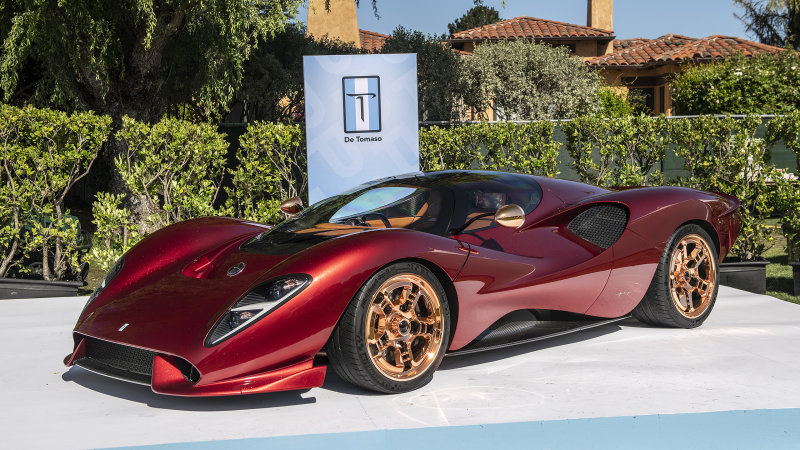
De Tomaso P72 gets a 5.0-liter Ford V8 with 700+ horsepower

All the comments the Hong Kong-based Consolidated Ideal TeamVentures (CIT) have made about resurrecting the De Tomaso brand have stressed the company’s focus on staying true to De Tomaso’s intentions and the values of his car company. The first proof of that came in CIT deciding to pay homage to the practically unknown De Tomaso P70 with the P72, instead of going for the slam dunk with a Pantera facsimile. The second proof comes in the choice of engine for the P72: Ford’s 5.0-liter Coyote V8 further developed by De Tomaso and Roush Performance. From De Tomaso’s first road car, the Vallelunga, to his last, the Guarà, he used Ford engines.

Final output figures will come in north of 700 horsepower and 608 pound-feet of torque thanks to a Roots-type supercharger. Yes, that’s less grunt and gumption than one gets from the 2020 Ford Mustang Shelby GT500, a coupe that costs one-tenth the P72’s 700,000 euros ($842,000 U.S.). But the men behind the project say blinding power figures are “irrelevant to ethos of this project and what we are trying to achieve.” In the words of general manager and chief marketing officer Ryan Berns, “In our opinion the market is now over-saturated with commercially driven ‘limited edition’ models primarily marketed on performance metrics. We have grown tired of this notion and thus took a contrarian approach with the P72.” The point with this car, rather, is “the provenance and the overall experience as a brand and for our clients.”

We can’t judge all of that yet, but the engine looks good on paper. Roush Performance tweaked the two four-lobe rotors in the supercharger for faster operation, better airflow and thermal efficiency, and less noise and vibration. The supercharger provides the power and response De Tomaso wants, along with regulation compliance in the U.S. and Europe. Yet the engine’s still in development as De Tomaso works to reduce the apparent presence of the supercharger, stressing an “old-school American V8 soundtrack” and the naturally aspirated spirit of the Sixties. Roush also added dry-sump lubrication, and it’s planned that the engine’s redline will lie beyond 7,500 rpm. Power gets sent to the rear axle through a six-speed manual gearbox, and we’re told to expect an audio clip soon of the “symphonic exhaust system” that exits atop the rear deck. If done right, the sound “brings one back in time as if they were on the starting grid at Le Mans in 1966.”

Miller Motorcars is the U.S. dealer for anyone still interested, but it seems this is a matter of snoozing and losing; De Tomaso will only build 72 examples of the P72 – hence the name – and the car already has more than 72 people standing in line for the chance to buy.

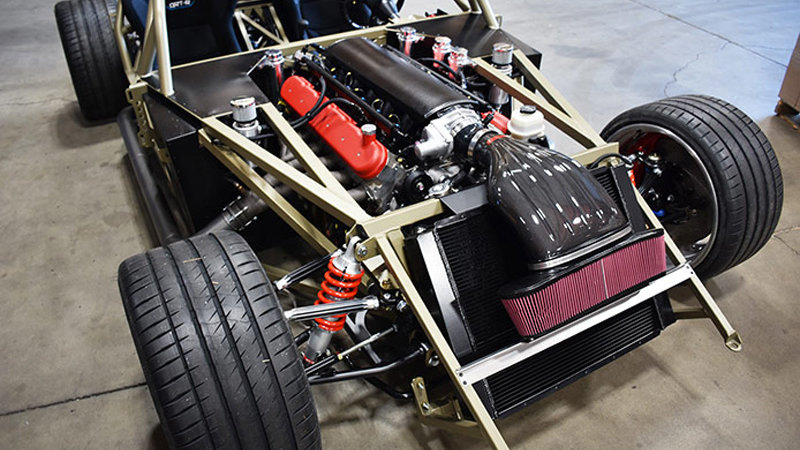
Factory Five developing new supercar with 755-hp LS V12

Factory Five has produced its mid-engined GTM supercar for more than 10 years, that car using C5 Chevrolet Corvette internals wrapped in a steel tube frame chassis and original composite bodywork. The Massachusetts-based company is working on a replacement now, coming to SEMA next month as an engine and chassis, due for debut in February 2020. Called Project Romulan, the chassis is a stretched and widened version of the Gen 3 Type 65 Coupe, otherwise known as the Shelby Daytona Coupe kit car the company sells. Yet whereas the kit car normally uses a Ford-sourced V8, Project Romulan gets a General Motors LS3-based 9.5-liter V12 with LS7 type heads made by Australian company Race Cast. The output: a turnkey 755 hp and 694 lb-ft on pump gas.  

And those numbers aren’t the wildest part. Hot Cars reports Project Romulan comes with a “Star Trek” backstory by way of Gaydon, England. Seems Factory Five benchmarked its supercar specs against the Aston Martin Vulcan. The Vulcan, remember, was a track-only car limited to 24 units, each powered by a 7.0-liter V12 with 820 hp and 575 lb-ft, although a few were converted to road-legal status. In “Star Trek” lore, when most of the once-violent and emotional Vulcans gave up their warfare for logic, as per Spock, a Vulcan faction quit the planet and settled planets Romulus and Remus. One coin, two sides.   

The 580-cubic-inch LS V12 will rev past 6,000 rpm, and Factory Five turned up the engine it calls “our mini Merlin” just a touch for a couple of Facebook videos. It’s mean. And even with an extra 4.5 inches across the chassis and nine more inches of chassis length, the fit is snug. Race Cast also provides the ECM and harness for the motor, Factory Five worked up custom bits like the oil pan and coil mounts. The tuner says the engine “will be available as one part number for anyone building this kit once it’s released.” Compared to a Coyote V8, the LS V12 will put about 140 more pounds on the front — 444 pounds for the Ford V8 vs 584 pounds for the Race Cast iron block V12 — but double-adjustable Koni shocks will do their best to make the weight worth it, and a serious set of Wilwood brakes will manage stopping.  

Factory Five says the super coupe will get a finished carbon fiber body with a new, modern design that needs no additional work. Assuming all goes well, after the February debut, production will begin later in 2020.

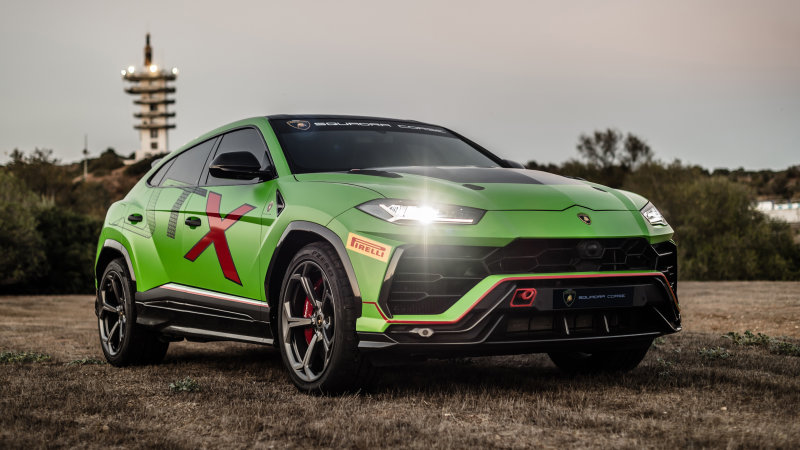
Lamborghini Squadra Corsa previews 830-hp hypercar and racing Urus ST-X

At the conclusion of last year’s Lamborghini Super Trofeo series, the Sant’Agata Bolognese carmaker’s Squadra Corse division unveiled the SC18 Alstom. That was a one-off, customer-commissioned, extreme track car based on the Aventador SVJ, and the first wholesale creation from the racing department. At this year’s series finale in Jerez, Spain, it teased a limited-run hypercar and an evolution of the race-bound Urus ST-X. The hypercar proves a rumor from earlier this month, when a poster at the McLaren Life forum said he was “Going to spec next week and test drive the SVR V12 track version of AV,” that AV standing for Aventador. Lamborghini says the track-only car, designed by the company’s Centro Stile department, will debut next year.

The rumor had posited the hypercar as a ne plus ultra expression of the Aventador’s 6.5-liter V12, and that seems to be the case. Engineers extracted 830 horsepower from the naturally aspirated engine, 70 hp more than found in the SVJ. In place of the road car’s seven-speed, single-clutch ISR transmission, the unnamed hypercar uses a six-speed Xtrac sequential gearbox, and a mechanical limited-slip differential can be adjusted by the driver for preload. The standard Aventador chassis has been reworked around that powertrain for aerodynamic and safety reasons. The front structure’s made of aluminum, a more pliant — and less expensive — material to deal with in case of incidents on the track. The engine’s been wrapped in a steel cage in order to increase torsional and bending stiffness. Airflow improves thanks to dual intakes on the hood, an airscoop over the cockpit, and a stonking rear wing. 

The Urus ST-X has undergone a few changes since its debut last year. The Verde Mantis SUV has been lightened by about 25 percent compared to the production version with “a lighter structure,” a vented carbon fiber hood and rear wing, and a racing exhaust. The cabin’s luxurious appointment are replaced by a roll cage, racing seats, and a fire suppression system. Scheduled to make its race debut at the end of October 2020 in Misano, Italy, the first pilots to get a chance behind the wheel will be winners of the four classes in the Super Trofeo series.

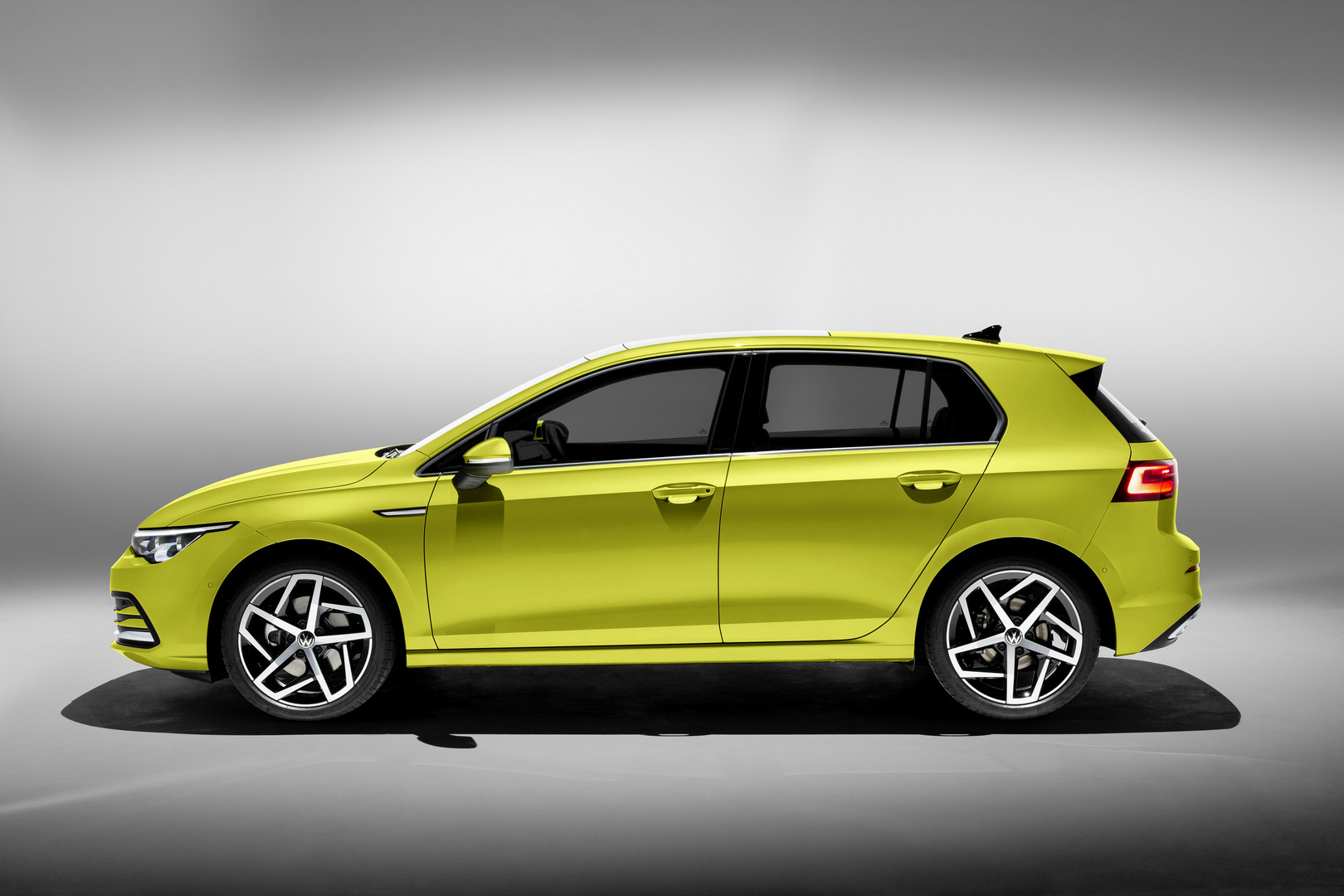
2020 Volkswagen Golf 8 Officially Revealed!

The Volkswagen Golf has landed. The Mark 8 has today been released, hoping to continue Volkswagen’s tradition of producing the best hatchback on the market.

As you would expect, the changes are evolutionary rather than revolutionary. Volkswagen has taken a huge step ahead when it comes to interior technology, bringing the Golf up to date!

Design

2020 VW Golf 8 Side

The design is familiar. The five-door version is all we get for now. The proportions are similar to before with a forward-pointing C pillar. The design lines are similar, the rear gets a new set of taillights and the front gets a new set of headlights which give the effect of a continuous bar across the front.

Powertrain

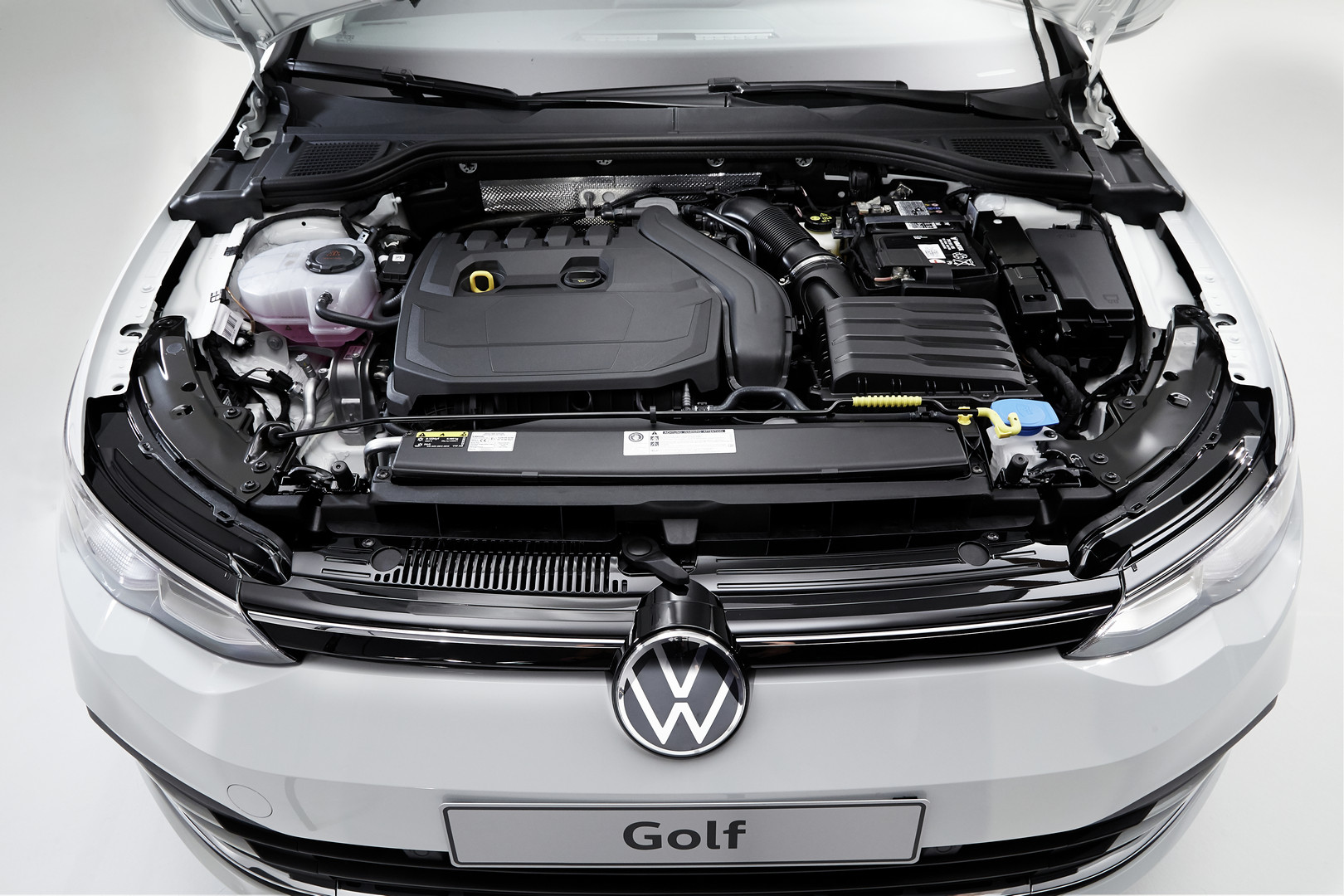
2020 VW Golf 8 Engine

In terms of powertrains, the GTI and R are missing from the market launch, rest assured that they will arrive at a later date.

Eight drive options will be available, including petrol, diesel, natural gas, mild hybrid and plug-in hybrid models.

Two all-new 1.0 litre, 3-cylinder petrol engines will be available with 90hp and 110 hp outputs. Two brand new 2.0 litre, 4-cylinder diesel engines will also premiere with a 115 hp and 150 hp output. Both will use AdBlue injected into the upstream.

Three mild hybrids will launch with 48-volt technology and outputs of 110 hp, 130 hp and 150 hp. These models will use the 1.5 litre Evo engine with Active Cylinder Management and a new turbocharger. The 48-volt system will be available exclusively with a 7 speed DSG gearbox and will allow coasting, energy recuperation and electric boost.

Two plug-in hybrids will also launch, an eHybrid with 150 hp and the GTE with 245 hp. The plug-in hybrids will use a new 13 kWh battery with higher electronically powered ranges.

Technology

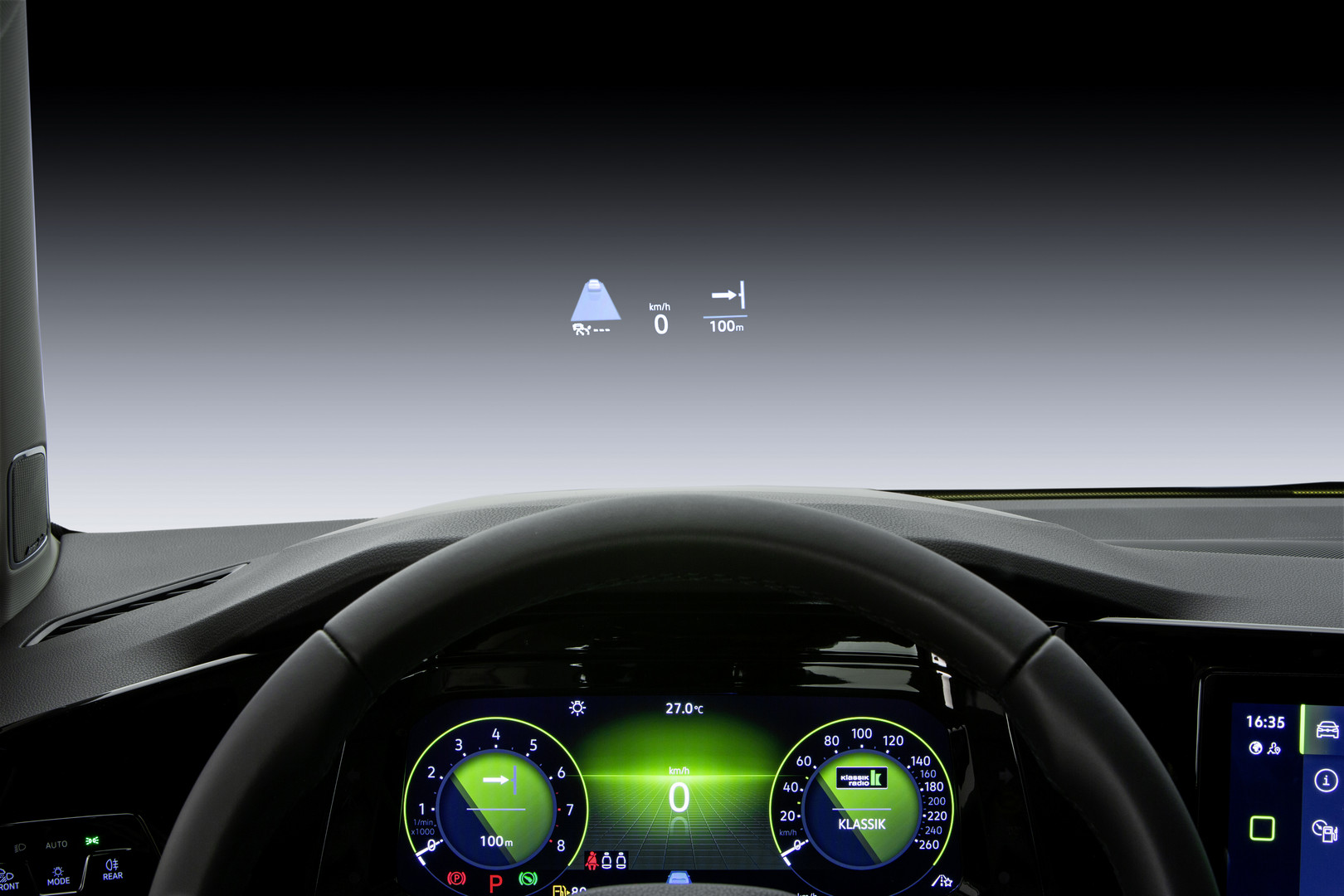
2020 VW Golf 8 Head Up Display

Volkswagen’s assist systems have recently been consolidated into a brand called IQ.DRIVE. The new Volkswagen Golf gets plenty of standard technological features including the Lane Assist lane-keeping system as well as a Front Assist area monitoring system (including City Emergency Braking System, Pedestrian Monitoring and a new swerve support feature as well as a new oncoming vehicle braking when turning function).

Further options include a predictive cruise control which reacts to speed limits, bends and roundabouts. Car2X communication also allows the exchange of information with other vehicles and other road users for the best possible information about driving conditions ahead.

The headlights are also carried across from the IQ.DRIVE program including the LED matrix headlights. Volkswagen will offer three alternatives including the top of the range LED metric units.

Interior

2020 VW Golf 8 Steering Wheel

The interior is where the real changes have been made. Integrated mobile online services are the difference. The biggest change is a redesign of the Golf’s dashboard. The digital instruments are now standard, including an 8.25-inch infotainment screen (or an optional 10.25-inch screen). The two screens appear merged and are mounted higher on the dashboard than before.

Many of the systems included in the new Golf can be updated retrospectively. There is a head-up display. Many of the analogue buttons have been replaced by touch screen functions too.

Competition

2020 BMW M135i Driving

The competition remains much the same as before. The BMW 1-Series and Mercedes-Benz A-Class immediately spring to mind. Both of these models are positioned slightly higher than the Golf and at higher price points. The Audi A3 is sure to follow soon and will likely build on the qualities of this new Golf, at a higher price point.

At the less premium end of the market, the Ford Focus and Vauxhall/Opel Astra are likely to offer competition. The Seat Leon, Mazda 3, Kia Ceed, Honda Civic, there is no shortage of competition. The Golf has traditionally occupied the centre-ground within the segment, a benchmark of quality. We expect the latest generation to continue this trend.

Gallery

GTSPIRIT NEWSLETTER

Here Are Some Overlanding-Ready Ford Super Duty Concepts

Ford will bring a veritable smorgasbord of modified vehicles to the SEMA show in November. We’ve already seen the Ford Ranger overlanding concepts. Today, Ford unveiled the company’s Super Duty concepts, which, not surprisingly, also include some rugged, purpose-built overlanders. Check out those trucks below.

BDS Suspension Ford F-350 Super Duty Crew Cab XLT

grey_placeholder

This F-350 is an overlanding rig powered by a 6.7-liter Diesel engine. It has a four-inch lift and massive 40-inch tires. The cab includes a hardshell tent and awning, refrigerator, and two-burner gas grill among other features.

LGE-CTS Motorsports Baja Forged Ford F-250 Super Duty Crew Cab XLT

grey_placeholder

This F-250 is another overlander with a custom bed. It’s intended to be “the Swiss army knife for the modern adventurer” with the functionality of “a mobile command center, campsite, and workshop.”

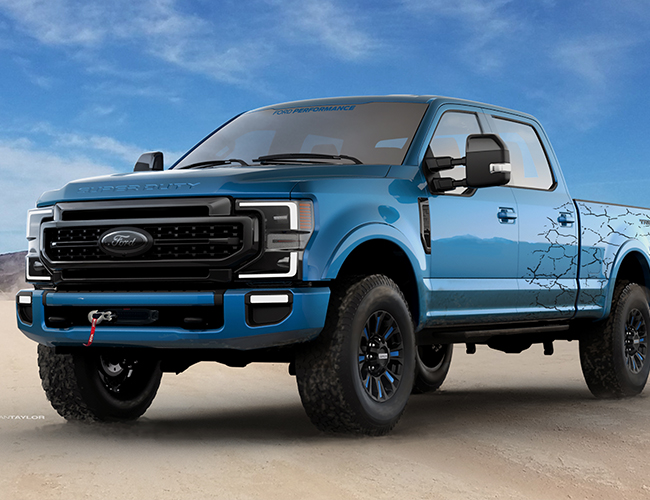
Ford Accessories F-250 Super Duty Tremor Crew Cab with Black Appearance Package

This truck shows off Ford Accessories offerings on an F-250 with the Tremor off-road package and Black Appearance package.

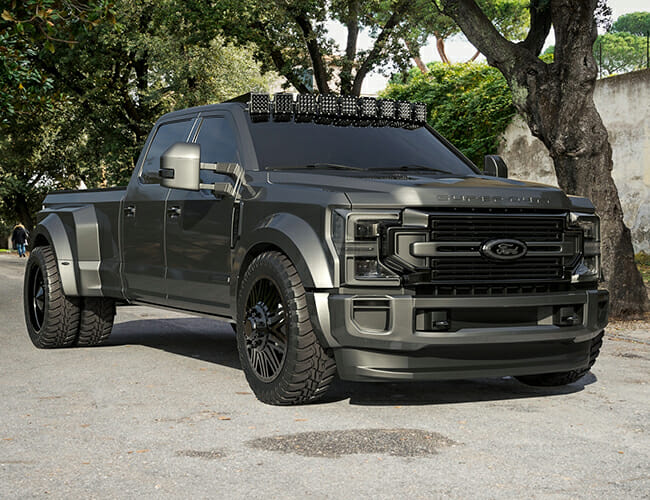
DeBerti Design Ford F-450 Super Duty Platinum Crew Cab

grey_placeholder

This F-450 is designed to be the ultimate work truck with pull-out drawers and Rigid LED lights. Fret not about security; this truck also has a vault.

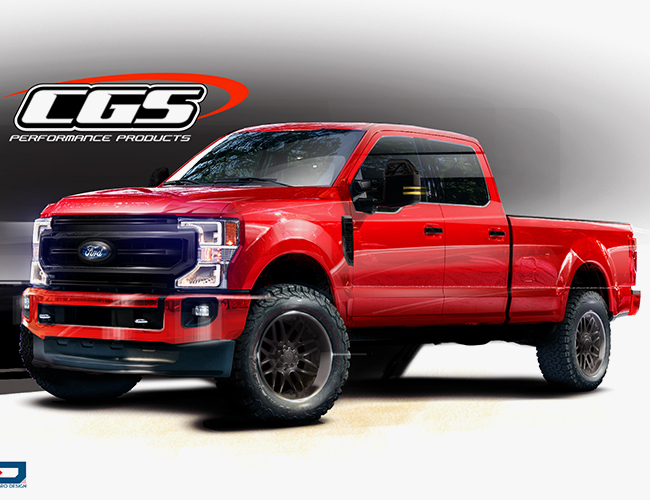
CGS Performance Products Ford F-250 Super Duty Tremor Crew Cab with Black Appearance Package

grey_placeholder

This F-250 is an off-roader with the Tremor package that focuses on aesthetics with custom wheels and tires as well as custom red Sikkens paint by AkzoNobel.

Note: Purchasing products through our links may earn us a portion of the sale, which supports our editorial team’s mission. Learn more here.