All posts in “Cars”

Lego Speed Champions Ferrari F8 Tributo and 1985 Audi Sport Quattro S1 are 25% bigger

During a week when auto manufacturers are at the 2019 Los Angeles Auto Show debuting real, drivable cars, Lego has debuted two new toy car kits modeled after the 1985 Audi Sport Quattro S1 and the Ferrari F8 Tributo. The new models also show off an improvement to the Lego Speed Champions series: the kits are now 25 percent bigger.

Lego is expanding its Speed Champions line of blocky car kits with two high-performance rides with very different purposes from very different times. One is a modern supercar, the other is a classic Group B rally car.

The F8 Tributo is an inch high, five inches long, and three inches wide. It wears a clean red color scheme with a black splitter and black diffuser, and the only stickers are the headlights and the badges. The toy design carries over features of the F8 such as the hood and side body scoops, and the tiered taillights. and the rear engine cover.

The S1, which is celebrating its 35th anniversary, has a much busier design. The main body of the car is white and yellow with retrolicious yellow body graphics. Black, gray and red striping add to the scheme, and “Audi,” “Audi Sport,” “Audi Team” and “quattro” stickers are seen on the body, the windshield, the hood and the rear wing. Clustered front rally lights, wheel flares, angular aerodynamic pieces and two sets of wheel designs help make the quattro look as authentic as possible. The car also comes with a miniature racer who can sit in the car and grip the stick shift.

Both the Ferrari and the Audi will be released for January 2020. Each model is listed at $19.99, plus tax.

Pagani Zonda Riviera Sells for $5.5 Million at Riyadh Car Show Auction

The Riyadh Car Show Auction took place yesterday. The hypercar rich sale featured plenty to get excited about with all manner of Ferrari, McLaren, Lamborghini and Pagani lots up for grabs.

Out of the 68 cars which crossed the auction block, only 18 found a new home. The 26% sale rate seems low, yet the auction managed to achieve $16.75 million in total sales, boosted by the sale of two lots in particular!

The biggest success of the night was the stunning Pagani Zonda Riviera. It hit a $5.5 million hammer price. The new owner gets a 760 Series Zonda built upon a Zonda F.

The Riviera gets new carbon fibre body panels, a roof scoop, a carbon fibre rear wing, carbon-black wheels and carbon fibre front canards on the exterior. The interior is fitted with bespoke brilliant blue leather bucket seats with matching door panels, a flat-bottomed Alcantara-covered steering wheel and an interior design mix of navy blue aluminium, navy Alcantara, navy carbon fibre and dark blue leather. The engine is the AMG 7.3-litre M297 V12 which gets the 760 series power output of 760 hp.

The result is interesting as it is the first time a Zonda has hit a public auction since an early Zonda C12 sold for £320,500 in 2011. During the same year, a Zonda C12 S Roadster hit a final price of £425,600. Next weekend, another special edition Pagani Zonda Aether is on offer at RM Sotheby’s first Abu Dhabi auction. The Riviera has set a benchmark!

The Riyadh auction also saw the sale of several other modern hypercars. A Bugatti Chiron Sport 110 ANS, one of the first delivered, was the next bestseller, achieving $3.4 million. Silverstone Auctions also managed to sell the Bugatti Veyron Super Sport World Record Edition which went for $1.9 million, and the LaFerrari which went for $2.2 million.

There is a story to be written about what did not sell too. The list is long and includes cars such as the Porsche 918 Spyder Weissach, Lamborghini Diablo VT, a McLaren P1 Carbon Edition, a Pagani Huayra Coupe, a Italdesign Zerouno, a McLaren Mercedes SLR 722S Roadster, a Mansory Linea Vincero Edition, a Ferrari 599 GTZ Zagato Nibbio Spyder, a Bugatti Veyron Nocturne, a Ferrari 288 GTO, a Mercedes-Maybach S600 Pullman, a Bugatti Chiron Sport, a Lamborghini Reventon, a McLaren Senna and a Gumpert Apollo Sport.

GTSPIRIT NEWSLETTER

Exclusive: V12 Will Return in Next Generation Mercedes-Benz S-Class in 2021

Good news for fans of the V12 engine. During an exclusive interview with GTspirit, today at the Guangzhou Auto Show 2019, Daimler CEO Ola Kallenius confirmed that the V12 engine will return in the next generation 2021 Mercedes-Benz S-Class.

Doubts about the return of the V12 engine were raised when Mercedes-Benz released the Mercedes-Maybach GLS 600 earlier this week. 600 modes normally receive the iconic V12 power plant, yet the GLS features a V8 unit instead. It has now been confirmed that, in the S Class at least, the V12 will live on.

Official details for the V12 version of the Mercedes-Benz flagship limousine will be announced next year. It is likely that Mercedes-Benz will develop the current V12 engine, found in the S 600 and Mercedes-Maybach S 600, will be updated to comply with strict upcoming emission standards.

During our interview, we also spoke with We also spoke with Kallenius about the brand new Mercedes-Maybach GLS 600 luxury SUV:

GTspirit: Exclusively available in China, the six-cylinder Mercedes-Maybach S 400 is the top selling Maybach model. Is there any chance we can expect a Maybach GLS with a six-cylinder any time soon?

Kallenius: “We launched the new Maybach GLS 600 with a V8 engine first but it is possible there will be a six-cylinder version of the GLS Maybach in due time. The AMG developed 4.0 liter V8 fits the GLS Maybach very well and was the obvious choice for launch of our first Maybach SUV.”

Asked about a possible Mercedes-Maybach GLS V12, the Daimler CEO is short and clear: “We have no plans for a Maybach GLS V12.”

Read more about the Mercedes-Maybach GLS 600

Mercedes-Maybach GLS 600

GTSPIRIT NEWSLETTER

New Tesla Cybertruck Reinvents the Pickup Truck

At an event, away from the ongoing Los Angeles Auto Show 2019, Tesla unveiled its highly anticipated Cybertruck. The next stage in building a model range, the Cybertruck is Tesla’s most controversial design yet.

In true Silicon Valley style, Elon Musk took to the stage on Thursday to unveil his latest model. Things didn’t go entirely to plan though. During a part where Musk intended to demonstrate the “armour glass”, he invited Tesla’s head of design, Franz von Holzhausen, on stage to throw a metal ball at the side windows. The idea was that it would just bounce off, causing no damage. The Cybertruck is supposed to protect occupants against bullets and sledgehammers The armour wasn’t as strong as it perhaps should have been as the window cracked on impact.

Of course, the biggest story is the pickup truck itself. Tesla rips up the rule book, as you would expect. The design features lots of straight lines, seemingly inspired by Lockheed Martin’s Skunk Works or the classic DeLorean than by any conventional pickup truck. It has proved controversial.

The exterior bodywork is milled from Ultra-Hard 30X Cold-Rolled stainless-steel using Tesla armour glass for the windows. This is said to make it extremely strong. The glass, which we suspect will be redesigned before the market launch, gets a polymer-layered composite skin for its strength.

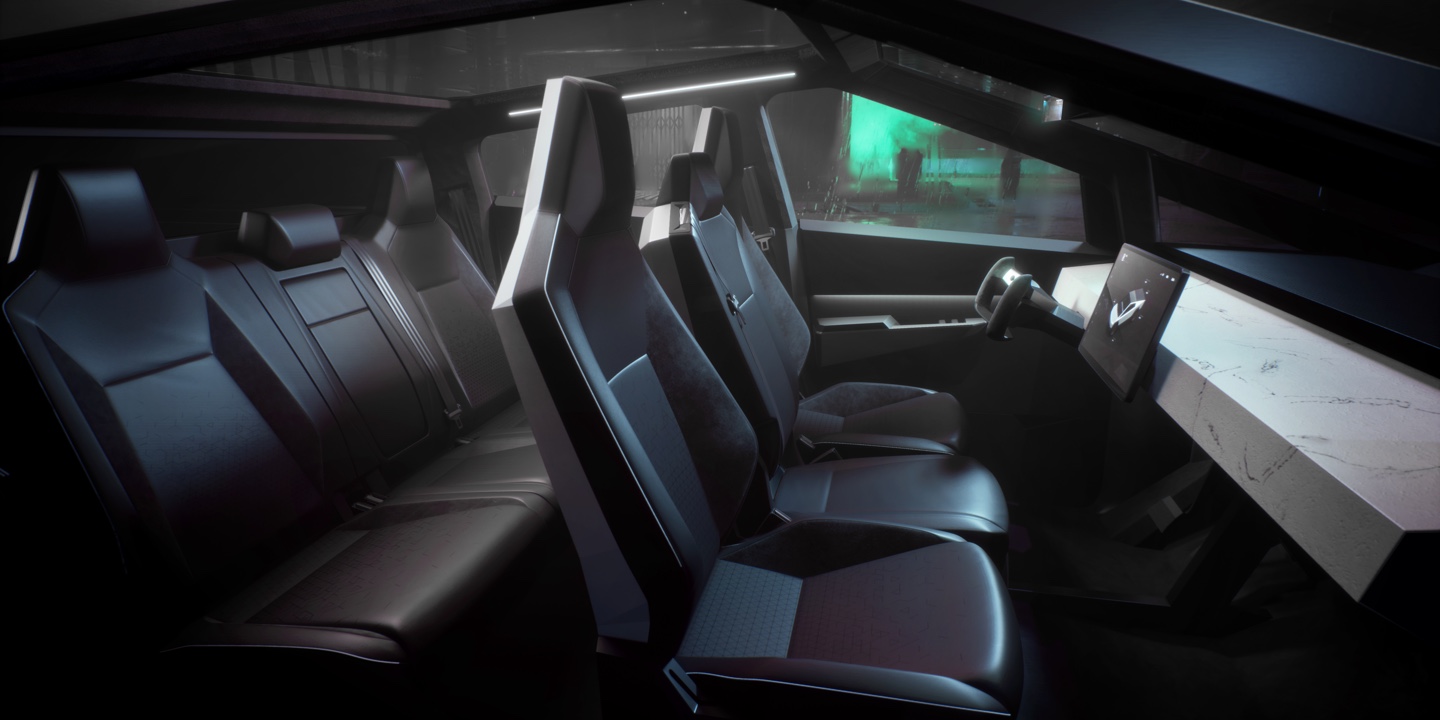
The interior features 6 seats. 3 in the first row and 3 in the rear together with a 17 inch display. The passenger cell is separated from the rear bed. From the side, you wouldn’t guess that it was a pickup truck. The rear bed is hidden by a gently sloped rear panel. It’s 1.98 metre rear bed has a payload capacity of 1,580 kg and 2,830 litres of space.

Under the chassis sits Tesla’s battery system. In its highest specification, it should hit 60 mph in a blistering 2.9 seconds with 500 miles of range. Tesla will in fact offer the Cybertruck in three options. The single motor, rear wheel drive option will manage a 250 mile range with a 6.5 second 60 mph sprint. The dual motor, all wheel drive model cuts the sprint time to 4.5 seconds and increases range to 300 miles. It is the triple-Motor, all whee drive model that gets the blistering pace and huge range.

Tesla Cybertruck Interior

At all four corners, the Cybertruck uses air suspension. This allows Tesla to program some convenience features, including a program which drops the ride height for entry and exit.

The Cybertruck is available to order immediately with a $100 deposit. Deliveries are expected to begin in 2021 with tri-Motor versions to follow on 2022. A full self driving mode costs extra. Pricing of the range starts from $39,900 for the entry level, rising to $49,900 for the mid range and $69,900 for the top of the range model.

GTSPIRIT NEWSLETTER

Lexus’ LC500 Goes Topless in 2021

For 2021, Lexus is adding a convertible variant of the sporty LC500 to its lineup. Despite its sunny Sunday drive looks, this is one mean Lex, powered by a naturally-aspirated 471-horsepower 5-liter V8. Adjustments were made to improve chassis rigidity in this roofless model, as well as in weight distribution and suspension tuning. This blue color will be limited to just 100 units.

[embedded content]

Think the $64K Subaru WRX Is Too Pricey? Here’s an Alternative

Last January, Subaru unveiled the spectacular WRX STI S209. It’s the most powerful STI-branded Subaru production car ever with 341 horsepower on tap. It’s also the first high-performance “S” car in the U.S. The run, about 200 vehicles, is limited. The price tag, starting at $63,995, is staggering. Fortunately, Subaru just announced the “WRX Series.White” for 2020. While it may have a goofy name, it offers a similar limited-edition appeal with a far more reasonable price tag.

The WRX Series.White gets premium appearance upgrades. It features exclusive ceramic white paint, matte bronze wheels (18-inch for WRX, 19-inch for WRX STI), and Ultrasuede-trimmed Recaro seats. For performance, the WRX Series.White cars have a Bilstein sport-tuned suspension, Brembo brakes with either red (WRX) or silver (WRX STI) calipers, and Michelin Pilot Sport Cup 2 tires.

Subaru will produce a limited run of WRX Series.White cars, but there will be notably more than the WRX STI S209. Subaru will produce 500 WRX and 500 WRX STI versions. The base model WRX Series.White will start at $33,995 (a $1,900 premium over the WRX Limited) and the upper-level WRX STI will start at $42,695 ($1,000 more than the WRX STI Limited). That’s also less expensive than 2018’s top-tier Subaru WRX STI Type RA.

You don’t get the extra 31 horsepower of the WRX STI S209 with the Series.White, but you do save more than $20,000. And, unlike the STI S209, it’s not so exclusive you would worry about protecting your investment every time you drive it.

Reminder: If you are going to pick up a WRX to have a blast driving around in the snow, make sure to pick up some great winter tires. Also, be mindful of law enforcement and other vehicles.

1,100hp Karma SC2 Concept: 0-60 in Under 1.9s!

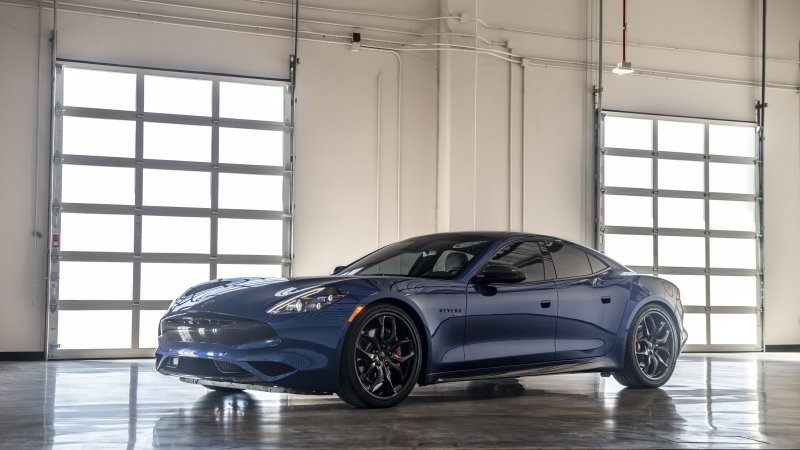
The reborn Karma Automotive company (previously Fisker) released a new concept car at the Los Angeles Auto Show 2019 this week. A specialist in EV vehicles, the two-door supercar is as eye-catching as the Fisker Karma which came before.

The Karma SC2 delivers its power through the front and rear-mounted electric motors which deliver 800 kW – around 1,100 hp – of power. At the wheels, the SC2 puts out 14,000 Nm of torque.

The power allows the Karma SC2 to hit 60 mph in under 1.9 seconds. It also manages a fairly respectable 350 miles on a pure electric range.

Karma equips the SC2 with carbon-ceramic brakes, push-rod operated racing suspension and a Karma torque vectoring gearbox. It has apparently been designed with the ability to cruise like a GT car, yet handle the canyons better than any other EV.

The Karma SC2 has one-of-a-kind Drive and Play technology through which you should be able to re-live previous drives through simulated driving experiences in their own vehicles. The system uses a triple high definition camera under the windshield and frequency-modulated continuous-wave (FMCW) lidar sensors to capture a 360 view of the car in motion, within a 3D environment.

The technology captures the entire driving experience in real-time; turns, braking, acceleration, light simulations, sounds, air temperature and audio playlist. After the drive, SC2’s adaptive laser projector replays the journey while the vehicle is parked, while a mounted smartphone acts as the cabin’s rear-view mirror.

Drivers can then share their Drive and Play experience with others, and also stream drivers’ routes from around the world within their own vehicles, experiencing driving simulations at world-famous roads and race tracks.

The design is pretty striking too. It gets a Vapor Gray hand-painted body. The shape is two-door, with the cockpit sitting very far back. Despite resembling a front-engined GT car, the 120 kWh batteries are actually fitted in the centre tunnel, beneath the dashboard and the seats. Those scissor doors are a big distraction too!

There are more gimics too. Vehicle entry is through fingerprint and facial recognition sensors. Inside the cabin, there are biometric seats and steering wheel, 3D audio, and electro-chromatic glass.

GTSPIRIT NEWSLETTER

BMW M boss gets closer to confirming a standalone M flagship

We’re leaning ever closer to official confirmation of a standalone screamer from BMW’s M division. Auto Express spoke to brand boss Markus Flasch during the L.A. Auto Show, the German saying, “I can think of doing standalone M-cars – I like the idea, and I think we’re going to do something in this direction.” Under further questioning, specifically about whether M might have an SUV in mind for the putative offering, Flasch replied, “I don’t know. … Well I do know, but I’m not saying yet!” Other sources inside the Munich automaker apparently told Auto Express “a new car could be seen by 2021″ and bring some sort of electrification with it.

This represents noteworthy movement from BMW’s position in June, when Flasch told Australian outlet Car Sales,  “We are investigating M variants that may also be standalone, that don’t have a predecessor.” At the time, a company insider said everything was in “a very early stage” of examining body styles, and Flasch said qualified the push by saying a potential model may be a product of M division, as opposed to based on a BMW offering.

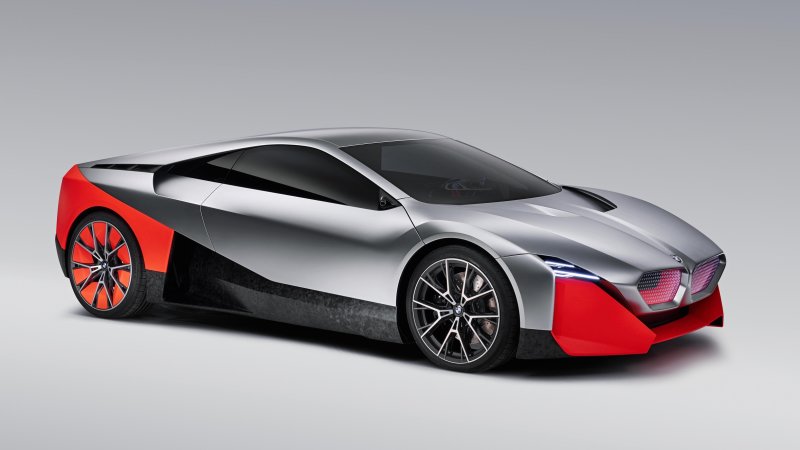
The 2021 dates carries significance because 2022 marks the M division’s 50th anniversary as an independent company. If M plans to debut something roadworthy and with production intent before the end of 2021, prototypes are no more than a year away. That means BMW has decided on the fundamentals and will be sorting out how to make them work together. The plug-in hybrid Vision M Next sounds like a long shot, though, even if BMW design chief Damagoj Dukec would like the 600-horsepower show car to get the nod, saying, “We have a heritage of bringing art cars and race cars together with M. I am convinced that this [Vision M Next] is the right way.” Flasch, however, explained that the halo “doesn’t necessarily have to be a mid-engined supercar,” only that “it has to stand out from the crowd.”

Closer to production reality, Flasch also said an electrified M car is “not too far away.” At the same time, he cautioned that adding electric aids is no panacea; “electrification is not rocket science, and it’s not the game changer [in] that people think it’s an easy answer to every question.”

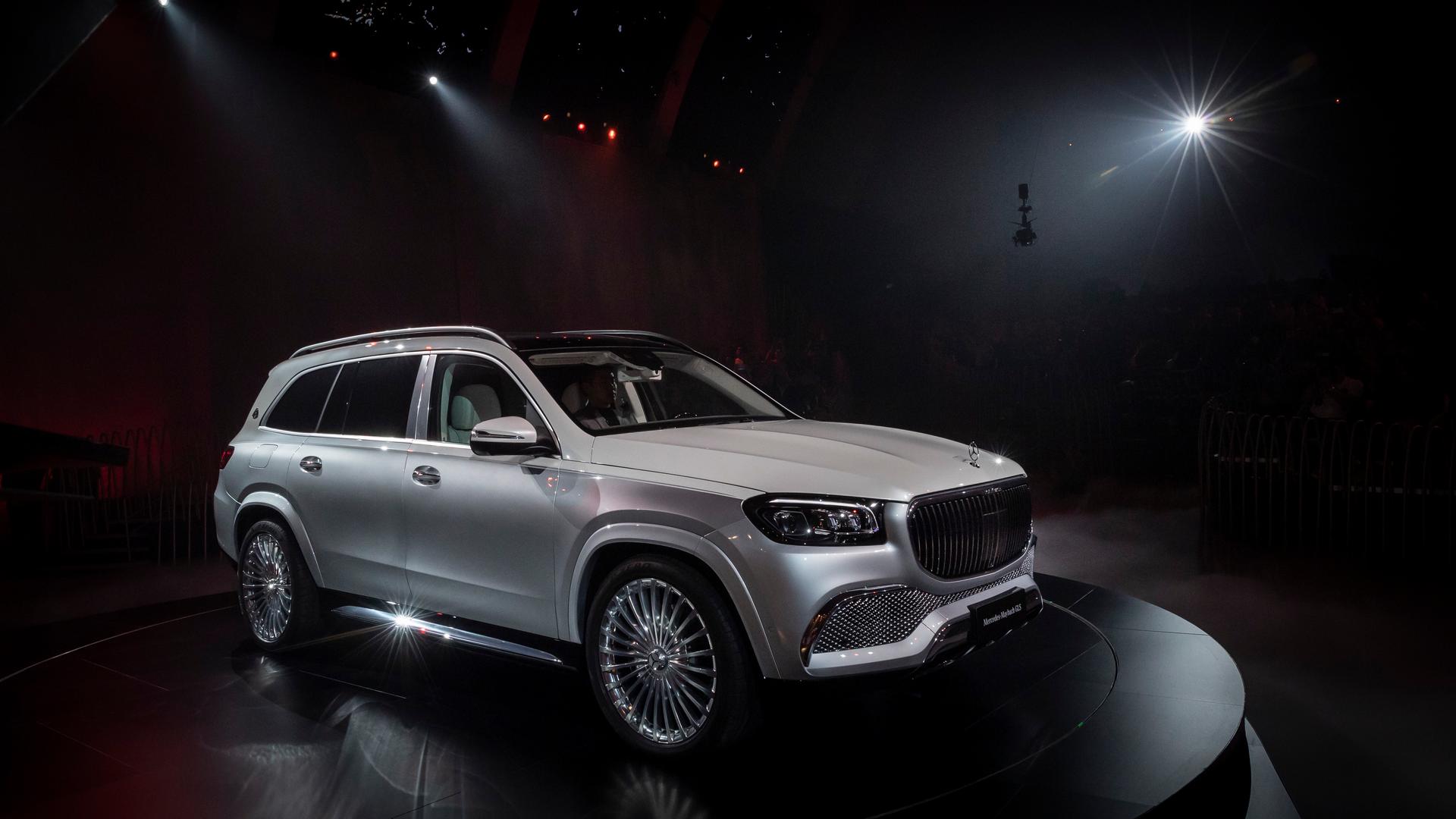
2020 Mercedes-Maybach GLS 600 Officially Revealed

Its been a while since Mercedes-Benz did something with the Mercedes-Maybach range. We have had the Mercedes-Maybach S 600 for some time now. It was joined by a limited edition Cabriolet quite sometime after, and a Mercedes-Maybach G 650 Landaulet. Today, a proper production SUV has arrived in the form of the Mercedes-Maybach GLS 600.

The Mercedes-Maybach GLS 600 debuts this week in Guangzhou, China. As the name suggests, it sits on the basis of a GLS Class, with the top end touches of the Maybach name.

Design

Mercedes-Maybach GLS 600 Red

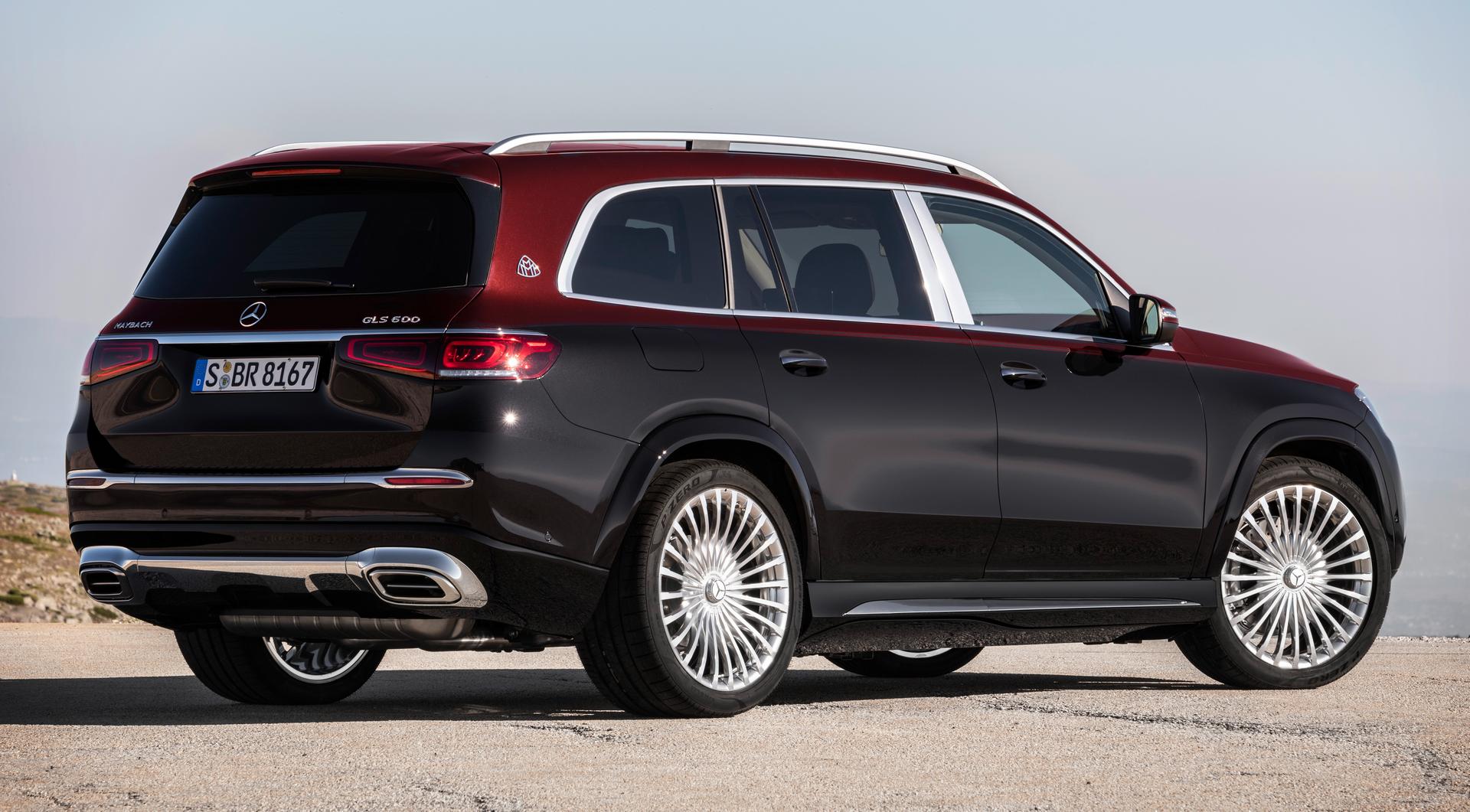
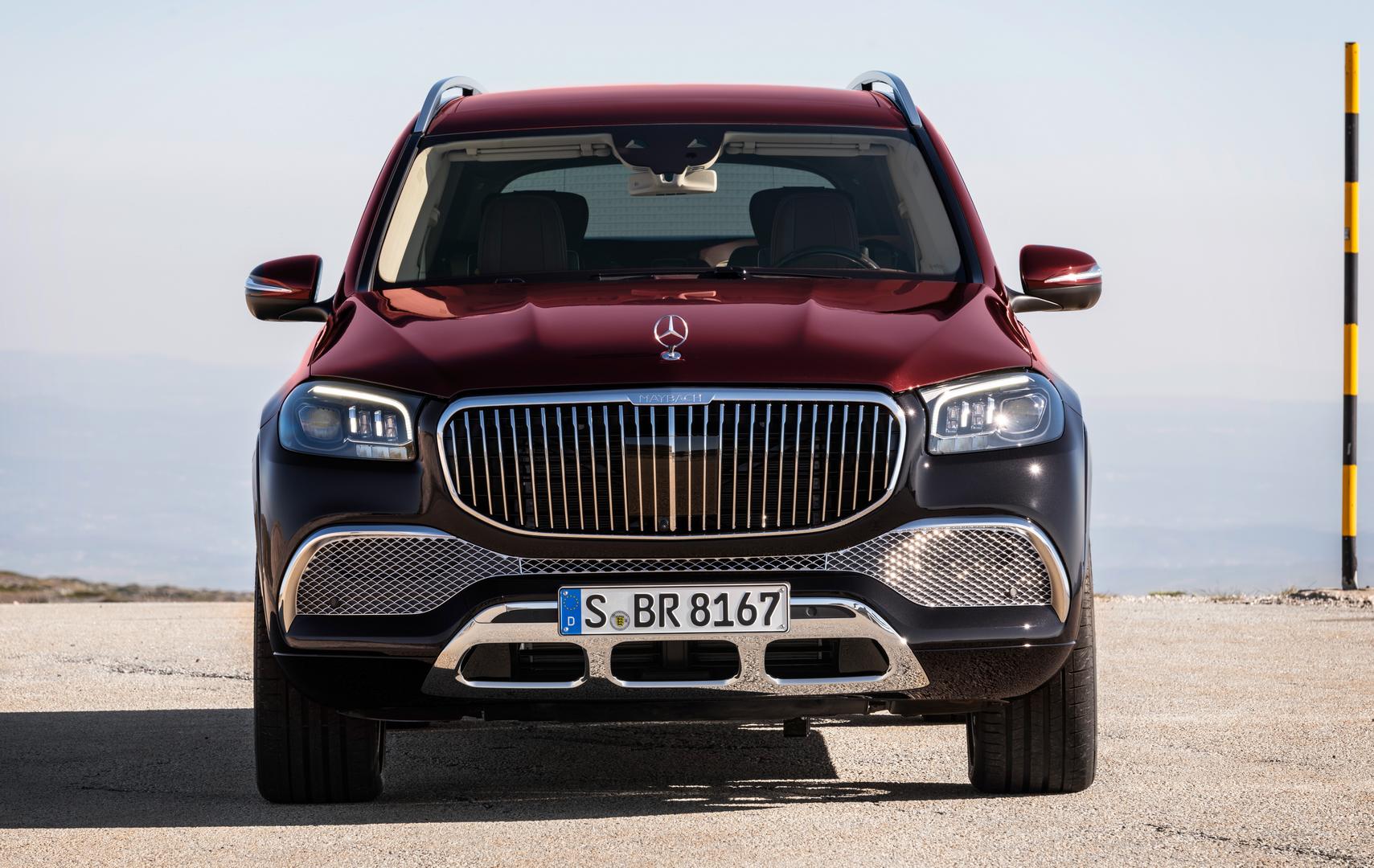
The Mercedes-Maybach GLS 600 uses the classic Mercedes-Benz star atop the bonnet. The Grille is replaced with a chrome Maybach-specific version which complements chrome air intake mesh and trim surrounds. The wheels are massive, multi-spoke 23-inch models.

The Maybach emblem is on display at the D-pillar. The rear gets plenty of chrome too, with Maybach-specific tailpipes. Truth be told, the look differs only slightly from that of the G Class. The look is enough to give it a high-class feel though. Plus it looks less ugly than the competition!

There are a few special touches too. The Airmatic suspension is programmed to drop the ride height of the SUV by 25mm when the door is opened. Running boards swing out from the underside to allow for easier access.

Power and Chassis

Mercedes-Maybach GLS 600 Engine

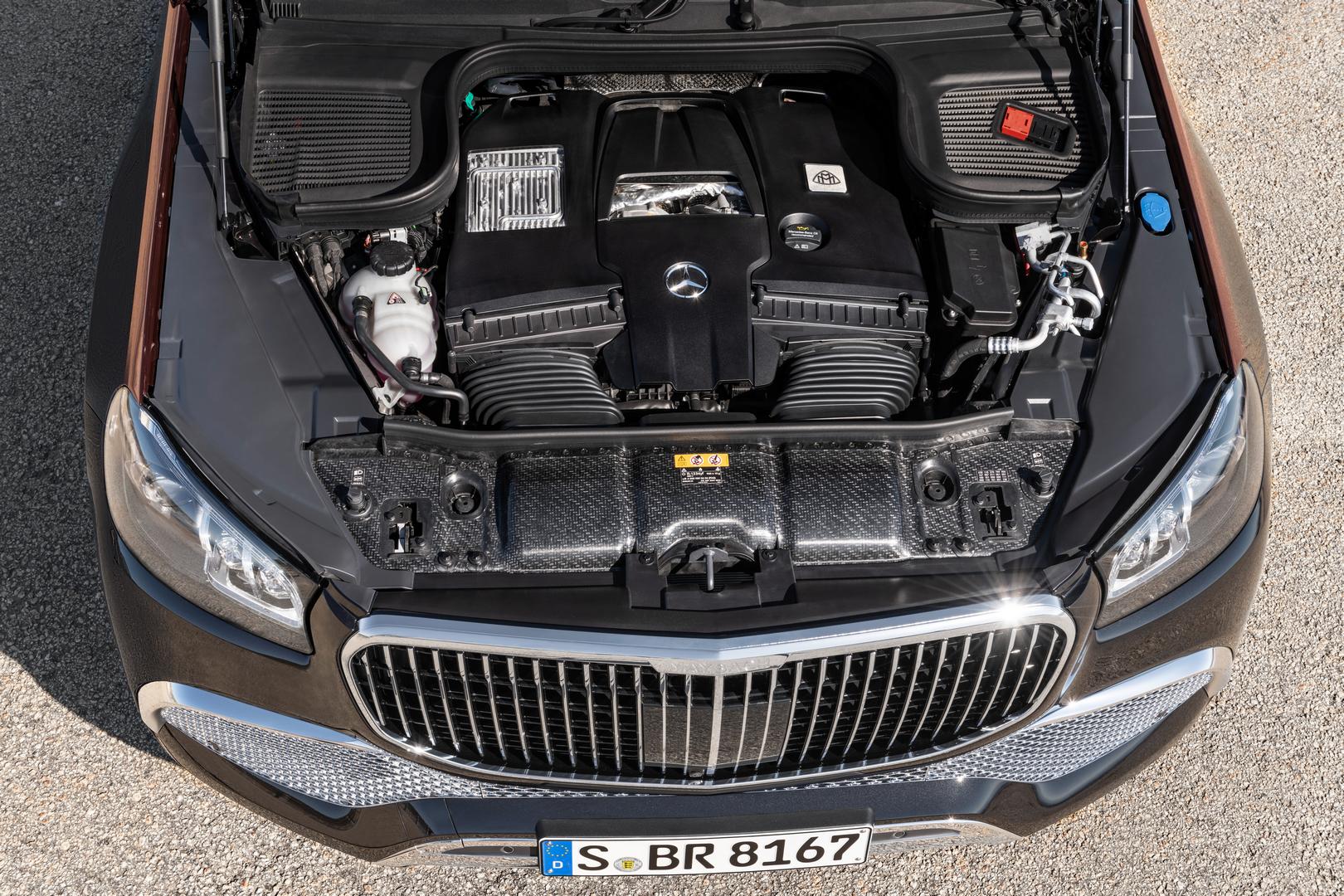
The Mercedes-Maybach GLS 600 ditches the V12 powerplant. Sad times. In its place is the 4.0 litre V8, tuned to produce 558 hp and 730 Nm of torque. Top speed is limited to 250 km/h with a 100 km/h sprint time of 4.9 seconds. The power is delivered through a 9-speed automatic transmission.

It is combined with the 48-volt system, Mercedes call EQ Boost. The 48-volt system also operates an E-Active Body Control system which uses an electronic sway bar setup to counteract dynamic forces. For example, in Curve mode, the body lens by as much as 3 degrees.

The suspension is Mercedes’ Airmatic system with something called Adaptive Damping System Plus (ADS+) as standard. This is connected to double wishbones at the front with a four-link setup at the rear.

The Airmatic system is designed to keep the body at a constant level using sensors and algorithms to smooth the bumps. Ground clearance is lowered by 15 mm at high speed to increase aerodynamic drag and increase stability.

Interior

Mercedes-Maybach GLS 600 Rear Seats

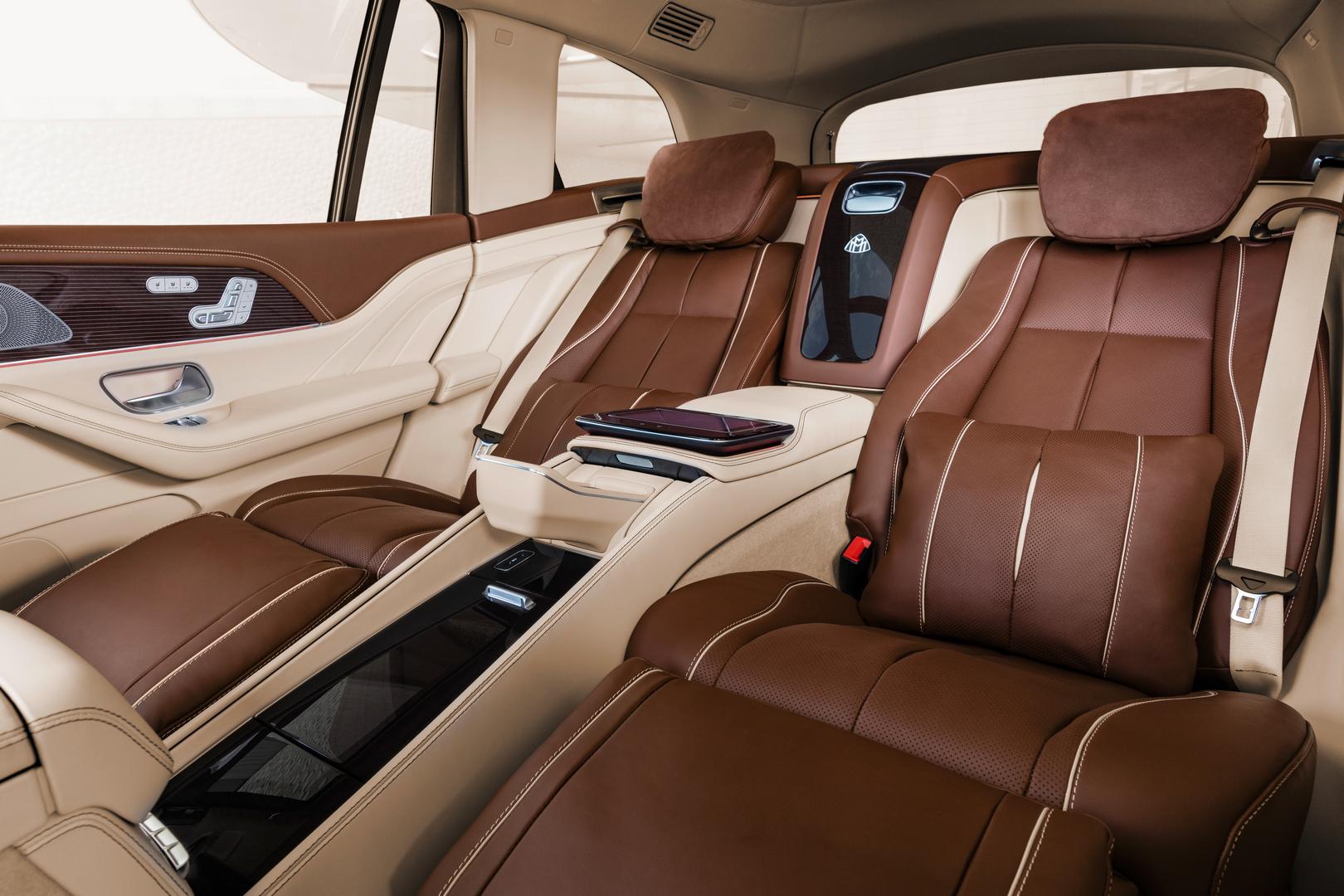
The Maybach is every bit as customisable as you would expect. There is a wide variety of wood, leather and rim options. The driver sits 25 cm higher than in an S Class. The rear seats are 120 mm further back than in the standard GLS.

The Mercedes-Maybach GLS 600 also makes do with only two rows of seats. That second row is ultra-luxurious though, with a five-seat or four-seat option. With the front seat in chauffeur position, the rear passenger gets 1.34 m of legroom.

The GLS 600 uses the MBUX system with a Maybach-specific design. Even the climate system fans have been specially optimised on rubber bearings. Rear passengers get two 11.6 inch touchscreens.

Availability

Mercedes-Maybach GLS 600 Front

The Mercedes-Maybach GLS 600 will be available during the second half of 2020. Cost is yet to be announced, although the GLS 600 should be on offer worldwide.

Competition

The Rolls-Royce Cullinan. That’s the competition.

Of course, the Bentley Bentayga, the Lamborghini Urus, the Aston Martin DBX – all could be competitors. Yet none are quite so focused on pure luxury as the GLS 600.

Gallery

GTSPIRIT NEWSLETTER

Aston Martin Unveils Its First SUV

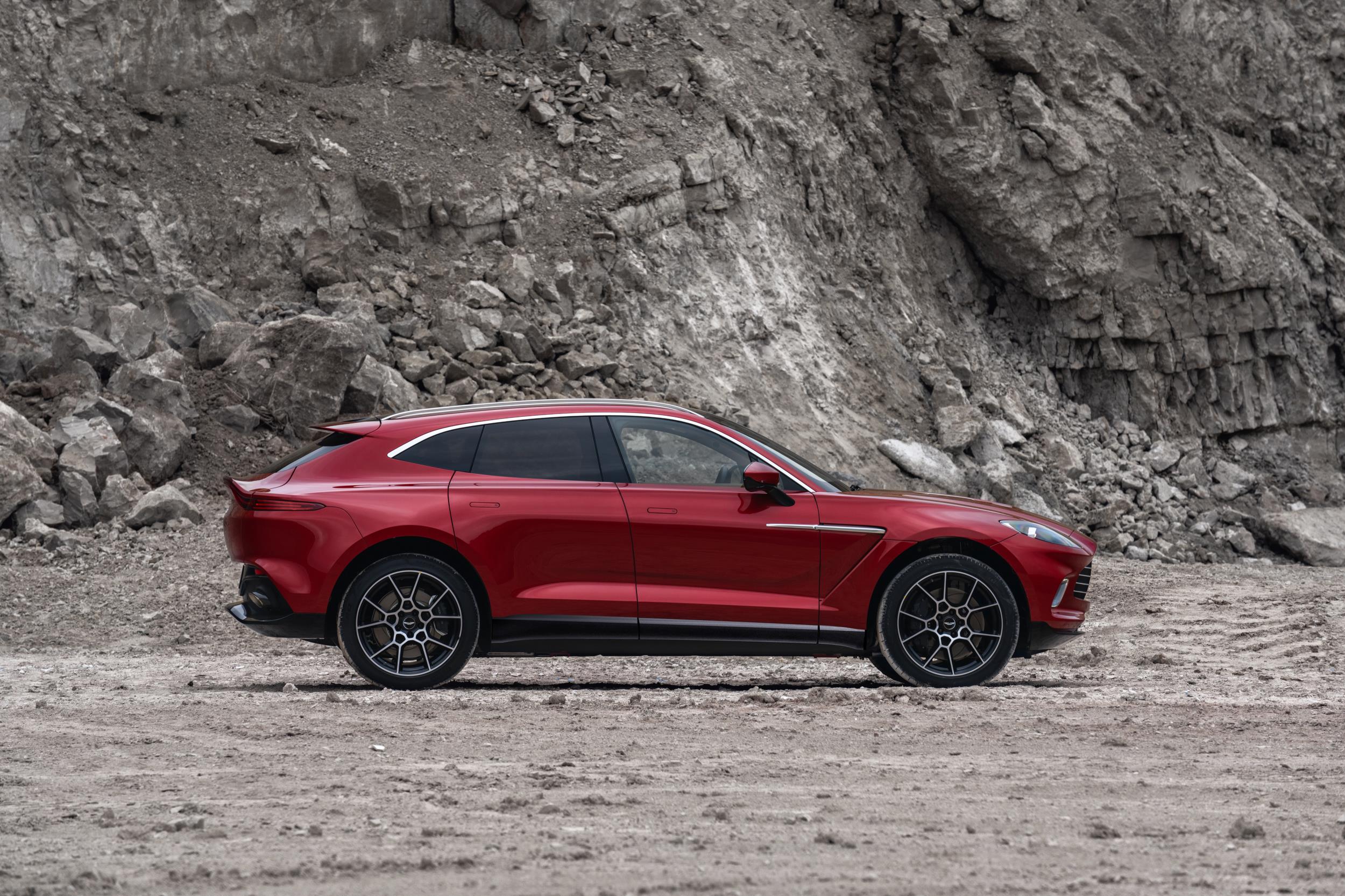
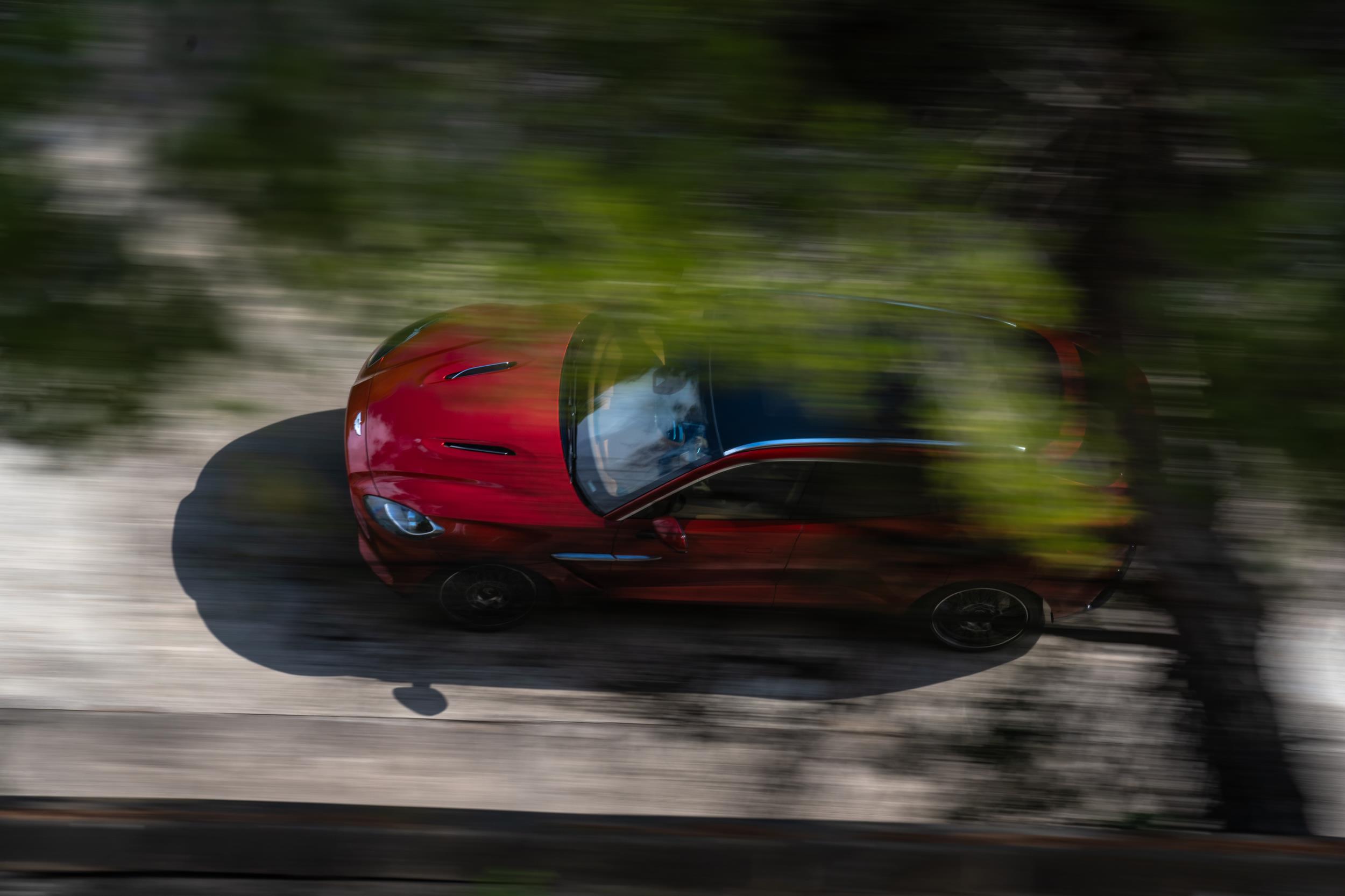
The forthcoming 2020 Aston Martin DBX will debut as the British supercar brand’s first-ever SUV. Powered by a 542-hp AMG 4-liter V-8, this luxury ’ute hits a 4.3-second zero-to-60-mph time and a top speed of 181 mph. It offers 5 dynamic drive modes as well as adaptive air suspension & an active anti-roll system. Looks pretty cool, too.

[embedded content]

Aston Martin Just Released the Ultimate $189,000 Dad Car

Aston Martin is not merely an automotive performance brand. Driving an Aston is also about looking stylish and sophisticated — it’s the brand James Bond drives after all. Now, the British brand has joined the SUV craze with the DBX. So it shouldn’t surprise anyone that it looks like the most elevated and exquisite dad car on the market. (It can even come with a matching Maxi-Cosi baby seat.)

Aston CEO Andy Palmer called the DBX “the most important vehicle in the history of the company.” That’s not hyperbole. SUVs have conquered the luxury market — that’s where the profits are. Even established sports car companies like Porsche and Lamborghini are now SUV manufacturers first and foremost if you’re looking at the accounting books. So, the DBX may not just redefine, but actually save Aston Martin, which has been in reported financial trouble.

So, what are you getting the DBX? Start with the Mercedes-AMG-sourced 4.0-liter twin-turbocharged V8 putting out 550 horsepower and 512 lb-ft of torque. The DBX accelerates from 0-60 mph in just 4.3 seconds and can reach a top speed of 181 mph. An adaptive air suspension that can be raised and lowered marks the difference between “SUV” and “raucous wagon.”

The DBX is practical enough to hold five occupants and their luggage. You can option it with essential family items like a “pet package” featuring a portable dog washer and a “snow package” with a ski boot warmer. But, it’s still definitively an Aston with “sumptuous full-grain leather sourced from long term partner Bridge of Weir.”

Aston Martin is currently taking orders on the DBX. U.S. pricing will start at $189,900 and with deliveries expected in 2020. While that pricing is far from cheap, it will set you back a bit less than the last practical Aston Martin.

LEGO x Top Gear App-Controlled R/C Rally Car

Batmobiles, Bugattis, and Beetles have all been part of the LEGO car world to our everlasting delight, but they’ve added their first app-controlled vehicle, and it’s a Top Gear-branded rally car. On top of its…

Karma Revero GTS and SC2 concept plot the way forward

The Karma Revero GTS and SC2 concept occupy two places in the automotive spectrum, but point to a single destination for Karma Automotive. In their ways, Karma has designed them to exhibit the brand’s intent to expand beyond the mechanics of electric car production. The Revero GTS pushes the Revero GT further, using the same 536-horsepower twin-motor setup and Karma-designed inverters integrated with the motors. The sprint to 60 miles per hour has been cut by 0.7 seconds to 3.9 seconds, top speed increases five miles per hour to 130 mph. Dynamic improvements include new suspension bushings and valving for more supple damping.

Changes are subtle throughout, nothing but a splash of carbon fiber exterior trim and GTS badging appearing to separate the hotter sibling from the GT. The interior is fitted with haptic steering wheel switchgear, Karma’s proprietary 570-watt Soloscape audio, ventilated seats, and Bridge of Weir leather. Preorders are being taken now for $149,950 before destination, a $15,000 bump over the Revero GT. Production will begin in the first quarter of 2020.

The Vapor Gray SC2 concept strikes us as the second coming of the Mercedes-McLaren SLR, and we’re totally OK with that; the pure electric hypercar puts a roof on the SC1 roadster concept Karma took to Pebble Beach this year, and looks more well-proportioned for it. In the previous teaser photo, we thought we were in for another set of gullwing doors, but those long, unfurling, insectoid wings would make a set of gullwings shy. And check out what looks like a piece of integrated luggage set into the front fender under the door. The interior is all the sharp-edged, color-keyed, future-cool minimalism tomorrow’s hitman could want. Entry is done through fingerprint and facial recognition, the seats and steering wheel respond to biometrics, fiber optics run through the headliner, and the side glass is electrochromatic. 

A mongo, I-shaped 120-kWh battery powers electric motors delivering 1,100 hp and 10,500 lb.-ft of torque, said to be good for a 0-60 mph blast of less than 1.9 seconds, that time having become the magic benchmark for EV screamers. Claimed range is 350 miles, not that you’d ever get that far thanks to acceleration runs and the promise of exceptional handling thanks to a pushrod suspension.

Another piece of in-house tech is the Drive and Play technology. The SC2’s HD camera and lidar sensors capture a 360-degree rendition of the environment during a spirited drive, and a data logger records driver inputs. The drive can then be played back as theater using an adaptive laser projector inside the cabin, right down to the temperature and playlist. A smartphone mount above the windshield even acts as a rearview mirror for verisimilitude. 

This SC2 previews Karma’s future design, and the electronic bits give a glimpse into Karma’s ideas for wider interactions with EVs. There’s a brand new platform on the way come 2021, so we’re looking forward to what filters through to production.

Aston Martin DBX Officially Revealed – Make or Break for British Brand!

The Aston Martin DBX has officially been revealed. It is a make or break model for Aston Martin. The company has taken a punt on the SUV market, seeing the success it has brought rivals Lamborghini, Bentley and Rolls Royce. Will it work?

Design
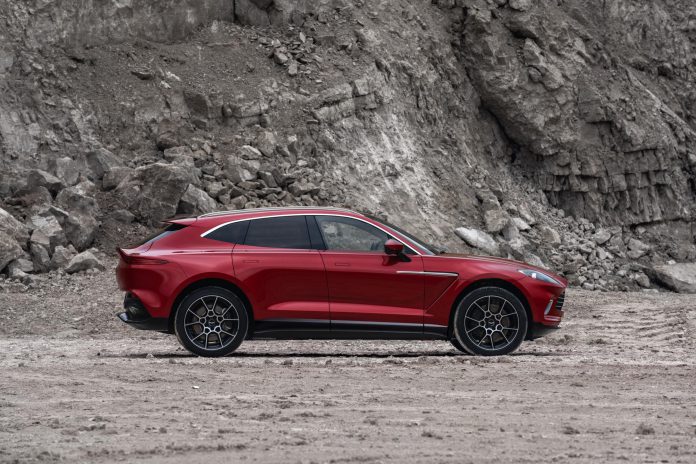
Aston Martin DBX

The design had been well known prior to today’s release. Aston Martin had heavily published a wide variety of teaser images and prototype stories.

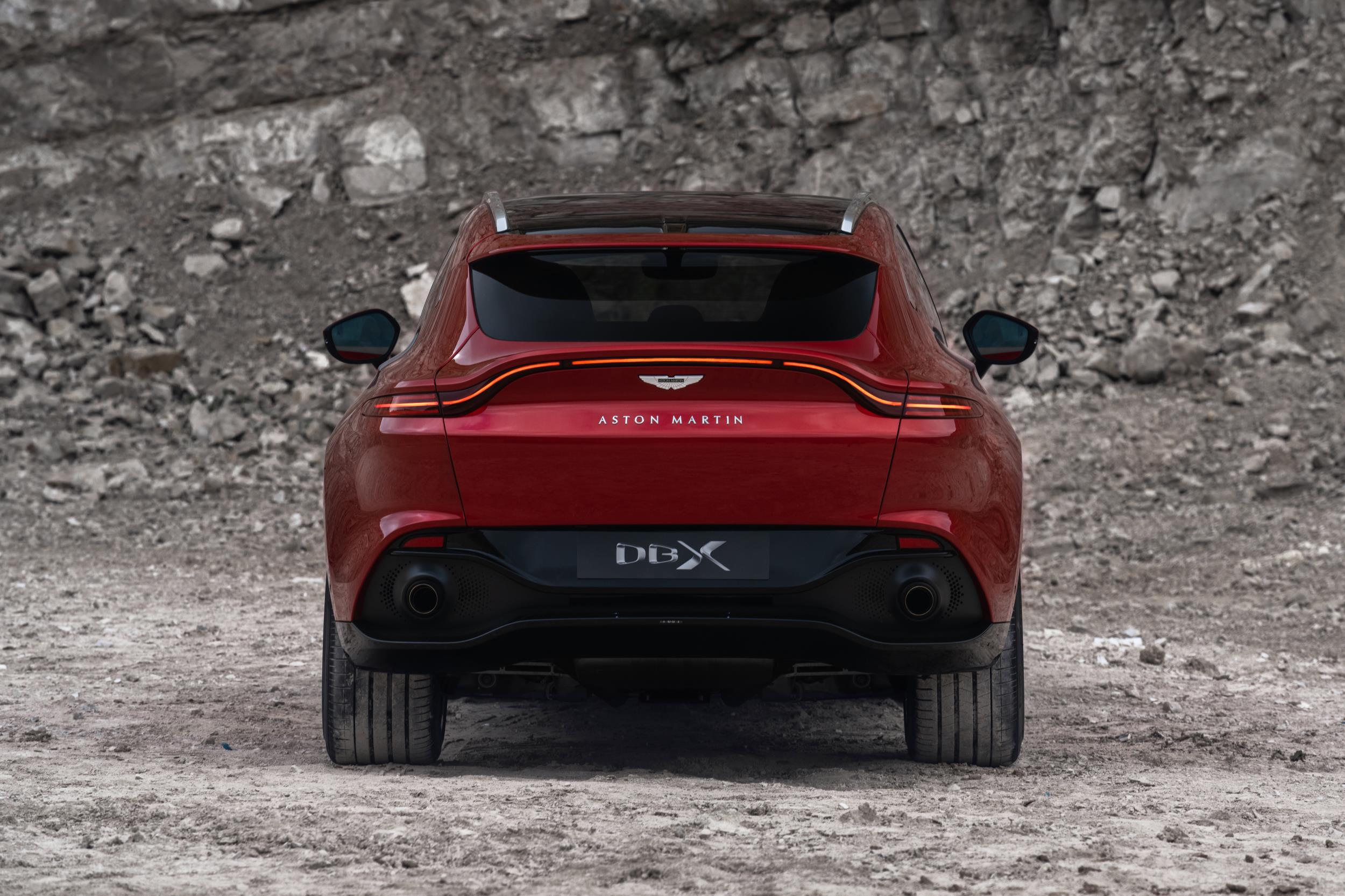
The DBX gets the same signature DB grille as the rest of the DB range. It is much bigger and more upright than Aston Martin’s sports cars. The design lines are signature Aston Martin too, with long lines running uninterrupted from front to back. The front wheel arch vents include long chrome finishers which only accentuate the length of the design lines.

One of our favourite design touches is the incorporatation of the ‘duck-tail’ type bootlid spoiler at the rear. It looks as though it is lifted direct from the Vantage.

Small design touches please the eye, such as the hidden side glass seals on the frameless doors and the glass B-pillar finishers. Cutaway side sills also help to disguise the bulk of the 5-seater SUV. The daytime running lights (DRLs) have an integrated aerodynamic duct which channels air into the wheel arch to aid brake cooling.

Power and Chassis
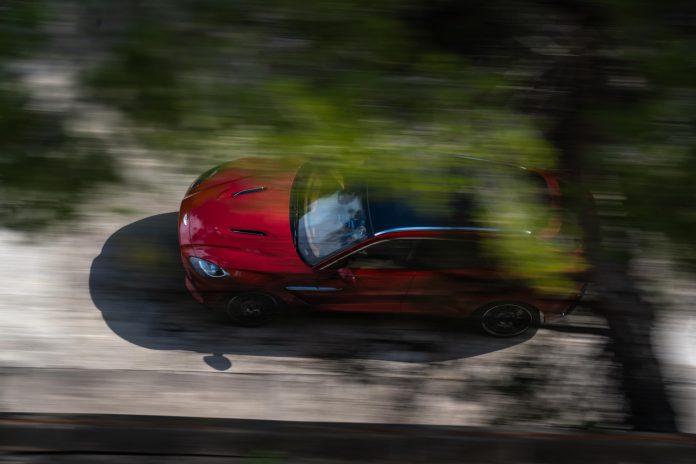
Aston Martin DBX

The power comes through a Mercedes-AMG sourced 4.0 litre V8 power plant. It produces 550 hp in the DBX with 700 Nm of torque. This makes it more powerful than the Vantage (which also uses the same engine). The power helps move the SUV to 100 km/h in an impressive 4.5 seconds. Top speed is 291 kph.

The power is routed, via a nine-speed torque convertor automatic gearbox, to all four wheels. The DBX uses an active central differential and an electronic rear limited slip differential (eDiff) to shift the torque for maximum traction.

Aston Martin has developed a new platform for the DBX. It uses a bonded aluminium structure, similar to Aston Martin’s sports cars, to keep weight down. Despite this, the DBX tips the scales at a hefty 2,245kg.

At the business end of things, the DBX benefits from adaptive triple volume air suspension, a 48v electric anti-roll control system (eARC) and electronic adaptive dampers. Aston Martin claims that this makes its SUV incredibly versatile. For example, it is possibly to raise the ride height by 45mm or lower it by 50mm.

Interior
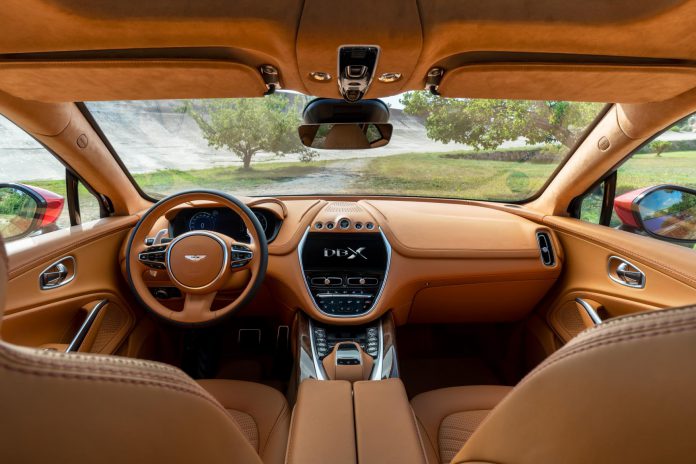
Aston Martin DBX Front Interior

Inside, things are just as interesting. Practicality is assures with 632 litres of boot space and a 40:20:40 split folding rear seat. It swallows suitcases, golf bags and ski equipment. There is plenty of light too with a full-length glass panoramic roof and frameless door glass as standard.

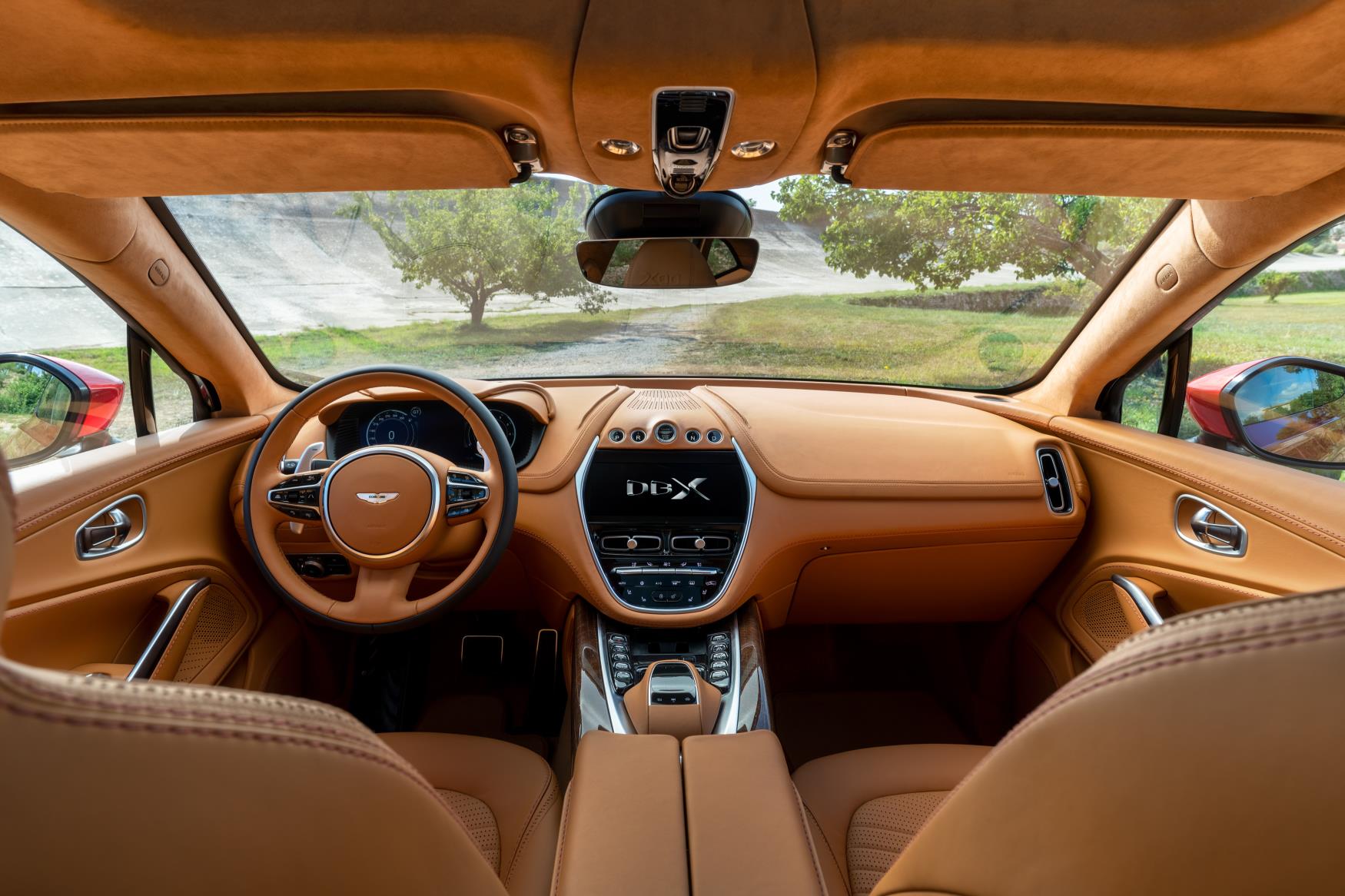
The interior is trimmed using Bridge of Weir full grain leather. Both the headlining and the electric roof blind are available in Alcantara. Metal, glass and wood are used extensively throughout the cabin. Customers will be able to make custom choices for interior materials through the Q by Aston Martin service.

In terms of design, Aston Martin has opted for something completely new with a bridged centre console. This allows maximum storage underneath. A 10.25 inch TFT screen sits flush in the centre console, while a huge 12.3 inch TFT screen provides driver information. Apple CarPlay comes as standard, as does a 360-degree camera system and ambient lighting that offers 64 different colours in two zones.

Availability
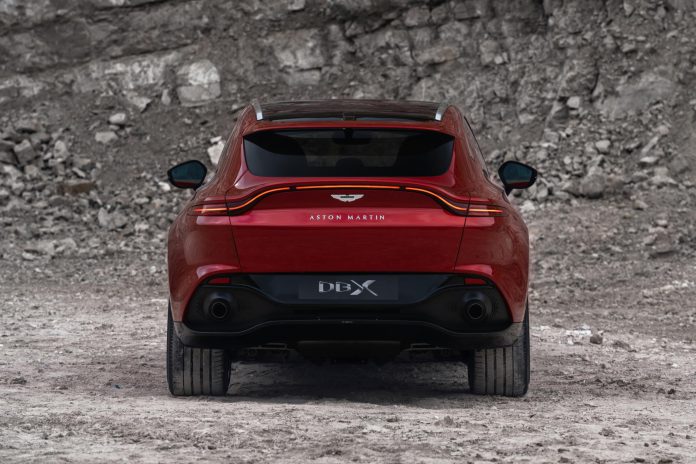
Aston Martin DBX

The first 500 Aston Martin DBX will be produced with a celebratory ‘1913 Package’. Each car will get a unique fender badge, sill plaque and an inspection plaque. Owners will receive a unique build-book signed by both Aston Martin’s CEO and Chief Creative Officer Marek Reichman and an invitation to a regionally hosted Waldorf Astoria celebration cocktail party.

Pricing has also been announced with a recommended retail price of £158,000 in the UK, €193,500 in Germany and $189,900 in USA.

The DBX is on sale now, with first deliveries scheduled to begin Q2 2020.

Competition
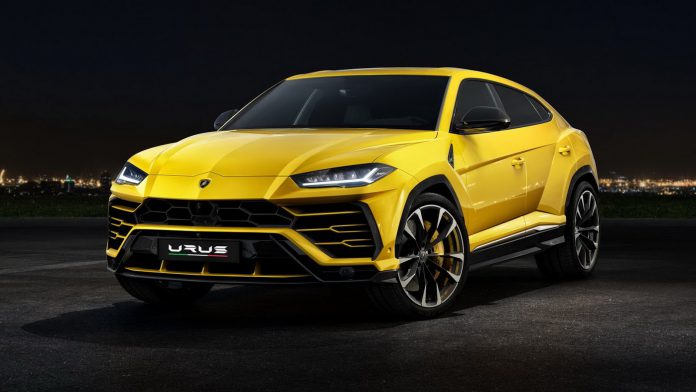
So how does Aston Martin’s package compare with the competition?

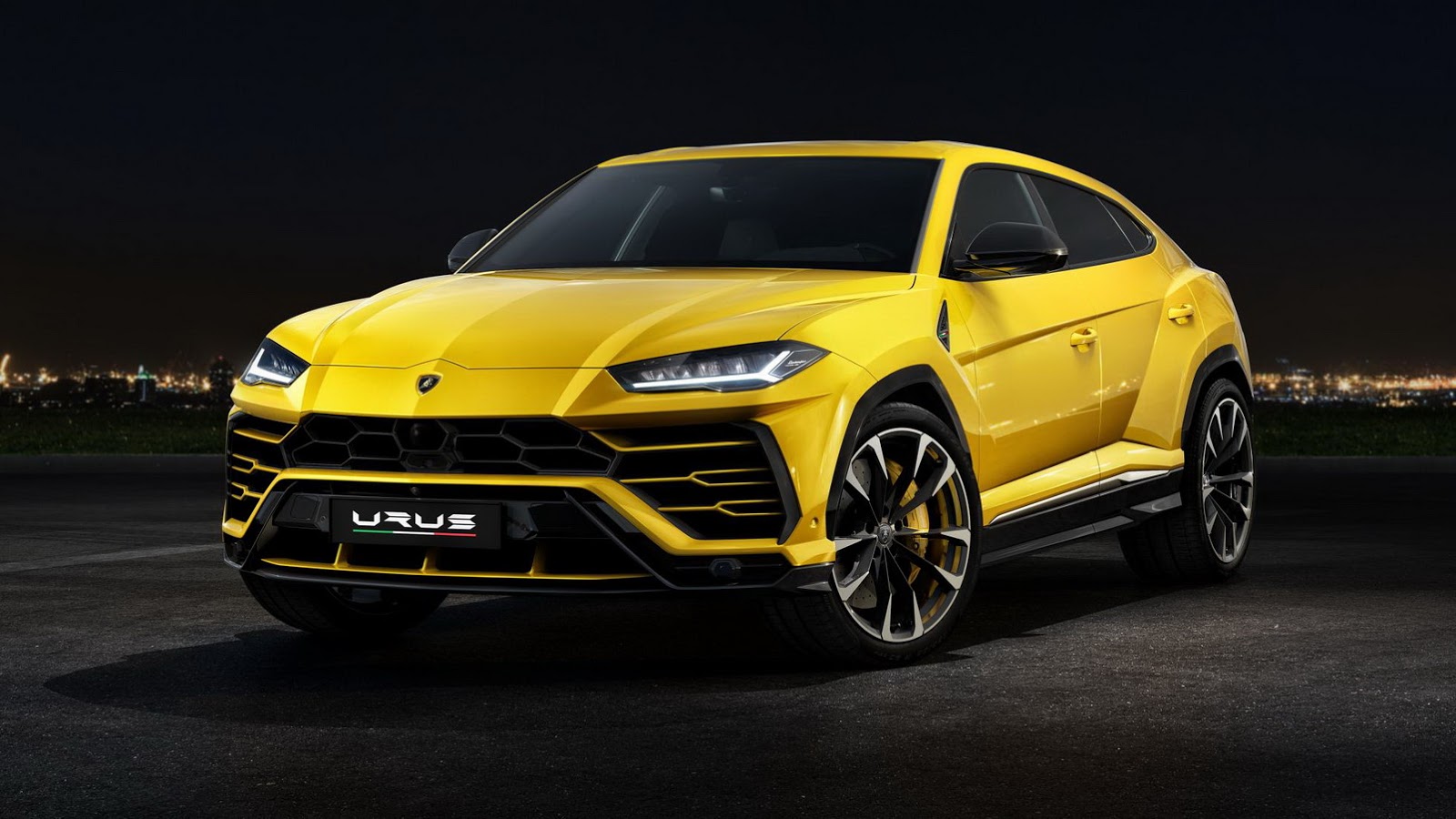
To start with its most obvious competitor, the Lamborghini Urus. The Urus is considerably more powerful (by 100 hp), weighs slightly less and costs about the same. The trade-off is in practicality though. The Urus will carry 16 litres less. In our opinion, the Aston Martin looks better, however, looks are highly subjective so you may favour the Italian rival.

Moving to the Bentley Bentayga V8. The Bentayga is more than £30,000 cheaper with the same power, more weight and less performance. The DBX also has to compete with the options such as the Porsche Cayenne Turbo S, the Range Rover SVAutobiography and (to a lesser extent) the Maserati Levante Trofeo.

Gallery

GTSPIRIT NEWSLETTER

Mini John Cooper Works GP Revealed in Los Angeles

A new range-topping, special edition Mini has been released at the Los Angeles Auto Show 2019, the Mini John Cooper Works GP. The GP has been teased for a long time with teaser runs up the Goodwood hill climb earlier this year and plenty of leaks.

The Mini John Cooper Works GP is the most extreme production Mini to date. It is set to give bigger hot hatches a run for their money!

Design

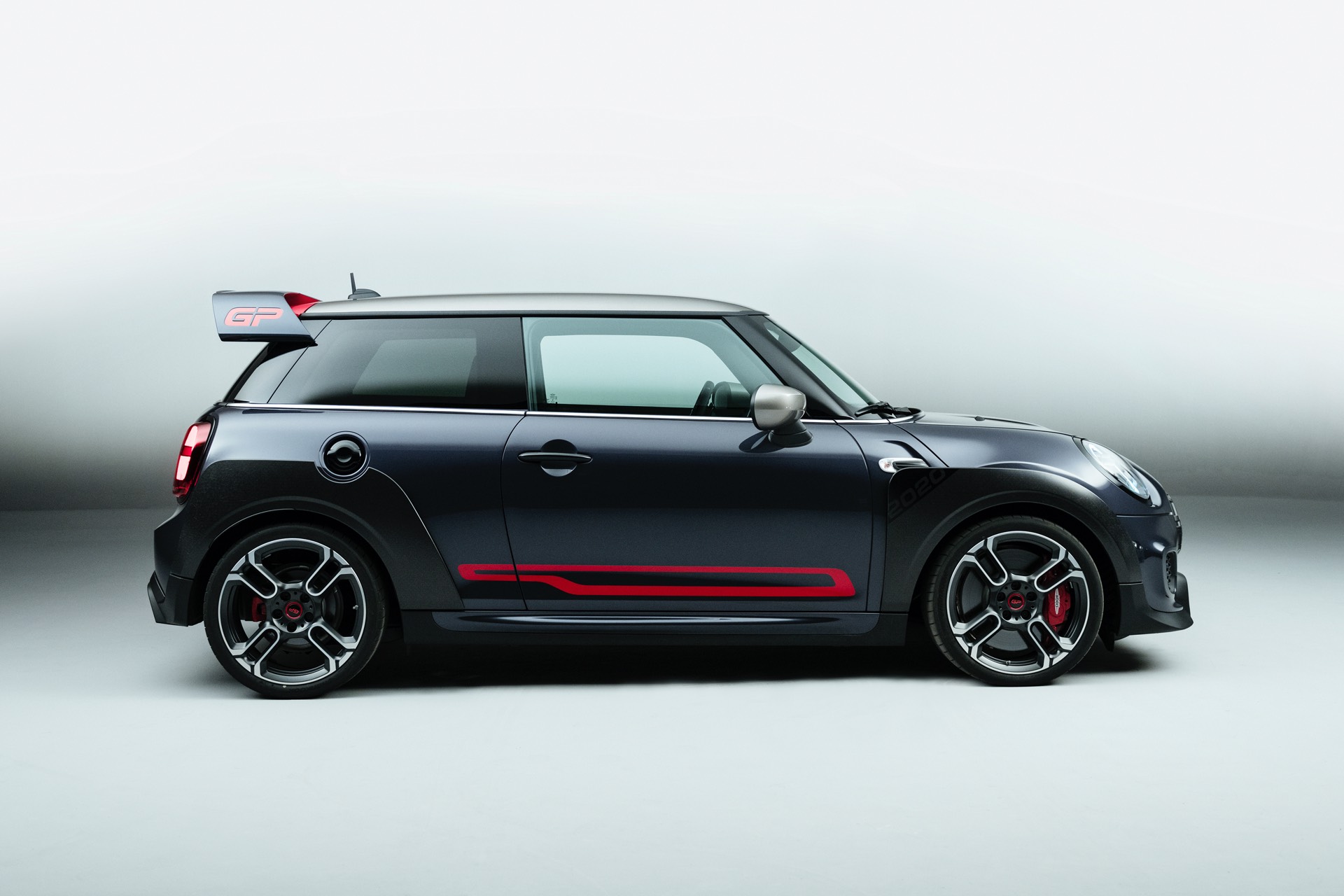
The Mini Cooper receives a variety of modifications to its design. The most noticeable is the wheel arch trim. Made from carbon fibre-reinforced plastic, it is the first time BMW has used this material. It is made using material recycled form he BMW i8 and BMW i3 production, making it highly efficient. It flares the wheel arch in a new and distinctive way.

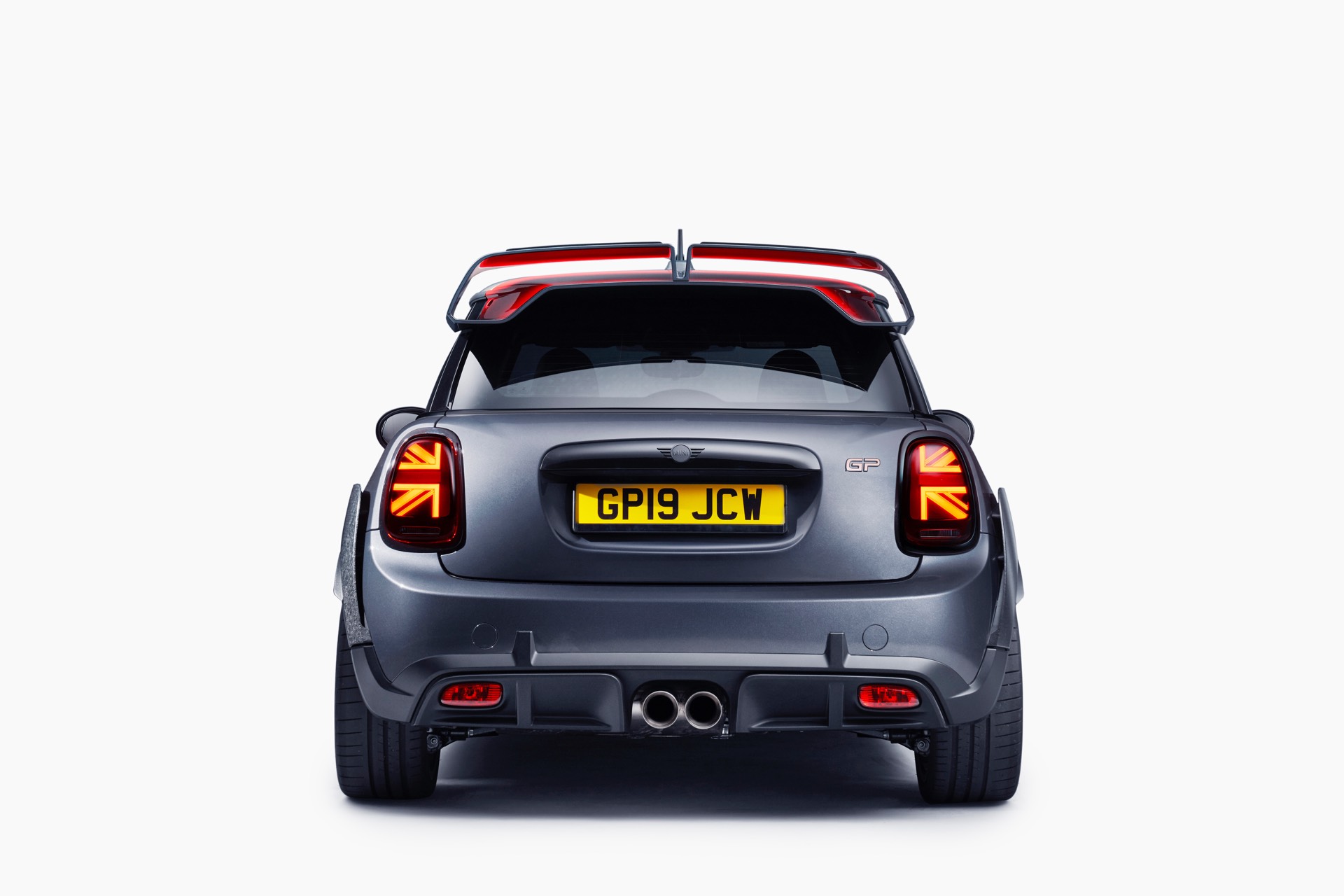
Other changes include a new set of wheels and black painted trim pieces. At the rear is a massive rear spoiler, the biggest we’ve ever seen on a production Mini. The rear gets a redesigned rear diffuser and a smaller set of air outlets.

Powertrain

Under the bonnet sits a 2.0 litre, twin-turbocharged, 4-cylinder engine. Power is pushed up by 75 hp to 306 hp and 450 Nm of torque. It sits on a new engine mount with new tunnel bridges.

The power is achieved through a variety of changes. The turbocharger is also new. Fitted to the exhaust manifold, a divert-air valve helps it achieve better response times. The compression ratio is lower by 0.7, but the system has increased boost pressure. The intake air duct is all-new with enlarged inlet and flow cross-sections.

The injection system is revamped too. New multi-hole injectors are arranged centrally and push at increased flow rates with an injection pressure of up to 350 bar. The final modification is an all-new engine oil sump. The modifications to the engine mean that the Mini should be more responsive.

The reinforced crankshaft uses an enlarged main bearing diameter, specific pistons, bushless connecting rods and a torsional vibration damper with enhanced cooling.

The John Cooper GP Works hits 100 km/h in 5.2 seconds and a top speed of 265 km/h (with no limiter). Naturally, Mini have installed a new exhaust system with a fuller, more sonorous sound. The system is unique to the GP Works and with a straight pipe, large rear silencer and two 90 mm brushed aluminium stainless steel tailpipes.

Power is routed to the front wheels through an 8 speed Steptronic transmission as standard with an integrated differential lock. The mechanical differential distributes traction between the right and left wheels. It locks up to 31 per cent under load and the helps counteract any loss of traction.

Suspension

Changes have also been made to the suspension setup. The single-joint spring front suspension and rear multilink axle receive a completely new tune. The track width is wider and the body is lowered by 10 millimetres.

New swivel bearings are installed which increaser front wheel and rear wheel camber. Rigidity is enhanced through a stiffer rubber support bearings.

A special GP mode in the DSC settings allows increased stability intervention through the brakes to improve agility. Talking about brakes, those are completely new too. At the front, you have 4-piston units with a floating-calliper. At the rear, a single-piston, both made of aluminium. They are hidden by a set of 18 inch forged wheels.

Availability

The Mini John Cooper Works GP gets its debut at the Los Angeles Auto Show 2019 this week.

It will be replicated 3,000 times with production set to get underway in March 2020. Pricing has been announced at 45,000 euros in Germany, £33,895 in the UK and $44,900 in the US.

Competition

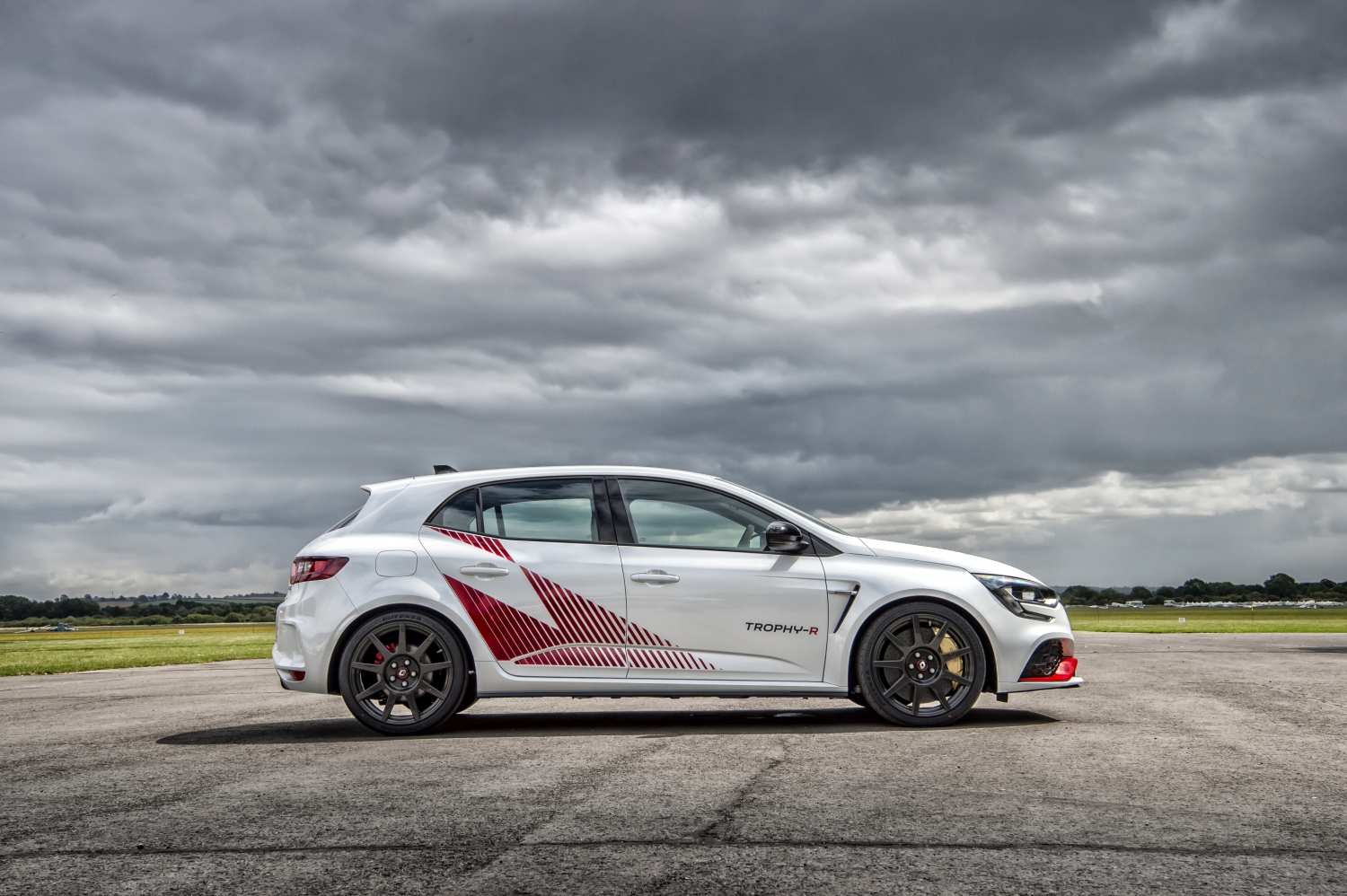
Renault Megane R.S. Trophy R

The hot hatch market isn’t as buoyant as it has been in the past, yet the Mini Cooper GP Works has no shortage of competition.

The Renault Mégane RS Trophy is clearly Mini’s immediate benchmark. The British marque is keen to lap the Cooper GP Works around the Nurburgring faster than Renault’s 7 minutes 40.1 seconds earlier this year.

At this price tag, the Honda Civic Type R, Volkswagen Golf R and Ford Focus ST. Of course, all three are considerably larger than the dominative Mini Cooper.

Gallery

GTSPIRIT NEWSLETTER

Bugatti considering electric four-seater as second model

Bugatti’s long-rumored additional model could run on electricity rather than gasoline, according to a recent report. The company is tentatively planning a downward expansion without diluting its image.

Downward is a relative term when spoken in the same sentence as Bugatti. The company isn’t interested in chasing volume with an alternative to the Volkswagen GTI. Instead, Bloomberg wrote it’s envisioning an electric four-seater priced between 500,000 and one million euros, sums that represent about $555,000 and $1.1 million, respectively. Bugatti CEO Stephan Winkelmann told the publication that convincing parent company Volkswagen to fund the model requires a “hard fight,” however.

“The industry is changing fundamentally, and we have to address what opportunities there are to develop Bugatti as a brand going forward,” he explained. Releasing a second, cheaper model would mark a dramatic shift for the prestigious automaker, which has stuck to a one-core-model strategy since its renaissance in 1998. The EV could bump its annual output from about 100 to 600 cars.

Winkelmann was the driving force behind the Urus when he ran Lamborghini, which has led to speculation that Bugatti’s second model will be an SUV. Speaking to Autoblog, a spokesperson for the company again doused cold water on the rumors. “It would not be an SUV,” we learned.

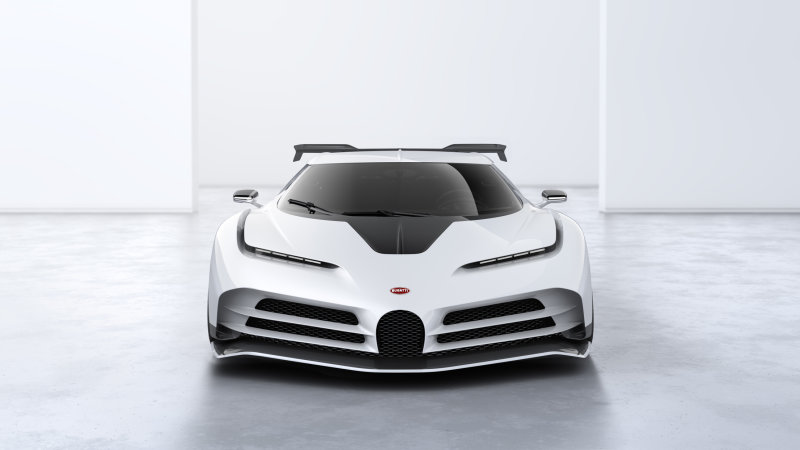
The representative stressed nothing has been decided yet, so it’s still too early to tell precisely when the second model would enter production if it receives the proverbial green light for production. Less than 100 Chiron build slots remain available, but the French company has its work cut out for the coming years. It will deliver the first of 40 planned examples of the Divo in 2020, send the one-off La Voiture Noire to its mysterious new home in 2021, and build the first of 10 Centodiecis (pictured) in 2022. Additional Chiron variants (like the record-breaking 300+) aren’t out of the question, either.

The idea of an electric Bugatti isn’t without precedence. In 1931, company founder Ettore Bugatti built a battery-powered runabout named Type 56 to drive on his property. It was never meant to be a production car, but requests from wealthy clients (including Belgian king Leopold III, who wanted one for his wife Astrid) convinced Bugatti to make 10 examples between 1931 and 1936. Four remain in 2019, including one in original condition that Autoblog got the opportunity to drive in 2018.