All posts in “Lamborghini”

Lamborghini goes rear-wheel drive with Huracán 580-2

Share

  • Pinterest

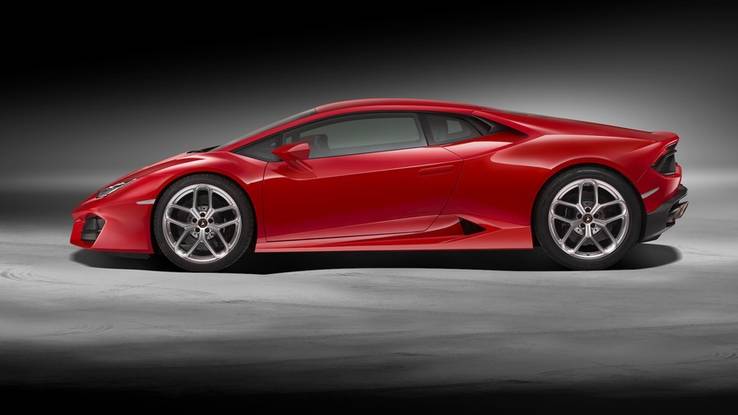
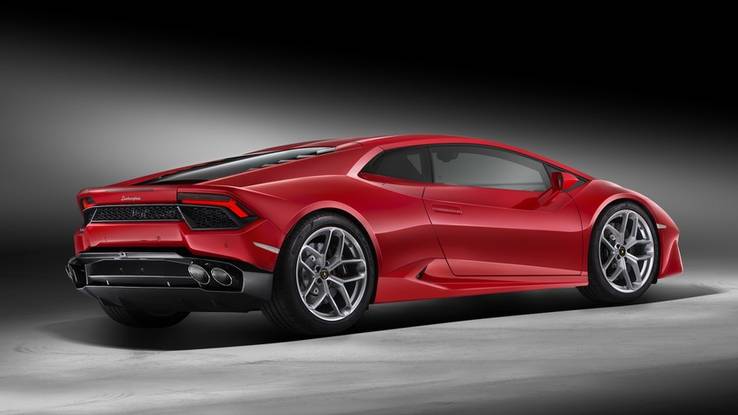
After years of building supercars that were almost exclusively all-wheel drive, Lamborghini is going back to rear-wheel-drive basics with the debut of the Huracán LP 580-2.

Announced a day before the 2015 Los Angeles Auto Show, the mid-engine, V10 coupe is the third — and cheapest — Huracán road car after the AWD coupe and convertible variants.

A rear-wheel drive Huracan sounds like a perfect enthusiast version of the scaled-down Lambo

What’s outside of the Huracán remains the same — it’s what’s underneath that counts. The rear-wheel-drive Huracán drops 73 pounds of driveline and adds way more fun.

“The Lamborghini Huracán LP 580-2 continues the Lamborghini tradition of pure, visionary and technology-driven models,” Lamborghini CEO Stephan Winkelmann said in a statement. “The rear-wheel-drive model fits perfectly into our Huracán family, appealing to those wanting an even more intense driving experience, or who currently drive other rear-wheel-drive marques and aspire to (drive) a Lamborghini.”

The Huracán LP 580-2 uses the same naturally aspirated, 5.2-liter, V10 engine as its AWD counterparts. Power drops from 601 hp to 572 hp, and torque drops from 413 lb-ft to 398 lb-ft. Cylinder deactivation remains in the name of saving fuel, as does the Huracán’s seven-speed dual-clutch transmission.

The Lamborghini Huracan 580-2 is more price-friendly and lighter than the 610-4

Lamborghini will apply its new cylinder deactivation technology to the upcoming Huracán 580-2 to help the V10 sip as little fuel as possible.

The 580-2 is 73 pounds lighter without the weight of the AWD system. Lacking the Earth-gripping traction on takeoff, the RWD model’s 0-62-mph time is 3.4 seconds, 0.2 second slower than the Huracán LP 610-4 coupe.

The suspension, steering, and stability and traction controls all have been recalibrated for the revised setup, Lamborghini said. The Pirelli tires are also unique, as is the 580-2’s front fascia.

The Huracán LP 580-2 will start at $201,100, including a gas-guzzler tax, or about $39,000 less than the AWD LP 610-4 coupe.

Lamborghini goes back to rear-wheel drive with Huracan LP 580-2 originally appeared on autonews.com

By David Undercoffler, Automotive News

Desert Concorso shows promise but needs a nicer venue

Share

  • Pinterest

We like car shows. We go to as many of them as our gasoline credit card will allow. And we want to help the ones just starting out to get going and become great events. But that said, while there’s no law that says concours must be held only on golf courses or in beautiful parks overlooking the deep blue Pacific, maybe there should be. For instance …

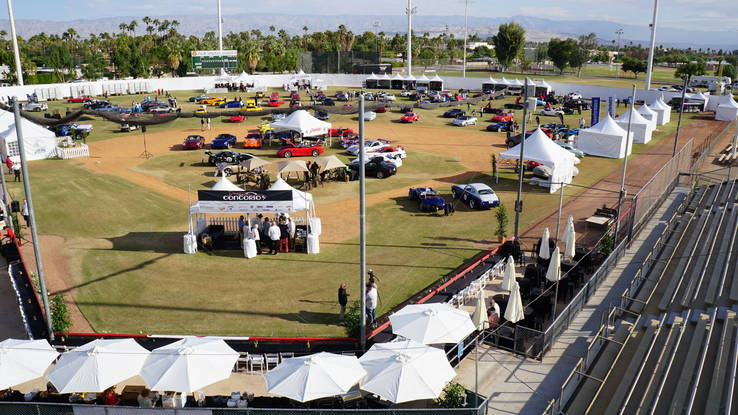
Palm Springs Stadium used to be the spring training camp for the California Angels. A long time ago. Now it’s a nice enough venue for a local baseball team, but would you choose it to host a concours?

Last year, Desert Concorso held its inaugural event at the fabulous, sprawling Shadow Mountain Resort in Palm Desert. There was green grass as far as the eyeball could see, deep blue water hazards masquerading as picturesque lakes and a huge resort hotel right there. This year, the event moved to the somewhat rundown 66-year-old ballpark, fenced in on all sides to give it an air of exclusivity, or maybe the feel of a prison yard.

“For us, Palm Springs Stadium is a unique venue,” said Concorso head Tom McDowell, the same guy who saved Concorso Italiano and now makes it one of the biggest and most enjoyable events of the Monterey Car Week.

He’s right about unique — we can’t think of another Concours held in a baseball stadium. But this is only the second year of the show, and we have faith McDowell will sort things out. Palm Springs in winter is a splendid place and the perfect time for a great car event, and McDowell has big plans for it. We can’t wait to see how he develops the show.

This year, there were many cool cars on hand. Palm Springs’ history as a racing venue was celebrated with a special display of old race cars from 1950-58. There were two Allards, a Cunningham C-3, Jaguar XK140, 1956 Mercedes-Benz 300SL roadster and even a “Baldwin Special” and a 1950 Mercury Coupe, the latter which represented the class of big American iron that also raced at Palm Springs’ original street circuit. Palm Springs was part of the great circuit of sports-car racing venues all over Southern California that included Paramount Ranch, Torrey Pines, Pomona, Santa Barbara Airport and Willow Springs, to name a few. So there’s plenty of historical precedent for a vintage car event here.

The Petersen Automotive Museum in Los Angeles brought several cars, including a Scaglietti-bodied Corvette and a 1923 Benz. Several – many – members of the Petersen’s support group the Checkered Flag 200 brought cars, too.

“We just want to support the event,” said Checkered Flag 200 alpha male Bruce Meyer.

The Riverside International Automotive Museum also shared its collection. Classic Assets in San Diego brought an exquisite 1929 Duesenberg Model J with coachwork by LeBaron.

Manufacturers were represented, too. Panoz was a supporting sponsor and brought an entire infield of road and race cars, from the current Esperante Spyder, Coupe and Convertible to the GTR1 race car. Even Dan Panoz himself was there. Lucra brought one of its insanely powerful and loud LC470s. Superformance brought what looked like one of everything it makes, from various Cobras to its GT40. There were even a couple modern-day Fiats parked behind official-looking Fiat flags.

Private owners made up the balance of the field. Harry Rieger brought his 1963 Split-Window Corvette, restored in 1987 and still looking showroom shiny. Roger and Rhonda Groves brought their 1960 Alfa SZ to the delight of Alfistis everywhere in the stadium. Caretaker Alan Taylor brought Paul Emple’s 1930 Isotta Fraschini that had been rebodied with a Flying Star roadster body in the late ’90s. It looked like a giant piece of delicious vanilla wedding cake. Other cool cars we liked included: a 1970 Maserati Ghibli SS, a 1959 Aston Martin MkIII, a Lamborghini 350 GT, a Ferrari 365 GT and John Romano’s “unmolested original survivor” 1971 Datsun 240Z. 

Desert Concorso from the press box

The view from on top of the press box. Ferraris are in center field, Astons in right.

Something that set this show apart, and demonstrated the need to fill out a field at a young show, was the number of more commonplace, fairly unremarkable modern cars. There were couple-year-old Mercedes and BMWs, some older Triumphs and, of course, the requisite handful of Lamborghini Gallardos. But there was also one each of the modern supercar triumvirate of Porsche 918, Ferrari LaFerrari and McLaren P1 at the show. There was variety like you don’t see at other, older, more established and more focused shows.

“Desert Concorso, in only its second year, is developing a unique flavor — kind of a Concorso Italiano for snow birds who like a little English and American seasoning in their Italian car shows,” said co-emcee Keith Martin, publisher of Sports Car Market.

McDowell has a grand vision for Desert Concorso that includes a week’s worth of activities anchored by his show on the first weekend and the McCormick’s Collector Car Auction on the second weekend. In between there would be other events, maybe a rally, maybe other things. This is only the second year. The night before this year’s Desert Concorso, there was a Jet Center Party at Thermal Airport to the east of Palm Springs. We didn’t attend that, but it sounded like fun. There were reports that a Ferrari LaFerrari hit 200 mph on Thermal’s private runway, but we couldn’t confirm that.

“We want to build some more events to fill out the week,” said McDowell. “We’d like to have a rally and some other events.”

We are guessing many car enthusiasts would like that, too. Given its spot on the calendar, its history as a sports-car race venue and the enthusiasm of the city of Palm Springs, there’s no reason this couldn’t grow into a must-do car week to offer a winter counterbalance to Pebble one day. They just have to move it out of the infield.

2016 Lamborghini Huracán LP 610-4 gets fresh features, cylinder deactivation

Share

  • Pinterest

The Lamborghini Huracán LP 610-4 launched in 2014; for 2016, Lamborghini has added the Spyder convertible to the Huracán line-up and also loaded it with new features.

To aid emissions and fuel economy, Lamborghini added cylinder deactivation technology to its V10. When the V10 isn’t screaming along, or under load, Lamborghini shuts down an entire bank of cylinders.

Aside from that, the only other major change will be a retuned all-wheel drive system that allows for a more neutral feel, and a better driving experience.

2016 Lamborghini Huracán and Huracán Spyder boast more efficient V10s and more options

Fuel efficiency and ultra-expensive supercars don’t normally run hand in hand — but with stricter emissions standards, cars like the Lamborghini Huracán are getting starting to get a green treatment.

The interior will be more owner-friendly for 2016. Lamborghini says it has enlarged the color and trim selections significantly –- ostensibly to match Lamborghini’s loud exterior color pallate. New standard refinements are limited to the addition of leather to the door handles and new matte black air vents. Lamborghini’s customization program, Ad Personam, further adds custom options to the interior – allowing for heritage colors, matte paints and practically anything the owner would want.

Of course, there are more options – this is Lamborghini after all. An optional 390-watt amplifier feeds ten speakers with Lamborghini’s Sensonum audio system. The sports exhaust system can now be even further optioned to include matte black exhaust tips. The new LED engine compartment lighting can be combined with a transparent engine cover, allowing owners to show off that V10 at all hours of the day.

Lamborghini hasn’t released official pricing yet, but we’re assuming it won’t be far off last year’s sticker price of $241,945. Of course, that will only get you a pedestrian-spec “base” model. By the time you’re finished throwing on options and features, the number will be considerably higher.

The Best of France and Italy (and Czechoslovakia)

Share

  • Pinterest

French and Italian car lovers celebrated 20 years of the free and fun The Best of France and Italy car show on Sunday, Nov. 1 with over 300 (maybe over 400) of their favorite cars sprawled all over the lawn and dusty dirt of Woodley Park in sunny Van Nuys, California. There were Fiats and Ferraris, Renaults and regal-and-ratty Romeos, along with several things you never would have expected to see outside of a museum in Europe.

“Oh, that’s the beauty of it,” said show co-organizer Chuck Forward, who, along with wife and business partner Tina Van Curen (they own Autobooks Aerobooks in Burbank) and a fleet of volunteers, has put this show together for two decades. “You never know what’s coming out of the woodwork.”

LA has a lot of woodwork.

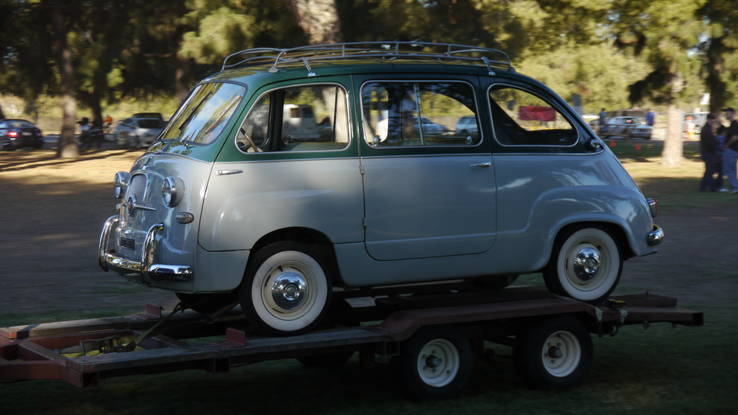
This year, there was the usual field of Fiats: many X1/9s but also a lot of Abarths, 124s, 128s and even a Multipla.

“This thing just makes everybody happy,” said automotive concierge Robert Dietz, who is helping owner Mike Malamut winnow Malamut’s collection of over 200 cars, including the Multipla. “Look at it, you don’t know if it’s coming or going.”

Technically, it’s going, out the doors of the Malamut collection and into private hands. Call for a price but be forewarned, this thing is in immaculate condition.

As was the 1954 Citroen Traction Avant of Rod Pick. Like all survivors, Pick’s Traction Avant has a story. It was built in Slough, England, and has right-hand drive. It spent 20 years in Botswana and South Africa before being shipped to Quebec, where it wound up in the second story of a barn for 30 years before a Citroen Club of Canada member bought it, restored the interior and sold it to Pick.

“I just love it,” Pick said.

Malamut's Multipla

Mike Malamut’s Multipla makes and entrance.

Everybody loved Peter Giacobbi’s 1959 Testarossa, too. We first saw it several years ago at Concorso Ferrari Pasadena, where we learned the car’s story. The body was built by a carrozzeria in Italy that was vying for the business of Ferrari at the time the original Testarossa was being developed. The carrozzeria built one body, didn’t get the contract to build any more and the one body went up in the rafters of a shop in Colico di Piano, where it sat until Giacobbi heard about it. He figured he’d never be able to afford a real Testarossa so he bought the body and built a car around it. Is it real? It sure looked real in its unpainted, race-ready glory.

And how often have you seen an OSI in your daily commute? Maybe never. Officine Stampaggi Industriali was formed in 1960 out of an exodus of Ghia employees. This OSI 20M TS has some Ford Taunus 20M mechanicals underneath, but this one also had a Ford Cobra 302 V8 making 406 hp. The interior is still being finished, but when it’s done it’ll be up for sale from Noble Fabrication in Ventura, CA. You’d be the only one on your block with one of these. 

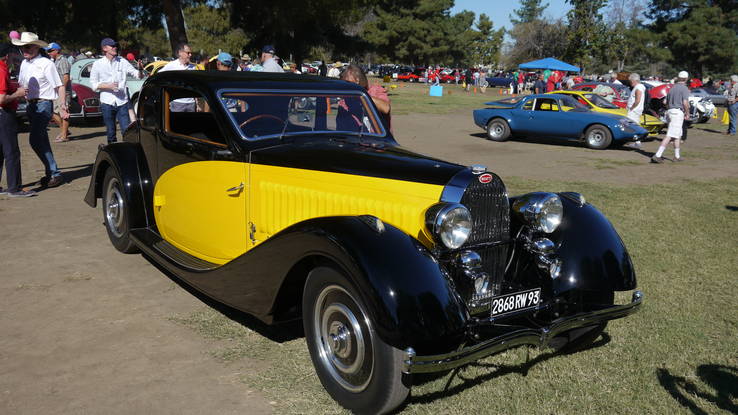
Bruce's Bugatti

Bruce Meyer brought his best Bugatti. Thanks, Bruce.

When we saw a 1935 Bugatti Ventoux pull onto the lawn, we knew there were only two guys on the planet who could both own one and be cool enough to bring it to this show: It had to be either Jay Leno or Bruce Meyer. And while Leno often comes to this and many other car shows in SoCal, this time the Bugatti belonged to Meyer. Meyer epitomizes the best of the car-guy culture, with a great collection and a willingness to share it with everyone.

On the other end of the collector spectrum was 15-year-old Massimo Lucidi, who restores classic Italian racing bicycles. He brought a 1981 Bianchi, 1962 Legnano and 1949 Taurea. He was giving demos of the Taurea’s derailer, the second such mechanism offered on a production bike, he said. A fine young man, and we look forward to seeing his Italian car collection in about 25 more years.

And while everything else was either Italian or French, there were three magnificent Tatras on hand Sunday. John Long brought the same wonderful silver T87 we saw the week before at Art Center, while Paul Greenstein and Dydia DeLyser brought their smooth black 1941 T87. Then, about noon, in rolled Danny Barnett, who towed his 1966 Tatra 2-603 all the way from Las Vegas just for The Best of F & I. We watched him roll it off the trailer and then had the audacity to ask if we could ride in it across the field to the Tatra section.

“Sure!” he said, and we now have a new favorite person of the week. Maybe two weeks. Great guy, but one of many who show up every year at this great show. See you next year, and get that Alfetta in running order!

2016 Lamborghini Aventador SV: Quick take

Wheeling a Lamborghini Huracan at Accademia Intensivo

Share

  • Pinterest

Lamborghini isn’t in the business of selling supercars that are instantly crashed, despite the infamy that comes from leading headlines at WreckedExotics.com. It wants owners to not only enjoy their cars, but to use them to their full capability.

That’s why it created Lamborghini Accademia Intensivo, a driving school that gives owners a chance to practice high-speed driving in someone else’s car. And that’s really the dream of all enthusiasts.

We took a trip to the Circuit of the Americas in Austin, Texas, to get a taste of what’s in store for the already admittedly lucky. This was a one-day event, and for customers it costs about $6,000. For that you get one day of driving, plus insurance, welcome drinks and dinner, trackside hospitality, pictures, a welcome gift and two nights at the hotel. Don’t drink too much that first night, Lamborghini reminded us, because you’ll be in the car early and stomach full of brown liquor and hot laps with pros just don’t mix.

The morning started with a quick safety briefing before hitting the track for a selection of different driving exercises. We started on the autocross with a spankin’ new Huracan coupe.

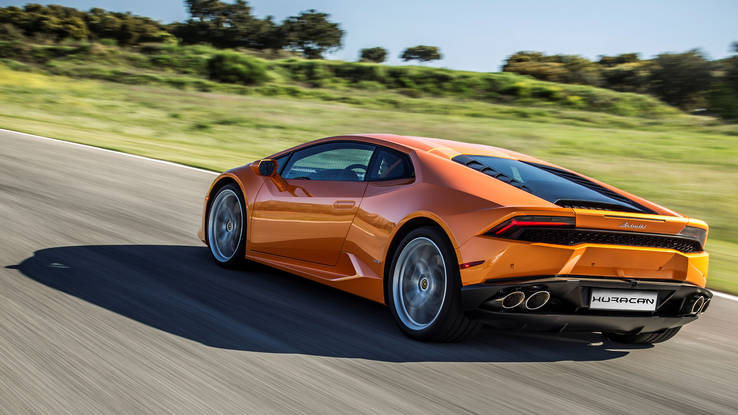
The 600-hp V10 kept a tight trajectory on the curving, double hairpin cone course. We kept it in automatic mode, not wanting to shift while navigating the esses. Anywhere else, we’d be paddling through the gears, but because we needed to learn the course, and were going for time, we didn’t touch them.

2015 Lamborghini Huracan LP 610 4 ice drive A raging bull versus a frozen Swedish lake

The Huracan felt surprisingly loose on the short, 20-second-or-so pop-up track. Though it’s all-wheel drive, the sport mode setting cheats power to the rear for more traditional sports car handling. A little too much gas sent the rear end out and we had to lift just a smidge to get it back in line. In street mode, or the track-oriented corsa mode, the car and its driven front wheels would do that for you. It shot down the small back straight through about a gear and a half before we had to stomp on the clampers to slow for the next turn. The best practice seemed to be keeping the tires squeaking around the hairpin, and then getting back on the gas to work the esses.

This was the first event, and many of the drivers were surprisingly timid, having never really driven a car in anger before. It didn’t take long for them to get in the swing of things.

Next up were lead-follow laps — us in the Huracan and one of our instructors in an Aventador. Lamborghini thoughtfully had us wear helmets with radios, so we were in constant contact with the lead driver.

After watching a few F1 races we were a little nervous about COTA. It was our first time at the track and it has several difficult sections including the esses, three near hairpins and a back straight that lets Formula One drivers hit 300 kph without breaking a sweat.

2016 Lamborghini Aventador SV

Turn one is the most intimidating. The front straight rises more than 100 feet and approaches one of the slowest turns on the track. After hitting somewhere in the mid-100-mph range you have to get on the brakes late and hard. It’s more difficult than it sounds: you see the lead driver brake, you start closing, but you don’t want to hit your brakes until you reach the braking point yourself.

After that is the downhill section leading to the S-curves, and if you don’t get that right, forget your time because the lap is blown. Just get yourself back on the racing line and try again next time. (We learned that helpful hint after watching videos of ourselves during another teaching portion of the school, which showed just how off the line we actually were.)

After the esses is another hairpin leading to the back straight. That corner is a matter of shifting down to second and pulling it around, but technically, it’s the most important curve on the track since it leads into the longest straight. We cracked about 165 mph on the back half of the track with constant, non-boosted power and quick shifts from the dual-clutch transmission. The Huracan danced a little when braking hard to make the hairpin, but only got out of whack far enough to scare us once.

The brake discs and pads hung tough all day, and these cars were getting beat on lap after lap by inexperienced drivers. We were surprised, but in retrospect, we shouldn’t have been — that’s what you should get when you drop $241,945 on a thoroughly modern all-wheel drive Italian supercar.

We jumped in the Aventador for the next — the company would like to sell you another — and were instantly transported back to our SV drive earlier this year in Spain. Lambo’s halo car is fast and scary, just as we remembered. Gear changes from the independent shift rod (ISR) transmission are too slow in street mode, and a little too hard in track mode. You’d think the middling sport mode would be best, but its not. We kept it in track. We hit about the same speeds in the Aventador, but its transmission setup makes it harder to bang off shifts in corners. We’d much prefer one of the many ultra-smooth dual-clutch units. And overall, if it were our money, we’d opt for the more stable Huracan.

Simraceway at Sonoma

At the end of the day, we got video of our driving, along with video of a hot lap with one of their drivers, for comparison. As expected, we weren’t quite as tight as we’d have liked, but it gives us a good place to start next time.

The company hopes the experience will keep owners coming back, too. And it would really like its fans to join Super Trofeo one-make racing series, and to tell all their friends how fun it is. Even though Lamborghini doesn’t have a rich motorsports history to rely on like its brother in arms across the Italian peninsula, performance driving training is a great way to keep customers interested in the brand (and keeping them safe and alive). A few hot laps on a racetrack aren’t too bad, either. Is it worth 6,000 bucks? If you’re on the street with the rest of us, it is.

Topless at 201 mph: 2016 Lamborghini Huracan Spyder debuts at Frankfurt motor show

Share

  • Pinterest

The Lamborghini Huracan LP 610-4 Spyder, which just debuted at the Frankfurt motor show, is not merely a Huracan with a cloth convertible top (though you could be forgiven for making that mistake): It is an especially dynamic take on an already impressive super-sports car boasting “added emotional dimension” and a “luxurious lifestyle personality,” according to Lamborghini.

But yeah, it’s also a Huracan with an electrohydraulically actuated cloth convertible top (very chic these days). Which means it’s an all-wheel drive carbon fiber wedge packing a naturally aspirated 5.2-liter V10 good for 602 SAE hp and 413 lb-ft of torque, only you’ll get to hear the roar of the wind along with the screaming of the engine. But not too loud of a roar. Lamborghini says you’ll be able to hold a civilized conversation in the cockpit.

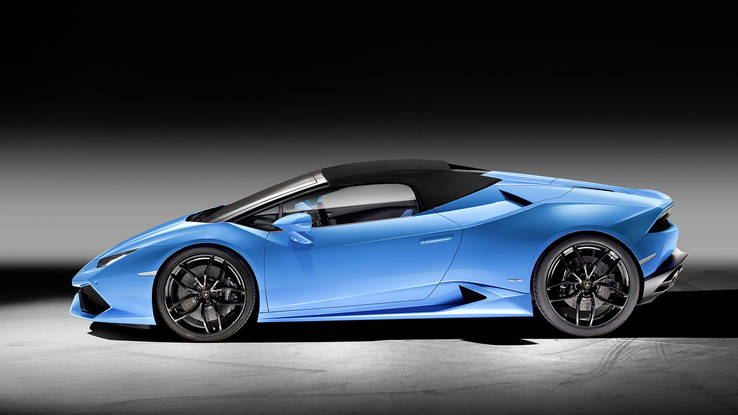
2016 Lamborghini Huracan Spyder LP 610-4 Frankfurt debut profile top up

Convertibles that look good with the top down are dime-a-dozen. Fortunately, the Huracán Spyder maintains a sleek profile with the cloth top up. Photo by Lamborghini

 It’s fast, darting from 0-62 mph in 3.4 seconds and 0-124 mph in 10.2 seconds — while it’s about 0.2 second slower to 62 mph than its hard-topped stablemate, we doubt you’ll notice.

Top speed is 201 mph, which isn’t quite enough to best the Bentley Continental GT Speed convertible’s 203 mph, but still. Dang.

The top, for what its worth, goes from open to closed in 17 seconds at speeds of up to 31 mph. Automatic pop-up safety bars should help protect your neck if things go  south at speed. Under normal circumstances, they’re tucked away out of sight so as not to spoil the car’s long, low silhouette.

The retractable top does carry a weight penalty: at 3,399 pounds, the Spyder is which is notably heavier than the 3,135-pound coupe. It also comes with all the 2016 model-year goodies like stop/start and cylinder bank deactivation, which are sure to be appreciated by eco-conscious and/or fuel-miserly Lambo owners everywhere.

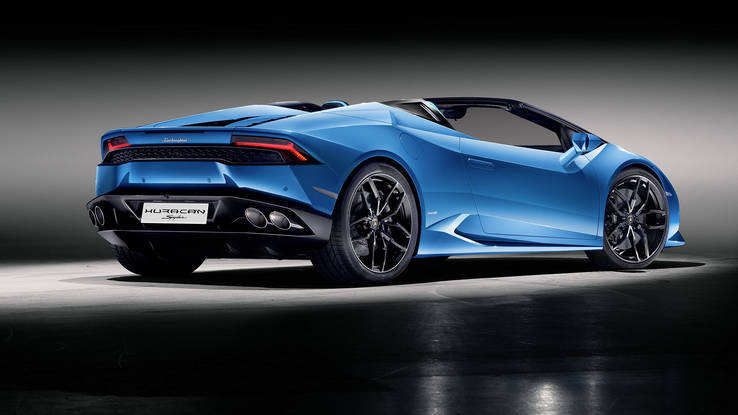
2016 Lamborghini Huracan Spyder LP 610-4 Frankfurt debut rear 3-4

The Huracán Spyder benefits from Lamborghini’s naturally aspirated 5.2-liter V10. Photo by Lamborghini

With the arrival of the Huracan Spyder, Lamborghini finally has a successor to the very popular Gallardo Spyder. Just as the Gallardo convertible proved popular for the automaker, accounting for just under one-third of the Gallardo’s record-breaking sales run of roughly 14,000 cars, we’re sure the Huracan Spyder will prove to be a smash sales success for Lamborghini — and, we trust, an engaging driver.

Sadly, you won’t be able to enjoy your Huracan Spyder in the crisp autumn air; deliveries don’t begin until spring of 2016. Pre-tax European pricing starts at 186,450 Euro, or roughly $211,000; we suspect it will be somewhere north of $250,000 when it goes on sale here (update: pricing to start at $262,350 plus tax and delivery). Anyway, if you take one out on the ice with the top down, you’ll be our hero forever.

Graham Kozak

Graham Kozak – Graham Kozak drove a 1951 Packard 200 sedan in high school because he wanted something that would be easy to find in a parking lot. He thinks all the things they’re doing with fuel injection and seatbelts these days are pretty nifty too.
See more by this author»

Concorso Italiano: Now more Italian than ever

Share

  • Pinterest

As Concorso grew over the years the number and percentage of non-Italian cars also grew. Not intrusively, this was still an Italian car show with zillions of Italian cars. But there did seem to be more of, for instance, BMW 750iLs around lately. Not this year. Concorso cappo Tom McDowell saw to that.

“We have well over 850 cars,” said a less-sunburned-than-last-year McDowell. “The number of Italian cars is up and the non-Italian down; though we prefer to call the non-Italian cars ‘Global Exotics.”

That’s good for the spirit of the show and ultimately good for everybody. While some shows will take anything that rolls in as long as it pays an entrance fee, Concorso is drawing a couple lines in the sand, or rather, in the lush green grass of the Bayonet Black Horse golf course in Seaside, Calif.

“We’re paring down the number of cars like the BMW 7-Series, which you can go down to the dealer and see,” said McDowell. “They’re beautiful cars but we’re paring them down. “

What was up were the Italians. While there were a lot of cars (850-plus) sprawled out over two huge fairways of the golf course, they were now mostly from Bella Italia.

“I’m not sure I’d measure success by numbers,” McDowell said. “The quality is up this year.”

Concorso Dino

Bella machinna!

For instance, the Ferrari Club of America national meeting was being held in Monterey and many of them were on hand. Car shows love anniversaries, and there were a few of those: This is the 50th year of Iso Grifo, an occasion celebrated by the presence of the first Iso, courtesy of the nearby Blackhawk Museum in Danville, and the last; and the Lamborghini Diablo celebrated 25 years at Concorso.

What was probably the biggest gathering ever of Ferrari 250 GTEs since those cars left the factory took place at Concorso, with 27 of them corralled on the main fairway.

And the ultra-rare Thomassima II made a showing. The product of American Tom Meade, who moved to Italy to pursue his dream of making an exotic sports car, the Thomassima II looks a little like a Ferrari P4. It could have won best in show but that honor went to another fabulous car, Ted Johnson’s 1961 Ferrari 250 SWB.

“I don’t want to say it was an easy decision,” said McDowell diplomatically. “But we have had harder choices.”

Thomassima II

The American-designed, Italian-built Thomassima II.

There was something for everybody. Katrina Couch, the marketing and fashion manager for Concorso, organized the first-ever “Ladies Lounge” at the event. There were no men allowed but we snuck in — to ask journalistic questions, of course.

“The idea came because the men come here with their wives and girlfriends and after a few hours they’re tugging on the man’s shirtsleeve saying, ‘Can we go now,’” Couch said. “The idea is, we do a fashion show and then afterwards they — the fashion models and the wives and girlfriends — can spend the afternoon in the lounge. It’s a place for the ladies to come and sit down.”

And by that point in the afternoon, we were looking for a place to sit down. What does McDowell have next? Desert Concorso is coming Nov. 15 to Palm Springs Stadium. It celebrates European cars, not just Italian, with the same mix of food and fashion thrown in.

 “Come on out in the desert in November,” said McDowell. We will have to do that.

Countach!

Lighter Lamborghini Aventador SV roadster debuts at The Quail

Share

  • Pinterest

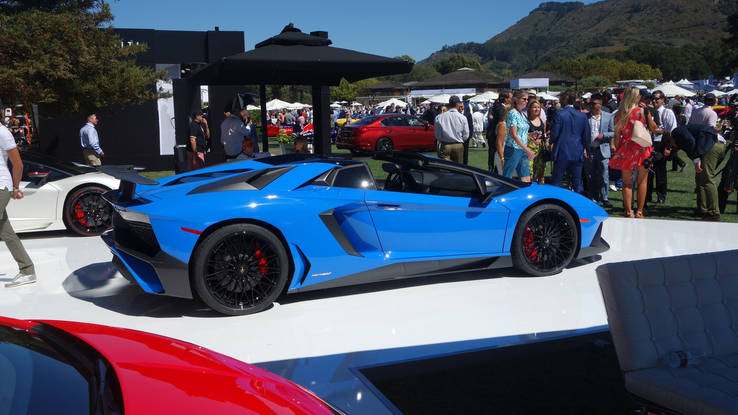
Lamborghini took to one of the biggest stages at Monterey car week to unveil its new Aventador LP 750-4 Superveloce roadster. An electric blue example premiered at The Quail, A Motorsports Gathering in Carmel Valley on Friday.

The SV roadster weighs 110 pounds less than the LP 700-4. Using the same 6.5-liter V12 as the hardtop, the SV roadster comes in with a power-to-weight ratio of 4.6 pounds per horse. Output stays at 740 hp at a stratospheric 8,400 rpm. Torque is rated at 509 lb-ft. A hard-shifting, if it’s anything like the hardtop, seven-speed ISR transmission sends power to all four wheels.

Lamborghini Aventador SV roadster i1

The Aventador goes on sale next year. Photo by Jake Lingeman

As with the coupe, the SV roadster comes with a magneto-rheological suspension, which can be firmed up or softened on demand, a pushrod damping system and Lamborghini’s adjustable steering.

The SV roadster gets a two-piece hardtop made from carbon fiber, both weighing less than 13 pounds. They stow in the luggage compartment, handy for when you’re out on the road and the rains start falling.

Deliveries start in 2016. The base price is $530,075.

Report: Lamborghini shelves Asterion in favor of Urus SUV

Share

  • Pinterest

Lamborghini has put the production Asterion coupe on the back burner in favor of bringing the Urus SUV to market in 2018, Autocar reports.

The Asterion LPI 910-4 debuted at the Paris Motor Show in 2014 in concept form, featuring a hybrid powertrain good for 910 hp and a design that departs from the Countach-inspired wedge shapes of virtually every Lamborghini model since the 1980s. The LPI part of its name stands for Longitudinale Posteriore Ibrido, that last term being the wonderfully Italian word for “hybrid,” with the coupe pairing the 5.2-liter V10 engine from the Huracan with three electric motors churning out an additional 300 hp.

The Asterion was a surprise when it broke cover, aiming at the McLaren P1, Ferrari La Ferrari, and the Porsche 918 Spyder. The hybrid supercar was very warmly received, with Lamborghini promising a 0 to 60 sprint time of just 3 seconds flat and a top speed of nearly 200 mph. The figure that surprised most, however, was the 57 mpg factory rating of the prototype and a pure-electric range of 32 miles.

The company is now playing down the production potential of the Asterion, indicating that it was meant largely as a technology demonstrator rather than something that was slated for production in the near to mid term.

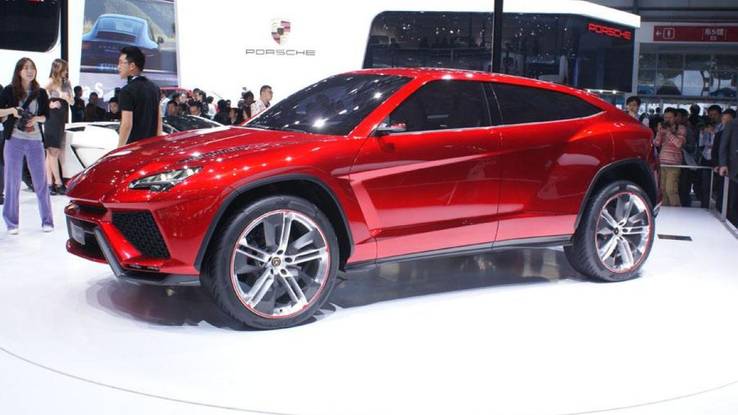
Lamborghini Urus concept

The Urus debuted in concept form in 2012. Photo by Autoweek

“It was built to show what we would do if the regulations forced us to have 30 miles of electric range as well as high-speed performance,” Lamborghini boss Stephan Winkelmann told Autocar. “Because of the weight of the batteries, we also took the opportunity to make the car bigger and roomier. We wanted to see customer reactions.”

Winkelmann indicated that a production version of the Asterion was now unlikely, with the company recently approving the Urus SUV which will share its underpinnings with the Bentley Bentayga and the Audi Q7. The Urus was greenlit weeks ago, and will be offered in most major markets for the marque with a goal of 3,000 units per year.

2016 Lamborghini Aventador SV

The Urus was first shown in concept form at the Beijing Motor Show in 2012, which means it will have taken Lamborghini more than six years to get the model into production by the time the first examples start rolling off the line at Sant’Agata Bolognese. The SUV, a first for the brand, is expected to be priced from approximately $230,000 which will in theory have it competing with its Bentley Bentayga sibling. But the relatively low production volumes and the different positioning of the two are not expected to cause headaches.

It remains to be seen whether the general design of the Urus as seen in Beijing will survive into production, though many observers are expecting hybrid tech borrowed from Audi.

Lamborghini Aventador SV Roadster drops its top, gets even more insane

Share

  • Pinterest

Look, we’re loath to engage in super-hyper-gigacar histrionics, but the 2016 Lamborghini Aventador SV is by all accounts (including our own) totally, absolutely, completely bonkers.

Apparently, the only way to make the 740-hp, 6.5-liter V12-powered SV — that stands for Superveloce, by the way — even more nuts is to adhere to the less-is-more philosophy. Which is why Lamborghini proceeded to chop off the poor car’s top.

The result is the just-announced Lamborghini Aventador LP 750-4 Superveloce Roadster. Like its hardtop stablemate, the Aventador SV Roadster gets that naturally aspirated V12 and, we presume, a similar 2.8-second 0-60 sprint. We’re sure it will feel faster, what with the wind in your hair and all.

2016 Lamborghini Aventador SV

Lamborghini announced the Aventador SV Roadster at the Goodwood Festival of Speed. Just 500 will be produced, making it even more exclusive than the coupe, which got a 600-car production run. Expect a pricetag somewhere north of $500,000.

The regular-ol’ Aventador Roadster offered plenty of high-power, high-dollar fun, and the Aventador SV is (intimidation factor aside) an on-track blast. We’ll be sure to bring you more info on this convertible as it becomes available.

Graham Kozak

Graham Kozak – Graham Kozak drove a 1951 Packard 200 sedan in high school because he wanted something that would be easy to find in a parking lot. He thinks all the things they’re doing with fuel injection and seatbelts these days are pretty nifty too.
See more by this author»

2016 Lamborghini Aventador SV first drive: Practice makes perfect

Share

  • Pinterest

What is it?

After more than 100 virtual laps of Barcelona’s Circuit de Catalunya in PS4’s “Project Cars,” we figured we were ready for the 740-hp earth-shaking Lamborghini Aventador Superveloce.

We’re glad we practiced.

The 2.9-mile, 16-turn track is rated for the fastest cars in the world, and Lamborghini let us strap into one. The SV takes the already-insane Aventador and cuts weight by 110 pounds, adds power and aero, and bumps the price from $404,695 to $493,095. The result? As you’d expect, it’s a beast to drive.

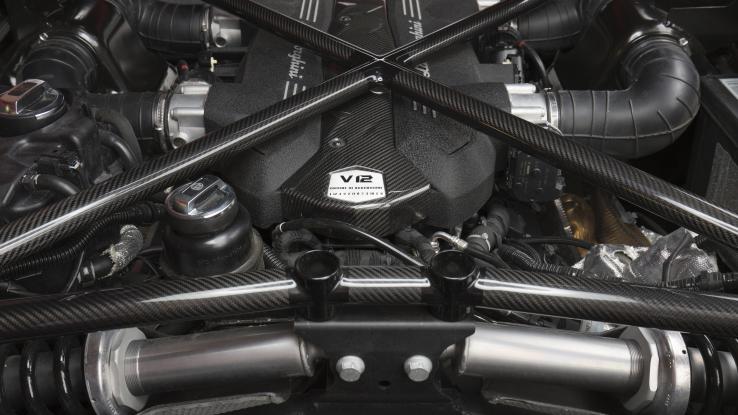
The 6.5-liter 60-degree V12 now spits out 740 hp (up from 691 hp) to go along with an unchanged 507 lb-ft of torque. Power is fed through a seven-speed Independent Shift Rod single-clutch transmission, leading to a physics-bending 0-60 sprint of 2.8 seconds. Getting to 124 mph takes 8.6 seconds, and top speed is well in excess of 200 mph.

2016 Lamborghini Aventador SV engine

The 6.5-liter 60-degree V12 now spits out 740 hp (up from 691 hp) to go along with an unchanged 507 lb-ft of torque. Photo by Lamborghini

What’s it like to drive?

Pulling out of the pits at Catalunya, we mashed the throttle, which in turn mashed our guts into our spine as the SV decided how much power to route to the rear wheels. Up to 60 percent can go forward, by the way, something we were thinking about when trying to negotiate tricky S turns later.

There’s great visceral joy in those g forces pressing on your chest relentlessly. Maybe something in our Cro-Magnon brain that says, “Your body isn’t made for this speed, you must have figured out how to fly!” The bark of the naturally aspirated V12 only makes the adrenaline pump harder, as if a hungry, mechanical dinosaur was hot on your hairy heels.

Acceleration is brutal, and comes in three stages. From 1,000 to 4,000 rpm, you get the feeling that this might be something special. From 4,000 to 6,000 rpm, your brain decides this is the fastest car on earth. Above 6,000 rpm? Most of your circuitry misfires, leaving you just scanning the track for danger approaching at 165 mph. Is it scary? Hell yes. Even for someone who’s used to triple digit speeds.


Scrubbing off the velocity is equally impressive, since you can shave 100 mph off this 3,595-pound time machine in a matter of seconds. During our first set of laps, the pedal felt rock solid, moving barely an inch before bringing things to a halt with the garbage-can-lid-sized carbon ceramic brakes discs. On our second session though, just as we were telling ourselves “these brakes are amazing, they’ll never hang us out to dry,” they hung us out to dry. There were several inches of difference in pedal travel after they heated up, which caused us to panic for split second, making the rear end dance a bit before we locked it into the 70-mph turn one.

Despite the brake dancing moment, grip is superb by all earthly standards, whether during acceleration, braking or turning. When we thought we were about to overcook things, the SV just pointed and went around (even on some of the turns where we went off-track in the simulator). The hard-shelled seats kept us in place perfectly, so don’t spring for the comfort option unless you plan to do a lot of grand touring.

After a few laps, we put the SV in “Corsa” or race mode, which tightens up the steering significantly, buttons down the F1-style pushrod suspension and quickens the ISR transmission to 50-millisecond shifts. We asked why the company went with the traditionally jerky single-clutch transmission and they told us it was both for weight, and for keeping that racy feel. In that latter point they succeeded: At full bore the Aventador SV kicks into the next gear hard, sometimes upsetting your weight balance in a turn. And that’s a scary place to be, knowing you need to upshift as you come out of a corner, but having to prepare for the kick, which could send you careening off the track. It happens less in Corsa than in other modes (which drop even more torque during gear changes). We only used the paddles to shift, but we hear it has an automatic mode too.

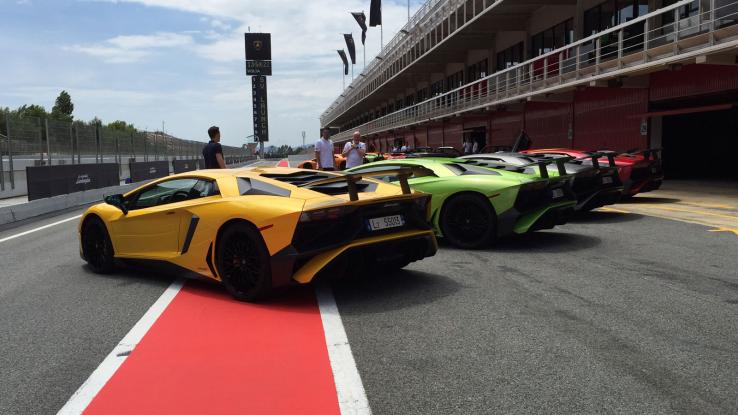
2016 Lamborghini Aventador SVs at Catalunya

Pick a color, any color. Photo by Jake Lingeman

We say this car is scary, but “thrilling” is a more apt descriptor. Once you’re locked into a sweeper, you both want to go both faster and slower. You can feel the weight in the rear, wanting to pull you out, but the faster you go, the more it seems to stick. Some of that is all the extra aero help Lamborghini adds to the SV, but credit also has to go to the Pirelli tires, 255/35 ZR20 in front, 355/25 ZR21 in back.

Going back to those practice laps in “Project Cars,” they definitely helped: We could put the rear-engine Porsche GT3 through Catalunya’s turn one at about 70 mph — very close to the speeds we experienced in the SV. Top speeds were similar too. We got the GT3 up to about 170 mph, virtually, before slowing at the end of the front straight, and could muster about 160 mph in the Aventador SV. Braking points were noticeably different though, so keep that in mind should you ever get a chance to test a real car on track you’ve virtually mastered.

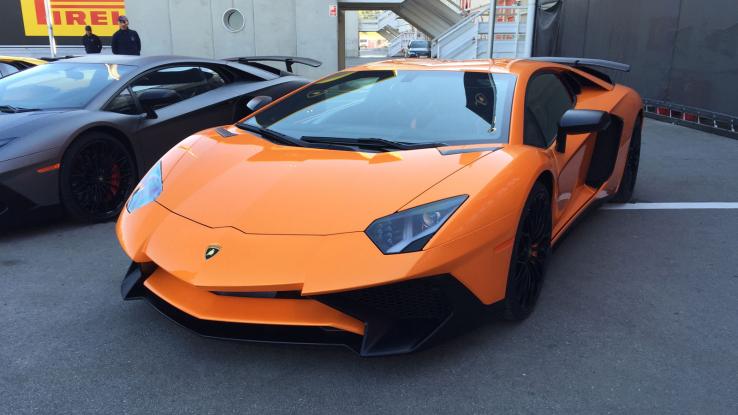
Lamborghini Aventador LP750-4 Superveloce

Do I want it?

If you do, you’ll have to act fast. Lamborghini is only building 600 examples of this car, and about 500 are sold.

The Aventador SV is the most extreme car from what’s arguably the most extreme car company. If you’re in the market for a supercar and you don’t mind people shrieking in delight as you pass by, this should be on your wish list. Just take some practice laps before you head out on to the street.

On Sale: Now

As Tested Price: $493,095

Drivetrain: 6.5-liter V12, seven-speed single-clutch Independent Shift Rod transmission

Output: 740 hp at 8,400; 507 lb-ft at 5,500

Curb Weight: 3,595 (est.)

0-60 MPH: 2.7 seconds

Options: None

Rambo Lambo, Part II: Lamborghini SUV coming in 2018; will be built in Italy

Share

  • Pinterest

Lamborghini will produce its new SUV at its Sant’Agata Bolognese plant in Italy, with the model due to enter the market in 2018, the company said today.

Lamborghini said it will hire 500 new employees, almost double the physical size of its plant in Italy’s Emilia Romagna region and invest “hundreds of millions of euros” in the project over the life cycle of the vehicle.

Lamborghini, part of the Volkswagen group, hopes the SUV will allow it to repeat sister brand Porsche’s success in the fast-growing market for luxury SUVs and boost profitability. The SUV’s targeted volumes of around 3,000 vehicles per year will more than double the company’s deliveries, which stood at 2,530 vehicles last year.

“The introduction of a third model signifies for us the beginning of a new era,” Lamborghini CEO Stephan Winkelmann said in a statement.

Winkelmann and Italy’s Prime Minister Matteo Renzi met in Rome today to sign a letter of intent for Italian production of the SUV. A source told Reuters on Tuesday that Italy’s government provided tax breaks and incentives for a total of up to 90 million euros ($98 million) to encourage Lamborghini to base the production of the new model in the country.

This week in 1988: Driving the Lamborghini LM002

This week in 1988: Driving the Lamborghini LM002

This week in 1988 finds us piloting the thrill-inducing Lamborghini LM002 — aka Rambo Lambo — for a drive review. The sharp-edged, brute of a truck served little practical purpose, but it sure did …

With the SUV, Lamborghini will mainly target SUV customers in markets such as the United States, China, the Middle East, the UK, Germany and Russia. The carmaker also hopes to expand its customer base to families and other clients new to the high-performance supercar brand.

Lamborghini gave no technical details of the SUV. When it unveiled the Urus at the Beijing auto show in 2012, the company said the production version would target an output of 600 horsepower. It would use lightweight materials for its structure and body shell to offer the best fuel economy and lowest CO2 emissions figure of all comparable vehicles, Lamborghini said, with widespread use of carbon-fiber reinforced plastics, including the seats.

Reports at the time said the SUV likely would use an upgraded 552-hp V10 gasoline unit powering the brand’s Gallardo.

Bizarre Transformers combiner features Maserati Kubang Lamborghini Urus Terradyne Gurkha and more

The SUV will share a VW Group platform with the Porsche Cayenne, the Audi Q7, Volkswagen Touareg and Bentley Bentayga. Fears were raised in Italy that the Lamborghini SUV could be built in VW’s Slovakia plant, which builds the Q7 and Touareg, as well as bodies-in-white for the Cayenne. The factory will build body shells for the Bentayga for final assembly at the brand’s plant in Crewe, England.

Lamborghini’s decision to base the model in Italy follows a similar move by Fiat Chrysler, which began producing its new Jeep Renegade and Fiat 500X models at a plant in southern Italy last year, also boosting employment.

Both companies are helped by labor reform that was approved by Renzi’s government earlier this year. In a bid to tackle chronically high unemployment, the reform has eased firing restrictions in large firms and offers fiscal incentives to employers that offer workers permanent contracts.

Automotive News Europe contributed to this report

Lamborghini to build SUV in Italy, launch planned for 2018 originally appeared on Automotive News

By Automotive News Europe, Reuters

Lamborghini Polo Storico will restore your vintage Lambo, reproduce unobtanium parts

Share

  • Pinterest

Automobili Lamborghini S.p.A. has always prided itself on staying young. For owners of its not-so-young cars, that often meant paying ungodly sums of money (sometimes in currencies they didn’t know how to pronounce or convert properly) to source a panel for a 400GT dented by a careless SUV owner who apparently couldn’t find anywhere else to park.

Those days will soon be over, with Lamborghini launching their very own Polo Storico restoration center which will service cars, provide historical records, perform concours-grade restorations and produce parts from original dies. Whether this will make buying a Lamborghini Urraco you found in the back of a British classic car magazine advertised for the price of a new Ford Fiesta less of a gamble is another question, but at least now there will be the option of sourcing OEM parts fresh from the factory.

Lamborghini Polo Storico is also planning to digitize historical papers, technical schematics, images and all literature ever produced by the company — materials which until this point in time existed only on paper. Owners of classic Lamborghini cars, ranging from the Miura to the latest models, will also have the option of having their car evaluated by a technical committee for historical accuracy and receiving a certificate from the factory attesting to the authenticity of all of its parts…or at least some of its parts.

Lotus Carlton

Lamborghini Espada

The Polo Storico will feature a technical committee which will evaluate cars for authenticity. Photo by Jay Ramey

Since Polo Storico will also produce original spare parts for historic models, owners of less-than-original examples will be able to rip out things hastily fitted to their cars three owners back and replace them with materials and parts created by the factory.

The launch of a classic division by Sant’Agata follows the creation of a similar department by Land Rover just last week, with Lamborghini set to join other automakers’ classic car service and restoration divisions.
 

Passenger killed at Walt Disney World’s Exotic Driving Experience

Share

  • Pinterest

A passenger was killed at a pay-for-play exotic-car driving event. This one happened at Walt Disney World in Florida when driver Tavon Watson, 24, lost control of a Lamborghini Gallardo Superleggera and hit a guardrail, killing Gary Terry, 36, who was an employee of Exotic Driving Experience.

This accident comes after last year’s amateur stock-car racing death at the Rusty Wallace Experience at Kentucky Speedway.

The Florida Highway Patrol says that Watson “failed to maneuver” the Lamborghini Gallardo around the exotic racing course, which includes some s-turns, hairpins and half the oval at Walt Disney World Speedway in Lake Buena Vista. Terry died at the scene; Watson was treated and released.

Details still scarce regarding stock car related death at Rusty Wallace Driving Experience

Few details in Kentucky Speedway death

Rusty Wallace’s racing organization is trying to determine what caused the death of an Indiana man at a fan driving event bearing the former NASCAR driver’s name.Stephen Cox of Decatur, Ind., …

Disney World’s exotic driving experience lets visitors take six, eight or 10 laps in a Porsche 911, Ferrari 430 or 458, Lamborghini Gallardo, Audi R8 or Nissan GT-R, or participants can let a professional take the wheel for two high-speed laps. Customers have to sign a waiver to participate, then are shown a 5-minute safety video before spending 45 minutes with the instructor. All of that is prior to the drive.

Richard Petty released a statement on Monday afternoon.

“The entire Petty family, and everyone associated with Petty, is deeply saddened by the passing of Gary Terry yesterday.  Our prayers go out to his family and everyone affected by this tragedy.  We are all thinking about the family and friends of Gary and all the employees of the Exotic Driving Experience.”

According to the Florida Highway Patrol, the accident is still under investigation.

2016 Lamborghini Aventador Superveloce to touch down at Amelia Island Concours

Share

  • Pinterest

The Lamborghini Aventador LP 750-4 Superveloce debuted earlier this month at the Geneva auto show, but this weekend it will put wheels to American soil (or at least some highly manicured grass) for the first time at the Amelia Island Concours d’Elegance.

If you forgot how big numbers work, let us throw some at you. Twelve, as in the number of cylinders; 6,500, its output in cubic centimeters; 740, the number of ponies in the barn; and 2.8, the number of seconds it takes to hit 62 mph. Throw 509 lb-ft of twist at it and drop 110 pounds from the standard Aventador. That’s what makes a Superveloce. Top speed is an insane 217 mph.

Lamborghini Aventador LP750-4 Superveloce

The Superveloce features Lamborghini’s pushrod suspension system. The adaptive Magneto Rheological Suspension counteracts body roll in the corners, as well as brake dive. The company’s Dynamic Steering system, meanwhile, adapts the steering ratio to the selected driving mode and road speed, working to achieve greater stability at high speed.

The Superveloce goes on sale this summer. Pricing hasn’t been revealed but the Aventador comes in at $397,000. We could easily see a price near $500K for this boss-of-bosses Lamborghini.

The 2015 Amelia Island Concours starts March 12 with the RM Sotheby’s sale preview, and ends March 16 with the Concours d’Elegance. General admission tickets cost $100. Visit our Amelia Island home page or ameliaconcours.org for more information.

Geneva auto show wrap-up: All of the reveals here

Share

  • Pinterest

Press days for the Geneva auto show have wrapped up. We saw big sports car reveals from McLaren, Aston Martin and Glickenhaus, as well as luxury upgrades from Bentley and a final edition from Bugatti. Soon, we’ll get all the supercars together for a bench racing session, until then, enjoy everything the Geneva auto show had to offer.

Audi Q7 E-Tron Quattro

The all electric Aston Martin DBX concept traverse Fury Road in Post Peak Oil comfort

Aston Martin Vulcan for Geneva

Aston Martin Vantage GT3

Bentley EXP 10 Speed 6 concept Geneva motor show gallery

2015 Bentley Continental GT set for Geneva auto show debut

Bugatti builds last Veyron will debut it at Geneva auto show

2016 Ford Focus RS Geneva motor show news

Ferrari 488 GTB heads to Geneva

Lamborghini Aventador LP750-4 Superveloce

Scuderia Cameron Glickenhaus 003 i1

2015 Honda Civic Type R Geneva auto show

Infiniti QX30 concept for Geneva

Koenigsegg Regera for Geneva auto show

Kahn Design Flying Huntsman concept truck

Lexus LF SA concept A razor egg from space debuts in Geneva

McLaren 675LT longtail for Geneva

McLaren P1 GTR for Geneva

2016 Mercedes AMG GT3 gets a huge 63 liter V8 side pipes and a whole lot of attitude

Porsche 911 GT3 RS

Volkswagen Sport Coupe Concept GTE

About the Geneva motor show

The 2014 Geneva motor show runs March 6-16 and is expected to attract a range of production and concept cars as diverse as the Jeep Renegade and the new Koenigsegg One:1. Check out Autoweek’s complete coverage at autoweek.com/geneva-auto-show.

– See more at: http://autoweek.com/article/car-news/denmarks-zenvo-st1-supercar-lurks-geneva-auto-show#sthash.zLiUkzRh.dpuf

About the Geneva motor show

The 2014 Geneva motor show runs March 6-16 and is expected to attract a range of production and concept cars as diverse as the Jeep Renegade and the new Koenigsegg One:1. Check out Autoweek’s complete coverage at autoweek.com/geneva-auto-show.

– See more at: http://autoweek.com/article/car-news/denmarks-zenvo-st1-supercar-lurks-geneva-auto-show#sthash.zLiUkzRh.dpuf

About the Geneva motor show

The 2014 Geneva motor show runs March 6-16 and is expected to attract a range of production and concept cars as diverse as the Jeep Renegade and the new Koenigsegg One:1. Check out Autoweek’s complete coverage at autoweek.com/geneva-auto-show.

– See more at: http://autoweek.com/article/car-news/denmarks-zenvo-st1-supercar-lurks-geneva-auto-show#sthash.zLiUkzRh.dpuf

About the Geneva auto show

The 2015 Geneva auto show runs from March 5-15 and will attract a diverse array of micros, sedans and supercars including the Aston Martin Vulcan, McLaren P1 GTR and Audi R8 V10. Check out Autoweek’s complete coverage at our Geneva motor show page.

Faster, lighter Lamborghini Aventador LP750-4 SuperVeloce debuts at Geneva auto show

Share

  • Pinterest

Four years after the debut of the original Aventador, Lamborghini has brought a lighter and more powerful version to the Geneva motor show. Dubbed the Aventador LP750-4 SuperVeloce, the SV is meant to be offered alongside the “base” version of Sant’Agata’s V12 all-wheel-drive bull.

The 6.5-liter V12 engine and the seven-speed automated manual transmission remain the same for this version of the Aventador, but Lamborghini has reworked the intake system, the valve timing and the exhaust system. As a result, the car churns out an impressive 740 hp. That’s up from 691 hp in the regular Aventador. While the horsepower output has received a noticeable hike, the torque output remains at 509 lb-ft. In case you’re wondering where the number 750 in the name comes from: That’s the metric horsepower rating of the newly tweaked supercar. Further, the car manages to shed aproximately 110 pounds of weight.

“The new Aventador SuperVeloce continues the Lamborghini tradition of SV models, pushing the boundaries in terms of performance and pure driving emotion,” says Stephan Winkelmann, president and CEO of Automobili Lamborghini. “The original Aventador was presented four years ago, and the SuperVeloce pays homage to its passionate owners, as well as the fan community whose enthusiasm has resulted in the biggest commercial success ever of a Lamborghini V12 super sports car. In the SuperVeloce, Lamborghini’s expertise in lightweight engineering is clearly evident. With technological features which, combined with design, quality standards and craftsmanship, the SuperVeloce results in the most exclusive, pure and emotional production model in the history of our brand.”

Lamborghini Aventador LP750-4 Superveloce rear

The Lamborghini Aventador LP750-4 Superveloce now produces 740-hp and 509 lb-ft of torque. Photo by Lamborghini

Lamborghini says that the Aventador 750-4 SuperVeloce is now good for a 0-62 mph sprint of 2.8 seconds and a top speed in excess of 217 hp. Suddenly, Brabus’ 850 6.0 Biturbo Coupe starts to make a bit more sense.

The weight savings were achieved by making several exterior components, such as the door panels, engine cover and rear wing from carbon fiber — the weight-loss material of choice when it comes to just about any sports car.

The Aventador LP750-4 SuperVeloce still features Lamborghini’s pushrod suspension system. The adaptive Magneto Rheological Suspension couteracts body roll in the corners, as well as brake diving. The company’s Dynamic Steering system, meanwhile, adapts the steering ratio to the selected driving mode as well as road speed, working to achieve greater stability at high speed.

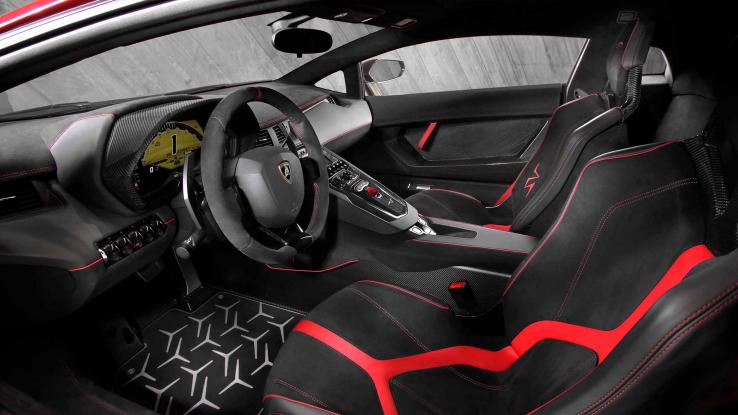
 Lamborghini Aventador LP750-4 Superveloce interior

The interior has also received an exclusive color pattern. Photo by Lamborghini

Lamborghini’s SV models date all the way back to the svelte Miura, though just about every model has since featured an SV variant. A large racing-style rear wing will be the most obvious tell-tale element of the new Aventador LP750-4 SuperVeloce, and like its predecessors the supercar will also feature large (but not too large) SV lettering on the sides.

About the Geneva motor show

The 2014 Geneva motor show runs March 6-16 and is expected to attract a range of production and concept cars as diverse as the Jeep Renegade and the new Koenigsegg One:1. Check out Autoweek’s complete coverage at autoweek.com/geneva-auto-show.

– See more at: http://autoweek.com/article/car-news/denmarks-zenvo-st1-supercar-lurks-geneva-auto-show#sthash.zLiUkzRh.dpuf

About the Geneva motor show

The 2014 Geneva motor show runs March 6-16 and is expected to attract a range of production and concept cars as diverse as the Jeep Renegade and the new Koenigsegg One:1. Check out Autoweek’s complete coverage at autoweek.com/geneva-auto-show.

– See more at: http://autoweek.com/article/car-news/denmarks-zenvo-st1-supercar-lurks-geneva-auto-show#sthash.zLiUkzRh.dpuf

About the Geneva motor show

The 2014 Geneva motor show runs March 6-16 and is expected to attract a range of production and concept cars as diverse as the Jeep Renegade and the new Koenigsegg One:1. Check out Autoweek’s complete coverage at autoweek.com/geneva-auto-show.

– See more at: http://autoweek.com/article/car-news/denmarks-zenvo-st1-supercar-lurks-geneva-auto-show#sthash.zLiUkzRh.dpuf

About the Geneva auto show

The 2015 Geneva auto show runs from March 5-15 and will attract a diverse array of micros, sedans and supercars including the Aston Martin Vulcan, McLaren P1 GTR and Audi R8 V10. Check out Autoweek’s complete coverage at our Geneva motor show page.

2015 Lamborghini Huracán LP 610-4 ice drive: Raging bull vs. frozen Swedish lake

Share

  • Pinterest

It’s tough to think of a car less likely to see action when the snow flies than the 2015 Lamborghini Huracán LP 610-4. Permanent all-wheel drive and optional heated seats notwithstanding, you just don’t hear about many of these V10-powered super-sports cars doing ski chalet shuttle duty.

Yet there’s something noble about making the counterintuitive choice — selecting, if not the wrong tool for the job, then at least the less obvious one. So it’s fortunate that, when we returned to Arjeplog, Sweden recently, there was a small fleet of 2015 Lamborghini Huracán LP 610-4s waiting for us. What a coincidence!

Unlike last year’s quest to a different frozen near-Arctic Swedish lake to test the Volkswagen Golf R, the weather was suboptimal this time around: Temps hovering just above freezing ensured that the super-slick lake surface was covered with ugly puddles of slush, creating a fairly reasonable facsimile of Detroit’s winter roads–though there were fewer potholes to contend with.

Lamborghini claimed it had no tricks up its sleeve. The Huracáns we were to test were retail-ready models, same as the ones produced at a rate of 12 per day at the company’s Sant’Agata Bolognese factory. (Traditional family values seem to prevail there: despite a lengthy wait list, workers take the weekend off.)

The testers came equipped with Pirelli Winter Sottozero 3 tires, not the ultra-aggressive studded snows that are fun on ice but illegal on nearly all U.S. roads. Also production-spec was the alphabet soup of onboard safety and performance systems: LDS, ESC, 4WD, ABS, and something called the LPI — more on that in a moment. It’s all there to tame what might otherwise be an unwieldy beast, and give the 602-hp bull some of the sure-footed nimbleness of, say, a mountain goat.
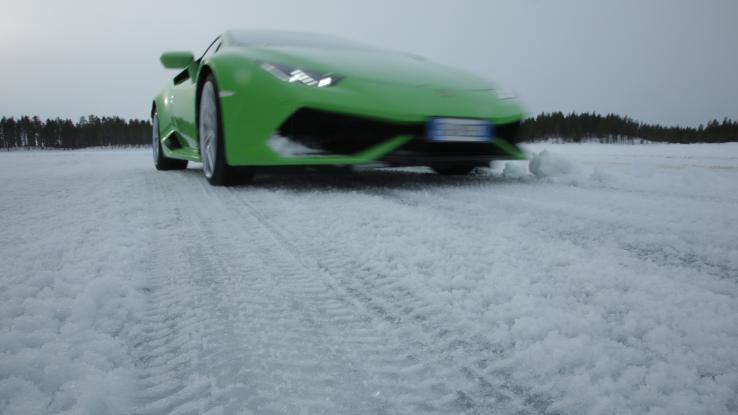
Photo 2015 Lamborghini Huracan LP 610-4 Swedish ice drive lake surface 1

The weather wasn’t great, with a layer of slush coating the icy lake surface. Photo by Lamborghini

Not that you’d ever know it from our first moments behind the wheel. Things got off to a slow, steady and slightly sideways start on the 1,000-foot circle track, until we tried driving with traction control off. We looped the car. We tried again. We looped again. It was more humiliating than anything else; there are few consequences to wiping out on an obstacle-free frozen lake.

But our lack of confidence was a killer. One of Lamborghini’s taglines for the Huracán is “instinctive technology,” and after some time in the car it actually seems like something more than a buzzy slogan: You get the impression that it can sense fear. Or more accurately in our case, embarrassment.

Test driver Marco Passerini, a roughly 20-year Lamborghini veteran, soothed us with his calm demeanor and sage advice, building back our confidence through a slalom course. Watching pro drivers spin out on the deteriorating track helped us loosen up, too. When you calm down and begin to enjoy yourself, the car seems to respond in kind and it becomes easy and rewarding to set up for effortless oversteer. Tap the brakes ahead of the corner, turn the wheel, wait for the predictable rotation — then firmly, confidently give it throttle, throttle and more throttle. The engine roars. It’s a good, organic sound. You’ll like it.

At these speeds — between, say, 25 mph and 55 mph — shifting isn’t much of a consideration; you’ll spend most of your time in second or third gear. You can lazily, or not-so-lazily, slide through corners sideways in “sport” mode, or switch to “corsa” if you’re gunning for maximum speed — this track-oriented drive mode sends more torque to the front wheels to help drag you out of corners. Switch ESC off if you desire, but leave the comfortable “strada” mode for highway driving; it’s not every day that you get to slide across a frozen lake.

Differences between modes, each selectable through the Huracán’s ANIMA system (that stands for “Adaptive Network Intelligent Management”), were readily apparent in these extreme low-traction conditions. Which is better is a matter of opinion. Passerini was said to prefer the feel of the rear-biased sport; Mario Fasanetto, another driver who began his Lamborghini career as a tech in the 1990s, leaned toward Corsa. That’s the joy of selectable drive modes. You can have it your way; both are Italian-test-driver-approved.

“I am very happy for you,” Passerini said sincerely (we think), shaking our hand after a fairly solid run on a 1.4-mile circuit. “This improvement was after a short time driving. Give it one, two more hours…” If only.
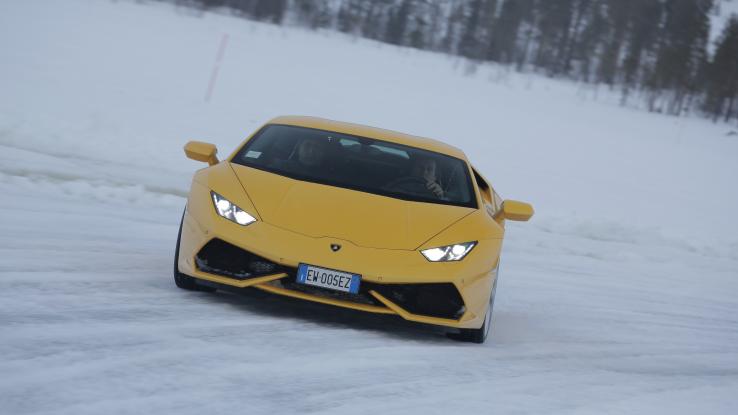
Photo 2015 Lamborghini Huracan LP 610-4 Swedish ice drive yellow

Your author getting semi-sideways. This is after a few embarrassing total losses of traction. Photo by Lamborghini

As we warmed up after the drive, we sat down with vehicle dynamics engineer Lorenzo Rinaldi. He’s been at Lamborghini for going on eight years — not bad for a first gig straight out of Polytechnic University of Turin’s automotive program. Dressed head to toe in Lamborghini gear, including a pair of 50th anniversary pants (surprisingly tasteful), he was proud of what his team accomplished with the Huracán and eager to tell us anything and everything we wanted to know about its guts in terms we could mostly understand.

Take the Lamborghini Piattaforma Inerziale, or inertial platform, a little aerospace-derived box containing a set of accelerometers and gyroscopes. The tech behind the LPI isn’t exactly an industry first; similar systems are used by engineers in the development phase of nearly every car on the road, and aftermarket systems are available to track day enthusiasts, explains Rinaldi. (Incidentally, Honda’s early-1980s Electro Gyrocator pre-GPS navigation system, which may or may not have been installed a couple of Accords, operated on the same principles.)

The key difference here is that Lamborghini decided to keep the inertial platform for production. It’s mounted at the Huracán’s center of gravity, tucked just behind the seats. Think of it as a sort of mechanical vestibular center tasked with measuring the Huracán’s yaw, pitch and roll in real time — then feeding that information to the aforementioned alphabet soup of onboard performance and safety systems.

Ideally, everything works in perfect harmony to deliver maximum performance, seamlessly and under any road and climatic conditions. It’s the kind of thing that you wouldn’t notice unless it was switched off, at which point the senses and reactions of the car’s many performance and safety systems would feel somewhat dulled.

Making it all play nicely together can be tricky. “Sometimes you control a movement of the body with the [incorrect] system,” Rinaldi says. “Maybe you try to control it with the damper, but it’s better to send torque to the front wheels — or to one wheel. It depends.” These potential conflicts are hashed out in the development process; on production cars, the complex ESC system tends to take precedence.
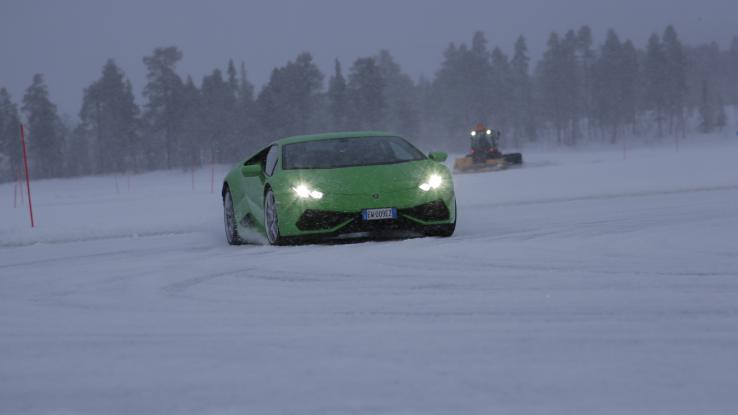
Photo 2015 Lamborghini Huracan LP 610-4 Swedish ice drive Photo 17

The Lamborghini’s eye-poppingly bright colors mean that if you do end up in a snow bank, snow patrol won’t have to struggle to find you. Photo by Lamborghini

Lamborghini likes to think all this added complexity is worth it. On a car like the Huracán, at least — don’t expect to find it on your next crossover. First, it costs too much for the vast majority of production cars. Second, according to Rinaldi, “You need a car that can react.” The Huracán’s carbon fiber/aluminum composite chassis is stiff enough — 50 percent stiffer than the Gallardo, in fact — to take full advantage of the roughly 10 millisecond input/response cycle achievable with the LPI.

Lamborghini’s engineers are “really satisfied” with the results of the Huracán program, Rinaldi tells us, and we’re inclined to echo the sentiment. “You’ve driven in these conditions, in which you cannot stand, cannot walk. And you can do it at 80 kph.” Indeed. You’ll have the time of your life doing it, too. That 600-plus hp could ever be controllable, much less enjoyable on ice is something we shouldn’t take for granted.

Yet there’s this nagging feeling that reliance on an always-active digital nervous system detracts from a sports car’s purity, however unquantifiable that factor might be. It feels philosophically wrong, somehow. Rinaldi seems to sympathize: “We talk about it a lot, because some of us, probably all of us, think that passive [systems] are more ‘pure.’” The reality is that Lamborghini dealerships sells cars to normal, if well-heeled, people — not just the one-in-a-million pro-level drivers skilled enough to drive them flat-out.

The challenge is to find some sort of balance that lets the average buyer enjoy 90 percent of what the car has to offer — and do it safely, whether on dry tarmac or icy pavement. The Huracán is, according to Rinaldi, “in the end, not so pure like a car from the 1980s. But it gives you the chance to be faster. We can stop everything and say we’d like to have everything passive, but the world is moving on — and when you make a mistake, the car can help you.”
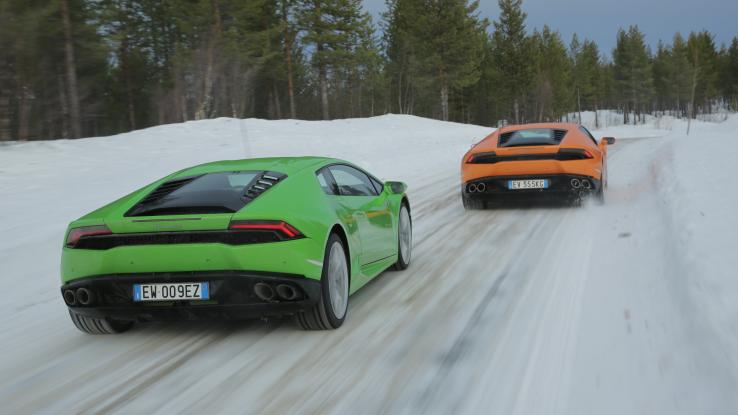
Photo 2015 Lamborghini Huracan LP 610-4 Swedish ice drive green orange rear

Think you could fit a ski rack back there? Photo by Lamborghini

We’re part of the crowd that’d be lucky to get 90 percent out of a car like the Huracán. You’re very probably right there beside us, and if you think otherwise, well, we’re always thrilled to learn that there are professional drivers in our audience. Set machismo aside for a moment and recognize that, with its combination of excellent chassis design, naturally aspirated power and technological wizardry, the Huracán is almost certainly more capable than you are. Recognize that this fact enables you to do some truly ridiculous things with it.

That, more than anything else, is what we took away from the ice drive experience. Watching the small fleet of brightly colored cars kick up powder as they slipped sideways through icy corners, falling snow muffling screaming V10s in the early Scandinavian twilight — the whole scene was so incongruous that it somehow felt right.

If one in 100 Huracán owners takes his car to the track regularly, then perhaps one in 1,000 contemplates using it as a $250,000 winter beater. That, in our mind, makes it the ideal car for cold-weather driving. It’s certainly, if improbably, up to the task — provided you are. The roughly nine-month wait from when you place your order to when you take delivery should give you plenty of time to find a suitable ski rack.
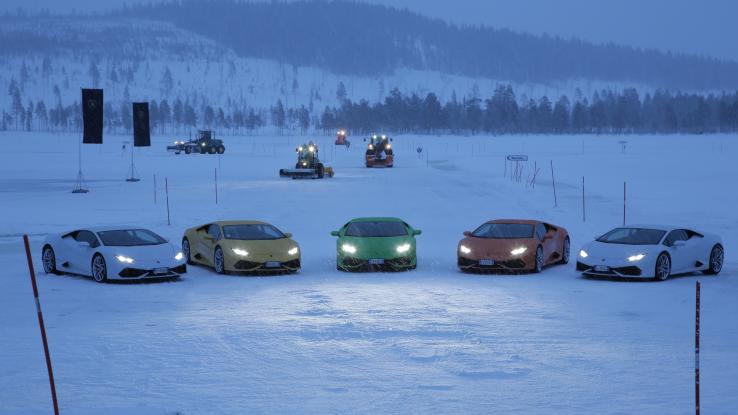
Photo 2015 Lamborghini Huracan LP 610-4 Swedish ice drive night lake 1

When it’s winter near the Arctic Circle, the sun doesn’t stick around for too long. Photo by Lamborghini

Graham Kozak

Graham Kozak – Graham Kozak drove a 1951 Packard 200 sedan in high school because he wanted something that would be easy to find in a parking lot. He thinks all the things they’re doing with fuel injection and seatbelts these days are pretty nifty too.
See more by this author»

On Sale: Now

Base Price: $241,945

Drivetrain: 5.2-liter V10; all-wheel drive; seven-speed dual-clutch automatic

Output: 602 hp @ 8,250 rpm; 412 lb-ft @ 6,500 rpm

Curb Weight: 3,135 lb

0-60 MPH: 3.2 seconds (0-62 mph)

Fuel Economy: 14/20/16(EPA City/Hwy/Combined)

Lamborghini unveils Huracan GT3 racer for Blancpain Endurance Series

Share

  • Pinterest

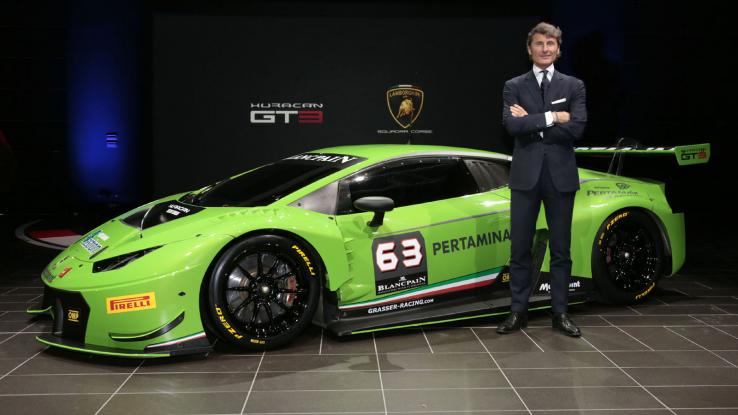
The Lamborghini Huracan showed off its GT3 upgrades on Wednesday at the company headquarters in Sant’Agata Bolognese, Italy. It will take to the starting grid in, among other places, Europe’s Blancpain Endurance Series.

The Huracan GT3 gets an aluminum-carbon chassis and a full FIA-compliant roll cage, according to Lamborghini. The subframe has been modified from the stock configuration to accommodate a high-performance radiator in the front and better positioning for the gearbox in back. Curb weight is pegged at 2,731 pounds, about 400 pounds less than the stock car.

The new bodywork was completed with help from Dallara Engineering and is tuned for maximum traction on asphalt. The new aero, with fast fittings for quick removal, allows improved cooling of the brake system. The rear wing and front diffuser are both adjustable. Front and rear lights are full LED and the multifunction steering wheel was redesigned by racing specialists at OMP.

Lamborghini Huracan GT3 1

The GT3 wears 15-inch brake discs in front with six-piston calipers and 14-inch discs in back with four-piston clampers. Like a true racecar, the Huracan GT3 gets a pneumatic lift system.

Inside, the GT3 comes with carbon frame seats, a fire extinguisher system and a roof hatch that is removable for medical emergencies. The seatbelts are from OMP and the pedals are adjustable.

The Huracan uses the same direct-injection V10 as the road car, managed by a Bosch Motorsport control box that also governs the traction control, transmission and dashboard. Lamborghini says all the wiring and connectors are designed for racing. A six-speed sequential gearbox sends power to the rear wheels only. Exact output numbers haven’t been revealed, and may vary depending on the race series.

The GT3 wears 15-inch brake discs in front with six-piston calipers and 14-inch discs in back with four-piston clampers. Like a true race car, the Huracan GT3 gets a pneumatic lift system.

Starting this year, it will compete in the Blancpain Endurance Series over five races in Europe, not to be confused with the Blancpain Super Trofeo Series, including the Spa-Francorchamps 24-hour race.

The Huracan GT3 comes in at 369,000 euros, or about $427,000.